CN109766243B - Multi-core host performance monitoring method based on power function - Google Patents
Multi-core host performance monitoring method based on power function Download PDFInfo
- Publication number
- CN109766243B CN109766243B CN201910002409.XA CN201910002409A CN109766243B CN 109766243 B CN109766243 B CN 109766243B CN 201910002409 A CN201910002409 A CN 201910002409A CN 109766243 B CN109766243 B CN 109766243B
- Authority
- CN
- China
- Prior art keywords
- cpu
- performance
- host
- core
- critical value
- Prior art date
- Legal status (The legal status is an assumption and is not a legal conclusion. Google has not performed a legal analysis and makes no representation as to the accuracy of the status listed.)
- Active
Links
- 238000000034 method Methods 0.000 title claims abstract description 15
- 238000012544 monitoring process Methods 0.000 title claims abstract description 11
- 230000006870 function Effects 0.000 claims abstract description 21
- 230000002159 abnormal effect Effects 0.000 claims abstract description 19
- 230000007423 decrease Effects 0.000 claims description 14
- 238000004590 computer program Methods 0.000 claims description 7
- 238000012806 monitoring device Methods 0.000 claims description 2
- 238000004458 analytical method Methods 0.000 description 13
- 230000005856 abnormality Effects 0.000 description 4
- 238000004364 calculation method Methods 0.000 description 3
- 238000013480 data collection Methods 0.000 description 2
- 238000011156 evaluation Methods 0.000 description 2
- 238000007792 addition Methods 0.000 description 1
- 238000004422 calculation algorithm Methods 0.000 description 1
- 238000007405 data analysis Methods 0.000 description 1
- 238000010586 diagram Methods 0.000 description 1
- 238000005516 engineering process Methods 0.000 description 1
- 238000012986 modification Methods 0.000 description 1
- 230000004048 modification Effects 0.000 description 1
Images


Landscapes
- Debugging And Monitoring (AREA)
Abstract
Description
技术领域technical field
本发明属于信息技术领域,具体涉及一种针对多核主机的性能分析方法。The invention belongs to the field of information technology, and in particular relates to a performance analysis method for a multi-core host.
背景技术Background technique
目前,主机都已采用多核CPU,少则4核CPU,多则64核CPU。CPU利用率是主机性能分析的主要依据,通过CPU利用率的高低来反映CPU运行的繁忙程度,同时反映该主机运行的繁忙程度。以往主机只有单核CPU,通过一个CPU的利用率能够反映出主机的运行情况。但主机多核情况下,每个核都有各自的CPU利用率,因此无法通过一个核的CPU利用率来反映主机的运行情况。多核情况下,每个CPU都代表该主机的一部分运算能力,一个或者部分CPU利用率高,并不能表示该主机运行繁忙,因为该主机还有其它利用率低的CPU,可以提供运算能力。所以需要检查所有CPU利用率情况才能判断主机的运行情况。At present, the host has adopted multi-core CPU, ranging from 4-core CPU to 64-core CPU. The CPU utilization is the main basis for the performance analysis of the host. The CPU utilization is used to reflect the busyness of the CPU and the busyness of the host. In the past, the host had only a single-core CPU, and the utilization of one CPU could reflect the running status of the host. However, in the case of a multi-core host, each core has its own CPU utilization, so the running status of the host cannot be reflected by the CPU utilization of one core. In the case of multiple cores, each CPU represents a part of the computing power of the host. High utilization of one or part of the CPUs does not mean that the host is busy, because the host has other CPUs with low utilization that can provide computing power. Therefore, it is necessary to check all CPU utilization to judge the operation of the host.
现在已有的网络管理系统实现对主机单核CPU性能进行分析与监控,通过SNMP获取主机每核CPU的运行参数,因为不能全面反映所有CPU的运行情况,所以这种算法往往带来很大偏差。本发明提供一种方法,采用幂函数计算多核CPU利用率,得到主机CPU综合性能指标,来准确反映CPU的运行状态,从而提高对主机性能状态的分析监控能力。The existing network management system can analyze and monitor the performance of the single-core CPU of the host, and obtain the operating parameters of each core CPU of the host through SNMP. Because it cannot fully reflect the operation of all CPUs, this algorithm often brings great deviations. . The invention provides a method for calculating the utilization rate of multi-core CPUs by using a power function to obtain the comprehensive performance index of the host CPU to accurately reflect the running state of the CPU, thereby improving the ability to analyze and monitor the performance state of the host computer.
发明内容SUMMARY OF THE INVENTION
本发明采用幂函数提供了一种多核主机的性能监控方法,它根据主机每核CPU的利用率计算出主机性能的影响,从而得到主机的CPU综合性能指标,克服了现有的网络管理系统或主机性能监控系统只针对单核CPU进行评估,不能对多核CPU进行总体评估的缺陷。The invention adopts the power function to provide a performance monitoring method of a multi-core host, which calculates the impact of the host performance according to the utilization rate of each core CPU of the host, thereby obtaining the comprehensive performance index of the host's CPU, which overcomes the problems of existing network management systems or The host performance monitoring system only evaluates the single-core CPU, and cannot evaluate the overall evaluation of the multi-core CPU.
本发明的基于幂函数的多核主机性能监控实现方法,包括主机性能指标采集子系统,它对主机各种性能指标进行采集,对采集到的每个CPU利用率进行幂函数计算,得到每个CPU的性能指标,再计算出主机中所有CPU的总体性能指标。该指标反映主机CPU的运行状态,可得到主机性能异常告警。主机资产管理子系统进行设备资产信息的管理(如设备名称、IP地址、网段、管理员等),同时根据主机所运行的应用服务,从数据库、应用中间件两个方面定义主机的性能属性,主机CPU性能指标和资产信息将提供给性能分析管理子系统进行分析。主机性能预警子系统对主机的运行情况进行监控和分析,产生性能事件。主机性能分析系统随时计算主机性能对应用服务运行状态的影响。The method for implementing multi-core host performance monitoring based on power function of the present invention includes a host performance index collection subsystem, which collects various performance indexes of the host, performs power function calculation on the collected utilization rate of each CPU, and obtains each CPU The performance indicators of the host, and then calculate the overall performance indicators of all CPUs in the host. This indicator reflects the running status of the host CPU, and can get abnormal host performance alarms. The host asset management subsystem manages device asset information (such as device name, IP address, network segment, administrator, etc.), and defines the performance attributes of the host from the database and application middleware according to the application services running on the host. , the host CPU performance indicators and asset information will be provided to the performance analysis management subsystem for analysis. The host performance early warning subsystem monitors and analyzes the running status of the host, and generates performance events. The host performance analysis system calculates the impact of host performance on the running state of application services at any time.
本发明的基于幂函数分析方法,包括以下步骤:The power function-based analysis method of the present invention comprises the following steps:
一种基于幂函数的多核主机性能监控方法,其特征在于该方法包括以下的步骤:A multi-core host performance monitoring method based on a power function, characterized in that the method comprises the following steps:
1)假设多核主机有n个CPU,定期获取主机中每个核CPU的利用率,CPU利用率值分别为x1,x2,…,xn;1) Assuming that the multi-core host has n CPUs, periodically obtain the utilization rate of each core CPU in the host, and the CPU utilization values are respectively x 1 , x 2 , ..., x n ;
2)设CPU利用率的临界值为x0,超过该临界值,表示CPU利用率值过高,该CPU性能异常;2) Set the critical value of CPU utilization as x 0 , if the critical value exceeds the critical value, it means that the CPU utilization value is too high, and the performance of the CPU is abnormal;
3)对于每核CPU,计算幂函数性能影响因子:
4)令多核CPU总的性能因子y=f(x1)+…+f(xn),则CPU利用率全部小于临界值时,总的性能因子小于1,当有一个CPU利用率大于临界值时,总的性能因子大于1;4) Let the total performance factor of the multi-core CPU y=f(x 1 )+…+f(x n ), then when the CPU utilization is all less than the critical value, the total performance factor is less than 1, when one CPU utilization is greater than the critical value value, the total performance factor is greater than 1;
5)定义多核CPU性能指数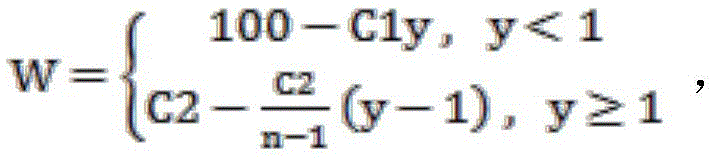
6)根据CPU性能指数判断主机性能状态,当CPU性能指数小于C2时,表示主机性能恶化,产生性能事件并进行性能告警。6) Determine the performance status of the host according to the CPU performance index. When the CPU performance index is less than C2, it means that the performance of the host deteriorates, and a performance event and a performance alarm are generated.
在本发明一些实施方式中,所述C1为常数20,则C2为常数80。In some embodiments of the present invention, the C1 is a constant of 20, and the C2 is a constant of 80.
在本发明另一些实施方式中,所述C1为常数40,则C2为常数60。In other embodiments of the present invention, the C1 is a constant of 40, and the C2 is a constant of 60.
在本发明的再一些实施方式中,所述m为5或者6。In still other embodiments of the present invention, the m is 5 or 6.
本发明另一方面提供一种多核主机性能监控设备,该设备包括存储器、处理器以及存储在所述存储器中并可在所述处理器上运行的计算机程序,所述处理器执行所述计算机程序时实现如下Another aspect of the present invention provides a multi-core host performance monitoring device including a memory, a processor, and a computer program stored in the memory and executable on the processor, the processor executing the computer program is implemented as follows
步骤:step:
1)假设多核主机有n个CPU,定期获取主机中每个核CPU的利用率,CPU利用率值分别为x1,x2,…,xn;1) Assuming that the multi-core host has n CPUs, periodically obtain the utilization rate of each core CPU in the host, and the CPU utilization values are respectively x 1 , x 2 , ..., x n ;
2)设CPU利用率的临界值为x0,超过该临界值,表示CPU利用率值过高,该CPU性能异常;2) Set the critical value of CPU utilization as x 0 , if the critical value exceeds the critical value, it means that the CPU utilization value is too high, and the performance of the CPU is abnormal;
3)对于每核CPU,计算幂函数性能影响因子:
4)令多核CPU总的性能因子y=f(x1)+…+f(xn),则CPU利用率全部小于临界值时,总的性能因子小于1,当有一个CPU利用率大于临界值时,总的性能因子大于1;4) Let the total performance factor of the multi-core CPU y=f(x 1 )+…+f(x n ), then when the CPU utilization is all less than the critical value, the total performance factor is less than 1, when one CPU utilization is greater than the critical value value, the total performance factor is greater than 1;
5)定义多核CPU性能指数
6)根据CPU性能指数判断主机性能状态,当CPU性能指数小于C2时,表示主机性能恶化,产生性能事件并进行性能告警。6) Determine the performance status of the host according to the CPU performance index. When the CPU performance index is less than C2, it means that the performance of the host deteriorates, and a performance event and a performance alarm are generated.
本发明再一方面提供一种计算机可读存储介质,所述计算机可读存储介质存储有计算机程序,所述计算机程序被处理器执行时实现如下所述方法的步骤:11)假设多核主机有n个CPU,定期获取主机中每个核CPU的利用率,CPU利用率值分别为x1,x2,…,xn;Another aspect of the present invention provides a computer-readable storage medium, where the computer-readable storage medium stores a computer program, and when the computer program is executed by a processor, implements the steps of the following method: 11) Suppose a multi-core host has n CPUs, periodically obtain the utilization rate of each core CPU in the host, and the CPU utilization values are x 1 , x 2 , …, x n ;
2)设CPU利用率的临界值为x0,超过该临界值,表示CPU利用率值过高,该CPU性能异常;2) Set the critical value of CPU utilization as x 0 , if the critical value exceeds the critical value, it means that the CPU utilization value is too high, and the performance of the CPU is abnormal;
3)对于每核CPU,计算幂函数性能影响因子:
4)令多核CPU总的性能因子y=f(x1)+…+f(xn),则CPU利用率全部小于临界值时,总的性能因子小于1,当有一个CPU利用率大于临界值时,总的性能因子大于1;4) Let the total performance factor of the multi-core CPU y=f(x 1 )+…+f(x n ), then when the CPU utilization is all less than the critical value, the total performance factor is less than 1, when one CPU utilization is greater than the critical value value, the total performance factor is greater than 1;
5)定义多核CPU性能指数
6)根据CPU性能指数判断主机性能状态,当CPU性能指数小于C2时,表示主机性能恶化,产生性能事件并进行性能告警。6) Determine the performance status of the host according to the CPU performance index. When the CPU performance index is less than C2, it means that the performance of the host deteriorates, and a performance event and a performance alarm are generated.
本发明的基于幂函数的多核主机性能监控方法,主机各种CPU利用率指标进行采集,对采集到的每个CPU利用率进行幂函数计算,得到每个CPU的性能指标,再计算出主机中所有CPU的总体性能指标。该指标反映主机CPU的运行状态,可得到主机性能异常告警。In the multi-core host performance monitoring method based on the power function of the present invention, various CPU utilization indicators of the host are collected, and power function calculation is performed on the collected utilization rate of each CPU to obtain the performance index of each CPU, and then calculate the Overall performance metrics for all CPUs. This indicator reflects the running status of the host CPU, and can get abnormal host performance alarms.
多核CPU性能指数对主机的性能状态有很大的影响,其值越低,表明主机性能越差。通过CPU性能指数一个参数,就能体现多个CPU的综合性能状态。为管理员判断主机性能提供直观、简单的判断依据。The multi-core CPU performance index has a great impact on the performance status of the host, and the lower the value, the worse the host performance. A parameter of the CPU performance index can reflect the comprehensive performance status of multiple CPUs. Provides an intuitive and simple judgment basis for administrators to judge host performance.
附图说明Description of drawings
图1为本发明的框架结构图;Fig. 1 is the frame structure diagram of the present invention;
图2为本发明的流程图。Figure 2 is a flow chart of the present invention.
具体实施方式Detailed ways
本发明是一种使用在主机管理领域的主机性能分析系统和分析方法。下面以具体实施例对本发明做出具体说明。The present invention is a host performance analysis system and analysis method used in the host management field. The present invention will be specifically described below with specific embodiments.
如图1所示,本发明的主机性能分析系统1运行在服务器上,在CPU性能分析子系统2中进行CPU数据采集与分析。CPU性能分析子系统中的CPU性能数据采集模块3定期采集主机的CPU数据,并存储在数据库中,通过CPU性能计算模块4对采集到的CPU数据进行计算处理,并通过CPU性能评估模块5判定CPU性能的好、坏状况。As shown in FIG. 1 , the host
主机管理子系统6中的主机资产信息管理模块7负责主机的设备资产属性、设备安全属性的管理,通过主机应用管理模块8对主机的应用范围进行管理,同时维护主机的资产信息表,包括设备名称、类型、IP地址、用途等。The host asset
主机性能预警子系统9对主机的性能与故障进行监控分析,通过性能监控模块10定期获取主机的性能数据,根据性能数据分析各主机的性能状况,产生性能事件。同时通过事件预警模块11对性能数据进行进一步分析,产生故障事件。The host performance
如图2所示,是本发明的分析系统的分析流程图:As shown in Figure 2, it is the analysis flow chart of the analysis system of the present invention:
1)假设多核主机有n个CPU,定期获取主机中每个核CPU的利用率,CPU利用率值分别为x1,x2,…,xn;1) Assuming that the multi-core host has n CPUs, periodically obtain the utilization of each core CPU in the host, and the CPU utilization values are x1, x2, ..., xn;
2)设CPU利用率的临界值为x0,超过该临界值,表示CPU利用率值过高,该CPU性能异常;2) Set the critical value of CPU utilization to x0, and if it exceeds the critical value, it means that the CPU utilization value is too high, and the performance of the CPU is abnormal;
3)对于每核CPU,计算幂函数性能影响因子: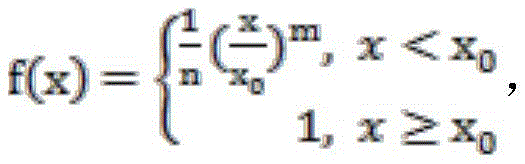
4)令多核CPU总的性能因子y=f(x1)+…+f(xn),则CPU利用率全部小于临界值时,总的性能因子小于1,当有一个CPU利用率大于临界值时,总的性能因子大于1;4) Let the total performance factor of multi-core CPU y=f(x1)+...+f(xn), then when the CPU utilization is all less than the critical value, the total performance factor is less than 1, and when there is a CPU utilization greater than the critical value , the total performance factor is greater than 1;
5)定义多核CPU性能指数
6)根据CPU性能指数判断主机性能状态,当CPU性能指数小于C2时,表示主机性能恶化,产生性能事件并进行性能告警。6) Determine the performance status of the host according to the CPU performance index. When the CPU performance index is less than C2, it means that the performance of the host deteriorates, and a performance event and a performance alarm are generated.
在本发明其中一个实施例中,所述幂函数性能影响因子: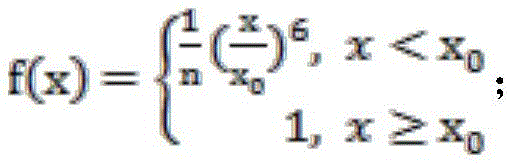

在本发明另一个实施例中,幂函数性能影响因子:

本说明书中所描述的以上内容仅仅是对本发明所作的举例说明。本发明所属技术领域的技术人员可以对所描述的具体实施例做各种各样的修改或补充或采用类似的方式替代,只要不偏离本发明说明书的内容或者超越本权利要求书所定义的范围,均应属于本发明的保护范围。The above content described in this specification is merely an illustration of the present invention. Those skilled in the art to which the present invention pertains can make various modifications or additions to the described specific embodiments or substitute in similar manners, as long as they do not deviate from the content of the description of the present invention or go beyond the scope defined by the claims. , should belong to the protection scope of the present invention.
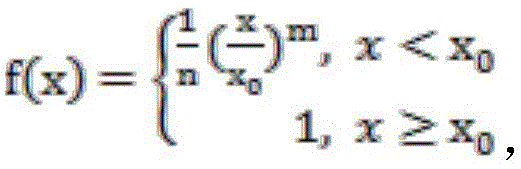
Claims (5)


Priority Applications (1)
| Application Number | Priority Date | Filing Date | Title |
|---|---|---|---|
| CN201910002409.XA CN109766243B (en) | 2019-01-02 | 2019-01-02 | Multi-core host performance monitoring method based on power function |
Applications Claiming Priority (1)
| Application Number | Priority Date | Filing Date | Title |
|---|---|---|---|
| CN201910002409.XA CN109766243B (en) | 2019-01-02 | 2019-01-02 | Multi-core host performance monitoring method based on power function |
Publications (2)
| Publication Number | Publication Date |
|---|---|
| CN109766243A CN109766243A (en) | 2019-05-17 |
| CN109766243B true CN109766243B (en) | 2022-05-27 |
Family
ID=66452677
Family Applications (1)
| Application Number | Title | Priority Date | Filing Date |
|---|---|---|---|
| CN201910002409.XA Active CN109766243B (en) | 2019-01-02 | 2019-01-02 | Multi-core host performance monitoring method based on power function |
Country Status (1)
| Country | Link |
|---|---|
| CN (1) | CN109766243B (en) |
Families Citing this family (2)
| Publication number | Priority date | Publication date | Assignee | Title |
|---|---|---|---|---|
| CN113886196B (en) * | 2021-12-07 | 2022-03-15 | 上海燧原科技有限公司 | On-chip power consumption management method, electronic device and storage medium |
| CN121092402A (en) * | 2025-11-11 | 2025-12-09 | 苏州元脑智能科技有限公司 | Methods and equipment for monitoring CPU core utilization |
Citations (4)
| Publication number | Priority date | Publication date | Assignee | Title |
|---|---|---|---|---|
| CN103955398A (en) * | 2014-04-28 | 2014-07-30 | 浙江大学 | Virtual machine coexisting scheduling method based on processor performance monitoring |
| CN104125217A (en) * | 2014-06-30 | 2014-10-29 | 复旦大学 | A real-time risk assessment method for cloud data centers based on host log analysis |
| CN106250306A (en) * | 2016-08-18 | 2016-12-21 | 电子科技大学 | A kind of performance prediction method being applicable to enterprise-level O&M automatization platform |
| CN106407088A (en) * | 2016-09-08 | 2017-02-15 | 努比亚技术有限公司 | Method and device for detecting multi-core CPU |
Family Cites Families (1)
| Publication number | Priority date | Publication date | Assignee | Title |
|---|---|---|---|---|
| CN102314391B (en) * | 2011-05-27 | 2013-11-20 | 运软网络科技(上海)有限公司 | Architecture and method for monitoring performance of virtualization system based on hardware basis tools |
-
2019
- 2019-01-02 CN CN201910002409.XA patent/CN109766243B/en active Active
Patent Citations (4)
| Publication number | Priority date | Publication date | Assignee | Title |
|---|---|---|---|---|
| CN103955398A (en) * | 2014-04-28 | 2014-07-30 | 浙江大学 | Virtual machine coexisting scheduling method based on processor performance monitoring |
| CN104125217A (en) * | 2014-06-30 | 2014-10-29 | 复旦大学 | A real-time risk assessment method for cloud data centers based on host log analysis |
| CN106250306A (en) * | 2016-08-18 | 2016-12-21 | 电子科技大学 | A kind of performance prediction method being applicable to enterprise-level O&M automatization platform |
| CN106407088A (en) * | 2016-09-08 | 2017-02-15 | 努比亚技术有限公司 | Method and device for detecting multi-core CPU |
Also Published As
| Publication number | Publication date |
|---|---|
| CN109766243A (en) | 2019-05-17 |
Similar Documents
| Publication | Publication Date | Title |
|---|---|---|
| CN112162878B (en) | Database fault discovery method and device, electronic equipment and storage medium | |
| CN103354924B (en) | For monitoring the method and system of performance indications | |
| US9600394B2 (en) | Stateful detection of anomalous events in virtual machines | |
| US11748227B2 (en) | Proactive information technology infrastructure management | |
| US9720823B2 (en) | Free memory trending for detecting out-of-memory events in virtual machines | |
| US10248561B2 (en) | Stateless detection of out-of-memory events in virtual machines | |
| WO2023071761A1 (en) | Anomaly positioning method and device | |
| CN112596975A (en) | Method, system, equipment and storage medium for monitoring network equipment | |
| US9244711B1 (en) | Virtual machine capacity planning | |
| CN112380089A (en) | Data center monitoring and early warning method and system | |
| CN108924084A (en) | A kind of network equipment safety evaluation method and device | |
| CN114860563A (en) | Application program testing method and device, computer readable storage medium and equipment | |
| CN112381258A (en) | Meter operation life cycle prediction method and device | |
| CN118523963B (en) | Power information network security risk assessment method and system | |
| CN120358147A (en) | Monitoring index dependency analysis and topology establishment method and device and computer equipment | |
| CN109766243B (en) | Multi-core host performance monitoring method based on power function | |
| CN115001997A (en) | Extreme value theory-based smart city network equipment performance abnormity threshold evaluation method | |
| CN120498901B (en) | Method, device, equipment and storage medium for identifying abnormal nodes of computing power network | |
| Gu et al. | Kpiroot: Efficient monitoring metric-based root cause localization in large-scale cloud systems | |
| CN116541728A (en) | Fault diagnosis method and device based on density clustering | |
| CN114598621B (en) | Power communication network reliability evaluation system | |
| CN118316715B (en) | Enterprise network security risk assessment method and system | |
| CN114338348A (en) | Intelligent alarm method, device, equipment and readable storage medium | |
| Chen et al. | The monitoring system of Business support system with emergency prediction based on machine learning approach | |
| TWI712880B (en) | Information service availability management method and system |
Legal Events
| Date | Code | Title | Description |
|---|---|---|---|
| PB01 | Publication | ||
| PB01 | Publication | ||
| SE01 | Entry into force of request for substantive examination | ||
| SE01 | Entry into force of request for substantive examination | ||
| GR01 | Patent grant | ||
| GR01 | Patent grant |