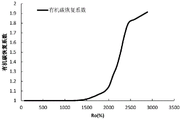
Organic carbon recovery coefficient evaluation method based on hydrocarbon generation and expulsion rate of hydrocarbon source rock
Technical Field
The invention relates to an evaluation method of resources, in particular to an organic carbon recovery coefficient evaluation method based on hydrocarbon source rock hydrocarbon generation and expulsion rate, and belongs to the technical field of oil and gas resource evaluation.
Background
The oil-gas resource evaluation is an effective method for the oil-gas content of the oil-gas-containing basin, and the organic carbon recovery coefficient is a key parameter in the oil-gas resource evaluation, so that the accuracy of the evaluated resource amount is determined.
In the past, many methods for restoring coefficients of organic carbon are provided, such as a thermal simulation experiment method, a natural evolution profile method, a substance balance method (invalid carbon conservation and element conservation method), a theoretical derivation method (chemical kinetics, a numerical simulation method of organic matter evolution law and a graphic plate method) and the like.
The thermal simulation experiment method comprises the steps of selecting hydrocarbon source rocks with low maturity and the same organic matter type, heating the hydrocarbon source rocks, measuring the hydrocarbon generation amount and pyrolysis parameters of different evolution stages, and then recovering a natural high-evolution hydrocarbon source rock sample.
The natural evolution section method is to actually measure the organic carbon content by adopting the hydrocarbon source rocks with the same layer and different burial depths and then calculate the recovery coefficient of the original organic matter abundance of the hydrocarbon source rocks with different maturity, and has the defect that the hydrocarbon source rock samples with the same layer and different burial depths are difficult to obtain in actual work.
The material balance method considers that the initial mass before the organic matrix is converted is equal to the sum of the mass of the residual organic matrix after the organic matrix is converted and the mass of various products, the hydrocarbon generation and discharge process of the organic matrix can be approximately regarded as a C, H, O element conservation process, the hydrocarbon generation and discharge reaction of the organic matrix is balanced according to the H/C and O/C atomic ratio of organic matters and crude oil, the original cracking potential recovery coefficient of a hydrocarbon source rock is deduced, however, the accurate composition of various products when the maturity degree is reached cannot be determined one by one in the actual work, and the equation can only be approximately balanced through mathematical optimization.
The theoretical extrapolation method (numerical simulation method and plate method of organic matter evolution law) is mainly found in literature and has no practical application.
In view of the above, conventional methods for restoring the coefficient of organic carbon generally have certain problems. In the face of long-term needed oil and gas resource evaluation work and oil and gas resource amount compaction work of an oil and gas-containing basin, an evaluation method for organic carbon recovery which is more in line with geological reality is urgently needed.
Disclosure of Invention
In order to solve the above-mentioned problems, an object of the present invention is to provide an evaluation method for organic carbon recovery coefficient, which can effectively solve the problems and disadvantages of the conventional evaluation method for organic carbon recovery coefficient and accurately evaluate the organic carbon recovery coefficient.
In order to achieve the above technical object, the present invention provides a method for evaluating the organic carbon recovery coefficient based on the hydrocarbon generation and expulsion rate of a hydrocarbon source rock, comprising the steps of:
the method comprises the following steps: carrying out thermal simulation experiments and conventional hydrocarbon source Rock sample analysis tests, wherein the thermal simulation experiments comprise hydrocarbon source Rock thermal simulation experiments and oil sample thermal simulation experiments, the hydrocarbon source Rock thermal simulation experiments comprise Rock-Eval hydrocarbon source Rock thermal simulation experiments, PY-Gc experiments and direct-pressure type semi-closed semi-open thermal simulation experiments, and the oil sample thermal simulation experiments comprise crude oil golden pipe thermal simulation experiments;
step two: collecting data, wherein the data comprises geochemical data and geological stratification data, paleo-geothermal gradient, paleo-surface temperature, denudation thickness and corresponding geological time data of a target horizon in a research area, and the geochemical data comprises organic carbon TOC, vitrinite reflectivity Ro, pyrolysis S1, pyrolysis S2 and pyrolysis S3;
step three: and carrying out hydrocarbon generation rate evaluation on the hydrocarbon source rock, wherein the hydrocarbon generation rate evaluation on the hydrocarbon source rock comprises the following steps:
according to the thermal simulation experiment result, calibrating kerogen crude oil, kerogen gas and oil cracking aerodynamic parameters of the hydrocarbon source rock at the target layer;
establishing a deposition burying history and thermal history model in the research area according to geological stratification data, paleoterrestrial temperature gradient, paleoterrestrial surface temperature, denudation thickness and geological time data of the research area;
performing dynamic geological extrapolation according to the kerogen crude oil, kerogen gas and oil cracking aerodynamic parameters of the hydrocarbon source rock at the calibration target layer and the built burying history and thermal history model in the research area to obtain kerogen crude oil, kerogen gas, oil cracking gas, clean oil and total gas hydrocarbon generation rate profiles of the hydrocarbon source rock at the target layer of the research area;
determining a hydrocarbon generation threshold, a type of the source rock and a thermal evolution degree of the source rock based on data of analysis and test of the source rock sample and geochemical data of a target horizon of the research area;
restricting the hydrocarbon generation rate of the hydrocarbon source rock according to the determined hydrocarbon generation threshold of the hydrocarbon source rock, the type of the hydrocarbon source rock and the thermal evolution degree of the hydrocarbon source rock, and realizing hydrocarbon generation rate evaluation of the hydrocarbon source rock;
step four: and evaluating the hydrocarbon expulsion rate of the source rock, wherein the evaluation of the hydrocarbon expulsion rate of the source rock comprises the following steps: light hydrocarbon recovery coefficient K of hydrocarbon discharge rateLight hydrocarbon recovery coefficientEvaluation: based on the data of the PY-Gc experiment, the light hydrocarbon component recovery coefficient K of the hydrocarbon discharge rate is establishedLight hydrocarbon recovery coefficientThe evaluation model is used for realizing the evaluation of the light hydrocarbon recovery coefficient of the hydrocarbon source rock hydrocarbon discharge rate;
establishing a single type experiment hydrocarbon discharge rate evaluation model P1: establishing a single-model experiment hydrocarbon discharge rate evaluation model P based on data of a direct-pressure semi-open semi-closed thermal simulation experiment1;
Establishing hydrocarbon source rock hydrocarbon discharge rate evaluation model P0: according to KLight hydrocarbon recovery coefficientEvaluation model and single-type experiment hydrocarbon discharge rate evaluation model P1Establishing a hydrocarbon source rock hydrocarbon discharge rate evaluation model P0(ii) a Finishing the hydrocarbon discharge rate evaluation of the source rock;
step five: according to the hydrocarbon generation rate evaluation result of the hydrocarbon source rock and the hydrocarbon discharge rate evaluation model P of the hydrocarbon source rock0And establishing an organic carbon recovery coefficient evaluation model to finish the evaluation of the organic carbon recovery coefficient based on the hydrocarbon generation and expulsion rate of the hydrocarbon source rock.
In the method for evaluating the organic carbon recovery coefficient based on the hydrocarbon generation and expulsion rate of the hydrocarbon source rock provided by the invention, preferably, in the step one, the conventional hydrocarbon source rock sample analysis test comprises a pyrolysis experiment analysis test, a rock total organic carbon analysis test, a vitrinite reflectance Ro analysis test and a chloroform bitumen "a" analysis test.
In the method for evaluating the organic carbon recovery coefficient based on the hydrocarbon generation and expulsion rate of the hydrocarbon source rock, preferably, in the first step, the PY-Gc experiment is C15+、C6-14、C1-5Measured in three forms.
In the method for evaluating the organic carbon recovery coefficient based on the hydrocarbon generation and hydrocarbon expulsion rate of the hydrocarbon source Rock provided by the invention, preferably, in the third step, kerogen oil, kerogen gas and oil cracking aerodynamic parameters of the hydrocarbon source Rock at the target layer are calibrated according to the data of a Rock-even hydrocarbon source Rock thermal simulation experiment, a PY-Gc experiment and a crude oil gold tube thermal simulation experiment.
In the above method for evaluating the organic carbon recovery coefficient based on the hydrocarbon generation and expulsion rate of the hydrocarbon source rock provided by the present invention, preferably, in the third step, when the hydrocarbon generation rate of the hydrocarbon source rock is restricted according to the determined hydrocarbon generation threshold of the hydrocarbon source rock, the type of the hydrocarbon source rock and the thermal evolution degree of the hydrocarbon source rock:
if the hydrocarbon generation threshold, the hydrocarbon source rock type and the thermal evolution degree of the hydrocarbon source rock in hydrocarbon generation rate reaction are evaluated to be inconsistent with the corresponding actually measured data, the step of establishing a deposition burial history and a thermal history model in the research area in the third step is carried out, the thermal history is restricted and adjusted until the hydrocarbon generation threshold depth determined by dynamic geological extrapolation is the same as the actual hydrocarbon generation threshold depth of the hydrocarbon source rock, Ro evaluated by the EASY% Ro model is consistent with the actually measured Ro data, and the hydrocarbon generation rate is evaluated to be consistent with the geological actual conversion rate.
In the method for evaluating the coefficient of recovery of organic carbon based on the hydrocarbon generation and expulsion rate of the hydrocarbon source rock, preferably, the light hydrocarbon component of the hydrocarbon expulsion rate is C6-14The light hydrocarbon component.
In the method for evaluating the organic carbon recovery coefficient based on the hydrocarbon generation and expulsion rate of the hydrocarbon source rock, the recovery coefficient K of the light hydrocarbon component of the hydrocarbon expulsion rate is preferablyLight hydrocarbon recovery coefficientThe evaluation model is:
wherein, KLight hydrocarbon recovery coefficientIs the recovery coefficient of light hydrocarbon components with hydrocarbon discharge rate;
C15+is C in petroleum15And the contents of the above components;
C6-14is C in petroleum6To C14The content of the components;
C1-5is C in petroleum1To C5The contents of the components.
In the method for evaluating the organic carbon recovery coefficient based on the hydrocarbon generation and expulsion rate of the hydrocarbon source rock, the single type experimental hydrocarbon expulsion rate evaluation model P is preferably1The method comprises the following steps:
wherein Q isResidual oil、QDischarging oil、QResidual gas、QExhaust gasRespectively indicating the residual oil mass and the residual oil discharge in a direct-pressure semi-open semi-closed thermal simulation experimentThe oil output, residual gas content and exhaust gas content are in mg/gTOC.
In the method for evaluating the organic carbon recovery coefficient based on the hydrocarbon generation and expulsion rate of the hydrocarbon source rock, the hydrocarbon source rock expulsion rate evaluation model P is preferably0The method comprises the following steps:
P0=P1*Klight hydrocarbon recovery coefficient;
KLight hydrocarbon recovery coefficientIs the recovery coefficient of light hydrocarbon components with hydrocarbon discharge rate;
P0refers to the hydrocarbon expulsion rate of the source rock.
In the method for evaluating the organic carbon recovery coefficient based on the hydrocarbon generation and expulsion rate of the hydrocarbon source rock, the organic carbon recovery coefficient evaluation model preferably includes:
wherein D refers to the hydrocarbon generation rate of the hydrocarbon source rock;
P0refers to the hydrocarbon expulsion rate of the source rock;
Korganic carbon recovery coefficientRepresenting the organic carbon recovery coefficient of the source rock.
In the method for evaluating the organic carbon recovery coefficient based on the hydrocarbon generation and expulsion rate of the hydrocarbon source rock, the method may further include the following steps:
feasibility analysis of hydrocarbon rejection evaluation: light hydrocarbon component C is carried out by relying on data of direct-pressure type semi-open semi-closed thermal simulation experiment of hydrocarbon source rock and data of PY-Gc experiment6-14And (4) correcting, namely performing light hydrocarbon compensation correction by adopting PY-Gc experimental data.
The organic carbon recovery coefficient evaluation method based on the hydrocarbon generation and expulsion rate of the hydrocarbon source rock fully considers the problems and the defects of the traditional organic carbon recovery coefficient evaluation method, establishes an organic carbon recovery coefficient evaluation model based on the thermal simulation experiment data of the hydrocarbon source rock, the thermal simulation experiment data of crude oil, geological data and geochemical data, evaluates the key parameter organic carbon recovery coefficient in resource evaluation, successfully solves the defects and defects of the organic carbon recovery coefficient evaluated by the traditional evaluation method, solves the problem of difficulty in evaluating the organic carbon recovery coefficient in oil and gas resource evaluation, provides technical service support for oil and gas resource evaluation of an oil field, and facilitates the oil field to quickly evaluate the organic carbon recovery coefficient of the hydrocarbon source rock at a target layer.
The organic carbon recovery coefficient evaluation method based on hydrocarbon generation and hydrocarbon expulsion rate of the hydrocarbon source rock, which is provided by the invention, is used for accurately evaluating the organic carbon recovery coefficient of the hydrocarbon source rock, is beneficial to compaction of oil and gas resource amount of an oil and gas containing basin, and is convenient to provide a positive guidance suggestion for next oil and gas exploration deployment; the established organic carbon recovery coefficient evaluation method supplements and perfects methods and theories in the organic carbon recovery aspect, and meanwhile, the organic carbon plane distribution differences before and after recovery are compared, so that the method can judge and identify which zone has large hydrocarbon discharge amount and which zone has large residual hydrocarbon amount, and has good guiding significance for next exploration and development.
The hydrocarbon source rock hydrocarbon generation and drainage rate-based organic carbon recovery coefficient evaluation method provided by the invention has been popularized and applied in large and medium oil-gas-containing basins such as a Songliao basin, a Bohai Bay basin, a Sichuan basin, an Eldos basin, a Tarim basin and the like in China, and has been commented by oil and gas resource evaluation workers in oil fields.
Drawings
FIG. 1 is a process flow diagram of a method for evaluating organic carbon recovery coefficients based on hydrocarbon-producing and hydrocarbon-expelling rates of a hydrocarbon source rock.
FIG. 2 is a graph showing the activation energy distribution of kerogen in a section of the middle-shallow mountain section in the north of the Songliaopelvic area.
FIG. 3 is a graph showing the distribution of the qi-forming activation energy of a section of kerogen in the middle shallow-layer mountain section of the northern part of the Songliao basin.
FIG. 4 is a graph showing the distribution of the activation energy of a section of oil-cracked gas in the middle shallow-layer mountain section in the north of Songliaopelvic region.
FIG. 5 is a cross-sectional view of the geological parameters of the shallow Qingshan group of source rock S1/TOC 100 in the north of Songliaopeng.
FIG. 6 is a sectional view of thermal evolution parameters Ro of a hydrocarbon source rock of a shallow-layer mountain mouth group in the north of the Songliao basin.
FIG. 7 is a diagram of a hydrocarbon generation rate profile constraint adjustment correction process for a section of a hydrocarbon source rock in a shallow-layer crater group in the north of the Songliaopelvic region.
FIG. 8 is a cross-sectional view of hydrocarbon generation rate and depth of a section of a hydrocarbon source rock in a shallow-layer crater group in the north of Songliaopelvic region.
FIG. 9 is a sectional view showing the hydrocarbon generation rate and Ro of a hydrocarbon source rock at a section of a shallow mountain section in the north of the Songliaopelvic region.
FIG. 10 is a cross-sectional view of the light hydrocarbon recovery coefficient and Ro of the data hydrocarbon discharge rate of PY-Gc of a section of source rock of a shallow mountain section in the north of the Songliaopelvic region.
FIG. 11 is a sectional view of a single-section straight-pressing semi-open semi-closed thermal simulation experiment hydrocarbon discharge rate and Ro of a hydrocarbon source rock in a shallow mountain section in the north of the Songliao basin.
FIG. 12 is a sectional view of the hydrocarbon expulsion rate and Ro of a section of source rock in the shallow mountain section in the north of Songliao basin.
FIG. 13 is a cross-sectional view of the recovery coefficient and depth of organic carbon from a section of source rock in the mountain area of the northern part of the Songliaopelvic region.
FIG. 14 is a sectional view of the recovery coefficient of organic carbon and Ro of a section of source rock in the mountain area of the northern part of Songliao basin.
FIG. 15 is a graph of the maturity Ro of a section of source rock in the mountain area of the northern part of the Songliao basin.
FIG. 16 is a cross-sectional view of the organic carbon recovery coefficient of a section of source rock in the mountain area of the northern part of the Songliaopelvic region.
FIG. 17 is a plot of organic carbon equivalent values for a section of the mountain section in the northern part of the Songliaopelvic area.
FIG. 18 is an isometric view of the recovery of organic carbon after a first stage of recovery in the mouth of the Qingshan mountain in the northern part of the Songliaopelvic area.
FIG. 19 is an isometric view of the difference between organic carbons before and after recovery in a section of the Qingshan Kou group in the northern part of the Songliaopelvic area.
Detailed Description
The technical solutions of the present invention will be described in detail below in order to clearly understand the technical features, objects, and advantages of the present invention, but the present invention is not limited to the practical scope of the present invention.
Example 1
In this embodiment, taking a section of the shallow-layer crater group in the north of the songliao basin as an example, depending on thermal simulation experiment data of the hydrocarbon source rock, crude oil golden tube experiment data, geological stratification data, paleo-geothermal gradient, paleo-surface temperature, hydrocarbon generation threshold depth, a section of a mature Ro of thermal evolution of the hydrocarbon source rock, geological data and the like, an organic carbon recovery coefficient evaluation method based on hydrocarbon generation and hydrocarbon discharge rate of the hydrocarbon source rock is adopted, and a process flow diagram is shown in fig. 1 to evaluate the organic carbon recovery coefficient of the section of the hydrocarbon source rock of the shallow-layer crater group in the north of the songliao basin. The method comprises the following specific steps:
(1) thermal simulation experiment design: designing a section of hydrocarbon source Rock (TOC is more than 0.5 percent, and the maturity Ro is less than 0.5 percent) thermal simulation experiment and an oil sample thermal simulation experiment of a shallow-layer green hill mouth group in the north part of the Songliao basin, namely a Rock-Eval hydrocarbon source Rock thermal simulation experiment, a PY-Gc experiment and a direct-pressure semi-closed semi-open system thermal simulation experiment, wherein the test results are shown in tables 1, 2, 3, 4 and 5; oil sample gold tube thermal simulation experiment; in addition, conventional hydrocarbon source rock sample analysis tests, namely pyrolysis experimental analysis test, rock total organic carbon analysis test, chloroform bitumen "A" analysis test and the like are designed, and the test results are shown in Table 6.
TABLE 1 thermal simulation experiment data of Rock-Eval hydrocarbon source Rock in shallow mountain group in north of Songliao basin
TABLE 2 PY-Gc data of a section of Hydrocarbon source rock (5 ℃/min) in the shallow-layer Qingshan-Kong group in the northern part of Songliao basin
| Temperature range of DEG C
|
C1-C5(%)
|
C5+-C13(%)
|
C13+(%)
|
Total (%)
|
| 200
|
0.162
|
1.172
|
0.092
|
1.425
|
| 200-250
|
0.124
|
0.574
|
0.012
|
0.71
|
| 250-300
|
0.157
|
0.781
|
0.07
|
1.009
|
| 300-330
|
0.193
|
0.464
|
0.033
|
0.69
|
| 330-360
|
0.241
|
1.34
|
0
|
1.582
|
| 360-390
|
0.417
|
2.183
|
0.128
|
2.728
|
| 390-420
|
1.19
|
4.542
|
1.217
|
6.949
|
| 420-450
|
3.399
|
8.714
|
4.364
|
16.478
|
| 450-480
|
9.876
|
18.222
|
9.886
|
37.983
|
| 480-510
|
8.177
|
8.728
|
2.538
|
19.443
|
| 510-540
|
3.406
|
2.599
|
0.073
|
6.078
|
| 540-570
|
1.574
|
0.722
|
0
|
2.296
|
| 570-600
|
0.95
|
0.547
|
0
|
1.496
|
| 600-630
|
0.79
|
0.343
|
0
|
1.133
|
| In total%
|
30.656
|
50.932
|
18.412
|
100 |
TABLE 3 PY-Gc experimental data of a section of Hydrocarbon source rock (10 ℃/min) in the shallow-layer Qingshan-Kong group in the north of Songliao basin
TABLE 4 PY-Gc experimental data of a section of Hydrocarbon source rock (20 ℃/min) in the shallow-layer Qingshan-Kong group in the north of Songliao basin
| Temperature range of DEG C
|
C1-C5(%)
|
C5+-C13(%)
|
C13+(%)
|
Total (%)
|
| 200
|
0.077
|
0.411
|
0
|
0.488
|
| 200-250
|
0.108
|
0.211
|
0
|
0.108
|
| 250-300
|
0.113
|
0.411
|
0
|
0.524
|
| 300-330
|
0.107
|
0.462
|
0
|
0.569
|
| 330-360
|
0.183
|
0.812
|
0.074
|
1.068
|
| 360-390
|
0.302
|
1.504
|
0.182
|
1.988
|
| 390-420
|
0.564
|
2.317
|
0.318
|
3.2
|
| 420-450
|
1.419
|
4.325
|
1.122
|
6.866
|
| 450-480
|
4.805
|
8.998
|
3.902
|
17.705
|
| 480-510
|
11.471
|
17.277
|
7.875
|
36.622
|
| 510-540
|
8.146
|
8.449
|
2.243
|
18.837
|
| 540-570
|
4.246
|
3.704
|
0.375
|
8.324
|
| 570-600
|
1.572
|
0.599
|
0
|
2.17
|
| 600-630
|
1.231
|
0.297
|
0
|
1.529
|
| In total%
|
34.344
|
49.777
|
16.09
|
100 |
TABLE 5 straight-pressing thermal simulation experiment data of one-section source rock of shallow-layer mountain mouth group in north part of Songliao basin
TABLE 6 data of routine experiments on the shallow part of the North part of Songliao basin
(2) Collecting data: previous geochemical data of a target horizon in a research area are collected, and geological stratification data, paleogeothermal gradient, paleosurface temperature, denudation thickness, corresponding geological age and other data in the research area are collected, wherein part of the collected data are shown in tables 7 and 8;
TABLE 7 partial data in shallow reciprocal data in North of Songliao basin
| Number of well
|
Sample depth (rice)
|
TOC
|
Ro
|
Tmax(℃)
|
S1(mg/g)
|
S2(mg/g)
|
S3(mg/g)
|
| J13
|
1827.64
|
0.91
|
|
441
|
0.01
|
2.01
|
0
|
| J13
|
1765.27
|
0.934
|
|
440
|
0.04
|
1.56
|
0
|
| J13
|
1783.58
|
1.032
|
|
436
|
0.06
|
1.69
|
0
|
| J13
|
1746.5
|
1.598
|
|
436
|
0.51
|
5.95
|
0
|
| J14
|
2031.83
|
0.773
|
|
441
|
0.08
|
0.85
|
0
|
| J14
|
1857.14
|
1.981
|
|
446
|
1.32
|
11.85
|
0
|
| J14
|
1887.58
|
3.237
|
|
445
|
1.55
|
42.59
|
0
|
| J17
|
1768.5
|
0.71
|
|
444
|
0.07
|
1.9
|
0
|
| J17
|
1781.3
|
0.768
|
1.13
|
438
|
0.01
|
0.09
|
0
|
| J17
|
1777.7
|
0.779
|
1.14
|
441
|
0.05
|
0.51
|
0
|
| J17
|
1741
|
0.814
|
1.15
|
441
|
0.17
|
0.78
|
0
|
| J17
|
1783.26
|
0.936
|
|
441
|
0.02
|
1.75
|
0
|
| J17
|
1768.3
|
0.945
|
0.98
|
443
|
0.05
|
0.48
|
0
|
| Gold 17
|
1741.5
|
0.953
|
|
442
|
0.04
|
2.47
|
0 |
TABLE 8 partial hierarchal data collected from the shallow layers in the North part of the Songliao basin
| Number of well
|
K1n3
|
K1n2
|
K1n1
|
K1y23
|
K1y1
|
K1qn23
| K1qn1
|
| Fish |
| 13
|
1231
|
1366
|
1502.5
|
1567
|
1606
|
2056.5
|
2134
|
| Ancient Chinese reference No. 57
|
1362
|
1627
|
1751.5
|
1861
|
1945.5
|
2343.5
|
2440.5
|
| Tai 18
|
757
|
965.5
|
1077
|
1170
|
1242.5
|
1526
|
1603.5
|
| Aromatic hydrocarbon 28
|
1175
|
1343
|
1446
|
1537.5
|
1607.5
|
1883.5
|
1943
|
| Dragon 28
|
1323
|
1514
|
1627
|
1711.5
|
1787.5
|
2152.5
|
2227.5 |
(3) The hydrocarbon generation rate evaluation of the hydrocarbon source rock and the hydrocarbon generation rate evaluation of the hydrocarbon source rock at the target layer are as follows:
calibrating kerogen raw oil, kerogen raw gas and oil cracking aerodynamic parameters of the hydrocarbon source Rock at a target horizon according to Rock-eval, PY-Gc and crude oil gold tube thermal simulation experiment data of the hydrocarbon source Rock obtained in the step (1), wherein calibration results are shown in a table 9, a figure 2, a figure 3 and a figure 4;
TABLE 9 dynamic parameter calibration result parameter table for a section of well in shallow layer green-junction group in Songliao basin
Establishing a representative deposition burying history and thermal history model in the research area according to the geological stratification, the paleo-geothermal gradient, the paleo-surface temperature, the denudation thickness, the corresponding geological age and other data of the research area, wherein the model is shown in a table 10;
TABLE 10 statistical table of model of one-stage deposition burying history and thermal history of middle-shallow layer Qingshan Korea group in northern part of Songliaopelvic region
Thirdly, combining the first step and the second step to carry out dynamic geological extrapolation to obtain a hydrocarbon generation rate profile of kerogen crude oil, kerogen crude gas, oil pyrolysis gas, clean oil and total gas of the hydrocarbon source rock at the target horizon of the research area;
determining the hydrocarbon generation threshold, the type and the thermal evolution degree of the source rock based on the conventional experimental data in the step A and the previous geochemical parameters (pyrolysis S1, chloroform bitumen 'A', organic carbon TOC and vitrinite reflectance Ro) collected in the step B; constraining the hydrocarbon generation rate of the hydrocarbon source rock according to the determined hydrocarbon generation threshold (figure 5), type and thermal evolution degree (figure 6), if the hydrocarbon generation threshold depth, type and thermal evolution degree of the hydrocarbon source rock hydrocarbon generation rate estimated by geological extrapolation is not consistent with the hydrocarbon generation threshold depth, type and thermal evolution degree of the hydrocarbon source rock hydrocarbon generation threshold determined by corresponding measured data, returning to the step C, constraining and adjusting the thermal history again until the hydrocarbon generation threshold depth determined by dynamic geological extrapolation is consistent with the hydrocarbon generation threshold depth determined by measured analysis data, and the Ro estimated by the EASY% Ro model is consistent with the measured Ro data (figure 7); further, the evaluated hydrocarbon generation rate (fig. 8 and 9) is consistent with the actual geological conversion rate, and the hydrocarbon generation rate of the hydrocarbon source rock is accurately evaluated, wherein the hydrocarbon generation threshold is determined at the position corresponding to the hydrocarbon generation rate of 0.1 in the embodiment;
(4) the hydrocarbon expulsion rate evaluation of the hydrocarbon source rock mainly comprises the following steps:
evaluation feasibility analysis of hydrocarbon discharge rate: based on the direct-pressure type semi-open semi-closed thermal simulation experiment data and the PY-Gc experiment data of the hydrocarbon source rock, the direct-pressure type thermal simulation experiment is to extract light hydrocarbon C in the process of simulating the residual oil quantity in the rock sample under the open system experiment condition6-14Loss, accurate evaluation of hydrocarbon-discharging rate of hydrocarbon source rock, light hydrocarbon component C6-14Correcting; the PY-Gc experimental data is adopted for light hydrocarbon compensation correction, and hydrocarbon discharge rate evaluation of the hydrocarbon source rock is realized;
evaluation of light hydrocarbon recovery coefficient K of hydrocarbon discharge rate: based on the experimental data of PY-Gc, the experimental data of PY-Gc is C15+、C6-14、C1-5Light hydrocarbon component (C) measured in three forms and establishing hydrocarbon rejection6-14) The coefficient of restitution K light hydrocarbon coefficient of restitution evaluation model realizes the evaluation of the coefficient of restitution of light hydrocarbon of hydrocarbon source rock hydrocarbon expulsion rate (figure 10);
③ evaluation model P of hydrocarbon discharge rate of single type experiment1: establishing a single-model experimental hydrocarbon discharge rate evaluation model P based on direct-pressure semi-open semi-closed thermal simulation experimental data1The evaluation result of the hydrocarbon discharge rate of the single type direct-pressure semi-open semi-closed thermal simulation experiment of the shallow-layer mountain mouth group in the north part of the Songliaopelvic region is shown in a figure 11.
Fourthly, hydrocarbon discharge rate evaluation model P0: in the combined step D, establishing a K light hydrocarbon recovery coefficient evaluation model and establishing a single type experiment hydrocarbon discharge rate evaluation model P1Establishing a hydrocarbon source rock hydrocarbon discharge rate evaluation model P0According to the direct-pressure type semi-open and semi-closed thermal simulation experimental data of the hydrocarbon source rock at the target horizon and the PY-Gc experimental data, combining the discharge rate evaluation model P in the step D0The hydrocarbon expulsion rate of the hydrocarbon source rock of the mountain mouth group in the north of the Songliao basin was evaluated (FIG. 12).
(5) Evaluation model of organic carbon recovery coefficient of source rock: establishing an organic carbon recovery coefficient evaluation formula and evaluating the organic carbon recovery coefficient, combining the hydrocarbon generation rate of the hydrocarbon source rock in the step C) and the hydrocarbon expulsion rate P0 of the hydrocarbon source rock in the step D), establishing an organic carbon recovery coefficient evaluation formula and evaluating the organic carbon recovery coefficient (figures 13 and 14).
Combining a section of maturity Ro equivalent diagram (figure 15) of the hydrocarbon source rock of the blue-hill mouth group at the north of the Songliaopelvic region, evaluating an organic carbon recovery coefficient equivalent diagram (figure 16), combining an organic carbon equivalent diagram (figure 17) of the blue-hill mouth group, evaluating a recovered organic carbon equivalent diagram (figure 18), performing difference between the organic carbon equivalent diagram of the blue-hill mouth group after section recovery and the organic carbon equivalent diagram under an unrecovered state, evaluating an organic carbon equivalent diagram which is matured and discharged (figure 19), combining the result diagram, finding that the Qionglong panong is a main hydrocarbon supply recess of the Daqing Changyuan, and the three depressions are mainly because the thermal evolution maturity of the hydrocarbon source rock of the blue-hill mouth group in the Qionglong district is high, generating a large amount of hydrocarbon, and the thermal evolution degree of the hydrocarbon source rock of the blue-hill mouth group at the inner zone of the three depressions is low, generating a relatively small amount of hydrocarbon and contributing to the Daqinglong Changyuan, with reference to fig. 15-19, a great number of near-source oil and gas reservoirs are arbitrarily present in the Qijia Gulong zone, and reference opinions are provided for the next oil and gas exploration.
The above embodiments illustrate that, according to the evaluation method provided by the present invention, based on the distribution and thermal evolution conditions of the target horizon hydrocarbon source rock, the hydrocarbon generation rate and the hydrocarbon discharge rate of the hydrocarbon source rock are accurately evaluated, a hydrocarbon generation and hydrocarbon discharge evaluation model of the hydrocarbon source rock is established, a change process from a low evolution degree to a high evolution degree of the hydrocarbon source rock is analyzed, two nodes of the low evolution degree and the high evolution degree of the hydrocarbon source rock are analyzed, the hydrocarbon generation conditions of a portion which can be converted into hydrocarbons and a portion which cannot be converted into hydrocarbons in the hydrocarbon source rock are revealed, the change rule of the content of the hydrocarbon source rock is summarized, and an organic carbon recovery coefficient evaluation model is established, so as to accurately evaluate organic carbon.