CN109615674B - Dynamic dual tracer PET reconstruction method based on hybrid loss function 3D CNN - Google Patents
Dynamic dual tracer PET reconstruction method based on hybrid loss function 3D CNN Download PDFInfo
- Publication number
- CN109615674B CN109615674B CN201811434410.1A CN201811434410A CN109615674B CN 109615674 B CN109615674 B CN 109615674B CN 201811434410 A CN201811434410 A CN 201811434410A CN 109615674 B CN109615674 B CN 109615674B
- Authority
- CN
- China
- Prior art keywords
- layer
- tracer
- dual
- dynamic
- pet
- Prior art date
- Legal status (The legal status is an assumption and is not a legal conclusion. Google has not performed a legal analysis and makes no representation as to the accuracy of the status listed.)
- Active
Links
Images


Classifications
-
- G06T12/00—
-
- G06T12/10—
-
- A—HUMAN NECESSITIES
- A61—MEDICAL OR VETERINARY SCIENCE; HYGIENE
- A61M—DEVICES FOR INTRODUCING MEDIA INTO, OR ONTO, THE BODY; DEVICES FOR TRANSDUCING BODY MEDIA OR FOR TAKING MEDIA FROM THE BODY; DEVICES FOR PRODUCING OR ENDING SLEEP OR STUPOR
- A61M5/00—Devices for bringing media into the body in a subcutaneous, intra-vascular or intramuscular way; Accessories therefor, e.g. filling or cleaning devices, arm-rests
- A61M5/007—Devices for bringing media into the body in a subcutaneous, intra-vascular or intramuscular way; Accessories therefor, e.g. filling or cleaning devices, arm-rests for contrast media
-
- A—HUMAN NECESSITIES
- A61—MEDICAL OR VETERINARY SCIENCE; HYGIENE
- A61B—DIAGNOSIS; SURGERY; IDENTIFICATION
- A61B6/00—Apparatus or devices for radiation diagnosis; Apparatus or devices for radiation diagnosis combined with radiation therapy equipment
- A61B6/02—Arrangements for diagnosis sequentially in different planes; Stereoscopic radiation diagnosis
- A61B6/03—Computed tomography [CT]
- A61B6/037—Emission tomography
-
- A—HUMAN NECESSITIES
- A61—MEDICAL OR VETERINARY SCIENCE; HYGIENE
- A61B—DIAGNOSIS; SURGERY; IDENTIFICATION
- A61B6/00—Apparatus or devices for radiation diagnosis; Apparatus or devices for radiation diagnosis combined with radiation therapy equipment
- A61B6/52—Devices using data or image processing specially adapted for radiation diagnosis
- A61B6/5205—Devices using data or image processing specially adapted for radiation diagnosis involving processing of raw data to produce diagnostic data
-
- G—PHYSICS
- G06—COMPUTING OR CALCULATING; COUNTING
- G06N—COMPUTING ARRANGEMENTS BASED ON SPECIFIC COMPUTATIONAL MODELS
- G06N3/00—Computing arrangements based on biological models
- G06N3/02—Neural networks
- G06N3/04—Architecture, e.g. interconnection topology
- G06N3/045—Combinations of networks
-
- G—PHYSICS
- G06—COMPUTING OR CALCULATING; COUNTING
- G06N—COMPUTING ARRANGEMENTS BASED ON SPECIFIC COMPUTATIONAL MODELS
- G06N3/00—Computing arrangements based on biological models
- G06N3/02—Neural networks
- G06N3/04—Architecture, e.g. interconnection topology
- G06N3/045—Combinations of networks
- G06N3/0455—Auto-encoder networks; Encoder-decoder networks
-
- G—PHYSICS
- G06—COMPUTING OR CALCULATING; COUNTING
- G06N—COMPUTING ARRANGEMENTS BASED ON SPECIFIC COMPUTATIONAL MODELS
- G06N3/00—Computing arrangements based on biological models
- G06N3/02—Neural networks
- G06N3/04—Architecture, e.g. interconnection topology
- G06N3/0464—Convolutional networks [CNN, ConvNet]
-
- G—PHYSICS
- G06—COMPUTING OR CALCULATING; COUNTING
- G06N—COMPUTING ARRANGEMENTS BASED ON SPECIFIC COMPUTATIONAL MODELS
- G06N3/00—Computing arrangements based on biological models
- G06N3/02—Neural networks
- G06N3/08—Learning methods
-
- G—PHYSICS
- G06—COMPUTING OR CALCULATING; COUNTING
- G06N—COMPUTING ARRANGEMENTS BASED ON SPECIFIC COMPUTATIONAL MODELS
- G06N3/00—Computing arrangements based on biological models
- G06N3/02—Neural networks
- G06N3/08—Learning methods
- G06N3/09—Supervised learning
-
- G06T12/20—
-
- A—HUMAN NECESSITIES
- A61—MEDICAL OR VETERINARY SCIENCE; HYGIENE
- A61B—DIAGNOSIS; SURGERY; IDENTIFICATION
- A61B6/00—Apparatus or devices for radiation diagnosis; Apparatus or devices for radiation diagnosis combined with radiation therapy equipment
- A61B6/48—Diagnostic techniques
- A61B6/481—Diagnostic techniques involving the use of contrast agents
-
- G—PHYSICS
- G06—COMPUTING OR CALCULATING; COUNTING
- G06N—COMPUTING ARRANGEMENTS BASED ON SPECIFIC COMPUTATIONAL MODELS
- G06N3/00—Computing arrangements based on biological models
- G06N3/02—Neural networks
- G06N3/04—Architecture, e.g. interconnection topology
- G06N3/048—Activation functions
-
- G—PHYSICS
- G06—COMPUTING OR CALCULATING; COUNTING
- G06T—IMAGE DATA PROCESSING OR GENERATION, IN GENERAL
- G06T2210/00—Indexing scheme for image generation or computer graphics
- G06T2210/41—Medical
-
- G—PHYSICS
- G06—COMPUTING OR CALCULATING; COUNTING
- G06T—IMAGE DATA PROCESSING OR GENERATION, IN GENERAL
- G06T2211/00—Image generation
- G06T2211/40—Computed tomography
- G06T2211/441—AI-based methods, deep learning or artificial neural networks
Landscapes
- Engineering & Computer Science (AREA)
- Health & Medical Sciences (AREA)
- Physics & Mathematics (AREA)
- Life Sciences & Earth Sciences (AREA)
- Theoretical Computer Science (AREA)
- General Health & Medical Sciences (AREA)
- Biomedical Technology (AREA)
- Biophysics (AREA)
- Molecular Biology (AREA)
- General Physics & Mathematics (AREA)
- Software Systems (AREA)
- Evolutionary Computation (AREA)
- Computing Systems (AREA)
- General Engineering & Computer Science (AREA)
- Data Mining & Analysis (AREA)
- Mathematical Physics (AREA)
- Computational Linguistics (AREA)
- Artificial Intelligence (AREA)
- Medical Informatics (AREA)
- Public Health (AREA)
- Heart & Thoracic Surgery (AREA)
- Veterinary Medicine (AREA)
- Animal Behavior & Ethology (AREA)
- High Energy & Nuclear Physics (AREA)
- Nuclear Medicine, Radiotherapy & Molecular Imaging (AREA)
- Optics & Photonics (AREA)
- Pathology (AREA)
- Radiology & Medical Imaging (AREA)
- Surgery (AREA)
- Hematology (AREA)
- Anesthesiology (AREA)
- Vascular Medicine (AREA)
- Computer Vision & Pattern Recognition (AREA)
- Image Analysis (AREA)
Abstract
本发明公开了一种基于混合损失函数3D CNN的动态双示踪PET重建方法,其针对双示踪PET数据的3D格式,选用对应的3D卷积核,在立体感受野中进行特征提取(下采样)和重建(上采样)过程,精确地从动态符合计数序列出发,重建出两种不同的双示踪PET的三维浓度分布图。本发明方法可以较好地对同时注射、单次采集的双示踪投影数据进行重建,不需要任何模型的约束,对双示踪剂的种类也无特殊要求。基于本发明方法可以最大限度地缩短双示踪PET所需的扫描时间,除此之外,向训练好的网络模型中输入混合的动态符合计数序列,可以在短时间内输出两种单一示踪剂的动态PET图像,这都有助于重建效率的提高。

The invention discloses a dynamic double-tracking PET reconstruction method based on a hybrid loss function 3D CNN. According to the 3D format of the double-tracking PET data, a corresponding 3D convolution kernel is selected, and feature extraction (downsampling) is performed in the stereoscopic receptive field. ) and reconstruction (up-sampling) process, starting from the dynamic coincidence counting sequence accurately, reconstruct the three-dimensional concentration distribution map of two different dual tracer PET. The method of the invention can better reconstruct the dual tracer projection data of simultaneous injection and single acquisition, without any model constraints, and no special requirements for the type of dual tracers. Based on the method of the present invention, the scanning time required for double tracer PET can be shortened to the maximum extent. Besides, the mixed dynamic coincidence counting sequence is input into the trained network model, and two single tracers can be output in a short time. Dynamic PET images of the agent, which all contribute to the improvement of reconstruction efficiency.
Description
技术领域technical field
本发明属于PET成像技术领域,具体涉及一种基于混合损失函数3D CNN的动态双示踪PET重建方法。The invention belongs to the technical field of PET imaging, and in particular relates to a dynamic double-tracking PET reconstruction method based on a hybrid loss function 3D CNN.
背景技术Background technique
PET(positron emission tomography,正电子发射断层成像)是一种可以检测人体内生理化学活动的诊断性成像技术,它经常被用来对人体的某些特定部位进行功能成像,从而获得该部位的葡萄糖代谢、血流和乏氧等生理指标。这种对人体内不同位置、不同功能成像的实现主要依赖于不同的示踪物质,研究人员将人体内代谢所需的葡萄糖、蛋白质、核酸等生物大分子标记上具有正电子放射性的放射性同位素(最常用的有11C、13N、15O、18F),就可以制成需要的放射性示踪剂,而放射性物质经过注射或者口服进入人体后,药物会根据某种生理或者病理的作用原理在体内浓聚,此时药物本身所包含的放射性核素就会发生衰变,产生正电子,正电子遇到人体内游离的电子就会发生湮灭效应,从而产生两个能量同为511keV,运动方向相反的γ光子,γ光子被体外的探测器探测到,进而利用重建算法得恢复出示踪剂在体内的分布情况。PET (positron emission tomography, positron emission tomography) is a diagnostic imaging technique that can detect physiological and chemical activities in the human body. It is often used to perform functional imaging of some specific parts of the human body to obtain the glucose in that part. Physiological indicators such as metabolism, blood flow and hypoxia. The realization of this imaging of different positions and functions in the human body mainly depends on different tracer substances. The researchers label biological macromolecules such as glucose, proteins, nucleic acids and other biological macromolecules required for metabolism in the human body with radioisotopes with positron radioactivity ( The most commonly used are 11 C, 13 N, 15 O, 18 F), which can be used to make the required radioactive tracers, and after the radioactive substances are injected or taken orally into the human body, the drugs will act according to certain physiological or pathological principles. Concentrated in the body, at this time, the radionuclide contained in the drug itself will decay to produce positrons, and the positrons will have an annihilation effect when they meet the free electrons in the human body, resulting in two energies of 511keV, the direction of movement. Gamma photons, in contrast, are detected by detectors outside the body, and a reconstruction algorithm is used to recover the distribution of the tracer in the body.
然而,对于身体某一特定部位来说,多方面、多角度的检测可以提供更丰富的信息,从不同方面来刻画肿瘤的生理和功能状态也有助于提高诊断准确率,因此双示踪剂PET成像是十分有必要的。为了节约扫描时间,减轻病人痛苦,提高诊断效率,单次扫描双示踪PET动态成像成为亟需解决的关键技术,由于一次湮灭反应产生的是一对511ekV的γ光子,所以不能从能量的角度对这两种示踪剂进行区分。目前主流的双示踪剂PET重建方法主要有两类:第一类方法对重建出的双示踪剂PET重建图像进行分离,该方法从原始数据出发进行双示踪PET图像的重建,但是计算复杂度高,并依赖于人为构造的双示踪模型,临床应用性不强。第二类方法将分离算法融入双示踪剂PET的分离过程中,直接重建出两种放射性示踪剂的浓度分布情况,该方法是在预先重建好的混合PET图像基础上进行分离,但此类方法的分离精度很大程度上取决于重建水平的好坏,限制了分离精度的进一步地提高。除此之外,大部分方法不适用于两种示踪剂同时注射的情况,这不利于最大限度地节省扫描时间,提高机器利用率,减轻病人痛苦。However, for a specific part of the body, multi-faceted and multi-angle detection can provide richer information, and characterizing the physiological and functional status of tumors from different aspects can also help improve the diagnostic accuracy. Therefore, dual-tracer PET Imaging is necessary. In order to save the scanning time, relieve the pain of the patient, and improve the diagnostic efficiency, single-scan dual-tracer PET dynamic imaging has become a key technology that needs to be solved urgently. Since one annihilation reaction produces a pair of 511kV γ photons, it cannot be seen from the perspective of energy. A distinction is made between the two tracers. There are two main types of mainstream dual-tracer PET reconstruction methods: the first method separates the reconstructed dual-tracer PET reconstructed images. The complexity is high, and it depends on the artificially constructed dual tracer model, and the clinical application is not strong. The second type of method integrates the separation algorithm into the separation process of dual-tracer PET, and directly reconstructs the concentration distribution of the two radiotracers. This method is based on the pre-reconstructed mixed PET image. The separation accuracy of the class method largely depends on the quality of the reconstruction, which limits the further improvement of the separation accuracy. In addition, most of the methods are not suitable for the simultaneous injection of two tracers, which is not conducive to maximizing the saving of scanning time, improving the utilization of the machine, and reducing the pain of the patient.
发明内容SUMMARY OF THE INVENTION
鉴于上述,本发明提供了一种基于混合损失函数3D CNN的动态双示踪PET重建方法,其针对双示踪PET数据的3D格式,选用对应的3D卷积核,在立体感受野中进行特征提取(下采样)和重建(上采样)过程,精确地从动态符合计数序列出发,重建出两种不同的双示踪PET的三维浓度分布图。In view of the above, the present invention provides a dynamic dual-tracking PET reconstruction method based on a hybrid loss function 3D CNN, which selects the corresponding 3D convolution kernel for the 3D format of the dual-tracking PET data, and performs feature extraction in the stereo receptive field. The (down-sampling) and reconstruction (up-sampling) processes, starting from the dynamic coincidence counting sequence precisely, reconstruct the three-dimensional concentration profiles of two different dual tracer PETs.
一种基于混合损失函数3D CNN的动态双示踪PET重建方法,包括如下步骤:A dynamic dual tracer PET reconstruction method based on hybrid loss function 3D CNN, including the following steps:
(1)向生物组织注入由示踪剂I和示踪剂II所组成的混合双示踪剂并进行动态PET探测,得到对应不同时刻的符合计数向量,进而组成反映混合双示踪剂分布情况的三维动态符合计数序列Sdual;(1) Inject a mixed double tracer composed of tracer I and tracer II into biological tissue and perform dynamic PET detection to obtain coincident count vectors corresponding to different times, and then form a composition to reflect the distribution of mixed double tracers The three-dimensional dynamic coincidence counting sequence S dual ;
(2)向生物组织先后注入示踪剂I和示踪剂II并进行动态PET探测,得到两组单示踪剂对应不同时刻的符合计数向量,进而组成分别反映示踪剂I和示踪剂II分布情况的三维动态符合计数序列SI和SII;(2) Injecting tracer I and tracer II into biological tissue successively and performing dynamic PET detection to obtain the coincidence count vectors corresponding to two groups of single tracers at different times, and then to form tracer I and tracer respectively. The three-dimensional dynamics of the II distribution is consistent with the counting sequences S I and S II ;
(3)利用PET图像重建算法计算出动态符合计数序列Sdual、SI和SII所对应的三维动态PET图像序列Xdual、XI和XII;(3) using the PET image reconstruction algorithm to calculate the three-dimensional dynamic PET image sequences X dual , X I and X II corresponding to the dynamic coincidence counting sequences S dual , S I and S II ;
(4)使Sdual、Xdual、XI和XII组成为样本,根据步骤(1)~(3)重复执行多次以得到大量样本,进而将所有样本分为训练集和测试集;(4) make S dual , X dual , X I and X II composed of samples, repeat steps (1) to (3) for many times to obtain a large number of samples, and then divide all samples into training sets and test sets;
(5)利用训练集样本中的Sdual作为输入,对应的Xdual作为辅助标签,XI和XII作为主标签,通过三维卷积神经网络(3D CNN)进行训练,得到动态双示踪剂PET重建模型;(5) Using S dual in the training set samples as input, corresponding X dual as auxiliary labels, X I and X II as main labels, training through three-dimensional convolutional neural network (3D CNN) to obtain dynamic dual tracers PET reconstruction model;
(6)从测试集中任取一样本,使该样本中的Sdual输入至所述动态双示踪剂PET重建模型,即可输出得到对应示踪剂I和示踪剂II的三维动态PET图像序列XI和XII。(6) Take any sample from the test set, input S dual in the sample into the dynamic dual tracer PET reconstruction model, and then output the three-dimensional dynamic PET images corresponding to tracer I and tracer II Sequences X I and X II .
进一步地,所述步骤(4)中将所有样本分为训练集和测试集,使得训练集与测试集的样本比例大于二分之一。Further, in the step (4), all samples are divided into a training set and a test set, so that the sample ratio of the training set and the test set is greater than half.
进一步地,所述步骤(5)中通过三维卷积神经网络进行训练的具体过程如下:Further, the specific process of training by three-dimensional convolutional neural network in the step (5) is as follows:
5.1构建一个三维卷积神经网络,其由混合PET图像的重建网络和基于重建后混合图像的分离网络两部分连接构成;5.1 Construct a 3D convolutional neural network, which is composed of two parts connected by the reconstruction network of the mixed PET image and the separation network based on the reconstructed mixed image;
5.2初始化三维卷积神经网络参数,包括每一层的偏置向量、权值矩阵、学习率以及最大迭代次数;5.2 Initialize the parameters of the three-dimensional convolutional neural network, including the bias vector, weight matrix, learning rate and maximum number of iterations of each layer;
5.3将训练集样本中的Sdual逐一输入至三维卷积神经网络中进行训练,计算重建网络的输出结果与辅助标签Xdual之间的误差Laux以及分离网络的输出结果与主标签[XI,XII]之间的误差Lmain,将误差Laux和Lmain组合成总的损失函数L;通过自适应矩估计算法(adaptive moment estimation,Adam)对整个三维卷积神经网络的参数不断进行更新,直至损失函数L收敛或达到最大迭代次数,从而完成训练得到动态双示踪剂PET重建模型。5.3 Input the S dual in the training set samples into the three-dimensional convolutional neural network one by one for training, calculate the error L aux between the output result of the reconstruction network and the auxiliary label X dual , and the output result of the separation network and the main label [X I , X II ], the errors L aux and L main are combined into a total loss function L; the parameters of the entire three-dimensional convolutional neural network are continuously evaluated by the adaptive moment estimation algorithm (Adam). Update until the loss function L converges or reaches the maximum number of iterations, thus completing the training to obtain a dynamic dual-tracer PET reconstruction model.
进一步地,所述重建网络由两个3D卷积层、一个reshape层和一个concat层依次连接构成;所述reshape层的输出维度与输入Sdual的维度相同,其输出结果作为concat层的输入;所述concat层将两个3D卷积层在时间维度上进行复制连接,其输出结果作为分离网络的输入。Further, the reconstruction network is formed by connecting two 3D convolution layers, a reshape layer and a concat layer in turn; the output dimension of the reshape layer is the same as the dimension of the input S dual , and the output result is used as the input of the concat layer; The concat layer replicates and connects the two 3D convolutional layers in the time dimension, and the output is used as the input of the separation network.
进一步地,所述分离网络由三个下采样块、三个上采样块和一个3D卷积层依次连接构成。Further, the separation network consists of three down-sampling blocks, three up-sampling blocks and a 3D convolutional layer connected in sequence.
进一步地,所述下采样块包含有八层,第一层为3D卷积层,设置卷积核不改变输入维度大小;第二层为BatchNorm层,对上一层的输出进行归一化;第三层为Scale层,对上一层的输出进行缩放和平移;第四层为Relu层,其采用激活函数,输出结果作为第五层的输入;第五层为3D卷积层,设置2×2×2的卷积核进行下采样,其输出相对输入维度减半;第六层为BatchNorm层,对上一层的输出进行归一化;第七层为Scale层,对上一层的输出进行缩放和平移;第八层为Relu层,其采用激活函数,输出结果作为下一个下采样块的输入;经过每一个下采样块,输入的三个维度均会减半。Further, the downsampling block includes eight layers, the first layer is a 3D convolution layer, and the convolution kernel is set without changing the input dimension size; the second layer is a BatchNorm layer, which normalizes the output of the previous layer; The third layer is the Scale layer, which scales and translates the output of the previous layer; the fourth layer is the Relu layer, which uses an activation function, and the output result is used as the input of the fifth layer; the fifth layer is a 3D convolution layer, set to 2 The convolution kernel of ×2×2 is down-sampled, and its output is halved relative to the input dimension; the sixth layer is the BatchNorm layer, which normalizes the output of the previous layer; the seventh layer is the Scale layer, which The output is scaled and translated; the eighth layer is the Relu layer, which uses an activation function, and the output is used as the input of the next downsampling block; after each downsampling block, the three dimensions of the input are halved.
进一步地,所述上采样块包含有两层,第一层为3D反卷积层,设置卷积核使得输入维度扩大一倍,输出结果作为第二层的输入;第二层为3D卷积层,设置卷积核不改变输入维度大小,其输出结果作为下一个上采样块的输入;经过每一个上采样块,输入的三个维度均会扩大一倍。Further, the upsampling block includes two layers, the first layer is a 3D deconvolution layer, the convolution kernel is set to double the input dimension, and the output result is used as the input of the second layer; the second layer is a 3D convolution layer. layer, setting the convolution kernel does not change the size of the input dimension, and the output result is used as the input of the next upsampling block; after each upsampling block, the three dimensions of the input will be doubled.
进一步地,所述分离网络中最后的3D卷积层,设置1×1×1的卷积核,产生的结果作为整个网络的输出即两种示踪剂三维PET图像在时间维度上的串联。Further, in the last 3D convolution layer in the separation network, a 1×1×1 convolution kernel is set, and the result is used as the output of the entire network, that is, the concatenation of two tracer 3D PET images in the time dimension.
进一步地,所述损失函数L的表达式如下:Further, the expression of the loss function L is as follows:

其中,|| ||2为L2范数,β为权重系数,用来调节辅助误差Laux与主误差Lmain之间的比例关系。Among them, || || 2 is the L2 norm, and β is the weight coefficient, which is used to adjust the proportional relationship between the auxiliary error L aux and the main error L main .
本发明方法可以较好地对同时注射、单次采集的双示踪投影数据进行重建,不需要任何模型的约束,对双示踪剂的种类也无特殊要求。基于本发明方法可以最大限度地缩短双示踪PET所需的扫描时间,除此之外,向训练好的网络模型中输入混合的动态符合计数序列,可以在短时间内输出两种单一示踪剂的动态PET图像,这都有助于重建效率的提高。The method of the invention can better reconstruct the dual tracer projection data of simultaneous injection and single acquisition, without any model constraints, and no special requirements for the type of dual tracers. Based on the method of the present invention, the scanning time required for double tracer PET can be shortened to the maximum extent. Besides, the mixed dynamic coincidence counting sequence is input into the trained network model, and two single tracers can be output in a short time. Dynamic PET images of the agent, which all contribute to the improvement of reconstruction efficiency.
附图说明Description of drawings
图1为本发明三维卷积神经网络的结构示意图。FIG. 1 is a schematic structural diagram of a three-dimensional convolutional neural network according to the present invention.
图2(a)为复杂大脑模板图像。Figure 2(a) is an image of a complex brain template.
图2(b)为Zubal胸腔模板图像。Figure 2(b) is the Zubal thoracic template image.
图3(a)为[11C]DTBZ第9帧的真实图像。Figure 3(a) is the real image of the 9th frame of [ 11 C]DTBZ.
图3(b)为[11C]DTBZ第9帧的预测图像。Fig. 3(b) is the predicted image of the ninth frame of [ 11 C] DTBZ.
图3(c)为[11C]FMZ第9帧的真实图像。Figure 3(c) is the real image of the 9th frame of [ 11 C]FMZ.
图3(d)为[11C]FMZ第9帧的预测图像。Figure 3(d) is the predicted image of the ninth frame of [ 11 C]FMZ.
图4(a)为[62Cu]ATSM第9帧的真实图像。Figure 4(a) is the real image of the 9th frame of [ 62 Cu]ATSM.
图4(b)为[62Cu]ATSM第9帧的预测图像。Figure 4(b) is the predicted image of the ninth frame of [ 62 Cu]ATSM.
图4(c)为[62Cu]PTSM第9帧的真实图像。Figure 4(c) is the real image of the 9th frame of [ 62 Cu]PTSM.
图4(d)为[62Cu]PTSM第9帧的预测图像。Figure 4(d) is the predicted image of the ninth frame of [ 62 Cu]PTSM.
具体实施方式Detailed ways
为了更为具体地描述本发明,下面结合附图及具体实施方式对本发明的技术方案进行详细说明。In order to describe the present invention more specifically, the technical solutions of the present invention will be described in detail below with reference to the accompanying drawings and specific embodiments.
本发明基于混合损失函数3D CNN的动态双示踪PET重建方法,包括如下步骤:The dynamic double-tracking PET reconstruction method based on the hybrid loss function 3D CNN of the present invention includes the following steps:
(1)准备训练数据。(1) Prepare training data.
1.1向生物组织注入由两种不同的示踪剂(示踪剂I和示踪剂II)所组成的混合双示踪剂并进行动态PET探测,得到对应不同时刻的符合计数向量,进而组成反映混合双示踪剂分布情况的动态符合计数序列Sdual;1.1 Inject a mixed double tracer composed of two different tracers (tracer I and tracer II) into biological tissue and perform dynamic PET detection to obtain coincidence count vectors corresponding to different times, and then form a reflection The dynamic coincidence counting sequence S dual of the distribution of mixed dual tracers;
1.2向生物组织先后注入示踪剂I和示踪剂II并进行动态PET探测,得到两组单示踪剂对应不同时刻的符合计数向量,进而组成分别反映示踪剂I和示踪剂II分布情况的三维动态符合计数序列SI和SII;1.2 Injecting tracer I and tracer II into biological tissue successively and performing dynamic PET detection, the coincidence count vectors of two groups of single tracers corresponding to different times are obtained, and then the composition reflects the distribution of tracer I and tracer II respectively. The three-dimensional dynamics of the situation fit the counting sequences S I and S II ;
1.3利用PET图像重建算法计算出三维动态符合计数序列Sdual、SI和SII所对应的三维动态PET图像序列Xdual、XI和XII;1.3 using the PET image reconstruction algorithm to calculate the three-dimensional dynamic PET image sequences X dual , X I and X II corresponding to the three-dimensional dynamic coincidence counting sequences S dual , S I and S II ;
1.4根据步骤(1)~(3)重复执行多次,得到大量的动态PET图像序列Sdual、Xdual、XI和XII。1.4 Repeat steps (1) to (3) for many times to obtain a large number of dynamic PET image sequences S dual , X dual , X I and X II .
(2)训练集和测试集的划分。(2) The division of training set and test set.
从Sdual,Xdual、XI和XII中提取1/3数据作为训练集输入


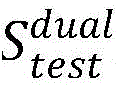


(3)多损失函数3D CNN的搭建:(3) Construction of 3D CNN with multiple loss functions:
构建一个3D CNN,它由混合PET图像的重建(Part I)和基于重建后混合图像的分离(Part II)两部分构成,如图1所示。A 3D CNN is constructed, which consists of two parts, the reconstruction of the mixed PET image (Part I) and the separation based on the reconstructed mixed image (Part II), as shown in Figure 1.
3.1重建Part I由两个3D卷积层、一个reshape层和一个concat层构成,利用辅助损失函数进行监督。第一层3D卷积层设置64×1×1的卷积核,产生64个feature map,作为下一层的输入;第二层3D卷积层设置64×64×1的卷积核,产生4096个feature map,作为下一层的输入;reshape层将输出的feature map重新组合成大小与输入
3.2分离Part II由三个下采样块、三个上采样块、一个3D卷积层构成。3.2 Separation Part II consists of three down-sampling blocks, three up-sampling blocks, and a 3D convolutional layer.
每一个下采样块的构成为:第一层为3D卷积层,设置卷积核的大小为3×3×17,不改变输入维度大小,产生18个feature map,作为下一层的输入;第二层为BatchNorm层,对上一层的输出进行归一化;第三层为Scale层,对上一层的输出进行缩放和平移;第四层为Relu层,这是一个激活函数,其输出结果作为下一层的输入;第五层为3D卷积层,设置2×2×2卷积核的下采样,输出相对输入维度减半;第六层为BatchNorm层,对上一层的输出进行归一化;第七层为Scale层,对上一层的输出进行缩放和平移;第八层为Relu层,其输出为下一个下采样块的输入;经过每一个下采样块,三个维度都会就减半,三个下采样块的feature map数量分别设置为18、36、72。The composition of each downsampling block is as follows: the first layer is a 3D convolutional layer, the size of the convolution kernel is set to 3×3×17, the input dimension size is not changed, and 18 feature maps are generated as the input of the next layer; The second layer is the BatchNorm layer, which normalizes the output of the previous layer; the third layer is the Scale layer, which scales and translates the output of the previous layer; the fourth layer is the Relu layer, which is an activation function whose The output result is used as the input of the next layer; the fifth layer is a 3D convolutional layer, and the downsampling of the 2×2×2 convolution kernel is set, and the output is halved relative to the input dimension; the sixth layer is the BatchNorm layer, which is a The output is normalized; the seventh layer is the Scale layer, which scales and translates the output of the previous layer; the eighth layer is the Relu layer, whose output is the input of the next downsampling block; after each downsampling block, three Each dimension will be halved, and the number of feature maps of the three downsampling blocks is set to 18, 36, and 72, respectively.
每一个上采样块的构成为:第一层为3D反卷积层,设置卷积核为2×2×2使得输入维度扩大一倍,作为下一层的输入;第二层为3D卷积层,设置卷积核3×3×17,不改变输入维度大小,作为下一个上采样块的输入;经过每一个上采样块,三个维度都会扩大一倍,三个上采样块的feature map数量分别设置为72、36、18。The composition of each upsampling block is: the first layer is a 3D deconvolution layer, and the convolution kernel is set to 2 × 2 × 2 to double the input dimension as the input of the next layer; the second layer is a 3D convolution layer. layer, set the
3.3最后一层是3D卷积层,设置1×1×1的卷积核,产生一个feature map作为整个网络的输出,为两种示踪剂三维图像在时间维度上的串联。3.3 The last layer is a 3D convolution layer, which sets a 1×1×1 convolution kernel to generate a feature map as the output of the entire network, which is the concatenation of two tracer 3D images in the time dimension.
(4)初始化网络,设置训练相关参数:(4) Initialize the network and set the training related parameters:
将每一层的权重矩阵和偏置向量设为0,将优化方式设置为Adam,学习率设置为10-6,batchsize设为1,Laux和Lmain之间的比例系数β设置为5。The weight matrix and bias vector of each layer are set to 0, the optimization method is set to Adam, the learning rate is set to 10 -6 , the batchsize is set to 1, and the scale factor β between L aux and L main is set to 5.
(5)将训练集输入此网络进行训练,训练的过程如下:(5) Input the training set into this network for training, and the training process is as follows:
将训练集(输入


其中,第一项为输出的混合重建预测值


以下我们通过模拟实验来验证本发明方法的重建结果。In the following, we verify the reconstruction results of the method of the present invention through simulation experiments.
(1)选择模板。(1) Select a template.
训练数据包含两组组不同的示踪剂对,每组示踪剂对采用不同的模板,每一个模板都由不同的感兴趣区域(Region of interest,ROI)构成,不同的感兴趣区域表示不同的生化环境。图2(a)是包含4个感兴趣区域的复杂大脑模板,[11C]FMZ+[11C]DTBZ这组示踪剂即采用此模板;图2(b)是Zubal胸腔模板,[62Cu]ATSM+[62Cu]PTSM这组示踪剂即采用此模板。The training data contains two groups of different tracer pairs, each group of tracer pairs uses different templates, each template is composed of different regions of interest (Region of interest, ROI), different regions of interest represent different biochemical environment. Figure 2(a) is a complex brain template containing 4 regions of interest, and this template is used for the set of tracers [ 11 C]FMZ+[ 11 C]DTBZ; Figure 2(b) is a Zubal thoracic template, [ 62 Cu The group of tracers ]ATSM+[ 62 Cu]PTSM adopts this template.
(2)模拟示踪剂进入体内之后的运动过程。(2) Simulate the movement process after the tracer enters the body.
采用基于动力学参数的双房室模型模拟双示踪剂在体内的运动情况,利用动力学微分方程组求解放射性核素衰变后在体内的稳定的浓度分布图;采用基于动力学参数的单房室模型模拟单一示踪剂在体内的运动情况,利用动力学微分方程组求解放射性核素衰变后在体内的稳定的浓度分布图。A dual-compartment model based on kinetic parameters was used to simulate the movement of dual tracers in the body, and kinetic differential equations were used to solve the stable concentration distribution of radionuclides in the body after decay; a single-chamber model based on kinetic parameters was used. The chamber model simulates the movement of a single tracer in the body, and uses the kinetic differential equation system to solve the stable concentration distribution map of the radionuclide in the body after decay.
(3)模拟PET的扫描过程。(3) Simulate the scanning process of PET.
本实验使用Monte Carlo的GATE来对PET系统进行建模,它能够模拟PET的整个采集过程;模拟型号为SHR74000,是日本滨松光子学株式会社设计的一台全身PET/CT成像系统,SHR74000-PET扫描仪有6个晶体环,每个环包括48个探测器模块,每个探测器模块包含一个16×16阵列的LYSO晶体,其中晶体环的半径为826mm。当三组双示踪剂和单一示踪剂浓度分布图输入蒙特卡洛系统中,便可以生成对应的动态计数序列。In this experiment, Monte Carlo's GATE is used to model the PET system, which can simulate the entire acquisition process of PET; the simulation model is SHR74000, which is a whole-body PET/CT imaging system designed by Hamamatsu Photonics Co., Ltd., Japan, SHR74000- The PET scanner has 6 crystal rings, each ring includes 48 detector modules, each detector module contains a 16 × 16 array of LYSO crystals, where the crystal ring has a radius of 826 mm. When three sets of dual tracer and single tracer concentration profiles are input into the Monte Carlo system, corresponding dynamic counting sequences can be generated.
(4)重建过程;利用经典的ML-EM重建算法对正弦图进行重建,得到模拟的放射性示踪剂对在体内的浓度分布。(4) Reconstruction process: The sinusoid is reconstructed by using the classical ML-EM reconstruction algorithm, and the concentration distribution of the simulated radiotracer pair in vivo is obtained.
(5)训练过程;从[11C]FMZ+[11C]DTBZ、[62Cu]ATSM+[62Cu]PTSM所产生的模拟数据中抽出2/3作为训练数据输入到网络中去。(5) Training process; 2/3 is extracted from the simulated data generated by [ 11 C]FMZ+[ 11 C]DTBZ, [ 62 Cu]ATSM+[ 62 Cu]PTSM as training data and input into the network.
(6)测试过程;利用剩余的1/3用来验证网络的有效性。(6) Test process; use the remaining 1/3 to verify the effectiveness of the network.
图3(a)~图3(b)分别为[11C]DTBZ的第9帧模拟放射性浓度分布图和经过训练的3DCNN得到的预测的放射性浓度分布图,图3(c)~图3(d)分别为[11C]FMZ的第9帧模拟反射性浓度分布图和经过训练的3D CNN得到的预测的放射性浓度分布图;图4(a)~图4(b)分别为[62Cu]PTSM的第9帧模拟放射性浓度分布图和经过训练的3D CNN得到的预测的放射性浓度分布图,图4(c)~图4(d)分别为[62Cu]ATSM的第9帧模拟反射性浓度分布图和经过训练的3DCNN得到的预测的放射性浓度分布图。Figures 3(a) to 3(b) are the simulated radioactivity concentration distribution map of the ninth frame of [ 11 C]DTBZ and the predicted radioactive concentration distribution map obtained by the trained 3DCNN, respectively. Figures 3(c) to 3( d) The simulated reflectance concentration distribution map of the 9th frame of [ 11 C]FMZ and the predicted radioactive concentration distribution map obtained by the trained 3D CNN, respectively; Fig. 4(a)-Fig. 4(b) are [ 62 Cu ] The 9th frame simulated radioactivity concentration distribution map of PTSM and the predicted radioactivity concentration distribution map obtained by the trained 3D CNN, Fig. 4(c) ~ Fig. 4(d) are the simulated reflections of the 9th frame of [ 62 Cu]ATSM, respectively The radioactivity concentration profile and the predicted radioactivity concentration profile obtained by the trained 3DCNN.
将预测的图像与模拟真实图像对比可以发现搭建的3D CNN能够很好地完成双示踪PET图像的重建,其有效性得到验证。Comparing the predicted image with the simulated real image, it can be found that the constructed 3D CNN can complete the reconstruction of the double tracer PET image well, and its effectiveness has been verified.
上述对实施例的描述是为便于本技术领域的普通技术人员能理解和应用本发明。熟悉本领域技术的人员显然可以容易地对上述实施例做出各种修改,并把在此说明的一般原理应用到其他实施例中而不必经过创造性的劳动。因此,本发明不限于上述实施例,本领域技术人员根据本发明的揭示,对于本发明做出的改进和修改都应该在本发明的保护范围之内。The above description of the embodiments is for the convenience of those of ordinary skill in the art to understand and apply the present invention. It will be apparent to those skilled in the art that various modifications to the above-described embodiments can be readily made, and the general principles described herein can be applied to other embodiments without inventive effort. Therefore, the present invention is not limited to the above-mentioned embodiments, and improvements and modifications made by those skilled in the art according to the disclosure of the present invention should all fall within the protection scope of the present invention.
Claims (7)
Priority Applications (2)
| Application Number | Priority Date | Filing Date | Title |
|---|---|---|---|
| CN201811434410.1A CN109615674B (en) | 2018-11-28 | 2018-11-28 | Dynamic dual tracer PET reconstruction method based on hybrid loss function 3D CNN |
| US16/367,012 US11508101B2 (en) | 2018-11-28 | 2019-03-27 | Dynamic dual-tracer PET reconstruction method based on hybrid-loss 3D convolutional neural networks |
Applications Claiming Priority (1)
| Application Number | Priority Date | Filing Date | Title |
|---|---|---|---|
| CN201811434410.1A CN109615674B (en) | 2018-11-28 | 2018-11-28 | Dynamic dual tracer PET reconstruction method based on hybrid loss function 3D CNN |
Publications (2)
| Publication Number | Publication Date |
|---|---|
| CN109615674A CN109615674A (en) | 2019-04-12 |
| CN109615674B true CN109615674B (en) | 2020-09-18 |
Family
ID=66005837
Family Applications (1)
| Application Number | Title | Priority Date | Filing Date |
|---|---|---|---|
| CN201811434410.1A Active CN109615674B (en) | 2018-11-28 | 2018-11-28 | Dynamic dual tracer PET reconstruction method based on hybrid loss function 3D CNN |
Country Status (2)
| Country | Link |
|---|---|
| US (1) | US11508101B2 (en) |
| CN (1) | CN109615674B (en) |
Families Citing this family (11)
| Publication number | Priority date | Publication date | Assignee | Title |
|---|---|---|---|---|
| US10839543B2 (en) * | 2019-02-26 | 2020-11-17 | Baidu Usa Llc | Systems and methods for depth estimation using convolutional spatial propagation networks |
| CN111166368B (en) * | 2019-12-19 | 2021-07-23 | 浙江大学 | Single-scan dual-tracer PET signal separation method based on pre-trained GRU |
| CN111476859B (en) * | 2020-04-13 | 2022-09-16 | 浙江大学 | Dynamic double-tracing PET imaging method based on 3D Unet |
| CN111920436A (en) * | 2020-07-08 | 2020-11-13 | 浙江大学 | Dual-tracer PET (positron emission tomography) separation method based on multi-task learning three-dimensional convolutional coding and decoding network |
| CN113160347B (en) * | 2021-04-14 | 2022-04-26 | 浙江大学 | Low-dose double-tracer PET reconstruction method based on attention mechanism |
| CN113808106B (en) * | 2021-09-17 | 2023-05-30 | 浙江大学 | Ultra-low dose PET image reconstruction system and method based on deep learning |
| CN113947642B (en) * | 2021-10-18 | 2024-06-04 | 北京航空航天大学 | X-space magnetic particle imaging deconvolution method |
| CN114596379A (en) * | 2022-05-07 | 2022-06-07 | 中国科学技术大学 | Image reconstruction method, electronic device and storage medium based on depth image prior |
| CN114998249B (en) * | 2022-05-30 | 2024-07-02 | 浙江大学 | Double-tracing PET imaging method constrained by space-time attention mechanism |
| US20230401769A1 (en) * | 2022-06-14 | 2023-12-14 | Siemens Medical Solutions Usa, Inc. | Systems and methods of accelerated dynamic imaging in pet |
| WO2024237769A1 (en) * | 2023-05-17 | 2024-11-21 | 재단법인 아산사회복지재단 | Method for predicting state of object on basis of dynamic image data, and computing device performing same |
Citations (9)
| Publication number | Priority date | Publication date | Assignee | Title |
|---|---|---|---|---|
| US8917925B1 (en) * | 2014-03-28 | 2014-12-23 | Heartflow, Inc. | Systems and methods for data and model-driven image reconstruction and enhancement |
| CN106887025A (en) * | 2017-01-16 | 2017-06-23 | 浙江大学 | A kind of method that mixing tracer dynamic PET concentration distributed image based on stack self-encoding encoder is rebuild |
| CN106910185A (en) * | 2017-01-13 | 2017-06-30 | 陕西师范大学 | A kind of DBCC disaggregated models and construction method based on CNN deep learnings |
| CN107133997A (en) * | 2017-04-11 | 2017-09-05 | 浙江大学 | A kind of dual tracer PET method for reconstructing based on deep neural network |
| CN107862275A (en) * | 2017-11-01 | 2018-03-30 | 电子科技大学 | Human bodys' response model and its construction method and Human bodys' response method |
| CN108062543A (en) * | 2018-01-16 | 2018-05-22 | 中车工业研究院有限公司 | A kind of face recognition method and device |
| CN108108723A (en) * | 2018-01-19 | 2018-06-01 | 深圳市恩钛控股有限公司 | A kind of face feature extraction method based on deep learning |
| CN108389226A (en) * | 2018-02-12 | 2018-08-10 | 北京工业大学 | A kind of unsupervised depth prediction approach based on convolutional neural networks and binocular parallax |
| CN108475415A (en) * | 2015-12-21 | 2018-08-31 | 商汤集团有限公司 | method and system for image processing |
Family Cites Families (2)
| Publication number | Priority date | Publication date | Assignee | Title |
|---|---|---|---|---|
| US10043097B2 (en) * | 2015-03-10 | 2018-08-07 | Fringefy Ltd. | Image abstraction system |
| CN104616005A (en) * | 2015-03-10 | 2015-05-13 | 南京宜开数据分析技术有限公司 | Domain-self-adaptive facial expression analysis method |
-
2018
- 2018-11-28 CN CN201811434410.1A patent/CN109615674B/en active Active
-
2019
- 2019-03-27 US US16/367,012 patent/US11508101B2/en active Active
Patent Citations (9)
| Publication number | Priority date | Publication date | Assignee | Title |
|---|---|---|---|---|
| US8917925B1 (en) * | 2014-03-28 | 2014-12-23 | Heartflow, Inc. | Systems and methods for data and model-driven image reconstruction and enhancement |
| CN108475415A (en) * | 2015-12-21 | 2018-08-31 | 商汤集团有限公司 | method and system for image processing |
| CN106910185A (en) * | 2017-01-13 | 2017-06-30 | 陕西师范大学 | A kind of DBCC disaggregated models and construction method based on CNN deep learnings |
| CN106887025A (en) * | 2017-01-16 | 2017-06-23 | 浙江大学 | A kind of method that mixing tracer dynamic PET concentration distributed image based on stack self-encoding encoder is rebuild |
| CN107133997A (en) * | 2017-04-11 | 2017-09-05 | 浙江大学 | A kind of dual tracer PET method for reconstructing based on deep neural network |
| CN107862275A (en) * | 2017-11-01 | 2018-03-30 | 电子科技大学 | Human bodys' response model and its construction method and Human bodys' response method |
| CN108062543A (en) * | 2018-01-16 | 2018-05-22 | 中车工业研究院有限公司 | A kind of face recognition method and device |
| CN108108723A (en) * | 2018-01-19 | 2018-06-01 | 深圳市恩钛控股有限公司 | A kind of face feature extraction method based on deep learning |
| CN108389226A (en) * | 2018-02-12 | 2018-08-10 | 北京工业大学 | A kind of unsupervised depth prediction approach based on convolutional neural networks and binocular parallax |
Non-Patent Citations (3)
| Title |
|---|
| Penalized PET Reconstruction using CNN Prior;Kyungsang Kim 等;《2017 IEEE Nuclear Science Symposium and Medical Imaging Conference Proceedings (NSS/MIC)》;20181115;第1-4页 * |
| Separation of a Mixture of Simultaneous Dual-Tracer PET Signals: A Data-Driven Approach;Dongsheng Ruan 等;《IEEE Transactions on Nuclear Science》;20170930;第64卷(第9期);第2588-2597页 * |
| 基于多列深度3D卷积神经网络的手势识别;易生 等;《计算机工程》;20170815;第43卷(第8期);第243-248页 * |
Also Published As
| Publication number | Publication date |
|---|---|
| US20200167974A1 (en) | 2020-05-28 |
| CN109615674A (en) | 2019-04-12 |
| US11508101B2 (en) | 2022-11-22 |
Similar Documents
| Publication | Publication Date | Title |
|---|---|---|
| CN109615674B (en) | Dynamic dual tracer PET reconstruction method based on hybrid loss function 3D CNN | |
| CN109009179B (en) | Same isotope labeling double-tracer PET separation method based on deep belief network | |
| US10765382B2 (en) | Method for mixed tracers dynamic PET concentration image reconstruction based on stacked autoencoder | |
| CN108257134B (en) | Nasopharyngeal carcinoma focus automatic segmentation method and system based on deep learning | |
| CN108629816B (en) | Method for reconstructing thin-layer magnetic resonance image based on deep learning | |
| CN107133997B (en) | A dual-tracer PET reconstruction method based on deep neural network | |
| CN113160347B (en) | Low-dose double-tracer PET reconstruction method based on attention mechanism | |
| Xu et al. | Deep-learning-based separation of a mixture of dual-tracer single-acquisition PET signals with equal half-lives: a simulation study | |
| CN106204674B (en) | The dynamic PET images method for reconstructing constrained based on structure dictionary and kinetic parameter dictionary joint sparse | |
| CN108986916B (en) | Dynamic PET Image Tracer Kinetic Macroparameter Estimation Method Based on Stacked Autoencoder | |
| Shao et al. | A learned reconstruction network for SPECT imaging | |
| CN109993808B (en) | A Dynamic Dual Tracer PET Reconstruction Method Based on DSN | |
| CN109717891A (en) | A kind of PET scatter correction method based on deep learning | |
| CN105678821A (en) | Dynamic PET image reconstruction method based on self-encoder image fusion | |
| Ruan et al. | Separation of a mixture of simultaneous dual-tracer PET signals: a data-driven approach | |
| CN103295207A (en) | Dynamic reconstruction method of dual-tracer PET (positron emission tomography) concentration on the basis of H infinity filter | |
| Qing et al. | Separation of dual-tracer PET signals using a deep stacking network | |
| CN111476859B (en) | Dynamic double-tracing PET imaging method based on 3D Unet | |
| CN111920436A (en) | Dual-tracer PET (positron emission tomography) separation method based on multi-task learning three-dimensional convolutional coding and decoding network | |
| CN111166368B (en) | Single-scan dual-tracer PET signal separation method based on pre-trained GRU | |
| CN112927132B (en) | PET image reconstruction method for improving spatial resolution uniformity of PET system | |
| CN114998249A (en) | Space-time attention mechanism constrained dual-tracer PET imaging method | |
| Lim et al. | SPECT Reconstruction With a Trained Regularizer Using CT-Side Information: Application to $^{177} $ Lu SPECT Imaging | |
| Wan et al. | Deep-learning based joint estimation of dual-tracer PET image activity maps and clustering of time activity curves | |
| CN115984401A (en) | A dynamic PET image reconstruction method based on model-driven deep learning |
Legal Events
| Date | Code | Title | Description |
|---|---|---|---|
| PB01 | Publication | ||
| PB01 | Publication | ||
| SE01 | Entry into force of request for substantive examination | ||
| SE01 | Entry into force of request for substantive examination | ||
| GR01 | Patent grant | ||
| GR01 | Patent grant |