CN109525985B - A full-duplex active eavesdropping method for wireless energy harvesting - Google Patents
A full-duplex active eavesdropping method for wireless energy harvesting Download PDFInfo
- Publication number
- CN109525985B CN109525985B CN201811249636.4A CN201811249636A CN109525985B CN 109525985 B CN109525985 B CN 109525985B CN 201811249636 A CN201811249636 A CN 201811249636A CN 109525985 B CN109525985 B CN 109525985B
- Authority
- CN
- China
- Prior art keywords
- suspicious
- node
- active eavesdropping
- active
- information
- Prior art date
- Legal status (The legal status is an assumption and is not a legal conclusion. Google has not performed a legal analysis and makes no representation as to the accuracy of the status listed.)
- Active
Links
- 238000000034 method Methods 0.000 title claims abstract description 15
- 238000003306 harvesting Methods 0.000 title claims description 7
- 230000006854 communication Effects 0.000 claims abstract description 70
- 238000004891 communication Methods 0.000 claims abstract description 67
- 238000005516 engineering process Methods 0.000 claims abstract description 24
- 230000008030 elimination Effects 0.000 claims abstract description 4
- 238000003379 elimination reaction Methods 0.000 claims abstract description 4
- 230000005540 biological transmission Effects 0.000 claims description 31
- 239000000654 additive Substances 0.000 claims description 12
- 230000000996 additive effect Effects 0.000 description 8
- 230000000694 effects Effects 0.000 description 6
- 238000011161 development Methods 0.000 description 3
- 238000003912 environmental pollution Methods 0.000 description 3
- 238000012423 maintenance Methods 0.000 description 3
- 238000011160 research Methods 0.000 description 3
- 238000010586 diagram Methods 0.000 description 2
- 238000005562 fading Methods 0.000 description 2
- 230000002452 interceptive effect Effects 0.000 description 2
- 230000001788 irregular Effects 0.000 description 2
- 230000009286 beneficial effect Effects 0.000 description 1
- 238000013461 design Methods 0.000 description 1
- 230000007613 environmental effect Effects 0.000 description 1
- 238000012986 modification Methods 0.000 description 1
- 230000004048 modification Effects 0.000 description 1
- 230000002688 persistence Effects 0.000 description 1
- 238000004088 simulation Methods 0.000 description 1
Images


Classifications
-
- H—ELECTRICITY
- H04—ELECTRIC COMMUNICATION TECHNIQUE
- H04W—WIRELESS COMMUNICATION NETWORKS
- H04W12/00—Security arrangements; Authentication; Protecting privacy or anonymity
- H04W12/02—Protecting privacy or anonymity, e.g. protecting personally identifiable information [PII]
-
- H—ELECTRICITY
- H04—ELECTRIC COMMUNICATION TECHNIQUE
- H04B—TRANSMISSION
- H04B17/00—Monitoring; Testing
- H04B17/30—Monitoring; Testing of propagation channels
- H04B17/309—Measuring or estimating channel quality parameters
- H04B17/336—Signal-to-interference ratio [SIR] or carrier-to-interference ratio [CIR]
-
- H—ELECTRICITY
- H04—ELECTRIC COMMUNICATION TECHNIQUE
- H04B—TRANSMISSION
- H04B5/00—Near-field transmission systems, e.g. inductive or capacitive transmission systems
- H04B5/70—Near-field transmission systems, e.g. inductive or capacitive transmission systems specially adapted for specific purposes
- H04B5/79—Near-field transmission systems, e.g. inductive or capacitive transmission systems specially adapted for specific purposes for data transfer in combination with power transfer
-
- H—ELECTRICITY
- H04—ELECTRIC COMMUNICATION TECHNIQUE
- H04L—TRANSMISSION OF DIGITAL INFORMATION, e.g. TELEGRAPHIC COMMUNICATION
- H04L63/00—Network architectures or network communication protocols for network security
- H04L63/30—Network architectures or network communication protocols for network security for supporting lawful interception, monitoring or retaining of communications or communication related information
- H04L63/302—Network architectures or network communication protocols for network security for supporting lawful interception, monitoring or retaining of communications or communication related information gathering intelligence information for situation awareness or reconnaissance
-
- H—ELECTRICITY
- H04—ELECTRIC COMMUNICATION TECHNIQUE
- H04W—WIRELESS COMMUNICATION NETWORKS
- H04W12/00—Security arrangements; Authentication; Protecting privacy or anonymity
- H04W12/12—Detection or prevention of fraud
Landscapes
- Engineering & Computer Science (AREA)
- Computer Networks & Wireless Communication (AREA)
- Signal Processing (AREA)
- Computer Security & Cryptography (AREA)
- Electromagnetism (AREA)
- Physics & Mathematics (AREA)
- Evolutionary Computation (AREA)
- Technology Law (AREA)
- Computer Hardware Design (AREA)
- Quality & Reliability (AREA)
- Computing Systems (AREA)
- General Engineering & Computer Science (AREA)
- Mobile Radio Communication Systems (AREA)
Abstract
Description
技术领域technical field
本发明涉及无线通信物理层安全通信,特别是一种基于无线能量采集技术的全双工主动窃听方法。The invention relates to wireless communication physical layer security communication, in particular to a full-duplex active eavesdropping method based on wireless energy collection technology.
背景技术Background technique
在无线通信技术的发展历程中,各种安全通信技术也随之发展。而其中的物理层安全基于香农理论的信道编码技术,利用无线信道复杂的空间特性和时变特性实现信息的安全传输。Wyner原创性的提出物理层安全的概念及其相关指标[1]。随后,物理层安全技术快速发展,各种物理层安全技术正越来越多的用于保障信息安全传输。In the development process of wireless communication technology, various security communication technologies have also developed. The physical layer security is based on the channel coding technology of Shannon's theory, which uses the complex spatial and time-varying characteristics of wireless channels to realize the secure transmission of information. Wyner originally proposed the concept of physical layer security and its related indicators [1] . Subsequently, with the rapid development of physical layer security technologies, various physical layer security technologies are increasingly being used to ensure the secure transmission of information.
传统物理层安全模型的发展已相当成熟,通常包含信源、中继、信宿和窃听者等节点,尤其是窃听者都是被动窃听者,传统工作则是通过各种物理层安全技术防止窃听者的非法窃听,诸如发射人工噪声干扰窃听者[2][3],各种天线选择技术[4][5]等,这些安全技术都有效提升了系统的安全性能。The development of the traditional physical layer security model is quite mature, and usually includes nodes such as source, relay, sink, and eavesdropper, especially eavesdroppers are passive eavesdroppers, and traditional work is to prevent eavesdroppers through various physical layer security technologies. such as transmitting artificial noise to interfere with eavesdroppers [2][3] , various antenna selection techniques [4][5] , etc., these security technologies have effectively improved the security performance of the system.
但这些传统安全模型使用场景有限,尤其是针对犯罪恐怖分子等一系列非法或可疑通信网络场景(本文统称可疑通信网络),如何主动窃听可疑通信网络的可疑信息,以及如何干扰可疑通信网络的正常通信,近些年才逐渐得到研究者的关注。However, these traditional security models have limited use scenarios, especially for a series of illegal or suspicious communication network scenarios such as criminal terrorists (collectively referred to as suspicious communication networks in this article), how to actively eavesdrop on suspicious information of suspicious communication networks, and how to interfere with the normal operation of suspicious communication networks Communication has gradually gained the attention of researchers in recent years.
早期主动窃听方案的研究考虑的可疑通信网络相对简单,如文献[6][7][8],均针对可疑信源发送可疑信息给可疑信宿的双节点可疑通信网络进行研究,此网络适用场景有限,可疑通信网络在解决长距离通信时,往往会增加可疑中继进行协作通信,文献[9][10]针对此场景进行了相关研究,但其主动窃听节点均配置单根天线,采用半双工的工作模式,针对多时隙可疑通信网络的主动窃听效果和加扰效果有限。而且现有的主动窃听方案研究极少考虑主动窃听节点的供能问题,可疑通信网络往往分布分散和无规律,且相对隐蔽,主动窃听节点的分布设置也随之变得复杂和无规律,靠传统的电池对主动窃听节点提供能量需要定期更换电池,这样会带来诸如维护成本高和环境污染等一系列问题。The suspicious communication network considered in the early research on active eavesdropping schemes is relatively simple. For example, literatures [6][7][8] focus on two-node suspicious communication networks in which suspicious sources send suspicious information to suspicious sinks. This network is applicable to scenarios Limited, suspicious communication networks often add suspicious relays for cooperative communication when solving long-distance communication. Literature [9] [10] conducted related research on this scenario, but the active eavesdropping nodes are all equipped with a single antenna, using half The duplex working mode has limited active eavesdropping effect and scrambling effect for suspicious multi-slot communication networks. In addition, the existing research on active eavesdropping schemes rarely consider the energy supply of active eavesdropping nodes. Suspicious communication networks are often scattered and irregular, and relatively hidden. The distribution settings of active eavesdropping nodes also become complex and irregular. The traditional battery to provide energy to the active eavesdropping node needs to replace the battery regularly, which will bring a series of problems such as high maintenance cost and environmental pollution.
发明内容SUMMARY OF THE INVENTION
本发明的主要目的在于针对复杂可疑通信网络(可疑信源和可疑信宿之间存在可疑中继)进行研究,提出一种基于无线能量采集技术的全双工主动窃听方法,主动窃听节点配置两根天线,采用全双工工作模式,通过无线能量采集技术进行供能,有效解决了上述一系列问题,且便于实施。The main purpose of the present invention is to study complex suspicious communication networks (suspicious relays exist between suspicious sources and suspicious sinks), and propose a full-duplex active eavesdropping method based on wireless energy harvesting technology. Active eavesdropping nodes are configured with two The antenna adopts the full-duplex working mode and supplies energy through wireless energy harvesting technology, which effectively solves the above-mentioned series of problems and is easy to implement.
本发明采用如下技术方案:The present invention adopts following technical scheme:
一种无线能量采集全双工主动窃听方法,其特征在于:通信模型包括四个节点,分别为可疑信源S、可疑中继R、可疑信宿D和主动窃听节点E;其中可疑信源S、可疑中继R和可疑信宿D构成可疑通信网络,均配置单根天线;主动窃听节点E配置两根天线,工作在全双工模式,具有充电模式状态和主动窃听模式状态,窃听方法包括如下步骤:A full-duplex active eavesdropping method for wireless energy collection, characterized in that: a communication model includes four nodes, namely, a suspicious information source S, a suspicious relay R, a suspicious information sink D, and an active eavesdropping node E; The suspicious relay R and the suspicious sink D form a suspicious communication network, and both are configured with a single antenna; the active eavesdropping node E is configured with two antennas, works in full-duplex mode, and has a charging mode state and an active eavesdropping mode state. The eavesdropping method includes the following steps :
1)在可疑通信网络的第一时隙,可疑信源S向可疑中继R发送可疑信息,同时主动窃听节点E对其可疑信息进行窃听,并发送人工噪声信号干扰可疑中继R接收可疑信息;1) In the first time slot of the suspicious communication network, the suspicious source S sends suspicious information to the suspicious relay R, and at the same time, the active eavesdropping node E eavesdrops on its suspicious information, and sends artificial noise signals to interfere with the suspicious relay R to receive the suspicious information. ;
2)在可疑通信网络的第二时隙,可疑中继R向可疑信宿D转发可疑信息,同时主动窃听节点E对其可疑信息进行窃听,并发送人工噪声信号干扰可疑信宿D接收可疑信息;2) In the second time slot of the suspicious communication network, the suspicious relay R forwards the suspicious information to the suspicious information sink D, while the active eavesdropping node E eavesdrops on its suspicious information, and sends artificial noise signals to interfere with the suspicious information sink D to receive the suspicious information;
3)主动窃听节点采用最大比合并的方式合并可疑通信网络两个时隙的可疑信息,且采用自干扰消除技术获得最终可疑信息,其自干扰信号全部用于自身采集能量。3) The active eavesdropping node merges the suspicious information of the two time slots of the suspicious communication network by means of maximum ratio combination, and adopts the self-interference elimination technology to obtain the final suspicious information, and its self-interference signal is all used for its own energy collection.
所述通信模型将整个通信过程分为k个传输时隙,在第k个传输时隙开始时,所述主动窃听节点估计其电池剩余能量ε[k],并与设定的电池阈值Eth进行比较;如果ε[k]>Eth,主动窃听节点开始窃听可疑信息,否则主动窃听节点继续充电。The communication model divides the entire communication process into k transmission time slots. At the beginning of the kth transmission time slot, the active eavesdropping node estimates its remaining battery energy ε[k] and compares it with the set battery threshold E th . Compare; if ε[k]>E th , the active eavesdropping node starts eavesdropping on suspicious information, otherwise the active eavesdropping node continues to charge.
步骤1)中,所述可疑中继R的接收信号表达式为In step 1), the received signal expression of the suspicious relay R is:

其中,PS代表可疑信源S的发送功率,PE代表主动窃听节点E的加扰功率,xS为可疑信源S发送的可疑信息,fER为可疑中继R接收到的主动窃听节点E发送的加扰信号,nR表示可疑中继R接收到的方差为σ2的加性白高斯噪声,hSR为可疑信源S到可疑中继R的信道参数,hER为主动窃听节点E到可疑中继R的信道参数。Among them, P S represents the transmission power of the suspicious source S, PE represents the scrambling power of the active eavesdropping node E, x S is the suspicious information sent by the suspicious information source S, f ER is the active eavesdropping node received by the suspicious relay R The scrambled signal sent by E, n R represents the additive white Gaussian noise with variance σ 2 received by the suspicious relay R, h SR is the channel parameter from the suspicious source S to the suspicious relay R, h ER is the active eavesdropping node Channel parameters from E to suspicious relay R.
所述主动窃听节点E在可疑通信网络第一时隙的接收信号表达式为The received signal expression of the active eavesdropping node E in the first time slot of the suspicious communication network is expressed as

其中fEE为主动窃听节点E接收到的自干扰信号,nE表示主动窃听节点E接收到的方差为σ2的加性白高斯噪声,hSE为可疑信源S到主动窃听节点E的信道参数,hEE为主动窃听节点E的自干扰信道参数。where f EE is the self-interference signal received by the active eavesdropping node E, n E represents the additive white Gaussian noise with variance σ 2 received by the active eavesdropping node E, h SE is the channel from the suspicious source S to the active eavesdropping node E parameter, h EE is the self-interference channel parameter of active eavesdropping node E.
步骤2)中,所述可疑信宿D的接收信号表达式为In step 2), the received signal expression of the suspicious information sink D is

其中,PR代表可疑中继R的发送功率,PE代表主动窃听节点E的加扰功率,xR为可疑中继R转发的可疑信息,fED为可疑信宿D接收到的主动窃听节点E发送的加扰信号,nD表示可疑信宿D接收到的方差为σ2的加性白高斯噪声,hRD为可疑中继R到可疑信宿D的信道参数,hED为主动窃听节点E到可疑信宿D的信道参数。Among them, PR represents the transmission power of the suspicious relay R , PE represents the scrambling power of the active eavesdropping node E , x R is the suspicious information forwarded by the suspicious relay R, f ED is the active eavesdropping node E received by the suspicious sink D The scrambled signal sent, n D represents the additive white Gaussian noise with variance σ 2 received by the suspicious sink D, h RD is the channel parameter from the suspicious relay R to the suspicious sink D, h ED is the active eavesdropping node E to the suspicious Channel parameters of sink D.
步骤2)中所述主动窃听节点E在可疑通信网络第二时隙的接收信号表达式为The received signal expression of the active eavesdropping node E in the second time slot of the suspicious communication network described in step 2) is expressed as

其中,fEE为主动窃听节点E接收到的自干扰信号,nE表示主动窃听节点接收到的方差为σ2的加性白高斯噪声,hRE为可疑中继R到主动窃听节点E的信道参数,hEE为主动窃听节点E的自干扰信道参数。Among them, f EE is the self-interference signal received by the active eavesdropping node E, n E represents the additive white Gaussian noise with variance σ 2 received by the active eavesdropping node, h RE is the channel from the suspicious relay R to the active eavesdropping node E parameter, h EE is the self-interference channel parameter of active eavesdropping node E.
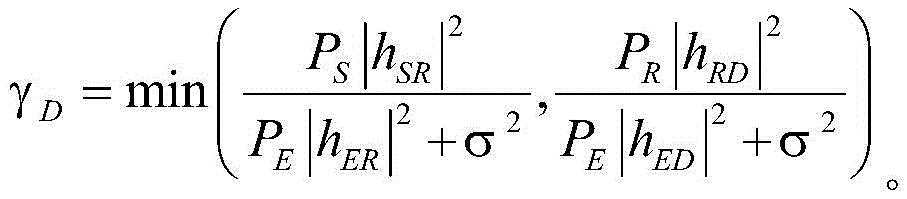
步骤2)中,所述可疑中继采用固定解码转发协议,所以可疑信宿的接收信干噪比可表示为In step 2), the suspicious relay adopts a fixed decoding and forwarding protocol, so the received signal-to-interference-noise ratio of the suspicious sink can be expressed as:

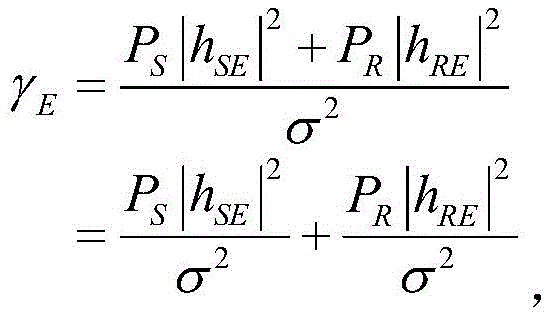
在步骤3)中,所述主动窃听节点的接收信噪比为In step 3), the received signal-to-noise ratio of the active eavesdropping node is

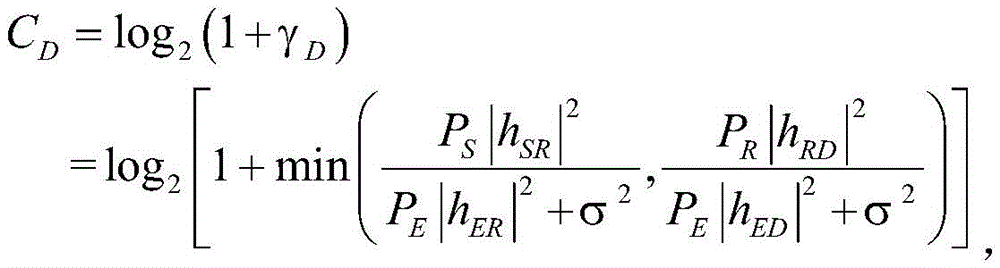
所述通信模型的可疑信道的信道容量可表示为:The channel capacity of the suspect channel of the communication model can be expressed as:

主动窃听信道的信道容量可表示为:The channel capacity of the active eavesdropping channel can be expressed as:
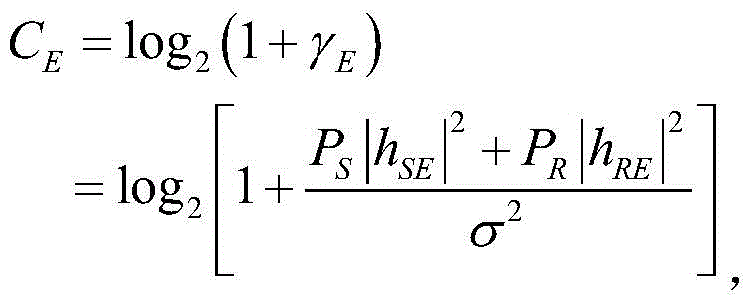
因此,可疑信道的传输中断概率可表示为:Therefore, the transmission interruption probability of the suspicious channel can be expressed as:

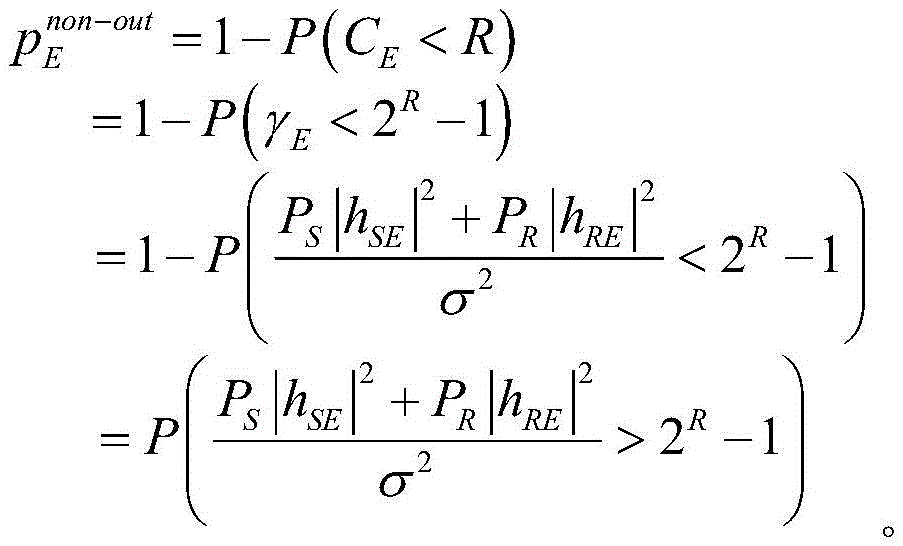
主动窃听信道的窃听不中断概率可表示为:The uninterrupted eavesdropping probability of active eavesdropping channel can be expressed as:
由上述对本发明的描述可知,与现有技术相比,本发明具有如下有益效果:As can be seen from the above description of the present invention, compared with the prior art, the present invention has the following beneficial effects:
1、以往主动窃听方案只考虑两节点之间的简单可疑通信网络,即可疑信源发送可疑信息给可疑信宿,而本发明考虑多节点之间(可疑信源和可疑信宿之间存在可疑中继)的复杂可疑通信网络;1. In the past, the active eavesdropping scheme only considers the simple suspicious communication network between two nodes, that is, the suspicious information source sends suspicious information to the suspicious information sink, and the present invention considers between multiple nodes (there is a suspicious relay between the suspicious information source and the suspicious information sink). ) complex suspicious communication networks;
二、以往主动窃听方案的主动窃听节点只配置单根天线,工作在半双工模式,窃听效果和加扰效果有限,本发明则考虑主动窃听节点配置两根天线,工作在全双工模式,有效提升了主动窃听信息量;2. The active eavesdropping node of the previous active eavesdropping scheme is only configured with a single antenna and works in half-duplex mode, with limited eavesdropping effect and scrambling effect. The present invention considers that the active eavesdropping node is configured with two antennas and works in full-duplex mode. Effectively increase the amount of active eavesdropping information;
三、现有主动窃听方案的主动窃听节点均采用传统的电池方案提供工作所需的能量,往往会造成维护成本高,环境污染等一系列问题,本发明的主动窃听节点则采用无线能量采集技术,使得供能的稳定性提升,且节能环保。3. The active eavesdropping nodes of the existing active eavesdropping scheme all use the traditional battery scheme to provide the energy required for work, which often causes a series of problems such as high maintenance costs and environmental pollution. The active eavesdropping node of the present invention adopts wireless energy collection technology , which improves the stability of energy supply, and saves energy and protects the environment.
附图说明Description of drawings
图1为本发明系统的结构模型图,图中包含四个节点,分别是可疑信源S、可疑中继R、可疑信宿D和主动窃听节点E,主动窃听节点E配置两根天线,其它节点均配置一根天线,系统中的各个信道均服从瑞利衰落信道;Fig. 1 is the structural model diagram of the system of the present invention, and the figure includes four nodes, namely suspicious information source S, suspicious relay R, suspicious information sink D and active eavesdropping node E, active eavesdropping node E is configured with two antennas, other nodes are Each channel is equipped with an antenna, and each channel in the system obeys the Rayleigh fading channel;
图2为本发明系统的传输时隙图;Fig. 2 is the transmission time slot diagram of the system of the present invention;
图3为本发明可疑通信网络的传输中断概率随主动窃听节点加扰功率的变化图;3 is a graph showing the change of the transmission interruption probability of the suspicious communication network of the present invention with the scrambling power of an active eavesdropping node;
图4为本发明的主动窃听节点的窃听不中断概率随可疑通信网络的可疑信源发送功率的变化图。FIG. 4 is a graph showing the change of the probability of uninterrupted eavesdropping of the active eavesdropping node according to the present invention with the transmission power of the suspicious information source of the suspicious communication network.
具体实施方式Detailed ways
以下通过具体实施方式对本发明作进一步的描述。The present invention will be further described below through specific embodiments.
本发明提出一种基于无线能量采集技术的全双工主动窃听传输方法,The invention proposes a full-duplex active eavesdropping transmission method based on wireless energy collection technology,
本发明通信模型包含四个节点,分别是可疑信源S、可疑中继R、可疑信宿D和主动窃听节点E,如图1所示,其中可疑网络部分包含可疑信源S、可疑中继R和可疑信宿D,均配置单根天线,而主动窃听节点E配置两根天线,工作在全双工模式,有充电模式状态和主动窃听模式状态。系统中各个信道建模考虑准静态平坦的瑞利衰落信道,所有信道相互独立,可疑信源S到可疑中继R,可疑中继R到可疑信宿D,可疑信源S到主动窃听节点E,可疑中继R到主动窃听节点E,主动窃听节点E到可疑中继R、主动窃听节点E到可疑信宿D、主动窃听节点E的自干扰信道参数分别表示为hSR,hRD,hSE,hRE,hER,hED,hEE。假设可疑信源与可疑信宿之间距离较远,不存在直达路径。考虑到实际情况,可疑网络中的所有节点均不知道主动窃听节点的存在,则其也无法获知主动窃听信道的信道状态信息(CSI),而主动窃听节点知道所有信道的CSI。The communication model of the present invention includes four nodes, namely suspicious information source S, suspicious relay R, suspicious information sink D and active eavesdropping node E, as shown in Figure 1, wherein the suspicious network part includes suspicious information source S, suspicious relay R and suspicious sink D, both are configured with a single antenna, while the active eavesdropping node E is configured with two antennas, works in full-duplex mode, and has a charging mode state and an active eavesdropping mode state. The modeling of each channel in the system considers a quasi-static flat Rayleigh fading channel, all channels are independent of each other, suspicious source S goes to suspicious relay R, suspicious relay R goes to suspicious sink D, suspicious source S goes to active eavesdropping node E, The self-interference channel parameters of the suspicious relay R to the active eavesdropping node E, the active eavesdropping node E to the suspicious relay R, the active eavesdropping node E to the suspicious sink D, and the active eavesdropping node E are respectively expressed as h SR , h RD , h SE , h RE , h ER , h ED , h EE . It is assumed that the distance between the suspicious information source and the suspicious information sink is long, and there is no direct path. Considering the actual situation, all nodes in the suspicious network do not know the existence of active eavesdropping nodes, so they cannot learn the channel state information (CSI) of active eavesdropping channels, and active eavesdropping nodes know the CSI of all channels.
无线能量采集策略:Wireless energy harvesting strategy:
本模型将整个通信过程分为k个传输时隙,每个传输时隙的工作方式如图2所示,在第k(k=1,2,…)个传输时隙开始时,主动窃听节点估计其电池剩余能量ε[k],并与设定的电池阈值Eth进行比较。如果ε[k]>Eth,主动窃听节点开始窃听可疑信息,否则主动窃听节点继续充电。其中,Eth等同于主动窃听节点消耗的所有功率能量,即Eth=PE+PC,其中,PE代表主动窃听节点E的加扰功率,PC代表恒定的电路损耗功率。This model divides the whole communication process into k transmission time slots. The working mode of each transmission time slot is shown in Figure 2. At the beginning of the kth (k=1, 2, ...) transmission time slot, the active eavesdropping node Estimate its remaining battery energy ε[k] and compare it with the set battery threshold E th . If ε[k]>E th , the active eavesdropping node starts eavesdropping on suspicious information, otherwise the active eavesdropping node continues to charge. Among them, Eth is equivalent to all the power energy consumed by the active eavesdropping node, namely Eth =PE + PC, where PE represents the scrambling power of the active eavesdropping node E , and PC represents the constant circuit loss power.
本发明具体步骤包括如下:The specific steps of the present invention include the following:
步骤1)在本模型中,可疑网络的传输分两个时隙完成,而主动窃听节点工作在两个模式,即充电模式和主动窃听模式。在可疑通信网络的第一时隙,可疑信源S向可疑中继R发送可疑信息,同时主动窃听节点E对其可疑信息进行窃听,并发送人工噪声信号干扰可疑中继R接收可疑信息。则可疑中继R的接收信号表达式为Step 1) In this model, the transmission of the suspicious network is completed in two time slots, and the active eavesdropping node works in two modes, namely the charging mode and the active eavesdropping mode. In the first time slot of the suspicious communication network, the suspicious source S sends suspicious information to the suspicious relay R, and at the same time, the active eavesdropping node E eavesdrops on its suspicious information, and sends artificial noise signals to interfere with the suspicious relay R receiving the suspicious information. Then the expression of the received signal of the suspicious relay R is:

其中,PS代表可疑信源S的发送功率,PE代表主动窃听节点E的加扰功率,xS为可疑信源S发送的可疑信息,fER为可疑中继R接收到的主动窃听节点E发送的加扰信号,nR表示可疑中继R接收到的方差为σ2的加性白高斯噪声。Among them, P S represents the transmission power of the suspicious source S, PE represents the scrambling power of the active eavesdropping node E, x S is the suspicious information sent by the suspicious information source S, f ER is the active eavesdropping node received by the suspicious relay R The scrambled signal sent by E, n R represents the additive white Gaussian noise with variance σ 2 received by the suspicious relay R.
则主动窃听节点E在可疑通信网络第一时隙的接收信号表达式为Then the expression of the received signal of the active eavesdropping node E in the first time slot of the suspicious communication network is:

其中,fEE为主动窃听节点E接收到的自干扰信号,nE表示主动窃听节点E接收到的方差为σ2的加性白高斯噪声。Among them, f EE is the self-interference signal received by active eavesdropping node E, and n E represents the additive white Gaussian noise with variance σ 2 received by active eavesdropping node E.
步骤2)在可疑通信网络的第二时隙,可疑中继R向可疑信宿D转发可疑信息,同时主动窃听节点E对其可疑信息进行窃听,并发送人工噪声信号干扰可疑信宿D接收可疑信息。则可疑信宿D的接收信号表达式为Step 2) In the second time slot of the suspicious communication network, the suspicious relay R forwards the suspicious information to the suspicious sink D, while the active eavesdropping node E eavesdrops on its suspicious information, and sends artificial noise signals to interfere the suspicious sink D to receive the suspicious information. Then the received signal expression of suspicious sink D is:

其中,PR代表可疑中继R的发送功率,PE代表主动窃听节点E的加扰功率,xR为可疑中继R转发的可疑信息,fED为可疑信宿D接收到的主动窃听节点E发送的加扰信号,nD表示可疑信宿D接收到的方差为σ2的加性白高斯噪声。Among them, PR represents the transmission power of the suspicious relay R , PE represents the scrambling power of the active eavesdropping node E , x R is the suspicious information forwarded by the suspicious relay R, f ED is the active eavesdropping node E received by the suspicious sink D The transmitted scrambled signal, n D represents the additive white Gaussian noise with variance σ 2 received by the suspicious sink D.
则主动窃听节点E在可疑通信网络第二时隙的接收信号表达式为Then the expression of the received signal of the active eavesdropping node E in the second time slot of the suspicious communication network is:

其中,fEE为主动窃听节点E接收到的自干扰信号,nE表示主动窃听节点接收到的方差为σ2的加性白高斯噪声。Among them, f EE is the self-interference signal received by the active eavesdropping node E, and n E represents the additive white Gaussian noise with variance σ 2 received by the active eavesdropping node.
由于可疑中继采用固定解码转发协议,所以可疑信宿的接收信干噪比可表示为Since the suspicious relay adopts a fixed decoding and forwarding protocol, the received SINR of the suspicious sink can be expressed as

步骤3)主动窃听节点采用最大比合并的方式合并可疑通信网络两个时隙的可疑信息,且采用自干扰消除技术,其自干扰信号全部用于自身采集能量,则主动窃听节点的接收信噪比为Step 3) The active eavesdropping node merges the suspicious information of the two time slots of the suspicious communication network by means of maximum ratio combining, and adopts the self-interference elimination technology. than
针对本模型。可疑信道的信道容量可表示为:for this model. The channel capacity of the suspect channel can be expressed as:

主动窃听信道的信道容量可表示为:The channel capacity of the active eavesdropping channel can be expressed as:

因此,可疑信道的传输中断概率可表示为:Therefore, the transmission interruption probability of the suspicious channel can be expressed as:

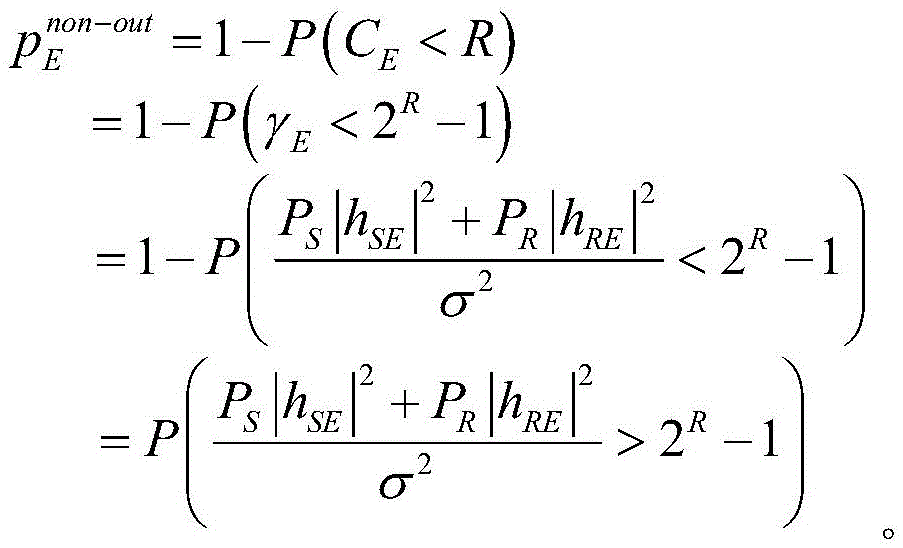
主动窃听信道的窃听不中断概率可表示为:The uninterrupted eavesdropping probability of active eavesdropping channel can be expressed as:
针对现有主动窃听方案考虑场景相对单一的情况,本发明的适用场景更加丰富,将全双工技术和人工噪声加扰技术相结合并应用在主动窃听节点上,对于复杂的可疑通信网络也能有着良好的窃听能力和有效干扰可疑通信网络通信的效果。Aiming at the situation that the existing active eavesdropping scheme considers a relatively single scenario, the present invention has more applicable scenarios. The full-duplex technology and artificial noise scrambling technology are combined and applied to the active eavesdropping node, which can also be used for complex suspicious communication networks. It has good eavesdropping ability and the effect of effectively interfering with suspicious communication network communication.
针对现有主动窃听方案对于主动窃听节点采用电池供电造成的维护成本高,环境污染等问题,本发明采用日趋成熟的无线能量采集技术对主动窃听节点进行供能,使得其在更多复杂环境能够持续稳定工作,且节能环保,便于实施。Aiming at the problems of high maintenance cost and environmental pollution caused by the use of battery power supply for the active eavesdropping node in the existing active eavesdropping scheme, the present invention adopts the increasingly mature wireless energy collection technology to supply energy to the active eavesdropping node, so that it can be used in more complex environments. Continuous and stable work, energy saving and environmental protection, easy to implement.
以下对所述传输系统的相关性能指标进行仿真分析,其中仿真次数为一百万次,各个信道平均信道增益均为1,各节点接收噪声方差均归一化。The relevant performance indicators of the transmission system are simulated and analyzed below, wherein the number of simulations is one million times, the average channel gain of each channel is 1, and the variance of the received noise of each node is normalized.
图3为所提方案可疑通信网络的传输中断概率随主动窃听节点加扰功率的变化图。由图可知,所提方案的可疑通信网络的传输中断概率随着主动窃听节点加扰功率的增大而增大,当主动窃听节点的加扰功率增大到一定程度时,可疑通信网络的传输中断概率近乎为1,不能正常进行通信,凸显出本发明对于干扰可疑通信网络的正常通信的优越性。可疑通信网络在通信受到影响时必然会增加可疑信源和可疑中继节点的发送功率,但随着可疑信源和可疑中继节点发送功率的增加,其整个可疑通信网络的初始传输中断概率也会增加,只能有限提升其网络的正常通信效果。但为了兼顾窃听可疑信息,主动窃听节点的加扰功率也不是越大越好,因为加扰功率越大,可疑通信网络的正常通信会越来越困难,则能窃听到的可疑信息就越少,因此在实际应用时可根据实际对于可疑信息的窃听需求设置不同的加扰功率,这也凸显出本发明的灵活性。Figure 3 is a graph showing the variation of transmission interruption probability of suspicious communication network with the scrambling power of active eavesdropping nodes in the proposed scheme. It can be seen from the figure that the transmission interruption probability of the suspicious communication network of the proposed scheme increases with the increase of the scrambling power of the active eavesdropping node. When the scrambling power of the active eavesdropping node increases to a certain extent, the transmission of the suspicious communication network The interruption probability is close to 1, and communication cannot be performed normally, which highlights the superiority of the present invention for interfering with normal communication of suspicious communication networks. The suspicious communication network will inevitably increase the transmission power of the suspicious source and the suspicious relay node when the communication is affected. will increase, and can only improve the normal communication effect of its network to a limited extent. However, in order to take into account the eavesdropping of suspicious information, the scrambling power of the active eavesdropping node is not as large as possible, because the higher the scrambling power, the more difficult the normal communication of the suspicious communication network will be, and the less suspicious information can be eavesdropped. Therefore, in practical application, different scrambling powers can be set according to the actual eavesdropping requirements for suspicious information, which also highlights the flexibility of the present invention.
图4为所提方案的主动窃听节点的窃听不中断概率随可疑通信网络的可疑信源发送功率的变化图。可疑通信网络在正常通信受到影响时必然会加大可疑信源和可疑中继的发送功率,由图可知,主动窃听节点的窃听不中断概率会随着可疑信源发送功率的增大而增大,即主动窃听节点的窃听稳定性和持续性会逐渐增强。而且随着可疑中继发送功率的增大,主动窃听节点的初始窃听不中断概率会随之增大,当可疑中继的发送功率增大到一定程度,主动窃听节点的窃听不中断概率近乎为1,表明主动窃听节点能够持续稳定的进行可疑信息的窃听,这也凸显出本发明窃听性能的优越性。Fig. 4 is a graph showing the change of the probability of uninterrupted eavesdropping of the active eavesdropping node of the proposed scheme with the transmission power of the suspicious source of the suspicious communication network. The suspicious communication network will inevitably increase the transmission power of suspicious sources and suspicious relays when normal communication is affected. It can be seen from the figure that the probability of uninterrupted eavesdropping of active eavesdropping nodes will increase with the increase of the transmission power of suspicious sources. , that is, the eavesdropping stability and persistence of active eavesdropping nodes will gradually increase. And with the increase of the transmission power of the suspicious relay, the probability of the uninterrupted initial eavesdropping of the active eavesdropping node will increase accordingly. 1. It shows that the active eavesdropping node can continuously and stably eavesdrop on suspicious information, which also highlights the superiority of the eavesdropping performance of the present invention.
上述仅为本发明的具体实施方式,但本发明的设计构思并不局限于此,凡利用此构思对本发明进行非实质性的改动,均应属于侵犯本发明保护范围的行为。The above are only specific embodiments of the present invention, but the design concept of the present invention is not limited to this, and any non-substantial modification of the present invention by using this concept should be regarded as an act of infringing the protection scope of the present invention.
Claims (4)





Priority Applications (1)
| Application Number | Priority Date | Filing Date | Title |
|---|---|---|---|
| CN201811249636.4A CN109525985B (en) | 2018-10-25 | 2018-10-25 | A full-duplex active eavesdropping method for wireless energy harvesting |
Applications Claiming Priority (1)
| Application Number | Priority Date | Filing Date | Title |
|---|---|---|---|
| CN201811249636.4A CN109525985B (en) | 2018-10-25 | 2018-10-25 | A full-duplex active eavesdropping method for wireless energy harvesting |
Publications (2)
| Publication Number | Publication Date |
|---|---|
| CN109525985A CN109525985A (en) | 2019-03-26 |
| CN109525985B true CN109525985B (en) | 2022-05-03 |
Family
ID=65774059
Family Applications (1)
| Application Number | Title | Priority Date | Filing Date |
|---|---|---|---|
| CN201811249636.4A Active CN109525985B (en) | 2018-10-25 | 2018-10-25 | A full-duplex active eavesdropping method for wireless energy harvesting |
Country Status (1)
| Country | Link |
|---|---|
| CN (1) | CN109525985B (en) |
Families Citing this family (4)
| Publication number | Priority date | Publication date | Assignee | Title |
|---|---|---|---|---|
| CN110062384B (en) * | 2019-04-28 | 2020-10-27 | 西安交通大学 | A wireless monitoring method based on signal rotation |
| CN110677181B (en) * | 2019-08-30 | 2021-05-14 | 哈尔滨工业大学(深圳) | Physical layer secure transmission method and system based on energy collection |
| CN112512037B (en) * | 2020-12-01 | 2023-12-15 | 华侨大学 | An active drone eavesdropping method optimized by combining trajectory and interference power |
| CN116762377A (en) * | 2021-02-24 | 2023-09-15 | 华为技术有限公司 | A relay communication method and device |
Family Cites Families (9)
| Publication number | Priority date | Publication date | Assignee | Title |
|---|---|---|---|---|
| US8612743B2 (en) * | 2011-07-26 | 2013-12-17 | The Boeing Company | Wireless network security |
| JP6438496B2 (en) * | 2014-05-22 | 2018-12-12 | 京セラ株式会社 | Scheduling communication resources for inter-device (D2D) communication in unlicensed frequency bands |
| US20160149951A1 (en) * | 2014-11-21 | 2016-05-26 | Electronics And Telecommunications Research Institute | Secure transmission method and system |
| CN106452503B (en) * | 2016-08-04 | 2019-06-04 | 华侨大学 | Full-duplex relay safe transmission method based on power distribution energy harvesting technology |
| CN106452655B (en) * | 2016-08-04 | 2019-01-25 | 华侨大学 | System security transmission method combining cooperative jamming and time-division energy harvesting technology |
| CN106454838A (en) * | 2016-09-28 | 2017-02-22 | 华侨大学 | Energy harvesting relay safety transmission method adopting artificial noise precoding |
| CN106533516B (en) * | 2016-12-21 | 2020-02-07 | 中国人民解放军理工大学 | Physical layer secure transmission method of multi-antenna multi-relay cognitive eavesdropping network |
| CN106992836B (en) * | 2017-03-24 | 2019-04-09 | 华侨大学 | A full-duplex scrambled transmission method in an untrusted relay network |
| CN107948173B (en) * | 2017-11-30 | 2020-09-29 | 华北电力大学(保定) | a method of monitoring |
-
2018
- 2018-10-25 CN CN201811249636.4A patent/CN109525985B/en active Active
Also Published As
| Publication number | Publication date |
|---|---|
| CN109525985A (en) | 2019-03-26 |
Similar Documents
| Publication | Publication Date | Title |
|---|---|---|
| Huo et al. | Jamming strategies for physical layer security | |
| CN109525985B (en) | A full-duplex active eavesdropping method for wireless energy harvesting | |
| CN109714737B (en) | A D2D covert communication system with full-duplex base station cellular network and communication method thereof | |
| CN102355661B (en) | Non-regenerative-relay-mode-based relay forwarding control method and device | |
| Guo et al. | Outage probability of ad hoc networks with wireless information and power transfer | |
| CN106452655A (en) | System security transmission method in combination with collaborative interference and time division energy collection technology | |
| CN107124215B (en) | Full-duplex multi-antenna destination node interference transmission method based on optimal antenna selection | |
| CN106452503A (en) | Full-duplex relay security transmission method based on power allocation energy collection technology | |
| CN106068032B (en) | Collaborative network power distribution method based on man made noise when the non-ideal estimation of main channel | |
| WO2013000171A1 (en) | Method and device for controlling relay transmission based on non-reproduction relay mode | |
| Li et al. | Harvest-and-opportunistically-relay: Analyses on transmission outage and covertness | |
| CN106877919B (en) | Relay safety communication method for power distribution energy collection based on optimal user selection | |
| CN109861728B (en) | Joint multi-relay selection and slot resource allocation method for massive MIMO systems | |
| CN105992124A (en) | Inter-cluster communication method based on D2D (Device-to-Device) | |
| Mukhlif et al. | Energy harvesting for efficient 5g networks | |
| Shim et al. | Exploiting opportunistic scheduling schemes to improve physical-layer security in MU-MISO NOMA systems | |
| CN109511111A (en) | A kind of method of energy acquisition Internet of things system data security transmission | |
| Xu et al. | AN-aided secure beamforming design for correlated MISO wiretap channels | |
| CN113595675B (en) | An interference management method and system to maximize safe data transmission rate | |
| Ji et al. | Adaptive power control for asymmetric two-way amplify-and-forward relaying with individual power constraints | |
| CN107612669A (en) | User's matching method for non-orthogonal multiple system | |
| Khodeir et al. | Secrecy outage performance with EH and TAS for realistic underlay cognitive radio networks using MIMO systems | |
| Hu et al. | Analysis of wireless energy harvesting relay throughput in Rician channel | |
| Wang et al. | Performance analysis for cooperative relay communication | |
| CN116131883A (en) | Multi-user interference hybrid RF/FSO system and secure transmission method based on SWIPT untrusted relay |
Legal Events
| Date | Code | Title | Description |
|---|---|---|---|
| PB01 | Publication | ||
| PB01 | Publication | ||
| SE01 | Entry into force of request for substantive examination | ||
| SE01 | Entry into force of request for substantive examination | ||
| GR01 | Patent grant | ||
| GR01 | Patent grant |