CN109475627B - Antibody mixtures - Google Patents
Antibody mixtures Download PDFInfo
- Publication number
- CN109475627B CN109475627B CN201780043870.9A CN201780043870A CN109475627B CN 109475627 B CN109475627 B CN 109475627B CN 201780043870 A CN201780043870 A CN 201780043870A CN 109475627 B CN109475627 B CN 109475627B
- Authority
- CN
- China
- Prior art keywords
- antibody
- antibodies
- human
- binds
- amino acid
- Prior art date
- Legal status (The legal status is an assumption and is not a legal conclusion. Google has not performed a legal analysis and makes no representation as to the accuracy of the status listed.)
- Active
Links
Images


Classifications
-
- C—CHEMISTRY; METALLURGY
- C07—ORGANIC CHEMISTRY
- C07K—PEPTIDES
- C07K16/00—Immunoglobulins [IGs], e.g. monoclonal or polyclonal antibodies
- C07K16/18—Immunoglobulins [IGs], e.g. monoclonal or polyclonal antibodies against material from animals or humans
- C07K16/28—Immunoglobulins [IGs], e.g. monoclonal or polyclonal antibodies against material from animals or humans against receptors, cell surface antigens or cell surface determinants
- C07K16/2803—Immunoglobulins [IGs], e.g. monoclonal or polyclonal antibodies against material from animals or humans against receptors, cell surface antigens or cell surface determinants against the immunoglobulin superfamily
- C07K16/2818—Immunoglobulins [IGs], e.g. monoclonal or polyclonal antibodies against material from animals or humans against receptors, cell surface antigens or cell surface determinants against the immunoglobulin superfamily against CD28 or CD152
-
- A—HUMAN NECESSITIES
- A61—MEDICAL OR VETERINARY SCIENCE; HYGIENE
- A61K—PREPARATIONS FOR MEDICAL, DENTAL OR TOILETRY PURPOSES
- A61K9/00—Medicinal preparations characterised by special physical form
- A61K9/0012—Galenical forms characterised by the site of application
- A61K9/0019—Injectable compositions; Intramuscular, intravenous, arterial, subcutaneous administration; Compositions to be administered through the skin in an invasive manner
-
- A—HUMAN NECESSITIES
- A61—MEDICAL OR VETERINARY SCIENCE; HYGIENE
- A61P—SPECIFIC THERAPEUTIC ACTIVITY OF CHEMICAL COMPOUNDS OR MEDICINAL PREPARATIONS
- A61P35/00—Antineoplastic agents
-
- C—CHEMISTRY; METALLURGY
- C07—ORGANIC CHEMISTRY
- C07K—PEPTIDES
- C07K16/00—Immunoglobulins [IGs], e.g. monoclonal or polyclonal antibodies
- C07K16/18—Immunoglobulins [IGs], e.g. monoclonal or polyclonal antibodies against material from animals or humans
- C07K16/28—Immunoglobulins [IGs], e.g. monoclonal or polyclonal antibodies against material from animals or humans against receptors, cell surface antigens or cell surface determinants
- C07K16/2887—Immunoglobulins [IGs], e.g. monoclonal or polyclonal antibodies against material from animals or humans against receptors, cell surface antigens or cell surface determinants against CD20
-
- C—CHEMISTRY; METALLURGY
- C07—ORGANIC CHEMISTRY
- C07K—PEPTIDES
- C07K16/00—Immunoglobulins [IGs], e.g. monoclonal or polyclonal antibodies
- C07K16/18—Immunoglobulins [IGs], e.g. monoclonal or polyclonal antibodies against material from animals or humans
- C07K16/28—Immunoglobulins [IGs], e.g. monoclonal or polyclonal antibodies against material from animals or humans against receptors, cell surface antigens or cell surface determinants
- C07K16/2896—Immunoglobulins [IGs], e.g. monoclonal or polyclonal antibodies against material from animals or humans against receptors, cell surface antigens or cell surface determinants against molecules with a "CD"-designation, not provided for elsewhere
-
- C—CHEMISTRY; METALLURGY
- C07—ORGANIC CHEMISTRY
- C07K—PEPTIDES
- C07K16/00—Immunoglobulins [IGs], e.g. monoclonal or polyclonal antibodies
- C07K16/18—Immunoglobulins [IGs], e.g. monoclonal or polyclonal antibodies against material from animals or humans
- C07K16/32—Immunoglobulins [IGs], e.g. monoclonal or polyclonal antibodies against material from animals or humans against translation products of oncogenes
-
- A—HUMAN NECESSITIES
- A61—MEDICAL OR VETERINARY SCIENCE; HYGIENE
- A61K—PREPARATIONS FOR MEDICAL, DENTAL OR TOILETRY PURPOSES
- A61K39/00—Medicinal preparations containing antigens or antibodies
- A61K2039/505—Medicinal preparations containing antigens or antibodies comprising antibodies
- A61K2039/507—Comprising a combination of two or more separate antibodies
-
- C—CHEMISTRY; METALLURGY
- C07—ORGANIC CHEMISTRY
- C07K—PEPTIDES
- C07K2317/00—Immunoglobulins specific features
- C07K2317/10—Immunoglobulins specific features characterized by their source of isolation or production
-
- C—CHEMISTRY; METALLURGY
- C07—ORGANIC CHEMISTRY
- C07K—PEPTIDES
- C07K2317/00—Immunoglobulins specific features
- C07K2317/10—Immunoglobulins specific features characterized by their source of isolation or production
- C07K2317/14—Specific host cells or culture conditions, e.g. components, pH or temperature
-
- C—CHEMISTRY; METALLURGY
- C07—ORGANIC CHEMISTRY
- C07K—PEPTIDES
- C07K2317/00—Immunoglobulins specific features
- C07K2317/20—Immunoglobulins specific features characterized by taxonomic origin
- C07K2317/21—Immunoglobulins specific features characterized by taxonomic origin from primates, e.g. man
-
- C—CHEMISTRY; METALLURGY
- C07—ORGANIC CHEMISTRY
- C07K—PEPTIDES
- C07K2317/00—Immunoglobulins specific features
- C07K2317/20—Immunoglobulins specific features characterized by taxonomic origin
- C07K2317/24—Immunoglobulins specific features characterized by taxonomic origin containing regions, domains or residues from different species, e.g. chimeric, humanized or veneered
-
- C—CHEMISTRY; METALLURGY
- C07—ORGANIC CHEMISTRY
- C07K—PEPTIDES
- C07K2317/00—Immunoglobulins specific features
- C07K2317/30—Immunoglobulins specific features characterized by aspects of specificity or valency
- C07K2317/31—Immunoglobulins specific features characterized by aspects of specificity or valency multispecific
-
- C—CHEMISTRY; METALLURGY
- C07—ORGANIC CHEMISTRY
- C07K—PEPTIDES
- C07K2317/00—Immunoglobulins specific features
- C07K2317/40—Immunoglobulins specific features characterized by post-translational modification
-
- C—CHEMISTRY; METALLURGY
- C07—ORGANIC CHEMISTRY
- C07K—PEPTIDES
- C07K2317/00—Immunoglobulins specific features
- C07K2317/50—Immunoglobulins specific features characterized by immunoglobulin fragments
- C07K2317/51—Complete heavy chain or Fd fragment, i.e. VH + CH1
-
- C—CHEMISTRY; METALLURGY
- C07—ORGANIC CHEMISTRY
- C07K—PEPTIDES
- C07K2317/00—Immunoglobulins specific features
- C07K2317/50—Immunoglobulins specific features characterized by immunoglobulin fragments
- C07K2317/515—Complete light chain, i.e. VL + CL
-
- C—CHEMISTRY; METALLURGY
- C07—ORGANIC CHEMISTRY
- C07K—PEPTIDES
- C07K2317/00—Immunoglobulins specific features
- C07K2317/50—Immunoglobulins specific features characterized by immunoglobulin fragments
- C07K2317/52—Constant or Fc region; Isotype
- C07K2317/522—CH1 domain
-
- C—CHEMISTRY; METALLURGY
- C07—ORGANIC CHEMISTRY
- C07K—PEPTIDES
- C07K2317/00—Immunoglobulins specific features
- C07K2317/50—Immunoglobulins specific features characterized by immunoglobulin fragments
- C07K2317/55—Fab or Fab'
-
- C—CHEMISTRY; METALLURGY
- C07—ORGANIC CHEMISTRY
- C07K—PEPTIDES
- C07K2317/00—Immunoglobulins specific features
- C07K2317/50—Immunoglobulins specific features characterized by immunoglobulin fragments
- C07K2317/56—Immunoglobulins specific features characterized by immunoglobulin fragments variable (Fv) region, i.e. VH and/or VL
-
- C—CHEMISTRY; METALLURGY
- C07—ORGANIC CHEMISTRY
- C07K—PEPTIDES
- C07K2317/00—Immunoglobulins specific features
- C07K2317/70—Immunoglobulins specific features characterized by effect upon binding to a cell or to an antigen
- C07K2317/73—Inducing cell death, e.g. apoptosis, necrosis or inhibition of cell proliferation
-
- C—CHEMISTRY; METALLURGY
- C07—ORGANIC CHEMISTRY
- C07K—PEPTIDES
- C07K2317/00—Immunoglobulins specific features
- C07K2317/70—Immunoglobulins specific features characterized by effect upon binding to a cell or to an antigen
- C07K2317/73—Inducing cell death, e.g. apoptosis, necrosis or inhibition of cell proliferation
- C07K2317/732—Antibody-dependent cellular cytotoxicity [ADCC]
-
- C—CHEMISTRY; METALLURGY
- C07—ORGANIC CHEMISTRY
- C07K—PEPTIDES
- C07K2317/00—Immunoglobulins specific features
- C07K2317/70—Immunoglobulins specific features characterized by effect upon binding to a cell or to an antigen
- C07K2317/73—Inducing cell death, e.g. apoptosis, necrosis or inhibition of cell proliferation
- C07K2317/734—Complement-dependent cytotoxicity [CDC]
-
- C—CHEMISTRY; METALLURGY
- C07—ORGANIC CHEMISTRY
- C07K—PEPTIDES
- C07K2317/00—Immunoglobulins specific features
- C07K2317/70—Immunoglobulins specific features characterized by effect upon binding to a cell or to an antigen
- C07K2317/76—Antagonist effect on antigen, e.g. neutralization or inhibition of binding
-
- C—CHEMISTRY; METALLURGY
- C07—ORGANIC CHEMISTRY
- C07K—PEPTIDES
- C07K2317/00—Immunoglobulins specific features
- C07K2317/90—Immunoglobulins specific features characterized by (pharmaco)kinetic aspects or by stability of the immunoglobulin
- C07K2317/92—Affinity (KD), association rate (Ka), dissociation rate (Kd) or EC50 value
-
- C—CHEMISTRY; METALLURGY
- C07—ORGANIC CHEMISTRY
- C07K—PEPTIDES
- C07K2317/00—Immunoglobulins specific features
- C07K2317/90—Immunoglobulins specific features characterized by (pharmaco)kinetic aspects or by stability of the immunoglobulin
- C07K2317/94—Stability, e.g. half-life, pH, temperature or enzyme-resistance
Landscapes
- Health & Medical Sciences (AREA)
- Chemical & Material Sciences (AREA)
- Organic Chemistry (AREA)
- Immunology (AREA)
- Medicinal Chemistry (AREA)
- Life Sciences & Earth Sciences (AREA)
- General Health & Medical Sciences (AREA)
- Biochemistry (AREA)
- Genetics & Genomics (AREA)
- Molecular Biology (AREA)
- Proteomics, Peptides & Aminoacids (AREA)
- Biophysics (AREA)
- Veterinary Medicine (AREA)
- Public Health (AREA)
- Pharmacology & Pharmacy (AREA)
- Animal Behavior & Ethology (AREA)
- General Chemical & Material Sciences (AREA)
- Nuclear Medicine, Radiotherapy & Molecular Imaging (AREA)
- Chemical Kinetics & Catalysis (AREA)
- Oncology (AREA)
- Dermatology (AREA)
- Epidemiology (AREA)
- Peptides Or Proteins (AREA)
- Micro-Organisms Or Cultivation Processes Thereof (AREA)
- Medicines Containing Antibodies Or Antigens For Use As Internal Diagnostic Agents (AREA)
- Medicines Containing Material From Animals Or Micro-Organisms (AREA)
- Preparation Of Compounds By Using Micro-Organisms (AREA)
- Medicines That Contain Protein Lipid Enzymes And Other Medicines (AREA)
Abstract
本文描述了任选由宿主细胞系产生的抗体和抗体混合物,编码所述抗体和抗体混合物的核酸,含有这种核酸的宿主细胞,以及使用所述抗体、抗体混合物或编码所述抗体或抗体混合物的核酸进行治疗的方法。还描述了在宿主细胞中产生抗体混合物的方法。

Described herein are antibodies and antibody mixtures optionally produced by host cell lines, nucleic acids encoding the antibodies and antibody mixtures, host cells containing such nucleic acids, and uses of the antibodies, antibody mixtures, or encoding the antibodies or antibody mixtures Methods of nucleic acid therapy. Methods of producing antibody mixtures in host cells are also described.
Description
技术领域technical field
本文所述的组合物和方法属于重组抗体及其制备方法的领域。The compositions and methods described herein are in the field of recombinant antibodies and methods for their preparation.
背景技术Background technique
在过去的20年里,重组单克隆抗体已经成为一类非常成功的治疗多种不同疾病的生物药物。它们已经在有和没有共施用小分子类药物的情况下使用。由于一些疾病的生物学复杂性,靶向多于一种抗原或表位的抗体混合物或双特异性抗体在治疗某些病症方面比单一抗体更有效。参见例如Lindzen等人,(2010),Proc.Natl.Acad.Sci.107(28):12550-12563;Nagorsen和Baeuerle(2011),Exp.CellRes.317(9):1255-60。Over the past 20 years, recombinant monoclonal antibodies have become a very successful class of biologic drugs for the treatment of many different diseases. They have been used with and without co-administration of small molecule drugs. Due to the biological complexity of some diseases, antibody mixtures or bispecific antibodies targeting more than one antigen or epitope are more effective than single antibodies in treating certain conditions. See eg Lindzen et al., (2010), Proc. Natl. Acad. Sci. 107(28): 12550-12563; Nagorsen and Baeuerle (2011), Exp. CellRes. 317(9): 1255-60.
抗体混合物允许灵活地给药两种不同的结合实体。对于IgG双特异性抗体来说情况并非如此,因为两种结合实体中的每一种都以相同的量存在,这是由于所述结合实体是同一分子的组成部分。在治疗方案中需要不同剂量的每种结合实体的情况下,这可能不是最佳的。参见例如Wolchok等人,(2013),NewEngl.J.Med.369(2):122-133。类似地,两种结合实体将在双特异性抗体中具有相同的体内半衰期,这在一些情况下可能不是最佳的。包括两种或更多种单独抗体的混合物的治疗剂可允许施用不同剂量的包含两种不同结合实体的抗体,并且所述抗体可具有不同的药代动力学性质。Antibody mixtures allow for the flexibility of dosing two different binding entities. This is not the case for IgG bispecific antibodies, as each of the two binding entities is present in the same amount, since the binding entities are part of the same molecule. This may not be optimal where different dosages of each binding entity are required in the treatment regimen. See, eg, Wolchok et al., (2013), New Engl. J. Med. 369(2):122-133. Similarly, both binding entities will have the same half-life in vivo in the bispecific antibody, which may not be optimal in some circumstances. A therapeutic comprising a mixture of two or more individual antibodies may allow administration of different doses of antibodies comprising two different binding entities, and the antibodies may have different pharmacokinetic properties.
重组抗体混合物的制备可以经由从各个宿主细胞系单独制备每种抗体并在制备后混合多种抗体来完成。通过混合和共培养表达不同抗体的宿主细胞进行的单批次多种抗体制备提供了这种方法的较低成本的替代方案。Rasmussen等人(2012),Arch BiochemBiophys.526:139-45。需要使用单一过程制备两种或更多种抗体的其它简单且相对便宜的制备方法。Preparation of recombinant antibody mixtures can be accomplished by preparing each antibody individually from each host cell line and mixing the antibodies after preparation. Single-batch multiple antibody production by mixing and co-culturing host cells expressing different antibodies offers a lower-cost alternative to this approach. Rasmussen et al. (2012), Arch Biochem Biophys. 526:139-45. Other simple and relatively inexpensive production methods that use a single process to prepare two or more antibodies are needed.
发明内容Contents of the invention
本文所述的组合物和方法在下面以一系列编号的项目描述。The compositions and methods described herein are described below in a series of numbered items.
1.一种包含两种主要抗体种类的抗体混合物,其包括:1. An antibody cocktail comprising two primary antibody classes comprising:
(a)第一抗体,所述第一抗体包含具有相同氨基酸序列的第一重链(HC1)的两个拷贝和具有相同氨基酸序列的第一轻链(LC1)的两个拷贝,以及(a) a first antibody comprising two copies of a first heavy chain (HC1) having the same amino acid sequence and two copies of a first light chain (LC1) having the same amino acid sequence, and
(b)第二抗体,所述第二抗体包含两个具有相同氨基酸序列第二重链(HC2)的的拷贝和具有相同氨基酸序列的第二轻链(LC2)的两个拷贝,(b) a second antibody comprising two copies of a second heavy chain (HC2) having the same amino acid sequence and two copies of a second light chain (LC2) having the same amino acid sequence,
其中所述第一和第二抗体是全长灵长类IgG抗体,wherein said first and second antibodies are full length primate IgG antibodies,
其中所述HC1和所述HC2具有不同的氨基酸序列,wherein said HC1 and said HC2 have different amino acid sequences,
其中所述LC1和所述LC2具有不同的氨基酸序列,wherein said LC1 and said LC2 have different amino acid sequences,
其中所述混合物包含不超过三种不同主要种类的全长抗体,并且wherein the mixture comprises no more than three different primary species of full-length antibodies, and
其中所述混合物是由已经引入了编码HC1、HC2、LC1和LC2的DNA的单一宿主细胞系产生的。wherein said mixture is produced by a single host cell line into which DNA encoding HC1, HC2, LC1 and LC2 has been introduced.
2.根据项目1所述的混合物,其中所述HC1和HC2是人IgG HC,其中它们中的每一者为以下同种型中的任一种:IgG1、IgG2、IgG3或IgG4。2. The mixture according to
3.根据项目1或2所述的混合物,其中3. The mixture according to
所述HC1和/或HC2含有至少一个LC配偶体定向改变,并且said HC1 and/or HC2 contain at least one LC partner orientation change, and
所述LC1和/或LC2在分别与所述HC1和/或HC2中发生所述LC配偶体定向改变的所述氨基酸接触或者分别与所述HC1和/或HC2中存在的带电氨基酸或半胱氨酸接触的氨基酸处含有至少一个HC配偶体定向改变。Said LC1 and/or LC2 are in contact with said amino acid in said HC1 and/or HC2 respectively where said LC partner orientation change occurs or with a charged amino acid or cysteine present in said HC1 and/or HC2 respectively The acid-contacted amino acid contains at least one HC partner orientation change.
4.根据项目3所述的混合物,4. The mixture according to
其中所述HC1和/或HC2在重链(HC)残基处包含至少一个LC配偶体定向改变,其中所述LC配偶体定向改变导致所述HC1和HC2在所述HC1和HC2氨基酸序列两者中的相同HC残基处包含带电氨基酸,其中所述HC1中的所述HC残基处的所述带电氨基酸与所述HC2中的所述HC残基处的所述带电氨基酸电荷相反,并且wherein said HC1 and/or HC2 comprises at least one LC partner orientation change at a heavy chain (HC) residue, wherein said LC partner orientation change results in said HC1 and HC2 being in both said HC1 and HC2 amino acid sequences comprising a charged amino acid at the same HC residue in said HC1, wherein said charged amino acid at said HC residue in said HC1 is oppositely charged to said charged amino acid at said HC residue in said HC2, and
其中所述LC1和/或LC2在与所述HC残基接触的轻链(LC)残基处包含至少一个HC配偶体定向改变,其中所述HC配偶体定向改变导致所述LC1和LC2在所述LC1和LC2氨基酸序列两者中的相同LC残基处包含带电氨基酸,其中所述LC1中的所述LC残基处的所述带电氨基酸与所述LC2中的所述LC残基处的带电氨基酸电荷相反,并且所述LC1中的所述LC残基处的所述带电氨基酸与所述HC1中的所述HC残基处的所述氨基电荷相反。wherein said LC1 and/or LC2 comprises at least one HC partner orientation change at a light chain (LC) residue in contact with said HC residue, wherein said HC partner orientation change results in said LC1 and LC2 being in said HC residue. Both the LC1 and LC2 amino acid sequences comprise charged amino acids at the same LC residue, wherein the charged amino acid at the LC residue in the LC1 is identical to the charged amino acid at the LC residue in the LC2. The amino acids are oppositely charged, and said charged amino acid at said LC residue in said LC1 is oppositely charged to said amino group at said HC residue in said HC1.
5.根据项目3或4所述的混合物,其中所述第一和第二抗体包含选自由以下组成的组的一组或多组改变:5. The mixture according to
(a)所述组的改变,其中所述HC1和HC2两者中的位置44和105以及所述LC1和LC2两者中的位置43和100各自由带电氨基酸占据,所述HC1中的位置44和105处的氨基酸与所述HC2中的相同位点处的氨基酸各自电荷相反,所述LC1中的位置43和100处的氨基酸与所述LC2中的相同位点处的氨基酸各自电荷相反,所述HC1和HC2中的位置44处的氨基酸分别与所述LC1和LC2中的位置100处的氨基酸电荷相反,并且所述HC1和HC2中的位置105处的氨基酸分别与所述LC1和LC2中的位置43处的氨基酸电荷相反;(a) The set of changes wherein
(b)所述组的改变,其中所述HC1和HC2中的位置147和所述LC1和LC2中的位置131各自由带电氨基酸占据,所述HC1中的位置147处的氨基酸与所述HC2中的位置147处的氨基酸电荷相反,所述LC1中的位置131处的氨基酸与所述LC2中的位置131处的氨基酸电荷相反,并且所述HC1和HC2中的位置147处的氨基酸分别与所述LC1和LC2中的位置131处的氨基酸电荷相反;(b) an alteration of the set, wherein position 147 in the HC1 and HC2 and position 131 in the LC1 and LC2 are each occupied by a charged amino acid, the amino acid at position 147 in the HC1 is the same as in the HC2 The amino acid at position 147 in LC1 is oppositely charged to the amino acid at position 131 in the LC2, and the amino acid at position 147 in the HC1 and HC2 is oppositely charged to the amino acid at position 131 in the LC2, respectively. The amino acid at position 131 in LC1 and LC2 is oppositely charged;
(c)所述组的改变,其中所述HC1和HC2中的位置168和所述LC1和LC2中的位置174各自由带电氨基酸占据,所述HC1中的位置168处的氨基酸与所述HC2中的位置168处的氨基酸电荷相反,所述LC1中的位置174处的氨基酸与所述LC2中的位置174处的氨基酸电荷相反,并且所述HC1和HC2中的位置168处的氨基酸分别与所述LC1和LC2中的位置174处的氨基酸电荷相反;并且(c) an alteration of the set wherein position 168 in the HC1 and HC2 and position 174 in the LC1 and LC2 are each occupied by a charged amino acid, the amino acid at position 168 in the HC1 is the same as in the HC2 The amino acid at position 168 in LC1 is oppositely charged to the amino acid at position 174 in the LC2, and the amino acid at position 168 in the HC1 and HC2 is oppositely charged to the amino acid at position 174 in the LC2, respectively. the amino acid at position 174 in LC1 and LC2 is oppositely charged; and
(d)所述组的改变,其中所述HC1和HC2中的位置181和所述LC1和LC2中的位置178各自由带电氨基酸占据,所述HC1中的位置181处的氨基酸与所述HC2中的位置181处的氨基酸电荷相反,所述LC1中的位置178处的氨基酸与所述LC2中的位置178处的氨基酸电荷相反,并且所述HC1和HC2中的位置181处的氨基酸分别与所述LC1和LC2中的位置178处的氨基酸电荷相反。(d) the set of alterations, wherein position 181 in the HC1 and HC2 and position 178 in the LC1 and LC2 are each occupied by a charged amino acid, the amino acid at position 181 in the HC1 is the same as in the HC2 The amino acid at position 181 in LC1 is oppositely charged to the amino acid at position 178 in the LC2, and the amino acid at position 181 in the HC1 and HC2 is oppositely charged to the amino acid at position 178 in the LC2, respectively. The amino acid at position 178 is oppositely charged in LC1 and LC2.
6.根据项目1至5中任一项所述的混合物,其中所述第一和第二抗体包含选自由以下组成的组的一组或多组改变:6. The mixture according to any one of
(a)所述组的改变,其中所述HC1包含44E/D,所述LC1包含100R/K,所述HC2包含44R/K,并且所述LC2包含100D/E;或者所述HC2包含44E/D,所述LC2包含100R/K,所述HC1包含44R/K,并且所述LC1包含100D/E;(a) The set of alterations, wherein the HC1 comprises 44E/D, the LC1 comprises 100R/K, the HC2 comprises 44R/K, and the LC2 comprises 100D/E; or the HC2 comprises 44E/K D, the LC2 comprises 100R/K, the HC1 comprises 44R/K, and the LC1 comprises 100D/E;
(b)所述组的改变,其中所述HC1包含105E/D,所述LC1包含43R/K,所述HC2包含105R/K,并且所述LC2包含43D/E;或者所述HC2包含105E/D,所述LC2包含43R/K,所述HC1包含105R/K,并且所述LC1包含43D/E;(b) The set of alterations, wherein the HC1 comprises 105E/D, the LC1 comprises 43R/K, the HC2 comprises 105R/K, and the LC2 comprises 43D/E; or the HC2 comprises 105E/K D, the LC2 comprises 43R/K, the HC1 comprises 105R/K, and the LC1 comprises 43D/E;
(c)所述组的改变,其中所述HC1包含147R/K,所述LC1包含131E/D,所述HC2包含147E/D,并且所述LC2包含131R/K;或者所述HC2包含147R/K,所述LC2包含131E/D,所述HC1包含147E/D,并且所述LC1包含131R/K;(c) an alteration of the set, wherein the HC1 comprises 147R/K, the LC1 comprises 131E/D, the HC2 comprises 147E/D, and the LC2 comprises 131R/K; or the HC2 comprises 147R/D K, the LC2 comprises 131E/D, the HC1 comprises 147E/D, and the LC1 comprises 131R/K;
(d)所述组的改变,其中所述HC1包含168E/D,所述LC1包含174R/K,所述HC2包含168R/K,并且所述LC2包含174D/E;或者所述HC2包含168E/D,所述LC2包含174R/K,所述HC1包含168R/K,并且所述LC1包含174D/E;并且(d) an alteration of the set, wherein the HC1 comprises 168E/D, the LC1 comprises 174R/K, the HC2 comprises 168R/K, and the LC2 comprises 174D/E; or the HC2 comprises 168E/K D, the LC2 comprises 174R/K, the HC1 comprises 168R/K, and the LC1 comprises 174D/E; and
(e)所述组的改变,其中所述HC1包含181E/D,所述LC1包含178R/K,所述HC2包含181R/K,并且所述LC2包含178D/E;或者所述HC2包含181E/D,所述LC2包含178R/K,所述HC1包含181R/K,并且所述LC1包含178D/E。(e) an alteration of the set, wherein the HC1 comprises 181E/D, the LC1 comprises 178R/K, the HC2 comprises 181R/K, and the LC2 comprises 178D/E; or the HC2 comprises 181E/K D, the LC2 contains 178R/K, the HC1 contains 181R/K, and the LC1 contains 178D/E.
7.根据项目6所述的混合物,其中所述第一和第二抗体包含选自由以下组成的组的一组或多组改变:7. The mixture according to
(a)所述组的改变,其中所述HC1包含44D和105R,所述LC1包含43D和100R,所述HC2包含44R和105D,并且所述LC2包含43R和100D;或者所述HC2包含44D和105R,所述LC2包含43D和100R,所述HC1包含44R和105D,并且所述LC1包含43R和100D;(a) The set of alterations, wherein the HC1 comprises 44D and 105R, the LC1 comprises 43D and 100R, the HC2 comprises 44R and 105D, and the LC2 comprises 43R and 100D; or the HC2 comprises 44D and 105R, the LC2 comprises 43D and 100R, the HC1 comprises 44R and 105D, and the LC1 comprises 43R and 100D;
(b)所述组的改变,其中所述HC1包含147R,所述LC1包含131D,所述HC2包含147D,并且所述LC2包含131R;或者所述HC2包含147R,所述LC2包含131D,所述HC1包含147D,并且所述LC1包含131R;(b) The set of alterations, wherein the HC1 comprises 147R, the LC1 comprises 131D, the HC2 comprises 147D, and the LC2 comprises 131R; or the HC2 comprises 147R, the LC2 comprises 131D, the HC1 comprises 147D, and said LC1 comprises 131R;
(c)所述组的改变,其中所述HC1包含168D,所述LC1包含174R,所述HC2包含168R,并且所述LC2包含174D;或者所述HC2包含168D,所述LC2包含174R,所述HC1包含168R,并且所述LC1包含174D;并且(c) changes in the set, wherein the HC1 comprises 168D, the LC1 comprises 174R, the HC2 comprises 168R, and the LC2 comprises 174D; or the HC2 comprises 168D, the LC2 comprises 174R, the HC1 comprises 168R, and said LC1 comprises 174D; and
(d)所述组的改变,其中所述HC1包含181D,所述LC1包含178R,所述HC2包含181R,并且所述LC2包含178D;或者所述HC2包含181D,所述LC2包含178R,所述HC1包含181R,并且所述LC1包含178D。(d) changes of the set, wherein the HC1 comprises 181D, the LC1 comprises 178R, the HC2 comprises 181R, and the LC2 comprises 178D; or the HC2 comprises 181D, the LC2 comprises 178R, the HC1 contains 181R and the LC1 contains 178D.
8.根据项目7所述的混合物,其中所述第一和第二抗体包含选自由以下组成的组的一组或多组改变:8. The mixture according to
(a)所述组的改变,其中所述HC1包含G44D和Q105R,所述LC1包含A/V43D和Q/G100R,所述HC2包含G44R和Q105D,并且所述LC2包含A/V43R和Q/G100D;或者所述HC2包含G44D和Q105R,所述LC2包含A/V43D和Q/G100R,所述HC1包含G44R和Q105D,并且所述LC1包含A/V43R和Q/G100D;(a) A change of the panel, wherein the HC1 comprises G44D and Q105R, the LC1 comprises A/V43D and Q/G100R, the HC2 comprises G44R and Q105D, and the LC2 comprises A/V43R and Q/G100D or the HC2 comprises G44D and Q105R, the LC2 comprises A/V43D and Q/G100R, the HC1 comprises G44R and Q105D, and the LC1 comprises A/V43R and Q/G100D;
(b)所述组的改变,其中所述HC1包含K147R,所述LC1包含S131D,所述HC2包含K147D,并且所述LC2包含S131R;或者所述HC2包含K147R,所述LC2包含S131D,所述HC1包含K147D,并且所述LC1包含S131R;(b) The set of alterations, wherein the HC1 comprises K147R, the LC1 comprises S131D, the HC2 comprises K147D, and the LC2 comprises S131R; or the HC2 comprises K147R, the LC2 comprises S131D, the HC1 comprises K147D, and said LC1 comprises S131R;
(c)所述组的改变,其中所述HC1包含H168D,所述LC1包含S174R,所述HC2包含H168R,并且所述LC2包含S174D;或者所述HC2包含H168D,所述LC2包含S174R,所述HC1包含H168R,并且所述LC1包含S174D;并且(c) the set of alterations, wherein the HC1 comprises H168D, the LC1 comprises S174R, the HC2 comprises H168R, and the LC2 comprises S174D; or the HC2 comprises H168D, the LC2 comprises S174R, the HC1 comprises H168R, and said LC1 comprises S174D; and
(d)所述组的改变,其中所述HC1包含S181D,所述LC1包含T178R,所述HC2包含S181R,并且所述LC2包含T178D;或者所述HC2包含S181D,所述LC2包含T178R,所述HC1包含S181R,并且所述LC1包含T178D。(d) changes in the set, wherein the HC1 comprises S181D, the LC1 comprises T178R, the HC2 comprises S181R, and the LC2 comprises T178D; or the HC2 comprises S181D, the LC2 comprises T178R, the HC1 contains S181R and the LC1 contains T178D.
9.根据项目1至8中任一项所述的混合物,其中所述第一和/或第二抗体包含选自由以下组成的组的一对或多对改变:9. The mixture according to any one of
所述HC1中的126C和所述LC1中的121C,或所述HC2中的126C和所述LC2中的121C;126C in the HC1 and 121C in the LC1, or 126C in the HC2 and 121C in the LC2;
所述HC1中的126C和所述LC1中的124C,或所述HC2中的126C和所述LC2中的124C;126C in the HC1 and 124C in the LC1, or 126C in the HC2 and 124C in the LC2;
所述HC1中的127C和所述LC1中的121C,或所述HC2中的127C和所述LC2中的121C;127C in the HC1 and 121C in the LC1, or 127C in the HC2 and 121C in the LC2;
所述HC1中的128C和所述LC1中的118C,或所述HC2中的128C和所述LC2中的118C;128C in the HC1 and 118C in the LC1, or 128C in the HC2 and 118C in the LC2;
所述HC1中的133C和所述LC1中的117C,或所述HC2中的133C和所述LC2中的117C;133C in the HC1 and 117C in the LC1, or 133C in the HC2 and 117C in the LC2;
所述HC1中的133C和所述LC1中的209C,或所述HC2中的133C和所述LC2中的209C;133C in the HC1 and 209C in the LC1, or 133C in the HC2 and 209C in the LC2;
所述HC1中的134C和所述LC1中的116C,或所述HC2中的134C和所述LC2中的116C;134C in the HC1 and 116C in the LC1, or 134C in the HC2 and 116C in the LC2;
所述HC1中的141C和所述LC1中的116C,或所述HC2中的141C和所述LC2中的116C;141C in the HC1 and 116C in the LC1, or 141C in the HC2 and 116C in the LC2;
所述HC1中的168C和所述LC1中的174C,或所述HC2中的168C和所述LC2中的174C;168C in the HC1 and 174C in the LC1, or 168C in the HC2 and 174C in the LC2;
所述HC1中的170C和所述LC1中的162C,或所述HC2中的170C和所述LC2中的162C;170C in the HC1 and 162C in the LC1, or 170C in the HC2 and 162C in the LC2;
所述HC1中的170C和所述LC1中的176C,或所述HC2中的170C和所述LC2中的176C;170C in the HC1 and 176C in the LC1, or 170C in the HC2 and 176C in the LC2;
所述HC1中的173C和所述LC1中的160C,或所述HC2中的173C和所述LC2中的160C;173C in the HC1 and 160C in the LC1, or 173C in the HC2 and 160C in the LC2;
所述HC1中的173C和所述LC1中的162C,或所述HC2中的173C和所述LC2中的162C;并且173C in said HC1 and 162C in said LC1, or 173C in said HC2 and 162C in said LC2; and
所述HC1中的183C和所述LC1中的176C,或所述HC2中的183C和所述LC2中的176C。183C in the HC1 and 176C in the LC1, or 183C in the HC2 and 176C in the LC2.
10.根据项目1至9中任一项所述的混合物,其中所述第一和第二抗体包含选自由以下组成的组的一组或多组改变:10. The mixture according to any one of
(1)分别在所述HC1和HC2中的位置170和183以及分别在所述LC1和LC2中的位置162和176各自被半胱氨酸取代;或者分别在所述HC2和HC1中的位置170和183以及分别在所述LC2和LC1中的位置162和176各自被半胱氨酸取代;(1) positions 170 and 183 in said HC1 and HC2, respectively, and positions 162 and 176 in said LC1 and LC2, respectively, are each substituted with cysteine; or positions 170 in said HC2 and HC1, respectively and 183 and positions 162 and 176 in said LC2 and LC1, respectively, are each substituted by cysteine;
(2)分别在所述HC1和HC2中的位置173和170以及分别在所述LC1和LC2中的位置160和162各自被半胱氨酸取代;或者分别在所述HC2和HC1中的位置173和170以及分别在所述LC2和LC1中的位置160和162各自被半胱氨酸取代;(2) positions 173 and 170 in said HC1 and HC2, respectively, and positions 160 and 162 in said LC1 and LC2, respectively, are each substituted by cysteine; or position 173 in said HC2 and HC1, respectively and 170 and positions 160 and 162 in said LC2 and LC1, respectively, are each substituted by cysteine;
(3)分别在所述HC1和HC2中的位置173和183以及分别在所述LC1和LC2中的位置160和176各自被半胱氨酸取代;或者分别在所述HC2和HC1中的位置173和183以及分别在所述LC2和LC1中的位置160和176各自被半胱氨酸取代;(3) positions 173 and 183 in said HC1 and HC2, respectively, and positions 160 and 176 in said LC1 and LC2, respectively, are each substituted by cysteine; or position 173 in said HC2 and HC1, respectively and 183 and positions 160 and 176 in said LC2 and LC1, respectively, are each substituted by cysteine;
(4)在所述HC1和HC2中的位置170以及分别在所述LC1和LC2中的位置162和176各自被半胱氨酸取代;或者所述HC2和HC1中的位置170以及分别在所述LC2和LC1中的位置162和176各自被半胱氨酸取代;(4) position 170 in said HC1 and HC2 and positions 162 and 176 in said LC1 and LC2, respectively, are each substituted by cysteine; or position 170 in said HC2 and HC1 and positions in said LC2, respectively Positions 162 and 176 in LC2 and LC1 are each substituted with cysteine;
(5)分别在所述HC1和HC2中的位置170和173以及分别在所述LC1和LC2中的位置162和160各自被半胱氨酸取代;或者分别在所述HC2和HC1中的位置170和173以及分别在所述LC2和LC1中的位置162和160各自被半胱氨酸取代;(5) positions 170 and 173 in said HC1 and HC2, respectively, and positions 162 and 160 in said LC1 and LC2, respectively, are each substituted by cysteine; or positions 170 in said HC2 and HC1, respectively and 173 and positions 162 and 160 in said LC2 and LC1, respectively, are each substituted by cysteine;
(6)分别在所述HC1和HC2中的位置173和170以及分别在所述LC1和LC2中的位置162和176各自被半胱氨酸取代;或者分别在所述HC2和HC1中的位置173和170以及分别在所述LC2和LC1中的位置162和176各自被半胱氨酸取代;(6) positions 173 and 170 in said HC1 and HC2, respectively, and positions 162 and 176 in said LC1 and LC2, respectively, are each substituted by cysteine; or position 173 in said HC2 and HC1, respectively and 170 and positions 162 and 176 in said LC2 and LC1, respectively, are each substituted by cysteine;
(7)在所述HC1和HC2中的位置173以及分别在所述LC1和LC2中的位置162和160各自被半胱氨酸取代;或者所述HC2和HC1中的位置173以及分别在所述LC2和LC1中的位置162和160各自被半胱氨酸取代;(7) position 173 in said HC1 and HC2 and positions 162 and 160 in said LC1 and LC2, respectively, are each substituted by cysteine; or position 173 in said HC2 and HC1 and positions in said LC2, respectively positions 162 and 160 in LC2 and LC1 are each substituted with cysteine;
(8)分别在所述HC1和HC2中的位置183和173以及分别在所述LC1和LC2中的位置176和160各自被半胱氨酸取代;或者分别在所述HC2和HC1中的位置183和173以及分别在所述LC2和LC1中的位置176和160各自被半胱氨酸取代;(8) positions 183 and 173 in said HC1 and HC2, respectively, and positions 176 and 160 in said LC1 and LC2, respectively, are each substituted by cysteine; or positions 183 in said HC2 and HC1, respectively and 173 and positions 176 and 160 in said LC2 and LC1, respectively, are each substituted by cysteine;
(9)分别在所述HC1和HC2中的位置170和173以及分别在所述LC1和LC2中的位置176和160各自被半胱氨酸取代;或者分别在所述HC2和HC1中的位置170和173以及分别在所述LC2和LC1中的位置176和160各自被半胱氨酸取代;并且(9) positions 170 and 173 in said HC1 and HC2, respectively, and positions 176 and 160 in said LC1 and LC2, respectively, are each substituted by cysteine; or positions 170 in said HC2 and HC1, respectively and 173 and positions 176 and 160 in said LC2 and LC1, respectively, are each substituted by cysteine; and
(10)分别在所述HC1和HC2中的位置170和183以及在所述LC1和LC2中的位置176各自被半胱氨酸取代;或者分别在所述HC2和HC1中的位置170和183以及在所述LC2和LC1中的位置176各自被半胱氨酸取代。(10) positions 170 and 183 in the HC1 and HC2, respectively, and position 176 in the LC1 and LC2, respectively, are substituted by cysteine; or positions 170 and 183 in the HC2 and HC1, respectively, and Positions 176 in the LC2 and LC1 are each substituted with cysteine.
11.根据项目1至10中任一项所述的混合物,其中所述第一和第二抗体包含选自由以下组成的组的一组或多组改变:11. The mixture according to any one of
(1)所述HC1包含F170C,所述LC1包含S162C,所述HC2包含S183C,并且所述LC2包含S176C;或者所述HC2包含F170C,所述LC2包含S162C,所述HC1包含S183C,并且所述LC1包含S176C;(1) the HC1 contains F170C, the LC1 contains S162C, the HC2 contains S183C, and the LC2 contains S176C; or the HC2 contains F170C, the LC2 contains S162C, the HC1 contains S183C, and the LC1 contains S176C;
(2)所述HC1包含V173C,所述LC1包含Q160C,所述HC2包含F170C,并且所述LC2包含S162C;或者所述HC2包含V173C,所述LC2包含Q160C,所述HC1包含F170C,并且所述LC1包含S162C;(2) said HC1 comprises V173C, said LC1 comprises Q160C, said HC2 comprises F170C, and said LC2 comprises S162C; or said HC2 comprises V173C, said LC2 comprises Q160C, said HC1 comprises F170C, and said LC1 contains S162C;
(3)所述HC1包含V173C,所述LC1包含Q160C,所述HC2包含S183C,并且所述LC2包含S176C;或者所述HC2包含V173C,所述LC2包含Q160C,所述HC1包含S183C,并且所述LC1包含S176C;(3) the HC1 contains V173C, the LC1 contains Q160C, the HC2 contains S183C, and the LC2 contains S176C; or the HC2 contains V173C, the LC2 contains Q160C, the HC1 contains S183C, and the LC1 contains S176C;
(4)所述HC1包含F170C,所述LC1包含S162C,所述HC2包含F170C,并且所述LC2包含S176C;或者所述HC2包含F170C,所述LC2包含S162C,所述HC1包含F170C,并且所述LC1包含S176C;(4) said HC1 comprises F170C, said LC1 comprises S162C, said HC2 comprises F170C, and said LC2 comprises S176C; or said HC2 comprises F170C, said LC2 comprises S162C, said HC1 comprises F170C, and said LC1 contains S176C;
(5)所述HC1包含F170C,所述LC1包含S162C,所述HC2包含V173C,并且所述LC2包含Q160C;或者所述HC2包含F170C,所述LC2包含S162C,所述HC1包含V173C,并且所述LC1包含Q160C;(5) said HC1 comprises F170C, said LC1 comprises S162C, said HC2 comprises V173C, and said LC2 comprises Q160C; or said HC2 comprises F170C, said LC2 comprises S162C, said HC1 comprises V173C, and said LC1 contains Q160C;
(6)所述HC1包含V173C,所述LC1包含S162C,所述HC2包含F170C,并且所述LC2包含S176C;或者所述HC2包含V173C,所述LC2包含S162C,所述HC1包含F170C,并且所述LC1包含S176C;(6) said HC1 comprises V173C, said LC1 comprises S162C, said HC2 comprises F170C, and said LC2 comprises S176C; or said HC2 comprises V173C, said LC2 comprises S162C, said HC1 comprises F170C, and said LC1 contains S176C;
(7)所述HC1包含V173C,所述LC1包含S162C,所述HC2包含V173C,并且所述LC2包含Q160C;或者所述HC2包含V173C,所述LC2包含S162C,所述HC1包含V173C,并且所述LC1包含Q160C;(7) said HC1 comprises V173C, said LC1 comprises S162C, said HC2 comprises V173C, and said LC2 comprises Q160C; or said HC2 comprises V173C, said LC2 comprises S162C, said HC1 comprises V173C, and said LC1 contains Q160C;
(8)所述HC1包含S183C,所述LC1包含S176C,所述HC2包含V173C,并且所述LC2包含Q160C;或者所述HC2包含S183C,所述LC2包含S176C,所述HC1包含V173C,并且所述LC1包含Q160C;(8) said HC1 comprises S183C, said LC1 comprises S176C, said HC2 comprises V173C, and said LC2 comprises Q160C; or said HC2 comprises S183C, said LC2 comprises S176C, said HC1 comprises V173C, and said LC1 contains Q160C;
(9)所述HC1包含F170C,所述LC1包含S176C,所述HC2包含V173C,并且所述LC2包含Q160C;或者所述HC2包含F170C,所述LC2包含S176C,所述HC1包含V173C,并且所述LC1包含Q160C;并且(9) said HC1 comprises F170C, said LC1 comprises S176C, said HC2 comprises V173C, and said LC2 comprises Q160C; or said HC2 comprises F170C, said LC2 comprises S176C, said HC1 comprises V173C, and said LC1 contains Q160C; and
(10)所述HC1包含F170C,所述LC1包含S176C,所述HC2包含S183C,并且所述LC2包含S176C;或者所述HC2包含F170C,所述LC2包含S176C,所述HC1包含S183C,并且所述LC1包含S176C。(10) said HC1 comprises F170C, said LC1 comprises S176C, said HC2 comprises S183C, and said LC2 comprises S176C; or said HC2 comprises F170C, said LC2 comprises S176C, said HC1 comprises S183C, and said LC1 contains S176C.
12.根据项目1至11中任一项所述的混合物,其包含三种主要抗体种类。12. The mixture according to any one of
13.根据项目1至11中任一项所述的混合物,其包含不超过两种主要抗体种类。13. The mixture according to any one of
14.根据项目13所述的混合物,14. The mixture according to
其中所述HC1和/或HC2含有一种或多种不利于异源二聚体的改变。Wherein said HC1 and/or HC2 contain one or more changes that are not conducive to heterodimerization.
15.根据项目14所述的混合物,其中15. The mixture according to
(a)(1)所述HC1是IgG1HC,所述HC2是IgG4HC,所述HC1在位置399和409处包含不利于异源二聚体的改变,并且所述HC2不含有不利于异源二聚体的改变;或者(2)所述HC2是IgG1HC,所述HC1是IgG4HC,所述HC2在位置399和409处包含不利于异源二聚体的改变,并且所述HC1不含有不利于异源二聚体的改变;(a) (1) the HC1 is an IgG1 HC, the HC2 is an IgG4 HC, the HC1 contains alterations at positions 399 and 409 that are disfavorable for heterodimerization, and the HC2 does not contain disfavorable heterodimerization or (2) the HC2 is an IgG1 HC, the HC1 is an IgG4 HC, the HC2 contains changes at positions 399 and 409 that are not conducive to heterodimers, and the HC1 does not contain changes that are not conducive to heterodimers Dimer changes;
(b)(1)所述HC1和HC2是IgG1HC,所述HC1在位置399和409处包含不利于异源二聚体的改变,并且所述HC2包含改变K409R;或者(2)所述HC1和HC2是IgG1HC,所述HC2在位置399和409处包含不利于异源二聚体的改变,并且所述HC1包含改变K409R;(b) (1) said HC1 and HC2 are IgG1 HCs, said HC1 contains alterations at positions 399 and 409 that disfavor heterodimerization, and said HC2 comprises an alteration K409R; or (2) said HC1 and HC2 is an IgG1 HC, the HC2 contains alterations at positions 399 and 409 that disfavor heterodimers, and the HC1 contains the alteration K409R;
(c)(1)所述HC1是IgG1HC,所述HC2是IgG4HC,并且所述HC1在位置390和400处包含不利于异源二聚体的改变;或者(2)所述HC1是IgG1HC,所述HC2是IgG4HC,并且所述HC2在位置390和400处包含不利于异源二聚体的改变;(c) (1) the HC1 is an IgG1 HC, the HC2 is an IgG4 HC, and the HC1 contains alterations at
(d)(1)所述HC1和HC2是IgG1HC,并且所述HC1在位置390和400处包含不利于异源二聚体的改变;或者(2)所述HC1和HC2是IgG1HC,并且所述HC2在位置390和400处包含不利于异源二聚体的改变;(d) (1) said HC1 and HC2 are IgG1 HCs, and said HC1 contains alterations at
(e)(1)所述HC1是IgG1HC,所述HC2是IgG4HC,所述HC1在位置364和370处包含不利于异源二聚体的改变,并且所述HC2不含有不利于异源二聚体的改变;或者(2)所述HC2是IgG1HC,所述HC1是IgG4HC,所述HC2在位置364和370处包含不利于异源二聚体的改变,并且所述HC1不含有不利于异源二聚体的改变;或者(e) (1) the HC1 is an IgG1 HC, the HC2 is an IgG4 HC, the HC1 contains alterations at positions 364 and 370 that are disfavorable for heterodimerization, and the HC2 does not contain disfavorable heterodimerization or (2) the HC2 is an IgG1 HC, the HC1 is an IgG4 HC, the HC2 contains changes at positions 364 and 370 that are not conducive to heterodimers, and the HC1 does not contain changes that are not conducive to heterodimers Dimer changes; or
(f)(1)所述HC1和HC2是IgG1HC,所述HC1在位置364和370处包含不利于异源二聚体的改变,并且所述HC2包含改变K409R;或者(2)所述HC1和HC2是IgG1HC,所述HC2在位置364和370处包含不利于异源二聚体的改变,并且所述HC1包含改变K409R。(f) (1) said HC1 and HC2 are IgG1 HCs, said HC1 comprises an alteration at positions 364 and 370 that is not conducive to heterodimerization, and said HC2 comprises an alteration K409R; or (2) said HC1 and HC2 is an IgGl HC that contains alterations at positions 364 and 370 that disfavor heterodimerization, and the HC1 contains the alteration K409R.
16.根据项目15所述的混合物,其中16. The mixture according to
(a)(1)所述HC1是IgG1HC并且包含改变D399R/K和K409D/E,并且所述HC2是不含有不利于异源二聚体的改变的IgG4HC,或者(2)所述HC2是IgG1HC并且包含改变D399R/K和K409D/E,并且所述HC1是不含有不利于异源二聚体的改变的IgG4HC;(a) (1) the HC1 is an IgG1 HC and contains the alterations D399R/K and K409D/E, and the HC2 is an IgG4 HC that does not contain alterations that disfavor heterodimers, or (2) the HC2 is an IgG1 HC and contains the changes D399R/K and K409D/E, and the HC1 is an IgG4 HC that does not contain changes that are not conducive to heterodimers;
(b)所述HC1和HC2是IgG1HC,并且它们中的一者包含改变D399R/K和K409D/E,而另一者包含改变K409R;(b) said HC1 and HC2 are IgG1 HCs and one of them comprises alterations D399R/K and K409D/E and the other comprises alteration K409R;
(c)(1)所述HC1是包含改变N390R/K和S400D/E或改变N390D/E和S400R/K的IgG1HC,并且所述HC2是IgG4HC;或者(2)所述HC1是IgG1HC,并且所述HC2是包含改变N390R/K和S400D/E或改变N390D/E和S400R/K的IgG4HC;(c) (1) the HC1 is an IgG1 HC comprising the alterations N390R/K and S400D/E or the alterations N390D/E and S400R/K, and the HC2 is an IgG4 HC; or (2) the HC1 is an IgG1 HC, and the said HC2 is an IgG4HC comprising alterations N390R/K and S400D/E or alterations N390D/E and S400R/K;
(d)(1)所述HC1和HC2是IgG1HC,并且所述HC1包含改变N390R/K和S400D/E或改变N390D/E和S400R/K;或者(2)所述HC1和HC2是IgG1HC,并且所述HC2包含所述改变N390R/K和S400D/E或所述改变N390D/E和S400R/K;(d) (1) said HC1 and HC2 are IgG1 HCs, and said HC1 comprises alterations N390R/K and S400D/E or alterations N390D/E and S400R/K; or (2) said HC1 and HC2 are IgG1 HCs, and said HC2 comprises said alterations N390R/K and S400D/E or said alterations N390D/E and S400R/K;
(e)(1)所述HC1是IgG1HC,所述HC2是IgG4HC,所述HC1包含所述改变S364K/R和K370D/E,并且所述HC2不含有不利于异源二聚体的改变;或者(2)所述HC2是IgG1HC,所述HC1是IgG4HC,所述HC2包含改变S364K/R和K370D/E,并且所述HC1不含有不利于异源二聚体的改变;或者or or
(f)(1)所述HC1和HC2是IgG1HC,所述HC1包含改变S364K/R和K370D/E,并且所述HC2包含改变K409R;或者(2)所述HC1和HC2是IgG1HC,所述HC2包含改变S364K/R和K370D/E,并且所述HC1包含改变K409R。(f) (1) said HC1 and HC2 are IgG1 HCs, said HC1 contains changes S364K/R and K370D/E, and said HC2 contains changes K409R; or (2) said HC1 and HC2 are IgG1 HCs, said HC2 contains changes S364K/R and K370D/E, and the HC1 contains changes K409R.
17.根据项目1至16中任一项所述的混合物,其中如果所述HC1和/或HC2是IgG4HC,则所述IgG4HC包含所述改变S228P。17. The mixture according to any one of
18.根据项目1至17中任一项所述的混合物,其中所述第一和第二抗体的体内半衰期相差至少一周。18. The mixture according to any one of
19.根据项目18所述的混合物,其中所述第一和第二抗体的体内半衰期相差至少十天。19. The mixture according to
20.根据项目19所述的混合物,其中所述第一和第二抗体的体内半衰期相差至少两周。20. The mixture according to
21.根据项目18至20中任一项所述的混合物,其中具有较短体内半衰期的抗体含有改变M252A、M252L、M252S、M252R、R255K或H435R。21. The mixture according to any one of
22.根据项目1至21中任一项所述的混合物,其中22. The mixture according to any one of
所述HC1包含分别具有氨基酸序列SEQ ID NO:28、SEQ ID NO:29和SEQ ID NO:30的CDR1、CDR2和CDR3,所述LC1包含分别具有氨基酸序列SEQ ID NO:25、SEQ ID NO:26和SEQID NO:27的CDR1、CDR2和CDR3,所述HC2包含具有氨基酸序列SEQ ID NO:31、SEQ ID NO:32和SEQ ID NO:33的CDR1、CDR2和CDR3,并且所述LC2包含具有氨基酸序列SEQ ID NO:34、SEQID NO:35和SEQ ID NO:36的CDR1、CDR2和CDR3。The HC1 comprises CDR1, CDR2 and CDR3 respectively having the amino acid sequences of SEQ ID NO:28, SEQ ID NO:29 and SEQ ID NO:30, and the LC1 comprises respectively having the amino acid sequences of SEQ ID NO:25, SEQ ID NO: 26 and CDR1, CDR2 and CDR3 of SEQ ID NO:27, the HC2 comprises CDR1, CDR2 and CDR3 having the amino acid sequences of SEQ ID NO:31, SEQ ID NO:32 and SEQ ID NO:33, and the LC2 comprises CDR1, CDR2 and CDR3 of amino acid sequences SEQ ID NO:34, SEQ ID NO:35 and SEQ ID NO:36.
23.根据项目22所述的混合物,其中23. The mixture according to
所述HC1包含具有包含改变44D和105R的SEQ ID NO:20的氨基酸1-120的氨基酸序列的重链可变结构域(VH),所述LC1包含具有包含改变43D和100R的SEQ ID NO:19的氨基酸1-107的氨基酸序列的轻链可变结构域(VL),所述HC2包含具有包含改变44R和105D的SEQID NO:21的氨基酸1-119的氨基酸序列的VH,并且所述LC2包含具有包含改变43R和100D的SEQ ID NO:22的氨基酸1-107的氨基酸序列的VL。The HC1 comprises a heavy chain variable domain (VH) having an amino acid sequence of amino acids 1-120 of SEQ ID NO: 20 comprising alterations 44D and 105R, the LC1 comprising a SEQ ID NO: comprising alterations 43D and 100R A light chain variable domain (VL) of an amino acid sequence of amino acids 1-107 of 19, said HC2 comprises a VH having an amino acid sequence of amino acids 1-119 of SEQ ID NO: 21 comprising alterations 44R and 105D, and said LC2 comprising a VL having an amino acid sequence comprising amino acids 1-107 of SEQ ID NO: 22 with alterations 43R and 100D.
24.根据项目1至23中任一项所述的混合物,其中24. The mixture according to any one of
(a)所述第一和第二抗体中的一者与人CTLA4结合,并且另一者与人PD1结合,(a) one of said first and second antibodies binds to human CTLA4 and the other binds to human PD1,
(b)所述第一和第二抗体两者都与人HER2结合,但是它们不竞争与HER2结合,(b) both the first and second antibodies bind to human HER2, but they do not compete for binding to HER2,
(c)所述第一和第二抗体中的一者与人LAG3结合,并且另一者与人PD1结合,(c) one of said first and second antibodies binds to human LAG3 and the other binds to human PD1,
(d)所述第一和第二抗体中的一者与人GITR结合,并且另一者与人PD1结合,(d) one of said first and second antibodies binds to human GITR and the other binds to human PD1,
(d)所述第一和第二抗体中的一者与人VEGF结合,并且另一者与人PD1结合,(d) one of said first and second antibodies binds to human VEGF and the other binds to human PD1,
(f)所述第一和第二抗体中的一者与人CSFR1a结合,并且另一者与人PD1结合,(f) one of said first and second antibodies binds to human CSFR1a and the other binds to human PD1,
(g)所述第一和第二抗体中的一者与人OX40结合,并且另一者与人PD1结合,(g) one of said first and second antibodies binds to human OX40 and the other binds to human PD1,
(h)所述第一和第二抗体中的一者与人TIGIT结合,并且另一者与人PD1结合,(h) one of said first and second antibodies binds to human TIGIT and the other binds to human PD1,
(i)所述第一和第二抗体中的一者与人CTLA4结合,并且另一者与人PDL1结合,(i) one of said first and second antibodies binds to human CTLA4 and the other binds to human PDL1,
(j)所述第一和第二抗体中的一者与人VEGF结合,并且另一者与人PDL1结合,(j) one of said first and second antibodies binds to human VEGF and the other binds to human PDL1,
(k)所述第一和第二抗体中的一者与人OX40结合,并且另一者与人PDL1结合,(k) one of said first and second antibodies binds to human OX40 and the other binds to human PDL1,
(l)所述第一和第二抗体中的一者与人CSFR1a结合,并且另一者与人PDL1结合,(1) one of the first and second antibodies binds to human CSFR1a, and the other binds to human PDL1,
(m)所述第一和第二抗体中的一者与人TIGIT结合,并且另一者与人PDL1结合,(m) one of said first and second antibodies binds to human TIGIT and the other binds to human PDL1,
(n)所述第一和第二抗体中的一者与人Tim3结合,并且另一者与人PDL1结合,(n) one of said first and second antibodies binds to human Tim3 and the other binds to human PDL1,
(o)所述第一和第二抗体中的一者与人CTLA4结合,并且另一者与人VEGF结合,(o) one of said first and second antibodies binds to human CTLA4 and the other binds to human VEGF,
(p)所述第一和第二抗体中的一者与人CTLA4结合,并且另一者与人41BB结合,(p) one of said first and second antibodies binds to human CTLA4 and the other binds to human 41BB,
(q)所述第一和第二抗体中的一者与人CD20结合,并且另一者与人CD37结合,(q) one of said first and second antibodies binds to human CD20 and the other binds to human CD37,
(r)所述第一和第二抗体中的一者与人ANG2结合,并且另一者与人VEGF结合,(r) one of said first and second antibodies binds to human ANG2 and the other binds to human VEGF,
(s)所述第一和第二抗体中的一者与人TNF结合,并且另一者与人IL17a结合,(s) one of said first and second antibodies binds to human TNF and the other binds to human IL17a,
(t)所述第一和第二抗体中的一者与人CD38结合,并且另一者与人CD138结合,(t) one of said first and second antibodies binds to human CD38 and the other binds to human CD138,
(u)所述第一和第二抗体中的一者与人EGFR结合,并且另一者与人HER2结合,(u) one of said first and second antibodies binds to human EGFR and the other binds to human HER2,
(v)所述第一和第二抗体中的一者与人EGFR结合,并且另一者与人HER3结合,(v) one of said first and second antibodies binds to human EGFR and the other binds to human HER3,
(w)所述第一和第二抗体中的一者与人MET结合,并且另一者与人VEGF结合(w) one of the first and second antibodies binds to human MET and the other binds to human VEGF
(x)所述第一和第二抗体中的一者与人MET结合,并且另一者与人EGFR结合,(x) one of said first and second antibodies binds to human MET and the other binds to human EGFR,
(y)所述第一和第二抗体中的一者与人TSLP结合,并且另一者与人IL33结合,或者(y) one of said first and second antibodies binds to human TSLP and the other binds to human IL33, or
(z)所述第一和第二抗体中的一者与人IL4结合,并且另一者与人IL13结合,或者(z) one of said first and second antibodies binds to human IL4 and the other binds to human IL13, or
(aa)所述第一和第二抗体中的一者与人PD1结合,并且另一者与人CD96结合。(aa) One of the first and second antibodies binds to human PD1 and the other binds to human CD96.
25.一种全长抗体,其包含两个具有相同氨基酸序列的灵长类和/或人源化LC和两个具有相同氨基酸序列的灵长类和/或人源化IgG HC,25. A full-length antibody comprising two primate and/or humanized LCs with the same amino acid sequence and two primate and/or humanized IgG HCs with the same amino acid sequence,
其中所述HC各自在位置181处包含带电氨基酸,wherein each of the HCs comprises a charged amino acid at position 181,
其中所述LC各自在位置178处包含带电氨基酸,并且wherein each of the LCs comprises a charged amino acid at position 178, and
其中所述HC的位置181处的所述氨基酸的电荷与所述LC的位置178处的所述氨基酸的电荷相反。wherein said amino acid at position 181 of said HC has an opposite charge to said amino acid at position 178 of said LC.
26.一种制备根据项目1至24中任一项所述的抗体混合物的方法,其包括以下步骤:26. A method of preparing an antibody mixture according to any one of
(a)在培养基中培养表达所述抗体种类的宿主细胞系,以及(a) culturing in culture a host cell line expressing the antibody species, and
(b)从所述培养基中回收包含所述抗体种类的混合物。(b) recovering from said culture medium a mixture comprising said antibody species.
27.根据项目26所述的方法,其中所述宿主细胞系是哺乳动物细胞系。27. The method according to
28.根据项目27所述的方法,其中所述宿主细胞系是CHO细胞系。28. The method according to
29.根据项目26至28中任一项所述的方法,其还包括从存在于所述培养基中的其它组分纯化所述混合物的步骤。29. The method according to any one of
30.一种宿主细胞系,其产生根据项目1至24中任一项所述的抗体混合物。30. A host cell line producing the antibody mixture according to any one of
31.根据项目30所述的宿主细胞系,其是哺乳动物细胞系。31. The host cell line according to
32.根据项目31所述的宿主细胞,其是CHO细胞系。32. The host cell according to
33.一种核酸或核酸混合物,其编码根据项目1至25中任一项所述的抗体或抗体混合物。33. A nucleic acid or nucleic acid mixture encoding the antibody or antibody mixture according to any one of
34.一种或多种载体,其含有根据项目33所述的核酸或核酸混合物。34. One or more vectors comprising a nucleic acid or mixture of nucleic acids according to
35.根据项目34所述的载体,所述载体中的每一个是哺乳动物表达载体。35. The vector according to
36.根据项目34所述的载体,所述载体中的每一个是病毒载体。36. The vector according to
37.根据项目36所述的载体,所述载体中的每一个是腺病毒载体、腺相关病毒(AAV)载体、逆转录病毒载体、痘苗病毒载体、改良安卡拉痘苗病毒(MVA)载体、疱疹病毒载体、慢病毒载体或痘病毒载体。37. The vector according to
38.一种治疗疾病的方法,其包括向患者施用根据项目1至24中任一项所述的混合物。38. A method of treating a disease comprising administering the mixture according to any one of
39.一种治疗癌症的方法,其包括向患者施用根据项目24(a)所述的混合物。39. A method of treating cancer comprising administering to a patient the mixture according to item 24(a).
40.一种治疗乳腺癌的方法,其包括向患者施用根据项目24(b)所述的混合物。40. A method of treating breast cancer comprising administering to a patient the mixture according to item 24(b).
41.根据项目40所述的方法,其中所述混合物包含三种主要抗体种类。41. The method according to
42.根据项目41所述的方法,其中所述混合物包含至多三种主要抗体种类。42. The method according to
43.一种治疗患有肿瘤的患者的方法,其包括将根据项目1至24中任一项所述的混合物注射到所述肿瘤中。43. A method of treating a patient suffering from a tumor comprising injecting the mixture according to any one of
44.一种治疗患有肿瘤的患者的方法,其包括直接向所述肿瘤施用根据项目33所述的核酸或根据项目34至37中任一项所述的载体。44. A method of treating a patient with a tumor, comprising administering the nucleic acid according to
45.根据项目44所述的方法,其中将所述核酸或所述载体注射到所述肿瘤中。45. The method according to
46.一种包含两种主要抗体种类的抗体混合物,其包括:46. An antibody cocktail comprising two primary antibody species comprising:
(a)包含第一重链(HC1)和第一轻链(LC1)的第一抗体,以及(a) a first antibody comprising a first heavy chain (HC1) and a first light chain (LC1), and
(b)包含第二重链(HC2)和第二轻链(LC2)的第二抗体,(b) a second antibody comprising a second heavy chain (HC2) and a second light chain (LC2),
其中所述第一和第二抗体是全长灵长类和/或人源化IgG抗体,wherein said first and second antibodies are full-length primate and/or humanized IgG antibodies,
其中所述第一抗体包含两条具有相同第一氨基酸序列的HC1链和两条具有相同第二氨基酸序列的LC1链,wherein said first antibody comprises two HC1 chains having the same first amino acid sequence and two LC1 chains having the same second amino acid sequence,
其中所述第二抗体包含两条具有相同第三氨基酸序列的HC2链和两条具有相同第四氨基酸序列的LC2链,wherein said second antibody comprises two HC2 chains having the same third amino acid sequence and two LC2 chains having the same fourth amino acid sequence,
其中所述HC1和所述HC2具有不同的氨基酸序列,wherein said HC1 and said HC2 have different amino acid sequences,
其中所述LC1和所述LC2具有不同的氨基酸序列,wherein said LC1 and said LC2 have different amino acid sequences,
其中所述混合物包含不超过十种不同主要种类的全长IgG抗体,并且wherein the mixture comprises full-length IgG antibodies of no more than ten different major classes, and
其中所述混合物已经由已引入了编码HC1、HC2、LC1和LC2的DNA的宿主细胞系产生。wherein said mixture has been produced by a host cell line into which DNA encoding HC1, HC2, LC1 and LC2 has been introduced.
47.根据项目46所述的混合物,其中所述混合物包含不超过三种不同主要种类的全长抗体。47. The mixture according to
48.根据项目47所述的混合物,其中同时引入编码所述HC1、HC2、LC1和LC2的所述DNA。48. The mixture according to
49.根据项目47所述的混合物,其中49. The mixture according to
编码所述HC1和LC1的所述DNA在编码所述HC2和LC2的所述DNA之前被引入,或者said DNA encoding said HC1 and LC1 is introduced before said DNA encoding said HC2 and LC2, or
编码所述HC2和LC2的所述DNA在编码所述HC1和LC1的所述DNA之前被引入。The DNA encoding the HC2 and LC2 was introduced before the DNA encoding the HC1 and LC1.
50.根据项目46至49中任一项所述的混合物,其中所述HC1和HC2是人和/或人源化IgG重链(HC),并且所述LC1和LC2是人和/或人源化轻链(LC)。50. The mixture according to any one of
51.根据项目46至50中任一项所述的混合物,其中51. The mixture according to any one of
(a)所述第一和第二抗体两者均包含一个或多个配偶体定向改变;(a) both said first and second antibodies comprise one or more partner orientation changes;
(b)所述第一和第二抗体两者均包含一个或多个配偶体定向改变,并且所述第一和第二抗体中的至少一者包含至少一个不利于异源二聚体的改变;或者(b) both said first and second antibodies comprise one or more partner orientation alterations, and at least one of said first and second antibodies comprises at least one alteration that disfavors heterodimerization ;or
(c)所述第一抗体包含一个或多个配偶体定向改变并且所述第二抗体不包含配偶体定向改变,或者反之亦然。(c) said first antibody comprises one or more partner orientation changes and said second antibody does not comprise partner orientation changes, or vice versa.
52.根据项目51(c)所述的混合物,其中所述第一抗体包含一个或多个不利于异源二聚体的改变并且所述第二抗体不包含不利于异源二聚体的改变,或者反之亦然。52. The mixture according to item 51(c), wherein said first antibody comprises one or more alterations that disfavor heterodimers and said second antibody does not comprise alterations that disfavor heterodimers , or vice versa.
53.根据项目52所述的混合物,其中53. The mixture according to
(1)所述第一抗体包含一个或多个配偶体定向改变和一个或多个不利于异源二聚体的改变并且所述第二抗体不包含配偶体定向改变或不利于异源二聚体的改变,或者(1) The primary antibody contains one or more partner orientation changes and one or more heterodimer-favoring changes and the second antibody does not contain partner-orientation changes or disfavor heterodimerization body changes, or
(2)所述第二抗体包含一个或多个配偶体定向改变和一个或多个不利于异源二聚体的改变并且所述第一抗体不包含配偶体定向改变或不利于异源二聚体的改变。(2) The second antibody contains one or more partner orientation changes and one or more heterodimer-favoring changes and the primary antibody does not contain partner-orientation changes or disfavor heterodimerization body changes.
54.根据项目46至51中任一项所述的混合物,其包含三种主要抗体种类。54. The mixture according to any one of
55.根据项目46至51中任一项所述的混合物,其包含不超过两种主要抗体种类。55. The mixture according to any one of
56.根据项目55所述的混合物,其中所述HC1和/或所述HC2含有一种或多种不利于异二聚体的改变。56. The mixture according to item 55, wherein said HC1 and/or said HC2 contain one or more alterations that disfavor heterodimerization.
57.根据项目46至56中任一项所述的混合物,其中57. The mixture according to any one of
(a)(1)所述HC1是IgG1或IgG2重链(HC),所述HC2是IgG4HC,所述HC1在位置399和409处包含不利于异源二聚体的改变,并且所述HC2不含有不利于异源二聚体的改变;或者(2)所述HC2是IgG1或IgG2HC,所述HC1是IgG4HC,所述HC2在位置399和409处包含不利于异源二聚体的改变,并且所述HC1不包含不利于异源二聚体的改变;或者(a) (1) the HC1 is an IgG1 or IgG2 heavy chain (HC), the HC2 is an IgG4 HC, the HC1 contains alterations at positions 399 and 409 that disfavor heterodimerization, and the HC2 does not contains an alteration that disfavors heterodimers; or (2) the HC2 is an IgG1 or IgG2 HC, the HC1 is an IgG4 HC, and the HC2 contains alterations that disfavor heterodimers at positions 399 and 409, and The HC1 does not contain alterations that are unfavorable for heterodimerization; or
(b)(1)所述HC1和HC2各自是IgG1或IgG2HC,所述HC1在位置399和409处包含不利于异源二聚体的改变,并且所述HC2包含改变K409R;或者(2)所述HC1和HC2各自是IgG1或IgG2HC,所述HC2在位置399和409处包含不利于异源二聚体的改变,并且所述HC1包含所述改变K409R。(b) (1) said HC1 and HC2 are each an IgG1 or IgG2 HC, said HC1 comprises an alteration at positions 399 and 409 that disfavors heterodimerization, and said HC2 comprises an alteration K409R; or (2) said The HC1 and HC2 are each an IgG1 or IgG2 HC, the HC2 contains alterations at positions 399 and 409 that disfavor heterodimerization, and the HC1 contains the alteration K409R.
58.根据项目57所述的混合物,其中58. The mixture according to item 57, wherein
(a)(1)所述HC1是IgG1或IgG2HC并且包含改变D399R/K和K409D/E,并且所述HC2是IgG4HC并且不包含不利于异源二聚体的改变,或者(2)所述HC2是IgG1或IgG2HC并且包含改变D399R/K和K409D/E,并且所述HC1是IgG4HC并且不包含不利于异源二聚体的改变;或者(a) (1) the HC1 is an IgG1 or IgG2 HC and contains the alterations D399R/K and K409D/E, and the HC2 is an IgG4 HC and does not contain alterations that are not conducive to heterodimers, or (2) the HC2 is an IgG1 or IgG2 HC and contains the alterations D399R/K and K409D/E, and the HC1 is an IgG4 HC and does not contain alterations that disfavor heterodimerization; or
(b)所述HC1和HC2各自是IgG1或IgG2HC,并且它们中的一者包含改变D399R/K和K409D/E,而另一者包含改变K409R。(b) said HC1 and HC2 are each IgG1 or IgG2 HC, and one of them comprises alterations D399R/K and K409D/E, and the other comprises alteration K409R.
59.根据项目46至51和54至56中任一项所述的混合物,其中所述第一抗体包含至少一个不利于异二聚体的改变,并且所述第二抗体不含有不利于异源二聚体的改变,或反之亦然。59. The mixture according to any one of
60.根据项目46至59中任一项所述的混合物,其中60. The mixture according to any one of
(a)所述第一抗体包含至少一个配偶体定向改变并且所述第二抗体不包含配偶体定向改变;并且(a) said first antibody comprises at least one partner orientation change and said second antibody does not comprise a partner orientation change; and
(b)(1)所述第一抗体是人和/或人源化IgG1抗体,所述HC1中的位置220处的所述半胱氨酸被另一种氨基酸取代,并且所述LC1中的位置214处的所述半胱氨酸被另一种氨基酸取代,或者(2)所述第一抗体是人和/或人源化IgG2或IgG4抗体,所述HC1中的位置131处的所述半胱氨酸被另一种氨基酸取代,并且所述LC1中的位置214处的所述半胱氨酸被另一种氨基酸取代。(b) (1) the primary antibody is a human and/or humanized IgG1 antibody, the cysteine at position 220 in the HC1 is substituted with another amino acid, and the LC1 in Said cysteine at position 214 is substituted with another amino acid, or (2) said primary antibody is a human and/or humanized IgG2 or IgG4 antibody, said cysteine at position 131 in said HC1 Cysteine is substituted with another amino acid, and said cysteine at position 214 in said LC1 is substituted with another amino acid.
61.根据项目60所述的混合物,其中61. The mixture according to item 60, wherein
所述第一抗体是IgG1抗体,并且其包含在所述HC1中的改变C220G/A和在所述LC1中的改变C214S/A/G;或者said primary antibody is an IgG1 antibody and it comprises alterations C220G/A in said HC1 and alterations C214S/A/G in said LC1; or
所述第一抗体是IgG2或IgG4抗体,并且其包含在所述HC1中的改变C131S/A/G和在所述LC1中的改变C214S/A/G。The primary antibody is an IgG2 or IgG4 antibody, and it comprises alterations C131S/A/G in the HC1 and alterations C214S/A/G in the LC1.
62.根据项目61所述的混合物,其中62. The mixture according to item 61, wherein
所述第一抗体是IgG1抗体,并且其包含在所述HC1中的改变C220G和在所述LC1中的改变C214S;或者said primary antibody is an IgG1 antibody and it comprises an alteration C220G in said HC1 and an alteration C214S in said LC1; or
所述第一抗体是IgG2或IgG4抗体,其包含在所述HC1中的改变C131S和在所述LC1中的改变C214S。The primary antibody is an IgG2 or IgG4 antibody comprising an alteration C131S in the HC1 and an alteration C214S in the LC1.
63.根据项目60至62中任一项所述的混合物,63. The mixture according to any one of items 60 to 62,
其中所述第一抗体是IgG1抗体;wherein the first antibody is an IgG1 antibody;
其中所述第一抗体在第一对氨基酸位置处包含至少一对半胱氨酸取代;wherein said first antibody comprises at least one pair of cysteine substitutions at a first pair of amino acid positions;
其中所述第一对氨基酸位置包括第一HC1位置和第一LC1位置;并且wherein said first pair of amino acid positions comprises a first HC1 position and a first LC1 position; and
其中所述第一HC1和LC1位置分别选自由以下组成的组:位置126和124;位置128和118;位置133和117;位置133和209;位置134和116;位置168和174;位置170和162;位置170和176;位置173和160;以及位置183和176。wherein said first HCl and LC1 positions are respectively selected from the group consisting of: positions 126 and 124; positions 128 and 118; positions 133 and 117; positions 133 and 209; positions 134 and 116; positions 168 and 174; 162; locations 170 and 176; locations 173 and 160; and locations 183 and 176.
64.根据项目63所述的混合物,64. The mixture according to item 63,
其中所述第一HC1和LC1位置分别选自由以下组成的组:位置168和174;位置173和160;以及位置170和162。wherein said first HCl and LCl positions are selected from the group consisting of: positions 168 and 174; positions 173 and 160; and positions 170 and 162, respectively.
65.根据项目64所述的混合物,其中65. The mixture according to item 64, wherein
所述第一抗体包含在第二对位置处的第二对半胱氨酸取代,所述第二对位置包括第二HC1和第二LC1位置,所述第二HC1和第二LC1位置分别不同于所述第一HC1和第一LC1位置,并且The first antibody comprises a second pair of cysteine substitutions at a second pair of positions comprising a second HC1 and a second LC1 position, the second HC1 and second LC1 positions being respectively different at the first HC1 and first LC1 positions, and
所述第二HC1和LC1位置分别选自由以下组成的组:位置126和124;位置128和118;位置133和117;位置133和209;位置134和116;位置168和174;位置170和162;位置170和176;位置173和160;以及位置183和176。The second HCl and LC1 positions are respectively selected from the group consisting of: positions 126 and 124; positions 128 and 118; positions 133 and 117; positions 133 and 209; positions 134 and 116; positions 168 and 174; positions 170 and 162 ; positions 170 and 176; positions 173 and 160; and positions 183 and 176.
66.根据项目65所述的混合物,其中所述第一HC1和LC1位置分别为173和160,并且所述第二HC1和LC1位置分别为170和162。66. The mixture according to item 65, wherein said first HCl and LC1 positions are 173 and 160, respectively, and said second HCl and LC1 positions are 170 and 162, respectively.
67.根据项目60至62中任一项所述的混合物,67. The mixture according to any one of items 60 to 62,
其中所述第一抗体是IgG4抗体;wherein the first antibody is an IgG4 antibody;
其中所述第一抗体在第一对氨基酸位置处包含至少一对半胱氨酸取代;wherein said first antibody comprises at least one pair of cysteine substitutions at a first pair of amino acid positions;
其中所述第一对氨基酸位置包括第一HC1位置和第一LC1位置;并且wherein said first pair of amino acid positions comprises a first HC1 position and a first LC1 position; and
其中所述第一HC1和LC1位置分别选自由以下组成的组:位置126和121;位置126和124;位置127和121;位置128和118;位置168和174;位置170和162;以及位置173和162。wherein said first HCl and LC1 positions are respectively selected from the group consisting of: positions 126 and 121; positions 126 and 124; positions 127 and 121; positions 128 and 118; positions 168 and 174; positions 170 and 162; and 162.
68.根据项目67所述的混合物,其中68. The mixture according to item 67, wherein
所述第一抗体在第二HC1位置和第二LC1位置处包含第二对半胱氨酸取代,所述第二HC1位置和第二LC1位置分别不同于所述第一HC1和LC1位置,并且said first antibody comprises a second pair of cysteine substitutions at a second HC1 position and a second LC1 position that are different from said first HC1 and LC1 positions, respectively, and
所述第二HC1和LC1位置分别选自由以下组成的组:位置126和121;位置126和124;位置127和121;位置128和118;位置168和174;位置170和162;以及位置173和162。The second HCl and LC1 positions are respectively selected from the group consisting of: positions 126 and 121; positions 126 and 124; positions 127 and 121; positions 128 and 118; positions 168 and 174; positions 170 and 162; 162.
69.根据项目60至62中任一项所述的混合物,69. The mixture according to any one of items 60 to 62,
其中所述第一抗体是IgG2抗体;wherein the first antibody is an IgG2 antibody;
其中所述第一抗体在第一对接触氨基酸位置处包含至少一对半胱氨酸取代,其中一个位置在所述HC1中并且另一个位置在所述LC1中。wherein said first antibody comprises at least one pair of cysteine substitutions at a first pair of contacting amino acid positions, one position in said HC1 and the other position in said LC1.
70.根据项目69所述的混合物,其中所述HC1和LC1中的所述第一对接触氨基酸位置分别选自由以下组成的组:170和162;以及173和160。70. The mixture according to item 69, wherein said first pair of contacting amino acid positions in said HC1 and LC1 are selected from the group consisting of: 170 and 162; and 173 and 160, respectively.
71.根据项目69或70所述的混合物,其中所述第一抗体在第二对接触氨基酸位置处包含第二对半胱氨酸取代,其中所述第二对接触氨基酸位置中的一个位置是HC1位置而另一个位置是LC1位置,并且其中所述第二对接触氨基酸位置中的所述HC1和LC1位置各自分别与所述第一对接触氨基酸位置中的所述HC1和LC1位置不同。71. The mixture according to item 69 or 70, wherein said first antibody comprises a second pair of cysteine substitutions at a second pair of contacting amino acid positions, wherein one of said second pair of contacting amino acid positions is and the other position is an LC1 position, and wherein each of said HC1 and LC1 positions in said second pair of contacting amino acid positions is different from said HC1 and LC1 positions in said first pair of contacting amino acid positions, respectively.
72.根据项目71所述的混合物,其中所述HC1和LC1中的所述第二对接触氨基酸位置分别选自由以下组成的组:170和162;以及173和160。72. The mixture according to item 71, wherein said second pair of contacting amino acid positions in said HC1 and LC1 are selected from the group consisting of: 170 and 162; and 173 and 160, respectively.
73.根据项目46至72中任一项所述的混合物,其中所述第一抗体包含至少一个配偶体定向改变,其中带电氨基酸取代另一种氨基酸。73. The mixture according to any one of
74.根据项目73所述的混合物,74. The mixture according to item 73,
其中所述第一抗体是IgG1抗体,wherein the first antibody is an IgG1 antibody,
其中所述第一抗体包含氨基酸的电荷对,wherein said first antibody comprises charge pairs of amino acids,
其中所述电荷对中的一个氨基酸在所述HC1中,并且所述电荷对中的一个氨基酸在所述LC1中,wherein one amino acid of said charge pair is in said HC1, and one amino acid of said charge pair is in said LC1,
其中所述电荷对中的至少一个氨基酸由所述配偶体定向改变造成;并且wherein at least one amino acid in said charge pair results from a change in orientation of said partner; and
其中所述电荷对由分别在所述HC1和LC1中的以下位置处的以下氨基酸对中的一个组成:147D/E和124K/R;147D/E和129K/R;147D/E和131K/R;147D/E和180K/R;168D/E和164K/R;168D/E和167K/R;或者168D/E和174K/R。wherein said charge pair consists of one of the following amino acid pairs at the following positions in said HC1 and LC1 respectively: 147D/E and 124K/R; 147D/E and 129K/R; 147D/E and 131K/R ; 147D/E and 180K/R; 168D/E and 164K/R; 168D/E and 167K/R; or 168D/E and 174K/R.
75.根据项目73所述的混合物,75. The mixture according to item 73,
其中所述第一抗体是IgG4抗体,wherein the first antibody is an IgG4 antibody,
其中所述第一抗体包含氨基酸的电荷对,wherein said first antibody comprises charge pairs of amino acids,
其中所述电荷对中的一个氨基酸在所述HC1中,并且所述电荷对中的一个氨基酸在所述LC1中,wherein one amino acid of said charge pair is in said HC1, and one amino acid of said charge pair is in said LC1,
其中所述电荷对中的至少一个氨基酸由所述配偶体定向改变造成;并且wherein at least one amino acid in said charge pair results from a change in orientation of said partner; and
其中所述电荷对由分别在所述HC1和LC1中的以下位置处的以下氨基酸对中的一个组成:133D/E和117K/R;137K/R和114D/E;137K/R和116D/E;147D/E和124K/R;147D/E和129K/R;147D/E和131K/R;147D/E和178K/R;147D/E和180K/R;168D/E和164K/R;168D/E和167K/R;168D/E和173K/R;或者168D/E和174K/R。wherein said charge pair consists of one of the following amino acid pairs at the following positions in said HC1 and LC1 respectively: 133D/E and 117K/R; 137K/R and 114D/E; 137K/R and 116D/E 147D/E and 124K/R; 147D/E and 129K/R; 147D/E and 131K/R; 147D/E and 178K/R; 147D/E and 180K/R; /E and 167K/R; 168D/E and 173K/R; or 168D/E and 174K/R.
76.根据项目73所述的混合物,76. The mixture according to item 73,
其中所述第一抗体是IgG2抗体,wherein the first antibody is an IgG2 antibody,
其中所述第一抗体包含氨基酸的电荷对,wherein said first antibody comprises charge pairs of amino acids,
其中所述电荷对中的一个氨基酸在所述HC1中,并且所述电荷对中的一个氨基酸在所述LC1中,wherein one amino acid of said charge pair is in said HC1, and one amino acid of said charge pair is in said LC1,
其中所述电荷对中的至少一个氨基酸由所述配偶体定向改变造成。wherein at least one amino acid in said charge pair results from a change in orientation of said partner.
77.根据项目76所述的混合物,其中所述电荷对由所述HC1中的147D/E和所述LC1中的131K/R组成。77. The mixture according to item 76, wherein said charge pair consists of 147D/E in said HC1 and 131K/R in said LC1.
78.根据项目46至59中任一项所述的混合物,其中78. The mixture according to any one of
所述HC1和/或所述HC2在HC残基处含有至少一个LC配偶体定向改变,并且said HC1 and/or said HC2 contain at least one LC partner orientation change at an HC residue, and
所述LC1和/或所述LC2在分别与HC1和/或HC2中发生所述LC配偶体定向改变的所述HC残基接触或分别与所述HC1和/或所述HC2中存在的带电氨基酸或半胱氨酸接触的LC残基处含有至少一个HC配偶体定向改变。Said LC1 and/or said LC2 are in contact with said HC residues in said HC1 and/or said HC2, respectively, where said LC partner orientation change occurs, or with charged amino acids present in said HCl and/or said HC2, respectively or cysteine-contacted LC residues containing at least one HC partner orientation change.
79.根据项目78所述的混合物,其中79. The mixture according to item 78, wherein
所述LC配偶体定向改变导致所述HC1和所述HC2在所述HC1和所述HC2两者中的所述HC残基处包含带电氨基酸,said LC partner orientation change results in said HC1 and said HC2 comprising a charged amino acid at said HC residue in both said HC1 and said HC2,
所述HC1中的所述HC残基处的所述带电氨基酸与所述HC2中的所述HC残基处的所述带电氨基酸电荷相反,said charged amino acid at said HC residue in said HC1 is opposite in charge to said charged amino acid at said HC residue in said HC2,
所述HC配偶体定向改变导致所述LC1和所述LC2在所述LC1和所述LC2两者中的所述LC残基处包含带电氨基酸,said HC partner orientation change results in said LC1 and said LC2 comprising a charged amino acid at said LC residue in both said LC1 and said LC2,
所述LC1中的所述LC残基处的所述带电氨基酸与所述LC2中的所述LC残基处的所述带电氨基酸电荷相反,并且said charged amino acid at said LC residue in said LC1 is opposite in charge from said charged amino acid at said LC residue in said LC2, and
所述LC1中的所述LC残基处的所述带电氨基酸与所述HC1中的所述HC残基处的所述氨基酸电荷相反。The charged amino acid at the LC residue in the LC1 is opposite in charge to the amino acid at the HC residue in the HC1.
80.根据项目78或79所述的混合物,其中所述第一和第二抗体包含选自由以下组成的组的一组或多组改变:80. The mixture according to item 78 or 79, wherein said first and second antibodies comprise one or more sets of alterations selected from the group consisting of:
(a)所述组的改变,其中所述HC1和所述HC2两者中的位置44和105以及所述LC1和所述LC2两者中的位置43和100各自由带电氨基酸占据,所述HC1中的位置44和105处的氨基酸与所述HC2中的相同位点处的氨基酸各自电荷相反,所述LC1中的位置43和100处的氨基酸与所述LC2中的相同位点处的氨基酸各自电荷相反,所述HC1和所述HC2中的位置44处的氨基酸分别与所述LC1和所述LC2中的位置100处的氨基酸电荷相反,并且所述HC1和所述HC2中的位置105处的氨基酸分别与所述LC1和所述LC2中的位置43处的氨基酸电荷相反;(a) the set of alterations wherein
(b)所述组的改变,其中所述HC1和所述HC2中的位置147和所述LC1和所述LC2中的位置131各自由带电氨基酸占据,所述HC1中的位置147处的氨基酸与所述HC2中的位置147处的氨基酸电荷相反,所述LC1中的位置131处的氨基酸与所述LC2中的位置131处的氨基酸电荷相反,并且所述HC1和所述HC2中的位置147处的氨基酸分别与所述LC1和所述LC2中的位置131处的氨基酸电荷相反;(b) the set of alterations, wherein position 147 in the HC1 and the HC2 and position 131 in the LC1 and the LC2 are each occupied by a charged amino acid, the amino acid at position 147 in the HC1 is the same as The amino acid at position 147 in the HC2 is oppositely charged, the amino acid at position 131 in the LC1 is oppositely charged to the amino acid at position 131 in the LC2, and the amino acid at position 147 in the HC1 and the HC2 The amino acid of is opposite to the amino acid at position 131 in said LC1 and said LC2, respectively;
(c)所述组的改变,其中所述HC1和所述HC2中的位置168和所述LC1和所述LC2中的位置174各自由带电氨基酸占据,所述HC1中的位置168处的氨基酸与所述HC2中的位置168处的氨基酸电荷相反,所述LC1中的位置174处的氨基酸与所述LC2中的位置174处的氨基酸电荷相反,并且所述HC1和所述HC2中的位置168处的氨基酸分别与所述LC1和所述LC2中的位置174处的氨基酸电荷相反;并且(c) the set of alterations, wherein position 168 in the HC1 and the HC2 and position 174 in the LC1 and the LC2 are each occupied by a charged amino acid, the amino acid at position 168 in the HC1 is the same as The amino acid at position 168 in the HC2 is oppositely charged, the amino acid at position 174 in the LC1 is oppositely charged to the amino acid at position 174 in the LC2, and the amino acid at position 168 in the HC1 and the HC2 The amino acid of is opposite in charge to the amino acid at position 174 in said LC1 and said LC2, respectively; and
(d)所述组的改变,其中所述HC1和所述HC2中的位置181和所述LC1和所述LC2中的位置178或180各自由带电氨基酸占据,所述HC1中的位置181处的氨基酸与所述HC2中的位置181处的氨基酸电荷相反,所述LC1中的位置178或180处的氨基酸与所述LC2中的位置178或180处的氨基酸电荷相反,并且所述HC1和所述HC2中的位置181处的氨基酸分别与所述LC1和所述LC2中的位置178或180处的氨基酸电荷相反。(d) the set of alterations, wherein position 181 in said HC1 and said HC2 and positions 178 or 180 in said LC1 and said LC2 are each occupied by a charged amino acid, position 181 in said HC1 the amino acid at position 181 in the HC2 is oppositely charged, the amino acid at position 178 or 180 in the LC1 is oppositely charged to the amino acid at position 178 or 180 in the LC2, and the HC1 and the The amino acid at position 181 in HC2 is oppositely charged to the amino acid at position 178 or 180 in the LC1 and the LC2, respectively.
81.根据项目78至80中任一项所述的混合物,其中所述第一和第二抗体包含选自由以下组成的组的一组或多组改变:81. The mixture according to any one of items 78 to 80, wherein said first and second antibodies comprise one or more sets of alterations selected from the group consisting of:
(a)所述组的改变,其中所述HC1包含44E/D,所述LC1包含100R/K,所述HC2包含44R/K,并且所述LC2包含100D/E;或者所述HC2包含44E/D,所述LC2包含100R/K,所述HC1包含44R/K,并且所述LC1包含100D/E;(a) The set of alterations, wherein the HC1 comprises 44E/D, the LC1 comprises 100R/K, the HC2 comprises 44R/K, and the LC2 comprises 100D/E; or the HC2 comprises 44E/K D, the LC2 comprises 100R/K, the HC1 comprises 44R/K, and the LC1 comprises 100D/E;
(b)所述组的改变,其中所述HC1包含105E/D,所述LC1包含43R/K,所述HC2包含105R/K,并且所述LC2包含43D/E;或者所述HC2包含105E/D,所述LC2包含43R/K,所述HC1包含105R/K,并且所述LC1包含43D/E;(b) The set of alterations, wherein the HC1 comprises 105E/D, the LC1 comprises 43R/K, the HC2 comprises 105R/K, and the LC2 comprises 43D/E; or the HC2 comprises 105E/K D, the LC2 comprises 43R/K, the HC1 comprises 105R/K, and the LC1 comprises 43D/E;
(c)所述组的改变,其中所述HC1包含147R/K,所述LC1包含131E/D,所述HC2包含147E/D,并且所述LC2包含131R/K;或者所述HC2包含147R/K,所述LC2包含131E/D,所述HC1包含147E/D,并且所述LC1包含131R/K;(c) an alteration of the set, wherein the HC1 comprises 147R/K, the LC1 comprises 131E/D, the HC2 comprises 147E/D, and the LC2 comprises 131R/K; or the HC2 comprises 147R/D K, the LC2 comprises 131E/D, the HC1 comprises 147E/D, and the LC1 comprises 131R/K;
(d)所述组的改变,其中所述HC1包含168E/D,所述LC1包含174R/K,所述HC2包含168R/K,并且所述LC2包含174D/E;或者所述HC2包含168E/D,所述LC2包含174R/K,所述HC1包含168R/K,并且所述LC1包含174D/E;并且(d) an alteration of the set, wherein the HC1 comprises 168E/D, the LC1 comprises 174R/K, the HC2 comprises 168R/K, and the LC2 comprises 174D/E; or the HC2 comprises 168E/K D, the LC2 comprises 174R/K, the HC1 comprises 168R/K, and the LC1 comprises 174D/E; and
(e)所述组的改变,其中所述HC1包含181E/D,所述LC1包含178R/K或180R/K,所述HC2包含181R/K,并且所述LC2包含178D/E或180D/E;或者所述HC2包含181E/D,所述LC2包含178R/K或180R/K,所述HC1包含181R/K,并且所述LC1包含178D/E或180D/E。(e) an alteration of the panel, wherein the HC1 comprises 181E/D, the LC1 comprises 178R/K or 180R/K, the HC2 comprises 181R/K, and the LC2 comprises 178D/E or 180D/E or the HC2 comprises 181E/D, the LC2 comprises 178R/K or 180R/K, the HC1 comprises 181R/K, and the LC1 comprises 178D/E or 180D/E.
82.根据项目81所述的混合物,其中所述第一和第二抗体包含选自由以下组成的组的一组或多组改变:82. The mixture according to item 81, wherein said first and second antibodies comprise one or more sets of alterations selected from the group consisting of:
(a)所述组的改变,其中所述HC1包含44D和105R,所述LC1包含43D和100R,所述HC2包含44R和105D,并且所述LC2包含43R和100D;或者所述HC2包含44D和105R,所述LC2包含43D和100R,所述HC1包含44R和105D,并且所述LC1包含43R和100D;(a) The set of alterations, wherein the HC1 comprises 44D and 105R, the LC1 comprises 43D and 100R, the HC2 comprises 44R and 105D, and the LC2 comprises 43R and 100D; or the HC2 comprises 44D and 105R, the LC2 comprises 43D and 100R, the HC1 comprises 44R and 105D, and the LC1 comprises 43R and 100D;
(b)所述组的改变,其中所述HC1包含147R,所述LC1包含131D,所述HC2包含147D,并且所述LC2包含131R;或者所述HC2包含147R,所述LC2包含131D,所述HC1包含147D,并且所述LC1包含131R;(b) The set of alterations, wherein the HC1 comprises 147R, the LC1 comprises 131D, the HC2 comprises 147D, and the LC2 comprises 131R; or the HC2 comprises 147R, the LC2 comprises 131D, the HC1 comprises 147D, and said LC1 comprises 131R;
(c)所述组的改变,其中所述HC1包含168D,所述LC1包含174R,所述HC2包含168R,并且所述LC2包含174D;或者所述HC2包含168D,所述LC2包含174R,所述HC1包含168R,并且所述LC1包含174D;并且(c) changes in the set, wherein the HC1 comprises 168D, the LC1 comprises 174R, the HC2 comprises 168R, and the LC2 comprises 174D; or the HC2 comprises 168D, the LC2 comprises 174R, the HC1 comprises 168R, and said LC1 comprises 174D; and
(d)所述组的改变,其中所述HC1包含181D,所述LC1包含178R或180R,所述HC2包含181R,并且所述LC2包含178D或180D;或者所述HC2包含181D,所述LC2包含178R或180R,所述HC1包含181R,并且所述LC1包含178D或178D。(d) A change of the panel, wherein the HC1 comprises 181D, the LC1 comprises 178R or 180R, the HC2 comprises 181R, and the LC2 comprises 178D or 180D; or the HC2 comprises 181D and the LC2 comprises 178R or 180R, the HC1 comprises 181R, and the LC1 comprises 178D or 178D.
83.根据项目82所述的混合物,其中所述第一和第二抗体包含选自由以下组成的组的一组或多组改变:83. The mixture according to item 82, wherein said first and second antibodies comprise one or more sets of alterations selected from the group consisting of:
(a)所述组的改变,其中所述HC1包含G44D和Q105R,所述LC1包含A/V43D和Q/G100R,所述HC2包含G44R和Q105D,并且所述LC2包含A/V43R和Q/G100D;或者所述HC2包含G44D和Q105R,所述LC2包含A/V43D和Q/G100R,所述HC1包含G44R和Q105D,并且所述LC1包含A/V43R和Q/G100D。(a) A change of the panel, wherein the HC1 comprises G44D and Q105R, the LC1 comprises A/V43D and Q/G100R, the HC2 comprises G44R and Q105D, and the LC2 comprises A/V43R and Q/G100D or the HC2 comprises G44D and Q105R, the LC2 comprises A/V43D and Q/G100R, the HC1 comprises G44R and Q105D, and the LC1 comprises A/V43R and Q/G100D.
(b)所述组的改变,其中所述HC1包含K147R,所述LC1包含S131D,所述HC2包含K147D,并且所述LC2包含S131R;或者所述HC2包含K147R,所述LC2包含S131D,所述HC1包含K147D,并且所述LC1包含S131R;(b) The set of alterations, wherein the HC1 comprises K147R, the LC1 comprises S131D, the HC2 comprises K147D, and the LC2 comprises S131R; or the HC2 comprises K147R, the LC2 comprises S131D, the HC1 comprises K147D, and said LC1 comprises S131R;
(c)所述组的改变,其中所述HC1包含H168D,所述LC1包含S174R,所述HC2包含H168R,并且所述LC2包含S174D;或者所述HC2包含H168D,所述LC2包含S174R,所述HC1包含H168R,并且所述LC1包含S174D;并且(c) the set of alterations, wherein the HC1 comprises H168D, the LC1 comprises S174R, the HC2 comprises H168R, and the LC2 comprises S174D; or the HC2 comprises H168D, the LC2 comprises S174R, the HC1 comprises H168R, and said LC1 comprises S174D; and
(d)所述组的改变,其中所述HC1包含S181D,所述LC1包含T/Y178R或T/S180R,所述HC2包含S181R,并且所述LC2包含T/Y178D或T/S180D;或者所述HC2包含S181D,所述LC2包含T/Y178R或T/S180R,所述HC1包含S181R,并且所述LC1包含T/Y178D或T/S180D。(d) an alteration of the set, wherein the HC1 comprises S181D, the LC1 comprises T/Y178R or T/S180R, the HC2 comprises S181R, and the LC2 comprises T/Y178D or T/S180D; or the The HC2 comprises S181D, the LC2 comprises T/Y178R or T/S180R, the HC1 comprises S181R, and the LC1 comprises T/Y178D or T/S180D.
84.根据项目78至83中任一项所述的混合物,84. The mixture according to any one of items 78 to 83,
其中所述第一和/或第二抗体在一对或多对位置处包含一对或多对半胱氨酸取代;wherein said first and/or second antibody comprises one or more pairs of cysteine substitutions at one or more pairs of positions;
其中每对位置包括一个HC位置和一个LC位置;wherein each pair of positions includes an HC position and an LC position;
其中所述对位置中的所述HC和LC位置分别选自由以下组成的组:126和121;126和124;127和121;128和118;133和117;133和209;134和116;141和116;168和174;170和162;170和176;173和160;173和162;以及183和176;并且wherein said HC and LC positions in said pair of positions are respectively selected from the group consisting of: 126 and 121; 126 and 124; 127 and 121; 128 and 118; 133 and 117; 133 and 209; 134 and 116; and 116; 168 and 174; 170 and 162; 170 and 176; 173 and 160; 173 and 162; and 183 and 176; and
其中所述第一和第二抗体在所述相同对位置处不包含半胱氨酸取代。wherein said first and second antibodies do not comprise cysteine substitutions at said same pair of positions.
85.根据项目84所述的混合物,其中所述第一和第二抗体包含选自由以下组成的组的一组或多组改变:85. The mixture according to item 84, wherein said first and second antibodies comprise one or more sets of alterations selected from the group consisting of:
(1)分别在所述HC1和所述HC2中的位置170和183以及分别在所述LC1和所述LC2中的位置162和176各自被半胱氨酸取代;或者分别在所述HC2和所述HC1中的位置170和183以及分别在所述LC2和所述LC1中的位置162和176各自被半胱氨酸取代;(1) positions 170 and 183 in the HC1 and the HC2, respectively, and positions 162 and 176 in the LC1 and the LC2, respectively, are each substituted by cysteine; or in the HC2 and the LC2, respectively, positions 170 and 183 in said HC1 and positions 162 and 176 in said LC2 and said LC1, respectively, are each substituted by cysteine;
(2)分别在所述HC1和所述HC2中的位置173和170以及分别在所述LC1和所述LC2中的位置160和162各自被半胱氨酸取代;或者分别在所述HC2和所述HC1中的位置173和170以及分别在所述LC2和所述LC1中的位置160和162各自被半胱氨酸取代;(2) positions 173 and 170 in the HC1 and the HC2, respectively, and positions 160 and 162 in the LC1 and the LC2, respectively, are each substituted by cysteine; or in the HC2 and the LC2, respectively, positions 173 and 170 in said HC1 and positions 160 and 162 in said LC2 and said LC1, respectively, are each substituted by cysteine;
(3)分别在所述HC1和所述HC2中的位置173和183以及分别在所述LC1和所述LC2中的位置160和176各自被半胱氨酸取代;或者分别在所述HC2和所述HC1中的位置173和183以及分别在所述LC2和所述LC1中的位置160和176各自被半胱氨酸取代;(3) positions 173 and 183 in the HC1 and the HC2, respectively, and positions 160 and 176 in the LC1 and the LC2, respectively, are each substituted by cysteine; or in the HC2 and the LC2, respectively, positions 173 and 183 in said HC1 and positions 160 and 176 in said LC2 and said LC1, respectively, are each substituted by cysteine;
(4)在所述HC1和所述HC2中的位置170以及分别在所述LC1和所述LC2中的位置162和176各自被半胱氨酸取代;或者所述HC2和所述HC1中的位置170以及分别在所述LC2和所述LC1中的位置162和176各自被半胱氨酸取代;(4) position 170 in the HC1 and the HC2 and positions 162 and 176 in the LC1 and the LC2, respectively, are each substituted with cysteine; or positions in the HC2 and the HC1 170 and positions 162 and 176 in said LC2 and said LC1, respectively, are each substituted with a cysteine;
(5)分别在所述HC1和所述HC2中的位置170和173以及分别在所述LC1和所述LC2中的位置162和160各自被半胱氨酸取代;或者分别在所述HC2和所述HC1中的位置170和173以及分别在所述LC2和所述LC1中的位置162和160各自被半胱氨酸取代;(5) positions 170 and 173 in said HC1 and said HC2 respectively and positions 162 and 160 in said LC1 and said LC2 respectively are substituted by cysteine; or respectively in said HC2 and said LC2 positions 170 and 173 in said HC1 and positions 162 and 160 in said LC2 and said LC1, respectively, are each substituted by cysteine;
(6)分别在所述HC1和所述HC2中的位置173和170以及分别在所述LC1和所述LC2中的位置162和176各自被半胱氨酸取代;或者分别在所述HC2和所述HC1中的位置173和170以及分别在所述LC2和所述LC1中的位置162和176各自被半胱氨酸取代;(6) positions 173 and 170 in said HC1 and said HC2 respectively and positions 162 and 176 in said LC1 and said LC2 respectively are substituted by cysteine; or respectively in said HC2 and said LC2 positions 173 and 170 in said HC1 and positions 162 and 176 in said LC2 and said LC1, respectively, are each substituted by cysteine;
(7)在所述HC1和所述HC2中的位置173以及分别在所述LC1和所述LC2中的位置162和160各自被半胱氨酸取代;或者所述HC2和所述HC1中的位置173以及分别在所述LC2和所述LC1中的位置162和160各自被半胱氨酸取代;(7) position 173 in said HC1 and said HC2 and positions 162 and 160 in said LC1 and said LC2, respectively, are each substituted with cysteine; or positions in said HC2 and said HC1 173 and positions 162 and 160 in said LC2 and said LC1, respectively, are each substituted with a cysteine;
(8)分别在所述HC1和所述HC2中的位置183和173以及分别在所述LC1和所述LC2中的位置176和160各自被半胱氨酸取代;或者分别在所述HC2和所述HC1中的位置183和173以及分别在所述LC2和所述LC1中的位置176和160各自被半胱氨酸取代;(8) positions 183 and 173 in said HC1 and said HC2 respectively and positions 176 and 160 in said LC1 and said LC2 respectively are substituted by cysteine; or respectively in said HC2 and said LC2 positions 183 and 173 in said HC1 and positions 176 and 160 in said LC2 and said LC1, respectively, are each substituted by cysteine;
(9)分别在所述HC1和所述HC2中的位置170和173以及分别在所述LC1和所述LC2中的位置176和160各自被半胱氨酸取代;或者分别在所述HC2和所述HC1中的位置170和173以及分别在所述LC2和所述LC1中的位置176和160各自被半胱氨酸取代;(9) positions 170 and 173 in said HC1 and said HC2 respectively and positions 176 and 160 in said LC1 and said LC2 respectively are substituted by cysteine; or respectively in said HC2 and said LC2 positions 170 and 173 in said HC1 and positions 176 and 160 in said LC2 and said LC1, respectively, are each substituted by cysteine;
(10)分别在所述HC1和所述HC2中的位置170和183以及在所述LC1和所述LC2中的位置176各自被半胱氨酸取代;或者分别在所述HC2和所述HC1中的位置170和183以及在所述LC2和所述LC1中的位置176各自被半胱氨酸取代;并且(10) each of positions 170 and 183 in said HC1 and said HC2 and position 176 in said LC1 and said LC2 are each substituted with cysteine; or in said HC2 and said HC1, respectively Positions 170 and 183 of and position 176 in the LC2 and the LC1 are each substituted with a cysteine; and
(11)分别在所述HC1和所述HC2中的位置173和170以及在所述LC1和所述LC2两者中的位置162各自被半胱氨酸取代;或者分别在所述HC2和所述HC1中的位置173和170以及在所述LC2和所述LC1两者中的位置162各自被半胱氨酸取代。(11) positions 173 and 170 in the HC1 and the HC2, respectively, and position 162 in both the LC1 and the LC2 are each substituted with cysteine; or in the HC2 and the LC2, respectively, Positions 173 and 170 in HC1 and position 162 in both the LC2 and the LC1 were each substituted with cysteine.
86.根据项目85所述的混合物,其中所述第一和第二抗体包含选自由以下组成的组的一组或多组改变:86. The mixture according to item 85, wherein said first and second antibodies comprise one or more sets of alterations selected from the group consisting of:
(1)所述HC1包含F170C,所述LC1包含S162C,所述HC2包含S183C,并且所述LC2包含S176C;或者所述HC2包含F170C,所述LC2包含S162C,所述HC1包含S183C,并且所述LC1包含S176C;(1) the HC1 contains F170C, the LC1 contains S162C, the HC2 contains S183C, and the LC2 contains S176C; or the HC2 contains F170C, the LC2 contains S162C, the HC1 contains S183C, and the LC1 contains S176C;
(2)所述HC1包含V173C,所述LC1包含Q160C,所述HC2包含F170C,并且所述LC2包含S162C;或者所述HC2包含V173C,所述LC2包含Q160C,所述HC1包含F170C,并且所述LC1包含S162C;(2) said HC1 comprises V173C, said LC1 comprises Q160C, said HC2 comprises F170C, and said LC2 comprises S162C; or said HC2 comprises V173C, said LC2 comprises Q160C, said HC1 comprises F170C, and said LC1 contains S162C;
(3)所述HC1包含V173C,所述LC1包含Q160C,所述HC2包含S183C,并且所述LC2包含S176C;或者所述HC2包含V173C,所述LC2包含Q160C,所述HC1包含S183C,并且所述LC1包含S176C;(3) the HC1 contains V173C, the LC1 contains Q160C, the HC2 contains S183C, and the LC2 contains S176C; or the HC2 contains V173C, the LC2 contains Q160C, the HC1 contains S183C, and the LC1 contains S176C;
(4)所述HC1包含F170C,所述LC1包含S162C,所述HC2包含F170C,并且所述LC2包含S176C;或者所述HC2包含F170C,所述LC2包含S162C,所述HC1包含F170C,并且所述LC1包含S176C;(4) said HC1 comprises F170C, said LC1 comprises S162C, said HC2 comprises F170C, and said LC2 comprises S176C; or said HC2 comprises F170C, said LC2 comprises S162C, said HC1 comprises F170C, and said LC1 contains S176C;
(5)所述HC1包含F170C,所述LC1包含S162C,所述HC2包含V173C,并且所述LC2包含Q160C;或者所述HC2包含F170C,所述LC2包含S162C,所述HC1包含V173C,并且所述LC1包含Q160C;(5) said HC1 comprises F170C, said LC1 comprises S162C, said HC2 comprises V173C, and said LC2 comprises Q160C; or said HC2 comprises F170C, said LC2 comprises S162C, said HC1 comprises V173C, and said LC1 contains Q160C;
(6)所述HC1包含V173C,所述LC1包含S162C,所述HC2包含F170C,并且所述LC2包含S176C;或者所述HC2包含V173C,所述LC2包含S162C,所述HC1包含F170C,并且所述LC1包含S176C;(6) said HC1 comprises V173C, said LC1 comprises S162C, said HC2 comprises F170C, and said LC2 comprises S176C; or said HC2 comprises V173C, said LC2 comprises S162C, said HC1 comprises F170C, and said LC1 contains S176C;
(7)所述HC1包含V173C,所述LC1包含S162C,所述HC2包含V173C,并且所述LC2包含Q160C;或者所述HC2包含V173C,所述LC2包含S162C,所述HC1包含V173C,并且所述LC1包含Q160C;(7) said HC1 comprises V173C, said LC1 comprises S162C, said HC2 comprises V173C, and said LC2 comprises Q160C; or said HC2 comprises V173C, said LC2 comprises S162C, said HC1 comprises V173C, and said LC1 contains Q160C;
(8)所述HC1包含S183C,所述LC1包含S176C,所述HC2包含V173C,并且所述LC2包含Q160C;或者所述HC2包含S183C,所述LC2包含S176C,所述HC1包含V173C,并且所述LC1包含Q/E160C;(8) said HC1 comprises S183C, said LC1 comprises S176C, said HC2 comprises V173C, and said LC2 comprises Q160C; or said HC2 comprises S183C, said LC2 comprises S176C, said HC1 comprises V173C, and said LC1 includes Q/E160C;
(9)所述HC1包含F170C,所述LC1包含S176C,所述HC2包含V173C,并且所述LC2包含Q160C;或者所述HC2包含F170C,所述LC2包含S176C,所述HC1包含V173C,并且所述LC1包含Q160C;(9) said HC1 comprises F170C, said LC1 comprises S176C, said HC2 comprises V173C, and said LC2 comprises Q160C; or said HC2 comprises F170C, said LC2 comprises S176C, said HC1 comprises V173C, and said LC1 contains Q160C;
(10)所述HC1包含F170C,所述LC1包含S176C,所述HC2包含S183C,并且所述LC2包含S176C;或者所述HC2包含F170C,所述LC2包含S176C,所述HC1包含S183C,并且所述LC1包含S176C;并且(10) said HC1 comprises F170C, said LC1 comprises S176C, said HC2 comprises S183C, and said LC2 comprises S176C; or said HC2 comprises F170C, said LC2 comprises S176C, said HC1 comprises S183C, and said LC1 contains S176C; and
(11)所述HC1包含V173C,所述LC1包含S162C,所述HC2包含F170C,并且所述LC2包含S162C;或者所述HC2包含V173C,所述LC2包含S162C,所述HC1包含F170C,并且所述LC1包含S162C。(11) said HC1 comprises V173C, said LC1 comprises S162C, said HC2 comprises F170C, and said LC2 comprises S162C; or said HC2 comprises V173C, said LC2 comprises S162C, said HC1 comprises F170C, and said LC1 contains S162C.
87.根据项目46至86中任一项所述的混合物,其中如果所述HC1和/或所述HC2是IgG4HC,则所述IgG4HC包含228P。87. The mixture according to any one of
88.根据项目46至87中任一项所述的混合物,其中所述第一和第二抗体的体内半衰期相差至少一周。88. The mixture according to any one of
89.根据项目88所述的混合物,其中所述第一和第二抗体的体内半衰期相差至少十天。89. The mixture according to item 88, wherein the in vivo half-lives of the first and second antibodies differ by at least ten days.
90.根据项目89所述的混合物,其中所述第一和第二抗体的体内半衰期相差至少两周。90. The mixture according to item 89, wherein the in vivo half-lives of the first and second antibodies differ by at least two weeks.
91.根据项目88至90中任一项所述的混合物,其中所述具有较短体内半衰期的抗体包含以下改变中的至少一种:M252A、M252L、M252S、M252R、R255K或H435R。91. The mixture according to any one of items 88 to 90, wherein said antibody with shorter in vivo half-life comprises at least one of the following modifications: M252A, M252L, M252S, M252R, R255K or H435R.
92.根据项目46至59和78至91中任一项所述的混合物,其中92. The mixture according to any one of
所述HC1包含分别具有氨基酸序列SEQ ID NO:28、SEQ ID NO:29和SEQ ID NO:30的CDR1、CDR2和CDR3,所述LC1包含分别具有氨基酸序列SEQ ID NO:25、SEQ ID NO:26和SEQID NO:27的CDR1、CDR2和CDR3,所述HC2包含具有氨基酸序列SEQ ID NO:31、SEQ ID NO:32和SEQ ID NO:33的CDR1、CDR2和CDR3,并且所述LC2包含具有氨基酸序列SEQ ID NO:34、SEQID NO:35和SEQ ID NO:36的CDR1、CDR2和CDR3。The HC1 comprises CDR1, CDR2 and CDR3 respectively having the amino acid sequences of SEQ ID NO:28, SEQ ID NO:29 and SEQ ID NO:30, and the LC1 comprises respectively having the amino acid sequences of SEQ ID NO:25, SEQ ID NO: 26 and CDR1, CDR2 and CDR3 of SEQ ID NO:27, the HC2 comprises CDR1, CDR2 and CDR3 having the amino acid sequences of SEQ ID NO:31, SEQ ID NO:32 and SEQ ID NO:33, and the LC2 comprises CDR1, CDR2 and CDR3 of amino acid sequences SEQ ID NO:34, SEQ ID NO:35 and SEQ ID NO:36.
93.根据项目46至91中任一项所述的混合物,其中93. The mixture according to any one of
(a)所述第一和第二抗体中的一者与人CTLA4结合,并且另一者与人PD1结合,(a) one of said first and second antibodies binds to human CTLA4 and the other binds to human PD1,
(b)所述第一和第二抗体两者都与人HER2结合,但是它们不竞争与HER2结合,(b) both the first and second antibodies bind to human HER2, but they do not compete for binding to HER2,
(c)所述第一和第二抗体中的一者与人LAG3结合,并且另一者与人PD1结合,(c) one of said first and second antibodies binds to human LAG3 and the other binds to human PD1,
(d)所述第一和第二抗体中的一者与人GITR结合,并且另一者与人PD1结合,(d) one of said first and second antibodies binds to human GITR and the other binds to human PD1,
(d)所述第一和第二抗体中的一者与人VEGF结合,并且另一者与人PD1结合,(d) one of said first and second antibodies binds to human VEGF and the other binds to human PD1,
(f)所述第一和第二抗体中的一者与人CSFR1a结合,并且另一者与人PD1结合,(f) one of said first and second antibodies binds to human CSFR1a and the other binds to human PD1,
(g)所述第一和第二抗体中的一者与人OX40结合,并且另一者与人PD1结合,(g) one of said first and second antibodies binds to human OX40 and the other binds to human PD1,
(h)所述第一和第二抗体中的一者与人TIGIT结合,并且另一者与人PD1结合,(h) one of said first and second antibodies binds to human TIGIT and the other binds to human PD1,
(i)所述第一和第二抗体中的一者与人CTLA4结合,并且另一者与人PDL1结合,(i) one of said first and second antibodies binds to human CTLA4 and the other binds to human PDL1,
(j)所述第一和第二抗体中的一者与人VEGF结合,并且另一者与人PDL1结合,(j) one of said first and second antibodies binds to human VEGF and the other binds to human PDL1,
(k)所述第一和第二抗体中的一者与人OX40结合,并且另一者与人PDL1结合,(k) one of said first and second antibodies binds to human OX40 and the other binds to human PDL1,
(l)所述第一和第二抗体中的一者与人CSFR1a结合,并且另一者与人PDL1结合,(1) one of the first and second antibodies binds to human CSFR1a, and the other binds to human PDL1,
(m)所述第一和第二抗体中的一者与人TIGIT结合,并且另一者与人PDL1结合,(m) one of said first and second antibodies binds to human TIGIT and the other binds to human PDL1,
(n)所述第一和第二抗体中的一者与人Tim3结合,并且另一者与人PDL1结合,(n) one of said first and second antibodies binds to human Tim3 and the other binds to human PDL1,
(o)所述第一和第二抗体中的一者与人CTLA4结合,并且另一者与人VEGF结合,(o) one of said first and second antibodies binds to human CTLA4 and the other binds to human VEGF,
(p)所述第一和第二抗体中的一者与人CTLA4结合,并且另一者与人41BB结合,(p) one of said first and second antibodies binds to human CTLA4 and the other binds to human 41BB,
(q)所述第一和第二抗体中的一者与人CD20结合,并且另一者与人CD37结合,(q) one of said first and second antibodies binds to human CD20 and the other binds to human CD37,
(r)所述第一和第二抗体中的一者与人ANG2结合,并且另一者与人VEGF结合,(r) one of said first and second antibodies binds to human ANG2 and the other binds to human VEGF,
(s)所述第一和第二抗体中的一者与人TNF结合,并且另一者与人IL17a结合,(s) one of said first and second antibodies binds to human TNF and the other binds to human IL17a,
(t)所述第一和第二抗体中的一者与人CD38结合,并且另一者与人CD138结合,(t) one of said first and second antibodies binds to human CD38 and the other binds to human CD138,
(u)所述第一和第二抗体中的一者与人EGFR结合,并且另一者与人HER2结合,(u) one of said first and second antibodies binds to human EGFR and the other binds to human HER2,
(v)所述第一和第二抗体中的一者与人EGFR结合,并且另一者与人HER3结合,(v) one of said first and second antibodies binds to human EGFR and the other binds to human HER3,
(w)所述第一和第二抗体中的一者与人MET结合,并且另一者与人VEGF结合(w) one of the first and second antibodies binds to human MET and the other binds to human VEGF
(x)所述第一和第二抗体中的一者与人MET结合,并且另一者与人EGFR结合,(x) one of said first and second antibodies binds to human MET and the other binds to human EGFR,
(y)所述第一和第二抗体中的一者与人TSLP结合,并且另一者与人IL33结合,(y) one of said first and second antibodies binds to human TSLP and the other binds to human IL33,
(z)所述第一和第二抗体中的一者与人IL4结合,并且另一者与人IL13结合,(z) one of said first and second antibodies binds to human IL4 and the other binds to human IL13,
(aa)所述第一和第二抗体中的一者与人PD1结合,并且另一者与人CD96结合,(aa) one of said first and second antibodies binds to human PD1 and the other binds to human CD96,
(bb)所述第一和第二抗体中的一者与人PD1结合,并且另一者与人SIRP-α结合,或者(bb) one of the first and second antibodies binds to human PD1 and the other binds to human SIRP-alpha, or
(cc)所述第一和第二抗体中的一者与人PD1结合,并且另一者与人CCR8结合。(cc) one of the first and second antibodies binds to human PD1 and the other binds to human CCR8.
94.一种包含灵长类或人源化IgG CH1结构域和灵长类或人源化CL结构域的抗体,94. An antibody comprising a primate or humanized IgG CH1 domain and a primate or humanized CL domain,
其中所述CH1和CL结构域包含氨基酸的电荷对,wherein said CH1 and CL domains comprise charge pairs of amino acids,
其中所述电荷对中的一个氨基酸在所述CH1结构域中,而另一个氨基酸在所述CL结构域中,并且wherein one amino acid of said charge pair is in said CH1 domain and the other amino acid is in said CL domain, and
其中in
(1)所述CH1结构域是IgG1CH1结构域,并且所述电荷对的所述氨基酸的所述HC和LC位置分别选自由以下组成的组:181和178;以及168和174;或者(1) said CH1 domain is an IgG1 CH1 domain and said HC and LC positions of said amino acids of said charge pair are respectively selected from the group consisting of: 181 and 178; and 168 and 174; or
(2)所述CH1结构域是IgG4CH1结构域,并且所述电荷对的所述氨基酸的所述HC和LC位置分别选自由以下组成的组:181和180;以及168和174。(2) said CH1 domain is an IgG4 CH1 domain, and said HC and LC positions of said amino acids of said charge pair are respectively selected from the group consisting of: 181 and 180; and 168 and 174.
95.一种包含灵长类或人源化IgG1CH1结构域和灵长类或人源化κCL结构域的抗体,95. An antibody comprising a primate or humanized IgG1 CH1 domain and a primate or humanized κCL domain,
其中所述CH1和CL结构域包含一对接触半胱氨酸残基,wherein said CH1 and CL domains comprise a pair of contact cysteine residues,
其中所述对中的一个半胱氨酸位于所述CH1结构域中,而另一个半胱氨酸位于所述CL结构域中,并且wherein one cysteine of the pair is located in the CH1 domain and the other cysteine is located in the CL domain, and
其中所述半胱氨酸对的所述CH1和CL位置分别选自由以下组成的组:(1)168和174;(2)133和117;(3)173和160;(4)170和162;(5)170和176;(6)126和124;(7)128和118;以及(8)134和116。wherein said CH1 and CL positions of said cysteine pair are respectively selected from the group consisting of: (1) 168 and 174; (2) 133 and 117; (3) 173 and 160; (4) 170 and 162 (5) 170 and 176; (6) 126 and 124; (7) 128 and 118; and (8) 134 and 116.
96.根据项目95所述的抗体,其中所述抗体包含用其它氨基酸对所述CH1结构域中的位置220处和所述CL结构域中的位置214处的所述半胱氨酸的取代。96. The antibody according to item 95, wherein said antibody comprises a substitution of said cysteine at position 220 in said CH1 domain and at position 214 in said CL domain with other amino acids.
97.一种包含灵长类或人源化IgG4CH1结构域和灵长类或人源化κCL结构域的抗体,97. An antibody comprising a primate or humanized IgG4 CH1 domain and a primate or humanized κCL domain,
其中所述CH1和CL结构域包含一对接触半胱氨酸残基,wherein said CH1 and CL domains comprise a pair of contact cysteine residues,
其中所述一对接触半胱氨酸残基中的一个在CH1残基处,而另一个在CL残基处,并且wherein one of said pair of contacting cysteine residues is at a CH1 residue and the other is at a CL residue, and
其中所述一对接触半胱氨酸残基的所述CH1和CL残基分别选自由以下组成的组:(1)168和174;(2)173和162;(3)170和162;(4)126和124;(5)127和121;以及(6)128和118。wherein said CH1 and CL residues of said pair of cysteine residues are respectively selected from the group consisting of: (1) 168 and 174; (2) 173 and 162; (3) 170 and 162; ( 4) 126 and 124; (5) 127 and 121; and (6) 128 and 118.
98.根据项目97所述的抗体,其中所述抗体包含用其它氨基酸对所述CH1结构域中的位置131处和所述CL结构域中的位置214处的所述半胱氨酸的取代。98. The antibody according to item 97, wherein said antibody comprises a substitution of said cysteine at position 131 in said CH1 domain and at position 214 in said CL domain with other amino acids.
99.一种包含灵长类或人源化IgG2CH1结构域和灵长类或人源化CL结构域的抗体,99. An antibody comprising a primate or humanized IgG2CH1 domain and a primate or humanized CL domain,
其中所述抗体包含用其它氨基酸对所述CH1结构域中的位置131处和所述CL结构域中的位置214处的所述半胱氨酸的取代,并且wherein said antibody comprises a substitution of said cysteine at position 131 in said CH1 domain and at position 214 in said CL domain with another amino acid, and
其中所述CH1和CL结构域各自包含半胱氨酸取代,所述半胱氨酸取代产生一对接触半胱氨酸残基。wherein the CH1 and CL domains each comprise a cysteine substitution that creates a pair of contacting cysteine residues.
100.根据项目99所述的抗体,其中所述一对接触半胱氨酸残基分别选自所述CH1和CL结构域中由以下组成的位置的组:(1)位置173和162;以及(2)位置170和162。100. The antibody of item 99, wherein said pair of contacting cysteine residues are selected from the group of positions in said CH1 and CL domains, respectively, consisting of: (1) positions 173 and 162; and (2) Positions 170 and 162.
101.根据项目99或100所述的抗体,其中所述CH1和CL结构域各自包含第二半胱氨酸取代,所述第二半胱氨酸取代产生不同的第二对接触半胱氨酸残基。101. The antibody according to
102.根据项目101所述的抗体,其中所述第二对接触半胱氨酸残基分别选自所述CH1和CL结构域中由以下组成的位置的组:(1)位置173和162;以及(2)位置170和162。102. The antibody according to
103.根据项目94至102中任一项所述的抗体,其中所述抗体是全长人或人源化IgG抗体。103. The antibody according to any one of items 94 to 102, wherein said antibody is a fully human or humanized IgG antibody.
104.一种制备根据项目46至93中任一项所述的抗体混合物的方法,其包括以下步骤:104. A method of preparing an antibody mixture according to any one of
(a)在培养基中培养表达所述抗体混合物的宿主细胞系,以及(a) culturing in culture a host cell line expressing the antibody mixture, and
(b)从细胞团或所述培养基中回收所述抗体混合物。(b) recovering said antibody mixture from the cell mass or said culture medium.
105.根据项目104所述的方法,其中所述宿主细胞系是哺乳动物细胞系。105. The method according to item 104, wherein said host cell line is a mammalian cell line.
106.根据项目105所述的方法,其中所述宿主细胞系是CHO细胞系。106. The method according to item 105, wherein said host cell line is a CHO cell line.
107.根据项目104至106中任一项所述的方法,还包括从存在于所述细胞团或所述培养基中的其它组分中纯化所述抗体混合物的步骤。107. The method according to any one of items 104 to 106, further comprising the step of purifying said antibody mixture from other components present in said cell mass or said culture medium.
108.一种宿主细胞系,其产生根据项目46至93中任一项所述的抗体混合物。108. A host cell line producing the antibody mixture according to any one of items 46-93.
109.根据项目108所述的宿主细胞系,其是哺乳动物细胞系。109. The host cell line according to item 108, which is a mammalian cell line.
110.根据项目109所述的宿主细胞系,其是CHO细胞系。110. The host cell line according to item 109, which is a CHO cell line.
111.一种或多种核酸,其编码根据项目46至103中任一项所述的抗体或抗体混合物。111. One or more nucleic acids encoding the antibody or antibody mixture according to any one of items 46-103.
112.一种或多种载体,其含有根据项目111所述的核酸。112. One or more vectors containing a nucleic acid according to item 111.
113.根据项目112所述的载体,所述载体中的每一个是哺乳动物表达载体。113. The vector according to item 112, each of said vectors is a mammalian expression vector.
114.根据项目112所述的载体,所述载体中的每一个是病毒载体。114. The vector according to item 112, each of said vectors is a viral vector.
115.根据项目114所述的载体,所述载体中的每一个是腺病毒载体、腺相关病毒(AAV)载体、逆转录病毒载体、痘苗病毒载体、改良安卡拉痘苗病毒(MVA)载体、疱疹病毒载体、慢病毒载体或痘病毒载体。115. The vector according to item 114, each of said vectors is an adenovirus vector, an adeno-associated virus (AAV) vector, a retrovirus vector, a vaccinia virus vector, a modified Ankara vaccinia virus (MVA) vector, a herpes virus vector vector, lentiviral vector or poxviral vector.
116.一种宿主细胞系,其含有根据项目111至115中任一项所述的核酸和/或载体。116. A host cell line containing the nucleic acid and/or vector according to any one of items 111 to 115.
117.一种治疗疾病的方法,其包括向患有所述疾病的患者施用根据项目46至93中任一项所述的抗体混合物,其中所述疾病是癌症、代谢疾病、传染病、或自身免疫疾病或炎性疾病。117. A method of treating a disease comprising administering the antibody mixture according to any one of
118.根据项目117所述的方法,其中所述疾病是癌症。118. The method according to item 117, wherein said disease is cancer.
119.一种治疗疾病的方法,其包括向患有所述疾病的患者施用根据项目94至103中任一项所述的抗体。119. A method of treating a disease comprising administering the antibody according to any one of items 94 to 103 to a patient suffering from said disease.
120.一种治疗癌症的方法,其包括向患者施用根据项目93(a)所述的抗体混合物。120. A method of treating cancer comprising administering to a patient the mixture of antibodies according to item 93(a).
121.一种治疗乳腺癌的方法,其包括向患者施用根据项目93(b)所述的抗体混合物。121. A method of treating breast cancer comprising administering to a patient the antibody mixture according to item 93(b).
122.根据项目121所述的方法,其中所述抗体混合物包含三种主要抗体种类。122. The method according to item 121, wherein said antibody mixture comprises three primary antibody species.
123.一种治疗患有肿瘤的患者的方法,其包括将根据项目46至103中任一项所述的抗体或抗体混合物注射到所述肿瘤中。123. A method of treating a patient with a tumor comprising injecting the antibody or antibody mixture according to any one of
124.一种治疗癌症患者的方法,其包括向所述患者施用根据项目111至115中任一项所述的核酸和/或载体。124. A method of treating a cancer patient, comprising administering to said patient a nucleic acid and/or vector according to any one of items 111 to 115.
125.根据项目124所述的方法,其中所述患者患有肿瘤并且将所述核酸和/或载体直接施用于所述肿瘤。125. The method according to item 124, wherein said patient has a tumor and said nucleic acid and/or vector is administered directly to said tumor.
126.根据项目125所述的方法,其中将所述核酸和/或所述载体注射到所述肿瘤中。126. The method according to item 125, wherein said nucleic acid and/or said vector is injected into said tumor.
附图说明Description of drawings
图1:用于在宿主细胞中产生“MabPair”的改变。图中指示了抗体的各种结构域。抗体1是IgG1抗体、IgG2抗体或IgG3抗体,其中残基409已经变为精氨酸;或者IgG4抗体,所述IgG4抗体在位置409处具有天然存在的精氨酸。如所指出的那样,抗体1与抗原A结合(由填充有不规则间隔的正方形的圆圈指示)。抗体2是IgG抗体,在所述抗体中残基409已经变为天冬氨酸或谷氨酸(K409D/E,用带圆圈的“-”指示),并且残基399已经变为精氨酸或赖氨酸(D399R/K,用带圆圈的“+”指示)。如所指出的那样,抗体2与抗原B结合(由填充有棋盘图案的圆圈指示)。如带圆圈的“+”和“-”符号所指示,抗体1和抗体2的VL和VH结构域以及CL和CH1结构域中的带电残基对驱动抗体1和2的轻链与它们的同源重链配对。这些带电残基可以存在于抗体的原始氨基酸序列中,或者可以通过用带电氨基酸取代所述原始序列中存在的氨基酸来引入。此外,这些带电残基在抗体1的重链与抗体2的轻链之间以及在抗体2的重链与抗体1的轻链之间产生排斥力。可以通过在抗体1和2的CH1/CL界面内的不同位置处的取代引入的半胱氨酸残基由以实线连接的两个
图2:用于在一个宿主细胞中产生三种不同抗体(“3合1混合物”)的改变。标记如图1所示。如所指出的那样,抗体1(左侧)是与抗原A结合的IgG1抗体,抗体2是与抗原B结合的IgG1抗体,并且抗体3是与抗原A和B两者结合的双特异性抗体。与图1中所示的实施方案不同,抗体2中的CH3结构域中不存在不利于异源二聚体形成的改变。Figure 2: Alterations for the production of three different antibodies ("3 in 1 mix") in one host cell. The markers are shown in Figure 1. As indicated, Antibody 1 (left) is an IgGl antibody that binds Antigen A,
图3:用于在一个宿主细胞中产生抗体的MabPair(图A)或3合1混合物(图B)的替代策略。标记如图1所示。图A.抗体1是IgG1抗体、IgG2抗体或IgG3抗体,其中残基409已经变为精氨酸;或者IgG4抗体,所述IgG4抗体在位置409处具有天然存在的精氨酸。如所指出的那样,抗体1与抗原A结合。抗体1在其Fab区中,即VH-CH1结构域和VL-CL结构域中不具有任何改变。HC与LC之间天然存在的二硫桥由CH1结构域与LC的羧基末端之间的粗实线表示。抗体2是IgG抗体,在所述抗体中残基399已变为精氨酸或赖氨酸(D399R/K,用带圆圈的“+”表示),并且残基409已变为天冬氨酸或谷氨酸(K409D/E,用带圆圈的“-”表示)。如所指出的那样,抗体2与抗原B结合。由于氨基酸取代,抗体2缺乏在LC与HC之间天然存在的链间二硫键,而是在CL结构域与CH1结构域之间具有两个新引入的二硫键(由以实线连接的两个
图4:可能由用编码两种全长抗体的DNA转染的宿主细胞产生的抗体种类。左侧的圆圈代表宿主细胞。较长的弯曲实线和较短的实线代表第一抗体的HC和LC,并且较长的弯曲虚线和较短的虚线代表第二抗体的HC和LC。这些多肽由已引入宿主细胞的DNA编码。在右侧的圆圈外面示出了如果不通过某种机制阻止各种链的混杂配对而可能产生的所有潜在抗体种类。由虚线矩形包围的三种物质是仅包含同源HC/LC对的物质。所有其它物质包括至少一个非同源HC/LC对。Figure 4: Antibody species likely to be produced by host cells transfected with DNA encoding two full-length antibodies. The circles on the left represent host cells. The longer curved solid line and the shorter solid line represent the HC and LC of the primary antibody, and the longer curved dashed line and the shorter dashed line represent the HC and LC of the second antibody. These polypeptides are encoded by DNA that has been introduced into the host cell. Shown outside the circle on the right are all potential antibody species that could arise if promiscuous pairing of the various chains were not prevented by some mechanism. The three species surrounded by dashed rectangles are species that contain only homologous HC/LC pairs. All other species included at least one non-homologous HC/LC pair.
图5:对HC和LC中的接触残基处存在半胱氨酸取代的情况下形成的抗体种类的分析。实验在实施例2中描述。简而言之,将编码具有或不具有改变的HC和具有或不具有改变的κLC(κLC)的DNA引入宿主细胞中,并通过蛋白质印迹法分析由宿主细胞产生的抗体。以下使用的名称“aCTLA4(IgG1)KE”是指具有改变C220S(其消除天然存在的HC/LC二硫桥)、D399K和K409E的IgG1抗-CTLA4抗体的HC。以下使用的名称“aPD1(IgG4)”是指包含改变C131S(其消除天然存在的HC/LC二硫桥)和S228P(其阻止IgG4Fab臂交换)的IgG4抗PD1抗体的HC。以下使用的名称“aCTLA4-κLC”和“aPD1-κLC”是指这些抗体的同源轻链,并且都包含改变C214S(其消除天然存在的HC/LC二硫桥)。这些多肽中的其它改变如(H168C)或没有另外的改变(WT)在以下多肽描述中以括号指示。泳道1、13、23、24和34含有在该图像中不可见的尺寸标记物。其它泳道含有来自含有编码以下的DNA的转染子的样品:泳道2,aCTLA4(IgG1)KE(H168C)和aCTLA4-κLC(S174C);泳道3,aCTLA4(IgG1)KE(K133C)和aCTLA4-κLC(I117C);泳道4,aCTLA4(IgG1)KE(K133C)和aCTLA4-κLC(F209C);泳道5,aCTLA4(IgG1)KE(V173C)和aCTLA4-κLC(Q160C);泳道6,aCTLA4(IgG1)KE(F170C)和aCTLA4-κLC(S162C);泳道7,aCTLA4(IgG1)KE(F170C)和aCTLA4-κLC(S176C);泳道8,aCTLA4(IgG1)KE(S183C)和aCTLA4-κLC(S176C);泳道9,aPD1(IgG4)(H168C)和aPD1-κLC(S174C);泳道10,aPD1(IgG4)(V173C)和aPD1-κLC(S162C);泳道11,aPD1(IgG4)(F170C)和aPD1-κLC(S162C);泳道12,aPD1(IgG4)(S183C)和aPD1-κLC(S176C);泳道14,aCTLA4(IgG1)KE(H168C)和aPD1-κLC(WT);泳道15,aCTLA4(IgG1)KE(K133C)和aPD1-κLC(WT);泳道16,aCTLA4(IgG1)KE(V173C)和aPD1-κLC(WT);泳道17,aCTLA4(IgG1)KE(F170C)和aPD1-κLC(WT);泳道18,aCTLA4(IgG1)KE(S183C)和aPD1-κLC(WT);泳道19,aPD1(IgG4)(H168C)和aCTLA4-κLC(WT);泳道20,aPD1(IgG4)(V173C)和aCTLA4-κLC(WT);泳道21,aPD1(IgG4)(F170C)和aCTLA4-κLC(WT);泳道22,aPD1(IgG4)(S183C)和aCTLA4-κLC(WT);泳道25,aPD1(IgG4)(WT)和aCTLA4-κLC(S174C);泳道26,aPD1(IgG4)(WT)和aCTLA4-κLC(I117C);泳道27,aPD1(IgG4)(WT)和aCTLA4-κLC(F209C);泳道28,aPD1(IgG4)(WT)和aCTLA4-κLC(Q160C);泳道29,aPD1(IgG4)(WT)和aCTLA4-κLC(S162C);泳道30,aPD1(IgG4)(WT)和aCTLA4-κLC(S176C);泳道31,aCTLA4(IgG1)KE(WT)和aPD1-κLC(S174C);泳道32,aCTLA4(IgG1)KE(WT)和aPD1-κLC(S162C);以及泳道33,aCT LA4(IgG1)KE(WT)和aPD1-κLC(S176C)。如下所述,左侧的箭头指向各个条带:顶部箭头,HC-LC/HC-LC,全长抗体;第二箭头,HC/HC-LC,含有两个HC和一个LC的四分之三抗体;第三箭头,HC/HC,仅含有两个HC的抗体种类;并且底部箭头,HC-LC,含有一个HC和一个LC的半抗体。Figure 5: Analysis of antibody species formed in the presence of cysteine substitutions at contact residues in HC and LC. Experiments are described in Example 2. Briefly, DNA encoding HC with or without alterations and kappa LC with or without alterations (κLC) was introduced into host cells, and antibodies produced by the host cells were analyzed by Western blotting. The designation "aCTLA4(IgG1)KE" used below refers to HCs with IgG1 anti-CTLA4 antibodies with altered C220S (which eliminates the naturally occurring HC/LC disulfide bridge), D399K and K409E. The designation "aPD1 (IgG4)" used below refers to HCs containing IgG4 anti-PD1 antibodies with alterations C131S (which eliminates the naturally occurring HC/LC disulfide bridge) and S228P (which prevents IgG4 Fab arm exchange). The designations "aCTLA4-κLC" and "aPD1-κLC" used below refer to the cognate light chains of these antibodies and both contain the alteration C214S (which eliminates the naturally occurring HC/LC disulfide bridge). Other alterations in these polypeptides as (H168C) or without additional alterations (WT) are indicated in brackets in the polypeptide descriptions below.
图6:对HC和LC中的接触残基处存在半胱氨酸取代的情况下形成的抗体种类的分析。实验在实施例2中描述。泳道1-6含有来自用编码实施例2中所述的IgG4抗PD1抗体的HC和LC的DNA共转染的细胞的细胞上清液。所有抗PD1HC包含S228P。这些抗体的其它改变如下:泳道1,野生型(wt)(HC)和(LC);泳道2,C131S(HC)和C214S(LC);泳道3,C131S加F126C(HC)和C214S加S121C(LC);泳道4,C131S加F126C(HC)和C214S加Q124C(LC);泳道5,C131S加P127C(HC)和C214S加S121C(LC);并且泳道6,C131S加L128C(HC)和C214S加F118C(LC)。泳道7-11含有来自用编码实施例2中所述的IgG1抗CTLA4抗体的野生wt或改变的HC和LC的DNA共转染的细胞的细胞上清液。这些抗体中的改变如下:泳道7,wt(HC)和(LC);泳道8,C220S(HC)和C214S(LC);泳道9,C220S加F126C(HC)和C214S加Q124C(LC);泳道10,C220S加L128C(HC)和C214S加F118C(LC);并且泳道11,C220S加S134C(HC)和C214S加F116C(LC)。泳道12含有来自没有使用DNA的模拟转染的细胞上清液。泳道13和14含有来自使用IgG1抗HER2抗体4D5-8(包含氨基酸序列SEQ ID NO.19和SEQ ID NO.20)的转染物的细胞上清液。泳道15和16含有来自使用IgG1抗HER2抗体2C4(含有氨基酸序列SEQ ID NO.21和SEQ ID NO.22)的转染物的细胞上清液。尺寸(以千道尔顿(kDa)计)标记物的位置在蛋白质印迹图像的左侧尺寸上指示。Figure 6: Analysis of antibody species formed in the presence of cysteine substitutions at contact residues in HC and LC. Experiments are described in Example 2. Lanes 1-6 contain cell supernatants from cells co-transfected with DNA encoding HC and LC encoding the IgG4 anti-PD1 antibody described in Example 2. All anti-PD1 HC contained S228P. Other changes of these antibodies are as follows:
图7:用于评估HC/LC配对的链脱扣(drop-out)瞬时转染。实验在实施例3中描述。每组五个样品来自使用编码第一重链(HC1)和第一轻链(LC1)的DNA(它们一起编码第一抗体(抗PD1抗体))和编码第二重链(HC2)和第二轻链(LC2)的DNA(它们一起编码第二抗体(抗CTLA4抗体))的各种组合的转染。如图所示,组合如下:1)HC1、LC1、HC2和LC2;2)HC1和LC1;3)HC1和LC2;4)HC2和LC2;以及5)HC2和LC1。每组五个泳道上方的名称18A-18D表示这些泳道中的HC和LC具有关于表21中的名称18A-18D所述的改变。泳道21和22含有来自分别用全长抗HER2抗体4D5-8(含有氨基酸序列SEQ ID NO:19和SEQ ID NO:20)和2C4(其含有氨基酸序列SEQ ID NO:21和SEQ ID NO:22)转染的细胞的上清液,被包括作为对照来监测转染效率。Figure 7: Strand drop-out transient transfection for assessment of HC/LC pairing. Experiments are described in Example 3. Each group of five samples was obtained using DNA encoding the first heavy chain (HC1) and first light chain (LC1), which together encode the first antibody (anti-PD1 antibody) and the second heavy chain (HC2) and second Transfection of various combinations of DNA of the light chain (LC2) which together encode the secondary antibody (anti-CTLA4 antibody). As shown, the combinations are as follows: 1) HC1, LC1, HC2, and LC2; 2) HC1 and LC1; 3) HC1 and LC2; 4) HC2 and LC2; and 5) HC2 and LC1. The
图8:用于评估HC/LC配对的链脱扣瞬时转染。实验在实施例3中描述。如泳道1-20下方所示,对于每对变体,将一组五种DNA组合(如上文关于图7所述)转染到宿主细胞中。每组五个泳道上方的名称14A-14D表示这些泳道中的HC和LC具有关于表20中的这些名称所述的改变。一式两份地同时转染编码抗HER2抗体4D5-8和2C4的DNA以监测转染效率,并在标记为5-8(4D5-8)和4(2C4)的泳道中分析来自这些转染子的细胞上清液。Figure 8: Strand-off transient transfection for assessment of HC/LC pairing. Experiments are described in Example 3. As indicated below lanes 1-20, for each pair of variants, a set of five DNA combinations (as described above for Figure 7) were transfected into host cells.
图9:用于评估HC/LC配对的链脱扣瞬时转染。实验在实施例3中描述。如泳道1-20下方所示,对于每对变体,将一组五种DNA组合(如上文关于图7所述)转染到宿主细胞中。每组五个泳道上方的名称23A-23D表示这些泳道中分析的HC和LC具有关于表21中的这些名称所述的改变。同时转染编码抗PD1抗体和抗CTLA4抗体的DNA以监测转染效率,并在标记为a-PD1和a-CTLA4的泳道中分析来自这些转染子的细胞上清液。Figure 9: Strand-off transient transfection for assessment of HC/LC pairing. Experiments are described in Example 3. As indicated below lanes 1-20, for each pair of variants, a set of five DNA combinations (as described above for Figure 7) were transfected into host cells.
图10:用于评估在接触残基处存在半胱氨酸取代的情况下的LC/HC配对的链脱扣瞬时转染。实验在实施例3中描述。图B和图C中的泳道21-23含有来自不含DNA(泳道21)、含有IgG1抗HER2抗体4D5-8(包含氨基酸序列SEQ ID NO.19和SEQ ID NO:20;泳道22)和含有IgG1抗HER2抗体2C4(其含有氨基酸序列SEQ ID NO.21和SEQ ID NO:22;泳道23)的对照转染的细胞上清液。如所指出的,所有其它样品是五个一组并含有来自含有编码HC1、LC1、HC2和LC2的各种组合的DNA的转染物的细胞上清液,如实施例3和图7的描述中所解释的。HC1和LC1一起构成实施例2中所述的不包含除S228P(HC1)以外的改变的IgG4的抗PD1抗体。HC2和LC2一起构成实施例2中所述的仅包含改变D399K和K409R(HC)的IgG1抗CTLA4抗体。如下表所示,这些抗体不包含另外的改变(命名为“WT”)或者在不同的泳道中以各种方式改变。分子量标准品的位置在左侧指示。Figure 10: Strand-off transient transfection for assessment of LC/HC pairing in the presence of cysteine substitutions at contact residues. Experiments are described in Example 3. Swimming lanes 21-23 in Figure B and Figure C contain DNA-free (swimming lane 21), containing IgG1 anti-HER2 antibody 4D5-8 (comprising amino acid sequences SEQ ID NO.19 and SEQ ID NO:20; swimming lane 22) and containing Control transfected cell supernatant of IgGl anti-HER2 antibody 2C4 (which contains the amino acid sequences SEQ ID NO. 21 and SEQ ID NO: 22; lane 23). As indicated, all other samples were quintuples and contained cell supernatants from transfectants containing DNA encoding various combinations of HC1, LC1, HC2, and LC2, as described in Example 3 and Figure 7 explained in. HC1 and LC1 together constitute the anti-PD1 antibody described in Example 2 that does not contain altered IgG4 other than S228P(HC1). Together HC2 and LC2 constitute the IgGl anti-CTLA4 antibody described in Example 2 comprising only the alterations D399K and K409R (HC). As shown in the table below, these antibodies contained no additional alterations (designated "WT") or were altered in various ways in different lanes. The positions of molecular weight standards are indicated on the left.
表1.图A所示样品中的抗体链的改变Table 1. Changes in antibody chains in the samples shown in panel A


*空白框表示不存在列在框上方标题中的链。*A blank box indicates that there is no chain listed in the header above the box.
表2.图B所示样品中的抗体链的改变Table 2. Changes in antibody chains in the samples shown in panel B


*空白框表示不存在列在框上方标题中的链*Empty boxes indicate that there is no link listed in the header above the box
表3.图C所示样品中的抗体链的改变Table 3. Changes in antibody chains in the samples shown in panel C


*空白框表示不存在列在框上方标题中的链*Empty boxes indicate that there is no link listed in the header above the box
图11:在位置392、370和397处具有改变的HC的异源二聚体形成。如实施例4中所述,用编码全长野生型IgG1HC和LC的DNA加上编码具有或没有如下所示改变的IgG1Fc片段的DNA转染宿主细胞。将来自转染子培养基的抗体在非还原条件下进行SDS-聚丙烯酰胺凝胶电泳(SDS-PAGE),并进行印迹。如实施例4中所述检测抗体。指示了HC-LC/HC-LC同源二聚体(“HC/HC”)、HC-LC/Fc异源二聚体(“HC/Fc”)和Fc/Fc(“Fc/Fc”)同源二聚体的位置。Fc片段中存在的改变和每个泳道中的HC-LC/Fc异源二聚体百分比如下:1)K392A,46.9%;2)K392C,49.2%;3)K392D,42.9%;4)K392E,44.1%;5)K392F,42.7%;6)K392G,50.2%;7)K392H,44.0%:8)K392M,43.3%;9)K392N,50.0%;10)K392P,45.9%;11)K392Q,48.1%;12)K392R,50.3%;13)K392S,46.3%;14)K392T,56.3%;15)K392V,54.0%;16)K392W,49.5%;17)K392Y,49.6%;18)WT,39.7%;19)K370A,47.3%;20)K370C,62.3%;21)K370D,48.8%;22)K370E,45.4%;23)K370F,43.2%;24)K370G,50.7%;25)K370H,55.2%;26)K370I,59.1%;27)K370L,60.6%;28)K370M,55.7%;29)K370N,47.4%;30)K370P,59.3%;31)K370Q,49.2%;32)K370T,54.1%;33)K370V,51.9%;34)K370W,39.7%;35)K370Y,47.3%;36)V397A,46.9%;37)V397C,53.7%;38)V397D,52.2%;39)V397E,57.5%;40)V397F,51.4%;41)V397G,55.3%;42)V397H,55.2%;43)V397I,51.4%;44)V397K,66.5%;45)V397L,48.4%;46)V397M,52.1%;47)V397N,59.4%;48)V397P,56.2%;49)V397Q,48.0%;50)V397R,61.9%;51)V397S,48.9%;52)V397T,51.6%;53)V397W,49.5%;以及54)V397Y,49.1%。Figure 11 : Heterodimer formation with altered HC at positions 392, 370 and 397. Host cells were transfected as described in Example 4 with DNA encoding full-length wild-type IgGl HC and LC plus DNA encoding the IgGl Fc fragment with or without the alterations shown below. Antibodies from transfectant medium were subjected to SDS-polyacrylamide gel electrophoresis (SDS-PAGE) under non-reducing conditions and blotted. Antibodies were detected as described in Example 4. HC-LC/HC-LC homodimer ("HC/HC"), HC-LC/Fc heterodimer ("HC/Fc") and Fc/Fc ("Fc/Fc") are indicated Position of the homodimer. The changes present in the Fc fragment and the percentage of HC-LC/Fc heterodimers in each lane are as follows: 1) K392A, 46.9%; 2) K392C, 49.2%; 3) K392D, 42.9%; 4) K392E, 44.1%; 5) K392F, 42.7%; 6) K392G, 50.2%; 7) K392H, 44.0%; 8) K392M, 43.3%; 9) K392N, 50.0%; 10) K392P, 45.9%; 12) K392R, 50.3%; 13) K392S, 46.3%; 14) K392T, 56.3%; 15) K392V, 54.0%; 16) K392W, 49.5%; 17) K392Y, 49.6%; ;19) K370A, 47.3%; 20) K370C, 62.3%; 21) K370D, 48.8%; 22) K370E, 45.4%; 23) K370F, 43.2%; 24) K370G, 50.7%; 26) K370I, 59.1%; 27) K370L, 60.6%; 28) K370M, 55.7%; 29) K370N, 47.4%; 30) K370P, 59.3%; 31) K370Q, 49.2%; 32) K370T, 54.1%; 33 )K370V, 51.9%; 34) K370W, 39.7%; 35) K370Y, 47.3%; 36) V397A, 46.9%; 37) V397C, 53.7%; 38) V397D, 52.2%; 39) V397E, 57.5%; 40) V397F, 51.4%; 41) V397G, 55.3%; 42) V397H, 55.2%; 43) V397I, 51.4%; 44) V397K, 66.5%; 45) V397L, 48.4%; 46) V397M, 52.1%; 47) V397N , 59.4%; 48) V397P, 56.2%; 49) V397Q, 48.0%; 50) V397R, 61.9%; 51) V397S, 48.9%; 52) V397T, 51.6%; 53) V397W, 49.5%; , 49.1%.
图12:在位置399和/或409处具有改变的HC的异源二聚体形成。本实验在实施例4中描述。本图中的实验和标记与图11中的相同,不同之处在于如下表所示,Fc片段的各种改变在位置399和/或409处,并且全长HC是野生型IgG4HC。Figure 12: Heterodimer formation with altered HC at positions 399 and/or 409. This experiment is described in Example 4. Experiments and labels in this figure are the same as in Figure 11, except that the various alterations of the Fc fragment are at positions 399 and/or 409 and the full length HC is a wild type IgG4 HC as shown in the table below.
图13:IgG1或IgG4HC的异源二聚体形成,其中Fc片段在位置399和/或409处具有或不具有改变。本实验在实施例4中描述。标记如图12所示。右侧表中的“无HC”或“无Fc”分别表示编码HC或Fc的DNA未被引入其抗体在该泳道中被可视化的宿主细胞中。“Ab1”和“Ab2”是两种不同的抗体。Ab2IgG4和Ab2IgG1分别具有呈IgG4形式和IgG1形式的相同可变结构域。Figure 13: Heterodimer formation of IgGl or IgG4 HC with or without changes in the Fc fragment at positions 399 and/or 409. This experiment is described in Example 4. The markers are shown in Figure 12. "No HC" or "No Fc" in the table on the right indicates that DNA encoding HC or Fc, respectively, was not introduced into the host cell whose antibody was visualized in that lane. "Ab1" and "Ab2" are two different antibodies. Ab2IgG4 and Ab2IgG1 have the same variable domains in the IgG4 and IgGl forms, respectively.
图14:IgG1或IgG4HC的异源二聚体形成,其中Fc片段在位置399和/或409处具有或不具有改变。实验在实施例4中描述。标记如图13所示。Figure 14: Heterodimer formation of IgGl or IgG4 HC with or without changes in the Fc fragment at positions 399 and/or 409. Experiments are described in Example 4. The markers are shown in Figure 13.
图15:对纯化的抗PD1抗CTLA4MabPair抗体混合物的SDS-PAGE分析。本实验在实施例5中描述。将非还原(左)和还原(右)样品在4-15%CRITERIONTM TGX STAIN-FREETM预制SDS-PAGE凝胶中运行并进行印迹,并且如实施例5中所述检测抗体。将各尺寸的蛋白质分子量标准品在最左边的泳道中运行,并且指示了以千道尔顿(kDa)计的尺寸。泳道1和8含有预期包含三种不同抗体的样品,所述三种不同抗体为两种不同的抗HER2抗体4D5-8和2C4以及含有来自这两种抗体中的每一种的一个HC和一个LC的双特异性抗体。泳道2和9含有来自用编码抗CTLA4IgG1抗体的DNA转染的细胞的样品。其它泳道含有来自含有编码表21中所述的抗体混合物的DNA的转染子的样品,如下所述:泳道3和10,混合物17B;泳道4和11,混合物17C;泳道5和12,混合物18B;泳道6和13,混合物18C;以及泳道7和14,混合物19C。Figure 15: SDS-PAGE analysis of purified anti-PD1 anti-CTLA4 MabPair antibody mixture. This experiment is described in Example 5. Non-reduced (left) and reduced (right) samples were run on 4-15% CRITERION ™ TGX STAIN-FREE ™ precast SDS-PAGE gels and blotted, and antibodies were detected as described in Example 5. Protein molecular weight standards of each size were run in the leftmost lane and sizes in kilodaltons (kDa) are indicated.
图16:对非还原和还原的抗体混合物样品的SDS-PAGE分析。本实验在实施例5中描述。顶部图和底部图中的最左侧泳道含有分子量标准品。每组五个泳道含有不同浓度的泳道上方所指示的非还原(顶部图)或还原(底部图)的抗体混合物样品。这些抗体混合物描述于表20中。Figure 16: SDS-PAGE analysis of non-reduced and reduced antibody mixture samples. This experiment is described in Example 5. The leftmost lanes in the top and bottom panels contain molecular weight standards. Each set of five lanes contained non-reduced (top panel) or reduced (bottom panel) antibody mixture samples at different concentrations indicated above the lane. These antibody mixtures are described in Table 20.
图17:通过低pH阳离子交换(CEX)色谱法分析非还原的抗体混合物。该图示出了来自如实施例5中所述在低pH下运行的CEX柱的描记线。横轴表示在柱运行开始后的分钟数,而纵轴表示在214纳米处在柱流出物中检测到的吸光度(表示为“AU”,其反映蛋白质浓度)。如上所述,上部描记线来自抗CTLA4抗体,中间描记线来自抗PD1抗体,并且底部描记线来自18C变体抗体混合物(描述于表21中),所述18C变体抗体混合物在用编码抗PD1抗体和抗CTLA4抗体的改变形式的DNA转染的宿主细胞中产生。Figure 17: Analysis of non-reduced antibody mixtures by low pH cation exchange (CEX) chromatography. The graph shows traces from a CEX column run at low pH as described in Example 5. The horizontal axis represents the minutes after the start of the column run, while the vertical axis represents the absorbance (expressed as "AU", which reflects the protein concentration) detected in the column effluent at 214 nm. As described above, the upper trace is from an anti-CTLA4 antibody, the middle trace is from an anti-PD1 antibody, and the bottom trace is from a 18C variant antibody mixture (described in Table 21 ) that was encoded with anti-PD1 Antibodies and altered forms of anti-CTLA4 antibodies are produced in DNA-transfected host cells.
图18:对来自纯化的抗HER2/抗HER2 14D 3合1抗体混合物的Fab片段的质谱(MS)分析。变体14D混合物描述于表20中。本实验在实施例5中描述。使用Waters SYNAPTTM G2MS系统(Waters Corporation,Milford,MA,USA)分析通过木瓜蛋白酶消化产生的Fab片段。在最突出的峰上方标示了质量(以道尔顿为单位)。如图所示,纵轴示出信号的强度(每秒离子计数),而横轴示出以千道尔顿计的质量。Figure 18: Mass spectrometry (MS) analysis of Fab fragments from purified anti-HER2/
图19:抗CTLA4、抗PD1MabPair抗体混合物的MS分析。这些实验在实施例6中描述。如图所示,x轴示出解卷积质量,并且y轴示出计数,所述计数反映给定质量下的蛋白定量。图A.该图示出了对没有改变的IgG1抗-CTLA4 111抗体的分析。图B.该图示出了对含有在HC中的改变K147D、F170C、V173C、C220G、R255K、D399R和K409E以及在LC中的改变S131K、Q160C、S162C和C214S的抗CTLA4 111抗体的分析。图C.该图示出了对实施例2中所述的未改变形式的IgG4抗PD1抗体与图B中分析的工程化IgG1抗CTLA4 111抗体的MabPair混合物的分析。图D.该图示出了对在图C中分析的MabPair混合物的更高分辨率分析。如所指出的,进行曲线下面积(AUC)分析以确定该MabPair中每种抗体的相对量。Figure 19: MS analysis of anti-CTLA4, anti-PD1 MabPair antibody mixture. These experiments are described in Example 6. As shown, the x-axis shows deconvoluted mass and the y-axis shows counts, which reflect protein quantification at a given mass. Panel A. This figure shows the analysis of IgG1 anti-CTLA4 111 antibodies that were not altered. Panel B. This figure shows the analysis of anti-CTLA4 111 antibodies containing alterations K147D, F170C, V173C, C220G, R255K, D399R and K409E in HC and alterations S131K, Q160C, S162C and C214S in LC. Panel C. This figure shows the analysis of the MabPair mixture of the unaltered form of the IgG4 anti-PD1 antibody described in Example 2 and the engineered IgG1 anti-CTLA4 111 antibody analyzed in Panel B. Panel D. This figure shows a higher resolution analysis of the MabPair mixture analyzed in Panel C. As indicated, area under the curve (AUC) analysis was performed to determine the relative amount of each antibody in the MabPair.
图20:来自抗PD1/抗CTLA4MabPair抗体混合物的Fab'片段的MS分析。所述实验在实施例6中描述。图A.该图示出了IgG抗体(在左侧)和用IdeS蛋白酶消化的IgG抗体(左起第二个),以及进一步用2-巯基乙胺(2-MEA)和乙二胺四乙酸(EDTA)处理的IgG抗体(在右侧)的图。标示了所生成的各种片段的名称。图B.该图示出了通过对图19的图D中所分析的相同MabPair进行IdeS蛋白酶消化和2-MEA/EDTA处理产生的Fab’片段的MS分析。如图所示,x轴示出解卷积质量,并且y轴示出计数,所述计数反映给定质量下的蛋白定量。标示了含有同源HC/LC对的两个Fab'片段的预期质量,以及检测到的所述片段的实际质量和计算误差。Figure 20: MS analysis of Fab' fragments from anti-PD1/anti-CTLA4 MabPair antibody mixture. The experiment is described in Example 6. Panel A. This figure shows an IgG antibody (on the left) and an IgG antibody digested with IdeS protease (second from the left), and further treated with 2-mercaptoethylamine (2-MEA) and ethylenediaminetetraacetic acid Graph of (EDTA) treated IgG antibody (on the right). The names of the various fragments generated are indicated. Panel B. This figure shows MS analysis of Fab' fragments generated by IdeS protease digestion and 2-MEA/EDTA treatment of the same MabPair analyzed in panel D of Figure 19 . As shown, the x-axis shows deconvoluted mass and the y-axis shows counts, which reflect protein quantification at a given mass. The expected masses of the two Fab' fragments containing the homologous HC/LC pair are indicated, as well as the actual masses detected for the fragments and calculation errors.
图21:工程化抗CTLA4抗体的还原和非还原赖氨酰内肽酶消化物的液相色谱。本实验在实施例6中描述。图A.该图示出了通过对图19的图B中分析的工程化抗CTLA4抗体进行赖氨酰内肽酶消化产生的肽中的两种的预期氨基酸序列。参见表7和表11。预期的二硫键用线表示。图B.该图示出了实施例6中所述的工程化的抗CTLA4抗体的赖氨酰内肽酶消化的非还原样品的柱谱。x轴示出自色谱开始以来的时间(表示为采集时间,以分钟计),并且y轴示出UV响应,UV响应反映了柱流出物中蛋白质的定量。对应于连接的链A和B的峰(参见图A)通过其质量识别,并由具有标记“3个二硫键连接的肽”的箭头指示。图C.该图示出了工程化抗CTLA4抗体的赖氨酰内肽酶消化的还原样品的柱谱。X轴和y轴与图B中的相同。对应于链A和B的新峰(参见图A)通过它们的质量识别并且指示。Figure 21 : Liquid chromatography of reduced and non-reduced lysyl endopeptidase digests of engineered anti-CTLA4 antibodies. This experiment is described in Example 6. Panel A. This figure shows the predicted amino acid sequences of two of the peptides generated by lysyl endopeptidase digestion of the engineered anti-CTLA4 antibodies analyzed in panel B of FIG. 19 . See Table 7 and Table 11. The expected disulfide bonds are indicated by lines. Panel B. This figure shows the column spectrum of a lysyl endopeptidase digested non-reduced sample of the engineered anti-CTLA4 antibody described in Example 6. The x-axis shows the time since the start of the chromatography (expressed as acquisition time in minutes), and the y-axis shows the UV response, which reflects the quantification of protein in the column effluent. The peaks corresponding to linked chains A and B (see panel A) are identified by their masses and indicated by arrows with the label "3 disulfide-linked peptides". Panel C. This figure shows the column spectrum of a lysyl endopeptidase digested reduced sample of an engineered anti-CTLA4 antibody. The x and y axes are the same as in panel B. New peaks corresponding to chains A and B (see panel A) were identified and indicated by their masses.
图22:测定由对工程化抗CTLA4抗体进行赖氨酰内肽酶消化产生的肽的单一同位素质量。实验在实施例6中描述。图A.来自对工程化抗CTLA4抗体的非还原赖氨酰内肽酶消化的预期二硫键连接的肽(在图21的图B中标记为“3个二硫键连接的肽”)的MS分析。x轴示出质荷比(m/z比),并且y轴示出计数,所述计数反映了给定质量的离子定量。图B.该图示出了对来源于工程化抗CTLA4抗体的还原赖氨酰内肽酶消化的链A肽(在图21的图C中指示)的MS分析。图C.该图示出了对来源于工程化抗CTLA4抗体的还原赖氨酰内肽酶消化的链B肽(在图21的图C中指示)的MS分析。Figure 22: Determination of monoisotopic masses of peptides produced by lysyl endopeptidase digestion of engineered anti-CTLA4 antibodies. Experiments are described in Example 6. Panel A. Anticipated disulfide-linked peptides (labeled "3 disulfide-linked peptides" in panel B of FIG. 21 ) from non-reducing lysyl endopeptidase digestion of engineered anti-CTLA4 antibodies. MS analysis. The x-axis shows the mass-to-charge ratio (m/z ratio), and the y-axis shows counts, which reflect the quantification of ions of a given mass. Panel B. This figure shows MS analysis of chain A peptide (indicated in Figure 21, panel C) derived from reduced lysyl endopeptidase digestion of engineered anti-CTLA4 antibodies. Panel C. This figure shows MS analysis of chain B peptides (indicated in Figure 21, panel C) derived from reduced lysyl endopeptidase digestion of engineered anti-CTLA4 antibodies.
图23:对IgG2/IgG4MabPair的质谱分析。这些实验在实施例7中描述。如所示,x轴示出以原子质量单位(amu)计的解卷积质量,并且y轴示出计数,所述计数反映了给定质量下的蛋白质定量。图A.该图示出了由用编码实施例7中所述的工程化IgG2和未改变的IgG4抗体的DNA转染的细胞产生的去糖基化抗体的质谱分析。图B.该图示出了从由用编码实施例7中所述的工程化IgG2和未改变的IgG4抗体的DNA转染的细胞产生的抗体生成的Fab'片段的质谱分析。Figure 23: Mass spectrometric analysis of IgG2/IgG4 MabPair. These experiments are described in Example 7. As indicated, the x-axis shows the deconvoluted mass in atomic mass units (amu), and the y-axis shows counts, which reflect protein quantitation at a given mass. Panel A. This figure shows mass spectrometric analysis of deglycosylated antibodies produced by cells transfected with DNA encoding the engineered IgG2 and unaltered IgG4 antibodies described in Example 7. Panel B. This figure shows mass spectrometric analysis of Fab' fragments produced from antibodies produced by cells transfected with DNA encoding the engineered IgG2 and unaltered IgG4 antibodies described in Example 7.
图24:抗体混合物的抗PD1效力。本实验在实施例8中描述。指示了由各种曲线表示的样品。横轴指示抗PD1抗体浓度的对数。在抗体混合物的情况下,该量是基于实施例7中进行的抗体浓度测定。纵轴指示相对发光单位的平均值加或减所述平均值的标准误差(RLU±SEM)。Figure 24: Anti-PD1 potency of antibody cocktails. This experiment is described in Example 8. Samples represented by various curves are indicated. The horizontal axis indicates the logarithm of the anti-PD1 antibody concentration. In the case of antibody mixtures, this amount is based on the antibody concentration determination performed in Example 7. The vertical axis indicates the mean relative to luminescence units plus or minus the standard error of the mean (RLU±SEM).
图25:抗体混合物的抗CTLA4效力。本实验在实施例9中描述。指示了由各种曲线表示的样品。横轴和纵轴如图16中所示,不同之处在于横轴表示抗CTLA4抗体浓度的对数而不是抗PD1抗体浓度的对数。Figure 25: Anti-CTLA4 potency of antibody cocktails. This experiment is described in Example 9. Samples represented by various curves are indicated. The horizontal and vertical axes are as in FIG. 16 , except that the horizontal axis represents the logarithm of anti-CTLA4 antibody concentration instead of the logarithm of anti-PD1 antibody concentration.
图26:抗CTLA4/抗PD1MabPair中抗CTLA4抗体的效力。程序在实施例10中描述。x轴示出每次测定中使用的抗CTLA4抗体的浓度,并且y轴示出RLU±SEM。符号和线条标识在图表左上角的图例中指示并在实施例10中说明的样品。右下角的单个实心圆表示来自无关的人IgG1抗体的数据。Figure 26: Potency of anti-CTLA4 antibodies in anti-CTLA4/anti-PD1 MabPair. The procedure is described in Example 10. The x-axis shows the concentration of anti-CTLA4 antibody used in each assay, and the y-axis shows RLU±SEM. Symbols and lines identify the samples indicated in the legend in the upper left corner of the graph and described in Example 10. The single solid circle in the lower right represents data from an unrelated human IgG1 antibody.
图27:抗HER2抗体混合物对乳腺癌细胞活力的影响。本实验在实施例11中描述。在实验中用作样品的抗体和抗体混合物如下所示。IgG1,对照IgG1/κLC抗体;4D5-8,抗HER抗体4D5-8;2C4,抗HER2抗体2C4;2C4+4D5-8,两种抗HER2抗体4D5-8和2C4的混合物;以及14D、15C、13D、14C和15D,所述抗HER2抗体混合物在表20中描述。纵轴指示RLU±SEM。横轴指示样品中抗体或抗体混合物的浓度,以纳摩尔/升(nM)计。如图所示,顶部图和底部图分别含有来自使用BT-474细胞和SK-BR-3细胞的样品的数据。Figure 27: Effect of anti-HER2 antibody cocktail on breast cancer cell viability. This experiment is described in Example 11. Antibodies and antibody mixtures used as samples in the experiments are shown below. IgG1, control IgG1/κLC antibody; 4D5-8, anti-HER antibody 4D5-8; 2C4, anti-HER2 antibody 2C4; 2C4+4D5-8, mixture of two anti-HER2 antibodies 4D5-8 and 2C4; 13D, 14C and 15D, the anti-HER2 antibody mixture is described in Table 20. The vertical axis indicates RLU±SEM. The horizontal axis indicates the concentration of antibody or antibody mixture in the sample in nanomoles/liter (nM). As shown, the top and bottom panels contain data from samples using BT-474 cells and SK-BR-3 cells, respectively.
序列表简述Brief description of the sequence listing


序列表的引用References to Sequence Listings
本申请包括以电子方式提交的序列表,该序列表为在2017年4月21日创建的标题为SB001WO_ST25.txt并且具有64千字节(KB)的大小的文件,该文件以引用方式并入本文。This application includes an electronically filed Sequence Listing as a file entitled SB001WO_ST25.txt created on April 21, 2017 and having a size of 64 kilobytes (KB), which is incorporated by reference This article.
具体实施方式detailed description
本文描述了抗体混合物和生产抗体混合物的方法,所述抗体混合物含有来自已经用编码至少两种具有不同结合特异性的不同抗体(任选地为全长灵长类IgG抗体)的DNA转染的宿主细胞(任选地为来自单一宿主细胞系的细胞)的有限数量的主要抗体种类,任选地不超过两种、三种、四种、五种、六种、七种、八种、九种或十种。在一些实施方案中,可以将编码至少两种不同重链(HC)和至少两种不同轻链(LC)的DNA引入宿主细胞中。在一些实施方案中,宿主细胞可以用编码至少两种但不超过四种具有不同结合特异性的不同抗体的DNA转染。在一些实施方案中,可以将编码至少两种但不多于四种不同HC和至少两种但不多于四种不同LC的DNA引入宿主细胞中。在一些实施方案中,可以使编码HC和LC的所有转染DNA的序列突变,从而改变抗体的氨基酸序列,使得不利于非同源HC/LC配对,并且非常有利于同源HC/LC配对。参见图1和图2。在将两种不同的HC引入宿主细胞的情况下,可任选地改变两种不同HC中的一种或两种,使得不利于异源二聚体的形成。在一些实施方案中,仅改变一条重链以阻止异源二聚体形成。在一些实施方案中,在将仅编码两种不同抗体的DNA引入宿主细胞的情况下,由所述DNA编码的抗体中的仅一种包含一个或多个配偶体定向改变,使得有利于同源HC/LC配对,而另一种抗体不包含此类改变。参见图3。在此类实施方案中,该改变的抗体还可包含一个或多个不利于异源二聚体形成的改变。参见图3。在一些实施方案中,所述抗体中的一种不包含不利于异源二聚体形成的改变或有利于同源HC/LC配对的改变。参见图3。在一些其它实施方案中,两种抗体中仅一种包含一个或多个配偶体定向改变,并且两种抗体中仅一种包含一个或多个不利于异源二聚体形成的改变。在此类实施方案中,包含所述配偶体定向改变的抗体可以不包含所述不利于异源二聚体形成的改变,并且反之亦然。或者,一种抗体可以是未改变的,而另一种抗体可以包含一个或多个配偶体定向改变和一个或多个不利于异源二聚体形成的改变。在一些实施方案中,宿主细胞仅产生两种主要抗体种类,其中每种HC主要与其同源LC配对,并且大多数抗体是含有两条具有相同氨基酸序列的重链和两条具有相同氨基酸序列的轻链的四聚体(在本文中称为“MabPair”)。参见图1和图3。在其它实施方案中,宿主细胞产生三种不同的主要抗体种类,两种各自包含两条具有相同氨基酸序列的HC和两条具有相同氨基酸序列的LC的不同单特异性抗体加上包含两条不同HC和两条不同LC的功能性双特异性抗体(在本文中称为抗体的“3合1混合物”)。参见图2和图3。本文描述了(1)在宿主细胞中,任选地在宿主细胞系中产生包含有限数量的主要物质的抗体混合物的方法,(2)抗体和抗体混合物,所述抗体和抗体混合物包含有助于同源HC/LC配对的改变,并且在一些实施方案包含不利于形成异源二聚体HC/HC对的改变,(3)用编码如本文所述改变的至少两条不同HC和两条不同LC的DNA转染的宿主细胞和/或宿主细胞系,(4)编码此类抗体及混合物的核酸,例如DNA,所述核酸可以携带在一个或多个载体上,以及(5)使用此类抗体、抗体混合物和/或编码它们的核酸进行治疗的方法。Described herein are antibody mixtures and methods of producing antibody mixtures containing antibodies from cells that have been transfected with DNA encoding at least two different antibodies (optionally full-length primate IgG antibodies) with different binding specificities. A limited number of primary antibody species of a host cell (optionally a cell from a single host cell line), optionally no more than two, three, four, five, six, seven, eight, nine species or ten. In some embodiments, DNA encoding at least two different heavy chains (HC) and at least two different light chains (LC) can be introduced into the host cell. In some embodiments, host cells can be transfected with DNA encoding at least two, but no more than four, different antibodies with different binding specificities. In some embodiments, DNA encoding at least two but no more than four different HCs and at least two but no more than four different LCs can be introduced into the host cell. In some embodiments, the sequences of all transfected DNA encoding HC and LC can be mutated, thereby altering the amino acid sequence of the antibody to disfavor non-cognate HC/LC pairing and strongly favor homologous HC/LC pairing. See Figures 1 and 2. Where two different HCs are introduced into the host cell, one or both of the two different HCs may optionally be altered so as to disfavor heterodimer formation. In some embodiments, only one heavy chain is altered to prevent heterodimer formation. In some embodiments, where DNA encoding only two different antibodies is introduced into a host cell, only one of the antibodies encoded by the DNA contains one or more partner orientation changes such that homologous HC/LC pairing, while the other antibody does not contain such changes. See Figure 3. In such embodiments, the altered antibody may also comprise one or more alterations that disfavor heterodimer formation. See Figure 3. In some embodiments, one of the antibodies does not contain alterations that disfavor heterodimer formation or alterations that favor homologous HC/LC pairing. See Figure 3. In some other embodiments, only one of the two antibodies contains one or more partner orientation changes, and only one of the two antibodies contains one or more changes that disfavor heterodimer formation. In such embodiments, an antibody comprising such a change in partner orientation may not comprise such a change that disfavors heterodimer formation, and vice versa. Alternatively, one antibody may be unaltered, while the other antibody may contain one or more alterations in partner orientation and one or more alterations that disfavor heterodimer formation. In some embodiments, the host cell produces only two major antibody species, where each HC is predominantly paired with its cognate LC, and the majority of the antibodies are two heavy chains with the same amino acid sequence and two heavy chains with the same amino acid sequence. Tetramers of light chains (referred to herein as "MabPairs"). See Figures 1 and 3. In other embodiments, the host cell produces three different primary antibody species, two different monospecific antibodies each comprising two HCs with the same amino acid sequence and two LCs with the same amino acid sequence plus two different A functional bispecific antibody of HC and two different LCs (referred to herein as a "3-in-1 mixture" of antibodies). See Figures 2 and 3. Described herein are (1) methods for producing in host cells, optionally in host cell lines, antibody mixtures comprising limited amounts of principal species, (2) antibodies and antibody mixtures comprising Alterations in homologous HC/LC pairings, and in some embodiments comprising alterations that disfavor formation of heterodimeric HC/HC pairs, (3) with at least two different HCs encoding alterations as described herein and two different DNA-transfected host cells and/or host cell lines of LC, (4) nucleic acids, such as DNA, encoding such antibodies and mixtures, which may be carried on one or more vectors, and (5) using such Methods of therapy with antibodies, antibody mixtures and/or nucleic acids encoding them.
定义definition
如本文所述,抗体的“3合1混合物”是指在已经引入了编码两种不同IgG抗体的DNA的宿主细胞系中制备的抗体混合物。3合1混合物包含三种不同的主要抗体种类,即两种不同的IgG抗体加上一种双特异性抗体,所述双特异性抗体包含来自两种IgG抗体中的每一种的同源HC/LC对。3合1混合物不是指由已经单独引入了编码不同抗体的不同DNA的单独宿主细胞群制备的抗体的混合物。As used herein, a "3-in-1 mixture" of antibodies refers to a mixture of antibodies produced in a host cell line into which DNA encoding two different IgG antibodies has been introduced. The 3-in-1 mix contains three different primary antibody classes, two different IgG antibodies plus a bispecific antibody comprising homologous HCs from each of the two IgG antibodies /LC pair. A 3-in-1 mixture does not refer to a mixture of antibodies produced from separate populations of host cells into which different DNAs encoding different antibodies have been individually introduced.
如本文所述,“不利于异源二聚体的改变”是对抗体的CH3结构域氨基酸序列(任选地是人、人源化或灵长类CH3结构域氨基酸序列)内的单个氨基酸的取代、插入或缺失,其中所述取代、插入或缺失不利于抗体混合物情境中的异源二聚体形成。抗体可以包含多于一个不利于异源二聚体的改变,并且多个不利于异源二聚体的改变可以发生在抗体混合物中的一种或多种抗体的多个位点处。不利于异源二聚体形成的单一改变不需要完全有效地消除异源二聚体,或者不需要本身有效地被认为是“不利于异源二聚体的改变”,只要它在与一种或多种其它改变配对时是部分有效和/或有效的即可。所述改变可包括用带电残基取代野生型序列中存在的残基。或者,取代可以产生对正确的HC/HC配对的空间障碍,诸如邻接另一个“突起”的“突起”。在美国专利8,679,785,第12栏第12行至第13栏第2行中描述了突起或球状突起,该专利以引用方式并入本文。一个或多个改变是否对HC/HC异源二聚体形成具有影响可以通过实施例4中所述的方法确定。来自此类实验的数据示出在图11至图14中。不利于异源二聚体的改变发生在“结构域界面残基”处。结构域界面残基在美国专利8,592,562的表1和所附文本中论述,该专利以引用方式并入本文。此类结构域界面残基被称为“接触”残基或被称为如果被预测为物理上接近就“接触”彼此,物理上接近即在α碳(Cα,即氨基酸的氨基与羧基部分之间的碳)之间最多12埃


表4:人IgG CH3/CH3界面处的接触残基Table 4: Contact residues at the human IgG CH3/CH3 interface

*编号是根据Edelman等人,(1969),Proc.Natl.Acad.Sci.USA63:78-85,该文献的全部内容以引用方式并入本文* Numbering is according to Edelman et al., (1969), Proc. Natl. Acad. Sci. USA 63:78-85, which is hereby incorporated by reference in its entirety
不利于异源二聚体的改变的实例包括例如任选地在抗体混合物包含另一包含409R的IgG抗体的情境下,在灵长类和/或人源化的IgG重链中的D399K/R加上K/R409D/E。如下表8中所示,人IgG4抗体在位置409处具有精氨酸(R),而人IgG1、IgG2和IgG3抗体在位置409处具有赖氨酸(K)。如本文所述,在IgG1、IgG2或IgG3抗体包含改变K409R的特定情况下,该改变不被认为是“不利于异源二聚体的改变”(这是上述定义的例外),因为在人IgG4HC中的位置409处具有天然存在的R。Examples of alterations that disfavor heterodimers include, for example, D399K/R in primate and/or humanized IgG heavy chains, optionally in the context where the antibody mixture comprises another IgG antibody comprising 409R Add K/R409D/E. As shown in Table 8 below, human IgG4 antibodies have an arginine (R) at position 409, while human IgGl, IgG2, and IgG3 antibodies have a lysine (K) at position 409. As described herein, in the specific case where an IgG1, IgG2, or IgG3 antibody contains the alteration K409R, this alteration is not considered a "heterodimer-favorable alteration" (this is an exception to the definition above), because in human IgG4HC has a naturally occurring R at position 409 in .
HC或LC氨基酸序列内的“氨基酸”、“氨基酸残基”、“残基”、或“位置”是指在如表5至表11中所示编号的位置处的氨基酸。因此,例如,两个不同的HC氨基酸序列可能在所述两个HC氨基酸序列中的特定位置处具有相同或不同的氨基酸。此外,“HC位置”、“HC残基”、“LC位置”或“LC残基”是指在任何HC或LC氨基酸序列中于表5至表11中所示编号的位置处的氨基酸。"Amino acid", "amino acid residue", "residue", or "position" within an HC or LC amino acid sequence refers to the amino acid at the position numbered as indicated in Tables 5-11. Thus, for example, two different HC amino acid sequences may have the same or different amino acids at specific positions in the two HC amino acid sequences. Furthermore, "HC position", "HC residue", "LC position" or "LC residue" refers to the amino acid at the position numbered as indicated in Table 5 to Table 11 in any HC or LC amino acid sequence.
如本文所述的“抗体”是含有至少一个重链可变(VH)结构域或轻链可变(VL)结构域的蛋白质。抗体通常含有VH结构域和VL结构域两者。VH结构域和VL结构域详细描述于例如Kabat等人,SEQUENCES OF PROTEINS OF IMMUNOLOGICAL INTEREST,第5版,美国国家卫生研究院公共卫生署,健康和人类服务工作部门,NIH公开号91-3242,1991,第xvi-xix页和第103-533页,该文献以引用方式并入本文。“抗体”包括具有不同形式的分子,诸如单链Fv抗体(scFv,其含有通过接头连接的VH区和VL区)、Fab、F(ab)2、Fab’、scFv:Fc抗体(如在Carayannopoulos和Capra,第9章FUNDAMENTAL IMMUNOLOGY,3.sup.rd ed.,Paul编辑,Raven Press,New York,1993,第284-286页中所述,该文献以引用方式并入本文)、各种形式的双特异性抗体和单价抗体,以及如下定义的全长和IgG抗体,以及其它可能形式的抗体。An "antibody" as described herein is a protein comprising at least one heavy chain variable (VH) domain or light chain variable (VL) domain. Antibodies typically contain both VH and VL domains. VH domains and VL domains are described in detail, for example, in Kabat et al., SEQUENCES OF PROTEINS OF IMMUNOLOGICAL INTEREST, 5th ed., National Institutes of Health Public Health Service, Health and Human Services Division, NIH Publication No. 91-3242, 1991 , pp. xvi-xix and pp. 103-533, which is incorporated herein by reference. "Antibody" includes molecules having different forms, such as single chain Fv antibody (scFv, which contains VH region and VL region connected by a linker), Fab, F(ab) 2 , Fab', scFv:Fc antibody (as described in Carayannopoulos and Capra,
如本文所述,“双特异性抗体”结合至两种不同表位,所述抗体可以驻留在一个靶分子上或在两个单独的靶分子上。双特异性抗体可以是全长抗体、IgG抗体或具有不同形式的抗体。As used herein, a "bispecific antibody" binds to two different epitopes, and the antibody may reside on one target molecule or on two separate target molecules. Bispecific antibodies can be full-length antibodies, IgG antibodies, or antibodies of different forms.
如本文所述,“二价抗体”可以同时结合至两个可以相同或不同的表位,并且可以驻留在一个靶分子上或两个单独的靶分子上。As described herein, a "bivalent antibody" can bind simultaneously to two epitopes, which can be the same or different, and can reside on one target molecule or on two separate target molecules.
如本文所述,氨基酸的“电荷对”是如本文所定义在“接触”氨基酸残基处的一对带相反电荷的氨基酸。这种带电氨基酸可以在相同的多肽链上或不同的多肽链上。As used herein, a "charge pair" of amino acids is a pair of oppositely charged amino acids at "contacting" amino acid residues, as defined herein. Such charged amino acids can be on the same polypeptide chain or on different polypeptide chains.
如本文所述,“带电”氨基酸是可以在近生理pH下具有电荷的酸性或碱性氨基酸。这些氨基酸包括在生理pH下带负电荷的酸性氨基酸谷氨酸(E)和天冬氨酸(D),以及在生理pH下带正电荷的碱性氨基酸精氨酸(R)和赖氨酸(K)。可以在接近生理pH下部分带电的弱碱性氨基酸组氨酸不在本文“带电”氨基酸的定义范围内。为了避免混淆,正电荷被认为是与负电荷“相反”,如本文所述。因此,例如,氨基酸残基E和R的电荷相反。As described herein, a "charged" amino acid is an acidic or basic amino acid that can have a charge at near physiological pH. These amino acids include the acidic amino acids glutamic acid (E) and aspartic acid (D), which are negatively charged at physiological pH, and the basic amino acids arginine (R) and lysine, which are positively charged at physiological pH (K). The weakly basic amino acid histidine, which can be partially charged at near physiological pH, is not within the definition of "charged" amino acid herein. To avoid confusion, a positive charge is considered to be the "opposite" of a negative charge, as described herein. Thus, for example, amino acid residues E and R are oppositely charged.
如本文所述,在抗体混合物情境下的“同源”HC是这样的HC,特定LC已知与所述HC配对以形成特定抗原的结合位点。例如,在抗体混合物包含抗体X以及其它抗体的情况下,如果已知的全长抗体X与抗原X结合,则抗体X HC是抗体X LC的同源HC,并且反之亦然。另外,如果混合物还包含抗体Y,则抗体Y HC是与抗体X LC“非同源”的,并且反之亦然。As described herein, a "cognate" HC in the context of a mixture of antibodies is an HC with which a particular LC is known to pair to form a binding site for a particular antigen. For example, where an antibody mixture comprises antibody X as well as other antibodies, if full-length antibody X is known to bind antigen X, then antibody X HC is the cognate HC of antibody X LC, and vice versa. Additionally, antibody Y HC is "non-homologous" to antibody X LC if the mixture also includes antibody Y, and vice versa.
“互补决定区”(CDR)是VH结构域或VL结构域内的高变区。每个VH结构域和VL结构域含有称为CDR1、CDR2和CDR3的三个CDR。CDR在抗体表面形成环,并且主要负责确定抗体的结合特异性。CDR散布在四个更保守的框架区域(称为FR1、FR2、FR3和FR4)之间,如下所示:FR1-CDR1-FR2-CDR2-FR3-CDR3-FR4。VH和VL中的CDR位置分别在表5和表9中示出。Kabat等人将VH CDR定位如下:CDR1在位置31-35处(可能的插入编号为35A和35B);CDR2在位置50-65处(可能的插入编号为52A-52C);并且CDR3在位置95-102处(可能的插入编号为100A-100K)。Kabat等人,出处同上,在xvii处。Kabat等人将VL CDR定位如下:CDR1在位置24-34处(可能的插入编号为27A-27F);CDR2在位置50-56处;并且CDR3在位置89-97(可能的插入编号为95A-95F)。"Complementarity determining regions" (CDRs) are hypervariable regions within a VH or VL domain. Each VH domain and VL domain contains three CDRs called CDR1, CDR2 and CDR3. The CDRs form loops on the antibody surface and are primarily responsible for determining the binding specificity of the antibody. The CDRs are interspersed between four more conserved framework regions (termed FR1, FR2, FR3, and FR4), as follows: FR1-CDR1-FR2-CDR2-FR3-CDR3-FR4. The CDR positions in VH and VL are shown in Table 5 and Table 9, respectively. Kabat et al. mapped the VH CDRs as follows: CDR1 at positions 31-35 (possible insertion numbers 35A and 35B); CDR2 at positions 50-65 (possible insertion numbers 52A-52C); and CDR3 at position 95 -102 (possible insert numbers 100A-100K). Kabat et al., supra, at xvii. Kabat et al. mapped the VL CDRs as follows: CDR1 at positions 24-34 (possible insertion numbers 27A-27F); CDR2 at positions 50-56; and CDR3 at positions 89-97 (possible insertion numbers 95A-27F). 95F).
如本文所述的“半胱氨酸取代”是指这样的蛋白质中氨基酸取代,在所述氨基酸取代中半胱氨酸被任何其它氨基酸取代。A "cysteine substitution" as used herein refers to an amino acid substitution in a protein in which cysteine is replaced with any other amino acid.
两个或更多个相关序列内的氨基酸改变“不同”是指(1)如果它们存在于两个相同氨基酸序列中或属于同一类(例如,VH结构域)的两个氨基酸序列中的不同位点处并且可以通过保守氨基酸与共同编号系统比对,和/或(2)如果改变不同,例如在两个其它方面相同或属于同一类的氨基酸序列内的相同位点处用不同的氨基酸取代,或者向两个其它方面相同或属于同一类的氨基酸序列插入不同数量的氨基酸和/或不同氨基酸或从两个其它方面相同或属于同一类的氨基酸序列缺失不同数量的氨基酸和/或不同氨基酸。当然,两个或更多个不相关序列中的氨基酸改变也彼此“不同”。如本文所述,两个或更多个抗体“不同”是指如果如本文所述,包含在所述抗体中的所有多肽链的氨基酸序列不是“相同”的。Amino acid changes within two or more related sequences are "different" if they are present (1) at different positions in two amino acid sequences that are identical or belong to the same class (e.g., VH domains) and may be aligned with the common numbering system by conservative amino acids, and/or (2) if the alteration is different, for example, a substitution with a different amino acid at the same position within two otherwise identical or belonging to the same class of amino acid sequences, Alternatively, different numbers of amino acids and/or different amino acids are inserted into or deleted from two otherwise identical or same class of amino acid sequences. Of course, amino acid changes in two or more unrelated sequences are also "different" from each other. As described herein, two or more antibodies "different" means that the amino acid sequences of all polypeptide chains comprised in said antibodies are not "identical" if described herein.
如本文所述,两个或更多个氨基酸序列是“不同”的是指如果它们不能由相同的DNA序列编码。因此,仅由于翻译后修饰而不同的氨基酸序列与本文所述“不同”。As used herein, two or more amino acid sequences are "different" if they cannot be encoded by the same DNA sequence. Thus, amino acid sequences that differ only by post-translational modifications are "different" from those described herein.
如本文所述,“Fc片段”包含来自HC的大部分或全部铰链结构域加上CH2和CH3结构域。例如,人IgG Fc片段的氨基酸序列示于表8中。As used herein, an "Fc fragment" comprises most or all of the hinge domain from HC plus the CH2 and CH3 domains. For example, the amino acid sequence of human IgG Fc fragment is shown in Table 8.
如本文所述,“全长抗体”包含(1)任何同种型的两条重链,所述两条重链各自包含至少VH结构域、第一重链恒定(CH1)结构域、铰链结构域、第二重链恒定(CH2)结构域和第三重链恒定(CH3)结构域,以及(2)两条轻链,所述轻链可以是各自包含VL结构域和轻链恒定(CL)结构域的κ或λ链。这些结构域详细描述于Kabat等人,出处同上第xv-xix页和第647-699页,这些页以引用方式并入本文。Kabat等人,出处同上的编号系统用于VH结构域和VL结构域(参见以下表5和表9),并且EU系统(Edelman等人,(1969),Proc.Natl.Acad.Sci.USA63:78-85,该文献的全部内容以引用方式并入本文)用于CL、CH1、铰链、CH2和CH3结构域。参见表6至表8、表10和表11。As used herein, a "full-length antibody" comprises (1) two heavy chains of any isotype, each comprising at least a VH domain, a first heavy chain constant (CH1) domain, a hinge structure domain, a second heavy chain constant (CH2) domain and a third heavy chain constant (CH3) domain, and (2) two light chains, which may each comprise a VL domain and a light chain constant (CL ) domain kappa or lambda chain. These domains are described in detail in Kabat et al., supra at pages xv-xix and 647-699, which pages are incorporated herein by reference. The numbering system of Kabat et al., supra, is used for the VH and VL domains (see Tables 5 and 9 below), and the EU system (Edelman et al., (1969), Proc. Natl. Acad. Sci. USA 63: 78-85, which is hereby incorporated by reference in its entirety) for the CL, CH1, hinge, CH2 and CH3 domains. See Tables 6-8, Table 10, and Table 11.
如本文所述,“重链(HC)”包含至少VH、CH1、铰链、CH2、和CH3结构域。包括所有这些结构域的HC也可以称为“全长HC”。一些同种型如IgA或IgM可含有其它序列,诸如IgM CH4结构域。Kabat等人,出处同上的编号系统用于VH结构域(参见下表5),并且EU系统(Edelman等人,(1969),Proc.Natl.Acad.Sci.USA 63:78-85,该文献的全部内容以引用方式并入本文)用于CH1、铰链、CH2和CH3结构域。以下表5至表8提供了HC氨基酸序列的更具体图片。As used herein, a "heavy chain (HC)" comprises at least a VH, CH1, hinge, CH2, and CH3 domains. HCs that include all of these domains can also be referred to as "full-length HCs". Some isotypes such as IgA or IgM may contain other sequences, such as the IgM CH4 domain. The numbering system of Kabat et al., supra is used for the VH domain (see Table 5 below), and the EU system (Edelman et al., (1969), Proc. Natl. Acad. Sci. USA 63:78-85, The entire content of is incorporated herein by reference) for CH1, hinge, CH2 and CH3 domains. Tables 5 to 8 below provide a more detailed picture of the HC amino acid sequences.
表5:人VH的共有序列Table 5: Consensus sequences of human VH

表5显示了基于Kabat等人,出处同上中的人VH氨基酸序列(I-III)的保守氨基酸。编号是根据Kabat等人,出处同上。CDR中的位点编号以粗斜体写出。后面跟有字母的位置编号,例如100A,由于CDR的不同长度而可以或可以不填充有氨基酸。特定位置处的单一粗体指示如Kabat等人(出处同上)所述的所有三类人VH结构域中的“不变”氨基酸。在所关注的位点处,在给定位置处的氨基酸最常见地是一种氨基酸或两种氨基酸中的任一者的情况下,这些氨基酸以纯文本表示。带下划线的粗体位点编号指示在此被描述为改变的位置。没有指定氨基酸的位置不符合上述标准。Table 5 shows the conserved amino acids based on the human VH amino acid sequence (I-III) in Kabat et al., supra. Numbering is according to Kabat et al., supra. Site numbers in CDRs are written in bold italics. A position number followed by a letter, eg 100A, may or may not be filled with amino acids due to the different lengths of the CDRs. Single boldface at a particular position indicates "invariant" amino acids in all three classes of human VH domains as described by Kabat et al., supra. Where the amino acid at a given position is most commonly one amino acid or either of two amino acids at the position of interest, these amino acids are presented in plain text. Bold underlined site numbers indicate positions described herein as altered. Positions with no amino acid specified do not meet the above criteria.
表5显示存在许多保守氨基酸,所述保守氨基酸允许任何VH序列与如上所示肉眼可见隔开的保守氨基酸进行比对。可替代地,可以使用比对软件将新颖的序列与已知的VH序列进行比对,所述比对软件为例如在
下表6显示了CH1结构域的共有氨基酸序列。Table 6 below shows the consensus amino acid sequence of the CH1 domain.
表6:CH1共有序列Table 6: CH1 Consensus Sequences

表6:编号是根据Edelman等人(出处同上)的编号。编号下方以粗体显示的单一氨基酸是根据Kabat等人(出处同上),根据多种物质的CH1结构域比对的“不变”残基。在此选择进行改变的位点(131、133、147、168、170、173、176、181和183)以带下划线的粗体显示。在这些位点处,在Kabat等人(出处同上)中报道的63种灵长类CH1序列中最常见的一种或两种氨基酸以纯文本示出。没有指定氨基酸的位置不是“不变的”并且不被选择用于改变。Table 6: Numbering is according to that of Edelman et al. (supra). Single amino acids shown in bold below the numbers are "invariant" residues according to the alignment of the CH1 domains of various substances according to Kabat et al., supra. The positions selected for alteration here (131, 133, 147, 168, 170, 173, 176, 181 and 183) are shown in bold underlined . At these positions, the most common one or two amino acids in the 63 primate CH1 sequences reported in Kabat et al. (supra) are shown in plain text. Positions without an assigned amino acid are not "invariant" and are not selected for change.
下表7显示了IgG1、IgG2、IgG3和IgG4同种型的比对人CH1结构域。这种比对突出了这些密切相关的CH1结构域之间非常强的序列保守性。Table 7 below shows aligned human CH1 domains of IgG1, IgG2, IgG3 and IgG4 isotypes. This alignment highlights the very strong sequence conservation between these closely related CH1 domains.
表7:人IgG1、IgG2、IgG3和IgG4CH1结构域的比对Table 7: Alignment of human IgG1, IgG2, IgG3 and IgG4 CH1 domains
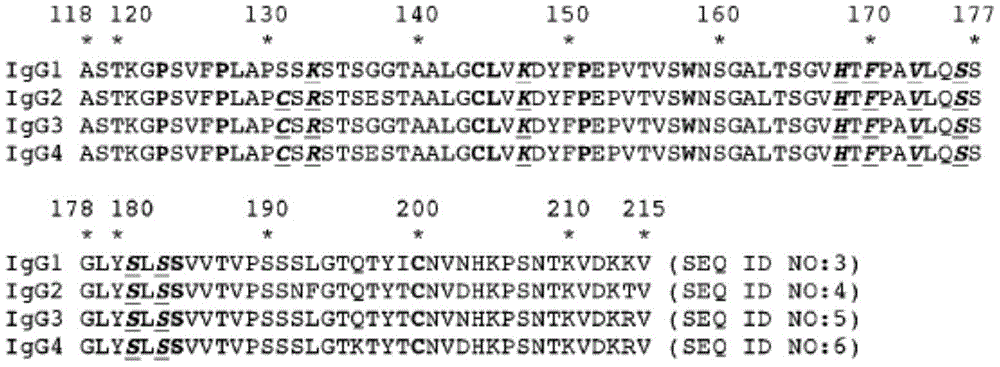
表7:人IgG1、IgG2、IgG3和IgG4抗体的代表性CH1结构域的氨基酸序列分别从IMGT网页,登录号J00228、J00230、X03604和K01316获得,并使用CLUSTALW软件进行比对。残基根据Edelman等人,出处同上的EU系统编号。根据Kabat等人,出处同上的“不变”残基以粗体示出。这些残基是高度保守的,但不是完全不变的。加下划线和粗斜体的残基是已经如下面的实施例中所报道进行取代和测试的位点。Table 7: The amino acid sequences of representative CH1 domains of human IgG1, IgG2, IgG3 and IgG4 antibodies were respectively obtained from the IMGT webpage, accession numbers J00228, J00230, X03604 and K01316, and compared using CLUSTALW software. Residues are numbered according to the EU system of Edelman et al., supra. "Invariant" residues according to Kabat et al. supra are shown in bold. These residues are highly conserved, but not completely invariant. Underlined and bold italicized residues are sites that have been substituted and tested as reported in the Examples below.
下表8显示了四种人IgG亚型IgG1、IgG2、IgG3和IgG4的人IgG Fc区的比对。这种比对显示了这些亚型之间的差异,以及高序列保守性。Table 8 below shows an alignment of the human IgG Fc regions of the four human IgG subtypes, IgGl, IgG2, IgG3 and IgG4. This alignment revealed differences between these subtypes, as well as high sequence conservation.
表8:人IgG Fc区的氨基酸序列Table 8: Amino acid sequences of human IgG Fc regions

已经引入了编码一种或多种蛋白质的DNA的“宿主细胞系”是指在例如通过转染引入所述DNA后来源于单个细胞的细胞系。用于在引入DNA后分离此类克隆细胞系的方法是本领域熟知的,并且包括有限稀释,以及可包括在视觉上确定特定样品中仅一个细胞存在的其它可能方法。参见例如Wewetzer(1995),J.Immunol.Methods179(1):71-76,Underwood和Bean(1988),J.Immunol.Meth.107(1):119-128。A "host cell line" into which DNA encoding one or more proteins has been introduced refers to a cell line derived from a single cell following introduction of said DNA, eg, by transfection. Methods for isolating such clonal cell lines following introduction of DNA are well known in the art and include limiting dilution, and may include other possible methods of visually ascertaining the presence of only one cell in a particular sample. See eg Wewetzer (1995), J. Immunol. Methods 179(1):71-76, Underwood and Bean (1988), J. Immunol. Meth. 107(1):119-128.
“人”核苷酸序列或氨基酸序列或核酸或蛋白质包括人中天然存在的核苷酸序列或氨基酸序列或核酸或蛋白质。许多人核苷酸和氨基酸序报告于例如Kabat等人,出处同上中,该文献说明了在本领域中字词“人”的使用。如本文所述,“人”氨基酸序列或蛋白质可以含有相对于天然存在的序列的一个或多个插入、缺失或取代,前提条件是“人”氨基酸序列或蛋白质不包含每100个氨基酸中单个氨基酸的多于10个插入、缺失和/或取代。类似地,人核酸(例如,DNA)或核苷酸序列不包含每300个核苷酸中单个核苷酸的多于30个插入、缺失和/或取代。在VH序列或VL序列的特定情况下,预期CDR变化极大,并且出于确定特定VH或VL氨基酸序列(或编码它的核苷酸序列)是否是“人”序列的目的,CDR(或编码它们的核苷酸)不被认为是所述序列的一部分。A "human" nucleotide sequence or amino acid sequence or nucleic acid or protein includes a nucleotide sequence or amino acid sequence or nucleic acid or protein that occurs naturally in humans. Numerous human nucleotide and amino acid sequences are reported, eg, in Kabat et al., supra, which illustrates the use of the word "human" in the art. As described herein, a "human" amino acid sequence or protein may contain one or more insertions, deletions or substitutions relative to the naturally occurring sequence, provided that the "human" amino acid sequence or protein does not contain a single amino acid in every 100 amino acids more than 10 insertions, deletions and/or substitutions. Similarly, a human nucleic acid (eg, DNA) or nucleotide sequence does not contain more than 30 insertions, deletions and/or substitutions of a single nucleotide out of every 300 nucleotides. In the particular case of a VH or VL sequence, the CDRs are expected to vary greatly, and for the purpose of determining whether a particular VH or VL amino acid sequence (or nucleotide sequence encoding it) is a "human" sequence, the CDRs (or encoding their nucleotides) are not considered part of the sequence.
如本文所述,编码抗体或抗体结构域或抗体或抗体结构域的“人源化”氨基酸序列的“人源化”核苷酸序列是这样的序列,所述序列起源于非人生物体但经工程化以尽可能类似于人序列且尽可能不牺牲抗体的所需特性,例如以一定的亲合力结合至某种抗原,以及许多可能的所需特性。人源化过程通常涉及将所有恒定结构域改变为人恒定结构域。在可变结构域中,原始CDR可用于替代与原始可变结构域尽可能相似的人抗体序列的CDR(通常称为CDR移植的过程)。然而,也可能需要框架区域中的一个或多个更改。因此,人源化抗体的氨基酸序列可能或可能不落入上文刚刚所述的“人”定义内。该过程在例如Zhang和Ho,Scientific Reports 6:33878;doi:10.1038/srep33878(2016)以及Miethe等人PLOS One;doi:10.137/journal.pone.0161446(2016)中描述,这两个文献以引用方式并入本文。As described herein, a "humanized" nucleotide sequence that encodes an antibody or antibody domain or a "humanized" amino acid sequence of an antibody or antibody domain is a sequence that is derived from a non-human organism but has been Engineered to resemble the human sequence as much as possible without sacrificing as much as possible the desired properties of the antibody, such as binding with a certain affinity to a certain antigen, and possibly many other desirable properties. The process of humanization generally involves changing all constant domains to human constant domains. In variable domains, the original CDRs can be used to replace those of human antibody sequences that are as similar as possible to the original variable domains (a process commonly referred to as CDR grafting). However, one or more changes in the frame area may also be required. Thus, the amino acid sequence of a humanized antibody may or may not fall within the definition of "human" immediately above. This process is described, for example, in Zhang and Ho, Scientific Reports 6:33878; doi:10.1038/srep33878 (2016) and Miethe et al. PLOS One; doi:10.137/journal.pone.0161446 (2016), both cited by way incorporated into this article.
如本文所述,“IgG抗体”是指如本文所定义的IgG同种型的全长抗体,包括IgG1、IgG2、IgG2和IgG4同种型亚型的人、人源化和灵长类抗体。As used herein, "IgG antibody" refers to a full length antibody of the IgG isotype as defined herein, including human, humanized and primate antibodies of the IgGl, IgG2, IgG2 and IgG4 isotype subtypes.
如本文所述,术语“同种型”是指在抗体中的重链恒定区,即CH1、铰链、CH2、和CH3结构域,是否是IgG,IgD,IgM,IgA或IgE型或其亚型,诸如IgG1、IgG2、IgG3或IgG4。此类同种型在本领域中是已知的,并且在例如Janeway等人,所述Immune System in Health andDisease,第5版,小节4-15至4-19,Garland Science,New York,2001(在http:// www.ncbi.nlm.nih.gov/books/NBK27106/处可得)中描述和说明。As used herein, the term "isotype" refers to the heavy chain constant regions in an antibody, i.e., the CH1, hinge, CH2, and CH3 domains, whether of IgG, IgD, IgM, IgA or IgE type or subtype thereof , such as IgG1, IgG2, IgG3 or IgG4. Such isotypes are known in the art and are described, for example, in Janeway et al., The Immune System in Health and Disease, 5th Edition, subsections 4-15 to 4-19, Garland Science, New York, 2001 ( Described and illustrated at http://www.ncbi.nlm.nih.gov/books/NBK27106/ ) .
如本文所述,“轻链(LC)”包含VL结构域和轻链恒定(CL)结构域,所述结构域可以是κ(CLκ)或λ(CLλ)结构域。这些结构域,包括它们的示例性氨基酸序列在内,描述于Kabat等人,出处同上,第xiii-lix页,第103-309页,和第647-660页中,该文献以引用方式并入本文。本文用于轻链的编号系统是在Kabat等人,出处同上中描述的用于VL结构域的编号系统和在Edelman等人,出处同上中描述的用于CL结构域的编号系统,如下文表9至表11所示。As used herein, a "light chain (LC)" comprises a VL domain and a light chain constant (CL) domain, which may be a kappa (CLK) or lambda (CLλ) domain. These domains, including their exemplary amino acid sequences, are described in Kabat et al., supra, pp. xiii-lix, pp. 103-309, and pp. 647-660, which is incorporated by reference This article. The numbering system used herein for the light chain is that for the VL domain described in Kabat et al., supra and for the CL domain described in Edelman et al., supra, as shown in the table below 9 to Table 11.
表9:人VL结构域的共有序列Table 9: Consensus sequences of human VL domains

表9:编号是根据Kabat等人(出处同上)的。粗斜体的编号指示CDR的位置。后面跟有字母的位置编号,例如27A,由于CDR的不同长度而可以或可以不填充有氨基酸。在Kabat等人(出处同上)中的所有人轻链的不变残基显示为粗体字母,以指示在该位置处存在的氨基酸。在选定的位点处,在该位点处存在的一至三种最常见的氨基酸以纯文本形式显示。此外,许多其它氨基酸在κ或λVL结构域的一些亚组内是不变的或高度保守的,这可以帮助将特定氨基酸序列分类为VL结构域。如下文实施例中所报道的,在此被选择进行改变的位点用加下划线的粗体类型指示。没有氨基酸被指定和/或编号没有用加下划线的粗体类型示出的位置不符合上述标准。Table 9: Numbering is according to Kabat et al. (supra). Numbers in bold italics indicate the positions of the CDRs. A position number followed by a letter, eg 27A, may or may not be filled with amino acids due to the different lengths of the CDRs. Invariant residues for all human light chains in Kabat et al. (supra) are shown in bold letters to indicate the amino acid present at that position. At a selected position, the one to three most common amino acids present at that position are displayed in plain text. In addition, many other amino acids are invariant or highly conserved within some subsets of kappa or lambda VL domains, which can aid in the classification of specific amino acid sequences as VL domains. As reported in the Examples below, sites selected for alteration herein are indicated with underlined bold type. Positions where no amino acid is assigned and/or numbering is not shown in underlined bold type do not meet the above criteria.
表10:CL结构域的共有序列和编号Table 10: Consensus sequences and numbering of CL domains
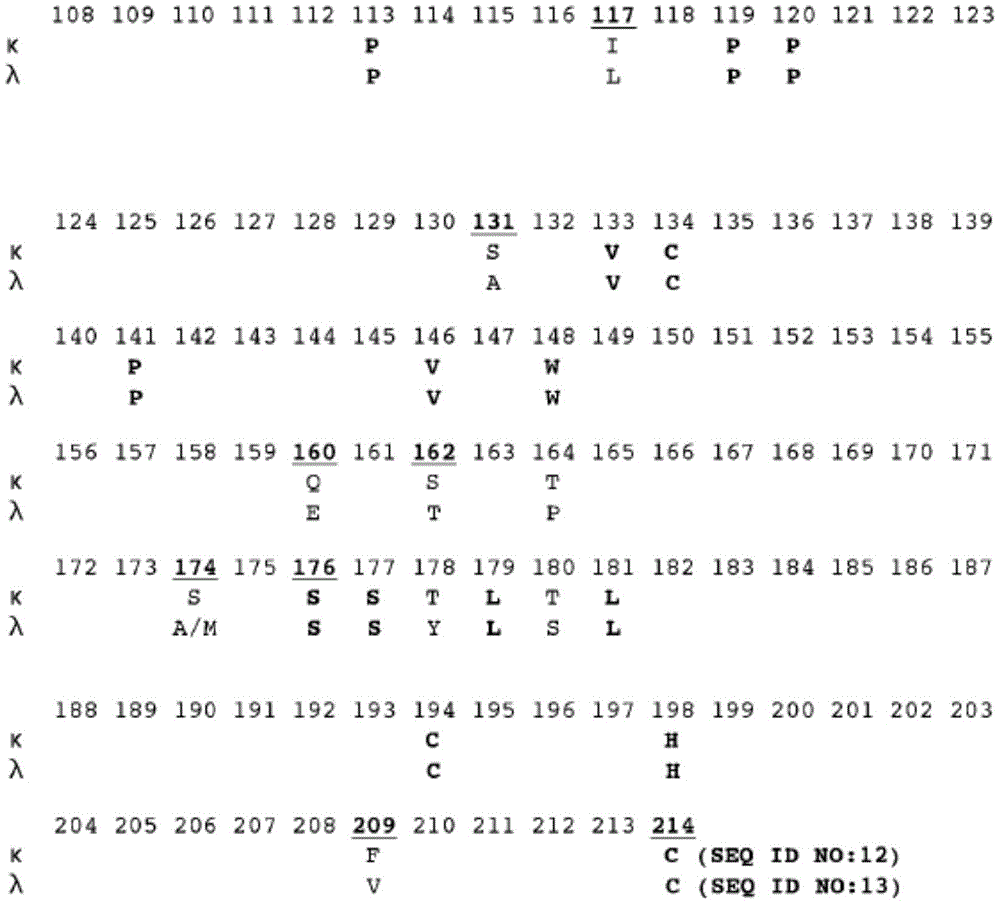
表10:编号是根据Edelman等人(出处同上)的,所述编号与Kabat等人(出处同上)中用于CL结构域的编号相同。编号下方以粗体显示的氨基酸是根据Kabat等人(出处同上),根据来自多种物质的κ和λCL结构域的比对的“不变”残基。如在选定位点(131、160、162、174、176和178)处所示,在Kabat等人(出处同上)中报道的十种人κ链(顶部)和28种人λ链(下部)中保守的氨基酸以纯文本示出。在这些位点中的一个位点处存在两种不同氨基酸中的任一种的情况下,更常见的氨基酸在较不常见的氨基酸之前显示,例如e.g.,A/M。加下划 线的粗体编号指示如下面实施例中报道的那样改变的位点。此外,许多其它氨基酸在CLκ或CLλ结构域的一些亚组内是不变的或高度保守的,这可以帮助将特定氨基酸序列分类为CL结构域。没有氨基酸被指定和/或编号没有用加下划线的粗体类型示出的位置不符合上述标准。Table 10: Numbering is according to Edelman et al. (supra), which is the same numbering used for the CL domain in Kabat et al. (supra). Amino acids in bold below the numbers are "invariant" residues according to Kabat et al. (supra), according to an alignment of kappa and lambda CL domains from various species. Ten human kappa chains (top) and 28 human lambda chains (bottom) reported in Kabat et al. Conserved amino acids are shown in plain text. Where either of two different amino acids are present at one of these positions, the more common amino acid is shown before the less common amino acid, eg, A/M. Underlined bold numbers indicate sites of alteration as reported in the Examples below. In addition, many other amino acids are invariant or highly conserved within some subgroups of CLκ or CLλ domains, which can aid in the classification of specific amino acid sequences as CL domains. Positions where no amino acid is assigned and/or numbering is not shown in underlined bold type do not meet the above criteria.
表11:人κ链CL结构域的比对Table 11: Alignment of human κ chain CL domains

表11:此表中人CLκ结构域的氨基酸序列来自

如本文所述,“LC配偶体定向改变”是在VH或CH1氨基酸序列内的HC/LC界面处的单个氨基酸的取代、插入或缺失,任选地是用带电氨基酸或半胱氨酸取代天然存在的氨基酸,这致使含有改变的VH和/或CH1氨基酸序列的HC(任选地人、人源化和/或灵长类IgG HC)与LC(任选地在接触氨基酸残基处含有“HC配偶体定向改变”的LC)更强地缔合。As described herein, a "LC partner-directed change" is a substitution, insertion or deletion of a single amino acid at the HC/LC interface within a VH or CH1 amino acid sequence, optionally substituting a charged amino acid or a cysteine for a natural Amino acids present such that HCs (optionally human, humanized and/or primate IgG HCs) containing altered VH and/or CH1 amino acid sequences and LCs (optionally containing " HC partner orientation changes" LC) associated more strongly.
类似地,“HC配偶体定向改变”是在VL或CL氨基酸序列内的HC/LC界面处的单个氨基酸的取代、插入或缺失,任选地是用带电氨基酸或半胱氨酸取代天然存在的氨基酸,这致使含有改变的VL和/或CL氨基酸序列的LC(任选地人、人源化和/或灵长类κ或λLC)与HC(任选地在接触氨基酸残基处含有“LC配偶体定向改变”的HC)更强地缔合。在一些实施方案中,HC配偶体定向改变和LC配偶体定向改变的接触对可以是具有相反电荷的带电氨基酸取代,所述取代形成如上文所定义的“电荷对”。在其它实施方案中,带电氨基酸已经存在于HC或LC的接触位点中的一者处,使得仅需要改变一条链来产生有利于形成同源HC/LC对的电荷对。在其它实施方案中,可以在接触位点处引入半胱氨酸残基,使得可以在同源HC/LC对之间形成二硫桥。在其它实施方案中,HC配偶体定向改变和LC配偶体定向改变可以是在接触残基处产生球状突起和孔(或突起和空腔)的取代或预先存在的氨基酸,如美国专利8,679,785中所述,该专利的相关部分以引用方式并入本文。HC可以是IgG、IgA、IgD、IgM或IgE同种型,任选地IgG1、IgG2、IgG3或IgG4。HC配偶体定向改变和LC配偶体定向改变发生在形成HC/LC界面一部分的接触氨基酸位置处。CL和CH1结构域中的界面残基包括
表12:CH1与CL之间的接触残基Table 12: Contact residues between CH1 and CL


在接触残基在VH结构域与VL结构域之间的界面上的情况下,使用以下标准选择适用于改变的残基对,所述残基对中的一个残基在VH中而另一个残基在VL结构域中:(1)残基被内埋或部分内埋,即在全长抗体的三级结构中不可接近,(2)残基在空间上接近,即两个氨基酸的Cα在约

如本文所述,“MabPair”是包含两种并且不超过两种主要抗体种类的抗体混合物。可以在已经引入了编码两种不同IgG抗体(即,两条不同重链和两条不同轻链)的DNA的宿主细胞系(如上文所定义)中制备MabPair。也可以在已经引入了编码两种不同IgG抗体的DNA的细胞群中制备MabPair,其中克隆宿主细胞系不是从引入了所述DNA的细胞中纯化的。这种情况的一个实例可以包括将编码两种不同IgG抗体的DNA瞬时转染到例如293或ExpiCHO细胞中,以及随后从转染细胞的细胞上清液中获得由所述细胞产生的抗体。由多于一种宿主细胞系制备的两种抗体的混合物不是如本文所述的MabPair。此外,从两个单独的细胞群制备的两种抗体的混合物(其中编码一种抗体的DNA已经被引入一个细胞群中,并且编码另一种抗体的DNA已被引入另一个细胞群中)也不是如本文所述的MabPair。As described herein, a "MabPair" is an antibody mixture comprising two and no more than two major antibody species. MabPairs may be produced in a host cell line (as defined above) into which DNA encoding two different IgG antibodies (ie two different heavy chains and two different light chains) has been introduced. MabPairs can also be prepared in a cell population into which DNA encoding two different IgG antibodies has been introduced, where the cloning host cell line is not purified from the cells into which the DNA was introduced. An example of this may include transient transfection of DNA encoding two different IgG antibodies into eg 293 or ExpiCHO cells, and subsequent obtaining of the antibodies produced by said cells from the cell supernatant of the transfected cells. A mixture of two antibodies produced by more than one host cell line is not a MabPair as described herein. In addition, a mixture of two antibodies prepared from two separate cell populations (in which DNA encoding one antibody has been introduced into one population of cells and DNA encoding the other antibody has been introduced into the other) is also Not MabPair as described in this article.
如本文所述,抗体混合物情境中的“主要种类”的抗体是构成混合物中的抗体总量的至少10%的特定抗体种类。为了确定抗体混合物中有多少主要物质,可以进行如实施例5中所述和图17中所示的低pHCEX色谱法。抗体混合物中的每种物质占抗体总量的百分比可以使用柱流出物的吸光度峰下面积来确定。As described herein, a "predominant species" of antibodies in the context of a mixture of antibodies is that particular antibody species that constitutes at least 10% of the total amount of antibodies in the mixture. To determine how much of the major species is in the antibody mixture, low pH CEX chromatography as described in Example 5 and shown in Figure 17 can be performed. The percentage of each species in the antibody mixture to the total amount of antibody can be determined using the area under the absorbance peak of the column effluent.
如本文所述,抗体混合物中的“次要种类”的抗体占抗体混合物中抗体总量的少于10%。这可以通过低pH CEX色谱法测定,如在“主要物质”的定义中所述。As described herein, "minor species" of antibodies in the antibody mixture comprise less than 10% of the total amount of antibodies in the antibody mixture. This can be determined by low pH CEX chromatography, as described in the definition of "major species".
“灵长类”核苷酸或氨基酸序列或核酸或蛋白质包括在灵长类中天然存在的分子和序列。灵长类包括来自许多家族的动物,包括但不限于原猴类(包括狐猴)、新世界猴、黑猩猩、人,大猩猩、猩猩、长臂猿和旧世界猴。具体灵长类物种包括但不限于智人(Homosapiens)、猕猴(Macaca mulata)(恒河猴)、食蟹猴(Macaca fascicularis)和黑猩猩(Pantroglodytes),以及其它许多灵长类动物。许多灵长类核苷酸和氨基酸序列是本领域已知的,例如在例如Kabat等人,出处同上中报道的灵长类核苷酸和氨基酸序列。通常,如本文所述,“灵长类”氨基酸序列可以含有相对于天然存在的灵长类序列的一个或多个插入、缺失或取代,前提条件是“灵长类”氨基酸序列不包含每100个氨基酸中单个氨基酸的多于10个插入、缺失和/或取代。类似地,灵长类核苷酸序列可以含有相对于天然存在的灵长类动物序列的插入、缺失或取代,但是不包含每300个核苷酸中单个核苷酸的多于30个插入、缺失和/或取代。在VH序列或VL序列的特定情况下,预期CDR变化极大,并且出于确定特定VH或VL氨基酸序列(或编码它的核苷酸序列)是否是“灵长类”序列的目的,CDR(或编码它们的核苷酸)不被认为是所述序列的一部分。A "primate" nucleotide or amino acid sequence or nucleic acid or protein includes molecules and sequences that occur naturally in primates. Primates include animals from many families including, but not limited to, prosimians (including lemurs), New World monkeys, chimpanzees, humans, gorillas, orangutans, gibbons, and Old World monkeys. Specific primate species include, but are not limited to, Homo sapiens, Macaca mulata (rheses), cynomolgus monkeys (Macaca fascicularis), and chimpanzees (Pantroglodytes), among many others. Many primate nucleotide and amino acid sequences are known in the art, such as those reported in, eg, Kabat et al., supra. Generally, as described herein, a "primate" amino acid sequence may contain one or more insertions, deletions or substitutions relative to a naturally occurring primate sequence, provided that the "primate" amino acid sequence does not contain every 100 More than 10 insertions, deletions and/or substitutions of a single amino acid in amino acids. Similarly, a primate nucleotide sequence may contain insertions, deletions or substitutions relative to a naturally occurring primate sequence, but does not contain more than 30 insertions, single nucleotides per 300 nucleotides, deletions and/or substitutions. In the particular case of a VH or VL sequence, the CDRs are expected to vary greatly, and for the purpose of determining whether a particular VH or VL amino acid sequence (or nucleotide sequence encoding it) is a "primate" sequence, the CDRs ( or the nucleotides encoding them) are not considered to be part of the sequence.
如本文所述,两个氨基酸序列是“相同”的是指如果这两个序列可以由相同的DNA序列编码。也就是说,如本文所述,仅由于翻译后修饰(例如,消除羧基末端赖氨酸或N末端谷氨酸或谷氨酰胺残基的环化)而不同的氨基酸序列是“相同”的。As used herein, two amino acid sequences are "identical" if the two sequences can be encoded by the same DNA sequence. That is, amino acid sequences that differ only as a result of post-translational modifications (eg, elimination of carboxy-terminal lysine or N-terminal glutamate or cyclization of N-terminal glutamate or glutamine residues) are "identical," as described herein.
如本文所述,“靶分子”是指抗体(例如,在本文所述的混合物中的抗体)特异性结合的分子。在一些实施方案中,靶分子是“靶蛋白”,即抗体特异性结合的蛋白质。As used herein, a "target molecule" refers to a molecule to which an antibody (eg, an antibody in a mixture described herein) specifically binds. In some embodiments, the target molecule is a "target protein", ie, a protein to which an antibody specifically binds.
抗体混合物及其制备方法Antibody mixture and its preparation method
本文描述了具有不同结合特异性的抗体的混合物,所述抗体混合物是在已经引入了编码抗体的DNA的宿主细胞中产生的。抗体可以是人、人源化和/或灵长类全长IgG抗体。还描述了制备此类混合物的方法。混合物中的不同主要抗体种类的数量可以被限制为例如不超过2种、3种、4种、5种、6种、7种、8种、9种或10种主要种类。抗体中的一种或多种的HC和/或LC可包含LC配偶体定向改变和/或HC配偶体定向改变。在一些实施方案中,抗体中的一种或多种的HC可包含一个或多个不利异源二聚体的改变。在一些实施方案中,混合物中的一种或多种主要抗体种类可以没有这种改变。这些改变可用于限制宿主细胞产生的主要抗体种类的数量。Described herein is a mixture of antibodies with different binding specificities produced in a host cell into which DNA encoding the antibody has been introduced. Antibodies can be human, humanized and/or primate full-length IgG antibodies. Methods of preparing such mixtures are also described. The number of different primary antibody species in the mixture can be limited, eg, to no more than 2, 3, 4, 5, 6, 7, 8, 9 or 10 primary species. The HC and/or LC of one or more of the antibodies may comprise an altered orientation of the LC partner and/or an altered orientation of the HC partner. In some embodiments, the HC of one or more of the antibodies may comprise one or more heterodimer-unfavorable alterations. In some embodiments, one or more primary antibody species in the mixture may not have such alterations. These changes can be used to limit the number of major antibody species produced by the host cell.
产生抗体混合物的方法可包括将编码本文所述抗体混合物的DNA引入宿主细胞,培养所述宿主细胞,以及从细胞团或培养基中回收所述抗体混合物。编码混合物中的不同抗体的DNA可以同时或在不同时间引入宿主细胞。例如,可以将编码第二抗体的DNA引入宿主细胞群中,所述宿主细胞群已经产生由先前引入所述宿主细胞群的DNA编码的第一抗体。或者,可以将编码两种抗体的DNA同时引入宿主细胞中。此外,在将编码多种抗体的DNA引入宿主细胞后,可以从引入了所述DNA的细胞群中分离产生所述抗体的克隆“宿主细胞系”(如上文所定义)。或者,抗体混合物可以由引入了DNA的宿主细胞群产生。如下文详细解释的,抗体中的改变可以限制由宿主细胞产生的主要抗体种类的数量。该混合物可以从宿主细胞培养上清液或细胞团获得,可以进一步纯化,并且可以适当地配制用作药物。Methods of producing a mixture of antibodies can include introducing into host cells DNA encoding the mixture of antibodies described herein, culturing the host cells, and recovering the mixture of antibodies from the cell pellet or culture medium. DNA encoding the different antibodies in the mixture can be introduced into the host cell at the same time or at different times. For example, DNA encoding a second antibody can be introduced into a population of host cells that already produce a primary antibody encoded by DNA previously introduced into the population of host cells. Alternatively, DNA encoding both antibodies can be introduced into the host cell simultaneously. Furthermore, following introduction into host cells of DNA encoding a plurality of antibodies, clonal "host cell lines" (as defined above) producing the antibodies may be isolated from the population of cells into which said DNA has been introduced. Alternatively, antibody mixtures can be produced by host cell populations into which the DNA has been introduced. As explained in detail below, changes in antibodies can limit the number of major antibody species produced by a host cell. The mixture can be obtained from host cell culture supernatant or cell mass, can be further purified, and can be formulated appropriately for use as a medicament.
更具体地,可以将编码至少两种、三种或四种结合不同表位和/或靶标的不同抗体(任选地全长IgG抗体)的DNA引入宿主细胞中。所编码的抗体可各自包含两条具有相同氨基酸序列的HC和两条具有相同氨基酸序列的LC,并且所编码的抗体中的每一种可具有的HC和LC与所编码的另一种或多种抗体的HC和LC的氨基酸序列不同。在一些实施方案中,抗体可以是两种全长抗体,所述两种全长抗体各自包含两条具有相同氨基酸序列的重链和两条具有相同氨基酸序列的轻链。任选地,抗体是灵长类和/或人和/或人源化IgG抗体。在一些实施方案中,在同源HC/LC对中的接触位点处的至少一对带相反电荷的残基,即电荷对或半胱氨酸残基(其中来自改变的至少一个这些带电残基或半胱氨酸结果)可以在每种抗体的LC与其同源HC之间的界面中找到。在其它实施方案中,这种电荷对和/或接触半胱氨酸残基对可以存在于混合物中的一种或多种抗体中,而不需要存在于混合物中的所有抗体中。LC和HC中产生这种配对的改变分别称为HC配偶体定向改变和LC配偶体定向改变。每种抗体可以包含LC配偶体定向改变和/或HC配偶体定向改变的多个接触对,或者可以不包含成对的LC配偶体定向改变和/或HC配偶体定向改变。任选地,CH3结构域中可能存在不利于异源二聚HC/HC对形成的另外改变。此类改变可以存在于抗体中的一种或多种中,并且可以不存在于一种或多种抗体中。可以培养宿主细胞群或宿主细胞系,并且可以在细胞团和/或培养基中回收抗体混合物。可以进一步纯化抗体混合物,并且可以将所述混合物配制成适用于其药物用途。More specifically, DNA encoding at least two, three or four different antibodies (optionally full length IgG antibodies) binding to different epitopes and/or targets may be introduced into the host cell. The encoded antibodies may each comprise two HCs having the same amino acid sequence and two LCs having the same amino acid sequence, and each of the encoded antibodies may have the same HC and LC as the other encoded one or more The HC and LC amino acid sequences of the two antibodies differ. In some embodiments, the antibodies may be two full-length antibodies that each comprise two heavy chains with the same amino acid sequence and two light chains with the same amino acid sequence. Optionally, the antibodies are primate and/or human and/or humanized IgG antibodies. In some embodiments, at least one pair of oppositely charged residues at the contact site in a cognate HC/LC pair, i.e., a charge pair or a cysteine residue (wherein at least one of these charged residues from an alteration base or cysteine results) can be found in the interface between the LC of each antibody and its cognate HC. In other embodiments, such pairs of charges and/or pairs of contacting cysteine residues may be present in one or more antibodies in the mixture, but need not be present in all antibodies in the mixture. The changes in LC and HC that produce this pairing are called HC partner orientation changes and LC partner orientation changes, respectively. Each antibody may comprise multiple contact pairs of altered LC partner orientations and/or altered HC partner orientations, or may contain no pairs of altered LC partner orientations and/or altered HC partner orientations. Optionally, there may be additional changes in the CH3 domain that disfavor the formation of heterodimeric HC/HC pairs. Such alterations may or may not be present in one or more of the antibodies. The host cell population or host cell line can be cultured, and the antibody mixture can be recovered in the cell pellet and/or culture medium. The antibody mixture can be further purified, and the mixture can be formulated for its pharmaceutical use.
在仅编码两种全长抗体(Ab1和Ab2)的DNA被引入宿主细胞并且每种抗体包含一种或多种HC配偶体定向改变和/或LC配偶体定向改变的实施方案中,使得形成很少(如果有的话)的非同源HC/LC对,则可以由所述宿主细胞产生两种(在本文中称为“MabPair”)或三种(在本文中称为“3合1混合物”)主要抗体种类。参见图1至图4。如果HC可以形成异源二聚HC/HC对,则可以由所述宿主细胞产生包含Ab1、Ab2和包含来自每种抗体的一条HC和一条LC的双特异性抗体的3合1混合物。如果抗体不形成异源二聚HC/HC对(任选地,由于一种或多种不利于异源二聚体形成的改变),则将产生包含Ab1和Ab2的MabPair混合物。In embodiments where only DNA encoding two full-length antibodies (Ab1 and Ab2) is introduced into the host cell and each antibody contains one or more HC partner orientation changes and/or LC partner orientation changes, resulting in the formation of many With few, if any, non-homologous HC/LC pairs, two (herein referred to as "MabPair") or three (herein referred to as "3-in-1 mixture") can be produced by the host cell ”) Main antibody species. See Figures 1 through 4. If HCs can form heterodimeric HC/HC pairs, a 3-in-1 mixture comprising Abl, Ab2 and a bispecific antibody comprising one HC and one LC from each antibody can be produced by the host cell. If the antibodies do not form heterodimeric HC/HC pairs (optionally due to one or more alterations that disfavor heterodimer formation), a MabPair mixture comprising Ab1 and Ab2 will result.
在编码两种全长抗体(Ab1和Ab2)的DNA被引入宿主细胞中的替代策略中,所述抗体中只有一种抗体包含一种或多种HC配偶体定向改变和/或LC配偶体定向改变,并且所述抗体中的任一者或没有任何一者包含不利于异源二聚体的改变。参见图3。因此,在一些实施方案中,所述抗体中的一种可以不包含配偶体定向改变并且不包含不利于异源二聚体的改变,并且另一种可以包含一个或多个配偶体定向改变和一个或多个不利异源二聚体的改变。参见图3中的图A。或者,所述抗体中的一种可以包含一个或多个配偶体定向改变但不包含不利于异源二聚体的改变,而另一种抗体可以不包含配偶体定向改变但可以包含一个或多个不利于异源二聚体的改变。在另一实施方案中,两种抗体均不包含不利于异源二聚体的改变,并且仅一种抗体包含一个或多个配偶体定向改变。参见图3中的图B。In an alternative strategy in which DNA encoding two full-length antibodies (Ab1 and Ab2) is introduced into host cells, only one of the antibodies contains one or more altered HC partner orientation and/or LC partner orientation Alterations, and either or none of the antibodies comprise alterations that disfavor heterodimerization. See Figure 3. Thus, in some embodiments, one of the antibodies may contain no partner orientation changes and no alterations that disfavor heterodimerization, and the other may comprise one or more partner orientation changes and One or more unfavorable heterodimer alterations. See Panel A in Figure 3. Alternatively, one of the antibodies may contain one or more partner orientation changes but not changes that disfavor heterodimerization, while the other antibody may contain no partner orientation changes but may contain one or more A change that does not favor heterodimerization. In another embodiment, neither antibody contains alterations that disfavor heterodimerization, and only one antibody contains one or more partner orientation alterations. See Panel B in Figure 3.
由宿主细胞群或宿主细胞系制备的抗体混合物的进一步纯化可涉及许多步骤。在一些实施方案中,将混合物施加到蛋白A或蛋白G亲和柱上,随后洗脱。也可以使用其它柱色谱步骤,诸如阳离子或阴离子交换色谱,包括如下所述的低pH阳离子交换色谱、尺寸排阻色谱、反相色谱或疏水相互作用色谱(HIC)。进一步的纯化步骤可包括渗滤以及许多可能方法。Further purification of antibody mixtures produced from host cell populations or host cell lines may involve a number of steps. In some embodiments, the mixture is applied to a protein A or protein G affinity column followed by elution. Other column chromatography steps such as cation or anion exchange chromatography, including low pH cation exchange chromatography, size exclusion chromatography, reverse phase chromatography or hydrophobic interaction chromatography (HIC) as described below may also be used. Further purification steps may include diafiltration as well as many possible methods.
此外,抗体混合物或编码抗体混合物的核酸可以经配制用于其预期用途。为了用作治疗剂,可以将抗体混合物配制成用于肠胃外给药,任选地用于注射的液体。其它种类的剂型例如凝胶剂、糊剂、霜剂,或固体也是可能的。制剂可以包含可以例如维持、修饰或保存抗体或核酸和/或控制因子(诸如pH、渗透压、粘度、透明度、气味、颜色、无菌性和/或体内释放或吸收速率)的成分。因此,制剂可包含通常用于此类制剂中的任何缓冲剂和/或赋形剂。这些成分的实例包括缓冲剂、抗微生物剂、螯合剂、盐、氨基酸和糖,以及许多可能的试剂。所配制的混合物的pH可以在约pH 5至约pH 8.5或约pH 6至约pH 8的范围内。Furthermore, antibody mixtures or nucleic acids encoding antibody mixtures can be formulated for their intended use. For use as a therapeutic agent, the antibody mixture can be formulated as a liquid for parenteral administration, optionally for injection. Other kinds of dosage forms such as gels, pastes, creams, or solids are also possible. Formulations can include ingredients that can, for example, maintain, modify or preserve the antibody or nucleic acid and/or control factors such as pH, osmolarity, viscosity, clarity, odor, color, sterility and/or rate of release or absorption in vivo. Accordingly, the formulations may contain any buffers and/or excipients commonly used in such formulations. Examples of such ingredients include buffers, antimicrobials, chelating agents, salts, amino acids and sugars, among many possible agents. The pH of the formulated mixture may range from about
抗体的结合特异性可以通过类似于实施例8中所描述的结合测定来确定。The binding specificity of antibodies can be determined by binding assays similar to those described in Example 8.
确定两种抗体是否竞争抗原上的特定结合位点或表位的方法通常包括以下步骤。首先,在不同量的竞争抗体(mAb2)存在下孵育生物素酰化的抗原。这些组合称为“样品”。然后将可以包含mAb2/抗原复合物以及未结合的mAb2和/或抗原的样品添加到微量滴定板中涂有另一种结合所述抗原的抗体(mAb1)的孔中。作为对照,可以在一些孔中添加包含在没有mAb2的情况下孵育的生物素酰化抗原的样品。然后洗涤平板以除去未结合的抗原。如果mAb1和mAb2不竞争,则mAb1可以与mAb2/抗原复合物以及游离抗原结合。在这种情况下,信号强度(与结合的抗原或mAb2/抗原复合物的量成比例)不会因样品中mAb2的存在而减弱。在一些情况下,mAb1和mAb2可以完全竞争,这意味着mAb1将结合游离抗原,但不结合mAb2/抗原复合物。在一些情况下,竞争可能会发生但不太完整。在这种情况下,mAb1与mAb2/抗原复合物的结合可以减少而不是完全不存在。在任一情况下,信号强度将因样品中mAb2/抗原复合物的存在而降低。通过以下步骤来检测信号:添加与辣根过氧化物酶(HRP)耦合的链霉抗生物素蛋白,洗涤平板,以及添加可通过比色测量检测到的HRP底物。洗涤平板,并停止反应以防止信号饱和。检测比色信号。如本文所述,如果通过本文所述的测试两种抗体竞争(完全或部分地竞争)与抗原结合,则据称它们与抗原上的相同表位结合。Methods of determining whether two antibodies compete for a particular binding site or epitope on an antigen generally include the following steps. First, biotinylated antigen was incubated in the presence of varying amounts of competing antibody (mAb2). These combinations are called "samples". A sample, which may contain mAb2/antigen complexes as well as unbound mAb2 and/or antigen, is then added to wells of the microtiter plate coated with another antibody (mAb1 ) that binds the antigen. As a control, samples containing biotinylated antigen incubated without mAb2 can be added to some wells. Plates are then washed to remove unbound antigen. If mAb1 and mAb2 do not compete, mAb1 can bind to mAb2/antigen complexes as well as free antigen. In this case, the signal intensity (proportional to the amount of bound antigen or mAb2/antigen complex) is not attenuated by the presence of mAb2 in the sample. In some cases, mAb1 and mAb2 can perfectly compete, meaning that mAb1 will bind free antigen, but not mAb2/antigen complex. In some cases, competition may occur but not be complete. In this case, the binding of mAb1 to the mAb2/antigen complex may be reduced rather than completely absent. In either case, the signal intensity will be reduced by the presence of mAb2/antigen complexes in the sample. Signal was detected by adding streptavidin coupled to horseradish peroxidase (HRP), washing the plate, and adding HRP substrate detectable by colorimetric measurement. Plates were washed, and the reaction was stopped to prevent signal saturation. Detection of colorimetric signals. As described herein, two antibodies are said to bind to the same epitope on an antigen if they compete (completely or partially) for binding to the antigen by the tests described herein.
混合物中抗体的HC可以是任何同种型,诸如IgG(包括IgG1、IgG2、IgG3或IgG4)、IgA、IgM、IgE或IgD。当使用IgG4HC时,HC可以包含改变S228P,所述改变S228P阻止Fab臂交换。Silva等人(2015),J.Biol.Chem.290(9):5462-5469。这种重链的序列是本领域中已知的。参见例如Kabat等人,出处同上,在第661-723页处,该文献以引用方式并入本文。SEQ IDNO:23中提供了含有S228P改变的IgG4抗体的重链的氨基酸序列。重链可以来自任何物种,例如哺乳动物、人、灵长类动物、小鼠、或大鼠,或者重链可以例如使用噬菌体展示或使用人源化过程人工地产生。The HC of the antibodies in the mixture may be of any isotype, such as IgG (including IgGl, IgG2, IgG3 or IgG4), IgA, IgM, IgE or IgD. When IgG4 HCs are used, the HCs may contain an alteration S228P that prevents Fab arm exchange. Silva et al. (2015), J. Biol. Chem. 290(9):5462-5469. The sequence of such heavy chains is known in the art. See, eg, Kabat et al., supra, at pp. 661-723, which is incorporated herein by reference. The amino acid sequence of the heavy chain of an IgG4 antibody containing the S228P alteration is provided in SEQ ID NO:23. The heavy chain can be from any species, such as mammalian, human, primate, mouse, or rat, or the heavy chain can be artificially produced, for example, using phage display or using a humanization process.
类似地,两条不同的轻链可以是λ(λLC)或κ(κLC)链,所述链可以来自任何物种,并且任选地可以是哺乳动物,例如人或人源化抗体、灵长类抗体、鼠或大鼠抗体。轻链也可以人工地产生,例如使用噬菌体展示或人源化过程。λLC链和κLC链的氨基酸序列的许多实例是本领域中已知的,例如在Kabat等人,出处同上,第647-660页中报道的氨基酸序列,该文献以引用方式并入本文。这些序列中的位置是根据用于VL结构域的Kabat(Kabat等人,出处同上)编号系统和用于CL结构域的Edelman(Edelman等人,出处同上)编号系统确定的,如表9至表11所示和在随附文本中论述的。Similarly, the two different light chains can be lambda (λLC) or kappa (κLC) chains, which can be from any species and optionally can be mammalian, e.g. human or humanized antibodies, primate Antibody, mouse or rat antibody. Light chains can also be produced artificially, for example using phage display or humanization processes. Many examples of amino acid sequences for lambda and kappa LC chains are known in the art, such as those reported in Kabat et al., supra, pp. 647-660, which is incorporated herein by reference. The positions in these sequences are determined according to the Kabat (Kabat et al., supra) numbering system for the VL domain and the Edelman (Edelman et al., supra) numbering system for the CL domain, as shown in Table 9 to Table 9. 11 and discussed in the accompanying text.
重链和轻链均可含有如本文所述的一种或多种改变。每种改变可以是单个氨基酸的取代、插入或缺失。在一些实施方案中,每种改变是一种氨基酸被另一种氨基酸取代。任选地,改变是用带电氨基酸或半胱氨酸取代原始存在于该位点的氨基酸。在一些实施方案中,被取代的氨基酸可以是任何氨基酸。在一些实施方案中,除半胱氨酸之外的氨基酸可以取代半胱氨酸。除半胱氨酸之外的氨基酸可以是任何氨基酸,虽然在一些实施方案中所述氨基酸可以是丝氨酸、甘氨酸或丙氨酸。在一些实施方案中,用于替代原始氨基酸序列中的氨基酸的氨基酸选择是有限的。例如,在此类实施方案中,用于替代原始氨基酸的氨基酸可以是除以下氨基酸中的一种或多种之外的任何氨基酸:丙氨酸(A)、精氨酸(R)、天冬酰胺(N)、天冬氨酸(D)、半胱氨酸(C)、谷氨酰胺(Q)、谷氨酸(E)、甘氨酸(G)、组氨酸(H)、异亮氨酸(I)、亮氨酸(L)、赖氨酸(K)、蛋氨酸(M)、苯丙氨酸(F)、脯氨酸(P)、丝氨酸(S)、苏氨酸(T)、色氨酸(W)、酪氨酸(Y)和缬氨酸(V)。在其它实施方案中,原始氨基酸可以用上面刚刚叙述的二十种氨基酸组中的任何另一氨基酸替代。在其它实施方案中,原始氨基酸可以用具有相似特性的氨基酸组中的两种、三种或四种氨基酸和/或任何氨基酸替代,诸如下文所述的“保守”氨基酸取代。例如,此类组包括(1)精氨酸和赖氨酸,(2)丝氨酸和苏氨酸,(3)天冬氨酸和谷氨酸,或(4)天冬酰胺和谷氨酰胺等。Both heavy and light chains can contain one or more alterations as described herein. Each alteration may be a single amino acid substitution, insertion or deletion. In some embodiments, each alteration is the substitution of one amino acid for another. Optionally, the alteration is a substitution of a charged amino acid or a cysteine for the amino acid originally present at that position. In some embodiments, the substituted amino acid can be any amino acid. In some embodiments, amino acids other than cysteine may be substituted for cysteine. The amino acid other than cysteine can be any amino acid, although in some embodiments the amino acid can be serine, glycine or alanine. In some embodiments, the choice of amino acids to replace amino acids in the original amino acid sequence is limited. For example, in such embodiments, the amino acid used to replace the original amino acid can be any amino acid except one or more of the following amino acids: alanine (A), arginine (R), asparagine Amide (N), Aspartic Acid (D), Cysteine (C), Glutamine (Q), Glutamic Acid (E), Glycine (G), Histidine (H), Isoleucine Acid (I), Leucine (L), Lysine (K), Methionine (M), Phenylalanine (F), Proline (P), Serine (S), Threonine (T) , tryptophan (W), tyrosine (Y) and valine (V). In other embodiments, the original amino acid may be replaced with any other amino acid from the group of twenty amino acids recited immediately above. In other embodiments, the original amino acid may be substituted with two, three or four amino acids and/or any amino acid from a group of amino acids with similar properties, such as the "conservative" amino acid substitutions described below. For example, such groups include (1) arginine and lysine, (2) serine and threonine, (3) aspartic acid and glutamic acid, or (4) asparagine and glutamine, etc. .
本领域的技术人员知道,存在于活生物中的氨基酸可以根据它们的特性进行分组,并且使用具有相似特性的氨基酸替代原始氨基酸被称为“保守取代”。在一些实施方案中,本文所述的改变可包括保守取代。如本文所述,保守取代包括以下替代:(1)用V、L或I取代A,(2)用K、Q或N取代R,(3)用Q取代N,(4)用E取代D,(5)用S或A取代C,(6)用N取代Q,(7)用D取代E,(8)用P或A取代G,(9)用N、Q、K或R取代H,(10)用L、V、M、A或F取代I,(11)用I、V、M、A或F取代L,(12)用R、Q或N取代K,(13)用L、F或I取代M,(14)用L、V、I、A或Y取代F,(15)用A取代P,(16)用T、A或C取代S,(17)用S取代T,(18)用Y或F取代W,(19)用W、F、T或S取代Y,以及(20)用I、M、L、F或A取代V。Those skilled in the art know that amino acids present in living organisms can be grouped according to their properties, and replacing an original amino acid with an amino acid with similar properties is called a "conservative substitution". In some embodiments, the changes described herein may include conservative substitutions. As described herein, conservative substitutions include the following substitutions: (1) substitution of A with V, L, or I, (2) substitution of R with K, Q, or N, (3) substitution of N with Q, (4) substitution of D with E , (5) replace C with S or A, (6) replace Q with N, (7) replace E with D, (8) replace G with P or A, (9) replace H with N, Q, K or R , (10) replace I with L, V, M, A or F, (11) replace L with I, V, M, A or F, (12) replace K with R, Q or N, (13) use L , F or I to replace M, (14) replace F with L, V, I, A or Y, (15) replace P with A, (16) replace S with T, A or C, (17) replace T with S , (18) substituting Y or F for W, (19) substituting W, F, T or S for Y, and (20) substituting I, M, L, F or A for V.
序列中特定位点处的氨基酸和氨基酸取代在本文中表示如下。序列中的原始氨基酸之后接有重链或轻链氨基酸序列中的位置编号(使用表5至表11中所示的编号系统),之后接有用作替代的氨基酸。例如,HC中的K409E意指最初存在于HC中的位置409处的赖氨酸被谷氨酸取代。如果重链中的位置409可原始包含两种不同氨基酸(例如,K或R)中的任一者,并且这些氨基酸可用两种氨基酸(例如,D或E)中的任一者替代,则这可以表示为K/R409D/E。该名称意指原始存在于位置409处的赖氨酸或精氨酸可以用天冬氨酸或谷氨酸替代。在一些情况下,未定义原始氨基酸。例如,HC中的409D意指氨基酸409是天冬氨酸,并且原始氨基酸的身份未定义并且可以是任何氨基酸,包括天冬氨酸。类似地,名称K409意谓位置409处的原始氨基酸是赖氨酸(并且没有改变)。Amino acids and amino acid substitutions at specific positions in the sequence are indicated herein as follows. The original amino acid in the sequence is followed by the position number in the heavy or light chain amino acid sequence (using the numbering system shown in Tables 5 to 11), followed by the amino acid used as replacement. For example, K409E in HC means that the lysine originally present in HC at position 409 is replaced by glutamic acid. If position 409 in the heavy chain can originally contain either of two different amino acids (e.g., K or R), and these amino acids can be replaced with either of two amino acids (e.g., D or E), then this It can be expressed as K/R409D/E. The name implies that the lysine or arginine originally present at position 409 can be replaced with aspartic acid or glutamic acid. In some cases, the original amino acid was not defined. For example, 409D in HC means that amino acid 409 is aspartic acid, and the identity of the original amino acid is undefined and can be any amino acid, including aspartic acid. Similarly, the designation K409 means that the original amino acid at position 409 was lysine (and unchanged).
表5至表11说明了在一些情况下在人或灵长类HC和LC中,HC和LC之间的序列共有水平。可变区的氨基酸序列不同,特别是在互补决定区(CDR,其在表5和表9中以粗斜体数字显示)中不同。然而,围绕CDR的框架区更加保守并且在许多位置处含有高度保守的氨基酸。许多普遍保守或几乎普遍保守的氨基酸,例如VH中的位置4、36、38和39和VL中的位置98、99、101、102在来自非人物种的VH区和VL区中也是保守的。此外,VH和VL中的许多其它位点是在可变结构域的特定组内高度保守的,尽管不是在所有VH和VL中都是高度保守的。HC和LC中的恒定结构域显示出比可变结构域更高程度的序列保守性并且含有许多高度保守的氨基酸。参见表6至表8和表10至表11。使用这些高度保守的氨基酸,本领域的技术人员将能够将大部分免疫球蛋白结构域与Kabat等人,出处同上中公开的序列进行比对以根据Kabat等人,出处同上或Edelman等人,出处同上的系统来分配这些VH和VL的编号。Tables 5 to 11 illustrate the level of sequence consensus between HC and LC in human or primate HC and LC in some cases. The amino acid sequences of the variable regions differ, especially in the complementarity determining regions (CDRs, which are shown in bold italic numbers in Tables 5 and 9). However, the framework regions surrounding the CDRs are more conserved and contain highly conserved amino acids at many positions. Many generally or nearly universally conserved amino acids, such as
本文所述混合物中的抗体可包含HC配偶体定向改变和/或LC配偶体定向改变。HC配偶体定向改变和/或LC配偶体定向改变起到确保每个LC与其同源HC配对并且反之亦然的功能。在没有此类改变的情况下,在用编码仅两种具有不同HC和LC的不同全长抗体的DNA转染的宿主细胞中可能形成至多十种不同种类的抗体。参见图4。当然,在用编码三种或四种具有不同的HC和LC并且缺乏配偶体定向改变的不同全长抗体的DNA转染的宿主细胞中可能形成更多的种类。然而,如果仅发生同源HC/LC配对,则这些数字将大大减小。如果仅发生同源二聚HC/HC配对,则种类的数量将进一步减少。由于在没有配偶体定向改变的情况下许多可能的种类将具有非同源HC/LC配对,因此一些所得抗体可能不与任何表位结合并且可能因此缺乏所需功能。鉴于对药品均匀性的非常严格的要求,这种复杂的混合物不太可能获得监管部门的批准而用作治疗剂。The antibodies in the mixtures described herein may comprise an altered orientation of the HC partner and/or an altered orientation of the LC partner. Changes in HC partner orientation and/or LC partner orientation changes function to ensure that each LC is paired with its cognate HC and vice versa. In the absence of such alterations, up to ten different classes of antibodies may be formed in host cells transfected with DNA encoding only two different full-length antibodies with different HCs and LCs. See Figure 4. Of course, more species may be formed in host cells transfected with DNA encoding three or four different full-length antibodies with different HCs and LCs and lacking partner orientation changes. However, these numbers are greatly reduced if only homologous HC/LC pairing occurs. If only homodimeric HC/HC pairings occurred, the number of species would be further reduced. Since many possible species will have non-cognate HC/LC pairings without a change in partner orientation, some resulting antibodies may not bind any epitope and may thus lack the desired function. Given the very stringent requirements for drug product homogeneity, it is unlikely that such a complex mixture will gain regulatory approval for use as a therapeutic agent.
如本文所解释的,HC配偶体定向改变和LC配偶体定向改变可发生在上表12中列出的CH1结构域和CL结构域中的接触位点处和/或在如下文说明的VH结构域和VL结构域中的接触位点处。本文所述混合物中的抗体可在其HC和/或LC中包含一个或多个LC配偶体定向改变和/或HC配偶体定向改变,例如1个、2个、3个、4个、5个、6个、7个、8个、9个、10个、11个、12个、13个、14个、15个、16个、17个、18个、19个或20个此类改变和/或不超过1个、2个、3个、4个、5个、6个、7个、8个、9个、10个、11个、12个、13个、14个、15个、16个、17个、18个、19个、或20个此类改变。在一些实施方案中,混合物中的至少一种抗体可以缺乏此类改变。As explained herein, HC partner orientation changes and LC partner orientation changes can occur at the contact sites in the CH1 domain and CL domain listed in Table 12 above and/or in the VH structure as explained below domain and at the contact site in the VL domain. The antibodies in the mixtures described herein may comprise one or more LC partner orientation changes and/or HC partner orientation changes in their HC and/or LC, e.g. 1, 2, 3, 4, 5 , 6, 7, 8, 9, 10, 11, 12, 13, 14, 15, 16, 17, 18, 19 or 20 such changes and/ or not more than 1, 2, 3, 4, 5, 6, 7, 8, 9, 10, 11, 12, 13, 14, 15, 16 , 17, 18, 19, or 20 such changes. In some embodiments, at least one antibody in the mixture may lack such alterations.
在一些实施方案中,这些改变包括在原始不具有带电氨基酸的位点处进行带电氨基酸取代,或者在原始含有带相反电荷的氨基酸的位点处进行带电氨基酸取代。在编码两种不同全长抗体(其中这两种抗体的HC和LC不同)的DNA被引入宿主细胞的实施方案中,LC配偶体定向改变和HC配偶体定向改变可以发生在所述两种不同LC和HC中的相同位点处,从而导致以下情况:(1)两种不同的LC在相同的LC位点处具有带相反电荷的氨基酸,(2)两种不同的HC在接触LC位点的HC位点处具有带相反电荷的氨基酸,以及(3)对于每个同源LC/HC配对,LC位点处的带电氨基酸与接触HC位点处的氨基酸电荷相反。在这种情况下,同源LC与HC之间的相互作用因带相反电荷的氨基酸之间的相互作用而得到加强,并且由于位于非同源HC/LC对中的接触位点处的具有相同电荷的氨基酸的排斥,而非常不利于非同源LC/HC配对之间的相互作用。参见图1至图2。在其它实施方案中,仅一种抗体包含有利于同源HC/LC配对的电荷对。参见图3。在这种情况下,电荷对中的氨基酸中的一个氨基酸可以由配偶体定向改变产生,其中带电氨基酸残取代带相反电荷的氨基酸残基。在这种情况下,由于排斥电荷相互作用,预计将不利于一些非同源HC/LC配对。任选地由HC配偶体定向改变和/或LC配偶体定向改变产生的接触电荷对的实例包括但不限于以下:44D/E(HC)和100R/K(LC);44R/K(HC)和100D/E(LC);105E/D(HC)和43R/K(LC);105R/K(HC)和43E/D(LC);133R/K(HC)和117D/E(LC);133D/E(HC)和117R/K(LC);137R/K(HC)和114D/E(LC);137D/E(HC)和114R/K(LC);137R/K(HC)和116D/E(LC);137D/E(HC)和116R/K(LC);147R/K(HC)和124D/E(LC);147D/E(HC)和124R/K(LC);147R/K(HC)和129D/E(LC);147D/E(HC)和129R/K(LC);147R/K(HC)和131D/E(LC);147D/E(HC)和131R/K(LC);147R/K(HC)和178D/E(LC);147D/E(HC)和178R/K(LC);147R/K(HC)和180D/E(LC);147D/E(HC)和180R/K(LC);168D/E(HC)和164R/K(LC);168R/K(HC)和164D/E(LC);168D/E(HC)和167R/K(LC);168R/K(HC)和167D/E(LC);168D/E(HC)和174R/K(LC);168R/K(HC)和174D/E(LC);170D/E(HC)和162R/K(LC);170R/K(HC)和162D/E(LC);173D/E(HC)和160R/K(LC);173R/K(HC)和160D/E(LC);173D/E(HC)和162R/K(LC);173R/K(HC)和162D/E(LC);175D/E(HC)和160R/K(LC);175R/K(HC)和160D/E(LC);175D/E(HC)和180R/K(LC);175R/K(HC)和180D/E(LC);176D/E(HC)和160R/K(LC);176R/K(HC)和160D/E(LC);181R/K(HC)和178D/E(LC);181D/E(HC)和178R/K(LC);183R/K(HC)和176D/E(LC);183D/E(HC)和176R/K(LC);190R/K(HC)和116D/E(LC);190D/E(HC)和116R/K(LC);190R/K(HC)和137D/E(LC);190D/E(HC)和137R/K(LC)。In some embodiments, these alterations include a charged amino acid substitution at a site that did not originally have a charged amino acid, or a charged amino acid substitution at a site that originally contained an oppositely charged amino acid. In embodiments where DNA encoding two different full-length antibodies (where the HC and LC of the two antibodies are different) is introduced into the host cell, the change in LC partner orientation and the change in HC partner orientation can occur between the two different antibodies. at the same site in the LC and HC, resulting in the following: (1) two different LCs have oppositely charged amino acids at the same LC site, (2) two different HCs have oppositely charged amino acids at the same LC site has oppositely charged amino acids at the HC site, and (3) for each cognate LC/HC pairing, the charged amino acid at the LC site is opposite to the amino acid at the contacting HC site. In this case, the interaction between cognate LC and HC is enhanced by the interaction between oppositely charged amino acids and by the presence of the same The repulsion of charged amino acids is highly detrimental to interactions between non-cognate LC/HC pairings. See Figures 1 to 2. In other embodiments, only one antibody comprises a charge pair that favors cognate HC/LC pairing. See Figure 3. In this case, one of the amino acids in the charge pair can result from a partner-directed change in which a charged amino acid residue replaces an oppositely charged amino acid residue. In this case, some non-cognate HC/LC pairings are expected to be unfavorable due to repulsive charge interactions. Examples of contact charge pairs optionally resulting from a change in orientation of the HC partner and/or a change in orientation of the LC partner include, but are not limited to the following: 44D/E(HC) and 100R/K(LC); 44R/K(HC) and 100D/E(LC); 105E/D(HC) and 43R/K(LC); 105R/K(HC) and 43E/D(LC); 133R/K(HC) and 117D/E(LC); 133D/E(HC) and 117R/K(LC); 137R/K(HC) and 114D/E(LC); 137D/E(HC) and 114R/K(LC); 137R/K(HC) and 116D /E(LC); 137D/E(HC) and 116R/K(LC); 147R/K(HC) and 124D/E(LC); 147D/E(HC) and 124R/K(LC); 147R/ K(HC) and 129D/E(LC); 147D/E(HC) and 129R/K(LC); 147R/K(HC) and 131D/E(LC); 147D/E(HC) and 131R/K (LC); 147R/K(HC) and 178D/E(LC); 147D/E(HC) and 178R/K(LC); 147R/K(HC) and 180D/E(LC); 147D/E( HC) and 180R/K(LC); 168D/E(HC) and 164R/K(LC); 168R/K(HC) and 164D/E(LC); 168D/E(HC) and 167R/K(LC ); 168R/K(HC) and 167D/E(LC); 168D/E(HC) and 174R/K(LC); 168R/K(HC) and 174D/E(LC); 170D/E(HC) and 162R/K(LC); 170R/K(HC) and 162D/E(LC); 173D/E(HC) and 160R/K(LC); 173R/K(HC) and 160D/E(LC); 173D/E(HC) and 162R/K(LC); 173R/K(HC) and 162D/E(LC); 175D/E(HC) and 160R/K(LC); 175R/K(HC) and 160D /E(LC); 175D/E(HC) and 180R/K(LC); 175R/K(HC) and 180D/E(LC); 176D/E(HC) and 160R/K(LC); 176R/ K(HC) and 160D/E(LC); 181R/K(HC) and 178D/E(LC); 181D/E(HC) and 178R/K(LC); 183R/K(HC) and 176D/E (LC); 183D/E(HC) and 176R/K(LC); 190R/K(HC) and 116D/E(LC); 190D/E(HC) and 11 6R/K(LC); 190R/K(HC) and 137D/E(LC); 190D/E(HC) and 137R/K(LC).
在例如编码两种全长抗体(包含HC1和LC1的第一抗体和包含HC2和LC2的第二抗体)的DNA被引入宿主细胞的实施方案中,在HC/LC对的一对接触位点中的一个或两个位点可能已含有带电氨基酸。例如,在一些情况下,LC1可以在与同源HC1中不包含带电氨基酸的位点接触的位点处包含带电氨基酸,或反之亦然。在一个具体实例中,人CL结构域中的位置160可包含谷氨酸(E),而人CH1结构域中的接触位点173、174和175通常分别包含V、L和Q。在这种情况下,接触CH1位点中的一个位点,例如173可以被改变为使得其与CL结构域中的位置160中的E电荷相反,即位置173可以用R或K取代。HC2中的相同位点可以被改变为与HC1中的所述位点处的带电荷氨基酸电荷相反的带电氨基酸(即,该位点可以用D或E取代),并且LC2中的接触位点可以被改变为与LC1中的带电氨基酸电荷相反的带电氨基酸(即,LC2中的位置160可以用R或K取代)。In an embodiment where, for example, DNA encoding two full-length antibodies (a primary antibody comprising HC1 and LC1 and a second antibody comprising HC2 and LC2) is introduced into the host cell, in a pair of contact sites of the HC/LC pair One or both of the positions may already contain charged amino acids. For example, in some cases, LC1 may contain a charged amino acid at a site in contact with a site in cognate HC1 that does not contain a charged amino acid, or vice versa. In one specific example, position 160 in the human CL domain may comprise glutamic acid (E), while contact sites 173, 174 and 175 in the human CH1 domain generally comprise V, L and Q, respectively. In this case, one of the contact CH1 sites, eg 173, can be altered such that it is oppositely charged to the E in position 160 in the CL domain, ie position 173 can be substituted with R or K. The same site in HC2 can be changed to a charged amino acid opposite in charge to that at the site in HC1 (i.e., the site can be substituted with D or E), and the contact site in LC2 can be was changed to a charged amino acid of the opposite charge to that in LC1 (ie, position 160 in LC2 could be substituted with R or K).
同源HC/LC对中的一个或多个接触位点已经包含一个或多个带电氨基酸的其它情况可以类似地处理,最终目标是在同源HC/LC对中的接触位点处产生带相反电荷的氨基酸。在一些实施方案中,可以改变同一对接触位点,使得它们在两种抗体中包含带相反电荷的氨基酸,前提条件是HC位点处的氨基酸的电荷在HC1和HC2中是相反的,并且LC位点处的电荷在HC1和HC2中也是相反的。Other cases where one or more contact sites in a cognate HC/LC pair already contain one or more charged amino acids can be handled similarly, with the ultimate goal of producing oppositely charged amino acids at contact sites in a cognate HC/LC pair. Charged amino acids. In some embodiments, the same pair of contact sites can be altered such that they contain oppositely charged amino acids in the two antibodies, provided that the charges of the amino acids at the HC sites are opposite in HC1 and HC2, and the LC The charges at the sites are also opposite in HC1 and HC2.
类似地,例如在编码两种全长抗体(包含HC1和LC1的第一抗体和包含HC2和LC2的第二抗体)的DNA已被引入宿主细胞的实施方案中,如果HC1和LC1中的接触位点包含带相反电荷的氨基酸,则HC2和LC2中的相同位点可以分别用与HC1和LC1中存在的氨基酸电荷相反的氨基酸替代。Similarly, for example, in an embodiment where DNA encoding two full-length antibodies (a primary antibody comprising HC1 and LC1 and a second antibody comprising HC2 and LC2) has been introduced into a host cell, if the contact sites in HC1 and LC1 If the spots contain oppositely charged amino acids, then the same spots in HC2 and LC2 can be replaced with amino acids of the opposite charge to the amino acids present in HC1 and LC1, respectively.
在将编码两种不同全长抗体的DNA引入宿主细胞的其它实施方案中,LC配偶体定向改变和HC配偶体定向改变可以发生在两种不同LC和HC中的不同位点处,从而导致以下情况:(1)一种LC及其同源HC各自在接触位点处具有带相反电荷的氨基酸,并且(2)另一种LC及其同源HC各自在与第一LC/HC对中使用的接触位点不同的接触位点处具有带相反电荷的氨基酸。在这些实施方案中,HC配偶体定向改变和LC配偶体定向改变用于加强同源HC/LC对之间的相互作用。In other embodiments where DNA encoding two different full-length antibodies is introduced into the host cell, the change in orientation of the LC partner and the change in orientation of the HC partner can occur at different sites in the two different LCs and HCs, resulting in the following Situation: (1) one LC and its cognate HC each have oppositely charged amino acids at the contact site, and (2) the other LC and its cognate HC are each used in a pair with the first LC/HC different contact sites have oppositely charged amino acids. In these embodiments, the altered orientation of the HC partner and the altered orientation of the LC partner are used to enhance the interaction between cognate HC/LC pairs.
在其它实施方案中,如本文所述的混合物中的一种或多种抗体可以不包含配偶体定向改变。在此类实施方案中,混合物中的另一种抗体可包含一个或多个配偶体定向改变。In other embodiments, one or more antibodies in a mixture as described herein may not comprise a partner orientation change. In such embodiments, the other antibody in the mixture may contain one or more partner orientation changes.
在其它实施方案中,由于在同源HC/LC对中的接触位点处的半胱氨酸取代,HC配偶体定向改变和LC配偶体定向改变可导致二硫桥的产生。在例如将编码两种不同全长抗体的DNA引入宿主细胞的实施方案中,这种LC配偶体定向改变和HC配偶体定向改变可以在两种不同的LC和HC中的不同位点处发生,从而导致以下情况:同源LC/HC对在接触位点处具有半胱氨酸取代,而非同源LC/HC对在接触位点处不具有半胱氨酸取代。参见图1至图3。因此,两种不同的同源HC/LC对将在HC/LC界面的不同位置处具有二硫桥,而非同源HC/LC对将不具有这种二硫桥,因为取代的半胱氨酸残基不够接近而不能形成二硫桥。因此,在这些实施方案中,HC配偶体定向改变和LC配偶体定向改变用于加强同源HC/LC对之间的相互作用。在其它实施方案中,混合物中的一种或多种抗体,而不是混合物中的所有抗体,可以在同源HC/LC对中的接触位点处包含半胱氨酸。接触残基处的半胱氨酸取代对的实例包括例如以下成对的改变:126C(HC)和121C(LC);126C(HC)和124C(LC);127C(HC)和121C(LC);128C(HC)和118C(LC);133C(HC)和117C(LC);133C(HC)和209C(LC);134C(HC)和116C(LC);141C(HC)和116C(LC);168C(HC)和174C(LC);170C(HC)和162C(LC);170C(HC)和176C(LC);173C(HC)和160C(LC);173C(HC)和162C(LC);以及183C(HC)和176C(LC)。In other embodiments, the altered orientation of the HC partner and the altered orientation of the LC partner can lead to the generation of disulfide bridges due to cysteine substitutions at the contact sites in the cognate HC/LC pair. In embodiments where, for example, DNA encoding two different full-length antibodies is introduced into a host cell, this change in LC partner orientation and HC partner orientation change can occur at different sites in the two different LCs and HCs, This results in a situation where homologous LC/HC pairs have cysteine substitutions at the contact sites, while non-cognate LC/HC pairs do not have cysteine substitutions at the contact sites. See Figures 1 to 3. Thus, two different homologous HC/LC pairs will have disulfide bridges at different positions at the HC/LC interface, whereas a non-homologous HC/LC pair will not have such disulfide bridges because the substituted cysteine The acid residues are not close enough to form disulfide bridges. Thus, in these embodiments, the altered orientation of the HC partner and the altered orientation of the LC partner are used to enhance the interaction between cognate HC/LC pairs. In other embodiments, one or more of the antibodies in the mixture, but not all of the antibodies in the mixture, may contain cysteines at the contact sites in the cognate HC/LC pair. Examples of cysteine substitution pairs at contact residues include, for example, the following paired changes: 126C(HC) and 121C(LC); 126C(HC) and 124C(LC); 127C(HC) and 121C(LC) 128C(HC) and 118C(LC); 133C(HC) and 117C(LC); 133C(HC) and 209C(LC); 134C(HC) and 116C(LC); 141C(HC) and 116C(LC) 168C(HC) and 174C(LC); 170C(HC) and 162C(LC); 170C(HC) and 176C(LC); 173C(HC) and 160C(LC); 173C(HC) and 162C(LC) and 183C(HC) and 176C(LC).
在一些实施方案中,通常形成HC与LC之间的二硫桥的一部分的一个或多个半胱氨酸残基可以用本文所述的混合物中的至少一种抗体中的另一种氨基酸替代。例如,在人IgG1抗体中,HC中的位置220处和LC中的位置214处的半胱氨酸在HC与LC之间形成二硫桥。这些氨基酸可以用其它氨基酸(例如丝氨酸、丙氨酸或甘氨酸)替代,从而消除HC/LC二硫桥。类似的改变可以在其它IgG同种型(即,IgG2、IgG3或IgG4)抗体中以相似或不同的二硫键形成模式进行,其中参与HC/LC二硫键形成的半胱氨酸残基可以用其它氨基酸取代。例如,在人IgG2和IgG4抗体中,位置131(HC)和位置214(LC)处的半胱氨酸可以用其它氨基酸取代。此类改变可以削弱非同源HC/LC配对以及同源HC/LC配对,因为非同源对也将不能形成通常的链间二硫桥。同源HC/LC配对可以通过例如添加配偶体定向改变到缺乏通常二硫桥的同源HC/LC对中来加强。此类配偶体定向改变可包括在HC和/或LC中的接触残基处进行半胱氨酸取代以产生新的二硫桥,和/或在HC和/或LC中的接触残基处进行引入带电氨基酸的取代以产生电荷对。参见图3。In some embodiments, one or more cysteine residues that normally form part of the disulfide bridge between HC and LC may be replaced with another amino acid in at least one antibody in the mixture described herein . For example, in a human IgGl antibody, the cysteines at position 220 in HC and 214 in LC form a disulfide bridge between HC and LC. These amino acids can be replaced with other amino acids such as serine, alanine or glycine, thereby eliminating the HC/LC disulfide bridges. Similar alterations can be made in antibodies of other IgG isotypes (i.e., IgG2, IgG3 or IgG4) with similar or different patterns of disulfide bond formation, where cysteine residues involved in HC/LC disulfide bond formation can be Substitution with other amino acids. For example, in human IgG2 and IgG4 antibodies, the cysteine at position 131 (HC) and position 214 (LC) can be substituted with other amino acids. Such changes can weaken non-homologous HC/LC pairings as well as homologous HC/LC pairings, since non-homologous pairs will also be unable to form the usual interchain disulfide bridges. Homologous HC/LC pairing can be enhanced by, for example, adding a partner orientation change into a homologous HC/LC pair that lacks the usual disulfide bridges. Such partner orientation changes may include cysteine substitutions at contact residues in HC and/or LC to create new disulfide bridges, and/or at contact residues in HC and/or LC Substitutions of charged amino acids are introduced to generate charge pairs. See Figure 3.
在编码至少两种且不超过四种具有不同HC和LC的不同全长抗体的DNA被引入宿主细胞的情况下,如果抗体的HC不含有任何不利于异源二聚体的形成的改变,则通常可以发生异源二聚HC/HC配对。如果已经引入了编码仅两种不同全长抗体的DNA并且只能形成同源HC/LC对(由于HC配偶体定向改变和/或LC配偶体定向改变),则这将导致形成三种不同的主要抗体种类(本文称为“3合1混合物”),即两种起始抗体加上包含来自每种起始抗体的同源HC/LC对的双特异性抗体。参见图2至图4。如下文参考含有两种结合不同表位的抗HER2抗体的混合物所解释的,这对于一些混合物可能是有利的情况。In cases where DNA encoding at least two and not more than four different full-length antibodies with different HCs and LCs is introduced into a host cell, if the HCs of the antibodies do not contain any alterations that would be detrimental to the formation of heterodimers, then Often heterodimeric HC/HC pairing can occur. If DNA encoding only two different full-length antibodies had been introduced and only homologous HC/LC pairs could be formed (due to altered orientation of the HC partner and/or altered orientation of the LC partner), this would result in the formation of three different The primary antibody species (herein referred to as "3-in-1 mix"), ie the two starting antibodies plus a bispecific antibody comprising a cognate HC/LC pair from each starting antibody. See Figures 2 through 4. This may be an advantageous situation for some mixtures, as explained below with reference to mixtures containing two anti-HER2 antibodies binding different epitopes.
在编码两种具有不同HC和LC的不同全长抗体的DNA已被引入宿主细胞的一些实施方案中,两种抗体中的至少一种的HC可以包含一个或多个不利于HC/HC异源二聚配对形成的改变。如果基本上只有同源二聚HC/HC对可以形成并且基本上只有同源HC/LC对可以形成(由于HC配偶体定向改变和/或LC配偶体定向改变和/或所述抗体中的至少一种抗体中HC/LC二硫桥的消除),则这将导致形成仅两种不同的主要抗体种类(本文称为“MabPair”混合物),即两种起始全长抗体。参见图1和图3。在药物生产过程的情境下,这导致以下有利的情况:可以使用单一生产方法在单一细胞系中生产基本上由两种不同抗体组成的药物产品。不利于异源二聚体形成的改变(包括在一些情况下存在于原始序列中的氨基酸)的实例包括但不限于以下:一条HC中为409D/E加上399R/K,其中另一条HC在位置409处具有精氨酸(例如,在人IgG 4抗体中);一条HC中为409D/E、399R/K加上392D/L/Y/M/W/I/V/F,其中另一条HC在位置409处具有精氨酸;一条HC中为392E/D加上399R/K,并且另一条HC中为392K/R加上399D/E;一条HC中为399K/R、409D/E加上392D/E,并且另一条HC中为399D/E、409K/R加上392K/R;一条HC中为399K/R、409D/E、356K/R加上392D/E,并且另一条HC中为399D/E、409K/R、356D/E加上392K/R;一条HC中为399K/R、409D/E、357K/R加上392D/E,并且另一条HC中为399D/E、409K/R、357D/E加上392K/R;一条HC中为399K/R、409D/E、356K/R加上438D/E,并且另一条HC中为399D/E、409K/R、356D/E加上438K/R;一条HC中为399K/R、409D/E、357K/R加上370D/E,并且另一条HC中为399D/E、409K/R、357D/E加上370K/R;一条HC中为399K/R、409D/E、356K/R、392D/E、357K/R加上370D/E,并且另一条HC中为399D/E、409K/R、356D/E、392K/R、357D/E加上370K/R;一条HC中为399K/R、409D/E、356K/R、392D/E、357K/R加上439D/E,并且另一条HC中为399D/E、409K/R、356D/E、392K/R、357D/E加上439K/R;一条HC中为366Y/W加上407T/A,并且另一条HC中为366T/A加上407Y/W;一条HC中为405A/T加上394W/Y,并且另一条HC中为405W/Y加上394A/T;一条HC中为407Y/W,并且另一条HC中为366Y/W;一条HC中为366Y/W、407T/A加上405A/T、394W/Y,并且另一条HC中为366T/A、407Y/W加上405Y/W加上394A/T;以及一条HC中为366W/Y、368A/T加上407V/T/A,并且另一条HC中为366T/A/S、368L加上407Y/W。In some embodiments where DNA encoding two different full-length antibodies with different HCs and LCs has been introduced into a host cell, the HC of at least one of the two antibodies may contain one or more heterogeneous antibodies that are not conducive to HC/HC. Alteration in dimerization pair formation. If essentially only homodimeric HC/HC pairs can form and essentially only homologous HC/LC pairs can form (due to a change in orientation of the HC partner and/or a change in orientation of the LC partner and/or at least Elimination of HC/LC disulfide bridges in one antibody), this would result in the formation of only two different major antibody species (referred to herein as a "MabPair" mixture), ie the two starting full-length antibodies. See Figures 1 and 3. In the context of a pharmaceutical production process, this leads to the advantageous situation that a pharmaceutical product essentially consisting of two different antibodies can be produced in a single cell line using a single production method. Examples of changes (including, in some cases, amino acids present in the original sequence) that are detrimental to heterodimer formation include, but are not limited to, the following: 409D/E plus 399R/K in one HC, where the other HC is in Arginine at position 409 (eg, in human IgG 4 antibody); 409D/E, 399R/K plus 392D/L/Y/M/W/I/V/F in one HC, one of the other HC has arginine at position 409; 392E/D plus 399R/K in one HC and 392K/R plus 399D/E in another HC; 399K/R, 409D/E plus 392D/E, and 399D/E, 409K/R plus 392K/R in another HC; 399K/R, 409D/E, 356K/R plus 392D/E in one HC, and 392D/E in another HC Add 392K/R for 399D/E, 409K/R, 356D/E; add 392D/E for 399K/R, 409D/E, 357K/R in one HC, and 399D/E, 409K in another HC /R, 357D/E plus 392K/R; 399K/R, 409D/E, 356K/R plus 438D/E in one HC, and 399D/E, 409K/R, 356D/E in the other HC Add 438K/R; one HC is 399K/R, 409D/E, 357K/R plus 370D/E, and the other HC is 399D/E, 409K/R, 357D/E plus 370K/R; One HC is 399K/R, 409D/E, 356K/R, 392D/E, 357K/R plus 370D/E, and the other HC is 399D/E, 409K/R, 356D/E, 392K/R , 357D/E plus 370K/R; one HC is 399K/R, 409D/E, 356K/R, 392D/E, 357K/R plus 439D/E, and the other HC is 399D/E, 409K /R, 356D/E, 392K/R, 357D/E plus 439K/R; one HC is 366Y/W plus 407T/A, and the other HC is 366T/A plus 407Y/W; one HC One HC is 405A/T plus 394W/Y, and another HC is 405W/Y plus 394A/T; one HC is 407Y/W, and another HC is 366Y/W; one HC is 366Y/ W, 407T/A plus 405A/T, 394W/Y, and another HC is 366T/A, 407Y/W plus 405Y/W plus 394A/T; and one HC is 366W/Y, 368A/ T plus 407V/T/A, and another HC is 366T/ A/S, 368L plus 407Y/W.
在其它实施方案中,可以引入影响如本文所述的混合物中的一种或多种抗体的药代动力学特性的一种或多种改变。例如,体内半衰期或曲线下面积(AUC)可以通过改变如M252A、M252L、M252S、M252R、R255K或H435R而缩短。可以引入影响抗体混合物中一种或多种抗体的药代动力学特性的其它改变。In other embodiments, one or more alterations can be introduced that affect the pharmacokinetic properties of one or more antibodies in a mixture as described herein. For example, the in vivo half-life or the area under the curve (AUC) can be shortened by altering eg M252A, M252L, M252S, M252R, R255K or H435R. Other changes can be introduced that affect the pharmacokinetic properties of one or more antibodies in the antibody mixture.
抗体Antibody
本文描述了包含本文所述的配偶体定向改变的抗体。此类抗体可以是包含VH、CH1、VL和CL结构域的任何形式的抗体。在一些实施方案中,此类抗体可以是全长IgG抗体,所述全长IgG抗体可以是IgG1抗体、IgG2抗体、IgG3抗体或IgG4抗体,所述全长IgG抗体可以是哺乳动物抗体,例如,灵长类抗体、人抗体和/或人源化抗体。这些抗体包括例如这样的抗体,所述抗体包含例如灵长类、人和/或人源化CL和IgG1CH1结构域,所述结构域分别在HC和LC中的以下位点对中的一个或多个位点对处包含一个或多个电荷对(其可由配偶体定向改变产生):147和131;168和174;以及181和178。其它实施方案包括这样的抗体,所述抗体包含例如灵长类、人和/或人源化CL和IgG4CH1结构域,所述结构域分别在HC和LC中的以下位点对中的一个或多个位点对处包含一个或多个电荷对(其可由配偶体定向改变产生):147和131;168和174;以及181和180。在其它实施方案中,本文描述了包含例如灵长类、人和/或人源化CL和IgG1CH1结构域的抗体,其中所述抗体在CH1结构域和CL结构域中的接触位点处包含一对或多对半胱氨酸残基,其中这些半胱氨酸残基分别的CH1和CL位置可以为以下对中的任何一个或多个对:126和124;128和118;133和117;134和116;168和174;170和162;170和176;以及173和160。在其它实施方案中,本文描述了包含例如灵长类、人和/或人源化CL和IgG4CH1结构域的抗体,其中所述抗体在CH1结构域和CL结构域中的接触位点处包含一对或多对半胱氨酸残基,其中这些半胱氨酸残基分别的CH1和CL位置可以为以下残基对中的任何一个或多个残基对:126和124;127和121;128和118;168和174;170和162;以及173和162;Described herein are antibodies comprising a partner-directed alteration described herein. Such antibodies may be of any form comprising VH, CH1, VL and CL domains. In some embodiments, such antibodies may be full-length IgG antibodies, which may be IgG1 antibodies, IgG2 antibodies, IgG3 antibodies, or IgG4 antibodies, which may be mammalian antibodies, for example, Primate antibodies, human antibodies and/or humanized antibodies. These antibodies include, for example, antibodies comprising, for example, primate, human and/or humanized CL and IgG1 CH1 domains at one or more of the following pairs of sites in HC and LC, respectively One or more charge pairs (which may result from a change in partner orientation) are contained at each site pair: 147 and 131; 168 and 174; and 181 and 178. Other embodiments include antibodies comprising, for example, primate, human and/or humanized CL and IgG4 CH1 domains at one or more of the following pairs of sites in HC and LC, respectively One or more charge pairs (which may result from a change in partner orientation) are contained at each site pair: 147 and 131; 168 and 174; and 181 and 180. In other embodiments, described herein are antibodies comprising, for example, primate, human and/or humanized CL and IgG1 CH1 domains, wherein the antibody comprises a One or more pairs of cysteine residues, wherein the respective CH1 and CL positions of these cysteine residues may be any one or more of the following pairs: 126 and 124; 128 and 118; 133 and 117; 134 and 116; 168 and 174; 170 and 162; 170 and 176; and 173 and 160. In other embodiments, described herein are antibodies comprising, for example, primate, human and/or humanized CL and IgG4 CH1 domains, wherein the antibody comprises a One or more pairs of cysteine residues, wherein the respective CH1 and CL positions of these cysteine residues may be any one or more of the following residue pairs: 126 and 124; 127 and 121; 128 and 118; 168 and 174; 170 and 162; and 173 and 162;
在另一个实施方案中,本文描述了IgG2抗体,任选地是人、灵长类和/或人源化抗体,所述抗体缺乏连接HC和LC的天然存在的二硫桥并且在HC和LC两者中都含有可产生一个或多个新的二硫桥的一个或多个取代。例如,在人、人源化和/或灵长类IgG2HC中的位置131处的半胱氨酸可以用另一种氨基酸(例如,丝氨酸、丙氨酸或甘氨酸)替代,并且同源LC中的位置214处的半胱氨酸可以用另一种氨基酸(例如,丝氨酸、丙氨酸或甘氨酸)替代。这些取代将消除IgG2HC与其同源LC之间天然存在的二硫桥。通过在一对接触残基的每个残基处引入半胱氨酸取代可以产生新的二硫桥,其中一个残基在IgG2HC中,而另一个残基在LC中。例如,HC中的取代F170C和LC中的S162C是在接触残基处的这样一对半胱氨酸取代,HC中的V173C和LC中的Q160C也是如此。也可以使用其它接触残基对处的其它半胱氨酸取代。该方法可以避免由于已经在天然人IgG2抗体中观察到的二硫键改组而形成多种IgG2结构异构体。参见例如Lightle等人(2010),Protein Science 19:753-762。当制备用作治疗剂的抗体时,多种结构异构体的形成可能是不利的,因为通常均相制备物是优选的。In another embodiment, described herein is an IgG2 antibody, optionally a human, primate and/or humanized antibody, which lacks a naturally occurring disulfide bridge linking HC and LC and has an Both contain one or more substitutions that result in one or more new disulfide bridges. For example, the cysteine at position 131 in human, humanized and/or primate IgG2 HC can be replaced with another amino acid (e.g., serine, alanine, or glycine), and the homologous LC in The cysteine at position 214 can be replaced with another amino acid (eg, serine, alanine or glycine). These substitutions will eliminate the naturally occurring disulfide bridges between the IgG2HC and its cognate LC. New disulfide bridges can be created by introducing cysteine substitutions at each residue of a pair of contacting residues, one of which is in IgG2HC and the other in LC. For example, the substitutions F170C in HC and S162C in LC are such a pair of cysteine substitutions at contact residues, as are V173C in HC and Q160C in LC. Other cysteine substitutions at other pairs of contacting residues may also be used. This approach avoids the formation of multiple IgG2 structural isomers due to disulfide bond shuffling that has been observed in natural human IgG2 antibodies. See, eg, Lightle et al. (2010), Protein Science 19:753-762. When preparing antibodies for use as therapeutic agents, the formation of multiple structural isomers may be disadvantageous, since generally homogeneous preparations are preferred.
可以使用本领域中的标准方法制备上述抗体中的任何抗体。例如,可以通过以下方式制备抗体:(1)将编码抗体的一种或多种DNA,任选地在一种或多种适当的载体中,引入宿主细胞,(2)在有利于所述抗体表达的条件下培养宿主细胞,以及(3)从细胞上清液或宿主细胞团中获得所述抗体。Any of the antibodies described above can be prepared using standard methods in the art. For example, antibodies can be prepared by (1) introducing one or more DNAs encoding the antibodies, optionally in one or more suitable vectors, into host cells, (2) The host cells are cultured under conditions for expression, and (3) the antibody is obtained from cell supernatants or host cell pellets.
由抗体和/或抗体混合物结合的靶分子Target molecules bound by antibodies and/or antibody mixtures
本文所述混合物中的不同抗体结合不同的表位并且可结合一种或多种靶分子。可以根据各种分子在疾病状态中的作用的了解来选择本文所述的抗体和/或抗体混合物的靶分子,任选地蛋白质。在一些实施方案中,所述疾病是人疾病,并且靶分子是一种或多种人蛋白质。类似地,上述抗体可以与这些靶分子中的一种结合。Different antibodies in the mixture described herein bind different epitopes and may bind one or more target molecules. Target molecules, optionally proteins, for the antibodies and/or antibody mixtures described herein can be selected based on knowledge of the role of the various molecules in disease states. In some embodiments, the disease is a human disease and the target molecule is one or more human proteins. Similarly, the antibodies described above can bind to one of these target molecules.
在一个实例中,抗体混合物的靶蛋白可以是一种或多种用作抑制或阻断免疫系统活性的检查点的蛋白质。由于免疫系统可以识别癌症和感染并且免疫系统可以调节甚至消除肿瘤和感染,因此阻止调节或阻断免疫系统活性能够潜在地限制癌细胞的生长或消除感染,在一些实施方案中消除病毒感染。检查点阻断抗体,诸如针对细胞毒性T淋巴细胞抗原4(CTLA4)和程序性死亡1受体(PD1)的抗体,已经在治疗扩大的恶性肿瘤列表中显示出前景。虽然CTLA4和PD1均用作负调节因子,但它们各自在调控免疫应答中起非冗余作用。CTLA4使稚T细胞和记忆T细胞的早期活化衰减,并且PD1主要经由与其配体、PD-L1和PD-L2相互作用来参与调控外周组织中的T细胞活性。单个抗体也可以与这些靶蛋白中的任一靶蛋白结合。In one example, the target protein of the antibody mixture can be one or more proteins that serve as checkpoints that inhibit or block the activity of the immune system. Since the immune system can recognize cancers and infections and the immune system can regulate and even eliminate tumors and infections, preventing modulation or blocking immune system activity can potentially limit the growth of cancer cells or eliminate infections, and in some embodiments, viral infections. Checkpoint blocking antibodies, such as those against cytotoxic T lymphocyte antigen 4 (CTLA4) and programmed
越来越多的临床证据表明,检查点阻断抗体在快速扩展的实体肿瘤谱中的作用有前景,所述实体肿瘤谱包括非小细胞肺癌、肾细胞癌、卵巢癌、膀胱癌、头颈癌和胃癌。虽然阻断CTLA4或PD1途径抑制多种肿瘤类型的生长,但总体应答率仍然很低,强调了改进现有选择的重要性。迄今为止,在具有未治疗的黑素瘤的患者中,用抗-CTLA4(伊匹单抗)和抗-PD1(纳武单抗)途径阻断剂研究的联合检查点阻断已显示出比单独使用伊匹单抗或单独使用纳武单抗更好的临床效力。Larkin等人(2015),New Engl.J.Med.373:23-34。在具有程序性细胞死亡1配体(PD-L1;也称为PDCD1LG1、PDCD1L1、B7H1和CD274)阳性肿瘤的黑素瘤患者中,单独用纳武单抗治疗的无疾病进展生存期与使用纳武单抗加上伊匹单抗治疗观察到的无疾病进展生存期基本上相同,并且高于单独用伊匹单抗治疗观察到的无疾病进展生存期。Larkin等人,出处同上。在患有PD-L1阴性肿瘤的患者中,联合治疗导致比单独用纳武单抗或伊匹单抗时观察到的更长的无疾病进展生存期。Larkin等人,出处同上。这些数据为包括阻断两种或更多种免疫系统检查点蛋白的两种或更多种抗体的抗癌治疗提供了强有力的理论基础。目前正在进行使用另一种抗PD1抗体帕姆单抗(prembrolizumab)的类似研究。此类混合物可以通过使用本文所述的方法制备例如MabPair混合物或3合1抗体混合物来制备。Accumulating clinical evidence suggests a promising role for checkpoint-blocking antibodies in a rapidly expanding spectrum of solid tumors including non-small cell lung cancer, renal cell carcinoma, ovarian cancer, bladder cancer, head and neck cancer and gastric cancer. Although blockade of the CTLA4 or PD1 pathway inhibits growth in multiple tumor types, overall response rates remain low, underscoring the importance of improving available options. To date, combined checkpoint blockade studied with anti-CTLA4 (ipilimumab) and anti-PD1 (nivolumab) pathway blockers has shown greater efficacy in patients with untreated melanoma. Better clinical efficacy with ipilimumab alone or nivolumab alone. Larkin et al. (2015), New Engl. J. Med. 373:23-34. In melanoma patients with
在制备不同免疫检查点阻断抗体的混合物的情境下,抗体的同种型可能是重要的,因为不同的同种型可以引发不同的效应子功能。在五种免疫球蛋白同种型中,免疫球蛋白G(IgG)在人血清中最丰富。四种IgG亚型IgG1、IgG2、IgG3和IgG4的恒定区不同,特别是在它们的铰链和上部CH2结构域中。这些区域参与与IgG-Fc受体(FcγR)的结合,这可以启动抗体依赖性细胞介导的细胞毒性(ADCC)和/或吞噬作用(ADCP)和C1q,C1q可以启动补体依赖性细胞毒性(CDC)。因此,不同的亚型具有不同的效应子功能。IgG1和IgG3抗体可以引发有效的效应子应答,包括ADCC、ADCP和CDC,而IgG2和IgG4抗体引发更微妙的效应子应答并且仅在某些情况下如此做。对可溶性蛋白质抗原和膜蛋白的抗体应答主要诱导IgG1抗体的产生,伴随着较低水平的其它IgG亚型,主要是IgG3和IgG4的产生。Ferrante等人(1990),Pediatr.Infect.Dis.J.9(增刊8):S16–24。In the context of preparing a mixture of different immune checkpoint blocking antibodies, the isotype of the antibody may be important because different isotypes can elicit different effector functions. Of the five immunoglobulin isotypes, immunoglobulin G (IgG) is the most abundant in human serum. The four IgG subtypes, IgGl, IgG2, IgG3 and IgG4, differ in their constant regions, especially in their hinge and upper CH2 domains. These regions are involved in binding to IgG-Fc receptors (FcγR), which can initiate antibody-dependent cell-mediated cytotoxicity (ADCC) and/or phagocytosis (ADCP), and C1q, which can initiate complement-dependent cytotoxicity ( CDC). Therefore, different subtypes have different effector functions. IgG1 and IgG3 antibodies can elicit potent effector responses, including ADCC, ADCP and CDC, whereas IgG2 and IgG4 antibodies elicit more subtle effector responses and do so only under certain circumstances. Antibody responses to soluble protein antigens and membrane proteins induce predominantly IgG1 antibody production, accompanied by lower levels of other IgG subtypes, mainly IgG3 and IgG4. Ferrante et al. (1990), Pediatr. Infect. Dis. J. 9(Suppl 8): S16–24.
对于治疗性抗体,IgG1是迄今为止最流行的选择。设计用于选择性根除癌细胞的抗体通常需要能够引发有效补体激活和效应子介导的ADCC细胞杀伤的同种型。虽然IgG1和IgG3都符合这些标准,但IgG3尚未用于治疗性抗体开发,可能是因为半衰期较短、相对长的铰链区对蛋白水解的敏感性以及广泛的同种异型多态性。For therapeutic antibodies, IgG1 is by far the most popular choice. Antibodies designed to selectively eradicate cancer cells typically require isotypes that elicit potent complement activation and effector-mediated killing of ADCC cells. While both IgG1 and IgG3 meet these criteria, IgG3 has not been used for therapeutic antibody development, likely because of its short half-life, susceptibility to proteolysis of the relatively long hinge region, and extensive allotype polymorphism.
抗体同种型可以是用于治疗癌症的抗CTLA4抗体的重要考虑因素。临床前数据表明,检查点阻断抗CTLA4抗体可通过杀伤肿瘤内的调节性T(Treg)细胞而提供其大部分疗效,从而释放CD8T细胞介导的抗肿瘤免疫。Simpson等人(2013),J Exp Med.210(9):1695-1710。类似的机制可能在人患者中起作用。伊匹单抗是一种人IgG1抗CTLA4抗体,其最近被证实导致ADCC介导的人Treg离体裂解。Romano等人(2015),Proc.Natl.Acad.Sci.112(19):6140-6145。此外,在一项小型临床研究中,对伊匹单抗有响应的黑色素瘤患者具有显著更高的非经典单核细胞基线频率和更活化的表达FcγRIII的肿瘤相关巨噬细胞,这与治疗后较低的肿瘤内Treg数量相关,表明在这些患者中发生了Treg缺失。因此,IgG1或IgG3同种型可能有利于用于治疗癌症的抗CTLA4抗体,因为如果抗体引起对肿瘤内Treg细胞的有效杀伤,则抗体可能具有最大效果。Antibody isotype can be an important consideration for anti-CTLA4 antibodies used to treat cancer. Preclinical data suggest that checkpoint-blocking anti-CTLA4 antibodies provide most of their efficacy by killing regulatory T (Treg) cells within tumors, thereby unleashing CD8 T cell-mediated antitumor immunity. Simpson et al. (2013), J Exp Med. 210(9):1695-1710. Similar mechanisms may operate in human patients. Ipilimumab is a human IgG1 anti-CTLA4 antibody that was recently shown to cause ADCC-mediated lysis of human Tregs ex vivo. Romano et al. (2015), Proc. Natl. Acad. Sci. 112(19):6140-6145. Furthermore, in a small clinical study, melanoma patients who responded to ipilimumab had significantly higher baseline frequencies of atypical monocytes and more activated tumor-associated macrophages expressing FcγRIII, which correlated with posttreatment Lower intratumoral Treg numbers were associated, suggesting that Treg loss occurred in these patients. Therefore, IgG1 or IgG3 isotypes may favor anti-CTLA4 antibodies for the treatment of cancer, as antibodies are likely to be maximally effective if they elicit efficient killing of intratumoral Treg cells.
抗PD-1抗体的所选IgG同种型通常是IgG4或具有最小的FcγR相互作用的突变IgG1。PD1在活化的T细胞、B细胞和巨噬细胞的表面上表达,并负调节免疫应答。由于PD1在这些效应细胞上表达,可能不期望使用能够引起强烈的效应子功能的同种型,即IgG1或IgG3,因为这可能会导致杀伤本来可以杀伤癌细胞的活化T细胞。The IgG isotype of choice for anti-PD-1 antibodies is usually IgG4 or a mutant IgG1 with minimal FcγR interactions. PD1 is expressed on the surface of activated T cells, B cells and macrophages and negatively regulates the immune response. Since PD1 is expressed on these effector cells, it may not be desirable to use isotypes that elicit strong effector functions, namely IgG1 or IgG3, as this may result in the killing of activated T cells that would otherwise kill cancer cells.
因此,在制备含有抗CTLA4抗体和抗PD1抗体的混合物的抗癌治疗剂时,包含双特异性抗CTLA4抗PD1抗体可能是不合适的,因为如上所述,不同的效应子功能适用于所述两个结合结构域中的每一者。此外,借助于抗PD1和抗CTLA4双特异性抗体使调节性T细胞和效应T细胞物理上紧密接近的效果是不可预测的。可能需要基本上由单特异性IgG1抗CTLA4抗体和单特异性IgG4(或经修饰的IgG1)抗PD1抗体组成的混合物。此类MabPair混合物可以使用本文所述的不利于异源二聚体的改变和LC配偶体定向改变和HC配偶体定向改变,在如本文所述的单个宿主细胞中制备。Therefore, when preparing an anticancer therapeutic containing a mixture of anti-CTLA4 and anti-PD1 antibodies, it may not be appropriate to include a bispecific anti-CTLA4 anti-PD1 antibody because, as mentioned above, different effector functions apply to the each of the two binding domains. Furthermore, the effect of bringing regulatory T cells and effector T cells into close physical proximity with the aid of anti-PD1 and anti-CTLA4 bispecific antibodies was unpredictable. A mixture consisting essentially of monospecific IgG1 anti-CTLA4 antibodies and monospecific IgG4 (or modified IgG1) anti-PD1 antibodies may be desired. Such MabPair mixtures can be prepared in a single host cell as described herein using the alterations described herein to disfavor heterodimers and the alterations in LC partner orientation and alterations in HC partner orientation.
此外,免疫检查点蛋白的其它组合可以用作抗体的MabPair混合物或3合1混合物的靶标。在不同同种型适合于每个结合结构域的情况下(如在CTLA4和PD1的情况下),MabPair混合物可为优选的,使得在大多数或所有情况下每个结合结构域将附着于所需的恒定区。在相同同种型适用于两个结合域的情况下,可以使用MabPair混合物或3合1混合物。In addition, other combinations of immune checkpoint proteins can be used as targets for MabPair mixtures or 3-in-1 mixtures of antibodies. In cases where different isotypes are appropriate for each binding domain (as in the case of CTLA4 and PD1), MabPair mixtures may be preferred such that in most or all cases each binding domain will attach to all binding domains. required constant region. In cases where the same isotype applies to both binding domains, MabPair mixes or 3-in-1 mixes can be used.
在另一个实例中,人表皮生长因子受体(HER)蛋白家族,即HER1、HER2、HER3和HER4,在细胞存活和增殖中起重要作用并且已经与肿瘤发生有关。这些蛋白质能够形成异源二聚体和同源二聚体,所述异源二聚体和同源二聚体可以激活调节许多细胞过程(包括生长、增殖和存活)的信号转导途径。HER2的过表达与人乳腺癌患者的侵袭性疾病和不良预后相关。用抗HER2抗体,如
被称为帕妥珠单抗的不同人源化抗HER2抗体结合与曲妥单抗不同的表位(在HER2的结构域II中)并抑制HER2与诸如HER3和HER1之类的其它HER家族成员的二聚化,从而抑制与肿瘤生长和进展相关的下游信号传导过程。帕妥珠单抗与曲妥单抗的组合与任一单独药剂相比具有强烈增强的抗肿瘤效应,并且在异种移植模型中诱导肿瘤消退(Yamashita-Kashima(2011),Clin.Cancer Res.17(15):5060-5070;Scheuer等人(2009),Cancer Res69:9330-9336),这是任一单一疗法无法实现的。在抗HER2曲妥单抗单药治疗期间,在肿瘤进展后也观察到了该组合的增强效力。曲妥单抗预处理不会损害帕妥珠单抗与肿瘤的结合。此外,曲妥单抗和帕妥珠单抗均有效激活ADCC。强烈增强的抗肿瘤活性可能是由于曲妥单抗和帕妥珠单抗的作用机制不同且互补。潜在地,可以同时结合一个或多个HER2蛋白分子上的两个表位的双特异性抗体可能具有与两种单独抗体不同的活性,可能为更大或更小的活性。在一些情况下,与单个靶蛋白上的两个不同表位结合的双特异性抗体可能不能同时结合单个靶蛋白上的所述两个表位。因此,有理由相信用两种或更多种结合不同表位的抗HER2抗体(任选地包括双特异性抗体)进行治疗可以比用单一抗体进行治疗更有效。A different humanized anti-HER2 antibody called pertuzumab binds to a different epitope (in domain II of HER2) than trastuzumab and inhibits HER2 interaction with other HER family members such as HER3 and HER1 dimerization, thereby inhibiting downstream signaling processes associated with tumor growth and progression. The combination of Pertuzumab and Trastuzumab has a strongly enhanced anti-tumor effect compared to either agent alone and induces tumor regression in a xenograft model (Yamashita-Kashima (2011), Clin. Cancer Res. 17 (15):5060-5070; Scheuer et al. (2009), Cancer Res 69:9330-9336), which cannot be achieved by any single therapy. The enhanced efficacy of the combination was also observed after tumor progression during anti-HER2 trastuzumab monotherapy. Pretreatment with trastuzumab did not impair the binding of pertuzumab to tumors. Furthermore, both trastuzumab and pertuzumab effectively activated ADCC. The strongly enhanced antitumor activity may be due to the different and complementary mechanisms of action of trastuzumab and pertuzumab. Potentially, a bispecific antibody that can simultaneously bind two epitopes on one or more HER2 protein molecules may have different, possibly greater or lesser, activities than the two individual antibodies. In some cases, a bispecific antibody that binds to two different epitopes on a single target protein may not be able to bind both epitopes on a single target protein simultaneously. Therefore, it is reasonable to believe that treatment with two or more anti-HER2 antibodies (optionally including bispecific antibodies) that bind different epitopes may be more effective than treatment with a single antibody.
因此,本文所述的方法可用于制备含有两种或更多种不同抗HER2抗体的混合物。例如,可以制备MabPair混合物或3合1抗体混合物。此类混合物可以用于治疗乳腺癌患者的子集,即那些患有过表达HER2的癌症的患者,以及患有HER2介导的癌症的可能其它癌症患者。Accordingly, the methods described herein can be used to prepare mixtures containing two or more different anti-HER2 antibodies. For example, MabPair mixtures or 3-in-1 antibody mixtures can be prepared. Such mixtures can be used to treat a subset of breast cancer patients, namely those with cancers that overexpress HER2, and possibly other cancer patients with HER2-mediated cancers.
此外,本文描述的方法可用于制备结合其它癌抗原(即在癌细胞上过表达的蛋白质)的抗体的混合物。在大多数情况下,IgG1和/或IgG3同种型将是所需的,因为杀伤癌细胞是治疗目标。例如,混合物中的抗体可以结合单个癌抗原上的不同表位。或者,如果癌细胞表达多种不同的癌抗原,则混合物中的抗体可以结合不同的癌抗原。在任一情况下,混合物可以是例如MabPair混合物或3合1混合物,具体取决于靶蛋白的生物学作用。In addition, the methods described herein can be used to prepare mixtures of antibodies that bind other cancer antigens (ie, proteins overexpressed on cancer cells). In most cases, IgG1 and/or IgG3 isotypes will be desired, as killing cancer cells is the goal of therapy. For example, antibodies in a mixture can bind different epitopes on a single cancer antigen. Alternatively, if the cancer cells express multiple different cancer antigens, the antibodies in the mixture can bind to different cancer antigens. In either case, the mixture can be, for example, a MabPair mixture or a 3-in-1 mixture, depending on the biological role of the target protein.
本文所述的抗体混合物的靶分子对的实例包括但不限于以下靶蛋白对(显示为第一靶蛋白/第二靶蛋白),所述靶蛋白可以是人蛋白:PD1/CTLA4、PD1/淋巴细胞激活基因3(LAG3)、PD1/糖皮质激素诱导的肿瘤坏死因子受体相关基因(GITR;也称为AITR或TNFRSF18)、PD1/血管内皮生长因子A(VEGF;也称为VEGFA)、PD1/集落刺激因子1受体(CSF1R;也称为FMS,c-FMS和CD115)、PD1/OX40(也称为TNFRSF4、ACT35和CD134)、PD1/具有免疫球蛋白和ITIM结构域的T细胞免疫受体(TIGIT)、PDL1/CTLA4、PDL1/VEGF、PDL1/OX40、PDL1/CSF1R、PDL1/TIGIT、PDL1/含有T细胞免疫球蛋白和粘蛋白结构域的蛋白3(TIM3,也称为HAVCR2)、CTLA4/VEGF、CTLA4/41BB(也称为TNFRSF9、ILA和CD137)、跨膜4结构域亚家族A成员1(CD20;也被称为MS4A1和B1)/白细胞表面抗原CD37(CD37)、血管生成素2(ANG2;也称为ANGPT2)/VEGF、肿瘤坏死因子(TNF;也称为TNFA和恶液质素(cachetin))/白细胞介素17a(IL17a;也称为CTLA8)、CD38抗原(CD38)/CD138抗原(CD138;也称为SDC1和SYND1)、表皮生长因子受体(EGFR;也称为ERBB1、HER1和SA7)/HER2、EGFR/HER3、MET原癌基因(MET;也称为HGFR)/VEGF、MET/EGFR、胸腺基质淋巴细胞生成素(TSLP)/白细胞介素33(IL33;也称为C9ORF26、NFHEV和IL1F11)、白细胞介素4(IL4;也称为BSF1)/白细胞介素13(IL13)、HER2/HER2、PD1/CD96、PD1/蛋白质-酪氨酸磷酸酶、非受体型底物-1(也称为SIRP-α-1、PTPNS1、SIRPA、SHPS1、MYD1和MFR)、以及PD1/趋化因子CC基序受体8(也称为CCR8趋化因子CC基序受体样2(CMKBRL2)、趋化因子受体样1(CKRL1)和CMKBR8)。单一抗体也可以与这些靶分子中的任一靶分子结合。Examples of target molecule pairs for the antibody mixtures described herein include, but are not limited to, the following target protein pairs (shown as first target protein/second target protein), which may be human proteins: PD1/CTLA4, PD1/lymphoid Cell activation gene 3 (LAG3), PD1/glucocorticoid-induced tumor necrosis factor receptor-related gene (GITR; also known as AITR or TNFRSF18), PD1/vascular endothelial growth factor A (VEGF; also known as VEGFA), PD1 / colony stimulating factor 1 receptor (CSF1R; also known as FMS, c-FMS and CD115), PD1/OX40 (also known as TNFRSF4, ACT35 and CD134), PD1 / T cell immunity with immunoglobulin and ITIM domains Receptor (TIGIT), PDL1/CTLA4, PDL1/VEGF, PDL1/OX40, PDL1/CSF1R, PDL1/TIGIT, PDL1/T cell immunoglobulin and mucin domain containing protein 3 (TIM3, also known as HAVCR2) , CTLA4/VEGF, CTLA4/41BB (also known as TNFRSF9, ILA, and CD137), transmembrane 4 domain subfamily A member 1 (CD20; also known as MS4A1 and B1)/leukocyte surface antigen CD37 (CD37), vascular Genietin 2 (ANG2; also known as ANGPT2)/VEGF, tumor necrosis factor (TNF; also known as TNFA and cachetin)/interleukin 17a (IL17a; also known as CTLA8), CD38 antigen ( CD38)/CD138 antigen (CD138; also known as SDC1 and SYND1), epidermal growth factor receptor (EGFR; also known as ERBB1, HER1, and SA7)/HER2, EGFR/HER3, MET proto-oncogene (MET; also known as HGFR)/VEGF, MET/EGFR, thymic stromal lymphopoietin (TSLP)/interleukin 33 (IL33; also known as C9ORF26, NFHEV, and IL1F11), interleukin 4 (IL4; also known as BSF1)/leukocyte Interlein 13 (IL13), HER2/HER2, PD1/CD96, PD1/protein-tyrosine phosphatase, non-receptor type substrate-1 (also known as SIRP-α-1, PTPNS1, SIRPA, SHPS1, MYD1 and MFR), and PD1/chemokine CC motif receptor 8 (also known as CCR8 chemokine CC motif receptor-like 2 (CMKBRL2), chemokine receptor-like 1 (CKRL1), and CMKBR8). A single antibody can also bind to any of these target molecules.
上面论述的特定靶标的示例是示例性的。可以使用本文描述的方法制备结合任何靶标或这些靶标的组合的抗体和/或抗体混合物。The examples of specific targets discussed above are exemplary. Antibodies and/or antibody mixtures that bind any target or a combination of such targets can be prepared using the methods described herein.
编码抗体和抗体混合物的核酸和载体Nucleic acids and vectors encoding antibodies and antibody mixtures
本发明提供了编码本文所述的抗体和抗体混合物的核酸,例如DNA。编码免疫球蛋白结构域(例如VH、VL、铰链、CH1、CH2和CH3结构域)的许多核酸序列是本领域中已知的。参见例如Kabat等人,出处同上。使用本文提供的指导,本领域技术人员可以组合编码抗体的已知或新型核酸序列并通过已知方法对所述核酸序列进行修饰,以产生编码本文所述抗体和抗体混合物的核酸,所述核酸包含本文所述的改变。The invention provides nucleic acids, such as DNA, encoding the antibodies and antibody mixtures described herein. Many nucleic acid sequences encoding immunoglobulin domains (eg, VH, VL, hinge, CH1, CH2 and CH3 domains) are known in the art. See, eg, Kabat et al., supra. Using the guidance provided herein, one skilled in the art can combine known or novel nucleic acid sequences encoding antibodies and modify the nucleic acid sequences by known methods to produce nucleic acids encoding the antibodies and antibody mixtures described herein, the nucleic acids Incorporates the changes described herein.
修饰核酸的方法是本领域中熟知的。用于产生修饰的核酸的可能最直接的方法是合成具有所需序列的核酸。许多公司,例如DNA 2.0(Menlo Park,Calif.,USA)、BlueHeron(Bothell,Washington)、Ge newiz(South Plainfield,New Jersey)、Gen9(Cambridge,Massachus etts)和Integrated DNA Technologies(Coralville,Iowa;IDT)提供这种服务。也可以采用其它已知的引入突变的方法,例如使用聚合酶链式反应(PCR)的定点诱变。参见例如Zoller(1991),Curr.Opin.Biotechnol.2(4):526-531;Reikofski和Tao(1992),Biotechnol.Adv.10(4):535-547。例如,下面的实施例2描述了使用商业试剂盒将特定突变引入起始D NA中。Methods of modifying nucleic acids are well known in the art. Probably the most straightforward method for producing a modified nucleic acid is to synthesize a nucleic acid with the desired sequence. Many companies, such as DNA 2.0 (Menlo Park, Calif., USA), BlueHeron (Bothell, Washington), Ge newiz (South Plainfield, New Jersey), Gen9 (Cambridge, Massachusetts etts) and Integrated DNA Technologies (Coralville, Iowa; IDT ) provides this service. Other known methods of introducing mutations, such as site-directed mutagenesis using polymerase chain reaction (PCR), may also be used. See eg Zoller (1991), Curr. Opin. Biotechnol. 2(4):526-531; Reikofski and Tao (1992), Biotechnol. Adv. 10(4):535-547. For example, Example 2 below describes the introduction of specific mutations into starting DNA using commercial kits.
含有编码抗体的HC和LC的DNA的DNA载体可以是适用于在所选宿主细胞中表达抗体的任何载体。载体可包括用于选择含有载体的宿主细胞和/或用于在宿主细胞中维持和/或扩增载体的选择标记。此类标记包括例如(1)赋予原核宿主细胞对抗生素或其它毒素(例如,氨苄青霉素、四环素或卡那霉素)的抗性的基因,(2)补充细胞的营养缺陷的基因,或(3)这样的基因,所述基因的运行供应无法从复杂或限定的培养基中获得的关键营养素。特异性选择标记包括卡那霉素抗性基因、氨苄青霉素抗性基因和四环素抗性基因。新霉素抗性基因也可用于原核和真核宿主细胞的选择。如本领域中已知的,二氢叶酸还原酶(DHFR)基因和/或无启动子的胸苷激酶基因可用于哺乳动物细胞中。The DNA vector containing DNA encoding the HC and LC of the antibody may be any vector suitable for expression of the antibody in the host cell of choice. A vector may include a selectable marker for selection of host cells containing the vector and/or for maintenance and/or amplification of the vector in host cells. Such markers include, for example, (1) genes that confer resistance to antibiotics or other toxins (e.g., ampicillin, tetracycline, or kanamycin) in prokaryotic host cells, (2) genes that complement the auxotrophy of the cells, or (3) ) genes whose operation supplies key nutrients that cannot be obtained from complex or defined media. Specific selectable markers include kanamycin resistance genes, ampicillin resistance genes and tetracycline resistance genes. The neomycin resistance gene can also be used for selection in prokaryotic and eukaryotic host cells. As known in the art, the dihydrofolate reductase (DHFR) gene and/or the promoterless thymidine kinase gene can be used in mammalian cells.
另外,载体可以含有维持载体和/或表达编码本文所述的抗体/或抗体混合物(例如,本文所述的抗体混合物的HC和LC)的插入序列所必须的各种其它序列元件。此类元件包括例如复制起点、启动子、一个或多个增强子、转录终止子、核糖体结合位点、多腺苷酸化位点,以及外源序列(诸如编码本文所述的抗体混合物的DNA)的多接头插入位点。这些序列元件可经选择以在所需宿主细胞中起作用,从而促进载体的复制和/或扩增以及插入所述载体中的异源序列的表达。此类序列元件在本领域中是熟知的,并且可以在大批商购可得的载体中获得。许多载体可从包括Promega Corporation(Madison,WI,USA)和AgilentTechnologies(Santa Clara,CA,USA)以及许多其它公司在内的公司商购获得。In addition, the vector may contain various other sequence elements necessary to maintain the vector and/or express an inserted sequence encoding an antibody and/or antibody mixture described herein (eg, HC and LC of an antibody mixture described herein). Such elements include, for example, an origin of replication, a promoter, one or more enhancers, a transcription terminator, a ribosomal binding site, a polyadenylation site, and exogenous sequences such as DNA encoding the antibody mixtures described herein. ) polylinker insertion site. These sequence elements can be selected to function in the desired host cell to facilitate replication and/or amplification of the vector and expression of heterologous sequences inserted into the vector. Such sequence elements are well known in the art and are available in a large number of commercially available vectors. Many vectors are commercially available from companies including Promega Corporation (Madison, WI, USA) and Agilent Technologies (Santa Clara, CA, USA), among many others.
可以使用任何合适的方法将编码两种或更多种抗体中的每一种抗体的DNA引入宿主细胞群中,所述方法包括例如转染、转导、转化、用微粒轰击,显微注射或电穿孔。在一些实施方案中,将编码两种全长IgG抗体的DNA引入宿主细胞中。此类方法是在本领域中已知的,并且在例如Kaestner等人(2015),Bioorg.Med.Chem.Lett.25:1171-1176中描述,该文献以引用方式并入本文。DNA encoding each of the two or more antibodies may be introduced into the host cell population using any suitable method, including, for example, transfection, transduction, transformation, bombardment with microparticles, microinjection, or Electroporation. In some embodiments, DNA encoding two full-length IgG antibodies is introduced into the host cell. Such methods are known in the art and described, eg, in Kaestner et al. (2015), Bioorg. Med. Chem. Lett. 25:1171-1176, which is incorporated herein by reference.
在一些实施方案中,编码抗体或抗体混合物的核酸可以携带在一种或多种病毒载体上。此类病毒载体的实例包括腺病毒载体、腺相关病毒(AAV)载体、逆转录病毒载体、痘苗病毒载体、改良安卡拉痘苗病毒(MVA)载体、疱疹病毒载体、慢病毒载体或痘病毒载体。在此类实施方案中,可以将这些含有编码所述混合物或抗体的核酸的病毒载体施用于患者以治疗疾病。在癌症患者中,可以将含有编码抗体混合物的核酸的此类病毒载体直接施用于患者的肿瘤或癌细胞主要部位,例如通过注射、吸入(用于肺癌)、局部施用(用于皮肤癌)和/或施用于粘膜(透过粘膜可以吸收核酸)以及许多可能的途径。In some embodiments, nucleic acid encoding an antibody or mixture of antibodies can be carried on one or more viral vectors. Examples of such viral vectors include adenoviral vectors, adeno-associated viral (AAV) vectors, retroviral vectors, vaccinia virus vectors, modified Ankara vaccinia virus (MVA) vectors, herpesvirus vectors, lentivirus vectors or poxvirus vectors. In such embodiments, these viral vectors containing nucleic acid encoding the mixture or antibody can be administered to a patient to treat a disease. In cancer patients, such viral vectors containing nucleic acids encoding antibody mixtures can be administered directly to the patient's primary site of tumor or cancer cells, for example, by injection, inhalation (for lung cancer), topical application (for skin cancer), and and/or administration to the mucosa (through which nucleic acids can be absorbed) and many possible routes.
类似地,编码如本文所述的抗体混合物的核酸可以被包封在脂质体中,可以施用于患有疾病的患者。Similarly, nucleic acids encoding antibody mixtures as described herein can be encapsulated in liposomes, which can be administered to a patient with a disease.
可以产生抗体混合物的宿主细胞host cells capable of producing antibody mixtures
引入了编码抗体的DNA的宿主细胞可以是适用于表达重组蛋白的多种细胞中的任一种。这些细胞包括例如革兰氏阴性或革兰氏阳性原核细胞,例如细菌,诸如大肠杆菌(Escherichia coli)、枯草芽孢杆菌(Bacillus subtilis)或鼠伤寒沙门氏菌(Salmonellatyphimurium)。在其它实施方案中,宿主细胞可以是真核细胞,包括诸如以下物种:酿酒酵母(Saccharomyces cerevisiae)、粟酒裂殖酵母(Schizosaccharomyces pombe)或克鲁维酵母属真核细胞、假丝酵母、夜蛾(Spodotera),或能够表达异源多肽的任何细胞。在其它实施方案中,宿主细胞可以是哺乳动物细胞。适于表达异源多肽的许多哺乳动物细胞是本领域中已知的,并且可以从包括例如美国典型培养物保藏中心(ATCC)在内的各种供应商获得。合适的哺乳动物细胞包括例如COS-7系(ATCC CRL1651)(Gluzman等人,1981,Cell 23:175)、L细胞、C127细胞、3T3细胞(ATCC CCL 163)、中国仓鼠卵巢(CHO)细胞或它们的衍生物如在无血清培养基中生长的Veggie CHO和相关细胞系(Rasmussen等人,1998,Cytotechnology 28:31)、HeLa细胞、幼仓鼠肾(BHK)细胞(例如,ATCC CRL 10)、如由McMahan等人,1991,EMBO J.10:2821所述来源于非洲绿猴肾细胞系CVI的CVI/EBNA细胞系(ATCC CCL 70)、人胚肾(HEK)细胞如293、293EBNA或MSR 293、人表皮A431细胞、人Colo205细胞、HL-60细胞、U937细胞、HaK细胞、Jurkat细胞、HepG2/3B细胞、KB细胞、NIH 3T3细胞或S49细胞。也可以使用能够表达异源多肽的其它哺乳动物细胞类型。The host cell into which the DNA encoding the antibody is introduced may be any of a variety of cells suitable for expressing recombinant proteins. These cells include, for example, Gram-negative or Gram-positive prokaryotic cells, eg bacteria such as Escherichia coli, Bacillus subtilis or Salmonella typhimurium. In other embodiments, the host cell may be a eukaryotic cell, including species such as: Saccharomyces cerevisiae, Schizosaccharomyces pombe, or Kluyveromyces eukaryotic cells, Candida, nightshade moth (Spodotera), or any cell capable of expressing a heterologous polypeptide. In other embodiments, the host cell can be a mammalian cell. Many mammalian cells suitable for expression of a heterologous polypeptide are known in the art and available from various suppliers including, for example, the American Type Culture Collection (ATCC). Suitable mammalian cells include, for example, the COS-7 line (ATCC CRL1651) (Gluzman et al., 1981, Cell 23:175), L cells, C127 cells, 3T3 cells (ATCC CCL 163), Chinese Hamster Ovary (CHO) cells or Their derivatives such as Veggie CHO and related cell lines grown in serum-free medium (Rasmussen et al., 1998, Cytotechnology 28:31), HeLa cells, baby hamster kidney (BHK) cells (e.g., ATCC CRL 10), CVI/EBNA cell line (ATCC CCL 70), human embryonic kidney (HEK) cells such as 293, 293EBNA or MSR derived from the Vero vero cell line CVI as described by McMahan et al., 1991, EMBO J.10:2821 293. Human epidermal A431 cells, human Colo205 cells, HL-60 cells, U937 cells, HaK cells, Jurkat cells, HepG2/3B cells, KB cells, NIH 3T3 cells or S49 cells. Other mammalian cell types capable of expressing heterologous polypeptides can also be used.
在一些实施方案中,抗体混合物,例如MabPair混合物或3合1混合物,可以从已经例如通过转染引入了编码抗体混合物的DNA的宿主细胞群中获得。在一些实施方案中,从已引入了所述DNA的细胞群中分离单个细胞。使该细胞繁殖以产生如本文所定义的可产生抗体混合物的“宿主细胞系”。In some embodiments, antibody mixtures, eg, MabPair mixtures or 3-in-1 mixtures, can be obtained from a population of host cells into which DNA encoding the antibody mixture has been introduced, eg, by transfection. In some embodiments, a single cell is isolated from a population of cells into which the DNA has been introduced. The cells are propagated to produce a "host cell line" as defined herein that produces the mixture of antibodies.
治疗方法treatment method
本文所述的抗体和/或抗体混合物或编码它们的核酸可用于治疗多种疾病,任选的人疾病。如本领域的技术人员将容易理解的,特定抗体或抗体混合物或编码所述抗体或混合物的核酸可用于治疗的疾病可通过多种因素确定,包括所述混合物中的每种抗体结合的靶蛋白的身份、由所述混合物中的每种抗体结合的每种靶蛋白上的特定表位、所述混合物中每种抗体的相对量、每种抗体的同种型,以及所述混合物中每种抗体的体内半衰期,以及其它可能的因素。由如本文所述的混合物中的一种或多种抗体结合的靶蛋白可起直接或间接驱动治疗疾病的过程的作用。例如,靶蛋白可以是驱动疾病的生物途径的一部分或者是用作免疫检查点的蛋白质,和/或靶蛋白可以用作靶向疾病细胞以由免疫系统破坏的手段。其它情况也是可能的。The antibodies and/or antibody mixtures described herein, or nucleic acids encoding them, are useful in the treatment of a variety of diseases, optionally human diseases. As will be readily understood by those skilled in the art, the disease for which a particular antibody or antibody mixture, or nucleic acid encoding the antibody or mixture, is useful for treatment can be determined by a variety of factors, including the target protein to which each antibody in the mixture binds. the identity of each target protein bound by each antibody in the mixture, the relative amount of each antibody in the mixture, the isotype of each antibody, and the specific epitope of each antibody in the mixture Antibody half-life in vivo, and possibly other factors. A target protein bound by one or more antibodies in a mixture as described herein may act to directly or indirectly drive the process of treating a disease. For example, the target protein may be part of a biological pathway driving disease or a protein that acts as an immune checkpoint, and/or the target protein may serve as a means of targeting diseased cells for destruction by the immune system. Other situations are also possible.
在一般意义上,本文所述的抗体混合物或编码它们的核酸可用于治疗由多种生物途径驱动的疾病、由具有多种作用机制的分子(例如乳腺癌中的HER2)驱动的疾病、或由被馈送进入单一生物途径的多种分子驱动的疾病,以及其它可能的疾病。这些疾病包括但不限于癌症、代谢疾病、传染疾病和自身免疫疾病或炎性疾病,以及许多可能的疾病。In a general sense, the antibody mixtures described herein, or nucleic acids encoding them, are useful in the treatment of diseases driven by multiple biological pathways, by molecules with multiple mechanisms of action (eg, HER2 in breast cancer), or by Diseases driven by multiple molecules fed into a single biological pathway, and possibly others. These diseases include, but are not limited to, cancer, metabolic disease, infectious disease, and autoimmune or inflammatory disease, among many possible diseases.
本文所述的抗体、抗体混合物或编码它们的核酸可以例如用于治疗癌症。在这种情况下,所述抗体或抗体混合物可以施用于癌症患者,任选地直接施用于肿瘤。如本领域所知,不同的癌症是不同的并且需要不同的治疗。因此,不同的抗体或抗体混合物可适用于不同的癌症。可用本文所述的抗体混合物治疗的癌症包括例如溶血性癌症、包括癌和恶性毒瘤在内的实体瘤、乳腺癌、包括黑素瘤的皮肤癌、肺癌、胰腺癌、前列腺癌、头颈癌、甲状腺癌、脑癌,以及许多其它癌症。The antibodies, antibody mixtures or nucleic acids encoding them described herein can be used, for example, in the treatment of cancer. In this case, the antibody or antibody mixture may be administered to the cancer patient, optionally directly to the tumor. As is known in the art, different cancers are different and require different treatments. Therefore, different antibodies or antibody mixtures may be suitable for different cancers. Cancers treatable with the antibody mixtures described herein include, for example, hemolytic cancers, solid tumors including carcinomas and malignancies, breast cancer, skin cancers including melanoma, lung cancer, pancreatic cancer, prostate cancer, head and neck cancer, thyroid cancer cancer, brain cancer, and many other cancers.
抗体、抗体混合物或编码它们的核酸可以配制成例如液体,糊剂或霜剂、或固体。口服给药是可能的。抗体、抗体混合物、或核酸可经由肠胃外注射施用。例如,抗体混合物或核酸的注射可以是皮下、静脉内、动脉内、病灶内(包括进入肿瘤或其它主要癌症部位)、腹膜或肌内注射。例如液体、糊剂或霜剂的局部给药是可能的,尤其是对于皮肤疾病。通过与粘膜接触给药也是可能的,诸如通过鼻内、舌下、阴道或直肠给药。或者,抗体、抗体混合物或编码抗体或抗体混合物的核酸可以作为吸入剂施用。Antibodies, antibody mixtures, or nucleic acids encoding them can be formulated, for example, as liquids, pastes or creams, or solids. Oral administration is possible. Antibodies, antibody mixtures, or nucleic acids can be administered via parenteral injection. For example, injection of the antibody mixture or nucleic acid can be subcutaneous, intravenous, intraarterial, intralesional (including into a tumor or other primary cancer site), peritoneal or intramuscular. Topical administration of eg liquids, pastes or creams is possible, especially for skin diseases. Administration by contact with mucous membranes is also possible, such as intranasally, sublingually, vaginally or rectally. Alternatively, the antibody, antibody mixture, or nucleic acid encoding the antibody or antibody mixture can be administered as an inhalant.
在一些实施方案中,编码抗体或抗体混合物的核酸可以携带在一种或多种病毒载体上。在此类实施方案中,这些含有编码所述抗体或抗体混合物的核酸的病毒载体可以施用于患者以治疗疾病,例如通过口服给药或通过注射(包括例如皮下、肌内、静脉内,肿瘤内或腹膜内注射)、吸入,局部给药和/或通过施用于粘膜(透过粘膜可以吸收核酸)以及许多可能途径。在癌症患者中,可以将含有编码抗体或抗体混合物的核酸的此类病毒载体直接施用于患者的肿瘤或癌细胞主要部位,例如通过注射、吸入(用于肺癌)、局部施用(用于皮肤癌)和/或施用于粘膜(透过粘膜可以吸收核酸)以及许多可能的途径。病毒载体可以是例如腺病毒载体、腺相关病毒(AAV)载体、逆转录病毒载体、痘苗病毒载体、改良安卡拉痘苗病毒(MVA)载体、疱疹病毒载体、慢病毒载体或痘病毒载体。In some embodiments, nucleic acid encoding an antibody or mixture of antibodies can be carried on one or more viral vectors. In such embodiments, these viral vectors containing nucleic acid encoding the antibody or mixture of antibodies can be administered to a patient to treat a disease, e.g., by oral administration or by injection (including, e.g., subcutaneous, intramuscular, intravenous, intratumoral or intraperitoneal injection), inhalation, topical administration and/or by application to the mucosa (through which nucleic acids can be absorbed), and many possible routes. In cancer patients, such viral vectors containing nucleic acids encoding antibodies or antibody mixtures can be administered directly to the patient's primary tumor or cancerous site, for example by injection, inhalation (for lung cancer), topical application (for skin cancer ) and/or administration to the mucosa (through which nucleic acids can be absorbed) and many possible routes. The viral vector may be, for example, an adenovirus vector, an adeno-associated virus (AAV) vector, a retrovirus vector, a vaccinia virus vector, a modified Ankara vaccinia virus (MVA) vector, a herpes virus vector, a lentivirus vector or a poxvirus vector.
本领域技术人员可以根据所治疗的病症、抗体或核酸的浓度、抗体的结合特性(亲和力和亲合力)、抗体结合的靶分子的体内丰度和可及性、以及抗体的体内半衰期等许多其它可能的考虑因素来调节抗体、抗体混合物或编码它们的核酸的剂量和给药频率。施用于患者的抗体或抗体混合物的剂量可以是例如约0.0036毫克(mg)至约450mg、约0.000051mg/kg至约6.4mg/kg,或约0.002mg/mm2至约250mg/mm2。类似地,编码抗体或抗体混合物的核酸(例如,DNA)的剂量可以是例如每千克患者体重约109至约1013个拷贝的编码抗体或抗体的DNA。给药可以每天、每隔一天、每周两次、每周一次、每隔一周、每3周、每4周、每5周、每6周、每7周、每8周、每9周、每10周、每11周或每12周一次、每年4次,每年两次,每九个月一次、或每年一次,以及以其它可能的时间安排发生。A person skilled in the art can determine the concentration of the antibody or nucleic acid depending on the condition being treated, the concentration of the antibody or nucleic acid, the binding properties (affinity and avidity) of the antibody, the in vivo abundance and accessibility of the target molecule to which the antibody binds, and the in vivo half-life of the antibody, among many other possibilities. The dosage and frequency of administration of the antibodies, mixtures of antibodies, or nucleic acids encoding them may be adjusted according to considerations. The dose of antibody or antibody mixture administered to a patient can be, for example, from about 0.0036 milligrams (mg) to about 450 mg, from about 0.000051 mg/kg to about 6.4 mg/kg, or from about 0.002 mg/mm 2 to about 250 mg/mm 2 . Similarly, the dosage of nucleic acid (eg, DNA) encoding an antibody or mixture of antibodies can be, eg, about 109 to about 1013 copies of DNA encoding an antibody or antibody per kilogram of patient body weight. Dosing can be daily, every other day, twice a week, once a week, every other week, every 3 weeks, every 4 weeks, every 5 weeks, every 6 weeks, every 7 weeks, every 8 weeks, every 9 weeks, Occurs every 10, 11, or 12 weeks, 4 times a year, twice a year, every nine months, or once a year, and other possible schedules.
已经在上面概括地描述了本发明,提供下面描述的具体实施例是为了例示而不是限制本发明的范围。应当理解,可以对本发明进行各种改变和修改,这些改变和修改符合本文所述的本发明的精神,并且对于本领域技术人员来说是显而易见的。此类改变和修改在本文所述发明的范围内,包括在所附权利要求书中的范围内。Having generally described the invention above, the specific examples described below are provided by way of illustration and not limitation of the scope of the invention. It should be understood that various changes and modifications can be made to the present invention which are within the spirit of the invention as described herein and which will be apparent to those skilled in the art. Such changes and modifications are within the scope of the invention described herein, including within the scope of the appended claims.
实施例Example
实施例1:设计HC配偶体定向改变和LC配偶体定向改变Example 1: Designing HC Partner Orientation Changes and LC Partner Orientation Changes
阻止非同源HC/LC配对将极大地限制由用编码多个全长抗体的DNA转染的宿主细胞产生的抗体种类数。参见例如图4。为了确保只有同源LC/HC对形成,关键是要找到控制HC/LC组装过程的动力学,使得每个LC强烈有利于与其同源HC配对而不利于与非同源HC配对的有效途径。由于VH/VL界面和CH1/CL界面都参与HC/LC识别和接合(参见Knarr等人(1995),J.Biol.Chem.270:27589-27594;Feige等人(2009),Mol.Cell 34:569-579;Reiter等人(1996),Nat.Biotechnol.14:1239-1245;Potapov等人(2004),J.Mol.Biol.342:665-679;Rothli sberger等人(2005),J.Mol.Biol.347:773-789,所有这些文献的全部内容以引用方式并入本文),所以这两个界面都经工程化以迫使同源H C/LC配对,如下文详细解释的那样。Preventing non-cognate HC/LC pairing would greatly limit the number of antibody species produced by host cells transfected with DNA encoding multiple full-length antibodies. See eg FIG. 4 . To ensure that only homologous LC/HC pairs form, it is critical to find efficient ways to control the kinetics of the HC/LC assembly process such that each LC strongly favors pairing with its cognate HC and disfavors pairing with noncognate HC. Since both the VH/VL interface and the CH1/CL interface are involved in HC/LC recognition and engagement (see Knarr et al. (1995), J. Biol. Chem. 270:27589-27594; Feige et al. (2009), Mol. Cell 34 (2004), J.Mol.Biol.342:665-679; Rothlisberger et al. (2005), J .Mol.Biol.347:773-789, all of which are incorporated herein by reference in their entirety), so both interfaces were engineered to force homologous HC/LC pairing, as explained in detail below.
使用现有的X射线晶体结构识别VH/VL界面和CH1/CL界面上的残基以进行修饰。与HER2复合的两种人源化IgG1抗HER2Fab片段的共晶体结构已被报道,即曲妥单抗的Fab片段的结构(可在http://www.imgt.org/3Dstructure-DB/处通过检索蛋白质数据库登录号1N8Z获得;同样参见Cho等人,(2003),Nature 421(6924):756-760,该文献以引用方式并入本文)和帕妥珠单抗Fab片段的结构(可http://www.imgt.org/3Dstructure-DB/处通过检索蛋白质数据库登录号1S78获得;同样参见Franklin等人(2004),Cancer Cell 5(4):317-328,该文献以引用方式并入本文)。还已经报道了人IgG4Fab的晶体结构(可在http://www.imgt.org/3Dstructure-DB/处通过检索蛋白质数据库登录号1BBJ获得;同样参见Brady等人(1992),J.Mol.Biol.,227(1):253-264,该文献以引用方式并入本文)。为了选择HC/LC相互作用中涉及的适合测试作为带电氨基酸取代位点的残基,考虑了由距离限制标准和溶剂可及表面积确定的物理接触。使用物理接触方法,用于供带电氨基酸取代的界面残基被定义为这样的残基,所述残基的侧链重原子(即除氢之外的原子)定位为距第二链中任何残基的侧链重原子的距离比指定极限


在可变结构域中,VH结构域中的G44和Q105分别在空间上接近VL结构域中的Q100和A43,而不管特定可变结构域所来源的种系序列。此外,这些残基是溶剂不可及的、在空间上保守的残基,即在不同抗体中在抗体三级结构中的空间位置的残基是保守的残基。因此,这些位点被选择用于进行取代以在VH与VL之间产生电荷-电荷相互作用。在本文中我们将此类取代称为“电荷对”改变或取代。In variable domains, G44 and Q105 in the VH domain are spatially close to Q100 and A43 in the VL domain, respectively, regardless of the germline sequence from which a particular variable domain is derived. Furthermore, these residues are solvent inaccessible, sterically conserved residues, ie residues whose spatial position in the antibody tertiary structure is conserved among different antibodies. Therefore, these sites are selected for substitution to create charge-charge interactions between VH and VL. We refer to such substitutions herein as "charge pair" changes or substitutions.
IgG1或IgG4Fab片段的CH1/CL界面处足够接近(即Cα原子之间小于约

表13:IgG1CH1/CLκ界面处的接触残基Table 13: Contact residues at the IgG1CH1/CLκ interface

*免疫球蛋白结构中各种链和转角的位置是在本领域中已知的,并在例如Wang(2013),Protein Cell.4(8):569-572中说明,该文献的相关部分以引用方式并入本文。*The position of the various chains and turns in the structure of an immunoglobulin is known in the art and described, for example, in Wang (2013), Protein Cell. 4(8):569-572, the relevant part of which is cited at Incorporated herein by reference.
@编号是根据Edelman等人,出处同上的,如在表6(CH1)和表10(CL)中所示。@Numbering is according to Edelman et al., supra, as shown in Table 6 (CH1) and Table 10 (CL).
表14:IgG4CH1/CLκ界面处的接触残基Table 14: Contact residues at the IgG4CH1/CLκ interface


*免疫球蛋白结构中各种链和转角的位置在例如Wang(2013),Protein Cell.4(8):569-572中说明。*The positions of the various chains and turns in the immunoglobulin structure are described, eg, in Wang (2013), Protein Cell. 4(8):569-572.
@编号是根据Edelman等人,出处同上的,如在表6(CH1)和表10(CL)中所示。 @Numbering is according to Edelman et al., supra, as shown in Table 6 (CH1) and Table 10 (CL).
由于存在CH1结构域,所以HC由免疫球蛋白重链结合蛋白(BiP,也称为GRP78和HSPA5)保留在内质网(ER)中,直到它们被LC接合而用于组装全长IgG。BiP通常识别并结合疏水性残基,并且在更小程度上结合亲水性和带电残基。Knarr等人(1995),J Biol Chem270:27589-27594。因此,HC/LC相互作用的去稳定化可导致抗体保留在ER中,从而减少培养基中的抗体分泌。Due to the presence of the CH1 domain, HCs are retained in the endoplasmic reticulum (ER) by immunoglobulin heavy chain binding proteins (BiPs, also known as GRP78 and HSPA5) until they are engaged by LCs for assembly of full-length IgGs. BiP generally recognizes and binds hydrophobic residues and, to a lesser extent, hydrophilic and charged residues. Knarr et al. (1995), J Biol Chem 270:27589-27594. Thus, destabilization of the HC/LC interaction can lead to antibody retention in the ER, thereby reducing antibody secretion in the medium.
对VH/VL界面和CH1/CL界面三级结构的检查表明,氢键和范德华相互作用是这些界面的重要部分。与CH3/CH3界面不同,LC与HC之间很少有静电荷-电荷残基相互作用。例如,CLκ/CH1界面具有一个且CLλ/CH1界面具有两个涉及E/D和K残基的正负电荷相互作用。所有这些现有的电荷对相互作用涉及部分或完全暴露于溶剂的位置,这种情况由于溶剂分子的干扰而削弱了静电相互作用。Examination of the tertiary structures of the VH/VL interface and the CH1/CL interface revealed that hydrogen bonding and van der Waals interactions are an important part of these interfaces. Unlike the CH3/CH3 interface, there are few electrostatic charge-charge residue interactions between LC and HC. For example, the CLκ/CH1 interface has one and the CLλ/CH1 interface has two positive and negative charge interactions involving E/D and K residues. All of these existing charge-pair interactions involve sites that are partially or fully exposed to solvent, which weakens electrostatic interactions due to interference from solvent molecules.
为了利用静电转向效应来驱动同源HC/LC配对,我们假设保持VH/VL和CH1/CL界面稳定可能是重要的并且残基取代可能使这些结构不稳定从而减少抗体表达。因此,我们优先使用至少一个保守的、天然存在的带电残基(例如,IgG1和IgG4两者的CH1结构域中的K147和H168)进行探索。我们假设将CH1结构域中的保守带电残基改变为具有相反电荷的残基可能导致对CH1/CL界面具有很少或没有破坏。To exploit the electrostatic steering effect to drive cognate HC/LC pairing, we hypothesized that it might be important to keep the VH/VL and CH1/CL interfaces stable and that residue substitutions might destabilize these structures and reduce antibody expression. Therefore, we preferentially explore using at least one conserved, naturally occurring charged residue (eg, K147 and H168 in the CH1 domain of both IgG1 and IgG4). We hypothesized that changing a conserved charged residue in the CH1 domain to one with an opposite charge might result in little or no disruption to the CH1/CL interface.
我们对上面描述的三级结构的分析表明,在IgG1和IgG4两者的CH1结构域中的K147接触CLκ结构域中的Q124、T129、S131和T180,并且在IgG1和IgG4两者的CH1结构域中的H168接触CLκ结构域中的T164、D167和S174。我们假设如果带相反电荷的残基中的一个位于包含链B、链D和链E的CL和/或CH1结构域的内部β折叠上,则在CL/CH1界面上相互作用的带相反电荷的氨基酸对可以具有最大的静电转向效应。此类残基的实例包括CLκ结构域的内部β折叠上的S131、T180、T164和S174。我们聚焦(1)在CLκ结构域中的S131和/或T180处的取代将促进与CH1结构域中的位置147处的残基(其可能有取代或可能没有取代)的静电相互作用,(2)在CLκ结构域中T164和/或S174处的取代将促进与CH1结构域中位置168处的残基(其可能有取代或可能没有取代)的静电相互作用。Our analysis of the tertiary structure described above shows that K147 in the CH1 domain of both IgG1 and IgG4 contacts Q124, T129, S131 and T180 in the CLκ domain, and that in the CH1 domain of both IgG1 and IgG4 H168 in contacts T164, D167 and S174 in the CLκ domain. We hypothesized that if one of the oppositely charged residues is located on the inner β-sheet of the CL and/or CH1 domains comprising chains B, D and E, then the oppositely charged residues interacting at the CL/CH1 interface Amino acid pairs can have the greatest electrostatic steering effect. Examples of such residues include S131, T180, T164 and S174 on the inner beta sheet of the CLκ domain. We focused on (1) substitutions at S131 and/or T180 in the CLκ domain will facilitate electrostatic interactions with the residue at position 147 in the CH1 domain (which may or may not be substituted), (2 ) substitutions at T164 and/or S174 in the CLκ domain will facilitate electrostatic interactions with the residue at position 168 in the CH1 domain (which may or may not be substituted).
实施例2:设计和测试HC/LC界面中添加的二硫桥Example 2: Design and testing of disulfide bridges added in the HC/LC interface
我们假设产生额外HC/LC链间二硫桥的改变可能会加强同源HC/LC对的缔合。在未修饰的抗体中,链间二硫键是暴露于溶剂的,而链内二硫键包埋在每个结构域内的两层反向平行的β折叠结构之间,即不暴露于溶剂。例如,铰链区中的链间二硫键是暴露于溶剂的,HC与LC之间的二硫键也是如此。暴露于溶剂的半胱氨酸残基被认为比未暴露的半胱氨酸残基更具反应性。因此,在进行半胱氨酸取代时,我们试图产生部分或完全暴露于溶剂的二硫桥。We hypothesized that changes that generate additional HC/LC interchain disulfide bridges might enhance the association of homologous HC/LC pairs. In unmodified antibodies, interchain disulfide bonds are solvent-exposed, while intra-chain disulfide bonds are embedded between two antiparallel β-sheet structures within each domain, ie, are not exposed to solvent. For example, the interchain disulfide bonds in the hinge region are solvent exposed, as are the disulfide bonds between HC and LC. Cysteine residues exposed to solvent were found to be more reactive than unexposed cysteine residues. Therefore, when performing cysteine substitutions, we try to generate disulfide bridges that are partially or fully solvent exposed.
已显示引入的二硫桥通过使VH/VL相互作用稳定来稳定Fv片段,从而导致所得Fv片段具有更高产量和溶解度。Reiter等人(1996),Nature Biotechnol.14(10):1239-1245。进行这些半胱氨酸取代的改变残基是框架区中的良好保守的氨基酸,特别是VH残基G44和Q105以及分别接触的VL残基Q100和A43。The introduced disulfide bridge has been shown to stabilize the Fv fragment by stabilizing the VH/VL interaction, resulting in higher yield and solubility of the resulting Fv fragment. Reiter et al. (1996), Nature Biotechnol. 14(10):1239-1245. The altered residues for these cysteine substitutions are well-conserved amino acids in the framework regions, notably the VH residues G44 and Q105 and the contacting VL residues Q100 and A43, respectively.
我们已经在CH1和CL结构域中尝试了类似的方法。我们对实施例1中描述的三级结构的分析表明,以下位于人IgG1或IgG 4HC与κLC的CH1/CL界面上的残基对足够接近,使得如果被半胱氨酸取代,则有可能形成二硫键。We have tried a similar approach in the CH1 and CL domains. Our analysis of the tertiary structure described in Example 1 shows that the following residue pairs located at the CH1/CL interface of human IgG1 or IgG 4HC and κLC are close enough that if substituted by cysteine, it is possible to form disulfide bond.
表15:适用于半胱氨酸取代的IgG1CH1/CLκ界面残基Table 15: IgG1CH1/CLκ interface residues suitable for cysteine substitution

*免疫球蛋白结构中各种链和转角的位置在例如Wang(2013),Protein Cell.4(8):569-572中说明。*The positions of the various chains and turns in the immunoglobulin structure are described, eg, in Wang (2013), Protein Cell. 4(8):569-572.
@编号是根据Edelman等人,出处同上的,如在表6(CH1)和表10(CL)中所示。@Numbering is according to Edelman et al., supra, as shown in Table 6 (CH1) and Table 10 (CL).
表16:适用于半胱氨酸取代的IgG4CH1/CLκ界面残基Table 16: IgG4CH1/CLκ interface residues suitable for cysteine substitution

*免疫球蛋白结构中各种链和转角的位置在例如Wang(2013),Protein Cell.4(8):569-572中说明。*The positions of the various chains and turns in the immunoglobulin structure are described, eg, in Wang (2013), Protein Cell. 4(8):569-572.
@编号是根据Edelman等人,出处同上的,如在表6(CH1)和表10(CL)中所示。@Numbering is according to Edelman et al., supra, as shown in Table 6 (CH1) and Table 10 (CL).
为了确定在HC和LC中于表15和表16中列出的一对或多对位点处具有半胱氨酸取代并且缺乏在HC与LC之间通常存在的二硫桥的抗体是否将形成稳定到足以从ER逃逸的HC/LC对,如下制备编码此类抗体的DNA构建体。由Integrated DNA Technologies(IDT),Inc.(Iowa,USA)合成编码信号肽(SP)接着是来自抗CTLA4抗体1E1(“1E1抗体”)的VH结构域和CH1结构域的DNA片段。1E1抗体的VH结构域和CH1结构域的氨基酸序列显示在SEQ ID NO:38的氨基酸1-216中。它通过Gibson反应(参见例如Gibson 
由IDT,Inc.合成编码SP接着是来自1E1抗体的VL构域和CL结构域的第二DNA片段,并将所述第二DNA片段通过Gibson反应与哺乳动物表达载体融合。1E1抗体的VL结构域和CL结构域的氨基酸序列显示在SEQ ID NO:40的氨基酸1-214中。通过电穿孔将反应混合物转化到感受态的大肠杆菌(E.coli)XL1Blue内,并在含有抗生素羧苄青霉素的LB琼脂平板上铺平板。将所得菌落挑取和培养,并分离质粒DNA。通过DNA测序确认质粒插入序列。A second DNA fragment encoding the SP followed by the VL and CL domains from the 1E1 antibody was synthesized by IDT, Inc. and fused to a mammalian expression vector by a Gibson reaction. The amino acid sequence of the VL and CL domains of the 1E1 antibody is shown in amino acids 1-214 of SEQ ID NO:40. The reaction mixture was transformed into competent E. coli XL1 Blue by electroporation and plated on LB agar plates containing the antibiotic carbenicillin. The resulting colonies were picked and cultured, and plasmid DNA was isolated. The sequence of the plasmid insert was confirmed by DNA sequencing.
通过使用QuikChange Lightning多位点定向诱变试剂盒(AgilentTechnologies,目录号210516)进行诱变反应将编码氨基酸取代的突变引入这些DNA构建体中。在编码HC的DNA中,进行编码C220S改变(其是用丝氨酸替代SEQ ID NO:38中的位置221处的半胱氨酸,因为EU编号系统在本文中用于描述恒定结构域改变)的突变。在编码LC的DNA中进行编码C214S改变(其是用丝氨酸替代SEQ ID NO:40中的位置214处的半胱氨酸)的突变。这些改变一起完全消除了通常存在于这些位置的半胱氨酸残基之间的天然存在的链间二硫桥。此外,使编码HC的DNA突变成编码改变F126C、L128C、S134C、H168C、K133C、F170C、V173C或S183C。根据EU编号方案的位置126、128、134、168、133、170、173和183分别等同于SEQ ID NO:38中的位置127、129、135、169、134、171、174和184。类似地,使编码LC的DNA突变成编码改变F116C、I117C、F118C、Q124C、Q160C、S162C、S174C、S176C、或F209C。根据EU编号的位置116、117、118、124、160、162、174、176和209等同于SEQ ID NO:40中的这些相同位置。Mutations encoding amino acid substitutions were introduced into these DNA constructs by mutagenesis reactions using the QuikChange Lightning Multiple Site-Directed Mutagenesis Kit (Agilent Technologies, Cat. No. 210516). In the DNA encoding the HC, a mutation encoding the C220S change (which is the substitution of a serine for the cysteine at position 221 in SEQ ID NO:38, as the EU numbering system is used herein to describe the constant domain change) was made . A mutation encoding the C214S change (which is a serine in place of the cysteine at position 214 in SEQ ID NO:40) was made in the DNA encoding the LC. Together, these changes completely eliminate the naturally occurring interchain disulfide bridges that normally exist between cysteine residues at these positions. In addition, the HC-encoding DNA was mutated to encode alterations F126C, L128C, S134C, H168C, K133C, F170C, V173C, or S183C. Positions 126, 128, 134, 168, 133, 170, 173 and 183 according to the EU numbering scheme are equivalent to positions 127, 129, 135, 169, 134, 171 , 174 and 184 in SEQ ID NO:38, respectively. Similarly, LC-encoding DNA is mutated to encode alterations F116C, I117C, F118C, Q124C, Q160C, S162C, S174C, S176C, or F209C. Positions 116, 117, 118, 124, 160, 162, 174, 176 and 209 according to EU numbering are equivalent to these same positions in SEQ ID NO:40.
编码抗PD1抗体的改变形式的第二组DNA构建体也以类似方式制备。由IDT,Inc.合成编码SP接着是来自抗PD1 102抗体的VH结构域和IgG4CH1结构域的DNA片段,并通过Gibson反应将所述DNA片段与编码人IgG4抗体的铰链、CH2和CH3结构域的下游DNA片段在哺乳动物表达载体中融合。SEQ ID NO:23提供了抗PD1抗体16137的HC的氨基酸序列,所述氨基酸序列与抗PD1 102抗体的HC的氨基酸序列的不同之处仅在CDR中和VH结构域的框架区中的三个额外氨基酸处。与抗PD1 102抗体HC一样,抗PD1抗体16137HC在位置228处具有脯氨酸(使用EU编号)以防止Fab臂交换(Silva等人(2015),J.Biol.Chem.290(9):5462-5469,该文献以引用方式并入本文))。由IDT,Inc.合成编码SP接着是来自抗PD1 102抗体的VL构域和CL结构域的第二DNA片段,并将所述第二DNA片段通过Gibson反应与哺乳动物表达载体融合。SEQ ID NO:24提供了抗PD1抗体16137的LC的氨基酸序列,所述氨基酸序列与抗PD1102抗体的LC的氨基酸序列的不同之处仅在CDR中和VL结构域的框架区中的五个额外氨基酸处。通过电穿孔将反应混合物转化到感受态的大肠杆菌XL1Blue内,并在含有抗生素羧苄青霉素的LB琼脂平板上铺平板。将所得菌落挑取和进行培养,并且通过DNA测序确认分离的质粒DNA的插入序列。A second set of DNA constructs encoding altered forms of anti-PD1 antibodies were also prepared in a similar manner. A DNA fragment encoding the SP followed by the VH domain and the IgG4 CH1 domain from an anti-PD1 102 antibody was synthesized by IDT, Inc. and combined with the DNA fragment encoding the hinge, CH2, and CH3 domains of a human IgG4 antibody by Gibson reaction. Downstream DNA fragments are fused in mammalian expression vectors. SEQ ID NO: 23 provides the amino acid sequence of the HC of the anti-PD1 antibody 16137, which differs from the amino acid sequence of the HC of the anti-PD1 102 antibody in only three of the CDRs and the framework regions of the VH domain additional amino acids. Like anti-PD1 102 antibody HC, anti-PD1 antibody 16137HC has a proline at position 228 (using EU numbering) to prevent Fab arm exchange (Silva et al. (2015), J. Biol. Chem. 290(9):5462 -5469, which is incorporated herein by reference)). A second DNA fragment encoding the SP followed by the VL and CL domains from the anti-PD1 102 antibody was synthesized by IDT, Inc. and fused to a mammalian expression vector by Gibson reaction. SEQ ID NO: 24 provides the amino acid sequence of the LC of the anti-PD1 antibody 16137, which differs from the amino acid sequence of the LC of the anti-PD1102 antibody only by five additional ones in the CDRs and in the framework regions of the VL domain amino acid. The reaction mixture was transformed into competent E. coli XL1Blue by electroporation and plated on LB agar plates containing the antibiotic carbenicillin. The resulting colonies were picked and cultured, and the insert sequence of the isolated plasmid DNA was confirmed by DNA sequencing.
使用QuikChange Lightning多位点定向诱变试剂盒(Agilent Technologies,目录号210516)将氨基酸取代引入抗PD1抗体内。为了消除C131(HC)与C214(LC)之间的二硫桥,在编码抗体的HC和LC DNA构建体中进行具有改变C131S(HC)和C214S(LC)的突变。此外,制备编码具有HC改变F126C、P127C、L128C、H168C、F170C、V173C或S183C和LC改变F118C、S121C、Q124C、S162C、S174C或S176C的抗体的DNA构建体。使用Qiagen Midi-prep试剂盒制备高质量的质粒DNA(OD260/280=1.90~2.00)。将质粒DNA在水中稀释并在EPPENDORF
上面刚刚描述的所有改变的抗体都缺少通常存在于C131(IgG4HC)或C220(IgG1HC)与C214(LC)之间的二硫桥,但在HC与LC中具有可能潜在地形成二硫桥的另外一对半胱氨酸残基。组合编码HC/LC对的两种DNA以转染EXPI293TM细胞(ThermoFisherScientific Inc.,Waltham,MA,USA),并通过蛋白质印迹可视化由转染子分泌到培养基中的抗体。如果转染子产生尺寸为约150千道尔顿(kDa)的全长抗体,则判定二硫桥形成是成功的。All of the altered antibodies described immediately above lack the disulfide bridge normally present between C131 (IgG4HC) or C220 (IgG1HC) and C214 (LC), but have the additional potential for disulfide bridge formation in HC and LC A pair of cysteine residues. The two DNAs encoding the HC/LC pair were combined to transfect EXPI293 ™ cells (ThermoFisher Scientific Inc., Waltham, MA, USA), and antibody secreted by transfectants into the medium was visualized by Western blotting. Disulfide bridge formation was judged to be successful if transfectants produced full-length antibodies with a size of approximately 150 kilodaltons (kDa).
更详细地,使用


结果示出于图5和图6中。如实施例1中所解释的,HC除非与LC接合,否则通常保留在ER中。因此,如果引入的半胱氨酸残基形成二硫桥,则可以预期HC将与LC接合,并且因此转染子将主要产生约150kDa的全长抗体,如图5中的顶部箭头和图6中的150kDa尺寸标记所示。然而,可能会产生其它种类,诸如由1条HC和1条LC组成的半抗体(75kDa;图5中的底部箭头)、含有2条相同HC和1条LC的四分之三抗体(125kDa;图5顶部的第二箭头)以及2条HC(100kDa;图5顶部的第三箭头和图6中的100kDa尺寸标记)。这些种类可能在引入的半胱氨酸残基不能完全有效地形成二硫桥的情况下产生。The results are shown in FIGS. 5 and 6 . As explained in Example 1, HCs are normally retained in the ER unless engaged with LCs. Therefore, if the introduced cysteine residues form a disulfide bridge, it can be expected that the HC will engage the LC, and thus the transfectants will mainly produce a full-length antibody of about 150 kDa, as shown by the top arrow in Figure 5 and Figure 6 The 150 kDa size marker in . However, other species may be produced, such as half-antibodies consisting of 1 HC and 1 LC (75 kDa; bottom arrow in Figure 5), three-quarter antibodies containing 2 identical HCs and 1 LC (125 kDa; 2nd arrow at top of Figure 5) and 2 HCs (100 kDa; 3rd arrow at top of Figure 5 and 100 kDa size marker in Figure 6). These species may arise where the introduced cysteine residues are not fully efficient at forming disulfide bridges.
预计缺乏通常存在于C131(IgG4HC)或C220(IgG1HC)与C214(LC)处的半胱氨酸残基(其形成天然存在的链间二硫桥)的抗体不会形成全长抗体,除非HC和LC两者都在接触位点处被半胱氨酸取代。使用缺乏天然存在的二硫桥并且不含任何半胱氨酸取代的抗体的数据示出在图6的泳道2和8中。仅检测到100kDa的物质(可能是HC/HC)。使用缺乏天然存在的二硫桥并且在HC中含有半胱氨酸取代但在LC中不含有半胱氨酸取代或反之亦然的抗体的结果示出在图5的泳道14至22和泳道25至33中。可以预知,这些HC/LC组合中的大多数不产生大量的全长抗体,主要产生100kDa的物质(可能是HC/HC)。出人意料的是,这些HC/LC组合中的三种HC/LC组合形成了全长抗体,即CH1结构域中的K133C并且在LC中没有取代(图5,泳道15)和在LC中的I117C或F209C并且在HC CH1结构域中没有取代(图5,分别为泳道26和27)。图5的泳道2至12示出了来自这样的HC/LC组合的数据,其中HC和LC都在如图5的说明中所示的接触位点处含有半胱氨酸取代并且缺乏形成天然存在的二硫桥的半胱氨酸。这些HC/LC组合中除了两种(这两种HC/LC组合都含有S183C(HC)加上S176C(LC)(泳道8和12))之外的所有HC/LC组合都形成了大量的全长抗体。类似地,对缺乏天然存在的二硫桥并且在接触残基处包含半胱氨酸取代的其它样品的分析主要检测到了全长抗体。图6中的泳道3至6和泳道9至11。Antibodies lacking the cysteine residues normally present at C131 (IgG4HC) or C220 (IgG1HC) and C214 (LC), which form the naturally occurring interchain disulfide bridge, are not expected to form full-length antibodies unless HC Both and LC are substituted with cysteines at the contact sites. Data using antibodies lacking naturally occurring disulfide bridges and without any cysteine substitutions are shown in
因此,这些数据表明所引入的半胱氨酸残基对中的大多数但不是全部确实形成二硫桥,尽管存在可检测量的小于全长的抗体种类表明抗体分泌的动力学可能受到引入的半胱氨酸残基的影响。具体地,结果表明,在人IgG1抗体中,半胱氨酸取代F126C(CH1)–Q124C(CLκ)、L128C(CH1)–F118C(CLκ)、S134C(CH1)–F116C(CLκ)、H168C(CH1)–S174C(CLκ)、K133C(CH1)–I117C(CLκ)、K133C(CH1)–F209C(CLκ)、V173C(CH1)–Q160C(CLκ)、F170C(CH1)–S162C(CLκ)以及F170C(CH1)–S176C(CLκ)可以介导二硫键形成。此外,结果表明,在人IgG4抗体中,半胱氨酸取代F126C(CH1)-S121C(Cκ)、F126C(CH1)-Q124C(Cκ)、P127C(CH1)-S121C(Cκ)、L128C(CH1)-F118C(Cκ)、H168C(CH1)-S174C(Cκ)、V173C(CH1)-S162C(Cκ)和F170C(CH1)-S162C(Cκ)可以介导二硫键形成。Thus, these data suggest that most, but not all, of the introduced cysteine residue pairs do form disulfide bridges, although the presence of detectable amounts of less than full-length antibody species suggests that the kinetics of antibody secretion may be affected by the introduced Effect of cysteine residues. Specifically, the results showed that in human IgG1 antibodies, cysteine substitutions F126C(CH1)–Q124C(CLκ), L128C(CH1)–F118C(CLκ), S134C(CH1)–F116C(CLκ), H168C(CH1 )–S174C(CLκ), K133C(CH1)–I117C(CLκ), K133C(CH1)–F209C(CLκ), V173C(CH1)–Q160C(CLκ), F170C(CH1)–S162C(CLκ) and F170C(CH1 )–S176C(CLκ) can mediate disulfide bond formation. In addition, the results showed that in human IgG4 antibodies, cysteine substitutions F126C(CH1)-S121C(Cκ), F126C(CH1)-Q124C(Cκ), P127C(CH1)-S121C(Cκ), L128C(CH1) -F118C(Cκ), H168C(CH1)-S174C(Cκ), V173C(CH1)-S162C(Cκ) and F170C(CH1)-S162C(Cκ) can mediate disulfide bond formation.
实施例3:测试含有LC配偶体定向改变和HC配偶体定向改变的抗体混合物,所述LC配偶体定向改变和HC配偶体定向改变是电荷对取代和/或半胱氨酸取代Example 3: Testing Antibody Cocktails Containing Altered LC Partner Orientation and Altered HC Partner Orientation That Are Charge Pair Substitutions and/or Cysteine Substitutions
已经通过对已公布的三级结构进行分析确定了HC和LC中适用于进行电荷对取代或半胱氨酸取代(实施例1和实施例2)的许多残基接触对的身份,并且已经进行并测试了一些半胱氨酸取代,进行并测试了一些此类取代及其组合来确定它们对同源HC/LC配对的影响。为了快速评估各种LC配偶体定向改变和HC配偶体定向改变在迫使进行同源HC/LC配对中的效力,进行如下所述的“链脱扣”实验。The identity of many residue contact pairs in HC and LC suitable for charge pair substitutions or cysteine substitutions (Example 1 and Example 2) has been determined by analysis of published tertiary structures and has been performed A number of cysteine substitutions were tested and a number of such substitutions and their combinations were made and tested to determine their effect on homologous HC/LC pairing. To quickly assess the effectiveness of various LC partner orientation changes and HC partner orientation changes in forcing homologous HC/LC pairing, a "chain-off" experiment was performed as described below.
使用与实施例2中描述的方法类似的方法制备编码抗体的DNA构建体。如实施例2中关于抗CTLA4 1E1抗体的HC所述地制备编码人抗CTLA4 111抗体(“111抗体”)的人IgG1HC的DNA片段。111抗体的CH1结构域、铰链结构域、CH2结构域和CH3结构域以及VH结构域的框架区具有与1E1抗体的HC的CH1结构域、铰链结构域、CH2结构域和CH3结构域以及VH结构域的框架区相同的氨基酸序列。1E1抗体的HC的氨基酸序列在SEQ ID NO:38中提供。编码SP以及人抗CTLA4 111抗体的LC的VL结构域和CLκ结构域的另一种DNA片段也如实施例2中关于抗CTLA4 1E1抗体所述地制备。111抗体的CL结构域以及VL结构域的框架区具有与1E1抗体的LC的CL结构域以及VL结构域的框架区相同的氨基酸序列,所述氨基酸序列的序列在SEQID NO:40中提供。Antibody-encoding DNA constructs were prepared using methods similar to those described in Example 2. A DNA fragment encoding the human IgG1 HC of the human anti-CTLA4 111 antibody ("111 antibody") was prepared as described in Example 2 for the HC of the anti-CTLA4 1E1 antibody. The CH1 domain, hinge domain, CH2 domain and CH3 domain and the framework region of the VH domain of the 111 antibody have the same CH1 domain, hinge domain, CH2 domain and CH3 domain and VH structure of the HC of the 1E1 antibody The same amino acid sequence as the framework region of the domain. The amino acid sequence of the HC of the 1E1 antibody is provided in SEQ ID NO:38. Another DNA fragment encoding SP and the VL domain and CLκ domain of the LC of the human anti-CTLA4 111 antibody was also prepared as described in Example 2 for the anti-CTLA4 1E1 antibody. The CL domain of the 111 antibody and the framework region of the VL domain have the same amino acid sequence as the CL domain of the 1E1 antibody and the framework region of the VL domain, and the sequence of the amino acid sequence is provided in SEQ ID NO:40.
在实施例2中描述了含有编码抗PD1 102抗体的HC和LC的DNA插入物的载体的构造。The construction of a vector containing DNA inserts encoding HC and LC of the anti-PD1 102 antibody is described in Example 2.
制备类似的构造以获得编码被称为4D5-8和2C4的一对抗HER2抗体的DNA。抗体4D5-8含有来自在Carter等人(1992),Proc.Natl.Acad.Sci.USA 89:4285-4289中描述的抗体humAb4D5-8的可变区,该文献的全部内容以引用方式并入本文;以及来自人IgG1HC和人κLC的恒定区。抗体2C4含有来自在Adams等人(2006),Cancer Immunol.Immunother.55(6):717-727中描述的抗体rhuMAb 2C4的可变区,该文献的全部内容以引用方式并入本文;以及来自人IgG1HC和人κLC的恒定区。4D5-8的轻链和重链的氨基酸序列分别在SEQ ID NO:19和SEQ ID NO:20中提供。2C4的重链和轻链的氨基酸序列分别在SEQ ID NO:21和SEQ ID NO:22中提供。A similar construct was made to obtain DNA encoding a pair of anti-HER2 antibodies called 4D5-8 and 2C4. Antibody 4D5-8 contains variable regions from antibody humAb 4D5-8 described in Carter et al. (1992), Proc. Natl. Acad. Sci. USA 89:4285-4289, which is incorporated by reference in its entirety Here; and constant regions from human IgGl HC and human kappa LC. Antibody 2C4 contains variable regions from antibody rhuMAb 2C4 described in Adams et al. (2006), Cancer Immunol. Immunother. 55(6):717-727, which is hereby incorporated by reference in its entirety; and from Constant regions of human IgGl HC and human kappa LC. The amino acid sequences of the light and heavy chains of 4D5-8 are provided in SEQ ID NO: 19 and SEQ ID NO: 20, respectively. The amino acid sequences of the heavy and light chains of 2C4 are provided in SEQ ID NO:21 and SEQ ID NO:22, respectively.
使用QuikChange Lightning多位点定向诱变试剂盒(Agilent Technologies,Santa Clara,California,目录号210516)通过诱变反应将氨基酸取代引入编码抗CTLA4和抗PD1抗体或两种抗HER2抗体的DNA中。每次QuikChange过程产生含有包含所需突变的插入物的载体DNA,然后将所述载体DNA转化到大肠杆菌XL1-Blue细胞中。将来自这些转化的菌落挑取和培养来获得质粒DNA以供转染到哺乳动物细胞中。通过DNA测序确认所有构建体的序列。Amino acid substitutions were introduced into the DNA encoding the anti-CTLA4 and anti-PD1 antibodies or both anti-HER2 antibodies by mutagenesis reactions using the QuikChange Lightning Multi-Site-Directed Mutagenesis Kit (Agilent Technologies, Santa Clara, California, Cat# 210516). Each QuikChange process produces vector DNA containing an insert containing the desired mutation, which is then transformed into E. coli XL1-Blue cells. Colonies from these transformations were picked and cultured to obtain plasmid DNA for transfection into mammalian cells. The sequences of all constructs were confirmed by DNA sequencing.
使用

使用
用于转染的哺乳动物EXPI293TM细胞可以转录DNA、翻译mRNA并将抗体分泌到培养基中。对培养基中非还原的抗体样品进行蛋白质印迹以监测HC/LC配对。如上所述,对于每对变体,使用上述五种不同的DNA混合物进行五次共转染。作为初始标准(参见表17),如果由含有编码同源HC/LC对的DNA的转染子产生的全长抗体水平高于由仅含有编码非同源HC/LC对的DNA(即,上述管3和管5)的转染子产生的水平,则判定特定的变体对是成功的。最终(参见表20和表21),如果来自含有编码LC1和HC1的DNA(上述管2)、编码LC2和HC2的DNA(管4)以及编码LC1、HC1、LC2和HC2的DNA(管1)的转染子的样品都产生良好水平的全长抗体,而来自含有编码HC1和LC2的DNA(上述管3)和编码HC2和LC1的DNA(管5)的转染子的样品产生很少或没有产生可检测的全长抗体,则可以判定特定的变体混合物成功地迫使大部分进行或仅进行同源HC/LC配对。Mammalian EXPI293 TM cells used for transfection transcribe DNA, translate mRNA, and secrete antibodies into the culture medium. Western blot was performed on non-reduced antibody samples in culture medium to monitor HC/LC pairing. For each pair of variants, five co-transfections were performed using the five different DNA mixtures described above, as described above. As an initial criterion (see Table 17), if the level of full-length antibody produced by transfectants containing DNA encoding a cognate HC/LC pair was higher than that produced by transfectants containing only DNA encoding a non-cognate HC/LC pair (i.e., the above The level of transfectant production in
这种蛋白质印迹的实例示出在图7至图10中。在图7中,泳道21和22分别示出来自接收了编码抗HER2抗体4D5-8和2C4的DNA的转染子的样品,4D5-8和2C4是被包括作为转染效率对照的全长抗体。测试转染子的DNA含量示出在图7的泳道1至20下方,并且所测试的变体对的名称在上方标示。变体对中的改变的身份在下表21中说明。图7中示出的结果表明,变体混合物18B和18C在迫使进行同源HC/LC配对方面比混合物18A和18D更有效。仅含有非同源18B或18C HC/LC对的转染子产生很少或没有产生可检测的全长抗体(图7,泳道8、10、13和15),而含有同源18B或18C HC/LC对的转染子产生可检测到的全长抗体(图7,泳道6、7、9、11、12和14)。相比之下,含有编码同源HC/LC对的DNA的18A管1和管4转染子产生相对少量的全长抗体,所述全长抗体在管4的转染子中尺寸弥散(diffuse in size)。图7中的泳道1和泳道4。此外,含有仅编码一种非同源HC/LC对的DNA的18D转染子产生少量的全长抗体(图7,泳道18),而含有编码同源HC/LC对的DNA的转染子仅产生相对更少量的全长抗体(图7,泳道16、17和19)。Examples of such Western blots are shown in Figures 7-10. In Figure 7,
类似地,包含变体混合物14A至14D(参见表20)的数据的蛋白印迹示出于图8中。变体14C和14D仅表现出同源HC/LC配对,因为当仅组合非同源HC/LC对(LC1+HC2或LC2+HC1)时,没有可检测到的抗体表达(图8,泳道13、15、18和20),而同源HC/LC对(LC1+HC1或LC2+HC2)或所有四种链的混合物(LC1+HC1+LC2+HC2)产生大量全长抗体(图8,泳道11、12、14、16、17和19)。相比之下,在一些含有来自仅含有非同源HC/LC对的转染子的样品的泳道(图8,泳道5和10)中混合物14A和14B确实示出可检测的全长抗体。Similarly, a Western blot containing data for
在图9中,示出了变体对23A-23D的类似数据。这些抗PD1和抗CTLA4抗体对中的改变显示在表21中。如泳道1-20下方所示,对于每对变体,将一组五种DNA组合(如上文所述)转染到宿主细胞中。将编码抗PD1抗体的DNA(标记为“a-PD1”的泳道)和编码抗CTLA4抗体的DNA(标记为“a-CTLA4”的泳道)同时转染以监测转染效率。已接收编码变体对23A的抗体链的DNA的宿主细胞产生很少的全长抗体,而无论所述细胞是用编码同源HC/LC对的DNA还是编码非同源HC/LC对的DNA转染。图9中的泳道1至5。当编码同源对HC1和LC1的DNA被引入宿主细胞时,已接收编码变体对23B和23C的链的DNA的宿主细胞产生很少或没有产生全长抗体(图9,泳道7和12),并且在编码非同源对HC2和LC1的DNA存在下产生少量但可检测到量的全长抗体(图9,泳道10和15)。相比之下,当编码同源HC/LC对的DNA存在时,已接收编码变体对23D的抗体链的DNA的宿主细胞产生大量全长抗体(图9,泳道16、17和19),而当仅存在编码非同源HC/LC对的DNA时,产生很少或没有产生全长抗体(图9,泳道18和20)。In Figure 9, similar data are shown for
在类似的链脱扣实验中测试了许多对变体,开始仅在VH结构域和VL结构域中或仅在CH1结构域和CL结构域中进行引入带电氨基酸的改变,然后组合VH、CH1、VL和CL中的改变。在一些情况下,添加了产生额外二硫桥的改变。此类改变对的身份和蛋白印迹的结果在表17至表21中编目。Many pairs of variants were tested in similar chain-off experiments, starting with changes introducing charged amino acids only in the VH and VL domains or only in the CH1 and CL domains, then combining VH, CH1, Changes in VL and CL. In some cases, changes that produced additional disulfide bridges were added. The identities of such altered pairs and the results of Western blots are cataloged in Tables 17-21.
表17:链脱扣实验中测试的电荷对改变Table 17: Changes in charge pairs tested in chain trip experiments


#该列提供了经改变的变体抗体的特定对的名称。 # This column provides the name of the specific pair of altered variant antibodies.
*“Y”表示这样的变体对,在所述变体对中含有编码同源HC/LC对的DNA的转染子具有稳健的全长抗体表达,并且比仅含有编码非同源HC/LC对的DNA的转染子产生更多的全长抗体。此类行以粗体显示。“N”表示不符合该标准。*"Y" indicates a variant pair in which transfectants containing DNA encoding a cognate HC/LC pair had robust full-length antibody expression and had a higher expression than transfectants containing only a non-cognate HC/LC pair LC-paired DNA transfectants produced more full-length antibodies. Such lines are shown in bold. "N" indicates that the standard is not met.
表17中的数据表明,VH和VL以及CH1和CL中的某些改变在迫使进行同源HC/LC配对方面比其它改变更有效。选择1B变体对作为起点以进行进一步的实验来测试在VH、CH1、VL和CL结构域中引入带电氨基酸的改变的各种组合,如下表18所报告。The data in Table 17 indicate that certain changes in VH and VL and CH1 and CL are more effective than others in forcing homologous HC/LC pairing. The 1B variant pair was chosen as a starting point for further experiments to test various combinations of changes introducing charged amino acids in the VH, CH1 , VL and CL domains, as reported in Table 18 below.
表18:链脱扣实验中测试的电荷对改变Table 18: Changes in charge pairs tested in chain trip experiments


*“Y”表示这样的变体对,在所述变体对中含有编码同源HC/LC对的DNA的转染子与含有仅编码非同源HC/LC对的DNA的转染子的差异与在1B变体对中观察到的相比更明显(其中前者显示全长抗体的表达,而后者显示很少或没有表达)。此类行以粗体显示。“N”表示不符合该标准。*"Y" indicates variant pairs in which transfectants containing DNA encoding a homologous HC/LC pair differ from transfectants containing DNA encoding only a non-cognate HC/LC pair The difference was more pronounced than that observed in the 1B variant pair (where the former showed expression of the full-length antibody, while the latter showed little or no expression). Such lines are shown in bold. "N" indicates that the standard is not met.
#该列提供了经改变的抗体的特定对的名称。 # This column provides the name of the specific pair of altered antibodies.
从6C和7B变体对中存在的改变开始,将所有已经引入的谷氨酸残基改变为天冬氨酸,以确定这些改变是否会对HC/LC配对的选择性产生影响。表19列出了这些改变以及它们的影响。Starting with the changes present in the 6C and 7B variant pairs, all glutamic acid residues that had been introduced were changed to aspartic acid to determine whether these changes would have an effect on the selectivity of the HC/LC pair. Table 19 lists these changes and their impact.
表19:在链脱扣实验中测试的E至D取代Table 19: E to D substitutions tested in the chain tripping experiment

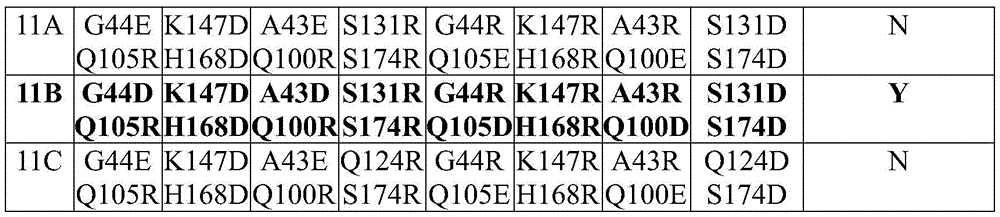
*“Y”表示这样的变体对,在所述变体对中含有编码同源HC/LC对的DNA的转染子与含有仅编码非同源HC/LC对的DNA的转染子的差异与在6C和7B变体对中观察到的相比更明显(其中前者显示全长抗体的表达,而后者显示很少或没有表达)。此类行以粗体显示。“N”表示不符合该标准。*"Y" indicates variant pairs in which transfectants containing DNA encoding a homologous HC/LC pair differ from transfectants containing DNA encoding only a non-cognate HC/LC pair The difference is more pronounced than that observed for the 6C and 7B variant pair (where the former showed expression of the full-length antibody, while the latter showed little or no expression). Such lines are shown in bold. "N" indicates that the standard is not met.
#该列提供了经改变的变体抗体的特定对的名称。 # This column provides the name of the specific pair of altered variant antibodies.
表19中的结果表明,与非同源HC/LC配对相比,变体对中D取代E进一步增强了同源HC/LC配对。我们假设D与E相比分子尺寸更小可能对VH/VL和CH1/CL界面上的相互作用的破坏性更小。The results in Table 19 show that substitution of D for E in the variant pair further enhances homologous HC/LC pairing compared to non-homologous HC/LC pairing. We hypothesized that the smaller molecular size of D compared to E might be less disruptive to the interactions at the VH/VL and CH1/CL interfaces.
从10B变体对中存在的改变开始,我们进行了进一步的改变,所述进一步的改变被设计用于在HC与LC之间产生额外的二硫桥。我们希望此类额外的二硫桥将增加含有编码同源HC/LC对的DNA的转染子的抗体表达,所述转染子中的许多不表达所需的高水平抗体。我们假设电荷对的改变在某种程度上使同源HC/LC对失去稳定性,从而导致抗体保留在ER中,并且额外的二硫桥可以使同源对稳定,从而增加培养基中的抗体分泌,在所述培养基中可以检测所述抗体。如实施例2中所报道的,还已经在没有电荷对取代的情况下测试了这些半胱氨酸取代,以确定它们形成HC/LC二硫键的能力。这些改变组合以及它们的影响列于下表20中。Starting from the changes present in the 10B variant pair, we made further changes designed to create an additional disulfide bridge between HC and LC. We hope that such additional disulfide bridges will increase antibody expression in transfectants containing DNA encoding cognate HC/LC pairs, many of which do not express the desired high levels of antibody. We hypothesize that the change in the charge pair somehow destabilizes the cognate HC/LC pair, resulting in antibody retention in the ER, and that the additional disulfide bridge can stabilize the cognate pair, thereby increasing antibody in the medium Secreted, the antibody can be detected in the culture medium. As reported in Example 2, these cysteine substitutions have also been tested without charge pair substitutions to determine their ability to form HC/LC disulfide bonds. These combinations of changes and their effects are listed in Table 20 below.
表20:在链脱扣实验中测试的电荷对加半胱氨酸对Table 20: Charge pairs plus cysteine pairs tested in chain release experiments



*“Y”表示宿主细胞(1)当存在编码一种或两种同源HC/LC对的DNA时产生易检测量的全长抗体;并且(2)当仅存在编码非同源HC/LC对的DNA时,产生很少或没有产生全长抗体。此类行为粗体。“N”表示并非所有这些标准都不符合。*"Y" indicates that host cells (1) produce detectable amounts of full-length antibodies when DNA encoding one or both cognate HC/LC pairs are present; and (2) when only noncognate HC/LC pairs are present Little or no full-length antibody was produced when against the DNA. Such behaviors are in bold. "N" indicates that not all of these criteria were met.
#该列提供了经改变的变体抗体的特定对的名称。 # This column provides the name of the specific pair of altered variant antibodies.
&图8中所示的数据。 & data shown in Figure 8.
为了将这些结果扩展到不同的抗体对,以类似方式测试含有实施例2中所述的改变的IgG4抗PD1 102抗体和上述IgG1抗CTLA4 111抗体的改变形式(其含有改变D399K和K409E(以不利于HC/HC异源二聚体形成))的改变抗体对。使用在表20中报道的链脱扣实验中探索的改变组合中的一些制备编码改变的抗PD1和抗CTLA4抗体对的DNA,并如上所述在链脱扣转染实验中进行测试。这些结果列于下表21中。To extend these results to different antibody pairs, altered versions of the IgG4 anti-PD1 102 antibody containing the alterations described in Example 2 and the IgG1 anti-CTLA4 111 antibody described above (which contained the alterations D399K and K409E (in different forms) were tested in a similar manner. Altered antibody pairs that favor HC/HC heterodimer formation)). DNA encoding altered anti-PD1 and anti-CTLA4 antibody pairs was prepared using some of the altered combinations explored in the chain-off assay reported in Table 20 and tested in the chain-off transfection assay as described above. These results are listed in Table 21 below.
表21:链脱扣实验中测试的改变Table 21: Changes to the test in the chain tripping experiment


*“Y”表示宿主细胞(1)当存在编码一种或两种同源HC/LC对的DNA时产生易检测量的全长抗体;并且(2)当仅存在编码非同源HC/LC对的DNA时,产生很少或没有产生全长抗体。此类行以粗体显示。“N”表示并非所有这些标准都不符合。*"Y" indicates that host cells (1) produce detectable amounts of full-length antibodies when DNA encoding one or both cognate HC/LC pairs are present; and (2) when only noncognate HC/LC pairs are present Little or no full-length antibody was produced when against the DNA. Such lines are shown in bold. "N" indicates that not all of these criteria were met.
@来自这些变体的数据在图9中示出。 @Data from these variants are shown in Figure 9.
&来自这些变体的数据在图7中示出。 & Data from these variants are shown in Figure 7.
#该列提供了经改变的变体抗体的特定对的名称。 # This column provides the name of the specific pair of altered variant antibodies.
这些数据表明,在含有两种全长IgG1抗体的抗HER2抗体混合物中有效迫使进行同源HC/LC配对的带电对和半胱氨酸对的一些相同位点在表21中所述的含有IgG1全长抗体和IgG4全长抗体两者的混合物中也是有效的。比较表20中的14C和14D与表21中的17C和19C。These data indicate that some of the same sites for charged and cysteine pairs that effectively force homologous HC/LC pairing in anti-HER2 antibody mixtures containing two full-length IgG1 antibodies are described in Table 21 for IgG1 containing It is also effective in mixtures of both full-length antibodies and IgG4 full-length antibodies. Compare 14C and 14D in Table 20 with 17C and 19C in Table 21.
此外,变体混合物23A至23D因添加二硫键而显示出明显效果。23A混合物中的抗体没有添加半胱氨酸残基,而将预期23B和23C混合物中的抗体仅在抗CTLA4抗体中具有额外的二硫键(由于半胱氨酸取代)。将预期23D混合物在混合物中的两种抗体中的每一种中具有额外的二硫键。表21.编码这四种抗体混合物的DNA编码除了这些半胱氨酸取代差异外相同的混合物。表21.在HC和LC两者中具有半胱氨酸取代的抗体的表达在23B和23C混合物中比在23A混合物中观察到的强。图9,比较泳道1和4与泳道6和9以及泳道11和14。然而,在来自混合物23B和23C的转染子中可检测到非同源对的一些表达。图9中的泳道10和泳道15。在混合物23D中,在含有编码同源HC/LC对的DNA的所有转染子中观察到了全长抗体的良好表达(图9,泳道16、17和19),并且在仅含有编码非同源对的DNA的转染子中检测到很少或没有表达(图9,泳道18和20)。这些数据表明,向混合物中的抗体添加二硫键增加了表达(可能是由于允许从ER逃逸的更强HC/LC相互作用)和配对的选择性。Furthermore,
在进一步的实验中,研究了在含有编码两种IgG抗体(所述两种IgG抗体中的一种IgG抗体不含有配偶体定向改变)的DNA的宿主细胞系中产生不超过两种或三种主要抗体种类的方法。在测试样品中,抗体中的一种不含有任何配偶体定向改变并且另一种缺乏天然存在的HC/LC二硫键(由于取代C220S/G(HC2)和C214S(LC2)),并且在一些样品中具有两个潜在的HC/LC二硫键(由于接触残基处的半胱氨酸取代),并且在一些情况下还具有HC/LC电荷对(由于接触残基处的带电氨基酸取代)。如上所述使用编码仅包含改变S228P(为防止Fab臂交换)的IgG4抗PD1 102抗体(包含HC1和LC1)和IgG1抗CTLA 4抗体111(包含HC2和LC2)的DNA进行链脱扣实验,所述IgG1抗CTLA 4抗体111在测试样品中经工程化以缺乏天然存在的二硫桥并且包含不利于异源二聚体的改变(HC中的D399K和K409E)加上配偶体定向改变(包括可能产生两个HC/LC二硫桥的改变),并且在某些情况下还包含HC/LC电荷对。所测试的半胱氨酸取代包括分别在HC2和LC2中的以下改变对:H168C和S174C;V173C和Q160C;以及F170C和S162C。所测试的带电氨基酸取代包括分别在HC2和LC2中的以下改变对:K147D和S131R/K;以及H168D和S174K/R。将样品在非还原条件下进行SDS-PAGE,并使用如上所述用于检测的山羊抗人IgG Fc特异性多克隆抗体通过蛋白质印迹进一步分析。结果在图10中示出。In further experiments, the production of no more than two or three antibodies in host cell lines containing DNA encoding two IgG antibodies, one of which did not contain a partner-directed change, was investigated. Methods for major antibody classes. In the test samples, one of the antibodies did not contain any partner orientation change and the other lacked the naturally occurring HC/LC disulfide bond (due to the substitutions C220S/G (HC2) and C214S (LC2)), and in some Two potential HC/LC disulfide bonds in the sample (due to cysteine substitutions at contact residues) and in some cases also HC/LC charge pairs (due to charged amino acid substitutions at contact residues) . Strand release experiments were performed as described above using DNA encoding IgG4 anti-PD1 102 antibody (comprising HC1 and LC1) and IgG1 anti-CTLA4 antibody 111 (comprising HC2 and LC2) containing only the altered S228P (to prevent Fab arm exchange), so The IgG1 anti-CTLA4 antibody 111 was engineered in test samples to lack naturally occurring disulfide bridges and to contain changes that disfavor heterodimerization (D399K and K409E in HC) plus partner orientation changes (including possibly changes that generate two HC/LC disulfide bridges), and in some cases also include HC/LC charge pairs. Cysteine substitutions tested included the following pairs of alterations in HC2 and LC2, respectively: H168C and S174C; V173C and Q160C; and F170C and S162C. Charged amino acid substitutions tested included the following altered pairs in HC2 and LC2, respectively: K147D and S131R/K; and H168D and S174K/R. Samples were subjected to SDS-PAGE under non-reducing conditions and further analyzed by Western blot using goat anti-human IgG Fc-specific polyclonal antibody for detection as described above. The results are shown in FIG. 10 .
用编码两种抗体的未改变形式的各链的DNA转染的细胞产生约150kDa的全长IgG抗体。图10的图A,泳道1-5。这些数据表明,非同源HC/LC对可以在没有阻止这种配对的改变的情况下产生全长抗体。在工程化的抗CTLA4 111抗体(包含HC2和LC2)中消除天然存在的二硫键阻止在任何不含有编码未改变的IgG4抗PD1抗体的两条链(即HC1和LC1)的DNA的转染子中形成全长IgG抗体。图10的图A,泳道6-10。向缺乏天然存在的二硫键的工程化抗CTLA4 111抗体中添加两个新的潜在二硫键恢复了含有编码HC2和LC2的DNA的转染子产生全长抗体,而在仅存在编码非同源对的DNA时大大减少了全长IgG抗体的产生的能力。图10的图A,泳道11-25。在所测试的半胱氨酸取代对的组合中,改变F170C加上V173C(HC2)和Q160C加上S162C(LC2)在同源HC2/LC2对存在下导致全长IgG的最佳表达(比较图A中的泳道24与泳道14和19),并且仅存在非同源HC/LC对的情况下导致全长IgG的最低表达(比较图A中的泳道23和25与泳道13和15或泳道18和20)。然而,所测试的半胱氨酸取代对的另外两种组合几乎同样有效。参见图10中图A的泳道11-20。这些改变如下:H168C加上V173C(HC2)和Q160C加上S174C(LC2);以及H168C加上V170C(HC2)和S162C加上S174C(LC2)。因此,这些结果表明,消除天然存在的HC/LC二硫桥并在HC和LC中的接触残基处添加两对半胱氨酸取代可以导致同源HC/LC对的稳健表达并且几乎不表达非同源对。Cells transfected with DNA encoding each chain of the unaltered forms of the two antibodies produced a full-length IgG antibody of approximately 150 kDa. Figure 10, panel A, lanes 1-5. These data suggest that non-cognate HC/LC pairs can generate full-length antibodies without alterations that prevent such pairing. Elimination of naturally occurring disulfide bonds in engineered anti-CTLA4 111 antibodies (comprising HC2 and LC2) prevents transfection in any DNA that does not contain the two chains (i.e., HC1 and LC1) encoding an unchanged IgG4 anti-PD1 antibody Formation of full-length IgG antibodies. Figure 10, panel A, lanes 6-10. Addition of two new potential disulfide bonds to an engineered anti-CTLA4 111 antibody lacking naturally occurring disulfide bonds restored full-length antibody production in transfectants containing DNA encoding HC2 and LC2, whereas only the non-identical The ability to generate full-length IgG antibodies is greatly reduced when sourced against DNA. Figure 10, panel A, lanes 11-25. Among the combinations of cysteine substitution pairs tested, varying F170C plus V173C (HC2) and Q160C plus S162C (LC2) resulted in optimal expression of full-length IgG in the presence of the cognate HC2/LC2 pair (compare Fig.
在另一组实验中,测试除了两个二硫桥之外还向第二抗体(其缺乏天然存在的二硫桥)添加HC/LC电荷对的效果。我们选择了氨基酸K147(HC2)和S131(LC2)的保守(参见表7和表10)接触对,因为K147是带电氨基酸。我们假设K147D/E改变(HC2)和S131K/R改变(LC2)将在HC1/LC2对中产生具有相同极性并且在HC2/LC1对中具有不利的相互作用的接触氨基酸对,因此进一步阻碍了非同源对的形成。如实施例1中所解释的,我们还假设可以容忍将带电氨基酸改变为不同的带电氨基酸,而不会在HC/LC界面中引起空间位阻。如果发生这种空间位阻,它可能使抗体失去稳定性。所述改变当然将在同源HC2/LC2对中产生额外的电荷对,因此有希望将有利于形成该同源对而不会使抗体失去稳定性。In another set of experiments, the effect of adding HC/LC charge pairs to a secondary antibody (which lacks naturally occurring disulfide bridges) in addition to two disulfide bridges was tested. We chose the conserved (see Table 7 and Table 10) contact pair of amino acids K147 (HC2) and S131 (LC2), because K147 is a charged amino acid. We hypothesized that the K147D/E change (HC2) and the S131K/R change (LC2) would create contact amino acid pairs in the HC1/LC2 pair with the same polarity and unfavorable interactions in the HC2/LC1 pair, thus further hindering Formation of non-cognate pairs. As explained in Example 1, we also assumed that changing the charged amino acid to a different charged amino acid could be tolerated without causing steric hindrance in the HC/LC interface. If this steric hindrance occurs, it may destabilize the antibody. Said changes will of course create an extra charge pair in the cognate HC2/LC2 pair and thus hopefully will favor the formation of this cognate pair without destabilizing the antibody.
如上所述在非还原条件下进行链脱扣转染并通过蛋白质印迹进行分析。结果示出在图10的图B中。如所预期的,含有两种抗体的链的各种组合的转染子,除了在HC1中的S228P和在HC2中的D399K加上K409E之外未改变,产生约150kDa的全长IgG抗体,而无论是否存在同源或非同源HC/LC对。图10的图B,泳道1-5。在存在改变C220S(HC2)和C214S(LC2)的情况下,向HC2和LC2添加两对半胱氨酸取代(F170C加上V173C(HC2)和Q160C加上S162C(LC2))在仅存在HC2和LC2时导致全长IgG的强表达(图10的图B,泳道9),并且在仅存在非同源对(即HC1/LC2和HC2/LC1)时导致几乎不可检测到全长IgG的表达(图10的图B,泳道8和10)。进一步添加K147D(HC2)以及S131K或S131R(LC2)导致在仅存在非同源对的情况下甚至更少(如果有的话)的全长IgG表达。图10的图B,泳道13、15、18和20。因此,这些结果与图A中的结果组合在一起表明,添加所测试的电荷对导致HC2/LC2对的稳健表达,以及很少(如果有的话)的非同源对表达。Strand-off transfections were performed under non-reducing conditions and analyzed by western blot as described above. The results are shown in panel B of FIG. 10 . As expected, transfectants containing various combinations of chains of the two antibodies, unchanged except for S228P in HC1 and D399K plus K409E in HC2, produced a full-length IgG antibody of approximately 150 kDa, whereas Regardless of the presence or absence of homologous or non-homologous HC/LC pairs. Figure 10, panel B, lanes 1-5. In the presence of the changes C220S (HC2) and C214S (LC2), two pairs of cysteine substitutions (F170C plus V173C (HC2) and Q160C plus S162C (LC2)) were added to HC2 and LC2 in the presence of only HC2 and LC2 resulted in strong expression of full-length IgG (panel B of Figure 10, lane 9), and in the presence of only non-cognate pairs (i.e. HC1/LC2 and HC2/LC1) resulted in almost undetectable expression of full-length IgG ( Panel B of Figure 10,
在第三组实验中,测试了向第二抗体(缺乏天然存在的二硫桥并且具有两个引入的二硫桥)中添加一不同电荷对(即,H168D(HC2)和S174K/R(LC2))以及任选地K147D(HC2)和S131K/R(LC2)对HC/LC配对的效率和特异性的影响。与K147D(HC2)和S131K/R(LC2)一样,我们假设H168D/E(HC2)和S174K/R(LC2)将在HC1/LC2对中产生具有相同电荷极性的接触氨基酸对(因为HC1中的H168和LC2中的S174K/R都是带正电的)并且可能对HC2/LC1配对有一些排斥,因此进一步阻止非同源配对的形成。此外,这些改变当然将在同源HC2/LC2对中产生额外的电荷对,因此可能使该同源对稳定。In a third set of experiments, the addition of a different charge pair (i.e., H168D (HC2) and S174K/R (LC2 )) and optionally the effect of K147D(HC2) and S131K/R(LC2) on the efficiency and specificity of HC/LC pairing. Like K147D(HC2) and S131K/R(LC2), we hypothesized that H168D/E(HC2) and S174K/R(LC2) would generate contacting amino acid pairs with the same charge polarity in the HC1/LC2 pair (because in HC1 Both H168 and S174K/R in LC2 are positively charged) and may have some repulsion towards the HC2/LC1 pair, thus further preventing non-homologous pair formation. Furthermore, these changes will of course generate additional charge pairs in the cognate HC2/LC2 pair, thus potentially stabilizing the cognate pair.
如上所述在非还原条件下进行链脱扣转染并通过蛋白质印迹进行分析。结果示出在图10的图C中。当第二抗体(除了缺乏天然存在的二硫桥并且在接触残基处具有两对半胱氨酸取代之外)还包含H168D(HC2)和S174K(LC2)时,同源HC2/LC2对的表达是稳健的(图10的图C,泳道4),而检测到很少(如果有的话)的非同源HC/LC对表达(图10的图C,泳道3和5)。当第二抗体包含H168D(HC2)和S174R(LC2)时获得了类似的结果,尽管同源HC2/LC2对的表达不那么稳健。图10的图C,泳道6-10。当第二抗体(除了缺乏天然存在的二硫桥并且在接触残基处具有两对半胱氨酸取代之外)还包含H168D加上K147D(HC2)和S174K加上S131K(LC2)时,HC2/LC2的表达是稳健的(图10的图C,泳道14),并且观察到很少或没有非同源对的表达(图10的图C,泳道13和15),这种效应在泳道13中特别清楚。该最后的结果可以通过以下事实来解释:在这种情况下,HC1/LC2对将含有具有相同电荷的两对接触氨基酸。有趣的是,当第二抗体(除了缺乏天然存在的二硫桥并且在接触残基处具有两对半胱氨酸取代之外)还包含H168D加上K147D(HC2)和S174R加上S131R(LC2)时,HC2/LC2对的表达不太稳健(比较图10的图C中的泳道19与泳道14),虽然非同源对的表达类似地非常低(图10的图C,泳道18和20)。Strand-off transfections were performed under non-reducing conditions and analyzed by western blot as described above. The results are shown in panel C of FIG. 10 . When the secondary antibody (in addition to lacking a naturally occurring disulfide bridge and having two pairs of cysteine substitutions at contact residues) also contained H168D (HC2) and S174K (LC2), the homologous HC2/LC2 pair Expression was robust (Figure 10, panel C, lane 4), while little, if any, non-cognate HC/LC pair expression was detected (Figure 10, panel C,
总的来说,图10中的结果表明了以下结论。首先,在用编码两种不同IgG抗体的DNA转染的宿主细胞中,消除所述抗体的第二抗体中天然存在的链间HC/LC二硫桥基本上阻止了该全长抗体(HC2/LC2)的表达,以及包含所述第二抗体的任一链的非同源对(HC2/LC1和HC1/LC2)的表达。然而,进一步添加半胱氨酸取代(可能在第二抗体中产生两个新的二硫桥)恢复了HC2/LC2的表达,而基本上不恢复非同源对的表达。向第二抗体进一步添加一个或两个HC2/LC2电荷对进一步增强了表达HC2/LC2并进一步降低了非同源对的表达。最后,含有赖氨酸加天冬氨酸的HC2/LC2电荷对比含有精氨酸加天冬氨酸的电荷对导致更高的HC2/LC2的表达。总的来说,这些数据表明,用编码两种不同IgG抗体的DNA转染的宿主细胞可以主要产生具有同源HC/LC对的抗体,甚至当所述抗体中只有一种包含配偶体定向改变时也如此。在不存在不利异源二聚体的改变的情况下,可能仅潜在地产生三种主要的抗体种类,并且在存在不利于HC1/HC2异源二聚体的改变的情况下可能仅潜在地产生两种主要的抗体种类。Overall, the results in Figure 10 suggest the following conclusions. First, in host cells transfected with DNA encoding two different IgG antibodies, elimination of interchain HC/LC disulfide bridges naturally occurring in the second antibody of said antibodies essentially prevented the full-length antibody (HC2/LC LC2), and non-homologous pairs (HC2/LC1 and HC1/LC2) comprising either chain of the second antibody. However, further addition of cysteine substitutions (possibly creating two new disulfide bridges in the secondary antibody) restored expression of HC2/LC2, but not substantially of the non-cognate pair. Further addition of one or two HC2/LC2 charge pairs to the secondary antibody further enhanced expression of HC2/LC2 and further decreased expression of non-cognate pairs. Finally, HC2/LC2 charges containing lysine plus aspartate resulted in higher expression of HC2/LC2 than charge pairs containing arginine plus aspartate. Collectively, these data suggest that host cells transfected with DNA encoding two different IgG antibodies can produce predominantly antibodies with cognate HC/LC pairs, even when only one of the antibodies contains a change in partner orientation The same is true sometimes. In the absence of alterations that are unfavorable for heterodimers, only the three major antibody species can potentially be generated, and in the presence of alterations that are unfavorable for HC1/HC2 heterodimers There are two main classes of antibodies.
实施例4:鉴别不利于HC/HC异源二聚体的改变Example 4: Identification of alterations that are detrimental to HC/HC heterodimers
当编码两种不同全长抗体的DNA(即,编码两条不同的HC和两条不同的LC的DNA)被引入宿主细胞中时,所述细胞可以潜在地产生具有HC和LC的不同组合的十种不同抗体。图4;Carter(2001),J.Immunol.Methods 248:7-15。为了减少在这种宿主细胞中产生的抗体种类的数量,可以对所述两条不同的HC进行工程化,使得它们主要形成(如果不是仅形成的话)HC/HC同源二聚体,并且HC和LC可以经工程化以使得大部分发生或仅发生同源HC/LC配对。实施例1至3解决了该后一个问题。本实施例描述了制备和测试HC中的各种被设计成不利于(如果不是完全消除的话)在两条不同的HC之间形成HC/HC异源二聚体的改变。When DNA encoding two different full-length antibodies (i.e., DNA encoding two different HCs and two different LCs) is introduced into a host cell, the cells can potentially produce antibodies with different combinations of HCs and LCs. Ten different antibodies. Figure 4; Carter (2001), J. Immunol. Methods 248:7-15. To reduce the number of antibody species produced in such a host cell, the two distinct HCs can be engineered such that they form predominantly, if not exclusively, HC/HC homodimers, and the HC and LC can be engineered such that mostly or only homologous HC/LC pairing occurs.
为了鉴定将实现消除异源二聚HC/HC对的目标的改变,制备了一组编码蛋白质对的DNA,所述蛋白质对包含一个Fc片段和一个同源HC/LC对,所述Fc片段和同源HC/LC对在它们的CH3结构域中具有不同的改变。将这些DNA引入可以表达它们的宿主细胞中,并如上所述通过SDS-PAGE和蛋白质印迹分析由所述宿主细胞产生的抗体,以确定由引入了所述DNA的宿主细胞产生的HC-LC/Fc异源二聚体、HC-LC/HC-LC同源二聚体以及Fc/Fc同源二聚体的相对量。To identify changes that would achieve the goal of eliminating the heterodimeric HC/HC pair, a panel of DNA encoding a protein pair comprising an Fc fragment and a homologous HC/LC pair, the Fc fragment and Homologous HC/LC pairs have different changes in their CH3 domains. These DNAs were introduced into host cells capable of expressing them, and the antibodies produced by the host cells were analyzed by SDS-PAGE and Western blotting as described above to determine the HC-LC/LC produced by the host cells into which the DNAs were introduced. Relative amounts of Fc heterodimers, HC-LC/HC-LC homodimers and Fc/Fc homodimers.
如实施例2和3中所说明,使用PCR和Gibson组装产生编码在CH3结构域中具有不同改变的Fc片段和HC/LC对的DNA构建体。将所得的编码包含不同改变的Fc片段和全长HC和LC的DNA共转染到HEK293宿主细胞中,并使用来自ThermoFisher Scientific(Waltham,MA,USA)的EXPI293TM表达系统进行表达。在培养四天后从转染子收获含有由宿主细胞产生的抗体的条件培养基。DNA constructs encoding Fc fragments and HC/LC pairs with different alterations in the CH3 domain were generated using PCR and Gibson assembly as described in Examples 2 and 3. The resulting DNA encoding Fc fragments containing various alterations and full-length HC and LC were co-transfected into HEK293 host cells and expressed using the EXPI293 ™ expression system from ThermoFisher Scientific (Waltham, MA, USA). Conditioned medium containing antibodies produced by the host cells was harvested from the transfectants after four days in culture.
如实施例2和3中所述,在非还原条件下通过蛋白质印迹检测培养基中的抗体。在使用来自Bio-Rad Laboratories,Inc.的装有IMAGE LABTM软件的CHEMIDOCTM XRS+系统进行可视化之后,使用IMAGE LABTM软件计算由用编码各种改变蛋白质对的DNA转染的宿主细胞产生的HC-LC/Fc异源二聚体的百分比。Antibodies in the media were detected by Western blot under non-reducing conditions as described in Examples 2 and 3. HCs produced by host cells transfected with DNA encoding various altered protein pairs were calculated using IMAGE LAB ™ software after visualization using the CHEMIDOC ™ XRS+ system with IMAGE LAB ™ software from Bio-Rad Laboratories, Inc. - Percentage of LC/Fc heterodimers.
图11示出了取自转染子的培养基的样品的蛋白质印迹,所述转染子含有编码LC和野生型人IgG4HC加上在位置K370(右上方的图)、K392(左上方的图)或V397(左下方的图)处具有各种单一取代的改变的人IgG1Fc片段的DNA对。这些位置中的每一个位于CH3/CH3界面处(参见例如WO 2015/017548第8页的表1,该专利以引用方式并入本文),并且K370和K392也接近三级结构中的位置409(其为IgG4中的R和IgG1中的K)。V397接近K392。因此,可能的是,这些残基可能起增强或削弱CH3结构域之间的相互作用的作用,尤其是在一条重链是IgG4而另一条重链是IgG1的情况下。然而,图11中的数据表明,所测试的取代中没有一种取代与当Fc片段未改变时观察到的相比显著降低了异源二聚体(表示为“HC/Fc”)的百分比,即使所有三个位点处的一些取代用较大的氨基酸替代原始氨基酸也是如此。比较图11中的泳道18与图11中的所有其它泳道。Figure 11 shows a Western blot of samples taken from culture medium of transfectants containing human IgG4 HC encoding LC and wild-type plus at positions K370 (upper right panel), K392 (upper left panel). ) or DNA pairs of altered human IgGl Fc fragments with various single substitutions at V397 (bottom left panel). Each of these positions is at the CH3/CH3 interface (see e.g. Table 1 on
在进一步的实验中,分析来自转染子的培养基,所述转染子含有编码人IgG4HC(其除了包含单一改变S228P以阻止Fab臂交换外是野生型的)和在D399和/或K409处具有改变的人IgG1Fc片段的DNA。结果在图12中示出。IgG1Fc片段中的单个取代D399K、D399R、K409D和K409E增加了异源二聚体形成。比较图12中的泳道1与图12中的泳道2至5。然而,当IgG1Fc片段含有D399K和K409E或D399K和K409D时,异源二聚体占由转染子产生的总抗体的少于5%。图12中的泳道6和泳道7。In a further experiment, media from transfectants containing HCs encoding human IgG4 (which were wild-type except for containing the single change S228P to prevent Fab arm exchange) and at D399 and/or K409 were analyzed. DNA with an altered human IgG1 Fc fragment. The results are shown in FIG. 12 . Single substitutions D399K, D399R, K409D and K409E in the IgGl Fc fragment increased heterodimer formation. Compare
图13中示出的数据解决了使用IgG4全长HC而不是例如IgG1HC是否在图12中示出的结果中起作用的问题。在图13中,泳道10至19显示了来自含有编码野生型(泳道10和15)或改变的(泳道11至14和16至19)人IgG1Fc片段和两种不同的人IgG4HC(一种(Ab1)在泳道10至14中,并且另一种(Ab2)在泳道15至19中)的DNA的转染子的数据。来自Ab2IgG4(泳道15至19)和Ab2IgG1(泳道20至24)的数据直接可比较,因为这些抗体分别含有IgG4或IgG1形式的相同可变结构域。如图13中的表所示,Fc中的改变在位置D399和K409处。在产生改变的Fc片段和全长人IgG4HC的转染子中很少或没有异源二聚体被检测到。图13中的泳道11至14和泳道16至19。相比之下,在来自产生改变的Fc片段和全长人IgG1HC的转染子的培养基中可检测到异源二聚体。图13中的泳道21至24。因此,这些数据表明使用IgG4HC而不是IgG1HC对于获得最低水平的异源二聚体是重要的。The data shown in FIG. 13 addresses the question of whether using IgG4 full-length HCs rather than eg IgG1 HCs played a role in the results shown in FIG. 12 . In FIG. 13 ,
如表8中所示,人IgG4HC在位置409处具有精氨酸,而人IgG1HC在位置409处具有赖氨酸。以下实验研究了这种差异是否在图13中观察到的效应中起作用,所述效应即产生人IgG4HC加上改变的(D399K/R、K409E/D)人IgG1Fc的宿主细胞与产生人IgG1HC加上相同改变的IgG1Fc的宿主细胞相比产生更低水平的HC-LC/Fc异源二聚体。用编码人IgG1Fc片段和人HC加LC的DNA转染宿主细胞。Fc是野生型(WT)或含有如图14中所示的改变。如图所示,HC是WTIgG1、WTIgG4或含有改变K409R的IgG1,所述改变K409R使IgG1在该位置处类似IgG4。图14中的数据显示,当宿主细胞产生含有D399K/R和K409D/E的Fc以及是野生型(WT)IgG4或含有改变K409R的IgG1的HC时,异源二聚体(表示为“HC/Fc”)的水平最低。比较图14中的泳道2至5和12至15与泳道7至10。当WTIgG1HC与含有D399K/R和K409D/E的Fc一起使用时,观察到了更高水平的异源二聚体。图14中的泳道7至10。因此,在这些实验中已经鉴定出了基本上消除可检测的异源二聚体形成的改变。As shown in Table 8, human IgG4 HC has an arginine at position 409, while human IgG1 HC has a lysine at position 409. The following experiments investigated whether this difference played a role in the effect observed in Figure 13, that is, host cells producing human IgG4 HC plus altered (D399K/R, K409E/D) human IgG1 Fc compared with those producing human IgG1 HC plus Host cells with the same altered IgG1 Fc produced lower levels of HC-LC/Fc heterodimers. Host cells were transfected with DNA encoding the human IgGl Fc fragment and human HC plus LC. Fc was wild type (WT) or contained alterations as shown in FIG. 14 . As indicated, the HCs were WTIgG1, WTIgG4, or IgG1 containing a change K409R that makes IgG1 resemble IgG4 at this position. The data in Figure 14 show that heterodimers (denoted as "HC/ Fc") had the lowest levels. Compare
实施例5:按尺寸评估抗体混合物Example 5: Evaluation of Antibody Mixtures by Size
为了确定上述一些改变的抗体混合物中存在多少种类的抗体,测定了混合物中各抗体的尺寸。首先,在非还原条件下通过SDS-PAGE评估这些混合物中全长抗体种类的尺寸,并在还原条件下通过SDS-PAGE评估各个HC和LC的尺寸。在非还原条件下在约150kDa(全长抗体)处和/或在还原条件下在约50kDa(HC)和/或25kDa(LC)处存在多个条带将支持混合物含有多种全长抗体种类的概念。为了进一步分辨全长抗体种类,在低pH下进行阳离子交换(CEX)色谱,这提供了对在150kD附近的尺寸范围内的种类的清晰分辨率。此外,通过质谱法(MS)测定来自少量抗体混合物的Fab片段的尺寸,这可以在针对含有同源和/或非同源HC/LC对的抗体混合物中可能形成的大多数不同Fab片段所预期的范围内区分质量差异。To determine how many antibody species were present in some of the altered antibody mixtures described above, the size of each antibody in the mixture was determined. First, the size of the full-length antibody species in these mixtures was assessed by SDS-PAGE under non-reducing conditions, and the size of the individual HCs and LCs was assessed by SDS-PAGE under reducing conditions. The presence of multiple bands at approximately 150 kDa (full-length antibody) under non-reducing conditions and/or at approximately 50 kDa (HC) and/or 25 kDa (LC) under reducing conditions would support a mixture containing multiple full-length antibody species the concept of. To further resolve full-length antibody species, cation exchange (CEX) chromatography was performed at low pH, which provided clear resolution of species in the size range around 150 kD. Furthermore, the size of Fab fragments from a small number of antibody mixtures was determined by mass spectrometry (MS), which can be expected for most of the different Fab fragments that may form in antibody mixtures containing homologous and/or non-cognate HC/LC pairs Distinguish quality differences within the range.
为了评估在用编码变体MabPair 17B、MabPair 17C、MabPair18B、MabPair 18C和MabPair 19C(参见表21)的DNA转染的细胞中产生的全长抗体和单独HC和LC的尺寸,用编码具有这些MabPair的两种抗体中的每一种的HC和LC的DNA转染EXPI293TM细胞。转染后,在振荡孵育4天后收获培养上清液。将抗体用蛋白A柱纯化,如实施例3所述在4-15%CRITERIONTMTGX STAIN-FREETM预制SDS-PAGE凝胶中进行分析,并且如实施例2中所述进行印迹和检测。结果在图15中示出。To assess the size of full-length antibodies and individual HCs and LCs produced in cells transfected with DNA encoding the variants MabPair 17B, MabPair 17C, MabPair18B,
如图所示,图15的泳道1至7含有非还原样品,并且泳道8至14含有还原样品。作为对照,泳道1和8含有抗体混合物,所述抗体混合物预期含有两种不同抗HER2抗体(4D5-8和2C4,所述抗体具有在表20中描述为变体14D的改变)加上含有来自每种抗体的一种HC和一种LC的双特异性抗体。在非还原条件下,该样品显示出三条约150kDa的条带,表明存在三种不同的抗体。作为进一步的对照,泳道2和9(标记为IgG1)含有IgG1抗CTLA4抗体,所述抗体在非还原条件下显示约150kDa单条带,表明该样品含有单一抗体种类。在非还原条件下,MabPair变体17B、17C、18B和18C显示出两条约150kDa的条带(泳道3至6),表明这些样品含有两种抗体种类。这是符合预期的,因为这些混合物中的抗体中的一种含有不利于异源二聚体形成的改变,并且因此混合物将预期是MabPair,即仅包含两种主要抗体种类的混合物。变体19C在非还原条件下仅显示一条条带(泳道7),表明在该样品中多种抗体种类共迁移。As shown,
当被还原时,对照样品显示一条约50kDa的条带和两条约25kDa的条带(图15,泳道8),表明两种不同的HC在相同位置迁移,而两种不同的LC分开迁移。还原条件下的IgG1对照(泳道9)显示约50kDa单条带和约25kDa单条带。所有还原的MabPair变体样品显示尺寸为50KDa的单条带和两条约25kDa的条带(泳道10至14),表明两种不同的HC一起迁移,而两种不同的LC分开迁移。因此,图15中的数据,当与实施例3和实施例4中的数据以及下面的数据合在一起时,强烈表明17B、17C、18B、18C和19C混合物含有不超过两种主要抗体种类。When reduced, the control sample showed one band at about 50 kDa and two bands at about 25 kDa (Figure 15, lane 8), indicating that two different HCs migrated at the same location, while two different LCs migrated separately. The IgG1 control under reducing conditions (lane 9) showed a single band at about 50 kDa and a single band at about 25 kDa. All reduced MabPair variant samples showed a single band with a size of 50 KDa and two bands of approximately 25 kDa (
由于用作设计变体抗体混合物1A至16D(表17至20)的起点的两种IgG1抗HER2抗体不含有任何不利于异源二聚体形成的改变,因此这些变体混合物在由宿主细胞产生时可含有三种不同的主要抗体种类,即含有两条相同的HC和两条相同的LC的两种不同的单特异性抗体和含有两条不同的HC和两条不同的LC的双特异性抗体。为了测试该假设,在摇瓶中将编码五种变体3合1混合物(即,13D、14C、14D、15B和15C(参见表20和图8)的两种HC和两种LC的DNA转染到30至50毫升(ml)EXPI293TM细胞内。收获上清液,并使用标准蛋白A柱纯化抗体。将不同量的纯化抗体以1:2系列稀释从每泳道200ng开始在4-15%CRITERIONTM TGX STAIN-FREETM预制SDS-PAGE凝胶(Bio-Rad Laboratories,Inc.)上进行分析,并如实施例2中所述进行印迹和检测。在非还原条件下(图16,顶部图),所有纯化的抗体混合物显示出约3条不同的约150kDa条带,表明这些混合物含有三种不同的抗体。在还原条件下(图16,底部图),所有纯化的混合物显示出1条约50kDa的条带和2条约25kDa的条带,表明两种不同的HC一起迁移,而两种不同的LC分开迁移。Since the two IgG1 anti-HER2 antibodies used as the starting point for designing variant antibody mixtures 1A to 16D (Tables 17 to 20) did not contain any alterations that were detrimental to heterodimer formation, these variant mixtures were produced in host cells can contain three different main antibody classes, namely two different monospecific antibodies containing two identical HCs and two identical LCs and bispecific antibodies containing two different HCs and two different LCs Antibody. To test this hypothesis, DNA encoding two HCs and two LCs encoding a 3-in-1 mixture of five variants (i.e., 13D, 14C, 14D, 15B, and 15C (see Table 20 and Figure 8)) was transfected in shake flasks. Stain into 30 to 50 milliliters (ml) of EXPI293TM cells. Harvest the supernatant and purify the antibody using a standard protein A column. Serially dilute different amounts of the purified antibody 1:2 starting at 200ng per lane at 4-15% CRITERION ™ TGX STAIN-FREE ™ precast SDS-PAGE gels (Bio-Rad Laboratories, Inc.) were analyzed and blotted and detected as described in Example 2. Under non-reducing conditions (Figure 16, top panel ), all purified antibody mixtures showed about 3 different bands of about 150 kDa, indicating that these mixtures contained three different antibodies. Under reducing conditions (Figure 16, bottom panel), all purified mixtures showed 1 band of about 50 kDa and 2 bands of about 25 kDa, indicating that two different HCs migrated together, while two different LCs migrated separately.
为了更好地分辨尺寸范围为约150kD的全长抗体种类,对含有变体抗体混合物18C(在表21中描述)的样品进行低pH阳离子交换色谱(CEX),所述变体抗体混合物含有抗PD1、抗CTLA4MabPair。该方法由Chen等人(2010),Protein Science,19:1191-1204描述,该文献的全部内容并入本文。简而言之,该方法使用Waters Alliance 2695高效液相色谱(HPLC)系统,采用前面接有50mm保护柱(PROPACTM WCX-10G)的4×250mm Thermo PROPACTM WCX-10弱CEX柱。以从100%缓冲液A(20mM乙酸钠,pH 5.2)至100%缓冲液B(20mM乙酸钠和250mM氯化钠,pH 5.2)的线性梯度运行色谱30分钟。将该柱用高盐(1M氯化钠)洗涤,并重新平衡至缓冲液A的起始条件。样品含有18.8mg的蛋白,并且通过214nm的吸光度检测柱流出物中的抗体。To better resolve full-length antibody species in the size range of approximately 150 kD, low pH cation exchange chromatography (CEX) was performed on samples containing
结果在图17中示出。如图17中所示,顶部的两条迹线来源于抗CTLA4(顶部)和抗PD1(顶部向下第二个)抗体的色谱,所述抗CTLA4抗体和抗PD1抗体是实施例3和实施例4中所述改变的起点。底部迹线来源于变体抗体混合物18C(参见表21)的色谱。使用来自WatersCorporation(Milford,MA,USA)的EMPOWERTM软件根据峰面积计算18C混合物中各组分的相对百分比,所述软件还用于控制HPLC系统。在来源于混合物18C的底部迹线中,对应于抗PD1抗体的较早、较小峰占混合物的21%,而对应于抗CTLA4抗体的较晚、较大峰占混合物的79%。这些数据显示,低pH CEX容易地区分了不同的全长抗体种类,并且可用于定量混合物中特定抗体种类的相对量。The results are shown in FIG. 17 . As shown in Figure 17, the top two traces are derived from the chromatograms of the anti-CTLA4 (top) and anti-PD1 (top down second) antibodies from Example 3 and The starting point for the changes described in Example 4. The bottom trace is derived from the chromatogram of
为了获得可以区分同源与非同源HC/LC对的数据,通过MS分析含有编码五种不同变体抗体混合物(13D、14C、14D、15C和15D)的DNA的转染子的上清液。用木瓜蛋白酶(ThermoScientific,目录号44985)消化混合物以产生Fab片段。当IgG分子在半胱氨酸存在下与木瓜蛋白酶一起孵育时,铰链区中的一个或多个肽键(通常在His224至Thr 225之间)断开而产生三个相似尺寸(约50kD)的片段:两个Fab片段和一个Fc片段。固定化酶是有利的,因为可以通过离心简单地使IgG溶液与包被有木瓜蛋白酶的树脂分离而立即停止消化,从而产生基本上无酶的消化物。在SYNAPTTM G2MS系统(Waters Corporation,Milford,MA,USA)上分析消化产物。鉴于MS的高分辨率,Fab片段和Fc片段是易区分的。下面描述的分析聚焦于与Fab片段的预期质量接近的质量。To obtain data that can distinguish homologous from non-homologous HC/LC pairs, supernatants from transfectants containing DNA encoding five different variant antibody mixtures (13D, 14C, 14D, 15C, and 15D) were analyzed by MS . The mixture was digested with papain (ThermoScientific, Cat# 44985) to generate Fab fragments. When an IgG molecule is incubated with papain in the presence of cysteine, one or more peptide bonds in the hinge region (usually between His224 to Thr 225) are broken to generate three similar-sized (approximately 50kD) Fragments: two Fab fragments and one Fc fragment. Immobilized enzymes are advantageous because digestion can be stopped immediately by centrifugation to simply separate the IgG solution from the papain-coated resin, resulting in an essentially enzyme-free digest. Digestion products were analyzed on a SYNAPT ™ G2MS system (Waters Corporation, Milford, MA, USA). Given the high resolution of MS, Fab and Fc fragments are easily distinguishable. The analysis described below focuses on masses close to those expected for Fab fragments.
只有四种不同的Fab片段可以由两种不同的HC(HC1和HC2)和两种不同的LC(LC1和LC2)制成,即HC1/LC1Fab、HC1/LC2Fab、HC2/LC2Fab和HC2/LC1Fab。在大多数情况下,可以使用MS分离这些不同的Fab片段。下表22显示了13D、14C、14D、15B和15C抗体混合物的四种可能Fab片段的计算质量。Only four different Fab fragments can be made from two different HCs (HC1 and HC2) and two different LCs (LC1 and LC2), namely HC1/LC1Fab, HC1/LC2Fab, HC2/LC2Fab and HC2/LC1Fab. In most cases these different Fab fragments can be separated using MS. Table 22 below shows the calculated masses of the four possible Fab fragments of the 13D, 14C, 14D, 15B and 15C antibody mixtures.
表22:Fab片段的计算质量Table 22: Calculated masses of Fab fragments

*这些质量估计未考虑任何潜在的翻译后修饰,诸如糖基化。然而,预测在这些Fab片段中没有N-糖基化。*These mass estimates do not take into account any potential post-translational modifications, such as glycosylation. However, no N-glycosylation is predicted in these Fab fragments.
如果在14D混合物中仅存在同源HC/LC对,则从木瓜蛋白酶消化中回收的Fab片段中将仅存在两种Fab片段,HC1/LC1Fab和HC2/LC2Fab。图18示出了来自14D抗体混合物的Fab片段的MS分析结果。检测到了两种主要种类,一种在约47,877道尔顿处,而另一种在约47,942道尔顿处。图18.这些可能是HC1/LC1Fab(预测尺寸为47,875.07道尔顿)和HC2/LC2Fab(预测尺寸为47,943.22道尔顿)。如果在混合物中已经存在可观量的非同源HC/LC对,则将检测到在约48,081.44道尔顿和/或47,736.85道尔顿处的另外两个峰。由于此类峰未被检测到并且可以容易地与使用MS实际检测到的峰分离,因此这些数据强烈表明14D混合物中的大多数(如果不是全部)HC/LC对是同源HC/LC对。If only cognate HC/LC pairs were present in the 14D mixture, then only two Fab fragments, HC1/LC1Fab and HC2/LC2Fab, would be present in the Fab fragments recovered from papain digestion. Figure 18 shows the results of MS analysis of Fab fragments from the 14D antibody mixture. Two main species were detected, one at about 47,877 Daltons and the other at about 47,942 Daltons. Figure 18. These could be the HC1/LC1 Fab (predicted size 47,875.07 Daltons) and HC2/LC2 Fab (predicted size 47,943.22 Daltons). Two additional peaks at about 48,081.44 Daltons and/or 47,736.85 Daltons would be detected if appreciable amounts of non-homologous HC/LC pairs were already present in the mixture. Since such peaks were not detected and could be easily separated from those actually detected using MS, these data strongly suggest that most, if not all, HC/LC pairs in the 14D mixture are homologous HC/LC pairs.
在通过MS分析的四种其它样品中,13D和15D混合物产生的结果类似于图18中所示的结果,即仅在与来自同源HC/LC对的Fab片段的计算质量几乎相同的质量处观察到两个主峰。在混合物14C和15C中,仅观察到一个主峰,该主峰与来自这些混合物中的每一种中的同源HC/LC对中的一个的Fab片段的计算质量几乎质量相同。我们假设来自这些样品中的另一同源HC/LC对的Fab片段被用于产生Fab片段的木瓜蛋白酶消化,因为所讨论的同源对在上述链脱扣实验中形成全长抗体。Of the four other samples analyzed by MS, the mixture of 13D and 15D produced results similar to those shown in Figure 18, i.e. only at nearly the same mass as the calculated mass of the Fab fragment from the cognate HC/LC pair Two main peaks were observed. In
实施例6:IgG1/IgG4MabPair的表征,在所述IgG1/IgG4MabPair中一种抗体不含有配偶体定向改变Example 6: Characterization of IgG1/IgG4 MabPairs in which one antibody does not contain a partner orientation change
上述数据表明,用编码两种不同IgG抗体的DNA转染的单一宿主细胞系可能仅产生两种主要抗体种类。在那些实验中,一种或两种抗体经工程化以实现该结果。以下实验旨在进一步表征这样的MabPair,在所述MabPair中一种抗体不包含配偶体定向改变或不利于异源二聚体的改变,而另一种抗体包含一个或多个配偶体定向改变以及一个或多个不利于异源二聚体的改变。为了确定在含有编码此类抗体的DNA的转染子中形成的主要种类数,进行以下实验。The above data suggest that a single host cell line transfected with DNA encoding two different IgG antibodies may only produce two major antibody species. In those experiments, one or both antibodies were engineered to achieve this result. The following experiments were designed to further characterize MabPairs in which one antibody contains no partner orientation changes or changes that disfavor heterodimerization, while the other antibody contains one or more partner orientation changes and One or more alterations that disfavor heterodimerization. To determine the number of major species formed in transfectants containing DNA encoding such antibodies, the following experiments were performed.
使用人IgG1抗CTLA4 111抗体作为产生工程化抗体的起始位置。抗CTLA4 111抗体的恒定结构域和可变结构域的框架区的氨基酸序列与在SEQ ID NO:38(HC)和SEQ ID NO:40(LC)中报道的抗CTLA4抗体1E1的氨基酸序列相同。构建编码包含以下改变的抗CTLA4111抗体的HC的DNA:K147D、F170C、V173C、C220G、R255K、D399R和K409E。通常,包含改变R255K的IgG抗体与不含此改变的抗体相比被更快地从血清中清除,并且改变D399R和K409E不利于HC/HC异源二聚体形成。构建另一种编码包含以下改变的抗CTLA4 111抗体轻链的DNA:S131K、Q160C、S162C和C214S。A human IgG1 anti-CTLA4 111 antibody was used as a starting point for generating engineered antibodies. The amino acid sequences of the constant domains and the framework regions of the variable domains of the anti-CTLA4 111 antibody were identical to those of the anti-CTLA4 antibody 1E1 reported in SEQ ID NO: 38 (HC) and SEQ ID NO: 40 (LC). DNA encoding an HC of an anti-CTLA4111 antibody comprising the following alterations was constructed: K147D, F170C, V173C, C220G, R255K, D399R, and K409E. In general, IgG antibodies containing the alteration R255K were cleared from serum faster than those without the alteration, and alterations D399R and K409E disfavored HC/HC heterodimer formation. Another DNA encoding the light chain of the anti-CTLA4 111 antibody comprising the following alterations was constructed: S131K, Q160C, S162C and C214S.
将编码该工程化抗CTLA4 111抗体、未改变的抗CTLA4 111抗体和实施例2中所述的未改变形式的人源化IgG4抗PD1 102抗体的质粒DNA从含有它们的培养细菌中回收,并使用

对从用编码未改变的抗CTLA-4 111抗体的DNA转染的EXPI293TM细胞产生的去糖基化抗体的MS分析表明,该抗体的质量为144,890.12道尔顿,该质量与144,889.16道尔顿的预测质量相差每百万之7(ppm)内。图19的图A.对用编码工程化抗CTLA4 111抗体的DNA转染的EXPI293TM细胞产生的去糖基化抗体的MS分析显示,该抗体的质量为144,780.02道尔顿,该质量与144,779.00道尔顿的预测质量相差7ppm内。图19的图B.对从用编码抗PD-1 102抗体和工程化的抗CTLA4 111抗体的HC和LC的DNA转染的EXPI293TM细胞产生的去糖基化抗体的MS分析得到了两个约146,000道尔顿的主要峰。还检测到少量可能包含一种HC和一种LC的种类(73,214.20道尔顿)。图19的图C.主峰放大图显示出一个峰为144,779.69道尔顿,而另一个峰为146,426.58道尔顿。图19的图D.这些质量符合工程化的抗CTLA4 111抗体的预测质量(144,779.00道尔顿)和抗PD1102抗体的预测质量(146,426.20道尔顿),分别在4.8ppm和2.6ppm内。因此,这些数据表明,在含有编码抗PD1 102抗体和工程化抗CTLA4 111抗体的DNA的宿主细胞中仅产生两种主要抗体种类。MS analysis of the deglycosylated antibody produced from EXPI293 TM cells transfected with DNA encoding the unchanged anti-CTLA-4 111 antibody showed that the antibody had a mass of 144,890.12 Daltons, which is the same mass as 144,889.16 Daltons The predicted quality of the difference is within 7 parts per million (ppm). Figure 19, Panel A. MS analysis of the deglycosylated antibody produced by EXPI293 TM cells transfected with DNA encoding the engineered anti-CTLA4 111 antibody showed that the antibody had a mass of 144,780.02 Daltons, which was comparable to 144,779.00 Daltons. Ton's predicted quality is within 7 ppm. Figure 19, Panel B. MS analysis of deglycosylated antibodies produced from EXPI293 TM cells transfected with DNA encoding HC and LC encoding the anti-PD-1 102 antibody and the engineered anti-CTLA4 111 antibody yielded two Major peak around 146,000 Daltons. A small amount of species (73,214.20 Daltons) possibly containing one HC and one LC was also detected. Figure 19, Panel C. Magnification of the main peaks shows one peak at 144,779.69 Daltons and the other at 146,426.58 Daltons. Figure 19, Panel D. These masses are within 4.8 ppm and 2.6 ppm of the predicted mass of the engineered anti-CTLA4 111 antibody (144,779.00 Daltons) and the predicted mass of the anti-PD1102 antibody (146,426.20 Daltons), respectively. Thus, these data suggest that only two major antibody species are produced in host cells containing DNA encoding anti-PD1 102 antibodies and engineered anti-CTLA4 111 antibodies.
将从用编码抗PD-1 102抗体和工程化抗CTLA4 111抗体的HC和LC的DNA转染EXPI293TM细胞产生的纯化抗体对进行进一步分析,以确认仅存在同源HC/LC对。将该抗体对用IdeS蛋白酶(Promega,目录号V7511,其在铰链区下方的单个位点切割IgG抗体,从而产生F(ab’)2片段和包含CH2和CH3结构域的片段)消化,并在乙二胺四乙酸(EDTA)存在下用2-巯基乙胺(2-MEA)进一步处理。用2-MEA和EDTA处理减少了铰链区二硫桥,而基本上不影响HC/LC二硫桥。因此,预计该处理将产生Fab'和包含CH2和CH3结构域的片段,可能伴有少量的LC片段和Fd片段。LC片段和Fd片段被命名为LC1(抗PD1)或LC2(抗CTLA4)和Fd1(抗PD1)或Fd2(抗CTLA4),取决于它们是源自第一抗体还是第二抗体。参见图20中的图A.潜在地,Fab’片段可以含有LC1和Fd1、LC2和Fd2、LC2和Fd1、和/或LC1和Fd2。这些Fab'片段的计算质量显示在下表中。Purified antibody pairs generated from transfection of EXPI293 ™ cells with DNA encoding HC and LC encoding the anti-PD-1 102 antibody and the engineered anti-CTLA4 111 antibody were further analyzed to confirm the presence of only homologous HC/LC pairs. This antibody pair was digested with IdeS protease (Promega, cat. no. V7511, which cleaves IgG antibodies at a single site below the hinge region, resulting in F(ab') 2 fragments and fragments containing CH2 and CH3 domains) and incubated in It was further treated with 2-mercaptoethylamine (2-MEA) in the presence of ethylenediaminetetraacetic acid (EDTA). Treatment with 2-MEA and EDTA reduced hinge region disulfide bridges without substantially affecting HC/LC disulfide bridges. Therefore, this treatment is expected to yield Fab' and fragments comprising CH2 and CH3 domains, possibly accompanied by small amounts of LC fragments and Fd fragments. LC fragments and Fd fragments were named LC1 (anti-PD1) or LC2 (anti-CTLA4) and Fd1 (anti-PD1) or Fd2 (anti-CTLA4), depending on whether they were derived from the primary or secondary antibody. See panel A in Figure 20. Potentially, a Fab' fragment may contain LC1 and Fd1, LC2 and Fd2, LC2 and Fd1, and/or LC1 and Fd2. The calculated masses of these Fab' fragments are shown in the table below.
表23:抗PD1、抗CTLA4抗体对的潜在Fab'片段的计算质量Table 23: Calculated masses of potential Fab' fragments of anti-PD1, anti-CTLA4 antibody pairs
通过MS分析经消化和经2-MEA加EDTA处理的抗体对在48,605.68道尔顿和49,458.94道尔顿处产生峰,所述峰分别符合Fd2/LC2的计算质量(在39ppm内)和Fd1/LC1Fab’的计算质量(在28ppm内)。图20,图B.在Fab'片段的计算质量附近的尺寸范围内没有观察到其它峰。因此,这些数据表明观察到的两种HC/LC对是同源对。Analysis by MS of the digested and 2-MEA plus EDTA-treated antibody pair produced peaks at 48,605.68 Daltons and 49,458.94 Daltons, which fit the calculated mass (within 39 ppm) of Fd2/LC2 and Fd1/LC1 Fab, respectively ' Calculated mass (within 28ppm). Figure 20, panel B. No other peaks were observed in the size range around the calculated mass of the Fab' fragment. Therefore, these data suggest that the two HC/LC pairs observed are homologous pairs.
为了确认在工程化抗CTLA4 111抗体中形成了两个新引入的二硫键,将100μg的该抗体在室温下在含有5mM的N-乙基马来酰亚胺(NEM)(ThermoScientific,目录号23030)的pH7.2的磷酸盐缓冲液中孵育2小时。NEM可以将游离硫醇(例如,不是二硫桥的一部分的半胱氨酸残基)烷基化。通过缓冲液交换去除过量的NEM后,以1:10(酶:蛋白质)比率添加赖氨酰内肽酶(Wako Chemicals,目录号125-05061,其切割赖氨酸残基的羧基侧上的蛋白质),并且将反应混合物在37℃孵育16小时。然后将一半混合物在室温下使用25mM的三(2-羧乙基)膦(TCEP,ThermoScientific,目录号20490)还原30分钟。To confirm the formation of two newly introduced disulfide bonds in the engineered anti-CTLA4 111 antibody, 100 μg of this antibody was incubated at room temperature in the presence of 5 mM N-ethylmaleimide (NEM) (ThermoScientific, cat. no. 23030) in phosphate buffered saline at pH 7.2 for 2 hours. NEM can alkylate free thiols (eg, cysteine residues that are not part of a disulfide bridge). After removing excess NEM by buffer exchange, lysyl endopeptidase (Wako Chemicals, Cat. No. 125-05061, which cleaves proteins on the carboxyl side of lysine residues) was added at a 1:10 (enzyme:protein) ratio. ), and the reaction mixture was incubated at 37°C for 16 hours. Half of the mixture was then reduced using 25 mM tris(2-carboxyethyl)phosphine (TCEP, Thermo Scientific, cat. no. 20490) for 30 minutes at room temperature.
对赖氨酰内肽酶消化产物的液相色谱-质谱(LC-MS)分析如下进行。在AgilentPolaris C18-A柱(2.0×250mm,5μm,Agilent Technologies,Inc.)上进行还原样品和非还原样品的反相(RP)HPLC。将50μg样品注射到柱上,并且首先将柱保持在98%流动相A(0.1%的三氟乙酸(TFA)水溶液)和2%流动相B(0.1%TFA在90%乙腈(ACN)中的溶液)5分钟。使用40分钟的2-22%流动相B线性梯度之后是160分钟的22-52%流动相B线性梯度实现分离。将柱温和流速分别保持在50℃和0.2mL/min。Liquid chromatography-mass spectrometry (LC-MS) analysis of lysyl endopeptidase digestion products was performed as follows. Reverse phase (RP) HPLC of reduced and non-reduced samples was performed on an Agilent Polaris C18-A column (2.0 x 250 mm, 5 μm, Agilent Technologies, Inc.). 50 μg of sample was injected onto the column, and the column was first maintained in 98% mobile phase A (0.1% trifluoroacetic acid (TFA) in water) and 2% mobile phase B (0.1% TFA in 90% acetonitrile (ACN) solution) for 5 minutes. Separation was achieved using a 40 min linear gradient of 2-22% mobile phase B followed by a 160 min linear gradient of 22-52% mobile phase B. The column temperature and flow rate were maintained at 50 °C and 0.2 mL/min, respectively.
在配备有ESI源的Agilent 6224精确质量TOF质谱仪上以正离子模式进行对柱流出物的在线MS分析。将干燥气体温度、干燥气体流量和喷雾器分别设定为350℃、12L/min和40psig。将毛细管、裂解器、分离器1和Oct RF Vpp分别设定在4500V、250V、60V和750V。将仪器以4GHz的高分辨率在100至3000的m/z范围中校准。使用Agilent 
通过比较还原对比非还原赖氨酰内肽酶消化物的柱谱和质量分析,来确定被取代的半胱氨酸残基F170C(HC)-S162C(LC)和V173C(HC)-Q160C(LC)是否实际上在改变的抗CTLA4抗体中形成二硫键。在非还原条件下,在反相柱上103.48分钟的保留时间处检测到了峰(标记为“3个二硫键连接的肽”,图21的图B),但是该峰在还原条件下不存在(图21的图C)。如果形成了所预测的二硫键,则图21的图A中所示的两个肽将在赖氨酰内肽酶消化后通过一个链内二硫键和两个链间二硫键共价连接。在非还原条件下在103.48分钟处检测到的峰中的肽具有9441.35道尔顿的真实单一同位素质量(5×1889.07-4=9441.35,因为肽处于+5电荷态),其与连接肽的预测单一同位素质量(即9441.37道尔顿)仅相差2ppm。图22的图A。在还原条件下,在39.65和113.05分钟的保留时间处观察到了两个峰(分别标记的链A和链B),这两个峰在非还原条件下不存在。图21的图C.这两个峰的实际单一同位素质量为7321.48道尔顿(1831.12×4-3=7321.48)和2126.90道尔顿(1063.95×2-1=2126.90)(图22的图B和C),它们分别完全符合链A和链B的理论单一同位素质量(图21的图A)。The substituted cysteine residues F170C(HC)-S162C(LC) and V173C(HC)-Q160C(LC) were determined by comparing column spectra and mass analysis of reduced versus non-reduced lysyl endopeptidase digests. ) actually form disulfide bonds in the altered anti-CTLA4 antibody. Under non-reducing conditions, a peak was detected at a retention time of 103.48 minutes on the reversed-phase column (labeled "3 disulfide-linked peptides", panel B of Figure 21 ), but this peak was absent under reducing conditions (Panel C of Figure 21). If the predicted disulfide bonds were formed, the two peptides shown in panel A of Figure 21 would covalently pass through one intrachain disulfide bond and two interchain disulfide bonds after lysyl endopeptidase digestion. connect. The peptide in the peak detected at 103.48 min under non-reducing conditions has a true monoisotopic mass of 9441.35 Daltons (5 × 1889.07-4 = 9441.35 because the peptide is in the +5 charge state), which is consistent with the predicted The monoisotopic masses (ie 9441.37 Daltons) differ by only 2ppm. Panel A of Figure 22. Under reducing conditions, two peaks (labeled chain A and chain B, respectively) were observed at retention times of 39.65 and 113.05 minutes, which were absent under non-reducing conditions. Panel C of Figure 21. The actual monoisotopic masses of these two peaks are 7321.48 Daltons (1831.12 x 4-3 = 7321.48) and 2126.90 Daltons (1063.95 x 2-1 = 2126.90) (panels B and C), which fit perfectly with the theoretical monoisotopic masses of chains A and B, respectively (panel A of FIG. 21 ).
此外,经NEM处理的未改变的抗CTLA4抗体对比上面刚刚讨论的工程化抗CTLA4抗体的质量分析显示两者都具有大致相同百分比的游离半胱氨酸残基,即不是二硫桥的一部分的半胱氨酸残基。数据未示出。总的来说,这些数据表明在F170C(HC)-S162C(LC)和V173C(HC)-Q160C(LC)处的两个新引入的半胱氨酸对确实形成了二硫键。Furthermore, mass analysis of the NEM-treated unaltered anti-CTLA4 antibody versus the engineered anti-CTLA4 antibody discussed just above revealed that both had roughly the same percentage of free cysteine residues, i.e., not part of the disulfide bridges. Cysteine residues. Data not shown. Collectively, these data indicate that the two newly introduced cysteine pairs at F170C(HC)-S162C(LC) and V173C(HC)-Q160C(LC) do indeed form disulfide bonds.
实施例7:IgG2/IgG4MabPair的表征,其中一种抗体不含有配偶体定向改变Example 7: Characterization of IgG2/IgG4 MabPairs in which one antibody does not contain a change in partner orientation
进行以下实验以确定是否可以在单一宿主细胞系中成功制备如实施例6中所述但含有IgG2和IgG4抗体而不是IgG1和IgG4抗体的MabPair。The following experiments were performed to determine whether a MabPair as described in Example 6 but containing IgG2 and IgG4 antibodies instead of IgGl and IgG4 antibodies could be successfully produced in a single host cell line.
通过IDT合成编码具有人恒定区的IgG2抗体的HC和LC的DNA 
这种工程化IgG2抗体,无论是单独的还是与未改变的IgG4抗PD-1 102抗体(在实施例2中描述)组合,都通过用上述质粒DNA瞬时转染EXPI293TM细胞并培养转染的细胞来表达。将表达的抗体从细胞上清液中回收,并使用蛋白A柱纯化。从用编码IgG2抗体和IgG4抗体两者的DNA转染的细胞纯化的抗体的质谱在用糖肽酶F去糖基化后进行。在下表24中,示出了从上述IgG2(包含HC2和LC2)和IgG4(包含HC1和LC1)抗体的所有可能的同源和非同源HC/LC配对产生的缺乏HC的C末端赖氨酸(其大部分由哺乳动物细胞中的羧肽酶去除)的全长去糖基化IgG抗体的计算质量。This engineered IgG2 antibody, either alone or in combination with an unaltered IgG4 anti-PD-1 102 antibody (described in Example 2), was obtained by transiently transfecting EXPI293 TM cells with the above plasmid DNA and culturing the transfected cells to express. Expressed antibodies were recovered from cell supernatants and purified using protein A columns. Mass spectrometry of antibodies purified from cells transfected with DNA encoding both IgG2 and IgG4 antibodies was performed after deglycosylation with glycopeptidase F. In Table 24 below, the HC-deficient C-terminal lysines generated from all possible homologous and non-homologous HC/LC pairings of the IgG2 (comprising HC2 and LC2) and IgG4 (comprising HC1 and LC1) antibodies described above are shown Calculated mass of full-length deglycosylated IgG antibody (most of which is removed by carboxypeptidase in mammalian cells).
表24:IgG抗体的计算质量Table 24: Calculated masses of IgG antibodies
*HC1和LC1是来自IgG4抗体的HC和LC,并且HC2和LC2是来自IgG2抗体的HC和LC。*HC1 and LC1 are HC and LC from IgG4 antibody, and HC2 and LC2 are HC and LC from IgG2 antibody.
实际质谱结果示出在图23的图A中。检测到了两个主峰。所述两个主峰中较小的主峰为143,666.77道尔顿,其符合IgG2抗体的计算质量(143,659.64道尔顿),误差为50ppm。所述两个主峰中较大的主峰为146,426.81道尔顿,其符合IgG4抗体的预测质量(146,424.20道尔顿),误差为18ppm。所述两个主峰中的每一个都伴有在稍大质量处的肩峰,据信这是由于在产生抗体的哺乳动物细胞中羧肽酶对HC的C末端赖氨酸的不完全去除。参见图23的图A。由异源二聚HC/HC配对和/或非同源HC/LC配对产生的抗体的计算质量范围为144,314.43至145,771.41道尔顿。表24。在该尺寸范围内没有观察到实质的峰(图23的图A),表明仅存在两种主要的抗体种类。The actual mass spectrometry results are shown in panel A of FIG. 23 . Two main peaks were detected. The smaller of the two main peaks is 143,666.77 Daltons, which agrees with the calculated mass of the IgG2 antibody (143,659.64 Daltons) with an error of 50 ppm. The larger of the two main peaks was 146,426.81 Daltons, which met the predicted mass of an IgG4 antibody (146,424.20 Daltons) with an error of 18 ppm. Each of the two main peaks is accompanied by a shoulder at a slightly larger mass, which is believed to be due to incomplete removal of the C-terminal lysine of HC by carboxypeptidases in antibody-producing mammalian cells. See panel A of FIG. 23 . The calculated masses of antibodies generated from heterodimeric HC/HC pairings and/or non-homologous HC/LC pairings ranged from 144,314.43 to 145,771.41 Daltons. Table 24. No substantial peaks were observed in this size range (Figure 23, panel A), indicating that only two major antibody species were present.
为了证实仅存在同源HC/LC对,还用IdeS蛋白酶、2-MEA和EDTA处理纯化的抗体以产生Fab'片段,并且随后如实施例6中所述通过质谱分析进行分析。下表25显示了由包括同源对和非同源对的四种可能的Fd/LC配对产生的Fab'片段的计算质量。To confirm that only homologous HC/LC pairs were present, purified antibodies were also treated with IdeS protease, 2-MEA and EDTA to generate Fab' fragments and subsequently analyzed by mass spectrometry as described in Example 6. Table 25 below shows the calculated masses of Fab' fragments generated from four possible Fd/LC pairings including homologous and non-homologous pairs.
表25:Fab’片段的计算质量Table 25: Calculated masses of Fab' fragments
*Fd1和LC1来自IgG4抗体,并且Fc2和LC2来自IgG2抗体。*Fd1 and LC1 are from IgG4 antibodies, and Fc2 and LC2 are from IgG2 antibodies.
来自质谱仪的实际结果示出在图23的图B中。在48,017.74和48015.87道尔顿处检测到了主峰,所述主峰符合Fd2/LC2Fab’片段的计算质量(误差为39ppm)和Fd1/LC1Fab’片段的计算质量(误差为36ppm)。在从非同源HC/LC配对产生的Fab'片段的预测质量(即48,730.83或48,745.36道尔顿)处或附近没有检测到其它峰。The actual results from the mass spectrometer are shown in panel B of FIG. 23 . Main peaks were detected at 48,017.74 and 48015.87 Daltons, which corresponded to the calculated mass of the Fd2/LC2 Fab' fragment (with an error of 39 ppm) and the calculated mass of the Fd1/LC1 Fab' fragment (with an error of 36 ppm). No other peaks were detected at or near the predicted mass (ie, 48,730.83 or 48,745.36 Daltons) of the Fab' fragments generated from non-cognate HC/LC pairings.
上述质谱结果表明,在用上述编码工程化IgG2抗体和未改变的IgG4抗体的DNA转染的细胞中仅产生两种具有同源二聚HC/HC配对和同源HC/LC配对的主要抗体种类。因此,这些结果强烈表明,IgG2抗体中的改变足以产生以下情况:在用编码工程化IgG2抗体和未改变的IgG4抗体的DNA转染的细胞中仅产生两种主要抗体种类。The above mass spectrometry results indicated that only two major antibody species with homodimeric HC/HC pairing and homologous HC/LC pairing were produced in cells transfected with the DNA encoding the engineered IgG2 antibody and the unaltered IgG4 antibody described above . Thus, these results strongly suggest that alterations in IgG2 antibodies are sufficient to produce a situation in which only two major antibody species are produced in cells transfected with DNA encoding engineered IgG2 antibodies and unaltered IgG4 antibodies.
实施例8:用于评估宿主细胞中产生的抗PD1和抗CTLA4MabPair抗体混合物的结合活性的基于ELISA的测定。Example 8: ELISA-based assay for assessing the binding activity of anti-PD1 and anti-CTLA4 MabPair antibody mixtures produced in host cells.
进行以下测定以评估在单个宿主细胞中产生的抗PD1、抗CTLA4MabPair混合物的抗原结合。用生物素化的人PD1(具有六聚组氨酸(His-6)标签的细胞外结构域)或生物素化的人CTLA4(具有谷胱甘肽S-转移酶(GST)标签的细胞外结构域)使用磷酸盐缓冲盐水(PBS)中100μl的1μg/mL溶液包被微量滴定板(96孔)。将平板用1x PBST洗涤三次,并用250μl/孔的封闭缓冲液(3%脱脂牛奶在1X PBST中的溶液)封闭,室温下振荡1小时。将平板再洗涤三次,并且以100μl/孔添加标准抗体对照样品或含有抗体混合物的测试样品在稀释缓冲液(PBST加0.1%牛血清白蛋白(BSA))中的溶液,在室温(RT)下振荡2小时。洗涤3次后,将100μl的HRP缀合的驴抗人IgG以1:5000的稀释度在稀释缓冲液中的溶液添加到各孔中,并将平板在室温下振荡2小时。洗涤三次后,将100μl的底物添加到各孔中,并将平板振荡孵育20分钟。通过添加0.16M的硫酸终止反应,并在
所测试的MabPair混合物中抗PD1抗体和抗CTLA4抗体的浓度分别根据使用对照抗PD1和抗CTLA4抗体绘制的标准曲线进行推导。结果表明,MabPair变体混合物17B、17C、18B、18C、19C分别包含18.0%、11.8%、27.2%、23.4%、27.2%的抗PD1抗体,并且分别包含82.0%、88.2%、72.8%、76.6%、72.8%的抗CTLA4抗体。因此,这些数据表明产生这些变体混合物的宿主细胞产生的抗CTLA4抗体比抗PD1抗体更多。The concentrations of anti-PD1 and anti-CTLA4 antibodies in the tested MabPair mixtures were deduced from standard curves prepared using control anti-PD1 and anti-CTLA4 antibodies, respectively. The results showed that
实施例9:用于评估抗PD1和抗CTLA4MabPair抗体混合物中Example 9: For evaluating anti-PD1 and anti-CTLA4 MabPair antibody mixture
抗PD1抗体的效力的荧光素酶报告基因测定Luciferase reporter gene assay for potency of anti-PD1 antibody
以下实验测试含有抗PD1抗体和抗CTLA4抗体的MabPair混合物中抗PD1抗体抑制PDL1与PD1相互作用的能力,其中PD1在细胞表面上表达。The following experiment tests the ability of anti-PD1 antibody in a MabPair mixture containing anti-PD1 antibody and anti-CTLA4 antibody to inhibit the interaction of PDL1 with PD1, where PD1 is expressed on the cell surface.
将稳定表达PD1和萤光素酶的Jurkat细胞(来自Promega Corporation,Madison,WI,USA)以4×10⁴个细胞/孔、以20μl的体积接种到96孔板的48个孔中(以避免边缘效应)。在孵育一天后,将20μl的5×104个稳定表达PDL1的CHO细胞添加到各孔中,以及将20μl的对照抗体或MabPair混合物添加到各孔中。在CHO细胞上表达的PDL1可以与Jurkat细胞上的PD1接合,从而激活抑制荧光素酶表达的细胞内信号传导途径。如果抗体通过与PD1结合阻止PD1/PDL1接合,则荧光素酶表达将增加。进行抗体或混合物的1:3系列稀释,使得不同的孔具有不同浓度的抗体或混合物。将平板在37℃于5%CO2中孵育6小时。将BIO-GLOTM荧光素酶试剂(Promega,目录号G7941)以每孔40μl添加以裂解细胞,并在
表26:MabPair混合物中抗PD1抗体的效力Table 26: Potency of anti-PD1 antibodies in MabPair mix

*基于实施例8中测定的每种混合物中抗PD1抗体的浓度。*Based on the concentration of anti-PD1 antibody in each mixture determined in Example 8.
实施例10:用于评估抗PD1和抗CTLA4MabPair抗体混合物中抗CTLA4抗体的效力的荧光素酶报告基因测定Example 10: Luciferase Reporter Gene Assay for Evaluating the Potency of Anti-CTLA4 Antibodies in Anti-PD1 and Anti-CTLA4 MabPair Antibody Mixtures
以下实验测试含有抗PD1抗体和抗CTLA4抗体的MabPair混合物中抗CTLA4抗体抑制CD80和/或CD86与CTLA4相互作用的能力,其中CTLA4在细胞表面上表达。The following experiments test the ability of anti-CTLA4 antibodies in MabPair mixtures containing anti-PD1 antibodies and anti-CTLA4 antibodies to inhibit the interaction of CD80 and/or CD86 with CTLA4, where CTLA4 is expressed on the cell surface.
将稳定表达CTLA4和萤光素酶的Jurkat细胞(来自Promega Corporation,Madison,WI,USA)以5×10⁴个细胞/孔、以15μl的体积接种到96孔微量滴定板的48个孔中。在孵育一天后,将15μl的5×104个稳定表达CD80和CD86的Raji细胞添加到各孔中,以及将15μl的对照抗CTLA4抗体或MabPair混合物添加到各孔中。在Raji细胞上表达的CD80和CD86可以与Jurkat细胞上的CTLA4接合,从而激活抑制荧光素酶表达的细胞内信号传导途径。如果抗体通过与CTLA4结合阻止CTLA4与CD80和/或CD86接合,则荧光素酶表达将增加。进行抗体或混合物的1:3系列稀释,使得不同的孔具有不同浓度的抗体或混合物。将平板在37℃于5%CO2中孵育6小时。将BIO-GLOTM荧光素酶试剂(Promega,目录号G7941)以每孔40μl添加以裂解细胞,并在
表27:MabPair混合物中抗CTLA4抗体的效力。Table 27: Potency of anti-CTLA4 antibodies in MabPair mixtures.

*基于实施例8中测定的每种混合物中抗CTLA4抗体的浓度。*Based on the concentration of anti-CTLA4 antibody in each mixture determined in Example 8.
这些数据表明,抗PD1和抗CTLA4MabPair混合物17B、17C、18B、18C和19C中的抗CTLA4抗体阻断CTLA4-CD80/86相互作用,尽管其效力低于单独的未改变的抗CTLA4抗体。18C混合物是MabPair抗体混合物中最有效的。因此,尽管这些数据表明变体混合物中的抗CTLA4抗体与单独的未改变的抗CTLA4抗体相比具有降低的活性(约低2-6倍),但含有改变的抗CTLA4抗体的MabPair混合物仍显示出抗CTLA活性。这些结果可以表明,这些抗CTLA4抗体的改变影响了它们的效力,但是观察到抗PD1抗体的效力几乎没有变化。These data suggest that anti-CTLA4 antibodies in the anti-PD1 and anti-CTLA4 MabPair mixtures 17B, 17C, 18B, 18C, and 19C block CTLA4-CD80/86 interactions, although less potently than the unaltered anti-CTLA4 antibodies alone. The 18C mix is the most potent of the MabPair antibody mixes. Thus, although these data indicate that the anti-CTLA4 antibodies in the variant mixtures have reduced activity (approximately 2-6 fold lower) compared to the unaltered anti-CTLA4 antibodies alone, the MabPair mixtures containing altered anti-CTLA4 antibodies still show Anti-CTLA activity. These results could indicate that changes in these anti-CTLA4 antibodies affected their potency, but little change in the potency of anti-PD1 antibodies was observed.
实施例11:用于评估包含配偶体定向改变的抗CTLA4抗体的效力的荧光素酶测定,该抗体是还包含缺乏此类改变的抗PD1抗体的MabPair的一部分Example 11: Luciferase Assay for Assessing the Potency of Anti-CTLA4 Antibodies Containing Altered Partner Directions as Part of a MabPair Also Containing Anti-PD1 Antibodies Lacking Such Alterations
该实验在包含实施例6中所述的未改变的抗PD1 102抗体的MabPair的环境下测试了实施例6中所述的工程化IgG1抗CTLA4 111抗体的效力,该工程化IgG1抗CTLA4 111抗体包含不利于异源二聚体的改变和配偶体定向改变。基本上如实施例10中所述进行测定。作为对照,还测试了未改变的抗CTLA4 111抗体(不作为MabPair的一部分)和另一种具有非常密切相关序列的未改变的抗CTLA4抗体(抗CTLA4 110抗体)。抗CTLA4 110抗体的恒定结构域的氨基酸序列与抗CTLA4抗体1E1的氨基酸序列相同,所述氨基酸序列在SEQ ID NO:38(HC)的氨基酸119-448和SEQ ID NO:40(LC)中的氨基酸108-214中提供。抗CTLA4抗体110的可变结构域的框架区的氨基酸序列与抗CTLA4抗体1E1的可变结构域的框架区的氨基酸序列相同,不同之处在于框架区中的单一取代。结果示出在图26中并汇总于下表28中。This experiment tested the efficacy of the engineered IgG1 anti-CTLA4 111 antibody described in Example 6 in the context of a MabPair containing the unaltered anti-PD1 102 antibody described in Example 6, which engineered IgG1 anti-CTLA4 111 antibody Contains changes that disfavor heterodimerization and partner orientation changes. The assay was performed essentially as described in Example 10. As controls, an unaltered anti-CTLA4 111 antibody (not part of MabPair) and another unaltered anti-CTLA4 antibody with a very closely related sequence (
表28:在MabPair环境下抗CTLA4抗体的效力Table 28: Potency of anti-CTLA4 antibodies in MabPair environment


*基于MabPair混合物中抗CTLA4抗体的浓度,所述浓度如实施例8中所述测定。*Based on the concentration of anti-CTLA4 antibody in the MabPair mixture determined as described in Example 8.
这些数据表明,MabPair中的工程化抗CTLA4 111抗体以与单独的改变的抗CTLA4111抗体相当并略高于单独的未改变的抗CTLA4111或抗CTLA4 110抗体的效力阻断CTLA4-CD80/86相互作用。因此,在该基于细胞的测定中,MabPair中抗PD1抗体的存在基本上不影响改变的抗CTLA4 111抗体的效力。These data demonstrate that engineered anti-CTLA4 111 antibodies in MabPair block CTLA4-CD80/86 interaction with potency comparable to that of altered anti-CTLA4 111 antibodies alone and slightly higher than that of unaltered anti-CTLA4 111 or anti-CTLA4 110 antibodies alone . Thus, the presence of anti-PD1 antibodies in the MabPair did not substantially affect the potency of the altered anti-CTLA4 111 antibodies in this cell-based assay.
实施例12:3合1抗HER2抗体混合物与两种抗HER2抗体的组合在杀伤人乳腺癌细胞的能力方面的比较Example 12: Comparison of the 3-in-1 anti-HER2 antibody mixture and the combination of two anti-HER2 antibodies in killing human breast cancer cells
进行以下实验以确定与两种抗体的组合相比,各种3合1抗体混合物杀伤癌细胞的相对能力,所述两种抗体是单独或组合地产生所述混合物的起始位置。The following experiments were performed to determine the relative ability of various 3-in-1 antibody mixtures to kill cancer cells compared to the combination of the two antibodies at which the mixtures were initiated, either alone or in combination.
以100μL/孔将表达人HER2的乳腺癌细胞系BT-474和SK-BR-3以1.0×104个细胞/mL接种在96孔平底板中。将细胞在37℃于5%CO2中孵育4小时。抗HER2抗体4D5-8和2C4用作制备变体抗体混合物1A-16D的起点。实施例3和表17至20。将抗体4D5-8,抗体2C4,这两种抗体的组合,或3合1抗体混合物14D、15C、13D、14C或15D(参见表20)之一以100μL的体积添加到各孔。从136nM开始进行1:4系列稀释。作为阴性对照,以所测试的最高抗体浓度(136nM)包括含有据信与癌细胞生长无关的人IgG1/κ抗体的两个平行测定孔。孵育96个小时后,从每孔中去除100μL上清液,并添加100μL的CELL TITER

表29:抗HER2抗体或其混合物抑制癌细胞活力的IC50 Table 29: IC 50 of anti-HER2 antibodies or their mixtures for inhibiting cancer cell viability

IgG1/κLC对照抗体(在图27中标记为“IgG1”)不影响BT-474细胞的活力。抗HER2抗体2C4对BT-474细胞的活力具有轻微的负面影响。抗HER2抗体4D5-8对BT-474细胞的活力具有显著的负面影响,并且4D5-8和2C4的组合也具有负面影响。与4D5-8+2C4抗体混合物相比,抗HER2 3合1抗体混合物14D、15C、13D、14C和15D都对BT-474细胞的活力具有更大的负面影响,表明与仅4D5-8和2C4的组合相比,所有3种抗体组分(4D5-8、2C4,以及包含这些抗体中的每一种的一半的双特异性抗体)更加抑制BT-474肿瘤细胞生长。3合1抗体混合物样品15C是BT-474细胞中最有效的抑制剂,IC50是0.22nM。The IgG1/κLC control antibody (labeled "IgG1" in Figure 27) did not affect the viability of BT-474 cells. The anti-HER2 antibody 2C4 had a slight negative effect on the viability of BT-474 cells. The anti-HER2 antibody 4D5-8 had a significant negative effect on the viability of BT-474 cells, and the combination of 4D5-8 and 2C4 also had a negative effect. Anti-HER2 3-in-1
在SK-BR-3细胞中,IgG1/κLC对照抗体不影响细胞活力。抗体2C4对SK-BR-3细胞的活力具有小影响,而4D5-8具有更大的影响。4D5-8和2C4的组合对活力的影响大于2C4且影响小于4D5-8。与2C4+4D5-8的混合物相比,抗HER2 3合1抗体混合物14D、15C、13D、14C和15D都对细胞活力具有略大的影响。这些数据表明,3合1混合物中的抗体种类一起作用以抑制肿瘤细胞的生长。In SK-BR-3 cells, the IgG1/κLC control antibody did not affect cell viability. Antibody 2C4 had a small effect on the viability of SK-BR-3 cells, while 4D5-8 had a greater effect. The combination of 4D5-8 and 2C4 had a greater effect on viability than 2C4 and less than 4D5-8. Anti-HER2 3-in-1
这些数据表明含有两种不同的单特异性抗HER2抗体加上包含每种抗体的一半的双特异性抗体的3合1混合物可以有效地抑制表达HER2的癌细胞的生长。These data suggest that a 3-in-1 mixture containing two different monospecific anti-HER2 antibodies plus a bispecific antibody containing half of each antibody can effectively inhibit the growth of HER2-expressing cancer cells.
序列表sequence listing
<110> Qilu Puget Sound Biotherapeutics Corporation<110> Qilu Puget Sound Biotherapeutics Corporation
<120> 抗体混合物<120> Antibody Cocktail
<130> SB-001-WO<130> SB-001-WO
<150> 62/342,167<150> 62/342,167
<151> 2016-05-26<151> 2016-05-26
<160> 44<160> 44
<170> PatentIn 3.5版<170> PatentIn Version 3.5
<210> 1<210> 1
<211> 132<211> 132
<212> PRT<212> PRT
<213> 人工序列<213> Artificial sequence
<220><220>
<223> 人VH结构域的共有氨基酸序列<223> Consensus amino acid sequence of human VH domain
<220><220>
<221> X<221>X
<222> (1)..(16)<222> (1)..(16)
<223> X是活生物体中常见的任何氨基酸<223> X is any amino acid commonly found in living organisms
<220><220>
<221> X<221>X
<222> (17)..(17)<222> (17)..(17)
<223> X是丝氨酸或苏氨酸<223> X is serine or threonine
<220><220>
<221> X<221>X
<222> (18)..(18)<222> (18)..(18)
<223> X是缬氨酸或亮氨酸<223> X is valine or leucine
<220><220>
<221> X<221>X
<222> (19)..(19)<222> (19)..(19)
<223> X是活生物体中常见的任何氨基酸<223> X is any amino acid commonly found in living organisms
<220><220>
<221> X<221>X
<222> (20)..(20)<222> (20)..(20)
<223> X是缬氨酸或亮氨酸<223> X is valine or leucine
<220><220>
<221> X<221>X
<222> (21)..(21)<222> (21)..(21)
<223> X是丝氨酸或苏氨酸<223> X is serine or threonine
<220><220>
<221> X<221>X
<222> (23)..(35)<222> (23)..(35)
<223> X是活生物体中常见的任何氨基酸<223> X is any amino acid commonly found in living organisms
<220><220>
<221> X<221>X
<222> (36)..(37)<222> (36)..(37)
<223> X可以存在也可以不存在,但是如果存在则可以是<223> X may or may not be present, but if present it may be
活生物体中常见的任何氨基酸Any amino acid commonly found in living organisms
<220><220>
<221> X<221>X
<222> (39)..(43)<222> (39)..(43)
<223> X是活生物体中常见的任何氨基酸<223> X is any amino acid commonly found in living organisms
<220><220>
<221> X<221>X
<222> (45)..(45)<222> (45)..(45)
<223> X是赖氨酸或谷氨酰胺<223> X is lysine or glutamine
<220><220>
<221> X<221>X
<222> (48)..(54)<222> (48)..(54)
<223> X是活生物体中常见的任何氨基酸<223> X is any amino acid commonly found in living organisms
<220><220>
<221> X<221>X
<222> (55)..(57)<222> (55)..(57)
<223> X可以存在也可以不存在,但是如果存在则可以是<223> X may or may not be present, but if present it may be
活生物体中常见的任何氨基酸Any amino acid commonly found in living organisms
<220><220>
<221> X<221>X
<222> (58)..(108)<222> (58)..(108)
<223> X是活生物体中常见的任何氨基酸<223> X is any amino acid commonly found in living organisms
<220><220>
<221> X<221>X
<222> (109)..(119)<222> (109)..(119)
<223> X可以存在也可以不存在,但是如果存在则可以是<223> X may or may not be present, but if present it may be
活生物体中常见的任何氨基酸Any amino acid commonly found in living organisms
<220><220>
<221> X<221>X
<222> (120)..(132)<222> (120)..(132)
<223> X是活生物体中常见的任何氨基酸<223> X is any amino acid commonly found in living organisms
<400> 1<400> 1
Xaa Xaa Xaa Leu Xaa Xaa Xaa Gly Xaa Xaa Xaa Xaa Xaa Pro Xaa XaaXaa Xaa Xaa Leu Xaa Xaa Xaa Gly Xaa Xaa Xaa Xaa Xaa Pro Xaa Xaa
1 5 10 151 5 10 15
Xaa Xaa Xaa Xaa Xaa Cys Xaa Xaa Xaa Gly Xaa Xaa Xaa Xaa Xaa XaaXaa Xaa Xaa Xaa Xaa Cys Xaa Xaa Xaa Gly Xaa Xaa Xaa Xaa Xaa Xaa
20 25 30 20 25 30
Xaa Xaa Xaa Xaa Xaa Trp Xaa Arg Gln Xaa Xaa Gly Xaa Gly Leu XaaXaa Xaa Xaa Xaa Xaa Trp Xaa Arg Gln Xaa Xaa Gly Xaa Gly Leu Xaa
35 40 45 35 40 45
Trp Xaa Xaa Xaa Xaa Xaa Xaa Xaa Xaa Xaa Xaa Xaa Xaa Xaa Xaa XaaTrp Xaa Xaa Xaa Xaa Xaa Xaa Xaa Xaa Xaa Xaa Xaa Xaa Xaa Xaa Xaa
50 55 60 50 55 60
Xaa Xaa Xaa Xaa Xaa Xaa Arg Xaa Xaa Xaa Xaa Xaa Xaa Xaa Ser XaaXaa Xaa Xaa Xaa Xaa Xaa Arg Xaa Xaa Xaa Xaa Xaa Xaa Xaa Ser Xaa
65 70 75 8065 70 75 80
Xaa Xaa Xaa Xaa Leu Xaa Xaa Xaa Xaa Xaa Xaa Xaa Xaa Asp Xaa XaaXaa Xaa Xaa Xaa Leu Xaa Xaa Xaa Xaa Xaa Xaa Xaa Xaa Asp Xaa Xaa
85 90 95 85 90 95
Xaa Tyr Xaa Cys Xaa Xaa Xaa Xaa Xaa Xaa Xaa Xaa Xaa Xaa Xaa XaaXaa Tyr Xaa Cys Xaa Xaa Xaa Xaa Xaa Xaa Xaa Xaa Xaa Xaa Xaa Xaa
100 105 110 100 105 110
Xaa Xaa Xaa Xaa Xaa Xaa Xaa Xaa Xaa Trp Xaa Gln Gly Xaa Xaa ValXaa Xaa Xaa Xaa Xaa Xaa Xaa Xaa Xaa Trp Xaa Gln Gly Xaa Xaa Val
115 120 125 115 120 125
Xaa Val Ser XaaXaa Val Ser Xaa
130 130
<210> 2<210> 2
<211> 98<211> 98
<212> PRT<212> PRT
<213> 人工序列<213> Artificial sequence
<220><220>
<223> CH1结构域的共有氨基酸序列<223> Consensus amino acid sequence of CH1 domain
<220><220>
<221> X<221>X
<222> (1)..(15)<222> (1)..(15)
<223> X是活生物体中常见的任何氨基酸<223> X is any amino acid commonly found in living organisms
<220><220>
<221> X<221>X
<222> (16)..(16)<222> (16)..(16)
<223> X是精氨酸或赖氨酸<223> X is arginine or lysine
<220><220>
<221> X<221>X
<222> (17)..(98)<222> (17)..(98)
<223> X是活生物体中常见的任何氨基酸<223> X is any amino acid commonly found in living organisms
<400> 2<400> 2
Xaa Xaa Xaa Xaa Xaa Pro Xaa Xaa Xaa Pro Xaa Xaa Xaa Xaa Xaa XaaXaa Xaa Xaa Xaa Xaa Pro Xaa Xaa Xaa Pro Xaa Xaa Xaa Xaa Xaa Xaa
1 5 10 151 5 10 15
Xaa Xaa Xaa Xaa Xaa Xaa Xaa Xaa Xaa Xaa Cys Leu Xaa Lys Xaa XaaXaa Xaa Xaa Xaa Xaa Xaa Xaa Xaa Xaa Xaa Cys Leu Xaa Lys Xaa Xaa
20 25 30 20 25 30
Xaa Pro Xaa Xaa Xaa Xaa Xaa Xaa Trp Xaa Xaa Xaa Xaa Xaa Xaa XaaXaa Pro Xaa Xaa Xaa Xaa Xaa Xaa Trp Xaa Xaa Xaa Xaa Xaa Xaa Xaa
35 40 45 35 40 45
Xaa Xaa His Xaa Phe Xaa Xaa Val Xaa Xaa Xaa Xaa Xaa Xaa Xaa ThrXaa Xaa His Xaa Phe Xaa Xaa Val Xaa Xaa Xaa Xaa Xaa Xaa Xaa Thr
50 55 60 50 55 60
Xaa Ser Ser Xaa Xaa Xaa Xaa Xaa Xaa Xaa Xaa Xaa Xaa Xaa Xaa XaaXaa Ser Ser Xaa Xaa Xaa Xaa Xaa Xaa Xaa Xaa Xaa Xaa Xaa Xaa Xaa
65 70 75 8065 70 75 80
Xaa Xaa Cys Xaa Xaa Xaa Xaa Xaa Xaa Xaa Xaa Xaa Xaa Xaa Xaa XaaXaa Xaa Cys Xaa Xaa Xaa Xaa Xaa Xaa Xaa Xaa Xaa Xaa Xaa Xaa Xaa
85 90 95 85 90 95
Xaa XaaXaa Xaa
<210> 3<210> 3
<211> 98<211> 98
<212> PRT<212> PRT
<213> 智人<213> Homo sapiens
<400> 3<400> 3
Ala Ser Thr Lys Gly Pro Ser Val Phe Pro Leu Ala Pro Ser Ser LysAla Ser Thr Lys Gly Pro Ser Val Phe Pro Leu Ala Pro Ser Ser Ser Lys
1 5 10 151 5 10 15
Ser Thr Ser Gly Gly Thr Ala Ala Leu Gly Cys Leu Val Lys Asp TyrSer Thr Ser Gly Gly Thr Ala Ala Leu Gly Cys Leu Val Lys Asp Tyr
20 25 30 20 25 30
Phe Pro Glu Pro Val Thr Val Ser Trp Asn Ser Gly Ala Leu Thr SerPhe Pro Glu Pro Val Thr Val Ser Trp Asn Ser Gly Ala Leu Thr Ser
35 40 45 35 40 45
Gly Val His Thr Phe Pro Ala Val Leu Gln Ser Ser Gly Leu Tyr SerGly Val His Thr Phe Pro Ala Val Leu Gln Ser Ser Gly Leu Tyr Ser
50 55 60 50 55 60
Leu Ser Ser Val Val Thr Val Pro Ser Ser Ser Leu Gly Thr Gln ThrLeu Ser Ser Val Val Thr Val Pro Ser Ser Ser Leu Gly Thr Gln Thr
65 70 75 8065 70 75 80
Tyr Ile Cys Asn Val Asn His Lys Pro Ser Asn Thr Lys Val Asp LysTyr Ile Cys Asn Val Asn His Lys Pro Ser Asn Thr Lys Val Asp Lys
85 90 95 85 90 95
Lys ValLys Val
<210> 4<210> 4
<211> 98<211> 98
<212> PRT<212> PRT
<213> 智人<213> Homo sapiens
<400> 4<400> 4
Ala Ser Thr Lys Gly Pro Ser Val Phe Pro Leu Ala Pro Cys Ser ArgAla Ser Thr Lys Gly Pro Ser Val Phe Pro Leu Ala Pro Cys Ser Arg
1 5 10 151 5 10 15
Ser Thr Ser Glu Ser Thr Ala Ala Leu Gly Cys Leu Val Lys Asp TyrSer Thr Ser Glu Ser Thr Ala Ala Leu Gly Cys Leu Val Lys Asp Tyr
20 25 30 20 25 30
Phe Pro Glu Pro Val Thr Val Ser Trp Asn Ser Gly Ala Leu Thr SerPhe Pro Glu Pro Val Thr Val Ser Trp Asn Ser Gly Ala Leu Thr Ser
35 40 45 35 40 45
Gly Val His Thr Phe Pro Ala Val Leu Gln Ser Ser Gly Leu Tyr SerGly Val His Thr Phe Pro Ala Val Leu Gln Ser Ser Gly Leu Tyr Ser
50 55 60 50 55 60
Leu Ser Ser Val Val Thr Val Pro Ser Ser Asn Phe Gly Thr Gln ThrLeu Ser Ser Val Val Thr Val Pro Ser Ser Asn Phe Gly Thr Gln Thr
65 70 75 8065 70 75 80
Tyr Thr Cys Asn Val Asp His Lys Pro Ser Asn Thr Lys Val Asp LysTyr Thr Cys Asn Val Asp His Lys Pro Ser Asn Thr Lys Val Asp Lys
85 90 95 85 90 95
Thr ValThr Val
<210> 5<210> 5
<211> 98<211> 98
<212> PRT<212> PRT
<213> 智人<213> Homo sapiens
<400> 5<400> 5
Ala Ser Thr Lys Gly Pro Ser Val Phe Pro Leu Ala Pro Cys Ser ArgAla Ser Thr Lys Gly Pro Ser Val Phe Pro Leu Ala Pro Cys Ser Arg
1 5 10 151 5 10 15
Ser Thr Ser Gly Gly Thr Ala Ala Leu Gly Cys Leu Val Lys Asp TyrSer Thr Ser Gly Gly Thr Ala Ala Leu Gly Cys Leu Val Lys Asp Tyr
20 25 30 20 25 30
Phe Pro Glu Pro Val Thr Val Ser Trp Asn Ser Gly Ala Leu Thr SerPhe Pro Glu Pro Val Thr Val Ser Trp Asn Ser Gly Ala Leu Thr Ser
35 40 45 35 40 45
Gly Val His Thr Phe Pro Ala Val Leu Gln Ser Ser Gly Leu Tyr SerGly Val His Thr Phe Pro Ala Val Leu Gln Ser Ser Gly Leu Tyr Ser
50 55 60 50 55 60
Leu Ser Ser Val Val Thr Val Pro Ser Ser Ser Leu Gly Thr Gln ThrLeu Ser Ser Val Val Thr Val Pro Ser Ser Ser Leu Gly Thr Gln Thr
65 70 75 8065 70 75 80
Tyr Thr Cys Asn Val Asn His Lys Pro Ser Asn Thr Lys Val Asp LysTyr Thr Cys Asn Val Asn His Lys Pro Ser Asn Thr Lys Val Asp Lys
85 90 95 85 90 95
Arg ValArg Val
<210> 6<210> 6
<211> 98<211> 98
<212> PRT<212> PRT
<213> 智人<213> Homo sapiens
<400> 6<400> 6
Ala Ser Thr Lys Gly Pro Ser Val Phe Pro Leu Ala Pro Cys Ser ArgAla Ser Thr Lys Gly Pro Ser Val Phe Pro Leu Ala Pro Cys Ser Arg
1 5 10 151 5 10 15
Ser Thr Ser Glu Ser Thr Ala Ala Leu Gly Cys Leu Val Lys Asp TyrSer Thr Ser Glu Ser Thr Ala Ala Leu Gly Cys Leu Val Lys Asp Tyr
20 25 30 20 25 30
Phe Pro Glu Pro Val Thr Val Ser Trp Asn Ser Gly Ala Leu Thr SerPhe Pro Glu Pro Val Thr Val Ser Trp Asn Ser Gly Ala Leu Thr Ser
35 40 45 35 40 45
Gly Val His Thr Phe Pro Ala Val Leu Gln Ser Ser Gly Leu Tyr SerGly Val His Thr Phe Pro Ala Val Leu Gln Ser Ser Gly Leu Tyr Ser
50 55 60 50 55 60
Leu Ser Ser Val Val Thr Val Pro Ser Ser Ser Leu Gly Thr Lys ThrLeu Ser Ser Val Val Thr Val Pro Ser Ser Ser Leu Gly Thr Lys Thr
65 70 75 8065 70 75 80
Tyr Thr Cys Asn Val Asp His Lys Pro Ser Asn Thr Lys Val Asp LysTyr Thr Cys Asn Val Asp His Lys Pro Ser Asn Thr Lys Val Asp Lys
85 90 95 85 90 95
Arg ValArg Val
<210> 7<210> 7
<211> 232<211> 232
<212> PRT<212> PRT
<213> 智人<213> Homo sapiens
<400> 7<400> 7
Glu Pro Lys Ser Cys Asp Lys Thr His Thr Cys Pro Pro Cys Pro AlaGlu Pro Lys Ser Cys Asp Lys Thr His Thr Cys Pro Pro Cys Pro Ala
1 5 10 151 5 10 15
Pro Glu Leu Leu Gly Gly Pro Ser Val Phe Leu Phe Pro Pro Lys ProPro Glu Leu Leu Gly Gly Pro Ser Val Phe Leu Phe Pro Pro Lys Pro
20 25 30 20 25 30
Lys Asp Thr Leu Met Ile Ser Arg Thr Pro Glu Val Thr Cys Val ValLys Asp Thr Leu Met Ile Ser Arg Thr Pro Glu Val Thr Cys Val Val
35 40 45 35 40 45
Val Asp Val Ser His Glu Asp Pro Glu Val Lys Phe Asn Trp Tyr ValVal Asp Val Ser His Glu Asp Pro Glu Val Lys Phe Asn Trp Tyr Val
50 55 60 50 55 60
Asp Gly Val Glu Val His Asn Ala Lys Thr Lys Pro Arg Glu Glu GlnAsp Gly Val Glu Val His Asn Ala Lys Thr Lys Pro Arg Glu Glu Gln
65 70 75 8065 70 75 80
Tyr Asn Ser Thr Tyr Arg Val Val Ser Val Leu Thr Val Leu His GlnTyr Asn Ser Thr Tyr Arg Val Val Ser Val Leu Thr Val Leu His Gln
85 90 95 85 90 95
Asp Trp Leu Asn Gly Lys Glu Tyr Lys Cys Lys Val Ser Asn Lys AlaAsp Trp Leu Asn Gly Lys Glu Tyr Lys Cys Lys Val Ser Asn Lys Ala
100 105 110 100 105 110
Leu Pro Ala Pro Ile Glu Lys Thr Ile Ser Lys Ala Lys Gly Gln ProLeu Pro Ala Pro Ile Glu Lys Thr Ile Ser Lys Ala Lys Gly Gln Pro
115 120 125 115 120 125
Arg Glu Pro Gln Val Tyr Thr Leu Pro Pro Ser Arg Glu Glu Met ThrArg Glu Pro Gln Val Tyr Thr Leu Pro Pro Ser Arg Glu Glu Met Thr
130 135 140 130 135 140
Lys Asn Gln Val Ser Leu Thr Cys Leu Val Lys Gly Phe Tyr Pro SerLys Asn Gln Val Ser Leu Thr Cys Leu Val Lys Gly Phe Tyr Pro Ser
145 150 155 160145 150 155 160
Asp Ile Ala Val Glu Trp Glu Ser Asn Gly Gln Pro Glu Asn Asn TyrAsp Ile Ala Val Glu Trp Glu Ser Asn Gly Gln Pro Glu Asn Asn Tyr
165 170 175 165 170 175
Lys Thr Thr Pro Pro Val Leu Asp Ser Asp Gly Ser Phe Phe Leu TyrLys Thr Thr Pro Pro Val Leu Asp Ser Asp Gly Ser Phe Phe Leu Tyr
180 185 190 180 185 190
Ser Lys Leu Thr Val Asp Lys Ser Arg Trp Gln Gln Gly Asn Val PheSer Lys Leu Thr Val Asp Lys Ser Arg Trp Gln Gln Gly Asn Val Phe
195 200 205 195 200 205
Ser Cys Ser Val Met His Glu Ala Leu His Asn His Tyr Thr Gln LysSer Cys Ser Val Met His Glu Ala Leu His Asn His Tyr Thr Gln Lys
210 215 220 210 215 220
Ser Leu Ser Leu Ser Pro Gly LysSer Leu Ser Leu Ser Pro Gly Lys
225 230225 230
<210> 8<210> 8
<211> 228<211> 228
<212> PRT<212> PRT
<213> 智人<213> Homo sapiens
<400> 8<400> 8
Glu Arg Lys Cys Cys Val Glu Cys Pro Pro Cys Pro Ala Pro Pro ValGlu Arg Lys Cys Cys Val Glu Cys Pro Pro Cys Pro Ala Pro Pro Val
1 5 10 151 5 10 15
Ala Gly Pro Ser Val Phe Leu Phe Pro Pro Lys Pro Lys Asp Thr LeuAla Gly Pro Ser Val Phe Leu Phe Pro Pro Lys Pro Lys Asp Thr Leu
20 25 30 20 25 30
Met Ile Ser Arg Thr Pro Glu Val Thr Cys Val Val Val Asp Val SerMet Ile Ser Arg Thr Pro Glu Val Thr Cys Val Val Val Asp Val Ser
35 40 45 35 40 45
His Glu Asp Pro Glu Val Gln Phe Asn Trp Tyr Val Asp Gly Met GluHis Glu Asp Pro Glu Val Gln Phe Asn Trp Tyr Val Asp Gly Met Glu
50 55 60 50 55 60
Val His Asn Ala Lys Thr Lys Pro Arg Glu Glu Gln Phe Asn Ser ThrVal His Asn Ala Lys Thr Lys Pro Arg Glu Glu Gln Phe Asn Ser Thr
65 70 75 8065 70 75 80
Phe Arg Val Val Ser Val Leu Thr Val Val His Gln Asp Trp Leu AsnPhe Arg Val Val Ser Val Leu Thr Val Val His Gln Asp Trp Leu Asn
85 90 95 85 90 95
Gly Lys Glu Tyr Lys Cys Lys Val Ser Asn Lys Gly Leu Pro Ala ProGly Lys Glu Tyr Lys Cys Lys Val Ser Asn Lys Gly Leu Pro Ala Pro
100 105 110 100 105 110
Ile Glu Lys Thr Ile Ser Lys Thr Lys Gly Gln Pro Arg Glu Pro GlnIle Glu Lys Thr Ile Ser Lys Thr Lys Gly Gln Pro Arg Glu Pro Gln
115 120 125 115 120 125
Val Tyr Thr Leu Pro Pro Ser Arg Glu Glu Met Thr Lys Asn Gln ValVal Tyr Thr Leu Pro Pro Ser Arg Glu Glu Met Thr Lys Asn Gln Val
130 135 140 130 135 140
Ser Leu Thr Cys Leu Val Lys Gly Phe Tyr Pro Ser Asp Ile Ala ValSer Leu Thr Cys Leu Val Lys Gly Phe Tyr Pro Ser Asp Ile Ala Val
145 150 155 160145 150 155 160
Glu Trp Glu Ser Asn Gly Gln Pro Glu Asn Asn Tyr Lys Thr Thr ProGlu Trp Glu Ser Asn Gly Gln Pro Glu Asn Asn Tyr Lys Thr Thr Pro
165 170 175 165 170 175
Pro Met Leu Asp Ser Asp Gly Ser Phe Phe Leu Tyr Ser Lys Leu ThrPro Met Leu Asp Ser Asp Gly Ser Phe Phe Leu Tyr Ser Lys Leu Thr
180 185 190 180 185 190
Val Asp Lys Ser Arg Trp Gln Gln Gly Asn Val Phe Ser Cys Ser ValVal Asp Lys Ser Arg Trp Gln Gln Gly Asn Val Phe Ser Cys Ser Val
195 200 205 195 200 205
Met His Glu Ala Leu His Asn His Tyr Thr Gln Lys Ser Leu Ser LeuMet His Glu Ala Leu His Asn His Tyr Thr Gln Lys Ser Leu Ser Leu
210 215 220 210 215 220
Ser Pro Gly LysSer Pro Gly Lys
225225
<210> 9<210> 9
<211> 279<211> 279
<212> PRT<212> PRT
<213> 智人<213> Homo sapiens
<400> 9<400> 9
Glu Leu Lys Thr Pro Leu Gly Asp Thr Thr His Thr Cys Pro Arg CysGlu Leu Lys Thr Pro Leu Gly Asp Thr Thr His Thr Cys Pro Arg Cys
1 5 10 151 5 10 15
Pro Glu Pro Lys Ser Cys Asp Thr Pro Pro Pro Cys Pro Arg Cys ProPro Glu Pro Lys Ser Cys Asp Thr Pro Pro Pro Cys Pro Arg Cys Pro
20 25 30 20 25 30
Glu Pro Lys Ser Cys Asp Thr Pro Pro Pro Cys Pro Arg Cys Pro GluGlu Pro Lys Ser Cys Asp Thr Pro Pro Pro Cys Pro Arg Cys Pro Glu
35 40 45 35 40 45
Pro Lys Ser Cys Asp Thr Pro Pro Pro Cys Pro Arg Cys Pro Ala ProPro Lys Ser Cys Asp Thr Pro Pro Pro Cys Pro Arg Cys Pro Ala Pro
50 55 60 50 55 60
Glu Leu Leu Gly Gly Pro Ser Val Phe Leu Phe Pro Pro Lys Pro LysGlu Leu Leu Gly Gly Pro Ser Val Phe Leu Phe Pro Pro Lys Pro Lys
65 70 75 8065 70 75 80
Asp Thr Leu Met Ile Ser Arg Thr Pro Glu Val Thr Cys Val Val ValAsp Thr Leu Met Ile Ser Arg Thr Pro Glu Val Thr Cys Val Val Val
85 90 95 85 90 95
Asp Val Ser His Glu Asp Pro Glu Val Gln Phe Lys Trp Tyr Val AspAsp Val Ser His Glu Asp Pro Glu Val Gln Phe Lys Trp Tyr Val Asp
100 105 110 100 105 110
Gly Val Glu Val His Asn Ala Lys Thr Lys Pro Arg Glu Glu Gln TyrGly Val Glu Val His Asn Ala Lys Thr Lys Pro Arg Glu Glu Gln Tyr
115 120 125 115 120 125
Asn Ser Thr Phe Arg Val Val Ser Val Leu Thr Val Leu His Gln AspAsn Ser Thr Phe Arg Val Val Ser Val Leu Thr Val Leu His Gln Asp
130 135 140 130 135 140
Trp Leu Asn Gly Lys Glu Tyr Lys Cys Lys Val Ser Asn Lys Ala LeuTrp Leu Asn Gly Lys Glu Tyr Lys Cys Lys Val Ser Asn Lys Ala Leu
145 150 155 160145 150 155 160
Pro Ala Pro Ile Glu Lys Thr Ile Ser Lys Thr Lys Gly Gln Pro ArgPro Ala Pro Ile Glu Lys Thr Ile Ser Lys Thr Lys Gly Gln Pro Arg
165 170 175 165 170 175
Glu Pro Gln Val Tyr Thr Leu Pro Pro Ser Arg Glu Glu Met Thr LysGlu Pro Gln Val Tyr Thr Leu Pro Pro Ser Arg Glu Glu Met Thr Lys
180 185 190 180 185 190
Asn Gln Val Ser Leu Thr Cys Leu Val Lys Gly Phe Tyr Pro Ser AspAsn Gln Val Ser Leu Thr Cys Leu Val Lys Gly Phe Tyr Pro Ser Asp
195 200 205 195 200 205
Ile Ala Val Glu Trp Glu Ser Ser Gly Gln Pro Glu Asn Asn Tyr AsnIle Ala Val Glu Trp Glu Ser Ser Gly Gln Pro Glu Asn Asn Tyr Asn
210 215 220 210 215 220
Thr Thr Pro Pro Met Leu Asp Ser Asp Gly Ser Phe Phe Leu Tyr SerThr Thr Pro Pro Met Leu Asp Ser Asp Gly Ser Phe Phe Leu Tyr Ser
225 230 235 240225 230 235 240
Lys Leu Thr Val Asp Lys Ser Arg Trp Gln Gln Gly Asn Ile Phe SerLys Leu Thr Val Asp Lys Ser Arg Trp Gln Gln Gly Asn Ile Phe Ser
245 250 255 245 250 255
Cys Ser Val Met His Glu Ala Leu His Asn Arg Phe Thr Gln Lys SerCys Ser Val Met His Glu Ala Leu His Asn Arg Phe Thr Gln Lys Ser
260 265 270 260 265 270
Leu Ser Leu Ser Pro Gly LysLeu Ser Leu Ser Pro Gly Lys
275 275
<210> 10<210> 10
<211> 229<211> 229
<212> PRT<212> PRT
<213> 智人<213> Homo sapiens
<400> 10<400> 10
Glu Ser Lys Tyr Gly Pro Pro Cys Pro Ser Cys Pro Ala Pro Glu PheGlu Ser Lys Tyr Gly Pro Pro Cys Pro Ser Cys Pro Ala Pro Glu Phe
1 5 10 151 5 10 15
Leu Gly Gly Pro Ser Val Phe Leu Phe Pro Pro Lys Pro Lys Asp ThrLeu Gly Gly Pro Ser Val Phe Leu Phe Pro Pro Lys Pro Lys Asp Thr
20 25 30 20 25 30
Leu Met Ile Ser Arg Thr Pro Glu Val Thr Cys Val Val Val Asp ValLeu Met Ile Ser Arg Thr Pro Glu Val Thr Cys Val Val Val Asp Val
35 40 45 35 40 45
Ser Gln Glu Asp Pro Glu Val Gln Phe Asn Trp Tyr Val Asp Gly ValSer Gln Glu Asp Pro Glu Val Gln Phe Asn Trp Tyr Val Asp Gly Val
50 55 60 50 55 60
Glu Val His Asn Ala Lys Thr Lys Pro Arg Glu Glu Gln Phe Asn SerGlu Val His Asn Ala Lys Thr Lys Pro Arg Glu Glu Gln Phe Asn Ser
65 70 75 8065 70 75 80
Thr Tyr Arg Val Val Ser Val Leu Thr Val Leu His Gln Asp Trp LeuThr Tyr Arg Val Val Ser Val Leu Thr Val Leu His Gln Asp Trp Leu
85 90 95 85 90 95
Asn Gly Lys Glu Tyr Lys Cys Lys Val Ser Asn Lys Gly Leu Pro SerAsn Gly Lys Glu Tyr Lys Cys Lys Val Ser Asn Lys Gly Leu Pro Ser
100 105 110 100 105 110
Ser Ile Glu Lys Thr Ile Ser Lys Ala Lys Gly Gln Pro Arg Glu ProSer Ile Glu Lys Thr Ile Ser Lys Ala Lys Gly Gln Pro Arg Glu Pro
115 120 125 115 120 125
Gln Val Tyr Thr Leu Pro Pro Ser Gln Glu Glu Met Thr Lys Asn GlnGln Val Tyr Thr Leu Pro Pro Ser Gln Glu Glu Met Thr Lys Asn Gln
130 135 140 130 135 140
Val Ser Leu Thr Cys Leu Val Lys Gly Phe Tyr Pro Ser Asp Ile AlaVal Ser Leu Thr Cys Leu Val Lys Gly Phe Tyr Pro Ser Asp Ile Ala
145 150 155 160145 150 155 160
Val Glu Trp Glu Ser Asn Gly Gln Pro Glu Asn Asn Tyr Lys Thr ThrVal Glu Trp Glu Ser Asn Gly Gln Pro Glu Asn Asn Tyr Lys Thr Thr
165 170 175 165 170 175
Pro Pro Val Leu Asp Ser Asp Gly Ser Phe Phe Leu Tyr Ser Arg LeuPro Pro Val Leu Asp Ser Asp Gly Ser Phe Phe Leu Tyr Ser Arg Leu
180 185 190 180 185 190
Thr Val Asp Lys Ser Arg Trp Gln Glu Gly Asn Val Phe Ser Cys SerThr Val Asp Lys Ser Arg Trp Gln Glu Gly Asn Val Phe Ser Cys Ser
195 200 205 195 200 205
Val Met His Glu Ala Leu His Asn His Tyr Thr Gln Lys Ser Leu SerVal Met His Glu Ala Leu His Asn His Tyr Thr Gln Lys Ser Leu Ser
210 215 220 210 215 220
Leu Ser Leu Gly LysLeu Ser Leu Gly Lys
225225
<210> 11<210> 11
<211> 117<211> 117
<212> PRT<212> PRT
<213> 人工序列<213> Artificial sequence
<220><220>
<223> 人VL结构域的共有氨基酸序列<223> Consensus amino acid sequence of human VL domain
<220><220>
<221> X<221>X
<222> (1)..(27)<222> (1)..(27)
<223> X是活生物体中常见的任何氨基酸<223> X is any amino acid commonly found in living organisms
<220><220>
<221> X<221>X
<222> (28)..(33)<222> (28)..(33)
<223> X可以存在也可以不存在,但是如果存在则可以是<223> X may or may not be present, but if present it may be
活生物体中常见的任何氨基酸Any amino acid commonly found in living organisms
<220><220>
<221> X<221>X
<222> (34)..(48)<222> (34)..(48)
<223> X是活生物体中常见的任何氨基酸<223> X is any amino acid commonly found in living organisms
<220><220>
<221> X<221>X
<222> (49)..(49)<222> (49)..(49)
<223> X是丙氨酸、丝氨酸或脯氨酸<223> X is alanine, serine or proline
<220><220>
<221> X<221>X
<222> (51)..(63)<222> (51)..(63)
<223> X是活生物体中常见的任何氨基酸<223> X is any amino acid commonly found in living organisms
<220><220>
<221> X<221>X
<222> (64)..(64)<222> (64)..(64)
<223> X是异亮氨酸或缬氨酸<223> X is isoleucine or valine
<220><220>
<221> X<221>X
<222> (66)..(89)<222> (66)..(89)
<223> X是活生物体中常见的任何氨基酸<223> X is any amino acid commonly found in living organisms
<220><220>
<221> X<221>X
<222> (90)..(90)<222> (90)..(90)
<223> X是丙氨酸或甘氨酸<223> X is alanine or glycine
<220><220>
<221> X<221>X
<222> (91)..(91)<222> (91)..(91)
<223> X是活生物体中常见的任何氨基酸<223> X is any amino acid commonly found in living organisms
<220><220>
<221> X<221>X
<222> (93)..(93)<222> (93)..(93)
<223> X是酪氨酸或苯丙氨酸<223> X is tyrosine or phenylalanine
<220><220>
<221> X<221>X
<222> (94)..(101)<222> (94)..(101)
<223> X是活生物体中常见的任何氨基酸<223> X is any amino acid commonly found in living organisms
<220><220>
<221> X<221>X
<222> (102)..(102)<222> (102)..(102)
<223> X可以存在也可以不存在,但是如果存在则可以是<223> X may or may not be present, but if present it may be
活生物体中常见的任何氨基酸Any amino acid commonly found in living organisms
<220><220>
<221> X<221>X
<222> (103)..(104)<222> (103)..(104)
<223> X是活生物体中常见的任何氨基酸<223> X is any amino acid commonly found in living organisms
<220><220>
<221> X<221>X
<222> (107)..(107)<222> (107)..(107)
<223> X是谷氨酰胺或甘氨酸<223> X is glutamine or glycine
<220><220>
<221> X<221>X
<222> (110)..(117)<222> (110)..(117)
<223> X是活生物体中常见的任何氨基酸<223> X is any amino acid commonly found in living organisms
<400> 11<400> 11
Xaa Xaa Xaa Xaa Xaa Xaa Xaa Xaa Xaa Xaa Xaa Xaa Xaa Xaa Xaa GlyXaa Xaa Xaa Xaa Xaa Xaa Xaa Xaa Xaa Xaa Xaa Xaa Xaa Xaa Xaa Gly
1 5 10 151 5 10 15
Xaa Xaa Xaa Xaa Xaa Xaa Cys Xaa Xaa Xaa Xaa Xaa Xaa Xaa Xaa XaaXaa Xaa Xaa Xaa Xaa Xaa Cys Xaa Xaa Xaa Xaa Xaa Xaa Xaa Xaa Xaa
20 25 30 20 25 30
Xaa Xaa Xaa Xaa Xaa Xaa Xaa Xaa Trp Xaa Xaa Xaa Xaa Xaa Xaa XaaXaa Xaa Xaa Xaa Xaa Xaa Xaa Xaa Trp Xaa Xaa Xaa Xaa Xaa Xaa Xaa
35 40 45 35 40 45
Xaa Pro Xaa Xaa Xaa Xaa Xaa Xaa Xaa Xaa Xaa Xaa Xaa Xaa Xaa XaaXaa Pro Xaa Xaa Xaa Xaa Xaa Xaa Xaa Xaa Xaa Xaa Xaa Xaa Xaa Xaa
50 55 60 50 55 60
Pro Xaa Arg Phe Ser Gly Ser Xaa Xaa Xaa Xaa Xaa Xaa Xaa Leu XaaPro Xaa Arg Phe Ser Gly Ser Xaa Xaa Xaa Xaa Xaa Xaa Xaa Leu Xaa
65 70 75 8065 70 75 80
Xaa Xaa Xaa Xaa Xaa Xaa Xaa Xaa Xaa Xaa Xaa Tyr Xaa Xaa Xaa XaaXaa Xaa Xaa Xaa Xaa Xaa Xaa Xaa Xaa Xaa Xaa Tyr Xaa Xaa Xaa Xaa
85 90 95 85 90 95
Xaa Xaa Xaa Xaa Xaa Xaa Xaa Xaa Phe Gly Xaa Gly Thr Xaa Xaa XaaXaa Xaa Xaa Xaa Xaa Xaa Xaa Xaa Phe Gly Xaa Gly Thr Xaa Xaa Xaa
100 105 110 100 105 110
Xaa Xaa Xaa Xaa XaaXaa Xaa Xaa Xaa Xaa
115 115
<210> 12<210> 12
<211> 107<211> 107
<212> PRT<212> PRT
<213> 人工序列<213> Artificial sequence
<220><220>
<223> CL κ结构域的共有氨基酸序列<223> Consensus amino acid sequence of CL kappa domain
<220><220>
<221> X<221>X
<222> (1)..(107)<222> (1)..(107)
<223> X是活生物体中常见的任何氨基酸<223> X is any amino acid commonly found in living organisms
<400> 12<400> 12
Xaa Xaa Xaa Xaa Xaa Pro Xaa Xaa Xaa Xaa Xaa Pro Pro Xaa Xaa XaaXaa Xaa Xaa Xaa Xaa Pro Xaa Xaa Xaa Xaa Xaa Pro Pro Xaa Xaa Xaa
1 5 10 151 5 10 15
Xaa Xaa Xaa Xaa Xaa Xaa Xaa Ser Xaa Val Cys Xaa Xaa Xaa Xaa XaaXaa Xaa Xaa Xaa Xaa Xaa Xaa Ser Xaa Val Cys Xaa Xaa Xaa Xaa Xaa
20 25 30 20 25 30
Xaa Pro Xaa Xaa Xaa Xaa Val Xaa Trp Xaa Xaa Xaa Xaa Xaa Xaa XaaXaa Pro Xaa Xaa Xaa Xaa Val Xaa Trp Xaa Xaa Xaa Xaa Xaa Xaa Xaa
35 40 45 35 40 45
Xaa Xaa Xaa Xaa Gln Xaa Ser Xaa Thr Xaa Xaa Xaa Xaa Xaa Xaa XaaXaa Xaa Xaa Xaa Gln Xaa Ser Xaa Thr Xaa Xaa Xaa Xaa Xaa Xaa Xaa
50 55 60 50 55 60
Xaa Xaa Ser Xaa Ser Ser Thr Leu Thr Leu Xaa Xaa Xaa Xaa Xaa XaaXaa Xaa Ser Xaa Ser Ser Thr Leu Thr Leu Xaa Xaa Xaa Xaa Xaa Xaa
65 70 75 8065 70 75 80
Xaa Xaa Xaa Xaa Xaa Xaa Cys Xaa Xaa Xaa His Xaa Xaa Xaa Xaa XaaXaa Xaa Xaa Xaa Xaa Xaa Cys Xaa Xaa Xaa His Xaa Xaa Xaa Xaa Xaa
85 90 95 85 90 95
Xaa Xaa Xaa Xaa Xaa Xaa Xaa Xaa Xaa Xaa CysXaa Xaa Xaa Xaa Xaa Xaa Xaa Xaa Xaa Xaa Cys
100 105 100 105
<210> 13<210> 13
<211> 107<211> 107
<212> PRT<212> PRT
<213> 人工序列<213> Artificial sequence
<220><220>
<223> CL λ结构域的共有氨基酸序列<223> Consensus amino acid sequence of CL lambda domain
<220><220>
<221> X<221>X
<222> (1)..(66)<222> (1)..(66)
<223> X是活生物体中常见的任何氨基酸<223> X is any amino acid commonly found in living organisms
<220><220>
<221> X<221>X
<222> (67)..(67)<222> (67)..(67)
<223> X是丙氨酸或甲硫氨酸<223> X is alanine or methionine
<220><220>
<221> X<221>X
<222> (68)..(106)<222> (68)..(106)
<223> X是活生物体中常见的任何氨基酸<223> X is any amino acid commonly found in living organisms
<400> 13<400> 13
Xaa Xaa Xaa Xaa Xaa Pro Xaa Xaa Xaa Xaa Xaa Pro Pro Xaa Xaa XaaXaa Xaa Xaa Xaa Xaa Pro Xaa Xaa Xaa Xaa Xaa Pro Pro Xaa Xaa Xaa
1 5 10 151 5 10 15
Xaa Xaa Xaa Xaa Xaa Xaa Xaa Ala Xaa Val Cys Xaa Xaa Xaa Xaa XaaXaa Xaa Xaa Xaa Xaa Xaa Xaa Ala Xaa Val Cys Xaa Xaa Xaa Xaa Xaa
20 25 30 20 25 30
Xaa Pro Xaa Xaa Xaa Xaa Val Xaa Trp Xaa Xaa Xaa Xaa Xaa Xaa XaaXaa Pro Xaa Xaa Xaa Xaa Val Xaa Trp Xaa Xaa Xaa Xaa Xaa Xaa Xaa
35 40 45 35 40 45
Xaa Xaa Xaa Xaa Glu Xaa Thr Xaa Pro Xaa Xaa Xaa Xaa Xaa Xaa XaaXaa Xaa Xaa Xaa Glu Xaa Thr Xaa Pro Xaa Xaa Xaa Xaa Xaa Xaa Xaa
50 55 60 50 55 60
Xaa Xaa Xaa Xaa Ser Ser Tyr Leu Ser Leu Xaa Xaa Xaa Xaa Xaa XaaXaa Xaa Xaa Xaa Ser Ser Tyr Leu Ser Leu Xaa Xaa Xaa Xaa Xaa Xaa
65 70 75 8065 70 75 80
Xaa Xaa Xaa Xaa Xaa Xaa Cys Xaa Xaa Xaa His Xaa Xaa Xaa Xaa XaaXaa Xaa Xaa Xaa Xaa Xaa Cys Xaa Xaa Xaa His Xaa Xaa Xaa Xaa Xaa
85 90 95 85 90 95
Xaa Xaa Xaa Xaa Xaa Xaa Xaa Xaa Xaa Xaa CysXaa Xaa Xaa Xaa Xaa Xaa Xaa Xaa Xaa Xaa Cys
100 105 100 105
<210> 14<210> 14
<211> 107<211> 107
<212> PRT<212> PRT
<213> 智人<213> Homo sapiens
<400> 14<400> 14
Arg Thr Val Ala Ala Pro Ser Val Phe Ile Phe Pro Pro Ser Asp GluArg Thr Val Ala Ala Pro Ser Val Phe Ile Phe Pro Pro Ser Asp Glu
1 5 10 151 5 10 15
Gln Leu Lys Ser Gly Thr Ala Ser Val Val Cys Leu Leu Asn Asn PheGln Leu Lys Ser Gly Thr Ala Ser Val Val Cys Leu Leu Asn Asn Phe
20 25 30 20 25 30
Tyr Pro Arg Glu Ala Lys Val Gln Trp Lys Val Asp Asn Ala Leu GlnTyr Pro Arg Glu Ala Lys Val Gln Trp Lys Val Asp Asn Ala Leu Gln
35 40 45 35 40 45
Ser Gly Asn Ser Gln Glu Ser Val Thr Glu Gln Asp Ser Lys Asp SerSer Gly Asn Ser Gln Glu Ser Val Thr Glu Gln Asp Ser Lys Asp Ser
50 55 60 50 55 60
Thr Tyr Ser Leu Ser Ser Thr Leu Thr Leu Ser Lys Ala Asp Tyr GluThr Tyr Ser Leu Ser Ser Thr Leu Thr Leu Ser Lys Ala Asp Tyr Glu
65 70 75 8065 70 75 80
Lys His Lys Val Tyr Ala Cys Glu Val Thr His Gln Gly Leu Ser SerLys His Lys Val Tyr Ala Cys Glu Val Thr His Gln Gly Leu Ser Ser
85 90 95 85 90 95
Pro Val Thr Lys Ser Phe Asn Arg Gly Glu CysPro Val Thr Lys Ser Phe Asn Arg Gly Glu Cys
100 105 100 105
<210> 15<210> 15
<211> 107<211> 107
<212> PRT<212> PRT
<213> 智人<213> Homo sapiens
<400> 15<400> 15
Arg Thr Val Ala Ala Pro Ser Val Phe Ile Phe Pro Pro Ser Asp GluArg Thr Val Ala Ala Pro Ser Val Phe Ile Phe Pro Pro Ser Asp Glu
1 5 10 151 5 10 15
Gln Leu Lys Ser Gly Thr Ala Ser Val Val Cys Leu Leu Asn Asn PheGln Leu Lys Ser Gly Thr Ala Ser Val Val Cys Leu Leu Asn Asn Phe
20 25 30 20 25 30
Tyr Pro Arg Glu Ala Lys Val Gln Trp Lys Val Asp Asn Ala Leu GlnTyr Pro Arg Glu Ala Lys Val Gln Trp Lys Val Asp Asn Ala Leu Gln
35 40 45 35 40 45
Ser Gly Asn Ser Gln Glu Ser Val Thr Glu Gln Glu Ser Lys Asp SerSer Gly Asn Ser Gln Glu Ser Val Thr Glu Gln Glu Ser Lys Asp Ser
50 55 60 50 55 60
Thr Tyr Ser Leu Ser Ser Thr Leu Thr Leu Ser Lys Ala Asp Tyr GluThr Tyr Ser Leu Ser Ser Thr Leu Thr Leu Ser Lys Ala Asp Tyr Glu
65 70 75 8065 70 75 80
Lys His Lys Val Tyr Ala Gly Glu Val Thr His Gln Gly Leu Ser SerLys His Lys Val Tyr Ala Gly Glu Val Thr His Gln Gly Leu Ser Ser
85 90 95 85 90 95
Pro Val Thr Lys Ser Phe Asn Arg Gly Glu CysPro Val Thr Lys Ser Phe Asn Arg Gly Glu Cys
100 105 100 105
<210> 16<210> 16
<211> 107<211> 107
<212> PRT<212> PRT
<213> 智人<213> Homo sapiens
<400> 16<400> 16
Arg Thr Val Ala Ala Pro Ser Val Phe Ile Phe Pro Pro Ser Asp GluArg Thr Val Ala Ala Pro Ser Val Phe Ile Phe Pro Pro Ser Asp Glu
1 5 10 151 5 10 15
Gln Leu Lys Ser Gly Thr Ala Ser Val Val Cys Leu Leu Asn Asn PheGln Leu Lys Ser Gly Thr Ala Ser Val Val Cys Leu Leu Asn Asn Phe
20 25 30 20 25 30
Tyr Pro Arg Glu Ala Lys Val Gln Arg Lys Val Asp Asn Ala Leu GlnTyr Pro Arg Glu Ala Lys Val Gln Arg Lys Val Asp Asn Ala Leu Gln
35 40 45 35 40 45
Ser Gly Asn Ser Gln Glu Ser Val Thr Glu Gln Glu Ser Lys Asp SerSer Gly Asn Ser Gln Glu Ser Val Thr Glu Gln Glu Ser Lys Asp Ser
50 55 60 50 55 60
Thr Tyr Ser Leu Ser Ser Thr Leu Thr Leu Ser Lys Ala Asp Tyr GluThr Tyr Ser Leu Ser Ser Thr Leu Thr Leu Ser Lys Ala Asp Tyr Glu
65 70 75 8065 70 75 80
Lys His Lys Val Tyr Ala Cys Glu Val Thr His Gln Gly Leu Ser SerLys His Lys Val Tyr Ala Cys Glu Val Thr His Gln Gly Leu Ser Ser
85 90 95 85 90 95
Pro Val Thr Lys Ser Phe Asn Arg Gly Glu CysPro Val Thr Lys Ser Phe Asn Arg Gly Glu Cys
100 105 100 105
<210> 17<210> 17
<211> 107<211> 107
<212> PRT<212> PRT
<213> 智人<213> Homo sapiens
<400> 17<400> 17
Arg Thr Val Ala Ala Pro Ser Val Phe Ile Phe Pro Pro Ser Asp GluArg Thr Val Ala Ala Pro Ser Val Phe Ile Phe Pro Pro Ser Asp Glu
1 5 10 151 5 10 15
Gln Leu Lys Ser Gly Thr Ala Ser Val Val Cys Leu Leu Asn Asn PheGln Leu Lys Ser Gly Thr Ala Ser Val Val Cys Leu Leu Asn Asn Phe
20 25 30 20 25 30
Tyr Pro Arg Glu Ala Lys Val Gln Trp Lys Val Asp Asn Ala Leu GlnTyr Pro Arg Glu Ala Lys Val Gln Trp Lys Val Asp Asn Ala Leu Gln
35 40 45 35 40 45
Ser Gly Asn Ser Gln Glu Ser Val Thr Glu Gln Asp Ser Lys Asp SerSer Gly Asn Ser Gln Glu Ser Val Thr Glu Gln Asp Ser Lys Asp Ser
50 55 60 50 55 60
Thr Tyr Ser Leu Ser Ser Thr Leu Thr Leu Ser Lys Ala Asp Tyr GluThr Tyr Ser Leu Ser Ser Thr Leu Thr Leu Ser Lys Ala Asp Tyr Glu
65 70 75 8065 70 75 80
Lys His Lys Leu Tyr Ala Cys Glu Val Thr His Gln Gly Leu Ser SerLys His Lys Leu Tyr Ala Cys Glu Val Thr His Gln Gly Leu Ser Ser
85 90 95 85 90 95
Pro Val Thr Lys Ser Phe Asn Arg Gly Glu CysPro Val Thr Lys Ser Phe Asn Arg Gly Glu Cys
100 105 100 105
<210> 18<210> 18
<211> 107<211> 107
<212> PRT<212> PRT
<213> 智人<213> Homo sapiens
<400> 18<400> 18
Arg Thr Val Ala Ala Pro Ser Val Phe Ile Phe Pro Pro Ser Asp GluArg Thr Val Ala Ala Pro Ser Val Phe Ile Phe Pro Pro Ser Asp Glu
1 5 10 151 5 10 15
Gln Leu Lys Ser Gly Thr Ala Ser Val Val Cys Leu Leu Asn Asn PheGln Leu Lys Ser Gly Thr Ala Ser Val Val Cys Leu Leu Asn Asn Phe
20 25 30 20 25 30
Tyr Pro Arg Glu Ala Lys Val Gln Trp Lys Val Asp Asn Ala Leu GlnTyr Pro Arg Glu Ala Lys Val Gln Trp Lys Val Asp Asn Ala Leu Gln
35 40 45 35 40 45
Ser Gly Asn Ser Gln Glu Ser Val Thr Glu Gln Asp Ser Lys Asp SerSer Gly Asn Ser Gln Glu Ser Val Thr Glu Gln Asp Ser Lys Asp Ser
50 55 60 50 55 60
Thr Tyr Ser Leu Ser Asn Thr Leu Thr Leu Ser Lys Ala Asp Tyr GluThr Tyr Ser Leu Ser Asn Thr Leu Thr Leu Ser Lys Ala Asp Tyr Glu
65 70 75 8065 70 75 80
Lys His Lys Val Tyr Ala Cys Glu Val Thr His Gln Gly Leu Ser SerLys His Lys Val Tyr Ala Cys Glu Val Thr His Gln Gly Leu Ser Ser
85 90 95 85 90 95
Pro Val Thr Lys Ser Phe Asn Arg Gly Glu CysPro Val Thr Lys Ser Phe Asn Arg Gly Glu Cys
100 105 100 105
<210> 19<210> 19
<211> 214<211> 214
<212> PRT<212> PRT
<213> 人工序列<213> Artificial sequence
<220><220>
<223> 人源化抗体轻链的氨基酸序列<223> Amino acid sequence of humanized antibody light chain
<400> 19<400> 19
Asp Ile Gln Met Thr Gln Ser Pro Ser Ser Leu Ser Ala Ser Val GlyAsp Ile Gln Met Thr Gln Ser Pro Ser Ser Leu Ser Ala Ser Val Gly
1 5 10 151 5 10 15
Asp Arg Val Thr Ile Thr Cys Arg Ala Ser Gln Asp Val Asn Thr AlaAsp Arg Val Thr Ile Thr Cys Arg Ala Ser Gln Asp Val Asn Thr Ala
20 25 30 20 25 30
Val Ala Trp Tyr Gln Gln Lys Pro Gly Lys Ala Pro Lys Leu Leu IleVal Ala Trp Tyr Gln Gln Lys Pro Gly Lys Ala Pro Lys Leu Leu Ile
35 40 45 35 40 45
Tyr Ser Ala Ser Phe Leu Tyr Ser Gly Val Pro Ser Arg Phe Ser GlyTyr Ser Ala Ser Phe Leu Tyr Ser Gly Val Pro Ser Arg Phe Ser Gly
50 55 60 50 55 60
Ser Arg Ser Gly Thr Asp Phe Thr Leu Thr Ile Ser Ser Leu Gln ProSer Arg Ser Gly Thr Asp Phe Thr Leu Thr Ile Ser Ser Leu Gln Pro
65 70 75 8065 70 75 80
Glu Asp Phe Ala Thr Tyr Tyr Cys Gln Gln His Tyr Thr Thr Pro ProGlu Asp Phe Ala Thr Tyr Tyr Cys Gln Gln His Tyr Thr Thr Pro Pro
85 90 95 85 90 95
Thr Phe Gly Gln Gly Thr Lys Val Glu Ile Lys Arg Thr Val Ala AlaThr Phe Gly Gln Gly Thr Lys Val Glu Ile Lys Arg Thr Val Ala Ala
100 105 110 100 105 110
Pro Ser Val Phe Ile Phe Pro Pro Ser Asp Glu Gln Leu Lys Ser GlyPro Ser Val Phe Ile Phe Pro Pro Ser Asp Glu Gln Leu Lys Ser Gly
115 120 125 115 120 125
Thr Ala Ser Val Val Cys Leu Leu Asn Asn Phe Tyr Pro Arg Glu AlaThr Ala Ser Val Val Cys Leu Leu Asn Asn Phe Tyr Pro Arg Glu Ala
130 135 140 130 135 140
Lys Val Gln Trp Lys Val Asp Asn Ala Leu Gln Ser Gly Asn Ser GlnLys Val Gln Trp Lys Val Asp Asn Ala Leu Gln Ser Gly Asn Ser Gln
145 150 155 160145 150 155 160
Glu Ser Val Thr Glu Gln Asp Ser Lys Asp Ser Thr Tyr Ser Leu SerGlu Ser Val Thr Glu Gln Asp Ser Lys Asp Ser Thr Tyr Ser Leu Ser
165 170 175 165 170 175
Ser Thr Leu Thr Leu Ser Lys Ala Asp Tyr Glu Lys His Lys Val TyrSer Thr Leu Thr Leu Ser Lys Ala Asp Tyr Glu Lys His Lys Val Tyr
180 185 190 180 185 190
Ala Cys Glu Val Thr His Gln Gly Leu Ser Ser Pro Val Thr Lys SerAla Cys Glu Val Thr His Gln Gly Leu Ser Ser Pro Val Thr Lys Ser
195 200 205 195 200 205
Phe Asn Arg Gly Glu CysPhe Asn Arg Gly Glu Cys
210 210
<210> 20<210> 20
<211> 450<211> 450
<212> PRT<212> PRT
<213> 人工序列<213> Artificial sequence
<400> 20<400> 20
Glu Val Gln Leu Val Glu Ser Gly Gly Gly Leu Val Gln Pro Gly GlyGlu Val Gln Leu Val Glu Ser Gly Gly Gly Leu Val Gln Pro Gly Gly
1 5 10 151 5 10 15
Ser Leu Arg Leu Ser Cys Ala Ala Ser Gly Phe Asn Ile Lys Asp ThrSer Leu Arg Leu Ser Cys Ala Ala Ser Gly Phe Asn Ile Lys Asp Thr
20 25 30 20 25 30
Tyr Ile His Trp Val Arg Gln Ala Pro Gly Lys Gly Leu Glu Trp ValTyr Ile His Trp Val Arg Gln Ala Pro Gly Lys Gly Leu Glu Trp Val
35 40 45 35 40 45
Ala Arg Ile Tyr Pro Thr Asn Gly Tyr Thr Arg Tyr Ala Asp Ser ValAla Arg Ile Tyr Pro Thr Asn Gly Tyr Thr Arg Tyr Ala Asp Ser Val
50 55 60 50 55 60
Lys Gly Arg Phe Thr Ile Ser Ala Asp Thr Ser Lys Asn Thr Ala TyrLys Gly Arg Phe Thr Ile Ser Ala Asp Thr Ser Lys Asn Thr Ala Tyr
65 70 75 8065 70 75 80
Leu Gln Met Asn Ser Leu Arg Ala Glu Asp Thr Ala Val Tyr Tyr CysLeu Gln Met Asn Ser Leu Arg Ala Glu Asp Thr Ala Val Tyr Tyr Cys
85 90 95 85 90 95
Ser Arg Trp Gly Gly Asp Gly Phe Tyr Ala Met Asp Tyr Trp Gly GlnSer Arg Trp Gly Gly Asp Gly Phe Tyr Ala Met Asp Tyr Trp Gly Gln
100 105 110 100 105 110
Gly Thr Leu Val Thr Val Ser Ser Ala Ser Thr Lys Gly Pro Ser ValGly Thr Leu Val Thr Val Ser Ser Ala Ser Thr Lys Gly Pro Ser Val
115 120 125 115 120 125
Phe Pro Leu Ala Pro Ser Ser Lys Ser Thr Ser Gly Gly Thr Ala AlaPhe Pro Leu Ala Pro Ser Ser Lys Ser Thr Ser Gly Gly Thr Ala Ala
130 135 140 130 135 140
Leu Gly Cys Leu Val Lys Asp Tyr Phe Pro Glu Pro Val Thr Val SerLeu Gly Cys Leu Val Lys Asp Tyr Phe Pro Glu Pro Val Thr Val Ser
145 150 155 160145 150 155 160
Trp Asn Ser Gly Ala Leu Thr Ser Gly Val His Thr Phe Pro Ala ValTrp Asn Ser Gly Ala Leu Thr Ser Gly Val His Thr Phe Pro Ala Val
165 170 175 165 170 175
Leu Gln Ser Ser Gly Leu Tyr Ser Leu Ser Ser Val Val Thr Val ProLeu Gln Ser Ser Gly Leu Tyr Ser Leu Ser Ser Val Val Thr Val Pro
180 185 190 180 185 190
Ser Ser Ser Leu Gly Thr Gln Thr Tyr Ile Cys Asn Val Asn His LysSer Ser Ser Leu Gly Thr Gln Thr Tyr Ile Cys Asn Val Asn His Lys
195 200 205 195 200 205
Pro Ser Asn Thr Lys Val Asp Lys Lys Val Glu Pro Lys Ser Cys AspPro Ser Asn Thr Lys Val Asp Lys Lys Val Glu Pro Lys Ser Cys Asp
210 215 220 210 215 220
Lys Thr His Thr Cys Pro Pro Cys Pro Ala Pro Glu Leu Leu Gly GlyLys Thr His Thr Cys Pro Pro Cys Pro Ala Pro Glu Leu Leu Gly Gly
225 230 235 240225 230 235 240
Pro Ser Val Phe Leu Phe Pro Pro Lys Pro Lys Asp Thr Leu Met IlePro Ser Val Phe Leu Phe Pro Pro Lys Pro Lys Asp Thr Leu Met Ile
245 250 255 245 250 255
Ser Arg Thr Pro Glu Val Thr Cys Val Val Val Asp Val Ser His GluSer Arg Thr Pro Glu Val Thr Cys Val Val Val Asp Val Ser His Glu
260 265 270 260 265 270
Asp Pro Glu Val Lys Phe Asn Trp Tyr Val Asp Gly Val Glu Val HisAsp Pro Glu Val Lys Phe Asn Trp Tyr Val Asp Gly Val Glu Val His
275 280 285 275 280 285
Asn Ala Lys Thr Lys Pro Arg Glu Glu Gln Tyr Asn Ser Thr Tyr ArgAsn Ala Lys Thr Lys Pro Arg Glu Glu Gln Tyr Asn Ser Thr Tyr Arg
290 295 300 290 295 300
Val Val Ser Val Leu Thr Val Leu His Gln Asp Trp Leu Asn Gly LysVal Val Ser Val Leu Thr Val Leu His Gln Asp Trp Leu Asn Gly Lys
305 310 315 320305 310 315 320
Glu Tyr Lys Cys Lys Val Ser Asn Lys Ala Leu Pro Ala Pro Ile GluGlu Tyr Lys Cys Lys Val Ser Asn Lys Ala Leu Pro Ala Pro Ile Glu
325 330 335 325 330 335
Lys Thr Ile Ser Lys Ala Lys Gly Gln Pro Arg Glu Pro Gln Val TyrLys Thr Ile Ser Lys Ala Lys Gly Gln Pro Arg Glu Pro Gln Val Tyr
340 345 350 340 345 350
Thr Leu Pro Pro Ser Arg Glu Glu Met Thr Lys Asn Gln Val Ser LeuThr Leu Pro Pro Ser Arg Glu Glu Met Thr Lys Asn Gln Val Ser Leu
355 360 365 355 360 365
Thr Cys Leu Val Lys Gly Phe Tyr Pro Ser Asp Ile Ala Val Glu TrpThr Cys Leu Val Lys Gly Phe Tyr Pro Ser Asp Ile Ala Val Glu Trp
370 375 380 370 375 380
Glu Ser Asn Gly Gln Pro Glu Asn Asn Tyr Lys Thr Thr Pro Pro ValGlu Ser Asn Gly Gln Pro Glu Asn Asn Tyr Lys Thr Thr Pro Pro Val
385 390 395 400385 390 395 400
Leu Asp Ser Asp Gly Ser Phe Phe Leu Tyr Ser Lys Leu Thr Val AspLeu Asp Ser Asp Gly Ser Phe Phe Leu Tyr Ser Lys Leu Thr Val Asp
405 410 415 405 410 415
Lys Ser Arg Trp Gln Gln Gly Asn Val Phe Ser Cys Ser Val Met HisLys Ser Arg Trp Gln Gln Gly Asn Val Phe Ser Cys Ser Val Met His
420 425 430 420 425 430
Glu Ala Leu His Asn His Tyr Thr Gln Lys Ser Leu Ser Leu Ser ProGlu Ala Leu His Asn His Tyr Thr Gln Lys Ser Leu Ser Leu Ser Pro
435 440 445 435 440 445
Gly LysGly Lys
450 450
<210> 21<210> 21
<211> 449<211> 449
<212> PRT<212> PRT
<213> 人工序列<213> Artificial sequence
<220><220>
<223> 人源化抗体重链的氨基酸序列<223> Amino acid sequence of humanized antibody heavy chain
<400> 21<400> 21
Glu Val Gln Leu Val Glu Ser Gly Gly Gly Leu Val Gln Pro Gly GlyGlu Val Gln Leu Val Glu Ser Gly Gly Gly Leu Val Gln Pro Gly Gly
1 5 10 151 5 10 15
Ser Leu Arg Leu Ser Cys Ala Ala Ser Gly Phe Thr Phe Thr Asp TyrSer Leu Arg Leu Ser Cys Ala Ala Ser Gly Phe Thr Phe Thr Asp Tyr
20 25 30 20 25 30
Thr Met Asp Trp Val Arg Gln Ala Pro Gly Lys Gly Leu Glu Trp ValThr Met Asp Trp Val Arg Gln Ala Pro Gly Lys Gly Leu Glu Trp Val
35 40 45 35 40 45
Ala Asp Val Asn Pro Asn Ser Gly Gly Ser Ile Tyr Asn Gln Arg PheAla Asp Val Asn Pro Asn Ser Gly Gly Ser Ile Tyr Asn Gln Arg Phe
50 55 60 50 55 60
Lys Gly Arg Phe Thr Leu Ser Val Asp Arg Ser Lys Asn Thr Leu TyrLys Gly Arg Phe Thr Leu Ser Val Asp Arg Ser Lys Asn Thr Leu Tyr
65 70 75 8065 70 75 80
Leu Gln Met Asn Ser Leu Arg Ala Glu Asp Thr Ala Val Tyr Tyr CysLeu Gln Met Asn Ser Leu Arg Ala Glu Asp Thr Ala Val Tyr Tyr Cys
85 90 95 85 90 95
Ala Arg Asn Leu Gly Pro Ser Phe Tyr Phe Asp Tyr Trp Gly Gln GlyAla Arg Asn Leu Gly Pro Ser Phe Tyr Phe Asp Tyr Trp Gly Gln Gly
100 105 110 100 105 110
Thr Leu Val Thr Val Ser Ser Ala Ser Thr Lys Gly Pro Ser Val PheThr Leu Val Thr Val Ser Ser Ala Ser Thr Lys Gly Pro Ser Val Phe
115 120 125 115 120 125
Pro Leu Ala Pro Ser Ser Lys Ser Thr Ser Gly Gly Thr Ala Ala LeuPro Leu Ala Pro Ser Ser Lys Ser Thr Ser Gly Gly Thr Ala Ala Leu
130 135 140 130 135 140
Gly Cys Leu Val Lys Asp Tyr Phe Pro Glu Pro Val Thr Val Ser TrpGly Cys Leu Val Lys Asp Tyr Phe Pro Glu Pro Val Thr Val Ser Trp
145 150 155 160145 150 155 160
Asn Ser Gly Ala Leu Thr Ser Gly Val His Thr Phe Pro Ala Val LeuAsn Ser Gly Ala Leu Thr Ser Gly Val His Thr Phe Pro Ala Val Leu
165 170 175 165 170 175
Gln Ser Ser Gly Leu Tyr Ser Leu Ser Ser Val Val Thr Val Pro SerGln Ser Ser Gly Leu Tyr Ser Leu Ser Ser Val Val Thr Val Pro Ser
180 185 190 180 185 190
Ser Ser Leu Gly Thr Gln Thr Tyr Ile Cys Asn Val Asn His Lys ProSer Ser Leu Gly Thr Gln Thr Tyr Ile Cys Asn Val Asn His Lys Pro
195 200 205 195 200 205
Ser Asn Thr Lys Val Asp Lys Lys Val Glu Pro Lys Ser Cys Asp LysSer Asn Thr Lys Val Asp Lys Lys Val Glu Pro Lys Ser Cys Asp Lys
210 215 220 210 215 220
Thr His Thr Cys Pro Pro Cys Pro Ala Pro Glu Leu Leu Gly Gly ProThr His Thr Cys Pro Pro Cys Pro Ala Pro Glu Leu Leu Gly Gly Pro
225 230 235 240225 230 235 240
Ser Val Phe Leu Phe Pro Pro Lys Pro Lys Asp Thr Leu Met Ile SerSer Val Phe Leu Phe Pro Pro Lys Pro Lys Asp Thr Leu Met Ile Ser
245 250 255 245 250 255
Arg Thr Pro Glu Val Thr Cys Val Val Val Asp Val Ser His Glu AspArg Thr Pro Glu Val Thr Cys Val Val Val Asp Val Ser His Glu Asp
260 265 270 260 265 270
Pro Glu Val Lys Phe Asn Trp Tyr Val Asp Gly Val Glu Val His AsnPro Glu Val Lys Phe Asn Trp Tyr Val Asp Gly Val Glu Val His Asn
275 280 285 275 280 285
Ala Lys Thr Lys Pro Arg Glu Glu Gln Tyr Asn Ser Thr Tyr Arg ValAla Lys Thr Lys Pro Arg Glu Glu Gln Tyr Asn Ser Thr Tyr Arg Val
290 295 300 290 295 300
Val Ser Val Leu Thr Val Leu His Gln Asp Trp Leu Asn Gly Lys GluVal Ser Val Leu Thr Val Leu His Gln Asp Trp Leu Asn Gly Lys Glu
305 310 315 320305 310 315 320
Tyr Lys Cys Lys Val Ser Asn Lys Ala Leu Pro Ala Pro Ile Glu LysTyr Lys Cys Lys Val Ser Asn Lys Ala Leu Pro Ala Pro Ile Glu Lys
325 330 335 325 330 335
Thr Ile Ser Lys Ala Lys Gly Gln Pro Arg Glu Pro Gln Val Tyr ThrThr Ile Ser Lys Ala Lys Gly Gln Pro Arg Glu Pro Gln Val Tyr Thr
340 345 350 340 345 350
Leu Pro Pro Ser Arg Glu Glu Met Thr Lys Asn Gln Val Ser Leu ThrLeu Pro Pro Ser Arg Glu Glu Met Thr Lys Asn Gln Val Ser Leu Thr
355 360 365 355 360 365
Cys Leu Val Lys Gly Phe Tyr Pro Ser Asp Ile Ala Val Glu Trp GluCys Leu Val Lys Gly Phe Tyr Pro Ser Asp Ile Ala Val Glu Trp Glu
370 375 380 370 375 380
Ser Asn Gly Gln Pro Glu Asn Asn Tyr Lys Thr Thr Pro Pro Val LeuSer Asn Gly Gln Pro Glu Asn Asn Tyr Lys Thr Thr Pro Pro Val Leu
385 390 395 400385 390 395 400
Asp Ser Asp Gly Ser Phe Phe Leu Tyr Ser Lys Leu Thr Val Asp LysAsp Ser Asp Gly Ser Phe Phe Leu Tyr Ser Lys Leu Thr Val Asp Lys
405 410 415 405 410 415
Ser Arg Trp Gln Gln Gly Asn Val Phe Ser Cys Ser Val Met His GluSer Arg Trp Gln Gln Gly Asn Val Phe Ser Cys Ser Val Met His Glu
420 425 430 420 425 430
Ala Leu His Asn His Tyr Thr Gln Lys Ser Leu Ser Leu Ser Pro GlyAla Leu His Asn His Tyr Thr Gln Lys Ser Leu Ser Leu Ser Pro Gly
435 440 445 435 440 445
LysLys
<210> 22<210> 22
<211> 214<211> 214
<212> PRT<212> PRT
<213> 人工序列<213> Artificial sequence
<220><220>
<223> 人源化抗体轻链的氨基酸序列<223> Amino acid sequence of humanized antibody light chain
<400> 22<400> 22
Asp Ile Gln Met Thr Gln Ser Pro Ser Ser Leu Ser Ala Ser Val GlyAsp Ile Gln Met Thr Gln Ser Pro Ser Ser Leu Ser Ala Ser Val Gly
1 5 10 151 5 10 15
Asp Arg Val Thr Ile Thr Cys Lys Ala Ser Gln Asp Val Ser Ile GlyAsp Arg Val Thr Ile Thr Cys Lys Ala Ser Gln Asp Val Ser Ile Gly
20 25 30 20 25 30
Val Ala Trp Tyr Gln Gln Lys Pro Gly Lys Ala Pro Lys Leu Leu IleVal Ala Trp Tyr Gln Gln Lys Pro Gly Lys Ala Pro Lys Leu Leu Ile
35 40 45 35 40 45
Tyr Ser Ala Ser Tyr Arg Tyr Thr Gly Val Pro Ser Arg Phe Ser GlyTyr Ser Ala Ser Tyr Arg Tyr Thr Gly Val Pro Ser Arg Phe Ser Gly
50 55 60 50 55 60
Ser Gly Ser Gly Thr Asp Phe Thr Leu Thr Ile Ser Ser Leu Gln ProSer Gly Ser Gly Thr Asp Phe Thr Leu Thr Ile Ser Ser Leu Gln Pro
65 70 75 8065 70 75 80
Glu Asp Phe Ala Thr Tyr Tyr Cys Gln Gln Tyr Tyr Ile Tyr Pro TyrGlu Asp Phe Ala Thr Tyr Tyr Cys Gln Gln Tyr Tyr Ile Tyr Pro Tyr
85 90 95 85 90 95
Thr Phe Gly Gln Gly Thr Lys Val Glu Ile Lys Arg Thr Val Ala AlaThr Phe Gly Gln Gly Thr Lys Val Glu Ile Lys Arg Thr Val Ala Ala
100 105 110 100 105 110
Pro Ser Val Phe Ile Phe Pro Pro Ser Asp Glu Gln Leu Lys Ser GlyPro Ser Val Phe Ile Phe Pro Pro Ser Asp Glu Gln Leu Lys Ser Gly
115 120 125 115 120 125
Thr Ala Ser Val Val Cys Leu Leu Asn Asn Phe Tyr Pro Arg Glu AlaThr Ala Ser Val Val Cys Leu Leu Asn Asn Phe Tyr Pro Arg Glu Ala
130 135 140 130 135 140
Lys Val Gln Trp Lys Val Asp Asn Ala Leu Gln Ser Gly Asn Ser GlnLys Val Gln Trp Lys Val Asp Asn Ala Leu Gln Ser Gly Asn Ser Gln
145 150 155 160145 150 155 160
Glu Ser Val Thr Glu Gln Asp Ser Lys Asp Ser Thr Tyr Ser Leu SerGlu Ser Val Thr Glu Gln Asp Ser Lys Asp Ser Thr Tyr Ser Leu Ser
165 170 175 165 170 175
Ser Thr Leu Thr Leu Ser Lys Ala Asp Tyr Glu Lys His Lys Val TyrSer Thr Leu Thr Leu Ser Lys Ala Asp Tyr Glu Lys His Lys Val Tyr
180 185 190 180 185 190
Ala Cys Glu Val Thr His Gln Gly Leu Ser Ser Pro Val Thr Lys SerAla Cys Glu Val Thr His Gln Gly Leu Ser Ser Pro Val Thr Lys Ser
195 200 205 195 200 205
Phe Asn Arg Gly Glu CysPhe Asn Arg Gly Glu Cys
210 210
<210> 23<210> 23
<211> 446<211> 446
<212> PRT<212> PRT
<213> 人工序列<213> Artificial sequence
<220><220>
<223> 工程化抗体重链的氨基酸序列<223> Amino acid sequence of engineered antibody heavy chain
<400> 23<400> 23
Gln Val Gln Leu Val Gln Ser Gly Ala Glu Val Lys Lys Pro Gly AlaGln Val Gln Leu Val Gln Ser Gly Ala Glu Val Lys Lys Pro Gly Ala
1 5 10 151 5 10 15
Ser Val Lys Val Ser Cys Lys Ala Ser Gly Tyr Thr Phe Thr Ser TyrSer Val Lys Val Ser Cys Lys Ala Ser Gly Tyr Thr Phe Thr Ser Tyr
20 25 30 20 25 30
Trp Met His Trp Val Arg Gln Ala Pro Gly Gln Gly Leu Glu Trp MetTrp Met His Trp Val Arg Gln Ala Pro Gly Gln Gly Leu Glu Trp Met
35 40 45 35 40 45
Gly Glu Ile Asp Pro Phe Asp Ser Tyr Thr Asn Tyr Asn Gln Lys PheGly Glu Ile Asp Pro Phe Asp Ser Tyr Thr Asn Tyr Asn Gln Lys Phe
50 55 60 50 55 60
Lys Gly Arg Val Thr Met Thr Ile Asp Lys Ser Thr Asn Thr Val TyrLys Gly Arg Val Thr Met Thr Ile Asp Lys Ser Thr Asn Thr Val Tyr
65 70 75 8065 70 75 80
Met Glu Leu Ser Ser Leu Gly Ser Glu Asp Thr Ala Val Tyr Tyr CysMet Glu Leu Ser Ser Leu Gly Ser Glu Asp Thr Ala Val Tyr Tyr Cys
85 90 95 85 90 95
Ala Arg Pro Gly Tyr Thr Tyr Gly Gly Met Asp Phe Trp Gly Gln GlyAla Arg Pro Gly Tyr Thr Tyr Gly Gly Met Asp Phe Trp Gly Gln Gly
100 105 110 100 105 110
Thr Leu Val Thr Val Ser Ser Ala Ser Thr Lys Gly Pro Ser Val PheThr Leu Val Thr Val Ser Ser Ala Ser Thr Lys Gly Pro Ser Val Phe
115 120 125 115 120 125
Pro Leu Ala Pro Cys Ser Arg Ser Thr Ser Glu Ser Thr Ala Ala LeuPro Leu Ala Pro Cys Ser Arg Ser Thr Ser Glu Ser Thr Ala Ala Leu
130 135 140 130 135 140
Gly Cys Leu Val Lys Asp Tyr Phe Pro Glu Pro Val Thr Val Ser TrpGly Cys Leu Val Lys Asp Tyr Phe Pro Glu Pro Val Thr Val Ser Trp
145 150 155 160145 150 155 160
Asn Ser Gly Ala Leu Thr Ser Gly Val His Thr Phe Pro Ala Val LeuAsn Ser Gly Ala Leu Thr Ser Gly Val His Thr Phe Pro Ala Val Leu
165 170 175 165 170 175
Gln Ser Ser Gly Leu Tyr Ser Leu Ser Ser Val Val Thr Val Pro SerGln Ser Ser Gly Leu Tyr Ser Leu Ser Ser Val Val Thr Val Pro Ser
180 185 190 180 185 190
Ser Ser Leu Gly Thr Lys Thr Tyr Thr Cys Asn Val Asp His Lys ProSer Ser Leu Gly Thr Lys Thr Tyr Thr Cys Asn Val Asp His Lys Pro
195 200 205 195 200 205
Ser Asn Thr Lys Val Asp Lys Arg Val Glu Ser Lys Tyr Gly Pro ProSer Asn Thr Lys Val Asp Lys Arg Val Glu Ser Lys Tyr Gly Pro Pro
210 215 220 210 215 220
Cys Pro Pro Cys Pro Ala Pro Glu Phe Leu Gly Gly Pro Ser Val PheCys Pro Pro Cys Pro Ala Pro Glu Phe Leu Gly Gly Pro Ser Val Phe
225 230 235 240225 230 235 240
Leu Phe Pro Pro Lys Pro Lys Asp Thr Leu Met Ile Ser Arg Thr ProLeu Phe Pro Pro Lys Pro Lys Asp Thr Leu Met Ile Ser Arg Thr Pro
245 250 255 245 250 255
Glu Val Thr Cys Val Val Val Asp Val Ser Gln Glu Asp Pro Glu ValGlu Val Thr Cys Val Val Val Asp Val Ser Gln Glu Asp Pro Glu Val
260 265 270 260 265 270
Gln Phe Asn Trp Tyr Val Asp Gly Val Glu Val His Asn Ala Lys ThrGln Phe Asn Trp Tyr Val Asp Gly Val Glu Val His Asn Ala Lys Thr
275 280 285 275 280 285
Lys Pro Arg Glu Glu Gln Phe Asn Ser Thr Tyr Arg Val Val Ser ValLys Pro Arg Glu Glu Gln Phe Asn Ser Thr Tyr Arg Val Val Ser Val
290 295 300 290 295 300
Leu Thr Val Leu His Gln Asp Trp Leu Asn Gly Lys Glu Tyr Lys CysLeu Thr Val Leu His Gln Asp Trp Leu Asn Gly Lys Glu Tyr Lys Cys
305 310 315 320305 310 315 320
Lys Val Ser Asn Lys Gly Leu Pro Ser Ser Ile Glu Lys Thr Ile SerLys Val Ser Asn Lys Gly Leu Pro Ser Ser Ile Glu Lys Thr Ile Ser
325 330 335 325 330 335
Lys Ala Lys Gly Gln Pro Arg Glu Pro Gln Val Tyr Thr Leu Pro ProLys Ala Lys Gly Gln Pro Arg Glu Pro Gln Val Tyr Thr Leu Pro Pro
340 345 350 340 345 350
Ser Gln Glu Glu Met Thr Lys Asn Gln Val Ser Leu Thr Cys Leu ValSer Gln Glu Glu Met Thr Lys Asn Gln Val Ser Leu Thr Cys Leu Val
355 360 365 355 360 365
Lys Gly Phe Tyr Pro Ser Asp Ile Ala Val Glu Trp Glu Ser Asn GlyLys Gly Phe Tyr Pro Ser Asp Ile Ala Val Glu Trp Glu Ser Asn Gly
370 375 380 370 375 380
Gln Pro Glu Asn Asn Tyr Lys Thr Thr Pro Pro Val Leu Asp Ser AspGln Pro Glu Asn Asn Tyr Lys Thr Thr Pro Pro Val Leu Asp Ser Asp
385 390 395 400385 390 395 400
Gly Ser Phe Phe Leu Tyr Ser Arg Leu Thr Val Asp Lys Ser Arg TrpGly Ser Phe Phe Leu Tyr Ser Arg Leu Thr Val Asp Lys Ser Arg Trp
405 410 415 405 410 415
Gln Glu Gly Asn Val Phe Ser Cys Ser Val Met His Glu Ala Leu HisGln Glu Gly Asn Val Phe Ser Cys Ser Val Met His Glu Ala Leu His
420 425 430 420 425 430
Asn His Tyr Thr Gln Lys Ser Leu Ser Leu Ser Leu Gly LysAsn His Tyr Thr Gln Lys Ser Leu Ser Leu Ser Leu Gly Lys
435 440 445 435 440 445
<210> 24<210> 24
<211> 220<211> 220
<212> PRT<212> PRT
<213> 人工序列<213> Artificial sequence
<220><220>
<223> 工程化抗体轻链的氨基酸序列<223> Amino acid sequence of engineered antibody light chain
<400> 24<400> 24
Asp Ile Val Met Thr Gln Ser Pro Asp Ser Leu Ala Val Ser Leu GlyAsp Ile Val Met Thr Gln Ser Pro Asp Ser Leu Ala Val Ser Leu Gly
1 5 10 151 5 10 15
Glu Arg Ala Thr Ile Asn Cys Arg Ser Ser Gln Ser Leu Phe Ile SerGlu Arg Ala Thr Ile Asn Cys Arg Ser Ser Gln Ser Leu Phe Ile Ser
20 25 30 20 25 30
Gly Asn Gln Lys Asn Tyr Leu Ala Trp Tyr Gln Gln Lys Pro Gly GlnGly Asn Gln Lys Asn Tyr Leu Ala Trp Tyr Gln Gln Lys Pro Gly Gln
35 40 45 35 40 45
Pro Pro Lys Leu Leu Ile Tyr Gly Ala Ser Thr Arg Asp Ser Gly ValPro Pro Lys Leu Leu Ile Tyr Gly Ala Ser Thr Arg Asp Ser Gly Val
50 55 60 50 55 60
Pro Asp Arg Phe Ser Gly Ser Gly Ser Gly Thr Asp Phe Thr Leu ThrPro Asp Arg Phe Ser Gly Ser Gly Ser Gly Thr Asp Phe Thr Leu Thr
65 70 75 8065 70 75 80
Ile Ser Ser Leu Gln Ala Glu Asp Val Ala Val Tyr Tyr Cys Gln AsnIle Ser Ser Leu Gln Ala Glu Asp Val Ala Val Tyr Tyr Cys Gln Asn
85 90 95 85 90 95
Asn His Tyr Tyr Pro Tyr Thr Phe Gly Gly Gly Thr Lys Val Glu IleAsn His Tyr Tyr Pro Tyr Thr Phe Gly Gly Gly Thr Lys Val Glu Ile
100 105 110 100 105 110
Lys Arg Thr Val Ala Ala Pro Ser Val Phe Ile Phe Pro Pro Ser AspLys Arg Thr Val Ala Ala Pro Ser Val Phe Ile Phe Pro Pro Ser Asp
115 120 125 115 120 125
Glu Gln Leu Lys Ser Gly Thr Ala Ser Val Val Cys Leu Leu Asn AsnGlu Gln Leu Lys Ser Gly Thr Ala Ser Val Val Cys Leu Leu Asn Asn
130 135 140 130 135 140
Phe Tyr Pro Arg Glu Ala Lys Val Gln Trp Lys Val Asp Asn Ala LeuPhe Tyr Pro Arg Glu Ala Lys Val Gln Trp Lys Val Asp Asn Ala Leu
145 150 155 160145 150 155 160
Gln Ser Gly Asn Ser Gln Glu Ser Val Thr Glu Gln Asp Ser Lys AspGln Ser Gly Asn Ser Gln Glu Ser Val Thr Glu Gln Asp Ser Lys Asp
165 170 175 165 170 175
Ser Thr Tyr Ser Leu Ser Ser Thr Leu Thr Leu Ser Lys Ala Asp TyrSer Thr Tyr Ser Leu Ser Ser Thr Leu Thr Leu Ser Lys Ala Asp Tyr
180 185 190 180 185 190
Glu Lys His Lys Val Tyr Ala Cys Glu Val Thr His Gln Gly Leu SerGlu Lys His Lys Val Tyr Ala Cys Glu Val Thr His Gln Gly Leu Ser
195 200 205 195 200 205
Ser Pro Val Thr Lys Ser Phe Asn Arg Gly Glu CysSer Pro Val Thr Lys Ser Phe Asn Arg Gly Glu Cys
210 215 220 210 215 220
<210> 25<210> 25
<211> 11<211> 11
<212> PRT<212> PRT
<213> 人工序列<213> Artificial sequence
<220><220>
<223> 人源化抗体的轻链CDR1的氨基酸序列<223> Amino acid sequence of light chain CDR1 of humanized antibody
<400> 25<400> 25
Arg Ala Ser Gln Asp Val Asn Thr Ala Val AlaArg Ala Ser Gln Asp Val Asn Thr Ala Val Ala
1 5 101 5 10
<210> 26<210> 26
<211> 7<211> 7
<212> PRT<212> PRT
<213> 人工序列<213> Artificial sequence
<220><220>
<223> 人源化抗体的轻链CDR2的氨基酸序列<223> Amino acid sequence of light chain CDR2 of humanized antibody
<400> 26<400> 26
Ser Ala Ser Phe Leu Trp SerSer Ala Ser Phe Leu Trp Ser
1 51 5
<210> 27<210> 27
<211> 9<211> 9
<212> PRT<212> PRT
<213> 人工序列<213> Artificial sequence
<220><220>
<223> 人源化抗体的轻链CDR3的氨基酸序列<223> Amino acid sequence of light chain CDR3 of humanized antibody
<400> 27<400> 27
Gln Gln His Tyr Thr Thr Pro Pro ThrGln Gln His Tyr Thr Thr Pro Pro Thr
1 51 5
<210> 28<210> 28
<211> 5<211> 5
<212> PRT<212> PRT
<213> 人工序列<213> Artificial sequence
<220><220>
<223> 人源化抗体的重链CDR1的氨基酸序列<223> Amino acid sequence of heavy chain CDR1 of humanized antibody
<400> 28<400> 28
Asp Thr Tyr Ile HisAsp Thr Tyr Ile His
1 51 5
<210> 29<210> 29
<211> 17<211> 17
<212> PRT<212> PRT
<213> 人工序列<213> Artificial sequence
<220><220>
<223> 人源化抗体的重链CDR2的氨基酸序列<223> Amino acid sequence of heavy chain CDR2 of humanized antibody
<400> 29<400> 29
Arg Ile Tyr Pro Thr Asn Gly Tyr Thr Arg Tyr Ala Asp Ser Val LysArg Ile Tyr Pro Thr Asn Gly Tyr Thr Arg Tyr Ala Asp Ser Val Lys
1 5 10 151 5 10 15
GlyGly
<210> 30<210> 30
<211> 11<211> 11
<212> PRT<212> PRT
<213> 人工序列<213> Artificial sequence
<220><220>
<223> 人源化抗体的重链CDR3的氨基酸序列<223> Amino acid sequence of heavy chain CDR3 of humanized antibody
<400> 30<400> 30
Trp Gly Gly Asp Gly Phe Tyr Ala Met Asp TyrTrp Gly Gly Asp Gly Phe Tyr Ala Met Asp Tyr
1 5 101 5 10
<210> 31<210> 31
<211> 11<211> 11
<212> PRT<212> PRT
<213> 人工序列<213> Artificial sequence
<220><220>
<223> 人源化抗体的轻链CDR1的氨基酸序列<223> Amino acid sequence of light chain CDR1 of humanized antibody
<400> 31<400> 31
Lys Ala Ser Gln Asp Val Ser Ile Gly Val AlaLys Ala Ser Gln Asp Val Ser Ile Gly Val Ala
1 5 101 5 10
<210> 32<210> 32
<211> 7<211> 7
<212> PRT<212> PRT
<213> 人工序列<213> Artificial sequence
<220><220>
<223> 人源化抗体的轻链CDR1的氨基酸序列<223> Amino acid sequence of light chain CDR1 of humanized antibody
<400> 32<400> 32
Ser Ala Ser Tyr Arg Tyr ThrSer Ala Ser Tyr Arg Tyr Thr
1 51 5
<210> 33<210> 33
<211> 9<211> 9
<212> PRT<212> PRT
<213> 人工序列<213> Artificial sequence
<220><220>
<223> 人源化抗体的轻链CDR3的氨基酸序列<223> Amino acid sequence of light chain CDR3 of humanized antibody
<400> 33<400> 33
Gln Gln Tyr Tyr Ile Tyr Pro Tyr ThrGln Gln Tyr Tyr Ile Tyr Pro Tyr Thr
1 51 5
<210> 34<210> 34
<211> 5<211> 5
<212> PRT<212> PRT
<213> 人工序列<213> Artificial sequence
<220><220>
<223> 人源化抗体的重链CDR1的氨基酸序列<223> Amino acid sequence of heavy chain CDR1 of humanized antibody
<400> 34<400> 34
Asp Thr Tyr Met AspAsp Thr Tyr Met Asp
1 51 5
<210> 35<210> 35
<211> 17<211> 17
<212> PRT<212> PRT
<213> 人工序列<213> Artificial sequence
<220><220>
<223> 人源化抗体的重链CDR2的氨基酸序列<223> Amino acid sequence of heavy chain CDR2 of humanized antibody
<400> 35<400> 35
Asp Val Asn Pro Asn Ser Gly Gly Ser Ile Tyr Asn Gln Arg Phe LysAsp Val Asn Pro Asn Ser Gly Gly Ser Ile Tyr Asn Gln Arg Phe Lys
1 5 10 151 5 10 15
GlyGly
<210> 36<210> 36
<211> 10<211> 10
<212> PRT<212> PRT
<213> 人工序列<213> Artificial sequence
<220><220>
<223> 人源化抗体的重链CDR3的氨基酸序列<223> Amino acid sequence of heavy chain CDR3 of humanized antibody
<400> 36<400> 36
Asn Leu Gly Pro Ser Phe Tyr Phe Asp TyrAsn Leu Gly Pro Ser Phe Tyr Phe Asp Tyr
1 5 101 5 10
<210> 37<210> 37
<211> 1347<211> 1347
<212> DNA<212>DNA
<213> 人工序列<213> Artificial sequence
<220><220>
<223> 编码工程化抗体重链的核苷酸<223> Nucleotides encoding engineered antibody heavy chains
序列sequence
<400> 37<400> 37
caggtgcagc ttgtcgaaag cggtggtggg gtagttgaac cagggcgttc tttacgttta 60caggtgcagc ttgtcgaaag cggtggtggg gtagttgaac cagggcgttc tttacgttta 60
tcttgtgcag cctccggttt caccttcagt tcatacggga tgcactgggt tagacaagct 120tcttgtgcag cctccggttt caccttcagt tcatacggga tgcactgggt tagacaagct 120
ccaggaaaag gattagaatg ggtagctgtt atttggtaca accctagcga gaaggattac 180ccaggaaaag gattagaatg ggtagctgtt atttggtaca accctagcga gaaggattac 180
gccgattcag ctaagggtag gtttaccatt agtagagaca atagtaaaaa cactctatat 240gccgattcag ctaagggtag gtttaccatt agtagagaca atagtaaaaa cactctatat 240
ctacaaatga acagcttgcg tgccgaggat actgcagttt actactgcgc gagggctggt 300ctacaaatga acagcttgcg tgccgaggat actgcagttt actactgcgc gagggctggt 300
cttctcggtt atttcgacta ctggggtcag gggacattgg taactgtttc aagcgctagc 360cttctcggtt atttcgacta ctggggtcag gggacattgg taactgtttc aagcgctagc 360
accaagggcc catccgtctt ccccctggcg ccctcctcca agagcacctc tgggggcaca 420accaagggcc catccgtctt ccccctggcg ccctcctcca agagcacctc tggggggcaca 420
gcggccctgg gctgcctggt caaggactac ttccccgaac cggtgacggt gtcgtggaac 480gcggccctgg gctgcctggt caaggactac ttccccgaac cggtgacggt gtcgtggaac 480
tcaggcgccc tgaccagcgg cgtgcacacc ttcccggctg tcctacagtc ctcaggactc 540tcaggcgccc tgaccagcgg cgtgcacacc ttcccggctg tcctacagtc ctcaggactc 540
tactccctca gcagcgtggt gaccgtgccc tccagcagct tgggcaccca gacctacatc 600tactccctca gcagcgtggt gaccgtgccc tccagcagct tgggcaccca gacctacatc 600
tgcaacgtga atcacaagcc cagcaacacc aaggtggaca agaaagttga gcccaaatct 660tgcaacgtga atcacaagcc cagcaacacc aaggtggaca agaaagttga gcccaaatct 660
tgtgacaaaa ctcacacatg cccaccgtgc ccagcacctg aactcctggg gggaccgtca 720tgtgacaaaa ctcacacatg cccaccgtgc ccagcacctg aactcctggg gggaccgtca 720
gtcttcctct tccccccaaa acccaaggac accctcatga tctcccggac ccctgaggtc 780gtcttcctct tccccccaaa acccaaggac accctcatga tctcccggac ccctgaggtc 780
acatgcgtgg tggtggacgt gagccacgaa gaccctgagg tcaagttcaa ctggtacgtg 840acatgcgtgg tggtggacgt gagccacgaa gaccctgagg tcaagttcaa ctggtacgtg 840
gacggcgtgg aggtgcataa tgccaagaca aagccgcggg aggagcagta caacagcacg 900gacggcgtgg aggtgcataa tgccaagaca aagccgcggg aggagcagta caacagcacg 900
taccgtgtgg tcagcgtcct caccgtcctg caccaggact ggctgaatgg caaggagtac 960taccgtgtgg tcagcgtcct caccgtcctg caccaggact ggctgaatgg caaggagtac 960
aagtgcaagg tctccaacaa agccctccca gcccccatcg agaaaaccat ctccaaagcc 1020aagtgcaagg tctccaacaa agccctccca gcccccatcg agaaaaccat ctccaaagcc 1020
aaagggcagc cccgagaacc acaggtgtac accctgcccc catcccggga ggagatgacc 1080aaagggcagc cccgagaacc acagggtgtac accctgcccc catcccggga ggagatgacc 1080
aagaaccagg tcagcctgac ctgcctggtc aaaggcttct atcccagcga catcgccgtg 1140aagaaccagg tcagcctgac ctgcctggtc aaaggcttct atcccagcga catcgccgtg 1140
gagtgggaga gcaatgggca gccggagaac aactacaaga ccacgcctcc cgtgctggac 1200gagtggggaga gcaatgggca gccggagaac aactacaaga ccacgcctcc cgtgctggac 1200
tccgacggct ccttcttcct ctatagcaag ctcaccgtgg acaagagcag gtggcagcag 1260tccgacggct ccttcttcct ctatagcaag ctcaccgtgg acaagagcag gtggcagcag 1260
gggaacgtct tctcatgctc cgtgatgcat gaggctctgc acaaccacta cacgcagaag 1320gggaacgtct tctcatgctc cgtgatgcat gaggctctgc acaaccacta cacgcagaag 1320
agcctctccc tgtctccggg taaatga 1347agcctctccc tgtctccggg taaatga 1347
<210> 38<210> 38
<211> 448<211> 448
<212> PRT<212> PRT
<213> 人工序列<213> Artificial sequence
<220><220>
<223> 工程化抗体重链的氨基酸序列<223> Amino acid sequence of engineered antibody heavy chain
<400> 38<400> 38
Gln Val Gln Leu Val Glu Ser Gly Gly Gly Val Val Glu Pro Gly ArgGln Val Gln Leu Val Glu Ser Gly Gly Gly Val Val Glu Pro Gly Arg
1 5 10 151 5 10 15
Ser Leu Arg Leu Ser Cys Ala Ala Ser Gly Phe Thr Phe Ser Ser TyrSer Leu Arg Leu Ser Cys Ala Ala Ser Gly Phe Thr Phe Ser Ser Tyr
20 25 30 20 25 30
Gly Met His Trp Val Arg Gln Ala Pro Gly Lys Gly Leu Glu Trp ValGly Met His Trp Val Arg Gln Ala Pro Gly Lys Gly Leu Glu Trp Val
35 40 45 35 40 45
Ala Val Ile Trp Tyr Asn Pro Ser Glu Lys Asp Tyr Ala Asp Ser AlaAla Val Ile Trp Tyr Asn Pro Ser Glu Lys Asp Tyr Ala Asp Ser Ala
50 55 60 50 55 60
Lys Gly Arg Phe Thr Ile Ser Arg Asp Asn Ser Lys Asn Thr Leu TyrLys Gly Arg Phe Thr Ile Ser Arg Asp Asn Ser Lys Asn Thr Leu Tyr
65 70 75 8065 70 75 80
Leu Gln Met Asn Ser Leu Arg Ala Glu Asp Thr Ala Val Tyr Tyr CysLeu Gln Met Asn Ser Leu Arg Ala Glu Asp Thr Ala Val Tyr Tyr Cys
85 90 95 85 90 95
Ala Arg Ala Gly Leu Leu Gly Tyr Phe Asp Tyr Trp Gly Gln Gly ThrAla Arg Ala Gly Leu Leu Gly Tyr Phe Asp Tyr Trp Gly Gln Gly Thr
100 105 110 100 105 110
Leu Val Thr Val Ser Ser Ala Ser Thr Lys Gly Pro Ser Val Phe ProLeu Val Thr Val Ser Ser Ala Ser Thr Lys Gly Pro Ser Val Phe Pro
115 120 125 115 120 125
Leu Ala Pro Ser Ser Lys Ser Thr Ser Gly Gly Thr Ala Ala Leu GlyLeu Ala Pro Ser Ser Lys Ser Thr Ser Gly Gly Thr Ala Ala Leu Gly
130 135 140 130 135 140
Cys Leu Val Lys Asp Tyr Phe Pro Glu Pro Val Thr Val Ser Trp AsnCys Leu Val Lys Asp Tyr Phe Pro Glu Pro Val Thr Val Ser Trp Asn
145 150 155 160145 150 155 160
Ser Gly Ala Leu Thr Ser Gly Val His Thr Phe Pro Ala Val Leu GlnSer Gly Ala Leu Thr Ser Ser Gly Val His Thr Phe Pro Ala Val Leu Gln
165 170 175 165 170 175
Ser Ser Gly Leu Tyr Ser Leu Ser Ser Val Val Thr Val Pro Ser SerSer Ser Gly Leu Tyr Ser Leu Ser Ser Ser Val Val Thr Val Pro Ser Ser
180 185 190 180 185 190
Ser Leu Gly Thr Gln Thr Tyr Ile Cys Asn Val Asn His Lys Pro SerSer Leu Gly Thr Gln Thr Tyr Ile Cys Asn Val Asn His Lys Pro Ser
195 200 205 195 200 205
Asn Thr Lys Val Asp Lys Lys Val Glu Pro Lys Ser Cys Asp Lys ThrAsn Thr Lys Val Asp Lys Lys Val Glu Pro Lys Ser Cys Asp Lys Thr
210 215 220 210 215 220
His Thr Cys Pro Pro Cys Pro Ala Pro Glu Leu Leu Gly Gly Pro SerHis Thr Cys Pro Pro Cys Pro Ala Pro Glu Leu Leu Gly Gly Pro Ser
225 230 235 240225 230 235 240
Val Phe Leu Phe Pro Pro Lys Pro Lys Asp Thr Leu Met Ile Ser ArgVal Phe Leu Phe Pro Pro Lys Pro Lys Asp Thr Leu Met Ile Ser Arg
245 250 255 245 250 255
Thr Pro Glu Val Thr Cys Val Val Val Asp Val Ser His Glu Asp ProThr Pro Glu Val Thr Cys Val Val Val Asp Val Ser His Glu Asp Pro
260 265 270 260 265 270
Glu Val Lys Phe Asn Trp Tyr Val Asp Gly Val Glu Val His Asn AlaGlu Val Lys Phe Asn Trp Tyr Val Asp Gly Val Glu Val His Asn Ala
275 280 285 275 280 285
Lys Thr Lys Pro Arg Glu Glu Gln Tyr Asn Ser Thr Tyr Arg Val ValLys Thr Lys Pro Arg Glu Glu Gln Tyr Asn Ser Thr Tyr Arg Val Val
290 295 300 290 295 300
Ser Val Leu Thr Val Leu His Gln Asp Trp Leu Asn Gly Lys Glu TyrSer Val Leu Thr Val Leu His Gln Asp Trp Leu Asn Gly Lys Glu Tyr
305 310 315 320305 310 315 320
Lys Cys Lys Val Ser Asn Lys Ala Leu Pro Ala Pro Ile Glu Lys ThrLys Cys Lys Val Ser Asn Lys Ala Leu Pro Ala Pro Ile Glu Lys Thr
325 330 335 325 330 335
Ile Ser Lys Ala Lys Gly Gln Pro Arg Glu Pro Gln Val Tyr Thr LeuIle Ser Lys Ala Lys Gly Gln Pro Arg Glu Pro Gln Val Tyr Thr Leu
340 345 350 340 345 350
Pro Pro Ser Arg Glu Glu Met Thr Lys Asn Gln Val Ser Leu Thr CysPro Pro Ser Arg Glu Glu Met Thr Lys Asn Gln Val Ser Leu Thr Cys
355 360 365 355 360 365
Leu Val Lys Gly Phe Tyr Pro Ser Asp Ile Ala Val Glu Trp Glu SerLeu Val Lys Gly Phe Tyr Pro Ser Asp Ile Ala Val Glu Trp Glu Ser
370 375 380 370 375 380
Asn Gly Gln Pro Glu Asn Asn Tyr Lys Thr Thr Pro Pro Val Leu AspAsn Gly Gln Pro Glu Asn Asn Tyr Lys Thr Thr Pro Pro Val Leu Asp
385 390 395 400385 390 395 400
Ser Asp Gly Ser Phe Phe Leu Tyr Ser Lys Leu Thr Val Asp Lys SerSer Asp Gly Ser Phe Phe Leu Tyr Ser Lys Leu Thr Val Asp Lys Ser
405 410 415 405 410 415
Arg Trp Gln Gln Gly Asn Val Phe Ser Cys Ser Val Met His Glu AlaArg Trp Gln Gln Gly Asn Val Phe Ser Cys Ser Val Met His Glu Ala
420 425 430 420 425 430
Leu His Asn His Tyr Thr Gln Lys Ser Leu Ser Leu Ser Pro Gly LysLeu His Asn His Tyr Thr Gln Lys Ser Leu Ser Leu Ser Pro Gly Lys
435 440 445 435 440 445
<210> 39<210> 39
<211> 645<211> 645
<212> DNA<212>DNA
<213> 人工序列<213> Artificial sequence
<220><220>
<223> 编码工程化抗体轻链的核苷酸<223> Nucleotides encoding engineered antibody light chains
序列sequence
<400> 39<400> 39
gagattgttc tgacacagag tcctggtaca ttatctttgt cccctggtga aagggcaact 60gagattgttc tgacacagag tcctggtaca ttatctttgt cccctggtga aagggcaact 60
ctatcttgta gggcctctca atctattagc agctacttgg cttggtatca acaaaaacca 120ctatcttgta gggcctctca atctattagc agctacttgg cttggtatca acaaaaacca 120
ggtcaagcgc cgagaccatt gatttatggt gtctcctcta gagcaacagg gataccagac 180ggtcaagcgc cgagaccatt gatttatggt gtctcctcta gagcaacagg gataccagac 180
agatttagtg gaagcggttc aggtactgat ttcactctaa cgattagccg tttagaacct 240agatttagtg gaagcggttc aggtactgat ttcactctaa cgattagccg tttagaacct 240
gaagattttg cagtgtacta ttgtcaacag tacggcatga gcccctttac ctttggtcct 300gaagattttg cagtgtacta ttgtcaacag tacggcatga gcccctttac ctttggtcct 300
ggaactaaag tggatataaa gcgtacggtg gctgcaccat ctgtcttcat cttcccgcca 360ggaactaaag tggatataaa gcgtacggtg gctgcaccat ctgtcttcat cttcccgcca 360
tctgatgagc agttgaaatc tggaactgcc tctgttgtgt gcctgctgaa taacttctat 420tctgatgagc agttgaaatc tggaactgcc tctgttgtgt gcctgctgaa taacttctat 420
cccagagagg ccaaagtaca gtggaaggtg gataacgccc tccaatcggg taactcccag 480cccagagagg ccaaagtaca gtggaaggtg gataacgccc tccaatcggg taactcccag 480
gagagtgtca cagagcagga cagcaaggac agcacctaca gcctcagcag caccctgacg 540gagagtgtca cagagcagga cagcaaggac agcacctaca gcctcagcag caccctgacg 540
ctgagcaaag cagactacga gaaacacaaa gtctacgcct gcgaagtcac ccatcagggc 600ctgagcaaag cagactacga gaaacacaaa gtctacgcct gcgaagtcac ccatcagggc 600
ctgagctcgc ccgtcacaaa gagcttcaac aggggagagt gttga 645ctgagctcgc ccgtcacaaa gagcttcaac aggggagagt gttga 645
<210> 40<210> 40
<211> 214<211> 214
<212> PRT<212> PRT
<213> 人工序列<213> Artificial sequence
<220><220>
<223> 工程化抗体轻链的氨基酸序列<223> Amino acid sequence of engineered antibody light chain
<400> 40<400> 40
Glu Ile Val Leu Thr Gln Ser Pro Gly Thr Leu Ser Leu Ser Pro GlyGlu Ile Val Leu Thr Gln Ser Pro Gly Thr Leu Ser Leu Ser Pro Gly
1 5 10 151 5 10 15
Glu Arg Ala Thr Leu Ser Cys Arg Ala Ser Gln Ser Ile Ser Ser TyrGlu Arg Ala Thr Leu Ser Cys Arg Ala Ser Gln Ser Ile Ser Ser Ser Tyr
20 25 30 20 25 30
Leu Ala Trp Tyr Gln Gln Lys Pro Gly Gln Ala Pro Arg Pro Leu IleLeu Ala Trp Tyr Gln Gln Lys Pro Gly Gln Ala Pro Arg Pro Leu Ile
35 40 45 35 40 45
Tyr Gly Val Ser Ser Arg Ala Thr Gly Ile Pro Asp Arg Phe Ser GlyTyr Gly Val Ser Ser Arg Ala Thr Gly Ile Pro Asp Arg Phe Ser Gly
50 55 60 50 55 60
Ser Gly Ser Gly Thr Asp Phe Thr Leu Thr Ile Ser Arg Leu Glu ProSer Gly Ser Gly Thr Asp Phe Thr Leu Thr Ile Ser Arg Leu Glu Pro
65 70 75 8065 70 75 80
Glu Asp Phe Ala Val Tyr Tyr Cys Gln Gln Tyr Gly Met Ser Pro PheGlu Asp Phe Ala Val Tyr Tyr Cys Gln Gln Tyr Gly Met Ser Pro Phe
85 90 95 85 90 95
Thr Phe Gly Pro Gly Thr Lys Val Asp Ile Lys Arg Thr Val Ala AlaThr Phe Gly Pro Gly Thr Lys Val Asp Ile Lys Arg Thr Val Ala Ala
100 105 110 100 105 110
Pro Ser Val Phe Ile Phe Pro Pro Ser Asp Glu Gln Leu Lys Ser GlyPro Ser Val Phe Ile Phe Pro Pro Ser Asp Glu Gln Leu Lys Ser Gly
115 120 125 115 120 125
Thr Ala Ser Val Val Cys Leu Leu Asn Asn Phe Tyr Pro Arg Glu AlaThr Ala Ser Val Val Cys Leu Leu Asn Asn Phe Tyr Pro Arg Glu Ala
130 135 140 130 135 140
Lys Val Gln Trp Lys Val Asp Asn Ala Leu Gln Ser Gly Asn Ser GlnLys Val Gln Trp Lys Val Asp Asn Ala Leu Gln Ser Gly Asn Ser Gln
145 150 155 160145 150 155 160
Glu Ser Val Thr Glu Gln Asp Ser Lys Asp Ser Thr Tyr Ser Leu SerGlu Ser Val Thr Glu Gln Asp Ser Lys Asp Ser Thr Tyr Ser Leu Ser
165 170 175 165 170 175
Ser Thr Leu Thr Leu Ser Lys Ala Asp Tyr Glu Lys His Lys Val TyrSer Thr Leu Thr Leu Ser Lys Ala Asp Tyr Glu Lys His Lys Val Tyr
180 185 190 180 185 190
Ala Cys Glu Val Thr His Gln Gly Leu Ser Ser Pro Val Thr Lys SerAla Cys Glu Val Thr His Gln Gly Leu Ser Ser Pro Val Thr Lys Ser
195 200 205 195 200 205
Phe Asn Arg Gly Glu CysPhe Asn Arg Gly Glu Cys
210 210
<210> 41<210> 41
<211> 326<211> 326
<212> PRT<212> PRT
<213> 智人<213> Homo sapiens
<400> 41<400> 41
Ala Ser Thr Lys Gly Pro Ser Val Phe Pro Leu Ala Pro Cys Ser ArgAla Ser Thr Lys Gly Pro Ser Val Phe Pro Leu Ala Pro Cys Ser Arg
1 5 10 151 5 10 15
Ser Thr Ser Glu Ser Thr Ala Ala Leu Gly Cys Leu Val Lys Asp TyrSer Thr Ser Glu Ser Thr Ala Ala Leu Gly Cys Leu Val Lys Asp Tyr
20 25 30 20 25 30
Phe Pro Glu Pro Val Thr Val Ser Trp Asn Ser Gly Ala Leu Thr SerPhe Pro Glu Pro Val Thr Val Ser Trp Asn Ser Gly Ala Leu Thr Ser
35 40 45 35 40 45
Gly Val His Thr Phe Pro Ala Val Leu Gln Ser Ser Gly Leu Tyr SerGly Val His Thr Phe Pro Ala Val Leu Gln Ser Ser Gly Leu Tyr Ser
50 55 60 50 55 60
Leu Ser Ser Val Val Thr Val Pro Ser Ser Asn Phe Gly Thr Gln ThrLeu Ser Ser Val Val Thr Val Pro Ser Ser Asn Phe Gly Thr Gln Thr
65 70 75 8065 70 75 80
Tyr Thr Cys Asn Val Asp His Lys Pro Ser Asn Thr Lys Val Asp LysTyr Thr Cys Asn Val Asp His Lys Pro Ser Asn Thr Lys Val Asp Lys
85 90 95 85 90 95
Thr Val Glu Arg Lys Cys Cys Val Glu Cys Pro Pro Cys Pro Ala ProThr Val Glu Arg Lys Cys Cys Val Glu Cys Pro Pro Cys Pro Ala Pro
100 105 110 100 105 110
Pro Val Ala Gly Pro Ser Val Phe Leu Phe Pro Pro Lys Pro Lys AspPro Val Ala Gly Pro Ser Val Phe Leu Phe Pro Pro Lys Pro Lys Asp
115 120 125 115 120 125
Thr Leu Met Ile Ser Arg Thr Pro Glu Val Thr Cys Val Val Val AspThr Leu Met Ile Ser Arg Thr Pro Glu Val Thr Cys Val Val Val Asp
130 135 140 130 135 140
Val Ser His Glu Asp Pro Glu Val Gln Phe Asn Trp Tyr Val Asp GlyVal Ser His Glu Asp Pro Glu Val Gln Phe Asn Trp Tyr Val Asp Gly
145 150 155 160145 150 155 160
Val Glu Val His Asn Ala Lys Thr Lys Pro Arg Glu Glu Gln Phe AsnVal Glu Val His Asn Ala Lys Thr Lys Pro Arg Glu Glu Gln Phe Asn
165 170 175 165 170 175
Ser Thr Phe Arg Val Val Ser Val Leu Thr Val Val His Gln Asp TrpSer Thr Phe Arg Val Val Ser Val Leu Thr Val Val His Gln Asp Trp
180 185 190 180 185 190
Leu Asn Gly Lys Glu Tyr Lys Cys Lys Val Ser Asn Lys Gly Leu ProLeu Asn Gly Lys Glu Tyr Lys Cys Lys Val Ser Asn Lys Gly Leu Pro
195 200 205 195 200 205
Ala Pro Ile Glu Lys Thr Ile Ser Lys Thr Lys Gly Gln Pro Arg GluAla Pro Ile Glu Lys Thr Ile Ser Lys Thr Lys Gly Gln Pro Arg Glu
210 215 220 210 215 220
Pro Gln Val Tyr Thr Leu Pro Pro Ser Arg Glu Glu Met Thr Lys AsnPro Gln Val Tyr Thr Leu Pro Pro Ser Arg Glu Glu Met Thr Lys Asn
225 230 235 240225 230 235 240
Gln Val Ser Leu Thr Cys Leu Val Lys Gly Phe Tyr Pro Ser Asp IleGln Val Ser Leu Thr Cys Leu Val Lys Gly Phe Tyr Pro Ser Asp Ile
245 250 255 245 250 255
Ala Val Glu Trp Glu Ser Asn Gly Gln Pro Glu Asn Asn Tyr Lys ThrAla Val Glu Trp Glu Ser Asn Gly Gln Pro Glu Asn Asn Tyr Lys Thr
260 265 270 260 265 270
Thr Pro Pro Met Leu Asp Ser Asp Gly Ser Phe Phe Leu Tyr Ser LysThr Pro Pro Met Leu Asp Ser Asp Gly Ser Phe Phe Leu Tyr Ser Lys
275 280 285 275 280 285
Leu Thr Val Asp Lys Ser Arg Trp Gln Gln Gly Asn Val Phe Ser CysLeu Thr Val Asp Lys Ser Arg Trp Gln Gln Gly Asn Val Phe Ser Cys
290 295 300 290 295 300
Ser Val Met His Glu Ala Leu His Asn His Tyr Thr Gln Lys Ser LeuSer Val Met His Glu Ala Leu His Asn His Tyr Thr Gln Lys Ser Leu
305 310 315 320305 310 315 320
Ser Leu Ser Pro Gly LysSer Leu Ser Pro Gly Lys
325 325
<210> 42<210> 42
<211> 326<211> 326
<212> PRT<212> PRT
<213> 人工序列<213> Artificial sequence
<220><220>
<223> 工程化抗体的CH1、铰链、CH2和CH3结构域的氨基酸<223> Amino acids of CH1, hinge, CH2 and CH3 domains of engineered antibodies
序列sequence
<400> 42<400> 42
Ala Ser Thr Lys Gly Pro Ser Val Phe Pro Leu Ala Pro Ser Ser ArgAla Ser Thr Lys Gly Pro Ser Val Phe Pro Leu Ala Pro Ser Ser Ser Arg
1 5 10 151 5 10 15
Ser Thr Ser Glu Ser Thr Ala Ala Leu Gly Cys Leu Val Asp Asp TyrSer Thr Ser Glu Ser Thr Ala Ala Leu Gly Cys Leu Val Asp Asp Tyr
20 25 30 20 25 30
Phe Pro Glu Pro Val Thr Val Ser Trp Asn Ser Gly Ala Leu Thr SerPhe Pro Glu Pro Val Thr Val Ser Trp Asn Ser Gly Ala Leu Thr Ser
35 40 45 35 40 45
Gly Val His Thr Cys Pro Ala Cys Leu Gln Ser Ser Gly Leu Tyr SerGly Val His Thr Cys Pro Ala Cys Leu Gln Ser Ser Gly Leu Tyr Ser
50 55 60 50 55 60
Leu Ser Ser Val Val Thr Val Pro Ser Ser Asn Phe Gly Thr Gln ThrLeu Ser Ser Val Val Thr Val Pro Ser Ser Asn Phe Gly Thr Gln Thr
65 70 75 8065 70 75 80
Tyr Thr Cys Asn Val Asp His Lys Pro Ser Asn Thr Lys Val Asp LysTyr Thr Cys Asn Val Asp His Lys Pro Ser Asn Thr Lys Val Asp Lys
85 90 95 85 90 95
Thr Val Glu Arg Lys Cys Cys Val Glu Cys Pro Pro Cys Pro Ala ProThr Val Glu Arg Lys Cys Cys Val Glu Cys Pro Pro Cys Pro Ala Pro
100 105 110 100 105 110
Pro Val Ala Gly Pro Ser Val Phe Leu Phe Pro Pro Lys Pro Lys AspPro Val Ala Gly Pro Ser Val Phe Leu Phe Pro Pro Lys Pro Lys Asp
115 120 125 115 120 125
Thr Leu Met Ile Ser Arg Thr Pro Glu Val Thr Cys Val Val Val AspThr Leu Met Ile Ser Arg Thr Pro Glu Val Thr Cys Val Val Val Asp
130 135 140 130 135 140
Val Ser His Glu Asp Pro Glu Val Gln Phe Asn Trp Tyr Val Asp GlyVal Ser His Glu Asp Pro Glu Val Gln Phe Asn Trp Tyr Val Asp Gly
145 150 155 160145 150 155 160
Val Glu Val His Asn Ala Lys Thr Lys Pro Arg Glu Glu Gln Phe AsnVal Glu Val His Asn Ala Lys Thr Lys Pro Arg Glu Glu Gln Phe Asn
165 170 175 165 170 175
Ser Thr Phe Arg Val Val Ser Val Leu Thr Val Val His Gln Asp TrpSer Thr Phe Arg Val Val Ser Val Leu Thr Val Val His Gln Asp Trp
180 185 190 180 185 190
Leu Asn Gly Lys Glu Tyr Lys Cys Lys Val Ser Asn Lys Gly Leu ProLeu Asn Gly Lys Glu Tyr Lys Cys Lys Val Ser Asn Lys Gly Leu Pro
195 200 205 195 200 205
Ala Pro Ile Glu Lys Thr Ile Ser Lys Thr Lys Gly Gln Pro Arg GluAla Pro Ile Glu Lys Thr Ile Ser Lys Thr Lys Gly Gln Pro Arg Glu
210 215 220 210 215 220
Pro Gln Val Tyr Thr Leu Pro Pro Ser Arg Glu Glu Met Thr Lys AsnPro Gln Val Tyr Thr Leu Pro Pro Ser Arg Glu Glu Met Thr Lys Asn
225 230 235 240225 230 235 240
Gln Val Ser Leu Thr Cys Leu Val Lys Gly Phe Tyr Pro Ser Asp IleGln Val Ser Leu Thr Cys Leu Val Lys Gly Phe Tyr Pro Ser Asp Ile
245 250 255 245 250 255
Ala Val Glu Trp Glu Ser Asn Gly Gln Pro Glu Asn Asn Tyr Lys ThrAla Val Glu Trp Glu Ser Asn Gly Gln Pro Glu Asn Asn Tyr Lys Thr
260 265 270 260 265 270
Thr Pro Pro Met Leu Arg Ser Asp Gly Ser Phe Phe Leu Tyr Ser GluThr Pro Pro Met Leu Arg Ser Asp Gly Ser Phe Phe Leu Tyr Ser Glu
275 280 285 275 280 285
Leu Thr Val Asp Lys Ser Arg Trp Gln Gln Gly Asn Val Phe Ser CysLeu Thr Val Asp Lys Ser Arg Trp Gln Gln Gly Asn Val Phe Ser Cys
290 295 300 290 295 300
Ser Val Met His Glu Ala Leu His Asn His Tyr Thr Gln Lys Ser LeuSer Val Met His Glu Ala Leu His Asn His Tyr Thr Gln Lys Ser Leu
305 310 315 320305 310 315 320
Ser Leu Ser Pro Gly LysSer Leu Ser Pro Gly Lys
325 325
<210> 43<210> 43
<211> 107<211> 107
<212> PRT<212> PRT
<213> 智人<213> Homo sapiens
<400> 43<400> 43
Arg Thr Val Ala Ala Pro Ser Val Phe Ile Phe Pro Pro Ser Asp GluArg Thr Val Ala Ala Pro Ser Val Phe Ile Phe Pro Pro Ser Asp Glu
1 5 10 151 5 10 15
Gln Leu Lys Ser Gly Thr Ala Ser Val Val Cys Leu Leu Asn Asn PheGln Leu Lys Ser Gly Thr Ala Ser Val Val Cys Leu Leu Asn Asn Phe
20 25 30 20 25 30
Tyr Pro Arg Glu Ala Lys Val Gln Trp Lys Val Asp Asn Ala Leu GlnTyr Pro Arg Glu Ala Lys Val Gln Trp Lys Val Asp Asn Ala Leu Gln
35 40 45 35 40 45
Ser Gly Asn Ser Gln Glu Ser Val Thr Glu Gln Asp Ser Lys Asp SerSer Gly Asn Ser Gln Glu Ser Val Thr Glu Gln Asp Ser Lys Asp Ser
50 55 60 50 55 60
Thr Tyr Ser Leu Ser Ser Thr Leu Thr Leu Ser Lys Ala Asp Tyr GluThr Tyr Ser Leu Ser Ser Thr Leu Thr Leu Ser Lys Ala Asp Tyr Glu
65 70 75 8065 70 75 80
Lys His Lys Val Tyr Ala Cys Glu Val Thr His Gln Gly Leu Ser SerLys His Lys Val Tyr Ala Cys Glu Val Thr His Gln Gly Leu Ser Ser
85 90 95 85 90 95
Pro Val Thr Lys Ser Phe Asn Arg Gly Glu CysPro Val Thr Lys Ser Phe Asn Arg Gly Glu Cys
100 105 100 105
<210> 44<210> 44
<211> 107<211> 107
<212> PRT<212> PRT
<213> 人工序列<213> Artificial sequence
<220><220>
<223> 工程化人抗体CL κ结构域的氨基酸<223> Amino acids of engineered human antibody CL kappa domain
序列sequence
<400> 44<400> 44
Arg Thr Val Ala Ala Pro Ser Val Phe Ile Phe Pro Pro Ser Asp GluArg Thr Val Ala Ala Pro Ser Val Phe Ile Phe Pro Pro Ser Asp Glu
1 5 10 151 5 10 15
Gln Leu Lys Ser Gly Thr Ala Lys Val Val Cys Leu Leu Asn Asn PheGln Leu Lys Ser Gly Thr Ala Lys Val Val Cys Leu Leu Asn Asn Phe
20 25 30 20 25 30
Tyr Pro Arg Glu Ala Lys Val Gln Trp Lys Val Asp Asn Ala Leu GlnTyr Pro Arg Glu Ala Lys Val Gln Trp Lys Val Asp Asn Ala Leu Gln
35 40 45 35 40 45
Ser Gly Asn Ser Cys Glu Cys Val Thr Glu Gln Asp Ser Lys Asp SerSer Gly Asn Ser Cys Glu Cys Val Thr Glu Gln Asp Ser Lys Asp Ser
50 55 60 50 55 60
Thr Tyr Ser Leu Ser Ser Thr Leu Thr Leu Ser Lys Ala Asp Tyr GluThr Tyr Ser Leu Ser Ser Thr Leu Thr Leu Ser Lys Ala Asp Tyr Glu
65 70 75 8065 70 75 80
Lys His Lys Val Tyr Ala Cys Glu Val Thr His Gln Gly Leu Ser SerLys His Lys Val Tyr Ala Cys Glu Val Thr His Gln Gly Leu Ser Ser
85 90 95 85 90 95
Pro Val Thr Lys Ser Phe Asn Arg Gly Glu SerPro Val Thr Lys Ser Phe Asn Arg Gly Glu Ser
100 105 100 105
Claims (31)
Applications Claiming Priority (3)
| Application Number | Priority Date | Filing Date | Title |
|---|---|---|---|
| US201662342167P | 2016-05-26 | 2016-05-26 | |
| US62/342,167 | 2016-05-26 | ||
| PCT/US2017/030676 WO2017205014A1 (en) | 2016-05-26 | 2017-05-02 | Mixtures of antibodies |
Publications (2)
| Publication Number | Publication Date |
|---|---|
| CN109475627A CN109475627A (en) | 2019-03-15 |
| CN109475627B true CN109475627B (en) | 2023-01-06 |
Family
ID=58709577
Family Applications (1)
| Application Number | Title | Priority Date | Filing Date |
|---|---|---|---|
| CN201780043870.9A Active CN109475627B (en) | 2016-05-26 | 2017-05-02 | Antibody mixtures |
Country Status (7)
| Country | Link |
|---|---|
| US (2) | US11130808B2 (en) |
| EP (1) | EP3463451A1 (en) |
| JP (2) | JP7301540B2 (en) |
| CN (1) | CN109475627B (en) |
| AU (1) | AU2017269115B2 (en) |
| CA (1) | CA3025162A1 (en) |
| WO (1) | WO2017205014A1 (en) |
Families Citing this family (43)
| Publication number | Priority date | Publication date | Assignee | Title |
|---|---|---|---|---|
| PH12013500974A1 (en) | 2010-11-17 | 2013-07-08 | Chugai Pharmaceutical Co Ltd | Multi-specific antigen-binding molecule having alternative function to function of blood coagulation factor viii |
| MX349057B (en) | 2010-11-30 | 2017-07-07 | Chugai Pharmaceutical Co Ltd | THERAPEUTIC AGENT THAT INDUCES CYTOTOXICITY. |
| ES2732712T3 (en) | 2011-10-31 | 2019-11-25 | Chugai Pharmaceutical Co Ltd | Antigen binding molecule that has a regulated conjugation between the heavy chain and the light chain |
| US20200270363A1 (en) | 2015-12-25 | 2020-08-27 | Chugai Seiyaku Kabushiki Kaisha | Antibody having enhanced activity, and method for modifying same |
| UA126900C2 (en) | 2016-04-28 | 2023-02-22 | Чугаі Сейяку Кабусікі Кайся | ANTIBODY CONTAINING DRUG |
| TWI773694B (en) | 2016-10-11 | 2022-08-11 | 美商艾吉納斯公司 | Anti-lag-3 antibodies and methods of use thereof |
| EP3586872A4 (en) * | 2017-02-24 | 2020-12-30 | Chugai Seiyaku Kabushiki Kaisha | PHARMACEUTICAL COMPOSITION, ANTIG-BINDING MOLECULES, TREATMENT METHODS AND SCREENING METHODS |
| PL3616720T3 (en) | 2017-03-29 | 2021-09-20 | Shionogi & Co., Ltd. | Pharmaceutical composition for cancer treatment |
| IL273592B2 (en) | 2017-09-29 | 2025-11-01 | Chugai Pharmaceutical Co Ltd | A multispecific antigen-binding molecule with activity that replaces the function of a cofactor for blood coagulation factor VIII (FVIII), and a pharmaceutical formulation containing the molecule as an active ingredient |
| JPWO2019088143A1 (en) | 2017-11-01 | 2020-11-12 | 中外製薬株式会社 | Antibody variants and isoforms with reduced bioactivity |
| TWI818934B (en) | 2017-11-28 | 2023-10-21 | 日商中外製藥股份有限公司 | Ligand-binding molecules with adjustable ligand-binding activity |
| JP2019151621A (en) * | 2018-02-28 | 2019-09-12 | 学校法人藤田学園 | Composition for cancer therapy containing compound having kat inhibitory activity |
| CN110357960A (en) * | 2018-04-10 | 2019-10-22 | 广州爱思迈生物医药科技有限公司 | Antibody and antibody remodeling method |
| AU2019349651B2 (en) | 2018-09-27 | 2023-12-07 | Celgene Corporation | SIRP alpha binding proteins and methods of use thereof |
| US11591390B2 (en) | 2018-09-27 | 2023-02-28 | Celgene Corporation | SIRP-α binding proteins and methods of use thereof |
| WO2020180811A1 (en) | 2019-03-04 | 2020-09-10 | Qilu Puget Sound Biotherapeutics Corporation | Anti-sirp-alpha antibodies |
| CN110551221B (en) * | 2019-07-02 | 2021-03-05 | 广州爱思迈生物医药科技有限公司 | Bispecific antibody and preparation method and application thereof |
| US20240059785A1 (en) | 2019-08-30 | 2024-02-22 | Qilu Puget Sound Biotherapeutics Corporation | Anti-cd20 antibodies, anti-cd37 antibodies, and mixtures thereof |
| BR112022005995A2 (en) * | 2019-09-30 | 2022-06-21 | Adimab Llc | ch1 domain variants designed for preferential pairing of light chain and multispecific antibodies comprising the same |
| BR112022010361A2 (en) * | 2019-12-17 | 2022-08-16 | Phanes Therapeutics Inc | ALTERNATIVELY COMBINED INTERCHAIN CYSTEINE ANTIBODIES AND USES THEREOF |
| EP4093875A4 (en) * | 2020-01-20 | 2024-02-28 | Chugai Seiyaku Kabushiki Kaisha | LIGAND-BINDED FUSION PROTEINS |
| US20230272052A1 (en) * | 2020-07-31 | 2023-08-31 | CureVac SE | Nucleic acid encoded antibody mixtures |
| CA3191710A1 (en) * | 2020-08-20 | 2022-02-24 | Amgen Inc. | Antigen binding proteins with non-canonical disulfide in fab region |
| EP4186926A4 (en) * | 2020-08-28 | 2024-06-05 | Harbour Biomed US, Inc. | Ccr8 antibody and application thereof |
| CN114437226A (en) * | 2020-11-05 | 2022-05-06 | 杭州菁因康生物科技有限公司 | Methods of making bispecific antibodies |
| US20220267446A1 (en) * | 2021-02-18 | 2022-08-25 | Qilu Puget Sound Biotherapeutics Corporation | Combinations of anti-pd1 and anti-ctla4 antibodies |
| CN112961245B (en) * | 2021-02-24 | 2023-07-25 | 重庆精准生物技术有限公司 | Bispecific antibody targeting CD96 and preparation method and application thereof |
| EP4326761A1 (en) * | 2021-04-20 | 2024-02-28 | Amgen Inc. | Balanced charge distribution in electrostatic steering of chain pairing in multi-specific and monovalent igg molecule assembly |
| CN117597361A (en) * | 2021-04-23 | 2024-02-23 | 成都恩沐生物科技有限公司 | Heterodimeric antibodies and antigen-binding fragments thereof |
| JP2024530402A (en) * | 2021-07-12 | 2024-08-21 | ジェネンテック, インコーポレイテッド | Structures for reducing antibody-lipase binding |
| CR20240074A (en) | 2021-07-14 | 2024-03-08 | Genentech Inc | Anti-c-c motif chemokine receptor 8 (ccr8) antibodies and methods of use |
| JP2024527582A (en) * | 2021-07-19 | 2024-07-25 | 中外製薬株式会社 | Protease-Mediated Target-Specific Cytokine Delivery Using Fusion Polypeptides - Patent application |
| US12441816B2 (en) * | 2021-09-21 | 2025-10-14 | Qilu Puget Sound Biotherapeutics Corporation | Heterodimeric Fc for making fusion proteins and bispecific antibodies |
| CN118660720A (en) * | 2022-02-22 | 2024-09-17 | 齐鲁制药有限公司 | Pharmaceutical composition comprising mixed antibodies of anti-CTLA4 and anti-PD1 and therapeutic use thereof |
| CN118946366A (en) * | 2022-04-13 | 2024-11-12 | 齐鲁制药有限公司 | Pharmaceutical composition comprising mixed antibodies of anti-CTLA4 and anti-PD1 and therapeutic use thereof |
| CN119300862A (en) * | 2022-06-28 | 2025-01-10 | 齐鲁制药有限公司 | Pharmaceutical composition comprising mixed antibodies of anti-CTLA4 and anti-PD1 and therapeutic use thereof |
| WO2024002226A1 (en) * | 2022-06-30 | 2024-01-04 | 齐鲁制药有限公司 | Pharmaceutical composition comprising anti-ctla4 and anti-pd1 antibody mixture and therapeutic use thereof |
| JP2025524024A (en) | 2022-07-22 | 2025-07-25 | イノベント バイオロジクス(スーチョウ)カンパニー,リミティド | Mutants that promote homologous pairing of heavy and light chains of multispecific antibodies |
| CN120344665A (en) | 2022-12-27 | 2025-07-18 | 中外制药株式会社 | Peptides with controlled association |
| WO2024158961A1 (en) * | 2023-01-25 | 2024-08-02 | Regeneron Pharmaceuticals, Inc. | Mass spectrometry-based characterization of antibodies co-expressed in vivo |
| WO2025059037A1 (en) * | 2023-09-11 | 2025-03-20 | Evolveimmune Therapeutics, Inc. | Bispecific antibody fusion molecules targeting b7-h4 and cd3 and methods of use thereof |
| WO2025117485A1 (en) * | 2023-11-29 | 2025-06-05 | Qilu Puget Sound Biotherapeutics Corporation | Anti-il33 and anti-tslp antibodies, and mixtures |
| WO2025228542A1 (en) | 2024-05-03 | 2025-11-06 | Genmab B.V. | Method for co-expression of a plurality of antibodies |
Citations (3)
| Publication number | Priority date | Publication date | Assignee | Title |
|---|---|---|---|---|
| WO2010084197A1 (en) * | 2009-01-26 | 2010-07-29 | Genmab A/S | Methods for producing mixtures of antibodies |
| CN104011221A (en) * | 2011-12-20 | 2014-08-27 | 米迪缪尼有限公司 | Modified polypeptides for bispecific antibody scaffolds |
| EP2889313A1 (en) * | 2012-07-25 | 2015-07-01 | Suzhou Alphamab Co. Ltd. | Method for preparing homodimer protein mixture by using charge repulsion effect |
Family Cites Families (27)
| Publication number | Priority date | Publication date | Assignee | Title |
|---|---|---|---|---|
| US5731168A (en) | 1995-03-01 | 1998-03-24 | Genentech, Inc. | Method for making heteromultimeric polypeptides |
| CA2872136C (en) | 2002-07-18 | 2017-06-20 | Merus B.V. | Recombinant production of mixtures of antibodies |
| DK1583830T3 (en) * | 2003-01-07 | 2007-01-15 | Symphogen As | Process for Preparation of Recombinant Polyclonal Proteins |
| GB0514779D0 (en) | 2005-07-19 | 2005-08-24 | Celltech R&D Ltd | Biological products |
| US20090182127A1 (en) | 2006-06-22 | 2009-07-16 | Novo Nordisk A/S | Production of Bispecific Antibodies |
| CA2676049C (en) * | 2007-03-01 | 2018-04-10 | Symphogen A/S | Recombinant anti-epidermal growth factor receptor antibody compositions |
| EP2164873B2 (en) | 2007-05-31 | 2018-09-12 | Genmab A/S | Stable igg4 antibodies |
| SI2235064T1 (en) | 2008-01-07 | 2016-04-29 | Amgen Inc. | Method for making antibody fc-heterodimeric molecules using electrostatic steering effects |
| AU2009324092A1 (en) | 2008-12-03 | 2011-06-23 | Genmab A/S | Antibody variants having modifications in the constant region |
| WO2011109726A2 (en) * | 2010-03-05 | 2011-09-09 | Bioatla Llc | Homologous multi-specific antibodies |
| WO2012020096A1 (en) | 2010-08-13 | 2012-02-16 | Medimmune Limited | Monomeric polypeptides comprising variant fc regions and methods of use |
| JP2014517683A (en) | 2011-03-11 | 2014-07-24 | アムジェン インコーポレイテッド | Methods of correlated mutation analysis to improve therapeutic antibodies |
| CA2830254C (en) | 2011-03-16 | 2019-09-10 | Amgen Inc. | Fc variants |
| WO2012123949A1 (en) | 2011-03-17 | 2012-09-20 | Ramot At Tel-Aviv University Ltd. | Bi- and monospecific, asymmetric antibodies and methods of generating the same |
| SG10201805291TA (en) | 2011-10-27 | 2018-08-30 | Genmab As | Production of heterodimeric proteins |
| CN114163530B (en) * | 2012-04-20 | 2025-04-29 | 美勒斯公司 | Methods and means for producing immunoglobulin-like molecules |
| WO2013166594A1 (en) | 2012-05-10 | 2013-11-14 | Zymeworks Inc. | Heteromultimer constructs of immunoglobulin heavy chains with mutations in the fc domain |
| CN104797599A (en) * | 2012-11-05 | 2015-07-22 | 全药工业株式会社 | Method for preparing antibody or antibody composition |
| UY35148A (en) | 2012-11-21 | 2014-05-30 | Amgen Inc | HETERODIMERIC IMMUNOGLOBULINS |
| JP6385357B2 (en) | 2012-11-27 | 2018-09-05 | アジュ ユニバーシティー インダストリー−アカデミック コーオペレイション ファウンデーションAjou University Industry−Academic Cooperation Foundation | Heterologous dimer of antibody heavy chain constant region, CH3 domain mutant pair that induces high-efficiency formation, production method and use thereof |
| MX385344B (en) | 2012-11-28 | 2025-03-18 | Zymeworks Bc Inc | GENETICALLY MODIFIED IMMUNOGLOBULIN HEAVY CHAIN-LIGHT CHAIN PAIRS AND THEIR USES. |
| EP2975061A4 (en) | 2013-03-13 | 2017-03-01 | Ibentrus Inc. | Protein in which electrical interaction is introduced within hydrophobic interaction site and preparation method therefor |
| ES2821753T3 (en) | 2013-03-15 | 2021-04-27 | Lilly Co Eli | Fab and bispecific antibody production procedures |
| CA2919076C (en) | 2013-07-31 | 2024-01-30 | Amgen Inc. | Stabilization of fc-containing polypeptides |
| EP3080158A4 (en) | 2013-12-09 | 2018-03-21 | Adimab, LLC | Polyclonal mixtures of antibodies, and methods of making and using them |
| EP3143043B1 (en) * | 2014-05-16 | 2022-12-14 | Pfizer Inc. | Bispecific antibodies with engineered ch1-cl interfaces |
| CN110312523B (en) * | 2016-11-08 | 2024-04-26 | 齐鲁皮吉特湾生物治疗有限公司 | Anti-PD1 and anti-CTLA4 antibodies |
-
2017
- 2017-05-02 CN CN201780043870.9A patent/CN109475627B/en active Active
- 2017-05-02 AU AU2017269115A patent/AU2017269115B2/en not_active Expired - Fee Related
- 2017-05-02 EP EP17723832.6A patent/EP3463451A1/en active Pending
- 2017-05-02 WO PCT/US2017/030676 patent/WO2017205014A1/en not_active Ceased
- 2017-05-02 CA CA3025162A patent/CA3025162A1/en active Pending
- 2017-05-02 JP JP2018562201A patent/JP7301540B2/en active Active
- 2017-05-05 US US16/303,611 patent/US11130808B2/en active Active
-
2021
- 2021-09-23 US US17/483,630 patent/US20220073615A1/en active Pending
- 2021-11-11 JP JP2021184049A patent/JP2022010244A/en not_active Withdrawn
Patent Citations (3)
| Publication number | Priority date | Publication date | Assignee | Title |
|---|---|---|---|---|
| WO2010084197A1 (en) * | 2009-01-26 | 2010-07-29 | Genmab A/S | Methods for producing mixtures of antibodies |
| CN104011221A (en) * | 2011-12-20 | 2014-08-27 | 米迪缪尼有限公司 | Modified polypeptides for bispecific antibody scaffolds |
| EP2889313A1 (en) * | 2012-07-25 | 2015-07-01 | Suzhou Alphamab Co. Ltd. | Method for preparing homodimer protein mixture by using charge repulsion effect |
Also Published As
| Publication number | Publication date |
|---|---|
| JP2019520063A (en) | 2019-07-18 |
| AU2017269115B2 (en) | 2024-06-20 |
| US20190248899A1 (en) | 2019-08-15 |
| JP2022010244A (en) | 2022-01-14 |
| WO2017205014A1 (en) | 2017-11-30 |
| JP7301540B2 (en) | 2023-07-03 |
| AU2017269115A1 (en) | 2018-11-29 |
| CA3025162A1 (en) | 2017-11-30 |
| US20220073615A1 (en) | 2022-03-10 |
| CN109475627A (en) | 2019-03-15 |
| EP3463451A1 (en) | 2019-04-10 |
| US11130808B2 (en) | 2021-09-28 |
Similar Documents
| Publication | Publication Date | Title |
|---|---|---|
| CN109475627B (en) | Antibody mixtures | |
| CN110312523B (en) | Anti-PD1 and anti-CTLA4 antibodies | |
| KR102907316B1 (en) | Altered april binding antibodies | |
| KR102417687B1 (en) | TL1A antibodies and uses thereof | |
| KR20220167340A (en) | Method of manufacturing bispecific antibodies, bispecific antibodies and therapeutic use of such antibodies | |
| CN111819198A (en) | Tumor necrosis factor (TNF) receptor superfamily (TNFRSF) receptor-activated antibody fusion protein with FcγR-independent agonistic activity (TNFRSF receptor-activated antibody fusion protein with FcγR-independent agonistic activity; TRAAFFIAA) | |
| KR20160044060A (en) | Multispecific domain exchanged common variable light chain antibodies | |
| CN114349866B (en) | PD-1/TGF-beta tetravalent bispecific antibody, preparation method and application thereof | |
| CN115956087B (en) | Anti-PD-1 antibodies | |
| CN114057877A (en) | anti-PD-L1 antibody and application thereof | |
| US20250382386A1 (en) | Anti-alk-1 antibody and use thereof | |
| CN114040924B (en) | Binding molecules specific for LIF and uses thereof | |
| RU2829997C1 (en) | Anti-cldn-18.2 antibody and use thereof | |
| HK40069234A (en) | Anti -pd-l1 antibody and use thereof | |
| KR20230024408A (en) | Anti-CLDN-18.2 Antibodies and Uses Thereof | |
| HK40040223A (en) | Anti-trem-1 antibodies and uses thereof | |
| KR20260011775A (en) | Altered april binding antibodies | |
| HK1243435B (en) | Altered april binding antibodies |
Legal Events
| Date | Code | Title | Description |
|---|---|---|---|
| PB01 | Publication | ||
| PB01 | Publication | ||
| SE01 | Entry into force of request for substantive examination | ||
| SE01 | Entry into force of request for substantive examination | ||
| GR01 | Patent grant | ||
| GR01 | Patent grant |