CN109417465B - Registration and automatic management method of intelligent contracts executed by block chains - Google Patents
Registration and automatic management method of intelligent contracts executed by block chains Download PDFInfo
- Publication number
- CN109417465B CN109417465B CN201780009120.XA CN201780009120A CN109417465B CN 109417465 B CN109417465 B CN 109417465B CN 201780009120 A CN201780009120 A CN 201780009120A CN 109417465 B CN109417465 B CN 109417465B
- Authority
- CN
- China
- Prior art keywords
- contract
- transaction
- blockchain
- node
- contracts
- Prior art date
- Legal status (The legal status is an assumption and is not a legal conclusion. Google has not performed a legal analysis and makes no representation as to the accuracy of the status listed.)
- Active
Links
Images


Classifications
-
- G—PHYSICS
- G06—COMPUTING OR CALCULATING; COUNTING
- G06Q—INFORMATION AND COMMUNICATION TECHNOLOGY [ICT] SPECIALLY ADAPTED FOR ADMINISTRATIVE, COMMERCIAL, FINANCIAL, MANAGERIAL OR SUPERVISORY PURPOSES; SYSTEMS OR METHODS SPECIALLY ADAPTED FOR ADMINISTRATIVE, COMMERCIAL, FINANCIAL, MANAGERIAL OR SUPERVISORY PURPOSES, NOT OTHERWISE PROVIDED FOR
- G06Q20/00—Payment architectures, schemes or protocols
- G06Q20/38—Payment protocols; Details thereof
- G06Q20/382—Payment protocols; Details thereof insuring higher security of transaction
- G06Q20/3829—Payment protocols; Details thereof insuring higher security of transaction involving key management
-
- G—PHYSICS
- G06—COMPUTING OR CALCULATING; COUNTING
- G06Q—INFORMATION AND COMMUNICATION TECHNOLOGY [ICT] SPECIALLY ADAPTED FOR ADMINISTRATIVE, COMMERCIAL, FINANCIAL, MANAGERIAL OR SUPERVISORY PURPOSES; SYSTEMS OR METHODS SPECIALLY ADAPTED FOR ADMINISTRATIVE, COMMERCIAL, FINANCIAL, MANAGERIAL OR SUPERVISORY PURPOSES, NOT OTHERWISE PROVIDED FOR
- G06Q20/00—Payment architectures, schemes or protocols
- G06Q20/04—Payment circuits
- G06Q20/06—Private payment circuits, e.g. involving electronic currency used among participants of a common payment scheme
- G06Q20/065—Private payment circuits, e.g. involving electronic currency used among participants of a common payment scheme using e-cash
- G06Q20/0655—Private payment circuits, e.g. involving electronic currency used among participants of a common payment scheme using e-cash e-cash managed centrally
-
- G—PHYSICS
- G06—COMPUTING OR CALCULATING; COUNTING
- G06Q—INFORMATION AND COMMUNICATION TECHNOLOGY [ICT] SPECIALLY ADAPTED FOR ADMINISTRATIVE, COMMERCIAL, FINANCIAL, MANAGERIAL OR SUPERVISORY PURPOSES; SYSTEMS OR METHODS SPECIALLY ADAPTED FOR ADMINISTRATIVE, COMMERCIAL, FINANCIAL, MANAGERIAL OR SUPERVISORY PURPOSES, NOT OTHERWISE PROVIDED FOR
- G06Q20/00—Payment architectures, schemes or protocols
- G06Q20/30—Payment architectures, schemes or protocols characterised by the use of specific devices or networks
- G06Q20/36—Payment architectures, schemes or protocols characterised by the use of specific devices or networks using electronic wallets or electronic money safes
- G06Q20/367—Payment architectures, schemes or protocols characterised by the use of specific devices or networks using electronic wallets or electronic money safes involving electronic purses or money safes
-
- G—PHYSICS
- G06—COMPUTING OR CALCULATING; COUNTING
- G06Q—INFORMATION AND COMMUNICATION TECHNOLOGY [ICT] SPECIALLY ADAPTED FOR ADMINISTRATIVE, COMMERCIAL, FINANCIAL, MANAGERIAL OR SUPERVISORY PURPOSES; SYSTEMS OR METHODS SPECIALLY ADAPTED FOR ADMINISTRATIVE, COMMERCIAL, FINANCIAL, MANAGERIAL OR SUPERVISORY PURPOSES, NOT OTHERWISE PROVIDED FOR
- G06Q20/00—Payment architectures, schemes or protocols
- G06Q20/02—Payment architectures, schemes or protocols involving a neutral party, e.g. certification authority, notary or trusted third party [TTP]
-
- G—PHYSICS
- G06—COMPUTING OR CALCULATING; COUNTING
- G06Q—INFORMATION AND COMMUNICATION TECHNOLOGY [ICT] SPECIALLY ADAPTED FOR ADMINISTRATIVE, COMMERCIAL, FINANCIAL, MANAGERIAL OR SUPERVISORY PURPOSES; SYSTEMS OR METHODS SPECIALLY ADAPTED FOR ADMINISTRATIVE, COMMERCIAL, FINANCIAL, MANAGERIAL OR SUPERVISORY PURPOSES, NOT OTHERWISE PROVIDED FOR
- G06Q20/00—Payment architectures, schemes or protocols
- G06Q20/30—Payment architectures, schemes or protocols characterised by the use of specific devices or networks
- G06Q20/36—Payment architectures, schemes or protocols characterised by the use of specific devices or networks using electronic wallets or electronic money safes
- G06Q20/367—Payment architectures, schemes or protocols characterised by the use of specific devices or networks using electronic wallets or electronic money safes involving electronic purses or money safes
- G06Q20/3678—Payment architectures, schemes or protocols characterised by the use of specific devices or networks using electronic wallets or electronic money safes involving electronic purses or money safes e-cash details, e.g. blinded, divisible or detecting double spending
-
- G—PHYSICS
- G06—COMPUTING OR CALCULATING; COUNTING
- G06Q—INFORMATION AND COMMUNICATION TECHNOLOGY [ICT] SPECIALLY ADAPTED FOR ADMINISTRATIVE, COMMERCIAL, FINANCIAL, MANAGERIAL OR SUPERVISORY PURPOSES; SYSTEMS OR METHODS SPECIALLY ADAPTED FOR ADMINISTRATIVE, COMMERCIAL, FINANCIAL, MANAGERIAL OR SUPERVISORY PURPOSES, NOT OTHERWISE PROVIDED FOR
- G06Q20/00—Payment architectures, schemes or protocols
- G06Q20/38—Payment protocols; Details thereof
- G06Q20/382—Payment protocols; Details thereof insuring higher security of transaction
- G06Q20/3827—Use of message hashing
-
- G—PHYSICS
- G06—COMPUTING OR CALCULATING; COUNTING
- G06Q—INFORMATION AND COMMUNICATION TECHNOLOGY [ICT] SPECIALLY ADAPTED FOR ADMINISTRATIVE, COMMERCIAL, FINANCIAL, MANAGERIAL OR SUPERVISORY PURPOSES; SYSTEMS OR METHODS SPECIALLY ADAPTED FOR ADMINISTRATIVE, COMMERCIAL, FINANCIAL, MANAGERIAL OR SUPERVISORY PURPOSES, NOT OTHERWISE PROVIDED FOR
- G06Q20/00—Payment architectures, schemes or protocols
- G06Q20/38—Payment protocols; Details thereof
- G06Q20/389—Keeping log of transactions for guaranteeing non-repudiation of a transaction
-
- G—PHYSICS
- G06—COMPUTING OR CALCULATING; COUNTING
- G06Q—INFORMATION AND COMMUNICATION TECHNOLOGY [ICT] SPECIALLY ADAPTED FOR ADMINISTRATIVE, COMMERCIAL, FINANCIAL, MANAGERIAL OR SUPERVISORY PURPOSES; SYSTEMS OR METHODS SPECIALLY ADAPTED FOR ADMINISTRATIVE, COMMERCIAL, FINANCIAL, MANAGERIAL OR SUPERVISORY PURPOSES, NOT OTHERWISE PROVIDED FOR
- G06Q30/00—Commerce
- G06Q30/018—Certifying business or products
-
- G—PHYSICS
- G06—COMPUTING OR CALCULATING; COUNTING
- G06Q—INFORMATION AND COMMUNICATION TECHNOLOGY [ICT] SPECIALLY ADAPTED FOR ADMINISTRATIVE, COMMERCIAL, FINANCIAL, MANAGERIAL OR SUPERVISORY PURPOSES; SYSTEMS OR METHODS SPECIALLY ADAPTED FOR ADMINISTRATIVE, COMMERCIAL, FINANCIAL, MANAGERIAL OR SUPERVISORY PURPOSES, NOT OTHERWISE PROVIDED FOR
- G06Q30/00—Commerce
- G06Q30/06—Buying, selling or leasing transactions
-
- H—ELECTRICITY
- H04—ELECTRIC COMMUNICATION TECHNIQUE
- H04L—TRANSMISSION OF DIGITAL INFORMATION, e.g. TELEGRAPHIC COMMUNICATION
- H04L9/00—Cryptographic mechanisms or cryptographic arrangements for secret or secure communications; Network security protocols
- H04L9/06—Cryptographic mechanisms or cryptographic arrangements for secret or secure communications; Network security protocols the encryption apparatus using shift registers or memories for block-wise or stream coding, e.g. DES systems or RC4; Hash functions; Pseudorandom sequence generators
- H04L9/0618—Block ciphers, i.e. encrypting groups of characters of a plain text message using fixed encryption transformation
- H04L9/0637—Modes of operation, e.g. cipher block chaining [CBC], electronic codebook [ECB] or Galois/counter mode [GCM]
-
- H—ELECTRICITY
- H04—ELECTRIC COMMUNICATION TECHNIQUE
- H04L—TRANSMISSION OF DIGITAL INFORMATION, e.g. TELEGRAPHIC COMMUNICATION
- H04L9/00—Cryptographic mechanisms or cryptographic arrangements for secret or secure communications; Network security protocols
- H04L9/06—Cryptographic mechanisms or cryptographic arrangements for secret or secure communications; Network security protocols the encryption apparatus using shift registers or memories for block-wise or stream coding, e.g. DES systems or RC4; Hash functions; Pseudorandom sequence generators
- H04L9/0643—Hash functions, e.g. MD5, SHA, HMAC or f9 MAC
-
- H—ELECTRICITY
- H04—ELECTRIC COMMUNICATION TECHNIQUE
- H04L—TRANSMISSION OF DIGITAL INFORMATION, e.g. TELEGRAPHIC COMMUNICATION
- H04L9/00—Cryptographic mechanisms or cryptographic arrangements for secret or secure communications; Network security protocols
- H04L9/08—Key distribution or management, e.g. generation, sharing or updating, of cryptographic keys or passwords
- H04L9/0816—Key establishment, i.e. cryptographic processes or cryptographic protocols whereby a shared secret becomes available to two or more parties, for subsequent use
- H04L9/0819—Key transport or distribution, i.e. key establishment techniques where one party creates or otherwise obtains a secret value, and securely transfers it to the other(s)
- H04L9/083—Key transport or distribution, i.e. key establishment techniques where one party creates or otherwise obtains a secret value, and securely transfers it to the other(s) involving central third party, e.g. key distribution center [KDC] or trusted third party [TTP]
- H04L9/0833—Key transport or distribution, i.e. key establishment techniques where one party creates or otherwise obtains a secret value, and securely transfers it to the other(s) involving central third party, e.g. key distribution center [KDC] or trusted third party [TTP] involving conference or group key
- H04L9/0836—Key transport or distribution, i.e. key establishment techniques where one party creates or otherwise obtains a secret value, and securely transfers it to the other(s) involving central third party, e.g. key distribution center [KDC] or trusted third party [TTP] involving conference or group key using tree structure or hierarchical structure
-
- H—ELECTRICITY
- H04—ELECTRIC COMMUNICATION TECHNIQUE
- H04L—TRANSMISSION OF DIGITAL INFORMATION, e.g. TELEGRAPHIC COMMUNICATION
- H04L9/00—Cryptographic mechanisms or cryptographic arrangements for secret or secure communications; Network security protocols
- H04L9/08—Key distribution or management, e.g. generation, sharing or updating, of cryptographic keys or passwords
- H04L9/0891—Revocation or update of secret information, e.g. encryption key update or rekeying
-
- H—ELECTRICITY
- H04—ELECTRIC COMMUNICATION TECHNIQUE
- H04L—TRANSMISSION OF DIGITAL INFORMATION, e.g. TELEGRAPHIC COMMUNICATION
- H04L9/00—Cryptographic mechanisms or cryptographic arrangements for secret or secure communications; Network security protocols
- H04L9/30—Public key, i.e. encryption algorithm being computationally infeasible to invert or user's encryption keys not requiring secrecy
- H04L9/3066—Public key, i.e. encryption algorithm being computationally infeasible to invert or user's encryption keys not requiring secrecy involving algebraic varieties, e.g. elliptic or hyper-elliptic curves
-
- H—ELECTRICITY
- H04—ELECTRIC COMMUNICATION TECHNIQUE
- H04L—TRANSMISSION OF DIGITAL INFORMATION, e.g. TELEGRAPHIC COMMUNICATION
- H04L9/00—Cryptographic mechanisms or cryptographic arrangements for secret or secure communications; Network security protocols
- H04L9/32—Cryptographic mechanisms or cryptographic arrangements for secret or secure communications; Network security protocols including means for verifying the identity or authority of a user of the system or for message authentication, e.g. authorization, entity authentication, data integrity or data verification, non-repudiation, key authentication or verification of credentials
- H04L9/321—Cryptographic mechanisms or cryptographic arrangements for secret or secure communications; Network security protocols including means for verifying the identity or authority of a user of the system or for message authentication, e.g. authorization, entity authentication, data integrity or data verification, non-repudiation, key authentication or verification of credentials involving a third party or a trusted authority
-
- H—ELECTRICITY
- H04—ELECTRIC COMMUNICATION TECHNIQUE
- H04L—TRANSMISSION OF DIGITAL INFORMATION, e.g. TELEGRAPHIC COMMUNICATION
- H04L9/00—Cryptographic mechanisms or cryptographic arrangements for secret or secure communications; Network security protocols
- H04L9/32—Cryptographic mechanisms or cryptographic arrangements for secret or secure communications; Network security protocols including means for verifying the identity or authority of a user of the system or for message authentication, e.g. authorization, entity authentication, data integrity or data verification, non-repudiation, key authentication or verification of credentials
- H04L9/3236—Cryptographic mechanisms or cryptographic arrangements for secret or secure communications; Network security protocols including means for verifying the identity or authority of a user of the system or for message authentication, e.g. authorization, entity authentication, data integrity or data verification, non-repudiation, key authentication or verification of credentials using cryptographic hash functions
-
- H—ELECTRICITY
- H04—ELECTRIC COMMUNICATION TECHNIQUE
- H04L—TRANSMISSION OF DIGITAL INFORMATION, e.g. TELEGRAPHIC COMMUNICATION
- H04L9/00—Cryptographic mechanisms or cryptographic arrangements for secret or secure communications; Network security protocols
- H04L9/32—Cryptographic mechanisms or cryptographic arrangements for secret or secure communications; Network security protocols including means for verifying the identity or authority of a user of the system or for message authentication, e.g. authorization, entity authentication, data integrity or data verification, non-repudiation, key authentication or verification of credentials
- H04L9/3236—Cryptographic mechanisms or cryptographic arrangements for secret or secure communications; Network security protocols including means for verifying the identity or authority of a user of the system or for message authentication, e.g. authorization, entity authentication, data integrity or data verification, non-repudiation, key authentication or verification of credentials using cryptographic hash functions
- H04L9/3242—Cryptographic mechanisms or cryptographic arrangements for secret or secure communications; Network security protocols including means for verifying the identity or authority of a user of the system or for message authentication, e.g. authorization, entity authentication, data integrity or data verification, non-repudiation, key authentication or verification of credentials using cryptographic hash functions involving keyed hash functions, e.g. message authentication codes [MACs], CBC-MAC or HMAC
-
- H—ELECTRICITY
- H04—ELECTRIC COMMUNICATION TECHNIQUE
- H04L—TRANSMISSION OF DIGITAL INFORMATION, e.g. TELEGRAPHIC COMMUNICATION
- H04L9/00—Cryptographic mechanisms or cryptographic arrangements for secret or secure communications; Network security protocols
- H04L9/32—Cryptographic mechanisms or cryptographic arrangements for secret or secure communications; Network security protocols including means for verifying the identity or authority of a user of the system or for message authentication, e.g. authorization, entity authentication, data integrity or data verification, non-repudiation, key authentication or verification of credentials
- H04L9/3247—Cryptographic mechanisms or cryptographic arrangements for secret or secure communications; Network security protocols including means for verifying the identity or authority of a user of the system or for message authentication, e.g. authorization, entity authentication, data integrity or data verification, non-repudiation, key authentication or verification of credentials involving digital signatures
-
- H—ELECTRICITY
- H04—ELECTRIC COMMUNICATION TECHNIQUE
- H04L—TRANSMISSION OF DIGITAL INFORMATION, e.g. TELEGRAPHIC COMMUNICATION
- H04L9/00—Cryptographic mechanisms or cryptographic arrangements for secret or secure communications; Network security protocols
- H04L9/50—Cryptographic mechanisms or cryptographic arrangements for secret or secure communications; Network security protocols using hash chains, e.g. blockchains or hash trees
-
- G—PHYSICS
- G06—COMPUTING OR CALCULATING; COUNTING
- G06Q—INFORMATION AND COMMUNICATION TECHNOLOGY [ICT] SPECIALLY ADAPTED FOR ADMINISTRATIVE, COMMERCIAL, FINANCIAL, MANAGERIAL OR SUPERVISORY PURPOSES; SYSTEMS OR METHODS SPECIALLY ADAPTED FOR ADMINISTRATIVE, COMMERCIAL, FINANCIAL, MANAGERIAL OR SUPERVISORY PURPOSES, NOT OTHERWISE PROVIDED FOR
- G06Q2220/00—Business processing using cryptography
-
- G—PHYSICS
- G06—COMPUTING OR CALCULATING; COUNTING
- G06Q—INFORMATION AND COMMUNICATION TECHNOLOGY [ICT] SPECIALLY ADAPTED FOR ADMINISTRATIVE, COMMERCIAL, FINANCIAL, MANAGERIAL OR SUPERVISORY PURPOSES; SYSTEMS OR METHODS SPECIALLY ADAPTED FOR ADMINISTRATIVE, COMMERCIAL, FINANCIAL, MANAGERIAL OR SUPERVISORY PURPOSES, NOT OTHERWISE PROVIDED FOR
- G06Q2220/00—Business processing using cryptography
- G06Q2220/10—Usage protection of distributed data files
- G06Q2220/12—Usage or charge determination
-
- H—ELECTRICITY
- H04—ELECTRIC COMMUNICATION TECHNIQUE
- H04L—TRANSMISSION OF DIGITAL INFORMATION, e.g. TELEGRAPHIC COMMUNICATION
- H04L2209/00—Additional information or applications relating to cryptographic mechanisms or cryptographic arrangements for secret or secure communication H04L9/00
- H04L2209/56—Financial cryptography, e.g. electronic payment or e-cash
Landscapes
- Engineering & Computer Science (AREA)
- Business, Economics & Management (AREA)
- Computer Security & Cryptography (AREA)
- Accounting & Taxation (AREA)
- Computer Networks & Wireless Communication (AREA)
- Signal Processing (AREA)
- Finance (AREA)
- Theoretical Computer Science (AREA)
- General Physics & Mathematics (AREA)
- Physics & Mathematics (AREA)
- Strategic Management (AREA)
- General Business, Economics & Management (AREA)
- Power Engineering (AREA)
- Pure & Applied Mathematics (AREA)
- Computing Systems (AREA)
- Mathematical Physics (AREA)
- Mathematical Optimization (AREA)
- Algebra (AREA)
- Mathematical Analysis (AREA)
- Economics (AREA)
- Marketing (AREA)
- Development Economics (AREA)
- Entrepreneurship & Innovation (AREA)
- Management, Administration, Business Operations System, And Electronic Commerce (AREA)
- Financial Or Insurance-Related Operations Such As Payment And Settlement (AREA)
- Information Retrieval, Db Structures And Fs Structures Therefor (AREA)
- Measuring Pulse, Heart Rate, Blood Pressure Or Blood Flow (AREA)
- Electrotherapy Devices (AREA)
- Lock And Its Accessories (AREA)
- Debugging And Monitoring (AREA)
- Hardware Redundancy (AREA)
Abstract
The invention relates to the technical field of tokenization, block chaining and intelligent contracts. It provides a technical arrangement that simplifies automated management of contracts. The present invention comprises a method and system for storing contracts using a computer-based repository. The contract is then represented by a transaction on the blockchain. The metadata in the transaction script includes a hash of the contract and the way in which its location is identified in the repository. The transaction also includes an unspent output (UTXO) indicating that the status is an open (i.e., not terminated) contract. The contract is terminated by spending the output at a later point in Time, for example, using n Lock Time + Check Lock Time validation (n Lock Time + Check Lock Time Verify (CLTV)). By combining this concept with other techniques and computing components, the present invention can provide a powerful mechanism for performing various tasks, such as continuing or extending a contract, or dividing it into sub-contracts or conditions. In addition, since the status and existence of contracts becomes apparent through the blockchain, this provides a permanent, publicly visible, and unalterable record of contracts.
Description
Technical Field
The present invention relates generally to computer protocols and, more particularly, to the verification, execution and/or fulfillment of conditional processes, such as contract-related processes. The invention is particularly suited for use with blockchain networks and may be used to advantage with intelligent contracts.
Background
A blockchain is a decentralized, distributed computer system that is composed of immutable blocks that are in turn composed of transactions. Each block contains a hash of the previous block so that the blocks are linked together, creating a record of all transactions that have been written to the blockchain since the birth of the blockchain. The transaction contains applets embedded in its input and output called scripts (scripts) that specify how and by whom the output of the transaction is accessed. Each unspent transaction (referred to as a UTXO) may be used as an input for a new transaction.
Although other blockchain implementations have been proposed and developed, the most well-known application of blockchain technology is the Bitcoin ledger (Bitcoin ledger). Although Bitcoin may be mentioned herein for convenience and illustrative purposes, it should be noted that the present invention is not limited to the use of Bitcoin blockchains (Bitcoin blockchains), and other blockchain implementations are within the scope of the present invention.
The blockchain technique is known for its application on cryptocurrency (cryptocurrency). In recent years, however, digital entrepreneurs have begun exploring cryptographic security systems based on the use of bitcoins and data that can be stored on blockchains, in order to implement new systems. These systems include, but are not limited to:
storage metadata
Implement digital tokens
Implementing and managing contracts
One key problem with modern contract management is that it is often temporary, with manually maintained local storage and copies of contracts. Thus, computer protocols known as "smart contracts" have begun to attract attention because they may partially or fully enable automated execution or fulfillment of contracts. Smart contracts may have the advantages of enhanced security and reduced transaction costs. However, while there have been known solutions that attempt to ensure that these contracts cannot be modified once stored, there has not been a commonly accepted public registration to check the validity of the contract (i.e., whether the contract is still open or has terminated).
Accordingly, there is a need to provide a computer-implemented mechanism that can control the public visibility of contract existence and improve the ability of interested parties to manage, perform and maintain fulfillment-based processes such as contracts in an automated manner (through machine management rather than manual management). Importantly, this mechanism will provide the technical ability to specify control conditions and trigger the behavior defined in the contract.
It should be noted that the invention as defined and described herein is not limited to the use of legal contracts. A contract may be a document, file, or other mechanism that defines a set of behaviors that may be triggered under certain conditions. The control condition can be openly satisfied. The present invention should not be limited to use in a law or business oriented environment and the term "contract" should not be construed so limited. For example, the contract may be a ticket for a rail or airline company, or a concert ticket, which has an access code (e.g., a machine readable bar code) printed thereon for unlocking the barrier.
Accordingly, this document provides the invention defined in the appended claims.
Disclosure of Invention
According to one aspect of the invention, there is provided a computer-implemented method of controlling visibility and/or fulfillment of a contract, the method comprising the steps of:
(a) storing the contract in a computer-based repository;
(b) broadcasting a transaction to the blockchain, the transaction comprising:
i) at least one unspent output (UTXO); and
ii) metadata including an identifier indicating a location where the contract is stored; and
(c) continuing or extending the contract by:
generating a new key using data associated with the previous key; and the previous key is associated with the contract;
generating a script, the script containing the new key, the location of the contract, and a hash of the contract; and
the script is paid an amount of currency.
By generating a new key using data related to a previous key associated with a contract, generating a script containing the new key, the contract location, and a hash of the contract, and paying an amount of currency to the script to continue or extend the contract, the following advantages are achieved: since the new key is related to the previous key, the authorizer can view the source contract through its contact with the renewed or deferred contract, thereby enabling the deferred contract to be verified without loss of certainty or privacy. Still have more advantages: because the keys associated with the contracted or deferred contracts are associated with the keys of the source contract, storage and processing capabilities may be reduced without loss of certainty or privacy by storing the contracts in an off-chain (i.e., not forming part of the blockchain) store of the computer.
In the case of "roll", the UTXO may be spent sending it to a "new" rolled contract. However, the entire contract may be cancelled by spending the existing contract before the lock time.
The present invention may provide a computer-implemented method and system for controlling visibility and/or fulfillment of contracts. "visibility" may mean the existence of the contract and/or how the content is provided to/by and accessed. The contract may be a "smart contract". The method may be an automated intelligent contract method. It may be a method of automating the process of monitoring the presence, effectiveness, and/or fulfillment of contracts. Because the contract may be represented in the form of at least a portion of a blockchain transaction, the present invention may be referred to as a tokenization (tokenization) method/system. Metadata in the transaction may provide a token for blockchain enforcement that is used to represent and/or access the contract.
The present invention may provide a method/system that enables storing contracts in a repository (registry), where a hash of the contract may be used as a look-up key (look-up key) to look up the contract.
The method comprises the following steps:
storing the contract in a computer-based repository; and is
Broadcasting a transaction to the blockchain, the transaction comprising:
i) at least one unspent output (UTXO); and
ii) metadata including an identifier indicating a location where the contract is stored.
The contract can be interpreted as open or valid until the UTXO is spent on the blockchain. The blockchain may or may not be a bitcoin blockchain. This shows the strength of a new mechanism for representing the status or validity of a contract on a blockchain represented by UTXO.
The method may include the step of using an off-chain computer implemented process, agent or other entity to observe the state of the blockchain and perform some action depending on whether the output is currently not being expended. This process is used to interpret the unspent output as an indicator of contract status. That is, when the output remains within the UTXO list on the blockchain, i.e., the transaction is still not spent, this may be used to indicate the validity or open status of the contract pointing to or referenced by the metadata. Once the UTXO is spent, the contract may be considered complete (terminated). This condition may be specified within the contract. However, once the UTXO is spent, the metadata may continue to contain pointers to the contract or references to the contract and hashes of the contract so that the contract may retain its functionality.
The method may include the step of publishing the existence of the contract, which may be accomplished by:
the Contract publisher (Contract issue) can create a new Contract document and publish it to the repository. The location of the document and the secure hash may be stored for later use;
creating a redemption script (redeemscript) that encompasses the protected contract document in an m/n multiple signature structure, wherein:
o m is at least 1; and
n is m plus the number of metadata blocks
Including at least one public key in the script; this may be the public key of the contract issuer. However, other signatures may also be required
Paying a certain amount of money, e.g. a bitcoin, to the script, preferably by paying a hash of the script (P2SH)
Wait until the transaction is published to the blockchain and extract the transaction ID for the published transaction
Create a new transaction, set the lock time to the expiration time of the contract, pay the output of the transaction back to the public key hash; or
For extended duration contracts: detecting transactions on the blockchain by using an automated computing agent, and triggering a code to convert the transactions into a new contract after the contract expiration time; or
For completion-based contracts (where x of y entities agree that the contract has been fulfilled): an m/n multi-signed transaction is created and issued to these entities to collectively sign upon completion.
A repository may be an off-block storage resource. In other words, a bank may not form part of the blockchain itself. The computer-based repository may be or include a server. The repository may be a database or other storage facility provided on a computer-based resource. The repository may be indexed to allow searching thereof. The repository may include a Distributed Hash Table (DHT). The contract may be stored in or associated with a Distributed Hash Table (DHT).
The transaction may also include a deterministic redemption or locking of the script address. The address may be a payment to script hash (P2SH) address. Thus, the existence of the contract (or elements defined in the contract) can be made publicly available through the use of the metadata of the transaction and/or contract. Where the P2SH address may be used to post the transaction to the blockchain, and the contract publisher may decide or provide the P2SH address.
The method may further comprise the step of terminating the contract by broadcasting (further) transactions to the blockchain at the expense of the output (UTXO). Further transactions may include as input to the output (UTXO) a signed unlock script, metadata and a public key.
This may provide the benefit of automatically terminating the contract by using blockchain transaction cost outputs.
A contract may define: i) at least one condition; ii) at least one action, the fulfillment of which depends on the evaluation of the condition. The condition may be a test that can be evaluated as true or false. The condition may be part of a contract (e.g., a clause). Completion or fulfillment conditions may be required to satisfy the contract. If the evaluation is true, the condition may be completed.
The metadata may include i) addresses or representations of addresses that are contractually stored in the computer-based repository; and/or ii) a hash of the contract.
The method may include the step of observing the state of the blockchain. It may include searching the block chain for a transaction containing a UTXO. It may include the step of checking whether the contract has terminated by determining whether the unspent transaction UTXO is in the unspent transaction output list of the blockchain. The monitoring or inspection process may be automated. It may be performed by a suitably programmed computing agent or resource. It may be substantially as described below in the section entitled "illustrative computing agent for use with the invention". The proxy may perform actions based on the spent or unspent state of the UTXO. Thus, the state of the UTXO may control or affect the behavior of an off-block computing agent.
The method may include the step of broadcasting a transaction to the blockchain, the transaction including an instruction to spend output at a specified date and/or time. The instruction may be a check lock time verify (CheckLockTimeVerify) instruction.
Access to some or all of the contents of the contract may be limited to at least one designated authorized party. In other words, authorization may be required to access or view some or all of the contract. In some embodiments, the protection mechanism may be applied to the contract itself. For example, one or more portions of a file may be protected, but the entire content may be public. This partial protection may be applied to encryption of information within the contract and detection of changes to the hash of its contents.
The contract may include a Deterministic Finite Automaton ("DFA") to implement the contract. Deterministic finite automata can be defined using an encoding scheme. Deterministic finite automata can be implemented by:
i) at least one blockchain transaction, preferably using a scripting language;
ii) a compute agent for monitoring blockchain status (this may be as described below in the section entitled "illustrative compute agent for the present invention"); and/or
iii) a set of instructions for the digital wallet.
According to another aspect of the present invention, there is provided a computer-implemented method of controlling visibility and/or fulfillment of a contract, the method comprising the steps of:
(a) storing contracts in a computer-based repository
(b) Broadcasting a transaction to the blockchain, the transaction comprising:
i) at least one unspent output (UTXO); and
ii) metadata including an identifier indicating a storage location of the contract; and
(c) generating a sub-contract derived from the contract, wherein the sub-contract is associated with a deterministic address and is generated in the following manner:
iii) using a new public key derived with the seed (seed);
iv) storing the sub-contract in a repository by reference to the contract and broadcasting the transaction to the blockchain containing the script of the reference; and/or
v) adding a reference to the sub-contract to the metadata of the existing contract. By generating sub-contracts derived from the contract, wherein the sub-contracts are associated with deterministic addresses, and are generated in the following manner: using a new public key derived from the seed; storing the sub-contract in or on a repository by reference to the contract and broadcasting the transaction to a blockchain containing the referenced script; and/or adding references to sub-contracts to the metadata of existing contracts, this provides the following advantages: sub-contracts can be managed independently without loss of certainty or privacy because they are cryptographically bound to the source contract. Further, by storing the sub-contracts in an off-block store, memory and processing resources may be minimized.
The method may include using a computer-based agent to monitor the blockchain and/or perform actions based on contract content. Such an agent may be substantially as described below in the section entitled "illustrative computing agent for use with the invention".
The present invention may also provide a computer-implemented system configured to perform any of the method steps described above, or any embodiment of the method described herein. The present invention may provide a computer-implemented system for controlling visibility and/or fulfillment of contracts, the system comprising:
a computer-based repository for storing contracts; and
a blockchain comprising transactions, the transactions comprising:
i) at least one unspent output (UTXO); and
ii) metadata containing an identifier that represents a location where the contract is stored.
The metadata may also store a hash of the contract. The contract may be a smart contract.
The repository may include a database. It may include DHT. It can be indexed, searched. It may include at least one security mechanism to control access to the contract.
The system may also include appropriately configured computing-based entities or agents. The agent may be arranged to monitor and/or search the blockchain. It may be arranged to perform at least one action based on the state of the blockchain. Can be used to determine if the UTXO has been expended. May be used to perform one or more actions based on whether the UTXO has been expended.
Any feature described herein with respect to one embodiment or aspect may be used in relation to any other embodiment or aspect. For example, any feature described with respect to the method may also be used in relation to the system, and vice versa.
A non-exhaustive list of some of the benefits that may be provided by the present invention is now provided.
The present invention may provide a technical agreement that simplifies the automated management of structured control conditions (which may be referred to as "contracts" in this document). This in turn makes it easier to agree on the status of the contract when disputes occur. The invention can also provide a mechanism to ensure the safe and open recording of the contract, and the method comprises the following steps: allowing its validity to be automatically determined by the computer and its details to be issued to authorized entities when validated. Thus, the present invention may provide a security enhanced control mechanism that allows or prohibits intelligent access to resources.
The present invention also provides the ability to publish contracts to viewers via a computer system such that the details of the contract can be limited to authorized entities only, but the existence of the contract is well known. That is, the contract between a and B is a well-known knowledge and can be publicly verified, but any knowledge other than its existence is limited to authorized parties (typically only a and B may be possible).
The present invention also provides a computer-implemented mechanism that allows a contract to be time-limited (i.e., the contract expires after a certain time or after a given date), condition-limited (i.e., the contract expires once the deliveries specified in the contract have been fulfilled), or indefinite (i.e., the contract continues to be delayed with a notification period to terminate the contract).
The present invention may provide a mechanism for providing notification of termination of the contract in a public manner. For example, n locktime + check locktime validation (nLockTime + CheckLockTime Verify (CLTV)) is used in spending transactions to "issue" an expiration date.
The present invention may provide a mechanism to construct a hierarchy of sub-contracts in a deterministic manner to allow control over different aspects of the contract to be divided. For example, in a technology development process, the demand phase may have a different set of control triggers than the development phase.
The present invention may provide an improved blockchain system or platform, as the present invention may be implemented on a blockchain platform and may extend the functionality of the blockchain such that the blockchain platform may be used in a technically different manner.
The invention can be used to convert any non-spent transaction (UTXO) into a smart contract, for example for digital access. For example, consider a scenario in which: the consumer pays the merchant to enjoy the service for a period of time. If the merchant's payment address is implemented as an intelligent contract, the present invention can be used to implement an access control mechanism for the service. A check may be made to ensure that the fee has been paid and an automated process may be used to clear the funds to the merchant's account at the end of the service time.
Drawings
These and other aspects of the invention are apparent from and will be elucidated with reference to the embodiments described herein. An embodiment of the invention is described, by way of example only, with reference to the accompanying drawings, in which:
FIG. 1 shows an overview of how embodiments of the present invention implement various contract-related tasks using blockchain transactions.
Fig. 2a shows a simple state machine with two states: (i) contract is open and (ii) contract is closed.
FIG. 2b illustrates the metadata definition for the context of FIG. 2 a. Metadata is carried on the (bitcoin) transaction output and the metadata definition specifies (by hashing) the contract location and proof of validity.
Fig. 2c shows a "publish" transaction related to the context of fig. 2a and 2b, which initially stores (a hash of) a contract on the blockchain.
Fig. 2d cancels the contracts of fig. 2a to 2c by spending bitcoins.
FIG. 3a illustrates exemplary metadata for a scenario in which an asset with hidden ownership is created and published to a blockchain.
Figure 3b illustrates an exemplary transaction to "invest" the assets of figure 3 a. That is, some bitcoin is put into the asset's public key so that the asset can fund its transaction (the issue transaction as shown in 3 c).
FIG. 3c illustrates an exemplary blockchain transaction for publication of the assets of FIGS. 3a and 3 b.
Figure 3d illustrates an exemplary transaction for closure of the contracts associated with figures 3a, b and c. UTXO is spent when required to be cancelled. In this scenario, the asset and the hidden owner of the asset are required to both sign.
Fig. 4a shows an exemplary state model of a scenario involving a rental contract.
FIG. 4b illustrates exemplary metadata for the scenario of FIG. 4 a.
Figure 4c illustrates an exemplary transaction for publishing asset ownership of figures 4a and 4b onto a blockchain.
FIG. 5a illustrates an exemplary state model of a scenario in which a contract is in a deferred state.
FIG. 5b illustrates exemplary metadata for the scenario of FIG. 5 a.
Fig. 5c illustrates an exemplary transaction for publishing the initial contract and initial delay (rolover) of fig. 5a and 5b onto a blockchain.
Figure 5d illustrates an exemplary transaction for terminating the contract of figures 5 a-5 d.
FIG. 6a is an exemplary state machine model that relates to a contract-restrictive scenario.
FIG. 6b illustrates exemplary metadata for the scenario of FIG. 6 a.
FIG. 6c illustrates an exemplary transaction that may be used to create an initial contract and two sub-contracts and publish them.
Fig. 6d shows an exemplary transaction relating to the context of 6a to 6 c.
Fig. 7 through 13 illustrate various aspects of a technique for deriving a child key from a parent key, which is suitable for application in connection with aspects of the present invention.
Detailed Description
The intelligent contracts built into the blockchain may be executed by logic embedded directly into the bitcoin transaction (i.e., within the lock/unlock script) and/or by an external computer-based application. Such external computer-based applications may be referred to as "agents", "Oracle", or "bots". In addition, some contract terms may be performed by other bitcoin transaction elements, such as an n-lock clock field (nLockTime field).
This document describes an invention where a contract is considered to continue to be valid as long as there is a valid uneconomical transaction output, UTXO, on the blockchain representing the contract. Since the behavior of various mechanisms (e.g., programmed computing agents) is governed by the conditions or regulations of the contract itself, this unspent state may be affected and changed. For example, a contract specifies that it will expire on a certain date, or when a certain value reaches a specified threshold.
This principle of representing contracts using the unspent transaction output can be used in conjunction with other features, such as encryption techniques. This enables complex scenarios and activities. In effect, around the occasion of outputting UTXO for unsigned transactions and the associated metadata in the script that allows it to be spent, the transaction is allowed to act as a pointer or reference to an off-chain (off-chain) store containing the formal details of the contract. In this document, "off-chain" means that it is not part of the block chain itself. This provides a mechanism by which anyone can use a software-based element or tool to determine whether a contract has terminated or is still valid/open by examining the blockchain. Once the contract is terminated, it will be recorded on the blockchain as an output of the cost in the transaction and for public review. Blockchain transactions become permanent, and public records of the existence and status of contracts.
A store (which may also be referred to as a "registry" or "register") may be implemented in a variety of ways, including, for example, as a Distributed Hash Table (DHT). A hash of the contract can be generated and stored as metadata in the blockchain transaction, and the hash of the contract can be used as a lookup key to reference the contract from the blockchain. A reference to the contract location is also provided in the transaction metadata. For example, a link (URL) to a repository may be provided. While the metadata is open for public viewing, the contract itself may not be, or may be partially, protected.
Standard bitcoin features, such as check Lock time verification ("CLTV"), allow for the formal, automated expiration of contracts at some future time. The use of blockchains may make this due date a secure (unalterable) public record. This concept, in conjunction with the use of multiple encryption keys described below, enables the CLTV model to automatically defer or renew a contract unless the contract is explicitly revoked.
The use of deterministic subkeys, in combination with the tokenization mechanism described herein, allows the creation of sub-contracts or projects as opposed to contracts.
In addition, the use of off-block computing agents (Oracle) allows contract conditions to be established and modified by a trusted third party. This means that the behavior of the agent can be influenced by the conditions provided in the contract definition (e.g., the "IF" statement).
Key terms
The following terminology may be used herein.
Contract publisher (Contract issuers):
the entity represents the role responsible for publishing the contract onto the blockchain.
Interested party (Interested party):
the entity represents a role that may need to determine whether a particular contract still exists or may need to determine the details of the contract.
Storage library (reproducibility)
The entity represents a location that secures/stores a structured representation of a contract referenced by a blockchain intelligent contract;
contract counter (Contract counter):
the entity represents the counterpart of a particular contract. It should be noted that this entity does not appear in many cases.
Contract (Contract):
this is a structured document or file stored in a repository, which is referenced from the blockchain. The contract may be any type of contract or agreement. This may include, for example, financial contracts, ownership certificates, service contracts, and so forth. The contract content may or may not be public. Contracts are formalized, which are represented in a structured manner using an encoding scheme.
Contract model:
The basic elements of the contract model are as follows:
coding schemes that allow a complete description of any type of contract. The scheme can be a new construction, and can also use the existing tools such as XBRL, XML, JSON and the like;
DFA (deterministic finite automaton) for implementing contracts that can be fully defined in an encoding scheme, consisting of
The method comprises the following steps:
set of parameters, and the sources of these parameters
One set of State definitions
Transitions between a set of states, including triggers for transitions and rules to be followed during transitions
O rule definition Table
Definition of specific parameters for an instance of a contract;
mechanisms to secure and protect contracts;
"browser" to enable the contract to be read by a person in formal legal language; and
"compiler" converts the coding scheme into Oracle code and/or script, such as bitcoin script.
Contract execution
When a contract is registered in the repository, the associated address (e.g., URL and hash) can be used as metadata in blockchain transactions to associate the transactions on the chain with the control contract itself. This can be achieved in a number of forms but a suitable coding scheme is provided below for doing so in the section entitled "coding scheme".
There are a number of different ways how the DFA contained in the contract definition can be implemented:
● as a blockchain transaction or sequence of transactions. DFAs in various forms can be directly realized in the bitcoin scripting language; those skilled in the art will appreciate this and the invention is not limited to the manner in which DFA is implemented by a block chain.
● as a proxy-based process (e.g., Oracle) or sequence of processes. The following section entitled "illustrative computing Agents for the invention" describes the basic process of defining and running appropriate agents to monitor blockchains and other possible foreign sources.
● as a set of instructions for the smart wallet. In this context, the smart wallet is actually just a local Oracle process that can handle certain contract conditions, such as assigning transaction inputs to blockchain transactions.
It should be noted that a given contract definition may be implemented as a hybrid of the three mechanisms described above, where each contract state transition is actually a separate implementation. There are many ways to create an implementation from a contract definition, including manually writing the relevant transaction/code.
Publishing the Presence of a contract
To publish the existence of the contract (or one of the defined elements in the contract), the transaction Tx is issued to the blockchain using the hash address paid to the script (P2 SH). In a P2SH transaction, the recipient must provide a script that matches the script hash, as well as data that makes the script evaluate to true, in order for the transaction to be used. In connection with embodiments of the present invention, payment to script hash (P2SH) may be readily determined from:
-a publisher of the contract; and
-metadata of the contract.
According to some embodiments of the invention, an unused transaction may be interpreted as an indicator of contract status. An off-chain process may be used to monitor the block chain and take some action depending on whether the output is unused. In other words, when this output remains within the UTXO list on the blockchain (i.e., the transaction is still unused), this indicates the validity of the contract to which the metadata is directed or referenced. Once this output is used, the contract is considered complete. This condition (contract still valid/open as long as UTXO is present) may be a condition of the contract itself. However, it is not a necessary provision of a protocol, as in other embodiments, alternative termination conditions may exist. It should be noted that even when the transaction is already in use (and therefore no longer exists in the UTXO list), it still resides permanently on the blockchain and still retains a pointer or reference to the contract, and a hash of the contract, to the extent that it retains its functionality even if used.
Sub-contracts/conditions
A sub-contract is a contract that is directly related to an existing contract. The conditions are terms in an existing contract that must be fulfilled to satisfy the terms in the contract.
According to one embodiment of the invention, both sub-contracts and conditions may be implemented in the same manner, i.e., a contract implemented as a UTXO with a deterministic redemption script address. In both cases, the entity may be understood as complete when the UTXO is spent (which indicates that the condition has been met with respect to the condition). As described above, the metadata will still contain a pointer or reference to a physical location within the repository, as well as a hash thereof. Thus, in other embodiments, sub-contracts or conditions may still exist and still retain functionality, depending on the conditions agreed upon by the contract, even after the output has been used.
There are a number of mechanisms available for creating a deterministic address for a condition or sub-contract:
-deriving a new public key using the seed information;
-creating and publishing within the repository a sub-contract with a reference to the main contract as a metadata reference; and
-adding a reference to the condition/sub-contract to the metadata of the existing contract.
Contract security protection
The formal representation of the contract (i.e., the document or file specifying the content of the contract) may be protected in various ways depending on the formal requirements of the particular contract, although in all cases the public record of the existence of the contract will be published on the blockchain contained on the metadata record (see the section entitled "encoding scheme" for details of the particular metadata structure).
Based on this blockchain record, the authorized entity will be able to know the location of the formal expression, as well as the hash, to determine that the formal expression has not been modified since the transaction was released.
However, the formal representation itself may be further protected by a variety of methods:
the document repository itself may provide access control mechanisms; and
the contract itself can be protected by standard encryption techniques that restrict access to the entity by accessing the relevant decryption key.
In many cases, the contract itself will have partial protection. For example, where the entire content is public, certain parts of the document may be protected, for example, to disclose details of how to implement a fixed interest rate loan, but only the parties to the contract know as to who borrowed the loan, how much was the amount, and how much was the interest rate.
This partial protection applies both to the encryption of information within a contract and to the hash detection of changes to its contents.
For multiple contracts, the details of the contract can be modified within its validity period, and the contract itself should not be required to be reissued. This may be accomplished by determining the range of hashes on the contract subset. One potentially useful example is the implementation of a unit trust. The contract supporting the trust of the unit may not change, but the beneficiary of the unit may modify by selling the contract. In one embodiment, the recording of changes may be accomplished using sub-contracts.
Terminating the contract
Because the blockchain provides a permanent, immutable transaction record, the contract cannot be terminated by simply deleting the associated contract document. This means that the security contract store must have the same storage and retention rules as the blockchain itself, which is supported through multiple standard mechanisms. This means that the solution must provide a mechanism to detect the expiration of the contract directly through blockchain recording.
The method of termination is defined as a condition in the contract and can be implemented in a variety of ways, all of which are conceptually covered by the present invention. In a preferred embodiment of the invention, termination is handled by the cost of the UTXO representing the contract.
For multiple contract types, the expiration of the contract can occur simultaneously with the publication of the contract itself. In effect, two deals are created, one for issuing the contract and obtaining a deal output representing the contract, and the other for spending the output. The second transaction has a check lock time verification set (CheckLockTime Verify set) on it for spending the output on a given future date (representing the end of the contract).
From the foregoing, this is our standard method, but not the only method.
This automatic expense can be extended to support a postponement of the contract (e.g., automatically extending a twelve month contract if not cancelled). In this case, the UTXO costs by sending it to a "new" deferred contract. However, the entire contract can be cancelled by canceling the old contract by spending the output before the lock time.
Use case model
FIG. 1 shows an overview of a use case model according to an embodiment of the invention. This illustrative use case model demonstrates how elements of a DFA can be implemented directly in a bitcoin script using standard bitcoin transactions. For purposes of illustration, examples of key use cases are provided below.
Creating contracts
The contract publisher, which in this example is the primary role, wishes to publish a contract on the blockchain for public review. This process is summarized in table 1:

there are two key embodiments or variations thereof in this context, specifically as follows:
● creating sub-contracts from existing contracts
● postponing the existing contract into a new contract (renew)
Creating sub-contracts
In this case, the contract publisher wishes to create a sub-contract from an existing contract, the process of which is summarized as Table 2:


in accordance with one or more embodiments, sub-contracts may be monitored independently. For example, consider a real estate construction contract, requiring an inspector to sign, the contract specifying "must be signed by < x >. To accomplish this, step 150.60 is created and loops to < x > to sign. The repayment script is not time-locked, but is created as an m/n multiple signature element, with the desired signer < x >. In some embodiments, the transaction will have two outputs: the charge paid to < x > plus the payment of the UTXO generated in step 150.50.
Example use case: extending existing contracts
In this example, the contract publisher wishes to extend an existing contract to a new contract. An illustrative procedure as shown in table 3:
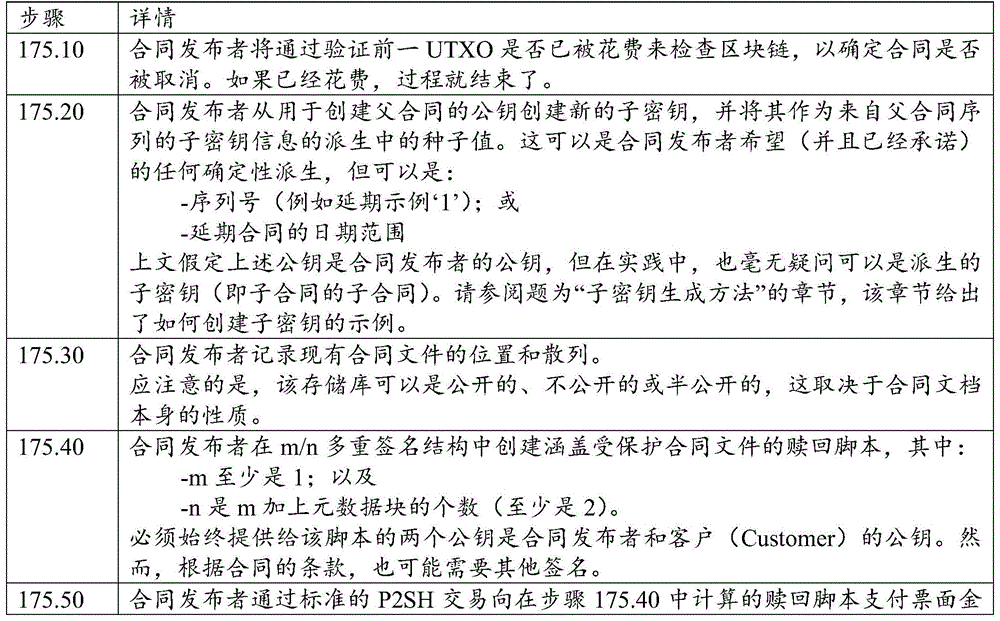

example (c): viewing contracts
In this use case, the interested party wishes to confirm the existence of the contract to cover the activity he (she) is asking for. This process is shown in table 4:

the main variables above assume that interested parties know to manage the trading of contracts through other means (generally, they are either contract publishers or contract partners). However, any entity that has access to the treaty document and the treaty publisher information can view it in the following manner:
-deriving a redemption script for the UTXO transaction; and
-scanning the block chain for UTXO with a matching redemption script hash.
Example (c): closing contract
In such a use case, the contract issuer or the contract partner wishes to close an existing contract. This process is shown in table 5:

contract conditions
The same mechanisms described above can be used to monitor conditions in a given contract, such as checkpoints. For example, if the contract value is determined to be 100BTC and 20BTC is paid at checkpoints 1 through 5, the sub-contract model described above can be used to derive a main contract and five sub-contracts. Each of these sub-contracts may be marked as complete using the same or different signature (e.g., notary or similar signer). In this way, a common record may be maintained indicating that the conditions attendant to the contract have been met. This concept can then be used in conjunction with a flow or application ("bot") that can be used to trigger payment 20BTC once the contract is marked as complete.
For purposes of illustration, the following provides some example scenarios illustrating some applications in which the present invention may be used. In all of these scenarios, the content of the contract itself is considered irrelevant and non-limiting.
Example scenario 1: common registry of assets
In this scenario, Bob (Bob) decides to publish his ownership of the asset (e.g., his home) onto the blockchain. There is no other work to do at this stage; it is just an asset that can be used in subsequent transactions. In this case, the contract has no expiration date. Fig. 2a shows a simple state machine with two states: (i) contract open and (ii) contract close. FIG. 2b shows the metadata definition at the bitcoin transaction output, which specifies the contract location and proof of validity by hashing. Figure 2c shows a "publish" transaction that initially stores the contracts on the blockchain (although it actually stores only the hash and not the actual contract). FIG. 2d cancels the contract by spending bitcoins.
Example scenario 2: creation and registration of hidden-ownership assets
Which is a slightly enhanced version of scenario 1. In this example, bob wants to publish the asset onto the blockchain, but does not want to directly reveal his ownership.
In this case, bob first creates a subkey from his public key to represent the asset. The subkey is then published onto the blockchain as part of the asset details. In this case, the asset has no expiration date. (example details of one manner in which subkeys may be generated are provided below-see section below entitled "subkey generation methods").
The state machine for this scenario is the same as the state machine for scenario 1, as shown in FIG. 2 a. FIG. 3a shows the metadata definition for this scenario. The metadata is carried on the bitcoin transaction output and specifies (by hashing) the contract location and proof of validity. Figure 3b illustrates a transaction to "invest" in assets. That is, some bitcoin is put into the asset's public key so that the asset can fund its transaction (e.g., the issue transaction in FIG. 3 c). FIG. 3b does not show the creation of Bob's asset subkey because it is not a bitcoin transaction.
Fig. 3c shows a blockchain transaction for asset distribution. Figure 3d shows a closed transaction for a contract. UTXO is costly when a cancellation of coincidence is required. In this case, the asset and the hidden owner signature of the asset are required.
Example scenario 3: lease contract
In this case, bob enters into a lease contract with eval (Eve) for a duration of three years. The contract terms specify a number of payment terms. The payment details are not relevant to the present invention. However, contracts have a fixed duration, with no default terms.
There is a simple state machine model, as shown in fig. 4 a. FIG. 4b shows the metadata for this scenario. Fig. 4c shows a transaction that publishes asset ownership to the blockchain. First, bob provides some funds for the asset, and then the asset releases itself.
Example scenario 4: postponement contract
In this illustrative case, Bob decides to rent houses to Afu in a deferred annual manner. If he wants to cancel the lease on the contract renewal day, he needs to be notified two months earlier, otherwise he will automatically renew. This has a simple state machine model, as shown in fig. 5 a. FIG. 5b shows the metadata for this scenario. FIG. 5c shows a transaction issuing an initial contract and an initial extension (rolover) of the contract onto the blockchain.
After the first year, bob continues to lease without terminating the contract. Immediately after the release of the Aft-S3-T2 (EVE-S3-T2), it was obtained by the automated computing agent and postponed for one year. It should be noted that this could also be done by the Ill using her own internal logic.
After the second year, Bob chooses to terminate the lease and submit the transaction using the same inputs as for Evoo-S3-T3. However, since this transaction has not yet been committed, the input is not spent, invalidating EVE-S3-T3 if Bob' S transaction was first posted to the blockchain. Although the amount involved is trivial, the bot will not sign the transaction unless the output is a public key hash for Evoh (or whatever the contract actually states). The transaction for terminating bob's contract is shown in fig. 5 d.
Example scenario 5: limitation of contract
In this case bob contracts with some builders to deliver a new property and specifies in the contract several conditions that need to be independently signed (the first is approval of the plan by the local planning department). This has a simple state machine model, as shown in fig. 6 a. FIG. 6b shows the metadata for this scenario. Fig. 6c illustrates a transaction in which bob creates an initial contract and two sub-contracts (after deriving the relevant sub-keys, possibly using sub-key generation techniques described below) and publishes them. Figure 6d shows the transaction after the planning permission has been signed.
Coding scheme
The metadata used to refer to the contract can be in a variety of formats. However, suitable coding schemes are described herein.
Contracts can be transferred if the rights specified by the contract are assigned to the contract holder or owner. One example of an undeliverable contract is a contract in which the contracting parties are named, that is, rights are granted to a particular designated entity rather than to the holder of the contract. The present encoding scheme only discusses negotiable contracts.
The token represents a particular contract that details or defines the rights granted by the contract. According to the invention, the token is a representation of a contract in the form of a bitcoin transaction.
The encoding method uses metadata that includes three parameters or data items. This data may indicate that:
i) the contractually-defined number of available shares (which may be referred to herein as "NumShares");
ii) a number of transfer units (which may be denoted herein as "sharefal") to be transferred from the sender to at least one recipient; and
iii) a factor (which may be referred to herein as a "hooking rate") for calculating a value for the number of transfer units.
One advantage of this encoding scheme is that it can encapsulate the contract using only the three parameters described above, or represent the contract as a token on a blockchain. In practice, contracts can be specified using at least these three data items. Since the encoding scheme can be used for any type of negotiable contract, a generic algorithm can be designed and applied. Further details of these metadata items are detailed below.
Partitionable tokens are tokens in which a value on the transaction output can be subdivided into smaller amounts allocated across multiple tokens (i.e., allocated across multiple transactions). The prototype is tokenized legal currency. A partitionable contract is defined as a contract that specifies a non-zero hook rate. For partitionable contracts, the tokenized value passed in the transaction output is associated with a base Bitcoin (BTC) value by a hook rate. That is, the contract specifies the holder's rights in hook rates. For an indivisible token, without a hook rate, the contract specifies the holder's rights at a fixed value (e.g., don't remember a bond: 'this contract can be redeemed for $ 1000' or by 'this contract can be used to cut hair once'). For an indivisible contract, the base deal BTC value is independent of the contract value.
The "base BTC value" refers to the bitcoin amount (BTC) that is appended to the transaction output. In bitcoin protocols, each transaction output must have a non-zero BTC number to be considered valid. In fact, the BTC quantity must be greater than a set minimum value (called "dust"), currently set to 546 clever (satoshis) at the time of writing this document. A 1-bit currency is defined as equal to 1 hundred million clever. Since bitcoin transactions are only used as a means to facilitate ownership exchanges, the actual underlying BTC number is arbitrary: the true value is in the contract document. Theoretically, each token can be carried by dust.
According to current coding schemes, especially for partitionable tokens, the base BTC value does have meaning: it is related to the contract value by the hook rate. The hook rate itself is arbitrary and is chosen so as to keep the base BTC amount small. The reason for using the hooking rate rather than simply making each token transaction dirty is because the protocol of the present invention facilitates separability: the original contract does not have to be adjusted when the token is divided into several smaller amounts of transaction output. Instead, the contract value of each segment token is calculated based only on the segment amounts of the hook rate and the base BTC value.
A limited token is a token in which the total issued value is fixed (or "limited") by a fixed, non-zero number of shares, defined by a quantity called numtokens. Thus, no more shares must be issued under a limited contract. For example, a partial ownership contract for a horse race is limited to only 100% of the horse race (e.g., 100 shares, 1% or 10 shares per share, 10% per share, etc.). An unlimited contract means that the publisher can sell further stock issues, such as adding the required amount of legal currency to its reserve account. Numcharacters must be specified in all contracts. The limited contract must satisfy NumShares > 0; an unlimited contract is represented by setting numcontracts to 0.
A typical example is a monetary reserve (similar to a gold reserve) such that the total value held in the reserve bank account matches the total value in the existing promissory note (i.e. the uncancelled token). This concept is not limited to monetary reserves, but also includes inventory. For example, a publisher holding printed T-shirt tokens may start with 10,000T-shirts in stock and may issue one divisible token to represent the 10,000T-shirts (where, for example, 1T-shirt is worth each). The original tokens may be subdivided and each subdivided token may be redeemed for a plurality of T-shirts according to a base BTC value of the transaction output defined by the hook rate. However, if demand increases, the publisher may decide to publish more shares (i.e., increase the number of currency shares (e.g., plus 10,000 shares)). In this case, the issuer is responsible for depositing 10,000 more T-shirts in their reserve account (i.e., inventory warehouse) for further distribution. Thus, at any time the total number of T-shirts in inventory (where the stock acts as a "reserve account") -the total number of un-redeemed stocks.
The hooking rate only applies to partitionable contracts where the value of the stock (represented by the quantity named sharefal) is hooked up to the base BTC amount. For example, a contract may specify that the publisher promise to redeem tokens at a rate of $ 10,000 per base 1 BTC. This means that a transaction with a tokenized base output value of 15,400 clever, for example, would be redeemable for $ 1.54. A value of 0 for the hook rate indicates that the contract is indivisible (i.e., only transfers in bulk, such as bearer bonds). When the hook rate is set to 0 (representing an indivisible token), the base BTC value is independent of the contract value and can be set to any amount. Generally in such a situation, it is desirable to keep the base BTC amount as small as possible (i.e., set as dust) to minimize operating costs.
Numcharacters is the total (fixed) number of shares available under a (limited) contract. For a limited contract, NumShares must be an integer greater than zero. For an unlimited contract, NumShares is not fixed, as more stocks can be released at any time (as long as they are bought), represented by setting the value to 0.
Shares are defined as transfer units and sharefal is the value of the unit. For example, for legal currency, the transfer unit may be set to 1 cent. Or, for example, it may be set to 50 cents, in which case the transfer can only be performed in "many" 50 cents. Sharefal may also be expressed as a percentage: for example, if a breeder wishes to sell racehorses on 10 equal shares, sharefal becomes 10%. Sharefal must be >0 and must be contractually defined.
The total issuance (totallssance) represents the total value of the issued stock ticket. The value relates to only limited contracts, the distribution of unlimited contracts is not fixed, and more shares can be distributed. If the shares are expressed as percentages, totallssance is 100% by definition.
For a limited contract, NumShares, ShareVal and Totalssuance are associated in the following manner:
NumShares x ShareVal=Totallssuance
a value of 0 for Totallssuance indicates that it is an infinite contract. An example of an unlimited contract is legal currency (so Totallssuance is set to 0); examples of limited contracts are: (i) limited edition commemorative coin (cast 1000, wherein 1 share is 1 coin): totallssuance 1000x 1 1000 coins; (ii) seats in a ticketing venue, wherein totallssance is the total number of available seats.
The traffic is defined as the total value of the unused tokens (i.e., determined by the transaction in the UTXO — the unused transaction output). The complete set of all unused transactions is kept in a list of available all bitcoin nodes. For example, if the publisher initially issued $ 10,000 as a legal currency type token and over time a 5500 worth of tokens were redeemed, then the traffic is $ 4500 (i.e., the value of the uncancelled token). This value should be consistent with the balance in the associated reserve account.
Subkey generation method
In the above, table 3 and the example scenario refer to the case where it is advantageous to generate the subkey from the original (master) key. A method for accomplishing this is now provided to illustrate one manner in which this may be performed.
Fig. 7 shows a system 1 comprising a first node 3 communicating with a second node 7 over a communication network 5. The first node 3 has an associated first processing device 23 and the second node 5 has an associated second processing device 27. The first and second nodes 3,7 may comprise electronic devices such as computers, telephones, tablet computers, mobile communication devices, computer servers, etc. In one example, the first node 3 may be a client (user) device and the second node 7 may be a server. The server may be a server of the digital wallet provider.
The first node 3 has a first node master private key (V)1C) And a first node master public key (P)1C) Is associated with the first asymmetric cryptographic pair. The second node (7) has a second node master private key (V)1S) And a second node master public key (P)1S) Is associated with the second asymmetric cryptographic pair. In other words, the first and second nodes each possess a respective public-private key pair.
The first and second asymmetric cryptographic pairs for the respective first and second nodes 3,7 may be generated during an enrollment process, e.g. an enrollment of a wallet. The public key of each node may be shared publicly, for example, through the communication network 5.
In order to determine a Common Secret (CS) at the first node 3 and the second node 7, the nodes 3,7 each perform the steps of the respective methods 300, 400 without transmitting the private key over the communication network 5.
The method 300 performed by the first node 3 comprises a step 330 of basing at least on a first node master private key (V)1C) The sum Generator Value (GV) determines the first node second private key (V)2C). The generator value may be based on a message (M) shared between the first and second nodes, which may include sharing the message over the communication network 5, as will be described in further detail below. The method 300 further includes a step 370 of basing at least on the second node master public key (P)1S) The sum Generator Value (GV) determines a second node second public key (P)2S). The method 300 includes a step 380 of basing a second private key (V) of the first node on the first node2C) And a second node second public key (P)2S) A Common Secret (CS) is determined.
Importantly, the same Common Secret (CS) can also be determined at the second node 7 by the method 400. Method of producing a composite material400 includes a step 430 of generating a master public key (P) based on the first node1C) The sum Generator Value (GV) determines the first node second public key (P)2C). The method 400 further includes a step 470 of assigning a second node master private key (V) based on the second node master private key (V)1S) The sum Generator Value (GV) determines a second node second private key (V)2S). The method 400 includes a step 480 of basing a second private key (V) of a second node2S) And a first node second public key (P)2C) A public key (CS) is determined.
The communication network 5 may include a local area network, a wide area network, a cellular network, a wireless communication network, the internet, and so forth. In these networks, data may be transmitted over a communications propagation medium such as wire, fiber optics, or wirelessly, and the data is susceptible to eavesdropping, such as by eavesdropper 11. The methods 300, 400 may enable both the first node 3 and the second node 7 to independently determine the common secret without transmitting the common secret through the communication network 5.
Thus, one advantage is that the Common Secret (CS) can be determined securely and independently by each node without having to send the private key over the possibly insecure communication network 5. The common secret can then be used as (or as a basis for) a secret key.
The method 300, 400 may include additional steps. See fig. 11. The method 300 may include: based on the message (M) and the first node second private key (V) at the first node 32C) A signed message is generated (SM 1). The method 300 further comprises the step 360 of sending the first signed message (SM1) to the second node 7 over the communication network. Next, in step 440, the second node 7 may perform receiving the first signed message (SM 1). The method 400 further includes the steps of: step 450, using the first node second public key (P)2C) Verifies the first signed message (SM1), and step 460 authenticates the first node 3 based on the result of verifying the first signed message (SM 1). Advantageously, this allows the second node 7 to authenticate that the purported first node (in which the first signed message was generated) is the first node 3. This is based on the following assumptions: only the first node 3 has access to the first node master private key (V)1C) Thus, only the first node 3 can determine the first node second private key (V) used to generate the first signed message (SM1)2C). Should understand thatSimilarly, a second signature message (SM2) may be generated at the second node 7 and sent to the first node 3 so that the first node 3 may authenticate the second node 7, for example in a point-to-point (peer) context.
The sharing of the message (M) between the first and second nodes may be implemented in various ways. In one example, the message may be generated at the first node 3 and then sent to the second node 7 over the communication network 5. Alternatively, the message may be generated at the second node 7 and then sent to the second node 7 over the communication network 5. In some examples, the message (M) may be public and thus may be sent over an unsecured network 5. One or more messages (M) may be stored in the data storage 13, 17, 19. Those skilled in the art will recognize that the sharing of messages may be implemented in a variety of ways.
Advantageously, a record may be maintained that allows the Common Secret (CS) to be recreated without the record itself having to be stored privately or transmitted securely.
An example of the registration method 100, 200 is described with reference to fig. 9, where the method 100 is performed by the first node 3 and the method 200 is performed by the second node 7. This includes establishing first and second asymmetric cryptographic pairs for respective first and second nodes 3, 7.
An asymmetric cryptographic pair includes an associated private key and a public key, such as the key used in public key cryptography. In this example, asymmetric cryptographic pairs are generated using Elliptic Curve Cryptography (ECC) and the properties of elliptic curve operations.
In the method 100, 200, this comprises steps 110, 210, the first and second nodes agree on a common ECC system and use a base point (G). (note: radix may be referred to as a common generator, but the term "radix" is used to avoid confusion with the generator values GV). In one example, the common ECC system may be based on the secp256K1, with the secp256K1 being the ECC system used by bitcoins. The base points (G) may be selected, randomly generated, or assigned.
As for the first node 3, the method 100 comprises a step 110 of selecting a common ECC system and a base point (G). This may include receiving the common ECC system and base point from the second node 7 or the third node 9. Alternatively, the user interface 15 may be associated with the first node 3, whereby a user may selectively provide a common ECC system and/or a base point (G). In another alternative, one or both of the common ECC system and/or the base point (G) may be randomly selected by the first node 3. The first node 3 may send an indication notification to the second node 7 over the communication network 5 using a common ECC system with a base point (G). And in step 210 the second node 7 may be selected by sending an indication notification confirming use of the common ECC system and the base point (G).
The method 100 further comprises a step 120 of the first node 3 generating a first asymmetric cryptographic pair comprising a first node master private key (V)1C) And a first node master public key (P)1C). This includes generating a first node master private key (V) based at least in part on random integers within an allowable range specified in a public ECC system1C) Further comprising a first node-based master private key (P) according to the following formula1C) Determining a first node master public key (P) by point multiplication with an elliptic curve of a base point (G)1C):
P1C=V1Cx G (equation 1)
Thus, the first asymmetric cryptographic pair comprises:
V1Ca first node master private key kept secret by the first node.
P1C: the first node master public key is known.
The first node 3 may master a first node private key (V)1C) And a first node master public key (P)1C) Is stored in a first data memory 13 associated with the first node 3. For security, the first node hosts a private key (V)1C) May be stored in a secure portion of the first data store 13 to ensure that the key remains private.
The method 100 further comprises a step 130 of applying the first node master public key (P) over the communication network 51C) To the second node 7 as shown in figure 9. The second node 7 may receive the first node master public key (P) in step 2201C) Then, the first node is made public in step 230Key (P)1C) Is stored in a second data memory 17 associated with the second node 7.
Similar to the first node 3, the method 200 of the second node 7 comprises a step 240 of generating a second asymmetric cryptographic pair comprising a second node master private key (V)1S) And a second node master public key (P)1S). Second node master private key (V)1S) And is also a random integer within the allowable range. And the second node master public key (P)1S) Determined by the following equation:
P1S=V1Sx G (equation 2)
Thus, the second asymmetric cryptographic pair comprises:
V1S: a second node master private key kept secret by the second node.
P1S: the second node master public key is known.
The second node 7 may store the second asymmetric cryptographic pair in the second data store 17. Method 200 also includes step 250 of applying a second node master public key (P)1S) To the first node 3. And in steps 140 and 150 the first node 3 may receive and store the second node master public key (P)1S)。
It will be appreciated that in some alternatives the respective public master key may be received and stored at a third data store 19 associated with the third node 9 (such as a trusted third party). This may include a third party acting as a public directory, such as a certificate authority. Thus, in some examples, the first node master public key (P)1C) May be requested and received by the second node 7 only when it is determined that a Common Secret (CS) is required (or vice versa).
The registration step may only need to be performed once as an initial setting.
Session initiation and determination of a common secret by the first node 3
An example of determining a Common Secret (CS) will now be explained with reference to fig. 10. The Common Secret (CS) may be used for a specific session, time, transaction or other purpose between the first node 3 and the second node 7. One may not want to use the same Common Secret (CS) or it may not be safe to do so. Thus, the Common Secret (CS) may be changed between different sessions, times, transactions, etc.
The following is provided to illustrate the secure transmission techniques described above.
Generating a message (M)310
In this example, the method 300 performed by the first node 3 comprises a step 310 of generating a message (M). The message (M) may be random, pseudo-random or user defined. In one example, the message (M) is based on a Unix system Time (Unix Time) and a random number (and arbitrary values). For example, the message (M) may be:
message (M) ═ Unix system time + random number (equation 3)
In some examples, the message (M) is arbitrary. However, it should be understood that the message (M) may have a selectivity value (e.g., Unix system time, etc.) that may be useful in certain applications.
The method 300 comprises a step 315 of sending the message (M) to the second node 7 through the communication network 5. The message (M) may be sent over an unsecured network because the message (M) does not contain information about the private key.
Determining a value of a Generator (GV)320
The method 300 further includes a step 320 of determining a Generator Value (GV) based on the message (M). In this example, this includes determining a cryptographic hash of the message. An example of a cryptographic hash algorithm includes SHA-256 to create a 256-bit Generator Value (GV). Namely:
GV ═ SHA-256(M) (formula 4)
It should be understood that other hashing algorithms may be used. Which may include other Hash algorithms in the Secure Hash Algorithm (SHA) family. Some specific examples include instances in the SHA-3 subset, including SHA3-224, SHA3-256, SHA3-384, SHA3-512, SHAKE 128, SHAKE 256. Other hashing algorithms may include those in the RACE raw Integrity verification Message Digest (abbreviated "ripemmd") series. Particular examples may include ripemm-160. Other hash functions may include Zemor-tilrich based hash functions and knapsack (knapack) based series of hash functions.
Determining first node second private key 330
V2C=V1C+ GV (equation 5)
Thus, the first node second private key (V)2C) Not a random value but rather derived deterministically from the first node master private key. The corresponding public key in the encrypted pair, i.e. the first node's second public key (P)2C) Having the following relationship:
P2C=V2Cx G (equation 6)
V in the formula 52CSubstituting in equation 6, then:
P2C=(V1C+ GV) x G (equation 7)
Wherein the "+" operator is used for adding the index quantity, and the "x" operator is used for multiplying the elliptic curve points. Note that elliptic curve cryptography algebra has a distribution law, and equation 7 can be expressed as:
P2C=V1Cx G + GV x G (equation 8)
Finally, equation 1 can be substituted into equation 7, then:
P2C=P1C+ GV x G (equation 9.1)
P2C=P1C+ SHA-256(M) x G (equation 9.2)
In equations 8 through 9.2, the "+" operator refers to elliptic curve point addition. Thus, the first node is known to have a master public key (P)1C) And a message (M), a corresponding first node second public key (P) may be derived2C). The second node 7 may have such knowledge to independently determine the first node second public key (P)2C) This will be referred to below in relation toMethod 400 is discussed in further detail.
Generating a first signed message (SM1)350 based on the message and a first node second private key
The method 300 further comprises a step 350 of determining a second private key (V) of the first node based on the message (M) and the determined second private key (V) of the first node2C) A first signed message (SM1) is generated. Generating the signed message comprises applying a digital signature algorithm to digitally sign the message (M). In one example, this includes applying a first node second private key (V)2C) Is applied to a message in an Elliptic Curve Digital Signature Algorithm ("ECDSA") to obtain a first signed message (SM 1). Examples of ECDSA include elliptic curve digital signature algorithms based on ECC systems with secp256k1, secp256r1, secp384r1, se3cp521r 1.
At the second node 7, the corresponding first node second public key (P) is taken2C) To verify the first signed message (SM 1). The second node 7 may authenticate the first node 3 using verification of the first signed message (SM1), as will be discussed in method 400 below.
Determining a second node second public key 370'
Then, in step 370, the first node 3 may determine a second node second public key (P)2S). As described above, the second node second public key (P)2S) May be based on at least a second node master public key (P)1S) And a Generator Value (GV). In this example, since the public key is determined to have the private key point-multiplied by an elliptic curve with the base point (G) (step 370'), the second node second public key (P) may be expressed in a manner similar to equation 62S) Such as:
P2S=V2Sx G (equation 10.1)
P2S=P1S+ GV x G (equation 10.2)
The mathematical proof of equation 10.2 is consistent with the above description for deriving the first node second public key (P)2C) The same is true for the mathematical demonstration of equation 9.1. It should be appreciated that in step 370, first node 3 may determine second node second public key independently of second node 7。
Determining a common secret 380 at the first node 3
Then, in step 380, the first node 3 may be based on the determined first node second private key (V)2C) And the determined second node second public key (P)2S) To determine a Common Secret (CS). The Common Secret (CS) may be determined by the first node 3 by the following formula:
S=V2C x P2S(formula 11)
A corresponding method 400 performed at the second node 7 will now be described. It should be understood that some of these steps are similar to the steps performed by the first node 3 described above.
The method 400 comprises a step 410 of receiving a message (M) from the first node 3 over the communication network 5. This may include the message (M) sent by the first node 3 at step 315. The second node 7 then determines a Generator Value (GV) based on the message (M) in step 420. The step 420 of determining the Generator Value (GV) by the second node 7 is similar to the step 320 performed by the first node described above. In this example, the second node 7 performs this determination step 420 independently of the first node 3.
A next step includes step 430, based on the first node master public key (P)1C) The sum Generator Value (GV) determines the first node second public key (P)2C). In this example, since the public key is determined (step 430') as having the private key point-multiplied by an elliptic curve with the base point (G), the first node second public key (P) may be expressed in a manner similar to equation 92C) Such as:
P2C=V2Cx G (equation 12.1)
P2C=P1C+ GV x G (equation 12.2)
The mathematical demonstration of equations 12.1 and 12.2 is the same as discussed above for equations 10.1 and 10.2.
The second node 7 authenticates the first node 3
The method 400 may include the steps ofThe second node 7 performs the step of authenticating that the purported first node 3 is the first node 3. As previously described, this includes the step 440 of receiving a first signed message (SM1) from the first node 3. The second node 7 may then use the first node second public key (P) determined in step 4302C) The signature on the first signed message (SM1) is verified (step 450).
Verifying the digital signature may be done according to the Elliptic Curve Digital Signature Algorithm (ECDSA) as described above. Importantly, the second private key (V) of the first node is used2C) The signed first signed message (SM1) should only use the corresponding first node second public key (P)2C) Correct verification because of V2CAnd P2CA password pair is formed. A first node master private key (V) generated due to these keys at registration with the first node 31C) And a first node master public key (P)1C) Is deterministic and therefore verifies that the first signed message (SM1) can be used as a basis for authentication, i.e. that the so-called first node sending the first signed message (SM1) is the same first node 3 as during registration. Thus, the second node 7 may also perform the step of authenticating (460) the first node 3 based on the result of verifying (450) the first signed message.
The second node 7 determines a common secret
The method 400 may further comprise the second node 7 based on a second node master private key (V)1S) The sum Generator Value (GV) determines (step 470) the second node second private key (V)2S). Similar to step 330 performed by the first node 3, the second node second private key (V)2S) May be based on a second node master private key (V) according to the following formula1S) Scalar addition sum of sum Generator Value (GV):
V2S=V1S+ GV (equation 13.1)
V2S=V1S+ SHA-256(M) (equation 13.2)
The second node 7 may then be independent of the first node 3, based on a second node second private key (V)2S) And a first node second public key (P)2C) Determining (step 480) a Common Secret (CS) based on the following formula:
S=V2S x P2C(formula 14)
Proof of a Common Secret (CS) determined by a first node 3 and a second node 7
The Common Secret (CS) determined by the first node 3 is the same as the Common Secret (CS) determined at the second node 7. The mathematical proof that equations 11 and 14 provide the same Common Secret (CS) will now be described.
As regards the Common Secret (CS) determined by the first node 3, equation 10.1 can be substituted into equation 11, as follows:
S=V2C x P2S(formula 11)
S=V2C x(V2S x G)
S=(V2C x V2S) x G (equation 15)
As for the Common Secret (CS) determined by the second node 7, equation 12.1 may be substituted into equation 14, as follows:
S=V2S x P2C(formula 14)
S=V2S x(V2C x G)
S=(V2S x V2C) x G (equation 16)
Since ECC algebra is commutative, equations 15 and 16 are equivalent because:
S=(V2C x V2S)x G=(V2S x V2C) x G (equation 17)
Common Secret (CS) and secret key
The Common Secret (CS) can now be used as a secret key or as a basis for a secret key in a symmetric key algorithm for secure communication between the first node 3 and the second node 7.
The Common Secret (CS) may be in the form of elliptic curve points (xs, ys). This may be converted to a standard key format using standard publicly known operations agreed upon by the nodes 3, 7. For example, the xs value may be a 256-bit integer, which may be used as AES256An encrypted key. It can also be converted to a 160-bit integer using RIREMD160 for anybodyAnd applications that require this length key.
The Common Secret (CS) may be determined as desired. Importantly, the first node 3 does not need to store the Common Secret (CS), as this can be re-determined based on the message (M). In some examples, the message (M) used may be stored in the data store 13, 17, 19 (or other data store) without requiring the same level of security required by the master private key. In some examples, the message (M) may be publicly available.
However, according to some applications, the Common Secret (CS) may be stored in a first data store (X) associated with the first node, provided that the Common Secret (CS) is associated with a first node master private key (V)1C) Is equally safe.
Advantageously, the technique may be used to determine a plurality of common secrets for a corresponding plurality of security keys based on a single master key encryption pair.
Hierarchy of generator values (keys)
For example, a series of successive producer values (GVs) may be determined, where each successive GV may be determined based on previous producer values (GVs). For example, rather than repeating steps 310-370 and 410-470 to generate a continuous single-use key, both parties may repeatedly re-hash the previously used Generator Value (GV) to establish a hierarchy of generator values, via a previous agreement between the nodes. In practice, the generator value based on the hash of the message (M) may be the next generation message (M ') of the next generation generator value (GV'). This allows successive generations of the shared secret to be computed without further protocol setup transmissions, particularly multiple messages for each generation of the common secret. The next generation public secret (CS') may be calculated as follows.
First, the first node 3 and the second node 7 independently determine a next-generation builder value (GV'). This is similar to step 320 and step 420, but applies to the following equation:
m' ═ SHA-256(M) (formula 18)
GV ═ SHA-256 (M') (equation 19.1)
GV' ═ SHA-256(M)) (formula 19.2)
The first node 3 may then determine a next generation second node second public key (P)2S') and a first node second private key (V)2C') similar to steps 370 and 330 above, but applying the following formula:
P2S’=P1S+ GV' x G (equation 20.1)
V2C’=V1C+ GV' (equation 20.2)
The second node 7 may then determine a next generation first node second public key (P)2C') and a second node second private key (V)2S') similar to steps 430 and 470 described above, but applying the following formula:
P2C’=P1C+ GV' x G (equation 21.1)
V2S’=V1S+ GV' (equation 21.2)
The first node 3 and the second node 7 may then each determine a next generation common secret (CS'). In particular, the first node 3 determines the next generation public secret (CS') using the following formula:
CS’=V2C’x P2S' (formula 22)
The second node 7 determines the next generation public secret (CS') using the following formula:
CS’=V2S’x P2C' (formula 23)
More generations (CS ", CS'", etc.) may be computed in the same manner to create a chain hierarchy. This technique requires that both the first node 3 and the second node 7 keep track of the original message (M) or the originally calculated producer value (GV) and the nodes it refers to. Since this is public information, there is no security issue regarding retaining this information. Thus, this information may be kept in a "hash table" (linking hash values to public keys) and freely distributed over the network 5 (e.g., using Torrent). Furthermore, if any single Common Secret (CS) in the hierarchy is corrupted, the security of any other common secret in the hierarchy is not affected, provided that private key V1C、V1SIt is still safe.
Tree structure of keys
In addition to the chain (linear) hierarchy as described above, a hierarchy in the form of a tree structure may be created. With a tree structure, various keys for different purposes may be determined, such as authentication keys, encryption keys, signature keys, payment keys, etc., all linked to a single securely maintained master key. This is most fully illustrated in fig. 12, which shows a tree structure 901 with various different keys, each of which may be used to create a shared key with another party. Branches can be completed in several ways, three of which are described below.
(i) Master key generation
In the chain hierarchy, each new "link" (public/private key pair) is created by adding a multiplicative rehash message to the original master key. For example, (for clarity, only the private key of the first node 3 is shown):
V2C=V1C+ SHA-256(M) (formula 24)
V2C’=V1C+ SHA-256(SHA-256(M)) (equation 25)
V2C”=V1C+ SHA-256(SHA-256(SHA-256(M))) (equation 26)
…
To create a branch, any key may be used as the child master key. For example, V2C' can be used as a child master key (V) by adding a hash to a regular master key3C):
V3C=V2C' + SHA-256(M) (equation 27)
Sub-master key (V)3C) May itself have a next generation key (V)3C') such as:
V3C’=V2C' + SHA-256(SHA-256(M)) (equation 28)
This provides a tree structure 903 using the master key generation method as shown in fig. 13.
(ii) Logical association
In this approach, all nodes on a tree (public/private key pair) are generated as chains (or in other forms), the logical relationships between the nodes in the tree are maintained by a table, and each node in the tree in the table is associated with a parent node in the tree using only pointers. Thus, the pointer may be used to determine the relevant public/private key pair to determine the public key (CS) of the session.
(iii) Message multiplicity
A new private/public key pair may be generated by introducing a new message at any point in the chain or tree. The message itself may be arbitrary or may carry some meaning or function (e.g. it may relate to a "real" bank account number, etc.). It may be desirable to securely retain such new messages for forming new private/public key pairs.
Illustrative computing agent for use with the invention
The present invention may utilize computing resources or agents to perform automated aspects of the contractual process. Examples of suitable agents are provided below (other embodiments may also be used).
The agent may operate with a blockchain, which is used as a non-erasable tape (tape) in a Turing machine (Turing machine) implementation. The agent runs in parallel with the blockchain network, oversees and handles (loops) the execution of the process. A cyclic process is designed to perform a given task, e.g., automation of a process or control of a device or system. The parallel resource monitors the state of the blockchain and can write transactions to the blockchain. In a sense, it utilizes a blockchain as an indelible paper strip for turing machines, with the following definitions and characteristics:
1. the blockchain acts as a belt for the turing machine. Each transaction in the blockchain represents a unit on the strip. The unit cell can
Containing symbols from a finite alphabet.
2. A tape head (tape head) may read information from a block to which a block chain has been written.
3. The tape header may write a new block containing many transactions to the end of the block chain. However, they cannot write to already existing ones
And (5) blocking. Therefore, the block chain belt is not erasable.
4. The metadata for each transaction may be stored as part of a multi-signature pay-to-script hash (P2SH) transaction.
An important function of the proxy is to act as an automation entity that monitors the current state of the blockchain. It may also receive signals or inputs from any off-block source. Depending on the blockchain state and/or the received input, the agent may perform certain actions. The agent decides which action(s) to perform. These may or may not involve actions in the "real world" (i.e., off-block) and/or actions on the block chain (e.g., creating and broadcasting new transactions). The actions taken by the agent may be triggered by a blockchain state. The agent may also decide the next set of transactions to be broadcast to the bitcoin network and then write to the blockchain.
The actions of the agents run in parallel and simultaneously to the blockchain (e.g., bitcoin) network. In a sense, this extends the functionality of blockchain (e.g., bitcoin) scripts. This continuous monitoring implements a "round-robin" control flow construct that allows for graphical integrity of the combined proxy and blockchain system.
The turing machine includes two stacks:
data stack: this is represented by the above-described blockchain.
The control stack: this is represented by a proxy function. It stores information related to repetitive control flow functions.
The separation of the control stack from the data stack provides the advantage of preventing infinite loops from occurring within the bitcoin core, mitigating denial-of-service attacks (denial-of-service attacks).
The agent manages and runs subroutines that can be looped through any type of loop construct (e.g., FOR-NEXT, REPEAT unt, etc.). The illustrative embodiments described herein include a process using one example of a "repeat" configuration. The user may specify the index (i) and the limit (J). These represent the current number of iterations (usually counting from 0) and the total number of iterations of the repeated loop, respectively.
For each iteration:
1. the index increment is 1. For the exit condition, when the index reaches a limit, the iteration will stop;
2. executing a code block containing an "if condition action (ICTA) statement, the action may be any action on or off the block chain;
3. a cryptographic hash of the subroutine is computed. This may be stored in the blockchain as part of the transaction. Since the hash is unique for each code, the used code can be verified.
The loop body includes code blocks. Each code block contains an "if condition the action" (ICTA) statement. This monitors the current state of the blockchain for transactions matching:
a start or trigger condition (e.g., when a particular date is reached).
A repetition condition (i.e., metadata or hash associated with a previous iteration).
A stop condition (i.e., the last iteration of the loop).
The ICTA statements enable the agent to decide on the next transaction to be conducted based on the current state of the blockchain. Making the next transaction involves broadcasting the transaction to the bitcoin network and writing the new transaction to the blockchain. This serves as a record that this iteration has been performed. Once the transaction is written to the blockchain, the Manager (Manager) will then find that the last iteration has been performed and written to the blockchain, and will perform the next iteration. The latter continues until the loop exits repeatedly when index (i) reaches the limit (J) specified in the code block.
Each transaction is stored in a reusable manner in the blockchain. In bitcoin implementations, a signature hash (SIGHASH) flag is appended to each signature in the transaction. The flag may take on different values, each value indicating whether other portions of the transaction may be modified without the owner of the signature participating. One of the reusable transactions in the transaction input has the SIGHASH flag "signature hash _ anyone payable (SIGHASH _ AnyoneCanPay)". This allows any person to contribute to the input of the transaction. This parameter enables the ICTA functionality of the agent to perform and repeat multiple times and use different inputs. The use of this functionality may be limited to authorized parties-e.g., by copyrights of reusable transactions.
The "If condition" part of the ICTA code block may monitor any type of condition. This is similar to other programming languages (e.g., C + +, Java) and is not limited to information stored on blockchains. For example, it may monitor the date and time (i.e., by a certain date and time) or the weather (i.e., when the temperature is below 10 ℃ and it is raining), the contract or trusted conditions (i.e., when company a purchases company B).
The "in action" portion of the ICTA code block may perform a number of actions. The invention does not limit the number or types of actions that can be taken. The action is not limited to transactions on the blockchain, although transactions containing metadata related to the action may be written to the blockchain.
The metadata may be in any form. However, in one embodiment, the metadata may store the hyperlink to a file containing further data or instructions related to the action. The metadata may store the hyperlinks to a hash table containing further data or instructions related to the action and a hash of the action as a circular key to the hash table.
The control stack of the agent may be implemented in a number of ways that pertain to the specific needs of each user. For example, the repeating loop of the control stack may be based on any turing-complete language. One possible language selection is the Forth style stack-based language. One advantage of using this language is that it allows the control stack to be consistent in programming style with bitcoin scripts, which are well known and widely used.
Spare stack using bitcoin scripts as data storage space
Bitcoin scripts contain commands, also known as operation codes (op codes), that enable a user to move data to an alternative stack called an "alt stack".
The operation code is:
OP _ TOALSTACK represents moving data from the top of the master stack to the top of the alt stack.
OP _ FROMLSTATCK represents moving data from the top of the alt stack to the top of the master stack.
This enables data from the intermediate step of the computation to be stored in the alt stack, similar to the "memory" function that allows data to be stored on the calculator. In one embodiment, the alt stack is used to configure bitcoin scripts to solve small computational tasks and return the computation results.
Managing agents using code registries
The agent also manages a registry of all code it owns and runs. The structure of this registry is similar to a look-up table or dictionary that maps a particular key to a particular value. Key and value pairs are hashes of code blocks (H)1) And an internet protocol version 6 (IPv6) address representation of the respective stored code. To use the key H1A block of code is retrieved and a look-up table is used to retrieve the associated value (which is the location where the code is stored) and the source code accordingly. The implementation of the code registry may vary.
Transactional metadata for code of agent, and recurrent regeneration
The information needed to regenerate the proxy loop in a particular iteration is stored as metadata in the transactions recorded on the blockchain.
In this way, transactions on the blockchain store or provide access to information about a given iteration of the loop executing on the agent. This information may include the value of any variable associated with the loop, such as the index i, as well as any other necessary information, such as parameter values used in the code block or location-related data specifying that other desired information may be accessed.
The metadata itself is stored as part of the multi-signature pay-to-script hash script (P2SH) in the transaction. Metadata that records transactions can also record how audit trails of code were performed in the past.
The agent may regenerate the repeating loop code block at each iteration in a number of ways. The code blocks may be hard coded into the agents themselves, may be stored in a non-public or public file, or may be stored as entries in a non-public or public hash table file, or a combination of the above. The code block may be a static code with hard coded variables or a static code block but containing parameters that can be filled. The parameter may be a single value in any data format or may be a small block code or a combination of the above. Parameters may be populated by retrieving them directly from metadata in the transaction (e.g., bitcoin transactions) or from an external source such as an internal database or a non-public/public file or hash table or any combination of the above. Pointers to external sources of parameter values may be stored in metadata in the transaction.
The following steps provide one example of how the agent regenerates the repeating loop code block in the ith iteration. In this example, the code registry is a hash table, and the hash value serves as a lookup key for the table and is stored in metadata about the transaction.
1. The agent monitors the blockchain for transactions that contain hash values of code blocks that match entries in the code registry.
2. The proxy finds that it contains the corresponding hash (H)1) The transaction of (2).
3. The proxy reads the "Metadata-code hash (Metadata-CodeHash)" and obtains the code hash (CodeHash) field to obtain H1And uses it to retrieve the code (C)1). If RIPEMD-160(SHA256 (C)1) Is equal to H1The code is not changed and the next step can be safely continued.
4. The agent reads the "metadata-code hash" of the storage index and regenerates the code in the ith iteration. In other words, the loop is "reloaded" in the appropriate iteration.
5. The user's signature is included in the P2SH command to verify the source of the metadata.
6. If this iteration of the loop requires such data, the proxy reads the "Metadata-output hash (Metadata-OutputHash)" and the "Metadata-output pointer (Metadata-OutputPointer)" to retrieve the output of the previous step.
It should be noted that the above-mentioned embodiments illustrate rather than limit the invention, and that those skilled in the art will be able to design many alternative embodiments without departing from the scope of the appended claims. In the claims, any reference signs placed between parentheses shall not be construed as limiting the claim. The words "comprising" and "comprises", and the like, do not exclude the presence of elements or steps other than those listed in any claim or the specification as a whole. In the present specification, "including" means "including or consisting of. The singular reference of an element is not intended to exclude the plural reference of such elements and vice-versa. The invention may be implemented by means of hardware comprising several distinct elements, and by means of a suitably programmed computer. In the device claim enumerating several means, several of these means may be embodied by one and the same item of hardware. The mere fact that certain measures are recited in mutually different dependent claims does not indicate that a combination of these measures cannot be used to advantage.
Claims (25)
Priority Applications (1)
| Application Number | Priority Date | Filing Date | Title |
|---|---|---|---|
| CN202011545639.XA CN112686653B (en) | 2016-02-23 | 2017-02-16 | Registration and automation management method for intelligent contract executed by block chain |
Applications Claiming Priority (13)
| Application Number | Priority Date | Filing Date | Title |
|---|---|---|---|
| GB1603114.8 | 2016-02-23 | ||
| GB1603123.9 | 2016-02-23 | ||
| GB1603117.1 | 2016-02-23 | ||
| GBGB1603117.1A GB201603117D0 (en) | 2016-02-23 | 2016-02-23 | Determining a common secret for two blockchain nodes for the secure exchange of information |
| GBGB1603114.8A GB201603114D0 (en) | 2016-02-23 | 2016-02-23 | Agent-based turing complete transactions integrating feedback within a blockchain system |
| GB1603125.4 | 2016-02-23 | ||
| GBGB1603125.4A GB201603125D0 (en) | 2016-02-23 | 2016-02-23 | Universal tokenisation system for blockchain based cryptocurrencies |
| GBGB1603123.9A GB201603123D0 (en) | 2016-02-23 | 2016-02-23 | P2P cryptocurrency exchange with tokenisation |
| GB1605571.7 | 2016-04-01 | ||
| GB201605571 | 2016-04-01 | ||
| GB201619301 | 2016-11-15 | ||
| GB1619301.3 | 2016-11-15 | ||
| PCT/IB2017/050865 WO2017145019A1 (en) | 2016-02-23 | 2017-02-16 | Registry and automated management method for blockchain-enforced smart contracts |
Related Child Applications (1)
| Application Number | Title | Priority Date | Filing Date |
|---|---|---|---|
| CN202011545639.XA Division CN112686653B (en) | 2016-02-23 | 2017-02-16 | Registration and automation management method for intelligent contract executed by block chain |
Publications (2)
| Publication Number | Publication Date |
|---|---|
| CN109417465A CN109417465A (en) | 2019-03-01 |
| CN109417465B true CN109417465B (en) | 2021-01-15 |
Family
ID=58213272
Family Applications (2)
| Application Number | Title | Priority Date | Filing Date |
|---|---|---|---|
| CN201780009120.XA Active CN109417465B (en) | 2016-02-23 | 2017-02-16 | Registration and automatic management method of intelligent contracts executed by block chains |
| CN202011545639.XA Active CN112686653B (en) | 2016-02-23 | 2017-02-16 | Registration and automation management method for intelligent contract executed by block chain |
Family Applications After (1)
| Application Number | Title | Priority Date | Filing Date |
|---|---|---|---|
| CN202011545639.XA Active CN112686653B (en) | 2016-02-23 | 2017-02-16 | Registration and automation management method for intelligent contract executed by block chain |
Country Status (20)
| Country | Link |
|---|---|
| US (3) | US11120437B2 (en) |
| EP (1) | EP3257191B1 (en) |
| JP (1) | JP6511201B1 (en) |
| KR (1) | KR101987692B1 (en) |
| CN (2) | CN109417465B (en) |
| AU (1) | AU2017223136B2 (en) |
| BR (1) | BR112018016815A2 (en) |
| CA (2) | CA3227439A1 (en) |
| DK (1) | DK3257191T3 (en) |
| EA (1) | EA201891827A1 (en) |
| ES (1) | ES2680851T3 (en) |
| GB (1) | GB2562623A (en) |
| IL (2) | IL278834B2 (en) |
| LT (1) | LT3257191T (en) |
| MX (1) | MX2018010057A (en) |
| PL (1) | PL3257191T3 (en) |
| SG (1) | SG11201806781SA (en) |
| SI (1) | SI3257191T1 (en) |
| TW (2) | TWI817232B (en) |
| WO (1) | WO2017145019A1 (en) |
Families Citing this family (240)
| Publication number | Priority date | Publication date | Assignee | Title |
|---|---|---|---|---|
| US10068228B1 (en) | 2013-06-28 | 2018-09-04 | Winklevoss Ip, Llc | Systems and methods for storing digital math-based assets using a secure portal |
| US10354325B1 (en) | 2013-06-28 | 2019-07-16 | Winklevoss Ip, Llc | Computer-generated graphical user interface |
| US9898782B1 (en) | 2013-06-28 | 2018-02-20 | Winklevoss Ip, Llc | Systems, methods, and program products for operating exchange traded products holding digital math-based assets |
| US10521775B2 (en) * | 2016-04-18 | 2019-12-31 | R3 Ltd. | Secure processing of electronic transactions by a decentralized, distributed ledger system |
| WO2018020369A1 (en) * | 2016-07-29 | 2018-02-01 | nChain Holdings Limited | Blockchain-implemented method and system |
| US10460118B2 (en) * | 2016-08-30 | 2019-10-29 | Workday, Inc. | Secure storage audit verification system |
| US10185550B2 (en) | 2016-09-28 | 2019-01-22 | Mcafee, Inc. | Device-driven auto-recovery using multiple recovery sources |
| US11139957B2 (en) * | 2016-12-08 | 2021-10-05 | Telefonaktiebolaget Lm Ericsson (Publ) | Method and apparatus for creating a finite blockchain |
| US10715331B2 (en) | 2016-12-28 | 2020-07-14 | MasterCard International Incorported | Method and system for providing validated, auditable, and immutable inputs to a smart contract |
| TWI815443B (en) * | 2016-12-30 | 2023-09-11 | 美商英特爾公司 | Non-transitory machine readable medium for internet of things |
| US10419225B2 (en) | 2017-01-30 | 2019-09-17 | Factom, Inc. | Validating documents via blockchain |
| US11501365B1 (en) | 2017-02-17 | 2022-11-15 | State Farm Mutual Automobile Insurance Company | Blockchain systems and methods for managing property loan information |
| US10411897B2 (en) | 2017-02-17 | 2019-09-10 | Factom, Inc. | Secret sharing via blockchains |
| US20180260811A1 (en) | 2017-03-07 | 2018-09-13 | Mastercard International Incorporated | Method and system for recording point to point transaction processing |
| US10817873B2 (en) | 2017-03-22 | 2020-10-27 | Factom, Inc. | Auditing of electronic documents |
| US10270599B2 (en) | 2017-04-27 | 2019-04-23 | Factom, Inc. | Data reproducibility using blockchains |
| US11436597B1 (en) * | 2017-05-01 | 2022-09-06 | Wells Fargo Bank, N.A. | Biometrics-based e-signatures for pre-authorization and acceptance transfer |
| US11165589B2 (en) * | 2017-05-11 | 2021-11-02 | Shapeshift Ag | Trusted agent blockchain oracle |
| US10541886B2 (en) * | 2017-05-24 | 2020-01-21 | International Business Machines Corporation | Decentralized change management based on peer devices using a blockchain |
| GB201709760D0 (en) * | 2017-06-19 | 2017-08-02 | Nchain Holdings Ltd | Computer-Implemented system and method |
| US10140392B1 (en) | 2017-06-29 | 2018-11-27 | Best Apps, Llc | Computer aided systems and methods for creating custom products |
| US11362834B2 (en) * | 2017-07-24 | 2022-06-14 | Comcast Cable Communications, Llc | Systems and methods for managing digital rights |
| GB201712185D0 (en) * | 2017-07-28 | 2017-09-13 | Eygs Llp | Apparatus and method for locating a mobile asset |
| JP7264878B6 (en) * | 2017-09-08 | 2024-02-15 | エヌチェーン ライセンシング アーゲー | Improved time-locking technology to protect resources in blockchain |
| US20190080402A1 (en) * | 2017-09-11 | 2019-03-14 | Templum, Llc | System and method for providing a regulatory-compliant token |
| US11494402B1 (en) | 2017-09-13 | 2022-11-08 | Inveniam Capital Partners, Inc. | Apparatus and methods for producing data structures having internal self-references suitable for immutably representing and verifying data |
| EP3669282B1 (en) * | 2017-09-20 | 2022-11-02 | Samsung Electronics Co., Ltd. | Method and apparatus for managing a service request in a blockchain network |
| US20190102833A1 (en) * | 2017-09-29 | 2019-04-04 | Laura Long | Variable rate system |
| US10963400B2 (en) * | 2017-10-11 | 2021-03-30 | International Business Machines Corporation | Smart contract creation and monitoring for event identification in a blockchain |
| US20190114706A1 (en) * | 2017-10-17 | 2019-04-18 | SALT Lending Holdings, Inc. | Blockchain oracle for managing loans collateralized by digital assets |
| US11403628B2 (en) | 2017-10-20 | 2022-08-02 | Hewlett Packard Enterprise Development Lp | Authenticating and paying for services using blockchain |
| US11604890B2 (en) | 2017-10-20 | 2023-03-14 | Hewlett Packard Enterprise Development Lp | Accessing information based on privileges |
| US11463241B2 (en) | 2017-10-20 | 2022-10-04 | Hewlett Packard Enterprise Development Lp | Transmitting or receiving blockchain information |
| EP3698529A4 (en) * | 2017-10-20 | 2021-04-07 | Hewlett Packard Enterprise Development LP | Permissions from entities to access information |
| WO2019082146A1 (en) | 2017-10-27 | 2019-05-02 | Tata Consultancy Services Limited | System and method for blockchain coexistence |
| WO2019092542A1 (en) * | 2017-11-09 | 2019-05-16 | nChain Holdings Limited | System for simplifying executable instructions for optimised verifiable computation |
| CN107730384A (en) * | 2017-11-13 | 2018-02-23 | 深圳大学 | Art sales method and server, server end and system based on block chain |
| US20220005106A1 (en) * | 2017-11-14 | 2022-01-06 | Tommy Run LLC | Systems and methods for a multiple device communication system |
| US10567168B2 (en) * | 2017-11-16 | 2020-02-18 | International Business Machines Corporation | Blockchain transaction privacy enhancement through broadcast encryption |
| EP3710974B1 (en) * | 2017-11-17 | 2023-07-26 | Telefonaktiebolaget LM Ericsson (publ) | Method and arrangement for detecting digital content tampering |
| US11348120B2 (en) | 2017-11-21 | 2022-05-31 | International Business Machines Corporation | Digital agreement management on digital twin ownership change |
| US11676098B2 (en) | 2017-11-21 | 2023-06-13 | International Business Machines Corporation | Digital twin management in IoT systems |
| US11354615B2 (en) | 2017-11-21 | 2022-06-07 | International Business Machines Corporation | Blockchain-implemented digital agreement management for digital twin assets |
| JP2021504859A (en) * | 2017-11-22 | 2021-02-15 | ソルト・ブロックチェーン・インコーポレイテッドSalt Blockchain Inc. | Digital asset-backed wallet that will be gradually completed |
| GB2561935B (en) * | 2017-11-24 | 2019-05-22 | Zeetta Networks Ltd | A system for providing an end-to-end network |
| TWI845490B (en) * | 2017-11-30 | 2024-06-21 | 安地卡及巴布達商區塊鏈控股有限公司 | Computer-implemented systems and methods for enhanced bitcoin wallets |
| TWI648680B (en) * | 2017-12-01 | 2019-01-21 | 鯨鏈科技股份有限公司 | System of smart contract, method for making the contract and computer-readable storage device |
| GB201720767D0 (en) | 2017-12-13 | 2018-01-24 | Barker Trevor | Computer-implemented system and method |
| EP3503595B1 (en) * | 2017-12-19 | 2020-11-11 | Nokia Technologies Oy | Provision of location-specific user information |
| US10833844B2 (en) * | 2017-12-20 | 2020-11-10 | International Business Machines Corporation | Blockchain lifecycle management |
| DE102017223522A1 (en) * | 2017-12-21 | 2019-06-27 | Siemens Aktiengesellschaft | Procedure for creating and managing a Smart Contract |
| US20220180374A1 (en) * | 2017-12-26 | 2022-06-09 | Jason Cooner | Architecture, systems, and methods used in carbon credit and block chain systems |
| CN109978477B (en) * | 2017-12-27 | 2022-12-23 | 现代财富控股有限公司 | Smart contract version control system and method based on block chain |
| US10817852B2 (en) | 2018-01-12 | 2020-10-27 | Bank Of America Corporation | System for executing, securing, and non-repudiation of pooled conditional smart contracts over distributed blockchain network |
| US10298585B1 (en) * | 2018-01-26 | 2019-05-21 | Accenture Global Solutions Limited | Blockchain interoperability |
| GB201802148D0 (en) | 2018-02-09 | 2018-03-28 | Nchain Holdings Ltd | Computer-implemented system and method |
| US10373158B1 (en) | 2018-02-12 | 2019-08-06 | Winklevoss Ip, Llc | System, method and program product for modifying a supply of stable value digital asset tokens |
| US10540654B1 (en) | 2018-02-12 | 2020-01-21 | Winklevoss Ip, Llc | System, method and program product for generating and utilizing stable value digital assets |
| US11200569B1 (en) | 2018-02-12 | 2021-12-14 | Winklevoss Ip, Llc | System, method and program product for making payments using fiat-backed digital assets |
| US11308487B1 (en) | 2018-02-12 | 2022-04-19 | Gemini Ip, Llc | System, method and program product for obtaining digital assets |
| US11475442B1 (en) | 2018-02-12 | 2022-10-18 | Gemini Ip, Llc | System, method and program product for modifying a supply of stable value digital asset tokens |
| US11909860B1 (en) | 2018-02-12 | 2024-02-20 | Gemini Ip, Llc | Systems, methods, and program products for loaning digital assets and for depositing, holding and/or distributing collateral as a token in the form of digital assets on an underlying blockchain |
| US12141871B1 (en) | 2018-02-12 | 2024-11-12 | Gemini Ip, Llc | System, method and program product for generating and utilizing stable value digital assets |
| US10373129B1 (en) | 2018-03-05 | 2019-08-06 | Winklevoss Ip, Llc | System, method and program product for generating and utilizing stable value digital assets |
| US20190251555A1 (en) * | 2018-02-12 | 2019-08-15 | Bank Of America Corporation | Distributed ledger system for standby guarantee resources |
| US10438290B1 (en) | 2018-03-05 | 2019-10-08 | Winklevoss Ip, Llc | System, method and program product for generating and utilizing stable value digital assets |
| US12271898B1 (en) | 2018-03-05 | 2025-04-08 | Gemini Ip, Llc | System, method and program product for modifying a supply of stable value digital asset tokens |
| CN108335206B (en) | 2018-02-14 | 2020-12-22 | 创新先进技术有限公司 | Asset management method and device, electronic equipment |
| CN108492180B (en) | 2018-02-14 | 2020-11-24 | 创新先进技术有限公司 | Asset management method and device, electronic equipment |
| CN108416675A (en) | 2018-02-14 | 2018-08-17 | 阿里巴巴集团控股有限公司 | Asset management method and device, electronic equipment |
| CN108335207B (en) | 2018-02-14 | 2020-08-04 | 阿里巴巴集团控股有限公司 | Asset management method and device and electronic equipment |
| CN108389118B (en) | 2018-02-14 | 2020-05-29 | 阿里巴巴集团控股有限公司 | Asset management system, method and device and electronic equipment |
| EP3531362A1 (en) * | 2018-02-22 | 2019-08-28 | Banco Bilbao Vizcaya Argentaria, S.A. | Method for validating a voucher |
| US11948132B2 (en) * | 2018-02-27 | 2024-04-02 | Fall Guy Llc | Cryptographically secure booster packs in a blockchain |
| CN108460596B (en) * | 2018-02-27 | 2020-08-25 | 周伟 | Quantization value distribution transfer method based on block chain |
| US10931457B2 (en) * | 2018-03-09 | 2021-02-23 | Igt Global Solutions Corporation | Systems and methods for blockchain-based digital lottery ticket generation and distribution |
| KR102113265B1 (en) | 2018-03-14 | 2020-05-20 | 주식회사 아이시티코리아 | Smart contract system based on block chain and its method |
| US10749687B2 (en) * | 2018-03-15 | 2020-08-18 | Microsoft Technology Licensing, Llc | Binding version stamp for smart contracts |
| US10693637B2 (en) * | 2018-03-23 | 2020-06-23 | Belavadi Nagarajaswamy Ramesh | System and method for composite-key based blockchain device control |
| EP3550534A1 (en) * | 2018-03-23 | 2019-10-09 | Panasonic Intellectual Property Corporation of America | Control method, information processing device, management system, and program |
| CN108712257B (en) * | 2018-04-03 | 2020-04-17 | 阿里巴巴集团控股有限公司 | Cross-block-chain authentication method and device and electronic equipment |
| CN112292704B (en) | 2018-04-19 | 2024-02-27 | 唯链基金会有限公司 | transaction processing |
| GB201806448D0 (en) | 2018-04-20 | 2018-06-06 | Nchain Holdings Ltd | Computer-implemented methods and systems |
| US20190325494A1 (en) | 2018-04-23 | 2019-10-24 | Bank Of America Corporation | Wearable device coding for customer application and transitioning |
| US11563557B2 (en) * | 2018-04-24 | 2023-01-24 | International Business Machines Corporation | Document transfer processing for blockchains |
| EP3750115B1 (en) * | 2018-04-25 | 2024-06-19 | Samsung Electronics Co., Ltd. | Machine learning on a blockchain |
| US11132707B2 (en) | 2018-04-25 | 2021-09-28 | At&T Intellectual Property I, L.P. | Blockchain solution for an automated advertising marketplace |
| US11973869B2 (en) * | 2018-04-27 | 2024-04-30 | Nchain Licensing Ag | Maintaining blocks of a blockchain in a partitioned blockchain network |
| US10951398B2 (en) * | 2018-05-03 | 2021-03-16 | Avaya Inc. | Regulating communication comprising access to protected data |
| CN108595709B (en) | 2018-05-10 | 2020-02-18 | 阿里巴巴集团控股有限公司 | Music originality analysis method and device based on block chain |
| CN108667618B (en) * | 2018-05-10 | 2020-07-03 | 阿里巴巴集团控股有限公司 | Data processing method, device, server and system for member management of block chain |
| CN108632045A (en) * | 2018-05-10 | 2018-10-09 | 阿里巴巴集团控股有限公司 | A kind of block chain data processing method, device, processing equipment and system |
| CN108647968A (en) | 2018-05-10 | 2018-10-12 | 阿里巴巴集团控股有限公司 | A kind of block chain data processing method, device, processing equipment and system |
| CN108681966B (en) * | 2018-05-11 | 2020-07-21 | 阿里巴巴集团控股有限公司 | A method and device for information supervision based on blockchain |
| US11170366B2 (en) | 2018-05-18 | 2021-11-09 | Inveniam Capital Partners, Inc. | Private blockchain services |
| US11134120B2 (en) | 2018-05-18 | 2021-09-28 | Inveniam Capital Partners, Inc. | Load balancing in blockchain environments |
| US10783164B2 (en) | 2018-05-18 | 2020-09-22 | Factom, Inc. | Import and export in blockchain environments |
| CN108681943B (en) * | 2018-05-18 | 2022-07-12 | 百度在线网络技术(北京)有限公司 | Data processing method, device and equipment of block chain network and storage medium |
| CN108805707A (en) * | 2018-05-21 | 2018-11-13 | 阿里巴巴集团控股有限公司 | Works copyright revenue distribution method and device based on block chain |
| WO2019226986A1 (en) | 2018-05-24 | 2019-11-28 | Walmart Apollo, Llc | Nested blockchain system |
| WO2019227052A1 (en) | 2018-05-24 | 2019-11-28 | Walmart Apollo, Llc | System and methods for multi-variant tracking |
| US11423398B1 (en) * | 2018-05-29 | 2022-08-23 | Block, Inc. | Recommending conditions for blockchain-enforced contracts |
| CN108898483A (en) * | 2018-05-29 | 2018-11-27 | 阿里巴巴集团控股有限公司 | Publication, exchanging method and its device, the electronic equipment of block chain assets |
| CN108876572A (en) | 2018-05-29 | 2018-11-23 | 阿里巴巴集团控股有限公司 | The account checking method and device, electronic equipment of block chain transaction |
| MX394801B (en) | 2018-06-04 | 2025-03-24 | Noah Rafalko | Telecommunication system and method for settling session transactions |
| US10834062B2 (en) * | 2018-06-20 | 2020-11-10 | International Business Machines Corporation | Unlinking ownership of successive asset transfers on a blockchain |
| CN108846494A (en) * | 2018-06-22 | 2018-11-20 | 四川华翼共享区块链科技有限公司 | A kind of integrated cloud airline reservation system based on block chain |
| WO2020003131A1 (en) * | 2018-06-25 | 2020-01-02 | Blocktest Global | Systems and methods to automatically evaluate blockchain-based solution performance |
| US11068464B2 (en) | 2018-06-26 | 2021-07-20 | At&T Intellectual Property I, L.P. | Cyber intelligence system and method |
| US20200013025A1 (en) * | 2018-07-06 | 2020-01-09 | International Business Machines Corporation | Conditional deferred transactions for blockchain |
| GB201811263D0 (en) * | 2018-07-10 | 2018-08-29 | Netmaster Solutions Ltd | A method and system for managing digital using a blockchain |
| CN109033855B (en) * | 2018-07-18 | 2020-02-11 | 腾讯科技(深圳)有限公司 | Data transmission method and device based on block chain and storage medium |
| US11334874B2 (en) | 2018-08-06 | 2022-05-17 | Inveniam Capital Partners, Inc. | Digital contracts in blockchain environments |
| US11989208B2 (en) | 2018-08-06 | 2024-05-21 | Inveniam Capital Partners, Inc. | Transactional sharding of blockchain transactions |
| EP3608866A1 (en) | 2018-08-06 | 2020-02-12 | Ernst & Young GmbH Wirtschaftsprüfungsgesellschaft | System and method of determining tax liability of entity |
| WO2020030891A1 (en) | 2018-08-07 | 2020-02-13 | Perpetual Altruism Limited | Computer implemented method and system for updating a database system for a blockchain version control system; computer implemented methods of auctioning an item for a seller, and computer implemented method of updating a smart contract |
| US11216802B2 (en) | 2018-08-10 | 2022-01-04 | Tzero Ip, Llc | Self-enforcing security token implementing smart-contract-based compliance rules consulting smart-contract-based global registry of investors |
| KR102666835B1 (en) | 2018-08-10 | 2024-05-20 | 티제로 아이피, 엘엘씨 | Upgradeable Security Token |
| TWI674543B (en) * | 2018-08-17 | 2019-10-11 | 郭谷彰 | A blockchain-based advertisement delivering and evaluation |
| WO2020046786A1 (en) | 2018-08-27 | 2020-03-05 | Fireblocks Ltd. | System and method for securing crypto-asset transactions |
| TWI713892B (en) * | 2018-09-06 | 2020-12-21 | 周詠珵 | Blockchain based article publishing method and system |
| US10891823B2 (en) * | 2018-09-13 | 2021-01-12 | Jcm American Corporation | Network architecture for gaming industry accounting |
| CN109272335A (en) * | 2018-09-17 | 2019-01-25 | 深圳市元征科技股份有限公司 | A kind of intelligence contract administration method, system, equipment and computer storage medium |
| WO2020067069A1 (en) * | 2018-09-24 | 2020-04-02 | Panasonic Intellectual Property Management Co., Ltd. | Community defined spaces |
| US11803664B2 (en) * | 2018-10-09 | 2023-10-31 | Ebay Inc. | Distributed application architectures using blockchain and distributed file systems |
| KR20200042149A (en) * | 2018-10-15 | 2020-04-23 | 주식회사 모카테크 | Company investment system based on block-chain and controlling method thereof |
| KR102131292B1 (en) * | 2018-10-19 | 2020-07-07 | 빅픽처랩 주식회사 | Method for managing trust information based on block-chain |
| KR102112288B1 (en) * | 2018-10-23 | 2020-06-10 | 박기업 | Server for creating content with cooperation based on blockcahin, server for distributing content and system there of |
| CN109583230A (en) | 2018-10-31 | 2019-04-05 | 阿里巴巴集团控股有限公司 | Data based on block chain deposit card method and device, electronic equipment |
| KR102178583B1 (en) * | 2018-11-13 | 2020-11-13 | 주식회사 싸이투코드 | Contract apparatus and method of blockchain using digital contents orginal key |
| CN111614656B (en) | 2018-11-16 | 2021-12-24 | 创新先进技术有限公司 | Credible management method and device for cross-link data and electronic equipment |
| US10867081B2 (en) | 2018-11-21 | 2020-12-15 | Best Apps, Llc | Computer aided systems and methods for creating custom products |
| US10922449B2 (en) | 2018-11-21 | 2021-02-16 | Best Apps, Llc | Computer aided systems and methods for creating custom products |
| US11138597B2 (en) | 2018-11-27 | 2021-10-05 | Advanced New Technologies Co., Ltd. | System and method for improving security of smart contract on blockchain |
| US11354727B2 (en) | 2018-11-27 | 2022-06-07 | Advanced New Technologies Co., Ltd. | System and method for improving security of smart contract on blockchain |
| BR112019008008A2 (en) * | 2018-11-30 | 2019-11-12 | Alibaba Group Holding Ltd | computer implemented method, computer readable medium and system |
| JP6867481B2 (en) | 2018-11-30 | 2021-04-28 | アドバンスド ニュー テクノロジーズ カンパニー リミテッド | Platform for atomic movement of smart assets within blockchain networks |
| CN110199302B (en) * | 2018-12-13 | 2023-07-28 | 创新先进技术有限公司 | Event-driven blockchain workflow processing |
| US11720545B2 (en) | 2018-12-19 | 2023-08-08 | International Business Machines Corporation | Optimization of chaincode statements |
| US11348101B2 (en) | 2018-12-19 | 2022-05-31 | International Business Machines Corporation | Post-settlement processes |
| EP3905165A4 (en) * | 2018-12-27 | 2022-08-10 | Hefei Dappworks Technology Co., Ltd. | DATA PROCESSING METHOD AND DEVICE FOR BLOCKCHAIN |
| US20200211092A1 (en) * | 2018-12-31 | 2020-07-02 | Paypal, Inc. | Adaptive product listing using blockchain inventory and smart contracts |
| WO2020145591A1 (en) * | 2019-01-08 | 2020-07-16 | 주식회사 에치에프알 | Method for generating natural language-based blockchain smart contract and apparatus therefor |
| KR102142688B1 (en) * | 2019-01-08 | 2020-08-07 | 주식회사 에치에프알 | Method and Apparatus for Creating Smart Contract in Blockchain Using Natural language |
| JP2022523643A (en) * | 2019-01-18 | 2022-04-26 | ゼットイーユー・テクノロジーズ・インコーポレイテッド | How to generate random numbers in blockchain smart contracts |
| KR102297592B1 (en) * | 2019-01-30 | 2021-09-03 | 펜타시큐리티시스템 주식회사 | Method and apparatus for sharing big data using block chain |
| US11138600B2 (en) | 2019-02-05 | 2021-10-05 | Capital One Services, Llc | Smart contract regulation |
| CN111553990A (en) * | 2019-02-11 | 2020-08-18 | 阿里巴巴集团控股有限公司 | Method for storing ticket checking record, ticket checking terminal and system |
| US11010394B2 (en) | 2019-02-15 | 2021-05-18 | Drfirst.Com, Inc. | Efficient access of chainable records |
| US11699203B2 (en) | 2019-02-20 | 2023-07-11 | Aon Risk Services, Inc. Of Maryland | Digital property authentication and management system |
| US11182866B2 (en) | 2019-02-20 | 2021-11-23 | Aon Risk Services, Inc. Of Maryland | Digital property authentication and management system |
| US10425230B1 (en) * | 2019-03-01 | 2019-09-24 | Capital One Services, Llc | Identity and electronic signature verification in blockchain |
| CA3057385C (en) * | 2019-03-01 | 2023-02-14 | Alibaba Group Holding Limited | Methods and devices for protecting sensitive data of transaction activity based on smart contract in blockchain |
| CN109768866B (en) * | 2019-03-05 | 2021-03-30 | 同济大学 | Block chain intelligent contract non-detachable signature method based on elliptic curve digital signature |
| CN109768867A (en) * | 2019-03-08 | 2019-05-17 | 上海一健事信息科技有限公司 | A method of the data access control based on block chain technology |
| KR102330005B1 (en) * | 2019-03-11 | 2021-11-24 | 순천향대학교 산학협력단 | Hybrid blockchain system for efficient content change and deletion and XGS injection method using hybrid blockchain |
| CN109921897B (en) * | 2019-03-13 | 2022-06-17 | 北京柏链基石科技有限公司 | Triggering method, device, computing device and storage medium for proof-of-work calculation |
| JP7523155B2 (en) | 2019-03-20 | 2024-07-26 | デフィニティ スティフトゥング | Distributed Networks with Blind Identity |
| CN109978543B (en) * | 2019-04-03 | 2022-03-22 | 恒生电子股份有限公司 | Contract signing method and device, electronic equipment and storage medium |
| US11108553B2 (en) * | 2019-04-05 | 2021-08-31 | International Business Machines Corporation | Database transaction guaranteed commitment |
| US11537592B1 (en) | 2019-04-22 | 2022-12-27 | Wells Fargo Bank, N.A. | Metadata management through blockchain technology |
| KR102118715B1 (en) | 2019-04-25 | 2020-06-03 | 넷마블 주식회사 | Method for automized remittance using blockchain |
| JP6650157B1 (en) * | 2019-05-08 | 2020-02-19 | 株式会社モールサービス | Information management system, information management method and information management program |
| CN110084572A (en) * | 2019-05-09 | 2019-08-02 | 北京智签科技有限公司 | A kind of electronic contract based on block chain is honoured an agreement processing method automatically |
| US11228446B2 (en) | 2019-05-10 | 2022-01-18 | Advanced New Technologies Co., Ltd. | Blockchain-based reconciliation method and apparatus and electronic device |
| US11153621B2 (en) | 2019-05-14 | 2021-10-19 | At&T Intellectual Property I, L.P. | System and method for managing dynamic pricing of media content through blockchain |
| GB202002285D0 (en) * | 2020-02-19 | 2020-04-01 | Nchain Holdings Ltd | Computer-implemented system and method |
| GB201907344D0 (en) * | 2019-05-24 | 2019-07-10 | Nchain Holdings Ltd | Multi-input transactions |
| GB2588072A (en) * | 2019-05-24 | 2021-04-21 | Nchain Holdings Ltd | Malleability of transactions for inclusion in a blockchain |
| CN110245518B (en) * | 2019-05-31 | 2024-05-17 | 创新先进技术有限公司 | Data storage method, device and equipment |
| EP3688930B1 (en) | 2019-07-02 | 2021-10-20 | Advanced New Technologies Co., Ltd. | System and method for issuing verifiable claims |
| CN111164594B (en) | 2019-07-02 | 2023-08-25 | 创新先进技术有限公司 | System and method for mapping decentralized identities to real entities |
| CN111095327B (en) | 2019-07-02 | 2023-11-17 | 创新先进技术有限公司 | Systems and methods for verifying verifiable claims |
| CN111213147B (en) | 2019-07-02 | 2023-10-13 | 创新先进技术有限公司 | Systems and methods for blockchain-based cross-entity authentication |
| CN110471984B (en) | 2019-07-15 | 2020-08-25 | 阿里巴巴集团控股有限公司 | Service processing method and device based on block chain and electronic equipment |
| US10937096B2 (en) | 2019-07-15 | 2021-03-02 | Advanced New Technologies Co., Ltd. | Transaction processing in a service blockchain |
| TWI725493B (en) * | 2019-07-26 | 2021-04-21 | 撼訊科技股份有限公司 | Security processing system and security processor used for smart contract |
| US11563585B1 (en) * | 2019-07-30 | 2023-01-24 | Wells Fargo Bank, N.A. | Systems and methods for smart contracts including arbitration attributes |
| US11489854B2 (en) | 2019-07-30 | 2022-11-01 | Nagravision S.A. | Techniques for incentivized intrusion detection system |
| US11252166B2 (en) | 2019-07-31 | 2022-02-15 | Advanced New Technologies Co., Ltd. | Providing data authorization based on blockchain |
| GB201912068D0 (en) * | 2019-08-22 | 2019-10-09 | Nchain Holdings Ltd | Computer-implemented system and method |
| CN110535660B (en) * | 2019-09-03 | 2021-11-05 | 杭州趣链科技有限公司 | A blockchain-based forensic service system |
| KR102095681B1 (en) * | 2019-09-03 | 2020-03-31 | 주식회사 에이콘이즈 | Robo-advisor examination learning system based on block-chain |
| GB201913143D0 (en) * | 2019-09-12 | 2019-10-30 | Nchain Holdings Ltd | Running a program from a blockchain |
| GB2587202A (en) * | 2019-09-17 | 2021-03-24 | Nchain Holdings Ltd | Allocation of a digital asset using blockchain transactions |
| GB201913990D0 (en) * | 2019-09-27 | 2019-11-13 | Nchain Holdings Ltd | Time-locked blockchain transactions and related blockchain technology |
| KR102160915B1 (en) * | 2019-10-08 | 2020-10-05 | (주)드림시큐리티 | Apparatus for providing purchase service through identification without media and method thereof |
| US20210118051A1 (en) * | 2019-10-18 | 2021-04-22 | 2218716 Alberta Ltd. | System and method for digitally tokenizing securities and managing subscription and distribution transactions |
| CN110807189B (en) * | 2019-11-15 | 2023-07-07 | 内蒙古大学 | Authority segmentation method in block chain access control |
| US11620722B2 (en) | 2019-11-27 | 2023-04-04 | Electronics And Telecommunications Research Institute | Method and apparatus of generating policy-based smart contract |
| KR102505911B1 (en) * | 2019-11-27 | 2023-03-06 | 한국전자통신연구원 | Method and device for generation policy-based smart contract |
| KR102364906B1 (en) * | 2019-12-11 | 2022-02-18 | 두나무 주식회사 | Method of transfer tokens between different blockchains, method of reconstructing unspent set, and apparatus therefor |
| CN111047187B (en) * | 2019-12-12 | 2023-10-17 | 浙江大搜车软件技术有限公司 | Information matching processing method, device, computer equipment and storage medium |
| JP6894160B1 (en) * | 2019-12-13 | 2021-06-23 | a42株式会社 | Usage right information processing device based on smart contract, usage right information processing system, and usage right information processing method |
| US11544252B2 (en) | 2019-12-17 | 2023-01-03 | Akamai Technologies, Inc. | High performance distributed system of record with extended transaction processing capability |
| US11475453B2 (en) | 2019-12-31 | 2022-10-18 | Capital One Services, Llc | System and techniques for utilizing a smart contracts library |
| CN111159197A (en) * | 2019-12-31 | 2020-05-15 | 深圳市网心科技有限公司 | A data storage method, apparatus, device and readable storage medium |
| US11343075B2 (en) | 2020-01-17 | 2022-05-24 | Inveniam Capital Partners, Inc. | RAM hashing in blockchain environments |
| CN111292190B (en) * | 2020-01-23 | 2025-01-07 | 腾讯科技(深圳)有限公司 | Transaction generation method, block creation method and related devices and equipment |
| US11556618B2 (en) | 2020-02-18 | 2023-01-17 | At&T Intellectual Property I, L.P. | Split ledger software license platform |
| WO2021178221A1 (en) | 2020-03-03 | 2021-09-10 | Best Apps, Llc | Computer aided systems and methods for creating custom products |
| CN111461813B (en) * | 2020-03-09 | 2023-06-20 | 成都商通时代数字科技有限公司 | Blockchain-based new alcohol retail method and system |
| US11301619B2 (en) | 2020-03-13 | 2022-04-12 | Zensar Technologies Limited | System and method for transforming a contract into a digital contract |
| CN111431988B (en) * | 2020-03-19 | 2023-02-10 | 财付通支付科技有限公司 | Vehicle information storage method and device based on block chain and storage medium |
| US11900347B2 (en) * | 2020-03-27 | 2024-02-13 | Hyland Software, Inc. | Computing system for configurable off-chain storage for blockchains |
| US11856057B2 (en) * | 2020-04-02 | 2023-12-26 | International Business Machines Corporation | Preservation of channel metadata |
| US11514203B2 (en) | 2020-05-18 | 2022-11-29 | Best Apps, Llc | Computer aided systems and methods for creating custom products |
| KR20200125534A (en) | 2020-05-28 | 2020-11-04 | 넷마블 주식회사 | Method for automized remittance using blockchain |
| US11481207B2 (en) * | 2020-05-29 | 2022-10-25 | Santa Clara University | Blockchain based secure software updates for IoT devices |
| GB202010177D0 (en) | 2020-07-02 | 2020-08-19 | Nchain Holdings Ltd | Electronic document signatures |
| US11368310B2 (en) | 2020-07-11 | 2022-06-21 | Bank Of America Corporation | Data transfer between computing nodes of a distributed computing system |
| CN111563743B (en) * | 2020-07-15 | 2020-11-03 | 百度在线网络技术(北京)有限公司 | Block chain transfer processing method, device, equipment and medium |
| EP4229573A4 (en) * | 2020-10-14 | 2024-09-18 | Blockchains, Inc. | MULTI-SIGNATURE KEY STORAGE, KEY ADJUSTMENT AND PRIVACY SERVICES |
| US20240013213A1 (en) * | 2020-12-02 | 2024-01-11 | Stanislav TROCK | Blockchain |
| US11374755B1 (en) | 2020-12-08 | 2022-06-28 | International Business Machines Corporation | Entangled token structure for blockchain networks |
| US11449938B2 (en) | 2020-12-23 | 2022-09-20 | Paypal, Inc. | Methods and systems for tracking unspent transaction output (UTXO) tokens in a distributed ledger technology-based network |
| US11568393B2 (en) | 2020-12-23 | 2023-01-31 | Paypal, Inc. | Methods and systems for transferring unspent transaction output (UTXO) tokens in a blockchain network |
| US20240007479A1 (en) * | 2021-02-22 | 2024-01-04 | Securrency, Inc. | Method and apparatus for decentralized management of trusted data on trustless networks |
| US12008526B2 (en) | 2021-03-26 | 2024-06-11 | Inveniam Capital Partners, Inc. | Computer system and method for programmatic collateralization services |
| CN113094727A (en) * | 2021-04-12 | 2021-07-09 | 浙江永旗区块链科技有限公司 | Block chain node point and data transmission method thereof |
| JP7361994B2 (en) * | 2021-05-14 | 2023-10-16 | ゴールドマン サックス アンド カンパニー エルエルシー | Blockchain with merged claims on tokens |
| CN113220786B (en) * | 2021-05-25 | 2022-05-24 | 杭州复杂美科技有限公司 | Logistics certificate storage method, computer equipment and storage medium |
| US12137179B2 (en) | 2021-06-19 | 2024-11-05 | Inveniam Capital Partners, Inc. | Systems and methods for processing blockchain transactions |
| US12007972B2 (en) | 2021-06-19 | 2024-06-11 | Inveniam Capital Partners, Inc. | Systems and methods for processing blockchain transactions |
| US20230079431A1 (en) * | 2021-09-13 | 2023-03-16 | M-One Inc. | Solid modeling and non-fungible virtual and anti-counterfeiting integration system |
| US12277553B2 (en) * | 2021-09-28 | 2025-04-15 | Visa International Service Association | Blockchain based interaction processing |
| US20230116401A1 (en) * | 2021-10-12 | 2023-04-13 | Suresh Nichani | System and method for valuation and collateralization of illiquid assets in a blockchain-based ecosystem |
| WO2023137484A1 (en) * | 2022-01-17 | 2023-07-20 | Vital Eco Technology, Llc | Sustainability management systems and methods |
| WO2023163833A1 (en) * | 2022-02-24 | 2023-08-31 | SKUewy, LLC | Trackable product interest system and method |
| CN114614991B (en) * | 2022-03-11 | 2023-12-26 | 国网浙江省电力有限公司电力科学研究院 | Blockchain automatic settlement method and system suitable for small and micro load aggregation response |
| WO2023205699A2 (en) * | 2022-04-19 | 2023-10-26 | Cyber Secure Mobile Payments, Inc. | Systems and methods for attributing value to objects and user incentive points using blockchain monetization techniques |
| US12182800B2 (en) | 2022-06-23 | 2024-12-31 | The Toronto-Dominion Bank | API for incremental and periodic crypto asset transfer |
| US12488390B2 (en) * | 2022-08-22 | 2025-12-02 | Capital One Services, Llc | Systems and methods for managing metrics in blockchain networks |
| CN119968808A (en) * | 2022-09-30 | 2025-05-09 | 万事达卡国际公司 | Method and system for blockchain application sanctions |
| US20240232879A9 (en) * | 2022-10-25 | 2024-07-11 | Bank Of America Corporation | Blockchain-based source identifier |
| KR102590471B1 (en) | 2023-01-31 | 2023-10-19 | 주식회사 셀디코리아 | Distribution Transaction Management System Based on Blockchain and Method Using the Same |
| US12361416B2 (en) | 2023-03-14 | 2025-07-15 | Bank Of America Corporation | Zero trust enable intelligent apparatus to register IoT devices for payment leveraging non fungible token |
| US12339960B2 (en) | 2023-05-08 | 2025-06-24 | Bank Of America Corporation | Dynamic workflow engine in an enterprise bot hub system |
| US12536028B2 (en) | 2023-05-08 | 2026-01-27 | Bank Of America Corporation | Self-evaluating hashchain-based distributed bot hubs |
| CN117093629B (en) * | 2023-09-04 | 2026-01-06 | 湖南天河文链科技有限公司 | Blockchain-based digital rights storage method and device |
Citations (1)
| Publication number | Priority date | Publication date | Assignee | Title |
|---|---|---|---|---|
| WO2015106285A1 (en) * | 2014-01-13 | 2015-07-16 | Yago Yaron Edan | Verification method |
Family Cites Families (430)
| Publication number | Priority date | Publication date | Assignee | Title |
|---|---|---|---|---|
| EP0639907B1 (en) | 1993-08-17 | 1999-12-08 | R3 Security Engineering AG | Digital signature method and key agreement method |
| US5535276A (en) | 1994-11-09 | 1996-07-09 | Bell Atlantic Network Services, Inc. | Yaksha, an improved system and method for securing communications using split private key asymmetric cryptography |
| EP0804758B1 (en) | 1994-07-29 | 2005-11-09 | Certicom Corp. | Elliptic curve encryption systems |
| ATE419586T1 (en) | 1995-02-13 | 2009-01-15 | Intertrust Tech Corp | SYSTEMS AND PROCEDURES FOR SECURE TRANSACTION MANAGEMENT AND ELECTRONIC LEGAL PROTECTION |
| US6785813B1 (en) | 1997-11-07 | 2004-08-31 | Certicom Corp. | Key agreement and transport protocol with implicit signatures |
| WO1996033565A1 (en) | 1995-04-21 | 1996-10-24 | Certicom Corp. | Method for signature and session key generation |
| US5761305A (en) | 1995-04-21 | 1998-06-02 | Certicom Corporation | Key agreement and transport protocol with implicit signatures |
| CA2176972C (en) | 1995-05-17 | 2008-11-25 | Scott A. Vanstone | Key agreement and transport protocol with implicit signatures |
| GB9510035D0 (en) | 1995-05-18 | 1995-08-02 | Cryptech Systems Inc | Strengthened public key protocols |
| CN1192834A (en) | 1995-06-05 | 1998-09-09 | 塞特科有限公司 | Multi-step digital signature method and system |
| US5999626A (en) | 1996-04-16 | 1999-12-07 | Certicom Corp. | Digital signatures on a smartcard |
| US6078667A (en) | 1996-10-10 | 2000-06-20 | Certicom Corp. | Generating unique and unpredictable values |
| US20010050990A1 (en) | 1997-02-19 | 2001-12-13 | Frank Wells Sudia | Method for initiating a stream-oriented encrypted communication |
| US5920630A (en) | 1997-02-25 | 1999-07-06 | United States Of America | Method of public key cryptography that includes key escrow |
| JP3656688B2 (en) | 1997-03-31 | 2005-06-08 | 栄司 岡本 | Cryptographic data recovery method and key registration system |
| GB9709135D0 (en) | 1997-05-02 | 1997-06-25 | Certicom Corp | Two way authentication protocol |
| BR9809664A (en) | 1997-05-28 | 2000-09-05 | Adan Lucas Young | Process and apparatus comprising a cryptosystem that can be used to generate, verify, use, and retrieve cryptographic codes |
| US6061449A (en) | 1997-10-10 | 2000-05-09 | General Instrument Corporation | Secure processor with external memory using block chaining and block re-ordering |
| DE69840782D1 (en) | 1998-01-02 | 2009-06-04 | Cryptography Res Inc | Leak-resistant cryptographic method and device |
| JPH11239124A (en) | 1998-02-23 | 1999-08-31 | Nippon Telegr & Teleph Corp <Ntt> | Secret key recovery method and apparatus |
| CA2235359C (en) | 1998-03-23 | 2012-04-10 | Certicom Corp. | Implicit certificate scheme with ca chaining |
| JPH11289324A (en) | 1998-04-03 | 1999-10-19 | Matsushita Electric Ind Co Ltd | Transmission / reception device and transmission / reception method |
| DE19822685A1 (en) | 1998-05-20 | 2000-01-27 | Deutsche Telekom Ag | Process for secure transmission of messages |
| US10326798B2 (en) | 1998-07-16 | 2019-06-18 | Grid7, LLC | System and method for secure data transmission and storage |
| US6286098B1 (en) | 1998-08-28 | 2001-09-04 | Sap Aktiengesellschaft | System and method for encrypting audit information in network applications |
| JP3796993B2 (en) | 1998-12-22 | 2006-07-12 | 株式会社日立製作所 | Elliptic curve cryptography execution method and apparatus, and recording medium |
| US6490352B1 (en) | 1999-03-05 | 2002-12-03 | Richard Schroeppel | Cryptographic elliptic curve apparatus and method |
| US7095851B1 (en) | 1999-03-11 | 2006-08-22 | Tecsec, Inc. | Voice and data encryption method using a cryptographic key split combiner |
| CA2267395C (en) | 1999-03-30 | 2002-07-09 | Ibm Canada Limited-Ibm Canada Limitee | Method and system for managing keys for encrypted data |
| US20020194081A1 (en) | 1999-04-21 | 2002-12-19 | Perkowski Thomas J. | Internet-based consumer service brand marketing communication system which enables service-providers, retailers, and their respective agents and consumers to carry out service-related functions along the demand side of the retail chain in an integrated manner |
| US7006633B1 (en) | 1999-07-16 | 2006-02-28 | Global Encryption Standard Corporation | Global encryption system |
| DE19935286A1 (en) | 1999-07-27 | 2001-02-01 | Deutsche Telekom Ag | Process for the secure distributed generation of an encryption key |
| JP2001069566A (en) | 1999-08-26 | 2001-03-16 | Nec Shizuoka Ltd | Composite mobile terminal |
| US7391865B2 (en) | 1999-09-20 | 2008-06-24 | Security First Corporation | Secure data parser method and system |
| US6662299B1 (en) | 1999-10-28 | 2003-12-09 | Pgp Corporation | Method and apparatus for reconstituting an encryption key based on multiple user responses |
| JP2001195479A (en) | 2000-01-07 | 2001-07-19 | Sony Corp | Unique currency management method and unique currency management system, exchange rate calculation method and exchange rate calculation system between unique currency and existing currency, weight determination method and weight determination system for existing currency, program storage medium, and data processing system |
| CA2304433A1 (en) | 2000-04-05 | 2001-10-05 | Cloakware Corporation | General purpose access recovery scheme |
| US20050071283A1 (en) | 2000-05-25 | 2005-03-31 | Randle William M. | Quality assured secure and coordinated transmission of separate image and data records representing a transaction |
| US6669564B1 (en) | 2000-06-27 | 2003-12-30 | Electronic Arts Inc. | Episodic delivery of content |
| JP2002026895A (en) | 2000-07-12 | 2002-01-25 | Hagiwara Sys-Com:Kk | Printer for mobile terminal and print contents distribution system |
| AU2001281122A1 (en) | 2000-08-05 | 2002-02-18 | Okraa, Llc | System and method for aligning data |
| US7181017B1 (en) | 2001-03-23 | 2007-02-20 | David Felsher | System and method for secure three-party communications |
| US7257844B2 (en) | 2001-07-31 | 2007-08-14 | Marvell International Ltd. | System and method for enhanced piracy protection in a wireless personal communication device |
| EP2429116B1 (en) | 2001-08-13 | 2013-07-10 | The Board of Trustees of the Leland Stanford Junior University | Method for identity-based encryption and related crytographic techniques |
| US7187772B2 (en) | 2001-08-31 | 2007-03-06 | Hewlett-Packard Development Company, L.P. | Anonymous transactions based on distributed processing |
| US20030046210A1 (en) | 2001-08-31 | 2003-03-06 | Vora Poorvi L. | Anonymous acquisition of digital products based on secret splitting |
| US20030188153A1 (en) | 2002-04-02 | 2003-10-02 | Demoff Jeff S. | System and method for mirroring data using a server |
| US7725730B2 (en) | 2002-08-09 | 2010-05-25 | Emc Corporation | Cryptographic methods and apparatus for secure authentication |
| JP2004192587A (en) | 2002-12-07 | 2004-07-08 | Gaitame.Com Co Ltd | Regularly funded foreign exchange deposit trading system |
| GB0229894D0 (en) * | 2002-12-21 | 2003-01-29 | Ibm | Methods, apparatus and computer programs for generating and/or using conditional electronic signatures and/or for reporting status changes |
| JP4505232B2 (en) | 2003-01-24 | 2010-07-21 | 中国電力株式会社 | Transaction mediation system and transaction mediation method |
| FR2850479B1 (en) | 2003-01-24 | 2005-04-29 | France Telecom | PUBLIC KEY CRYPTOGRAPHIC METHOD FOR PROTECTING A CHIP AGAINST FRAUD |
| JP2004302818A (en) | 2003-03-31 | 2004-10-28 | Clarion Co Ltd | Hard disk device, information processing method and program |
| DE10315756A1 (en) | 2003-04-04 | 2004-11-11 | Technische Universität Darmstadt | Decentralized accounting system, based on tokens and distributed cryptography, is designed for use in a peer-to-peer network with tokens exchanged between receivers, rescue or service providers and administrative super-peers |
| JP4305049B2 (en) | 2003-05-15 | 2009-07-29 | 沖電気工業株式会社 | Secret sharing method, secret sharing system, and distributed computing device |
| JP2005004048A (en) | 2003-06-13 | 2005-01-06 | Oki Electric Ind Co Ltd | Key-expanding apparatus, key expansion method, and key expansion program |
| ITRM20030341A1 (en) | 2003-07-14 | 2005-01-15 | Michele Giudilli | METHOD FOR THE CHARGE OF THE COSTS OF FRUITION OF CONTENT |
| US7499544B2 (en) | 2003-11-03 | 2009-03-03 | Microsoft Corporation | Use of isogenies for design of cryptosystems |
| US8139770B2 (en) | 2003-12-23 | 2012-03-20 | Wells Fargo Bank, N.A. | Cryptographic key backup and escrow system |
| EP1548976B1 (en) * | 2003-12-24 | 2007-08-22 | STMicroelectronics S.r.l. | A message deciphering method |
| US7961874B2 (en) | 2004-03-03 | 2011-06-14 | King Fahd University Of Petroleum & Minerals | XZ-elliptic curve cryptography with secret key embedding |
| US7961873B2 (en) | 2004-03-03 | 2011-06-14 | King Fahd University Of Petroleum And Minerals | Password protocols using XZ-elliptic curve cryptography |
| US8050409B2 (en) | 2004-04-02 | 2011-11-01 | University Of Cincinnati | Threshold and identity-based key management and authentication for wireless ad hoc networks |
| KR20060132026A (en) | 2004-04-02 | 2006-12-20 | 리서치 인 모션 리미티드 | Deployment and Protocols of Wireless Portable Devices |
| US11599873B2 (en) | 2010-01-08 | 2023-03-07 | Blackhawk Network, Inc. | Systems and methods for proxy card and/or wallet redemption card transactions |
| EP1747638B1 (en) | 2004-04-30 | 2016-08-31 | BlackBerry Limited | Systems and methods to securely generate shared keys |
| CN1871809B (en) | 2004-05-03 | 2011-04-06 | 捷讯研究有限公司 | Systems and methods for generating reproducible session keys |
| US20060034494A1 (en) | 2004-08-11 | 2006-02-16 | National Background Data, Llc | Personal identity data management |
| KR20070051338A (en) | 2004-08-19 | 2007-05-17 | 토마스 메레디쓰 | How to provide cash and cash equivalents for e-commerce |
| US20060156013A1 (en) | 2005-01-07 | 2006-07-13 | Beeson Curtis L | Digital signature software using ephemeral private key and system |
| US7869593B2 (en) | 2005-01-07 | 2011-01-11 | First Data Corporation | Software for providing based on shared knowledge public keys having same private key |
| US20060153370A1 (en) | 2005-01-07 | 2006-07-13 | Beeson Curtis L | Generating public-private key pair based on user input data |
| US7936869B2 (en) | 2005-01-07 | 2011-05-03 | First Data Corporation | Verifying digital signature based on shared knowledge |
| US20060153367A1 (en) | 2005-01-07 | 2006-07-13 | Beeson Curtis L | Digital signature system based on shared knowledge |
| US7490239B2 (en) | 2005-01-07 | 2009-02-10 | First Data Corporation | Facilitating digital signature based on ephemeral private key |
| US7593527B2 (en) | 2005-01-07 | 2009-09-22 | First Data Corporation | Providing digital signature and public key based on shared knowledge |
| US20060161485A1 (en) | 2005-01-18 | 2006-07-20 | Meldahl Robert A | Financial analysis tree software engine |
| US7860802B2 (en) | 2005-02-01 | 2010-12-28 | Microsoft Corporation | Flexible licensing architecture in content rights management systems |
| US7747865B2 (en) | 2005-02-10 | 2010-06-29 | International Business Machines Corporation | Method and structure for challenge-response signatures and high-performance secure Diffie-Hellman protocols |
| CN1838140A (en) * | 2005-03-25 | 2006-09-27 | 威盛电子股份有限公司 | Apparatus and method for generating information digest using encryption function |
| JP2006293764A (en) | 2005-04-12 | 2006-10-26 | Pioneer Electronic Corp | Information processing apparatus, system thereof, method thereof, program thereof, and recording medium recording the program |
| US7940927B2 (en) | 2005-04-27 | 2011-05-10 | Panasonic Corporation | Information security device and elliptic curve operating device |
| US7657459B2 (en) | 2005-04-27 | 2010-02-02 | Apple Inc. | Techniques for acquiring a media season of digital media assets |
| US7649999B2 (en) | 2005-06-08 | 2010-01-19 | Iris Anshel | Method and apparatus for establishing a key agreement protocol |
| US7546461B2 (en) * | 2005-06-28 | 2009-06-09 | Microsoft Corporation | Strengthening secure hash functions |
| JP4526458B2 (en) | 2005-07-29 | 2010-08-18 | 富士通株式会社 | Packet processing apparatus and packet processing program |
| US8190895B2 (en) | 2005-08-18 | 2012-05-29 | Microsoft Corporation | Authenticated key exchange with derived ephemeral keys |
| JP4490352B2 (en) | 2005-08-30 | 2010-06-23 | Kddi株式会社 | VPN server hosting system and VPN construction method |
| US10289688B2 (en) | 2010-06-22 | 2019-05-14 | International Business Machines Corporation | Metadata access in a dispersed storage network |
| US8989390B2 (en) | 2005-12-12 | 2015-03-24 | Qualcomm Incorporated | Certify and split system and method for replacing cryptographic keys |
| US8180047B2 (en) | 2006-01-13 | 2012-05-15 | Microsoft Corporation | Trapdoor pairings |
| US20140129844A1 (en) | 2006-01-26 | 2014-05-08 | Unisys Corporation | Storage security using cryptographic splitting |
| US8201233B2 (en) | 2006-02-06 | 2012-06-12 | Cisco Technology, Inc. | Secure extended authentication bypass |
| KR100706816B1 (en) | 2006-03-10 | 2007-04-12 | 삼성전자주식회사 | Nonvolatile memory device and its programming method which can improve program speed |
| GB2436668B (en) | 2006-03-28 | 2011-03-16 | Identum Ltd | Electronic data communication system |
| WO2007113040A1 (en) | 2006-03-31 | 2007-10-11 | International Business Machines Corporation | Method and systems using identifier tags and authenticity certificates for detecting counterfeited or stolen brand objects |
| US7860825B2 (en) | 2006-05-08 | 2010-12-28 | Palm, Inc. | Method for synchronizing software application and user data for asynchronous client-server and peer to peer computer networks |
| US8775319B2 (en) * | 2006-05-15 | 2014-07-08 | The Directv Group, Inc. | Secure content transfer systems and methods to operate the same |
| US20070269040A1 (en) | 2006-05-16 | 2007-11-22 | Microsoft Corporation | Cryptographic Protocol for Commonly Controlled Devices |
| US8589238B2 (en) | 2006-05-31 | 2013-11-19 | Open Invention Network, Llc | System and architecture for merchant integration of a biometric payment system |
| US7708194B2 (en) | 2006-08-23 | 2010-05-04 | Verizon Patent And Licensing Inc. | Virtual wallet |
| WO2008030523A2 (en) | 2006-09-06 | 2008-03-13 | Bsecured Solutions, Llc | Real privacy management authentication system |
| JP4881119B2 (en) | 2006-09-29 | 2012-02-22 | 株式会社東芝 | User authentication method, user side authentication device, and program |
| US7860246B2 (en) | 2006-11-01 | 2010-12-28 | International Business Machines Corporation | System and method for protecting data in a secure system |
| US8155322B2 (en) | 2006-11-07 | 2012-04-10 | Security First Corp. | Systems and methods for distributing and securing data |
| US8023646B2 (en) | 2006-11-08 | 2011-09-20 | Voltage Security, Inc. | Identity-based-encryption extensions formed using multiple instances of an identity based encryption scheme |
| SG174833A1 (en) | 2006-11-15 | 2011-10-28 | Certicom Corp | Implicit certificate verification |
| JP2008136063A (en) | 2006-11-29 | 2008-06-12 | Tadayuki Hattori | P2p network application software program for efficiently distributing literary work in information communication network while protecting copyright and the distribution technique thereof |
| GB2446199A (en) | 2006-12-01 | 2008-08-06 | David Irvine | Secure, decentralised and anonymous peer-to-peer network |
| US20080144836A1 (en) | 2006-12-13 | 2008-06-19 | Barry Sanders | Distributed encryption authentication methods and systems |
| JP2008146601A (en) | 2006-12-13 | 2008-06-26 | Canon Inc | Information processing apparatus and information processing method |
| US20130030941A1 (en) | 2007-02-08 | 2013-01-31 | Thomas Meredith | Method of providing cash and cash equivalent for electronic transactions |
| JP5439358B2 (en) | 2007-03-23 | 2014-03-12 | アノト アクティエボラーク | Print position coding pattern |
| JP5210376B2 (en) | 2007-05-07 | 2013-06-12 | ヒタチデータ・システムズ・コーポレイション | Data confidentiality preservation method in fixed content distributed data storage system |
| JP2009015824A (en) | 2007-05-14 | 2009-01-22 | Shinsedai Kk | Recording medium with computer program implementing fraudulence preventing method recorded therein, the computer program, and fraudulence preventing method |
| US8478988B2 (en) | 2007-05-15 | 2013-07-02 | At&T Intellectual Property I, L.P. | System and method for authentication of a communication device |
| WO2009009868A1 (en) | 2007-07-17 | 2009-01-22 | Certicom Corp. | Method of compressing a cryptographic value |
| US8160966B2 (en) | 2007-08-17 | 2012-04-17 | King Fahd University Of Petroleum And Minerals | Token based new digital cash protocols |
| US9697171B2 (en) | 2007-10-09 | 2017-07-04 | Internaitonal Business Machines Corporation | Multi-writer revision synchronization in a dispersed storage network |
| JP4897645B2 (en) | 2007-10-25 | 2012-03-14 | 日本電信電話株式会社 | Encrypted message transmission / reception method, sender apparatus, receiver apparatus, encrypted message transmission / reception system, and program |
| US8266430B1 (en) | 2007-11-29 | 2012-09-11 | Emc Corporation | Selective shredding in a deduplication system |
| KR100918838B1 (en) | 2007-12-17 | 2009-09-28 | 한국전자통신연구원 | Apparatus and method for sharing identity in ubiquitous environment |
| US8452017B2 (en) | 2007-12-21 | 2013-05-28 | Research In Motion Limited | Methods and systems for secure channel initialization transaction security based on a low entropy shared secret |
| US20140046792A1 (en) | 2007-12-21 | 2014-02-13 | Venkat Ganesan | Method for coordinating messaging between motivated buyers and listed sellers |
| JP5525133B2 (en) | 2008-01-17 | 2014-06-18 | 株式会社日立製作所 | System and method for digital signature and authentication |
| CN101499959B (en) | 2008-01-31 | 2012-08-08 | 华为技术有限公司 | Method, apparatus and system for configuring cipher key |
| JP5063777B2 (en) | 2008-03-10 | 2012-10-31 | 三菱電機株式会社 | Secret information management device, information processing device, and secret information management system |
| US8855318B1 (en) | 2008-04-02 | 2014-10-07 | Cisco Technology, Inc. | Master key generation and distribution for storage area network devices |
| US8793497B2 (en) | 2008-05-09 | 2014-07-29 | Qualcomm Incorporated | Puzzle-based authentication between a token and verifiers |
| US8023425B2 (en) | 2009-01-28 | 2011-09-20 | Headwater Partners I | Verifiable service billing for intermediate networking devices |
| US8170216B2 (en) | 2008-06-18 | 2012-05-01 | Apple Inc. | Techniques for validating and sharing secrets |
| US10007893B2 (en) | 2008-06-30 | 2018-06-26 | Blog Band, Llc | Methods for online collaboration |
| US8302204B2 (en) | 2008-07-30 | 2012-10-30 | Sap Ag | Secure distributed item-level discovery service using secret sharing |
| US9130757B2 (en) | 2008-08-11 | 2015-09-08 | International Business Machines Corporation | Method for authenticated communication in dynamic federated environments |
| US8230219B2 (en) | 2008-08-12 | 2012-07-24 | Texas Instruments Incorporated | Reduced computation for bit-by-bit password verification in mutual authentication |
| US8520854B2 (en) | 2008-08-28 | 2013-08-27 | Red Hat, Inc. | Sharing a secret using polynomials over polynomials |
| US8675877B2 (en) | 2008-08-29 | 2014-03-18 | Red Hat, Inc. | Sharing a secret via linear interpolation |
| JP5479474B2 (en) | 2008-09-10 | 2014-04-23 | エルジー エレクトロニクス インコーポレイティド | Selective control signal encryption method |
| US8166481B2 (en) | 2008-10-20 | 2012-04-24 | Microsoft Corporation | Transaction processing in transactional memory |
| US20100150341A1 (en) | 2008-12-17 | 2010-06-17 | David Dodgson | Storage security using cryptographic splitting |
| US8151333B2 (en) | 2008-11-24 | 2012-04-03 | Microsoft Corporation | Distributed single sign on technologies including privacy protection and proactive updating |
| US20100131752A1 (en) | 2008-11-26 | 2010-05-27 | Ulrich Flegel | Method and system for invalidation of cryptographic shares in computer systems |
| US8266448B2 (en) | 2008-12-09 | 2012-09-11 | Nvidia Corporation | Apparatus, system, method, and computer program product for generating and securing a program capable of being executed utilizing a processor to decrypt content |
| CN101447980B (en) | 2008-12-25 | 2012-04-11 | 中国电子科技集团公司第五十四研究所 | Collision-resistance method for mapping public-private key pairs by utilizing uniform user identification |
| US20100172501A1 (en) | 2009-01-06 | 2010-07-08 | Tian Weicheng | Secure key system |
| CN101477669A (en) | 2009-01-08 | 2009-07-08 | 刘钢 | P2P downloading experience for network audio and video product retail e-commerce and application implementation process |
| US20100199095A1 (en) | 2009-01-30 | 2010-08-05 | Texas Instruments Inc. | Password-Authenticated Association Based on Public Key Scrambling |
| US8713329B2 (en) | 2009-02-26 | 2014-04-29 | Red Hat, Inc. | Authenticated secret sharing |
| CA2752752C (en) | 2009-02-27 | 2015-09-15 | Certicom Corp. | System and method for securely communicating with electronic meters |
| US8520855B1 (en) | 2009-03-05 | 2013-08-27 | University Of Washington | Encapsulation and decapsulation for data disintegration |
| US8527773B1 (en) | 2009-03-09 | 2013-09-03 | Transunion Interactive, Inc. | Identity verification systems and methods |
| JP2010219912A (en) | 2009-03-17 | 2010-09-30 | Nec Access Technica Ltd | Method of generating cipher key, network system, and program |
| CN101616410B (en) | 2009-06-25 | 2011-08-10 | 中兴通讯股份有限公司 | Access method and access system for cellular mobile communication network |
| PT2280365E (en) | 2009-07-27 | 2012-10-23 | Nagravision Sa | A processor-implemented method for ensuring software integrity |
| KR101063354B1 (en) * | 2009-07-29 | 2011-09-07 | 한국과학기술원 | Billing system and method using public key based protocol |
| JP2011082662A (en) | 2009-10-05 | 2011-04-21 | Mitsubishi Electric Corp | Communication device, and method and program for processing information |
| KR101640214B1 (en) | 2009-11-19 | 2016-07-15 | 삼성전자 주식회사 | List Searching Method And Portable Device using the same |
| JP5586436B2 (en) | 2009-12-03 | 2014-09-10 | パナソニック インテレクチュアル プロパティ コーポレーション オブ アメリカ | Lifestyle collection device, user interface device, and lifestyle collection method |
| US20150310497A1 (en) | 2009-12-17 | 2015-10-29 | David Valin | Method and process for registration, creation and management of micro shares of real or intangible properties and advertisements in a network system |
| EP2348446B1 (en) | 2009-12-18 | 2015-04-15 | CompuGroup Medical AG | A computer implemented method for authenticating a user |
| EP2526505B1 (en) | 2010-01-20 | 2015-06-17 | Intrinsic ID B.V. | Device and method for obtaining a cryptographic key |
| US8401185B1 (en) | 2010-02-01 | 2013-03-19 | Symantec Corporation | Systems and methods for securely deduplicating data owned by multiple entities |
| US8332651B2 (en) | 2010-02-18 | 2012-12-11 | King Fahd University Of Petroleum And Minerals | Method of generating a password protocol using elliptic polynomial cryptography |
| DE102010002241B4 (en) | 2010-02-23 | 2012-03-22 | Fraunhofer-Gesellschaft zur Förderung der angewandten Forschung e.V. | Apparatus and method for efficient one-way authentication |
| US8918648B2 (en) | 2010-02-25 | 2014-12-23 | Certicom Corp. | Digital signature and key agreement schemes |
| JP4905575B2 (en) | 2010-03-30 | 2012-03-28 | 日本電気株式会社 | Information processing system, information processing method, copy source information processing apparatus, copy destination information processing apparatus, and program |
| EP2553904A2 (en) | 2010-03-31 | 2013-02-06 | Rick L. Orsini | Systems and methods for securing data in motion |
| GB2479455B (en) | 2010-04-07 | 2014-03-05 | Apple Inc | Real-time or near real-time streaming |
| US8429408B2 (en) | 2010-06-11 | 2013-04-23 | Certicom Corp. | Masking the output of random number generators in key generation protocols |
| EP2591436A4 (en) | 2010-07-08 | 2014-11-05 | Certicom Corp | SYSTEM AND METHOD FOR REALIZING DEVICE AUTHENTICATION USING KEY ACCREDITATION |
| US8644515B2 (en) | 2010-08-11 | 2014-02-04 | Texas Instruments Incorporated | Display authenticated security association |
| EP2606604A1 (en) | 2010-08-17 | 2013-06-26 | Hewlett-Packard Development Company, L.P. | Encryption key management |
| US8969563B2 (en) | 2010-09-22 | 2015-03-03 | Mitsubishi Gas Chemical Company, Inc. | Calcium salt of pyrroloquinoline quinone |
| US8910247B2 (en) | 2010-10-06 | 2014-12-09 | Microsoft Corporation | Cross-site scripting prevention in dynamic content |
| US20120239556A1 (en) | 2010-10-20 | 2012-09-20 | Magruder Andrew M | Latency payment settlement apparatuses, methods and systems |
| US9003501B2 (en) | 2010-12-07 | 2015-04-07 | Mcafee, Inc. | Method and system for protecting against unknown malicious activities by detecting a heap spray attack on an electronic device |
| US9282085B2 (en) | 2010-12-20 | 2016-03-08 | Duo Security, Inc. | System and method for digital user authentication |
| CN103329184B (en) | 2011-01-13 | 2016-02-03 | 三菱电机株式会社 | Data processing equipment and data storing device |
| US8806609B2 (en) | 2011-03-08 | 2014-08-12 | Cisco Technology, Inc. | Security for remote access VPN |
| US8538029B2 (en) | 2011-03-24 | 2013-09-17 | Hewlett-Packard Development Company, L.P. | Encryption key fragment distribution |
| US9754130B2 (en) | 2011-05-02 | 2017-09-05 | Architecture Technology Corporation | Peer integrity checking system |
| US9219604B2 (en) | 2011-05-09 | 2015-12-22 | Cleversafe, Inc. | Generating an encrypted message for storage |
| US20160055583A1 (en) | 2011-06-03 | 2016-02-25 | Mozido, Inc. | Mobile global exchange platform |
| US9209980B2 (en) | 2011-06-21 | 2015-12-08 | Blackberry Limited | Provisioning a shared secret to a portable electronic device and to a service entity |
| US20130198104A1 (en) * | 2011-08-05 | 2013-08-01 | Patricia S. Parker | Systems and methods for managing electronic contracts and data |
| AU2012209043B2 (en) | 2011-08-05 | 2015-09-24 | Kraft Foods Group Brands Llc | Ready-to-bake batter and methods of making the same |
| DE102011122767A1 (en) | 2011-09-09 | 2013-03-14 | Dr. Klein Gmbh & Co. Media Kgaa | Method of payment with at least one electronic means of payment |
| US9621404B2 (en) | 2011-09-24 | 2017-04-11 | Elwha Llc | Behavioral fingerprinting with social networking |
| EP2582085A1 (en) | 2011-10-10 | 2013-04-17 | Certicom Corp. | Generating implicit certificates |
| US8769310B2 (en) | 2011-10-21 | 2014-07-01 | International Business Machines Corporation | Encrypting data objects to back-up |
| CN102938036B (en) | 2011-11-29 | 2016-01-13 | Ut斯达康(中国)有限公司 | The segment of double re-encryption of Windows dynamic link library and method for secure loading |
| US10949815B2 (en) | 2011-12-13 | 2021-03-16 | Visa International Service Association | Integrated mobile trusted service manager |
| EP2795552A4 (en) | 2011-12-22 | 2015-07-01 | Intel Corp | Multi user electronic wallet and management thereof |
| US8613066B1 (en) | 2011-12-30 | 2013-12-17 | Amazon Technologies, Inc. | Techniques for user authentication |
| US9065637B2 (en) | 2012-01-25 | 2015-06-23 | CertiVox Ltd. | System and method for securing private keys issued from distributed private key generator (D-PKG) nodes |
| DE102012203231A1 (en) | 2012-03-01 | 2013-09-05 | Continental Automotive Gmbh | Method for mobile radio communication and communication device |
| US11042870B2 (en) | 2012-04-04 | 2021-06-22 | Blackhawk Network, Inc. | System and method for using intelligent codes to add a stored-value card to an electronic wallet |
| US9027102B2 (en) | 2012-05-11 | 2015-05-05 | Sprint Communications Company L.P. | Web server bypass of backend process on near field communications and secure element chips |
| US8918651B2 (en) | 2012-05-14 | 2014-12-23 | International Business Machines Corporation | Cryptographic erasure of selected encrypted data |
| US20130318578A1 (en) | 2012-05-24 | 2013-11-28 | Ca, Inc. | Password management and smart honey pot system |
| FR2992509B1 (en) | 2012-06-21 | 2017-05-26 | Commissariat Energie Atomique | DEVICE AND METHOD FOR GENERATING A SESSION KEY |
| WO2014011454A2 (en) | 2012-07-09 | 2014-01-16 | Jvl Ventures, Llc | Systems, methods, and computer program products for integrating third party services with a mobile wallet |
| US20150379510A1 (en) * | 2012-07-10 | 2015-12-31 | Stanley Benjamin Smith | Method and system to use a block chain infrastructure and Smart Contracts to monetize data transactions involving changes to data included into a data supply chain. |
| EP2885893B1 (en) | 2012-08-17 | 2018-09-26 | Koninklijke Philips N.V. | Attribute-based encryption |
| US9129536B2 (en) | 2012-08-31 | 2015-09-08 | Freescale Semiconductor, Inc. | Circuit for secure provisioning in an untrusted environment |
| US9582671B2 (en) | 2014-03-06 | 2017-02-28 | Sensity Systems Inc. | Security and data privacy for lighting sensory networks |
| US20140082358A1 (en) | 2012-09-17 | 2014-03-20 | General Instrument Corporation | Efficient key generator for distribution of sensitive material from mulitple application service providers to a secure element such as a universal integrated circuit card (uicc) |
| JP2014068140A (en) | 2012-09-25 | 2014-04-17 | Sony Corp | Information processor, information processing method and program |
| US8745415B2 (en) | 2012-09-26 | 2014-06-03 | Pure Storage, Inc. | Multi-drive cooperation to generate an encryption key |
| ITTO20120896A1 (en) | 2012-10-15 | 2014-04-16 | Indesit Co Spa | INDUCTION HOB |
| US9152649B2 (en) * | 2012-10-17 | 2015-10-06 | Datadirect Networks, Inc. | Maintaining order and fault-tolerance in a distributed hash table system |
| US20140129441A1 (en) | 2012-11-02 | 2014-05-08 | German Blanco | Systems and methods for authorizing sensitive purchase transactions with a mobile device |
| US9876775B2 (en) | 2012-11-09 | 2018-01-23 | Ent Technologies, Inc. | Generalized entity network translation (GENT) |
| HK1214693A1 (en) | 2012-11-09 | 2016-07-29 | 蒂莫西.莫斯伯格 | Entity network translation (ent) |
| KR102024531B1 (en) | 2012-12-14 | 2019-09-25 | 한국전자통신연구원 | Apparatus and method for anonymity-based authentication and key agreement with message binding properties |
| US9251531B2 (en) | 2012-12-21 | 2016-02-02 | Cortex Mcp, Inc. | File format and platform for storage and verification of credentials |
| JP2016502377A (en) | 2013-01-08 | 2016-01-21 | バーイラン ユニバーシティー | How to provide safety using safety calculations |
| KR20140099126A (en) | 2013-02-01 | 2014-08-11 | 삼성전자주식회사 | Method of securing software using a hash function, Computer readable storage medium of recording the method and a software processing apparatus |
| JP2014153583A (en) | 2013-02-12 | 2014-08-25 | Hitachi Ltd | Management method of signature document and signature server |
| CN109086581B (en) | 2013-03-15 | 2021-11-05 | 美国邮政管理局 | Authentication system and method |
| US20160337124A1 (en) | 2013-04-10 | 2016-11-17 | Michael Rozman | Secure backup and recovery system for private sensitive data |
| US20160085955A1 (en) | 2013-06-10 | 2016-03-24 | Doosra, Inc. | Secure Storing and Offline Transferring of Digitally Transferable Assets |
| US10354325B1 (en) | 2013-06-28 | 2019-07-16 | Winklevoss Ip, Llc | Computer-generated graphical user interface |
| US10068228B1 (en) | 2013-06-28 | 2018-09-04 | Winklevoss Ip, Llc | Systems and methods for storing digital math-based assets using a secure portal |
| US20150006386A1 (en) | 2013-06-28 | 2015-01-01 | Sap Ag | Offline mobile payment process |
| CN103440209B (en) | 2013-07-19 | 2016-08-17 | 记忆科技(深圳)有限公司 | A kind of solid state hard disc data encryption/decryption method and solid state hard disk system |
| US9519925B2 (en) | 2013-08-01 | 2016-12-13 | Omnibazaar, Inc. | Decentralized internet shopping marketplaces |
| US9594698B2 (en) | 2013-08-13 | 2017-03-14 | Dell Products, Lp | Local keying for self-encrypting drives (SED) |
| US20160203572A1 (en) * | 2013-08-21 | 2016-07-14 | Ascribe Gmbh | Method to securely establish, affirm, and transfer ownership of artworks |
| FR3010215B1 (en) | 2013-08-29 | 2016-12-30 | Compagnie Ind Et Financiere Dingenierie Ingenico | METHOD FOR PROCESSING TRANSACTIONAL DATA, DEVICES AND CORRESPONDING COMPUTER PROGRAMS. |
| US11423370B2 (en) | 2013-09-04 | 2022-08-23 | Raise Marketplace, Llc | Systems and methods for transferring value to and managing user selected accounts |
| US9350550B2 (en) | 2013-09-10 | 2016-05-24 | M2M And Iot Technologies, Llc | Power management and security for wireless modules in “machine-to-machine” communications |
| US20150120569A1 (en) * | 2013-10-31 | 2015-04-30 | Bitgo, Inc. | Virtual currency address security |
| US9124430B2 (en) | 2013-09-23 | 2015-09-01 | Venafi, Inc. | Centralized policy management for security keys |
| US20150170112A1 (en) * | 2013-10-04 | 2015-06-18 | Erly Dalvo DeCastro | Systems and methods for providing multi-currency platforms comprising means for exchanging and interconverting tangible and virtual currencies in various transactions, banking operations, and wealth management scenarios |
| US9595034B2 (en) | 2013-10-25 | 2017-03-14 | Stellenbosch University | System and method for monitoring third party access to a restricted item |
| US9178699B2 (en) | 2013-11-06 | 2015-11-03 | Blackberry Limited | Public key encryption algorithms for hard lock file encryption |
| WO2015102839A1 (en) | 2013-12-30 | 2015-07-09 | Jvl Ventures, Llc | Systems, methods, and computer program products for providing application validation |
| CN105900165B (en) | 2014-01-17 | 2019-03-08 | 日本电信电话株式会社 | Secret computing method, secret computing system, random permutation device, and recording medium |
| US10726098B2 (en) | 2014-01-23 | 2020-07-28 | Dror Samuel Brama | Method, system and program product for transferring genetic and health data |
| US20150213433A1 (en) | 2014-01-28 | 2015-07-30 | Apple Inc. | Secure provisioning of credentials on an electronic device using elliptic curve cryptography |
| US20160012465A1 (en) | 2014-02-08 | 2016-01-14 | Jeffrey A. Sharp | System and method for distributing, receiving, and using funds or credits and apparatus thereof |
| WO2015125765A1 (en) | 2014-02-18 | 2015-08-27 | 日本電信電話株式会社 | Security device, method therefor and program |
| CN103795529A (en) | 2014-02-26 | 2014-05-14 | 东南大学 | Wireless sensor network data safety infusion method based secret key vectors |
| CN103825733A (en) | 2014-02-28 | 2014-05-28 | 华为技术有限公司 | Communication method, device and system based on combined public key cryptography system |
| US10664833B2 (en) | 2014-03-05 | 2020-05-26 | Mastercard International Incorporated | Transactions utilizing multiple digital wallets |
| CN104901931B (en) | 2014-03-05 | 2018-10-12 | 财团法人工业技术研究院 | certificate management method and device |
| FR3018379A1 (en) | 2014-03-07 | 2015-09-11 | Enrico Maim | TRANSACTIONAL SYSTEM AND METHODS WITH DISTRIBUTED ARCHITECTURE BASED ON TRANSFER TRANSFERS OF ACCOUNT UNITS BETWEEN ADDRESSES |
| FR3018377A1 (en) | 2014-03-07 | 2015-09-11 | Enrico Maim | TRANSACTIONAL SYSTEM AND METHOD WITH DISTRIBUTED ARCHITECTURE BASED ON TRANSFER TRANSFERS OF ACCOUNT UNITS BETWEEN ADDRESSES |
| FR3018370A1 (en) | 2014-03-07 | 2015-09-11 | Enrico Maim | METHOD AND SYSTEM FOR AUTOMATIC CRYPTO-CURRENCY GENERATION |
| FR3018378A1 (en) * | 2014-03-12 | 2015-09-11 | Enrico Maim | TRANSACTIONAL SYSTEM AND METHOD WITH DISTRIBUTED ARCHITECTURE BASED ON TRANSFER TRANSFERS OF ACCOUNT UNITS BETWEEN ADDRESSES |
| AU2015230660A1 (en) | 2014-03-11 | 2015-12-10 | Dragonfly Fintech Pte Ltd | Computer implemented frameworks and methods configured to create and manage a virtual currency |
| WO2015142765A1 (en) | 2014-03-17 | 2015-09-24 | Coinbase, Inc | Bitcoin host computer system |
| US9858569B2 (en) | 2014-03-21 | 2018-01-02 | Ramanan Navaratnam | Systems and methods in support of authentication of an item |
| US10713686B2 (en) | 2014-03-22 | 2020-07-14 | Retailmenot, Inc. | Peer-to-peer geotargeting content with ad-hoc mesh networks |
| US20150278780A1 (en) | 2014-03-31 | 2015-10-01 | Ebay Inc. | Shared Digital Wallets |
| US11232521B2 (en) | 2014-04-14 | 2022-01-25 | Lukka, Inc. | Methods, systems, and tools for providing tax related services for virtual currency holdings |
| CN105095737B (en) | 2014-04-16 | 2019-03-01 | 阿里巴巴集团控股有限公司 | The method and apparatus for detecting weak password |
| US20150302401A1 (en) | 2014-04-18 | 2015-10-22 | Ebay Inc. | Distributed crypto currency unauthorized transfer monitoring system |
| CN103927656A (en) | 2014-05-05 | 2014-07-16 | 宋骊平 | Bitcoin terminal wallet with embedded fixed collecting address and Bitcoin payment method of Bitcoin terminal wallet |
| US20150324789A1 (en) | 2014-05-06 | 2015-11-12 | Case Wallet, Inc. | Cryptocurrency Virtual Wallet System and Method |
| ZA201502969B (en) | 2014-05-09 | 2016-01-27 | Univ Stellenbosch | Enabling a user to transact using cryptocurrency |
| EP3140979A4 (en) | 2014-05-09 | 2017-12-27 | Veritaseum Inc. | Devices, systems, and methods for facilitating low trust and zero trust value transfers |
| WO2015175854A2 (en) | 2014-05-15 | 2015-11-19 | Cryptyk, Inc. (Trading As Bitsavr Inc.) | System and method for digital currency storage, payment and credit |
| US9704143B2 (en) | 2014-05-16 | 2017-07-11 | Goldman Sachs & Co. LLC | Cryptographic currency for securities settlement |
| US20150332224A1 (en) | 2014-05-19 | 2015-11-19 | OX Labs Inc. | System and method for rendering virtual currency related services |
| US9621525B2 (en) | 2014-06-02 | 2017-04-11 | Qualcomm Incorporated | Semi-deterministic digital signature generation |
| US20150348017A1 (en) | 2014-06-03 | 2015-12-03 | Jonathan Allmen | Method for integrating cryptocurrency transfer on a social network interface |
| US9818092B2 (en) * | 2014-06-04 | 2017-11-14 | Antti Pennanen | System and method for executing financial transactions |
| US10346814B2 (en) * | 2014-06-04 | 2019-07-09 | MONI Limited | System and method for executing financial transactions |
| WO2015188151A1 (en) | 2014-06-06 | 2015-12-10 | Bittorrent, Inc. | Securely sharing information via a public key- value data store |
| US20150356523A1 (en) | 2014-06-07 | 2015-12-10 | ChainID LLC | Decentralized identity verification systems and methods |
| US20150363777A1 (en) | 2014-06-16 | 2015-12-17 | Bank Of America Corporation | Cryptocurrency suspicious user alert system |
| US20150363770A1 (en) | 2014-06-16 | 2015-12-17 | Bank Of America Corporation | Cryptocurrency Transaction Payment System |
| US10127552B2 (en) | 2014-06-16 | 2018-11-13 | Bank Of America Corporation | Cryptocurrency aggregation system |
| KR101626276B1 (en) | 2014-06-17 | 2016-06-01 | 어준선 | Method for creating, providing and replaying digital content by using information on digital currency and terminal and computer-readable recording medium using the same |
| US11055707B2 (en) | 2014-06-24 | 2021-07-06 | Visa International Service Association | Cryptocurrency infrastructure system |
| WO2015198098A1 (en) | 2014-06-26 | 2015-12-30 | Telefonaktiebolaget L M Ericsson (Publ) | Privacy-preserving querying mechanism on privately encrypted data on semi-trusted cloud |
| US9794341B2 (en) | 2014-06-30 | 2017-10-17 | Sandisk Technologies Llc | Data storage verification in distributed storage system |
| KR101579232B1 (en) | 2014-06-30 | 2016-01-05 | 주식회사 휴비스 | High Self-crimping and volume Polyester composite yarn and Method Preparing Same |
| CN105323064B (en) | 2014-07-01 | 2018-07-10 | 柯呈翰 | System and method for adding instant file dynamic label and encryption on line |
| EP2966802A1 (en) | 2014-07-07 | 2016-01-13 | Thomson Licensing | Method for ciphering and deciphering digital data, based on an identity, in a multi-authorities context |
| KR101589980B1 (en) | 2014-07-16 | 2016-02-01 | 주식회사 코인플러그 | Bitcoin trade method by gift card type based on on-line |
| EP2975570A1 (en) | 2014-07-17 | 2016-01-20 | draglet GmbH | Method and a device for securing access to wallets containing crypto-currencies |
| CN105306194B (en) | 2014-07-22 | 2018-04-17 | 柯呈翰 | Multiple encryption method and system for encrypting files and/or communication protocols |
| US9608829B2 (en) | 2014-07-25 | 2017-03-28 | Blockchain Technologies Corporation | System and method for creating a multi-branched blockchain with configurable protocol rules |
| US9836908B2 (en) | 2014-07-25 | 2017-12-05 | Blockchain Technologies Corporation | System and method for securely receiving and counting votes in an election |
| US10218800B2 (en) | 2014-07-28 | 2019-02-26 | Oath Inc. | Systems and methods for providing recommendations and explanations |
| AU2015296901B2 (en) | 2014-08-01 | 2019-10-10 | Commonwealth Scientific And Industrial Research Organisation | Generating shares of secret data |
| WO2016022864A2 (en) | 2014-08-06 | 2016-02-11 | Blockchain Technologies Corporation | System and method for securely receiving and counting votes in an election |
| US10147111B2 (en) | 2014-08-21 | 2018-12-04 | American Express Travel Related Services Company, Inc. | System and method for transaction account owner acquisition |
| US10355797B2 (en) | 2014-08-25 | 2019-07-16 | Music Pocket, Llc | Provisioning a service for capturing broadcast content to a user device via a network |
| RU2710897C2 (en) | 2014-08-29 | 2020-01-14 | Виза Интернэшнл Сервис Ассосиэйшн | Methods for safe generation of cryptograms |
| US20160071108A1 (en) | 2014-09-04 | 2016-03-10 | Idm Global, Inc. | Enhanced automated anti-fraud and anti-money-laundering payment system |
| US20160086175A1 (en) | 2014-09-22 | 2016-03-24 | Qualcomm Incorporated | Peer-to-peer transaction system |
| WO2016046820A1 (en) | 2014-09-23 | 2016-03-31 | Spondoolies Tech Ltd. | System and method for providing shared hash engines architecture for a bitcoin block chain |
| US10721062B2 (en) | 2014-09-24 | 2020-07-21 | Hewlett Packard Enterprise Development Lp | Utilizing error correction for secure secret sharing |
| WO2016046949A1 (en) | 2014-09-26 | 2016-03-31 | 株式会社日立製作所 | Method for calculating elliptic curve scalar multiplication |
| CA2906911C (en) | 2014-09-29 | 2023-08-15 | The Toronto-Dominion Bank | Systems and methods for generating and administering mobile applications using pre-loaded tokens |
| US20160092988A1 (en) | 2014-09-30 | 2016-03-31 | Raistone, Inc. | Systems and methods for transferring digital assests using a de-centralized exchange |
| US20160098723A1 (en) | 2014-10-01 | 2016-04-07 | The Filing Cabinet, LLC | System and method for block-chain verification of goods |
| CA2867765A1 (en) | 2014-10-15 | 2016-04-15 | John W. Swabey | A trustless method of qualifying an individual for absence of medical symptoms at a checkpoint |
| EP3010176B1 (en) | 2014-10-17 | 2020-10-07 | QuBalt GmbH | Method and receiver entity for secure execution of software |
| CN104392354B (en) | 2014-11-05 | 2017-10-03 | 中国科学院合肥物质科学研究院 | A kind of public key address is associated and search method and its system with user account |
| CN104320262B (en) | 2014-11-05 | 2017-07-21 | 中国科学院合肥物质科学研究院 | The method and system of client public key address binding, retrieval and the verification of account book technology are disclosed based on encryption digital cash |
| GB2532039B (en) | 2014-11-06 | 2016-09-21 | Ibm | Secure database backup and recovery |
| KR101544722B1 (en) | 2014-11-13 | 2015-08-18 | 주식회사 엘지씨엔에스 | Method for performing non-repudiation, payment managing server and user device therefor |
| US10061914B2 (en) | 2014-11-14 | 2018-08-28 | Mcafee, Llc | Account recovery protocol |
| US9769133B2 (en) | 2014-11-21 | 2017-09-19 | Mcafee, Inc. | Protecting user identity and personal information by sharing a secret between personal IoT devices |
| CN104331516B (en) * | 2014-11-26 | 2018-07-17 | 山东中创软件工程股份有限公司 | A kind of contract type management system |
| US20160162897A1 (en) | 2014-12-03 | 2016-06-09 | The Filing Cabinet, LLC | System and method for user authentication using crypto-currency transactions as access tokens |
| EP3032783A1 (en) | 2014-12-11 | 2016-06-15 | Hewlett-Packard Development Company, L.P. | Fragmented packet processing resource determination |
| CN104463001A (en) | 2014-12-19 | 2015-03-25 | 比特卡国际有限公司 | A method for independently generating and storing encrypted digital currency private keys and a device for carrying encrypted digital currency private keys |
| US20170308580A1 (en) | 2015-01-26 | 2017-10-26 | Hitachi, Ltd. | Data Aggregation/Analysis System and Method Therefor |
| JP5860556B1 (en) | 2015-02-06 | 2016-02-16 | 日本電信電話株式会社 | Inconsistency detection method, inconsistency detection system, inconsistency detection apparatus, and program |
| SG11201706289WA (en) | 2015-02-09 | 2017-09-28 | T0 Com Inc | Crypto integration platform |
| US10594484B2 (en) | 2015-02-13 | 2020-03-17 | Yoti Holding Limited | Digital identity system |
| US9436923B1 (en) | 2015-02-26 | 2016-09-06 | Skuchain, Inc. | Tracking unitization occurring in a supply chain |
| RU2015106704A (en) | 2015-02-27 | 2016-09-20 | Дмитрий Сергеевич Ермолаев | METHOD FOR ACCOUNTING PROPERTY AND OTHER NAMEED UNITS IN SINGLE-LEVEL BITCOIN AND NEXT TYPE MEDIA |
| JP6426852B2 (en) * | 2015-02-27 | 2018-11-21 | テクスチュラ・コーポレイションTextura Corporation | Change management |
| WO2016135737A1 (en) | 2015-02-27 | 2016-09-01 | Dyadic Security Ltd | A system and methods for protecting keys in computerized devices operating versus a server |
| US10541811B2 (en) | 2015-03-02 | 2020-01-21 | Salesforce.Com, Inc. | Systems and methods for securing data |
| US9967334B2 (en) | 2015-03-02 | 2018-05-08 | Dell Products Lp | Computing device configuration and management using a secure decentralized transaction ledger |
| US10592985B2 (en) | 2015-03-02 | 2020-03-17 | Dell Products L.P. | Systems and methods for a commodity contracts market using a secure distributed transaction ledger |
| US9813392B2 (en) | 2015-03-06 | 2017-11-07 | Qualcomm Incorporated | Apparatus and method for providing a public key for authenticating an integrated circuit |
| RU2015108134A (en) | 2015-03-10 | 2016-10-10 | Дмитрий Сергеевич Ермолаев | METHOD FOR CERTIFYING AN ACCOUNT POSITION IN SINGLE-LEVEL BITCOIN AND NEXT TYPES |
| US9641338B2 (en) | 2015-03-12 | 2017-05-02 | Skuchain, Inc. | Method and apparatus for providing a universal deterministically reproducible cryptographic key-pair representation for all SKUs, shipping cartons, and items |
| US20160275294A1 (en) | 2015-03-16 | 2016-09-22 | The MaidSafe Foundation | Data system and method |
| RU2015109271A (en) | 2015-03-17 | 2016-10-10 | Дмитрий Сергеевич Ермолаев | METHOD FOR COMPRESSING A BOOK OF ACCOUNTING AND CONTROL FOR THE SUBJECTS INCLUDED IN IT IN SINGLE-LEVEL DIGITAL ACCOUNTING MEDIA SIMILAR TO BITCOIN AND NEXT |
| US10685349B2 (en) | 2015-03-18 | 2020-06-16 | Google Llc | Confirming physical possession of plastic NFC cards with a mobile digital wallet application |
| US20180240107A1 (en) | 2015-03-27 | 2018-08-23 | Black Gold Coin, Inc. | Systems and methods for personal identification and verification |
| SI3073670T1 (en) | 2015-03-27 | 2021-07-30 | Black Gold Coin, Inc. | A system and a method for personal identification and verification |
| WO2016161073A1 (en) | 2015-03-31 | 2016-10-06 | Nasdaq, Inc. | Systems and methods of blockchain transaction recordation |
| US9641341B2 (en) | 2015-03-31 | 2017-05-02 | Duo Security, Inc. | Method for distributed trust authentication |
| US20160292680A1 (en) | 2015-04-05 | 2016-10-06 | Digital Asset Holdings | Digital asset intermediary electronic settlement platform |
| JP5858506B1 (en) | 2015-04-09 | 2016-02-10 | 株式会社Orb | Virtual currency management program and virtual currency management method |
| US10516527B1 (en) | 2015-04-17 | 2019-12-24 | EMC IP Holding Company LLC | Split-key based cryptography system for data protection and synchronization across multiple computing devices |
| US10630472B2 (en) | 2015-04-29 | 2020-04-21 | Nec Corporation | Method and system for providing encrypted data on a client |
| US10380702B2 (en) * | 2015-05-01 | 2019-08-13 | Monegraph, Inc. | Rights transfers using block chain transactions |
| US20160321435A1 (en) | 2015-05-01 | 2016-11-03 | Monegraph, Inc. | Managing digital content via block chain registers |
| US9906505B2 (en) | 2015-05-08 | 2018-02-27 | Nxp B.V. | RSA decryption using multiplicative secret sharing |
| JP5957120B1 (en) | 2015-05-12 | 2016-07-27 | 日本電信電話株式会社 | Secret sharing method, secret sharing system, distribution apparatus, and program |
| US10635471B2 (en) | 2015-05-15 | 2020-04-28 | Joshua Paul Davis | System and method for an autonomous entity |
| JP5858507B1 (en) | 2015-05-18 | 2016-02-10 | 株式会社Orb | Virtual currency management program and virtual currency management method |
| US9735958B2 (en) | 2015-05-19 | 2017-08-15 | Coinbase, Inc. | Key ceremony of a security system forming part of a host computer for cryptographic transactions |
| US20160342984A1 (en) | 2015-05-20 | 2016-11-24 | 402 Technologies S.A. | Loop transfer in a resource transfer system |
| US20160342977A1 (en) | 2015-05-20 | 2016-11-24 | Vennd.io Pty Ltd | Device, method and system for virtual asset transactions |
| US10963881B2 (en) | 2015-05-21 | 2021-03-30 | Mastercard International Incorporated | Method and system for fraud control of blockchain-based transactions |
| US10552829B2 (en) | 2015-05-26 | 2020-02-04 | tZERO Group, Inc. | Obfuscation of intent in transactions using cryptographic techniques |
| US9904629B2 (en) | 2015-05-31 | 2018-02-27 | Apple Inc. | Backup system with multiple recovery keys |
| US9961030B2 (en) | 2015-06-24 | 2018-05-01 | Private Giant | Method and system for sender-controlled messaging and content sharing |
| US9673975B1 (en) | 2015-06-26 | 2017-06-06 | EMC IP Holding Company LLC | Cryptographic key splitting for offline and online data protection |
| US10997590B2 (en) | 2015-06-26 | 2021-05-04 | American Express Travel Related Services Company, Inc. | Systems and methods for in-application and in-browser purchases |
| US10009324B2 (en) | 2015-06-29 | 2018-06-26 | American Express Travel Related Services Company, Inc. | Host card emulation systems and methods |
| WO2017001972A1 (en) | 2015-06-30 | 2017-01-05 | Raghav Bhaskar | User friendly two factor authentication |
| AU2016288644A1 (en) | 2015-07-02 | 2018-02-22 | Nasdaq, Inc. | Systems and methods of secure provenance for distributed transaction databases |
| GB201511964D0 (en) | 2015-07-08 | 2015-08-19 | Barclays Bank Plc | Secure digital data operations |
| US9298806B1 (en) | 2015-07-08 | 2016-03-29 | Coinlab, Inc. | System and method for analyzing transactions in a distributed ledger |
| US11521203B2 (en) * | 2015-07-09 | 2022-12-06 | Cryptography Research, Inc. | Generating a cryptographic key based on transaction data of mobile payments |
| EP3324355B1 (en) * | 2015-07-13 | 2020-08-26 | Nippon Telegraph and Telephone Corporation | Contract agreement method, agreement verification method, contract agreement system, agreement verification device, contract agreement device, contract agreement program and agreement verification program |
| US10339523B2 (en) | 2015-07-14 | 2019-07-02 | Fmr Llc | Point-to-point transaction guidance apparatuses, methods and systems |
| US20170017936A1 (en) | 2015-07-14 | 2017-01-19 | Fmr Llc | Point-to-Point Transaction Guidance Apparatuses, Methods and Systems |
| US10552905B2 (en) | 2015-07-24 | 2020-02-04 | Castor Pollux Holdings SARL | Device, system, and method for transfer of commodities |
| JP6034927B1 (en) | 2015-07-27 | 2016-11-30 | 日本電信電話株式会社 | Secret calculation system, secret calculation device, and program |
| GB2540976A (en) * | 2015-07-31 | 2017-02-08 | British Telecomm | Access control |
| US10402792B2 (en) | 2015-08-13 | 2019-09-03 | The Toronto-Dominion Bank | Systems and method for tracking enterprise events using hybrid public-private blockchain ledgers |
| US20170046668A1 (en) | 2015-08-16 | 2017-02-16 | Google Inc. | Comparing An Extracted User Name with Stored User Data |
| US11188907B1 (en) | 2015-08-21 | 2021-11-30 | United Services Automobile Association (Usaa) | ACH authorization validation using public blockchains |
| CN105204802B (en) | 2015-09-10 | 2019-05-21 | 海信集团有限公司 | A kind of control information processing method and device |
| US20170075877A1 (en) | 2015-09-16 | 2017-03-16 | Marie-Therese LEPELTIER | Methods and systems of handling patent claims |
| US11651367B2 (en) | 2015-09-18 | 2023-05-16 | International Business Machines Corporation | Security in a communication network |
| US10453059B2 (en) | 2015-09-30 | 2019-10-22 | Bank Of America Corporation | Non-intrusive geo-location determination associated with transaction authorization |
| US20170109540A1 (en) | 2015-10-16 | 2017-04-20 | Bank Of America Corporation | Tokenization of financial account information for use in transactions |
| US20170116608A1 (en) | 2015-10-22 | 2017-04-27 | Align Commerce Corporation | System and method for payment processing using crypto currencies |
| US20170132621A1 (en) * | 2015-11-06 | 2017-05-11 | SWFL, Inc., d/b/a "Filament" | Systems and methods for autonomous device transacting |
| US10719816B1 (en) | 2015-11-19 | 2020-07-21 | Wells Fargo Bank, N.A. | Systems and methods for math-based currency escrow transactions |
| US11562353B2 (en) | 2015-11-24 | 2023-01-24 | Mastercard International Incorporated | Method and system for gross settlement by use of an opaque blockchain |
| US20170154391A1 (en) * | 2015-11-30 | 2017-06-01 | Bank Of America Corporation | System for resource analysis and resolution of non-conforming attributes |
| EP3384448B1 (en) * | 2015-11-30 | 2020-10-14 | Shapeshift AG | Systems and methods for improving security in blockchain-asset exchange |
| US11115196B1 (en) | 2015-12-08 | 2021-09-07 | EMC IP Holding Company LLC | Methods and apparatus for secret sharing with verifiable reconstruction type |
| EP3387819B1 (en) | 2015-12-11 | 2022-09-28 | Umbra Technologies Ltd. | System and method for information slingshot over a network tapestry and granularity of a tick |
| US10089609B2 (en) | 2015-12-14 | 2018-10-02 | Visa International Service Association | System and methods for online/offline synchronization |
| US11423498B2 (en) | 2015-12-16 | 2022-08-23 | International Business Machines Corporation | Multimedia content player with digital rights management while maintaining privacy of users |
| CN108432205A (en) | 2015-12-16 | 2018-08-21 | 维萨国际服务协会 | Use the system and method for the multi-party communication of the safety of agency |
| CN108701325B (en) | 2015-12-21 | 2022-11-22 | 星茶瓦公司 | Self-adjusting transaction system and method therefor |
| EP3395091B1 (en) | 2015-12-24 | 2021-05-26 | Nokia Technologies Oy | Authentication and key agreement in communication network |
| US9971850B2 (en) | 2015-12-29 | 2018-05-15 | International Business Machines Corporation | Hash table structures |
| US20170200137A1 (en) | 2016-01-08 | 2017-07-13 | The Western Union Company | Combined security for electronic transfers |
| AU2016100059A4 (en) | 2016-01-24 | 2016-03-03 | The Trustee For The Mckeon Family Trust | integratedCONTRACT is a process of embedding dynamic data characteristics into financial and other instruments using Blockchain technology and a unique method for transacting on online peer to peer and marketplace exchanges. |
| WO2017136643A1 (en) | 2016-02-03 | 2017-08-10 | Luther Systems | System and method for secure management of digital contracts |
| US20170243193A1 (en) | 2016-02-18 | 2017-08-24 | Skuchain, Inc. | Hybrid blockchain |
| US10387878B2 (en) | 2016-02-22 | 2019-08-20 | Bank Of America Corporation | System for tracking transfer of resources in a process data network |
| EP3860037A1 (en) | 2016-02-23 | 2021-08-04 | Nchain Holdings Limited | Cryptographic method and system for secure extraction of data from a blockchain |
| JP6877448B2 (en) | 2016-02-23 | 2021-05-26 | エヌチェーン ホールディングス リミテッドNchain Holdings Limited | Methods and systems for guaranteeing computer software using distributed hash tables and blockchain |
| EP3754901A1 (en) | 2016-02-23 | 2020-12-23 | Nchain Holdings Limited | Blockchain implemented counting system and method for use in secure voting and distribution |
| GB2561729A (en) | 2016-02-23 | 2018-10-24 | Nchain Holdings Ltd | Secure multiparty loss resistant storage and transfer of cryptographic keys for blockchain based systems in conjunction with a wallet management system |
| KR102753569B1 (en) * | 2016-02-23 | 2025-01-10 | 엔체인 홀딩스 리미티드 | Systems and methods for controlling asset-related activities via blockchain |
| US11658810B2 (en) | 2016-03-23 | 2023-05-23 | Telefonaktiebolaget Lm Ericsson (Publ) | Cyber-physical context-dependent cryptography |
| WO2017184160A1 (en) | 2016-04-22 | 2017-10-26 | Entit Software Llc | Authorization of use of cryptographic keys |
| GB201607476D0 (en) | 2016-04-29 | 2016-06-15 | Eitc Holdings Ltd | Operating system for blockchain IOT devices |
| US20190149337A1 (en) | 2016-04-29 | 2019-05-16 | nChain Holdings Limited | Implementing logic gate functionality using a blockchain |
| US10333705B2 (en) | 2016-04-30 | 2019-06-25 | Civic Technologies, Inc. | Methods and apparatus for providing attestation of information using a centralized or distributed ledger |
| US10277564B2 (en) | 2016-05-04 | 2019-04-30 | Nxp Usa, Inc. | Light-weight key update mechanism with blacklisting based on secret sharing algorithm in wireless sensor networks |
| CN106022917A (en) | 2016-05-08 | 2016-10-12 | 杭州复杂美科技有限公司 | Block chain matching exchange scheme |
| WO2018020369A1 (en) | 2016-07-29 | 2018-02-01 | nChain Holdings Limited | Blockchain-implemented method and system |
| CN107679045B (en) | 2016-08-01 | 2021-08-31 | 华为技术有限公司 | Copyright authorization management method and system |
| JP2018023029A (en) | 2016-08-04 | 2018-02-08 | 株式会社 エヌティーアイ | Communication system, communication client, communication server, communication method, and program |
| EP3479519B1 (en) | 2016-08-30 | 2022-11-02 | Commonwealth Scientific and Industrial Research Organisation | Dynamic access control on blockchain |
| US11663609B2 (en) * | 2016-10-04 | 2023-05-30 | International Business Machines Corporation | Method and apparatus to enforce smart contract execution hierarchy on blockchain |
| CN107959656B (en) | 2016-10-14 | 2021-08-31 | 阿里巴巴集团控股有限公司 | Data security guarantee system, method and device |
| US10524119B2 (en) | 2016-11-23 | 2019-12-31 | Afero, Inc. | Apparatus and method for sharing credentials in an internet of things (IoT) system |
| CN106411503B (en) | 2016-11-28 | 2019-11-08 | 中国银行股份有限公司 | The bookkeeping methods and system, ballot and accounting nodes of block chain ballot accounting mode |
| TWI815443B (en) | 2016-12-30 | 2023-09-11 | 美商英特爾公司 | Non-transitory machine readable medium for internet of things |
| AU2018210013A1 (en) | 2017-01-23 | 2019-09-12 | Syed Kamran HASAN | Universal BCHAIN e3a connections (UBEC) |
| US20180247191A1 (en) | 2017-02-03 | 2018-08-30 | Milestone Entertainment Llc | Architectures, systems and methods for program defined entertainment state system, decentralized cryptocurrency system and system with segregated secure functions and public functions |
| CN106952094B (en) | 2017-03-10 | 2018-09-04 | 腾讯科技(深圳)有限公司 | Electronic bill management method and device |
| US11157900B2 (en) | 2017-03-24 | 2021-10-26 | Mastercard International Incorporated | Method and system for offline data transfer via machine-readable code |
| US20190080402A1 (en) | 2017-09-11 | 2019-03-14 | Templum, Llc | System and method for providing a regulatory-compliant token |
| US11144893B2 (en) | 2017-10-30 | 2021-10-12 | Nec Corporation | Method and system for securing smart contracts in blockchains |
| KR102083258B1 (en) | 2017-11-15 | 2020-03-02 | 한양대학교 산학협력단 | Pulse operating apparatus for reducing asymmetry of weights in synapse devices, and the method thereof |
| US20190034936A1 (en) | 2017-12-29 | 2019-01-31 | Intel Corporation | Approving Transactions from Electronic Wallet Shares |
| EP3740921A4 (en) | 2018-01-17 | 2021-11-10 | tZERO IP, LLC | MULTI-APPROVAL SYSTEM USING M OF N BUTTONS TO GENERATE A SWEEP TRANSACTION ON A CUSTOMER DEVICE |
| US20190340352A1 (en) | 2018-05-03 | 2019-11-07 | Ivan JC Peeters | Method for producing dynamic password identification for users such as machines |
| US20190378139A1 (en) | 2018-06-06 | 2019-12-12 | The Bank Of New York Mellon | Tracking and recovering transactions performed across multiple applications |
| US20190392118A1 (en) | 2018-06-20 | 2019-12-26 | Adp, Llc | Blockchain Version Control |
| US20190392536A1 (en) | 2018-06-26 | 2019-12-26 | bootstrap legal Inc. | Method and System for Creating and Managing a Smart Contract on a Distributed Ledger |
| US11204939B2 (en) | 2018-07-18 | 2021-12-21 | Bank Of America Corporation | Data manifest as a blockchain service |
| US11886421B2 (en) | 2019-01-31 | 2024-01-30 | Salesforce, Inc. | Systems, methods, and apparatuses for distributing a metadata driven application to customers and non-customers of a host organization using distributed ledger technology (DLT) |
| US11372455B2 (en) | 2019-02-15 | 2022-06-28 | The Johns Hopkins University | Imaging sensor-based position detection |
| US11831710B2 (en) | 2020-06-30 | 2023-11-28 | ImageKeeper LLC | Tracking and certification of digital media via distributed ledger |
-
2017
- 2017-02-16 CN CN201780009120.XA patent/CN109417465B/en active Active
- 2017-02-16 IL IL278834A patent/IL278834B2/en unknown
- 2017-02-16 JP JP2018539915A patent/JP6511201B1/en active Active
- 2017-02-16 PL PL17708587T patent/PL3257191T3/en unknown
- 2017-02-16 CN CN202011545639.XA patent/CN112686653B/en active Active
- 2017-02-16 GB GB1806739.7A patent/GB2562623A/en not_active Withdrawn
- 2017-02-16 EP EP17708587.5A patent/EP3257191B1/en active Active
- 2017-02-16 SI SI201730002T patent/SI3257191T1/en unknown
- 2017-02-16 ES ES17708587.5T patent/ES2680851T3/en active Active
- 2017-02-16 WO PCT/IB2017/050865 patent/WO2017145019A1/en not_active Ceased
- 2017-02-16 CA CA3227439A patent/CA3227439A1/en active Pending
- 2017-02-16 US US16/078,605 patent/US11120437B2/en active Active
- 2017-02-16 SG SG11201806781SA patent/SG11201806781SA/en unknown
- 2017-02-16 CA CA3015569A patent/CA3015569C/en active Active
- 2017-02-16 DK DK17708587.5T patent/DK3257191T3/en active
- 2017-02-16 MX MX2018010057A patent/MX2018010057A/en unknown
- 2017-02-16 EA EA201891827A patent/EA201891827A1/en unknown
- 2017-02-16 BR BR112018016815A patent/BR112018016815A2/en not_active IP Right Cessation
- 2017-02-16 KR KR1020187027478A patent/KR101987692B1/en active Active
- 2017-02-16 AU AU2017223136A patent/AU2017223136B2/en not_active Ceased
- 2017-02-16 LT LTEP17708587.5T patent/LT3257191T/en unknown
- 2017-02-21 TW TW110140407A patent/TWI817232B/en active
- 2017-02-21 TW TW106105713A patent/TWI747880B/en not_active IP Right Cessation
-
2018
- 2018-08-19 IL IL261209A patent/IL261209B/en active IP Right Grant
-
2020
- 2020-12-07 US US17/114,053 patent/US11972422B2/en active Active
-
2024
- 2024-03-15 US US18/607,288 patent/US12505435B2/en active Active
Patent Citations (1)
| Publication number | Priority date | Publication date | Assignee | Title |
|---|---|---|---|---|
| WO2015106285A1 (en) * | 2014-01-13 | 2015-07-16 | Yago Yaron Edan | Verification method |
Non-Patent Citations (1)
| Title |
|---|
| Mastering Bitcoin-Unlocking Digital Cryptocurrencies;Andreas M.Antonopoulos;《Mastering bitcoin》;20141220;全文 * |
Also Published As
Similar Documents
| Publication | Publication Date | Title |
|---|---|---|
| CN109417465B (en) | Registration and automatic management method of intelligent contracts executed by block chains | |
| US20230254168A1 (en) | System and method for controlling asset-related actions via a block chain | |
| Gayvoronskaya et al. | Blockchain | |
| Yi et al. | Bitcoin, Ethereum, Smart Contracts and Blockchain Types | |
| HK1240719B (en) | Registry and automated management method for blockchain-enforced smart contracts | |
| HK1240719A1 (en) | Registry and automated management method for blockchain-enforced smart contracts |
Legal Events
| Date | Code | Title | Description |
|---|---|---|---|
| PB01 | Publication | ||
| PB01 | Publication | ||
| SE01 | Entry into force of request for substantive examination | ||
| SE01 | Entry into force of request for substantive examination | ||
| GR01 | Patent grant | ||
| GR01 | Patent grant |