CN109414511B - Antisense oligomers for treating diseases associated with acid alpha-glucosidase gene and methods of use thereof - Google Patents
Antisense oligomers for treating diseases associated with acid alpha-glucosidase gene and methods of use thereof Download PDFInfo
- Publication number
- CN109414511B CN109414511B CN201780037829.0A CN201780037829A CN109414511B CN 109414511 B CN109414511 B CN 109414511B CN 201780037829 A CN201780037829 A CN 201780037829A CN 109414511 B CN109414511 B CN 109414511B
- Authority
- CN
- China
- Prior art keywords
- seq
- gaa
- cxc
- ggc
- aag
- Prior art date
- Legal status (The legal status is an assumption and is not a legal conclusion. Google has not performed a legal analysis and makes no representation as to the accuracy of the status listed.)
- Active
Links
Images


Classifications
-
- C—CHEMISTRY; METALLURGY
- C12—BIOCHEMISTRY; BEER; SPIRITS; WINE; VINEGAR; MICROBIOLOGY; ENZYMOLOGY; MUTATION OR GENETIC ENGINEERING
- C12N—MICROORGANISMS OR ENZYMES; COMPOSITIONS THEREOF; PROPAGATING, PRESERVING, OR MAINTAINING MICROORGANISMS; MUTATION OR GENETIC ENGINEERING; CULTURE MEDIA
- C12N15/00—Mutation or genetic engineering; DNA or RNA concerning genetic engineering, vectors, e.g. plasmids, or their isolation, preparation or purification; Use of hosts therefor
- C12N15/09—Recombinant DNA-technology
- C12N15/11—DNA or RNA fragments; Modified forms thereof; Non-coding nucleic acids having a biological activity
- C12N15/113—Non-coding nucleic acids modulating the expression of genes, e.g. antisense oligonucleotides; Antisense DNA or RNA; Triplex- forming oligonucleotides; Catalytic nucleic acids, e.g. ribozymes; Nucleic acids used in co-suppression or gene silencing
-
- C—CHEMISTRY; METALLURGY
- C07—ORGANIC CHEMISTRY
- C07H—SUGARS; DERIVATIVES THEREOF; NUCLEOSIDES; NUCLEOTIDES; NUCLEIC ACIDS
- C07H21/00—Compounds containing two or more mononucleotide units having separate phosphate or polyphosphate groups linked by saccharide radicals of nucleoside groups, e.g. nucleic acids
- C07H21/02—Compounds containing two or more mononucleotide units having separate phosphate or polyphosphate groups linked by saccharide radicals of nucleoside groups, e.g. nucleic acids with ribosyl as saccharide radical
-
- A—HUMAN NECESSITIES
- A61—MEDICAL OR VETERINARY SCIENCE; HYGIENE
- A61K—PREPARATIONS FOR MEDICAL, DENTAL OR TOILETRY PURPOSES
- A61K31/00—Medicinal preparations containing organic active ingredients
- A61K31/70—Carbohydrates; Sugars; Derivatives thereof
- A61K31/7088—Compounds having three or more nucleosides or nucleotides
- A61K31/7105—Natural ribonucleic acids, i.e. containing only riboses attached to adenine, guanine, cytosine or uracil and having 3'-5' phosphodiester links
-
- A—HUMAN NECESSITIES
- A61—MEDICAL OR VETERINARY SCIENCE; HYGIENE
- A61K—PREPARATIONS FOR MEDICAL, DENTAL OR TOILETRY PURPOSES
- A61K9/00—Medicinal preparations characterised by special physical form
- A61K9/0012—Galenical forms characterised by the site of application
- A61K9/0019—Injectable compositions; Intramuscular, intravenous, arterial, subcutaneous administration; Compositions to be administered through the skin in an invasive manner
-
- A—HUMAN NECESSITIES
- A61—MEDICAL OR VETERINARY SCIENCE; HYGIENE
- A61K—PREPARATIONS FOR MEDICAL, DENTAL OR TOILETRY PURPOSES
- A61K9/00—Medicinal preparations characterised by special physical form
- A61K9/0012—Galenical forms characterised by the site of application
- A61K9/0053—Mouth and digestive tract, i.e. intraoral and peroral administration
-
- A—HUMAN NECESSITIES
- A61—MEDICAL OR VETERINARY SCIENCE; HYGIENE
- A61P—SPECIFIC THERAPEUTIC ACTIVITY OF CHEMICAL COMPOUNDS OR MEDICINAL PREPARATIONS
- A61P3/00—Drugs for disorders of the metabolism
-
- A—HUMAN NECESSITIES
- A61—MEDICAL OR VETERINARY SCIENCE; HYGIENE
- A61P—SPECIFIC THERAPEUTIC ACTIVITY OF CHEMICAL COMPOUNDS OR MEDICINAL PREPARATIONS
- A61P3/00—Drugs for disorders of the metabolism
- A61P3/08—Drugs for disorders of the metabolism for glucose homeostasis
- A61P3/10—Drugs for disorders of the metabolism for glucose homeostasis for hyperglycaemia, e.g. antidiabetics
-
- A—HUMAN NECESSITIES
- A61—MEDICAL OR VETERINARY SCIENCE; HYGIENE
- A61P—SPECIFIC THERAPEUTIC ACTIVITY OF CHEMICAL COMPOUNDS OR MEDICINAL PREPARATIONS
- A61P43/00—Drugs for specific purposes, not provided for in groups A61P1/00-A61P41/00
-
- C—CHEMISTRY; METALLURGY
- C07—ORGANIC CHEMISTRY
- C07H—SUGARS; DERIVATIVES THEREOF; NUCLEOSIDES; NUCLEOTIDES; NUCLEIC ACIDS
- C07H21/00—Compounds containing two or more mononucleotide units having separate phosphate or polyphosphate groups linked by saccharide radicals of nucleoside groups, e.g. nucleic acids
- C07H21/04—Compounds containing two or more mononucleotide units having separate phosphate or polyphosphate groups linked by saccharide radicals of nucleoside groups, e.g. nucleic acids with deoxyribosyl as saccharide radical
-
- C—CHEMISTRY; METALLURGY
- C12—BIOCHEMISTRY; BEER; SPIRITS; WINE; VINEGAR; MICROBIOLOGY; ENZYMOLOGY; MUTATION OR GENETIC ENGINEERING
- C12N—MICROORGANISMS OR ENZYMES; COMPOSITIONS THEREOF; PROPAGATING, PRESERVING, OR MAINTAINING MICROORGANISMS; MUTATION OR GENETIC ENGINEERING; CULTURE MEDIA
- C12N15/00—Mutation or genetic engineering; DNA or RNA concerning genetic engineering, vectors, e.g. plasmids, or their isolation, preparation or purification; Use of hosts therefor
- C12N15/09—Recombinant DNA-technology
- C12N15/11—DNA or RNA fragments; Modified forms thereof; Non-coding nucleic acids having a biological activity
- C12N15/113—Non-coding nucleic acids modulating the expression of genes, e.g. antisense oligonucleotides; Antisense DNA or RNA; Triplex- forming oligonucleotides; Catalytic nucleic acids, e.g. ribozymes; Nucleic acids used in co-suppression or gene silencing
- C12N15/1137—Non-coding nucleic acids modulating the expression of genes, e.g. antisense oligonucleotides; Antisense DNA or RNA; Triplex- forming oligonucleotides; Catalytic nucleic acids, e.g. ribozymes; Nucleic acids used in co-suppression or gene silencing against enzymes
-
- C—CHEMISTRY; METALLURGY
- C12—BIOCHEMISTRY; BEER; SPIRITS; WINE; VINEGAR; MICROBIOLOGY; ENZYMOLOGY; MUTATION OR GENETIC ENGINEERING
- C12N—MICROORGANISMS OR ENZYMES; COMPOSITIONS THEREOF; PROPAGATING, PRESERVING, OR MAINTAINING MICROORGANISMS; MUTATION OR GENETIC ENGINEERING; CULTURE MEDIA
- C12N2310/00—Structure or type of the nucleic acid
- C12N2310/10—Type of nucleic acid
- C12N2310/11—Antisense
-
- C—CHEMISTRY; METALLURGY
- C12—BIOCHEMISTRY; BEER; SPIRITS; WINE; VINEGAR; MICROBIOLOGY; ENZYMOLOGY; MUTATION OR GENETIC ENGINEERING
- C12N—MICROORGANISMS OR ENZYMES; COMPOSITIONS THEREOF; PROPAGATING, PRESERVING, OR MAINTAINING MICROORGANISMS; MUTATION OR GENETIC ENGINEERING; CULTURE MEDIA
- C12N2310/00—Structure or type of the nucleic acid
- C12N2310/30—Chemical structure
- C12N2310/31—Chemical structure of the backbone
-
- C—CHEMISTRY; METALLURGY
- C12—BIOCHEMISTRY; BEER; SPIRITS; WINE; VINEGAR; MICROBIOLOGY; ENZYMOLOGY; MUTATION OR GENETIC ENGINEERING
- C12N—MICROORGANISMS OR ENZYMES; COMPOSITIONS THEREOF; PROPAGATING, PRESERVING, OR MAINTAINING MICROORGANISMS; MUTATION OR GENETIC ENGINEERING; CULTURE MEDIA
- C12N2310/00—Structure or type of the nucleic acid
- C12N2310/30—Chemical structure
- C12N2310/31—Chemical structure of the backbone
- C12N2310/314—Phosphoramidates
- C12N2310/3145—Phosphoramidates with the nitrogen in 3' or 5'-position
-
- C—CHEMISTRY; METALLURGY
- C12—BIOCHEMISTRY; BEER; SPIRITS; WINE; VINEGAR; MICROBIOLOGY; ENZYMOLOGY; MUTATION OR GENETIC ENGINEERING
- C12N—MICROORGANISMS OR ENZYMES; COMPOSITIONS THEREOF; PROPAGATING, PRESERVING, OR MAINTAINING MICROORGANISMS; MUTATION OR GENETIC ENGINEERING; CULTURE MEDIA
- C12N2310/00—Structure or type of the nucleic acid
- C12N2310/30—Chemical structure
- C12N2310/32—Chemical structure of the sugar
- C12N2310/323—Chemical structure of the sugar modified ring structure
- C12N2310/3233—Morpholino-type ring
-
- C—CHEMISTRY; METALLURGY
- C12—BIOCHEMISTRY; BEER; SPIRITS; WINE; VINEGAR; MICROBIOLOGY; ENZYMOLOGY; MUTATION OR GENETIC ENGINEERING
- C12N—MICROORGANISMS OR ENZYMES; COMPOSITIONS THEREOF; PROPAGATING, PRESERVING, OR MAINTAINING MICROORGANISMS; MUTATION OR GENETIC ENGINEERING; CULTURE MEDIA
- C12N2310/00—Structure or type of the nucleic acid
- C12N2310/30—Chemical structure
- C12N2310/35—Nature of the modification
- C12N2310/351—Conjugate
-
- C—CHEMISTRY; METALLURGY
- C12—BIOCHEMISTRY; BEER; SPIRITS; WINE; VINEGAR; MICROBIOLOGY; ENZYMOLOGY; MUTATION OR GENETIC ENGINEERING
- C12N—MICROORGANISMS OR ENZYMES; COMPOSITIONS THEREOF; PROPAGATING, PRESERVING, OR MAINTAINING MICROORGANISMS; MUTATION OR GENETIC ENGINEERING; CULTURE MEDIA
- C12N2310/00—Structure or type of the nucleic acid
- C12N2310/30—Chemical structure
- C12N2310/35—Nature of the modification
- C12N2310/351—Conjugate
- C12N2310/3513—Protein; Peptide
-
- C—CHEMISTRY; METALLURGY
- C12—BIOCHEMISTRY; BEER; SPIRITS; WINE; VINEGAR; MICROBIOLOGY; ENZYMOLOGY; MUTATION OR GENETIC ENGINEERING
- C12N—MICROORGANISMS OR ENZYMES; COMPOSITIONS THEREOF; PROPAGATING, PRESERVING, OR MAINTAINING MICROORGANISMS; MUTATION OR GENETIC ENGINEERING; CULTURE MEDIA
- C12N2320/00—Applications; Uses
- C12N2320/30—Special therapeutic applications
- C12N2320/33—Alteration of splicing
-
- C—CHEMISTRY; METALLURGY
- C12—BIOCHEMISTRY; BEER; SPIRITS; WINE; VINEGAR; MICROBIOLOGY; ENZYMOLOGY; MUTATION OR GENETIC ENGINEERING
- C12Y—ENZYMES
- C12Y302/00—Hydrolases acting on glycosyl compounds, i.e. glycosylases (3.2)
- C12Y302/01—Glycosidases, i.e. enzymes hydrolysing O- and S-glycosyl compounds (3.2.1)
- C12Y302/0102—Alpha-glucosidase (3.2.1.20)
-
- Y—GENERAL TAGGING OF NEW TECHNOLOGICAL DEVELOPMENTS; GENERAL TAGGING OF CROSS-SECTIONAL TECHNOLOGIES SPANNING OVER SEVERAL SECTIONS OF THE IPC; TECHNICAL SUBJECTS COVERED BY FORMER USPC CROSS-REFERENCE ART COLLECTIONS [XRACs] AND DIGESTS
- Y02—TECHNOLOGIES OR APPLICATIONS FOR MITIGATION OR ADAPTATION AGAINST CLIMATE CHANGE
- Y02P—CLIMATE CHANGE MITIGATION TECHNOLOGIES IN THE PRODUCTION OR PROCESSING OF GOODS
- Y02P20/00—Technologies relating to chemical industry
- Y02P20/50—Improvements relating to the production of bulk chemicals
- Y02P20/582—Recycling of unreacted starting or intermediate materials
Landscapes
- Health & Medical Sciences (AREA)
- Chemical & Material Sciences (AREA)
- Life Sciences & Earth Sciences (AREA)
- Engineering & Computer Science (AREA)
- Organic Chemistry (AREA)
- Molecular Biology (AREA)
- Genetics & Genomics (AREA)
- Biochemistry (AREA)
- General Health & Medical Sciences (AREA)
- Biotechnology (AREA)
- Bioinformatics & Cheminformatics (AREA)
- Biomedical Technology (AREA)
- Veterinary Medicine (AREA)
- Animal Behavior & Ethology (AREA)
- General Engineering & Computer Science (AREA)
- Pharmacology & Pharmacy (AREA)
- Medicinal Chemistry (AREA)
- Zoology (AREA)
- Public Health (AREA)
- Wood Science & Technology (AREA)
- Diabetes (AREA)
- General Chemical & Material Sciences (AREA)
- Chemical Kinetics & Catalysis (AREA)
- Nuclear Medicine, Radiotherapy & Molecular Imaging (AREA)
- Physics & Mathematics (AREA)
- Biophysics (AREA)
- Microbiology (AREA)
- Plant Pathology (AREA)
- Obesity (AREA)
- Hematology (AREA)
- Epidemiology (AREA)
- Virology (AREA)
- Physiology (AREA)
- Nutrition Science (AREA)
- Dermatology (AREA)
- Endocrinology (AREA)
- Emergency Medicine (AREA)
- Pharmaceuticals Containing Other Organic And Inorganic Compounds (AREA)
- Medicines That Contain Protein Lipid Enzymes And Other Medicines (AREA)
- Enzymes And Modification Thereof (AREA)
Abstract
本公开内容涉及修饰的反义寡核苷酸。本文所述的核苷酸具有10至40个核碱基,并且包括与人α葡糖苷酶(GAA)基因的前mRNA的内含子1内的靶区域互补的靶向序列。与靶向序列相比,靶区域包括至少一个另外的核碱基,其中所述至少一个另外的核碱基在所述靶向序列中不具有互补的核碱基,并且其中所述至少一个另外的核碱基在所述靶区域的内部。

The present disclosure relates to modified antisense oligonucleotides. The nucleotides described herein have 10 to 40 nucleobases and include a targeting sequence complementary to a target region within intron 1 of the pre-mRNA of the human alpha glucosidase (GAA) gene. Compared to the targeting sequence, the target region includes at least one additional nucleobase, wherein the at least one additional nucleobase does not have a complementary nucleobase in the targeting sequence, and wherein the at least one additional The nucleobases are inside the target region.
Description
Technical Field
The present invention relates to antisense oligomers and related compositions and methods for inducing exon inclusion as a treatment for type II glycogen storage disease (GSD-II) (also known as Pang Pibing (Pompe disease), glycogen disease II, acid Maltase Deficiency (AMD), acid alpha-glucosidase deficiency and lysosomal alpha-glucosidase deficiency), and more particularly to inducing inclusion of exon 2 and resumption of the same by GAALevels of enzymatically active acid alpha-Glucosidase (GAA) protein encoded by the gene.
Description of the Related Art
Alternative splicing increases the coding potential of the human genome by producing multiple proteins from a single gene. Inappropriate alternative splicing is also associated with an increasing number of human diseases.
GSD-II is a hereditary autosomal recessive lysosomal storage disorder caused by a deficiency of an enzyme called acid alpha-Glucosidase (GAA). The role of GAA in vivo is to break down glycogen. Reduced or absent levels of GAA activity lead to glycogen accumulation in affected tissues including heart, skeletal muscle (including those involved in respiration), liver and nervous system. This glycogen accumulation is thought to cause progressive muscle weakness and respiratory insufficiency in individuals with GSD-II. GSD-II can occur in infants, young children or adults, and prognosis varies depending on the time of onset and severity of symptoms. Clinically, GSD-II can exhibit a broad and continuous spectrum of severity, ranging from severe (infants) to the lighter, tardive adult form. The patient eventually dies from respiratory insufficiency. There is a good correlation between the severity of the disease and the residual acid alpha-glucosidase activity, which is normally 10-20% in the delayed form and less than 2% in the early form of the disease. GSD-II is estimated to affect approximately 5,000 to 10,000 people worldwide.
The most common mutation associated with the adult onset form of the disease is IVS1-13T > G. Such mutations may confer a selective advantage in heterozygous individuals or are very old mutations found in more than two-thirds of adult onset GSD-II patients. The wide ethnic variation of adult onset GSD-II individuals with such mutations is opposed to co-establishments.
GAAThe gene consists of 20 exons spanning about 20 kb. The 3.4kb mRNA encodes a protein with a molecular weight of about 105 kD. IVS1-13T>The G mutation resulted in the loss of exon 2 (577 bases), which contains the start AUG codon.
Treatments for GSD-II have involved drug treatment strategies, dietary manipulation, and bone marrow transplantation, but have not been significantly successful. In recent years, enzyme Replacement Therapy (ERT) has provided new promise for GSD-II patients. For example, myozyme ® Recombinant GAA protein drugs were approved in 2006 in both the united states and europe for use in patients with GSD-II disease. Myozyme ® Mannose-6-phosphate (M6P) on the surface of the GAA protein is relied upon for delivery to lysosomes.
Antisense techniques, mainly for RNA down-regulation, have recently been adapted to alter the splicing process. The processing of primary gene transcripts (pre-mRNAs) of many genes involves the removal of introns and precise splicing of exons, with donor splice sites linked to acceptor splice sites. Splicing is a precise process involving coordinated recognition of donor and acceptor splice sites, and balancing of branch points (upstream of acceptor splice sites) with positive exon splice enhancers (located predominantly within exons) and negative splice motifs (splice silencers located predominantly within introns).
Can be changedGAAEffective agents for pre-mRNA splicing are likely to be therapeutically useful in the improved treatment of GSD-II.
Summary of The Invention
In one aspect, the invention features a 10 to 40 nucleobase modified antisense oligonucleotide. The modified antisense oligonucleotide comprises a targeting sequence that is complementary to a target region within a pre-mRNA of a human alpha Glucosidase (GAA) gene (e.g., within intron 1 of GAA, e.g., a target region within SEQ ID NO: 1), wherein the target region comprises at least one additional nucleobase compared to the targeting sequence, wherein the at least one additional nucleobase does not have a complementary nucleobase in the targeting sequence, and wherein the at least one additional nucleobase is internal to the target region. The interaction between the targeting region and the targeting sequence can be 100% complementary, but can also include a lower complementarity threshold (e.g., 80%, 81%, 82%, 83%, 84%, 85%, 86%, 87%, 88%, 89%, 90%, 91%, 92%, 93%, 94%, 95%, 96%, 97%, 98%, 99%). The target region may comprise at least one of SEQ ID NO. 2 or SEQ ID NO. 3. Optionally, the target region may comprise SEQ ID NO. 4. Optionally, the target region may comprise SEQ ID NO. 5. The modified antisense region oligonucleotides can facilitate exon 2 retention in GAA mRNA after binding of the targeting sequence to the target region. The target region may comprise one to three additional nucleobases as compared to the targeting sequence. However, more than three additional nucleobases may also be present in the target region. Furthermore, additional nucleobases can be separated from each other along the target region. The modified antisense oligonucleotide can induce at least twice the GAA enzymatic activity according to the enzymatic activity test compared to a second antisense oligonucleotide fully complementary to the target region within SEQ ID NO. 1. The modified antisense oligonucleotide can induce at least three or at least four times the GAA enzymatic activity according to the enzymatic activity test, compared to a second antisense oligonucleotide fully complementary to the target region within SEQ ID NO. 1.
In another aspect, the invention features an antisense oligomer compound of formula (I):

or a pharmaceutically acceptable salt thereof, wherein:
each Nu is a nucleobase that together form a targeting sequence;
z is an integer from 8 to 38;
each Y is independently selected from O and-NR 4 Wherein each R is 4 Independently selected from H, C 1 -C 6 Alkyl, aralkyl, -C (=nh) NH 2 、-C(O)(CH 2 ) n NR 5 C(=NH)NH 2 、-C(O)(CH 2 ) 2 NHC(O)(CH 2 ) 5 NR 5 C(=NH)NH 2 And G, wherein R 5 Selected from H and C 1 -C 6 Alkyl, and n is an integer from 1 to 5;
t is selected from OH and a moiety of the formula:

wherein:
a is selected from-OH, -N (R) 7 ) 2 And R is 1 Wherein each R is 7 Independently selected from H and C 1 -C 6 Alkyl group, and
R 6 selected from OH, -N (R) 9 )CH 2 C(O)NH 2 And a moiety of the formula:

wherein:
R 9 selected from H and C 1 -C 6 An alkyl group; and
R 10 selected from G, -C (O) -R 11 OH, acyl, trityl, 4-methoxytrityl, -C (=NH) NH 2 、-C(O)(CH 2 ) m NR 12 C(=NH)NH 2 and-C (O) (CH 2 ) 2 NHC(O)(CH 2 ) 5 NR 12 C(=NH)NH 2 Wherein:
m is an integer of 1 to 5,
R 11 having- (O-alkyl) groups y -, where y is an integer from 3 to 10, and
each y alkyl is independently selected from C 2 -C 6 An alkyl group; and
R 12 selected from H and C 1 -C 6 An alkyl group;
R 1 independently selected from the group consisting of:
–N(R 13 ) 2 wherein each R is 13 Independently selected from H and C 1 -C 6 An alkyl group;
a moiety of formula (II):

wherein:
R 15 selected from H, G, C 1 -C 6 Alkyl, -C (=nh) NH 2 、-C(O)(CH 2 ) q NR 18 C(=NH)NH 2 and-C (O) (CH 2 ) 2 NHC(O)(CH 2 ) 5 NR 18 C(=NH)NH 2 Wherein:
R 18 selected from H and C 1 -C 6 An alkyl group; and
q is an integer of 1 to 5, and
Each R 17 Independently selected from H and methyl; and
a moiety of formula (III):

wherein:
R 19 selected from H, C 1 -C 6 Alkyl, -C (=nh) NH 2 、-C(O)(CH 2 ) r NR 22 C(=NH)NH 2 、-C(O)CH(NH 2 )(CH 2 ) 3 NHC(=NH)NH 2 、-C(O)(CH 2 ) 2 NHC(O)(CH 2 ) 5 NR 22 C(=NH)NH 2 、-C(O)CH(NH 2 )(CH 2 ) 4 NH 2 And G, wherein:
R 22 selected from H and C 1 -C 6 An alkyl group; and
r is an integer from 1 to 5, and
R 20 selected from H and C 1 -C 6 An alkyl group; or (b)
R 19 And R is 20 Together with the nitrogen atom to which they are attached, form a heterocyclic or heteroaryl ring having 5 to 7 ring atoms, and optionally containing a further heteroatom selected from oxygen, nitrogen and sulfur; and
R 2 selected from H, G, acyl, trityl, 4-methoxytrityl, benzoyl, stearoyl, C 1 -C 6 Alkyl, -C (=nh) NH 2 、-C(O)-R 23 、-C(O)(CH 2 ) s NR 24 C(=NH)NH 2 、-C(O)(CH 2 ) 2 NHC(O)(CH 2 ) 5 NR 24 C(=NH)NH 2 、-C(O)CH(NH 2 )(CH 2 ) 3 NHC(=NH)NH 2 And a moiety of the formula:

wherein,,
R 23 having- (O-alkyl) groups v -OH, wherein v is an integer from 3 to 10, and each v alkyl is independentlyAt the site selected from C 2 -C 6 An alkyl group; and
R 24 selected from H and C 1 -C 6 An alkyl group;
s is an integer from 1 to 5;
l is selected from the group consisting of-C (O) (CH 2 ) 6 C (O) -and-C (O) (CH 2 ) 2 S 2 (CH 2 ) 2 C (O) -; and
each R 25 Having- (CH) 2 ) 2 OC(O)N(R 26 ) 2 Wherein each R is 26 Having- (CH) 2 ) 6 NHC(=NH)NH 2 ,
Wherein G is a cell penetrating peptide ("CPP") and is selected from the group consisting of-C (O) (CH) 2 ) 5 NH-CPP、-C(O)(CH 2 ) 2 NH-CPP、-C(O)(CH 2 ) 2 NHC(O)(CH 2 ) 5 NH-CPP、-C(O)CH 2 NH-CPP and:

wherein the CPP is attached to the linker moiety through an amide bond at the carboxy terminus of the CPP, and
wherein G may occur once or not.
In certain embodiments, each R 1 is-N (CH) 3 ) 2 . In some embodiments, about 50-90% of R 1 The radical being dimethylamino (i.e. -N (CH) 3 ) 2 ). In certain embodiments, about 66% R 1 The group is dimethylamino.
In some non-limiting embodiments, the targeting sequence is selected from the sequences of tables 2A-2C, wherein X is selected from uracil (U) or thymine (T). In some non-limiting embodiments, each R 1 is-N (CH) 3 ) 2 And the targeting sequence is selected from the sequences of tables 2A-2C, wherein X is selected from uracil (U) or thymine (T).
In some embodiments of the invention, R 1 May be selected from:

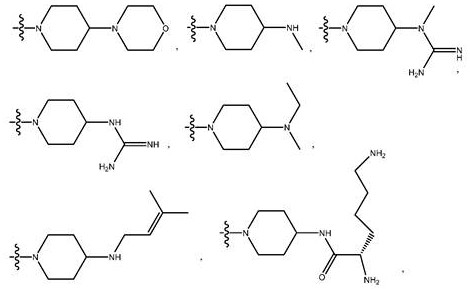

in certain embodiments, T is selected from:

y is at each occurrence O. In some embodiments, R 2 Selected from H, G, acyl, trityl, 4-methoxytrityl, benzoyl and stearyl.
In certain embodiments, T has the formula:

y is at each occurrence O and R 2 Is G.
In certain embodiments, T has the formula:

and Y is O at each occurrence.
In certain embodiments, T has the formula: y is at each occurrence O, each R 1 is-N (CH) 3 ) 2 And R is 2 Is H.
In another aspect, the invention features an antisense oligomer compound of formula (VII):

or a pharmaceutically acceptable salt thereof,
wherein each Nu is a nucleobase that together form a targeting sequence;
Z is an integer from 8 to 38;
t is selected from:

each R 1 is-N (R) 4 ) 2 Wherein each R is 4 Independently C 1 -C 6 An alkyl group; and
R 2 selected from H, G, acyl, trityl, 4-methoxytrityl, benzoyl and stearyl,
wherein G is a cell penetrating peptide ("CPP") and is selected from the group consisting of-C (O) (CH) 2 ) 5 NH-CPP、-C(O)(CH 2 ) 2 NH-CPP、-C(O)(CH 2 ) 2 NHC(O)(CH 2 ) 5 NH-CPP、-C(O)CH 2 NH-CPP and:

wherein the CPP is attached to the linker moiety through an amide bond at the carboxy terminus of the CPP, and
wherein T is Or R is 2 Is G.
In some embodiments, the targeting sequences of the antisense oligomers of the invention, including, for example, some embodiments of the antisense oligomers of formulas (I) and (IV), are selected from the sequences summarized in tables 2A-2C, as described herein and as follows:
I.
a) SEQ ID NO. 13 (GGC CAG AAG GAA GGC GAG AAA AGC) wherein Z is 22;
b) SEQ ID NO. 14 (GCC AGA AGG AAG GC GAG AAA AGC X) wherein Z is 22;
c) SEQ ID NO. 15 (CCA GAA GGA AGG CGA GAA AAG CXC) wherein Z is 22;
d) SEQ ID NO. 16 (CAG AAG GAA GGC GAG AAA AGC XCC) wherein Z is 22;
e) SEQ ID NO. 17 (AGA AGG AAG GCG AGA AAA GCX CCA) wherein Z is 22;
f) SEQ ID NO. 18 (GAA GGA AGG CGA GAA AAG CXC CAG) wherein Z is 22;
g) SEQ ID NO. 19 (AAG GAA GGC GAG AAA AGC XCC AGC), wherein Z is 22;
h) SEQ ID NO. 20 (AGG AAG GCG AGA AAA GCX CCA GCA), wherein Z is 22;
i) SEQ ID NO. 21 (CGG CXC XCA AAG CAG CXC XGA GA) wherein Z is 21;
j) SEQ ID NO. 22 (ACG GCX CXC AAA GCA GCX CXG AG) wherein Z is 21;
k) SEQ ID NO. 23 (CAC GGC XCX CAA AGC AGC XCX GA), wherein Z is 21;
l) SEQ ID NO. 24 (XCA CGG CXC XCA AAG CAG CXC XG) wherein Z is 21;
m) SEQ ID NO. 25 (CXC ACG GCX CXC AAA GCA GCX CX) wherein Z is 21;
n) SEQ ID NO. 26 (ACX CAC GGC XCX CAA AGC AGC XC) wherein Z is 21;
o) SEQ ID NO. 27 (GCG GCA CXC ACG GCX CXC AAA GC) wherein Z is 21;
p) SEQ ID NO. 28 (GGC GGC ACX CAC GGC XCX CAA AG) wherein Z is 21;
q) SEQ ID NO. 29 (CGG CAC XCA CGG CXC XCA AAG CA) wherein Z is 21;
r) SEQ ID NO. 30 (GCA CXC ACG GCX CXC AAA GCA GC) wherein Z is 21;
s) SEQ ID NO. 31 (GGC ACX CAC GGC XCX CAA AGC AG) wherein Z is 21;
t) SEQ ID NO. 32 (CAC XCA CGG CXC XCA AAG CAG CX) wherein Z is 21;
u) SEQ ID NO. 33 (GCC AGA AGG AAG GCG AGA AAA GC) wherein Z is 21;
v) SEQ ID NO. 34 (CCA GAA GGA AGG CGA GAA AAG C) wherein Z is 19;
w) SEQ ID NO. 35 (CAG AAG GAA GGC GAG AAA AGC) wherein Z is 19;
x) SEQ ID NO. 36 (GGC CAG AAG GAA GGC GAG AAA AG) wherein Z is 21;
y) SEQ ID NO. 37 (GGC CAG AAG GAA GGC GAG AAA A), wherein Z is 19;
z) SEQ ID NO. 38 (GGC CAG AAG GAA GGC GAG AAA), wherein Z is 19;
aa) SEQ ID NO 39 (CGG CAC XCA CGGC XCX CAA AGC A), wherein Z is 21;
bb) SEQ ID NO. 40 (GCG GCA CXC ACGG CXC XCA AAG C), wherein Z is 21;
cc) SEQ ID NO. 41 (GGC GGC ACX CAC G GCX CXC AAA G) wherein Z is 21;
dd) SEQ ID NO. 42 (XGG GGA GAG GGC CAG AAG GAA GGC), wherein Z is 22;
ee) SEQ ID NO. 43 (XGG GGA GAG GGC CAG AAG GAA GC), wherein Z is 21;
ff) SEQ ID NO. 44 (XGG GGA GAG GGC CAG AAG GAA C), wherein Z is 20;
gg) SEQ ID NO. 45 (GGC CAG AAG GAA GCG AGA AAA GC), wherein Z is 21;
hh) SEQ ID NO. 46 (GGC CAG AAG GAA CGA GAA AAG C), wherein Z is 20;
ii) SEQ ID NO. 47 (AGG AAG CGA GAA AAG CXC CAG CA) wherein Z is 21;
jj) SEQ ID NO. 48 (AGG AAC GAG AAA AGC XCC AGC A), wherein Z is 20;
kk) SEQ ID NO. 49 (CGG GCX CXC AAA GCA GCX CXG AGA), wherein Z is 22;
ll) SEQ ID NO. 50 (CGC XCX CAA AGC AGC XCX GAG A) wherein Z is 20;
mm) SEQ ID NO. 51 (CCX CXC AAA GCA GCX CXG AGA), wherein Z is 19;
nn) SEQ ID NO. 52 (GGC GGC ACX CAC GGG CXC XCA AAG), wherein Z is 22;
oo) SEQ ID NO. 53 (GGC GGC ACX CAC GCX CXC AAA G) wherein Z is 20;
pp) SEQ ID NO. 54 (GGC GGC ACX CAC CXC XCA AAG), wherein Z is 19;
qq) SEQ ID NO. 55 (GCG GGA GGG GCG GCA CXC ACG GGC) wherein Z is 22;
rr) SEQ ID NO. 56 (GCG GGA GGG GCG GCA CXC ACG GC) wherein Z is 21;
ss) SEQ ID NO 57 (GCG GGA GGG GCG GCA CXC ACG C) wherein Z is 20; and
tt) SEQ ID NO 58 (GCG GGA GGG GCG GCA CXC ACC), wherein Z is 19,
wherein X is selected from uracil (U) or thymine (T);
II.
a) SEQ ID NO 59 (GGC CAG AAG GAA GGG CGA GAA AAG C) wherein Z is 23;
b) SEQ ID NO. 60 (CCA GAA GGA AGG GCG AGA AAA GCX C) wherein Z is 23;
c) SEQ ID NO. 61 (AAG GAA GGG CGA GAA AAG CXC CAG C) wherein Z is 23;
d) SEQ ID NO. 62 (GCG GGA GGG GCG GCA CXC ACG GGG C) wherein Z is 23;
e) SEQ ID NO. 63 (XGG GGA GAG GGC CAG AAG GAA GGG C) wherein Z is 23;
f) SEQ ID NO. 64 (AGA AGG AAG GGC GAG AAA AGC XCC A) wherein Z is 23;
g) SEQ ID NO. 65 (GCX CXC AAA GCA GCX CXG AGA CAX C) wherein Z is 23;
h) SEQ ID NO. 66 (CXC XCA AAG CAG CXC XGA GAC AXC A) wherein Z is 23;
i) SEQ ID NO. 67 (XCX CAA AGC AGC XCX GAG ACA XCA A) wherein Z is 23;
j) SEQ ID NO. 68 (CXC AAA GCA GCX CXG AGA CAX CAA C) wherein Z is 23;
k) SEQ ID NO. 69 (XCA AAG CAG CXC XGA GAC AXC AAC C) wherein Z is 23;
l) SEQ ID NO 70 (CAA AGC AGC XCX GAG ACA XCA ACC G) wherein Z is 23;
m) SEQ ID NO. 71 (AAA GCA GCX CXG AGA CAX CAA CCG C) wherein Z is 23;
n) SEQ ID NO. 72 (AAG CAG CXC XGA GAC AXC AAC CGC G) wherein Z is 23;
o) SEQ ID NO. 73 (AGC AGC XCX GAG ACA XCA ACC GCG G) wherein Z is 23;
p) SEQ ID NO 74 (GCA GCX CXG AGA CAX CAA CCG CGG C) wherein Z is 23; and
q) SEQ ID NO. 75 (CAG CXC XGA GAC AXC AAC CGC GGC X) wherein Z is 23,
wherein X is selected from uracil (U) or thymine (T); and
III.
a) SEQ ID NO. 76 (GCC AGA AGG AAG GGC GAG AAA AGC X) wherein Z is 23;
b) SEQ ID NO. 77 (CAG AAG GAA GGG CGA GAA AAG CXC C) wherein Z is 23;
c) SEQ ID NO. 78 (GAA GGA AGG GCG AGA AAA GCX CCA G) wherein Z is 23;
d) SEQ ID NO. 79 (AGG AAG GGC GAG AAA AGC XCC AGC A) where Z is 23;
e) 80 (ACX CAC GGG GCX CXC AAA GCA GCX C) in SEQ ID NO, wherein Z is 23;
f) SEQ ID NO. 81 (GGCXCXCAAAGCAGCXCXCXGAGACAX) wherein Z is 23;
g) SEQ ID NO. 82 (GGC XCX CAA AGC AGC XCX GA), wherein Z is 18,
h) SEQ ID NO. 83 (GAG AGG GCC AGA AGG AAG GG) wherein Z is 18,
i) SEQ ID NO. 84 (XXX GCC AXG XXA CCC AGG CX) wherein Z is 18,
j) SEQ ID NO 85 (GCG CAC CCX CXG CCC XGG CC) wherein Z is 18, and
k) SEQ ID NO 86 (GGC CCX GGX CXG CXG GCX CCC XGC X) wherein Z is 23,
wherein X is selected from uracil (U) or thymine (T).
In certain embodiments, the targeting sequence is selected from the group consisting of SEQ ID NOs 13, 27-29, 34-36, 59 and 82. In certain embodiments, the targeting sequence is selected from the group consisting of SEQ ID NOs 13, 27-29, 34-36 and 59. In certain embodiments, the targeting sequence is selected from SEQ ID NOs 13, 27-29 and 34-36. In certain embodiments, each occurrence of X in any of SEQ ID NOs 13, 27-29, 34-36, 59 and 82 is T.
In some embodiments, including, for example, antisense oligomers of formulas (I) and (IV), the targeting sequence is complementary to a target region within intron 1 (SEQ ID NO: 1) of the pre-mRNA of the human alpha Glucosidase (GAA) gene. In some embodiments, the targeting sequence is complementary to a target region in exon 2 or intron 2 of the human GAA gene. In various embodiments, including, for example, embodiments of antisense oligomers of formulas (I) and (IV), the targeting sequence is complementary to a target region within intron 1 (SEQ ID NO: 1) of the pre-mRNA of the human alpha Glucosidase (GAA) gene, wherein the target region comprises at least one additional nucleobase as compared to the targeting sequence, wherein the at least one additional nucleobase does not have a complementary nucleobase in the targeting sequence, and wherein the at least one additional nucleobase is internal to the target region. In certain embodiments, the targeting sequence comprises a sequence selected from SEQ ID NOS 13-86, as shown in tables 2A-2C herein. In certain embodiments, the targeting sequence comprises a sequence selected from tables 2A and 2B. In certain embodiments, the targeting sequence is selected from the group consisting of SEQ ID NOs 13, 27-29, 34-36, 59 and 82. Furthermore, and with respect to the sequences outlined in tables 2A-2C (or tables 2B and 2C) herein, in certain embodiments, sequences with 100% complementarity are selected and one or more nucleobases are removed (or alternatively, one or more missing nucleobase syntheses are accompanied), such that the resulting sequence has one or more missing nucleobases in the target region as compared to its natural complement. Except for the portion where one or more nucleobases are removed, it is contemplated that the remainder is 100% complementary. However, it is within the scope of the invention that there may be a reduced level of complementarity.
In some embodiments, at least one X of SEQ ID NOS 13-86 is T. In some embodiments, at least one X of SEQ ID NOS 13-86 is U. In some embodiments, each X in SEQ ID NOS 13-86 is T. In some embodiments, each X in SEQ ID NOS 13-86 is U. In various embodiments, at least one X of the targeting sequence is T. In various embodiments, each X of the targeting sequence is T. In various embodiments, at least one X of the targeting sequence is U. In various embodiments, each X of the targeting sequence is U.
These and other aspects of the invention will become apparent upon reference to the following detailed description and accompanying drawings. All references disclosed herein are incorporated by reference in their entirety as if each was individually incorporated.
Brief Description of Drawings
Figures 1 and 2 are bar graphs depicting GAA enzyme activity (enzyme assay) found for various PMO compounds during screening. The Y-axis represents fold increase in GAA enzyme activity relative to the unreacted control. "N" refers to the number of replicates evaluated in each study. Horizontal hash lines represent GAA activity levels in untreated cells. Each compound was administered at 5 μm and 0.2 μm. Horizontal hash lines represent GAA activity levels in untreated cells.
Figures 3 and 4 are bar graphs depicting the enzymatic assay dose response found for various PMO compounds. The Y-axis represents fold increase in GAA enzyme activity relative to untreated controls. Each compound was administered at 5 μm, 1 μm, 0.2 μm and 0.4 μm. Horizontal hash lines represent GAA activity levels in untreated cells.
Fig. 5-8 are bar graphs depicting the enzymatic assay dose response found for various PMO compounds. The Y-axis represents fold increase in GAA enzyme activity relative to untreated controls. Each compound was administered at 5 μm, 1 μm, 0.2 μm and 0.04 μm. Horizontal hash lines represent GAA activity levels in untreated cells.
Figures 9-14 are bar graphs depicting the enzymatic assay dose response found for various PMO compounds. The Y-axis represents fold increase in GAA enzyme activity relative to untreated controls. Each compound was administered at 5 μm, 1.6 μm, 0.5 μm and 0.16 μm. Horizontal hash lines represent GAA activity levels in untreated cells.
Fig. 15a and 15b are bar graphs depicting the enzymatic assay dose response found for various PPMO compounds. The Y-axis represents fold increase in GAA enzyme activity relative to untreated controls. Each compound was administered at 5 μm, 1.6 μm and 0.5 μm. Horizontal hash lines represent GAA activity levels in untreated cells.
Fig. 16 is a bar graph depicting the enzymatic assay dose response found for various PMO compounds. The Y-axis represents fold increase in GAA enzyme activity relative to untreated controls. Each compound was administered at 5 μm. Horizontal hash lines represent GAA activity levels in untreated cells.
FIGS. 17 and 18 are bar graphs depicting GAA enzyme activity (enzyme assay) found for various PPMO compounds. The Y-axis represents fold increase in GAA enzyme activity relative to untreated controls. Each compound was administered at 5 μm, 1.6 μm and 0.5 μm. Horizontal hash lines represent GAA activity levels in untreated cells. "n=9" refers to the number of repetitions evaluated in each study. The data summary table shows EC in μm 50 。
FIG. 19 is a graph depicting EC with respect to various PPMO compounds 50 Data summary table (in μm).
FIGS. 20-22 are bar graphs depicting GAA enzyme activity (enzyme assay) found for various PPMO compounds. The Y-axis represents fold increase in GAA enzyme activity relative to untreated controls. Each compound was administered at 5 μm, 1.6 μm and 0.5 μm. Horizontal hash lines represent GAA activity levels in untreated cells. The data summary table shows EC in μm 50 。
FIG. 23 is a graph depicting EC with respect to various PPMO compounds 50 Data summary table (in μm).
FIGS. 24-26 are bar graphs depicting GAA enzyme activity (enzyme assay) found for various PPMO compounds. The Y-axis represents fold increase in GAA enzyme activity relative to untreated controls. Each compound was administered at 5 μm, 1.6 μm and 0.5 μm. Horizontal hash lines represent GAA activity levels in untreated cells. The data summary table shows EC in μm 50 。
Detailed Description
I. Definition of the definition
Unless defined otherwise, all technical and scientific terms used herein have the same meaning as commonly understood by one of ordinary skill in the art to which this invention belongs. Although preferred methods and materials are described, any methods and materials similar or equivalent to those described herein can be used in the practice or testing of the present subject matter. For the purposes of the present invention, the following terms are defined below.
The articles "a" and "an" are used herein to refer to one or to more than one (i.e., to at least one) of the grammatical object of the article. For example, "an element" means one element or more than one element.
By "about" is meant that the amount, level, value, number, frequency, percentage, size, quantity, weight, or length varies by up to 30, 25, 20, 15, 10, 9, 8, 7, 6, 5, 4, 3, 2, or 1% from a reference amount, level, value, number, frequency, percentage, size, quantity, weight, or length.
"coding sequence" means any nucleic acid sequence that contributes to the polypeptide product of a coding gene. In contrast, the term "non-coding sequence" refers to any nucleic acid sequence that does not directly contribute to the polypeptide product of the coding gene.
Throughout this disclosure, unless the context requires otherwise, the words "comprise", "comprises" and "comprising" will be understood to imply the inclusion of a stated step or element or group of steps or elements but not the exclusion of any other step or element or group of steps or elements.
"consisting of … …" is intended to include, and not be limited to, anything following the phrase "consisting of … …". Thus, the phrase "consisting of … …" indicates that the listed elements are required or mandatory and that no other elements are present. "consisting essentially of … …" is intended to include any element listed after the phrase and is limited to other elements that do not interfere with or contribute to the activity or effect specified for the listed elements in the present invention. Thus, the phrase "consisting essentially of … …" indicates that the listed elements are essential or mandatory, but that other elements are optional and may or may not be present, depending on whether they substantially affect the activity or function of the listed elements.
As used herein, the terms "contacting a cell," "introducing" or "delivering" include delivering an oligomer of the invention into a cell by methods conventional in the art, e.g., transfection (e.g., liposomes, calcium phosphate, polyethylenimine), electroporation (e.g., nuclear transfection), microinjection.
As used herein, the term "alkyl" is intended to include linear (i.e., unbranched or acyclic), branched, cyclic, or polycyclic non-aromatic hydrocarbon groups, optionally substituted with one or more functional groups. Unless otherwise indicated, an "alkyl" group contains 1 to 8, and preferably 1 to 6 carbon atoms. C (C) 1 -C 6 Alkyl is contemplated to include C 1 、C 2 、C 3 、C 4 、C 5 And C 6 An alkyl group. Lower alkyl refers to an alkyl group containing 1 to 6 carbon atoms. Examples of alkyl groups include, but are not limited to, methyl, ethyl, n-propyl, isopropyl, cyclopropyl, butyl, isobutyl, sec-butyl, tert-butyl, cyclobutyl, pentyl, isopentyl, tert-pentyl, cyclopentyl, hexyl, isohexyl, cyclohexyl, and the like. Alkyl groups may be substituted or unsubstituted. Exemplary substituted alkyl groups include, but are not limited to, fluoromethyl, difluoromethyl, trifluoromethyl, 2-fluoroethyl, 3-fluoropropyl, hydroxymethyl, 2-hydroxyethyl, 3-hydroxypropyl, benzyl, substituted benzyl, phenethyl, substituted phenethyl, and the like.
As used herein, the term "alkoxy" means a subset of alkyl groups, wherein an alkyl group as defined above has the indicated number of carbon atoms attached through an oxygen bridge. For example, "alkoxy" refers to the group-O-alkyl, wherein the alkyl group contains a linear, branched, cyclic configuration of 1 to 8 carbon atoms. Examples of "alkoxy" include, but are not limited to, methoxy, ethoxy, n-propoxy, isopropoxy, t-butoxy, n-butoxy, sec-pentoxy, and the like.
As used herein, the term "aryl" alone or as part of a larger moiety, such as in "aralkyl", "aralkoxy" or "aryloxy-alkyl" refers to an aromatic ring group having six to fourteen ring atoms, such as phenyl, 1-naphthyl, 2-naphthyl, 1-anthryl and 2-anthryl. An "aryl" ring may contain one or more substituents. The term "aryl" may be used interchangeably with the term "aryl ring". "aryl" also includes fused polycyclic aromatic ring systems in which an aromatic ring is fused with one or more rings. Non-limiting examples of useful aryl ring groups include phenyl, hydroxyphenyl, halophenyl, alkoxyphenyl, dialkoxyphenyl, trialkoxyphenyl, alkylenedioxyphenyl, naphthyl, phenanthryl, anthracyl, phenanthro, and the like, as well as 1-naphthyl, 2-naphthyl, 1-anthracyl, and 2-anthracyl. Also included within the scope of the term "aryl" as it is used herein are groups in which an aromatic ring is fused to one or more non-aromatic rings, such as in indanyl, phenanthridinyl, or tetrahydronaphthyl, in which an atomic group or attachment point is on the aromatic ring.
The term "acyl" means a C (O) R group (wherein R represents H, alkyl or aryl as defined above). Examples of acyl groups include formyl, acetyl, benzoyl, phenylacetyl and the like.
As used herein, the term "homologue" means a compound that is regularly different by the sequential addition of the same chemical groups. For example, homologs of the compounds may be obtained by adding one or more-CH 2 -groups, amino acid residues, nucleotides or nucleotide analogues.
The terms "cell penetrating peptide" (CPP) or "peptide moiety that enhances cellular uptake" are used interchangeably and refer to a cationic cell penetrating peptide, also known as a "transit peptide", "carrier peptide" or "peptide transduction domain". As shown herein, the peptides have the ability to induce cell penetration within at least about 30%, 40%, 50%, 60%, 70%, 80%, 90% or 100% of cells of a given cell culture population and allow translocation of macromolecules within multiple tissues in vivo after systemic administration. In some embodiments, the CPP has the formula- [ (C (O) CHR' NH) m ]R ' ' wherein R ' is a side chain of a naturally occurring amino acid or a mono-or di-carbon homologue thereof, R ' ' is selected from hydrogen or acyl, and m is an integer up to 50. CPP may also have -[(C(O)CHR'NH) m ]R a Wherein R' is a side chain of a naturally occurring amino acid or a mono-or di-carbon homologue thereof, and wherein Ra is selected from hydrogen, acyl, benzoyl or stearoyl. CPP of any structure can be attached to the 3 'or 5' end of the antisense oligomer via a "linker," such as-C (O) (CH 2 ) 5 NH-、-C(O)(CH 2 ) 2 NH-、-C(O)(CH 2 ) 2 NH-C(O)(CH 2 ) 5 NH-or-C (O) CH 2 NH-. Additional CPPs are well known in the art and are disclosed, for example, in U.S. application Ser. No. 2010/0016215, which is incorporated by reference in its entirety. In other embodiments, m is an integer selected from 1 to 50, wherein when m is 1, the moiety is a single amino acid or derivative thereof.
As used herein, "amino acid" refers to a compound consisting of carbon atoms to which primary amino groups, carboxylic acid groups, side chains, and hydrogen atoms are attached. For example, the term "amino acid" includes, but is not limited to, glycine, alanine, valine, leucine, isoleucine, asparagine, glutamine, lysine, and arginine. In addition, as used herein, "amino acid" also includes derivatives of amino acids, such as esters, amides, and salts, as well as other derivatives, including derivatives that have pharmacological properties when metabolized to an active form. Accordingly, the term "amino acid" is understood to include naturally occurring and non-naturally occurring amino acids.
As used herein, "electron pair" refers to a valence electron pair that is not bonded or shared with another atom.
As used herein, "homology" refers to the percentage of amino acids that are identical or constitute conservative substitutions. Homology can be determined using sequence comparison programs such as GAP (Deveraux et al, 1984, nucleic Acids Research, 387-395). In this way, sequences of similar or substantially different lengths than those cited herein may be compared by inserting GAPs into the alignment, such GAPs being determined, for example, by the comparison algorithm used by GAPs.
By "isolated" is meant a substance that is substantially or essentially free of components that normally accompany it in its natural state. For example, as used herein, an "isolated polynucleotide," "isolated oligonucleotide," or "isolated oligomer" may refer to a polynucleotide that has been purified or removed from a sequence flanked by naturally occurring states, e.g., a DNA fragment removed from a sequence adjacent to a fragment in the genome. The term "isolated" when it relates to a cell refers to the purification of the cell (e.g., fibroblast, lymphoblastic) from a source host (e.g., a host with a polynucleotide repeat disease). In the context of mRNA or protein, "isolating" refers to recovering mRNA or protein from a source such as a cell.
The term "modulating" includes "increasing" or "decreasing" one or more quantifiable parameters, optionally by a defined and/or statistically significant amount. "increase" or "increase", "enhancement" or "enhancement", or "stimulus" or "stimulation" refers generally to the ability of one or more antisense compounds or compositions to produce or elicit a greater physiological response in a cell or subject relative to the response elicited by a non-antisense compound or control compound (i.e., a downstream effect). The relevant physiological or cellular response (in vivo or in vitro) will be apparent to those skilled in the art and may include an increase in the inclusion of exon 2 in the GAA-encoding pre-mRNA, or an increase in the expression of a functional GAA enzyme in a cell, tissue or subject in need thereof. The "increased" or "enhanced" amount is typically a "statistically significant" amount and may include an increase that is 1.1, 1.2, 2, 3, 4, 5, 6, 7, 8, 9, 10, 15, 20, 30, 40, 50 or more times (e.g., 500, 1000 times) of the amount produced by the non-antisense compound (in the absence of the agent) or the control compound, including all integers and decimal points between 1 and more than 1 (e.g., 1.5, 1.6, 1.7, 1.8). The term "reduce" or "inhibit" may generally refer to the ability of one or more antisense compounds or compositions to "reduce" an associated physiological or cellular response, such as the symptoms of a disease or condition described herein, as measured according to conventional techniques in the diagnostic arts. The relevant physiological or cellular response (in vivo or in vitro) will be apparent to those skilled in the art and may include a decrease in symptoms or pathological conditions of glycogen storage disease, such as pompe disease, e.g., a decrease in glycogen accumulation in one or more tissues. The "decrease" in response may be "statistically significant" as compared to a response produced by an antisense-free compound or control composition, and may include a 1%, 2%, 3%, 4%, 5%, 6%, 7%, 8%, 9%, 10%, 11%, 12%, 13%, 14%, 15%, 16%, 17%, 18%, 19%, 20%, 25%, 30%, 35%, 40%, 45%, 50%, 55%, 60%, 65%, 70%, 75%, 80%, 85%, 90%, 95% or 100% decrease, including all integers therebetween.
As used herein, "antisense oligonucleotide," "antisense oligomer," or "oligonucleotide" refers to a linear sequence of nucleotides or nucleotide analogs that allows nucleobases to hybridize to a target sequence in RNA by watson-crick base pairing to form an oligomer within the target sequence, RNA heteroduplex. The terms "antisense oligonucleotide", "modified antisense oligonucleotide", "antisense oligomer", "oligomer" and "compound" are used interchangeably to refer to an oligomer. The cyclic subunit may be based on ribose or another pentose, or in certain embodiments, morpholino groups (see description of morpholino oligomers below). Also contemplated are Peptide Nucleic Acids (PNAs), locked Nucleic Acids (LNAs), tricyclic-DNA oligomers, tricyclic-phosphorothioate oligomers and 2' -O-methyl oligomers, as well as other antisense agents known in the art.
Included are non-naturally occurring oligomers or "oligonucleotide analogs," including oligomers having: (i) Modified backbone structures, e.g., backbones other than standard phosphodiester linkages found in naturally occurring oligonucleotides and polynucleotides, and/or (ii) modified sugar moieties, e.g., morpholino moieties other than ribose or deoxyribose moieties. The oligomer analogs support bases capable of forming hydrogen bonds with standard polynucleotide bases by Watson-Crick base pairing, wherein the analog backbone presents the bases in such a way as to allow such hydrogen bonds in a sequence-specific manner between the bases in the oligomer analog molecule and the standard polynucleotide (e.g., single-stranded RNA or single-stranded DNA). Preferred analogs are those having a substantially uncharged phosphorus-containing backbone.
"nuclease resistant" oligomer refers to an oligomer whose backbone is substantially resistant to nuclease cleavage in non-hybridized or hybridized form; by extracellular and intracellular nucleases common in the body (e.g., by exonucleases such as 3' -exonuclease, endonuclease, rnase H); that is, the oligomer exhibits little or no nuclease cleavage under normal nuclease conditions to which the oligomer is exposed in vivo. "nuclease resistant heteroduplex" refers to heteroduplex formed by binding of an antisense oligomer to its complementary target such that the heteroduplex is substantially resistant to in vivo degradation by intracellular and extracellular nucleases capable of cleaving double stranded RNA/RNA or RNA/DNA complexes. "heteroduplex" refers to a duplex between an antisense oligomer and a complementary portion of a target RNA.
As used herein, "nucleobase" (Nu), "base pairing moiety" or "base" is used interchangeably to refer to a purine or pyrimidine base (uracil, thymine, adenine, cytosine and guanine) found in natural DNA or RNA, as well as naturally occurring analogs of purine and pyrimidine, which impart improved properties, such as binding affinity to an oligomer. Exemplary analogs include hypoxanthine (the base component of nucleoside inosine); 2, 6-diaminopurine; 5-methylcytosine; c5-propynyl modified pyrimidines; 9- (aminoethoxy) phenoxazine (G-clamp), and the like.
Further examples of base pairing moieties include, but are not limited to, uracil, thymine, adenine, cytosine, guanine and hypoxanthine, 2-fluorouracil, 2-fluorocytosine, 5-bromouracil, 5-iodouracil, 2, 6-diaminopurine, azacytosine, pyrimidine analogs such as pseudoisocytosine and pseudouracil, and other modified nucleobases such as 8-substituted purines, xanthines or hypoxanthines (the latter two being natural degradation products). Modified nucleobases as disclosed in Chiu and Rana, RNA, 2003, 9, 1034-1048, limbach et al Nucleic Acids Research, 1994, 22, 2183-2196 and Revankarar and Rao, comprehensive Natural Products Chemistry, volume 7, 313 are also contemplated.
Further examples of base pairing moieties include, but are not limited to, extended size nucleobases in which one or more benzene rings have been added. Glen Research directory (www.glenresearch.com); krueger AT et al, acc, chem, res, 2007, 40, 141-150; kool, ET, acc, chem, res, 2002, 35, 936-943; benner s.a. et al, nat. Rev. Genet., 2005, 6, 553-543; romisberg, f.e. et al, curr. Omin. Chem. Biol., 2003, 7, 723-733; nucleobase substitutions described in Hirao, i., curr. Opin. Chem. Biol., 2006, 10, 622-627 are contemplated as useful for synthesizing the oligomers described herein. Examples of nucleobases of expanded size are shown below:


Nucleobases covalently linked to ribose, sugar analogs, or morpholinos comprise nucleosides. A "nucleotide" consists of a nucleoside together with a phosphate group. The phosphate groups covalently link adjacent nucleotides to each other to form an oligomer.
An oligomer "specifically hybridizes" to a target polynucleotide if the oligomer hybridizes to the target under physiological conditions with a Tm that is substantially greater than 40 ℃ or 45 ℃, preferably at least 50 ℃, and typically 60 ℃ to 80 ℃ or more. Such hybridization preferably corresponds to stringent hybridization conditions. At a given ionic strength and pH, tm is the temperature at which 50% of the target sequence hybridizes to the complementary polynucleotide. Such hybridization may occur with "near" or "substantial" complementarity of the antisense oligomer to the target sequence, as well as with exact complementarity.
As used herein, "sufficient length" refers to an antisense copolymer or targeting sequence thereof that is complementary to GAA intron 1, exon 2, or a region of intron 2, or spans at least 8, at least 9, at least 10, at least 11, at least 12, at least 13, at least 14, at least 15, at least 16, at least 17, at least 18, at least 19, at least 20, at least 21, at least 22, at least 23, at least 24, at least 25, at least 26, at least 27, at least 28, at least 29, or at least 30 or more, e.g., 8-40, and e.g., 15-40 contiguous nucleobases in any of the foregoing regions. Antisense oligomers of sufficient length have at least a minimum number of nucleotides to be able to specifically hybridize to the GAA pre-mRNA repeat region in the mutant RNA. Preferably, the oligomer of sufficient length is 8 to 30 nucleotides in length. More preferably, the oligomer of sufficient length is 9 to 27 nucleotides in length. Even more preferably, the oligomer of sufficient length is 15 to 40 nucleotides in length.
As used herein, the term "sequence identity" or, for example, comprising "a sequence that is 50% identical thereto" refers to the degree to which sequences are identical on a nucleotide-by-nucleotide basis or an amino acid-by-amino acid basis over a comparison window. Thus, the "percent sequence identity" can be calculated by: the two optimally aligned sequences are compared over a comparison window, the number of positions at which the same nucleobase (e.g., A, T, C, G, I) or the same amino acid residue (e.g., ala, pro, ser, thr, gly, val, leu, ile, phe, tyr, trp, lys, arg, his, asp, glu, asn, gln, cys and Met) occurs in the two sequences is determined to produce the number of matched positions, the number of matched positions is divided by the total number of positions in the comparison window (i.e., window size), and the result is multiplied by 100 to produce the percent sequence identity. Optimal alignment of sequences for comparison windows can be performed by computerized implementation of the algorithm (Wisconsin Genetics Software Package Release 7.0.0, genetics Computer Group, 575 Science Drive Madison, wis., GAP, BESTFIT, FASTA and TFASTA in USA or by inspection, and by any of a variety of methods selected to generate optimal alignment (i.e., resulting in the highest percent homology over the comparison window). Reference can also be made to the BLAST program family, as disclosed, for example, by Altschul et al, nucleic Acids res.25:3389, 1997.
"subject" or "subjects in need thereof" includes mammalian subjects, such as human subjects. An exemplary mammalian subject suffers from or is at risk of suffering from GSD-II (or Pang Pibing). As used herein, the term "GSD-II" refers to a glycogen storage disease type II (GSD-II or Pang Pibing), a human autosomal recessive disease typically characterized by underexpression of GAA protein in the affected individual. In certain embodiments, the subject has reduced expression and/or activity of GAA protein in one or more tissues (e.g., heart, skeletal muscle, liver, and nervous system tissues). In some embodiments, the subject has increased glycogen accumulation in one or more tissues (e.g., heart, skeletal muscle, liver, and nervous system tissues). In particular embodiments, the subject has an IVS1-13T > G mutation or other mutation that results in reduced expression of the functional GAA protein (see, e.g., zampiier et al, european J. Human genetics 19:422-431, 2011).
As used herein, the term "target" refers to an RNA region, and in particular, to a target consisting ofGAARegion identified by the gene. In a particular embodiment, the target is a region within intron 1 of the pre-mRNA encoding GAA (e.g., SEQ ID NO: 1) that is responsible for inhibiting the signal that facilitates inclusion of exon 2. In another embodiment, the target region is GAARegion of mRNA for exon 2. In a further embodiment, the target comprises one or more discrete subregions of intron 1 of the GAA-encoding pre-mRNA. These subregions include, but are not limited to, the sequences defined by SEQ ID NO. 2 and SEQ ID NO. 3.
The term "target sequence" refers to a portion of the target RNA to which the oligomer analog is directed, i.e., the sequence to which the oligomer analog hybridizes by Watson-Crick base pairing of the complementary sequences.
The term "targeting sequence" is a sequence in an oligomer or oligomer analogue that is complementary (meaning, in addition, substantially complementary) to a "target sequence" in the RNA genome. The entire sequence or only a portion of the antisense oligomer may be complementary to the target sequence. For example, in an oligomer having 20-30 bases, about 6, 7, 8, 9, 10, 11, 12, 13, 14, 15, 16, 17, 18, 19, 20, 21, 22, 23, 24, 25, 26, 27, 28, or 29 can be targeting sequences complementary to the target region. Typically, the targeting sequence is formed of contiguous bases in the oligomer, but may alternatively be formed of non-contiguous sequences that, when taken together, constitute, for example, sequences spanning the target sequence from opposite ends of the oligomer.
The "targeting sequence" may have "near" or "substantial" complementarity to the target sequence and still function for the purposes of the present invention, i.e., remain "complementary". Preferably, the oligomer analogue compounds employed in the present invention have at most one mismatch of 10 nucleotides, and preferably at most one mismatch of 20 nucleotides, to the target sequence. Alternatively, the antisense oligomer employed has at least 90% sequence homology, and preferably at least 95% sequence homology, with exemplary targeting sequences as specified herein.
As used herein, the term "TEG" or "triethylene glycol tail" refers to a triethylene glycol moiety conjugated to an oligonucleotide, for example, at its 3 'or 5' end. For example, in some embodiments, "TEG" includes where T, e.g., a compound of formula (I), (VI), or (VII), has the formula:

as used herein, the term "quantitative," "quantitative," or other related terms refer to the determination of the quantity, mass, or concentration of a nucleic acid, polynucleotide, oligomer, peptide, polypeptide, or protein per unit volume.
As used herein, a "treatment" of a subject (e.g., mammal, such as a human) or cell is any type of intervention used in an attempt to alter the natural course of the individual or cell. Treatment includes, but is not limited to, administration of pharmaceutical compositions, and may be performed prophylactically or after initiation of a pathological event or after contact with a pathogenic agent. Also included are "prophylactic" treatments, which may involve reducing the rate of progression, delaying the onset of, or reducing the severity of a disease or condition to be treated. "treating" or "preventing" does not necessarily indicate complete eradication, cure, or prevention of a disease or condition or associated symptoms thereof.
Sequences for GAA splice modulation
Certain embodiments relate to a method for enhancing the level of GAA-encoding mRNA containing exon 2 relative to GAA mRNA deleted from exon 2 in a cell comprising contacting the cell with an antisense oligomer of sufficient length and complementarity toGAAThe region within the gene hybridizes specifically such that the level of GAA mRNA containing exon 2 is increased relative to GAA mRNA deleted for exon-2 in the cell. In some embodiments, the cell is in a subject, and the method comprises administering an antisense oligomer to the subject.
Antisense oligomers can be designed to block or inhibit or regulate translation of mRNA, or inhibit or regulate pre-mRNA splicing processing, or induce degradation of targeted mRNA, and can be said to be "directed against" or "target" the target sequence with which it hybridizes. In certain embodiments, the target sequence comprises a region comprising the 3 'or 5' splice site of the pre-processed mRNA, a branch point, or other sequence involved in splice regulation. The target sequence may be within an exon or within an intron or across an intron/exon junction.
In certain embodiments, the antisense oligomer has sufficient sequence complementarity to the target RNA (i.e., the RNA for which splice site selection is to be regulated) to block a region of the target RNA (e.g., pre-mRNA) in an effective manner. In exemplary embodiments, such blocking of GAA pre-mRNA acts to modulate splicing, by masking binding sites for the native protein that would otherwise modulate splicing, and/or by altering the structure of the targeted RNA. In some embodiments, the target RNA is a target pre-mRNA (e.g., GAAGene pre-mRNA).
Antisense oligomer having sufficient sequence complementarity to the target RNA sequence to modulate splicing of the target RNA means that the antisense agent has a sequence sufficient to trigger masking of the binding site for the native protein that would otherwise modulate splicing, and/or alter the three-dimensional structure of the target RNA. Likewise, an oligomeric agent having sufficient sequence complementary to the target RNA sequence to modulate splicing of the target RNA means that the oligomeric agent has a sequence sufficient to trigger masking of the binding site for the native protein (which would otherwise modulate splicing), and/or alter the three-dimensional structure of the target RNA.
In certain embodiments, the antisense oligomer is of sufficient length and complementarity to a sequence in intron 1 of human GAA pre-mRNA, exon 2 of human GAA pre-mRNA, or intron 2 of human GAA pre-mRNA. Also included are antisense oligomers that are complementary to a region spanning exon 1/exon 2 of human GAA pre-mRNA or a region spanning exon 2/intron 2 of human GAA pre-mRNA. Concerning peopleGAAThe sequences of intron 1 (SEQ ID NO: 1), exon 2 (SEQ ID NO: 4) and intron 2 (SEQ ID NO: 5) of the gene are shown in Table 1 below (T/G highlighted near the 3' -end of SEQ ID NO: 1 is IVS1-13T as described above) >G mutation; the nucleotide at this position is T or G).


In certain embodiments, the antisense targeting sequences are designed to hybridize to regions of one or more of the target sequences listed in table 1. The selected antisense targeting sequence can be made shorter, e.g., about 12 bases, or longer, e.g., about 40 bases, and include a small number of mismatches, provided that the sequences are sufficiently complementary to effect splice modulation upon hybridization to the target sequence, and optionally form a heteroduplex with RNA having a Tm of 45 ℃ or higher.
In certain embodiments, the degree of complementarity between the target sequence and the antisense targeting sequence is sufficient to form a stable duplex. The region of complementarity of the antisense oligomer to the target RNA sequence may be as short as 8-11 bases, but may be 12-15 bases or more, such as 10-40 bases, 12-30 bases, 12-25 bases, 15-25 bases, 12-20 bases, or 15-20 bases, including all integers between these ranges. Antisense oligomers of about 14-15 bases are generally long enough to have unique complementary sequences. In certain embodiments, a minimum length of complementary bases may be required to achieve the requisite binding Tm, as discussed herein.
In certain embodiments, oligomers up to 40 bases may be suitable, wherein at least a minimum number of bases, e.g., 10-12 bases, are complementary to the target sequence. In some embodiments, the promotion or active uptake in the cell is optimized at an oligomer length of less than about 30 bases. For the PMO oligomers described further herein, the optimal balance of binding stability and uptake generally occurs at a length of 18-25 bases. Included in the present invention are antisense oligomers (e.g., PMO-X, PNA, LNA, 2' -OMe) consisting of about 10, 11, 12, 13, 14, 15, 16, 17, 18, 19, 20, 21, 22, 23, 24, 25, 26, 27, 28, 29, 30, 31, 32, 33, 34, 35, 36, 37, 38, 39, or 40 bases, wherein at least about 6, 8, 9, 10, 11, 12, 13, 14, 15, 16, 17, 18, 19, 20, 21, 22, 23, 24, 25, 26, 27, 28, 29, 30, 31, 32, 33, 34, 35, 36, 37, 38, 39, or 40 contiguous or non-contiguous bases are complementary to a target sequence of table 1 (e.g., a sequence of SEQ ID NOs: 1-5, spanning SEQ ID NOs: 1/4, or SEQ ID NOs: 4/5).
Antisense oligomers generally comprise a polypeptide that is complementary to a humanGAAThe sequence or region within or near intron 1, exon 2 or intron 2 of the pre-mRNA sequence of the gene is sufficiently complementary. In certain embodiments, the oligomer is complementary to SEQ ID NO. 2 and SEQ ID NO. 3. Ideally, antisense oligomers are effective in modulating aberrant splicing of GAA pre-mRNA and thereby increasing expression of active GAA protein. This requirement is optionally met when the oligomer compound has the ability to be actively absorbed by mammalian cells, and upon absorption forms a stable duplex (or heteroduplex) with the target mRNA, optionally with a Tm of greater than about 40 ℃ or 45 ℃.
In certain embodiments, the antisense oligomer may be 100% complementary to the target sequence, or may include mismatches, e.g., to accommodate the variant, so long as the heteroduplex formed between the oligomer and the target sequence is stable enough to withstand the action of cellular nucleases and other degradation modes that may occur in vivo. Thus, certain oligomers may have substantial complementarity, meaning about or at least about 70% sequence complementarity, e.g., 70%, 71%, 72%, 73%, 74%, 75%, 76%, 77%, 78%, 79%, 80%, 81%, 82%, 83%, 84%, 85%, 86%, 87%, 88%, 89%, 90%, 91%, 92%, 93%, 94%, 95%, 96%, 97%, 98%, 99% or 100% sequence complementarity between the oligomer and the target sequence. Oligomer backbones that are less susceptible to cleavage by nucleases are discussed herein. If present, mismatches are generally less labile to the end regions of the hybridization duplex than in the middle. The number of mismatches allowed will depend on the length of the oligomer, the percentage of G: C base pairs in the duplex, and the location of the mismatch in the duplex, according to well known principles of duplex stability. Although such antisense oligomer is not necessarily 100% complementary to v target sequence, it efficiently and stably and specifically binds to target sequence such that splicing of pre-target RNA is modulated.
The stability of the duplex formed between the oligomer and the target sequence is a function of the binding Tm and the susceptibility of the duplex to enzymatic cleavage by the cell. The Tm of oligomers of RNA with respect to complementary sequences can be measured by conventional Methods, for example those described by Hames et al, nucleic Acid Hybridization, IRL Press, 1985, pages 107-108, or as described in Miyada C.G. and Wallace R.B., 1987, oligomer Hybridization Techniques, methods enzymes, volume 154, pages 94-107. In certain embodiments, the antisense oligomer can have a binding Tm relative to the complementary sequence RNA that is greater than body temperature, and preferably greater than about 45 ℃ or 50 ℃. Also included is a Tm in the range of 60-80℃or higher. According to well known principles, the Tm of an oligomer relative to a complementarity based RNA hybrid can be increased by increasing the ratio of C: G paired bases in the duplex, and/or by increasing the length (in base pairs) of the heteroduplex. Meanwhile, to optimize cellular uptake, it may be advantageous to limit the size of the oligomer. For this reason, for high Tm values, compounds exhibiting a high Tm (45-50℃or higher) at a length of 25 bases or less are generally superior to those compounds requiring more than 25 bases.
Tables 2A, 2B and 2C show the identity with humansGAAExemplary targeting sequences complementary to the pre-mRNA sequence of the gene (in the 5 '-to 3' -direction).


Thus, certain antisense oligomers comprise, consist of, or consist essentially of: the sequences in tables 2A-2C, or variants or contiguous or non-contiguous portions thereof. For example, certain antisense oligomers comprise about or at least about 6, 7, 8, 9, 10, 11, 12, 13, 14, 15, 16, 17, 18, 19, 20, 21, 22, 23, 24, 25, 26, or 27 contiguous or non-contiguous nucleotides of any of the SEQ ID NOs summarized in tables 2A-2C. In certain embodiments, the targeting sequence is selected from the group consisting of SEQ ID NOs 13, 27-29, 34-36, 59 and 82. For non-contiguous portions, intervening nucleotides may be deleted. Additional examples of variants include oligomers having about or at least about 70% sequence identity or homology over the entire length of any of the SEQ ID NOs outlined in tables 2A-C, e.g., 70%, 71%, 72%, 73%, 74%, 75%, 76%, 77%, 78%, 79%, 80%, 81%, 82%, 83%, 84%, 85%, 86%, 87%, 88%, 89%, 90%, 91%, 92%, 93%, 94%, 95%, 96%, 97%, 98%, 99% or 100% sequence identity or homology. In some embodiments, any antisense oligomer or compound comprising, consisting of, or consisting essentially of such variant sequences inhibits ISS and/or ESS elements in GAA pre-mRNA. In some embodiments, the antisense oligomer or compound having a targeting sequence comprises, consists of, or consists essentially of such variant sequences that inhibit ISS and/or ESS elements in GAA pre-mRNA. In some embodiments, an antisense oligomer or compound having a targeting sequence comprising, consisting of, or consisting essentially of such variant sequences according to at least one example or method described herein increases, enhances, or promotes exon 2 retention in mature GAA mRNA, optionally, at least about 10%, 15%, 20%, 25%, 30%, 35%, 40%, 45%, 50%, 55%, 60%, or 65% or more relative to a control. In some embodiments, an antisense oligomer or compound having a targeting sequence comprising, consisting of, or consisting essentially of such variant sequences according to at least one example or method described herein increases, enhances, or promotes GAA protein expression in a cell, optionally by at least about 10%, 15%, 20%, 25%, 30%, 35%, 40%, 45%, 50%, 55%, 60%, or 65% or more relative to a control. In some embodiments, an antisense oligomer or compound comprising, consisting of, or consisting essentially of such variant sequences increases, enhances, or promotes GAA enzymatic activity in a cell, optionally by at least about 10%, 15%, 20%, 25%, 30%, 35%, 40%, 45%, 50%, 55%, 60%, or 65% or more relative to a control, according to at least one example or method described herein. As exemplified herein, cells (e.g., fibroblasts) can be obtained from a patient having an IVS1-13t > g mutation.
In some embodiments, certain antisense oligomers comprise, consist of, or consist essentially of: the sequences as detailed in table 2B (or table 2C) or variants or contiguous or non-contiguous portions thereof. For example, certain antisense oligomers comprise about or at least about 6, 7, 8, 9, 10, 11, 12, 13, 14, 15, 16, 17, 18, 19, 20, 21, 22, 23, 24, 25, 26, or 27 contiguous or non-contiguous nucleotides of any of the SEQ ID NOs summarized in table 2B or 2C. For non-contiguous portions, intervening nucleotides may be deleted. Additional examples of variants include oligomers having about or at least about 70% sequence identity or homology over the entire length of any of the SEQ ID NOs outlined in table 2B or 2C, e.g., 70%, 71%, 72%, 73%, 74%, 75%, 76%, 77%, 78%, 79%, 80%, 81%, 82%, 83%, 84%, 85%, 86%, 87%, 88%, 89%, 90%, 91%, 92%, 93%, 94%, 95%, 96%, 97%, 98%, 99% or 100% sequence identity or homology. In some embodiments, the antisense oligomer or compound having a targeting sequence comprises, consists of, or consists essentially of such variant sequences that inhibit ISS and/or ESS elements in GAA pre-mRNA. In some embodiments, an antisense oligomer or compound having a targeting sequence comprising, consisting of, or consisting essentially of such variant sequences according to at least one example or method described herein increases, enhances, or promotes exon 2 retention in mature GAA mRNA, optionally, at least about 10%, 15%, 20%, 25%, 30%, 35%, 40%, 45%, 50%, 55%, 60%, or 65% or more relative to a control. In some embodiments, an antisense oligomer or compound having a targeting sequence comprising, consisting of, or consisting essentially of such variant sequences according to at least one example or method described herein increases, enhances, or promotes GAA protein expression in a cell, optionally by at least about 10%, 15%, 20%, 25%, 30%, 35%, 40%, 45%, 50%, 55%, 60%, or 65% or more relative to a control. In some embodiments, an antisense oligomer or compound comprising, consisting of, or consisting essentially of such variant sequences increases, enhances, or promotes GAA enzymatic activity in a cell, optionally by at least about 10%, 15%, 20%, 25%, 30%, 35%, 40%, 45%, 50%, 55%, 60%, or 65% or more relative to a control, according to at least one example or method described herein. As exemplified herein, cells (e.g., fibroblasts) can be obtained from a patient having an IVS1-13t > g mutation.
In various aspects, antisense oligomers or compounds are provided that comprise a targeting sequence that is complementary (e.g., at least 80, 81, 82, 83, 84, 85, 86, 87, 88, 89, 90, 91, 92, 93, 94, 95, 96, 97, 98, 99, or 100% complementary) to a target region of a human GAA pre-mRNA, optionally wherein the targeting sequence is as shown in any of tables 2A-2C. In another aspect, an antisense oligomer or compound is provided that comprises a variant targeting sequence, such as any variant described herein, wherein the variant targeting sequence binds to a complementary target region of a human pre-mRNA that is complementary (e.g., 80% -100% complementary) to one or more of the targeting sequences described in any of tables 2A-2C. In some embodiments, the antisense oligomer or compound binds to a target sequence comprising at least 10 (e.g., at least 11, 12, 13, 14, 15, 16, 17, 18, 19, 20, 21, 22, 23, 24, 25, 26, 27, 28, 29, 30, 31, 32, 33, 34, 35, 36, 37, 38, 39, or 40) consecutive bases of human GAA pre-mRNA (e.g., any of SEQ ID NOs: 1, 2, or 3, or sequences spanning GAA pre-mRNA splice junctions defined by SEQ ID NOs: 1/4 or 4/5). In some embodiments, the target sequence is complementary (e.g., at least 80, 81, 82, 83, 84, 85, 86, 87, 88, 89, 90, 91, 92, 93, 94, 95, 96, 97, 98, 99, or 100% complementary) to one or more of the targeting sequences shown in any of tables 2A-2C. In some embodiments, the target sequence is complementary (e.g., at least 80, 81, 82, 83, 84, 85, 86, 87, 88, 89, 90, 91, 92, 93, 94, 95, 96, 97, 98, 99, or 100% complementary) to at least 10 (e.g., at least 11, 12, 13, 14, 15, 16, 17, 18, 19, 20, 21, 22, 23, 24, 25, 26, 27, or 28) consecutive bases of one or more of the targeting sequences shown in any of tables 2A-2C. In some embodiments, the target sequence is defined by an annealing site (e.g., GAA-ivs1.Sa. (-189, -165)) as shown in one or more tables herein.
The activity of antisense oligomers and variants thereof can be determined according to techniques conventional in the art. For example, the splice forms and expression levels of the investigated RNAs and proteins may be assessed by any of a wide variety of well-known methods for detecting splice forms and/or transcribed nucleic acid or protein expression. Non-limiting examples of such methods include RT-PCR of RNA in spliced form, followed by size separation of PCR products, nucleic acid hybridization methods such as northern blotting and/or use of nucleic acid arrays; a nucleic acid amplification method; immunological methods for detecting proteins; protein purification methods; and protein function or activity assays.
RNA expression levels can be assessed by: mRNA/cDNA (i.e., transcribed polynucleotide) is prepared from a cell, tissue or organism and hybridized to a reference polynucleotide or fragment thereof which is the complement of the assay nucleic acid. The cDNA may optionally be amplified using any of a variety of polymerase chain reactions or in vitro transcription methods prior to hybridization to the complementary polynucleotide; preferably, it is not amplified. Quantitative PCR can also be used to detect expression of one or more transcripts to assess the level of expression of the transcripts.
III antisense oligomer chemistry
A. General features
Certain antisense oligomers of the invention specifically hybridize to an intron splice silencer element or an exon splice silencer element. Some antisense oligomers comprise the targeting sequences shown in tables 2A-2C, fragments of at least 10 contiguous nucleotides of the targeting sequences in tables 2A-2C, or variants having at least 80% sequence identity to the targeting sequences in tables 2A-2C. The specific antisense oligomer consists of or consists essentially of the targeting sequences shown in tables 2A-2C. In some embodiments, the oligomer is nuclease resistant.
In certain embodiments, the antisense oligomer comprises a non-natural chemical backbone selected from the group consisting of phosphoramidate or Phosphorodiamidate Morpholino Oligomers (PMOs), peptide Nucleic Acids (PNAs), locked Nucleic Acids (LNAs), phosphorothioate oligomers, tricyclic-DNA oligomers, tricyclic-phosphorothioate oligomers, 2' O-Me-modified oligomers, or any combination of the foregoing, and a human acid alpha glucosidaseGAA) Intron 1 of the pre-mRNA of the gene (SEQ ID. NO: 1) [ comprising the sequence represented by SEQ ID NO:2 and SEQ ID NO. 3]Targeting sequences complementary to regions within intron 2 (SEQ ID. NO: 5) or exon 2 (SEQ ID. NO: 4). For example, in some embodiments, the targeting sequence is selected from the sequences outlined in tables 2A-2C, wherein X is selected from uracil (U) or thymine (T). In addition and for example, the targeting sequence is selected from the sequences outlined in tables 2A-2C. In some cases In embodiments, the oligonucleotides described herein have the targeting sequences shown in tables 4A-4C.
The antisense oligomers of the invention generally comprise multiple nucleotide subunits each bearing a nucleobase that together form or comprise a targeting sequence, e.g., as discussed above. Accordingly, in some embodiments, the antisense oligomer ranges in length from about 10 to about 40 subunits, more preferably from about 10 to 30 subunits, and typically 15-25 subunits. For example, antisense compounds of the invention can be 10, 11, 12, 13, 14, 15, 16, 17, 18, 19, 20, 21, 22, 23, 24, 25, 26, 27, 28, 29, 30, 31, 32, 33, 34, 35, 36, 37, 38, 39, or 40 subunits in length, or in the range of 10 subunits to 40 subunits, 10 subunits to 30 subunits, 14 subunits to 25 subunits, 15 subunits to 30 subunits, 17 subunits to 27 subunits, 10 subunits to 25 subunits, and 10 subunits to 20 subunits. In certain embodiments, the antisense oligomer is about 10 to about 40, or about 5 to about 30 nucleotides in length. In some embodiments, the antisense oligomer is about 14 to about 25, or about 17 to about 27 nucleotides in length.
In various embodiments, the antisense oligomer can comprise a fully modified backbone, e.g., 100% of the backbone is modified (e.g., a 25-mer antisense oligomer comprises the entire backbone modified with any combination of backbone modifications as described herein). In various embodiments, the antisense oligomer can comprise about 100% to 2.5% modified backbones thereof. In various embodiments, the antisense oligomer can comprise about 99%, 95%, 90%, 85%, 80%, 75%, 70%, 65%, 60%, 55%, 50%, 45%, 40%, 35%, 30%, 25%, 20%, 15%, 10%, 5%, or 2.5% modified backbones thereof, and iterations therebetween. In other embodiments, the antisense oligomer can comprise any combination of backbone modifications as described herein.
In various embodiments, the antisense oligomer can comprise, consist of, or consist essentially of: phosphoramidate morpholino oligomers and Phosphorodiamidate Morpholino Oligomers (PMOs), phosphorothioate modified oligomers, 2 'O-methyl modified oligomers, peptide Nucleic Acids (PNAs), locked Nucleic Acids (LNAs), phosphorothioate oligomers, 2' O-MOE modified oligomers, 2 '-fluoro modified oligomers, 2' O,4 'c-ethylene bridged nucleic acids (ENAs), tricyclic-DNA phosphorothioate nucleotides, 2' -O- [2- (N-methylcarbamoyl) ethyl ] modified oligomers, morpholino oligomers, peptide conjugated phosphoroamidate morpholino oligomers (PPMOs) having a covalent bond to the nitrogen atom of a morpholino ring, and (ii) a second phosphorus oligoester having a phosphorus atom to a (1, 4-piperazin) -1-yl substituent or substituted (1, 4-piperazin) -1-yl (pmops), and a phosphorodiamidate having a covalent bond to the nitrogen atom of a morpholino ring (i.e) and a chemical combination of a phosphorus atom to the nitrogen atom of a morpholino ring (p-1, p-morpholino) and a piperidine atom (p-N, p-4-morpholino).
In some embodiments, the backbone of the antisense oligomer is substantially uncharged, and optionally recognized as an active or transport-promoting substrate that spans the cell membrane. In some embodiments, all internucleoside linkages are uncharged. The ability of an oligomer to form a stable duplex with a target RNA can also involve other features of the backbone, including the length and degree of complementarity of the antisense oligomer relative to the target, the ratio of G: C to A: T base matches, and the location of any mismatched bases. The ability of antisense oligomers to resist cellular nucleases can promote survival of the agent and final delivery to the cytoplasm. Exemplary antisense oligomer targeting sequences are listed in tables 2A, 2B, and 2C.
In certain embodiments, the antisense oligomer has at least one internucleoside linkage that is positively charged or cationic at physiological pH. In some embodiments, the antisense oligomer has at least one internucleoside linkage that exhibits a pKa of about 5.5 to about 12. In further embodiments, the antisense oligomer contains about, at least about, or no more than about 1, 2, 3, 4, 5, 6, 7, 8, 9, or 10 internucleoside linkages that exhibit a pKa of about 4.5 to about 12. In some embodiments, the antisense oligomer contains about or at least about 10%, 15%, 20%, 25%, 30%, 35%, 40%, 45%, 50%, 55%, 60%, 65%, 70%, 75%, 80%, 85%, 90%, 95%, or 100% internucleoside linkages that exhibit a pKa of about 4.5 to about 12. Optionally, the antisense oligomer has at least one internucleoside linkage with both basic nitrogen and alkyl, aryl or aralkyl groups. In particular embodiments, the cationic internucleoside linkage or linkage comprises a 4-aminopiperidin-1-yl (APN) group or derivative thereof. While not being bound by any one theory, it is believed that the presence of one or more cationic bonds (e.g., APN groups or APN derivatives) in the oligomer promotes binding to negatively charged phosphates in the target nucleotide. Thus, heteroduplex formation between mutant RNA and cationic bond-containing oligomers can be held together by ion attraction and Watson-Crick base pairing.
In some embodiments, the number of cationic bonds is at least 2 and no more than about half of the total internucleoside bonds, e.g., about or no more than about 1, 2, 3, 4, 5, 6, 7, 8, 9, 10, 11, 12, 13, 14, 15, 16, 17, 18, 19, 20 cationic bonds. However, in some embodiments, at most all internucleoside linkages are cationic linkages, e.g., about or at least about 1, 2, 3, 4, 5, 6, 7, 8, 9, 10, 11, 12, 13, 14, 15, 16, 17, 18, 19, 20, 21, 22, 23, 24, 25, 26, 27, 28, 29, 30, 31, 32, 33, 34, 35, 36, 37, 38, 39, or 40 total internucleoside linkages are cationic linkages. In particular embodiments, oligomers of about 19-20 subunits may have 2-10, e.g., 4-8, cationic bonds, with the remainder being uncharged bonds. In other embodiments, the 14-15 subunit oligomer may have 2-7, e.g., 2, 3, 4, 5, 6, or 7 cationic bonds, with the remainder being uncharged bonds. Thus, the total number of cationic bonds in the oligomer may vary from about 1 to 10 to 15 to 20 to 30 or more (including all integers therebetween) and may be dispersed throughout the oligomer.
In some embodiments, the antisense oligomer can have about or up to about 1 cationic bond per 2-5 or 2, 3, 4, or 5 uncharged bonds, for example about 4-5 or 4 or 5 per 10 uncharged bonds.
Certain embodiments include antisense oligomers containing about 10%, 15%, 20%, 25%, 30%, 35%, 40%, 45%, 50%, 55%, 60%, 65%, 70%, 75%, 80%, 85%, 90%, 95%, or 100% cationic bonds. In certain embodiments, the best improvement in antisense activity can be seen if about 25% of the backbone linkages are cationic. In certain embodiments, the enhancement may be seen with a small amount, e.g., 10-20%, of cationic bonds, or when the number of cationic bonds is in the range of 50-80%, e.g., about 60%.
In some embodiments, the cationic bonds are interspersed along the backbone. Such oligomers optionally contain at least two consecutive uncharged linkages; that is, the oligomer optionally does not have a strictly alternating pattern along its entire length. In particular instances, each or both cationic bonds are separated along the backbone by at least 1, 2, 3, 4, or 5 uncharged bonds.
Also included are blocks having cationic bonds and blocks having uncharged bonds. For example, the central block of uncharged bonds may be flanked by blocks of cationic bonds, or vice versa. In some embodiments, the oligomer has 5', 3' and central regions of approximately equal length, and the percentage of cationic bonds in the central regions is greater than about 50%, 60%, 70% or 80% of the total number of cationic bonds.
In certain antisense oligomers, a majority of the cationic bonds (e.g., 70, 75%, 80%, 90% of the cationic bonds) are distributed close to the "central region" backbone bonds, e.g., 6, 7, 8, 9, 10, 11, 12, 13, 14, or 15 centermost bonds. For example, a 16, 17, 18, 19, 20, 21, 22, 23, or 24 mer oligomer may have at least 50%, 60%, 70%, or 80% of the total cationic bonds located at 8, 9, 10, 11, or 12 centermost bonds.
B. Chemical characteristics of the backbone
Antisense oligomers can employ a variety of antisense chemistries. Examples of oligomer chemistry include, but are not limited to, phosphoroamidate morpholino oligomers and Phosphorodiamidate Morpholino Oligomers (PMO), phosphorothioate modified oligomers, 2 'O-methyl modified oligomers, peptide Nucleic Acids (PNA), locked Nucleic Acids (LNA), phosphorothioate oligomers, 2' O-MOE modified oligomers, 2 '-fluoro modified oligomers, 2' O,4 'c-ethylene bridged nucleic acids (ENA), tricyclo-DNA phosphorothioate nucleotides, 2' -O- [2- (N-methylcarbamoyl) ethyl ] modified oligomers, morpholino oligomers, peptide conjugated phosphoroamidate morpholino oligomers (PPMO), phosphorodiamidate morpholino oligomers having (i) covalent bond to the nitrogen atom of a morpholino ring, and (ii) covalent bond to a second amino group of (1, 4-piperazino) -1-yl substituent or substituted (pmops) and (p-morpholino) having a second amino group having a covalent bond to the nitrogen atom of a morpholino ring, i.e. a phosphorodiamidate (p-N) and a 2 '-O-morpholino ring, or a combination of said amino groups having a nitrogen atom of a 2' -O-2- (N-methylcarbamoyl) ethyl ] modified oligomer (PMO). In general, PNA and LNA chemistry can utilize shorter targeting sequences because of their relatively high target binding strength relative to PMO and 2' O-Me modified oligomers. The phosphorothioate and 2 'O-Me-modified chemistry can be combined to produce a 2' O-Me-phosphorothioate backbone. See, for example, PCT publication nos. WO/2013/112053 and WO/2009/008725, which are incorporated herein by reference in their entirety.
In some cases, antisense oligomers such as PMO may be conjugated with Cell Penetrating Peptides (CPPs) to facilitate intracellular delivery. Peptide conjugated PMOs are referred to as PPMOs, and certain embodiments include those described in PCT publication No. WO/2012/150960, which is incorporated herein by reference in its entirety. In some embodiments, arginine-rich peptide sequences conjugated or linked to the 3' end of an antisense oligomer, e.g., as described herein, can be used. In certain embodiments, arginine-rich peptide sequences conjugated or linked to, for example, the 5' end of an antisense oligomer as described herein can be used.
1. Peptide Nucleic Acid (PNA)
Peptide Nucleic Acids (PNAs) are analogues of DNA in which the backbone is structurally homomorphic to the deoxyribose backbone, consisting of N- (2-aminoethyl) glycine units to which pyrimidine or purine bases are attached. PNAs containing natural pyrimidine and purine bases hybridize to complementary oligomers following Watson-Crick base pairing rules and mimic DNA in terms of base pair recognition (Eghelm, buchardt et al 1993). The backbone of PNAs is formed by peptide bonds rather than phosphodiester bonds, making them well suited for antisense applications (see structures below). The backbone is uncharged, resulting in PNA/DNA or PNA/RNA duplex that exhibits greater than normal thermal stability. PNAs are not recognized by nucleases or proteases. Non-limiting examples of PNAs are described below:

Despite fundamental structural changes to the native structure, PNA is able to bind specifically to DNA or RNA sequences in a helical form. PNA is characterized by high binding affinity to complementary DNA or RNA, destabilizing effects caused by single base mismatches, resistance to nucleases and proteases, hybridization to DNA or RNA independent of salt concentration, and triplex formation with homopurine DNA. PANAGENE ™ has developed its proprietary Bts PNA monomer (Bts; benzothiazole-2-sulfonyl) and proprietary oligomerization methods. PNA oligomerization using Bts PNA monomer consists of repeated cycles of deprotection, coupling, and capping. PNAs may be synthetically produced using any technique known in the art. See, for example, U.S. patent nos. 6,969,766, 7,211,668, 7,022,851, 7,125,994, 7,145,006, and 7,179,896. See also U.S. Pat. nos. 5,539,082 for PNA preparation; 5,714,331; and 5,719,262. Further teaching of PNA compounds can be found in Nielsen et al Science, 254:1497-1500, 1991. Each of the foregoing is incorporated by reference in its entirety.
2. Lock Nucleic Acid (LNA)
Antisense oligomer compounds may also contain a "locked nucleic acid" subunit (LNA). "LNA" is a member of a class of modifications known as Bridging Nucleic Acids (BNA). BNA is characterized by a covalent bond that locks the conformation of the ribose ring in the C30-internal (north) sugar fold. For LNA, the bridge consists of a methylene group between the 2'-O and 4' -C positions. LNA enhances backbone pre-organization and base stacking to increase hybridization and thermal stability.
The structure of the LNA may be found, for example, in Wengel et al Chemical Communications (1998) 455; tetrahedron (1998) 54:3607, and accents of chem. Research (1999) 32:301); obika et al Tetrahedron Letters (1997) 38:8735; (1998) 39:5401 and Bioorganic Medicinal Chemistry (2008) 16:9230, which references are incorporated herein by reference in their entirety. Non-limiting examples of LNAs are described below:

the compounds of the invention may incorporate one or more LNAs; in some cases, the compound may consist entirely of LNA. Methods for synthesizing individual LNA nucleoside subunits and their incorporation into oligomers are described, for example, in U.S. patent nos. 7,572,582, 7,569,575, 7,084,125, 7,060,809, 7,053,207, 7,034,133, 6,794,499, and 6,670,461, each of which is incorporated by reference in its entirety. Typical inter-subunit linkages include phosphodiester and phosphorothioate moieties; alternatively, a non-phosphorus containing linker may be employed. Further embodiments include compounds comprising LNA, wherein each LNA subunit is separated by a DNA subunit. Some compounds consist of alternating LNA and DNA subunits, where the inter-subunit linkage is phosphorothioate.
The 2'O,4' C-ethylene-bridged nucleic acid (ENA) is another member of the BNA class. Non-limiting examples are described below:

ENA oligomer and its preparation are described in Obika et al,Tetrahedron Ltt38 8735, which is incorporated herein by reference in its entirety. The compounds of the invention may incorporate one or more ENA subunits.
3. Phosphorothioate esters
"phosphorothioate" (or S-oligomer) is a variant of normal DNA in which one of the non-bridging oxygens is replaced with sulfur. Non-limiting examples of phosphorothioates are described below:

the vulcanization of internucleotide linkages reduces the action of endonucleases and exonucleases, including 5 'to 3' and 3 'to 5' DNA POL 1 exonucleases, nucleases S1 and P1, rnases, serum nucleases and snake venom phosphodiesterases. Phosphorothioates are prepared by two main routes: methods for sulfiding phosphite triesters by the action of a solution of elemental sulfur in carbon disulfide on hydrogen phosphonate, or by the use of tetraethylthiuram disulfide (TETD) or 3H-1, 2-benzodithiol-3-one 1, 1-dioxide (BDTD) (see, e.g., iyr et al, j. Org. Chem. 55, 4693-4699, 1990, which is incorporated herein by reference in its entirety). The latter approach avoids the problems of insolubility of elemental sulphur in most organic solvents and toxicity of carbon disulphide. The TETD and BDTD processes also produce higher purity phosphorothioates.
4. Tricycle-DNA and tricyclic-thiosulfate nucleotides
tricyclic-DNA (tc-DNA) is a class of constrained DNA analogs in which each nucleotide is modified by the introduction of a cyclopropane loop to limit conformational flexibility of the backbone and optimize backbone geometry at torsion angle γ. tc-DNA containing homologous bases (Homobasic) adenine and thymine forms very stable A-T base pairs with complementary RNA. tricyclic-DNA and its synthesis are described in international patent application publication No. WO2010/115993, which is incorporated herein by reference in its entirety. The compounds of the invention may incorporate one or more tricyclic-DNA nucleotides; in some cases, the compound may consist entirely of tricyclic-DNA nucleotides.
The tricyclic-phosphorothioate nucleotides are tricyclic-DNA nucleotides with phosphorothioate intersubunit linkages. Tricyclic-phosphorothioate nucleotides and their synthesis are described in international patent application publication No. WO2013/053928, which is incorporated herein by reference in its entirety. The compounds of the invention may incorporate one or more tricyclic-DNA nucleotides; in some cases, the compound may consist entirely of tricyclic-DNA nucleotides. Non-limiting examples of tricyclic-DNA/tricyclic-phosphorothioate nucleotides are described below:

5.2 ' O-methyl, 2' O-MOE and 2' -F oligomers
The "2'O-Me oligomer" molecule carries a methyl group at the 2' -OH residue of the ribose molecule. 2' -O-Me-RNA shows the same (or similar) behavior as DNA, but is protected from nuclease degradation. The 2' -O-Me-RNA can also be combined with phosphorothioate oligomers (PTO) for further stabilization. The 2' O-Me oligomer (phosphodiester or phosphorothioate) can be synthesized according to techniques conventional in the art (see, e.g., yoo et al, nucleic Acids Res. 32:2008-16, 2004, which is incorporated herein by reference in its entirety). Non-limiting examples of 2' O-Me oligomers are described below:

the 2'O-Me oligomer may also comprise phosphorothioate linkages (2' O-Me phosphorothioate oligomer). 2 'O-methoxyethyl oligomer (2' -O MOE), like the 2'O-Me oligomer, carries methoxyethyl groups at the 2' -OH residue of the ribose molecule and is known to Martin et al,Helv. Chim. Acta, 78, 486-504, 1995, which is incorporated herein by reference in its entirety. Non-limiting examples of 2' O-MOE nucleotides are described below:

in contrast to the alkylated 2'oh ribose derivative described previously, the 2' -fluoro oligomer has a fluoro radical at the 2 'position instead of the 2' oh. Non-limiting examples of 2' -F oligomers are described below:

2' -fluoro oligomers are further described in WO 2004/043977, which is incorporated herein by reference in its entirety. The compounds of the invention may incorporate one or more of the 2' O-methyl, 2' O-MOE and 2' -F subunits, and may utilize any of the intersubunit linkages described herein. In some cases, the compounds of the invention may consist entirely of 2' O-methyl, 2' O-MOE, or 2' -F subunits. One embodiment of the compounds of the present invention consists entirely of 2' O-methyl subunits.
6.2' -O- [2- (N-methylcarbamoyl) ethyl ] oligonucleotide (MCE)
MCE is another example of a 2' o modified ribonucleoside that can be used in the compounds of the present invention. Here, the 2' OH is derivatized to a 2- (N-methylcarbamoyl) ethyl moiety to increase nuclease resistance. Non-limiting examples of MCE oligomers are described below:

MCE and its synthesis are described in Yamada et al,J. Org. Chem.described in 3042-53, 76 (9), incorporated herein by reference in its entirety. The compounds of the invention may incorporate one or more MCE subunits.
7. Stereospecific oligomers
Stereospecific oligomers are those that fix the stereochemistry of each phosphorus-containing bond by synthetic methods such that a substantially pure single oligomer is produced. Non-limiting examples of stereospecific oligomers are described below:

In the above examples, each phosphorus of the oligomer has the same stereochemistry. Further examples include the above oligomers. For example, LNA, ENA, tricyclo-DNA, MCE, 2' O-methyl, 2' O-MOE, 2' -F, and morpholino-based oligomers may be prepared with stereospecific phosphorus-containing internucleoside linkages, such as phosphorothioate, phosphodiester, phosphoramidate, phosphorodiamidate, or other phosphorus-containing internucleoside linkages. Stereospecific oligomers, methods of preparation, chiral controlled synthesis, chiral designs and chiral auxiliary for the preparation of such oligomers are described in detail, for example, in WO2015107425, WO2015108048, WO2015108046, WO2015108047, WO2012039448, WO2010064146, WO2011034072, WO2014010250, WO2014012081, WO20130127858 and WO2011005761, each of which is incorporated herein by reference in its entirety.
8. Morpholino-based oligomers
Morpholino-based oligomers refer to oligomers that contain morpholino subunits that support nucleobases and contain a morpholino ring instead of ribose. Exemplary internucleoside linkages include, for example, phosphoramidate or phosphorodiamidate internucleoside linkages linking the morpholino ring nitrogen of one morpholino subunit to the 4' exocyclic carbon of an adjacent morpholino subunit. Each morpholino subunit comprises a purine or pyrimidine nucleobase which is effectively bound to a base in an oligonucleotide by base specific hydrogen bonding.
Morpholino-based oligomers (including antisense oligomers) are described in detail, for example, in the following: U.S. patent No. 5,698,685;5,217,866;5,142,047;5,034,506;5,166,315;5,185,444;5,521,063;5,506,337 and pending U.S. patent application Ser. No. 12/271,036;12/271040; and PCT publication nos. WO/2009/064471 and WO/2012/043730, and Summerton et al 1997, antisense and Nucleic Acid Drug Development, 7, 187-195, which are incorporated herein by reference in their entirety. Within the oligomer structure, the phosphate groups are commonly referred to as "internucleoside linkages" that form the oligomer. Naturally occurring internucleoside linkages of RNA and DNA are 3 'to 5' phosphodiester linkages. The "phosphoramidate" group comprises a phosphorus having three attached oxygen atoms and one attached nitrogen atom, while the "phosphoramidate" group comprises a phosphorus having two attached oxygen atoms and two attached nitrogen atoms. In the uncharged or cationic intersubunit linkages of the morpholino-based oligomers described herein, one nitrogen is always pendant from the backbone. The second nitrogen in the phosphorodiamidite linkage is typically the ring nitrogen in the morpholine ring structure.
"PMO-X" refers to phosphorodiamidate morpholino-based oligomers having a phosphorus atom with (i) a covalent bond to a nitrogen atom of a morpholino ring, and (ii) a second covalent bond to a ring nitrogen of a 4-aminopiperidin-1-yl (i.e., APN) or 4-aminopiperidin-1-yl derivative. Exemplary PMO-X oligomers are disclosed in PCT application No. PCT/US2011/38459 and PCT publication No. WO2013/074834, which are incorporated herein by reference in their entirety. PMO-X includes "PMO-APN" or "APN", which refers to PMO-X oligomers comprising at least one internucleoside linkage, wherein the phosphorus atom is attached to the morpholino group and the ring nitrogen of the 4-aminopiperidin 1-yl (i.e., APN). In a specific embodiment, the antisense oligomer comprising a targeting sequence as shown in table 2A, 2B or 2C comprises at least one bond comprising an APN or a bond comprising an APN derivative. Various embodiments include morpholino-based oligomers having about 10%, 15%, 20%, 25%, 30%, 35%, 40%, 45%, 50%, 55%, 60%, 65%, 70%, 75%, 80%, 85%, 90%, 95% or 100% of the bonds containing an APN/APN derivative, wherein the remaining bonds (if less than 100%) are uncharged bonds, e.g., about or at least about 1, 2, 3, 4,5, 6, 7,8, 9, 10, 11, 12, 13, 14, 15, 16, 17, 18, 19, 20, 21, 22, 23, 24, 25, 26, 27, 28, 29, 30, 31, 32, 33, 34, 35, 36, 37, 38, 39 or 40 total internucleoside bonds are bonds containing an APN/APN derivative.
In some embodiments, the antisense oligomer is a compound of formula (I):

or a pharmaceutically acceptable salt thereof, wherein:
each Nu is a nucleobase that together form a targeting sequence;
z is an integer from 8 to 38;
each Y is independently selected from O and-NR 4 Wherein each R is 4 Independently selected from H, C 1 -C 6 Alkyl, aralkyl, -C (=nh) NH 2 、-C(O)(CH 2 ) n NR 5 C(=NH)NH 2 、-C(O)(CH 2 ) 2 NHC(O)(CH 2 ) 5 NR 5 C(=NH)NH 2 And G, wherein R 5 Selected from H and C 1 -C 6 Alkyl, and n is an integer from 1 to 5;
t is selected from OH and a moiety of the formula:

wherein:
a is selected from-OH, -N (R) 7 ) 2 And R is 1 Wherein each R is 7 Independently selected from H and C 1 -C 6 Alkyl group, and
R 6 selected from OH, -N (R) 9 )CH 2 C(O)NH 2 And a moiety of the formula:

wherein:
R 9 selected from H and C 1 -C 6 An alkyl group; and
R 10 selected from G, -C (O) -R 11 OH, acyl, trityl, 4-methoxytrityl, -C (=NH) NH 2 、-C(O)(CH 2 ) m NR 12 C(=NH)NH 2 and-C (O) (CH 2 ) 2 NHC(O)(CH 2 ) 5 NR 12 C(=NH)NH 2 Wherein:
m is an integer of 1 to 5,
R 11 having- (O-alkyl) groups y -, where y is an integer from 3 to 10, and
each y alkyl is independently selected from C 2 -C 6 An alkyl group; and
R 12 selected from H and C 1 -C 6 An alkyl group;
R 1 independently selected from the group consisting of:
–N(R 13 ) 2 wherein each R is 13 Independently selected from H and C 1 -C 6 An alkyl group;
a moiety of formula (II):

wherein:
R 15 selected from H, G, C 1 -C 6 Alkyl, -C (=nh) NH 2 、-C(O)(CH 2 ) q NR 18 C(=NH)NH 2 and-C (O) (CH 2 ) 2 NHC(O)(CH 2 ) 5 NR 18 C(=NH)NH 2 Wherein:
R 18 selected from H and C 1 -C 6 An alkyl group; and
q is an integer of 1 to 5, and
each R 17 Independently selected from H and methyl; and
a moiety of formula (III):

wherein:
R 19 selected from H, C 1 -C 6 Alkyl, -C (=nh) NH 2 、-C(O)(CH 2 ) r NR 22 C(=NH)NH 2 、-C(O)CH(NH 2 )(CH 2 ) 3 NHC(=NH)NH 2 、-C(O)(CH 2 ) 2 NHC(O)(CH 2 ) 5 NR 22 C(=NH)NH 2 、-C(O)CH(NH 2 )(CH 2 ) 4 NH 2 And G, wherein:
R 22 selected from H and C 1 -C 6 An alkyl group; and
r is an integer from 1 to 5, and
R 20 selected from H and C 1 -C 6 An alkyl group; or (b)
R 19 And R is 20 Together with the nitrogen atom to which they are attached form a heterocyclic or heteroaryl ring having 5 to 7 ring atoms, and optionallyContaining a further heteroatom selected from oxygen, nitrogen and sulfur; and
R 2 selected from H, G, acyl, trityl, 4-methoxytrityl, benzoyl, stearoyl, C 1 -C 6 Alkyl, -C (=nh) NH 2 、-C(O)-R 23 、-C(O)(CH 2 ) s NR 24 C(=NH)NH 2 、-C(O)(CH 2 ) 2 NHC(O)(CH 2 ) 5 NR 24 C(=NH)NH 2 、-C(O)CH(NH 2 )(CH 2 ) 3 NHC(=NH)NH 2 And a moiety of the formula:

wherein,,
R 23 having- (O-alkyl) groups v -OH, wherein v is an integer from 3 to 10, and each valkyl is independently selected from C 2 -C 6 An alkyl group; and
R 24 selected from H and C 1 -C 6 An alkyl group;
s is an integer from 1 to 5;
l is selected from the group consisting of-C (O) (CH 2 ) 6 C (O) -and-C (O) (CH 2 ) 2 S 2 (CH 2 ) 2 C (O) -; and
each R 25 Having- (CH) 2 ) 2 OC(O)N(R 26 ) 2 Wherein each R is 26 Having- (CH) 2 ) 6 NHC(=NH)NH 2 ,
Wherein G is a cell penetrating peptide ("CPP") and is selected from the group consisting of-C (O) (CH) 2 ) 5 NH-CPP、-C(O)(CH 2 ) 2 NH-CPP、-C(O)(CH 2 ) 2 NHC(O)(CH 2 ) 5 NH-CPP、-C(O)CH 2 NH-CPP and:

wherein the CPP is attached to the linker moiety through an amide bond at the carboxy terminus of the CPP, and
wherein G may occur once or not.
In some embodiments, R2 is a moiety of the formula:

wherein L is selected from the group consisting of-C (O) (CH 2 ) 6 C (O) -or-C (O) (CH 2 ) 2 S 2 (CH 2 ) 2 C (O) -, and
and each R 25 Having- (CH) 2 ) 2 OC(O)N(R 26 ) 2 Wherein each R is 26 Having- (CH) 2 ) 6 NHC(=NH)NH 2 . Such a section is further described in U.S. patent No. 7,935,816, which is incorporated herein by reference in its entirety.
In certain embodiments, R 2 May comprise any of the following:

in certain embodiments, each R 1 is-N (CH) 3 ) 2 . In some embodiments, about 50-90% of R 1 The radical being dimethylamino (i.e. -N (CH) 3 ) 2 ). In certain embodiments, about 66% R 1 The group is dimethylamino.
In some non-limiting embodiments, the targeting sequence is selected from the sequences of tables 2A-2C, wherein X is selected from uracil (U) or thymine (T). In some non-limiting embodiments, each R 1 is-N (CH) 3 ) 2 And the targeting sequence is selected from the sequences of tables 2A-2C, wherein X is selected from uracil (U) or thymine (T).
In some embodiments of the invention, R 1 May be selected from:


in some embodiments, at least one R 1 The method comprises the following steps:

in certain embodiments, T is selected from:

y is at each occurrence O. In some embodiments, R 2 Selected from H, G, acyl, trityl, 4-methoxytrityl, benzoyl and stearyl.
In various embodiments, T is selected from:

In some embodiments, T has the formula:

R 6 has the following formula:

y is at each occurrence O and R 2 Is G.
In certain embodiments, T has the formula:

y is at each occurrence O and R 2 Is G. In some embodiments, T has the formula:

y is at each occurrence O, each R 1 is-N (CH) 3 ) 2 And R is 2 Is G.
In certain embodiments, T has the formula:

and Y is O at each occurrence. In some embodiments, T has the formula:

y is at each occurrence O, each R 1 is-N (CH) 3 ) 2 And R is 2 Is acetyl.
In certain embodiments, T has the formula: y is at each occurrence O, each R 1 is-N (CH) 3 ) 2 And R is 2 Is H.
In some embodiments, R 2 Selected from H, acyl, trityl, 4-methoxyTrityl, benzoyl and stearyl.
In various embodiments, R 2 Selected from H or G. In particular embodiments, R 2 Is G. In some embodiments, R 2 Is H or acyl. In some embodiments, each R 1 is-N (CH) 3 ) 2 . In some embodiments, R 1 At least one occurrence of (C) is-N (CH) 3 ) 2 . In certain embodiments, R 1 Each occurrence of (2) is-N (CH) 3 ) 2 。
In some embodiments, G has the formula:

wherein R is a Selected from H, acyl, benzoyl and stearoyl. In some embodiments, R a Is acetyl.
In certain embodiments, the CPP has the formula:

wherein R is a Selected from H, acyl, benzoyl and stearoyl. In some embodiments, R a Is acetyl.
In another aspect, the antisense oligomer is a compound of formula (Ia):

or a pharmaceutically acceptable salt thereof, wherein:
each Nu is a nucleobase that together form a targeting sequence;
z is an integer from about 13 to about 38;
each Y is independently selected from O and-NR 4 Wherein each R is 4 Independently selected from H, C 1 -C 6 Alkyl, aralkyl, -C (=nh) NH 2 、-C(O)(CH 2 ) n NR 5 C(=NH)NH 2 、-C(O)(CH 2 ) 2 NHC(O)(CH 2 ) 5 NR 5 C(=NH)NH 2 And G, wherein R 5 Selected from H and C 1 -C 6 Alkyl, and n is an integer from 1 to 5;
t is selected from OH and a moiety of the formula:

wherein:
a is selected from-OH, -N (R) 7 ) 2 And R is 1 Wherein each R is 7 Independently selected from H and C 1 -C 6 Alkyl group, and
R 6 selected from OH, -N (R) 9 )CH 2 C(O)NH 2 And a moiety of the formula:

wherein:
R 9 selected from H and C 1 -C 6 An alkyl group; and
R 10 selected from G, -C (O) -R 11 OH, acyl, trityl, 4-methoxytrityl, -C (=NH) NH 2 、-C(O)(CH 2 ) m NR 12 C(=NH)NH 2 and-C (O) (CH 2 ) 2 NHC(O)(CH 2 ) 5 NR 12 C(=NH)NH 2 Wherein:
m is an integer of 1 to 5,
R 11 Having- (O-alkyl) groups y -, where y is an integer from 3 to 10, and
each y alkyl is independently selected from C 2 -C 6 An alkyl group; and
R 12 selected from H and C 1 -C 6 An alkyl group;
R 1 each occurrence of (3) is independentIs selected from:
–N(R 13 ) 2 wherein each R is 13 Independently selected from H and C 1 -C 6 An alkyl group;
a moiety of formula (II):

wherein:
R 15 selected from H, G, C 1 -C 6 Alkyl, -C (=nh) NH 2 、-C(O)(CH 2 ) q NR 18 C(=NH)NH 2 and-C (O) (CH 2 ) 2 NHC(O)(CH 2 ) 5 NR 18 C(=NH)NH 2 Wherein:
R 18 selected from H and C 1 -C 6 An alkyl group; and
q is an integer of 1 to 5, and
each R 17 Independently selected from H and methyl; and
a moiety of formula (III):

wherein:
R 19 selected from H, C 1 -C 6 Alkyl, -C (=nh) NH 2 、-C(O)(CH 2 ) r NR 22 C(=NH)NH 2 、-C(O)CH(NH 2 )(CH 2 ) 3 NHC(=NH)NH 2 、-C(O)(CH 2 ) 2 NHC(O)(CH 2 ) 5 NR 22 C(=NH)NH 2 、-C(O)CH(NH 2 )(CH 2 ) 4 NH 2 And G, wherein:
R 22 selected from H and C 1 -C 6 An alkyl group; and
r is an integer from 1 to 5, and
R 20 selected from H and C 1 -C 6 An alkyl group; or (b)
R 19 And R is 20 Together with the nitrogen atom to which they are attached, form a heterocyclic or heteroaryl ring having 5 to 7 ring atoms, and optionally containing a further heteroatom selected from oxygen, nitrogen and sulfur; and
R 2 selected from H, G, acyl, trityl, 4-methoxytrityl, benzoyl, stearoyl, C 1 -C 6 Alkyl, -C (=nh) NH 2 、-C(O)-R 23 、-C(O)(CH 2 ) s NR 24 C(=NH)NH 2 、-C(O)(CH 2 ) 2 NHC(O)(CH 2 ) 5 NR 24 C(=NH)NH 2 、-C(O)CH(NH 2 )(CH 2 ) 3 NHC(=NH)NH 2 And a moiety of the formula:

wherein,,
R 23 having- (O-alkyl) groups v -OH, wherein v is an integer from 3 to 10, and each valkyl is independently selected from C 2 -C 6 An alkyl group; and
R 24 selected from H and C 1 -C 6 An alkyl group;
s is an integer from 1 to 5;
l is selected from the group consisting of-C (O) (CH 2 ) 6 C (O) -and-C (O) (CH 2 ) 2 S 2 (CH 2 ) 2 C (O) -; and
each R 25 Having- (CH) 2 ) 2 OC(O)N(R 26 ) 2 Wherein each R is 26 Having- (CH) 2 ) 6 NHC(=NH)NH 2 ,
Wherein G is a cell penetrating peptide ("CPP") and comprises the formula-C (O) CH 2 A linker moiety of an NH-CPP, wherein the CPP has the formula:

wherein R is a Is H or acyl, and
wherein G may occur once or not.
In certain embodiments, T is selected from:

y is at each occurrence O. In some embodiments, R 2 Selected from H, G, acyl, trityl, 4-methoxytrityl, benzoyl and stearyl.
In various embodiments, T is selected from:

In some embodiments, T has the formula:

R 6 has the following formula:

y is at each occurrence O and R 2 Is G.
In certain embodiments, T has the formula:

y is at each occurrence O and R 2 Is G. In some embodiments, T has the formula:

y is at each occurrence O, each R 1 is-N (CH) 3 ) 2 And R is 2 Is G.
In certain embodiments, T has the formula:

and Y is O at each occurrence. In some embodiments, T has the formula:

y is at each occurrence O, each R 1 is-N (CH) 3 ) 2 And R is 2 Is acetyl.
In certain embodiments, T has the formula:  Y is at each occurrence O, each R 1 is-N (CH) 3 ) 2 And R is 2 Is H.
In some embodiments, R 2 Selected from H, acyl, trityl, 4-methoxytrityl, benzoyl and stearoyl.
In various embodiments, R 2 Selected from H or G. In particular embodiments, R 2 Is G. In some embodiments, R 2 Is H or acyl. In some embodiments, each R 1 is-N (CH) 3 ) 2 . In some embodiments, R 1 At least one occurrence of (C) is-N (CH) 3 ) 2 . In certain embodiments, R 1 Each occurrence of (2) is-N (CH) 3 ) 2 。
In some embodiments, R a Is acetyl.
In some embodiments, including, for example, embodiments of antisense oligomers of formulas (I) and (Ia), the targeting sequence is complementary to a target region within intron 1 (SEQ ID NO: 1) of the pre-mRNA of the human alpha Glucosidase (GAA) gene. In various embodiments, including, for example, embodiments of antisense oligomers of formulas (I) and (Ia), the targeting sequence is complementary to a target region within intron 1 (SEQ ID NO: 1) of the pre-mRNA of the human alpha Glucosidase (GAA) gene, wherein the target region comprises at least one additional nucleobase as compared to the targeting sequence, wherein the at least one additional nucleobase does not have a complementary nucleobase in the targeting sequence, and wherein the at least one additional nucleobase is internal to the target region. In certain embodiments, the targeting sequence comprises a sequence selected from SEQ ID NOS 13-86, as shown in tables 2A-2C herein. In certain embodiments, the targeting sequence comprises a sequence selected from tables 2A and 2B. In certain embodiments, the targeting sequence is selected from the group consisting of SEQ ID NOs 13, 27-29, 34-36, 59 and 82. Furthermore, and with respect to the sequences outlined in tables 2A-2C (or tables 2B and 2C) herein, in certain embodiments, sequences with 100% complementarity are selected and one or more nucleobases are removed (or alternatively, one or more missing nucleobase syntheses are accompanied), such that the resulting sequence has one or more missing nucleobases in the target region as compared to its natural complement. Except for the portion where one or more nucleobases are removed, it is contemplated that the remainder is 100% complementary. However, it is within the scope of the invention that there may be a reduced level of complementarity.
In certain embodiments, the antisense oligomer of the present invention is a compound of formula (IVa):

or a pharmaceutically acceptable salt thereof, wherein:
each Nu is a nucleobase that together form a targeting sequence;
z is an integer from 8 to 38;
t is selected from OH and a moiety of the formula:

a is selected from-OH, -N (R) 7 ) 2 R 8 And R is 1 Wherein:
each R 7 Independently selected from H and C 1 -C 6 Alkyl group, and
R 8 selected from electron pairs and H, and
R 6 selected from OH, -N (R) 9 )CH 2 C(O)NH 2 And a moiety of the formula:

wherein:
R 9 selected from H and C 1 -C 6 An alkyl group; and
R 10 selected from the group consisting of-C (O) -R 11 OH, acyl, trityl, 4-methoxytrityl, -C (=NH) NH 2 、-C(O)(CH 2 ) m NR 12 C(=NH)NH 2 and-C (O) (CH 2 ) 2 NHC(O)(CH 2 ) 5 NR 12 C(=NH)NH 2 Wherein:
m is an integer of 1 to 5,
R 11 having- (O-alkyl) groups y -, where y is an integer from 3 to 10, and
each y alkyl is independently selected from C 2 -C 6 An alkyl group; and
R 12 selected from H and C 1 -C 6 An alkyl group;
R 1 each occurrence of (A) is independently-N (R) 13 ) 2 R 14 Wherein each R is 13 Independently selected from H and C 1 -C 6 Alkyl, and R 14 Selected from electron pairs and H; and
R 2 selected from H, acyl, trityl, 4-methoxytrityl, benzoyl, stearoyl and C 1 -C 6 An alkyl group.
In certain embodiments, T is selected from:

y is at each occurrence O. In some embodiments, R 2 Selected from H, acyl, trityl, 4-methoxytrityl, benzoyl and stearoyl.
In various embodiments, T is selected from:

in some embodiments, T has the formula:

R 6 has the following formula:

in certain embodiments, T has the formula:

in some embodiments, R 2 Is H, trityl or acyl. In some embodiments, R 1 At least one occurrence of (C) is-N (CH) 3 ) 2 . In some embodiments, each R 1 is-N (CH) 3 ) 2 。
In certain embodiments, the antisense oligomer of the present invention is a compound of formula (IVb):

or a pharmaceutically acceptable salt thereof, wherein:
each Nu is a nucleobase that together form a targeting sequence;
z is an integer from 8 to 38;
t is selected from the group consisting of moieties of the formula:

wherein R is 3 Selected from H and C 1 -C 6 An alkyl group;
R 1 each occurrence of (A) is independently-N (R) 4 ) 2 Wherein each R is 4 Independently selected from H and C 1 -C 6 An alkyl group; and
R 2 selected from H, acyl, trityl, 4-methoxytrityl, benzoyl, stearoyl and C 1 -C 6 An alkyl group.
In various embodiments, R 2 Selected from H or acyl. In some embodiments, R 2 Is H.
In certain embodiments, T has the formula:

R 2 is hydrogen.
In certain embodiments, the antisense oligomer of the present invention is a compound of formula (IVc):

or a pharmaceutically acceptable salt thereof, wherein:
each Nu is a nucleobase that together form a targeting sequence;
Z is an integer from 8 to 38;
each Y is O;
each R 1 Independently selected from:

wherein at least one R 1 is-N (CH) 3 ) 2 。
In some embodiments, the targeting sequence is selected from the group consisting of SEQ ID NOs 4 to 30, 133 to 255, or 296 to 342, wherein X is selected from uracil (U) or thymine (T). In some embodiments, each R 1 is-N (CH) 3 ) 2 。
In certain embodiments, the antisense oligomer is a compound of formula (V):

or a pharmaceutically acceptable salt thereof, wherein:
each Nu is a nucleobase that together form a targeting sequence; and
z is an integer from 8 to 38.
In some embodiments, including, for example, embodiments of antisense oligomers of formulas (IVa), (IVb), (IVc) and (V), the targeting sequence is complementary to a target region within intron 1 (SEQ ID NO: 1) of the pre-mRNA of the human alpha Glucosidase (GAA) gene. In various embodiments, including, for example, embodiments of antisense oligomers of formulae (IVa), (IVb), (IVc), and (V), the targeting sequence is complementary to a target region within intron 1 (SEQ ID NO: 1) of the pre-mRNA of the human alpha Glucosidase (GAA) gene, wherein the target region comprises at least one additional nucleobase as compared to the targeting sequence, wherein the at least one additional nucleobase does not have a complementary nucleobase in the targeting sequence, and wherein the at least one additional nucleobase is internal to the target region. In certain embodiments, the targeting sequence comprises a sequence selected from the group consisting of SEQ ID NO: 13-SEQ ID NO: 86, as set forth in tables 2A-2C herein. In certain embodiments, the targeting sequence is selected from the group consisting of SEQ ID NOs 13, 27-29, 34-36, 59 and 82. In certain embodiments, the targeting sequence comprises a sequence selected from tables 2A-2C. Furthermore, and with respect to the sequences outlined in tables 2A-2C (or tables 2B and 2C) herein, in certain embodiments, sequences with 100% complementarity are selected and one or more nucleobases are removed (or alternatively, one or more missing nucleobase syntheses are accompanied), such that the resulting sequence has one or more missing nucleobases in the target region as compared to its natural complement. Except for the portion where one or more nucleobases are removed, it is contemplated that the remainder is 100% complementary. However, it is within the scope of the invention that there may be a reduced level of complementarity.
In certain embodiments, the antisense oligomer is a compound of formula (VI):

or a pharmaceutically acceptable salt thereof,
wherein each Nu is a nucleobase that together form a targeting sequence;
z is an integer from 8 to 38;
t is selected from:

each R 1 Independently selected from:

R 2 selected from H, G, acyl, trityl, 4-methoxytrityl, benzoyl and stearyl,
wherein G is a cell penetrating peptide ("CPP") and is selected from the group consisting of-C (O) (CH) 2 ) 5 NH-CPP、-C(O)(CH 2 ) 2 NH-CPP、-C(O)(CH 2 ) 2 NHC(O)(CH 2 ) 5 NH-CPP、-C(O)CH 2 NH-CPP and:

wherein the CPP is attached to the linker moiety through an amide bond at the carboxy terminus of the CPP, and
wherein T is Or R is 2 Is G.
In certain embodiments, T has the formula:

and R is 2 Is G. In certain embodiments, R 1 At least one occurrence of (C) is-N (CH) 3 ) 2 . In some embodiments, R 1 Each occurrence of (2) is-N (CH) 3 ) 2 . In some embodiments, T has the formula:

in certain embodiments, R 1 At least one occurrence of (C) is-N (CH) 3 ) 2 . In some embodiments, R 1 Each occurrence of (2) is-N (CH) 3 ) 2 。
In some embodiments, T has the formula:

R 2 is G, and R 1 Each occurrence of (2) is-N (CH) 3 ) 2 。
In certain embodiments, R2 is selected from H, acetyl, trityl, 4 methoxytrityl, benzoyl, and stearoyl, and T has the formula:

In various embodiments, R 2 Selected from H, acyl, trityl, 4-methoxytrityl, benzoyl and stearoyl.
In certain embodiments, R 2 Is acetyl, T has the formula:

In some embodiments, wherein G has the formula:

wherein R is a Selected from H, acyl, benzoyl and stearoyl. In some embodiments, R a Is acetyl.
In some embodiments, the CPP has the formula:

wherein R is a Selected from H, acyl, benzoyl and stearoyl. In some embodiments, R a Is acetyl.
In certain embodiments, the antisense oligomer is a compound of formula (VII):

or a pharmaceutically acceptable salt thereof,
wherein each Nu is a nucleobase that together form a targeting sequence;
z is an integer from 8 to 38;
t is selected from:

each R 1 is-N (R) 4 ) 2 Wherein each R is 4 Independently C 1 -C 6 An alkyl group; and
R 2 selected from H, G, acyl, trityl, 4-methoxytrityl, benzoyl and stearyl,
Wherein G is a cell penetrating peptide ("CPP") and is selected from the group consisting of-C (O) (CH) 2 ) 5 NH-CPP、-C(O)(CH 2 ) 2 NH-CPP、-C(O)(CH 2 ) 2 NHC(O)(CH 2 ) 5 NH-CPP、-C(O)CH 2 NH-CPP and:

wherein the CPP is attached to the linker moiety through an amide bond at the carboxy terminus of the CPP, and
wherein T is Or R is 2 Is G.
In some embodiments, R 1 At least one occurrence of (C) is-N (CH) 3 ) 2 . In certain embodiments, R 1 Each occurrence of (2) is-N (CH) 3 ) 2 。
In certain embodiments, T has the formula:

In various embodiments, G has the formula:

wherein R is a Selected from H, acyl, benzoyl and stearoyl. In some embodiments, R a Is acetyl.
In certain embodiments, the CPP has the formula:

wherein R is a Selected from H, acetyl, benzoyl and stearoyl. In some embodiments, R a Is acetyl.
In certain embodiments, the antisense oligomer is a compound of formula (VIIa):

or a pharmaceutically acceptable salt thereof,
wherein each Nu is a nucleobase that together form a targeting sequence;
z is an integer from 8 to 38;
t is selected from:

R 1 each occurrence of (2) is-N (R 4 ) 2 Wherein each R is 4 Independently C 1 -C 6 An alkyl group; and
g is a cell penetrating peptide ("CPP") selected from the group consisting of-C (O) (CH) 2 ) 5 NH-CPP、-C(O)(CH 2 ) 2 NH-CPP、-C(O)(CH 2 ) 2 NHC(O)(CH 2 ) 5 NH-CPP、-C(O)CH 2 NH-CPP and:

In some embodiments, R 1 At least one occurrence of (C) is-N (CH) 3 ) 2 . In certain embodiments, R 1 Each occurrence of (2) is-N (CH) 3 ) 2 。
In some embodiments, G has the formula:

wherein R is a Selected from H, acyl, benzoyl and stearoyl. In some embodiments, R a Is acetyl.
In various embodiments, R 1 Each occurrence of (2) is-N (CH) 3 ) 2 G has the formula:

R a is acetyl.
In certain embodiments, the CPP has the formula:

wherein R is a Selected from H, acyl, benzoyl and stearoyl. In some embodiments, R a Is acetyl. In various embodiments, R 1 Each occurrence of (2) is-N (CH) 3 ) 2 CPP has the formula:

R a is acetyl.
In various aspects, antisense oligonucleotides of the invention comprise compounds of formula (VIIb):

or a pharmaceutically acceptable salt thereof, wherein:
wherein each Nu is a nucleobase that together form a targeting sequence;
z is an integer from 8 to 38;
R 1 each occurrence of (2) is-N (R 4 ) 2 Wherein each R is 4 Independently C 1 -C 6 An alkyl group; and
g is a cell penetrating peptide ("CPP") selected from the group consisting of-C (O) (CH) 2 ) 5 NH-CPP、-C(O)(CH 2 ) 2 NH-CPP、-C(O)(CH 2 ) 2 NHC(O)(CH 2 ) 5 NH-CPP、-C(O)CH 2 NH-CPP and:

wherein the CPP is attached to the linker moiety by an amide bond at the carboxy terminus of the CPP.
In some embodiments, R 1 At least one occurrence of (C) is-N (CH) 3 ) 2 . In certain embodiments, R 1 Each occurrence of (2) is-N (CH) 3 ) 2 。
In some embodiments, G has the formula:

wherein R is a Selected from H, acyl, benzoyl and stearoyl. In some embodiments, R a Is acetyl.
In various embodiments, R 1 Each occurrence of (2) is-N (CH) 3 ) 2 G has the formula:

R a is acetyl.
In certain embodiments, the CPP has the formula:

wherein R is a Selected from H, acyl, benzoyl and stearoyl. In some embodiments, R a Is acetyl. In various embodiments, R 1 Each occurrence of (2) is-N (CH) 3 ) 2 CPP has the formula:

R a is acetyl.
In various aspects, antisense oligonucleotides of the invention comprise compounds of formula (VIIc):

or a pharmaceutically acceptable salt thereof, wherein:
wherein each Nu is a nucleobase that together form a targeting sequence;
z is an integer from 8 to 38; and
g is a cell penetrating peptide ("CPP") selected from the group consisting of-C (O) (CH) 2 ) 5 NH-CPP、-C(O)(CH 2 ) 2 NH-CPP、-C(O)(CH 2 ) 2 NHC(O)(CH 2 ) 5 NH-CPP、-C(O)CH 2 NH-CPP and:

wherein the CPP is attached to the linker moiety by an amide bond at the carboxy terminus of the CPP.
In some embodiments, G has the formula:

wherein R is a Selected from H, acyl, benzoyl and stearoyl. In some embodiments, R a Is acetyl.
In various embodiments, G has the formula:

R a is acetyl.
In certain embodiments, the CPP has the formula:

wherein R is a Selected from H, acyl, benzoyl and stearoyl. In some embodiments, R a Is acetyl. In various embodiments, the CPP has the formula:

R a is acetylA base.
In various aspects, the antisense oligomer of the invention is a compound of formula (VIId):

wherein:
each Nu is a nucleobase that together form a targeting sequence;
z is an integer from 8 to 38;
R 1 each occurrence of (2) is-N (R 4 ) 2 Wherein each R is 4 Independently C 1 -C 6 An alkyl group; and
R 2 selected from the group consisting of H, trityl, 4-methoxytrityl, acetyl, benzoyl and stearoyl; and
g is a cell penetrating peptide ("CPP") selected from the group consisting of-C (O) (CH) 2 ) 5 NH-CPP、-C(O)(CH 2 ) 2 NH-CPP、-C(O)(CH 2 ) 2 NHC(O)(CH 2 ) 5 NH-CPP、-C(O)CH 2 NH-CPP and:

wherein the CPP is attached to the linker moiety by an amide bond at the carboxy terminus of the CPP.
In some embodiments, R 1 At least one occurrence of (C) is-N (CH) 3 ) 2 . In certain embodiments, R 1 Each occurrence of (2) is-N (CH) 3 ) 2 。
In some embodiments, G has the formula:

wherein R is a Selected from H, acyl, benzoyl and stearoyl. In some embodiments, R a Is acetylA base.
In various embodiments, R 1 Each occurrence of (2) is-N (CH) 3 ) 2 G has the formula:

R a is acetyl.
In certain embodiments, the CPP has the formula:

wherein R is a Selected from H, acyl, benzoyl and stearoyl. In some embodiments, R a Is acetyl. In various embodiments, R 1 Each occurrence of (2) is-N (CH) 3 ) 2 CPP has the formula:

R a is acetyl.
In various aspects, antisense oligonucleotides of the invention comprise compounds of formula (VIIe):

or a pharmaceutically acceptable salt thereof, wherein:
each Nu is a nucleobase that together form a targeting sequence;
z is an integer from 8 to 38;
R 2 selected from the group consisting of H, trityl, 4-methoxytrityl, acetyl, benzoyl and stearoyl; and
g is a cell penetrating peptide ("CPP") selected from the group consisting of-C (O) (CH) 2 ) 5 NH-CPP、-C(O)(CH 2 ) 2 NH-CPP、-C(O)(CH 2 ) 2 NHC(O)(CH 2 ) 5 NH-CPP、-C(O)CH 2 NH-CPP and:

Wherein the CPP is attached to the linker moiety by an amide bond at the carboxy terminus of the CPP.
In some embodiments, G has the formula:
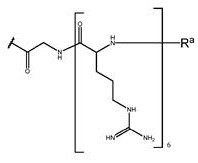
Wherein R is a Selected from H, acyl, benzoyl and stearoyl. In some embodiments, R a Is acetyl.
In various embodiments, G has the formula:

R a is acetyl.
In certain embodiments, the CPP has the formula:

wherein R is a Selected from H, acyl, benzoyl and stearoyl. In some embodiments, R a Is acetyl. In various embodiments, the CPP has the formula:

R a is acetyl.
In some embodiments, including, for example, embodiments of antisense oligomers of formulas (VI), (VII), (VIIa), (VIIb), (VIIc), (VIId), (VIie) and (VIII), the targeting sequence is complementary to a target region within intron 1 (SEQ ID NO: 1) of the pre-mRNA of the human alpha Glucosidase (GAA) gene. In various embodiments, including, for example, embodiments of antisense oligomers of formulas (VI), (VII), (VIIa), (VIIb), (VIIc), (VIId), (VIie) and (VIII), the targeting sequence is complementary to a target region within intron 1 (SEQ ID NO: 1) of the pre-mRNA of the human alpha Glucosidase (GAA) gene, wherein the target region comprises at least one additional nucleobase as compared to the targeting sequence, wherein the at least one additional nucleobase does not have a complementary nucleobase in the targeting sequence, and wherein the at least one additional nucleobase is internal to the target region. In certain embodiments, the targeting sequence comprises a sequence selected from the group consisting of SEQ ID NO: 13-SEQ ID NO: 86 (e.g., SEQ ID NO: 13-58 or 59-75). In certain embodiments, the targeting sequence is selected from the group consisting of SEQ ID NOs 13, 27-29, 34-36, 59 and 82. In certain embodiments, the targeting sequence comprises a sequence selected from tables 2A-2C. Furthermore, and with respect to the sequences outlined in tables 2A-2C herein, in certain embodiments, sequences with 100% complementarity are selected and one or more nucleobases are removed (or alternatively synthesis of nucleobases accompanied by one or more deletions) such that the resulting sequence has one or more nucleobases deleted in the target region as compared to its natural complement. Except for the portion where one or more nucleobases are removed, it is contemplated that the remainder is 100% complementary. However, it is within the scope of the invention that there may be a reduced level of complementarity.
In some embodiments of any of the antisense oligomers, methods, or compositions described herein, Z is an integer from 8 to 28, 15 to 38, 15 to 28, 8 to 25, 15 to 25, 10 to 38, 10 to 25, 12 to 38, 12 to 25, 14 to 38, or 14 to 25. In some embodiments of any of the antisense oligomers, methods, or compositions described herein, Z is 12, 13, 14, 15, 16, 17, 18, 19, 20, 21, 22, 23, 24, 25, 26, 27, 28, 29, 30, 31, 32, 33, 34, 35, 36, 37, or 38. In some embodiments of any of the antisense oligomers, methods, or compositions described herein, Z is 12, 13, 14, 15, 16, 17, 18, 19, 20, 21, 22, 23, 24, 25, 26, 27, or 28. In some embodiments of any of the antisense oligomers, methods, or compositions described herein, Z is 15, 16, 17, 18, 19, 20, 21, 22, 23, 24, or 25.
In some embodiments, each Z of the modified antisense oligomer of the invention, including compounds of formulas (I), (Ia), (IVa), (IVb), (IVc), (V), (VI), (VII), (VIIa), (VIIb), (VIIc), (VIId), (VIIe), and (VIII), is an integer from 8 to 28.
In some embodiments, each Z of the modified antisense oligomer of the invention, including compounds of formulas (I), (Ia), (IVa), (IVb), (IVc), (V), (VI), (VII), (VIIa), (VIIb), (VIIc), (VIId), (VIIe), and (VIII), is an integer from 15 to 38.
In some embodiments, each Z of the modified antisense oligomer of the invention, including compounds of formulas (I), (Ia), (IVa), (IVb), (IVc), (V), (VI), (VII), (VIIa), (VIIb), (VIIc), (VIId), (VIIe), and (VIII), is an integer from 15 to 28.
In some embodiments, each Z of the modified antisense oligomer of the invention, including compounds of formulas (I), (Ia), (IVa), (IVb), (IVc), (V), (VI), (VII), (VIIa), (VIIb), (VIIc), (VIId), (VIIe), and (VIII), is an integer from 8 to 25.
In some embodiments, each Z of the modified antisense oligomer of the invention, including compounds of formulas (I), (Ia), (IVa), (IVb), (IVc), (V), (VI), (VII), (VIIa), (VIIb), (VIIc), (VIId), (VIIe), and (VIII), is an integer from 15 to 25.
In some embodiments, each Z of the modified antisense oligomer of the invention, including compounds of formulas (I), (Ia), (IVa), (IVb), (IVc), (V), (VI), (VII), (VIIa), (VIIb), (VIIc), (VIId), (VIIe), and (VIII), is an integer from 10 to 38.
In some embodiments, each Z of the modified antisense oligomer of the invention, including compounds of formulas (I), (Ia), (IVa), (IVb), (IVc), (V), (VI), (VII), (VIIa), (VIIb), (VIIc), (VIId), (VIIe), and (VIII), is an integer from 10 to 25.
In some embodiments, each Z of the modified antisense oligomer of the invention, including compounds of formulas (I), (Ia), (IVa), (IVb), (IVc), (V), (VI), (VII), (VIIa), (VIIb), (VIIc), (VIId), (VIIe), and (VIII), is an integer from 12 to 38.
In some embodiments, each Z of the modified antisense oligomer of the invention, including compounds of formulas (I), (Ia), (IVa), (IVb), (IVc), (V), (VI), (VII), (VIIa), (VIIb), (VIIc), (VIId), (VIIe), and (VIII), is an integer from 12 to 25.
In some embodiments, each Z of the modified antisense oligomer of the invention, including compounds of formulas (I), (Ia), (IVa), (IVb), (IVc), (V), (VI), (VII), (VIIa), (VIIb), (VIIc), (VIId), (VIIe), and (VIII), is an integer from 14 to 38.
In some embodiments, each Z of the modified antisense oligomer of the invention, including compounds of formulas (I), (Ia), (IVa), (IVb), (IVc), (V), (VI), (VII), (VIIa), (VIIb), (VIIc), (VIId), (VIIe), and (VIII), is an integer from 14 to 25.
In some embodiments, each Z of the modified antisense oligomer of the invention, including compounds of formula (I), (Ia), (IVa), (IVb), (IVc), (V), (VI), (VII), (VIIa), (VIIb), (VIIc), (VIId), (VIIe) and (VIII) is 12, 13, 14, 15, 16, 17, 18, 19, 20, 21, 22, 23, 24, 25, 26, 27, 28, 29, 30, 31, 32, 33, 34, 35, 36, 37 or 38.
In some embodiments, each Z of the modified antisense oligomer of the invention, including compounds of formula (I), (Ia), (IVa), (IVb), (IVc), (V), (VI), (VII), (VIIa), (VIIb), (VIIc), (VIId), (VIIe) and (VIII), is 12, 13, 14, 15, 16, 17, 18, 19, 20, 21, 22, 23, 24, 25, 26, 27 or 28.
In some embodiments, each Z of the modified antisense oligomer of the invention, including compounds of formulas (I), (Ia), (IVa), (IVb), (IVc), (V), (VI), (VII), (VIIa), (VIIb), (VIIc), (VIId), (VIIe), and (VIII), is 15, 16, 17, 18, 19, 20, 21, 22, 23, 24, or 25.
In some embodiments, each Nu of the antisense oligomer of the present invention, including compounds of formulas (I), (Ia), (IVa), (IVb), (IVc), (V), (VI), (VII), (VIIa), (VIIb), (VIIc), (VIId), (VIIe), and (VIII), is independently selected from adenine, guanine, thymine, uracil, cytosine, hypoxanthine, 2, 6-diaminopurine, 5-methylcytosine, C5-propynyl modified pyrimidine, and 9- (aminoethoxy) phenoxazine.
In some embodiments, the antisense oligomer of the present invention, including the targeting sequences of the compounds of formula (I), (Ia), (IVa), (IVb), (IVc), (V), (VI), (VII), (VIIa), (VIIb), (VIIc), (VIId), (VIie) and (VIII), are those that are found in human acid alpha glucosidase @ GAA) 10 or more contiguous nucleotides complementary in a target region within intron 1 (SEQ ID. NO. 1), intron 2 (SEQ ID. NO. 60), or exon 2 (SEQ ID. NO. 61) of the pre-mRNA of the gene. In certain embodiments, the targeting sequences of the antisense oligomer of the present invention, including compounds of formula (I), (Ia), (IVa), (IVb), (IVc), (V), (VI), (VII), (VIIa), (VIIb), (VIIc), (VIId), (VIIe) and (VIII), comprise sequences selected from the sequences of tables 2A-2C as described herein, are fragments of at least 12 contiguous nucleotides selected from the sequences of tables 2A-2C as described herein, or are variants having at least 90% sequence identity to the sequences selected from tables 2A-2C as described herein (wherein X is selected from uracil (U) or thymine (T), as appropriate, depending on the reference table). In certain embodiments, the targeting sequence is selected from the group consisting of SEQ ID NOs 13, 27-29, 34-36, 59 and 82.
Additional antisense oligomers/chemicals that can be used in accordance with the present invention include those described in the following patents and patent publications, the contents of which are incorporated herein by reference: PCT publication number WO/2007/002390; WO/2010/120820; and WO/2010/148249; U.S. patent No. 7,838,657; and U.S. application number 2011/0269820.
Antisense oligonucleotides can be prepared by stepwise solid phase synthesis using methods known in the art and described in the references cited herein.
C. Arginine-rich peptide conjugates (PPMO) of CPP and PMO
In certain embodiments, the antisense oligonucleotide is conjugated to a cell penetrating peptide (referred to herein as a "CPP"). In some embodiments, the CPP is an arginine-rich peptide. The term "arginine-rich" refers to a CPP having at least 2, preferably 2, 3, 4, 5, 6, 7 or 8 arginine residues, each of which is optionally separated by one or more uncharged hydrophobic residues, and optionally contains about 6-14 amino acid residues. As explained below, CPP is preferably linked at its carboxy terminus to the 3 'and/or 5' terminus of the antisense oligonucleotide by a linker, which may also be one or more amino acids, and preferably also at its amino terminus by a substituent R a Capping, wherein R a Selected from H, acyl, benzoyl or stearoyl. In some embodiments, R a Is acetyl.
As can be seen in the following table, non-limiting examples of CPPs for use herein include- (RXR) 4 -R a 、R-(FFR) 3 -R a 、-B-X-(RXR) 4 -R a 、-B-X-R-(FFR) 3 -R a 、-GLY-R-(FFR) 3 -R a 、-GLY-R 6 -R a and-R 6 -R a Wherein R is a Selected from H, acyl, benzoyl and stearoyl, and wherein R is arginine, X is 6-aminocaproic acid, B is beta-alanine, F is phenylalanine, and GLY (or G) is glycine. CPP "R 6 "means via an amide bond (rather than a single substituent, e.g., R 6 ) A peptide of six (6) arginine residues linked together. In some embodiments, R a Is acetyl.
Exemplary CPPs are provided in Table 2D (SEQ ID NOS: 6-12).

CPPs, their synthesis, and methods of conjugation with oligomers are further described in U.S. application publication No. 2012/0289457 and international patent application publications nos. WO 2004/097017, WO 2009/005793, and WO 2012/150960, the disclosures of which are incorporated herein by reference in their entirety.
In some embodiments, the antisense oligonucleotide comprises a substituent "G", which is defined as a combination of CPP and linker. The linker bridges the CPP at its carboxy terminus to the 3 'end and/or 5' end of the oligonucleotide. In various embodiments, an antisense oligonucleotide can comprise only one CPP linked to the 3' end of an oligomer. In other embodiments, the antisense oligonucleotide can comprise only one CPP linked to the 5' end of the oligomer.
The linker within G may comprise, for example, 1, 2, 3, 4 or 5 amino acids.
In a specific embodiment, G is selected from:
-C(O)(CH 2 ) 5 NH-CPP;
-C(O)(CH 2 ) 2 NH-CPP;
-C(O)(CH 2 ) 2 NHC(O)(CH 2 ) 5 NH-CPP;
-C(O)CH 2 NH-CPP and the formula:

wherein the CPP is attached to the linker moiety by an amide bond at the carboxy terminus of the CPP.
In various embodiments, the CPP is an arginine-rich peptide as defined above, and see table 2D. In certain embodiments, the arginine-rich CPP is R 6 -R a (i.e., six arginine residues; SEQ ID NO: 12), wherein R a Selected from H, acyl, benzoyl and stearoyl. R is R a Is acetyl. In various embodiments, the CPP is selected from SEQ ID NO. 6, 7 or 12 and the linker is selected from the above groups. In some embodiments, the CPP is SEQ ID NO. 12 and the linker is Gly.
In certain embodiments, G is-C (O) CH covalently bonded to the antisense oligomer of the invention at the 5 'and/or 3' ends of the oligomer 2 NH-R 6 -R a Wherein R is a Is H, acyl, benzoyl or stearoyl, to cap R 6 Amino terminal of (c). R is R a Is acetyl. In these non-limiting examples, the CPP is-R 6 -R a And the linker is-C (O) CH 2 NH- (i.e., GLY). G= -C (O) CH 2 NH-R 6 -R a Is also exemplified by the following structure:
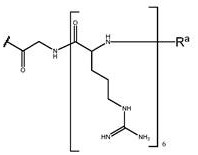
wherein R is a Selected from H, acyl, benzoyl and stearoyl. In some embodiments, G is selected from SEQ ID NOs 3-6. In certain embodiments, G is SEQ ID NO. 6. In some embodiments, R a Is acetyl.
In various embodiments, the CPP is-R 6 -R a Also exemplified by the following formula:

wherein R is a Selected from H, acyl, benzoyl and stearoyl. In certain embodiments, the CPP is SEQ ID NO: XX. In some embodiments, R a Is acetyl.
In some embodiments, the CPP is- (RXR) 4 -R a Also exemplified by the following formula:

in various embodiments, the CPP is-R- (FFR) 3 Ra, also exemplified by the following formula:

in various embodiments, G is selected from:
-C(O)(CH 2 ) 5 NH-CPP;
-C(O)(CH 2 ) 2 NH-CPP;
-C(O)(CH 2 ) 2 NHC(O)(CH 2 ) 5 NH-CPP;
-C(O)CH 2 NH-CPP and the formula:

wherein the CPP is attached to the linker moiety through an amide bond at the carboxy terminus of the CPP, and wherein the CPP is selected from the group consisting of:


In some embodiments, the antisense oligomer of the present invention is a compound of formula (VIII) selected from the group consisting of:

and

or a pharmaceutically acceptable salt of any of the foregoing, wherein:
each Nu is a purine or pyrimidine base pairing moiety that together form a targeting sequence;
z is an integer from 8 to 38;
R a selected from H, acetyl, benzoyl and stearoyl; and
R b selected from the group consisting of H, acetyl, benzoyl, stearoyl, trityl and 4-methoxytrityl.
In some embodiments, including, for example, embodiments of antisense oligomers of formula (VIII), the targeting sequence is complementary to a target region within intron 1 (SEQ ID NO: 1) of the pre-mRNA of the human alpha Glucosidase (GAA) gene.
In various embodiments, including, for example, embodiments of antisense oligomers of formula (VIII), the targeting sequence is complementary to a target region within intron 1 (SEQ ID NO: 1) of the pre-mRNA of the human alpha Glucosidase (GAA) gene, wherein the target region comprises at least one additional nucleobase as compared to the targeting sequence, wherein the at least one additional nucleobase does not have a complementary nucleobase in the targeting sequence, and wherein the at least one additional nucleobase is internal to the target region. In certain embodiments, the targeting sequence comprises a sequence selected from the group consisting of SEQ ID NO: 13-SEQ ID NO: 86 (e.g., any of SEQ ID NO: 13-58 or 59-75). In certain embodiments, the targeting sequence comprises a sequence selected from tables 2A-2C. In certain embodiments, the targeting sequence comprises a sequence selected from tables 2A and 2B. Furthermore, and with respect to the sequences outlined in tables 2A-2C herein, in certain embodiments, sequences with 100% complementarity are selected and one or more nucleobases are removed (or alternatively synthesis of nucleobases accompanied by one or more deletions) such that the resulting sequence has one or more nucleobases deleted in the target region as compared to its natural complement. Except for the portion where one or more nucleobases are removed, it is contemplated that the remainder is 100% complementary. However, it is within the scope of the invention that there may be a reduced level of complementarity.
In some embodiments, the targeting sequences of the antisense oligomers of the invention, including, for example, antisense oligomers of formula (I), (Ia), (IVa), (IVb), (IVc), (V), (VI), (VII), (VIIa), (VIIb), (VIIc), (VIId), (VIIe) and (VIII), are selected from the sequences outlined in tables 2A-2C, as described herein and as follows:
I.
uu) SEQ ID NO. 13 (GGC CAG AAG GAA GGC GAG AAA AGC), wherein Z is 22;
v) SEQ ID NO. 14 (GCC AGA AGG AAG GC GAG AAA AGC X) wherein Z is 22;
ww) SEQ ID NO. 15 (CCA GAA GGA AGG CGA GAA AAG CXC) wherein Z is 22;
xx) SEQ ID NO. 16 (CAG AAG GAA GGC GAG AAA AGC XCC) wherein Z is 22;
yy) SEQ ID NO. 17 (AGA AGG AAG GCG AGA AAA GCX CCA), wherein Z is 22;
zz) SEQ ID NO. 18 (GAA GGA AGG CGA GAA AAG CXC CAG), wherein Z is 22;
aaa) SEQ ID NO. 19 (AAG GAA GGC GAG AAA AGC XCC AGC), wherein Z is 22;
bbb) SEQ ID NO. 20 (AGG AAG GCG AGA AAA GCX CCA GCA), wherein Z is 22;
ccc) SEQ ID NO. 21 (CGG CXC XCA AAG CAG CXC XGA GA) wherein Z is 21;
ddd) SEQ ID NO. 22 (ACG GCX CXC AAA GCA GCX CXG AG) wherein Z is 21;
eee) SEQ ID NO. 23 (CAC GGC XCX CAA AGC AGC XCX GA), wherein Z is 21;
fff) SEQ ID NO. 24 (XCA CGG CXC XCA AAG CAG CXC XG) wherein Z is 21;
ggg) SEQ ID NO. 25 (CXC ACG GCX CXC AAA GCA GCX CX), wherein Z is 21;
hhh) SEQ ID NO. 26 (ACX CAC GGC XCX CAA AGC AGC XC), wherein Z is 21;
iii) SEQ ID NO. 27 (GCG GCA CXC ACG GCX CXC AAA GC) wherein Z is 21;
jjj) SEQ ID NO. 28 (GGC GGC ACX CAC GGC XCX CAA AG), wherein Z is 21;
kkk) SEQ ID NO. 29 (CGG CAC XCA CGG CXC XCA AAG CA), wherein Z is 21;
lll) SEQ ID NO. 30 (GCA CXC ACG GCX CXC AAA GCA GC), wherein Z is 21;
mmm) SEQ ID NO. 31 (GGC ACX CAC GGC XCX CAA AGC AG), wherein Z is 21;
nnn) SEQ ID NO. 32 (CAC XCA CGG CXC XCA AAG CAG CX), wherein Z is 21;
ooo) SEQ ID NO. 33 (GCC AGA AGG AAG GCG AGA AAA GC) wherein Z is 21;
ppp) SEQ ID NO 34 (CCA GAA GGA AGG CGA GAA AAG C) wherein Z is 19;
qqq) SEQ ID NO. 35 (CAG AAG GAA GGC GAG AAA AGC) wherein Z is 19;
rrr) SEQ ID NO. 36 (GGC CAG AAG GAA GGC GAG AAA AG), wherein Z is 21;
sss) SEQ ID NO. 37 (GGC CAG AAG GAA GGC GAG AAA A), wherein Z is 19;
ttt) SEQ ID NO. 38 (GGC CAG AAG GAA GGC GAG AAA) wherein Z is 19;
uuu) SEQ ID NO 39 (CGG CAC XCA CGGC XCX CAA AGC A) wherein Z is 21;
vvv) SEQ ID NO. 40 (GCG GCA CXC ACGG CXC XCA AAG C), wherein Z is 21;
www) SEQ ID NO. 41 (GGC GGC ACX CAC G GCX CXC AAA G), wherein Z is 21;
xxx) SEQ ID NO. 42 (XGG GGA GAG GGC CAG AAG GAA GGC), wherein Z is 22;
yyy) SEQ ID NO. 43 (XGG GGA GAG GGC CAG AAG GAA GC), wherein Z is 21;
zz) SEQ ID NO. 44 (XGG GGA GAG GGC CAG AAG GAA C), wherein Z is 20;
aaaa) SEQ ID NO. 45 (GGC CAG AAG GAA GCG AGA AAA GC), wherein Z is 21;
bb) SEQ ID NO 46 (GGC CAG AAG GAA CGA GAA AAG C), wherein Z is 20;
cccc) SEQ ID NO. 47 (AGG AAG CGA GAA AAG CXC CAG CA) wherein Z is 21;
dddd) SEQ ID NO. 48 (AGG AAC GAG AAA AGC XCC AGC A), wherein Z is 20;
eeee) SEQ ID NO. 49 (CGG GCX CXC AAA GCA GCX CXG AGA), wherein Z is 22;
ffff) SEQ ID NO. 50 (CGC XCX CAA AGC AGC XCX GAG A) wherein Z is 20;
gggg) SEQ ID NO. 51 (CCX CXC AAA GCA GCX CXG AGA), wherein Z is 19;
hhhhh) SEQ ID NO. 52 (GGC GGC ACX CAC GGG CXC XCA AAG), wherein Z is 22;
iii) SEQ ID NO. 53 (GGC GGC ACX CAC GCX CXC AAA G), wherein Z is 20;
jjj) SEQ ID NO. 54 (GGC GGC ACX CAC CXC XCA AAG), wherein Z is 19;
kkkkk) SEQ ID NO. 55 (GCG GGA GGG GCG GCA CXC ACG GGC) wherein Z is 22;
llll) SEQ ID NO. 56 (GCG GGA GGG GCG GCA CXC ACG GC) wherein Z is 21;
mmmm) SEQ ID NO. 57 (GCG GGA GGG GCG GCA CXC ACG C) wherein Z is 20; and
nnnn) SEQ ID NO 58 (GCG GGA GGG GCG GCA CXC ACC), wherein Z is 19,
wherein X is selected from uracil (U) or thymine (T);
II.
r) SEQ ID NO 59 (GGC CAG AAG GAA GGG CGA GAA AAG C) wherein Z is 23;
s) SEQ ID NO. 60 (CCA GAA GGA AGG GCG AGA AAA GCX C), wherein Z is 23;
t) SEQ ID NO. 61 (AAG GAA GGG CGA GAA AAG CXC CAG C) wherein Z is 23;
u) SEQ ID NO. 62 (GCG GGA GGG GCG GCA CXC ACG GGG C) wherein Z is 23;
v) SEQ ID NO 63 (XGG GGA GAG GGC CAG AAG GAA GGG C) wherein Z is 23;
w) SEQ ID NO. 64 (AGA AGG AAG GGC GAG AAA AGC XCC A), wherein Z is 23;
x) SEQ ID NO. 65 (GCX CXC AAA GCA GCX CXG AGA CAX C) wherein Z is 23;
y) SEQ ID NO 66 (CXC XCA AAG CAG CXC XGA GAC AXC A) wherein Z is 23;
z) SEQ ID NO 67 (XCX CAA AGC AGC XCX GAG ACA XCA A) wherein Z is 23;
aa) SEQ ID NO. 68 (CXC AAA GCA GCX CXG AGA CAX CAA C), wherein Z is 23;
bb) SEQ ID NO 69 (XCA AAG CAG CXC XGA GAC AXC AAC C), wherein Z is 23;
cc) SEQ ID NO 70 (CAA AGC AGC XCX GAG ACA XCA ACC G) wherein Z is 23;
dd) SEQ ID NO. 71 (AAA GCA GCX CXG AGA CAX CAA CCG C), wherein Z is 23;
ee) SEQ ID NO. 72 (AAG CAG CXC XGA GAC AXC AAC CGC G), wherein Z is 23;
ff) SEQ ID NO. 73 (AGC AGC XCX GAG ACA XCA ACC GCG G) wherein Z is 23;
gg) SEQ ID NO 74 (GCA GCX CXG AGA CAX CAA CCG CGG C), wherein Z is 23; and
hh) SEQ ID NO. 75 (CAG CXC XGA GAC AXC AAC CGC GGC X), wherein Z is 23,
wherein X is selected from uracil (U) or thymine (T); and
III.
l) SEQ ID NO 76 (GCC AGA AGG AAG GGC GAG AAA AGC X) wherein Z is 23;
m) SEQ ID NO 77 (CAG AAG GAA GGG CGA GAA AAG CXC C), wherein Z is 23;
n) SEQ ID NO. 78 (GAA GGA AGG GCG AGA AAA GCX CCA G) wherein Z is 23;
o) SEQ ID NO. 79 (AGG AAG GGC GAG AAA AGC XCC AGC A), wherein Z is 23;
p) SEQ ID NO 80 (ACX CAC GGG GCX CXC AAA GCA GCX C) wherein Z is 23;
q) SEQ ID NO. 81 (GGCXCXCAAAGCAGCXCXCXGAGACAX) wherein Z is 23;
r) SEQ ID NO. 82 (GGC XCX CAA AGC AGC XCX GA), wherein Z is 18,
s) SEQ ID NO. 83 (GAG AGG GCC AGA AGG AAG GG) wherein Z is 18,
t) SEQ ID NO. 84 (XXX GCC AXG XXA CCC AGG CX) wherein Z is 18,
u) SEQ ID NO 85 (GCG CAC CCX CXG CCC XGG CC) wherein Z is 18, and
v) SEQ ID NO 86 (GGC CCX GGX CXG CXG GCX CCC XGC X) wherein Z is 23,
wherein X is selected from uracil (U) or thymine (T).
In certain embodiments, the targeting sequence is selected from the group consisting of SEQ ID NOs 13, 27-29, 34-36, 59 and 82. In certain embodiments, the targeting sequence is selected from the group consisting of SEQ ID NOs 13, 27-29, 34-36 and 59. In certain embodiments, the targeting sequence is selected from SEQ ID NOs 13, 27-29 and 34-36. In certain embodiments, each occurrence of X in any of SEQ ID NOs 13, 27-29, 34-36, 59 and 82 is T.
In some embodiments, the targeting sequence of the antisense oligomer compound of formula (I) is selected from the sequences outlined in tables 2A-2C. In some embodiments, the targeting sequence of the antisense oligomer compound of formula (Ia) is selected from the sequences outlined in tables 2A-2C. In some embodiments, the targeting sequence of the antisense oligomer compound of formula (IVa) is selected from the sequences outlined in tables 2A-2C. In some embodiments, the targeting sequence of the antisense oligomer compound of formula (IVb) is selected from the sequences outlined in tables 2A-2C. In some embodiments, the targeting sequence of the antisense oligomer compound of formula (IVc) is selected from the sequences outlined in tables 2A-2C. In some embodiments, the targeting sequence of the antisense oligomer compound of formula (V) is selected from the sequences outlined in tables 2A-2C. In some embodiments, the targeting sequence of the antisense oligomer compound of formula (VI) is selected from the sequences outlined in tables 2A-2C. In some embodiments, the targeting sequence of the antisense oligomer compound of formula (VII) is selected from the sequences outlined in tables 2A-2C. In some embodiments, the targeting sequence of the antisense oligomer compound of formula (VIIa) is selected from the sequences outlined in tables 2A-2C. In some embodiments, the targeting sequence of the antisense oligomer compound of formula (VIIb) is selected from the sequences outlined in tables 2A-2C. In some embodiments, the targeting sequence of the antisense oligomer compound of formula (VIIc) is selected from the sequences outlined in tables 2A-2C. In some embodiments, the targeting sequence of the antisense oligomer compound of formula (VIId) is selected from the sequences outlined in tables 2A-2C. In some embodiments, the targeting sequence of the antisense oligomer compound of formula (VIIe) is selected from the sequences outlined in tables 2A-2C. In some embodiments, the targeting sequence of the antisense oligomer compound of formula (VIII) is selected from the sequences outlined in tables 2A-2C.
In some embodiments, at least one X of the sequences summarized in tables 2A-2C is T. In some embodiments, at least one X of the sequences summarized in tables 2A-2C is U. In some embodiments, each X of the sequences summarized in table 2A is T. In some embodiments, each X of the sequences summarized in table 2A is U. In various embodiments, at least one X of the targeting sequence is T. In various embodiments, each X of the targeting sequence is T. In various embodiments, at least one X of the targeting sequence is U. In various embodiments, each X of the targeting sequence is U.
Furthermore, in some embodiments, the antisense oligomer of the present invention is a compound of formula (XX):

or a pharmaceutically acceptable salt thereof, wherein:
I.
a) Each Nu is one nucleobase that together form the following targeting sequences (5 'to 3'): SEQ ID NO. 13 (GGC CAG AAG GAA GGC GAG AAA AGC) wherein Z is 22;
b) Each Nu is one nucleobase that together form the following targeting sequences (5 'to 3'): SEQ ID NO. 14 (GCC AGA AGG AAG GC GAG AAA AGC X) wherein Z is 22;
c) Each Nu is one nucleobase that together form the following targeting sequences (5 'to 3'): SEQ ID NO. 15 (CCA GAA GGA AGG CGA GAA AAG CXC) wherein Z is 22;
d) Each Nu is one nucleobase that together form the following targeting sequences (5 'to 3'): SEQ ID NO. 16 (CAG AAG GAA GGC GAG AAA AGC XCC) wherein Z is 22;
e) Each Nu is one nucleobase that together form the following targeting sequences (5 'to 3'): SEQ ID NO. 17 (AGA AGG AAG GCG AGA AAA GCX CCA) wherein Z is 22;
f) Each Nu is one nucleobase that together form the following targeting sequences (5 'to 3'): SEQ ID NO. 18 (GAA GGA AGG CGA GAA AAG CXC CAG) wherein Z is 22;
g) Each Nu is a nucleobase which together form the targeting sequence (5 'to 3') SEQ ID No. 19 (AAG GAA GGC GAG AAA AGC XCC AGC), wherein Z is 22;
h) Each Nu is one nucleobase that together form the following targeting sequences (5 'to 3'): SEQ ID NO. 20 (AGG AAG GCG AGA AAA GCX CCA GCA), wherein Z is 22;
i) Each Nu is one nucleobase that together form the following targeting sequences (5 'to 3'): SEQ ID NO. 21 (CGG CXC XCA AAG CAG CXC XGA GA) wherein Z is 21;
j) Each Nu is one nucleobase that together form the following targeting sequences (5 'to 3'): SEQ ID NO. 22 (ACG GCX CXC AAA GCA GCX CXG AG) wherein Z is 21;
k) Each Nu is one nucleobase that together form the following targeting sequences (5 'to 3'): SEQ ID NO. 23 (CAC GGC XCX CAA AGC AGC XCX GA), wherein Z is 21;
l) each Nu is a nucleobase which together form the following targeting sequences (5 'to 3'): SEQ ID NO. 24 (XCA CGG CXC XCA AAG CAG CXC XG) wherein Z is 21;
m) each Nu is a nucleobase which together form the following targeting sequences (5 'to 3'): SEQ ID NO. 25 (CXC ACG GCX CXC AAA GCA GCX CX) wherein Z is 21;
n) each Nu is a nucleobase which together form the following targeting sequences (5 'to 3'): SEQ ID NO. 26 (ACX CAC GGC XCX CAA AGC AGC XC) wherein Z is 21;
o) each Nu is a nucleobase which together form the following targeting sequences (5 'to 3'): SEQ ID NO. 27 (GCG GCA CXC ACG GCX CXC AAA GC) wherein Z is 21;
p) each Nu is a nucleobase which together form the following targeting sequences (5 'to 3'): SEQ ID NO. 28 (GGC GGC ACX CAC GGC XCX CAA AG) wherein Z is 21;
q) each Nu is a nucleobase which together form the following targeting sequences (5 'to 3'): SEQ ID NO. 29 (CGG CAC XCA CGG CXC XCA AAG CA) wherein Z is 21;
r) each Nu is a nucleobase which together form the following targeting sequences (5 'to 3'): SEQ ID NO. 30 (GCA CXC ACG GCX CXC AAA GCA GC) wherein Z is 21;
s) each Nu is a nucleobase which together form the following targeting sequences (5 'to 3'): SEQ ID NO. 31 (GGC ACX CAC GGC XCX CAA AGC AG) wherein Z is 21;
t) each Nu is a nucleobase which together form the following targeting sequences (5 'to 3'): SEQ ID NO. 32 (CAC XCA CGG CXC XCA AAG CAG CX) wherein Z is 21;
u) each Nu is a nucleobase which together form the following targeting sequences (5 'to 3'): SEQ ID NO. 33 (GCC AGA AGG AAG GCG AGA AAA GC) wherein Z is 21;
v) each Nu is a nucleobase which together form the following targeting sequences (5 'to 3'): SEQ ID NO. 34 (CCA GAA GGA AGG CGA GAA AAG C) wherein Z is 19;
w) each Nu is a nucleobase which together form the following targeting sequences (5 'to 3'): SEQ ID NO. 35 (CAG AAG GAA GGC GAG AAA AGC) wherein Z is 19;
x) each Nu is a nucleobase which together form the following targeting sequences (5 'to 3'): SEQ ID NO. 36 (GGC CAG AAG GAA GGC GAG AAA AG) wherein Z is 21;
y) each Nu is a nucleobase which together form the following targeting sequences (5 'to 3'): SEQ ID NO. 37 (GGC CAG AAG GAA GGC GAG AAA A) wherein Z is 19;
z) each Nu is a nucleobase which together form the following targeting sequences (5 'to 3'): SEQ ID NO. 38 (GGC CAG AAG GAA GGC GAG AAA) wherein Z is 19;
aa) each Nu is a nucleobase which together form the following targeting sequences (5 'to 3'): SEQ ID NO 39 (CGG CAC XCA CGGC XCX CAA AGC A) wherein Z is 21;
bb) each Nu is a nucleobase which together form the following targeting sequences (5 'to 3'): SEQ ID NO. 40 (GCG GCA CXC ACGG CXC XCA AAG C) wherein Z is 21;
cc) each Nu is one nucleobase which together form the following targeting sequences (5 'to 3'): SEQ ID NO. 41 (GGC GGC ACX CAC G GCX CXC AAA G) wherein Z is 21;
dd) each Nu is a nucleobase which together form the following targeting sequences (5 'to 3'): SEQ ID NO. 42 (XGG GGA GAG GGC CAG AAG GAA GGC) wherein Z is 22;
ee) each Nu is a nucleobase that together form the following targeting sequences (5 'to 3'): SEQ ID NO. 43 (XGG GGA GAG GGC CAG AAG GAA GC) wherein Z is 21;
ff) each Nu is a nucleobase which together form the following targeting sequences (5 'to 3'): SEQ ID NO. 44 (XGG GGA GAG GGC CAG AAG GAA C) wherein Z is 20;
gg) each Nu is a nucleobase which together form the following targeting sequences (5 'to 3'): SEQ ID NO. 45 (GGC CAG AAG GAA GCG AGA AAA GC) wherein Z is 21;
hh) each Nu is a nucleobase which together form the following targeting sequences (5 'to 3'): SEQ ID NO. 46 (GGC CAG AAG GAA CGA GAA AAG C) wherein Z is 20;
ii) each Nu is a nucleobase which together form the following targeting sequences (5 'to 3'): SEQ ID NO. 47 (AGG AAG CGA GAA AAG CXC CAG CA) wherein Z is 21;
jj) each Nu is a nucleobase which together form the following targeting sequences (5 'to 3'): SEQ ID NO. 48 (AGG AAC GAG AAA AGC XCC AGC A) where Z is 20;
kk) each Nu is one nucleobase that together form the following targeting sequences (5 'to 3'): SEQ ID NO. 49 (CGG GCX CXC AAA GCA GCX CXG AGA) wherein Z is 22;
11 Each Nu is one nucleobase that together form the following targeting sequences (5 'to 3'): SEQ ID NO. 50 (CGC XCX CAA AGC AGC XCX GAG A) wherein Z is 20;
mm) each Nu is one nucleobase which together form the following targeting sequences (5 'to 3'): SEQ ID NO. 51 (CCX CXC AAA GCA GCX CXG AGA) wherein Z is 19;
nn) each Nu is a nucleobase that together form the following targeting sequences (5 'to 3'): SEQ ID NO. 52 (GGC GGC ACX CAC GGG CXC XCA AAG) wherein Z is 22;
oo) each Nu is a nucleobase that together form the following targeting sequences (5 'to 3'): SEQ ID NO. 53 (GGC GGC ACX CAC GCX CXC AAA G) wherein Z is 20;
pp) each Nu is a nucleobase which together form the following targeting sequences (5 'to 3'): SEQ ID NO. 54 (GGC GGC ACX CAC CXC XCA AAG) wherein Z is 19;
qq) each Nu is a nucleobase that together form the following targeting sequences (5 'to 3'): SEQ ID NO. 55 (GCG GGA GGG GCG GCA CXC ACG GGC) wherein Z is 22;
rr) each Nu is a nucleobase which together form the following targeting sequences (5 'to 3'): SEQ ID NO. 56 (GCG GGA GGG GCG GCA CXC ACG GC) wherein Z is 21;
ss) each Nu is a nucleobase which together form the following targeting sequences (5 'to 3'): SEQ ID NO. 57 (GCG GGA GGG GCG GCA CXC ACG C) wherein Z is 20; and
tt) each Nu is a nucleobase which together form the following targeting sequences (5 'to 3'): SEQ ID NO. 58 (GCG GGA GGG GCG GCA CXC ACC), wherein Z is 19,
wherein X is selected from uracil (U) or thymine (T);
II.
a) Each Nu is one nucleobase that together form the following targeting sequences (5 'to 3'): SEQ ID NO 59 (GGC CAG AAG GAA GGG CGA GAA AAG C) wherein Z is 23;
b) Each Nu is one nucleobase that together form the following targeting sequences (5 'to 3'): SEQ ID NO. 60 (CCA GAA GGA AGG GCG AGA AAA GCX C) wherein Z is 23;
c) Each Nu is one nucleobase that together form the following targeting sequences (5 'to 3'): SEQ ID NO. 61 (AAG GAA GGG CGA GAA AAG CXC CAG C) wherein Z is 23;
d) Each Nu is one nucleobase that together form the following targeting sequences (5 'to 3'): SEQ ID NO. 62 (GCG GGA GGG GCG GCA CXC ACG GGG C) wherein Z is 23;
e) Each Nu is one nucleobase that together form the following targeting sequences (5 'to 3'): SEQ ID NO. 63 (XGG GGA GAG GGC CAG AAG GAA GGG C) wherein Z is 23;
f) Each Nu is one nucleobase that together form the following targeting sequences (5 'to 3'): SEQ ID NO. 64 (AGA AGG AAG GGC GAG AAA AGC XCC A) wherein Z is 23;
g) Each Nu is one nucleobase that together form the following targeting sequences (5 'to 3'): SEQ ID NO. 65 (GCX CXC AAA GCA GCX CXG AGA CAX C) wherein Z is 23;
h) Each Nu is one nucleobase that together form the following targeting sequences (5 'to 3'): SEQ ID NO. 66 (CXC XCA AAG CAG CXC XGA GAC AXC A) wherein Z is 23;
i) Each Nu is one nucleobase that together form the following targeting sequences (5 'to 3'): SEQ ID NO. 67 (XCX CAA AGC AGC XCX GAG ACA XCA A) wherein Z is 23;
j) Each Nu is one nucleobase that together form the following targeting sequences (5 'to 3'): SEQ ID NO. 68 (CXC AAA GCA GCX CXG AGA CAX CAA C) wherein Z is 23;
k) Each Nu is one nucleobase that together form the following targeting sequences (5 'to 3'): SEQ ID NO. 69 (XCA AAG CAG CXC XGA GAC AXC AAC C) wherein Z is 23;
l) each Nu is a nucleobase which together form the following targeting sequences (5 'to 3'): SEQ ID NO 70 (CAA AGC AGC XCX GAG ACA XCA ACC G) wherein Z is 23;
m) each Nu is a nucleobase which together form the following targeting sequences (5 'to 3'): SEQ ID NO. 71 (AAA GCA GCX CXG AGA CAX CAA CCG C) wherein Z is 23;
n) each Nu is a nucleobase which together form the following targeting sequences (5 'to 3'): SEQ ID NO. 72 (AAG CAG CXC XGA GAC AXC AAC CGC G) wherein Z is 23;
o) each Nu is a nucleobase which together form the following targeting sequences (5 'to 3'): SEQ ID NO. 73 (AGC AGC XCX GAG ACA XCA ACC GCG G) wherein Z is 23;
p) each Nu is a nucleobase which together form the following targeting sequences (5 'to 3'): SEQ ID NO 74 (GCA GCX CXG AGA CAX CAA CCG CGG C) wherein Z is 23; and
q) each Nu is a nucleobase which together form the following targeting sequences (5 'to 3'): SEQ ID NO. 75 (CAG CXC XGA GAC AXC AAC CGC GGC X) wherein Z is 23,
wherein X is selected from uracil (U) or thymine (T); and
III.
a) Each Nu is one nucleobase that together form the following targeting sequences (5 'to 3'): SEQ ID NO. 76 (GCC AGA AGG AAG GGC GAG AAA AGC X) wherein Z is 23;
b) Each Nu is one nucleobase that together form the following targeting sequences (5 'to 3'): SEQ ID NO. 77 (CAG AAG GAA GGG CGA GAA AAG CXC C) wherein Z is 23;
c) Each Nu is one nucleobase that together form the following targeting sequences (5 'to 3'): SEQ ID NO. 78 (GAA GGA AGG GCG AGA AAA GCX CCA G) wherein Z is 23;
d) Each Nu is one nucleobase that together form the following targeting sequences (5 'to 3'): SEQ ID NO. 79 (AGG AAG GGC GAG AAA AGC XCC AGC A) where Z is 23;
e) Each Nu is one nucleobase that together form the following targeting sequences (5 'to 3'): 80 (ACX CAC GGG GCX CXC AAA GCA GCX C) in SEQ ID NO, wherein Z is 23;
f) Each Nu is one nucleobase that together form the following targeting sequences (5 'to 3'): SEQ ID NO. 81 (GGCXCXCAAAGCAGCXCXCXGAGACAX) wherein Z is 23;
g) Each Nu is one nucleobase that together form the following targeting sequences (5 'to 3'): SEQ ID NO. 82 (GGC XCX CAA AGC AGC XCX GA), wherein Z is 18;
h) Each Nu is one nucleobase that together form the following targeting sequences (5 'to 3'): 83 (GAG AGG GCC AGA AGG AAG GG) in SEQ ID NO, wherein Z is 18;
i) Each Nu is one nucleobase that together form the following targeting sequences (5 'to 3'): SEQ ID NO 84 (XXX GCC AXG XXA CCC AGG CX) wherein Z is 18;
j) Each Nu is one nucleobase that together form the following targeting sequences (5 'to 3'): SEQ ID NO. 85 (GCG CAC CCX CXG CCC XGG CC) wherein Z is 18; and
k) Each Nu is one nucleobase that together form the following targeting sequences (5 'to 3'): SEQ ID NO 86 (GGC CCX GGX CXG CXG GCX CCC XGC X) wherein Z is 23,
wherein X is selected from uracil (U) or thymine (T);
and wherein R is a Is H or acetyl.
In some embodiments, at least one X of SEQ ID NOS 13-86 is T. In some embodiments, at least one X of SEQ ID NOS 13-86 is U. In some embodiments, each X of SEQ ID NOS 13-86 is T. In some embodiments, each X of SEQ ID NOS 13-86 is U. In various embodiments, at least one X of the targeting sequence is T. In various embodiments, each X of the targeting sequence is T. In various embodiments, at least one X of the targeting sequence is U. In various embodiments, each X of the targeting sequence is U.
In certain embodiments, the targeting sequence is selected from the group consisting of SEQ ID NOs 13, 27-29, 34-36, 59 and 82. In some embodiments, at least one X of SEQ ID NOS 13, 27-29, 34-36, 59, and 82 is T. In some embodiments, at least one X of SEQ ID NOS 13, 27-29, 34-36, 59, and 82 is U. In some embodiments, each X of SEQ ID NOS 13, 27-29, 34-36, 59, and 82 is T. In some embodiments, each X of SEQ ID NOS 13, 27-29, 34-36, 59, and 82 is U.
In some embodiments of the antisense oligomers of the invention, including, for example, antisense oligomers of formula (XX), the antisense oligomers can have formula (XXI):

or a pharmaceutically acceptable salt thereof, wherein:
I.
a) Each Nu is one nucleobase that together form the following targeting sequences (5 'to 3'): SEQ ID NO. 13 (GGC CAG AAG GAA GGC GAG AAA AGC) wherein Z is 22;
b) Each Nu is one nucleobase that together form the following targeting sequences (5 'to 3'): SEQ ID NO. 14 (GCC AGA AGG AAG GC GAG AAA AGC X) wherein Z is 22;
c) Each Nu is one nucleobase that together form the following targeting sequences (5 'to 3'): SEQ ID NO. 15 (CCA GAA GGA AGG CGA GAA AAG CXC) wherein Z is 22;
d) Each Nu is one nucleobase that together form the following targeting sequences (5 'to 3'): SEQ ID NO. 16 (CAG AAG GAA GGC GAG AAA AGC XCC) wherein Z is 22;
e) Each Nu is one nucleobase that together form the following targeting sequences (5 'to 3'): SEQ ID NO. 17 (AGA AGG AAG GCG AGA AAA GCX CCA) wherein Z is 22;
f) Each Nu is one nucleobase that together form the following targeting sequences (5 'to 3'): SEQ ID NO. 18 (GAA GGA AGG CGA GAA AAG CXC CAG) wherein Z is 22;
g) Each Nu is a nucleobase which together form the targeting sequence (5 'to 3') SEQ ID No. 19 (AAG GAA GGC GAG AAA AGC XCC AGC), wherein Z is 22;
h) Each Nu is one nucleobase that together form the following targeting sequences (5 'to 3'): SEQ ID NO. 20 (AGG AAG GCG AGA AAA GCX CCA GCA), wherein Z is 22;
i) Each Nu is one nucleobase that together form the following targeting sequences (5 'to 3'): SEQ ID NO. 21 (CGG CXC XCA AAG CAG CXC XGA GA) wherein Z is 21;
j) Each Nu is one nucleobase that together form the following targeting sequences (5 'to 3'): SEQ ID NO. 22 (ACG GCX CXC AAA GCA GCX CXG AG) wherein Z is 21;
k) Each Nu is one nucleobase that together form the following targeting sequences (5 'to 3'): SEQ ID NO. 23 (CAC GGC XCX CAA AGC AGC XCX GA), wherein Z is 21;
l) each Nu is a nucleobase which together form the following targeting sequences (5 'to 3'): SEQ ID NO. 24 (XCA CGG CXC XCA AAG CAG CXC XG) wherein Z is 21;
m) each Nu is a nucleobase which together form the following targeting sequences (5 'to 3'): SEQ ID NO. 25 (CXC ACG GCX CXC AAA GCA GCX CX) wherein Z is 21;
n) each Nu is a nucleobase which together form the following targeting sequences (5 'to 3'): SEQ ID NO. 26 (ACX CAC GGC XCX CAA AGC AGC XC) wherein Z is 21;
o) each Nu is a nucleobase which together form the following targeting sequences (5 'to 3'): SEQ ID NO. 27 (GCG GCA CXC ACG GCX CXC AAA GC) wherein Z is 21;
p) each Nu is a nucleobase which together form the following targeting sequences (5 'to 3'): SEQ ID NO. 28 (GGC GGC ACX CAC GGC XCX CAA AG) wherein Z is 21;
q) each Nu is a nucleobase which together form the following targeting sequences (5 'to 3'): SEQ ID NO. 29 (CGG CAC XCA CGG CXC XCA AAG CA) wherein Z is 21;
r) each Nu is a nucleobase which together form the following targeting sequences (5 'to 3'): SEQ ID NO. 30 (GCA CXC ACG GCX CXC AAA GCA GC) wherein Z is 21;
s) each Nu is a nucleobase which together form the following targeting sequences (5 'to 3'): SEQ ID NO. 31 (GGC ACX CAC GGC XCX CAA AGC AG) wherein Z is 21;
t) each Nu is a nucleobase which together form the following targeting sequences (5 'to 3'): SEQ ID NO. 32 (CAC XCA CGG CXC XCA AAG CAG CX) wherein Z is 21;
u) each Nu is a nucleobase which together form the following targeting sequences (5 'to 3'): SEQ ID NO. 33 (GCC AGA AGG AAG GCG AGA AAA GC) wherein Z is 21;
v) each Nu is a nucleobase which together form the following targeting sequences (5 'to 3'): SEQ ID NO. 34 (CCA GAA GGA AGG CGA GAA AAG C) wherein Z is 19;
w) each Nu is a nucleobase which together form the following targeting sequences (5 'to 3'): SEQ ID NO. 35 (CAG AAG GAA GGC GAG AAA AGC) wherein Z is 19;
x) each Nu is a nucleobase which together form the following targeting sequences (5 'to 3'): SEQ ID NO. 36 (GGC CAG AAG GAA GGC GAG AAA AG) wherein Z is 21;
y) each Nu is a nucleobase which together form the following targeting sequences (5 'to 3'): SEQ ID NO. 37 (GGC CAG AAG GAA GGC GAG AAA A) wherein Z is 19;
z) each Nu is a nucleobase which together form the following targeting sequences (5 'to 3'): SEQ ID NO. 38 (GGC CAG AAG GAA GGC GAG AAA) wherein Z is 19;
aa) each Nu is a nucleobase which together form the following targeting sequences (5 'to 3'): SEQ ID NO 39 (CGG CAC XCA CGGC XCX CAA AGC A) wherein Z is 21;
bb) each Nu is a nucleobase which together form the following targeting sequences (5 'to 3'): SEQ ID NO. 40 (GCG GCA CXC ACGG CXC XCA AAG C) wherein Z is 21;
cc) each Nu is one nucleobase which together form the following targeting sequences (5 'to 3'): SEQ ID NO. 41 (GGC GGC ACX CAC G GCX CXC AAA G) wherein Z is 21;
dd) each Nu is a nucleobase which together form the following targeting sequences (5 'to 3'): SEQ ID NO. 42 (XGG GGA GAG GGC CAG AAG GAA GGC) wherein Z is 22;
ee) each Nu is a nucleobase that together form the following targeting sequences (5 'to 3'): SEQ ID NO. 43 (XGG GGA GAG GGC CAG AAG GAA GC) wherein Z is 21;
ff) each Nu is a nucleobase which together form the following targeting sequences (5 'to 3'): SEQ ID NO. 44 (XGG GGA GAG GGC CAG AAG GAA C) wherein Z is 20;
gg) each Nu is a nucleobase which together form the following targeting sequences (5 'to 3'): SEQ ID NO. 45 (GGC CAG AAG GAA GCG AGA AAA GC) wherein Z is 21;
hh) each Nu is a nucleobase which together form the following targeting sequences (5 'to 3'): SEQ ID NO. 46 (GGC CAG AAG GAA CGA GAA AAG C) wherein Z is 20;
ii) each Nu is a nucleobase which together form the following targeting sequences (5 'to 3'): SEQ ID NO. 47 (AGG AAG CGA GAA AAG CXC CAG CA) wherein Z is 21;
jj) each Nu is a nucleobase which together form the following targeting sequences (5 'to 3'): SEQ ID NO. 48 (AGG AAC GAG AAA AGC XCC AGC A) where Z is 20;
kk) each Nu is one nucleobase that together form the following targeting sequences (5 'to 3'): SEQ ID NO. 49 (CGG GCX CXC AAA GCA GCX CXG AGA) wherein Z is 22;
11 Each Nu is one nucleobase that together form the following targeting sequences (5 'to 3'): SEQ ID NO. 50 (CGC XCX CAA AGC AGC XCX GAG A) wherein Z is 20;
mm) each Nu is one nucleobase which together form the following targeting sequences (5 'to 3'): SEQ ID NO. 51 (CCX CXC AAA GCA GCX CXG AGA) wherein Z is 19;
nn) each Nu is a nucleobase that together form the following targeting sequences (5 'to 3'): SEQ ID NO. 52 (GGC GGC ACX CAC GGG CXC XCA AAG) wherein Z is 22;
oo) each Nu is a nucleobase that together form the following targeting sequences (5 'to 3'): SEQ ID NO. 53 (GGC GGC ACX CAC GCX CXC AAA G) wherein Z is 20;
pp) each Nu is a nucleobase which together form the following targeting sequences (5 'to 3'): SEQ ID NO. 54 (GGC GGC ACX CAC CXC XCA AAG) wherein Z is 19;
qq) each Nu is a nucleobase that together form the following targeting sequences (5 'to 3'): SEQ ID NO. 55 (GCG GGA GGG GCG GCA CXC ACG GGC) wherein Z is 22;
rr) each Nu is a nucleobase which together form the following targeting sequences (5 'to 3'): SEQ ID NO. 56 (GCG GGA GGG GCG GCA CXC ACG GC) wherein Z is 21;
ss) each Nu is a nucleobase which together form the following targeting sequences (5 'to 3'): SEQ ID NO. 57 (GCG GGA GGG GCG GCA CXC ACG C) wherein Z is 20; and
tt) each Nu is a nucleobase which together form the following targeting sequences (5 'to 3'): SEQ ID NO. 58 (GCG GGA GGG GCG GCA CXC ACC), wherein Z is 19,
wherein X is selected from uracil (U) or thymine (T);
II.
a) Each Nu is one nucleobase that together form the following targeting sequences (5 'to 3'): SEQ ID NO 59 (GGC CAG AAG GAA GGG CGA GAA AAG C) wherein Z is 23;
b) Each Nu is one nucleobase that together form the following targeting sequences (5 'to 3'): SEQ ID NO. 60 (CCA GAA GGA AGG GCG AGA AAA GCX C) wherein Z is 23;
c) Each Nu is one nucleobase that together form the following targeting sequences (5 'to 3'): SEQ ID NO. 61 (AAG GAA GGG CGA GAA AAG CXC CAG C) wherein Z is 23;
d) Each Nu is one nucleobase that together form the following targeting sequences (5 'to 3'): SEQ ID NO. 62 (GCG GGA GGG GCG GCA CXC ACG GGG C) wherein Z is 23;
e) Each Nu is one nucleobase that together form the following targeting sequences (5 'to 3'): SEQ ID NO. 63 (XGG GGA GAG GGC CAG AAG GAA GGG C) wherein Z is 23;
f) Each Nu is one nucleobase that together form the following targeting sequences (5 'to 3'): SEQ ID NO. 64 (AGA AGG AAG GGC GAG AAA AGC XCC A) wherein Z is 23;
g) Each Nu is one nucleobase that together form the following targeting sequences (5 'to 3'): SEQ ID NO. 65 (GCX CXC AAA GCA GCX CXG AGA CAX C) wherein Z is 23;
h) Each Nu is one nucleobase that together form the following targeting sequences (5 'to 3'): SEQ ID NO. 66 (CXC XCA AAG CAG CXC XGA GAC AXC A) wherein Z is 23;
i) Each Nu is one nucleobase that together form the following targeting sequences (5 'to 3'): SEQ ID NO. 67 (XCX CAA AGC AGC XCX GAG ACA XCA A) wherein Z is 23;
j) Each Nu is one nucleobase that together form the following targeting sequences (5 'to 3'): SEQ ID NO. 68 (CXC AAA GCA GCX CXG AGA CAX CAA C) wherein Z is 23;
k) Each Nu is one nucleobase that together form the following targeting sequences (5 'to 3'): SEQ ID NO. 69 (XCA AAG CAG CXC XGA GAC AXC AAC C) wherein Z is 23;
l) each Nu is a nucleobase which together form the following targeting sequences (5 'to 3'): SEQ ID NO 70 (CAA AGC AGC XCX GAG ACA XCA ACC G) wherein Z is 23;
m) each Nu is a nucleobase which together form the following targeting sequences (5 'to 3'): SEQ ID NO. 71 (AAA GCA GCX CXG AGA CAX CAA CCG C) wherein Z is 23;
n) each Nu is a nucleobase which together form the following targeting sequences (5 'to 3'): SEQ ID NO. 72 (AAG CAG CXC XGA GAC AXC AAC CGC G) wherein Z is 23;
o) each Nu is a nucleobase which together form the following targeting sequences (5 'to 3'): SEQ ID NO. 73 (AGC AGC XCX GAG ACA XCA ACC GCG G) wherein Z is 23;
p) each Nu is a nucleobase which together form the following targeting sequences (5 'to 3'): SEQ ID NO 74 (GCA GCX CXG AGA CAX CAA CCG CGG C) wherein Z is 23; and
q) each Nu is a nucleobase which together form the following targeting sequences (5 'to 3'): SEQ ID NO. 75 (CAG CXC XGA GAC AXC AAC CGC GGC X) wherein Z is 23,
wherein X is selected from uracil (U) or thymine (T); and
III.
l) each Nu is a nucleobase which together form the following targeting sequences (5 'to 3'): SEQ ID NO. 76 (GCC AGA AGG AAG GGC GAG AAA AGC X) wherein Z is 23;
m) each Nu is a nucleobase which together form the following targeting sequences (5 'to 3'): SEQ ID NO. 77 (CAG AAG GAA GGG CGA GAA AAG CXC C) wherein Z is 23;
n) each Nu is a nucleobase which together form the following targeting sequences (5 'to 3'): SEQ ID NO. 78 (GAA GGA AGG GCG AGA AAA GCX CCA G) wherein Z is 23;
o) each Nu is a nucleobase which together form the following targeting sequences (5 'to 3'): SEQ ID NO. 79 (AGG AAG GGC GAG AAA AGC XCC AGC A) where Z is 23;
p) each Nu is a nucleobase which together form the following targeting sequences (5 'to 3'): 80 (ACX CAC GGG GCX CXC AAA GCA GCX C) in SEQ ID NO, wherein Z is 23;
q) each Nu is a nucleobase which together form the following targeting sequences (5 'to 3'): SEQ ID NO. 81 (GGCXCXCAAAGCAGCXCXCXGAGACAX) wherein Z is 23;
r) each Nu is a nucleobase which together form the following targeting sequences (5 'to 3'): SEQ ID NO. 82 (GGC XCX CAA AGC AGC XCX GA), wherein Z is 18;
s) each Nu is a nucleobase which together form the following targeting sequences (5 'to 3'): 83 (GAG AGG GCC AGA AGG AAG GG) in SEQ ID NO, wherein Z is 18;
t) each Nu is a nucleobase which together form the following targeting sequences (5 'to 3'): SEQ ID NO 84 (XXX GCC AXG XXA CCC AGG CX) wherein Z is 18;
u) each Nu is a nucleobase which together form the following targeting sequences (5 'to 3'): SEQ ID NO. 85 (GCG CAC CCX CXG CCC XGG CC) wherein Z is 18; and
v) each Nu is a nucleobase which together form the following targeting sequences (5 'to 3'): SEQ ID NO 86 (GGC CCX GGX CXG CXG GCX CCC XGC X) wherein Z is 23,
wherein X is selected from uracil (U) or thymine (T);
and wherein R is a Is H or acetyl.
In some embodiments, at least one X of SEQ ID NOS 13-86 is T. In some embodiments, at least one X of SEQ ID NOS 13-86 is U. In some embodiments, each X of SEQ ID NOS 13-86 is T. In some embodiments, each X of SEQ ID NOS 13-86 is U. In various embodiments, at least one X of the targeting sequence is T. In various embodiments, each X of the targeting sequence is T. In various embodiments, at least one X of the targeting sequence is U. In various embodiments, each X of the targeting sequence is U.
In certain embodiments, the targeting sequence is selected from the group consisting of SEQ ID NOs 13, 27-29, 34-36, 59 and 82. In some embodiments, at least one X of SEQ ID NOS 13, 27-29, 34-36, 59, and 82 is T. In some embodiments, at least one X of SEQ ID NOS 13, 27-29, 34-36, 59, and 82 is U. In some embodiments, each X of SEQ ID NOS 13-86 is T. In some embodiments, each X of SEQ ID NOS 13, 27-29, 34-36, 59, and 82 is U.
In some embodiments, the antisense oligomer is a compound of formula (XXII), or a pharmaceutically acceptable salt thereof, selected from the following:


and

wherein X is independently selected at each occurrence from Or->
Or-> . In some embodiments, each X is T. In other embodiments, each X is U.
In some embodiments, the antisense oligomer of formula (XXII) is of formula (XXII a), wherein at least one X is U. In some embodiments, the compound of formula (XXII) is of formula (XXII a), wherein at least one X is T. In some embodiments, the compound of formula (XXII) is of formula (XXII a), wherein each X is U. In some embodiments, the compound of formula (XXII) is of formula (XXII a), wherein each X is T.
In some embodiments, the antisense oligomer of formula (XXII) is of formula (XXII b), wherein at least one X is U. In some embodiments, the compound of formula (XXII) is of formula (XXII b), wherein at least one X is T. In some embodiments, the compound of formula (XXII) is of formula (XXII b), wherein each X is U. In some embodiments, the compound of formula (XXII) is of formula (XXII b), wherein each X is T.
In some embodiments, the antisense oligomer of formula (XXII) is of formula (XXII c), wherein at least one X is U. In some embodiments, the compound of formula (XXII) is of formula (XXII c), wherein at least one X is T. In some embodiments, the compound of formula (XXII) is of formula (XXII c), wherein each X is U. In some embodiments, the compound of formula (XXII) is of formula (XXII c), wherein each X is T.
In some embodiments, the antisense oligomer of formula (XXII) is of formula (XXII d), wherein at least one X is U. In some embodiments, the compound of formula (XXII) is of formula (XXII d), wherein at least one X is T. In some embodiments, the compound of formula (XXII) is of formula (XXII d), wherein each X is U. In some embodiments, the compound of formula (XXII) is of formula (XXII d), wherein each X is T.
In some embodiments, the antisense oligomer of formula (XXII) is of formula (XXII e), wherein at least one X is U. In some embodiments, the compound of formula (XXII) is of formula (XXII e), wherein at least one X is T. In some embodiments, the compound of formula (XXII) is of formula (XXII e), wherein each X is U. In some embodiments, the compound of formula (XXII) is of formula (XXII e), wherein each X is T.
In some embodiments, the antisense oligomer of formula (XXII) is of formula (XXII f), wherein at least one X is U. In some embodiments, the compound of formula (XXII) is of formula (XXII f), wherein at least one X is T. In some embodiments, the compound of formula (XXII) is of formula (XXII f), wherein each X is U. In some embodiments, the compound of formula (XXII) is of formula (XXII f), wherein each X is T.
In some embodiments, the antisense oligomer of formula (XXII) is of formula (XXII g), wherein at least one X is U. In some embodiments, the compound of formula (XXII) is of formula (XXII g), wherein at least one X is T. In some embodiments, the compound of formula (XXII) is of formula (XXII g), wherein each X is U. In some embodiments, the compound of formula (XXII) is of formula (XXII g), wherein each X is T.
In some embodiments, the antisense oligomer of formula (XXII) is of formula (XXII h), wherein at least one X is U. In some embodiments, the compound of formula (XXII) is of formula (XXII h), wherein at least one X is T. In some embodiments, the compound of formula (XXII) is of formula (XXII h), wherein each X is U. In some embodiments, the compound of formula (XXII) is of formula (XXII h), wherein each X is T.
In some embodiments, the antisense oligomer of formula (XXII) is of formula (XXII i), wherein at least one X is U. In some embodiments, the compound of formula (XXII) is of formula (XXII i), wherein at least one X is T. In some embodiments, the compound of formula (XXII) is of formula (XXII i), wherein each X is U. In some embodiments, the compound of formula (XXII) is of formula (XXII i), wherein each X is T.
In some embodiments of the antisense oligomers of the invention, including, for example, antisense oligomers of formula (XXII), the antisense oligomers are compounds of formula (XXIII) or pharmaceutically acceptable salts thereof, selected from the following:


and

in some embodiments, the antisense oligomer of formula (XXIII) has formula (XXIII a). In some embodiments, the antisense oligomer of formula (XXIII) has formula (XXIII b). In some embodiments, the antisense oligomer of formula (XXIII) has formula (XXIII c). In some embodiments, the antisense oligomer of formula (XXIII) has formula (XXIII d). In some embodiments, the antisense oligomer of formula (XX) has formula (XXIII e). In some embodiments, the antisense oligomer of formula (XXIII) has formula (XXIII f). In some embodiments, the antisense oligomer of formula (XXIII) has formula (XXIII g). In some embodiments, the antisense oligomer of formula (XXIII) has formula (XXIII h). In some embodiments, the antisense oligomer of formula (XXIII) has formula (XXIII i).
In another aspect, the invention features an antisense oligomer compound of any one of formulas (XXII a) through (XXIIi), or a pharmaceutically acceptable salt thereof, wherein X is independently selected at each occurrence Or (b)
 . In some embodiments, each X is T.
In another aspect, the invention features an antisense oligomer compound of any one of formulas (XXIIIa) through (XXIIIi), or a pharmaceutically acceptable salt thereof.
D. Preparation of PMO-X with basic Nitrogen internucleoside linker
Morpholino subunits, modified intersubunit linkages, and oligomers comprising the same can be prepared as described, for example, in U.S. patent nos. 5,185,444 and 7,943,762, which are incorporated by reference in their entirety. Morpholino subunits can be prepared according to the general scheme I below.

Referring to scheme 1, wherein B represents a base pairing moiety and PG represents a protecting group, morpholino subunits can be prepared from the corresponding ribonucleoside (1) as shown. Morpholino subunit (2) may optionally be protected by reaction with a suitable protecting group precursor (e.g. trityl chloride). The 3' protecting group is typically removed during solid state oligomer synthesis, as described in more detail below. The base pairing moiety can be suitably protected for solid phase oligomer synthesis. Suitable protecting groups include benzoyl for adenine and cytosine, phenylacetyl for guanine and pivaloyloxymethyl for hypoxanthine (I). Pivaloyloxymethyl may be introduced at the N1 position of the hypoxanthine heterocyclic base. Although unprotected hypoxanthine subunits can be used, the yield of the activation reaction is much higher when the base is protected. Other suitable protecting groups include those disclosed in co-pending U.S. application Ser. No. 12/271,040, which is incorporated herein by reference in its entirety.
The reaction of 3 with activated phosphorus compound 4 results in a morpholino subunit having the desired bond moiety 5. The compounds of structure 4 can be prepared using a number of methods known to those skilled in the art. For example, such compounds may be prepared by the reaction of the corresponding amine with phosphorus oxychloride. In this regard, the amine starting material may be prepared using any method known in the art, such as those described in the examples and U.S. patent No. 7,943,762.
The compounds of structure 5 can be used in solid phase automated oligomer synthesis for preparing oligomers comprising intersubunit linkages. Such methods are well known in the art. Briefly, the compound of structure 5 may be modified at the 5' end to contain a linker to a solid support. For example, compound 5 may be prepared by comprising L 11 And L 15 Is attached to the solid support.
The preparation of modified morpholino subunits and morpholino oligomers is described in more detail in the examples. Morpholino oligomers containing any number of modification linkages can be prepared using the methods described herein, known in the art, and/or by the methods described in the references herein. Also described in the examples are overall modifications of morpholino oligomers prepared as previously described (see, e.g., PCT publication WO 2008036127).
The term "protecting group" refers to a chemical moiety that blocks some or all of the reactive moieties of a compound and prevents such moieties from participating in a chemical reaction until the protecting group is removed, such as those listed and described in t.w. Greene, p.g. m. Wuts, protective Groups in Organic Synthesis, 3 rd edition John Wiley & Sons (1999). When different protecting groups are employed, it may be advantageous that each (different) protecting group can be removed by different means. Protecting groups that cleave under disparate reaction conditions allow for differential removal of such protecting groups. For example, the protecting group may be removed by acid, base and hydrogenolysis. Groups such as trityl, dimethoxytrityl, acetal and t-butyldimethylsilyl are acid labile and can be used to protect carboxyl and hydroxyl reactive moieties in the presence of an amino group protected by a Cbz group that can be removed by hydrogenolysis and an Fmoc group that is base labile. The carboxylic acid moiety may be blocked with a base labile group such as, but not limited to, methyl or ethyl, and the hydroxyl reactive moiety may be blocked with a base labile group such as acetyl in the presence of an amine blocked with an acid labile group such as t-butyl carbamate, or with a carbamate that is both acid and base stable, but is hydrolytically removable.
The carboxylic acid and hydroxyl reactive moiety may also be blocked with a hydrolytically removable protecting group such as benzyl, while the amine group may be blocked with a base labile group such as Fmoc. A particularly useful amine protecting group for the synthesis of compounds of formula (I) is trifluoroacetamide. The carboxylic acid-reactive moiety may be blocked with an oxidatively removable protecting group such as 2, 4-dimethoxybenzyl, while the coexisting amino groups may be blocked with a fluorine-labile silyl carbamate.
The allyl blocking group is useful in the presence of acid-and base-protecting groups, as the former is stable and can then be removed by metal or pi-acid catalysts. For example, the allyl-blocked carboxylic acid may be deprotected by a palladium (0) -catalyzed reaction in the presence of an acid-labile tert-butyl carbamate or a base-labile amine acetate protecting group. Another form of protecting group is a resin to which the compound or intermediate may be attached. As long as the residue is attached to the resin, the functional group is blocked from reaction. Once released from the resin, the functional groups are available for reaction.
Typical blocking/protecting groups are known in the art and include, but are not limited to, the following moieties:

All chemicals were obtained from Sigma-Aldrich-Fluka unless otherwise indicated. Benzoyl adenosine, benzoyl cytidine and phenylacetylguanosine were obtained from Carbosynth Limited, UK.
The synthesis of PMO, pmo+, PPMO, and PMO-X containing further bond modifications as described herein is accomplished using methods known in the art and described in pending U.S. application nos. 12/271,036 and 12/271,040, and PCT publication No. WO/2009/064471, which are incorporated herein by reference in their entirety.
PMO with 3' trityl modification was synthesized essentially as described in PCT publication No. WO/2009/064471, except that the detritylation step was omitted.
IV. preparation
The compounds of the invention may also be mixed, encapsulated, conjugated or otherwise associated with other molecules, molecular structures or mixtures of compounds, such as, for example, liposomes, receptor targeting molecules, oral, rectal, topical or other formulations, for aiding uptake, distribution and/or absorption. Representative U.S. patents teaching the preparation of such ingestion, distribution and/or absorption aids include, but are not limited to, U.S. patent nos. 5,108,921;5,354,844;5,416,016;5,459,127;5,521,291;5,543,158;5,547,932;5,583,020;5,591,721;4,426,330;4,534,899;5,013,556;5,108,921;5,213,804;5,227,170;5,264,221;5,356,633;5,395,619;5,416,016;5,417,978;5,462,854;5,469,854;5,512,295;5,527,528;5,534,259;5,543,152;5,556,948;5,580,575; and 5,595,756; each of which is incorporated herein by reference.
The antisense compounds of the invention encompass any pharmaceutically acceptable salt, ester, or salt of such an ester, or any other compound or residue thereof capable of providing (directly or indirectly) a biologically active metabolite upon administration to an animal, including a human. Accordingly, for example, the invention also relates to prodrugs and pharmaceutically acceptable salts of the compounds of the invention, pharmaceutically acceptable salts of such prodrugs, and other biological equivalents.
The term "prodrug" refers to a therapeutic agent prepared in an inactive form that is converted to an active form (i.e., drug) in vivo or in cells thereof by the action of endogenous enzymes or other chemicals and/or conditions. In particular, the prodrug forms of the oligomers of the present invention are prepared as SATE [ (S-acetyl-2-thioethyl) phosphate ] derivatives according to the methods disclosed in WO 93/24510 to Gosselin et al, 12/9, 1993, or in WO 94/26764 and U.S. Pat. No. 5,770,713 to Imbach et al.
The term "pharmaceutically acceptable salt" refers to the physiologically and pharmaceutically acceptable salts of the compounds of the invention: i.e., salts that retain the desired biological activity of the parent compound and do not impart undesirable toxicological effects thereto. Examples of pharmaceutically acceptable salts for oligomers and their use are further described in U.S. Pat. No. 6,287,860, which is incorporated herein in its entirety.
The invention also includes pharmaceutical compositions and formulations comprising the antisense compounds of the invention. The pharmaceutical compositions of the present invention may be administered in a variety of ways depending on whether local or systemic treatment is desired and the area to be treated. Administration may be topical (including ophthalmic as well as delivery to mucous membranes, including vaginal and rectal), pulmonary, including for example by inhalation or insufflation of powders or aerosols by nebulizer; intratracheal, intranasal, epidermal and transdermal), oral or parenteral. Parenteral administration includes intravenous, intra-arterial, subcutaneous, intraperitoneal, or intramuscular injection or infusion; or intracranial, such as intrathecal or intraventricular administration. Oligomers having at least one 2' -O-methoxyethyl modification are believed to be particularly useful for oral administration. Pharmaceutical compositions and formulations for topical administration may include transdermal patches, ointments, lotions, creams, gels, drops, suppositories, sprays, liquids and powders. Conventional pharmaceutical carriers, aqueous, powder or oily matrices, thickeners and the like may be necessary or desirable. Coated condoms, gloves and the like may also be useful.
The pharmaceutical formulations of the present invention, which may conveniently be presented in unit dosage form, may be prepared according to conventional techniques well known in the pharmaceutical industry. Such techniques include the step of bringing into association the active ingredient with the pharmaceutical carrier or excipient. In general, formulations were prepared by: the active ingredient is uniformly and intimately admixed with a liquid carrier or a finely divided solid carrier or both, and then, if necessary, the product is shaped.
The compositions of the present invention may be formulated in any of a number of possible dosage forms, such as, but not limited to, tablets, capsules, gel capsules, liquid syrups, soft gels, suppositories, and enemas. The compositions of the present invention may also be formulated as suspensions in aqueous, non-aqueous or mixed media. The aqueous suspension may further contain substances that increase the viscosity of the suspension, including for example sodium carboxymethyl cellulose, sorbitol, and/or dextran. The suspension may also contain stabilizers.
Pharmaceutical compositions of the invention include, but are not limited to, solutions, emulsions, foams, and liposome-containing formulations. The pharmaceutical compositions and formulations of the present invention may comprise one or more permeation enhancers, carriers, excipients, or other active or inactive ingredients.
Emulsions are generally heterogeneous systems in which one liquid is dispersed in another liquid in the form of droplets, which are typically more than 0.1 μm in diameter. The emulsion may contain additional components in addition to the dispersed phase, and the active agent may be present as a solution in the aqueous phase, in the oil phase, or in itself as a separate phase. Microemulsions are included as embodiments of the present invention. Emulsions and their use are well known in the art and are further described in U.S. Pat. No. 6,287,860, which is incorporated herein in its entirety.
The formulations of the present invention include liposomal formulations. As used herein, the term "liposome" means a vesicle composed of amphiphilic lipids disposed in one or more spherical bilayers. Liposomes are unilamellar or multilamellar vesicles having a membrane formed from a lipophilic material and an aqueous interior containing the composition to be delivered. Cationic liposomes are positively charged liposomes that are believed to interact with negatively charged DNA molecules to form stable complexes. Liposomes, which are pH sensitive or negatively charged, are believed to entrap DNA rather than complex with it. Both cationic and non-cationic liposomes have been used to deliver DNA to cells.
Liposomes also include "sterically stabilized" liposomes, as used herein, the term refers to liposomes comprising one or more specialized lipids that, when incorporated into the liposome, result in enhanced circulation longevity relative to liposomes lacking such specialized lipids. Examples of sterically stabilized liposomes are those in which a portion of the vesicle-forming lipid portion of the liposome comprises one or more glycolipids, or is derivatized with one or more hydrophilic polymers such as polyethylene glycol (PEG) moieties. Liposomes and their uses are further described in U.S. Pat. No. 6,287,860, which is incorporated herein in its entirety.
The pharmaceutical formulations and compositions of the present invention may also include a surfactant. The use of surfactants in pharmaceutical products, formulations and emulsions is well known in the art. Surfactants and their use are further described in U.S. Pat. No. 6,287,860, which is incorporated herein in its entirety.
In some embodiments, the present invention employs various permeation enhancers to achieve efficient delivery of nucleic acids, particularly oligomers. In addition to helping the non-lipophilic drug diffuse across the cell membrane, the permeation enhancer also enhances the permeability of the lipophilic drug. Permeation enhancers can be classified as belonging to one of five major classes, namely surfactants, fatty acids, bile salts, chelating agents, and non-chelating non-surfactants. Permeation enhancers and their use are further described in U.S. Pat. No. 6,287,860, which is incorporated herein in its entirety.
Those skilled in the art will recognize that the formulation is routinely designed according to its intended use, i.e., route of administration.
Formulations for topical administration include those in which the oligomers of the present invention are admixed with topical delivery agents such as lipids, liposomes, fatty acids, fatty acid esters, steroids, chelating agents, and surfactants. Lipids and liposomes include neutral (e.g., dioleoyl phosphatidyl DOPE ethanolamine, dimyristoyl phosphatidylcholine DMPC, distearoyl phosphatidylcholine), negative (e.g., dimyristoyl phosphatidyl glycerol DMPG), and cationic (e.g., dioleoyl tetramethyl aminopropyl DOTAP and dioleoyl phosphatidyl ethanolamine DOTMA).
For topical or other administration, the oligomers of the invention may be encapsulated within liposomes or may form complexes with them (particularly cationic liposomes). Alternatively, the oligomer may be complexed with a lipid, in particular a cationic lipid. Fatty acids and esters, pharmaceutically acceptable salts thereof, and uses thereof are further described in U.S. Pat. No. 6,287,860, which is incorporated herein in its entirety. Topical formulations are described in detail in U.S. patent application Ser. No. 09/315,298, filed 5/20 1999, which is incorporated herein by reference in its entirety.
Compositions and formulations for oral administration include powders or granules, microparticles, nanoparticles, suspensions or solutions in aqueous or nonaqueous media, capsules, gel capsules, sachets, tablets or minitablets. Thickeners, flavoring agents, diluents, emulsifiers, dispersing aids or binders may be desirable. Oral formulations are those in which the oligomer of the invention is administered in combination with one or more penetration enhancers, surfactants and chelators. The surfactant comprises fatty acid and/or its ester or salt, bile acid and/or its salt. Bile acids/salts and fatty acids and their uses are further described in U.S. Pat. No. 6,287,860, which is incorporated herein in its entirety. In some embodiments, the present invention provides a combination of permeation enhancers, such as fatty acids/salts in combination with bile acids/salts. An exemplary combination is the sodium salts of lauric acid, capric acid, and UDCA. Further permeation enhancers include polyoxyethylene-9-lauryl ether, polyoxyethylene-20-cetyl ether. The oligomers of the invention may be delivered orally in particulate form, including spray dried particles, or complexed to form microparticles or nanoparticles. Oligomer complexing agents and their use are further described in U.S. Pat. No. 6,287,860, which is incorporated herein in its entirety. Oral formulations for oligomers and their preparation are described in detail in U.S. patent serial No. 09/108,673 (filed 7/1/1998), 09/315,298 (filed 5/20/1999) and 10/071,822 filed 2/8/2002, each of which is incorporated herein by reference in its entirety.
Compositions and formulations for parenteral, intrathecal or intraventricular administration may include sterile aqueous solutions which may also contain buffers, diluents and other suitable additives such as, but not limited to, permeation enhancers, carrier compounds and other pharmaceutically acceptable carriers or excipients.
Certain embodiments of the present invention provide pharmaceutical compositions containing one or more oligomeric compounds and one or more other chemotherapeutic agents that act through a non-antisense mechanism. Examples of such chemotherapeutic agents include, but are not limited to, cancer chemotherapeutic agents such as daunorubicin, dactinomycin, doxorubicin, epirubicin, idarubicin, elsamycin, bleomycin, maphosamide, ifosfamide, cytosine arabinoside, dichloroethyl nitrosourea, busulfan, mitomycin C, actinomycin D, mithramycin, prednisone, hydroxyprogesterone, testosterone, tamoxifen, dacarbazine, procarbazine, hexamethylmelamine, pentamethylmelamine, mitoxantrone, amsacrine, chlorambucil, methylcyclohexyl nitrosourea, mechlorethamine, melphalan, cyclophosphamide, 6-mercaptopurine, 6-thioguanine, cytarabine, 5-azacytidine, hydroxyurea, deoxyrib-type mycin, 4-hydroxyperoxycyclophosphamide, 5-fluorouracil (5-FU), 5-fluorodeoxyuridine (5-FUdR), methotrexate (MTX), colchicine, flupiroxicam, 16-fludroside, vinpocetine, cistansine, etoposide, topotecan, and other drugs. When used with the compounds of the invention, such chemotherapeutic agents may be used individually (e.g., 5-FU and oligomers), sequentially (e.g., 5-FU and oligomers for a period of time followed by MTX and oligomers), or in combination with one or more other such chemotherapeutic agents (e.g., 5-FU, MTX and oligomers, or 5-FU, radiation therapy and oligomers). Anti-inflammatory agents include, but are not limited to, non-steroidal anti-inflammatory agents and corticosteroids, and antiviral agents including, but not limited to, ribavirin, vidarabine, acyclovir, and ganciclovir, may also be combined in the compositions of the invention. Combinations of antisense compounds and other non-antisense drugs are also within the scope of the invention. Two or more compounds in combination may be used together or sequentially.
In another related embodiment, the composition of the invention may contain one or more antisense compounds, particularly oligomers, targeted to the first nucleic acid and one or more additional antisense compounds targeted to the second nucleic acid target. Alternatively, the compositions of the invention may contain two or more antisense compounds targeted to different regions of the same nucleic acid target. Numerous examples of antisense compounds are known in the art. Two or more compounds in combination may be used together or sequentially.
V. method of use
Certain embodiments relate to methods of using the antisense oligomers of the invention to increase the expression of GAA mRNA and/or protein containing exon 2 for therapeutic purposes (e.g., to treat subjects with GSD-II). Accordingly, in some embodiments, the invention provides a method of treating an individual having or at risk of developing GSD-II comprising administering to the subject an effective amount of an antisense oligomer of the invention. In some embodiments, the antisense oligomer comprises nucleotide sequences of sufficient length and complementarity to interact with acid alpha-glucosidase @GAA) A region within the pre-mRNA of the gene specifically hybridizes, wherein binding of the antisense oligomer to the region increases the level of GAA mRNA containing exon 2 in the cells and/or tissues of the subject. Exemplary antisense targeting sequences are shown in tables 2A-2C herein.
Also included are antisense oligomers comprising nucleotide sequences of sufficient length and complementarity to interact with acid alpha-glucosidase useful in the preparation of a medicament for the treatment of type II glycogen storage disease (GSD-II; pang Pibing)GAA) A region within the pre-mRNA of the gene specifically hybridizes, wherein binding of the antisense oligomer to the region increases the level of GAA mRNA containing exon 2.
In some embodiments of the method of treating GSD-II or the agent for treating GSD-II, the antisense oligomer compound comprises:
a non-natural chemical backbone selected from phosphoramidate or Phosphorodiamidate Morpholino Oligomers (PMOs), peptide Nucleic Acids (PNAs), locked Nucleic Acids (LNAs), phosphorothioate oligomers, tricyclic-DNA oligomers, tricyclic-phosphorothioate oligomers, 2' o-Me-modified oligomers, or any combination of the foregoing; and
acid alpha-glucosidaseGAA) The region within intron 1 (SEQ ID. NO: 1), intron 2 (SEQ ID. NO: 60) or exon 2 (SEQ ID. NO: 61) of the pre-mRNA of the gene is complementary to the targeting sequence.
As noted above, "GSD-II" refers to glycogen storage disease type II (GSD-II or Pang Pibing) which is generally characterized by human autosomal recessive disease in which the expression of GAA protein is deficient in the affected individual. Included are subjects with infant GSD-II and subjects with delayed forms of the disease.
In certain embodiments, the subject has reduced GAA protein expression and/or activity in one or more tissues (e.g., relative to a healthy subject or an earlier point in time), including cardiac, skeletal muscle, liver, and nervous system tissues. In some embodiments, the subject has increased glycogen accumulation (e.g., relative to a healthy subject or an earlier point in time) in one or more tissues, including cardiac, skeletal muscle, liver, and nervous system tissues. In particular embodiments, the subject has at least one IVS1-13T > G mutation (also referred to as c.336-13T > G), possibly in combination with other mutations that result in reduced expression of the functional GAA protein. A summary of the molecular genetic tests used in GSD-II are shown in table 3 below.

Certain embodiments relate to methods of increasing expression of GAA mRNA or protein containing exon 2 in a cell, tissue, and/or subject, as described herein. In some cases, GAA mRNA or protein containing exon 2 is increased by about or at least about 5%, 6%, 7%, 8%, 9%, 10%, 11%, 12%, 13%, 14%, 15%, 16%, 17%, 18%, 19%, 20%, 25%, 30%, 35%, 40%, 45%, 50%, 55%, 60%, 65%, 70%, 75%, 80%, 85%, 90%, 95%, or 100% relative to a control, e.g., control cells/subject, control composition without antisense oligomer, absence of treatment, and/or earlier time point. Also included are methods of maintaining expression of a GAA-containing mRNA or protein relative to the level of a healthy control.
Some embodiments relate to methods of increasing functional/active GAA protein expression in a cell, tissue, and/or subject, as described herein. In certain instances, the level of functional/active GAA protein is increased by about or at least about 5%, 6%, 7%, 8%, 9%, 10%, 11%, 12%, 13%, 14%, 15%, 16%, 17%, 18%, 19%, 20%, 25%, 30%, 35%, 40%, 45%, 50%, 55%, 60%, 65%, 70%, 75%, 80%, 85%, 90%, 95%, or 100% relative to a control, e.g., a control cell/subject, a control composition without antisense oligomer, the absence of treatment, and/or an earlier time point. Also included are methods of maintaining functional/active GAA protein expression relative to the level of healthy controls.
Particular embodiments relate to methods of reducing glycogen accumulation in one or more cells, tissues and/or subjects, as described herein. In certain instances, glycogen accumulation is reduced by about or at least about 5%, 6%, 7%, 8%, 9%, 10%, 11%, 12%, 13%, 14%, 15%, 16%, 17%, 18%, 19%, 20%, 25%, 30%, 35%, 40%, 45%, 50%, 55%, 60%, 65%, 70%, 75%, 80%, 85%, 90%, 95%, or 100% relative to a control, e.g., a control cell/subject, a control composition without antisense oligomer, absence of treatment, and/or an earlier time point. Also included are methods of maintaining normal or otherwise healthy glycogen levels (e.g., asymptomatic levels or levels associated with reduced GSD-II symptoms) in a cell, tissue, and/or subject.
Also included are methods of reducing one or more symptoms of GSD-II in a subject in need thereof. Specific examples include symptoms of infant GSD-II such as cardiac hypertrophy, hypotonia, cardiomyopathy, left ventricular outflow obstruction, respiratory distress, motor/muscle weakness, and feeding difficulties/growth arrest. Further examples include symptoms of delayed GSD-II, such as muscle weakness (e.g., skeletal muscle weakness, including progressive muscular weakness), cough impairment, recurrent chest infections, hypotonia, delayed motor development, dysphagia or mastication, and reduced or impaired lung capacity or respiratory function.
The antisense oligomers of the invention can be administered to a subject to treat (prophylactically or therapeutically) GSD-II. In connection with such treatments, pharmacogenomics (i.e., the study of the relationship between the genotype of an individual and the individual's response to a foreign compound or drug) can be considered. By varying the relationship between the dose of pharmacologically active drug and blood concentration, differences in metabolism of therapeutic agents can lead to serious toxicity or treatment failure.
Thus, a doctor or clinician may consider the knowledge gained in the relevant pharmacogenomic study to determine whether to administer a therapeutic agent and to tailor the dose and/or treatment regimen to be treated with the therapeutic agent.
Efficient delivery of antisense oligomers to target nucleic acids is one aspect of treatment. Approaches to antisense oligomer delivery include, but are not limited to, various systemic approaches including oral and parenteral approaches, such as intravenous, subcutaneous, intraperitoneal and intramuscular, as well as inhalation, transdermal and topical delivery. The appropriate route may be determined by one skilled in the art to be appropriate for the condition of the subject being treated. Vascular or extravascular circulation, the blood or lymphatic system, and cerebrospinal fluid are some non-limiting sites into which RNA can be introduced. Direct CNS delivery may be employed, for example, intra-brain intravenous or intrathecal administration may be used as a route of administration.
In certain embodiments, the antisense oligomers are administered to a subject by intramuscular Injection (IM), i.e., they are administered or delivered intramuscularly. Non-limiting examples of intramuscular injection sites include the deltoid muscle of the arm, the vastus lateral muscle of the leg, and the anterior ventral gluteus (ventrogluteal muscle) and gluteus maximus (dorsogluteal muscle) of the hip. In specific embodiments, PMO-X or PPMO is administered by IM.
In certain embodiments, a subject in need thereof is in need of glycogen accumulation in central nervous system tissue. Examples include situations in which a central nervous system pathological condition leads to respiratory defects in GSD-II (see, e.g., deRuisseau et al, PNAS USA 106:9419-24, 2009). Accordingly, the antisense oligomers described herein may be delivered to the nervous system of a subject by any art-recognized method, for example, when the subject has GSD-II involved in the CNS. For example, peripheral blood injection of the antisense oligomers of the invention can be used to deliver the agent to peripheral neurons via diffusion and/or active means. Alternatively, antisense oligomers may be modified to facilitate the crossing of the Blood Brain Barrier (BBB) to effect delivery of the agent to neuronal cells of the Central Nervous System (CNS). Recent specific advances in antisense oligomer technology and delivery strategies have widened the scope of antisense oligomers for neuronal disorders (see, e.g., forte, a. Et al 2005. Curr. Drug Targets 6:21-29; jaeger, l. B. And w.a. Banks 2005. Methods mol. Med. 106:237-251; vinogradov, s. V. Et al 2004. Bioconjug. Chem. 5:50-60; the foregoing is incorporated herein by reference in its entirety). For example, the antisense oligomer of the present invention can be produced as a Peptide Nucleic Acid (PNA) compound. PNA agents have been identified that each cross the BBB (Jaeger, L.B. And W.A. banks 2005. Methods mol. Med. 106:237-251). Treatment of subjects with, for example, vasoactive agents to facilitate transport across the BBB has also been described (supra). The tethering of the antisense oligomers of the invention to agents that actively transport across the BBB can also be used as delivery mechanisms. As described in PCT publication No. WO/2013/086207, incorporated by reference in its entirety, administration of an antisense agent along with a contrast agent such as iohexol (e.g., separately, simultaneously, in the same formulation) can also facilitate delivery across the BBB.
In certain embodiments, the antisense oligomers of the invention can be delivered by transdermal methods (e.g., via incorporation of the antisense oligomers into, for example, an emulsion, wherein such antisense oligomers are optionally packaged into liposomes). Such transdermal and emulsion/liposome mediated delivery methods are described, for example, in U.S. patent No. 6,965,025, the contents of which are incorporated herein by reference in their entirety, for the delivery of antisense oligomers in the art.
Antisense oligomers described herein can also be delivered via an implantable device. The design of such devices is a well-known method in the art, using synthetic implant designs such as described in U.S. patent No. 6,969,400, the contents of which are incorporated herein by reference in their entirety.
Antisense oligomers can be introduced into cells using art-recognized techniques (e.g., transfection, electroporation, fusion, liposomes, colloidal polymer particles, and viral and non-viral vectors, among other means known in the art). The delivery method chosen depends at least on the oligomer chemistry, the cell to be treated and the location of the cell, and will be apparent to the skilled artisan. For example, localization can be achieved by liposomes having specific markers on the surface to direct the liposome, direct injection into the tissue containing the target cells, specific receptor-mediated uptake, and the like.
As known in the art, antisense oligomers can be delivered using, for example, methods involving: liposome-mediated uptake, lipid conjugates, polylysine-mediated uptake, nanoparticle-mediated uptake and receptor-mediated endocytosis, as well as additional non-endocytic delivery modes, such as microinjection, permeabilization (e.g., streptolysin-O permeabilization, anionic peptide permeabilization), electroporation, and various non-invasive non-endocytic delivery methods known in the art (reference is made to Dokka and Rojanasakul, advanced Drug Delivery Reviews, 35-49, incorporated by reference in their entirety).
The antisense oligomer can be administered in any convenient vehicle or carrier that is physiologically and/or pharmaceutically acceptable. Such compositions may include any of a variety of standard pharmaceutically acceptable carriers employed by those of ordinary skill in the art. Examples include, but are not limited to, saline, phosphate Buffered Saline (PBS), water, aqueous ethanol, emulsions such as oil/water emulsions or triglyceride emulsions, tablets, and capsules. The choice of a suitable physiologically acceptable carrier will vary depending on the mode of administration selected. "pharmaceutically acceptable carrier" is intended to include any and all solvents, dispersion media, coatings, antibacterial and antifungal agents, isotonic and absorption delaying agents, and the like, compatible with pharmaceutical administration. The use of such media and agents for pharmaceutically active substances is well known in the art. Except insofar as any conventional medium or agent is incompatible with the active compound, its use in the composition is contemplated. Supplementary active compounds may also be incorporated into the compositions.
The compounds of the invention (e.g., antisense oligomers) can generally be used as free acids or free bases. Alternatively, the compounds of the present invention may be used in the form of acid or base addition salts. The acid addition salts of the free amino compounds of the present invention can be prepared by methods well known in the art and can be formed from organic and inorganic acids. Suitable organic acids include maleic, fumaric, benzoic, ascorbic, succinic, methanesulfonic, acetic, trifluoroacetic, oxalic, propionic, tartaric, salicylic, citric, gluconic, lactic, mandelic, cinnamic, aspartic, stearic, palmitic, glycolic, glutamic and benzenesulfonic acids.
Suitable mineral acids include hydrochloric acid, hydrobromic acid, sulfuric acid, phosphoric acid and nitric acid. Base addition salts include those formed from carboxylate anions and include salts formed from organic and inorganic cations such as those selected from alkali and alkaline earth metals (e.g., lithium, sodium, potassium, magnesium, barium, and calcium), as well as ammonium ions and substituted derivatives thereof (e.g., dibenzylammonium, benzylammonium, 2-hydroxyethylammonium, and the like). Thus, the term "pharmaceutically acceptable salt" is intended to encompass any and all acceptable salt forms.
In addition, prodrugs are also included in the context of the present invention. Prodrugs are any covalently bonded carriers that release the compound in vivo when such prodrug is administered to a patient. Prodrugs are generally prepared by modifying functional groups in such a way that the modification, either by routine manipulation or cleavage in vivo, results in the parent compound. Prodrugs include, for example, compounds of the invention wherein a hydroxyl, amine, or sulfhydryl group is bonded to any group that, when administered to a patient, cleaves to form a hydroxyl, amine, or sulfhydryl group. Thus, representative examples of prodrugs include, but are not limited to, acetate, formate and benzoate derivatives of the alcohol and amine functional groups of the antisense oligomers of the present invention. In addition, in the case of carboxylic acid (-COOH), esters such as methyl ester, ethyl ester, and the like can be employed.
In some cases, liposomes may be used to facilitate uptake of antisense oligomers into cells (see, e.g., williams, S.A., leukemia 10 (12): 1980-1989, 1996; lappalaain et al, anti-viral Res. 23:119, 1994; uhlmann et al, antisense oligomers: a new therapeutic principle, chemical Reviews, volume 90, no. 4, 25 pages 544-584, 1990; gregorian dis, G., chapter R14, liposomes, drug Carriers in Biology and Medicine, pages 287-341, academic Press, 1979). Hydrogels may also be used as vehicles for antisense oligomer administration, for example as described in WO 93/01086. Alternatively, the oligomer may be administered in microspheres or microparticles. (see, e.g., wu, g.y. And Wu, c.h., j. Biol. Chem. 262:4429-4432, 30 1987). Alternatively, the use of gas-filled microbubbles complexed with antisense oligomers can enhance delivery to target tissue, as described in U.S. patent No. 6,245,747. Sustained release compositions may also be used. These may include semipermeable polymer matrices in the form of shaped articles, e.g., films, or microcapsules.
In one embodiment, the antisense oligomer is administered in a suitable pharmaceutical carrier to a mammalian subject, such as a human or domestic animal, exhibiting symptoms of a lysosomal storage disorder. In one aspect of the method, the subject is a human subject, e.g., a patient diagnosed with GSD-II (Pang Pibing). In a preferred embodiment, the antisense oligomer is contained in a pharmaceutically acceptable carrier and delivered orally. In another preferred embodiment, the oligomer is contained in a pharmaceutically acceptable carrier and is delivered intravenously (i.v.).
In one embodiment, the antisense compound is administered in an amount and manner effective to result in a peak blood concentration of at least 200-400 nM antisense oligomer. Typically, one or more doses of antisense oligomer are administered at regular intervals for a period of about one to two weeks. A preferred dose for oral administration is about 1-1000 mg oligomer/70 kg. In some cases, a dose of greater than 1000 mg oligomer/patient may be required. For i.v. administration, a preferred dose is about 0.5 mg to 1000 mg oligomer/70 kg. The antisense oligomer can be administered at regular intervals for a short period of time, e.g., once a day for a total of two weeks or less. However, in some cases, the oligomer is administered intermittently over a longer period of time. Administration may be followed by or concurrent with administration of an antibiotic or other therapeutic treatment. Based on the results of the immunoassay, other biochemical tests, and physiological examination of the subject under treatment, the treatment regimen (dose, frequency, route, etc.) can be adjusted as indicated.
The effective in vivo treatment regimen using the antisense oligomers of the invention can vary depending on the duration, dosage, frequency and route of administration, and the condition of the subject being treated (i.e., prophylactic administration versus administration in response to localized or systemic infection). Accordingly, such in vivo therapies often need to be monitored by appropriate testing for the particular type of condition being treated and corresponding adjustments in dosage or treatment regimen in order to achieve optimal therapeutic results.
Treatment may be monitored, for example, by general indicators of disease known in the art. The efficacy of the antisense oligomer of the present invention administered in vivo can be determined by biological samples (tissue, blood, urine, etc.) taken from the subject before, during and after administration of the antisense oligomer. Assays for such samples include (1) monitoring the presence or absence of heteroduplex formation from target and non-target sequences using procedures known to those skilled in the art, such as electrophoresis gel mobility assays; (2) The amount of mutant mRNA relative to a reference normal mRNA or protein is monitored as determined by standard techniques such as RT-PCR, RNA blotting, ELISA or Western blotting.
In some embodiments, the antisense oligomer is actively taken up by mammalian cells. In further embodiments, the antisense oligomer can be conjugated to a transport moiety (e.g., a transit peptide or CPP) as described herein to facilitate such uptake.
VI administration of
The formulation of the therapeutic composition and its subsequent administration (dosing) is considered to be within the ability of those skilled in the art. Administration depends on the severity and responsiveness of the disease state to be treated, wherein the course of treatment lasts from days to months, or until a cure is achieved or a reduction in the disease state is achieved. The optimal dosing schedule may be calculated from measurements of drug accumulation in the patient. The optimal dosage, method of administration and repetition rate can be readily determined by one of ordinary skill. The optimal dose may vary depending on the relative potency of the individual oligomers and can generally be estimated based on EC50 s found to be effective in animal models in vitro and in vivo. Generally, the dose is from 0.01 μg to 100 g/kg body weight and may be administered one or more times daily, weekly, monthly or yearly, or even once every 2 to 20 years. Based on the residence time and concentration of the drug measured in the body fluid or tissue, one of ordinary skill in the art can readily assess the repetition rate with respect to administration. After successful treatment, it may be desirable to subject the patient to maintenance therapy to prevent recurrence of the disease state, wherein the oligomer is administered at a maintenance dose ranging from 0.01 μg to 100 g/kg body weight, once or more per day to once every 20 years.
While the invention has been specifically described in terms of certain embodiments thereof, the following examples are illustrative of the invention and are not intended to be limiting thereof. References, patents, patent applications, genBank accession numbers, and the like cited in this application are each incorporated by reference in their entirety.
Examples VII. Examples
Example 1
Design of antisense targeting sequences
Antisense oligomer targeting sequences designed for use with humansGAAIVS1-13T in Gene>Therapeutic splicing switch applications involving G mutations. Here, the splice switching oligomers are expected to suppress introns and exon splice silencer elements (ISS and ESS elements, respectively) and thereby promote exon 2 retention in mature GAA mRNA. Restoration of normal or near-normal GAA expression will then allow synthesis of functional enzymes, thereby providing clinical benefit to GSD-II patients.
Some antisense targeting sequences are therefore designed to be maskedGAASplice silencer elements within exon 2 of the gene or within its flanking introns. Non-limiting examples of potential silencer element targets include the hnRNPA1 motif (TAGGGA), the Tra 2-. Beta.motif, and the 9G8 motif. Computer chip secondary structural analysis (mFold) of the mRNA of introns 1 and 2 (IVS 1 and IVS2, respectively) was also used to identify long-range interactions that could provide suitable antisense target sequences. Antisense targeting sequences resulting from this analysis are shown in tables 2A-2C herein.
Exemplary oligomers comprising targeting sequences as shown in tables 2A-2C were prepared as PMO and/or PPMO (oligomers conjugated to CPP, e.g., arginine-rich CPP). These antisense oligomers were introduced into GSD-II patient derived fibroblasts using a nuclear transfection protocol as also described in example 2 below, as described below.
Example 2
Materials and methods
GSD-II cells. Patient-derived fibroblasts or lymphocytes from individuals with GSD-II (Coriell cell lines GM00443 and GM 11661) were cultured according to standard protocols in Eagle's MEM with 10% FBS. Cells were passaged about 3-5 days prior to the experiment and approximately 80% confluent at transfection or nuclear transfection.
GM00443 fibroblasts were from men aged 30. Adult form; beginning at the age of thirty; detecting by antibody the normal size and amount of mRNA, GAA protein, related to GAA, but only 9 to 26% of normal acid alpha-1, 4 glucosidase activity; channel 3 at CCR; the donor body is heterozygous in that one allele is carried inGAAT at position-13 of the receptor site of intron 1 of the gene>G-transversion resulting in an alternatively spliced transcript with a deletion of the first coding exon [ exon 2 (IVS 1-13T) >G)]。
GM11661 fibroblasts were from men aged 38. Abnormal liver function test; occasional leg cramps during physical activity; headache in the morning; intolerance to greasy foods; an abdominal cyst; lack of fibroblast and WBC acid alpha-1, 4 glucosidase activity; the donor host is a complex hybrid: allele one is carried onGAAT at position-13 of the receptor site of intron 1 of the gene>G transversion (IVS 1-13T)>G) The method comprises the steps of carrying out a first treatment on the surface of the The resulting alternatively spliced transcript has an in-frame deletion of exon 2, said exon 2 containing the start codon; allele two carries a deletion of exon 18.
Nuclear transfection protocol. Antisense PMO/PPMO (PMO conjugated with arginine-rich peptide) was prepared as a 1-2 mM stock solution in nuclease-free water (not treated with DEPC), from which appropriate dilutions were prepared for nuclear transfection. GSD-II cells were trypsinized, counted, centrifuged at 90g for 10 min, and 1-5X10 5 Individual cells/wells were resuspended in nuclear transfection solution P2 (Lonza). The antisense PMO solution and cells were then added to each well of the Nucleocuvette 16 well stripAnd pulsed with program EN-100. Cells were incubated for 10 minutes at room temperature and transferred in duplicate to 12-well plates. After 48 hours, total RNA was isolated from the treated cells using the GE illumina 96 Spin kit following the manufacturer's recommended protocol. The recovered RNA was stored at-80℃prior to analysis.
GAA RT-PCR. For PCR detection of mRNA containing exon 2, the primer sequence is selected from exon 1 (forward) to exon 3 (reverse). RT-PCR across exons 1-3 will generate a full-length amplicon of approximately 1177 bases. The difference in size between the complete amplicon (1177 bases) and the 600 base transcript lacking exon 2 (exon 2 is 578 bases) means that there is a substantially preferential amplification of the shorter product. This sets a high benchmark in determining the efficacy of antisense oligomers to induce splicing of full length transcripts or transcripts containing exon 2.
Reverse transcriptase PCR was performed using SuperScript III One-Step RT-PCR System (Invitrogen) to amplifyGAAAlleles. 400 ng total RNA isolated from nuclear transfected cells was reverse transcribed and amplified with gene specific primers.
The amplification solution provided in the One-Step kit was supplemented with Cy 5-labeled dCTP (GE) to allow visualization by fluorescent bands. Digested samples were run on a pre-prepared 10% acrylamide/TBE gel (Invitrogen) and visualized on Typhoon Trio (GE) using 633nm excitation laser and a 670nm BP 30 emission filter with a focal plane at the platen surface. The gel was analyzed with ImageQuant (GE) to determine the strength of the bands. The intensities from all bands containing exon 2 are added together to represent the complete exon 2 transcript level in the contained assay.
Alternatively, PCR amplification products (without complementary Cy 5-labeled dCTP) were analyzed on a Caliper LabChip GX bioanalyzer or Agilent 2200 Tape Station for determination of% exon inclusion.
GAA enzyme assay and protein simplicity Wes. Untransformed patient-derived fibroblasts (GM 00443) were nuclear transfected with PMO at different concentrations in a Lonza P3 nuclear transfection solution and at 37℃and 5% CO 2 Incubate for 6 days.Cells were washed twice with Hank's Balanced Salt Solution (HBSS) and with unbuffered H 2 O-lysis, freezing/thawing three times, followed by shaking at 1000 rpm for 1 minute. Bio-Rad DC ™ Assay Kit was used to quantify total protein concentration. For enzyme assays, cell lysates were combined with 1.4 mM 4-methylumbelliferone alpha-D-glucopyranoside in 0.2M acetate buffer (pH 3.9 or 6.5), incubated for three hours at 37℃and then fluorescence read at 360 nm excitation and 460 nm emission. Standard curves were generated using 4-methylumbelliferone.
Western blotting was performed on GAA protein using the ProteinSimple Wes ™ system (12-230 kDa Master Kit). Rabbit anti-GAA antibody from Abcam [ clone EPR4716 (2) ] was diluted 1:100 and duplex with mouse anti-GAPDH from Santa Cruz Biotechnology [ clone 6c5] diluted 1:5. A1:1 combination of mouse and rabbit secondary antibodies from ProteinSimple was used for duplex formation. GAA was quantified as the area under the curve of all forms of GAA using protein simple software and normalized to GAPDH.
Example 3
Preparation of antisense PMO and PPMO
Antisense PMOs are designed to target human GAA pre-mRNA (e.g., intron 1 of human GAA pre-mRNA) synthesized as described herein and used to treat GSD-II patient-derived fibroblasts.

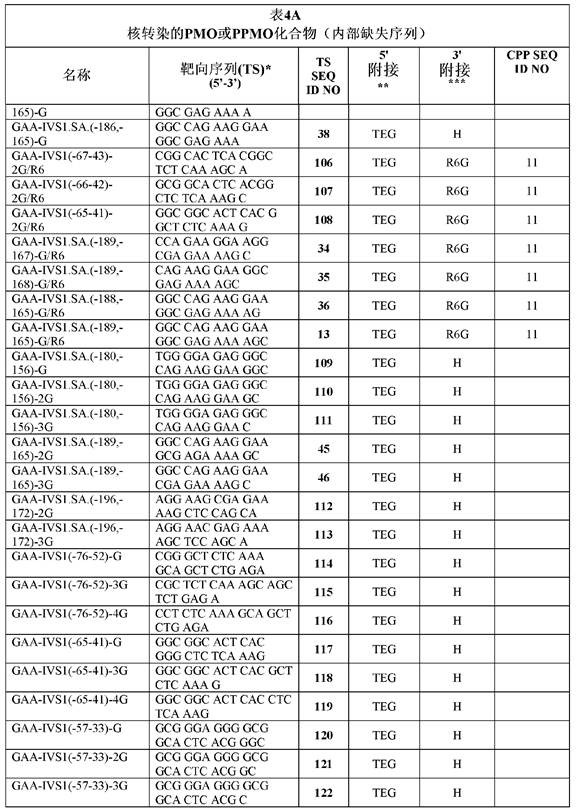


Example 4
Antisense oligomers induce elevated expression levels of acid alpha-glucosidase in GSD-II patient-derived fibroblasts
The antisense PMOs and PPMOs described above were delivered to GM00443 or GM11661 cells by nuclear transfection (see above, e.g., materials and methods). At 37℃with 5% CO 2 After six days of incubation, the cells were lysed and GAA activity in the lysate or GAA protein expression was measured by an immunoassay as described above. In general, the protein expression of GAA enzyme in cells treated with the antisense oligonucleotides of the invention is higher than the GAA expression level in untreated cells (see detailed experimental results below). These results indicate that the oligonucleotides of the invention induce elevated protein expression levels of GAA enzyme in GSD-II patient derived fibroblasts. While not being bound by any theory or mechanism of action, in view of the experimental results described herein, the inventors believe that the oligomers of the invention inhibit ISS and/or ESS elements and thereby promote exon 2 retention in the mature GAA mRNA.
As detailed in the experiments below, a series of variant PPMO and PMO oligonucleotides were evaluated for their ability to increase GAA enzyme expression and/or activity in cells from patients with pompe disease. The targeting sequence of the variant oligonucleotide is complementary to a target region within intron 1 (SEQ ID NO: 1) of the pre-mRNA of the human alpha Glucosidase (GAA) gene, wherein the target region comprises one, two, three or four additional nucleobases compared to the targeting sequence, wherein those additional nucleobases are cytosines, and wherein one, two, three or four additional nucleobases have NO corresponding complementary nucleobases in the targeting sequence (thus, "-G" (guanine), "-2G", "-3G", or "-4G" annotation). Additional nucleobases are within the target region. Surprisingly, many of these variant oligonucleotides were found to have the same or similar activity as oligonucleotides with corresponding non-variant targeting sequences (see e.g. fig. 10b and 16). In some cases, the oligonucleotides with variant targeting sequences are more active in increasing GAA enzyme activity in patient cells than oligonucleotides with corresponding non-variant targeting sequences (see, e.g., fig. 16). For example, as shown in fig. 16, two different oligonucleotides with variant targeting sequences with one less G residue were more active in increasing GAA in fibroblasts derived from pompe patients than oligonucleotides with targeting sequences 100% complementary to GAA (non-variant) (fig. 16).
Selected oligonucleotides were evaluated in multiple doses (5 μm and 0.2 μm) in GM00443 cells. After six days of incubation of the nuclear transfected cells, lysates were prepared as above, and GAA enzyme activity was measured in the lysates. As shown in fig. 1 and 2, cell lysates treated with each of these compounds showed increased GAA enzyme activity at all concentrations tested, as compared to the GAA enzyme activity level in lysates from untreated cells.
In another experiment, selected oligonucleotides were evaluated in multiple doses (5. Mu.M, 1. Mu.M, 0.2. Mu.M, and 0.4. Mu.M) in GM00443 cells. As shown in fig. 3 and 4, cell lysates treated with each of these compounds showed increased GAA enzyme activity at all concentrations tested, as compared to the GAA enzyme activity level in lysates from untreated cells.
In another experiment, selected oligonucleotides were evaluated in multiple doses (5. Mu.M, 1. Mu.M, 0.2. Mu.M, and 0.04. Mu.M) in GM00443 cells. As shown in fig. 5-8, cell lysates treated with each of these compounds showed increased GAA enzyme activity at all concentrations tested, as compared to the GAA enzyme activity level in lysates from untreated cells.
Experiment 4
In another experiment, selected oligonucleotides were evaluated in multiple doses (5. Mu.M, 1.6. Mu.M, 0.5. Mu.M, and 0.16. Mu.M) in GM00443 cells. As shown in fig. 9, cell lysates treated with each of these compounds showed increased GAA enzyme activity at all concentrations tested, as compared to the GAA enzyme activity level in lysates from untreated cells.
In another experiment, selected oligonucleotides were evaluated in multiple doses (5. Mu.M, 1.6. Mu.M, 0.5. Mu.M, and 0.16. Mu.M) in GM00443 cells. As shown in fig. 10a, cell lysates treated with each of these compounds showed increased GAA enzyme activity at all concentrations tested, compared to the GAA enzyme activity level in lysates from untreated cells.
In another experiment, selected oligonucleotides were evaluated in multiple doses (5. Mu.M, 1.6. Mu.M, 0.5. Mu.M, and 0.16. Mu.M) in GM11661 cells. As shown in fig. 10b, cell lysates treated with each of these compounds showed increased GAA enzyme activity at all concentrations tested, compared to the GAA enzyme activity level in lysates from untreated cells.
Experiment 7
In another experiment, selected oligonucleotides were evaluated in multiple doses (5. Mu.M, 1.6. Mu.M, 0.5. Mu.M, and 0.16. Mu.M) in GM00443 cells. As shown in fig. 11 and 12, cell lysates treated with each of these compounds showed increased GAA enzyme activity at all concentrations tested, as compared to the GAA enzyme activity level in lysates from untreated cells.
Experiment 8
In another experiment, selected oligonucleotides were evaluated in multiple doses (5. Mu.M, 1.6. Mu.M, 0.5. Mu.M, and 0.16. Mu.M) in GM00443 cells. As shown in fig. 13a, cell lysates treated with each of these compounds showed increased GAA enzyme activity at all concentrations tested, compared to the GAA enzyme activity level in lysates from untreated cells.
In another experiment, selected oligonucleotides were evaluated in multiple doses (5. Mu.M, 1.6. Mu.M, 0.5. Mu.M, and 0.16. Mu.M) in GM11661 cells. As shown in fig. 13b, cell lysates treated with each of these compounds showed increased GAA enzyme activity at all concentrations tested, compared to the GAA enzyme activity level in lysates from untreated cells.
Experiment 10
In another experiment, selected oligonucleotides were evaluated in multiple doses (5. Mu.M, 1.6. Mu.M, 0.5. Mu.M, and 0.16. Mu.M) in GM00443 cells. As shown in fig. 14, cell lysates treated with each of these compounds showed increased GAA enzyme activity at all concentrations tested, as compared to the GAA enzyme activity level in lysates from untreated cells.
Experiment 11
In another experiment, selected PPMO oligonucleotides were evaluated in GM00443 cells in multiple doses (5 μm, 1.6 μm, 0.5 μm and 0.16 μm). As shown in fig. 15a, cell lysates treated with each of these compounds showed increased GAA enzyme activity at all concentrations tested, compared to the GAA enzyme activity level in lysates from untreated cells.
Experiment 12
In another experiment, selected PPMO oligonucleotides were evaluated in GM11661 cells in multiple doses (5 μm, 1.6 μm, 0.5 μm and 0.16 μm). As shown in fig. 15b, cell lysates treated with each of these compounds showed increased GAA enzyme activity at all concentrations tested, compared to the GAA enzyme activity level in lysates from untreated cells.
Experiment 13
In another experiment, selected oligonucleotides were evaluated in GM00443 cells at a single dose of 5 μm. As shown in fig. 16, cell lysates treated with each of these compounds showed increased GAA enzyme activity at all concentrations tested, as compared to the GAA enzyme activity level in lysates from untreated cells.
Experiment 14
In another experiment, selected PPMO oligonucleotides were evaluated in GM00443 cells in multiple doses (5 μm, 1.6 μm and 0.5 μm). As shown in FIG. 17, GAA enzyme in the lysate from untreated cellsCell lysates treated with each of these compounds showed increased GAA enzyme activity compared to the activity level at all concentrations tested. In addition, EC 50 The (μm) range is 0.042 to 0.836.
In another experiment, selected PPMO oligonucleotides were evaluated in GM11661 cells in multiple doses (5 μm, 1.6 μm and 0.5 μm). As shown in fig. 18, cell lysates treated with each of these compounds showed increased GAA enzyme activity at all concentrations tested, as compared to the GAA enzyme activity level in lysates from untreated cells. In addition, EC 50 The (μm) range is 0.086 to 0.414.
FIG. 19 provides an evaluation of EC for selected PPMO oligonucleotides in both GM00443 and GM11661 cells 50 Table summary of (μm) values, n=9, averaged over three experiments.
Experiment 17
In another experiment, selected PPMO oligonucleotides were evaluated in GM00443 cells in multiple doses (5 μm, 1.6 μm and 0.5 μm). As shown in fig. 20, cell lysates treated with each of these compounds showed increased GAA enzyme activity at all concentrations tested, as compared to the GAA enzyme activity level in lysates from untreated cells. In addition, EC 50 The (. Mu.M) range from 0.149 to 0.896.
In another experiment, selected PPMO oligonucleotides were evaluated in GM00443 cells in multiple doses (5 μm, 1.6 μm and 0.5 μm). As shown in fig. 21, cell lysates treated with each of these compounds showed increased GAA enzyme activity at all concentrations tested, as compared to the GAA enzyme activity level in lysates from untreated cells. In addition, EC 50 The (μm) range is 0.100 to 0.550.
Experiment 19
In another experiment, selected cells were evaluated in multiple doses (5. Mu.M, 1.6. Mu.M, and 0.5. Mu.M) in GM00443 cells PPMO oligonucleotides. As shown in fig. 22, cell lysates treated with each of these compounds showed increased GAA enzyme activity at all concentrations tested, as compared to the GAA enzyme activity level in lysates from untreated cells. In addition, EC 50 The (μm) range is 0.025 to 0.675.
FIG. 23 provides an evaluation of EC for selected PPMO oligonucleotides in both GM00443 and GM11661 cells 50 Table summary of (μm) values, n=9, averaged across all assays.
Experiment 21
In another experiment, selected PPMO oligonucleotides were evaluated in GM11661 cells in multiple doses (5 μm, 1.6 μm and 0.5 μm). As shown in fig. 24, cell lysates treated with each of these compounds showed increased GAA enzyme activity at all concentrations tested, as compared to the GAA enzyme activity level in lysates from untreated cells. In addition, EC 50 The (μm) range is 0.144 to 0.630.
Experiment 22
In another experiment, selected PPMO oligonucleotides were evaluated in GM11661 cells in multiple doses (5 μm, 1.6 μm and 0.5 μm). As shown in fig. 25, cell lysates treated with each of these compounds showed increased GAA enzyme activity at all concentrations tested, as compared to the GAA enzyme activity level in lysates from untreated cells. In addition, EC 50 The (. Mu.M) range is 0.128 to 0.763.
Experiment 23
In another experiment, selected PPMO oligonucleotides were evaluated in GM11661 cells in multiple doses (5 μm, 1.6 μm and 0.5 μm). As shown in fig. 26, cell lysates treated with each of these compounds showed increased GAA enzyme activity at all concentrations tested, as compared to the GAA enzyme activity level in lysates from untreated cells. In addition, EC 50 The (. Mu.M) range is 0.002 to 0.218.


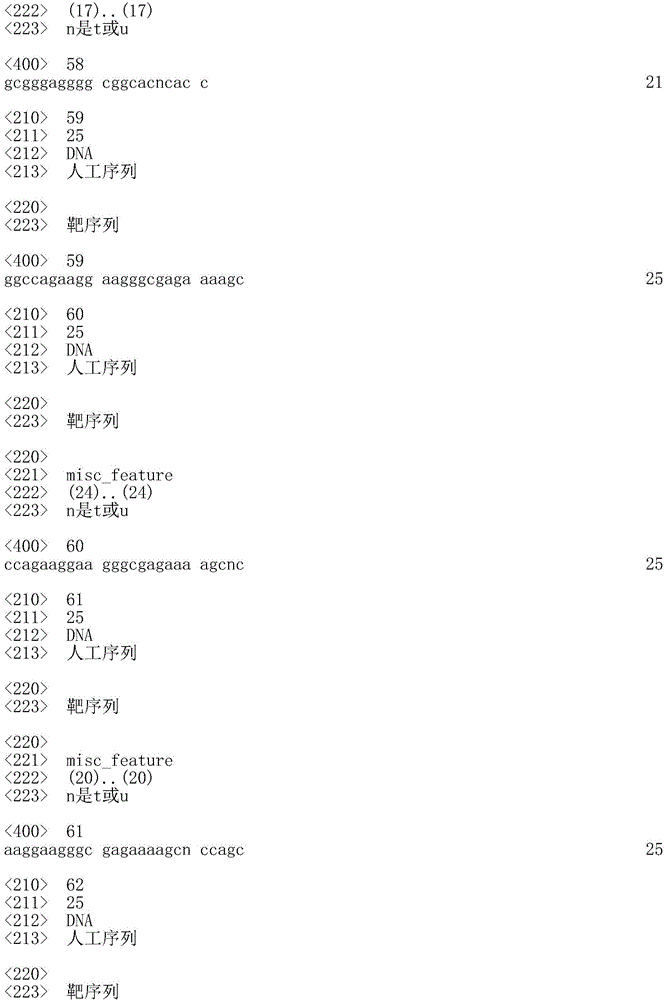


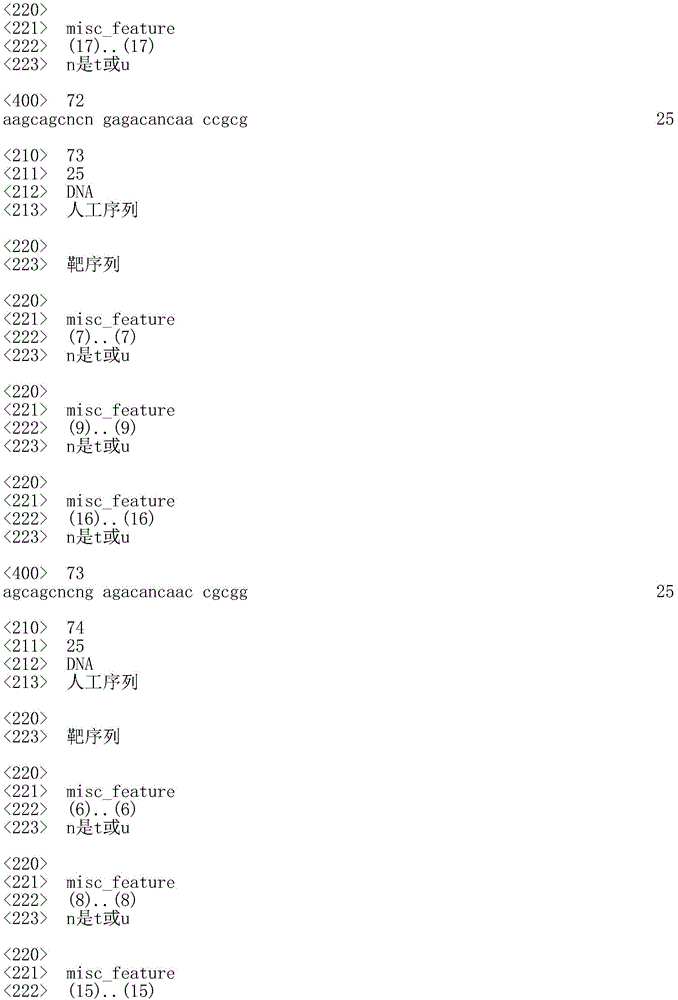


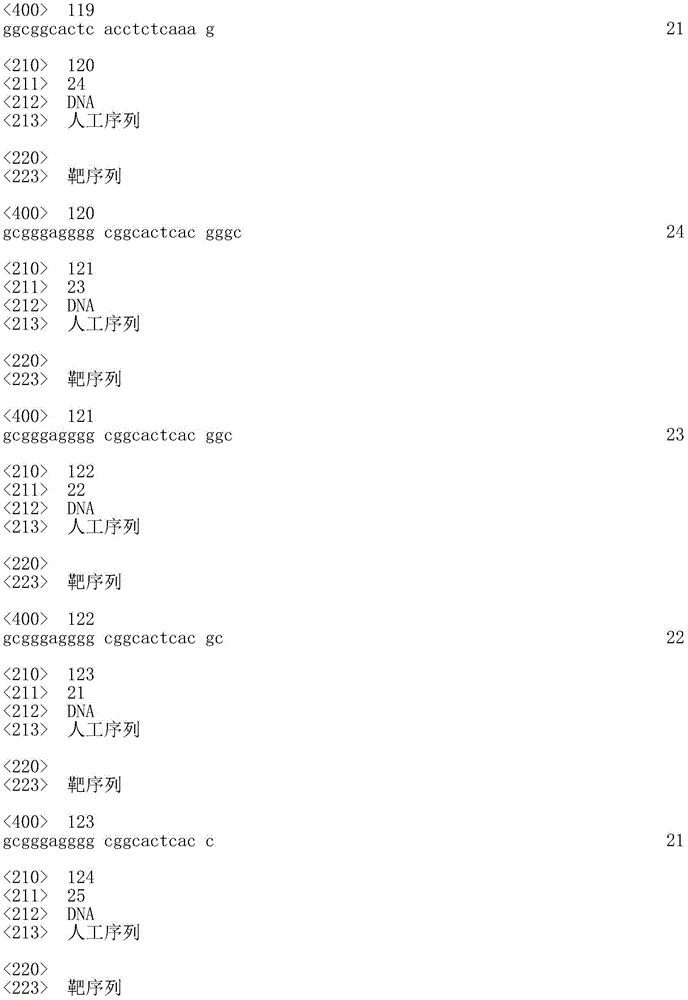


Claims (20)
1. A 10 to 40 nucleobase modified antisense oligonucleotide comprising: a targeting sequence complementary to a target region within intron 1 of a human alpha Glucosidase (GAA) gene shown in SEQ ID No. 1, wherein the target region comprises at least one additional nucleobase compared to the targeting sequence, wherein the at least one additional nucleobase does not have a complementary nucleobase in the targeting sequence, wherein the at least one additional nucleobase is internal to the target region; and wherein the modified antisense oligonucleotide is an antisense oligomer compound of formula (I):

or a pharmaceutically acceptable salt thereof, wherein:
each Nu is a nucleobase that together form a targeting sequence;
Z is an integer from 8 to 38;
each Y is independently selected from O and-NR 4 Wherein each R is 4 Independently selected from H, C 1 -C 6 Alkyl, aralkyl, -C (=nh) NH 2 、-C(O)(CH 2 ) n NR 5 C(=NH)NH 2 、-C(O)(CH 2 ) 2 NHC(O)(CH 2 ) 5 NR 5 C(=NH)NH 2 And G, wherein R 5 Selected from H and C 1 -C 6 Alkyl, and n is an integer from 1 to 5;
t is selected from OH and a moiety of the formula:

wherein:
a is selected from-OH, -N (R) 7 ) 2 And R is 1 Wherein each R is 7 Independently selected from H and C 1 -C 6 Alkyl group, and
R 6 selected from OH, -N (R) 9 )CH 2 C(O)NH 2 And a moiety of the formula:

wherein:
R 9 selected from H and C 1 -C 6 An alkyl group; and
R 10 selected from G, -C (O) -R 11 OH, acyl, trityl, 4-methoxytrityl, -C (=NH) NH 2 、-C(O)(CH 2 ) m NR 12 C(=NH)NH 2 and-C (O) (CH 2 ) 2 NHC(O)(CH 2 ) 5 NR 12 C(=NH)NH 2 Wherein:
m is an integer of 1 to 5,
R 11 having- (O-alkyl) groups y -, where y is an integer from 3 to 10, and
each y alkyl is independently selected from C 2 -C 6 An alkyl group; and
R 12 selected from H and C 1 -C 6 An alkyl group;
R 1 independently selected from the group consisting of:
–N(R 13 ) 2 wherein each R is 13 Independently selected from H and C 1 -C 6 An alkyl group;
a moiety of formula (II):

wherein:
R 15 selected from H, G, C 1 -C 6 Alkyl, -C (=nh) NH 2 、-C(O)(CH 2 ) q NR 18 C(=NH)NH 2 and-C (O) (CH 2 ) 2 NHC(O)(CH 2 ) 5 NR 18 C(=NH)NH 2 Wherein:
R 18 selected from H and C 1 -C 6 An alkyl group; and
q is an integer of 1 to 5, and
each R 17 Independently selected from H and methyl; and
a moiety of formula (III):

wherein:
R 19 selected from H, C 1 -C 6 Alkyl, -C (=nh) NH 2 、-C(O)(CH 2 ) r NR 22 C(=NH)NH 2 、-C(O)CH(NH 2 )(CH 2 ) 3 NHC(=NH)NH 2 、-C(O)(CH 2 ) 2 NHC(O)(CH 2 ) 5 NR 22 C(=NH)NH 2 、-C(O)CH(NH 2 )(CH 2 ) 4 NH 2 And G, wherein:
R 22 selected from H and C 1 -C 6 An alkyl group; and
r is an integer from 1 to 5, and
R 20 Selected from H and C 1 -C 6 An alkyl group; or (b)
R 19 And R is 20 Together with the nitrogen atom to which they are attached, form a heterocyclic or heteroaryl ring having 5 to 7 ring atoms, and optionally containing a further heteroatom selected from oxygen, nitrogen and sulfur; and
R 2 selected from H, G, acyl, trityl, 4-methoxytrityl, benzoyl, stearoyl, C 1 -C 6 Alkyl, -C (=nh) NH 2 、-C(O)-R 23 、-C(O)(CH 2 ) s NR 24 C(=NH)NH 2 、-C(O)(CH 2 ) 2 NHC(O)(CH 2 ) 5 NR 24 C(=NH)NH 2 、-C(O)CH(NH 2 )(CH 2 ) 3 NHC(=NH)NH 2 And a moiety of the formula:

wherein,,
R 23 having- (O-alkyl) groups v -OH, wherein v is an integer from 3 to 10, and each valkyl is independently selected from C 2 -C 6 An alkyl group; and
R 24 selected from H and C 1 -C 6 An alkyl group;
s is an integer from 1 to 5;
l is selected from the group consisting of-C (O) (CH 2 ) 6 C (O) -and-C (O) (CH 2 ) 2 S 2 (CH 2 ) 2 C (O) -; and
each R 25 Having- (CH) 2 ) 2 OC(O)N(R 26 ) 2 Wherein each R is 26 Having- (CH) 2 ) 6 NHC(=NH)NH 2 ,
Wherein G is a cell penetrating peptide ("CPP") and is selected from the group consisting of-C (O) (CH) 2 ) 5 NH-CPP、-C(O)(CH 2 ) 2 NH-CPP、-C(O)(CH 2 ) 2 NHC(O)(CH 2 ) 5 NH-CPP、-C(O)CH 2 NH-CPP and:

wherein the CPP is attached to the linker moiety through an amide bond at the carboxy terminus of the CPP, and
wherein G may occur once or not.
2. The modified antisense oligonucleotide of claim 1 wherein the target region comprises at least one of SEQ ID No. 2 or SEQ ID No. 3.
3. The modified antisense oligonucleotide of claim 1 or 2, wherein the antisense oligonucleotide promotes exon 2 retention in GAAmRNA upon binding of the targeting sequence to the target region.
4. The modified antisense oligonucleotide of claim 1 wherein the target region comprises one to three additional nucleobases as compared to the targeting sequence.
5. The modified antisense oligonucleotide of claim 1 wherein the antisense oligonucleotide induces at least two times or at least three times or at least four times GAA enzymatic activity according to an enzymatic activity test as compared to a second antisense oligonucleotide that is fully complementary to a target region within SEQ ID No. 1.
6. The modified antisense oligonucleotide of claim 1 wherein the targeting sequence is selected from any one of SEQ ID NOs 13-58.
7. The modified antisense oligonucleotide of claim 1 wherein the targeting sequence is selected from any one of SEQ ID NOs 13, 33-38, 45, 46 and 87-123.
8. The modified antisense oligonucleotide of claim 1 wherein the targeting sequence is selected from any one of SEQ ID NOs 13, 27-29 or 34-36.
9. An antisense oligomer compound of formula (I):

or a pharmaceutically acceptable salt thereof, wherein:
each Nu is a nucleobase that together form a targeting sequence;
z is an integer from 8 to 38;
each Y is independently selected from O and-NR 4 Wherein each R is 4 Independently selected from H, C 1 -C 6 Alkyl, aralkyl, -C (=nh) NH 2 、-C(O)(CH 2 ) n NR 5 C(=NH)NH 2 、-C(O)(CH 2 ) 2 NHC(O)(CH 2 ) 5 NR 5 C(=NH)NH 2 And G, wherein R 5 Selected from H and C 1 -C 6 Alkyl, and n is an integer from 1 to 5;
t is selected from OH and a moiety of the formula:

wherein:
a is selected from-OH, -N (R) 7 ) 2 And R is 1 Wherein each R is 7 Independently selected from H and C 1 -C 6 Alkyl group, and
R 6 selected from OH, -N (R) 9 )CH 2 C(O)NH 2 And a moiety of the formula:

wherein:
R 9 selected from H and C 1 -C 6 An alkyl group; and
R 10 selected from G, -C (O) -R 11 OH, acyl, trityl, 4-methoxytrityl, -C (=NH) NH 2 、-C(O)(CH 2 ) m NR 12 C(=NH)NH 2 and-C (O) (CH 2 ) 2 NHC(O)(CH 2 ) 5 NR 12 C(=NH)NH 2 Wherein:
m is an integer of 1 to 5,
R 11 having- (O-alkyl) groups y -, where y is an integer from 3 to 10, and
each y alkyl is independently selected from C 2 -C 6 An alkyl group; and
R 12 selected from H and C 1 -C 6 An alkyl group;
R 1 independently selected from the group consisting of:
–N(R 13 ) 2 wherein each R is 13 Independently selected from H and C 1 -C 6 An alkyl group;
a moiety of formula (II):

wherein:
R 15 selected from H, G, C 1 -C 6 Alkyl, -C (=nh) NH 2 、-C(O)(CH 2 ) q NR 18 C(=NH)NH 2 and-C (O) (CH 2 ) 2 NHC(O)(CH 2 ) 5 NR 18 C(=NH)NH 2 Wherein:
R 18 selected from H and C 1 -C 6 An alkyl group; and
q is an integer of 1 to 5, and
each R 17 Independently selected from H and methyl; and
a moiety of formula (III):

wherein:
R 19 selected from H, C 1 -C 6 Alkyl, -C (=nh) NH 2 、-C(O)(CH 2 ) r NR 22 C(=NH)NH 2 、-C(O)CH(NH 2 )(CH 2 ) 3 NHC(=NH)NH 2 、-C(O)(CH 2 ) 2 NHC(O)(CH 2 ) 5 NR 22 C(=NH)NH 2 、-C(O)CH(NH 2 )(CH 2 ) 4 NH 2 And G, wherein:
R 22 selected from H and C 1 -C 6 An alkyl group; and
r is an integer from 1 to 5, and
R 20 selected from H and C 1 -C 6 An alkyl group; or (b)
R 19 And R is 20 Together with the nitrogen atom to which they are attached, form a heterocyclic or heteroaryl ring having 5 to 7 ring atoms, and optionally containing a further heteroatom selected from oxygen, nitrogen and sulfur; and
R 2 Selected from H, G, acyl, trityl, 4-methoxytrityl, benzoyl, stearoyl, C 1 -C 6 Alkyl, -C (=nh) NH 2 、-C(O)-R 23 、-C(O)(CH 2 ) s NR 24 C(=NH)NH 2 、-C(O)(CH 2 ) 2 NHC(O)(CH 2 ) 5 NR 24 C(=NH)NH 2 、-C(O)CH(NH 2 )(CH 2 ) 3 NHC(=NH)NH 2 And a moiety of the formula:

wherein,,
R 23 having- (O-alkyl) groups v -OH, wherein v is an integer from 3 to 10, and each valkyl is independently selected from C 2 -C 6 An alkyl group; and
R 24 selected from H and C 1 -C 6 An alkyl group;
s is an integer from 1 to 5;
l is selected from the group consisting of-C (O) (CH 2 ) 6 C (O) -and-C (O) (CH 2 ) 2 S 2 (CH 2 ) 2 C (O) -; and
each R 25 Having- (CH) 2 ) 2 OC(O)N(R 26 ) 2 Wherein each R is 26 Having- (CH) 2 ) 6 NHC(=NH)NH 2 ,
Wherein G is a cell penetrating peptide ("CPP") and is selected from the group consisting of-C (O) (CH) 2 ) 5 NH-CPP、-C(O)(CH 2 ) 2 NH-CPP、-C(O)(CH 2 ) 2 NHC(O)(CH 2 ) 5 NH-CPP、-C(O)CH 2 NH-CPP and:

wherein the CPP is attached to the linker moiety through an amide bond at the carboxy terminus of the CPP, and
wherein G may occur once or absent; wherein the targeting sequence is selected from the group consisting of:
I.
a) SEQ ID NO. 13 (GGC CAGAAG GAA GGC GAG AAA AGC) wherein Z is 22;
b) SEQ ID NO. 14 (GCC AGA AGGAAG GCG AGA AAA GCX) wherein Z is 22;
c) SEQ ID NO. 15 (CCA GAA GGA AGG CGA GAA AAG CXC) wherein Z is 22;
d) SEQ ID NO. 16 (CAG AAG GAA GGC GAG AAA AGC XCC) wherein Z is 22;
e) SEQ ID NO. 17 (AGA AGG AAG GCG AGA AAA GCX CCA) wherein Z is 22;
f) SEQ ID NO. 18 (GAA GGA AGG CGA GAA AAG CXC CAG) wherein Z is 22;
g) SEQ ID NO. 19 (AAG GAA GGC GAG AAA AGC XCC AGC), wherein Z is 22;
h) SEQ ID NO. 20 (AGG AAG GCG AGAAAA GCX CCA GCA), wherein Z is 22;
i) SEQ ID NO. 21 (CGG CXC XCA AAG CAG CXC XGA GA) wherein Z is 21;
j) SEQ ID NO. 22 (ACG GCX CXC AAA GCA GCX CXG AG) wherein Z is 21;
k) SEQ ID NO. 23 (CAC GGC XCX CAAAGC AGC XCX GA), wherein Z is 21;
l) SEQ ID NO. 24 (XCA CGG CXC XCA AAG CAG CXC XG) wherein Z is 21;
m) SEQ ID NO. 25 (CXC ACG GCX CXC AAA GCA GCX CX) wherein Z is 21;
n) SEQ ID NO. 26 (ACX CAC GGC XCX CAA AGC AGC XC) wherein Z is 21;
o) SEQ ID NO. 27 (GCG GCA CXC ACG GCX CXC AAA GC) wherein Z is 21;
p) SEQ ID NO. 28 (GGC GGC ACX CAC GGC XCX CAA AG) wherein Z is 21;
q) SEQ ID NO. 29 (CGG CAC XCA CGG CXC XCA AAG CA) wherein Z is 21;
r) SEQ ID NO. 30 (GCA CXC ACG GCX CXC AAA GCA GC) wherein Z is 21;
s) SEQ ID NO. 31 (GGC ACX CAC GGC XCX CAA AGC AG) wherein Z is 21;
t) SEQ ID NO. 32 (CAC XCA CGG CXC XCA AAG CAG CX) wherein Z is 21;
u) SEQ ID NO. 33 (GCC AGA AGG AAG GCG AGA AAA GC) wherein Z is 21;
v) SEQ ID NO 34 (CCA GAA GGA AGG CGA GAA AAG C) wherein Z is 20;
w) SEQ ID NO. 35 (CAG AAG GAA GGC GAG AAA AGC) wherein Z is 19;
x) SEQ ID NO. 36 (GGC CAG AAG GAA GGC GAG AAA AG) wherein Z is 21;
y) SEQ ID NO 37 (GGC CAG AAG GAA GGC GAG AAA A) wherein Z is 20;
z) SEQ ID NO. 38 (GGC CAG AAG GAA GGC GAG AAA), wherein Z is 19;
aa) SEQ ID NO 39 (CGG CAC XCA CGG CXC XCA AAG CA), wherein Z is 21;
bb) SEQ ID NO. 40 (GCG GCA CXC ACG GCX CXC AAA GC), wherein Z is 21;
cc) SEQ ID NO. 41 (GGC GGC ACX CAC GGC XCX CAA AG) wherein Z is 21;
dd) SEQ ID NO. 42 (XGG GGA GAG GGC CAG AAG GAA GGC), wherein Z is 22;
ee) SEQ ID NO. 43 (XGG GGA GAG GGC CAG AAG GAA GC), wherein Z is 21;
ff) SEQ ID NO. 44 (XGG GGA GAG GGC CAG AAG GAA C), wherein Z is 20;
gg) SEQ ID NO. 45 (GGC CAG AAG GAA GCG AGA AAA GC), wherein Z is 21;
hh) SEQ ID NO. 46 (GGC CAG AAG GAA CGA GAA AAG C), wherein Z is 20;
ii) SEQ ID NO. 47 (AGG AAG CGA GAA AAG CXC CAG CA) wherein Z is 21;
jj) SEQ ID NO. 48 (AGG AAC GAG AAA AGC XCC AGC A), wherein Z is 20;
kk) SEQ ID NO. 49 (CGG GCX CXC AAA GCA GCX CXG AGA), wherein Z is 22;
ll) SEQ ID NO. 50 (CGC XCX CAA AGC AGC XCX GAG A) wherein Z is 20;
mm) SEQ ID NO. 51 (CCX CXC AAA GCA GCX CXG AGA), wherein Z is 19;
nn) SEQ ID NO. 52 (GGC GGC ACX CAC GGG CXC XCA AAG), wherein Z is 22;
oo) SEQ ID NO. 53 (GGC GGC ACX CAC GCX CX CAAA G) wherein Z is 20;
pp) SEQ ID NO. 54 (GGC GGC ACX CAC CXC XCA AAG), wherein Z is 19;
qq) SEQ ID NO. 55 (GCG GGA GGG GCG GCA CXC ACG GGC) wherein Z is 22;
rr) SEQ ID NO. 56 (GCG GGA GGG GCG GCA CXC ACG GC) wherein Z is 21;
ss) SEQ ID NO 57 (GCG GGA GGG GCG GCA CXC ACG C) wherein Z is 20; and
tt) SEQ ID NO 58 (GCG GGA GGG GCG GCA CXC ACC), wherein Z is 19,
wherein X is selected from uracil (U) or thymine (T);
II.
a) SEQ ID NO 59 (GGC CAG AAG GAA GGG CGA GAA AAG C) wherein Z is 23;
b) SEQ ID NO. 60 (CCA GAA GGA AGG GCG AGA AAA GCX C) wherein Z is 23;
c) SEQ ID NO. 61 (AAG GAA GGG CGA GAA AAG CXC CAG C) wherein Z is 23;
d) SEQ ID NO. 62 (GCG GGA GGG GCG GCA CXC ACG GGG C) wherein Z is 23;
e) SEQ ID NO. 63 (XGG GGA GAG GGC CAG AAG GAAGGG C) wherein Z is 23;
f) SEQ ID NO. 64 (AGA AGG AAG GGC GAG AAA AGC XCC A) wherein Z is 23;
g) SEQ ID NO. 65 (GCX CXC AAA GCA GCX CXG AGA CAX C) wherein Z is 23;
h) SEQ ID NO. 66 (CXC XCA AAG CAG CXC XGA GAC AXC A) wherein Z is 23;
i) SEQ ID NO. 67 (XCX CAA AGC AGC XCX GAG ACA XCA A) wherein Z is 23;
j) SEQ ID NO. 68 (CXC AAA GCA GCX CXG AGA CAX CAA C) wherein Z is 23;
k) SEQ ID NO. 69 (XCA AAG CAG CXC XGA GAC AXC AAC C) wherein Z is 23;
l) SEQ ID NO 70 (CAA AGC AGC XCX GAG ACA XCA ACC G) wherein Z is 23;
m) SEQ ID NO. 71 (AAA GCA GCX CXG AGA CAX CAA CCG C) wherein Z is 23;
n) SEQ ID NO. 72 (AAG CAG CXC XGA GAC AXC AAC CGC G) wherein Z is 23;
o) SEQ ID NO. 73 (AGC AGC XCX GAG ACA XCA ACC GCG G) wherein Z is 23;
p) SEQ ID NO 74 (GCA GCX CXG AGA CAX CAA CCG CGG C) wherein Z is 23; and
q) SEQ ID NO. 75 (CAG CXC XGA GAC AXC AAC CGC GGC X) wherein Z is 23,
wherein X is selected from uracil (U) or thymine (T).
10. The antisense oligomer compound of claim 9 wherein each R 1 is-N (CH) 3 ) 2 。
11. The antisense oligomer compound of claim 9, R 1 Selected from:

12. the antisense oligomer compound of any one of claims 9-11, wherein T is selected from the group consisting of:

y is at each occurrence O.
Use of a modified antisense oligonucleotide of 10 to 40 nucleobases in the manufacture of a medicament for the treatment of a glycogen storage disease type II, wherein the modified antisense oligonucleotide comprises: a targeting sequence complementary to a target region within intron 1 of a human alpha Glucosidase (GAA) gene shown in SEQ ID No. 1, wherein the target region comprises at least one additional nucleobase compared to the targeting sequence, wherein the at least one additional nucleobase does not have a complementary nucleobase in the targeting sequence, wherein the at least one additional nucleobase is internal to the target region, and wherein the modified antisense oligonucleotide is an antisense oligomer compound of formula (I):

Or a pharmaceutically acceptable salt thereof, wherein:
each Nu is a nucleobase that together form a targeting sequence;
z is an integer from 8 to 38;
each Y is independently selected from O and-NR 4 Wherein each R is 4 Independently selected from H, C 1 -C 6 Alkyl, aralkyl, -C (=nh) NH 2 、-C(O)(CH 2 ) n NR 5 C(=NH)NH 2 、-C(O)(CH 2 ) 2 NHC(O)(CH 2 ) 5 NR 5 C(=NH)NH 2 And G, wherein R 5 Selected from H and C 1 -C 6 Alkyl, and n is an integer from 1 to 5;
t is selected from OH and a moiety of the formula:

wherein:
a is selected from-OH, -N (R) 7 ) 2 And R is 1 Wherein each R is 7 Independently selected from H and C 1 -C 6 Alkyl group, and
R 6 selected from OH, -N (R) 9 )CH 2 C(O)NH 2 And a moiety of the formula:

wherein:
R 9 selected from H and C 1 -C 6 An alkyl group; and
R 10 selected from G, -C (O) -R 11 OH, acyl, trityl, 4-methoxytrityl, -C (=NH) NH 2 、-C(O)(CH 2 ) m NR 12 C(=NH)NH 2 and-C (O) (CH 2 ) 2 NHC(O)(CH 2 ) 5 NR 12 C(=NH)NH 2 Wherein:
m is an integer of 1 to 5,
R 11 having- (O-alkyl) groups y -, where y is an integer from 3 to 10, and
each y alkyl is independently selected from C 2 -C 6 An alkyl group; and
R 12 selected from H and C 1 -C 6 An alkyl group;
R 1 independently selected from the group consisting of:
–N(R 13 ) 2 wherein each R is 13 Independently selected from H and C 1 -C 6 An alkyl group;
a moiety of formula (II):

wherein:
R 15 selected from H, G, C 1 -C 6 Alkyl, -C (=nh) NH 2 、-C(O)(CH 2 ) q NR 18 C(=NH)NH 2 and-C (O) (CH 2 ) 2 NHC(O)(CH 2 ) 5 NR 18 C(=NH)NH 2 Wherein:
R 18 selected from H and C 1 -C 6 An alkyl group; and
q is an integer of 1 to 5, and
each R 17 Independently selected from H and methyl; and
a moiety of formula (III):

wherein:
R 19 Selected from H, C 1 -C 6 Alkyl, -C (=nh) NH 2 、-C(O)(CH 2 ) r NR 22 C(=NH)NH 2 、-C(O)CH(NH 2 )(CH 2 ) 3 NHC(=NH)NH 2 、-C(O)(CH 2 ) 2 NHC(O)(CH 2 ) 5 NR 22 C(=NH)NH 2 、-C(O)CH(NH 2 )(CH 2 ) 4 NH 2 And G, wherein:
R 22 selected from H and C 1 -C 6 An alkyl group; and
r is an integer from 1 to 5, and
R 20 selected from H and C 1 -C 6 An alkyl group; or (b)
R 19 And R is 20 Together with the nitrogen atom to which they are attached, form a heterocyclic or heteroaryl ring having 5 to 7 ring atoms, and optionally containing a further heteroatom selected from oxygen, nitrogen and sulfur; and
R 2 selected from H, G, acyl, trityl, 4-methoxytrityl, benzoyl, stearoyl, C 1 -C 6 Alkyl, -C (=nh) NH 2 、-C(O)-R 23 、-C(O)(CH 2 ) s NR 24 C(=NH)NH 2 、-C(O)(CH 2 ) 2 NHC(O)(CH 2 ) 5 NR 24 C(=NH)NH 2 、-C(O)CH(NH 2 )(CH 2 ) 3 NHC(=NH)NH 2 And a moiety of the formula:

wherein,,
R 23 having- (O-alkyl) groups v -OH, wherein v is an integer from 3 to 10, and each valkyl is independently selected from C 2 -C 6 An alkyl group;and
R 24 selected from H and C 1 -C 6 An alkyl group;
s is an integer from 1 to 5;
l is selected from the group consisting of-C (O) (CH 2 ) 6 C (O) -and-C (O) (CH 2 ) 2 S 2 (CH 2 ) 2 C (O) -; and
each R 25 Having- (CH) 2 ) 2 OC(O)N(R 26 ) 2 Wherein each R is 26 Having- (CH) 2 ) 6 NHC(=NH)NH 2 ,
Wherein G is a cell penetrating peptide ("CPP") and is selected from the group consisting of-C (O) (CH) 2 ) 5 NH-CPP、-C(O)(CH 2 ) 2 NH-CPP、-C(O)(CH 2 ) 2 NHC(O)(CH 2 ) 5 NH-CPP、-C(O)CH 2 NH-CPP and:

wherein the CPP is attached to the linker moiety through an amide bond at the carboxy terminus of the CPP, and
wherein G may occur once or not.
14. The use of claim 13, wherein the target region comprises at least one of SEQ ID No. 2 or SEQ ID No. 3.
15. The use of claim 13 or 14, wherein the antisense oligonucleotide promotes exon 2 retention in the GAAmRNA upon binding of the targeting sequence to the target region.
16. The use of claim 13, wherein the target region comprises one to three additional nucleobases compared to the targeting sequence.
17. The use of claim 13, wherein the antisense oligonucleotide induces at least two times or at least three times or at least four times GAA enzymatic activity according to an enzymatic activity test compared to a second antisense oligonucleotide fully complementary to the target region within SEQ ID No. 1.
18. The use of claim 13, wherein the targeting sequence is selected from any one of SEQ ID NOs 13 to 58.
19. The use of claim 13, wherein the targeting sequence is selected from any one of SEQ ID NOs 13, 33-38, 45, 46 and 87-123.
20. The use of claim 13, wherein the targeting sequence is selected from any one of SEQ ID NOs 13, 27-29 or 34-36.
Applications Claiming Priority (3)
| Application Number | Priority Date | Filing Date | Title |
|---|---|---|---|
| US201662324185P | 2016-04-18 | 2016-04-18 | |
| US62/324185 | 2016-04-18 | ||
| PCT/US2017/028002 WO2017184529A1 (en) | 2016-04-18 | 2017-04-17 | Antisense oligomers and methods of using the same for treating diseases associated with the acid alpha-glucosidase gene |
Publications (2)
| Publication Number | Publication Date |
|---|---|
| CN109414511A CN109414511A (en) | 2019-03-01 |
| CN109414511B true CN109414511B (en) | 2023-05-23 |
Family
ID=60117051
Family Applications (1)
| Application Number | Title | Priority Date | Filing Date |
|---|---|---|---|
| CN201780037829.0A Active CN109414511B (en) | 2016-04-18 | 2017-04-17 | Antisense oligomers for treating diseases associated with acid alpha-glucosidase gene and methods of use thereof |
Country Status (15)
| Country | Link |
|---|---|
| US (3) | US11060089B2 (en) |
| EP (1) | EP3445405A4 (en) |
| JP (3) | JP7033547B2 (en) |
| KR (1) | KR102522059B1 (en) |
| CN (1) | CN109414511B (en) |
| AU (2) | AU2017254106B2 (en) |
| BR (1) | BR112018071477A2 (en) |
| CA (1) | CA3021267A1 (en) |
| EA (1) | EA201892366A1 (en) |
| MX (2) | MX2018012695A (en) |
| MY (1) | MY200252A (en) |
| SA (1) | SA518400251B1 (en) |
| SG (1) | SG11201808964PA (en) |
| TW (1) | TWI766861B (en) |
| WO (1) | WO2017184529A1 (en) |
Families Citing this family (13)
| Publication number | Priority date | Publication date | Assignee | Title |
|---|---|---|---|---|
| CN109414511B (en) | 2016-04-18 | 2023-05-23 | 萨勒普塔医疗公司 | Antisense oligomers for treating diseases associated with acid alpha-glucosidase gene and methods of use thereof |
| EP3697910A4 (en) | 2017-10-18 | 2021-07-14 | Sarepta Therapeutics, Inc. | ANTISENSE OLIGOMERIC COMPOUNDS |
| US20220193250A1 (en) | 2018-08-02 | 2022-06-23 | Dyne Therapeutics, Inc. | Muscle targeting complexes and uses thereof for treating facioscapulohumeral muscular dystrophy |
| US12018087B2 (en) | 2018-08-02 | 2024-06-25 | Dyne Therapeutics, Inc. | Muscle-targeting complexes comprising an anti-transferrin receptor antibody linked to an oligonucleotide and methods of delivering oligonucleotide to a subject |
| CN118662653A (en) * | 2018-08-02 | 2024-09-20 | 达因疗法公司 | Muscle targeting complexes and their use for the treatment of pompe disease |
| CN115175991A (en) | 2019-10-16 | 2022-10-11 | 博德研究所 | Engineered muscle targeting compositions |
| US11638761B2 (en) | 2021-07-09 | 2023-05-02 | Dyne Therapeutics, Inc. | Muscle targeting complexes and uses thereof for treating Facioscapulohumeral muscular dystrophy |
| IL311568A (en) * | 2021-09-30 | 2024-05-01 | Sarepta Therapeutics Inc | Antisense oligonucleotides having one or more basic units |
| KR20250051026A (en) | 2022-07-14 | 2025-04-16 | 더 브로드 인스티튜트, 인코퍼레이티드 | AAV capsid enabling CNS-wide gene transfer through interaction with transferrin receptor |
| JP2025533501A (en) * | 2022-09-28 | 2025-10-07 | サレプタ セラピューティクス, インコーポレイテッド | Methods for generating, characterizing, and using Pompe disease mouse models |
| WO2025155923A1 (en) | 2024-01-17 | 2025-07-24 | The Broad Institute, Inc. | Aav capsid modifications that enable improved cns-wide gene delivery through interactions with the transferrin receptor |
| WO2025217174A1 (en) | 2024-04-08 | 2025-10-16 | The Broad Institute, Inc. | Aav capsid modifications that enable improved cns-wide gene delivery through interactions with carbonic anhydrase iv |
| WO2025217163A2 (en) | 2024-04-08 | 2025-10-16 | The Broad Institute, Inc. | Novel aav capsids binding to human cd59 |
Citations (3)
| Publication number | Priority date | Publication date | Assignee | Title |
|---|---|---|---|---|
| WO2015179741A1 (en) * | 2014-05-23 | 2015-11-26 | Genzyme Corporation | Inhibiting or downregulating glycogen synthase by creating premature stop codons using antisense oligonucleotides |
| WO2015190922A1 (en) * | 2014-06-10 | 2015-12-17 | Erasmus University Medical Center Rotterdam | Antisense oligonucleotides useful in treatment of pompe disease |
| TW201605881A (en) * | 2013-09-05 | 2016-02-16 | 薩羅塔治療公司 | Antisense strand induction of acid alpha glucosidase induces exon 2 inclusion |
Family Cites Families (111)
| Publication number | Priority date | Publication date | Assignee | Title |
|---|---|---|---|---|
| US4534899A (en) | 1981-07-20 | 1985-08-13 | Lipid Specialties, Inc. | Synthetic phospholipid compounds |
| US4426330A (en) | 1981-07-20 | 1984-01-17 | Lipid Specialties, Inc. | Synthetic phospholipid compounds |
| US5034506A (en) | 1985-03-15 | 1991-07-23 | Anti-Gene Development Group | Uncharged morpholino-based polymers having achiral intersubunit linkages |
| US5166315A (en) | 1989-12-20 | 1992-11-24 | Anti-Gene Development Group | Sequence-specific binding polymers for duplex nucleic acids |
| US5521063A (en) | 1985-03-15 | 1996-05-28 | Antivirals Inc. | Polynucleotide reagent containing chiral subunits and methods of use |
| US5506337A (en) | 1985-03-15 | 1996-04-09 | Antivirals Inc. | Morpholino-subunit combinatorial library and method |
| US5185444A (en) | 1985-03-15 | 1993-02-09 | Anti-Gene Deveopment Group | Uncharged morpolino-based polymers having phosphorous containing chiral intersubunit linkages |
| DE3687030T2 (en) | 1985-03-15 | 1993-03-11 | Eugene Stirchak | STEREO-REGULAR POLYNUCLEOTID-BINDING POLYMERS. |
| US5217866A (en) | 1985-03-15 | 1993-06-08 | Anti-Gene Development Group | Polynucleotide assay reagent and method |
| US5354844A (en) | 1989-03-16 | 1994-10-11 | Boehringer Ingelheim International Gmbh | Protein-polycation conjugates |
| US5108921A (en) | 1989-04-03 | 1992-04-28 | Purdue Research Foundation | Method for enhanced transmembrane transport of exogenous molecules |
| US5227170A (en) | 1989-06-22 | 1993-07-13 | Vestar, Inc. | Encapsulation process |
| US5527528A (en) | 1989-10-20 | 1996-06-18 | Sequus Pharmaceuticals, Inc. | Solid-tumor treatment method |
| US5356633A (en) | 1989-10-20 | 1994-10-18 | Liposome Technology, Inc. | Method of treatment of inflamed tissues |
| US5013556A (en) | 1989-10-20 | 1991-05-07 | Liposome Technology, Inc. | Liposomes with enhanced circulation time |
| US5580575A (en) | 1989-12-22 | 1996-12-03 | Imarx Pharmaceutical Corp. | Therapeutic drug delivery systems |
| US5469854A (en) | 1989-12-22 | 1995-11-28 | Imarx Pharmaceutical Corp. | Methods of preparing gas-filled liposomes |
| US5264618A (en) | 1990-04-19 | 1993-11-23 | Vical, Inc. | Cationic lipids for intracellular delivery of biologically active molecules |
| DE4021108A1 (en) | 1990-07-03 | 1992-01-09 | Bayer Ag | OPTICALLY ACTIVE N- (ALPHA) -FLUORACRYLOYL-AMINO ACID DERIVATIVES, THEIR PRODUCTION, THE OPTICALLY ACTIVE POLYMERS MADE THEREOF AND THE USE THEREOF FOR THE CLEAVING OF RACEMATS |
| JP3220180B2 (en) | 1991-05-23 | 2001-10-22 | 三菱化学株式会社 | Drug-containing protein-bound liposomes |
| US5539082A (en) | 1993-04-26 | 1996-07-23 | Nielsen; Peter E. | Peptide nucleic acids |
| US5714331A (en) | 1991-05-24 | 1998-02-03 | Buchardt, Deceased; Ole | Peptide nucleic acids having enhanced binding affinity, sequence specificity and solubility |
| US5719262A (en) | 1993-11-22 | 1998-02-17 | Buchardt, Deceased; Ole | Peptide nucleic acids having amino acid side chains |
| JPH07501204A (en) | 1991-06-28 | 1995-02-09 | マサチューセッツ インスティテュート オブ テクノロジー | Topical oligonucleotide therapy |
| US5521291A (en) | 1991-09-30 | 1996-05-28 | Boehringer Ingelheim International, Gmbh | Conjugates for introducing nucleic acid into higher eucaryotic cells |
| NZ244306A (en) | 1991-09-30 | 1995-07-26 | Boehringer Ingelheim Int | Composition for introducing nucleic acid complexes into eucaryotic cells, complex containing nucleic acid and endosomolytic agent, peptide with endosomolytic domain and nucleic acid binding domain and preparation |
| FR2692265B1 (en) | 1992-05-25 | 1996-11-08 | Centre Nat Rech Scient | BIOLOGICALLY ACTIVE COMPOUNDS OF THE PHOSPHOTRIESTER TYPE. |
| US5583020A (en) | 1992-11-24 | 1996-12-10 | Ribozyme Pharmaceuticals, Inc. | Permeability enhancers for negatively charged polynucleotides |
| JP3351476B2 (en) | 1993-01-22 | 2002-11-25 | 三菱化学株式会社 | Phospholipid derivatives and liposomes containing the same |
| US5395619A (en) | 1993-03-03 | 1995-03-07 | Liposome Technology, Inc. | Lipid-polymer conjugates and liposomes |
| US5462854A (en) | 1993-04-19 | 1995-10-31 | Beckman Instruments, Inc. | Inverse linkage oligonucleotides for chemical and enzymatic processes |
| FR2705099B1 (en) | 1993-05-12 | 1995-08-04 | Centre Nat Rech Scient | Phosphorothioate triester oligonucleotides and process for their preparation. |
| US5534259A (en) | 1993-07-08 | 1996-07-09 | Liposome Technology, Inc. | Polymer compound and coated particle composition |
| US5543158A (en) | 1993-07-23 | 1996-08-06 | Massachusetts Institute Of Technology | Biodegradable injectable nanoparticles |
| US5417978A (en) | 1993-07-29 | 1995-05-23 | Board Of Regents, The University Of Texas System | Liposomal antisense methyl phosphonate oligonucleotides and methods for their preparation and use |
| US5595756A (en) | 1993-12-22 | 1997-01-21 | Inex Pharmaceuticals Corporation | Liposomal compositions for enhanced retention of bioactive agents |
| US5543152A (en) | 1994-06-20 | 1996-08-06 | Inex Pharmaceuticals Corporation | Sphingosomes for enhanced drug delivery |
| US5591721A (en) | 1994-10-25 | 1997-01-07 | Hybridon, Inc. | Method of down-regulating gene expression |
| US5512295A (en) | 1994-11-10 | 1996-04-30 | The Board Of Trustees Of The Leland Stanford Junior University | Synthetic liposomes for enhanced uptake and delivery |
| PT1704878E (en) | 1995-12-18 | 2013-07-17 | Angiodevice Internat Gmbh | Crosslinked polymer compositions and methods for their use |
| US6245747B1 (en) | 1996-03-12 | 2001-06-12 | The Board Of Regents Of The University Of Nebraska | Targeted site specific antisense oligodeoxynucleotide delivery method |
| US6794499B2 (en) | 1997-09-12 | 2004-09-21 | Exiqon A/S | Oligonucleotide analogues |
| US7572582B2 (en) | 1997-09-12 | 2009-08-11 | Exiqon A/S | Oligonucleotide analogues |
| US7084125B2 (en) | 1999-03-18 | 2006-08-01 | Exiqon A/S | Xylo-LNA analogues |
| JP2002543214A (en) | 1999-05-04 | 2002-12-17 | エクシコン エ/エス | L-ribo-LNA analog |
| US6287860B1 (en) | 2000-01-20 | 2001-09-11 | Isis Pharmaceuticals, Inc. | Antisense inhibition of MEKK2 expression |
| KR20020097241A (en) | 2000-05-04 | 2002-12-31 | 에이브이아이 바이오파마 인코포레이티드 | Splice-region antisense composition and method |
| KR100408844B1 (en) | 2000-07-29 | 2003-12-06 | 한국산업기술평가원 | Expression vector using for animal cell |
| US20040049022A1 (en) | 2001-04-24 | 2004-03-11 | Nyce Jonathan W. | Composition & methods for treatment and screening |
| CA2459347C (en) | 2001-09-04 | 2012-10-09 | Exiqon A/S | Locked nucleic acid (lna) compositions and uses thereof |
| US6965025B2 (en) | 2001-12-10 | 2005-11-15 | Isis Pharmaceuticals, Inc. | Antisense modulation of connective tissue growth factor expression |
| KR100464261B1 (en) | 2002-01-24 | 2005-01-03 | 주식회사 파나진 | A Novel Monomer For Synthesis of PNA Oligomer And A Process For Producing The Same |
| KR20030084444A (en) | 2002-04-26 | 2003-11-01 | 주식회사 파나진 | A Novel Monomer For Synthesis of PNA Oligomer And A Process For Producing The Same |
| US7569575B2 (en) | 2002-05-08 | 2009-08-04 | Santaris Pharma A/S | Synthesis of locked nucleic acid derivatives |
| WO2004043977A2 (en) | 2002-11-05 | 2004-05-27 | Isis Pharmaceuticals, Inc. | 2’-fluoro substituted oligomeric compounds and compositions for use in gene modulations |
| EP2305813A3 (en) | 2002-11-14 | 2012-03-28 | Dharmacon, Inc. | Fuctional and hyperfunctional sirna |
| US7250496B2 (en) | 2002-11-14 | 2007-07-31 | Rosetta Genomics Ltd. | Bioinformatically detectable group of novel regulatory genes and uses thereof |
| ES2500921T3 (en) | 2003-04-29 | 2014-10-01 | Sarepta Therapeutics, Inc. | Compositions to enhance the transport and antisense efficacy of nucleic acid analogs in cells |
| US7211668B2 (en) | 2003-07-28 | 2007-05-01 | Panagene, Inc. | PNA monomer and precursor |
| EP1716232B9 (en) | 2004-02-10 | 2010-10-13 | ZyStor Therapeutics , Inc. | Acid alpha-glucosidase and fragments thereof |
| US20050288246A1 (en) | 2004-05-24 | 2005-12-29 | Iversen Patrick L | Peptide conjugated, inosine-substituted antisense oligomer compound and method |
| US7838657B2 (en) | 2004-12-03 | 2010-11-23 | University Of Massachusetts | Spinal muscular atrophy (SMA) treatment via targeting of SMN2 splice site inhibitory sequences |
| SI3308788T1 (en) | 2005-06-23 | 2019-01-31 | Biogen Ma Inc. | Compositions and methods for modulation of smn2 splicing |
| US20070105803A1 (en) | 2005-08-18 | 2007-05-10 | Muthiah Manoharan | Methods and compositions for treating neurological disease |
| EP2735568B8 (en) | 2006-05-10 | 2017-09-27 | Sarepta Therapeutics, Inc. | Oligonucleotide analogs having cationic intersubunit linkages |
| US20090099066A1 (en) | 2007-06-29 | 2009-04-16 | Avi Biopharma, Inc. | Tissue specific peptide conjugates and methods |
| US20100016215A1 (en) | 2007-06-29 | 2010-01-21 | Avi Biopharma, Inc. | Compound and method for treating myotonic dystrophy |
| WO2009008725A2 (en) | 2007-07-12 | 2009-01-15 | Prosensa Technologies B.V. | Molecules for targeting compounds to various selected organs, tissues or tumor cells |
| US7935816B2 (en) | 2007-10-25 | 2011-05-03 | Gene Tools, Llc | Molecular transporter compositions comprising dendrimeric oligoguanidine with a triazine core that facilitate delivery into cells in vivo |
| HRP20140646T1 (en) | 2007-11-15 | 2014-09-26 | Sarepta Therapeutics, Inc. | Method of synthesis of morpholino oligomers |
| CA2741629C (en) | 2008-10-27 | 2022-07-05 | Academisch Ziekenhuis Leiden | Methods and means for efficient skipping of exon 45 in duchenne muscular dystrophy pre-mrna |
| EP2370451B1 (en) | 2008-12-02 | 2016-11-16 | Wave Life Sciences Japan, Inc. | Method for the synthesis of phosphorus atom modified nucleic acids |
| US20120149756A1 (en) | 2009-04-10 | 2012-06-14 | Associatin Institut de Myologie | Tricyclo-dna antisense oligonucleotides, compositions, and methods for the treatment of disease |
| US20120149757A1 (en) | 2009-04-13 | 2012-06-14 | Krainer Adrian R | Compositions and methods for modulation of smn2 splicing |
| CN115227710A (en) | 2009-06-17 | 2022-10-25 | 冷泉港实验室 | Compositions and methods for modulating SMN2 splicing in a subject |
| KR101885383B1 (en) | 2009-07-06 | 2018-08-03 | 웨이브 라이프 사이언시스 리미티드 | Novel nucleic acid prodrugs and methods of use thereof |
| WO2011028941A2 (en) | 2009-09-04 | 2011-03-10 | The United States Of America, As Represented By The Secretary Department Of Health & Human Services | Disabling autophagy as a treatment for lysosomal storage diseases |
| ES2586683T3 (en) | 2009-09-16 | 2016-10-18 | Wave Life Sciences Japan, Inc. | Novel protective group to synthesize RNA and derivatives thereof |
| EP2519633B1 (en) | 2009-12-29 | 2017-10-25 | CuRNA, Inc. | Treatment of nuclear respiratory factor 1 (nrf1) related diseases by inhibition of natural antisense transcript to nrf1 |
| FR2957090A1 (en) | 2010-03-05 | 2011-09-09 | Immunosearch | METHOD FOR EVALUATING THE IRRITANT POTENTIAL OF A TEST COMPOUND |
| US8802642B2 (en) | 2010-04-28 | 2014-08-12 | Iowa State University Research Foundation, Inc. | Spinal muscular atrophy treatment via targeting SMN2 catalytic core |
| TWI620756B (en) | 2010-05-28 | 2018-04-11 | 薩羅塔治療公司 | Oligonucleotide analogues having modified intersubunit linkages and/or terminal groups |
| JP5906237B2 (en) | 2010-06-01 | 2016-04-20 | エータイアー ファーマ, インコーポレイテッド | Innovative discovery of therapeutic, diagnostic and antibody compositions related to protein fragments of lysyl tRNA synthetase |
| US10428019B2 (en) | 2010-09-24 | 2019-10-01 | Wave Life Sciences Ltd. | Chiral auxiliaries |
| KR101764462B1 (en) | 2010-09-30 | 2017-08-02 | 니뽄 신야쿠 가부시키가이샤 | Morpholino nucleic acid derivative |
| KR102229650B1 (en) * | 2011-05-05 | 2021-03-19 | 사렙타 쎄러퓨틱스, 인코퍼레이티드 | Peptide Oligonucleotide conjugates |
| US9161948B2 (en) | 2011-05-05 | 2015-10-20 | Sarepta Therapeutics, Inc. | Peptide oligonucleotide conjugates |
| EP2747855B1 (en) | 2011-08-25 | 2017-11-15 | DB Equipment AS | Accessory bag having reinforced sidewalls and variable length |
| PL2581448T3 (en) | 2011-10-13 | 2015-08-31 | Association Inst De Myologie | Tricyclo-phosphorothioate DNA |
| EA202090338A1 (en) | 2011-11-18 | 2021-04-30 | Сарепта Терапьютикс, Инк. | Functionally Modified Oligonucleotides and Their Subunits |
| CA2857664A1 (en) | 2011-11-30 | 2013-06-06 | Sarepta Therapeutics, Inc. | Antisense oligonucleotides targeting within the smn2 pre-mrna for use ininduced exon inclusion in spinal muscle atrophy |
| EP2788087A4 (en) | 2011-12-06 | 2015-08-26 | Ohio State Innovation Foundation | NON-IONIC LOW OSMOLARITY CONTRAST AGENTS FOR THE ADMINISTRATION OF ANTISENSE OLIGONUCLEOTIDES AND THE TREATMENT OF DISEASE |
| BR112014018427B1 (en) | 2012-01-27 | 2021-11-03 | Biomarin Technologies B.V. | RNA MODULATOR OLIGONUCLEOTIDES WITH IMPROVED FEATURES FOR THE TREATMENT OF DUCHENNE AND BECKER'S MUSCULAR DYSTROPHY |
| DE102012101676A1 (en) | 2012-02-29 | 2013-08-29 | Klaus-Dieter Rösler | Method and device for processing forms with a data processing system |
| CN104602714A (en) | 2012-05-16 | 2015-05-06 | Rana医疗有限公司 | Compositions and methods for modulating bdnf expression |
| EP2850184A4 (en) | 2012-05-16 | 2016-01-27 | Rana Therapeutics Inc | COMPOSITIONS AND METHODS FOR MODULATING GENE EXPRESSION |
| DK2872625T3 (en) * | 2012-07-11 | 2017-02-06 | Sangamo Biosciences Inc | METHODS AND COMPOSITIONS FOR TREATING LYSOSOMAL STORAGE DISEASES |
| CN104661664B (en) | 2012-07-13 | 2020-07-03 | 波涛生命科学有限公司 | Chiral control |
| PL2872485T3 (en) | 2012-07-13 | 2021-05-31 | Wave Life Sciences Ltd. | Asymmetric auxiliary group |
| MX366485B (en) | 2013-03-14 | 2019-07-10 | Sarepta Therapeutics Inc | COMPOSITIONS FOR EXON JUMPING FOR THE TREATMENT OF MUSCULAR DYSTROPHY. |
| US9108673B2 (en) | 2013-03-15 | 2015-08-18 | Steering Solutions Ip Holding Corporation | Crash release mechanism for automotive steering column |
| JPWO2015108046A1 (en) | 2014-01-15 | 2017-03-23 | 株式会社新日本科学 | Chiral nucleic acid adjuvant and antiallergic agent having antiallergic action |
| WO2015108047A1 (en) | 2014-01-15 | 2015-07-23 | 株式会社新日本科学 | Chiral nucleic acid adjuvant having immunity induction activity, and immunity induction activator |
| JPWO2015108048A1 (en) | 2014-01-15 | 2017-03-23 | 株式会社新日本科学 | Chiral nucleic acid adjuvant and antitumor agent having antitumor activity |
| EP4137572A1 (en) | 2014-01-16 | 2023-02-22 | Wave Life Sciences Ltd. | Chiral design |
| CA2948373A1 (en) | 2014-05-16 | 2015-11-19 | Oregon State University | Antisense antibacterial compounds and methods |
| CA2950876A1 (en) * | 2014-06-10 | 2015-12-17 | Erasmus University Medical Center Rotterdam | Methods for characterizing alternatively or aberrantly spliced mrna isoforms |
| CA2917705C (en) | 2015-02-25 | 2019-06-18 | Jervis B. Webb Company | Method and system for automated luggage security inspection |
| WO2016138534A2 (en) | 2015-02-27 | 2016-09-01 | Sarepta Therapeutics, Inc. | Antisense-induced exon2 inclusion in acid alpha-glucosidase |
| CN109414511B (en) | 2016-04-18 | 2023-05-23 | 萨勒普塔医疗公司 | Antisense oligomers for treating diseases associated with acid alpha-glucosidase gene and methods of use thereof |
| JP6343649B2 (en) | 2016-12-01 | 2018-06-13 | 株式会社ジャパンディスプレイ | Organic EL display device |
-
2017
- 2017-04-17 CN CN201780037829.0A patent/CN109414511B/en active Active
- 2017-04-17 US US16/094,858 patent/US11060089B2/en active Active
- 2017-04-17 EP EP17786423.8A patent/EP3445405A4/en active Pending
- 2017-04-17 WO PCT/US2017/028002 patent/WO2017184529A1/en not_active Ceased
- 2017-04-17 KR KR1020187032780A patent/KR102522059B1/en active Active
- 2017-04-17 CA CA3021267A patent/CA3021267A1/en active Pending
- 2017-04-17 MX MX2018012695A patent/MX2018012695A/en unknown
- 2017-04-17 SG SG11201808964PA patent/SG11201808964PA/en unknown
- 2017-04-17 EA EA201892366A patent/EA201892366A1/en unknown
- 2017-04-17 MY MYPI2018001730A patent/MY200252A/en unknown
- 2017-04-17 BR BR112018071477-1A patent/BR112018071477A2/en unknown
- 2017-04-17 AU AU2017254106A patent/AU2017254106B2/en active Active
- 2017-04-17 JP JP2018554464A patent/JP7033547B2/en active Active
- 2017-04-18 TW TW106112915A patent/TWI766861B/en active
-
2018
- 2018-10-16 SA SA518400251A patent/SA518400251B1/en unknown
- 2018-10-17 MX MX2024001181A patent/MX2024001181A/en unknown
-
2021
- 2021-06-09 US US17/343,447 patent/US12139709B2/en active Active
-
2022
- 2022-03-01 JP JP2022030705A patent/JP7342169B2/en active Active
-
2023
- 2023-08-30 JP JP2023140002A patent/JP2023155418A/en active Pending
-
2024
- 2024-06-24 AU AU2024204309A patent/AU2024204309A1/en active Pending
- 2024-10-09 US US18/910,901 patent/US20250171779A1/en active Pending
Patent Citations (3)
| Publication number | Priority date | Publication date | Assignee | Title |
|---|---|---|---|---|
| TW201605881A (en) * | 2013-09-05 | 2016-02-16 | 薩羅塔治療公司 | Antisense strand induction of acid alpha glucosidase induces exon 2 inclusion |
| WO2015179741A1 (en) * | 2014-05-23 | 2015-11-26 | Genzyme Corporation | Inhibiting or downregulating glycogen synthase by creating premature stop codons using antisense oligonucleotides |
| WO2015190922A1 (en) * | 2014-06-10 | 2015-12-17 | Erasmus University Medical Center Rotterdam | Antisense oligonucleotides useful in treatment of pompe disease |
Non-Patent Citations (1)
| Title |
|---|
| 酸性-α-糖苷酶基因外显子突变与mRNA剪接导致Ⅱ型糖贮积病关系;米热古丽·买买提等;《新疆医科大学学报》;20131231;第36卷(第08期);1082-1085 * |
Also Published As
| Publication number | Publication date |
|---|---|
| JP7033547B2 (en) | 2022-03-10 |
| EP3445405A1 (en) | 2019-02-27 |
| AU2024204309A1 (en) | 2024-08-08 |
| AU2017254106A1 (en) | 2018-11-01 |
| US11060089B2 (en) | 2021-07-13 |
| MY200252A (en) | 2023-12-16 |
| NZ747165A (en) | 2024-11-29 |
| JP2022082544A (en) | 2022-06-02 |
| JP2023155418A (en) | 2023-10-20 |
| EP3445405A4 (en) | 2019-12-18 |
| US20250171779A1 (en) | 2025-05-29 |
| SA518400251B1 (en) | 2023-01-12 |
| MX2024001181A (en) | 2024-02-27 |
| CN109414511A (en) | 2019-03-01 |
| JP2019513405A (en) | 2019-05-30 |
| KR20180134389A (en) | 2018-12-18 |
| CA3021267A1 (en) | 2017-10-26 |
| KR102522059B1 (en) | 2023-04-14 |
| US12139709B2 (en) | 2024-11-12 |
| WO2017184529A1 (en) | 2017-10-26 |
| TWI766861B (en) | 2022-06-11 |
| JP7342169B2 (en) | 2023-09-11 |
| SG11201808964PA (en) | 2018-11-29 |
| US20220364085A1 (en) | 2022-11-17 |
| BR112018071477A2 (en) | 2019-02-19 |
| TW201741459A (en) | 2017-12-01 |
| AU2017254106B2 (en) | 2024-07-11 |
| EA201892366A1 (en) | 2019-03-29 |
| MX2018012695A (en) | 2019-06-20 |
| US20190284555A1 (en) | 2019-09-19 |
Similar Documents
| Publication | Publication Date | Title |
|---|---|---|
| JP6671449B2 (en) | Antisense-induced exon 2 inclusion in acid α-glucosidase | |
| CN109414511B (en) | Antisense oligomers for treating diseases associated with acid alpha-glucosidase gene and methods of use thereof | |
| JP2024074908A (en) | Antisense-directed exon 2 inclusion in acid alpha-glucosidase - Patent Application 20070229933 | |
| EA042313B1 (en) | ANTISENSE OLIGOMERS AND METHODS OF THEIR APPLICATION FOR THE TREATMENT OF DISEASES ASSOCIATED WITH THE ACID ALPHA GLUCOSIDASE GENOME | |
| NZ787366A (en) | Antisense oligomers and methods of using the same for treating diseases associated |
Legal Events
| Date | Code | Title | Description |
|---|---|---|---|
| PB01 | Publication | ||
| PB01 | Publication | ||
| SE01 | Entry into force of request for substantive examination | ||
| SE01 | Entry into force of request for substantive examination | ||
| GR01 | Patent grant | ||
| GR01 | Patent grant |