CN109389078B - Image segmentation method, corresponding device and electronic device - Google Patents
Image segmentation method, corresponding device and electronic device Download PDFInfo
- Publication number
- CN109389078B CN109389078B CN201811156790.7A CN201811156790A CN109389078B CN 109389078 B CN109389078 B CN 109389078B CN 201811156790 A CN201811156790 A CN 201811156790A CN 109389078 B CN109389078 B CN 109389078B
- Authority
- CN
- China
- Prior art keywords
- image
- scale
- network
- feature
- dense
- Prior art date
- Legal status (The legal status is an assumption and is not a legal conclusion. Google has not performed a legal analysis and makes no representation as to the accuracy of the status listed.)
- Active
Links
Images


Classifications
-
- G—PHYSICS
- G06—COMPUTING OR CALCULATING; COUNTING
- G06V—IMAGE OR VIDEO RECOGNITION OR UNDERSTANDING
- G06V20/00—Scenes; Scene-specific elements
-
- G—PHYSICS
- G06—COMPUTING OR CALCULATING; COUNTING
- G06N—COMPUTING ARRANGEMENTS BASED ON SPECIFIC COMPUTATIONAL MODELS
- G06N3/00—Computing arrangements based on biological models
- G06N3/02—Neural networks
- G06N3/08—Learning methods
-
- G—PHYSICS
- G06—COMPUTING OR CALCULATING; COUNTING
- G06N—COMPUTING ARRANGEMENTS BASED ON SPECIFIC COMPUTATIONAL MODELS
- G06N3/00—Computing arrangements based on biological models
- G06N3/02—Neural networks
-
- G—PHYSICS
- G06—COMPUTING OR CALCULATING; COUNTING
- G06N—COMPUTING ARRANGEMENTS BASED ON SPECIFIC COMPUTATIONAL MODELS
- G06N3/00—Computing arrangements based on biological models
- G06N3/02—Neural networks
- G06N3/04—Architecture, e.g. interconnection topology
- G06N3/045—Combinations of networks
-
- G—PHYSICS
- G06—COMPUTING OR CALCULATING; COUNTING
- G06N—COMPUTING ARRANGEMENTS BASED ON SPECIFIC COMPUTATIONAL MODELS
- G06N3/00—Computing arrangements based on biological models
- G06N3/02—Neural networks
- G06N3/04—Architecture, e.g. interconnection topology
- G06N3/0464—Convolutional networks [CNN, ConvNet]
-
- G—PHYSICS
- G06—COMPUTING OR CALCULATING; COUNTING
- G06N—COMPUTING ARRANGEMENTS BASED ON SPECIFIC COMPUTATIONAL MODELS
- G06N3/00—Computing arrangements based on biological models
- G06N3/02—Neural networks
- G06N3/08—Learning methods
- G06N3/09—Supervised learning
-
- G—PHYSICS
- G06—COMPUTING OR CALCULATING; COUNTING
- G06T—IMAGE DATA PROCESSING OR GENERATION, IN GENERAL
- G06T7/00—Image analysis
- G06T7/10—Segmentation; Edge detection
-
- G—PHYSICS
- G06—COMPUTING OR CALCULATING; COUNTING
- G06T—IMAGE DATA PROCESSING OR GENERATION, IN GENERAL
- G06T7/00—Image analysis
- G06T7/10—Segmentation; Edge detection
- G06T7/11—Region-based segmentation
-
- G—PHYSICS
- G06—COMPUTING OR CALCULATING; COUNTING
- G06V—IMAGE OR VIDEO RECOGNITION OR UNDERSTANDING
- G06V10/00—Arrangements for image or video recognition or understanding
- G06V10/40—Extraction of image or video features
- G06V10/44—Local feature extraction by analysis of parts of the pattern, e.g. by detecting edges, contours, loops, corners, strokes or intersections; Connectivity analysis, e.g. of connected components
- G06V10/443—Local feature extraction by analysis of parts of the pattern, e.g. by detecting edges, contours, loops, corners, strokes or intersections; Connectivity analysis, e.g. of connected components by matching or filtering
- G06V10/449—Biologically inspired filters, e.g. difference of Gaussians [DoG] or Gabor filters
- G06V10/451—Biologically inspired filters, e.g. difference of Gaussians [DoG] or Gabor filters with interaction between the filter responses, e.g. cortical complex cells
- G06V10/454—Integrating the filters into a hierarchical structure, e.g. convolutional neural networks [CNN]
-
- G—PHYSICS
- G06—COMPUTING OR CALCULATING; COUNTING
- G06V—IMAGE OR VIDEO RECOGNITION OR UNDERSTANDING
- G06V10/00—Arrangements for image or video recognition or understanding
- G06V10/40—Extraction of image or video features
- G06V10/46—Descriptors for shape, contour or point-related descriptors, e.g. scale invariant feature transform [SIFT] or bags of words [BoW]; Salient regional features
- G06V10/462—Salient features, e.g. scale invariant feature transforms [SIFT]
-
- G—PHYSICS
- G06—COMPUTING OR CALCULATING; COUNTING
- G06V—IMAGE OR VIDEO RECOGNITION OR UNDERSTANDING
- G06V10/00—Arrangements for image or video recognition or understanding
- G06V10/70—Arrangements for image or video recognition or understanding using pattern recognition or machine learning
- G06V10/82—Arrangements for image or video recognition or understanding using pattern recognition or machine learning using neural networks
-
- G—PHYSICS
- G06—COMPUTING OR CALCULATING; COUNTING
- G06N—COMPUTING ARRANGEMENTS BASED ON SPECIFIC COMPUTATIONAL MODELS
- G06N3/00—Computing arrangements based on biological models
- G06N3/02—Neural networks
- G06N3/04—Architecture, e.g. interconnection topology
- G06N3/048—Activation functions
-
- G—PHYSICS
- G06—COMPUTING OR CALCULATING; COUNTING
- G06T—IMAGE DATA PROCESSING OR GENERATION, IN GENERAL
- G06T2207/00—Indexing scheme for image analysis or image enhancement
- G06T2207/20—Special algorithmic details
- G06T2207/20016—Hierarchical, coarse-to-fine, multiscale or multiresolution image processing; Pyramid transform
-
- G—PHYSICS
- G06—COMPUTING OR CALCULATING; COUNTING
- G06T—IMAGE DATA PROCESSING OR GENERATION, IN GENERAL
- G06T2207/00—Indexing scheme for image analysis or image enhancement
- G06T2207/20—Special algorithmic details
- G06T2207/20081—Training; Learning
-
- G—PHYSICS
- G06—COMPUTING OR CALCULATING; COUNTING
- G06T—IMAGE DATA PROCESSING OR GENERATION, IN GENERAL
- G06T2207/00—Indexing scheme for image analysis or image enhancement
- G06T2207/20—Special algorithmic details
- G06T2207/20084—Artificial neural networks [ANN]
Landscapes
- Engineering & Computer Science (AREA)
- Theoretical Computer Science (AREA)
- Physics & Mathematics (AREA)
- General Physics & Mathematics (AREA)
- Evolutionary Computation (AREA)
- Health & Medical Sciences (AREA)
- Artificial Intelligence (AREA)
- General Health & Medical Sciences (AREA)
- Molecular Biology (AREA)
- Software Systems (AREA)
- Biomedical Technology (AREA)
- Life Sciences & Earth Sciences (AREA)
- Computing Systems (AREA)
- Biophysics (AREA)
- Computer Vision & Pattern Recognition (AREA)
- Computational Linguistics (AREA)
- Data Mining & Analysis (AREA)
- General Engineering & Computer Science (AREA)
- Mathematical Physics (AREA)
- Multimedia (AREA)
- Biodiversity & Conservation Biology (AREA)
- Medical Informatics (AREA)
- Databases & Information Systems (AREA)
- Image Analysis (AREA)
Abstract
Description
技术领域technical field
本申请涉及数字图像处理技术领域,具体而言,本申请涉及一种图像分割方法、相应的装置及电子设备。The present application relates to the technical field of digital image processing, and in particular, the present application relates to an image segmentation method, a corresponding device, and an electronic device.
背景技术Background technique
目标识别是在数字图像处理中应用非常广泛的技术,其要求根据指定目标的特征,在复杂的图像内容中,将指定目标识别分割出来。该技术在很多领域中都起着举足轻重的作用,诸如军事、交通、商业、医疗等。而随着深度学习的兴起,目标识别算法也突破了传统算法的瓶颈,有了长足的发展。Target recognition is a very widely used technology in digital image processing, which requires the specified target to be identified and segmented from the complex image content according to the characteristics of the specified target. This technology plays a pivotal role in many fields, such as military, transportation, commerce, medical and so on. With the rise of deep learning, target recognition algorithms have also broken through the bottleneck of traditional algorithms and have made great progress.
对特殊场景的识别分割是目标识别的一种特定应用,其目的是准确识别特殊场景区域,并将其与其他目标进行区分。例如天空场景区域的分割,在无人机视觉、气象监测、娱乐APP等方面均有一定的应用。目前天空场景区域的分割主要基于梯度统计等技术,在天空特征不够明显的情况下(如浓雾,暗夜等),会有较大几率产生误分割。类似的,对于特殊场景区域,为了达到理想的分割效果,普遍会采用较复杂网络结构进行识别分割,严重影响目标识别的运算效率。Recognition and segmentation of special scenes is a specific application of target recognition, and its purpose is to accurately identify special scene areas and distinguish them from other targets. For example, the segmentation of sky scene areas has certain applications in UAV vision, weather monitoring, entertainment APP, etc. At present, the segmentation of the sky scene area is mainly based on techniques such as gradient statistics. When the sky features are not obvious enough (such as dense fog, dark night, etc.), there will be a greater chance of mis-segmentation. Similarly, for special scene areas, in order to achieve an ideal segmentation effect, a relatively complex network structure is generally used for recognition and segmentation, which seriously affects the computational efficiency of target recognition.
发明内容SUMMARY OF THE INVENTION
本申请提供了一种图像分割方法、相应的装置及电子设备,用于解决图像分割的运算效率低的问题。The present application provides an image segmentation method, a corresponding device and an electronic device, which are used to solve the problem of low operation efficiency of image segmentation.
第一方面,提供了一种图像分割方法,包括:In a first aspect, an image segmentation method is provided, including:
在输入图像中提取N个尺度的图像语义特征,N为不小于3的整数;Extract image semantic features of N scales from the input image, where N is an integer not less than 3;
依据预定的级联关系,通过N-1个级联的密集提炼网络对N个尺度的图像语义特征按照尺度从小到大的顺序依次进行特征处理,以得到输入图像中预定场景区域的二值化掩膜图像;According to the predetermined cascade relationship, N-1 cascaded dense extraction networks are used to perform feature processing on the image semantic features of N scales in order of scale from small to large, so as to obtain the binarization of the predetermined scene area in the input image. mask image;
其中,预定的级联关系为:输入第n个密集提炼网络的两个相邻尺度的语义特征包括第n个尺度的低频语义特征和第n+1个尺度的图像语义特征,第n个尺度的低频语义特征是由第n-1个密集提炼网络输出的,2≤n≤N-1;Among them, the predetermined cascade relationship is: the semantic features of two adjacent scales input to the nth dense extraction network include the low-frequency semantic features of the nth scale and the image semantic features of the n+1th scale, and the nth scale The low-frequency semantic features of are output by the n-1th dense extraction network, 2≤n≤N-1;
输入第1个密集提炼网络的两个相邻尺度的语义特征包括第1个尺度的图像语义特征和第2个尺度的图像语义特征。The semantic features of two adjacent scales input to the 1st Dense Refinement Network include the image semantic features of the 1st scale and the image semantic features of the 2nd scale.
第二方面,一种图像分割装置,包括:In a second aspect, an image segmentation device includes:
提取模块,被配置为在输入图像中提取N个尺度的图像语义特征,N为不小于3的整数;an extraction module, configured to extract image semantic features of N scales in the input image, where N is an integer not less than 3;
特征处理模块,被配置为依据预定的级联关系,通过N-1个级联的密集提炼网络对N个尺度的图像语义特征按照尺度从小到大的顺序依次进行特征处理,以得到输入图像中预定场景区域的二值化掩膜图像;The feature processing module is configured to perform feature processing on the image semantic features of N scales in the order of scale from small to large through N-1 cascaded dense extraction networks according to a predetermined cascade relationship, so as to obtain the input image. A binarized mask image of a predetermined scene area;
其中,预定的级联关系为:输入第n个密集提炼网络的两个相邻尺度的语义特征包括第n个尺度的低频语义特征和第n+1个尺度的图像语义特征,第n个尺度的低频语义特征是由第n-1个密集提炼网络输出的,2≤n≤N-1;Among them, the predetermined cascade relationship is: the semantic features of two adjacent scales input to the nth dense extraction network include the low-frequency semantic features of the nth scale and the image semantic features of the n+1th scale, and the nth scale The low-frequency semantic features of are output by the n-1th dense extraction network, 2≤n≤N-1;
输入第1个密集提炼网络的两个相邻尺度的语义特征包括第1个尺度的图像语义特征和第2个尺度的图像语义特征。The semantic features of two adjacent scales input to the 1st Dense Refinement Network include the image semantic features of the 1st scale and the image semantic features of the 2nd scale.
第三方面,提供了一种电子设备,该电子设备包括:处理器、存储器、通信接口和通信总线,处理器、存储器和通信接口通过通信总线完成相互间的通信;In a third aspect, an electronic device is provided, the electronic device includes: a processor, a memory, a communication interface, and a communication bus, and the processor, the memory, and the communication interface communicate with each other through the communication bus;
存储器用于存放至少一可执行指令,可执行指令使处理器执行如第一方面所示的图像分割方法对应的操作。The memory is used to store at least one executable instruction, and the executable instruction enables the processor to perform operations corresponding to the image segmentation method shown in the first aspect.
第四方面,提供了一种计算机可读存储介质,计算机可读存储介质上存储有计算机程序,该程序被处理器执行时实现第一方面所示的图像分割方法。In a fourth aspect, a computer-readable storage medium is provided, where a computer program is stored on the computer-readable storage medium, and when the program is executed by a processor, the image segmentation method shown in the first aspect is implemented.
本申请实施例提供了一种图像分割方法、相应的装置及电子设备,与现有技术中采用复杂的网络结果来进行图像分割相比,本申请采用高效的密集提炼网络多级级联来对输入图像中提取的多个尺度的图像语义特征进行特征处理,可以有效提高网络的整体运算速度。The embodiments of the present application provide an image segmentation method, a corresponding device, and an electronic device. Compared with the prior art using complex network results for image segmentation, the present application adopts an efficient dense extraction network multi-level cascade to The image semantic features of multiple scales extracted from the input image are processed for feature processing, which can effectively improve the overall operation speed of the network.
附图说明Description of drawings
为了更清楚地说明本申请实施例中的技术方案,下面将对本申请实施例描述中所需要使用的附图作简单地介绍。In order to illustrate the technical solutions in the embodiments of the present application more clearly, the following briefly introduces the accompanying drawings that need to be used in the description of the embodiments of the present application.
图1为本申请实施例提供的一种图像分割方法的流程示意图;1 is a schematic flowchart of an image segmentation method provided by an embodiment of the present application;
图2为本申请实施例提供的执行图像分割方法的流程示意图;FIG. 2 is a schematic flowchart of a method for performing image segmentation provided by an embodiment of the present application;
图3为本申请实施例提供的执行密集提炼网络的流程示意图;FIG. 3 is a schematic flowchart of executing a densely refined network according to an embodiment of the present application;
图4为本申请实施例提供的执行密集卷积单元的流程示意图;FIG. 4 is a schematic flowchart of executing a dense convolution unit according to an embodiment of the present application;
图5为本申请实施例提供的执行链式密集池化单元的流程示意图;FIG. 5 is a schematic flowchart of executing a chained dense pooling unit according to an embodiment of the present application;
图6为本申请实施例提供的一种图像分割装置的结构示意图;FIG. 6 is a schematic structural diagram of an image segmentation apparatus provided by an embodiment of the present application;
图7为本申请实施例提供的一种电子设备的结构示意图。FIG. 7 is a schematic structural diagram of an electronic device according to an embodiment of the present application.
具体实施方式Detailed ways
下面详细描述本申请的实施例,所述实施例的示例在附图中示出,其中自始至终相同或类似的标号表示相同或类似的元件或具有相同或类似功能的元件。下面通过参考附图描述的实施例是示例性的,仅用于解释本申请,而不能解释为对本申请的限制。The following describes in detail the embodiments of the present application, examples of which are illustrated in the accompanying drawings, wherein the same or similar reference numerals refer to the same or similar elements or elements having the same or similar functions throughout. The embodiments described below with reference to the accompanying drawings are exemplary and are only used to explain the present application, but not to be construed as a limitation on the present application.
本技术领域技术人员可以理解,除非特意声明,这里使用的单数形式“一”、“一个”、“所述”和“该”也可包括复数形式。应该进一步理解的是,本申请的说明书中使用的措辞“包括”是指存在所述特征、整数、步骤、操作、元件和/或组件,但是并不排除存在或添加一个或多个其他特征、整数、步骤、操作、元件、组件和/或它们的组。应该理解,当我们称元件被“连接”或“耦接”到另一元件时,它可以直接连接或耦接到其他元件,或者也可以存在中间元件。此外,这里使用的“连接”或“耦接”可以包括无线连接或无线耦接。这里使用的措辞“和/或”包括一个或更多个相关联的列出项的全部或任一单元和全部组合。It will be understood by those skilled in the art that the singular forms "a", "an", "the" and "the" as used herein can include the plural forms as well, unless expressly stated otherwise. It should be further understood that the word "comprising" used in the specification of this application refers to the presence of stated features, integers, steps, operations, elements and/or components, but does not preclude the presence or addition of one or more other features, Integers, steps, operations, elements, components and/or groups thereof. It will be understood that when we refer to an element as being "connected" or "coupled" to another element, it can be directly connected or coupled to the other element or intervening elements may also be present. Furthermore, "connected" or "coupled" as used herein may include wirelessly connected or wirelessly coupled. As used herein, the term "and/or" includes all or any element and all combination of one or more of the associated listed items.
下面将结合附图,以具体地实施例对本申请的技术方案以及本申请的技术方案如何解决上述技术问题进行详细说明。下面这几个具体的实施例可以相互结合,对于相同或相似的概念或过程可能在某些实施例中不再赘述。The technical solution of the present application and how the technical solution of the present application solves the above-mentioned technical problems will be described in detail below with specific embodiments in conjunction with the accompanying drawings. The following specific embodiments may be combined with each other, and the same or similar concepts or processes may not be repeated in some embodiments.
本申请实施例提供了一种图像分割方法,如图1所示,该方法包括:The embodiment of the present application provides an image segmentation method, as shown in FIG. 1 , the method includes:
步骤S101、在输入图像中提取N个尺度的图像语义特征,N为不小于3的整数;Step S101, extracting image semantic features of N scales in the input image, where N is an integer not less than 3;
提取不同尺度的图像语义特征,是指基于不同的尺度对输入图像进行特征提取,所基于的尺度能够限定所提取的图像语义特征的尺度。例如,可以通过神经网络提取不同尺度的图像语义特征。Extracting image semantic features of different scales refers to extracting features from an input image based on different scales, and the scales based on which can limit the scale of the extracted image semantic features. For example, image semantic features at different scales can be extracted through neural networks.
其中,基于较小的尺度提取的图像语义特征可以包含高分辨率的细节信息,而基于较大的尺度提取的图像语义特征可以包含用于分类的全局信息。因此,多尺度的结合能够对输入图像进行更准确的解析,提高目标识别的精度。本申请实施例中,基于不同尺度的图像语义特征的目标识别,对于出现遮挡(例如天空场景中的浓雾)、透视(例如天空场景中的暗夜)等情况而造成的输入图像中预定场景区域特征提取效果不理解想的问题,能够起到积极地抗干扰效果。Among them, image semantic features extracted based on smaller scales can contain high-resolution detailed information, while image semantic features extracted based on larger scales can contain global information for classification. Therefore, the combination of multiple scales can more accurately parse the input image and improve the accuracy of target recognition. In the embodiment of the present application, target recognition based on image semantic features of different scales, for the predetermined scene area in the input image caused by the occurrence of occlusion (such as dense fog in the sky scene), perspective (such as the dark night in the sky scene), etc. The feature extraction effect does not understand the problem of imagination, and can play a positive anti-interference effect.
具体而言,N(N为不小于2的整数)个尺度可以包括输入图像的原始尺度以及1/2尺度、1/4尺度、1/8尺度、1/16尺度、1/32尺度等不同于输入图像原始尺度的各种尺度中的至少一个,或者可以包括1/2尺度、1/4尺度、1/8尺度、1/16尺度、1/32尺度等不同于输入图像的原始尺度的至少二个尺度。Specifically, the N (N is an integer not less than 2) scales may include the original scale of the input image and different scales such as 1/2 scale, 1/4 scale, 1/8 scale, 1/16 scale, and 1/32 scale. At least one of various scales that are different from the original scale of the input image, or may include 1/2 scale, 1/4 scale, 1/8 scale, 1/16 scale, 1/32 scale, etc. different from the original scale of the input image. at least two scales.
可选地,各个尺度按照从小到大的顺序与下述密集提炼网络(Dense-RefineNet)相对应。Optionally, each scale corresponds to the following Dense-RefineNet in ascending order.
步骤S102、依据预定的级联关系,通过N-1个级联的密集提炼网络对N个尺度的图像语义特征按照尺度从小到大的顺序依次进行特征处理,以得到输入图像中预定场景区域的二值化掩膜图像;Step S102, according to a predetermined cascade relationship, perform feature processing on the image semantic features of N scales in order of scale from small to large through N-1 cascaded dense refining networks, so as to obtain the predetermined scene area in the input image. Binarize the mask image;
其中,该级联关系为输入第n个密集提炼网络的两个相邻尺度的语义特征包括第n个尺度的低频语义特征和第n+1个尺度的图像语义特征,第n个尺度的低频语义特征是由第n-1个密集提炼网络输出的,2≤n≤N-1。Among them, the cascading relationship is that the semantic features of two adjacent scales input to the n-th dense extraction network include the low-frequency semantic features of the n-th scale and the image semantic features of the n+1-th scale, and the low-frequency semantic features of the n-th scale. Semantic features are output by the n-1th dense refining network, 2≤n≤N-1.
另外,输入第1个密集提炼网络的两个相邻尺度的语义特征包括第1个尺度的图像语义特征和第2个尺度的图像语义特征。In addition, the semantic features of two adjacent scales input to the first dense refinement network include image semantic features of the first scale and image semantic features of the second scale.
也就是说,每个密集提炼网络具有两个输入,即针对任一密集提炼网络,将两个相邻尺度的语义特征进行特征处理;两个相邻尺度是指按照从小到大顺序的各个尺度中相邻尺度大小的两个尺度。例如,提取的图像语义特征的N个尺度包括1/2尺度、1/4尺度、1/8尺度、1/16尺度时,两个相邻尺度可以为1/16尺度和1/8尺度,或者为1/8尺度和1/4尺度,或者为1/4尺度和1/2尺度。本领域技术人员应能理解这几种两个相邻尺度仅为示例,基于这些示例进行的适当变化也可适用于本发明,故也应包含在本发明保护范围以内。That is to say, each dense extraction network has two inputs, that is, for any dense extraction network, feature processing is performed on the semantic features of two adjacent scales; two adjacent scales refer to each scale in the order from small to large Two scales of the size of the adjacent scales in the middle. For example, when the N scales of the extracted image semantic features include 1/2 scale, 1/4 scale, 1/8 scale, and 1/16 scale, the two adjacent scales can be 1/16 scale and 1/8 scale, Either 1/8 scale and 1/4 scale, or 1/4 scale and 1/2 scale. Those skilled in the art should understand that these two adjacent dimensions are only examples, and appropriate changes based on these examples can also be applied to the present invention, so they should also be included in the protection scope of the present invention.
本申请实施例中,各个尺度之间的关系可以为:第2个尺度为第1个尺度的2倍;第n+1个尺度为第n个尺度的2倍。In the embodiment of the present application, the relationship between the scales may be: the second scale is twice the first scale; the n+1th scale is twice the nth scale.
由上述介绍可知,针对第1个密集提炼网络,两个相邻尺度的语义特征为第1个尺度的图像语义特征和第2个尺度的图像语义特征;即第1个密集提炼网络的两个输入为各个尺度中最小两个尺度分别对应的图像语义特征。进一步地,第1个密集提炼网络输出的低频语义特征的尺度与上述第2个尺度相同。It can be seen from the above introduction that for the first dense extraction network, the semantic features of two adjacent scales are the image semantic features of the first scale and the image semantic features of the second scale; that is, the two The input is the image semantic features corresponding to the smallest two scales in each scale. Further, the scale of the low-frequency semantic features output by the first dense extraction network is the same as the above-mentioned second scale.
针对第n个密集提炼网络的密集提炼网络,两个相邻尺度的语义特征为第n个尺度的低频语义特征和第n+1个尺度的图像语义特征,其中,图像语义特征是两个相邻尺度中较大尺度对应的语义特征,低频语义特征是两个相邻尺度中较小尺度对应的语义特征,为与当前密集提炼网络级联的前一个密集提炼网络输出的,其尺度与前一个密集提炼网络中输入的尺度较大的图像语义特征的尺度相同。也就是说,第n个密集提炼网络输出的低频语义特征的尺度与上述第n+1个尺度相同。For the dense extraction network of the nth dense extraction network, the semantic features of two adjacent scales are the low-frequency semantic features of the nth scale and the image semantic features of the n+1th scale, where the image semantic features are two The semantic feature corresponding to the larger scale in the adjacent scale, the low-frequency semantic feature is the semantic feature corresponding to the smaller scale in the two adjacent scales, which is output by the previous dense extraction network cascaded with the current dense extraction network, and its scale is the same as that of the previous dense extraction network. Larger-scale image semantic features fed into a dense refinement network are of the same scale. That is, the scale of the low-frequency semantic features output by the n-th dense extraction network is the same as the above-mentioned n+1-th scale.
本申请实施例提供的图像分割方法,与现有技术中采用复杂的网络结果来进行图像分割相比,采用高效的密集提炼网络多级级联来对输入图像中提取的多个尺度的图像语义特征进行特征处理,可以有效提高网络的整体运算速度。The image segmentation method provided by the embodiments of the present application, compared with the prior art using complex network results for image segmentation, adopts an efficient dense extraction network multi-level cascade to extract image semantics of multiple scales from the input image. Feature processing can effectively improve the overall computing speed of the network.
本申请实施例还提供一种可能的实现方式,其中,步骤S102包括:The embodiment of the present application also provides a possible implementation manner, wherein step S102 includes:
通过第1个密集提炼网络对第1个尺度的图像语义特征和第2个尺度的图像语义特征进行特征处理,得到第1个密集提炼网络输出的低频语义特征,第1个密集提炼网络输出的低频语义特征的尺度与第2个尺度相同;The image semantic features of the first scale and the image semantic features of the second scale are processed by the first dense extraction network to obtain the low-frequency semantic features output by the first dense extraction network, and the output of the first dense extraction network. The scale of low-frequency semantic features is the same as the second scale;
通过第n个密集提炼网络对第n-1个密集提炼网络输出的低频语义特征和第n+1个尺度的图像语义特征进行特征处理,得到第n个密集提炼网络输出的低频语义特征,第n个密集提炼网络输出的低频语义特征的尺度与第n+1个尺度相同。The low-frequency semantic features output by the n-1th intensive refining network and the image semantic features of the n+1-th scale are processed by the n-th intensive refining network, and the low-frequency semantic features output by the n-th intensive refining network are obtained. The scale of the low-frequency semantic features output by n dense refinement networks is the same as the n+1th scale.
作为示例地,如图2所示,图2中以N=4为例,示出了依据预定的级联关系,通过3个级联的密集提炼网络对4个尺度的图像语义特征进行特征处理的过程,不同尺度的图像语义特征在密集提炼网络中经过三级级联合并。As an example, as shown in FIG. 2, N=4 is taken as an example in FIG. 2, which shows that according to a predetermined cascade relationship, feature processing is performed on image semantic features of 4 scales through 3 cascaded dense extraction networks The process of image semantic features of different scales is combined in three levels in a dense extraction network.
具体而言,4个尺度分别为1/16尺度、1/8尺度、1/4尺度、1/2尺度,其中,1/16尺度和1/8尺度对应第1个密集提炼网络,1/8尺度和1/4尺度对应第2个密集提炼网络,1/4尺度和1/2尺度对应第3个密集提炼网络。Specifically, the four scales are 1/16 scale, 1/8 scale, 1/4 scale, and 1/2 scale, among which, 1/16 scale and 1/8 scale correspond to the first dense refining network, 1/ Scales 8 and 1/4 correspond to the second dense refining network, and scales 1/4 and 1/2 correspond to the third dense refining network.
实际应用中,可以采用预设的特征提取网络对输入图像进行图像语义特征提取:将输入图像送入预设的特征提取网络,从中获得预定卷积层所输出的特征,例如第4、8、12和16卷积层所输出的特征,分别作为1/2尺度、1/4尺度、1/8尺度和1/16尺度的图像语义特征,传入3个级联的密集提炼网络进行特征处理。In practical applications, a preset feature extraction network can be used to extract image semantic features of the input image: the input image is sent to the preset feature extraction network, and the features output by the predetermined convolution layer are obtained from it, such as the fourth, eighth, The features output by the 12 and 16 convolutional layers are used as image semantic features of 1/2 scale, 1/4 scale, 1/8 scale and 1/16 scale respectively, and are passed into 3 cascaded dense extraction networks for feature processing. .
其中,预设的特征提取网络预先经过训练,可以提取和识别预定场景区域的特征。例如,若用于分割天空场景区域,可以使用VGG-19网络作为特征提取网络来实现图像语义特征提取功能。该网络经过超大量的数据集训练,已学习到自然图像中绝大部分的特征信息,能够对输入图像中预定场景区域的特征进行较好的提取与识别。Among them, the preset feature extraction network is pre-trained and can extract and identify the features of the predetermined scene area. For example, if it is used to segment the sky scene area, the VGG-19 network can be used as the feature extraction network to realize the image semantic feature extraction function. The network has been trained with a large amount of data sets, and has learned most of the feature information in natural images, and can better extract and identify the features of the predetermined scene area in the input image.
本申请实施例中,可以在步骤S101中利用卷积神经网络VGG-19在输入图像中提取N个尺度的图像语义特征。例如提取1/2尺度、1/4尺度、1/8尺度和1/16尺度这4个尺度的图像语义特征,便可在步骤S102中通过图2所示的3个级联的密集提炼网络进行特征处理。In the embodiment of the present application, the convolutional neural network VGG-19 may be used in step S101 to extract image semantic features of N scales in the input image. For example, to extract image semantic features of 4 scales of 1/2 scale, 1/4 scale, 1/8 scale and 1/16 scale, in step S102, the three cascaded dense extraction networks shown in FIG. 2 can be used. Perform feature processing.
该示例中,通过第1个密集提炼网络对1/16尺度的图像语义特征和1/8尺度的图像语义特征进行特征处理,得到第2个密集提炼网络输出的1/8尺度的低频语义特征;In this example, the 1/16 scale image semantic features and the 1/8 scale image semantic features are processed by the first dense extraction network, and the 1/8 scale low-frequency semantic features output by the second dense extraction network are obtained. ;
通过第2个密集提炼网络对1/8尺度的低频语义特征和1/4尺度的图像语义特征进行特征处理,得到第2个密集提炼网络输出的1/4尺度的低频语义特征;The 1/8-scale low-frequency semantic features and the 1/4-scale image semantic features are processed by the second dense extraction network, and the 1/4-scale low-frequency semantic features output by the second dense extraction network are obtained;
通过第3个密集提炼网络对1/4尺度的低频语义特征和1/2尺度的图像语义特征进行特征处理,得到第3个密集提炼网络输出的1/2尺度的低频语义特征。The 1/4-scale low-frequency semantic features and 1/2-scale image semantic features are processed by the third dense extraction network, and the 1/2-scale low-frequency semantic features output by the third dense extraction network are obtained.
随后,将1/2尺度的低频语义特征通过尺度放大(2upscale)网络,得到输入图像中预定场景区域的二值化掩膜图像。二值化掩膜图像可以过滤掉输入图像中杂信区域的干扰,得到更为准确的图像分割结果。Then, the low-frequency semantic features of 1/2 scale are passed through a 2upscale network to obtain a binarized mask image of the predetermined scene area in the input image. The binarized mask image can filter out the interference of noise areas in the input image, and obtain more accurate image segmentation results.
本领域技术人员应能理解上述示例仅为举例,基于该示例可以较方便的推断出将上述图像分割方法应用于更为一般的情况,例如N为不小于3的任意整数,也应包含在本申请保护范围以内。Those skilled in the art should understand that the above example is only an example, based on this example, it can be more convenient to infer that the above image segmentation method is applied to a more general situation. For example, N is any integer not less than 3, which should also be included in this document. within the scope of the application for protection.
本申请实施例提供的图像分割方法,与现有技术中采用复杂的网络结果来进行图像分割相比,采用高效的密集提炼网络多级级联来对输入图像中提取的多个尺度的图像语义特征进行特征处理,可以有效提高网络的整体运算速度。The image segmentation method provided by the embodiments of the present application, compared with the prior art using complex network results for image segmentation, adopts an efficient dense extraction network multi-level cascade to extract image semantics of multiple scales from the input image. Feature processing can effectively improve the overall computing speed of the network.
本申请实施例还提供一种密集提炼网络的可能的实现方式,如图3所示,密集提炼网络主要由密集卷积单元(Dense conv uint)、融合单元(Fusion)和链式密集池化单元(Chain dense pooling)构成。This embodiment of the present application also provides a possible implementation of the dense extraction network. As shown in FIG. 3 , the dense extraction network mainly consists of a dense convolution unit (Dense conv uint), a fusion unit (Fusion) and a chain dense pooling unit. (Chain dense pooling) composition.
具体而言,针对任一密集提炼网络,将两个相邻尺度的语义特征进行特征处理的过程包括步骤SA(图中未标注)、步骤SB(图中未标注)和步骤SC(图中未标注),其中,Specifically, for any dense extraction network, the process of feature processing the semantic features of two adjacent scales includes step SA (not marked in the figure), step SB (not marked in the figure) and step SC (not marked in the figure) label), where,
步骤SA、通过两个密集卷积单元分别对两个相邻尺度的语义特征进行卷积处理,得到两个相邻尺度的图像全局特征;In step SA, the semantic features of two adjacent scales are convolutionally processed by two dense convolution units to obtain the global image features of the two adjacent scales;
从上述介绍可以知道,若该密集提炼网络为第1个密集提炼网络,则两个尺度的语义特征为各个尺度中最小两个尺度分别对应的图像语义特征(其中,较小尺度的图像语义特征对应图3中小尺度层,较大尺度的图像语义特征对应图3中大尺度层);若该密集提炼网络为第n个密集提炼网络,则两个尺度的语义特征为两个相邻尺度中较大尺度(第n+1个尺度)对应的图像语义特征(对应图3中大尺度层),以及两个相邻尺度中较小尺度(第n个尺度)对应的低频语义特征(对应图3中小尺度层)。It can be known from the above introduction that if the dense extraction network is the first dense extraction network, the semantic features of the two scales are the image semantic features corresponding to the smallest two scales in each scale (among them, the image semantic features of the smaller scale Corresponding to the small-scale layer in Figure 3, the larger-scale image semantic features correspond to the large-scale layer in Figure 3); if the dense extraction network is the nth dense extraction network, the semantic features of the two scales are the two adjacent scales. The image semantic features (corresponding to the large-scale layer in Figure 3) corresponding to the larger scale (the n+1th scale), and the low-frequency semantic features corresponding to the smaller scale (the nth scale) in the two adjacent scales (corresponding map 3 small and medium scale layers).
本步骤中,密集卷积单元的主要作用是对输入的语义特征进行进一步特征提取,使得其输出含有充分的全局语义特征。因此,通过两个密集卷积单元分别对两个尺度的语义特征进行卷积处理,可以得到两个尺度的图像全局特征。其中,具体的卷积方式例如可以是残差卷积,本申请实施例对此不作限定。In this step, the main function of the dense convolution unit is to further extract the semantic features of the input, so that the output contains sufficient global semantic features. Therefore, by convolving the semantic features of the two scales by two dense convolution units respectively, the global image features of the two scales can be obtained. The specific convolution manner may be, for example, residual convolution, which is not limited in this embodiment of the present application.
步骤SB、将两个相邻尺度的图像全局特征进行特征融合,得到融合处理后的图像全局特征,融合处理后的图像全局特征的尺度与两个相邻尺度中的较大尺度相同;Step SB: Perform feature fusion on the global image features of two adjacent scales to obtain a global image feature after fusion processing, and the scale of the global image feature after fusion processing is the same as the larger scale of the two adjacent scales;
本步骤可以通过密集提炼网络中融合单元进行处理。This step can be processed by the fusion unit in the dense refining network.
具体而言,如图3的虚线框中的内容所示,对两个尺度中的较小尺度的图像全局特征进行上采样;再将上采样后的图像全局特征与两个尺度中的较大尺度的图像全局特征进行叠加,得到两个尺度中的较大尺度的图像全局特征。Specifically, as shown in the dashed box in Figure 3, the image global feature of the smaller scale of the two scales is upsampled; then the upsampled image global feature is compared with the larger of the two scales. The image global features of the scales are superimposed to obtain the larger scale image global features of the two scales.
实际应用中,可以使用反卷积等方式作为上采样的操作,本申请实施例对此不作限定。对两个尺度中的较小尺度的图像全局特征经过一个卷积操作(例如Conv 3×3)后进行上采样,可以将较小尺度的图像全局特征上采样至两个尺度中的较大尺度的图像全局特征对应的尺度。那么,便可将经过上采样后的图像全局特征与两个尺度中的较大尺度的图像全局特征经过一个卷积操作(例如Conv 3×3)后进行线型叠加。In practical applications, methods such as deconvolution may be used as the upsampling operation, which is not limited in this embodiment of the present application. The image global feature of the smaller scale of the two scales is upsampled after a convolution operation (such as Conv 3×3), and the image global feature of the smaller scale can be upsampled to the larger scale of the two scales. The scale corresponding to the image global features. Then, the upsampled image global feature and the larger scale image global feature in the two scales can be subjected to a convolution operation (for example, Conv 3×3) to perform linear stacking.
作为示例地,若需要将1/8尺度的图像全局特征和1/4尺度的图像全局特征进行特征融合,就对1/8尺度的图像全局特征进行上采样,得到上采样后的1/4尺度的图像全局特征,将上采样后的1/4尺度的图像全局特征与用于特征融合的1/4尺度的图像全局特征进行线型叠加,得到融合处理后的1/4尺度的图像全局特征。As an example, if the feature fusion of the 1/8 scale image global feature and the 1/4 scale image global feature is required, the 1/8 scale image global feature is upsampled to obtain 1/4 of the upsampled image global feature. Scale global image features, the upsampling 1/4 scale image global features and the 1/4 scale image global features used for feature fusion are linearly superimposed, and the fused 1/4 scale image global features are obtained. feature.
步骤SC、通过链式密集池化单元对融合处理后的图像全局特征进行池化处理,以根据池化处理结果得到较大尺度的低频语义特征。In step SC, the global features of the fused image are pooled through a chain dense pooling unit, so as to obtain larger-scale low-frequency semantic features according to the pooling results.
本步骤中,链式密集池化单元的主要作用是通过池化过程获取图像全局特征中预定场景区域对应的低频语义特征,实际应用中,可以再经过一个卷积操作(例如Conv 3×3),输出的便是密集提炼网络对应的两个尺度中较大尺度的低频语义特征。In this step, the main function of the chain dense pooling unit is to obtain the low-frequency semantic features corresponding to the predetermined scene area in the image global feature through the pooling process. , the output is the low-frequency semantic feature of the larger scale of the two scales corresponding to the dense extraction network.
对于本申请实施例,每个密集提炼网络通过密集卷积单元、融合单元和链式密集池化单元将两个相邻尺度的语义特征进行处理,得到较大尺度的低频语义特征,由于密集卷积单元和链式密集池化单元运算速度快,所以使得每个密集提炼网络的处理速度非常高效,在经过多个密集提炼网络多级级联来对多个尺度的图像语义特征进行特征处理时,可以有效提升网络的整体运算速度。For the embodiment of the present application, each dense refining network processes semantic features of two adjacent scales through a dense convolution unit, a fusion unit and a chained dense pooling unit to obtain a larger-scale low-frequency semantic feature. The product unit and the chain dense pooling unit have fast operation speed, so the processing speed of each dense extraction network is very efficient. When multiple dense extraction networks are cascaded to perform feature processing on image semantic features of multiple scales , which can effectively improve the overall computing speed of the network.
本申请实施例还提供一种密集卷积单元的可能的实现方式,其中,The embodiment of the present application also provides a possible implementation manner of the dense convolution unit, wherein,
任一密集卷积单元包括M层卷积子网络,M为不小于2的整数,每层卷积子网络可以包括激活函数层(ReLU)、卷积层(Conv 1x1)、(BN)、激活函数层(ReLU)、卷积层(Conv 3x3)、批量归一化层(BN)。各层卷积子网络之间存在着密集的连接关系,这样大量的特征可以得到复用,使得每个卷积层使用少量数目的卷积核就可以提取充分的特征信息,因此能够有效提升密集卷积单元的运算速度。实际应用中,本领域技术人员可以根据实际情况对每层卷积子网络的卷积核数目进行设置,例如为16或32等。Any dense convolutional unit includes M layers of convolutional sub-networks, where M is an integer not less than 2. Each layer of convolutional sub-networks may include an activation function layer (ReLU), a convolutional layer (Conv 1x1), (BN), activation Function layer (ReLU), convolution layer (Conv 3x3), batch normalization layer (BN). There is a dense connection between the convolutional sub-networks of each layer, so that a large number of features can be reused, so that each convolutional layer can extract sufficient feature information with a small number of convolution kernels, so it can effectively improve the density The operation speed of the convolution unit. In practical applications, those skilled in the art can set the number of convolution kernels of each layer of convolution sub-networks according to actual conditions, for example, 16 or 32.
具体而言,通过一个密集卷积单元对一个尺度的语义特征进行卷积处理,得到一个尺度的图像全局特征的处理过程为:Specifically, the semantic features of one scale are convolved through a dense convolution unit to obtain the global image features of one scale. The process is as follows:
将一个尺度的语义特征输入到第一层卷积子网络,输出第一结果并,将一个尺度的语义特征和第一结果进行合并,得到第一合并结果;Input the semantic features of one scale into the first-layer convolution sub-network, output the first result, and combine the semantic features of one scale with the first result to obtain the first combined result;
将第一合并结果输入到第二层卷积子网络,输出第二结果,并将一个尺度的语义特征、第一合并结果和第二结果进行合并,得到第二合并结果;Input the first merged result into the second layer convolution sub-network, output the second result, and merge the semantic features of one scale, the first merged result, and the second result to obtain the second merged result;
在各个卷积子网络中连续执行卷积处理,直至将第M-1合并结果输入到第M层卷积子网络,输出第M结果,并将一个尺度的语义特征、第一合并结果至第M-1合并结果和第M结果进行合并,得到第M合并结果;Convolution processing is performed continuously in each convolutional sub-network until the M-1th merged result is input to the Mth layer of convolutional sub-network, the Mth result is output, and the semantic features of one scale, the first merged result are input to the Mth The M-1 merged result and the Mth result are merged to obtain the Mth merged result;
根据第M合并结果得到一个尺度的图像全局特征。According to the M-th merging result, the global image features of one scale are obtained.
具体地,可以再通过一个卷积子网络对第M合并结果进行卷积处理,得到一个尺度的图像全局特征。此时,密集卷积单元包括M+1层卷积子网络。Specifically, a convolution sub-network can be used to perform convolution processing on the Mth merged result to obtain a global image feature of one scale. At this time, the dense convolutional unit includes M+1 layers of convolutional sub-networks.
作为示例地,如图4所示,图4中以M=4为例,示出了有4个卷积子网络构成的密集卷积单元对一个尺度的语义特征进行卷积处理,得到一个尺度的图像全局特征的过程。As an example, as shown in FIG. 4, M=4 is taken as an example in FIG. 4, which shows that a dense convolution unit composed of 4 convolution sub-networks performs convolution processing on semantic features of one scale to obtain a scale The process of image global features.
该示例中,每一层卷积子网络的卷积核数据可以很小,使得密集卷积单元的输出信道数也很少,提升密集提炼网络的处理效率。可选地,该示例中每层卷积子网络的卷积核数目为32。In this example, the convolution kernel data of each layer of convolution sub-network can be very small, so that the number of output channels of the dense convolution unit is also small, which improves the processing efficiency of the dense refining network. Optionally, in this example, the number of convolution kernels of each layer of convolutional sub-network is 32.
具体而言,如图4所示,将一个的语义特征输入到第一层卷积子网络,输出第一结果,并将一个尺度的语义特征和第一结果进行合并(Concat),得到第一合并结果;Specifically, as shown in Figure 4, a semantic feature of one scale is input into the first layer of convolutional sub-network, the first result is output, and the semantic feature of one scale is merged with the first result (Concat) to obtain the first combined results;
将得到的第一合并结果输入到第二层卷积子网络,输出第二结果;并将一个尺度的语义特征、第一合并结果和第二结果进行合并,得到第二合并结果;Input the obtained first merged result into the second-layer convolution sub-network, and output the second result; and merge the semantic features of one scale, the first merged result, and the second result to obtain the second merged result;
将得到的第二合并结果输入到第三层卷积子网络,输出第三结果;并将一个尺度的语义特征、第一合并结果、第二合并结果和第三结果进行合并,得到第三合并结果;Input the obtained second merging result into the third-layer convolution sub-network, and output the third result; and combine the semantic features of one scale, the first merging result, the second merging result and the third result, and obtain the third merging result;
将得到的第三合并结果输入到第四层卷积子网络,输出一个尺度的图像全局特征。The obtained third merged result is input to the fourth-layer convolutional sub-network, and the global image features of one scale are output.
对于本申请实施例,密集卷积单元可以对输入的语义特征进行进一步特征提取,由于密集卷积单元中的每层卷积子网络是将上一层的输出结果与该层的卷积结果进行通道连结并降维,所以每层卷积子网络的输出均含有充分的全局语义特征,使得每个卷积层使用少量数目的卷积核就可以提取充分的特征信息,因此能够有效提升密集卷积单元的运算速度进而有效提升密集提炼网络的处理效率,进一步提升网络的整体运算速度。For this embodiment of the present application, the dense convolution unit can perform further feature extraction on the input semantic features, because each layer of convolution sub-network in the dense convolution unit performs the output result of the previous layer with the convolution result of this layer. The channels are connected and dimensionally reduced, so the output of each convolutional sub-network contains sufficient global semantic features, so that each convolutional layer can extract sufficient feature information with a small number of convolution kernels, so it can effectively improve the dense volume The operation speed of the product unit can effectively improve the processing efficiency of the dense refining network, and further improve the overall operation speed of the network.
本申请实施例还提供一种链式密集池化单元的可能的实现方式,其中,The embodiment of the present application also provides a possible implementation of a chained dense pooling unit, wherein,
链式密集池化单元包括W个池化网络和一个卷积子网络,W为不小于2的整数。本申请实施例中,每个池化网络包括一个池化层(pooling)、一个卷积层(conv)和一个批量归一化层(BN)。卷积子网络可以包括激活函数层(ReLU)、卷积层(Conv 1x1)、(BN)、激活函数层(ReLU)、卷积层(Conv 3x3)、批量归一化层(BN)。本领域技术人员可以根据实际情况对链式密集池化单元中卷积核数量进行设置,例如为32等。The chained dense pooling unit includes W pooling networks and a convolutional sub-network, where W is an integer not less than 2. In the embodiments of this application, each pooling network includes a pooling layer (pooling), a convolution layer (conv), and a batch normalization layer (BN). The convolutional sub-network can include activation function layer (ReLU), convolutional layer (Conv 1x1), (BN), activation function layer (ReLU), convolutional layer (Conv 3x3), batch normalization layer (BN). Those skilled in the art can set the number of convolution kernels in the chain dense pooling unit according to the actual situation, for example, 32 and so on.
具体而言,通过链式密集池化单元对融合处理后的图像全局特征进行池化处理的过程为:Specifically, the process of pooling the global features of the fused image through the chain dense pooling unit is as follows:
将融合处理后的图像全局特征输入到第一个池化网络,输出第一低频语义特征,并将第一低频语义特征与融合处理后的图像全局特征进行合并,输出第一联结结果;Inputting the global image feature after fusion processing into the first pooling network, outputting the first low-frequency semantic feature, and combining the first low-frequency semantic feature with the global image feature after fusion processing, and outputting the first connection result;
将第一低频语义特征输入到第二个池化网络,输出第二低频语义特征,并将第二低频语义特征与第一联结结果进行合并,输出第二联结结果;Inputting the first low-frequency semantic feature into the second pooling network, outputting the second low-frequency semantic feature, and combining the second low-frequency semantic feature with the first connection result to output the second connection result;
在各个池化网络中连续执行池化处理,直至将第W-1低频语义特征输入到第W个池化网络,输出第W低频语义特征,并将第W低频语义特征与第W-1联结结果进行合并,输出第W个联结结果;The pooling process is continuously performed in each pooling network until the W-1th low-frequency semantic feature is input to the W-th pooling network, the W-th low-frequency semantic feature is output, and the W-th low-frequency semantic feature is connected with the W-1th. The results are merged, and the Wth connection result is output;
通过卷积子网络对第W个联结结果进行卷积处理,得到较大尺度的低频语义特征。Convolution processing is performed on the W-th connection result through the convolution sub-network to obtain large-scale low-frequency semantic features.
作为示例地,如图5所示,图5中以W=2为例,示出了链式密集池化单元对融合处理后的图像全局特征进行池化处理的过程。As an example, as shown in FIG. 5 , W=2 is taken as an example in FIG. 5 , which shows the process of pooling the global features of the image after fusion processing by the chain dense pooling unit.
该示例中,将融合处理后的图像全局特征输入到第一个池化网络(对应图5的虚线框中的部分),输出第一低频语义特征,并将第一低频语义特征与融合处理后的图像全局特征进行合并(Concat),输出第一联结结果;In this example, the global image features after fusion processing are input into the first pooling network (corresponding to the part in the dashed box in Figure 5), the first low-frequency semantic features are output, and the first low-frequency semantic features are combined with the fusion-processed features. The image global features are merged (Concat), and the first connection result is output;
将第一低频语义特征输入到第二个池化网络,输出第二低频语义特征,并将第二低频语义特征与第一联结结果进行合并,得到第二联结结果;通过卷积子网络对第二联结结果进行卷积处理,得到较大尺度的低频语义特征。Input the first low-frequency semantic feature into the second pooling network, output the second low-frequency semantic feature, and combine the second low-frequency semantic feature with the first connection result to obtain the second connection result; The two-connection results are processed by convolution to obtain large-scale low-frequency semantic features.
对于本申请实施例,采用链式密集池化单元可以通过池化过程获取语义特征中的低频语义特征,并通过密集卷积的方式与输入的语义特征进行融合,进而获得全局的低频语义特征,有效提高对预定场景区域识别的准确性。且链式密集池化单元中的各个池化网络之间存在着密集的连接关系,这样大量的特征可以得到复用,使得每个池化网络使用少量数目的池化核及卷积核就可以实现低频语义特征的提取,因此能够有效提升链式密集池化单元的运算速度,进而有效提升密集提炼网络的处理效率,进一步提升网络的整体运算速度。For the embodiment of the present application, the use of the chain dense pooling unit can obtain the low-frequency semantic features in the semantic features through the pooling process, and fuse with the input semantic features through dense convolution, thereby obtaining the global low-frequency semantic features, Effectively improve the accuracy of identifying the predetermined scene area. And there is a dense connection relationship between each pooling network in the chain dense pooling unit, so that a large number of features can be reused, so that each pooling network can use a small number of pooling kernels and convolution kernels. The extraction of low-frequency semantic features is realized, so it can effectively improve the operation speed of the chain dense pooling unit, thereby effectively improving the processing efficiency of the dense refining network, and further improving the overall operation speed of the network.
本申请实施例还提供了一种损失函数,应用于上述各实施例中执行图像分割方法的网络。具体而言,令网络对输入图像中特定场景区域分割的预测结果为I’,输入图像中特定场景区域分割的真实结果为I,则定义网络的损失函数为:The embodiment of the present application further provides a loss function, which is applied to the network performing the image segmentation method in the above-mentioned embodiments. Specifically, let the predicted result of the segmentation of the specific scene area in the input image by the network be I', and the real result of the segmentation of the specific scene area in the input image as I, then define the loss function of the network as:
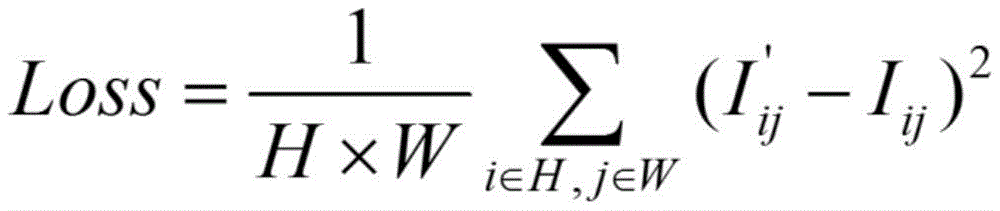
实际应用中,卷积神经网络VGG-19和N-1个级联的密集提炼网络包含于网络模型中,本申请实施例还提供了一种训练该网络模型的方式。In practical applications, the convolutional neural network VGG-19 and N-1 cascaded dense refining networks are included in the network model, and the embodiment of the present application also provides a method for training the network model.
具体而言,在步骤S101之前,对网络模型进行训练。Specifically, before step S101, the network model is trained.
进一步地,对网络模型进行训练的过程包括:Further, the process of training the network model includes:
获取卷积神经网络VGG-19的网络参数及训练样本;Obtain the network parameters and training samples of the convolutional neural network VGG-19;
基于网络参数及训练样本,采用随机梯度下降法对网络模型进行训练。Based on the network parameters and training samples, the stochastic gradient descent method is used to train the network model.
实际应用中,本领域技术人员可以根据预定场景区域选取合适的训练样本,一般训练样本中会区分一定数量的场景,本申请实施例对训练样本的选取不作限定。In practical applications, those skilled in the art can select appropriate training samples according to the predetermined scene area. Generally, a certain number of scenes are distinguished in the training samples, and the selection of the training samples is not limited in this embodiment of the present application.
作为示例地,以预定场景区域为天空场景区域为例,对网络的训练过程包括如下内容:As an example, taking the predetermined scene area as the sky scene area as an example, the training process of the network includes the following contents:
可选地,在训练过程中,可以直接导入VGG-19的预训练参数,能够节省训练时间。Optionally, during the training process, the pre-training parameters of VGG-19 can be directly imported, which can save training time.
可选地,利用skyFinder数据集进行训练与测试,其中,skyFinder数据集有46个场景,8万余帧图片。Optionally, use the skyFinder dataset for training and testing, where the skyFinder dataset has 46 scenes and more than 80,000 frames of pictures.
本领域技术人员可以根据实际情况设置训练集与测试集的数量,例如设置训练集与测试集的比例为9:1。Those skilled in the art can set the number of the training set and the test set according to the actual situation, for example, set the ratio of the training set to the test set to 9:1.
作为示例地,训练时,每次迭代过程会从每个场景随机抽取20帧图片进行训练,即每次迭代抽取900帧图片进行训练,训练100次迭代,会有90000帧次图像参与训练。而在参与训练的图像中,某些图像会被抽取多次,某些图像则不会被抽取。这样可以防止出现过拟合的情况。As an example, during training, 20 frames of images will be randomly selected from each scene for training in each iteration, that is, 900 frames of images will be selected for training in each iteration, and 90,000 frames of images will be trained for 100 iterations. Among the images involved in training, some images will be extracted multiple times, and some images will not be extracted. This prevents overfitting.
可选地,本申请实施例还可以使用随机梯度下降法对网络进行训练,学习率设置为1e-4。Optionally, in this embodiment of the present application, the stochastic gradient descent method may also be used to train the network, and the learning rate is set to 1e -4 .
本申请实施例采用的训练过程,结合上述各实施例的图像分割方法可以对输入图像中的天空场景区域有较好的识别精度。The training process adopted in the embodiments of the present application, combined with the image segmentation methods of the above-mentioned embodiments, can have better recognition accuracy for the sky scene region in the input image.
本领域技术人员可以基于此进行的适当变化而应用于其他预定场景区域的识别,故也应包含在本申请保护范围以内。Those skilled in the art can make appropriate changes based on this to apply to the identification of other predetermined scene regions, and therefore should also be included within the scope of protection of the present application.
本申请实施例还提供了一种图像分割装置,如图6所示,该图像分割装置60可以包括:提取模块601和特征处理模块602,其中,The embodiment of the present application further provides an image segmentation apparatus. As shown in FIG. 6 , the
提取模块601被配置为在输入图像中提取N个尺度的图像语义特征,N为不小于3的整数;The
特征处理模块602被配置为依据预定的级联关系,通过N-1个级联的密集提炼网络对N个尺度的图像语义特征按照尺度从小到大的顺序依次进行特征处理,以得到输入图像中预定场景区域的二值化掩膜图像;The
其中,预定的级联关系为:输入第n个密集提炼网络的两个相邻尺度的语义特征包括第n个尺度的低频语义特征和第n+1个尺度的图像语义特征,第n个尺度的低频语义特征是由第n-1个密集提炼网络输出的,2≤n≤N-1;Among them, the predetermined cascade relationship is: the semantic features of two adjacent scales input to the nth dense extraction network include the low-frequency semantic features of the nth scale and the image semantic features of the n+1th scale, and the nth scale The low-frequency semantic features of are output by the n-1th dense extraction network, 2≤n≤N-1;
输入第1个密集提炼网络的两个相邻尺度的语义特征包括第1个尺度的图像语义特征和第2个尺度的图像语义特征。The semantic features of two adjacent scales input to the 1st Dense Refinement Network include the image semantic features of the 1st scale and the image semantic features of the 2nd scale.
可选地,特征处理模块602具体被配置为:Optionally, the
通过第1个密集提炼网络对第1个尺度的图像语义特征和第2个尺度的图像语义特征进行特征处理,得到第1个密集提炼网络输出的低频语义特征,第1个密集提炼网络输出的低频语义特征的尺度与第2个尺度相同;The image semantic features of the first scale and the image semantic features of the second scale are processed by the first dense extraction network to obtain the low-frequency semantic features output by the first dense extraction network, and the output of the first dense extraction network. The scale of low-frequency semantic features is the same as the second scale;
通过第n个密集提炼网络对第n-1个密集提炼网络输出的低频语义特征和第n+1个尺度的图像语义特征进行特征处理,得到第n个密集提炼网络输出的低频语义特征,第n个密集提炼网络输出的低频语义特征的尺度与第n+1个尺度相同;The low-frequency semantic features output by the n-1th intensive refining network and the image semantic features of the n+1-th scale are processed by the n-th intensive refining network, and the low-frequency semantic features output by the n-th intensive refining network are obtained. The scale of the low-frequency semantic features output by the n dense refining networks is the same as the n+1th scale;
可选地,特征处理模块602包括密集卷积单元、融合单元和链式密集池化单元;Optionally, the
密集卷积单元被配置为通过两个密集卷积单元分别对两个相邻尺度的语义特征进行卷积处理,得到两个相邻尺度的图像全局特征;The dense convolution unit is configured to perform convolution processing on the semantic features of two adjacent scales through two dense convolution units respectively, so as to obtain the global image features of the two adjacent scales;
融合单元被配置为将两个相邻尺度的图像全局特征进行特征融合,得到融合处理后的图像全局特征,融合处理后的图像全局特征的尺度与两个相邻尺度中的较大尺度相同;The fusion unit is configured to perform feature fusion on the global image features of two adjacent scales to obtain the global image features after fusion processing, and the scale of the global image features after fusion processing is the same as the larger scale of the two adjacent scales;
链式密集池化单元被配置为通过链式密集池化单元对融合处理后的图像全局特征进行池化处理,以根据池化处理结果得到较大尺度的低频语义特征。The chain dense pooling unit is configured to perform pooling processing on the global image features after fusion processing through the chain dense pooling unit, so as to obtain larger-scale low-frequency semantic features according to the pooling processing results.
可选地,任一密集卷积单元包括M层卷积子网络,M为不小于2的整数,密集卷积单元具体被配置为:Optionally, any dense convolution unit includes M layers of convolution sub-networks, where M is an integer not less than 2, and the dense convolution unit is specifically configured as:
将一个尺度的语义特征输入到第一层卷积子网络,输出第一结果并,将一个尺度的语义特征和第一结果进行合并,得到第一合并结果;Input the semantic features of one scale into the first-layer convolution sub-network, output the first result, and combine the semantic features of one scale with the first result to obtain the first combined result;
将第一合并结果输入到第二层卷积子网络,输出第二结果,并将一个尺度的语义特征、第一合并结果和第二结果进行合并,得到第二合并结果;Input the first merged result into the second layer convolution sub-network, output the second result, and merge the semantic features of one scale, the first merged result, and the second result to obtain the second merged result;
在各个卷积子网络中连续执行卷积处理,直至将第M-1合并结果输入到第M层卷积子网络,输出第M结果,并将一个尺度的语义特征、第一合并结果至第M-1合并结果和第M结果进行合并,得到第M合并结果;Convolution processing is performed continuously in each convolutional sub-network until the M-1th merged result is input to the Mth layer of convolutional sub-network, the Mth result is output, and the semantic features of one scale, the first merged result are input to the Mth The M-1 merged result and the Mth result are merged to obtain the Mth merged result;
根据第M合并结果得到一个尺度的图像全局特征。According to the M-th merging result, the global image features of one scale are obtained.
可选地,链式密集池化单元包括W个池化网络和一个卷积子网络,W为不小于2的整数,池化网络包括池化层、卷积层和批量归一化层,链式密集池化单元具体被配置为:Optionally, the chained dense pooling unit includes W pooling networks and a convolution sub-network, where W is an integer not less than 2, and the pooling network includes a pooling layer, a convolutional layer, and a batch normalization layer. The dense pooling unit is specifically configured as:
将融合处理后的图像全局特征输入到第一个池化网络,输出第一低频语义特征,并将第一低频语义特征与融合处理后的图像全局特征进行合并,输出第一联结结果;Inputting the global image feature after fusion processing into the first pooling network, outputting the first low-frequency semantic feature, and combining the first low-frequency semantic feature with the global image feature after fusion processing, and outputting the first connection result;
将第一低频语义特征输入到第二个池化网络,输出第二低频语义特征,并将第二低频语义特征与第一联结结果进行合并,输出第二联结结果;Inputting the first low-frequency semantic feature into the second pooling network, outputting the second low-frequency semantic feature, and combining the second low-frequency semantic feature with the first connection result to output the second connection result;
在各个池化网络中连续执行池化处理,直至将第W-1低频语义特征输入到第W个池化网络,输出第W低频语义特征,并将第W低频语义特征与第W-1联结结果进行合并,输出第W个联结结果;The pooling process is continuously performed in each pooling network until the W-1th low-frequency semantic feature is input to the W-th pooling network, the W-th low-frequency semantic feature is output, and the W-th low-frequency semantic feature is connected with the W-1th. The results are merged, and the Wth connection result is output;
通过卷积子网络对第W个联结结果进行卷积处理,得到较大尺度的低频语义特征。Convolution processing is performed on the W-th connection result through the convolution sub-network to obtain large-scale low-frequency semantic features.
可选地,融合单元具体被配置为:对两个相邻尺度中的较小尺度的图像全局特征进行上采样;将上采样后的图像全局特征与两个尺度中的较大尺度的图像全局特征进行叠加。Optionally, the fusion unit is specifically configured to: perform upsampling on the image global feature of the smaller scale in the two adjacent scales; Features are superimposed.
可选地,第2个尺度为第1个尺度的2倍;第n+1个尺度为第n个尺度的2倍。Optionally, the second scale is twice the first scale; the n+1th scale is twice the nth scale.
可选地,提取模块601具体被配置为利用卷积神经网络VGG-19在输入图像中提取N个尺度的图像语义特征。Optionally, the
实际应用中,卷积神经网络VGG-19和N-1个级联的密集提炼网络包含于网络模型。In practical applications, the convolutional neural network VGG-19 and N-1 cascaded dense refinement networks are included in the network model.
可选地,本申请实施例提供的图像分割装置60还包括训练模块。Optionally, the
训练模块被配置为获取卷积神经网络VGG-19的网络参数及训练样本;基于网络参数及训练样本,采用随机梯度下降法对网络模型进行训练。The training module is configured to obtain network parameters and training samples of the convolutional neural network VGG-19; based on the network parameters and training samples, the stochastic gradient descent method is used to train the network model.
本申请实施例的图像分割装置,与现有技术中采用复杂的网络结果来进行图像分割相比,本申请采用高效的密集提炼网络多级级联来对输入图像中提取的多个尺度的图像语义特征进行特征处理,可以有效提高网络的整体运算速度。Compared with the prior art using complex network results for image segmentation, the image segmentation device of the embodiment of the present application adopts an efficient dense extraction network multi-level cascade to extract images of multiple scales from the input image. Semantic feature processing can effectively improve the overall computing speed of the network.
本实施例的图像分割装置可执行适用于上述方法实施例,其实现原理相类似,此处不再赘述。The image segmentation apparatus in this embodiment can be executed and is applicable to the above method embodiments, and the implementation principles thereof are similar, which will not be repeated here.
本申请实施例还提供了一种电子设备,如图7所示,图7所示的电子设备7000包括:处理器7001和存储器7003。其中,处理器7001和存储器7003相连,如通过总线7002相连。可选地,电子设备7000还可以包括收发器7004。需要说明的是,实际应用中收发器7004不限于一个,该电子设备7000的结构并不构成对本申请实施例的限定。An embodiment of the present application further provides an electronic device. As shown in FIG. 7 , the
其中,处理器7001应用于本申请实施例中,用于实现图6所示的提取模块601和特征处理模块602的功能。收发器7004包括接收机和发射机。The
处理器7001可以是CPU,通用处理器,DSP,ASIC,FPGA或者其他可编程逻辑器件、晶体管逻辑器件、硬件部件或者其任意组合。其可以实现或执行结合本申请公开内容所描述的各种示例性的逻辑方框,模块和电路。处理器7001也可以是实现计算功能的组合,例如包含一个或多个微处理器组合,DSP和微处理器的组合等。The
总线7002可包括一通路,在上述组件之间传送信息。总线7002可以是PCI总线或EISA总线等。总线7002可以分为地址总线、数据总线、控制总线等。为便于表示,图7中仅用一条粗线表示,但并不表示仅有一根总线或一种类型的总线。The
存储器7003可以是ROM或可存储静态信息和指令的其他类型的静态存储设备,RAM或者可存储信息和指令的其他类型的动态存储设备,也可以是EEPROM、CD-ROM或其他光盘存储、光碟存储(包括压缩光碟、激光碟、光碟、数字通用光碟、蓝光光碟等)、磁盘存储介质或者其他磁存储设备、或者能够用于携带或存储具有指令或数据结构形式的期望的程序代码并能够由计算机存取的任何其他介质,但不限于此。The
存储器7003用于存储执行本申请方案的应用程序代码,并由处理器7001来控制执行。处理器7001用于执行存储器7003中存储的应用程序代码,以实现图6所示实施例提供的图像分割装置的功能。The
本申请实施例提供的电子设备,与现有技术中采用复杂的网络结果来进行图像分割相比,本申请采用高效的密集提炼网络多级级联来对输入图像中提取的多个尺度的图像语义特征进行特征处理,可以有效提高网络的整体运算速度。Compared with the electronic device provided by the embodiments of the present application, the complex network results are used for image segmentation in the prior art. Semantic feature processing can effectively improve the overall computing speed of the network.
本申请实施例提供的电子设备适用于上述方法实施例,在此不再赘述。The electronic device provided in the embodiment of the present application is applicable to the foregoing method embodiment, and details are not described herein again.
本申请实施例还提供了一种计算机可读存储介质,计算机可读存储介质上存储有计算机程序,该程序被处理器执行时实现上述方法实施例所示的图像分割方法。Embodiments of the present application further provide a computer-readable storage medium, where a computer program is stored on the computer-readable storage medium, and when the program is executed by a processor, the image segmentation method shown in the foregoing method embodiment is implemented.
本申请实施例提供了一种计算机可读存储介质,与现有技术中采用复杂的网络结果来进行图像分割相比,本申请采用高效的密集提炼网络多级级联来对输入图像中提取的多个尺度的图像语义特征进行特征处理,可以有效提高网络的整体运算速度。The embodiment of the present application provides a computer-readable storage medium. Compared with the complex network results used for image segmentation in the prior art, the present application adopts an efficient dense The feature processing of image semantic features of multiple scales can effectively improve the overall computing speed of the network.
本申请实施例提供的计算机可读存储介质适用于上述方法实施例,在此不再赘述。The computer-readable storage medium provided by the embodiment of the present application is applicable to the foregoing method embodiments, and details are not described herein again.
应该理解的是,虽然附图的流程图中的各个步骤按照箭头的指示依次显示,但是这些步骤并不是必然按照箭头指示的顺序依次执行。除非本文中有明确的说明,这些步骤的执行并没有严格的顺序限制,其可以以其他的顺序执行。而且,附图的流程图中的至少一部分步骤可以包括多个子步骤或者多个阶段,这些子步骤或者阶段并不必然是在同一时刻执行完成,而是可以在不同的时刻执行,其执行顺序也不必然是依次进行,而是可以与其他步骤或者其他步骤的子步骤或者阶段的至少一部分轮流或者交替地执行。It should be understood that although the various steps in the flowchart of the accompanying drawings are sequentially shown in the order indicated by the arrows, these steps are not necessarily executed in sequence in the order indicated by the arrows. Unless explicitly stated herein, the execution of these steps is not strictly limited to the order and may be performed in other orders. Moreover, at least a part of the steps in the flowchart of the accompanying drawings may include multiple sub-steps or multiple stages, and these sub-steps or stages are not necessarily executed at the same time, but may be executed at different times, and the execution sequence is also It does not have to be performed sequentially, but may be performed alternately or alternately with other steps or at least a portion of sub-steps or stages of other steps.
以上所述仅是本申请的部分实施方式,应当指出,对于本技术领域的普通技术人员来说,在不脱离本申请原理的前提下,还可以做出若干改进和润饰,这些改进和润饰也应视为本申请的保护范围。The above are only part of the embodiments of the present application. It should be pointed out that for those skilled in the art, without departing from the principles of the present application, several improvements and modifications can also be made. It should be regarded as the protection scope of this application.
Claims (10)
Priority Applications (3)
| Application Number | Priority Date | Filing Date | Title |
|---|---|---|---|
| CN201811156790.7A CN109389078B (en) | 2018-09-30 | 2018-09-30 | Image segmentation method, corresponding device and electronic device |
| PCT/CN2019/106559 WO2020063426A1 (en) | 2018-09-30 | 2019-09-19 | Image segmentation apparatus and method, and related computing device |
| US16/651,946 US11113816B2 (en) | 2018-09-30 | 2019-09-19 | Image segmentation apparatus, method and relevant computing device |
Applications Claiming Priority (1)
| Application Number | Priority Date | Filing Date | Title |
|---|---|---|---|
| CN201811156790.7A CN109389078B (en) | 2018-09-30 | 2018-09-30 | Image segmentation method, corresponding device and electronic device |
Publications (2)
| Publication Number | Publication Date |
|---|---|
| CN109389078A CN109389078A (en) | 2019-02-26 |
| CN109389078B true CN109389078B (en) | 2022-06-21 |
Family
ID=65418340
Family Applications (1)
| Application Number | Title | Priority Date | Filing Date |
|---|---|---|---|
| CN201811156790.7A Active CN109389078B (en) | 2018-09-30 | 2018-09-30 | Image segmentation method, corresponding device and electronic device |
Country Status (3)
| Country | Link |
|---|---|
| US (1) | US11113816B2 (en) |
| CN (1) | CN109389078B (en) |
| WO (1) | WO2020063426A1 (en) |
Families Citing this family (37)
| Publication number | Priority date | Publication date | Assignee | Title |
|---|---|---|---|---|
| CN110866526B (en) * | 2018-08-28 | 2024-10-01 | 北京三星通信技术研究有限公司 | Image segmentation method, electronic device and computer readable storage medium |
| CN109389078B (en) | 2018-09-30 | 2022-06-21 | 京东方科技集团股份有限公司 | Image segmentation method, corresponding device and electronic device |
| CN110070056B (en) * | 2019-04-25 | 2023-01-10 | 腾讯科技(深圳)有限公司 | Image processing method, device, storage medium and equipment |
| CN112991254B (en) * | 2019-12-13 | 2025-03-25 | 上海肇观电子科技有限公司 | Disparity estimation system, method, electronic device and computer readable storage medium |
| CN111275721B (en) * | 2020-02-14 | 2021-06-08 | 推想医疗科技股份有限公司 | Image segmentation method and device, electronic equipment and storage medium |
| CN111091576B (en) * | 2020-03-19 | 2020-07-28 | 腾讯科技(深圳)有限公司 | Image segmentation method, device, equipment and storage medium |
| CN111914947B (en) * | 2020-08-20 | 2024-04-16 | 华侨大学 | Image instance segmentation method, device, equipment and storage medium based on feature fusion |
| CN115410159B (en) * | 2020-09-15 | 2026-01-02 | 重庆市农业科学院 | A system for identifying and monitoring tea lace bugs in tea cultivation |
| CN111967538B (en) * | 2020-09-25 | 2024-03-15 | 北京康夫子健康技术有限公司 | Feature fusion methods, devices, equipment and storage media applied to small target detection |
| CN112561916B (en) * | 2020-12-16 | 2025-02-18 | 深圳市商汤科技有限公司 | Image processing method and device, electronic device and storage medium |
| CN112686329A (en) * | 2021-01-06 | 2021-04-20 | 西安邮电大学 | Electronic laryngoscope image classification method based on dual-core convolution feature extraction |
| CN112949732B (en) * | 2021-03-12 | 2022-04-22 | 中国人民解放军海军航空大学 | Semantic annotation method and system based on adaptive multi-modal remote sensing image fusion |
| CN113112484B (en) * | 2021-04-19 | 2021-12-31 | 山东省人工智能研究院 | Ventricular image segmentation method based on feature compression and noise suppression |
| CN113378842A (en) * | 2021-05-18 | 2021-09-10 | 浙江大学 | Recommendation method based on segmented image feature extraction |
| CN113536904B (en) * | 2021-06-03 | 2023-08-25 | 大连民族大学 | Time-frequency domain combined panoramic segmentation method, system and medium |
| CN113536905B (en) * | 2021-06-03 | 2023-08-25 | 大连民族大学 | Time-Frequency Domain Combined Panoramic Segmentation Convolutional Neural Network and Its Application |
| CN113360697B (en) * | 2021-06-24 | 2022-07-05 | 广州华多网络科技有限公司 | Commodity image retrieval processing method and corresponding device, equipment and medium |
| CN113537000A (en) * | 2021-07-01 | 2021-10-22 | 大连民族大学 | Monocular Vision Instance Segmentation Deep Chained Feature Extraction Networks, Methods and Systems |
| CN113537004B (en) * | 2021-07-01 | 2023-09-01 | 大连民族大学 | Image double pyramid multi-element feature extraction network, image segmentation method, system and medium |
| CN113591861B (en) * | 2021-07-08 | 2024-05-14 | 杭州网易智企科技有限公司 | Image processing method, device, computing equipment and storage medium |
| CN113807363B (en) * | 2021-09-08 | 2024-04-19 | 西安电子科技大学 | Image classification method based on lightweight residual error network |
| US11803950B2 (en) * | 2021-09-16 | 2023-10-31 | Adobe Inc. | Universal style transfer using multi-scale feature transform and user controls |
| CN113989773B (en) * | 2021-10-27 | 2024-05-31 | 智道网联科技(北京)有限公司 | BiSeNet-based traffic sign recognition method and BiSeNet-based traffic sign recognition device for automatic driving |
| CN113989122B (en) * | 2021-11-16 | 2025-01-24 | 中国联合网络通信集团有限公司 | Image super-resolution restoration method, system, electronic device and storage medium |
| CN114359833B (en) * | 2022-01-05 | 2025-05-13 | 浙江大学 | A crowd counting method and device based on multi-level feature fusion |
| CN116563526A (en) * | 2022-01-26 | 2023-08-08 | 北京沃东天骏信息技术有限公司 | Image Semantic Segmentation Method and Device |
| CN114565766B (en) * | 2022-03-01 | 2024-06-18 | 智道网联科技(北京)有限公司 | BiSeNet V2-based pavement image semantic segmentation method and BiSeNet V-based pavement image semantic segmentation device |
| CN114898360B (en) * | 2022-03-31 | 2024-04-26 | 中南林业科技大学 | Method for establishing food image classification model based on attention and deep feature fusion |
| CN115115836B (en) * | 2022-06-29 | 2023-06-13 | 抖音视界有限公司 | Image recognition method, device, storage medium and electronic equipment |
| CN115331048B (en) * | 2022-07-29 | 2023-06-27 | 北京百度网讯科技有限公司 | Image classification method, device, equipment and storage medium |
| CN115375989A (en) * | 2022-08-30 | 2022-11-22 | 同济大学 | Interpretable image recognition method and device based on semantic characterization and storage medium |
| CN115661584B (en) * | 2022-11-18 | 2023-04-07 | 浙江莲荷科技有限公司 | Model training method, open domain target detection method and related device |
| CN116091524B (en) * | 2023-04-07 | 2023-06-13 | 杭州电子科技大学 | A Method for Detection and Segmentation of Objects in Complex Backgrounds |
| CN116468719B (en) * | 2023-05-06 | 2026-01-20 | 四川大学 | A method for detecting armature defects in micro-vibration motors based on semantic segmentation |
| CN117522881B (en) * | 2023-11-06 | 2024-06-18 | 山东省人工智能研究院 | Cardiac image segmentation method based on attention mechanism and multi-level feature fusion |
| CN117830313B (en) * | 2024-03-05 | 2024-05-28 | 四川泓宝润业工程技术有限公司 | Oilfield wellhead detection method, device and system based on deep learning |
| CN118497890B (en) * | 2024-07-18 | 2024-11-15 | 浙江康鹏半导体有限公司 | Gallium arsenide polycrystal synthesis device and method |
Citations (1)
| Publication number | Priority date | Publication date | Assignee | Title |
|---|---|---|---|---|
| CN107871119A (en) * | 2017-11-01 | 2018-04-03 | 西安电子科技大学 | An Object Detection Method Based on Object Space Knowledge and Two-Stage Predictive Learning |
Family Cites Families (9)
| Publication number | Priority date | Publication date | Assignee | Title |
|---|---|---|---|---|
| US8625878B2 (en) * | 2011-04-15 | 2014-01-07 | International Business Machines Corporation | Method and system of rail component detection using vision technology |
| US10295338B2 (en) * | 2013-07-12 | 2019-05-21 | Magic Leap, Inc. | Method and system for generating map data from an image |
| US20170124409A1 (en) * | 2015-11-04 | 2017-05-04 | Nec Laboratories America, Inc. | Cascaded neural network with scale dependent pooling for object detection |
| CN105869174B (en) | 2016-04-20 | 2019-01-29 | 中国航空工业集团公司洛阳电光设备研究所 | A method for image segmentation of sky scene |
| CN107784654B (en) * | 2016-08-26 | 2020-09-25 | 杭州海康威视数字技术股份有限公司 | Image segmentation method and device and full convolution network system |
| US10657364B2 (en) * | 2016-09-23 | 2020-05-19 | Samsung Electronics Co., Ltd | System and method for deep network fusion for fast and robust object detection |
| US11010595B2 (en) * | 2017-03-23 | 2021-05-18 | Samsung Electronics Co., Ltd. | Facial verification method and apparatus |
| CN108062754B (en) | 2018-01-19 | 2020-08-25 | 深圳大学 | Segmentation and recognition method and device based on dense network image |
| CN109389078B (en) * | 2018-09-30 | 2022-06-21 | 京东方科技集团股份有限公司 | Image segmentation method, corresponding device and electronic device |
-
2018
- 2018-09-30 CN CN201811156790.7A patent/CN109389078B/en active Active
-
2019
- 2019-09-19 US US16/651,946 patent/US11113816B2/en active Active
- 2019-09-19 WO PCT/CN2019/106559 patent/WO2020063426A1/en not_active Ceased
Patent Citations (1)
| Publication number | Priority date | Publication date | Assignee | Title |
|---|---|---|---|---|
| CN107871119A (en) * | 2017-11-01 | 2018-04-03 | 西安电子科技大学 | An Object Detection Method Based on Object Space Knowledge and Two-Stage Predictive Learning |
Non-Patent Citations (3)
| Title |
|---|
| Densely Connected Convolutional Networks;Gao Huang et.al;《arXiv:1608.06993v5 [cs.CV]》;20180128;第1-5页 * |
| RefineNet: Multi-Path Refinement Networks for High-Resolution Semantic Segmentation;Guosheng Lin et.al;《arXiv:1611.06612v3 [cs.CV]》;20161125;第2-10页 * |
| Skin Lesion Segmentation via Dense Connected Deconvolutional Network;Hang Li et.al;《2018 24th International Conference on Pattern Recognition (ICPR)》;20180824;第671-675页 * |
Also Published As
| Publication number | Publication date |
|---|---|
| CN109389078A (en) | 2019-02-26 |
| US20200334819A1 (en) | 2020-10-22 |
| US11113816B2 (en) | 2021-09-07 |
| WO2020063426A1 (en) | 2020-04-02 |
Similar Documents
| Publication | Publication Date | Title |
|---|---|---|
| CN109389078B (en) | Image segmentation method, corresponding device and electronic device | |
| CN112561027B (en) | Neural network architecture search method, image processing method, device and storage medium | |
| CN115937655B (en) | Multi-order feature interaction target detection model, construction method, device and application thereof | |
| CN115187820B (en) | Lightweight target detection method, device, equipment, and storage medium | |
| US20250131258A1 (en) | Compression of sparse deep convolutional network weights | |
| Liu et al. | FDDWNet: a lightweight convolutional neural network for real-time semantic segmentation | |
| US11521039B2 (en) | Method and apparatus with neural network performing convolution | |
| CN108416327B (en) | A target detection method, apparatus, computer equipment and readable storage medium | |
| CN110852383B (en) | Target detection method and device based on attention mechanism deep learning network | |
| US10282864B1 (en) | Method and device for encoding image and testing method and testing device using the same | |
| CN110889416B (en) | Salient object detection method based on cascade improved network | |
| CN114359293B (en) | A deep learning-based 3D MRI brain tumor segmentation method | |
| Li et al. | FRD-CNN: Object detection based on small-scale convolutional neural networks and feature reuse | |
| CN113537462B (en) | Data processing method, neural network quantization method and related device | |
| CN116524379A (en) | Aerial photographing target detection method based on attention mechanism and self-adaptive feature fusion | |
| KR20210034462A (en) | Method for training generative adversarial networks to generate per-pixel annotation | |
| CN110457524B (en) | Model generation method, video classification method and device | |
| CN112380919A (en) | Vehicle category statistical method | |
| CN114821096A (en) | Image processing method, neural network training method and related equipment | |
| CN113742525A (en) | Self-supervision video hash learning method, system, electronic equipment and storage medium | |
| CN118470714B (en) | Camouflage object semantic segmentation method, system, medium and electronic equipment based on decision-level feature fusion modeling | |
| CN113033371B (en) | Multi-level feature fusion pedestrian detection method based on CSP model | |
| CN115546503B (en) | Adaptive multi-scale visual feature expression method and system based on deep attention | |
| Cong et al. | CAN: Contextual aggregating network for semantic segmentation | |
| CN114818872A (en) | An Image Object Detection Method Based on Improved YOLOv4 |
Legal Events
| Date | Code | Title | Description |
|---|---|---|---|
| PB01 | Publication | ||
| PB01 | Publication | ||
| SE01 | Entry into force of request for substantive examination | ||
| SE01 | Entry into force of request for substantive examination | ||
| GR01 | Patent grant | ||
| GR01 | Patent grant |