Disclosure of Invention
Therefore, it is necessary to provide a method, an apparatus and a system for session management that can solve the problem of session management in the multi-party call process.
In order to achieve the above object, in one aspect, an embodiment of the present invention provides a session management method implemented from a PCRF perspective, including:
receiving an AAR message of a current Rx session sent by a P-CSCF;
associating the current Rx session to a Gx session associated with the previous Rx session based on the preset maintenance relationship and the AAR message; the preset maintenance relationship is the corresponding relationship between the Gx session identification of the Gx session and the user equipment address.
In one embodiment, the step of receiving the AAR message of the current Rx session sent by the P-CSCF comprises the steps of:
and establishing a Gx session, configuring a Gx session identifier for the Gx session, and generating a preset maintenance relationship.
In one embodiment, the step of associating the current Rx session to the Gx session associated with the previous Rx session based on the preset maintenance relationship and the AAR message comprises:
searching a preset maintenance relation according to an address cell carried by the AAR message to obtain a Gx session identifier corresponding to the address of the user equipment; the address information element contains the address of the user equipment and the Rx conversation mark of the current Rx conversation;
and generating an association relation between the Gx session identification and the Rx session identification of the current Rx session.
In one embodiment, the step of generating the association relationship between the Gx session identifier and the Rx session identifier of the current Rx session includes:
searching an association relation table through the Gx session identifier, and adding the Rx session identifier of the current Rx session into the association relation table; the association relation table contains the association relation between the Gx session identification and the Rx session identification of the previous Rx session.
In one embodiment, the method further comprises the following steps:
receiving an STR message sent by a P-CSCF;
based on the STR message, a corresponding Rx session of the Rx sessions associated with the Gx session is deleted.
In one embodiment, based on the STR message, the step of deleting a corresponding Rx session of the Rx sessions associated with the Gx session includes:
and deleting the association relation between the Rx session identifier and the Gx session identifier carried by the STR message.
On the other hand, an embodiment of the present invention further provides a session management method implemented from a P-CSCF perspective, including:
sending an AAR message of the current Rx conversation to the PCRF;
the AAR message is used for indicating the PCRF to correlate the current Rx conversation to the Gx conversation correlated with the previous Rx conversation based on the preset maintenance relation and the AAR message; the preset maintenance relationship is the corresponding relationship between the Gx session identification of the Gx session and the user equipment address.
In one embodiment, the method further comprises the following steps:
sending an STR message to the PCRF;
the STR message is used to instruct the PCRF to delete a corresponding Rx session in each Rx session associated with the Gx session.
A session management apparatus implemented from a PCRF perspective, comprising:
a receiving module, configured to receive an AAR message of a current Rx session sent by a P-CSCF;
the association module is used for associating the current Rx session with the Gx session associated with the previous Rx session based on the preset maintenance relationship and the AAR message; the preset maintenance relationship is the corresponding relationship between the Gx session identification of the Gx session and the user equipment address.
A session management apparatus implemented from a P-CSCF perspective, comprising:
a message sending module, configured to send an AAR message of the current Rx session to the PCRF; the AAR message is used for indicating the PCRF to correlate the current Rx conversation to the Gx conversation correlated with the previous Rx conversation based on the preset maintenance relation and the AAR message; the preset maintenance relationship is the corresponding relationship between the Gx session identification of the Gx session and the user equipment address.
An EPC system comprising a PCRF;
the PCRF is configured to perform the steps of the session management method implemented from the PCRF perspective.
An IMS system comprising a P-CSCF;
the P-CSCF is arranged to perform the steps of the session management method described above, carried out from the perspective of the P-CSCF.
In one embodiment, the IMS system is an IMS system based on a TD-LTE system.
A session management system comprises a PCRF, a P-CSCF and a PGW; the PCRF is connected with the PGW through a Gx interface and is connected with the P-CSCF through an Rx interface;
the PCRF is used for executing the steps of the session management method implemented from the perspective of the PCRF;
the P-CSCF is arranged to perform the steps of the session management method described above, carried out from the perspective of the P-CSCF.
A computer-readable storage medium, on which a computer program is stored which, when being executed by a processor, carries out the steps of any of the above-mentioned session management methods.
One of the above technical solutions has the following advantages and beneficial effects:
the method is applied to the multi-party call process, the called user which is used as a calling party and also used as a third party call is a scene that two or more Rx conversations correspond to one Gx conversation. The method and the device solve the Rx session management problem of the IMS three-party call, and are also suitable for Rx session management of the multi-party call with more than three parties. The method and the device enhance the service types supported by the IMS system, so that the system can support rich VoLTE multi-party call application scenes. The application provides an Rx session management method applicable to an IMS VoLTE multi-party call process, which solves the Rx session management problem in the multi-party call process, further ensures that the VoLTE multi-party call can be normally carried out, and further improves the call experience of a VoLTE user.
Detailed Description
In order to make the objects, technical solutions and advantages of the present application more apparent, the present application is described in further detail below with reference to the accompanying drawings and embodiments. It should be understood that the specific embodiments described herein are merely illustrative of the present application and are not intended to limit the present application.
IMS is introduced by 3GPP (3rd Generation Partnership Project) Release5, Release5 defines the basic structure of IMS, Release 6 develops work that focuses on various enhanced services of IMS, IMS superimposes a call and service control system on the PS domain, and thus, real PS domain voice call and service control is achieved. In the process of initiating an IMS VoLTE voice Call by a user, a P-CSCF (Proxy-Call Session Control Function) in an IMS interacts with a PCRF (Policy and Charging Rule Function) in an EPC network element by carrying media description information through an Rx interface, and triggers the PCRF to establish a voice dedicated bearer for a Gx Session associated with the Rx Session, thereby implementing user voice data transmission.
The session management method provided by the application can be applied to the application environment shown in fig. 1. In the EPC system, a Gx interface is located between a PGW (PDN Gateway) and a PCRF, and an Rx interface is located between a P-CSCF and the PCRF. An IMS User Can initiate a VoLTE voice call and first needs to establish and complete IMS PDN (Public Data Network) connection in an EPC system, at this time, a Network element PCRF of the EPC system will establish and maintain a Gx session of the IMS PDN for the User, where the Gx session corresponds to an IP-Can (IP Connectivity Access Network) session of an IMS signaling service default bearer of a UE (User Equipment), the establishment of the dedicated bearer is dependent on the established Gx session default bearer because voice Data needs a dedicated bearer, an AAR (automatic assignment Request, PCRF assignment Request) Request message of an Rx port triggers a Request for establishing a dedicated bearer to a PGW, and an association relationship is established between the Rx session and the Gx session through a frame-IP-Address cell carried by the AAR message.
However, at present, the EPC system does not explicitly define an Rx session management method for VoLTE multi-party call in the IMS system, and this problem may result in that normal operation of VoLTE multi-party call cannot be guaranteed. Generally, Rx sessions and Gx sessions are in one-to-one correspondence under the VoLTE call, that is, one Rx session corresponds to one Gx session, and in the multi-party call process, for example, a called user who is a calling party and also serves as a third party call in a three-party call is that two or more Rx sessions correspond to one Gx session, so that the Rx session management method applicable to the IMS VoLTE multi-party call process is provided, the Rx session management problem in the multi-party call process is solved, the VoLTE multi-party call can be ensured to be normally performed, and the call experience of the VoLTE user is improved.
In an embodiment, as shown in fig. 2, a session management method is provided, which is described by taking the application of the method to the PCRF in fig. 1 as an example, and includes the following steps:
step S202, receiving the AAR message of the current Rx conversation sent by the P-CSCF.
Wherein the current Rx session refers to a current Rx session; that is, the P-CSCF sends the AAR message of the current Rx conversation through the Rx interface; the AAR message may refer to a request message for Rx session establishment.
Specifically, a user A initiates a VoLTE call to a user B, and triggers a P-CSCF to send an AAR message of an Rx session to a PCRF; as another example, user C initiates a VoLTE call to user a, triggering the P-CSCF to send an AAR message for the Rx session to the PCRF.
Step S204, based on the preset maintenance relationship and AAR message, the current Rx session is related to the Gx session related to the previous Rx session.
The preset maintenance relationship is the corresponding relationship between the Gx session identification of the Gx session and the user equipment address.
Specifically, the PCRF may establish an association relationship between the Rx session and the Gx session through a frame-IP-Address cell (i.e., an Address cell) carried by the AAR message. And the PCRF can maintain the corresponding relation between the Gx session identification and the user equipment address in advance. And the current Rx conversation is related to the Gx conversation related to the previous Rx conversation, so that a single Gx conversation is related to a plurality of Rx conversations under the multi-party conversation scene, and the conversation management of the multi-party conversation is realized.
In a specific embodiment, the step of receiving the AAR message of the current Rx session sent by the P-CSCF includes the steps of:
and establishing a Gx session, configuring a Gx session identifier for the Gx session, and generating a preset maintenance relationship.
Specifically, the IMS user completes IMS PDN connection establishment in the EPC system. The user completes the establishment of an IMS PDN, acquires a user equipment Address (UE Address) distributed by a PGW, and simultaneously establishes a Gx session corresponding to the user in a PCRF; the PCRF allocates a unique identifier Gx Session ID for the Gx Session, and maintains the corresponding relation between the Gx Session ID and the UE Address.
Further, the PCRF can establish a corresponding relationship table between the Gx Session ID and the UE Address in the computer memory. It should be noted that the Gx Session identifier may refer to a Gx Session unique identifier Gx Session ID; the user equipment Address may refer to the UE Address.
In addition, a frame-IP-Address cell carried by the AAR message may represent a user equipment Address (i.e., UE Address) and an Rx session identifier; it should be noted that the Rx Session ID may refer to an Rx Session unique ID Rx Session ID.
In a specific embodiment, the step of associating the current Rx session to the Gx session associated with the previous Rx session based on the preset maintenance relationship and the AAR message includes:
searching a preset maintenance relation according to an address cell carried by the AAR message to obtain a Gx session identifier corresponding to the address of the user equipment; the address information element contains the address of the user equipment and the Rx conversation mark of the current Rx conversation;
and generating an association relation between the Gx session identification and the Rx session identification of the current Rx session.
Specifically, the Rx Session is uniquely identified by an Rx Session ID, the Gx Session is uniquely identified by a Gx Session ID, and associating the Rx Session to the Gx Session may refer to establishing an association relationship between the Rx Session ID and the Gx Session ID.
In the application, the association relationship between the Rx Session and the Gx Session can be associated through the UE Address, and specifically, an association relationship table between the UE Address and the Gx Session ID can be established when the Gx Session is established; and when the current Rx Session is established, an association relation table of the UE Address and the current Rx Session ID is established, and the association relation between the Gx Session ID and the current Rx Session ID is established by searching the UE Address.
Further, the step of generating the association relationship between the Gx session identifier and the Rx session identifier of the current Rx session includes:
searching an association relation table through the Gx session identifier, and adding the Rx session identifier of the current Rx session into the association relation table; the association relation table contains the association relation between the Gx session identification and the Rx session identification of the previous Rx session.
Specifically, the association relationship table includes the association relationship between the Gx Session ID and the previous Rx Session ID. At this time, when the current Rx Session is established, an association relationship between the UE Address and the current Rx Session ID is established, and the UE Address is associated to the Gx Session ID in the preset maintenance relationship by searching for the Gx Session ID.
Further, an association relation table is searched by using the Gx Session ID, the current Rx Session ID is added into the association relation table, and at the moment, one Gx Session is associated with two Rx sessions; by analogy, one Gx session can be associated with a plurality of Rx sessions, and Rx session management of multi-party call is realized.
In the session management method implemented from the perspective of the PCRF, the current Rx session is associated with the Gx session associated with the previous Rx session, so that a single Gx session is associated with multiple Rx sessions in a multi-party call scenario, thereby implementing session management for multi-party calls. When a multi-party call scene with more than three parties exists, the Gx Session ID is associated to a plurality of Rx Session IDs, namely the association between the Gx Session and the Rx sessions is established, and the requirement of three-party or multi-party call is met.
It should be noted that, the number of multi-party calls theoretically supported by the present application is not limited, and the practical application is limited by the performance and processing capability of the computer, and an acceptable upper limit is usually agreed to prevent the computer resources from being exhausted.
The method is applied to a multi-party call process (for example, three-party call), the called user who is the calling party and also serves as the third-party call is a scene that two or more Rx sessions correspond to one Gx session, the method for managing the Gx session and the Rx session is perfected, the Rx session management problem of the IMS three-party call is solved, the service types supported by the IMS system are enhanced, and the system can support rich VoLTE multi-party call application scenes. The application provides an Rx session management method applicable to an IMS VoLTE multi-party call process, which solves the Rx session management problem in the multi-party call process, further ensures that the VoLTE multi-party call can be normally carried out, and further improves the call experience of a VoLTE user.
In an embodiment, as shown in fig. 3, a session management method is provided, which is described by taking the application of the method to the PCRF in fig. 1 as an example, and includes the following steps:
step S302, a Gx session is established, a Gx session identifier is configured for the Gx session, and a preset maintenance relationship is generated;
step S304, receiving the AAR message of the current Rx conversation sent by the P-CSCF;
step S306, based on the preset maintenance relationship and AAR message, relating the current Rx conversation to the Gx conversation related to the previous Rx conversation; the preset maintenance relationship is the corresponding relationship between the Gx session identification of the Gx session and the user equipment address;
step S308, receiving STR message sent by P-CSCF;
step S310, based on the STR message, deletes a corresponding Rx session in each Rx session associated with the Gx session.
In a specific embodiment, based on the STR message, the step of deleting a corresponding Rx session of the Rx sessions associated with the Gx session includes:
and deleting the association relation between the Rx session identifier and the Gx session identifier carried by the STR message.
Specifically, when the multi-party call is ended, the association relationship between the Gx Session and the Rx Session needs to be deleted, for example, the user C ends the VoLTE call with the user a, the PCRF receives an STR (Session-Termination-Request) message sent by the P-CSCF through the Rx interface, and deletes the second Rx Session based on the STR message; in a specific example, the PCRF deletes the association relationship between the Gx Session ID and the Rx Session ID carried in the STR message; and finishing the multi-party call until the association relation between the Gx session and the Rx session established in the multi-party call is completely cleared.
The application provides an IMS multi-party call Rx session management method, which realizes Rx session management of IMS VoLTE multi-party call. The management method of the Gx session and the Rx session is perfected, so that a single Gx session can be associated with a plurality of Rx sessions, and the session management of the multi-party call is realized; the service types supported by the IMS system are enhanced, so that the system can support rich VoLTE multi-party call application scenes. And the above-described method may be implemented on a hardware server device running software using any available software programming method.
In one embodiment, as shown in fig. 4, a session management method is provided, which is described by taking the application of the method to the P-CSCF in fig. 1 as an example, and includes the following steps:
step S402, sending AAR message of current Rx conversation to PCRF;
the AAR message is used for indicating the PCRF to correlate the current Rx conversation to the Gx conversation correlated with the previous Rx conversation based on the preset maintenance relation and the AAR message; the preset maintenance relationship is the corresponding relationship between the Gx session identification of the Gx session and the user equipment address.
Specifically, a user A initiates a VoLTE call to a user B, and triggers a P-CSCF to send an AAR message of an Rx Session to a PCRF, wherein the AAR message carries a Framed-IP-Address Address cell to represent UE Address and an Rx Session unique identifier Rx Session ID; and the PCRF searches the maintained corresponding relationship between the Gx Session ID and the UE Address, associates the current Rx Session to the Gx Session, and simultaneously establishes the association relationship between the Gx Session ID and the Rx Session ID of the current Rx Session.
In a specific embodiment, the method further comprises the steps of:
sending an STR message to the PCRF;
the STR message is used to instruct the PCRF to delete a corresponding Rx session in each Rx session associated with the Gx session.
Specifically, when the multi-party call is finished, the association relationship between the Gx session and the Rx session needs to be deleted; for example, the user B ends the VoLTE call with the user a, the P-CSCF sends an STR message through the Rx interface to instruct the PCRF to delete the Rx Session, and the PCRF deletes the association between the Gx Session ID and the Rx Session ID of the Rx Session established in the association table; and ending the multi-party call until the association relation between the Gx session and the Rx session established in the multi-party call is completely cleared.
The following describes the session management method according to the present application with reference to a specific example. In the EPC system, the application of the method to the PCRF and the P-CSCF in fig. 1 is taken as an example for explanation, and the method includes the following steps:
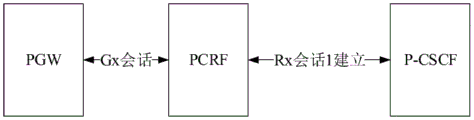
1. and the IMS user completes the establishment of the IMS PDN connection in an EPC system. As shown in fig. 5, the user completes establishment of the IMS PDN and obtains a user equipment Address (UE Address) allocated by the PGW, and simultaneously establishes a Gx Session corresponding to the user at the PCRF, the PCRF assigns a unique identifier Gx Session ID for the Gx Session, and the PCRF maintains a correspondence between the Gx Session ID and the UE Address.
The PCRF can maintain the corresponding relation by establishing a corresponding relation table of the Gx Session ID and the UE Address in a memory of the computer.
2. A first Rx Session is established and managed, as shown in fig. 6, a user a initiates a VoLTE call to a user B, and triggers a P-CSCF to send an AAR message of an Rx Session to a PCRF, where the AAR message carries a frame-IP-Address cell to represent a UE Address and an Rx Session unique identifier Rx Session ID, and the PCRF searches for a correspondence between the Gx Session ID and the UE Address maintained in step 1, associates the first Rx Session to a Gx Session, and simultaneously establishes an association between the Gx Session ID and the first Rx Session ID.
Specifically, the Rx Session is uniquely identified by an Rx Session ID, the Gx Session is uniquely identified by a Gx Session ID, and associating the Rx Session with the Gx Session is to establish an association relationship between the Rx Session ID and the Gx Session ID.
Wherein, the association relationship between the Rx session and the Gx session is associated through the UE Address, specifically: as described in step 1, when a Gx Session is established, an association relation table between UE Address and Gx Session ID is established; as described in step 2, when the first Rx Session is established, an association relationship table between the UE Address and the first Rx Session ID is established, and an association relationship between the Gx Session ID and the first Rx Session ID is established by searching the UE Address.
3. And a second Rx Session is established and managed, as shown in fig. 7, a user C initiates a VoLTE call to a user a, and triggers the P-CSCF to send an AAR message of an Rx Session to the PCRF, where the AAR message carries a frame-IP-Address cell to represent a UE Address and an Rx Session unique identifier Rx Session ID, the PCRF searches for a correspondence between the Gx Session ID and the UE Address maintained in step 1, associates the second Rx Session to a Gx Session, and meanwhile, adds the second Rx Session ID to an association table between the Gx Session ID and the first Rx Session ID established in step 2, where the Gx Session associates two Rx sessions.
As described in steps 1 and 2, the association table between the Gx Session ID and the first Rx Session ID is already established in step 2. At this time, as described in step 3, when the second Rx Session is established, the UE Address and the second Rx Session ID association relationship table are established, the UE Address is associated with the Gx Session ID established in step 1 by searching for the UE Address, then the Gx Session ID is used to search for the association relationship table between the Gx Session ID established in step 2 and the first Rx Session ID, the second Rx Session ID is added to the association relationship table between the Gx Session ID established in step 2 and the first Rx Session ID, and at this time, one Gx Session is associated with two Rx sessions.
4. By analogy, as shown in fig. 8, when there is a multi-party call scenario with more than three parties, the Gx Session ID is associated with multiple Rx Session IDs, that is, the association between the Gx Session and multiple Rx sessions is established, so as to meet the requirements of three-party or multi-party call.
The number of the multi-party calls supported theoretically is not limited, the practical application is limited by the performance and the processing capacity of the computer, and an acceptable upper limit can be generally defined to prevent the computer resources from being exhausted.
5. The three-party call is ended. The correlation between the Gx Session and the Rx Session needs to be deleted, the user C ends the VoLTE call with the user a, the P-CSCF sends an Rx interface STR message to instruct the PCRF to delete the second Rx Session, and the PCRF deletes the correlation table between the Gx Session ID and the second Rx Session ID established in step 3; and the user B finishes the VoLTE call with the user A, and the P-CSCF sends an Rx interface STR message to indicate the PCRF to delete the first Rx Session, and the PCRF deletes the association relation table of the Gx Session ID and the first Rx Session ID established in the step 2, so that the Gx Session and the Rx Session association relation established in the three-party call are completely removed, and the three-party call is finished.
Wherein, the Rx Session ID carried by the AAR message triggering the Rx Session establishment is the same as the Rx Session ID of the STR message triggering the Rx Session deletion; it should be noted that the AAR established for the first Rx Session is different from the AAR established for the second Rx Session and the Rx Session ID carried by the AAR established for the nth Rx Session. Therefore, the PCRF deletes a specific Rx Session corresponding to a certain Rx interface STR according to the Rx Session ID carried by the certain Rx interface STR message.
The method can be applied to a multi-party call process (for example, three-party call), the called user who is the calling party and also the third-party call is a scene that two or more Rx sessions correspond to one Gx session, and further, the management method of the Gx session and the Rx session is perfected; the current Rx session is associated with the Gx session associated with the previous Rx session, so that a single Gx session is associated with a plurality of Rx sessions, and the session management of the multi-party call is realized. The method and the device solve the Rx session management problem of the IMS three-party call, and are also suitable for Rx session management of the multi-party call with more than three parties. The method and the device enhance the service types supported by the IMS system, so that the system can support rich VoLTE multi-party call application scenes. The application provides an Rx session management method applicable to an IMS VoLTE multi-party call process, which solves the Rx session management problem in the multi-party call process, further ensures that the VoLTE multi-party call can be normally carried out, and further improves the call experience of a VoLTE user.
It should be understood that although the various steps in the flow charts of fig. 2-8 are shown in order as indicated by the arrows, the steps are not necessarily performed in order as indicated by the arrows. The steps are not performed in the exact order shown and described, and may be performed in other orders, unless explicitly stated otherwise. Moreover, at least some of the steps in fig. 2-8 may include multiple sub-steps or multiple stages that are not necessarily performed at the same time, but may be performed at different times, and the order of performance of the sub-steps or stages is not necessarily sequential, but may be performed in turn or alternating with other steps or at least some of the sub-steps or stages of other steps.
In one embodiment, as shown in fig. 9, there is provided a session management apparatus implemented from the perspective of PCRF, including:
a receiving module 910, configured to receive an AAR message of a current Rx session sent by the P-CSCF;
an associating module 920, configured to associate the current Rx session with a Gx session associated with a previous Rx session based on a preset maintenance relationship and the AAR message; the preset maintenance relationship is the corresponding relationship between the Gx session identification of the Gx session and the user equipment address.
In a specific embodiment, the method further comprises the following steps:
the session establishing module is used for establishing a Gx session;
and the relationship maintenance module is used for configuring a Gx session identifier for the Gx session and generating a preset maintenance relationship.
In a specific embodiment, the association module is configured to search a preset maintenance relationship according to an address cell carried by the AAR message, and obtain a Gx session identifier corresponding to the user equipment address; and generating an association relation between the Gx session identifier and the Rx session identifier of the current Rx session; the address information element contains the user equipment address and the Rx session identity of the current Rx session.
In a specific embodiment, the association module is configured to search an association table through the Gx session identifier, and add the Rx session identifier of the current Rx session to the association table; the association relation table contains the association relation between the Gx session identification and the Rx session identification of the previous Rx session.
In a specific embodiment, the receiving module is configured to receive an STR message sent by a P-CSCF;
further comprising: and the session deleting module is used for deleting the corresponding Rx session in each Rx session related to the Gx session based on the STR message.
In a specific embodiment, the session deletion module is configured to delete an association relationship between an Rx session identifier and a Gx session identifier carried in the STR message.
In one embodiment, as shown in fig. 10, there is provided a block diagram of a session management apparatus implemented from the perspective of a P-CSCF, including:
a message sending module 110, configured to send an AAR message of the current Rx session to the PCRF; the AAR message is used for indicating the PCRF to correlate the current Rx conversation to the Gx conversation correlated with the previous Rx conversation based on the preset maintenance relation and the AAR message; the preset maintenance relationship is the corresponding relationship between the Gx session identification of the Gx session and the user equipment address.
In a specific embodiment, the message sending module is further configured to send the STR message to the PCRF; the STR message is used to instruct the PCRF to delete a corresponding Rx session in each Rx session associated with the Gx session.
For the specific definition of the session management device, reference may be made to the above definition of the session management method, which is not described herein again. The modules in the session management device can be wholly or partially implemented by software, hardware and a combination thereof. The modules can be embedded in a hardware form or independent from a processor in the computer device, and can also be stored in a memory in the computer device in a software form, so that the processor can call and execute operations corresponding to the modules.
Those skilled in the art will appreciate that the configurations shown in fig. 1 and 9-10 are merely block diagrams of some configurations relevant to the present disclosure, and do not constitute a limitation on the computing devices to which the present disclosure may be applied, and that a particular computing device may include more or less components than those shown, or may combine certain components, or have a different arrangement of components.
In one embodiment, an EPC system is provided that includes a PCRF;
the PCRF is configured to perform the steps of the session management method implemented from the PCRF perspective.
In one embodiment, an IMS system is provided that includes a P-CSCF;
the P-CSCF is arranged to perform the steps of the session management method described above, carried out from the perspective of the P-CSCF.
In a specific embodiment, the IMS system is an IMS system based on a TD-LTE system.
In one embodiment, a session management system is provided, including a PCRF, a P-CSCF, and a PGW; the PCRF is connected with the PGW through a Gx interface and is connected with the P-CSCF through an Rx interface;
the PCRF is used for executing the steps of the session management method implemented from the perspective of the PCRF;
the P-CSCF is arranged to perform the steps of the session management method described above, carried out from the perspective of the P-CSCF.
It should be noted that Rx session management for three-way call of the IMS system is well implemented by using the session management method provided by the present application, so that an IMS user can successfully initiate a three-way or multi-way VoLTE call. The session management method is successfully applied to the IMS system, and successfully passes actual three-party call tests of multiple common mobile phones such as iPhone, Huashi and Samsung, and the effect is good. Further, the method can be applied to an IMS system based on a TD-LTE system.
In one embodiment, a computer-readable storage medium is provided, on which a computer program is stored, which computer program, when being executed by a processor, realizes the steps of any of the above-mentioned session management methods.
It will be understood by those skilled in the art that all or part of the processes of the methods of the embodiments described above can be implemented by hardware instructions of a computer program, which can be stored in a non-volatile computer-readable storage medium, and when executed, can include the processes of the embodiments of the methods described above. Any reference to memory, storage, database, or other medium used in the embodiments provided herein may include non-volatile and/or volatile memory, among others. Non-volatile memory can include read-only memory (ROM), Programmable ROM (PROM), Electrically Programmable ROM (EPROM), Electrically Erasable Programmable ROM (EEPROM), or flash memory. Volatile memory can include Random Access Memory (RAM) or external cache memory. By way of illustration and not limitation, RAM is available in a variety of forms such as Static RAM (SRAM), Dynamic RAM (DRAM), Synchronous DRAM (SDRAM), Double Data Rate SDRAM (DDRSDRAM), Enhanced SDRAM (ESDRAM), Synchronous Link DRAM (SLDRAM), Rambus Direct RAM (RDRAM), direct bus dynamic RAM (DRDRAM), and memory bus dynamic RAM (RDRAM).
The technical features of the embodiments described above may be arbitrarily combined, and for the sake of brevity, all possible combinations of the technical features in the embodiments described above are not described, but should be considered as being within the scope of the present specification as long as there is no contradiction between the combinations of the technical features.
The above-mentioned embodiments only express several embodiments of the present application, and the description thereof is more specific and detailed, but not construed as limiting the scope of the invention. It should be noted that, for a person skilled in the art, several variations and modifications can be made without departing from the concept of the present application, which falls within the scope of protection of the present application. Therefore, the protection scope of the present patent shall be subject to the appended claims.