CN109087706B - Human health assessment method and assessment system based on sleep big data - Google Patents
Human health assessment method and assessment system based on sleep big data Download PDFInfo
- Publication number
- CN109087706B CN109087706B CN201810772360.1A CN201810772360A CN109087706B CN 109087706 B CN109087706 B CN 109087706B CN 201810772360 A CN201810772360 A CN 201810772360A CN 109087706 B CN109087706 B CN 109087706B
- Authority
- CN
- China
- Prior art keywords
- data
- sleep
- loss
- network
- disease
- Prior art date
- Legal status (The legal status is an assumption and is not a legal conclusion. Google has not performed a legal analysis and makes no representation as to the accuracy of the status listed.)
- Active
Links
Images


Classifications
-
- G—PHYSICS
- G16—INFORMATION AND COMMUNICATION TECHNOLOGY [ICT] SPECIALLY ADAPTED FOR SPECIFIC APPLICATION FIELDS
- G16H—HEALTHCARE INFORMATICS, i.e. INFORMATION AND COMMUNICATION TECHNOLOGY [ICT] SPECIALLY ADAPTED FOR THE HANDLING OR PROCESSING OF MEDICAL OR HEALTHCARE DATA
- G16H50/00—ICT specially adapted for medical diagnosis, medical simulation or medical data mining; ICT specially adapted for detecting, monitoring or modelling epidemics or pandemics
- G16H50/30—ICT specially adapted for medical diagnosis, medical simulation or medical data mining; ICT specially adapted for detecting, monitoring or modelling epidemics or pandemics for calculating health indices; for individual health risk assessment
-
- A—HUMAN NECESSITIES
- A61—MEDICAL OR VETERINARY SCIENCE; HYGIENE
- A61B—DIAGNOSIS; SURGERY; IDENTIFICATION
- A61B5/00—Measuring for diagnostic purposes; Identification of persons
- A61B5/0002—Remote monitoring of patients using telemetry, e.g. transmission of vital signals via a communication network
- A61B5/0015—Remote monitoring of patients using telemetry, e.g. transmission of vital signals via a communication network characterised by features of the telemetry system
- A61B5/0022—Monitoring a patient using a global network, e.g. telephone networks, internet
-
- A—HUMAN NECESSITIES
- A61—MEDICAL OR VETERINARY SCIENCE; HYGIENE
- A61B—DIAGNOSIS; SURGERY; IDENTIFICATION
- A61B5/00—Measuring for diagnostic purposes; Identification of persons
- A61B5/02—Detecting, measuring or recording for evaluating the cardiovascular system, e.g. pulse, heart rate, blood pressure or blood flow
- A61B5/0205—Simultaneously evaluating both cardiovascular conditions and different types of body conditions, e.g. heart and respiratory condition
-
- A—HUMAN NECESSITIES
- A61—MEDICAL OR VETERINARY SCIENCE; HYGIENE
- A61B—DIAGNOSIS; SURGERY; IDENTIFICATION
- A61B5/00—Measuring for diagnostic purposes; Identification of persons
- A61B5/02—Detecting, measuring or recording for evaluating the cardiovascular system, e.g. pulse, heart rate, blood pressure or blood flow
- A61B5/024—Measuring pulse rate or heart rate
-
- A—HUMAN NECESSITIES
- A61—MEDICAL OR VETERINARY SCIENCE; HYGIENE
- A61B—DIAGNOSIS; SURGERY; IDENTIFICATION
- A61B5/00—Measuring for diagnostic purposes; Identification of persons
- A61B5/08—Measuring devices for evaluating the respiratory organs
- A61B5/0816—Measuring devices for examining respiratory frequency
-
- A—HUMAN NECESSITIES
- A61—MEDICAL OR VETERINARY SCIENCE; HYGIENE
- A61B—DIAGNOSIS; SURGERY; IDENTIFICATION
- A61B5/00—Measuring for diagnostic purposes; Identification of persons
- A61B5/103—Measuring devices for testing the shape, pattern, colour, size or movement of the body or parts thereof, for diagnostic purposes
- A61B5/11—Measuring movement of the entire body or parts thereof, e.g. head or hand tremor or mobility of a limb
- A61B5/1116—Determining posture transitions
-
- A—HUMAN NECESSITIES
- A61—MEDICAL OR VETERINARY SCIENCE; HYGIENE
- A61B—DIAGNOSIS; SURGERY; IDENTIFICATION
- A61B5/00—Measuring for diagnostic purposes; Identification of persons
- A61B5/68—Arrangements of detecting, measuring or recording means, e.g. sensors, in relation to patient
- A61B5/6887—Arrangements of detecting, measuring or recording means, e.g. sensors, in relation to patient mounted on external non-worn devices, e.g. non-medical devices
- A61B5/6892—Mats
-
- A—HUMAN NECESSITIES
- A61—MEDICAL OR VETERINARY SCIENCE; HYGIENE
- A61B—DIAGNOSIS; SURGERY; IDENTIFICATION
- A61B5/00—Measuring for diagnostic purposes; Identification of persons
- A61B5/72—Signal processing specially adapted for physiological signals or for diagnostic purposes
- A61B5/7235—Details of waveform analysis
- A61B5/7264—Classification of physiological signals or data, e.g. using neural networks, statistical classifiers, expert systems or fuzzy systems
- A61B5/7267—Classification of physiological signals or data, e.g. using neural networks, statistical classifiers, expert systems or fuzzy systems involving training the classification device
-
- G—PHYSICS
- G06—COMPUTING OR CALCULATING; COUNTING
- G06N—COMPUTING ARRANGEMENTS BASED ON SPECIFIC COMPUTATIONAL MODELS
- G06N20/00—Machine learning
-
- G—PHYSICS
- G16—INFORMATION AND COMMUNICATION TECHNOLOGY [ICT] SPECIALLY ADAPTED FOR SPECIFIC APPLICATION FIELDS
- G16H—HEALTHCARE INFORMATICS, i.e. INFORMATION AND COMMUNICATION TECHNOLOGY [ICT] SPECIALLY ADAPTED FOR THE HANDLING OR PROCESSING OF MEDICAL OR HEALTHCARE DATA
- G16H10/00—ICT specially adapted for the handling or processing of patient-related medical or healthcare data
- G16H10/60—ICT specially adapted for the handling or processing of patient-related medical or healthcare data for patient-specific data, e.g. for electronic patient records
-
- G—PHYSICS
- G16—INFORMATION AND COMMUNICATION TECHNOLOGY [ICT] SPECIALLY ADAPTED FOR SPECIFIC APPLICATION FIELDS
- G16H—HEALTHCARE INFORMATICS, i.e. INFORMATION AND COMMUNICATION TECHNOLOGY [ICT] SPECIALLY ADAPTED FOR THE HANDLING OR PROCESSING OF MEDICAL OR HEALTHCARE DATA
- G16H15/00—ICT specially adapted for medical reports, e.g. generation or transmission thereof
-
- G—PHYSICS
- G16—INFORMATION AND COMMUNICATION TECHNOLOGY [ICT] SPECIALLY ADAPTED FOR SPECIFIC APPLICATION FIELDS
- G16H—HEALTHCARE INFORMATICS, i.e. INFORMATION AND COMMUNICATION TECHNOLOGY [ICT] SPECIALLY ADAPTED FOR THE HANDLING OR PROCESSING OF MEDICAL OR HEALTHCARE DATA
- G16H50/00—ICT specially adapted for medical diagnosis, medical simulation or medical data mining; ICT specially adapted for detecting, monitoring or modelling epidemics or pandemics
- G16H50/20—ICT specially adapted for medical diagnosis, medical simulation or medical data mining; ICT specially adapted for detecting, monitoring or modelling epidemics or pandemics for computer-aided diagnosis, e.g. based on medical expert systems
-
- G—PHYSICS
- G16—INFORMATION AND COMMUNICATION TECHNOLOGY [ICT] SPECIALLY ADAPTED FOR SPECIFIC APPLICATION FIELDS
- G16H—HEALTHCARE INFORMATICS, i.e. INFORMATION AND COMMUNICATION TECHNOLOGY [ICT] SPECIALLY ADAPTED FOR THE HANDLING OR PROCESSING OF MEDICAL OR HEALTHCARE DATA
- G16H50/00—ICT specially adapted for medical diagnosis, medical simulation or medical data mining; ICT specially adapted for detecting, monitoring or modelling epidemics or pandemics
- G16H50/70—ICT specially adapted for medical diagnosis, medical simulation or medical data mining; ICT specially adapted for detecting, monitoring or modelling epidemics or pandemics for mining of medical data, e.g. analysing previous cases of other patients
-
- G—PHYSICS
- G16—INFORMATION AND COMMUNICATION TECHNOLOGY [ICT] SPECIALLY ADAPTED FOR SPECIFIC APPLICATION FIELDS
- G16H—HEALTHCARE INFORMATICS, i.e. INFORMATION AND COMMUNICATION TECHNOLOGY [ICT] SPECIALLY ADAPTED FOR THE HANDLING OR PROCESSING OF MEDICAL OR HEALTHCARE DATA
- G16H40/00—ICT specially adapted for the management or administration of healthcare resources or facilities; ICT specially adapted for the management or operation of medical equipment or devices
- G16H40/60—ICT specially adapted for the management or administration of healthcare resources or facilities; ICT specially adapted for the management or operation of medical equipment or devices for the operation of medical equipment or devices
- G16H40/67—ICT specially adapted for the management or administration of healthcare resources or facilities; ICT specially adapted for the management or operation of medical equipment or devices for the operation of medical equipment or devices for remote operation
Landscapes
- Health & Medical Sciences (AREA)
- Engineering & Computer Science (AREA)
- Medical Informatics (AREA)
- Public Health (AREA)
- Life Sciences & Earth Sciences (AREA)
- Biomedical Technology (AREA)
- General Health & Medical Sciences (AREA)
- Pathology (AREA)
- Epidemiology (AREA)
- Primary Health Care (AREA)
- Data Mining & Analysis (AREA)
- Physics & Mathematics (AREA)
- Databases & Information Systems (AREA)
- Animal Behavior & Ethology (AREA)
- Surgery (AREA)
- Veterinary Medicine (AREA)
- Molecular Biology (AREA)
- Heart & Thoracic Surgery (AREA)
- Biophysics (AREA)
- Physiology (AREA)
- Cardiology (AREA)
- Artificial Intelligence (AREA)
- Pulmonology (AREA)
- Computer Vision & Pattern Recognition (AREA)
- Mathematical Physics (AREA)
- Theoretical Computer Science (AREA)
- Software Systems (AREA)
- Evolutionary Computation (AREA)
- Computing Systems (AREA)
- Oral & Maxillofacial Surgery (AREA)
- General Engineering & Computer Science (AREA)
- Psychiatry (AREA)
- Signal Processing (AREA)
- General Physics & Mathematics (AREA)
- Dentistry (AREA)
- Fuzzy Systems (AREA)
- Business, Economics & Management (AREA)
- General Business, Economics & Management (AREA)
- Computer Networks & Wireless Communication (AREA)
- Medical Treatment And Welfare Office Work (AREA)
Abstract
本发明公开了一种基于睡眠大数据的人体健康评估方法及评估系统,其中的健康大数据研究是指长期地、稳定地、持续增长地获得人体生命特征数据,采用先进的数据挖掘技术清晰明确地描述人类个体的身体状态并预测其健康的未来。通过安装在床上的传感器,获取人体睡眠时的各项生理数据存储于云端服务器;运用人工智能学习模型得到人体生理评价指标并生成人体健康状态分析报告。通过获取安装于床上的传感器数据,进行人工智能学习模型数据训练,让模型自动学习出与人体健康相关的特征,从而节省人工挑选和构造特征的时间成本,达到精准预测疾病的目的,进一步通过训练分类器模型可以在健康评估报告中直接获知患病类型。
The invention discloses a human health assessment method and assessment system based on sleep big data, wherein the health big data research refers to the long-term, stable, and continuous growth of human vital characteristic data, and the use of advanced data mining technology is clear and definite accurately describe the physical state of human individuals and predict their future health. Through the sensors installed on the bed, various physiological data of the human body during sleep are obtained and stored in the cloud server; the artificial intelligence learning model is used to obtain human physiological evaluation indicators and generate human health status analysis reports. By obtaining the sensor data installed on the bed, the artificial intelligence learning model data training is carried out, so that the model can automatically learn the characteristics related to human health, thereby saving the time and cost of manual selection and construction of features, and achieving the purpose of accurately predicting diseases. Further training The classifier model can directly learn the disease type in the health assessment report.
Description
技术领域technical field
本发明涉及睡眠健康数据分析与管理技术领域,具体地说,是一种基于睡眠大数据的人体健康评估方法及评估系统。The invention relates to the technical field of sleep health data analysis and management, in particular, a human health assessment method and system based on sleep big data.
背景技术Background technique
目前人们常用的身体健康评估方法主要包括问卷调查、借助医疗器械测试身体各项指标、日常佩戴具有检测生理数据的穿戴设备等等。其中,问卷调查是参与调查的用户针对医护人员提供的健康评估问卷,结合日常生活中身体状态回答问卷,医护人员收集用户填写的调查问卷后对用户健康状态进行评估。通过医疗器械或穿戴设备检测生理数据,需要定期记录检测结果,根据记录的检测数据及时发现健康问题。这些评估方法所使用的数据来源真实性不高,数据获取过程中很容易受到用户意识的影响,很难完整记录正常生活习惯中的生理数据,无法保证数据采集的标准性和精确度。At present, the commonly used physical health assessment methods mainly include questionnaire surveys, testing various indicators of the body with the help of medical equipment, daily wearing of wearable devices with detection of physiological data, and so on. Among them, the questionnaire survey is a health assessment questionnaire provided by the users participating in the survey for the medical staff, combined with the physical status in daily life to answer the questionnaire, and the medical staff collects the questionnaires filled out by the users to evaluate the user's health status. To detect physiological data through medical devices or wearable devices, it is necessary to record the test results regularly, and to discover health problems in time according to the recorded test data. The data sources used in these evaluation methods are not very authentic, and the data acquisition process is easily affected by user awareness. It is difficult to completely record the physiological data in normal living habits, and the standardization and accuracy of data collection cannot be guaranteed.
睡眠占人们日常生活1/3的时间,睡眠状态下人体各项生理数据相对稳定,采集睡眠状态下的人体生理数据用来进行健康评估,可以保证数据的准确性、稳定性和持久性,提供评估结果的准确度。现在医学上被认可的判断临床应用的睡眠状态的方法是睡眠聚图法。在睡眠聚图法中,测量脑波、眼球运动和奥特筋电,可以从这些波形中判断睡眠状态。然而,测量脑波、筋电等的方法,需要在被试验者的身体上安装电极,对实验者的负担非常大。因此,不可能在一般家庭中测量脑波和筋电等。Sleep accounts for 1/3 of people's daily life, and various physiological data of the human body are relatively stable in the sleeping state. Collecting human physiological data in the sleeping state for health assessment can ensure the accuracy, stability and durability of the data, providing Assess the accuracy of the results. The currently medically accepted method for judging the sleep state of clinical application is the sleep clustering method. In hypnography, brain waves, eye movements, and Ottomania are measured, and sleep status can be judged from these waveforms. However, the method of measuring brain waves, myoelectricity, etc. requires electrodes to be attached to the subject's body, and the burden on the experimenter is very heavy. Therefore, it is impossible to measure brain waves, tendon electricity, etc. in general households.
身体评估是一个有组织的系统性的收集过程所产生的客观数据,基于健康历史和从头到脚或一般系统检查,好的身体评估结果需要一个有组织的、系统的方法,对用户的直接反应和实际或潜在的问题的探索发现并研究,因此,如何保证前期用户生理数据的采集量足够的多并且足够全面,如何保证数据处理的合理性减小误差,是进行人体健康评估需要十分关注的问题。Physical assessment is an organized systematic collection of objective data based on health history and a head-to-toe or general systemic examination. Good physical assessment results require an organized, systematic approach that responds directly to the user Therefore, how to ensure that the collection of physiological data of users in the early stage is sufficient and comprehensive enough, and how to ensure the rationality of data processing and reduce errors, is the human health assessment that needs to be paid close attention to. question.
发明内容Contents of the invention
本发明的目的是针对现有技术中的不足,提供一种基于睡眠大数据的人体健康评估方法及评估系统。该系统中的健康大数据研究是指长期地、稳定地、持续增长地获得人体生命特征数据,采用先进的数据挖掘技术清晰明确地描述人类个体的身体状态并预测其健康的未来。通过获取安装于床上的传感器数据,进行人工智能学习模型数据训练,让模型自动学习出与人体健康相关的特征,从而节省人工挑选和构造特征的时间成本,达到精准预测疾病的目的,进一步通过训练分类器模型可以在健康评估报告中直接获知患病类型。The purpose of the present invention is to provide a human health assessment method and assessment system based on sleep big data to address the deficiencies in the prior art. The health big data research in this system refers to the long-term, stable and continuous growth of human vital signs data, and the use of advanced data mining technology to clearly describe the physical state of human individuals and predict their healthy future. By obtaining the sensor data installed on the bed, the artificial intelligence learning model data training is carried out, so that the model can automatically learn the characteristics related to human health, thereby saving the time and cost of manual selection and construction of features, and achieving the purpose of accurately predicting diseases. Further training The classifier model can directly learn the disease type in the health assessment report.
为实现上述目的,本发明采取的技术方案是:一种基于睡眠大数据的人体健康评估方法,包括以下步骤:In order to achieve the above object, the technical solution adopted by the present invention is: a human health assessment method based on sleep big data, comprising the following steps:
通过安装在床上的传感器,获取人体睡眠时的各项生理数据,并将这些睡眠数据永久地存储于云端服务器;Through the sensors installed on the bed, various physiological data of the human body during sleep are obtained, and these sleep data are permanently stored in the cloud server;
将上述存储于云端服务器中的睡眠数据进行数据预处理筛除缺失和错误的数据,将正确的数据放入人工智能学习模型中进行训练,使人工智能学习模型学习到患病特征,计算得到生理评价指标;The above sleep data stored in the cloud server is preprocessed to screen out missing and wrong data, and the correct data is put into the artificial intelligence learning model for training, so that the artificial intelligence learning model can learn the characteristics of the disease and calculate the physiological parameters. evaluation index;
利用上述人工智能学习模型学习到的数据的患病特征,并以此训练分类器模型,使分类器模型可以识别出不同数据对应的患病类型;Using the disease characteristics of the data learned by the above-mentioned artificial intelligence learning model, and using it to train the classifier model, so that the classifier model can identify the disease types corresponding to different data;
根据上述数据训练得到的人体生理评价指标和分类器模型生成人体健康状态分析报告。Generate a human health status analysis report based on the human physiological evaluation indicators and classifier model obtained from the above data training.
进一步地在某些实施例中,上述方法中经过预处理之后正确的数据分为有患病标签的睡眠数据和无患病标签的睡眠数据,所述有患病标签的睡眠数据来自于已知患病类型的人体,所述无患病标签的睡眠数据来自于未知患病状态的人体。Further in some embodiments, the correct data after preprocessing in the above method is divided into sleep data with disease labels and sleep data without disease labels, and the sleep data with disease labels comes from known A human body of a diseased type, the sleep data without a diseased label comes from a human body of an unknown diseased state.
进一步地在某一实施例中,上述正确的数据放入人工智能学习模型中进行训练的过程包括:Further, in a certain embodiment, the process of putting the above correct data into the artificial intelligence learning model for training includes:
将预处理后无患病标签的睡眠数据送入自编码网络中计算得到无监督网络损失;Send the preprocessed sleep data without disease labels into the autoencoder network to calculate the unsupervised network loss;
将预处理后有患病标签的睡眠数据送入与上述同一参数的自编码网络中,得到中间层降维输出数据并计算出有监督网络损失;Send the preprocessed sleep data with the disease label to the autoencoder network with the same parameters as above to obtain the output data of the middle layer dimensionality reduction and calculate the supervised network loss;
迭代训练上述两个步骤,当得到的无监督网络损失与有监督网络损失之和不再变化或者达到最大迭代步数时,停止迭代,此时得到的睡眠数据即可作为生理评价指标。Iteratively train the above two steps. When the sum of the obtained unsupervised network loss and supervised network loss does not change or reaches the maximum number of iteration steps, the iteration is stopped. The sleep data obtained at this time can be used as a physiological evaluation index.
进一步地在某一实施例中,上述有患病标签的睡眠数据在自编码网络中得到的中间层降维输出数据,输入至分类器,训练出一个分类器模型。Further, in a certain embodiment, the above-mentioned sleep data with a disease label is obtained from the middle layer dimensionality reduction output data in the self-encoding network, and is input into a classifier to train a classifier model.
进一步地,所述生理评价指标用于评估人体是否为患病状态,所述分类器模型用于分析人体患病类型。Further, the physiological evaluation index is used to evaluate whether the human body is in a disease state, and the classifier model is used to analyze the disease type of the human body.
为实现上述目的,本发明采取的技术方案进一步是:基于睡眠大数据的人体健康评估系统,所述系统包括:In order to achieve the above object, the technical solution adopted by the present invention is further: a human health assessment system based on sleep big data, said system comprising:
睡眠数据获取单元,用于获取人体睡眠时的各项生理数据,所述数据来自于安装于床上的传感器;The sleep data acquisition unit is used to acquire various physiological data of the human body during sleep, and the data comes from sensors installed on the bed;
睡眠数据存储单元,包括云端服务器,用于存储睡眠数据获取单元采集到的所有睡眠数据;A sleep data storage unit, including a cloud server, for storing all sleep data collected by the sleep data acquisition unit;
数据训练单元,用于对睡眠数据进行预处理,并通过人工智能学习模型对数据进行训练得到生理评价指标;The data training unit is used to preprocess the sleep data, and train the data through an artificial intelligence learning model to obtain physiological evaluation indicators;
分类器模型训练单元,用于对人工智能学习模型训练后的睡眠数据进行分类器模型训练;The classifier model training unit is used to carry out classifier model training to the sleep data after artificial intelligence learning model training;
报告生成单元,用于根据数据训练得到的人体生理评价指标和分类器模型生成人体健康状态分析报告。The report generating unit is used to generate a human health status analysis report according to the human physiological evaluation index and the classifier model obtained through data training.
进一步地在某一具体实施例中,所述数据训练单元包括:Further in a specific embodiment, the data training unit includes:
数据预处理,用于筛除云端服务器中存储的缺失和错误的睡眠数据;Data preprocessing, used to filter out missing and wrong sleep data stored in the cloud server;
自编码器,用于创建自编码网络,通过计算网络损失对数据进行迭代训练。Autoencoder, used to create an autoencoder network, iteratively trains the data by computing the network loss.
为实现上述目的,本发明采取的技术方案进一步是:一种终端设备,所述设备包括上述的基于睡眠大数据的人体健康评估系统。所述设备还包括用于控制上述报告生成单元生成报告的操作机构。To achieve the above object, the technical solution adopted by the present invention is further: a terminal device, which includes the above-mentioned human health assessment system based on sleep big data. The device also includes an operating mechanism for controlling the above-mentioned report generating unit to generate a report.
本发明优点在于:The present invention has the advantage that:
1、本发明系统与安装在床上传感器实现数据传输,床的使用寿命长久且用户在睡眠状态下的各项生理数据相对稳定,从而保证了数据获取的持久性和稳定性,另一方面用床上安装的传感器获取的海量睡眠数据,为健康评估提供了优质的数据基础。1. The system of the present invention realizes data transmission with the sensor installed on the bed. The service life of the bed is long and the physiological data of the user in the sleep state is relatively stable, thereby ensuring the persistence and stability of data acquisition. The massive sleep data collected by installed sensors provides a high-quality data basis for health assessment.
2、本发明系统的云端服务器用于存储用户日常睡眠数据,保证了睡眠数据的稳定性和安全性,同时也为健康评估提供了大量的数据基础,提高评估结果的准确性。2. The cloud server of the system of the present invention is used to store the user's daily sleep data, which ensures the stability and safety of the sleep data, and also provides a large amount of data basis for health assessment, improving the accuracy of the assessment results.
3、本发明的方法通过获取大量人体睡眠时的生理数据,进行人工智能学习模型训练,人在睡眠状态下主动意识非常薄弱,此时得到的生理数据能够真实的反映人体的健康状态;通过搭建适用的人工智能学习模型,让模型自动学习出与人体健康相关的特征,从而节省人工挑选和构造特征的时间成本,达到精准预测疾病的目的。3. The method of the present invention carries out artificial intelligence learning model training by acquiring a large amount of physiological data when the human body sleeps. People's active consciousness is very weak in the sleep state, and the physiological data obtained at this time can truly reflect the health status of the human body; The applicable artificial intelligence learning model allows the model to automatically learn features related to human health, thereby saving the time and cost of manually selecting and constructing features, and achieving the purpose of accurately predicting diseases.
附图说明Description of drawings
为能更清楚理解本发明的目的、特点和优点,以下将结合附图对本发明的较佳实施例进行详细描述,显而易见地,下面描述中的附图仅仅是本发明的一些实施例,对于本领域普通技术人员来讲,在不付出创造性劳动的前提下,还可以根据这些附图获得其他的附图。其中:In order to understand the purpose, features and advantages of the present invention more clearly, the preferred embodiments of the present invention will be described in detail below in conjunction with the accompanying drawings. Obviously, the accompanying drawings in the following description are only some embodiments of the present invention. Those of ordinary skill in the art can also obtain other drawings based on these drawings without any creative effort. in:
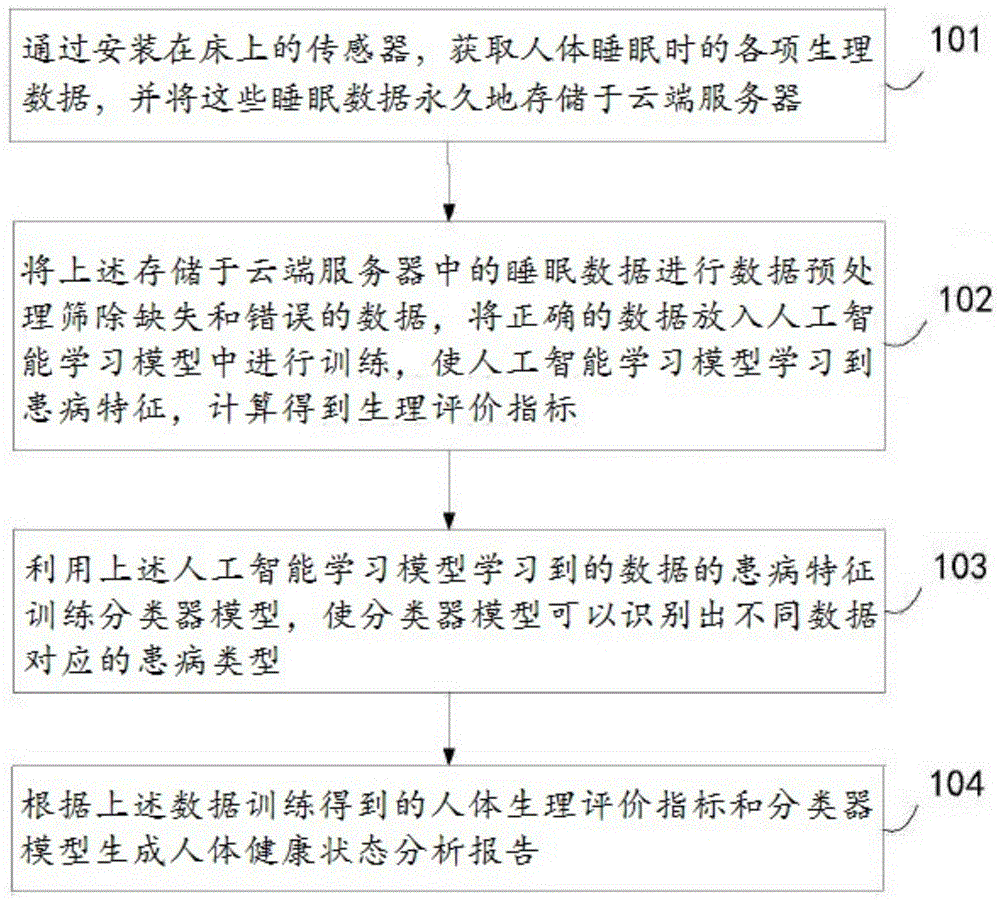
图1为本发明实施例的基于睡眠大数据的人体健康评估方法的流程示意图;Fig. 1 is a schematic flow chart of a human health assessment method based on sleep big data according to an embodiment of the present invention;
图2为本发明实施例的人工智能学习模型进行数据训练的流程示意图;Fig. 2 is the schematic flow chart that the artificial intelligence learning model of the embodiment of the present invention carries out data training;
图3为本发明实施例的分类器模型训练的流程示意图;FIG. 3 is a schematic flow diagram of classifier model training in an embodiment of the present invention;
图4为本发明实施例的基于睡眠大数据的人体健康评估系统的框架图。Fig. 4 is a frame diagram of a human health assessment system based on sleep big data according to an embodiment of the present invention.
具体实施方式Detailed ways
为了使本领域的人员更好地理解本发明的技术方案,下面将结合本发明实施例中的附图,对本发明实施例中的技术方案进行清查、完整地描述,显然,所描述的实施例仅仅是本发明一部分的实施例,而不是全部的实施例。基于本发明中的实施例,本领域普通技术人员在没有做出创造性劳动前提下所获得的所有其他实施例,都应当属于本发明保护的范围。In order to enable those skilled in the art to better understand the technical solutions of the present invention, the technical solutions in the embodiments of the present invention will be checked and completely described below in conjunction with the accompanying drawings in the embodiments of the present invention. Obviously, the described embodiments It is only some embodiments of the present invention, but not all embodiments. Based on the embodiments of the present invention, all other embodiments obtained by persons of ordinary skill in the art without making creative efforts shall fall within the protection scope of the present invention.
本发明实施例提供一种基于睡眠大数据的人体健康评估方法,用以提高健康评估结果的准确性实现精准预测疾病的目的,适用于安装有传感器的床包括但不仅仅限于:电动床、智能床或者铺设有感应床垫的床等等。图1示出了本发明实施例中基于睡眠大数据的人体健康评估方法的流程图。如附图1所示,本发明实施例中,基于睡眠大数据的人体健康评估方法可以包括:The embodiment of the present invention provides a human health assessment method based on sleep big data, which is used to improve the accuracy of the health assessment results and achieve the purpose of accurately predicting diseases. It is suitable for beds equipped with sensors, including but not limited to: electric beds, intelligent Beds or beds with induction mattresses, etc. Fig. 1 shows a flow chart of a human health assessment method based on sleep big data in an embodiment of the present invention. As shown in Figure 1, in the embodiment of the present invention, the human health assessment method based on sleep big data may include:
步骤101.通过安装在床上的传感器,获取人体睡眠时的各项生理数据,并将这些睡眠数据永久地存储于云端服务器。
由图1所示流程可以得知,本发明实施例中基于睡眠大数据的人体健康评估方法是借助人工智能学习模型进行数据训练的方法对存储于云端服务器中大量的睡眠数据进行处理、分析和训练。该方法通过云端服务器与安装于床上的传感器实现数据传输,对于包含有电动控制系统的电动床或智能床,云端服务器也可以与控制系统的数据库进行通信连接,实时稳定的获取用户的睡眠数据,为健康评估提供优质的数据基础。云端服务器存储的人体睡眠时的各项生理数据类型与安装在床上的传感器类型相关联,实际应用中可以根据健康评估的侧重点选择特定的传感器获取目标数据,例如本实施例中获取到的生理数据包括:心率、呼吸率、翻身、微动、打鼾和离床信息。As can be seen from the flow shown in Figure 1, the human health assessment method based on sleep big data in the embodiment of the present invention is a method of data training with the help of an artificial intelligence learning model to process, analyze and analyze a large amount of sleep data stored in a cloud server. train. This method realizes data transmission through the cloud server and the sensor installed on the bed. For an electric bed or smart bed that includes an electric control system, the cloud server can also communicate with the database of the control system to obtain the user's sleep data in real time and stably. Provide a high-quality data basis for health assessment. The types of physiological data stored on the cloud server during human sleep are associated with the types of sensors installed on the bed. In practical applications, specific sensors can be selected to acquire target data according to the focus of health assessment, such as the physiological data obtained in this embodiment. The data includes: heart rate, breathing rate, turning over, micro-movement, snoring and getting out of bed information.
步骤102.将上述存储于云端服务器中的睡眠数据进行数据预处理筛除缺失和错误的数据,将正确的数据放入人工智能学习模型中进行训练,使人工智能学习模型学习到患病特征,计算得到生理评价指标。
云端服务器中存储的原始人体睡眠数据为实时获取且没有经过任何处理的,其中难免会含有大量缺失和错误的数据,因此在进行数据分析之前必须经过数据预处理,筛选出正确的睡眠数据才能放入人工智能学习模型中进行训练,不然会导致整个模型错乱,从而无法得到正确的预测结果。数据预处理在筛除噪音数据的同时根据数据来源将睡眠数据分为有患病标签的睡眠数据和无患病标签的睡眠数据,其中有患病标签的睡眠数据是指采集于已知患病类型的人体生理数据中;无患病标签的睡眠数据采集于未知患病状态的人体生理数据中。预处理后的睡眠数据将被送入人工智能学习模型训练后可用于评估人体的健康状态。具体的实施时,在采集有患病标签的睡眠数据用于人工智能学习模型训练和分类器模型训练时,会选择一个已经准确得知是患病状态,并且知道该疾病类型的个体,对其睡眠数据采集并输入人工智能学习模型中,用来让模型识别人体的状态是正常还是患病以及患病类型。在采集无患病标签的睡眠数据用于人工智能学习模型训练时,会选择一个不能确定是否患病的个体,对其睡眠数据采集并输入人工智能学习模型汇总,用来让模型学习到人体睡眠数据所具有的共性。The original human sleep data stored in the cloud server is obtained in real time without any processing, which will inevitably contain a large number of missing and wrong data. Therefore, data preprocessing must be performed before data analysis, and the correct sleep data can only be released. It should be trained in the artificial intelligence learning model, otherwise the whole model will be confused, so that the correct prediction result cannot be obtained. Data preprocessing divides the sleep data into sleep data with disease labels and sleep data without disease labels according to the data source while screening out the noise data. The sleep data with disease labels refers to the sleep data collected from known disease Types of human physiological data; sleep data without disease labels are collected from human physiological data of unknown disease status. The preprocessed sleep data will be sent to the artificial intelligence learning model for training and can be used to evaluate the health status of the human body. In specific implementation, when collecting sleep data with disease labels for artificial intelligence learning model training and classifier model training, an individual who has been accurately known to be in a disease state and knows the type of disease will be selected, and the The sleep data is collected and input into the artificial intelligence learning model, which is used to allow the model to identify whether the human body is normal or diseased and the type of disease. When collecting sleep data without a disease label for artificial intelligence learning model training, an individual who is not sure whether he is sick will be selected, and his sleep data will be collected and input into the artificial intelligence learning model summary, so that the model can learn human sleep commonality of the data.
步骤103.利用上述人工智能学习模型学习到的数据的患病特征训练分类器模型,使分类器模型可以识别出不同数据对应的患病类型。
在本申请中,经过人工智能学习模型训练的数据将作为生理评价指标,可以用来识别个体的身体状态为患病状态还是正常状态。进一步地,将有患病标签的睡眠数据通过在自编码网络的中间层降维输出后,作为SVM分类器的输入,用来训练分类器模型,使分类器模型可以识别出不同数据对应的患病类型。经过步骤102使人工智能学习模型从原始数据中学习到和患病相关的一些特征,再经过步骤103进一步训练使分类器模型可以识别出产生该睡眠数据的个体所患疾病的具体类型。In this application, the data trained by the artificial intelligence learning model will be used as a physiological evaluation index, which can be used to identify whether the individual's physical state is a diseased state or a normal state. Further, after the sleep data with disease labels are output in the middle layer of the self-encoding network, it is used as the input of the SVM classifier to train the classifier model, so that the classifier model can identify the patients corresponding to different data. disease type. After
步骤104.根据上述数据训练得到的人体生理评价指标和分类器模型生成人体健康状态分析报告。
下面结合附图1-3介绍本发明的具体实施方式。The specific implementation manner of the present invention will be introduced below in conjunction with accompanying drawings 1-3.
首先将存储在云端服务器中的睡眠数据进行数据预处理,筛除去缺失和错误的数据,剩下的正确的睡眠数据根据数据来源分为有患病标签的睡眠数据和无患病标签的睡眠数据,将这些数据放入人工智能学习模型中进行训练。First, the sleep data stored in the cloud server is preprocessed to filter out missing and wrong data, and the remaining correct sleep data are divided into sleep data with disease labels and sleep data without disease labels according to the data source. , put these data into the artificial intelligence learning model for training.
附图2示出了本发明实施例的人工智能学习模型进行数据训练的流程示意图,如图2所示,经过预处理后的正确的数据放入人工智能学习模型中进行训练的过程包括:Accompanying drawing 2 shows the schematic flow chart that the artificial intelligence learning model of the embodiment of the present invention carries out data training, as shown in Figure 2, the process of putting the correct data after preprocessing into the artificial intelligence learning model for training includes:
(1)将预处理后无患病标签的睡眠数据x送入自编码网络的深度自编码器中,计算得到无监督网络损失loss1k。本申请中选用最优的计算方式为:将睡眠数据x送入深度自编码器中得到输入和输出的均方差值,并将该值赋予无监督网络损失loss1k。(1) Send the sleep data x without disease label after preprocessing to the deep autoencoder of the autoencoder network, and calculate the unsupervised network loss loss1 k . The optimal calculation method used in this application is: send the sleep data x into the deep autoencoder to obtain the mean square error value of the input and output, and assign this value to the unsupervised network loss loss1 k .
(2)将预处理后有患病标签的睡眠数据y送入与上述同一参数的自编码网络中,得到中间层降维输出数据并计算出有监督网络损失loss2k。本申请中选用最优的计算有监督网络损失loss2k的方式为:根据患病标签将得到的中间层降维输出数据分成不同的类别,找出每个类别的中心点,并计算同类数据到同类中心点的距离,所得数据之和赋予有监督网络损失loss2k。(2) Send the preprocessed sleep data y with the disease label to the autoencoder network with the same parameters as above to obtain the output data of intermediate layer dimensionality reduction and calculate the supervised network loss loss2 k . In this application, the optimal way to calculate the supervised network loss loss2 k is as follows: Divide the obtained middle layer dimensionality reduction output data into different categories according to the disease label, find the center point of each category, and calculate the similar data to The distance between the center points of the same class, and the sum of the obtained data endow the supervised network loss loss2 k .
(3)将上述(1)和(2)得到的loss1k和loss2k求和即得网络总损失lossk,即lossk=loss1k+loss2k,利用反向传播算法调整整个网络结构参数。然后采用迭代训练方式,将x和y再次送入自编码网络结构中,分别重复步骤(1)和步骤(2)再次计算网络结构参数调整之后的无监督网络损失loss1k+1和有监督网络损失loss2k+1,并计算得到本轮网络总损失lossk+1=loss1k+1+loss2k+1。(3) Sum the loss1 k and loss2 k obtained in (1) and (2) above to obtain the total loss k of the network, that is, loss k = loss1 k + loss2 k , and use the backpropagation algorithm to adjust the parameters of the entire network structure. Then adopt iterative training method, send x and y into the self-encoder network structure again, repeat steps (1) and (2) respectively to calculate the unsupervised network loss loss1 k+1 and the supervised network after adjusting the network structure parameters Loss loss2 k+1 , and calculate the total network loss loss k+1 of this round = loss1 k+1 +loss2 k+1 .
(4)比较调整网络结构参数后的损失值并再次调整网络结构参数,直到网络结构的lossk+1=lossk或者达到最大迭代次数时停止训练。最大迭代次数是指,在人工智能学习模型的训练过程中,根据需要设定最大迭代次数M,当迭代次数为M(k=M)时,即使网络总损失仍然发生变化也不会继续进行迭代训练。(4) Compare the loss value after adjusting the network structure parameters and adjust the network structure parameters again until the loss k+1 of the network structure = loss k or stop training when the maximum number of iterations is reached. The maximum number of iterations means that during the training process of the artificial intelligence learning model, the maximum number of iterations M is set as required. When the number of iterations is M (k=M), even if the total loss of the network still changes, it will not continue to iterate train.
至此人工智能学习模型训练完成,训练得到的神经网络损失和自编码网络损失将作为生理评价指标,用于评估睡眠数据对应的个体是否为患病状态或者为正常的健康状态。At this point, the training of the artificial intelligence learning model is completed, and the neural network loss and autoencoder network loss obtained from the training will be used as physiological evaluation indicators to evaluate whether the individual corresponding to the sleep data is in a diseased state or in a normal healthy state.
上述有患病标签的睡眠数据y送入自编码网络中时所得到的中间层降维输出数据,进一步将被作为SVM分类器的输入,用来训练分类器模型,使分类器模型可以识别出不同数据对应的患病类型。训练得到的分类器模型可以识别出产生该睡眠数据的个体所患疾病的具体类型。The above-mentioned sleep data y with the disease label is sent to the self-encoding network, and the output data of the middle layer dimension reduction will be further used as the input of the SVM classifier to train the classifier model, so that the classifier model can identify Disease types corresponding to different data. The classifier model is trained to identify the specific type of disease suffered by the individual who produced the sleep data.
经过上述训练得到的生理评价指标和分类器模型,既可以用于生成睡眠数据对应的个体健康状态分析报告。具体实施时,从云端服务器中选出需要进行健康评估的个体的睡眠数据,将这些数据放入已经训练完成的人工智能学习模型中,通过该模型确定该个体的患病状态,如得到结果为患病状态,则进一步的可以得到该个体所患病类型。最终可以借助终端设备输出或打印出包含上述评估结果的人体健康评估报告,实现利用睡眠数据预测疾病的目的。The physiological evaluation index and classifier model obtained through the above training can be used to generate an individual health status analysis report corresponding to the sleep data. During specific implementation, select the sleep data of individuals who need health assessment from the cloud server, put these data into the artificial intelligence learning model that has been trained, and determine the disease status of the individual through this model. If the result is Disease status, the disease type of the individual can be further obtained. Finally, the human health assessment report containing the above assessment results can be output or printed out with the help of terminal equipment, so as to realize the purpose of predicting diseases by using sleep data.
图4为本发明实施例的基于睡眠大数据的人体健康评估系统的框架图,如附图4所示,基于睡眠大数据的人体健康评估系统包括:4 is a frame diagram of a human health assessment system based on sleep big data according to an embodiment of the present invention. As shown in accompanying drawing 4, the human health assessment system based on sleep big data includes:
睡眠数据获取单元,用于获取人体睡眠时的各项生理数据,所述数据来自于安装于床上的传感器;The sleep data acquisition unit is used to acquire various physiological data of the human body during sleep, and the data comes from sensors installed on the bed;
睡眠数据存储单元,包括云端服务器,用于存储睡眠数据获取单元采集到的所有睡眠数据;A sleep data storage unit, including a cloud server, for storing all sleep data collected by the sleep data acquisition unit;
数据训练单元,用于对睡眠数据进行预处理,并通过人工智能学习模型对数据进行训练得到生理评价指标。数据训练单元包括:数据预处理,用于筛除云端服务器中存储的缺失和错误的睡眠数据;自编码器,用于创建自编码网络,通过计算网络损失对数据进行迭代训练。The data training unit is used for preprocessing the sleep data, and training the data through an artificial intelligence learning model to obtain physiological evaluation indicators. The data training unit includes: data preprocessing, which is used to filter out missing and wrong sleep data stored in the cloud server; an autoencoder, which is used to create an autoencoder network, and iteratively trains the data by calculating the network loss.
分类器模型训练单元,用于对人工智能学习模型训练后的睡眠数据进行分类器模型训练;The classifier model training unit is used to carry out classifier model training to the sleep data after artificial intelligence learning model training;
报告生成单元,用于根据数据训练得到的人体生理评价指标和分类器模型生成人体健康状态分析报告。The report generating unit is used to generate a human health status analysis report according to the human physiological evaluation index and the classifier model obtained through data training.
需要说明的是,本发明系统可以设置于电动床的控制系统中或者装设于人机交互操作的终端设备中,设备还包括用于控制报告生成单元生成报告的操作机构,以便于用户可以按照需求对评估系统进行自定义设置。本说明书实施例中所述的终端设备可以包括用户设备、智能手机、电脑、移动互联网设备或穿戴式智能设备等互联网设备,本发明实施例不作限定。It should be noted that the system of the present invention can be set in the control system of the electric bed or installed in the terminal equipment for human-computer interaction operation, and the equipment also includes an operating mechanism for controlling the report generation unit to generate a report, so that the user can follow the Need to customize the evaluation system. The terminal devices described in the embodiments of this specification may include Internet devices such as user equipment, smart phones, computers, mobile Internet devices, or wearable smart devices, which are not limited in this embodiment of the present invention.
本领域内的技术人员应明白,本发明的实施例可提供为方法、系统或计算机程序产品。因此,本发明可采用完全硬件实施例、完全软件实施例、或结合软件和硬件方面的实施例的形式。Those skilled in the art should understand that the embodiments of the present invention may be provided as methods, systems or computer program products. Accordingly, the present invention can take the form of an entirely hardware embodiment, an entirely software embodiment, or an embodiment combining software and hardware aspects.
以上所述仅是本发明的优选实施方式,应当指出,对于本技术领域的普通技术人员,在不脱离本发明方法的前提下,还可以做出若干改进和补充,这些改进和补充也应视为本发明的保护范围。The above is only a preferred embodiment of the present invention, it should be pointed out that for those of ordinary skill in the art, without departing from the method of the present invention, some improvements and supplements can also be made, and these improvements and supplements should also be considered Be the protection scope of the present invention.
Claims (8)
Priority Applications (6)
| Application Number | Priority Date | Filing Date | Title |
|---|---|---|---|
| CN201810772360.1A CN109087706B (en) | 2018-07-13 | 2018-07-13 | Human health assessment method and assessment system based on sleep big data |
| PCT/CN2018/100955 WO2020010668A1 (en) | 2018-07-13 | 2018-08-17 | Human body health assessment method and system based on sleep big data |
| US17/040,975 US20210225510A1 (en) | 2018-07-13 | 2018-08-17 | Human body health assessment method and system based on sleep big data |
| RU2020129796A RU2757048C1 (en) | 2018-07-13 | 2018-08-17 | Method and system for assessing the health of the human body based on the large-volume sleep data |
| AU2018432124A AU2018432124A1 (en) | 2018-07-13 | 2018-08-17 | Human body health assessment method and system based on sleep big data |
| EP18926215.7A EP3783619A4 (en) | 2018-07-13 | 2018-08-17 | HUMAN BODY HEALTH ASSESSMENT METHOD AND SYSTEM BASED ON SLEEP BIG DATA |
Applications Claiming Priority (1)
| Application Number | Priority Date | Filing Date | Title |
|---|---|---|---|
| CN201810772360.1A CN109087706B (en) | 2018-07-13 | 2018-07-13 | Human health assessment method and assessment system based on sleep big data |
Publications (2)
| Publication Number | Publication Date |
|---|---|
| CN109087706A CN109087706A (en) | 2018-12-25 |
| CN109087706B true CN109087706B (en) | 2022-12-02 |
Family
ID=64837905
Family Applications (1)
| Application Number | Title | Priority Date | Filing Date |
|---|---|---|---|
| CN201810772360.1A Active CN109087706B (en) | 2018-07-13 | 2018-07-13 | Human health assessment method and assessment system based on sleep big data |
Country Status (6)
| Country | Link |
|---|---|
| US (1) | US20210225510A1 (en) |
| EP (1) | EP3783619A4 (en) |
| CN (1) | CN109087706B (en) |
| AU (1) | AU2018432124A1 (en) |
| RU (1) | RU2757048C1 (en) |
| WO (1) | WO2020010668A1 (en) |
Families Citing this family (21)
| Publication number | Priority date | Publication date | Assignee | Title |
|---|---|---|---|---|
| CN109767836A (en) * | 2018-12-29 | 2019-05-17 | 上海亲看慧智能科技有限公司 | A kind of medical diagnosis artificial intelligence system, device and its self-teaching method |
| CN109661039B (en) * | 2019-01-15 | 2020-07-21 | 北京泰德东腾通信技术有限公司 | Protocol consistency test method and system for 5G session establishment and release |
| CN109840932A (en) * | 2019-01-23 | 2019-06-04 | 平安科技(深圳)有限公司 | Cardiovascular and cerebrovascular disease methods of exhibiting, device, equipment and storage medium |
| CN109770881A (en) * | 2019-01-28 | 2019-05-21 | 深圳市星裳尔电子商务有限公司 | A kind of health monitor method and blood pressure measuring device based on blood pressure |
| JP7326926B2 (en) * | 2019-06-27 | 2023-08-16 | トヨタ自動車株式会社 | LEARNING DEVICE, REHABILITATION SUPPORT SYSTEM, METHOD, PROGRAM, AND LEARNED MODEL |
| CN111009328A (en) * | 2019-12-25 | 2020-04-14 | 新绎健康科技有限公司 | Regional population health condition assessment method and device |
| CN111785374A (en) * | 2020-06-15 | 2020-10-16 | 山东省玖玖医养健康产业有限公司 | Health condition analysis and prediction method and system based on big data |
| CN111696679A (en) * | 2020-07-14 | 2020-09-22 | 章越新 | Human health state analysis scheme based on quantum Petri net |
| US10931643B1 (en) | 2020-07-27 | 2021-02-23 | Kpn Innovations, Llc. | Methods and systems of telemedicine diagnostics through remote sensing |
| EP4315020A4 (en) * | 2021-03-30 | 2025-02-19 | Jio Platforms Limited | System and method of data ingestion and processing framework |
| CN114242246A (en) * | 2021-12-28 | 2022-03-25 | 深圳市伟晴大健康科技有限公司 | Intelligent Health Management System |
| CN116269242B (en) * | 2023-05-17 | 2023-07-18 | 广州培生智能科技有限公司 | An internet-based real-time monitoring system for the health status of the elderly |
| CN117131396B (en) * | 2023-08-28 | 2025-09-05 | 东南大学 | An online wrist torque estimation method based on neural features and LSTM |
| CN117235200B (en) * | 2023-09-12 | 2024-05-10 | 杭州湘云信息技术有限公司 | Data integration method and device based on AI technology, computer equipment and storage medium |
| CN118098590A (en) * | 2024-03-08 | 2024-05-28 | 南京优悠健康科技有限公司 | Intelligent analysis, prediction and early warning system and method for health state |
| CN118280569B (en) * | 2024-03-29 | 2025-04-22 | 浙江中医药大学 | Evaluation method and system of sleep quality regulation in TCM psychosomatic medicine |
| CN117992803B (en) * | 2024-04-03 | 2024-06-11 | 江西千策信息工程有限公司 | A multi-scale combined monitoring method and system based on steel structure health |
| CN118044813B (en) * | 2024-04-16 | 2024-07-02 | 山东第一医科大学附属省立医院(山东省立医院) | Psychological health condition assessment method and system based on multitask learning |
| CN118983045B (en) * | 2024-07-23 | 2025-03-21 | 京医云(北京)信息科技有限公司 | A physical health monitoring and evaluation system and method based on big data |
| CN119867667B (en) * | 2025-03-26 | 2025-08-01 | 浙江麒盛数据服务有限公司 | Snoring detection method and system based on intelligent bed |
| CN120267244B (en) * | 2025-06-09 | 2025-09-16 | 浙江麒盛数据服务有限公司 | Personalized dynamic sleep staging method and system |
Citations (4)
| Publication number | Priority date | Publication date | Assignee | Title |
|---|---|---|---|---|
| CN105997053A (en) * | 2016-06-25 | 2016-10-12 | 浙江和也健康科技有限公司 | Health management method based on intelligent bedding |
| CN106156530A (en) * | 2016-08-03 | 2016-11-23 | 北京好运到信息科技有限公司 | Health check-up data analysing method based on stack own coding device and device |
| CN107103182A (en) * | 2017-03-28 | 2017-08-29 | 南京医科大学 | A kind of heart disease Warning System and method based on deep learning algorithm |
| CN107595243A (en) * | 2017-07-28 | 2018-01-19 | 深圳和而泰智能控制股份有限公司 | A kind of illness appraisal procedure and terminal device |
Family Cites Families (16)
| Publication number | Priority date | Publication date | Assignee | Title |
|---|---|---|---|---|
| EP2574275A3 (en) * | 2004-03-22 | 2013-06-26 | BodyMedia, Inc. | Non-Invasive Temperature Monitoring Device |
| US7733224B2 (en) * | 2006-06-30 | 2010-06-08 | Bao Tran | Mesh network personal emergency response appliance |
| US7558622B2 (en) * | 2006-05-24 | 2009-07-07 | Bao Tran | Mesh network stroke monitoring appliance |
| US8905928B2 (en) * | 2009-07-17 | 2014-12-09 | Oregon Health & Science University | Method and apparatus for assessment of sleep disorders |
| US9955795B2 (en) * | 2014-06-05 | 2018-05-01 | Matthew W. Krenik | Automated bed and method of operation thereof |
| US20180014784A1 (en) * | 2015-01-30 | 2018-01-18 | New York University | System and method for electrophysiological monitoring |
| EP3268881B1 (en) * | 2015-03-09 | 2022-05-11 | Koninklijke Philips N.V. | Method and wearable device for obtaining audio data for diagnosis |
| US10912508B2 (en) * | 2015-06-15 | 2021-02-09 | Medibio Limited | Method and system for assessing mental state |
| CN204971278U (en) * | 2015-08-24 | 2016-01-20 | 华南理工大学 | Senile dementia monitor system based on health service robot |
| US10105092B2 (en) * | 2015-11-16 | 2018-10-23 | Eight Sleep Inc. | Detecting sleeping disorders |
| EP3490440B1 (en) * | 2016-07-29 | 2023-07-05 | Bryte, Inc. | A method, performed by at least one processor, for assisting in adjusting a user sleep platform environment with localized pressure regions across the sleep surface |
| CN106618611A (en) * | 2017-03-06 | 2017-05-10 | 兰州大学 | Sleeping multichannel physiological signal-based depression auxiliary diagnosis method and system |
| CN108091391A (en) * | 2017-12-27 | 2018-05-29 | 深圳和而泰数据资源与云技术有限公司 | Illness appraisal procedure, terminal device and computer-readable medium |
| EP3735156A1 (en) * | 2018-01-05 | 2020-11-11 | Sleep Number Corporation | Bed having physiological event detecting feature |
| US11364361B2 (en) * | 2018-04-20 | 2022-06-21 | Neuroenhancement Lab, LLC | System and method for inducing sleep by transplanting mental states |
| US10890968B2 (en) * | 2018-05-07 | 2021-01-12 | Apple Inc. | Electronic device with foveated display and gaze prediction |
-
2018
- 2018-07-13 CN CN201810772360.1A patent/CN109087706B/en active Active
- 2018-08-17 WO PCT/CN2018/100955 patent/WO2020010668A1/en not_active Ceased
- 2018-08-17 RU RU2020129796A patent/RU2757048C1/en active
- 2018-08-17 EP EP18926215.7A patent/EP3783619A4/en active Pending
- 2018-08-17 AU AU2018432124A patent/AU2018432124A1/en not_active Abandoned
- 2018-08-17 US US17/040,975 patent/US20210225510A1/en not_active Abandoned
Patent Citations (4)
| Publication number | Priority date | Publication date | Assignee | Title |
|---|---|---|---|---|
| CN105997053A (en) * | 2016-06-25 | 2016-10-12 | 浙江和也健康科技有限公司 | Health management method based on intelligent bedding |
| CN106156530A (en) * | 2016-08-03 | 2016-11-23 | 北京好运到信息科技有限公司 | Health check-up data analysing method based on stack own coding device and device |
| CN107103182A (en) * | 2017-03-28 | 2017-08-29 | 南京医科大学 | A kind of heart disease Warning System and method based on deep learning algorithm |
| CN107595243A (en) * | 2017-07-28 | 2018-01-19 | 深圳和而泰智能控制股份有限公司 | A kind of illness appraisal procedure and terminal device |
Also Published As
| Publication number | Publication date |
|---|---|
| CN109087706A (en) | 2018-12-25 |
| US20210225510A1 (en) | 2021-07-22 |
| RU2757048C1 (en) | 2021-10-11 |
| WO2020010668A1 (en) | 2020-01-16 |
| AU2018432124A1 (en) | 2020-10-22 |
| EP3783619A1 (en) | 2021-02-24 |
| EP3783619A4 (en) | 2022-01-26 |
Similar Documents
| Publication | Publication Date | Title |
|---|---|---|
| CN109087706B (en) | Human health assessment method and assessment system based on sleep big data | |
| US12079773B2 (en) | Method to increase efficiency, coverage, and quality of direct primary care | |
| US11529105B2 (en) | Digital twin updating | |
| CN109119130A (en) | A kind of big data based on cloud computing is health management system arranged and method | |
| KR20200005986A (en) | System and method for diagnosing cognitive impairment using face recognization | |
| CN115299947B (en) | Confidence evaluation method and system for psychological scales based on multimodal physiological data | |
| CN111513732A (en) | Intelligent psychological stress assessment early warning system for various groups of people under epidemic disease condition | |
| Gamel et al. | SleepSmart: an IoT-enabled continual learning algorithm for intelligent sleep enhancement | |
| CN111568445A (en) | A delirium risk monitoring method and system based on a delirium dynamic prediction model | |
| CN112185558A (en) | Mental health and rehabilitation evaluation method, device and medium based on deep learning | |
| CN118692705A (en) | Physical health status monitoring method and system based on big data | |
| CN120221116A (en) | Chronic disease risk assessment and intervention strategy generation system based on data analysis | |
| CN121096631A (en) | Artificial Intelligence-Based Mental and Physical Health Monitoring and Management Methods Based on Chaos Models | |
| CN119446430B (en) | An Evidence-Based Method and System for TCM Diagnosis and Treatment Decision Making | |
| CN120199427A (en) | Health plan recommendation method, device and equipment based on big model and knowledge graph | |
| CN120108725A (en) | A health status assessment method, device, robot and storage medium | |
| US20240285205A1 (en) | Devices, Systems, and Methods for Mental Health Assessment | |
| CN119028504A (en) | Big data-based in-hospital and out-of-hospital data management method and system for chronic disease patients | |
| Lim et al. | Developing a mobile wellness management system for healthy lifestyle by analyzing daily living activities | |
| CN114388089A (en) | Personal health management method and system based on artificial intelligence | |
| Oliveira et al. | Convolutional neural network for elderly wandering prediction in indoor scenarios | |
| US20250246282A1 (en) | Digital therapy management system of reflecting and updating feedback according to actual use of digital therapeutics and operation method thereof | |
| CN121528519A (en) | A method and system for assessing physiological age and rate of aging. | |
| Huiying | Application of intelligent diagnosis based on optical medical equipment in adjustment of type 2 diabetes exercise prescription | |
| CN120600306A (en) | Personalized digital health assessment method based on digital twin and generative AI |
Legal Events
| Date | Code | Title | Description |
|---|---|---|---|
| PB01 | Publication | ||
| PB01 | Publication | ||
| SE01 | Entry into force of request for substantive examination | ||
| SE01 | Entry into force of request for substantive examination | ||
| GR01 | Patent grant | ||
| GR01 | Patent grant |