[go: up one dir, main page]

CN108960183B - A system and method for target recognition on curved roads based on multi-sensor fusion - Google Patents

A system and method for target recognition on curved roads based on multi-sensor fusion Download PDF

Info

Publication number
CN108960183B
CN108960183B CN201810797646.5A CN201810797646A CN108960183B CN 108960183 B CN108960183 B CN 108960183B CN 201810797646 A CN201810797646 A CN 201810797646A CN 108960183 B CN108960183 B CN 108960183B
Authority
CN
China
Prior art keywords
lane
lane line
line
area
image
Prior art date
Legal status (The legal status is an assumption and is not a legal conclusion. Google has not performed a legal analysis and makes no representation as to the accuracy of the status listed.)
Active
Application number
CN201810797646.5A
Other languages
Chinese (zh)
Other versions
CN108960183A (en
Inventor
余贵珍
张思佳
张力
牛欢
张艳飞
Current Assignee (The listed assignees may be inaccurate. Google has not performed a legal analysis and makes no representation or warranty as to the accuracy of the list.)
Taoke Zhixing Technology Co., Ltd.
Original Assignee
Beihang University
Priority date (The priority date is an assumption and is not a legal conclusion. Google has not performed a legal analysis and makes no representation as to the accuracy of the date listed.)
Filing date
Publication date
Application filed by Beihang University filed Critical Beihang University
Priority to CN201810797646.5A priority Critical patent/CN108960183B/en
Publication of CN108960183A publication Critical patent/CN108960183A/en
Application granted granted Critical
Publication of CN108960183B publication Critical patent/CN108960183B/en
Active legal-status Critical Current
Anticipated expiration legal-status Critical

Links

Images

Classifications

    • GPHYSICS
    • G06COMPUTING OR CALCULATING; COUNTING
    • G06VIMAGE OR VIDEO RECOGNITION OR UNDERSTANDING
    • G06V20/00Scenes; Scene-specific elements
    • G06V20/50Context or environment of the image
    • G06V20/56Context or environment of the image exterior to a vehicle by using sensors mounted on the vehicle
    • G06V20/588Recognition of the road, e.g. of lane markings; Recognition of the vehicle driving pattern in relation to the road
    • GPHYSICS
    • G01MEASURING; TESTING
    • G01SRADIO DIRECTION-FINDING; RADIO NAVIGATION; DETERMINING DISTANCE OR VELOCITY BY USE OF RADIO WAVES; LOCATING OR PRESENCE-DETECTING BY USE OF THE REFLECTION OR RERADIATION OF RADIO WAVES; ANALOGOUS ARRANGEMENTS USING OTHER WAVES
    • G01S13/00Systems using the reflection or reradiation of radio waves, e.g. radar systems; Analogous systems using reflection or reradiation of waves whose nature or wavelength is irrelevant or unspecified
    • G01S13/88Radar or analogous systems specially adapted for specific applications
    • G01S13/93Radar or analogous systems specially adapted for specific applications for anti-collision purposes
    • G01S13/931Radar or analogous systems specially adapted for specific applications for anti-collision purposes of land vehicles
    • GPHYSICS
    • G06COMPUTING OR CALCULATING; COUNTING
    • G06FELECTRIC DIGITAL DATA PROCESSING
    • G06F18/00Pattern recognition
    • G06F18/20Analysing
    • G06F18/25Fusion techniques
    • GPHYSICS
    • G06COMPUTING OR CALCULATING; COUNTING
    • G06TIMAGE DATA PROCESSING OR GENERATION, IN GENERAL
    • G06T7/00Image analysis
    • G06T7/20Analysis of motion
    • G06T7/277Analysis of motion involving stochastic approaches, e.g. using Kalman filters
    • GPHYSICS
    • G06COMPUTING OR CALCULATING; COUNTING
    • G06TIMAGE DATA PROCESSING OR GENERATION, IN GENERAL
    • G06T2207/00Indexing scheme for image analysis or image enhancement
    • G06T2207/30Subject of image; Context of image processing
    • G06T2207/30248Vehicle exterior or interior
    • G06T2207/30252Vehicle exterior; Vicinity of vehicle
    • G06T2207/30256Lane; Road marking

Landscapes

  • Engineering & Computer Science (AREA)
  • Physics & Mathematics (AREA)
  • Theoretical Computer Science (AREA)
  • General Physics & Mathematics (AREA)
  • Remote Sensing (AREA)
  • Radar, Positioning & Navigation (AREA)
  • Data Mining & Analysis (AREA)
  • Multimedia (AREA)
  • Computer Vision & Pattern Recognition (AREA)
  • Bioinformatics & Computational Biology (AREA)
  • General Engineering & Computer Science (AREA)
  • Evolutionary Computation (AREA)
  • Evolutionary Biology (AREA)
  • Bioinformatics & Cheminformatics (AREA)
  • Electromagnetism (AREA)
  • Artificial Intelligence (AREA)
  • Life Sciences & Earth Sciences (AREA)
  • Computer Networks & Wireless Communication (AREA)
  • Traffic Control Systems (AREA)
  • Image Analysis (AREA)

Abstract

本发明公开了一种基于多传感器融合的弯道目标识别系统及方法,主要针对车辆在高速公路弯道处对前方目标检测的问题,将车道线分成近视场的直线部分和远视场的曲线部分,对于相机采集信息而言,利用霍夫变换和卡尔曼滤波完成近视场处的车道线拟合和跟踪,利用BP神经网络完成远视场处的曲线拟合,对于雷达采集信息,提取出静止物体群的信息,利用BP神经网络进行曲线拟合。通过时空对准后,将视觉采集的车道线信息与雷达所采集的车道线信息进行融合,确定车辆所在车道的可行驶区域,最后结合可行驶区域和车道线类型给出了基于相机和毫米波雷达融合的弯道目标识别算法,实现了对弯道处目标的检测。

Figure 201810797646

The invention discloses a system and method for recognizing a curve target based on multi-sensor fusion, mainly aiming at the problem of vehicle detection of the front target at the curve of the expressway, dividing the lane line into a straight line part of the near field of view and a curved part of the far field of view , For the information collected by the camera, the Hough transform and Kalman filter are used to complete the lane line fitting and tracking at the near field of view, and the BP neural network is used to complete the curve fitting at the far field of view. For the information collected by the radar, the stationary objects are extracted. The information of the group is used for curve fitting using BP neural network. After space-time alignment, the lane line information collected by vision and the lane line information collected by radar are fused to determine the drivable area of the lane where the vehicle is located. The radar-fused curve target recognition algorithm realizes the detection of the target at the curve.

Figure 201810797646

Description

Curve target identification system and method based on multi-sensor fusion
Technical Field
The invention relates to the field of intelligent terminals, in particular to a highway curve target identification system and method based on multi-sensor fusion.
Background
The problem of target identification and tracking at the curve is an important subject in the field of environmental perception all the time, and has important significance for the development of an ADAS system. Taking an ACC system as an example, the existing method automatically adjusts the speed of the cruise vehicle and maintains the safe distance to the vehicle in front of the vehicle according to the millimeter wave radar information. However, in a curve section, a plurality of target vehicles usually exist in front of the curve section, and at the moment, the system often has the phenomenon that the target vehicles are disordered or lost, so that the cruise vehicle causes rear-end collision accidents due to abnormal acceleration or deceleration. In addition, in consideration of the characteristics of the radar, information such as partial guardrails, buildings and signboards on two sides of the curve can be transmitted back by the radar, and the targets can generate false alarms for vehicle control. Once the false alarm occurs, traffic accidents may be caused, and the normal operation of the highway is affected.
In the prior art, machine vision recognition technology or millimeter wave radar data marker bits (indicating bits such as moving targets and new targets) are mostly adopted to recognize targets in front of a vehicle, and objects in straight roads have high recognition rate, but the accuracy rate is greatly reduced in curve positions. If the travelable area of the vehicle can be determined by combining the lane lines and the objects in the area are analyzed, the accuracy of target identification can be effectively improved, but the lane lines are required to be identified accurately enough.
At present, lane line recognition is mainly completed by means of vision, and generally comprises two parts of lane line detection and tracking. Lane line detection can be broadly divided into two categories, feature-based detection and model-based detection. The method based on feature detection mainly applies features of roads, such as edges, colors and the like, to carry out road detection. The detection method is easily influenced by the surrounding environment and is difficult to be applied to driving environments such as vehicle shielding and light change. The detection method based on the model mainly applies a specific parameter model to match the lane line, for example, a hyperbolic model is adopted to detect the lane line, the algorithm has the advantage of carrying out lane line calculation according to the lane line constraint relation under the conditions of lane line loss and the like, but the calculation amount is relatively large, the lane line model needs to be known in advance, and the accuracy rate can be reduced under the environment of illumination change.
Disclosure of Invention
In order to solve the problems, the invention provides a system and a method for identifying curves of a highway based on fusion of vision and a millimeter wave radar, which are used for judging targets by combining a driving area of a current lane of a vehicle and have the advantages of high accuracy, strong robustness and the like.
In order to achieve the above object, the method for identifying a curve target based on multi-sensor fusion provided by the invention comprises the following steps:
(1) lane line extraction and fitting based on machine vision: the method comprises the steps that after a camera is installed and calibrated, image information is collected, preprocessing is carried out on the image information, road edge information is obtained, near and far visual fields are divided, lane lines at the positions of the near and far visual fields are respectively extracted and fitted, and relevant information of the lane lines is obtained;
(2) lane line extraction and fitting based on the millimeter wave radar: collecting information after the radar is installed and calibrated, screening and filtering radar targets, reserving static targets and moving targets, and fitting lane lines according to the position and quantity related information of the static targets;
(3) determining a travelable area: fusing lane line information output by image information processing and lane line information output by millimeter wave radar information processing, and outputting a travelable area;
(4) target identification based on vision and millimeter wave radar fusion: and for the moving target detected by the radar, carrying out effective target preliminary discrimination by combining with a travelable region, converting an effective target point into an image coordinate system through projection transformation, identifying the target by using an image processing algorithm, and outputting final effective target information. And applying a previous frame detection result to the lane line at the near view field of the curve, and tracking the lane line by adopting a Kalman filtering model.
And fitting the lane line at the far view field of the curve by adopting a BP neural network model.
According to another aspect of the invention, the curve target recognition system based on multi-sensor fusion is further provided, and comprises a camera, a millimeter wave radar and a data processing unit, wherein the data processing unit is connected to the camera and the millimeter wave radar, and is used for receiving detection information of the camera and the millimeter wave radar, processing the detection information and outputting a final result.
The millimeter wave radar is arranged in the center of the front end of the vehicle, the height from the ground is between 35cm and 65cm, the mounting plane of the millimeter wave radar is perpendicular to the ground as much as possible and the longitudinal plane of the vehicle body, namely the pitch angle and the yaw angle are close to 0 degree.
The camera is installed at a position 1-3 cm below a base of the rearview mirror in the vehicle, the pitch angle of the camera is adjusted, and when the scene is a straight road, the 2/3 area under the picture is a road.
Has the advantages that: (1) the identification system of the invention applies the previous frame detection result to the lane line at the near view field of the curve, adopts the Kalman filtering model to track the lane line, and solves the problem that the lane line cannot be detected, such as the loss, the abrasion and the like of the lane line in the driving process of the vehicle.
(2) And fitting the lane line at the far view field of the curve by adopting a BP neural network model. After a proper network structure is selected, the network can be trained to obtain the weight and the threshold value between each node to obtain a fitting curve without giving a curve expression in advance.
(3) The curve characteristic of the expressway and the distribution rule of the stationary object groups beside the road are comprehensively considered, and the information of the stationary object groups returned by the radar is utilized to perform lane line fitting, so that the utilization rate of the radar information is improved.
(4) When the driving area of the current lane is determined, the information collected by the radar and the camera is comprehensively utilized and effectively fused, so that the detection precision of the lane line is improved.
(5) By combining the current driveable area of the lane and the type of the lane line, the targets at the curve are identified by adopting a fusion method based on vision and millimeter wave radar, so that the invalid targets are effectively eliminated, and the problem of disorder of the front targets at the curve of the current ACC and AEB systems is solved.
Drawings
The accompanying drawings, which are included to provide a further understanding of the application and are incorporated in and constitute a part of this application, illustrate embodiment(s) of the application and together with the description serve to explain the application and not to limit the application. In the drawings:
FIG. 1 is a schematic diagram of a schematic framework of a highway curve identification system and method based on the fusion of vision and millimeter wave radar according to the present invention;
FIG. 2 is a flow chart of machine vision based lane line extraction and fitting;
FIG. 3 is a lane line model;
FIG. 4 is a flowchart of lane line extraction and fitting based on millimeter wave radar;
fig. 5 is a flowchart of target recognition based on a combination of vision in a travelable region and millimeter wave radar fusion.
Detailed Description
The technical solutions in the embodiments of the present invention will be clearly and completely described below with reference to the drawings in the embodiments of the present invention, and it is obvious that the described embodiments are only a part of the embodiments of the present invention, and not all of the embodiments. The following description of at least one exemplary embodiment is merely illustrative in nature and is in no way intended to limit the invention, its application, or uses. All other embodiments, which can be derived by a person skilled in the art from the embodiments given herein without making any creative effort, shall fall within the protection scope of the present invention.
It is noted that the terminology used herein is for the purpose of describing particular embodiments only and is not intended to be limiting of example embodiments according to the present application. As used herein, the singular forms "a", "an" and "the" are intended to include the plural forms as well, and it should be understood that when the terms "comprises" and/or "comprising" are used in this specification, they specify the presence of stated features, steps, operations, devices, components, and/or combinations thereof, unless the context clearly indicates otherwise.
The relative arrangement of the components and steps, the numerical expressions and numerical values set forth in these embodiments do not limit the scope of the present invention unless specifically stated otherwise. Meanwhile, it should be understood that the sizes of the respective portions shown in the drawings are not drawn in an actual proportional relationship for the convenience of description. Techniques, methods, and apparatus known to those of ordinary skill in the relevant art may not be discussed in detail, but are intended to be part of the specification where appropriate. In all examples shown and discussed herein, any particular value should be construed as merely illustrative, and not limiting. Thus, other examples of the exemplary embodiments may have different values. It should be noted that: like reference numbers and letters refer to like items in the following figures, and thus, once an item is defined in one figure, further discussion thereof is not required in subsequent figures.
Example 1
The system and the method for identifying the curve of the expressway based on the fusion of the vision and the millimeter wave radar provided by the embodiment of the invention have the principle frame schematic diagram as shown in figure 1. And the camera and the millimeter wave radar respectively acquire information and then perform information preprocessing, and for radar information, static target information and moving target information are reserved after filtering empty signals and invalid signals. Considering that for a highway, a guardrail is generally arranged, distributed at two sides of a road according to a certain rule, contains abundant road shape information and is generally detected by a radar. Therefore, it is possible to estimate the far lane line information from the information of the stationary target returned by the radar. For image information, extracting road edges after information preprocessing, dividing roads into near and far view fields according to distances, considering the driving speed of vehicles at high speed and the design standard of the roads, considering that a lane line at the near view field is a straight line, and performing straight line fitting by adopting Hough transformation; and for the lane line at the far visual field, curve fitting is carried out by adopting a neural network. And combining the information fusion of the lane line information fitted by the vision radar and the millimeter wave radar respectively to determine the drivable area of the current lane. Converting moving target information detected by a radar into an image coordinate system through projection transformation, and if the moving target information is located in a road travelable area, performing target fusion and outputting a final result; if the target is not in the drivable road area, considering the type of the lane line, if the target is outside the dotted line, starting the machine vision target recognition module to perform target fusion, and if the target is not in the drivable road area, considering the target as a false target and filtering the false target. Specifically, the method comprises the following steps:
(1) machine vision based lane line extraction and fitting, as shown in fig. 2.
After the image information returned by the camera is acquired, considering that the upper part of the picture is generally sky or other information, the research lane line is not helped, and therefore the area 2/3 below the picture is selected as a region of interest (ROI) for research. And noise caused by noise, uneven illumination and the like is eliminated by adopting median filtering. In order to increase the processing speed, the picture is converted into a gray image, and the conversion formula is as follows:
Gray=0.3b+0.59g+0.11r
where gray represents the luminance information of the gray-scale map, and r, g, and b represent the three channel components of the color image, respectively. The method comprises the steps of obtaining a binary image of the image by means of Otsu self-adaptive threshold (OTSU) segmentation, and filtering noise by means of various Sobel gradient filtering algorithms such as an x-axis direction, a tangent direction and a vector value. Considering that the contrast of the yellow line and the white cement ground on the highway is too close, in order to filter out the white cement while retaining the yellow line, considering in combination with the S channel of the HIS color space, the threshold value of the S channel may be generally set between (110, 130).
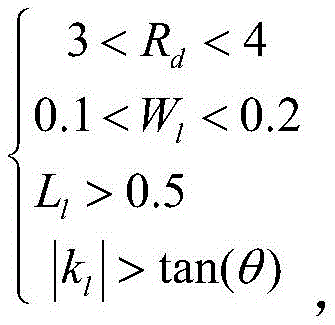
After image preprocessing is completed, firstly, a lane line constraint model on a structured road is established according to road characteristics:
Figure BDA0001736315710000061
wherein R isdAs a width constraint of the motor vehicle lane, WlIs the amount of line width constraint of lane line, LlIs the length constraint quantity of the lane line, theta is the included angle between the lane line and the longitudinal axis, and klIs the corresponding slope.
Considering that the near field part of the lane line appears as a straight line when the vehicle is driven at high speed, and the far field part is divided into a near field area a and a far field area b according to the actual road condition. For region a, a straight line model is used for fitting, and region b is used for fitting a BP neural network model, the lane line model of which is shown in FIG. 3, wherein p0、p1Respectively, the intersection point of two lane lines in the two view field connection region, q0、q1The other two end points of the near visual field straight line are respectively.
For region a, its lane line model can be expressed as:
xl=cl×yl+dl
xr=cr×yr+dr
in the above formula, clAnd crThe slope, x, of the straight lane lines on the left and right sides, respectivelylAnd xrIndependent variables, y, of the left and right lane lines, respectivelylAnd yrRespectively corresponding dependent variables, dlAnd drRespectively, the intercept of the lane line on the x-axis.
Comprehensively considering the slope of the lane line, processing the 1/2 area below the image by using Hough transformation (pre-searching area), and obtaining an equation of a straight line segment of the left lane line and the right lane line in the image by comparing and extracting peak points of the parameter plane after Hough transformation. And determining the lowest point and the highest point of the two lane lines according to an equation, and solving the intersection point (namely the vanishing point) of the two straight lines.
In consideration of the situation that the lane lines cannot be detected, such as the loss and abrasion of the lane lines, in the driving process of the vehicle, the lane lines are tracked by applying the detection result of the previous frame. The present invention primarily applies the kalman filter to four end points (p) of a detected line of a near field region as shown in fig. 30,p1,q0,q1) X coordinates (X1, X2, X3, X4) for tracking.
State X of system in the tracking systemkAnd the observed value Z of the systemkRespectively as follows:
Xk=[x1,x2,x3,x4,x1′,x2′,x3′,x4′]
Zk=[x1,x2,x3,x4]
x1, X2, X3, X4 respectively represent the X coordinates of the four endpoints of the detected near field area straight line, and X1 ', X2', X3 ', and X4' respectively represent the rate of change of the coordinates. The system matrix A is:
Figure BDA0001736315710000071
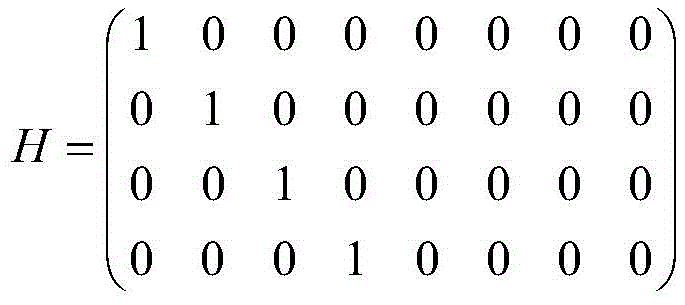
the observation matrix H of the system is:
Figure BDA0001736315710000072
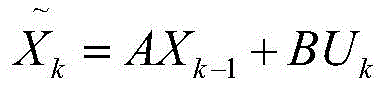
the prediction equation for the system is:
Figure BDA0001736315710000073
Figure BDA0001736315710000074
as a prediction value of the system at time K, Xk-1Is the state of the system at time K-1, B is the control matrix of the system, UkIs the control amount of the system at time k, which is 0 in this case.
After the near-field straight line fitting is completed, setting a straight line section between the lowest point and the vanishing point of the lane line as a pre-search area, sequentially scanning from the lowest point from bottom to top according to a specified step length, and stopping searching when a black pixel point is searched and the searched white pixel points are more than a specified number, wherein the pixel point at the moment is the intersection point (i.e. inflection point) of the straight line section and the curve section of the lane line. Searching between the inflection point and the vanishing point, scanning from bottom to top, respectively traversing 5 rows from the point on the corresponding lane line linear equation to the left and the right in each line of the image, and counting the number of white pixel points on the two sides of the linear segment. And comparing the number of the pixel points at the two sides to judge the bending direction of the lane line. And traversing N rows from the point on the current lane line linear equation to the bending direction of the lane, stopping scanning when a plurality of white pixel points are continuously searched in consideration of the width of the lane line, and taking the scanned first white pixel point as the characteristic point of the lane line curve segment. And (3) taking the x coordinate of each characteristic point as input and the y coordinate as expected output, and completing curve fitting by using a BP neural network.
Before curve fitting is carried out by using the BP neural network, various highway curve video data need to be collected to train the curve video data. The basic principle of training is as follows: input signal XiActing on the output node via the intermediate node, and performing nonlinear transformation to generate an output signal Yk. Each sample of the network training comprises an input vector X and an expected output quantity t, and the deviation between a network output value Y and the expected output value t is adjusted by adjusting an input nodeConnection strength W with hidden layer nodeijAnd the connection strength T between the hidden node and the output nodejkAnd the threshold value is used for reducing the deviation along the gradient direction, and after repeated learning and training, when the deviation is smaller than the given threshold value or the training reaches the maximum iteration number, the training is stopped to obtain the needed BP neural network model.
The training function selects an LM algorithm, and the basic idea is that the error is allowed to be searched along the deterioration direction in the iteration process, and meanwhile, the purpose of optimizing the network weight and the threshold value is achieved through self-adaptive adjustment between a gradient descent method and a Gaussian-Newton method. The method can effectively converge the network, and improve the generalization capability and convergence speed of the network, and the basic form of the method is as follows:
x[JT(x)J(x)+μI]-1JT(x)e(x)
wherein J (x) is a Jacobian matrix, mu is a damping system, and I is an identity matrix.
The type of the lane line is of great significance for judging whether the vehicle meets the lane change condition and judging whether the obstacles in the adjacent lane influence the vehicle of the lane, so that the type of the lane line is further judged after the lane line is identified. And mapping the identified lane line to an edge image in an image preprocessing stage, selecting points on the lane line at equal intervals in the edge image, respectively extending 2 pixels to the left and right directions by taking the points on the lane line as the center, and recording the area as a solid line area if the edge point exists in the range of 2 pixels on the left and right sides, otherwise, recording the area as a dotted line area. And after the judgment of the solid line area and the dotted line area of the judgment point selected by the whole lane line is finished, calculating the ratio of the solid line area and the whole lane line of the whole lane line, and if the ratio is greater than a set threshold value, the ratio is a solid line, otherwise, the ratio is a dotted line.
(2) Lane line extraction and fitting based on millimeter wave radar, as shown in fig. 4;
according to the characteristics of the millimeter wave radar, the millimeter wave radar has high reflectivity for static objects such as road guardrails, and a plurality of returned targets can be points on the guardrails; while guardrails are typically distributed along the roadway, to some extent reflecting the course of the roadway. Therefore, after preliminary filtering, we can calculate the curvature of the road ahead by the position information of the stationary object returned by the radar relative to the host vehicle.
First, extracting front stationary object information from radar detection information, including: relative distance, azimuth, and relative velocity. In consideration of the fact that the curvature of the expressway changes smoothly, the stationary objects may be assigned to the respective road edges according to the information about the stationary objects in the radar information. And calculating the number of the static objects distributed to the edges of the roads, and when the number reaches a threshold value and the distribution meets a certain condition, considering that the road curvature information can be calculated by utilizing the information, and setting the effective mark position to be 1. For a static object group with an effective zone bit of 1, different values are distributed according to the distribution condition along the road, the more uniform the distribution is, the higher the value is, when the value reaches a certain threshold value, the higher the degree of engagement between the value and the curvature of the real road is considered, and the curvature of the real road is calculated according to the value: when the number of the obtained static objects is large, curve fitting is completed by using a BP neural network; when the number of the obtained static objects is small, curve fitting can be completed by utilizing a cubic curve model in consideration of the characteristics of curves of the expressway. The curve obtained at this time is substantially parallel to the lane line.
(3) Determining a drivable area of a current lane;
generally, since the detection angle of the radar is limited and the detection range is far, the lane line at far field is usually fitted with the radar. Therefore, in determining the travelable region, the lane line at the far field fitted by the radar and the lane line at the far field fitted by the camera are fused as the travelable region at the far field, with the lane line at the near field fitted by the camera as the travelable region at the near field.
Because the radar detection result and the camera detection result are fused, the space-time joint calibration between the sensors is needed. Considering that the frequencies of the radar and the camera for acquiring information are generally different, the time sequence can be unified by taking a sensor with low data acquisition frequency as a reference. After the radar position of the camera is fixed, the matrix obtained by spatial joint calibration is as follows:
Figure BDA0001736315710000101
wherein (x)w,yw,zw) As world coordinate system coordinates, (u, v) as image pixel coordinate system coordinates, (x)c,yc,zc) For the coordinates of the camera coordinate system, R represents a rotation matrix, t represents a translation matrix, f represents a focal length, dx and dy represent the length units occupied by one pixel in the x direction and the y direction of the image physical coordinate system, and u represents0,v0Center pixel coordinate (o) of a representative image1) And image origin pixel coordinate (O)0) The number of horizontal and vertical pixels of the phase difference therebetween.
And (3) scattering and taking points on a curve model fitted by the radar, taking enough points, then calibrating the obtained matrix by combining the camera and the radar, projecting the matrix into an image pixel coordinate system, and determining the offset of a curve fitted by the radar detection points and a lane line and the starting point of a far-field lane line by combining the position of the inflection point in the step (1). And performing offset correction on the projected points, and performing curve fitting by using the BP neural network again. And averaging the just obtained lane line and the lane line fitted by the camera by using a weighted average method to obtain a travelable area at the far view field.
(4) Target recognition based on vision and millimeter wave radar fusion in combination with travelable regions, as shown in fig. 5;
obtaining information of a moving object by using a radar, projecting the information into a corresponding image after carrying out coordinate conversion and time sequence unification on the information, determining an interested area by taking a projection point as a center if the projection point is positioned in a drivable area of a current lane, finishing target identification by using an image processing algorithm, and outputting corresponding information of a target; if the projection point is located outside the driving area of the current lane, further judgment is carried out by combining the lane line type, if the target is located outside the dotted line, target identification is completed by using an image processing algorithm, corresponding information of the target is output, and if the target is not the false target, the target is discarded. This completes the target recognition at the curve.
The invention mainly aims at the problem that a vehicle detects a front target at a curve, and provides a curve target identification system and method based on multi-sensor fusion by using a camera and a millimeter wave radar. Dividing the lane line into a straight line part of a near visual field and a curve part of a far visual field, finishing the fitting and tracking of the lane line at the near visual field by using Hough transform and Kalman filtering for camera acquisition information, finishing the curve fitting at the far visual field by using a BP (back propagation) neural network, extracting the information of a static object group for radar acquisition information, and performing curve fitting by using the BP neural network. After space-time alignment, visually acquired lane line information and radar acquired lane line information are fused to determine a travelable area of a lane where a vehicle is located, and finally a curve target recognition algorithm based on the fusion of a camera and a millimeter wave radar is given by combining the travelable area and the lane line type, so that the detection of a target at a curve is realized.
In the description of the present invention, it is to be understood that the orientation or positional relationship indicated by the orientation words such as "front, rear, upper, lower, left, right", "lateral, vertical, horizontal" and "top, bottom", etc. are usually based on the orientation or positional relationship shown in the drawings, and are only for convenience of description and simplicity of description, and in the case of not making a reverse description, these orientation words do not indicate and imply that the device or element being referred to must have a specific orientation or be constructed and operated in a specific orientation, and therefore, should not be considered as limiting the scope of the present invention; the terms "inner and outer" refer to the inner and outer relative to the profile of the respective component itself.
Spatially relative terms, such as "above … …," "above … …," "above … …," "above," and the like, may be used herein for ease of description to describe one device or feature's spatial relationship to another device or feature as illustrated in the figures. It will be understood that the spatially relative terms are intended to encompass different orientations of the device in use or operation in addition to the orientation depicted in the figures. For example, if a device in the figures is turned over, devices described as "above" or "on" other devices or configurations would then be oriented "below" or "under" the other devices or configurations. Thus, the exemplary term "above … …" can include both an orientation of "above … …" and "below … …". The device may be otherwise variously oriented (rotated 90 degrees or at other orientations) and the spatially relative descriptors used herein interpreted accordingly.
It should be noted that the terms "first", "second", and the like are used to define the components, and are only used for convenience of distinguishing the corresponding components, and the terms have no special meanings unless otherwise stated, and therefore, the scope of the present invention should not be construed as being limited.
In addition, the above-mentioned serial numbers of the embodiments of the present application are merely for description, and do not represent the merits of the embodiments. In the above embodiments of the present application, the descriptions of the respective embodiments have respective emphasis, and for parts that are not described in detail in a certain embodiment, reference may be made to related descriptions of other embodiments.
The above is only a preferred embodiment of the present invention, and is not intended to limit the present invention, and various modifications and changes will occur to those skilled in the art. Any modification, equivalent replacement, or improvement made within the spirit and principle of the present invention should be included in the protection scope of the present invention.

Claims (4)

1.一种基于多传感器融合的弯道目标识别方法,其特征在于,包括以下步骤:1. a kind of curve target recognition method based on multi-sensor fusion, is characterized in that, comprises the following steps: (1)基于机器视觉的车道线提取和拟合:相机安装标定后采集图像信息,对图像信息进行预处理,获取道路边缘信息,所述预处理具体为:(1) Lane line extraction and fitting based on machine vision: After the camera is installed and calibrated, image information is collected, and the image information is preprocessed to obtain road edge information. The preprocessing is specifically: 选取图片下2/3区域作为感兴趣区域进行研究,采用中值滤波消除由于噪声、光照不均匀造成的噪点,将图片转化为灰度图像,转化公式如下:Select the lower 2/3 area of the picture as the region of interest for research, use median filtering to eliminate noise caused by noise and uneven illumination, and convert the picture into a grayscale image. The conversion formula is as follows: Gray=0.3b+0.59g+0.11rGray=0.3b+0.59g+0.11r 其中,Gray表示灰度图的亮度信息,r、g、b分别表示彩色图像的三个通道分量,在获取图像灰度图的基础上进行车道线边缘提取,通过大津法自适应阈值分割获取图像的二值图像,并采用Sobel梯度过滤算法,从x轴方向、正切方向或向量值大小来滤除噪声;Among them, Gray represents the brightness information of the grayscale image, and r, g, and b represent the three channel components of the color image, respectively. On the basis of obtaining the grayscale image of the image, the edge of the lane line is extracted, and the image is obtained through the adaptive threshold segmentation of the Otsu method. The binary image of , and the Sobel gradient filtering algorithm is used to filter out the noise from the x-axis direction, the tangent direction or the size of the vector value; 完成预处理后,根据道路特征建立结构化道路上的车道线约束模型:After the preprocessing is completed, the lane line constraint model on the structured road is established according to the road features:
Figure DEST_PATH_IMAGE002
其中,Rd为机动车道的宽度约束量,Wl为车道线线宽约束量,Ll为车道线长度约束量,θ为车道线同纵向轴线的夹角,kl为对应的斜率;Among them, R d is the width constraint of the motor vehicle lane, W l is the lane line width constraint, L l is the lane line length constraint, θ is the angle between the lane line and the longitudinal axis, and k l is the corresponding slope; 将感兴趣区域分为近视场区域a和远视场区域b部分,对于区域a用直线模型进行拟合,区域b用BP神经网络模型进行拟合,车道线模型中p0、p1分别为两车道线在两视场相接区域交点,q0、q1分别为近视场直线的另外两个端点;The area of interest is divided into near field area a and far field area b. The area a is fitted with a straight line model, and the area b is fitted with a BP neural network model. In the lane line model, p 0 and p 1 are two respectively. The intersection of the lane line in the area where the two fields of view meet, and q 0 and q 1 are the other two endpoints of the near field of view line; 对于区域a,其车道线模型可表示为:For area a, its lane line model can be expressed as: xl=cl×yl+dl x l = c l ×y l +d l xr=cr×yr+dr x r =c r ×y r +d r 上式中,cl和cr分别为左右两侧直道车道线的斜率,xl和xr分别为左右车道线的自变量,yl和yr分别为对应的因变量,dl和dr分别为车道线在x轴的截距;In the above formula, c l and c r are the slopes of the left and right straight lane lines, respectively, x l and x r are the independent variables of the left and right lane lines, y l and y r are the corresponding dependent variables, d l and d r is the intercept of the lane line on the x-axis, respectively; 应用Hough变换对图像下方1/2区域进行处理,通过比较提取Hough变换后参数平面的峰值点,获得图像中左右车道线直线段的方程,根据方程确定两车道线的最低点和最高点,并求解两直线的交点,即消失点;The Hough transform is applied to process the lower 1/2 area of the image. By comparing and extracting the peak points of the parameter plane after Hough transform, the equation of the straight line segment of the left and right lane lines in the image is obtained, and the lowest and highest points of the two lane lines are determined according to the equation. Solve the intersection of two straight lines, that is, the vanishing point; 应用前帧检测结果对车道线进行跟踪,采用卡尔曼滤波器对近视场区域a的检测到的直线的四个端点p0,p1,q0,q1的X坐标x1,x2,x3,x4进行跟踪,该跟踪系统中系统的状态Xk和系统的观测值Zk分别为:Apply the detection result of the previous frame to track the lane line, and use the Kalman filter to detect the X coordinates x1, x2, x3 of the four end points p 0, p 1, q 0, q 1 of the near field area a of the straight line, x1, x2, x3, x4 to track, the state X k of the system and the observed value Z k of the system in the tracking system are: Xk=[x1,x2,x3,x4,x1′,x2′,x3′,x4′]X k =[x1,x2,x3,x4,x1′,x2′,x3′,x4′] Zk=[x1,x2,x3,x4]Z k = [x1,x2,x3,x4] x1,x2,x3,x4分别表示检测到的近视场区域a直线的四个端点的X坐标,x1′,x2′,x3′,x4′分别表示坐标的变化率;x1, x2, x3, and x4 represent the X coordinates of the four endpoints of the detected near-field area a line, respectively, and x1', x2', x3', and x4' represent the rate of change of the coordinates, respectively; 系统矩阵A为:The system matrix A is:
Figure DEST_PATH_IMAGE004
系统的观测矩阵H为:The observation matrix H of the system is:
Figure DEST_PATH_IMAGE006
系统的预测方程为:The prediction equation of the system is:
Figure DEST_PATH_IMAGE008
Figure DEST_PATH_IMAGE010
为K时刻系统的预测值,Xk-1为K-1时刻系统的状态,B为系统的控制矩阵,Uk是k时刻系统的控制量,其值为0;
Figure DEST_PATH_IMAGE010
is the predicted value of the system at time K, X k-1 is the state of the system at time K-1, B is the control matrix of the system, U k is the control amount of the system at time k, and its value is 0;
近视场直线拟合完成后,将车道线最低点与消失点间的直线段设为预搜索区域,从最低点按规定步长从下往上依次扫描,当搜索到一个黑色像素点,且已搜索到的白色像素点大于指定数量时,搜索停止,此时的像素点为该车道线直线段与曲线段的交点,即拐点,在拐点与消失点间进行搜索,从下往上扫描,在图像每一行中,从对应车道线直线方程上的点开始,分别向左、右两侧各遍历5列,并统计直线段两侧白色像素点的个数,对两侧像素点个数进行比较来完成车道线弯曲方向判断,从当前车道线直线方程上的点开始,向该车道的弯曲方向遍历N列,考虑到车道线的宽度,当连续搜索到多个白色像素点时停止扫描,取扫到的第一个白色像素点作为车道线曲线段的特征点,将各特征点的x坐标作为输入,y坐标作为期望输出量,利用BP神经网络完成曲线拟合;After the near-field straight line fitting is completed, set the straight line segment between the lowest point of the lane line and the vanishing point as the pre-search area, and scan sequentially from the bottom to the top according to the specified step size from the lowest point. When the searched white pixel points are greater than the specified number, the search stops. The pixel point at this time is the intersection of the straight line segment and the curve segment of the lane line, that is, the inflection point. The search is performed between the inflection point and the vanishing point, scanning from bottom to top. In each line of the image, starting from the point on the line equation of the corresponding lane line, traverse 5 columns to the left and right sides respectively, and count the number of white pixels on both sides of the line segment, and compare the number of pixels on both sides. To complete the judgment of the bending direction of the lane line, starting from the point on the straight line equation of the current lane line, traverse N columns in the bending direction of the lane, considering the width of the lane line, stop scanning when multiple white pixels are continuously searched, and take The first white pixel point scanned is used as the feature point of the lane line curve segment, the x coordinate of each feature point is used as the input, the y coordinate is used as the expected output, and the BP neural network is used to complete the curve fitting; 完成车道线识别后对车道线的类型进行判断,将识别的车道线映射至图像预处理阶段的边缘图中,在边缘图中识别到的车道线上等间距的选取车道线上的点,并以车道线上的点为中心向左右两个方向分别延伸2个像素,若左右两侧2个像素的范围内存在边缘点,则将该区域记录为实线区域,反之记录为虚线区域,在完成整条车道线所选取的判断点的实线区域与虚线区域判断后,计算整条车道线的实线区域与整条车道线的比值,若比值大于设定的阈值则为实线,反之为虚线;After completing the identification of lane lines, judge the type of lane lines, map the identified lane lines to the edge map in the image preprocessing stage, and select points on the lane lines at equal intervals on the lane lines identified in the edge map, and Taking the point on the lane line as the center, it extends 2 pixels in the left and right directions respectively. If there is an edge point in the range of 2 pixels on the left and right sides, the area is recorded as a solid line area, otherwise, it is recorded as a dotted line area. After completing the judgment of the solid line area and the dotted line area of the judgment point selected by the entire lane line, calculate the ratio of the solid line area of the entire lane line to the entire lane line. If the ratio is greater than the set threshold, it will be a solid line, otherwise is a dotted line; (2)基于毫米波雷达的车道线提取和拟合:雷达安装标定后采集信息,对雷达目标进行筛选和过滤,保留静止目标和运动目标,依据静止目标的位置、数量相关信息进行车道线拟合;(2) Lane line extraction and fitting based on millimeter-wave radar: After the radar is installed and calibrated, the information is collected, the radar targets are screened and filtered, the stationary and moving targets are retained, and the lane lines are drawn according to the position and quantity of the stationary targets. combine; (3)可行驶区域确定:以基于机器视觉拟合的近视场处的车道线作为近视场处的可行驶区域,以基于雷达拟合的远视场处的车道线与基于机器视觉拟合的远视场处的车道线融合作为远视场处的可行驶区域;(3) Determination of the drivable area: The lane line at the near field of vision based on machine vision fitting is used as the drivable area in the near field of view, and the lane line at the far field of vision based on radar fitting and the distance based on machine vision fitting are used. The lane lines at the field are merged as the drivable area at the far field of view; 所述融合方法为:The fusion method is: 首先进行传感器间的时空联合标定,以获取数据频率低的传感器为基准进行时序统一,在固定好相机雷达位置后,进行空间联合标定所得到的矩阵为:Firstly, the space-time joint calibration between sensors is performed, and the time sequence is unified based on the sensor with low data frequency. After the camera radar position is fixed, the matrix obtained by the space-time joint calibration is:
Figure DEST_PATH_IMAGE012
其中,(xw,yw,zw)为世界坐标系坐标,(u,v)为图像像素坐标系坐标,(xc,yc,zc)为相机坐标系坐标,R表示旋转矩阵,t表示平移矩阵,f表示焦距,dx和dy表示图像物理坐标系的x方向和y方向的一个像素所占的长度单位,u0,v0表示图像的中心像素坐标Ο1和图像原点像素坐标Ο0之间相差的横向和纵向像素数;Among them, (x w , y w , z w ) are the coordinates of the world coordinate system, (u, v) are the coordinates of the image pixel coordinate system, (x c , y c , z c ) are the coordinates of the camera coordinate system, and R represents the rotation matrix , t represents the translation matrix, f represents the focal length, dx and dy represent the length unit occupied by a pixel in the x and y directions of the physical coordinate system of the image, u 0 , v 0 represent the center pixel coordinate of the image Ο 1 and the image origin pixel The number of horizontal and vertical pixels that differ between coordinates Ο 0 ; 在雷达拟合的曲线模型上分散取点,取足够多的点后通过相机与雷达联合标定所得到的矩阵将其投影变换到图像像素坐标系中,结合步骤(1)中拐点所在的位置确定雷达探测点拟合曲线与车道线的偏移量以及远视场车道线的起点,对投影过后的点进行偏移校正后再次运用BP神经网络进行曲线拟合,运用加权平均法对得到的车道线与基于机器视觉拟合的车道线进行平均,作为远视场处的可行驶区域;The points are scattered on the curve model fitted by the radar, and after taking enough points, the matrix obtained by the joint calibration of the camera and the radar is projected and transformed into the image pixel coordinate system, and the position of the inflection point in step (1) is determined. The offset of the radar detection point fitting curve and the lane line and the starting point of the far-field lane line, the offset correction of the projected point is performed, and then the BP neural network is used for curve fitting again, and the weighted average method is used to obtain the lane line. Averaged with the lane lines based on machine vision fitting as the drivable area at the far field of view; (4)基于机器视觉和毫米波雷达融合的目标识别:(4) Target recognition based on fusion of machine vision and millimeter wave radar: 利用雷达获得运动物体的信息,将其进行坐标转换和时序统一后,投影到对应图像中,若投影点位于当前车道可行驶区域内,则以投影点为中心,确定感兴趣区域,利用图像处理算法完成目标识别,并输出目标的相应信息;若投影点位于当前车道可行驶区域外,则结合车道线类型进行进一步判别,如果目标处于虚线外侧,同样利用图像处理算法完成目标识别,输出目标相应信息,否则目标认为是“虚假”目标,进行舍弃。The information of moving objects is obtained by radar, and after coordinate transformation and time sequence are unified, it is projected into the corresponding image. If the projected point is located in the drivable area of the current lane, the projected point is used as the center to determine the area of interest, and image processing is used to determine the area of interest. The algorithm completes the target recognition and outputs the corresponding information of the target; if the projected point is outside the drivable area of the current lane, it will be further judged based on the type of the lane line. information, otherwise the target considers it to be a "false" target and discards it.
2.一种应用权利要求1所述识别方法的识别系统,其特征在于,包括摄像头、毫米波雷达、数据处理单元,所述数据处理单元连接至所述摄像头、毫米波雷达,所述数据处理单元用于接收所述摄像头和毫米波雷达的检测信息,对所述检测信息进行处理,并输出最终结果。2. An identification system applying the identification method of claim 1, characterized in that, comprising a camera, a millimeter-wave radar, and a data processing unit, and the data processing unit is connected to the camera, the millimeter-wave radar, and the data processing unit The unit is configured to receive the detection information of the camera and the millimeter-wave radar, process the detection information, and output the final result. 3.根据权利要求2所述的识别系统,其特征在于,所述毫米波雷达安装在车辆前端中心处,离地高度在35cm-65cm之间,使其安装平面尽量与地面垂直,与车体纵向平面垂直,即俯仰角和横摆角均接近0°。3. The identification system according to claim 2, wherein the millimeter-wave radar is installed at the center of the front end of the vehicle, and the height above the ground is between 35cm-65cm, so that its installation plane is as perpendicular to the ground as possible, and is parallel to the vehicle body. The longitudinal plane is vertical, that is, the pitch and yaw angles are both close to 0°. 4.根据权利要求2所述的识别系统,其特征在于,所述摄像头安装在车辆内部后视镜底座正下方1-3厘米处,对摄像头俯仰角进行调节,当所处场景为直道时,使得图片下2/3区域为道路。4. The identification system according to claim 2, wherein the camera is installed at 1-3 centimeters directly below the rearview mirror base in the vehicle, and the camera pitch angle is adjusted, when the scene is a straight road, so that The bottom 2/3 of the picture is a road.
CN201810797646.5A 2018-07-19 2018-07-19 A system and method for target recognition on curved roads based on multi-sensor fusion Active CN108960183B (en)

Priority Applications (1)

Application Number Priority Date Filing Date Title
CN201810797646.5A CN108960183B (en) 2018-07-19 2018-07-19 A system and method for target recognition on curved roads based on multi-sensor fusion

Applications Claiming Priority (1)

Application Number Priority Date Filing Date Title
CN201810797646.5A CN108960183B (en) 2018-07-19 2018-07-19 A system and method for target recognition on curved roads based on multi-sensor fusion

Publications (2)

Publication Number Publication Date
CN108960183A CN108960183A (en) 2018-12-07
CN108960183B true CN108960183B (en) 2020-06-02

Family

ID=64497400

Family Applications (1)

Application Number Title Priority Date Filing Date
CN201810797646.5A Active CN108960183B (en) 2018-07-19 2018-07-19 A system and method for target recognition on curved roads based on multi-sensor fusion

Country Status (1)

Country Link
CN (1) CN108960183B (en)

Families Citing this family (52)

* Cited by examiner, † Cited by third party
Publication number Priority date Publication date Assignee Title
CN109785291B (en) * 2018-12-20 2020-10-09 南京莱斯电子设备有限公司 Lane line self-adaptive detection method
CN109670455A (en) * 2018-12-21 2019-04-23 联创汽车电子有限公司 Computer vision lane detection system and its detection method
CN109725318B (en) * 2018-12-29 2021-08-27 百度在线网络技术(北京)有限公司 Signal processing method and device, active sensor and storage medium
CN109720275A (en) * 2018-12-29 2019-05-07 重庆集诚汽车电子有限责任公司 Multi-sensor Fusion vehicle environmental sensory perceptual system neural network based
CN109856619B (en) * 2019-01-03 2020-11-20 中国人民解放军空军研究院战略预警研究所 Radar direction finding relative system error correction method
CN111247525A (en) * 2019-01-14 2020-06-05 深圳市大疆创新科技有限公司 Lane detection method and device, lane detection equipment and mobile platform
CN109784292B (en) * 2019-01-24 2023-05-26 中汽研(天津)汽车工程研究院有限公司 A method for autonomously finding a parking space for an intelligent car used in an indoor parking lot
CN110007669A (en) * 2019-01-31 2019-07-12 吉林微思智能科技有限公司 A kind of intelligent driving barrier-avoiding method for automobile
WO2020198973A1 (en) * 2019-03-29 2020-10-08 深圳市大疆创新科技有限公司 Method for using microwave radar to detect stationary object near to barrier, and millimeter-wave radar
US10943132B2 (en) * 2019-04-10 2021-03-09 Black Sesame International Holding Limited Distant on-road object detection
DE102019206036A1 (en) * 2019-04-26 2020-10-29 Volkswagen Aktiengesellschaft Method and device for determining the geographical position and orientation of a vehicle
CN110413942B (en) * 2019-06-04 2023-08-08 上海汽车工业(集团)总公司 Lane line equation screening method and screening module thereof
CN112101069B (en) * 2019-06-18 2024-12-03 深圳引望智能技术有限公司 Method and device for determining driving area information
JP7429246B2 (en) * 2019-06-28 2024-02-07 バイエリシエ・モトーレンウエルケ・アクチエンゲゼルシヤフト Methods and systems for identifying objects
CN110239535B (en) * 2019-07-03 2020-12-04 国唐汽车有限公司 An active collision avoidance control method for curves based on multi-sensor fusion
CN110304064B (en) * 2019-07-15 2020-09-11 广州小鹏汽车科技有限公司 Control method for vehicle lane change, vehicle control system and vehicle
CN110412564A (en) * 2019-07-29 2019-11-05 哈尔滨工业大学 A kind of identification of train railway carriage and distance measuring method based on Multi-sensor Fusion
CN110426051B (en) * 2019-08-05 2021-05-18 武汉中海庭数据技术有限公司 Lane line drawing method and device and storage medium
CN110796003B (en) * 2019-09-24 2022-04-26 成都旷视金智科技有限公司 Lane line detection method and device and electronic equipment
CN110794405B (en) * 2019-10-18 2022-06-10 北京全路通信信号研究设计院集团有限公司 Target detection method and system based on camera and radar fusion
CN110781816A (en) * 2019-10-25 2020-02-11 北京行易道科技有限公司 Method, device, equipment and storage medium for transverse positioning of vehicle in lane
CN110949395B (en) * 2019-11-15 2021-06-22 江苏大学 A ACC target vehicle recognition method based on multi-sensor fusion
CN110806215B (en) * 2019-11-21 2021-06-29 北京百度网讯科技有限公司 Method, device, device and storage medium for vehicle positioning
CN112829753B (en) * 2019-11-22 2022-06-28 驭势(上海)汽车科技有限公司 Guard bar estimation method based on millimeter wave radar, vehicle-mounted equipment and storage medium
CN110940981B (en) * 2019-11-29 2024-02-20 径卫视觉科技(上海)有限公司 A method for determining whether the position of the target in front of the vehicle is within its own lane
CN112950740B (en) * 2019-12-10 2024-07-12 中交宇科(北京)空间信息技术有限公司 Method, device, equipment and storage medium for generating high-precision map road centerline
CN111290388B (en) * 2020-02-25 2022-05-13 苏州科瓴精密机械科技有限公司 Path tracking method, system, robot and readable storage medium
CN111353466B (en) * 2020-03-12 2023-09-22 北京百度网讯科技有限公司 Lane line recognition processing method, equipment and storage medium
CN113409583B (en) * 2020-03-16 2022-10-18 华为技术有限公司 Lane line information determination method and device
WO2021217669A1 (en) * 2020-04-30 2021-11-04 华为技术有限公司 Target detection method and apparatus
CN111797701B (en) * 2020-06-10 2024-05-24 广东正扬传感科技股份有限公司 Road obstacle sensing method and system for vehicle multi-sensor fusion system
CN112380927B (en) * 2020-10-29 2023-06-30 中车株洲电力机车研究所有限公司 Rail identification method and device
CN112382092B (en) * 2020-11-11 2022-06-03 成都纳雷科技有限公司 Method, system and medium for automatically generating lane by traffic millimeter wave radar
CN112373474B (en) * 2020-11-23 2022-05-17 重庆长安汽车股份有限公司 Lane line fusion and lateral control method, system, vehicle and storage medium
CN112698314B (en) * 2020-12-07 2023-06-23 四川写正智能科技有限公司 A method of intelligent health management for children based on millimeter wave radar sensor
CN112464914B (en) * 2020-12-30 2025-02-25 南京积图网络科技有限公司 A guardrail segmentation method based on convolutional neural network
CN112712040B (en) * 2020-12-31 2023-08-22 潍柴动力股份有限公司 Method, device, equipment and storage medium for calibrating lane marking information based on radar
CN112859005B (en) * 2021-01-11 2023-08-29 成都圭目机器人有限公司 Method for detecting metal straight cylinder structure in multichannel ground penetrating radar data
CN113238209B (en) * 2021-04-06 2024-01-16 宁波吉利汽车研究开发有限公司 Road sensing methods, systems, equipment and storage media based on millimeter wave radar
CN113253225A (en) * 2021-04-21 2021-08-13 福建中科云杉信息技术有限公司 AEBS fence vehicle identification method
CN113189583B (en) * 2021-04-26 2022-07-01 天津大学 Time-space synchronization millimeter wave radar and visual information fusion method
CN113588654B (en) * 2021-06-24 2024-02-02 宁波大学 Three-dimensional visual detection method for engine heat exchanger interface
CN113298810B (en) * 2021-06-28 2023-12-26 浙江工商大学 Road line detection method combining image enhancement and deep convolutional neural network
CN113791414B (en) * 2021-08-25 2023-12-29 南京市德赛西威汽车电子有限公司 Scene recognition method based on millimeter wave vehicle-mounted radar view
CN114332105A (en) * 2021-10-29 2022-04-12 武汉光庭信息技术股份有限公司 A drivable area segmentation method, system, electronic device and storage medium
CN114387576B (en) * 2021-12-09 2025-07-01 杭州电子科技大学信息工程学院 Lane line recognition method, system, medium, device and information processing terminal
CN114353817B (en) * 2021-12-28 2023-08-15 重庆长安汽车股份有限公司 Multi-source sensor lane line determination method, system, vehicle and computer readable storage medium
CN115761691B (en) * 2022-10-25 2026-01-02 长安大学 A vision-based method for vehicle following status recognition
CN116092290A (en) * 2022-12-31 2023-05-09 武汉光庭信息技术股份有限公司 A method and system for automatically correcting and supplementing collected data
CN117649583B (en) * 2024-01-30 2024-05-14 科大国创合肥智能汽车科技有限公司 Automatic driving vehicle running real-time road model fusion method
CN118938212B (en) * 2024-10-14 2024-12-27 民航成都电子技术有限责任公司 Airport runway foreign matter detection system and method based on multiple sensors
CN121051698A (en) * 2025-10-30 2025-12-02 重庆长安汽车股份有限公司 Target management method and device, vehicle and electronic equipment

Citations (12)

* Cited by examiner, † Cited by third party
Publication number Priority date Publication date Assignee Title
CN101089917A (en) * 2007-06-01 2007-12-19 清华大学 Quick identification method for object vehicle lane changing
CN202163431U (en) * 2011-06-30 2012-03-14 中国汽车技术研究中心 Collision and traffic lane deviation pre-alarming device based on integrated information of sensors
US8355539B2 (en) * 2007-09-07 2013-01-15 Sri International Radar guided vision system for vehicle validation and vehicle motion characterization
CN103456185A (en) * 2013-08-27 2013-12-18 李德毅 Relay navigation method for intelligent vehicle running in urban road
CN104008645A (en) * 2014-06-12 2014-08-27 湖南大学 Lane line predicating and early warning method suitable for city road
CN105151049A (en) * 2015-08-27 2015-12-16 嘉兴艾特远信息技术有限公司 Early warning system based on driver face features and lane departure detection
CN105667518A (en) * 2016-02-25 2016-06-15 福州华鹰重工机械有限公司 Lane detection method and device
CN105824314A (en) * 2016-03-17 2016-08-03 奇瑞汽车股份有限公司 Lane keeping control method
CN106981202A (en) * 2017-05-22 2017-07-25 中原智慧城市设计研究院有限公司 A kind of vehicle based on track model lane change detection method back and forth
CN107235044A (en) * 2017-05-31 2017-10-10 北京航空航天大学 It is a kind of to be realized based on many sensing datas to road traffic scene and the restoring method of driver driving behavior
CN108196535A (en) * 2017-12-12 2018-06-22 清华大学苏州汽车研究院(吴江) Automated driving system based on enhancing study and Multi-sensor Fusion
CN108256446A (en) * 2017-12-29 2018-07-06 百度在线网络技术(北京)有限公司 For determining the method, apparatus of the lane line in road and equipment

Family Cites Families (4)

* Cited by examiner, † Cited by third party
Publication number Priority date Publication date Assignee Title
CN102303605A (en) * 2011-06-30 2012-01-04 中国汽车技术研究中心 Multi-sensor information fusion-based collision and departure pre-warning device and method
KR102267562B1 (en) * 2015-04-16 2021-06-22 한국전자통신연구원 Device and method for recognition of obstacles and parking slots for unmanned autonomous parking
CN105046235B (en) * 2015-08-03 2018-09-07 百度在线网络技术(北京)有限公司 The identification modeling method and device of lane line, recognition methods and device
CN107609472A (en) * 2017-08-04 2018-01-19 湖南星云智能科技有限公司 A kind of pilotless automobile NI Vision Builder for Automated Inspection based on vehicle-mounted dual camera

Patent Citations (13)

* Cited by examiner, † Cited by third party
Publication number Priority date Publication date Assignee Title
CN101089917A (en) * 2007-06-01 2007-12-19 清华大学 Quick identification method for object vehicle lane changing
US8355539B2 (en) * 2007-09-07 2013-01-15 Sri International Radar guided vision system for vehicle validation and vehicle motion characterization
CN202163431U (en) * 2011-06-30 2012-03-14 中国汽车技术研究中心 Collision and traffic lane deviation pre-alarming device based on integrated information of sensors
CN103456185A (en) * 2013-08-27 2013-12-18 李德毅 Relay navigation method for intelligent vehicle running in urban road
CN104008645A (en) * 2014-06-12 2014-08-27 湖南大学 Lane line predicating and early warning method suitable for city road
CN105151049A (en) * 2015-08-27 2015-12-16 嘉兴艾特远信息技术有限公司 Early warning system based on driver face features and lane departure detection
CN105667518A (en) * 2016-02-25 2016-06-15 福州华鹰重工机械有限公司 Lane detection method and device
CN105824314A (en) * 2016-03-17 2016-08-03 奇瑞汽车股份有限公司 Lane keeping control method
CN106981202A (en) * 2017-05-22 2017-07-25 中原智慧城市设计研究院有限公司 A kind of vehicle based on track model lane change detection method back and forth
CN107235044A (en) * 2017-05-31 2017-10-10 北京航空航天大学 It is a kind of to be realized based on many sensing datas to road traffic scene and the restoring method of driver driving behavior
CN107235044B (en) * 2017-05-31 2019-05-28 北京航空航天大学 A kind of restoring method realized based on more sensing datas to road traffic scene and driver driving behavior
CN108196535A (en) * 2017-12-12 2018-06-22 清华大学苏州汽车研究院(吴江) Automated driving system based on enhancing study and Multi-sensor Fusion
CN108256446A (en) * 2017-12-29 2018-07-06 百度在线网络技术(北京)有限公司 For determining the method, apparatus of the lane line in road and equipment

Also Published As

Publication number Publication date
CN108960183A (en) 2018-12-07

Similar Documents

Publication Publication Date Title
CN108960183B (en) A system and method for target recognition on curved roads based on multi-sensor fusion
US8670592B2 (en) Clear path detection using segmentation-based method
US10388153B1 (en) Enhanced traffic detection by fusing multiple sensor data
US8611585B2 (en) Clear path detection using patch approach
US8332134B2 (en) Three-dimensional LIDAR-based clear path detection
US8699754B2 (en) Clear path detection through road modeling
US8605947B2 (en) Method for detecting a clear path of travel for a vehicle enhanced by object detection
US8452053B2 (en) Pixel-based texture-rich clear path detection
US8634593B2 (en) Pixel-based texture-less clear path detection
Kastrinaki et al. A survey of video processing techniques for traffic applications
US8890951B2 (en) Clear path detection with patch smoothing approach
US8487991B2 (en) Clear path detection using a vanishing point
US9852357B2 (en) Clear path detection using an example-based approach
US8751154B2 (en) Enhanced clear path detection in the presence of traffic infrastructure indicator
CN112215306A (en) A target detection method based on the fusion of monocular vision and millimeter wave radar
CN107389084B (en) Driving path planning method and storage medium
US20100098290A1 (en) Method for detecting a clear path through topographical variation analysis
CN107646114A (en) Method for estimating lane
CN101950350A (en) Clear path detection using a hierachical approach
KR20150049529A (en) Apparatus and method for estimating the location of the vehicle
Raguraman et al. Intelligent drivable area detection system using camera and lidar sensor for autonomous vehicle
JP5888275B2 (en) Road edge detection system, method and program
Oniga et al. A fast ransac based approach for computing the orientation of obstacles in traffic scenes
Eckelmann et al. Empirical Evaluation of a Novel Lane Marking Type for Camera and LiDAR Lane Detection.
Alvarez et al. Perception advances in outdoor vehicle detection for automatic cruise control

Legal Events

Date Code Title Description
PB01 Publication
PB01 Publication
SE01 Entry into force of request for substantive examination
GR01 Patent grant
GR01 Patent grant
TR01 Transfer of patent right

Effective date of registration: 20211123

Address after: 100176 901, 9th floor, building 2, yard 10, KEGU 1st Street, Beijing Economic and Technological Development Zone, Daxing District, Beijing

Patentee after: BEIJING TAGE IDRIVER TECHNOLOGY CO.,LTD.

Address before: 100191 No. 37, Haidian District, Beijing, Xueyuan Road

Patentee before: BEIHANG University

TR01 Transfer of patent right
CP03 Change of name, title or address

Address after: Room 303, Zone D, Main Building of Beihang Hefei Science City Innovation Research Institute, No. 999 Weiwu Road, Xinzhan District, Hefei City, Anhui Province, 230012

Patentee after: Taoke Zhixing Technology Co., Ltd.

Country or region after: China

Address before: 100176 901, 9th floor, building 2, yard 10, KEGU 1st Street, Beijing Economic and Technological Development Zone, Daxing District, Beijing

Patentee before: BEIJING TAGE IDRIVER TECHNOLOGY CO.,LTD.

Country or region before: China