CN108928327B - Lifting control method, device, power exchange station, controller and medium - Google Patents
Lifting control method, device, power exchange station, controller and medium Download PDFInfo
- Publication number
- CN108928327B CN108928327B CN201810739495.8A CN201810739495A CN108928327B CN 108928327 B CN108928327 B CN 108928327B CN 201810739495 A CN201810739495 A CN 201810739495A CN 108928327 B CN108928327 B CN 108928327B
- Authority
- CN
- China
- Prior art keywords
- battery
- trolley
- distance
- height
- vehicle body
- Prior art date
- Legal status (The legal status is an assumption and is not a legal conclusion. Google has not performed a legal analysis and makes no representation as to the accuracy of the status listed.)
- Active
Links
- 238000000034 method Methods 0.000 title claims abstract description 65
- 238000001514 detection method Methods 0.000 claims description 21
- 230000001360 synchronised effect Effects 0.000 claims description 20
- 238000004590 computer program Methods 0.000 claims description 6
- 230000001960 triggered effect Effects 0.000 claims description 3
- 238000006243 chemical reaction Methods 0.000 claims 1
- 238000000926 separation method Methods 0.000 abstract description 17
- 238000012544 monitoring process Methods 0.000 abstract description 3
- XLYOFNOQVPJJNP-UHFFFAOYSA-N water Substances O XLYOFNOQVPJJNP-UHFFFAOYSA-N 0.000 description 12
- 230000005611 electricity Effects 0.000 description 8
- 238000010586 diagram Methods 0.000 description 4
- 238000005259 measurement Methods 0.000 description 4
- 238000012986 modification Methods 0.000 description 3
- 230000004048 modification Effects 0.000 description 3
- 238000001816 cooling Methods 0.000 description 2
- 230000000694 effects Effects 0.000 description 2
- 230000007613 environmental effect Effects 0.000 description 2
- 239000000446 fuel Substances 0.000 description 2
- 230000009286 beneficial effect Effects 0.000 description 1
- 238000011161 development Methods 0.000 description 1
- 238000011897 real-time detection Methods 0.000 description 1
Images


Classifications
-
- B—PERFORMING OPERATIONS; TRANSPORTING
- B60—VEHICLES IN GENERAL
- B60S—SERVICING, CLEANING, REPAIRING, SUPPORTING, LIFTING, OR MANOEUVRING OF VEHICLES, NOT OTHERWISE PROVIDED FOR
- B60S5/00—Servicing, maintaining, repairing, or refitting of vehicles
- B60S5/06—Supplying batteries to, or removing batteries from, vehicles
-
- Y—GENERAL TAGGING OF NEW TECHNOLOGICAL DEVELOPMENTS; GENERAL TAGGING OF CROSS-SECTIONAL TECHNOLOGIES SPANNING OVER SEVERAL SECTIONS OF THE IPC; TECHNICAL SUBJECTS COVERED BY FORMER USPC CROSS-REFERENCE ART COLLECTIONS [XRACs] AND DIGESTS
- Y02—TECHNOLOGIES OR APPLICATIONS FOR MITIGATION OR ADAPTATION AGAINST CLIMATE CHANGE
- Y02T—CLIMATE CHANGE MITIGATION TECHNOLOGIES RELATED TO TRANSPORTATION
- Y02T10/00—Road transport of goods or passengers
- Y02T10/60—Other road transportation technologies with climate change mitigation effect
- Y02T10/70—Energy storage systems for electromobility, e.g. batteries
-
- Y—GENERAL TAGGING OF NEW TECHNOLOGICAL DEVELOPMENTS; GENERAL TAGGING OF CROSS-SECTIONAL TECHNOLOGIES SPANNING OVER SEVERAL SECTIONS OF THE IPC; TECHNICAL SUBJECTS COVERED BY FORMER USPC CROSS-REFERENCE ART COLLECTIONS [XRACs] AND DIGESTS
- Y02—TECHNOLOGIES OR APPLICATIONS FOR MITIGATION OR ADAPTATION AGAINST CLIMATE CHANGE
- Y02T—CLIMATE CHANGE MITIGATION TECHNOLOGIES RELATED TO TRANSPORTATION
- Y02T10/00—Road transport of goods or passengers
- Y02T10/60—Other road transportation technologies with climate change mitigation effect
- Y02T10/7072—Electromobility specific charging systems or methods for batteries, ultracapacitors, supercapacitors or double-layer capacitors
Landscapes
- Engineering & Computer Science (AREA)
- Mechanical Engineering (AREA)
- Arrangement Or Mounting Of Propulsion Units For Vehicles (AREA)
- Vehicle Cleaning, Maintenance, Repair, Refitting, And Outriggers (AREA)
- Secondary Cells (AREA)
- Electric Propulsion And Braking For Vehicles (AREA)
Abstract
本发明涉及一种升降控制方法、装置以及换电站、控制器和介质,所述方法包括步骤S1、检测换电小车携带电池下降过程中电池与车身是否分离,若分离,则换电小车继续携带电池下降至运送电池的高度,否则,进行步骤S2;步骤S2、调整换电小车高度并调整车身所处平面,然后,换电小车重新携带电池下降,并返回步骤S1。本发明通过监测换电过程中是否出现挂电池情况,通过自适应调节车身高度,获得车身和电池平面相平行的平面,从而保证电池与车身的正常分离。
The present invention relates to a lifting control method and device, as well as a power exchange station, a controller and a medium. The method includes step S1 , detecting whether the battery is separated from the body during the descent of the battery carried by the power exchange trolley, and if it is separated, the power exchange trolley continues to carry The battery is lowered to the height for transporting the battery, otherwise, go to step S2; step S2, adjust the height of the battery-changing trolley and adjust the plane on which the body is located, then the battery-changing trolley is lowered again, and returns to step S1. The present invention obtains a plane parallel to the plane of the vehicle body and the battery by monitoring whether the battery is hung during the battery swapping process, and adjusts the height of the vehicle body adaptively, thereby ensuring the normal separation of the battery and the vehicle body.
Description
技术领域technical field
本发明涉及电动汽车换电技术领域,尤其涉及一种升降控制方法、装置以及换电站、控制器和介质。The invention relates to the technical field of electric vehicle battery swapping, in particular to a lifting control method and device, as well as a swapping station, a controller and a medium.
背景技术Background technique
随着全球车辆销量的连年激增,燃油车带来的环境问题日益严重,保护环境的需求日益凸显,电动汽车成为未来发展的重点和趋势。电动汽车在环境保护方面具有先天的优势,但与燃油车相比,续航和充电也是迫切需要解决的问题。为了不断提高电动汽车续航能力,换电方式成为一种极速、方便、安全有效的方法。电动汽车的动力电池(以下简称电池)通常安装在车身底部,因此换电过程中,需要通过举升机构将车体抬升,再由换电小车为车辆更换电池。With the continuous surge in global vehicle sales, the environmental problems brought about by fuel vehicles have become increasingly serious, and the need to protect the environment has become increasingly prominent. Electric vehicles have become the focus and trend of future development. Electric vehicles have inherent advantages in environmental protection, but compared with fuel vehicles, battery life and charging are also urgent issues that need to be solved. In order to continuously improve the battery life of electric vehicles, battery swapping has become an extremely fast, convenient, safe and effective method. The power battery of an electric vehicle (hereinafter referred to as the battery) is usually installed at the bottom of the vehicle body. Therefore, during the battery replacement process, the vehicle body needs to be lifted by a lifting mechanism, and then the battery is replaced by the battery replacement trolley.
电池2通过螺钉等连接件固定安装在车身1上,此外,电池2某一端通常还有电池接头4(如水电接头等部件)与车身连接,如图1所示,换电小车3解锁电池2过程中,由于电池2离开车身1的一瞬间,电池接头4处,电池2可能随着换电小车3和车身1造成一定的偏移量,该偏移量可能导致电池2与车身1之间可能会出现倾角,导致在电池2与车身1之间出现巨大的横向压力,从而造成电池2无法与车身1正常分离,该状况称为“挂电池”,如果换电小车3继续下降,则会损坏电池接头4。因此,如何实现换电过程中的升降控制,保证电池与车身正常分离,避免损坏水电接头等部件,成为亟待解决的技术问题。The
发明内容SUMMARY OF THE INVENTION
本发明所要解决的技术问题在于,提供一种升降控制方法、装置以及换电站、控制器和介质,监测换电过程中是否出现挂电池情况,通过自适应调节车身高度,获得车身和电池平面相平行的平面,从而保证电池与车身的正常分离。The technical problem to be solved by the present invention is to provide a lifting control method and device, as well as a power exchange station, a controller and a medium, to monitor whether the battery is hanging during the power exchange process, and to adjust the height of the vehicle body adaptively to obtain the plane phase of the vehicle body and the battery. parallel planes, thus ensuring the normal separation of the battery and the body.
为了解决上述技术问题,根据本发明第一方面,提供了一种升降控制方法,包括:In order to solve the above-mentioned technical problems, according to the first aspect of the present invention, a kind of lifting control method is provided, comprising:
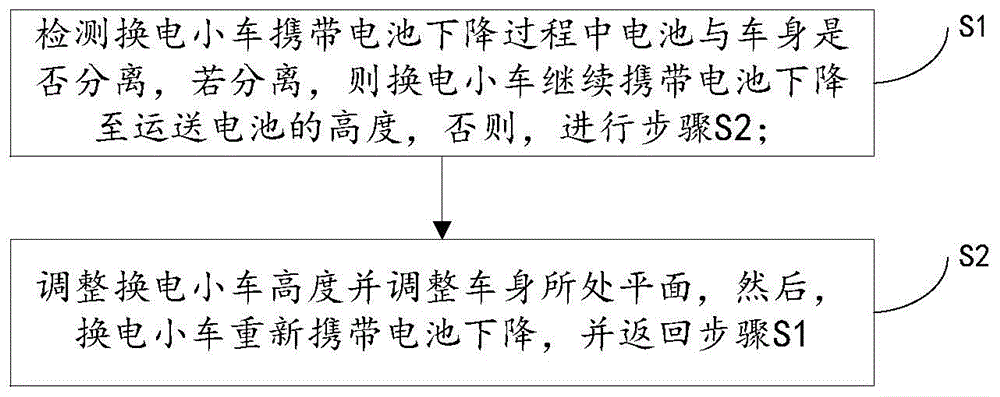
步骤S1、检测换电小车携带电池下降过程中电池与车身是否分离,若分离,则换电小车继续携带电池下降至运送电池的高度,否则,进行步骤S2;Step S1, detecting whether the battery is separated from the body during the descending process of the battery-changing trolley. If it is separated, the battery-changing trolley continues to carry the battery and descend to the height for transporting the battery, otherwise, go to step S2;
步骤S2、调整换电小车高度并调整车身所处平面,然后,换电小车重新携带电池下降,并返回步骤S1。In step S2, the height of the battery-changing trolley is adjusted and the plane on which the vehicle body is located is adjusted. Then, the battery-changing trolley is lowered again with the battery, and the process returns to step S1.
进一步的,所述检测换电小车携带电池下降过程中电池与车身是否分离,包括以下步骤:Further, the detection of whether the battery is separated from the vehicle body during the descent of the battery-carrying trolley includes the following steps:
实时检测换电小车的高度;Real-time detection of the height of the battery swap trolley;
当换电小车下降至预设的第一高度时,检测电池下表面上不同点与换电小车上表面的距离,所述第一高度大于等于电池与车身未分离时,使电池接头部件发生损坏的临界高度值;When the battery swap trolley descends to a preset first height, the distance between different points on the lower surface of the battery and the upper surface of the battery swap trolley is detected. The critical height value of ;
根据所检测的电池下表面上不同点与换电小车上表面的距离和预设的距离阈值,判断电池与车身是否分离;According to the detected distance between different points on the lower surface of the battery and the upper surface of the battery swap car and a preset distance threshold, determine whether the battery is separated from the body;
其中,所述电池上与换电小车相接触的一面为电池下表面,所述换电小车上与电池相接触的一面为换电小车上表面,所述距离阈值根据测距仪的数量、设置在换电小车的位置和/或电池正常与车身分离情况下电池下表面与换电小车上表面的距离值来设定。Wherein, the side of the battery in contact with the battery-changing trolley is the lower surface of the battery, and the side of the battery-changing trolley that is in contact with the battery is the upper surface of the battery-changing trolley, and the distance threshold is based on the number and setting of the rangefinder. The value of the distance between the lower surface of the battery and the upper surface of the battery-changing trolley is set in the position of the battery-changing trolley and/or when the battery is normally separated from the body.
进一步的,所述方法还包括:若电池与车身未分离,则电池下表面上与换电小车上表面的距离大于所述预设的距离阈值的点所对应的电池一端与车身未分离,该端称为未分离端。Further, the method further includes: if the battery is not separated from the vehicle body, one end of the battery corresponding to the point where the distance between the lower surface of the battery and the upper surface of the battery swap car is greater than the preset distance threshold is not separated from the vehicle body. The end is called the unseparated end.
进一步的,所述检测电池下表面上不同点与换电小车上表面的距离,包括以下步骤:Further, the detection of the distance between different points on the lower surface of the battery and the upper surface of the battery swap car includes the following steps:
在所述换电小车上表面设置两个以上的测距仪;More than two rangefinders are arranged on the upper surface of the battery-swapping trolley;
每个所述测距仪测量电池下表面上一个点距离所述换电小车上表面的距离。Each of the rangefinders measures the distance from a point on the lower surface of the battery to the upper surface of the battery swap cart.
进一步的,所述在所述换电小车上表面设置两个以上的测距仪包括:Further, the setting of two or more rangefinders on the upper surface of the battery-swapping trolley includes:
所述电池的四个角在换电小车上表面的对应位置上分别设置一个所述测距仪,The four corners of the battery are respectively provided with a rangefinder at the corresponding position on the upper surface of the battery-changing trolley,
其中,所述测距仪包括激光测距仪、超声波测距仪和接近开关。Wherein, the range finder includes a laser range finder, an ultrasonic range finder and a proximity switch.
进一步的,所述调整换电小车高度并调整车身所处平面,包括以下步骤:Further, the adjustment of the height of the battery-changing trolley and the adjustment of the plane where the body is located includes the following steps:
控制所述换电小车从所述第一高度上升至换电高度,所述换电高度为换电小车从车身解锁电池时对应的高度;Controlling the battery swap cart to rise from the first height to the battery swap height, where the battery swap height is the height corresponding to when the battery swap cart unlocks the battery from the body;
将所述未分离端对应的车身一端抬高预设的调整距离,所述调整距离根据所述电池沿所述电池与车身未发生分离的方位的长度,电池接头的高度以及车身举升机构与车身接触的举升点所构成形状尺寸来设定。The end of the body corresponding to the unseparated end is raised by a preset adjustment distance, and the adjustment distance is based on the length of the battery along the azimuth where the battery is not separated from the body, the height of the battery connector, and the relationship between the body lifting mechanism and the battery. The shape and size of the lift point that the body contacts are set.
进一步的,所述将所述未分离端对应的车身一端抬高预设的调整距离,包括以下步骤:Further, raising the end of the vehicle body corresponding to the unseparated end by a preset adjustment distance includes the following steps:
通过控制用于举升车辆的举升机构,将所述未分离端对应的车身一端抬高预设的调整距离。By controlling the lifting mechanism for lifting the vehicle, the end of the body corresponding to the unseparated end is raised by a preset adjustment distance.
进一步的,所述举升机构为四立柱举升机构,包括均匀分布于车身底部的四个立柱,所述举升机构初始举升车辆过程中,所述四个立柱处于同步模式;Further, the lifting mechanism is a four-column lifting mechanism, including four columns evenly distributed on the bottom of the vehicle body, and during the initial lifting of the vehicle by the lifting mechanism, the four columns are in a synchronous mode;
所述通过控制用于举升车辆的举升机构,将所述未分离端对应的车身一端抬高预设的调整距离,包括以下步骤:The step of raising one end of the vehicle body corresponding to the unseparated end by a preset adjustment distance by controlling the lifting mechanism used to lift the vehicle includes the following steps:
控制所述四个立柱退出同步模式,所述退出同步模式包括控制其中两个立柱处于同步模式或者控制每个立柱处于单独控制模式;controlling the four uprights to exit the synchronizing mode, the exiting the synchronizing mode comprising controlling two of the uprights to be in the synchronous mode or controlling each of the uprights to be in an individual control mode;
根据所述电池与车身未发生分离的方位,控制该方位对应的两个立柱同时上升预设调整距离。According to the orientation where the battery is not separated from the vehicle body, the two uprights corresponding to the orientation are controlled to rise simultaneously by a preset adjustment distance.
根据本发明第二方面,提供了一种升降控制装置,包括:According to a second aspect of the present invention, a lift control device is provided, comprising:
检测装置,用于检测换电小车携带电池下降过程中电池与车身是否分离;The detection device is used to detect whether the battery is separated from the body during the descent of the battery carried by the battery-changing trolley;
调整装置,用于通过一次或多次调整换电小车高度并调整车身所处平面,使车身所处平面达到与电池平面相平行的位置,完成电池与车身的分离。The adjusting device is used to adjust the height of the battery-swapping trolley one or more times and adjust the plane where the vehicle body is located, so that the plane where the vehicle body is located reaches a position parallel to the battery plane, so as to complete the separation of the battery from the vehicle body.
进一步的,所述检测装置包括高度检测器、距离检测单元和判断机构,其中:Further, the detection device includes a height detector, a distance detection unit and a judgment mechanism, wherein:
所述高度检测器用于实时检测换电小车的高度,当换电小车下降至预设的第一高度时,触发距离检测单元工作;The height detector is used to detect the height of the battery-changing trolley in real time, and when the battery-changing trolley drops to a preset first height, the distance detection unit is triggered to work;
所述距离检测单元用于检测电池下表面上不同点与换电小车上表面的距离,所述第一高度大于等于电池与车身未分离时,使电池接头部件发生损坏的临界高度值;The distance detection unit is used to detect the distance between different points on the lower surface of the battery and the upper surface of the battery swap car, and the first height is greater than or equal to a critical height value that damages the battery connector parts when the battery is not separated from the vehicle body;
所述判断机构用于根据所述电池下表面上不同点与换电小车上表面的距离和预设的距离阈值,判断电池与车身是否分离;The judging mechanism is used for judging whether the battery is separated from the vehicle body according to the distance between different points on the lower surface of the battery and the upper surface of the battery swap car and a preset distance threshold;
其中,所述电池上与换电小车相接触的一面为电池下表面,所述换电小车上与电池相接触的一面为换电小车上表面,所述距离阈值根据测距仪的数量、设置在换电小车的位置和/或电池正常与车身分离情况下电池下表面与换电小车上表面的距离值来设定。Wherein, the side of the battery in contact with the battery-changing trolley is the lower surface of the battery, and the side of the battery-changing trolley that is in contact with the battery is the upper surface of the battery-changing trolley, and the distance threshold is based on the number and setting of the rangefinder. The value of the distance between the lower surface of the battery and the upper surface of the battery-changing trolley is set in the position of the battery-changing trolley and/or when the battery is normally separated from the body.
进一步的,所述判断机构还用于当电池与车身未分离时,判断未分离端,具体包括:Further, the judging mechanism is also used for judging the unseparated end when the battery is not separated from the vehicle body, specifically including:
若电池与车身未分离,则将电池下表面上与换电小车上表面的距离大于所述预设的距离阈值的点所对应的电池一端判断为所述未分离端。If the battery is not separated from the vehicle body, the end of the battery corresponding to the point where the distance between the lower surface of the battery and the upper surface of the battery swap cart is greater than the preset distance threshold is determined as the non-separated end.
进一步的,所述判断机构包括:Further, the judging mechanism includes:
设于所述换电小车上表面的两个以上的测距仪,每个所述测距仪测量电池下表面上一个点距离所述换电小车上表面的距离。There are two or more rangefinders arranged on the upper surface of the battery-changing trolley, each of which measures the distance from a point on the lower surface of the battery to the upper surface of the battery-changing trolley.
进一步的,所述判断机构包括四个所述测距仪,分别设置在所述电池的四个角在换电小车上表面的对应位置;其中,Further, the judging mechanism includes four rangefinders, which are respectively arranged at the corresponding positions of the four corners of the battery on the upper surface of the battery-swapping trolley; wherein,
所述测距仪包括激光测距仪、超声波测距仪和接近开关。The range finder includes a laser range finder, an ultrasonic range finder and a proximity switch.
进一步的,所述调整装置包括:Further, the adjustment device includes:
第一调整机构,用于控制所述换电小车上升至换电高度,所述换电高度为换电小车从车身解锁电池时对应的高度;a first adjustment mechanism, used to control the power-swap trolley to rise to a power-swap height, where the power-swap height is the height corresponding to when the power-swap cart unlocks the battery from the body;
第二调整机构,将所述未分离端对应的车身一端抬高预设的调整距离,所述调整距离根据所述电池沿所述电池与车身未发生分离的方位的长度,电池接头的高度以及车身举升机构与车身接触的举升点所构成形状尺寸来设定。The second adjustment mechanism lifts one end of the vehicle body corresponding to the unseparated end by a preset adjustment distance, and the adjustment distance is based on the length of the battery along the orientation where the battery is not separated from the vehicle body, the height of the battery connector, and The shape and size of the lift point where the body lift mechanism is in contact with the body is set.
进一步的,所述第二调整机构还用于,通过控制用于举升车辆的举升机构,将所述未分离端对应的车身一端抬高预设的调整距离。Further, the second adjustment mechanism is also used for raising the end of the vehicle body corresponding to the unseparated end by a preset adjustment distance by controlling the lifting mechanism used to lift the vehicle.
进一步的,所述举升机构为四立柱举升机构,包括均匀分布与车身底部的四个立柱,所述举升机构初始举升车辆过程中,所述四个立柱处于同步模式;Further, the lifting mechanism is a four-column lifting mechanism, including four columns evenly distributed with the bottom of the vehicle body, and the four columns are in a synchronous mode during the initial lifting of the vehicle by the lifting mechanism;
所述第二调整机构包括:The second adjustment mechanism includes:
第一控制单元,用于控制所述四个立柱退出同步模式,所述退出同步模式包括控制其中两个立柱处于同步模式或者每个立柱处于单独控制模式;a first control unit, configured to control the four uprights to exit the synchronous mode, the exiting from the synchronous mode includes controlling two of the uprights to be in the synchronous mode or each of the uprights to be in an individual control mode;
第二控制单元,根据电池与车身未发生分离的方位,控制该方位对应的两个立柱同时上升预设调整距离。The second control unit controls the two uprights corresponding to the azimuth to simultaneously rise by a preset adjustment distance according to the azimuth where the battery is not separated from the vehicle body.
根据本发明第三方面,提供一种换电站,包括所述升降控制装置,用于调整换电小车高度并调整车身所处平面,使车身所处平面达到与电池平面相平行的位置,完成电池与车身的分离。According to a third aspect of the present invention, there is provided a power exchange station, including the lift control device, which is used to adjust the height of the power exchange trolley and adjust the plane where the vehicle body is located, so that the plane where the vehicle body is located reaches a position parallel to the battery plane, and the battery is completed. separation from the body.
根据本发明第四方面,提供一种控制器,其包括存储器与处理器,所述存储器存储有计算机程序,所述程序在被所述处理器执行时能够实现所述方法的步骤。According to a fourth aspect of the present invention, there is provided a controller comprising a memory and a processor, the memory storing a computer program capable of implementing the steps of the method when executed by the processor.
根据本发明第五方面,提供一种计算机可读存储介质,用于存储计算机程序,所述程序在由一计算机或处理器执行时实现所述方法的步骤。According to a fifth aspect of the present invention, there is provided a computer-readable storage medium for storing a computer program which, when executed by a computer or processor, implements the steps of the method.
本发明与现有技术相比具有明显的优点和有益效果。借由上述技术方案,本发明一种升降控制方法、装置以及换电站、控制器和介质可达到相当的技术进步性及实用性,并具有产业上的广泛利用价值,其至少具有下列优点:Compared with the prior art, the present invention has obvious advantages and beneficial effects. With the above technical solutions, a lifting control method, device, power exchange station, controller and medium of the present invention can achieve considerable technical progress and practicability, and have extensive industrial value, and at least have the following advantages:
本发明通过监测换电过程中是否出现挂电池情况,通过自适应调节车身高度,获得车身所述和电池平面相平行的平面,从而保证电池与车身的正常分离,避免换电过程中损坏电池上的水电接头等部件。The present invention monitors whether the battery is hanging in the battery replacement process, and adjusts the height of the body adaptively to obtain a plane parallel to the battery plane, so as to ensure the normal separation of the battery and the body, and avoid damage to the battery during the battery replacement process. components such as water and electricity connections.
上述说明仅是本发明技术方案的概述,为了能够更清楚了解本发明的技术手段,而可依照说明书的内容予以实施,并且为了让本发明的上述和其他目的、特征和优点能够更明显易懂,以下特举较佳实施例,并配合附图,详细说明如下。The above description is only an overview of the technical solutions of the present invention, in order to be able to understand the technical means of the present invention more clearly, it can be implemented according to the content of the description, and in order to make the above and other purposes, features and advantages of the present invention more obvious and easy to understand , the following specific preferred embodiments, and in conjunction with the accompanying drawings, are described in detail as follows.
附图说明Description of drawings
图1为换电过程中电池无法与车身正常分离的挂电池情况示意图;Figure 1 is a schematic diagram of the hanging battery situation when the battery cannot be normally separated from the body during the battery replacement process;
图2为本发明一实施例提供的升降控制方法流程图;2 is a flowchart of a lifting control method provided by an embodiment of the present invention;
图3为本发明一实施例提供的升降控制过程示意图;3 is a schematic diagram of a lifting control process provided by an embodiment of the present invention;
图4为本发明一实施例提供的升降控制装置示意图;4 is a schematic diagram of a lift control device provided by an embodiment of the present invention;
图5为本发明又一实施例提供的升降控制装置示意图。FIG. 5 is a schematic diagram of a lift control device according to another embodiment of the present invention.
【符号说明】【Symbol Description】
1:车身 2:电池1: Body 2: Battery
3:换电小车 4:电池接头3: Battery swap trolley 4: Battery connector
5:检测装置 6:调整装置5: Detection device 6: Adjustment device
51:高度检测器 52:距离检测单元51: Height detector 52: Distance detection unit
53:判断机构 61:第一调整机构53: Judging Mechanism 61: First Adjusting Mechanism
62:第二调整机构62: Second adjustment mechanism
具体实施方式Detailed ways
为更进一步阐述本发明为达成预定发明目的所采取的技术手段及功效,以下结合附图及较佳实施例,对依据本发明提出的一种升降控制方法、装置以及换电站、控制器和介质的具体实施方式及其功效,详细说明如后。In order to further illustrate the technical means and effects adopted by the present invention to achieve the predetermined purpose of the invention, the following describes a lifting control method, a device, a power exchange station, a controller and a medium according to the present invention with reference to the accompanying drawings and preferred embodiments. The specific embodiment and its effect are described in detail as follows.
如图2所示,本实施例提供了一种升降控制方法,包括以下步骤:As shown in Figure 2, the present embodiment provides a kind of lifting control method, comprises the following steps:
步骤S1、检测换电小车携带电池下降过程中电池与车身是否分离,若分离,则换电小车继续携带电池下降至运送电池的高度H1,否则,进行步骤S2;其中,运送电池的高度H1指的是换电小车与换电站的电池存储装置进行交换电池时换电小车所处的高度。Step S1: Detect whether the battery is separated from the body during the descending process of the battery-changing trolley. If it is separated, the battery-changing trolley continues to carry the battery down to the height H1 for transporting the battery, otherwise, go to step S2; wherein, the height H1 for the transporting battery refers to It is the height at which the battery-changing trolley is located when the battery is exchanged with the battery storage device of the battery-changing station.
步骤S2、调整换电小车高度并调整车身所处平面,然后,换电小车重新携带电池下降,并返回步骤S1。In step S2, the height of the battery-changing trolley is adjusted and the plane on which the vehicle body is located is adjusted. Then, the battery-changing trolley is lowered again with the battery, and the process returns to step S1.
通过执行步骤S1和步骤S2,监测换电过程中是否出现挂电池情况,并通过自适应调节车身高度,获得车身所述和电池平面相平行的平面,从而保证电池与车身的正常分离,且可有效避免损坏电池的水电接头等部件。By performing steps S1 and S2, monitoring whether the battery is hanging during the battery replacement process, and by adaptively adjusting the height of the vehicle body, obtain the plane parallel to the battery plane, so as to ensure the normal separation of the battery and the vehicle body. Effectively avoid damage to the battery's water and electricity connectors and other components.
需要说明的是,本发明实施例中所涉及的所有高度均为距离换电站底面的高度,例如,换电站直接设于地面上,换电站底面即为底面,则所有高度均为距离地面的高度。此外,电池通常通过螺钉等连接件固定在车身上,电池某一端通常还有水电接头等部件与车身连接,统称为电池接头,例如水接头和电接头,其中电接头用于为车身供电,水接头用于与水冷系统连接。换电小车解锁电池的过程中,电池接头处易发生挂电池现象,使电池与车身未分离。It should be noted that all the heights involved in the embodiments of the present invention are the heights from the bottom surface of the swap station. For example, the swap station is directly set on the ground, and the bottom surface of the swap station is the bottom surface, so all the heights are the heights from the ground. . In addition, the battery is usually fixed on the body by screws and other connectors, and one end of the battery is usually connected to the body with components such as water and electricity connectors, which are collectively referred to as battery connectors, such as water connectors and electrical connectors. The connector is used to connect with the water cooling system. During the process of unlocking the battery of the battery swap car, the battery is prone to hang at the battery connector, so that the battery is not separated from the body.
作为一种示例,步骤S1中,检测换电小车携带电池下降过程中电池与车身是否分离,包括以下步骤:As an example, in step S1, detecting whether the battery is separated from the vehicle body during the lowering process of the battery-changing trolley includes the following steps:
步骤S11、实时检测换电小车的高度;Step S11, detecting the height of the battery-changing trolley in real time;
换电小车通常可连接举升电机来实现升降,步骤S11中,可通过设置一个与换电小车的举升电机相连接的编码器来实时采集换电小车举升电机的信息,从而实时获取换电小车的高度。作为一种示例,换电小车的举升电机可以为三相供电,实现遇到高速标志会以高频转动,遇到中速标志会以中频转动,遇到低速标志会以低频转动。换电小车可以为导轨导航小车(Rail Guide Vehicle简称RGV)。The battery-changing trolley can usually be connected to a lifting motor to realize lifting. In step S11, an encoder connected to the lifting motor of the battery-changing trolley can be set to collect the information of the lifting motor of the battery-changing trolley in real time, so as to obtain the information of the lifting motor of the battery-changing trolley in real time. The height of the electric trolley. As an example, the lift motor of the battery swap car can supply three-phase power, so that it will rotate at high frequency when encountering high-speed signs, rotate at medium frequency when encountering medium-speed signs, and rotate at low-frequency when encountering low-speed signs. The battery swap car can be a Rail Guide Vehicle (RGV for short).
步骤S12、当换电小车下降至预设的第一高度H2时,检测电池下表面上不同点与换电小车上表面的距离,其中,第一高度H2需大于等于电池与车身未分离时,使电池接头部件发生损坏的临界高度值h1。换电小车解锁完电池,携带电池下降,当下降至h1时,若电池与车身未分离,则会损坏电池与车身未分离处的电池接头部件。Step S12, when the battery-swapping trolley descends to a preset first height H2, detect the distance between different points on the lower surface of the battery and the upper surface of the battery-swapping trolley, wherein the first height H2 needs to be greater than or equal to when the battery is not separated from the body. The critical height value h1 at which damage to the battery connector parts occurs. After the battery is unlocked, the battery is lowered by the battery swap car. When it drops to h1, if the battery is not separated from the body, it will damage the battery connector parts where the battery is not separated from the body.
作为示例,步骤S12中,检测电池下表面上不同点与换电小车上表面的距离,包括以下步骤:As an example, in step S12, detecting the distance between different points on the lower surface of the battery and the upper surface of the battery swap car includes the following steps:
步骤S121、在换电小车上表面设置两个以上的测距仪;Step S121, setting more than two rangefinders on the upper surface of the battery-swapping trolley;
其中,所述测距仪包括激光测距仪、超声波测距仪和接近开关等测距装置,上述示例均为现有的测距装置,因此其结构组成以及工作原理在此不再赘述。但可以理解的是,本发明实施例所述测距仪并不仅限于上述几种测距装置,其他测距装置也可适用于此。需要说明的是,换电小车上表面设置的测距仪的具体数量以及具体位置不作限定,例如可设置2个测距仪,分别位于换电小车上表面与车长方向平行的中线的两端的位置;也可设置3个测距仪均匀分布在换电小车上表面;也可设置5个测距仪均匀或不均匀分布在换电小车上表面等等,实际使用中,可根据具体应用需求适应性调整测距仪的数量和设置位置。The range finder includes a laser range finder, an ultrasonic range finder, a proximity switch and other range finder devices. The above examples are all existing range finder devices, so their structural composition and working principle will not be repeated here. However, it can be understood that, the range finder according to the embodiment of the present invention is not limited to the above-mentioned several range-finding devices, and other range-finding devices may also be applicable to this. It should be noted that the specific number and specific positions of the rangefinders arranged on the upper surface of the battery-changing trolley are not limited. For example, two rangefinders can be set, which are located at the two ends of the center line parallel to the length of the battery on the upper surface of the battery-changing trolley. position; 3 rangefinders can also be set to be evenly distributed on the upper surface of the battery-changing trolley; 5 rangefinders can also be set to be evenly or unevenly distributed on the upper surface of the battery-changing trolley, etc. In actual use, it can be based on specific application requirements Adaptively adjust the number and setting positions of the rangefinders.
步骤S122、每个测距仪测量电池下表面上一个点距离所述换电小车上表面的距离。Step S122: Each range finder measures the distance between a point on the lower surface of the battery and the upper surface of the battery swap cart.
以下通过一具体示例对步骤S121-步骤S122进行说明,该示例中,采用4个激光测距仪,分别安装在换电小车正常承接电池时(即换电小车解锁电池过程中,电池与车身正常分离),电池的四个角在换电小车上表面的对应位置,分别为第一激光测距仪LR_A,第二激光测距仪LR_B,第三激光测距仪LR_C,第四激光测距仪LR_D,分别用于测量电池下表面四个角顶点与换电小车上表面之间的距离,对应的测量值分别设为LR_A、LR_B、LR_C和LR_D。Steps S121-S122 will be described below through a specific example. In this example, four laser rangefinders are used, which are respectively installed when the battery swap car normally accepts the battery (that is, during the process of unlocking the battery by the battery swap car, the battery and the body are normal separation), the four corners of the battery are at the corresponding positions on the upper surface of the battery swap car, which are the first laser rangefinder LR_A, the second laser rangefinder LR_B, the third laser rangefinder LR_C, and the fourth laser rangefinder. LR_D is used to measure the distance between the four corner vertices of the lower surface of the battery and the upper surface of the battery swap car, and the corresponding measured values are set to LR_A, LR_B, LR_C and LR_D respectively.
步骤S13、根据所检测的电池下表面上不同点与换电小车上表面的距离和预设的距离阈值d,判断电池与车身是否分离。其中,所述电池上与换电小车相接触的一面为电池下表面,所述换电小车上与电池相接触的一面为换电小车上表面,所述距离阈值d根据测距仪的数量、设置在换电小车的位置和/或电池正常与车身分离情况下电池下表面与换电小车上表面的距离值来设定。Step S13 , according to the detected distance between different points on the lower surface of the battery and the upper surface of the battery swap car and a preset distance threshold d, determine whether the battery is separated from the vehicle body. Wherein, the side of the battery in contact with the battery-changing trolley is the lower surface of the battery, the side of the battery-changing trolley in contact with the battery is the upper surface of the battery-changing trolley, and the distance threshold d is based on the number of rangefinders, It is set at the position of the battery-changing trolley and/or the distance between the lower surface of the battery and the upper surface of the battery-changing trolley when the battery is normally separated from the body.
所述步骤S13还包括:若电池与车身未分离,则电池下表面上与换电小车上表面的距离大于所述预设的距离阈值d的点所对应的电池一端与车身未分离,该端称为未分离端。作为示例,电池通常为长方向结构,电池包括电池前端、电池左端、电池后端和电池右端,电池前端为靠近车头一端,电池后端为靠近车尾一端,电池左端为靠近车左侧(以车头为正前方)一端,电池右端为靠近车右侧(以车头为正前方)一端。The step S13 further includes: if the battery is not separated from the vehicle body, one end of the battery corresponding to the point at which the distance between the lower surface of the battery and the upper surface of the battery swap car is greater than the preset distance threshold d is not separated from the vehicle body, and the end of the battery is not separated from the vehicle body. called the unseparated end. As an example, the battery is usually a long-direction structure. The battery includes the front end of the battery, the left end of the battery, the rear end of the battery, and the right end of the battery. The front of the car is the front end), and the right end of the battery is the end close to the right side of the car (the front of the car is the front).
继续参照上述具体示例,换电小车下降至预设的第一高度H2时,4个激光测距仪实时反馈电池小表面四个角顶点和换电小车表面的距离,将电池靠近车头一端设为电池前端,电池靠近车尾一端设为电池后端,第一激光测距仪LR_A和第二激光测距仪LR_B位于电池前端,第三激光测距仪LR_C和第四激光测距仪LR_D位于电池后端,第二激光测距仪LR_B和第三激光测距仪LR_C相邻,第一激光测距仪LR_A和第四激光测距仪LR_D相邻,以下通过几种示例来判断挂电池以及方位判断:Continuing to refer to the above specific example, when the battery-changing trolley descends to the preset first height H2, the four laser rangefinders feed back the distance between the four corner vertices of the small surface of the battery and the surface of the battery-changing trolley in real time, and set the end of the battery close to the front of the battery as The front end of the battery, the end of the battery near the rear of the car is set as the rear end of the battery, the first laser rangefinder LR_A and the second laser rangefinder LR_B are located at the front of the battery, and the third laser rangefinder LR_C and the fourth laser rangefinder LR_D are located at the battery At the back end, the second laser rangefinder LR_B is adjacent to the third laser rangefinder LR_C, and the first laser rangefinder LR_A is adjacent to the fourth laser rangefinder LR_D. The following examples are used to determine the battery and the orientation judge:
示例1、距离阈值d根据电池正常与车身分离情况下电池下表面与换电小车上表面的距离值来设定,测量结果中LR_A和LR_B均大于距离阈值d,测量结果中LR_C和LR_D均小于等于距离阈值d,由此可知,电池前端发生了挂电池现象,使电池与车身未分离。Example 1. The distance threshold d is set according to the distance between the lower surface of the battery and the upper surface of the battery swap car when the battery is normally separated from the body. In the measurement results, both LR_A and LR_B are greater than the distance threshold d, and both LR_C and LR_D in the measurement results are smaller than the distance threshold d. Equal to the distance threshold d, it can be seen that the battery hanging phenomenon occurs at the front end of the battery, so that the battery is not separated from the vehicle body.
示例2、距离阈值d根据测距仪的数量、设置在换电小车的位置和或电池正常与车身分离情况下电池下表面与换电小车上表面的距离值来设定,此时,可结合LR_A和LR_B输出一个反馈值Value1,结合LR_C和LR_D输出一个反馈值Value2,然后将(Value2-Value1)的绝对值与距离阈值d进行比较,若大于,则判断电池前端发生了挂电池现象,使电池与车身未分离。Example 2. The distance threshold d is set according to the number of rangefinders, the position set on the battery-changing trolley, and the distance between the lower surface of the battery and the upper surface of the battery-changing trolley when the battery is normally separated from the body. LR_A and LR_B output a feedback value Value1, combined with LR_C and LR_D to output a feedback value Value2, and then compare the absolute value of (Value2-Value1) with the distance threshold d. If it is greater than the distance, it is judged that the battery is hanging on the front end of the battery. The battery is not separated from the body.
需要说明的是,根据本领域普通技术领域人员理解可知,检测的电池下表面上不同点与换电小车上表面的距离后,可采用简单的数学运算和/或几何运算,结合设定的距离阈值d即可判断出电池下表面是否与换电小车上表面平行,若平行,则判断电池与车身分离,若电池下表面与换电小车上表面不平行,则判断电池与车身未分离,则可进一步采用简单的数学运算和/或几何运算,结合设定的距离阈值d判断电池与车身未发生分离的方位,即判断电池的哪一端未与车身分离,发生挂电池现象。It should be noted that, according to the understanding of those of ordinary skill in the art, after detecting the distance between different points on the lower surface of the battery and the upper surface of the battery swap car, simple mathematical operations and/or geometric operations can be used, combined with the set distance. The threshold d can determine whether the lower surface of the battery is parallel to the upper surface of the battery swap car. If it is parallel, it is determined that the battery is separated from the body. If the lower surface of the battery is not parallel to the upper surface of the battery replacement car, it is determined that the battery is not separated from the body. Simple mathematical operations and/or geometric operations can be further used, combined with the set distance threshold d to determine the orientation where the battery is not separated from the vehicle body, that is, to determine which end of the battery is not separated from the vehicle body, and the phenomenon of hanging battery occurs.
作为示例,步骤S2包括以下步骤:As an example, step S2 includes the following steps:
步骤S21、控制换电小车从第一高度H2上升至换电高度H3,所述换电高度H3为换电小车从车身解锁电池时对应的高度;Step S21, controlling the power-swap cart to rise from the first height H2 to the power-swap height H3, where the power-swap height H3 is the height corresponding to when the power-swap cart unlocks the battery from the body;
需要说明的是,在出现挂电池情况时,需要将换电小车从第一高度H2上升至换电高度H3,然后再进行车身调整,这样可以保证调整过程中电池接头不被损坏,可靠性高,如果不将换电小车从第一高度H2上升至换电高度H3,而直接在其他位置调整,由于挂电池部位本身已经存在横向压力,直接调整,会造成横向压力继续增大,从而损坏电池接头。It should be noted that when the battery is hung up, it is necessary to raise the battery-changing trolley from the first height H2 to the battery-changing height H3, and then adjust the body to ensure that the battery connector is not damaged during the adjustment process, and the reliability is high. , If the battery swap cart is not raised from the first height H2 to the battery swap height H3, but is directly adjusted at other positions, since there is already lateral pressure on the battery hanging part itself, direct adjustment will cause the lateral pressure to continue to increase, thereby damaging the battery. connector.
步骤S22、将未分离端对应的车身一端抬高预设的调整距离h,所述调整距离h可根据所述电池沿所述电池与车身未发生分离的方位的长度,电池接头的高度以及车身举升机构与车身接触的举升点所构成形状尺寸来设定,需要说明的是,通常设定的调整距离h在发生挂电池现象时,可通过一次调整,实现电池与车身分离,若调整后未实现电池与车身分离,则需循环执行步骤S1-步骤S2,经过多次调整,最终实现实现电池与车身分离。Step S22: Raise one end of the vehicle body corresponding to the unseparated end by a preset adjustment distance h, and the adjustment distance h may be based on the length of the battery along the orientation where the battery and the vehicle body are not separated, the height of the battery connector and the length of the vehicle body. The shape and size of the lifting point where the lifting mechanism contacts the body is set. It should be noted that the normally set adjustment distance h can be adjusted once to separate the battery from the body when the battery hangs. If the separation of the battery and the body is not achieved, steps S1 to S2 need to be executed cyclically, and after several adjustments, the separation of the battery and the body is finally realized.
其中,作为一种示例,步骤S22可包括以下步骤:Wherein, as an example, step S22 may include the following steps:
步骤S221、通过控制用于举升车辆的举升机构,将所述未分离端对应的车身一端抬高预设的调整距离h。Step S221 , by controlling the lifting mechanism for lifting the vehicle, the end of the vehicle body corresponding to the unseparated end is raised by a preset adjustment distance h.
作为一种示例,所述举升机构为四立柱举升机构,包括均匀分布于车身底部的四个立柱,所述举升机构初始举升车辆过程中,所述四个立柱处于同步模式,所述步骤S221可具体包括以下步骤:As an example, the lifting mechanism is a four-column lifting mechanism, including four columns evenly distributed on the bottom of the vehicle body. During the initial lifting of the vehicle by the lifting mechanism, the four columns are in a synchronous mode, so The step S221 may specifically include the following steps:
步骤S2211、控制所述四个立柱退出同步模式,所述退出同步模式包括控制其中两个立柱处于同步模式或者控制每个立柱处于单独控制模式;Step S2211, controlling the four columns to exit the synchronization mode, the exiting the synchronization mode includes controlling two of the columns to be in the synchronization mode or controlling each column to be in an independent control mode;
步骤S2212、根据所述电池与车身未发生分离的方位,控制该方位对应的两个立柱同时上升预设调整距离h。Step S2212 , according to the azimuth where the battery and the vehicle body are not separated, control the two uprights corresponding to the azimuth to simultaneously rise by a preset adjustment distance h.
继续上述示例,换电小车解锁电池时,四立柱所处高度为M,换电小车所述高度为H3,换电小车下降至第一高度H2时,经过四个激光测距仪的判断,电池前端与车身出现了挂电池的现象,假设调整距离h为1cm,控制所述四个立柱退出同步模式,控制车身前端两个立柱进入同步模式、车身后端两个立柱进入同步模式,控制车身后端两个立柱保持不变,控制车身前端两个立柱上升1cm。然后,换电小车重新携带电池下降,若符合要求,则电池下重新下降过程中与车身分离,否则,进行下一次调整,直至电池与车身分离,具体流程如图3所示。作为上述示例的变形,可控制四个立柱分别独立控制模式,然后同时控制前端两个立柱上升1cm,控制后端两个立柱不动,也可实现上述调整。其中,四立柱举升机构可通过四柱举升电机控制每个立柱升降的高度,四柱举升机构可连接一编码器,实时反馈当前各个立柱的高度。本示例中,通过激光测距和伺服电机的控制系统,通过同步和非同步模式的切换,调整换电小车的高度,以及车身所处平面,从而有效解决挂电池的问题,保证车身与电池正常分离,其中,同步控制方式的同步性好,精度高,独立控制可进行高精度的独立控制,通过激光测距仪反馈值,控制同步和非同步模式的切换,实现车身与电池的正常分离,避免电池接头损坏,提高了换电的准确度和效率。Continuing the above example, when the battery swap car unlocks the battery, the height of the four columns is M, the height of the battery swap car is H3, and when the battery swap car drops to the first height H2, after the judgment of the four laser rangefinders, the battery There is a phenomenon that the front end and the body are connected to the battery. Assuming that the adjustment distance h is 1cm, control the four columns to exit the synchronization mode, control the two columns at the front of the body to enter the synchronization mode, and control the two columns at the rear of the body to enter the synchronization mode. The two uprights at the end remain unchanged, and the two uprights at the front end of the body are controlled to rise by 1cm. Then, the battery-changing trolley is lowered again with the battery. If it meets the requirements, the battery will be separated from the body during the process of lowering the battery. Otherwise, the next adjustment will be performed until the battery is separated from the body. The specific process is shown in Figure 3. As a variation of the above example, the above adjustment can also be achieved by controlling the four uprights to independently control the modes, and then simultaneously controlling the two front uprights to rise by 1 cm, and controlling the rear two uprights to remain stationary. Among them, the four-column lifting mechanism can control the height of each column through the four-column lifting motor, and the four-column lifting mechanism can be connected to an encoder to feedback the current height of each column in real time. In this example, through the control system of laser ranging and servo motor, and by switching between synchronous and asynchronous modes, the height of the battery-changing trolley and the plane on which the body is located are adjusted, so as to effectively solve the problem of hanging batteries and ensure that the body and battery are normal. Separation, among them, the synchronous control mode has good synchronization and high precision, and independent control can carry out high-precision independent control. Through the feedback value of the laser rangefinder, the switching between synchronous and non-synchronous modes is controlled to realize the normal separation of the vehicle body and the battery. Avoid damage to the battery connector and improve the accuracy and efficiency of battery replacement.
本发明实施例还提供一种升降控制装置,如图4所示,包括检测装置5和调整装置6,其中,检测装置5用于检测换电小车携带电池下降过程中电池与车身是否分离;调整装置6用于通过一次或多次调整换电小车高度并调整车身所处平面,使车身所处平面达到与电池平面相平行的位置,完成电池与车身的分离,换电小车继续携带电池下降至运送电池的高度H1,其中,运送电池的高度H1指的是换电小车与换电站的电池存储装置进行交换电池时换电小车所处的高度。所述装置通过监测换电过程中是否出现挂电池情况,并通过调整装置6自适应调节车身高度,获得车身所述和电池平面相平行的平面,从而保证电池与车身的正常分离,且可有效避免损坏电池的水电接头等部件。The embodiment of the present invention also provides a lifting control device, as shown in FIG. 4 , including a
需要说明的是,本发明实施例中所涉及的所有高度均为距离换电站底面的高度,例如,换电站直接设于地面上,换电站底面即为底面,则所有高度均为距离地面的高度。此外,电池通常通过螺钉等连接件固定在车身上,电池某一端通常还有水电接头等部件与车身连接,统称为电池接头,例如水接头和电接头,其中电接头用于为车身供电,水接头用于与水冷系统连接。换电小车解锁电池的过程中,电池接头处易发生挂电池现象,使电池与车身未分离。It should be noted that all the heights involved in the embodiments of the present invention are the heights from the bottom surface of the swap station. For example, the swap station is directly set on the ground, and the bottom surface of the swap station is the bottom surface, so all the heights are the heights from the ground. . In addition, the battery is usually fixed on the body by screws and other connectors, and one end of the battery is usually connected to the body with components such as water and electricity connectors, which are collectively referred to as battery connectors, such as water connectors and electrical connectors. The connector is used to connect with the water cooling system. During the process of unlocking the battery of the battery swap car, the battery is prone to hang at the battery connector, so that the battery is not separated from the body.
如图5所示示例,检测装置5包括高度检测器51、距离检测单元52和判断机构53,其中:高度检测器51用于实时检测换电小车的高度,当换电小车下降至预设的第一高度H2时,触发距离检测单元52工作。换电小车通常可连接举升电机来实现升降,距离检测单元52可通过设置一个与换电小车的举升电机相连接的编码器来实时采集换电小车举升电机的信息,从而实时获取换电小车的高度。作为一种示例,换电小车的举升电机可以为三相供电,实现遇到高速标志会以高频转动,遇到中速标志会以中频转动,遇到低速标志会以低频转动。换电小车可以为导轨导航小车(Rail Guide Vehicle简称RGV)。For example, as shown in FIG. 5 , the
距离检测单元52用于检测电池下表面上不同点与换电小车上表面的距离,所述第一高度H2大于等于电池与车身未分离时,使电池接头部件发生损坏的临界高度值h1;换电小车解锁完电池,携带电池下降,当下降至h1时,若电池与车身未分离,则会损坏电池与车身未分离处的电池接头部件。The
判断机构53用于根据电池下表面上不同点与换电小车上表面的距离和预设的距离阈值d,判断电池与车身是否分离。The judging
所述判断机构53还用于当电池与车身未分离时,判断未分离端,具体包括:若电池与车身未分离,则将电池下表面上与换电小车上表面的距离大于所述预设的距离阈值的点所对应的电池一端判断为所述未分离端。即判断电池哪一端未与车身分离。其中,所述电池上与换电小车相接触的一面为电池下表面,所述换电小车上与电池相接触的一面为换电小车上表面,距离阈值d根据测距仪的数量、设置在换电小车的位置和/或电池正常与车身分离情况下电池下表面与换电小车上表面的距离值来设定。The judging
作为示例,判断机构53包括设于换电小车上表面的两个以上的测距仪,每个测距仪测量电池下表面上一个点距离所述换电小车上表面的距离。其中,所述测距仪包括激光测距仪、超声波测距仪和接近开关等测距装置。上述示例均为现有的测距装置,因此其结构组成以及工作原理在此不再赘述。但可以理解的是,本发明实施例所述测距仪并不仅限于上述几种测距装置,其他测距装置也可适用于此。需要说明的是,换电小车上表面设置的测距仪的具体数量以及具体位置不作限定,例如可设置2个测距仪,分别位于换电小车上表面与车长方向平行的中线的两端的位置;也可设置3个测距仪均匀分布在换电小车上表面;也可设置5个测距仪均匀或不均匀分布在换电小车上表面等等,实际使用中,可根据具体应用需求适应性调整测距仪的数量和设置位置。As an example, the judging
如图5所示示例,调整装置6包括第一调整机构61和第二调整机构62,其中,第一调整机构61用于控制换电小车上升至换电高度H3,换电高度H3为换电小车从车身解锁电池时对应的高度;需要说明的是,在出现挂电池情况时,需要将换电小车从第一高度H2上升至换电高度H3,然后再进行车身调整,这样可以保证调整过程中电池接头不被损坏,可靠性高,如果不将换电小车从第一高度H2上升至换电高度H3,而直接在其他位置调整,由于挂电池部位本身已经存在横向压力,直接调整,会造成横向压力继续增大,从而损坏电池接头。For example, as shown in FIG. 5 , the
第二调整机构62将所述未分离端对应的车身一端抬高预设的调整距离h,所述调整距离h根据所述电池沿所述电池与车身未发生分离的方位的长度,电池接头的高度以及车身举升机构与车身接触的举升点所构成形状尺寸来设定。The
第二调整机构62还用于通过控制用于举升车辆的举升机构,将所述未分离端对应的车身一端抬高预设的调整距离h。调整距离h可根据所述电池沿所述电池与车身未发生分离的方位的长度,电池接头的高度以及车身举升机构与车身接触的举升点所构成形状尺寸来设定,需要说明的是,通常设定的调整距离h在发生挂电池现象时,可通过调整装置6一次调整,实现电池与车身分离,若调整后未实现电池与车身分离,则需通过调整装置6进行经过多次调整,最终实现实现电池与车身分离。The
作为一种示例,举升机构为四立柱举升机构,包括均匀分布与车身底部的四个立柱,举升机构初始举升车辆过程中,四个立柱处于同步模式。As an example, the lifting mechanism is a four-column lifting mechanism, including four columns evenly distributed on the bottom of the vehicle body. During the initial lifting of the vehicle by the lifting mechanism, the four columns are in a synchronous mode.
第二调整机构62可包括第一控制单元和第二控制单元,其中,第一控制单元用于控制四个立柱退出同步模式,所述退出同步模式包括控制其中两个立柱处于同步模式或者每个立柱处于单独控制模式;第二控制单元根据电池与车身未发生分离的方位,控制该方位对应的两个立柱同时上升预设调整距离h。The
本发明实施例还提供一种换电站,包括本发明实施例所述升降控制装置,所述升降控制装置用于调整换电小车高度并调整车身所处平面,使车身所处平面达到与电池平面相平行的位置,完成电池与车身的分离,保证换电过程的顺利进行,提高换电站为车辆换电的可靠性和效率。An embodiment of the present invention also provides a power swap station, including the lift control device according to the embodiment of the present invention, the lift control device is used to adjust the height of the battery swap cart and adjust the plane where the vehicle body is located so that the plane where the vehicle body is located reaches the level of the battery. In a parallel position, the separation of the battery and the body is completed, ensuring the smooth progress of the power exchange process, and improving the reliability and efficiency of the power exchange station for the vehicle.
本发明实施例还提供一种控制器,其包括存储器与处理器,所述存储器存储有计算机程序,所述程序在被所述处理器执行时能够实现所述升降控制方法的步骤。An embodiment of the present invention further provides a controller, which includes a memory and a processor, wherein the memory stores a computer program, and when the program is executed by the processor, the steps of the lifting control method can be implemented.
本发明实施例还提供一种计算机可读存储介质,用于存储计算机程序,所述程序在由一计算机或处理器执行时实现所述升降控制方法的步骤。Embodiments of the present invention further provide a computer-readable storage medium for storing a computer program, the program implementing the steps of the lifting control method when executed by a computer or a processor.
本发明实施例通过监测换电过程中是否出现挂电池情况,通过自适应调节车身高度,获得车身所述和电池平面相平行的平面,从而保证电池与车身的正常分离,避免换电过程中损坏电池上的水电接头等部件,同时提高了换电站换电的可靠性和效率。In the embodiment of the present invention, by monitoring whether the battery is hanging during the power exchange process, and by adaptively adjusting the height of the vehicle body, a plane parallel to the battery plane can be obtained, so as to ensure the normal separation of the battery and the vehicle body, and avoid damage during the power exchange process. The components such as the water and electricity connectors on the battery also improve the reliability and efficiency of the power exchange at the power exchange station.
以上所述,仅是本发明的较佳实施例而已,并非对本发明作任何形式上的限制,虽然本发明已以较佳实施例揭露如上,然而并非用以限定本发明,任何熟悉本专业的技术人员,在不脱离本发明技术方案范围内,当可利用上述揭示的技术内容作出些许更动或修饰为等同变化的等效实施例,但凡是未脱离本发明技术方案的内容,依据本发明的技术实质对以上实施例所作的任何简单修改、等同变化与修饰,均仍属于本发明技术方案的范围内。The above are only preferred embodiments of the present invention, and are not intended to limit the present invention in any form. Although the present invention has been disclosed above with preferred embodiments, it is not intended to limit the present invention. The technical personnel, within the scope of the technical solution of the present invention, can make some changes or modifications to equivalent examples of equivalent changes by using the technical content disclosed above, but any content that does not depart from the technical solution of the present invention, according to the Any simple modifications, equivalent changes and modifications made to the above embodiments still fall within the scope of the technical solutions of the present invention.
Claims (17)
Priority Applications (1)
| Application Number | Priority Date | Filing Date | Title |
|---|---|---|---|
| CN201810739495.8A CN108928327B (en) | 2018-07-06 | 2018-07-06 | Lifting control method, device, power exchange station, controller and medium |
Applications Claiming Priority (1)
| Application Number | Priority Date | Filing Date | Title |
|---|---|---|---|
| CN201810739495.8A CN108928327B (en) | 2018-07-06 | 2018-07-06 | Lifting control method, device, power exchange station, controller and medium |
Publications (2)
| Publication Number | Publication Date |
|---|---|
| CN108928327A CN108928327A (en) | 2018-12-04 |
| CN108928327B true CN108928327B (en) | 2020-08-25 |
Family
ID=64447450
Family Applications (1)
| Application Number | Title | Priority Date | Filing Date |
|---|---|---|---|
| CN201810739495.8A Active CN108928327B (en) | 2018-07-06 | 2018-07-06 | Lifting control method, device, power exchange station, controller and medium |
Country Status (1)
| Country | Link |
|---|---|
| CN (1) | CN108928327B (en) |
Families Citing this family (3)
| Publication number | Priority date | Publication date | Assignee | Title |
|---|---|---|---|---|
| CN111605392B (en) * | 2019-02-25 | 2024-01-30 | 浙江吉智新能源汽车科技有限公司 | Battery replacement device and car |
| CN114132209A (en) * | 2020-09-03 | 2022-03-04 | 奥动新能源汽车科技有限公司 | Bottom battery replacement method |
| CN113401838B (en) * | 2021-05-28 | 2023-05-30 | 蓝谷智慧(北京)能源科技有限公司 | Leveling device for electric vehicle, power exchanging method thereof and power exchanging station |
Family Cites Families (7)
| Publication number | Priority date | Publication date | Assignee | Title |
|---|---|---|---|---|
| JP4175638B2 (en) * | 2003-12-25 | 2008-11-05 | コスミック工業株式会社 | Railway vehicle body separation / movement device |
| US7926600B2 (en) * | 2008-10-22 | 2011-04-19 | Dura Global Technologies, Llc | Vehicle leveling and attitude positioning system |
| JP5343899B2 (en) * | 2010-03-16 | 2013-11-13 | 株式会社豊田自動織機 | Vehicle battery exchange device |
| JP5950832B2 (en) * | 2011-01-31 | 2016-07-13 | 日本電産サンキョー株式会社 | Battery exchange robot and battery exchange system |
| CN105000001B (en) * | 2015-07-28 | 2017-03-29 | 国网山东省电力公司电力科学研究院 | A kind of chassis of electric passenger vehicle battery change system and change method for electrically |
| CN206568906U (en) * | 2017-01-04 | 2017-10-20 | 上海蔚来汽车有限公司 | Full-automatic dust prevention system for electric automobile quick-release connector |
| CN108082141A (en) * | 2017-12-20 | 2018-05-29 | 佛山市梦真营机电有限公司 | One kind is automobile-used to change electric system |
-
2018
- 2018-07-06 CN CN201810739495.8A patent/CN108928327B/en active Active
Also Published As
| Publication number | Publication date |
|---|---|
| CN108928327A (en) | 2018-12-04 |
Similar Documents
| Publication | Publication Date | Title |
|---|---|---|
| CN108928327B (en) | Lifting control method, device, power exchange station, controller and medium | |
| CN101891109B (en) | Two-freedom-degree regulation self-leveling spreader and regulation method | |
| CN209446782U (en) | More surveys line it can carry out the detection trolleys of tunnel-liner non-destructive testings simultaneously | |
| CN102502406A (en) | Method, controller and device for measuring working parameters of crane boom and crane | |
| CN114906737A (en) | Hook attitude adjustment system, method, tower crane | |
| CN109131921A (en) | A kind of unmanned plane automatic charging platform and automatic recharging method | |
| CN105259487B (en) | High pressure industrial frequency AC pressurized system movable measuring device and its alignment control method | |
| CN103926031B (en) | The thrust measurement method of linear electric motors and detection system | |
| CN109765001A (en) | A kind of torque calibration system and its scaling method of torque and speed sensors | |
| CN104075664A (en) | Shaft deformation rapid scanning and obtaining device | |
| CN113889683B (en) | Power battery rapid remodeling needle bed | |
| CN206876126U (en) | A kind of mobile phone bezel height gap detection machine | |
| CN203949633U (en) | The online pole plate measuring thickness device of coating machine | |
| CN206074787U (en) | A kind of device for detecting solder design quality between lithium battery busbar and battery core pole | |
| CN103683053A (en) | Leveling device for suspension equipment | |
| CN205427118U (en) | Portable measuring device of high pressure power frequency alternating current overpressure resistant system | |
| CN202347106U (en) | Anode height positioning device | |
| CN106001808A (en) | Magnetic-electric linkage type electrochemical machining gap automatic feedback control device and using method | |
| HK40001199B (en) | Lifting control method and device, battery replacement station, controller and medium | |
| HK40001199A (en) | Lifting control method and device, battery replacement station, controller and medium | |
| CN109515399A (en) | Vehicle body position adjusting apparatus, vehicle body adjusting method, and computer-readable storage medium | |
| CN210011756U (en) | High-temperature superconducting magnetic suspension rail inspection vehicle | |
| CN216283408U (en) | Civil engineering construction quality detects with straightness detection device that hangs down | |
| CN105110137A (en) | Location tool used for elevator | |
| CN204162436U (en) | A kind of silicon core mounting device of reducing furnace |
Legal Events
| Date | Code | Title | Description |
|---|---|---|---|
| PB01 | Publication | ||
| PB01 | Publication | ||
| SE01 | Entry into force of request for substantive examination | ||
| SE01 | Entry into force of request for substantive examination | ||
| REG | Reference to a national code |
Ref country code: HK Ref legal event code: DE Ref document number: 40001199 Country of ref document: HK |
|
| TA01 | Transfer of patent application right | ||
| TA01 | Transfer of patent application right |
Effective date of registration: 20200727 Address after: Susong Road West and Shenzhen Road North, Hefei Economic and Technological Development Zone, Anhui Province Applicant after: Weilai (Anhui) Holding Co.,Ltd. Address before: China Hong Kong Applicant before: NIO NEXTEV Ltd. |
|
| GR01 | Patent grant | ||
| GR01 | Patent grant | ||
| CP03 | Change of name, title or address | ||
| CP03 | Change of name, title or address |
Address after: 230601 Building F, Hengchuang Intelligent Technology Park, No. 3963 Susong Road, Economic Development Zone, Hefei City, Anhui Province Patentee after: Weilai Holdings Ltd. Country or region after: China Address before: Susong Road West and Shenzhen Road North, Hefei Economic and Technological Development Zone, Anhui Province Patentee before: Weilai (Anhui) Holding Co.,Ltd. Country or region before: China |
|
| TR01 | Transfer of patent right | ||
| TR01 | Transfer of patent right |
Effective date of registration: 20241225 Address after: No. 218, 2nd Floor, Building 6, Phase I, Optoelectronic Supporting Industrial Park, No. 117 Zuoling Road, Zuoling Town, Donghu New Technology Development Zone, Hongshan District, Wuhan City, Hubei Province, China (Wuhan Free Trade Zone) Patentee after: Wuhan Weilai Energy Co.,Ltd. Country or region after: China Address before: 230601 Building F, Hengchuang Intelligent Technology Park, No. 3963 Susong Road, Economic Development Zone, Hefei City, Anhui Province Patentee before: Weilai Holdings Ltd. Country or region before: China |