CN108882886B - Proximity sensor circuit and related sensing method - Google Patents
Proximity sensor circuit and related sensing method Download PDFInfo
- Publication number
- CN108882886B CN108882886B CN201780022422.0A CN201780022422A CN108882886B CN 108882886 B CN108882886 B CN 108882886B CN 201780022422 A CN201780022422 A CN 201780022422A CN 108882886 B CN108882886 B CN 108882886B
- Authority
- CN
- China
- Prior art keywords
- electrical signal
- circuit
- user
- sensor
- electrodes
- Prior art date
- Legal status (The legal status is an assumption and is not a legal conclusion. Google has not performed a legal analysis and makes no representation as to the accuracy of the status listed.)
- Active
Links
Images




Classifications
-
- A—HUMAN NECESSITIES
- A61—MEDICAL OR VETERINARY SCIENCE; HYGIENE
- A61B—DIAGNOSIS; SURGERY; IDENTIFICATION
- A61B5/00—Measuring for diagnostic purposes; Identification of persons
- A61B5/02—Detecting, measuring or recording for evaluating the cardiovascular system, e.g. pulse, heart rate, blood pressure or blood flow
- A61B5/024—Measuring pulse rate or heart rate
- A61B5/02444—Details of sensor
-
- A—HUMAN NECESSITIES
- A61—MEDICAL OR VETERINARY SCIENCE; HYGIENE
- A61B—DIAGNOSIS; SURGERY; IDENTIFICATION
- A61B5/00—Measuring for diagnostic purposes; Identification of persons
- A61B5/02—Detecting, measuring or recording for evaluating the cardiovascular system, e.g. pulse, heart rate, blood pressure or blood flow
- A61B5/024—Measuring pulse rate or heart rate
- A61B5/0245—Measuring pulse rate or heart rate by using sensing means generating electric signals, i.e. ECG signals
-
- A—HUMAN NECESSITIES
- A61—MEDICAL OR VETERINARY SCIENCE; HYGIENE
- A61B—DIAGNOSIS; SURGERY; IDENTIFICATION
- A61B5/00—Measuring for diagnostic purposes; Identification of persons
- A61B5/02—Detecting, measuring or recording for evaluating the cardiovascular system, e.g. pulse, heart rate, blood pressure or blood flow
- A61B5/02007—Evaluating blood vessel condition, e.g. elasticity, compliance
-
- A—HUMAN NECESSITIES
- A61—MEDICAL OR VETERINARY SCIENCE; HYGIENE
- A61B—DIAGNOSIS; SURGERY; IDENTIFICATION
- A61B5/00—Measuring for diagnostic purposes; Identification of persons
- A61B5/02—Detecting, measuring or recording for evaluating the cardiovascular system, e.g. pulse, heart rate, blood pressure or blood flow
- A61B5/02028—Determining haemodynamic parameters not otherwise provided for, e.g. cardiac contractility or left ventricular ejection fraction
-
- A—HUMAN NECESSITIES
- A61—MEDICAL OR VETERINARY SCIENCE; HYGIENE
- A61B—DIAGNOSIS; SURGERY; IDENTIFICATION
- A61B5/00—Measuring for diagnostic purposes; Identification of persons
- A61B5/02—Detecting, measuring or recording for evaluating the cardiovascular system, e.g. pulse, heart rate, blood pressure or blood flow
- A61B5/021—Measuring pressure in heart or blood vessels
- A61B5/02108—Measuring pressure in heart or blood vessels from analysis of pulse wave characteristics
-
- A—HUMAN NECESSITIES
- A61—MEDICAL OR VETERINARY SCIENCE; HYGIENE
- A61B—DIAGNOSIS; SURGERY; IDENTIFICATION
- A61B5/00—Measuring for diagnostic purposes; Identification of persons
- A61B5/02—Detecting, measuring or recording for evaluating the cardiovascular system, e.g. pulse, heart rate, blood pressure or blood flow
- A61B5/024—Measuring pulse rate or heart rate
- A61B5/02438—Measuring pulse rate or heart rate with portable devices, e.g. worn by the patient
-
- A—HUMAN NECESSITIES
- A61—MEDICAL OR VETERINARY SCIENCE; HYGIENE
- A61B—DIAGNOSIS; SURGERY; IDENTIFICATION
- A61B5/00—Measuring for diagnostic purposes; Identification of persons
- A61B5/68—Arrangements of detecting, measuring or recording means, e.g. sensors, in relation to patient
- A61B5/6801—Arrangements of detecting, measuring or recording means, e.g. sensors, in relation to patient specially adapted to be attached to or worn on the body surface
- A61B5/6802—Sensor mounted on worn items
- A61B5/681—Wristwatch-type devices
-
- A—HUMAN NECESSITIES
- A61—MEDICAL OR VETERINARY SCIENCE; HYGIENE
- A61B—DIAGNOSIS; SURGERY; IDENTIFICATION
- A61B5/00—Measuring for diagnostic purposes; Identification of persons
- A61B5/68—Arrangements of detecting, measuring or recording means, e.g. sensors, in relation to patient
- A61B5/6801—Arrangements of detecting, measuring or recording means, e.g. sensors, in relation to patient specially adapted to be attached to or worn on the body surface
- A61B5/6813—Specially adapted to be attached to a specific body part
- A61B5/6824—Arm or wrist
-
- A—HUMAN NECESSITIES
- A61—MEDICAL OR VETERINARY SCIENCE; HYGIENE
- A61B—DIAGNOSIS; SURGERY; IDENTIFICATION
- A61B5/00—Measuring for diagnostic purposes; Identification of persons
- A61B5/68—Arrangements of detecting, measuring or recording means, e.g. sensors, in relation to patient
- A61B5/6801—Arrangements of detecting, measuring or recording means, e.g. sensors, in relation to patient specially adapted to be attached to or worn on the body surface
- A61B5/6844—Monitoring or controlling distance between sensor and tissue
-
- A—HUMAN NECESSITIES
- A61—MEDICAL OR VETERINARY SCIENCE; HYGIENE
- A61B—DIAGNOSIS; SURGERY; IDENTIFICATION
- A61B2560/00—Constructional details of operational features of apparatus; Accessories for medical measuring apparatus
- A61B2560/04—Constructional details of apparatus
- A61B2560/0462—Apparatus with built-in sensors
- A61B2560/0468—Built-in electrodes
-
- A—HUMAN NECESSITIES
- A61—MEDICAL OR VETERINARY SCIENCE; HYGIENE
- A61B—DIAGNOSIS; SURGERY; IDENTIFICATION
- A61B2562/00—Details of sensors; Constructional details of sensor housings or probes; Accessories for sensors
- A61B2562/02—Details of sensors specially adapted for in-vivo measurements
- A61B2562/0257—Proximity sensors
-
- A—HUMAN NECESSITIES
- A61—MEDICAL OR VETERINARY SCIENCE; HYGIENE
- A61B—DIAGNOSIS; SURGERY; IDENTIFICATION
- A61B2562/00—Details of sensors; Constructional details of sensor housings or probes; Accessories for sensors
- A61B2562/16—Details of sensor housings or probes; Details of structural supports for sensors
- A61B2562/164—Details of sensor housings or probes; Details of structural supports for sensors the sensor is mounted in or on a conformable substrate or carrier
-
- A—HUMAN NECESSITIES
- A61—MEDICAL OR VETERINARY SCIENCE; HYGIENE
- A61B—DIAGNOSIS; SURGERY; IDENTIFICATION
- A61B5/00—Measuring for diagnostic purposes; Identification of persons
- A61B5/02—Detecting, measuring or recording for evaluating the cardiovascular system, e.g. pulse, heart rate, blood pressure or blood flow
- A61B5/026—Measuring blood flow
- A61B5/0295—Measuring blood flow using plethysmography, i.e. measuring the variations in the volume of a body part as modified by the circulation of blood therethrough, e.g. impedance plethysmography
-
- A—HUMAN NECESSITIES
- A61—MEDICAL OR VETERINARY SCIENCE; HYGIENE
- A61B—DIAGNOSIS; SURGERY; IDENTIFICATION
- A61B5/00—Measuring for diagnostic purposes; Identification of persons
- A61B5/68—Arrangements of detecting, measuring or recording means, e.g. sensors, in relation to patient
- A61B5/6801—Arrangements of detecting, measuring or recording means, e.g. sensors, in relation to patient specially adapted to be attached to or worn on the body surface
- A61B5/683—Means for maintaining contact with the body
- A61B5/6831—Straps, bands or harnesses
Landscapes
- Health & Medical Sciences (AREA)
- Life Sciences & Earth Sciences (AREA)
- Cardiology (AREA)
- Engineering & Computer Science (AREA)
- Heart & Thoracic Surgery (AREA)
- Surgery (AREA)
- Veterinary Medicine (AREA)
- Biophysics (AREA)
- Pathology (AREA)
- Biomedical Technology (AREA)
- Public Health (AREA)
- Medical Informatics (AREA)
- Molecular Biology (AREA)
- Physics & Mathematics (AREA)
- Animal Behavior & Ethology (AREA)
- General Health & Medical Sciences (AREA)
- Physiology (AREA)
- Vascular Medicine (AREA)
- Signal Processing (AREA)
- Hematology (AREA)
- Measuring Pulse, Heart Rate, Blood Pressure Or Blood Flow (AREA)
- Measurement And Recording Of Electrical Phenomena And Electrical Characteristics Of The Living Body (AREA)
- Measuring Fluid Pressure (AREA)
Abstract
各种实施例包括使用接近度传感器的装置以及方法。示例装置包括:具有传感器电路的换能器电路,该传感器电路包括电极;电信号感测电路;支撑并且至少部分地封围换能器电路和电信号感测电路的基板;以及通信电路。换能器电路将电容的变化转换为电信号,该电容的变化由电极承载并且响应于由血液动力学或脉搏波事件引起的压力和/或电场调变。电信号感测电路响应于来自换能器电路的电信号来对事件进行感测。基板可以与用户的一部分相配并且将传感器电路定位成足够接近用户的皮肤以便电感测血液动力学或脉搏波事件。通信电路通过发送指示血液动力学监测的数据来响应于电信号感测电路。
Various embodiments include apparatus and methods using proximity sensors. An example device includes: a transducer circuit having a sensor circuit including electrodes; an electrical signal sensing circuit; a substrate supporting and at least partially enclosing the transducer circuit and the electrical signal sensing circuit; and a communication circuit. The transducer circuit converts the change in capacitance carried by the electrodes and responding to pressure and/or electric field modulation caused by hemodynamic or pulse wave events into an electrical signal. The electrical signal sensing circuit senses the event in response to the electrical signal from the transducer circuit. The substrate may fit a portion of the user and position the sensor circuitry close enough to the user's skin to electrically sense hemodynamic or pulse wave events. The communication circuit responds to the electrical signal sensing circuit by sending data indicative of the hemodynamic monitoring.
Description
概览overview
各种实施例的各方面涉及用于感测用户的血液动力学变化(或脉搏波形) 的接近度传感器以及相关的感测方法。Aspects of the various embodiments relate to proximity sensors and related sensing methods for sensing hemodynamic changes (or pulse waveforms) of a user.
在以下的讨论中,借助非限制示例实施例公开了各种实施方式以及应用以提供对于当前公开的理解。In the following discussion, various implementations and applications are disclosed by way of non-limiting example embodiments to provide an understanding of the present disclosure.
在某些示例实施例中,本公开的各方面涉及一个或多个传感器电路,该传感器电路配置并布置为感测用户的血液动力学变化(或脉搏波形),且该传感器电路以通过使用置于要测量的表面附近/之上的单个电极来监测用户的生理学变化的方式被配置。这些以及其他方面采用传感器电路,该传感器电路配置为感测与以下描述的实施例和/或机制中的一个或多个相一致的血液动力学变化。In certain example embodiments, aspects of the present disclosure relate to one or more sensor circuits configured and arranged to sense hemodynamic changes (or pulse waveforms) of a user, and the sensor circuits are configured by using It is configured in such a way that a single electrode near/on the surface to be measured monitors physiological changes of the user. These and other aspects employ sensor circuitry configured to sense hemodynamic changes consistent with one or more of the embodiments and/or mechanisms described below.
更具体的示例实施例涉及具有至少一个传感器电路的装置,该传感器电路包括电极以及电信号感测电路。装置可以用于以无创的方式并实时地监测一个或多个血液动力学参数。例如,电信号感测电路可以在传感器电路被置于皮肤附近或皮肤上时通过监测电容变化来感测脉搏波事件。电极所承载的电容变化响应于由脉搏波事件引起的压力和/或电场调变或响应于血管中的压力或血流的变化(例如,血液动力学)。电极可以用于确定电极与用户的皮肤之间的电容变化。包括电极的传感器电路可以与换能器电路一起布置,该换能器电路用于向电信号感测电路提供指示电容和/或压力的变化的电信号。由于脉搏波事件,用户的皮肤与电极之间的距离可能变化和/或血管周围的电场分布可能变化,这导致当使用传感器电路进行测量时电容的相对变化。随时间的电容的变化可以由电信号感测电路来处理并且可以用于生成和/或确定脉搏波形。在各种实施例中,脉搏波形与各种血液动力学参数相关。作为具体的示例,可以处理脉搏波形以确定心率、血压、动脉僵硬度、和/或血容量。More specific example embodiments relate to devices having at least one sensor circuit that includes electrodes and electrical signal sensing circuitry. The device can be used to monitor one or more hemodynamic parameters in a non-invasive manner and in real time. For example, electrical signal sensing circuitry may sense pulse wave events by monitoring changes in capacitance when the sensor circuitry is placed near or on the skin. The capacitance carried by the electrodes changes in response to pressure and/or electric field modulations caused by pulse wave events or in response to changes in pressure or blood flow in blood vessels (eg, hemodynamics). The electrodes may be used to determine a change in capacitance between the electrodes and the user's skin. A sensor circuit comprising electrodes may be arranged with a transducer circuit for providing an electrical signal indicative of a change in capacitance and/or pressure to the electrical signal sensing circuit. Due to the pulse wave event, the distance between the user's skin and the electrodes may change and/or the electric field distribution around the blood vessel may change, which results in a relative change in capacitance when measured using the sensor circuit. Changes in capacitance over time can be processed by electrical signal sensing circuitry and can be used to generate and/or determine a pulse waveform. In various embodiments, pulse waveforms are correlated with various hemodynamic parameters. As a specific example, pulse waveforms may be processed to determine heart rate, blood pressure, arterial stiffness, and/or blood volume.
电极可以与用户的皮肤相接触和/或接近用户的皮肤。在一些方面,使用机械约束(例如,腕带、弹性顺应性环、或衣服)和/或粘合剂将电极约束到用户上(无论是否接触)。电极可以定位于血管附近,优选地定位于可触知的脉搏点附近(诸如但不限于桡动脉、肱动脉、颈动脉、胫动脉、以及颞动脉的脉搏点)。The electrodes may be in contact with and/or proximate to the user's skin. In some aspects, the electrodes are constrained to the user (whether in contact or not) using mechanical restraint (eg, a wrist strap, elastic compliance loop, or clothing) and/or adhesives. Electrodes may be positioned near blood vessels, preferably near palpable pulse points such as, but not limited to, those of the radial, brachial, carotid, tibial, and temporal arteries.
在其他具体的方面,装置包括多个电极。例如,装置可以包括多个传感器电路,并且每个传感器电路包括多个电极中的一个。可以布置多个电极作为换能器电路的一部分,该换能器电路用于向电信号感测电路提供指示电容的变化的电信号(例如,数字信号),该电容的变化响应于用户的皮肤与电极之间的距离、压力和/或电场的调变并且由血液动力学或脉搏波事件引起。在各种相关的方面中,多个传感器电路机械地分离和/或布置为阵列(例如,传感器阵列)。可以有区别地构建每个传感器电路,诸如具有不同几何尺寸、介电层、位置、灵敏度以及如本文进一步描述的其他构造。In other specific aspects, the device includes a plurality of electrodes. For example, a device may include multiple sensor circuits, with each sensor circuit including one of the multiple electrodes. A plurality of electrodes may be arranged as part of a transducer circuit for providing an electrical signal (e.g., a digital signal) to an electrical signal sensing circuit indicative of a change in capacitance responsive to the user's skin Modulation of distance from electrodes, pressure and/or electric field and caused by hemodynamic or pulse wave events. In various related aspects, multiple sensor circuits are mechanically separated and/or arranged in an array (eg, a sensor array). Each sensor circuit may be constructed differently, such as with different geometries, dielectric layers, locations, sensitivities, and other configurations as further described herein.
各种方面涉及使用以上描述的装置的方法。方法可以包括将装置的至少一个电极置于用户的皮肤附近或皮肤上并且感测脉搏波事件。当至少一个电极置于用户的皮肤附近或皮肤上时,使用装置的电信号感测电路并通过监测响应于由血液动力学或脉搏波事件引起的压力和/或电场调变的电容变化,可以感测脉搏波事件。脉搏波事件可以用于生成脉搏波形和/或用于确定各种血液动力学参数。例如,方法可以包括使用脉搏波事件来确定舒张压、收缩压、动脉僵硬度、和/或血容量。Various aspects relate to methods of using the devices described above. The method may include placing at least one electrode of the device near or on the skin of the user and sensing a pulse wave event. When at least one electrode is placed near or on the user's skin, using the electrical signal sensing circuitry of the device and by monitoring changes in capacitance in response to pressure and/or electric field modulation caused by hemodynamic or pulse wave events, it is possible to Pulse wave events are sensed. Pulse wave events may be used to generate pulse waveforms and/or to determine various hemodynamic parameters. For example, methods may include using pulse wave events to determine diastolic blood pressure, systolic blood pressure, arterial stiffness, and/or blood volume.
具体的方法可以包括使用可穿戴装置的柔性的或可弯曲的基板以保护具有至少一个传感器电路的换能器电路。基板支撑并且至少部分地封围换能器电路以及电信号感测电路。基板进一步与用户的包括血管的部分相配,并且将至少一个电极定位为足够接近用户的皮肤以便经由电容变化来电感测血液动力学或脉搏波事件,该电容的变化响应于由血液动力学或脉搏波事件引起的压力和/或电场调变。换能器电路将电容的变化转换为电信号。方法进一步包括:响应于来自换能器电路的电信号,经由电信号感测电路来感测血液动力学或脉搏波事件;并且利用位于可穿戴装置内或外的通信电路来通过向外部电路发送血液动力学监测数据从而响应于电信号感测电路。Particular methods may include using a flexible or bendable substrate of a wearable device to protect a transducer circuit having at least one sensor circuit. The substrate supports and at least partially encloses the transducer circuitry and the electrical signal sensing circuitry. The substrate is further fitted to the portion of the user that includes blood vessels, and the at least one electrode is positioned close enough to the skin of the user to electrically sense hemodynamic or pulse wave events via changes in capacitance that respond to changes in capacitance caused by hemodynamic or pulse waves. Pressure and/or electric field modulation due to wave events. The transducer circuit converts the change in capacitance into an electrical signal. The method further includes: sensing a hemodynamic or pulse wave event via an electrical signal sensing circuit in response to the electrical signal from the transducer circuit; The hemodynamic monitoring data is thereby responsive to the electrical signal sensing circuit.
其他方面涉及作为可穿戴设备的一部分使用的装置,该装置由柔性的或可弯曲的基板表征,该基板配置并布置为支撑并至少部分地封围换能器电路以及电信号感测电路并且与用户的包括用于血液动力学监测的血管的部分相配。装置包括具有至少一个传感器电路的换能器电路,该传感器电路包括电极、电信号感测电路、以及通信电路,如以上之前描述的那样。Other aspects relate to apparatus for use as part of a wearable device characterized by a flexible or bendable substrate configured and arranged to support and at least partially enclose transducer circuitry and electrical signal sensing circuitry and communicate with Parts of the user including blood vessels for hemodynamic monitoring are matched. The device includes a transducer circuit having at least one sensor circuit including electrodes, an electrical signal sensing circuit, and a communication circuit, as previously described above.
以上讨论/概述并不意图代表本公开的每个实施例或每一个实施方式。下面的附图和具体实施方式也例示了各种实施例。、The above discussion/summary is not intended to represent each embodiment or every implementation of the present disclosure. The Figures and Detailed Description that follow also illustrate various embodiments. ,
附图说明Description of drawings
考虑结合附图的以下的详细描述,可以更全面地理解各示例实施例,在附图中:A more complete understanding of the example embodiments can be obtained by considering the following detailed description when taken in conjunction with the accompanying drawings, in which:
图1A-1B示出了根据本公开的装置的示例;1A-1B illustrate examples of devices according to the present disclosure;
图2A-2D示出了根据本公开的装置的示例以及与用户的皮肤所得到的相互作用;2A-2D illustrate an example of a device according to the present disclosure and the resulting interaction with a user's skin;
图3是例示了根据本公开的用于实现电子器件和/或来自装置的信号流的示例方法的框图;3 is a block diagram illustrating an example method for implementing an electronic device and/or signal flow from a device according to the present disclosure;
图4A-5B示出了根据本公开的各种示例装置;4A-5B illustrate various example devices according to the present disclosure;
图6A-6C示出了根据本公开的装置;6A-6C illustrate devices according to the present disclosure;
图7示出了根据各种实施例的使用装置(诸如图6B-6C所示的装置)所捕捉到的示例数据;7 illustrates example data captured using a device, such as that shown in FIGS. 6B-6C , according to various embodiments;
图8示出了根据本公开的使用装置捕捉到的示例数据;Figure 8 illustrates example data captured using a device according to the present disclosure;
图9A-9B示出了根据本公开的具有多个信道的示例装置以及使用该装置捕捉到的数据;9A-9B illustrate an example device having multiple channels and data captured using the device in accordance with the present disclosure;
图10示出了根据本公开的使用装置捕捉到的示例数据;Figure 10 illustrates example data captured using a device according to the present disclosure;
图11示出了根据本公开的使用具有拥有平面接触的电极的装置捕捉到的示例数据;11 shows example data captured using a device with electrodes having planar contacts according to the present disclosure;
图12示出了根据本公开的使用装置捕捉到的示例数据;Figure 12 illustrates example data captured using a device according to the present disclosure;
图13A-13B示出了根据本公开的使用装置捕捉到的示例数据;13A-13B illustrate example data captured using a device according to the present disclosure;
图14示出了根据本公开的使用装置捕捉到的示例数据;Figure 14 illustrates example data captured using a device according to the present disclosure;
图15A-15B示出了根据本公开的示例装置以及使用装置捕捉到的数据;15A-15B illustrate an example device and data captured using the device in accordance with the present disclosure;
图16示出了根据本公开的使用装置收集到的数据的示例;Figure 16 shows an example of data collected using a device according to the present disclosure;
图17A-17C示出了根据各种实验性实施例的使用装置收集到的示例数据以及使用动脉管路收集到的数据;17A-17C illustrate example data collected using a device and data collected using an arterial line, according to various experimental embodiments;
图18A-18C示出了根据各种实验性实施例的使用装置收集到的以及使用动脉管路收集到的示例数据;18A-18C illustrate example data collected using a device and using an arterial line, according to various experimental embodiments;
图19A-19C示出了根据各种实验性实施例的使用装置收集到的以及使用动脉管路收集到的心率和血压的变化的示例;19A-19C illustrate examples of changes in heart rate and blood pressure collected using a device and collected using an arterial line, according to various experimental embodiments;
图20示出了根据各种实验性实施例的使用装置收集到的示例呼吸速率;Figure 20 shows example respiration rates collected using a device according to various experimental embodiments;
图21示出了根据各种实验性实施例的使用具有多个电极的装置收集到的示例数据;Figure 21 shows example data collected using a device with multiple electrodes according to various experimental embodiments;
图22示出了根据各种实验性实施例的使用具有位于不同位置的多个电极的装置收集到的示例数据;Figure 22 shows example data collected using a device with multiple electrodes at different locations, according to various experimental embodiments;
图23示出了根据各种实验性实施例的使用具有多个电极的装置收集到的示例数据;以及Figure 23 shows example data collected using a device with multiple electrodes, according to various experimental embodiments; and
图24A-24B示出了根据各种实施例的使用可穿戴装置、动脉管路、以及光学传感器生成的示例脉搏波形。24A-24B illustrate example pulse waveforms generated using a wearable device, an arterial line, and an optical sensor, according to various embodiments.
尽管本文讨论的各实施例可以经受修改和替代形式,但是其各方面已经通过示例在附图中示出并且将被详细描述。然而,应该理解,本发明不是将本公开限制于所描述的特定实施例。相反,意图是覆盖落入包括权利要求中限定的方面的本公开的范围内的所有修改、等同和替代。另外,贯穿本申请所使用的术语“示例”仅用于说明而非限制。While the embodiments discussed herein are subject to modification and alternative forms, aspects thereof have been shown by way of example in the drawings and will be described in detail. It should be understood, however, that the intention is not to limit the disclosure to the particular embodiments described. On the contrary, the intention is to cover all modifications, equivalents, and alternatives falling within the scope of the disclosure including aspects defined in the claims. Additionally, the term "example" is used throughout this application for the purpose of illustration only and not limitation.
具体实施方式Detailed ways
相信本公开的各方面可应用于各种不同类型的装置和方法,该装置包括用户穿戴传感器电路并且该方法涉及用户穿戴传感器电路的使用,该用户穿戴传感器电路配置并布置为感测用户的脉搏波事件的方面、条件和/或属性。在某些实施方式中,已经将本公开的各方面显示为当在腕部安置或腕部穿戴的条带的情境中使用时是有利的,但是将理解到本公开并不一定限于此。可以通过以下使用了示例性情境的非限制性示例的讨论来理解各种方面。It is believed that aspects of the present disclosure are applicable to various types of devices and methods that include user-worn sensor circuitry and that involve the use of user-worn sensor circuitry configured and arranged to sense a user's pulse Aspects, conditions and/or properties of a wave event. In certain embodiments, aspects of the present disclosure have been shown to be advantageous when used in the context of a wrist-mounted or wrist-worn strap, but it will be understood that the disclosure is not necessarily so limited. Various aspects can be appreciated through the following discussion using non-limiting examples of illustrative contexts.
相应地,在以下描述中阐述了各种具体细节以描述本文中呈现的具体示例。然而,对于本领域技术人员而言显而易见的是,可以在没有下面给出的所有具体细节的情况下实践这些示例的一个或多个其它示例和/或变体。在其他实例中,公知特性未被详细描述,以免混淆本文示例的描述。为了便于说明,可以在不同的图中使用相同的附图标记来指示相同的元件或相同元件的附加实例。另外,尽管在一些情况下可能在各个附图中对方面以及特性进行描述,但是将理解到来自附图或实施例的特性可以与其他附图或实施例的特性相组合,即便组合未被明确地示出或明确地描述为组合。Accordingly, various specific details are set forth in the following description to describe specific examples presented herein. It will be apparent, however, to those skilled in the art that one or more other examples and/or variations of these examples may be practiced without all of the specific details given below. In other instances, well-known features have not been described in detail in order not to obscure the description of the examples herein. For ease of illustration, the same reference numerals may be used in different drawings to indicate the same element or additional instances of the same element. In addition, although aspects and characteristics may in some cases be described in individual figures, it will be understood that features from figures or embodiments may be combined with features from other figures or embodiments, even if the combination is not explicitly stated. shown or explicitly described as a combination.
本公开的各种示例实施例涉及包括至少一个传感器电路的装置,该传感器电路包括电极以及电信号感测电路。装置可以用于以无创的方式并实时地监测一个或多个血液动力学参数和脉搏波事件。令人惊讶的是,已发现可以将通常的浮动接地和不需要接触用户的皮肤的单个电极用于测量脉搏波事件。在各种实施例中,可以免提的方式并且在没有来自环境噪声(例如,人类声音以及其他背景噪声、电干扰以及环境光线)的干扰的情况下监测脉搏波事件。电极 (或电极的阵列)可以消耗相对低的功率量(例如,在5微瓦特与3毫瓦特之间,然而实施例不限于此)。在一些特定的实施例中,可以通过仅在触发事件 (例如,心率高于阈值、特定心脏事件发生(诸如指示问题的事件))之后保存数据和/或以突发传输来传输保存的数据从而降低功率消耗。当至少一个传感器电路置于皮肤附近或皮肤上时,通过监测由脉搏波事件引起的压力差值或由脉搏波事件引起的电容变化,电信号感测电路可以感测脉搏波事件。电极可以用于确定电极与用户的皮肤之间的电容变化。归因于脉搏波事件,用户的皮肤与电极之间的距离可能变化,这导致电容和/或由换能器电路和电信号感测电路测量的信号振幅和质量的相对变化。随时间的电容的变化可以由电信号感测电路来处理并且可以用于生成和/或确定脉搏波形。在各种实施例中,脉搏波形与各种血液动力学参数相关。作为具体的示例,可以处理脉搏波形以确定心率、血压、动脉僵硬度、和/或血容量。电极可以与用户的皮肤相接触和/或接近于用户的皮肤。在一些实施例中,电极可以足够接近用户的皮肤以用于经由电极 (或多个电极)所承载的电容变化来电感测血液动力学或脉搏波事件。在这样的示例中,“足够接近”对应于在从最远距离是距皮肤1毫米(mm)到最近距离是零或与皮肤相接触的范围内的相对于包括血管的部分的近距离。在一些方面,使用机械地约束(例如,柔性的或可弯曲的基板,诸如腕带、袜子、手套、袖子、或其他的一块设备或衣物)和/或粘合剂将传感器电路(例如,电极) 约束到用户上(无论是否接触)。Various example embodiments of the present disclosure relate to devices including at least one sensor circuit including electrodes and electrical signal sensing circuitry. The device can be used to monitor one or more hemodynamic parameters and pulse wave events in a non-invasive manner and in real time. Surprisingly, it has been found that a single electrode which is generally floating to ground and does not need to contact the user's skin can be used to measure pulse wave events. In various embodiments, pulse wave events can be monitored in a hands-free manner and without interference from ambient noise (eg, human voices and other background noise, electrical interference, and ambient light). An electrode (or array of electrodes) may consume a relatively low amount of power (eg, between 5 microwatts and 3 milliwatts, although embodiments are not limited thereto). In some specific embodiments, data may be saved by only saving data after a triggering event (e.g., heart rate above a threshold, occurrence of a specific cardiac event, such as an event indicative of a problem) and/or transferring saved data in burst transfers. Reduce power consumption. The electrical signal sensing circuit may sense a pulse wave event by monitoring a pressure difference or a capacitance change caused by the pulse wave event when at least one sensor circuit is placed near or on the skin. The electrodes may be used to determine a change in capacitance between the electrodes and the user's skin. Due to pulse wave events, the distance between the user's skin and the electrodes may vary, which results in relative changes in capacitance and/or signal amplitude and quality measured by the transducer circuitry and electrical signal sensing circuitry. Changes in capacitance over time can be processed by electrical signal sensing circuitry and can be used to generate and/or determine a pulse waveform. In various embodiments, pulse waveforms are correlated with various hemodynamic parameters. As a specific example, pulse waveforms may be processed to determine heart rate, blood pressure, arterial stiffness, and/or blood volume. The electrodes may be in contact with and/or proximate to the user's skin. In some embodiments, the electrodes may be close enough to the user's skin for electrical sensing of hemodynamic or pulse wave events via changes in capacitance carried by the electrode (or electrodes). In such an example, "close enough" corresponds to a close distance relative to the portion including the blood vessel in the range from the furthest distance being 1 millimeter (mm) from the skin to the closest distance being zero or in contact with the skin. In some aspects, sensor circuitry (e.g., electrodes) are bonded using mechanical constraints (e.g., a flexible or bendable substrate, such as a wristband, sock, glove, sleeve, or other piece of equipment or clothing) and/or adhesives. ) bound to the user (whether contacted or not).
由电极以及相应的传感器电路承载的电容的变化响应于由血液动力学或脉搏波事件引起的压力和/或电场调变。更具体地,传感器电路和电极可以通过用户的皮肤的接近度感测(与作为传统的电容传感器的物理地使设备变形相反)来捕捉(或感测)电容变化,并由此发挥接近度传感器的作用或作为接近度传感器。接近度感测和/或电容变化对调变用户的皮肤与传感器电路之间的距离和/或调变边缘场(fringe field)线作出响应。Changes in the capacitance carried by the electrodes and corresponding sensor circuits respond to pressure and/or electric field modulations caused by hemodynamic or pulse wave events. More specifically, the sensor circuitry and electrodes can capture (or sense) capacitive changes through proximity sensing of the user's skin (as opposed to physically deforming the device as conventional capacitive sensors), and thereby function as a proximity sensor. role or as a proximity sensor. Proximity sensing and/or capacitance changes respond to modulating the distance between the user's skin and the sensor circuit and/or modulating fringe field lines.
在其他特定的实施例中,装置包括多个电极。可以布置多个电极作为换能器电路的一部分,该换能器电路用于向电信号感测电路提供指示电容和/或压力变化的电信号。例如,换能器电路可以包括多个传感器电路,并且每个传感器电路包括多个电极中的一个。电信号感测电路可以与换能器电路一起布置以监测小于1kPa(诸如在0.3千帕(kPa)到1kPa的范围内)的压力差值。不同的电极可以具有不同的几何尺寸、灵敏度和/或位于不同的位置。换能器电路将电容的变化转换为电信号(例如,数字信号)。如本文中所述,可以由基板来支撑并且至少部分地封围换能器电路以及电信号感测电路。In other specific embodiments, the device includes a plurality of electrodes. A plurality of electrodes may be arranged as part of a transducer circuit for providing electrical signals indicative of changes in capacitance and/or pressure to the electrical signal sensing circuit. For example, the transducer circuit may include a plurality of sensor circuits, and each sensor circuit includes one of the plurality of electrodes. Electrical signal sensing circuitry may be arranged with the transducer circuitry to monitor pressure differentials of less than 1 kPa, such as in the range of 0.3 kilopascals (kPa) to 1 kPa. Different electrodes may have different geometries, sensitivities and/or be located at different locations. The transducer circuit converts the change in capacitance into an electrical signal (eg, a digital signal). As described herein, the transducer circuitry and electrical signal sensing circuitry may be supported by and at least partially enclosed by a substrate.
本公开的某些实施例涉及使用装置的方法,如之前描述的那样。方法可以包括将装置的至少一个电极置于用户的皮肤附近或皮肤上并且感测脉搏波事件。当至少一个电极置于用户的皮肤附近或皮肤上时,使用装置的电信号感测电路,通过监测由脉搏波事件引起的压力差值和/或监测由脉搏波事件引起的电容变化(或相对电容变化),可以感测脉搏波事件。脉搏波事件可以用于生成脉搏波形和/或用于确定各种生理学参数和/或血液动力学参数。例如,方法可以包括使用脉搏波事件来确定舒张压、收缩压、动脉僵硬度、和/或血容量。Certain embodiments of the present disclosure relate to methods of using devices, as previously described. The method may include placing at least one electrode of the device near or on the skin of the user and sensing a pulse wave event. When at least one electrode is placed near or on the user's skin, the electrical signal sensing circuitry of the device is used to monitor the pressure difference caused by the pulse wave event and/or the capacitance change (or relative electrode) caused by the pulse wave event. capacitance change), pulse wave events can be sensed. Pulse wave events may be used to generate pulse waveforms and/or to determine various physiological and/or hemodynamic parameters. For example, methods may include using pulse wave events to determine diastolic blood pressure, systolic blood pressure, arterial stiffness, and/or blood volume.
有点令人惊讶的是,可以使用置于动脉脉搏点上或其附近的一个或多个电极来监测脉搏波事件。例如,响应于脉搏波事件,每个电极可以提供指示脉搏波事件的信号。电极(或多个电极)连接至电路系统(诸如换能器电路)。更具体地,每个电极(例如,电导体)连接至各自的传感器电路,该传感器电路用于测量或检测指示来自电极的脉搏波事件的信号(例如,电容值和/或电容的变化)并且向换能器电路提供该信号。换能器电路随后将指示脉搏波事件的信号转换成电信号,该电信号被提供至电信号感测电路。脉搏波事件包括或指代指示心跳(例如,心脏肌肉的收缩)的或由心跳引起的血液动力学响应和/ 或属性(例如,心跳或心音、血液的脉动等等)。电信号感测电路(和/或换能器电路)可以包括用于电容式触摸屏的可购得的或定制设计的电路,并且可以与中央处理器(CPU)进行无线或有线通信。此外,换能器和/或感测电路可以具有浮动接地。使用电极来测量的信号可以归因于调变电极处的边缘场的小的压力差异和/或皮肤的表面位移,并导致可测量的电容变化。可以使用粘合剂(例如,胶带)或机械地使用条带(诸如表带、手镯或腕带)将(多个)电极附连至用户(或其他动物或生物)的皮肤。Somewhat surprisingly, pulse wave events can be monitored using one or more electrodes placed on or near an arterial pulse point. For example, in response to a pulse wave event, each electrode may provide a signal indicative of the pulse wave event. The electrode (or electrodes) is connected to circuitry (such as transducer circuitry). More specifically, each electrode (e.g., an electrical conductor) is connected to a respective sensor circuit for measuring or detecting a signal indicative of a pulse wave event from the electrode (e.g., a capacitance value and/or a change in capacitance) and This signal is provided to the transducer circuit. The transducer circuit then converts the signal indicative of the pulse wave event into an electrical signal, which is provided to the electrical signal sensing circuit. A pulse wave event includes or refers to a hemodynamic response and/or property (eg, heartbeat or sound, pulsation of blood, etc.) indicative of a heartbeat (eg, contraction of heart muscle) or caused by a heartbeat. The electrical signal sensing circuitry (and/or transducer circuitry) may include commercially available or custom designed circuitry for capacitive touch screens and may be in wireless or wired communication with a central processing unit (CPU). Additionally, the transducer and/or sensing circuitry may have a floating ground. The signals measured using the electrodes can be attributed to small pressure differences modulating the fringing fields at the electrodes and/or surface displacements of the skin and result in measurable changes in capacitance. The electrode(s) may be attached to the skin of the user (or other animal or living being) using an adhesive (eg, tape) or mechanically using a strip (such as a watch strap, bracelet, or wristband).
在特定的实施例中,利用介电层(例如,密封材料)来将(多个)电极进行封装。当使用多个电极时,在多个电极中的每一个上的介电层可以具有不同的结构特性以调变每个电极的信号灵敏度。示例特性可以包括介电层的厚度、所使用的介电材料的成分、结构、以及电阻率值以及其他特性。可以基于电极几何尺寸和与电极一起使用的介电层中的至少一个来将多个电极中的每一个与不同的特性相关联。响应于受监测的脉搏波事件,不同的电极可以用于输出信号。可以在差模下使用来自不同的电极的信号以消除可能对于电极来说常见的信号(诸如温度变化以及用户运动(例如,噪声))以及用于增强可以由更多的敏感电极测量的信号或脉搏波事件(诸如脉搏波形压力差值)。在相关的特定的实施例中,可以将多个电极中的一个或多个电极相互电屏蔽或隔离。此外,可以使用间隔件来控制或设置传感器电路和/或电极中的至少一个与用户的皮肤之间的距离。In certain embodiments, the electrode(s) are encapsulated with a dielectric layer (eg, encapsulation material). When multiple electrodes are used, the dielectric layer on each of the multiple electrodes can have different structural properties to modulate the signal sensitivity of each electrode. Example properties may include the thickness of the dielectric layer, the composition, structure, and resistivity value of the dielectric material used, among other properties. Each of the plurality of electrodes may be associated with a different characteristic based on at least one of electrode geometry and a dielectric layer used with the electrode. Different electrodes may be used to output signals in response to monitored pulse wave events. The signals from the different electrodes can be used in differential mode to cancel signals that may be common to the electrodes, such as temperature changes and user motion (e.g., noise), and to enhance signals that can be measured by more sensitive electrodes or Pulse wave events (such as pulse wave pressure differences). In related particular embodiments, one or more of the plurality of electrodes may be electrically shielded or isolated from each other. Furthermore, a spacer may be used to control or set the distance between at least one of the sensor circuit and/or electrodes and the user's skin.
由(多个)电极提供的信号可以用于确定各种血液动力学参数。例如,响应于脉搏波事件,将指示电容变化的一个或多个信号提供至电信号感测电路。如之前所描述的,由至少一个电极承载的电容变化响应于由血液动力学或脉搏波事件引起的压力和/或电场调变。电信号感测电路使用一个或多个信号来确定心率、舒张压、收缩压、和/或动脉僵硬度。可以使用一个或多个带通滤波器或其他信号处理技术来处理信号。例如,可以数字化地或通过用于最小化伪像的电路设计来对信号进行滤波,该伪像归因于各因素(诸如归因于呼吸、手臂运动、以及外界振动的压力变化或运动)。The signals provided by the electrode(s) can be used to determine various hemodynamic parameters. For example, one or more signals indicative of a change in capacitance are provided to the electrical signal sensing circuit in response to a pulse wave event. As previously described, the capacitance carried by at least one electrode changes in response to pressure and/or electric field modulations caused by hemodynamic or pulse wave events. The electrical signal sensing circuitry uses one or more signals to determine heart rate, diastolic blood pressure, systolic blood pressure, and/or arterial stiffness. Signals may be processed using one or more bandpass filters or other signal processing techniques. For example, the signal may be filtered digitally or by circuit design to minimize artifacts due to factors such as pressure changes or motion due to respiration, arm motion, and external vibrations.
这些令人惊讶的发现对于以无创的和/或连续的方式来监测血压或其他血液动力学参数是特别有用的。在特定的实施方式中,可以使用装置来提供对于由脉搏波事件造成的压力差值和/或电容变化的灵敏度。此外,相比于电容式传感器,可以更容易地制造装置和/或装置的部分(例如,电极),因为它们具有更少的设计元件和材料,这使得终端装置更加稳健。These surprising findings are particularly useful for monitoring blood pressure or other hemodynamic parameters in a non-invasive and/or continuous manner. In particular embodiments, devices may be used to provide sensitivity to pressure differentials and/or capacitance changes caused by pulse wave events. Furthermore, devices and/or parts of devices (eg, electrodes) can be manufactured more easily than capacitive sensors because they have fewer design elements and materials, which makes the end device more robust.
在相关的特定的实施方式中,装置包括或是可以连续地监测心率和其他血液动力学影响(诸如舒张压、收缩压、以及动脉僵硬度)的便携式/可穿戴设备和/或装置的一部分。作为示例,智能绷带可以被应用在动脉脉搏点上并且可以实时地向接收器传输数据。另一个示例包括提供实时读出、存储和/或传输数据的智能表带。其他实施方式涉及可以调变电极处的边缘场的小的表面位移或压力差值。In related particular embodiments, the device comprises or is part of a portable/wearable device and/or device that can continuously monitor heart rate and other hemodynamic influences such as diastolic, systolic, and arterial stiffness. As an example, a smart bandage could be applied on an artery pulse point and transmit data to a receiver in real time. Another example includes a smart watch band that provides real-time readout, storage and/or transmission of data. Other embodiments involve small surface displacements or pressure differences that can modulate the fringing fields at the electrodes.
现在转向附图,图1A-1B示出了根据本公开的装置的示例。如图1A-1B 所示,每个装置包括具有电极的传感器电路以及电信号感测电路。装置可以监测由脉搏波事件引起的压力差异和/或电容变化并且使用所监测的压力差异和/ 或电容变化来确定一个或多个血液动力学参数。可以使用脉搏波事件来生成响应于或指示用户或动物的脉搏的波形或波形的部分(例如,表示心跳的触觉触诊)。可以捕捉脉搏波事件作为信号,并且可以使用脉搏波事件来确定血液动力学参数(诸如心率、舒张压、收缩压、和/或动脉僵硬度)。Turning now to the drawings, FIGS. 1A-1B illustrate examples of devices according to the present disclosure. As shown in Figures 1A-1B, each device includes a sensor circuit having electrodes and an electrical signal sensing circuit. The device may monitor pressure differentials and/or capacitance changes caused by pulse wave events and use the monitored pressure differentials and/or capacitance changes to determine one or more hemodynamic parameters. A pulse wave event may be used to generate a waveform or portion of a waveform responsive to or indicative of a user's or animal's pulse (eg, tactile palpation representing a heartbeat). Pulse wave events can be captured as signals and used to determine hemodynamic parameters such as heart rate, diastolic, systolic, and/or arterial stiffness.
图1A示出了示例装置,该示例装置包括具有电极102的传感器电路103 以及电信号感测电路106。可以将电极102置于用户(或其他动物)的皮肤附近或皮肤上。电信号感测电路106可以包括接近度电信号感测电路,当电极102 置于皮肤附近或用户的皮肤上时该电信号感测电路感测脉搏波事件。在一些实施例中,如本文中进一步所示的,电极102可以与皮肤直接接触或可以(诸如通过空气或介电材料)与皮肤电隔离或机械隔离。电极102用于感测由脉搏波事件引起的压力和/或电容变化,并且经由传感器电路103和通信路径104向电信号感测电路106输出指示感测到的压力或电容变化的信号(例如,将电极连接至或插入传感器电路103,该传感器电路103捕捉并且输出指示电容值的信号)。电信号感测电路106监测由脉搏波事件引起的压力或电容的变化(或相对电容变化)并且从其中确定血液动力学参数(诸如心率)。可以基于电容的相对变化来测量压力和/或电容的变化,该变化可以由电极102与用户的皮肤之间的距离的变化和/或血管周围的电场的变化引起。FIG. 1A shows an example device including a
在特定的实施例中,将传感器电路103和/或电极102(或多个电极)(诸如通过腕带或一件衣服)机械地约束到皮肤或其他身体部分。机械约束可以是经由有弹性的、柔性的或可弯曲的带和/或将传感器电路103和/或电极102附连至皮肤或身体的粘合剂。可以将粘合剂应用于传感器电路103的周界(并且不一定在电极102与皮肤或其他身体部分之间)。在其他实施例中,电极102 (诸如经由间隔件或以其它方式)不物理接触皮肤,如本文中进一步描述的那样。感兴趣的电容变化可以是相对的并且不是绝对值。电极102的基本电容可以取决于电极102和/或传感器电路103设计的各自的几何尺寸和范围。在示例实验性实施例中,电信号感测电路106可以在100pF的最大偏移量的情况下测量正负15皮法拉(pF)的输入范围(例如,电容变化)。基本电容可以是在 5-75pF的数量级上,并且(由脉搏波事件)得到的脉搏波形信号可以具有在 0.1到1pF的数量级上的最大振幅。然而,实施例不限于此,并且可以通过传感器和电子器件设计从而针对不同的应用来修正这些值。In particular embodiments,
可以使用在一段时间内的电容的相对变化来生成和/或以其他方式输出脉搏波形信号。脉搏波形信号可以指示血液动力学参数和/或可以包括动脉脉搏波 (或有时称为“动脉压力波”)。由脉搏波事件引起的电容的变化可以用于确定血液动力学参数(诸如各种血液动力学参数)。如可以由普通技术人员理解到的,动脉脉搏波形是当心脏收缩并且波沿动脉树的动脉壁行进时由心脏生成的波形。总体上说,该波有两个主要分量。正向移动的波以及反射的波。当在心脏收缩期间心脏(心室)收缩时生成正向波。该波从心脏沿大的主动脉行进并且在大动脉的分叉或“十字路口”处被反射进入到2个髂血管中。在正常健康的人中,在主动脉瓣关闭之后,反射的波可以在心脏舒张期中返回。返回的波具有陷波,并且因为其推动血液通过冠状血管,所以其也有助于通过冠状血管的心脏的灌注。反射的波返回的速度变得非常重要:动脉越僵硬,反射的波返回得越快。这随后可以进入到收缩期并且增大最终血压读数。动脉脉搏波比射出的血液行进得更快。可以各种方式修改图1A所示的示例装置 (如图1B所示),诸如图1B所示的方式。一个示例修改包括将电极102修改为与用户的皮肤电绝缘。可以通过将介电层添加至电极102的一部分和/或包围 (例如,封装)电极102来使电极102绝缘。在一些特定的实施例中,电极102 可以连接至包含在腕带中的电路系统(例如,传感器电路,诸如电路板或芯片)。电极102可以是柔性的。例如,当用户穿戴腕带时,电极102可以环绕腕带弯曲并且隐藏在腕带中。在其他示例中和/或另外地,可以将电极102集成和/或嵌入到腕带中。介电层可以由不同的介电(或绝缘)材料形成,诸如聚酯(例如,聚对苯二甲酸乙二醇酯)、聚烯烃、含氟聚合物、聚酰亚胺、聚氯乙烯、纤维素、纸张、布和或其他绝缘材料。此外,介电层可以具有不同的厚度,诸如在5到250微米的数量级上。尽管实施例不限于此,并且介电层可以更厚或更薄从而影响对于用户而言的穿戴装置的刚度和/或舒适度或者调变传感器电路103的灵敏度。The relative change in capacitance over a period of time may be used to generate and/or otherwise output a pulse waveform signal. The pulse waveform signal may be indicative of a hemodynamic parameter and/or may include an arterial pulse wave (or sometimes referred to as an "arterial pressure wave"). Changes in capacitance caused by pulse wave events can be used to determine hemodynamic parameters, such as various hemodynamic parameters. As can be appreciated by those of ordinary skill, the arterial pulse waveform is the waveform generated by the heart as the heart contracts and the wave travels along the arterial walls of the arterial tree. Generally speaking, the wave has two main components. Forward moving waves and reflected waves. Positive going waves are generated when the heart (ventricles) contracts during systole. The wave travels from the heart along the large aorta and is reflected into the 2 iliac vessels at the bifurcation or "crossroads" of the aorta. In a normal healthy person, after the aortic valve closes, the reflected wave can return during diastole. The returning wave is notched, and because it pushes blood through the coronary vessels, it also aids in the perfusion of the heart through the coronary vessels. The speed at which the reflected waves return becomes very important: the stiffer the artery, the faster the reflected waves return. This can then go into systole and increase the final blood pressure reading. The arterial pulse wave travels faster than the ejected blood. The example apparatus shown in FIG. 1A (as shown in FIG. 1B ) may be modified in various ways, such as that shown in FIG. 1B . One example modification includes modifying the
对于不同的用户和/或基于测量的位置,脉搏波形的形状可能是不同的。例如,更宽的脉搏压可表明或指示主动脉回流(在心脏舒张中时,动脉压下降以通过回流主动脉瓣动脉来填充左心室)。窄脉搏压可指示心脏压塞或任何其他种类的低输出状态(例如,严重心源性休克、大块肺栓塞或张力性气胸)。此外,脉搏波形的形状可以取决于测量的位置(诸如测量离主动脉(例如,肱动脉、桡动脉、股动脉、和足背动脉)越远)而调整。然而,伴随波形的形状的变化,平均动脉压(MAP)可能不变化和/或在阈值量内变化。这是因为从主动脉到桡动脉,流动阻力的变化小。一旦位置移动至小动脉,MAP开始变化。从主动脉位置到足背动脉的波形的变化可以包括:收缩峰的增加、进一步远离收缩峰的降中峡、较低的舒张末期压力(例如,更宽的脉搏压)、以及较晚的脉搏到达(例如,从主动脉到桡动脉的六十秒的延迟)。有时将得到的形状称为远端收缩脉搏放大,因为收缩峰更陡并且进一步沿动脉树往下。The shape of the pulse waveform may be different for different users and/or based on the location of the measurement. For example, a wider pulse pressure may indicate or indicate aortic regurgitation (in diastole, a drop in arterial pressure to fill the left ventricle by regurgitating the aortic valve artery). Narrow pulse pressures may indicate cardiac tamponade or any other kind of low output state (eg, severe cardiogenic shock, massive pulmonary embolism, or tension pneumothorax). Furthermore, the shape of the pulse waveform can be adjusted depending on the location of the measurement, such as the farther the measurement is from the aorta (eg, brachial, radial, femoral, and dorsalis pedis). However, with a change in the shape of the waveform, mean arterial pressure (MAP) may not change and/or change within a threshold amount. This is because the change in resistance to flow is small from the aorta to the radial artery. Once the position is moved to the arterioles, the MAP starts to change. Changes in the waveform from the position of the aorta to the dorsalis pedis artery can include: increased systolic peak, descending isthmus further away from systolic peak, lower end-diastolic pressure (e.g., wider pulse pressure), and later pulse Arrival (eg, sixty second delay from aorta to radial artery). The resulting shape is sometimes referred to as distal systolic pulse amplification because the systolic peak is steeper and further down the arterial tree.
使用包括含有传感器电路的可穿戴装置的无创的装置来使用根据本公开的实施例以输出脉搏波形并且确定各种血液动力学参数。装置可以用于监测心率、舒张压、收缩压、动脉僵硬度、血容量、以及其他参数。以前的有创装置 (诸如动脉管路)被医学插入用户体内,这可能是疼痛的、限制了患者移动并且可能让用户处于感染以及其他并发症的危险之中。例如,动脉管路是插入用户的动脉中的细导管。通常导管插入腕部的桡动脉,但是也可以插入肘部的肱动脉、腹股沟的股动脉、脚部的足背动脉、和/或腕部的尺动脉。动脉管路可以用于重症监护医学和麻醉以便直接地和实时地监测血压。因为插入可能是疼痛的,所以可以使用麻醉剂(例如,利多卡因)使插入更加可以忍受并有助于防止血管痉挛。动脉管路引起的并发症可以导致组织损伤以及甚至截肢。根据本公开的装置可以用于以无创的方式实时地监测血压。装置可以避免和/或减轻由有创设备引起的风险,诸如动脉的临时阻断、假动脉瘤、血肿形成或在穿刺点处流血、脓肿、蜂窝组织炎、正中神经麻痹、血栓动脉炎、气泡栓塞、筋膜间室综合征和腕管综合征、神经损伤等。Embodiments according to the present disclosure are used using non-invasive devices including wearable devices containing sensor circuits to output pulse waveforms and determine various hemodynamic parameters. The device can be used to monitor heart rate, diastolic blood pressure, systolic blood pressure, arterial stiffness, blood volume, and other parameters. Previously invasive devices, such as arterial lines, were medically inserted into the user's body, which could be painful, restrict patient mobility, and potentially put the user at risk of infection and other complications. For example, an arterial line is a thin catheter inserted into a user's artery. Usually the catheter is inserted into the radial artery at the wrist, but can also be inserted into the brachial artery at the elbow, the femoral artery at the groin, the dorsalis pedis artery at the foot, and/or the ulnar artery at the wrist. Arterial lines can be used in intensive care medicine and anesthesia for direct and real-time monitoring of blood pressure. Because insertion can be painful, anesthetics (eg, lidocaine) can be used to make insertion more tolerable and help prevent vasospasm. Complications from arterial lines can lead to tissue damage and even amputation. Devices according to the present disclosure can be used to monitor blood pressure in real time in a non-invasive manner. Device can avoid and/or mitigate risks caused by invasive devices such as temporary occlusion of arteries, false aneurysm, hematoma formation or bleeding at puncture site, abscess, cellulitis, median nerve palsy, thromboarteritis, air bubbles Embolism, compartment syndrome and carpal tunnel syndrome, nerve injury, etc.
如图1B所示,可以修正各种特性以调整装置的灵敏度和/或改善电极所获取的信号。图1B示出了包括多个电极102-1、102-2以及102-3的示例装置。每个电极102-1、102-2、102-3用于感测由脉搏压事件引起的(例如,由电极与皮肤表面之间的距离变化引起的)压力或电容变化,如之前描述的那样。电极102-1、102-2以及102-3可以是换能器电路110的一部分或形成换能器电路 110,该换能器电路110向电信号感测电路106提供一个或多个信号。可以将电极102-1、102-2以及102-3置于装置的不同位置以改善位置精确度和/或提供用于差值分析的一个或多个参考信号。在一些实施例中,每个电极102-1、102-2、 102-3向电信号感测电路106提供指示(由脉搏压引起的)压力或电容变化的信号。在特定的实施例中,换能器电路110可以具有浮动接地。在其他特定的实施例中,传感器电路中的至少一个具有浮动接地(例如,两个传感器电路,各自具有浮动接地;全部传感器电路,各自具有浮动接地,等)。此外,换能器110和传感器电路中的至少一个都可以具有浮动接地。As shown in Figure IB, various characteristics can be modified to adjust the sensitivity of the device and/or improve the signal acquired by the electrodes. Figure IB shows an example device including a plurality of electrodes 102-1, 102-2, and 102-3. Each electrode 102-1, 102-2, 102-3 is used to sense changes in pressure or capacitance caused by pulse pressure events (eg, caused by changes in the distance between the electrodes and the skin surface), as previously described . The electrodes 102-1, 102-2, and 102-3 may be part of or form a
尽管图1B(以及包括但不限于图2A、2B和2D的其他图示)没有示出连接至电极的传感器电路和/或连接至多个电极中的每一个的传感器电路,但是普通技术人员可以理解到:根据各种实施例,每个电极连接至传感器电路,如之前描述的那样。以这种方式,图1B的图示以及其他图示为了清楚起见而没有示出传感器电路,并且这并不旨在是限制性的。Although FIG. 1B (and other illustrations including, but not limited to, FIGS. 2A, 2B, and 2D) do not show sensor circuitry connected to an electrode and/or to each of a plurality of electrodes, those of ordinary skill will appreciate that To: According to various embodiments, each electrode is connected to a sensor circuit as previously described. In this way, the illustration of FIG. 1B , as well as other illustrations, do not show sensor circuitry for the sake of clarity, and this is not intended to be limiting.
在各种实施例中,装置(例如,电信号感测电路106)可以进一步包括无线通信电路。无线通信电路将来自电信号感测电路106的数据无线地传送至位于装置外部的电路系统。通信电路可以配置并布置为将由血液动力学或脉搏波事件引起的捕捉到的变化传送至外部处理电路系统。通信电路可以在可穿戴设备和/或装置内或外,并且可以通过向外部电路发送血液动力学监测数据来响应电信号感测电路。此外,装置可以包括电源电路112,如本文中进一步描述的那样。In various embodiments, an apparatus (eg, electrical signal sensing circuit 106 ) may further include wireless communication circuitry. Wireless communication circuitry wirelessly communicates data from electrical
在一些实施例中,多个电极102-1、102-2、102-3中的一个或多个可以与用户的皮肤电绝缘。如上所述,可以通过将介电层108-1、108-2、108-3添加至多个电极102-1、102-2、102-3中的一些或全部来使电极102-1、102-2、102-3 绝缘。介电层108-1、108-2、108-3可以围绕电极102-1、102-2、102-3和/或各自的传感器电路。然而,根据本公开的实施例不限于此并且可以包括介电层,该介电层定位于电极的被布置为与皮肤表面相接触的部分和/或区域,和/或围绕各自的电极或传感器电路的至少一部分。In some embodiments, one or more of the plurality of electrodes 102-1, 102-2, 102-3 may be electrically insulated from the user's skin. As described above, the electrodes 102-1, 102-1, 102- 2. 102-3 insulation. The dielectric layer 108-1, 108-2, 108-3 may surround the electrodes 102-1, 102-2, 102-3 and/or the respective sensor circuitry. However, embodiments according to the present disclosure are not limited thereto and may include a dielectric layer positioned on portions and/or regions of the electrodes that are arranged to be in contact with the skin surface, and/or surrounding the respective electrodes or sensors at least a portion of the circuit.
如图1B所示,换能器电路110可以用于提供差模以减去伪像。伪像可以是归因于用户的运动的基线漂移,诸如肢体移动、呼吸和/或体温的变化。在各种实施例中,换能器电路110的不同的电极102-1、102-2以及102-3具有不同的结构属性和/或特性,该结构属性和/或特性用于修改包括电极的相应的传感器电路的灵敏度水平。例如,电极102-1、102-2以及102-3可以是不同形状的(例如,几何尺寸),可以定位于相对于用户和/或装置的不同位置,并且可以由不同的材料形成。在其他实施例中,不同的结构属性和/或特性可以包括:用于电隔离电极的密封材料的不同的成分、结构部件、纹理、和/或厚度。例如,相应电极102-1、102-2、102-3的介电层可以由不同成分、结构、和/或厚度的介电材料形成以便修改用于隔离电极的灵敏度水平和/或屏蔽特征。因此,多个电极可以具有被配置并布置为设置多个电极中的每一个的灵敏度水平的密封材料。As shown in FIG. 1B ,
在各种实施例中,装置进一步包括电源电路112。电源电路112至少向电信号感测电路106提供电力。在一些特定的实施方式中,电源电路112是被动或感应供电的电路,诸如电感器电路。示例电源电路包括电池、太阳能转换器、机电系统、壁插孔(例如,市电)以及其他电源。In various embodiments, the device further includes a
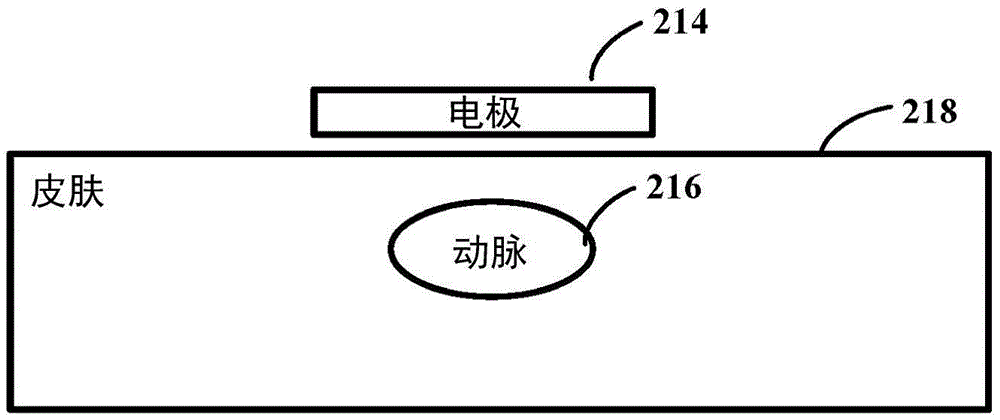
图2A示出了装置的示例,该装置包括具有与皮肤218进行相互作用的电极214的传感器电路103。如之前所述,传感器电路和电极可以通过用户的皮肤的接近度感测(与作为电容传感器的物理地变形相反)来承载电容变化,并且由此发挥接近度传感器的作用或作为接近度传感器。已发现具有置于动脉脉搏点(例如,动脉216)附近的单个电极214的(接近度)传感器电路可以用于经由电容变化来测量动脉脉搏波形。可以从该波形中提取心率以及其他血液动力学参数。电极214可以与皮肤218直接接触或者与皮肤218电绝缘或隔离。不需要将其机械地耦合至皮肤218。可以选择电绝缘的成分、结构以及厚度以修改传感器的灵敏度。可以使用间隔件结构来确定电极与皮肤之间的电容变化。电路可以具有浮动接地(例如,传感器电路和/或换能器电路可以具有浮动接地)。FIG. 2A shows an example of a device that includes a
可以使用电极的阵列来改善位置准确度和/或提供用于差值分析的参考信号。并且,可以通过最优化边缘场分布的电极设计来改善信号。例如,在一些实施例中,由传感器电路的阵列来感测模拟响应,每个传感器电路具有单个电极。阵列中的两个或多个电极可以具有不同的灵敏度水平并且由该阵列中的两个或多个传感器电路感测到的模拟响应可以用于差值感测。An array of electrodes may be used to improve positional accuracy and/or provide a reference signal for difference analysis. Also, the signal can be improved by optimizing the electrode design of the fringe field distribution. For example, in some embodiments, an analog response is sensed by an array of sensor circuits, each sensor circuit having a single electrode. Two or more electrodes in the array can have different sensitivity levels and the analog responses sensed by the two or more sensor circuits in the array can be used for differential sensing.
图2B示出了使用如图2A所示的装置感测到的脉搏波形209的示例。如图所示,脉搏波形209的周期性反映了心动周期并且可以用于确定用户的心率。Figure 2B shows an example of a
图2C示出了用于监测脉搏波事件的装置的示例机制。如图2C所示,用户的皮肤218充当针对该机制的接地面。在不受特定理论的约束的情况下,可相信本公开中讨论的一个或多个实施例的各方面背后的机制如下:(i)皮肤218 充当接地面且动脉压变化引起皮肤218的表面的位移,并且这改变了电极214 与皮肤218之间的距离,其被测量为电容的变化;(ii)动脉216(以及覆盖的皮肤)中的血液的电势随着每次心跳而改变,并且这修正了边缘场线,其被反映为阻抗的变化;以及(iii)涉及来自以上机制中的每一个的组合(贡献)。Figure 2C illustrates an example mechanism of a device for monitoring pulse wave events. As shown in Figure 2C, the user's
图2D示出了如图2C所示的装置的示例,该示例进一步包括设置传感器电路的至少一部分(例如,电极214)与皮肤218之间的距离(例如,最小距离) 的一个或多个间隔件。间隔件217包括由材料形成的一个或多个结构,在该结构中长度(例如,从电极到皮肤表面的距离)设置传感器电路的至少一部分/ 电极与皮肤之间的距离。长度可以是0.1毫米(mm)到1mm的范围,然而实施例并不限于此。尽管图2D的实施例示出了具有矩形形状的一个间隔件,但实施例不限于此并且可以包括多于一个间隔件并且不同形状的间隔件(诸如纹理化和/或结构化材料的层)。FIG. 2D shows an example of the device shown in FIG. 2C, which further includes one or more intervals that set the distance (eg, minimum distance) between at least a portion of the sensor circuit (eg, electrode 214) and
图3是例示了根据本公开的实现电子器件和/或信号流的示例方法的框图,从位于用户的皮肤处或皮肤附近的装置(包括例如传感器电路324、换能器电路326、电信号感测电路327和通信电路330)到远程/无线通信收发器和CPU 334(例如,经由天线336进行接收)。可以对CPU 334和/或电信号感测电路327进行编程以实施如本文中公开的以下操作,包括但不限于:处理指示特定的血液动力学信号的存在的原始数据;从原始数据中建立波形;和/或计算用于特定的应用的血液动力学信号和/或波形的集成度、质量以及相关性,该特定的应用与用户的血液动力学状态或健康(用户的心率或其他血液动力学指标或参数(诸如舒张压、收缩压、动脉僵硬度、和血容量),和/或指示一个或多个指标或参数的变化)有关。3 is a block diagram illustrating an example method of implementing electronics and/or signal flow according to the present disclosure, from a device (including, for example,
传感器电路324的电极捕捉响应于脉搏波事件的电容变化并且向换能器电路326提供电容变化。在一些实施例中,换能器电路324是或包括电容-数字转换器。电容-数字转换器将电容值(例如,相对变化)转换为数字信号并且将数字信号输出至电信号感测电路327,该电信号感测电路327可以包括或作为微控制器或其他处理电路系统。使用电源328所提供的电力的电信号感测电路327 测量和/或记录动脉脉搏波形并且可选地控制信号、计算数据的质量、和/或确定一个或多个血液动力学参数。电信号感测电路327可以经由通信电路330(例如,收发器)以及天线332来将波形和其他可选的数据输出至CPU 334。The electrodes of the
如本文中所述的感测装置可以免提的方式并且在没有来自环境噪声(例如,人类声音以及其他背景噪声、电干扰以及环境光线)的干扰的情况下监测脉搏波事件。此外,电信号感测电路可以响应于来自换能器电路的电信号来感测血液动力学或脉搏波事件。电极(或电极的阵列)可以消耗相对低的功率量 (例如,在(低于)5微瓦特与3毫瓦特之间)。在一些特定的实施例中,可以通过仅在触发事件之后保存数据和/或以突发传输来传输被保存的数据来进一步降低功率消耗。触发事件可以包括指示问题的特定的心脏事件(诸如心率高于或低于阈值量和/或特定的波形特性)。Sensing devices as described herein can monitor pulse wave events in a hands-free manner and without interference from environmental noise (eg, human voices and other background noise, electrical interference, and ambient light). Additionally, the electrical signal sensing circuitry may sense hemodynamic or pulse wave events in response to electrical signals from the transducer circuitry. An electrode (or an array of electrodes) may consume a relatively low amount of power (eg, between (less than) 5 microwatts and 3 milliwatts). In some particular embodiments, power consumption may be further reduced by saving data only after a trigger event and/or transmitting the saved data in burst transfers. Trigger events may include specific cardiac events (such as heart rate above or below a threshold amount and/or specific waveform characteristics) that indicate a problem.
图4A-5B示出了根据本公开的具有传感器阵列的各种示例装置。例如,图4A-4B示出了具有配置为与用户的皮肤相互作用的四个电极的示例装置。4A-5B illustrate various example devices with sensor arrays according to the present disclosure. For example, FIGS. 4A-4B illustrate an example device having four electrodes configured to interact with a user's skin.
图4A示出了包括传感器阵列的装置的自上而下(或鸟瞰)视图,该传感器阵列具有包括四个电极447、449、451、453的四个传感器电路。线宽以及间隔可以是在用于脉搏监测应用的0.1mm到20mm的数量级上。如图所示,传感器阵列包括可选的接地连接440、458以及可选的主动屏蔽连接442、448、 450、456。传感器的阵列进一步包括传感器连接444、446、452、454以及绝缘层460、443。FIG. 4A shows a top-down (or bird's eye) view of a device comprising a sensor array with four sensor circuits comprising four
图4B是图4A所示的装置的侧视图。如图所示,层包括绝缘层460、四个电极445(例如,图4A所示的电极447、449、451、453)以及其他绝缘层443。装置包括配置为接近或接触用户或其他对象的皮肤的有效部分(或区域)455。有效部分455的长度可以是在用于脉搏监测应用的0.1mm到20mm的数量级上。另外,有效部分455可以与皮肤接触或不与皮肤接触并且距皮肤至多1mm。在各种特定的实施例中,距离通常是距皮肤小于100微米,该距离可以是足以获取具有足够低的得到的信噪值以便从中获取心率和/或血压的距离。在特定的实施例中,为了灵敏度目的并且为了减少与皮肤的接触,电极445可以是有纹理的或起皱的。越小的有效区域可以具有越高的灵敏度,但是可能难以精确定位。Figure 4B is a side view of the device shown in Figure 4A. As shown, the layers include an insulating
在各种实施例中,装置包括封装的传感器的阵列,该传感器的阵列包括被配置为与用户的皮肤相互作用的(四个)电极445。可以将传感器的阵列(例如,电极)封装在绝缘材料中(例如,介电材料)以提供环境稳定性以及抗湿性。绝缘材料可以包括聚酯、聚烯烃、含氟聚合物、聚酰亚胺、聚氯乙烯、纤维素、纸张、布、以及其他材料。封装厚度可以是5到250微米或更高的数量级上。类似地,可选的粘合剂和导电层厚度可以是数十个微米的数量级上,并且分别对于粘合剂和导电层通常是小于70和5微米。(多个)导电层可以可选地是被动屏蔽层和/或被连接至控制电子器件以提供主动屏蔽。In various embodiments, the device includes an array of packaged sensors including electrode(s) 445 configured to interact with the user's skin. An array of sensors (eg, electrodes) can be encapsulated in an insulating material (eg, a dielectric material) to provide environmental stability and moisture resistance. Insulating materials may include polyesters, polyolefins, fluoropolymers, polyimides, polyvinyl chloride, cellulose, paper, cloth, and other materials. Package thickness can be on the order of 5 to 250 microns or more. Similarly, optional adhesive and conductive layer thicknesses can be on the order of tens of microns, and are typically less than 70 and 5 microns for adhesive and conductive layer, respectively. The conductive layer(s) may optionally be a passive shielding layer and/or be connected to the control electronics to provide active shielding.
在特定的实施例中,层包括:具有可选的屏蔽以及粘合涂层的绝缘层、绝缘层、一个或多个电极、另一个绝缘层、以及具有可选的屏蔽以及粘合涂层的另一个绝缘层,如参考图5A-5B在本文中进一步示出以及讨论的那样。In a particular embodiment, the layers include: an insulating layer with an optional shielding and bonding coating, an insulating layer, one or more electrodes, another insulating layer, and an insulating layer with an optional shielding and bonding coating Another insulating layer, as further shown and discussed herein with reference to FIGS. 5A-5B .
在一些实施例中,可以将传感器的阵列(例如,电极)封装在绝缘材料中 (例如,介电材料)以提供增加的环境稳定性以及抗湿性。一个或多个绝缘层可以是位于一个或多个位置的狭缝以将各个传感器电路机械隔离并且增加封装的传感器与底层基板的一致性。In some embodiments, an array of sensors (eg, electrodes) can be encapsulated in an insulating material (eg, a dielectric material) to provide increased environmental stability and moisture resistance. The one or more insulating layers may be slits at one or more locations to mechanically isolate the individual sensor circuits and increase the conformity of the packaged sensor to the underlying substrate.
在进一步的特定的实施例中,封装的传感器的阵列包括(四个)电极445 以及间隔件层。间隔件层包括一个或多个间隔件,该间隔件可以设置或控制传感器电路和/或电极(或至少电极的一部分)距皮肤表面的距离,如之前图2D 所示的那样。间隔件层可以最小化或减轻来自非有效(非传感器)区域的寄生电容。只要该距离不影响传感器的灵敏度,间隔件层厚度可以是在0.1mm到 5mm或更高的数量级上。可以将传感器的阵列(例如,电极)封装在绝缘材料中(例如,介电材料)以提供环境稳定性以及抗湿性。封装厚度可以是5到250 微米或更高的数量级上。类似地,可选的粘合剂和导电层厚度可以是数十个微米的数量级上,并且分别对于粘合剂和导电层通常是小于70和5微米。In a further particular embodiment, the array of packaged sensors includes electrode(s) 445 and a spacer layer. The spacer layer includes one or more spacers that can set or control the distance of the sensor circuitry and/or electrodes (or at least a portion of the electrodes) from the skin surface, as previously shown in Figure 2D. The spacer layer can minimize or mitigate parasitic capacitance from non-active (non-sensor) areas. The spacer layer thickness may be on the order of 0.1mm to 5mm or more, as long as the distance does not affect the sensitivity of the sensor. An array of sensors (eg, electrodes) can be encapsulated in an insulating material (eg, a dielectric material) to provide environmental stability and moisture resistance. Package thickness can be on the order of 5 to 250 microns or more. Similarly, optional adhesive and conductive layer thicknesses can be on the order of tens of microns, and are typically less than 70 and 5 microns for adhesive and conductive layer, respectively.
封装的传感器的阵列可以进一步包括屏蔽层。如以下进一步描述的,一个或多个绝缘层可以在其内表面上具有粘合涂层从而使得该层粘附至其它层,诸如将绝缘层粘附至另一个(多个)绝缘层。绝缘层可以在其外表面上具有与用户的皮肤接触的导电层。导电层可以可替代地是夹在两个绝缘层之间。导电材料可以包括例如已印刷、蒸发、喷溅或电镀在非导电基板(例如,PET或聚酰亚胺基板)上的铝、金、碳、或铜。绝缘层可以是位于一个或多个位置的狭缝以将各个传感器电路机械隔离并且增加封装的传感器电路与底层基板的一致性。因此,基板可以配置并布置为与用户的腕部、肢体、或其他身体部分相配的用户配件。The array of packaged sensors may further include a shielding layer. As described further below, one or more insulating layers may have an adhesive coating on its inner surface to enable the layer to adhere to other layers, such as to adhere the insulating layer to another insulating layer(s). The insulating layer may have a conductive layer on its outer surface that contacts the user's skin. The conductive layer may alternatively be sandwiched between two insulating layers. Conductive materials may include, for example, aluminum, gold, carbon, or copper that has been printed, evaporated, sputtered, or plated onto a non-conductive substrate (eg, a PET or polyimide substrate). The insulating layer may be a slit at one or more locations to mechanically isolate the individual sensor circuits and increase the conformity of the packaged sensor circuit to the underlying substrate. Accordingly, the base plate may be configured and arranged as a user accessory that fits a user's wrist, limb, or other body part.
在特殊的实验性实施例中,绝缘层443、460和电极445由柔性扁平电缆 (FFC/FPC)(诸如可购得的莫莱克斯(Molex)15168-0147)形成,具有粘合涂层的绝缘层460由具有粘合剂(诸如可购得的艾利(Avery)156660)的聚对苯二甲酸乙二醇酯(PET)形成,具有导电材料的绝缘层443由具有大约或大于2光密度的蒸发的铝(诸如可购得的赛普拉斯特(Celplast)Cel-Met 48g) 12微米PET,并且间隔件层由泡沫胶带层(诸如可购得的耐适康(Nexcare)731) 形成。各个电极可以是0.625mm宽,各个电极之间有0.625mm间隔。In a particular experimental embodiment, the insulating
不同的电极445可以具有不同的电容灵敏度。装置可以包括间隔件层,该间隔件层覆盖了一些传感器电路但非全部传感器的有效部分。传感器电路可以具有用于读出的隔离开的电子器件以便防止或减轻通过公共电路的串扰。
如贯穿本公开所述(例如,包括图1A-1B、2A、2C-2D、4A-4B 、5A-5B、 6B、以及16A)的传感器电路的柔性或弯曲的角度可以是足以捕捉压力或电容的变化(例如,电容值的变化)。更具体地,传感器电路的刚度与传感器电路的厚度和/或长度成反比(例如,电极越厚或越长,越具有刚性)。柔性以及厚度(和/或长度)可以配置为相对于彼此足以提供对0.3千帕(kPa)到1kPa的压力变化和/或相比传感器电路的基本电容在正负15皮法拉(pF)的范围内的电容变化的灵敏度。在更特定的实施例中,柔性以及厚度和/或长度可以配置为相对于彼此足以提供对0.5kPa到1kPa的压力变化的灵敏度。此外,如本文中描述的,当传感器接触了皮肤或其他表面时,可以感测到压力的变化(其指示了电容的变化)的测量。当(多个)电极不与用户的皮肤或其他表面接触(但是距离在1mm内)时,可以获取感测到的电容的变化。The angle of flexibility or bending of sensor circuits as described throughout this disclosure (eg, including FIGS. changes (for example, changes in capacitance values). More specifically, the stiffness of the sensor circuit is inversely proportional to the thickness and/or length of the sensor circuit (eg, thicker or longer electrodes are more rigid). The flexibility and thickness (and/or length) can be configured relative to each other sufficiently to provide a pressure change of 0.3 kilopascals (kPa) to 1 kPa and/or in the range of plus or minus 15 picofarads (pF) relative to the fundamental capacitance of the sensor circuit Sensitivity to capacitance changes within. In more particular embodiments, the flexibility and thickness and/or length may be configured relative to each other sufficient to provide sensitivity to pressure changes of 0.5 kPa to 1 kPa. Additionally, as described herein, when the sensor contacts the skin or other surface, a measurement of a change in pressure (which is indicative of a change in capacitance) can be sensed. When the electrode(s) are not in contact with the user's skin or other surface (but within 1mm distance), the change in the sensed capacitance can be acquired.
图5A-5B示出了具有封装的传感器的阵列的示例装置,该传感器的阵列包括具有不同电容灵敏度的多个(例如,四个)电极。装置包括间隔件层545,该间隔件层545覆盖一些传感器电路(例如,电极547以及548)但非所有传感器电路(例如,非电极549以及550)的有效部分。可替代地和/或另外地,一些传感器电路(例如,电极549以及550)以及部分绝缘层541、543比其余的传感器(例如,电极547、548)更短(相对于接近有效部分551的装置的端部)。传感器电路可以具有用于读出的隔离开的电子器件以便防止或减轻通过公共电路的串扰。如之前所述,一个或多个绝缘层530可以在其内表面上具有粘合涂层从而使得绝缘层530粘附至其它层,诸如将绝缘层530粘附至其他绝缘层541、544。其他绝缘层544可以在其外表面上具有与用户的皮肤接触的导电层。5A-5B illustrate an example device with an array of packaged sensors including multiple (eg, four) electrodes with different capacitive sensitivities. The device includes a
图5A示出了包括四个电极547、548、549、550的传感器阵列的装置的自上而下(或鸟瞰)视图。如图所示,传感器阵列包括可选的接地连接531、540 以及可选的主动屏蔽连接532、535、536、539。传感器的阵列进一步包括:传感器连接533、534、537、538;绝缘层541、543;间隔件层545;以及具有可选的屏蔽和粘合涂层的附加的绝缘层544、530。绝缘层541、543可以是位于一个或多个位置542的狭缝以将各个传感器电路机械隔离并且增加封装的传感器与底层基板的一致性。FIG. 5A shows a top-down (or bird's eye) view of a device comprising a sensor array of four
图5B是图5A所示的装置的侧视图。如图所示,层包括:在内表面上(例如,在接近绝缘层541的表面上)具有粘合涂层的绝缘层530、绝缘层541、四个电极546(例如,图5A所示的电极547、548、549、550)、另一个绝缘层543、间隔件层545、以及在外表面上(例如,在与间隔件层545相对和/或相接近的表面上)具有导电材料的另一个绝缘层544。装置包括有效区域551,如之前所描述的那样。Figure 5B is a side view of the device shown in Figure 5A. As shown, the layers include: insulating
图6A-6C示出了根据本公开的装置。如图6B和6C所示,在某些实施例中,装置可以具有配置并布置为感测脉搏波形的柔性带状传感器阵列602。可以使用腕带604来将柔性带状传感器阵列602固定在位,如图6C所示,该腕带可以被置于用户603的腕部周围。图6A所示的图表示出了针对典型的桡动脉脉搏波形形状的电容数据601。在示例实验性实施例中,使用带通滤波器 (20Hz/0.5Hz)来处理数据,这导致计算出的心率是71bpm。(来自FitbitCharge HRTM的)参考心率是70bpm,这说明了传感器信号反映了心动周期。对于该实施例,柔性带状传感器阵列602由弹性腕带604保持以接触紧挨着用户的皮肤的平面。在各种实施例中,可以使用莫莱克斯(Molex)15168-0147FFC跨接电缆作为柔性带状传感器阵列。可以来自这样的波形数据的傅里叶变换来计算心率。可以将柔性带状传感器阵列602连接至蓝牙接近度感测电路(例如,电信号感测电路)6A-6C illustrate devices according to the present disclosure. As shown in Figures 6B and 6C, in some embodiments, a device may have a flexible
图7示出了根据各种实施例的使用装置(诸如图6B-6C所示的装置)所捕捉到的示例数据。在某些实施例中,装置可以包括带状电缆,该带状电缆被实施从而使得可以分别沿着由电缆的导电线提供的不同的信号路径来同时地(或可替代地,同时发生地或顺序地)测量多个信道。在这样的实施例中,将不同的电极(以及相应的传感器电路)配置成多个信道(例如,信号路径)之一,其分别承载用于由电信号感测电路进行的顺序处理和/或用于由电信号感测电路进行的同时发生处理或同时处理的信号。如图7所示,作为可以测量的四个信道的示例实施方式,装置可以包括四个电极,四个电极中的每一个布置在相应的信号路径/信道中。与图6A类似,使用带通滤波器(20Hz/0.5Hz)来(例如,从来自四个信道的未经滤波的705、707、709、711)提取数据。在该实验性实施例中,计算出的心率是71bpm,并且参考心率(Fitbit Charge HRTM) 是70bpm。对于该实施例,柔性带状传感器阵列由弹性腕带保持以接触紧挨着用户的皮肤的平面。在各种实施例中,可以使用莫莱克斯(Molex)15168-0147FFC跨接电缆作为柔性带状传感器阵列。可以从这样的波形数据的傅里叶变换来计算心率。可以将柔性带状电极连接至蓝牙接近度感测电路(例如,电信号感测电路)FIG. 7 illustrates example data captured using a device, such as that shown in FIGS. 6B-6C , in accordance with various embodiments. In some embodiments, the device may include a ribbon cable implemented such that the signals can be simultaneously (or alternatively, simultaneously or sequentially) to measure multiple channels. In such an embodiment, the different electrodes (and corresponding sensor circuitry) are configured as one of a plurality of channels (e.g., signal paths) that respectively carry signals for sequential processing by the electrical signal sensing circuitry and/or Signals for simultaneous processing or simultaneous processing by electrical signal sensing circuits. As shown in Figure 7, as an example embodiment of four channels that may be measured, the device may include four electrodes, each of the four electrodes being arranged in a corresponding signal path/channel. Similar to Fig. 6A, a bandpass filter (20Hz/0.5Hz) is used to extract data (eg, from unfiltered 705, 707, 709, 711 from four channels). In this experimental example, the calculated heart rate is 71 bpm, and the reference heart rate (Fitbit Charge HR ™ ) is 70 bpm. For this embodiment, the flexible strip sensor array is held by an elastic wristband to contact a plane next to the user's skin. In various embodiments, a Molex 15168-0147FFC jumper cable may be used as the flexible ribbon sensor array. Heart rate can be calculated from the Fourier transform of such waveform data. Flexible strip electrodes can be connected to Bluetooth proximity sensing circuitry (e.g. electrical signal sensing circuitry)
图8示出了使用装置所捕捉到的数据802、804、806、808的示例。在某些实施例中,装置可以具有用于修改响应信噪比的附加的介电绝缘层(胶带)。顶部的两个图示出了不具有介电绝缘层的电极的响应(例如,数据802、804)。底部的两个图示出了具有一个介电绝缘层的电极的响应并且展示出了信号振幅的降低(例如,数据806、808)。Figure 8 shows examples of
图9A-9B示出了各种实施例中的具有多个信道的示例装置以及使用该装置所捕捉到的数据。信道中的一个或多个可以具有(多个)介电层或与(多个) 介电层相关联,该(多个)介电层可以降低信号强度。图9A示出了使用具有四个信道(例如,信号路径,电极被配置在该信号路径中,并且该信号路径分别承载信号)的装置捕捉到的示例数据。相比于裸露接触,可以利用一个或两个介电层(例如,一块或两块胶带)来降低信号的振幅。如图所示,波形914 表示使用不具有介电层的电极所捕捉到的数据,波形915表示使用具有一个介电层的电极所捕捉到的数据,波形916表示使用具有两个介电层的电极所捕捉到的数据,并且波形917表示不具有介电层的电极所捕捉到的数据。用于收集所示的数据的示例装置可以包括传感器条带,该传感器条带(诸如经由腕带) 机械地耦合至用户的皮肤。9A-9B illustrate an example device with multiple channels and data captured using the device in various embodiments. One or more of the channels may have or be associated with a dielectric layer(s) that may reduce signal strength. FIG. 9A shows example data captured using a device having four channels (eg, signal paths in which electrodes are configured and which respectively carry signals). One or two dielectric layers (eg, one or two pieces of tape) can be utilized to reduce the amplitude of the signal compared to bare contacts. As shown,
在某些实施例中,介电层可以调变脉搏波形的振幅,但是可能不妨碍归因于运动或呼吸伪像的基线漂移的观察。图9B示出了响应于信号变化使用上述装置所捕捉的数据,该信号变化是由于用户将他们的手部进行上下运动并且振幅为6英寸而引起的。如图所示,每个信道用于捕捉归因于用户运动的基线漂移的观察,其分别由波形918、919、920、921示出。具有对脉搏波形信号的较低的灵敏度的传感器电路(例如,具有一层或两层介电材料的传感器电路) 可以充当用于移除差模中的归因于用户的运动的基线漂移的参考。In some embodiments, the dielectric layer may modulate the amplitude of the pulse waveform, but may not prevent observation of baseline drift due to motion or breathing artifacts. Figure 9B shows data captured using the above device in response to signal changes caused by a user moving their hand up and down with an amplitude of 6 inches. As shown, each channel is used to capture observations of baseline drift due to user motion, which are shown by
图10示出了根据各种实施例的使用装置所捕捉到的示例数据。某些实施例可以在各种位置(诸如腕部的正面、背面、和/或侧面)实现一个或多个电极 (例如,传感器)位于不同位置的电极的位置可以充当针对差模中的总运动伪像的参考。可以选择位置以模仿在脉搏点观察到的运动伪像。图10示出了使用装置的(例如,被配置在信道中的)每个电极所捕捉到的不同的数据,该装置具有已置于腕部周围的不同位置的四个传感器电路。将捕捉到的数据表示为波形1003、1005、1007、1009。传感器电路可以经由腕带机械地耦合至用户。Figure 10 illustrates example data captured using a device in accordance with various embodiments. Certain embodiments may enable one or more electrodes (e.g., sensors) to be located at various locations (such as the front, back, and/or sides of the wrist). Artifact reference. Positions can be chosen to mimic motion artifacts observed at pulse points. Figure 10 shows different data captured using each electrode (eg, configured in a channel) of a device with four sensor circuits that have been placed at different locations around the wrist. The captured data is represented as
在某些实施例中,可以使用不同电极类型来实现装置。例如,图11-15B 示出了使用不同类型的电极所捕捉到的数据。In some embodiments, different electrode types may be used to implement the device. For example, Figures 11-15B show data captured using different types of electrodes.
图11示出了使用具有单个条带电极的装置所捕捉到的示例数据,该单个条带具有平面接触。图11所示的数据1129是未经滤波的。带通滤波器 (20Hz/0.5Hz)用于提取数据。在示例实验性实施例中,计算出的心率是63bpm,并且参考心率(Fitbit Charge HRTM)是63bpm。对于该实施例,铜胶带电极是6mm宽且3厘米(cm)长,具有与用户的皮肤的平面铜接触,并且由弹性腕带保持以接触紧挨着用户的皮肤的平面,然而实施例不限于此。(多个)电极可以是各种尺寸,诸如在0.5mm到6mm宽的范围内、在0.5mm到1cm宽的范围内、以及在0.5mm到3cm长的范围内。Figure 11 shows example data captured using a device with a single strip electrode with planar contacts. The data 1129 shown in Figure 11 is unfiltered. A bandpass filter (20Hz/0.5Hz) was used to extract the data. In an example experimental embodiment, the calculated heart rate is 63bpm, and the reference heart rate (Fitbit Charge HR ™ ) is 63bpm. For this embodiment, the copper tape electrodes are 6mm wide and 3 centimeters (cm) long, have a planar copper contact with the user's skin, and are held by an elastic wristband to contact the planar surface next to the user's skin, however the embodiment does not limited to this. The electrode(s) may be of various sizes, such as in the range of 0.5 mm to 6 mm wide, in the range of 0.5 mm to 1 cm wide, and in the range of 0.5 mm to 3 cm long.
图12示出了根据各种实施例的使用装置所捕捉到的示例数据。如之前所述,装置包括具有电极的至少一个传感器电路,其中电极的边沿置于用户的皮肤附近。边沿接触可以是在皮肤附近,但是可以不接触用户的皮肤。边沿接触距皮肤越近,得到的信号越强。图12示出了使用上述装置所捕捉到的示例脉搏波形1238。脉搏波形1238示出了来自传感器电路的信号,并且数据1234、 1236、以及1239示出了在无传感器被连接的情况下来自空信道的信号。在该示例中,传感器电路包括具有边沿接触的6mm宽的铜胶带电极。Figure 12 illustrates example data captured using a device in accordance with various embodiments. As previously stated, the device comprises at least one sensor circuit having electrodes, wherein the edges of the electrodes are placed adjacent to the user's skin. Edge contact may be near the skin, but may not touch the user's skin. The closer the edge contact is to the skin, the stronger the signal obtained. Figure 12 shows an
图13A-13B示出了根据各种实施例的使用装置捕捉到的示例数据。装置包括由导电布形成的单个电极。例如,布电极可以是2mm宽且2cm长。图13A 示出了使用布电极捕捉到的示例脉搏波形1350。电极可以平放在用户的皮肤上并且可以通过腕带来被固定在皮肤上。用户的手臂可能随着手部抬高而弯曲,并且在用户已经正在原地跑步之后捕捉数据。图13B示出了随时间而变化的心率的示例曲线图1354并且该示例曲线图1354依照图13A所示的数据而生成。带通滤波器(20Hz/0.5Hz)用于处理脉搏波形数据,从脉搏波形的傅里叶变换计算出心率,并且可以在一段时间上对心率值求平均(例如,15秒)。在该示例中的参考数据1353由于求平均周期的差异所以滞后于实验性数据一段时间 (例如,30秒)。13A-13B illustrate example data captured using a device according to various embodiments. The device includes a single electrode formed from conductive cloth. For example, cloth electrodes may be 2 mm wide and 2 cm long. Figure 13A shows an
图14示出了根据各种实施例的使用装置所捕捉到的示例数据。装置包括单个(经编织的)线电极。如图所示,捕捉到的数据包括脉搏波形1457。为了确定心率,使用带通滤波器(1Hz/2Hz)来提取数据。在示例实验性实施例中,计算出的心率是71bpm,并且参考心率(Fitbit Charge HRTM)是72bpm。电极可以由钢(例如,钢图片线)形成并且通过弹性腕带固定在位。Figure 14 illustrates example data captured using a device in accordance with various embodiments. The device consists of a single (braided) wire electrode. As shown, the captured data includes
图15A-15B示出了根据各种实施例的示例装置以及使用装置所捕捉到的数据。如图15A所示,电极1559可以包括更复杂的几何尺寸,诸如平放在用户的皮肤上并通过腕带固定在皮肤上的星形的铜箔电极。图15B示出了使用图 15A中示出的装置捕捉到的经滤波的和未经滤波的示例脉搏波形。带通滤波器 (20Hz/0.5Hz)用于提取数据。在示例实验性实施例中,计算出的心率是71bpm,并且参考心率(Fitbit Charge HRTM)是71bpm。15A-15B illustrate an example device and data captured using the device, according to various embodiments. As shown in Figure 15A, the
参考图3所示的框图,由(在微控制器处的)用于数字处理的信号转换器来处理来自穿戴换能器的信号流,该数字处理用于向远程用户界面的无线(和 /或有限)通信。在某些实施例中,由传感器电路拾取并且由换能器(例如,电容-数字转换器)和电信号感测电路(例如,微控制器)处理和检测/测量相关信号,而与换能器和/或传感器电路是否初始配置为接触用户的皮肤(如在电导换能器仅依赖于电导的情况下)和/或在用户的皮肤与换能器之间是否是特定类型的界面无关。取决于可能的以上指出的(多个)机制,与传统的传感器方法相反,这样的实施例不依赖于与用户的皮肤的初始接触的量和/或界面类型 (这样的传统的传感器方法对边缘场的变化和或电极与皮肤之间的距离的变化是不敏感的)。在各种实施例中,诸如在光电血管容积图(PPG)传感器的情况下,由电极承载的信号不受由血液动力学或脉搏波事件引起的亮度的变化所影响或改变。Referring to the block diagram shown in Figure 3, the signal flow from the wearable transducer is processed by a signal converter (at the microcontroller) for digital processing for wireless (and/or or limited) communication. In some embodiments, relevant signals are picked up by sensor circuitry and processed and detected/measured by transducers (e.g., capacitance-to-digital converters) and electrical signal sensing circuitry (e.g., microcontrollers), whereas It is irrelevant whether the transducer and/or sensor circuitry is initially configured to contact the user's skin (as in the case of conductance transducers that rely solely on conductance) and/or whether there is a particular type of interface between the user's skin and the transducer. Depending on the possible mechanism(s) noted above, such embodiments do not depend on the amount of initial contact with the user's skin and/or the type of interface, as opposed to traditional sensor approaches (such traditional sensor approaches are critical to edge insensitive to changes in the field and/or the distance between the electrodes and the skin). In various embodiments, such as in the case of a photoplethysmography (PPG) sensor, the signal carried by the electrodes is not affected or altered by changes in brightness caused by hemodynamic or pulse wave events.
各种实施例中的包括单个电极的传感器电路用于执行接近度感测。如之前所描述的,电容的变化由电极和相应的传感器电路承载并且响应于由血液动力学或脉搏波事件引起的压力和/或电场调变。电容变化可以归因于血管的压力、几何尺寸、或电场分布的变化,但不直接测量这些参数。传感器电路和电极通过用户的皮肤的接近度感测(与作为电容传感器的物理地使设备变形相反)来捕捉(或感测)电容变化,并且由此发挥接近度传感器的作用或成为接近度传感器。接近度感测和/或电容变化对调变用户的皮肤与传感器电路之间的距离和 /或调变边缘场线作出响应。A sensor circuit including a single electrode in various embodiments is used to perform proximity sensing. As previously described, changes in capacitance are carried by the electrodes and corresponding sensor circuitry and in response to pressure and/or electric field modulations caused by hemodynamic or pulse wave events. Capacitance changes can be attributed to changes in pressure, geometry, or electric field distribution of blood vessels, but these parameters are not directly measured. The sensor circuitry and electrodes capture (or sense) capacitance changes through proximity sensing of the user's skin (as opposed to physically deforming the device as a capacitive sensor), and thereby function or become proximity sensors . Proximity sensing and/or capacitance changes are responsive to modulating the distance between the user's skin and the sensor circuit and/or modulating fringing field lines.
以上描述的各种实施例以及如在以下进一步描述的更详细的/实验性的实施例参考用户和与用户的皮肤或身体相配的相应的可穿戴装置。普通技术人员可以理解到用户不限于人类。根据特定的实施例,用户可以包括生物体或动物 (而不是人类),例如马、狗、奶牛、鸟类、爬行动物、在动物园中受监控的各种动物或其他类型的生物体或动物(例如,斑马、大象、熊猫等等)、在野外受监控的生物体或动物、以及其他生物体。用户(例如,动物)皮肤可以被毛发覆盖,并且上述可穿戴装置可以与用户的身体相配或机械地约束到用户的身体。The various embodiments described above and the more detailed/experimental embodiments as further described below refer to a user and a corresponding wearable device that fits the user's skin or body. Those of ordinary skill will understand that users are not limited to humans. According to certain embodiments, users may include organisms or animals (other than humans), such as horses, dogs, cows, birds, reptiles, various animals monitored in zoos, or other types of organisms or animals ( For example, zebras, elephants, pandas, etc.), organisms or animals monitored in the wild, and other organisms. The user's (eg, animal) skin can be covered with hair, and the wearable device described above can be fitted to or mechanically constrained to the user's body.
2019年3月29日提交的题为“接近度传感器以及相关的感测方法 (ProximitySensors and Related Sensing Methods)”基础临时申请(序列号 62/314,474)中的幻灯片17以及18示出了对于某些特定的实施例的详细的图,该图示出了如何实现这样的传感器电路的示例,为了其教导而将其以其整体并入本文。
更具体/实验性的实施例More concrete/experimental example
根据本公开的实施例包括装置(该装置包括电信号感测电路以及具有电极的至少一个传感器电路)的使用以便监测电容变化和/或相对电容变化,该电容变化和/或相对电容变化响应于对应的电极与用户的皮肤之间的距离的变化和/ 或由脉搏波事件引起的动脉脉搏点附近的电场的变化。使用电容的变化,可以确定脉搏波形和/或压力差值。脉搏波形可以用于以无创方式监测包括心率、舒张压、收缩压、动脉僵硬度以及血容量血液动力学参数和/或参数的变化。Embodiments according to the present disclosure include the use of an apparatus comprising an electrical signal sensing circuit and at least one sensor circuit having electrodes to monitor changes in capacitance and/or relative changes in capacitance responsive to A change in the distance between the corresponding electrode and the user's skin and/or a change in the electric field near the arterial pulse point caused by the pulse wave event. Using the change in capacitance, the pulse waveform and/or pressure differential can be determined. The pulse waveform can be used to non-invasively monitor changes in hemodynamic parameters and/or parameters including heart rate, diastolic blood pressure, systolic blood pressure, arterial stiffness, and blood volume.
图16示出了根据各种实施例的使用装置所收集到的示例数据。数据包括可以使用根据本公开的实施例的装置来捕捉的一系列不同形状的脉搏波形 1664、1665、1666、1667、1668、1669、1670、1671、1672、1673、1674、 1675、1676、以及1677(为了方便参考,本文中将它们主要称为“脉搏波形”)。通过测量电容的相对变化且不基于电容的绝对值获取到所示的脉搏波形。然而,根据本公开的实施例不限于此。Figure 16 illustrates example data collected using a device in accordance with various embodiments. The data includes a series of differently shaped
图17A-17C示出了根据各种试验性实施例的使用装置收集到的数据以及使用动脉管路收集到的数据。使用装置(该装置置于接近用户的左桡动脉脉搏点)获取到的数据跟踪和/或模拟使用植入右桡动脉中的动脉管路获取到的数据。图17A示出了:由根据各种实施例的装置获取到的数据1773模仿由动脉管路获取到的数据1772。图17B示出了数据1773(例如,波形)并且图17C 示出了数据1772,以分别用于进一步的说明。17A-17C illustrate data collected using a device and data collected using an arterial line, according to various experimental embodiments. Data acquired using a device placed close to the pulse point of the user's left radial artery tracked and/or simulated data acquired using an arterial line implanted in the right radial artery. Figure 17A shows that
图18A-18C示出了根据各种试验性实施例的使用装置收集到的以及使用动脉管路收集到的示例脉搏波形数据。使用装置(该装置置于接近用户的左桡动脉脉搏点)跟踪和/或模仿使用植入右桡动脉中的动脉管路或得到的数据。可以通过测量脉搏波的长度由逐个心跳的分析来确定心率。可以从各个心率值的分布来确定心率变化性。图18A示出了:由装置获取到的脉搏波形数据1877 可以模仿由动脉管路获取到的脉搏波形数据1875。图18B示出了脉搏波形数据 1877(例如,波形)并且图18C示出了脉搏波形数据1875,以分别用于进一步的说明。18A-18C illustrate example pulse waveform data collected using a device and collected using an arterial line, according to various experimental embodiments. The use of a device placed close to the user's left radial artery pulse point tracks and/or mimics the use of arterial line implanted in the right radial artery or data obtained. Heart rate can be determined by beat-by-beat analysis by measuring the length of the pulse wave. Heart rate variability may be determined from the distribution of individual heart rate values. Figure 18A shows that
图19A-19C示出了根据各种试验性实施例的使用装置收集到的以及使用动脉管路收集到的心率和血压的变化的示例。在各种实施例中,可以跟踪和/ 或监测心率和血压中的图案和异常现象。这样的图案和/或异常现象可以指示各种健康状况,诸如心房颤动高血压、周围性血管疾病、主动脉回流、主动脉狭窄、和/或左心室阻塞、以及其他状况。使用装置(该装置置于接近用户的左桡动脉脉搏点)获取到的数据可以跟踪和/或模拟使用植入右桡动脉中的动脉管路获取到的数据。图19A示出了:由根据各种实施例的装置获取到的数据1981 模仿由动脉管路获取到的数据1979。图19B示出了1981(例如,波形)并且图19C示出了数据1979,以分别用于进一步的说明。19A-19C illustrate examples of changes in heart rate and blood pressure collected using a device and collected using an arterial line, according to various experimental embodiments. In various embodiments, patterns and anomalies in heart rate and blood pressure can be tracked and/or monitored. Such patterns and/or abnormalities may indicate various medical conditions, such as atrial fibrillation hypertension, peripheral vascular disease, aortic regurgitation, aortic stenosis, and/or left ventricular obstruction, among other conditions. Data acquired using a device placed proximate to the user's left radial artery pulse point may track and/or simulate data acquired using an arterial line implanted in the right radial artery. Figure 19A shows that
图20示出了根据各种实施例的使用装置收集到的示例呼吸速率。装置可以用于测量和/或监测来自呼吸模式的呼吸速率。例如,图20示出了使用四个不同的信号捕捉到的数据2087、2088、2089、2090并且示出了具有与用户的呼吸运动相关的特性频率周期性的基线漂移。FIG. 20 illustrates example respiration rates collected using a device in accordance with various embodiments. The device can be used to measure and/or monitor breathing rate from a breathing pattern. For example, FIG. 20
图21示出了根据各种试验性实施例的使用具有位于不同位置的多个电极的装置收集到的示例数据。如之前所描述的,可以将电极布置为具有分别承载信号的多个信道,该信号由电信号感测装置进行处理。归因于每个电极的各自的位置,在信道之间捕捉到的数据(可以同时地捕捉该数据)的质量和振幅可能变化。图21示出了经滤波的数据2115、2116、2117、2118(例如,使用四个信道所捕捉到的经滤波的原始数据)。21 shows example data collected using a device with multiple electrodes at different locations, according to various experimental embodiments. As previously described, the electrodes may be arranged to have a plurality of channels each carrying a signal which is processed by the electrical signal sensing means. Due to the respective position of each electrode, the quality and amplitude of the data captured (which may be captured simultaneously) may vary between channels. Figure 21 shows filtered
图22示出了根据各种试验性实施例的使用具有位于不同位置的多个电极的装置收集到的示例数据。如之前参考图21在以上讨论的,电极的位置可以影响捕捉到的数据的质量。另外地和/或可替代地,电极的位置可以导致(分别) 正常的和反转的混合。图22示出了使用四个信道捕捉到的经滤波的数据2221、 2222、2223、2224,如之前描述的那样。22 shows example data collected using a device with multiple electrodes at different locations, according to various experimental embodiments. As previously discussed above with reference to FIG. 21 , the location of the electrodes can affect the quality of the captured data. Additionally and/or alternatively, the position of the electrodes may result in a mix of (respectively) normal and inverted. Figure 22 shows filtered
图23示出了根据各种试验性实施例的使用具有多个电极的装置收集到的示例呼吸速率。在各个实施例中,可以使用带通滤波器对使用(多个)电极捕捉到的数据进行处理以减少基线漂移和信号噪声。例如,图23示出了使用相同的四个信号捕捉到的经滤波的数据2345、2346、2347、2348(例如,使用 0.1Hz到20Hz的带通滤波器来进行滤波)。FIG. 23 shows example respiration rates collected using a device with multiple electrodes, according to various experimental embodiments. In various embodiments, data captured using the electrode(s) may be processed using bandpass filters to reduce baseline drift and signal noise. For example, Figure 23 shows filtered
如所示的以及之前所描述的,脉搏波形可以用于确定各种血液动力学参数。例如,可以将脉搏波形的形状和其他特征与血压相关联。在其他实施例中,可以通过确定每个脉搏的心率和心脏变化性的时序来获取心率以及心理变化率。进一步地,可以通过首先校准数据(诸如利用按照可充气袖口数据进行校准的动脉管路)来监测血压中的变化。As shown and previously described, the pulse waveform can be used to determine various hemodynamic parameters. For example, the shape and other characteristics of the pulse waveform can be correlated with blood pressure. In other embodiments, heart rate and psychotropic rate may be obtained by determining the timing of heart rate and cardiac variability for each pulse. Further, changes in blood pressure may be monitored by first calibrating the data, such as with an arterial line calibrated to the inflatable cuff data.
可以使用包括特征分析和计算流体动力学技术的各种不同的技术来分析脉搏波形和/或确定各种血液动力学参数。例如,可以将归因于血液动力学现象的特征与血压、动脉僵硬度、和其他血液动力学参数相关联。对于有关归因于血液动力学现象的特征的更普遍的和更特定的信息,参考Cecelia、Marina和 Phil Chowienczyk的“心血管疾病中的动脉僵硬度的作用(Role of Arterial Stiffness in Cardiovascular Disease)”(皇家医学学会杂志心血管疾病(JRSM Cardiovascular Disease)1.4(2012):cvd.2012.012016,PMC,Web.2017年1 月31日);David A.Donley等人的“有氧运动训练降低代谢综合征中的动脉僵硬度(Aerobic exercise training reduces arterial stiffness in metabolicsyndrome)”(2014年6月1日发表于“应用生理学杂志(Journal of Applied Physiology)”第116卷,第11号,第1396-1404页);Baruch,Martin C.等人的“使用中央动脉血压的脉搏分解分析算法的验证(Validation of the pulse decomposition analysis algorithmusing central arterial blood pressure)”(生物医学工程在线(Biomedicalengineering online)13.1(2014)96.);以及Munir、 Shahzad等人的“外周增强指数限中央脉搏压力与外围脉搏压的关系 (Peripheral augmentation index defines therelationship between central and peripheral pulse pressure)”(高血压(Hypertension)51.1(2008):112-118.),这些文献中的每一个完全并入本文。作为另一个示例,增强指数(AI)(外周第二收缩压(pSBP2)-舒张压(DBP))/(外周收缩压(pSBP)-DBP)可以用作针对动脉僵硬度的标记并且可以与外周和中央血压峰值(pPP和cPP)相关联。AI是归一化的参数并且可以在没有绝对校准的情况下对AI进行分析。计算流体动力学技术可以包括:将血管建模为电感电容电阻(LCR)电路和/ 或弹性管道的网络以便计算参数(诸如脉搏波速度和/或波形形状)。对于与用于确定血液动力学参数的计算流体动力学相关的更普遍的和更特定的信息,参考Lee、Byoung-Kwon的“心血管疾病中的计算流体动力学(Computational fluid dynamics in cardiovascular disease)”(韩国循环杂志(Koreancirculation journal) 41.8(2011):423-430.),以及Xiaoman Xing和Mingshan Sun的“利用光电容积描记法和基于FFT的神经网络的光学血压估计(Optical blood pressureestimation with photoplethysmography and FFT-based neural networks)”(生物医学光学快递(Biomed.Opt.Express),7,0307-3020(2016)),这些文献的每一个完全并入本文。可以用于获得脉搏波形(由PPG获取到的)与血压之间的关系的模型(其中,g由血管壁的模量E限定)包括:A variety of different techniques can be used to analyze the pulse waveform and/or determine various hemodynamic parameters, including signature analysis and computational fluid dynamics techniques. For example, features attributed to hemodynamic phenomena can be correlated with blood pressure, arterial stiffness, and other hemodynamic parameters. For more general and more specific information on features attributed to hemodynamic phenomena, see "Role of Arterial Stiffness in Cardiovascular Disease" by Cecelia, Marina, and Phil Chowienczyk (JRSM Cardiovascular Disease 1.4 (2012):cvd.2012.012016, PMC, Web.2017 January 31); David A. Donley et al. "Aerobic exercise training reduces metabolic syndrome "Aerobic exercise training reduces arterial stiffness in metabolic syndrome" (Journal of Applied Physiology, Vol. 116, No. 11, pp. 1396-1404, June 1, 2014) "Validation of the pulse decomposition analysis algorithm using central arterial blood pressure" by Baruch, Martin C. et al. (Biomedical engineering online 13.1 (2014) 96. ); and "Peripheral augmentation index defines relationship between central and peripheral pulse pressure" by Munir, Shahzad et al. (Hypertension 51.1 (2008): 112- 118.), each of which is fully incorporated herein. As another example, augmentation index (AI) (peripheral second systolic pressure (pSBP2) - diastolic blood pressure (DBP))/(peripheral systolic pressure (pSBP) - DBP) can be used as a marker for arterial stiffness and can be compared with peripheral Correlates with peak central blood pressure (pPP and cPP). AI is a normalized parameter and AI can be analyzed without absolute calibration. Computational fluid dynamics techniques may include modeling blood vessels as networks of inductor-capacitor-resistor (LCR) circuits and/or elastic tubing in order to calculate parameters such as pulse wave velocity and/or waveform shape. For more general and more specific information related to computational fluid dynamics for determining hemodynamic parameters, refer to "Computational fluid dynamics in cardiovascular disease" by Lee, Byoung-Kwon " (Korean circulation journal 41.8(2011): 423-430.), and "Optical blood pressure estimation with photoplethysmography and FFT-based neural network" by Xiaoman Xing and Mingshan Sun FFT-based neural networks)" (Biomed.Opt.Express, 7, 0307-3020 (2016)), each of which is fully incorporated herein. Models (where g is defined by the modulus E of the vessel wall) that can be used to obtain the relationship between the pulse waveform (obtained by the PPG) and blood pressure include:
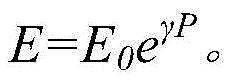
例如,可以由下式给出归一化的波形:For example, the normalized waveform can be given by:


各种技术可以用于将脉搏波形与血压值相关联。对于与将脉搏波形与血压值相关联相关的更普遍的和更特定的信息,参考Xiaoman Xing和Mingshan Sun 的“利用光电容积描记法和基于FFT的神经网络的光学血压估计(Optical blood pressure estimationwith photoplethysmography and FFT-based neural networks)”(生物医学工程在线(Biomedical engineering online)7.8(2016):3007-3020),以及Various techniques can be used to correlate pulse waveforms with blood pressure values. For more general and specific information related to correlating pulse waveforms with blood pressure values, refer to "Optical blood pressure estimation with photoplethysmography and FFT-based neural networks" by Xiaoman Xing and Mingshan Sun. and FFT-based neural networks)" (Biomedical engineering online (Biomedical engineering online) 7.8 (2016): 3007-3020), and
http://cs229.stanford.edu/proj2014/Sharath%20Ananth,Blood%20Pressure%20Dete ction%20from%20PPG.pdf,这些文献中的每一个完全并入本文。http://cs229.stanford.edu/proj2014/Sharath%20Ananth, Blood%20Pressure%20Detection%20from%20PPG.pdf, each of which is fully incorporated herein.
图24A-24B示出了根据各种实施例的使用可穿戴装置、动脉管路、以及光学传感器生成的示例脉搏波形。可穿戴装置包括具有电极的传感器电路,如之前所描述的那样。24A-24B illustrate example pulse waveforms generated using a wearable device, an arterial line, and an optical sensor, according to various embodiments. The wearable device includes a sensor circuit with electrodes, as previously described.
如图24A所示,特别当次要特征大并且与主要峰值相分隔开时,使用可穿戴装置生成的脉搏波形2455捕捉次要特征。此外,脉搏波形2455与使用动脉管路生成的脉搏波形2457以及使用光学传感器(例如,光电血管容积图(PPG)) 生成的脉搏波形2459相似。As shown in Figure 24A, the wearable device generated
图24B示出了电信号感测装置捕捉脉搏波形2460的细微特征的能力,其可以将波形与血压相关联。可以利用PPG传感器来洗掉这样的特征(该特征由环绕部分脉搏波形2460、2462、2464的圆圈突出显示),如由使用PPG捕捉到的脉搏波形2464所示的那样。Figure 24B illustrates the ability of an electrical signal sensing device to capture subtle features of a
用于例示取向以及方向的术语,诸如高/低、左/右、顶/底、上/下、上方/ 下方、竖直、水平可以在本文中用于指代如附图中所示的组件的相对位置。类似地,加热或冷却是技术的相对术语,考虑到可以根据期望的温度变化来改变温度变化的方向,可以理解到热源和冷源可以是同义的。应该理解到,所述术语仅用于标记的方便,并且在实际使用中,所公开的结构可以与附图中所示的取向不同地取向。因此,这些术语不应该以限制的方式来解释。Terms used to illustrate orientations and directions, such as high/low, left/right, top/bottom, up/down, above/below, vertical, horizontal, may be used herein to refer to components as shown in the drawings relative position. Similarly, heating or cooling are relative terms of technology, and it will be understood that heat source and cool source can be synonymous, considering that the direction of temperature change can be changed according to the desired temperature change. It should be understood that the terminology is used for convenience of notation only and that in actual use the disclosed structures may be oriented differently than that shown in the drawings. Therefore, these terms should not be interpreted in a limiting manner.
理解以下术语的情境/意义也可以是有帮助的:术语“电极”指代或包括导电导体;术语“传感器电路”指代或包括含有电极和到换能器电路的连接(例如,具有用于将电极插入或以其它方式连接至换能器电路的传感器连接器)的电路,且该电路经由电极来检测或测量电容值和/或电容的变化并且用于向换能器电路输出相同的电容值和/或电容的变化;传感器电路可以附加地包括各种其他组件,诸如如图4A-4B以及5A-5B所示的那些,例如,传感器电路可以包括含有电极和各种介电和导电层的多层构造;术语“换能器电路”指代或包括将物理质量的变化(诸如由传感器电路提供的电容的变化)转换为电信号的电路系统;例如,换能器电路可以包括电容-数字转换器;术语“脉搏波事件”指代或包括由心跳引起的和/或指示了心跳(例如,心脏肌肉的收缩)的血液动力学响应和/或属性(例如,心跳或心音、血压或血流速度的变化等);术语“脉搏波形”指代或包括由脉搏波事件生成的信号或波,例如例如脉搏波形包括动脉脉搏波形;例如,当心脏收缩且波沿动脉树的动脉壁行进时由心脏引起的波形;术语“电信号感测电路”指代或包括用于使用来自换能器电路的电信号来感测血液动力学或脉搏波事件的电路;示例电信号感测电路包括微控制器或其他处理电路并且示例换能器电路包括电容-数字转换器,然而实施例不限于此;术语“通信电路”指代或包括向其他外部电路输出数据的电路,该电路可以包括无限或有线通信;示例通信电路包括收发器,然而实施例不限于此;术语“血液动力学”或“血液动力学参数”指代或包括与器官、血管、以及身体组织内的血液的流动相关的参数;示例血液动力学或血液动力学参数可以包括舒张压、收缩压、动脉僵硬度、以及血容量以及其他参数。It may also be helpful to understand the context/meaning of the following terms: the term "electrode" refers to or includes an electrically conductive conductor; the term "sensor circuit" refers to or includes a circuit comprising electrodes and connections to a transducer (e.g., A circuit that inserts or otherwise connects electrodes to the transducer circuit's sensor connector) and that circuit detects or measures capacitance value and/or changes in capacitance via the electrodes and is used to output the same capacitance to the transducer circuit change in value and/or capacitance; the sensor circuit may additionally include various other components, such as those shown in FIGS. 4A-4B and 5A-5B, for example, the sensor circuit may include multilayer construction; the term "transducer circuit" refers to or includes circuitry that converts a change in physical mass, such as a change in capacitance provided by a sensor circuit, into an electrical signal; for example, a transducer circuit may include a capacitance- digitizer; the term "pulse wave event" refers to or includes a hemodynamic response and/or property (e.g., heartbeat or sound, blood pressure or changes in blood flow velocity, etc.); the term "pulse waveform" refers to or includes a signal or wave generated by a pulse wave event, such as, for example, a pulse waveform including an arterial pulse waveform; for example, when the heart contracts and the wave travels along the arterial wall of the arterial tree when the waveform is induced by the heart; the term "electrical signal sensing circuit" refers to or includes a circuit for sensing hemodynamic or pulse wave events using an electrical signal from a transducer circuit; example electrical signal sensing circuits include Microcontrollers or other processing circuits and example transducer circuits include capacitance-to-digital converters, although embodiments are not limited thereto; the term "communication circuits" refers to or includes circuits that output data to other external circuits, which may include infinite or wired communication; example communication circuits include transceivers, however embodiments are not limited thereto; the terms "hemodynamics" or "hemodynamic parameters" refer to or include parameters related to the flow of blood in organs, blood vessels, and body tissues Parameters; example hemodynamic or hemodynamic parameters may include diastolic blood pressure, systolic blood pressure, arterial stiffness, and blood volume, among other parameters.
根据2016年3月29日提交的题为“接近度传感器和相关的感测方法 (ProximitySensors and Related Sensing Methods)”的基础临时申请(序列号 62/314,474)来实现各种实施例,要求其权益并且通过援引将其全部纳入本文。例如,在本文和/或该临时申请(包括其中的幻灯片)中的实施例可以不同程度 (包括整体)组合。还可以参考在该基础临时申请中提供的实验教导和基础参考,包括形成临时申请的一部分的幻灯片。除非特别指出,否则幻灯片中讨论的实施例不旨在以任何方式限于整体技术公开或要求保护的发明的任何部分。Various embodiments are implemented and benefit is claimed under the underlying provisional application (Serial No. 62/314,474) filed March 29, 2016 entitled "Proximity Sensors and Related Sensing Methods" And all of them are incorporated herein by reference. For example, the embodiments herein and/or in this provisional application (including slides therein) may be combined to varying degrees, including in whole. Reference is also made to the experimental teachings and fundamental references provided in this underlying provisional application, including slides forming part of the provisional application. The embodiments discussed in the slides are not intended to be limiting in any way to any part of the overall technical disclosure or the claimed invention, unless specifically indicated otherwise.
可以实现各种块、模块或其他电路以实施本文中描述的和/或附图中所示的一个或多个操作或活动。例如,可以通过使用各种电路和相关联的机器来使工艺(诸如加热、刻蚀、以及沉积)自动化。在这样的情境中,可以使用实施了一个或多个这些操作/活动或者有关的操作/活动的电路来实现各种所描绘的功能。在各种实施例中,对于在有限的柔性是足够的情况下的这样的实施例,硬连线控制块可以用于最小化面积。可替代地和/或另外地,在特定的以上所讨论的实施例中,一个或多个模块是被配置并布置用于实现这些操作/活动的离散逻辑电路或可编程逻辑电路。Various blocks, modules, or other circuits may be implemented to perform one or more operations or activities described herein and/or illustrated in the accompanying drawings. For example, processes such as heating, etching, and deposition can be automated through the use of various circuits and associated machinery. In such contexts, various depicted functions may be implemented using circuitry that implements one or more of these or related operations/activities. In various embodiments, hardwired control blocks may be used to minimize area for such embodiments where limited flexibility is sufficient. Alternatively and/or additionally, in certain of the above-discussed embodiments, one or more modules are discrete logic circuits or programmable logic circuits configured and arranged to implement these operations/activities.
作为示例,说明书描述和/或示出了有助于借助各种电路或电路系统来实现所要求的公开,该电路或电路系统可以展示为或使用术语(诸如块、模块、设备、系统、和/或其他电路类型的描绘)。这样的电路或电路系统可以与其他组件(腕带、外部处理电路系统等等)一起使用以例示如何以形式或结构、步骤、功能、操作、活动等来实施某些实施例。例如,在某些以上所讨论的实施例中,在本上下文中的一个或多个所示的术语表示被配置并布置为实现这些操作/活动的电路(例如,离散逻辑电路系统或(半)可编程电路),如可以在幻灯片中所示的方法中实施的那样。在某些实施例中,这样的所示的术语表示一个或多个计算机电路系统(例如,微计算机或其他CPU),该计算机系统可以理解为包括存储器电路系统,该存储器电路系统存储代码(用于执行作为指令集/ 多个指令集的程序)以用于:执行基本算法(例如,检测由脉搏波事件引起的压力差值和/或电容变化)、和/或涉及对血液动力学参数进行确定、和/或将会从描述了这样的特定参数感测的已知文献中理解到的更复杂的处理/算法。将具体地实现这样的处理/算法以执行与特定的应用相适的相关的步骤、功能、操作、活动。说明书也可参考不表示结构的任何属性的形容词(“第一[结构的类型]”以及“第二[结构的类型]”),在该情况下形容词仅用于英文先行词,以将一个这样的类似命名的结构与另一个类似命名的结构相区分(例如,“第一电极……”可以解释为“电极……”)。As examples, the specification describes and/or illustrates various circuits or circuitry that may be presented as or using terms (such as block, module, device, system, and and/or depiction of other circuit types). Such circuits or circuitry may be used with other components (wristbands, external processing circuitry, etc.) to illustrate how certain embodiments may be implemented in form or structure, steps, functions, operations, activities, and the like. For example, in some of the above-discussed embodiments, one or more of the indicated terms in this context means circuitry (e.g., discrete logic circuitry or (semi) programmable circuit), as can be implemented in the approach shown in the slide. In certain embodiments, such illustrated terms refer to one or more computer circuitry (e.g., a microcomputer or other CPU) that may be understood to include memory circuitry that stores code (in for execution as a set/sets of instructions) for: performing basic algorithms (e.g., detecting pressure differentials and/or capacitance changes caused by pulse wave events), and/or involving the analysis of hemodynamic parameters More complex processes/algorithms are determined, and/or will be understood from known literature describing such specific parameter sensing. Such processes/algorithms will be specifically implemented to perform the associated steps, functions, operations, activities as appropriate for a particular application. The specification may also refer to adjectives that do not denote any attribute of the structure ("first [type of structure]" and "second [type of structure]"), in which case the adjective is used only for the English antecedent, so that one such A similarly named structure is distinguished from another similarly named structure (for example, "first electrode..." can be interpreted as "electrode...").
基于仪上讨论以及说明,本领域的技术人员将很容易意识到,在不严格遵循本文中所展示和描述的示例性实施例的情况下,可以对各种实施例作出各种修改和变化。例如,在保留本文中的实施例的一个或多个方面的情况下,在附图中所例示的方法可以涉及以各种顺序被实施的步骤,或可以涉及更少或更多的步骤。这样的修改不脱离本公开的各种方面(包括权利要求中阐述的各方面) 的真实的精神和范围。Based on the above discussion and illustrations, those skilled in the art will readily appreciate that various modifications and changes can be made to the various embodiments without strictly following the exemplary embodiments shown and described herein. For example, the methods illustrated in the figures may involve steps performed in various orders, or may involve fewer or more steps, while retaining one or more aspects of the embodiments herein. Such modifications do not depart from the true spirit and scope of the various aspects of this disclosure, including those set forth in the claims.
Claims (17)
Priority Applications (1)
| Application Number | Priority Date | Filing Date | Title |
|---|---|---|---|
| CN202310114035.7A CN116172529B (en) | 2016-03-29 | 2017-03-29 | Proximity sensor circuit and related sensing method |
Applications Claiming Priority (3)
| Application Number | Priority Date | Filing Date | Title |
|---|---|---|---|
| US201662314474P | 2016-03-29 | 2016-03-29 | |
| US62/314,474 | 2016-03-29 | ||
| PCT/US2017/024838 WO2017172978A1 (en) | 2016-03-29 | 2017-03-29 | Proximity sensor circuits and related sensing methods |
Related Child Applications (1)
| Application Number | Title | Priority Date | Filing Date |
|---|---|---|---|
| CN202310114035.7A Division CN116172529B (en) | 2016-03-29 | 2017-03-29 | Proximity sensor circuit and related sensing method |
Publications (2)
| Publication Number | Publication Date |
|---|---|
| CN108882886A CN108882886A (en) | 2018-11-23 |
| CN108882886B true CN108882886B (en) | 2023-02-28 |
Family
ID=59966489
Family Applications (2)
| Application Number | Title | Priority Date | Filing Date |
|---|---|---|---|
| CN201780022422.0A Active CN108882886B (en) | 2016-03-29 | 2017-03-29 | Proximity sensor circuit and related sensing method |
| CN202310114035.7A Active CN116172529B (en) | 2016-03-29 | 2017-03-29 | Proximity sensor circuit and related sensing method |
Family Applications After (1)
| Application Number | Title | Priority Date | Filing Date |
|---|---|---|---|
| CN202310114035.7A Active CN116172529B (en) | 2016-03-29 | 2017-03-29 | Proximity sensor circuit and related sensing method |
Country Status (5)
| Country | Link |
|---|---|
| US (1) | US20200305740A1 (en) |
| EP (1) | EP3435855B1 (en) |
| JP (2) | JP7251763B2 (en) |
| CN (2) | CN108882886B (en) |
| WO (1) | WO2017172978A1 (en) |
Families Citing this family (18)
| Publication number | Priority date | Publication date | Assignee | Title |
|---|---|---|---|---|
| CN108882886B (en) | 2016-03-29 | 2023-02-28 | 小利兰·斯坦福大学托管委员会 | Proximity sensor circuit and related sensing method |
| JP6610433B2 (en) * | 2016-05-27 | 2019-11-27 | オムロンヘルスケア株式会社 | Sensor assembly |
| JP6693274B2 (en) | 2016-05-27 | 2020-05-13 | オムロンヘルスケア株式会社 | Blood pressure cuff and blood pressure monitor |
| GB2550967A (en) * | 2016-06-03 | 2017-12-06 | Brandenburg (Uk) Ltd | Sensing of objects |
| EP3488777B1 (en) * | 2017-11-24 | 2023-04-12 | Nokia Technologies Oy | Bio-signal detection |
| CN112004874B (en) | 2018-01-01 | 2023-07-07 | 罗地亚经营管理公司 | Pressure sensing layer and device including the pressure sensing layer |
| GB2571101B (en) * | 2018-02-15 | 2020-12-16 | Digital & Future Tech Limited | Flexible circuit for detecting liquid presence |
| US11272851B2 (en) * | 2018-11-16 | 2022-03-15 | Roboprint Co., Ltd | Pulse sensing module, blood pressure calculation module, blood pressure measuring device and method for manufacturing pulse sensing module |
| CN112294319B (en) | 2019-08-02 | 2024-08-20 | 华广生技股份有限公司 | Method for manufacturing implanted micro-biosensor |
| KR102848702B1 (en) * | 2019-08-06 | 2025-08-21 | 삼성디스플레이 주식회사 | Display device including sensing unit and sensing method |
| CN114746011A (en) * | 2019-10-03 | 2022-07-12 | 皮尔姆斯公司 | Proximity sensor circuit and related sensing method |
| WO2021074292A1 (en) * | 2019-10-17 | 2021-04-22 | Boehringer Ingelheim Vetmedica Gmbh | Examination apparatus for medical examination of an animal |
| US20210212636A1 (en) * | 2020-01-10 | 2021-07-15 | Hill-Rom Services, Inc. | Technologies for determining a condition of a patient using lc resonator data |
| US12350025B1 (en) | 2020-11-03 | 2025-07-08 | JB Health Tech | Optical-based oscillometry blood pressure measurement device |
| US20220192515A1 (en) * | 2020-12-20 | 2022-06-23 | Georgia Tech Research Corporation | Flexible biosensors and methods of using same to estimate heart rate |
| US20220378376A1 (en) * | 2021-05-26 | 2022-12-01 | Pixart Imaging Inc. | Wearable electronic device and biological information measuring system capable of sensing motion or calibrating biological information corresponding to motion |
| US12300018B2 (en) * | 2021-07-19 | 2025-05-13 | Google Llc | Biometric detection using photodetector array |
| WO2025233790A1 (en) | 2024-05-08 | 2025-11-13 | Coer Systems Gmbh | System and method for proactive cardiorespiratory health assessment using capacitive sensing of electric field perturbations |
Citations (4)
| Publication number | Priority date | Publication date | Assignee | Title |
|---|---|---|---|---|
| CN101330868A (en) * | 2005-12-19 | 2008-12-24 | 皇家飞利浦电子股份有限公司 | Monitoring device for monitoring a user's heart rate and/or heart rate variations, watch comprising such a monitoring device |
| CN101484070A (en) * | 2006-07-21 | 2009-07-15 | 心脏起搏器公司 | Multiple sensor deployment |
| WO2012155157A1 (en) * | 2011-05-06 | 2012-11-15 | Azoteq (Pty) Ltd | Multiple media capacitive sensor |
| CN103354729A (en) * | 2011-01-24 | 2013-10-16 | 株式会社Act医疗服务 | Blood vessel pulse wave measurement system |
Family Cites Families (33)
| Publication number | Priority date | Publication date | Assignee | Title |
|---|---|---|---|---|
| US3545430A (en) * | 1968-03-05 | 1970-12-08 | Ceskoslovenska Akademie Ved | Adjustable electrode arrangement for capacitance plethysmography |
| US5179956A (en) * | 1990-07-06 | 1993-01-19 | Colin Electronics Co., Ltd. | Contact pressure sensor |
| US5495414A (en) * | 1993-04-07 | 1996-02-27 | Ford Motor Company | Integrated silicon automotive accelerometer and single-point impact sensor |
| US6017313A (en) * | 1998-03-20 | 2000-01-25 | Hypertension Diagnostics, Inc. | Apparatus and method for blood pressure pulse waveform contour analysis |
| WO2000017615A2 (en) * | 1998-09-23 | 2000-03-30 | Keith Bridger | Physiological sensing device |
| WO2002065904A1 (en) * | 2001-02-23 | 2002-08-29 | Cordless Antistatic Research Inc. | Enhanced pickup bio-electrode |
| US6813515B2 (en) * | 2002-01-04 | 2004-11-02 | Dune Medical Devices Ltd. | Method and system for examining tissue according to the dielectric properties thereof |
| US20070100666A1 (en) * | 2002-08-22 | 2007-05-03 | Stivoric John M | Devices and systems for contextual and physiological-based detection, monitoring, reporting, entertainment, and control of other devices |
| JP2006508752A (en) * | 2002-12-10 | 2006-03-16 | コーニンクレッカ フィリップス エレクトロニクス エヌ ヴィ | Wearable device performing bioelectric interaction with motion artifact correction means |
| JP3819877B2 (en) * | 2003-07-03 | 2006-09-13 | 株式会社東芝 | Pulse wave measurement module |
| DE102004063249A1 (en) * | 2004-12-23 | 2006-07-13 | Fraunhofer-Gesellschaft zur Förderung der angewandten Forschung e.V. | Sensor system and method for the capacitive measurement of electromagnetic signals of biological origin |
| JP4901309B2 (en) * | 2006-05-31 | 2012-03-21 | 株式会社デンソー | Biological state detection device, control device, and pulse wave sensor mounting device |
| JP2008203055A (en) * | 2007-02-20 | 2008-09-04 | Omron Corp | Capacitance sensor |
| JP2010523248A (en) * | 2007-04-10 | 2010-07-15 | アナクシス テクノロジー リミテッド | Breath sensor |
| EP2146628B1 (en) * | 2007-04-18 | 2011-11-09 | Jäger, Robert | Device for detecting and analyzing vital parameters of the body, such as particularly the pulse and respiration |
| JP2010526646A (en) * | 2007-05-11 | 2010-08-05 | シグメッド,インコーポレーティッド | Non-invasive characterization of physiological parameters |
| JP2009066356A (en) * | 2007-09-18 | 2009-04-02 | Citizen Holdings Co Ltd | Bioinformation measuring apparatus |
| CN101584581A (en) * | 2008-05-23 | 2009-11-25 | 沈冬生 | A kind of digital display device for mercury sphygmomanometer |
| WO2010023615A1 (en) * | 2008-08-29 | 2010-03-04 | Koninklijke Philips Electronics N.V. | Compensation of motion artifacts in capacitive measurement of electrophysiological signals |
| WO2011137566A1 (en) * | 2010-05-07 | 2011-11-10 | Yang Changming | Method and system for generating physiological signals with fabric capacitive sensors |
| WO2013006709A2 (en) * | 2011-07-07 | 2013-01-10 | The Board Of Trustees Of The Leland Stanford Junior University | Comprehensive cardiovascular analysis with volumetric phase-contrast mri |
| US20140081160A1 (en) * | 2012-09-20 | 2014-03-20 | Jiannan Xiang | Flexible Multi-point Pulse Sensor |
| US20150216406A1 (en) * | 2013-03-27 | 2015-08-06 | Kabushikikaisha Raifu | Apparatus and method for measuring eye's moisture |
| GB2516259A (en) * | 2013-07-16 | 2015-01-21 | Nokia Corp | An apparatus, method and computer program for detecting physiological parameters |
| US11596320B2 (en) * | 2013-08-16 | 2023-03-07 | Texas Instruments Incorporated | Blood pulse measurement based on capacitive sensing |
| US9462979B2 (en) * | 2013-12-06 | 2016-10-11 | Covidien Lp | Capacitance enhanced physiological measurements |
| US9552517B2 (en) * | 2013-12-06 | 2017-01-24 | International Business Machines Corporation | Tracking eye recovery |
| US11445925B2 (en) * | 2014-03-28 | 2022-09-20 | Andrey KRASNOV | Pressure of blood monitor |
| US10039455B2 (en) * | 2014-05-19 | 2018-08-07 | Qualcomm Incorporated | Continuous calibration of a blood pressure measurement device |
| US10722174B2 (en) * | 2014-07-11 | 2020-07-28 | The Board Of Trustees Of The Leland Stanford Junior University | Skin-conformal sensors |
| US9625330B2 (en) * | 2014-08-01 | 2017-04-18 | The Board Of Trustees Of The Leland Stanford Junior University | Methods and apparatus concerning multi-tactile sensitive (E-skin) pressure sensors |
| US20160246396A1 (en) * | 2015-02-20 | 2016-08-25 | Qualcomm Incorporated | Interactive touchscreen and sensor array |
| CN108882886B (en) | 2016-03-29 | 2023-02-28 | 小利兰·斯坦福大学托管委员会 | Proximity sensor circuit and related sensing method |
-
2017
- 2017-03-29 CN CN201780022422.0A patent/CN108882886B/en active Active
- 2017-03-29 CN CN202310114035.7A patent/CN116172529B/en active Active
- 2017-03-29 US US16/088,700 patent/US20200305740A1/en active Pending
- 2017-03-29 JP JP2018551788A patent/JP7251763B2/en active Active
- 2017-03-29 WO PCT/US2017/024838 patent/WO2017172978A1/en not_active Ceased
- 2017-03-29 EP EP17776588.0A patent/EP3435855B1/en active Active
-
2023
- 2023-01-13 JP JP2023003741A patent/JP7648197B2/en active Active
Patent Citations (4)
| Publication number | Priority date | Publication date | Assignee | Title |
|---|---|---|---|---|
| CN101330868A (en) * | 2005-12-19 | 2008-12-24 | 皇家飞利浦电子股份有限公司 | Monitoring device for monitoring a user's heart rate and/or heart rate variations, watch comprising such a monitoring device |
| CN101484070A (en) * | 2006-07-21 | 2009-07-15 | 心脏起搏器公司 | Multiple sensor deployment |
| CN103354729A (en) * | 2011-01-24 | 2013-10-16 | 株式会社Act医疗服务 | Blood vessel pulse wave measurement system |
| WO2012155157A1 (en) * | 2011-05-06 | 2012-11-15 | Azoteq (Pty) Ltd | Multiple media capacitive sensor |
Also Published As
| Publication number | Publication date |
|---|---|
| US20200305740A1 (en) | 2020-10-01 |
| CN108882886A (en) | 2018-11-23 |
| JP2023041713A (en) | 2023-03-24 |
| EP3435855A4 (en) | 2019-11-20 |
| WO2017172978A1 (en) | 2017-10-05 |
| EP3435855B1 (en) | 2023-05-10 |
| CN116172529A (en) | 2023-05-30 |
| JP7251763B2 (en) | 2023-04-04 |
| JP2019515722A (en) | 2019-06-13 |
| JP7648197B2 (en) | 2025-03-18 |
| EP3435855A1 (en) | 2019-02-06 |
| CN116172529B (en) | 2025-07-01 |
Similar Documents
| Publication | Publication Date | Title |
|---|---|---|
| CN108882886B (en) | Proximity sensor circuit and related sensing method | |
| US11793460B2 (en) | Body-worn sensor for characterizing patients with heart failure | |
| US11253159B2 (en) | Tracking cardiac forces and arterial blood pressure using accelerometers | |
| US11311227B2 (en) | Fetal ECG and heart rate assessment and monitoring device | |
| US9259183B2 (en) | Body-worn sensor for characterizing patients with heart failure | |
| JP2025172754A (en) | Proximity sensor circuit and related sensing method | |
| US11304609B2 (en) | Body-worn sensor for characterizing patients with heart failure | |
| US20140288447A1 (en) | Ear-related devices implementing sensors to acquire physiological characteristics | |
| JP2022532844A (en) | Patch type physiological sensor | |
| EP3094235B1 (en) | Biosensing electrodes | |
| CN109688910A (en) | Multi-sensor blood pressure measurement system | |
| EP3484354A1 (en) | Single wearable device system for measuring blood pressure | |
| TW201740876A (en) | Rollable biometric measuring device | |
| Hsu et al. | Skin-surface-coupled personal health monitoring system | |
| US10314509B2 (en) | Body-worn sensor for characterizing patients with heart failure | |
| Zhang et al. | Advancements on Non-invasive Continuous Blood Pressure Monitoring Technologies: A Body Site-Specific Perspective |
Legal Events
| Date | Code | Title | Description |
|---|---|---|---|
| PB01 | Publication | ||
| PB01 | Publication | ||
| SE01 | Entry into force of request for substantive examination | ||
| SE01 | Entry into force of request for substantive examination | ||
| GR01 | Patent grant | ||
| GR01 | Patent grant |