[go: up one dir, main page]

CN108872935B - Static rigid body positioning method based on distance measurement - Google Patents

Static rigid body positioning method based on distance measurement Download PDF

Info

Publication number
CN108872935B
CN108872935B CN201810567164.0A CN201810567164A CN108872935B CN 108872935 B CN108872935 B CN 108872935B CN 201810567164 A CN201810567164 A CN 201810567164A CN 108872935 B CN108872935 B CN 108872935B
Authority
CN
China
Prior art keywords
rigid body
transpose
coordinate system
denotes
column
Prior art date
Legal status (The legal status is an assumption and is not a legal conclusion. Google has not performed a legal analysis and makes no representation as to the accuracy of the status listed.)
Active
Application number
CN201810567164.0A
Other languages
Chinese (zh)
Other versions
CN108872935A (en
Inventor
王刚
蒋坚
Current Assignee (The listed assignees may be inaccurate. Google has not performed a legal analysis and makes no representation or warranty as to the accuracy of the list.)
Ningbo University
Original Assignee
Ningbo University
Priority date (The priority date is an assumption and is not a legal conclusion. Google has not performed a legal analysis and makes no representation as to the accuracy of the date listed.)
Filing date
Publication date
Application filed by Ningbo University filed Critical Ningbo University
Priority to CN201810567164.0A priority Critical patent/CN108872935B/en
Publication of CN108872935A publication Critical patent/CN108872935A/en
Application granted granted Critical
Publication of CN108872935B publication Critical patent/CN108872935B/en
Active legal-status Critical Current
Anticipated expiration legal-status Critical

Links

Images

Classifications

    • GPHYSICS
    • G01MEASURING; TESTING
    • G01SRADIO DIRECTION-FINDING; RADIO NAVIGATION; DETERMINING DISTANCE OR VELOCITY BY USE OF RADIO WAVES; LOCATING OR PRESENCE-DETECTING BY USE OF THE REFLECTION OR RERADIATION OF RADIO WAVES; ANALOGOUS ARRANGEMENTS USING OTHER WAVES
    • G01S5/00Position-fixing by co-ordinating two or more direction or position line determinations; Position-fixing by co-ordinating two or more distance determinations
    • G01S5/02Position-fixing by co-ordinating two or more direction or position line determinations; Position-fixing by co-ordinating two or more distance determinations using radio waves
    • G01S5/06Position of source determined by co-ordinating a plurality of position lines defined by path-difference measurements

Landscapes

  • Physics & Mathematics (AREA)
  • Engineering & Computer Science (AREA)
  • General Physics & Mathematics (AREA)
  • Radar, Positioning & Navigation (AREA)
  • Remote Sensing (AREA)
  • Mobile Radio Communication Systems (AREA)
  • Length Measuring Devices With Unspecified Measuring Means (AREA)

Abstract

本发明公开了一种基于距离测量的静止刚体定位方法,其先确定刚体定位问题的约束最小二乘表述形式,其包含有待估计的旋转矩阵和位置矢量;然后通过改变约束条件,得到刚体定位问题的约束最小二乘表述形式的转化形式,进而得到刚体定位问题的半正定规划形式;再对刚体定位问题的半正定规划形式进行求解,得到旋转矩阵和位置矢量各自的初步值;最后对旋转矩阵的初步值进行正交化,将正交化后的值作为旋转矩阵的估计值,且直接将位置矢量的初步值作为其估计值;优点是其在无线传感器网络中锚节点分布比较差或无线传感器网络中噪声比较大的情况下,也能对刚体的旋转和位置进行精确估计,且计算复杂度低。

Figure 201810567164

The invention discloses a static rigid body positioning method based on distance measurement, which firstly determines the constrained least squares expression form of the rigid body positioning problem, which includes the rotation matrix and position vector to be estimated; and then obtains the rigid body positioning problem by changing the constraint conditions The transformation form of the constrained least squares representation form of , and then the positive semi-definite programming form of the rigid body positioning problem is obtained; then the positive semi-definite programming form of the rigid body positioning problem is solved to obtain the initial values of the rotation matrix and the position vector; finally, the rotation matrix Orthogonalize the initial value of , and use the orthogonalized value as the estimated value of the rotation matrix, and directly use the initial value of the position vector as its estimated value; the advantage is that the distribution of anchor nodes in wireless sensor networks is relatively poor or wireless In the case of relatively large noise in the sensor network, the rotation and position of the rigid body can also be accurately estimated, and the computational complexity is low.

Figure 201810567164

Description

一种基于距离测量的静止刚体定位方法A static rigid body localization method based on distance measurement

技术领域technical field

本发明涉及一种目标定位方法,尤其是涉及一种无线传感器网络中基于距离测量的静止刚体定位方法,其定位内容为估计刚体的旋转和位置。The invention relates to a target positioning method, in particular to a static rigid body positioning method based on distance measurement in a wireless sensor network. The positioning content is to estimate the rotation and position of the rigid body.

背景技术Background technique

近些年来,无线传感器技术的快速发展使得无线传感器网络(WSN)在与定位导航、安防监控相关的不同领域得到了广泛应用。在很多实际应用中,精确估计刚体(即有固定形状的物体)的旋转和位置是非常重要的,如机器人、航天飞船、水下交通工具等等。因此,对无线传感器网络中刚体的定位方法的研究十分有必要。In recent years, the rapid development of wireless sensor technology has made wireless sensor network (WSN) widely used in different fields related to positioning, navigation and security monitoring. Accurate estimation of the rotation and position of rigid bodies (that is, objects with fixed shapes) is very important in many practical applications, such as robots, spacecraft, underwater vehicles, and so on. Therefore, it is very necessary to study the positioning method of rigid bodies in wireless sensor networks.

目前,对于无线传感器网络中刚体的定位方法,使用较多的是基于距离测量的方法,其优点是测量系统复杂度低,可实现高精度的定位结果。然而,在无线传感器网络中锚节点分布比较差或无线传感器网络中噪声比较大的情况下,现有的基于距离测量的方法的定位精度会明显下降;而现有的定位精度较高的定位方法,其计算复杂度比较高。At present, for the positioning method of rigid body in wireless sensor network, the method based on distance measurement is mostly used, which has the advantage of low complexity of the measurement system and can achieve high-precision positioning results. However, when the distribution of anchor nodes in the wireless sensor network is relatively poor or the noise in the wireless sensor network is relatively large, the positioning accuracy of the existing method based on distance measurement will decrease significantly; while the existing positioning methods with higher positioning accuracy , its computational complexity is relatively high.

发明内容SUMMARY OF THE INVENTION

本发明所要解决的技术问题是提供一种基于距离测量的静止刚体定位方法,其在无线传感器网络中锚节点分布比较差或无线传感器网络中噪声比较大的情况下,也能对刚体的旋转和位置进行精确估计,且计算复杂度低。The technical problem to be solved by the present invention is to provide a static rigid body positioning method based on distance measurement, which can also adjust the rotation and The location is accurately estimated with low computational complexity.

本发明解决上述技术问题所采用的技术方案为:一种基于距离测量的静止刚体定位方法,其特征在于包括以下步骤:The technical solution adopted by the present invention to solve the above-mentioned technical problems is: a static rigid body positioning method based on distance measurement, which is characterized by comprising the following steps:

步骤一:设定无线传感器网络中存在M个用于接收测量信号的锚节点和一个刚体,并设定刚体的内部放置有N个用于发射测量信号的未知节点;在无线传感器网络中建立一个空间坐标系作为全局参考坐标系,并在刚体的内部设置一个空间坐标系作为局部参考坐标系;将M个锚节点在全局参考坐标系中的坐标位置对应记为a1,...,am,...,aM,将刚体运动前N个未知节点在局部参考坐标系中的坐标位置对应记为c1,...,ci,...,cN;其中,M和N均为正整数,M≥4,N≥3,a1表示第1个锚节点在全局参考坐标系中的坐标位置,m为正整数,1≤m≤M,am表示第m个锚节点在全局参考坐标系中的坐标位置,aM表示第M个锚节点在全局参考坐标系中的坐标位置,c1表示刚体运动前第1个未知节点在局部参考坐标系中的坐标位置,i为正整数,1≤i≤N,ci表示刚体运动前第i个未知节点在局部参考坐标系中的坐标位置,cN表示刚体运动前第N个未知节点在局部参考坐标系中的坐标位置;Step 1: Set M anchor nodes for receiving measurement signals and a rigid body in the wireless sensor network, and set N unknown nodes for transmitting measurement signals inside the rigid body; establish a The space coordinate system is used as the global reference coordinate system, and a space coordinate system is set inside the rigid body as the local reference coordinate system; the coordinate positions of the M anchor nodes in the global reference coordinate system are correspondingly recorded as a 1 ,...,a m ,...,a M , the coordinate positions of the N unknown nodes in the local reference coordinate system before the rigid body motion are correspondingly recorded as c 1 ,..., ci ,...,c N ; where M and N is a positive integer, M≥4, N≥3, a 1 indicates the coordinate position of the first anchor node in the global reference coordinate system, m is a positive integer, 1≤m≤M, a m indicates the mth anchor The coordinate position of the node in the global reference coordinate system, a M represents the coordinate position of the M-th anchor node in the global reference coordinate system, c 1 represents the coordinate position of the first unknown node in the local reference coordinate system before the rigid body motion, i is a positive integer, 1≤i≤N, c i represents the coordinate position of the ith unknown node in the local reference coordinate system before the rigid body motion, c N represents the position of the Nth unknown node in the local reference coordinate system before the rigid body motion coordinate position;

步骤二:使刚体运动,将刚体运动后N个未知节点在全局参考坐标系中的坐标位置对应记为s1,...,si,...,sN;然后获取每个未知节点到各个锚节点的测量距离,将第i个未知节点到第m个锚节点的测量距离记为rmi;其中,s1表示刚体运动后第1个未知节点在全局参考坐标系中的坐标位置,si表示刚体运动后第i个未知节点在全局参考坐标系中的坐标位置,sN表示刚体运动后第N个未知节点在全局参考坐标系中的坐标位置;Step 2: Make the rigid body move, and record the coordinate positions of the N unknown nodes in the global reference coordinate system after the rigid body moves as s 1 ,...,s i ,...,s N ; then obtain each unknown node The measured distance to each anchor node, the measured distance from the i-th unknown node to the m-th anchor node is recorded as r mi ; where s 1 represents the coordinate position of the first unknown node in the global reference coordinate system after rigid body motion , si represents the coordinate position of the ith unknown node in the global reference coordinate system after rigid body motion, and s N represents the coordinate position of the Nth unknown node in the global reference coordinate system after rigid body motion;

步骤三:对刚体运动后每个未知节点在全局参考坐标系中的坐标位置以模型方式进行描述,将si的模型描述为:si=Qci+t;然后对每个未知节点到各个锚节点的测量距离以模型方式进行描述,将rmi的模型描述为:rmi=||am-si||+vmi=||am-Qci-t||+vmi;接着对每个未知节点到各个锚节点的测量距离的模型描述进行形式整理,对于rmi=||am-si||+vmi=||am-Qci-t||+vmi,将等式rmi=||am-Qci-t||+vmi两边同时平方,忽略

Figure BDA0001684827750000031
同时将||am-Qci-t||替换为rmi,整理得到
Figure BDA0001684827750000032
再将
Figure BDA0001684827750000033
Figure BDA0001684827750000034
堆砌成向量的形式,描述为:
Figure BDA0001684827750000035
最后令
Figure BDA0001684827750000036
成立,并确定刚体定位问题的约束最小二乘表述形式,描述为:
Figure BDA0001684827750000037
其中,Q表示旋转矩阵,Q的维数为3×3,t表示位置矢量,t代表刚体运动后局部参考坐标系的原点在全局参考坐标系中的坐标位置,t的维数为3×1,符号“||||”为求欧几里德范数符号,vmi表示rmi中存在的测量噪声,vmi服从零均值的高斯分布
Figure BDA0001684827750000038
Figure BDA0001684827750000039
表示vmi的功率,
Figure BDA00016848277500000310
为ci的转置,
Figure BDA00016848277500000311
为am的转置,符号
Figure BDA00016848277500000312
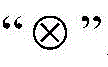
为克罗内克积运算符号,vec(Q)表示对Q进行矩阵矢量化,QT为Q的转置,d=[p11,…,pM1,p12,…,pM2,…,p1N,…,pMN]T,符号“[]”为矢量表示符号,[p11,…,pM1,p12,…,pM2,…,p1N,…,pMN]T为[p11,...,pM1,p12,…,pM2,…,p1N,…,pMN]的转置,
Figure BDA00016848277500000313
r11表示第1个未知节点到第1个锚节点的测量距离,
Figure BDA00016848277500000314
rM1表示第1个未知节点到第M个锚节点的测量距离,
Figure BDA00016848277500000315
r12表示第2个未知节点到第1个锚节点的测量距离,c2表示刚体运动前第2个未知节点在局部参考坐标系中的坐标位置,
Figure BDA00016848277500000316
rM2表示第2个未知节点到第M个锚节点的测量距离,
Figure BDA00016848277500000317
r1N表示第N个未知节点到第1个锚节点的测量距离,
Figure BDA00016848277500000318
rMN表示第N个未知节点到第M个锚节点的测量距离,H=[h11,...,hM1,h12,…,hM2,…,h1N,…,hMN]T,[h11,...,hM1,h12,…,hM2,…,h1N,…,hMN]T为[h11,...,hM1,h12,…,hM2,…,h1N,…,hMN]的转置,
Figure BDA0001684827750000041
Figure BDA0001684827750000042
的转置,
Figure BDA0001684827750000043
为c1的转置,
Figure BDA0001684827750000044
为a1的转置,
Figure BDA0001684827750000045
Figure BDA0001684827750000046
的转置,
Figure BDA0001684827750000047
为aM的转置,
Figure BDA0001684827750000048
Figure BDA0001684827750000049
Figure BDA00016848277500000410
的转置,
Figure BDA00016848277500000411
为c2的转置,
Figure BDA00016848277500000412
Figure BDA00016848277500000413
的转置,
Figure BDA00016848277500000414
Figure BDA00016848277500000415
Figure BDA00016848277500000424
的转置,
Figure BDA00016848277500000416
为cN的转置,
Figure BDA00016848277500000417
Figure BDA00016848277500000418
的转置,f=[(vec(Q))T,tT,(QTt)T,||t||2]T,[(vec(Q))T,tT,(QTt)T,||t||2]T为[(vec(Q))T,tT,(QTt)T,||t||2]的转置,(vec(Q))T为vec(Q)的转置,tT为t的转置,(QTt)T为QTt的转置,
Figure BDA00016848277500000419
[2r11v11,...,2rM1vM1,2r12v12,…,2rM2vM2,…,2r1Nv1N,…,2rMNvMN]T为[2r11v11,...,2rM1vM1,2r12v12,…,2rM2vM2,…,2r1Nv1N,…,2rMNvMN]的转置,v11表示r11中存在的测量噪声,vM1表示rM1中存在的测量噪声,v12表示r12中存在的测量噪声,vM2表示rM2中存在的测量噪声,v1N表示r1N中存在的测量噪声,vMN表示rMN中存在的测量噪声,min()为取最小值函数,(d-Hf)T为(d-Hf)的转置,
Figure BDA00016848277500000420
Figure BDA00016848277500000421
的逆,
Figure BDA00016848277500000422
Figure BDA00016848277500000423
[r11,…,rM1,r12,…,rM2,…,r1N,…,rMN]T为[r11,…,rM1,r12,…,rM2,…,r1N,…,rMN]的转置,
Figure BDA0001684827750000051
diag()为对角线矩阵表示形式,
Figure BDA0001684827750000052
表示v11的功率,
Figure BDA0001684827750000053
表示vM1的功率,
Figure BDA0001684827750000054
表示v12的功率,
Figure BDA0001684827750000055
表示vM2的功率,
Figure BDA0001684827750000056
表示v1N的功率,
Figure BDA0001684827750000057
表示vMN的功率,I为单位矩阵,I的维数为3×3,det(Q)表示求Q的行列式,QTQ=I和det(Q)=1为Q需要满足的条件,“s.t.”表示“受约束于……”;Step 3: Describe the coordinate position of each unknown node in the global reference coordinate system after rigid body motion, and describe the model of s i as: s i =Qc i +t; The measurement distance of the anchor node is described in a model way, and the model of r mi is described as: r mi =||a m -s i ||+v mi =||a m -Qc i -t||+v mi ; Then, the model description of the measured distance from each unknown node to each anchor node is formally organized. For r mi =||am -s i ||+ v mi =||am -Qc i -t ||+v mi , square both sides of the equation r mi =||am -Qc i -t ||+v mi at the same time, ignoring
Figure BDA0001684827750000031
At the same time, replace ||a m -Qc i -t|| with r mi , and get
Figure BDA0001684827750000032
again
Figure BDA0001684827750000033
Figure BDA0001684827750000034
Stacked in the form of a vector, described as:
Figure BDA0001684827750000035
final order
Figure BDA0001684827750000036
is established, and determines the constrained least squares representation of the rigid body localization problem, which is described as:
Figure BDA0001684827750000037
Among them, Q represents the rotation matrix, the dimension of Q is 3×3, t represents the position vector, t represents the coordinate position of the origin of the local reference coordinate system in the global reference coordinate system after rigid body motion, and the dimension of t is 3×1 , the symbol "||||" is the symbol for finding the Euclidean norm, v mi represents the measurement noise existing in r mi , and v mi obeys the Gaussian distribution with zero mean
Figure BDA0001684827750000038
Figure BDA0001684827750000039
represents the power of v mi ,
Figure BDA00016848277500000310
is the transpose of c i ,
Figure BDA00016848277500000311
is the transpose of a m , notation
Figure BDA00016848277500000312
is the Kronecker product symbol, vec(Q) represents the matrix vectorization of Q, Q T is the transpose of Q, d=[p 11 ,...,p M1 ,p 12 ,...,p M2 ,..., p 1N ,…,p MN ] T , the symbol “[]” is a vector representation symbol, [p 11 ,…,p M1 ,p 12 ,…,p M2 ,…,p 1N ,…,p MN ] T is [ transpose of p 11 ,...,p M1 ,p 12 ,...,p M2 ,...,p 1N ,...,p MN ],
Figure BDA00016848277500000313
r 11 represents the measured distance from the first unknown node to the first anchor node,
Figure BDA00016848277500000314
r M1 represents the measured distance from the first unknown node to the Mth anchor node,
Figure BDA00016848277500000315
r 12 represents the measured distance from the second unknown node to the first anchor node, c 2 represents the coordinate position of the second unknown node in the local reference coordinate system before the rigid body motion,
Figure BDA00016848277500000316
r M2 represents the measured distance from the second unknown node to the M-th anchor node,
Figure BDA00016848277500000317
r 1N represents the measured distance from the Nth unknown node to the 1st anchor node,
Figure BDA00016848277500000318
r MN represents the measured distance from the Nth unknown node to the Mth anchor node, H=[h 11 ,...,h M1 ,h 12 ,...,h M2 ,...,h 1N ,...,h MN ] T , [h 11 ,...,h M1 ,h 12 ,…,h M2 ,…,h 1N ,…,h MN ] T is [h 11 ,...,h M1 ,h 12 ,…,h M2 ,…,h 1N ,…,h MN ] transpose,
Figure BDA0001684827750000041
for
Figure BDA0001684827750000042
transpose of ,
Figure BDA0001684827750000043
is the transpose of c 1 ,
Figure BDA0001684827750000044
is the transpose of a 1 ,
Figure BDA0001684827750000045
for
Figure BDA0001684827750000046
transpose of ,
Figure BDA0001684827750000047
is the transpose of a M ,
Figure BDA0001684827750000048
Figure BDA0001684827750000049
for
Figure BDA00016848277500000410
transpose of ,
Figure BDA00016848277500000411
is the transpose of c 2 ,
Figure BDA00016848277500000412
for
Figure BDA00016848277500000413
transpose of ,
Figure BDA00016848277500000414
Figure BDA00016848277500000415
for
Figure BDA00016848277500000424
transpose of ,
Figure BDA00016848277500000416
is the transpose of c N ,
Figure BDA00016848277500000417
for
Figure BDA00016848277500000418
transpose of , f=[(vec(Q)) T ,t T ,(Q T t) T ,||t|| 2 ] T ,[(vec(Q)) T ,t T ,(Q T t ) T ,||t|| 2 ] T is the transpose of [(vec(Q)) T ,t T ,(Q T t) T ,||t|| 2 ], and (vec(Q)) T is The transpose of vec(Q), t T is the transpose of t, (Q T t)T is the transpose of Q T t,
Figure BDA00016848277500000419
[2r 11 v 11 ,...,2r M1 v M1 ,2r 12 v 12 ,…,2r M2 v M2 ,…,2r 1N v 1N ,…,2r MN v MN ] T is [2r 11 v 11 ,. ..,2r M1 v M1 ,2r 12 v 12 ,…,2r M2 v M2 ,…,2r 1N v 1N ,…,2r MN v MN ], v 11 represents the measurement noise present in r 11 , v M1 denotes the measurement noise present in r M1 , v 12 denotes the measurement noise present in r 12 , v M2 denotes the measurement noise present in r M2 , v 1N denotes the measurement noise present in r 1N , v MN denotes the measurement noise present in r MN The measurement noise of , min() is the function of taking the minimum value, (d-Hf) T is the transpose of (d-Hf),
Figure BDA00016848277500000420
for
Figure BDA00016848277500000421
the inverse of ,
Figure BDA00016848277500000422
Figure BDA00016848277500000423
[r 11 ,…,r M1 ,r 12 ,…,r M2 ,…,r 1N ,…,r MN ] T is [r 11 ,…,r M1 ,r 12 ,…,r M2 ,…,r 1N ,…,r MN ] the transpose,
Figure BDA0001684827750000051
diag() is a diagonal matrix representation,
Figure BDA0001684827750000052
represents the power of v 11 ,
Figure BDA0001684827750000053
represents the power of v M1 ,
Figure BDA0001684827750000054
represents the power of v 12 ,
Figure BDA0001684827750000055
represents the power of v M2 ,
Figure BDA0001684827750000056
represents the power of v 1N ,
Figure BDA0001684827750000057
Represents the power of v MN , I is the unit matrix, the dimension of I is 3×3, det(Q) represents the determinant of Q, Q T Q=I and det(Q)=1 are the conditions that Q needs to meet, "st" means "subject to...";

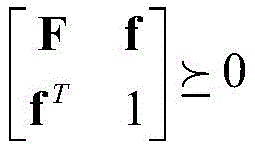
步骤四:令F=ffT,使刚体定位问题的约束最小二乘表述形式中的约束条件QTQ=I等价于

Figure BDA0001684827750000058
并使f中的QTt形成约束条件
Figure BDA0001684827750000059
根据(QTt)TQTt=tTt和||t||2=tTt,得到约束条件
Figure BDA00016848277500000510
然后舍掉刚体定位问题的约束最小二乘表述形式中的约束条件det(Q)=1,将刚体定位问题的约束最小二乘表述形式转化为:
Figure BDA0001684827750000061
再根据F=ffT等价于
Figure BDA0001684827750000062
去掉非凸的关于矩阵F的约束rank(F)=1,将
Figure BDA0001684827750000063
结合到刚体定位问题的约束最小二乘表述形式的转化形式中,得到刚体定位问题的半正定规划形式,描述为:
Figure BDA0001684827750000064
最后对刚体定位问题的半正定规划形式进行求解,得到Q和t各自的初步值,对应记为Qsdp和tsdp;其中,HT为H的转置,dT为d的转置,F为引入的矩阵,F的维数为16×16,fT为f的转置,tr()表示求一个矩阵中的所有对角元素的值的和,F(1:3,1:3)表示由F的第1行至第3行、第1列至第3列所有元素形成的矩阵,F(4:6,4:6)表示由F的第4行至第6行、第4列至第6列所有元素形成的矩阵,F(7:9,7:9)表示由F的第7行至第9行、第7列至第9列所有元素形成的矩阵,F(1,4)表示F的第1行第4列元素的值,F(2,5)表示F的第2行第5列元素的值,F(3,6)表示F的第3行第6列元素的值,F(1,7)表示F的第1行第7列元素的值,F(2,8)表示F的第2行第8列元素的值,F(3,9)表示F的第3行第9列元素的值,F(4,7)表示F的第4行第7列元素的值,F(5,8)表示F的第5行第8列元素的值,F(6,9)表示F的第6行第9列元素的值,f(13)表示f中的第13个元素的值,f(14)表示f中的第14个元素的值,f(15)表示f中的第15个元素的值,F(1:3,10:12)表示由F的第1行至第3行、第10列至第12列所有元素形成的矩阵,F(4:6,10:12)表示由F的第4行至第6行、第10列至第12列所有元素形成的矩阵,F(7:9,10:12)表示由F的第7行至第9行、第10列至第12列所有元素形成的矩阵,F(10:12,10:12)表示由F的第10行至第12行、第10列至第12列所有元素形成的矩阵,F(13:15,13:15)表示由F的第13行至第15行、第13列至第15列所有元素形成的矩阵,f(16)表示f中的第16个元素的值,符号
Figure BDA0001684827750000071
表示一个矩阵是半正定的,rank()表示求一个矩阵的秩;Step 4: Let F=ff T , so that the constraint condition Q T Q=I in the constrained least squares representation of the rigid body positioning problem is equivalent to
Figure BDA0001684827750000058
and make the Q T t in f form a constraint
Figure BDA0001684827750000059
According to (Q T t) T Q T t=t T t and ||t|| 2 =t T t, the constraints are obtained
Figure BDA00016848277500000510
Then discard the constraint det(Q)=1 in the constrained least squares representation of the rigid body localization problem, and convert the constrained least squares representation of the rigid body localization problem into:
Figure BDA0001684827750000061
Then according to F=ff T is equivalent to
Figure BDA0001684827750000062
Remove the non-convex constraint rank(F)=1 about the matrix F, set
Figure BDA0001684827750000063
Combined with the transformation form of the constrained least squares representation of the rigid body localization problem, the semi-positive definite programming form of the rigid body localization problem is obtained, which is described as:
Figure BDA0001684827750000064
Finally, the semi-positive definite programming form of the rigid body positioning problem is solved, and the respective preliminary values of Q and t are obtained, which are correspondingly recorded as Q sdp and t sdp ; where H T is the transposition of H, d T is the transposition of d, and F For the introduced matrix, the dimension of F is 16 × 16, f T is the transpose of f, tr() means to find the sum of the values of all diagonal elements in a matrix, F(1:3,1:3) Represents a matrix formed by all elements from the 1st row to the 3rd row and the 1st column to the 3rd column of F, F(4:6,4:6) represents the 4th row to the 6th row and the 4th column of F The matrix formed by all elements from the 6th column to the 6th column, F(7:9,7:9) represents the matrix formed by all the elements from the 7th row to the 9th row and the 7th column to the 9th column of F, F(1,4 ) represents the value of the element in the 1st row and 4th column of F, F(2,5) represents the value of the element in the 2nd row and 5th column of F, and F(3,6) represents the value of the element in the 3rd row and 6th column of F value, F(1,7) represents the value of the element in the 1st row and 7th column of F, F(2,8) represents the value of the element in the 2nd row and 8th column of F, and F(3,9) represents the value of the element in the 8th column of F. The value of the element in row 3, column 9, F(4,7) represents the value of the element in row 4, column 7 of F, F(5,8) represents the value of the element in row 5, column 8 of F, and F(6 ,9) represents the value of the element in the 6th row and 9th column of F, f(13) represents the value of the 13th element in f, f(14) represents the value of the 14th element in f, and f(15) Represents the value of the 15th element in f, F(1:3,10:12) represents the matrix formed by all elements from the 1st row to the 3rd row and the 10th column to the 12th column of F, F(4: 6,10:12) represents the matrix formed by all elements from the 4th row to the 6th row and the 10th column to the 12th column of F, and F(7:9,10:12) represents the 7th row to the 12th row of F. A matrix formed by all elements in rows 9, columns 10 to 12, F(10:12,10:12) represents a matrix formed by all elements of rows 10 to 12 and columns 10 to 12 of F , F(13:15, 13:15) represents the matrix formed by all elements from the 13th row to the 15th row and the 13th column to the 15th column of F, and f(16) represents the value of the 16th element in f ,symbol
Figure BDA0001684827750000071
Indicates that a matrix is positive semi-definite, and rank() means to find the rank of a matrix;

步骤五:对Qsdp进行正交化,将正交化后得到的值记为Qort,Qort满足

Figure BDA0001684827750000072
且det(Qort)=1;然后将Qort作为Q的估计值,将tsdp作为t的估计值;其中,
Figure BDA0001684827750000073
为Qort的转置,det(Qort)表示求Qort的行列式。Step 5: Orthogonalize Q sdp , denote the value obtained after orthogonalization as Q ort , and Q ort satisfies
Figure BDA0001684827750000072
And det(Q ort )=1; then take Q ort as the estimated value of Q, and take t sdp as the estimated value of t; where,
Figure BDA0001684827750000073
It is the transpose of Q ort , and det(Q ort ) represents the determinant of Q ort .

所述的步骤五执行完毕后,继续执行以下步骤六,具体如下:After the step 5 is completed, continue to execute the following step 6, as follows:

步骤六:对Qort和tsdp进行优化,得到Qort和tsdp各自的优化值,对应记为Qfin和tfin;将Qfin作为Q的最优估计值,将tfin作为t的最优估计值。Step 6: Optimizing Q ort and t sdp to obtain the respective optimized values of Q ort and t sdp , which are correspondingly recorded as Q fin and t fin ; take Q fin as the optimal estimated value of Q, and take t fin as the optimal value of t. best estimate.

与现有技术相比,本发明的优点在于:Compared with the prior art, the advantages of the present invention are:

1)本发明方法充分利用了测量距离等式平方后估计参数和已知参数的线性关系,减少了半正定规划问题中的优化变量,降低了计算复杂度,缩短了计算时间。1) The method of the present invention makes full use of the linear relationship between the estimated parameter and the known parameter after the square of the measured distance equation, reduces the optimization variables in the semi-definite programming problem, reduces the computational complexity, and shortens the computation time.

2)本发明方法中的优化变量较少,且优化变量只与旋转矩阵和位置矢量有关,因此估计结果精度较高,且在无线传感器网络中锚节点分布比较差或无线传感器网络中噪声比较大的情况下,也能对刚体的旋转和位置进行精确估计。2) There are few optimization variables in the method of the present invention, and the optimization variables are only related to the rotation matrix and the position vector, so the accuracy of the estimation result is high, and the distribution of anchor nodes in the wireless sensor network is relatively poor or the noise in the wireless sensor network is relatively large. In the case of , the rotation and position of the rigid body can also be accurately estimated.

3)本发明方法中半正定规划问题中的优化变量个数是固定的,不会随锚节点和刚体内未知节点的个数变化而改变,因此本发明方法的稳健性较高,在不同场景中均有较高的定位精度。3) The number of optimization variables in the semi-definite programming problem in the method of the present invention is fixed, and will not change with the number of anchor nodes and unknown nodes in the rigid body. Therefore, the method of the present invention has high robustness and can be used in different scenarios. Both have high positioning accuracy.

附图说明Description of drawings

图1为本发明方法的总体实现流程框图;Fig. 1 is the overall realization flow chart of the method of the present invention;

图2a为刚体运动前刚体的内部设置的未知节点在局部参考坐标系中的坐标位置的示意图;Fig. 2a is a schematic diagram of the coordinate position of an unknown node set inside the rigid body in the local reference coordinate system before the rigid body moves;

图2b为锚节点在全局参考坐标系中的坐标位置及刚体运动后刚体的内部设置的未知节点在全局参考坐标系中的坐标位置的示意图;Figure 2b is a schematic diagram of the coordinate position of the anchor node in the global reference coordinate system and the coordinate position of the unknown node set in the rigid body after the rigid body moves in the global reference coordinate system;

图3为本发明方法与现有的分拆各个击破的方法和现有的半正定规划方法的关于旋转矩阵的估计值与旋转矩阵的真实值的均方根误差随测量噪声标准差增加的变化图Fig. 3 is the change of the root mean square error of the estimated value of the rotation matrix and the true value of the rotation matrix with the increase of the standard deviation of the measurement noise of the method of the present invention, the existing method of splitting each break and the existing positive semi-definite programming method picture

图4为本发明方法与现有的分拆各个击破的方法和现有的半正定规划方法的关于位置矢量的估计值与位置矢量的真实值的均方根误差随测量噪声标准差增加的变化图。Fig. 4 is the change of the root mean square error of the estimated value of the position vector and the real value of the position vector with the increase of the standard deviation of the measurement noise of the method of the present invention, the existing method of splitting each break and the existing positive semi-definite programming method picture.

具体实施方式Detailed ways

以下结合附图实施例对本发明作进一步详细描述。The present invention will be further described in detail below with reference to the embodiments of the accompanying drawings.

本发明提出的一种基于距离测量的静止刚体定位方法,其总体实现流程框图如图1所示,其包括以下步骤:A static rigid body positioning method based on distance measurement proposed by the present invention, its overall implementation flowchart is shown in Figure 1, which includes the following steps:

步骤一:设定无线传感器网络中存在M个用于接收测量信号的锚节点和一个刚体,并设定刚体的内部放置有N个用于发射测量信号的未知节点;在无线传感器网络中建立一个空间坐标系作为全局参考坐标系,并在刚体的内部设置一个空间坐标系作为局部参考坐标系;将M个锚节点在全局参考坐标系中的坐标位置对应记为a1,...,am,...,aM,将刚体运动前N个未知节点在局部参考坐标系中的坐标位置对应记为c1,...,ci,...,cN;其中,M和N均为正整数,M≥4,如取M=10,N≥3,如取N=5,a1表示第1个锚节点在全局参考坐标系中的坐标位置,m为正整数,1≤m≤M,am表示第m个锚节点在全局参考坐标系中的坐标位置,aM表示第M个锚节点在全局参考坐标系中的坐标位置,c1表示刚体运动前第1个未知节点在局部参考坐标系中的坐标位置,i为正整数,1≤i≤N,ci表示刚体运动前第i个未知节点在局部参考坐标系中的坐标位置,cN表示刚体运动前第N个未知节点在局部参考坐标系中的坐标位置,c1,...,ci,...,cN已知,由人为设定,图2a给出了刚体运动前刚体的内部设置的未知节点在局部参考坐标系中的坐标位置,图2b给出了锚节点在全局参考坐标系中的坐标位置,刚体运动为刚体旋转或位移或旋转和位移。Step 1: Set M anchor nodes for receiving measurement signals and a rigid body in the wireless sensor network, and set N unknown nodes for transmitting measurement signals inside the rigid body; establish a The space coordinate system is used as the global reference coordinate system, and a space coordinate system is set inside the rigid body as the local reference coordinate system; the coordinate positions of the M anchor nodes in the global reference coordinate system are correspondingly recorded as a 1 ,...,a m ,...,a M , the coordinate positions of the N unknown nodes in the local reference coordinate system before the rigid body motion are correspondingly recorded as c 1 ,..., ci ,...,c N ; where M and N is a positive integer, M≥4, if M=10, N≥3, if N=5, a 1 represents the coordinate position of the first anchor node in the global reference coordinate system, m is a positive integer, 1 ≤m≤M, a m represents the coordinate position of the mth anchor node in the global reference coordinate system, a M represents the coordinate position of the Mth anchor node in the global reference coordinate system, c 1 represents the first one before the rigid body motion The coordinate position of the unknown node in the local reference coordinate system, i is a positive integer, 1≤i≤N, c i represents the coordinate position of the ith unknown node in the local reference coordinate system before the rigid body motion, c N represents the rigid body motion before The coordinate position of the Nth unknown node in the local reference coordinate system, c 1 ,..., ci ,...,c N are known and set manually. Figure 2a shows the interior of the rigid body before the rigid body moves. Set the coordinate position of the unknown node in the local reference coordinate system. Figure 2b shows the coordinate position of the anchor node in the global reference coordinate system. The rigid body motion is rigid body rotation or displacement or rotation and displacement.

步骤二:使刚体运动,将刚体运动后N个未知节点在全局参考坐标系中的坐标位置对应记为s1,...,si,...,sN;然后采用现有技术获取每个未知节点到各个锚节点的测量距离,将第i个未知节点到第m个锚节点的测量距离记为rmi(参见图2b);其中,s1表示刚体运动后第1个未知节点在全局参考坐标系中的坐标位置,si表示刚体运动后第i个未知节点在全局参考坐标系中的坐标位置,sN表示刚体运动后第N个未知节点在全局参考坐标系中的坐标位置,s1,...,si,...,sN未知,图2b同时给出了刚体运动后刚体的内部设置的未知节点在全局参考坐标系中的坐标位置。Step 2: Make the rigid body move, and record the coordinate positions of the N unknown nodes in the global reference coordinate system after the rigid body moves as s 1 ,..., si ,...,s N ; and then obtain by using the prior art The measured distance from each unknown node to each anchor node, the measured distance from the i-th unknown node to the m-th anchor node is recorded as r mi (see Figure 2b); where s 1 represents the first unknown node after rigid body motion The coordinate position in the global reference coordinate system, si represents the coordinate position of the ith unknown node in the global reference coordinate system after the rigid body motion, s N represents the coordinate of the Nth unknown node in the global reference coordinate system after the rigid body motion The positions, s 1 ,...,s i ,...,s N are unknown. Figure 2b also shows the coordinate positions of the unknown nodes in the global reference coordinate system of the rigid body after the rigid body moves.

步骤三:对刚体运动后每个未知节点在全局参考坐标系中的坐标位置以模型方式进行描述,将si的模型描述为:si=Qci+t;然后对每个未知节点到各个锚节点的测量距离以模型方式进行描述,将rmi的模型描述为:rmi=||am-si||+vmi=||am-Qci-t||+vmi;接着对每个未知节点到各个锚节点的测量距离的模型描述进行形式整理,对于rmi=||am-si||+vmi=||am-Qci-t||+vmi,将等式rmi=||am-Qci-t||+vmi两边同时平方,忽略

Figure BDA0001684827750000101
同时将||am-Qci-t||替换为rmi,整理得到
Figure BDA0001684827750000102
再将
Figure BDA0001684827750000103
Figure BDA0001684827750000104
堆砌成向量的形式,描述为:
Figure BDA0001684827750000105
最后令
Figure BDA0001684827750000106
成立,并确定刚体定位问题的约束最小二乘表述形式,描述为:
Figure BDA0001684827750000107
其中,Q表示旋转矩阵,Q的维数为3×3,t表示位置矢量,t代表刚体运动后局部参考坐标系的原点在全局参考坐标系中的坐标位置,t的维数为3×1,符号“|| ||”为求欧几里德范数符号,vmi表示rmi中存在的测量噪声,vmi服从零均值的高斯分布
Figure BDA0001684827750000108
Figure BDA0001684827750000109
表示vmi的功率,
Figure BDA00016848277500001010
为ci的转置,
Figure BDA00016848277500001011
为am的转置,符号
Figure BDA00016848277500001012
为克罗内克积运算符号,vec(Q)表示对Q进行矩阵矢量化,QT为Q的转置,d=[p11,...,pM1,p12,…,pM2,…,p1N,…,pMN]T,符号“[]”为矢量表示符号,[p11,...,pM1,p12,…,pM2,…,p1N,…,pMN]T为[p11,…,pM1,p12,…,pM2,…,p1N,…,pMN]的转置,
Figure BDA0001684827750000111
r11表示第1个未知节点到第1个锚节点的测量距离,
Figure BDA0001684827750000112
rM1表示第1个未知节点到第M个锚节点的测量距离,
Figure BDA0001684827750000113
r12表示第2个未知节点到第1个锚节点的测量距离,c2表示刚体运动前第2个未知节点在局部参考坐标系中的坐标位置,
Figure BDA0001684827750000114
rM2表示第2个未知节点到第M个锚节点的测量距离,
Figure BDA0001684827750000115
r1N表示第N个未知节点到第1个锚节点的测量距离,
Figure BDA0001684827750000116
rMN表示第N个未知节点到第M个锚节点的测量距离,H=[h11,…,hM1,h12,…,hM2,…,h1N,…,hMN]T,[h11,...,hM1,h12,…,hM2,…,h1N,…,hMN]T为[h11,...,hM1,h12,…,hM2,…,h1N,…,hMN]的转置,
Figure BDA0001684827750000117
Figure BDA0001684827750000118
的转置,
Figure BDA0001684827750000119
为c1的转置,
Figure BDA00016848277500001110
为a1的转置,
Figure BDA00016848277500001111
Figure BDA00016848277500001112
的转置,
Figure BDA00016848277500001113
为aM的转置,
Figure BDA00016848277500001114
Figure BDA00016848277500001115
Figure BDA00016848277500001116
的转置,
Figure BDA00016848277500001117
为c2的转置,
Figure BDA00016848277500001118
Figure BDA00016848277500001119
的转置,
Figure BDA00016848277500001120
Figure BDA00016848277500001121
Figure BDA00016848277500001122
的转置,
Figure BDA00016848277500001123
为cN的转置,
Figure BDA00016848277500001124
Figure BDA00016848277500001125
的转置,f=[(vec(Q))T,tT,(QTt)T,||t||2]T,[(vec(Q))T,tT,(QTt)T,||t||2]T为[(vec(Q))T,tT,(QTt)T,||t||2]的转置,(vec(Q))T为vec(Q)的转置,tT为t的转置,(QTt)T为QTt的转置,
Figure BDA00016848277500001126
[2r11v11,...,2rM1vM1,2r12v12,…,2rM2vM2,…,2r1Nv1N,…,2rMNvMN]T为[2r11v11,...,2rM1vM1,2r12v12,…,2rM2vM2,…,2r1Nv1N,…,2rMNvMN]的转置,v11表示r11中存在的测量噪声,vM1表示rM1中存在的测量噪声,v12表示r12中存在的测量噪声,vM2表示rM2中存在的测量噪声,v1N表示r1N中存在的测量噪声,vMN表示rMN中存在的测量噪声,min()为取最小值函数,(d-Hf)T为(d-Hf)的转置,
Figure BDA0001684827750000121
Figure BDA0001684827750000122
的逆,
Figure BDA0001684827750000123
Figure BDA0001684827750000124
[r11,...,rM1,r12,…,rM2,…,r1N,…,rMN]T为[r11,...,rM1,r12,…,rM2,…,r1N,…,rMN]的转置,
Figure BDA0001684827750000125
diag()为对角线矩阵表示形式,
Figure BDA0001684827750000126
表示v11的功率,
Figure BDA0001684827750000127
表示vM1的功率,
Figure BDA0001684827750000128
表示v12的功率,
Figure BDA0001684827750000129
表示vM2的功率,
Figure BDA00016848277500001210
表示v1N的功率,
Figure BDA00016848277500001211
表示vMN的功率,I为单位矩阵,I的维数为3×3,det(Q)表示求Q的行列式,QTQ=I和det(Q)=1为Q需要满足的条件,“s.t.”表示“受约束于……”。Step 3: Describe the coordinate position of each unknown node in the global reference coordinate system after rigid body motion, and describe the model of s i as: s i =Qc i +t; The measurement distance of the anchor node is described in a model way, and the model of r mi is described as: r mi =||a m -s i ||+v mi =||a m -Qc i -t||+v mi ; Then, the model description of the measured distance from each unknown node to each anchor node is formally organized. For r mi =||am -s i ||+ v mi =||am -Qc i -t ||+v mi , square both sides of the equation r mi =||am -Qc i -t ||+v mi at the same time, ignoring
Figure BDA0001684827750000101
At the same time, replace ||a m -Qc i -t|| with r mi , and get
Figure BDA0001684827750000102
again
Figure BDA0001684827750000103
Figure BDA0001684827750000104
Stacked in the form of a vector, described as:
Figure BDA0001684827750000105
final order
Figure BDA0001684827750000106
is established, and determines the constrained least squares representation of the rigid body localization problem, which is described as:
Figure BDA0001684827750000107
Among them, Q represents the rotation matrix, the dimension of Q is 3×3, t represents the position vector, t represents the coordinate position of the origin of the local reference coordinate system in the global reference coordinate system after rigid body motion, and the dimension of t is 3×1 , the symbol "|| ||" is the symbol for finding the Euclidean norm, v mi represents the measurement noise existing in r mi , and v mi obeys a Gaussian distribution with zero mean
Figure BDA0001684827750000108
Figure BDA0001684827750000109
represents the power of v mi ,
Figure BDA00016848277500001010
is the transpose of c i ,
Figure BDA00016848277500001011
is the transpose of a m , notation
Figure BDA00016848277500001012
is the Kronecker product symbol, vec(Q) represents the matrix vectorization of Q, Q T is the transpose of Q, d=[p 11 ,...,p M1 ,p 12 ,...,p M2 , …,p 1N ,…,p MN ] T , the symbol “[]” is a vector representation symbol, [p 11 ,…,p M1 ,p 12 ,…,p M2 ,…,p 1N ,…,p MN ] T is the transpose of [p 11 ,…,p M1 ,p 12 ,…,p M2 ,…,p 1N ,…,p MN ],
Figure BDA0001684827750000111
r 11 represents the measured distance from the first unknown node to the first anchor node,
Figure BDA0001684827750000112
r M1 represents the measured distance from the first unknown node to the Mth anchor node,
Figure BDA0001684827750000113
r 12 represents the measured distance from the second unknown node to the first anchor node, c 2 represents the coordinate position of the second unknown node in the local reference coordinate system before the rigid body motion,
Figure BDA0001684827750000114
r M2 represents the measured distance from the second unknown node to the M-th anchor node,
Figure BDA0001684827750000115
r 1N represents the measured distance from the Nth unknown node to the 1st anchor node,
Figure BDA0001684827750000116
r MN represents the measured distance from the Nth unknown node to the Mth anchor node, H=[h 11 ,...,h M1 ,h 12 ,...,h M2 ,...,h 1N ,...,h MN ] T ,[ h 11 ,...,h M1 ,h 12 ,…,h M2 ,…,h 1N ,…,h MN ] T is [h 11 ,...,h M1 ,h 12 ,…,h M2 ,… ,h 1N ,…,h MN ] the transpose,
Figure BDA0001684827750000117
for
Figure BDA0001684827750000118
transpose of ,
Figure BDA0001684827750000119
is the transpose of c 1 ,
Figure BDA00016848277500001110
is the transpose of a 1 ,
Figure BDA00016848277500001111
for
Figure BDA00016848277500001112
transpose of ,
Figure BDA00016848277500001113
is the transpose of a M ,
Figure BDA00016848277500001114
Figure BDA00016848277500001115
for
Figure BDA00016848277500001116
transpose of ,
Figure BDA00016848277500001117
is the transpose of c 2 ,
Figure BDA00016848277500001118
for
Figure BDA00016848277500001119
transpose of ,
Figure BDA00016848277500001120
Figure BDA00016848277500001121
for
Figure BDA00016848277500001122
transpose of ,
Figure BDA00016848277500001123
is the transpose of c N ,
Figure BDA00016848277500001124
for
Figure BDA00016848277500001125
transpose of , f=[(vec(Q)) T ,t T ,(Q T t) T ,||t|| 2 ] T ,[(vec(Q)) T ,t T ,(Q T t ) T ,||t|| 2 ]T is the transpose of [(vec(Q)) T ,t T ,(Q T t) T ,||t||2], (vec(Q)) T is The transpose of vec(Q), t T is the transpose of t, (Q T t) T is the transpose of Q T t,
Figure BDA00016848277500001126
[2r 11 v 11 ,...,2r M1 v M1 ,2r 12 v 12 ,...,2r M2 v M2 ,...,2r 1N v 1N ,...,2r MN v MN ] T is [2r 11 v 11 ,. ..,2r M1 v M1 ,2r 12 v 12 ,…,2r M2 v M2 ,…,2r 1N v 1N ,…,2r MN v MN ], v 11 represents the measurement noise present in r 11 , v M1 denotes the measurement noise present in r M1 , v 12 denotes the measurement noise present in r 12 , v M2 denotes the measurement noise present in r M2 , v 1N denotes the measurement noise present in r 1N , v MN denotes the measurement noise present in r MN The measurement noise of , min() is the function of taking the minimum value, (d-Hf) T is the transpose of (d-Hf),
Figure BDA0001684827750000121
for
Figure BDA0001684827750000122
the inverse of ,
Figure BDA0001684827750000123
Figure BDA0001684827750000124
[r 11 ,...,r M1 ,r 12 ,…,r M2 ,…,r 1N ,…,r MN ] T is [r 11 ,...,r M1 ,r 12 ,…,r M2 , The transpose of …,r 1N ,…,r MN ],
Figure BDA0001684827750000125
diag() is a diagonal matrix representation,
Figure BDA0001684827750000126
represents the power of v 11 ,
Figure BDA0001684827750000127
represents the power of v M1 ,
Figure BDA0001684827750000128
represents the power of v 12 ,
Figure BDA0001684827750000129
represents the power of v M2 ,
Figure BDA00016848277500001210
represents the power of v 1N ,
Figure BDA00016848277500001211
Represents the power of v MN , I is the unit matrix, the dimension of I is 3×3, det(Q) represents the determinant of Q, Q T Q=I and det(Q)=1 are the conditions that Q needs to meet, "st" means "subject to...".

步骤四:令F=ffT,使刚体定位问题的约束最小二乘表述形式中的约束条件QTQ=I等价于

Figure BDA00016848277500001212
并使f中的QTt形成约束条件
Figure BDA00016848277500001213
根据(QTt)TQTt=tTt和||t||2=tTt,得到约束条件
Figure BDA00016848277500001214
然后舍掉刚体定位问题的约束最小二乘表述形式中的约束条件det(Q)=1,将刚体定位问题的约束最小二乘表述形式转化为:
Figure BDA0001684827750000131
再根据F=ffT等价于
Figure BDA0001684827750000132
去掉非凸的关于矩阵F的约束rank(F)=1,将
Figure BDA0001684827750000133
结合到刚体定位问题的约束最小二乘表述形式的转化形式中,得到刚体定位问题的半正定规划形式,描述为:
Figure BDA0001684827750000134
最后对刚体定位问题的半正定规划形式进行求解,得到Q和t各自的初步值,对应记为Qsdp和tsdp;其中,HT为H的转置,dT为d的转置,F为引入的矩阵,F的维数为16×16,fT为f的转置,tr()表示求一个矩阵中的所有对角元素的值的和,F(1:3,1:3)表示由F的第1行至第3行、第1列至第3列所有元素形成的矩阵,F(4:6,4:6)表示由F的第4行至第6行、第4列至第6列所有元素形成的矩阵,F(7:9,7:9)表示由F的第7行至第9行、第7列至第9列所有元素形成的矩阵,F(1,4)表示F的第1行第4列元素的值,F(2,5)表示F的第2行第5列元素的值,F(3,6)表示F的第3行第6列元素的值,F(1,7)表示F的第1行第7列元素的值,F(2,8)表示F的第2行第8列元素的值,F(3,9)表示F的第3行第9列元素的值,F(4,7)表示F的第4行第7列元素的值,F(5,8)表示F的第5行第8列元素的值,F(6,9)表示F的第6行第9列元素的值,f(13)表示f中的第13个元素的值,f(14)表示f中的第14个元素的值,f(15)表示f中的第15个元素的值,F(1:3,10:12)表示由F的第1行至第3行、第10列至第12列所有元素形成的矩阵,F(4:6,10:12)表示由F的第4行至第6行、第10列至第12列所有元素形成的矩阵,F(7:9,10:12)表示由F的第7行至第9行、第10列至第12列所有元素形成的矩阵,F(10:12,10:12)表示由F的第10行至第12行、第10列至第12列所有元素形成的矩阵,F(13:15,13:15)表示由F的第13行至第15行、第13列至第15列所有元素形成的矩阵,f(16)表示f中的第16个元素的值,符号
Figure BDA0001684827750000141
表示一个矩阵是半正定的,rank()表示求一个矩阵的秩。Step 4: Let F=ff T , so that the constraint condition Q T Q=I in the constrained least squares representation of the rigid body positioning problem is equivalent to
Figure BDA00016848277500001212
and make the Q T t in f form a constraint
Figure BDA00016848277500001213
According to (Q T t) T Q T t=t T t and ||t|| 2 =t T t, the constraints are obtained
Figure BDA00016848277500001214
Then discard the constraint det(Q)=1 in the constrained least squares representation of the rigid body localization problem, and convert the constrained least squares representation of the rigid body localization problem into:
Figure BDA0001684827750000131
Then according to F=ff T is equivalent to
Figure BDA0001684827750000132
Remove the non-convex constraint rank(F)=1 about the matrix F, set
Figure BDA0001684827750000133
Combined with the transformation form of the constrained least squares representation of the rigid body localization problem, the semi-positive definite programming form of the rigid body localization problem is obtained, which is described as:
Figure BDA0001684827750000134
Finally, the semi-positive definite programming form of the rigid body positioning problem is solved, and the respective preliminary values of Q and t are obtained, which are correspondingly recorded as Q sdp and t sdp ; where H T is the transposition of H, d T is the transposition of d, and F For the introduced matrix, the dimension of F is 16 × 16, f T is the transpose of f, tr() means to find the sum of the values of all diagonal elements in a matrix, F(1:3,1:3) Represents a matrix formed by all elements from the 1st row to the 3rd row and the 1st column to the 3rd column of F, F(4:6,4:6) represents the 4th row to the 6th row and the 4th column of F The matrix formed by all elements from the 6th column to the 6th column, F(7:9,7:9) represents the matrix formed by all the elements from the 7th row to the 9th row and the 7th column to the 9th column of F, F(1,4 ) represents the value of the element in the 1st row and 4th column of F, F(2,5) represents the value of the element in the 2nd row and 5th column of F, and F(3,6) represents the value of the element in the 3rd row and 6th column of F value, F(1,7) represents the value of the element in the 1st row and 7th column of F, F(2,8) represents the value of the element in the 2nd row and 8th column of F, and F(3,9) represents the value of the element in the 8th column of F. The value of the element in row 3, column 9, F(4,7) represents the value of the element in row 4, column 7 of F, F(5,8) represents the value of the element in row 5, column 8 of F, and F(6 ,9) represents the value of the element in the 6th row and 9th column of F, f(13) represents the value of the 13th element in f, f(14) represents the value of the 14th element in f, and f(15) Represents the value of the 15th element in f, F(1:3,10:12) represents the matrix formed by all elements from the 1st row to the 3rd row and the 10th column to the 12th column of F, F(4: 6,10:12) represents the matrix formed by all elements from the 4th row to the 6th row and the 10th column to the 12th column of F, and F(7:9,10:12) represents the 7th row to the 12th row of F. A matrix formed by all elements in rows 9, columns 10 to 12, F(10:12,10:12) represents a matrix formed by all elements of rows 10 to 12 and columns 10 to 12 of F , F(13:15, 13:15) represents the matrix formed by all elements from the 13th row to the 15th row and the 13th column to the 15th column of F, and f(16) represents the value of the 16th element in f ,symbol
Figure BDA0001684827750000141
Indicates that a matrix is positive semi-definite, and rank() means to find the rank of a matrix.

步骤五:由于在步骤四中忽略了约束条件det(Q)=1,因此刚体定位问题的半正定规划形式关于Q的求解结果Qsdp并不准确,甚至不能满足旋转矩阵的性质,即可能出现

Figure BDA0001684827750000142
或者det(Qsdp)<0的情况,
Figure BDA0001684827750000143
为Qsdp的转置,故在本步骤中采用现有技术对Qsdp进行正交化,将正交化后得到的值记为Qort,Qort满足
Figure BDA0001684827750000144
且det(Qort)=1;然后将Qort作为Q的估计值,将tsdp作为t的估计值;其中,
Figure BDA0001684827750000145
为Qort的转置,det(Qort)表示求Qort的行列式。Step 5: Since the constraint condition det(Q)=1 is ignored in step 4, the solution result Q sdp of the semi-definite programming form of the rigid body positioning problem is inaccurate with respect to Q, and even cannot satisfy the properties of the rotation matrix, that is, it may occur.
Figure BDA0001684827750000142
Or in the case of det(Q sdp )<0,
Figure BDA0001684827750000143
is the transposition of Q sdp , so in this step, the prior art is used to orthogonalize Q sdp , and the value obtained after the orthogonalization is denoted as Q ort , and Q ort satisfies
Figure BDA0001684827750000144
And det(Q ort )=1; then take Q ort as the estimated value of Q, and take t sdp as the estimated value of t; where,
Figure BDA0001684827750000145
It is the transpose of Q ort , and det(Q ort ) represents the determinant of Q ort .

在此,对Qsdp进行正交化所采用的双重迭代算法为:

Figure BDA0001684827750000151
当abs(det(Xn+1)-1)<10-4或者迭代次数达到设定上限时,迭代终止,其中,X0表示迭代初始值,Xn表示第n迭代得到的值,Xn+1表示第n+1迭代得到的值,abs()为求绝对值函数。Here, the double iterative algorithm used to orthogonalize Q sdp is:
Figure BDA0001684827750000151
When abs(det(X n+1 )-1)<10 -4 or the number of iterations reaches the upper limit, the iteration is terminated, where X 0 represents the initial value of the iteration, X n represents the value obtained by the nth iteration, and X n +1 represents the value obtained by the n+1th iteration, and abs() is the absolute value function.

步骤六:对Qort和tsdp进行优化,得到Qort和tsdp各自的优化值,对应记为Qfin和tfin;将Qfin作为Q的最优估计值,将tfin作为t的最优估计值。Step 6: Optimizing Q ort and t sdp to obtain the respective optimized values of Q ort and t sdp , which are correspondingly recorded as Q fin and t fin ; take Q fin as the optimal estimated value of Q, and take t fin as the optimal value of t. best estimate.

在本实施例中,步骤六中对Qort和tsdp进行优化采用的优化方法为论文“J.Jiang,G.Wang,and K.C.Ho,``Accurate localization of a rigid body via semidefiniterelaxation,”IEEE Signal Process.Lett.,vol.25,no.3,pp,378-382,Mar.2018.”(蒋坚,王刚,K.C.Ho,“基于半正定规划的精确刚体定位,”IEEE Signal Process.Lett,第25卷,第3期,页码,378-382,三月,2018年)中公开的优化方法,步骤六的具体过程为:In this embodiment, the optimization method used to optimize Q ort and t sdp in step 6 is the paper "J.Jiang, G.Wang, and KCHo, "Accurate localization of a rigid body via semidefiniterelaxation," IEEE Signal Process .Lett., vol.25, no.3, pp, 378-382, Mar. 2018.” (Jian Jiang, Gang Wang, KCHo, “Accurate Rigid Body Localization Based on Positive Semidefinite Programming,” IEEE Signal Process. Lett, pp. 25 The optimization method disclosed in Volume, Issue 3, Pages, 378-382, March, 2018), the specific process of Step 6 is:

1)令Qfin表示Q的最优估计值,令tfin表示t的最优估计值;令Qfin=QortQδ,tfin=tsdp+Δt;如果Qδ满足旋转矩阵的性质,则Qfin也满足,因此在合理的假设Qδ中的欧拉角都接近于0的前提下,使用近似等式cosx≈1,sinx≈x,x为欧拉角,则得到Qδ的近似表达式为:

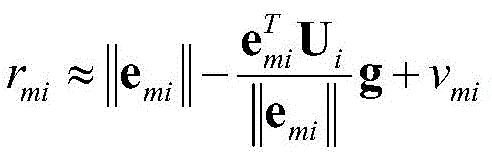
Figure BDA0001684827750000152
然后对Qδ的近似表达式进行线性化,得到vec(Qδ)=γ+Lβ;并将Qfin=QortQδ和tfin=tsdp+Δt代入rmi=||am-Qci-t||+vmi中,得到rmi=||am-Qfinci-tfin||+vmi=||am-QortQδci-tsdp-Δt||+vmi;接着将vec(Qδ)=γ+Lβ代入rmi=||am-Qfinci-tfin||+vmi=||am-QortQδci-tsdp-Δt||+vmi中,得到rmi=||emi-Uig||+vmi;之后对rmi=||emi-Uig||+vmi的等式右边进行一阶泰勒展开,得到
Figure BDA0001684827750000161
Figure BDA0001684827750000162
的两边同乘以||emi||,得到
Figure BDA0001684827750000163
令qmi=(rmi-||emi||)||emi||,则有
Figure BDA0001684827750000164
再将
Figure BDA0001684827750000165
Figure BDA0001684827750000166
堆砌成向量的形式,描述为:
Figure BDA0001684827750000167
最后令
Figure BDA0001684827750000168
成立,求解
Figure BDA0001684827750000169
中的g的线性加权最小二乘解,记为
Figure BDA00016848277500001610
Figure BDA00016848277500001611
其中,Qδ表示Q的修正矩阵,Δt表示t的修正矢量,θ、ψ和φ均为Qδ中的欧拉角,
Figure BDA00016848277500001612
Figure BDA00016848277500001613
kθ=sinθ,kψ=sinψ,kφ=sinφ,cos为求余弦函数,sin为求正弦函数,vec(Qδ)表示对Qδ进行矩阵矢量化,γ=[1 0 0 0 1 0 0 0 1]T,[1 0 0 0 1 0 0 0 1]T为[1 0 0 0 1 0 0 0 1]的转置,
Figure BDA00016848277500001614
Figure BDA00016848277500001615
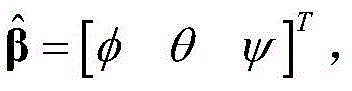
的转置,β=[φ θ ψ]T,[φ θ ψ]T为[φ θ ψ]的转置,
Figure BDA00016848277500001616
Figure BDA00016848277500001617
为ci的转置,
Figure BDA00016848277500001618
1) Let Q fin denote the optimal estimated value of Q, and let t fin denote the optimal estimated value of t; let Q fin =Q ort Q δ , t fin =t sdp +Δt; if Q δ satisfies the properties of the rotation matrix, Then Q fin is also satisfied, so under the premise that the Euler angles in Q δ are all close to 0, the approximate equation cosx≈1, sinx≈x, x is the Euler angle, then the approximation of Q δ is obtained The expression is:
Figure BDA0001684827750000152
Then the approximate expression of Q δ is linearized to obtain vec(Q δ )=γ+Lβ; and Q fin =Q ort Q δ and t fin =t sdp +Δt are substituted into r mi =||am -Qc i -t||+v mi , r mi =||a m -Q fin c i -t fin ||+v mi =||a m -Q ort Q δ c i -t sdp -Δt|| +v mi ; then substitute vec(Q δ )=γ+Lβ into r mi =|| am -Q fin c i -t fin ||+v mi =|| am -Q ort Q δ c i -t In sdp -Δt||+v mi , we get r mi =||e mi -U i g||+v mi ; then to the right side of the equation of r mi =||e mi -U i g||+v mi Perform a first-order Taylor expansion to get
Figure BDA0001684827750000161
right
Figure BDA0001684827750000162
Multiply both sides by ||e mi || to get
Figure BDA0001684827750000163
Let q mi = (r mi -||e mi ||)||e mi ||, then we have
Figure BDA0001684827750000164
again
Figure BDA0001684827750000165
Figure BDA0001684827750000166
Stacked in the form of a vector, described as:
Figure BDA0001684827750000167
final order
Figure BDA0001684827750000168
establish, solve
Figure BDA0001684827750000169
The linear weighted least squares solution of g in , denoted as
Figure BDA00016848277500001610
Figure BDA00016848277500001611
Among them, Q δ represents the correction matrix of Q, Δt represents the correction vector of t, θ, ψ and φ are all Euler angles in Q δ ,
Figure BDA00016848277500001612
Figure BDA00016848277500001613
k θ = sinθ, k ψ =sinψ, k φ =sinφ, cos is the cosine function, sin is the sine function, vec(Q δ ) represents matrix vectorization of Q δ , γ=[1 0 0 0 1 0 0 0 1] T , [1 0 0 0 1 0 0 0 1] T is the transpose of [1 0 0 0 1 0 0 0 1],
Figure BDA00016848277500001614
for
Figure BDA00016848277500001615
The transpose of , β=[φ θ ψ] T , [φ θ ψ] T is the transpose of [φ θ ψ],
Figure BDA00016848277500001616
Figure BDA00016848277500001617
is the transpose of c i ,
Figure BDA00016848277500001618

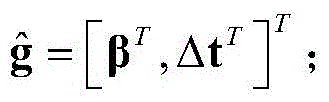
g=[βT,ΔtT]T,βT为β的转置,ΔtT为Δt的转置,[βT,ΔtT]T为[βT,ΔtT]的转置,

Figure BDA00016848277500001619
为emi的转置,qmi为引入的变量,
Figure BDA00016848277500001620
[q11,...,qM1,q12,…,qM2,…,q1N,…,qMN]T为[q11,...,qM1,q12,…,qM2,…,q1N,…,qMN]的转置,q11=(r11-||e11||)||e11||,qM1=(rM1-||eM1||)||eM1||,q12=(r12-||e12||)||e12||,qM2=(rM2-||eM2||)||eM2||,q1N=(r1N-||e1N||)||e1N||,qMN=(rMN-||eMN||)||eMN||,
Figure BDA0001684827750000171
Figure BDA0001684827750000172
Figure BDA0001684827750000173
的转置,
Figure BDA0001684827750000174
为U1的转置,
Figure BDA0001684827750000175
Figure BDA0001684827750000176
为U2的转置,
Figure BDA0001684827750000177
Figure BDA0001684827750000178
为UN的转置,
Figure BDA0001684827750000179
Figure BDA00016848277500001710
g=[β T ,Δt T ] T , β T is the transposition of β, Δt T is the transposition of Δt, [β T ,Δt T ] T is the transposition of [β T ,Δt T ],
Figure BDA00016848277500001619
is the transpose of e mi , qmi is the introduced variable,
Figure BDA00016848277500001620
[q 11 ,...,q M1 ,q 12 ,...,q M2 ,...,q 1N ,...,q MN ] T is [q 11 ,...,q M1 ,q 12 ,...,q M2 , Transpose of ...,q 1N ,...,q MN ], q 11 =(r 11 -||e 11 ||)||e 11 ||, q M1 =(r M1 -||e M1 ||)| |e M1 ||, q 12 = (r 12 -||e 12 ||)||e 12 ||, q M2 = (r M2 -||e M2 ||)||e M2 ||, q 1N =(r 1N -||e 1N ||)||e 1N ||, q MN =(r MN -||e MN ||)||e MN ||,
Figure BDA0001684827750000171
Figure BDA0001684827750000172
for
Figure BDA0001684827750000173
transpose of ,
Figure BDA0001684827750000174
is the transpose of U 1 ,
Figure BDA0001684827750000175
Figure BDA0001684827750000176
is the transpose of U2 ,
Figure BDA0001684827750000177
Figure BDA0001684827750000178
is the transpose of U N ,
Figure BDA0001684827750000179
Figure BDA00016848277500001710

[||e11||v11,...,||eM1||vM1,||e12||v12,…,||eM2||vM2,…,||e1N||v1N,…,||eMN||vMN]T[||e 11 ||v 11 , ..., ||e M1 ||v M1 , ||e 12 ||v 12 , ..., ||e M2 ||v M2 , ..., ||e 1N | |v 1N , …, ||e MN ||v MN ] T is

[||e11||v11,...,||eM1||vM1,||e12||v12,…,||eM2||vM2,…,||e1N||v1N,…,||eMN||vMN]的转置,

Figure BDA00016848277500001711
Figure BDA00016848277500001712
的转置,
Figure BDA00016848277500001713
Figure BDA00016848277500001714
的逆,
Figure BDA00016848277500001715
Figure BDA00016848277500001716
[||e11||,...,||eM1||,||e12||,…,||eM2||,…,||e1N||,…,||eMN||]T为[||e11||,...,||eM1||,||e12||,…,||eM2||,…,||e1N||,…,||eMN||]的转置,
Figure BDA00016848277500001717
Figure BDA00016848277500001718
Figure BDA00016848277500001719
Figure BDA00016848277500001720
Figure BDA00016848277500001721
的逆。[||e 11 ||v 11 , ..., ||e M1 ||v M1 , ||e 12 ||v 12 , ..., ||e M2 ||v M2 , ..., ||e 1N | Transpose of |v 1N , …, ||e MN ||v MN ],
Figure BDA00016848277500001711
for
Figure BDA00016848277500001712
transpose of ,
Figure BDA00016848277500001713
for
Figure BDA00016848277500001714
the inverse of ,
Figure BDA00016848277500001715
Figure BDA00016848277500001716
[||e 11 ||, …, ||e M1 ||, ||e 12 ||, …, ||e M2 ||, …, ||e 1N ||, …, ||e MN ||] T is [||e 11 ||, …, ||e M1 ||, ||e 12 ||, …, ||e M2 ||, …, ||e 1N ||, … , the transpose of ||e MN ||],
Figure BDA00016848277500001717
Figure BDA00016848277500001718
Figure BDA00016848277500001719
Figure BDA00016848277500001720
for
Figure BDA00016848277500001721
inverse of .

2)将

Figure BDA00016848277500001722
代入g=[βT,ΔtT]T中,得到
Figure BDA00016848277500001723
进而根据
Figure BDA00016848277500001724
得到β和Δt的估计值,对应记为
Figure BDA00016848277500001725
Figure BDA00016848277500001726
然后将
Figure BDA00016848277500001727
代入β=[φ θ ψ]T中,得到
Figure BDA00016848277500001728
进而根据
Figure BDA00016848277500001729
得到φ、θ和ψ各自的值;接着将φ、θ和ψ各自的值代入
Figure BDA00016848277500001730
中,得到Qδ的估计值,记为
Figure BDA00016848277500001731
最后将
Figure BDA00016848277500001732
代入Qfin=QortQδ中,得到
Figure BDA00016848277500001733
即得到Qfin的值;并将
Figure BDA00016848277500001734
代入tfin=tsdp+Δt中,得到
Figure BDA0001684827750000181
即得到tfin的值。2) will
Figure BDA00016848277500001722
Substitute into g=[β T , Δt T ] T , we get
Figure BDA00016848277500001723
and then according to
Figure BDA00016848277500001724
The estimated values of β and Δt are obtained, corresponding to
Figure BDA00016848277500001725
and
Figure BDA00016848277500001726
followed by
Figure BDA00016848277500001727
Substitute into β=[φ θ ψ] T , we get
Figure BDA00016848277500001728
and then according to
Figure BDA00016848277500001729
Obtain the respective values of φ, θ, and ψ; then substitute the respective values of φ, θ, and ψ into
Figure BDA00016848277500001730
, the estimated value of Q δ is obtained, denoted as
Figure BDA00016848277500001731
will finally
Figure BDA00016848277500001732
Substituting into Q fin =Q ort Q δ , we get
Figure BDA00016848277500001733
That is to get the value of Q fin ; and
Figure BDA00016848277500001734
Substitute into t fin =t sdp +Δt, we get
Figure BDA0001684827750000181
That is, the value of t fin is obtained.

上述步骤六的过程是为了进一步提高定位精度,对已求得的Qort和tsdp进行优化。The process of the above-mentioned step 6 is to further improve the positioning accuracy and optimize the obtained Q ort and t sdp .

为了验证本发明方法的可行性和有效性,对本发明方法进行仿真试验。In order to verify the feasibility and effectiveness of the method of the present invention, a simulation test is carried out on the method of the present invention.

假设刚体的内部放置了N=5个未知节点,其相对于刚体的内部设置的局部参考坐标系的坐标位置分别为矩阵

Figure BDA0001684827750000182
的各列。无线传感器网络中放置了M=6个锚节点,其位置均随机分布在长、宽、高对应为200米、100米、30米的长方体内(锚节点分布比较差),该长方体的中心位置的坐标位置在全局参考坐标系中为[0,-50,-85]T,[0,-50,-85]T为[0,-50,-85]的转置。刚体的旋转和位移设置如下:假设初始状态下局部参考坐标系和全局参考坐标系重合,即在全局参考坐标系中刚体的内部的未知节点的初始位置的坐标就是其在局部参考坐标系下的坐标位置;刚体相对于X,Y,Z轴的旋转角度分别为20度、-25度和10度;位置矢量为t=[50,50,20]T,[50,50,20]T为[50,50,20]的转置。假设同一个锚节点到所有未知节点的测量距离中存在的测量噪声的功率一致,不同的锚节点到未知节点的测量距离中存在的测量噪声的功率不同。设定未知节点到不同锚节点的测量噪声标准差分别为
Figure BDA0001684827750000183
σ表示仿真时参考的测量噪声标准差,σ∈[0.01,10]。Assuming that N=5 unknown nodes are placed inside the rigid body, their coordinate positions relative to the local reference coordinate system set inside the rigid body are respectively a matrix
Figure BDA0001684827750000182
of each column. M=6 anchor nodes are placed in the wireless sensor network, and their positions are randomly distributed in the rectangular parallelepiped with length, width and height corresponding to 200 meters, 100 meters, and 30 meters (the distribution of anchor nodes is relatively poor). The coordinate position of is [0,-50,-85] T in the global reference coordinate system, and [0,-50,-85] T is the transpose of [0,-50,-85]. The rotation and displacement of the rigid body are set as follows: Assuming that the local reference coordinate system and the global reference coordinate system are coincident in the initial state, that is, the coordinates of the initial positions of the unknown nodes inside the rigid body in the global reference coordinate system are their coordinates in the local reference coordinate system. Coordinate position; the rotation angles of the rigid body relative to the X, Y, Z axes are 20 degrees, -25 degrees and 10 degrees respectively; the position vector is t=[50,50,20] T , [50,50,20] T is Transpose of [50,50,20]. It is assumed that the power of measurement noise existing in the measurement distances from the same anchor node to all unknown nodes is the same, and the powers of measurement noise existing in the measurement distances from different anchor nodes to unknown nodes are different. The standard deviations of measurement noise from unknown nodes to different anchor nodes are set as
Figure BDA0001684827750000183
σ represents the standard deviation of the measured noise referenced during simulation, σ∈[0.01,10].

测试本发明方法的性能随测量噪声标准差增加的变化情况。图3给出了本发明方法与现有的分拆各个击破的方法和现有的半正定规划方法的关于旋转矩阵Q的估计值与旋转矩阵Q的真实值的均方根误差随测量噪声标准差增加的变化图;图4给出了本发明方法与现有的分拆各个击破的方法和现有的半正定规划方法的关于位置矢量t的估计值与位置矢量t的真实值的均方根误差随测量噪声标准差增加的变化图。从图3和图4中可以看出,在无线传感器网络中锚节点分布比较差和无线传感器网络中噪声比较大的情况下,无论是关于Q,还是关于t的估计,本发明方法明显优于现有的分拆各个击破的方法,当测量噪声的功率在中等到较大的水平时,本发明方法对t的估计也优于现有的半正定规划方法,对Q的估计与现有的半正定规划方法性能接近,同时本发明方法的复杂度比现有的半正定规划方法低,足以说明本发明方法在刚体定位的精度方面有足够的优势。The performance of the method of the present invention was tested as a function of the increase in the standard deviation of the measurement noise. Fig. 3 shows the root mean square error of the estimated value of the rotation matrix Q and the real value of the rotation matrix Q with the measurement noise standard of the method of the present invention, the existing method of splitting each break and the existing positive semi-definite programming method Figure 4 shows the mean square of the estimated value of the position vector t and the real value of the position vector t of the method of the present invention and the existing splitting method and the existing positive semi-definite programming method. Plot of root error as the standard deviation of the measurement noise increases. It can be seen from Fig. 3 and Fig. 4 that under the condition that the distribution of anchor nodes in the wireless sensor network is relatively poor and the noise in the wireless sensor network is relatively large, the method of the present invention is obviously better than the estimation of Q or t. In the existing method of splitting each break, when the power of the measurement noise is at a medium to large level, the estimation of t by the method of the present invention is also better than the existing positive semi-definite programming method, and the estimation of Q is similar to the existing method. The performance of the positive semi-definite programming method is similar, and the complexity of the method of the present invention is lower than that of the existing positive semi-definite programming method, which is enough to show that the method of the present invention has sufficient advantages in the accuracy of rigid body positioning.

Claims (2)

1. A static rigid body positioning method based on distance measurement is characterized by comprising the following steps:
the method comprises the following steps: setting M anchor nodes for receiving measurement signals and a rigid body in a wireless sensor network, and setting N unknown nodes for transmitting the measurement signals in the rigid body; establishing a space coordinate system in the wireless sensor network as a global reference coordinate system, and setting a space coordinate system in the rigid body as a local reference coordinate system; correspondingly marking the coordinate positions of the M anchor nodes in the global reference coordinate system as a1,...,am,...,aMCorresponding coordinate positions of N unknown nodes in the local reference coordinate system before rigid motion are recorded as c1,...,ci,...,cN(ii) a Wherein M and N are positive integers, M is not less than 4, N is not less than 3, a1Representing the coordinate position of the 1 st anchor node in the global reference coordinate system, M is a positive integer, M is more than or equal to 1 and less than or equal to M, amDenotes the coordinate position of the mth anchor node in the global reference coordinate system, aMRepresenting the coordinate position of the Mth anchor node in the global reference frame, c1Representing the coordinate position of the 1 st unknown node in the local reference coordinate system before rigid body motion, i is a positive integer, i is more than or equal to 1 and less than or equal to N, ciRepresenting the coordinate position of the i-th unknown node before rigid body motion in the local reference coordinate system, cNRepresenting the coordinate position of the Nth unknown node in the local reference coordinate system before the rigid body motion;
step two: making rigid body move, and correspondingly recording coordinate positions of N unknown nodes in global reference coordinate system after rigid body moves1,...,si,...,sN(ii) a Then, the measurement distance from each unknown node to each anchor node is obtained, and the measurement distance from the ith unknown node to the mth anchor node is recorded as rmi(ii) a Wherein s is1Representing the coordinate position, s, of the 1 st unknown node in the global reference coordinate system after rigid body motioniRepresenting the coordinate position, s, of the ith unknown node in the global reference coordinate system after rigid body motionNRepresenting the coordinate position of the Nth unknown node in the global reference coordinate system after the rigid body moves;
step three: describing the coordinate position of each unknown node in the global reference coordinate system after rigid body motion in a model mode, and describing siThe model of (2) is described as: si=Qci+ t; then, the measured distance from each unknown node to each anchor node is described in a model mode, and r ismiThe model of (2) is described as: r ismi=||am-si||+vmi=||am-Qci-t||+vmi(ii) a Then, the model description of the measured distance from each unknown node to each anchor node is formally sorted, and r ismi=||am-si||+vmi=||am-Qci-t||+vmiWill be equation rmi=||am-Qci-t||+vmiBoth sides square simultaneously, neglecting
Figure FDA0001684827740000021
Simultaneously will | | am-Qci-t | | is replaced by rmiIs finished to obtain
Figure FDA0001684827740000022
Then will be
Figure FDA0001684827740000023
Figure FDA0001684827740000024
The stacking is in the form of a vector, and is described as:
Figure FDA0001684827740000025
finally order
Figure FDA0001684827740000026
A constrained least squares formulation of the rigid body positioning problem is established and determined, described as:
Figure FDA0001684827740000027
wherein Q represents a rotation matrix, the dimension of Q is 3 multiplied by 3, t represents a position vector, t represents the coordinate position of the origin of the local reference coordinate system in the global reference coordinate system after rigid motion, the dimension of t is 3 multiplied by 1, the symbol "| | | | |" is a symbol for solving Euclidean norm, vmiIs represented by rmiOf the measurement noise, vmiGaussian distribution obeying zero mean
Figure FDA0001684827740000028
Figure FDA0001684827740000029
Denotes vmiThe power of (a) is determined,
Figure FDA00016848277400000210
is ciThe transpose of (a) is performed,
Figure FDA00016848277400000211
is amTranspose, sign
Figure FDA00016848277400000212
For the kronecker product operator, vec (Q) denotes the matrix vectorization of Q, QTFor transposing Q, d ═ p11,...,pM1,p12,…,pM2,…,p1N,…,pMN]TThe term "[ 2 ]]"is a vector representation symbol, [ p ]11,...,pM1,p12,…,pM2,…,p1N,…,pMN]TIs [ p ]11,...,pM1,p12,…,pM2,…,p1N,…,pMN]The transpose of (a) is performed,
Figure FDA00016848277400000213
r11represents the measured distance from the 1 st unknown node to the 1 st anchor node,
Figure FDA00016848277400000214
rM1represents the measured distance from the 1 st unknown node to the mth anchor node,
Figure FDA00016848277400000215
r12represents the measured distance from the 2 nd unknown node to the 1 st anchor node, c2Representing the coordinate position of the 2 nd unknown node before the rigid body motion in the local reference coordinate system,
Figure FDA00016848277400000216
rM2represents the measured distance from the 2 nd unknown node to the mth anchor node,
Figure FDA00016848277400000217
r1Nrepresents the measured distance from the nth unknown node to the 1 st anchor node,
Figure FDA00016848277400000218
rMNdenotes the measured distance from the nth unknown node to the mth anchor node, H ═ H11,…,hM1,h12,…,hM2,…,h1N,…,hMN]T,[h11,…,hM1,h12,…,hM2,…,h1N,…,hMN]TIs [ h ]11,...,hM1,h12,…,hM2,…,h1N,…,hMN]The transpose of (a) is performed,
Figure FDA0001684827740000031
Figure FDA0001684827740000032
is composed of
Figure FDA0001684827740000033
The transpose of (a) is performed,
Figure FDA0001684827740000034
is c1The transpose of (a) is performed,
Figure FDA0001684827740000035
is a1The transpose of (a) is performed,
Figure FDA0001684827740000036
Figure FDA0001684827740000037
is composed of
Figure FDA0001684827740000038
The transpose of (a) is performed,
Figure FDA0001684827740000039
is aMThe transpose of (a) is performed,
Figure FDA00016848277400000310
Figure FDA00016848277400000311
is composed of
Figure FDA00016848277400000312
The transpose of (a) is performed,
Figure FDA00016848277400000313
is c2The transpose of (a) is performed,
Figure FDA00016848277400000314
Figure FDA00016848277400000315
is composed of
Figure FDA00016848277400000316
The transpose of (a) is performed,
Figure FDA00016848277400000317
Figure FDA00016848277400000318
is composed of
Figure FDA00016848277400000319
The transpose of (a) is performed,
Figure FDA00016848277400000320
is cNThe transpose of (a) is performed,
Figure FDA00016848277400000321
Figure FDA00016848277400000322
is composed of
Figure FDA00016848277400000323
Is (f) [ (vec (q))T,tT,(QTt)T,||t|||2]T,[(vec(Q))T,tT,(QTt)T,||t||2]TIs [ (vec (Q))T,tT,(QTt)T,||t||2]Transpose of (vec (Q))TFor transposing vec (Q), tTIs the transpose of t, (Q)Tt)TIs QTthe transpose of t is performed,
Figure FDA00016848277400000328
[2r11v11,...,2rM1vM1,2r12v12,...,2rM2vM2,...,2r1Nv1N,...,2rMNvMN]Tis [2r ]11v11,…,2rM1vM1,2r12v12,…,2rM2vM2,…,2r1Nv1N,…,2rMNvMN]Transpose of v11Is represented by r11Of the measurement noise, vM1Is represented by rM1Of the measurement noise, v12Is represented by r12Of the measurement noise, vM2Is represented by rM2Of the measurement noise, v1NIs represented by r1NOf the measurement noise, vMNIs represented by rMNMin () is a function taking the minimum value, (d-Hf)TIs the transpose of (d-Hf),
Figure FDA00016848277400000324
is composed of
Figure FDA00016848277400000325
The inverse of (a) is,
Figure FDA00016848277400000326
Figure FDA00016848277400000327
[r11,…,rM1,r12,…,rM2,…,r1N,...,rMN]Tis [ r ]11,...,rM1,r12,…,rM2,…,r1N,…,rMN]The transpose of (a) is performed,
Figure FDA0001684827740000041
diag () is a diagonal matrix representation,
Figure FDA0001684827740000042
denotes v11The power of (a) is determined,
Figure FDA0001684827740000043
denotes vM1The power of (a) is determined,
Figure FDA0001684827740000044
denotes v12The power of (a) is determined,
Figure FDA0001684827740000045
denotes vM2The power of (a) is determined,
Figure FDA0001684827740000046
denotes v1NThe power of (a) is determined,
Figure FDA0001684827740000047
denotes vMNI is an identity matrix, I has a dimension of 3 x 3, det (Q) denotes a determinant for Q, QTQ ═ I and det (Q) ═ 1 are conditions that Q needs to satisfy, "s.t." means "constrained to … …";
step four: let F equal to ffTMaking constraint Q in a constrained least squares formulation of the rigid body positioning problemTQ ═ I is equivalent to
Figure FDA0001684827740000048
And Q in fTt forms a constraint
Figure FDA0001684827740000049
According to (Q)Tt)TQTt=tTt and | | t | | non-conducting phosphor2=tTt, obtaining a constraint condition
Figure FDA00016848277400000410
Then, the constraint condition det (Q) 1 in the constraint least square expression form of the rigid body positioning problem is omitted, and the constraint least square expression form of the rigid body positioning problem is converted into:
Figure FDA00016848277400000411
according to F ═ ffTIs equivalent to
Figure FDA0001684827740000051
Remove the non-convex constraint rank (F) 1 on the matrix F, will
Figure FDA0001684827740000052
And combining the transformation form of the constraint least square expression form of the rigid body positioning problem to obtain a semi-positive definite planning form of the rigid body positioning problem, wherein the semi-positive definite planning form is described as follows:
Figure FDA0001684827740000053
finally, solving the semi-positive definite planning form of the rigid body positioning problem to obtain respective preliminary values of Q and t, and correspondingly recording the preliminary values as QsdpAnd tsdp(ii) a Wherein HTIs the transpose of H, dTIs the transpose of d, F is the introduced matrix, the dimension of F is 16 x 16, FTFor the transposition of F, tr () represents summing up the values of all diagonal elements in one matrix, F (1: 3) represents a matrix formed by all elements of rows 1 to 3 and columns 1 to 3 of F, F (4: 6) represents a matrix formed by all elements of rows 4 to 6 and columns 4 to 6 of F, F (7: 9) represents a matrix formed by all elements of rows 7 to 9 and columns 7 to 9 of F, F (1,4) represents the value of the row 1 and column 4 of F, F (2,5) represents the value of the row 2 and column 5 of F, F (3,6) represents the value of the row 3 and column 6 of F, F (1,7) represents the value of the row 1 and column 7 of F, F (2,8) represents the row 2 and column 8 of F (3, 3), 9) denotes a value of a row 3, a column 9 element of F, F (4,7) denotes a value of a row 4, a column 7 element of F, F (5,8) denotes a row 5, a column 8 element of F, F (6,9) denotes a value of a row 6, a column 9 element of F, F (13) denotes a value of a 13 th element of F, F (14) denotes a value of a 14 th element of F, F (15) denotes a value of a 15 th element of F, F (1:3,10:12) denotes a matrix formed by all elements of the row 1 to the row 3, the column 10 to the column 12 of F, F (4:6,10:12) denotes a matrix formed by all elements of the row 4 to the column 6, the column 10 to the column 12 of F, F (7:9,10:12) denotes a matrix formed by all elements of the row 7 to the column 9, the column 10:12 of FArray, F (10:12 ) represents a matrix formed by all elements of rows 10 to 12 and columns 10 to 12 of F, F (13:15 ) represents a matrix formed by all elements of rows 13 to 15 and columns 13 to 15 of F, F (16) represents the value of the 16 th element in F, and the symbol
Figure FDA0001684827740000063
Indicating that a matrix is semi-positive, rank () indicating the rank of solving a matrix;
step five: to QsdpOrthogonalizing the resultant to obtain a value Qort,QortSatisfy the requirement of
Figure FDA0001684827740000061
And det (Q)ort) 1 is ═ 1; then Q is addedortAs an estimated value of Q, t issdpAs an estimate of t; wherein,
Figure FDA0001684827740000062
is QortTranspose of (d), det (Q)ort) To express QortDeterminant (c).
2. The method according to claim 1, wherein after the step five is completed, the following step six is further performed, specifically as follows:
step six: to QortAnd tsdpOptimizing to obtain QortAnd tsdpRespective optimum values, corresponding to QfinAnd tfin(ii) a Will QfinAs an optimum estimate of Q, t is givenfinAs the best estimate of t.
CN201810567164.0A 2018-06-05 2018-06-05 Static rigid body positioning method based on distance measurement Active CN108872935B (en)

Priority Applications (1)

Application Number Priority Date Filing Date Title
CN201810567164.0A CN108872935B (en) 2018-06-05 2018-06-05 Static rigid body positioning method based on distance measurement

Applications Claiming Priority (1)

Application Number Priority Date Filing Date Title
CN201810567164.0A CN108872935B (en) 2018-06-05 2018-06-05 Static rigid body positioning method based on distance measurement

Publications (2)

Publication Number Publication Date
CN108872935A CN108872935A (en) 2018-11-23
CN108872935B true CN108872935B (en) 2020-11-10

Family

ID=64336561

Family Applications (1)

Application Number Title Priority Date Filing Date
CN201810567164.0A Active CN108872935B (en) 2018-06-05 2018-06-05 Static rigid body positioning method based on distance measurement

Country Status (1)

Country Link
CN (1) CN108872935B (en)

Citations (5)

* Cited by examiner, † Cited by third party
Publication number Priority date Publication date Assignee Title
CN102186242A (en) * 2011-05-09 2011-09-14 江南大学 Method for positioning mobile node of wireless sensor network in fixed area
CN102841345A (en) * 2011-06-22 2012-12-26 财团法人工业技术研究院 Electronic device, positioning method and system, computer program product and recording medium
CN102890265A (en) * 2012-08-09 2013-01-23 西北工业大学 Passive target positioning method based on underwater acoustic sensor network
CN104050483A (en) * 2014-06-25 2014-09-17 北京大学 Feature dimension reduction method based on local orthogonal alignment
CN107015259A (en) * 2016-01-27 2017-08-04 北京中联星通投资管理有限公司 The tight integration method of pseudorange/pseudorange rates is calculated using Doppler anemometer

Patent Citations (5)

* Cited by examiner, † Cited by third party
Publication number Priority date Publication date Assignee Title
CN102186242A (en) * 2011-05-09 2011-09-14 江南大学 Method for positioning mobile node of wireless sensor network in fixed area
CN102841345A (en) * 2011-06-22 2012-12-26 财团法人工业技术研究院 Electronic device, positioning method and system, computer program product and recording medium
CN102890265A (en) * 2012-08-09 2013-01-23 西北工业大学 Passive target positioning method based on underwater acoustic sensor network
CN104050483A (en) * 2014-06-25 2014-09-17 北京大学 Feature dimension reduction method based on local orthogonal alignment
CN107015259A (en) * 2016-01-27 2017-08-04 北京中联星通投资管理有限公司 The tight integration method of pseudorange/pseudorange rates is calculated using Doppler anemometer

Non-Patent Citations (2)

* Cited by examiner, † Cited by third party
Title
Accurate Localization of a Rigid Body Using Multiple Sensors and Landmarks;Shanjie Chen 等;《IEEE TRANSACTIONS ON SIGNAL PROCESSING》;20151215;第63卷(第24期);6459-6472 *
基于最小二乘测距定位算法信标最优部署模型;刘书静 等;《计算机学报》;20130331;第36卷(第3期);546-556 *

Also Published As

Publication number Publication date
CN108872935A (en) 2018-11-23

Similar Documents

Publication Publication Date Title
Gramkow On averaging rotations
Zhao An efficient solution to non-minimal case essential matrix estimation
CN100461220C (en) Calibration method based on fixed parameters and variable parameters in 3D scanning system
CN104076332B (en) A kind of radar uniform linear array amplitude and the method for estimation of phase place
CN109471061B (en) A Received Signal Strength Difference Location Method Robustly Handling Model Parameter Errors
CN104615880B (en) Rapid ICP (inductively coupled plasma) method for point cloud matching of three-dimensional laser radar
CN113923590B (en) A TOA positioning method under the condition of uncertain anchor node position
CN104539340B (en) A kind of sane direction of arrival estimation method being fitted based on rarefaction representation and covariance
CN108668358A (en) A Cooperative Positioning Method Based on Time of Arrival for Wireless Sensor Networks
CN116088303B (en) A Time-varying Recursive Estimation Method for Uncertain Complex Dynamic Network State
Han et al. A matching algorithm based on the nonlinear filter and similarity transformation for gravity-aided underwater navigation
Liu et al. A convex optimization based approach for pose SLAM problems
CN108200547B (en) Rigid body localization method based on measured distance
CN107613458B (en) The localization method of optimal joint time synchronization and positioning under the conditions of a kind of TDOA
CN104181513A (en) Array element position correcting method of radar antenna
CN108872935B (en) Static rigid body positioning method based on distance measurement
CN103810747A (en) Three-dimensional point cloud object shape similarity comparing method based on two-dimensional mainstream shape
CN112533284B (en) Near-far field unified positioning method based on arrival angle
CN109031195B (en) Mobile rigid body positioning method based on distance and Doppler measurement
CN109738852A (en) The distributed source two-dimensional space Power estimation method rebuild based on low-rank matrix
CN109561384B (en) A wireless sensor network node location method under complex noise conditions
Ge et al. Relative sensor registration with two‐step method for state estimation
Baechler et al. Combining range and direction for improved localization
CN119415808B (en) Particle swarm optimization algorithm-based wellbore separation coefficient calculation method
Zhou et al. Determining the robot-to-robot relative pose using range-only measurements

Legal Events

Date Code Title Description
PB01 Publication
PB01 Publication
SE01 Entry into force of request for substantive examination
GR01 Patent grant
GR01 Patent grant