CN108834068B - Positioning method based on wearable device and wearable device - Google Patents
Positioning method based on wearable device and wearable device Download PDFInfo
- Publication number
- CN108834068B CN108834068B CN201810781727.6A CN201810781727A CN108834068B CN 108834068 B CN108834068 B CN 108834068B CN 201810781727 A CN201810781727 A CN 201810781727A CN 108834068 B CN108834068 B CN 108834068B
- Authority
- CN
- China
- Prior art keywords
- wearable device
- current
- positioning
- environment
- location
- Prior art date
- Legal status (The legal status is an assumption and is not a legal conclusion. Google has not performed a legal analysis and makes no representation as to the accuracy of the status listed.)
- Active
Links
Images






Classifications
-
- H—ELECTRICITY
- H04—ELECTRIC COMMUNICATION TECHNIQUE
- H04W—WIRELESS COMMUNICATION NETWORKS
- H04W4/00—Services specially adapted for wireless communication networks; Facilities therefor
- H04W4/02—Services making use of location information
- H04W4/021—Services related to particular areas, e.g. point of interest [POI] services, venue services or geofences
-
- G—PHYSICS
- G01—MEASURING; TESTING
- G01C—MEASURING DISTANCES, LEVELS OR BEARINGS; SURVEYING; NAVIGATION; GYROSCOPIC INSTRUMENTS; PHOTOGRAMMETRY OR VIDEOGRAMMETRY
- G01C21/00—Navigation; Navigational instruments not provided for in groups G01C1/00 - G01C19/00
- G01C21/20—Instruments for performing navigational calculations
-
- H—ELECTRICITY
- H04—ELECTRIC COMMUNICATION TECHNIQUE
- H04W—WIRELESS COMMUNICATION NETWORKS
- H04W4/00—Services specially adapted for wireless communication networks; Facilities therefor
- H04W4/02—Services making use of location information
- H04W4/024—Guidance services
-
- H—ELECTRICITY
- H04—ELECTRIC COMMUNICATION TECHNIQUE
- H04W—WIRELESS COMMUNICATION NETWORKS
- H04W4/00—Services specially adapted for wireless communication networks; Facilities therefor
- H04W4/30—Services specially adapted for particular environments, situations or purposes
- H04W4/33—Services specially adapted for particular environments, situations or purposes for indoor environments, e.g. buildings
-
- H—ELECTRICITY
- H04—ELECTRIC COMMUNICATION TECHNIQUE
- H04W—WIRELESS COMMUNICATION NETWORKS
- H04W64/00—Locating users or terminals or network equipment for network management purposes, e.g. mobility management
- H04W64/006—Locating users or terminals or network equipment for network management purposes, e.g. mobility management with additional information processing, e.g. for direction or speed determination
Landscapes
- Engineering & Computer Science (AREA)
- Computer Networks & Wireless Communication (AREA)
- Signal Processing (AREA)
- Radar, Positioning & Navigation (AREA)
- Remote Sensing (AREA)
- Automation & Control Theory (AREA)
- Physics & Mathematics (AREA)
- General Physics & Mathematics (AREA)
- Navigation (AREA)
- Position Fixing By Use Of Radio Waves (AREA)
Abstract
A positioning method based on a wearable device and the wearable device comprise: the wearable device can determine the current location of the user, and if the current location belongs to outdoor location, the wearable device collects an environment image; furthermore, the wearable device can calculate according to the environmental parameters (at least including the target color temperature of the environmental image) of the environmental image, and determine whether the target light source scene of the current environment where the wearable device is located belongs to an outdoor scene or an indoor scene, and if the target light source scene belongs to the indoor scene, it is indicated that the determined current location of the wearable device is inaccurate; furthermore, the wearable device can correct the current location into a target location closest to the current location, and the target location belongs to indoor location, so that the current location of the user can be corrected when the user is inaccurately located, and the accuracy of the wearable device location is improved. By implementing the embodiment of the invention, the positioning accuracy of the wearable equipment can be improved.
Description
Technical Field
The invention relates to the technical field of wearable equipment, in particular to a positioning method based on wearable equipment and the wearable equipment.
Background
Since the telephone watch has a positioning function, parents usually know the real-time position of a child through the positioning function of the telephone watch worn by the child. At present, the positioning function of the phone watch usually uses wifi to position the current position of the child, and specifically, the phone watch can calculate the current position of the child according to the collected wifi hotspots and wifi hotspots in the server database. However, wifi data collected by the server usually comes from vehicle navigation positioning, and the indoor wifi data is less collected, so that the situation that the current position of a child is positioned outdoors by the telephone watch even if the child is indoors can be caused, and the accuracy of positioning the telephone watch is reduced.
Disclosure of Invention
The embodiment of the invention discloses a positioning method based on wearable equipment and the wearable equipment, which can improve the positioning accuracy of the wearable equipment.
The first aspect of the embodiment of the invention discloses a positioning method based on wearable equipment, which comprises the following steps:
the wearable device determines a current location and judges whether the current location belongs to indoor location or outdoor location;
if the environment belongs to the outdoor positioning, the wearable equipment collects an environment image and calculates environment parameters of the environment image, wherein the environment parameters at least comprise a target color temperature of the environment image;
the wearable equipment determines a target light source scene of the current environment where the wearable equipment is located according to the target color temperature, and judges whether the current environment belongs to an outdoor environment or an indoor environment according to the target light source scene;
if the current location belongs to the indoor environment, the wearable device revises the current location into a target location closest to the current location; wherein the target location belongs to the indoor location.
As an optional implementation manner, in the first aspect of the embodiment of the present invention, after the wearable device determines the current location, the method further includes:
the wearable device judges whether the current location is within a preset safety area;
if the current location is in the safe area, the wearable device executes the operation of judging whether the current location belongs to indoor location or outdoor location;
if the wearable device is not in the safe area, the wearable device sends early warning information for indicating that the user leaves the safe area to a mobile terminal connected with the wearable device;
the wearable device determines a navigation route for guiding the user to return to the safe area, and outputs the navigation route to prompt the user to return to the safe area according to the navigation route.
As an optional implementation manner, in the first aspect of the embodiment of the present invention, after the wearable device calculates the environment parameter of the environment image, the method further includes:
the wearable device collects ambient brightness and determines the current time;
the wearable device determines a target light source scene of the current environment where the wearable device is located according to the target color temperature, and the method comprises the following steps:
and the wearable device determines a target light source scene of the current environment of the wearable device according to the environment brightness, the current time and the target color temperature.
As an optional implementation manner, in the first aspect of the embodiment of the present invention, after the wearable device corrects the current location to a target location closest to the current location, the method further includes:
the wearable device sends the target location and the environment image to a mobile terminal which establishes connection with the wearable device;
after the wearable device determines that the current environment belongs to the outdoor environment, the method further includes:
the wearable device detects a physiological parameter of a user, the physiological parameter including at least a heart rate;
the wearable device judges whether the physiological parameter is in a preset normal parameter range;
and if the target location, the environment image and the physiological parameter are not in the normal parameter range, the wearable device sends the target location, the environment image and the physiological parameter to a mobile terminal which is connected with the wearable device, and outputs prompt information for guiding the user to save oneself.
As an optional implementation manner, in the first aspect of the embodiment of the present invention, the modifying, by the wearable device, the current location to a target location closest to the current location includes:
the wearable equipment detects whether a plurality of positions belonging to the indoor positioning exist in a circular range which takes the current positioning as a circle center and takes a preset length as a radius;
if the plurality of positions exist, the wearable device determines a target position closest to the current position from the plurality of positions and corrects the current position into the target position;
after the wearable device detects that a plurality of locations belonging to the indoor location do not exist within a preset radius around the current location as a center, the method further includes:
the wearable device sends positioning abnormal information to a mobile terminal which is connected with the wearable device and outputs inquiry information for inquiring whether a user needs to alarm for help or not;
the wearable device receives voice information used for indicating that alarming and help seeking are needed and determines voiceprint characteristics of the voice information;
the wearable device judges whether the voiceprint features are legal voiceprint features or not, and if yes, sends a preset alarm signal to an alarm platform and starts a self-protection mechanism; wherein the self-protection mechanism is configured to maintain a positioning function of the wearable device in an on state.
A second aspect of an embodiment of the present invention discloses a wearable device, including:
a first determination unit for determining a current location;
a first judgment unit for judging whether the current positioning belongs to indoor positioning or outdoor positioning;
the acquisition unit is used for acquiring an environment image and calculating environment parameters of the environment image after the first judgment unit judges that the current location belongs to the outdoor location, wherein the environment parameters at least comprise a target color temperature of the environment image;
the second determining unit is used for determining a target light source scene of the current environment where the wearable device is located according to the target color temperature;
the second judging unit is used for judging whether the current environment belongs to an outdoor environment or an indoor environment according to the target light source scene;
a correcting unit configured to correct the current location to a target location closest to the current location after the second determining unit determines that the current environment belongs to the indoor environment; wherein the target location belongs to the indoor location.
As an optional implementation manner, in a second aspect of the embodiment of the present invention, the wearable device further includes:
a third determining unit, configured to determine whether the current location is within a preset safety area after the first determining unit determines the current location;
the first judging unit is specifically configured to judge whether the current location belongs to indoor location or outdoor location after the third judging unit judges that the current location is within the safety area;
a first sending unit, configured to send, to a mobile terminal that establishes a connection with the wearable device, warning information indicating that a user leaves the safe area after the third determining unit determines that the current location is not within the safe area;
and the third determining unit is used for determining a navigation route for guiding the user to return to the safety area and outputting the navigation route so as to prompt the user to return to the safety area according to the navigation route.
As an alternative implementation, in the second aspect of the embodiment of the present invention,
the acquisition unit is further used for acquiring the ambient brightness and determining the current time after the ambient parameters of the ambient image are calculated;
the manner of determining the target light source scene of the current environment where the wearable device is located according to the target color temperature by the second determining unit is specifically as follows:
the second determining unit determines a target light source scene of the current environment where the wearable device is located according to the environment brightness, the current time and the target color temperature.
As an alternative implementation, in the second aspect of the embodiment of the present invention,
the first sending unit is further configured to send the target location and the environment image to a mobile terminal that establishes a connection with the wearable device after the current location is corrected by the correcting unit to be a target location closest to the current location;
the wearable device further comprises:
the detection unit is used for detecting physiological parameters of the user after the second judgment unit judges that the current environment belongs to the outdoor environment, and the physiological parameters at least comprise heart rate;
the second judging unit is further configured to judge whether the physiological parameter is within a preset normal parameter range;
the first sending unit is further configured to send the target location, the environment image and the physiological parameter to a mobile terminal connected to the wearable device after the second determining unit determines that the physiological parameter is not within the normal parameter range, and output prompt information for guiding a user to save oneself.
As an alternative implementation, in a second aspect of the embodiment of the present invention, the modifying unit includes:
a detection subunit, configured to detect whether multiple locations belonging to the indoor location exist within a circular range having the current location as a circle center and a preset length as a radius after the second determination unit determines that the current environment belongs to the indoor environment;
a determining subunit, configured to determine, after the detecting subunit detects that the plurality of locations exist within a circular range with a preset length as a radius around the current location, a target location closest to the current location from the plurality of locations, and correct the current location to the target location;
the wearable device further comprises:
the second sending unit is used for sending abnormal positioning information to the mobile terminal which is connected with the wearable device and outputting inquiry information for inquiring whether the user needs to give an alarm and ask for help or not after the detection subunit detects that the plurality of positions do not exist in a circular range which takes the current position as the center of a circle and takes the preset length as the radius;
the receiving unit is used for receiving voice information which represents that alarming and help seeking are needed and determining the voiceprint characteristics of the voice information;
a third judging unit, configured to judge whether the voiceprint feature is a valid voiceprint feature;
the second sending unit is further configured to send a preset alarm signal to an alarm platform and start a self-protection mechanism after the third determining unit determines that the voiceprint feature is the legal voiceprint feature; wherein the self-protection mechanism is configured to maintain a positioning function of the wearable device in an on state.
A third aspect of an embodiment of the present invention discloses a wearable device, including:
a memory storing executable program code;
a processor coupled with the memory;
the processor calls the executable program code stored in the memory to execute the positioning method based on the wearable device disclosed by the first aspect of the embodiment of the invention.
A fourth aspect of the present invention discloses a computer-readable storage medium storing a computer program, where the computer program enables a computer to execute the positioning method based on a wearable device disclosed in the first aspect of the present invention.
A fifth aspect of embodiments of the present invention discloses a computer program product, which when running on a computer, causes the computer to execute the positioning method based on a wearable device disclosed in the first aspect.
Compared with the prior art, the embodiment of the invention has the following beneficial effects:
in the embodiment of the invention, the wearable device can determine the current location of the user, and if the current location belongs to outdoor location, the environment image of the wearable device is collected; furthermore, the wearable device can calculate according to the environmental parameters (at least including the target color temperature of the environmental image) of the environmental image, and determine whether the target light source scene of the current environment where the wearable device is located belongs to an outdoor scene or an indoor scene, and if the target light source scene belongs to the indoor scene, it is indicated that the determined current location of the wearable device is inaccurate; furthermore, the wearable device can correct the current location into a target location closest to the current location, and the target location belongs to indoor location, so that the current location of the user can be corrected when the user is inaccurately located, and the accuracy of the wearable device location is improved. In conclusion, the positioning accuracy of the wearable device can be improved by implementing the embodiment of the invention.
Drawings
In order to more clearly illustrate the technical solutions in the embodiments of the present invention, the drawings needed to be used in the embodiments will be briefly described below, and it is obvious that the drawings in the following description are only some embodiments of the present invention, and it is obvious for those skilled in the art that other drawings can be obtained according to these drawings without creative efforts.
Fig. 1 is a schematic flowchart of a positioning method based on a wearable device according to an embodiment of the present invention;
fig. 2 is a schematic flow chart of another positioning method based on a wearable device according to the embodiment of the present invention;
fig. 3 is a schematic flowchart of another positioning method based on a wearable device according to an embodiment of the disclosure;
fig. 4 is a schematic structural diagram of a wearable device disclosed in the embodiment of the invention;
FIG. 5 is a schematic structural diagram of another wearable device disclosed in the embodiments of the present invention;
FIG. 6 is a schematic structural diagram of another wearable device disclosed in the embodiments of the present invention;
fig. 7 is a schematic structural diagram of another wearable device disclosed in the embodiment of the present invention.
Detailed Description
The technical solutions in the embodiments of the present invention will be clearly and completely described below with reference to the drawings in the embodiments of the present invention, and it is obvious that the described embodiments are only a part of the embodiments of the present invention, and not all of the embodiments. All other embodiments, which can be derived by a person skilled in the art from the embodiments given herein without making any creative effort, shall fall within the protection scope of the present invention.
It is to be noted that the terms "comprises" and "comprising" and any variations thereof in the embodiments and drawings of the present invention are intended to cover non-exclusive inclusions. For example, a process, method, system, article, or apparatus that comprises a list of steps or elements is not limited to only those steps or elements listed, but may alternatively include other steps or elements not listed, or inherent to such process, method, article, or apparatus.
The embodiment of the invention discloses a positioning method based on wearable equipment and the wearable equipment, which can improve the positioning accuracy of the wearable equipment. The following are detailed below.
It should be noted that, in any one of the first to seventh embodiments, the user may be a wearable device wearer.
Example one
Referring to fig. 1, fig. 1 is a schematic flowchart illustrating a positioning method based on a wearable device according to an embodiment of the present invention. The wearable device based positioning method as shown in fig. 1 may comprise the steps of:
101. the wearable device determines the current location.
In this embodiment of the present invention, optionally, the method for determining the current location by the wearable device may specifically be:
the method comprises the steps that the wearable device detects whether at least one wireless access point signal exists in a circular range which takes the wearable device as a circle center and takes a preset length (for example, 10 meters) as a radius; if at least one wireless access point signal exists, the wearable device sends all detected wireless access point signals to the server, so that the server determines the signal strength of each wireless access point signal and the MAC address (for example, 10-78-D2-93-58-C2) of the wireless access point corresponding to each wireless access point signal according to the wireless access point signals, and determines the position information of the wearable device according to the signal strength of each wireless access point signal and the MAC address of the wireless access point; in turn, the wearable device receives the location information sent by the server and treats the location information as the current location of the wearable device.
102. The wearable device judges whether the current positioning belongs to indoor positioning or outdoor positioning, if the current positioning belongs to outdoor positioning, step 103 is executed, and if the current positioning belongs to indoor positioning, the process is ended.
In the embodiment of the present invention, based on the above specific implementation manner of determining the current location by the wearable device, further optionally, the manner of determining whether the current location belongs to indoor location or outdoor location by the wearable device may specifically be:
the wearable device sends a judging request of the attribution attribute of the current positioning to the server, so that the server judges whether the current positioning belongs to indoor positioning or outdoor positioning according to the MAC address of the wireless access point corresponding to each wireless access point signal after responding to the judging request; the attribution attribute comprises indoor positioning and outdoor positioning;
the wearable device receives the determination result of the attribution attribute of the current positioning sent by the server, if the current positioning belongs to outdoor positioning, step 103 is executed, and if the current positioning belongs to indoor positioning, the process is ended.
It should be noted that, at present, for a wearable device wearer who is located indoors, the GPS positioning signal that is generally used on the wearable device is blocked by the wall, so that the wearable device cannot receive the GPS positioning signal, and the positioning difficulty is increased. Based on the situation, the embodiment of the invention applies the wireless access point positioning method, and the method can determine the current positioning of the wearable device wearer through the wireless access points around the wearable device, thereby not only solving the problem that the wearable device wearer is difficult to position indoors, but also improving the positioning accuracy of the wearable device to the current positioning.
In the embodiment of the present invention, optionally, if the wearable device determines that the current location belongs to the indoor location, the wearable device may perform the following steps:
the wearable device optimizes the current location according to at least one of an inertial navigation technology, a bluetooth beacon technology, a radio frequency identification technology, an infrared technology, an ultrasonic technology, an ultra-wideband technology and an LED visible light technology, and sends the optimized current location to the mobile terminal after receiving a location request sent by the mobile terminal (e.g., a parent's mobile phone); wherein the optimized current location (e.g., southeast corner of room 301 on the third floor of the teaching building) is more accurate than the current location (e.g., teaching building) before optimization.
Therefore, the embodiment of the invention can further optimize the current positioning after judging that the current positioning belongs to indoor positioning so as to obtain the current positioning with higher precision.
103. The wearable device collects an environment image and calculates environment parameters of the environment image, wherein the environment parameters at least comprise a target color temperature of the environment image.
In the embodiment of the present invention, the color temperature refers to the color presented by continuously heating from absolute zero (-273 degrees celsius) for an absolute black body, for example, when a piece of iron is continuously heated, the color of the iron changes as follows: black, dark red, bright red, golden yellow.
In the embodiment of the present invention, optionally, the wearable device collects the environment image, and the manner of calculating the environment parameter of the environment image may specifically be:
the wearable equipment collects an environment image through a camera and performs normalization processing on the environment image;
the wearable device calculates environmental parameters of the normalized environmental image.
Therefore, by implementing the optional embodiment, the color of the object in the environment image under the condition of the shooting light source of the environment image can be restored to the inherent color of the object through the normalization processing on the environment image, so as to reduce the misjudgment probability of the wearable device on the environment parameter (for example, color temperature) of the environment image.
104. And the wearable device determines a target light source scene of the current environment where the wearable device is located according to the target color temperature.
In the embodiment of the present invention, for example, when the target color temperature is less than 1900 kelvin (K), the wearable device determines that the target light source scene of the current environment is a scene in which a fire exists; when the target color temperature is 2000K, the wearable device determines that the target light source scene of the current environment is a scene with sunward/sunset; when the target color temperature is 2900K, the wearable device determines that the target light source scene of the current environment is a scene with a tungsten lamp; when the target color temperature is 3500K-4000K, the wearable equipment determines that the target light source scene of the current environment is a scene with a fluorescent lamp; when the target color temperature is 4300K, the wearable device determines that the target light source scene of the current environment is a scene in which the morning/afternoon sunlight exists.
105. The wearable device judges whether the current environment belongs to an outdoor environment or an indoor environment according to the target light source scene, if the current environment belongs to the indoor environment, step 106 is executed, and if the current environment belongs to the outdoor environment, the current positioning and environment image is sent to the mobile terminal connected with the wearable device.
In the embodiment of the present invention, for example, if the target light source scene of the current environment determined by the wearable device is a scene in which a fire exists, the wearable device may determine that the current environment belongs to an indoor environment; if the target light source scene of the current environment determined by the wearable device is a scene with sunward/sunset, the wearable device can judge that the current environment belongs to the outdoor environment; if the target light source scene of the current environment determined by the wearable device is a scene with a tungsten filament lamp, the wearable device can judge that the current environment belongs to an indoor environment; if the target light source scene of the current environment determined by the wearable device is a scene with a fluorescent lamp, the wearable device can judge that the current environment belongs to an indoor environment; if the target light source scene of the current environment determined by the wearable device is a scene with the existence of morning/afternoon sunlight, the wearable device can judge that the current environment belongs to the outdoor environment.
106. The wearable device corrects the current location into a target location closest to the current location; wherein, the target positioning belongs to indoor positioning.
In the embodiment of the present invention, optionally, the manner in which the wearable device corrects the current location to the target location closest to the current location may specifically be:
the wearable device sends a positioning search request to a server, so that the server searches for target positioning which belongs to indoor positioning and is closest to the current positioning within a circular range with the current positioning as a circle center and a preset length (for example, 10 meters) as a radius after responding to the positioning search request;
the wearable device receives the target location sent by the server and revises the current location to the target location.
Therefore, the method described in fig. 1 can be implemented to improve the accuracy of positioning the wearable device; in addition, the misjudgment probability of the color temperature of the environment image by the wearable device can be reduced through the normalization processing of the environment image.
Example two
Referring to fig. 2, fig. 2 is a schematic flowchart illustrating another positioning method based on a wearable device according to an embodiment of the present invention. As shown in fig. 2, the positioning method based on the wearable device may include the following steps:
201. the wearable device determines the current location.
202. The wearable device determines whether the current location is within a preset safety zone, if yes, step 205 is executed, and if no, step 203 is executed.
In an embodiment of the present invention, the security area may include, but is not limited to, an area where a school of the wearable device wearer (e.g., a student) is located, an area where a residence of the wearable device wearer is located, and an area where a learning place for the wearable device wearer to learn outside class is located.
In the embodiment of the present invention, optionally, the manner for the wearable device to determine whether the current location is within the preset safety area may specifically be:
the wearable device determines the current time (for example, monday, 14:30), and determines a target time period (for example, monday, 14:00-17:00) to which the current time belongs and a safety area (for example, area in which school is located) corresponding to the target time period according to a preset time comparison table, and further determines whether the current location belongs to the safety area, if so, step 205 is executed, and if not, step 203 is executed.
Therefore, the embodiment of the invention can perform safety monitoring on the current positioning of the wearable device wearer according to the preset time comparison table, wherein the preset time comparison table is used for representing the safety areas corresponding to different time periods. When the current location of the wearable device wearer in the target time period does not belong to the safety area corresponding to the target time period, the wearable device sends early warning information for indicating that the user leaves the safety area to the mobile terminal connected with the wearable device, so that the probability that the personal safety of the wearable device wearer is threatened is reduced, and the function of protecting the personal safety of the wearable device wearer is achieved.
203. The wearable device sends early warning information for indicating that the user leaves a safe area to the mobile terminal which establishes connection with the wearable device.
In an embodiment of the present invention, the wearable device may send, to a mobile terminal (e.g., a parent's mobile phone) that establishes a connection with the wearable device, warning information indicating that a user (e.g., a student) leaves a security area (e.g., an area where a school is located) (e.g., the student has left the area where the school is located).
204. The wearable device determines a navigation route for guiding the user back to the safe area and outputs the navigation route to prompt the user to return to the safe area according to the navigation route.
In the embodiment of the present invention, optionally, the determining, by the wearable device, the navigation route for guiding the user to return to the safety area, and outputting the navigation route to prompt the user to return to the safety area according to the navigation route may specifically be:
the wearable device determines a plurality of navigation routes for guiding the user to return to the safe area according to the current location; the plurality of navigation routes for guiding the user to return to the safety area at least comprise walking navigation routes for guiding the user to return to the safety area and riding navigation routes for guiding the user to return to the safety area;
the wearable equipment outputs prompt information; the prompt information is used for prompting a user to select one navigation route from a plurality of navigation routes;
the wearable device detects user operation, determines a navigation route selected by the user according to the user operation, and outputs the navigation route selected by the user through voice/characters so as to prompt the user to return to a safety area according to the navigation route.
Therefore, the embodiment of the invention can provide a plurality of navigation routes for the wearable device wearer to select one navigation route from the plurality of navigation routes, and further output the navigation route, help the wearable device wearer to return to a safe area, and reduce the probability of the personal safety of the wearable device wearer threatened.
205. The wearable device judges whether the current positioning belongs to indoor positioning or outdoor positioning, if the current positioning belongs to outdoor positioning, step 206 is executed, and if the current positioning belongs to indoor positioning, the process is ended.
206. The wearable device collects an environment image and calculates environment parameters of the environment image, wherein the environment parameters at least comprise a target color temperature of the environment image.
207. The wearable device collects ambient brightness and determines a current time.
208. And the wearable device determines a target light source scene of the current environment in which the wearable device is positioned according to the ambient brightness, the current time and the target color temperature.
In addition, the positioning method based on the wearable device can further comprise the following steps: step 209 and step 210, please refer to the detailed description of step 105 and step 106 in the first embodiment for the description of step 209 and step 210, which is not repeated in the embodiments of the present invention.
It can be seen that the accuracy of wearable device positioning can be improved by implementing the method described in fig. 2; in addition, the misjudgment probability of the color temperature of the environment image by the wearable equipment can be reduced through the normalization processing of the environment image; in addition, the probability that the personal safety of the wearable device wearer is threatened can be reduced, and the function of protecting the personal safety of the wearable device wearer is achieved.
EXAMPLE III
Referring to fig. 3, fig. 3 is a schematic flowchart illustrating a positioning method based on a wearable device according to another embodiment of the present invention. The wearable device based positioning method as shown in fig. 3 may include the steps of:
step 301 to step 308, please refer to the detailed description of step 201 to step 208 in embodiment two for the description of step 301 to step 308, which is not repeated herein.
309. The wearable device determines whether the current environment belongs to an outdoor environment or an indoor environment according to the target light source scene, if the current environment belongs to the indoor environment, step 310 is executed, and if the current environment belongs to the outdoor environment, step 316 is executed.
310. The wearable device detects whether a plurality of locations belonging to indoor locations exist in a circular range with the current location as a circle center and a preset length as a radius, if so, step 314 is executed, and if not, step 311 is executed.
311. The wearable device sends positioning abnormal information to the mobile terminal connected with the wearable device and outputs inquiry information for inquiring whether the user needs to alarm for help or not.
For example, when the wearable device determines that the current location is an outdoor location, the current environment belongs to an indoor environment, and the wearable device does not detect that a plurality of locations belonging to the indoor location exist in a circular range taking the current location as a circle center and taking a preset length as a radius, the environment where the student is located may be on a car that is fast, at this moment, the wearable device sends location abnormal information to a mobile phone of a parent to timely notify the parent when the wearable device is abnormally located, and the wearable device also outputs inquiry information for inquiring whether the user needs to alarm for help, so as to inquire whether the student needs to alarm for help when the student is in danger.
312. The wearable device receives voice information indicating that an alarm is needed for help and determines voiceprint characteristics of the voice information.
313. The wearable device judges whether the voiceprint features are legal voiceprint features, if yes, a preset alarm signal is sent to the alarm platform, a self-protection mechanism is started, and if not, the step 313 is executed; wherein, the self-protection mechanism is used for keeping the positioning function of the wearable device in an opening state.
In an embodiment of the present invention, the self-protection mechanism is a mechanism preset in the wearable device, and when the self-protection mechanism is started, the positioning function of the wearable device cannot be closed through manual operation, but can be closed when a danger-removing key is detected, where the danger-removing key may be a preset password or a digital password, and the embodiment of the present invention is not limited.
314. The wearable device determines a target location closest to the current location from the plurality of locations and revises the current location as the target location.
315. The wearable device sends the target location and the environment image to the mobile terminal which establishes connection with the wearable device.
316. The wearable device detects a physiological parameter of the user, the physiological parameter including at least a heart rate.
In this embodiment of the present invention, optionally, the physiological parameter may further include at least one of a electrodermal response index and a respiration rate, which is not limited in this embodiment of the present invention.
317. The wearable device judges whether the physiological parameter is in a preset normal parameter range, if so, the current positioning and environment image is sent to the mobile terminal which establishes connection with the wearable device, and if not, step 318 is executed.
318. The wearable device sends target positioning, environmental images and physiological parameters to the mobile terminal connected with the wearable device, and outputs prompt information for guiding the user to save oneself.
It can be seen that the accuracy of wearable device positioning can be improved by implementing the method described in fig. 3; in addition, the misjudgment probability of the color temperature of the environment image by the wearable equipment can be reduced through the normalization processing of the environment image; in addition, the probability that the personal safety of the wearable device wearer is threatened can be reduced, and the function of protecting the personal safety of the wearable device wearer is achieved.
Example four
Referring to fig. 4, fig. 4 is a schematic structural diagram of a wearable device according to an embodiment of the present invention. As shown in fig. 4, the wearable device may include: a first determining unit 401, a first judging unit 402, a collecting unit 403, a second determining unit 404, a second judging unit 405, and a correcting unit 406, wherein:
a first determining unit 401, configured to determine a current location.
In this embodiment of the present invention, optionally, the method for determining the current location by the first determining unit 401 may specifically be:
the first determining unit 401 detects whether there is at least one wireless access point signal in a circular range with a wearable device as a circle center and a preset length (e.g., 10 meters) as a radius; if at least one wireless access point signal exists, the first determining unit 401 sends all detected wireless access point signals to the server, so that the server determines the signal strength of each wireless access point signal and the MAC address (for example, 10-78-D2-93-58-C2) of the wireless access point corresponding to each wireless access point signal according to the wireless access point signals, and determines the position information of the wearable device according to the signal strength of each wireless access point signal and the MAC address of the wireless access point; further, the first determination unit 401 receives the location information transmitted by the server and takes the location information as the current location of the wearable device.
A first determining unit 402, configured to determine whether the current location belongs to an indoor location or an outdoor location.
In this embodiment of the present invention, based on the above specific implementation manner of determining the current location by the optional first determining unit 401, further optionally, the manner of determining whether the current location belongs to indoor location or outdoor location by the first determining unit 402 may specifically be:
the first judging unit 402 sends a judging request of the attribution attribute of the current positioning to the server, so that the server judges whether the current positioning belongs to indoor positioning or outdoor positioning according to the MAC address of the wireless access point corresponding to each wireless access point signal after responding to the judging request; the attribution attribute comprises indoor positioning and outdoor positioning;
the first determining unit 402 receives the determination result of the attribution attribute of the current location sent by the server, and if the current location belongs to the outdoor location, the acquiring unit 403 is triggered to start, and if the current location belongs to the indoor location, no operation is performed.
It should be noted that, at present, for a wearable device wearer who is located indoors, the GPS positioning signal that is generally used on the wearable device is blocked by the wall, so that the wearable device cannot receive the GPS positioning signal, and the positioning difficulty is increased. Based on the situation, the embodiment of the invention applies the wireless access point positioning method, and the method can determine the current positioning of the wearable device wearer through the wireless access points around the wearable device, thereby not only solving the problem that the wearable device wearer is difficult to position indoors, but also improving the positioning accuracy of the wearable device to the current positioning.
In this embodiment of the present invention, optionally, the first determining unit 402 may be further configured to, after determining that the current location belongs to the indoor location,
optimizing the current location according to at least one of an inertial navigation technology, a bluetooth beacon technology, a radio frequency identification technology, an infrared technology, an ultrasonic technology, an ultra-wideband technology and an LED visible light technology, and sending the optimized current location to the mobile terminal after receiving a location request sent by the mobile terminal (e.g., a parent's mobile phone); wherein the optimized current location (e.g., southeast corner of room 301 on the third floor of the teaching building) is more accurate than the current location (e.g., teaching building) before optimization.
Therefore, the embodiment of the invention can further optimize the current positioning after judging that the current positioning belongs to indoor positioning so as to obtain the current positioning with higher precision.
And an acquiring unit 403, configured to acquire an environment image and calculate an environment parameter of the environment image after the first determining unit 402 determines that the current location belongs to the outdoor location, where the environment parameter at least includes a target color temperature of the environment image.
In the embodiment of the present invention, the color temperature refers to the color presented by continuously heating from absolute zero (-273 degrees celsius) for an absolute black body, for example, when a piece of iron is continuously heated, the color of the iron changes as follows: black, dark red, bright red, golden yellow.
In this embodiment of the present invention, optionally, the manner of acquiring the environment image by the acquisition unit 403 and calculating the environment parameter of the environment image may specifically be:
the acquisition unit 403 acquires an environment image through a camera, and performs normalization processing on the environment image;
the acquisition unit 403 calculates environmental parameters of the environmental image after the normalization processing.
Therefore, by implementing the optional embodiment, the color of the object in the environment image under the condition of the shooting light source of the environment image can be restored to the inherent color of the object through the normalization processing on the environment image, so as to reduce the misjudgment probability of the wearable device on the environment parameter (for example, color temperature) of the environment image.
A second determining unit 404, configured to determine a target light source scene of a current environment where the wearable device is located according to the target color temperature.
In the embodiment of the present invention, for example, when the target color temperature is less than 1900 kelvin (K), the target light source scene of the current environment determined by the second determining unit 404 is a scene in which fire exists; when the target color temperature is 2000K, the second determining unit 404 determines that the target light source scene of the current environment is a scene with sunward/sunset; when the target color temperature is 2900K, the target light source scene of the current environment determined by the second determining unit 404 is a scene in which a tungsten lamp exists; when the target color temperature is 3500K to 4000K, the second determining unit 404 determines that the target light source scene of the current environment is a scene in which a fluorescent lamp exists; when the target color temperature is 4300K, the second determining unit 404 determines that the target light source scene of the current environment is a scene in which the morning/afternoon sunlight exists.
A second determining unit 405, configured to determine whether the current environment belongs to an outdoor environment or an indoor environment according to the target light source scene.
In the embodiment of the present invention, for example, if the target light source scene of the current environment determined by the second determining unit 404 is a scene in which a fire exists, the second determining unit 405 may determine that the current environment belongs to an indoor environment; if the target light source scene of the current environment determined by the second determining unit 404 is a scene in which sunward/sunset exists, the second determining unit 405 may determine that the current environment belongs to an outdoor environment; if the target light source scene of the current environment determined by the second determining unit 404 is a scene in which a tungsten lamp exists, the second determining unit 405 may determine that the current environment belongs to an indoor environment; if the target light source scene of the current environment determined by the second determining unit 404 is a scene in which a fluorescent lamp exists, the second determining unit 405 may determine that the current environment belongs to an indoor environment; the second determination unit 405 may determine that the current environment belongs to the outdoor environment if the target light source scene of the current environment determined by the second determination unit 404 is a scene in which the morning/afternoon sunlight exists.
A correcting unit 406, configured to correct the current location to a target location closest to the current location after the second determining unit 405 determines that the current environment belongs to an indoor environment; wherein, the target positioning belongs to indoor positioning.
In this embodiment of the present invention, optionally, the manner of correcting the current location by the correcting unit 406 to be the target location closest to the current location may specifically be:
the correction unit 406 sends a positioning search request to the server, so that the server searches for a target positioning which belongs to indoor positioning and is closest to the current positioning within a circular range with the current positioning as a center and a preset length (for example, 10 meters) as a radius after responding to the positioning search request;
the correcting unit 406 receives the target location sent by the server and corrects the current location to the target location.
It can be seen that implementing the wearable device described in fig. 4 can improve the accuracy of the positioning of the wearable device; in addition, the misjudgment probability of the color temperature of the environment image by the wearable device can be reduced through the normalization processing of the environment image.
EXAMPLE five
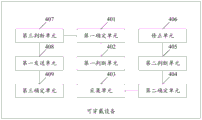
Referring to fig. 5, fig. 5 is a schematic structural diagram of another wearable device disclosed in the embodiment of the present invention. Wherein, the wearable device shown in fig. 5 is optimized by the wearable device shown in fig. 4. Compared to the wearable device shown in fig. 4, the wearable device shown in fig. 5 may further include: a third judging unit 407, a first sending unit 408, and a third determining unit 409, wherein:
a third judging unit 407, configured to judge whether the current location is within a preset safety area after the first determining unit 401 determines the current location.
The first determining unit 401 is specifically configured to determine whether the current location belongs to indoor location or outdoor location after the third determining unit 407 determines that the current location is within the safety area.
In an embodiment of the present invention, the security area may include, but is not limited to, an area where a school of the wearable device wearer (e.g., a student) is located, an area where a residence of the wearable device wearer is located, and an area where a learning place for the wearable device wearer to learn outside class is located.
In this embodiment of the present invention, optionally, the manner of determining, by the first determining unit 401, whether the current location is within the preset safety area may specifically be:
the first determining unit 401 determines the current time (for example, monday, 14:30), determines a target time period (for example, monday, 14:00-17:00) to which the current time belongs and a safety region (for example, region in which school is located) corresponding to the target time period according to a preset time comparison table, further determines whether the current location belongs to the safety region, if so, triggers the acquiring unit 403 to acquire the environment image and calculate the operation of the environment parameter of the environment image, and if not, triggers the first sending unit 408 to start.
Therefore, the embodiment of the invention can perform safety monitoring on the current positioning of the wearable device wearer according to the preset time comparison table, wherein the preset time comparison table is used for representing the safety areas corresponding to different time periods. When the current location of the wearable device wearer in the target time period does not belong to the safety area corresponding to the target time period, the wearable device sends early warning information for indicating that the user leaves the safety area to the mobile terminal connected with the wearable device, so that the probability that the personal safety of the wearable device wearer is threatened is reduced, and the function of protecting the personal safety of the wearable device wearer is achieved.
A first sending unit 408, configured to send, after the third determining unit 407 determines that the current location is not within the safety area, warning information indicating that the user leaves the safety area to the mobile terminal that establishes a connection with the wearable device.
In this embodiment of the present invention, the first sending unit 408 may send warning information (for example, that the student has left the area where the school is located) indicating that the user (for example, the student) leaves the security area (for example, the area where the school is located) to the mobile terminal (for example, the parent's mobile phone) that establishes the connection with the wearable device.
A third determining unit 409 for determining a navigation route for guiding the user to return to the safety area and outputting the navigation route to prompt the user to return to the safety area according to the navigation route.
In the embodiment of the present invention, optionally, the third determining unit 409 determines a navigation route for guiding the user to return to the safety area, and outputs the navigation route to prompt the user to return to the safety area according to the navigation route may specifically be:
the third determining unit 409 determines a plurality of navigation routes for guiding the user to return to the safety area according to the current location; the plurality of navigation routes for guiding the user to return to the safety area at least comprise walking navigation routes for guiding the user to return to the safety area and riding navigation routes for guiding the user to return to the safety area;
the third determination unit 409 outputs prompt information; the prompt information is used for prompting a user to select one navigation route from a plurality of navigation routes;
the third determination unit 409 detects a user operation and determines a navigation route selected by the user according to the user operation, and outputs the navigation route selected by the user through voice/text to prompt the user to return to a safety area according to the navigation route.
Therefore, the embodiment of the invention can provide a plurality of navigation routes for the wearable device wearer to select one navigation route from the plurality of navigation routes, and further output the navigation route, help the wearable device wearer to return to a safe area, and reduce the probability of the personal safety of the wearable device wearer threatened.
The acquiring unit 403 is further configured to acquire the ambient brightness and determine the current time after calculating the ambient parameter of the ambient image.
The way for determining the target light source scene of the current environment where the wearable device is located according to the target color temperature by the second determining unit 404 is specifically:
the second determining unit 404 determines a target light source scene of the current environment where the wearable device is located according to the ambient brightness, the current time, and the target color temperature.
It can be seen that implementing the wearable device described in fig. 5 can improve the accuracy of the positioning of the wearable device; in addition, the misjudgment probability of the color temperature of the environment image by the wearable equipment can be reduced through the normalization processing of the environment image; in addition, the probability that the personal safety of the wearable device wearer is threatened can be reduced, and the function of protecting the personal safety of the wearable device wearer is achieved.
EXAMPLE six
Referring to fig. 6, fig. 6 is a schematic structural diagram of another wearable device disclosed in the embodiment of the present invention. The wearable device shown in fig. 6 is optimized by the wearable device shown in fig. 5. Compared with the wearable device shown in fig. 5, the first sending unit 408 is further configured to send the target location and the environment image to the mobile terminal that establishes a connection with the wearable device after the correcting unit 406 corrects the current location to a target location closest to the current location.
The wearable device shown in fig. 6 further includes: a detection unit 410.
A detecting unit 410, configured to detect a physiological parameter of the user after the second determining unit 405 determines that the current environment belongs to the outdoor environment, where the physiological parameter at least includes a heart rate.
In this embodiment of the present invention, optionally, the physiological parameter may further include at least one of a electrodermal response index and a respiration rate, which is not limited in this embodiment of the present invention.
The second determining unit 405 is further configured to determine whether the physiological parameter is within a preset normal parameter range.
The first sending unit 408 is further configured to send the target location, the environmental image, and the physiological parameter to the mobile terminal connected to the wearable device after the second determining unit 405 determines that the physiological parameter is not within the normal parameter range, and output a prompt message for guiding the user to save oneself.
The correction unit 406 includes:
the detecting sub-unit 4061 is configured to detect whether multiple locations belonging to indoor positioning exist within a circular range with the current positioning as a circle center and a preset length as a radius after the second determining unit 405 determines that the current environment belongs to the indoor environment.
The determining subunit 4062 is configured to, after the detecting subunit 4061 detects that multiple locations exist within a circular range with the current location as a center and a preset length as a radius, determine a target location closest to the current location from the multiple locations, and correct the current location to be the target location.
Further, the wearable device shown in fig. 6 further includes: a second sending unit 411, a receiving unit 412 and a third judging unit 413, wherein:
the second sending unit 411 is configured to, after the detecting sub-unit 4061 detects that there are no multiple locations in a circular range with the current location as a center of a circle and a preset length as a radius, send location abnormality information to the mobile terminal that is connected to the wearable device, and output inquiry information that inquires whether the user needs to alarm for help.
And the receiving unit 412 is used for receiving the voice information which represents that the alarm and the help are required and determining the voiceprint characteristics of the voice information.
A third judging unit 413, configured to judge whether the voiceprint feature is a valid voiceprint feature.
In an embodiment of the present invention, the self-protection mechanism is a mechanism preset in the wearable device, and when the self-protection mechanism is started, the positioning function of the wearable device cannot be closed through manual operation, but can be closed when a danger-removing key is detected, where the danger-removing key may be a preset password or a digital password, and the embodiment of the present invention is not limited.
The second sending unit 411 is further configured to send a preset alarm signal to the alarm platform and start a self-protection mechanism after the third determining unit 413 determines that the voiceprint feature is a legal voiceprint feature; wherein, the self-protection mechanism is used for keeping the positioning function of the wearable device in an opening state.
It can be seen that implementing the wearable device described in fig. 6 can improve the accuracy of wearable device positioning; in addition, the misjudgment probability of the color temperature of the environment image by the wearable equipment can be reduced through the normalization processing of the environment image; in addition, the probability that the personal safety of the wearable device wearer is threatened can be reduced, and the function of protecting the personal safety of the wearable device wearer is achieved.
EXAMPLE seven
Referring to fig. 7, fig. 7 is a schematic structural diagram of another wearable device disclosed in the embodiment of the present invention. As shown in fig. 7, for convenience of illustration, only the portion related to the embodiment of the present invention is shown, and details of the technique are not disclosed, please refer to the method portion of the embodiment of the present invention.
Referring to fig. 7, the wearable device includes: a Radio Frequency (RF) circuit 710, a memory 720, an input unit 730, a display unit 740, a sensor 750, an audio circuit 760, a wireless fidelity (WiFi) module 770, a processor 780, a power supply 790, and a camera (not shown). Those skilled in the art will appreciate that the wearable device structure shown in fig. 7 does not constitute a limitation of the wearable device, and may include more or fewer components than shown, or combine certain components, or a different arrangement of components.
The following describes the various components of the wearable device in detail with reference to fig. 7:
the RF circuit 710 may be used for receiving and transmitting signals during information transmission and reception or during a call, and in particular, receives downlink information of a base station and then processes the received downlink information to the processor 780; in addition, the data for designing uplink is transmitted to the base station. In general, the RF circuit 710 includes, but is not limited to, an antenna, at least one amplifier, a transceiver, a coupler, a Low Noise Amplifier (LNA), a duplexer, and the like. In addition, the RF circuit 710 may also communicate with networks and other devices via wireless communication. The wireless communication may use any communication standard or protocol, including but not limited to global system for Mobile communications (GSM), General Packet Radio Service (GPRS), Code Division Multiple Access (CDMA), Wideband Code Division Multiple Access (WCDMA), Long Term Evolution (LTE), email, Short Messaging Service (SMS), and the like.
The memory 720 may be used to store software programs and modules, and the processor 780 may execute various functional applications and data processing of the wearable device by operating the software programs and modules stored in the memory 720. The memory 720 may mainly include a program storage area and a data storage area, wherein the program storage area may store an operating system, an application program required by at least one function (such as a sound playing function, an image playing function, etc.), and the like; the storage data area may store data (such as audio data, a phone book, etc.) created according to the use of the wearable device, and the like. Further, the memory 720 may include high speed random access memory, and may also include non-volatile memory, such as at least one magnetic disk storage device, flash memory device, or other volatile solid state storage device.
The input unit 730 may be used to receive input numeric or character information and generate key signal inputs related to user settings and function control of the wearable device. Specifically, the input unit 730 may include a touch panel 731 and other input devices 732. The touch panel 731, also referred to as a touch screen, can collect touch operations of a user (e.g. operations of the user on or near the touch panel 731 by using any suitable object or accessory such as a finger, a stylus, etc.) and drive the corresponding connection device according to a preset program. Alternatively, the touch panel 731 may include two portions of a touch detection device and a touch controller. The touch detection device detects the touch direction of a user, detects a signal brought by touch operation and transmits the signal to the touch controller; the touch controller receives touch information from the touch sensing device, converts it to touch point coordinates, and sends the touch point coordinates to the processor 780, and can receive and execute commands from the processor 780. In addition, the touch panel 731 may be implemented by various types, such as a resistive type, a capacitive type, an infrared ray, and a surface acoustic wave. The input unit 730 may include other input devices 732 in addition to the touch panel 731. In particular, other input devices 732 may include, but are not limited to, one or more of a physical keyboard, function keys (such as volume control keys, switch keys, etc.), a trackball, a mouse, a joystick, and the like.
The display unit 740 may be used to display information input by or provided to the user and various menus of the wearable device. The Display unit 740 may include a Display panel 741, and optionally, the Display panel 741 may be configured in the form of a Liquid Crystal Display (LCD), an organic light-Emitting Diode (OLED), or the like. Further, the touch panel 731 can cover the display panel 741, and when the touch panel 731 detects a touch operation on or near the touch panel 731, the touch operation is transmitted to the processor 780 to determine the type of the touch event, and then the processor 780 provides a corresponding visual output on the display panel 741 according to the type of the touch event. Although in fig. 7, the touch panel 731 and the display panel 741 are two independent components to implement the input and output functions of the wearable device, in some embodiments, the touch panel 731 and the display panel 741 may be integrated to implement the input and output functions of the wearable device.
The wearable device may also include at least one sensor 750, such as light sensors, motion sensors, and other sensors. Specifically, the light sensor may include an ambient light sensor that may adjust the brightness of the display panel 741 according to the brightness of ambient light, and a proximity sensor that may turn off the display panel 741 and/or the backlight when the wearable device is moved to the ear. As one of the motion sensors, the accelerometer sensor can detect the magnitude of acceleration in each direction (generally, three axes), detect the magnitude and direction of gravity when stationary, and can be used for applications (such as horizontal and vertical screen switching, related games, magnetometer attitude calibration) for recognizing wearable device attitude, and related functions (such as pedometer and tapping) for vibration recognition; as for other sensors such as a gyroscope, a barometer, a hygrometer, a thermometer, and an infrared sensor, which can be further configured on the wearable device, detailed description is omitted here.
WiFi belongs to short-distance wireless transmission technology, and the wearable device can help a user to send and receive e-mails, browse webpages, access streaming media and the like through the WiFi module 770, and provides wireless broadband Internet access for the user. Although fig. 7 shows the WiFi module 770, it is understood that it does not belong to the essential constitution of the wearable device, and can be omitted entirely as needed within the scope not changing the essence of the invention.
The processor 780 is a control center of the wearable device, and connects various parts of the entire wearable device using various interfaces and lines, and performs various functions of the wearable device and processes data by running or executing software programs and/or modules stored in the memory 720 and calling up data stored in the memory 720, thereby performing overall monitoring of the wearable device. Optionally, processor 780 may include one or more processing units; preferably, the processor 780 may integrate an application processor, which primarily handles operating systems, user interfaces, applications, etc., and a modem processor, which primarily handles wireless communications. It will be appreciated that the modem processor described above may not be integrated into processor 780.
The wearable device also includes a power source 790 (e.g., a battery) for powering the various components, which may preferably be logically coupled to the processor 780 via a power management system, such that the power management system may be used to manage charging, discharging, and power consumption.
Although not shown, the wearable device may further include a bluetooth module or the like, which is not described herein.
In an embodiment of the present invention, the processor 780 included in the wearable device invokes a software program stored in the memory 720 to specifically perform the following operations:
determining a current location;
judging whether the current positioning belongs to indoor positioning or outdoor positioning;
after judging that the current location belongs to outdoor location, acquiring an environment image, and calculating environment parameters of the environment image, wherein the environment parameters at least comprise a target color temperature of the environment image;
determining a target light source scene of the current environment where the wearable equipment is located according to the target color temperature;
judging whether the current environment belongs to an outdoor environment or an indoor environment according to the target light source scene;
after judging that the current environment belongs to the indoor environment, correcting the current positioning into a target positioning closest to the current positioning; wherein, the target positioning belongs to indoor positioning.
It can be seen that implementing the wearable device described in fig. 7 can improve the positioning accuracy of the wearable device.
The above embodiments are only used for illustrating the technical solutions of the present application and not for limiting the same; although the present application has been described in detail with reference to the foregoing embodiments, it will be understood by those of ordinary skill in the art; the technical solutions described in the foregoing embodiments may still be modified, or some technical features may be equivalently replaced; and such modifications or substitutions do not depart from the spirit and scope of the corresponding technical solutions in the embodiments of the present application.
Claims (8)
Priority Applications (1)
| Application Number | Priority Date | Filing Date | Title |
|---|---|---|---|
| CN201810781727.6A CN108834068B (en) | 2018-07-17 | 2018-07-17 | Positioning method based on wearable device and wearable device |
Applications Claiming Priority (1)
| Application Number | Priority Date | Filing Date | Title |
|---|---|---|---|
| CN201810781727.6A CN108834068B (en) | 2018-07-17 | 2018-07-17 | Positioning method based on wearable device and wearable device |
Publications (2)
| Publication Number | Publication Date |
|---|---|
| CN108834068A CN108834068A (en) | 2018-11-16 |
| CN108834068B true CN108834068B (en) | 2020-04-24 |
Family
ID=64140703
Family Applications (1)
| Application Number | Title | Priority Date | Filing Date |
|---|---|---|---|
| CN201810781727.6A Active CN108834068B (en) | 2018-07-17 | 2018-07-17 | Positioning method based on wearable device and wearable device |
Country Status (1)
| Country | Link |
|---|---|
| CN (1) | CN108834068B (en) |
Cited By (1)
| Publication number | Priority date | Publication date | Assignee | Title |
|---|---|---|---|---|
| US20250076067A1 (en) * | 2023-08-29 | 2025-03-06 | Honda Motor Co., Ltd. | Computer implemented method and device for assisting person to perform a task and computer program product |
Families Citing this family (17)
| Publication number | Priority date | Publication date | Assignee | Title |
|---|---|---|---|---|
| CN111601232B (en) * | 2019-02-19 | 2022-05-27 | 广东小天才科技有限公司 | A kind of positioning correction method, system and related equipment |
| CN114554402B (en) * | 2019-06-14 | 2024-11-22 | 广东小天才科技有限公司 | Building positioning method, electronic equipment and computer storage medium |
| CN110200643A (en) * | 2019-06-21 | 2019-09-06 | 西南政法大学 | A kind of long-distance intelligent mentally disturbed risk early warning system |
| CN110189500A (en) * | 2019-06-21 | 2019-08-30 | 西南政法大学 | A kind of intelligent remote mentally disturbed's risk early warning system based on bluetooth positioning |
| CN111750848B (en) * | 2019-07-24 | 2024-03-19 | 广东小天才科技有限公司 | Building positioning method and electronic equipment |
| CN111757262B (en) * | 2019-07-31 | 2022-08-26 | 广东小天才科技有限公司 | Positioning reminding method and system based on electronic fence and wearable device |
| CN111757263A (en) * | 2019-07-31 | 2020-10-09 | 广东小天才科技有限公司 | A method, system and mobile terminal for sharing positioning data |
| CN111148028B (en) * | 2019-08-08 | 2021-08-24 | 广东小天才科技有限公司 | A kind of positioning correction method and server |
| CN111223217A (en) * | 2019-12-26 | 2020-06-02 | 浙江华云信息科技有限公司 | Evaluation site intelligent management system and method |
| CN111369763B (en) * | 2020-04-09 | 2022-04-29 | 西南政法大学 | Attack prevention system for mental disorder patient |
| CN111696311A (en) * | 2020-06-23 | 2020-09-22 | 广东小天才科技有限公司 | Indoor and outdoor auxiliary identification method, intelligent wearable device and storage medium |
| CN111950971A (en) * | 2020-06-28 | 2020-11-17 | 闵亨锋 | Student management system based on wearable equipment |
| CN112099368A (en) * | 2020-09-25 | 2020-12-18 | 歌尔科技有限公司 | An electrical equipment control method, system and wearable device |
| CN112181055A (en) * | 2020-09-28 | 2021-01-05 | 广东小天才科技有限公司 | Indoor and outdoor state judgment method, wearable device, and computer-readable storage medium |
| CN113176587B (en) * | 2021-04-07 | 2023-02-07 | 甄十信息科技(上海)有限公司 | Indoor and outdoor identification method and system, electronic equipment and computer readable medium |
| CN114035155B (en) * | 2021-11-15 | 2024-11-15 | 上海探寻信息技术有限公司 | A method and device for scene recognition of wearable device |
| CN114113837B (en) * | 2021-11-15 | 2024-04-30 | 国网辽宁省电力有限公司朝阳供电公司 | A method and system for detecting live transformer based on acoustic characteristics |
Citations (5)
| Publication number | Priority date | Publication date | Assignee | Title |
|---|---|---|---|---|
| CN104848892A (en) * | 2015-04-02 | 2015-08-19 | 广东小天才科技有限公司 | Method and device for spectrum detection of user environment |
| CN104869634A (en) * | 2015-04-30 | 2015-08-26 | 百度在线网络技术(北京)有限公司 | Method and device for correcting positioning result |
| CN106248107A (en) * | 2016-09-22 | 2016-12-21 | 中国电子科技集团公司第二十二研究所 | A kind of flight path based on indoor earth magnetism path matching infers calibration steps and device |
| KR20170025288A (en) * | 2015-08-28 | 2017-03-08 | 전자부품연구원 | Position Information Correction Method based on Interior Space Information for a Wearable Device |
| CN106851556A (en) * | 2016-12-08 | 2017-06-13 | 广东小天才科技有限公司 | Positioning correction method and system, handheld device and wearable device |
Family Cites Families (4)
| Publication number | Priority date | Publication date | Assignee | Title |
|---|---|---|---|---|
| CN103402254B (en) * | 2013-07-04 | 2016-03-23 | 百度在线网络技术(北京)有限公司 | A kind of method and apparatus of indoor positioning |
| KR20150051070A (en) * | 2013-11-01 | 2015-05-11 | 삼성전자주식회사 | Method for processing data and an electronic device thereof |
| KR102318887B1 (en) * | 2015-03-06 | 2021-10-29 | 삼성전자주식회사 | Wearable electronic device and method for controlling thereof |
| CN106896387B (en) * | 2015-12-21 | 2020-02-18 | 中国移动通信集团公司 | Method and portable terminal for determining whether a portable terminal is indoors or outdoors |
-
2018
- 2018-07-17 CN CN201810781727.6A patent/CN108834068B/en active Active
Patent Citations (5)
| Publication number | Priority date | Publication date | Assignee | Title |
|---|---|---|---|---|
| CN104848892A (en) * | 2015-04-02 | 2015-08-19 | 广东小天才科技有限公司 | Method and device for spectrum detection of user environment |
| CN104869634A (en) * | 2015-04-30 | 2015-08-26 | 百度在线网络技术(北京)有限公司 | Method and device for correcting positioning result |
| KR20170025288A (en) * | 2015-08-28 | 2017-03-08 | 전자부품연구원 | Position Information Correction Method based on Interior Space Information for a Wearable Device |
| CN106248107A (en) * | 2016-09-22 | 2016-12-21 | 中国电子科技集团公司第二十二研究所 | A kind of flight path based on indoor earth magnetism path matching infers calibration steps and device |
| CN106851556A (en) * | 2016-12-08 | 2017-06-13 | 广东小天才科技有限公司 | Positioning correction method and system, handheld device and wearable device |
Cited By (1)
| Publication number | Priority date | Publication date | Assignee | Title |
|---|---|---|---|---|
| US20250076067A1 (en) * | 2023-08-29 | 2025-03-06 | Honda Motor Co., Ltd. | Computer implemented method and device for assisting person to perform a task and computer program product |
Also Published As
| Publication number | Publication date |
|---|---|
| CN108834068A (en) | 2018-11-16 |
Similar Documents
| Publication | Publication Date | Title |
|---|---|---|
| CN108834068B (en) | Positioning method based on wearable device and wearable device | |
| US12114233B2 (en) | User location aware smart event handling | |
| CN110572776B (en) | Security area division method, terminal and storage medium | |
| CN108871315A (en) | Navigation monitoring method and system based on wearable device and wearable device | |
| CN108597186B (en) | A drowning alarm method and wearable device based on user behavior | |
| WO2017088154A1 (en) | Profile mode switching method | |
| WO2018177425A1 (en) | Rescue request method, device and system | |
| CN108234751B (en) | Automatic danger detection method, mobile terminal and computer readable storage medium | |
| CN106778591B (en) | Alarm method and device and mobile terminal | |
| CN109141355B (en) | Relative height measurement method and wearable device based on multi-sensor | |
| CN107566604B (en) | Message reminding control method and user terminal | |
| CN109975757A (en) | Indoor positioning air navigation aid, terminal and computer storage medium | |
| CN107734455A (en) | A kind of method, terminal and the readable storage medium storing program for executing of positional information record | |
| WO2019061276A1 (en) | Signal quality alert method, terminal and server | |
| CN109309761B (en) | Emergency call method, mobile terminal and computer readable storage medium | |
| CN110047246A (en) | Alarm method, equipment and computer readable storage medium | |
| CN112414587A (en) | A kind of temperature detection method and terminal equipment | |
| CN106408869B (en) | Terminal and method and device for detecting human fall | |
| CN108416982A (en) | Drowning monitoring method based on motion change rule and wearable device | |
| CN111103607B (en) | A kind of positioning prompt method and electronic device | |
| CN106161800A (en) | Incoming call reminding method and device and mobile communication terminal | |
| CN109474889B (en) | Information transmission method, mobile terminal and server | |
| CN111756927B (en) | A kind of output method of positioning information, terminal device and storage medium | |
| CN109041212A (en) | Positioning method and wearable device | |
| CN108055393A (en) | Speed based reminding method, device and computer readable storage medium |
Legal Events
| Date | Code | Title | Description |
|---|---|---|---|
| PB01 | Publication | ||
| PB01 | Publication | ||
| SE01 | Entry into force of request for substantive examination | ||
| SE01 | Entry into force of request for substantive examination | ||
| GR01 | Patent grant | ||
| GR01 | Patent grant |