CN108810855B - Clustering D2D resource allocation method based on energy constraint and interference limited area - Google Patents
Clustering D2D resource allocation method based on energy constraint and interference limited area Download PDFInfo
- Publication number
- CN108810855B CN108810855B CN201810499842.4A CN201810499842A CN108810855B CN 108810855 B CN108810855 B CN 108810855B CN 201810499842 A CN201810499842 A CN 201810499842A CN 108810855 B CN108810855 B CN 108810855B
- Authority
- CN
- China
- Prior art keywords
- user equipment
- cellular
- interference
- cellular user
- restricted area
- Prior art date
- Legal status (The legal status is an assumption and is not a legal conclusion. Google has not performed a legal analysis and makes no representation as to the accuracy of the status listed.)
- Active
Links
- 238000000034 method Methods 0.000 title claims abstract description 25
- 238000013468 resource allocation Methods 0.000 title claims abstract description 23
- 230000001413 cellular effect Effects 0.000 claims abstract description 169
- 230000005540 biological transmission Effects 0.000 claims abstract description 26
- 241000854291 Dianthus carthusianorum Species 0.000 claims description 13
- 238000004891 communication Methods 0.000 abstract description 26
- 238000001228 spectrum Methods 0.000 description 7
- 238000005516 engineering process Methods 0.000 description 5
- 238000010295 mobile communication Methods 0.000 description 4
- 230000009286 beneficial effect Effects 0.000 description 2
- 238000010586 diagram Methods 0.000 description 2
- 238000005265 energy consumption Methods 0.000 description 1
- 238000001914 filtration Methods 0.000 description 1
- 238000003306 harvesting Methods 0.000 description 1
- 238000007726 management method Methods 0.000 description 1
- 238000012986 modification Methods 0.000 description 1
- 230000004048 modification Effects 0.000 description 1
- 230000003595 spectral effect Effects 0.000 description 1
Images


Classifications
-
- H—ELECTRICITY
- H04—ELECTRIC COMMUNICATION TECHNIQUE
- H04W—WIRELESS COMMUNICATION NETWORKS
- H04W4/00—Services specially adapted for wireless communication networks; Facilities therefor
- H04W4/70—Services for machine-to-machine communication [M2M] or machine type communication [MTC]
-
- H—ELECTRICITY
- H04—ELECTRIC COMMUNICATION TECHNIQUE
- H04W—WIRELESS COMMUNICATION NETWORKS
- H04W72/00—Local resource management
- H04W72/04—Wireless resource allocation
- H04W72/044—Wireless resource allocation based on the type of the allocated resource
- H04W72/0473—Wireless resource allocation based on the type of the allocated resource the resource being transmission power
-
- H—ELECTRICITY
- H04—ELECTRIC COMMUNICATION TECHNIQUE
- H04W—WIRELESS COMMUNICATION NETWORKS
- H04W72/00—Local resource management
- H04W72/12—Wireless traffic scheduling
- H04W72/1263—Mapping of traffic onto schedule, e.g. scheduled allocation or multiplexing of flows
-
- H—ELECTRICITY
- H04—ELECTRIC COMMUNICATION TECHNIQUE
- H04W—WIRELESS COMMUNICATION NETWORKS
- H04W72/00—Local resource management
- H04W72/50—Allocation or scheduling criteria for wireless resources
- H04W72/54—Allocation or scheduling criteria for wireless resources based on quality criteria
- H04W72/541—Allocation or scheduling criteria for wireless resources based on quality criteria using the level of interference
-
- Y—GENERAL TAGGING OF NEW TECHNOLOGICAL DEVELOPMENTS; GENERAL TAGGING OF CROSS-SECTIONAL TECHNOLOGIES SPANNING OVER SEVERAL SECTIONS OF THE IPC; TECHNICAL SUBJECTS COVERED BY FORMER USPC CROSS-REFERENCE ART COLLECTIONS [XRACs] AND DIGESTS
- Y02—TECHNOLOGIES OR APPLICATIONS FOR MITIGATION OR ADAPTATION AGAINST CLIMATE CHANGE
- Y02D—CLIMATE CHANGE MITIGATION TECHNOLOGIES IN INFORMATION AND COMMUNICATION TECHNOLOGIES [ICT], I.E. INFORMATION AND COMMUNICATION TECHNOLOGIES AIMING AT THE REDUCTION OF THEIR OWN ENERGY USE
- Y02D30/00—Reducing energy consumption in communication networks
- Y02D30/70—Reducing energy consumption in communication networks in wireless communication networks
Landscapes
- Engineering & Computer Science (AREA)
- Computer Networks & Wireless Communication (AREA)
- Signal Processing (AREA)
- Quality & Reliability (AREA)
- Mobile Radio Communication Systems (AREA)
Abstract
一种基于能量约束和干扰限制区域的分簇D2D资源分配方法,所述方法包括:在当前资源调度帧的奇数时隙结束前,获取所述D2D用户设备从周围环境中获取能量的信息;为各个所述蜂窝用户设备分配资源块,并基于所述D2D用户设备从周围环境中获取的能量,计算得到所述D2D用户设备的发送功率;从所述D2D用户设备中去除发送功率小于预设的最小发送功率阈值的D2D用户设备;为各个所述蜂窝用户设备分配资源块,并基于蜂窝用户设备的干扰限制区域和D2D用户设备的干扰限制区域,将所述D2D用户设备以蜂窝用户设备为簇头进行分簇;为各个分簇中的蜂窝用户设备和D2D用户设备分配对应的发送功率。上述的方案,可以缓解蜂窝用户设备和D2D用户设备及D2D用户设备相互之间的干扰,提升用户设备的通信质量。

A clustering D2D resource allocation method based on energy constraints and interference restricted areas, the method comprising: before the end of an odd-numbered time slot of a current resource scheduling frame, acquiring information about the D2D user equipment acquiring energy from a surrounding environment; Each of the cellular user equipments allocates resource blocks, and calculates the transmission power of the D2D user equipment based on the energy obtained by the D2D user equipment from the surrounding environment; removes the transmission power from the D2D user equipment that is less than a preset value. D2D user equipment with a minimum transmit power threshold; resource blocks are allocated to each of the cellular user equipment, and based on the interference restricted area of the cellular user equipment and the interference restricted area of the D2D user equipment, the D2D user equipment is clustered with the cellular user equipment The head is clustered; the corresponding transmit power is allocated to the cellular user equipment and the D2D user equipment in each cluster. The above solution can alleviate the interference between the cellular user equipment, the D2D user equipment and the D2D user equipment, and improve the communication quality of the user equipment.
Description
技术领域technical field
本发明涉及通信技术领域,具体地涉及一种基于能量约束和干扰限制区域的分簇D2D资源分配方法。The present invention relates to the field of communication technologies, in particular to a clustering D2D resource allocation method based on energy constraints and interference limited regions.
背景技术Background technique
第五代移动通信是指第五代移动电话行动通信标准,也称第五代移动通信技术,外语缩写为5G,为4G之后的延伸。The fifth-generation mobile communication refers to the fifth-generation mobile phone mobile communication standard, also known as the fifth-generation mobile communication technology, abbreviated as 5G in foreign languages, and is an extension after 4G.
为了满足日益增长的本地通信负载和频谱效率需求,设备到设备的直接通信(D2D,Device-to-Device)成为第五代移动通信技术通信系统的关键技术之一。与通过基站进行信息传递不同,D2D通信能够使移动设备在本地链路进行直接的信息传输,通过复用蜂窝用户设备资源的方式能够提升小范围频谱效率,降低传输延迟并扩大基站范围,同时提高了系统吞吐量。In order to meet the increasing demands of local communication load and spectral efficiency, device-to-device direct communication (D2D, Device-to-Device) has become one of the key technologies of the fifth-generation mobile communication technology communication system. Different from information transmission through base stations, D2D communication enables mobile devices to perform direct information transmission on local links. By reusing cellular user equipment resources, it can improve small-scale spectrum efficiency, reduce transmission delay, and expand base station range. system throughput.
但是,现有的D2D资源分配方法,使得蜂窝用户设备和D2D用户设备之间及D2D用户设备相互之间存在着较大的干扰,影响了用户设备的通信质量。However, the existing D2D resource allocation method causes great interference between the cellular user equipment and the D2D user equipment and between the D2D user equipments, which affects the communication quality of the user equipment.
发明内容SUMMARY OF THE INVENTION
本发明解决的技术问题是如何缓解蜂窝用户设备和D2D用户设备之间及D2D用户设备相互之间的干扰问题。The technical problem solved by the present invention is how to alleviate the problem of interference between cellular user equipment and D2D user equipment and between D2D user equipments.
为解决上述技术问题,本发明实施例提供了一种基于能量约束和干扰限制区域的分簇D2D资源分配方法,所述方法包括:In order to solve the above technical problems, an embodiment of the present invention provides a clustering D2D resource allocation method based on energy constraints and interference limited regions, the method includes:
获取基站覆盖区域内蜂窝用户设备和D2D用户设备的信息;Obtain information about cellular user equipment and D2D user equipment within the coverage area of the base station;
在当前资源调度帧的奇数时隙结束前,获取所述D2D用户设备从周围环境中获取能量的信息;每个所述资源调度帧包括等长的奇数时隙和偶数时隙,且在所述奇数时隙D2D用户设备从周围环境中获取能量,在所述偶数时隙所述D2D用户设备向其他D2D用户设备传输信息;Before the end of the odd-numbered time slot of the current resource scheduling frame, obtain the information that the D2D user equipment obtains energy from the surrounding environment; each resource scheduling frame includes an odd-numbered time slot and an even-numbered time slot of equal length, and in the The D2D user equipment in odd-numbered time slots obtains energy from the surrounding environment, and in the even-numbered time slots, the D2D user equipment transmits information to other D2D user equipment;
为各个所述蜂窝用户设备分配资源块,并基于所述D2D用户设备在从周围环境中获取的能量,计算得到所述D2D用户设备的发送功率;Allocating resource blocks for each of the cellular user equipments, and calculating the transmit power of the D2D user equipment based on the energy obtained by the D2D user equipment from the surrounding environment;
从所述D2D用户设备中去除发送功率小于预设的最小发送功率阈值的D2D用户设备,得到满足最小发送功率阈值的D2D用户设备;Remove D2D user equipment whose transmission power is less than a preset minimum transmission power threshold from the D2D user equipment, to obtain D2D user equipment that satisfies the minimum transmission power threshold;
为各个所述蜂窝用户设备分配资源块,并基于蜂窝用户设备的干扰限制区域和D2D用户设备的干扰限制区域,将所述D2D用户设备以蜂窝用户设备为簇头进行分簇;Allocating resource blocks for each of the cellular user equipment, and clustering the D2D user equipment with the cellular user equipment as the cluster head based on the interference restricted area of the cellular user equipment and the interference restricted area of the D2D user equipment;
为各个分簇中的蜂窝用户设备和D2D用户设备分配对应的发送功率,以使得各个分簇内的D2D用户设备在所述当前资源调度帧的偶数时隙内,复用对应的蜂窝用户设备的上行链路频带资源向其他D2D用户设备传输信息。Allocate the corresponding transmit power to the cellular user equipment and the D2D user equipment in each cluster, so that the D2D user equipment in each cluster multiplexes the corresponding cellular user equipment in the even-numbered time slots of the current resource scheduling frame. The uplink frequency band resources transmit information to other D2D user equipments.
可选地,所述为各个所述蜂窝用户设备分配资源块,并基于蜂窝用户设备的干扰限制区域和D2D用户设备的干扰限制区域,将所述D2D用户设备以蜂窝用户设备为簇头进行分簇,包括:Optionally, allocating resource blocks to each of the cellular user equipment, and dividing the D2D user equipment with the cellular user equipment as a cluster head based on the interference restricted area of the cellular user equipment and the interference restricted area of the D2D user equipment. clusters, including:
确定每个蜂窝用户设备的干扰限制区域和每个所述满足最小发送功率阈值的D2D用户设备的干扰限制区域;determining the interference limitation area of each cellular user equipment and the interference limitation area of each D2D user equipment that satisfies the minimum transmit power threshold;
对满足最小发送功率阈值的D2D用户设备按照顺序进行遍历,获取遍历到的当前D2D用户设备;Traverse the D2D user equipments that meet the minimum transmit power threshold in order, and obtain the current D2D user equipments that have been traversed;
当确定遍历到的D2D用户设备位于蜂窝用户设备的干扰限制区域之外且该蜂窝用户设备的分簇内已存在的D2D用户设备位于遍历到的当前D2D用户设备的干扰限制区域之外时,将遍历到的当前D2D用户设备加入该蜂窝用户设备的分簇内,直至所述满足最小发送功率阈值的D2D用户设备全部遍历完成,得到以每个蜂窝用户设备为簇头的多个分簇。When it is determined that the traversed D2D user equipment is outside the interference restricted area of the cellular user equipment and the existing D2D user equipment in the cluster of the cellular user equipment is outside the interference restricted area of the current traversed D2D user equipment, the The traversed current D2D user equipments are added to the clustering of the cellular user equipment until all the D2D user equipments satisfying the minimum transmit power threshold are traversed, and multiple clusters with each cellular user equipment as the cluster head are obtained.
可选地,所述确定蜂窝用户设备的干扰限制区域,包括:Optionally, the determining the interference restricted area of the cellular user equipment includes:
以所述蜂窝用户设备的位置为中心,将不满足蜂窝用户设备的最小信号干扰噪声比的区域,作为所述蜂窝用户设备的干扰限制区域。Taking the location of the cellular user equipment as the center, an area that does not meet the minimum signal-to-interference-noise ratio of the cellular user equipment is taken as the interference restricted area of the cellular user equipment.
可选地,采用如下的公式确定蜂窝用户设备的干扰限制区域的半径:Optionally, the following formula is used to determine the radius of the interference restricted area of the cellular user equipment:


其中,


可选地,所述蜂窝用户设备的最小信号干扰噪声比SINR为0dB。Optionally, the minimum signal-to-interference-noise ratio SINR of the cellular user equipment is 0 dB.
可选地,所述确定D2D用户设备的干扰限制区域,包括:Optionally, the determining the interference restricted area of the D2D user equipment includes:
以D2D用户设备的位置为中心,将不满足D2D用户设备的最小信号干扰噪声比的区域,作为所述蜂窝用户设备的干扰限制区域。Taking the location of the D2D user equipment as the center, the area that does not meet the minimum signal-to-interference-noise ratio of the D2D user equipment is taken as the interference limitation area of the cellular user equipment.
可选地,采用如下的公式确定D2D用户设备的干扰限制区域的半径:Optionally, the following formula is used to determine the radius of the interference restricted area of the D2D user equipment:


其中,


可选地,所述D2D用户设备的最小信号干扰噪声比为5dB。Optionally, the minimum signal-to-interference-noise ratio of the D2D user equipment is 5dB.
与现有技术相比,本发明实施例的技术方案具有以下有益效果:Compared with the prior art, the technical solutions of the embodiments of the present invention have the following beneficial effects:
上述的方案,通过蜂窝用户设备的干扰限制区域和D2D用户设备的干扰限制区域,将所述D2D用户设备以蜂窝用户设备为簇头进行分簇,为各个分簇中的蜂窝用户设备和D2D用户设备分配对应的发送功率,以使得各个分簇内的D2D用户设备在所述当前资源调度帧的偶数时隙内,复用对应的蜂窝用户设备的上行链路频带资源向其他D2D用户设备传输信息,即同一分簇内的用户设备可以复用相同的资源块,从而可以缓解分簇内用户设备间的相互干扰,故可以提高用户设备的通信质量。In the above scheme, through the interference restricted area of the cellular user equipment and the interference restricted area of the D2D user equipment, the D2D user equipment is clustered with the cellular user equipment as the cluster head, and the cellular user equipment and the D2D user equipment in each cluster are clustered. The device allocates the corresponding transmit power, so that the D2D user equipment in each cluster multiplexes the uplink frequency band resources of the corresponding cellular user equipment in the even-numbered time slots of the current resource scheduling frame to transmit information to other D2D user equipments , that is, the user equipments in the same cluster can multiplex the same resource blocks, so that the mutual interference between the user equipments in the cluster can be alleviated, so the communication quality of the user equipments can be improved.
附图说明Description of drawings
图1是本发明实施例中的一种基于能量约束和干扰限制区域的分簇D2D资源分配方法的流程示意图;1 is a schematic flowchart of a method for clustering D2D resource allocation based on an energy constraint and an interference limited area according to an embodiment of the present invention;
图2是本发明实施例中的一种基于能量约束和干扰限制区域的分簇D2D资源分配方法中对用户设备进行分簇的流程示意图;2 is a schematic flowchart of clustering user equipment in a method for clustering D2D resource allocation based on energy constraints and interference restricted areas in an embodiment of the present invention;
图3是本发明实施例中的基于能量约束和干扰限制区域的分簇D2D资源分配方法的应用实例示意图。FIG. 3 is a schematic diagram of an application example of a clustered D2D resource allocation method based on energy constraints and interference limited regions in an embodiment of the present invention.
具体实施方式Detailed ways
蜂窝网络下的设备到设备(Device to Device,D2D)通信具有三种模式,分别是专用模式、蜂窝模式和复用模式。其中,复用模式即系统中的D2D用户设备通过复用蜂窝链路的资源块进行设备间的直接通信。这种模式可以提高系统的资源利用率,但同时会引发新的问题,即小区内用户设备间的相互干扰问题。Device to Device (Device to Device, D2D) communication in a cellular network has three modes, which are a dedicated mode, a cellular mode, and a multiplexing mode. The multiplexing mode means that the D2D user equipment in the system performs direct communication between the devices by multiplexing the resource blocks of the cellular link. This mode can improve the resource utilization rate of the system, but at the same time, it will cause a new problem, that is, the problem of mutual interference between user equipments in a cell.
资源分配属干扰管理范畴,是在蜂窝链路自身调度未变化的情况下进行D2D资源分配优化以提升小区总的吞吐量和频带利用率。其中,优化D2D资源分配包含如何减少D2D发送端对蜂窝用户设备的干扰和减少蜂窝用户设备对D2D接收端的干扰。Resource allocation belongs to the category of interference management, which is to optimize D2D resource allocation under the condition that the scheduling of the cellular link itself does not change to improve the overall throughput and frequency band utilization of the cell. Wherein, optimizing the D2D resource allocation includes how to reduce the interference of the D2D transmitting end to the cellular user equipment and how to reduce the interference of the cellular user equipment to the D2D receiving end.
D2D通信因其短距离通信的特点能促进新型移动应用和业务模型的发展,而更高的数据速率需求造成了移动设备的高能耗,同时移动设备通常受到电池容量的约束,这极大地影响了网络寿命,在很多领域,单纯由电池供电的无线通信网络已经不能满足需求,由此引入从周围环境中获取能量的技术。D2D communication can promote the development of new mobile applications and business models due to its short-range communication characteristics, while the higher data rate requirements cause high energy consumption of mobile devices, and mobile devices are usually constrained by battery capacity, which greatly affects Network life, in many fields, the wireless communication network powered by the battery can no longer meet the demand, so the technology of obtaining energy from the surrounding environment is introduced.
基于能量获取的D2D资源分配方案可以延长能量受限设备的网络寿命,同时满足严格的能量效率要求。为进一步提高网络吞吐量,该方案采用“多对一”的资源共享方式,即一个相同的资源块能被多个D2D用户设备复用,在这种方式下D2D用户设备除了受到蜂窝链路产生的干扰以外,还将受到共享同一个资源块的其他D2D通信链路的干扰。因此,现有的资源分配方法,使得蜂窝用户设备和D2D用户设备之间及D2D用户设备相互之间存在着较大的干扰。Energy harvesting-based D2D resource allocation schemes can extend the network lifetime of energy-constrained devices while meeting stringent energy efficiency requirements. In order to further improve the network throughput, the scheme adopts a "many-to-one" resource sharing method, that is, a same resource block can be multiplexed by multiple D2D user equipments. In addition to the interference from other D2D communication links sharing the same resource block. Therefore, the existing resource allocation method causes great interference between the cellular user equipment and the D2D user equipment and between the D2D user equipments.
本发明实施例中的技术方案通过蜂窝用户设备的干扰限制区域和D2D用户设备的干扰限制区域,将所述D2D用户设备以蜂窝用户设备为簇头进行分簇,为各个分簇中的蜂窝用户设备和D2D用户设备分配对应的发送功率,以使得各个分簇内的D2D用户设备在所述当前资源调度帧的偶数时隙内,复用对应的蜂窝用户设备的上行链路频带资源向其他D2D用户设备传输信息,即同一分簇内的用户设备可以复用相同的资源块,从而可以缓解甚至消除分簇内用户设备间的相互干扰,故可以提高用户设备的通信质量。The technical solution in the embodiment of the present invention uses the interference restricted area of the cellular user equipment and the interference restricted area of the D2D user equipment to cluster the D2D user equipment with the cellular user equipment as the cluster head, to be the cellular user equipment in each cluster. The device and the D2D user equipment allocate corresponding transmit power, so that the D2D user equipment in each cluster reuses the uplink frequency band resources of the corresponding cellular user equipment to other D2D users in the even-numbered time slots of the current resource scheduling frame. The user equipment transmits information, that is, the user equipments in the same cluster can multiplex the same resource blocks, so that the mutual interference between the user equipments in the cluster can be alleviated or even eliminated, so the communication quality of the user equipment can be improved.
为使本发明的上述目的、特征和有益效果能够更为明显易懂,下面结合附图对本发明的具体实施例做详细的说明。In order to make the above objects, features and beneficial effects of the present invention more clearly understood, specific embodiments of the present invention will be described in detail below with reference to the accompanying drawings.
图1是本发明实施例的一种D2D资源分配方法的结构示意图。参考图1,一种基于能量约束和干扰限制区域的分簇D2D资源分配方法,具体可以包括如下的步骤:FIG. 1 is a schematic structural diagram of a D2D resource allocation method according to an embodiment of the present invention. Referring to FIG. 1 , a method for clustering D2D resource allocation based on energy constraints and interference limited regions may specifically include the following steps:
步骤S101:获取基站覆盖区域内蜂窝用户设备和D2D用户设备的信息。Step S101: Acquire information of cellular user equipment and D2D user equipment within the coverage area of the base station.
在具体实施中,基站可以通过蜂窝用户设备和D2D用户设备的当前所处位置,来判断蜂窝用户设备和D2D用户设备是否位于自身的覆盖范围内。In a specific implementation, the base station may determine whether the cellular user equipment and the D2D user equipment are located within its own coverage by using the current locations of the cellular user equipment and the D2D user equipment.
步骤S102:在当前资源调度帧的奇数时隙结束前,获取所述D2D用户设备从周围环境中获取能量的信息。Step S102: Before the end of the odd-numbered time slot of the current resource scheduling frame, obtain information that the D2D user equipment obtains energy from the surrounding environment.
在具体实施中,每个所述资源调度帧包括等长的奇数时隙和偶数时隙。其中,对于每个资源调度帧:奇数时隙为基站覆盖范围内的D2D用户设备从周围环境中获取能量的时隙,即充能时隙;偶数时隙为所述D2D用户设备向其他D2D用户设备传输信息的时隙,也称为传输时隙。In a specific implementation, each of the resource scheduling frames includes odd-numbered time slots and even-numbered time slots of equal length. Among them, for each resource scheduling frame: the odd-numbered time slot is the time slot in which the D2D user equipment within the coverage of the base station obtains energy from the surrounding environment, that is, the charging time slot; the even-numbered time slot is the time slot that the D2D user equipment sends to other D2D users. The time slot in which the device transmits information, also known as the transmission time slot.
步骤S103:基于所述D2D用户设备在从周围环境中获取的能量,计算得到所述D2D用户设备的发送功率。Step S103: Calculate the transmit power of the D2D user equipment based on the energy obtained by the D2D user equipment from the surrounding environment.
在具体实施中,D2D用户设备在从周围环境中获取的能量与发送功率之间满足预设的对应关系,故所述D2D用户设备在从周围环境中获取的能量在当前调度帧的奇数时隙获取的能量,采用所述对应关系可以计算得到每个所述D2D用户设备的发送功率。In the specific implementation, the D2D user equipment satisfies a preset correspondence between the energy obtained from the surrounding environment and the transmission power, so the energy obtained by the D2D user equipment from the surrounding environment is in the odd-numbered time slot of the current scheduling frame. For the obtained energy, the transmit power of each D2D user equipment can be calculated by using the corresponding relationship.
步骤S104:从所述D2D用户设备中去除发送功率小于预设的最小发送功率阈值的D2D用户设备,得到满足最小发送功率阈值的D2D用户设备。Step S104: Remove D2D user equipment whose transmission power is less than a preset minimum transmission power threshold from the D2D user equipment, to obtain D2D user equipment that satisfies the minimum transmission power threshold.
在具体实施中,所述预设的最小发送功率阈值为D2D用户设备进行数据传输所需的最小发送功率,且可以根据通信系统的实际需要进行设置。在本发明一实施例中,所述最小发送功率阈值为23dBm。In a specific implementation, the preset minimum transmit power threshold is the minimum transmit power required by the D2D user equipment for data transmission, and can be set according to actual needs of the communication system. In an embodiment of the present invention, the minimum transmit power threshold is 23dBm.
步骤S105:为各个所述蜂窝用户设备分配资源块,并基于蜂窝用户设备的干扰限制区域和D2D用户设备的干扰限制区域,将所述D2D用户设备以蜂窝用户设备为簇头进行分簇。Step S105: Allocate resource blocks to each of the cellular user equipment, and cluster the D2D user equipment with the cellular user equipment as the cluster head based on the interference restricted area of the cellular user equipment and the interference restricted area of the D2D user equipment.
在具体实施中,基站可以按照正比公平(PF)算法为蜂窝用户设备分配资源块。In a specific implementation, the base station may allocate resource blocks to the cellular user equipment according to a proportional fairness (PF) algorithm.
在具体实施中,将所述D2D用户设备以蜂窝用户设备为簇头进行分簇,为将相互之间不会产生干扰的D2D用户设备和蜂窝用户设备划入同一分簇内,具体请参见图2的详细介绍。In the specific implementation, the D2D user equipment is clustered with the cellular user equipment as the cluster head, in order to divide the D2D user equipment and the cellular user equipment that do not interfere with each other into the same cluster. For details, please refer to FIG. 2 details.
步骤S106:为各个分簇中的蜂窝用户设备和D2D用户设备分配对应的发送功率。Step S106: Allocate corresponding transmit power to the cellular user equipment and the D2D user equipment in each cluster.
具体实施中,为所述D2D用户设备分配对应的发送功率为所述最小发送功率阈值,为蜂窝用户设备所分配的为发送功率为蜂窝用户设备的最大发送功率。In a specific implementation, the corresponding transmit power allocated to the D2D user equipment is the minimum transmit power threshold, and the transmit power allocated to the cellular user equipment is the maximum transmit power of the cellular user equipment.
当蜂窝用户设备和D2D用户设备的发送功率分配完成时,各个分簇内的D2D用户设备在当前资源调度帧的偶数时隙内,可以复用对应的蜂窝用户设备的上行链路频带资源向其他D2D用户设备传输信息,可以缓解分簇内蜂窝用户设备与D2D用户设备之间及D2D用户设备相互间的干扰,故可以提高用户设备的通信质量,提升用户设备的使用体验。When the transmission power allocation between the cellular user equipment and the D2D user equipment is completed, the D2D user equipment in each cluster can reuse the uplink frequency band resources of the corresponding cellular user equipment to other The D2D user equipment transmits information, which can alleviate the interference between the cellular user equipment and the D2D user equipment in the cluster and between the D2D user equipments, so the communication quality of the user equipment can be improved, and the user equipment experience can be improved.
图2示出了本发明实施例中的一种对基站内的用户设备进行分簇的流程示意图。参见图2,本发明实施例中的一种用户设备分簇方法,可以包括如下的步骤:FIG. 2 shows a schematic flowchart of clustering user equipments in a base station according to an embodiment of the present invention. Referring to FIG. 2, a method for clustering user equipment in an embodiment of the present invention may include the following steps:
步骤S201:确定每个蜂窝用户设备的干扰限制区域和每个所述满足最小发送功率阈值的D2D用户设备的干扰限制区域。Step S201: Determine the interference limitation area of each cellular user equipment and the interference limitation area of each D2D user equipment that satisfies the minimum transmit power threshold.
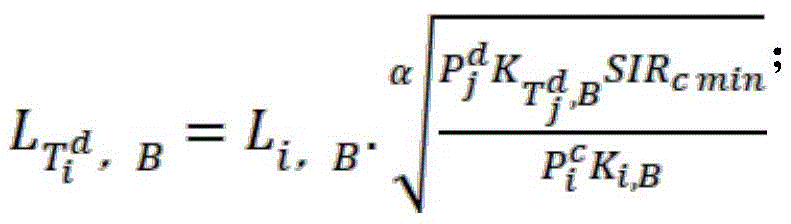
在具体实施中,所述蜂窝用户设备的干扰限制区域,为以蜂窝用户设备的位置为中心的不满足蜂窝用户设备最小信号干扰噪声比的区域,在本发明一实施例中,所述蜂窝用户设备的最小信号干扰噪声比SINR为0dB。其中,根据蜂窝用户设备的干扰限制区域的定义,可以得到蜂窝用户设备的干扰限制区域半径为:In a specific implementation, the interference restricted area of the cellular user equipment is an area centered on the location of the cellular user equipment that does not satisfy the minimum signal-to-interference noise ratio of the cellular user equipment. In an embodiment of the present invention, the cellular user equipment The minimum signal-to-interference-noise ratio SINR of the device is 0dB. Among them, according to the definition of the interference restricted area of the cellular user equipment, the radius of the interference restricted area of the cellular user equipment can be obtained as:

且,and,


其中,


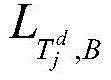
在具体实施中,所述确定D2D用户设备的干扰限制区域,为以D2D用户设备的位置为中心,将不满足D2D用户设备的最小信号干扰噪声比的区域。在本发明一实施例中,D2D用户设备的最小信号干扰噪声比为5dB。其中,根据蜂窝用户设备的干扰限制区域的定义,可以得到确定D2D用户设备的干扰限制区域的半径为:In a specific implementation, the determined interference restricted area of the D2D user equipment is an area centered on the location of the D2D user equipment and will not satisfy the minimum signal-to-interference-noise ratio of the D2D user equipment. In an embodiment of the present invention, the minimum signal-to-interference-noise ratio of the D2D user equipment is 5dB. Among them, according to the definition of the interference restricted area of the cellular user equipment, the radius of the interference restricted area of the D2D user equipment can be determined as:

且,and,


其中,


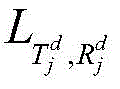


步骤S202:对满足最小发送功率阈值的D2D用户设备按照顺序进行遍历,获取遍历到的当前D2D用户设备。Step S202 : traverse the D2D user equipments that meet the minimum transmit power threshold in order, and acquire the current D2D user equipments that have been traversed.
在具体实施中,满足最小发送功率阈值的D2D用户设备进行遍历的顺序可以根据实际的需要进行设置。在本发明一实施例中,可以通过计算D2D用户设备对相应资源块的优先级的先后顺序,满足最小发送功率阈值的D2D用户设备进行遍历。具体而言,可以通过计算D2D用户设备对每个资源块的metric值,并按照计算得到的metric值的大小顺序进行排列,满足最小发送功率阈值的D2D用户设备的优先级顺序。In a specific implementation, the traversal order of the D2D user equipment that meets the minimum transmit power threshold may be set according to actual needs. In an embodiment of the present invention, the D2D user equipment that satisfies the minimum transmit power threshold can be traversed by calculating the priority order of the D2D user equipment for the corresponding resource blocks. Specifically, by calculating the metric value of the D2D user equipment for each resource block, and arranging in the order of the size of the calculated metric value, the priority order of the D2D user equipment that satisfies the minimum transmit power threshold can be obtained.
步骤S203:判断遍历到的当前D2D用户设备是否位于蜂窝用户设备的干扰限制区域之外;当判断结果为是时,可以执行步骤S204;反之,则可以执行步骤S206。Step S203: Determine whether the traversed current D2D user equipment is located outside the interference restricted area of the cellular user equipment; when the determination result is yes, step S204 may be performed; otherwise, step S206 may be performed.
步骤S204:判断对应蜂窝用户设备的分簇内当前存在的D2D用户设备是否位于遍历到的当前D2D用户设备的干扰限制区域之外;当判断结果为是时,可以执行步骤S205;反之,则可以执行步骤S206。Step S204: judge whether the D2D user equipment currently existing in the cluster corresponding to the cellular user equipment is located outside the traversed interference restricted area of the current D2D user equipment; when the judgment result is yes, step S205 can be performed; Step S206 is executed.
步骤S205:将遍历到的当前D2D用户设备置于该蜂窝用户设备的分簇内。Step S205: Place the traversed current D2D user equipment in the cluster of the cellular user equipment.
在具体实施中,当遍历到的当前D2D用户设备位于对应的蜂窝用户设备的干扰限制区域之外,且该蜂窝用户设备的分簇内已经存在的D2D用户设备位于遍历到的当前D2D用户设备位的干扰限制区域之外时,可以确定遍历到的当前D2D用户设备在进行D2D通信时,既不会对蜂窝用户设备产生干扰,也不会对分簇内已经存在的D2D用户设备的通信产生干扰,故可以将遍历到的当前D2D用户设备置于该蜂窝用户设备的分簇内。In a specific implementation, when the traversed current D2D user equipment is located outside the interference restricted area of the corresponding cellular user equipment, and the existing D2D user equipment in the cluster of the cellular user equipment is located in the traversed current D2D user equipment location When it is outside the interference restriction area, it can be determined that the current D2D user equipment traversed will neither interfere with the cellular user equipment nor interfere with the communication of the existing D2D user equipment in the cluster when performing D2D communication. , so the traversed current D2D user equipment can be placed in the cluster of the cellular user equipment.
步骤S206:将遍历到的当前D2D用户设备移出该蜂窝用户设备的分簇。Step S206: Move the traversed current D2D user equipment out of the cluster of the cellular user equipment.
在具体实施中,当遍历到的当前D2D用户设备位于对应的蜂窝用户设备的干扰限制区域之内时,可以确定遍历到的当前D2D用户设备在进行D2D通信时,会对蜂窝用户设备的通信产生干扰;或者,当遍历到的当前D2D用户设备位于对应的蜂窝用户设备的干扰限制区域之外但且该蜂窝用户设备的分簇内已经存在的D2D用户设备位于遍历到的当前D2D用户设备位的干扰限制区域之内时,可以确定遍历到的当前D2D用户设备在进行D2D通信时,虽不会对蜂窝用户设备产生干扰,但会对分簇内已经存在的D2D用户设备的通信产生干扰。因此,在出现上述两种情况中任意一种情况时,通过将遍历到的当前D2D用户设备移出该蜂窝用户设备的分簇,可以缓解或者消除D2D通信对蜂窝用户设备和D2D用户设备的干扰。In a specific implementation, when the traversed current D2D user equipment is located within the interference restricted area of the corresponding cellular user equipment, it can be determined that when the traversed current D2D user equipment performs D2D communication, the communication of the cellular user equipment will be affected. interference; or, when the traversed current D2D user equipment is located outside the interference restricted area of the corresponding cellular user equipment but the existing D2D user equipment in the cluster of the cellular user equipment is located within the traversed position of the current D2D user equipment When it is within the interference restriction area, it can be determined that the current D2D user equipment traversed will not interfere with the cellular user equipment when performing D2D communication, but it will interfere with the communication of the existing D2D user equipment in the cluster. Therefore, when any one of the above two situations occurs, by moving the traversed current D2D user equipment out of the cluster of the cellular user equipment, the interference of the D2D communication on the cellular user equipment and the D2D user equipment can be alleviated or eliminated.
步骤S207:判断满足最小发送功率阈值的D2D用户设备是否全部遍历完成;当判断结果为是时,可以结束操作;反之,则可以执行步骤S207。Step S207: Determine whether all the D2D user equipments that meet the minimum transmit power threshold are traversed; when the determination result is yes, the operation can be ended; otherwise, step S207 can be performed.
步骤S208:获取下一D2D用户设备,并从步骤S203开始执行。Step S208: Acquire the next D2D user equipment, and start from step S203.
在具体实施中,当满足最小发送功率阈值的D2D用户设备为全部遍历完成,也即尚存在未划分到分簇内的D2D用户设备,故此时可以按照顺序对剩余的满足最小发送功率阈值的D2D用户设备进行遍历,也即获取下一位序的满足最小发送功率阈值的D2D,并从步骤S203开始执行,直至所有的满足最小发送功率阈值的D2D用户设备全部遍历完成,即将所有的满足最小发送功率阈值的D2D用户设备划入以不同的蜂窝用户设备为簇头的分簇内。In a specific implementation, when all D2D user equipments that meet the minimum transmit power threshold are all traversed, that is, there are still D2D user equipments that have not been divided into clusters, so at this time, the remaining D2D user equipments that meet the minimum transmit power threshold can be sorted in order. The user equipment traverses, that is, obtains the D2Ds that meet the minimum transmit power threshold in the next order, and executes from step S203 until all D2D user equipments that meet the minimum transmit power threshold are all traversed, that is, all D2D user equipments that meet the minimum transmit power threshold are traversed. D2D user equipments with a power threshold are classified into clusters with different cellular user equipments as cluster heads.
下面结合具体的实例对本发明实施例中的基于能量约束和干扰限制区域的分簇D2D资源分配方法进行介绍。The following describes the clustering D2D resource allocation method based on energy constraint and interference limited area in the embodiment of the present invention with reference to specific examples.
参见图3,针对一个单小区场景,该小区内包含一个基站BS,两个蜂窝用户设备C1和C2,以及五个D2D用户设备d1、d2、d3、d4和
在第一时隙,五个D2D用户设备d1、d2、d3、d4和
表1Table 1


在第二时隙开始前,判断五个D2D用户设备功率值是否满足发送信号的最小发送功率阈值,将不满足发送信号最小发送功率阈值的D2D用户设备剔除,剔除的用户设备不参与第二时隙的信息传输,这里以五个D2D用户设备都满足发送信号最小发送功率阈值的情况继续进行说明。Before the start of the second time slot, it is judged whether the power values of the five D2D user equipments meet the minimum transmission power threshold of the transmitted signal, and the D2D user equipments that do not meet the minimum transmission power threshold of the transmitted signal are eliminated, and the eliminated user equipment does not participate in the second time slot. Slot information transmission, and the description is continued by taking the situation that all five D2D user equipments meet the minimum transmit power threshold of the transmitted signal.
在筛选出满足发送信号最小发送功率阈值的用户设备后,划分两个蜂窝用户设备C1和C2的干扰限制区域CU-ILA,该干扰限制区域本身不满足蜂窝用户设备最小信号干扰噪声比,并根据该项限制条件可以得到蜂窝用户设备干扰限制区域半径。After filtering out the user equipment that satisfies the minimum transmit power threshold of the transmitted signal, divide the interference restricted area CU-ILA of two cellular user equipments C1 and C2, the interference restricted area itself does not satisfy the minimum signal to interference noise ratio of the cellular user equipment, And according to this restriction condition, the radius of cellular user equipment interference restriction area can be obtained.
从图3可以看出蜂窝用户设备C1的干扰限制区域,D2D用户设备d1在C1的干扰限制区域中,因此它不满足蜂窝用户设备C1最小信号噪声比的要求,不能复用蜂窝用户设备C1上行链路的频谱资源;d2在C1的干扰限制区域之外,它满足蜂窝用户设备C1最小信号干扰噪声比的需求,因此d2可以复用蜂窝用户设备C1上行链路的频谱资源。It can be seen from Figure 3 that the interference restricted area of the cellular user equipment C1 , the D2D user equipment d1 is in the interference restricted area of C1 , so it does not meet the minimum signal-to-noise ratio requirement of the cellular user equipment C1 , and cannot reuse the cellular Spectrum resource of user equipment C 1 uplink; d 2 is outside the interference restricted area of C 1 , it meets the requirement of the minimum signal-to-interference noise ratio of cellular user equipment C 1 , so d 2 can reuse cellular user equipment C 1 uplink Spectrum resources of the link.
在划分蜂窝用户设备干扰限制区域后,继续划分五个D2D用户设备的干扰限制区域D2D-ILA,即第二重干扰限制区域,与蜂窝用户设备干扰限制区域类似,该干扰限制区域本身不满足D2D用户设备最小信号干扰噪声比,根据改项限制条件可以得到D2D用户设备干扰限制区域半径。After dividing the cellular user equipment interference limitation area, continue to divide the interference limitation area D2D-ILA of five D2D user equipment, that is, the second interference limitation area. Similar to the cellular user equipment interference limitation area, the interference limitation area itself does not satisfy the D2D requirement. The minimum signal-to-interference-to-noise ratio of the user equipment, and the radius of the D2D user equipment interference limitation area can be obtained according to the modified restriction conditions.
从图3可以看出D2D用户设备d2和d4的干扰限制区域,d2在蜂窝用户设备C1的干扰限制区域外,它满足D2D用户设备C1最小信号干扰噪声比的要求,因此D2D用户设备d2可以复用C1的上行链路资源;d3在D2D用户设备d2的干扰限制区域内,因此d3不能与d2共享蜂窝用户设备C1的频谱资源。同理,对于d4的干扰限制区域,D2D用户设备d5不能与d4共享蜂窝用户设备C1的频谱资源。It can be seen from Figure 3 that the interference restricted areas of D2D user equipments d2 and d4 , d2 is outside the interference restricted area of cellular user equipment C1 , it meets the minimum signal-to-interference noise ratio requirement of D2D user equipment C1 , so D2D User equipment d 2 can reuse the uplink resources of C 1 ; d 3 is within the interference restricted area of D2D user equipment d 2 , so d 3 cannot share the spectrum resources of cellular user equipment C 1 with d 2 . Similarly, for the interference restricted area of d 4 , the D2D user equipment d 5 cannot share the spectrum resources of the cellular user equipment C 1 with d 4 .
接着,以蜂窝用户设备作为簇头,根据D2D用户设备的位置分布对其进行分簇。继续参见图3,d1在C1的干扰限制区域内因此被剔除,d2,d3,d4,d5在C1的干扰限制区域外因而保留,而D2D用户设备d3在d2的干扰限制区域内因此被剔除,D2D用户设备d5在d4的干扰限制区域内因此也被剔除,将剩下的D2D用户设备d2,d4和蜂窝用户设备C1划分成一个簇,D2D用户设备d2和d4可以共享蜂窝用户设备C1的上行链路频谱资源。Next, the cellular user equipment is used as the cluster head, and the D2D user equipment is clustered according to its location distribution. Continuing to refer to FIG. 3 , d 1 is excluded from the interference restricted area of C 1 , d 2 , d 3 , d 4 , and d 5 are therefore kept outside the interference restricted area of C 1 , and the D2D user equipment d 3 is in d 2 Therefore, the D2D user equipment d 5 in the interference restricted area of d 4 is also eliminated, and the remaining D2D user equipment d 2 , d 4 and cellular user equipment C 1 are divided into a cluster, The D2D user equipments d2 and d4 may share the uplink spectrum resources of the cellular user equipment C1 .
当分簇完成之后,以功率P0给D2D用户设备分配发送功率,以最大发送率
本发明实施例中的上述方案,通过蜂窝用户设备的干扰限制区域和D2D用户设备的干扰限制区域,将所述D2D用户设备以蜂窝用户设备为簇头进行分簇,为各个分簇中的蜂窝用户设备和D2D用户设备分配对应的发送功率,以使得各个分簇内的D2D用户设备在所述当前资源调度帧的偶数时隙内,复用对应的蜂窝用户设备的上行链路频带资源向其他D2D用户设备传输信息,即同一分簇内的用户设备可以复用相同的资源块,从而可以缓解分簇内用户设备间的相互干扰,故可以提高用户设备的通信质量。In the above solution in the embodiment of the present invention, the D2D user equipment is clustered with the cellular user equipment as the cluster head through the interference restricted area of the cellular user equipment and the interference restricted area of the D2D user equipment, and the cells in each cluster are clustered. The user equipment and the D2D user equipment allocate corresponding transmit power, so that the D2D user equipment in each cluster reuses the uplink frequency band resources of the corresponding cellular user equipment to other D2D user equipment transmits information, that is, the user equipments in the same cluster can multiplex the same resource blocks, so that the mutual interference between the user equipments in the cluster can be alleviated, so the communication quality of the user equipments can be improved.
本领域普通技术人员可以理解上述实施例的各种方法中的全部或部分步骤是可以通过程序来指令相关的硬件来完成,该程序可以存储于计算机可读存储介质中,存储介质可以包括:ROM、RAM、磁盘或光盘等。Those of ordinary skill in the art can understand that all or part of the steps in the various methods of the above embodiments can be completed by instructing relevant hardware through a program, and the program can be stored in a computer-readable storage medium, and the storage medium can include: ROM , RAM, disk or CD, etc.
虽然本发明披露如上,但本发明并非限定于此。任何本领域技术人员,在不脱离本发明的精神和范围内,均可作各种更动与修改,因此本发明的保护范围应当以权利要求所限定的范围为准。Although the present invention is disclosed above, the present invention is not limited thereto. Any person skilled in the art can make various changes and modifications without departing from the spirit and scope of the present invention. Therefore, the protection scope of the present invention should be based on the scope defined by the claims.
Claims (7)






Priority Applications (1)
| Application Number | Priority Date | Filing Date | Title |
|---|---|---|---|
| CN201810499842.4A CN108810855B (en) | 2018-05-22 | 2018-05-22 | Clustering D2D resource allocation method based on energy constraint and interference limited area |
Applications Claiming Priority (1)
| Application Number | Priority Date | Filing Date | Title |
|---|---|---|---|
| CN201810499842.4A CN108810855B (en) | 2018-05-22 | 2018-05-22 | Clustering D2D resource allocation method based on energy constraint and interference limited area |
Publications (2)
| Publication Number | Publication Date |
|---|---|
| CN108810855A CN108810855A (en) | 2018-11-13 |
| CN108810855B true CN108810855B (en) | 2020-10-02 |
Family
ID=64092795
Family Applications (1)
| Application Number | Title | Priority Date | Filing Date |
|---|---|---|---|
| CN201810499842.4A Active CN108810855B (en) | 2018-05-22 | 2018-05-22 | Clustering D2D resource allocation method based on energy constraint and interference limited area |
Country Status (1)
| Country | Link |
|---|---|
| CN (1) | CN108810855B (en) |
Families Citing this family (2)
| Publication number | Priority date | Publication date | Assignee | Title |
|---|---|---|---|---|
| CN113329418B (en) * | 2021-04-21 | 2022-04-05 | 中南大学 | User clustering method, system and medium based on large-scale MIMO-NOMA system |
| CN117320112B (en) * | 2023-10-26 | 2024-05-03 | 陕西思极科技有限公司 | A dual-mode communication network energy consumption balancing method and system |
Citations (5)
| Publication number | Priority date | Publication date | Assignee | Title |
|---|---|---|---|---|
| WO2013169210A1 (en) * | 2012-05-11 | 2013-11-14 | Agency For Science, Technology And Research | Methods for determining an activation scheme of a radio communication device and radio communication devices |
| CN105229969A (en) * | 2013-02-19 | 2016-01-06 | 艾斯通林克国际有限责任公司 | Performance Analysis and Optimization Methods for Information Collection Networks on Electrical Distribution Networks |
| CN105531949A (en) * | 2013-09-17 | 2016-04-27 | 华为技术有限公司 | Device and method for enhancing downlink UE-specific demodulation reference signal to promote inter-cell interference suppression |
| CN106211191A (en) * | 2016-07-08 | 2016-12-07 | 上海大学 | A Fast Clustering Method for Energy Conservation Balance in Wireless Sensor Networks |
| CN106507316A (en) * | 2016-11-02 | 2017-03-15 | 西安邮电大学 | User's sub-clustering and resource allocation methods under a kind of D2D multicasts scene |
Family Cites Families (1)
| Publication number | Priority date | Publication date | Assignee | Title |
|---|---|---|---|---|
| US20130051277A1 (en) * | 2011-08-30 | 2013-02-28 | Renesas Mobile Corporation | Method and apparatus for allocating resources for device-to-device discovery |
-
2018
- 2018-05-22 CN CN201810499842.4A patent/CN108810855B/en active Active
Patent Citations (5)
| Publication number | Priority date | Publication date | Assignee | Title |
|---|---|---|---|---|
| WO2013169210A1 (en) * | 2012-05-11 | 2013-11-14 | Agency For Science, Technology And Research | Methods for determining an activation scheme of a radio communication device and radio communication devices |
| CN105229969A (en) * | 2013-02-19 | 2016-01-06 | 艾斯通林克国际有限责任公司 | Performance Analysis and Optimization Methods for Information Collection Networks on Electrical Distribution Networks |
| CN105531949A (en) * | 2013-09-17 | 2016-04-27 | 华为技术有限公司 | Device and method for enhancing downlink UE-specific demodulation reference signal to promote inter-cell interference suppression |
| CN106211191A (en) * | 2016-07-08 | 2016-12-07 | 上海大学 | A Fast Clustering Method for Energy Conservation Balance in Wireless Sensor Networks |
| CN106507316A (en) * | 2016-11-02 | 2017-03-15 | 西安邮电大学 | User's sub-clustering and resource allocation methods under a kind of D2D multicasts scene |
Also Published As
| Publication number | Publication date |
|---|---|
| CN108810855A (en) | 2018-11-13 |
Similar Documents
| Publication | Publication Date | Title |
|---|---|---|
| Wen et al. | QoS-aware mode selection and resource allocation scheme for device-to-device (D2D) communication in cellular networks | |
| CN104717755B (en) | A Downlink Spectrum Resource Allocation Method Using D2D Technology in a Cellular Network | |
| CN103260258A (en) | Resource distribution and resource reuse combination method in cellular terminal device-to-device (D2D) system | |
| CN103260244B (en) | D2D uplink resource multiplexing mode switching method in a kind of cellular system | |
| CN103997740B (en) | Cognitive-Cooperation network association resource allocation methods based on optimization utility | |
| CN104902431B (en) | A kind of LTE network mid-span cell D2D communication spectrum distribution methods | |
| CN107396293B (en) | V2X resource allocation method and system based on D2D communication | |
| EP3195678B1 (en) | Scheduling method and system for fourth generation radio mobile networks | |
| CN108271163A (en) | The sharing method and device of a kind of frequency spectrum resource | |
| CN108924799A (en) | The resource allocation algorithm of D2D communication in a kind of cellular network | |
| Li et al. | An advanced spectrum allocation algorithm for the across-cell D2D communication in LTE network with higher throughput | |
| CN106851838A (en) | Multiple cell D2D frequency spectrum resource allocation methods | |
| CN108810855B (en) | Clustering D2D resource allocation method based on energy constraint and interference limited area | |
| CN107172706B (en) | Joint wireless resource allocation and power control method based on D2D communication | |
| CN103313309B (en) | A kind of minizone D2D user model system of selection based on load | |
| CN105611644A (en) | Method for improving fairness of cellular network containing D2D (Device-to-Device) communication | |
| CN106954269B (en) | A QoS-based clustering channel allocation method in D2D communication system | |
| CN106912059B (en) | Cognitive relay network joint relay selection and resource allocation method supporting mutual information accumulation | |
| CN110049473B (en) | Joint wireless channel allocation and power control method for relay enhanced D2D communication | |
| CN104918207A (en) | Multi-D2D communication resource allocation method in heterogeneous network based on frequency spectrum resource allocation | |
| CN112637927B (en) | Multi-user multi-mode D2D communication resource allocation method based on energy efficiency | |
| CN114422986A (en) | Uplink resource allocation system and method based on QoS | |
| US9924475B2 (en) | Method for managing data transmission power in mobile cellular networks | |
| CN104168634B (en) | Distributed user location aware cell method for closing for LTE-A cellular network | |
| CN105992219A (en) | Method and device for obtaining management strategy of heterogeneous network |
Legal Events
| Date | Code | Title | Description |
|---|---|---|---|
| PB01 | Publication | ||
| PB01 | Publication | ||
| SE01 | Entry into force of request for substantive examination | ||
| SE01 | Entry into force of request for substantive examination | ||
| GR01 | Patent grant | ||
| GR01 | Patent grant |