CN108780849B - organic electroluminescent element - Google Patents
organic electroluminescent element Download PDFInfo
- Publication number
- CN108780849B CN108780849B CN201780016883.7A CN201780016883A CN108780849B CN 108780849 B CN108780849 B CN 108780849B CN 201780016883 A CN201780016883 A CN 201780016883A CN 108780849 B CN108780849 B CN 108780849B
- Authority
- CN
- China
- Prior art keywords
- electron transport
- transport layer
- light
- electron
- derivatives
- Prior art date
- Legal status (The legal status is an assumption and is not a legal conclusion. Google has not performed a legal analysis and makes no representation as to the accuracy of the status listed.)
- Active
Links
Images

Classifications
-
- H—ELECTRICITY
- H10—SEMICONDUCTOR DEVICES; ELECTRIC SOLID-STATE DEVICES NOT OTHERWISE PROVIDED FOR
- H10K—ORGANIC ELECTRIC SOLID-STATE DEVICES
- H10K85/00—Organic materials used in the body or electrodes of devices covered by this subclass
- H10K85/60—Organic compounds having low molecular weight
- H10K85/649—Aromatic compounds comprising a hetero atom
- H10K85/654—Aromatic compounds comprising a hetero atom comprising only nitrogen as heteroatom
-
- C—CHEMISTRY; METALLURGY
- C09—DYES; PAINTS; POLISHES; NATURAL RESINS; ADHESIVES; COMPOSITIONS NOT OTHERWISE PROVIDED FOR; APPLICATIONS OF MATERIALS NOT OTHERWISE PROVIDED FOR
- C09K—MATERIALS FOR MISCELLANEOUS APPLICATIONS, NOT PROVIDED FOR ELSEWHERE
- C09K11/00—Luminescent, e.g. electroluminescent, chemiluminescent materials
- C09K11/06—Luminescent, e.g. electroluminescent, chemiluminescent materials containing organic luminescent materials
-
- H—ELECTRICITY
- H10—SEMICONDUCTOR DEVICES; ELECTRIC SOLID-STATE DEVICES NOT OTHERWISE PROVIDED FOR
- H10K—ORGANIC ELECTRIC SOLID-STATE DEVICES
- H10K50/00—Organic light-emitting devices
-
- H—ELECTRICITY
- H10—SEMICONDUCTOR DEVICES; ELECTRIC SOLID-STATE DEVICES NOT OTHERWISE PROVIDED FOR
- H10K—ORGANIC ELECTRIC SOLID-STATE DEVICES
- H10K50/00—Organic light-emitting devices
- H10K50/10—OLEDs or polymer light-emitting diodes [PLED]
-
- H—ELECTRICITY
- H10—SEMICONDUCTOR DEVICES; ELECTRIC SOLID-STATE DEVICES NOT OTHERWISE PROVIDED FOR
- H10K—ORGANIC ELECTRIC SOLID-STATE DEVICES
- H10K50/00—Organic light-emitting devices
- H10K50/10—OLEDs or polymer light-emitting diodes [PLED]
- H10K50/11—OLEDs or polymer light-emitting diodes [PLED] characterised by the electroluminescent [EL] layers
-
- H—ELECTRICITY
- H10—SEMICONDUCTOR DEVICES; ELECTRIC SOLID-STATE DEVICES NOT OTHERWISE PROVIDED FOR
- H10K—ORGANIC ELECTRIC SOLID-STATE DEVICES
- H10K50/00—Organic light-emitting devices
- H10K50/10—OLEDs or polymer light-emitting diodes [PLED]
- H10K50/11—OLEDs or polymer light-emitting diodes [PLED] characterised by the electroluminescent [EL] layers
- H10K50/12—OLEDs or polymer light-emitting diodes [PLED] characterised by the electroluminescent [EL] layers comprising dopants
-
- H—ELECTRICITY
- H10—SEMICONDUCTOR DEVICES; ELECTRIC SOLID-STATE DEVICES NOT OTHERWISE PROVIDED FOR
- H10K—ORGANIC ELECTRIC SOLID-STATE DEVICES
- H10K50/00—Organic light-emitting devices
- H10K50/10—OLEDs or polymer light-emitting diodes [PLED]
- H10K50/14—Carrier transporting layers
- H10K50/16—Electron transporting layers
- H10K50/165—Electron transporting layers comprising dopants
-
- H—ELECTRICITY
- H10—SEMICONDUCTOR DEVICES; ELECTRIC SOLID-STATE DEVICES NOT OTHERWISE PROVIDED FOR
- H10K—ORGANIC ELECTRIC SOLID-STATE DEVICES
- H10K85/00—Organic materials used in the body or electrodes of devices covered by this subclass
- H10K85/60—Organic compounds having low molecular weight
- H10K85/649—Aromatic compounds comprising a hetero atom
- H10K85/657—Polycyclic condensed heteroaromatic hydrocarbons
-
- H—ELECTRICITY
- H10—SEMICONDUCTOR DEVICES; ELECTRIC SOLID-STATE DEVICES NOT OTHERWISE PROVIDED FOR
- H10K—ORGANIC ELECTRIC SOLID-STATE DEVICES
- H10K85/00—Organic materials used in the body or electrodes of devices covered by this subclass
- H10K85/60—Organic compounds having low molecular weight
- H10K85/649—Aromatic compounds comprising a hetero atom
- H10K85/657—Polycyclic condensed heteroaromatic hydrocarbons
- H10K85/6572—Polycyclic condensed heteroaromatic hydrocarbons comprising only nitrogen in the heteroaromatic polycondensed ring system, e.g. phenanthroline or carbazole
-
- C—CHEMISTRY; METALLURGY
- C07—ORGANIC CHEMISTRY
- C07D—HETEROCYCLIC COMPOUNDS
- C07D487/00—Heterocyclic compounds containing nitrogen atoms as the only ring hetero atoms in the condensed system, not provided for by groups C07D451/00 - C07D477/00
- C07D487/02—Heterocyclic compounds containing nitrogen atoms as the only ring hetero atoms in the condensed system, not provided for by groups C07D451/00 - C07D477/00 in which the condensed system contains two hetero rings
- C07D487/04—Ortho-condensed systems
-
- H—ELECTRICITY
- H10—SEMICONDUCTOR DEVICES; ELECTRIC SOLID-STATE DEVICES NOT OTHERWISE PROVIDED FOR
- H10K—ORGANIC ELECTRIC SOLID-STATE DEVICES
- H10K2101/00—Properties of the organic materials covered by group H10K85/00
- H10K2101/90—Multiple hosts in the emissive layer
-
- H—ELECTRICITY
- H10—SEMICONDUCTOR DEVICES; ELECTRIC SOLID-STATE DEVICES NOT OTHERWISE PROVIDED FOR
- H10K—ORGANIC ELECTRIC SOLID-STATE DEVICES
- H10K2102/00—Constructional details relating to the organic devices covered by this subclass
- H10K2102/10—Transparent electrodes, e.g. using graphene
- H10K2102/101—Transparent electrodes, e.g. using graphene comprising transparent conductive oxides [TCO]
- H10K2102/103—Transparent electrodes, e.g. using graphene comprising transparent conductive oxides [TCO] comprising indium oxides, e.g. ITO
-
- H—ELECTRICITY
- H10—SEMICONDUCTOR DEVICES; ELECTRIC SOLID-STATE DEVICES NOT OTHERWISE PROVIDED FOR
- H10K—ORGANIC ELECTRIC SOLID-STATE DEVICES
- H10K50/00—Organic light-emitting devices
- H10K50/10—OLEDs or polymer light-emitting diodes [PLED]
- H10K50/14—Carrier transporting layers
- H10K50/16—Electron transporting layers
- H10K50/166—Electron transporting layers comprising a multilayered structure
-
- H—ELECTRICITY
- H10—SEMICONDUCTOR DEVICES; ELECTRIC SOLID-STATE DEVICES NOT OTHERWISE PROVIDED FOR
- H10K—ORGANIC ELECTRIC SOLID-STATE DEVICES
- H10K85/00—Organic materials used in the body or electrodes of devices covered by this subclass
- H10K85/30—Coordination compounds
- H10K85/341—Transition metal complexes, e.g. Ru(II)polypyridine complexes
- H10K85/342—Transition metal complexes, e.g. Ru(II)polypyridine complexes comprising iridium
-
- H—ELECTRICITY
- H10—SEMICONDUCTOR DEVICES; ELECTRIC SOLID-STATE DEVICES NOT OTHERWISE PROVIDED FOR
- H10K—ORGANIC ELECTRIC SOLID-STATE DEVICES
- H10K85/00—Organic materials used in the body or electrodes of devices covered by this subclass
- H10K85/60—Organic compounds having low molecular weight
- H10K85/649—Aromatic compounds comprising a hetero atom
- H10K85/657—Polycyclic condensed heteroaromatic hydrocarbons
- H10K85/6574—Polycyclic condensed heteroaromatic hydrocarbons comprising only oxygen in the heteroaromatic polycondensed ring system, e.g. cumarine dyes
-
- H—ELECTRICITY
- H10—SEMICONDUCTOR DEVICES; ELECTRIC SOLID-STATE DEVICES NOT OTHERWISE PROVIDED FOR
- H10K—ORGANIC ELECTRIC SOLID-STATE DEVICES
- H10K85/00—Organic materials used in the body or electrodes of devices covered by this subclass
- H10K85/60—Organic compounds having low molecular weight
- H10K85/649—Aromatic compounds comprising a hetero atom
- H10K85/657—Polycyclic condensed heteroaromatic hydrocarbons
- H10K85/6576—Polycyclic condensed heteroaromatic hydrocarbons comprising only sulfur in the heteroaromatic polycondensed ring system, e.g. benzothiophene
Landscapes
- Physics & Mathematics (AREA)
- Chemical & Material Sciences (AREA)
- Engineering & Computer Science (AREA)
- Materials Engineering (AREA)
- Optics & Photonics (AREA)
- Spectroscopy & Molecular Physics (AREA)
- Organic Chemistry (AREA)
- Electroluminescent Light Sources (AREA)
- Other In-Based Heterocyclic Compounds (AREA)
- Nitrogen Condensed Heterocyclic Rings (AREA)
- Plural Heterocyclic Compounds (AREA)
- Indole Compounds (AREA)
Abstract
本发明提供一种低驱动电压且高发光效率、长寿命的有机电致发光元件(有机EL元件)。该有机EL元件在对置的阳极与阴极之间包含1个以上的发光层和电子输送层,至少1个电子输送层含有下述通式(1)表示的吲哚并咔唑化合物和电子供体。其中,环A为式(1a)表示的芳香族烃环,环B为式(1b)表示的杂环,L为单键或者芳香族烃基,X为N或者C‑Ar1,至少1个X为N,Y和Ar1为氢、芳香族烃基或者芳香族杂环基。
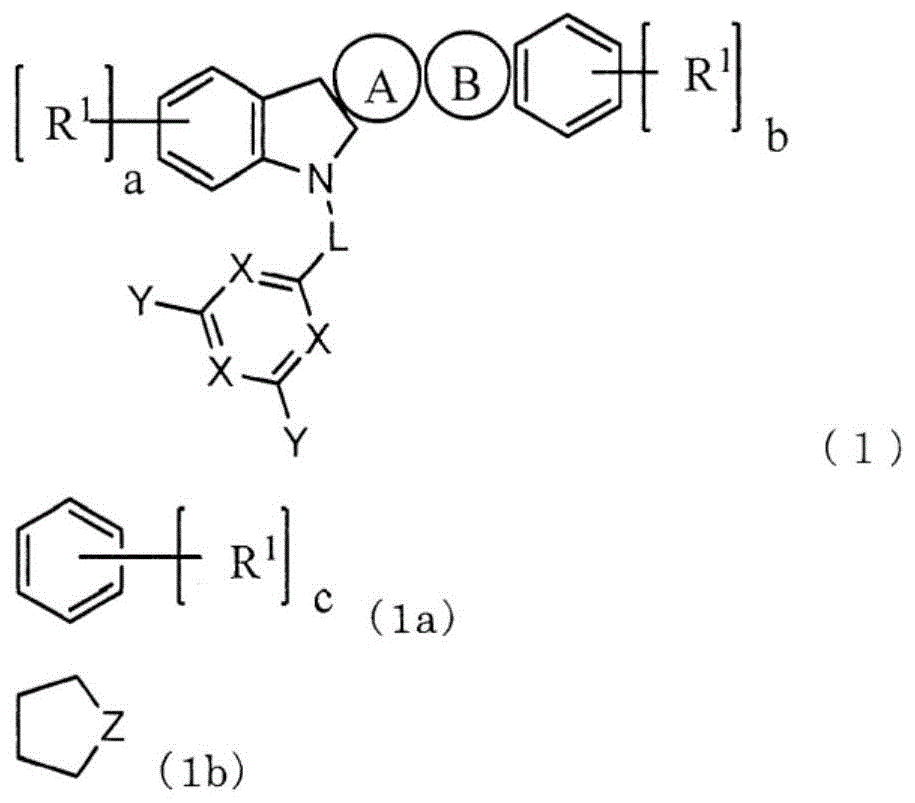
This invention provides an organic electroluminescent element (organic EL element) with low driving voltage, high luminous efficiency, and long lifetime. The organic EL element comprises one or more light-emitting layers and electron transport layers between opposing anodes and cathodes. At least one electron transport layer contains an indole-carbazole compound represented by the following general formula (1) and an electron donor. Wherein, ring A is an aromatic hydrocarbon ring represented by formula (1a), ring B is a heterocycle represented by formula (1b), L is a single bond or an aromatic hydrocarbon group, X is N or C- Ar1 , at least one X is N, and Y and Ar1 are hydrogen, an aromatic hydrocarbon group, or an aromatic heterocyclic group.
Description
技术领域technical field
本发明涉及有机电场元件(称为有机EL元件)。The present invention relates to organic electric field elements (referred to as organic EL elements).
背景技术Background technique
通过对有机EL元件外加电压,从而从阳极向发光层注入空穴,从阴极向发光层注入电子。然后在发光层中,注入的空穴与电子再结合,生成激子。此时,根据电子自旋的统计定律,单线态激子和三线态激子以1:3的比例生成。据说利用由单线态激子产生的发光的荧光发光型的有机EL元件的内部量子效率的极限为25%。另一方面,已知利用由三线态激子产生的发光的磷光发光型的有机EL元件在从单线态激子高效地进行系间窜越时,内部量子效率高达100%。By applying a voltage to the organic EL element, holes are injected from the anode to the light-emitting layer, and electrons are injected from the cathode to the light-emitting layer. Then in the light-emitting layer, the injected holes and electrons recombine to generate excitons. At this time, according to the statistical law of electron spin, singlet excitons and triplet excitons are generated in a ratio of 1:3. It is said that the limit of the internal quantum efficiency of a fluorescent light-emitting organic EL element utilizing light emission by singlet excitons is 25%. On the other hand, it is known that an organic EL element of phosphorescence emission type utilizing light emission from triplet excitons has an internal quantum efficiency as high as 100% when efficient intersystem crossing from singlet excitons is performed.
然而,关于磷光发光型的有机EL元件,长寿命化成为技术课题。However, with regard to the organic EL element of phosphorescence emission type, it is a technical subject to prolong the life.
最近,开发了利用延迟荧光的高效率的有机EL元件。例如在专利文献1中公开了一种利用作为延迟荧光的机理之一的TTF(三线态-三线态融合,Triplet-Triplet Fusion)机制的有机EL元件。TTF机制利用通过2个三线态激子的碰撞而生成单线态激子的现象,认为在理论上可将内部量子效率提高至40%。然而,与磷光发光型的有机EL元件相比,效率低,因此要求进一步改良效率。Recently, high-efficiency organic EL elements utilizing delayed fluorescence have been developed. For example,
在专利文献2中,公开了一种利用TADF(热活化延迟荧光,Thermally ActivatedDelayed Fluorescence)机制的有机EL元件。TADF机制利用在单线态准位和三线态准位的能量差小的材料中产生从三线态激子向单线态激子的反向系间窜越的现象,认为理论上可将内部量子效率提高至100%。然而与磷光发光型的元件同样地,要求进一步改善寿命特性。
现有技术文献prior art literature
专利文献Patent Literature
专利文献1:WO2010/134350号Patent Document 1: WO2010/134350
专利文献2:WO2011/070963号Patent Document 2: WO2011/070963
专利文献3:WO2009/0116377号Patent Document 3: WO2009/0116377
专利文献4:WO2011/0099374号Patent Document 4: WO2011/0099374
专利文献5:WO2013/0175746号Patent Document 5: WO2013/0175746
专利文献6:WO2013/0175747号Patent Document 6: WO2013/0175747
在专利文献3中公开了使用吲哚并咔唑化合物作为电子输送层。在专利文献4中公开了使用吲哚并咔唑化合物作为电子输送层和空穴阻挡层的使用。在专利文献5和6中公开了使用吖嗪(azine)化合物作为电子输送层。
然而,都无法说是充分的,期望进一步改良。However, none of them can be said to be sufficient, and further improvement is desired.
发明内容SUMMARY OF THE INVENTION
为了将有机EL元件应用于平板显示器等显示元件或者光源,需要改善元件的发光效率,同时充分确保驱动时的稳定性。本发明鉴于上述现状,其目的在于提供低驱动电压、高效率且具有高的驱动稳定性的实用上有用的有机EL元件。In order to apply an organic EL element to a display element such as a flat panel display or a light source, it is necessary to improve the luminous efficiency of the element while sufficiently ensuring the stability during driving. In view of the above-mentioned situation, the present invention aims to provide a practically useful organic EL element having a low driving voltage, high efficiency, and high driving stability.
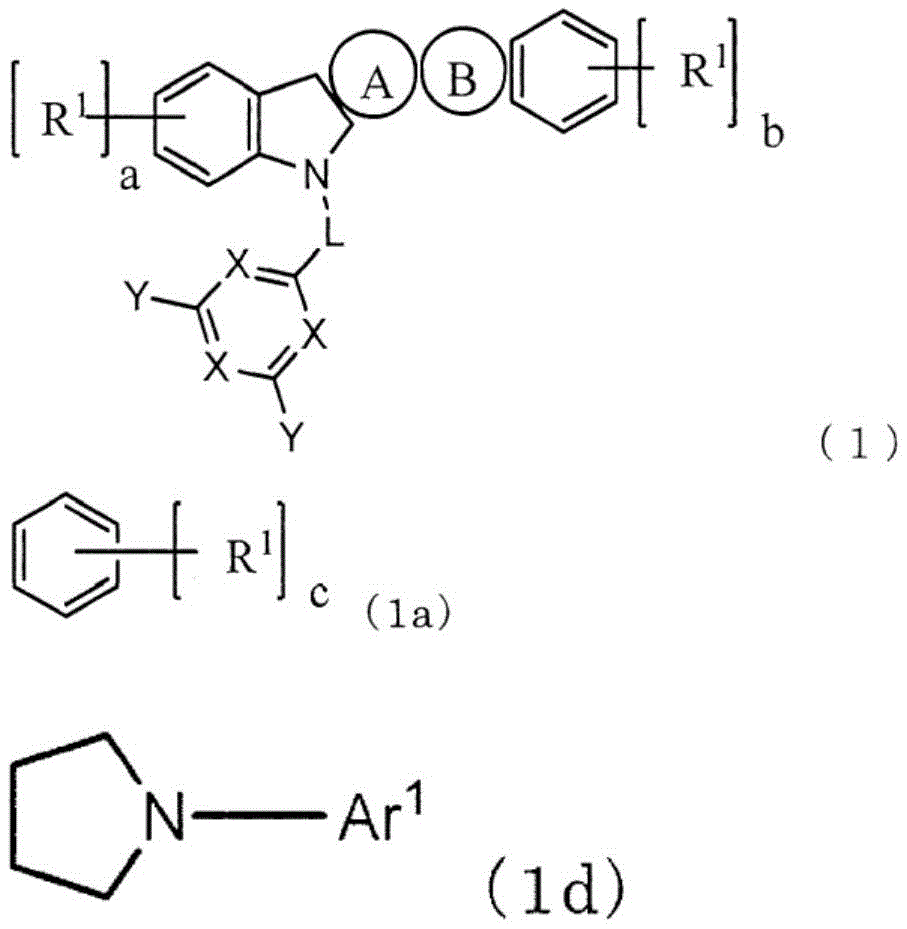
本发明是一种有机EL元件,其特征在于,在对置的阳极与阴极之间包含1个以上的发光层和1个以上的电子输送层,至少1个电子输送层含有下述通式(1)表示的化合物和电子供体。The present invention is an organic EL device characterized by comprising one or more light-emitting layers and one or more electron transport layers between the opposing anode and cathode, and at least one electron transport layer contains the following general formula ( 1) The compound and electron donor represented by 1).
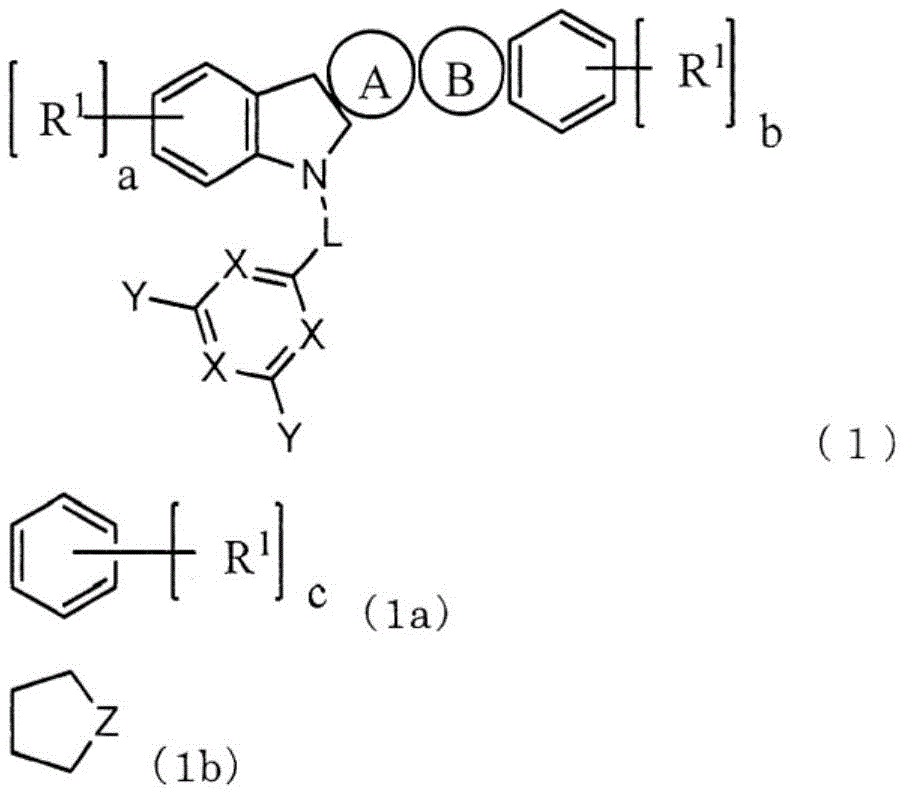
其中,环A为式(1a)表示的芳香族烃环,环B为式(1b)表示的杂环,环A和环B与各自邻接的环在任意的位置稠合。Here, ring A is an aromatic hydrocarbon ring represented by formula (1a), ring B is a heterocyclic ring represented by formula (1b), and ring A and ring B are condensed at arbitrary positions with their adjacent rings.
L表示单键、或者碳原子数6~12的芳香族烃基。L represents a single bond or an aromatic hydrocarbon group having 6 to 12 carbon atoms.
X表示N或者C-Ar1,至少1个X表示N。X represents N or C-Ar 1 , and at least one X represents N.
Y和Ar1各自独立地为氢、取代或者未取代的碳原子数6~18的芳香族烃基、取代或者未取代的碳原子数3~18的芳香族杂环基、或者这些芳香族环2~5个连接而成的连接芳香族基团。Y and Ar 1 are each independently hydrogen, a substituted or unsubstituted aromatic hydrocarbon group having 6 to 18 carbon atoms, a substituted or unsubstituted aromatic heterocyclic group having 3 to 18 carbon atoms, or these
R1独立地为碳原子数1~10的脂肪族烃基、取代或者未取代的碳原子数6~10的芳香族烃基、或者取代或者未取代的碳原子数3~12的芳香族杂环基。a、b、c各自独立地表示0~3的整数。R 1 is independently an aliphatic hydrocarbon group having 1 to 10 carbon atoms, a substituted or unsubstituted aromatic hydrocarbon group having 6 to 10 carbon atoms, or a substituted or unsubstituted aromatic heterocyclic group having 3 to 12 carbon atoms . a, b, and c each independently represent an integer of 0 to 3.
Z为N-Ar2、C(R2)2、O或者S。Z is N-Ar 2 , C(R 2 ) 2 , O or S.
Ar2为取代或者未取代的碳原子数6~18的芳香族烃基、取代或者未取代的碳原子数3~18的芳香族杂环基、或者这些芳香族环2~5个连接而成的连接芳香族基团。Ar 2 is a substituted or unsubstituted aromatic hydrocarbon group having 6 to 18 carbon atoms, a substituted or unsubstituted aromatic heterocyclic group having 3 to 18 carbon atoms, or a combination of 2 to 5 of these aromatic rings connected Attach aromatic groups.
R2独立地为氢、碳原子数1~10的脂肪族烃基、取代或未取代的碳原子数6~10的芳香族烃基、或者取代或未取代的碳原子数3~12的芳香族杂环基。R 2 is independently hydrogen, an aliphatic hydrocarbon group having 1 to 10 carbon atoms, a substituted or unsubstituted aromatic hydrocarbon group having 6 to 10 carbon atoms, or a substituted or unsubstituted aromatic hetero group having 3 to 12 carbon atoms. ring base.
作为式(1b)的优选方式,有式(1d),作为L的优选方式,有单键。As a preferred embodiment of formula (1b), there is formula (1d), and as a preferred embodiment of L, there is a single bond.
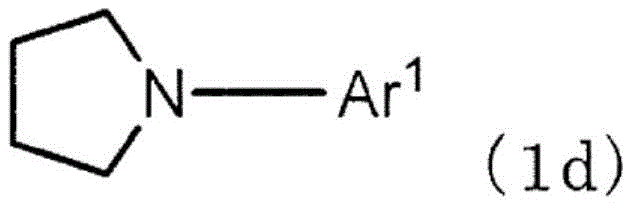
(其中,Ar1与通式(1)中的Ar1为相同含义。)(In this case, Ar 1 has the same meaning as Ar 1 in the general formula (1).)
优选电子输送层由第1电子输送层和第2电子输送层这两层构成,其中,第1电子输送层与发光层邻接,第1电子输送层含有通式(1)表示的化合物,第2电子输送层含有通式(1)表示的化合物和电子供体。Preferably, the electron transport layer is composed of two layers, a first electron transport layer and a second electron transport layer, wherein the first electron transport layer is adjacent to the light-emitting layer, the first electron transport layer contains the compound represented by the general formula (1), and the second electron transport layer is preferably composed of two layers. The electron transport layer contains the compound represented by the general formula (1) and an electron donor.
作为上述电子供体,优选为碱金属化合物或者碱金属配合物,更优选为羟基喹啉锂(Liq)。As said electron donor, an alkali metal compound or an alkali metal complex is preferable, and lithium quinolate (Liq) is more preferable.
优选电子输送层是使通式(1)表示的化合物和电子供体的预混物蒸镀而得到的,另外,优选发光层含有主体材料和发光材料,且含有通式(1)表示的化合物作为主体材料。The electron transport layer is preferably obtained by vapor deposition of a premix of the compound represented by the general formula (1) and the electron donor, and the light-emitting layer preferably contains a host material and a light-emitting material, and contains the compound represented by the general formula (1). as the main material.
本发明的有机EL元件因为电子输送层含有特定的电子输送材料和电子供体,因此能够成为低驱动电压、高发光效率且长寿命的有机EL元件。Since the organic EL element of the present invention contains a specific electron transport material and an electron donor in the electron transport layer, it can be an organic EL element with low driving voltage, high luminous efficiency, and long life.
附图说明Description of drawings
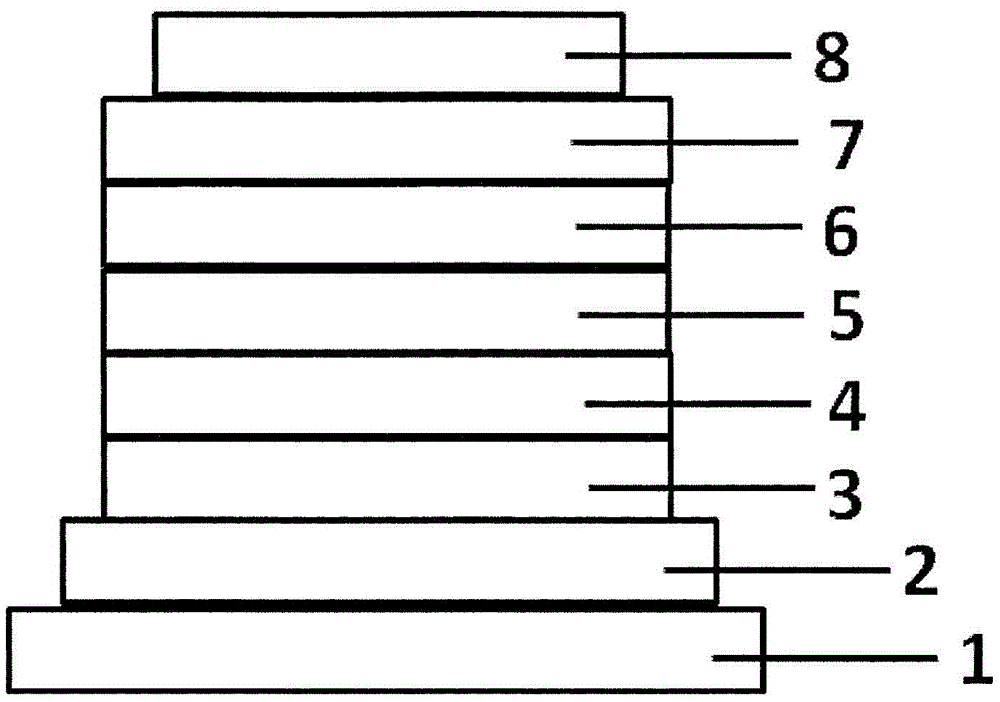
图1是表示有机EL元件的1个例子的截面示意图。FIG. 1 is a schematic cross-sectional view showing an example of an organic EL element.
具体实施方式Detailed ways
本发明的有机EL元件是在对置的阳极与阴极之间包含1个以上的发光层和1个以上的电子输送层的有机EL元件,至少1个电子输送层含有上述通式(1)表示的化合物和电子供体。The organic EL element of the present invention is an organic EL element including one or more light-emitting layers and one or more electron transport layers between the opposing anode and cathode, and at least one electron transport layer contains the expression represented by the above general formula (1). compounds and electron donors.
以下,对通式(1)进行说明。Hereinafter, the general formula (1) will be described.
环A表示由式(1a)表示的芳香族烃环。另外,环B为式(1b)表示的杂环,环A和环B与各自邻接的环在任意的位置稠合。Ring A represents an aromatic hydrocarbon ring represented by formula (1a). In addition, ring B is a heterocyclic ring represented by formula (1b), and ring A and ring B are condensed at arbitrary positions with each adjacent ring.
L表示单键、或者2价的碳原子数6~12的芳香族烃基。优选为单键、或者亚苯基,更优选为单键。L represents a single bond or a divalent aromatic hydrocarbon group having 6 to 12 carbon atoms. A single bond or a phenylene group is preferable, and a single bond is more preferable.
作为上述碳原子数6~12的芳香族烃基的具体例,可举出亚苯基、亚联苯基和亚萘基。Specific examples of the above-mentioned aromatic hydrocarbon group having 6 to 12 carbon atoms include a phenylene group, a biphenylene group, and a naphthylene group.
X表示N或者C-Ar1,至少1个X为N。X represents N or C-Ar 1 , and at least one X is N.
Y和Ar1各自独立地为氢、取代或者未取代的碳原子数6~18的芳香族烃基、取代或者未取代的碳原子数3~18的芳香族杂环基、或者这些芳香族环2~5个连接而成的连接芳香族基团,优选为氢、取代或未取代的碳原子数6~12的芳香族烃基、取代或未取代的碳原子数3~12的芳香族杂环基、或者这些芳香族环2~3个连接而成的连接芳香族基团,更优选为氢或者取代或未取代的碳原子数6~12的芳香族烃基。Y and Ar 1 are each independently hydrogen, a substituted or unsubstituted aromatic hydrocarbon group having 6 to 18 carbon atoms, a substituted or unsubstituted aromatic heterocyclic group having 3 to 18 carbon atoms, or these
作为上述碳原子数6~18的芳香族烃基、碳原子数3~18的芳香族杂环基、或者这些连接芳香族基团未取代的情况的具体例,可举出由苯、萘、菲、蒽、三亚苯、吡啶、嘧啶、三嗪、噻吩、异噻唑、噻唑、哒嗪、吡咯、吡唑、咪唑、三唑、噻二唑、吡嗪、呋喃、异


此处,本说明书中所说的连接芳香族基团是将上述碳原子数的芳香族烃基或者芳香族杂环基所具有的芳香族环以直接键合的方式连接多个而成的芳香族基团,多个芳香族环可以相同,也可以不同。Here, the linking aromatic group referred to in this specification refers to an aromatic group obtained by directly bonding a plurality of aromatic rings contained in an aromatic hydrocarbon group or an aromatic heterocyclic group having the above-mentioned carbon number. As a group, a plurality of aromatic rings may be the same or different.
连接芳香族化合物可以是像Ar11-Ar12-Ar13这样的直链型,也可以是像Ar11-Ar12(Ar13)这样的支链型,Ar11~Ar13可以相同,也可以不同。此外,可以没有Ar13,也可以进一步含有Ar14、Ar15。由连接芳香族化合物产生的芳香族基团的键合位点可以从末端的Ar11或者Ar13产生,也可以从中间的Ar12产生。此处,Ar11~Ar15为芳香族基团或者芳香族环。The linking aromatic compound may be a straight chain type such as Ar 11 -Ar 12 -Ar 13 or a branched type such as Ar 11 -Ar 12 (Ar 13 ). Ar 11 to Ar 13 may be the same or may be different. In addition, Ar 13 may be absent, or Ar 14 and Ar 15 may be further contained. The bonding site of the aromatic group generated by linking the aromatic compound may be generated from Ar 11 or Ar 13 at the terminal, or may be generated from Ar 12 in the middle. Here, Ar 11 to Ar 15 are aromatic groups or aromatic rings.
这些芳香族烃基、芳香族杂环基、或者连接芳香族基团各自可以具有取代基。具有取代基时的优选取代基为氰基、碳原子数1~10的脂肪族烃基。此外,取代基的个数为0~5,优选为0~2。芳香族烃基、芳香族杂环基、和连接芳香族基团具有取代基时的碳原子数的计算中不包括取代基的碳原子数。但是,优选包括取代基的碳原子数在内的合计的碳原子数满足上述范围。Each of these aromatic hydrocarbon groups, aromatic heterocyclic groups, or linking aromatic groups may have a substituent. When having a substituent, preferable substituents are a cyano group and an aliphatic hydrocarbon group having 1 to 10 carbon atoms. In addition, the number of the substituents is 0-5, preferably 0-2. The number of carbon atoms of the substituent is not included in the calculation of the number of carbon atoms when an aromatic hydrocarbon group, an aromatic heterocyclic group, and a substituent connected to an aromatic group have a substituent. However, it is preferable that the total number of carbon atoms including the number of carbon atoms of the substituent satisfies the above range.
作为上述取代基的具体例,可举出氰基、甲基、乙基、丙基、丁基、戊基、己基、庚基、辛基、壬基、癸基。优选为氰基或者C1~C6的烷基。As a specific example of the said substituent, a cyano group, a methyl group, an ethyl group, a propyl group, a butyl group, a pentyl group, a hexyl group, a heptyl group, an octyl group, a nonyl group, and a decyl group are mentioned. Preferably it is a cyano group or a C1-C6 alkyl group.
R1独立地为碳原子数1~10的脂肪族烃基、取代或未取代的碳原子数6~10的芳香族烃基、或者取代或未取代的碳原子数3~12的芳香族杂环基。优选为碳原子数1~6的脂肪族烃基、取代或未取代的碳原子数6~8的芳香族烃基、或者取代或未取代的碳原子数3~9的芳香族杂环基。更优选为苯基。R 1 is independently an aliphatic hydrocarbon group having 1 to 10 carbon atoms, a substituted or unsubstituted aromatic hydrocarbon group having 6 to 10 carbon atoms, or a substituted or unsubstituted aromatic heterocyclic group having 3 to 12 carbon atoms . Preferably, it is an aliphatic hydrocarbon group having 1 to 6 carbon atoms, a substituted or unsubstituted aromatic hydrocarbon group having 6 to 8 carbon atoms, or a substituted or unsubstituted aromatic heterocyclic group having 3 to 9 carbon atoms. More preferably, it is a phenyl group.
作为上述碳原子数1~10的脂肪族烃基的具体例,可举出甲基、乙基、丙基、丁基、戊基、己基、庚基、辛基、壬基、癸基等。优选为C1~C6的烷基。Specific examples of the aliphatic hydrocarbon group having 1 to 10 carbon atoms include methyl, ethyl, propyl, butyl, pentyl, hexyl, heptyl, octyl, nonyl, decyl and the like. Preferably it is a C1-C6 alkyl group.
作为上述碳原子数6~10的芳香族烃基或者碳原子数3~12的芳香族杂环基未取代时的具体例,可举出从苯、萘、吡啶、嘧啶、三嗪、噻吩、异噻唑、噻唑、哒嗪、吡咯、吡唑、咪唑、三唑、噻二唑、吡嗪、呋喃、异


这些芳香族烃基或者芳香族杂环基各自可以具有取代基。具有取代基时的优选取代基与在Ar1中说明的取代基相同。Each of these aromatic hydrocarbon groups or aromatic heterocyclic groups may have a substituent. Preferred substituents when having substituents are the same as those described in Ar 1 .
a、b、c各自独立地表示0~3的整数,优选表示0~2的整数。更优选为0或者1的整数。a, b, and c each independently represent an integer of 0-3, preferably an integer of 0-2. More preferably, it is an integer of 0 or 1.
Z表示N-Ar2、C(R2)2、O或者S。优选为N-Ar2,此时,由式(1d)表示。此处,Ar2不为氢,除此之外,与Ar1中说明的情况同样。R2包括为氢的情况,除此之外,与R1中说明的情况同样。Z represents N-Ar 2 , C(R 2 ) 2 , O or S. N-Ar 2 is preferable, and in this case, it is represented by formula (1d). Here, it is the same as the case described for Ar 1 except that Ar 2 is not hydrogen. Except for the case where R 2 includes hydrogen, it is the same as the case described for R 1 .
以下示出通式(1)表示的化合物的具体例,但并不限于这些例示化合物。Specific examples of the compound represented by the general formula (1) are shown below, but are not limited to these exemplified compounds.
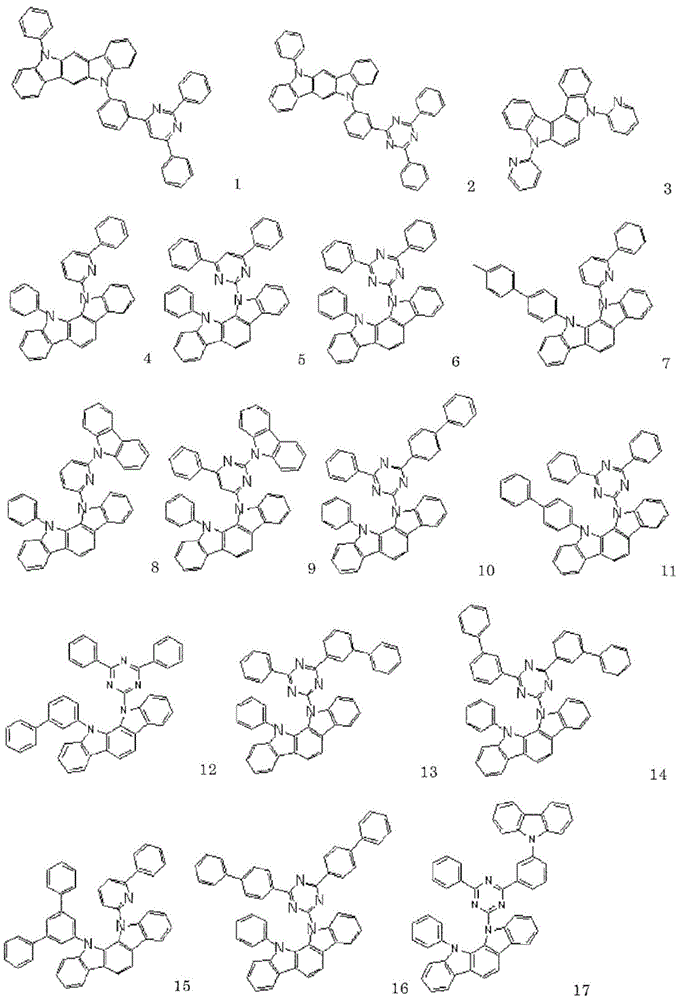
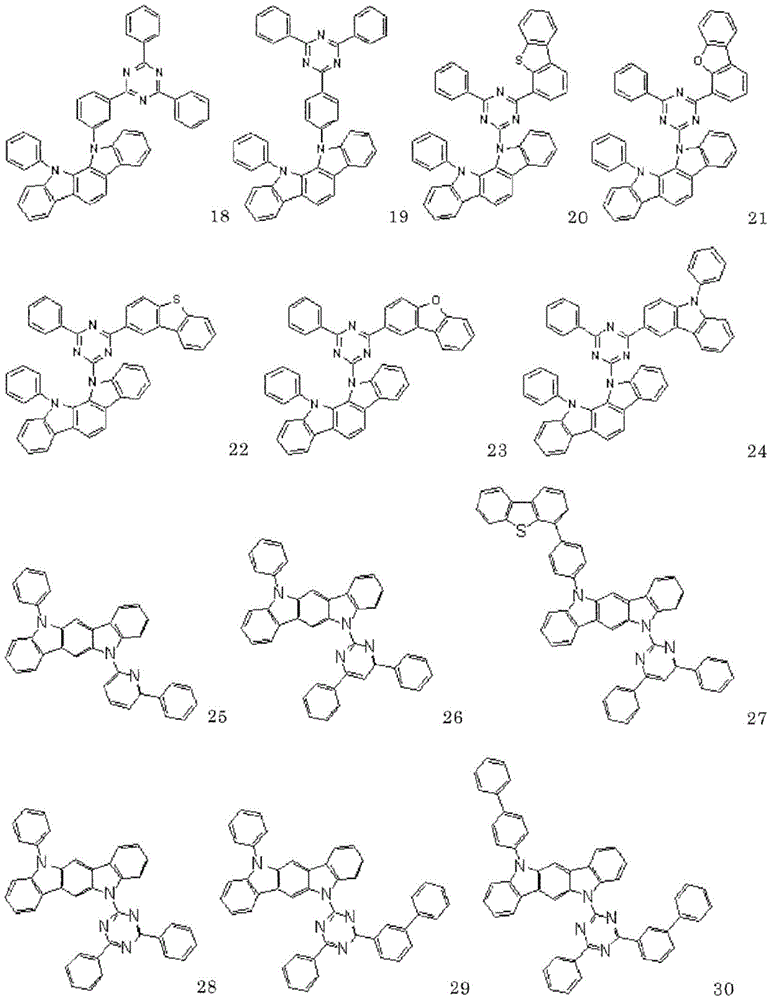


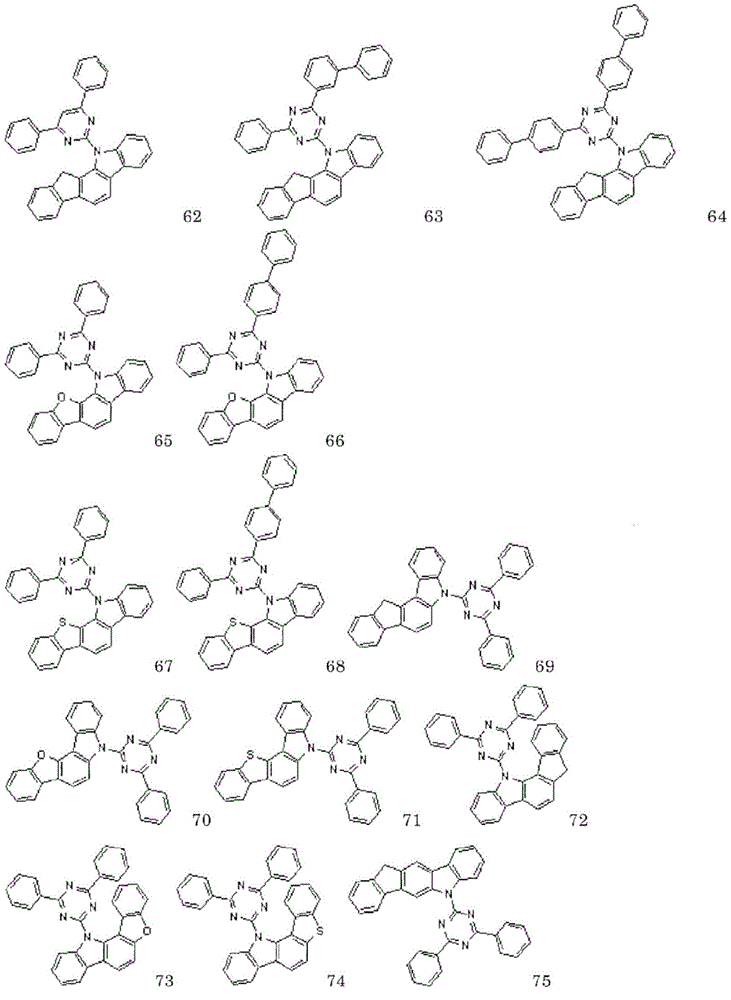

电子供体可以使用作为通过改善电子注入屏障使从阴极或电子注入层向电子输送层的电子注入容易的化合物已知的化合物。优选为在电子输送材料中混合使用的供体性化合物。作为电子供体的优选例,可举出碱金属、含有碱金属的无机盐、碱金属与有机物的配合物、碱土金属、含有碱土金属的无机盐、或者碱土金属与有机物的配合物等。优选为含有碱金属的无机盐、碱金属与有机物的配合物,更优选为Liq。As the electron donor, a compound known as a compound that facilitates electron injection from the cathode or the electron injection layer to the electron transport layer by improving the electron injection barrier can be used. The donor compound used in combination with the electron transport material is preferably used. Preferable examples of the electron donor include alkali metals, inorganic salts containing alkali metals, complexes of alkali metals and organic substances, alkaline earth metals, inorganic salts containing alkaline earth metals, or complexes of alkaline earth metals and organic substances. It is preferably an inorganic salt containing an alkali metal or a complex of an alkali metal and an organic substance, and more preferably Liq.
作为上述碱金属、碱土金属的优选种类,可举出功函数低且提高电子输送性能的效果大的锂、钠、钾、铷、铯之类的碱金属,镁、钙、铈、钡之类的碱土金属。Preferable types of the above-mentioned alkali metals and alkaline earth metals include alkali metals such as lithium, sodium, potassium, rubidium, and cesium, which have a low work function and a large effect of improving electron transport performance, and magnesium, calcium, cerium, and barium. of alkaline earth metals.
另外,从在真空中的蒸镀容易、操作性优异的角度出发,与金属单质相比更优选无机盐、或者与有机物的配合物的状态。此外,从使在大气中的操作容易、控制添加浓度的容易性的观点考虑,更优选为与有机物的配合物的状态。In addition, the state of an inorganic salt or a complex with an organic substance is more preferable than a simple metal substance from the viewpoints of easy vapor deposition in a vacuum and excellent workability. In addition, from the viewpoints of ease of handling in the atmosphere and ease of control of the concentration of addition, it is more preferable to be in the state of a complex with an organic substance.
作为无机盐的具体例,可举出LiO、Li2O等氧化物,LiF、NaF、KF等氟化物,Li2CO3、Na2CO3、K2CO3、Rb2CO3、Cs2CO3等碳酸盐。另外,作为碱金属或者碱土金属的优选例,从得到大的低电压驱动效果的观点考虑,可举出锂、铯。作为与有机物的配合物中的有机物的具体例,可举出羟基喹啉、苯并羟基喹啉、吡啶基苯酚、黄酮醇、羟基咪唑并吡啶、羟基吲哚(hydroxybenzazole)、羟基三唑等。其中,从发光元件的低电压化的效果更大的观点考虑,优选碱金属与有机物的配合物,此外,从合成的容易性、热稳定性的观点考虑,更优选锂与有机物的配合物。例如,为Liq。Specific examples of inorganic salts include oxides such as LiO and Li 2 O, fluorides such as LiF, NaF, and KF, Li 2 CO 3 , Na 2 CO 3 , K 2 CO 3 , Rb 2 CO 3 , and Cs 2 . Carbonates such as CO3 . Moreover, as a preferable example of an alkali metal or an alkaline-earth metal, from a viewpoint of obtaining a large low-voltage driving effect, lithium and cesium are mentioned. Specific examples of the organic substance in the complex with the organic substance include hydroxyquinoline, benzoquinoline, pyridylphenol, flavonol, hydroxyimidazopyridine, hydroxybenzazole, hydroxytriazole, and the like. Among them, a complex of an alkali metal and an organic substance is preferable from the viewpoint of a greater effect of lowering the voltage of a light-emitting element, and a complex of lithium and an organic substance is more preferable from the viewpoints of ease of synthesis and thermal stability. For example, Liq.
通过使用上述通式(1)表示的化合物和上述电子供体作为电子输送层材料,能够提供优异的有机EL元件。By using the compound represented by the above-mentioned general formula (1) and the above-mentioned electron donor as an electron transport layer material, an excellent organic EL device can be provided.
电子输送层也可以仅形成1层而使用,但优选形成与发光层邻接的第1电子输送层和与该第1电子输送层邻接的第2电子输送层这两层而使用。形成两层电子输送层时,优选与发光层邻接的第1电子输送层含有上述通式(1)表示的化合物,第2电子输送层含有上述通式(1)表示的化合物和上述电子供体。此时,第1电子输送层也可作为空穴阻挡层发挥功能。The electron transport layer may be used by forming only one layer, but it is preferable to form and use two layers, a first electron transport layer adjacent to the light-emitting layer and a second electron transport layer adjacent to the first electron transport layer. When forming two electron-transporting layers, it is preferable that the first electron-transporting layer adjacent to the light-emitting layer contains the compound represented by the above general formula (1), and the second electron-transporting layer contains the compound represented by the above-mentioned general formula (1) and the above-mentioned electron donor. . In this case, the first electron transport layer can also function as a hole blocking layer.
上述通式(1)表示的化合物和电子供体也可以由不同的蒸镀源分别蒸镀使用,但优选在蒸镀前进行预混而制成预混物,将该预混物由1个蒸镀源同时蒸镀而形成电子输送层。The compound represented by the above-mentioned general formula (1) and the electron donor may be used by vapor deposition from different vapor deposition sources, but it is preferable to premix it before vapor deposition to prepare a premix, and this premix is composed of one The vapor deposition source simultaneously vapor-deposits to form the electron transport layer.
接下来,参照附图对本发明的有机EL元件的结构进行说明,但本发明的有机EL元件的结构并不限定于此。Next, although the structure of the organic EL element of this invention is demonstrated with reference to drawings, the structure of the organic EL element of this invention is not limited to this.
图1是表示本发明中使用的一般的有机EL元件的结构例的截面图,1表示基板,2表示阳极,3表示空穴注入层,4表示空穴输送层,5表示发光层,6表示第1电子输送层,7表示第2电子输送层,8表示阴极。本发明的有机EL元件可以在发光层与空穴输送层之间具有电子阻挡层。本发明的有机EL元件中,具有阴极、发光层、电子输送层和阴极作为必需层,除必需层以外可以具有空穴注入输送层、电子注入层,在空穴注入输送层与发光层之间还可以具有电子阻挡层。应予说明,空穴注入输送层是指空穴注入层和空穴输送层中的任一者、或者两者。1 is a cross-sectional view showing a structural example of a general organic EL element used in the present invention, wherein 1 denotes a substrate, 2 an anode, 3 a hole injection layer, 4 a hole transport layer, 5 a light emitting layer, and 6 a The first electron transport layer, 7 denotes the second electron transport layer, and 8 denotes the cathode. The organic EL element of the present invention may have an electron blocking layer between the light emitting layer and the hole transport layer. The organic EL element of the present invention has a cathode, a light-emitting layer, an electron transport layer, and a cathode as essential layers, and may have a hole injection and transport layer and an electron injection layer in addition to the essential layers, and between the hole injection and transport layer and the light-emitting layer There may also be an electron blocking layer. It should be noted that the hole injection and transport layer refers to either or both of the hole injection layer and the hole transport layer.
也可以是与图1相反的结构,即在基板1上依次层叠阴极8、第2电子输送层7、第1电子输送层6、发光层5、空穴输送层4、空穴注入层3、阳极2,该情况下,根据需要也可以追加、省略层。1, that is, a
―基板――Substrate―
本发明的有机EL元件优选由基板支承。该基板没有特别限制,只要是一直以来在有机EL元件中使用的基板即可,例如可以使用由玻璃、透明塑料、石英等构成的基板。The organic EL element of the present invention is preferably supported by a substrate. The substrate is not particularly limited as long as it is a substrate conventionally used in organic EL elements, and for example, a substrate made of glass, transparent plastic, quartz, or the like can be used.
―阳极―-anode-
作为有机EL元件中的阳极材料,优选使用由功函数大(4eV以上)的金属、合金、导电性化合物或它们的混合物构成的材料。作为这样的电极材料的具体例,可举出Au等金属、CuI、氧化铟锡(ITO)、SnO2、ZnO等导电性透明材料。另外,也可使用IDIXO(In2O3-ZnO)等非晶质且能够制成透明导电膜的材料。对于阳极而言,可以利用蒸镀、溅射等方法使这些电极材料形成薄膜,利用光刻法形成所希望形状的图案,或者在不太需要图案精度的情况下(100μm以上左右),也可以在上述电极材料的蒸镀、溅射时介由所希望形状的掩模而形成图案。或者,在使用像有机导电性化合物这样的可涂布的物质的情况下,也可以使用印刷方式、涂布方式等湿式成膜法。从该阳极导出发光时,优选使透射率大于10%,另外,作为阳极的薄层电阻优选几百Ω/□以下。膜厚取决于材料,但通常在10~1000nm、优选10~200nm的范围选择。As the anode material in the organic EL element, a material composed of a metal having a large work function (4 eV or more), an alloy, a conductive compound, or a mixture thereof is preferably used. Specific examples of such electrode materials include metals such as Au, and conductive transparent materials such as CuI, indium tin oxide (ITO), SnO 2 , and ZnO. In addition, amorphous materials such as IDIXO (In 2 O 3 -ZnO) that can be used as transparent conductive films can also be used. For the anode, these electrode materials can be formed into a thin film by methods such as vapor deposition and sputtering, and a pattern of a desired shape can be formed by photolithography. A pattern is formed through a mask of a desired shape at the time of vapor deposition and sputtering of the electrode material. Alternatively, in the case of using a coatable substance such as an organic conductive compound, a wet film-forming method such as a printing method and a coating method can also be used. When emitting light from the anode, the transmittance is preferably greater than 10%, and the sheet resistance of the anode is preferably several hundred Ω/□ or less. The film thickness depends on the material, but is usually selected within the range of 10 to 1000 nm, preferably 10 to 200 nm.
―阴极―-cathode-
另一方面,作为阴极材料,可使用由功函数小(4eV以下)的金属(称为电子注入性金属)、合金、导电性化合物或它们的混合物构成的材料。作为这样的电极材料的具体例,可举出钠、钠-钾合金、镁、锂、镁/铜混合物、镁/银混合物、镁/铝混合物、镁/铟混合物、铝/氧化铝(Al2O3)混合物、铟、锂/铝混合物、稀土金属等。其中,从电子注入性和对氧化等的耐久性的方面考虑,优选电子注入性金属和功函数值比其大且稳定的金属即第二金属的混合物,例如镁/银混合物、镁/铝混合物、镁/铟混合物、铝/氧化铝(Al2O3)混合物、锂/铝混合物、铝等。阴极可以通过利用蒸镀、溅射等方法使这些阴极材料形成薄膜来制作。另外,作为阴极的薄层电阻,优选几百Ω/□以下,膜厚通常在10nm~5μm、优选在50~200nm的范围选择。应予说明,为了使发出的光透射,如果有机EL元件的阳极或阴极中的任一方为透明或半透明的,则发光亮度提高,是适合的。On the other hand, as the cathode material, a material composed of a metal having a small work function (4 eV or less) (referred to as an electron injecting metal), an alloy, a conductive compound, or a mixture thereof can be used. Specific examples of such electrode materials include sodium, sodium-potassium alloy, magnesium, lithium, magnesium/copper mixture, magnesium/silver mixture, magnesium/aluminum mixture, magnesium/indium mixture, aluminum/alumina (Al 2 O 3 ) mixtures, indium, lithium/aluminum mixtures, rare earth metals, and the like. Among them, a mixture of an electron-injecting metal and a second metal having a larger and more stable work function value, such as a magnesium/silver mixture and a magnesium/aluminum mixture, is preferable from the viewpoint of electron injecting properties and durability against oxidation, etc. , magnesium/indium mixture, aluminum/aluminum oxide (Al 2 O 3 ) mixture, lithium/aluminum mixture, aluminum, etc. The cathode can be produced by forming these cathode materials into a thin film by methods such as vapor deposition and sputtering. In addition, the sheet resistance of the cathode is preferably several hundred Ω/□ or less, and the film thickness is usually selected in the range of 10 nm to 5 μm, preferably 50 to 200 nm. In addition, in order to transmit the emitted light, it is suitable if either the anode or the cathode of the organic EL element is transparent or semi-transparent, since the light emission brightness is improved.
另外,通过将上述金属以1~20nm的膜厚形成为阴极后,在其上形成在阳极的说明中举出的导电性透明材料,能够制作透明或半透明的阴极,通过应用该阴极,能够制作阳极和阴极双方都具有透射性的元件。In addition, a transparent or semitransparent cathode can be produced by forming the above-mentioned metal as a cathode with a film thickness of 1 to 20 nm, and then forming the conductive transparent material mentioned in the description of the anode thereon. By applying this cathode, it is possible to Fabrication of elements with both anode and cathode transmissive.
―发光层――Light-emitting layer―
发光层是从阳极和阴极分别注入的空穴与电子再结合而生成激子后,发光的层,发光层含有发光材料和主体材料,该发光材料优选为有机发光性掺杂材料。发光层可以为1层或多层中的任一种,有机发光性掺杂材料和主体材料可以各自为1种,也可以组合多种使用。The light-emitting layer is a layer that emits light after the holes and electrons injected from the anode and the cathode, respectively, recombine to generate excitons, and the light-emitting layer contains a light-emitting material and a host material, and the light-emitting material is preferably an organic light-emitting dopant material. The light-emitting layer may be any one of one layer or multiple layers, and the organic light-emitting dopant material and the host material may each be one type or a combination of two types.
发光层含有发光材料和主体材料时,作为主体材料,更优选使用上述通式(1)表示的化合物。When the light-emitting layer contains a light-emitting material and a host material, it is more preferable to use the compound represented by the above-mentioned general formula (1) as the host material.
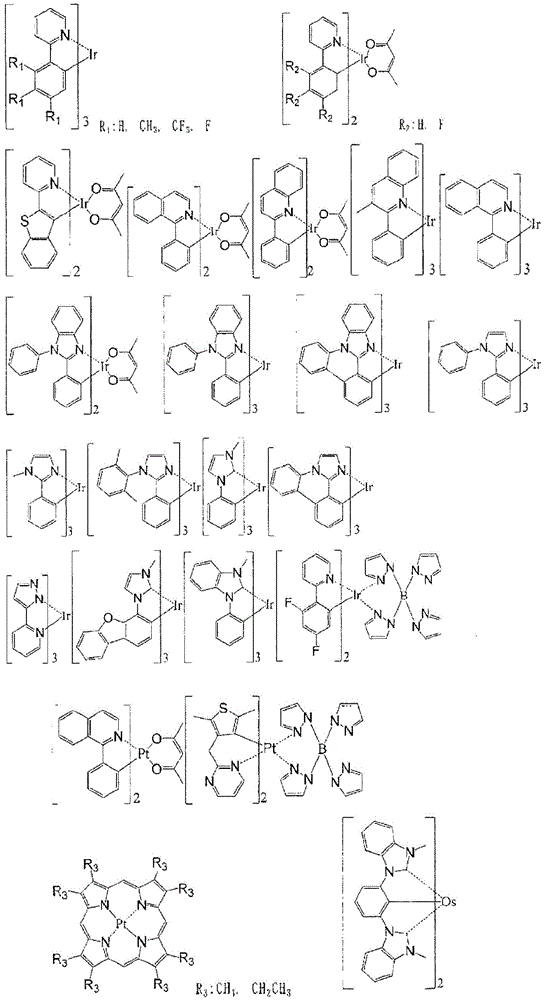
使用磷光发光掺杂剂作为发光性掺杂材料时,作为磷光发光掺杂剂,优选含有包含选自钌、铑、钯、银、铼、锇、铱、铂和金中的至少1种金属的有机金属配合物。具体而言,优选使用在J.Am.Chem.Soc.2001,123,4304或日本特表2013-53051号公报中记载的铱配合物,但不限于这些例子。When a phosphorescent light-emitting dopant is used as the light-emitting dopant material, the phosphorescent light-emitting dopant preferably contains at least one metal selected from the group consisting of ruthenium, rhodium, palladium, silver, rhenium, osmium, iridium, platinum, and gold. Organometallic complexes. Specifically, the iridium complexes described in J.Am.Chem.Soc. 2001, 123, 4304 or JP 2013-53051 A are preferably used, but are not limited to these examples.
磷光发光掺杂材料在发光层中可以仅含有1种,也可以含有2种以上。磷光发光掺杂材料的含量相对于主体材料优选为0.1~30wt%,更优选为1~20wt%。The phosphorescent light-emitting dopant material may be contained in the light-emitting layer of only one type, or may be contained in two or more types. The content of the phosphorescent dopant material is preferably 0.1 to 30 wt % with respect to the host material, and more preferably 1 to 20 wt %.
磷光发光掺杂材料没有特别限定,具体而言可举出如下的例子。The phosphorescent dopant material is not particularly limited, and specifically, the following examples can be given.
使用荧光发光掺杂剂作为发光性掺杂材料时,作为荧光发光掺杂剂,没有特别限定,例如可举出苯并


荧光发光掺杂材料在发光层中可以仅含有1种,也可以含有2种以上。荧光发光掺杂材料的含量相对于主体材料优选为0.1~20%,更优选为1~10%。The fluorescent light-emitting dopant material may be contained in the light-emitting layer of only one type, or may be contained in two or more types. The content of the fluorescent light-emitting dopant material is preferably 0.1 to 20% with respect to the host material, and more preferably 1 to 10%.
使用热活化延迟荧光发光掺杂剂作为发光性掺杂材料时,作为热活化延迟荧光发光掺杂剂,没有特别限定,可举出锡配合物、铜配合物等金属配合物、在WO2011/070963号中记载的吲哚并咔唑衍生物、在Nature 2012,492,p234中记载的氰基苯衍生物、咔唑衍生物等。When a thermally activated delayed fluorescence emission dopant is used as a light-emitting dopant material, the thermally activated delayed fluorescence emission dopant is not particularly limited, and metal complexes such as tin complexes and copper complexes can be mentioned, as described in WO2011/070963 Indolocarbazole derivatives described in No. , cyanobenzene derivatives and carbazole derivatives described in Nature 2012, 492, p234, and the like.

热活化延迟荧光发光掺杂材料在发光层中可以仅含有1种,也可以含有2种以上。另外,热活化延迟荧光发光掺杂剂可以与磷光发光掺杂剂、荧光发光掺杂剂混合使用。热活化延迟荧光发光掺杂材料的含量相对于主体材料优选为0.1~50%,更优选为1~30%。The thermally activated delayed fluorescence light-emitting dopant material may be contained in the light-emitting layer of only one type, or may be contained in two or more types. In addition, the thermally activated delayed fluorescence emission dopant may be used in combination with a phosphorescence emission dopant and a fluorescent emission dopant. The content of the thermally activated delayed fluorescence light-emitting dopant material is preferably 0.1 to 50% with respect to the host material, and more preferably 1 to 30%.
主体材料可以仅使用1种,也可以组合多种使用。作为主体材料,没有特别限定,可以使用萘、蒽、菲、芘、
-注入层--Injection layer-
注入层是指为了降低驱动电压、提高发光亮度而设置在电极与有机层之间的层,有空穴注入层和电子注入层,可以存在于阳极与发光层或空穴输送层之间、和阴极与发光层或电子输送层之间。注入层可以根据需要设置。The injection layer refers to a layer provided between the electrode and the organic layer in order to reduce the driving voltage and improve the luminous brightness. Between the cathode and the light emitting layer or electron transport layer. The injection layer can be set as required.
-电子阻挡层-- Electron blocking layer -
广义上来讲,电子阻挡层具有空穴输送层的功能,通过输送空穴并阻挡电子,能够提高发光层中的电子与空穴再结合的概率。Broadly speaking, the electron blocking layer has the function of a hole transport layer, and by transporting holes and blocking electrons, the probability of recombination of electrons and holes in the light-emitting layer can be increased.
作为电子阻挡层的材料,可以使用公知的电子阻挡层材料,另外根据需要可以使用后述的空穴输送层的材料。电子阻挡层的膜厚优选为3~100nm,更优选为5~30nm。As the material of the electron blocking layer, a known electron blocking layer material can be used, and if necessary, the material of the hole transport layer described later can be used. The film thickness of the electron blocking layer is preferably 3 to 100 nm, and more preferably 5 to 30 nm.
-空穴输送层--Hole transport layer-
空穴输送层由具有输送空穴的功能的空穴输送材料构成,空穴输送层可以设置单层或者多层。The hole transport layer is composed of a hole transport material having a function of transporting holes, and the hole transport layer may be provided with a single layer or multiple layers.
作为空穴输送材料,是具有空穴的注入或输送、电子的屏障性中的任一种功能的材料,可以为有机物、无机物中的任一种。空穴输送层可以从以往公知的化合物中选择任意的化合物而使用。作为上述空穴输送材料,例如可举出卟啉衍生物、芳胺衍生物、三唑衍生物、

-电子输送层-- Electron transport layer -
电子输送层可以为1层,也可以设置2层以上。设置2层以上时,将靠近发光层的层称为第1电子输送层,将离发光层较远的层称为第2电子输送层。在第1电子输送层与第2电子输送层之间可以设置第三电子输送层。The electron transport layer may be one layer, or two or more layers may be provided. When two or more layers are provided, the layer closer to the light-emitting layer is called a first electron transport layer, and the layer farther from the light-emitting layer is called a second electron transport layer. A third electron transport layer may be provided between the first electron transport layer and the second electron transport layer.
电子输送层为1层时,该层含有上述通式(1)表示的化合物和电子供体。When the electron transport layer is one layer, the layer contains the compound represented by the above-mentioned general formula (1) and an electron donor.
电子输送层由2层以上构成时,任一个电子输送层含有通式(1)表示的化合物和电子供体。优选第1电子输送层含有通式(1)表示的化合物,第2电子输送层含有通式(1)表示的化合物和电子供体。此时,第1电子输送层不含电子供体。When the electron transport layer is composed of two or more layers, any one of the electron transport layers contains the compound represented by the general formula (1) and an electron donor. Preferably, the first electron transport layer contains the compound represented by the general formula (1), and the second electron transport layer contains the compound represented by the general formula (1) and an electron donor. At this time, the first electron transport layer does not contain an electron donor.
对具有第1电子输送层和第2电子输送层的情况进行说明。The case where the first electron transport layer and the second electron transport layer are provided will be described.
第1电子输送层可以使用公知的电子输送材料形成,可以仅使用通式(1)表示的化合物形成,也可以并用公知的电子输送材料形成。但是,优选第1电子输送层含有50wt%以上的通式(1)表示的化合物。The first electron transport layer may be formed using a known electron transport material, may be formed using only the compound represented by the general formula (1), or may be formed using a known electron transport material in combination. However, it is preferable that the first electron transport layer contains 50 wt % or more of the compound represented by the general formula (1).
作为公知的电子输送材料,可举出萘、蒽、菲咯啉、三亚苯等多环芳香族衍生物,三(8-羟基喹啉)铝(III)衍生物、氧化膦衍生物、硝基取代芴衍生物、二苯醌衍生物、噻喃二氧化物衍生物、碳二亚胺、亚芴基甲烷衍生物、蒽醌二甲烷和蒽酮衍生物、联吡啶衍生物、喹啉衍生物、
第2电子输送层含有通式(1)表示的化合物和电子供体。The second electron transport layer contains the compound represented by the general formula (1) and an electron donor.
电子供体的含量在第2电子输送层中优选为5~95%(wt),更优选为25~75%。通式(1)表示的化合物的含量优选为5~90%,更优选为25~70%。第2电子输送层中也可以含有其它的电子输送材料。The content of the electron donor in the second electron transport layer is preferably 5 to 95% (wt), and more preferably 25 to 75%. The content of the compound represented by the general formula (1) is preferably 5 to 90%, and more preferably 25 to 70%. The second electron transport layer may contain other electron transport materials.
通式(1)表示的化合物和电子供体可以分别由不同的蒸镀源蒸镀,也可以在蒸镀前进行预混而制成预混物,由1个蒸镀源同时蒸镀通式(1)表示的化合物和电子供体。作为预混方法,可采用粉碎混合等公知的方法,优选尽可能充分地混合。The compound represented by the general formula (1) and the electron donor may be vapor-deposited from different vapor deposition sources, or may be premixed before vapor deposition to prepare a premix, and the general formula may be simultaneously vapor-deposited from one vapor deposition source. The compound represented by (1) and the electron donor. As a premixing method, a well-known method, such as pulverization mixing, can be used, and it is preferable to mix as much as possible.
实施例Example
以下,通过本发明的实施例进一步详细说明,但本发明不限于这些实施例,只要不超出其主旨,可以以各种形态实施。Hereinafter, although the Example of this invention is demonstrated in detail, this invention is not limited to these Examples, It can implement in various forms unless the summary is exceeded.
实施例1Example 1
用真空蒸镀法将各薄膜以真空度4.0×10⁻⁵Pa层叠在形成有膜厚110nm的由ITO构成的阳极的玻璃基板上。首先,在ITO上形成25nm厚度的HAT-CN作为空穴注入层,接着形成30nm厚度的NPD作为空穴输送层。接着形成10nm厚度的HT-1作为电子阻挡层。然后将作为第1主体的化合物6、作为第2主体的H1、作为发光掺杂剂的Ir(ppy)3分别由不同的蒸镀源进行共蒸镀,形成40nm厚度的发光层。此时,在Ir(ppy)3的浓度为10wt%、第1主体与第2主体的重量比为40:60的蒸镀条件下进行共蒸镀。接下来形成5nm厚度的化合物6作为第1电子输送层。然后将化合物6和Liq分别由不同的蒸镀源进行共蒸镀,形成15nm厚度的第2电子输送层。此时,在化合物6与Liq的重量比为50:50的蒸镀条件下进行共蒸镀。进一步形成1nm厚度的Liq作为电子注入层。最后,在电子注入层上形成70nm厚度的Al作为阴极,由此制作有机EL元件。Each thin film was laminated at a vacuum degree of 4.0×10 −5 Pa on a glass substrate on which an anode made of ITO with a film thickness of 110 nm was formed by a vacuum deposition method. First, HAT-CN was formed on ITO with a thickness of 25 nm as a hole injection layer, and then NPD was formed with a thickness of 30 nm as a hole transport layer. Next, HT-1 with a thickness of 10 nm was formed as an electron blocking layer. Then, Compound 6 as the first host, H1 as the second host, and Ir(ppy) 3 as the light-emitting dopant were co-evaporated from different vapor deposition sources to form a light-emitting layer with a thickness of 40 nm. At this time, the co-evaporation was carried out under the vapor deposition conditions that the concentration of Ir(ppy) 3 was 10 wt %, and the weight ratio of the first body and the second body was 40:60. Next, Compound 6 was formed with a thickness of 5 nm as a first electron transport layer. Then, compound 6 and Liq were co-evaporated from different evaporation sources to form a second electron transport layer with a thickness of 15 nm. At this time, co-evaporation was performed under the vapor deposition conditions in which the weight ratio of Compound 6 and Liq was 50:50. Liq was further formed with a thickness of 1 nm as an electron injection layer. Finally, Al with a thickness of 70 nm was formed on the electron injection layer as a cathode, thereby producing an organic EL element.
实施例2~7Examples 2 to 7
在实施例1中,使用化合物12、16、18、23、28、36中的任一个代替形成第2电子输送层的化合物6,除此之外,在与实施例1同样的条件下制作有机EL元件。In Example 1, except that any one of Compounds 12, 16, 18, 23, 28, and 36 was used in place of Compound 6 for forming the second electron transport layer, an organic compound was prepared under the same conditions as in Example 1. EL element.
实施例8Example 8
在实施例1中,使用化合物47代替形成第2电子输送层的化合物6,在化合物47与Liq的重量比为30:70的蒸镀条件下进行共蒸镀,除此之外,在与实施例1同样的条件下制作有机EL元件。In Example 1, the compound 47 was used instead of the compound 6 forming the second electron transport layer, and the co-evaporation was carried out under the vapor deposition conditions in which the weight ratio of the compound 47 and Liq was 30:70. Example 1 An organic EL element was produced under the same conditions.
实施例9Example 9
在实施例1中,使用化合物55代替形成第2电子输送层的化合物6,在化合物55与Liq的重量比为70:30的蒸镀条件下进行共蒸镀,除此之外,在与实施例1同样的条件下制作有机EL元件In Example 1, the compound 55 was used instead of the compound 6 for forming the second electron transport layer, and the co-evaporation was carried out under the vapor deposition conditions in which the weight ratio of the compound 55 and Liq was 70:30. Example 1 Fabrication of an organic EL element under the same conditions
实施例10~12Examples 10 to 12
在实施例1中,使用化合物10、11或者16代替作为第1电子输送层的化合物6,除此之外,在与实施例1同样的条件下制作有机EL元件。In Example 1, an organic EL element was produced under the same conditions as in Example 1, except that Compound 10, 11 or 16 was used instead of Compound 6 as the first electron transport layer.
实施例13Example 13
量取化合物17(0.50g)和Liq(0.50g),用研钵磨碎并混合,由此制备预混物E1。Compound 17 (0.50 g) and Liq (0.50 g) were weighed, ground and mixed with a mortar, thereby preparing a premix E1.
用真空蒸镀法将各薄膜以真空度4.0×10⁻⁵Pa层叠在形成有膜厚110nm的由ITO构成的阳极的玻璃基板上。首先,在ITO上形成25nm厚度的HAT-CN作为空穴注入层,接着形成30nm厚度的NPD作为空穴输送层。接着形成10nm厚度的HT-1作为电子阻挡层。然后将作为第1主体的化合物6、作为第2主体的H1、作为发光掺杂剂的Ir(ppy)3分别由不同的蒸镀源进行共蒸镀,形成40nm厚度的发光层。此时,在Ir(ppy)3的浓度为10wt%、第1主体与第2主体的重量比为40:60的蒸镀条件下进行共蒸镀。接下来,形成5nm厚度的化合物6作为第1电子输送层。然后形成15nm厚度的预混物E1作为第2电子输送层,进一步形成1nm厚度的Liq作为电子注入层。最后,在电子注入层上形成70nm厚度的Al作为阴极,制作有机EL元件。Each thin film was laminated at a vacuum degree of 4.0×10 −5 Pa on a glass substrate on which an anode made of ITO with a film thickness of 110 nm was formed by a vacuum deposition method. First, HAT-CN was formed on ITO with a thickness of 25 nm as a hole injection layer, and then NPD was formed with a thickness of 30 nm as a hole transport layer. Next, HT-1 with a thickness of 10 nm was formed as an electron blocking layer. Then, Compound 6 as the first host, H1 as the second host, and Ir(ppy) 3 as the light-emitting dopant were co-evaporated from different vapor deposition sources to form a light-emitting layer with a thickness of 40 nm. At this time, the co-evaporation was carried out under the vapor deposition conditions that the concentration of Ir(ppy) 3 was 10 wt %, and the weight ratio of the first body and the second body was 40:60. Next, Compound 6 was formed with a thickness of 5 nm as a first electron transport layer. Next, the premix E1 was formed to a thickness of 15 nm as a second electron transport layer, and Liq was further formed to a thickness of 1 nm as an electron injection layer. Finally, Al with a thickness of 70 nm was formed on the electron injection layer as a cathode, and an organic EL element was fabricated.
比较例1Comparative Example 1
在实施例1中,使用ET-1代替形成第2电子输送层的化合物6,除此之外,在与实施例1同样的条件下制作有机EL元件。In Example 1, an organic EL element was produced under the same conditions as in Example 1, except that ET-1 was used instead of Compound 6 forming the second electron transport layer.
比较例2Comparative Example 2
用真空蒸镀法将各薄膜以真空度4.0×10⁻⁵Pa层叠在形成有膜厚110nm的由ITO构成的阳极的玻璃基板上。首先,在ITO上形成25nm厚度的HAT-CN作为空穴注入层,接着形成30nm厚度的NPD作为空穴输送层。接下来,形成10nm厚度的HT-1作为电子阻挡层。然后将作为第1主体的化合物6、作为第2主体的H1、作为发光掺杂剂的Ir(ppy)3分别由不同的蒸镀源进行共蒸镀,形成40nm厚度的发光层。此时,在Ir(ppy)3的浓度为5wt%、第1主体与第2主体的重量比为40:60的蒸镀条件下进行共蒸镀。接下来,形成20nm厚度的化合物6作为电子输送层。进一步形成1nm厚度的Liq作为电子注入层。最后,在电子注入层上形成70nm厚度的Al作为阴极,制作有机EL元件。Each thin film was laminated at a vacuum degree of 4.0×10 −5 Pa on a glass substrate on which an anode made of ITO with a film thickness of 110 nm was formed by a vacuum deposition method. First, HAT-CN was formed on ITO with a thickness of 25 nm as a hole injection layer, and then NPD was formed with a thickness of 30 nm as a hole transport layer. Next, HT-1 was formed with a thickness of 10 nm as an electron blocking layer. Then, Compound 6 as the first host, H1 as the second host, and Ir(ppy)3 as the light-emitting dopant were co-evaporated from different vapor deposition sources to form a light-emitting layer with a thickness of 40 nm. At this time, co-evaporation was carried out under the conditions of vapor deposition that the concentration of Ir(ppy) 3 was 5 wt %, and the weight ratio of the first body to the second body was 40:60. Next, Compound 6 was formed to a thickness of 20 nm as an electron transport layer. Liq was further formed with a thickness of 1 nm as an electron injection layer. Finally, Al with a thickness of 70 nm was formed on the electron injection layer as a cathode, and an organic EL element was fabricated.
以下示出实施例中使用的化合物。The compounds used in the examples are shown below.

将形成第1电子输送层的化合物、形成第2电子输送层的化合物和电子供体示于表1。%为wt%。Table 1 shows the compound forming the first electron transport layer, the compound forming the second electron transport layer, and the electron donor. % is wt%.
[表1][Table 1]
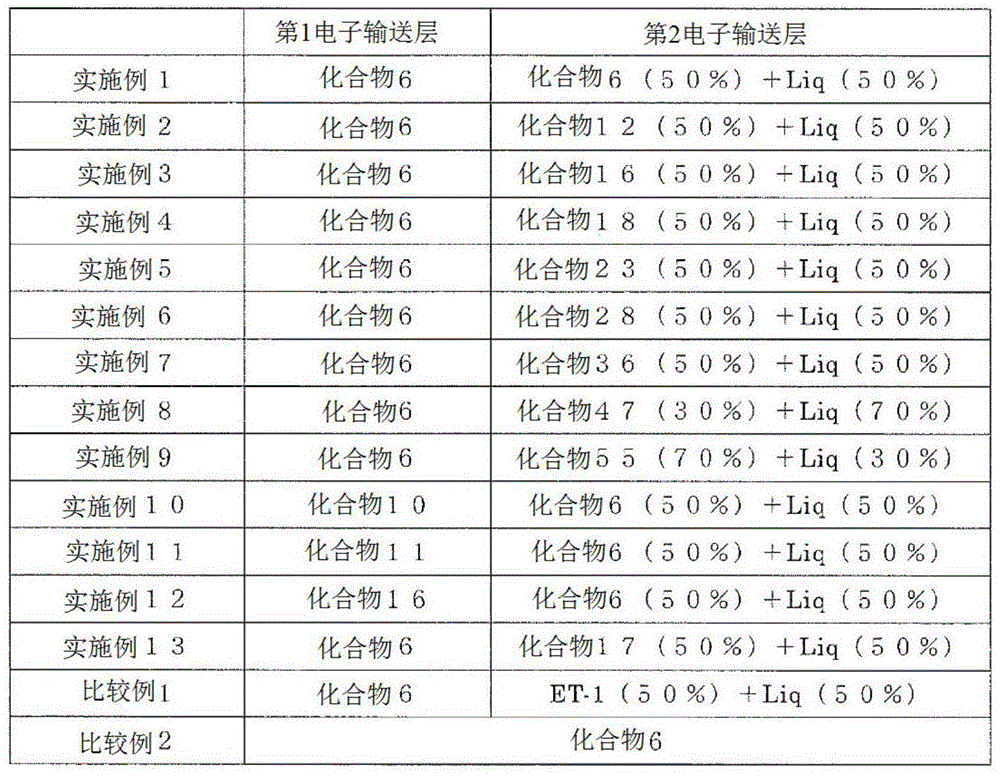
可知将实施例1~13和比较例1、2中制成的有机EL元件与外部电源连接并外加电压时,均可观测到极大波长535nm的发射光谱,得到来自Ir(ppy)3的发光。It can be seen that when the organic EL elements produced in Examples 1 to 13 and Comparative Examples 1 and 2 were connected to an external power source and a voltage was applied, an emission spectrum with a maximum wavelength of 535 nm was observed, and light emission from Ir(ppy) 3 was obtained. .
将制成的有机EL元件的亮度、驱动电压、发光效率、寿命特性示于表2。表中亮度、驱动电压、发光效率是驱动电流为10mA/cm2时的值,为初期特性。表中LT95是在驱动电流为20mA/cm2时亮度衰减至初期亮度的95%所需的时间。Table 2 shows the luminance, driving voltage, luminous efficiency, and lifetime characteristics of the produced organic EL element. The luminance, driving voltage, and luminous efficiency in the table are values when the driving current is 10 mA/cm 2 , which are initial characteristics. In the table, LT95 is the time required for the luminance to decay to 95% of the initial luminance when the drive current is 20 mA/cm 2 .
[表2][Table 2]
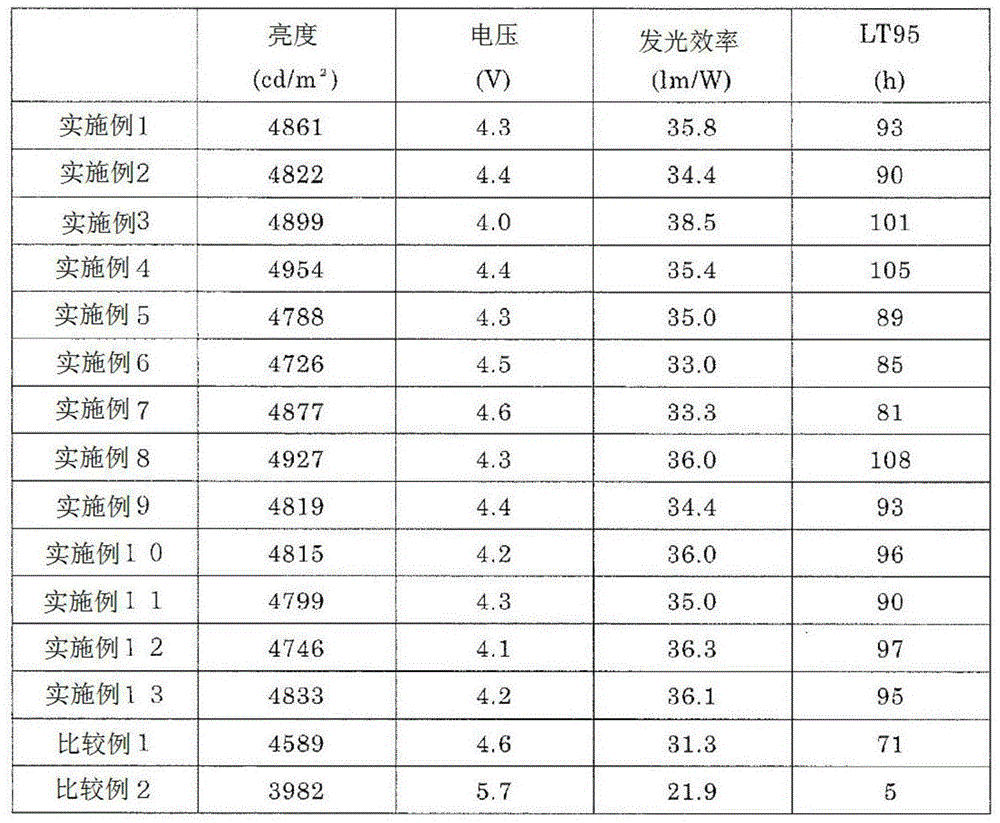
由表2可知,电子输送层中混合使用通式(1)表示的化合物和电子供体时,发光效率和寿命特性明显延长。As can be seen from Table 2, when the compound represented by the general formula (1) and the electron donor are used in combination in the electron transport layer, the luminous efficiency and the lifetime characteristics are remarkably prolonged.
产业上的可利用性Industrial Availability
本发明的有机EL元件为低驱动电压、高发光效率且长寿命,除可用于移动设备显示器以外,还可用于TV等有机EL显示器、有机EL照明。The organic EL element of the present invention has low driving voltage, high luminous efficiency, and long life, and can be used for organic EL displays such as TVs, and organic EL lighting, in addition to mobile device displays.
符号说明Symbol Description
1基板、2阳极、3空穴注入层、4空穴输送层、5发光层、6第1电子输送层、7第2电子输送层、8阴极。1 substrate, 2 anode, 3 hole injection layer, 4 hole transport layer, 5 light emitting layer, 6 first electron transport layer, 7 second electron transport layer, 8 cathode.
Claims (7)
Applications Claiming Priority (3)
| Application Number | Priority Date | Filing Date | Title |
|---|---|---|---|
| JP2016050402 | 2016-03-15 | ||
| JP2016-050402 | 2016-03-15 | ||
| PCT/JP2017/004980 WO2017159152A1 (en) | 2016-03-15 | 2017-02-10 | Organic electroluminescent element |
Publications (2)
| Publication Number | Publication Date |
|---|---|
| CN108780849A CN108780849A (en) | 2018-11-09 |
| CN108780849B true CN108780849B (en) | 2020-10-27 |
Family
ID=59850234
Family Applications (1)
| Application Number | Title | Priority Date | Filing Date |
|---|---|---|---|
| CN201780016883.7A Active CN108780849B (en) | 2016-03-15 | 2017-02-10 | organic electroluminescent element |
Country Status (7)
| Country | Link |
|---|---|
| US (1) | US11088334B2 (en) |
| EP (1) | EP3432378A4 (en) |
| JP (1) | JP6763944B2 (en) |
| KR (1) | KR102760228B1 (en) |
| CN (1) | CN108780849B (en) |
| TW (1) | TWI699425B (en) |
| WO (1) | WO2017159152A1 (en) |
Families Citing this family (7)
| Publication number | Priority date | Publication date | Assignee | Title |
|---|---|---|---|---|
| EP3605636B1 (en) * | 2017-03-31 | 2024-05-01 | Idemitsu Kosan Co., Ltd. | Organic electroluminescence element and electronic device |
| US11117897B2 (en) | 2017-05-01 | 2021-09-14 | Universal Display Corporation | Organic electroluminescent materials and devices |
| US12484443B2 (en) | 2018-03-16 | 2025-11-25 | Nippon Steel Chemical & Material Co., Ltd. | Organic electroluminescent element |
| CN112563426B (en) * | 2019-09-26 | 2022-08-12 | 江苏三月科技股份有限公司 | Organic electroluminescent device, method of manufacturing the same, and display apparatus including the same |
| KR102913453B1 (en) * | 2019-12-26 | 2026-01-15 | 엘지디스플레이 주식회사 | Organic Light Emitting Device and Display Device Using the Same |
| KR20220033737A (en) * | 2020-09-10 | 2022-03-17 | 엘지디스플레이 주식회사 | Organic compounds having improved luminsecent properties, organic light emitting diode and organic light emitting device including the compounds |
| JP2022128419A (en) * | 2021-02-22 | 2022-09-01 | ローム・アンド・ハース・エレクトロニック・マテリアルズ・コリア・リミテッド | Organic electroluminescent compound, multiple host materials, and organic electroluminescent device including the same |
Citations (4)
| Publication number | Priority date | Publication date | Assignee | Title |
|---|---|---|---|---|
| WO2011157339A1 (en) * | 2010-06-15 | 2011-12-22 | Merck Patent Gmbh | Metal complexes |
| CN102448946A (en) * | 2009-05-29 | 2012-05-09 | 默克专利有限公司 | Materials for Organic Electroluminescent Devices |
| CN102471602A (en) * | 2009-06-30 | 2012-05-23 | 默克专利有限公司 | Materials for organic electroluminescence devices |
| WO2015170930A1 (en) * | 2014-05-08 | 2015-11-12 | Rohm And Haas Electronic Materials Korea Ltd. | An electron transport material and an organic electroluminescence device comprising the same |
Family Cites Families (8)
| Publication number | Priority date | Publication date | Assignee | Title |
|---|---|---|---|---|
| US8062769B2 (en) | 2006-11-09 | 2011-11-22 | Nippon Steel Chemical Co., Ltd. | Indolocarbazole compound for use in organic electroluminescent device and organic electroluminescent device |
| TWI472074B (en) * | 2008-03-17 | 2015-02-01 | Nippon Steel & Sumikin Chem Co | Organic electroluminescent elements |
| US20100295444A1 (en) | 2009-05-22 | 2010-11-25 | Idemitsu Kosan Co., Ltd. | Organic electroluminescence device |
| EP3176241A1 (en) | 2009-12-07 | 2017-06-07 | Nippon Steel & Sumikin Chemical Co., Ltd. | Organic light-emitting material and organic light-emitting element |
| TWI429650B (en) | 2010-02-12 | 2014-03-11 | Nippon Steel & Sumikin Chem Co | Organic electroluminescent elements |
| WO2013175746A1 (en) | 2012-05-22 | 2013-11-28 | 出光興産株式会社 | Organic electroluminescent element |
| WO2013175747A1 (en) | 2012-05-22 | 2013-11-28 | 出光興産株式会社 | Organic electroluminescent element |
| WO2017025164A1 (en) * | 2015-08-11 | 2017-02-16 | Merck Patent Gmbh | Materials for organic electroluminescent devices |
-
2017
- 2017-02-10 CN CN201780016883.7A patent/CN108780849B/en active Active
- 2017-02-10 EP EP17766160.0A patent/EP3432378A4/en not_active Withdrawn
- 2017-02-10 US US16/078,231 patent/US11088334B2/en active Active
- 2017-02-10 WO PCT/JP2017/004980 patent/WO2017159152A1/en not_active Ceased
- 2017-02-10 JP JP2018505347A patent/JP6763944B2/en active Active
- 2017-02-10 KR KR1020187027013A patent/KR102760228B1/en active Active
- 2017-02-23 TW TW106106199A patent/TWI699425B/en not_active IP Right Cessation
Patent Citations (4)
| Publication number | Priority date | Publication date | Assignee | Title |
|---|---|---|---|---|
| CN102448946A (en) * | 2009-05-29 | 2012-05-09 | 默克专利有限公司 | Materials for Organic Electroluminescent Devices |
| CN102471602A (en) * | 2009-06-30 | 2012-05-23 | 默克专利有限公司 | Materials for organic electroluminescence devices |
| WO2011157339A1 (en) * | 2010-06-15 | 2011-12-22 | Merck Patent Gmbh | Metal complexes |
| WO2015170930A1 (en) * | 2014-05-08 | 2015-11-12 | Rohm And Haas Electronic Materials Korea Ltd. | An electron transport material and an organic electroluminescence device comprising the same |
Also Published As
| Publication number | Publication date |
|---|---|
| JP6763944B2 (en) | 2020-09-30 |
| KR102760228B1 (en) | 2025-01-24 |
| EP3432378A4 (en) | 2019-11-20 |
| WO2017159152A1 (en) | 2017-09-21 |
| JPWO2017159152A1 (en) | 2019-01-24 |
| EP3432378A1 (en) | 2019-01-23 |
| CN108780849A (en) | 2018-11-09 |
| US20190103562A1 (en) | 2019-04-04 |
| KR20180121922A (en) | 2018-11-09 |
| US11088334B2 (en) | 2021-08-10 |
| TW201741437A (en) | 2017-12-01 |
| TWI699425B (en) | 2020-07-21 |
Similar Documents
| Publication | Publication Date | Title |
|---|---|---|
| JP6663427B2 (en) | Organic electroluminescent device | |
| JP6786393B2 (en) | Organic electroluminescent device | |
| CN108780849B (en) | organic electroluminescent element | |
| CN104137289B (en) | Light emitting element | |
| CN109791997B (en) | Organic electroluminescent element and method for producing the same | |
| KR20230151560A (en) | Organic electroluminescent element | |
| CN108475732B (en) | Organic electroluminescent element | |
| JPWO2018173593A1 (en) | Organic electroluminescent device | |
| KR20230129396A (en) | Organic electroluminescent device and method of manufacturing the same | |
| WO2011033978A1 (en) | Organic electroluminescent element | |
| CN108475733B (en) | Organic electroluminescent device | |
| TW202104539A (en) | Organic electroluminescent element | |
| CN113661226A (en) | Organic electroluminescent element |
Legal Events
| Date | Code | Title | Description |
|---|---|---|---|
| PB01 | Publication | ||
| PB01 | Publication | ||
| SE01 | Entry into force of request for substantive examination | ||
| SE01 | Entry into force of request for substantive examination | ||
| TA01 | Transfer of patent application right |
Effective date of registration: 20190202 Address after: Tokyo, Japan, Japan Applicant after: Nippon Iron Chemical Materials Co., Ltd. Address before: Tokyo, Japan, Japan Applicant before: Nippon Steel Chemical Co. |
|
| TA01 | Transfer of patent application right | ||
| GR01 | Patent grant | ||
| GR01 | Patent grant |