CN108733629B - A Method for Solving the Jacobian Matrix of Closed-chain Mechanisms - Google Patents
A Method for Solving the Jacobian Matrix of Closed-chain Mechanisms Download PDFInfo
- Publication number
- CN108733629B CN108733629B CN201810566988.6A CN201810566988A CN108733629B CN 108733629 B CN108733629 B CN 108733629B CN 201810566988 A CN201810566988 A CN 201810566988A CN 108733629 B CN108733629 B CN 108733629B
- Authority
- CN
- China
- Prior art keywords
- matrix
- jacobian matrix
- coordinate system
- closed
- distance
- Prior art date
- Legal status (The legal status is an assumption and is not a legal conclusion. Google has not performed a legal analysis and makes no representation as to the accuracy of the status listed.)
- Expired - Fee Related
Links
Images


Classifications
-
- G—PHYSICS
- G06—COMPUTING OR CALCULATING; COUNTING
- G06F—ELECTRIC DIGITAL DATA PROCESSING
- G06F30/00—Computer-aided design [CAD]
- G06F30/20—Design optimisation, verification or simulation
-
- G—PHYSICS
- G06—COMPUTING OR CALCULATING; COUNTING
- G06F—ELECTRIC DIGITAL DATA PROCESSING
- G06F17/00—Digital computing or data processing equipment or methods, specially adapted for specific functions
- G06F17/10—Complex mathematical operations
- G06F17/16—Matrix or vector computation, e.g. matrix-matrix or matrix-vector multiplication, matrix factorization
-
- G—PHYSICS
- G06—COMPUTING OR CALCULATING; COUNTING
- G06F—ELECTRIC DIGITAL DATA PROCESSING
- G06F2111/00—Details relating to CAD techniques
- G06F2111/10—Numerical modelling
-
- G—PHYSICS
- G06—COMPUTING OR CALCULATING; COUNTING
- G06F—ELECTRIC DIGITAL DATA PROCESSING
- G06F2119/00—Details relating to the type or aim of the analysis or the optimisation
- G06F2119/06—Power analysis or power optimisation
Landscapes
- Engineering & Computer Science (AREA)
- Physics & Mathematics (AREA)
- General Physics & Mathematics (AREA)
- Theoretical Computer Science (AREA)
- Mathematical Physics (AREA)
- Mathematical Analysis (AREA)
- Mathematical Optimization (AREA)
- Data Mining & Analysis (AREA)
- Computational Mathematics (AREA)
- General Engineering & Computer Science (AREA)
- Pure & Applied Mathematics (AREA)
- Computing Systems (AREA)
- Computer Hardware Design (AREA)
- Evolutionary Computation (AREA)
- Algebra (AREA)
- Geometry (AREA)
- Databases & Information Systems (AREA)
- Software Systems (AREA)
- Manipulator (AREA)
- Complex Calculations (AREA)
Abstract
本发明为一种新型的求解闭链机构的雅可比矩阵的方法,该方法的步骤是:第一步、依据封闭矢量法,建立机构的运动学模型,求解出机构中建立运动学模型所需的必要节点的坐标;第二步、将雅可比矩阵写成偏导的形式;第三步、依据多元函数求导和第一步中必要节点的坐标,将第二步中雅可比矩阵的每个元素表示为多个矩阵相乘的形式;第四步、求解第三步中的每个相乘的矩阵中的元素,并分别用相关坐标参数表达出来;第五步、将机构的雅可比矩阵进行整理,将整个雅可比矩阵表示成多个矩阵相乘的形式,每个矩阵的元素对应第三步中的相应矩阵。该方法适合用于求解闭链机构,可将雅可比矩阵中相同的公式一个个的择出来,避免重复计算,显著降低了计算量。
The invention is a novel method for solving the Jacobian matrix of a closed-chain mechanism. The steps of the method are as follows: the first step is to establish a kinematics model of the mechanism according to the closed vector method, and to solve the requirements for establishing the kinematics model in the mechanism. The coordinates of the necessary nodes of the The elements are expressed in the form of multiplying multiple matrices; the fourth step is to solve the elements in each multiplied matrix in the third step, and express them with the relevant coordinate parameters; the fifth step, the Jacobian matrix of the organization Arrange and express the entire Jacobian matrix in the form of multiplying multiple matrices, and the elements of each matrix correspond to the corresponding matrix in the third step. This method is suitable for solving closed-chain mechanisms, and the same formulas in the Jacobian matrix can be selected one by one, avoiding repeated calculations and significantly reducing the amount of calculation.
Description
技术领域technical field
本发明涉及闭链机构运动学领域,具体涉及一种新型的求解闭链机构的雅可比矩阵的方法。The invention relates to the field of kinematics of a closed-chain mechanism, in particular to a novel method for solving the Jacobian matrix of a closed-chain mechanism.
背景技术Background technique
随着科技的发展和工程的需要,一些新型的复杂的机构不断的被发明出来在工程中应用,随着构型的复杂,其雅可比矩阵的求解也越来越复杂,计算越来越繁琐。为了有效减少计算的复杂程度,发明了一种新型求解雅可比矩阵的方法。由于现在智能控制计算量大,所以此方法在控制领域也很有意义。With the development of science and technology and the needs of engineering, some new and complex mechanisms have been invented and applied in engineering. . In order to effectively reduce the computational complexity, a new method for solving the Jacobian matrix was invented. Due to the large amount of calculation in intelligent control, this method is also meaningful in the field of control.
雅可比矩阵是一阶偏导数以一定方式排列成的矩阵,定义为输入空间到操作空间之间速度的广义传动比,是机构的一个重要参数,机构的刚度,灵巧性,奇异位形,各向同性等都需要由雅可比矩阵推导,雅可比矩阵还是机器人控制的重要基础。The Jacobian matrix is a matrix in which the first-order partial derivatives are arranged in a certain way. It is defined as the generalized transmission ratio of the speed between the input space and the operation space. It is an important parameter of the mechanism. Isotropy and so on need to be derived from the Jacobian matrix, which is also an important basis for robot control.
闭链机构常用的求解雅可比矩阵的方法是求导法,该方法在求得机构的位置正解或者反解之后,直接让其对时间求一阶导数,即可求得机构的雅可比矩阵,不足之处在于当遇到复杂机构时,计算十分复杂,容易算错,且公式整理较困难。The commonly used method for solving the Jacobian matrix of the closed-chain mechanism is the derivation method. After obtaining the forward or inverse solution of the position of the mechanism, the method directly asks it to obtain the first derivative with respect to time, and then the Jacobian matrix of the mechanism can be obtained. The disadvantage is that when encountering a complex mechanism, the calculation is very complicated, it is easy to make mistakes, and the formula is difficult to organize.
发明内容SUMMARY OF THE INVENTION
针对现有技术的不足,本发明拟解决的技术问题是:提供一种新型的求解闭链机构的雅可比矩阵的方法。该方法适合用于求解闭链机构,可将雅可比矩阵中相同的公式一个个的择出来,条理清晰,避免重复计算,显著降低了计算量。Aiming at the deficiencies of the prior art, the technical problem to be solved by the present invention is to provide a novel method for solving the Jacobian matrix of a closed-chain mechanism. This method is suitable for solving closed-chain mechanisms, and the same formulas in the Jacobian matrix can be selected one by one.
本发明解决所述技术问题采用的技术方案是:提供一种新型的求解闭链机构的雅可比矩阵的方法,该方法的步骤是:The technical solution adopted by the present invention to solve the technical problem is to provide a novel method for solving the Jacobian matrix of a closed-chain mechanism, and the steps of the method are:
第一步、依据封闭矢量法,建立机构的运动学模型,求解出机构中建立运动学模型所需的必要节点的坐标;The first step is to establish the kinematic model of the mechanism according to the closed vector method, and solve the coordinates of the necessary nodes in the mechanism required to establish the kinematic model;
第二步、将雅可比矩阵写成偏导的形式;The second step is to write the Jacobian matrix in the form of partial derivatives;
第三步、依据多元函数求导和第一步中必要节点的坐标,将第二步中雅可比矩阵的每个元素表示为多个矩阵相乘的形式;The third step is to express each element of the Jacobian matrix in the second step in the form of multiplying multiple matrices according to the derivation of the multivariate function and the coordinates of the necessary nodes in the first step;
第四步、求解第三步中的每个相乘的矩阵中的元素,并分别用相关坐标参数表达出来;The fourth step is to solve the elements in each multiplied matrix in the third step, and express them with the relevant coordinate parameters respectively;
第五步、将机构的雅可比矩阵进行整理,将整个雅可比矩阵表示成多个矩阵相乘的形式,每个矩阵的元素对应第三步中的相应矩阵。The fifth step is to organize the Jacobian matrix of the organization, and express the entire Jacobian matrix in the form of multiplying multiple matrices, and the elements of each matrix correspond to the corresponding matrix in the third step.
与现有技术相比,本发明的有益效果是:Compared with the prior art, the beneficial effects of the present invention are:
本发明方法按照第一步的求解顺序将雅可比矩阵中的元素写成矩阵相乘的形式,再将雅可比矩阵整体表达成几个矩阵相乘的形式,求解雅可比矩阵,该方法可应用于所有闭链机构,适用于驱动运动副为移动副的机构和比较复杂的机构,该方法的数学基础是多元函数求导和矩阵乘法,计算相对容易,且能避免重复计算,效率更高。The method of the invention writes the elements in the Jacobian matrix in the form of matrix multiplication according to the solving order of the first step, and then expresses the Jacobian matrix as a whole in the form of multiplying several matrices to solve the Jacobian matrix. The method can be applied to All closed-chain mechanisms are suitable for mechanisms with moving pairs and more complex mechanisms. The mathematical basis of this method is multivariate function derivation and matrix multiplication. The calculation is relatively easy, and repeated calculations can be avoided, and the efficiency is higher.
附图说明Description of drawings
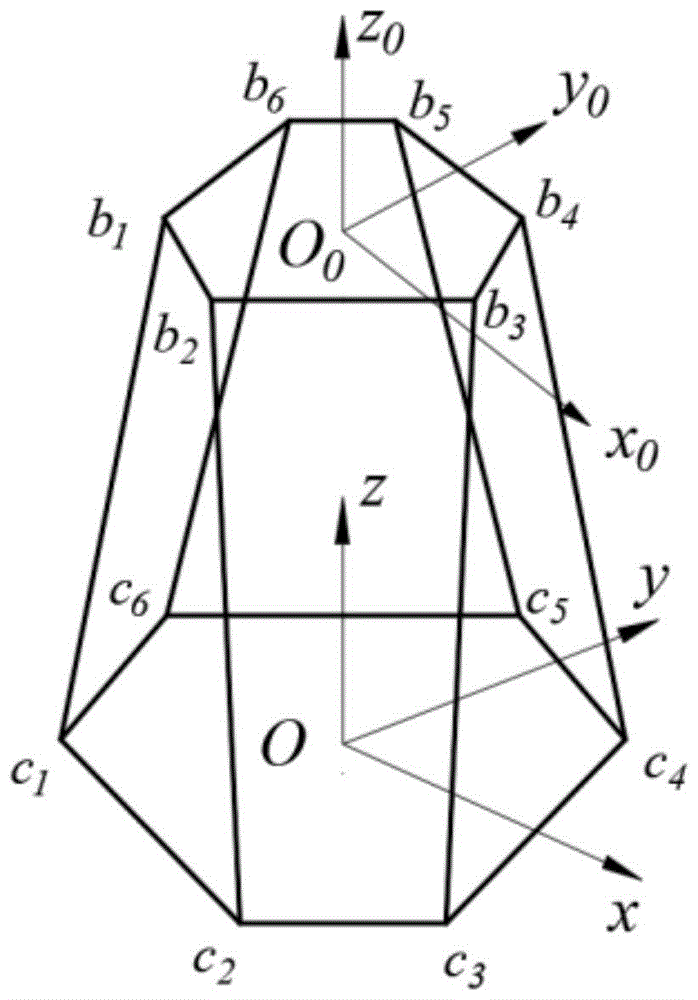
图1为steward机构的结构简图;Figure 1 is a schematic diagram of the structure of the steward mechanism;
图2为图1的俯视图。FIG. 2 is a top view of FIG. 1 .
具体实施方式Detailed ways
下面结合实施例及附图进一步解释本发明,但并不以此作为对本申请保护范围的限定。The present invention is further explained below with reference to the embodiments and accompanying drawings, but this is not intended to limit the protection scope of the present application.
本发明新型的求解闭链机构的雅可比矩阵的方法,该方法的步骤是:The novel method for solving the Jacobian matrix of the closed chain mechanism of the present invention, the steps of the method are:
第一步、依据封闭矢量法,建立机构的运动学模型(解析解),求解出机构中建立运动学模型所需的必要节点的坐标;The first step is to establish the kinematic model (analytical solution) of the mechanism according to the closed vector method, and solve the coordinates of the necessary nodes in the mechanism for establishing the kinematic model;
第二步、将雅可比矩阵写成偏导的形式;The second step is to write the Jacobian matrix in the form of partial derivatives;
第三步、依据多元函数求导和第一步中必要节点的坐标,将第二步中雅可比矩阵的每个元素表示为多个矩阵相乘的形式;The third step is to express each element of the Jacobian matrix in the second step in the form of multiplying multiple matrices according to the derivation of the multivariate function and the coordinates of the necessary nodes in the first step;
第四步、求解第三步中的每个相乘的矩阵中的元素,并分别用相关坐标参数表达出来;The fourth step is to solve the elements in each multiplied matrix in the third step, and express them with the relevant coordinate parameters respectively;
第五步、将机构的雅可比矩阵进行整理,将整个雅可比矩阵表示成多个矩阵相乘的形式,每个矩阵的元素对应第三步中的相应矩阵。The fifth step is to organize the Jacobian matrix of the organization, and express the entire Jacobian matrix in the form of multiplying multiple matrices, and the elements of each matrix correspond to the corresponding matrix in the third step.
在实际使用雅可比矩阵时,将第四步求出的相关参数表达式带入第五步中的多个矩阵相乘的雅可比矩阵中,可以求出雅可比矩阵的最终表达式。When the Jacobian matrix is actually used, the relevant parameter expressions obtained in the fourth step are brought into the Jacobian matrix multiplied by multiple matrices in the fifth step, and the final expression of the Jacobian matrix can be obtained.
本发明方法中运动学模型的建立,求解必要节点坐标的过程、将雅可比矩阵写成偏导形式都是本领域所公知的。The establishment of the kinematic model in the method of the present invention, the process of solving the necessary node coordinates, and the writing of the Jacobian matrix in the form of partial derivatives are well known in the art.
下面以steward机构为例求解雅可比矩阵。The following takes the Steward mechanism as an example to solve the Jacobian matrix.
图1和图2是6/6型steward机构示意图,该机构由上下两个相似的半规则六边形b1b2b3b4b5b6和c1c2c3c4c5c6通过六个分支相连而成。b1b2b3b4b5b6围成的六边形为上平台,c1c2c3c4c5c6围成的六边形为下平台,机构中每个分支通过球铰链与上、下平台相连,中间由六个移动副驱动从而改变各分支中杆的长度,使得动平台(上平台)在三维空间中的位置和姿态发生变化。静系原点定在静平台(下平台)中心,动系原点定在动平台中心,建立动系O0-x0y0z0,静系O-xyz,具体建系方法见《六自由度并联机器人奇异位形的研究》第64,65页(曹毅.六自由度并联机器人奇异位形的研究[D].燕山大学,2006)。Figures 1 and 2 are schematic diagrams of a 6/6-type steward mechanism, which consists of two similar upper and lower semi-regular hexagons b 1 b 2 b 3 b 4 b 5 b 6 and c 1 c 2 c 3 c 4 c 5 c 6 is connected by six branches. The hexagon enclosed by b 1 b 2 b 3 b 4 b 5 b 6 is the upper platform, and the hexagon enclosed by c 1 c 2 c 3 c 4 c 5 c 6 is the lower platform. Each branch in the mechanism passes through The ball hinge is connected with the upper and lower platforms, and the middle is driven by six moving pairs to change the length of the rods in each branch, so that the position and posture of the moving platform (upper platform) in the three-dimensional space change. The origin of the static system is set at the center of the static platform (lower platform), the origin of the dynamic system is set at the center of the moving platform, and the dynamic system O 0 -x 0 y 0 z 0 and the static system O-xyz are established. For the specific system establishment method, see "Six Degrees of Freedom" Research on Singular Configurations of Parallel Robots, pp. 64, 65 (Cao Yi. Research on Singular Configurations of Parallel Robots with Six Degrees of Freedom [D]. Yanshan University, 2006).
求解步骤如下:The solution steps are as follows:
1、求解运动学反解,动系姿态用z(φ)-y(θ)-z(ψ)欧拉角表示,设定静平台的各坐标点为已知,对每条支链的求解,以第一条支链为例求解。b1点、c1点坐标分别用式(1)、式(2)表示:1. Solve the inverse kinematics solution, the attitude of the dynamic system is represented by z(φ)-y(θ)-z(ψ) Euler angles, set each coordinate point of the static platform as known, and solve each branch chain , take the first branch as an example to solve. The coordinates of b 1 point and c 1 point are represented by formula (1) and formula (2) respectively:
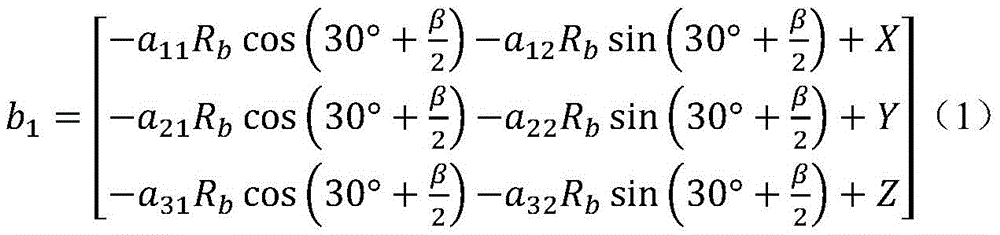
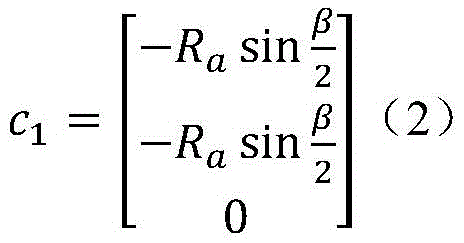
其中,Ra为定平台外接圆半径;Rb为动平台外接圆半径;XYZ分别为动平台中心点O0在 O-xyz坐标系下的对应坐标;β为长边c1c2和b4b5所对应的中心角;Among them, R a is the radius of the circumcircle of the fixed platform; R b is the radius of the circumcircle of the moving platform; XYZ are the corresponding coordinates of the center point O 0 of the moving platform in the O-xyz coordinate system; β is the long sides c 1 c 2 and b The central angle corresponding to 4 b 5 ;
反解公式为式(3),在此公式中,c1点坐标(c1x、c1y、c1z)已是一个定值,b1点坐标(b1x、b1y、b1z)是关于动平台位姿的函数。z(φ)-y(θ)-z(ψ)欧拉角:用于描述动平台的姿态。具体含义是:将O-xyz坐标系先沿z轴旋转φ度,再沿新坐标系的y轴旋转θ度,最后再以新得到的坐标系旋转ψ度,可得到O0-x0y0z0坐标系;三次旋转的方向均满足右手定则。右手定则:伸出右手,大拇指方向与坐标轴方向相同,同时四指弯曲,四指的指向即为角度转动的正方向。The inverse solution formula is formula (3). In this formula, the coordinates of c 1 point (c 1x , c 1y , c 1z ) are already fixed values, and the coordinates of b 1 point (b 1x , b 1y , b 1z ) are about A function of the pose of the moving platform. z(φ)-y(θ)-z(ψ) Euler angle: used to describe the attitude of the moving platform. The specific meaning is: first rotate the O-xyz coordinate system along the z-axis by φ degrees, then rotate along the y-axis of the new coordinate system by θ degrees, and finally rotate the newly obtained coordinate system by ψ degrees to obtain O 0 -x 0 y 0 z 0 coordinate system; the directions of the three rotations all satisfy the right-hand rule. Right-hand rule: Extend the right hand, the thumb is in the same direction as the coordinate axis, and the four fingers are bent at the same time, and the direction of the four fingers is the positive direction of the angle rotation.

建立运动学模型的求解顺序:求解过程中,机构的点比较多,要一个一个的、有顺序的求出。以本实施例中的Stewart机构为例,建立运动学模型的顺序:首先已知动平台的位姿,再求出b1点坐标,c1点是已知的,再求出b1c1距离,即l1。第三步才能有这个式子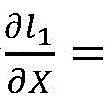

2、机构的输出速度与输入速度之间的关系通过式(4)表示,式中

3、将雅可比矩阵中的每个元素写成多个矩阵相乘的形式,然后求出每个元素的相关参数表达式,以第一个元素为例应用多元函数求导进行求解,第一个元素写成两个矩阵相乘的形式,见式(5),式(5)也可以简写为式(6):3. Write each element in the Jacobian matrix in the form of multiplying multiple matrices, and then find the relevant parameter expression of each element, take the first element as an example, and apply multivariate function derivation to solve the problem. The elements are written in the form of multiplying two matrices, see formula (5), formula (5) can also be abbreviated as formula (6):
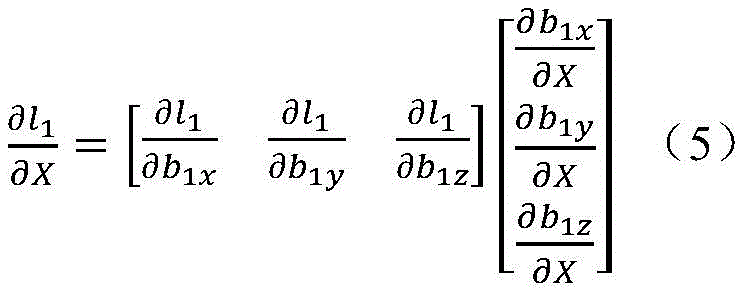

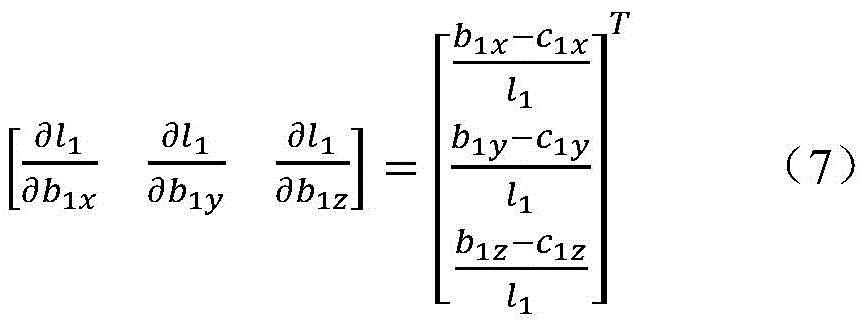
4、利用第一步求得的相关节点的表达式,求出式(5)中每个矩阵中的每个元素的相关参数表达式,结果为式(7)、式(8):4. Using the expressions of the relevant nodes obtained in the first step, the relevant parameter expressions of each element in each matrix in the formula (5) are obtained, and the results are formulas (7) and (8):

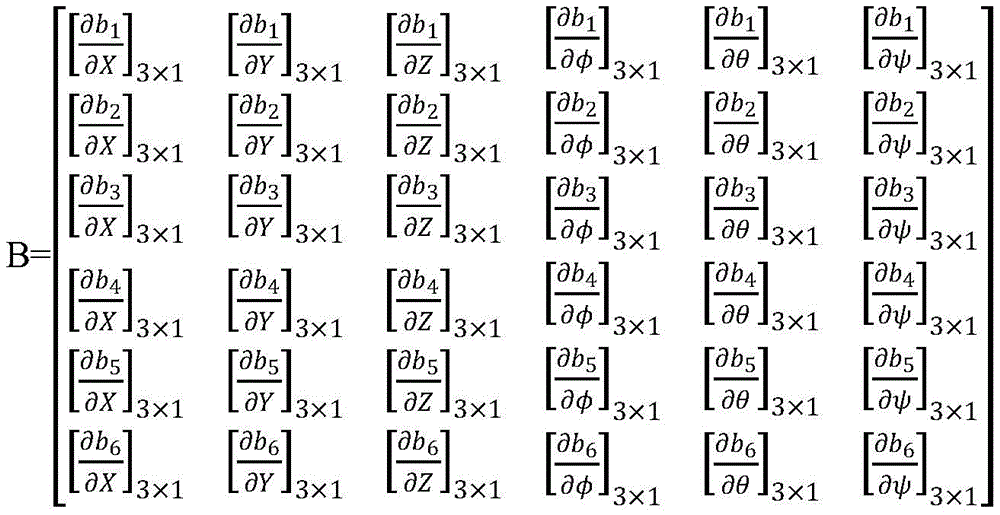
5、将雅可比矩阵中的所有元素按照式(6)的形式表示,再根据矩阵相乘的方法将雅可比矩阵整体重新整理成多个矩阵相乘的形式,本实施例中整理成两个矩阵相乘的形式,即J=AB,矩阵A和B中的每个元素都可以用第四步中的相应的相关参数表达式表示出来。5. Represent all elements in the Jacobian matrix in the form of formula (6), and then rearrange the Jacobian matrix as a whole into a form of multiplying multiple matrices according to the method of matrix multiplication. In this embodiment, it is organized into two In the form of matrix multiplication, that is, J=AB, each element in the matrices A and B can be represented by the corresponding relevant parameter expressions in the fourth step.
其中,J为雅可比矩阵,where J is the Jacobian matrix,

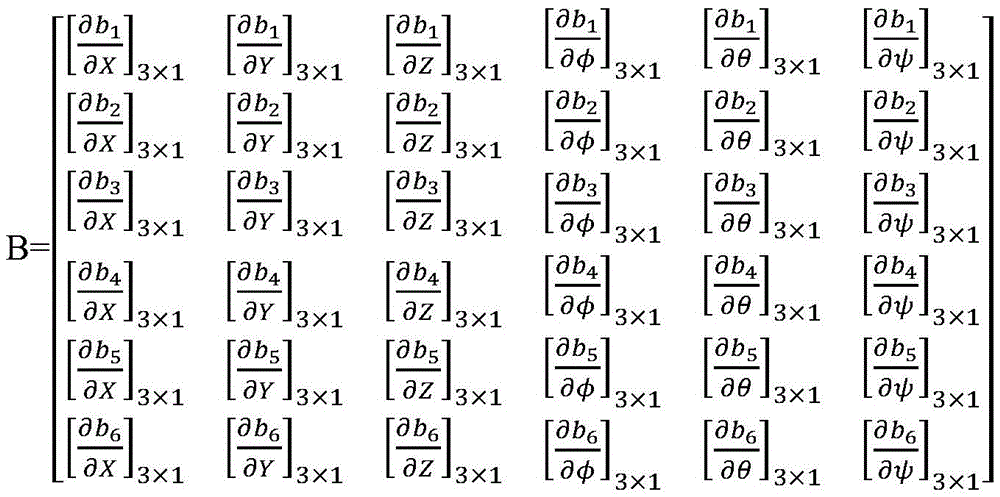
本实施例方法可将雅可比矩阵中相同的公式一个个的择出来(即对角矩阵A中的元素),条理清晰,如果按照传统的求导法,会重复计算,从而增加计算量(例如,例子中的
本发明未述及之处适用于现有技术。What is not described in the present invention applies to the prior art.
Claims (1)


Priority Applications (1)
| Application Number | Priority Date | Filing Date | Title |
|---|---|---|---|
| CN201810566988.6A CN108733629B (en) | 2018-06-05 | 2018-06-05 | A Method for Solving the Jacobian Matrix of Closed-chain Mechanisms |
Applications Claiming Priority (1)
| Application Number | Priority Date | Filing Date | Title |
|---|---|---|---|
| CN201810566988.6A CN108733629B (en) | 2018-06-05 | 2018-06-05 | A Method for Solving the Jacobian Matrix of Closed-chain Mechanisms |
Publications (2)
| Publication Number | Publication Date |
|---|---|
| CN108733629A CN108733629A (en) | 2018-11-02 |
| CN108733629B true CN108733629B (en) | 2022-04-15 |
Family
ID=63932263
Family Applications (1)
| Application Number | Title | Priority Date | Filing Date |
|---|---|---|---|
| CN201810566988.6A Expired - Fee Related CN108733629B (en) | 2018-06-05 | 2018-06-05 | A Method for Solving the Jacobian Matrix of Closed-chain Mechanisms |
Country Status (1)
| Country | Link |
|---|---|
| CN (1) | CN108733629B (en) |
Citations (2)
| Publication number | Priority date | Publication date | Assignee | Title |
|---|---|---|---|---|
| CN103500367A (en) * | 2013-10-08 | 2014-01-08 | 北京理工大学 | 3-PRS (Prismatic-Revolute-Spherical) parallel robot positioning accuracy optimization method based on interval analysis |
| CN106055519A (en) * | 2016-05-27 | 2016-10-26 | 盐城工学院 | A Singularity Analysis Method for Stewart Parallel Mechanism |
Family Cites Families (1)
| Publication number | Priority date | Publication date | Assignee | Title |
|---|---|---|---|---|
| US7217266B2 (en) * | 2001-05-30 | 2007-05-15 | Anderson R Rox | Apparatus and method for laser treatment with spectroscopic feedback |
-
2018
- 2018-06-05 CN CN201810566988.6A patent/CN108733629B/en not_active Expired - Fee Related
Patent Citations (2)
| Publication number | Priority date | Publication date | Assignee | Title |
|---|---|---|---|---|
| CN103500367A (en) * | 2013-10-08 | 2014-01-08 | 北京理工大学 | 3-PRS (Prismatic-Revolute-Spherical) parallel robot positioning accuracy optimization method based on interval analysis |
| CN106055519A (en) * | 2016-05-27 | 2016-10-26 | 盐城工学院 | A Singularity Analysis Method for Stewart Parallel Mechanism |
Non-Patent Citations (2)
| Title |
|---|
| Generalized coordinate partitioning for complex mechanisms based on kinematic substructuring;Kristopher T.Wehage等;《Mechanism and Machine Theory》;20151231;第92卷;第464-483页 * |
| 一种微型3-PSP并联机构的运动学、雅克比矩阵及运动奇异性分析;谢哲东等;《中国农机化学报》;20161130;第37卷(第11期);第116-122页 * |
Also Published As
| Publication number | Publication date |
|---|---|
| CN108733629A (en) | 2018-11-02 |
Similar Documents
| Publication | Publication Date | Title |
|---|---|---|
| CN109176494B (en) | Self-calibration method and system for rope-driven multi-joint flexible robot and storage medium | |
| CN102785248B (en) | Motion control method of decoupling type 6-DOF (six degrees of freedom) industrial robot | |
| CN109093600B (en) | Scale synthesis method of five-degree-of-freedom hybrid robot for round steel end face labeling | |
| CN108621158A (en) | A kind of time optimal trajectory planning control method and device about mechanical arm | |
| Chirikjian et al. | Pose changes from a different point of view | |
| Arian et al. | Kinematic and dynamic analysis of the Gantry-Tau, a 3-DoF translational parallel manipulator | |
| CN111123943B (en) | A trajectory planning method and system for ultra-redundant robots based on pseudo-inverse constraints | |
| Shetab-Bushehri et al. | Lattice-based shape tracking and servoing of elastic objects | |
| CN113722864A (en) | 7-degree-of-freedom redundant manipulator inverse kinematics solving method and system | |
| CN107160401B (en) | A method for solving the joint angle offset problem of redundant manipulators | |
| CN103499922A (en) | Kinematics real-time solving method based on seven-DOF space manipulator of FPGA | |
| CN112001087B (en) | A nonlinear dynamic modeling and analysis method for a rotary joint industrial robot | |
| CN107529630A (en) | A kind of method that robot for space establishes kinetic model | |
| CN111230860B (en) | Robot control method, device, computer equipment and storage medium | |
| CN111283682B (en) | Geometric projection solution method for forward kinematics of 4-UPU parallel robot | |
| CN108733629B (en) | A Method for Solving the Jacobian Matrix of Closed-chain Mechanisms | |
| CN112706163A (en) | Mechanical arm motion control method, device, equipment and medium | |
| Jia et al. | Tri-criteria optimization motion planning at acceleration-level of dual redundant manipulators | |
| CN108638057B (en) | Double-arm motion planning method for humanoid robot | |
| Huang et al. | Feasible instantaneous motions and kinematic characteristics of a special 3-DOF 3-UPU parallel manipulator | |
| Crenganis et al. | Inverse kinematics of a 7 DOF manipulator using adaptive neuro-fuzzy inference systems | |
| Reis et al. | Modeling and control of a multifingered robot hand for object grasping and manipulation tasks | |
| Ye et al. | Structure design and optimization of ground moving and pole climbing inspection robot | |
| CN108115672B (en) | Motion control system and method of oblique wrist spraying robot | |
| Platt Jr et al. | Multi-priority cartesian impedance control |
Legal Events
| Date | Code | Title | Description |
|---|---|---|---|
| PB01 | Publication | ||
| PB01 | Publication | ||
| SE01 | Entry into force of request for substantive examination | ||
| SE01 | Entry into force of request for substantive examination | ||
| GR01 | Patent grant | ||
| GR01 | Patent grant | ||
| CF01 | Termination of patent right due to non-payment of annual fee | ||
| CF01 | Termination of patent right due to non-payment of annual fee |
Granted publication date: 20220415 |