CN108699650B - Rolled wire - Google Patents
Rolled wire Download PDFInfo
- Publication number
- CN108699650B CN108699650B CN201780012634.0A CN201780012634A CN108699650B CN 108699650 B CN108699650 B CN 108699650B CN 201780012634 A CN201780012634 A CN 201780012634A CN 108699650 B CN108699650 B CN 108699650B
- Authority
- CN
- China
- Prior art keywords
- less
- wire rod
- rolled wire
- rolling
- content
- Prior art date
- Legal status (The legal status is an assumption and is not a legal conclusion. Google has not performed a legal analysis and makes no representation as to the accuracy of the status listed.)
- Active
Links
Images


Classifications
-
- C—CHEMISTRY; METALLURGY
- C22—METALLURGY; FERROUS OR NON-FERROUS ALLOYS; TREATMENT OF ALLOYS OR NON-FERROUS METALS
- C22C—ALLOYS
- C22C38/00—Ferrous alloys, e.g. steel alloys
- C22C38/18—Ferrous alloys, e.g. steel alloys containing chromium
- C22C38/28—Ferrous alloys, e.g. steel alloys containing chromium with titanium or zirconium
-
- C—CHEMISTRY; METALLURGY
- C21—METALLURGY OF IRON
- C21D—MODIFYING THE PHYSICAL STRUCTURE OF FERROUS METALS; GENERAL DEVICES FOR HEAT TREATMENT OF FERROUS OR NON-FERROUS METALS OR ALLOYS; MAKING METAL MALLEABLE, e.g. BY DECARBURISATION OR TEMPERING
- C21D8/00—Modifying the physical properties by deformation combined with, or followed by, heat treatment
- C21D8/06—Modifying the physical properties by deformation combined with, or followed by, heat treatment during manufacturing of rods or wires
-
- C—CHEMISTRY; METALLURGY
- C22—METALLURGY; FERROUS OR NON-FERROUS ALLOYS; TREATMENT OF ALLOYS OR NON-FERROUS METALS
- C22C—ALLOYS
- C22C38/00—Ferrous alloys, e.g. steel alloys
-
- C—CHEMISTRY; METALLURGY
- C22—METALLURGY; FERROUS OR NON-FERROUS ALLOYS; TREATMENT OF ALLOYS OR NON-FERROUS METALS
- C22C—ALLOYS
- C22C38/00—Ferrous alloys, e.g. steel alloys
- C22C38/001—Ferrous alloys, e.g. steel alloys containing N
-
- C—CHEMISTRY; METALLURGY
- C22—METALLURGY; FERROUS OR NON-FERROUS ALLOYS; TREATMENT OF ALLOYS OR NON-FERROUS METALS
- C22C—ALLOYS
- C22C38/00—Ferrous alloys, e.g. steel alloys
- C22C38/002—Ferrous alloys, e.g. steel alloys containing In, Mg, or other elements not provided for in one single group C22C38/001 - C22C38/60
-
- C—CHEMISTRY; METALLURGY
- C22—METALLURGY; FERROUS OR NON-FERROUS ALLOYS; TREATMENT OF ALLOYS OR NON-FERROUS METALS
- C22C—ALLOYS
- C22C38/00—Ferrous alloys, e.g. steel alloys
- C22C38/02—Ferrous alloys, e.g. steel alloys containing silicon
-
- C—CHEMISTRY; METALLURGY
- C22—METALLURGY; FERROUS OR NON-FERROUS ALLOYS; TREATMENT OF ALLOYS OR NON-FERROUS METALS
- C22C—ALLOYS
- C22C38/00—Ferrous alloys, e.g. steel alloys
- C22C38/04—Ferrous alloys, e.g. steel alloys containing manganese
-
- C—CHEMISTRY; METALLURGY
- C22—METALLURGY; FERROUS OR NON-FERROUS ALLOYS; TREATMENT OF ALLOYS OR NON-FERROUS METALS
- C22C—ALLOYS
- C22C38/00—Ferrous alloys, e.g. steel alloys
- C22C38/06—Ferrous alloys, e.g. steel alloys containing aluminium
-
- C—CHEMISTRY; METALLURGY
- C22—METALLURGY; FERROUS OR NON-FERROUS ALLOYS; TREATMENT OF ALLOYS OR NON-FERROUS METALS
- C22C—ALLOYS
- C22C38/00—Ferrous alloys, e.g. steel alloys
- C22C38/18—Ferrous alloys, e.g. steel alloys containing chromium
- C22C38/20—Ferrous alloys, e.g. steel alloys containing chromium with copper
-
- C—CHEMISTRY; METALLURGY
- C22—METALLURGY; FERROUS OR NON-FERROUS ALLOYS; TREATMENT OF ALLOYS OR NON-FERROUS METALS
- C22C—ALLOYS
- C22C38/00—Ferrous alloys, e.g. steel alloys
- C22C38/18—Ferrous alloys, e.g. steel alloys containing chromium
- C22C38/22—Ferrous alloys, e.g. steel alloys containing chromium with molybdenum or tungsten
-
- C—CHEMISTRY; METALLURGY
- C22—METALLURGY; FERROUS OR NON-FERROUS ALLOYS; TREATMENT OF ALLOYS OR NON-FERROUS METALS
- C22C—ALLOYS
- C22C38/00—Ferrous alloys, e.g. steel alloys
- C22C38/18—Ferrous alloys, e.g. steel alloys containing chromium
- C22C38/24—Ferrous alloys, e.g. steel alloys containing chromium with vanadium
-
- C—CHEMISTRY; METALLURGY
- C22—METALLURGY; FERROUS OR NON-FERROUS ALLOYS; TREATMENT OF ALLOYS OR NON-FERROUS METALS
- C22C—ALLOYS
- C22C38/00—Ferrous alloys, e.g. steel alloys
- C22C38/18—Ferrous alloys, e.g. steel alloys containing chromium
- C22C38/26—Ferrous alloys, e.g. steel alloys containing chromium with niobium or tantalum
-
- C—CHEMISTRY; METALLURGY
- C22—METALLURGY; FERROUS OR NON-FERROUS ALLOYS; TREATMENT OF ALLOYS OR NON-FERROUS METALS
- C22C—ALLOYS
- C22C38/00—Ferrous alloys, e.g. steel alloys
- C22C38/18—Ferrous alloys, e.g. steel alloys containing chromium
- C22C38/32—Ferrous alloys, e.g. steel alloys containing chromium with boron
-
- C—CHEMISTRY; METALLURGY
- C22—METALLURGY; FERROUS OR NON-FERROUS ALLOYS; TREATMENT OF ALLOYS OR NON-FERROUS METALS
- C22C—ALLOYS
- C22C38/00—Ferrous alloys, e.g. steel alloys
- C22C38/18—Ferrous alloys, e.g. steel alloys containing chromium
- C22C38/40—Ferrous alloys, e.g. steel alloys containing chromium with nickel
- C22C38/42—Ferrous alloys, e.g. steel alloys containing chromium with nickel with copper
-
- C—CHEMISTRY; METALLURGY
- C22—METALLURGY; FERROUS OR NON-FERROUS ALLOYS; TREATMENT OF ALLOYS OR NON-FERROUS METALS
- C22C—ALLOYS
- C22C38/00—Ferrous alloys, e.g. steel alloys
- C22C38/18—Ferrous alloys, e.g. steel alloys containing chromium
- C22C38/40—Ferrous alloys, e.g. steel alloys containing chromium with nickel
- C22C38/50—Ferrous alloys, e.g. steel alloys containing chromium with nickel with titanium or zirconium
-
- C—CHEMISTRY; METALLURGY
- C22—METALLURGY; FERROUS OR NON-FERROUS ALLOYS; TREATMENT OF ALLOYS OR NON-FERROUS METALS
- C22C—ALLOYS
- C22C38/00—Ferrous alloys, e.g. steel alloys
- C22C38/18—Ferrous alloys, e.g. steel alloys containing chromium
- C22C38/40—Ferrous alloys, e.g. steel alloys containing chromium with nickel
- C22C38/54—Ferrous alloys, e.g. steel alloys containing chromium with nickel with boron
-
- C—CHEMISTRY; METALLURGY
- C21—METALLURGY OF IRON
- C21D—MODIFYING THE PHYSICAL STRUCTURE OF FERROUS METALS; GENERAL DEVICES FOR HEAT TREATMENT OF FERROUS OR NON-FERROUS METALS OR ALLOYS; MAKING METAL MALLEABLE, e.g. BY DECARBURISATION OR TEMPERING
- C21D2211/00—Microstructure comprising significant phases
- C21D2211/005—Ferrite
-
- C—CHEMISTRY; METALLURGY
- C21—METALLURGY OF IRON
- C21D—MODIFYING THE PHYSICAL STRUCTURE OF FERROUS METALS; GENERAL DEVICES FOR HEAT TREATMENT OF FERROUS OR NON-FERROUS METALS OR ALLOYS; MAKING METAL MALLEABLE, e.g. BY DECARBURISATION OR TEMPERING
- C21D2211/00—Microstructure comprising significant phases
- C21D2211/009—Pearlite
-
- C—CHEMISTRY; METALLURGY
- C21—METALLURGY OF IRON
- C21D—MODIFYING THE PHYSICAL STRUCTURE OF FERROUS METALS; GENERAL DEVICES FOR HEAT TREATMENT OF FERROUS OR NON-FERROUS METALS OR ALLOYS; MAKING METAL MALLEABLE, e.g. BY DECARBURISATION OR TEMPERING
- C21D9/00—Heat treatment, e.g. annealing, hardening, quenching or tempering, adapted for particular articles; Furnaces therefor
- C21D9/52—Heat treatment, e.g. annealing, hardening, quenching or tempering, adapted for particular articles; Furnaces therefor for wires; for strips ; for rods of unlimited length
- C21D9/525—Heat treatment, e.g. annealing, hardening, quenching or tempering, adapted for particular articles; Furnaces therefor for wires; for strips ; for rods of unlimited length for wire, for rods
Landscapes
- Chemical & Material Sciences (AREA)
- Engineering & Computer Science (AREA)
- Materials Engineering (AREA)
- Mechanical Engineering (AREA)
- Metallurgy (AREA)
- Organic Chemistry (AREA)
- Manufacturing & Machinery (AREA)
- Physics & Mathematics (AREA)
- Thermal Sciences (AREA)
- Crystallography & Structural Chemistry (AREA)
- Heat Treatment Of Steel (AREA)
Abstract
Description
技术领域technical field
本发明涉及能够作为冷态锻造部件的材料使用的棒状或线状的轧制钢材(以下称为“轧制线材”)。The present invention relates to a rod-shaped or wire-shaped rolled steel material (hereinafter referred to as "rolled wire rod") that can be used as a material for cold forged parts.
背景技术Background technique
通过冷态锻造制造的部件(冷态锻造部件)的表面或尺寸精度优异,与通过热态锻造制造的部件(热态锻造部件)相比制造成本低,材料利用率也更好。因此,冷态锻造部件作为汽车或各种工业机械等所使用的机械构造用部件(齿轮、轴、螺栓等)或建筑构造物用部件而广泛应用。Components manufactured by cold forging (cold forged components) are excellent in surface or dimensional accuracy, and have lower manufacturing costs and better material utilization than components manufactured by hot forging (hot forged components). Therefore, cold forged parts are widely used as parts for machine structures (gears, shafts, bolts, etc.) used in automobiles, various industrial machines, and the like, and parts for building structures.
近年来,机械构造用部件不断地小型化、轻量化,建筑结构物用部件不断地大型化,因此冷态锻造部件不论其大小如何,期望进一步高强度化。In recent years, components for machine structures have been reduced in size and weight, and components for building structures have been increased in size. Therefore, regardless of their size, cold forged components are expected to further increase their strength.
作为这些冷态锻造部件,有JISG4051的机械构造用碳钢钢材或JISG4053的机械构造用合金钢钢材等。通常,这些钢材在热态下轧制为棒状或线状,然后进行球状化退火,进而在反复进行拉拔加工或冷态拉丝加工后,通过冷态锻造成型为部件形状,并通过淬火、回火等热处理调整为预定的强度或硬度。As these cold forged parts, there are JISG4051 carbon steel materials for machine structures, JISG4053 alloy steel materials for machine structures, and the like. Usually, these steel materials are rolled in a hot state into a bar or wire shape, then spheroidized and annealed, and then after repeated drawing or cold wire drawing, they are formed into a component shape by cold forging, and then quenched and tempered. Heat treatment such as fire is adjusted to a predetermined strength or hardness.
机械构造用钢材等由于含有较多(0.20~0.40质量%左右)的碳,所以能够通过调质处理而用作高强度部件。然而,机械构造用钢材等作为锻造原材料的强度高,因此如果不通过球状化退火及冷态拉丝加工使钢材软质化,则在部件成型的冷态锻造时容易产生模具的磨损或开裂,并且会在部件上产生开裂。因此,由于担心这样的制造上的问题,机械构造用钢材等需要使钢材软质化,进行强度等的调整。Since steel materials for machine structures and the like contain a large amount of carbon (about 0.20 to 0.40 mass %), they can be used as high-strength members by tempering treatment. However, steel materials for machine structures and the like have high strength as forging materials. Therefore, if the steel materials are not softened by spheroidizing annealing and cold wire drawing, wear or cracking of the die is likely to occur during cold forging of component forming, and Cracks can occur on the part. Therefore, in order to worry about such a manufacturing problem, it is necessary to soften the steel materials for machine structures and the like, and to adjust the strength and the like.
尤其是近年来,部件倾向于高强度化,并且部件形状倾向于复杂化。因此,出于使通过淬火、回火而得到高强度的钢材在冷态锻造前软质化的目的,采用使球状化退火长时间化、或反复进行球状化退火和冷态拉丝加工等对策。Especially in recent years, parts tend to be high in strength, and part shapes tend to be complicated. Therefore, for the purpose of softening the high-strength steel material obtained by quenching and tempering before cold forging, countermeasures such as prolonging spheroidizing annealing or repeating spheroidizing annealing and cold wire drawing are employed.
但是,在采用这些对策的情况下,不仅人工费用和设备费用等成本增高,能量损耗也变大。因此,需求开发一种通过省略球状化退火(及冷态拉丝加工)或者使这些过程短时间化而得到的钢材。However, when these measures are adopted, not only the costs such as labor costs and facility costs increase, but also energy consumption increases. Therefore, there is a need to develop a steel material obtained by omitting spheroidizing annealing (and cold wire drawing) or by shortening these processes.
在这样的背景之下,以省略球状化退火或者使球状化退火短时间化为目的,提出了减少C、Cr、Mn等合金元素的含量、降低作为锻造材料的轧制线材的强度、并通过添加B(硼)来弥补由于合金元素的减少而导致的淬火性的下降的添加硼的钢,以及各种改良方案。Against such a background, in order to omit the spheroidizing annealing or shorten the spheroidizing annealing time, it has been proposed to reduce the content of alloying elements such as C, Cr, and Mn, and to reduce the strength of the rolled wire rod as a forging material. A boron-added steel in which B (boron) is added to compensate for the decrease in hardenability due to a reduction in alloying elements, and various improvement proposals.
添加硼的钢显示出高淬火性,即使不添加Cr、Mo等合金元素也能够确保充分的淬火性,成本也被抑制为较低。因此,近年来添加硼的钢广泛普及,但为了得到通过冷态锻造成型为部件形状并在淬火、回火后拉伸强度成为1000MPa以上的高强度部件,还需要克服氢脆化的问题。Boron-added steel exhibits high hardenability, and sufficient hardenability can be ensured without adding alloying elements such as Cr and Mo, and the cost is kept low. Therefore, in recent years, boron-added steels have been widely used. However, in order to obtain high-strength parts with a tensile strength of 1,000 MPa or more after quenching and tempering, the problem of hydrogen embrittlement needs to be overcome.
例如,在日本特许第3443285号公报、日本特许第5486634号公报和日本特开平9-104945号公报中,分别公开了“防止晶粒粗大化特性和冷态锻造性优异的冷态锻造用热轧钢材及其制造方法”、“冷态加工用机械构造用钢及其制造方法”、以及“冷态加工性和耐延迟破坏性优异的高强度螺栓用钢、高强度螺栓的制造方法及高强度螺栓”。For example, in Japanese Patent No. 3443285, Japanese Patent No. 5486634, and Japanese Patent Laid-Open No. 9-104945, "hot rolling for cold forging excellent in grain coarsening prevention properties and cold forging properties" are disclosed, respectively. Steel material and method for producing the same", "Steel for machine structure for cold working and method for producing the same", and "Steel for high-strength bolts excellent in cold workability and delayed fracture resistance, method for producing high-strength bolts, and high-strength bolts" bolt".
即,在日本特许第3443285号公报中,公开了一种防止晶粒粗大化特性和冷态锻造性优异的冷态锻造用热轧钢材及其制造方法,其特征在于,含有C:0.10~0.60%、Si:0.50%以下、Mn:0.30~2.00%、P:0.025%以下、S:0.025%以下、Cr:0.25%以下、B:0.0003~0.0050%、N:0.0050%以下、Ti:0.020~0.100%,余量为Fe和不可避免的杂质,并且在钢的基体中具有20个/100μm2以上的直径为0.2μm以下的TiC或Ti(CN)。That is, Japanese Patent No. 3443285 discloses a hot-rolled steel material for cold forging, which is excellent in grain coarsening prevention properties and cold forgeability, and a method for producing the same, characterized by containing C: 0.10 to 0.60 %, Si: 0.50% or less, Mn: 0.30-2.00%, P: 0.025% or less, S: 0.025% or less, Cr: 0.25% or less, B: 0.0003-0.0050%, N: 0.0050% or less, Ti: 0.020- 0.100%, the balance is Fe and inevitable impurities, and there are 20/100 μm 2 or more of TiC or Ti(CN) with a diameter of 0.2 μm or less in the steel matrix.
另外,在日本特许第5486634号公报中公开了一种能够通过实施通常的球状化处理而实现充分的软质化的冷态加工用机械构造用钢及其制造方法,其特征在于,以质量%计含有C:0.2~0.6%、Si:0.01~0.5%、Mn:0.2~1.5%、P:0.03%以下、S:0.01~0.05%、Al:0.01~0.1%、N:0.015%以下、以及Cr:超过0.5%且2.0%以下,余量为铁及不可避免的杂质,金属组织具有珠光体和初析铁素体,珠光体和初析铁素体相对于全部组织的合计面积率为90%以上,并且初析铁素体的面积率A与由Ae=(0.8-Ceq)×96.75(其中,Ceq=[C]+0.1×[Si]+0.06×[Mn]+0.11×[Cr],[(元素名)]是指各元素的含量(质量%))表示的Ae具有A>Ae的关系,初析铁素体和珠光体中的铁素体的平均粒径为15~25μm。In addition, Japanese Patent No. 5486634 discloses a steel for cold working machine structure that can be sufficiently softened by performing a normal spheroidizing treatment, and a method for producing the same, characterized in that the mass % It contains C: 0.2 to 0.6%, Si: 0.01 to 0.5%, Mn: 0.2 to 1.5%, P: 0.03% or less, S: 0.01 to 0.05%, Al: 0.01 to 0.1%, N: 0.015% or less, and Cr: more than 0.5% and 2.0% or less, the balance is iron and unavoidable impurities, the metal structure has pearlite and pro-eutectoid ferrite, and the total area ratio of pearlite and pro-eutectoid ferrite to the whole structure is 90 % or more, and the area ratio A of pro-eutectoid ferrite is related to Ae=(0.8-Ceq)×96.75 (wherein, Ceq=[C]+0.1×[Si]+0.06×[Mn]+0.11×[Cr] , [(element name)] means the content of each element (mass %)) Ae represented by A>Ae relationship, the average particle size of ferrite in pro-eutectoid ferrite and pearlite is 15-25 μm.
另外,在日本特开平9-104945号公报中公开了一种冷态加工性及耐延迟破坏性优异的高强度螺栓用钢,其特征在于,以质量%计含有C:0.15~0.35%、Si:0.1%以下、Mn:0.3~1.3%、P:0.01%以下、S:0.01%以下、Cr:小于0.5%、Ti:0.01~0.10%、Al:0.01~0.05%、B:0.0005~0.003%,余量为Fe和不可避免的杂质,满足0.50≤[C]+0.15[Si]+0.2[Mn]+0.11[Cr]≤0.60。In addition, Japanese Patent Application Laid-Open No. 9-104945 discloses a high-strength bolt steel excellent in cold workability and delayed fracture resistance, characterized in that it contains C: 0.15 to 0.35% by mass, Si : 0.1% or less, Mn: 0.3 to 1.3%, P: 0.01% or less, S: 0.01% or less, Cr: less than 0.5%, Ti: 0.01 to 0.10%, Al: 0.01 to 0.05%, B: 0.0005 to 0.003% , and the balance is Fe and inevitable impurities, satisfying 0.50≤[C]+0.15[Si]+0.2[Mn]+0.11[Cr]≤0.60.
发明内容SUMMARY OF THE INVENTION
根据日本特许第3443285号公报公开的技术,能够降低轧制钢材的硬度,因此能够以低成本进行冷态锻造,另外,能够具备淬火加热时的晶粒粗大化防止特性。但是,由于钢中的Cr含量低,所以淬火性低,在提高部件的强度方面存在限制,作为超过1000MPa的高强度部件,在耐氢脆化特性上存在技术课题。According to the technique disclosed in Japanese Patent No. 3443285, the hardness of the rolled steel material can be reduced, so that cold forging can be performed at low cost, and the property of preventing coarsening of crystal grains during quenching heating can be provided. However, since the Cr content in steel is low, the hardenability is low, and there is a limit to improving the strength of the part, and there is a technical problem in the hydrogen embrittlement resistance characteristic of high-strength parts exceeding 1000 MPa.
另外,日本特许第5486634号公报公开的冷加工用机械构造用钢,通过实施通常的球状化退火能够软质化,能够应用于高强度部件。但是,钢的化学成分的添加量平衡没有被最优化,并且轧制钢材的组织的铁素体分率实质上较小。因此,如果在部件的冷态锻造时使用进行了产品轧制或实施了短时间的球状化退火的状态下的钢材,则有可能产生开裂,无法以低成本制造部件。In addition, the steel for machine structure for cold working disclosed in Japanese Patent No. 5486634 can be softened by performing ordinary spheroidizing annealing, and can be applied to high-strength parts. However, the addition amount balance of the chemical components of the steel is not optimized, and the ferrite fraction of the structure of the rolled steel material is substantially small. Therefore, when a steel product in a state of product rolling or spheroidizing annealing for a short time is used in cold forging of parts, cracks may occur, and parts cannot be manufactured at low cost.
而且,在日本特开平9-104945号公报公开的技术中,规定C、Si、Mn及Cr的总量的下限和上限,得到不会给冷态加工性带来不良影响的轧制材料的强度、和在进行调质处理后可得到期望强度的轧制材料的强度。但是,由于Cr量低、淬火性低,因此作为超过1000MPa的高强度部件,在耐氢脆化特性上存在技术课题。Furthermore, in the technique disclosed in Japanese Patent Application Laid-Open No. 9-104945, the lower limit and the upper limit of the total amount of C, Si, Mn and Cr are specified to obtain the strength of the rolled material which does not adversely affect the cold workability , and the strength of the rolled material that can obtain the desired strength after tempering treatment. However, since the amount of Cr is low and the hardenability is low, there is a technical problem in the resistance to hydrogen embrittlement as a high-strength member exceeding 1000 MPa.
本发明是鉴于上述情况而完成的,其目的在于提供一种即使在冷态锻造前未实施球状化退火、或者即使使球状化退火短时间化,也能够有效抑制冷态锻造时的开裂产生,在紧接着球状化退火的淬火、回火后的耐氢脆化特性优异的轧制线材。The present invention has been made in view of the above circumstances, and an object of the present invention is to provide a method that can effectively suppress the occurrence of cracks during cold forging even if spheroidizing annealing is not performed before cold forging, or even if the spheroidizing annealing time is shortened, A rolled wire rod with excellent resistance to hydrogen embrittlement after quenching and tempering immediately after spheroidizing annealing.
本发明人为解决上述课题进行了各种研究。结果,本发明人得到下述见解(a)~(e)。The present inventors have conducted various studies to solve the above-mentioned problems. As a result, the present inventors obtained the following findings (a) to (e).
(a)为了即使省略球状化退火或使其短时间化,也能够将冷态锻造性确保为能够进行部件的成型的程度,对于除了有可能生成脱碳层的表层部分以外的内部组织,需要以面积率计95%以上为铁素体和珠光体的混合组织,并且铁素体分率超过40%。(a) In order to ensure cold forgeability to an extent that enables forming of parts even if the spheroidizing annealing is omitted or shortened, the internal structure other than the surface layer portion where the decarburized layer may be formed needs to be 95% or more of the area ratio is a mixed structure of ferrite and pearlite, and the ferrite fraction exceeds 40%.
(b)即使是相同的铁素体和珠光体的混合组织,通过使存在于轧制线材的表面附近的夹杂物微细并且减少伸长的夹杂物,也能够提高冷态锻造性,由此,能够进行更复杂的部件的成型。另外,通过夹杂物的微细化或减少,淬火、回火后的耐氢脆化特性提高。(b) Even with the same mixed structure of ferrite and pearlite, cold forgeability can be improved by making the inclusions present near the surface of the rolled wire rod finer and reducing the elongation of the inclusions. Forming of more complex parts is possible. In addition, the refinement or reduction of inclusions improves the hydrogen embrittlement resistance after quenching and tempering.
(c)C、Si、Mn、Cr等添加元素主要会对轧制线材的强度造成影响。另外,Mn、Ti、N、S等添加元素会对轧制线材中不可避免地含有的夹杂物的组成或形态造成影响。为了具备优异的冷态锻造性和作为冷态锻造部件使用所需的淬火性或耐氢脆化特性,必须充分地考虑这两个类型的添加元素的平衡。并且,为了具备上述冷态锻造性等,需要进一步在产品轧制前的高温加热后进行轧制比为6以上的一次轧制,或需要控制之后的精轧制的温度等钢材的制造条件。由此,以确保能够作为冷态锻造部件使用的级别的淬火性为前提,能够得到即使省略球状化退火或使其短时间化也能够实现优异的冷态锻造性的轧制线材。(c) Additive elements such as C, Si, Mn, and Cr mainly affect the strength of the rolled wire rod. In addition, additive elements such as Mn, Ti, N, and S affect the composition and morphology of inclusions inevitably contained in the rolled wire rod. In order to have excellent cold forgeability and hardenability or hydrogen embrittlement resistance properties required for use as a cold forged part, the balance of these two types of additive elements must be fully considered. In addition, in order to have the above-mentioned cold forgeability, etc., it is necessary to perform primary rolling with a rolling ratio of 6 or more after high-temperature heating before product rolling, or to control the production conditions of steel materials such as the temperature of the subsequent finish rolling. As a result, it is possible to obtain a rolled wire rod that can achieve excellent cold forgeability even if spheroidizing annealing is omitted or shortened on the premise of securing a level of hardenability that can be used as a cold forged part.
(d)具体而言,在由将化学成分设为预定的平衡的钢水制造钢块或铸锭后,在产品轧制之前的阶段中高温加热至1280℃以上,在确保至少30min以上的均热时间后立刻进行轧制比为6以上的一次轧制并冷却。由此,在凝固时生成的包含Ti的粗大的碳氮化物和/或碳化物,以及包含Ti和/或Mn的粗大的硫化物的一部分,暂时在钢中固溶,并且通过高温的一次轧制切断粗大的硫化物,在之后的冷却过程中微细地再析出。因此,对冷态锻造性带来不良影响的粗大的硫化物得到抑制,并且再析出的微细的碳氮化物和/或碳化物在之后进行的热态的产品轧制的加热时作为钉扎粒子发挥作用,有助于防止奥氏体晶粒的粗大生长。其结果,在产品轧制后的冷却时析出的铁素体微细化,铁素体分率变高,进而能够得到(a)记载的组织。(d) Specifically, after producing a steel ingot or an ingot from molten steel having a predetermined balance of chemical components, it is heated to a high temperature of 1280° C. or higher in a stage before product rolling, and a soaking period of at least 30 minutes is ensured. Immediately after the time, primary rolling with a rolling ratio of 6 or more is performed and cooled. As a result, the coarse carbonitrides and/or carbides including Ti and a part of the coarse sulfides including Ti and/or Mn, which are generated during solidification, temporarily dissolve in the steel, and are subjected to primary rolling at high temperature. Coarse sulfides are cut and finely reprecipitated in the subsequent cooling process. Therefore, the coarse sulfides that adversely affect the cold forgeability are suppressed, and the reprecipitated fine carbonitrides and/or carbides serve as pinning particles at the time of heating in the subsequent hot product rolling. Works to help prevent the coarse growth of austenite grains. As a result, the ferrite precipitated during cooling after rolling of the product is refined, and the ferrite fraction is increased, and the structure described in (a) can be obtained.
(e)如上述那样在高温加热后进行了一次轧制的钢片被再加热,在热态下进行产品轧制成为预定直径的线材。但是,产品轧制中的最终的精轧制优选以5~15/秒的加工速度在750~850℃的温度范围进行。通过管理精轧制的加工速度和温度范围,铁素体相变前的奥氏体晶粒更加微细,铁素体分率变高,因此能够得到(a)记载的组织。如果精轧制温度小于750℃,则铁素体晶粒变得过于微细,轧制线材的强度提高,冷态锻造性恶化,另一方面,如果精轧制温度超过850℃,则无法得到(a)记载的组织。再者,产品轧制时的加热温度优选为1050℃以下。(e) The steel sheet that has been subjected to primary rolling after being heated at a high temperature as described above is reheated, and the product is rolled into a wire rod having a predetermined diameter in a hot state. However, the final finish rolling in the product rolling is preferably performed in a temperature range of 750 to 850° C. at a working speed of 5 to 15/sec. By controlling the working speed and temperature range of finish rolling, the austenite grains before ferrite transformation become finer, and the ferrite fraction increases, so that the structure described in (a) can be obtained. If the finish rolling temperature is less than 750°C, the ferrite grains become too fine, the strength of the rolled wire rod increases, and the cold forgeability is deteriorated. On the other hand, when the finish rolling temperature exceeds 850°C, ( a) Organization as documented. Furthermore, the heating temperature at the time of product rolling is preferably 1050°C or lower.
根据上述(a)~(e)的见解而得到的轧制线材,具有铁素体和珠光体的合计面积率为95%以上且铁素体分率超过40%的内部组织。另外,该轧制线材中,存在于从其最表层起到D/8(D表示轧制线材的直径(mm))的范围的硫化物的平均面积为6μm2以下。而且,该轧制线材中,该硫化物的平均纵横比为5以下。因此,该轧制线材是粗大且伸长的硫化物的存在率少的线材。The rolled wire rod obtained from the findings of (a) to (e) above has an internal structure in which the total area ratio of ferrite and pearlite is 95% or more and the ferrite fraction exceeds 40%. In addition, in the rolled wire rod, the average area of sulfides present in the range from the outermost layer to D/8 (D represents the diameter (mm) of the rolled wire rod) is 6 μm 2 or less. Furthermore, in the rolled wire rod, the average aspect ratio of the sulfide is 5 or less. Therefore, the rolled wire rod is a large and elongated wire rod with a small presence rate of sulfides.
其结果,上述轧制线材即使省略球状化退火处理或者使其短时间化,也具有充分的冷态锻造性,并且能够确保淬火性,因此能够优选用作冷态锻造部件,能够制成淬火、回火后的耐氢脆化特性也优异的线材。As a result, even if the spheroidizing annealing treatment is omitted or shortened, the above-mentioned rolled wire rod has sufficient cold forgeability and can ensure the hardenability, so it can be preferably used as a cold forged part, and can be made into quenched, A wire rod with excellent resistance to hydrogen embrittlement after tempering.
再者,为了在冷态锻造后进行淬火,当加热至超过Ac3点的温度时,奥氏体晶粒的一部分有时会异常大地生长即发生异常晶粒生长,成为部件强度参差变动的主要原因。但是,本发明中的轧制线材的耐粗粒化特性优异,即使在冷态锻造后加热至超过Ac3点的温度的情况下,也能够抑制晶粒的异常晶粒生长。Furthermore, in order to perform quenching after cold forging, when heated to a temperature exceeding the Ac 3 point, a part of austenite grains may grow abnormally, that is, abnormal grain growth may occur, which may cause variation in the strength of parts. . However, the rolled wire rod of the present invention is excellent in resistance to coarsening, and can suppress abnormal grain growth of crystal grains even when heated to a temperature exceeding the Ac 3 point after cold forging.
本发明基于上述见解而完成,其主旨在于下述(1)~(3)所示的轧制线材。The present invention was completed based on the above findings, and the gist of the present invention resides in the rolled wire rods shown in the following (1) to (3).
(1)一种轧制线材,其特征在于,(1) A rolled wire rod, characterized in that,
以质量%计含有Contains in mass %
C:0.20%以上且小于0.40%、C: 0.20% or more and less than 0.40%,
Mn:0.10%以上且小于0.40%、Mn: 0.10% or more and less than 0.40%,
S:小于0.020%、S: less than 0.020%,
P:小于0.020%、P: less than 0.020%,
Cr:0.70%以上且1.60%以下、Cr: 0.70% or more and 1.60% or less,
Al:0.005%以上且0.060%以下、Al: 0.005% or more and 0.060% or less,
Ti:0.010%以上且0.080%以下、Ti: 0.010% or more and 0.080% or less,
B:0.0003%以上且0.0040%以下、以及B: 0.0003% or more and 0.0040% or less, and
N:0.0020%以上且0.0080%以下,N: 0.0020% or more and 0.0080% or less,
余量为Fe和杂质,The balance is Fe and impurities,
在将Ti、N和S的各含量(质量%)分别设为[Ti]、[N]、[S]时,When the respective contents (mass %) of Ti, N, and S are [Ti], [N], and [S], respectively,
在[S]≤0.0010的情况下,[Ti]为(4.5×[S]+3.4×[N])以上且(0.008+3.4×[N])以下,In the case of [S]≦0.0010, [Ti] is not less than (4.5×[S]+3.4×[N]) and not more than (0.008+3.4×[N]),
在[S]≥0.0010的情况下,[Ti]为(4.5×[S]+3.4×[N])以上且(8.0×[S]+3.4×[N])以下,When [S]≥0.0010, [Ti] is (4.5×[S]+3.4×[N]) or more and (8.0×[S]+3.4×[N]) or less,
内部组织是以面积率计铁素体比率为40%以上的铁素体与珠光体的混合组织,在包含轴向的平面的截面中,将直径设为D(mm)时,存在于从最表层到D/8位置的范围的硫化物的平均面积为6μm2以下,所述硫化物的平均纵横比为5以下。The internal structure is a mixed structure of ferrite and pearlite with a ferrite ratio of 40% or more in area ratio, and exists from the most The average area of the sulfide in the range from the surface layer to the D/8 position is 6 μm 2 or less, and the average aspect ratio of the sulfide is 5 or less.
(2)根据上述(1)记载的轧制线材,以质量%计含有0%以上且小于0.40%的Si和0%以上且0.050%以下的Nb之中的至少一种来代替所述Fe的一部分。(2) The rolled wire rod according to the above (1), which contains, in mass %, at least one of 0% or more and less than 0.40% of Si and 0% or more and 0.050% or less of Nb in place of the Fe part.
(3)根据上述(1)或(2)的任一项记载的轧制线材,以质量%计含有0.50%以下的Cu、0.30%以下的Ni、0.05%以下的Mo和0.05%以下的V之中的至少一种来代替所述Fe的一部分。(3) The rolled wire rod according to any one of the above (1) or (2), which contains, in mass %, 0.50% or less of Cu, 0.30% or less of Ni, 0.05% or less of Mo, and 0.05% or less of V At least one of them replaces a part of the Fe.
(4)根据上述(1)~(3)的任一项记载的轧制线材,以质量%计含有0.05%以下的Zr、0.005%以下的Ca和0.005%以下的Mg之中的至少一种来代替所述Fe的一部分。(4) The rolled wire rod according to any one of the above (1) to (3), which contains, in mass %, at least one of 0.05% or less of Zr, 0.005% or less of Ca, and 0.005% or less of Mg to replace part of the Fe.
通过使用本发明的轧制线材作为原材料,即使省略球状化退火处理或使其短时间化,也能够通过冷态锻造成型为部件,即使在淬火时对奥氏体区域加热,也能够抑制晶粒的异常晶粒生长,能够作为淬火、回火后的耐氢脆化特性也优异的冷态锻造部件使用。By using the rolled wire rod of the present invention as a raw material, even if the spheroidizing annealing treatment is omitted or shortened, it can be formed into a component by cold forging, and even if the austenite region is heated during quenching, crystal grains can be suppressed It can be used as a cold forged part with excellent resistance to hydrogen embrittlement after quenching and tempering.
附图说明Description of drawings
图1是表示满足本实施方式的[Ti]与[S]的关系的区域的图。FIG. 1 is a diagram showing a region satisfying the relationship between [Ti] and [S] in the present embodiment.
图2是表示环状V型切口试验片的图。FIG. 2 is a view showing an annular V-notch test piece.
具体实施方式Detailed ways
以下,对本实施方式的轧制线材进行详细说明。再者,本实施方式的轧制线材是指棒状或线状的轧制钢材且其直径为5~25mm左右。另外,以下所示的各元素的含量的“%”是指“质量%”。Hereinafter, the rolled wire rod of the present embodiment will be described in detail. In addition, the rolled wire rod of this embodiment is a rod-shaped or wire-shaped rolled steel material, and the diameter is about 5-25 mm. In addition, "%" of the content of each element shown below means "mass %".
(A)关于化学成分(A) About chemical composition
C:0.20%以上且小于0.40%C: 0.20% or more and less than 0.40%
C是使钢强化的元素,必须含有0.20%以上。另一方面,如果C的含量为0.40%以上,则冷态锻造性降低。因此,将C的含量设为0.20%以上且小于0.40%。而且,在想提高冷态锻造部件的淬火硬度的情况下,优选将C的含量设为0.24%以上,在进一步想提高冷态锻造性的情况下,优选设为0.35%以下。C is an element that strengthens steel and must be contained in an amount of 0.20% or more. On the other hand, when the content of C is 0.40% or more, the cold forgeability is lowered. Therefore, the content of C is set to 0.20% or more and less than 0.40%. Furthermore, when it is desired to increase the quenching hardness of the cold forged part, the content of C is preferably 0.24% or more, and when it is desired to further improve the cold forgeability, it is preferably 0.35% or less.
Mn:0.10%以上且小于0.40%Mn: 0.10% or more and less than 0.40%
Mn是提高淬火性所需的元素,因此将其下限值设为0.10%。但是,如果Mn的含量成为0.40%以上,则在精轧制后的冷却时铁素体相变的开始温度下降,铁素体分率下降,进而生成贝氏体,因此冷态锻造性降低。因此,需要将Mn的含量设为小于0.40%。再者,为了提高淬火性,Mn优选含有0.20%以上。Mn is an element required to improve hardenability, so the lower limit is made 0.10%. However, when the Mn content is 0.40% or more, the start temperature of ferrite transformation during cooling after finish rolling decreases, the ferrite fraction decreases, and bainite is formed, so that cold forgeability decreases. Therefore, it is necessary to make the content of Mn less than 0.40%. Furthermore, in order to improve hardenability, Mn is preferably contained in an amount of 0.20% or more.
S:小于0.020%S: less than 0.020%
S作为杂质而含有。但是,如果S的含量成为0.020%以上,则钢中所含有的硫化物会成为粗大且伸长的形态,会使冷态锻造性下降。S的含量优选小于0.010%。另外,为了得到冷态锻造性优异的硫化物的形态和大小,S即使在相同的含量范围内,也必须考虑与Ti或N的平衡而含有。S is contained as an impurity. However, when the content of S is 0.020% or more, the sulfides contained in the steel will be in a coarse and elongated form, and the cold forgeability will be deteriorated. The content of S is preferably less than 0.010%. In addition, in order to obtain the form and size of the sulfide excellent in cold forgeability, even if S is within the same content range, it must be contained in consideration of the balance with Ti or N.
P:小于0.020%P: less than 0.020%
P作为杂质而含有。但是,如果P的含量成为0.020%以上,则不仅会使冷态锻造性降低,而且在对奥氏体的加热时P在晶界偏析而成为淬火时的开裂产生的主要原因,而且会使淬火、回火后的耐氢脆化特性下降。因此,必须使P的含量小于0.020%。P的含量优选设为小于0.010%。P is contained as an impurity. However, if the content of P is 0.020% or more, not only does the cold forgeability decrease, but also P segregates at grain boundaries during heating of austenite, which causes cracking during quenching and causes quenching. , The hydrogen embrittlement resistance after tempering decreases. Therefore, it is necessary to make the content of P less than 0.020%. The content of P is preferably set to less than 0.010%.
Cr:0.70%以上且1.60%以下Cr: 0.70% or more and 1.60% or less
Cr与Mn同样是提高淬火性所需的元素,在本发明中必须含有0.70%以上。但是,如果Cr的含量超为1.60%,则虽然淬火性变高,但在精轧制后的冷却时铁素体相变的开始温度下降,铁素体分率下降,进而生成贝氏体,因此冷态锻造性降低。为了稳定地得到高淬火性,优选将Cr的含量设为0.80%以上,更优选含有0.90%以上。另一方面,在想进一步提高冷态锻造性的情况下,优选将Cr的含量设为1.50%以下,更优选设为1.40%以下。Cr, like Mn, is an element necessary for improving the hardenability, and in the present invention, it must be contained in an amount of 0.70% or more. However, when the Cr content exceeds 1.60%, the hardenability increases, but the temperature at which the ferrite transformation starts during cooling after finish rolling decreases, the ferrite fraction decreases, and bainite is formed. Therefore, the cold forgeability is lowered. In order to obtain high hardenability stably, the content of Cr is preferably 0.80% or more, and more preferably 0.90% or more. On the other hand, when it is desired to further improve the cold forgeability, the content of Cr is preferably 1.50% or less, and more preferably 1.40% or less.
Al:0.005%以上且0.060%以下Al: 0.005% or more and 0.060% or less
Al不仅具有脱氧作用,还具有与N结合而形成AlN,利用其钉扎效果,使热轧时的奥氏体晶粒微细化,抑制贝氏体的生成的作用。因此,必须含有0.005%以上的Al。另一方面,如果Al的含量超过0.060%,则不仅其效果饱和,还会由于生成粗大的AlN而使冷态锻造性降低。在想进一步抑制贝氏体的生成的情况下,Al的含量优选为0.015%以上,更优选为0.020%以上。另外,从提高冷态锻造性的观点来看,Al的含量优选为0.050%以下,更优选为0.045%以下。Al not only has a deoxidizing effect, but also has an effect of combining with N to form AlN, and by using the pinning effect, the austenite grains during hot rolling are refined, and the formation of bainite is suppressed. Therefore, Al must be contained in an amount of 0.005% or more. On the other hand, if the content of Al exceeds 0.060%, not only the effect is saturated, but also the cold forgeability is lowered due to the generation of coarse AlN. When it is desired to further suppress the formation of bainite, the content of Al is preferably 0.015% or more, and more preferably 0.020% or more. In addition, from the viewpoint of improving cold forgeability, the content of Al is preferably 0.050% or less, and more preferably 0.045% or less.
Ti:0.010%以上且0.080%以下Ti: 0.010% or more and 0.080% or less
Ti具有与N或C结合而形成碳化物、氮化物或碳氮化物,利用它们的钉扎效果,在热轧时使奥氏体晶粒微细化,抑制精轧制后的冷却过程中的贝氏体的生成,提高铁素体分率的作用。另外,Ti还具有抑制为了在冷态锻造后进行淬火而加热至超过Ac3点的温度时的异常晶粒生长的作用。而且,Ti减少固溶在钢中的N、抑制BN的生成,因此还具有提高由B带来的淬火性提高的效果的作用。此外,Ti具有与S反应而改变硫化物的组成,使硫化物微细化,提高冷态锻造性、耐氢脆化特性的效果,因此必须考虑与N或S的平衡而进行添加。Ti combines with N or C to form carbides, nitrides, or carbonitrides, and by virtue of their pinning effect, austenite grains are refined during hot rolling, and brittleness during cooling after finish rolling is suppressed. The formation of intenite and the effect of increasing the ferrite fraction. In addition, Ti also has the effect of suppressing abnormal grain growth when heated to a temperature exceeding the Ac 3 point for quenching after cold forging. In addition, Ti reduces the N dissolved in the steel and suppresses the formation of BN, and thus also has the effect of enhancing the effect of improving the hardenability by B. In addition, Ti has the effect of reacting with S to change the composition of the sulfide, making the sulfide finer, and improving cold forgeability and hydrogen embrittlement resistance, so it must be added in consideration of the balance with N or S.
为了得到这些效果,Ti必须含有0.010%以上。为了进一步得到这些效果,Ti的含量优选为0.030%以上,更优选为0.060%以上。另一方面,在含有超过0.080%的情况下,在精轧制时会析出微细的Ti碳化物,使铁素体相强化、使冷态锻造性恶化,因此Ti的含量为0.070%以下。再者,Ti会形成碳化物、氮化物或碳氮化物,并且固溶于硫化物,给硫化物的形态和大小带来影响。因此,有助于淬火时的异常晶粒生长的抑制或冷态锻造性、耐氢脆化特性的提高。因此,Ti的含量即使在上述范围内,也必须考虑与S或N的平衡而含有。In order to obtain these effects, Ti must be contained in an amount of 0.010% or more. In order to obtain these effects further, the content of Ti is preferably 0.030% or more, and more preferably 0.060% or more. On the other hand, when the content exceeds 0.080%, fine Ti carbides are precipitated during finish rolling, the ferrite phase is strengthened, and the cold forgeability is deteriorated, so the content of Ti is 0.070% or less. Furthermore, Ti forms carbides, nitrides or carbonitrides, and dissolves in sulfides, thereby affecting the shape and size of sulfides. Therefore, it contributes to suppression of abnormal grain growth during quenching, and improvement of cold forgeability and hydrogen embrittlement resistance. Therefore, even if the content of Ti is within the above range, it must be contained in consideration of the balance with S or N.
B:0.0003%以上且0.0040%以下B: 0.0003% or more and 0.0040% or less
通过添加微量的B,可有效提高钢的淬火性,必须含有0.0003%以上。但是,如果含有超过0.0040%,不仅效果会饱和,而且还会使冷态锻造性劣化。在想进一步提高淬火性的情况下,B的含量优选为0.0005%以上,更优选为0.0010%以上。另一方面,在进一步提高冷态锻造性的情况下,B的含量优选为0.0030%以下,更优选为0.0025%以下。By adding a small amount of B, the hardenability of steel can be effectively improved, and it must be contained in an amount of 0.0003% or more. However, if the content exceeds 0.0040%, not only the effect will be saturated, but also the cold forgeability will be deteriorated. When it is desired to further improve the hardenability, the content of B is preferably 0.0005% or more, and more preferably 0.0010% or more. On the other hand, in order to further improve cold forgeability, the content of B is preferably 0.0030% or less, and more preferably 0.0025% or less.
N:0.0020%以上且0.0080%以下N: 0.0020% or more and 0.0080% or less
N具有与Ti或Al结合而生成氮化物或碳氮化物,使热轧时的奥氏体晶粒微细化的效果,以及抑制将冷态锻造部件淬火时的加热时的异常晶粒生长的效果。但是,N含量必须考虑与对硫化物的组成和形态带来影响的Ti的平衡而决定。为了得到这些效果,N必须含有0.0020%以上,优选含有0.0030%以上。但是,如果过剩地含有N,则不仅会使这些效果饱和,还会与B结合而生成氮化物,减弱由B带来的淬火性提高的效果,因此N的含量需要设为0.0080%以下。为了稳定地提高淬火性,N含量优选小于0.0070%,更优选为0.0060%以下。此外,N会与Ti结合而生成氮化物或碳氮化物。因此,N会影响到对硫化物的形态和大小带来影响的Ti量。因此,N必须考虑与Ti或S的平衡而含有。N combines with Ti or Al to form nitrides or carbonitrides to refine austenite grains during hot rolling, and has the effect of suppressing abnormal grain growth during heating during quenching of cold forged parts . However, the N content must be determined in consideration of the balance with Ti which affects the composition and morphology of the sulfide. In order to obtain these effects, N must be contained in an amount of 0.0020% or more, preferably 0.0030% or more. However, if N is contained excessively, not only these effects are saturated, but also nitrogen is formed by combining with B, and the effect of improving the hardenability by B is weakened. Therefore, the content of N needs to be 0.0080% or less. In order to stably improve the hardenability, the N content is preferably less than 0.0070%, and more preferably 0.0060% or less. In addition, N combines with Ti to form nitrides or carbonitrides. Therefore, N affects the amount of Ti that affects the form and size of sulfides. Therefore, N must be contained in consideration of the balance with Ti or S.
在本申请发明中,如此前所述的那样,Ti、N、S的各元素的平衡十分重要。特别是在([Ti]-3.4×[N])与[S]之比过小的情况下,无法得到Ti固溶于硫化物而使硫化物微细化的效果,容易存在粗大的硫化物。其背景是:在本发明中为了得到适合于冷态锻造性的铁素体·珠光体组织,使Mn的含量低,Fe固溶在硫化物中而容易使硫化物粗大化。In the present invention, as described above, the balance of each element of Ti, N, and S is very important. In particular, when the ratio of ([Ti]-3.4×[N]) to [S] is too small, the effect that Ti is dissolved in the sulfide to refine the sulfide cannot be obtained, and coarse sulfide tends to exist. The background is that in the present invention, in order to obtain a ferrite/pearlite structure suitable for cold forgeability, the content of Mn is reduced, and Fe is dissolved in a sulfide, and the sulfide is easily coarsened.
另一方面,在([Ti]-3.4×[N])与[S]之比过大的情况下,微细的Ti碳化物在铁素体中析出,提高铁素体的强度,使冷态锻造性下降。On the other hand, when the ratio of ([Ti]-3.4×[N]) to [S] is too large, fine Ti carbides are precipitated in the ferrite, the strength of the ferrite is increased, and the cold state is reduced. Forgeability decreased.
通过使([Ti]-3.4×[N])与[S]之比为适当量,所含有的硫化物成为固溶有Ti的组成。其结果,硫化物微细化,母材的冷态锻造性得以改善。另外,即使在淬火时对奥氏体区域加热也能抑制晶粒的异常晶粒生长,能够作为淬火、回火后的耐氢脆化特性也优异的冷态锻造部件使用。By setting the ratio of ([Ti]-3.4×[N]) to [S] to an appropriate amount, the contained sulfide becomes a composition in which Ti is dissolved in a solid solution. As a result, the sulfide is refined, and the cold forgeability of the base material is improved. In addition, abnormal grain growth of crystal grains can be suppressed even when the austenite region is heated during quenching, and it can be used as a cold forged part having excellent resistance to hydrogen embrittlement after quenching and tempering.
基于此,在将本实施方式的轧制线材中的Ti、N及S的各含量(质量%)分别设为[Ti]、[N]、[S]时,它们满足如下条件:Based on this, when the respective contents (mass %) of Ti, N, and S in the rolled wire rod of the present embodiment are set as [Ti], [N], and [S], respectively, they satisfy the following conditions:
在[S]≤0.0010的情况下,[Ti]为(4.5×[S]+3.4×[N])以上且(0.008+3.4×[N])以下,In the case of [S]≦0.0010, [Ti] is not less than (4.5×[S]+3.4×[N]) and not more than (0.008+3.4×[N]),
在[S]≥0.0010的情况下,[Ti]为(4.5×[S]+3.4×[N])以上且(8.0×[S]+3.4×[N])以下。When [S]≧0.0010, [Ti] is not less than (4.5×[S]+3.4×[N]) and not more than (8.0×[S]+3.4×[N]).
在该定义中,规定[Ti]的上限的数学式以[S]=0.0010为边界而改变。对于其理由会在后面进行说明。In this definition, the mathematical expression that defines the upper limit of [Ti] is changed with [S]=0.0010 as the boundary. The reason for this will be described later.
图1的斜线部分表示满足上述的[Ti]、[N]和[S]的关系的区域。图1中,由纵轴表示的值A是依赖于上述[N]的值([N]的3.4倍值),具体而言是在0.0068(质量%)~0.0272(质量%)的范围内变动的值。再者,在本申请发明中,由于[N]规定为0.0020%以上且0.0080%以下,因此值A为0.0068以上且0.0272以下。The shaded portion in FIG. 1 represents a region satisfying the above-described relationship of [Ti], [N], and [S]. In FIG. 1 , the value A represented by the vertical axis is a value that depends on the above-mentioned [N] (a value 3.4 times the value of [N]), and specifically varies within a range of 0.0068 (mass %) to 0.0272 (mass %). value of . In addition, in the present invention, since [N] is defined to be 0.0020% or more and 0.0080% or less, the value A is 0.0068 or more and 0.0272 or less.
在[S]≥0.0010的情况下,通过使[Ti]为(4.5×[S]+3.4×[N])以上,所含有的硫化物成为固溶有Ti的组成,实现微细化,因此冷态锻造性得到改善。In the case of [S]≥0.0010, by making [Ti] equal to or more than (4.5×[S]+3.4×[N]), the sulfides contained have a composition in which Ti is dissolved in a solid solution, and refinement is realized. State forgeability is improved.
另外,在[S]≥0.0010的情况下,通过使[Ti]为(8.0×[S]+3.4×[N])以下,能够抑制微细的Ti碳化物的析出量,使铁素体的强度不会变得过高,防止冷态锻造性的下降。In addition, in the case of [S]≥0.0010, by setting [Ti] to be (8.0×[S]+3.4×[N]) or less, the amount of precipitation of fine Ti carbides can be suppressed, and the strength of ferrite can be improved. Does not become too high, preventing the decline of cold forgeability.
与[S]≥0.0010的情况同样地,在[S]≤0.0010的情况下,通过使[Ti]为(4.5×[S]+3.4×[N])以上,所含有的硫化物成为固溶有Ti的组成,实现微细化,因此冷态锻造性得到改善。Similarly to the case of [S]≥0.0010, in the case of [S]≤0.0010, by making [Ti] equal to or more than (4.5×[S]+3.4×[N]), the contained sulfide becomes a solid solution It has a composition of Ti and realizes miniaturization, so that the cold forgeability is improved.
与之相对,在[S]≤0.0010的情况下,[Ti]的上限规定为(0.008+3.4×[N])。在[Ti]位于该范围的情况下,线材内部析出的微细的Ti碳化物的量减少,铁素体的强度不会变得过高,能够防止冷态锻造性的下降。On the other hand, when [S]≦0.0010, the upper limit of [Ti] is defined as (0.008+3.4×[N]). When [Ti] is in this range, the amount of fine Ti carbides precipitated inside the wire rod is reduced, the strength of ferrite does not become too high, and a reduction in cold forgeability can be prevented.
在此,关于[Ti]的上限值,对在[S]=0.0010的前后将数学式分开的理由进行说明。如上所述,对于[Ti]的上限值,为了抑制微细的Ti碳化物的析出量并使线材的强度适当而进行限制。在[Ti]少的区域,尤其在[Ti]为(0.008+3.4×[N])以下的区域中,(无论[S]含量如何)生成的微细的Ti碳化物是微量的,给线材硬度带来的影响小。在[S]较多的区域规定[Ti]的上限的式子(8.0×[S]+3.4×[N])与(0.008+3.4×[N])的交点处,[S]=0.0010。Here, regarding the upper limit value of [Ti], the reason why the mathematical expression is separated before and after [S]=0.0010 will be described. As described above, the upper limit of [Ti] is limited in order to suppress the precipitation amount of fine Ti carbides and to make the strength of the wire rod appropriate. In the region with a small amount of [Ti], especially in the region where [Ti] is (0.008+3.4×[N]) or less, (regardless of the [S] content) the generated fine Ti carbides are in a small amount, which contributes to the hardness of the wire rod. The impact is small. [S]=0.0010 at the intersection of the expression (8.0×[S]+3.4×[N]) and (0.008+3.4×[N]) that define the upper limit of [Ti] in a region with many [S].
即,在[S]≤0.0010的范围中,即使[Ti]为(8.0×[S]+3.4×[N])以上,只要为(0.008+3.4×[N])以下,就可以制造能够达成本申请发明的目标的轧制线材。因此,在[S]≤0.0010的区域中,导入与[S]≥0.0010的区域不同的规定。That is, in the range of [S]≦0.0010, even if [Ti] is (8.0×[S]+3.4×[N]) or more, as long as it is (0.008+3.4×[N]) or less, the production can be achieved. The rolled wire rod which is the object of the present invention. Therefore, in the region of [S]≦0.0010, a different rule from the region of [S]≧0.0010 is introduced.
另外,本实施方式的轧制线材大多主要用于在冷态锻造后通过淬火、回火赋予强度的部件。由此,为了确保作为部件的淬火性,优选使在该轧制线材中含有的C、Mn、Cr满足下述式<1>。In addition, many of the rolled wire rods of this embodiment are mainly used for components to be given strength by quenching and tempering after cold forging. Therefore, in order to secure the hardenability as a member, it is preferable that C, Mn, and Cr contained in the rolled wire rod satisfy the following formula <1>.
[Mn]×[Cr]>0.134×(D/25.4-(0.50×√[C]))/(0.50×√[C])<1>[Mn]×[Cr]>0.134×(D/25.4-(0.50×√[C]))/(0.50×√[C])<1>
在此,在上述式中,[Mn]、[Cr]、[C]表示各自的元素以质量%计的含量,D表示轧制线材的直径(mm)。Here, in the above formula, [Mn], [Cr], and [C] represent the contents in mass % of the respective elements, and D represents the diameter (mm) of the rolled wire rod.
在此,式<1>的左边是由钢中所含有的Mn、Cr的质量%之积表示的值,是为了确保作为高强度冷态锻造部件需求的淬火性所需的参数。Here, the left side of the formula <1> is a value represented by the product of mass % of Mn and Cr contained in the steel, and is a parameter required to secure the hardenability required as a high-strength cold forged part.
与之相对,式<1>的右边是表示D与[C]的关系的参数,在将直径为D(mm)的轧制线材加热至Ac3点以上的温度,通过油冷进行淬火处理的情况下,会影响到在轧制线材的中心部即从表面到D/2(mm)位置处得到的马氏体的分率。On the other hand, the right side of the formula <1> is a parameter representing the relationship between D and [C], and the quenching process is performed by heating a rolled wire rod having a diameter of D (mm) to a temperature of Ac 3 or higher and performing oil cooling. In this case, the fraction of martensite obtained at the center of the rolled wire rod, that is, from the surface to the D/2 (mm) position is affected.
并且,作为高强度冷态锻造部件,为了确保充分的淬火性,优选式<1>中左边的值大于右边的值。In addition, in order to ensure sufficient hardenability as a high-strength cold forged part, it is preferable that the value on the left side of the formula <1> is larger than the value on the right side.
此外,本实施方式的轧制线材中的余量为“Fe和杂质”。在此,“杂质”是意外地含有在轧制线材中的成分,是在工业制造钢铁材料时从作为原料的矿石及废料混入的成分或由于制造环境而混入的成分。例如,氧为杂质,为了抑制粗大的氧化物的生成、避免冷态锻造性变差,优选抑制在0.0030%以下,更优选抑制在0.0020%以下,特别优选抑制在0.0015%以下。In addition, the remainder in the rolled wire rod of this embodiment is "Fe and impurities". Here, "impurities" are components accidentally contained in the rolled wire rod, and are components mixed from ores and scraps as raw materials during industrial production of steel materials, or components mixed in by the production environment. For example, oxygen is an impurity, and in order to suppress the formation of coarse oxides and prevent the deterioration of cold forgeability, it is preferably suppressed to 0.0030% or less, more preferably 0.0020% or less, and particularly preferably 0.0015% or less.
接着,在本实施方式涉及的线材中,也可以根据需要含有选自Si、Nb、Cu、Ni、Mo、V、Zr、Ca和Mg中的至少一种元素来代替作为余量的Fe的一部分。以下,对任意添加元素Nb、Cu、Ni、Mo、V、Zr、Ca和Mg的含量和该含量的设定理由进行说明。Next, in the wire rod according to the present embodiment, at least one element selected from the group consisting of Si, Nb, Cu, Ni, Mo, V, Zr, Ca, and Mg may be contained in place of a part of Fe as the remainder as necessary. . Hereinafter, the contents of Nb, Cu, Ni, Mo, V, Zr, Ca, and Mg of the optional additive elements and the reasons for setting the contents will be described.
Si:0%以上且小于0.40%Si: 0% or more and less than 0.40%
由于Si降低热轧状态下的轧制线材的拉伸强度,因此其含量越低越好。但Si会通过固溶强化而使铁素体强化,因此在想要提高冷态锻造部件的回火硬度的情况下也可以含有。该情况下,Si的含量需要小于0.40%。如果Si的含量为0.40%以上,则冷态锻造性降低。在想要提高冷态锻造性的情况下,Si的含量优选小于0.30%,更优选小于0.20%。Since Si reduces the tensile strength of the rolled wire rod in the hot-rolled state, the lower the content, the better. However, Si strengthens ferrite through solid solution strengthening, so it may be contained in the case where it is desired to increase the temper hardness of cold forged parts. In this case, the content of Si needs to be less than 0.40%. When the content of Si is 0.40% or more, the cold forgeability decreases. When it is desired to improve cold forgeability, the content of Si is preferably less than 0.30%, more preferably less than 0.20%.
Nb:0%以上且0.050%以下Nb: 0% or more and 0.050% or less
Nb与C或N结合而形成碳化物、氮化物或碳氮化物,利用它们的钉扎效果,在热轧时使奥氏体晶粒微细化,因此具有抑制精轧制后的冷却过程中的贝氏体生成,提高铁素体分率的作用。另外,Nb的碳化物、氮化物或碳氮化物会抑制将冷态锻造部件淬火时的加热时的晶粒的异常晶粒生长。在本实施方式中,即使不添加Nb,也能够实现铁素体分率的提高或晶粒的异常晶粒生长的抑制。但是,在切实地实现这些效果的情况下,添加Nb是有效的。即,为了切实地得到这些效果,Nb优选含有0.003%以上,更优选含有0.005%以上,特别优选含有0.010%以上。另一方面,在Nb含有超过0.050%的情况下,不仅这些效果会饱和,还有可能会使轧制线材的冷态锻造性下降。因此,Nb的含量优选为0.040%以下,更优选为0.030%以下。Nb combines with C or N to form carbides, nitrides or carbonitrides, and by virtue of their pinning effect, austenite grains are refined during hot rolling, so it has the effect of suppressing the deterioration during cooling after finish rolling. The formation of bainite and the effect of increasing the ferrite fraction. In addition, Nb carbides, nitrides, or carbonitrides suppress abnormal grain growth of crystal grains during heating when quenching a cold forged part. In the present embodiment, even without adding Nb, it is possible to improve the ferrite fraction and suppress abnormal grain growth of crystal grains. However, adding Nb is effective in realizing these effects reliably. That is, in order to obtain these effects reliably, Nb is preferably contained at 0.003% or more, more preferably 0.005% or more, and particularly preferably 0.010% or more. On the other hand, when the Nb content exceeds 0.050%, not only these effects are saturated, but also the cold forgeability of the rolled wire rod may be lowered. Therefore, the content of Nb is preferably 0.040% or less, and more preferably 0.030% or less.
Cu:0.50%以下Cu: 0.50% or less
Cu是提高淬火性的元素,可以含有。但是,如果Cu的含量超过0.50%,则淬火性变得过高,在精轧制后会生成贝氏体,导致轧制线材的冷态锻造性的下降。因此,Cu的含量优选为0.50以下%,更优选为0.30%以下,特别优选为0.20%以下。再者,为了稳定地得到上述Cu的添加效果,Cu的含量优选为0.03%以上,更优选为0.05%以上。Cu is an element that improves hardenability and may be contained. However, when the content of Cu exceeds 0.50%, the hardenability becomes too high, bainite is formed after finish rolling, and the cold forgeability of the rolled wire rod is lowered. Therefore, the content of Cu is preferably 0.50% or less, more preferably 0.30% or less, and particularly preferably 0.20% or less. In addition, in order to obtain the above-mentioned effect of adding Cu stably, the content of Cu is preferably 0.03% or more, and more preferably 0.05% or more.
Ni:0.30%以下Ni: 0.30% or less
Ni是提高淬火性的元素,可以含有。但是,如果Ni的含量超过0.30%,则不仅该效果会饱和,而且淬火性会变得过高,在精轧制后会生成贝氏体,导致冷态锻造性的下降。因此,Ni的含量优选为0.30%以下,更优选为0.20%以下,特别优选为0.10%以下。再者,为了稳定地得到上述Ni的效果,Ni的含量优选为0.01%以上,更优选为0.03%以上。Ni is an element that improves hardenability and may be contained. However, if the content of Ni exceeds 0.30%, not only the effect is saturated, but also the hardenability becomes too high, bainite is formed after finish rolling, and the cold forgeability is deteriorated. Therefore, the content of Ni is preferably 0.30% or less, more preferably 0.20% or less, and particularly preferably 0.10% or less. In addition, in order to obtain the effect of the above-mentioned Ni stably, the content of Ni is preferably 0.01% or more, and more preferably 0.03% or more.
Mo:0.05%以下Mo: 0.05% or less
Mo是通过固溶强化而使钢强化的元素,可大幅提高钢的淬火性。出于该目的可以含有Mo。但是,如果Mo的含量超过0.05%,则在精轧制后会生成贝氏体或马氏体,导致冷态锻造性的下降。因此,Mo的含量优选为0.05%以下,更优选为0.03%以下,特别优选为0.02%以下。再者,为了稳定地得到上述Mo的效果,Mo的含量优选为0.005%以上。Mo is an element that strengthens steel by solid solution strengthening, and can greatly improve the hardenability of steel. Mo may be contained for this purpose. However, when the content of Mo exceeds 0.05%, bainite or martensite is formed after finish rolling, resulting in a decrease in cold forgeability. Therefore, the content of Mo is preferably 0.05% or less, more preferably 0.03% or less, and particularly preferably 0.02% or less. In addition, in order to obtain the above-mentioned effect of Mo stably, the content of Mo is preferably 0.005% or more.
V:0.05%以下V: 0.05% or less
V虽然会与C及N结合而形成碳化物、氮化物或碳氮化物,但通过微量添加也具有提高钢的淬火性的作用。因此可以含有V。但是,如果V的含量超过0.05%,则由于析出的碳化物或碳氮化物而使轧制线材的强度增大,导致冷态锻造性的下降。因此,V的含量优选为0.05%以下。从提高冷态锻造性的观点出发,V的含量更优选为0.03%以下,特别优选为0.02%以下。再者,为了稳定地得到上述V的效果,V的含量优选为0.005%以上。Although V combines with C and N to form carbides, nitrides, or carbonitrides, it also has the effect of improving the hardenability of steel by adding a small amount. Therefore, V can be contained. However, if the content of V exceeds 0.05%, the strength of the rolled wire rod increases due to the precipitated carbides or carbonitrides, resulting in a decrease in cold forgeability. Therefore, the content of V is preferably 0.05% or less. From the viewpoint of improving cold forgeability, the content of V is more preferably 0.03% or less, and particularly preferably 0.02% or less. Furthermore, in order to obtain the effect of V stably, the content of V is preferably 0.005% or more.
Zr:0.05%以下Zr: 0.05% or less
Zr通过微量地添加也具有提高钢的淬火性的作用。出于该目的可以添加微量的Zr。但是,如果Zr的含量超过0.05%,则会生成粗大的氮化物,使冷态锻造性下降。因此,Zr的含量优选为0.05%以下。从提高冷态锻造性的观点出发,Zr的量更优选为0.03%以下,特别优选为0.02%以下。再者,为了稳定地得到上述Zr的效果,Zr的含量优选为0.003%以上。Zr also has the effect of improving the hardenability of steel by adding it in a small amount. Trace amounts of Zr can be added for this purpose. However, when the content of Zr exceeds 0.05%, coarse nitrides are formed and the cold forgeability is deteriorated. Therefore, the content of Zr is preferably 0.05% or less. From the viewpoint of improving cold forgeability, the amount of Zr is more preferably 0.03% or less, and particularly preferably 0.02% or less. In addition, in order to obtain the effect of the above-mentioned Zr stably, the content of Zr is preferably 0.003% or more.
Ca:0.005%以下Ca: 0.005% or less
Ca与S结合而形成硫化物,作为MnS的生成核发挥作用,因此Ca具有使MnS微细分散的作用。通过像这样使MnS微细分散,在精轧制后的冷却时将MnS作为生成核而使铁素体析出,所以Ca具有提高铁素体分率的效果。因此可以含有Ca。但是,如果Ca的含量超过0.005%,则上述效果饱和,而且Ca和Al一起与钢中的氧反应生成的氧化物变得粗大,导致冷态锻造性的下降。因此,Ca的含量优选为0.005%以下,更优选为0.003%以下,特别优选为0.002%以下。此外,为了稳定地得到上述Ca的效果,Ca的含量优选为0.0005%以上。Ca combines with S to form sulfides and functions as nuclei for the formation of MnS, so Ca has an effect of finely dispersing MnS. By dispersing MnS finely in this way, ferrite is precipitated by using MnS as nuclei during cooling after finish rolling, so Ca has an effect of increasing the ferrite fraction. Therefore, Ca may be contained. However, when the content of Ca exceeds 0.005%, the above-mentioned effects are saturated, and oxides formed by the reaction of Ca and Al with oxygen in the steel become coarse, resulting in a decrease in cold forgeability. Therefore, the content of Ca is preferably 0.005% or less, more preferably 0.003% or less, and particularly preferably 0.002% or less. In addition, in order to obtain the effect of the above-mentioned Ca stably, the content of Ca is preferably 0.0005% or more.
Mg:0.005%以下Mg: 0.005% or less
Mg与S结合而形成硫化物,作为MnS的生成核发挥作用,因此Mg具有使MnS微细分散的效果。通过像这样使MnS微细分散,在精轧制后的冷却时将MnS作为生成核而使铁素体析出,所以Mg具有提高铁素体分率的效果。因此可以含有Mg。但是,如果Mg的含量超过0.005%,则上述效果饱和。另外,Mg的添加效率差,会使制造成本恶化。因此,Mg的含量优选为0.005%以下,更优选为0.003%以下,特别优选为0.002%以下。再者,为了稳定地得到上述Mg的效果,Mg的含量优选为0.0005%以上。Mg combines with S to form sulfides and functions as nuclei for the formation of MnS, so Mg has the effect of finely dispersing MnS. By dispersing MnS finely in this way, ferrite is precipitated by using MnS as nuclei during cooling after finish rolling, so Mg has the effect of increasing the ferrite fraction. Therefore, Mg may be contained. However, if the content of Mg exceeds 0.005%, the above-mentioned effects are saturated. In addition, the addition efficiency of Mg is poor, and the manufacturing cost is deteriorated. Therefore, the content of Mg is preferably 0.005% or less, more preferably 0.003% or less, and particularly preferably 0.002% or less. In addition, in order to obtain the above-mentioned effect of Mg stably, the content of Mg is preferably 0.0005% or more.
(B)轧制线材的内部组织(B) Internal structure of rolled wire rod
本实施方式的轧制线材的冷态锻造性优异,即使省略以往要求20小时左右的产品轧制后的球状化退火处理,或者使该处理的时间为一半左右,也不会产生冷态锻造时的模具寿命下降或成形部件的开裂等。这是因为,通过不仅对所制造的钢的化学成分进行控制,还控制轧制线材的制造条件,由此将轧制线材的金属组织控制为适合于冷态锻造的形态。The rolled wire rod of the present embodiment is excellent in cold forgeability, and even if the spheroidizing annealing treatment after product rolling, which has been required for about 20 hours in the past, is omitted, or the treatment time is about half, no cold forging occurs. Die life reduction or cracking of formed parts, etc. This is because the metallographic structure of the rolled wire rod is controlled to a form suitable for cold forging by controlling not only the chemical composition of the steel to be produced but also the production conditions of the rolled wire rod.
具体而言,在本实施方式的轧制线材中,除了有可能生成脱碳层的表层部分以外的内部组织是以面积率计95%以上为铁素体和珠光体的混合组织,并且是铁素体组织的分率为40%以上的组织。在此,在本实施方式中的铁素体中不包括珠光体中所含的渗碳体之间的铁素体。另外,铁素体和珠光体的混合组织以面积率计为整体的95%以上是指马氏体、贝氏体的合计小于5%。为了得到良好的冷态锻造性,如上所述,需要将铁素体和珠光体的混合组织以面积率计设为95%以上,更优选设为100%。Specifically, in the rolled wire rod of the present embodiment, the internal structure other than the surface layer portion where the decarburized layer may be formed is a mixed structure of ferrite and pearlite at an area ratio of 95% or more, and is iron A tissue with a fraction of body tissue of 40% or more. Here, the ferrite in the present embodiment does not include ferrite between cementite contained in pearlite. In addition, 95% or more of the entire mixed structure of ferrite and pearlite in terms of area ratio means that the total of martensite and bainite is less than 5%. In order to obtain good cold forgeability, as described above, the mixed structure of ferrite and pearlite needs to be 95% or more in area ratio, more preferably 100%.
在铁素体分率小于40%的情况下,无法确保良好的冷态锻造性,在成型时在部件上产生开裂,并且轧制线材的变形阻抗高,因此会产生模具寿命变短之类的问题。铁素体分率优选为45%以上,特别优选为50%以上。When the ferrite fraction is less than 40%, good cold forgeability cannot be ensured, cracks occur in the parts during forming, and the deformation resistance of the rolled wire rod is high, resulting in shortened die life. question. The ferrite fraction is preferably 45% or more, particularly preferably 50% or more.
另外,为了能够抑制由冷态锻造中的烧结导致的锻造不良,铁素体分率优选为60%以下。铁素体分率更优选为55%以下。In addition, in order to suppress forging failure due to sintering in cold forging, the ferrite fraction is preferably 60% or less. The ferrite fraction is more preferably 55% or less.
(C)关于线材的夹杂物的形态(C) Morphology of inclusions in wire rods
本实施方式中的轧制线材的冷态锻造性优异,在冷态锻造时,不会产生模具寿命下降或成型部件的开裂等。另外,即使出于对线材进行淬火的目的而对奥氏体区域加热,也能够抑制晶粒的异常晶粒生长,并且回火后的耐氢脆化特性也优异。这是因为,不仅对所制造的钢的化学成分和/或轧制线材的金属组织进行控制,还使轧制线材表面附近所含的硫化物的形态微细,减少了在轧制方向上伸长的硫化物。The rolled wire rod in this embodiment is excellent in cold forgeability, and during cold forging, no reduction in die life, cracking of formed parts, or the like occurs. In addition, even if the austenite region is heated for the purpose of quenching the wire rod, abnormal grain growth of crystal grains can be suppressed, and the hydrogen embrittlement resistance after tempering is also excellent. This is because not only the chemical composition of the produced steel and/or the metallographic structure of the rolled wire rod is controlled, but also the morphology of the sulfides contained in the vicinity of the surface of the rolled wire rod is made fine, and the elongation in the rolling direction is reduced. sulfide.
具体而言,本实施方式中的线材,通过化学成分或轧制条件的优化,使轧制线材的内部组织成为铁素体分率为40%以上的铁素体和珠光体的混合组织,提高了冷态锻造性。特别是为了得到适合于冷态锻造性的铁素体和珠光体的混合组织,对Mn的含量进行了限制,但在这样的低Mn的成分系统中,铸锭所含的硫化物会成为固溶有Fe的硫化物,从而容易粗大化。因此通过如上所述平衡良好地含有Ti、N、S,能够使Ti固溶于硫化物,抑制硫化物的粗大化。Specifically, in the wire rod in the present embodiment, the internal structure of the rolled wire rod is made into a mixed structure of ferrite and pearlite with a ferrite fraction of 40% or more by optimizing the chemical composition or rolling conditions, thereby improving the Cold forgeability. In particular, in order to obtain a mixed structure of ferrite and pearlite suitable for cold forgeability, the content of Mn is limited, but in such a low Mn composition system, the sulfide contained in the ingot becomes solid. The sulfide of Fe dissolves, so that it tends to be coarsened. Therefore, by containing Ti, N, and S in a well-balanced manner as described above, Ti can be dissolved in the sulfide, and the coarsening of the sulfide can be suppressed.
另外,对于在铸锭的阶段残留的粗大的硫化物,通过在产品轧制之前的阶段高温加热至1280℃以上,在确保至少30min以上的均热时间后立刻进行轧制比为6以上的一次轧制,能够将其切断。并且,进而通过高温加热而固溶的粗大的硫化物的一部分,会在之后的冷却过程中微细地再析出。通过这些处理,能够抑制对冷态锻造性或耐氢脆化特性带来不良影响的粗大的硫化物。特别是在从轧制线材成型为冷态锻造部件时,存在于从表层到D/8(D:轧制线材的直径)的范围的硫化物会引起由冷态锻造导致的开裂或氢脆化。因此,在本实施方式中,在包含轧制线材的轴向的截面中,存在于从最表层到D/8的范围的硫化物的平均面积设为6μm2以下,另外该硫化物的平均纵横比为5以下。In addition, the coarse sulfides remaining in the ingot stage are heated to 1280°C or more at a high temperature in the stage before product rolling, and immediately after ensuring a soaking time of at least 30 minutes or more, a rolling ratio of 6 or more is performed once. Rolling can cut it. In addition, a part of the coarse sulfides that have been solid-dissolved by the high-temperature heating will be finely reprecipitated in the subsequent cooling process. By these treatments, coarse sulfides that adversely affect cold forgeability and hydrogen embrittlement resistance can be suppressed. In particular, when a rolled wire rod is formed into a cold forged part, the sulfide present in the range from the surface layer to D/8 (D: diameter of the rolled wire rod) causes cracking or hydrogen embrittlement due to cold forging . Therefore, in the present embodiment, the average area of the sulfide existing in the range from the outermost layer to D/8 in the cross section including the axial direction of the rolled wire rod is set to 6 μm 2 or less, and the average length and width of the sulfide is set to 6 μm 2 or less. ratio is 5 or less.
如果硫化物的平均面积大于6μm2,则不论其形态如何,在冷态锻造时应力会集中在粗大的硫化物的周围,成为开裂产生的起点。另外,如果硫化物的平均面积大于6μm2大,则淬火、回火后的耐氢脆化特性也劣化。因此,本实施方式中的轧制线材,存在于从最表层到D/8的范围的硫化物的平均面积为6μm2以下。再者,该硫化物的平均面积越小越好。If the average area of the sulfides is larger than 6 μm 2 , regardless of the form, stress is concentrated around the coarse sulfides during cold forging, which becomes the origin of cracking. In addition, when the average area of the sulfide is larger than 6 μm 2 , the resistance to hydrogen embrittlement after quenching and tempering is also deteriorated. Therefore, in the rolled wire rod in this embodiment, the average area of sulfides present in the range from the outermost layer to D/8 is 6 μm 2 or less. Furthermore, the smaller the average area of the sulfide, the better.
另外,本实施方式中的轧制线材,不论硫化物的尺寸如何,都使硫化物的最大长度与最大宽度之比即纵横比的平均值小于5。由此,能够抑制伸长的硫化物成为开裂产生的起点。再者,该硫化物的平均纵横比越小越好。In addition, in the rolled wire rod in this embodiment, regardless of the size of the sulfide, the ratio of the maximum length to the maximum width of the sulfide, that is, the average value of the aspect ratio is less than 5. As a result, the elongated sulfide can be suppressed from becoming the origin of cracking. Furthermore, the smaller the average aspect ratio of the sulfide, the better.
(D)关于线材的制造工艺(D) About the manufacturing process of the wire
本实施方式中,不仅控制轧制线材的化学成分,还控制轧制线材的制造条件,由此能够控制产品轧制状态下的组织和/或夹杂物的形态,提供可适合用作冷态锻造部件的轧制线材。以下,例示用于控制产品轧制后的组织和/或夹杂物的形态的制造方法。再者,只要轧制线材的化学成分和/或组织的形态以及夹杂物的形态在上述本发明的范围内,就不会损害本发明的效果。再者,即使通过下述制造工艺以外的制造工艺得到化学成分和组织的形态在本发明的范围内的轧制线材的情况下,该轧制线材也包含于本发明。In this embodiment, by controlling not only the chemical composition of the rolled wire rod, but also the manufacturing conditions of the rolled wire rod, the structure and/or the shape of the inclusions in the rolled state of the product can be controlled, and it is possible to provide a product suitable for cold forging. Rolled wire rod for components. Hereinafter, a manufacturing method for controlling the microstructure and/or the form of inclusions after rolling of the product will be exemplified. Furthermore, as long as the chemical composition and/or the morphology of the structure of the rolled wire rod and the morphology of the inclusions are within the scope of the present invention described above, the effects of the present invention will not be impaired. In addition, even when the rolled wire rod whose chemical composition and structure form are within the scope of the present invention is obtained by a production process other than the following production process, the rolled wire rod is also included in the present invention.
具体而言,对C、Mn、Cr、Ti、S、N等化学成分进行调整,利用转炉或电炉等对熔炼、铸造的钢块或铸锭进行分块轧制,制成作为钢片的产品轧制用材料。为了得到本发明的轧制线材,需要在对钢块或铸锭进行分块轧制的阶段,至少高温加热至1280℃以上,在30min以上均热状态后立刻进行轧制比为6以上的一次轧制,接着进行冷却。这是因为通过一次轧制将在铸锭阶段生成的粗大的硫化物切断,进而通过高温加热使粗大的硫化物的一部分固溶,在之后的冷却过程中使其微细地再析出。另外,也是因为通过对由于凝固而在铸锭中生成的粗大的Ti碳氮化物、Ti碳化物等碳氮化物、碳化物进行高温加热,使其暂时固溶于钢,在冷却过程中使其微细地再析出。Specifically, chemical components such as C, Mn, Cr, Ti, S, and N are adjusted, and the smelted and cast steel ingots or ingots are rolled in blocks using a converter or an electric furnace to produce a product as a steel sheet material for rolling. In order to obtain the rolled wire rod of the present invention, it is necessary to heat at least 1280°C or higher at a high temperature at the stage of block rolling of the ingot or ingot, and immediately after soaking for 30 minutes or more, once the rolling ratio is 6 or more rolling, followed by cooling. This is because the coarse sulfides produced in the ingot stage are cut by primary rolling, and a part of the coarse sulfides are dissolved by high-temperature heating, and finely reprecipitated in the subsequent cooling process. In addition, it is also because the coarse carbonitrides and carbides such as Ti carbonitrides and Ti carbides formed in the ingot due to solidification are heated at high temperature to temporarily dissolve in the steel, and are dissolved in the steel during cooling. Finely reprecipitate.
然后,对通过分块轧制而得到的钢片进行再加热,对预定直径的线材在热态下进行产品轧制,此时的产品轧制时的加热温度为1050℃以下。这是因为如果产品轧制时的加热温度过高,则通过上述的高温加热处理而再析出的微细的碳氮化物、碳化物会再次固溶,伴随产品轧制后的冷却时的铁素体相变,这些氮化物、碳化物整合析出。如果像这样发生整合析出,则会提高产品轧制后的强度,使冷态锻造性下降。再者,没有通过产品轧制时的加热而固溶的Ti碳氮化物、Ti碳化物等碳氮化物、碳化物不会给产品轧制后的强度带来影响,不会使冷态锻造性劣化,即使在冷态锻造后的淬火时加热至Ac3点以上,也具有抑制晶粒的异常晶粒生长的效果。Then, the steel sheet obtained by block rolling is reheated, and the wire rod having a predetermined diameter is subjected to product rolling in a hot state, and the heating temperature during product rolling at this time is 1050° C. or lower. This is because if the heating temperature at the time of product rolling is too high, the fine carbonitrides and carbides re-precipitated by the above-mentioned high-temperature heat treatment will be solid-solubilized again, resulting in ferrite formation during cooling of the product after rolling. Phase transformation, and these nitrides and carbides are integrated and precipitated. When the coherent precipitation occurs in this way, the strength of the product after rolling is increased, and the cold forgeability is deteriorated. In addition, carbonitrides and carbides such as Ti carbonitrides and Ti carbides that are not solid-solubilized by heating during product rolling do not affect the strength of the product after rolling, and do not cause cold forgeability. Deterioration, even if it is heated to the Ac 3 point or more during quenching after cold forging, it has the effect of suppressing abnormal grain growth of crystal grains.
而且,通过产品轧制的精轧制,最终精加工为预定直径的线材。精轧制是利用产品轧制的最终工序中的精轧机组实施的轧制,将加工速度Z设为5~15/秒,并且在750~850℃的轧制温度范围内进行。加工速度Z是根据由精轧制导致的线材的截面减少率和精轧制时间,通过下述式<2>求出的值。另外,对于精轧制温度,可以使用红外线放射温度计等测定精轧机组出口侧的温度。Furthermore, by the finish rolling of product rolling, the wire rod having a predetermined diameter is finally finished. The finish rolling is performed by the finish rolling line in the final step of product rolling, and is performed within the rolling temperature range of 750 to 850° C. at a working speed Z of 5 to 15/sec. The working speed Z is a value obtained by the following formula <2> based on the reduction rate of the cross section of the wire rod by the finish rolling and the finish rolling time. In addition, as for the finishing rolling temperature, the temperature on the exit side of the finishing rolling line can be measured using an infrared radiation thermometer or the like.
Z=-ln(1-R)/t<2>Z=-ln(1-R)/t<2>
其中,R是由精轧制导致的线材的截面减少率,t是精轧制时间(秒)。Here, R is the reduction rate of the cross section of the wire rod by finish rolling, and t is the finish rolling time (seconds).
另外,截面减少率R是根据轧制线材的精轧制前的截面积A0和精轧制后的截面积A,通过R=(A0-A)/A0而求出的。In addition, the cross-sectional reduction rate R is obtained by R=(A 0 -A)/A 0 from the cross-sectional area A 0 before finish rolling and the cross-sectional area A after finish rolling of the rolled wire rod.
精轧制时间t是轧制线材从精轧机组中通过的时间,能够通过将精轧机组的最初的轧制机到最后的轧制机的距离除以轧制线材的平均输送速度而求出。The finishing rolling time t is the time during which the rolled wire rod passes through the finishing train, and can be obtained by dividing the distance from the first rolling mill to the last rolling stand in the finishing train by the average conveying speed of the rolling wire rod .
在精轧制的温度小于750℃的情况或精轧制的加工速度超过15/秒的情况下,从未再结晶的奥氏体晶粒起开始铁素体相变,因此冷却后的组织变得过于微细,强度变高,冷态锻造性劣化。与之相对,在精轧制的温度超过850℃的情况或加工速度小于5/秒的情况下,由于再结晶后的奥氏体晶粒粗大化,铁素体相变的开始温度变低,所以冷却后的组织的铁素体分率变小,冷态锻造性劣化。再者,在精轧制完成之后,直到轧制线材的表面温度成为500℃为止的冷却速度的范围优选设为0.2~5℃/秒。When the temperature of finish rolling is less than 750°C or when the working speed of finish rolling exceeds 15/sec, ferrite transformation starts from unrecrystallized austenite grains, so the microstructure after cooling changes. If it is too fine, the strength becomes high and the cold forgeability deteriorates. On the other hand, when the temperature of finish rolling exceeds 850°C or when the working speed is less than 5/sec, the austenite grains after recrystallization become coarse, so that the starting temperature of ferrite transformation becomes low. Therefore, the ferrite fraction of the structure after cooling becomes small, and the cold forgeability deteriorates. In addition, it is preferable that the range of the cooling rate until the surface temperature of a rolled wire rod becomes 500 degreeC after finishing rolling is 0.2-5 degreeC/sec.
实施例Example
以下,通过实施例对本发明进行具体说明。Hereinafter, the present invention will be specifically described by way of examples.
本发明中,即使是相同的化学成分的钢,根据制造工艺的不同,有时也不满足本发明的必要条件。因此,首先使用化学成分大致相同的钢,在不同的条件下制造轧制线材,对本发明的效果进行调查。另外,使用化学成分不同的钢,在相同的条件下制造轧制线材,对本发明的效果进行调查。In the present invention, even steels of the same chemical composition may not satisfy the requirements of the present invention depending on the manufacturing process. Therefore, first, using steel having substantially the same chemical composition, a rolled wire rod was produced under different conditions, and the effect of the present invention was investigated. In addition, the effects of the present invention were investigated by producing rolled wire rods under the same conditions using steels with different chemical components.
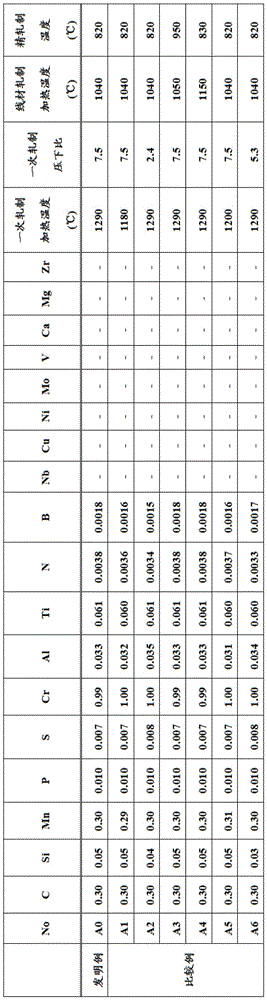
首先,关于使用了化学成分大致相同的钢的例子,采用表1所示的成分,进而按照该表所示的条件(一次轧制加热温度、一次轧制压下比、线材轧制加热温度、以及精轧制温度),得到分块轧制后的钢片,由该钢片进行产品轧制形成预定直径的线材,得到轧制线材(发明例A0及比较例A1~A6)。再者,表1中的“-”是指该元素的含量为杂质级别,可以判断为实质上不含有。First, regarding an example using steel having substantially the same chemical composition, the composition shown in Table 1 was used, and the conditions shown in the table (primary rolling heating temperature, primary rolling reduction ratio, wire rod rolling heating temperature, and finish rolling temperature) to obtain a block-rolled steel sheet, and product rolling from the steel sheet to form a wire rod with a predetermined diameter to obtain a rolled wire rod (Invention Example A0 and Comparative Examples A1 to A6). In addition, "-" in Table 1 means that the content of this element is an impurity level, and it can be judged that it does not contain substantially.
表1Table 1
接着,关于使用化学成分不同的钢的例子,采用表2所示的成分,在由铸锭得到钢片的阶段,将一次轧制加热温度设为1280℃以上,将一次轧制压下比设为6以上,进行分块轧制。并且,使用得到的钢片进行产品轧制(线材轧制加热温度:1030~1050℃、精轧制温度:750~850℃),得到轧制线材(发明例1~14及比较例15~25)。再者,表2中的“-”是指该元素的含量为杂质级别,可以判断为实质上不含有。Next, regarding an example using steels with different chemical compositions, the compositions shown in Table 2 were used, and the primary rolling heating temperature was set to 1280° C. or higher, and the primary rolling reduction ratio was set to If it is 6 or more, block rolling is performed. Then, product rolling was performed using the obtained steel sheet (heating temperature for wire rod rolling: 1030 to 1050° C., finish rolling temperature: 750 to 850° C.) to obtain rolled wire rods (Invention Examples 1 to 14 and Comparative Examples 15 to 25). ). In addition, "-" in Table 2 means that the content of this element is an impurity level, and it can be judged that it does not contain substantially.
另外,在表2中一并记载了由下式表示的指标Y1。In addition, in Table 2, the index Y1 represented by the following formula is also described.
Y1=([Ti]-3.4×[N])/[S] <1>Y1=([Ti]-3.4×[N])/[S] <1>
其中,[Ti]、[N]、[S]表示各自的元素的以质量%计的含量。Here, [Ti], [N], and [S] represent the content in mass % of each element.
Y1是表示钢所含有的Ti、N、S的含量平衡的式子,是对能够作为高强度冷态锻造用部件使用的淬火性、存在于轧制钢材的表面附近的硫化物的形态、大小进行控制,赋予优异的冷态锻造性或淬火时的异常晶粒生长的抑制及淬火、回火后优异的耐氢脆化特性所需的参数。Y1 is a formula showing the content balance of Ti, N, and S contained in the steel, and is the form and size of the sulfide that can be used as a part for high-strength cold forging and the sulfide existing in the vicinity of the surface of the rolled steel. Control parameters required for excellent cold forgeability, suppression of abnormal grain growth during quenching, and excellent hydrogen embrittlement resistance after quenching and tempering.
如上所述,在本实施方式的轧制线材中,在[S]≥0.0010的情况下,[Ti]为(4.5×[S]+3.4×[N])以上且(8.0×[S]+3.4×[N])以下是必要条件。该必要条件通过使用指标Y1而表示为4.5≤Y1≤8.0。As described above, in the rolled wire rod of the present embodiment, when [S]≧0.0010, [Ti] is (4.5×[S]+3.4×[N]) or more and (8.0×[S]+ 3.4×[N]) or less is a necessary condition. This necessary condition is expressed as 4.5≤Y1≤8.0 by using the index Y1.
在[S]≤0.0010的情况下,[Ti]的下限也为(4.5×[S]+3.4×[N])。这表示为4.5≤Y1。另一方面,[S]≤0.0010的范围内的[Ti]的上限表示为(0.008+3.4×[N]),不受Y1的影响。在该区域中,容许[Ti]位于Y1>8.0的区域。When [S]≦0.0010, the lower limit of [Ti] is also (4.5×[S]+3.4×[N]). This is expressed as 4.5≤Y1. On the other hand, the upper limit of [Ti] in the range of [S]≦0.0010 is expressed as (0.008+3.4×[N]) and is not affected by Y1. In this region, [Ti] is allowed to be in the region where Y1>8.0.
表2Table 2
关于表1所示的化学成分的发明例的试验编号A0及比较例A1~A6,如以下这样制造轧制线材。About the test number A0 and the comparative examples A1-A6 of the invention examples shown in Table 1, the rolled wire rod was manufactured as follows.
即,表1所示的发明例A0中,将铸锭插入到1290℃的炉内,进行2小时均热后,取出到炉外,然后立刻进行分块,制成162mm见方的钢片。此时,轧制比为7.5。That is, in the invention example A0 shown in Table 1, the ingot was inserted into a furnace at 1290° C., soaked for 2 hours, taken out of the furnace, and immediately divided into pieces to obtain 162 mm square steel sheets. At this time, the rolling ratio was 7.5.
另一方面,比较例A1中,将铸锭插入1180℃的炉内,进行2小时均热后,取出到炉外,然后立刻进行分块,制成162mm见方的钢片。此时,轧制比与A0相同地为7.5。On the other hand, in Comparative Example A1, the ingot was inserted into the furnace at 1180° C., soaked for 2 hours, taken out of the furnace, and immediately divided into pieces to obtain 162 mm square steel sheets. At this time, the rolling ratio was 7.5 like A0.
另外,比较例A5中,将铸锭插入1200℃的炉内,进行2小时均热后,取出到炉外,然后立刻进行分块,制成162mm见方的钢片。此时,轧制比与A0相同地为7.5。In addition, in Comparative Example A5, the ingot was inserted into the furnace at 1200° C., soaked for 2 hours, taken out of the furnace, and immediately divided into pieces to obtain 162 mm square steel sheets. At this time, the rolling ratio was 7.5 like A0.
另外,比较例A2、A6中,将截面积比A0或A1小的铸锭插入到1290℃的炉内,进行2小时均热后,取出到炉外,然后立刻进行分块,制成162mm见方的钢片。此时,比较例A2的轧制比为2.4,比较例A6的轧制比为5.3。In addition, in Comparative Examples A2 and A6, ingots with a smaller cross-sectional area than A0 or A1 were inserted into a furnace at 1290° C., soaked for 2 hours, taken out of the furnace, and immediately divided into blocks to make 162 mm square sheet of steel. At this time, the rolling ratio of Comparative Example A2 was 2.4, and the rolling ratio of Comparative Example A6 was 5.3.
接着,在1040℃下分别对这些成为轧制用材料的钢片进行加热后,以精轧制温度为820℃,进行产品轧制以成为预定直径,制造了轧制线材。此时,精轧制的加工速度为5~15/秒的范围,在精轧制完成后,将直到相变完成为止的平均冷却速度设为0.4℃/秒,进行了调整冷却。Next, after heating these steel sheets used as rolling materials at 1040° C., respectively, at a finish rolling temperature of 820° C., product rolling was performed to obtain a predetermined diameter, and a rolled wire rod was produced. At this time, the working rate of finish rolling was in the range of 5 to 15/sec, and after completion of finish rolling, the average cooling rate until the transformation was completed was set to 0.4° C./sec, and cooling was adjusted.
比较例A3、A4中,将与发明例A0相同的化学成分、与A0相同的条件下进行分块轧制而得到的162mm见方的钢片作为产品轧制用材料,改变产品轧制前的加热温度或精轧制的温度,制造轧制线材。具体而言,比较例A3中,将产品轧制的加热温度设为1050℃进行加热之后,以轧制温度为950℃进行精轧制以成为预定直径,制造轧制线材。此时,精轧制的加工速度为5~15/秒的范围,在精轧制完成后,直到相变完成为止的平均冷却速度为0.4℃/秒。In Comparative Examples A3 and A4, the 162 mm square steel sheet obtained by block rolling under the same conditions as those of Invention Example A0 was used as the material for product rolling, and the heating before product rolling was changed. The temperature, or the temperature at which the finish rolling is produced, the rolled wire rod. Specifically, in Comparative Example A3, after heating the product rolling at a heating temperature of 1050° C., finish rolling was performed at a rolling temperature of 950° C. to obtain a predetermined diameter, and a rolled wire rod was produced. At this time, the working speed of the finish rolling was in the range of 5 to 15/sec, and the average cooling rate until the transformation was completed after the finish rolling was completed was 0.4° C./sec.
比较例A4中,将产品轧制的加热温度设为1150℃进行加热之后,以轧制温度为830℃进行精轧制以成为预定直径,制造轧制线材。此时,精轧制的加工速度为5~15/秒的范围,在精轧制完成后,直到相变完成为止的平均冷却速度为0.4℃/秒。In Comparative Example A4, after heating the product rolling at a heating temperature of 1150° C., finish rolling was performed at a rolling temperature of 830° C. to obtain a predetermined diameter, and a rolled wire rod was produced. At this time, the working speed of the finish rolling was in the range of 5 to 15/sec, and the average cooling rate until the transformation was completed after the finish rolling was completed was 0.4° C./sec.
比较例A6中,将与发明例A0不同的化学成分、与A0不同的条件下进行分块轧制而得到的162mm见方的钢片作为产品轧制用材料,改变产品轧制前的加热温度或精轧制的温度,制造轧制线材。具体而言,比较例A6是将一次轧制温度设为1290℃、将一次轧制压下比设为5.3的例子,在将产品轧制的加热温度设为1040℃进行加热后,以轧制温度为820℃进行精轧制以成为预定直径,制造轧制线材。此时,精轧制的加工速度为5~15/秒的范围,在精轧制完成后,直到相变完成为止的平均冷却速度为0.4℃/秒。In Comparative Example A6, a 162 mm square steel sheet obtained by block rolling with a chemical composition different from that of Invention Example A0 and under conditions different from A0 was used as a product rolling material, and the heating temperature before product rolling was changed or The temperature at which finish rolling is used to manufacture rolled wire rods. Specifically, Comparative Example A6 is an example in which the primary rolling temperature was set to 1290° C. and the primary rolling reduction ratio was set to 5.3, and the product rolling was heated at a heating temperature of 1040° C., and then rolled with Finish rolling was performed at a temperature of 820° C. to obtain a predetermined diameter, and a rolled wire rod was produced. At this time, the working speed of the finish rolling was in the range of 5 to 15/sec, and the average cooling rate until the transformation was completed after the finish rolling was completed was 0.4° C./sec.
接着,关于表2所示的化学成分的发明例的试验编号1~14及比较例15~25,如以下这样制造轧制线材。Next, about the test numbers 1-14 and the comparative examples 15-25 of the invention examples shown in Table 2, the rolled wire rod was manufactured as follows.
即,在真空熔炼炉中熔炼表2所示的各化学成分的钢。熔炼的铸锭插入到加热至1290℃的炉内,在2小时均热后,取出到炉外,然后立刻进行分块轧制,制成140mm见方的钢片,将其作为产品轧制用材料。此时,轧制比为7.4。接着,在以1030~1050℃加热产品轧制用材料后,将精轧制温度调整为750~850℃之间,实施产品轧制,制成直径为14mm的线材。此时,精轧制的加工速度均为5~15/秒的范围,在精轧制完成后,直到相变完成为止的平均冷却速度为0.4~2℃/秒。That is, steel of each chemical composition shown in Table 2 was melted in a vacuum melting furnace. The smelted ingot was inserted into a furnace heated to 1290°C, and after soaking for 2 hours, it was taken out of the furnace, and then block rolling was performed immediately to make a 140mm square steel sheet, which was used as a product rolling material . At this time, the rolling ratio was 7.4. Next, after heating the material for product rolling at 1030 to 1050° C., the finish rolling temperature was adjusted to between 750 and 850° C., and product rolling was performed to obtain a wire rod having a diameter of 14 mm. At this time, the working speed of the finish rolling is in the range of 5 to 15/sec, and the average cooling rate until the transformation is completed after the finish rolling is completed is 0.4 to 2°C/sec.
关于如以上这样制造的轧制线材(发明例A0和比较例A1~A6、发明例1~14和比较例15~25),对铁素体分率(面积%)、夹杂物的形态(硫化物平均面积(μm2)和硫化物平均纵横比)、冷态锻造性(变形抗力和开裂)、耐氢脆化特性、以及是否产生异常粗大晶粒进行了调查。Regarding the rolled wire rods produced as described above (Inventive Example A0 and Comparative Examples A1 to A6, Invention Examples 1 to 14 and Comparative Examples 15 to 25), the ferrite fraction (area %) and the form of inclusions (sulfide The material average area (μm 2 ) and sulfide average aspect ratio), cold forgeability (deformation resistance and cracking), resistance to hydrogen embrittlement, and the occurrence of abnormally coarse grains were investigated.
(轧制线材的微小组织(铁素体分率)的调查)(Investigation of microstructure (ferrite fraction) of rolled wire rod)
在将轧制线材切断为长度10mm后,以使横截面(与轧制线材的轴正交的截面)成为被检测面的方式进行树脂填埋,并进行镜面研磨。接着,用3%硝酸乙醇(硝酸乙醇腐蚀液)腐蚀表面,使微观组织显现。之后,在从轧制线材的表面到D/4(D:轧制线材的直径)的位置,使用光学显微镜以200倍的倍率拍摄5个视场的微观组织照片,确定“相”。其结果,确认在实施例及比较例中的任一检体中,以面积率计95%以上为铁素体、珠光体。另外,使用图像分析软件对各视场中的铁素体面积率进行测定,求出它们的平均值作为各例中的铁素体分率。After cutting the rolled wire rod into a length of 10 mm, resin embedding and mirror polishing were performed so that the cross section (section perpendicular to the axis of the rolled wire rod) would be the surface to be detected. Next, the surface was etched with 3% nitric acid (nitroethanol etching solution) to reveal the microstructure. After that, at a position from the surface of the rolled wire rod to D/4 (D: diameter of the rolled wire rod), microstructure photographs of 5 fields of view were taken with an optical microscope at a magnification of 200 times, and the "phase" was determined. As a result, it was confirmed that 95% or more of the samples in the Examples and Comparative Examples were ferrite and pearlite in terms of area ratio. In addition, the area ratio of ferrite in each field of view was measured using image analysis software, and the average value thereof was obtained as the ferrite fraction in each example.
(夹杂物的形态(硫化物平均面积(μm2)及硫化物平均纵横比)的调查)(Investigation of Inclusion Morphology (Sulfide Mean Area (μm 2 ) and Sulfide Mean Aspect Ratio))
在将轧制线材切断为长度12mm后,以轧制线材的纵剖面(包括线材的轴的平面)成为被检测面的方式进行树脂填埋,并进行镜面研磨。被检测面设为与轧制线材的长边方向平行,利用扫描型电子显微镜(SEM)确定被推测是存在于从轧制线材的表面到D/8(D:轧制线材的直径)的位置的范围的硫化物的夹杂物。更具体而言,在从轧制线材的表面到D/8的范围中,以500倍的倍率确定100处被测检面内的任意的观察区域。各观察区域的面积为254μm×190μm,观察区域的总面积为4.8mm2。并且,基于通过各观察区域的反射电子图像而判别的对比,确定夹杂物,并对确定的各夹杂物的面积及纵横比进行测定。最后,求出它们的平均值设为各例中的硫化物平均面积(面积%)及硫化物平均纵横比。再者,被确定的夹杂物通过能量色散型X射线光谱法(EDS)确认为硫化物。After cutting the rolled wire rod into a length of 12 mm, resin filling was performed so that the longitudinal section of the rolled wire rod (the plane including the axis of the wire rod) became the surface to be detected, and mirror polishing was performed. The detected surface was set to be parallel to the longitudinal direction of the rolled wire rod, and the position presumed to exist from the surface of the rolled wire rod to D/8 (D: diameter of the rolled wire rod) was identified by a scanning electron microscope (SEM). A range of sulfide inclusions. More specifically, in the range from the surface of the rolled wire rod to D/8, an arbitrary observation area in the surface to be detected at 100 points is determined at a magnification of 500 times. The area of each observation area was 254 μm×190 μm, and the total area of the observation area was 4.8 mm 2 . Then, based on the comparison determined by the backscattered electron images of each observation area, inclusions are identified, and the area and aspect ratio of each identified inclusion are measured. Finally, these average values were obtained and used as the sulfide average area (area %) and the sulfide average aspect ratio in each example. Furthermore, the identified inclusions were confirmed to be sulfides by energy dispersive X-ray spectroscopy (EDS).
(冷态锻造性(变形阻力、开裂)的调查)(Investigation of cold forgeability (deformation resistance, cracking))
冷态锻造性通过冷加工时的变形阻力和轧制线材是否产生开裂来进行评价。具体而言,从与轧制线材的中心部相当的位置起,机械加工切下φ10×15mmL的圆棒,通过冷压缩试验对变形阻力进行测定,并且对加工时是否产生开裂进行调查。阶段性地压缩试验片直到应变成为(ε=2.2)为止,测定压缩时的最大载荷,算出变形阻力。另外,通过目测判断试验片表面是否产生开裂。The cold forgeability was evaluated by the deformation resistance during cold working and the occurrence of cracks in the rolled wire rod. Specifically, from a position corresponding to the center of the rolled wire rod, a round bar having a diameter of 10×15 mmL was machined and cut out, the deformation resistance was measured by a cold compression test, and whether cracking occurred during processing was investigated. The test piece was compressed stepwise until the strain became (ε=2.2), the maximum load at the time of compression was measured, and the deformation resistance was calculated. In addition, it was determined by visual inspection whether or not cracks occurred on the surface of the test piece.
关于变形阻力,将根据最大载荷算出的变形阻力小于100kgf/mm2(980MPa)的情况设为“好”,另一方面,将该变形阻力为100kgf/mm2(980MPa)以上的情况设为“不好”。关于开裂,将在试验片的任何部分均不产生开裂的情况设为“好”,另一方面,将在试验片表面的至少某一处产生开裂的情况设为“不好”。并且,将变形阻力和开裂中的任一个评价均为“好”的情况作为“好”而进行综合评价,另一方面,将变形阻力和开裂中的至少某一者不合格的情况作为“不好”而进行综合评价。Regarding the deformation resistance, the case where the deformation resistance calculated from the maximum load was less than 100 kgf/mm 2 (980 MPa) was regarded as "good", and the case where the deformation resistance was 100 kgf/mm 2 (980 MPa) or more was regarded as "good". not good". With regard to cracking, the case where no cracking occurred in any part of the test piece was regarded as "good", and on the other hand, the case where cracking occurred in at least one part of the surface of the test piece was regarded as "not good". In addition, the comprehensive evaluation was performed as "good" when either of the deformation resistance and the cracking was evaluated as "good", and the case where at least one of the deformation resistance and the cracking was unsatisfactory was regarded as "unsatisfactory". good” for a comprehensive evaluation.
(耐氢脆化特性的调查)(Investigation of hydrogen embrittlement resistance)
对轧制线材实施淬火、回火,将轧制线材的拉伸强度调整为约1200MPa。接着,对调整了拉伸强度的线材实施机械加工,得到图2所示的附带环状V型切口的试验片。图2中,未公开单位的数值表示试验片的对应部位的尺寸(单位为mm)。另外,该图中,“φ数值”表示指定的部位的直径(mm),“60°”表示V型切口角度,“0.175R”表示V型切口底部半径。再者,试验片针对各发明例及各比较例分别准备10片。Quenching and tempering were performed on the rolled wire rod, and the tensile strength of the rolled wire rod was adjusted to about 1200 MPa. Next, the wire rod whose tensile strength was adjusted was machined to obtain a test piece with an annular V-notch as shown in FIG. 2 . In FIG. 2, the numerical value of the undisclosed unit represents the dimension (unit is mm) of the corresponding part of a test piece. In addition, in this figure, "φ value" represents the diameter (mm) of the designated part, "60°" represents the V-notch angle, and "0.175R" represents the V-notch bottom radius. In addition, 10 test pieces were prepared for each invention example and each comparative example, respectively.
接着,关于各发明例及各比较例中的每一个,采用电解充电法,向多个附带环状V型切口的试验片中导入各种浓度的氢。再者,电解充电法如以下这样实施。即,在将试验片浸渍于硫氰酸胺水溶液中的状态下,使试验片的表面产生阳极电位,使氢进入到试验片内。然后,在试验片的表面形成镀锌被膜,由此防止试验片中的氢的逸散。Next, for each of the inventive examples and the comparative examples, hydrogen of various concentrations was introduced into a plurality of test pieces with annular V-shaped notches by the electrolytic charging method. In addition, the electrolytic charging method is implemented as follows. That is, in a state where the test piece is immersed in the ammonium thiocyanate aqueous solution, an anode potential is generated on the surface of the test piece, and hydrogen is introduced into the test piece. Then, a galvanized film was formed on the surface of the test piece, thereby preventing the escape of hydrogen in the test piece.
接着,对于试验片的V型切口截面施加公称应力为1080MPa的抗拉应力,实施施加一定载荷的恒定载荷试验。对于在试验中破裂的试验片及未破裂的试验片这两者,使用气相色谱仪装置实施升温分析法,测定试验片中的氢量。测定后,对于各发明例及各比较例中的每一个,将未破裂的试验片的最大氢量定义为极限扩散性氢量Hc。Next, a tensile stress with a nominal stress of 1080 MPa was applied to the V-notch cross section of the test piece, and a constant load test in which a constant load was applied was performed. With respect to both the test piece that was broken during the test and the test piece that was not broken, a temperature-temperature analysis method was performed using a gas chromatograph apparatus, and the amount of hydrogen in the test piece was measured. After the measurement, for each of the invention examples and the comparative examples, the maximum hydrogen amount of the unbroken test piece was defined as the limit diffusible hydrogen amount Hc.
而且,以具有与JISG4053(2008)的SCM435相当的化学组成的钢的极限扩散性氢量(0.40ppm)为基准,对于各发明例及各比较例中的每一个,将极限扩散性氢量为0.40ppm以上的情况评价为“好”,将小于0.40ppm的情况评价为“不好”。Furthermore, based on the limit diffusible hydrogen content (0.40 ppm) of steel having a chemical composition equivalent to SCM435 of JISG4053 (2008), for each of the invention examples and the comparative examples, the limit diffusible hydrogen content was set as The case of 0.40 ppm or more was evaluated as "good", and the case of less than 0.40 ppm was evaluated as "not good".
(是否产生异常粗大晶粒的调查)(Investigation of abnormal coarse grains or not)
对在冷态锻造性(变形阻力、开裂)的调查中加工的试验片进行再加热,确认是否产生异常粗大晶粒。具体而言,在将冷态加工的试验片在惰性气体气氛、880℃的炉内进行30分钟加热后,进行浸渍于60℃的油槽的淬火,观察试验片的微观组织,观察是否产生异常粗大晶粒。以能够观察试验片的内部组织的方式,与轴向平行地切断进行了淬火的试验片,并进行树脂填埋。接着,腐蚀表面以使得能够显现出旧奥氏体晶界,利用光学显微镜对微观组织进行观察。将倍率设为500倍,对与冷态加工前的试验片的D1/4(D1:试验片的直径)相当的位置进行观察,将仅观察到整粒的情况判定为“好”,将观察到异常粗大晶粒的情况判定为“不好”。再者,仅观察到整粒的组织呈现5~30μm左右的旧奥氏体晶粒,在观察到异常粗大晶粒的组织中混合存在有生长超过100μm的晶粒。The test piece processed in the investigation of cold forgeability (deformation resistance, cracking) was reheated to confirm whether or not abnormally coarse grains were generated. Specifically, after heating the cold-processed test piece in an inert gas atmosphere and a furnace at 880°C for 30 minutes, quenching was performed by immersing in an oil bath at 60°C, and the microstructure of the test piece was observed to observe whether abnormal coarsening occurred. grains. The quenched test piece was cut in parallel to the axial direction so that the internal structure of the test piece could be observed, and then filled with resin. Next, the surface was etched so that prior austenite grain boundaries could be visualized, and the microstructure was observed with an optical microscope. The magnification was set to 500 times, and the position corresponding to D1/4 (D1: the diameter of the test piece) of the test piece before cold working was observed. When the crystal grains were abnormally coarse, it was judged as "not good". In addition, only the whole-grained structure was observed to exhibit prior austenite grains of about 5 to 30 μm, and crystal grains grown over 100 μm were mixed in the structure where abnormally coarse grains were observed.
关于以上说明的铁素体分率(面积%)、夹杂物的形态(硫化物平均面积(μm2)及硫化物平均纵横比)、冷态锻造性(变形阻力及开裂)、耐氢脆化特性、以及是否产生异常粗大晶粒,在表3(发明例A0及比较例A1~A6)及表4(发明例1~14及比较例15~25)中示出调查结果。另外,在表3、4中也一并记载是否满足图1所示的[Ti]与[S]的关系。Regarding the ferrite fraction (area %), the morphology of inclusions (average area of sulfide (μm 2 ) and average aspect ratio of sulfide), cold forgeability (deformation resistance and cracking), and hydrogen embrittlement resistance described above The characteristics and the presence or absence of abnormally coarse crystal grains are shown in Table 3 (Inventive Example A0 and Comparative Examples A1 to A6) and Table 4 (Inventive Examples 1 to 14 and Comparative Examples 15 to 25). In addition, Tables 3 and 4 also describe whether the relationship between [Ti] and [S] shown in FIG. 1 is satisfied.
表3table 3
表4Table 4
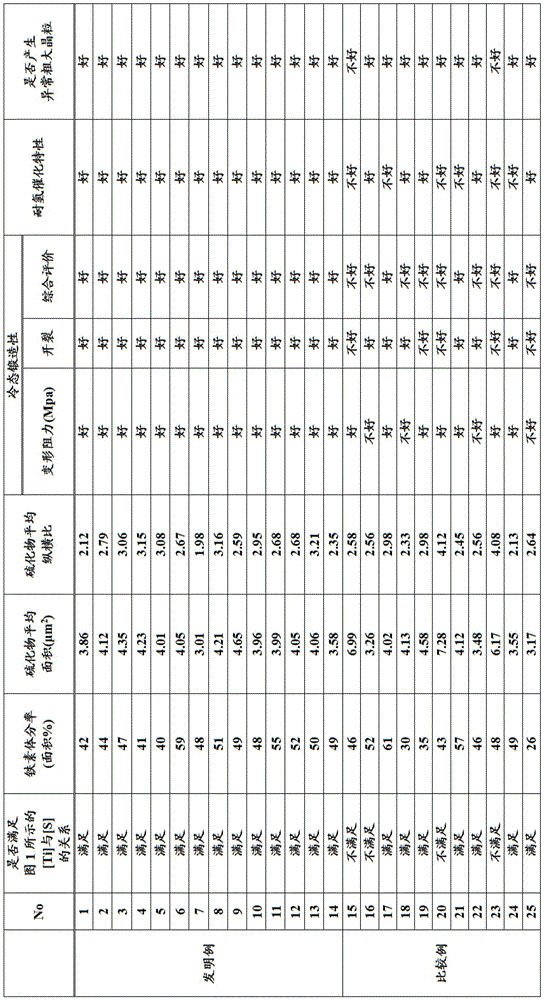
根据表3、4,在发明例A0及发明例1~14中,各元素具有本申请预定的含量,并且Ti含量与S含量的关系满足图1的斜线区域的范围,铁素体分率、硫化物的平均面积和硫化物的平均纵横比在本申请预定的范围内。因此,在发明例A0及发明例1~14中,关于冷态锻造性、耐氢脆化特性、以及是否产生异常粗大晶粒之中的任一项,都能够得到优异的结果。According to Tables 3 and 4, in Invention Example A0 and Invention Examples 1 to 14, each element has a predetermined content in the present application, and the relationship between the Ti content and the S content satisfies the range of the shaded area in FIG. 1, and the ferrite fraction , the average area of the sulfide and the average aspect ratio of the sulfide are within the predetermined ranges of the present application. Therefore, in Invention Example A0 and Invention Examples 1 to 14, excellent results were obtained in any of cold forgeability, hydrogen embrittlement resistance, and occurrence of abnormally coarse grains.
与之相对,在比较例A1~A6及比较例15~25中,各元素不具有本申请预定的含量,或者Ti含量与S含量的关系不满足图1的斜线区域的范围,或者铁素体分率、硫化物的平均面积和硫化物的平均纵横比不在本申请预定的范围内。因此,在比较例A1~A6及比较例15~25中,关于冷态锻造性、耐氢脆化特性、以及是否产生异常粗大晶粒之中的至少任一项,没有得到优异的结果。On the other hand, in Comparative Examples A1 to A6 and Comparative Examples 15 to 25, each element did not have the content specified in the present application, or the relationship between the Ti content and the S content did not satisfy the range of the shaded area in FIG. 1 , or the ferrite The volume fraction, the average area of sulfide and the average aspect ratio of sulfide are not within the intended range of the present application. Therefore, in Comparative Examples A1 to A6 and Comparative Examples 15 to 25, excellent results were not obtained with respect to at least any one of cold forgeability, hydrogen embrittlement resistance, and occurrence of abnormally coarse grains.
产业上的可利用性Industrial Availability
根据本发明,能够提供一种即使在冷态锻造前不实施球状化退火或者即使使球状化退火短时间化,也能有效抑制冷态锻造时的开裂产生,并且紧接着球状化退火的淬火、回火后的耐氢脆化特性优异的轧制线材。因此,本发明尤其是在能够作为冷态锻造部件的材料使用这一点上有前途。According to the present invention, even if spheroidizing annealing is not performed before cold forging or even if the spheroidizing annealing time is shortened, it is possible to provide a quenching, Rolled wire rod with excellent resistance to hydrogen embrittlement after tempering. Therefore, the present invention is particularly promising in that it can be used as a material for cold forged parts.
Claims (5)
Applications Claiming Priority (3)
| Application Number | Priority Date | Filing Date | Title |
|---|---|---|---|
| JP2016-133379 | 2016-07-05 | ||
| JP2016133379 | 2016-07-05 | ||
| PCT/JP2017/024715 WO2018008703A1 (en) | 2016-07-05 | 2017-07-05 | Rolled wire rod |
Publications (2)
| Publication Number | Publication Date |
|---|---|
| CN108699650A CN108699650A (en) | 2018-10-23 |
| CN108699650B true CN108699650B (en) | 2020-01-14 |
Family
ID=60912184
Family Applications (1)
| Application Number | Title | Priority Date | Filing Date |
|---|---|---|---|
| CN201780012634.0A Active CN108699650B (en) | 2016-07-05 | 2017-07-05 | Rolled wire |
Country Status (6)
| Country | Link |
|---|---|
| US (1) | US11098394B2 (en) |
| EP (1) | EP3483293B1 (en) |
| JP (1) | JP6614349B2 (en) |
| KR (1) | KR102113076B1 (en) |
| CN (1) | CN108699650B (en) |
| WO (1) | WO2018008703A1 (en) |
Families Citing this family (4)
| Publication number | Priority date | Publication date | Assignee | Title |
|---|---|---|---|---|
| CN109609738B (en) * | 2018-12-27 | 2021-07-06 | 东莞科力线材技术有限公司 | Large flat head precision screw wire for mobile phone and preparation method thereof |
| JP7428889B2 (en) * | 2020-03-27 | 2024-02-07 | 日本製鉄株式会社 | steel material |
| CN117043372B (en) * | 2021-03-24 | 2025-11-11 | 日本制铁株式会社 | Steel material |
| WO2025169960A1 (en) * | 2024-02-05 | 2025-08-14 | 日本製鉄株式会社 | Steel material and bolt |
Family Cites Families (19)
| Publication number | Priority date | Publication date | Assignee | Title |
|---|---|---|---|---|
| JPS582572B2 (en) * | 1979-02-15 | 1983-01-17 | 新日本製鐵株式会社 | Method for manufacturing strong steel bars with little anisotropy |
| JPH09104945A (en) | 1995-10-05 | 1997-04-22 | Kobe Steel Ltd | Steel for high strength bolt excellent in cold workability and delayed fracture resistance, production of high strength bolt, and high strength bolt |
| JP3443285B2 (en) | 1997-07-23 | 2003-09-02 | 新日本製鐵株式会社 | Hot rolled steel for cold forging with excellent crystal grain coarsening prevention properties and cold forgeability, and method for producing the same |
| JP3490293B2 (en) * | 1997-07-23 | 2004-01-26 | 新日本製鐵株式会社 | Cold forging steel excellent in crystal grain coarsening prevention property and delayed fracture resistance, and its manufacturing method |
| JP2000192148A (en) * | 1998-12-25 | 2000-07-11 | Kobe Steel Ltd | Steel wire rod excellent in cold workability and its production |
| JP3554505B2 (en) * | 1999-05-26 | 2004-08-18 | 新日本製鐵株式会社 | Hot-rolled wire rod / steel bar for machine structure and manufacturing method thereof |
| JP4435954B2 (en) * | 1999-12-24 | 2010-03-24 | 新日本製鐵株式会社 | Bar wire for cold forging and its manufacturing method |
| US6896746B2 (en) * | 2000-04-04 | 2005-05-24 | Nippon Steel Corporation | Hot-rolled steel wire rods and bars usable for machine structural use without annealing and method for producing the same |
| JP4423253B2 (en) | 2005-11-02 | 2010-03-03 | 株式会社神戸製鋼所 | Spring steel excellent in hydrogen embrittlement resistance, and steel wire and spring obtained from the steel |
| JP4268194B2 (en) * | 2006-03-15 | 2009-05-27 | 株式会社神戸製鋼所 | Rolled material for fracture separation type connecting rod excellent in fracture separation, hot forged parts for fracture separation type connecting rod excellent in fracture separation, and fracture separation type connecting rod |
| JP5201000B2 (en) * | 2009-03-02 | 2013-06-05 | 新日鐵住金株式会社 | Wire material for high-strength steel wire, high-strength steel wire, and production method thereof |
| US20120247618A1 (en) * | 2010-03-11 | 2012-10-04 | Daisuke Hirakami | High strength steel material and high strength bolt excellent in delayed fracture resistance and methods of production of same |
| WO2013031640A1 (en) * | 2011-08-26 | 2013-03-07 | 新日鐵住金株式会社 | Wire material for non-refined machine component; steel wire for non-refined machine component; non-refined machine component; and method for manufacturing wire material for non-refined machine component, steel wire for non-refined machine component, and non-refined machine component |
| JP5375981B2 (en) * | 2012-01-10 | 2013-12-25 | Jfeスチール株式会社 | Wear-resistant welded steel pipe with excellent weld crack resistance and method for producing the same |
| JP5486634B2 (en) | 2012-04-24 | 2014-05-07 | 株式会社神戸製鋼所 | Steel for machine structure for cold working and method for producing the same |
| WO2013183648A1 (en) * | 2012-06-08 | 2013-12-12 | 新日鐵住金株式会社 | Steel wire rod or bar steel |
| JP6058439B2 (en) * | 2013-01-10 | 2017-01-11 | 株式会社神戸製鋼所 | Hot-rolled steel sheet with excellent cold workability and surface hardness after processing |
| EP3222743B1 (en) * | 2014-11-18 | 2019-09-25 | Nippon Steel Corporation | Rolled steel bar or rolled wire material for cold-forged component |
| EP3222742B8 (en) | 2014-11-18 | 2019-08-21 | Nippon Steel Corporation | Rolled steel bar or rolled wire material for cold-forged component |
-
2017
- 2017-07-05 EP EP17824306.9A patent/EP3483293B1/en active Active
- 2017-07-05 JP JP2018526425A patent/JP6614349B2/en active Active
- 2017-07-05 CN CN201780012634.0A patent/CN108699650B/en active Active
- 2017-07-05 KR KR1020187026958A patent/KR102113076B1/en active Active
- 2017-07-05 WO PCT/JP2017/024715 patent/WO2018008703A1/en not_active Ceased
- 2017-07-05 US US16/312,225 patent/US11098394B2/en active Active
Also Published As
| Publication number | Publication date |
|---|---|
| CN108699650A (en) | 2018-10-23 |
| EP3483293A4 (en) | 2019-12-04 |
| EP3483293A1 (en) | 2019-05-15 |
| EP3483293B1 (en) | 2024-08-28 |
| US11098394B2 (en) | 2021-08-24 |
| KR102113076B1 (en) | 2020-05-20 |
| WO2018008703A1 (en) | 2018-01-11 |
| US20190233925A1 (en) | 2019-08-01 |
| JPWO2018008703A1 (en) | 2019-04-04 |
| KR20180117129A (en) | 2018-10-26 |
| JP6614349B2 (en) | 2019-12-04 |
Similar Documents
| Publication | Publication Date | Title |
|---|---|---|
| JP5387799B1 (en) | Manufacturing method of high strength steel with excellent resistance to sulfide stress cracking | |
| JP4632000B2 (en) | Seamless steel pipe manufacturing method | |
| JP5880788B2 (en) | High strength oil well steel and oil well pipe | |
| KR101965520B1 (en) | Rolled steel bar or rolled wire material for cold-forged component | |
| CN108368575B (en) | Rolling wire rod for cold forging tempered product | |
| KR101965521B1 (en) | Rolled steel bar or rolled wire material for cold-forged component | |
| JP6819198B2 (en) | Rolled bar for cold forged tempered products | |
| CN108699650B (en) | Rolled wire | |
| JP6461672B2 (en) | Bolt steel wire and bolt with excellent cold forgeability and delayed fracture resistance after quenching and tempering | |
| CN109790602B (en) | Steel | |
| JP6679935B2 (en) | Steel for cold work parts | |
| JP5668547B2 (en) | Seamless steel pipe manufacturing method | |
| JP6459704B2 (en) | Steel for cold forging parts | |
| JP6465206B2 (en) | Hot-rolled bar wire, parts and method for producing hot-rolled bar wire | |
| KR20240146676A (en) | Steel | |
| JP7274062B1 (en) | High strength stainless steel wire and spring | |
| JP5098486B2 (en) | Manufacturing method of carburized parts | |
| JP5454620B2 (en) | Steel for carburized parts with excellent grain size prevention properties |
Legal Events
| Date | Code | Title | Description |
|---|---|---|---|
| PB01 | Publication | ||
| PB01 | Publication | ||
| SE01 | Entry into force of request for substantive examination | ||
| SE01 | Entry into force of request for substantive examination | ||
| CB02 | Change of applicant information |
Address after: Tokyo, Japan, Japan Applicant after: Nippon Iron & Steel Corporation Address before: Tokyo, Japan, Japan Applicant before: Nippon Steel Corporation |
|
| CB02 | Change of applicant information | ||
| GR01 | Patent grant | ||
| GR01 | Patent grant |