[go: up one dir, main page]

CN108663675B - A Method for Simultaneous Localization of Multiple Targets in a Life Detection Radar Array - Google Patents

A Method for Simultaneous Localization of Multiple Targets in a Life Detection Radar Array Download PDF

Info

Publication number
CN108663675B
CN108663675B CN201710211813.9A CN201710211813A CN108663675B CN 108663675 B CN108663675 B CN 108663675B CN 201710211813 A CN201710211813 A CN 201710211813A CN 108663675 B CN108663675 B CN 108663675B
Authority
CN
China
Prior art keywords
radar
combination
distance information
radar detection
detection unit
Prior art date
Legal status (The legal status is an assumption and is not a legal conclusion. Google has not performed a legal analysis and makes no representation as to the accuracy of the status listed.)
Active
Application number
CN201710211813.9A
Other languages
Chinese (zh)
Other versions
CN108663675A (en
Inventor
叶盛波
张经纬
方广有
刘新
Current Assignee (The listed assignees may be inaccurate. Google has not performed a legal analysis and makes no representation or warranty as to the accuracy of the list.)
Institute of Electronics of CAS
Original Assignee
Institute of Electronics of CAS
Priority date (The priority date is an assumption and is not a legal conclusion. Google has not performed a legal analysis and makes no representation as to the accuracy of the date listed.)
Filing date
Publication date
Application filed by Institute of Electronics of CAS filed Critical Institute of Electronics of CAS
Priority to CN201710211813.9A priority Critical patent/CN108663675B/en
Publication of CN108663675A publication Critical patent/CN108663675A/en
Application granted granted Critical
Publication of CN108663675B publication Critical patent/CN108663675B/en
Active legal-status Critical Current
Anticipated expiration legal-status Critical

Links

Images

Classifications

    • GPHYSICS
    • G01MEASURING; TESTING
    • G01SRADIO DIRECTION-FINDING; RADIO NAVIGATION; DETERMINING DISTANCE OR VELOCITY BY USE OF RADIO WAVES; LOCATING OR PRESENCE-DETECTING BY USE OF THE REFLECTION OR RERADIATION OF RADIO WAVES; ANALOGOUS ARRANGEMENTS USING OTHER WAVES
    • G01S13/00Systems using the reflection or reradiation of radio waves, e.g. radar systems; Analogous systems using reflection or reradiation of waves whose nature or wavelength is irrelevant or unspecified
    • G01S13/02Systems using reflection of radio waves, e.g. primary radar systems; Analogous systems
    • G01S13/06Systems determining position data of a target
    • GPHYSICS
    • G01MEASURING; TESTING
    • G01SRADIO DIRECTION-FINDING; RADIO NAVIGATION; DETERMINING DISTANCE OR VELOCITY BY USE OF RADIO WAVES; LOCATING OR PRESENCE-DETECTING BY USE OF THE REFLECTION OR RERADIATION OF RADIO WAVES; ANALOGOUS ARRANGEMENTS USING OTHER WAVES
    • G01S13/00Systems using the reflection or reradiation of radio waves, e.g. radar systems; Analogous systems using reflection or reradiation of waves whose nature or wavelength is irrelevant or unspecified
    • G01S13/88Radar or analogous systems specially adapted for specific applications

Landscapes

  • Engineering & Computer Science (AREA)
  • Radar, Positioning & Navigation (AREA)
  • Remote Sensing (AREA)
  • Physics & Mathematics (AREA)
  • Computer Networks & Wireless Communication (AREA)
  • General Physics & Mathematics (AREA)
  • Electromagnetism (AREA)
  • Radar Systems Or Details Thereof (AREA)

Abstract

本发明提供了一种用于生命探测雷达阵列多目标同时定位的方法,包括:将至少4个用于生命探测的雷达探测单元排布成一个面阵,确定其位置坐标;获取每个雷达探测单元的信号;从中提取探测到的生命体个数以及相应的距离信息;对所有的雷达探测单元进行数学上的随机组合,并对每个雷达组合中的距离信息进行配对组合计算出一个可能的目标位置,并给每个位置分配一个可信度指数,决定其是否保留;以及对保留的位置进行聚类,依据每个类中元素个数占所有可能位置点的比例分配一个概率,选取概率最高的m个类当作目标体真实位置所在的类,对其进行加权平均,同时得到多生命体的具体位置。上述方法有效去除了错误解和虚假解,实现了多目标同时定位。

Figure 201710211813

The invention provides a method for simultaneous positioning of multiple targets of a life detection radar array, comprising: arranging at least four radar detection units for life detection into an area array, and determining their position coordinates; obtaining each radar detection unit The signal of the unit; extract the number of detected life bodies and the corresponding distance information; make a mathematical random combination of all the radar detection units, and make a paired combination of the distance information in each radar combination to calculate a possible target position, and assign a credibility index to each position to determine whether it is retained; and cluster the retained positions, assign a probability according to the proportion of the number of elements in each class to all possible position points, and select the probability The highest m classes are regarded as the class where the real position of the target body is located, and the weighted average is performed to obtain the specific position of the multi-life body. The above method effectively removes erroneous solutions and false solutions, and realizes simultaneous positioning of multiple targets.

Figure 201710211813

Description

Method for simultaneously positioning multiple targets of life detection radar array
Technical Field
The invention belongs to the field of life detection radar systems, and relates to a method for simultaneously positioning multiple targets of a life detection radar array.
Background
In the existing post-disaster rescue process, the life detection radar plays a lot of roles, and provides first-hand information for rescue workers to judge whether life bodies exist under ruins, and in the actual rescue process, as some rescue targets are not found or cannot be accurately positioned, secondary damage is caused to other objects when one object is rescued, so that the existence of a plurality of targets under the ruins can be recognized at the same time, and the specific positions of the targets can be determined very importantly. The existing life detection radar is basically of a single-station type, and only can help rescue workers to determine whether a life body exists in a radar detection area or not, and the specific position of the life body cannot be determined. In order to determine the position of a living body, a triangulation method has been studied to determine the position of the living body by detecting one target simultaneously by three radar units, but this positioning method is suitable for the case where only a single living body exists, the existing mature method for simultaneously positioning a plurality of targets can not realize accurate positioning under the condition that a plurality of life bodies exist, each target to be positioned is required to have characteristic identification information thereof, including a specific ID or differences in parameters such as velocity, volume, etc. of each target, so as to realize one-to-one correspondence between the positioning information and the targets, thereby realizing multi-target simultaneous positioning, but in the process of detecting a living body, the difference information basically does not exist, so that the traditional life detection radar system and the positioning method cannot solve the problem of simultaneous multi-target positioning.
Disclosure of Invention
Technical problem to be solved
The present invention provides a method for multi-object simultaneous localization of a life detection radar array to at least partially solve the above-mentioned technical problems.
(II) technical scheme
According to one aspect of the invention, a method for multi-target simultaneous localization of a life detection radar array is provided, comprising:
step S102: arranging r radar detection units for life detection into an area array, wherein r is more than or equal to 4, selecting a position as a reference point, and determining the specific position coordinates of each radar detection unit based on the position; the arrangement of the area array enables the radar detection units to surround detected life bodies in all directions, and the distance setting of each radar detection unit is far larger than the ranging error;
step S104: acquiring a signal of each radar detection unit;
step S106: extracting the number of detected life bodies and corresponding distance information from each radar detection unit signal;
step S108: performing mathematical random combination on all radar detection units, and performing pairing combination on distance information in each radar combination; calculating a possible target position by using the position coordinates and distance information of each radar combination, and distributing a credibility index to each position; then, whether the position is reserved or not is determined according to the credibility index of each position; and
step S110: and clustering reserved positions, distributing a probability according to the proportion of the number of elements in each class to all possible position points, selecting m classes with the highest probability as the class where the real position of the target body is located, then carrying out weighted average on all the position points of the class where the real position is located, obtaining the specific positions of the multiple life bodies at the same time, and realizing multi-target simultaneous positioning.
Preferably, the step S108 includes:
substep s108 a: numbering all the radar detection units A1, A2, Ar, and correspondingly numbering Rij, i 1, 2, 3, r, j 1, 2, 3; randomly selecting a plurality of radar units from the r radar units as a combination, wherein the selection mode adopts a combination mode in mathematics, and different combinations are allowed to contain the same radar unit; then selecting a radar combination, randomly selecting one from the distance information Rij of each radar in the combination to obtain the distance between all the radars in the combination to the same target, and pairing and combining the distance information by other radar combinations in the same way; wherein r represents the total number of the radar detection units (r is more than or equal to 4), and m represents the number of life bodies identified by a single radar detection unit (m is more than or equal to 2);
substep s108 b: solving a cost function according to the distance information of all radars in each radar combination to the same target, searching an optimal value for the cost function by using an optimization method, wherein the optimal solution (x, y, z) is the possible position of a life body corresponding to the radar combination, and the reciprocal 1/f (x, y, z) of the optimal value is the credibility index of the position; and
substep s108 c: setting a threshold value delta of position reliability, carrying out threshold value judgment on possible positions of the life body obtained by all radar combinations according to the reliability indexes of the positions, reserving the position when the reliability index of a certain position is greater than the threshold value delta, and abandoning the position when the reliability index of the certain position is less than the threshold value delta.
Preferably, the randomly selecting a plurality of the r radar units as a combination, and the selecting method adopts a mathematical combination method including: is provided withSetting r to 5, randomly taking 4 radar detection units as a combination, and sharing the randomly selected combination number
Figure BDA0001260422850000033
Seed growing; and the above pairing and combining the distance information in each radar combination comprises: respectively randomly selecting a distance from m pieces of distance information of each radar detection unit of 4 radar detection units as the distance of the radar detection unit to a certain target, wherein m is total for one radar combination4And (5) matching and combining distance information.
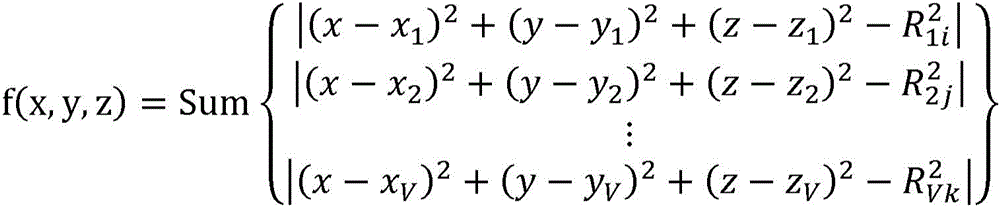
Preferably, the expression of the cost function is as follows:
Figure BDA0001260422850000031
wherein (x)1,y1,z1)(x2,y2,z2)···(xV,yV,zV) Respectively representing the position coordinates of each radar detection unit in one radar combination; v represents the number of radar detection units contained in one radar combination; r1i,R2j,…RVkRespectively representing the distance of the 1 st radar, the 2 nd radar and the … th radar in one radar combination to the same target; r1iRandomly selecting one distance information from m distance information of the 1 st radar in the radar combination, wherein i is 1, 2, … m; r2jFor randomly selected one of m distance information of the 2 nd radar in the radar combination, j is 1, 2, … m: rVkRandomly selecting one piece of range information from m pieces of range information of a V-th radar in the radar combination, wherein k is 1, 2, … m; sum {. is a summation function; | is a function of absolute value.
Preferably, the optimization method for solving the cost function adopts a differential evolution optimization algorithm, adopts a constraint optimization algorithm, takes the largest detection area of the radar array as a constraint condition, and checks whether each solution meets the constraint condition in the optimization process to finally find out the optimal solution.
Preferably, the threshold δ for the above-mentioned confidence level is of the order of 103
Preferably, the remaining positions are clustered, and the clustering method includes: selecting a plurality of position points with the distance between the position points smaller than a distance threshold value delta d as a class, wherein the expression is as follows:
Figure BDA0001260422850000032
one of the location points is: (x)i,yi,zi) And the other position point is (x)j,yj,zj)。
Preferably, the distance threshold δ d takes the following values: δ d is 2 δ, and δ represents the range error of the radar unit itself.
Preferably, the step S106 includes:
sub-step S106 a: subtracting the static background, the expression is as follows:
Figure BDA0001260422850000041
wherein, s (n) is an expression of radar detection data minus static background; s (n)0A signal data expression which is initially detected by the radar detection unit; n is the number of radar data channels, and a positive integer is taken; m is the number of window channels of the sliding average;
sub-step S106 b: arranging the radar detection data with the static background subtracted into a block scanning B-SCAN image, and performing Fourier transform on autocorrelation functions of all channel data of each radar detection unit at the same sampling moment to obtain a power spectrum, wherein the calculation formula is as follows:
P(ω)=Fourier(Rxx(n)) (2)
wherein, P (omega) is an expression of a power spectrum; rxx(n) is the autocorrelation function of all the channel data of one radar unit corresponding to each sampling moment; fourier (·) is a Fourier transform function; and
sub-step S106 c: if the amplitude of the power spectrum of the radar detection unit at a certain sampling moment is larger than a certain threshold value in the micro-motion frequency range of the living body, determining that the living body exists; therefore, the number of the living bodies can be judged in the time window of the B-SCAN image, and the distance between each living body and the radar detection unit is calculated; wherein the threshold is three times of the average value of the micro-motion frequency of the living body, and the threshold is below 0.6 Hz.
(III) advantageous effects
According to the technical scheme, the method for simultaneously positioning the multiple targets of the life detection radar array has the following beneficial effects:
the distance information received by each radar detection unit in a detection area array is combined and paired in a radar detection unit combination mode, a target position equation set is established, a cost function is solved, the reciprocal of the optimal value corresponds to the reliability index of each position, a system can judge whether the position information is effective or not according to the reliability index, error solutions are removed, then a clustering mode is adopted, real targets are distinguished in a plurality of radar combinations, false solutions are removed, specific position information of multiple targets is solved simultaneously, and therefore simultaneous positioning of the multiple targets is achieved, and missing detection cannot occur.
Drawings
FIG. 1 is a flow chart of a method for multi-target simultaneous localization of a life detection radar array according to an embodiment of the present invention.
Fig. 2 is a schematic diagram of the arrangement of the radar detection units and the actual existing positions of the detected living beings corresponding to step S102 in the flowchart shown in fig. 1 according to the embodiment of the invention.
Fig. 3 is a flowchart of extracting the number of detected living beings and corresponding distance information from each radar detection unit signal corresponding to step S106 in the flowchart shown in fig. 1 according to an embodiment of the present invention.
Fig. 4 is a flowchart of an implementation corresponding to step S108 in the flowchart shown in fig. 1 according to an embodiment of the present invention.
Fig. 5 is a flowchart of an algorithm for solving the cost function corresponding to step S108b in the flowchart shown in fig. 4 according to an embodiment of the present invention.
Fig. 6 is a flowchart of determining multiple target locations corresponding to step S110 in the flowchart shown in fig. 1 according to an embodiment of the present invention.
Fig. 7 is a schematic diagram of simulation after the clustering process corresponding to step S110 in the flowchart shown in fig. 1.
Detailed Description
The invention provides a method for multi-target simultaneous positioning of a life detection radar array, which comprises the steps of forming an area array by arranging a plurality of detection radar units, carrying out numbering and combined pairing on information acquired by each detection radar to obtain possible position target information and a reliability index thereof, removing error solutions through the reliability index, removing the false solutions by using a clustering mode, further obtaining the real position of a target body, and realizing multi-target positioning.
In order to make the objects, technical solutions and advantages of the present invention more apparent, the present invention is described in further detail below with reference to the accompanying drawings in conjunction with specific embodiments.
In one exemplary embodiment of the invention, a method for multi-object simultaneous localization of a life detection radar array is provided. Fig. 1 is a flowchart of a method for simultaneously positioning multiple targets of a life detection radar array, as shown in fig. 1, the method for simultaneously positioning multiple targets of a life detection radar array in this embodiment includes the following steps:
step S102: arranging r radar detection units for life detection into an area array, wherein r is more than or equal to 4, selecting a position as a reference point, and determining the specific position coordinates of each radar detection unit based on the position;
in this embodiment, taking r as 5, fig. 2 is a schematic diagram of the arrangement of the radar detection units corresponding to step S102 and the actual existing positions of the detected living bodies in the flowchart shown in fig. 1 according to the embodiment of the present invention, and as shown in fig. 2, 5 radar detection units for life detection are arranged in an area array, so that the radar detection units can "surround" the detected living bodies as much as possible in each direction, and meanwhile, in order to reduce the positioning error caused by the ranging error of the radar itself, the distance between the radar detection units is set to be much larger than the ranging error.
Step S104: acquiring a signal of each radar detection unit;
the acquired signal of each radar detection unit comprises amplitude and channel number.
Step S106: extracting the number of detected life bodies and corresponding distance information from each radar detection unit signal;
fig. 3 is a flowchart of extracting the number of detected living beings and corresponding distance information from each radar detection unit signal corresponding to step S106 in the flowchart shown in fig. 1 according to an embodiment of the present invention, and as shown in fig. 3, step S106 is specifically divided into the following sub-steps:
sub-step S106 a: subtracting static background, wherein the expression is shown in the following formula (1);
selecting the number M of the window channels of the moving average, wherein the expression of each channel of radar detection data after background removal is as follows:
Figure BDA0001260422850000061
wherein, s (n) is an expression of radar detection data minus static background; s (n)0A signal data expression which is initially detected by the radar detection unit; n is the number of radar data channels, and a positive integer is taken; m is the number of window tracks of the moving average.
Sub-step S106 b: arranging the radar detection data with the static background subtracted into a block scanning B-SCAN image, and performing Fourier transform on autocorrelation functions of all channel data of each radar detection unit at the same sampling moment to obtain a power spectrum, wherein the calculation formula is as follows:
P(ω)=Fourier(Rxx(n)) (2)
wherein, P (omega) is an expression of a power spectrum; rxx(n) is the autocorrelation function of all the channel data of one radar unit corresponding to each sampling moment; fourier (·) is a Fourier transform function.
Sub-step S106 c: if the amplitude of the power spectrum of the radar detection unit at a certain sampling moment is larger than a certain threshold value in the micro-motion frequency range of the living body, determining that the living body exists; therefore, the number of the living bodies can be judged in the time window of the B-SCAN image, and the distance between each living body and the radar detection unit is calculated;
the micro-motion frequency of the living body is below 0.6Hz, and at a certain sampling moment, the amplitude of the power spectrum of the radar detection unit is more than 3 times of the average value in the micro-motion frequency range of the living body, and then the existence of the living body is judged.
Step S108: performing mathematical random combination on all radar detection units, and performing pairing combination on distance information in each radar combination; calculating a possible target position by using the position and distance information of each radar combination, and distributing a credibility index to each position; then, whether the position is reserved or not is determined according to the credibility index of each position;
fig. 4 is a flowchart of an implementation corresponding to step S108 in the flowchart shown in fig. 1, and as shown in fig. 4, the above steps may be divided into the following sub-steps:
sub-step S108 a: numbering all the radar detection units A1, A2, Ar, and correspondingly numbering Rij, i 1, 2, 3, r, j 1, 2, 3; randomly selecting a plurality of radar units from the r radar units as a combination, wherein the selection mode adopts a combination mode in mathematics, and different combinations are allowed to contain the same radar unit; then selecting a radar combination, randomly selecting one from the distance information Rij of each radar in the combination to obtain the distance between all the radars in the combination to the same target, and pairing and combining the distance information by other radar combinations in the same way;
wherein r represents the total number of the radar detection units (r is more than or equal to 4), and m represents the number of life bodies (m is more than or equal to 2) identified by a single radar detection unit.
In this embodiment, 4 radar detection units are selected as a combination, and the total number r of the radar detection units is 5, so that the randomly selected combination number is one in common
Figure BDA0001260422850000071
And (4) seed preparation. Taking each radar combination, and pairing all the radar combinations and distances; the process of pairing the distance information by one radar combination is as follows: respectively selecting a distance from m distance information of 4 radar detection units as the distance of the radar detection unit to a certain target, and obtaining m for a radar combination4And (5) matching and combining distance information.
Sub-step S108 b: solving a cost function according to the distance information of all radars in each radar combination to the same target, searching an optimal value for the cost function by using an optimization method, wherein the optimal solution (x, y, z) is the possible position of a life body corresponding to the radar combination, and the reciprocal 1/f (x, y, z) of the optimal value is the reliability index of the position;
the cost function is expressed as follows:
Figure BDA0001260422850000081
wherein (x)1,y1,z1)(x2,y2,z2)···(xV,yV,zV) Respectively representing the position coordinates of each radar detection unit in one radar combination; v represents the number of radar detection units contained in one radar combination; r1i,R2j,…RVkRespectively representing the distance between the 1 st radar and the 2 nd radar in one radar combination and the same target; r1iRandomly selecting one distance information from m distance information of the 1 st radar in the radar combination, wherein i is 1, 2, … m; r2jRandomly selecting one distance information from m distance information of the 2 nd radar in the radar combination, wherein j is 1, 2, … m; rVkRandomly selecting one piece of range information from m pieces of range information of a V-th radar in the radar combination, wherein k is 1, 2, … m; sum {. is a summation function; | is a function of absolute value.
In this embodiment, 4 radar detection units are used as one radar combination, and four radar detectors are providedThe coordinates of the measuring units are respectively (x)1,y1,z1),(x2,y2,z2),(x3,y3,z3),(x4,y4,z4) The target position where life exists is (x, y, z), and for each radar combination, the cost function is specifically in the form of:
Figure BDA0001260422850000082
wherein i is 1, 2, … m; j is 1, 2, … m; k is 1, 2, … m; l is 1, 2, … m.
Fig. 5 is a flowchart of an algorithm for solving the cost function corresponding to step S108b in the flowchart shown in fig. 4 according to an embodiment of the present invention, as shown in fig. 5, for the nonlinearity of the cost function, a Differential Evolution (DE) optimization algorithm is used to solve the cost function, and a solving process of the algorithm is divided into the following sub-steps:
substep S108 b-1: establishing an objective function F (X), determining the dimension D of the nonlinear problem, and establishing an initial population { X1,X2,......,XNPFourthly, establishing a maximum evolution time N;
wherein each population XiAre all D-dimensional vectors, NP represents the population number, and in this embodiment, the dimension of the non-linear problem is 3.
Substep S108 b-2: selecting a population sample XtAs variant target, three additional population samples were selected to generate variant individuals XS(ii) a The method for producing a heterologous individual is according to the following formula:
XS=Xk+F*(Xj-Xl) { t, k, j, l ∈ {1, 2,. cndot., NP }, and t ≠ k ≠ j ≠ l } (5)
Substep S108 b-3: mutating the target XtAnd the variant individual XSPerforming gene exchange to generate filial generation individuals XchildAnd ensures that at least one gene in the variant source individual is transmitted to the offspring individual;
substep S108 b-4:performing population screening to generate next generation population sample XnextCompleting the first evolution; the population screening method is based on the following formula:
Figure BDA0001260422850000091
substep S108 b-5: if the evolution times is less than N, returning to the step S108b-2 for the next evolution; if the evolution algebra is N, selecting an individual which minimizes the target function from the Nth generation of population as the optimal solution of the nonlinear problem;
in the embodiment, since the largest detection area of the radar array is known, in order to ensure that the solution is within the detection range and consider the solution efficiency, a constraint optimization algorithm is adopted, the largest detection area of the radar array is taken as a constraint condition, in the optimization process, whether the solution meets the constraint condition is checked for each solution, and finally, the optimal solution is found out;
it should be noted that the present invention is not limited to the above differential evolution optimization algorithm, and other existing optimization algorithms can be adopted.
Sub-step S108 c: setting a threshold value delta of position reliability, carrying out threshold value judgment on possible positions of the life body obtained by all radar combinations according to the reliability indexes of the positions, reserving the position when the reliability index of a certain position is greater than the threshold value delta, and abandoning the position when the reliability index of the certain position is less than the threshold value delta. Namely:
Figure BDA0001260422850000092
in the present embodiment, the threshold δ for the position reliability is of the order of 103(ii) a The purpose of setting the confidence threshold is to remove the wrong solution in the process of solving the cost function.
Step S110: clustering reserved positions, distributing a probability according to the proportion of the number of elements in each class to all possible position points, selecting m classes with the highest probability as the class where the real position of the target body is located, then carrying out weighted average on all the position points of the class where the real position is located, obtaining the specific positions of multiple life bodies at the same time, and realizing multi-target simultaneous positioning;
fig. 6 is a flowchart of determining multiple target locations corresponding to step S110 in the flowchart shown in fig. 1, and as shown in fig. 6, the steps are divided into the following sub-steps:
sub-step S110 a: clustering possibly existing positions of the reserved life bodies, wherein the clustering method comprises the following steps: selecting a plurality of position points with the distance between the position points smaller than a distance threshold value delta d as a class, wherein the expression is as follows:
Figure BDA0001260422850000101
one of the location points is: (x)i,yi,zi) And the other position point is (x)j,yj,zj);
In this embodiment, δ d is selected to be 2 δ, and δ represents a ranging error of the radar unit itself; in actual ranging, different radar combinations caused by independent ranging errors of each radar unit finally calculate positioning points which are not completely overlapped when the same target body is positioned, so that a false solution is generated, and the false solution is effectively removed through clustering.
Fig. 7 is a schematic diagram of a simulation after the clustering process corresponding to step S110 in the flowchart shown in fig. 1 according to an embodiment of the present invention. The simulation diagram after clustering the reserved positions in this embodiment is shown in fig. 7, in which the numbers "1, 8, 9" in the black box represent the number of times each position appears in the radar combination.
Sub-step S110 b: distributing a probability according to the proportion of the number of elements in each class to all possible position points, and selecting the first m classes with the highest probability as the classes where the real positions of the target bodies are located;
sub-step S110 c: and carrying out weighted average on all position points of the class where the real position is located, wherein the obtained result represents the position where the life body is located, and multi-target simultaneous positioning is realized.
In summary, the embodiments of the present invention provide a method for multi-target simultaneous localization of a life detection radar array, in which radar detection units are randomly grouped, distance information obtained from each radar combination is combined and paired, and an optimal value of a cost equation is solved to obtain possible position target information and a reliability index thereof, so that a system can determine whether the position information is valid according to the reliability index, thereby removing erroneous solutions and solving the problems that the number of equations is more than the number of variables and the equation set has no solution in the conventional method; and by means of clustering, the position points with the distance less than a certain value are classified into one class, and by using the basic algorithm of highest probability of occurrence of real targets, false solutions caused by ranging errors are removed, and finally multi-target simultaneous positioning is realized.
Of course, according to actual needs, the method for simultaneously positioning multiple targets of the life detection radar array provided by the invention further comprises other common algorithms and steps, and the method is not repeated because of the independence of innovation of the invention.
The numbers mentioned in the invention appear in the expressions of the 1 st and 2 nd indicating the sequence or the listed serial numbers, are equivalent to the first and the second, appear in the expressions of the 4 th and the 3 rd indicating the number, and are equivalent to the four and the five characters.
The above-mentioned embodiments are intended to illustrate the objects, technical solutions and advantages of the present invention in further detail, and it should be understood that the above-mentioned embodiments are only illustrative of the present invention and are not intended to limit the present invention, and any modifications, equivalents, improvements and the like made within the spirit and principle of the present invention should be included in the protection scope of the present invention.

Claims (10)

1.一种用于生命探测雷达阵列多目标同时定位的方法,其特征在于,包括:1. a method for simultaneous positioning of life detection radar array multi-target, is characterized in that, comprises: 步骤S102:将r个用于生命探测的雷达探测单元排布成一个面阵,其中r≥4,并选定一个位置作为参考点,基于此确定各个雷达探测单元的具体位置坐标;Step S102: Arrange the r radar detection units for life detection into an area array, where r≥4, and select a position as a reference point, and determine the specific position coordinates of each radar detection unit based on this; 其中,面阵的排布使得雷达探测单元能在各个方向上“包围住”被探测生命体,各个雷达探测单元的间距设置远大于测距误差;Among them, the arrangement of the area array enables the radar detection unit to "encircle" the detected living body in all directions, and the spacing setting of each radar detection unit is much larger than the ranging error; 步骤S104:获取每个雷达探测单元的信号;Step S104: acquiring the signal of each radar detection unit; 步骤S106:从每个雷达探测单元信号中提取探测到的生命体个数以及相应的距离信息;Step S106: extracting the detected number of living bodies and corresponding distance information from each radar detection unit signal; 步骤S108:对所有的雷达探测单元进行数学上的随机组合,并对每个雷达组合中的距离信息进行配对组合;利用每个雷达组合的位置坐标和距离信息计算出一个可能的目标位置,并给每个位置分配一个可信度指数;然后通过每个位置的可信度指数决定其是否保留;以及Step S108: Perform a mathematical random combination on all the radar detection units, and perform a paired combination of the distance information in each radar combination; use the position coordinates and distance information of each radar combination to calculate a possible target position, and assigning each location a confidence index; then deciding whether to retain each location by its confidence index; and 步骤S110:对保留的位置进行聚类,依据每个类中元素个数占所有可能位置点的比例分配一个概率,选取概率最高的m个类当作目标体真实位置所在的类,然后对真实位置所在的类的所有位置点进行加权平均,同时得到多生命体的具体位置,实现多目标同时定位。Step S110: Clustering the reserved positions, assigning a probability according to the ratio of the number of elements in each class to all possible position points, selecting m classes with the highest probability as the class where the real position of the target body is located, and then assigning a probability to the real position of the target body. All position points of the class where the position is located are weighted and averaged, and the specific positions of multiple living bodies are obtained at the same time to achieve simultaneous positioning of multiple targets. 2.根据权利要求1所述的方法,其特征在于,所述步骤S108包括:2. The method according to claim 1, wherein the step S108 comprises: 子步骤s108a:对所有雷达探测单元进行编号A1,A2,······Ar,对每个雷达单元获取的目标距离对应进行编号Rij,i=1,2,3,······r,j=1,2,3,······m;从r个雷达单元中随机选取若干个作为一个组合,选取方式采用数学中的组合方式,不同的组合间允许含有相同的雷达单元;然后选定一个雷达组合,从该组合中每个雷达的距离信息Rij中随机挑选一个,得到该组合所有雷达对同一个目标的距离,其它雷达组合按照同样的方式对距离信息进行配对组合;其中,r表示雷达探测单元总数,r≥4,m表示单个雷达探测单元识别的生命体个数,m≥2;Sub-step s108a: Numbering all radar detection units A1, A2, ···Ar, and correspondingly numbering the target distances obtained by each radar unit Rij, i=1, 2, 3, ··· r, j=1, 2, 3, m; randomly select several radar units from r units as a combination, the selection method adopts the combination method in mathematics, and different combinations are allowed to contain the same Radar unit; then select a radar combination, randomly select one from the distance information Rij of each radar in the combination, and get the distances of all radars in the combination to the same target, and other radar combinations pair the distance information in the same way Combination; where r represents the total number of radar detection units, r≥4, m represents the number of living bodies identified by a single radar detection unit, m≥2; 子步骤s108b:根据每个雷达组合中所有雷达对同一个目标的距离信息求解代价函数,对该代价函数利用最优化方法寻找最优值,其最优解(x,y,z)为该雷达组合对应的生命体可能存在位置,其最优值的倒数1/f(x,y,z)即为该位置的可信度指数;以及Sub-step s108b: solve the cost function according to the distance information of all radars in each radar combination to the same target, and use the optimization method to find the optimal value of the cost function, and the optimal solution (x, y, z) is the radar The possible existence position of the life body corresponding to the combination, the reciprocal 1/f(x, y, z) of its optimal value is the reliability index of the position; and 子步骤s108c:设定一个位置可信度的阈值δ,对所有雷达组合得到的生命体可能存在位置根据位置的可信度指数进行阈值判定取舍,当某个位置的可信度指数大于该阈值δ时予以保留,小于该阈值δ则舍弃。Sub-step s108c: set a threshold value δ of the position reliability, and perform a threshold decision on the possible existence positions of the living bodies obtained by combining all radars according to the reliability index of the position. When the reliability index of a certain position is greater than the threshold value If it is δ, it will be reserved, and if it is less than the threshold δ, it will be discarded. 3.根据权利要求2所述的方法,其特征在于,3. The method of claim 2, wherein 所述从r个雷达单元中随机选取若干个作为一个组合,选取方式采用数学中的组合方式包括:Described randomly selecting several from r radar units as a combination, the selection method adopts the combination method in mathematics and includes: 设置r=5,从中随机取4个雷达探测单元作为一个组合,随机选取的组合数一共有
Figure FDA0003021227580000021
种;
Set r=5, from which 4 radar detection units are randomly selected as a combination, and the number of randomly selected combinations is a total of
Figure FDA0003021227580000021
kind;
且所述对每个雷达组合中的距离信息进行配对组合包括:And the paired combination of the distance information in each radar combination includes: 分别从4个雷达探测单元的每个雷达探测单元的m个距离信息中随机选一个距离作为该雷达探测单元对某个目标的距离,对于一个雷达组合共有m4种距离信息配对组合。A distance is randomly selected from the m distance information of each radar detection unit of the four radar detection units as the distance of the radar detection unit to a certain target. There are m 4 distance information pairing combinations for a radar combination.
4.根据权利要求2所述的方法,其特征在于,所述代价函数的表达式如下:4. The method according to claim 2, wherein the expression of the cost function is as follows:
Figure FDA0003021227580000022
其中,(x1,y1,z1)(x2,y2,z2)···(xV,yV,zV)分别表示一个雷达组合中的各个雷达探测单元的位置坐标;V表示一个雷达组合中包含的雷达探测单元个数;R1i,R2j,…RVk分别表示一个雷达组合中的第1个,第2个,···第V个雷达对同一个目标的距离;R1i为雷达组合中第1个雷达的m个距离信息中随机挑选的一个距离信息,i=1,2,…m;R2j为雷达组合中第2个雷达的m个距离信息中随机挑选的一个距离信息,j=1,2,…m;RVk为雷达组合中第V个雷达的m个距离信息中随机挑选的一个距离信息,k=1,2,…m;Sum{·}为求和函数;|·|为绝对值函数。Among them, (x 1 , y 1 , z 1 )(x 2 , y 2 , z 2 )...(x V , y V , z V ) respectively represent the position coordinates of each radar detection unit in a radar combination; V represents the number of radar detection units included in a radar combination; R 1i , R 2j , ... R Vk respectively represent the 1st, 2nd, ... Vth radar in a radar combination to the same target Distance; R 1i is a randomly selected distance information from the m distance information of the first radar in the radar combination, i=1, 2, ... m; R 2j is the m distance information of the second radar in the radar combination. A randomly selected distance information, j = 1, 2, ... m; R Vk is a randomly selected distance information from the m distance information of the Vth radar in the radar combination, k = 1, 2, ... m; Sum{ ·} is the summation function; |·| is the absolute value function.
5.根据权利要求2所述的方法,其特征在于,采用差分进化最优化算法求解代价函数,并且采用约束优化算法,以雷达阵列最大的探测区域为约束条件,在寻优过程中,对每一次解都检查其是否满足约束条件,最终找出最优解。5. The method according to claim 2, characterized in that, a differential evolution optimization algorithm is used to solve the cost function, and a constraint optimization algorithm is used to take the largest detection area of the radar array as a constraint condition, in the optimization process, for each Each solution checks whether it satisfies the constraints, and finally finds the optimal solution. 6.根据权利要求2所述的方法,其特征在于,所述可信度的阈值δ量级为1036 . The method according to claim 2 , wherein the threshold δ of the reliability is in the order of 10 3 . 7 . 7.根据权利要求1所述的方法,其特征在于,所述对保留的位置进行聚类,聚类的方法为:选取位置点之间的距离小于距离阈值δd的若干位置点归为一类,其表达式如下:7. The method according to claim 1, wherein the reserved positions are clustered, and the method for clustering is: select some position points whose distance between the position points is less than the distance threshold δd and classify them into one class , whose expression is as follows:
Figure FDA0003021227580000031
其中一个位置点为:(xi,yi,zi),另一个位置点为(xj,yj,zj)。One of the position points is: ( xi , y i , z i ), and the other position point is (x j , y j , z j ).
8.根据权利要求7所述的方法,其特征在于,所述距离阈值δd取值为:δd=2δ,δ表示雷达单元本身的测距误差。8 . The method according to claim 7 , wherein the distance threshold δd takes the value: δd=2δ, and δ represents the ranging error of the radar unit itself. 9 . 9.根据权利要求1至8中任一项所述的方法,其特征在于,所述步骤S106包括:9. The method according to any one of claims 1 to 8, wherein the step S106 comprises: 子步骤S106a:扣除静态背景,其表达式如下:Sub-step S106a: deduct static background, its expression is as follows:
Figure FDA0003021227580000032
其中,s(n)为雷达探测数据扣除静态背景后的表达式;s(n)0为雷达探测单元初始探测到的信号数据表达式;n为雷达数据道数,取正整数;M为滑动平均的窗口道数;Among them, s(n) is the expression of the radar detection data after deducting the static background; s(n) 0 is the expression of the signal data initially detected by the radar detection unit; n is the number of radar data channels, which is a positive integer; M is the sliding Average number of window channels; 子步骤S106b:将扣除静态背景后的雷达探测数据排列成块扫描B-SCAN图,对同一采样时刻每个雷达探测单元所有道数据的自相关函数采取傅里叶变换获得功率谱,其计算公式如下:Sub-step S106b: Arrange the radar detection data after deducting the static background into a block scanning B-SCAN diagram, and take Fourier transform to obtain the power spectrum for the autocorrelation function of all the data of each radar detection unit at the same sampling time, and the calculation formula as follows: P(ω)=Fourier(Rxx(n))P(ω)=Fourier(R xx (n)) 其中,P(ω)为功率谱的表达式;Rxx(n)为每一采样时刻对应的一个雷达单元所有道数据的自相关函数;Fourier(·)为傅里叶变换函数;以及Among them, P(ω) is the expression of the power spectrum; Rxx (n) is the autocorrelation function of all the data of a radar unit corresponding to each sampling time; Fourier( ) is the Fourier transform function; and 子步骤S106c:若某一采样时刻雷达探测单元的功率谱的幅值在生命体微动频率范围内大于某一个阈值,则判定为有生命体存在;这样在B-SCAN图的时间窗内可以判断有多少个生命体存在,并计算出每个生命体离雷达探测单元的距离。Sub-step S106c: if the amplitude of the power spectrum of the radar detection unit at a certain sampling moment is greater than a certain threshold within the fretting frequency range of the living body, it is determined that there is a living body; in this way, within the time window of the B-SCAN map, it can be determined that there is a living body. Determine how many living bodies exist, and calculate the distance of each living body from the radar detection unit.
10.根据权利要求9所述的方法,其特征在于,所述生命体微动范围大于的阈值为生命体微动频率平均值的三倍,且所述阈值在0.6Hz以下。10 . The method according to claim 9 , wherein the threshold value for which the fretting range of the living body is greater than the average value of the fretting frequency of the living body is three times, and the threshold value is below 0.6 Hz. 11 .
CN201710211813.9A 2017-03-31 2017-03-31 A Method for Simultaneous Localization of Multiple Targets in a Life Detection Radar Array Active CN108663675B (en)

Priority Applications (1)

Application Number Priority Date Filing Date Title
CN201710211813.9A CN108663675B (en) 2017-03-31 2017-03-31 A Method for Simultaneous Localization of Multiple Targets in a Life Detection Radar Array

Applications Claiming Priority (1)

Application Number Priority Date Filing Date Title
CN201710211813.9A CN108663675B (en) 2017-03-31 2017-03-31 A Method for Simultaneous Localization of Multiple Targets in a Life Detection Radar Array

Publications (2)

Publication Number Publication Date
CN108663675A CN108663675A (en) 2018-10-16
CN108663675B true CN108663675B (en) 2021-08-03

Family

ID=63784219

Family Applications (1)

Application Number Title Priority Date Filing Date
CN201710211813.9A Active CN108663675B (en) 2017-03-31 2017-03-31 A Method for Simultaneous Localization of Multiple Targets in a Life Detection Radar Array

Country Status (1)

Country Link
CN (1) CN108663675B (en)

Families Citing this family (5)

* Cited by examiner, † Cited by third party
Publication number Priority date Publication date Assignee Title
CN111580086B (en) 2019-02-19 2023-08-25 富士通株式会社 Life detection method, detection device and electronic equipment
CN110297878B (en) * 2019-07-03 2022-07-01 中煤航测遥感集团有限公司 Ground penetrating radar data and geographic position association method and device
CN111198369B (en) * 2020-01-03 2023-06-27 电子科技大学 Partitioning pairing and positioning method based on distance constraint
CN113391270B (en) * 2021-06-11 2022-10-04 森思泰克河北科技有限公司 False target suppression method and device for multi-radar point cloud fusion and terminal equipment
CN113589277B (en) * 2021-07-14 2023-10-10 森思泰克河北科技有限公司 Radar detection method and device for living body in vehicle and terminal equipment

Citations (7)

* Cited by examiner, † Cited by third party
Publication number Priority date Publication date Assignee Title
US7417582B2 (en) * 2004-10-22 2008-08-26 Time Domain Corporation System and method for triggering an explosive device
CN102213761A (en) * 2011-04-06 2011-10-12 哈尔滨工程大学 Multi-target location method of bistatic common-address multi-input-multi-output radar
CN103116159A (en) * 2013-01-18 2013-05-22 湖南华诺星空电子技术有限公司 Multi-mode self-positioning networking radar life detection method and device
CN104101873A (en) * 2014-06-29 2014-10-15 西北工业大学 Weighted average strategy-based distributed radar network multi-target positioning method
CN104101876A (en) * 2014-07-22 2014-10-15 西安电子科技大学 Random finite set based multi-target tracking method in outer radiation source radar
CN105510905A (en) * 2015-11-30 2016-04-20 中国科学院电子学研究所 Life detection radar-based multiple-detection point target searching and locating method
CN105974404A (en) * 2016-04-27 2016-09-28 南京理工大学 One-dimensional radar embattling optimization method based on non-contact vital sign monitoring system

Patent Citations (7)

* Cited by examiner, † Cited by third party
Publication number Priority date Publication date Assignee Title
US7417582B2 (en) * 2004-10-22 2008-08-26 Time Domain Corporation System and method for triggering an explosive device
CN102213761A (en) * 2011-04-06 2011-10-12 哈尔滨工程大学 Multi-target location method of bistatic common-address multi-input-multi-output radar
CN103116159A (en) * 2013-01-18 2013-05-22 湖南华诺星空电子技术有限公司 Multi-mode self-positioning networking radar life detection method and device
CN104101873A (en) * 2014-06-29 2014-10-15 西北工业大学 Weighted average strategy-based distributed radar network multi-target positioning method
CN104101876A (en) * 2014-07-22 2014-10-15 西安电子科技大学 Random finite set based multi-target tracking method in outer radiation source radar
CN105510905A (en) * 2015-11-30 2016-04-20 中国科学院电子学研究所 Life detection radar-based multiple-detection point target searching and locating method
CN105974404A (en) * 2016-04-27 2016-09-28 南京理工大学 One-dimensional radar embattling optimization method based on non-contact vital sign monitoring system

Also Published As

Publication number Publication date
CN108663675A (en) 2018-10-16

Similar Documents

Publication Publication Date Title
CN108663675B (en) A Method for Simultaneous Localization of Multiple Targets in a Life Detection Radar Array
McBrearty et al. Pairwise association of seismic arrivals with convolutional neural networks
CN111444767B (en) Pedestrian detection and tracking method based on laser radar
Chen et al. Ground and top of canopy extraction from photon-counting LiDAR data using local outlier factor with ellipse searching area
Shen et al. Sea ice classification using Cryosat-2 altimeter data by optimal classifier–feature assembly
CN112464920B (en) FY-3D infrared hyperspectral cloud detection method based on extreme random tree
CN113156391A (en) Radar signal multi-dimensional feature intelligent sorting method
CN101893704A (en) A Radar Radiator Signal Recognition Method Based on Rough Sets
CN113075648A (en) Clustering and filtering method for unmanned cluster target positioning information
CN120335058B (en) A sea fog forecasting method, medium and system based on ocean station observation data
CN111352087A (en) Passive MIMO radar multi-target positioning method based on DBSCAN
CN115575902A (en) Multi-station fusion and sorting method for radar signals
CN112712102A (en) Recognizer capable of simultaneously recognizing known radar radiation source individuals and unknown radar radiation source individuals
CN118444275A (en) Intelligent parameter agile radar signal sorting method
CN119360384A (en) A semantic segmentation method of farmland objects based on lidar and SegNet
CN104268574A (en) A SAR Image Change Detection Method Based on Genetic Kernel Fuzzy Clustering
CN116466314A (en) A radar individual sorting method, device, storage medium and equipment
CN112269173B (en) A method for fusion of multi-platform radar one-dimensional image signals
CN111353412B (en) End-to-end 3D-CapsNet flame detection method and device
CN112666515A (en) Rapid passive sensor network multi-target positioning method
CN111563532A (en) An Unknown Object Recognition Method Based on Attribute Weight Fusion
CN108805218B (en) Optical target association method based on deviation mapping clustering
CN113899948A (en) System and method for quickly extracting electromagnetic spectrum target characteristic data
CN112966710A (en) FY-3D infrared hyperspectral cloud detection method based on linear discriminant analysis
CN112767543B (en) FY-3D infrared hyperspectral cloud detection method based on logistic regression

Legal Events

Date Code Title Description
PB01 Publication
PB01 Publication
SE01 Entry into force of request for substantive examination
GR01 Patent grant
GR01 Patent grant