This application claims priority to U.S. provisional application No.62/337,434, filed 2016, 5, 17, the disclosure of which is incorporated herein by reference in its entirety.
Detailed Description
Reference will now be made in detail to non-limiting examples of the present disclosure, examples of which are illustrated in the accompanying drawings. Examples are described below with reference to the drawings, wherein like reference numerals refer to like elements. When like reference numerals are shown, the corresponding description is not repeated, and the interested reader is able to obtain a description of the same elements with reference to the previously discussed figures.
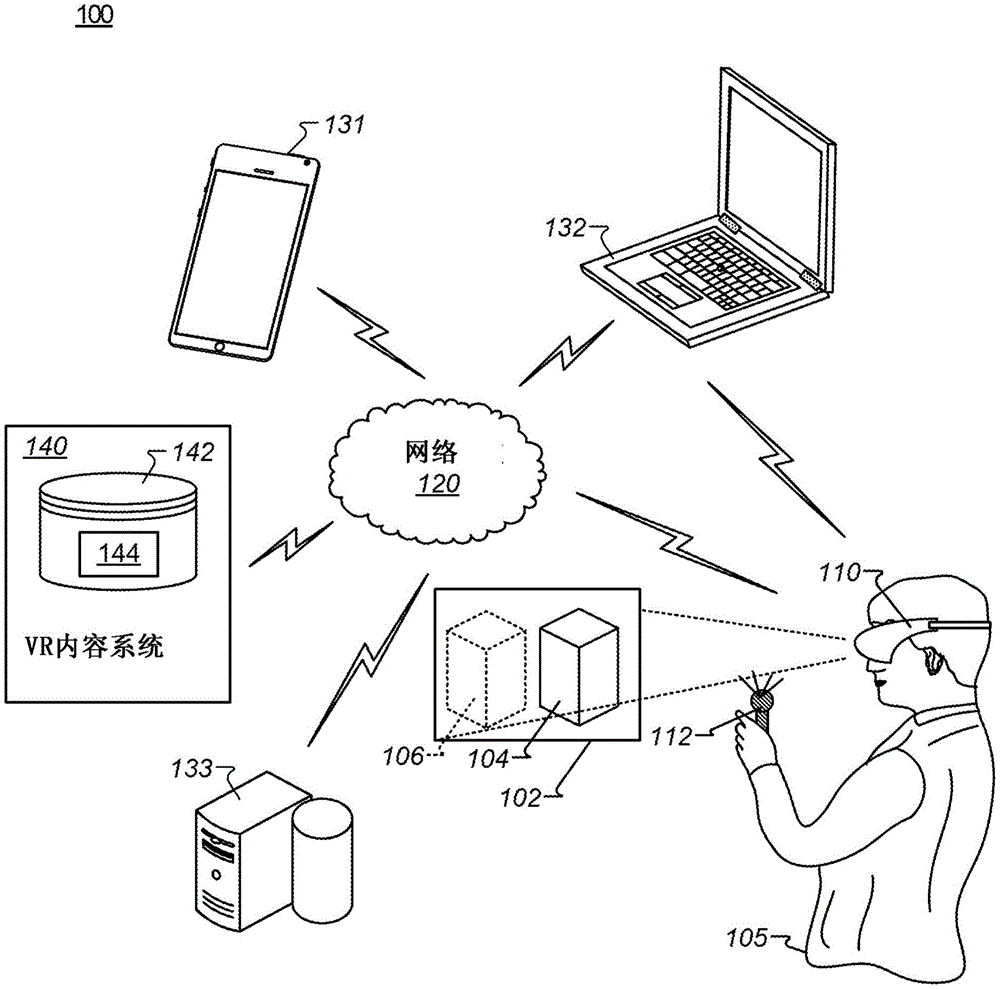
Turning to fig. 1, a block diagram of an example three-dimensional (3D) Virtual Reality (VR) system 100 for creating and interacting with a VR environment 102 in accordance with the teachings of the present disclosure is shown. In general, the system 100 provides the VR environment 102 and VR content to enable a user to access, view, use, and/or interact with the VR environment 102. The VR system 100 can provide the user with options for accessing content, applications, virtual objects, real objects, and VR controls, for example, using actual and projected movement in the VR environment. The example VR system 100 of fig. 1 includes: a Head Mounted Display (HMD)110 worn by the user 105, and a handheld controller 112 held by the user 105. The example VR environment 102 shown in fig. 1 is a representation of images displayed for a user within the user's HMD 110.
In accordance with the present disclosure, an example VR environment 102 may contain a representation of a virtual object 104, as well as a real (e.g., non-virtual, physical, actual, etc.) object 106 that is not typically seen or visible to a user when operating within the VR environment 102 displayed within their HMD 110. In other words, the real objects 106 displayed in the VR environment 102 represent physical objects, while the virtual objects 104 may not represent physical objects in the physical world. For example, the real object 106 may represent a physical object present in a room in which the user is operating their HMD 110 and thus interacting within the VR environment 102. When the real object 106 is not displayed to the user in the HMD 110 of the user, the user may make unintended or unintended contact with the physical object represented by the real object 106 as the user navigates within the VR environment 102. Such inadvertent contact may reduce customer satisfaction and/or may result in user injury.
Accordingly, examples disclosed herein adaptively or dynamically display virtual objects, as well as real objects 106 that are representations of physical objects outside of the VR environment 102 within the VR environment 102, in order to alert a user in the VR environment 102. In this way, for example, the risk of the user making unintended or unintended contact with the real object may be reduced, thereby also reducing the risk that the user may be injured due to a collision with the real object. For example, if the projected movement of the user, or a portion thereof, indicates that the user is to move close to (e.g., within a threshold criterion or distance, within a small distance) a physical object in the physical world, the real object 106, which is a representation of the physical object, changes from an undisplayed state in which the real object 106 is not visible (e.g., substantially invisible) in the VR environment 102 (e.g., within the VR environment 102 on a display within the HMD 110) to a displayed state in which the real object 106 is at least partially depicted in the VR environment 102. In this way, the content displayed in the VR environment 102 may include objects in the VR environment 102 as well as physical objects (represented as real objects 106) from the physical space in which the user operates the HMD 110.
For example, fig. 2A shows a physical room 200 containing physical or real objects in the form of bins 205. The physical room 200 represents a physical space in which a user may physically move while interacting with a VR environment displayed within their HMD. Fig. 2B shows a virtual room 210 displayed within the HMD of the user, the virtual room 210 containing virtual objects, for example in the form of a virtual bed 215. In fig. 2B, the user of the HMD is at a distance (not shown) from the bed 215.
If the user of the HMD moves close enough to or is projected to move as a foot of the virtual bed 215, e.g., in direction D1, they also move close to or are projected to move as a physical box 205 in the physical room 200. This results in a virtual representation of physical box 205 as virtual box 220 shown in VR environment 210 within the user's HMD, as shown in fig. 2C.
In this way, the user is made aware within their HMD that the bin 205 is in its projected path of movement, and therefore action can be taken to avoid contact. As shown in fig. 2C, the virtual box 220 may be shown in a partially visible state.
Example partially visible states may include, but are not limited to, a partially opaque state, a partially transparent state, a display state in a wireframe representation, and the like. When in the partially visible state, another object, real or virtual, in the VR environment may be at least partially viewed through the displayed representation of the real object.
In some examples, a threshold is used to determine when to display the real object at least in part. More generally, one or more conditions may be specified that include reaching such a threshold, under which real objects representing physical objects may be displayed in the VR environment. Example thresholds include, but are not limited to, the distance between projected movement and the real object, the time of projection to reach the real object, the projected contact probability, and the like. If the user is projected to move away from the real object as determined by calculating the projected movement. In response to the calculated projected movement, the real object may be restored to be invisible inside the HMD. By using a threshold, real objects can be displayed in a partially visible state for a small distance around the user. In some embodiments, different thresholds are used for different objects and/or types of objects. In some implementations, any movement of the user in the same room as the physical object may cause the real object 106 to be displayed in the VR environment.
Referring back to fig. 1, the example VR system 100 includes any number of computing and/or electronic devices that can exchange data over the network 120. These devices may represent clients or servers and may communicate via network 120 or any other additional and/or alternative network. Example client devices include, but are not limited to, a mobile device 131 (e.g., a smartphone, a personal digital assistant, a portable media player, etc.), an electronic tablet (not shown), a laptop or netbook 132, a camera (not shown), an HMD 110, a desktop computer 133, a VR handheld controller 112, a gaming device (not shown), and any other electronic or computing device that can communicate with other computing or electronic devices or systems using a network 120 or other network, or that can be used to access VR content or operate in a VR environment. Devices 110, 112, and 131 may represent client or server devices. The devices 110, 112, and 131 can execute a client operating system and can access, render, provide, or display one or more client applications of VR content contained in each respective device 110, 112, and 131 or on a display device associated with the respective device 110, 112, and 131 and 133.
Fig. 3 is a schematic diagram of an example HMD 300 that may be used to implement the example HMD 110 of fig. 1, and the like. The example HMD 300 of fig. 3 includes an optics module 305, a processor module 310, and an outward-facing or forward-facing camera 315.
The optical module 305 includes, but is not limited to, lenses, mirrors, coatings, apertures, etc., that enable a wearer of the HMD 300 to view the display 320. The example display 320 displays side-by-side images and/or videos of respective eyes of a wearer of the HMD 300. In other examples, two (or more) of displays 320 are each used to collectively display side-by-side images and/or video.
Modules 305, 310, and 315 and elements therein may be implemented using any number and/or type of components and/or machine-readable instructions. In some examples, the processor module 310 is implemented using a mobile device, such as a mobile phone or smart phone, that may be communicatively and/or physically coupled to the HMD 300. In some examples, mobile device 131 is positioned, or otherwise implemented or operated within HMD 110 or 300 in conjunction with HMD 110 or 300 to provide a display that may serve as display 320 and/or a camera that may serve as camera 315 of HMD 110 or 300. The mobile device 131 may additionally or alternatively contain hardware and/or software for executing VR applications.
To control HMD 300, the example processor module 310 of fig. 3 includes a processor 325 in the form of a microcontroller, a Central Processing Unit (CPU), an ASIC, a Digital Signal Processor (DSP), an FPGA, a Graphics Processing Unit (GPU), etc., programmed or configured to execute machine-readable instructions stored in memory 330. In some examples, the instructions, when executed, cause the processor 325 to change the manner and time, etc., that the real object is presented on the display 320 within the HMD 300 based on projected physical movement of the user relative to the real object. In some examples, more than one processor 325 and/or memory 330 is provided.
The processor 325 additionally processes images taken by the camera 315 to identify, for example, the location, size, etc. of real objects in the physical space in which the user is using his HMD. This information can be used to map the real environment in which the user is using their HMD. Additionally or alternatively, other devices may be used to map the location, size, etc. of the real object in the physical space in which the HMD is being used. In some examples, the mapping of the physical environment in which the user will use their HMD is pre-scanned, pre-learned, or otherwise determined a priori. Alternatively and/or additionally, it may be determined in real-time as the user's HMD is worn and moved around.
To communicatively couple the
example HMD 300 to other devices, such as the
device 131 and 133 of fig. 1, the
example HMD 300 of fig. 3 includes a
communication module 335. The
example communication module 335 implements communication signals and/or protocols, such as
And a Universal Serial Bus (USB).
To record data and/or signals representing actual movement, the example processor module 310 of FIG. 3 includes a movement tracker 340. For example, the movement tracker 340 of fig. 3 may record tracking information determined by the HMD 310, and/or tracking information determined by other devices, such as the example device 131 and 133. Example tracking information includes three-dimensional (3DoF) and six-degree-of-freedom (6DoF) tracking data. Any number and/or type of emitters, sensors, and/or cameras may be used to determine tracking information. The actual movement tracking data represents actual (e.g., physical, real, non-virtual, etc.) movement of the user, HMD, handheld controller, limb, head, hand, foot, torso, etc. In some examples, the actual movement tracking data is captured in 3D.
To project the movement, the example processor module 310 of FIG. 3 includes a movement projector 345. The example movement projector 345 of fig. 3 determines one or more characteristics of actual movement (e.g., past movement, movement that has occurred, etc.) based on the actual movement data collected by the movement tracker 340. Example characteristics include shape (line, curve, radius of curve, etc.) velocity, acceleration, etc. of the trajectory or vector. The shape of the trajectory may be determined using, for example, a curve fitting algorithm or method.
Based on the determined characteristics, the movement projector 345 projects (e.g., predicts, estimates, determines, etc.) movements (e.g., future movements, movements that have not occurred, etc.). For example, if the actual movement has recently occurred along a linear trajectory at a speed of X, the movement of the example projection will be along the linear trajectory at a distance (X times time) from the current position, where time is the amount of time the projection was made (e.g., 0.5 seconds). Here, for the sake of discussion, the time interval during which the projection is performed will be referred to as a projection interval (or projection period). Other shapes of trajectory may be projected similarly, and other factors, such as acceleration, taken into account. When the end of the projection interval (e.g., every 0.5 seconds) is actually reached (e.g., the interval time has elapsed), the process repeats with the projected movement data being discarded and replaced with additional actual movement data. The moving projection may be performed in two dimensions (2D) or 3D.
In some implementations, the movement projector 345 additionally accounts for movement of the handheld controller relative to the HMD. For example, when a user waves their hand around their body as they move (e.g., walk, run, etc.). In such an example, a projected movement trajectory will be calculated for each of the HMD and the controller.
To project the contacts, the example processor module 310 of FIG. 3 includes a contact projector 350. The example contact projector 350 of fig. 3 compares the projected movement data determined by the example movement projector 345 to the location and characteristics of the real object to determine whether the user will pass close enough to the real object that the real object should be displayed inside the HMD 300 in an at least partially visible state. In an example of calculating projected movement trajectories for each of the HMD and the controller, each trajectory may be considered relative to the position of the real object. In some examples, time may be used to trigger the display of real objects instead of distance. For example, assuming a prediction interval of 2 seconds and a user's reaction time of 1 second, any contact that may occur between the time of the present and one second since the present should be shown at least in part.
In some embodiments, contact projection allows for what will happen in VR applications. For example, if the VR application has an object or target that the user is attempting to reach, the contact projection may have a greater threshold criteria in a direction toward the object or target than in other directions. In other directions, if a user is moving towards such an object or target, they are more likely to accelerate their movement in that direction, and therefore, a larger criterion threshold may be used. For example, assume that there are two physical objects with the user in a room — a chair to the user's left and a table to the user's right. Assume further that the user is moving towards the chair. In this case, the contact projector 350 generates projected data indicating that the user is likely to collide with the chair within three seconds. In this case, if the time threshold is three seconds, an image of the chair may be displayed in the VR environment. Further, because the user is less likely to suddenly turn to make contact with the table, the time threshold for displaying the table may be set to one second instead of three seconds.
As an example, turn to fig. 4A and 4B. Fig. 4A is a perspective view of a series of actual locations 401, 402, 403, and 404 of person 410 (in the physical world) at respective times T1, T2, T3, and T4. In fig. 4A and 4B, the user is wearing the HMD and interacting with the VR environment they are viewing in the HMD as they move. FIG. 4B is a top view of a series of locations 401 and 404 of FIG. 4A. In summary, the actual positions 401-404 and times T1-T4 represent the actual movement of the person 410 along the linear trajectory 415 while swinging the fly swatter 420 about itself. For clarity of illustration, only one example of a person 410 and a fly swatter 420 is designated.
Between times T1 and T4, movement tracker 340 uses sensors contained in HMDs 110 or 300 to collect data representing the motion of person 410 along trajectory 415 and data representing the motion of fly swatter 420 based on handheld controller 112. The motion of the HMD 110 or 300 may be determined, for example, using a front facing camera included in the HMD and/or an emitter included in the HMD that is sensed by a sensor (not shown) of the VR system 100 of fig. 1.
At time T4 in fig. 4A and 4B, the movement projector 345 processes some or all of the data collected by the movement tracker 340 and determines that actual movement occurred at a speed of X along the linear trajectory 415. Moving projector 345 accordingly projects at time T5 that the person will continue to move along linear trajectory 415 at the same speed because the speeds are already reasonably consistent. Thus, at time T5, the moving projector 345 projects them to be at position 425.
The moving projector 345 also processes at least some of the data and determines that the fly swatter 420 was recently swung in an arc, and that the fly swatter has been repositioned to be swung again when a fly is present. Accordingly, the mobile projector 345 projects that this person will be mid-swing at location 425 at time T5. In summary, the moving projector 345 projects that the person will be at position 425 at time T5 while in the middle of a swing with the fly swatter 420.
The contact projector 350 compares the predicted position 425 of the HMD at time T5 with the position of the real object 430 in the physical space in which the HMD is being used. The contact projector 350 also compares the predicted position 435 of the fly swatter 420 at time T5 with the position of the real object 430. As shown in FIG. 4B, the fly swatter at the projected location 435 is proximate to the real object 430 (e.g., within a threshold distance). Thus, the real object 430 is at least partially displayed in the VR environment displayed within the HMD. Because the HMD is projected relatively far away from real object 430, the HMD does not trigger the display of real object 430.
In some embodiments, the projection intervals are short enough that only a single projected moving data point is calculated for each interval, and only a single comparison with respect to the real object position needs to be made. By shortening the projection interval, the complexity of moving the projection may be reduced, as the projected movement data will be relatively close to the most recent actual movement data. In such a case, a low order extrapolation (low order extrapolation) may be used. However, consideration may need to be given to a sufficiently long interval that allows the user to react to a change in the display state of the real object.
In some embodiments, the display of the real object is triggered in time. For example, assuming a prediction interval of 2 seconds and a user reaction time of 1 second, any contact that may occur within time NOW to time NOW plus 1 second should be shown in an at least partially visible state. In some examples, the time for projecting the contact is adjusted based on a speed of the actual movement. For example, it may be assumed that the reaction time increases as the person moves faster to avoid the real object being displayed at least partially too late, or decreases as the person moves slower to avoid the real object being displayed at least partially too early.
In some embodiments, the probability of contact is utilized. For example, if the probability of contact is greater than X%, the real object should be displayed in an at least partially visible state.
In some embodiments, no moving projection is used. Instead, an actual position that meets a certain actual distance from the real object triggers the display of the object in an at least partially displayed state.
In some implementations, the movement tracker 340, the movement projector 345, and the contact projector 350 execute without knowledge of the application developer so that real object contact information can be provided at a system level in the HMD. In this way, real object contact information may be provided without the effort, involvement, understanding, or approval of an application developer. In this way, the user obtains the improved advantages disclosed herein for all of his VR applications.
In some implementations, the movement projector 345 and the contact projector 350 are combined into and implemented by a neural network or Artificial Intelligence (AI) module 360. Generally, the AI module 360 of fig. 3 learns causal relationships (e.g., AI models) between inputs and outputs using unstructured learning. The learned relationship may then be applied to the actual movement data input to determine projected movement data. The learned relationships may be learned by training AI module 360 using as inputs the set of actual movement data captured at { T1, T0. } and as outputs the actual movement data captured at T2. A subsequent set of data contains data captured at { T2, T1. } and T3; data captured at { T3, T2, T1, } and T4, etc. In use, actual movement data is input to the AI module 360 and an output representative of which real objects are displayed in an at least partially displayed state.
In some embodiments, a portion of the processor module 310 is implemented separately from the HMD 300. For example, the movement tracker 340, movement projector, contact projector 350, and/or AI module 350 may be implemented by any of the devices 131 and 133. Information about which real objects should be displayed in an at least partially displayed state may be relayed to the HMD 300.
Fig. 5 is a flowchart of an example method that may be implemented, for example, as machine readable instructions executed by one or more processors (e.g., the example processors P00 and P50 of fig. 8) to implement the example motion projector disclosed herein. The example method of fig. 5 includes analyzing or processing actual HMD movement data to determine an actual HMD trajectory (block 505), and analyzing or processing actual controller movement data to determine an actual controller trajectory (block 510). Projection of HMD positions (block 515) and projection of controller positions (block 520). Additionally or alternatively, limbs, hands, feet, heads, etc. not necessarily associated with the controller may be tracked. Control is then exited from the example method of FIG. 5.
Fig. 6 is a flowchart of an example method that may be implemented, for example, as machine readable instructions executed by one or more processors (e.g., the example processors P00 and P50 of fig. 8) to implement the example contact projector disclosed herein. The example method of fig. 6 includes calculating a distance between the projected HMD position and the position of the real object (block 605). If any of the distances satisfies the threshold (e.g., is less than, less than or equal to, etc.) (block 610), then the real objects that satisfy the threshold are displayed in an at least partially displayed state (block 615).
The distance between the projected controller position and the position of the real object is calculated (block 620). If any of the distances is less than the threshold (block 625), then the real objects that meet the threshold are displayed in an at least partially displayed state (block 630). Control is then exited from the example method of FIG. 6.
As described above, other criteria (e.g., time, percentage, etc.) may additionally or alternatively be used to determine which real objects to display in an at least partially displayed state.
Fig. 7 is a flowchart of an example method of machine readable instructions that may be implemented, for example, as executed by one or more processors (e.g., the example processors P00 and P50 of fig. 8) to implement the example AI modules disclosed herein. In addition to projecting contacts, the example method of FIG. 7 also includes adjusting the learned relationships when using the AI module. The example method of fig. 7 includes inputting actual athletic data to an AI model (block 705) and outputting projected contact information (block 710).
If the match of the previous projection to the actual projection meets criteria (e.g., number of missed contacts, number of false contacts, contacts displayed too late, contacts displayed too early, etc.) (block 715), the current state of the AI model is saved (block 720) and the current actual motion data is saved (block 725). Control is then exited from the example method of FIG. 7.
If the previous projection does not match the actual projection within the criteria (block 715), then the saved AI model state (block 730) and the saved actual motion data are invoked (block 735). The AI module is updated with the data of the call as input and the most recent actual data as output (block 740). Control is then exited from the example method of FIG. 7.
One or more of the elements and interfaces disclosed herein may be duplicated; the parallel implementation is carried out; implemented in the singular; are combined, divided, rearranged, omitted, eliminated, and/or implemented in any other way. Further, any of the disclosed elements and interfaces may be implemented by the example processor platforms P00 and P50 of fig. 8 and/or one or more circuits, programmable processors, fuses, Application Specific Integrated Circuits (ASICs), Programmable Logic Devices (PLDs), Field Programmable Logic Devices (FPLDs), and/or Field Programmable Gate Arrays (FPGAs), among others. Any of the elements and interfaces disclosed herein may be implemented, for example, as machine-readable instructions executed by one or more processors. A processor, controller, and/or any other suitable processing device, such as the processing device shown in fig. 8, may be used, configured, and/or programmed to perform and/or implement the examples disclosed herein. For example, any of these interfaces and elements may be embodied in program code and/or machine-readable instructions stored on a tangible and/or non-transitory computer-readable medium accessible by a processor, a computer, and/or other machine with a processor (e.g., the processor discussed below in connection with fig. 8). Machine-readable instructions comprise, for example, instructions that cause a processor, a computer, and/or a machine having a processor to perform one or more particular processes. The order of execution of the methods may be changed, and/or one or more of the described blocks and/or interactions may be changed, eliminated, sub-divided, or combined. Additionally, they may be performed in sequential order and/or in parallel by, for example, separate processing threads, processors, devices, discrete logic, circuits, and/or the like.
For example, the example methods disclosed herein may be implemented as machine-readable instructions executed by one or more processors. A processor, controller, and/or any other suitable processing device, such as the processing device shown in fig. 8, may be used, configured, and/or programmed to perform and/or implement the example methods. For example, they may be embodied in program code and/or machine-readable instructions stored on a tangible and/or non-transitory computer-readable medium accessible by a processor, a computer, and/or other machine having a processor (e.g., the processor discussed below in connection with fig. 8). Machine-readable instructions comprise, for example, instructions that cause a processor, a computer, and/or a machine having a processor to perform one or more particular processes. Many other methods of implementing the example methods may be employed. For example, the order of execution may be changed, and/or one or more of the described blocks and/or interactions may be changed, eliminated, sub-divided, or combined. Additionally, any or all of the example methods may be performed sequentially and/or performed in parallel by, for example, separate processing threads, processors, devices, discrete logic, circuits, and/or the like.
As used herein, the term "computer-readable medium" is expressly defined to include any type of computer-readable medium and to expressly exclude propagating signals. Example computer readable media include, but are not limited to, one or any combination of the following: volatile and/or nonvolatile memory, volatile and/or nonvolatile memory devices, optical disks (CDs), Digital Versatile Disks (DVDs), Read Only Memory (ROMs), Random Access Memory (RAM), programmable ROMs (proms), electronically programmable ROMs (eproms), electronically erasable proms (eeproms), optical storage disks, optical storage devices, magnetic storage disks, magnetic storage devices, caches, and/or any other storage media, wherein information is stored for any duration (e.g., extended time periods, permanent, short times, temporarily buffered and/or used for caching of information) and accessible by a processor, computer, and/or other machine with a processor.
Returning to fig. 1, VR system 100 can include any number of VR content systems 140 that store content and/or VR software modules (e.g., in the form of VR applications 144) that can generate, modify, and/or execute VR scenes. In some examples, the devices 110, 112, and 131 and the VR content system 140 include one or more processors and one or more memory devices that can execute a client operating system and one or more client applications. The HMD 110, controller 112, other device 131, 133, or VR content system 140 may be implemented by the example computing devices P00 and P50 of fig. 8.
The VR application 144 may be configured to execute on any or all of the devices 110, 112, and 131 and 133. For example, the HMD 110 may connect to the device 131 and 133 to access VR content on the VR content system 140. The device 131 and 133 may be connected (wired or wireless) to the HMD 110, and the HMD 110 may provide VR content for display. The user's VR system may be HMD 110 alone, or a combination of device 131 and HMD 110.
HMD 110 may represent a VR HMD, glasses, eyepieces, or any other wearable device capable of displaying VR content. In operation, HMD 110 may execute VR application 144, which may play back received, rendered, and/or processed images for the user. In some cases, the VR application 144 may be hosted by one or more of the devices 131 and 133.
In some implementations, one or more content servers (e.g., VR content system 140) and one or more computer-readable storage devices can communicate with the computing devices 110 and 131 and 134 using the network 120 to provide VR content to the devices 110 and 131 and 134.
In some implementations, mobile device 131 can execute VR application 144 and provide content for the VR environment. In some implementations, the laptop computing device 132 can execute the VR application 144 and can provide content from one or more content servers (e.g., VR content server 140). One or more content servers and one or more computer-readable storage devices may communicate with mobile device 131 and/or laptop computing device 132 using network 120 to provide content for display in HMD 106.
Where
HMD 106 is wirelessly coupled to
device 102 or
device 104, the coupling may include using any wireless communication protocol. A non-exhaustive list of wireless communication protocols that may be used alone or in combination includes, but is not limited to, the institute of Electrical and electronics Engineers
The x family of standards, namely Wi-Fi or Wireless Local Area Network (WLAN), bluetooth, transmission control protocol/internet protocol (TCP/IP), satellite data network, cellular data network, Wi-Fi hotspot, internet and Wireless Wide Area Network (WWAN).
Where the HMD 106 is electrically coupled to the device 102 or 104, a cable with appropriate connectors at either end for insertion into the device 102 or 104 may be used. A non-exhaustive list of wired communication protocols that may be used alone or in combination includes, but is not limited to, IEEE 802.3x (ethernet), a powerline network, the internet, a coaxial cable data network, a fiber optic data network, a broadband or dial-up modem over a telephone network, a private communication network (e.g., a private Local Area Network (LAN), leased line, etc.).
The cable may include Universal Serial Bus (USB) connectors at both ends. The USB connectors may be the same USB type connector or the USB connectors may each be a different type of USB connector. The various types of USB connectors may include, but are not limited to, USB type a connectors, USB type B connectors, micro USB type a connectors, micro USB type B connectors, micro USB AB connectors, USB five pin mini B connectors, USB four pin mini B connectors, USB type 3.0A connectors, USB type 3.0B connectors, USB type 3.0 micro B connectors, and USB type C connectors. Similarly, the electrical coupling may comprise a cable having appropriate connectors at either end for insertion into the HMD 106 and device 102 or device 104. For example, the cable may contain USB connectors at both ends. The USB connectors may be the same USB type connector, or the USB connectors may be different types of USB connectors. Either end of the cable used to couple the device 102 or 104 to the HMD 106 may be fixedly connected to the device 102 or 104 and/or the HMD 106.
FIG. 8 shows an example of a general purpose computer device P00 and a general purpose mobile computer device P50 that may be used with the techniques described herein. Computing device P00 is intended to represent various forms of digital computers, such as laptops, desktops, tablets, workstations, personal digital assistants, televisions, servers, blade servers, mainframes, and other appropriate computing devices. Computing device P50 is intended to represent various forms of mobile devices, such as personal digital assistants, cellular telephones, smart phones, and other similar computing devices. The components shown here, their connections and relationships, and their functions, are meant to be exemplary only, and are not meant to limit implementations of the inventions described and/or claimed in this document.
Computing device P00 includes a processor P02, memory P04, storage device P06, a high-speed interface P08 connecting to memory P04 and high-speed expansion ports P10, and a low-speed interface P12 connecting to low-speed bus P14 and storage device P06. The processor P02 may be a semiconductor-based processor. The memory P04 may be a semiconductor-based memory. Each of the components P02, P04, P06, P08, P10, and P12 are interconnected using various buses, and may be mounted on a common motherboard or in other manners as appropriate. The processor P02 may process instructions for execution within the computing device P00, including instructions stored in the memory P04 or on the storage device P06, to display graphical information for a GUI on an external input/output device (such as display P16 coupled to high speed interface P08). In other embodiments, multiple processors and/or multiple buses may be used, as appropriate, along with multiple memories and types of memory. Also, multiple computing devices P00 may be connected, with each device providing portions of the necessary operations (e.g., as a server farm, a group of blade servers, or a multi-processor system).
The memory P04 stores information within the computing device P00. In one implementation, the memory P04 is a volatile memory unit or units. In another implementation, the memory P04 is a non-volatile memory unit or units. The memory P04 may also be another form of computer-readable medium, such as a magnetic or optical disk.
The storage device P06 is capable of providing mass storage for the computing device P00. In one embodiment, the storage device P06 may be or contain a computer-readable medium, such as a floppy disk device, a hard disk device, an optical disk device, or a tape device; flash memory or other similar solid state storage devices; or an array of devices, including devices in a storage area network or other configuration. The computer program product may be tangibly embodied in an information carrier. The computer program product may also contain instructions that, when executed, perform one or more methods, such as those described above. The information carrier is a computer-or machine-readable medium, such as the memory P04, the storage device P06, or memory on processor P02.
The high speed controller P08 manages bandwidth-intensive operations for the computing device P00, while the low speed controller P12 manages lower bandwidth-intensive operations. Such allocation of functions is exemplary only. In one embodiment, the high-speed controller P08 is coupled to memory P04, display P16 (e.g., through a graphics processor or accelerator), and to high-speed expansion ports P10, which may accept various expansion cards (not shown). In an embodiment, low-speed controller P12 is coupled to storage device P06 and low-speed expansion port P14. The low-speed expansion port, which may include various communication ports (e.g., USB, bluetooth, ethernet, wireless ethernet), may be coupled to one or more input/output devices, such as a keyboard, a pointing device, a scanner, or a networking device such as a switch or router, for example, through a network adapter.
Computing device P00 may be implemented in a number of different forms, as shown. For example, it may be implemented as a standard server P20, or multiple times in a group of such servers. It may also be implemented as part of a rack server system P24. In addition, it can be implemented in a personal computer such as a laptop computer P22. Alternatively, components from computing device P00 may be combined with other components in a mobile device (not shown), such as device P50. Each such device may contain one or more of computing devices P00, P50, and an entire system may be made up of multiple computing devices P00, P50 in communication with each other.
The computing device P50 includes a processor P52, memory P64, input/output devices such as a display P54, a communication interface P66 and a transceiver P68, among other components. The device P50 may also be provided with a storage device, such as a microdrive or other device, to provide additional storage. Each of the components P50, P52, P64, P54, P66, and P68 are interconnected using various buses, and several of the components may be mounted on a common motherboard or in other manners as appropriate.
The processor P52 may execute instructions within the computing device P50, including instructions stored in the memory P64. The processor may be implemented as a chipset of chips that contain separate and multiple analog and digital processors. For example, the processor may provide coordination of the other components of the device P50, such as control of user interfaces, applications run by device P50, and wireless communication by device P50.
The processor P52 may communicate with a user through a control interface P58 and a display interface P56 coupled to a display P54. The display P54 may be, for example, a TFT LCD (thin film transistor liquid crystal display) or OLED (organic light emitting diode) display, or other suitable display technology. The display interface P56 may include appropriate circuitry for driving the display P54 to present graphical and other information to a user. The control interface P58 may receive commands from a user and convert them for submission to the processor P52. In addition, an external interface P62 may be provided in communication with the processor P52, to enable near area communication of the device P50 with other devices. External interface P62 may provide, for example, for wired communication in some embodiments, or for wireless communication in other embodiments, and multiple interfaces may also be used.
The memory P64 stores information within the computing device P50. The memory P64 may be implemented as one or more of a computer-readable medium or media, a volatile memory unit or units, or a non-volatile memory unit or units. Expansion memory P74 may also be provided and connected to device P50 through expansion interface P72, which expansion interface P72 may comprise, for example, a SIMM (Single in line memory Module) card interface. Such expansion memory P74 may provide additional storage space for device P50, or may also store applications or other information for device P50. Specifically, expansion memory P74 may contain instructions for performing or supplementing the processes described above, and may also contain secure information. Thus, for example, expansion memory P74 may be provided as a security module for device P50, and may be programmed with instructions that permit secure use of device P50. In addition, secure applications may be provided via the SIMM card, as well as additional information, such as placing identifying information on the SIMM card in a non-hackable manner.
The memory may include, for example, flash memory and/or NVRAM memory, as described below. In one embodiment, a computer program product is tangibly embodied in an information carrier. The computer program product contains instructions that, when executed, perform one or more methods, such as those described above. The information carrier is a computer-or machine-readable medium, such as the memory P64, expansion memory P74, or memory on processor P52, which may be received, for example, over transceiver P68 or external interface P62.
The device P50 may communicate wirelessly through the communication interface P66, and the communication interface P66 may contain digital signal processing circuits as necessary. Communication interface P66 may provide for communications under various modes or protocols, such as GSM voice calls, SMS, EMS, or MMS messaging, CDMA, TDMA, PDC, WCDMA, CDMA2000, or GPRS. Such communication may occur, for example, through radio-frequency transceiver P68. Additionally, short-range communications are possible, such as using a Bluetooth, Wi-Fi, or other such transceiver (not shown). In addition, GPS (global positioning system) receiver module P70 may provide additional navigation-and location-related wireless data to device P50, which may be used as appropriate by applications running on device P50.
Device P50 may also communicate audibly using an audio codec P60 that may receive spoken information from a user and convert it to usable digital information. The audio codec P60 may likewise generate audible sound for the user, e.g. through a speaker, e.g. in a handset of the device P50. Such sound may include sound from voice telephone calls, may include recorded sound (e.g., voice messages, music files, etc.), and may also include sound generated by applications operating on device P50.
Computing device P50 may be implemented in a number of different forms, as shown. For example, it may be implemented as a cellular phone P80. It may also be implemented as part of a smart phone P82, personal digital assistant, or other similar mobile device.
Various implementations of the systems and techniques described here can be realized in digital electronic circuitry, integrated circuitry, specially designed ASICs (application specific integrated circuits), computer hardware, firmware, software, and/or combinations thereof. These various implementations can include implementation in one or more computer programs that are executable and/or interpretable on a programmable system including at least one programmable processor, which may be special or general purpose, coupled to receive data and instructions from, and to transmit data and instructions to, a storage system, at least one input device, and at least one output device.
These computer programs (also known as programs, software applications or code) include machine instructions for a programmable processor, and may be implemented in a high-level procedural and/or object-oriented programming language, and/or in assembly/machine language. As used herein, the terms "machine-readable medium," "computer-readable medium" refers to any computer program product, apparatus and/or device (e.g., magnetic discs, optical disks, memory, Programmable Logic Devices (PLDs)) used to provide machine instructions and/or data to a programmable processor, including a machine-readable medium that receives machine instructions as a machine-readable signal. The term "machine-readable signal" refers to any signal used to provide machine instructions and/or data to a programmable processor.
To provide for interaction with a user, the systems and techniques described here can be implemented on a computer having a display device (e.g., a CRT (cathode ray tube) or LCD (liquid crystal display) monitor) for displaying information to the user and a keyboard and a pointing device (e.g., a mouse or a trackball) by which the user can provide input to the computer. Other types of devices may also be used to provide for interaction with a user; for example, feedback provided to the user can be any form of sensory feedback (e.g., visual feedback, auditory feedback, or tactile feedback); and input from the user can be received in any form, including acoustic, speech, or tactile input.
The systems and techniques described here can be implemented in a computing system that includes a back-end component (e.g., as a data server), or that includes a middleware component (e.g., an application server), or that includes a front-end component (e.g., a client computer having a graphical user interface or a Web browser through which a user can interact with an implementation of the systems and techniques described here), or any combination of such back-end, middleware, or front-end components. The components of the system can be interconnected by any form or medium of digital data communication (e.g., a communication network). Examples of communication networks include a local area network ("LAN"), a wide area network ("WAN"), and the internet.
A computing system may include clients and servers. A client and server are generally remote from each other and typically interact through a communication network. The relationship of client and server arises by virtue of computer programs running on the respective computers and having a client-server relationship to each other.
In this specification and the appended claims, the singular forms "a", "an" and "the" do not exclude a plurality, unless the context clearly dictates otherwise. Furthermore, conjunctions such as "and", "or" and/or "are inclusive unless the context clearly dictates otherwise. For example, "a and/or B" includes a alone, B alone, and a and B. Furthermore, the connecting lines or connectors shown in the various figures presented are intended to represent example functional relationships and/or physical or logical couplings between the various elements. It should be noted that many alternative or additional functional relationships, physical connections or logical connections may be present in a practical device. Moreover, no item or component is essential to the practice of the embodiments disclosed herein unless the element is specifically described as "essential" or "critical".
Further embodiments are summarized in the following examples:
example 1: a method, comprising: projecting movement of a person in a Virtual Reality (VR) environment based on actual movement of the person; and changing the representation of the real object from an undisplayed state to at least a partially displayed state in the VR environment if the projected movement satisfies a threshold relative to a position of the real object in a physical space in which the VR environment is implemented.
Example 2: the method of example 1, further comprising: receiving data representing the actual movement of the person, wherein the projection is based on the data.
Example 3: the method of example 2, wherein the data represents at least one of an actual moving direction, an actual moving speed, and/or an actual moving acceleration.
Example 4: the method according to one of examples 1 to 3, wherein the real object in the non-displayed state is not visible to the person.
Example 5: the method according to one of examples 1 to 4, wherein the real object in the display state is partially visible to the person.
Example 6: the method of example 5, wherein the real object is at least one of partially opaque when partially visible, partially transparent, displayed in a wire frame representation, and/or allowing another object in the VR environment to be at least partially visible through the real object.
Example 7: the method according to one of examples 1 to 6, wherein the threshold represents a distance between the projected movement and the real object.
Example 8: the method of one of examples 1 to 7, wherein the threshold represents a time of arrival at the real object.
Example 9: the method of one of examples 1 to 8, wherein projecting the movement of the person comprises: projecting a movement trajectory of the person; and determining movement along the projected movement trajectory based on the projected velocity and/or the projected acceleration.
Example 10: the method of example 9, wherein the threshold represents a distance between the projected movement trajectory and the real object.
Example 11: the method of example 9, wherein projecting the movement of the person further comprises: projecting a movement trajectory of a portion of the person, and determining projected movement of the portion of the person with respect to the projected movement trajectory of the person; and wherein the threshold value represents a distance between the projected movement of the portion and the real object.
Example 12: the method of one of examples 1 to 11, wherein projecting the movement of the person comprises: processing the actual movement of the person with at least one of an artificial intelligence module and/or a neural network.
Example 13: the method of example 12, further comprising: training at least one of the artificial intelligence module and/or the neural network using the set of actual movement data and projected movement data.
Example 14: an electronic device configured to project movement of a person in a Virtual Reality (VR) environment based on actual movement of the person; and changing the representation of the real object from an undisplayed state to at least a partially displayed state in the VR environment if the projected movement satisfies a threshold relative to a position of the real object in a physical space in which the VR environment is implemented.
Example 15: the electronic device of example 14, wherein the control circuitry is further configured to receive data representative of the actual movement of the person, wherein the projection is based on the data.
Example 16: the electronic device according to one of examples 14 and 15, wherein the real object in the non-displayed state is not visible to the person.
Example 17: the electronic device of one of examples 14-16, wherein the real object in the display state is partially visible to the person.
Example 18: the electronic device of one of examples 14-17, wherein the threshold represents a distance between the projected movement and the real object.
Example 19: the electronic device of one of examples 14-17, wherein the threshold represents a time of arrival at the real object.
Example 20: a non-transitory machine-readable medium storing machine-readable instructions that, when executed, cause a machine to perform at least a method according to one of examples 1 to 13.
Although certain example methods, apparatus and articles of manufacture have been described herein, the scope of coverage of this patent is not limited thereto. On the contrary, this patent covers all methods, apparatus, and articles of manufacture fairly falling within the scope of the appended claims either literally or under the doctrine of equivalents.