CN108586389B - Method for synthesizing Carilazine - Google Patents
Method for synthesizing Carilazine Download PDFInfo
- Publication number
- CN108586389B CN108586389B CN201810697783.1A CN201810697783A CN108586389B CN 108586389 B CN108586389 B CN 108586389B CN 201810697783 A CN201810697783 A CN 201810697783A CN 108586389 B CN108586389 B CN 108586389B
- Authority
- CN
- China
- Prior art keywords
- trans
- cyclohexyl
- dichlorophenyl
- ethyl
- oxo
- Prior art date
- Legal status (The legal status is an assumption and is not a legal conclusion. Google has not performed a legal analysis and makes no representation as to the accuracy of the status listed.)
- Active
Links
- 238000000034 method Methods 0.000 title claims abstract description 33
- 230000002194 synthesizing effect Effects 0.000 title claims abstract description 9
- TWIJFVCCEZAONK-WKILWMFISA-N ClC1=C(C=CC=C1Cl)N1CCN(CC1)C(C[C@@H]1CC[C@H](CC1)NC(N(C)C)=O)=O Chemical compound ClC1=C(C=CC=C1Cl)N1CCN(CC1)C(C[C@@H]1CC[C@H](CC1)NC(N(C)C)=O)=O TWIJFVCCEZAONK-WKILWMFISA-N 0.000 claims abstract description 26
- KPWSJANDNDDRMB-QAQDUYKDSA-N cariprazine Chemical compound C1C[C@@H](NC(=O)N(C)C)CC[C@@H]1CCN1CCN(C=2C(=C(Cl)C=CC=2)Cl)CC1 KPWSJANDNDDRMB-QAQDUYKDSA-N 0.000 claims abstract description 20
- 229960005123 cariprazine Drugs 0.000 claims abstract description 19
- KCZGQVQWQAJXSN-UHFFFAOYSA-N 2-[4-(dimethylcarbamoylamino)cyclohexyl]acetic acid Chemical compound CN(C(NC1CCC(CC1)CC(=O)O)=O)C KCZGQVQWQAJXSN-UHFFFAOYSA-N 0.000 claims abstract description 18
- UDQMXYJSNNCRAS-UHFFFAOYSA-N 2,3-dichlorophenylpiperazine Chemical compound ClC1=CC=CC(N2CCNCC2)=C1Cl UDQMXYJSNNCRAS-UHFFFAOYSA-N 0.000 claims abstract description 14
- UORVGPXVDQYIDP-UHFFFAOYSA-N borane Chemical compound B UORVGPXVDQYIDP-UHFFFAOYSA-N 0.000 claims abstract description 10
- 229910000085 borane Inorganic materials 0.000 claims abstract description 5
- YMWUJEATGCHHMB-UHFFFAOYSA-N Dichloromethane Chemical compound ClCCl YMWUJEATGCHHMB-UHFFFAOYSA-N 0.000 claims description 54
- ZMANZCXQSJIPKH-UHFFFAOYSA-N Triethylamine Chemical compound CCN(CC)CC ZMANZCXQSJIPKH-UHFFFAOYSA-N 0.000 claims description 45
- WYURNTSHIVDZCO-UHFFFAOYSA-N Tetrahydrofuran Chemical compound C1CCOC1 WYURNTSHIVDZCO-UHFFFAOYSA-N 0.000 claims description 26
- 238000006243 chemical reaction Methods 0.000 claims description 24
- 239000012074 organic phase Substances 0.000 claims description 24
- 239000000243 solution Substances 0.000 claims description 24
- XLYOFNOQVPJJNP-UHFFFAOYSA-N water Substances O XLYOFNOQVPJJNP-UHFFFAOYSA-N 0.000 claims description 18
- 238000010791 quenching Methods 0.000 claims description 17
- 230000000171 quenching effect Effects 0.000 claims description 15
- 239000003960 organic solvent Substances 0.000 claims description 14
- YLQBMQCUIZJEEH-UHFFFAOYSA-N tetrahydrofuran Natural products C=1C=COC=1 YLQBMQCUIZJEEH-UHFFFAOYSA-N 0.000 claims description 12
- 238000001035 drying Methods 0.000 claims description 8
- 239000011259 mixed solution Substances 0.000 claims description 8
- 238000004537 pulping Methods 0.000 claims description 8
- 150000008064 anhydrides Chemical class 0.000 claims description 6
- 238000001953 recrystallisation Methods 0.000 claims description 6
- 229910000033 sodium borohydride Inorganic materials 0.000 claims description 6
- 239000012279 sodium borohydride Substances 0.000 claims description 6
- FYSNRJHAOHDILO-UHFFFAOYSA-N thionyl chloride Chemical compound ClS(Cl)=O FYSNRJHAOHDILO-UHFFFAOYSA-N 0.000 claims description 6
- 150000001263 acyl chlorides Chemical class 0.000 claims description 5
- 238000000605 extraction Methods 0.000 claims description 5
- 238000010992 reflux Methods 0.000 claims description 5
- FPQQSJJWHUJYPU-UHFFFAOYSA-N 3-(dimethylamino)propyliminomethylidene-ethylazanium;chloride Chemical compound Cl.CCN=C=NCCCN(C)C FPQQSJJWHUJYPU-UHFFFAOYSA-N 0.000 claims description 4
- KZMGYPLQYOPHEL-UHFFFAOYSA-N Boron trifluoride etherate Chemical compound FB(F)F.CCOCC KZMGYPLQYOPHEL-UHFFFAOYSA-N 0.000 claims description 4
- IAZDPXIOMUYVGZ-UHFFFAOYSA-N Dimethylsulphoxide Chemical compound CS(C)=O IAZDPXIOMUYVGZ-UHFFFAOYSA-N 0.000 claims description 4
- 239000003795 chemical substances by application Substances 0.000 claims description 4
- CTSLXHKWHWQRSH-UHFFFAOYSA-N oxalyl chloride Chemical compound ClC(=O)C(Cl)=O CTSLXHKWHWQRSH-UHFFFAOYSA-N 0.000 claims description 4
- YOETUEMZNOLGDB-UHFFFAOYSA-N 2-methylpropyl carbonochloridate Chemical compound CC(C)COC(Cl)=O YOETUEMZNOLGDB-UHFFFAOYSA-N 0.000 claims description 3
- PFKFTWBEEFSNDU-UHFFFAOYSA-N carbonyldiimidazole Chemical compound C1=CN=CN1C(=O)N1C=CN=C1 PFKFTWBEEFSNDU-UHFFFAOYSA-N 0.000 claims description 3
- -1 hexafluorophosphate Chemical compound 0.000 claims description 3
- ZCYVEMRRCGMTRW-UHFFFAOYSA-N 7553-56-2 Chemical compound [I] ZCYVEMRRCGMTRW-UHFFFAOYSA-N 0.000 claims description 2
- QOSSAOTZNIDXMA-UHFFFAOYSA-N Dicylcohexylcarbodiimide Chemical compound C1CCCCC1N=C=NC1CCCCC1 QOSSAOTZNIDXMA-UHFFFAOYSA-N 0.000 claims description 2
- ZMXDDKWLCZADIW-UHFFFAOYSA-N N,N-Dimethylformamide Chemical compound CN(C)C=O ZMXDDKWLCZADIW-UHFFFAOYSA-N 0.000 claims description 2
- 239000012964 benzotriazole Substances 0.000 claims description 2
- 229910052740 iodine Inorganic materials 0.000 claims description 2
- 239000011630 iodine Substances 0.000 claims description 2
- 238000003786 synthesis reaction Methods 0.000 abstract description 10
- 239000012467 final product Substances 0.000 abstract description 2
- XEKOWRVHYACXOJ-UHFFFAOYSA-N Ethyl acetate Natural products CCOC(C)=O XEKOWRVHYACXOJ-UHFFFAOYSA-N 0.000 description 14
- 230000015572 biosynthetic process Effects 0.000 description 10
- VEXZGXHMUGYJMC-UHFFFAOYSA-N Hydrochloric acid Chemical compound Cl VEXZGXHMUGYJMC-UHFFFAOYSA-N 0.000 description 8
- 238000006722 reduction reaction Methods 0.000 description 8
- WEVYAHXRMPXWCK-UHFFFAOYSA-N Acetonitrile Chemical compound CC#N WEVYAHXRMPXWCK-UHFFFAOYSA-N 0.000 description 6
- HEMHJVSKTPXQMS-UHFFFAOYSA-M Sodium hydroxide Chemical compound [OH-].[Na+] HEMHJVSKTPXQMS-UHFFFAOYSA-M 0.000 description 6
- 239000000203 mixture Substances 0.000 description 6
- 239000007787 solid Substances 0.000 description 6
- 239000000047 product Substances 0.000 description 5
- CYQFNNSFAGXCEC-UHFFFAOYSA-N 1-(2,3-dichlorophenyl)piperazine;hydrochloride Chemical compound [Cl-].ClC1=CC=CC(N2CC[NH2+]CC2)=C1Cl CYQFNNSFAGXCEC-UHFFFAOYSA-N 0.000 description 4
- HEDRZPFGACZZDS-MICDWDOJSA-N Trichloro(2H)methane Chemical compound [2H]C(Cl)(Cl)Cl HEDRZPFGACZZDS-MICDWDOJSA-N 0.000 description 4
- 150000001875 compounds Chemical class 0.000 description 4
- 239000012043 crude product Substances 0.000 description 4
- 230000002829 reductive effect Effects 0.000 description 4
- 230000002378 acidificating effect Effects 0.000 description 3
- LMDZBCPBFSXMTL-UHFFFAOYSA-N 1-Ethyl-3-(3-dimethylaminopropyl)carbodiimide Substances CCN=C=NCCCN(C)C LMDZBCPBFSXMTL-UHFFFAOYSA-N 0.000 description 2
- 238000005160 1H NMR spectroscopy Methods 0.000 description 2
- RTZKZFJDLAIYFH-UHFFFAOYSA-N Diethyl ether Chemical compound CCOCC RTZKZFJDLAIYFH-UHFFFAOYSA-N 0.000 description 2
- 238000006546 Horner-Wadsworth-Emmons reaction Methods 0.000 description 2
- KDLHZDBZIXYQEI-UHFFFAOYSA-N Palladium Chemical compound [Pd] KDLHZDBZIXYQEI-UHFFFAOYSA-N 0.000 description 2
- 238000005917 acylation reaction Methods 0.000 description 2
- WTEOIRVLGSZEPR-UHFFFAOYSA-N boron trifluoride Chemical compound FB(F)F WTEOIRVLGSZEPR-UHFFFAOYSA-N 0.000 description 2
- 229940125904 compound 1 Drugs 0.000 description 2
- 229940125782 compound 2 Drugs 0.000 description 2
- 229940126214 compound 3 Drugs 0.000 description 2
- 238000010511 deprotection reaction Methods 0.000 description 2
- 229940079593 drug Drugs 0.000 description 2
- 239000003814 drug Substances 0.000 description 2
- 238000005886 esterification reaction Methods 0.000 description 2
- 238000005984 hydrogenation reaction Methods 0.000 description 2
- 239000000543 intermediate Substances 0.000 description 2
- BASFCYQUMIYNBI-UHFFFAOYSA-N platinum Chemical compound [Pt] BASFCYQUMIYNBI-UHFFFAOYSA-N 0.000 description 2
- 238000003756 stirring Methods 0.000 description 2
- NGNBDVOYPDDBFK-UHFFFAOYSA-N 2-[2,4-di(pentan-2-yl)phenoxy]acetyl chloride Chemical compound CCCC(C)C1=CC=C(OCC(Cl)=O)C(C(C)CCC)=C1 NGNBDVOYPDDBFK-UHFFFAOYSA-N 0.000 description 1
- JYJIMEQNTHFXMT-UHFFFAOYSA-N 2-nitro-2-phenylacetic acid Chemical compound OC(=O)C([N+]([O-])=O)C1=CC=CC=C1 JYJIMEQNTHFXMT-UHFFFAOYSA-N 0.000 description 1
- OTCYOBLTAQTFPW-UHFFFAOYSA-N 4-aminocyclohexan-1-one Chemical compound NC1CCC(=O)CC1 OTCYOBLTAQTFPW-UHFFFAOYSA-N 0.000 description 1
- 229910015900 BF3 Inorganic materials 0.000 description 1
- YIIMEMSDCNDGTB-UHFFFAOYSA-N Dimethylcarbamoyl chloride Chemical compound CN(C)C(Cl)=O YIIMEMSDCNDGTB-UHFFFAOYSA-N 0.000 description 1
- XQFRJNBWHJMXHO-RRKCRQDMSA-N IDUR Chemical compound C1[C@H](O)[C@@H](CO)O[C@H]1N1C(=O)NC(=O)C(I)=C1 XQFRJNBWHJMXHO-RRKCRQDMSA-N 0.000 description 1
- 206010026749 Mania Diseases 0.000 description 1
- XVDSFSRMHSDHGJ-LJGSYFOKSA-N N[C@H]1CC[C@H](CC(O)=O)CC1 Chemical compound N[C@H]1CC[C@H](CC(O)=O)CC1 XVDSFSRMHSDHGJ-LJGSYFOKSA-N 0.000 description 1
- PMZURENOXWZQFD-UHFFFAOYSA-L Sodium Sulfate Chemical compound [Na+].[Na+].[O-]S([O-])(=O)=O PMZURENOXWZQFD-UHFFFAOYSA-L 0.000 description 1
- 230000010933 acylation Effects 0.000 description 1
- 125000003277 amino group Chemical group 0.000 description 1
- 230000000561 anti-psychotic effect Effects 0.000 description 1
- 239000008346 aqueous phase Substances 0.000 description 1
- 230000009286 beneficial effect Effects 0.000 description 1
- 239000003054 catalyst Substances 0.000 description 1
- 239000003153 chemical reaction reagent Substances 0.000 description 1
- 229940125898 compound 5 Drugs 0.000 description 1
- 230000005494 condensation Effects 0.000 description 1
- 238000006482 condensation reaction Methods 0.000 description 1
- 125000000113 cyclohexyl group Chemical group [H]C1([H])C([H])([H])C([H])([H])C([H])(*)C([H])([H])C1([H])[H] 0.000 description 1
- 230000007547 defect Effects 0.000 description 1
- 230000007812 deficiency Effects 0.000 description 1
- 238000001514 detection method Methods 0.000 description 1
- 230000032050 esterification Effects 0.000 description 1
- 238000002474 experimental method Methods 0.000 description 1
- 125000000524 functional group Chemical group 0.000 description 1
- 230000002140 halogenating effect Effects 0.000 description 1
- 238000005658 halogenation reaction Methods 0.000 description 1
- 238000010438 heat treatment Methods 0.000 description 1
- 230000003301 hydrolyzing effect Effects 0.000 description 1
- 239000005457 ice water Substances 0.000 description 1
- 229960004716 idoxuridine Drugs 0.000 description 1
- PNDPGZBMCMUPRI-UHFFFAOYSA-N iodine Chemical compound II PNDPGZBMCMUPRI-UHFFFAOYSA-N 0.000 description 1
- 208000024714 major depressive disease Diseases 0.000 description 1
- 229910052763 palladium Inorganic materials 0.000 description 1
- 230000037361 pathway Effects 0.000 description 1
- 229910052697 platinum Inorganic materials 0.000 description 1
- 238000002360 preparation method Methods 0.000 description 1
- 238000000746 purification Methods 0.000 description 1
- 239000002994 raw material Substances 0.000 description 1
- 238000006268 reductive amination reaction Methods 0.000 description 1
- 201000000980 schizophrenia Diseases 0.000 description 1
- HPALAKNZSZLMCH-UHFFFAOYSA-M sodium;chloride;hydrate Chemical class O.[Na+].[Cl-] HPALAKNZSZLMCH-UHFFFAOYSA-M 0.000 description 1
- 239000000126 substance Substances 0.000 description 1
- 238000001308 synthesis method Methods 0.000 description 1
Classifications
-
- C—CHEMISTRY; METALLURGY
- C07—ORGANIC CHEMISTRY
- C07D—HETEROCYCLIC COMPOUNDS
- C07D295/00—Heterocyclic compounds containing polymethylene-imine rings with at least five ring members, 3-azabicyclo [3.2.2] nonane, piperazine, morpholine or thiomorpholine rings, having only hydrogen atoms directly attached to the ring carbon atoms
- C07D295/04—Heterocyclic compounds containing polymethylene-imine rings with at least five ring members, 3-azabicyclo [3.2.2] nonane, piperazine, morpholine or thiomorpholine rings, having only hydrogen atoms directly attached to the ring carbon atoms with substituted hydrocarbon radicals attached to ring nitrogen atoms
- C07D295/12—Heterocyclic compounds containing polymethylene-imine rings with at least five ring members, 3-azabicyclo [3.2.2] nonane, piperazine, morpholine or thiomorpholine rings, having only hydrogen atoms directly attached to the ring carbon atoms with substituted hydrocarbon radicals attached to ring nitrogen atoms substituted by singly or doubly bound nitrogen atoms
- C07D295/135—Heterocyclic compounds containing polymethylene-imine rings with at least five ring members, 3-azabicyclo [3.2.2] nonane, piperazine, morpholine or thiomorpholine rings, having only hydrogen atoms directly attached to the ring carbon atoms with substituted hydrocarbon radicals attached to ring nitrogen atoms substituted by singly or doubly bound nitrogen atoms with the ring nitrogen atoms and the substituent nitrogen atoms separated by carbocyclic rings or by carbon chains interrupted by carbocyclic rings
Landscapes
- Chemical & Material Sciences (AREA)
- Organic Chemistry (AREA)
- Pharmaceuticals Containing Other Organic And Inorganic Compounds (AREA)
Abstract
The invention belongs to the technical field of organic synthesis, and provides a method for synthesizing cariprazine. The new method comprises the following steps: (1) condensing trans-2- (4- (3, 3-dimethylureido) cyclohexyl) acetic acid with 1- (2, 3-dichlorophenyl) piperazine to obtain 3- (trans-4- {2- [4- (2, 3-dichlorophenyl) -piperazin-1-yl ] -2-oxo-ethyl } -cyclohexyl) -1, 1-dimethylurea; (2) reduction of 3- (trans-4- {2- [4- (2, 3-dichlorophenyl) -piperazin-1-yl ] -2-oxo-ethyl } -cyclohexyl) -1, 1-dimethylurea by borane affords calicheazine. The method greatly shortens the process steps, ensures the purity of the final product and obviously improves the total yield.
Description
Technical Field
The invention belongs to the field of organic synthesis, and particularly relates to a method for synthesizing cariprazine.
Background
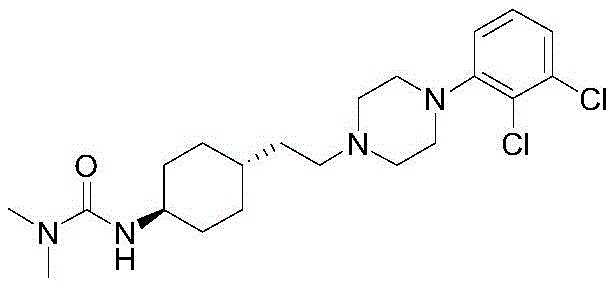
Carragazine (Cariprazine, CAS registry number: 839712-12-8), a third generation antipsychotic drug developed by Gedeon Richter pharmaceutical company, Allergan and Hungari, USA, for the treatment of schizophrenia, mania, and major depression; approved by the U.S. food and drug administration for marketing on 17 days 9/2015. The chemical name of the compound is trans-4- {2- [4- (2, 3-dichlorophenyl) -piperazine-1-yl ] -ethyl } -N, N-dimethyl formyl-cyclohexylamine, and the structural formula is as follows:
international patents WO2015056164, WO20111060363, WO2010070370, WO2010070371, WO2008142461 and WO2005012266 and documents JMC2013,56(22), 9199-:
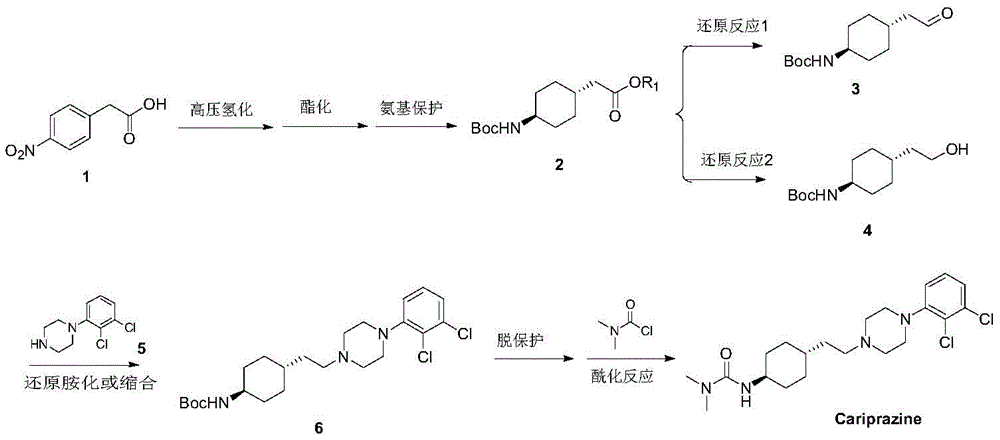
wherein, the compound 1 is hydrogenated under high pressure, esterified and protected by amino group to obtain a compound 2. The compound 2 is subjected to different reduction methods to obtain a compound 3 or 4, and then the compound is subjected to reductive amination/condensation, deprotection and acylation reactions to obtain the kalilazine.
Although there are differences in the above methods with respect to the manner and order of linkage of the individual groups and the formation pathway of the relevant functional groups, the formation of the "trans-1, 4-disubstituted cyclohexyl" group is the same for the core group. Synthetic routes have been reported to suffer from the following deficiencies or drawbacks: in the step 1, the reduction of the nitrophenylacetic acid requires high temperature and high pressure and a large amount of palladium/platinum catalyst, and the reagent is expensive and has high requirements on equipment; and esterification and recrystallization are needed after reduction to obtain a relatively pure trans-configuration product. In addition, most literature does not provide purity data for the trans-configured product.
Patent CN104496854 uses 4-aminocyclohexanone as raw material, and it is acylated with N, N-dimethylcarbamoyl chloride, and then it is made into 2- (4- (3, 3-dimethylureido) cyclohexyl) ethyl acetate by Wittig-Horner reaction and hydrogenation reduction. The reaction process is as follows:

the process does not address the ratio of cis-trans configuration of the intermediate after reduction. The inventors repeated this experiment during the course of the study, demonstrating that the hydrogenated product is in fact a mixture and cannot be used to prepare a pharmaceutically standard amount of cariprazine. Patent CN106565510 reports a preparation process for purifying trans 4-aminocyclohexylacetate by salification, with a purification yield of only 30%, and still containing 1% to 2% of the product in cis configuration.
Synthesis (Germany)2016, 48(18), 3120-3126 reports that the synthesis process is as follows:
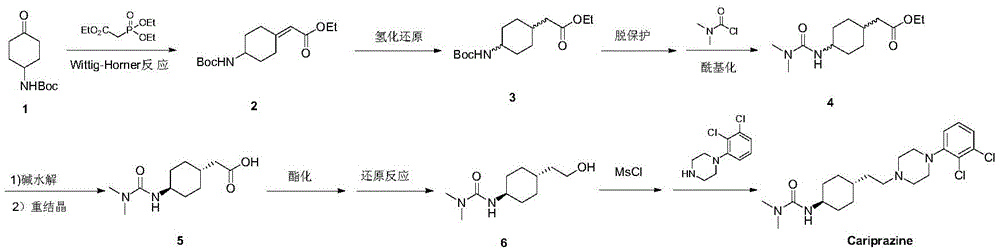
wherein, the compound 1 is subjected to Wittig-Horner reaction and hydrogenation reduction to obtain a compound 3 (cis-trans configuration is about 1:1.7), and then subjected to deprotection and acylation to obtain a compound 4. And hydrolyzing the compound 4, recrystallizing to obtain a high-purity trans-configuration compound 5, esterifying, reducing, halogenating, and finally condensing with 1- (2, 3-dichlorophenyl) piperazine to obtain the cariprazine. The process provides a method for preparing high purity trans-configured intermediates, but the overall reaction steps are relatively long.
Disclosure of Invention
Aiming at the defects in the prior art, the invention aims to provide a method for synthesizing the cariprazine, which is used for obtaining the cariprazine by condensing high-purity trans-2- (4- (3, 3-dimethylureido) cyclohexyl) acetic acid and 1- (2, 3-dichlorophenyl) piperazine and then reducing the condensed products, so that the process steps are greatly shortened, the purity of the final product is ensured, and the total yield is obviously improved.
In order to solve the technical problems, the invention adopts the following technical scheme that:
a novel method of synthesizing cariprazine, comprising: (1) condensing trans-2- (4- (3, 3-dimethylureido) cyclohexyl) acetic acid with 1- (2, 3-dichlorophenyl) piperazine to obtain 3- (trans-4- {2- [4- (2, 3-dichlorophenyl) -piperazin-1-yl ] -2-oxo-ethyl } -cyclohexyl) -1, 1-dimethylurea; (2) reduction of 3- (trans-4- {2- [4- (2, 3-dichlorophenyl) -piperazin-1-yl ] -2-oxo-ethyl } -cyclohexyl) -1, 1-dimethylurea by borane affords calicheazine.
The reaction route of the synthesis method is shown as follows:

specifically, step (1) includes, but is not limited to, four methods in the present application:
the method comprises the following steps: dripping thionyl chloride or oxalyl chloride into an organic solvent in which trans-2- (4- (3, 3-dimethylureido) cyclohexyl) acetic acid is suspended, refluxing for 3-5h, and concentrating to dryness to obtain an acyl chloride solution; preparing a mixed solution of 1- (2, 3-dichlorophenyl) piperazine, triethylamine (ET3N) and dichloromethane, adding an acyl chloride solution into the mixed solution under ice bath, and reacting for 3-5 h; then quenching by water, extracting, drying the organic phase, concentrating and pulping to obtain the 3- (trans-4- {2- [4- (2, 3-dichlorophenyl) -piperazine-1-yl ] -2-oxo-ethyl } -cyclohexyl) -1, 1-dimethyl urea.
The method 2 comprises the following steps: dropwise adding triethylamine and isobutyl chloroformate into an organic solvent in which trans-2- (4- (3, 3-dimethylureido) cyclohexyl) acetic acid is suspended, and reacting to obtain a mixed anhydride solution; preparing a mixed solution of 1- (2, 3-dichlorophenyl) piperazine, triethylamine and dichloromethane, and adding the mixed solution into a mixed anhydride solution for reaction for 2 hours; then quenching by water, extracting, drying the organic phase, concentrating and pulping to obtain the 3- (trans-4- {2- [4- (2, 3-dichlorophenyl) -piperazine-1-yl ] -2-oxo-ethyl } -cyclohexyl) -1, 1-dimethyl urea.
The method 3 comprises the following steps: adding triethylamine and carbonyl diimidazole dropwise into an organic solvent in which trans-2- (4- (3, 3-dimethylureido) cyclohexyl) acetic acid is suspended, reacting for 1-2h, adding 1- (2, 3-dichlorophenyl) piperazine, and reacting for 2 h; then quenching by water, extracting, drying the organic phase, concentrating and pulping to obtain the 3- (trans-4- {2- [4- (2, 3-dichlorophenyl) -piperazine-1-yl ] -2-oxo-ethyl } -cyclohexyl) -1, 1-dimethyl urea.
In the methods 1 to 3, the organic solvent includes one of tetrahydrofuran and dichloromethane.
The method 4 comprises the following steps: dissolving trans-2- (4- (3, 3-dimethylureido) cyclohexyl) acetic acid and 1- (2, 3-dichlorophenyl) piperazine in an organic solvent, adding a condensing agent and triethylamine, and reacting for 2-4 h; then quenching by water, extracting, drying the organic phase, concentrating and pulping to obtain the 3- (trans-4- {2- [4- (2, 3-dichlorophenyl) -piperazine-1-yl ] -2-oxo-ethyl } -cyclohexyl) -1, 1-dimethyl urea.
In method 4, the organic solvent includes one of tetrahydrofuran, dichloromethane, N-dimethylformamide and dimethylsulfoxide; the condensing agent comprises one of 1- (3-dimethylaminopropyl) -3-ethylcarbodiimide hydrochloride (EDCI), dicyclohexylcarbodiimide and 2- (7-benzotriazole oxide) -N, N, N ', N' -tetramethylurea hexafluorophosphate.
Specifically, step (2) includes, but is not limited to, three methods:
the method comprises the following steps: adding sodium borohydride to 3- (trans-4- {2- [4- (2, 3-dichlorophenyl) -piperazin-1-yl ] -2-oxo-ethyl } -cyclohexyl) -1, 1-dimethylurea dissolved in tetrahydrofuran; then dropwise adding boron trifluoride diethyl etherate and reacting overnight: and then sequentially carrying out water quenching, extraction, organic phase concentration and recrystallization to obtain the cariprazine.
The method 2 comprises the following steps: adding sodium borohydride to 3- (trans-4- {2- [4- (2, 3-dichlorophenyl) -piperazin-1-yl ] -2-oxo-ethyl } -cyclohexyl) -1, 1-dimethylurea dissolved in tetrahydrofuran; dropwise adding tetrahydrofuran solution of elemental iodine, and reacting for 4-6 h: and then sequentially carrying out water quenching, extraction, organic phase concentration and recrystallization to obtain the cariprazine.
The method 3 comprises the following steps: 3- (trans-4- {2- [4- (2, 3-dichlorophenyl) -piperazin-1-yl ] -2-oxo-ethyl } -cyclohexyl) -1, 1-dimethylurea was reacted directly with a commercial borane solution; and then sequentially carrying out water quenching, extraction, organic phase concentration and recrystallization to obtain the cariprazine.
The invention has the beneficial effects that:
the method comprises the steps of condensing trans-2- (4- (3, 3-dimethylureido) cyclohexyl) acetic acid and 1- (2, 3-dichlorophenyl) piperazine, and reducing by borane to obtain the cariprazine. Compared with the prior art, the method avoids the steps of re-esterification, reduction and re-halogenation of trans-2- (4- (3, 3-dimethylureido) cyclohexyl) acetic acid, shortens the process steps and obviously improves the total yield.
DETAILED DESCRIPTION OF EMBODIMENT (S) OF INVENTION
The present invention will be described in further detail with reference to the following examples.
Example 1: synthesis of 3- (trans-4- {2- [4- (2, 3-dichlorophenyl) -piperazin-1-yl ] -2-oxo-ethyl } -cyclohexyl) -1, 1-dimethylurea:

trans-2- (4- (3, 3-dimethylureido) cyclohexyl) acetic acid (105g, 0.46mol) was suspended in dichloromethane (500ml), thionyl chloride (82.1g, 0.69mol) was slowly added at low temperature, and after the addition, the system was heated to reflux and stirred for 4 h. The reaction solution was concentrated to dryness under reduced pressure, and 300ml of methylene chloride was added to obtain an acid chloride solution for use.
In another reaction flask was added 1- (2, 3-dichlorophenyl) piperazine hydrochloride (135.4g, 0.51mol), triethylamine (116.2g, 1.15mol) and dichloromethane (1.3L), and cooled in an ice-water bath. And (3) controlling the temperature to be less than 15 ℃, dropwise adding the prepared acyl chloride solution, and reacting at room temperature for 2 hours after the addition is finished. After completion of the reaction, the organic phase was poured into water (1L), the layers were separated and the aqueous phase was extracted once with dichloromethane (500 ml). The organic phases were combined, washed once with dilute hydrochloric acid and saturated brine in this order, and dried over anhydrous sodium sulfate. The organic phase was concentrated to give a crude product, which was slurried with ethyl acetate (500ml), filtered and dried to give 195g of a white solid in 96.0% yield.
1H NMR(400MHz,CDCl3):δ=7.22-7.12(m,2H),6.94-6.88(m,1H),4.17-4.09(m,1H),3.85-3.75(m,2H),3.70-3.52(m,3H),3.05-2.95(m,4H),2.88(s,6H),2.25(d,J=6.4Hz,2H),2.08-1.98(m,2H),1.92-1.78(m,2H),1.34-1.06(m,5H).
Example 2: synthesis of 3- (trans-4- {2- [4- (2, 3-dichlorophenyl) -piperazin-1-yl ] -2-oxo-ethyl } -cyclohexyl) -1, 1-dimethylurea:
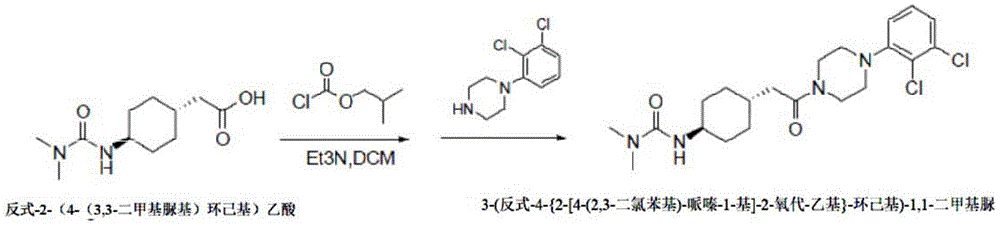
trans-2- (4- (3, 3-dimethylureido) cyclohexyl) acetic acid (10g,43.8mmol) was suspended in dichloromethane (80ml), triethylamine (6.6g, 65.7mmol) was added, the reaction cooled to < -15 ℃ and isobutyl chloroformate (6g, 44mmol) was added slowly. After the addition is finished, the temperature is controlled between minus 15 ℃ and minus 10 ℃ and the mixture is stirred for 1 hour to obtain mixed anhydride solution for standby.
In another reaction flask were added 1- (2, 3-dichlorophenyl) piperazine hydrochloride (12.9g, 48.2mmol), triethylamine (5.3g, 53mmol) and dichloromethane (60ml), stirred well and slowly added dropwise to the prepared mixed anhydride solution with a temperature controlled <5 ℃. After the addition, the temperature is naturally raised to the room temperature and the mixture is stirred for 2 hours. After the reaction, the reaction solution was quenched with 100ml of water, made acidic with 6N hydrochloric acid solution, and the organic phase was separated. The organic phase was concentrated to give a crude product, which was slurried with ethyl acetate (200ml), filtered and dried to give 16.4g of a white solid with 85.0% yield.
Example 3: synthesis of 3- (trans-4- {2- [4- (2, 3-dichlorophenyl) -piperazin-1-yl ] -2-oxo-ethyl } -cyclohexyl) -1, 1-dimethylurea:
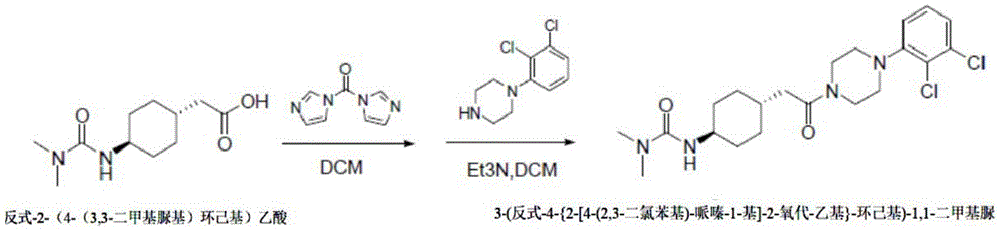
trans-2- (4- (3, 3-dimethylureido) cyclohexyl) acetic acid (10g,43.8mmol) was suspended in dichloromethane (80ml), triethylamine (6.6g, 65.7mmol) was added, the reaction was cooled to-5 ℃ and carbonyldiimidazole (8.5g, 52.6mmol) was added portionwise. After the addition, the reaction solution was heated to 10-15 ℃ and stirred for 1-2h, and 1- (2, 3-dichlorophenyl) piperazine hydrochloride (12.9g, 48.2mmol) was added in portions with a temperature controlled at <15 ℃. After the addition, the temperature is naturally raised to the room temperature and the mixture is stirred for 2 hours. After the reaction, the reaction solution was quenched with 100ml of water, made acidic with 6N hydrochloric acid solution, and the organic phase was separated. The organic phase was concentrated to give a crude product, which was slurried with ethyl acetate (200ml), filtered and dried to give 17.1g of a white solid in 88.6% yield.
Example 4: synthesis of 3- (trans-4- {2- [4- (2, 3-dichlorophenyl) -piperazin-1-yl ] -2-oxo-ethyl } -cyclohexyl) -1, 1-dimethylurea:
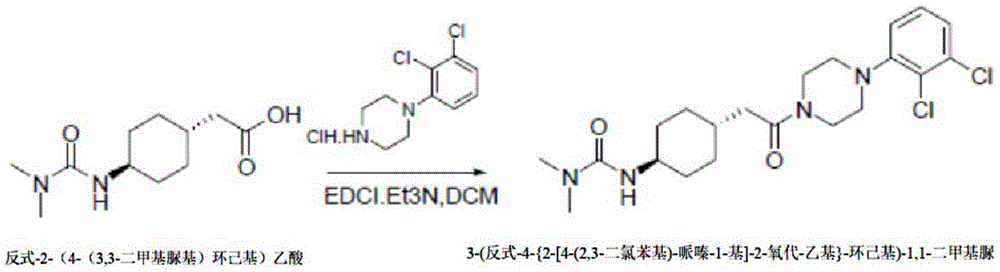
trans-2- (4- (3, 3-dimethylureido) cyclohexyl) acetic acid (10g,43.8mmol), 1- (2, 3-dichlorophenyl) piperazine hydrochloride (12.9g, 48.2mmol) and 1-ethyl- (3-dimethylaminopropyl) carbodiimide hydrochloride (10g, 52.5mmol) were charged into a reaction flask, 120mL of dichloromethane was added thereto, the mixture was stirred uniformly, triethylamine (9.8g, 96.4mmol) was added thereto, and the mixture was stirred at room temperature overnight. The reaction solution is made acidic with dilute hydrochloric acid solution, and the organic phase is separated. The organic phase was concentrated to give a crude product, which was slurried with ethyl acetate (200ml), filtered and dried to give 17.5g of a white solid with a yield of 90.6%.
Example 5: synthesis of cariprazine:
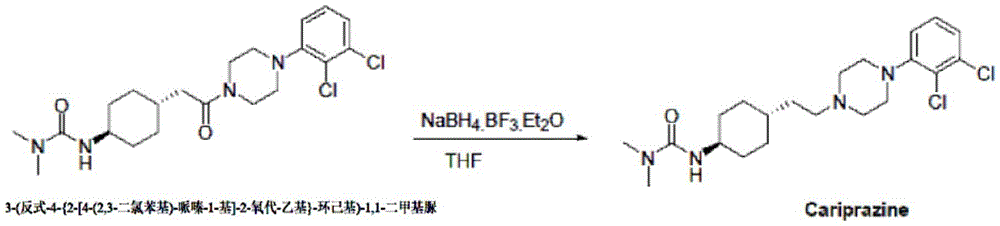
3- (trans-4- {2- [4- (2, 3-dichlorophenyl) -piperazin-1-yl ] -2-oxo-ethyl } -cyclohexyl) -1, 1-dimethylurea (19.1g, 43.3mmol), sodium borohydride (4.9g, 128.9mol) were dissolved in tetrahydrofuran (200ml), stirred well, then boron trifluoride ether (24.5g, 172.6mmol) was added dropwise with controlling the temperature below 20 ℃, after addition, stirring was carried out at natural temperature for 16 h. The reaction was complete by TLC. 20ml of water was slowly added dropwise to the system to quench the reaction. After quenching, adding dilute hydrochloric acid into the system, refluxing for 3h, and concentrating under reduced pressure to remove most of the organic solvent. Made basic with sodium hydroxide and extracted with dichloromethane (200mL × 2). The organic phase is concentrated to dryness and the acetonitrile recrystallised to yield 17.2g of a white solid in 93.0% yield.
1H NMR(400MHz,CDCl3):δ=7.15-7.08(m,2H),6.97-6.90(m,1H),4.18-4.06(m,1H),3.63-3.50(m,1H),3.14-2.97(br,4H),2.86(s,6H),2.69-2.53(br,4H),2.45-2.36(m,2H),2.08-1.94(m,2H),1.83-1.69(m,2H),1.48-1.37(m,2H),1.30-1.16(m,1H),1.15-0.98(m,4H).
Example 6: synthesis of cariprazine:

3- (trans-4- {2- [4- (2, 3-dichlorophenyl) -piperazin-1-yl ] -2-oxo-ethyl } -cyclohexyl) -1, 1-dimethylurea (8.9g, 20.2mmol), sodium borohydride (2.3g, 60.5mmol) were dissolved in tetrahydrofuran (90ml) and the temperature was reduced <10 ℃. Dissolving elementary iodine (10.3g, 40.5mmol) in THF (80ml), controlling the temperature below 20 ℃, dropping into the reaction system, heating to 60 ℃ after adding, and stirring for 4 h. TLC detection shows that the reaction is complete and the reaction solution is cooled to room temperature. 20ml of water was slowly added dropwise to the system to quench the reaction. After quenching, adding dilute hydrochloric acid into the system, refluxing for 3h, and concentrating under reduced pressure to remove most of the organic solvent. Made basic with sodium hydroxide and extracted with dichloromethane (150ml x 2). The organic phase is concentrated to dryness and the acetonitrile recrystallised to yield 7.6g of a white solid in 88.4% yield.
Claims (3)
1. A method of synthesizing cariprazine, comprising:
(1) condensing trans-2- (4- (3, 3-dimethylureido) cyclohexyl) acetic acid with 1- (2, 3-dichlorophenyl) piperazine to obtain 3- (trans-4- {2- [4- (2, 3-dichlorophenyl) -piperazin-1-yl ] -2-oxo-ethyl } -cyclohexyl) -1, 1-dimethylurea;
(2) reducing the 3- (trans-4- {2- [4- (2, 3-dichlorophenyl) -piperazin-1-yl ] -2-oxo-ethyl } -cyclohexyl) -1, 1-dimethylurea with borane to give the calicheazine;
wherein, the specific operation of the step (1) comprises one of A, B, C or D;
a: dropwise adding thionyl chloride or oxalyl chloride into the organic solvent in which the trans-2- (4- (3, 3-dimethylureido) cyclohexyl) acetic acid is suspended, refluxing for 3-5h, and concentrating to dryness to obtain an acyl chloride solution; preparing a mixed solution formed by the 1- (2, 3-dichlorophenyl) piperazine, the triethylamine and the dichloromethane, adding the acyl chloride solution into the mixed solution under ice bath, and reacting for 3-5 h; then sequentially quenching with water, extracting, drying the organic phase, concentrating and pulping to obtain the 3- (trans-4- {2- [4- (2, 3-dichlorophenyl) -piperazin-1-yl ] -2-oxo-ethyl } -cyclohexyl) -1, 1-dimethylurea;
b: dropwise adding triethylamine and isobutyl chloroformate into the organic solvent in which the trans-2- (4- (3, 3-dimethylureido) cyclohexyl) acetic acid is suspended, and reacting to obtain a mixed anhydride solution; preparing a mixed solution of the 1- (2, 3-dichlorophenyl) piperazine, triethylamine and dichloromethane, and adding the mixed solution into the mixed anhydride solution for reaction for 2 hours; then sequentially quenching with water, extracting, drying the organic phase, concentrating and pulping to obtain the 3- (trans-4- {2- [4- (2, 3-dichlorophenyl) -piperazin-1-yl ] -2-oxo-ethyl } -cyclohexyl) -1, 1-dimethylurea;
c: adding triethylamine and carbonyldiimidazole dropwise into the organic solvent in which the trans-2- (4- (3, 3-dimethylureido) cyclohexyl) acetic acid is suspended, reacting for 1-2h, adding the 1- (2, 3-dichlorophenyl) piperazine, and reacting for 2 h; then sequentially quenching with water, extracting, drying the organic phase, concentrating and pulping to obtain the 3- (trans-4- {2- [4- (2, 3-dichlorophenyl) -piperazin-1-yl ] -2-oxo-ethyl } -cyclohexyl) -1, 1-dimethylurea;
d: dissolving the trans-2- (4- (3, 3-dimethylureido) cyclohexyl) acetic acid and the 1- (2, 3-dichlorophenyl) piperazine in an organic solvent, adding a condensing agent and triethylamine, and reacting for 2-4 h; then sequentially quenching with water, extracting, drying the organic phase, concentrating and pulping to obtain the 3- (trans-4- {2- [4- (2, 3-dichlorophenyl) -piperazin-1-yl ] -2-oxo-ethyl } -cyclohexyl) -1, 1-dimethylurea; the condensing agent comprises one of 1- (3-dimethylaminopropyl) -3-ethylcarbodiimide hydrochloride, dicyclohexylcarbodiimide and 2- (7-benzotriazole oxide) -N, N, N ', N' -tetramethylurea hexafluorophosphate;
the specific operation of the step (2) comprises one of the following E or F;
e: adding sodium borohydride to the tetrahydrofuran in which the 3- (trans-4- {2- [4- (2, 3-dichlorophenyl) -piperazin-1-yl ] -2-oxo-ethyl } -cyclohexyl) -1, 1-dimethylurea is dissolved; then dropwise adding boron trifluoride diethyl etherate and reacting overnight; then sequentially carrying out water quenching, extraction, organic phase concentration and recrystallization to obtain the cariprazine;
f: adding sodium borohydride to the tetrahydrofuran in which the 3- (trans-4- {2- [4- (2, 3-dichlorophenyl) -piperazin-1-yl ] -2-oxo-ethyl } -cyclohexyl) -1, 1-dimethylurea is dissolved; then, dropwise adding a tetrahydrofuran solution of elemental iodine and reacting for 4-6 h; and then sequentially carrying out water quenching, extraction, organic phase concentration and recrystallization to obtain the cariprazine.
2. The method of synthesizing cariprazine of claim 1, wherein: when the specific operation of step (1) is one of A, B, C, the organic solvent is one of tetrahydrofuran and dichloromethane.
3. The method of synthesizing cariprazine of claim 1, wherein: when the specific operation of the step (1) is D, the organic solvent is one of tetrahydrofuran, dichloromethane, N-dimethylformamide and dimethylsulfoxide.
Priority Applications (1)
| Application Number | Priority Date | Filing Date | Title |
|---|---|---|---|
| CN201810697783.1A CN108586389B (en) | 2018-06-29 | 2018-06-29 | Method for synthesizing Carilazine |
Applications Claiming Priority (1)
| Application Number | Priority Date | Filing Date | Title |
|---|---|---|---|
| CN201810697783.1A CN108586389B (en) | 2018-06-29 | 2018-06-29 | Method for synthesizing Carilazine |
Publications (2)
| Publication Number | Publication Date |
|---|---|
| CN108586389A CN108586389A (en) | 2018-09-28 |
| CN108586389B true CN108586389B (en) | 2020-06-12 |
Family
ID=63634522
Family Applications (1)
| Application Number | Title | Priority Date | Filing Date |
|---|---|---|---|
| CN201810697783.1A Active CN108586389B (en) | 2018-06-29 | 2018-06-29 | Method for synthesizing Carilazine |
Country Status (1)
| Country | Link |
|---|---|
| CN (1) | CN108586389B (en) |
Families Citing this family (5)
| Publication number | Priority date | Publication date | Assignee | Title |
|---|---|---|---|---|
| CN110317182B (en) * | 2018-03-29 | 2021-10-15 | 上虞京新药业有限公司 | A kind of preparation method of cariprazine |
| CN113527227B (en) * | 2020-04-15 | 2024-06-21 | 四川弘远药业有限公司 | Preparation method of kalirazine |
| CN114539185B (en) * | 2020-11-24 | 2024-12-24 | 上海新礼泰药业有限公司 | A preparation method of cariprazine and its intermediate |
| CN114213362B (en) * | 2021-12-20 | 2024-11-29 | 四川奥邦古得药业有限公司 | Preparation method of calicheazine and intermediate compound |
| CN115806510B (en) * | 2023-02-03 | 2023-04-21 | 成都福柯斯医药技术有限公司 | Synthesis method of 3-trans-4- (2-hydroxyethyl) cyclohexyl-1, 1-dimethylurea |
Family Cites Families (13)
| Publication number | Priority date | Publication date | Assignee | Title |
|---|---|---|---|---|
| HU227534B1 (en) * | 2003-08-04 | 2011-08-29 | Richter Gedeon Nyrt | (thio)carbamoyl-cyclohexane derivatives, process for producing them and pharmaceutical compositions containing them |
| HUP0700353A2 (en) * | 2007-05-18 | 2008-12-29 | Richter Gedeon Nyrt | Metabolites of (thio)carbamoyl-cyclohexane derivatives |
| HU229858B1 (en) * | 2008-12-17 | 2014-10-28 | Richter Gedeon Nyrt | Process for the preparation of trans 4-amino-cyclohexyl acetic acid ethyl ester hcl |
| HUP0800765A2 (en) * | 2008-12-18 | 2010-11-29 | Richter Gedeon Nyrt | A new process for the preparation of piperazine derivatives and their hydrochloric salts |
| US20110117214A1 (en) * | 2009-11-16 | 2011-05-19 | Auspex Pharmaceuticals, Inc. | Cyclohexyl urea modulators of d2 receptors and/or d3 receptors |
| HUP0900790A2 (en) * | 2009-12-17 | 2011-09-28 | Richter Gedeon Nyrt | A new process for the preparation of piperazine and their hydrochloric salts |
| ITMI20131693A1 (en) * | 2013-10-14 | 2015-04-15 | Chemo Res S L | DERIVATIVES OF 1,4-CYCLOHEXYLAMINE AND THEIR PREPARATION |
| CN104592163B (en) * | 2015-01-08 | 2016-08-24 | 爱斯特(成都)生物制药有限公司 | A kind of synthetic method of chirality 2-Phenylpyrrolidine |
| CN105218484B (en) * | 2015-09-14 | 2018-02-23 | 安徽省逸欣铭医药科技有限公司 | Tartaric acid Cariliprazine and preparation method thereof and medical usage |
| CN111925304A (en) * | 2015-09-22 | 2020-11-13 | 江苏恩华药业股份有限公司 | Compound for preparing kalilazine and preparation method thereof |
| CN106699689A (en) * | 2015-11-13 | 2017-05-24 | 天津市汉康医药生物技术有限公司 | Cariprazine trihydrate compound |
| CN105330616B (en) * | 2015-12-09 | 2017-09-26 | 苏州明锐医药科技有限公司 | The preparation method of Cariliprazine |
| HU231173B1 (en) * | 2016-07-08 | 2021-06-28 | Richter Gedeon Nyrt. | Industrial procedure for production of cariprazine |
-
2018
- 2018-06-29 CN CN201810697783.1A patent/CN108586389B/en active Active
Also Published As
| Publication number | Publication date |
|---|---|
| CN108586389A (en) | 2018-09-28 |
Similar Documents
| Publication | Publication Date | Title |
|---|---|---|
| CN108586389B (en) | Method for synthesizing Carilazine | |
| CN112174798B (en) | Synthesis method of Sakuba/valsartan sodium LCZ696 | |
| JP5457555B2 (en) | Method for producing tricyclic derivative | |
| CN103044263A (en) | Preparing method for medicament midbody for treating cystic fibrosis | |
| CN113121416A (en) | Preparation method of lefenacin | |
| CN112830890A (en) | Preparation method of lefenacin intermediate and lefenacin | |
| CN114426497A (en) | Preparation method of trans-4-aminocyclohexanecarboxylic acid hydrochloride | |
| CN105745191B (en) | A kind of preparation method of silodosin and intermediate thereof | |
| CN114213362B (en) | Preparation method of calicheazine and intermediate compound | |
| CN113773229B (en) | Alpha, beta-unsaturated amino acid derivative and DL-selenium-methyl seleno amino acid derivative, synthetic method and application thereof | |
| CN118496177A (en) | Method for preparing kali lazine and intermediate thereof | |
| CN113185419B (en) | Synthetic method of oxybuprocaine hydrochloride | |
| WO2015137407A1 (en) | Production method for heteroarylcarboxylic acid ester derivative, production intermediate thereof, and crystal | |
| CN111285914B (en) | A kind of preparation method of obeticholic acid | |
| CN116693437A (en) | A kind of synthetic method of N-Boc-3-azetidine acetic acid | |
| CN115960036B (en) | Preparation method of (R) -3-aminopiperidine dihydrochloride | |
| CN109678706A (en) | A kind of synthetic method and the preparation of L- Cichoric acid crystal form of Cichoric acid | |
| CN119118851A (en) | A kind of synthetic method of mebeverine hydrochloride | |
| JP7344983B2 (en) | Method for preparing chenodeoxycholic acid derivatives | |
| CN113121414B (en) | Synthesis method of trelagliptin intermediate | |
| CN109574860A (en) | A kind of method for preparing vilanterol | |
| CN115057906A (en) | Method for synthesizing cholesterol using dehydroepiandrosterone | |
| CN117917425A (en) | A method for synthesizing plant-derived ursodeoxycholic acid | |
| CN113493399A (en) | Preparation method for converting configuration of key intermediate of cariprazine | |
| CN113387866A (en) | Preparation method of panobinostat |
Legal Events
| Date | Code | Title | Description |
|---|---|---|---|
| PB01 | Publication | ||
| PB01 | Publication | ||
| SE01 | Entry into force of request for substantive examination | ||
| SE01 | Entry into force of request for substantive examination | ||
| GR01 | Patent grant | ||
| GR01 | Patent grant | ||
| EE01 | Entry into force of recordation of patent licensing contract | ||
| EE01 | Entry into force of recordation of patent licensing contract |
Application publication date: 20180928 Assignee: CHENGDU DAOHEER PHARMACEUTICAL TECHNOLOGY CO.,LTD. Assignor: CHENGDU FOCUS PHARMACEUTICAL TECHNOLOGY CO.,LTD. Contract record no.: X2023980038992 Denomination of invention: A Method for Synthesizing Calilazine Granted publication date: 20200612 License type: Common License Record date: 20230807 |