CN108578427B - Folic acid modified gold nanoparticle, preparation method thereof and application of gold nanoparticle in preparation of radiosensitization treatment drug - Google Patents
Folic acid modified gold nanoparticle, preparation method thereof and application of gold nanoparticle in preparation of radiosensitization treatment drug Download PDFInfo
- Publication number
- CN108578427B CN108578427B CN201810172584.9A CN201810172584A CN108578427B CN 108578427 B CN108578427 B CN 108578427B CN 201810172584 A CN201810172584 A CN 201810172584A CN 108578427 B CN108578427 B CN 108578427B
- Authority
- CN
- China
- Prior art keywords
- gold nanoparticles
- modified
- folic acid
- cross
- linking agent
- Prior art date
- Legal status (The legal status is an assumption and is not a legal conclusion. Google has not performed a legal analysis and makes no representation as to the accuracy of the status listed.)
- Expired - Fee Related
Links
- 239000002105 nanoparticle Substances 0.000 title claims abstract description 178
- 239000010931 gold Substances 0.000 title claims abstract description 128
- PCHJSUWPFVWCPO-UHFFFAOYSA-N gold Chemical compound [Au] PCHJSUWPFVWCPO-UHFFFAOYSA-N 0.000 title claims abstract description 126
- 229910052737 gold Inorganic materials 0.000 title claims abstract description 126
- OVBPIULPVIDEAO-LBPRGKRZSA-N Folic acid Natural products C=1N=C2NC(N)=NC(=O)C2=NC=1CNC1=CC=C(C(=O)N[C@@H](CCC(O)=O)C(O)=O)C=C1 OVBPIULPVIDEAO-LBPRGKRZSA-N 0.000 title claims abstract description 62
- OVBPIULPVIDEAO-UHFFFAOYSA-N N-Pteroyl-L-glutaminsaeure Natural products C=1N=C2NC(N)=NC(=O)C2=NC=1CNC1=CC=C(C(=O)NC(CCC(O)=O)C(O)=O)C=C1 OVBPIULPVIDEAO-UHFFFAOYSA-N 0.000 title claims abstract description 38
- 239000011724 folic acid Substances 0.000 title claims abstract description 38
- 229960000304 folic acid Drugs 0.000 title claims abstract description 38
- 235000019152 folic acid Nutrition 0.000 title claims abstract description 38
- 230000000637 radiosensitizating effect Effects 0.000 title claims abstract description 33
- 238000002360 preparation method Methods 0.000 title claims abstract description 29
- 239000003814 drug Substances 0.000 title claims description 7
- -1 Folic acid modified gold Chemical class 0.000 title claims 6
- 229940079593 drug Drugs 0.000 title description 6
- 206010028980 Neoplasm Diseases 0.000 claims abstract description 58
- 239000003431 cross linking reagent Substances 0.000 claims abstract description 46
- 238000013170 computed tomography imaging Methods 0.000 claims abstract description 8
- 229940126585 therapeutic drug Drugs 0.000 claims abstract description 5
- 229920001223 polyethylene glycol Polymers 0.000 claims description 47
- ZMANZCXQSJIPKH-UHFFFAOYSA-N Triethylamine Chemical compound CCN(CC)CC ZMANZCXQSJIPKH-UHFFFAOYSA-N 0.000 claims description 42
- 239000002202 Polyethylene glycol Substances 0.000 claims description 28
- 239000002994 raw material Substances 0.000 claims description 21
- 125000002924 primary amino group Chemical group [H]N([H])* 0.000 claims description 18
- 125000000956 methoxy group Chemical group [H]C([H])([H])O* 0.000 claims description 14
- LMDZBCPBFSXMTL-UHFFFAOYSA-N 1-ethyl-3-(3-dimethylaminopropyl)carbodiimide Chemical compound CCN=C=NCCCN(C)C LMDZBCPBFSXMTL-UHFFFAOYSA-N 0.000 claims description 13
- 238000005119 centrifugation Methods 0.000 claims description 11
- 238000000108 ultra-filtration Methods 0.000 claims description 10
- IAZDPXIOMUYVGZ-UHFFFAOYSA-N Dimethylsulphoxide Chemical compound CS(C)=O IAZDPXIOMUYVGZ-UHFFFAOYSA-N 0.000 claims description 9
- 125000003396 thiol group Chemical class [H]S* 0.000 claims description 8
- XLYOFNOQVPJJNP-UHFFFAOYSA-N water Substances O XLYOFNOQVPJJNP-UHFFFAOYSA-N 0.000 claims description 7
- 239000000126 substance Substances 0.000 claims description 6
- 238000003756 stirring Methods 0.000 claims description 4
- 239000012216 imaging agent Substances 0.000 claims description 3
- 239000002904 solvent Substances 0.000 claims description 3
- LYCAIKOWRPUZTN-UHFFFAOYSA-N ethylene glycol Natural products OCCO LYCAIKOWRPUZTN-UHFFFAOYSA-N 0.000 claims 3
- WGCNASOHLSPBMP-UHFFFAOYSA-N hydroxyacetaldehyde Natural products OCC=O WGCNASOHLSPBMP-UHFFFAOYSA-N 0.000 claims 3
- 150000002343 gold Chemical class 0.000 abstract description 49
- 238000004132 cross linking Methods 0.000 abstract description 24
- 230000000694 effects Effects 0.000 abstract description 11
- 238000000034 method Methods 0.000 abstract description 11
- 239000002086 nanomaterial Substances 0.000 abstract description 8
- 238000002560 therapeutic procedure Methods 0.000 abstract description 7
- 230000001960 triggered effect Effects 0.000 abstract description 6
- 238000011160 research Methods 0.000 abstract description 4
- 239000002246 antineoplastic agent Substances 0.000 abstract description 3
- 229940041181 antineoplastic drug Drugs 0.000 abstract description 3
- 238000001556 precipitation Methods 0.000 abstract description 2
- 239000003795 chemical substances by application Substances 0.000 abstract 1
- 150000003573 thiols Chemical class 0.000 description 20
- 210000004027 cell Anatomy 0.000 description 13
- 125000003929 folic acid group Chemical group 0.000 description 11
- 239000002245 particle Substances 0.000 description 11
- 238000001959 radiotherapy Methods 0.000 description 10
- 239000011550 stock solution Substances 0.000 description 8
- 230000008685 targeting Effects 0.000 description 8
- 238000010521 absorption reaction Methods 0.000 description 7
- 238000001727 in vivo Methods 0.000 description 7
- 230000004048 modification Effects 0.000 description 7
- 238000012986 modification Methods 0.000 description 7
- 241001465754 Metazoa Species 0.000 description 6
- 239000000243 solution Substances 0.000 description 6
- 241000699670 Mus sp. Species 0.000 description 5
- 230000002776 aggregation Effects 0.000 description 5
- 238000004220 aggregation Methods 0.000 description 5
- 230000003834 intracellular effect Effects 0.000 description 5
- 238000009281 ultraviolet germicidal irradiation Methods 0.000 description 5
- 238000003917 TEM image Methods 0.000 description 4
- 238000011534 incubation Methods 0.000 description 4
- 230000014759 maintenance of location Effects 0.000 description 4
- KZNICNPSHKQLFF-UHFFFAOYSA-N succinimide Chemical compound O=C1CCC(=O)N1 KZNICNPSHKQLFF-UHFFFAOYSA-N 0.000 description 4
- 210000004881 tumor cell Anatomy 0.000 description 4
- 210000003462 vein Anatomy 0.000 description 4
- 230000005778 DNA damage Effects 0.000 description 3
- 231100000277 DNA damage Toxicity 0.000 description 3
- 239000007864 aqueous solution Substances 0.000 description 3
- 238000006243 chemical reaction Methods 0.000 description 3
- 238000009826 distribution Methods 0.000 description 3
- 238000000338 in vitro Methods 0.000 description 3
- 238000001095 inductively coupled plasma mass spectrometry Methods 0.000 description 3
- 239000000203 mixture Substances 0.000 description 3
- 239000010413 mother solution Substances 0.000 description 3
- 230000008569 process Effects 0.000 description 3
- 238000001338 self-assembly Methods 0.000 description 3
- 229910021642 ultra pure water Inorganic materials 0.000 description 3
- 239000012498 ultrapure water Substances 0.000 description 3
- NHBKXEKEPDILRR-UHFFFAOYSA-N 2,3-bis(butanoylsulfanyl)propyl butanoate Chemical compound CCCC(=O)OCC(SC(=O)CCC)CSC(=O)CCC NHBKXEKEPDILRR-UHFFFAOYSA-N 0.000 description 2
- 206010006187 Breast cancer Diseases 0.000 description 2
- 208000026310 Breast neoplasm Diseases 0.000 description 2
- 241000699666 Mus <mouse, genus> Species 0.000 description 2
- 125000003277 amino group Chemical group 0.000 description 2
- 230000015572 biosynthetic process Effects 0.000 description 2
- 201000011510 cancer Diseases 0.000 description 2
- 230000001413 cellular effect Effects 0.000 description 2
- 238000001446 dark-field microscopy Methods 0.000 description 2
- 238000010586 diagram Methods 0.000 description 2
- 239000002612 dispersion medium Substances 0.000 description 2
- 230000012202 endocytosis Effects 0.000 description 2
- 238000005516 engineering process Methods 0.000 description 2
- 238000002347 injection Methods 0.000 description 2
- 239000007924 injection Substances 0.000 description 2
- 239000000463 material Substances 0.000 description 2
- 239000002609 medium Substances 0.000 description 2
- 238000002156 mixing Methods 0.000 description 2
- 238000007626 photothermal therapy Methods 0.000 description 2
- 230000002035 prolonged effect Effects 0.000 description 2
- 210000002966 serum Anatomy 0.000 description 2
- 229960002317 succinimide Drugs 0.000 description 2
- IMLSAISZLJGWPP-UHFFFAOYSA-N 1,3-dithiolane Chemical compound C1CSCS1 IMLSAISZLJGWPP-UHFFFAOYSA-N 0.000 description 1
- 239000004971 Cross linker Substances 0.000 description 1
- 239000002253 acid Substances 0.000 description 1
- 230000004913 activation Effects 0.000 description 1
- 238000013459 approach Methods 0.000 description 1
- 230000008901 benefit Effects 0.000 description 1
- 239000012620 biological material Substances 0.000 description 1
- 210000004369 blood Anatomy 0.000 description 1
- 239000008280 blood Substances 0.000 description 1
- 238000009835 boiling Methods 0.000 description 1
- 238000006555 catalytic reaction Methods 0.000 description 1
- 230000010261 cell growth Effects 0.000 description 1
- 230000008859 change Effects 0.000 description 1
- 239000003153 chemical reaction reagent Substances 0.000 description 1
- 230000021615 conjugation Effects 0.000 description 1
- 238000001918 dark-field optical micrograph Methods 0.000 description 1
- 230000003247 decreasing effect Effects 0.000 description 1
- 238000003745 diagnosis Methods 0.000 description 1
- 238000006471 dimerization reaction Methods 0.000 description 1
- 201000010099 disease Diseases 0.000 description 1
- 208000037265 diseases, disorders, signs and symptoms Diseases 0.000 description 1
- 230000005611 electricity Effects 0.000 description 1
- 238000002474 experimental method Methods 0.000 description 1
- 230000002349 favourable effect Effects 0.000 description 1
- 230000036541 health Effects 0.000 description 1
- 230000028993 immune response Effects 0.000 description 1
- 230000005847 immunogenicity Effects 0.000 description 1
- 230000006698 induction Effects 0.000 description 1
- 230000001939 inductive effect Effects 0.000 description 1
- 238000006317 isomerization reaction Methods 0.000 description 1
- 231100000053 low toxicity Toxicity 0.000 description 1
- WXZMFSXDPGVJKK-UHFFFAOYSA-N pentaerythritol Chemical compound OCC(CO)(CO)CO WXZMFSXDPGVJKK-UHFFFAOYSA-N 0.000 description 1
- 230000035699 permeability Effects 0.000 description 1
- 229920006295 polythiol Polymers 0.000 description 1
- 230000001376 precipitating effect Effects 0.000 description 1
- 150000003384 small molecules Chemical class 0.000 description 1
- 239000001509 sodium citrate Substances 0.000 description 1
- NLJMYIDDQXHKNR-UHFFFAOYSA-K sodium citrate Chemical compound O.O.[Na+].[Na+].[Na+].[O-]C(=O)CC(O)(CC([O-])=O)C([O-])=O NLJMYIDDQXHKNR-UHFFFAOYSA-K 0.000 description 1
- 239000003381 stabilizer Substances 0.000 description 1
- 238000010186 staining Methods 0.000 description 1
- 238000003786 synthesis reaction Methods 0.000 description 1
- 230000004614 tumor growth Effects 0.000 description 1
Images


Classifications
-
- A—HUMAN NECESSITIES
- A61—MEDICAL OR VETERINARY SCIENCE; HYGIENE
- A61K—PREPARATIONS FOR MEDICAL, DENTAL OR TOILETRY PURPOSES
- A61K33/00—Medicinal preparations containing inorganic active ingredients
- A61K33/24—Heavy metals; Compounds thereof
-
- A—HUMAN NECESSITIES
- A61—MEDICAL OR VETERINARY SCIENCE; HYGIENE
- A61K—PREPARATIONS FOR MEDICAL, DENTAL OR TOILETRY PURPOSES
- A61K49/00—Preparations for testing in vivo
- A61K49/04—X-ray contrast preparations
-
- A—HUMAN NECESSITIES
- A61—MEDICAL OR VETERINARY SCIENCE; HYGIENE
- A61K—PREPARATIONS FOR MEDICAL, DENTAL OR TOILETRY PURPOSES
- A61K9/00—Medicinal preparations characterised by special physical form
- A61K9/14—Particulate form, e.g. powders, Processes for size reducing of pure drugs or the resulting products, Pure drug nanoparticles
- A61K9/141—Intimate drug-carrier mixtures characterised by the carrier, e.g. ordered mixtures, adsorbates, solid solutions, eutectica, co-dried, co-solubilised, co-kneaded, co-milled, co-ground products, co-precipitates, co-evaporates, co-extrudates, co-melts; Drug nanoparticles with adsorbed surface modifiers
- A61K9/145—Intimate drug-carrier mixtures characterised by the carrier, e.g. ordered mixtures, adsorbates, solid solutions, eutectica, co-dried, co-solubilised, co-kneaded, co-milled, co-ground products, co-precipitates, co-evaporates, co-extrudates, co-melts; Drug nanoparticles with adsorbed surface modifiers with organic compounds
-
- A—HUMAN NECESSITIES
- A61—MEDICAL OR VETERINARY SCIENCE; HYGIENE
- A61P—SPECIFIC THERAPEUTIC ACTIVITY OF CHEMICAL COMPOUNDS OR MEDICINAL PREPARATIONS
- A61P35/00—Antineoplastic agents
Landscapes
- Health & Medical Sciences (AREA)
- Veterinary Medicine (AREA)
- Animal Behavior & Ethology (AREA)
- Life Sciences & Earth Sciences (AREA)
- Public Health (AREA)
- General Health & Medical Sciences (AREA)
- Chemical & Material Sciences (AREA)
- Medicinal Chemistry (AREA)
- Pharmacology & Pharmacy (AREA)
- Epidemiology (AREA)
- Bioinformatics & Cheminformatics (AREA)
- Engineering & Computer Science (AREA)
- Organic Chemistry (AREA)
- Chemical Kinetics & Catalysis (AREA)
- Inorganic Chemistry (AREA)
- Nuclear Medicine, Radiotherapy & Molecular Imaging (AREA)
- General Chemical & Material Sciences (AREA)
- Pharmaceuticals Containing Other Organic And Inorganic Compounds (AREA)
- Medicines That Contain Protein Lipid Enzymes And Other Medicines (AREA)
Abstract
本发明公开了一种叶酸修饰的金纳米颗粒及其制备方法与在制备放射增敏治疗药物中的应用;本发明的制备方法包括以下步骤:1)在纳米颗粒表面上修饰紫外光敏感性交联剂以及叶酸;2)紫外光触发的金纳米颗粒交联;和3)紫外光触发金纳米颗粒应用与放射增敏。该方法首次使用了体积较小的交联剂,避免了纳米颗粒的沉淀;修饰肿瘤靶向功能分子,有效增加纳米材料在肿瘤部位的富集量;利用紫外光照射实现纳米颗粒的可控交联,大大增加了纳米材料在肿瘤部位的滞留时间;通过本发明的制备方法获得光触发金纳米颗粒交联极大地增强了肿瘤CT成像和较好的肿瘤放射增敏治疗效果。适合于开发成一种基于放射增敏疗法的抗肿瘤药物,具有重要的科研及经济价值。
The invention discloses a folic acid-modified gold nanoparticle, a preparation method thereof, and an application in the preparation of a radiosensitizing therapeutic drug; the preparation method of the invention comprises the following steps: 1) modifying ultraviolet light-sensitive crosslinking on the surface of the nanoparticle agent and folic acid; 2) UV-triggered crosslinking of gold nanoparticles; and 3) UV-triggered gold nanoparticle application and radiosensitization. This method uses a smaller cross-linking agent for the first time to avoid the precipitation of nanoparticles; it modifies tumor-targeting functional molecules to effectively increase the enrichment of nanomaterials at the tumor site; and uses ultraviolet light irradiation to realize the controllable cross-linking of nanoparticles. The photo-triggered gold nanoparticle cross-linking obtained by the preparation method of the present invention greatly enhances tumor CT imaging and better tumor radiosensitization treatment effect. The invention is suitable for developing into an antitumor drug based on radiosensitization therapy, and has important scientific research and economic value.
Description
技术领域technical field
本发明属于纳米颗粒自组装技术领域,具体涉及一种具有肿瘤靶向功能以及紫外光触发的纳米颗粒交联策略的制备方法,通过该方法制备的交联体,以及该交联策略在制备基于放射治疗(Radiotherapy,RT)的抗肿瘤药物中的应用。The invention belongs to the technical field of nanoparticle self-assembly, and in particular relates to a preparation method of a nanoparticle crosslinking strategy with tumor targeting function and ultraviolet light triggering, a crosslinking body prepared by the method, and the crosslinking strategy in preparation based on Application of antitumor drugs in radiotherapy (RT).
背景技术Background technique
恶性肿瘤一直是威胁人类健康的重大疾病之一,其多年来居高不下的发病率和高死亡率给人类生活及社会经济造成了沉重的负担。如何实现肿瘤的及时诊断与有效治疗,一直是医学界和科学家所关注的重大课题。Malignant tumor has always been one of the major diseases threatening human health, and its high morbidity and high mortality have caused a heavy burden on human life and social economy for many years. How to realize the timely diagnosis and effective treatment of tumors has always been a major topic of concern to the medical community and scientists.
众所周知,纳米材料的小尺寸和高比表面积,使其可以通过肿瘤组织透过性增强及滞留效应(EPR效应,Enhanced Permeability and Retention effect)而被动地富集在肿瘤部位。除了这些被动靶向效应,纳米材料还可以通过表面修饰配体-受体系统靶向分子来达到材料的主动靶向肿瘤效果。金纳米材料具有独特的光、电、热、催化等物理与化学性质,生物相容性好,在生物材料领域有着广泛的应用。有研究报道,现有技术修饰的金纳米粒子,进入肿瘤后还会回流到血液中或是转移到周边组织,从而降低粒子的富集量。It is well known that the small size and high specific surface area of nanomaterials enable them to passively enrich in tumor sites through enhanced permeability and retention effect (EPR effect). In addition to these passive targeting effects, nanomaterials can also target molecules through surface modification ligand-receptor systems to achieve active tumor targeting of materials. Gold nanomaterials have unique physical and chemical properties such as light, electricity, heat, and catalysis, and have good biocompatibility, so they have a wide range of applications in the field of biological materials. Some studies have reported that gold nanoparticles modified by the existing technology will flow back into the blood or metastasize to surrounding tissues after entering the tumor, thereby reducing the enrichment of the particles.
迄今,大量的技术已经开发了用于金纳米材料发生交联,目前也存在着一些问题。例如,金纳米粒子可以很容易地在溶液中通过与多硫醇的分子混合来自组装,如二硫醇烷和季戊四醇四-3-巯基丙酸酯来实现,不幸的是,这种方法显然是不适合体内形成可控金纳米粒子集合体;金纳米粒子通过DNA触发自组装在所需部位用于体外诊断已被报道,但是,在技术上由于DNA昂贵、容易被血液中核酸酶分解以及可能诱导免疫应答,这个方法应用到体内也是具有挑战性的。最近,肿瘤微环境刺激响应性的肿瘤组织局部诱导金纳米粒子的聚集也已有报道。实体肿瘤局部的pH偏酸性可能刺激对pH敏感金纳米粒子,可以在肿瘤部位聚集并用于肿瘤光热治疗,然而,复杂的体内生物环境可能带来不想要的颗粒聚集。绕过这些障碍的一种方法就是利用光作为刺激。事实上,在体外利用光响应分子对金纳米粒子的光触发的自组装的研究已经报道了,如发色团的异构化或二聚体,螺吡喃,偶氮苯等;然而,在上述研究都未能在体内应用,而且所涉及的光响应分子的合成很复杂。To date, a large number of techniques have been developed for crosslinking of gold nanomaterials, and there are still some problems. For example, gold nanoparticles can be easily self-assembled in solution by molecular mixing with polythiols, such as dithiolane and pentaerythritol tetra-3-mercaptopropionate. Unfortunately, this approach is apparently Not suitable for in vivo formation of controllable gold nanoparticle aggregates; self-assembly of gold nanoparticles at desired sites via DNA has been reported for in vitro diagnostics, however, technically, due to the Inducing an immune response in vivo is also challenging. Recently, localized induction of gold nanoparticle aggregation in tumor tissue responsive to tumor microenvironment stimuli has also been reported. Local pH acidity in solid tumors may stimulate pH-sensitive gold nanoparticles, which can aggregate at tumor sites and be used for tumor photothermal therapy. However, the complex in vivo biological environment may bring unwanted particle aggregation. One way to get around these obstacles is to use light as a stimulus. In fact, in vitro studies of light-triggered self-assembly of gold nanoparticles using light-responsive molecules, such as isomerization or dimerization of chromophores, spiropyrans, azobenzenes, etc., have been reported; however, in None of the above studies have been applied in vivo, and the synthesis of light-responsive molecules involved is complex.
因此为了克服传统方法的缺点,寻找并开发一种具有肿瘤主动靶向功能并且能简单、快速、可控的金纳米颗粒交联新方法,应用于肿瘤放射增敏治疗中具有重大的研究及应用价值。Therefore, in order to overcome the shortcomings of traditional methods, a new method for cross-linking gold nanoparticles with active tumor targeting function and simple, rapid and controllable can be found and developed, which has great research and application in tumor radiosensitization therapy. value.
发明内容SUMMARY OF THE INVENTION
为了克服上述现有技术中存在的问题,本发明利用光敏感交联反应开发出一种简单、快速、绿色、稳定、可控的纳米颗粒交联方法,得到的小分子交联金纳米材料可以与放射治疗结合,增加疗效,其具有低免疫原性、低毒副作用以及更加有利于在肿瘤组织中的滞留。In order to overcome the above-mentioned problems in the prior art, the present invention develops a simple, fast, green, stable and controllable nanoparticle crosslinking method by utilizing the photosensitive crosslinking reaction, and the obtained small molecule crosslinked gold nanomaterials can be Combined with radiotherapy to increase the efficacy, it has low immunogenicity, low toxicity and more favorable retention in tumor tissue.
具体而言,本发明提供了一种叶酸修饰的金纳米颗粒交联策略并应用于肿瘤放射增敏治疗;采用如下技术方案:Specifically, the present invention provides a cross-linking strategy of folic acid-modified gold nanoparticles and is applied to tumor radiosensitization therapy; the following technical scheme is adopted:
叶酸修饰的金纳米颗粒在制备放射增敏治疗药物和/或CT成像剂中的应用;或者叶酸修饰的金纳米颗粒交联体在制备放射增敏治疗药物和/或CT成像剂中的应用。The application of folic acid-modified gold nanoparticles in the preparation of radiosensitizing therapeutic drugs and/or CT imaging agents; or the application of folic acid-modified gold nanoparticle cross-links in the preparation of radiosensitizing therapeutic drugs and/or CT imaging agents.
叶酸修饰的金纳米颗粒或者叶酸修饰的金纳米颗粒交联体在制备与肿瘤有效交联的药物中的应用。Application of folic acid-modified gold nanoparticles or folic acid-modified gold nanoparticle cross-links in the preparation of medicines that are effectively cross-linked to tumors.
本发明中,叶酸修饰的金纳米颗粒的制备方法,包括如下步骤:In the present invention, the preparation method of folic acid-modified gold nanoparticles comprises the following steps:
(1)以金纳米颗粒、甲氧基聚乙二醇硫醇和氨基聚乙二醇硫醇为原料,制备PEG修饰的氨基功能化金纳米颗粒;(1) Using gold nanoparticles, methoxy polyethylene glycol thiol and amino polyethylene glycol thiol as raw materials to prepare PEG-modified amino-functional gold nanoparticles;
(2)以PEG修饰的氨基功能化金纳米颗粒、紫外光敏感性交联剂和三乙胺为原料,制备紫外光敏感性交联剂修饰的金纳米颗粒;(2) Using PEG-modified amino-functionalized gold nanoparticles, UV-sensitive cross-linking agent and triethylamine as raw materials to prepare gold nanoparticles modified with UV-sensitive cross-linking agent;
(3)以叶酸、1-(3-二甲氨基丙基)-3-乙基碳二亚胺、N-N-羟基琥珀酰亚胺、紫外光敏感性交联剂修饰的金纳米颗粒为原料,制备叶酸修饰的金纳米颗粒。(3) Gold nanoparticles modified with folic acid, 1-(3-dimethylaminopropyl)-3-ethylcarbodiimide, N-N-hydroxysuccinimide, and UV-sensitive crosslinking agent were used as raw materials to prepare Folic acid-modified gold nanoparticles.
本发明中,叶酸修饰的金纳米颗粒交联体的制备方法,包括如下步骤:In the present invention, the preparation method of folic acid-modified gold nanoparticle cross-linked body includes the following steps:
(1)以金纳米颗粒、甲氧基聚乙二醇硫醇和氨基聚乙二醇硫醇为原料,制备PEG修饰的氨基功能化金纳米颗粒;(1) Using gold nanoparticles, methoxy polyethylene glycol thiol and amino polyethylene glycol thiol as raw materials to prepare PEG-modified amino-functional gold nanoparticles;
(2)以PEG修饰的氨基功能化金纳米颗粒、紫外光敏感性交联剂和三乙胺为原料,制备紫外光敏感性交联剂修饰的金纳米颗粒;(2) Using PEG-modified amino-functionalized gold nanoparticles, UV-sensitive cross-linking agent and triethylamine as raw materials to prepare gold nanoparticles modified with UV-sensitive cross-linking agent;
(3)以叶酸、1-(3-二甲氨基丙基)-3-乙基碳二亚胺、N-N-羟基琥珀酰亚胺、紫外光敏感性交联剂修饰的金纳米颗粒为原料,制备叶酸修饰的金纳米颗粒;(3) Gold nanoparticles modified with folic acid, 1-(3-dimethylaminopropyl)-3-ethylcarbodiimide, N-N-hydroxysuccinimide, and UV-sensitive crosslinking agent were used as raw materials to prepare Folic acid-modified gold nanoparticles;
(4)将叶酸修饰的金纳米颗粒加水重悬,置于紫外光下照射,得到叶酸修饰的金纳米颗粒交联体。(4) The folic acid-modified gold nanoparticles are resuspended in water and irradiated under ultraviolet light to obtain a folic acid-modified gold nanoparticle cross-linked body.
本发明中,步骤(1)中,金纳米颗粒、甲氧基聚乙二醇硫醇、氨基聚乙二醇硫醇的质量比为(1~2)∶20∶20;向金纳米颗粒溶液中加入甲氧基聚乙二醇硫醇和氨基聚乙二醇硫醇,于室温搅拌12~24小时,再经超滤离心,制备PEG修饰的氨基功能化金纳米颗粒。In the present invention, in step (1), the mass ratio of gold nanoparticles, methoxy polyethylene glycol thiol, and amino polyethylene glycol thiol is (1-2): 20: 20; Methoxy polyethylene glycol thiol and amino polyethylene glycol thiol are added to the mixture, stirred at room temperature for 12-24 hours, and then subjected to ultrafiltration and centrifugation to prepare PEG-modified amino-functionalized gold nanoparticles.
本发明中,步骤(2)中,PEG修饰的氨基功能化金纳米颗粒、紫外光敏感性交联剂、三乙胺的质量比为1∶(2~15)∶(2~15);将PEG修饰的氨基功能化金纳米颗粒、紫外光敏感性交联剂、三乙胺于室温搅拌2~5小时,再经超滤离心,制备紫外光敏感性交联剂修饰的金纳米颗粒。In the present invention, in step (2), the mass ratio of PEG-modified amino-functionalized gold nanoparticles, ultraviolet light-sensitive crosslinking agent, and triethylamine is 1:(2-15):(2-15); The modified amino-functionalized gold nanoparticles, ultraviolet light-sensitive cross-linking agent, and triethylamine are stirred at room temperature for 2-5 hours, and then subjected to ultrafiltration and centrifugation to prepare gold nanoparticles modified with ultraviolet light-sensitive cross-linking agent.
本发明中,步骤(3)中,叶酸、1-(3-二甲氨基丙基)-3-乙基碳二亚胺、N-N-羟基琥珀酰亚胺的摩尔比为1∶2∶2;首先将叶酸、1-(3-二甲氨基丙基)-3-乙基碳二亚胺、N-N-羟基琥珀酰亚胺在DMSO溶剂中混合2~3小时,随后加入紫外光敏感性交联剂修饰的金纳米颗粒,室温搅拌过夜,再经超滤离心,制备叶酸修饰的金纳米颗粒。In the present invention, in step (3), the molar ratio of folic acid, 1-(3-dimethylaminopropyl)-3-ethylcarbodiimide, and N-N-hydroxysuccinimide is 1:2:2; First, folic acid, 1-(3-dimethylaminopropyl)-3-ethylcarbodiimide, and N-N-hydroxysuccinimide were mixed in DMSO solvent for 2 to 3 hours, and then UV-sensitive crosslinking agent was added. The modified gold nanoparticles were stirred at room temperature overnight, and then subjected to ultrafiltration and centrifugation to prepare folic acid-modified gold nanoparticles.
本发明中,步骤(4)中,紫外光的波长为365 nm或405 nm激光,照射强度为1~12 W/cm2,照射时间为3~30分钟。In the present invention, in step (4), the wavelength of the ultraviolet light is 365 nm or 405 nm laser, the irradiation intensity is 1-12 W/cm 2 , and the irradiation time is 3-30 minutes.
本发明中,紫外光敏感性交联剂的化学名称为N-[3-(3-甲基-3H-双吖丙啶-3-基)丙酰氧基]琥珀酰亚胺,其化学结构式如下:In the present invention, the chemical name of the UV-sensitive crosslinking agent is N-[3-(3-methyl- 3H -bisaziridin-3-yl)propionyloxy]succinimide, and its chemical structural formula is as follows:

本发明还公开了具有放射增敏的金纳米颗粒的制备方法,包括如下步骤:The invention also discloses a preparation method of the gold nanoparticles with radiosensitization, comprising the following steps:
(1)以金纳米颗粒、甲氧基聚乙二醇硫醇和氨基聚乙二醇硫醇为原料,制备PEG修饰的氨基功能化金纳米颗粒;(1) Using gold nanoparticles, methoxy polyethylene glycol thiol and amino polyethylene glycol thiol as raw materials to prepare PEG-modified amino-functional gold nanoparticles;
(2)以PEG修饰的氨基功能化金纳米颗粒、紫外光敏感性交联剂和三乙胺为原料,制备紫外光敏感性交联剂修饰的金纳米颗粒;(2) Using PEG-modified amino-functionalized gold nanoparticles, UV-sensitive cross-linking agent and triethylamine as raw materials to prepare gold nanoparticles modified with UV-sensitive cross-linking agent;
(3)以叶酸、1-(3-二甲氨基丙基)-3-乙基碳二亚胺、N-N-羟基琥珀酰亚胺、紫外光敏感性交联剂修饰的金纳米颗粒为原料,制备具有放射增敏的金纳米颗粒。(3) Gold nanoparticles modified with folic acid, 1-(3-dimethylaminopropyl)-3-ethylcarbodiimide, N-N-hydroxysuccinimide, and UV-sensitive crosslinking agent were used as raw materials to prepare Gold nanoparticles with radiosensitization.
本发明还公开了具有放射增敏的金纳米颗粒交联体的制备方法,包括如下步骤:The invention also discloses a preparation method of the cross-linked body of gold nanoparticles with radiosensitization, comprising the following steps:
(1)以金纳米颗粒、甲氧基聚乙二醇硫醇和氨基聚乙二醇硫醇为原料,制备PEG修饰的氨基功能化金纳米颗粒;(1) Using gold nanoparticles, methoxy polyethylene glycol thiol and amino polyethylene glycol thiol as raw materials to prepare PEG-modified amino-functional gold nanoparticles;
(2)以PEG修饰的氨基功能化金纳米颗粒、紫外光敏感性交联剂和三乙胺为原料,制备紫外光敏感性交联剂修饰的金纳米颗粒;(2) Using PEG-modified amino-functionalized gold nanoparticles, UV-sensitive cross-linking agent and triethylamine as raw materials to prepare gold nanoparticles modified with UV-sensitive cross-linking agent;
(3)以叶酸、1-(3-二甲氨基丙基)-3-乙基碳二亚胺、N-N-羟基琥珀酰亚胺、紫外光敏感性交联剂修饰的金纳米颗粒为原料,制备叶酸修饰的金纳米颗粒;(3) Gold nanoparticles modified with folic acid, 1-(3-dimethylaminopropyl)-3-ethylcarbodiimide, N-N-hydroxysuccinimide, and UV-sensitive crosslinking agent were used as raw materials to prepare Folic acid-modified gold nanoparticles;
(4)将叶酸修饰的金纳米颗粒加水重悬,置于紫外光下照射,得到具有放射增敏的金纳米颗粒交联体。(4) The folic acid-modified gold nanoparticles are resuspended in water and irradiated under ultraviolet light to obtain a cross-linked body of gold nanoparticles with radiosensitization.
本发明还公开了一种肿瘤放射增敏药物,所述肿瘤放射增敏药物的制备方法包括如下步骤:The invention also discloses a tumor radiosensitizing drug, and the preparation method of the tumor radiosensitizing drug comprises the following steps:
(1)以金纳米颗粒、甲氧基聚乙二醇硫醇和氨基聚乙二醇硫醇为原料,制备PEG修饰的氨基功能化金纳米颗粒;(1) Using gold nanoparticles, methoxy polyethylene glycol thiol and amino polyethylene glycol thiol as raw materials to prepare PEG-modified amino-functional gold nanoparticles;
(2)以PEG修饰的氨基功能化金纳米颗粒、紫外光敏感性交联剂和三乙胺为原料,制备紫外光敏感性交联剂修饰的金纳米颗粒;(2) Using PEG-modified amino-functionalized gold nanoparticles, UV-sensitive cross-linking agent and triethylamine as raw materials to prepare gold nanoparticles modified with UV-sensitive cross-linking agent;
(3)以叶酸、1-(3-二甲氨基丙基)-3-乙基碳二亚胺、N-N-羟基琥珀酰亚胺、紫外光敏感性交联剂修饰的金纳米颗粒为原料,制备叶酸修饰的金纳米颗粒;(3) Gold nanoparticles modified with folic acid, 1-(3-dimethylaminopropyl)-3-ethylcarbodiimide, N-N-hydroxysuccinimide, and UV-sensitive crosslinking agent were used as raw materials to prepare Folic acid-modified gold nanoparticles;
(4)将叶酸修饰的金纳米颗粒加水重悬,置于紫外光下照射,得到具有放射增敏的金纳米颗粒交联体;(4) resuspend the folic acid-modified gold nanoparticles in water, and irradiate them under ultraviolet light to obtain a cross-linked body of gold nanoparticles with radiosensitization;
(5)将具有放射增敏的金纳米颗粒交联体与分散介质混合,得到肿瘤放射增敏药物。(5) Mixing the cross-linked body of gold nanoparticles with radiosensitization with a dispersion medium to obtain a tumor radiosensitizing drug.
本发明还公开了上述肿瘤放射增敏药物在制备抗肿瘤药物中的应用。The invention also discloses the application of the above-mentioned tumor radiosensitizing drug in the preparation of anti-tumor drugs.
优选的,在上述制备方法中,步骤(1)中所述甲氧基聚乙二醇硫醇为两个末端分别由甲氧基和巯基修饰的聚乙二醇,其选自M-PEG2000-SH、M-PEG5000-SH、M-PEG10000-SH、M-PEG20000-SH中的任意一种或其任意比例的混合物;更优选的,所述甲氧基聚乙二醇硫醇为M-PEG5000-SH。甲氧基聚乙二醇硫醇发挥稳定化作用,防止纳米颗粒从原液中沉淀析出。Preferably, in the above preparation method, the methoxy polyethylene glycol thiol in step (1) is polyethylene glycol whose two ends are modified by methoxy groups and sulfhydryl groups respectively, which is selected from M-PEG 2000 Any one of -SH, M-PEG 5000 -SH, M-PEG 10000 -SH, M-PEG 20000 -SH or a mixture thereof in any ratio; more preferably, the methoxy polyethylene glycol thiol is M-PEG 5000 -SH. Methoxy polyethylene glycol thiol acts as a stabilizing agent to prevent the nanoparticles from precipitating out of the stock solution.
优选的,在上述制备方法中,步骤(1)中所述氨基聚乙二醇硫醇为两个末端分别由氨基和巯基修饰的聚乙二醇,其选自NH2-PEG2000-SH、NH2-PEG5000-SH、NH2-PEG10000-SH、NH2-PEG20000-SH中的任意一种或其任意比例的混合物;更优选的,所述氨基聚乙二醇硫醇为NH2-PEG5000-SH。氨基聚乙二醇硫醇发挥功能化修饰作用。Preferably, in the above preparation method, the amino polyethylene glycol thiol in step (1) is polyethylene glycol whose two ends are modified by amino groups and sulfhydryl groups respectively, which is selected from NH 2 -PEG 2000 -SH, Any one of NH 2 -PEG 5000 -SH, NH 2 -PEG 10000 -SH, NH 2 -PEG 20000 -SH or a mixture thereof in any proportion; more preferably, the amino polyethylene glycol thiol is NH 2 -PEG 5000 -SH. Amino polyethylene glycol thiol plays a functional modification role.
优选的,在上述制备方法中,步骤(4)中所述紫外光由紫外光发射装置提供,所述紫外光发射装置为发射高能量紫外光的紫外激光器;更优选的,所述紫外光发射装置为紫外激光器。Preferably, in the above preparation method, the ultraviolet light in step (4) is provided by an ultraviolet light emitting device, and the ultraviolet light emitting device is an ultraviolet laser that emits high-energy ultraviolet light; more preferably, the ultraviolet light emits The device is an ultraviolet laser.
优选的,在上述制备方法中,步骤(5)中所述分散介质为水。Preferably, in the above preparation method, the dispersion medium in step (5) is water.
本发明上述的制备方法可以得到叶酸修饰的金纳米颗粒、叶酸修饰的金纳米颗粒交联体,通过修饰小尺寸的金纳米粒子的表面,使其在肿瘤内发生可控交联,使颗粒尺寸变大延长在肿瘤部位滞留时间从而可以做到CT成像引导下的肿瘤放射增敏治疗。The above preparation method of the present invention can obtain folic acid-modified gold nanoparticles and folic acid-modified gold nanoparticle cross-links. Enlargement prolongs the residence time at the tumor site so as to achieve CT imaging-guided tumor radiosensitization therapy.
修饰金纳米颗粒用于肿瘤治疗已经有所报道,但是大部分都是利用金的特性进行光热治疗,没有见到关于放射增敏治疗的报道;特别的,现有修饰金颗粒都着眼于细胞内吞然后杀死癌细胞,没有研究者考虑金颗粒与组织之间的联系,更没有这方面的报道;而且现有大部分报道都公开了体外细胞研究,极少涉及体内,更没有公开体内组织的效果研究,这恰恰是效果最不可预期的部分,体内外环境有别,这是常识,再加上肿瘤组织与肿瘤细胞是两回事,导致现有技术很多结果无法做参考。本发明首次使用了体积较小的紫外光敏感性交联剂N-[3-(3-甲基-3H-双吖丙啶-3-基)丙酰氧基]琥珀酰亚胺,成功避免了由于交联剂体积过大而导致的纳米颗粒沉淀;通过修饰肿瘤靶向功能分子,有效增加纳米材料在肿瘤部位的富集量,大大增加了纳米材料在肿瘤部位的滞留时间;极大地增强了肿瘤放射增敏治疗疗效。Modified gold nanoparticles have been reported for tumor treatment, but most of them use the properties of gold for photothermal therapy, and there is no report on radiosensitization therapy; in particular, existing modified gold particles focus on cells Endocytosis and then killing cancer cells, no researcher considers the connection between gold particles and tissues, let alone reports in this regard; and most of the existing reports disclose in vitro cell research, rarely involving in vivo, let alone in vivo Research on the effect of tissue is precisely the most unpredictable part of the effect. It is common sense that the internal and external environments are different. In addition, tumor tissue and tumor cells are two different things, so many results of the existing technology cannot be used as a reference. The present invention uses the UV light-sensitive crosslinking agent N-[3-(3-methyl- 3H -bisaziridin-3-yl)propionyloxy]succinimide for the first time, and successfully avoids the Eliminate the precipitation of nanoparticles due to the excessive volume of the cross-linking agent; by modifying tumor-targeting functional molecules, the enrichment of nanomaterials at the tumor site is effectively increased, and the residence time of nanomaterials at the tumor site is greatly increased; greatly enhanced The efficacy of tumor radiosensitization therapy.
由于上述技术方案的运用,本发明与现有技术相比具有如下优点:Due to the application of the above-mentioned technical solutions, the present invention has the following advantages compared with the prior art:
本发明首次公开了一种叶酸靶向修饰的金纳米颗粒用于制备肿瘤放射增敏治疗药物的研究,其可以有效与肿瘤组织进行交联;通过体内实验证实,金纳米颗粒在肿瘤部位的滞留时间明显延长,经过X射线机照射后,肿瘤增长较其他组别被明显抑制,说明具有肿瘤靶向功能的的光响应的金纳米颗粒在动物水平有很好的放射增敏效果。The present invention discloses for the first time that a kind of folic acid-targeted modified gold nanoparticles is used for the preparation of tumor radiosensitizing therapeutic drugs, which can be effectively cross-linked with tumor tissue; it is confirmed by in vivo experiments that the retention of gold nanoparticles in tumor sites The time was significantly prolonged, and after X-ray machine irradiation, the tumor growth was significantly inhibited compared with other groups, indicating that the light-responsive gold nanoparticles with tumor targeting function have a good radiosensitization effect at the animal level.
附图说明Description of drawings
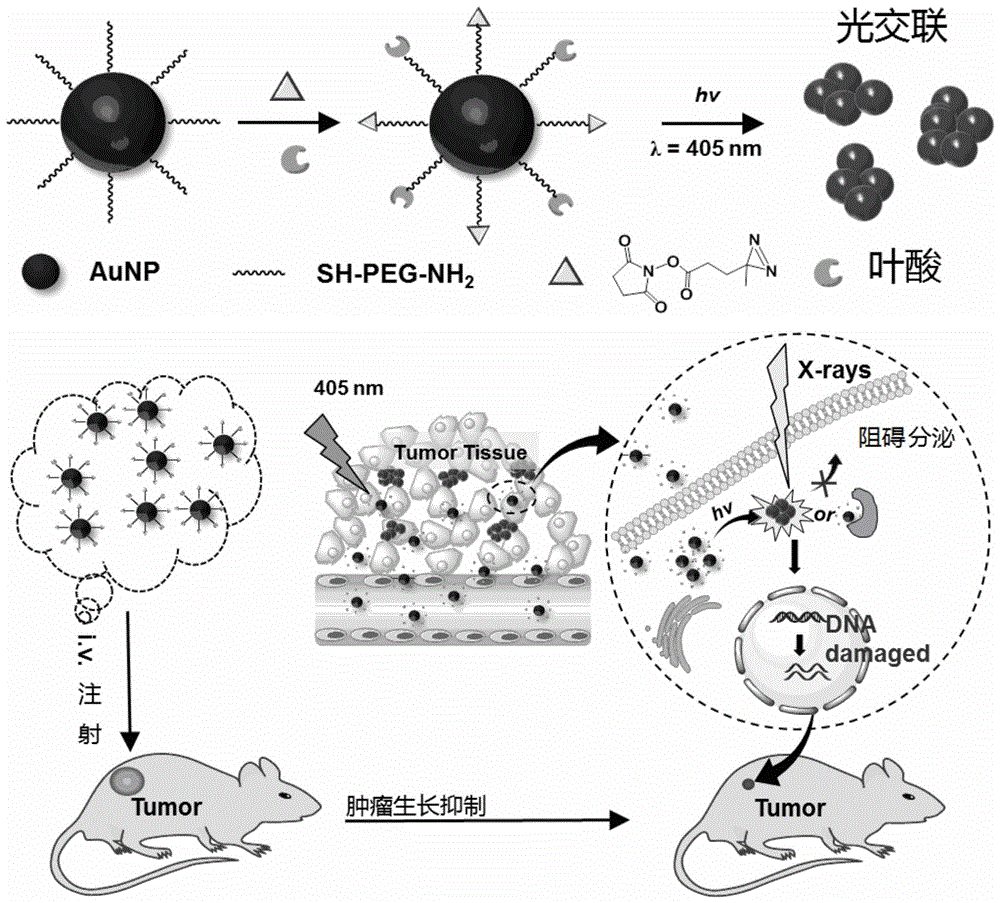
图1为实施例纳米颗粒表面PEG末端的交联剂和叶酸修饰过程以及金纳米颗粒在肿瘤放射增敏治疗中作用的示意图;1 is a schematic diagram of the cross-linking agent and folic acid modification process at the PEG end of the nanoparticle surface and the role of gold nanoparticles in tumor radiosensitization therapy;
图2为叶酸修饰的金纳米颗粒交联前后的紫外吸收和粒径变化情况图;Fig. 2 is a graph showing the changes of UV absorption and particle size before and after crosslinking of folic acid-modified gold nanoparticles;
图3为叶酸修饰的金纳米颗粒交联前后的TEM图;Fig. 3 is the TEM images of folic acid-modified gold nanoparticles before and after cross-linking;
图4为暗场显微镜图像显示叶酸修饰的金纳米颗粒的细胞内吞情况;Figure 4 is a dark-field microscope image showing the endocytosis of folic acid-modified gold nanoparticles;
图5为叶酸修饰的金纳米颗粒经紫外光诱导交联前后小动物CT图像;Fig. 5 shows the CT images of small animals before and after UV-induced cross-linking of gold nanoparticles modified with folic acid;
图6为叶酸修饰的金纳米颗粒经紫外光诱导交联前后的细胞水平放射增敏研究;Figure 6 is a cell-level radiosensitization study of folic acid-modified gold nanoparticles before and after UV-induced crosslinking;
图7为叶酸修饰的金纳米颗粒经紫外光诱导交联前后的动物水平放射增敏研究。Figure 7 shows the animal-level radiosensitization study of folic acid-modified gold nanoparticles before and after UV-induced crosslinking.
具体实施方式Detailed ways
下文将结合附图和具体实施例来进一步阐述本发明。应当理解的是,这些实施例仅用于解释和说明本发明中的技术方案,而并非旨在限制本发明的范围。此外,除非另有说明,下列实施例中所使用的材料、试剂、仪器等均可通过商业手段获得。The present invention will be further described below with reference to the accompanying drawings and specific embodiments. It should be understood that these embodiments are only used to explain and illustrate the technical solutions of the present invention, but are not intended to limit the scope of the present invention. In addition, unless otherwise stated, the materials, reagents, instruments, etc. used in the following examples are all commercially available.
实施例一Example 1
向超纯水(100 mL)中加入1%的氯金酸溶液(0.6 mL),加热至100℃,剧烈搅拌至沸腾后加入1%的柠檬酸钠溶液(3 mL),待体系变成酒红色后,继续煮沸30 min,得到金纳米颗粒原液。Add 1% chloroauric acid solution (0.6 mL) to ultrapure water (100 mL), heat to 100 °C, stir vigorously until boiling, add 1% sodium citrate solution (3 mL), and wait until the system becomes wine After turning red, continue to boil for 30 min to obtain the gold nanoparticle stock solution.
向金纳米颗粒原液(100 mL,内含金纳米颗粒1 mg)中依次加入M-PEG5000-SH(20mg)和NH2-PEG5000-SH(20 mg),于室温搅拌24h。经超滤离心(5000 rpm × 10 min)5次,除掉多余的PEG。离心后用超纯水重悬,得到PEG修饰的氨基功能化金纳米颗粒母液。M-PEG 5000 -SH (20 mg) and NH 2 -PEG 5000 -SH (20 mg) were sequentially added to the gold nanoparticle stock solution (100 mL, containing 1 mg of gold nanoparticles), and stirred at room temperature for 24 h. Excess PEG was removed by ultrafiltration centrifugation (5000 rpm × 10 min) 5 times. After centrifugation, it was resuspended in ultrapure water to obtain the PEG-modified amino-functionalized gold nanoparticle mother solution.
向制得的经PEG修饰的氨基功能化金纳米颗粒母液(100 mL,内含经PEG修饰的氨基功能化金纳米颗粒1 mg)中紫外光敏感性交联剂(2.7 mg)和三乙胺(2.4 mg),于室温搅拌反应4 h。经超滤离心(5000 rpm × 10 min)3次后,得到紫外光敏感性交联剂修饰的金纳米颗粒。通过测定反应前后溶液中紫外光敏感性交联剂的浓度,经计算可知,大约0.88 µmol的紫外光敏感性交联剂偶联于纳米颗粒表面。To the prepared PEG-modified amino-functionalized gold nanoparticles stock solution (100 mL, containing 1 mg of PEG-modified amino-functionalized gold nanoparticles), UV-sensitive crosslinking agent (2.7 mg) and triethylamine ( 2.4 mg), and the reaction was stirred at room temperature for 4 h. After ultrafiltration centrifugation (5000 rpm × 10 min) for 3 times, gold nanoparticles modified with UV-sensitive crosslinking agent were obtained. By measuring the concentration of the UV-sensitive cross-linking agent in the solution before and after the reaction, it was calculated that about 0.88 μmol of the UV-sensitive cross-linking agent was coupled to the surface of the nanoparticles.
所述紫外光敏感性交联剂的化学结构式如下:The chemical structural formula of the ultraviolet light-sensitive crosslinking agent is as follows:

在紫外光敏感的金纳米颗粒表面剩余PEG末端氨基上修饰肿瘤靶向叶酸分子:Modification of tumor-targeted folic acid molecules on the remaining PEG terminal amino groups on the surface of UV-sensitive gold nanoparticles:
首先,将叶酸:1-(3-二甲氨基丙基)-3-乙基碳二亚胺(EDC):N-N-羟基琥珀酰亚胺(NHS)=1:2:2的摩尔比,在DMSO溶剂中活化2小时,随后将紫外光敏感性交联剂修饰的金纳米颗粒水溶液(1 mL,1 mg/mL)加入,室温搅拌过夜。经超滤离心,得到叶酸修饰的金纳米颗粒。First, the molar ratio of folic acid: 1-(3-dimethylaminopropyl)-3-ethylcarbodiimide (EDC): N-N-hydroxysuccinimide (NHS) = 1:2:2 was After activation in DMSO solvent for 2 hours, an aqueous solution of gold nanoparticles modified with UV-sensitive crosslinking agent (1 mL, 1 mg/mL) was added and stirred overnight at room temperature. After ultrafiltration and centrifugation, folic acid-modified gold nanoparticles were obtained.
实施例二
将实施例一制得的叶酸修饰的金纳米颗粒用超纯水重悬,置于紫外灯(405 nm,1W/cm2)下照射10 min,便可诱导金纳米颗粒发生交联,得到叶酸修饰的金纳米颗粒交联体。The folic acid-modified gold nanoparticles prepared in Example 1 were resuspended in ultrapure water and placed under an ultraviolet lamp (405 nm, 1W/cm 2 ) for 10 min to induce cross-linking of the gold nanoparticles to obtain folic acid. Modified gold nanoparticle crosslinkers.
纳米颗粒表面PEG末端的交联剂以及叶酸修饰过程以及紫外光触发的纳米颗粒交联过程的示意图如图1所示。The schematic diagrams of the cross-linking agent at the PEG end of the nanoparticle surface and the modification process of folic acid and the cross-linking process of the nanoparticle triggered by UV light are shown in Figure 1.
实施例三 金纳米颗粒交联前后的水合粒径分布和紫外吸收的变化以及TEM图像Example 3 Changes of hydrated particle size distribution, UV absorption and TEM images of gold nanoparticles before and after crosslinking
将上述叶酸修饰的金纳米颗粒水溶液(母液)、叶酸修饰的金纳米颗粒交联体水溶液(母液)100 μL(2 mg/mL)分别用水稀释至2 mL,测试其粒径分布(DLS)和紫外吸收情况。The above-mentioned folic acid-modified gold nanoparticle aqueous solution (mother solution) and folic acid-modified gold nanoparticle cross-linked body aqueous solution (mother solution) 100 μL (2 mg/mL) were diluted with water to 2 mL, respectively, and their particle size distribution (DLS) and UV absorption.
如图2a所示,叶酸修饰的金纳米颗粒的水合粒径分布较为均匀(约为60 nm),经紫外激光器(405 nm,25 min)照射的叶酸修饰的金纳米颗粒能发生交联聚集,水合粒径约为300 nm。As shown in Figure 2a, the hydrated particle size distribution of the folic acid-modified gold nanoparticles is relatively uniform (about 60 nm), and the folic acid-modified gold nanoparticles can be cross-linked and aggregated when irradiated by an ultraviolet laser (405 nm, 25 min). The hydrated particle size is about 300 nm.
图2b是金纳米颗粒光触发交联聚集后的紫外吸收变化。未经过紫外光照射的叶酸修饰的金纳米颗粒的最大吸收在524 nm左右,经紫外激光(405 nm)照射后的叶酸修饰的金纳米颗粒交联体除了在536 nm左右有一个吸收峰以外,在700~800 nm区间吸收也有明显增强。Figure 2b is the UV absorption change of gold nanoparticles after light-triggered cross-linking aggregation. The maximum absorption of folic acid-modified gold nanoparticles without UV light irradiation is around 524 nm, and the cross-linked folic acid-modified gold nanoparticles after irradiation with UV laser (405 nm) has an absorption peak around 536 nm. The absorption is also significantly enhanced in the range of 700-800 nm.
图3a-3b是紫外激光照射后叶酸修饰的金纳米颗粒的TEM图像,可以明显看到未经过紫外光照射的叶酸修饰的金纳米颗粒的粒径在20 nm左右(见图3a),经紫外激光(405nm)照射后的叶酸修饰的金纳米颗粒发生了明显的聚集现象(见图3b)。Figures 3a-3b are TEM images of folic acid-modified gold nanoparticles after UV laser irradiation. It can be clearly seen that the particle size of folic acid-modified gold nanoparticles without UV light irradiation is about 20 nm (see Figure 3a). The folic acid-modified gold nanoparticles showed obvious aggregation phenomenon after laser (405 nm) irradiation (see Fig. 3b).
实施例四 经叶酸修饰的光响应的金纳米颗粒对肿瘤细胞的靶向功能Example 4 Targeting function of folic acid-modified light-responsive gold nanoparticles on tumor cells
将上述叶酸修饰的金纳米颗粒母液、叶酸修饰的金纳米颗粒交联体母液(2 mg/mL)用含10%血清培养基稀释至50 μg/mL,与小鼠乳腺癌细胞(4T1)孵育不同时间(2、6、10、24 h),然后用ICP-MS测细胞内的金元素含量,同时利用暗场显微镜直接观察金颗粒在细胞内的情况。The above folic acid-modified gold nanoparticle stock solution and folic acid-modified gold nanoparticle cross-linked stock solution (2 mg/mL) were diluted to 50 μg/mL with 10% serum-containing medium, and incubated with mouse breast cancer cells (4T1). At different times (2, 6, 10, 24 h), the intracellular gold content was measured by ICP-MS, and the intracellular condition of gold particles was directly observed by dark field microscopy.
如图4a ICP-MS结果所示,随着金纳米颗粒与细胞的孵育时间延长,细胞内的金元素含量逐渐增多,并且未经叶酸修饰的金纳米颗粒的细胞内的金元素含量明显少于经叶酸修饰的金纳米颗粒。同时如图4b所示,在孵育24 h后,暗场显微镜结果也明显看到有叶酸修饰的金纳米颗粒明显多于未经叶酸修饰的金纳米颗粒。这证明经叶酸修饰后的金纳米颗粒可以通过配体-受体靶向系统更加有利于被肿瘤细胞内吞。As shown in Figure 4a ICP-MS results, with the prolongation of the incubation time of gold nanoparticles and cells, the intracellular gold element content gradually increased, and the intracellular gold element content of gold nanoparticles without folic acid modification was significantly less than Gold nanoparticles modified with folic acid. At the same time, as shown in Figure 4b, after incubation for 24 h, the dark-field microscopy results also clearly showed that the gold nanoparticles modified with folic acid were significantly more than those without folic acid modification. This proves that the gold nanoparticles modified with folic acid can be more favorably endocytosed by tumor cells through the ligand-receptor targeting system.
实施例五 叶酸修饰的金纳米颗粒在肿瘤部位交联的CT显像以及TEM图像Example 5 CT and TEM images of cross-linking of folic acid-modified gold nanoparticles at tumor sites
将叶酸修饰的金纳米颗粒母液200 μL(5 mg/mL)尾静脉注射到BALB/C小鼠体内,然后用小动物CT成像系统不同时间点观察金纳米颗粒在肿瘤部位的CT成像。200 μL (5 mg/mL) of folic acid-modified gold nanoparticles stock solution was injected into BALB/C mice via tail vein, and then the CT imaging of gold nanoparticles at tumor sites was observed at different time points with a small animal CT imaging system.
如图5a所示,在小鼠尾静脉注射金纳米颗粒3 h之后,未经过和经过紫外光照射的小鼠肿瘤CT显像结果有差别,可以看到在48 h之后,经过紫外光照射的肿瘤部位CT增强明显,而未经过紫外光照射的肿瘤部位CT成像效果已经不明显了。同时如图5b所示,不同时间点的肿瘤部位CT值也能看出经过紫外光照射的金纳米颗粒交联在肿瘤部位CT值明显高于未经紫外光照射的,这说明经过紫外光交联之后的金纳米颗粒在肿瘤部位的滞留时间明显延长。As shown in Figure 5a, 3 hours after the mice were injected with gold nanoparticles into the tail vein, there were differences in the CT imaging results of the tumors of the mice without and those irradiated by UV light. The CT enhancement of the tumor site is obvious, but the CT imaging effect of the tumor site that has not been irradiated by ultraviolet light is not obvious. At the same time, as shown in Figure 5b, the CT values of the tumor site at different time points can also be seen that the CT value of the gold nanoparticles cross-linked after UV light irradiation is significantly higher than that of the tumor site without UV light irradiation, which indicates that after UV light cross-linking The retention time of the gold nanoparticles in the tumor site was significantly prolonged after conjugation.
如图5c所示,分别将尾静脉注射后9、24、48 h的肿瘤做组织切片,可以看到经过紫外光照射的肿瘤部位内有金纳米颗粒交联聚集,而未经过紫外光照射的肿瘤部位内金纳米颗粒相对较少并且没有发生交联聚集。相对应的肿瘤组织内金元素含量用ICP-MS测定(见图5d),也可以得到一致结论。同时采用未经过紫外光照射的作为对比(其他制备方法一样),发现肿瘤组织内金元素含量较经过紫外光照射少大约35%。As shown in Figure 5c, the tumors at 9, 24, and 48 h after tail vein injection were taken as tissue sections. It can be seen that gold nanoparticles are cross-linked and aggregated in the tumor sites irradiated by UV light, while those that have not been irradiated by UV light can be seen. There were relatively few gold nanoparticles within the tumor site and no cross-linked aggregation occurred. The corresponding gold content in tumor tissue was determined by ICP-MS (see Figure 5d), and consistent conclusions could also be drawn. At the same time, using the non-UV irradiation as a comparison (the same as other preparation methods), it was found that the gold content in the tumor tissue was about 35% less than that after UV irradiation.
实施例六 叶酸修饰的金纳米颗粒在细胞水平的放射增敏Example 6 Radiosensitization of folic acid-modified gold nanoparticles at the cellular level
将叶酸修饰的金纳米颗粒母液100 μL,2 mg/mL用含10%血清培养基稀释至50 μg/mL,与小鼠乳腺癌细胞(4T1)孵育24 h之后。分为五组(Control组,λ405 nm组,RT组,Au+RT组,Au+λ405 nm+RT组,Au指加入叶酸修饰的金纳米颗粒;λ405 nm指405 nm紫外激光照射(1 W/cm2,3min);RT指X射线机照射(4 Gy);细胞生长24 h后测live/dead染色以及DNA损伤,荧光显微镜拍照。100 μL of folic acid-modified gold nanoparticles stock solution, 2 mg/mL was diluted to 50 μg/mL with 10% serum-containing medium, and incubated with mouse breast cancer cells (4T1) for 24 h. Divided into five groups (Control group, λ 405 nm group, RT group, Au+RT group, Au+λ 405 nm+RT group, Au refers to gold nanoparticles modified with folic acid; λ 405 nm refers to 405 nm ultraviolet laser irradiation ( 1 W/cm 2 , 3 min); RT refers to X-ray machine irradiation (4 Gy); after 24 h of cell growth, live/dead staining and DNA damage were measured and photographed by fluorescence microscope.
从图6a中可以看出,叶酸修饰的金纳米颗粒在细胞孵育下经过405 nm紫外光照射(1 W/cm2,3 min)后,金纳米颗粒在细胞内发生交联聚集,经过X射线机照射(4 Gy)后,死细胞(红色)较其他组别明显增多,活细胞(绿色)较其他组别明显减少,说明本发明的方法能够在细胞内实现金纳米颗粒的交联,并具有较好的放射增敏治疗效果,能够有效杀死肿瘤细胞。It can be seen from Figure 6a that after the folic acid-modified gold nanoparticles were irradiated with 405 nm ultraviolet light (1 W/cm 2 , 3 min) under cell incubation, the gold nanoparticles were cross-linked and aggregated in the cells. After machine irradiation (4 Gy), dead cells (red) were significantly increased compared with other groups, and live cells (green) were significantly decreased compared with other groups, indicating that the method of the present invention can achieve intracellular cross-linking of gold nanoparticles, and It has good radiosensitization treatment effect and can effectively kill tumor cells.
从图6b中可以看出,叶酸修饰的金纳米颗粒在细胞孵育下经过405 nm紫外光照射(1 W/cm2,3 min)后,金纳米颗粒在细胞内发生交联聚集,经过X射线机照射(4 Gy)后,DNA损伤(红色的点)较其他组别明显增多,与live/dead结论一致,说明具有肿瘤靶向功能的的光响应的金纳米颗粒在细胞水平有很好的放射增敏效果。同时采用未经过紫外光照射的作为对比(其他制备方法一样),发现DNA损伤较经过紫外光照射少。It can be seen from Figure 6b that after the folic acid-modified gold nanoparticles were irradiated with 405 nm ultraviolet light (1 W/cm 2 , 3 min) under the cell incubation, the gold nanoparticles were cross-linked and aggregated in the cells, and after X-ray irradiation After machine irradiation (4 Gy), DNA damage (red dots) was significantly increased compared with other groups, which was consistent with the live/dead conclusion, indicating that the light-responsive gold nanoparticles with tumor-targeting function have a good effect at the cellular level. Radiosensitizing effect. At the same time, the DNA without UV irradiation was used as a comparison (the same as other preparation methods), and it was found that DNA damage was less than that after UV irradiation.
实施例10:具有肿瘤靶向功能的的光响应的金纳米颗粒在动物水平的放射增敏Example 10: Radiosensitization of light-responsive gold nanoparticles with tumor targeting function at animal level
将叶酸修饰的金纳米颗粒母液100 μL,2 mg/mL尾静脉注射到BALB/C小鼠体内,分为五组(Control组,λ405 nm组,RT组,Au+RT组,Au+λ405 nm+RT组,Au指加入叶酸修饰的金纳米颗粒;λ405 nm指405 nm紫外激光照射(1 W/cm2,25 min);RT指X射线机照射(4 Gy两次,第0天以及第二天照射);然后隔天记录肿瘤大小。BALB/C mice were divided into five groups (Control group, λ 405 nm group, RT group, Au+RT group, Au+λ 405 nm+RT group, Au refers to gold nanoparticles modified with folic acid; λ 405 nm refers to 405 nm ultraviolet laser irradiation (1 W/cm 2 , 25 min); RT refers to X-ray machine irradiation (4 Gy twice, the 0th day and the second day of irradiation); tumor size was then recorded every other day.
如图7所示,叶酸修饰的金纳米颗粒在尾静脉注射小鼠体内之后经过405 nm紫外光照射后,金纳米颗粒在肿瘤内发生交联聚集,经过X射线机照射后,肿瘤增长较其他组别被明显抑制,说明具有肿瘤靶向功能的的光响应的金纳米颗粒在动物水平有很好的放射增敏效果。同时采用不加叶酸、未经过紫外光照射的作为对比(其他制备方法一样),发现肿瘤体积与RT组都差不多。As shown in Figure 7, after folate-modified gold nanoparticles were irradiated with 405 nm ultraviolet light after tail vein injection into mice, the gold nanoparticles were cross-linked and aggregated in the tumor. The group was significantly inhibited, indicating that the light-responsive gold nanoparticles with tumor-targeting function have a good radiosensitization effect at the animal level. At the same time, no folic acid and no UV irradiation were used as a comparison (the other preparation methods were the same), and it was found that the tumor volume was similar to that of the RT group.
Claims (5)


Priority Applications (1)
| Application Number | Priority Date | Filing Date | Title |
|---|---|---|---|
| CN201810172584.9A CN108578427B (en) | 2018-03-01 | 2018-03-01 | Folic acid modified gold nanoparticle, preparation method thereof and application of gold nanoparticle in preparation of radiosensitization treatment drug |
Applications Claiming Priority (1)
| Application Number | Priority Date | Filing Date | Title |
|---|---|---|---|
| CN201810172584.9A CN108578427B (en) | 2018-03-01 | 2018-03-01 | Folic acid modified gold nanoparticle, preparation method thereof and application of gold nanoparticle in preparation of radiosensitization treatment drug |
Publications (2)
| Publication Number | Publication Date |
|---|---|
| CN108578427A CN108578427A (en) | 2018-09-28 |
| CN108578427B true CN108578427B (en) | 2020-11-17 |
Family
ID=63625628
Family Applications (1)
| Application Number | Title | Priority Date | Filing Date |
|---|---|---|---|
| CN201810172584.9A Expired - Fee Related CN108578427B (en) | 2018-03-01 | 2018-03-01 | Folic acid modified gold nanoparticle, preparation method thereof and application of gold nanoparticle in preparation of radiosensitization treatment drug |
Country Status (1)
| Country | Link |
|---|---|
| CN (1) | CN108578427B (en) |
Families Citing this family (3)
| Publication number | Priority date | Publication date | Assignee | Title |
|---|---|---|---|---|
| US11266740B1 (en) | 2020-09-04 | 2022-03-08 | King Abdulaziz University | Noble metal nanoparticles with radial pores |
| CN114081948B (en) * | 2021-11-23 | 2023-07-11 | 无锡市人民医院 | PH-responsive nanoparticle self-assembled aggregate molecular probe and preparation method and application thereof |
| CN114949248B (en) * | 2022-05-10 | 2023-11-03 | 苏州大学 | Targeted synergistic retention type nanoparticle as well as preparation method and application thereof |
Citations (4)
| Publication number | Priority date | Publication date | Assignee | Title |
|---|---|---|---|---|
| CN103768614A (en) * | 2013-11-08 | 2014-05-07 | 盐城工学院 | Antitumor medicine conjugate with folic acid receptor-mediated and photoresponsive functions, and preparation method thereof |
| CN104147608A (en) * | 2014-07-16 | 2014-11-19 | 东华大学 | Lithium amide soapstone nano particles modified by polyethylene glycol-folic acid as well as preparation and application of lithium amide soapstone nano particles |
| CN105381474A (en) * | 2015-12-10 | 2016-03-09 | 东华大学 | Preparation method of folic acid modified ferriferrous oxide/gold star-shaped nanoparticles |
| CN106267200A (en) * | 2016-03-09 | 2017-01-04 | 苏州大学 | Nanoparticle self-assembled aggregate mediated by ultraviolet light, its preparation method and application |
Family Cites Families (5)
| Publication number | Priority date | Publication date | Assignee | Title |
|---|---|---|---|---|
| US20120232225A1 (en) * | 2009-08-26 | 2012-09-13 | The Regents Of The University Of Michigan | Synthesis and isolation of dendrimer systems |
| US20110251138A1 (en) * | 2010-04-08 | 2011-10-13 | Ravikuma Kabyadi Seetharama | Lipoic acid metabolite conjugate: preparation and their therapeutic effect |
| US20150004096A1 (en) * | 2013-06-28 | 2015-01-01 | Bbs Nanotechnology Ltd. | Tumorspecific SPECT/MR(T1), SPECT/MR(T2) and SPECT/CT contrast agents |
| CN104587485B (en) * | 2014-12-24 | 2017-08-04 | 中国科学院近代物理研究所 | Preparation method and application of tirapazamine-gold nanoparticle composite |
| CN106729738B (en) * | 2016-12-14 | 2019-07-16 | 苏州大学 | A kind of dendritic gold-platinum bimetallic nanoparticle and its preparation method and application |
-
2018
- 2018-03-01 CN CN201810172584.9A patent/CN108578427B/en not_active Expired - Fee Related
Patent Citations (4)
| Publication number | Priority date | Publication date | Assignee | Title |
|---|---|---|---|---|
| CN103768614A (en) * | 2013-11-08 | 2014-05-07 | 盐城工学院 | Antitumor medicine conjugate with folic acid receptor-mediated and photoresponsive functions, and preparation method thereof |
| CN104147608A (en) * | 2014-07-16 | 2014-11-19 | 东华大学 | Lithium amide soapstone nano particles modified by polyethylene glycol-folic acid as well as preparation and application of lithium amide soapstone nano particles |
| CN105381474A (en) * | 2015-12-10 | 2016-03-09 | 东华大学 | Preparation method of folic acid modified ferriferrous oxide/gold star-shaped nanoparticles |
| CN106267200A (en) * | 2016-03-09 | 2017-01-04 | 苏州大学 | Nanoparticle self-assembled aggregate mediated by ultraviolet light, its preparation method and application |
Also Published As
| Publication number | Publication date |
|---|---|
| CN108578427A (en) | 2018-09-28 |
Similar Documents
| Publication | Publication Date | Title |
|---|---|---|
| Wang et al. | Tumor cell-targeting and tumor microenvironment–responsive nanoplatforms for the multimodal imaging-guided photodynamic/photothermal/chemodynamic treatment of cervical cancer | |
| Zhang et al. | Polydopamine nanoparticles camouflaged by stem cell membranes for synergistic chemo-photothermal therapy of malignant bone tumors | |
| Shen et al. | pH-responsive aerobic nanoparticles for effective photodynamic therapy | |
| Cui et al. | Renal clearable Ag nanodots for in vivo computer tomography imaging and photothermal therapy | |
| Wang et al. | Ag@ Fe3O4@ C nanoparticles for multi-modal imaging-guided chemo-photothermal synergistic targeting for cancer therapy | |
| CN109771442B (en) | Composite nano-particles for sensitizing tumor radiotherapy and preparation method and application thereof | |
| Yao et al. | Construction of magnetic-carbon-quantum-dots-probe-labeled apoferritin nanocages for bioimaging and targeted therapy | |
| Zhao et al. | Multifunctional magnetic nanoparticles for simultaneous cancer near-infrared imaging and targeting photodynamic therapy | |
| CN105582554B (en) | Core-shell structured nanomaterials, preparation method and application | |
| Li et al. | A near-infrared light-controlled smart nanocarrier with reversible polypeptide-engineered valve for targeted fluorescence-photoacoustic bimodal imaging-guided chemo-photothermal therapy | |
| Cheng et al. | Fabrication of multifunctional triple-responsive platform based on CuS-capped periodic mesoporous organosilica nanoparticles for chemo-photothermal therapy | |
| CN114522151B (en) | Integrated bionic nanoplatform based on hollow polydopamine nanoparticles and its preparation and application | |
| CN105031651B (en) | A kind of enzyme response type magnetic nano particle and preparation method and application | |
| CN108578427B (en) | Folic acid modified gold nanoparticle, preparation method thereof and application of gold nanoparticle in preparation of radiosensitization treatment drug | |
| CN107899013A (en) | A kind of preparation method of the meso-porous titanium dioxide manganese nano medicament carrying system with photodynamic therapy switching effect and Molecular Recognization | |
| Lin et al. | Nucleic acid-MOF nanoparticle conjugates for NIR/ATP-driven synergetic photo-chemotherapy with hypoxia relief | |
| CN109157662B (en) | A kind of human serum albumin-doxorubicin cross-linked nanoparticle and its application | |
| Li et al. | Albumin-stabilized polydopamine nanoparticles for chemo-photothermal synergistic therapy of melanoma | |
| Karami et al. | Synthesis, characterization, and in vitro analysis of a chitosan/gamma alumina/graphene quantum dots/bio-hydrogel for quercetin delivery to lung cancer cells | |
| Zhou et al. | Zn2+-interference and H2S-mediated gas therapy based on ZnS-tannic acid nanoparticles synergistic enhancement of cell apoptosis for specific treatment of prostate cancer | |
| Zhang et al. | Combined chemo-and photothermal therapies of non-small cell lung cancer using polydopamine/au hollow nanospheres loaded with doxorubicin | |
| Yang et al. | Synthetic carbon-based lanthanide upconversion nanoparticles for enhanced photothermal therapy | |
| CN114456310B (en) | Nanogel-carbon dot composite material, its preparation method and application | |
| CN105641717A (en) | Hyperstable monodisperse fluorescent magnetic nano probe and preparation and application thereof | |
| Chen et al. | Facile fabrication of near-infrared-resonant and magnetic resonance imaging-capable nanomediators for photothermal therapy |
Legal Events
| Date | Code | Title | Description |
|---|---|---|---|
| PB01 | Publication | ||
| PB01 | Publication | ||
| SE01 | Entry into force of request for substantive examination | ||
| SE01 | Entry into force of request for substantive examination | ||
| GR01 | Patent grant | ||
| GR01 | Patent grant | ||
| CF01 | Termination of patent right due to non-payment of annual fee | ||
| CF01 | Termination of patent right due to non-payment of annual fee |
Granted publication date: 20201117 |