[go: up one dir, main page]

CN108573246B - A temporal action recognition method based on deep learning - Google Patents

A temporal action recognition method based on deep learning Download PDF

Info

Publication number
CN108573246B
CN108573246B CN201810431650.XA CN201810431650A CN108573246B CN 108573246 B CN108573246 B CN 108573246B CN 201810431650 A CN201810431650 A CN 201810431650A CN 108573246 B CN108573246 B CN 108573246B
Authority
CN
China
Prior art keywords
action
regression
section
clip
time
Prior art date
Legal status (The legal status is an assumption and is not a legal conclusion. Google has not performed a legal analysis and makes no representation as to the accuracy of the status listed.)
Active
Application number
CN201810431650.XA
Other languages
Chinese (zh)
Other versions
CN108573246A (en
Inventor
蔡轶珩
孔欣然
王雪艳
李媛媛
Current Assignee (The listed assignees may be inaccurate. Google has not performed a legal analysis and makes no representation or warranty as to the accuracy of the list.)
Beijing University of Technology
Original Assignee
Beijing University of Technology
Priority date (The priority date is an assumption and is not a legal conclusion. Google has not performed a legal analysis and makes no representation as to the accuracy of the date listed.)
Filing date
Publication date
Application filed by Beijing University of Technology filed Critical Beijing University of Technology
Priority to CN201810431650.XA priority Critical patent/CN108573246B/en
Publication of CN108573246A publication Critical patent/CN108573246A/en
Application granted granted Critical
Publication of CN108573246B publication Critical patent/CN108573246B/en
Active legal-status Critical Current
Anticipated expiration legal-status Critical

Links

Images

Classifications

    • GPHYSICS
    • G06COMPUTING OR CALCULATING; COUNTING
    • G06VIMAGE OR VIDEO RECOGNITION OR UNDERSTANDING
    • G06V20/00Scenes; Scene-specific elements
    • G06V20/40Scenes; Scene-specific elements in video content
    • G06V20/49Segmenting video sequences, i.e. computational techniques such as parsing or cutting the sequence, low-level clustering or determining units such as shots or scenes
    • GPHYSICS
    • G06COMPUTING OR CALCULATING; COUNTING
    • G06TIMAGE DATA PROCESSING OR GENERATION, IN GENERAL
    • G06T7/00Image analysis
    • G06T7/20Analysis of motion
    • G06T7/269Analysis of motion using gradient-based methods
    • GPHYSICS
    • G06COMPUTING OR CALCULATING; COUNTING
    • G06VIMAGE OR VIDEO RECOGNITION OR UNDERSTANDING
    • G06V20/00Scenes; Scene-specific elements
    • G06V20/40Scenes; Scene-specific elements in video content
    • G06V20/46Extracting features or characteristics from the video content, e.g. video fingerprints, representative shots or key frames

Landscapes

  • Engineering & Computer Science (AREA)
  • Theoretical Computer Science (AREA)
  • Physics & Mathematics (AREA)
  • General Physics & Mathematics (AREA)
  • Multimedia (AREA)
  • Computing Systems (AREA)
  • Computer Vision & Pattern Recognition (AREA)
  • Image Analysis (AREA)

Abstract

本发明公开一种基于深度学习的时序动作识别方法,包含视频特征提取和时间边界回归模型构建。针对边界检测过程中长动作特征表达有效性不够的问题,通过双流网络同时提取帧间信息和帧内信息,得到视频单元的特征序列,并提出结合上下文信息的多尺度短动作段截选方案,有效地提高后续回归准确率,利用特征序列训练时间边界模型,减小模型训练时间,提高计算效率。针对长动作边界回归不准确问题,本发明提出一种改进的时间边界回归模型,包含改进的多任务多层感知器和一种全新的针对长动作的拼接机制,在保证动作类别准确的基础上,有效地提高长动作时间边界回归的准确率,提高预测动作段与实际动作段的重叠度,实现时序动作识别率的提高。

Figure 201810431650

The invention discloses a time sequence action recognition method based on deep learning, which includes video feature extraction and time boundary regression model construction. Aiming at the problem that the long-action feature expression is not effective enough in the process of boundary detection, the inter-frame information and intra-frame information are simultaneously extracted through a dual-stream network to obtain the feature sequence of the video unit, and a multi-scale short-action segment selection scheme combined with context information is proposed. Effectively improve the follow-up regression accuracy, use the feature sequence to train the time boundary model, reduce the model training time, and improve the computational efficiency. Aiming at the problem of inaccurate long action boundary regression, the present invention proposes an improved time boundary regression model, which includes an improved multi-task multilayer perceptron and a brand new splicing mechanism for long actions. On the basis of ensuring the accuracy of action categories , effectively improve the accuracy of long-action time boundary regression, improve the overlap between the predicted action segment and the actual action segment, and improve the recognition rate of time-series actions.

Figure 201810431650

Description

Time sequence action identification method based on deep learning
Technical Field
The invention belongs to the field of computer vision and pattern recognition, and relates to a time sequence action recognition method based on deep learning.
Background
With the rapid development of smart phones and the internet, the blowout phenomenon of video data begins to appear, so the research in the field of computer vision is gradually expanded and extended in the direction of video data. The video processing is based on motion recognition, although the traditional motion recognition achieves a high recognition rate, the original data of the traditional motion recognition is a short video with a fixed frame number after being cut, and a single motion label is required to be included, so the cutting requirement is too harsh, but in practical application, the motion appears in the long video randomly, so the traditional motion recognition algorithm cannot meet the practical application scene. The time sequence action detection is a specific research aiming at the original long video without clipping, and is a further development of an action recognition task to the reality.
The time sequence action detection task is a video processing task which accurately segments an action segment and a background segment from an uncut long video and determines an action type. In view of the fact that the amount of long video data is too large, the time sequence action recognition method needs to be carried out in two steps, feature extraction and model construction. The method mainly selects a mature neural network in motion detection to extract feature vectors from a long video, and then constructs motion segments (clip) with different lengths through multiple strategy combinations for constructing a subsequent motion boundary model. Therefore, the problem that the training time is exponentially increased can be avoided by constructing the model after the characteristic sequence, the calculated amount is greatly reduced, and the parameter adjustment is easier. However, different action segment length construction rules and model construction strategies can greatly influence the accuracy of the action boundary, and because the accuracy of the current action category identification is high, the determination of the action boundary plays a crucial role in improving the final detection accuracy.
Disclosure of Invention
The invention aims to improve the recognition rate of time sequence actions in a long video by accurately acting time boundaries. On the basis of accurate detection of action categories, aiming at the problems of insufficient long action feature expression effectiveness and inaccurate long action boundary regression in the boundary detection process, a time sequence action recognition method based on deep learning is provided so as to effectively improve the overlapping degree of a predicted action section and an actual action section.
The invention provides a time sequence action recognition scheme aiming at an uncut video, which mainly comprises two parts: and (3) extracting video features and constructing a time boundary regression model.
In the feature extraction part, inter-frame motion information and intra-frame space information are simultaneously extracted according to the characteristics of the motion video. Firstly, preprocessing an original video sequence to obtain an optical flow graph of a video, laying a foundation for extracting inter-frame motion information, and sending the inter-frame motion information and original data which retains intra-frame space information into a double-flow network; and secondly, constructing an action section by combining the characteristic sequence output by the double-flow network with a multi-scale interception scheme of context information. According to the scheme, the time boundary regression model training is carried out by utilizing the characteristic sequence, so that the defect of computation amount increase caused by directly using original video data training is avoided, the model training time is shortened, the calculation efficiency is improved, the hardware cost of long video action detection is reduced, and more importantly, the subsequent regression accuracy can be effectively improved by combining the action section training model of context information.
In the regression model construction section, the invention provides an improved time boundary regression model. The model comprises a multitask multilayer perceptron and a brand new splicing mechanism aiming at long actions. The multi-task multi-layer sensor is used for obtaining a time boundary regression result, and a long action splicing mechanism is used as post-processing, so that the regression accuracy of long actions is further improved. Because the time sequence action detection task aims at the uncut long action video, when the action section is constructed by feature extraction, the length limitation influences, and partial action sections cannot contain complete long actions, the accuracy of the regression boundary is obviously reduced. In the face of the regression result of incomplete actions, the invention provides a splicing mechanism in a targeted manner, and the time sequence action recognition rate can be effectively improved through multi-condition judgment and short action integration.
The invention provides a method for judging incomplete paragraphs, which comprises the steps of overlapping rate, action probability and boundary offset, wherein three conditions are used for judging incomplete paragraphs. In order to obtain the various judgment data, the invention constructs an improved multi-task regression model when constructing an algorithm process, selects a multilayer perceptron and constructs a multi-task loss function, thereby improving the boundary regression performance. In conclusion, the invention further defines the action time boundary by constructing a feature extraction scheme combined with context information and a splicing mechanism regression model based on an improved multi-layer perceptron, and finally realizes the improvement of the time sequence action recognition rate.
The technical scheme of the invention is as follows:
the first step is as follows: extracting an optical flow graph from an original video sequence, organizing 16 frames of the optical flow graph into a basic video unit, defining the basic video unit as a unit, respectively sending the original sequence and the optical flow graph into a C3D network (based on a caffe platform and a 3DCNN network framework pre-trained by an activityNet data set), extracting an fc6 layer (a full connection layer) in the C3D network, obtaining a feature vector of each unit, and finally extracting all unit feature sequences from the original un-cropped long video.
The second step is that: and performing multi-scale context combination on the unit feature vector sequence to construct short action segment feature sequences with different lengths. Each short action segment is defined as a clip, and the length of the clip is set as m. In order to obtain a multi-scale clip to contain various action lengths, m is respectively set to be 2, 4, 8, 16, 32, 64 and 128 units, each unit in the first-step unit feature sequence is repeatedly spliced for 7 times according to the different m lengths, and then average pooling is carried out to obtain a multi-scale basic clip, so that each unit is contained in 7 time-scale clips. Then, splicing the front section and the back section at the left and the right of each basic clip respectively, wherein the lengths of the front section and the back section are all equal
Figure BDA0001653568020000031
Finally, the context information is connected, the prediction accuracy is improved, and the final clip length is obtained
Figure BDA0001653568020000032
Covering a variety of action lengths.
The third step: and (3) all the multi-scale clip segments are sent to a multi-layer perceptron to obtain action time boundary offset (including two offsets of a starting position and an ending position), action probability (two classifications of an action and a background), overlapping degree of a group true and three regression results.
Multitask multilayer perceptron setup: to achieve multi-layer perceptron multi-tasking regression results, a multi-tasking loss function is constructed as follows:
L=Lcls+λLreg+λLoverlap
the multilayer perceptron loss function L includes three parts: classification loss function LclsSelecting standard softmax function, regression loss function LregSelecting a multi-task standard mean square error loss function and an overlap degree loss function LoverlapAnd selecting a standard mean square error loss function, wherein lambda is a hyperparameter, and the total loss function of the multilayer perceptron is the sum of the three parts.
In the training process, the positive sample is selected to be the sample with the overlap rate of the positive sample and the ground true being more than 50%. The negative sample is a sample with the overlapping rate of less than 50%, and an adam optimizer is selected for parameter updating, wherein the adam optimizer improves the traditional gradient decrease through momentum (moving average of parameters) and promotes dynamic adjustment of the hyper-parameters. The learning rate of the multilayer perceptron (1000 hidden layer units can be set) is set to be 0.005, and lambda can be valued to be 2 according to experience.
The fourth step:
aiming at the clip which is not enough to cover the complete action in the third step part, the invention provides a splicing mechanism, and the detailed rule is as follows:
firstly, screening out incomplete action sections: sequentially judging according to the regression prediction result obtained in the third step; and secondly, gradually realizing the splicing of the adjacent action sections according to the judgment result. Defining the action start/end time offset obtained by the regression of the current segment as ts/teThe offset of the action start/end time of the next segment is tls/tleAnd setting a time offset threshold t (the length of the second step clip segment is equal to
Figure BDA0001653568020000041
the value of t may be between 0.1n and 0.2 n).
The splicing conditions were as follows:
and judging whether the current section is spliced with the next section in a circulating way, so as to realize screening of all incomplete action sections.
1. If teIf t, the subsequent stage needs to be further judged as follows:
a. if tlsIf t is less than t, the two sections of clip are incomplete and belong to the same action, and the two sections are spliced and connected to obtain a new clip sequence;
b. if tlsIf t is greater than t, the rear section is complete and does not need to be spliced with the current section.
2. If teAnd if the current section is not less than t, the current section does not need to be spliced with the next section.
And judging incomplete action sections of the regression results section by section according to the judging conditions, and splicing to obtain a time action boundary.
The fifth step:
and sequencing all possible action sections obtained after the processing of the splicing mechanism according to the action probability. Selecting Non-Maximum Suppression (soft-NMS), sorting the action boundary segments obtained by regression according to scores, reserving the action segment with the highest score, and reducing the confidence probability of the rest parts, wherein a specific score resetting function is shown as follows
Figure BDA0001653568020000042
Define M as the current scoring action segment, biFor the action section to be processed, siScoring the action segment, biThe greater iou (degree of overlap) of M, biScore s ofiThe lower. N is a radical oftThe iou threshold value can be between 0.1 and 0.8, the error deletion operation is reduced, and the final action boundary is established.
And a sixth step: directly using the C3D network as a classifier (pre-trained by an activityNet data set), and sending the action segments obtained in the previous step into the action classifier to obtain the final action category.
Has the advantages that:
aiming at the problems of overlarge uncut long video data and inaccurate regression of long action time boundary, the invention further defines the action time boundary by constructing a feature extraction scheme combined with context information and a splicing mechanism regression model based on an improved multi-layer perceptron, and finally realizes the improvement of the time sequence action recognition rate.
The invention selects the deep learning network with mature action recognition to extract the characteristic vector firstly, and does not directly aim at the original video data processing, so that the selection can obviously reduce the subsequent calculation amount and reduce the training time by times. When a basic short action section is constructed, the invention provides a multi-scale construction scheme for connecting an upper segment and a lower segment, so that context information can be considered when a regression result is predicted, the method is more sensitive to an action boundary, and the prediction accuracy is improved.
Aiming at the phenomenon that long action time boundary regression is not accurate due to the limitation of the length of a short action segment, the invention provides a long action splicing mechanism based on an improved multi-task multi-layer sensor. If the short action section constructed at the current section is not enough to cover the complete action, the preceding and following text of the short action section contain partial action sections, so that the method selectively splices the content section of the current short action and the following section through incomplete judgment of the section-by-section regression result, further accurately obtains the long action time regression result, effectively improves the recognition rate of the long action of the algorithm, achieves the effect of improving the prediction accuracy of the long action time boundary, and realizes the obvious improvement of the average prediction accuracy of the action boundary.
Drawings
Fig. 1 is an overall framework of the time sequence action recognition algorithm: an RGB sequence in which 16 frames are set as one video unit is input, and the motion type and the motion time coordinate are output.
FIG. 2 is an image data effect diagram after optical flow extraction, (a) is an x-direction optical flow diagram, (b) is an y-direction optical flow diagram, and (c) is an RGB image
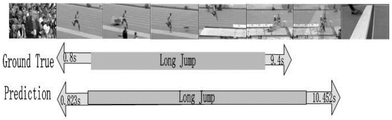
Fig. 3 is a schematic diagram of a time sequence action recognition result, which locates an action time boundary from video data to determine that the action type is long jump.
Detailed Description
The present invention will be described in detail below with reference to the accompanying drawings and specific embodiments.
In order to improve the subjective quality of the video, the invention considers the length limitation of the long action during multi-scale construction, provides a brand-new splicing mechanism aiming at incomplete action sections, effectively improves the accuracy of the long action boundary, and further accurately identifies the action sections by considering the context information. The invention discloses a time sequence action detection method based on deep learning, the flow is shown in figure 1,
the method specifically comprises the following steps:
the invention selects a time sequence action detection data set THUMOS Challenge 2014 as an experiment database, wherein the undivided videos containing 20 types of actions comprise time sequence action tags, and 200 verifier videos (comprising 3007 action segments) and 213 test videos (comprising 3358 action segments) are selected. Used for training and testing the time sequence action detection model respectively, and the unified resolution is 320 multiplied by 180.
The first step is as follows: extracting an optical flow graph from an original video sequence, organizing 16 frames of the optical flow graph into a basic video unit, defining the basic video unit as a unit, respectively sending the original sequence and the optical flow graph into a C3D network (based on a caffe platform and a 3DCNN network framework pre-trained by an activityNet data set), extracting an fc6 layer (a full connection layer) in the C3D network to obtain a feature vector of each unit, and finally extracting all unit feature sequences from the original uncut long video, wherein in the specific training process, the C3D features with the length of 16 frames are extracted by the overlapping degree of 0.5, and each unit obtains a 4096-dimensional feature vector, so that the unit feature sequences are extracted from the original long video.
The second step is that: and performing multi-scale context combination on the unit feature vector sequence to construct short action segment feature sequences with different lengths. Each short action segment is defined as a clip, and the length of the clip is set as m. In order to obtain a multi-scale clip to contain various action lengths, m is respectively set to be 2, 4, 8, 16, 32, 64 and 128 units, each unit in the first-step unit feature sequence is repeatedly spliced for 7 times according to the different m lengths, and then average pooling is carried out to obtain a multi-scale basic clip, so that each unit is contained in 7 time-scale clips. Then, splicing the front section and the back section at the left and the right of each basic clip respectively, wherein the lengths of the front section and the back section are all equal
Figure BDA0001653568020000061
Finally, the context information is connected, the prediction accuracy is improved, and the final clip length is obtained
Figure BDA0001653568020000062
Covering a variety of action lengths.
The third step: and respectively sending the final clip segment into a multi-layer perceptron to obtain action time boundary offset (comprising two offsets of a starting position and an ending position), action probability (two classifications of an action and a background), overlapping degree of the action and a ground true and three regression results.
Multitask multilayer perceptron setup: the multi-layer sensor can be provided with 1000 hidden layer units, and a multi-task loss function is constructed for realizing a multi-task regression result of the multi-layer sensor, and is as follows:
L=Lcls+λLreg+λLoverlap
the method comprises three parts: classification loss function LclsSelecting standard softmax function, regression loss function LregSelecting a multi-task mean square error loss function and an overlap degree loss function LoverlapAnd selecting a mean square error loss function, wherein lambda is a hyper-parameter, and the total loss function of the multilayer perceptron is the sum of the three parts.
In the training process, the positive sample is selected to be the sample with the overlap rate of the positive sample and the ground true being more than 50%. The negative sample is a sample with the overlapping rate of less than 50%, and the parameter is updated by using an adam optimizer, wherein the adam optimizer improves the traditional gradient decrease through momentum (the moving average of the parameter) and promotes the dynamic adjustment of the hyper-parameters. The learning rate is set to 0.005 and λ is empirically taken to be 2.
Fourthly, a splicing mechanism is as follows:
firstly, screening out incomplete action sections: judging according to the regression prediction result obtained in the third step; and secondly, splicing adjacent action sections according to the sequential circulating judgment result. Defining the action start/end time offset obtained by the regression of the current segment as ts/teThe offset of the action start/end time of the next segment is tls/tleAnd setting a time offset threshold t (the length of the second step clip segment is equal to
Figure BDA0001653568020000071
the value of t may be between 0.1n and 0.2 n).
The splicing conditions were as follows:
and judging whether the current section is spliced with the next section in a circulating way, so as to realize screening of all incomplete action sections.
1. If teIf t, the subsequent stage needs to be further judged as follows:
a. if tlsIf t is less than t, it indicates that the two clip sections are incomplete and belong to the same action, and the two clip sections are carried outSplicing and connecting to obtain a new clip sequence;
b. if tlsIf t is greater than t, the rear section is complete and does not need to be spliced with the current section.
2. If teAnd if the current section is not less than t, the current section does not need to be spliced with the next section.
And according to the judgment conditions, splicing judgment processing is carried out on the regression results section by section.
The fifth step: and sequencing all possible action sections obtained after the processing of the splicing mechanism according to the action probability. Selecting Non-Maximum Suppression (soft-NMS), sorting the action boundary segments obtained by regression according to scores, reserving the action segment with the highest score, and reducing the confidence probability of the rest parts, wherein a specific score resetting function is shown as follows
Figure BDA0001653568020000081
M is the current score action segment, biFor the action section to be processed, siScoring the action segment, biThe larger iou of M, biScore s ofiThe lower, NtThe iou threshold value can be between 0.1 and 0.8, the error deletion operation is reduced, and the final action boundary is established.
The method avoids the failure of target action detection caused by directly deleting all thresholds when the target action occurs in the overlapped areas of different boundaries by the conventional Non-Maximum Suppression (NMS), and improves the average detection rate of the algorithm, so the method selects the soft-NMS to establish the final action boundary.
And a sixth step: and (3) directly using the C3D network as a classifier (pre-trained by an activityNet data set), sending the final action section obtained in the fifth step into the 20 types of action classifiers to obtain a final action class, wherein when the iou threshold is 0.5, the accuracy is 24.6%.

Claims (1)

1. A time sequence action recognition method based on deep learning comprises two parts: extracting video features and constructing a time boundary regression model;
the method is characterized in that: in the characteristic extraction part, inter-frame motion information and intra-frame space information are simultaneously extracted according to the characteristics of the action video; firstly, preprocessing an original video sequence to obtain an optical flow graph of a video, laying a foundation for extracting inter-frame motion information, and sending the inter-frame motion information and original data which retains intra-frame space information into a double-flow network; secondly, constructing an action section by combining the characteristic sequence output by the double-current network with a multi-scale interception scheme of context information;
in a regression model construction part, the model comprises a multi-task multilayer perceptron and a brand-new splicing mechanism aiming at long actions; the multi-task multi-layer sensor is used for obtaining a time boundary regression result, a long action splicing mechanism is used as post-processing, a brand-new splicing mechanism needs to add various early stage regression results for carrying out splicing condition judgment, wherein the splicing condition judgment comprises an overlapping rate, action possible probability and boundary offset, and incomplete paragraph judgment is carried out on three conditions; selecting a multilayer perceptron and constructing a multitask loss function;
the method comprises the following specific steps:
the first step is as follows: extracting an optical flow graph from an original video sequence, organizing each 16 frames of the optical flow graph into a basic video unit, defining the basic video unit as a unit, respectively sending the original sequence and the optical flow graph into a C3D network in a unit form, extracting an fc6 layer and an fc6 layer in the C3D network as a full connection layer to obtain a feature vector of each unit, and finally extracting all unit feature sequences from the original un-cropped long video;
the second step is that: carrying out multi-scale context combination on the unit characteristic sequences to construct short action segment characteristic sequences with different lengths; each short action section is defined as a clip, and the length of the clip is set as m; in order to obtain a multi-scale clip to contain various action lengths, setting m to be 2, 4, 8, 16, 32, 64 and 128 unit lengths respectively, repeatedly splicing each unit in the first-step unit feature sequence for 7 times according to the different m lengths, and then carrying out average pooling to obtain a multi-scale basic clip so as to ensure that each unit is contained in clips of 7 time scales; then, on the left and right of each basic clip respectivelySplicing the front section and the rear section, the length is
Figure FDA0003356271980000011
Finally, the context information is connected, the prediction accuracy is improved, and the final clip length is obtained
Figure FDA0003356271980000012
Covering a plurality of action lengths;
the third step: sending all the multi-scale clip segments into a multi-layer perceptron to obtain action time boundary offsets, namely two offsets of a starting position and an ending position, action probability, namely two classifications of an action and a background, and an overlap degree with a ground true, namely a true action interval, and three regression results;
multitask multilayer perceptron setup: to achieve multi-layer perceptron multi-tasking regression results, a multi-tasking loss function is constructed as follows:
L=Lcls+λLreg+λLoverlap
the multilayer perceptron loss function L includes three parts: classification loss function LclsSelecting standard softmax function, regression loss function LregSelecting a multi-task standard mean square error loss function and an overlap degree loss function LoverlapSelecting a standard mean square error loss function, wherein lambda is a hyper-parameter, and the total loss function of the multilayer perceptron is the sum of the three parts;
in the training process, selecting a sample with the overlap rate of the positive sample and the ground true greater than 50%; the negative sample is a sample with the overlapping rate of less than 50%, an adam optimizer is selected for parameter updating, the learning rate of the multilayer perceptron is set to be 0.005, and the lambda value is 2;
the fourth step:
aiming at the clip which is not enough to cover the complete action in the third step part, a splicing mechanism is provided, and the detailed rule is as follows:
firstly, screening out incomplete action sections: sequentially judging according to the regression prediction result obtained in the third step; secondly, splicing adjacent action sections step by step according to a judgment result; defining the action obtained by regression of the current segmentOffset of start/end time ts/teThe offset of the action start/end time of the next segment is tls/tleSetting a time offset threshold t; from the length of the second clip segment to
Figure FDA0003356271980000021
The time offset threshold value t is between 0.1n and 0.2 n;
the splicing conditions were as follows:
judging whether the current section is spliced with the next section in a circulating way, and screening all incomplete action sections;
1) if te<t, then the subsequent segment needs to be further judged as follows:
a. if tls<t, the two sections of clip are incomplete and belong to the same action, and the two sections are spliced and connected to obtain a new clip sequence;
b. if tls>t, the rear section is complete and does not need to be spliced with the current section;
2) if teIf the current section is more than or equal to t, the current section does not need to be spliced with the next section;
judging incomplete action sections of the regression results section by section according to the judging conditions, and splicing to obtain a time action boundary;
the fifth step:
sequencing all possible action sections obtained after the processing of the splicing mechanism according to the action probability; selecting non-maximum value to inhibit, sorting the action boundary segments obtained by regression according to scores, retaining the action segment with the highest score, reducing the confidence probability of the rest parts, and using the specific score resetting function as shown in the specification
Figure FDA0003356271980000022
Define M as the current scoring action segment, biFor the action section to be processed, siScoring the action segment, biThe greater the degree of iou overlap with M, biScore s ofiThe lower;Nttaking the iou threshold value as 0.1-0.8;
and a sixth step: directly using the C3D network as a classifier, and sending the action segment obtained in the previous step into the action classifier to obtain the final action category.
CN201810431650.XA 2018-05-08 2018-05-08 A temporal action recognition method based on deep learning Active CN108573246B (en)

Priority Applications (1)

Application Number Priority Date Filing Date Title
CN201810431650.XA CN108573246B (en) 2018-05-08 2018-05-08 A temporal action recognition method based on deep learning

Applications Claiming Priority (1)

Application Number Priority Date Filing Date Title
CN201810431650.XA CN108573246B (en) 2018-05-08 2018-05-08 A temporal action recognition method based on deep learning

Publications (2)

Publication Number Publication Date
CN108573246A CN108573246A (en) 2018-09-25
CN108573246B true CN108573246B (en) 2022-04-05

Family

ID=63571913

Family Applications (1)

Application Number Title Priority Date Filing Date
CN201810431650.XA Active CN108573246B (en) 2018-05-08 2018-05-08 A temporal action recognition method based on deep learning

Country Status (1)

Country Link
CN (1) CN108573246B (en)

Families Citing this family (18)

* Cited by examiner, † Cited by third party
Publication number Priority date Publication date Assignee Title
CN109493370B (en) * 2018-10-12 2021-07-02 西南交通大学 A Target Tracking Method Based on Spatial Offset Learning
CN109409307B (en) * 2018-11-02 2022-04-01 深圳龙岗智能视听研究院 Online video behavior detection method based on space-time context analysis
CN111382624B (en) * 2018-12-28 2023-08-11 杭州海康威视数字技术股份有限公司 Action recognition method, device, equipment and readable storage medium
CN109886225B (en) * 2019-02-27 2020-09-15 浙江理工大学 Image gesture action online detection and recognition method based on deep learning
CN109977262B (en) * 2019-03-25 2021-11-16 北京旷视科技有限公司 Method and device for acquiring candidate segments from video and processing equipment
CN110110648B (en) * 2019-04-30 2020-03-17 北京航空航天大学 Action nomination method based on visual perception and artificial intelligence
CN110111358B (en) * 2019-05-14 2022-05-24 西南交通大学 Target tracking method based on multilayer time sequence filtering
CN110232339B (en) * 2019-05-29 2021-02-19 西安交通大学 Contrast-based weak supervision timing sequence action positioning evaluation method and system
CN110348345B (en) * 2019-06-28 2021-08-13 西安交通大学 A Weakly Supervised Temporal Action Localization Method Based on Action Coherence
CN112422863B (en) 2019-08-22 2022-04-12 华为技术有限公司 A video shooting method, electronic device and storage medium
CN111104855B (en) * 2019-11-11 2023-09-12 杭州电子科技大学 A workflow identification method based on sequential behavior detection
CN111898461B (en) * 2020-07-08 2022-08-30 贵州大学 Time sequence behavior segment generation method
CN113591529B (en) * 2021-02-23 2025-04-04 腾讯科技(深圳)有限公司 Action segmentation model processing method, device, computer equipment and storage medium
CN113516030B (en) * 2021-04-28 2024-03-26 上海科技大学 Action sequence verification method and device, storage medium and terminal
CN114821774B (en) * 2022-04-18 2025-07-25 南京大学 Time sequence action detection method and detector based on anchor-free frame technology
CN114898465B (en) * 2022-05-11 2025-08-26 咪咕文化科技有限公司 Action boundary detection model, model training method, device and storage medium
CN115588230A (en) * 2022-08-31 2023-01-10 中国地质大学(武汉) Time-series action detection method and computer equipment based on high-precision boundary prediction
CN116051823A (en) * 2022-11-01 2023-05-02 每平每屋(上海)科技有限公司 Image processing method, electronic device and computer storage medium

Citations (3)

* Cited by examiner, † Cited by third party
Publication number Priority date Publication date Assignee Title
CN106845351A (en) * 2016-05-13 2017-06-13 苏州大学 It is a kind of for Activity recognition method of the video based on two-way length mnemon in short-term
CN107292249A (en) * 2017-06-08 2017-10-24 深圳市唯特视科技有限公司 A kind of time motion detection method based on structuring segmented network
CN107480642A (en) * 2017-08-18 2017-12-15 深圳市唯特视科技有限公司 A kind of video actions recognition methods based on Time Domain Piecewise network

Family Cites Families (1)

* Cited by examiner, † Cited by third party
Publication number Priority date Publication date Assignee Title
US10032067B2 (en) * 2016-05-28 2018-07-24 Samsung Electronics Co., Ltd. System and method for a unified architecture multi-task deep learning machine for object recognition

Patent Citations (3)

* Cited by examiner, † Cited by third party
Publication number Priority date Publication date Assignee Title
CN106845351A (en) * 2016-05-13 2017-06-13 苏州大学 It is a kind of for Activity recognition method of the video based on two-way length mnemon in short-term
CN107292249A (en) * 2017-06-08 2017-10-24 深圳市唯特视科技有限公司 A kind of time motion detection method based on structuring segmented network
CN107480642A (en) * 2017-08-18 2017-12-15 深圳市唯特视科技有限公司 A kind of video actions recognition methods based on Time Domain Piecewise network

Non-Patent Citations (1)

* Cited by examiner, † Cited by third party
Title
结合有序光流图和双流卷积网络的行为识别;李庆辉等;《光学学报》;20180130(第06期);第234-240页 *

Also Published As

Publication number Publication date
CN108573246A (en) 2018-09-25

Similar Documents

Publication Publication Date Title
CN108573246B (en) A temporal action recognition method based on deep learning
CN113627389B (en) Optimization method and equipment for target detection
CN109800778B (en) Faster RCNN target detection method based on difficultly-divided sample mining
CN108830252B (en) Convolutional neural network human body action recognition method fusing global space-time characteristics
KR102641116B1 (en) Method and device to recognize image and method and device to train recognition model based on data augmentation
CN107529650B (en) Closed loop detection method and device and computer equipment
CN110276264B (en) Crowd density estimation method based on foreground segmentation graph
CN112052818B (en) Method, system and storage medium for detecting pedestrians without supervision domain adaptation
CN110110648B (en) Action nomination method based on visual perception and artificial intelligence
CN110287777B (en) Golden monkey body segmentation algorithm in natural scene
CN113409327B (en) An improved instance segmentation method based on sorting and semantic consistency constraints
CN111104855B (en) A workflow identification method based on sequential behavior detection
CN111144483A (en) Image feature point filtering method and terminal
CN110705412A (en) Video target detection method based on motion history image
CN106204597B (en) A kind of video object dividing method based on from the step Weakly supervised study of formula
JP7073171B2 (en) Learning equipment, learning methods and programs
CN114724015A (en) Target detection method for reducing labeling requirements based on active domain adaptive learning
CN110427819A (en) The method and relevant device of PPT frame in a kind of identification image
CN108491766A (en) A kind of people counting method end to end based on depth decision forest
CN110889863A (en) A target tracking method based on target-aware correlation filtering
CN114399780A (en) Table detection method, table detection model training method and device
CN115641575A (en) Leafhopper agricultural pest detection method based on sparse candidate frame
CN114937311A (en) Time sequence action detection method based on accurate boundary prediction
CN114743263B (en) A dynamic behavior recognition system based on key editing discrimination
CN116740495B (en) Training method and defect detection method for defect detection model of road and bridge tunnel

Legal Events

Date Code Title Description
PB01 Publication
PB01 Publication
SE01 Entry into force of request for substantive examination
GR01 Patent grant
GR01 Patent grant