CN108520532B - Method and device for recognizing moving direction of objects in video - Google Patents
Method and device for recognizing moving direction of objects in video Download PDFInfo
- Publication number
- CN108520532B CN108520532B CN201810296899.4A CN201810296899A CN108520532B CN 108520532 B CN108520532 B CN 108520532B CN 201810296899 A CN201810296899 A CN 201810296899A CN 108520532 B CN108520532 B CN 108520532B
- Authority
- CN
- China
- Prior art keywords
- video
- channel
- optical flow
- neural network
- flow field
- Prior art date
- Legal status (The legal status is an assumption and is not a legal conclusion. Google has not performed a legal analysis and makes no representation as to the accuracy of the status listed.)
- Active
Links
Images


Classifications
-
- G—PHYSICS
- G06—COMPUTING OR CALCULATING; COUNTING
- G06T—IMAGE DATA PROCESSING OR GENERATION, IN GENERAL
- G06T7/00—Image analysis
- G06T7/20—Analysis of motion
- G06T7/269—Analysis of motion using gradient-based methods
-
- G—PHYSICS
- G06—COMPUTING OR CALCULATING; COUNTING
- G06T—IMAGE DATA PROCESSING OR GENERATION, IN GENERAL
- G06T2207/00—Indexing scheme for image analysis or image enhancement
- G06T2207/10—Image acquisition modality
- G06T2207/10016—Video; Image sequence
-
- G—PHYSICS
- G06—COMPUTING OR CALCULATING; COUNTING
- G06T—IMAGE DATA PROCESSING OR GENERATION, IN GENERAL
- G06T2207/00—Indexing scheme for image analysis or image enhancement
- G06T2207/10—Image acquisition modality
- G06T2207/10024—Color image
-
- G—PHYSICS
- G06—COMPUTING OR CALCULATING; COUNTING
- G06T—IMAGE DATA PROCESSING OR GENERATION, IN GENERAL
- G06T2207/00—Indexing scheme for image analysis or image enhancement
- G06T2207/20—Special algorithmic details
- G06T2207/20081—Training; Learning
-
- G—PHYSICS
- G06—COMPUTING OR CALCULATING; COUNTING
- G06T—IMAGE DATA PROCESSING OR GENERATION, IN GENERAL
- G06T2207/00—Indexing scheme for image analysis or image enhancement
- G06T2207/20—Special algorithmic details
- G06T2207/20084—Artificial neural networks [ANN]
Landscapes
- Engineering & Computer Science (AREA)
- Multimedia (AREA)
- Computer Vision & Pattern Recognition (AREA)
- Physics & Mathematics (AREA)
- General Physics & Mathematics (AREA)
- Theoretical Computer Science (AREA)
- Image Analysis (AREA)
Abstract
本发明公开了一种识别视频中物体运动方向的方法、装置及计算机可读存储介质,涉及多媒体技术领域。其中的方法包括:计算视频的稠密光流,生成视频的多张光流场矢量图;将多张光流场矢量图量化为三通道彩色图像,三通道彩色图像能够表征视频中物体运动方向;利用预先训练的深度学习神经网络对三通道彩色图像进行处理,识别视频中物体运动方向。本发明通过计算稠密光流生成光流场矢量图,并将量化的三通道彩色图像输入深度学习神经网络进行处理,能够较为精确的自动识别视频中物体的运动方向。
The invention discloses a method, a device and a computer-readable storage medium for recognizing the moving direction of an object in a video, and relates to the technical field of multimedia. The method includes: calculating the dense optical flow of the video, and generating multiple optical flow field vector diagrams of the video; quantizing the multiple optical flow field vector diagrams into three-channel color images, and the three-channel color images can represent the moving direction of objects in the video; A deep learning neural network processes three-channel color images to identify the direction of movement of objects in the video. The invention generates an optical flow field vector diagram by calculating the dense optical flow, and inputs the quantized three-channel color image into a deep learning neural network for processing, which can automatically identify the moving direction of the object in the video more accurately.
Description
技术领域technical field
本发明涉及多媒体技术领域,特别涉及一种识别视频中物体运动方向的方法、装置以及计算机可读存储介质。The present invention relates to the field of multimedia technologies, and in particular, to a method, a device and a computer-readable storage medium for recognizing the moving direction of an object in a video.
背景技术Background technique
视频在播放过程中,视频中的物体例如可能处于顺时针旋转、逆时针旋转、不旋转等状态。对于视频中物体运动状态的自动识别,在多媒体技术领域中具有重要意义。During the playback of the video, the objects in the video may be in a state of, for example, rotating clockwise, rotating counterclockwise, or not rotating. Automatic recognition of the motion state of objects in video is of great significance in the field of multimedia technology.
然而,传统的技术很难较为精确的自动识别视频中物体的运动方向。因此,如何提高自动识别视频中物体的运动方向的精确度,逐渐成为人们关注的焦点。However, it is difficult for the traditional technology to automatically identify the moving direction of objects in the video more accurately. Therefore, how to improve the accuracy of automatically recognizing the moving direction of an object in a video has gradually become the focus of attention.
发明内容SUMMARY OF THE INVENTION
本发明解决的一个技术问题是,如何较为精确的自动识别视频中物体的运动方向。A technical problem solved by the present invention is how to automatically identify the moving direction of the object in the video more accurately.
根据本发明实施例的一个方面,提供了一种识别视频中物体运动方向的方法,包括:计算视频的稠密光流,生成视频的多张光流场矢量图;将多张光流场矢量图量化为三通道彩色图像,三通道彩色图像能够表征视频中物体运动方向;利用预先训练的深度学习神经网络对三通道彩色图像进行处理,识别视频中物体运动方向。According to an aspect of the embodiments of the present invention, a method for recognizing the motion direction of an object in a video is provided, including: calculating the dense optical flow of the video, generating multiple optical flow field vector diagrams of the video; quantizing the multiple optical flow field vector graphics into three channels Color images, three-channel color images can represent the moving direction of objects in the video; use a pre-trained deep learning neural network to process the three-channel color images to identify the moving direction of objects in the video.
在一些实施例中,将多张光流场矢量图量化为三通道彩色图像包括:对于每个像素坐标,将各张光流场矢量图的光流矢量方向角量化为第一颜色通道的亮度值以及第二颜色通道的亮度值,将张光流场矢量图的光流矢量模量化为第三颜色通道的亮度值;对于每个像素坐标,计算量化后的各张光流场矢量图的各个颜色通道的亮度均值;利用各个颜色通道的亮度均值生成三通道彩色图像。In some embodiments, quantizing the plurality of optical flow vector vectors into a three-channel color image includes: for each pixel coordinate, quantizing the optical flow vector direction angle of each optical flow vector into the luminance value of the first color channel and the second The brightness value of the color channel, modulate the optical flow vector of the optical flow field vector diagram into the brightness value of the third color channel; for each pixel coordinate, calculate the brightness mean value of each color channel of each optical flow field vector diagram after quantization; A three-channel color image is generated using the luminance mean of each color channel.
在一些实施例中,第一颜色通道为红色通道,第二颜色通道为绿色通道,第三颜色通道为蓝色通道,三通道彩色图像为RGB图像。In some embodiments, the first color channel is a red channel, the second color channel is a green channel, the third color channel is a blue channel, and the three-channel color image is an RGB image.
在一些实施例中,方法还包括:将预先设置的三通道彩色图像以及对应的视频中物体实际运动方向输入深度学习神经网络,以对深度学习神经网络进行训练,使得深度学习神经网络能够根据输入的三通道彩色图像预测视频中物体的运动方向。In some embodiments, the method further includes: inputting the preset three-channel color image and the actual motion direction of the object in the corresponding video into the deep learning neural network, so as to train the deep learning neural network, so that the deep learning neural network can The three-channel color image predicts the motion direction of objects in the video.
在一些实施例中,该方法还包括:将Tinynet网络模型中位于最后一层的全连接层用全局平均池化层代替,生成深度学习神经网络。In some embodiments, the method further includes: replacing the fully connected layer in the last layer of the Tinynet network model with a global average pooling layer to generate a deep learning neural network.
在一些实施例中,该方法还包括:将Tinynet、Googlenet、Caffenet、Resnet50网络模型中的一种作为深度学习神经网络。In some embodiments, the method further includes: using one of Tinynet, Googlenet, Caffenet, and Resnet50 network models as the deep learning neural network.
在一些实施例中,计算视频的稠密光流,生成视频的多张光流场矢量图包括:根据相邻的两个视频帧对应的灰度图像,计算视频的稠密光流,得到视频的多张光流场矢量图。In some embodiments, calculating the dense optical flow of the video and generating multiple optical flow field vector diagrams of the video includes: calculating the dense optical flow of the video according to the grayscale images corresponding to two adjacent video frames, and obtaining multiple optical flow fields of the video Vector illustration.
根据本发明实施例的另一个方面,提供了一种识别视频中物体运动方向的装置,包括:光流场矢量图生成模块,用于计算视频的稠密光流,生成视频的多张光流场矢量图;彩色图像量化模块,用于将多张光流场矢量图量化为三通道彩色图像,三通道彩色图像能够表征视频中物体运动方向;运动方向识别模块,用于利用预先训练的深度学习神经网络对三通道彩色图像进行处理,识别视频中物体运动方向。According to another aspect of the embodiments of the present invention, there is provided an apparatus for recognizing the moving direction of an object in a video, including: an optical flow field vector diagram generation module, configured to calculate the dense optical flow of the video, and generate multiple optical flow field vector diagrams of the video ; The color image quantization module is used to quantify multiple optical flow vector vectors into three-channel color images, which can represent the motion direction of objects in the video; the motion direction recognition module is used to use a pre-trained deep learning neural network to analyze the three The channel color image is processed to identify the motion direction of objects in the video.
在一些实施例中,彩色图像量化模块用于:对于每个像素坐标,将各张光流场矢量图的光流矢量方向角量化为第一颜色通道的亮度值以及第二颜色通道的亮度值,将张光流场矢量图的光流矢量模量化为第三颜色通道的亮度值;对于每个像素坐标,计算量化后的各张光流场矢量图的各个颜色通道的亮度均值;利用各个颜色通道的亮度均值生成三通道彩色图像。In some embodiments, the color image quantization module is configured to: for each pixel coordinate, quantize the direction angle of the optical flow vector of each optical flow field vector diagram into the luminance value of the first color channel and the luminance value of the second color channel, The optical flow vector modulus of the optical flow field vector diagram is quantized as the brightness value of the third color channel; for each pixel coordinate, calculate the brightness mean value of each color channel of each optical flow field vector diagram after quantization; use the brightness mean value of each color channel Generate a three-channel color image.
在一些实施例中,第一颜色通道为红色通道,第二颜色通道为绿色通道,第三颜色通道为蓝色通道,三通道彩色图像为RGB图像。In some embodiments, the first color channel is a red channel, the second color channel is a green channel, the third color channel is a blue channel, and the three-channel color image is an RGB image.
在一些实施例中,该装置还包括:神经网络训练模块,用于将预先设置的三通道彩色图像以及对应的视频中物体的实际运动方向输入深度学习神经网络,以对深度学习神经网络进行训练,使得深度学习神经网络能够根据输入的三通道彩色图像预测视频中物体的运动方向。In some embodiments, the device further includes: a neural network training module, configured to input the preset three-channel color image and the actual motion direction of the object in the corresponding video into the deep learning neural network, so as to train the deep learning neural network , which enables the deep learning neural network to predict the motion direction of objects in the video based on the input three-channel color image.
在一些实施例中,该装置还包括第一神经网络生成模块,用于将Tinynet网络模型中位于最后一层的全连接层用全局平均池化层代替,生成深度学习神经网络。In some embodiments, the apparatus further includes a first neural network generation module, configured to replace the fully connected layer in the last layer of the Tinynet network model with a global average pooling layer to generate a deep learning neural network.
在一些实施例中,该装置还包括第二神经网络生成模块,用于将Tinynet、Googlenet、Caffenet、Resnet50网络模型中的一种作为深度学习神经网络。In some embodiments, the apparatus further includes a second neural network generation module for using one of Tinynet, Googlenet, Caffenet, and Resnet50 network models as a deep learning neural network.
在一些实施例中,光流场矢量图生成模块用于:根据相邻的两个视频帧对应的灰度图像,计算视频的稠密光流,得到视频的多张光流场矢量图。In some embodiments, the optical flow field vector diagram generation module is configured to: calculate the dense optical flow of the video according to the grayscale images corresponding to two adjacent video frames, and obtain multiple optical flow field vector diagrams of the video.
根据本发明实施例的又一个方面,提供了一种识别视频中物体运动方向的装置,其中,包括:存储器;以及耦接至存储器的处理器,处理器被配置为基于存储在存储器中的指令,执行前述的识别视频中物体运动方向的方法。According to yet another aspect of the embodiments of the present invention, there is provided an apparatus for identifying a moving direction of an object in a video, comprising: a memory; and a processor coupled to the memory, the processor being configured to be based on instructions stored in the memory , and perform the aforementioned method for recognizing the moving direction of an object in a video.
根据本发明实施例的再一个方面,提供了一种计算机可读存储介质,其中,计算机可读存储介质存储有计算机指令,指令被处理器执行时实现前述的识别视频中物体运动方向的方法。According to yet another aspect of the embodiments of the present invention, a computer-readable storage medium is provided, wherein the computer-readable storage medium stores computer instructions, and when the instructions are executed by a processor, the foregoing method for recognizing the moving direction of an object in a video is implemented.
本发明提供的识别视频中物体运动方向的方法,能够较为精确的自动识别视频中物体的运动方向。The method for identifying the moving direction of an object in the video provided by the present invention can automatically identify the moving direction of the object in the video more accurately.
通过以下参照附图对本发明的示例性实施例的详细描述,本发明的其它特征及其优点将会变得清楚。Other features and advantages of the present invention will become apparent from the following detailed description of exemplary embodiments of the present invention with reference to the accompanying drawings.
附图说明Description of drawings
为了更清楚地说明本发明实施例或现有技术中的技术方案,下面将对实施例或现有技术描述中所需要使用的附图作简单地介绍,显而易见地,下面描述中的附图仅仅是本发明的一些实施例,对于本领域普通技术人员来讲,在不付出创造性劳动性的前提下,还可以根据这些附图获得其他的附图。In order to explain the embodiments of the present invention or the technical solutions in the prior art more clearly, the following briefly introduces the accompanying drawings that need to be used in the description of the embodiments or the prior art. Obviously, the accompanying drawings in the following description are only These are some embodiments of the present invention, and for those of ordinary skill in the art, other drawings can also be obtained from these drawings without any creative effort.
图1示出了本发明一个实施例的识别视频中物体运动方向的方法的流程示意图。FIG. 1 shows a schematic flowchart of a method for recognizing the moving direction of an object in a video according to an embodiment of the present invention.
图2示出了光流场矢量图的示意图。Figure 2 shows a schematic diagram of the optical flow field vector diagram.
图3A以及图3B示出了连续两帧之间的Munsell-Color系统光流场矢量量化图以及压缩均图。FIG. 3A and FIG. 3B show the vector quantization map and the compressed average map of the Munsell-Color system optical flow field between two consecutive frames.
图4示出了深度学习神经网络的结构示意图。Figure 4 shows a schematic diagram of the structure of a deep learning neural network.
图5示出了深度学习神经网络的训练和使用流程示意图。Figure 5 shows a schematic diagram of the training and use of a deep learning neural network.
图6示出了本发明一个实施例的识别视频中物体运动方向的装置的结构示意图。FIG. 6 shows a schematic structural diagram of an apparatus for recognizing the moving direction of an object in a video according to an embodiment of the present invention.
图7示出了本发明另一个实施例的识别视频中物体运动方向的装置的结构示意图。FIG. 7 shows a schematic structural diagram of an apparatus for recognizing the moving direction of an object in a video according to another embodiment of the present invention.
具体实施方式Detailed ways
下面将结合本发明实施例中的附图,对本发明实施例中的技术方案进行清楚、完整地描述,显然,所描述的实施例仅仅是本发明一部分实施例,而不是全部的实施例。以下对至少一个示例性实施例的描述实际上仅仅是说明性的,决不作为对本发明及其应用或使用的任何限制。基于本发明中的实施例,本领域普通技术人员在没有作出创造性劳动前提下所获得的所有其它实施例,都属于本发明保护的范围。The technical solutions in the embodiments of the present invention will be clearly and completely described below with reference to the accompanying drawings in the embodiments of the present invention. Obviously, the described embodiments are only a part of the embodiments of the present invention, but not all of the embodiments. The following description of at least one exemplary embodiment is merely illustrative in nature and is in no way intended to limit the invention, its application, or uses. Based on the embodiments of the present invention, all other embodiments obtained by those of ordinary skill in the art without creative efforts shall fall within the protection scope of the present invention.
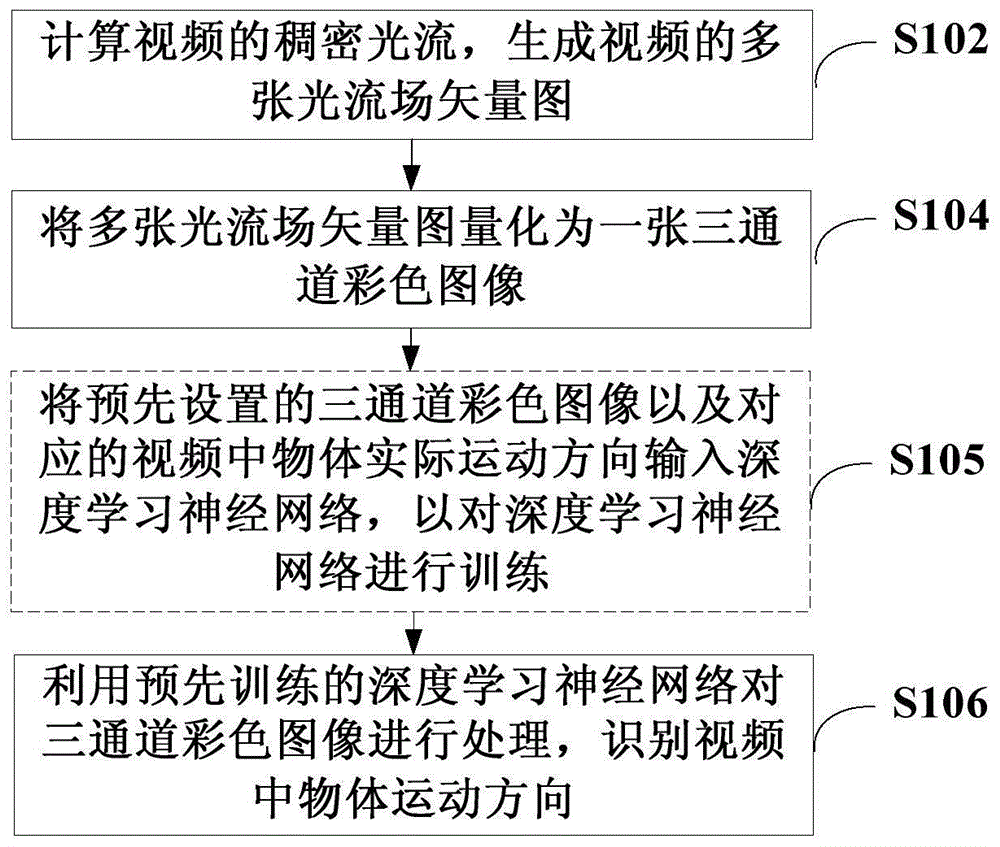
首先结合图1介绍本发明一个实施例的识别视频中物体运动方向的方法。First, a method for recognizing the moving direction of an object in a video according to an embodiment of the present invention is introduced with reference to FIG. 1 .
图1示出了本发明一个实施例的识别视频中物体运动方向的方法的流程示意图。如图1所示,本实施例中的识别视频中物体运动方向的方法包括:FIG. 1 shows a schematic flowchart of a method for recognizing the moving direction of an object in a video according to an embodiment of the present invention. As shown in FIG. 1 , the method for identifying the moving direction of an object in a video in this embodiment includes:
步骤S102,计算视频的稠密光流,生成视频的多张光流场矢量图。In step S102, the dense optical flow of the video is calculated, and multiple optical flow field vector diagrams of the video are generated.
其中,可以根据相邻的两个视频帧对应的灰度图像,计算视频的稠密光流,得到视频的多张光流场矢量图。Among them, the dense optical flow of the video can be calculated according to the grayscale images corresponding to two adjacent video frames, and multiple optical flow field vector diagrams of the video can be obtained.
步骤S104,将多张光流场矢量图量化为一张三通道彩色图像,三通道彩色图像能够表征视频中物体运动方向。Step S104, quantizing the plurality of optical flow field vector diagrams into a three-channel color image, and the three-channel color image can represent the moving direction of the object in the video.
其中,对于每个像素坐标,可以将各张光流场矢量图的光流矢量方向角量化为第一颜色通道的亮度值以及第二颜色通道的亮度值,将张光流场矢量图的光流矢量模量化为第三颜色通道的亮度值,然后计算量化后的各张光流场矢量图的各个颜色通道的亮度均值,再利用各个颜色通道的亮度均值生成一张三通道彩色图像。Among them, for each pixel coordinate, the direction angle of the optical flow vector of each optical flow field vector diagram can be quantized into the brightness value of the first color channel and the brightness value of the second color channel, and the optical flow vector modulus of the optical flow field vector diagram can be Convert it to the luminance value of the third color channel, then calculate the luminance mean value of each color channel of each optical flow field vector diagram after quantization, and then use the luminance mean value of each color channel to generate a three-channel color image.
例如,第一颜色通道为红色通道,第二颜色通道为绿色通道,第三颜色通道为蓝色通道,三通道彩色图像为RGB图像。For example, the first color channel is the red channel, the second color channel is the green channel, the third color channel is the blue channel, and the three-channel color image is an RGB image.
步骤S106,利用预先训练的深度学习神经网络对三通道彩色图像进行处理,识别视频中物体运动方向。Step S106, using a pre-trained deep learning neural network to process the three-channel color image to identify the moving direction of the object in the video.
例如,可以采用Tinynet、Googlenet、Caffenet、Resnet50网络模型中的一种网络模型作为深度学习神经网络。还可以将Tinynet网络模型中位于最后一层的全连接层用全局平均池化层代替,生成深度学习神经网络,这种轻量型深度学习神经网络在使用过程中简单方便。For example, a network model among Tinynet, Googlenet, Caffenet, and Resnet50 network models can be used as the deep learning neural network. It is also possible to replace the fully connected layer in the last layer of the Tinynet network model with a global average pooling layer to generate a deep learning neural network. This lightweight deep learning neural network is simple and convenient to use.
本领域技术人员应理解,在步骤S106之前,还可以执行步骤S105,将预先设置的三通道彩色图像以及对应的视频中物体实际运动方向输入深度学习神经网络,以对深度学习神经网络进行训练,使得深度学习神经网络能够根据输入的三通道彩色图像预测视频中物体的运动方向。It should be understood by those skilled in the art that, before step S106, step S105 can also be performed to input the preset three-channel color image and the actual motion direction of the object in the corresponding video into the deep learning neural network, so as to train the deep learning neural network, It enables the deep learning neural network to predict the motion direction of objects in the video based on the input three-channel color image.
上述实施例中,通过全局性的稠密光流算法计算每连续帧之间生成光流场矢量图;然后依据光流点方向向量特点把双通道的光流场矢量图进行量化,把所有量化所得的可视化图压缩成一张光流运动均图以代表该视频中物体运动方向,最后将视频集上得到的光流均图数据输入深度学习神经网络,以对运动方向进行识别。通过训练,深度学习神经网络可以学习出光流场压缩均图里对于描述视频运动趋势的有效特征,从而较为精确自动预测视频中物体运动方向。同时,上述实施例使用稠密光流场量化,利用压缩均图表示视频旋转主趋势,解决了单个光流场难以完成训练的难点,从而能够使用卷积神经网络训练均图方向分类模型,使得该方法具有简单高效、可靠性强的特点。In the above-mentioned embodiment, the optical flow field vector diagram is generated between each consecutive frame by calculating the global dense optical flow algorithm; The visual image is compressed into an optical flow motion average map to represent the motion direction of objects in the video, and finally the optical flow average map data obtained on the video set is input into the deep learning neural network to identify the motion direction. Through training, the deep learning neural network can learn the effective features of the compressed average image of the optical flow field to describe the motion trend of the video, so as to accurately and automatically predict the motion direction of the objects in the video. At the same time, the above-mentioned embodiment uses dense optical flow field quantization, and uses the compressed average image to represent the main trend of video rotation, which solves the difficulty that a single optical flow field is difficult to complete the training, so that the convolutional neural network can be used to train the average image direction classification model, so that the The method is simple, efficient and reliable.
下面介绍本发明识别视频中物体运动方向的方法的一个应用例。本应用例主要包括如下几个部分:An application example of the method for recognizing the moving direction of an object in a video of the present invention is described below. This application example mainly includes the following parts:
(一)计算光流场矢量图。(1) Calculate the vector diagram of the optical flow field.
对连续的视频帧进行处理,输入为灰度图像,如果为彩色图像,可以使用公式(1)转为灰度图:To process continuous video frames, the input is a grayscale image. If it is a color image, it can be converted to a grayscale image using formula (1):
Gray=0.299R+0.587G+0.114B (1)Gray=0.299R+0.587G+0.114B (1)
然后使用Gunnar Farneback计算全局性的稠密光流算法,得到每两灰度帧之间的光流图。假定图像上点m=(x,y)T在时刻t的灰度值为I(x,y,t),经过时间间隔dt后,对应点的灰度为I(x+dx,y+dy,t+dt),当dt→0时,可以认为两点的灰度不变,也就是公式(2):Then use Gunnar Farneback to calculate the global dense optical flow algorithm to obtain the optical flow map between every two grayscale frames. Assuming that the point m=(x,y) T on the image has a grayscale value of I(x,y,t) at time t, after the time interval dt, the grayscale value of the corresponding point is I(x+dx,y+dy ,t+dt), when dt→0, it can be considered that the grayscale of the two points remains unchanged, that is, formula (2):
I(x+dx,y+dy,t+dt)=I(x,y,t) (2)I(x+dx,y+dy,t+dt)=I(x,y,t) (2)
如果图像灰度随x,y,t缓慢变化,可以将公式(2)左边泰勒级数展开,得到公式(3):If the grayscale of the image changes slowly with x, y, and t, the Taylor series on the left side of formula (2) can be expanded to obtain formula (3):

其中ε代表二阶无穷小项。由于dt→0,忽略ε,可以得到公式(4):where ε represents the second-order infinitesimal term. Since dt→0, ignoring ε, formula (4) can be obtained:

令

Ixμ+Iyv+It=0 (5)I x μ+I y v+I t =0 (5)
此式即光流场的基本方程。写成向量形式,即得到公式(6):This formula is the basic equation of the optical flow field. Written in vector form, formula (6) is obtained:

上式称为光流约束方程。其中
(二)光流场矢量图的可视化。(2) Visualization of the optical flow field vector diagram.
光流场是图片中每个像素都有一个x方向和y方向的位移,所以在上面那些光流计算结束后得到的光流是个和原来图像大小相等的双通道图像,也就是的光流场矢量图。然后,使用孟塞尔颜色Munsell-Color系统依据光流场各个方向向量角度和模,把双通道的光流场矢量图量化至0-255之间的数值,完成可视化的目的。图3A以及图3B示出了连续两帧之间的Munsell-Color系统光流场矢量量化图以及压缩均图。The optical flow field is that each pixel in the picture has a displacement in the x direction and the y direction, so the optical flow obtained after the above optical flow calculations is a two-channel image with the same size as the original image, that is, the optical flow field. Vector illustration. Then, use the Munsell-Color system to quantify the two-channel optical flow vector vector to a value between 0 and 255 according to the angle and modulus of each direction vector of the optical flow field to complete the visualization. FIG. 3A and FIG. 3B show the vector quantization map and the compressed average map of the Munsell-Color system optical flow field between two consecutive frames.
(三)光流场矢量图的压缩。(3) Compression of the optical flow field vector diagram.
由于单张光流场矢量图是无法表示视频整体运动的趋势,同时也是无法进入卷积升级该网络进行训练和学习。为此,我们通过求取总体N-1张可视化后的图的RGB三通道的均值的方法得到压缩图片,简单且高效。假设待测视频共有N帧图片,当经过上述计算两两之间的稠密光流场矢量图,再经量化操作后可以得到N-1张图。此步骤中,我们通过公式(7)、(8)、(9)企图压缩所得到的N-1张图成为1张,以代表该待测视频运动的趋势。Since a single optical flow field vector diagram cannot represent the trend of the overall motion of the video, it is also impossible to enter the convolution to upgrade the network for training and learning. To this end, we obtain compressed images by calculating the mean of the three RGB channels of the total N-1 visualized images, which is simple and efficient. Assuming that there are N frames of pictures in the video to be tested, N-1 pictures can be obtained after the above-mentioned calculation of the dense optical flow field vector diagram between each pair, and then through the quantization operation. In this step, we attempt to compress the N-1 images obtained by formulas (7), (8) and (9) into one image to represent the motion trend of the video to be tested.


不同旋转方向视频上进行上述的压缩计算,可以得到压缩图片和旋转方向一对一的分类样本集。有了样本集,我们可以进而通过分类算法完成深度学习神经网络的训练。By performing the above compression calculation on videos with different rotation directions, a one-to-one classification sample set of compressed pictures and rotation directions can be obtained. With the sample set, we can then complete the training of the deep learning neural network through the classification algorithm.
(四)深度学习神经网络的训练与使用。(4) Training and use of deep learning neural network.
可以准备500顺时针、500逆时针、500不旋转的三类样本视频。在每个类别上,将500划分成300训练加200验证的方式进行。深度学习神经网络基于Tinynet,它是一种很轻量的模型,包含16层卷积层,且都是以3*3和1*1的卷积核组合而成,此外,Tinynet最后一层以全局平均池化层代替常用的全连接层,可以大幅降低网络的参数量,从而减少容易导致过拟合的风险发生。图4示出了深度学习神经网络的结构示意图。其中,输入图片大小固定为128*128像素,训练参数具体为:训练方法Sovler设置为随机梯度下降SGD,学习策略lr_policy设置为固定步长下降step,初始学习力base_lr设置为0.001,冲量momentum设置为0.9,下降权值weight_decay设置为0.0005,最大训练次数max_iter设置为100000。实验表明,经过10000次的训练,该神经网络模型的精度稳定在0.95,可以达到实用的性能和目标。图5示出了深度学习神经网络的训练和使用流程示意图。训练完成之后,可以使用它来识别视频中物体旋转方向。Three types of sample videos of 500 clockwise, 500 counterclockwise, and 500 non-rotating can be prepared. On each category, the 500 is divided into 300 training and 200 validation. The deep learning neural network is based on Tinynet, which is a very lightweight model, including 16 convolutional layers, which are combined with 3*3 and 1*1 convolution kernels. In addition, the last layer of Tinynet is composed of The global average pooling layer replaces the commonly used fully connected layer, which can greatly reduce the number of parameters of the network, thereby reducing the risk of overfitting. Figure 4 shows a schematic diagram of the structure of a deep learning neural network. Among them, the input image size is fixed to 128*128 pixels, and the training parameters are as follows: the training method Sovler is set to stochastic gradient descent SGD, the learning policy lr_policy is set to a fixed step size drop step, the initial learning force base_lr is set to 0.001, and the impulse momentum is set to 0.9, the descending weight weight_decay is set to 0.0005, and the maximum number of training max_iter is set to 100000. Experiments show that after 10,000 times of training, the accuracy of the neural network model is stable at 0.95, which can achieve practical performance and goals. Figure 5 shows a schematic diagram of the training and use of a deep learning neural network. After the training is complete, it can be used to identify the rotation direction of objects in the video.
上述应用例中,首选利用Gunnar Farneback算法计算全局性的稠密光流,每连续帧之间生成光流图;然后使用munsell-color系统依据光流矢量特点,把双通道的光流图进行量化并使用RGB-mean的方法压缩为一张,代表该视频的运动趋势;最后利用视频集上得到的光流均图数据集对卷积神经网络进行训练,并利用训练好的卷及神经网络识别视频中物体旋转方向。In the above application example, the first choice is to use the Gunnar Farneback algorithm to calculate the global dense optical flow, and generate an optical flow map between each consecutive frame; then use the munsell-color system to quantify the dual-channel optical flow map according to the characteristics of the optical flow vector The RGB-mean method is used to compress it into one piece, which represents the motion trend of the video. Finally, the convolutional neural network is trained using the optical flow average image data set obtained on the video set, and the trained volume and neural network are used to identify the video. The object's rotation direction.
下面结合图6介绍本发明一个实施例的识别视频中物体运动方向的装置。The following describes an apparatus for recognizing the moving direction of an object in a video according to an embodiment of the present invention with reference to FIG. 6 .
图6示出了本发明一个实施例的识别视频中物体运动方向的装置的结构示意图。如图6所示,本实施例的识别视频中物体运动方向的装置60包括:FIG. 6 shows a schematic structural diagram of an apparatus for recognizing the moving direction of an object in a video according to an embodiment of the present invention. As shown in FIG. 6 , the
光流场矢量图生成模块602,用于计算视频的稠密光流,生成视频的多张光流场矢量图;The optical flow field vector diagram generation module 602 is used to calculate the dense optical flow of the video, and generate multiple optical flow field vector diagrams of the video;
彩色图像量化模块603,用于将多张光流场矢量图量化为一张三通道彩色图像,三通道彩色图像能够表征视频中物体运动方向;The color image quantization module 603 is used to quantify the multiple optical flow field vector diagrams into a three-channel color image, and the three-channel color image can represent the moving direction of the object in the video;
运动方向识别模块606,用于利用预先训练的深度学习神经网络对三通道彩色图像进行处理,识别视频中物体运动方向。The movement direction identification module 606 is used for processing the three-channel color image by using the pre-trained deep learning neural network, and identifying the movement direction of the object in the video.
在一些实施例中,彩色图像量化模块603用于:对于每个像素坐标,将各张光流场矢量图的光流矢量方向角量化为第一颜色通道的亮度值以及第二颜色通道的亮度值,将张光流场矢量图的光流矢量模量化为第三颜色通道的亮度值;对于每个像素坐标,计算量化后的各张光流场矢量图的各个颜色通道的亮度均值;利用各个颜色通道的亮度均值生成一张三通道彩色图像。In some embodiments, the color image quantization module 603 is configured to: for each pixel coordinate, quantize the optical flow vector direction angle of each optical flow field vector diagram into the luminance value of the first color channel and the luminance value of the second color channel, The optical flow vector modulus of the optical flow field vector diagram is quantized into the brightness value of the third color channel; for each pixel coordinate, calculate the brightness average value of each color channel of each optical flow field vector diagram after quantization; use the brightness of each color channel Averaging produces a three-channel color image.
在一些实施例中,第一颜色通道为红色通道,第二颜色通道为绿色通道,第三颜色通道为蓝色通道,三通道彩色图像为RGB图像。In some embodiments, the first color channel is a red channel, the second color channel is a green channel, the third color channel is a blue channel, and the three-channel color image is an RGB image.
在一些实施例中,该装置还包括第一神经网络生成模块604A,用于将Tinynet、Googlenet、Caffenet、Resnet50网络模型中的一种作为深度学习神经网络。In some embodiments, the apparatus further includes a first neural network generation module 604A for using one of Tinynet, Googlenet, Caffenet, and Resnet50 network models as a deep learning neural network.
在一些实施例中,该装置还包括第二神经网络生成模块604B,用于将Tinynet网络模型中位于最后一层的全连接层用全局平均池化层代替,生成深度学习神经网络。In some embodiments, the apparatus further includes a second neural network generation module 604B, configured to replace the fully connected layer in the last layer of the Tinynet network model with a global average pooling layer to generate a deep learning neural network.
在一些实施例中,该装置还包括:神经网络训练模块605,用于将预先设置的三通道彩色图像以及对应的视频中物体的实际运动方向输入深度学习神经网络,以对深度学习神经网络进行训练,使得深度学习神经网络能够根据输入的三通道彩色图像预测视频中物体的运动方向。In some embodiments, the apparatus further includes: a neural network training module 605, configured to input the preset three-channel color image and the actual motion direction of the object in the corresponding video into the deep learning neural network, so as to train the deep learning neural network The training enables the deep learning neural network to predict the motion direction of objects in the video based on the input three-channel color image.
在一些实施例中,光流场矢量图生成模块602用于:根据相邻的两个视频帧对应的灰度图像,计算视频的稠密光流,得到视频的多张光流场矢量图。In some embodiments, the optical flow field vector diagram generation module 602 is configured to: calculate the dense optical flow of the video according to the grayscale images corresponding to two adjacent video frames, and obtain multiple optical flow field vector diagrams of the video.
上述实施例中,通过全局性的稠密光流算法计算每连续帧之间生成光流场矢量图;然后依据光流点方向向量特点把双通道的光流场矢量图进行量化,把所有量化所得的可视化图压缩成一张光流运动均图以代表该视频中物体运动方向,最后将视频集上得到的光流均图数据输入深度学习神经网络,以对运动方向进行识别。通过训练,深度学习神经网络可以学习出光流场压缩均图里对于描述视频运动趋势的有效特征,从而较为精确自动预测视频中物体运动方向。同时,上述实施例使用稠密光流场量化,利用压缩均图表示视频旋转主趋势,解决了单个光流场难以完成训练的难点,从而能够使用卷积神经网络训练均图方向分类模型,使得该方法具有简单高效、可靠性强的特点。In the above-mentioned embodiment, the optical flow field vector diagram is generated between each consecutive frame by calculating the global dense optical flow algorithm; The visual image is compressed into an optical flow motion average map to represent the motion direction of objects in the video, and finally the optical flow average map data obtained on the video set is input into the deep learning neural network to identify the motion direction. Through training, the deep learning neural network can learn the effective features of the compressed average image of the optical flow field to describe the motion trend of the video, so as to accurately and automatically predict the motion direction of the objects in the video. At the same time, the above-mentioned embodiment uses dense optical flow field quantization, and uses the compressed average image to represent the main trend of video rotation, which solves the difficulty that a single optical flow field is difficult to complete the training, so that the convolutional neural network can be used to train the average image direction classification model, so that the The method is simple, efficient and reliable.
图7示出了本发明另一个实施例的识别视频中物体运动方向的装置的结构示意图。如图7所示,该实施例的识别视频中物体运动方向的装置70包括:存储器710以及耦接至该存储器710的处理器720,处理器720被配置为基于存储在存储器710中的指令,执行前述任意一个实施例中的识别视频中物体运动方向的方法。FIG. 7 shows a schematic structural diagram of an apparatus for recognizing the moving direction of an object in a video according to another embodiment of the present invention. As shown in FIG. 7 , the
其中,存储器710例如可以包括系统存储器、固定非易失性存储介质等。系统存储器例如存储有操作系统、应用程序、引导装载程序(Boot Loader)以及其他程序等。The
一种识别视频中物体运动方向的装置70还可以包括输入输出接口730、网络接口740、存储接口750等。这些接口730,740,750以及存储器710和处理器720之间例如可以通过总线760连接。其中,输入输出接口730为显示器、鼠标、键盘、触摸屏等输入输出设备提供连接接口。网络接口740为各种联网设备提供连接接口。存储接口740为SD卡、U盘等外置存储设备提供连接接口。An
本发明还包括一种计算机可读存储介质,其上存储有计算机指令,该指令被处理器执行时实现前述任意一个实施例中的识别视频中物体运动方向的方法。The present invention also includes a computer-readable storage medium on which computer instructions are stored, and when the instructions are executed by a processor, implement the method for recognizing the moving direction of an object in a video in any one of the foregoing embodiments.
本领域内的技术人员应明白,本发明的实施例可提供为方法、系统、或计算机程序产品。因此,本发明可采用完全硬件实施例、完全软件实施例、或结合软件和硬件方面的实施例的形式。而且,本发明可采用在一个或多个其中包含有计算机可用程序代码的计算机可用非瞬时性存储介质(包括但不限于磁盘存储器、CD-ROM、光学存储器等)上实施的计算机程序产品的形式。As will be appreciated by one skilled in the art, embodiments of the present invention may be provided as a method, system, or computer program product. Accordingly, the present invention may take the form of an entirely hardware embodiment, an entirely software embodiment, or an embodiment combining software and hardware aspects. Furthermore, the present invention may take the form of a computer program product embodied on one or more computer-usable non-transitory storage media (including, but not limited to, disk storage, CD-ROM, optical storage, etc.) having computer-usable program code embodied therein .
本发明是参照根据本发明实施例的方法、设备(系统)、和计算机程序产品的流程图和/或方框图来描述的。应理解可由计算机程序指令实现流程图和/或方框图中的每一流程和/或方框、以及流程图和/或方框图中的流程和/或方框的结合。可提供这些计算机程序指令到通用计算机、专用计算机、嵌入式处理机或其他可编程数据处理设备的处理器以产生一个机器,使得通过计算机或其他可编程数据处理设备的处理器执行的指令产生用于实现在流程图一个流程或多个流程和/或方框图一个方框或多个方框中指定的功能的装置。The present invention is described with reference to flowchart illustrations and/or block diagrams of methods, apparatus (systems), and computer program products according to embodiments of the invention. It will be understood that each process and/or block in the flowchart illustrations and/or block diagrams, and combinations of processes and/or blocks in the flowchart illustrations and/or block diagrams, can be implemented by computer program instructions. These computer program instructions may be provided to the processor of a general purpose computer, special purpose computer, embedded processor or other programmable data processing device to produce a machine such that the instructions executed by the processor of the computer or other programmable data processing device produce Means for implementing the functions specified in a flow or flow of a flowchart and/or a block or blocks of a block diagram.
这些计算机程序指令也可存储在能引导计算机或其他可编程数据处理设备以特定方式工作的计算机可读存储器中,使得存储在该计算机可读存储器中的指令产生包括指令装置的制造品,该指令装置实现在流程图一个流程或多个流程和/或方框图一个方框或多个方框中指定的功能。These computer program instructions may also be stored in a computer-readable memory capable of directing a computer or other programmable data processing apparatus to function in a particular manner, such that the instructions stored in the computer-readable memory result in an article of manufacture comprising instruction means, the instructions The apparatus implements the functions specified in the flow or flow of the flowcharts and/or the block or blocks of the block diagrams.
这些计算机程序指令也可装载到计算机或其他可编程数据处理设备上,使得在计算机或其他可编程设备上执行一系列操作步骤以产生计算机实现的处理,从而在计算机或其他可编程设备上执行的指令提供用于实现在流程图一个流程或多个流程和/或方框图一个方框或多个方框中指定的功能的步骤。These computer program instructions can also be loaded on a computer or other programmable data processing device to cause a series of operational steps to be performed on the computer or other programmable device to produce a computer-implemented process such that The instructions provide steps for implementing the functions specified in the flow or blocks of the flowcharts and/or the block or blocks of the block diagrams.
以上所述仅为本发明的较佳实施例,并不用以限制本发明,凡在本发明的精神和原则之内,所作的任何修改、等同替换、改进等,均应包含在本发明的保护范围之内。The above are only preferred embodiments of the present invention and are not intended to limit the present invention. Any modification, equivalent replacement, improvement, etc. made within the spirit and principle of the present invention shall be included in the protection of the present invention. within the range.
Claims (16)
Priority Applications (1)
| Application Number | Priority Date | Filing Date | Title |
|---|---|---|---|
| CN201810296899.4A CN108520532B (en) | 2018-04-03 | 2018-04-03 | Method and device for recognizing moving direction of objects in video |
Applications Claiming Priority (1)
| Application Number | Priority Date | Filing Date | Title |
|---|---|---|---|
| CN201810296899.4A CN108520532B (en) | 2018-04-03 | 2018-04-03 | Method and device for recognizing moving direction of objects in video |
Publications (2)
| Publication Number | Publication Date |
|---|---|
| CN108520532A CN108520532A (en) | 2018-09-11 |
| CN108520532B true CN108520532B (en) | 2020-12-22 |
Family
ID=63431430
Family Applications (1)
| Application Number | Title | Priority Date | Filing Date |
|---|---|---|---|
| CN201810296899.4A Active CN108520532B (en) | 2018-04-03 | 2018-04-03 | Method and device for recognizing moving direction of objects in video |
Country Status (1)
| Country | Link |
|---|---|
| CN (1) | CN108520532B (en) |
Families Citing this family (3)
| Publication number | Priority date | Publication date | Assignee | Title |
|---|---|---|---|---|
| CN111833320A (en) * | 2020-07-06 | 2020-10-27 | 涵古观智能科技(苏州)有限公司 | Method, device and equipment for detecting running state of steel strip and storage medium |
| CN112044046B (en) * | 2020-08-28 | 2021-06-25 | 浙江大学 | Counting method of skipping rope based on deep learning |
| CN113759197B (en) * | 2021-09-09 | 2024-04-30 | 国网上海市电力公司 | A power transformer state monitoring device and method |
Family Cites Families (4)
| Publication number | Priority date | Publication date | Assignee | Title |
|---|---|---|---|---|
| CN103890781B (en) * | 2011-08-25 | 2017-11-21 | 康奈尔大学 | Retina Encoder for Machine Vision |
| CN105550699B (en) * | 2015-12-08 | 2019-02-12 | 北京工业大学 | A video recognition and classification method based on CNN fusion of spatiotemporal salient information |
| CN106056161B (en) * | 2016-06-02 | 2019-05-31 | 中国人民解放军军事医学科学院卫生装备研究所 | A kind of visible detection method for Plane Rotation target |
| CN106952303B (en) * | 2017-03-09 | 2020-04-24 | 北京旷视科技有限公司 | Vehicle distance detection method, device and system |
-
2018
- 2018-04-03 CN CN201810296899.4A patent/CN108520532B/en active Active
Also Published As
| Publication number | Publication date |
|---|---|
| CN108520532A (en) | 2018-09-11 |
Similar Documents
| Publication | Publication Date | Title |
|---|---|---|
| US12062249B2 (en) | System and method for generating image landmarks | |
| US20230367809A1 (en) | Systems and Methods for Geolocation Prediction | |
| CN105701508B (en) | Global local optimum model and conspicuousness detection algorithm based on multistage convolutional neural networks | |
| WO2020199931A1 (en) | Face key point detection method and apparatus, and storage medium and electronic device | |
| CN108108751B (en) | Scene recognition method based on convolution multi-feature and deep random forest | |
| US20220301295A1 (en) | Recurrent multi-task convolutional neural network architecture | |
| CN114008663A (en) | Real-time video super-resolution | |
| JP2020502665A (en) | Convert source domain image to target domain image | |
| CN113538235B (en) | Training method and device for image processing model, electronic equipment and storage medium | |
| CN114339409A (en) | Video processing method, video processing device, computer equipment and storage medium | |
| CN103530619A (en) | Gesture recognition method of small quantity of training samples based on RGB-D (red, green, blue and depth) data structure | |
| CN111915713B (en) | Method for creating three-dimensional dynamic scene, computer equipment, and storage medium | |
| US20190266395A1 (en) | Method and device for segmenting lines in line chart | |
| CN113554550B (en) | Image processing model training method, device, electronic equipment and storage medium | |
| CN116884004A (en) | Image processing methods, devices, electronic equipment and storage media | |
| CN108229300A (en) | Video classification methods, device, computer readable storage medium and electronic equipment | |
| CN108520532B (en) | Method and device for recognizing moving direction of objects in video | |
| US10936938B2 (en) | Method for visualizing neural network models | |
| CN114494815A (en) | Neural network training method, target detection method, device, equipment and medium | |
| CN116246026A (en) | Three-dimensional reconstruction model training method, three-dimensional scene rendering method and device | |
| CN115115691A (en) | Monocular three-dimensional plane recovery method, equipment and storage medium | |
| US12288281B2 (en) | Frame interpolation for rendered content | |
| CN112989952B (en) | A method and device for crowd density estimation based on mask guidance | |
| CN117677973A (en) | Bystander and attached object removal | |
| CN114943995A (en) | Face recognition model training method, face recognition method and device |
Legal Events
| Date | Code | Title | Description |
|---|---|---|---|
| PB01 | Publication | ||
| PB01 | Publication | ||
| SE01 | Entry into force of request for substantive examination | ||
| SE01 | Entry into force of request for substantive examination | ||
| GR01 | Patent grant | ||
| GR01 | Patent grant |