Detailed Description
With reference to the accompanying drawings, the SDC error detection method based on instruction vulnerability analysis of the present invention includes the following steps:
step 1, carrying out a fault injection experiment on a program set to obtain an SDC vulnerability value of an instruction, thereby constructing a sample data set of an SDC vulnerability analysis model of the instruction;
the vulnerability value of the command SDC is calculated by adopting the following formula:
wherein, set V
staticIs a static instruction set of a program, I
iRepresenting the ith static instruction in the program, wherein N is the number of all the static instructions in the program; set V
dynamicIs a dynamic instruction set at program run time, d
iIs an instruction I
iThe number of dynamic executions of (2); set I
dynamic(i) Representing static instructions I during program run
iAll dynamic executions of the correspondenceInstruction is V
dynamicIs selected from the group consisting of (a) a subset of,
is an instruction I
iThe qth dynamic instruction of (1); p
SDC(I
i) Is an instruction I
iThe value of the SDC vulnerability of (a),
as dynamic instructions
The SDC vulnerability value is obtained by calculating the fault injection experiment result.
Step 2, extracting an SDC vulnerability description feature vector F according to the SDC vulnerability value of the program instruction sample obtained in the step 1;
the constructed instruction SDC vulnerability description feature vector F is the following two-tuple:
wherein, FdependentPropagating dependent instruction dependent feature vectors for the data; END is a feature vector containing five fields<Estore,Ecaller,Eicmp,Efcmp,Eaddress>Respectively indicating whether the data are referred by a storage instruction, a function calling instruction, an integer comparison instruction, a floating point comparison instruction and an address related instruction, if so, marking a corresponding bit as 1, otherwise, marking the bit as 0; a CMP is a feature vector comprising two fields used to characterize the relevant instruction when the end instruction is a compare instruction, CMP ═ c<Loopdepth,Pbranch>,LoopdepthTo compare the cycle depth, P, of the instructionbranchIs the static branch probability; crash is a feature vector comprising two fields and is used for characterizing features related to program Crash; crash ═<Bytedest,Addrnum>,BytedestNumber of operation bits for purpose, AddrnumFor address phasing in forward slicingThe number of instructions off; MF is the calculated error masking factor; finherentThe method comprises the steps of (1) an instruction intrinsic feature vector for representing the property of an instruction; IC is a type of instruction and is a feature vector containing 8 fields, IC ═ Cint,Cfloat,Ccmp,Cbit,Cconv,Cmem,Ccall,Cload>, respectively indicating whether the operation is integer binary operation, floating point binary operation, comparison instruction, logic operation, conversion operation, address-related operation, function call instruction and memory read instruction, if so, marking the corresponding field as 1, otherwise, marking the field as 0; insttimeThe ratio of the execution time of the dynamic instruction to the total time of the program is; BBL is the size of the basic block where the instruction is located; INloopIndicating whether the instruction is in a loop; RINbbIndicating the number of instructions to be executed until the end of the basic block; DC (direct current)ratioRepresenting the ratio of instruction to function execution time; callnumRepresenting the number of times the function in which the instruction is located is called; RINfunIndicating the number of instructions to be executed until the function returns; varglobalWhether the variable in the instruction influences the global variable or not is shown, if so, the variable is marked as 1, and if not, the variable is marked as 0; fanoutA fan-out value representing an instruction destination operand.
Step 3, training a support vector regression-based instruction SDC vulnerability analysis model according to the instruction vulnerability value obtained in the step 1 and the instruction feature vector obtained in the step 2;
when an instruction SDC vulnerability analysis model based on support vector regression is trained, a training set T { (F) of instruction sample data is giveni,pi) 1,2, l, l is the number of samples in the training set, where F is the number of samples in the training seti=<Fi.inherent,Fi.dependentThe feature vector of the ith sample in the training set is greater than the feature vector of the ith sample in the training set; p is a radical ofiRepresenting the SDC vulnerability of the ith instruction sample; according to the support vector regression structured risk minimization principle, establishing an instruction vulnerability analysis model, and solving to obtain a corresponding instruction SDC vulnerability prediction analysis function as follows:
wherein F represents a feature vector of a target instruction to be analyzed; a and
solving the obtained Lagrange multiplier; k (F)
iAnd F) represents a kernel function introduced according to SVR theory; b is the bias term obtained by solving.
Step 4, extracting the instruction feature vector of the target program by using the method in the step 2, and performing prediction analysis on the instruction vulnerability value of the target program according to the instruction SDC vulnerability analysis model obtained by training in the step 3;
step 5, performing instruction redundancy processing on the target program according to the instruction vulnerability value obtained by prediction analysis in the step 4; the instruction redundancy method specifically comprises three steps:
step 5.1: analyzing according to the command SDC vulnerability prediction analysis function in the step 4 to obtain a command vulnerability value, and selecting a command set to be redundant by adopting the following formula in the program:
wherein, I
sortRepresenting an instruction set after ordering the instruction vulnerabilities in a descending order;
as instructions
The value of the SDC vulnerability of (a),
as instructions
The dynamic instruction number of (2); i is
selectedRepresenting instructions I from behind
sortThe selected first S instruction sets;z represents the redundancy granularity of the instruction, namely the instruction proportion for performing redundancy processing on the target program; d is the total number of static instructions in the program;
step 5.2: for instruction set I in step 5.1
selectedPerforming redundancy processing to obtain a set
Traverse I
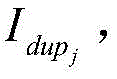
dupAll instructions in, if instruction
Data dependence on
And i > j, then they have a defined reference relationship; if I
dupInstructions in an instruction set
If the definition reference relationship cannot be formed with other redundant instructions, a separate comparison instruction is added to the redundant instruction in step 5.3;
step 5.3: inserting a comparison instruction at the last of the basic block, comparing the execution result of the original instruction with the execution result of the inserted redundant instruction, if the results are inconsistent, indicating that an instantaneous fault occurs, and needing to take measures for recovery; if the result is consistent, the execution of the basic block code of the segment is not in error.
Step 6, carrying out a fault injection experiment on the target program subjected to the redundancy processing obtained in the step 5, and detecting SDC errors when the program runs;
and 7, evaluating the SDC error detection capability of the target program after the redundancy processing obtained in the step 5. The SDC error detection capability is evaluated by the following equation:
wherein, SDCcoverageRepresenting the SDC error detection rate; n is a radical ofSDCIndicates the original orderThe number of SDC errors after the fault is injected by the standard program; n is a radical ofDUPAnd the times of SDC errors detected after the target program subjected to redundancy processing injects faults are shown.
The invention provides an instruction characteristic influencing the vulnerability of an instruction, an instruction SDC vulnerability analysis model, a method for carrying out redundancy processing on the instruction with higher vulnerability and a method for detecting SDC errors. The method has high SDC error detection rate and low performance overhead, and can be applied to detection of program SDC errors caused by transient faults in severe environments.
The present invention will be described in further detail with reference to examples.
Examples
With reference to fig. 1 and 2, the present invention is a SDC error detection method based on instruction vulnerability analysis. The method comprises the following steps:
step 1, carrying out fault injection experiments on six programs including FFT (Fourier transform), basicmath (mathematical computation), SHA (secure hash algorithm), CRC (communication CRC32 computation tool), partricia (tree structure used for sparse leaves in network) and sphinx (voice decoding) in a Mibench program set to obtain the SDC vulnerability value of the instruction, so that a sample data set of the instruction SDC vulnerability prediction model is constructed, wherein the sample data set comprises 4365 instruction samples. The SDC vulnerability value of the instruction adopts the following formula:
wherein, set V
staticIs a static instruction set of a program, I
iRepresenting the ith static instruction in the program, wherein N is the number of all the static instructions in the program; set V
dynamicIs a dynamic instruction set at program run time, d
iIs an instruction I
iThe number of dynamic executions of (2); set I
dynamic(i) Representing static instructions I during program run
iAll dynamically executed instructions that correspond are V
dynamicIs selected from the group consisting of (a) a subset of,
is an instruction I
iThe qth dynamic instruction of (1). P
SDC(I
i) Is an instruction I
iThe value of the SDC vulnerability of (a),
as dynamic instructions
The SDC vulnerability value is obtained by calculating the fault injection experiment result.
And 2, extracting an SDC vulnerability description feature vector F according to the SDC vulnerability value of the program instruction sample obtained in the step 1. The constructed instruction feature vector F is the following doublet:
wherein, FdependentPropagating dependent instruction dependent feature vectors for the data; END is a feature vector containing five fields<Estore,Ecaller,Eicmp,Efcmp,Eaddress>Respectively indicating whether the data are referred by a storage instruction, a function calling instruction, an integer comparison instruction, a floating point comparison instruction and an address related instruction, if so, marking a corresponding bit as 1, otherwise, marking the bit as 0; a CMP is a feature vector comprising two fields used to characterize the relevant instruction when the end instruction is a compare instruction, CMP ═ c<Loopdepth,Pbranch>,LoopdepthTo compare the cycle depth, P, of the instructionbranchIs the static branch probability; crash is a feature vector comprising two fields and is used for characterizing features related to program Crash; crash ═<Bytedest,Addrnum>,BytedestNumber of operation bits for purpose, AddrnumThe number of instructions related to the address in the forward slice; MF is the calculated error masking factor.
FinherentThe method comprises the steps of (1) an instruction intrinsic feature vector for representing the property of an instruction; IC is an instruction type, and is a feature vector containing 8 fields, IC ═ c<Cint,Cfloat,Ccmp,Cbit,Cconv,Cmem,Ccall,Cload>Respectively indicating whether the operation is integer binary operation, floating point binary operation, comparison instruction, logic operation, conversion operation, address-related operation, function call instruction and memory read instruction, if so, marking the corresponding field as 1, otherwise, marking the field as 0; insttimeThe ratio of the execution time of the dynamic instruction to the total time of the program is; BBL is the size of the basic block where the instruction is located; INloopIndicating whether the instruction is in a loop; RINbbIndicating the number of instructions to be executed until the end of the basic block; DC (direct current)ratioRepresenting the ratio of instruction to function execution time; callnumRepresenting the number of times the function in which the instruction is located is called; RINfunIndicating the number of instructions to be executed until the function returns; varglobalWhether the variable in the instruction influences the global variable or not is shown, if so, the variable is marked as 1, and if not, the variable is marked as 0; fanoutA fan-out value representing an instruction destination operand.
Step 3, training a support vector regression-based instruction SDC vulnerability analysis model according to the instruction vulnerability value obtained in the step 1 and the instruction feature vector obtained in the step 2:
given a training set T { (F) of instruction sample datai,pi) 1,2, l, l is the number of samples in the training set, where F is the number of samples in the training seti=<Fi.inherent,Fi.dependent>A feature vector of an ith sample in a training set; p is a radical ofiIndicating the SDC vulnerability of the ith instruction sample. According to the support vector regression structured risk minimization principle, establishing an instruction vulnerability analysis model, and solving to obtain a corresponding instruction SDC vulnerability prediction analysis function as follows:
wherein F represents a feature vector of a target instruction to be analyzed; a and
solving the obtained Lagrange multiplier; k (F)
iAnd F) represents a kernel function introduced according to SVR theory; b is the bias term obtained by solving.
Step 4, extracting target instruction feature vectors to be analyzed of the three target programs of qsort (quick sorting), dijkstra (shortest path algorithm) and susan (image recognition) by using the method in the step 2, and performing prediction analysis on the instruction vulnerability according to the instruction SDC vulnerability analysis model obtained by training in the step 3;
and 5, performing instruction redundancy on the target program according to the instruction vulnerability value obtained through prediction analysis in the step 4. The instruction redundancy method specifically comprises three steps:
step 5.1, obtaining an instruction vulnerability value according to the prediction analysis in the step 4, and selecting an instruction set to be redundant according to the following formula in a program:
wherein, I
sortRepresenting an instruction set after ordering the instruction vulnerabilities in a descending order;
as instructions
The value of the SDC vulnerability of (a),
as instructions
The dynamic instruction number of (2); i is
selectedRepresenting instructions I from behind
sortThe selected first S instruction sets; z represents the redundancy granularity of the instruction, namely the instruction proportion for performing redundancy processing on the target program, and the values of Z are respectively 0.1, 0.2 and 0.3; d is the total number of static instructions in the program.
Step 5.2, step pairInstruction set I in 5.1
selectedPerforming redundancy processing to obtain a set
Traverse I
dupAll instructions in, if instruction
Data dependence on
And i > j, then they have a defined reference relationship; if I
dupInstructions in an instruction set
Cannot form a defined reference relationship with other redundant instructions, a separate compare instruction is added to the redundant instruction in step 5.3.
Step 5.3, a comparison instruction is inserted into the last of the basic block, the execution result of the original instruction is compared with the execution result of the inserted redundant instruction, if the results are inconsistent, the instantaneous fault is indicated, and measures are required to be taken for recovery; if the result is consistent, the execution of the basic block code of the segment is not in error.
And 6, carrying out a fault injection experiment on the target program subjected to the redundancy processing obtained in the step 5, and detecting the SDC error caused by the instantaneous fault when the program runs.
And 7, evaluating the SDC error detection capability of the target program after the redundancy processing obtained in the step 5. The SDC error detection capability is evaluated by the following equation:
wherein, SDCcoverageRepresenting the SDC error detection rate; n is a radical ofSDCRepresenting the times of SDC errors after the original target program is injected with faults; n is a radical ofDUPAnd the times of SDC errors detected after the target program subjected to redundancy processing injects faults are shown.
Figure 3 provides a comparison of SDC error detection rates. Wherein, ML-SED-10, ML-SED-20, ML-SED-30 correspond to the instruction redundancy processing of different granularities to the target program when Z takes 0.1, 0.2, 0.3 in the method of the invention respectively. Hotpath is the redundancy of paths that are executed frequently in a program. Figure 4 gives a comparison of performance overhead.
As can be seen from fig. 3 and 4, the method of the present invention can obtain a higher SDC error detection rate with a lower time overhead.