CN108473904B - Nitrogen-functionalized olefin polymers for engine lubricants - Google Patents
Nitrogen-functionalized olefin polymers for engine lubricants Download PDFInfo
- Publication number
- CN108473904B CN108473904B CN201680079138.2A CN201680079138A CN108473904B CN 108473904 B CN108473904 B CN 108473904B CN 201680079138 A CN201680079138 A CN 201680079138A CN 108473904 B CN108473904 B CN 108473904B
- Authority
- CN
- China
- Prior art keywords
- lubricant composition
- olefin polymer
- weight percent
- astm
- oil
- Prior art date
- Legal status (The legal status is an assumption and is not a legal conclusion. Google has not performed a legal analysis and makes no representation as to the accuracy of the status listed.)
- Active
Links
Classifications
-
- C—CHEMISTRY; METALLURGY
- C10—PETROLEUM, GAS OR COKE INDUSTRIES; TECHNICAL GASES CONTAINING CARBON MONOXIDE; FUELS; LUBRICANTS; PEAT
- C10M—LUBRICATING COMPOSITIONS; USE OF CHEMICAL SUBSTANCES EITHER ALONE OR AS LUBRICATING INGREDIENTS IN A LUBRICATING COMPOSITION
- C10M167/00—Lubricating compositions characterised by the additive being a mixture of a macromolecular compound, a non-macromolecular compound and a compound of unknown or incompletely defined constitution, each of these compounds being essential
-
- C—CHEMISTRY; METALLURGY
- C10—PETROLEUM, GAS OR COKE INDUSTRIES; TECHNICAL GASES CONTAINING CARBON MONOXIDE; FUELS; LUBRICANTS; PEAT
- C10M—LUBRICATING COMPOSITIONS; USE OF CHEMICAL SUBSTANCES EITHER ALONE OR AS LUBRICATING INGREDIENTS IN A LUBRICATING COMPOSITION
- C10M169/00—Lubricating compositions characterised by containing as components a mixture of at least two types of ingredient selected from base-materials, thickeners or additives, covered by the preceding groups, each of these compounds being essential
- C10M169/04—Mixtures of base-materials and additives
- C10M169/044—Mixtures of base-materials and additives the additives being a mixture of non-macromolecular and macromolecular compounds
-
- C—CHEMISTRY; METALLURGY
- C10—PETROLEUM, GAS OR COKE INDUSTRIES; TECHNICAL GASES CONTAINING CARBON MONOXIDE; FUELS; LUBRICANTS; PEAT
- C10M—LUBRICATING COMPOSITIONS; USE OF CHEMICAL SUBSTANCES EITHER ALONE OR AS LUBRICATING INGREDIENTS IN A LUBRICATING COMPOSITION
- C10M135/00—Lubricating compositions characterised by the additive being an organic non-macromolecular compound containing sulfur, selenium or tellurium
- C10M135/08—Lubricating compositions characterised by the additive being an organic non-macromolecular compound containing sulfur, selenium or tellurium containing a sulfur-to-oxygen bond
- C10M135/10—Sulfonic acids or derivatives thereof
-
- C—CHEMISTRY; METALLURGY
- C10—PETROLEUM, GAS OR COKE INDUSTRIES; TECHNICAL GASES CONTAINING CARBON MONOXIDE; FUELS; LUBRICANTS; PEAT
- C10M—LUBRICATING COMPOSITIONS; USE OF CHEMICAL SUBSTANCES EITHER ALONE OR AS LUBRICATING INGREDIENTS IN A LUBRICATING COMPOSITION
- C10M149/00—Lubricating compositions characterised by the additive being a macromolecular compound containing nitrogen
- C10M149/12—Macromolecular compounds obtained otherwise than by reactions only involving carbon-to-carbon unsaturated bonds
- C10M149/14—Macromolecular compounds obtained otherwise than by reactions only involving carbon-to-carbon unsaturated bonds a condensation reaction being involved
- C10M149/18—Polyamides
-
- C—CHEMISTRY; METALLURGY
- C10—PETROLEUM, GAS OR COKE INDUSTRIES; TECHNICAL GASES CONTAINING CARBON MONOXIDE; FUELS; LUBRICANTS; PEAT
- C10M—LUBRICATING COMPOSITIONS; USE OF CHEMICAL SUBSTANCES EITHER ALONE OR AS LUBRICATING INGREDIENTS IN A LUBRICATING COMPOSITION
- C10M149/00—Lubricating compositions characterised by the additive being a macromolecular compound containing nitrogen
- C10M149/12—Macromolecular compounds obtained otherwise than by reactions only involving carbon-to-carbon unsaturated bonds
- C10M149/14—Macromolecular compounds obtained otherwise than by reactions only involving carbon-to-carbon unsaturated bonds a condensation reaction being involved
- C10M149/22—Polyamines
-
- C—CHEMISTRY; METALLURGY
- C10—PETROLEUM, GAS OR COKE INDUSTRIES; TECHNICAL GASES CONTAINING CARBON MONOXIDE; FUELS; LUBRICANTS; PEAT
- C10M—LUBRICATING COMPOSITIONS; USE OF CHEMICAL SUBSTANCES EITHER ALONE OR AS LUBRICATING INGREDIENTS IN A LUBRICATING COMPOSITION
- C10M2203/00—Organic non-macromolecular hydrocarbon compounds and hydrocarbon fractions as ingredients in lubricant compositions
- C10M2203/003—Organic non-macromolecular hydrocarbon compounds and hydrocarbon fractions as ingredients in lubricant compositions used as base material
-
- C—CHEMISTRY; METALLURGY
- C10—PETROLEUM, GAS OR COKE INDUSTRIES; TECHNICAL GASES CONTAINING CARBON MONOXIDE; FUELS; LUBRICANTS; PEAT
- C10M—LUBRICATING COMPOSITIONS; USE OF CHEMICAL SUBSTANCES EITHER ALONE OR AS LUBRICATING INGREDIENTS IN A LUBRICATING COMPOSITION
- C10M2203/00—Organic non-macromolecular hydrocarbon compounds and hydrocarbon fractions as ingredients in lubricant compositions
- C10M2203/10—Petroleum or coal fractions, e.g. tars, solvents, bitumen
- C10M2203/1006—Petroleum or coal fractions, e.g. tars, solvents, bitumen used as base material
-
- C—CHEMISTRY; METALLURGY
- C10—PETROLEUM, GAS OR COKE INDUSTRIES; TECHNICAL GASES CONTAINING CARBON MONOXIDE; FUELS; LUBRICANTS; PEAT
- C10M—LUBRICATING COMPOSITIONS; USE OF CHEMICAL SUBSTANCES EITHER ALONE OR AS LUBRICATING INGREDIENTS IN A LUBRICATING COMPOSITION
- C10M2215/00—Organic non-macromolecular compounds containing nitrogen as ingredients in lubricant Compositions
- C10M2215/086—Imides [having hydrocarbon substituents containing less than thirty carbon atoms]
-
- C—CHEMISTRY; METALLURGY
- C10—PETROLEUM, GAS OR COKE INDUSTRIES; TECHNICAL GASES CONTAINING CARBON MONOXIDE; FUELS; LUBRICANTS; PEAT
- C10M—LUBRICATING COMPOSITIONS; USE OF CHEMICAL SUBSTANCES EITHER ALONE OR AS LUBRICATING INGREDIENTS IN A LUBRICATING COMPOSITION
- C10M2217/00—Organic macromolecular compounds containing nitrogen as ingredients in lubricant compositions
- C10M2217/02—Macromolecular compounds obtained from nitrogen containing monomers by reactions only involving carbon-to-carbon unsaturated bonds
- C10M2217/024—Macromolecular compounds obtained from nitrogen containing monomers by reactions only involving carbon-to-carbon unsaturated bonds containing monomers having an unsaturated radical bound to an amido or imido group
-
- C—CHEMISTRY; METALLURGY
- C10—PETROLEUM, GAS OR COKE INDUSTRIES; TECHNICAL GASES CONTAINING CARBON MONOXIDE; FUELS; LUBRICANTS; PEAT
- C10M—LUBRICATING COMPOSITIONS; USE OF CHEMICAL SUBSTANCES EITHER ALONE OR AS LUBRICATING INGREDIENTS IN A LUBRICATING COMPOSITION
- C10M2217/00—Organic macromolecular compounds containing nitrogen as ingredients in lubricant compositions
- C10M2217/04—Macromolecular compounds from nitrogen-containing monomers obtained otherwise than by reactions only involving carbon-to-carbon unsaturated bonds
- C10M2217/046—Polyamines, i.e. macromoleculars obtained by condensation of more than eleven amine monomers
-
- C—CHEMISTRY; METALLURGY
- C10—PETROLEUM, GAS OR COKE INDUSTRIES; TECHNICAL GASES CONTAINING CARBON MONOXIDE; FUELS; LUBRICANTS; PEAT
- C10M—LUBRICATING COMPOSITIONS; USE OF CHEMICAL SUBSTANCES EITHER ALONE OR AS LUBRICATING INGREDIENTS IN A LUBRICATING COMPOSITION
- C10M2217/00—Organic macromolecular compounds containing nitrogen as ingredients in lubricant compositions
- C10M2217/06—Macromolecular compounds obtained by functionalisation op polymers with a nitrogen containing compound
-
- C—CHEMISTRY; METALLURGY
- C10—PETROLEUM, GAS OR COKE INDUSTRIES; TECHNICAL GASES CONTAINING CARBON MONOXIDE; FUELS; LUBRICANTS; PEAT
- C10M—LUBRICATING COMPOSITIONS; USE OF CHEMICAL SUBSTANCES EITHER ALONE OR AS LUBRICATING INGREDIENTS IN A LUBRICATING COMPOSITION
- C10M2219/00—Organic non-macromolecular compounds containing sulfur, selenium or tellurium as ingredients in lubricant compositions
- C10M2219/04—Organic non-macromolecular compounds containing sulfur, selenium or tellurium as ingredients in lubricant compositions containing sulfur-to-oxygen bonds, i.e. sulfones, sulfoxides
- C10M2219/046—Overbased sulfonic acid salts
-
- C—CHEMISTRY; METALLURGY
- C10—PETROLEUM, GAS OR COKE INDUSTRIES; TECHNICAL GASES CONTAINING CARBON MONOXIDE; FUELS; LUBRICANTS; PEAT
- C10N—INDEXING SCHEME ASSOCIATED WITH SUBCLASS C10M RELATING TO LUBRICATING COMPOSITIONS
- C10N2020/00—Specified physical or chemical properties or characteristics, i.e. function, of component of lubricating compositions
- C10N2020/01—Physico-chemical properties
- C10N2020/02—Viscosity; Viscosity index
-
- C—CHEMISTRY; METALLURGY
- C10—PETROLEUM, GAS OR COKE INDUSTRIES; TECHNICAL GASES CONTAINING CARBON MONOXIDE; FUELS; LUBRICANTS; PEAT
- C10N—INDEXING SCHEME ASSOCIATED WITH SUBCLASS C10M RELATING TO LUBRICATING COMPOSITIONS
- C10N2030/00—Specified physical or chemical properties which is improved by the additive characterising the lubricating composition, e.g. multifunctional additives
- C10N2030/02—Pour-point; Viscosity index
-
- C—CHEMISTRY; METALLURGY
- C10—PETROLEUM, GAS OR COKE INDUSTRIES; TECHNICAL GASES CONTAINING CARBON MONOXIDE; FUELS; LUBRICANTS; PEAT
- C10N—INDEXING SCHEME ASSOCIATED WITH SUBCLASS C10M RELATING TO LUBRICATING COMPOSITIONS
- C10N2030/00—Specified physical or chemical properties which is improved by the additive characterising the lubricating composition, e.g. multifunctional additives
- C10N2030/04—Detergent property or dispersant property
-
- C—CHEMISTRY; METALLURGY
- C10—PETROLEUM, GAS OR COKE INDUSTRIES; TECHNICAL GASES CONTAINING CARBON MONOXIDE; FUELS; LUBRICANTS; PEAT
- C10N—INDEXING SCHEME ASSOCIATED WITH SUBCLASS C10M RELATING TO LUBRICATING COMPOSITIONS
- C10N2030/00—Specified physical or chemical properties which is improved by the additive characterising the lubricating composition, e.g. multifunctional additives
- C10N2030/08—Resistance to extreme temperature
-
- C—CHEMISTRY; METALLURGY
- C10—PETROLEUM, GAS OR COKE INDUSTRIES; TECHNICAL GASES CONTAINING CARBON MONOXIDE; FUELS; LUBRICANTS; PEAT
- C10N—INDEXING SCHEME ASSOCIATED WITH SUBCLASS C10M RELATING TO LUBRICATING COMPOSITIONS
- C10N2030/00—Specified physical or chemical properties which is improved by the additive characterising the lubricating composition, e.g. multifunctional additives
- C10N2030/52—Base number [TBN]
-
- C—CHEMISTRY; METALLURGY
- C10—PETROLEUM, GAS OR COKE INDUSTRIES; TECHNICAL GASES CONTAINING CARBON MONOXIDE; FUELS; LUBRICANTS; PEAT
- C10N—INDEXING SCHEME ASSOCIATED WITH SUBCLASS C10M RELATING TO LUBRICATING COMPOSITIONS
- C10N2040/00—Specified use or application for which the lubricating composition is intended
- C10N2040/25—Internal-combustion engines
- C10N2040/252—Diesel engines
-
- C—CHEMISTRY; METALLURGY
- C10—PETROLEUM, GAS OR COKE INDUSTRIES; TECHNICAL GASES CONTAINING CARBON MONOXIDE; FUELS; LUBRICANTS; PEAT
- C10N—INDEXING SCHEME ASSOCIATED WITH SUBCLASS C10M RELATING TO LUBRICATING COMPOSITIONS
- C10N2040/00—Specified use or application for which the lubricating composition is intended
- C10N2040/25—Internal-combustion engines
- C10N2040/252—Diesel engines
- C10N2040/253—Small diesel engines
-
- C—CHEMISTRY; METALLURGY
- C10—PETROLEUM, GAS OR COKE INDUSTRIES; TECHNICAL GASES CONTAINING CARBON MONOXIDE; FUELS; LUBRICANTS; PEAT
- C10N—INDEXING SCHEME ASSOCIATED WITH SUBCLASS C10M RELATING TO LUBRICATING COMPOSITIONS
- C10N2040/00—Specified use or application for which the lubricating composition is intended
- C10N2040/25—Internal-combustion engines
- C10N2040/255—Gasoline engines
Landscapes
- Chemical & Material Sciences (AREA)
- Chemical Kinetics & Catalysis (AREA)
- General Chemical & Material Sciences (AREA)
- Oil, Petroleum & Natural Gas (AREA)
- Organic Chemistry (AREA)
- Lubricants (AREA)
Abstract
以下组分的润滑剂组合物在汽油发动机中显示出良好的防淤渣性能:具有润滑粘度的油,具有2,000‑70,000的数均分子量且包含接枝在聚合物骨架上的羧酸或等价官能的烯烃聚合物与通常具有单一伯氨基的单胺或多胺的无灰缩合反应产物;琥珀酰亚胺分散剂;使得润滑剂组合物的总碱值小于6.5的量的过碱性金属清净剂。Lubricant compositions of the following components show good anti-sludge properties in gasoline engines: oils of lubricating viscosity, having a number average molecular weight of 2,000-70,000 and comprising a carboxylic acid or equivalent grafted on a polymer backbone Ashless condensation reaction product of a functional olefin polymer with a mono- or polyamine, usually having a single primary amino group; a succinimide dispersant; an overbased metal detergency in an amount such that the total base number of the lubricant composition is less than 6.5 agent.
Description
背景background
本公开的技术涉及用于内燃机的润滑剂,其除其它组分外,包含氮官能化烯烃聚合物。The technology of the present disclosure relates to lubricants for internal combustion engines that include, among other components, a nitrogen-functionalized olefin polymer.
用于内燃机,例如客车用火花点火发动机的润滑剂必须满足严格的性能要求。它们必须润滑发动机以防磨损并使摩擦最小化,同时对由与燃烧副产物和其它污染物接触而产生的性能降解和劣化具有抗性。特别是,提供不会由于淤渣、漆或其它沉积物形成而随时间劣化的润滑剂仍是个挑战;这通常通过在润滑剂中包含含氮分散剂,例如琥珀酰亚胺分散剂而至少部分地实现。理想的还有润滑剂应当对由水的存在产生的有害影响具有抗性,所述水作为发动机内燃料燃烧的产物产生。本文公开的技术容许具有降低量的含氮琥珀酰亚胺分散剂,同时保持良好的淤渣和沉积物防止性能并提供良好耐水性的配制剂。Lubricants for internal combustion engines, such as spark-ignition engines for passenger cars, must meet stringent performance requirements. They must lubricate the engine to prevent wear and minimize friction, while being resistant to performance degradation and degradation from contact with combustion byproducts and other contaminants. In particular, it remains a challenge to provide lubricants that do not degrade over time due to sludge, lacquer or other deposit formation; this is often at least partially achieved by including a nitrogen-containing dispersant, such as a succinimide dispersant, in the lubricant realized. It is also desirable that the lubricant should be resistant to the deleterious effects caused by the presence of water, which is produced as a product of fuel combustion within the engine. The techniques disclosed herein allow for formulations with reduced amounts of nitrogen-containing succinimide dispersants while maintaining good sludge and deposit prevention properties and providing good water resistance.
美国专利7,790,661,Covitch等人,2010年9月7日公开了包含芳族胺的分散剂粘度改进剂。公开了包含羧酸官能或其反应性等价物的聚合物和包含3-硝基苯胺的胺组分的反应产物,所述聚合物具有大于5,000的数均分子量。芳族胺还可以为N,N-二烷基苯二胺,例如N,N-二甲基-1,4,-苯二胺。合适的骨架聚合物包括乙烯丙烯共聚物。烯属不饱和羧酸材料通常接枝在聚合物骨架上。马来酸酐或其衍生物是合适的。还可存在常规润滑剂添加剂,包括其它分散剂、清净剂和其它材料。衍生的接枝共聚物可用于火花点火和压缩点火内燃机用的曲轴箱润滑油中。US Patent 7,790,661, Covitch et al., Sept. 7, 2010, discloses dispersant viscosity modifiers comprising aromatic amines. The reaction product of a polymer comprising carboxylic acid functionality or reactive equivalents thereof and an amine component comprising 3-nitroaniline, the polymer having a number average molecular weight greater than 5,000 is disclosed. The aromatic amine can also be an N,N-dialkylphenylenediamine, such as N,N-dimethyl-1,4,-phenylenediamine. Suitable backbone polymers include ethylene propylene copolymers. The ethylenically unsaturated carboxylic acid material is usually grafted onto the polymer backbone. Maleic anhydride or derivatives thereof are suitable. Conventional lubricant additives may also be present, including other dispersants, detergents, and other materials. The derived graft copolymers are useful in crankcase lubricating oils for spark-ignition and compression-ignition internal combustion engines.
美国公开2010/0162981,Adams等人,2010年7月1日公开了用于内燃机,优选柴油机中的具有增强抗磨性能的多级润滑油组合物。润滑剂包含基油、总量0.15-0.8重量%的一种或多种分散剂粘度改进剂、1.5-3重量%活性分散剂总量的一种或多种分散剂、一种或多种清净剂和一种或多种金属二烃基二硫代磷酸盐。合适分散剂粘度改进剂的实例为与活性单体,例如马来酸酐接枝,然后用醇或胺衍化的乙烯-丙烯共聚物。合适的分散剂改进剂为存在于Lubrizol的LZ 7177B中的。US Publication 2010/0162981, Adams et al., July 1, 2010 discloses multigrade lubricating oil compositions with enhanced antiwear properties for use in internal combustion engines, preferably diesel engines. The lubricant comprises a base oil, a total of 0.15-0.8% by weight of one or more dispersant viscosity modifiers, 1.5-3% by weight of active dispersants total of one or more dispersants, one or more detergents agent and one or more metal dihydrocarbyl dithiophosphates. Examples of suitable dispersant viscosity modifiers are ethylene-propylene copolymers grafted with reactive monomers, such as maleic anhydride, and then derivatized with alcohols or amines. A suitable dispersant modifier is present in Lubrizol's LZ 7177B.
美国专利5,264,140,Mishra等人公开了包含主要量的基油和次要量的润滑剂添加剂(作为抗氧化剂/分散剂VI改进剂添加剂)的润滑油组合物。公开了由乙烯和丙烯制备的聚合物;烯属不饱和羧酸材料接枝在聚合物骨架上。也可使用马来酸酐接枝的聚异丁烯。中间体与氨基芳族化合物反应。US Patent 5,264,140, Mishra et al. discloses lubricating oil compositions comprising a major amount of a base oil and a minor amount of a lubricant additive as an antioxidant/dispersant VI improver additive. Polymers prepared from ethylene and propylene are disclosed; ethylenically unsaturated carboxylic acid material is grafted onto the polymer backbone. Maleic anhydride-grafted polyisobutylene can also be used. The intermediate is reacted with an aminoaromatic compound.
美国公开2009/0176672,Goldblatt,2009年7月9日公开了用于接枝到低分子量聚烯烃上的官能单体及其在制备分散剂和润滑油组合物中的用途。聚烯烃可具有约300至约10,000的平均分子量范围。US Publication 2009/0176672, Goldblatt, July 9, 2009 discloses functional monomers for grafting onto low molecular weight polyolefins and their use in preparing dispersant and lubricating oil compositions. The polyolefin may have an average molecular weight ranging from about 300 to about 10,000.
美国公开2011/0245119,Sauer,2011年10月6日公开了用作分散剂,适于防止淤渣、漆、煤烟、摩擦和磨损的多功能接枝聚合物。该聚合物可具有约10,000至约500,000的分子量。可接枝的偶联基团可经历与胺的缩合反应。据说产物用于内燃机。润滑剂任选可包含约0.1至约10%,优选0.5-4%的一种或多种清净剂。US Publication 2011/0245119, Sauer, Oct. 6, 2011, discloses multifunctional graft polymers useful as dispersants, suitable for preventing sludge, paint, soot, friction and wear. The polymer may have a molecular weight of from about 10,000 to about 500,000. Graftable coupling groups can undergo condensation reactions with amines. The product is said to be used in internal combustion engines. The lubricant may optionally contain from about 0.1 to about 10%, preferably 0.5-4%, of one or more detergents.
概述Overview
本公开的技术提供润滑剂组合物,其包含:具有在100℃下2至6mm2s-1或者至5.3mm2s-1的运动粘度的具有润滑粘度的油;0.14-1.5或0.25-1.5重量%的具有2,000-70,000或5,000-65,000的数均分子量(凝胶渗透色谱法,GPC)且包含接枝在聚合物骨架上的羧酸官能或其反应性等价物的烯烃聚合物与单胺或多胺的无灰缩合反应产物,条件是如果烯烃聚合物为乙烯/丙烯共聚物,则所述多胺不是聚(乙烯胺);0.35-1.8重量%的包含聚烯烃取代琥珀酸酐与亚烷基多胺的缩合产物的琥珀酰亚胺分散剂,其中聚烯烃取代基具有1,000-3,500的数均分子量;和使得润滑剂组合物的总碱值(TBN,根据ASTM D2896)为小于6.5的量的0.05-1.5重量%过碱性金属清净剂;所述润滑剂组合物具有根据ASTM D4683为1.4-3.5mPa·s(cP)的高温高剪切粘度。The technology of the present disclosure provides a lubricant composition comprising: an oil having a lubricating viscosity having a kinematic viscosity of 2 to 6 mm 2 s -1 or to 5.3 mm 2 s -1 at 100°C; 0.14-1.5 or 0.25-1.5 % by weight of an olefin polymer having a number average molecular weight (gel permeation chromatography, GPC) of 2,000-70,000 or 5,000-65,000 and comprising a carboxylic acid function or its reactive equivalent grafted onto the polymer backbone with a monoamine or Ashless condensation reaction products of polyamines, provided that if the olefin polymer is an ethylene/propylene copolymer, the polyamine is not a poly(ethylene amine); A succinimide dispersant for a condensation product of a polyamine, wherein the polyolefin substituent has a number average molecular weight of 1,000 to 3,500; and in an amount such that the lubricant composition has a total base number (TBN, according to ASTM D2896) of less than 6.5 0.05-1.5 wt% overbased metal detergent; the lubricant composition has a high temperature high shear viscosity according to ASTM D4683 of 1.4-3.5 mPa·s (cP).
在其它实施方案中,公开的技术提供了使用所述润滑剂组合物润滑火花点火、油箱润滑内燃机的方法,和改进如本文所述润滑油的防水性的方法,其包括在所述润滑油内包含0.25-1.5重量%的如上所述烯烃共聚物的缩合反应产物。In other embodiments, the disclosed technology provides methods of lubricating spark ignition, tank lubricated internal combustion engines using the lubricant compositions, and methods of improving the water resistance of lubricating oils as described herein, which are included in the lubricating oils Contains 0.25-1.5 wt% of the condensation reaction product of the olefin copolymer as described above.
详述detail
下面通过非限定性阐述描述各个优选特征和实施方案。Various preferred features and embodiments are described below by way of non-limiting illustration.
本公开技术的一种组分为具有润滑粘度的油。这类油包括天然和合成油,衍生自加氢裂化、氢化或加氢精制的油,未精炼、精炼和再精炼油及其混合物。One component of the disclosed technology is an oil of lubricating viscosity. Such oils include natural and synthetic oils, oils derived from hydrocracking, hydrogenation or hydrorefining, unrefined, refined and re-refined oils and mixtures thereof.
未精炼油为通常不经(或仅很少)进一步提纯处理,直接由天然或合成来源得到的那些。精炼油类似于未精炼油,不同的是已将它们在一个或多个提纯步骤中进一步处理以改进一种或多种性能。提纯技术是本领域中已知的,包括溶剂萃取、二次蒸馏、酸或碱萃取、过滤、渗滤等。再精炼油也称为再生或再加工油,并通过类似于用于得到精炼油的那些的方法得到且通常通过旨在除去废添加剂和油分解产物的技术另外加工。Unrefined oils are those obtained directly from natural or synthetic sources, usually without (or only little) further purification treatment. Refined oils are similar to unrefined oils, except that they have been further processed in one or more purification steps to improve one or more properties. Purification techniques are known in the art and include solvent extraction, secondary distillation, acid or base extraction, filtration, diafiltration, and the like. Re-refined oils are also known as reclaimed or reprocessed oils and are obtained by methods similar to those used to obtain refined oils and are typically additionally processed by techniques aimed at removing spent additives and oil breakdown products.
用于制备本发明润滑剂的天然油包括动物油,植物油(例如蓖麻油),矿物润滑油,例如液体石油以及烷烃、环烷烃和混合烷烃-环烷烃型的溶剂处理或酸处理矿物润滑油,和衍生自煤或页岩的油,或其混合物。Natural oils used to prepare the lubricants of the present invention include animal oils, vegetable oils (such as castor oil), mineral lubricating oils such as liquid petroleum and solvent-treated or acid-treated mineral lubricating oils of the alkane, naphthenic and mixed alkane-naphthene types, and Oil derived from coal or shale, or mixtures thereof.
合成润滑油是有用的,包括烃油,例如聚合和共聚烯烃(例如聚丁烯、聚丙烯、丙烯-异丁烯共聚物);聚(1-己烯)、聚(1-辛烯)、聚(1-癸烯)及其混合物;烷基苯(例如十二烷基苯、十四烷基苯、二壬基苯、二-(2-乙基己基)-苯);聚苯(例如联苯、三联苯、烷基化多苯);二苯基链烷烃、烷基化二苯基链烷烃、烷基化二苯醚和烷基化二苯硫及其衍生物、类似物和同系物,或其混合物。其它合成润滑油包括多元醇酯(例如
具有润滑粘度的油也可如the American Petroleum Institute(API)Base OilInterchangeability Guidelines(2011)所述定义。五组基油如下:I组(硫含量>0.03重量%,和/或<90重量%饱和物,粘度指数80至小于120);II组(硫含量≤0.03重量%,且≥90重量%饱和物,粘度指数80至小于120);III组(硫含量≤0.03重量%,且≥90重量%饱和物,粘度指数≥120);IV组(所有聚α烯烃(PAO));和V组(所有不包括在I、II、III或IV组中的其它基油)。具有润滑粘度的油也可以为API II+组基油,该术语指粘度指数大于或等于110且小于120的II组基油,如SAE公开―Design Practice:Passenger CarAutomaticTransmissions”,第4版,AE-29,2012,第12-96页,以及US8,216,448,第1栏第57行所述。Oils of lubricating viscosity may also be defined as described in the American Petroleum Institute (API) Base Oil Interchangeability Guidelines (2011). The five groups of base oils are as follows: Group I (sulfur content > 0.03 wt %, and/or < 90 wt % saturates, viscosity index 80 to less than 120); Group II (sulfur content ≤ 0.03 wt %, and ≥ 90 wt % saturated Group III (sulfur content ≤ 0.03 wt % and ≥ 90 wt % saturates, viscosity index ≥ 120); Group IV (all polyalphaolefins (PAO)); and Group V ( All other base oils not included in Groups I, II, III or IV). Oils with lubricating viscosity may also be API Group II+ base oils, the term referring to Group II base oils with a viscosity index greater than or equal to 110 and less than 120, as published by SAE "Design Practice: Passenger CarAutomaticTransmissions", 4th Edition, AE-29 , 2012, pp. 12-96, and US 8,216,448, col. 1, line 57.
具有润滑粘度的油可以为API IV组油或其混合物,即聚α烯烃。聚α烯烃可通过金属茂催化方法或者由非金属茂方法制备。具有润滑粘度的油还可包含API I组、II组、III组、IV组、V组油或其混合物。通常具有润滑粘度的油为API I组、II组、II+组、III组、IV组油或其混合物。作为选择,具有润滑粘度的油通常为API II组、II+组、III组或IV组油或其混合物。作为选择,具有润滑粘度的油通常为API II组、II+组、III组油或其混合物。The oil of lubricating viscosity may be an API Group IV oil or a mixture thereof, ie a polyalphaolefin. Polyalphaolefins can be prepared by metallocene-catalyzed processes or by non-metallocene processes. Oils of lubricating viscosity may also comprise API Group I, Group II, Group III, Group IV, Group V oils or mixtures thereof. Typically oils of lubricating viscosity are API Group I, Group II, Group II+, Group III, Group IV oils or mixtures thereof. Alternatively, the oil of lubricating viscosity is typically an API Group II, Group II+, Group III or Group IV oil or mixtures thereof. Alternatively, the oil of lubricating viscosity is typically an API Group II, Group II+, Group III oil or mixtures thereof.
具有润滑粘度的油或基油总体具有通过ASTM D445测量在100℃下2-6mm2s-1或者在一些实施方案中,2.2至5.3或至5mm2s-1的运动粘度。基油粘度的适当选择可以是将润滑剂配制至所需高温高剪切(HTHS)粘度水平中的显著因素,如下文中更详细描述的。Oils or base oils with lubricating viscosity generally have a kinematic viscosity of 2-6 mm2s - 1 or, in some embodiments, 2.2 to 5.3 or to 5 mm2s- 1 at 100°C as measured by ASTM D445. The proper choice of base oil viscosity can be a significant factor in formulating a lubricant to a desired high temperature high shear (HTHS) viscosity level, as described in more detail below.
存在的具有润滑粘度的油的量通常为从100重量%中减去如上文所述添加剂和其它性能添加剂的量之和以后的余量。说明性量可包括50-99重量%,或者60-98,或者70-95,或者80-94,或者85-93%。The amount of oil of lubricating viscosity present is generally the balance after subtracting the sum of the amounts of additives as described above and other performance additives from 100% by weight. Illustrative amounts may include 50-99% by weight, or 60-98, or 70-95, or 80-94, or 85-93%.
润滑组合物可以为浓缩物和/或完全配制润滑剂的形式。如果本发明润滑组合物为浓缩物的形式(其可与其它油结合以形成完全或部分最终润滑剂),则本发明组分与具有润滑粘度的油和/或与稀释油的比包括1:99-99:1重量计或80:20-10:90重量计的范围。The lubricating composition may be in the form of a concentrate and/or a fully formulated lubricant. If the lubricating composition of the present invention is in the form of a concentrate (which can be combined with other oils to form all or part of the final lubricant), the ratio of the present components to the oil of lubricating viscosity and/or to the diluent oil comprises 1: 99-99:1 gravimetric or 80:20-10:90 gravimetric range.
另一组分为具有接枝的羧酸(或等价)官能的烯烃聚合物与可具有单一伯氨基的单胺或多胺反应的无灰缩合反应产物。如果烯烃聚合物为乙烯/丙烯共聚物,则所述多胺不是聚(乙烯胺)。该材料可称为分散剂粘度改进剂,因为烯烃聚合物可用于赋予粘度改进剂性能且反应的胺可提供氮或其它极性官能,这可赋予分散剂性能。各种分散剂粘度改进剂用于重型柴油机的润滑中,其中它们执行分散由柴油燃料燃烧产生的煤烟的角色。汽油(火花点火)发动机通常不产生煤烟,因此这类分散剂粘度改进剂在汽油机中不用于分散煤烟。本发明分散剂粘度改进剂在非煤烟发动机环境中的使用容许降低常规分散剂,例如琥珀酰亚胺分散剂的量,同时保持分散剂性能并容许在配制润滑剂组合物以满足性能目标中的较大灵活性。Another component is the ashless condensation reaction product of a grafted carboxylic acid (or equivalent) functional olefin polymer reacted with a mono- or polyamine that may have a single primary amino group. If the olefin polymer is an ethylene/propylene copolymer, the polyamine is not a poly(vinylamine). This material can be referred to as a dispersant viscosity modifier because the olefin polymer can be used to impart viscosity modifier properties and the reacted amine can provide nitrogen or other polar functionality, which can impart dispersant properties. Various dispersant viscosity modifiers are used in the lubrication of heavy duty diesel engines, where they perform the role of dispersing the soot produced by the combustion of diesel fuel. Gasoline (spark ignition) engines generally do not produce soot, so such dispersant viscosity modifiers are not used in gasoline engines to disperse soot. The use of the dispersant viscosity modifiers of the present invention in non-soot engine environments allows for reductions in the amount of conventional dispersants, such as succinimide dispersants, while maintaining dispersant performance and allows for formulation of lubricant compositions to meet performance goals greater flexibility.
衍化的接枝共聚物中所用的聚合物或共聚物基质包含接枝的羧酸官能或羧酸官能的反应性等价物(例如酐或酯)。反应性羧酸官能通常作为例如通过接枝方法连接的侧基存在。烯烃聚合物可衍生自异丁烯或异戊二烯。在某些实施方案中,聚合物可由乙烯和丙烯制备或者它可由乙烯和(C3-C10)α-单烯烃范围内的较高烯烃制备,每种情况下与合适的含羧酸物种(即单体)接枝。The polymer or copolymer matrix used in the derivatized graft copolymer contains grafted carboxylic acid functions or reactive equivalents of carboxylic acid functions (eg, anhydrides or esters). The reactive carboxylic acid functions are usually present as pendant groups attached, for example, by grafting methods. Olefin polymers can be derived from isobutylene or isoprene. In certain embodiments, the polymer can be prepared from ethylene and propylene or it can be prepared from ethylene and higher olefins in the (C 3 -C 10 )α-monoolefin range, in each case with a suitable carboxylic acid-containing species ( i.e. monomer) grafting.
通常称为共聚物的更复杂的聚合物基质可使用第三种组分制备。通常用于制备共聚物基质的第三种组分可以为选自共轭或非共轭二烯和三烯的多烯单体。非共轭二烯组分可以为具有约5至约14个碳原子的组分。二烯单体的特征可以是其结构中存在乙烯基并且可包括环状和二环化合物。代表性二烯包括1,4-己二烯、1,4-环己二烯、二环戊二烯、5-亚乙基-2-降冰片烯、5-亚甲基-2-降冰片烯、1,5-庚二烯和1,6-辛二烯。多于一种二烯的混合物可用于制备共聚物。More complex polymer matrices, commonly referred to as copolymers, can be prepared using a third component. The third component typically used to prepare the copolymer matrix can be a polyene monomer selected from the group consisting of conjugated or non-conjugated dienes and trienes. The non-conjugated diene component can be a component having from about 5 to about 14 carbon atoms. Diene monomers can be characterized by the presence of vinyl groups in their structure and can include cyclic and bicyclic compounds. Representative dienes include 1,4-hexadiene, 1,4-cyclohexadiene, dicyclopentadiene, 5-ethylidene-2-norbornene, 5-methylene-2-norbornane 1,5-heptadiene and 1,6-octadiene. Mixtures of more than one diene can be used to prepare the copolymer.
还可存在具有至少2个非共轭双键和至多约30个碳原子的三烯组分。典型的三烯包括1-异亚丙基-3a,4,7,7a-四氢茚、1-异亚丙基二环戊二烯和2-(2-亚甲基-4-甲基-3-戊烯基)-[2.2.1]二环-5-庚烯。Triene components having at least 2 non-conjugated double bonds and up to about 30 carbon atoms may also be present. Typical trienes include 1-isopropylidene-3a,4,7,7a-tetrahydroindene, 1-isopropylidenedicyclopentadiene, and 2-(2-methylene-4-methyl- 3-pentenyl)-[2.2.1]bicyclo-5-heptene.
烯烃聚合物种类的合适骨架聚合物包括乙烯丙烯共聚物、乙烯-丙烯-α烯烃三元共聚物、乙烯-α烯烃共聚物、进一步包含非共轭二烯的乙烯丙烯共聚物和异丁烯/共轭二烯共聚物,随后可向其各自供以接枝的羧酸官能。Suitable backbone polymers of the olefin polymer class include ethylene propylene copolymers, ethylene-propylene-alpha olefin terpolymers, ethylene-alpha olefin copolymers, ethylene propylene copolymers further comprising non-conjugated dienes, and isobutylene/conjugated Diene copolymers, each of which can then be provided with grafted carboxylic acid functions.
形成烯烃聚合物基质的聚合反应可在溶剂介质中在催化剂的存在下进行。聚合溶剂可以为在单烯烃溶液聚合的反应条件下为液体的任何合适惰性有机溶剂,所述溶液聚合可在齐格勒-纳塔型催化剂或金属茂催化剂的存在下进行。在聚合物基质的典型制备中,首先将己烷引入反应器中,并使反应器中的温度温和地上升至约30℃。将干丙烯供入反应器中直至压力达到环境以上约130-150kPa(40-45英寸汞)。然后通过将干乙烯和5-亚乙基-2-降冰片烯供入反应器中而将压力提高至约200kPa(60英寸汞)。停止单体进料并加入倍半氯化铝和三氯氧化钒的混合物以引发聚合反应。聚合反应的完成由反应器中的压降证明。The polymerization to form the olefin polymer matrix can be carried out in a solvent medium in the presence of a catalyst. The polymerization solvent can be any suitable inert organic solvent that is liquid under the reaction conditions for the solution polymerization of monoolefins, which can be carried out in the presence of a Ziegler-Natta type catalyst or a metallocene catalyst. In a typical preparation of the polymer matrix, hexane is first introduced into the reactor and the temperature in the reactor is gently raised to about 30°C. Dry propylene was fed into the reactor until the pressure reached about 130-150 kPa (40-45 inches of mercury) above ambient. The pressure was then increased to about 200 kPa (60 inches of mercury) by feeding dry ethylene and 5-ethylidene-2-norbornene into the reactor. The monomer feed was stopped and a mixture of aluminum sesquichloride and vanadium oxychloride was added to initiate polymerization. Completion of the polymerization reaction is evidenced by the pressure drop in the reactor.
乙烯-丙烯或较高α单烯烃共聚物可由15-80摩尔%乙烯和20-85摩尔%丙烯或较高烯烃组成。在一些实施方案中,摩尔比为30-80摩尔%乙烯和20-70摩尔%至少一种C3-C10α单烯烃,例如50-80摩尔%乙烯和20-50摩尔%丙烯。上述聚合物的三元共聚物变体可包含至多15摩尔%非共轭二烯或三烯。The ethylene-propylene or higher alpha monoolefin copolymer may consist of 15-80 mole percent ethylene and 20-85 mole percent propylene or higher olefin. In some embodiments, the molar ratio is 30-80 mol% ethylene and 20-70 mol% at least one C3 - C10 alpha monoolefin, eg, 50-80 mol% ethylene and 20-50 mol% propylene. Terpolymer variants of the above polymers may contain up to 15 mole percent non-conjugated dienes or trienes.
在这些实施方案中,聚合物基质,例如乙烯共聚物或三元共聚物可以为油溶性、基本线性的橡胶材料。在某些实施方案中,聚合物还可以为不同于基本线性的形式,即它可以为支化聚合物或星形聚合物。聚合物还可以为无规共聚物或嵌段共聚物,包括二嵌段和较高嵌段,包括递变嵌段和多种其它结构。这些类型的聚合物结构是本领域中已知的并且其制备在本领域技术人员的能力范围内。In these embodiments, the polymer matrix, such as an ethylene copolymer or terpolymer, can be an oil-soluble, substantially linear, rubbery material. In certain embodiments, the polymer may also be in a form other than substantially linear, ie it may be a branched polymer or a star polymer. The polymers can also be random or block copolymers, including diblocks and higher blocks, including tapered blocks and various other structures. These types of polymer structures are known in the art and their preparation is within the capabilities of those skilled in the art.
术语聚合物和共聚物一般地用于包括乙烯和/或较高α单烯烃聚合物、共聚物、三元共聚物或共聚物。这些材料可包含次要量的其它烯烃单体,条件是它们的碱性特性不实质性地变化。The terms polymer and copolymer are generally used to include ethylene and/or higher alpha monoolefin polymers, copolymers, terpolymers or copolymers. These materials may contain minor amounts of other olefin monomers, provided that their basic characteristics do not change substantially.
公开技术的聚合物可具有通常可以为2,000-75,000、4,000-65,000、5,000-65,000,或者9,000-55,000,或者11,000-52,000,或者40,000-50,000的数均分子量(通过凝胶渗透色谱法,聚苯乙烯标准)。The polymers of the disclosed technology can have number average molecular weights (by gel permeation chromatography, polyphenylene vinyl standards).
烯属不饱和羧酸材料通常接枝在聚合物骨架上。附着于聚合物上的这些材料通常包含至少一个烯键(在反应以前)和至少一个,例如2个羧酸(或其酐)基团或可通过氧化或水解转化成所述羧基的极性基团。马来酸酐或其衍生物是合适的。它接枝在烯烃聚合物(例如乙烯共聚物或三元共聚物)上以得到两个羧酸官能。其它不饱和羧酸材料的实例包括氯马来酸酐、衣康酸酐或相应的二羧酸,例如马来酸、富马酸和它们的酯以及肉桂酸及其酯。The ethylenically unsaturated carboxylic acid material is usually grafted onto the polymer backbone. These materials attached to the polymer generally contain at least one olefinic bond (prior to reaction) and at least one, for example 2 carboxylic acid (or anhydride) groups or polar groups which can be converted to said carboxyl groups by oxidation or hydrolysis group. Maleic anhydride or derivatives thereof are suitable. It is grafted onto an olefin polymer (eg ethylene copolymer or terpolymer) to give two carboxylic acid functions. Examples of other unsaturated carboxylic acid materials include chloromaleic anhydride, itaconic anhydride or the corresponding dicarboxylic acids such as maleic acid, fumaric acid and their esters and cinnamic acid and their esters.
烯属不饱和羧酸材料可以以多种方法接枝在聚合物(例如乙烯/丙烯共聚物)上。它可以使用或不使用自由基引发剂而以溶液或熔融形式接枝在聚合物上。烯属不饱和羧酸材料的自由基引发接枝还可在溶剂如己烷或矿物油中进行。它可在100℃至250℃,例如120℃至190℃,或者150℃至180℃,例如160℃以上的升高温度下进行。如果它在溶剂如矿物润滑油溶液中进行,则溶液可包含基于原始总油溶液例如1-50重量%,或者5-30重量%乙烯/丙烯共聚物。The ethylenically unsaturated carboxylic acid material can be grafted onto polymers (eg, ethylene/propylene copolymers) in a variety of ways. It can be grafted onto the polymer in solution or melt with or without free radical initiators. Free radical initiated grafting of ethylenically unsaturated carboxylic acid materials can also be carried out in solvents such as hexane or mineral oil. It can be carried out at elevated temperatures from 100°C to 250°C, eg 120°C to 190°C, or 150°C to 180°C, eg above 160°C. If it is carried out in a solvent such as a mineral lubricating oil solution, the solution may contain, for example, 1-50 wt%, or 5-30 wt% ethylene/propylene copolymer, based on the original total oil solution.
可使用的自由基引发剂包括过氧化物、氢过氧化物和偶氮化合物,通常具有大于约100℃的且在接枝温度范围内热分解以提供自由基的那些。这些自由基引发剂的代表包括偶氮二异丁腈和2,5-二甲基-己-3-炔-2,5-双-叔丁基过氧化物。引发剂可以以基于反应混合物溶液的重量0.005%至1重量%的量使用。接枝可在惰性气氛中,例如在氮气覆盖下进行。所得聚合物中间体的特征是其结构内具有羧酸酰化官能。Free radical initiators that can be used include peroxides, hydroperoxides, and azo compounds, typically those having a temperature greater than about 100°C and thermally decomposing to provide free radicals in the grafting temperature range. Representatives of these free radical initiators include azobisisobutyronitrile and 2,5-dimethyl-hex-3-yn-2,5-bis-tert-butyl peroxide. The initiator can be used in an amount of 0.005% to 1% by weight based on the weight of the reaction mixture solution. Grafting can be carried out in an inert atmosphere, for example under a nitrogen blanket. The resulting polymer intermediate is characterized by having a carboxylic acid acylation function within its structure.
在形成接枝聚合物的熔体方法中,任选使用自由基引发剂,不饱和羧酸可使用橡胶塑炼或剪切设备接枝在熔融橡胶上。该方法中的熔融材料的温度可以为150℃至400℃。任选,作为该方法的一部分或者与该方法分离,可使用机械剪切和升高的温度将聚合物的分子量降至最终提供对润滑剂应用而言理想的剪切稳定性水平的值。在一个实施方案中,该塑炼可在适当地配置以提供高剪切区,能够将聚合物破裂至所需分子量的双螺杆挤出机中进行。剪切降解可在与马来酸酐接枝以前或以后进行。它可在不存在或存在氧气下进行。剪切和接枝步骤可在相同挤出机中或者在分开的挤出机中以任何顺序进行。In the melt process of forming the graft polymer, optionally using a free radical initiator, the unsaturated carboxylic acid can be grafted onto the molten rubber using rubber mastication or shearing equipment. The temperature of the molten material in this method may be 150°C to 400°C. Optionally, as part of or separate from the process, mechanical shear and elevated temperature can be used to reduce the molecular weight of the polymer to a value that ultimately provides a desired level of shear stability for lubricant applications. In one embodiment, the mastication can be carried out in a twin screw extruder suitably configured to provide a high shear zone capable of breaking the polymer to the desired molecular weight. Shear degradation can be performed before or after grafting with maleic anhydride. It can be carried out in the absence or presence of oxygen. The shearing and grafting steps can be performed in any order in the same extruder or in separate extruders.
在备选实施方案中,可首先使不饱和羧酸材料,例如马来酸酐与通常具有单一伯氨基的单胺或多胺(下文所述)缩合,然后以与上述类似的方式将缩合产物本身接枝在聚合物骨架上。In an alternative embodiment, an unsaturated carboxylic acid material, such as maleic anhydride, can be first condensed with a mono- or polyamine, typically having a single primary amino group (described below), and then the condensation product itself can be condensed in a similar manner to that described above. Grafted on the polymer backbone.
在另一备选实施方案中,缩合产物可通过单胺或多胺与不饱和羧酸材料在挤出机中反应而形成。In another alternative embodiment, the condensation product may be formed by reacting a mono- or polyamine with an unsaturated carboxylic acid material in an extruder.
羧酸官能也可通过用通式R3C(O)(R4)nC(O)OR5的乙醛酸或其同系物或其反应性等价物的接枝方法提供。在该式中,R3和R5为氢或烃基,且R4为二价亚烃基。n为0或1。还包括相应的缩醛、半缩醛、缩酮和半缩酮。这类乙醛酸材料在烃基聚合物上的接枝的制备详细描述于美国专利6,117,941中。Carboxylic acid functionality can also be provided by a grafting method with glyoxylic acid of the general formula R3C(O)(R4)nC ( O ) OR5 or a homologue or reactive equivalent thereof. In this formula, R 3 and R 5 are hydrogen or a hydrocarbyl group, and R 4 is a divalent hydrocarbylene group. n is 0 or 1. Also included are the corresponding acetals, hemiacetals, ketals and hemiketals. The preparation of such grafting of glyoxylic acid materials on hydrocarbon-based polymers is described in detail in US Pat. No. 6,117,941.
聚合物链上反应性羧酸的量,特别是链上接枝羧酸的量基于聚合物骨架的重量通常为0.5-6重量%,或者1-5重量%,或者2-3重量%。这些数字表示特别参考马来酸酐作为接枝单体,含羧酸单体的量。如本领域技术人员所了解的,可调整该量以说明具有较高或较低分子量或者较大或较少量酸官能/分子的酸单体。接枝可以为提供具有10-50,或者20-40,或者25-35,或者约31的总酸值(TAN,根据ASTM D664)的酸官能化聚合物的程度。The amount of reactive carboxylic acid on the polymer chain, especially the amount of grafted carboxylic acid on the chain, is typically 0.5-6 wt %, alternatively 1-5 wt %, or 2-3 wt %, based on the weight of the polymer backbone. These figures represent the amount of carboxylic acid-containing monomer, with particular reference to maleic anhydride as the grafting monomer. As understood by those skilled in the art, this amount can be adjusted to account for acid monomers with higher or lower molecular weights or larger or lower amounts of acid functions/molecule. Grafting can be to the extent that provides an acid functional polymer with a total acid number (TAN, according to ASTM D664) of 10-50, or 20-40, or 25-35, or about 31.
含酸聚合物与通常具有单一伯氨基的单胺或多胺反应,如果烯烃聚合物为乙烯/丙烯共聚物,则所述多胺不是聚(乙烯胺)。反应可由缩合以形成酰亚胺、酰胺或半酰胺或者酰胺-酯(假定一部分醇也反应)或者胺盐组成。伯氨基通常缩合以形成酰胺或者在马来酸酐单体的情况下,形成酰亚胺。应当指出在某些实施方案中,胺具有单一伯氨基,即它不具有2个或更多个伯氨基(可能除外的是整个胺组分内非常小的、无关紧要量的其它伯氨基,例如小于5%或者2%或者1%或者0.5%,或者0.01-0.1%,尤其是1%或更小,例如0.01-1%胺基团为伯)。该特征使否则可能发生的交联的量最小化。聚(乙烯胺)可一般性地,并且以超简单的方式描述为H2N-(C2H4-NH-)n-C2H4-NH2,其中n可以为例如2-6。这些通常具有平均约2个伯氨基,所以它们的使用对乙烯/丙烯共聚物的官能化而言通常是不理想的,使得可使任何不理想的交联最小化或者避免。在其中多胺不是聚(乙烯胺)的那些实施方案中,用于制备缩合产物的胺组分不含或者基本不含聚(乙烯胺),例如小于5重量%,或者小于1%,或者0.01-0.1重量%胺组分为聚(乙烯胺)。The acid-containing polymer is reacted with a mono- or polyamine, usually having a single primary amino group, which is not a poly(ethylene amine) if the olefin polymer is an ethylene/propylene copolymer. The reaction may consist of condensation to form an imide, amide or half-amide or an amide-ester (assuming a portion of the alcohol also reacts) or an amine salt. Primary amino groups typically condense to form amides or, in the case of maleic anhydride monomers, imides. It should be noted that in certain embodiments, the amine has a single primary amino group, i.e. it does not have 2 or more primary amino groups (with the possible exception of very small, inconsequential amounts of other primary amino groups throughout the amine component, such as Less than 5% or 2% or 1% or 0.5%, or 0.01-0.1%, especially 1% or less, eg 0.01-1% amine groups are primary). This feature minimizes the amount of crosslinking that might otherwise occur. Poly(vinylamine)s can be described generically, and in an ultra-simple manner, as H2N- ( C2H4 - NH-) n - C2H4 - NH2 , where n can be, for example, 2-6. These typically have an average of about 2 primary amino groups, so their use is generally not desirable for functionalization of ethylene/propylene copolymers so that any undesirable crosslinking can be minimized or avoided. In those embodiments in which the polyamine is not a poly(vinylamine), the amine component used to prepare the condensation product is free or substantially free of poly(vinylamine), eg, less than 5% by weight, or less than 1%, or 0.01% - 0.1 wt% amine component is poly(vinylamine).
合适的伯胺可包括芳族胺,例如其中芳族环结构的碳原子直接连接在氨基氮上的胺。胺可以为单胺或多胺。芳族环通常为单核芳族环(即,衍生自苯的环),但可包括稠合芳族环,例如衍生自萘的那些。芳族胺的实例包括苯胺、N-烷基苯胺,例如N-甲基苯胺和N-丁基苯胺、二-(对-甲基苯基)胺、萘胺、4-氨基二苯胺、N,N-二甲基苯二胺、4-(4-硝基苯基偶氮)苯胺(分散橙3)、磺胺二甲嘧啶、4-苯氧基苯胺、3-硝基苯胺、4-氨基乙酰苯胺、4-氨基-2-羟基-苯甲酸苯酯(氨基水杨酸苯酯)、N-(4-氨基-5-甲氧基-2-甲基-苯基)-苯甲酰胺(固紫B)、N-(4-氨基-2,5-二甲氧基-苯基)-苯甲酰胺(固蓝RR)、N-(4-氨基-2,5-二乙氧基-苯基)-苯甲酰胺(固蓝BB)、N-(4-氨基-苯基)-苯甲酰胺和4-苯基偶氮苯胺。其它实例包括对-乙氧基苯胺、对-十二烷基苯胺、环己基取代萘胺和噻吩基取代苯胺。其它合适的芳族胺的实例包括氨基取代芳族化合物和其中胺氮为芳族环的一部分的胺,例如3-氨基喹啉、5-氨基喹啉和8-氨基喹啉。还包括芳族胺,例如2-氨基苯并咪唑,其包含一个直接连接在芳族环上的仲氨基和连接在咪唑环上的伯氨基。其它胺包括N-(4-苯胺基苯基)-3-氨基丁酰胺(即φ-NH-φ-NH-COCH2CH(CH3)NH2)。其它芳族胺包括氨基咔唑、氨基吲哚、氨基吡咯、氨基吲唑酮、氨基白啶、巯基三唑、氨基吩噻嗪、氨基吡啶、氨基吡嗪、氨基嘧啶、吡啶、吡嗪、嘧啶、氨基噻二唑、氨基硫代噻二唑和氨基苯并三唑。其它合适的胺包括3-氨基-N-(4-苯胺基苯基)-N-异丙基丁酰胺和N-(4-苯胺基苯基)-3-{(3-氨基丙基)-(椰油烷基)氨基}丁酰胺。可使用的其它芳族胺包括包含通过例如酰胺结构连接的多个芳族环的各种芳族胺染料中间体。实例包括一般结构φ-CONH-φ-NH2的材料,其中苯基可以为被取代的。合适的芳族胺包括其中胺氮为芳族羧酸化合物上的取代基,即氮不是芳族环内sp2杂化的那些。Suitable primary amines may include aromatic amines, such as amines in which the carbon atom of the aromatic ring structure is directly attached to the amino nitrogen. Amines can be monoamines or polyamines. Aromatic rings are typically mononuclear aromatic rings (ie, rings derived from benzene), but can include fused aromatic rings, such as those derived from naphthalene. Examples of aromatic amines include aniline, N-alkylanilines such as N-methylaniline and N-butylaniline, bis-(p-methylphenyl)amine, naphthylamine, 4-aminodiphenylamine, N, N-dimethylphenylenediamine, 4-(4-nitrophenylazo)aniline (dispersed orange 3), sulfamethazine, 4-phenoxyaniline, 3-nitroaniline, 4-aminoacetyl Aniline, 4-amino-2-hydroxy-phenyl benzoate (phenyl aminosalicylate), N-(4-amino-5-methoxy-2-methyl-phenyl)-benzamide (solid Violet B), N-(4-Amino-2,5-dimethoxy-phenyl)-benzamide (Fast Blue RR), N-(4-Amino-2,5-diethoxy-benzene yl)-benzamide (Fast Blue BB), N-(4-amino-phenyl)-benzamide and 4-phenylazoaniline. Other examples include p-ethoxyaniline, p-dodecylaniline, cyclohexyl-substituted naphthylamine, and thienyl-substituted aniline. Examples of other suitable aromatic amines include amino-substituted aromatic compounds and amines in which the amine nitrogen is part of an aromatic ring, such as 3-aminoquinoline, 5-aminoquinoline, and 8-aminoquinoline. Also included are aromatic amines, such as 2-aminobenzimidazole, which contain a secondary amino group attached directly to the aromatic ring and a primary amino group attached to the imidazole ring. Other amines include N-(4-anilinophenyl)-3-aminobutanamide (ie φ-NH-φ-NH-COCH2CH( CH3 ) NH2 ). Other aromatic amines include aminocarbazole, aminoindole, aminopyrrole, aminoindazolone, aminopyridine, mercaptotriazole, aminophenothiazine, aminopyridine, aminopyrazine, aminopyrimidine, pyridine, pyrazine, pyrimidine , aminothiadiazoles, aminothiothiadiazoles and aminobenzotriazoles. Other suitable amines include 3-amino-N-(4-anilinophenyl)-N-isopropylbutanamide and N-(4-anilinophenyl)-3-{(3-aminopropyl)- (cocoalkyl)amino}butanamide. Other aromatic amines that can be used include various aromatic amine dye intermediates comprising multiple aromatic rings linked by, for example, amide structures. Examples include materials of the general structure φ-CONH-φ- NH2 , where the phenyl group may be substituted. Suitable aromatic amines include those in which the amine nitrogen is a substituent on an aromatic carboxylic acid compound, ie, the nitrogen is not sp 2 hybridized within the aromatic ring.
脂族或脂环族胺包括具有例如1-8个碳原子的单胺,例如甲胺、乙胺和丙胺以及各种较高胺。也可使用脂族二胺或多胺,且通常仅具有单一伯氨基。实例包括二甲基氨基丙胺、二乙基氨基丙胺、二丁基氨基丙胺、二甲基氨基乙胺、二乙基氨基乙胺、二丁基氨基乙胺、1-(2-氨基乙基)哌啶、1-(2-氨基乙基)吡咯、氨基乙基吗啉和氨基丙基吗啉。Aliphatic or cycloaliphatic amines include monoamines having, for example, 1 to 8 carbon atoms, such as methylamine, ethylamine, and propylamine, and various higher amines. Aliphatic di- or polyamines can also be used, and generally have only a single primary amino group. Examples include dimethylaminopropylamine, diethylaminopropylamine, dibutylaminopropylamine, dimethylaminoethylamine, diethylaminoethylamine, dibutylaminoethylamine, 1-(2-aminoethyl) Piperidine, 1-(2-aminoethyl)pyrrole, aminoethylmorpholine and aminopropylmorpholine.
在某些实施方案中,芳族胺可单独或者相互组合或者与脂族或脂环族胺组合使用。在一些实施方案中,这类脂族或脂环族胺的量可以为与芳族胺的量相比的次要量。In certain embodiments, aromatic amines may be used alone or in combination with each other or with aliphatic or cycloaliphatic amines. In some embodiments, the amount of such aliphatic or cycloaliphatic amines may be a minor amount compared to the amount of aromatic amines.
在一个实施方案中,胺组分包含单胺。在一个实施方案中,胺组分包含单一芳族环,在一个实施方案中,胺组分包含3-硝基苯胺。如果胺组分包含芳族胺,则在某些实施方案中,接枝烯烃聚合物可进一步与脂族胺缩合。在一个实施方案中,胺组分可包含含有一个或多个醚键的胺,即醚胺或聚醚胺。聚醚胺及其制备方法更详细地描述于美国专利No.6,458,172,第4和5栏中。In one embodiment, the amine component comprises a monoamine. In one embodiment the amine component comprises a single aromatic ring, in one embodiment the amine component comprises 3-nitroaniline. If the amine component comprises an aromatic amine, in certain embodiments, the grafted olefin polymer can be further condensed with an aliphatic amine. In one embodiment, the amine component may comprise an amine containing one or more ether linkages, ie, ether amines or polyether amines. Polyetheramines and methods for their preparation are described in more detail in US Patent No. 6,458,172, columns 4 and 5.
在某些实施方案中,接枝烯烃聚合物可具有0.4-1.6重量%,或者0.2-3,或者0.3-2,或者0.4-1.6,或者0.5-1.4,或者0.85-2重量%的氮含量。烯烃聚合物的缩合反应产物的量可以为0.14-1.5,或者0.25-1.5,或者0.25-1,或者0.4-1重量%。In certain embodiments, the grafted olefin polymer may have a nitrogen content of 0.4-1.6 wt. %, or 0.2-3, or 0.3-2, or 0.4-1.6, or 0.5-1.4, or 0.85-2 wt. %. The amount of the condensation reaction product of the olefin polymer may be 0.14-1.5, alternatively 0.25-1.5, alternatively 0.25-1, alternatively 0.4-1 wt%.
如本文所述的润滑剂还包含0.35-1.8重量%,或者0.5-1.5,或者1-1.45%的量(总量)的一种或多种琥珀酰亚胺分散剂。这些量明显小于迄今为止要求的对常规汽油机润滑剂而言可以为2-4%或更多,对柴油机润滑剂而言可以为3-5%或更多的量。琥珀酰亚胺分散剂是已知的。琥珀酰亚胺分散剂包括具有多种化学结构的N-取代长链烯基琥珀酰亚胺,通常包括:The lubricants as described herein also comprise one or more succinimide dispersants in an amount of 0.35-1.8% by weight, alternatively 0.5-1.5, alternatively 1-1.45% (total). These amounts are significantly less than hitherto required, which may be 2-4% or more for conventional gasoline engine lubricants and 3-5% or more for diesel engine lubricants. Succinimide dispersants are known. Succinimide dispersants include N-substituted long-chain alkenyl succinimides with a variety of chemical structures, typically including:
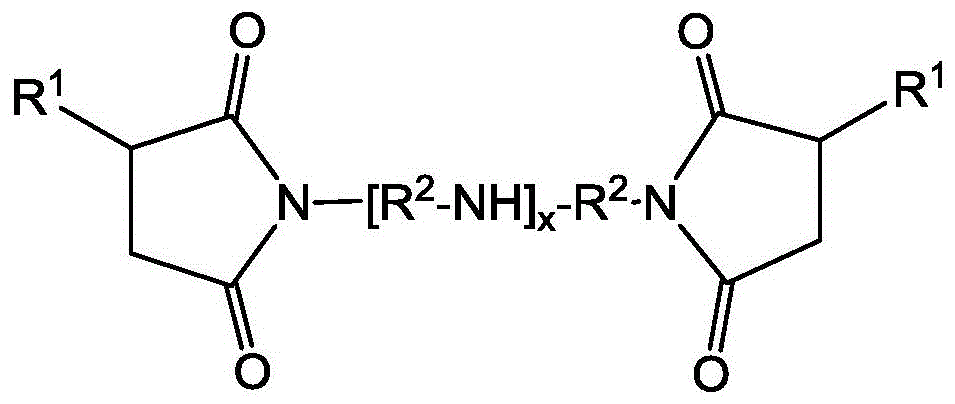
其中R1各自独立地为烷基,通常聚异丁烯基团,且R1基团可具有1000-3,500的数均分子量(Mn)。R2基团为亚烷基,通常亚乙基(C2H4)。作为选择,R1基团的Mn可以为1500-3000或2800-2500。这类分子通常衍生自烯基酰化剂与多胺的反应,并且除上文所示的简单酰亚胺结构外,两个结构部分之间的多种键是可能的,包括多种酰胺和季铵盐。在以上结构中,胺部分显示为亚烷基多胺,尽管也可使用其它脂族和芳族单胺和多胺。R1基团在酰亚胺结构上的多种键模式也是可能的,包括各种环键。酰化剂的羰基与胺的氮原子的比可以为1:0.5-1:3,在其它情况下,1:1-1:2.75或1:1.5-1:2.5。琥珀酰亚胺分散剂更完整地描述于美国专利4,234,435和3,172,892以及EP 0355895中。包括通过所谓的常规(或氯)路线以及通过热或直接烷基化或者“烯”路线制备的琥珀酰亚胺,如以上专利文件中公开的。通过不同路线制备的琥珀酰亚胺分散剂的特征通常是R1基团连接的详细结构的差别。也可将分散剂用各种试剂如硼酸化剂(例如硼酸)后处理以制备硼酸化分散剂。wherein each R 1 is independently an alkyl group, typically a polyisobutylene group, and the R 1 groups can have a number average molecular weight (M n ) of 1000-3,500. The R2 group is an alkylene group, typically an ethylene group ( C2H4 ) . Alternatively, the Mn of the R1 group can be 1500-3000 or 2800-2500. Such molecules are typically derived from the reaction of an alkenyl acylating agent with a polyamine, and in addition to the simple imide structures shown above, a variety of linkages between the two moieties are possible, including a variety of amides and Quaternary ammonium salts. In the above structure, the amine moiety is shown as an alkylene polyamine, although other aliphatic and aromatic mono- and polyamines may also be used. Various bond patterns of the R 1 group on the imide structure are also possible, including various ring bonds. The ratio of carbonyl groups of the acylating agent to nitrogen atoms of the amine may be 1:0.5-1:3, in other cases 1:1-1:2.75 or 1:1.5-1:2.5. Succinimide dispersants are more fully described in US Pat. Nos. 4,234,435 and 3,172,892 and EP 0355895. Included are succinimides prepared by the so-called conventional (or chlorine) route as well as by thermal or direct alkylation or the "ene" route, as disclosed in the above patent documents. Succinimide dispersants prepared by different routes are often characterized by differences in the detailed structure of the attachment of the R1 groups. The dispersants can also be post-treated with various agents such as borated agents (eg, boric acid) to prepare borated dispersants.
分散剂的TBN取决于其中所含胺官能的量,并且可以为10-60或者12-50或者15-40或者20-35或者35-30。其它实施方案可包括10-30或者12-25;或者作为选择20-60或者30-50mg KOH/g(都基于无油计算)。The TBN of the dispersant depends on the amount of amine functionality contained therein and can be 10-60 or 12-50 or 15-40 or 20-35 or 35-30. Other embodiments may include 10-30 or 12-25; or alternatively 20-60 or 30-50 mg KOH/g (both on an oil free basis).
琥珀酰亚胺分散剂还可通过多种试剂中的任一种反应而后处理。其中,这些为脲、硫脲、二巯基噻二唑、二硫化碳、醛、酮、羧酸、烃取代的琥珀酸酐、腈、环氧化物、硼化合物和磷化合物。详述该处理的参考列于美国专利4,654,403中。The succinimide dispersant can also be post-treated by reacting any of a variety of reagents. Among these, these are urea, thiourea, dimercaptothiadiazoles, carbon disulfide, aldehydes, ketones, carboxylic acids, hydrocarbon-substituted succinic anhydrides, nitriles, epoxides, boron compounds and phosphorus compounds. References detailing this process are listed in US Pat. No. 4,654,403.
本文所述润滑剂配制剂还包含至少一种过碱性金属清净剂。过碱性清净剂通常为均匀牛顿体系,其特征是超过根据金属和清净剂阴离子的化学计量中和会存在的金属含量。过量金属的量通常根据金属比表示,即金属的总当量与酸性有机化合物的当量的比。过碱性材料通过酸性材料(例如二氧化碳)与酸性有机化合物、惰性反应介质(例如矿物油)、化学计量过量的金属碱和促进剂如苯酚或醇反应而制备。酸性有机材料通常具有足够的碳原子数目以提供油溶性。The lubricant formulations described herein also include at least one overbased metal detergent. Overbased detergents are generally homogeneous Newtonian systems characterized by a metal content in excess of what would be present based on stoichiometric neutralization of the metal and detergent anion. The amount of excess metal is generally expressed in terms of metal ratio, ie the ratio of total equivalents of metal to equivalents of acidic organic compound. Overbased materials are prepared by reacting an acidic material (eg, carbon dioxide) with an acidic organic compound, an inert reaction medium (eg, mineral oil), a stoichiometric excess of a metal base, and a promoter such as phenol or alcohol. Acidic organic materials generally have a sufficient number of carbon atoms to provide oil solubility.
过碱性清净剂可通过总碱值(TBN,ASTM D2896),中和所有材料的碱度所需的强酸的量表征,表示为mg KOH/g试样。由于过碱性清净剂通常以包含稀释油的形式提供,就本文件而言,TBN通过除以不是油的清净剂(作为供应的)的含量而对于无油基重新计算。一些有用的清净剂可具有100-800,或者150-750或400-700的TBN。Overbased detergents can be characterized by Total Base Number (TBN, ASTM D2896), the amount of strong acid required to neutralize the alkalinity of all materials, expressed as mg KOH/g sample. Since overbased detergents are typically supplied in a form that includes diluent oils, for the purposes of this document, TBN is recalculated for an oil-free base by dividing by the amount of detergent (as supplied) that is not an oil. Some useful detergents may have a TBN of 100-800, or 150-750 or 400-700.
用于制备碱性金属盐的金属化合物通常为任何1族或2族金属化合物(元素周期表的CAS版本)。实例包括碱金属,例如钠、钾、锂、铜、镁、钙、钡、锌和镉。在一个实施方案中,金属为钠、镁或钙;或者钙或镁;或者钙。盐的阴离子部分可以为氢氧根、氧根、碳酸根、硼酸根或硝酸根。The metal compound used to prepare the basic metal salt is typically any Group 1 or 2 metal compound (CAS version of the Periodic Table of the Elements). Examples include alkali metals such as sodium, potassium, lithium, copper, magnesium, calcium, barium, zinc and cadmium. In one embodiment, the metal is sodium, magnesium, or calcium; or calcium or magnesium; or calcium. The anionic portion of the salt can be hydroxide, oxygen, carbonate, borate or nitrate.
在一个实施方案中,润滑剂可包含过碱性磺酸盐清净剂。合适的磺酸包括磺酸和硫代磺酸,包括单核或多核芳族或脂环族化合物。某些油溶性磺酸盐可由R2-T-(SO3-)a或R3-(SO3-)b表示,其中a和b各自为至少1;T为环状核,例如苯或甲苯;R2为脂族基团,例如烷基、烯基、烷氧基或烷氧基烷基;(R2)-T通常包含总计至少15个碳原子;且R3为通常含有至少15个碳原子的脂族烃基。基团T、R2和R3还可包含其它无机或有机取代基。在一个实施方案中,磺酸盐清净剂可以为具有至少8的金属比的主要线性烷基苯磺酸盐清净剂,如美国专利申请2005065045的第[0026]-[0037]段所述。在一些实施方案中,线性烷基可在沿着烷基的直链的任何位置,但通常在直链的2、3或4位上,在一些情况下,主要在2位上与苯环连接。In one embodiment, the lubricant may comprise an overbased sulfonate detergent. Suitable sulfonic acids include sulfonic and thiosulfonic acids, including mononuclear or polynuclear aromatic or cycloaliphatic compounds. Certain oil-soluble sulfonates can be represented by R2 - T-(SO3-) a or R3- (SO3- ) b , where a and b are each at least 1 ; T is a cyclic nucleus such as benzene or toluene R 2 is an aliphatic group such as alkyl, alkenyl, alkoxy or alkoxyalkyl; (R 2 )-T typically contains a total of at least 15 carbon atoms; and R 3 is typically at least 15 carbon atoms aliphatic hydrocarbon group of carbon atoms. The groups T, R2 and R3 may also contain other inorganic or organic substituents. In one embodiment, the sulfonate detergent may be a predominantly linear alkylbenzene sulfonate detergent having a metal ratio of at least 8, as described in US Patent Application 2005065045 at paragraphs [0026]-[0037]. In some embodiments, the linear alkyl group can be attached to the benzene ring at any position along the straight chain of the alkyl group, but is usually attached to the benzene ring at the 2, 3 or 4 position of the straight chain, and in some cases predominantly at the 2 position .
另一过碱性材料为过碱性酚盐清净剂。用于制备酚盐清净剂的苯酚可由(R1)a-Ar-(OH)b表示,其中R1为4-400或者6-80或者6-30或者8-25或8-15个碳原子的脂族烃基;Ar为芳族基团,例如苯、甲苯或萘;a和b各自为至少1,a和b的和为至多Ar的芳族核上的可替代氢的数目,例如1-4或1-2。对于各个苯酚化合物,通常存在平均至少8个由R1基团提供的脂族碳原子。酚盐清净剂有时也作为硫桥物种提供。Another overbased material is an overbased phenate detergent. The phenol used to prepare the phenate detergent can be represented by (R 1 ) a -Ar-(OH) b , where R 1 is 4-400 or 6-80 or 6-30 or 8-25 or 8-15 carbon atoms Ar is an aromatic group such as benzene, toluene or naphthalene; a and b are each at least 1, and the sum of a and b is at most the number of replaceable hydrogens on the aromatic nucleus of Ar, such as 1- 4 or 1-2. For each phenolic compound, there is generally an average of at least 8 aliphatic carbon atoms provided by the R1 group. Phenate detergents are also sometimes supplied as sulfur bridge species.
烷基苯酚通常用作过碱性清净剂中的组分和/或结构单元。烷基苯酚可用于制备酚盐、水杨酸盐、salixarate或水杨苷清净剂或其混合物。合适的烷基苯酚可包括对位取代的烃基苯酚。烃基可以为1-60个碳原子、8-40个碳原子、10-24个碳原子、12-20个碳原子,或者16-24个碳原子的线性或支化脂族基团。在一个实施方案中,烷基苯酚过碱性清净剂由不含或基本不含(即含有小于0.1重量%)对-十二烷基苯酚的烷基苯酚或其混合物制备。在一个实施方案中,本发明润滑组合物包含小于0.3重量%烷基苯酚、小于0.1重量%烷基苯酚,或者小于0.05重量%烷基苯酚。Alkylphenols are commonly used as components and/or building blocks in overbased detergents. Alkylphenols can be used to prepare phenate, salicylates, salixarate or salicin detergents or mixtures thereof. Suitable alkyl phenols may include para-substituted hydrocarbyl phenols. The hydrocarbyl group can be a linear or branched aliphatic group of 1-60 carbon atoms, 8-40 carbon atoms, 10-24 carbon atoms, 12-20 carbon atoms, or 16-24 carbon atoms. In one embodiment, the alkylphenol overbased detergent is prepared from alkylphenols or mixtures thereof that are free or substantially free (ie, contain less than 0.1% by weight) of p-dodecylphenol. In one embodiment, the lubricating composition of the present invention comprises less than 0.3 wt% alkylphenol, less than 0.1 wt% alkylphenol, or less than 0.05 wt% alkylphenol.
在一个实施方案中,过碱性材料为过碱性水杨苷清净剂。过碱性水杨苷清净剂通常为基于水杨苷衍生物的过碱性镁盐。该水杨苷衍生物的一般实例可由下式表示:In one embodiment, the overbased material is an overbased salicin detergent. Overbased salicin detergents are typically overbased magnesium salts based on salicin derivatives. A general example of the salicin derivative can be represented by the formula:
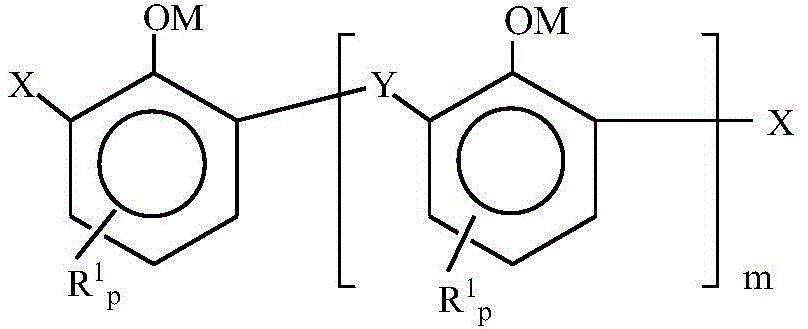
其中X为-CHO或-CH2OH,Y为-CH2-或-CH2OCH2-,且-CHO基团通常包含至少10摩尔%X和Y基团;M为氢、铵或一定价的金属离子(即如果M为多价的,则一个价由所述结构满足,且其它价由其它物种如阴离子或者相同结构的另一情况满足),R1为1-60个碳原子的烃基,m为0至通常10,且各个p独立地为0、1、2或3,条件是至少一个芳族环包含R1取代基,且所有R1基团中的碳原子总数为至少7。当m为1或更大时,一个X基团可以为氢。在一个实施方案中,M为一定价的Mg离子或者Mg和氢的混合物。水杨苷清净剂更详细地公开于美国专利6,310,009中,具体参考其合成方法(第8栏和实施例1)和各个X和Y物种的优选量(第6栏)。wherein X is -CHO or -CH2OH , Y is -CH2- or -CH2OCH2- , and the -CHO group typically contains at least 10 mole % X and Y groups; M is hydrogen, ammonium or a valence of metal ions (ie if M is multivalent, one valence is satisfied by the structure and the other is satisfied by other species such as anions or another case of the same structure), R 1 is a hydrocarbyl group of 1-60 carbon atoms , m is 0 to typically 10, and each p is independently 0, 1, 2, or 3, provided that at least one aromatic ring contains an R1 substituent and the total number of carbon atoms in all R1 groups is at least 7 . When m is 1 or greater, one X group may be hydrogen. In one embodiment, M is a valent Mg ion or a mixture of Mg and hydrogen. Salicin detergents are disclosed in more detail in US Pat. No. 6,310,009, with specific reference to their methods of synthesis (column 8 and Example 1) and preferred amounts of each X and Y species (column 6).
Salixarate清净剂为可通过包含至少一个式(I)或式(II)单元的化合物表示的过碱性材料,且化合物的各个端具有式(III)或(IV)的端基:Salixarate detergents are overbased materials that can be represented by compounds comprising at least one unit of formula (I) or formula (II), with each end of the compound having a terminal group of formula (III) or (IV):

这类基团通过可以为相同或不同的二价桥联基团A连接。在式(I)-(IV)中,R3为氢、烃基或一定价的金属离子;R2为羟基或烃基,且j为0、1或2;R6为氢、烃基或杂取代烃基;R4为羟基且R5和R7独立地为氢、烃基或杂取代烃基,或者R5和R7都是羟基且R4为氢、烃基或杂取代烃基;条件是R4、R5、R6和R7中的至少一个为含有至少8个碳原子的烃基;且其中分子平均包含至少一个单元(I)或(III)和至少一个单元(II)或(IV),且组合物中单元(I)和(III)的总数与(II)和(IV)单元的总数的比为0.1:1-2:1。每次出现时可以为相同或不同的二价桥联基团―A”包括-CH2-和-CH2OCH2-,其每一种可衍生自甲醛或甲醛等价物(例如仲甲醛、甲醛水)。Salixarate衍生物及其制备方法更详细地描述于美国专利No.6,200,936和PCT公开WO01/56968中。认为salixarate衍生物具有主要线性,而不是大环结构,尽管两种结构意欲包括在术语―salixarate”中。Such groups are linked through divalent bridging groups A which may be the same or different. In formula (I)-(IV), R 3 is hydrogen, hydrocarbyl or a metal ion of a certain valence; R 2 is hydroxyl or hydrocarbyl, and j is 0, 1 or 2; R 6 is hydrogen, hydrocarbyl or heterosubstituted hydrocarbyl ; R 4 is hydroxy and R 5 and R 7 are independently hydrogen, hydrocarbyl or heterosubstituted hydrocarbyl, or R 5 and R 7 are both hydroxy and R 4 is hydrogen, hydrocarbyl or heterosubstituted hydrocarbyl; provided that R 4 , R 5 , at least one of R 6 and R 7 is a hydrocarbyl group containing at least 8 carbon atoms; and wherein the molecule comprises on average at least one unit (I) or (III) and at least one unit (II) or (IV), and the composition The ratio of the total number of units (I) and (III) to the total number of units (II) and (IV) is 0.1:1 to 2:1. Each occurrence may be the same or a different divalent bridging group " A " includes -CH2- and -CH2OCH2- , each of which may be derived from formaldehyde or a formaldehyde equivalent (e.g. paraformaldehyde, formalin ). Salixarate derivatives and methods for their preparation are described in more detail in US Patent No. 6,200,936 and PCT Publication WO 01/56968. Salixarate derivatives are believed to have predominantly linear, rather than macrocyclic structures, although both structures are intended to be included in the term— salixarate".
乙醛酸清净剂为基于阴离子基团的类似过碱性材料,在一个实施方案中,其可具有结构:Glyoxylic acid detergents are similar overbased materials based on anionic groups, which in one embodiment can have the structure:

其中各个R独立地为含有至少4或8个碳原子的烷基,条件是所有这类R基团中的碳原子总数为至少12或16或24。作为选择,各个R可以为烯烃聚合物取代基。制备过碱性乙醛酸清净剂的酸性材料为羟基芳族材料如烃基取代苯酚与羧酸反应物如乙醛酸或另一ω-氧代链烷酸的缩合产物。过碱性乙醛酸清净剂及其制备方法更详细地公开于美国专利6,310,011和其中引用的参考文献中。wherein each R is independently an alkyl group containing at least 4 or 8 carbon atoms, provided that the total number of carbon atoms in all such R groups is at least 12 or 16 or 24. Alternatively, each R can be an olefin polymer substituent. The acidic material from which the overbased glyoxylic acid detergent is made is the condensation product of a hydroxyaromatic material such as a hydrocarbyl substituted phenol with a carboxylic acid reactant such as glyoxylic acid or another omega-oxoalkanoic acid. Overbased glyoxylic acid detergents and methods for their preparation are disclosed in more detail in US Pat. No. 6,310,011 and references cited therein.
过碱性清净剂还可以为过碱性水杨酸盐,例如取代水杨酸的碱金属或碱土金属盐。水杨酸可以为烃基取代的,其中各个取代基含有平均至少8个碳原子每取代基和1-3个取代基每分子。取代基可以为聚烯烃取代基。在一个实施方案中,烃基取代基包含7-300个碳原子并且可以为具有150-2000的分子量的烷基。过碱性水杨酸盐清净剂及其制备方法公开于美国专利4,719,023和3,372,116中。水杨酸盐清净剂和过碱性水杨酸盐清净剂可以以至少两种不同的方式制备。对-烷基苯酚的羰基化(也称为羧化)描述于许多参考文献中,包括美国专利8,399,388。羰基化之后可以是过碱化以形成过碱性水杨酸盐清净剂。合适的对-烷基苯酚包括具有1-60个碳原子的线性和/或支化烃基的那些。水杨酸盐清净剂也可通过水杨酸的烷基化,其后过碱化制备,如美国专利7,009,072所述。以这种方式制备的水杨酸盐清净剂可由包含6-50个碳原子、10-30个碳原子,或者14-24个碳原子的线性和/或支化烷基化剂(通常1-烯烃)制备。在一个实施方案中,本发明过碱性清净剂为水杨酸盐清净剂。在一个实施方案中,本发明水杨酸盐清净剂不含未反应的对-烷基苯酚(即,包含小于0.1重量%)。在一个实施方案中,本发明水杨酸盐清净剂通过水杨酸的烷基化制备。Overbased detergents can also be overbased salicylates, such as alkali metal or alkaline earth metal salts of substituted salicylic acid. The salicylic acid can be hydrocarbyl-substituted, wherein each substituent contains an average of at least 8 carbon atoms per substituent and 1-3 substituents per molecule. The substituents may be polyolefin substituents. In one embodiment, the hydrocarbyl substituent contains 7-300 carbon atoms and can be an alkyl group having a molecular weight of 150-2000. Overbased salicylate detergents and methods for their preparation are disclosed in US Pat. Nos. 4,719,023 and 3,372,116. Salicylate detergents and overbased salicylate detergents can be prepared in at least two different ways. The carbonylation (also known as carboxylation) of p-alkylphenols is described in many references, including US Patent 8,399,388. Carbonylation may be followed by overbasing to form an overbased salicylate detergent. Suitable para-alkylphenols include those having linear and/or branched hydrocarbon groups of 1 to 60 carbon atoms. Salicylate detergents can also be prepared by alkylation of salicylic acid followed by overbasing, as described in US Pat. No. 7,009,072. The salicylate detergents prepared in this manner can be composed of linear and/or branched alkylating agents (usually 1- olefins). In one embodiment, the overbased detergents of the present invention are salicylate detergents. In one embodiment, the salicylate detergents of the present invention are free of unreacted p-alkylphenol (ie, contain less than 0.1 wt%). In one embodiment, the salicylate detergents of the present invention are prepared by alkylation of salicylic acid.
其它过碱性清净剂可包括具有曼尼希碱结构的过碱性清净剂,如美国专利6,569,818中公开的。Other overbased detergents may include overbased detergents having a Mannich base structure, as disclosed in US Pat. No. 6,569,818.
在某些实施方案中,以上清净剂(例如酚盐、水杨苷、salixarate、乙醛酸或水杨酸盐)中羟基取代芳族环上的烃基取代基不含或者基本不含C12脂族烃基(例如小于1%、0.1%,或者0.01重量%取代基为C12脂族烃基)。在一些实施方案中,这类烃基取代基包含至少14或至少18个碳原子。In certain embodiments, the hydrocarbyl substituents on the hydroxy-substituted aromatic rings in the above detergents (eg, phenate, salicin, salixarate, glyoxylic acid, or salicylates) are free or substantially free of C12 lipids aliphatic hydrocarbon groups (eg, less than 1%, 0.1%, or 0.01% by weight of substituents are C12 aliphatic hydrocarbon groups). In some embodiments, such hydrocarbyl substituents contain at least 14 or at least 18 carbon atoms.
本技术的配制剂中过碱性清净剂的量通常为0.05-1.8重量%,或者0.07-1.5,或者0.1-1.2,或者0.3-1重量%。可存在单一清净剂或多种清净剂;如果存在多于一种,则量涉及多种清净剂的总量。在公开的技术中,一种或多种过碱性金属清净剂的量与其TBN组合受限使得总润滑剂的TBN为小于6.5mg KOH当量/g。该值包括由清净剂以及由其它来源如含胺分散剂提供的TBN。在某些实施方案中,润滑剂的TBN为2-6或3-5。The amount of overbased detergent in formulations of the present technology is typically 0.05-1.8 wt %, alternatively 0.07-1.5, alternatively 0.1-1.2, alternatively 0.3-1 wt %. A single detergent or multiple detergents may be present; if more than one is present, the amount refers to the total of the multiple detergents. In the disclosed technology, the amount of one or more overbased metal detergents in combination with their TBN is limited such that the TBN of the total lubricant is less than 6.5 mg KOH equiv/g. This value includes TBN provided by detergents as well as by other sources such as amine-containing dispersants. In certain embodiments, the TBN of the lubricant is 2-6 or 3-5.
其它常规组分可用于制备本发明润滑剂,例如通常用于曲轴箱润滑剂中的那些添加剂。曲轴箱润滑剂可通常包含下文所述以下组分中的任一种或者所有。Other conventional components can be used to prepare the lubricants of the present invention, such as those additives commonly used in crankcase lubricants. Crankcase lubricants may generally contain any or all of the following components described below.
另一添加剂可以为不同于琥珀酰亚胺分散剂的分散剂。一种这类备选分散剂为高分子量酯,其通过烃基酰化剂和多元脂族醇如甘油、季戊四醇或山梨糖醇反应而制备。这类材料更详细地描述于美国专利3,381,022中。另一类分散剂为曼尼希碱。这些为通过较高分子量烷基取代苯酚、亚烷基多胺和醛如甲醛缩合而形成的材料,并且更详细地描述于美国专利3,634,515中。这类分散剂也可通过与多种试剂中的任一种反应而后处理,如上文关于琥珀酰亚胺分散剂所述。所述组合物中任选其它分散剂的量通常可以为0-10重量%,或者1-5%或2-4%。Another additive may be a dispersant other than the succinimide dispersant. One such alternative dispersing agent is a high molecular weight ester, prepared by reacting a hydrocarbyl acylating agent with a polyhydric aliphatic alcohol such as glycerol, pentaerythritol, or sorbitol. Such materials are described in more detail in US Pat. No. 3,381,022. Another class of dispersants are Mannich bases. These are materials formed by the condensation of higher molecular weight alkyl-substituted phenols, alkylene polyamines, and aldehydes such as formaldehyde, and are described in more detail in US Pat. No. 3,634,515. Such dispersants may also be post-treated by reaction with any of a variety of reagents, as described above for succinimide dispersants. The amount of optional other dispersants in the composition may generally be 0-10% by weight, alternatively 1-5% or 2-4%.
另一组分为抗氧化剂。抗氧化剂包括苯酚抗氧化剂,其可包含含有2或3个叔丁基的丁基取代苯酚,对位也可被烃基、含酯基团或桥联2个芳族环的基团占据。抗氧化剂还包括芳族胺,例如壬基化二苯胺或烷基化苯基萘胺。其它抗氧化剂包括硫化烯烃、钛化合物和钼化合物。美国专利4,285,822例如公开了包含含硫和含钼组合物的润滑油组合物。美国专利申请公开2006-0217271公开了多种钛化合物,包括钛醇盐和钛酸化分散剂,所述材料也可赋予沉积物控制和过滤性的改进。其它钛化合物包括钛羧酸盐,例如新癸酸盐。如果存在钛化合物,则其量可以例如提供15-1000或者25-200份每百万份钛。当然,抗氧化剂的典型量取决于具体抗氧化剂及其单独的效力,但说明性总量可以为0.01-5重量%或者0.15-4.5%或0.2-4%。另外,可存在多于一种抗氧化剂,且这些的某些组合在其组合总效应方面是协同的。Another component is antioxidants. Antioxidants include phenolic antioxidants, which may comprise butyl-substituted phenols containing 2 or 3 tert-butyl groups, and the para position may also be occupied by a hydrocarbyl group, an ester-containing group, or a group bridging 2 aromatic rings. Antioxidants also include aromatic amines such as nonylated diphenylamines or alkylated phenylnaphthylamines. Other antioxidants include sulfurized olefins, titanium compounds, and molybdenum compounds. US Patent 4,285,822, for example, discloses lubricating oil compositions comprising sulfur- and molybdenum-containing compositions. US Patent Application Publication 2006-0217271 discloses a variety of titanium compounds, including titanium alkoxides and titanated dispersants, that can also impart improvements in deposit control and filterability. Other titanium compounds include titanium carboxylates, such as neodecanoate. If a titanium compound is present, the amount may, for example, provide 15-1000 or 25-200 parts per million titanium. Of course, typical amounts of antioxidants will depend on the particular antioxidant and its individual potency, but illustrative total amounts may be 0.01-5% by weight or 0.15-4.5% or 0.2-4%. Additionally, more than one antioxidant may be present, and certain combinations of these are synergistic in their combined overall effect.
另一添加剂为抗磨剂。抗磨剂的实例包括含磷抗磨/特压剂,例如金属硫代磷酸盐、磷酸酯及其盐、含磷羧酸、酯、醚和酰胺;和亚磷酸盐。在某些实施方案中,磷抗磨剂可以以提供0.01-0.2,或者0.015-0.15,或者0.02-0.1,或者0.025-0.08%磷的量存在。通常,抗磨剂为二烷基二硫代磷酸锌(ZDP)。对于可包含11%P(基于无油计算)的典型ZDP,合适的量可包括0.09-0.82%。在一个实施方案中,润滑剂组合物不含或基本不含二烷基二硫代磷酸锌。不含磷的抗磨剂包括硼酸酯(包括硼酸化环氧化物)、二硫代氨基甲酸酯化合物、含钼化合物和硫化烯烃。Another additive is an antiwear agent. Examples of antiwear agents include phosphorus-containing antiwear/extreme pressure agents such as metal thiophosphates, phosphoric acid esters and salts thereof, phosphorus-containing carboxylic acids, esters, ethers, and amides; and phosphites. In certain embodiments, the phosphorus antiwear agent may be present in an amount to provide 0.01-0.2, alternatively 0.015-0.15, alternatively 0.02-0.1, alternatively 0.025-0.08% phosphorus. Typically, the antiwear agent is zinc dialkyldithiophosphate (ZDP). For a typical ZDP that may contain 11% P (on an oil free basis), suitable amounts may include 0.09-0.82%. In one embodiment, the lubricant composition is free or substantially free of zinc dialkyldithiophosphates. Phosphorus-free antiwear agents include borate esters (including borated epoxides), dithiocarbamate compounds, molybdenum-containing compounds, and sulfurized olefins.
可用作抗磨剂的其它材料包括酒石酸酯、酒石酰胺和酒石酰亚胺。实例包括油基酒石酰亚胺(由油胺和酒石酸形成的酰亚胺)和油基二酯(例如来自混合C12-16醇)。可使用的其它相关材料包括通常其它羟基羧酸,包括羟基-聚羧酸,例如酸如酒石酸、柠檬酸、乳酸、羟基乙酸、羟基丙酸、羟基戊二酸及其混合物的酯、酰胺和酰亚胺。这些材料也可赋予润滑剂抗磨性能以外的另外功能。这些材料更详细地描述于美国公开2006-0079413和PCT公开WO2010/077630中。如果存在的话,羟基羧酸(或由其衍生的化合物)的这类衍生物通常可以以0.1重量%至5重量%,或者0.2重量%至3重量%,或者大于0.2重量%至3重量%的量存在于润滑组合物中。Other materials useful as antiwear agents include tartrate esters, tartaramides and tartarimides. Examples include oleyl tartarimides (imides formed from oleylamine and tartaric acid) and oleyl diesters (eg, from mixed C 12-16 alcohols). Other related materials that can be used include other hydroxycarboxylic acids in general, including hydroxy-polycarboxylic acids, such as esters, amides and acyl acids of acids such as tartaric acid, citric acid, lactic acid, glycolic acid, hydroxypropionic acid, hydroxyglutaric acid, and mixtures thereof imine. These materials can also impart additional functions to the lubricant in addition to its antiwear properties. These materials are described in more detail in US Publication 2006-0079413 and PCT Publication WO2010/077630. Such derivatives of hydroxycarboxylic acids (or compounds derived therefrom), if present, may generally be present in an amount of from 0.1% to 5% by weight, or from 0.2% to 3% by weight, or more than 0.2% to 3% by weight amount is present in the lubricating composition.
可任选用于润滑油中的其它添加剂包括倾点下降剂、特压剂、抗磨剂、色彩稳定剂和消泡剂。Other additives that may optionally be used in lubricating oils include pour point depressants, extreme pressure agents, antiwear agents, color stabilizers, and defoamers.
其它粘度改进剂Other viscosity modifiers
通常选择具有润滑粘度的油以提供除其它性能外合适的粘度(运动粘度和高温高剪切粘度)和粘度指数。多数现代发动机润滑剂为多级润滑剂,其包含粘度指数改进剂以提供低温和高温下的合适粘度,即不同于如上所述分散剂粘度改进剂(包含氮官能)的粘度改进剂,即补充粘度改进剂。尽管粘度改进剂有时被认为是基油的一部分,更适当地认为是分开的组分,其选择在本领域技术人员的能力范围内。Oils of lubricating viscosity are generally selected to provide, among other properties, suitable viscosity (kinematic viscosity and high temperature high shear viscosity) and viscosity index. Most modern engine lubricants are multi-grade lubricants that contain viscosity index improvers to provide suitable viscosity at low and high temperatures, i.e. viscosity modifiers other than dispersant viscosity modifiers (containing nitrogen functionality) as described above, i.e. supplemental Viscosity modifier. Although viscosity modifiers are sometimes considered part of the base oil, they are more properly considered separate components, the choice of which is within the purview of those skilled in the art.
粘度改进剂通常为聚合物材料,其通常为一般具有25,000-500,000,例如50,000-300,000或者50,000-200,000的数均分子量的烃基聚合物。Viscosity modifiers are typically polymeric materials, which are typically hydrocarbon-based polymers typically having a number average molecular weight of 25,000-500,000, eg, 50,000-300,000 or 50,000-200,000.
烃聚合物可用作粘度指数改进剂。实例包括两种或更多种C2-C30,例如C2-C8烯烃,包括α烯烃和内烯烃单体的均聚物和聚合物,所述单体可以为直链或支化的、脂族、芳族、烷基-芳族或脂环族的。实例包括通过已知方法使乙烯和丙烯共聚而制备的乙烯-丙烯共聚物,通常称为OCP。Hydrocarbon polymers can be used as viscosity index improvers. Examples include two or more C2- C30 , such as C2 - C8 olefins, including homopolymers and polymers of alpha olefin and internal olefin monomers, which may be linear or branched , aliphatic, aromatic, alkyl-aromatic or cycloaliphatic. Examples include ethylene-propylene copolymers, commonly referred to as OCPs, prepared by copolymerizing ethylene and propylene by known methods.
氢化苯乙烯-共轭二烯共聚物或氢化共轭二烯聚合物为其它类别的粘度改进剂。这些聚合物包括为氢化或部分氢化均聚物的聚合物,并且还包括无规、递变、星型和嵌段共聚物。术语“苯乙烯”包括各种取代的苯乙烯。共轭二烯可包含4-6个碳原子,并且可包括例如间戊二烯、2,3-二甲基-1,3-丁二烯、氯丁二烯、异戊二烯和1,3-丁二烯。这类共轭二烯的混合物是有用的。这些共聚物的苯乙烯含量可以为20%至70重量%或者40%至60%,且脂族共轭二烯含量可以为30%至80%或者40%至60%。这些共聚物可通过本领域熟知的方法制备,并且通常氢化以除去实质性部分的其烯键式双键。Hydrogenated styrene-conjugated diene copolymers or hydrogenated conjugated diene polymers are other classes of viscosity modifiers. These polymers include polymers that are hydrogenated or partially hydrogenated homopolymers, and also include random, tapered, star and block copolymers. The term "styrene" includes various substituted styrenes. Conjugated dienes may contain 4-6 carbon atoms, and may include, for example, piperylene, 2,3-dimethyl-1,3-butadiene, chloroprene, isoprene, and 1,3-diene, 3-butadiene. Mixtures of such conjugated dienes are useful. The styrene content of these copolymers may be 20% to 70% by weight or 40% to 60%, and the aliphatic conjugated diene content may be 30% to 80% or 40% to 60%. These copolymers can be prepared by methods well known in the art and are usually hydrogenated to remove a substantial portion of their ethylenic double bonds.
通过苯乙烯和马来酸酐在自由基引发剂的存在下共聚,其后将共聚物用C4-18醇的混合物酯化而得到的酯也用作发动机油中的粘度改进添加剂。同样,聚(甲基)丙烯酸酯(PMA)可用作粘度改进剂。如容易理解的,如本文所用,术语“(甲基)丙烯酸酯”及其同类词意指甲基丙烯酸酯或丙烯酸酯。这些材料通常由具有不同烷基的(甲基)丙烯酸酯单体的混合物制备,所述烷基可以为含有1-18个碳原子的直链或支链基团。Esters obtained by copolymerization of styrene and maleic anhydride in the presence of a free radical initiator followed by esterification of the copolymer with a mixture of C 4-18 alcohols are also used as viscosity improving additives in engine oils. Likewise, poly(meth)acrylates (PMA) can be used as viscosity modifiers. As readily understood, as used herein, the term "(meth)acrylate" and its congeners mean either methacrylate or acrylate. These materials are typically prepared from mixtures of (meth)acrylate monomers with different alkyl groups, which may be straight or branched chain groups containing from 1 to 18 carbon atoms.
某些粘度改进剂可以为多臂聚合物。这些可包括包含含有至少约20,或者至少50或者100或者200或者350或者500或者1000个碳原子的多个臂的含(甲基)丙烯酸酯聚合物,所述臂连接在多价有机结构部分上。多臂聚合物因此可以为“星型”聚合物、“梳型”聚合物或者具有如本文所述多个臂或支链的聚合物的特性。Certain viscosity modifiers may be multi-arm polymers. These may include (meth)acrylate-containing polymers comprising multiple arms containing at least about 20, or at least 50 or 100 or 200 or 350 or 500 or 1000 carbon atoms, the arms being attached to a polyvalent organic moiety superior. A multi-armed polymer may thus be a "star" polymer, a "comb" polymer, or the properties of a polymer having multiple arms or branches as described herein.
星型聚合物是已知的。它们可通过多种路线制备,包括原子转移自由基聚合(ATRP)、可逆加成-断裂链转移(RAFT)聚合、氮氧调控聚合或阴离子聚合。ATRP的详细讨论the Handbook of Radical Polymerization,编辑KrzysztofMatyjaszewski和ThomasP.Davis,John Wiley和Sons,Inc.,2002(下文中称为―Matyjaszewski”)的第11章,第523-628页中给出。特别参见第524页的反应示意图11.1、第556页的11.4、第571页的11.7、第572页的11.8和第575页的11.9。Star polymers are known. They can be prepared by various routes, including atom transfer radical polymerization (ATRP), reversible addition-fragmentation chain transfer (RAFT) polymerization, nitroxide-mediated polymerization, or anionic polymerization. A detailed discussion of ATRP is given in Chapter 11, pp. 523-628, of the Handbook of Radical Polymerization, eds. Krzysztof Matyjaszewski and Thomas P. Davis, John Wiley and Sons, Inc., 2002 (hereinafter "Matyjaszewski"). See reaction scheme 11.1 on page 524, 11.4 on page 556, 11.7 on page 571, 11.8 on page 572 and 11.9 on page 575.
当聚合物的核部分包含上式(I)的官能团,且其中Y由-S-C(=S)-R5表示,其中R5可以为含有1-20个碳原子的烷基时,可使用RAFT聚合。Y官能可衍生自或者为链转移剂的一部分。在某些实施方案中,核部分包含衍生自包含硫代羰基硫基和自由基离去基团的化合物的官能团(通常来自链转移剂),例如美国申请2007/0244018的第0146段所述那些。RAFT can be used when the core moiety of the polymer comprises a functional group of formula (I) above, and wherein Y is represented by -SC(=S) -R5 , where R5 may be an alkyl group containing 1-20 carbon atoms polymerization. The Y functionality can be derived from or be part of a chain transfer agent. In certain embodiments, the core moiety comprises a functional group (usually from a chain transfer agent) derived from a compound comprising a thiocarbonylthio group and a radical leaving group, such as those described in paragraph 0146 of US Application 2007/0244018 .
RAFT链转移剂的实例包括1-(2-吡咯烷酮)二硫代碳酸苄基酯、(1,2-苯二羧酰亚胺基)二硫代碳酸苄基酯、1-吡咯二硫代碳酸2-氰基丙-2-基酯、1-吡咯二硫代碳酸2-氰基丁-2-基酯、1-咪唑二硫代碳酸苄基酯、N,N-二甲基-S-(2-氰基丙-2-基)二硫代氨基甲酸酯、二硫代氨基甲酸N,N-二乙基-S-苄基酯、1-(2-吡咯)二硫代碳酸氰基甲酯、二硫代苯甲酸异丙苯酯、S-(2-乙氧基羰基丙-2-基)二硫代氨基甲酸N,N-二乙基酯、黄原酸O-乙基-S-(1-苯基乙基)酯、黄原酸O-乙基-S-(2-(乙氧基羰基)丙-2-基)酯、黄原酸O-乙基-S-(2-氰基丙-2-基)酯、黄原酸O-乙基-S-(2-氰基丙-2-基)酯、黄原酸O-乙基-S-氰基甲基酯、黄原酸O-苯基-S-苄基酯、黄原酸O-五氟苯基-S-苄基酯、3-苄硫基-5,5-二甲基环己-2-烯-1-硫酮、3,3-二(苄硫基)二硫代丙-2-烯酸苄基酯、S,S'-双-(α,α'-二取代-α”-乙酸)-三硫代碳酸酯、S,S'-双-(α,α'-二取代-α”-乙酸)-三硫代碳酸酯或S-烷基-S'-(-(α,α'-二取代-α”-乙酸)-三硫代碳酸酯、二硫代苯甲酸、4-氯二硫代苯甲酸、二硫代苯甲酸苄基酯、二硫代苯甲酸1-苯基乙基酯、二硫代苯甲酸2-苯基丙-2-基酯、二硫代苯甲酸1-乙酰氧基乙基酯、六(硫代苯甲酰硫基甲基)苯、1,4-双(硫代苯甲酰硫基甲基)苯、1,2,4,5-四(硫代苯甲酰硫基甲基)苯、1,4-双-(2-(硫代苯甲酰硫基)丙-2-基)苯、二硫代苯甲酸1-(4-甲氧基苯基)乙基酯、二硫代乙酸苄基酯、二硫代乙酸乙氧基羰基甲基酯、二硫代苯甲酸2-(乙氧基羰基)丙-2-基酯、二硫代苯甲酸2,4,4-三甲基戊-2-基酯、二硫代苯甲酸2-(4-氯苯基)丙-2-基酯、二硫代苯甲酸3-乙烯基苄基酯、二硫代苯甲酸4-乙烯基苄基酯、二乙氧基亚膦基二硫代甲酸S-苄基酯、三硫代过苯甲酸叔丁基酯、4-氯二硫代苯甲酸2-苯基丙-2-基酯、1-二硫代萘二甲酸2-苯基丙-2-基酯、二硫代苯甲酸4-氰基戊酸酯、四硫代对苯二甲酸二苄基酯、三硫代碳酸二苄基酯、二硫代苯甲酸羧基甲酯或者具有二硫代苯甲酸酯端基的聚(氧化乙烯)或其混合物。RAFT还更详细地描述于Matyjaszewski的第12章,第629-690页,尤其是第664-665页中。Examples of RAFT chain transfer agents include benzyl 1-(2-pyrrolidone)dithiocarbonate, benzyl (1,2-benzenedicarboximido)dithiocarbonate, 1-pyrroledithiocarbonate 2-cyanoprop-2-yl ester, 2-cyanobut-2-yl 1-pyrrole dithiocarbonate, 1-imidazole dithiobenzyl carbonate, N,N-dimethyl-S- (2-cyanoprop-2-yl)dithiocarbamate, N,N-diethyl-S-benzyl dithiocarbamate, 1-(2-pyrrole)dithiocyanocarbonate methyl ester, cumyl dithiobenzoate, N,N-diethyl dithiocarbamate, S-(2-ethoxycarbonylpropan-2-yl) dithiocarbamate, O-ethyl xanthate -S-(1-Phenylethyl)ester, O-ethyl-S-(2-(ethoxycarbonyl)propan-2-yl)xanthate, O-ethyl-S-xanthate (2-Cyanoprop-2-yl) ester, O-ethyl-S-(2-cyanoprop-2-yl) xanthate, O-ethyl-S-cyanomethyl xanthate Ester, O-phenyl-S-benzyl xanthate, O-pentafluorophenyl-S-benzyl xanthate, 3-benzylthio-5,5-dimethylcyclohexyl-2- Alkenyl-1-thione, 3,3-bis(benzylthio)dithioprop-2-enoic acid benzyl ester, S,S'-bis-(α,α'-disubstituted-α"-acetic acid )-trithiocarbonate, S,S'-bis-(α,α'-disubstituted-α"-acetic acid)-trithiocarbonate or S-alkyl-S'-(-(α,α '-disubstituted-α"-acetic acid)-trithiocarbonate, dithiobenzoic acid, 4-chlorodithiobenzoic acid, benzyl dithiobenzoate, 1-phenyl dithiobenzoate ethyl ester, 2-phenylpropan-2-yl dithiobenzoate, 1-acetoxyethyl dithiobenzoate, hexa(thiobenzoylthiomethyl)benzene, 1, 4-bis(thiobenzoylthiomethyl)benzene, 1,2,4,5-tetrakis(thiobenzoylthiomethyl)benzene, 1,4-bis-(2-(thiobenzoylthiomethyl)benzene Benzoylthio)prop-2-yl)benzene, 1-(4-methoxyphenyl)ethyl dithiobenzoate, benzyl dithioacetate, ethoxycarbonyl dithioacetate Methyl ester, 2-(ethoxycarbonyl)propan-2-yl dithiobenzoate, 2,4,4-trimethylpent-2-yl dithiobenzoate, dithiobenzoic acid 2-(4-Chlorophenyl)propan-2-yl ester, 3-vinylbenzyl dithiobenzoate, 4-vinylbenzyl dithiobenzoate, diethoxyphosphinate S-benzyl thioformate, tert-butyl trithioperbenzoate, 2-phenylpropan-2-yl 4-chlorodithiobenzoate, 2-benzene 1-dithionaphthalene dicarboxylate Propan-2-yl ester, 4-cyanovalerate dithiobenzoate, dibenzyl tetrathioterephthalate, dibenzyl trithiocarbonate, carboxymethyl dithiobenzoate Or poly(ethylene oxide) or mixtures thereof with dithiobenzoate end groups. RAFT is also described in more detail in chapter 12 of Matyjaszewski, pages 629-690, especially pages 664-665.
当包含多个臂的含(甲基)丙烯酸酯聚合物为星型聚合物时,聚合物可包含:(i)包含多价(甲基)丙烯酸单体、其低聚物或聚合物或者多价二乙烯基非丙烯酸单体、其低聚物或聚合物的核部分;和(ii)至少两个聚合(甲基)丙烯酸烷基酯臂。核部分则可进一步包含式(Ia)的官能团:When the (meth)acrylate-containing polymer comprising multiple arms is a star polymer, the polymer may comprise: (i) comprising a polyvalent (meth)acrylic monomer, oligomer or polymer thereof, or polyvalent (meth)acrylic monomers, oligomers or polymers thereof. a core moiety of a valent divinyl non-acrylic monomer, oligomer or polymer thereof; and (ii) at least two polymeric alkyl (meth)acrylate arms. The core moiety may then further comprise a functional group of formula (Ia):
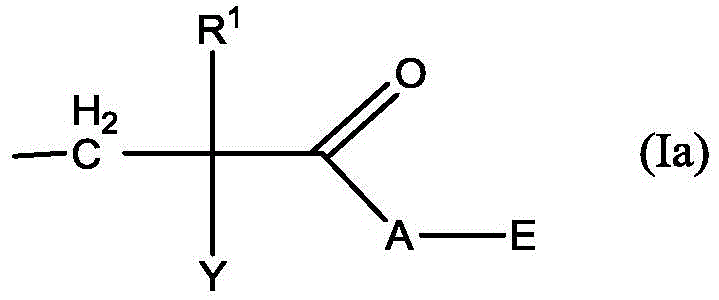
其中E独立地为核的另一部分、聚合物臂或者单体物种,或者如式(Ia)定义的另一结构单元;R1为氢或者含有1-5个碳原子的线性或支化烷基;A为氮或氧;且Y为自由基离去基团,其选自可在聚合条件下通过自由基机制转移的一个或多个原子或原子基团、卤素、氮氧基团或者二硫代酯基团。类似于结构(Iz),结构(Ia)的左侧上显示的键通常可连接在Z基团上,其中Z为聚合物基团,例如交联聚合物基团。wherein E is independently another part of the core, a polymeric arm or a monomeric species, or another structural unit as defined by formula (Ia); R 1 is hydrogen or a linear or branched alkyl group containing 1-5 carbon atoms A is nitrogen or oxygen; and Y is a free radical leaving group selected from one or more atoms or groups of atoms, halogens, nitroxyl groups, or disulfides that can be transferred by a free radical mechanism under polymerization conditions Ester group. Similar to structure (Iz), the bond shown on the left side of structure (Ia) can generally be attached to a Z group, where Z is a polymeric group, eg, a cross-linked polymeric group.
星型聚合物的臂本身可以为含(甲基)丙烯酸酯聚合物或低聚物结构部分,其包含与醇结构部分缩合以提供烷基的(甲基)丙烯酸结构部分。在某些实施方案中,星型聚合物的臂可由烷基中含有至多40个碳原子,或者至多30个碳原子,或者1-18个碳原子,或者1-15个碳原子,或者8-15,或者10-15,或者12-15个碳原子的(甲基)丙烯酸烷基酯形成。在某些实施方案中,一个或多个臂包含衍生自丙烯酸烷基酯单体的单元。在一个实施方案中,(甲基)丙烯酸酯包含聚合(甲基)丙烯酸烷基酯臂中的98%至100%的含有1-18或1-15个碳原子的烷基;和聚合(甲基)丙烯酸烷基酯臂中的0%至2%的含有19-30或者16-30个碳原子的烷基。The arms of the star polymer can themselves be (meth)acrylate containing polymer or oligomer moieties comprising (meth)acrylic moieties that condense with alcohol moieties to provide alkyl groups. In certain embodiments, the arms of the star polymer may contain up to 40 carbon atoms, or up to 30 carbon atoms, or 1-18 carbon atoms, or 1-15 carbon atoms, or 8- 15, or 10-15, or 12-15 carbon atoms of alkyl (meth)acrylate formation. In certain embodiments, one or more arms comprise units derived from alkyl acrylate monomers. In one embodiment, the (meth)acrylate comprises 98% to 100% of the alkyl (meth)acrylate arms containing 1-18 or 1-15 carbon atoms in the polymeric alkyl ester arm; and the polymeric (meth)acrylate 0% to 2% of alkyl groups containing 19-30 or 16-30 carbon atoms in the alkyl acrylate arms.
在一个实施方案中,星型聚合物可具有至少3个臂,在另一实施方案中,大于5个臂,在另一实施方案中,大于7个臂,在另一实施方案中,大于10个臂,例如12-100、14-50,或者16-40个臂。在一个实施方案中,星型聚合物可具有120个臂或更少,在另一实施方案中,80个臂或更少,在另一实施方案中,60个臂或更少。在某些实施方案中,每个星可存在3-20、5-20,或者6-15,或者7-8个臂。这类多臂聚合物及其制备更详细地描述于WO2015/142482,2015年9月24日,参见第0017-0064段。In one embodiment, the star polymer may have at least 3 arms, in another embodiment, greater than 5 arms, in another embodiment, greater than 7 arms, and in another embodiment, greater than 10 arms arms, such as 12-100, 14-50, or 16-40 arms. In one embodiment, a star polymer may have 120 arms or less, in another embodiment, 80 arms or less, and in another embodiment, 60 arms or less. In certain embodiments, there may be 3-20, 5-20, or 6-15, or 7-8 arms per star. Such multi-arm polymers and their preparation are described in more detail in WO2015/142482, 24 September 2015, see paragraphs 0017-0064.
粘度改进剂组分(不同于上述分散剂粘度改进剂)的量基于无油可以为0.02-5重量%,或者0.1-2%,或者0.2-1%,或者0.3-0.6重量%。The amount of the viscosity modifier component (other than the dispersant viscosity modifier described above) may be 0.02-5 wt %, alternatively 0.1-2 %, alternatively 0.2-1 %, alternatively 0.3-0.6 wt % based on oil-free.
可选择具有润滑粘度的油、上文所述分散剂粘度改进剂和任何任选其它粘度改进剂的组合使得所得润滑剂在100℃下的运动粘度为3.5-16.3mm2s-1。此外,可选择这些参数使得润滑剂配制剂具有根据ASTMD4683为1.4-3.5mPa·s,或者1.5-3.3mPa·s,或者1.4或1.5至3.0或者2.9或2.7mPa·s的高温高剪切(HTHS)粘度。具有该范围内的HTHS的润滑剂是用于汽车汽油发动机的润滑剂的特性,例如与用于重型柴油机的润滑剂相反。该HTHS范围可通过选择上述粘度范围的基油以及选择合适的粘度改进剂,例如上述分散剂粘度改进剂而得到。所述分散剂粘度改进剂在提供分散性中的效力容许常规分散剂的量降至先前使用的水平以下。这又容许使用较低运动粘度的基油,这改进冷曲柄和沉积性能。The combination of an oil of lubricating viscosity, the dispersant viscosity modifier described above, and any optional other viscosity modifier may be selected such that the resulting lubricant has a kinematic viscosity at 100°C of 3.5-16.3 mm 2 s −1 . In addition, these parameters can be selected such that the lubricant formulation has a high temperature high shear (HTHS) according to ASTM D4683 of 1.4-3.5 mPa·s, or 1.5-3.3 mPa·s, or 1.4 or 1.5 to 3.0 or 2.9 or 2.7 mPa·s ) viscosity. Lubricants with HTHS in this range are characteristic of lubricants for automotive gasoline engines, as opposed to lubricants for heavy duty diesel engines, for example. This HTHS range can be obtained by selecting a base oil within the above viscosity range and selecting a suitable viscosity modifier, such as the above mentioned dispersant viscosity modifier. The effectiveness of the dispersant viscosity modifier in providing dispersibility allows the amount of conventional dispersants to be reduced below previously used levels. This in turn allows the use of lower kinematic viscosity base oils, which improves cold cranking and deposition properties.
在某些实施方案中,所述润滑剂可包含含钼化合物、含镁清净剂、水杨酸盐清净剂或硼酸化分散剂中的至少一种。In certain embodiments, the lubricant may comprise at least one of a molybdenum-containing compound, a magnesium-containing detergent, a salicylate detergent, or a borated dispersant.
如本文所用,术语―缩合产物”意欲包括酯、酰胺、酰亚胺和可通过酸或酸的反应性等价物(例如酰基卤、酐或酯)与醇或胺的缩合反应而制备的其它这类材料,而不管是否实际上进行缩合反应而直接导致产物。因此,例如特定酯可通过酯交换反应而不是直接通过缩合反应制备。所得产物仍认为是缩合产物。As used herein, the term "condensation product" is intended to include esters, amides, imides, and other such species that can be prepared by the condensation reaction of an acid or a reactive equivalent of an acid (eg, an acid halide, anhydride, or ester) with an alcohol or amine material, regardless of whether the condensation reaction actually proceeds to lead directly to the product. Thus, for example, certain esters can be prepared by transesterification rather than directly by condensation. The resulting product is still considered a condensation product.
除非另有说明,所述各个化学组分的量表示为排除了通常可存在于商业材料中的任何溶剂或稀释油,即基于活性化学品。然而,除非另有说明,本文提及的各个化学品或组合物应当理解为可含有异构体、副产物、衍生物和通常应当理解存在于商品级中的其它这类材料的商品级材料。Unless otherwise stated, the amounts of the individual chemical components are expressed excluding any solvents or diluent oils that may ordinarily be present in commercial materials, ie, based on the active chemical. However, unless otherwise indicated, each chemical or composition referred to herein is understood to be a commercial grade material that may contain isomers, by-products, derivatives, and other such materials that are generally understood to be present in commercial grades.
如本文所用,术语“烃基取代基”或“烃基”以其本领域技术人员熟知的常用意义使用。具体而言,它指具有直接连接在分子其余部分上的碳原子且主要具有烃性质的基团。烃基的实例包括:As used herein, the terms "hydrocarbyl substituent" or "hydrocarbyl" are used in their conventional meanings well known to those skilled in the art. Specifically, it refers to a group having a carbon atom directly attached to the rest of the molecule and having a predominantly hydrocarbon character. Examples of hydrocarbon groups include:
烃取代基,即脂族(例如烷基或烯基)、脂环族(例如环烷基、环烯基)取代基,和芳族-、脂族-和脂环族取代的芳族取代基,以及其中环通过该分子的另一部分完成(例如两个取代基一起形成环)的环状取代基;Hydrocarbon substituents, i.e., aliphatic (eg, alkyl or alkenyl), cycloaliphatic (eg, cycloalkyl, cycloalkenyl) substituents, and aromatic-, aliphatic-, and cycloaliphatic substituted aromatic substituents , and cyclic substituents in which the ring is completed by another part of the molecule (e.g., two substituents together form a ring);
取代的烃取代基,即含有在本发明上下文中不改变取代基的主要烃性质的非烃基团(例如卤素(尤其是氯和氟)、羟基、烷氧基、巯基、烷基巯基、硝基、亚硝基和亚硫酰基(sulfoxy))的取代基;Substituted hydrocarbon substituents, i.e. non-hydrocarbon groups containing in the context of the present invention do not alter the predominantly hydrocarbon character of the substituent (eg halogen (especially chlorine and fluorine), hydroxy, alkoxy, mercapto, alkyl mercapto, nitro , nitroso and sulfoxy) substituents;
杂取代基,即在本发明上下文中,在具有主要烃性质的同时在由碳原子组成的环或链中含有不同于碳的取代基,且包括取代基如吡啶基、呋喃基、噻吩基和咪唑基。杂原子包括硫、氧、氮。一般而言,对于每10个碳原子,在烃基中存在不多于2,优选不多于1个非烃取代基;作为选择,烃基中可不存在非烃取代基。Heterosubstituents, that is, in the context of the present invention, contain substituents other than carbon in a ring or chain consisting of carbon atoms while having a predominantly hydrocarbon character, and include substituents such as pyridyl, furyl, thienyl and imidazolyl. Heteroatoms include sulfur, oxygen, nitrogen. Generally, no more than 2, preferably no more than 1, non-hydrocarbon substituents are present in the hydrocarbyl group for every 10 carbon atoms; alternatively, there may be no non-hydrocarbon substituents present in the hydrocarbyl group.
已知一些上述材料在最终配制剂中可能相互作用,使得最终配制剂的组分可能与起初加入的那些不同。例如,金属离子(例如清净剂的)可迁移至其它分子的其它酸性或阴离子部位。由此形成的产品,包括经以其意欲用途使用本发明组合物而形成的产品可能不容易描述。然而,所有这类改进和反应产物均包括在本发明的范围内;本发明包括通过将上述组分混合而制备的组合物。It is known that some of the above materials may interact in the final formulation such that the components of the final formulation may differ from those initially added. For example, metal ions (eg, of detergents) can migrate to other acidic or anionic sites of other molecules. Products formed thereby, including products formed by using the compositions of the present invention for their intended use, may not be easily described. However, all such modifications and reaction products are included within the scope of the present invention; the present invention includes compositions prepared by admixing the components described above.
本文的发明用于除其它益处外显示出良好分散性(即良好淤渣性能)的润滑剂配制剂,其可参考以下实施例更好地理解。The invention herein is used for lubricant formulations that exhibit, among other benefits, good dispersibility (ie, good sludge properties), which can be better understood with reference to the following examples.
实施例Example
除非另外说明,聚合物通过在已知接枝条件下通过如上所述在挤出方法中或溶液中接枝而使乙烯/丙烯共聚物或聚异丁烯与马来酸酐反应而制备。首先使含酸聚合物与胺A反应,其后与胺B反应,如表1中所述。在表中,报告了胺反应聚合物的Mw和Mn。Unless otherwise stated, polymers are prepared by reacting ethylene/propylene copolymers or polyisobutylene with maleic anhydride by grafting in an extrusion process or in solution as described above under known grafting conditions. The acid-containing polymer was first reacted with amine A, followed by amine B, as described in Table 1. In the table, the Mw and Mn of the amine-reactive polymers are reported.
表1Table 1

a.购得的商业聚合物―HitechTM5777”;用于参比。a. Commercially available polymer - Hitech ™ 5777"; for reference.
b.E/P 1为具有41重量%乙烯、3534的反应性当量(即56100/总酸值),用马来酸酐接枝的乙烯丙烯共聚物。b. E/P 1 is an ethylene propylene copolymer with 41 wt% ethylene, 3534 reactivity equivalents (ie 56100 per total acid number), grafted with maleic anhydride.
c.E/P 2类似于E/P 1,不同的是具有2761的反应性当量。c. E/P 2 is similar to E/P 1 except having a reactivity equivalent of 2761.
d.PiB为用马来酸酐接枝的聚异丁烯。d. PiB is polyisobutylene grafted with maleic anhydride.
e.摩尔比CO:(胺A的NH2):(胺B的NH2)e. Molar ratio CO:( NH2 of amine A):( NH2 of amine B)
f.DMAPA=二甲基氨基丙胺f.DMAPA=dimethylaminopropylamine
g.ADPA=氨基二苯胺g. ADPA = aminodiphenylamine
—不可得到信息- no information available
将某些上述聚合物结合到润滑剂配制剂中并经受试验。润滑剂包含如下表中所示的量和类型的分散剂聚合物,且各自包含以下组分,除非另外说明,作为重量%(无油):Some of the above polymers were incorporated into lubricant formulations and subjected to testing. The lubricants contained the amounts and types of dispersant polymers shown in the table below, and each contained the following components, unless otherwise specified, as % by weight (oil-free):
矿物油(API II组):85.8%Mineral oil (API Group II): 85.8%
粘度改进剂,乙烯/丙烯共聚物:0.38%Viscosity modifier, ethylene/propylene copolymer: 0.38%
倾点下降剂,苯乙烯/酯聚合物,0.07%Pour Point Depressant, Styrene/Ester Polymer, 0.07%
芳烃磺酸钠清净剂,0.16%(对于包含36%油的材料,TBN448)Sodium Aromatic Sulfonate Detergent, 0.16% (for material containing 36% oil, TBN448)
芳烃磺酸钙清净剂,0.74%(对于包含42%油的材料,TBN300)Calcium Aromatic Sulfonate Detergent, 0.74% (for material containing 42% oil, TBN300)
琥珀酰亚胺分散剂,1.1%(对于包含47%油的材料,TBN15)Succinimide dispersant, 1.1% (for material containing 47% oil, TBN15)
抗氧化剂:胺、苯酚和含硫的:1.45%Antioxidants: Amines, Phenols and Sulfur: 1.45%
二烷基二硫代磷酸锌:0.79%Zinc dialkyldithiophosphate: 0.79%
酰胺摩擦改进剂:0.1%Amide friction modifier: 0.1%
商业消泡剂,90ppm,包括稀释剂Commercial defoamer, 90ppm, including diluent
稀释油:至=100%的余量Diluent oil: to = 100% balance
如上包含所得分散剂聚合物的润滑剂的粘度参数根据所述ASTM程序测量。耐水性通过将润滑剂试样保持在温暖潮湿条件(50℃和95%相对湿度)下达8星期(56天)而评估。在第0天和在多天以后测量润滑剂的浊度,以JTU浊度单位表示。结果显示于表2中。The viscosity parameters of the lubricants comprising the resulting dispersant polymer as above were measured according to the ASTM procedure. Water resistance was assessed by maintaining lubricant samples in warm humid conditions (50°C and 95% relative humidity) for 8 weeks (56 days). The turbidity of the lubricant, expressed in JTU turbidity units, was measured on day 0 and after multiple days. The results are shown in Table 2.
表2Table 2
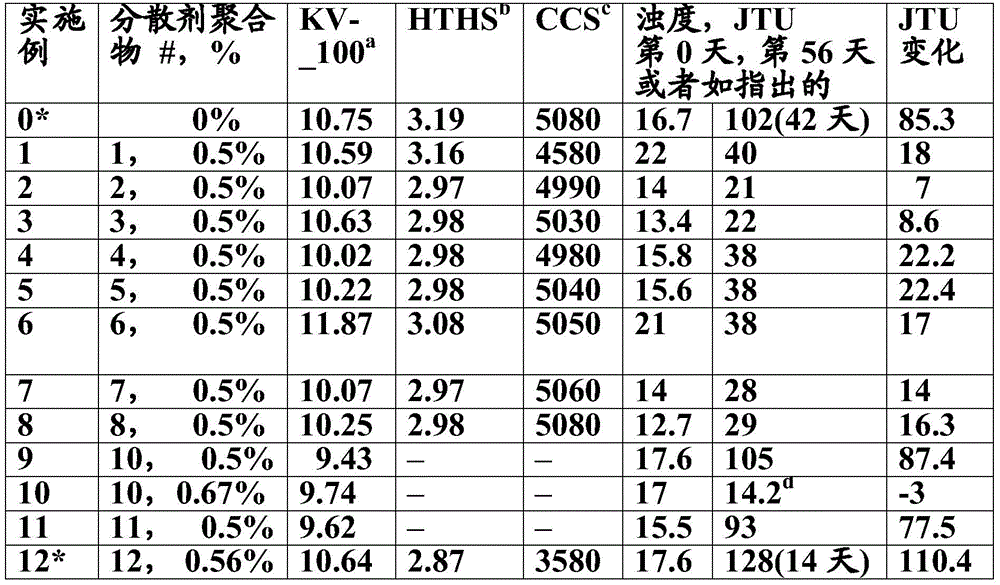
*参比或对比例*Reference or comparative example
a通过ASTM D2270测量的KV_100,以mm2s-1表示aKV_100 measured by ASTM D2270 in mm 2 s -1
b通过ASTM D4683测量的HTHS粘度,以mPa·s表示b HTHS viscosity measured by ASTM D4683 in mPa s
c通过ASTM D4683测量的冷曲柄剪切粘度,以mPa·s表示c Cold crank shear viscosity measured by ASTM D4683 in mPa s
d观察到的一些沉降,导致JTU降低d Some settling observed, resulting in lower JTU
结果显示本发明聚合物赋予在长期热暴露于水时的良好清澈性(可接受的浊度)和良好粘度特性。The results show that the polymers of the present invention impart good clarity (acceptable turbidity) and good viscosity characteristics upon prolonged thermal exposure to water.
III G系列沉积性能试验和VG系列淤渣沉积试验性能在包含上文定义的分散剂聚合物#1与降低量的常规分散剂的润滑剂配制剂上进行。组成通常与用于表2的那些相同或可比,其中显著的变化在在下文中指出。量为%,基于无油。The III G Series Deposition Performance Test and VG Series Sludge Deposition Test performance were conducted on lubricant formulations comprising Dispersant Polymer #1 as defined above with reduced amounts of conventional dispersants. Compositions are generally the same or comparable to those used in Table 2, with significant changes noted below. Amounts are % based on oil free.
表3table 3
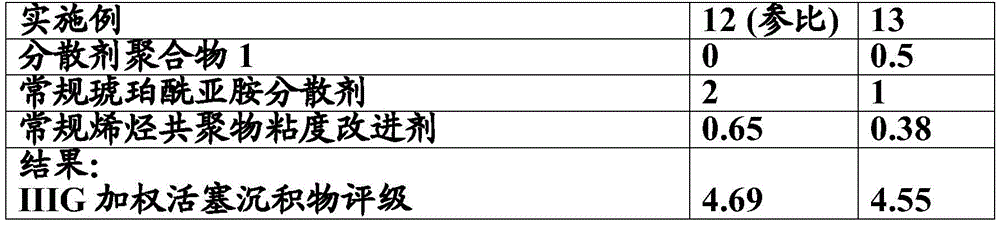
表4Table 4

沉积物、淤渣和清漆评级甚至在明显降低量的常规分散剂下保持基本不变。实施例14与15之间倾点下降剂的差不会定性地影响结果。The deposit, sludge and varnish ratings remained essentially unchanged even at significantly reduced amounts of conventional dispersants. The difference in pour point depressant between Examples 14 and 15 did not qualitatively affect the results.
公开的技术还可用于通过在所述润滑油内包含(b)0.25-1.5重量%的具有2,000-70,000或者5,000-65,000的数均分子量(ASTM D664A)且包含接枝在聚合物骨架上的羧酸官能或其反应性等价物的烯烃聚合物与单胺或多胺的缩合反应产物而改进润滑油的耐水性,其中润滑油包含:(a)具有润滑粘度的油;(c)0.35-1.8重量%的包含聚烯烃取代琥珀酸酐与亚烷基多胺的缩合产物的无灰琥珀酰亚胺分散剂,其中聚烯烃取代基具有1,000-3,500的数均分子量;和(d)使得润滑剂组合物的总碱值(TBN,根据ASTM D2896)为小于6.5的量的0.05-1.5重量%过碱性金属清净剂,条件是如果烯烃聚合物为乙烯/丙烯共聚物,则所述多胺具有不多于一个伯氨基。The disclosed technology can also be used by including (b) 0.25-1.5 wt% in the lubricating oil having a number average molecular weight (ASTM D664A) of 2,000-70,000 or 5,000-65,000 and comprising carboxylate grafted on the polymer backbone Condensation reaction products of acid functional olefin polymers or their reactive equivalents with mono- or polyamines for improving the water resistance of lubricating oils, wherein the lubricating oils comprise: (a) an oil of lubricating viscosity; (c) 0.35-1.8 wt. % of an ashless succinimide dispersant comprising the condensation product of a polyolefin substituted succinic anhydride and an alkylene polyamine, wherein the polyolefin substituent has a number average molecular weight of 1,000 to 3,500; and (d) such that a lubricant composition The total base number (TBN, according to ASTM D2896) is 0.05-1.5 wt% overbased metal detergent in an amount less than 6.5, provided that if the olefin polymer is an ethylene/propylene copolymer, the polyamine has not much in a primary amino group.
通过引用将以上提及的各文件,包括要求其优先权的任何先前技术结合到本文中,无论上文是否明确列出。任何文件的提及不是承认该文件取得现有技术的资格或以任何权限构成技术人员的常识。除实施例中外,或如果另外明确指出,该说明书中所有描述材料的量、反应条件、分子量、碳原子数等的数量应当理解为通过措辞“约”修饰。应当理解本文所述量、范围和比的上限和下限可独立地组合。类似地,本发明各个元素的范围和量可与任何其它元素的范围或量一起使用。Each of the documents mentioned above, including any prior art from which priority is claimed, is incorporated herein by reference, whether or not expressly listed above. Reference to any document is not an admission that the document qualifies as prior art or constitutes common knowledge of a skilled person in any authority. Except in the Examples, or if expressly stated otherwise, all quantities in this specification describing the amounts of materials, reaction conditions, molecular weights, number of carbon atoms, etc. are understood to be modified by the word "about". It should be understood that the upper and lower limits of the amounts, ranges and ratios described herein can be independently combined. Similarly, the ranges and amounts for each element of the invention can be used together with ranges or amounts for any other element.
如本文所用,与“包括”、“含有”或“特征是…”同义的过渡术语“包含”为包括性或开放性的,且不排除其它未描述的元素或方法步骤。然而,在本文中“包含”的各描述中,意欲作为备选实施方案,该术语还包括短语“基本由…组成”和“由…组成”,其中“由…组成”不包括未描述的任何元素或步骤,“基本由…组成”容许包括不实质性影响所考虑的组合物或方法的必要或基本和新特性的其它未描述元素或步骤。当应用于权利要求的元素时,表述“由…组成”和“基本由…组成”意欲限制该元素表示类型的所有物种,虽然权利要求中别处存在“包含”。As used herein, the transition term "comprising," which is synonymous with "including," "containing," or "characterized by," is inclusive or open-ended and does not exclude other unrecited elements or method steps. However, in various descriptions herein of "comprising", which is intended as an alternative embodiment, the term also includes the phrases "consisting essentially of" and "consisting of," wherein "consisting of" does not include any not described An element or step, "consisting essentially of" allows the inclusion of other undescribed elements or steps that do not materially affect the essential or essential and novel characteristics of the composition or method in question. When applied to an element of a claim, the expressions "consisting of" and "consisting essentially of" are intended to limit all species of the type represented by the element, notwithstanding the presence of "comprising" elsewhere in the claim.
尽管显示了某些代表性实施方案和细节以阐述本发明,本领域技术人员了解可不偏离本发明的范围而做出本文的各种改变和改进。就这点而言,本发明的范围仅受以下权利要求书限制。While certain representative embodiments and details have been shown in order to illustrate the invention, those skilled in the art will appreciate that various changes and modifications can be made herein without departing from the scope of the invention. In this regard, the scope of the present invention is limited only by the following claims.
Claims (49)
Applications Claiming Priority (3)
| Application Number | Priority Date | Filing Date | Title |
|---|---|---|---|
| US201562269579P | 2015-12-18 | 2015-12-18 | |
| US62/269,579 | 2015-12-18 | ||
| PCT/US2016/062429 WO2017105747A1 (en) | 2015-12-18 | 2016-11-17 | Nitrogen-functionalized olefin polymers for engine lubricants |
Publications (2)
| Publication Number | Publication Date |
|---|---|
| CN108473904A CN108473904A (en) | 2018-08-31 |
| CN108473904B true CN108473904B (en) | 2022-06-03 |
Family
ID=57472072
Family Applications (1)
| Application Number | Title | Priority Date | Filing Date |
|---|---|---|---|
| CN201680079138.2A Active CN108473904B (en) | 2015-12-18 | 2016-11-17 | Nitrogen-functionalized olefin polymers for engine lubricants |
Country Status (4)
| Country | Link |
|---|---|
| US (1) | US10597599B2 (en) |
| EP (1) | EP3390594B1 (en) |
| CN (1) | CN108473904B (en) |
| WO (1) | WO2017105747A1 (en) |
Families Citing this family (14)
| Publication number | Priority date | Publication date | Assignee | Title |
|---|---|---|---|---|
| WO2019005738A1 (en) * | 2017-06-27 | 2019-01-03 | The Lubrizol Corporation | Lubricating composition for and method of lubricating an internal combustion engine |
| WO2019035905A1 (en) | 2017-08-17 | 2019-02-21 | The Lubrizol Company | Nitrogen-functionalized olefin polymers for driveline lubricants |
| US10822569B2 (en) * | 2018-02-15 | 2020-11-03 | Afton Chemical Corporation | Grafted polymer with soot handling properties |
| US10851324B2 (en) | 2018-02-27 | 2020-12-01 | Afton Chemical Corporation | Grafted polymer with soot handling properties |
| CA3104063A1 (en) | 2018-06-22 | 2019-12-26 | The Lubrizol Corporation | Lubricating compositions for heavy duty diesel engines |
| US10899989B2 (en) | 2018-10-15 | 2021-01-26 | Afton Chemical Corporation | Amino acid grafted polymer with soot handling properties |
| US11046908B2 (en) | 2019-01-11 | 2021-06-29 | Afton Chemical Corporation | Oxazoline modified dispersants |
| US10808198B2 (en) * | 2019-01-16 | 2020-10-20 | Afton Chemical Corporation | Lubricant containing thiadiazole derivatives |
| EP4077601B1 (en) * | 2019-12-18 | 2025-09-24 | The Lubrizol Corporation | Polymeric surfactant compound |
| CN111690143B (en) * | 2020-06-23 | 2022-08-05 | 新乡市瑞丰新材料股份有限公司 | Preparation method of high molecular weight high-nitrogen ashless dispersant |
| US11584898B2 (en) * | 2020-08-12 | 2023-02-21 | Afton Chemical Corporation | Polymeric surfactants for improved emulsion and flow properties at low temperatures |
| JP7563935B2 (en) * | 2020-10-09 | 2024-10-08 | Eneos株式会社 | Lubricating Oil Composition |
| EP4301832B1 (en) * | 2021-03-02 | 2024-12-11 | The Lubrizol Corporation | Thermally stable, low traction coefficient lubricant |
| US20250101336A1 (en) * | 2023-09-22 | 2025-03-27 | Infineum International Limited | Lubricant Formulations Containing Functionalized Olefin Polymers and Reduced Traditional Dispersant |
Citations (9)
| Publication number | Priority date | Publication date | Assignee | Title |
|---|---|---|---|---|
| US5314632A (en) * | 1992-06-05 | 1994-05-24 | Texaco Inc. | Combining dispersant viscosity index improver and detergent additives for lubricants |
| US6117825A (en) * | 1992-05-07 | 2000-09-12 | Ethyl Corporation | Polyisobutylene succinimide and ethylene-propylene succinimide synergistic additives for lubricating oils compositions |
| CN1782047A (en) * | 2004-11-30 | 2006-06-07 | 英菲诺姆国际有限公司 | Lubricating oil compositions |
| CN101031633A (en) * | 2004-07-30 | 2007-09-05 | 卢布里佐尔公司 | Dispersant viscosity modifiers containing aromatic amines |
| WO2009064685A2 (en) * | 2007-11-13 | 2009-05-22 | The Lubrizol Corporation | Lubricating composition containing a polymer |
| CN102414300A (en) * | 2009-02-26 | 2012-04-11 | 卢布里佐尔公司 | Lubricating composition containing the reaction product of an aromatic amine and a carboxylic acid functionalized polymer and a dispersant |
| CN103857775A (en) * | 2011-07-07 | 2014-06-11 | 卢布里佐尔公司 | Lubricant providing improved cleanliness for two-stroke cycle engines |
| JP5557074B2 (en) * | 2007-08-09 | 2014-07-23 | インフィニューム インターナショナル リミテッド | Low phosphorus content lubricating oil composition for engines with catalytic converters |
| WO2015088769A3 (en) * | 2013-12-10 | 2015-10-08 | The Lubrizol Corporation | Method for preparing functionalized graft polymers |
Family Cites Families (39)
| Publication number | Priority date | Publication date | Assignee | Title |
|---|---|---|---|---|
| DE1248643B (en) | 1959-03-30 | 1967-08-31 | The Lubrizol Corporation, Cleveland, Ohio (V. St. A.) | Process for the preparation of oil-soluble aylated amines |
| US3381022A (en) | 1963-04-23 | 1968-04-30 | Lubrizol Corp | Polymerized olefin substituted succinic acid esters |
| GB1105217A (en) | 1965-10-05 | 1968-03-06 | Lubrizol Corp | Process for preparing basic metal phenates |
| US3634515A (en) | 1968-11-08 | 1972-01-11 | Standard Oil Co | Alkylene polyamide formaldehyde |
| US4234435A (en) | 1979-02-23 | 1980-11-18 | The Lubrizol Corporation | Novel carboxylic acid acylating agents, derivatives thereof, concentrate and lubricant compositions containing the same, and processes for their preparation |
| US4285822A (en) | 1979-06-28 | 1981-08-25 | Chevron Research Company | Process for preparing a sulfurized molybdenum-containing composition and lubricating oil containing the composition |
| US4594378A (en) | 1985-03-25 | 1986-06-10 | The Lubrizol Corporation | Polymeric compositions, oil compositions containing said polymeric compositions, transmission fluids and hydraulic fluids |
| GB8531626D0 (en) | 1985-12-23 | 1986-02-05 | Shell Int Research | Grease composition |
| GB8818711D0 (en) | 1988-08-05 | 1988-09-07 | Shell Int Research | Lubricating oil dispersants |
| US5264140A (en) | 1992-06-01 | 1993-11-23 | Texaco Inc. | Antioxidant-dispersant VI improver additive and lubricating oil composition containing same |
| US5614124A (en) * | 1993-12-01 | 1997-03-25 | Ethyl Additives Corporation | Polyisobutylene succinimide, ethylene-propylene succinimide and an alkylated phenothiazine additive for lubricating oil compositions |
| US6310011B1 (en) | 1994-10-17 | 2001-10-30 | The Lubrizol Corporation | Overbased metal salts useful as additives for fuels and lubricants |
| US6117941A (en) | 1997-06-05 | 2000-09-12 | The Lubrizol Corporation | Intermediates useful for preparing dispersant-viscosity improvers for lubricating oils |
| US6200936B1 (en) | 1997-11-13 | 2001-03-13 | The Lubrizol Corporation | Salicyclic calixarenes and their use as lubricant additives |
| US6117826A (en) * | 1998-09-08 | 2000-09-12 | Uniroyal Chemical Company, Inc. | Dithiocarbamyl derivatives useful as lubricant additives |
| AU2001225296A1 (en) | 2000-02-07 | 2001-08-14 | Bp Oil International Limited | Calixarenes and their use as lubricant additives |
| US6458172B1 (en) | 2000-03-03 | 2002-10-01 | The Lubrizol Corporation | Fuel additive compositions and fuel compositions containing detergents and fluidizers |
| US6310009B1 (en) | 2000-04-03 | 2001-10-30 | The Lubrizol Corporation | Lubricating oil compositions containing saligenin derivatives |
| US6569818B2 (en) | 2000-06-02 | 2003-05-27 | Chevron Oronite Company, Llc | Lubricating oil composition |
| ATE292667T1 (en) | 2001-11-05 | 2005-04-15 | Lubrizol Corp | LUBRICANT COMPOSITION WITH IMPROVED FUEL SAVING |
| US7009072B2 (en) | 2002-10-31 | 2006-03-07 | Crompton Corporation | Method for producing lubricant detergents |
| US6790813B2 (en) * | 2002-11-21 | 2004-09-14 | Chevron Oronite Company Llc | Oil compositions for improved fuel economy |
| US7053254B2 (en) | 2003-11-07 | 2006-05-30 | Chevron U.S.A, Inc. | Process for improving the lubricating properties of base oils using a Fischer-Tropsch derived bottoms |
| US7514393B2 (en) | 2003-11-21 | 2009-04-07 | Castrol Limited | Preparation of functional monomers for grafting to low molecular weight polyalkenes and their use in the preparation of dispersants and lubricating oil compositions containing dispersant polyalkenes |
| WO2005087821A2 (en) * | 2004-03-10 | 2005-09-22 | The Lubrizol Corporation | Dispersant viscosity modifiers based on diene-containing polymers |
| US7651987B2 (en) | 2004-10-12 | 2010-01-26 | The Lubrizol Corporation | Tartaric acid derivatives as fuel economy improvers and antiwear agents in crankcase oils and preparation thereof |
| AU2005299676B2 (en) | 2004-10-25 | 2011-02-10 | The Lubrizol Corporation | Star polymers and compositions thereof |
| CN102229842A (en) | 2005-03-28 | 2011-11-02 | 卢布里佐尔公司 | Titanium compounds and complexes as additives in lubricants |
| EP1992677A1 (en) | 2007-05-10 | 2008-11-19 | Castrol Limited | Lubricant composition for combustion engine containing dispersant additive and polymer dispersant viscosity index improver |
| EP2177596A1 (en) * | 2008-10-20 | 2010-04-21 | Castrol Limited | Method of operating a hybrid engine |
| US8557753B2 (en) * | 2008-11-26 | 2013-10-15 | The Lubrizol Corporation | Lubricating composition containing a functionalized carboxylic polymer |
| CN105602652A (en) | 2008-12-09 | 2016-05-25 | 路博润公司 | Lubricating composition containing compound derived from hydroxy-carboxylic acid |
| US8859473B2 (en) * | 2008-12-22 | 2014-10-14 | Chevron Oronite Company Llc | Post-treated additive composition and method of making the same |
| JP2010174138A (en) * | 2009-01-29 | 2010-08-12 | Nok Kluber Kk | Method for producing grease composition and grease composition produced by the same |
| US8399388B2 (en) | 2009-07-01 | 2013-03-19 | Chevron Oronite Company Llc | Low temperature performance lubricating oil detergents and method of making the same |
| US8703873B2 (en) | 2010-04-01 | 2014-04-22 | Castrol Limited | Multiple function graft polymer |
| JP5809582B2 (en) * | 2012-02-21 | 2015-11-11 | Jx日鉱日石エネルギー株式会社 | Lubricating oil composition |
| JP5902005B2 (en) * | 2012-03-08 | 2016-04-13 | シェブロンジャパン株式会社 | Lubricating oil composition for automobile engine lubrication |
| CA2943053A1 (en) | 2014-03-19 | 2015-09-24 | The Lubrizol Corporation | Lubricants containing blends of polymers |
-
2016
- 2016-11-17 CN CN201680079138.2A patent/CN108473904B/en active Active
- 2016-11-17 US US16/063,303 patent/US10597599B2/en active Active
- 2016-11-17 EP EP16805660.4A patent/EP3390594B1/en active Active
- 2016-11-17 WO PCT/US2016/062429 patent/WO2017105747A1/en not_active Ceased
Patent Citations (9)
| Publication number | Priority date | Publication date | Assignee | Title |
|---|---|---|---|---|
| US6117825A (en) * | 1992-05-07 | 2000-09-12 | Ethyl Corporation | Polyisobutylene succinimide and ethylene-propylene succinimide synergistic additives for lubricating oils compositions |
| US5314632A (en) * | 1992-06-05 | 1994-05-24 | Texaco Inc. | Combining dispersant viscosity index improver and detergent additives for lubricants |
| CN101031633A (en) * | 2004-07-30 | 2007-09-05 | 卢布里佐尔公司 | Dispersant viscosity modifiers containing aromatic amines |
| CN1782047A (en) * | 2004-11-30 | 2006-06-07 | 英菲诺姆国际有限公司 | Lubricating oil compositions |
| JP5557074B2 (en) * | 2007-08-09 | 2014-07-23 | インフィニューム インターナショナル リミテッド | Low phosphorus content lubricating oil composition for engines with catalytic converters |
| WO2009064685A2 (en) * | 2007-11-13 | 2009-05-22 | The Lubrizol Corporation | Lubricating composition containing a polymer |
| CN102414300A (en) * | 2009-02-26 | 2012-04-11 | 卢布里佐尔公司 | Lubricating composition containing the reaction product of an aromatic amine and a carboxylic acid functionalized polymer and a dispersant |
| CN103857775A (en) * | 2011-07-07 | 2014-06-11 | 卢布里佐尔公司 | Lubricant providing improved cleanliness for two-stroke cycle engines |
| WO2015088769A3 (en) * | 2013-12-10 | 2015-10-08 | The Lubrizol Corporation | Method for preparing functionalized graft polymers |
Also Published As
| Publication number | Publication date |
|---|---|
| US20180371357A1 (en) | 2018-12-27 |
| EP3390594A1 (en) | 2018-10-24 |
| EP3390594B1 (en) | 2022-06-29 |
| WO2017105747A1 (en) | 2017-06-22 |
| CA3008675A1 (en) | 2017-06-22 |
| CN108473904A (en) | 2018-08-31 |
| US10597599B2 (en) | 2020-03-24 |
Similar Documents
| Publication | Publication Date | Title |
|---|---|---|
| CN108473904B (en) | Nitrogen-functionalized olefin polymers for engine lubricants | |
| EP1730202B1 (en) | Dispersant viscosity modifiers based on diene-containing polymers | |
| EP1778822B1 (en) | Dispersant viscosity modifiers containing aromatic amines | |
| KR20110099258A (en) | Lubrication composition containing polymers functionalized with aromatic polyamines and carboxylic acids | |
| EP3645687B1 (en) | Lubricating composition for and method of lubricating an internal combustion engine | |
| CN102459539A (en) | Polymethacrylates as high vi viscosity modifiers | |
| JP2012532958A (en) | Polymer blends useful as viscosity modifiers | |
| CN105008412B (en) | Dispersant viscosity modifiers | |
| CA3047083C (en) | Multi-functional olefin copolymers and lubricating compositions containing same | |
| JP6169700B2 (en) | Lubricating composition comprising an esterified copolymer and a diene rubber copolymer | |
| KR101848109B1 (en) | Lubricants containing aromatic dispersants and titanium | |
| JP2022155556A (en) | Engine oils with improved viscometric performance | |
| CA3008675C (en) | Nitrogen-functionalized olefin polymers for engine lubricants | |
| EP3913040A1 (en) | Driveline lubricants comprising nitrogen-functionalized olefin polymers | |
| US11680222B2 (en) | Engine oils with low temperature pumpability | |
| JP2020193335A (en) | Lubricating oil additive |
Legal Events
| Date | Code | Title | Description |
|---|---|---|---|
| PB01 | Publication | ||
| PB01 | Publication | ||
| SE01 | Entry into force of request for substantive examination | ||
| SE01 | Entry into force of request for substantive examination | ||
| EE01 | Entry into force of recordation of patent licensing contract |
Application publication date: 20180831 Assignee: Lubrizol additive (Zhuhai) Co.,Ltd. Assignor: THE LUBRIZOL Corp. Contract record no.: 2019990000109 Denomination of invention: NITROGEN-FUNCTIONALIZED OLEFIN POLYMERS FOR ENGINE LUBRICANTS License type: Common License Record date: 20190403 |
|
| EE01 | Entry into force of recordation of patent licensing contract | ||
| EC01 | Cancellation of recordation of patent licensing contract |
Assignee: Lubrizol additive (Zhuhai) Co.,Ltd. Assignor: THE LUBRIZOL Corp. Contract record no.: 2019990000109 Date of cancellation: 20200309 |
|
| EC01 | Cancellation of recordation of patent licensing contract | ||
| EE01 | Entry into force of recordation of patent licensing contract |
Application publication date: 20180831 Assignee: Lubrizol additive (Zhuhai) Co.,Ltd. Assignor: THE LUBRIZOL Corp. Contract record no.: X2020990000241 Denomination of invention: NITROGEN-FUNCTIONALIZED OLEFIN POLYMERS FOR ENGINE LUBRICANTS License type: Common License Record date: 20200512 |
|
| EE01 | Entry into force of recordation of patent licensing contract | ||
| EC01 | Cancellation of recordation of patent licensing contract |
Assignee: Lubrizol additive (Zhuhai) Co.,Ltd. Assignor: THE LUBRIZOL Corp. Contract record no.: X2020990000241 Date of cancellation: 20210311 |
|
| EC01 | Cancellation of recordation of patent licensing contract | ||
| EE01 | Entry into force of recordation of patent licensing contract |
Application publication date: 20180831 Assignee: Lubrizol additive (Zhuhai) Co.,Ltd. Assignor: THE LUBRIZOL Corp. Contract record no.: X2021990000246 Denomination of invention: Nitrogen functionalized olefin polymers for engine lubricants License type: Common License Record date: 20210427 |
|
| EE01 | Entry into force of recordation of patent licensing contract | ||
| GR01 | Patent grant | ||
| GR01 | Patent grant | ||
| EC01 | Cancellation of recordation of patent licensing contract |
Assignee: Lubrizol additive (Zhuhai) Co.,Ltd. Assignor: THE LUBRIZOL Corp. Contract record no.: X2021990000246 Date of cancellation: 20250723 |
|
| EC01 | Cancellation of recordation of patent licensing contract | ||
| EE01 | Entry into force of recordation of patent licensing contract |
Application publication date: 20180831 Assignee: Lubrizol additive (Zhuhai) Co.,Ltd. Assignor: THE LUBRIZOL Corp. Contract record no.: X2025990000278 Denomination of invention: Nitrogen functionalized olefin polymers for engine lubricants Granted publication date: 20220603 License type: Common License Record date: 20250724 |
|
| EE01 | Entry into force of recordation of patent licensing contract |