CN108369591B - System and method for caching and parameterizing IR - Google Patents
System and method for caching and parameterizing IR Download PDFInfo
- Publication number
- CN108369591B CN108369591B CN201680071878.1A CN201680071878A CN108369591B CN 108369591 B CN108369591 B CN 108369591B CN 201680071878 A CN201680071878 A CN 201680071878A CN 108369591 B CN108369591 B CN 108369591B
- Authority
- CN
- China
- Prior art keywords
- plan
- node
- query
- module
- parameterized
- Prior art date
- Legal status (The legal status is an assumption and is not a legal conclusion. Google has not performed a legal analysis and makes no representation as to the accuracy of the status listed.)
- Active
Links
Images


Classifications
-
- G—PHYSICS
- G06—COMPUTING OR CALCULATING; COUNTING
- G06F—ELECTRIC DIGITAL DATA PROCESSING
- G06F16/00—Information retrieval; Database structures therefor; File system structures therefor
- G06F16/20—Information retrieval; Database structures therefor; File system structures therefor of structured data, e.g. relational data
- G06F16/24—Querying
- G06F16/245—Query processing
- G06F16/2453—Query optimisation
- G06F16/24534—Query rewriting; Transformation
- G06F16/24542—Plan optimisation
-
- G—PHYSICS
- G06—COMPUTING OR CALCULATING; COUNTING
- G06F—ELECTRIC DIGITAL DATA PROCESSING
- G06F16/00—Information retrieval; Database structures therefor; File system structures therefor
- G06F16/20—Information retrieval; Database structures therefor; File system structures therefor of structured data, e.g. relational data
- G06F16/24—Querying
- G06F16/245—Query processing
- G06F16/2452—Query translation
- G06F16/24524—Access plan code generation and invalidation; Reuse of access plans
Landscapes
- Engineering & Computer Science (AREA)
- Theoretical Computer Science (AREA)
- Computational Linguistics (AREA)
- Data Mining & Analysis (AREA)
- Databases & Information Systems (AREA)
- Physics & Mathematics (AREA)
- General Engineering & Computer Science (AREA)
- General Physics & Mathematics (AREA)
- Operations Research (AREA)
- Information Retrieval, Db Structures And Fs Structures Therefor (AREA)
- Devices For Executing Special Programs (AREA)
Abstract
一种缓存和参数化中间表示代码的系统和方法,包括:数据库接收查询;所述数据库解析所述查询,以获取包含多个计划节点的计划树,所述多个计划节点布置成从顶层计划节点降序排列的层级次序;所述数据库为所述计划节点产生节点中间表示(intermediate representation,IR);所述数据库使用所述节点IR执行第一查询;以及所述数据库重用所述节点IR执行后续查询。

A system and method for caching and parameterizing intermediate representation code, comprising: a database receiving a query; the database parsing the query to obtain a plan tree comprising a plurality of plan nodes arranged to plan from a top level a descending hierarchical order of nodes; the database generates a node intermediate representation (IR) for the plan node; the database uses the node IR to perform a first query; and the database reuses the node IR to perform subsequent Inquire.
Description
Cross application of related applications
Prior application priority of united states non-provisional patent application No. 14/960,894 entitled "System and Method for Caching and Parameterizing IR" filed on 12/7/2015, the contents of which are incorporated herein by reference.
Technical Field
The present invention relates generally to database systems and methods, and in particular embodiments, to techniques and mechanisms for caching and parameterizing Intermediate Representation (IR) code.
Background
As the prices of memory and high-speed storage devices decrease, Central Processing Unit (CPU) performance, like input/output (I/O) performance, has become a bottleneck in database efficiency. Conventional database systems must accommodate all variations and forms of data, and therefore conventional query execution models make many branching and iterative decisions when executing a query. This execution model causes the database engine to parse and execute each query at runtime. Thus, queries that would otherwise share similar code branches must be re-parsed, planned, and executed each time.
Native compilation has been proposed to address the problems associated with a single parse and execution path in a database engine. Code specific to a query may be generated at runtime and executed by the database engine. Generating computer code that is customized for a query avoids parsing and executing multiple queries in an iterative manner that requires many branch decisions.
Some compiler infrastructures, such as Low Level Virtual Machine (LLVM) projects, propose to perform just-in-time (JIT) compilation of query-specific code. Such infrastructures typically reduce queries to a low-level programming language or Intermediate Representation (IR), which is then converted to machine code by a JIT compiler at runtime. JIT compilation may reduce the CPU processing power required to execute a query because the database engine may execute code specific to the query, rather than general code that is capable of responding to any query. However, JIT compilation introduces overhead due to the large amount of CPU resources required to generate and compile IR specific to a query.
Disclosure of Invention
The disclosed embodiments describe systems and methods for caching and parameterizing IR to reduce JIT compilation costs, substantially achieving technical advantages.
According to an embodiment, a method is provided. The method comprises the following steps: the database receives the query; the database parsing the query to obtain a plan tree comprising a plurality of plan nodes arranged in a hierarchical order in descending order from a top level plan node; the database generating Intermediate Representation (IR) of nodes for the plan nodes; the database executing a first query using the node IR; and the database re-uses the node IR to perform subsequent queries.
According to another embodiment, a method is provided. The method includes the database receiving a first query; the database parsing the first query to obtain a first plan tree comprising a first plurality of plan nodes; generating, by the database, a first node Intermediate Representation (IR) for the first plurality of plan nodes; the database parameterizes the first node IR to generate a parameterized IR; the database combining the parameterized IR to generate a module; the database storing the module and the first plan tree in a plan cache; and the database executing the first query by the module.
According to yet another embodiment, an apparatus is provided. The apparatus includes a processor and a computer readable storage medium storing a program for execution by the processor. The program includes instructions for receiving a query; parsing the query to obtain a plan tree comprising a plurality of plan nodes arranged in a hierarchical order in descending order from a top level plan node; generating an Intermediate Representation (IR) for the plan node; performing a first query using the node IR; and re-using the node IR to perform subsequent queries.
Drawings
For a more complete understanding of the present invention, and the advantages thereof, reference is now made to the following descriptions taken in conjunction with the accompanying drawings, in which:
FIG. 1 is a block diagram of an embodiment processing system;
FIG. 2A depicts one embodiment of a method for generating an Intermediate Representation (IR);
FIG. 2B illustrates one embodiment of an IR reuse method;
FIG. 3 depicts an embodiment query method for generating and reusing IR when executing a query;
FIG. 4 illustrates one embodiment of an IR parameterization method; and
fig. 5 shows an example showing inter-query reuse of parameterized IR.
Corresponding reference numerals and symbols in the various drawings generally refer to corresponding parts unless otherwise indicated. The figures are drawn to clearly illustrate the relevant aspects of the embodiments and are not necessarily drawn to scale.
Detailed Description
The making and using of embodiments of the present invention are discussed in detail below. It should be appreciated that the concepts disclosed herein may be implemented in a variety of specific environments, and that the specific embodiments discussed are merely illustrative and do not limit the scope of the claims. Further, it should be understood that various changes, substitutions and alterations can be made herein without departing from the spirit and scope of the invention as defined by the appended claims.
Systems and methods for caching and parameterizing Intermediate Representation (IR) code to reduce JIT compilation costs are disclosed herein. While the present discussion is presented in the context of a database engine, it should be understood that embodiments of the present invention can be used with any type of computer to generate and execute IR. Modern database engines generate query execution plan trees and store the plan trees in a plan cache. A planning tree typically includes several planning nodes arranged in a hierarchical order. Embodiments of the technology generate an IR for each node of a plan tree and store the IR and the corresponding node in the plan tree in a plan cache, which may be reused when subsequently executing queries.
During JIT compilation, the IR is compiled into machine code for executing the query. Compiled machine code can be assembled into code modules that can include variables, function declarations, function implementations, and the like. Embodiment techniques cache compiled modules so that they can be reused when reusing IR. Thus, in addition to storing IR and nodes of the plan tree, machine code modules generated by IR may be stored by caching the code modules and the top-level plan nodes of the plan tree. Thereby allowing the cached machine code to be reused when the same query is subsequently executed.
The IR generated is typically specific to one planning node. For example, a plan node may include arithmetic operations involving constants. Embodiments parameterize IR or machine code generated by the planning node. Parameterized IR may be more general IR, rather than specific to a particular plan node, and thus may be reused for different plan nodes if only one constant of the plan nodes is different. Parameterized IR can then be reused for different plan nodes in the same or similar queries. Whereby parameterized IR converts specific IR to more general IR. By converting IR to more general IR, the functionality of the database itself is improved.
Different embodiments may achieve different advantages. By caching the generated IR or machine code, full IR generation and JIT compilation may be avoided each time a query is executed. When executing queries, IR generation can take about 20% to 30% of the additional CPU time required for JIT compilation. By avoiding IR generation on every execution, the cost of IR generation can be reduced, thereby reducing the cost of executing each query and improving the overall performance of the database. Parameterizing the buffered IR may further improve the reusability of the IR even if there is variation between the buffered IR and subsequent queries. Improved IR reusability may further increase the cache hit rate of reused IR, thereby increasing performance.
FIG. 1 is a block diagram of an embodiment processing system 100 that may be installed in a host device for performing the methods described herein. As shown, processing system 100 includes a processor 102, a memory 104, an interface 106, a database 112, and a cache 114, which may (or may not) be arranged as shown in FIG. 1. Processor 102 may be any component or collection of components for performing computing and/or other processing-related tasks, and memory 104 may be any component or collection of components for storing programming and/or instructions for execution by processor 102. In an embodiment, memory 104 includes a non-transitory computer-readable storage medium. Interfaces 106, 108, 110 may be any component or collection of components that allow processing system 100 to communicate with other devices/components and/or users. For example, one or more of the interfaces 106, 108, 110 may be used to transfer data, control or management messages from the processor 102 to applications installed on the host device and/or the slave device. As another example, one or more of the interfaces 106, 108, 110 may be used to allow a user or user device (e.g., a Personal Computer (PC), etc.) to interact/communicate with the processing system 100. Processing system 100 may include other components not depicted in fig. 1, such as long-term memory (e.g., non-volatile memory, etc.).
In some embodiments, the processing system 100 is included in a network device that accesses or is a component of a telecommunications network. In one example, processing system 100 is in a network-side device in a wireless or wired telecommunications network, such as a base station, relay station, scheduler, controller, gateway, router, application server, or any other device in a telecommunications network. In other embodiments, the processing system 100 is in a user side device in a wireless or wired telecommunications network, such as a mobile station, a User Equipment (UE), a Personal Computer (PC), a tablet, a wearable communication device (e.g., a smart watch, etc.), or any other device for accessing a telecommunications network.
In an example embodiment, the processing system 100 includes a database device including a receiving module that receives a query; a parsing module that parses the query to obtain a plan tree that includes a plurality of plan nodes arranged in a hierarchical order that is descending order from a top level plan node; a representation module that generates an Intermediate Representation (IR) of nodes for the plan node; a query module to perform a first query using the node IR; and a reuse module reusing the node IR to perform subsequent queries. In some embodiments, processing system 100 may include other or additional modules for performing any one or combination of the steps described in the embodiments.
In an example embodiment, the processing system 100 includes a database device including a receiving module that receives a first query; an analysis module that analyzes the first query to obtain a first plan tree that includes a first plurality of plan nodes; a representation module that generates a first node Intermediate Representation (IR) for the first plurality of plan nodes; a parameter module parameterizing the first node IR to produce a parameterized IR; a combining module that combines the parameterized IR to generate a module; a storage module to store the module and the first plan tree in a plan cache; and a query execution module, by which the first query is executed. In some embodiments, processing system 100 may include other or additional modules for performing any one or combination of the steps described in the embodiments.
FIG. 2A illustrates a node IR generation method 200 according to one embodiment. The IR generation method 200 may indicate operations that occur at the time of the planning phase in the database.
The IR generation method 200 begins by generating a plan tree for a query (step 202). Subsequently, a node IR is generated for each plan node in the query plan tree (step 204). The generated node IR may be specific to each planned node or may be parameterized (discussed further below). The IR for each plan node is then added to the module for query (step 206). In some embodiments, the modules may be generated using an interface of the LLVM. Finally, the module is saved concurrently with the query plan tree (step 208). In some embodiments, for example, in embodiments where a database supports plan caching, the query plan and module are each stored as objects in a plan cache of the database, and the module is associated with the query plan.
Fig. 2B illustrates an embodiment IR reuse method 250. The IR reuse method 250 may be used to indicate operations that occur at the stage of executing a query that performs database operations, with a plan tree and modules for the query pre-stored in the plan cache.
The IR reuse method 250 begins by obtaining a saved module corresponding to a query plan tree (step 252). The module may be retrieved when retrieving the plan tree for the query. The IR in the module is then compiled into executable objects or retrieved as cached executable objects for the module (step 254). In some embodiments, the cached executable objects are also stored in a plan cache with the query plan tree. In some embodiments, the cached executable object is stored elsewhere. If the module has not been compiled, it will be compiled by a JIT compiler. If the module has been compiled, the address of the cached executable object is remapped to memory and a function pointer for the executable object is returned to the JIT compiler. Finally, the executable object is executed when the database is queried (step 256).
FIG. 3 depicts an embodiment query method 300 for generating and reusing IR when executing a query. The query method 300 may indicate operations that occur when a database query is executed, where the database caches and reuses machine code for the database query.
The query method 300 begins by receiving a query for processing and execution (step 302). The database then determines whether a plan tree for the query is cached (step 304). If a plan tree does not exist, the query is analyzed to generate a query plan tree (step 306). The plan tree may include a plurality of plan nodes arranged in a hierarchical order sorted in descending order from a top-level plan node. An IR is then generated for each plan node in the plan (step 308). The generation of the IR may be used to join LLVMs. The module is then built with the generated IR by adding the IR for each plan node to the module (step 310). The module and the plan tree are then saved together by saving the module and the top plan nodes of the plan tree (step 312). In some embodiments, the query plan tree and modules are stored in a plan cache of a database.
If there is a plan tree for the query, the database engine does not generate a query plan, but rather determines if there are IR modules saved for the plan (step 314). If there are no modules saved for the plan, an IR is generated and added to the module and stored with the plan tree (step 308-312). However, if a plan is cached and the plan contains an IR module, the database engine determines if there is a compiled executable object cached for the module (step 316). If there are no compiled executable objects, the module is compiled to obtain executable objects (step 318). The compiled executable object of the module is then saved (step 320). In some embodiments, the executable objects are stored with the plan tree in a plan cache, which may be accomplished, for example, by extending the plan cache to include entries for IR, module, and/or executable objects. Finally, once the executable object is compiled or loaded from cache, the executable object is executed, making a query (step 322).
In addition to caching IR or machine code corresponding to a query plan/node, in embodiments, IR (node IR) may be optimized for a node before caching IR or compiling it into machine code. Embodiment optimization includes parameterizing the node IR during IR generation, e.g., replacing constants or tuple properties in the generated IR code body with parameters, modifying the generated IR to accept runtime variables containing parameters. IR optimization is performed prior to compiling and storing IR or machine code. Embodiment optimization allows for re-use of IR at one query or between queries (e.g., between queries), even if there is variation between the IR generated for different queries. For example, the following is a pseudo-code listing of an instance query for which embodiments may generate and parameterize IR:
SELECT id+5
FROM tblExample
a plan tree may be generated by analyzing the example queries listed above, and generating IR's for the plan nodes of the plan tree. One of the resulting planning nodes for the query corresponds to the addition operation (id + 5). The following pseudo-code list is shown as an example IR generated for the addition operation.
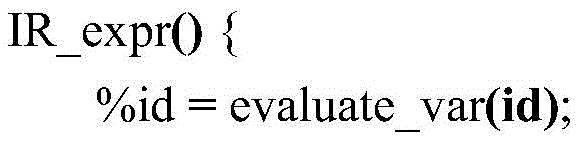

The above listed IR can then be invoked, as follows:
call IR_expr();
as can be seen from the above pseudo-code list, the body of IR generated for addition includes an opcode that sums the summand (id) and the addend (5). While the above illustrated IR may be compiled and reused by the database engine, the IR is relatively specific and may only be reused for planning nodes in another query that sum the same summands and summands. The summand is an attribute of the table tuple (the "id" column of the "tblExample" database table) in this example, and the addend is a constant (5) in this example. Therefore, future queries cannot reuse the listed IR even if the included tuple attributes or constants change slightly. For example, a query to the table in a column other than the "id" column, or a query that sums this column with another value other than 5, would require the generation of a new IR.
Embodiments may optimize the above IR to parameterize the IR. The parameterized IR may be a more general version of IR that is invoked by the planning node and into which additional parameters specific to a node may be transmitted node by node. Continuing with the above example, the following pseudo-code listing depicts an example parameterized IR that may be generated when a constant is replaced with a parameter:

as can be seen in the above pseudo-code listing, the parameterized IR, which does not contain any more constants, the addend is the input parameter or variable (% arg), and sums the summand (id) and the addend. The addends (5) in the original list are then transmitted to the IR at run time. Accordingly, the illustrated parameterized IR may be used for both of the example queries discussed above. The instance query containing the arithmetic operation (id +5) may call the parameterized IR and the argument 5, e.g.
call IR_expr(5);
Likewise, the instance query containing the arithmetic operation (id +6) may call the parameterized IR and the argument 6, e.g.:
call IR_expr(6);
in some embodiments, the attributes of the table tuples in the body of the parameterized IR may also be replaced with parameters. Continuing with the above example, the following pseudo-code listing shows an example parameterized IR that can be generated when a tuple attribute "id" in the listed IR is replaced with a parameter:

the above pseudocode listing can see that the parameterized IR no longer contains attributes for table tuples. Instead, the table column (id) of the IR access is replaced with the input parameter (% attnum). The tuple attributes (id) in the original manifest are then passed into the IR at runtime. The instance query containing the arithmetic operation (id +5) may call the parameterized IR and the argument 5, e.g.
call IR_expr(id,5);
Because both of the above example plan nodes use the same IR, the IR can be cached and reused between queries. Accordingly, planning nodes with slight variations between queries need not generate new IR. Thus, database engine performance can be improved by reducing the amount of IR that must be generated and compiled per query.
FIG. 4 illustrates one embodiment of an IR parameterization method 400. The IR parameterization method 400 may indicate operations that occur in the database when generating IR for a query.
The IR parameterization method 400 begins by receiving a query and analyzing and executing (step 402). The query is then parsed to generate a plan tree for the query (step 404). The database engine then traverses the plan tree to determine if there are more plan nodes that require code generation (step 406), which may be accomplished through CPU analysis and program analysis. If code needs to be generated for more nodes, the database engine determines if an IR has been generated for the current node (step 408). If no IR exists, then an IR is generated for the currently planned node (step 410). Generating IR includes parameterizing IR to replace constant or tuple operations in the body of the generated expression with parameters passed into the generated IR as runtime variables.
If the IR already exists, the database engine proceeds to the next plan node and does not generate an IR for the current plan node. Steps 406 through 410 may thus be repeated for each plan node in the query plan tree. Finally, once an IR is generated or matched for each plan node in the query, the IR is assembled into modules, compiled and cached (step 412).
Fig. 5 shows an example 500 of inter-query reuse parameterized IR. Example 500 may illustrate operations that occur in a database when executing the IR parameterization method 400.
The example 500 begins by receiving a first query (step 502). The database then generates a first parameterized IR for the first query (step 504). The parameterized IR is compiled, used to execute the first query, and the compiled object is cached (step 506). The database engine receives the second query (step 508). The database engine generates a second parameterized IR for the second query (step 510). Finally, the database engine locates the IR matching the second query from the first query, and reuses the corresponding cached object when executing the second query (step 512). If the difference of the IR for the first query and the IR for the second query has been parameterized in the IR, the matching IR may be the same.
Although the detailed description has been described, it should be understood that various changes, substitutions and alterations can be made herein without departing from the spirit and scope of the invention as defined by the appended claims. Moreover, the scope of the present application is not intended to be limited to the particular embodiments described herein, and one of ordinary skill in the art will readily appreciate from the disclosure that a process, machine, manufacturing process, composition of matter, means, method, or step, including those presently existing or later to be developed, may perform substantially the same function or achieve substantially the same result as the corresponding embodiments described herein. Accordingly, the appended claims are intended to include within their scope such processes, machines, manufacture, compositions of matter, means, methods, or steps.
Claims (19)
Applications Claiming Priority (3)
| Application Number | Priority Date | Filing Date | Title |
|---|---|---|---|
| US14/960,894 | 2015-12-07 | ||
| US14/960,894 US10339137B2 (en) | 2015-12-07 | 2015-12-07 | System and method for caching and parameterizing IR |
| PCT/CN2016/108236 WO2017097160A1 (en) | 2015-12-07 | 2016-12-01 | System and method for caching and parameterizing ir |
Publications (2)
| Publication Number | Publication Date |
|---|---|
| CN108369591A CN108369591A (en) | 2018-08-03 |
| CN108369591B true CN108369591B (en) | 2021-08-13 |
Family
ID=58798330
Family Applications (1)
| Application Number | Title | Priority Date | Filing Date |
|---|---|---|---|
| CN201680071878.1A Active CN108369591B (en) | 2015-12-07 | 2016-12-01 | System and method for caching and parameterizing IR |
Country Status (4)
| Country | Link |
|---|---|
| US (1) | US10339137B2 (en) |
| CN (1) | CN108369591B (en) |
| CA (1) | CA3007425C (en) |
| WO (1) | WO2017097160A1 (en) |
Families Citing this family (12)
| Publication number | Priority date | Publication date | Assignee | Title |
|---|---|---|---|---|
| KR101832594B1 (en) * | 2016-02-18 | 2018-02-26 | 라인 가부시키가이샤 | Method and system for enhancing loading velocity of intermediate language file |
| US10394895B2 (en) | 2016-11-28 | 2019-08-27 | International Business Machines Corporation | Identifying relationships of interest of entities |
| US10838959B2 (en) * | 2017-04-10 | 2020-11-17 | Sap Se | Harmonized structured query language and non-structured query language query processing |
| US20190079972A1 (en) * | 2017-09-13 | 2019-03-14 | Electronics And Telecommunications Research Institute | System and method for parallel query processing based on jit compilation |
| US11461324B2 (en) * | 2019-08-29 | 2022-10-04 | Oracle International Corporation | First futamura projection in the context of SQL expression evaluation |
| US11294894B2 (en) | 2019-08-30 | 2022-04-05 | Oracle International Corporation | Dynamic resolution of dependencies for database guest languages |
| US11531652B2 (en) | 2019-08-30 | 2022-12-20 | Oracle International Corporation | Database modularization of pluggable guest languages |
| US12147434B2 (en) * | 2020-03-27 | 2024-11-19 | Sap Se | Ranking filter algorithms |
| US12099508B2 (en) | 2022-09-20 | 2024-09-24 | Oracle International Corporation | Producing natively compiled query plans by recompiling existing C code through partial evaluation |
| US11947531B1 (en) | 2023-02-14 | 2024-04-02 | Oracle International Corporation | Copy avoidance via static analysis for DBMS querying |
| US12393582B2 (en) * | 2024-01-31 | 2025-08-19 | Sap Se | Automatic recompilation for parameterized queries |
| CN119862210B (en) * | 2025-03-24 | 2025-07-08 | 浙江大学 | Database query execution method and device based on dynamic query compilation cache optimization |
Citations (5)
| Publication number | Priority date | Publication date | Assignee | Title |
|---|---|---|---|---|
| CN1609856A (en) * | 2003-06-23 | 2005-04-27 | 微软公司 | Method and system for querying intermediate language |
| CN1609855A (en) * | 2003-06-23 | 2005-04-27 | 微软公司 | Query optimization system and method |
| US6985904B1 (en) * | 2002-02-28 | 2006-01-10 | Oracle International Corporation | Systems and methods for sharing of execution plans for similar database statements |
| CN101984439A (en) * | 2010-12-09 | 2011-03-09 | 上海市共进通信技术有限公司 | Method for realizing optimization of data source extensive makeup language (XML) query system based on sub-queries |
| CN102323946A (en) * | 2011-09-05 | 2012-01-18 | 天津神舟通用数据技术有限公司 | Implementation method for operator reuse in parallel database |
Family Cites Families (9)
| Publication number | Priority date | Publication date | Assignee | Title |
|---|---|---|---|---|
| CA2279222C (en) * | 1999-07-30 | 2002-07-16 | Ibm Canada Limited-Ibm Canada Limitee | Direct call threaded code |
| CA2382714A1 (en) * | 2002-04-19 | 2003-10-19 | Ibm Canada Limited-Ibm Canada Limitee | Substituting parameter markers for literals in a database query language statement to promote reuse of previously generated access plans |
| US7461052B2 (en) | 2004-12-06 | 2008-12-02 | International Business Machines Corporation | Abstract query plan |
| US20070027905A1 (en) | 2005-07-29 | 2007-02-01 | Microsoft Corporation | Intelligent SQL generation for persistent object retrieval |
| US20080098003A1 (en) * | 2006-10-20 | 2008-04-24 | Oracle International Corporation | Database workload replay remapping infrastructure |
| US20120150913A1 (en) | 2010-12-13 | 2012-06-14 | Microsoft Corporation | Multidimensional data-centric service protocol |
| US9317552B2 (en) * | 2012-01-30 | 2016-04-19 | Memsql, Inc. | Reusing existing query plans in a database system |
| US8924373B2 (en) * | 2012-08-09 | 2014-12-30 | International Business Machines Corporation | Query plans with parameter markers in place of object identifiers |
| US11341132B2 (en) * | 2015-09-01 | 2022-05-24 | Sybase, Inc. | Generating a producer-driven execution plan from a consumer-driven iterator-based execution plan |
-
2015
- 2015-12-07 US US14/960,894 patent/US10339137B2/en active Active
-
2016
- 2016-12-01 CA CA3007425A patent/CA3007425C/en active Active
- 2016-12-01 CN CN201680071878.1A patent/CN108369591B/en active Active
- 2016-12-01 WO PCT/CN2016/108236 patent/WO2017097160A1/en not_active Ceased
Patent Citations (5)
| Publication number | Priority date | Publication date | Assignee | Title |
|---|---|---|---|---|
| US6985904B1 (en) * | 2002-02-28 | 2006-01-10 | Oracle International Corporation | Systems and methods for sharing of execution plans for similar database statements |
| CN1609856A (en) * | 2003-06-23 | 2005-04-27 | 微软公司 | Method and system for querying intermediate language |
| CN1609855A (en) * | 2003-06-23 | 2005-04-27 | 微软公司 | Query optimization system and method |
| CN101984439A (en) * | 2010-12-09 | 2011-03-09 | 上海市共进通信技术有限公司 | Method for realizing optimization of data source extensive makeup language (XML) query system based on sub-queries |
| CN102323946A (en) * | 2011-09-05 | 2012-01-18 | 天津神舟通用数据技术有限公司 | Implementation method for operator reuse in parallel database |
Also Published As
| Publication number | Publication date |
|---|---|
| US20170161325A1 (en) | 2017-06-08 |
| CA3007425C (en) | 2021-10-26 |
| CA3007425A1 (en) | 2017-06-15 |
| WO2017097160A1 (en) | 2017-06-15 |
| CN108369591A (en) | 2018-08-03 |
| US10339137B2 (en) | 2019-07-02 |
Similar Documents
| Publication | Publication Date | Title |
|---|---|---|
| CN108369591B (en) | System and method for caching and parameterizing IR | |
| US9058360B2 (en) | Extensible language framework using data cartridges | |
| US8997070B2 (en) | Extension mechanism for scripting language compiler | |
| US8661023B1 (en) | Optimizing search query logic to speed retrieval | |
| US8959106B2 (en) | Class loading using java data cartridges | |
| CN105718593B (en) | A kind of database inquiry optimization method and system | |
| EP3254191B1 (en) | Apparatus and method for using parameterized intermediate representation for just-in-time compilation in database query execution engine | |
| US20140282444A1 (en) | Programming language transformations with abstract syntax tree extensions | |
| US11023443B2 (en) | Collaborative planning for accelerating analytic queries | |
| US20160139895A1 (en) | System and method for providing and executing a domain-specific language for cloud services infrastructure | |
| CN110019314B (en) | Dynamic data encapsulation method, client and server based on data item analysis | |
| US10157234B1 (en) | Systems and methods for transforming datasets | |
| CN103412754A (en) | Dynamic language code execution method and device | |
| US20250086180A1 (en) | Query runtime for multi-layer composition of queries | |
| US12530356B2 (en) | Method and system for providing a context-sensitive, non-intrusive data processing optimization framework | |
| CN115809063A (en) | Storage process compiling method, system, electronic equipment and storage medium | |
| US8621424B2 (en) | Compiler based code modification for use in document ranking | |
| KR20180104498A (en) | Method and apparatus for processing query | |
| CN117055895A (en) | Method, system and readable medium for converting SQL sentence into HTTP interface | |
| CN114169003A (en) | Dynamic desensitization method and system based on syntax tree parsing and result set rewriting | |
| CN116431115A (en) | Script generation method, system, equipment and storage medium | |
| KR102100513B1 (en) | Method for Generating Primitive and Method for Processing Query Using Same | |
| TWI699658B (en) | Data sharing system and data sharing method | |
| US20230071160A1 (en) | Compiler generation for partial evaluation | |
| US20220075778A1 (en) | Transforming operations of a computer program for execution at a database |
Legal Events
| Date | Code | Title | Description |
|---|---|---|---|
| PB01 | Publication | ||
| PB01 | Publication | ||
| SE01 | Entry into force of request for substantive examination | ||
| SE01 | Entry into force of request for substantive examination | ||
| GR01 | Patent grant | ||
| GR01 | Patent grant |