CN108350008B - A novel acyclic nucleoside analog and its pharmaceutical composition - Google Patents
A novel acyclic nucleoside analog and its pharmaceutical composition Download PDFInfo
- Publication number
- CN108350008B CN108350008B CN201780003928.7A CN201780003928A CN108350008B CN 108350008 B CN108350008 B CN 108350008B CN 201780003928 A CN201780003928 A CN 201780003928A CN 108350008 B CN108350008 B CN 108350008B
- Authority
- CN
- China
- Prior art keywords
- compound
- deuterium
- added
- mmol
- pharmaceutical composition
- Prior art date
- Legal status (The legal status is an assumption and is not a legal conclusion. Google has not performed a legal analysis and makes no representation as to the accuracy of the status listed.)
- Active
Links
Classifications
-
- A—HUMAN NECESSITIES
- A61—MEDICAL OR VETERINARY SCIENCE; HYGIENE
- A61K—PREPARATIONS FOR MEDICAL, DENTAL OR TOILETRY PURPOSES
- A61K31/00—Medicinal preparations containing organic active ingredients
- A61K31/66—Phosphorus compounds
- A61K31/675—Phosphorus compounds having nitrogen as a ring hetero atom, e.g. pyridoxal phosphate
-
- C—CHEMISTRY; METALLURGY
- C07—ORGANIC CHEMISTRY
- C07B—GENERAL METHODS OF ORGANIC CHEMISTRY; APPARATUS THEREFOR
- C07B59/00—Introduction of isotopes of elements into organic compounds ; Labelled organic compounds per se
-
- C—CHEMISTRY; METALLURGY
- C07—ORGANIC CHEMISTRY
- C07F—ACYCLIC, CARBOCYCLIC OR HETEROCYCLIC COMPOUNDS CONTAINING ELEMENTS OTHER THAN CARBON, HYDROGEN, HALOGEN, OXYGEN, NITROGEN, SULFUR, SELENIUM OR TELLURIUM
- C07F9/00—Compounds containing elements of Groups 5 or 15 of the Periodic Table
- C07F9/02—Phosphorus compounds
- C07F9/547—Heterocyclic compounds, e.g. containing phosphorus as a ring hetero atom
- C07F9/6561—Heterocyclic compounds, e.g. containing phosphorus as a ring hetero atom containing systems of two or more relevant hetero rings condensed among themselves or condensed with a common carbocyclic ring or ring system, with or without other non-condensed hetero rings
Landscapes
- Chemical & Material Sciences (AREA)
- Organic Chemistry (AREA)
- Health & Medical Sciences (AREA)
- Life Sciences & Earth Sciences (AREA)
- General Health & Medical Sciences (AREA)
- Biochemistry (AREA)
- Molecular Biology (AREA)
- Medicinal Chemistry (AREA)
- Pharmacology & Pharmacy (AREA)
- Epidemiology (AREA)
- Animal Behavior & Ethology (AREA)
- Public Health (AREA)
- Veterinary Medicine (AREA)
- Pharmaceuticals Containing Other Organic And Inorganic Compounds (AREA)
Abstract
Description
技术领域technical field
本发明属于医药技术领域,尤其涉及一种新型的无环核苷类似物及其药物组合物,其可用于治疗病毒感染的相关疾病。The invention belongs to the technical field of medicine, and in particular relates to a novel acyclic nucleoside analog and a pharmaceutical composition thereof, which can be used for treating diseases related to viral infection.
背景技术Background technique
艾滋病,是由HIV感染引起的严重疾病,自1981年首例艾滋病案被报道以来,全球累计已有近7000万人被艾滋病病毒所感染,2000多万人死于艾滋病。在过去的20年里,虽然有效的药物治疗曾使艾滋病的死亡率有所下降,但每年仍新增数以百万的人被艾滋病毒感染,全球艾滋患者的数目一直呈上升趋势。AIDS is a serious disease caused by HIV infection. Since the first AIDS case was reported in 1981, nearly 70 million people worldwide have been infected with HIV, and more than 20 million people have died of AIDS. In the past 20 years, although the death rate of AIDS has decreased due to effective drug treatment, millions of new people are still infected with HIV every year, and the number of AIDS patients has been on the rise globally.
乙型肝炎(hepatitis B)是一种发病率高、感染力强、严重危害人类健康的世界性流行性传染病。目前,全世界约有20亿人感染过乙型肝炎病毒(hepatitis B virus,HBV),其中3.5亿人成为慢性HBV携带者,全球每年约100万人死于HBV感染相关的肝脏疾病。我国是乙型肝炎的高发区,根根据2002年全国HBV感染者血清流行病学调查,HBsAg的流行率为9.09%,约有1.2亿人携带HBV。其中慢性乙型肝炎(chronic hepatitis B,CHB)患者3000多万。慢性乙肝患者中有15%-25%的危险死于HBV相关性肝脏疾病,包括慢性重型肝病、肝硬化及肝细胞癌,肝硬化失代偿的年发生率约3%,5年累计发生率约16%,其中6%-15%可发展为肝细胞癌(hepatic cell carcinoma,HCC)。慢性乙肝、代偿期和失代偿期肝硬化的5年病死率分别为0%-2%、14%-20%和70%-86%。我国每年有30万人以上死于乙肝相关性并发症。此外,婴儿时期感染HBV者,90%以上成为慢性HBV携带者,并且随着年龄的增长演变为慢性肝炎、肝硬化、肝衰竭和肝细胞癌。HBV的持续复制是造成慢性乙肝患者肝脏炎症持续发展,并导致肝硬化和肝癌发生的重要因素。Hepatitis B (hepatitis B) is a worldwide epidemic infectious disease with high incidence, strong infectivity and serious harm to human health. Currently, about 2 billion people in the world have been infected with hepatitis B virus (HBV), of which 350 million people are chronic HBV carriers, and about 1 million people worldwide die of HBV infection-related liver disease every year. my country is a high-incidence area of hepatitis B. According to the seroepidemiological survey of HBV-infected people in China in 2002, the prevalence of HBsAg was 9.09%, and about 120 million people were carrying HBV. Among them, there are more than 30 million patients with chronic hepatitis B (CHB). There is a 15%-25% risk of dying from HBV-related liver diseases in patients with chronic hepatitis B, including chronic severe liver disease, liver cirrhosis and hepatocellular carcinoma. The annual incidence of liver cirrhosis decompensation is about 3%, and the 5-year cumulative incidence About 16%, of which 6%-15% can develop into hepatocellular carcinoma (HCC). The 5-year mortality rates of chronic hepatitis B, compensated and decompensated cirrhosis are 0%-2%, 14%-20% and 70%-86%, respectively. In my country, more than 300,000 people die of hepatitis B-related complications every year. In addition, more than 90% of those infected with HBV in infancy become chronic HBV carriers, and develop chronic hepatitis, liver cirrhosis, liver failure and hepatocellular carcinoma with age. The continuous replication of HBV is an important factor that causes the continuous development of liver inflammation in patients with chronic hepatitis B and leads to the occurrence of liver cirrhosis and hepatocellular carcinoma.
近十几年来,抗人类免疫缺陷病毒(human im-munodeficiency virus,HIV)药物研究取得了巨大进展。目前,美国食品及药品管理局已经批准了至少27种用于治疗HIV感染的抗病毒药物。抗HIV药物主要包括4大类:核苷类逆转录酶抑制剂(NRTIs)、非核苷类逆转录酶抑制剂(NNRTIs)、蛋白酶抑制剂(PIs)和HIV整合酶抑制剂,其中NRTIs是应用最早、品种最多的一类,主要包括齐多夫定(AZT),拉米夫定、去羟基酐、斯坦福定、阿巴卡韦和替诺福韦。In the past ten years, great progress has been made in the research of anti-human immunodeficiency virus (human immunodeficiency virus, HIV) drugs. Currently, the U.S. Food and Drug Administration has approved at least 27 antiviral drugs for the treatment of HIV infection. Anti-HIV drugs mainly include 4 categories: nucleoside reverse transcriptase inhibitors (NRTIs), non-nucleoside reverse transcriptase inhibitors (NNRTIs), protease inhibitors (PIs) and HIV integrase inhibitors, of which NRTIs are used The earliest and the most diverse category, mainly including zidovudine (AZT), lamivudine, dehydroxyanhydride, stamandidine, abacavir and tenofovir.
核苷类逆转录酶抑制剂(NRTIs),是合成HIV的DNA逆转录酶底物脱氧核苷酸的类似物,在体内转化成活性的三磷酸核苷衍生物,与天然的三磷酸脱氧核苷竞争性与HIV逆转录酶(RT)结合,抑制RT的作用,阻碍前病毒的合成。NRTIs的结构与核苷类似,为双脱氧核苷衍生物,可与细胞内核苷竞争性地结合逆转录酶,从而终止逆转录反应。Nucleoside reverse transcriptase inhibitors (NRTIs) are analogs of deoxynucleotides, which are the DNA reverse transcriptase substrates for the synthesis of HIV, and are converted into active nucleoside triphosphate derivatives in vivo. Glycoside competitively binds to HIV reverse transcriptase (RT), inhibiting the effect of RT and hindering the synthesis of provirus. Similar in structure to nucleosides, NRTIs are dideoxynucleoside derivatives, which can compete with nucleosides for binding to reverse transcriptase, thereby terminating the reverse transcription reaction.
HIV和HBV感染导致的病毒性疾病传染性很强,严重威胁着人类的健康,在过去的几十年里,基于HIV/HBV的抗病毒药物不断被开发出来,Tenofovir(GS-1278,(R)-PMPA)及其前药TDF是其中重要的成员。虽然TDF是目前抗逆转录病毒效果最好的药物之一且许多国家的抗病毒指南已经推荐其作为抗HIV/HBV的一线用药,但是它仍然存在一定的缺陷,主要包括靶细胞吸收效率低、耐药和潜在的肾毒性风险。因此,本领域仍需要开发对核苷类逆转录酶有抑制活性或更好药效学性能的化合物。Viral diseases caused by HIV and HBV infection are highly contagious and seriously threaten human health. In the past few decades, HIV/HBV-based antiviral drugs have been continuously developed, Tenofovir (GS-1278, (R )-PMPA) and its prodrug TDF are important members. Although TDF is one of the most effective antiretroviral drugs at present, and antiviral guidelines in many countries have recommended it as a first-line drug against HIV/HBV, it still has certain shortcomings, mainly including low target cell absorption efficiency, Drug resistance and potential risk of nephrotoxicity. Therefore, there is still a need in the art to develop compounds with inhibitory activity against nucleoside reverse transcriptases or better pharmacodynamic properties.
发明内容SUMMARY OF THE INVENTION
针对以上技术问题,本发明公开了一种核苷类逆转录酶抑制剂、药物组合物及其应用,其具有更好的核苷类逆转录酶抑制活性和/或具有更好药效学/药代动力学性能。In view of the above technical problems, the present invention discloses a nucleoside reverse transcriptase inhibitor, a pharmaceutical composition and an application thereof, which have better nucleoside reverse transcriptase inhibitory activity and/or better pharmacodynamics/ Pharmacokinetic properties.
对此,本发明采用的技术方案为:To this, the technical scheme adopted in the present invention is:
一种核苷类逆转录酶抑制剂,如式(I)所示新型的无环核苷类似物,或其晶型、药学上可接受的盐、前药、立体异构体、水合物或溶剂化合物,A nucleoside reverse transcriptase inhibitor, a novel acyclic nucleoside analog represented by formula (I), or a crystalline form, pharmaceutically acceptable salt, prodrug, stereoisomer, hydrate or Solvent Compounds,

其中,R1、R2、R3、R4、R5、R6、R7、R8、R9、R10、R11、R12、R13、R14、R15和R16各自独立地为氢、氘或卤素;wherein each of R 1 , R 2 , R 3 , R 4 , R 5 , R 6 , R 7 , R 8 , R 9 , R 10 , R 11 , R 12 , R 13 , R 14 , R 15 and R 16 independently hydrogen, deuterium or halogen;
X选自“氢(H)、氘(D)、烷基(CnH2n+1,n<17)、一次或多次氘代的烷基(CnH2n+1,n<17)”;X is selected from "hydrogen (H), deuterium (D), alkyl (C n H 2n+1 , n<17), one or more deuterated alkyl (C n H 2n+1 , n<17) ";
作为本发明的进一步改进,R1、R2、R3、R4、R5、R6、R7、R8、R9、R10、R11、R12、R13、R14、R15、R16和X中至少一个是氘代的或含氘。As a further improvement of the present invention, R 1 , R 2 , R 3 , R 4 , R 5 , R 6 , R 7 , R 8 , R 9 , R 10 , R 11 , R 12 , R 13 , R 14 , R At least one of 15 , R 16 and X is deuterated or deuterium-containing.
作为本发明的进一步改进,R1和R2各自独立地为氘或氢。As a further improvement of the present invention, R 1 and R 2 are each independently deuterium or hydrogen.
作为本发明的进一步改进,R3、R4、R5、R6、R7和R8各自独立地为氘或氢。As a further improvement of the present invention, R 3 , R 4 , R 5 , R 6 , R 7 and R 8 are each independently deuterium or hydrogen.
作为本发明的进一步改进,R9和R10各自独立地为氘或氢。As a further improvement of the present invention, R 9 and R 10 are each independently deuterium or hydrogen.
作为本发明的进一步改进,R11、R12、R13、R14、R15和R16各自独立地为氘或氢。As a further improvement of the present invention, R 11 , R 12 , R 13 , R 14 , R 15 and R 16 are each independently deuterium or hydrogen.
作为本发明的进一步改进,X是烷基、一次或多次氘代的烷基(CnH2n+1,n<17)。As a further improvement of the present invention, X is an alkyl group, one or more deuterated alkyl groups (C n H 2n+1 , n<17).
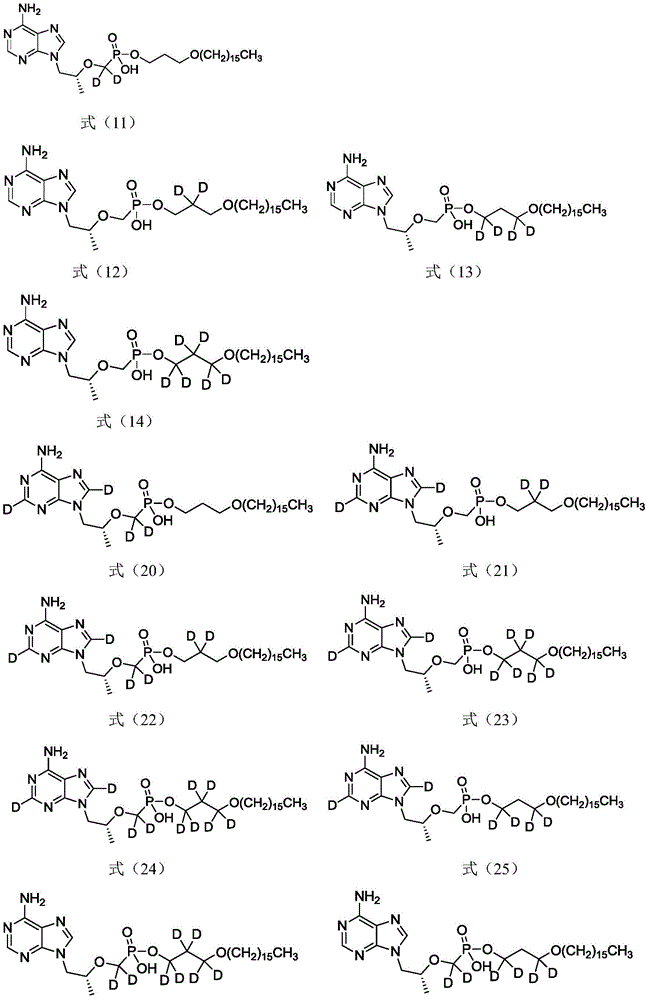
作为本发明的进一步改进,所述化合物可选自下述化合物或其药学上可接受的盐,但不局限于下列化合物:As a further improvement of the present invention, the compound can be selected from the following compounds or their pharmaceutically acceptable salts, but is not limited to the following compounds:


采用此技术方案,氘在药物分子中的形状和体积与氢基本上相同,如果药物分子中氢被选择性替换为氘,氘代药物一般还会保留原来的生物活性和选择性。同时发明人经过实验证实,碳氘键的结合比碳氢键的结合更稳定,可直接影响一些药物的吸收、分布、代谢和排泄等属性,从而提高药物的疗效、安全性和耐受性。With this technical solution, the shape and volume of deuterium in the drug molecule are basically the same as that of hydrogen. If the hydrogen in the drug molecule is selectively replaced by deuterium, the deuterated drug will generally retain the original biological activity and selectivity. At the same time, the inventors have confirmed through experiments that the combination of carbon-deuterium bonds is more stable than the combination of carbon-hydrogen bonds, which can directly affect the absorption, distribution, metabolism and excretion of some drugs, thereby improving the efficacy, safety and tolerance of drugs.
优选的,氘在氘代位置的氘同位素含量至少是大于天然氘同位素含量(0.015%),较佳地大于30%,更佳地大于50%,更佳地大于75%,更佳地大于95%,更佳地大于99%。Preferably, the deuterium isotope content of deuterium at the deuterium position is at least greater than the natural deuterium isotope content (0.015%), preferably greater than 30%, more preferably greater than 50%, more preferably greater than 75%, more preferably greater than 95% %, more preferably greater than 99%.
具体地说,在本发明中R1、R2、R3、R4、R5、R6、R7、R8、R9、R10、R11、R12、R13、R14、R15、R16和X各氘代位置中氘同位素含量至少是5%,较佳地大于10%,更佳地大于15%,更佳地大于20%,更佳地大于25%,更佳地大于30%,更佳地大于35%,更佳地大于40%,更佳地大于45%,更佳地大于50%,更佳地大于55%,更佳地大于60%,更佳地大于65%,更佳地大于70%,更佳地大于75%,更佳地大于80%,更佳地大于85%,更佳地大于90%,更佳地大于95%,更佳地大于99%。Specifically, in the present invention, R 1 , R 2 , R 3 , R 4 , R 5 , R 6 , R 7 , R 8 , R 9 , R 10 , R 11 , R 12 , R 13 , R 14 , The content of deuterium isotopes in each of the deuterated positions of R 15 , R 16 and X is at least 5%, preferably more than 10%, more preferably more than 15%, more preferably more than 20%, more preferably more than 25%, more preferably more preferably more than 30%, more preferably more than 35%, more preferably more than 40%, more preferably more than 45%, more preferably more than 50%, more preferably more than 55%, more preferably more than 60%, more preferably more than 65%, more preferably more than 70%, more preferably more than 75%, more preferably more than 80%, more preferably more than 85%, more preferably more than 90%, more preferably more than 95%, more preferably more than 99%.
在另一优选例中,式(I)中化合物的R1、R2、R3、R4、R5、R6、R7、R8、R9、R10、R11、R12、R13、R14、R15、R16和X,至少其中一个R/X含氘,更佳地两个R/X含氘,更佳地三个R/X含氘,更佳地四个R/X含氘,更佳地五个R/X含氘,更佳地六个R/X含氘,更佳地七个R/X含氘,更佳地八个R/X含氘,更佳地九个R/X含氘,更佳地十个R含氘,更佳地十一个R/X含氘,更佳地十二个R/X含氘,更佳地十三个R/X含氘,更佳地十四个R/X含氘,更佳地十五个R/X含氘,更佳地十六个R/X含氘。In another preferred example, R 1 , R 2 , R 3 , R 4 , R 5 , R 6 , R 7 , R 8 , R 9 , R 10 , R 11 , R 12 , R 13 , R 14 , R 15 , R 16 and X, at least one of R/X contains deuterium, more preferably two R/X contain deuterium, more preferably three R/X contain deuterium, more preferably four R/X contains deuterium, more preferably five R/X contains deuterium, more preferably six R/X contains deuterium, more preferably seven R/X contains deuterium, more preferably eight R/X contains deuterium, more preferably nine R/X contain deuterium, more preferably ten R/X contain deuterium, more preferably eleven R/X contain deuterium, more preferably twelve R/X contain deuterium, more preferably thirteen R/X contain deuterium R/X contain deuterium, more preferably fourteen R/X contain deuterium, more preferably fifteen R/X contain deuterium, more preferably sixteen R/X contain deuterium.
在另一优选例中,所述化合物不包括非氘代化合物。In another preferred embodiment, the compound does not include a non-deuterated compound.
本发明还公开了一种药物组合物,其含有药学上可接受的载体和如上所述的所述的核苷类逆转录酶抑制剂,或其晶型、药学上可接受的盐、水合物或溶剂合物、立体异构体、前药或同位素变体的药物组合物。The present invention also discloses a pharmaceutical composition, which contains a pharmaceutically acceptable carrier and the aforementioned nucleoside reverse transcriptase inhibitor, or a crystalline form, a pharmaceutically acceptable salt, or a hydrate thereof Or pharmaceutical compositions of solvates, stereoisomers, prodrugs or isotopic variants.
作为本发明的进一步改进,所述药学上可接受的载体包括助流剂、增甜剂、稀释剂、防腐剂、染料/着色剂、矫味增强剂、表面活性剂、润湿剂、分散剂、崩解剂、助悬剂、稳定剂、等渗剂、溶剂或乳化剂中的至少一种。As a further improvement of the present invention, the pharmaceutically acceptable carrier includes glidants, sweeteners, diluents, preservatives, dyes/colorants, flavor enhancers, surfactants, wetting agents, dispersing agents , at least one of disintegrants, suspending agents, stabilizers, isotonic agents, solvents or emulsifiers.
作为本发明的进一步改进,所述药物组合物为片剂、丸剂、胶囊剂、粉剂、颗粒剂、膏剂、乳剂、悬浮剂、溶液剂、栓剂、注射剂、吸入剂、凝胶剂、微球或气溶胶。As a further improvement of the present invention, the pharmaceutical composition is tablet, pill, capsule, powder, granule, ointment, emulsion, suspension, solution, suppository, injection, inhalation, gel, microsphere or Aerosol.
给予本发明药物组合物的典型途径包括但不限于口服、直肠、透黏膜、经肠给药,或者局部、经皮、吸入、肠胃外、舌下、阴道内、鼻内、眼内、腹膜内、肌内、皮下、静脉内给药。优选口服给药或注射给药。Typical routes of administration of the pharmaceutical compositions of the present invention include, but are not limited to, oral, rectal, transmucosal, enteral, or topical, transdermal, inhalation, parenteral, sublingual, intravaginal, intranasal, intraocular, intraperitoneal , intramuscular, subcutaneous, intravenous administration. Oral administration or injection administration is preferred.
本发明的药物组合物可以采用本领域周知的方法制造,如常规的混合法、溶解法、制粒法、制糖衣药丸法、磨细法、乳化法、冷冻干燥法等。The pharmaceutical composition of the present invention can be manufactured by methods known in the art, such as conventional mixing method, dissolving method, granulation method, sugar-coated pill method, grinding method, emulsifying method, freeze-drying method and the like.
本发明还提供了一种制备药物组合物的方法,包括步骤:将药学上可接受的载体与如上所述的核苷类逆转录酶抑制剂,或其晶型、药学上可接受的盐、水合物或溶剂合物进行混合,形成药物组合物。The present invention also provides a method for preparing a pharmaceutical composition, comprising the steps of: combining a pharmaceutically acceptable carrier with the above-mentioned nucleoside reverse transcriptase inhibitor, or a crystal form, a pharmaceutically acceptable salt, The hydrates or solvates are mixed to form a pharmaceutical composition.
作为本发明的进一步改进,其还包含其他活性化合物,所述活性化合物为免疫调节剂或抗病毒药物化合物,可选自拉米夫定、阿巴卡韦、齐多夫定、司他夫定、扎西他滨、去羟肌苷、恩曲他滨、替诺福韦、地拉韦啶、依法韦仑、依曲韦林、奈韦拉平、氨普那韦、阿扎那韦、地瑞那韦、茚地那韦、洛匹那韦、奈非那韦、利托那韦、沙奎那韦、替拉那韦、马拉韦罗、恩夫韦肽和雷特格韦。As a further improvement of the present invention, it also includes other active compounds, the active compounds are immunomodulators or antiviral drug compounds, which can be selected from lamivudine, abacavir, zidovudine, stavudine , Zalcitabine, Didanosine, Emtricitabine, Tenofovir, Delavirdine, Efavirenz, Etravirine, Nevirapine, Amprenavir, Atazanavir, Darena vir, indinavir, lopinavir, nelfinavir, ritonavir, saquinavir, tipranavir, maraviroc, enfuvirtide, and raltegravir.
本发明的活性成分也可与其他活性成分联合使用。这种组合的选择基于治疗的情况、成份的交叉反应性和联合的药学性质。还可能使本发明的任意化合物联合一种或多种其他活性成分,以单一剂型同时或连续对患者给药。联合治疗可以同时或连续给药方案给药。当连续给药时,联合可以两次或更多次给药施用。联合治疗可提供“增效作用”或“协同作用”,换言之,当活性成分一起使用获得的效果大于分开使用化合物所得效果之和。当活性成分:(1)被共同配制和给药或以组合制剂形式同时递送;(2)作为独立的制剂交替给药或平行给药;或(3)通过一些其他给药方案时,可获得协同作用。当以交替治疗递送时,当化合物序贯给药或释放,例如以独立的片剂、丸剂或胶囊剂,或通过单独注射器的不同注射,可获得协同作用。通常,在交替治疗期间,每种活性成分有效剂量被序贯,即连续地给予,而在联合治疗中,两种或更多种活性成分的有效剂量共同给予。The active ingredients of the present invention may also be used in combination with other active ingredients. Selection of this combination is based on the therapeutic situation, the cross-reactivity of the ingredients and the pharmaceutical properties of the combination. It is also possible for any compound of the present invention to be administered to a patient simultaneously or sequentially in a single dosage form in combination with one or more other active ingredients. Combination therapy can be administered in a simultaneous or sequential dosing regimen. When administered consecutively, the combination may be administered in two or more doses. Combination therapy may provide a "synergistic effect" or "synergistic effect," in other words, the effect obtained when the active ingredients are used together is greater than the sum of the effects obtained when the compounds are used separately. It may be obtained when the active ingredients are: (1) co-formulated and administered or delivered simultaneously in a combined formulation; (2) administered alternately or in parallel as separate formulations; or (3) by some other dosing regimen synergy. When delivered in alternation therapy, a synergistic effect can be obtained when the compounds are administered or released sequentially, eg, in separate tablets, pills, or capsules, or by different injections from separate syringes. Typically, during alternation therapy, effective doses of each active ingredient are administered sequentially, ie, consecutively, while in combination therapy, effective doses of two or more active ingredients are co-administered.
本发明还公开了一种如上所述的取代的无环核苷类似物作为核苷类逆转录酶抑制剂的用途,即本发明化合物可有利地适用作治疗如艾滋病和乙型肝炎的病状的治疗剂。The present invention also discloses the use of the above-mentioned substituted acyclic nucleoside analogs as nucleoside reverse transcriptase inhibitors, that is, the compounds of the present invention can be advantageously used as agents for the treatment of conditions such as AIDS and hepatitis B. therapeutic agent.
本发明中使用的“治疗”适用于获得有益的或需要的结果(包括临床结果)的途径。为了本发明的目的,有益的或需要的结果包括(但不限于)缓解或改善一种或多种症状,减小病变范围,稳定的(即,非恶化的)疾病状态,预防疾病扩散,延缓或减慢疾病进展,疾病状态的改善或环节和减轻(无论是局部的还是全部的),无论是可检测的还是不可检测的。"Treatment" as used in the present invention applies to an approach to obtaining beneficial or desired results, including clinical results. For the purposes of the present invention, beneficial or desirable results include, but are not limited to, alleviation or amelioration of one or more symptoms, reduction in lesion size, stable (ie, non-exacerbating) disease state, prevention of disease spread, delay Or slow disease progression, amelioration or partial and alleviation of disease state (whether local or global), whether detectable or undetectable.
应理解,在本发明范围内中,本发明的上述各技术特征和在下文(如实施例)中具体描述的各技术特征之间都可以互相组合,从而构成新的或优选的技术方案。限于篇幅,在此不再一一累述。It should be understood that within the scope of the present invention, the above-mentioned technical features of the present invention and the technical features specifically described in the following (eg, the embodiments) can be combined with each other to form new or preferred technical solutions. Due to space limitations, it is not repeated here.
本文中,如无特别说明,“卤素”指F、Cl、Br、和I。更佳地,卤原子选自F、Cl和Br。Herein, unless otherwise specified, "halogen" refers to F, Cl, Br, and I. More preferably, the halogen atom is selected from F, Cl and Br.
本文中,如无特别说明,“氘代”指化合物或基团中的一个或多个氢被氘所取代;氘代可以是一取代、二取代、多取代或全取代。术语“一个或多个氘代的”与“一次或多次氘代”可互换使用。Herein, unless otherwise specified, "deuterated" refers to the replacement of one or more hydrogens in a compound or group with deuterium; deuterated can be mono-, di-, poly- or full-substitution. The term "one or more deuterated" and "one or more deuterated" are used interchangeably.
本文中,如无特别说明,“非氘代的化合物”是指含氘原子比例不高于天然氘同位素含量(0.015%)的化合物。Herein, unless otherwise specified, "non-deuterated compounds" refer to compounds containing deuterium atoms in a proportion not higher than the natural deuterium isotope content (0.015%).
本发明的组合物任选包含这里化合物的盐,特别是药学上可接受的无毒的盐,含有,例如,Na+、Li+、K+、Ca+2和Mg+2。这些盐可包括通过适宜的阳离子,例如碱和碱土金属离子或铵和四价氨基离子和酸阴离子部分,典型的是羧酸的结合而衍生的盐。如想获得水溶性盐,则优选一价盐。金属盐典型地通过使金属氢氧化物与本发明的化合物反应制备。在这种方法制备的金属盐的实施例是含有Li+、Na+和K+的盐。通过添加适宜金属化合物,更不溶性金属盐可从更可溶性盐溶液中沉淀出来。另外,盐可以由添加某些有机酸和无机酸形成,例如,HCl、HBr、H2SO4、H3PO4或有机磺酸,到碱性中心,典型的是胺,或到酸性基团而形成。最后,可以理解,此处的组合物包含以它们未电离的,以及两性离子形式存在的本发明化合物,和与如水合物中的化学计算量的水组合。在本发明范围内也包括母体化合物与一种或多种氨基酸的盐。上述的任意一种氨基酸都是适宜的,特别是作为蛋白质成分发现的天然发生的氨基酸,尽管该氨基酸典型地是一种带有具有碱性或酸性基团的侧链的氨基酸,例如,赖氨酸、精氨酸或谷氨酸,或带有具有中性基团的侧链的氨基酸,例如,甘氨酸、丝氨酸、苏氨酸、丙氨酸、异亮氨酸或亮氨酸。The compositions of the present invention optionally comprise salts of the compounds herein, especially pharmaceutically acceptable non-toxic salts, containing, for example, Na + , Li + , K + , Ca +2 and Mg +2 . These salts may include salts derived by the combination of suitable cations, such as alkali and alkaline earth metal ions or ammonium and tetravalent amino ions and acid anion moieties, typically carboxylic acids. If water-soluble salts are desired, monovalent salts are preferred. Metal salts are typically prepared by reacting metal hydroxides with compounds of the present invention. Examples of metal salts prepared in this way are salts containing Li + , Na + and K + . By adding a suitable metal compound, the more insoluble metal salt can be precipitated from the more soluble salt solution. Additionally, salts can be formed by adding certain organic and inorganic acids, eg, HCl, HBr , H2SO4 , H3PO4 , or organic sulfonic acids, to basic centers, typically amines, or to acidic groups formed. Finally, it is understood that the compositions herein comprise the compounds of the present invention in their unionized, as well as zwitterionic forms, in combination with stoichiometric amounts of water as in hydrates. Also included within the scope of the present invention are salts of the parent compound with one or more amino acids. Any of the aforementioned amino acids are suitable, especially the naturally occurring amino acids found as protein constituents, although the amino acid is typically an amino acid with a side chain having a basic or acidic group, e.g., lysine acid, arginine or glutamic acid, or amino acids with side chains having neutral groups, eg glycine, serine, threonine, alanine, isoleucine or leucine.
本发明化合物可具有手性中心,例如,手性碳或磷原子。本发明化合物因此包括所有立体异构体的外消旋混合物,包括对映体、非对映体和阻转异构体。另外,本发明化合物包括在任意或全部不对称手性原子上的富集的或拆分的旋光异构体。换句话说,从描述中显而易见的手性中心被作为手性异构体或外消旋混合物提供。外消旋混合物和非对映的混合物,以及实质上不含它们的对映或非对映的配偶体、分离或合成的单独旋光异构体,全部落在本发明的保护范围内。通过已知技术,例如,分离用旋光活性的助剂例如,酸或碱形成的非对映的盐,接着转回为旋光活性物质,外消旋混合物被分离成他们的单个的、实质上光学纯的同分异构体。在大多数情况下,想得到的旋光异构体是通过立体特异反应,从希望的原料的适宜立体异构体开始进行合成的。The compounds of the present invention may have chiral centers, eg, chiral carbon or phosphorus atoms. The compounds of the present invention thus include racemic mixtures of all stereoisomers, including enantiomers, diastereomers and atropisomers. Additionally, the compounds of the present invention include enriched or resolved optical isomers at any or all asymmetric chiral atoms. In other words, the chiral centers evident from the description are provided as chiral isomers or racemic mixtures. Racemic and diastereomeric mixtures, as well as substantially free of their enantiomeric or diastereomeric partners, isolated or synthesized individual optical isomers, all fall within the scope of the present invention. Racemic mixtures are separated into their individual, substantially optically active species by known techniques, eg, separation of diastereomeric salts formed with optically active auxiliaries, eg, acids or bases, followed by conversion to the optically active species pure isomers. In most cases, desired optical isomers are synthesized by stereospecific reactions starting from the appropriate stereoisomer of the desired starting material.
在某些情况中,本发明化合物也可能以互变异构体的形式存在。尽管仅有一种非定域共振结构可能被描述,但设想所有的这类形式都落在本发明的保护范围内。例如,对于嘌呤、嘧啶、咪唑、胍、脒和四唑系统而言,烯-胺互变异构体可能存在,并且所有它们可能的互变异构形式都落在本发明保护范围内。In certain instances, the compounds of the present invention may also exist in tautomeric forms. Although only one delocalized resonance structure may be described, it is contemplated that all such forms are within the scope of the present invention. For example, for purine, pyrimidine, imidazole, guanidine, amidine and tetrazole systems, en-amine tautomers may exist, and all of their possible tautomeric forms are within the scope of this invention.
术语“溶剂合物”指本发明化合物与溶剂分子配位形成特定比例的配合物。“水合物”是指本发明化合物与水进行配位形成的配合物。The term "solvate" refers to a complex in which a compound of the present invention coordinates with solvent molecules to form a complex in specified proportions. "Hydrate" refers to a complex formed by the coordination of a compound of the present invention with water.
本发明所用的“人免疫缺陷病毒”(或“HIV”)包括其所有的亚型,包括HIV的A、B、C、D、E、F、G和O亚型以及HIV-2。As used herein, "human immunodeficiency virus" (or "HIV") includes all subtypes thereof, including HIV subtypes A, B, C, D, E, F, G and O, and HIV-2.
本发明所用的“乙型肝炎病毒”(或“HBV”)包括其所有的亚型(adw、adr、ayw和ayr)和/或基因型(A、B、C、D、E、F、G和H)。"Hepatitis B virus" (or "HBV") as used in the present invention includes all of its subtypes (adw, adr, ayw and ayr) and/or genotypes (A, B, C, D, E, F, G and H).
与现有技术相比,本发明的有益效果为:本发明的化合物对核苷类逆转录酶具有优异的抑制性;通过氘化这一技术改变化合物在生物体中的代谢,使化合物具有更好的药代动力学参数特性。在这种情况下,可以改变剂量并形成长效制剂,改善适用性;用氘取代化合物中的氢原子,由于其氘同位素效应,提高化合物在动物体内的药物浓度,提高了药物疗效;用氘取代化合物中的氢原子,可以抑制某些代谢产物,提高了化合物的安全性。Compared with the prior art, the beneficial effects of the present invention are as follows: the compound of the present invention has excellent inhibitory activity on nucleoside reverse transcriptase; the metabolism of the compound in the organism is changed by the deuterium technology, so that the compound has a better inhibitory effect. Good pharmacokinetic parameter profile. In this case, the dosage can be changed and a long-acting preparation can be formed to improve the applicability; replacing the hydrogen atom in the compound with deuterium, due to its deuterium isotope effect, increases the drug concentration of the compound in the animal body and improves the drug efficacy; the use of deuterium Substituting hydrogen atoms in compounds can inhibit certain metabolites and improve the safety of compounds.
具体实施方式Detailed ways
下面更具体地描述本发明式(I)结构化合物的制备方法,但这些具体方法不对本发明构成任何限制。本发明化合物还可以任选将在本说明书中描述的或本领域已知的各种合成方法组合起来而方便地制得,这样的组合可由本发明所属领域的技术人员容易地进行。The preparation method of the compound of formula (I) of the present invention is described in more detail below, but these specific methods do not constitute any limitation to the present invention. The compounds of the present invention can also be conveniently prepared by optionally combining various synthetic methods described in this specification or known in the art, and such combinations can be easily performed by those skilled in the art to which the present invention pertains.
通常,在制备流程中,各反应通常在惰性溶剂中,在室温至回流温度(如0℃~100℃,优选0℃~80℃)下进行。反应时间通常为0.1小时-60小时,较佳地为0.5-24小时。Usually, in the preparation process, each reaction is usually carried out in an inert solvent at room temperature to reflux temperature (eg, 0°C to 100°C, preferably 0°C to 80°C). The reaction time is usually 0.1 hour to 60 hours, preferably 0.5 to 24 hours.
实施例1 制备(R)-9-{2-[(十六烷氧基-d6-丙基)磷酸甲氧]丙基}腺嘌呤,即化合Example 1 Preparation of (R)-9-{2-[(hexadecyloxy-d6-propyl)phosphate methoxy]propyl}adenine, i.e. compound 物T-1,具体合成步骤如下:Material T-1, the specific synthesis steps are as follows:

步骤1 (R)-9-(2-羟基丙基)腺嘌呤(化合物3)的合成。Step 1 Synthesis of (R)-9-(2-hydroxypropyl)adenine (compound 3).
在反应瓶中加入腺嘌呤(4.0g,29.6mmol)和(R)-碳酸丙烯酯(3.45g,33.8mmol),加入4.5mL DMF溶解,加热至130℃反应过夜,TLC检测反应完全后,降温至100℃,加入14mL甲苯和0.47g甲磺酸(保持内温在100-110℃),再加入11mL甲苯得到一个均相混悬液,逐渐降温至室温,再降温至0℃保持1小时,过滤的白色固体,真空干燥得5.77g产物,收率100%。LC-MS(APCI):m/z=194.3(M+1)+。Adenine (4.0 g, 29.6 mmol) and (R)-propylene carbonate (3.45 g, 33.8 mmol) were added to the reaction flask, 4.5 mL of DMF was added to dissolve, heated to 130 °C and reacted overnight. After the reaction was completed by TLC, the temperature was lowered. to 100 ° C, add 14 mL of toluene and 0.47 g of methanesulfonic acid (keeping the internal temperature at 100-110 ° C), then add 11 mL of toluene to obtain a homogeneous suspension, gradually cool down to room temperature, then cool down to 0 ° C for 1 hour, The filtered white solid was dried in vacuo to obtain 5.77 g of product with a yield of 100%. LC-MS (APCI): m/z=194.3 (M+1) + .
步骤2 二乙基[[(对甲苯磺酰基)氧基]甲基]磷酸酯(化合物5)的合成。Step 2 Synthesis of diethyl[[(p-toluenesulfonyl)oxy]methyl]phosphate (compound 5).
在反应瓶中加入羟甲基磷酸二乙酯(3.85g,22.89mmol),加入30mL无水乙醚溶解,滴加三乙胺(3.38mL,24.04mmol),加毕,降温至-10℃,滴加对甲苯磺酰氯(4.58g,24.04mmol)的10mL乙醚溶液,加毕,0℃下搅拌反应3小时,再升至室温反应过夜。加入少量乙醚稀释,过滤除去无机盐,滤液浓缩,硅胶柱层析纯化,真空干燥得产物5.4g,收率73.2%。LC-MS(APCI):m/z=323.1(M+1)+。Add hydroxymethyl diethyl phosphate (3.85 g, 22.89 mmol) to the reaction flask, add 30 mL of anhydrous ether to dissolve, add triethylamine (3.38 mL, 24.04 mmol) dropwise, after the addition is completed, cool down to -10 ° C, dropwise A solution of p-toluenesulfonyl chloride (4.58 g, 24.04 mmol) in 10 mL of ether was added, the addition was completed, the reaction was stirred at 0° C. for 3 hours, and then raised to room temperature for overnight reaction. A small amount of diethyl ether was added to dilute, the inorganic salt was removed by filtration, the filtrate was concentrated, purified by silica gel column chromatography, and dried in vacuo to obtain 5.4 g of the product with a yield of 73.2%. LC-MS (APCI): m/z=323.1 (M+1) + .
步骤3 (R)-9-[2-(二乙基磷酰甲氧基)丙基]腺嘌呤(化合物6)的合成。Step 3 Synthesis of (R)-9-[2-(diethylphosphorylmethoxy)propyl]adenine (compound 6).
将化合物3(1.0g,5.17mmol)用40ml无水DMF溶解,降温至0℃,氮气保护下加入NaH(233.3mg)低温下反应40分钟,加入化合物5(1.75g,5.44mmol)的10mL无水DMF溶解,升至室温反应18小时,TLC检测反应完毕后浓缩除去溶剂,硅胶柱层析纯化,蒸干后得产物0.88g,收率50%。LC-MS(APCI):m/z=344.5(M+1)+。Compound 3 (1.0 g, 5.17 mmol) was dissolved in 40 ml of anhydrous DMF, cooled to 0 °C, NaH (233.3 mg) was added under nitrogen protection and reacted at low temperature for 40 minutes, and 10 mL of compound 5 (1.75 g, 5.44 mmol) was added. Water DMF was dissolved, and the reaction was raised to room temperature for 18 hours. After the reaction was detected by TLC, the solvent was concentrated to remove the solvent, purified by silica gel column chromatography, and evaporated to dryness to obtain 0.88 g of the product with a yield of 50%. LC-MS (APCI): m/z=344.5 (M+1) + .
步骤4 (R)-9-[2-(磷酰甲氧基)丙基]腺嘌呤(化合物7)的合成。Step 4 Synthesis of (R)-9-[2-(phosphorylmethoxy)propyl]adenine (compound 7).
在干燥的反应瓶中加入化合物6(2.276g,6.63mmol),加入20mL无水DMF溶解,室温下加入TMSBr(3.76g,24.57mmol),搅拌反应20小时,TLC检测反应完成后,浓缩除去溶剂,加入氨水调PH至8.0,浓缩得油状液体,用稀盐酸调PH至3.0,再次蒸干,加入异丙醇析出黄色固体,过滤,用异丙醇/水(3∶1)重结晶得白色固体0.57g,收率30.1%。LC-MS(APCI):m/z=286.7(M-1)-。Compound 6 (2.276 g, 6.63 mmol) was added to a dry reaction flask, 20 mL of anhydrous DMF was added to dissolve, TMSBr (3.76 g, 24.57 mmol) was added at room temperature, and the reaction was stirred for 20 hours. After the reaction was detected by TLC, the solvent was concentrated and removed. , add ammonia water to adjust pH to 8.0, concentrate to obtain oily liquid, adjust pH to 3.0 with dilute hydrochloric acid, evaporate to dryness again, add isopropanol to separate out yellow solid, filter, recrystallize with isopropanol/water (3:1) to obtain white Solid 0.57g, yield 30.1%. LC-MS (APCI): m/z=286.7 (M-1) − .
步骤5 3-十六烷氧基-1,2,3-d6-1-丙醇(化合物9)的合成。Step 5 Synthesis of 3-hexadecyloxy-1,2,3-d6-1-propanol (compound 9).
在反应瓶中加入溴代十六烷(619.9mg,2.03mmol)和d6-1,3-丙二醇(500mg,6.09mmol),加入3mL二甲基亚砜和3mL四氢呋喃溶解,加入氢氧化钠(324.8mg,8.12mmol)室温下反应24小时。加入5mL水稀释,用2M稀盐酸调PH至中性,乙酸乙酯萃取3次,合并有机相,饱和食盐水洗涤,浓缩,硅胶柱层析纯化得化合物0.60g,收率:96%。LC-MS(APCI):m/z=307.5(M+1)+。Bromohexadecane (619.9 mg, 2.03 mmol) and d6-1,3-propanediol (500 mg, 6.09 mmol) were added to the reaction flask, 3 mL of dimethyl sulfoxide and 3 mL of tetrahydrofuran were added to dissolve, and sodium hydroxide (324.8 mL) was added. mg, 8.12 mmol) at room temperature for 24 hours. Add 5 mL of water to dilute, adjust pH to neutral with 2M dilute hydrochloric acid, extract 3 times with ethyl acetate, combine the organic phases, wash with saturated brine, concentrate, and purify by silica gel column chromatography to obtain compound 0.60 g, yield: 96%. LC-MS (APCI): m/z=307.5 (M+1) + .
步骤6 (R)-9-{2-[(十六烷氧基-d6-丙基)磷酸甲氧]丙基}腺嘌呤(化合物T-1)的合成。Step 6 Synthesis of (R)-9-{2-[(hexadecyloxy-d6-propyl)phosphomethoxy]propyl}adenine (compound T-1).
在反应瓶中加入化合物7(240mg,0.836mmol)、化合物9(306.5mg,1.00mmol)和10mL DMF,加热至85℃,加入三乙胺(104mg,1.03mmol),升温至100℃,加入二环己基碳二亚胺(DCC,281mg,1.36mmol),再升至120℃搅拌反应16小时。TLC检测原料消失后降温至室温,过滤除去不溶物,用少量DMF洗涤滤饼,滤液浓缩,硅胶柱层析纯化得到250mg产物,收率52.5%。LC-MS(APCI):m/z=576.5(M+1)+。1H NMR(500MHz,CDCl3)δ8.38(s,1H),8.20(s,1H),4.35(d,J=13.4Hz,1H),3.99(s,1H),3.74(s,1H),3.30(s,2H),3.02(q,J=7.3Hz,1H),2.85(q,J=7.2Hz,1H),1.49(s,2H),1.24(t,J=7.1Hz,26H),0.86(t,J=6.9Hz,3H)。Compound 7 (240 mg, 0.836 mmol), compound 9 (306.5 mg, 1.00 mmol) and 10 mL of DMF were added to the reaction flask, heated to 85 °C, triethylamine (104 mg, 1.03 mmol) was added, the temperature was raised to 100 °C, and diethylamine was added. Cyclohexylcarbodiimide (DCC, 281 mg, 1.36 mmol), then warmed to 120°C and stirred for 16 hours. After TLC detected the disappearance of the raw materials, the temperature was cooled to room temperature, the insolubles were removed by filtration, the filter cake was washed with a small amount of DMF, the filtrate was concentrated, and purified by silica gel column chromatography to obtain 250 mg of product with a yield of 52.5%. LC-MS (APCI): m/z=576.5 (M+1) + . 1 H NMR (500 MHz, CDCl 3 ) δ 8.38 (s, 1H), 8.20 (s, 1H), 4.35 (d, J=13.4 Hz, 1H), 3.99 (s, 1H), 3.74 (s, 1H) , 3.30(s, 2H), 3.02(q, J=7.3Hz, 1H), 2.85(q, J=7.2Hz, 1H), 1.49(s, 2H), 1.24(t, J=7.1Hz, 26H) , 0.86 (t, J=6.9 Hz, 3H).
实施例2 制备(R)-9-{2-[(十六烷氧基-2-d2-丙基)磷酸甲氧]丙基}腺嘌呤,即化Example 2 Preparation of (R)-9-{2-[(hexadecyloxy-2-d2-propyl)phosphomethoxy]propyl}adenine, i.e. 合物T-2,具体合成步骤如下:Compound T-2, the specific synthesis steps are as follows:

步骤1 2-d2-丙二酸二乙酯(化合物11)的合成。Step 1 Synthesis of 2-d2-diethyl malonate (compound 11).
在微波反应瓶中加入丙二酸二乙酯(4.0g,25mmol)、碳酸钾(345mg,2.5mmol)和15mL重水,密闭后置于微波反应器中加热至85℃反应45分钟。降至室温,加入乙酸乙酯萃取三次,合并有机相,饱和食盐水洗涤,浓缩柱层析纯化得到目标产物3.63g,收率90.7%。LC-MS(APCI):m/z=163.1(M+1)+。Diethyl malonate (4.0 g, 25 mmol), potassium carbonate (345 mg, 2.5 mmol) and 15 mL of deuterium were added to the microwave reaction flask, which was sealed and placed in a microwave reactor and heated to 85° C. to react for 45 minutes. After cooling to room temperature, ethyl acetate was added for extraction three times, the organic phases were combined, washed with saturated brine, concentrated and purified by column chromatography to obtain 3.63 g of the target product with a yield of 90.7%. LC-MS (APCI): m/z=163.1 (M+1) + .
步骤2 2-d2-1,3-丙二醇(化合物12)的合成。Step 2 Synthesis of 2-d2-1,3-propanediol (compound 12).
在反应瓶中加入化合物11(2.26g,13.94mmol),用50mL无水四氢呋喃溶解,冰浴下,分批加入氢化锂铝(1.06g,27.88mmol),加毕,升至室温搅拌反应过夜。冰浴条件下加入少量十水和硫酸钠淬灭反应,过滤除去不溶物,滤液浓缩得到目标产物粗品,真空干燥得到612mg,收率56.2%。LC-MS(APCI):m/z=79.1(M+1)+。Compound 11 (2.26 g, 13.94 mmol) was added to the reaction flask, dissolved in 50 mL of anhydrous tetrahydrofuran, lithium aluminum hydride (1.06 g, 27.88 mmol) was added in batches under ice bath, the addition was completed, and the reaction was stirred at room temperature overnight. A small amount of decahydrate and sodium sulfate were added to quench the reaction under ice bath conditions, the insolubles were removed by filtration, the filtrate was concentrated to obtain the crude product of the target product, and 612 mg was obtained by vacuum drying with a yield of 56.2%. LC-MS (APCI): m/z=79.1 (M+1) + .
步骤3 3-十六烷氧基-2-d2-1-丙醇(化合物13)的合成。Step 3 Synthesis of 3-hexadecyloxy-2-d2-1-propanol (compound 13).
在反应瓶中加入溴代十六烷(496.7mg,1.63mmol)和化合物12(381mg,4.88mmol),加入2mL二甲基亚砜和2mL四氢呋喃溶解,加入氢氧化钠(261mg,6.52mmol)室温下反应24小时。加入5mL水稀释,用2M稀盐酸调PH至中性,乙酸乙酯萃取3次,合并有机相,饱和食盐水洗涤,浓缩,硅胶柱层析纯化得化合物0.41g,收率:83.2%。LC-MS(APCI):m/z=303.5(M+1)+。Bromohexadecane (496.7 mg, 1.63 mmol) and compound 12 (381 mg, 4.88 mmol) were added to the reaction flask, 2 mL of dimethyl sulfoxide and 2 mL of tetrahydrofuran were added to dissolve, and sodium hydroxide (261 mg, 6.52 mmol) was added at room temperature The reaction was continued for 24 hours. Add 5 mL of water to dilute, adjust the pH to neutral with 2M dilute hydrochloric acid, extract with ethyl acetate three times, combine the organic phases, wash with saturated brine, concentrate, and purify by silica gel column chromatography to obtain compound 0.41 g, yield: 83.2%. LC-MS (APCI): m/z=303.5 (M+1) + .
步骤4 (R)-9-{2-[(十六烷氧基-2-d2-丙基)磷酸甲氧]丙基}腺嘌呤(化合物T-2)的制备。Step 4 Preparation of (R)-9-{2-[(hexadecyloxy-2-d2-propyl)phosphomethoxy]propyl}adenine (compound T-2).
在反应瓶中加入化合物7(253.2mg,0.88mmol)、化合物13(320mg,1.06mmol)和10mL DMF,加热至85℃,加入三乙胺(109mg,1.08mmol),升温至100℃,加入DCC(296mg,1.43mmol),再升至120℃搅拌反应16小时。TLC检测原料消失后降温至室温,过滤除去不溶物,用少量DMF洗涤滤饼,滤液浓缩,硅胶柱层析纯化得到273mg产物,收率54.2%。LC-MS(APCI):m/z=572.7(M+1)+。1H NMR(300MHz,CDCl3)δ8.38(s,1H),8.21(s,1H),4.34(d,J=12.9Hz,1H),3.89(s,3H),3.75-3.68(m,1H),3.39-3.27(m,4H),3.07-2.80(m,2H),1.48(s,2H),1.24(s,26H),1.14(s,3H),0.87(t,J=6.6Hz,3H)。Compound 7 (253.2 mg, 0.88 mmol), compound 13 (320 mg, 1.06 mmol) and 10 mL of DMF were added to the reaction flask, heated to 85 °C, triethylamine (109 mg, 1.08 mmol) was added, the temperature was raised to 100 °C, and DCC was added (296 mg, 1.43 mmol), and then warmed to 120°C and stirred the reaction for 16 hours. After TLC detected the disappearance of the raw materials, the temperature was lowered to room temperature, the insolubles were removed by filtration, the filter cake was washed with a small amount of DMF, the filtrate was concentrated, and purified by silica gel column chromatography to obtain 273 mg of product with a yield of 54.2%. LC-MS (APCI): m/z=572.7 (M+1) + . 1 H NMR (300 MHz, CDCl 3 ) δ 8.38 (s, 1H), 8.21 (s, 1H), 4.34 (d, J=12.9 Hz, 1H), 3.89 (s, 3H), 3.75-3.68 (m, 1H), 3.39-3.27(m, 4H), 3.07-2.80(m, 2H), 1.48(s, 2H), 1.24(s, 26H), 1.14(s, 3H), 0.87(t, J=6.6Hz , 3H).
实施例3 制备(R)-9-{2-[(十六烷氧基-1,3-d4-丙基)磷酸甲氧]丙基}腺嘌呤,即Example 3 Preparation of (R)-9-{2-[(hexadecyloxy-1,3-d4-propyl)phosphomethoxy]propyl}adenine, namely 化合物T-3,具体合成步骤如下:Compound T-3, the specific synthesis steps are as follows:

步骤1 1,3-d4-1,3-丙二醇(化合物14)的合成。Step 1 Synthesis of 1,3-d4-1,3-propanediol (compound 14).
在反应瓶中加入丙二酸二乙酯(1.0g,6.24mmol),用20mL无水四氢呋喃溶解,冰浴下,分批加入氘代氢化锂铝(0.52g,12.5mmol),加毕,升至室温搅拌反应过夜。冰浴条件下加入少量十水和硫酸钠淬灭反应,过滤除去不溶物,滤液浓缩得到目标产物粗品,真空干燥得到263mg,收率52.6%。LC-MS(APCI):m/z=81.1(M+1)+。Diethyl malonate (1.0 g, 6.24 mmol) was added to the reaction flask, dissolved in 20 mL of anhydrous tetrahydrofuran, under ice bath, lithium aluminum hydride deuterium (0.52 g, 12.5 mmol) was added in batches, the addition was completed, 1 The reaction was stirred to room temperature overnight. A small amount of decahydrate and sodium sulfate were added to quench the reaction under ice bath conditions, the insolubles were removed by filtration, the filtrate was concentrated to obtain the crude product of the target product, and 263 mg was obtained by vacuum drying with a yield of 52.6%. LC-MS (APCI): m/z=81.1 (M+1) + .
步骤2 3-十六烷氧基-1,3-d4-1-丙醇(化合物15)的合成。Step 2 Synthesis of 3-hexadecyloxy-1,3-d4-1-propanol (compound 15).
在反应瓶中加入溴代十六烷(334.2mg,1.1mmol)和化合物14(263mg,3.284mmol),加入2mL二甲基亚砜和2mL四氢呋喃溶解,加入氢氧化钠(175.2mg,4.38mmol)室温下反应24小时。加入5mL水稀释,用2M稀盐酸调PH至中性,乙酸乙酯萃取3次,合并有机相,饱和食盐水洗涤,浓缩,硅胶柱层析纯化得化合物0.32g,收率:95.5%。LC-MS(APCI):m/z=305.5(M+1)+。Bromohexadecane (334.2 mg, 1.1 mmol) and compound 14 (263 mg, 3.284 mmol) were added to the reaction flask, 2 mL of dimethyl sulfoxide and 2 mL of tetrahydrofuran were added to dissolve, and sodium hydroxide (175.2 mg, 4.38 mmol) was added. The reaction was carried out at room temperature for 24 hours. Add 5 mL of water to dilute, adjust the pH to neutral with 2M dilute hydrochloric acid, extract with ethyl acetate three times, combine the organic phases, wash with saturated brine, concentrate, and purify by silica gel column chromatography to obtain compound 0.32 g, yield: 95.5%. LC-MS (APCI): m/z=305.5 (M+1) + .
步骤3 (R)-9-{2-[(十六烷氧基-1,3-d4-丙基)磷酸甲氧]丙基}腺嘌呤(化合物T-3)的合成。Step 3 Synthesis of (R)-9-{2-[(hexadecyloxy-1,3-d4-propyl)phosphomethoxy]propyl}adenine (compound T-3).
在反应瓶中加入化合物7(55.05mg,0.192mmol)、化合物15(70mg,0.23mmol)和5mLDMF,加热至85℃,加入三乙胺(24mg,0.24mmol),升温至100℃,加入DCC(64.6mg,0.31mmol),再升至120℃搅拌反应16小时。TLC检测原料消失后降温至室温,过滤除去不溶物,用少量DMF洗涤滤饼,滤液浓缩,硅胶柱层析纯化得到73mg产物,收率66.4%。LC-MS(APCI):m/z=574.2(M+1)+。1H NMR(500MHz,CDCl3)δ8.38(s,1H),8.20(s,1H),4.35(d,J=13.4Hz,1H),3.99(s,1H),3.74(s,1H),3.30(s,2H),3.02(q,J=7.3Hz,1H),2.85(q,J=7.2Hz,1H),1.77(s,2H),1.49(s,2H),1.24(t,J=7.1Hz,26H),0.86(t,J=6.9Hz,3H)。Compound 7 (55.05 mg, 0.192 mmol), compound 15 (70 mg, 0.23 mmol) and 5 mL of DMF were added to the reaction flask, heated to 85 °C, triethylamine (24 mg, 0.24 mmol) was added, the temperature was raised to 100 °C, and DCC ( 64.6 mg, 0.31 mmol), then warmed to 120°C and stirred the reaction for 16 hours. After TLC detected the disappearance of the raw materials, the temperature was lowered to room temperature, the insolubles were removed by filtration, the filter cake was washed with a small amount of DMF, the filtrate was concentrated, and purified by silica gel column chromatography to obtain 73 mg of product with a yield of 66.4%. LC-MS (APCI): m/z=574.2 (M+1) + . 1 H NMR (500 MHz, CDCl 3 ) δ 8.38 (s, 1H), 8.20 (s, 1H), 4.35 (d, J=13.4 Hz, 1H), 3.99 (s, 1H), 3.74 (s, 1H) , 3.30(s, 2H), 3.02(q, J=7.3Hz, 1H), 2.85(q, J=7.2Hz, 1H), 1.77(s, 2H), 1.49(s, 2H), 1.24(t, J=7.1 Hz, 26H), 0.86 (t, J=6.9 Hz, 3H).
实施例4 制备(R)-9-{2-[(十六烷氧丙基)磷酸甲氧]丙基}-2,8-d2-腺嘌呤,即化Example 4 Preparation of (R)-9-{2-[(hexadecyloxypropyl)phosphate methoxy]propyl}-2,8-d2-adenine, i.e. 合物T-4,具体合成步骤如下:Compound T-4, the specific synthesis steps are as follows:

步骤1 2,8-d2-腺嘌呤(化合物16)的合成。Step 1 Synthesis of 2,8-d2-Adenine (Compound 16).
在微波反应瓶中加入腺嘌呤(1.0g,7.4mmol),重水(10mL)和Pd/C(100mg),置换氢气,密封后置于微波反应器中160℃反应1.5-2小时,降至室温,加入0.65mL浓盐酸,加热至60℃使产物溶解,趁热过滤,滤液用氨水调PH至8.0,冰浴冷却并保持0.5小时,过滤得白色固体,真空干燥得0.8g产物,收率:80%。LC-MS(APCI):m/z=138.3(M+1)+。Adenine (1.0 g, 7.4 mmol), heavy water (10 mL) and Pd/C (100 mg) were added to the microwave reaction flask, hydrogen was replaced, sealed and placed in a microwave reactor at 160 °C for 1.5-2 hours, and then cooled to room temperature , add 0.65mL of concentrated hydrochloric acid, heat to 60°C to dissolve the product, filter while hot, adjust the pH of the filtrate to 8.0 with ammonia water, cool in an ice bath and keep for 0.5 hours, filter to obtain a white solid, and vacuum dry to obtain 0.8g of product, yield: 80%. LC-MS (APCI): m/z=138.3 (M+1) + .
步骤2 (R)-9-(2-羟基丙基)-2,8-d2-腺嘌呤(化合物17)的合成。Step 2 Synthesis of (R)-9-(2-hydroxypropyl)-2,8-d2-adenine (compound 17).
在反应瓶中加入化合物16(2.465g,17.97mmol)和(R)-碳酸丙烯酯(2.093g,20.5mmol),加入3mLDMF溶解,加热至130℃反应过夜,TLC检测反应完全后,降温至100℃,加入8.5ml甲苯和0.3g甲磺酸(保持内温在100-110℃),再加入7mL甲苯得到一个均相混悬液,逐渐降温至室温,再降温至0℃保持1小时,过滤的白色固体,真空干燥得3.76g产物,收率100%。LC-MS(APCI):m/z=196.3(M+1)+。Compound 16 (2.465 g, 17.97 mmol) and (R)-propylene carbonate (2.093 g, 20.5 mmol) were added to the reaction flask, 3 mL of DMF was added to dissolve, heated to 130 °C and reacted overnight. After TLC detected the reaction, the temperature was lowered to 100 °C. ℃, add 8.5ml toluene and 0.3g methanesulfonic acid (keeping the internal temperature at 100-110℃), then add 7mL toluene to obtain a homogeneous suspension, gradually cool down to room temperature, then cool down to 0°C for 1 hour, filter The white solid was dried in vacuo to obtain 3.76 g of the product with a yield of 100%. LC-MS (APCI): m/z=196.3 (M+1) + .
步骤3 (R)-9-[2-(二乙基磷酰甲氧基)丙基]-2,8-d2-腺嘌呤(化合物18)的合成。Step 3 Synthesis of (R)-9-[2-(diethylphosphorylmethoxy)propyl]-2,8-d2-adenine (compound 18).
将化合物17(1.0g,5.17mmol)用40mL无水DMF溶解,降温至0℃,氮气保护下加入NaH(233.3mg)低温下反应40分钟,加入化合物3(1.75g,5.44mmol)的10mL无水DMF溶解,升至室温反应18小时,TLC检测反应完毕后浓缩除去溶剂,硅胶柱层析纯化,蒸干后得产物0.89g,收率51%。LC-MS(APCI):m/z=346.5(M+1)+。Compound 17 (1.0 g, 5.17 mmol) was dissolved in 40 mL of anhydrous DMF, cooled to 0 °C, NaH (233.3 mg) was added under nitrogen protection and reacted at low temperature for 40 minutes, and 10 mL of compound 3 (1.75 g, 5.44 mmol) was added. The DMF was dissolved in water, and the reaction was raised to room temperature for 18 hours. After the reaction was detected by TLC, the solvent was concentrated to remove the solvent, purified by silica gel column chromatography, and evaporated to dryness to obtain 0.89 g of the product with a yield of 51%. LC-MS (APCI): m/z=346.5 (M+1) + .
步骤4 (R)-9-[2-(磷酰甲氧基)丙基]-2,8-d2-腺嘌呤(化合物19)的合成。Step 4 Synthesis of (R)-9-[2-(phosphorylmethoxy)propyl]-2,8-d2-adenine (compound 19).
在干燥的反应瓶中加入化合物18(2.276g,6.63mmol),加入20mL无水DMF溶解,室温下加入TMSBr(3.76g,24.57mmol),搅拌反应20小时,TLC检测反应完成后,浓缩除去溶剂,加入氨水调PH至8.0,浓缩得油状液体,用稀盐酸调PH至3.0,再次蒸干,加入异丙醇析出黄色固体,过滤,用异丙醇/水(3∶1)重结晶得白色固体0.62g,收率32.1%。LC-MS(APCI):m/z=288.6(M-1)-。Compound 18 (2.276 g, 6.63 mmol) was added to the dry reaction flask, 20 mL of anhydrous DMF was added to dissolve, TMSBr (3.76 g, 24.57 mmol) was added at room temperature, and the reaction was stirred for 20 hours. After the reaction was detected by TLC, the solvent was concentrated and removed. , add ammonia water to adjust pH to 8.0, concentrate to obtain oily liquid, adjust pH to 3.0 with dilute hydrochloric acid, evaporate to dryness again, add isopropanol to separate out yellow solid, filter, recrystallize with isopropanol/water (3:1) to obtain white Solid 0.62g, yield 32.1%. LC-MS (APCI): m/z=288.6 (M-1) − .
步骤5 3-十六烷氧基-1-丙醇(化合物21)的合成。Step 5 Synthesis of 3-hexadecyloxy-1-propanol (compound 21).
在反应瓶中加入溴代十六烷(1.52g,5mmol)和1,3-丙二醇(1.14g,15mmol),加入5mL二甲基亚砜和5mL四氢呋喃溶解,加入氢氧化钠(800mg,20mmol)室温下反应24小时。加入10mL水稀释,用2M稀盐酸调PH至中性,乙酸乙酯萃取3次,合并有机相,饱和食盐水洗涤,浓缩,硅胶柱层析纯化得化合物1.0g,收率:66.7%。LC-MS(APCI):m/z=301.3(M+1)+。Bromohexadecane (1.52g, 5mmol) and 1,3-propanediol (1.14g, 15mmol) were added to the reaction flask, 5mL of dimethyl sulfoxide and 5mL of tetrahydrofuran were added to dissolve, and sodium hydroxide (800mg, 20mmol) was added. The reaction was carried out at room temperature for 24 hours. Add 10 mL of water to dilute, adjust the pH to neutral with 2M dilute hydrochloric acid, extract with ethyl acetate three times, combine the organic phases, wash with saturated brine, concentrate, and purify by silica gel column chromatography to obtain compound 1.0 g, yield: 66.7%. LC-MS (APCI): m/z=301.3 (M+1) + .
步骤6 (R)-9-{2-[(十六烷氧丙基)磷酸甲氧]丙基}-2,8-d2-腺嘌呤(化合物T-4)的合成。Step 6 Synthesis of (R)-9-{2-[(hexadecyloxypropyl)phosphate methoxy]propyl}-2,8-d2-adenine (compound T-4).
在反应瓶中加入化合物19(296mg,1.023mmol)、化合物21(370mg,1.23mmol)和10mL DMF,加热至85℃,加入三乙胺(127.3mg,1.26mmol),升温至100℃,加入DCC(344.6mg,1.67mmol),再升至120℃搅拌反应16小时。TLC检测原料消失后降温至室温,过滤除去不溶物,用少量DMF洗涤滤饼,滤液浓缩,硅胶柱层析纯化得到263mg产物,收率44.9%。LC-MS(APCI):m/z=572.6(M+1)+。1H NMR(300MHz,CDCl3)δ4.34(d,J=14.0Hz,1H),4.04(s,1H),3.88(d,J=6.1Hz,2H),3.80(s,1H),3.31(dd,J=19.6,12.9Hz,6H),1.76(s,2H),1.48(s,2H),1.27(d,J=13.0Hz,26H),1.15(d,J=5.6Hz,3H),0.86(d,J=6.9Hz,3H)。Compound 19 (296 mg, 1.023 mmol), compound 21 (370 mg, 1.23 mmol) and 10 mL of DMF were added to the reaction flask, heated to 85 °C, triethylamine (127.3 mg, 1.26 mmol) was added, the temperature was raised to 100 °C, and DCC was added (344.6 mg, 1.67 mmol), and then warmed to 120°C and stirred the reaction for 16 hours. After TLC detected the disappearance of the raw materials, the temperature was lowered to room temperature, the insolubles were removed by filtration, the filter cake was washed with a small amount of DMF, the filtrate was concentrated, and purified by silica gel column chromatography to obtain 263 mg of product with a yield of 44.9%. LC-MS (APCI): m/z=572.6 (M+1) + . 1 H NMR (300 MHz, CDCl 3 ) δ 4.34 (d, J=14.0 Hz, 1H), 4.04 (s, 1H), 3.88 (d, J=6.1 Hz, 2H), 3.80 (s, 1H), 3.31 (dd, J=19.6, 12.9Hz, 6H), 1.76 (s, 2H), 1.48 (s, 2H), 1.27 (d, J=13.0Hz, 26H), 1.15 (d, J=5.6Hz, 3H) , 0.86 (d, J=6.9 Hz, 3H).
实施例5 制备(R)-9-{2-[(十六烷氧丙基)磷酸-d2-甲氧]丙基}腺嘌呤,即化合物Example 5 Preparation of (R)-9-{2-[(hexadecyloxypropyl)phosphate-d2-methoxy]propyl}adenine, the compound T-5,具体合成步骤如下:T-5, the specific synthesis steps are as follows:


步骤1 二乙基[[(对甲苯磺酰基)氧基]-d2-甲基]磷酸酯(化合物22)的合成。Step 1 Synthesis of diethyl[[(p-toluenesulfonyl)oxy]-d2-methyl]phosphate (compound 22).
在微波反应瓶中加入化合物5(1.0g,3.1mmol),无水碳酸钾(42.8mg,0.31mmol)加入10mL重水,密封后置于微波反应器中加热至80℃反应1小时,降至室温后,加入乙酸乙酯萃取,合并有机相,依次用水和饱和食盐水洗涤两次,浓缩,硅胶柱层析纯化,真空干燥得产物0.86g,收率85%。LC-MS(APCI):m/z=325.1(M+1)+。Compound 5 (1.0 g, 3.1 mmol) was added to a microwave reaction flask, anhydrous potassium carbonate (42.8 mg, 0.31 mmol) was added to 10 mL of heavy water, sealed and then placed in a microwave reactor and heated to 80 °C for 1 hour, and then cooled to room temperature After that, ethyl acetate was added for extraction, the organic phases were combined, washed twice with water and saturated brine in turn, concentrated, purified by silica gel column chromatography, and dried in vacuo to obtain 0.86 g of the product with a yield of 85%. LC-MS (APCI): m/z=325.1 (M+1) + .
步骤2 (R)-9-[2-(二乙基磷酰-d2-甲氧基)丙基]腺嘌呤(化合物23)的合成。Step 2 Synthesis of (R)-9-[2-(diethylphosphoryl-d2-methoxy)propyl]adenine (compound 23).
将化合物3(1.0g,5.17mmol)用40mL无水DMF溶解,降温至0℃,氮气保护下加入NaH(233.3mg)低温下反应40分钟,加入化合物22(1.75g,5.44mmol)的10mL无水DMF溶解,升至室温反应18小时,TLC检测反应完毕后浓缩除去溶剂,硅胶柱层析纯化,蒸干后得产物0.91g,收率51.7%。LC-MS(APCI):m/z=346.5(M+1)+。Compound 3 (1.0 g, 5.17 mmol) was dissolved in 40 mL of anhydrous DMF, cooled to 0 °C, NaH (233.3 mg) was added under nitrogen protection and reacted at low temperature for 40 minutes, and 10 mL of compound 22 (1.75 g, 5.44 mmol) was added. Water DMF was dissolved, and the reaction was raised to room temperature for 18 hours. After the reaction was detected by TLC, the solvent was concentrated to remove the solvent, purified by silica gel column chromatography, and evaporated to dryness to obtain 0.91 g of the product with a yield of 51.7%. LC-MS (APCI): m/z=346.5 (M+1) + .
步骤3 (R)-9-[2-(磷酰-d2-甲氧基)丙基]腺嘌呤(化合物23)的合成。Step 3 Synthesis of (R)-9-[2-(phosphoryl-d2-methoxy)propyl]adenine (compound 23).
在干燥的反应瓶中加入化合物23(2.276g,6.63mmol),加入20mL无水DMF溶解,室温下加入TMSBr(3.76g,24.57mmol),搅拌反应20小时,TLC检测反应完成后,浓缩除去溶剂,加入氨水调PH至8.0,浓缩得油状液体,用稀盐酸调PH至3.0,再次蒸干,加入异丙醇析出黄色固体,过滤,用异丙醇/水(3∶1)重结晶得白色固体0.76g,收率40.1%。LC-MS(APCI):m/z=288.2(M-1)-。Compound 23 (2.276 g, 6.63 mmol) was added to a dry reaction flask, 20 mL of anhydrous DMF was added to dissolve, TMSBr (3.76 g, 24.57 mmol) was added at room temperature, and the reaction was stirred for 20 hours. After the reaction was detected by TLC, the solvent was concentrated and removed. , add ammonia water to adjust pH to 8.0, concentrate to obtain oily liquid, adjust pH to 3.0 with dilute hydrochloric acid, evaporate to dryness again, add isopropanol to separate out yellow solid, filter, recrystallize with isopropanol/water (3:1) to obtain white Solid 0.76g, yield 40.1%. LC-MS (APCI): m/z=288.2 (M-1) − .
步骤4 (R)-9-{2-[(十六烷氧丙基)磷酸-d2-甲氧]丙基}腺嘌呤(化合物T-5)的合成。Step 4 Synthesis of (R)-9-{2-[(hexadecyloxypropyl)phosphate-d2-methoxy]propyl}adenine (compound T-5).
在反应瓶中加入化合物24(200mg,0.696mmol)、化合物21(256mg,0.83mmol)和5mLDMF,加热至85℃,加入三乙胺(86.6mg,0.856mmol),升温至100℃,加入DCC(233mg,1.13mmol),再升至120℃搅拌反应16小时。TLC检测原料消失后降温至室温,过滤除去不溶物,用少量DMF洗涤滤饼,滤液浓缩,硅胶柱层析纯化得到182mg产物,收率45.5%。LC-MS(APCI):m/z=572.3(M+1)+。1H NMR(300MHz,CDCl3)δ8.38(s,1H),8.20(s,1H),4.37(d,J=14.0Hz,1H),4.04(s,1H),3.87(d,J=6.1Hz,1H),3.37-3.29(m,6H),1.76(s,2H),1.48(s,2H),1.27(d,J=13.0Hz,26H),1.15(d,J=5.6Hz,3H),0.86(d,J=6.9Hz,3H)。Compound 24 (200 mg, 0.696 mmol), compound 21 (256 mg, 0.83 mmol) and 5 mL of DMF were added to the reaction flask, heated to 85 °C, triethylamine (86.6 mg, 0.856 mmol) was added, the temperature was raised to 100 °C, and DCC ( 233 mg, 1.13 mmol), and then warmed to 120°C and stirred the reaction for 16 hours. After TLC detected the disappearance of the raw materials, the temperature was lowered to room temperature, the insolubles were removed by filtration, the filter cake was washed with a small amount of DMF, the filtrate was concentrated, and purified by silica gel column chromatography to obtain 182 mg of product with a yield of 45.5%. LC-MS (APCI): m/z=572.3 (M+1) + . 1 H NMR (300 MHz, CDCl 3 ) δ 8.38 (s, 1H), 8.20 (s, 1H), 4.37 (d, J=14.0 Hz, 1H), 4.04 (s, 1H), 3.87 (d, J= 6.1Hz, 1H), 3.37-3.29(m, 6H), 1.76(s, 2H), 1.48(s, 2H), 1.27(d, J=13.0Hz, 26H), 1.15(d, J=5.6Hz, 3H), 0.86 (d, J=6.9 Hz, 3H).
生物活性测试。Biological activity test.
(1)检测化合物体外抗HIV活性(1) Detection of anti-HIV activity of compounds in vitro
化合物处理:待测化合物和参考化合物将用DMSO倍比稀释好后加入细胞培养板中。待测化合物和参考化合物将测试8个浓度,两个复孔。Compound treatment: The test compound and reference compound will be diluted with DMSO and added to the cell culture plate. Test compounds and reference compounds will be tested at 8 concentrations in two replicate wells.
病毒感染和细胞处理:将HIV-1和MT-4细胞于37℃,5%CO2培养箱中共培养1h。随后将感染细胞以一定密度接种于细胞培养板中。细胞培养基中DMSO终浓度为0.5%。将细胞置于37℃,5%CO2培养箱中培养5天。细胞毒性测试实验的细胞为未感染的MT-4细胞,其它实验条件和抗病毒活性实验一致。Virus infection and cell treatment: HIV-1 and MT-4 cells were co-cultured for 1 h at 37°C, 5% CO2 incubator. Infected cells were then seeded in cell culture plates at a certain density. The final concentration of DMSO in the cell culture medium was 0.5%. Cells were placed in a 37 °C, 5% CO2 incubator for 5 days. The cells used in the cytotoxicity test were uninfected MT-4 cells, and other experimental conditions were consistent with the antiviral activity experiments.
细胞活性检测:细胞活性由细胞活性检测试剂CellTiter-Glo(Promega)测定。原始数据用于化合物抗HIV-1活性和细胞毒性计算。化合物剂量反应曲线及其EC50和CC50值将由GraphPad Prism软件分析后得到,其中,A表示EC50<30nM,B表示30nM≤EC50≤100nM,C表示100nM<EC50≤500nM,D表示EC50>500nM;F表示CC50>50000nM(如下表1所示)。Cell viability assay: Cell viability was determined by the cell viability assay reagent CellTiter-Glo (Promega). Raw data were used for compound anti-HIV-1 activity and cytotoxicity calculations. The compound dose-response curve and its EC 50 and CC 50 values will be analyzed by GraphPad Prism software, where A means EC 50 <30nM, B means 30nM≤EC50≤100nM , C means 100nM< EC50≤500nM , D means EC 50 > 500 nM; F means CC 50 > 50000 nM (as shown in Table 1 below).
(2)检测化合物体外抗HBV活性(2) Detection of anti-HBV activity of compounds in vitro
实验方法:用Bright-Glo(Promega)检测荧光素酶测定化合物抗丙型肝炎病毒活性。采用GraphPad Prism软件分析数据,拟合曲线并计算EC50和CC50值。Experimental method: Bright-Glo (Promega) was used to detect the luciferase activity of the compounds against hepatitis C virus. Data were analyzed using GraphPad Prism software, curves were fitted and EC50 and CC50 values were calculated.
实验步骤:Experimental steps:
抗细胞活性实验:在HepG2.2.15细胞中检测20个化合物的体外抗乙肝病毒活性,TDF作为阳性对照化合物。第一天种细胞到96孔板,第二天加入化合物处理细胞,第五天更换新的含化合物的培养液。第八天收集上清提取DNA。用定量PCR检测HBV DNA的含量。待测化合物和TDF均3倍系列稀释,8个浓度点,平行测定2复孔。培养液中DMSO的终浓度为0.5%。抑制百分比计算公式如下:Anti-cell activity test: In vitro anti-HBV activity of 20 compounds was detected in HepG2.2.15 cells, and TDF was used as a positive control compound. Cells were seeded into 96-well plates on the first day, compound-treated cells were added on the second day, and new compound-containing medium was replaced on the fifth day. On the eighth day, the supernatant was collected for DNA extraction. The content of HBV DNA was detected by quantitative PCR. The compounds to be tested and TDF were serially diluted 3 times, 8 concentration points, and 2 duplicate wells were measured in parallel. The final concentration of DMSO in the culture medium was 0.5%. The formula for calculating the percentage of inhibition is as follows:
%抑制率=(1-样品中HBV的拷贝数/DMSO对照组中HBV的拷贝数)×100% inhibition rate=(1-copy number of HBV in sample/copy number of HBV in DMSO control group)×100
EC50由Graphpad Prism软件(four parameter logistic equations)分析,其中I表示EC50<20nM,II表示20nM≤EC50≤50nM,III表示50nM<EC50≤100nM,IV表示EC50>100nM(如下表1所示)。 EC50 was analyzed by Graphpad Prism software (four parameter logistic equations), where I means EC50 < 20 nM, II means 20 nM ≤ EC 50 ≤ 50 nM, III means 50 nM < EC 50 ≤ 100 nM, IV means EC 50 > 100 nM (Table 1 below) shown).
细胞毒性实验:化合物排板、化合物处理流程与与抗HIV活性检测一致。化合物处理细胞六天后,测定细胞活性。每孔加入Cell-titer Blue试剂,37℃孵育3小时,读取荧光值(560Ex/590Em);分析数据和计算相对细胞活力:Cytotoxicity test: compound plate, compound processing flow and anti-HIV activity test are consistent. Cell viability was determined six days after compound treatment of cells. Add Cell-titer Blue reagent to each well, incubate at 37°C for 3 hours, read the fluorescence value (560Ex/590Em); analyze the data and calculate the relative cell viability:
应用如下公式计算细胞活性百分比:%细胞活力=(样品荧光读数-培养液对照的荧光读数)/(DMSO对照的荧光读数-培养液对照的荧光读数)×100。最后使用GraphPadPrism软件计算化合物的CC50值,V表示CC50>100000nM(如下表1所示)。The percent cell viability was calculated using the following formula: % cell viability = (sample fluorescence reading - culture medium control fluorescence reading)/(DMSO control fluorescence reading - culture medium control fluorescence reading) x 100. Finally, the CC 50 value of the compound was calculated using GraphPad Prism software, V represents CC 50 >100000 nM (as shown in Table 1 below).
表1实施例化合物HBV活性和HIV活性Table 1 Example compound HBV activity and HIV activity

实验结果表明,本发明化合物具有很强的抗HIV活性和HBV活性(均达到纳摩尔水平),与ContraVir制药公司正在开发的高效的抗HBV药物(CMX157)相比,本实施例化合物的抗HIV活性和抗HBV活性均与其相当,其中,实施例化合物T-1、T-2和T-5的抗HBV活性表现出优于CMX157的抗HBV活性,而实施例化合物T-2和T-5则在抗HIV活性极佳的活性。此外,在所测的细胞系中,本发明化合物没有显示毒性(最优的CC50>100000nM)。The experimental results show that the compound of the present invention has strong anti-HIV activity and HBV activity (both reaching the nanomolar level). The activity and anti-HBV activity were comparable, wherein the anti-HBV activities of the example compounds T-1, T-2 and T-5 showed better anti-HBV activity than that of CMX157, while the example compounds T-2 and T-5 It has excellent activity in anti-HIV activity. Furthermore, in the cell lines tested, the compounds of the present invention showed no toxicity (optimal CC50 > 100000 nM).
(3)代谢稳定性评价。(3) Evaluation of metabolic stability.
微粒体实验:人肝微粒体:0.5mg/mL,Xenotech;大鼠肝微粒体:0.5mg/mL,Xenotech;辅酶(NADPH/NADH):1mM,Sigma Life Science;氯化镁:5mM,100mM磷酸盐缓冲剂(pH为7.4)。Microsome assay: Human liver microsomes: 0.5mg/mL, Xenotech; Rat liver microsomes: 0.5mg/mL, Xenotech; Coenzyme (NADPH/NADH): 1mM, Sigma Life Science; Magnesium chloride: 5mM, 100mM phosphate buffer agent (pH 7.4).
储备液的配制:精密称取一定量的实施例化合物粉末,并用DMSO分别溶解至5mM。Preparation of stock solutions: A certain amount of the powders of the example compounds were precisely weighed and dissolved to 5 mM with DMSO, respectively.
磷酸盐缓冲液(100mM,pH7.4)的配制:取预先配好的0.5M磷酸二氢钾150mL和700mL的0.5M磷酸氢二钾溶液混合,再用0.5M磷酸氢二钾溶液调节混合液pH值至7.4,使用前用超纯水稀释5倍,加入氯化镁,得到磷酸盐缓冲液(100mM),其中含100mM磷酸钾,3.3mM氯化镁,pH为7.4。Preparation of phosphate buffer (100mM, pH7.4): Mix 150mL of pre-prepared 0.5M potassium dihydrogen phosphate solution with 700mL of 0.5M dipotassium hydrogen phosphate solution, and then adjust the mixed solution with 0.5M dipotassium hydrogen phosphate solution The pH was adjusted to 7.4, diluted 5 times with ultrapure water before use, and magnesium chloride was added to obtain a phosphate buffer (100 mM), which contained 100 mM potassium phosphate, 3.3 mM magnesium chloride, and the pH was 7.4.
配制NADPH再生系统溶液(含有6.5mM NADP,16.5mM G-6-P,3U/mL G-6-P D,3.3mM氯化镁),使用前置于湿冰上。The NADPH regeneration system solution (containing 6.5 mM NADP, 16.5 mM G-6-P, 3 U/mL G-6-P D, 3.3 mM magnesium chloride) was prepared and placed on wet ice before use.
配制终止液:含有50ng/mL盐酸普萘洛尔和200ng/mL甲苯磺丁脲(内标)的乙腈溶液。取25057.5μL磷酸盐缓冲液(pH7.4)至50mL离心管中,分别加入812.5μL人肝微粒体,混匀,得到蛋白浓度为0.625mg/mL的肝微粒体稀释液。取25057.5μL磷酸盐缓冲液(pH7.4)至50mL离心管中,分别加入812.5μL SD大鼠肝微粒体,混匀,得到蛋白浓度为0.625mg/mL的肝微粒体稀释液。A stop solution was prepared: a solution containing 50 ng/mL propranolol hydrochloride and 200 ng/mL tolbutamide (internal standard) in acetonitrile. Take 25057.5 μL of phosphate buffer (pH 7.4) into a 50 mL centrifuge tube, add 812.5 μL of human liver microsomes, and mix well to obtain a liver microsome dilution with a protein concentration of 0.625 mg/mL. Take 25057.5 μL of phosphate buffer (pH 7.4) into a 50 mL centrifuge tube, add 812.5 μL SD rat liver microsomes respectively, and mix well to obtain a liver microsome dilution with a protein concentration of 0.625 mg/mL.
样品的孵育:用含70%乙腈的水溶液将相应化合物的储备液分别稀释至0.25mM,作为工作液,备用。分别取398μL的人肝微粒体或者大鼠肝微粒体稀释液加入96孔孵育板中(N=2),分别加入2μL 0.25mM的的工作液中,混匀。Incubation of the samples: The stock solutions of the corresponding compounds were diluted to 0.25 mM with an aqueous solution containing 70% acetonitrile, which was used as a working solution for later use. Take 398 μL of human liver microsomes or rat liver microsome dilutions and add them to a 96-well incubation plate (N=2), respectively, add 2 μL of 0.25 mM working solution, and mix well.
代谢稳定性的测定:在96孔深孔板的每孔中加入300μL预冷的终止液,并置于冰上,作为终止板。将96孔孵育板和NADPH再生系统置于37℃水浴箱中,100转/分钟震荡,预孵5min。从孵育板每孔取出80μL孵育液加入终止板,混匀,补充20μL NADPH再生系统溶液,作为0min样品。再向孵育板每孔加入80μL的NADPH再生系统溶液,启动反应,开始计时。相应化合物的反应浓度为1μM,蛋白浓度为0.5mg/mL。分别于反应10、30、90min时,各取100μL反应液,加入终止板中,涡旋3min终止反应。将终止板于5000×g,4℃条件下离心10min。取100μL上清液至预先加入100μL蒸馏水的96孔板中,混匀,采用LC-MS/MS进行样品分析。Determination of metabolic stability: Add 300 μL of pre-cooled stop solution to each well of a 96-well deep-well plate, and place it on ice as a stop plate. The 96-well incubation plate and the NADPH regeneration system were placed in a 37°C water bath, shaken at 100 rpm, and pre-incubated for 5 min. Take 80 μL of incubation solution from each well of the incubation plate and add it to the stop plate, mix well, and add 20 μL of NADPH regeneration system solution as a 0-min sample. Add 80 μL of NADPH regeneration system solution to each well of the incubation plate to start the reaction and start timing. The reaction concentration of the corresponding compound was 1 μM and the protein concentration was 0.5 mg/mL. At 10, 30, and 90 min of the reaction, 100 μL of the reaction solution was taken and added to the termination plate, and the reaction was terminated by vortexing for 3 min. The stop plate was centrifuged at 5000 × g for 10 min at 4°C. Take 100 μL of the supernatant to a 96-well plate pre-added with 100 μL of distilled water, mix well, and analyze the samples by LC-MS/MS.
数据分析:通过LC-MS/MS系统检测相应化合物及内标的峰面积,计算化合物与内标峰面积比值。通过化合物剩余量的百分率的自然对数与时间作图测得斜率,并根据以下公式计算t1/2和CLint,其中V/M即等于1/蛋白浓度。Data analysis: The peak area of the corresponding compound and the internal standard was detected by LC-MS/MS system, and the ratio of the peak area of the compound to the internal standard was calculated. The slope was measured by plotting the natural logarithm of the percentage of compound remaining versus time, and t 1/2 and CL int were calculated according to the following formula, where V/M is equal to 1/protein concentration.

表2实施例化合物的肝微粒代谢评价Table 2 Evaluation of hepatic microparticle metabolism of the compounds of the examples

实验结果如上表2所示,同CMX157相比,本发明化合物的半衰期较长,清除率较小,在人肝微粒体与大鼠肝微粒体实验中都表现出较优的代谢稳定性,更适合作为抗HIV或HBV的药物。The experimental results are shown in Table 2 above. Compared with CMX157, the compound of the present invention has a longer half-life and a lower clearance rate, and exhibits better metabolic stability in both human liver microsome and rat liver microsome experiments. Suitable as an anti-HIV or HBV drug.
(4)大鼠药代动力学实验。(4) Pharmacokinetic experiment in rats.
实验目的:研究大鼠给予(R)-9-{2-[(十六烷氧丙基)磷酸甲氧]丙基}腺嘌呤、实施例化合物后,考察本发明化合物的药代动力学行为。Experimental purpose: To study the pharmacokinetic behavior of the compounds of the present invention after administration of (R)-9-{2-[(hexadecyloxypropyl) methoxy]propyl}adenine and example compounds to rats .
实验动物:Experimental animals:
种类及品系:SD大鼠等级:SPF级Species and strains: SD rat grade: SPF grade
性别及数量:雄性,6只Gender and number: male, 6
体重范围:180~220g(实际体重范围为187~197g)Weight range: 180~220g (actual weight range is 187~197g)
来源:上海西普尔必凯实验动物有限公司Source: Shanghai Sipple Bikai Laboratory Animal Co., Ltd.
实验及动物合格证号:SCXK(沪)2013-0016。Experiment and animal qualification certificate number: SCXK (Shanghai) 2013-0016.
实验过程:experiment procedure:
在血样采集之前,预先在EDTA-K2抗凝管中加入20L的2M氟化钠溶液(酯酶抑制剂),于80度烘箱内烘干后,置于4度冰箱存放。Before blood sample collection, 20L of 2M sodium fluoride solution (esterase inhibitor) was added to the EDTA-K2 anticoagulation tube in advance, dried in an oven at 80 degrees, and then stored in a refrigerator at 4 degrees.
大鼠,雄性,体重187~197g,随机分为2组,于实验前一天下午开始禁食过夜但可自由饮水,给药后4h给食物。A组给予(R)-9-{2-[(十六烷氧丙基)磷酸甲氧]丙基}腺嘌呤3mg/kg,B组给予实施例化合物3mg/kg,分别于给药后15min、30min、1、2、3、5、8、10h从大鼠眼眶静脉取血100-200L左右,置于经EDTA-K2抗凝的0.5mL的Eppendorf管中,立即混匀,抗凝后,尽快将试管轻轻颠倒混匀5-6次后,血取好后放置在冰盒中,30min内把血样本在4000rpm,10min,4℃条件下离心分离血浆,收集全部血浆后立即于-20℃保存。所有时间点样品采集后测定每个时间点的血浆中的血药浓度。Rats, male, weighing 187-197 g, were randomly divided into 2 groups. They were fasted overnight but could drink water freely on the afternoon of the day before the experiment, and they were given food 4 hours after administration. Group A was given (R)-9-{2-[(hexadecyloxypropyl)phosphate methoxy]propyl}adenine 3 mg/kg, and group B was given 3 mg/kg of the example compound, respectively 15 minutes after administration , 30min, 1, 2, 3, 5, 8, 10h, about 100-200L of blood was collected from the orbital vein of the rat, placed in a 0.5mL Eppendorf tube anticoagulated by EDTA-K2, and immediately mixed. After gently inverting the test tube for 5-6 times as soon as possible, the blood was collected and placed in an ice box. The blood samples were centrifuged at 4000rpm, 10min, and 4°C within 30min to separate the plasma, and all the plasma was collected immediately at -20 Store at ℃. Plasma concentrations in plasma were determined at each time point after sample collection at all time points.
根据上述所得的给药后平均血药浓度-时间数据,采用Winnonin软件,按非房室统计矩理论求算雄性SD大鼠分别i.g给予(R)-9-{2-[(十六烷氧丙基)磷酸甲氧]丙基}腺嘌呤(3mg/kg)、实施例化合物(3mg/kg)后的药代动力学相关参数。According to the above-obtained average blood drug concentration-time data after administration, using Winnonin software, according to the non-compartmental statistical moment theory, male SD rats were given (R)-9-{2-[(hexadecyloxygenated) i.g. Pharmacokinetic-related parameters after propyl) methoxy] propyl} adenine phosphate (3 mg/kg) and example compounds (3 mg/kg).
实验表明,与(R)-9-{2-[(十六烷氧丙基)磷酸甲氧]丙基}腺嘌呤相比,本发明化合物具有更优的活性,并且具有优异的药代动力学性质,因此更适合作为抑制核苷类逆转录酶的化合物,进而适合制备治疗抗病毒感染的药物。Experiments show that compared with (R)-9-{2-[(hexadecyloxypropyl)phosphate methoxy]propyl}adenine, the compound of the present invention has better activity and has excellent pharmacokinetics Because of its chemical properties, it is more suitable as a compound that inhibits nucleoside reverse transcriptase, and is further suitable for the preparation of drugs for the treatment of antiviral infections.
应理解,这些实施例仅用于说明本发明而不用于限制本发明的范围,实施例中未注明具体条件的实验方法,通常按照常规条件,或按照制造厂商所建议的条件。除非另外说明,否则份数和百分比为重量份和重量百分比。It should be understood that these examples are only used to illustrate the present invention and are not intended to limit the scope of the present invention, and the experimental methods that do not indicate specific conditions in the examples are usually based on conventional conditions or conditions suggested by manufacturers. Parts and percentages are by weight unless otherwise indicated.
以上内容是结合具体的优选实施方式对本发明所作的进一步详细说明,不能认定本发明的具体实施只局限于这些说明。对于本发明所属技术领域的普通技术人员来说,在不脱离本发明构思的前提下,还可以做出若干简单推演或替换,都应当视为属于本发明的保护范围。The above content is a further detailed description of the present invention in combination with specific preferred embodiments, and it cannot be considered that the specific implementation of the present invention is limited to these descriptions. For those of ordinary skill in the technical field of the present invention, without departing from the concept of the present invention, some simple deductions or substitutions can be made, which should be regarded as belonging to the protection scope of the present invention.
Claims (13)



Applications Claiming Priority (3)
| Application Number | Priority Date | Filing Date | Title |
|---|---|---|---|
| CN201610152273 | 2016-03-17 | ||
| CN2016101522737 | 2016-03-17 | ||
| PCT/CN2017/074191 WO2017157137A1 (en) | 2016-03-17 | 2017-02-21 | New type acyclic nucleoside analogue and pharmaceutical composition thereof |
Publications (2)
| Publication Number | Publication Date |
|---|---|
| CN108350008A CN108350008A (en) | 2018-07-31 |
| CN108350008B true CN108350008B (en) | 2020-11-03 |
Family
ID=59850601
Family Applications (1)
| Application Number | Title | Priority Date | Filing Date |
|---|---|---|---|
| CN201780003928.7A Active CN108350008B (en) | 2016-03-17 | 2017-02-21 | A novel acyclic nucleoside analog and its pharmaceutical composition |
Country Status (2)
| Country | Link |
|---|---|
| CN (1) | CN108350008B (en) |
| WO (1) | WO2017157137A1 (en) |
Cited By (1)
| Publication number | Priority date | Publication date | Assignee | Title |
|---|---|---|---|---|
| CN112175003B (en) * | 2019-07-01 | 2022-02-15 | 上海医药工业研究院 | Preparation method of phenyl hydrogen phosphonate and intermediate thereof |
Families Citing this family (3)
| Publication number | Priority date | Publication date | Assignee | Title |
|---|---|---|---|---|
| AU2020334152A1 (en) * | 2019-08-22 | 2022-03-24 | Emory University | Nucleoside prodrugs and uses related thereto |
| CN111100032B (en) * | 2019-12-23 | 2023-08-11 | 陕西理工大学 | A kind of preparation method and application of rare earth Schiff base complex containing ethoxy salicylaldehyde acetal 1,4-butanediamine |
| CN111943982B (en) * | 2020-08-14 | 2023-10-10 | 山东罗欣药业集团股份有限公司 | Synthesis process of antiviral drug |
Citations (1)
| Publication number | Priority date | Publication date | Assignee | Title |
|---|---|---|---|---|
| CN1810816A (en) * | 2006-03-07 | 2006-08-02 | 中国医学科学院医药生物技术研究所 | Tenoforv monoester compounds with HIV-1/HBV virus copying inhibiting activity |
Family Cites Families (2)
| Publication number | Priority date | Publication date | Assignee | Title |
|---|---|---|---|---|
| HUE032860T2 (en) * | 2010-02-12 | 2017-11-28 | Chimerix Inc | Methods of treating viral infection |
| CN102939291B (en) * | 2010-04-14 | 2016-09-07 | 加利福尼亚大学董事会 | Phosphonate ester for the toxicity with reduction for the treatment of of viral infections |
-
2017
- 2017-02-21 CN CN201780003928.7A patent/CN108350008B/en active Active
- 2017-02-21 WO PCT/CN2017/074191 patent/WO2017157137A1/en not_active Ceased
Patent Citations (1)
| Publication number | Priority date | Publication date | Assignee | Title |
|---|---|---|---|---|
| CN1810816A (en) * | 2006-03-07 | 2006-08-02 | 中国医学科学院医药生物技术研究所 | Tenoforv monoester compounds with HIV-1/HBV virus copying inhibiting activity |
Non-Patent Citations (1)
| Title |
|---|
| 稳定同位素在药学中的研究和应用;梁剑平 等;《中国药学杂志》;20020115;第37卷(第1期);第68页右栏第3段 * |
Cited By (1)
| Publication number | Priority date | Publication date | Assignee | Title |
|---|---|---|---|---|
| CN112175003B (en) * | 2019-07-01 | 2022-02-15 | 上海医药工业研究院 | Preparation method of phenyl hydrogen phosphonate and intermediate thereof |
Also Published As
| Publication number | Publication date |
|---|---|
| WO2017157137A1 (en) | 2017-09-21 |
| CN108350008A (en) | 2018-07-31 |
Similar Documents
| Publication | Publication Date | Title |
|---|---|---|
| US10251898B2 (en) | Methods for treating Filoviridae virus infections | |
| EP2891658B1 (en) | Tenofovir prodrug and pharmaceutical uses thereof | |
| CN105669751B (en) | The preparation of acyclonucleosides acid phosphoramide types compound and its salt and the application in anti-virus aspect | |
| CN108350008B (en) | A novel acyclic nucleoside analog and its pharmaceutical composition | |
| CN110759908B (en) | N-benzenesulfonyl benzamide compound for inhibiting Bcl-2 protein and composition and application thereof | |
| KR102502749B1 (en) | Liver Delivery Entecavir Prodrug Nucleotide Cyclophosphate Compounds and Applications | |
| CN106565785A (en) | Nucleoside phosphoramidate type compound with HBV/HIV resistance activity and salt and application of nucleoside phosphoramidate type compound | |
| WO2023169572A1 (en) | Triazine compound, intermediate thereof, preparation method therefor and use thereof | |
| TWI718990B (en) | A novel polymorphic form of tenofovir prodrug and its preparation as well as the use thereof | |
| EP3476854B1 (en) | Antiviral precursor drug nucleoside cyclophosphate compound and use thereof | |
| CN108350007B (en) | Substituted adenine compound and pharmaceutical composition thereof | |
| KR20060127906A (en) | 4'-substituted carver and avacavir derivatives and related compounds having HIV and HCV antiviral activity | |
| JP7250015B2 (en) | Anti-HBV tetrahydroisoxazolo[4,3-c]pyridine class compounds | |
| CN111909204B (en) | A tenofovir diphenylpropionate-based phosphoramidate compound and its pharmaceutical composition and application | |
| WO2021098850A1 (en) | Crystal form of nucleoprotein inhibitor and use thereof | |
| CN115197164B (en) | Novel thiazole compound and its preparation method and use | |
| KR20100087241A (en) | Adefovir dipivoxil orotic acid salt and process for the preparation | |
| EP3543238B1 (en) | Nucleoside derivatives having anti-viral activity | |
| WO2021088762A1 (en) | Liver targeting drug, pharmaceutical composition and use thereof | |
| WO2024114709A1 (en) | A crystal form of a fused heterocycle derivative compound | |
| CN111205287B (en) | A kind of pyrido[2,3-d]pyrimidine HIV-1 reverse transcriptase inhibitor and its preparation method and application | |
| WO2017124895A1 (en) | Alkylalkoxy ester prodrug of nucleoside analogue and use thereof | |
| CN110300758A (en) | (S)-2-[[[(R)-2-(6-Aminopurin-9-yl)-1-methyl-ethoxy]methyl-phenoxy-phosphoryl]amino]-propionic acid Cyclobutyl ester and methods for producing and using the same | |
| CN114605417A (en) | Bisamide pyridine compound, its pharmaceutical composition, preparation method and application | |
| CN117126161A (en) | Benzopyridine compounds and their preparation methods and applications |
Legal Events
| Date | Code | Title | Description |
|---|---|---|---|
| PB01 | Publication | ||
| PB01 | Publication | ||
| SE01 | Entry into force of request for substantive examination | ||
| SE01 | Entry into force of request for substantive examination | ||
| GR01 | Patent grant | ||
| GR01 | Patent grant |