CN108234004B - Interference Alignment Method for MIMO Cooperative Topology with Hamiltonian Rings - Google Patents
Interference Alignment Method for MIMO Cooperative Topology with Hamiltonian Rings Download PDFInfo
- Publication number
- CN108234004B CN108234004B CN201711298266.9A CN201711298266A CN108234004B CN 108234004 B CN108234004 B CN 108234004B CN 201711298266 A CN201711298266 A CN 201711298266A CN 108234004 B CN108234004 B CN 108234004B
- Authority
- CN
- China
- Prior art keywords
- channel system
- mimo
- interference channel
- alignment
- matrix
- Prior art date
- Legal status (The legal status is an assumption and is not a legal conclusion. Google has not performed a legal analysis and makes no representation as to the accuracy of the status listed.)
- Active
Links
- 238000000034 method Methods 0.000 title claims abstract description 27
- 239000013598 vector Substances 0.000 claims abstract description 84
- 230000005540 biological transmission Effects 0.000 claims abstract description 42
- 239000011159 matrix material Substances 0.000 claims description 77
- 230000002452 interceptive effect Effects 0.000 claims description 10
- URWAJWIAIPFPJE-YFMIWBNJSA-N sisomycin Chemical compound O1C[C@@](O)(C)[C@H](NC)[C@@H](O)[C@H]1O[C@@H]1[C@@H](O)[C@H](O[C@@H]2[C@@H](CC=C(CN)O2)N)[C@@H](N)C[C@H]1N URWAJWIAIPFPJE-YFMIWBNJSA-N 0.000 claims description 7
- 238000013461 design Methods 0.000 claims description 5
- 238000012545 processing Methods 0.000 claims description 5
- 238000009825 accumulation Methods 0.000 claims description 3
- 230000008054 signal transmission Effects 0.000 claims description 3
- 230000000295 complement effect Effects 0.000 claims description 2
- 238000010276 construction Methods 0.000 claims 1
- 238000004088 simulation Methods 0.000 description 7
- 241001112867 Jafar Species 0.000 description 4
- 238000004891 communication Methods 0.000 description 2
- 238000010586 diagram Methods 0.000 description 2
- 230000000694 effects Effects 0.000 description 2
- 238000005516 engineering process Methods 0.000 description 2
- 238000003672 processing method Methods 0.000 description 1
Images


Classifications
-
- H—ELECTRICITY
- H04—ELECTRIC COMMUNICATION TECHNIQUE
- H04B—TRANSMISSION
- H04B7/00—Radio transmission systems, i.e. using radiation field
- H04B7/02—Diversity systems; Multi-antenna system, i.e. transmission or reception using multiple antennas
- H04B7/04—Diversity systems; Multi-antenna system, i.e. transmission or reception using multiple antennas using two or more spaced independent antennas
- H04B7/0413—MIMO systems
- H04B7/0456—Selection of precoding matrices or codebooks, e.g. using matrices antenna weighting
-
- H—ELECTRICITY
- H04—ELECTRIC COMMUNICATION TECHNIQUE
- H04B—TRANSMISSION
- H04B7/00—Radio transmission systems, i.e. using radiation field
- H04B7/02—Diversity systems; Multi-antenna system, i.e. transmission or reception using multiple antennas
- H04B7/04—Diversity systems; Multi-antenna system, i.e. transmission or reception using multiple antennas using two or more spaced independent antennas
- H04B7/0413—MIMO systems
-
- H—ELECTRICITY
- H04—ELECTRIC COMMUNICATION TECHNIQUE
- H04B—TRANSMISSION
- H04B7/00—Radio transmission systems, i.e. using radiation field
- H04B7/02—Diversity systems; Multi-antenna system, i.e. transmission or reception using multiple antennas
- H04B7/04—Diversity systems; Multi-antenna system, i.e. transmission or reception using multiple antennas using two or more spaced independent antennas
- H04B7/08—Diversity systems; Multi-antenna system, i.e. transmission or reception using multiple antennas using two or more spaced independent antennas at the receiving station
- H04B7/0837—Diversity systems; Multi-antenna system, i.e. transmission or reception using multiple antennas using two or more spaced independent antennas at the receiving station using pre-detection combining
- H04B7/0842—Weighted combining
- H04B7/086—Weighted combining using weights depending on external parameters, e.g. direction of arrival [DOA], predetermined weights or beamforming
-
- H—ELECTRICITY
- H04—ELECTRIC COMMUNICATION TECHNIQUE
- H04L—TRANSMISSION OF DIGITAL INFORMATION, e.g. TELEGRAPHIC COMMUNICATION
- H04L25/00—Baseband systems
- H04L25/02—Details ; arrangements for supplying electrical power along data transmission lines
- H04L25/03—Shaping networks in transmitter or receiver, e.g. adaptive shaping networks
- H04L25/03891—Spatial equalizers
- H04L25/03898—Spatial equalizers codebook-based design
- H04L25/0391—Spatial equalizers codebook-based design construction details of matrices
Landscapes
- Engineering & Computer Science (AREA)
- Computer Networks & Wireless Communication (AREA)
- Signal Processing (AREA)
- Physics & Mathematics (AREA)
- Mathematical Physics (AREA)
- Power Engineering (AREA)
- Radio Transmission System (AREA)
Abstract
Description
技术领域technical field
本发明属于通信技术领域,更进一步涉及无线通信技术领域中的一种有哈密尔顿环的多输入多输出天线MIMO(multiple input multiple out)协作拓扑干扰对齐方法。本发明可用于有哈密尔顿环的多输入多输出MIMO干扰信道中,在仅知道发送端与接收端网络拓扑的前提下,通过多个发送端之间信息共享的相互协作,达到干扰对齐的目的。The invention belongs to the technical field of communication, and further relates to a multi-input multiple-out antenna MIMO (multiple input multiple out) cooperative topology interference alignment method with Hamiltonian ring in the field of wireless communication technology. The present invention can be used in multiple-input multiple-output MIMO interference channels with Hamiltonian rings, and on the premise of only knowing the network topology of the transmitting end and the receiving end, the purpose of interference alignment is achieved through the mutual cooperation of information sharing among multiple transmitting ends.
背景技术Background technique
针对干扰信道,拓扑干扰对齐方法因其可以在发送端不知道任何信道状态信息(CSI),而仅需在发送端和接收端知道网络拓扑信息,通过一定的信号处理手段,最终可以达到干扰对齐的目的,成为近些年来干扰对齐领域的热点。For the interference channel, the topology interference alignment method can finally achieve interference alignment because the transmitter does not know any channel state information (CSI), but only needs to know the network topology information at the transmitter and receiver. It has become a hot spot in the field of interference alignment in recent years.
西安电子科技大学在其申请的发明专利文献“MIMO干扰信道拓扑干扰对齐方法”(公开号:105871434A,申请号:201610187896.8)中公开了一种MIMO干扰信道拓扑干扰对齐方法。该方法的具体步骤为:基于SISO干扰信道的部分连接模型分别求解SISO干扰信道系统中满足干扰对齐条件的预编码向量和解码向量和MIMO干扰信道满足干扰对齐条件的预编码矩阵和解码矩阵,通过对MIMO干扰信道系统中的发送信号进行时延扩展和预编码,并对接收信号进行转置和解码,实现干扰对齐的效果。该方法虽然能在MIMO干扰信道实现拓扑干扰对齐的目的,但该方法仍然存在不足之处,在发送端的选择方面,它存在固定的选取范围,并且只用到了MIMO系统中每个收发节点对中最小的天线数,而对于收发节点中多余的天线数并未有效利用,最终的系统性能还可以进行优化提高。Xi'an University of Electronic Science and Technology disclosed a MIMO interference channel topology interference alignment method in its patent document "MIMO interference channel topology interference alignment method" (publication number: 105871434A, application number: 201610187896.8). The specific steps of the method are as follows: based on the partial connection model of the SISO interference channel, the precoding vector and decoding vector that satisfy the interference alignment condition in the SISO interference channel system and the precoding matrix and the decoding matrix that satisfy the interference alignment condition for the MIMO interference channel are respectively solved. Delay extension and precoding are performed on the transmitted signal in the MIMO interference channel system, and the received signal is transposed and decoded to achieve the effect of interference alignment. Although this method can achieve the purpose of topology interference alignment in the MIMO interference channel, this method still has shortcomings. In terms of the selection of the transmitter, it has a fixed selection range, and only uses the center of each transceiver node in the MIMO system. The minimum number of antennas is not used effectively, and the final system performance can also be optimized and improved.
X.Yi和D.Gesbert教授在其发表的论文“Topological interference managementwithtransmitter cooperation”(“IEEE Transactions on Information Theory”2015,61(11):1921-1934)提出了一种带有传输协作的拓扑干扰对齐方法。该方法的具体步骤为:针对SISO干扰信道,基于多个传输端的相互协作,通过设计预编码与解码矩阵达到干扰对齐的目的,并给出了系统的可达对称自由度。但是,该方案仍然存在不足,它仅仅从SISO干扰信道的角度出发研究了相应的协作拓扑干扰对齐方案,对于在更复杂场景下的具体方案并未涉及,性能上还可以更优。Professor X.Yi and D.Gesbert proposed a topology interference alignment with transmission cooperation in their paper "Topological interference management withtransmitter cooperation" ("IEEE Transactions on Information Theory" 2015, 61(11): 1921-1934) method. The specific steps of the method are: aiming at the SISO interference channel, based on the mutual cooperation of multiple transmission ends, the interference alignment is achieved by designing the precoding and decoding matrices, and the attainable symmetry degree of freedom of the system is given. However, this scheme still has shortcomings. It only studies the corresponding cooperative topology interference alignment scheme from the perspective of SISO interference channel, and does not involve specific schemes in more complex scenarios, and the performance can be better.
发明内容SUMMARY OF THE INVENTION
本发明的目的在于针对上述存在的问题,提出一种有哈密尔顿环的MIMO协作拓扑干扰对齐方法,以解决现有拓扑干扰对齐方法发送端选取单一,天线利用率不高以及现有协作拓扑干扰对齐方法只能针对SISO干扰信道系统的条件限制,并提高系统的传输速率。The purpose of the present invention is to solve the above-mentioned problems, and propose a MIMO cooperative topology interference alignment method with Hamiltonian ring, so as to solve the problem that the existing topological interference alignment method selects a single transmitter, the antenna utilization rate is not high, and the existing cooperative topology interference alignment The method can only limit the conditions of the SISO interference channel system and improve the transmission rate of the system.
本发明的技术思路是:在有哈密尔顿环的场景下,基于多个发送端之间信息共享的相互协作,通过联合设计对于多输入多输出干扰信道的传输预编码矩阵与接收波束成形矩阵,结合一定的信号处理手段,达到干扰对齐的目的。The technical idea of the present invention is: in a scenario with a Hamiltonian ring, based on the mutual cooperation of information sharing among multiple transmitters, by jointly designing the transmission precoding matrix and the receiving beamforming matrix for the MIMO interference channel, combined with Certain signal processing methods are used to achieve the purpose of interference alignment.
为实现上述目的,本发明的主要步骤如下:For achieving the above object, the main steps of the present invention are as follows:
(1)设置系统参数:(1) Set system parameters:
将多输入多输出MIMO干扰信道系统中的每个发送端配置Mi根天线,每个接收端配置Nj根天线,其中,发送端与接收端的数目相等且Mi,Nj≥2,i表示发送端的序号,j表示接收端的序号,i,j∈{1,2...,K},∈表示属于符号,K表示发送端与接收端的数目;Each transmitter in the MIMO interference channel system is configured with M i antennas, and each receiver is configured with N j antennas, wherein the number of transmitters and receivers is equal and M i , N j ≥ 2, i Indicates the serial number of the sender, j represents the serial number of the receiver, i,j∈{1,2...,K}, ∈ denotes the symbol, and K denotes the number of senders and receivers;
(2)构建多输入多输出MIMO干扰信道的部分连接模型:(2) Build the partial connection model of the MIMO interference channel:
将P≥η时的干扰链路设置为1,将P<η时的干扰链路设置为0,忽略置0干扰链路对系统传输的影响,得到有发送端与接收端之间的连接关系的拓扑信息MIMO干扰信道的部分连接模型;其中,P表示来自多个干扰链路的干扰功率之和,η表示根据MIMO干扰信道的传输要求设置的干扰门限;Set the interference link when P ≥ η to 1, set the interference link when P < η to 0, ignore the influence of the interference link set to 0 on the system transmission, and obtain the connection relationship between the sender and the receiver. The partial connection model of the MIMO interference channel of the topology information; wherein, P represents the sum of the interference power from multiple interference links, and n represents the interference threshold set according to the transmission requirements of the MIMO interference channel;
(3)判断每个多输入多输出MIMO干扰信道系统中的发送端发送的当前期望信息是否满足对齐可行条件,若是,则执行步骤(4),否则,执行步骤(9);(3) judge whether the current expected information sent by the transmitting end in each multiple-input multiple-output MIMO interference channel system satisfies the alignment feasible condition, if so, execute step (4), otherwise, execute step (9);
(4)确定哈密尔顿环场景下的有效发送端:(4) Determine the valid sender in the Hamilton ring scenario:
(4a)以每个满足对齐可行条件的期望信息作为顶点,任意两个满足对齐可行条件的期望信息之间的对齐可行关系作为边,绘制对齐可行图;(4a) Draw an alignment feasible graph with each desired information satisfying the alignment feasible condition as a vertex, and the alignment feasible relationship between any two desired information satisfying the alignment feasible condition as an edge;
(4b)从每个对齐可行图中,找出所有经过对齐可行图中所有顶点且只经过一次的哈密尔顿环;(4b) From each aligned feasible graph, find all the Hamiltonian rings that pass through all the vertices in the aligned feasible graph and pass through only once;
(4c)找出每个哈密尔顿环中满足对齐可行条件的期望信息对应的所有多输入多输出MIMO干扰信道系统中的发送端;(4c) Find out the transmitters in all the multiple-input multiple-output MIMO interference channel systems corresponding to the desired information that satisfies the alignment feasible condition in each Hamiltonian ring;
(4d)构造一个只包含0,1元素的K×K维的满足对齐可行图条件的对齐无冲突矩阵,剔除对齐无冲突矩阵中以1元素表示的与接收端无关的多输入多输出MIMO干扰信道系统中的发送端,得到对齐无冲突矩阵中以0元素表示的与多输入多输出MIMO干扰信道系统中的接收端有关的有效发送端,作为哈密尔顿环场景下的有效发送端;(4d) Construct a K×K-dimensional aligned conflict-free matrix containing only 0, 1 elements that satisfies the alignment feasible graph condition, and remove the MIMO interference that is independent of the receiver and represented by 1 element in the aligned conflict-free matrix The transmitter in the channel system obtains the effective transmitter related to the receiver in the multiple-input multiple-output MIMO interference channel system represented by 0 elements in the aligned collision-free matrix, as the effective transmitter in the Hamilton ring scenario;
(5)以信息共享的形式,构建多输入多输出MIMO干扰信道系统中相互协作的每个发送端的发送数据向量如下:(5) In the form of information sharing, the transmission data vector of each transmitting end that cooperates with each other in the MIMO interference channel system is constructed as follows:

其中,si表示多输入多输出MIMO干扰信道系统中的第i个发送端的发送数据向量,<·>表示按列累加操作,

(6)获得多输入多输出MIMO干扰信道系统中每个发送端的发送信号向量:(6) Obtain the transmitted signal vector of each transmitter in the MIMO interference channel system:
(6a)按照下式,设计多输入多输出MIMO干扰信道系统中的每个发送端的传输预编码矩阵:(6a) According to the following formula, design the transmission precoding matrix of each transmitter in the MIMO interference channel system:
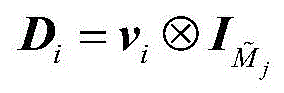
其中,Di表示多输入多输出MIMO干扰信道系统中的第i个发送端的传输预编码矩阵,vi表示单输入单输出SISO干扰信道的拓扑干扰对齐中第i个发送端的预编码向量,


(6b)对多输入多输出MIMO干扰信道系统中的发送端的发送数据向量利用传输预编码矩阵进行编码处理,得到每个发送端的发送信号向量;(6b) using the transmission precoding matrix to perform encoding processing on the transmission data vector of the transmitting end in the multiple-input multiple-output MIMO interference channel system, to obtain the transmission signal vector of each transmitting end;
(7)获得多输入多输出MIMO干扰信道系统中的每个接收端接收到的信号向量:(7) Obtain the signal vector received by each receiver in the multiple-input multiple-output MIMO interference channel system:
(7a)按照下式,获得多输入多输出MIMO干扰信道系统中每个发送端与接收端之间的信道矩阵:(7a) According to the following formula, obtain the channel matrix between each transmitter and receiver in the MIMO interference channel system:

其中,
(7b)将每个发送端的发送信号向量与信道矩阵相乘,得到多输入多输出MIMO干扰信道系统中每个接收端接收到的信号向量;(7b) multiplying the transmitted signal vector of each transmitting end by the channel matrix to obtain the signal vector received by each receiving end in the MIMO interference channel system;
(8)对哈密尔顿环场景下接收到的多输入多输出MIMO干扰信道系统中信号向量进行解码:(8) Decode the received signal vector in the multiple-input multiple-output MIMO interference channel system in the Hamilton ring scenario:
(8a)在哈密尔顿环场景下,对多输入多输出MIMO干扰信道系统中每个接收端,用干扰消除向量和空间保持矩阵的克罗内克积的形式,同时设计两个接收波束成形矩阵;(8a) In the Hamilton ring scenario, for each receiver in the MIMO interference channel system, use the form of the Kronecker product of the interference cancellation vector and the space preserving matrix to simultaneously design two receive beamforming matrices;
(8b)用两个接收波束成形矩阵分别与多输入多输出MIMO干扰信道系统中接收到的信号向量相乘,得到解码处理后的多输入多输出MIMO干扰信道系统中每个接收端的无干扰信号向量;(8b) Multiply the received signal vectors in the MIMO interference channel system by the two receiving beamforming matrices respectively, and obtain the uninterference signal of each receiving end in the MIMO interference channel system after decoding processing. vector;
(9)结束干扰对齐。(9) End the interference alignment.
本发明与现有的技术相比,具有以下优点:Compared with the prior art, the present invention has the following advantages:
第一,本发明通过确定哈密尔顿环场景下的有效发送端,并以信息共享的形式,构建每个发送端的发送数据向量,实现多个发送端相互协作共同发送期望信号,克服了现有技术发送端的选择固定以及只到了MIMO系统中每个收发节点对中最小的天线数,而对于多余的天线数并未有效利用的局限性,使得本发明增加了发送端的选择机会,发送更多的期望信号,提高了拓扑干扰对齐方法的系统性能。First, the present invention overcomes the problem of the prior art by determining the effective transmitting end in the Hamilton ring scenario, and constructing the transmitting data vector of each transmitting end in the form of information sharing, so that multiple transmitting ends cooperate with each other to send the desired signal together. The selection of the terminal is fixed and only the minimum number of antennas in each transceiver node pair in the MIMO system is reached, and the excess antenna number is not effectively utilized, so that the present invention increases the selection opportunity of the transmitting terminal and sends more desired signals , which improves the system performance of the topological interference alignment method.
第二,本发明通过在发送端和接收端分别设计传输预编码矩阵与接收波束成形矩阵,实现任意天线配置的多输入多输出干扰信道的协作拓扑干扰对齐,克服了现有技术只能针对单输入单输出干扰信道系统的条件限制,使得本发明提高系统的传输速率。Second, the present invention realizes the cooperative topology interference alignment of the multiple-input multiple-output interference channels with arbitrary antenna configurations by designing the transmission precoding matrix and the receiving beamforming matrix at the transmitting end and the receiving end respectively. Constraints of the input single output interference channel system make the present invention improve the transmission rate of the system.
附图说明Description of drawings
图1为本发明的流程图;Fig. 1 is the flow chart of the present invention;
图2为本发明构建的多输入多输出MIMO干扰信道的部分连接模型的示意图;2 is a schematic diagram of a partial connection model of a multiple-input multiple-output MIMO interference channel constructed by the present invention;
图3为本发明的仿真图。FIG. 3 is a simulation diagram of the present invention.
具体实施方式Detailed ways
下面结合附图对本发明做进一步的描述。The present invention will be further described below with reference to the accompanying drawings.
参照附图1,本发明的具体实施步骤如下。Referring to FIG. 1 , the specific implementation steps of the present invention are as follows.
步骤1,设置系统参数。
将多输入多输出MIMO干扰信道系统中的每个发送端配置Mi根天线,每个接收端配置Nj根天线,其中,发送端与接收端的数目相等且Mi,Nj≥2,i表示发送端的序号,j表示接收端的序号,i,j∈{1,2...,K},∈表示属于符号,K表示发送端与接收端的数目。Each transmitter in the MIMO interference channel system is configured with M i antennas, and each receiver is configured with N j antennas, wherein the number of transmitters and receivers is equal and M i , N j ≥ 2, i Indicates the serial number of the sender, j represents the serial number of the receiver, i,j∈{1,2...,K}, ∈ indicates the belonging symbol, and K indicates the number of the sender and the receiver.
步骤2,构建多输入多输出MIMO干扰信道的部分连接模型。
参照附图2,对构建多输入多输出MIMO干扰信道的部分连接模型的具体过程描述如下。图2中的Tx i表示多输入多输出MIMO干扰信道中的第i个发送端,Rx j表示多输入多输出MIMO干扰信道中的第j个接收端,Mi表示第i个发送端的天线数,Nj表示第j个接收端的天线数。Referring to FIG. 2 , the specific process of constructing the partial connection model of the multiple-input multiple-output MIMO interference channel is described as follows. Tx i in Figure 2 represents the i-th transmitter in the MIMO interference channel, Rx j represents the j-th receiver in the MIMO interference channel, and M i represents the number of antennas of the i-th transmitter , and N j represents the number of antennas at the j-th receiver.
将P≥η时的干扰链路设置为1,将P<η时的干扰链路设置为0,忽略置0干扰链路对系统传输的影响,得到有发送端与接收端之间的连接关系的拓扑信息MIMO干扰信道的部分连接模型;其中,P表示来自多个干扰链路的干扰功率之和,η表示根据MIMO干扰信道的传输要求设置的干扰门限。Set the interference link when P ≥ η to 1, set the interference link when P < η to 0, ignore the influence of the interference link set to 0 on the system transmission, and obtain the connection relationship between the sender and the receiver. The partial connection model of the MIMO interference channel with the topology information; wherein, P represents the sum of the interference power from multiple interference links, and n represents the interference threshold set according to the transmission requirements of the MIMO interference channel.
步骤3,判断发送端发送的当前期望信息是否同时满足


步骤4,确定哈密尔顿环场景下的有效发送端。Step 4: Determine the valid sender in the Hamilton ring scenario.
以每个满足对齐可行条件的期望信息作为顶点,任意两个满足对齐可行条件的期望信息之间的对齐可行关系作为边,绘制对齐可行图。Taking each desired information satisfying the alignment feasible condition as a vertex, and the alignment feasible relationship between any two desired information satisfying the alignment feasible condition as an edge, an alignment feasible graph is drawn.
从每个对齐可行图中,找出经过对齐可行图中所有顶点且只经过一次的哈密尔顿环,哈密尔顿环中的任意相邻顶点是对齐可行的,且相邻对齐可行的期望信息沿着同一个预编码矩阵张成子空间传输,相邻对齐可行期望信息来自于不同且不产生相互干扰的发送端。From each aligned feasible graph, find the Hamiltonian cycle that passes through all vertices in the aligned feasible graph and only once. Any adjacent vertices in the Hamiltonian cycle are aligned feasible, and the expected information of adjacent alignment feasible is along the same The precoding matrix is spread into a subspace for transmission, and the feasible desired information for adjacent alignment comes from different senders that do not interfere with each other.
从哈密尔顿环中提取所有的与对齐可行的期望信息对应的发送端。Extract all the transmitters corresponding to the desired information for which the alignment is feasible from the Hamiltonian ring.
第1步,按照下式,遍历每个哈密尔顿环,找到多输入多输出MIMO干扰信道系统中每个接收端期望信息的发送端:


其中,


第2步,取每一对对齐可行信息的两个不同发送端天线数的最小值作为两个发送端的有效天线数,得到第一步中找出的多输入多输出MIMO干扰信道系统中所有接收端期望信息不同发送端的有效天线数。
根据对齐可行图构造一个只包含0,1元素的K×K维的对齐无冲突矩阵,剔除矩阵中以1元素表示的与接收端无关的发送端,得到矩阵中以0元素表示的与接收端有关发送端,按照如下步骤实现:According to the alignment feasible graph, construct a K×K-dimensional alignment conflict-free matrix containing only 0 and 1 elements, and remove the transmitters that are not related to the receiver represented by 1 element in the matrix, and get the matrix represented by 0 elements that are related to the receiver. For the sender, follow the steps below:
第1步,将同时满足以下两个条件的对齐无冲突矩阵的对应位置元素取值为1,否则取值为0:The first step is to set the corresponding position element of the aligned conflict-free matrix that satisfies the following two conditions at the same time as 1, otherwise the value is 0:


其中,
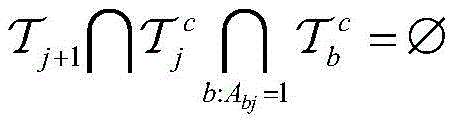
第2步,将满足第一步条件的对齐无冲突矩阵中对应位置值为1的元素,同时又满足以下两个条件中任意一个条件的对齐无冲突矩阵中对应位置元素值更新为0,得到对齐无冲突矩阵:The second step is to update the element whose corresponding position value is 1 in the alignment-free conflict matrix that satisfies the first condition, and the corresponding position element value in the alignment-free matrix that satisfies any one of the following two conditions to 0 to obtain Align conflict-free matrices:


其中,Abj表示对齐无冲突矩阵中的第b行第j列的元素,
第3步,关闭对齐无冲突矩阵中1元素表示的与接收端无关的多输入多输出MIMO干扰信道系统中的发送端,剩余0元素作为与多输入多输出MIMO干扰信道系统中每个接收端有关的发送端,对齐无冲突矩阵每一行中1的数目不同,与1对应与接收端无关的发送端数目不同,对于多输入多输出MIMO干扰信道系统中的每个接收端,至多有(K-g)个对应的发送端发送期望信号,其中,K表示多输入多输出MIMO干扰信道系统中发送端的总数,g表示遍历对齐无冲突矩阵每一行中1的数目的最小值。The third step is to close the transmitter in the MIMO interference channel system that is independent of the receiver and represented by the 1 element in the alignment-free conflict matrix, and the remaining 0 elements are used as each receiver in the MIMO interference channel system. The number of 1s in each row of the aligned conflict-free matrix is different for the relevant senders, which is different from the number of 1s that correspond to the senders independent of the receivers. For each receiver in the MIMO interference channel system, there are at most (K-g ) corresponding transmitters send the desired signal, where K represents the total number of transmitters in the MIMO interference channel system, and g represents the minimum value of the number of 1s in each row of the traversed alignment-free conflict matrix.
步骤5,以信息共享的形式,构建多输入多输出MIMO干扰信道系统中每个发送端的发送数据向量如下:

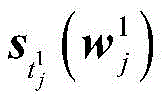
其中,si表示多输入多输出MIMO干扰信道系统中第i个发送端的发送数据向量,<·>表示按列累加操作,

步骤6,获得多输入多输出MIMO干扰信道系统中每个发送端的发送信号向量:
第1步,按照下式,设计每个发送端的传输预编码矩阵:The first step is to design the transmission precoding matrix of each sender according to the following formula:

其中,Di表示第i个发送端的传输预编码矩阵,vi表示单输入单输出干扰信道的拓扑干扰对齐中第i个发送端的预编码向量,


第2步,发送端的发送数据向量利用传输预编码矩阵进行编码处理,得到每个发送端的发送信号向量。In
步骤7,获得每个接收端接收到的信号向量:
按照下式,获得多输入多输出MIMO干扰信道系统中每个发送端与接收端之间的信道矩阵:According to the following formula, the channel matrix between each transmitter and receiver in the MIMO interference channel system is obtained:

其中,
将每个发送端的发送信号向量与信道矩阵相乘,按照下式,遍历K个对齐可行的信息对,忽略噪声对接收到信息的影响,得到多输入多输出MIMO干扰信道系统中每个接收端接收到的信号向量:Multiply the transmitted signal vector of each transmitter by the channel matrix, and traverse K feasible information pairs according to the following formula, ignoring the influence of noise on the received information, and obtain each receiver in the MIMO interference channel system. Received signal vector:


其中,yj表示多输入多输出MIMO干扰信道系统中第j个接收端接收到的信号向量,∈表示不属于符号,


步骤8,对哈密尔顿环场景下多输入多输出MIMO干扰信道系统中接收到的信号向量进行解码:
在哈密尔顿环场景下,对多输入多输出MIMO干扰信道系统中每个接收端,用干扰消除向量和空间保持矩阵的克罗内克积的形式,得到两个接收波束成形矩阵。In the Hamilton ring scenario, for each receiver in the MIMO interference channel system, two receive beamforming matrices are obtained in the form of the Kronecker product of the interference cancellation vector and the space preserving matrix.
第1步,将接收到的信号向量重新划分为下式包含不同期望信号两部分,以便分别消除对多输入多输出MIMO干扰信道系统中每个接收端两个期望信号的干扰:Step 1: Re-divide the received signal vector into two parts containing different desired signals in the following formula, so as to eliminate the interference to the two desired signals at each receiving end in the MIMO interference channel system:


其中,yj表示多输入多输出MIMO干扰信道系统中第j个接收端接收到的信号向量,vj-1和vj分别表示两个期望信号的预编码向量,


第2步,将与两个干扰信号传输空间矩阵中含有的干扰信号预编码向量乘积为零,且与期望信号的预编码向量乘积不为零的两个向量作为两个干扰消除向量,按照下式给出:In the second step, two vectors whose product with the precoding vector of the interference signal contained in the two interference signal transmission space matrices is zero and the product of which is not zero with the precoding vector of the desired signal are regarded as two interference cancellation vectors, according to the following formula gives:


其中,

第3步,将与信道矩阵相乘后满秩,保证两个期望信号有充足的传输空间的两个矩阵作为两个空间保持矩阵,按照下式给出:In the third step, the two matrices that are multiplied by the channel matrix and have full rank and ensure that the two desired signals have sufficient transmission space are used as two space-preserving matrices, which are given by the following formula:


其中,

第4步,用两个干扰消除向量分别与两个空间保持矩阵进行克罗内克乘积,得到两个接收波束成形矩阵,按照下式给出:In
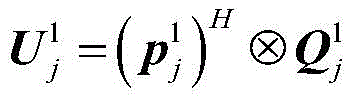

其中,


分别用两个接收波束成形矩阵分别与多输入多输出MIMO干扰信道系统中接收到的信号向量相乘,得到解码处理后的多输入多输出MIMO干扰信道系统中每个接收端的无干扰信号向量,按照下式给出:The two receive beamforming matrices are respectively multiplied by the received signal vectors in the MIMO interference channel system to obtain the non-interference signal vector of each receiving end in the MIMO interference channel system after decoding processing, is given by:


其中,

步骤9,结束干扰对齐。
通过以下仿真对本发明的效果做进一步的说明:The effect of the present invention is further described by the following simulation:
1.仿真条件。1. Simulation conditions.
本发明的仿真实验在matlab环境下进行,将多输入多输出干扰信道MIMO干扰信道系统的收发端天线数分别设置为2,4,6,8,10。The simulation experiment of the present invention is carried out in a matlab environment, and the number of antennas at the transceiver end of the multiple-input multiple-output interference channel MIMO interference channel system is set to 2, 4, 6, 8, and 10 respectively.
2.仿真内容。2. Simulation content.
用本发明和现有技术Jafar方案中拓扑干扰对齐方法,对图2中构建的多输入多输出MIMO干扰信道的部分连接模型,在收发端天线数分别为2,4,6,8,10时每个用户获得的自由度进行仿真,结果如图3所示。Using the topology interference alignment method in the Jafar scheme of the present invention and the prior art, for the partial connection model of the MIMO interference channel constructed in FIG. The degrees of freedom obtained by each user are simulated and the results are shown in Figure 3.
图3中的横坐标表示收发端天线数,纵坐标表示每用户的自由度,以圆圈标示的直线表示现有技术Jafar方案中拓扑干扰对齐的结果,以星号标示的直线表示本发明拓扑干扰对齐的结果。The abscissa in Fig. 3 represents the number of antennas at the transceiver end, the ordinate represents the degree of freedom of each user, the straight line marked with a circle represents the result of topology interference alignment in the prior art Jafar scheme, and the straight line marked with asterisks represents the topology interference of the present invention alignment result.
由图3中的仿真结果可以看出,随着收发端天线数的增加,每用户自由度呈线性增长趋势,当收发端天线数分别为2,4,6,8,10时,本发明拓扑干扰对齐的每用户自由度都高于现有技术Jafar方案中拓扑干扰对齐方法的每用户自由度。It can be seen from the simulation results in Figure 3 that with the increase of the number of antennas at the transceiver end, the degree of freedom per user increases linearly. When the number of antennas at the transceiver end is 2, 4, 6, 8, and 10, the topology of the present invention is The per-user degree of freedom of interference alignment is higher than that of the topological interference alignment method in the prior art Jafar scheme.
由本发明的仿真实验结果表明,在收发端天线数相同的条件下,本发明使得系统中每个用户所自由度高于现有技术Jafar方案中拓扑干扰对齐方法的每用户自由度,系统性能更优。The simulation experiment results of the present invention show that under the condition of the same number of antennas at the transceiver end, the present invention makes the degree of freedom of each user in the system higher than that of the topological interference alignment method in the prior art Jafar scheme, and the system performance is better. excellent.
Claims (6)






Priority Applications (1)
| Application Number | Priority Date | Filing Date | Title |
|---|---|---|---|
| CN201711298266.9A CN108234004B (en) | 2017-12-08 | 2017-12-08 | Interference Alignment Method for MIMO Cooperative Topology with Hamiltonian Rings |
Applications Claiming Priority (1)
| Application Number | Priority Date | Filing Date | Title |
|---|---|---|---|
| CN201711298266.9A CN108234004B (en) | 2017-12-08 | 2017-12-08 | Interference Alignment Method for MIMO Cooperative Topology with Hamiltonian Rings |
Publications (2)
| Publication Number | Publication Date |
|---|---|
| CN108234004A CN108234004A (en) | 2018-06-29 |
| CN108234004B true CN108234004B (en) | 2020-08-25 |
Family
ID=62653977
Family Applications (1)
| Application Number | Title | Priority Date | Filing Date |
|---|---|---|---|
| CN201711298266.9A Active CN108234004B (en) | 2017-12-08 | 2017-12-08 | Interference Alignment Method for MIMO Cooperative Topology with Hamiltonian Rings |
Country Status (1)
| Country | Link |
|---|---|
| CN (1) | CN108234004B (en) |
Families Citing this family (3)
| Publication number | Priority date | Publication date | Assignee | Title |
|---|---|---|---|---|
| CN111800176B (en) * | 2020-06-23 | 2022-01-18 | 深圳大学 | Equivalent channel matrix generation method, precoding method, device, equipment and medium |
| CN114615210B (en) * | 2022-03-10 | 2023-06-16 | 华南理工大学 | Wired CMIMO signal transmission method based on multimode transmission line |
| CN115002831B (en) * | 2022-05-24 | 2024-08-02 | 西安电子科技大学 | Joint allocation method of wireless network and cache resources based on topology interference alignment |
Family Cites Families (5)
| Publication number | Priority date | Publication date | Assignee | Title |
|---|---|---|---|---|
| US8670390B2 (en) * | 2000-11-22 | 2014-03-11 | Genghiscomm Holdings, LLC | Cooperative beam-forming in wireless networks |
| KR101329542B1 (en) * | 2009-02-27 | 2013-11-15 | 알까뗄 루슨트 | Cooperative beam forming method, device and base station |
| US8891604B2 (en) * | 2011-09-28 | 2014-11-18 | Nec Laboratories America, Inc. | Coordinated multi-point transmission |
| CN105871434B (en) * | 2016-03-29 | 2018-11-16 | 西安电子科技大学 | The topological interference alignment schemes of MIMO interference channel |
| CN106656289B (en) * | 2016-12-30 | 2019-10-11 | 西安电子科技大学 | Topological Interference Alignment Method for MIMO Interfering Broadcast Channels |
-
2017
- 2017-12-08 CN CN201711298266.9A patent/CN108234004B/en active Active
Also Published As
| Publication number | Publication date |
|---|---|
| CN108234004A (en) | 2018-06-29 |
Similar Documents
| Publication | Publication Date | Title |
|---|---|---|
| CN106656289B (en) | Topological Interference Alignment Method for MIMO Interfering Broadcast Channels | |
| CN105871434B (en) | The topological interference alignment schemes of MIMO interference channel | |
| CN117560043B (en) | Non-cellular network power control method based on graph neural network | |
| CN103117970A (en) | Method for selecting full-duplex antenna in multiple-in multiple-out (MIMO) system | |
| CN104104425A (en) | Multi-user MIMO (multiple input multiple output) adaptive receiving method based on expectation and interference signal relations | |
| CN108234004B (en) | Interference Alignment Method for MIMO Cooperative Topology with Hamiltonian Rings | |
| CN102868433B (en) | Signal transmission method based on antenna selection in multiple-input multiple-output Y channel | |
| CN107994933B (en) | Method for optimizing system capacity of secondary user in cognitive MIMO network | |
| CN105978835A (en) | Low-complexity distributive interference aligning method | |
| Liu et al. | Topological interference management with transmitter cooperation for MIMO interference channels | |
| CN109039402B (en) | MIMO topological interference alignment method based on user compression | |
| CN109510650B (en) | A Joint Precoding Method for Multi-User Bidirectional AF MIMO Relay System | |
| CN103929224B (en) | Disturbance restraining method and device in cellular network | |
| CN104253638B (en) | MIMO interference alignment algorithm based on Stiefel manifold conjugate gradient method | |
| CN105099530B (en) | AF panel method for precoding based on cognitive user leakage power in cognitive radio MIMO-OFDM systems | |
| CN112994762B (en) | MIMO-NOMA downlink self-adaptive wireless transmission method based on statistical CSI | |
| CN102006146B (en) | User scheduling method for multiple-user multiple input multiple output (MU-MIMO) system downlink | |
| CN111510403B (en) | Large-scale MIMO system iterative signal detection method based on symmetric LQ | |
| CN105429687B (en) | A kind of interference alignment schemes minimizing jamming power and dimension | |
| CN102857292B (en) | Multi-user bidirectional relay transmission system and multi-user bidirectional relay transmission method | |
| CN109474318B (en) | Precoding method including direct transmission link under multi-user bidirectional MIMO relay system | |
| CN106850031B (en) | A kind of power distribution method in multiple antennas bi-directional relaying Transmission system | |
| CN112929062B (en) | A network interference alignment method for MIMO interference channel based on group sparseness | |
| CN104092516A (en) | A non-orthogonal precoding codebook design method suitable for MU-MIMO system | |
| CN115085781B (en) | MIMO IC chain interference alignment method based on maximum independent set |
Legal Events
| Date | Code | Title | Description |
|---|---|---|---|
| PB01 | Publication | ||
| PB01 | Publication | ||
| SE01 | Entry into force of request for substantive examination | ||
| SE01 | Entry into force of request for substantive examination | ||
| GR01 | Patent grant | ||
| GR01 | Patent grant |