CN108191853B - Organic electroluminescent material and device - Google Patents
Organic electroluminescent material and device Download PDFInfo
- Publication number
- CN108191853B CN108191853B CN201810021938.XA CN201810021938A CN108191853B CN 108191853 B CN108191853 B CN 108191853B CN 201810021938 A CN201810021938 A CN 201810021938A CN 108191853 B CN108191853 B CN 108191853B
- Authority
- CN
- China
- Prior art keywords
- organic
- compound
- light
- electrode
- present
- Prior art date
- Legal status (The legal status is an assumption and is not a legal conclusion. Google has not performed a legal analysis and makes no representation as to the accuracy of the status listed.)
- Active
Links
Images


Classifications
-
- C—CHEMISTRY; METALLURGY
- C07—ORGANIC CHEMISTRY
- C07D—HETEROCYCLIC COMPOUNDS
- C07D471/00—Heterocyclic compounds containing nitrogen atoms as the only ring hetero atoms in the condensed system, at least one ring being a six-membered ring with one nitrogen atom, not provided for by groups C07D451/00 - C07D463/00
- C07D471/02—Heterocyclic compounds containing nitrogen atoms as the only ring hetero atoms in the condensed system, at least one ring being a six-membered ring with one nitrogen atom, not provided for by groups C07D451/00 - C07D463/00 in which the condensed system contains two hetero rings
- C07D471/04—Ortho-condensed systems
-
- C—CHEMISTRY; METALLURGY
- C07—ORGANIC CHEMISTRY
- C07D—HETEROCYCLIC COMPOUNDS
- C07D519/00—Heterocyclic compounds containing more than one system of two or more relevant hetero rings condensed among themselves or condensed with a common carbocyclic ring system not provided for in groups C07D453/00 or C07D455/00
-
- C—CHEMISTRY; METALLURGY
- C09—DYES; PAINTS; POLISHES; NATURAL RESINS; ADHESIVES; COMPOSITIONS NOT OTHERWISE PROVIDED FOR; APPLICATIONS OF MATERIALS NOT OTHERWISE PROVIDED FOR
- C09B—ORGANIC DYES OR CLOSELY-RELATED COMPOUNDS FOR PRODUCING DYES, e.g. PIGMENTS; MORDANTS; LAKES
- C09B57/00—Other synthetic dyes of known constitution
-
- C—CHEMISTRY; METALLURGY
- C09—DYES; PAINTS; POLISHES; NATURAL RESINS; ADHESIVES; COMPOSITIONS NOT OTHERWISE PROVIDED FOR; APPLICATIONS OF MATERIALS NOT OTHERWISE PROVIDED FOR
- C09K—MATERIALS FOR MISCELLANEOUS APPLICATIONS, NOT PROVIDED FOR ELSEWHERE
- C09K11/00—Luminescent, e.g. electroluminescent, chemiluminescent materials
- C09K11/06—Luminescent, e.g. electroluminescent, chemiluminescent materials containing organic luminescent materials
-
- H—ELECTRICITY
- H10—SEMICONDUCTOR DEVICES; ELECTRIC SOLID-STATE DEVICES NOT OTHERWISE PROVIDED FOR
- H10K—ORGANIC ELECTRIC SOLID-STATE DEVICES
- H10K50/00—Organic light-emitting devices
-
- H—ELECTRICITY
- H10—SEMICONDUCTOR DEVICES; ELECTRIC SOLID-STATE DEVICES NOT OTHERWISE PROVIDED FOR
- H10K—ORGANIC ELECTRIC SOLID-STATE DEVICES
- H10K85/00—Organic materials used in the body or electrodes of devices covered by this subclass
- H10K85/60—Organic compounds having low molecular weight
- H10K85/649—Aromatic compounds comprising a hetero atom
- H10K85/654—Aromatic compounds comprising a hetero atom comprising only nitrogen as heteroatom
-
- H—ELECTRICITY
- H10—SEMICONDUCTOR DEVICES; ELECTRIC SOLID-STATE DEVICES NOT OTHERWISE PROVIDED FOR
- H10K—ORGANIC ELECTRIC SOLID-STATE DEVICES
- H10K85/00—Organic materials used in the body or electrodes of devices covered by this subclass
- H10K85/60—Organic compounds having low molecular weight
- H10K85/649—Aromatic compounds comprising a hetero atom
- H10K85/657—Polycyclic condensed heteroaromatic hydrocarbons
- H10K85/6572—Polycyclic condensed heteroaromatic hydrocarbons comprising only nitrogen in the heteroaromatic polycondensed ring system, e.g. phenanthroline or carbazole
-
- C—CHEMISTRY; METALLURGY
- C09—DYES; PAINTS; POLISHES; NATURAL RESINS; ADHESIVES; COMPOSITIONS NOT OTHERWISE PROVIDED FOR; APPLICATIONS OF MATERIALS NOT OTHERWISE PROVIDED FOR
- C09K—MATERIALS FOR MISCELLANEOUS APPLICATIONS, NOT PROVIDED FOR ELSEWHERE
- C09K2211/00—Chemical nature of organic luminescent or tenebrescent compounds
- C09K2211/10—Non-macromolecular compounds
- C09K2211/1003—Carbocyclic compounds
- C09K2211/1007—Non-condensed systems
-
- C—CHEMISTRY; METALLURGY
- C09—DYES; PAINTS; POLISHES; NATURAL RESINS; ADHESIVES; COMPOSITIONS NOT OTHERWISE PROVIDED FOR; APPLICATIONS OF MATERIALS NOT OTHERWISE PROVIDED FOR
- C09K—MATERIALS FOR MISCELLANEOUS APPLICATIONS, NOT PROVIDED FOR ELSEWHERE
- C09K2211/00—Chemical nature of organic luminescent or tenebrescent compounds
- C09K2211/10—Non-macromolecular compounds
- C09K2211/1018—Heterocyclic compounds
- C09K2211/1025—Heterocyclic compounds characterised by ligands
- C09K2211/1029—Heterocyclic compounds characterised by ligands containing one nitrogen atom as the heteroatom
-
- C—CHEMISTRY; METALLURGY
- C09—DYES; PAINTS; POLISHES; NATURAL RESINS; ADHESIVES; COMPOSITIONS NOT OTHERWISE PROVIDED FOR; APPLICATIONS OF MATERIALS NOT OTHERWISE PROVIDED FOR
- C09K—MATERIALS FOR MISCELLANEOUS APPLICATIONS, NOT PROVIDED FOR ELSEWHERE
- C09K2211/00—Chemical nature of organic luminescent or tenebrescent compounds
- C09K2211/10—Non-macromolecular compounds
- C09K2211/1018—Heterocyclic compounds
- C09K2211/1025—Heterocyclic compounds characterised by ligands
- C09K2211/1044—Heterocyclic compounds characterised by ligands containing two nitrogen atoms as heteroatoms
-
- C—CHEMISTRY; METALLURGY
- C09—DYES; PAINTS; POLISHES; NATURAL RESINS; ADHESIVES; COMPOSITIONS NOT OTHERWISE PROVIDED FOR; APPLICATIONS OF MATERIALS NOT OTHERWISE PROVIDED FOR
- C09K—MATERIALS FOR MISCELLANEOUS APPLICATIONS, NOT PROVIDED FOR ELSEWHERE
- C09K2211/00—Chemical nature of organic luminescent or tenebrescent compounds
- C09K2211/10—Non-macromolecular compounds
- C09K2211/1018—Heterocyclic compounds
- C09K2211/1025—Heterocyclic compounds characterised by ligands
- C09K2211/1059—Heterocyclic compounds characterised by ligands containing three nitrogen atoms as heteroatoms
Landscapes
- Chemical & Material Sciences (AREA)
- Organic Chemistry (AREA)
- Engineering & Computer Science (AREA)
- Materials Engineering (AREA)
- Physics & Mathematics (AREA)
- Spectroscopy & Molecular Physics (AREA)
- Optics & Photonics (AREA)
- Electroluminescent Light Sources (AREA)
- Nitrogen Condensed Heterocyclic Rings (AREA)
Abstract

Description
技术领域technical field
本发明涉及有机电致发光技术领域,更具体地,涉及一种有机化合物、其在有机电致发光领域的应用以及将其用于发光层的有机电致发光器件。The present invention relates to the technical field of organic electroluminescence, and more particularly, to an organic compound, its application in the field of organic electroluminescence, and an organic electroluminescence device using the same in the light-emitting layer.
背景技术Background technique
在电致激发的条件下,有机电致发光材料会产生25%的单线态和75%的三线态,传统的荧光材料由于自旋禁阻的原因只能利用单线态激子。为了利用三线态激子,研究者提出了许多方法,其中最为显著的是磷光材料的利用。然而磷光材料由于使用了稀有的重金属,材料较为昂贵,不利于产品成本的降低。Under the condition of electro-excitation, organic electroluminescent materials will generate 25% singlet states and 75% triplet states, while traditional fluorescent materials can only utilize singlet excitons due to spin forbidden. In order to utilize triplet excitons, researchers have proposed many methods, the most notable of which is the utilization of phosphorescent materials. However, due to the use of rare heavy metals in phosphorescent materials, the materials are relatively expensive, which is not conducive to the reduction of product cost.
日本九州大学的Adachi教授发现的基于三线态-单线态跃迁的热激活延迟荧光(TADF) 材料利用环境热量可实现能量从三线态激发态向单线态激发态的逆向系间窜越,无需使用高成本的稀有金属即可实现高发光效率。在专利文献1中,新日铁住金化学株式会社和九州大学揭示了一种基于吲哚并咔唑的材料(参见下式),并揭示了一种荧光及延迟荧光型的有机发光元件,其特征在于,在基板上具有至少一个发光层含有发射荧光及延迟荧光的有机发光材料,所述发光材料的激发单重态能量和激发三重态能量的差为0~0.2eV,代表化合物展示了较高的效率性能。The thermally activated delayed fluorescence (TADF) material based on triplet-singlet transition discovered by Professor Adachi of Kyushu University in Japan can realize reverse intersystem crossing of energy from triplet excited state to singlet excited state by using ambient heat without using high High luminous efficiency can be achieved with inexpensive rare metals. In Patent Document 1, Nippon Steel & Sumitomo Metal Chemical Co., Ltd. and Kyushu University disclose an indolocarbazole-based material (see the following formula), and disclose a fluorescence and delayed fluorescence type organic light-emitting element, which It is characterized in that there is at least one light-emitting layer on the substrate containing an organic light-emitting material that emits fluorescence and delayed fluorescence, and the difference between the excited singlet state energy and the excited triplet state energy of the light-emitting material is 0-0.2 eV, which represents that the compound exhibits relatively high performance. High efficiency performance.

清华大学段炼教授提出的热活化敏化延迟荧光(TASF)的发光机理的重点是将激发态三线态能量通过上转换至激发态单重态能量,然后通过Foxter能量转移至染料激发态单重态,再实现发光,从而实现了能量采集和发光过程的分离。在专利文献2揭示了一种有机电致发光器件,包括彼此层叠的阳极、空穴传输层、发光层、电子传输层及阴极,其特征在于,发光层的主体材料的三线态与单线态能级差小于0.15eV,且在所述主体材料中掺杂荧光染料,并且所述荧光染料的单线态能级低于主体材料的单线态能级,实现了高的效率和低的效率滚降以及更好的色纯度。The key point of the luminescence mechanism of thermally activated sensitized delayed fluorescence (TASF) proposed by Professor Duan Lian of Tsinghua University is to convert the excited triplet energy to the excited singlet energy through up-conversion, and then transfer it to the dye excited singlet energy through Foxter energy. state, and then realize luminescence, thus realizing the separation of energy harvesting and luminescence process. Patent Document 2 discloses an organic electroluminescence device including an anode, a hole transport layer, a light-emitting layer, an electron transport layer, and a cathode stacked on each other, characterized in that the triplet and singlet energies of the host material of the light-emitting layer are The level difference is less than 0.15eV, and the host material is doped with a fluorescent dye, and the singlet energy level of the fluorescent dye is lower than that of the host material, achieving high efficiency and low efficiency roll-off and more. Good color purity.
然而,随着研究的深入,人们发现,激发单重态和激发三重态能量差并不是材料具有TADF 性质的充分条件(参见非专利文献1)。因此,如何设计新一代OLED材料,实现高效率、低成本材料的开发仍是人们研究的重点。However, with the deepening of research, it was found that the energy difference between the excited singlet state and the excited triplet state is not a sufficient condition for the material to have TADF properties (see Non-Patent Document 1). Therefore, how to design a new generation of OLED materials and realize the development of high-efficiency and low-cost materials is still the focus of research.
专利文献1:CN102648268BPatent Document 1: CN102648268B
专利文献2:CN 102709485BPatent Document 2: CN 102709485B
非专利文献1:Chem.Sci.,2016,7,3355-3363Non-patent document 1: Chem. Sci., 2016, 7, 3355-3363
发明内容SUMMARY OF THE INVENTION
为了解决上述问题,在有机电致发光器件中得到高的发光效率,需要开发具有热活化延迟荧光性质的新材料,以实现高性能、低成本的荧光器件性能。进而,在电化学稳定性、耐热性、以及无定形稳定性等方面也需要进一步改良。In order to solve the above problems and obtain high luminous efficiency in organic electroluminescent devices, it is necessary to develop new materials with thermally activated delayed fluorescence properties to achieve high-performance, low-cost fluorescent device performance. Furthermore, further improvements are required in electrochemical stability, heat resistance, and amorphous stability.
鉴于此,本发明的主要目的在于提供一种具有热活化延迟荧光性质的有机电致发光材料、其在有机电致发光领域的应用以及用其作为发光层材料的有机电致发光器件。In view of this, the main purpose of the present invention is to provide an organic electroluminescent material with thermally activated delayed fluorescence properties, its application in the field of organic electroluminescence, and an organic electroluminescent device using the same as a light-emitting layer material.
为了实现上述目的,本发明提供一种特定结构的有机化合物,其特征在于,由下述通式 (1)表示:In order to achieve the above object, the present invention provides an organic compound of a specific structure, which is characterized in that it is represented by the following general formula (1):

式(1)中,X1~X8分别独立选自CR1或N,且X1~X8中至少有1个为N原子;L为单键, C5~C15的取代或未取代的亚芳基、亚杂芳基,当上述基团具有取代基时,所述取代基选自C1~C4的烃基;R1选自氢、C1~C10的烷基或环烷基、C6~C15的芳基或C6~C19的杂芳基,且至少有1个为下式(2)所示的结构,In formula (1), X 1 to X 8 are independently selected from CR 1 or N, and at least one of X 1 to X 8 is an N atom; L is a single bond, substituted or unsubstituted by C 5 to C 15 arylene and heteroarylene, when the above groups have substituents, the substituents are selected from C 1 -C 4 hydrocarbon groups; R 1 is selected from hydrogen, C 1 -C 10 alkyl groups or cycloalkanes group, C 6 -C 15 aryl group, or C 6 -C 19 heteroaryl group, and at least one of them has the structure represented by the following formula (2),

式(2)中,Y1~Y8分别独立选自CR2或N,且Y1~Y8中至少有1个为N原子;R2选自氢、C1~C10的烷基或环烷基、C6~C15的芳基或C6~C19的杂芳基;In formula (2), Y 1 to Y 8 are independently selected from CR 2 or N, and at least one of Y 1 to Y 8 is an N atom; R 2 is selected from hydrogen, C 1 -C 10 alkyl or Cycloalkyl, C 6 -C 15 aryl or C 6 -C 19 heteroaryl;
Ar由下式(3)表示:Ar is represented by the following formula (3):

式(3)中,Z1~Z5分别独立选自CR3或N,且其中有1~3个为N原子;R3选自氢、C1~C10的烷基或环烷基、C6~C15的芳基或C6~C19的杂芳基。In formula (3), Z 1 to Z 5 are independently selected from CR 3 or N, and 1 to 3 of them are N atoms; R 3 is selected from hydrogen, C 1 -C 10 alkyl or cycloalkyl, A C 6 -C 15 aryl group or a C 6 -C 19 heteroaryl group.
本发明的有机化合物采用氮杂咔唑衍生物作为donor基团,含氮杂环化合物作为acceptor 基团,通过特定的连接方式,可以发出荧光及延迟荧光。使用了本发明的有机化合物的有机电致发光器件效率明显提高。The organic compound of the present invention adopts the azacarbazole derivative as the donor group and the nitrogen-containing heterocyclic compound as the acceptor group, and can emit fluorescence and delayed fluorescence through a specific connection method. The efficiency of the organic electroluminescent device using the organic compound of the present invention is significantly improved.
进一步的,优选通式(1)的X1~X8中有且只有1个是N原子,即本发明的化合物包含咔啉结构。Further, it is preferable that X 1 to X 8 of the general formula (1) have one and only one N atom, that is, the compound of the present invention contains a carboline structure.
本发明的通式化合物采用D-π-A结构,通过使用特定位置连接的咔啉基团作为供电子基团,在保持其高三线态能级的同时,具有优良的电荷传输性能,通过共轭基团和吸电子基团调节材料结构,使其同时具备优异的空穴和电子传输性能,拓宽电荷复合区域,同时具备大的反向系间窜越速率,从而有效利用激发三重态能量。此外,咔啉基团可以是芳环上任一位置为N 的咔啉,其缺电子性有助于提高电荷迁移率。The compound of the general formula of the present invention adopts a D-π-A structure, and by using the carboline group connected at a specific position as an electron-donating group, while maintaining its high triplet energy level, it has excellent charge transport performance. Conjugated groups and electron-withdrawing groups adjust the structure of the material so that it has excellent hole and electron transport properties at the same time, widens the charge recombination area, and has a large reverse intersystem crossing rate, thereby effectively utilizing the excited triplet energy. In addition, the carboline group can be a carboline with N at any position on the aromatic ring, and its electron deficiency helps to improve the charge mobility.
进一步的,优选通式(1)的X1和X8中有且只有1个是N原子,即,本发明的化合物包含α-咔啉结构,更优选由下述通式之一表示:Further, it is preferred that X 1 and X 8 of the general formula (1) have one and only one N atom, that is, the compound of the present invention contains an α-carboline structure, and is more preferably represented by one of the following general formulas:

本发明的化合物通过包含α-咔啉结构,可以与附近氢原子形成氢键,避免了化合物键角的过度扭曲导致的键能削弱,可维持更好的化学稳定性,同时在合成上具有明显优势,更易实现高产率的量产,有利于材料的产业化应用。The compound of the present invention can form a hydrogen bond with nearby hydrogen atoms by including an α-carboline structure, which avoids the weakening of bond energy caused by excessive twisting of the bond angle of the compound, maintains better chemical stability, and has obvious synthetic properties. Advantages, it is easier to achieve high-yield mass production, which is conducive to the industrial application of materials.
进一步的,通式(1)中的Ar优选为下式所示的结构:Further, Ar in the general formula (1) is preferably the structure shown in the following formula:

其中,R4选自苯基、甲苯基、二甲苯基、异丙基苯基、叔丁基苯基、联苯基;Wherein, R 4 is selected from phenyl, tolyl, xylyl, isopropylphenyl, tert-butylphenyl, biphenyl;
n为0、1或2;当n为2时,两个R4可以相同或不同。n is 0, 1 or 2; when n is 2 , the two R4 may be the same or different.
更进一步的,通式(1)中的Ar更优选为上述结构中的三嗪或嘧啶基团。Further, Ar in the general formula (1) is more preferably a triazine or pyrimidine group in the above structure.
通过将Ar限定为这些基团,可以使化合物具备更快的能量的带隙的反向系间窜越速率,可以更好地利用激发态三线态能量,从而得到更高的效率。基于此,使用了本发明的有机化合物的有机电致发光器件的效率进一步提高。By limiting Ar to these groups, the compound can have a faster inverse intersystem crossing rate of the energy band gap, and can make better use of the triplet energy of the excited state, thereby obtaining higher efficiency. Based on this, the efficiency of the organic electroluminescent device using the organic compound of the present invention is further improved.
进一步的,通式(1)中的R1优选为下述式(4)所示的咔啉基团,该咔啉基团与母核基团通过C-N键连接:Further, R 1 in the general formula (1) is preferably a carboline group represented by the following formula (4), and the carboline group is connected to the parent nucleus group through a CN bond:

进一步的,通式(1)中的L优选选自亚苯基、亚二甲苯基、亚联苯基、亚吡啶基、亚氮杂联苯基。Further, L in the general formula (1) is preferably selected from a phenylene group, a xylylene group, a biphenylene group, a pyridylene group, and an azabiphenyl group.
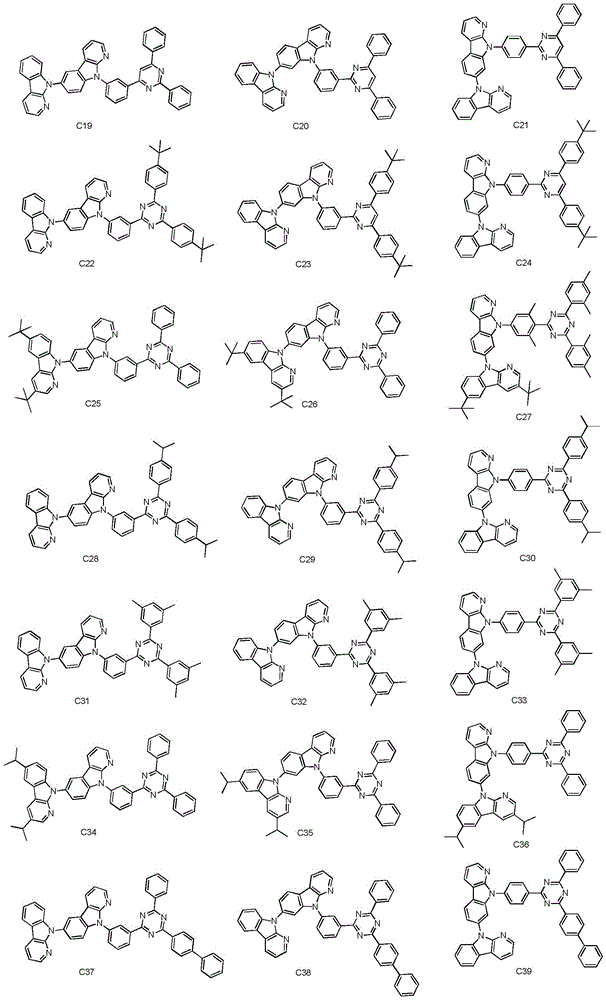
更进一步的,本发明通式(1)所述的化合物优选选自下述C1~C75:Further, the compound of the general formula (1) of the present invention is preferably selected from the following C1 to C75:


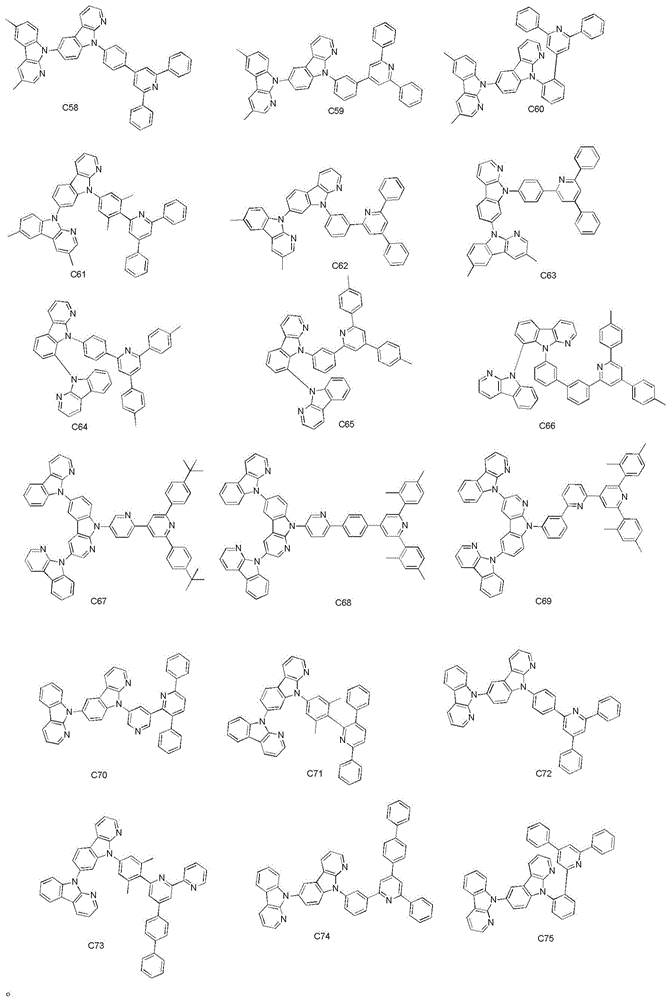
本发明具有上述结构的有机化合物可发出荧光及延迟荧光,将其应用于有机电致发光元件中,可以得到高效率的有机电致发光元件。The organic compound having the above-mentioned structure of the present invention can emit fluorescence and delayed fluorescence, and when it is applied to an organic electroluminescence element, a high-efficiency organic electroluminescence element can be obtained.
本发明还涉及上述有机化合物在有机电致发光器件中的应用,其可直接作为发光染料使用。The present invention also relates to the application of the above-mentioned organic compounds in organic electroluminescent devices, which can be directly used as luminescent dyes.
本发明提供一种有机电致发光器件,包括第一电极、第二电极和插入在所述第一电极和第二电极之间的多个有机层,其特征在于,所述有机层中含有上述有机化合物。上述有机化合物可用作发光层中的染料,也可用作主体。The present invention provides an organic electroluminescence device, comprising a first electrode, a second electrode, and a plurality of organic layers interposed between the first electrode and the second electrode, wherein the organic layer contains the above-mentioned organic compounds. The above-mentioned organic compounds can be used as a dye in the light-emitting layer, and can also be used as a host.
本发明的有机化合物作为有机电致发光器件材料来使用,通过在有机发光元件的发光层中含有该有机发光材料,能量可通过快速的反向系间窜越实现能量的收集,从而提高器件的效率。本发明设计了第一主体、第二主体与染料的材料组合方案,通式(1)所述的本发明新型化合物作为发光层的第二主体,可以实现更高的器件效率和小的效率滚降,本发明所述材料可实现激发态三线态能量的利用,避免在发光层的堆积导致的效率滚降。所述染料可以是荧光染料也可以是磷光染料。The organic compound of the present invention is used as an organic electroluminescent device material. By including the organic light-emitting material in the light-emitting layer of the organic light-emitting element, energy can be collected through rapid reverse intersystem crossing, thereby improving the device's performance. efficiency. The present invention designs a material combination scheme of the first host, the second host and the dye. The novel compound of the present invention described in the general formula (1) is used as the second host of the light-emitting layer, which can achieve higher device efficiency and small efficiency roll. The material of the present invention can realize the utilization of the triplet energy of the excited state, and avoid the efficiency roll-off caused by the accumulation in the light-emitting layer. The dyes may be fluorescent dyes or phosphorescent dyes.
本发明提供一种有机电致发光器件,包括第一电极、第二电极和插入在所述第一电极和第二电极之间的多个有机层,其特征在于,所述器件中含有发射荧光和延迟荧光的有机发光材料,所述有机发光材料的反向系间窜越常数kRISC大于104s-1,优选大于105s-1,更优选大于106s-1。上述有机发光材料是具有热活化延迟荧光性质的有机发光材料,包含donor基团和acceptor基团。上述有机发光材料可以是由通式(1)表示的化合物以外的化合物,但优选为由通式(1) 表示的化合物。另外,在本发明的有机发光材料为由通式(1)表示的化合物的情况下,kRISC没有限制,但优选大于104s-1,更优选大于106s-1。The present invention provides an organic electroluminescence device, comprising a first electrode, a second electrode, and a plurality of organic layers interposed between the first electrode and the second electrode, characterized in that the device contains a fluorescent emission and delayed fluorescence organic light-emitting materials, the inverse intersystem crossing constant k RISC of the organic light-emitting material is greater than 10 4 s -1 , preferably greater than 10 5 s -1 , more preferably greater than 10 6 s -1 . The above organic light-emitting material is an organic light-emitting material with thermally activated delayed fluorescence properties, and includes a donor group and an acceptor group. The above-mentioned organic light-emitting material may be a compound other than the compound represented by the general formula (1), but is preferably a compound represented by the general formula (1). In addition, in the case where the organic light-emitting material of the present invention is a compound represented by the general formula (1), k RISC is not limited, but is preferably greater than 10 4 s -1 , more preferably greater than 10 6 s -1 .
本发明还提供了一种有机电致发光器件,包括第一电极、第二电极和插入在所述第一电极和第二电极之间的若干有机层,其特征在于,所述有机层中含有上述有机化合物,所述化合物可用于传输层,其良好的氧化还原性质有助于器件应用稳定性的提高。The present invention also provides an organic electroluminescence device, comprising a first electrode, a second electrode, and several organic layers interposed between the first electrode and the second electrode, wherein the organic layer contains The above-mentioned organic compounds can be used in the transport layer, and their good redox properties contribute to the improvement of device application stability.
根据本发明,可以得到具有热活化延迟荧光性质的有机化合物,这类有机化合物的反向系间窜越速率较快、荧光量子产率较高,使用它们可以得到电化学稳定、无定形稳定、具有高耐热性和高电流效率的有机电致发光器件。According to the present invention, organic compounds with thermally activated delayed fluorescence properties can be obtained, such organic compounds have faster reverse intersystem crossing rates and higher fluorescence quantum yields, and can be electrochemically stable, amorphously stable, Organic electroluminescent devices with high heat resistance and high current efficiency.
附图说明Description of drawings
图1是本发明的化合物C1的HOMO轨道分布图;Fig. 1 is the HOMO orbital distribution diagram of compound C1 of the present invention;
图2是本发明的化合物Cl的LUMO轨道分布图;Fig. 2 is the LUMO orbital distribution figure of compound Cl of the present invention;
图3是本发明的化合物C2的HOMO轨道分布图;Fig. 3 is the HOMO orbital distribution diagram of compound C2 of the present invention;
图4是本发明的化合物C2的LUMO轨道分布图;Fig. 4 is the LUMO orbital distribution diagram of compound C2 of the present invention;
图5是本发明的化合物C1的瞬态荧光曲线;Fig. 5 is the transient fluorescence curve of compound C1 of the present invention;
图6是本发明的化合物C2的瞬态荧光曲线;Fig. 6 is the transient fluorescence curve of compound C2 of the present invention;
图7是本发明的有机电致发光器件的基本结构示意图。FIG. 7 is a schematic diagram of the basic structure of the organic electroluminescent device of the present invention.
具体实施方式Detailed ways
下面以多个合成实施例为例来详述本发明的上述新化合物的具体制备方法,但本发明的制备方法并不限于这些合成实施例。The specific preparation methods of the above-mentioned new compounds of the present invention will be described in detail below by taking multiple synthesis examples as examples, but the preparation methods of the present invention are not limited to these synthesis examples.
本发明中所用的各种化学药品如石油醚、乙酸乙酯、正己烷、甲苯、四氢呋喃、二氯甲烷、乙酸、磷酸钾、叔丁醇钠、丁基锂等基础化工原料均购自市售试剂。Various chemicals used in the present invention, such as petroleum ether, ethyl acetate, n-hexane, toluene, tetrahydrofuran, dichloromethane, acetic acid, potassium phosphate, sodium tert-butoxide, butyllithium and other basic chemical raw materials are purchased from commercially available reagents.
合成实施例1Synthesis Example 1
化合物C1的合成:Synthesis of compound C1:

中间体M1的合成:室温下在一个装有磁力搅拌的1000mL三口烧瓶中加入苯胺17.3g (186mmol,1eq)、2-溴-4-氯吡啶41.3g(216mmol,1.16eq)、Pd2(dba)31.7g(18.6mmol,1%eq)、 dppf 2.06g(3.7mmol,2%eq)、叔丁醇钠27g(279mmol,1.5eq)、甲苯500mL,加毕,置换氮气3次,开启搅拌,油浴加热升温至回流(油浴温度120℃)反应5小时。TLC跟踪反应显示2,4-二甲基苯胺反应完全(PE/EA=20∶1),停止反应。将反应液降至室温,加入500mL甲苯稀释,短硅胶柱抽滤,减压旋干,降至室温得棕黄色固体50g,进一步用石油醚重结晶得到类白色粉末45g。HPLC99.66%,收率为80%。Synthesis of intermediate M1: at room temperature, in a 1000mL three-necked flask equipped with magnetic stirring, add aniline 17.3g (186mmol, 1eq), 2-bromo-4-chloropyridine 41.3g (216mmol, 1.16eq), Pd 2 (dba ) 3 1.7g (18.6mmol, 1%eq), dppf 2.06g (3.7mmol, 2%eq), sodium tert-butoxide 27g (279mmol, 1.5eq), toluene 500mL, after adding, replace nitrogen 3 times, turn on stirring , the oil bath was heated to reflux (oil bath temperature 120°C) and reacted for 5 hours. TLC tracking the reaction showed that the 2,4-dimethylaniline reaction was complete (PE/EA=20:1), and the reaction was stopped. The reaction solution was cooled to room temperature, diluted with 500 mL of toluene, filtered through a short silica gel column, spin-dried under reduced pressure, and cooled to room temperature to obtain 50 g of a brownish-yellow solid, which was further recrystallized with petroleum ether to obtain 45 g of off-white powder. HPLC 99.66%, yield 80%.
中间体M2的合成:室温下在一个装有磁力搅拌的1000mL三口烧瓶中加入中间体M120.4g(100mmol,1eq)、Pd(OAc)2 2.25g(10mmol,10%eq)、P(Cy)3HBF47.36g(20mmol, 20%eq)、碳酸钾27.8g(200mmol,2eq)、DMAC 300mL,加毕,置换氮气3次,开启搅拌,电热套加热升温至回流反应4小时。TLC跟踪反应显示中间体(1)反应完全(PE/EA=20∶1),停止反应。将反应液降至室温,加入纯水900mL,甲苯300mL分液,水相用甲苯(300mL*2) 萃取,合并有机相,饱和食盐水洗涤,无水硫酸钠干燥,短硅胶柱抽滤旋干得到棕黄色固体粗品15g,100mL石油醚重结晶(冷冻)得到13.5g白色粉末固体。HPLC99.84%,收率为60%。Synthesis of intermediate M2: Add intermediate M120.4g (100mmol, 1eq), Pd(OAc)2 2.25g (10mmol, 10%eq), P(Cy) to a 1000mL three-necked flask equipped with magnetic stirring at room temperature 3 HBF 4 7.36 g (20 mmol, 20% eq), potassium carbonate 27.8 g (200 mmol, 2 eq), DMAC 300 mL, after the addition was completed, nitrogen was replaced 3 times, the stirring was turned on, and the heating mantle was heated to reflux for reaction for 4 hours. TLC tracking the reaction showed that the reaction of intermediate (1) was complete (PE/EA=20:1), and the reaction was stopped. The reaction solution was cooled to room temperature, 900 mL of pure water was added, and 300 mL of toluene was added for liquid separation. The aqueous phase was extracted with toluene (300 mL*2), the organic phases were combined, washed with saturated brine, dried over anhydrous sodium sulfate, and filtered with a short silica gel column to spin dry. 15 g of a crude brown-yellow solid was obtained, and 100 mL of petroleum ether was recrystallized (frozen) to obtain 13.5 g of a white powder solid. HPLC 99.84%, yield 60%.
中间体M3的合成:氮气保护下,100mL单口瓶中,将中间体M29.8g(58.7mmol,1eq),二氯甲烷50mL,开启搅拌,NBS 1.51g室温滴加,反应过夜;停止反应,过滤,水中反沉淀,旋干即得产物11白色固体,收率93%。Synthesis of intermediate M3: under nitrogen protection, in a 100mL single-neck flask, put intermediate M29.8g (58.7mmol, 1eq), dichloromethane 50mL, start stirring, NBS 1.51g at room temperature is added dropwise, and the reaction is overnight; stop the reaction, filter , reverse precipitation in water, spin-dried to obtain product 11 as a white solid with a yield of 93%.
中间体M4的合成:100毫升三口瓶中加入中间体M2、中间体M3、Pd(PPh3)4、磷酸钾,然后氮气保护下,加入甲苯和H2O,在油浴上加热回流反应6h,停止反应,降至室温,加水(50mL)淬灭,EA(50mL*4)萃取,100mL饱和NaCl溶液洗涤,收集有机相加入无水MgSO4干燥,旋除有机相后,过柱分离(石油醚∶乙酸乙酯=10∶1)得中间体M2,收率为78.9%。Synthesis of intermediate M4: Add intermediate M2, intermediate M3, Pd(PPh 3 ) 4 , potassium phosphate into a 100 ml three-necked flask, then under nitrogen protection, add toluene and H 2 O, and heat under reflux for 6 h on an oil bath , stopped the reaction, lowered to room temperature, quenched by adding water (50mL), extracted with EA (50mL*4), washed with 100mL saturated NaCl solution, collected the organic phase and added anhydrous MgSO 4 to dry, spin off the organic phase, and separated through a column (petroleum ether:ethyl acetate=10:1) to obtain intermediate M2 with a yield of 78.9%.
化合物C1的合成:氮气保护下,1000L单口瓶中,将M412g(35.8mmol,1.1eq),2-(4-溴苯基)-4,6-二苯基-1,3,5-三嗪12.6g(32.5mmol,1eq),叔丁醇钠6.2g(65.1mmol,2eq),三叔丁基磷1.1ml(6%,0.06eq),Pd2(dba)30.9g(2%,0.02eq)投入反应瓶,随后加入二甲苯300mL,开启搅拌,升温回流反应过夜,停止反应,用200mL甲苯稀释,用500mL水洗,有机相干燥,过硅胶柱,旋干,用甲苯/正己烷重结晶三次,得22g产品,白色固体,收率94%。Synthesis of compound C1: under nitrogen protection, in a 1000L single-neck flask, M412g (35.8mmol, 1.1eq), 2-(4-bromophenyl)-4,6-diphenyl-1,3,5-triazine 12.6g (32.5mmol, 1eq), sodium tert-butoxide 6.2g (65.1mmol, 2eq), tri-tert-butylphosphorus 1.1ml (6%, 0.06eq), Pd 2 (dba) 3 0.9g (2%, 0.02 eq) put into a reaction flask, then add 300 mL of xylene, turn on stirring, heat up and reflux overnight, stop the reaction, dilute with 200 mL of toluene, wash with 500 mL of water, dry the organic phase, pass through a silica gel column, spin dry, and recrystallize with toluene/n-hexane Three times, 22 g of product was obtained as a white solid, and the yield was 94%.
产物MS(m/e):641.2,元素分析(C43H27N7):理论值C,80.48%;H,4.24%;N,15.28%;实测值C,80.17%;H,4.21%;N,15.30%。1H NMR(400MHz,Chloroform)δ8.55(s,4H),8.49-8.33 (m,38H),7.83(I,J=52.0Hz,22H),7.51(d,J=8.0Hz,29H),7.32(s,5H),7.19-7.04(m,15H).Product MS (m/e): 641.2, Elemental Analysis (C43H27N7): Theorized C, 80.48%; H, 4.24%; N, 15.28%; found C, 80.17%; H, 4.21%; N, 15.30%. 1 H NMR (400MHz, Chloroform) δ 8.55 (s, 4H), 8.49-8.33 (m, 38H), 7.83 (I, J=52.0Hz, 22H), 7.51 (d, J=8.0Hz, 29H), 7.32(s, 5H), 7.19-7.04(m, 15H).
合成实施例2Synthesis Example 2
化合物C2的合成:Synthesis of compound C2:
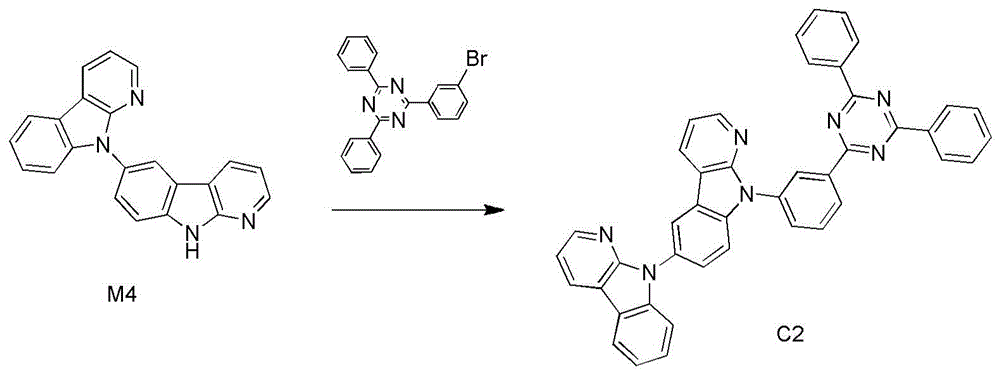
化合物C2的合成:合成步骤同化合物C1,只是将2-(4-溴苯基)-4,6-二苯基-1,3,5-三嗪换成2-(3-溴苯基)-4,6-二苯基-1,3,5-三嗪,其它试剂不变,得到化合物C2,收率63%。Synthesis of compound C2: The synthesis steps are the same as compound C1, except that 2-(4-bromophenyl)-4,6-diphenyl-1,3,5-triazine is replaced by 2-(3-bromophenyl) -4,6-diphenyl-1,3,5-triazine, other reagents unchanged, to obtain compound C2 with a yield of 63%.
产物MS(m/e):641.2,元素分析(C43H27N7):理论值C,80.48%;H,4.24%;N,15.28%;实测值C,80.18%;H,4.27%;N,15.22%。1H NMR(400MHz,Chloroform)δ8.50(d,J=36.4Hz, 8H),8.44-8.34(m,31H),8.22(d,J=12.0Hz,9H),7.65(d,J=4.0Hz,8H),7.56(d,J=32.0Hz,18H), 7.50(s,14H),7.32(s,4H),7.19-7.05(m,16H).Product MS (m/e): 641.2, Elemental Analysis (C43H27N7): Theorized C, 80.48%; H, 4.24%; N, 15.28%; found C, 80.18%; H, 4.27%; N, 15.22%. 1 H NMR (400 MHz, Chloroform) δ 8.50 (d, J=36.4 Hz, 8H), 8.44-8.34 (m, 31H), 8.22 (d, J=12.0 Hz, 9H), 7.65 (d, J=4.0 Hz, 8H), 7.56(d, J=32.0Hz, 18H), 7.50(s, 14H), 7.32(s, 4H), 7.19-7.05(m, 16H).
合成实施例3Synthesis Example 3
化合物C5的合成:Synthesis of compound C5:

化合物C5的合成:合成步骤同化合物C2,只是将中间体M4换成9H-7,9′-咔啉[2,3-b]咔啉,其它试剂不变,得到化合物C5,收率72%。Synthesis of compound C5: The synthesis steps are the same as compound C2, except that the intermediate M4 is replaced with 9H-7,9'-carboline[2,3-b]carboline, and other reagents remain unchanged to obtain compound C5 with a yield of 72% .
产物MS(m/e):714.2,元素分析(C52H34N4):理论值C,87.37%;H,4.79%;N,7.84%;实测值C,87.31%;H,4.90%;N,7.49%。1H NMR(400MHz,Chloroform)δ8.55(s,21H),8.38(dd,J =21.9,9.9Hz,231H),8.22(d,J=12.0Hz,38H),8.14(s,24H),7.62(d,J=20.0Hz,51H),7.56(dd,J= 6.1,4.1Hz,4H),7.54-7.52(m,22H),7.52-7.19(m,172H),7.19-7.05(m,82H).Product MS (m/e): 714.2, Elemental Analysis (C52H34N4): Theorized C, 87.37%; H, 4.79%; N, 7.84%; found C, 87.31%; H, 4.90%; N, 7.49%. 1 H NMR (400 MHz, Chloroform) δ 8.55 (s, 21H), 8.38 (dd, J=21.9, 9.9 Hz, 231H), 8.22 (d, J=12.0 Hz, 38H), 8.14 (s, 24H), 7.62(d, J=20.0Hz, 51H), 7.56(dd, J=6.1, 4.1Hz, 4H), 7.54-7.52(m, 22H), 7.52-7.19(m, 172H), 7.19-7.05(m, 82H).
合成实施例4Synthesis Example 4
化合物C10的合成:Synthesis of compound C10:

化合物C10的合成:合成步骤同化合物C1,只是将中间体M4换成9′H-9,3′:6′,9"-二咔啉咔啉,其它试剂不变,得到化合物C10,收率67%。Synthesis of compound C10: The synthesis steps are the same as compound C1, except that the intermediate M4 is replaced with 9'H-9,3':6',9"-dicarbolinecarboline, and other reagents remain unchanged to obtain compound C10, yield 67%.
产物MS(m/e):807.3,元素分析(C54H33N9):理论值C,80.28%;H,4.12%;N,15.60%;实测值C,80.31%;H,4.04%;N,15.62%。1H NMR(400MHz,Chloroform)δ9.27(s,1H),8.69(s, 1H),8.53(d,J=15.0Hz,3H),8.46-8.33(m,7H),7.83(t,J=52.0Hz,5H),7.51(d,J=8.0Hz,7H), 7.32(s,1H),7.18-7.05(m,5H).Product MS (m/e): 807.3, Elemental Analysis (C54H33N9): Theorized C, 80.28%; H, 4.12%; N, 15.60%; found C, 80.31%; H, 4.04%; N, 15.62%. 1 H NMR (400 MHz, Chloroform) δ 9.27 (s, 1H), 8.69 (s, 1H), 8.53 (d, J=15.0 Hz, 3H), 8.46-8.33 (m, 7H), 7.83 (t, J =52.0Hz, 5H), 7.51(d, J=8.0Hz, 7H), 7.32(s, 1H), 7.18-7.05(m, 5H).
合成实施例5Synthesis Example 5
化合物C12的合成:Synthesis of compound C12:
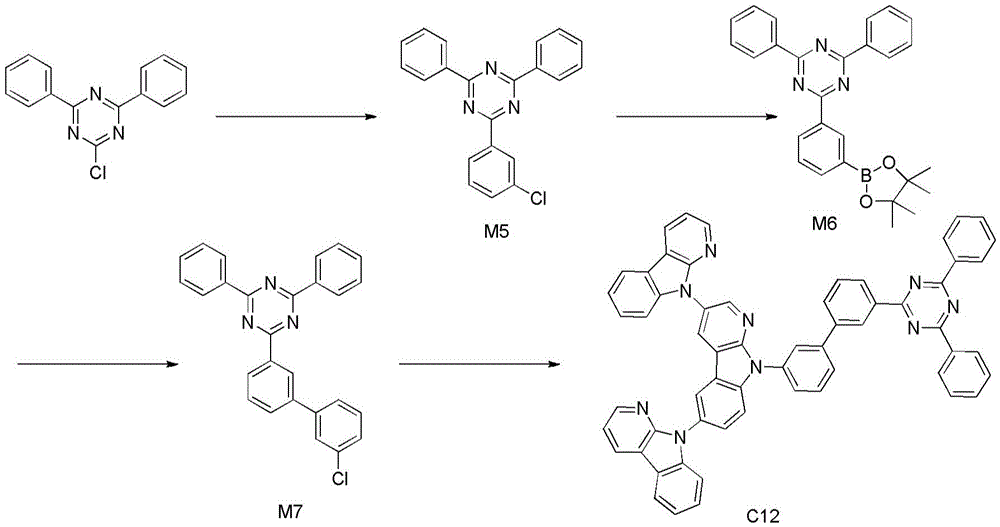
中间体M5的合成:氮气保护下,1000L单口瓶中,将2-氯-4,6-二苯基-1,3,5-三嗪30g (0.11mol,1eq),间氯苯硼酸19.5g(0.12mol,1.1eq),碳酸钾46.8g(0.33mol,3eq)投入反应瓶,随后加入二氧六环300mL,水150mL,开启搅拌,反应溶液鼓氮气20min,再加入四三苯基磷钯1.2g(1%,0.01eq),升温回流反应过夜,停止反应,分液,水相用乙酸乙酯200mL提取,合并有机相,过短柱子,旋干,甲苯重结晶得25g白色固体,收率65%。Synthesis of intermediate M5: under nitrogen protection, in a 1000L single-neck flask, 30g (0.11mol, 1eq) of 2-chloro-4,6-diphenyl-1,3,5-triazine, 19.5g of m-chlorobenzeneboronic acid (0.12mol, 1.1eq), potassium carbonate 46.8g (0.33mol, 3eq) was put into the reaction flask, then 300mL of dioxane, 150mL of water were added, stirring was turned on, the reaction solution was bubbled with nitrogen for 20min, and then tetrakistriphenylphosphonium palladium was added 1.2g (1%, 0.01eq), heated and refluxed overnight, stopped the reaction, separated the layers, extracted the aqueous phase with 200mL of ethyl acetate, combined the organic phases, passed through a short column, spin-dried, and recrystallized from toluene to obtain 25g of white solids. rate 65%.
中间体M6的合成:氮气保护下,1000L单口瓶中,将M523g(67mmol,1eq),醋酸钾19.7g(201mmol,3eq),三环己基膦四氟硼酸盐1.5g(3.9mmol,0.06eq),1g(1.3mmol, 2%)投入反应瓶,随后加入DMF 300mL,开启搅拌,升温回流反应过夜,停止反应,倾倒入 600mL水中,抽滤,固体用甲苯溶解,过硅胶柱,洗提液旋干,石油醚煮洗得25.5g白色固体产品,收率87.6%。Synthesis of intermediate M6: under nitrogen protection, in a 1000L single-necked flask, put M523g (67mmol, 1eq), potassium acetate 19.7g (201mmol, 3eq), tricyclohexylphosphine tetrafluoroborate 1.5g (3.9mmol, 0.06eq) ), 1 g (1.3 mmol, 2%) was put into the reaction flask, then 300 mL of DMF was added, stirring was started, the temperature was heated and refluxed overnight, the reaction was stopped, poured into 600 mL of water, suction filtered, the solid was dissolved in toluene, passed through a silica gel column, and the eluent was Spin-dried, boiled and washed with petroleum ether to obtain 25.5 g of white solid product with a yield of 87.6%.
中间体M7的合成:氮气保护下,1000L单口瓶中,将M625.5g(58.7mmol,1eq),间氯溴苯12.4g(64.6mmol,1.1eq),碳酸钾24.3g(176.3mol,3eq)投入反应瓶,随后加入二氧六环300mL,水150mL,开启搅拌,反应溶液鼓氮气20min,再加入四三苯基磷钯0.7g(1%,0.01eq),升温回流反应过夜,停止反应,分液,水相用乙酸乙酯200mL提取,合并有机相,过短柱子,旋干,甲苯重结晶得15g白色固体,收率61%。Synthesis of intermediate M7: under nitrogen protection, in a 1000L single-neck flask, M625.5g (58.7mmol, 1eq), m-chlorobromobenzene 12.4g (64.6mmol, 1.1eq), potassium carbonate 24.3g (176.3mol, 3eq) Put into a reaction flask, then add 300 mL of dioxane, 150 mL of water, turn on stirring, the reaction solution is bubbled with nitrogen for 20 min, then 0.7 g (1%, 0.01 eq) of tetrakistriphenylphosphonium palladium is added, the temperature is heated and refluxed overnight, and the reaction is stopped. The liquids were separated, the aqueous phase was extracted with 200 mL of ethyl acetate, the organic phases were combined, passed through a short column, spin-dried, and recrystallized from toluene to obtain 15 g of a white solid with a yield of 61%.
化合物C12的合成:合成步骤同化合物C10,只是将2-(4-溴苯基)-4,6-二苯基-1,3,5-三嗪换成中间体M7,其它试剂不变,得到化合物C12,收率62%。Synthesis of compound C12: The synthesis steps are the same as compound C10, except that 2-(4-bromophenyl)-4,6-diphenyl-1,3,5-triazine is replaced by intermediate M7, and other reagents remain unchanged. Compound C12 was obtained in a yield of 62%.
产物MS(m/e):883.3,元素分析(C60H37N9):理论值C,81.52%;H,4.22%;N,14.26%;实测值C,81.54%;H,4.20%;N,14.24%。1H NMR(400MHz,Chloroform)δ9.67(s,1H),9.53(s, 1H),8.55(s,2H),8.48(s,2H),8.39(dd,J=14.0,10.0Hz,8H),8.24(d,J=22.4Hz,2H),7.75-7.57(m, 5H),7.54-7.40(m,9H),7.32(s,1H),7.18-7.05(m,5H).Product MS (m/e): 883.3, Elemental Analysis (C60H37N9): Theorized C, 81.52%; H, 4.22%; N, 14.26%; found C, 81.54%; H, 4.20%; N, 14.24%. 1 H NMR (400 MHz, Chloroform) δ 9.67 (s, 1H), 9.53 (s, 1H), 8.55 (s, 2H), 8.48 (s, 2H), 8.39 (dd, J=14.0, 10.0 Hz, 8H ), 8.24(d, J=22.4Hz, 2H), 7.75-7.57(m, 5H), 7.54-7.40(m, 9H), 7.32(s, 1H), 7.18-7.05(m, 5H).
合成实施例6Synthesis Example 6
化合物C13的合成:Synthesis of compound C13:

中间体M8的合成:合成步骤同中间体M5,只是将2-氯-4,6-二苯基-1,3,5-三嗪改为3-氯 -2,5-二苯基吡嗪,其它试剂不变,得到中间体M8,收率73%。Synthesis of intermediate M8: The synthesis procedure is the same as that of intermediate M5, except that 2-chloro-4,6-diphenyl-1,3,5-triazine is changed to 3-chloro-2,5-diphenylpyrazine , and other reagents remained unchanged to obtain intermediate M8 with a yield of 73%.
化合物C13的合成:合成步骤同化合物C1,只是将2-(4-溴苯基)-4,6-二苯基-1,3,5-三嗪换成中间体M8,其它试剂不变,得到化合物C13,收率53%。Synthesis of compound C13: The synthesis steps are the same as compound C1, except that 2-(4-bromophenyl)-4,6-diphenyl-1,3,5-triazine is replaced by intermediate M8, and other reagents remain unchanged. Compound C13 was obtained in a yield of 53%.
产物MS(m/e):640.2,元素分析(C44H28N6):理论值C,82.48%;H,4.40%;N,13.12%;实测值C,82.43%;H,4.38%;N,13.11%。1H NMR(400MHz,Chloroform)δ8.78(d,J=8.0Hz, 13H),8.55(s,6H),8.48-8.33(m,39H),8.26(s,12H),7.90-7.66(m,16H),7.59(s,18H),7.53(d,J= 8.0Hz,19H),7.34(d,J=12.0Hz,31H),7.19-7.05(m,22H).Product MS (m/e): 640.2, Elemental Analysis (C44H28N6): Theorized C, 82.48%; H, 4.40%; N, 13.12%; found C, 82.43%; H, 4.38%; N, 13.11%. 1 H NMR (400 MHz, Chloroform) δ 8.78 (d, J=8.0 Hz, 13H), 8.55 (s, 6H), 8.48-8.33 (m, 39H), 8.26 (s, 12H), 7.90-7.66 (m) , 16H), 7.59 (s, 18H), 7.53 (d, J=8.0Hz, 19H), 7.34 (d, J=12.0Hz, 31H), 7.19-7.05 (m, 22H).
合成实施例7Synthesis Example 7
化合物C15的合成:Synthesis of compound C15:

化合物C15的合成:合成步骤同化合物Cl,只是将2-(4-溴苯基)-4,6-二苯基-1,3,5-三嗪换成2-(4-溴苯基)-4,6-二苯基嘧啶,其它试剂不变,得到化合物C15,收率61%。Synthesis of compound C15: The synthesis steps are the same as that of compound Cl, except that 2-(4-bromophenyl)-4,6-diphenyl-1,3,5-triazine is replaced by 2-(4-bromophenyl) -4,6-diphenylpyrimidine, and other reagents remained unchanged to obtain compound C15 with a yield of 61%.
产物MS(m/e):640.2,元素分析(C44H28N6):理论值C,82.48%;H,4.40%;N,13.12%;实测值C,82.45%;H,4.42%;N,13.16%。1H NMR(400MHz,Chloroform)δ8.55(s,2H),8.47-8.26 (m,10H),8.23(s,2H),7.92(t,J=6.0Hz,16H),7.66(s,2H),7.52(t,J=12.0Hz,14H),7.32(s,2H), 7.19-7.05(m,7H).Product MS (m/e): 640.2, elemental analysis (C44H28N6): Theorized C, 82.48%; H, 4.40%; N, 13.12%; found C, 82.45%; H, 4.42%; N, 13.16%. 1 H NMR (400 MHz, Chloroform) δ 8.55 (s, 2H), 8.47-8.26 (m, 10H), 8.23 (s, 2H), 7.92 (t, J=6.0 Hz, 16H), 7.66 (s, 2H) ), 7.52(t, J=12.0Hz, 14H), 7.32(s, 2H), 7.19-7.05(m, 7H).
本发明的化合物的量化计算Quantitative Calculation of Compounds of the Invention
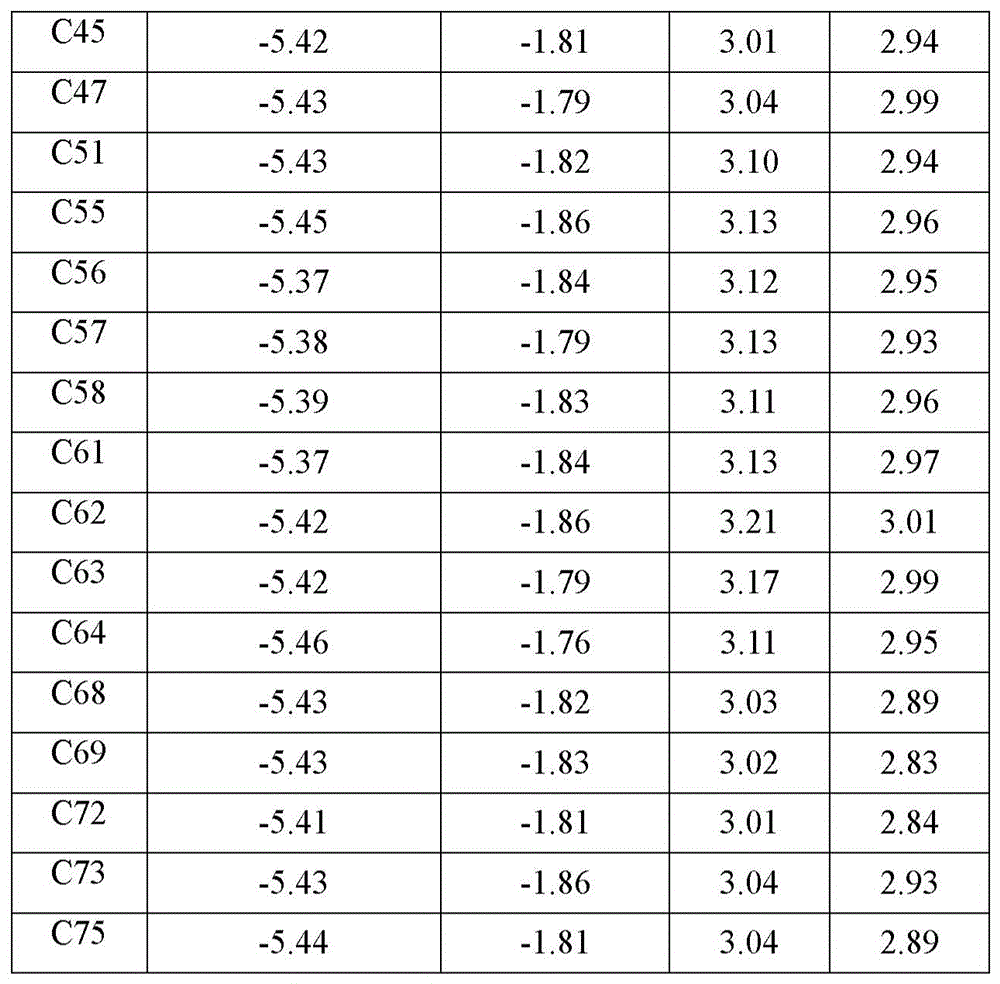
本发明的化合物C1~C29的能量结构可通过量子化学计算得到,采用高斯09软件为平台,以密度泛函理论方法(DFT)作为计算方法,以6-31g(d)为基组,对设计化合物进行了量化理论计算。通过对设计化合物几何构型的优化计算,得到化合物的空间构型,相应的分子轨道能级(HOMO能级、LUMO能级)分布及数据;进而以TD-DFT对化合物的激发态能级的计算,得到化合物的激发态能级(T1,S1)。量化计算结果见表1。The energy structures of the compounds C1-C29 of the present invention can be calculated by quantum chemistry. Gaussian 09 software is used as the platform, density functional theory (DFT) is used as the calculation method, and 6-31g(d) is used as the basis set. Compounds were subjected to quantitative theoretical calculations. Through the optimization calculation of the geometric configuration of the designed compound, the spatial configuration of the compound, the corresponding molecular orbital energy level (HOMO energy level, LUMO energy level) distribution and data are obtained. Calculate to obtain the excited state energy level (T1, S1) of the compound. The quantitative calculation results are shown in Table 1.
表1本发明部分化合物的量化计算结果:Table 1 Quantitative calculation results of some compounds of the present invention:

化合物速率常数测试:Compound rate constant test:
化合物系间窜越系数可以通过瞬态荧光光谱和荧光量子产率测试仪,结合下述公式得到。The crossover coefficient between compound series can be obtained by transient fluorescence spectrum and fluorescence quantum yield tester combined with the following formula.


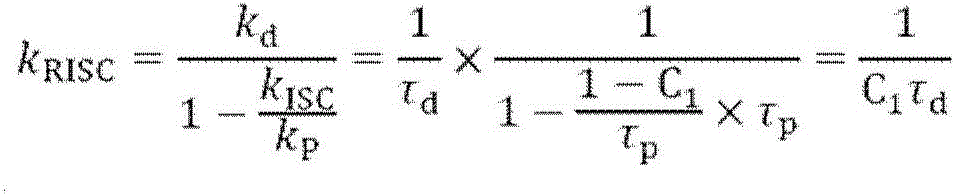
其中,C1为荧光成分比例,τp,τd为荧光部分和延迟荧光部分寿命,ΦPLQY为化合物荧光量子产率。Among them, C1 is the ratio of fluorescent components, τ p , τ d are the lifetimes of the fluorescent part and the delayed fluorescent part, and Φ PLQY is the fluorescence quantum yield of the compound.
化合物瞬态荧光寿命在溶液中测试得到。溶液中通入氮气15min除氧后,用爱丁堡FLS920 稳态瞬态荧光光谱仪得到瞬态发射光谱,并对光谱进行二级拟合得到荧光和延迟荧光部分的成分比例C1和C2(C1+C2=1),以及荧光和延迟荧光部分的寿命τp和τd。化合物的荧光量子产率由绝对荧光量子产率仪C9920(Hamamatsu)测试得到。Compound transient fluorescence lifetimes were measured in solution. After the solution was deaerated by nitrogen gas for 15min, the transient emission spectrum was obtained by Edinburgh FLS920 steady-state transient fluorescence spectrometer, and the second-level fitting of the spectrum was performed to obtain the composition ratios C1 and C2 of the fluorescence and delayed fluorescence parts (C1+C2= 1), and the lifetimes τ p and τ d of the fluorescent and delayed fluorescent moieties. The fluorescence quantum yields of the compounds were measured by an absolute fluorescence quantum yield meter C9920 (Hamamatsu).
化合物C1,C2,C10和C12的系间窜越速率常数数据见表2。The intersystem crossing rate constant data for compounds C1, C2, C10 and C12 are shown in Table 2.
表2:四种化合物的瞬态荧光数据Table 2: Transient fluorescence data for four compounds

有机电致发光器件Organic Electroluminescent Devices
本发明同时提供了一种包含上述式(1)表示的化合物的有机电致发光器件。The present invention also provides an organic electroluminescence device comprising the compound represented by the above formula (1).
具体而言,本发明的一个实施方案提供了一种有机电致发光器件,包括第一电极、第二电极和插入所述第一电极和第二电极之间的多个有机层,其中,所述有机层中含有上述式(1) 所示的化合物。关于该构成,于下文详细叙述。Specifically, one embodiment of the present invention provides an organic electroluminescence device including a first electrode, a second electrode, and a plurality of organic layers interposed between the first electrode and the second electrode, wherein the The organic layer contains the compound represented by the above formula (1). This configuration will be described in detail below.
更具体地,所述有机层包含空穴传输层、发光层、电子传输层;还可以包含空穴注入层、电子注入层等。以下,对有机电致发光元件的各构件及各层进行说明。More specifically, the organic layer includes a hole transport layer, a light emitting layer, and an electron transport layer; and may also include a hole injection layer, an electron injection layer, and the like. Hereinafter, each member and each layer of the organic electroluminescence element will be described.
[发光层][Light Emitting Layer]
发光层是通过自阳极及阴极分别注入的空穴与电子进行再结合而生成激子后进行发光的层。The light-emitting layer is a layer that emits light after the holes and electrons injected from the anode and the cathode, respectively, recombine to generate excitons.
本发明的有机电致发光器件中,发光层可以使用单一有机发光材料,也可使用具有主体材料(host)和客体材料(也称掺杂剂或染料)组合的掺杂体系。作为有机发光层,可以单独使用本发明的有机化合物;为了获得高效率的稳定器件,优选使用本发明所述有机化合物作为第二主体,荧光或磷光染料为掺杂剂的材料组合体系。In the organic electroluminescent device of the present invention, a single organic light-emitting material may be used for the light-emitting layer, or a doping system with a combination of host material (host) and guest material (also called dopant or dye) may be used. As the organic light-emitting layer, the organic compound of the present invention can be used alone; in order to obtain a stable device with high efficiency, it is preferable to use the organic compound of the present invention as the second host and a material combination system with fluorescent or phosphorescent dyes as dopants.
在使用主客体掺杂体系的器件中,本发明的有机发光材料在发光层中含有的量可在1~99%的范围。In a device using a host-guest doping system, the organic light-emitting material of the present invention may be contained in the light-emitting layer in an amount ranging from 1 to 99%.
在使用主客体掺杂体系的器件中,客体材料可选用磷光发光材料,优选含Ir,Pt的配合物。具体可举出如下化合物:In the device using the host-guest doping system, the guest material can be selected from a phosphorescent light-emitting material, preferably a complex containing Ir and Pt. Specifically, the following compounds can be mentioned:


在使用主客体掺杂体系的器件中,客体材料可选用荧光发光材料,具体可举出:In the device using the host-guest doping system, the guest material can be selected from fluorescent light-emitting materials, specifically:


[其他层][other layers]
本发明的有机电致发光器件优选被基板所支撑。该基板并无特别限制,只要为先前于有机电致发光元件中所用的基板即可,例如可使用包含玻璃、透明塑料、石英、硅等的基板。The organic electroluminescent device of the present invention is preferably supported by a substrate. The substrate is not particularly limited as long as it is a substrate previously used in organic electroluminescence devices, and for example, a substrate including glass, transparent plastic, quartz, silicon, or the like can be used.
阳极可以采用无机材料或有机导电聚合物。无机材料一般为氧化铟锡(ITO)、氧化锌(ZnO)、氧化铟锌(IZO)等金属氧化物或金、铜、银等功函数较高的金属,优选ITO;有机导电聚合物优选为聚噻吩/聚乙烯基苯磺酸钠(以下简称PEDOT/PSS)、聚苯胺(以下简称PANI)中的一种。The anode can use inorganic materials or organic conductive polymers. Inorganic materials are generally metal oxides such as indium tin oxide (ITO), zinc oxide (ZnO), indium zinc oxide (IZO), or metals with higher work functions such as gold, copper, and silver, preferably ITO; organic conductive polymers are preferably One of polythiophene/sodium polyvinylbenzenesulfonate (hereinafter referred to as PEDOT/PSS) and polyaniline (hereinafter referred to as PANI).
阴极一般采用锂、镁、钙、锶、铝、铟等功函数较低的金属或它们与铜、金、银的合金,或金属与金属氟化物交替形成的电极层。本发明中阴极优选为层叠的LiF层和Al层(LiF层在外侧)。The cathode generally adopts metals with low work function such as lithium, magnesium, calcium, strontium, aluminum, and indium, or their alloys with copper, gold, and silver, or electrode layers formed alternately between metals and metal fluorides. In the present invention, the cathode is preferably a stacked LiF layer and an Al layer (the LiF layer is on the outside).
空穴传输层的材料包含具有传输空穴的功能的空穴传输材料,且空穴传输层可设置单层或数层。可以选自芳胺类和枝聚物类低分子材料或、通式(1)所述有机化合物,优选NPB,MTDATA。The material of the hole transport layer includes a hole transport material having the function of transporting holes, and the hole transport layer may be provided with a single layer or several layers. It can be selected from aromatic amines and dendrimer low molecular materials or organic compounds described in general formula (1), preferably NPB, MTDATA.
电子传输层的材料包含具有传输电子的功能的电子传输材料,且电子传输层可设置单层或数层。可采用有机金属配合物(如Alq3、Gaq3、BAlq或Ga(Saph-q))、通式(1)所述有机化合物或其他常用于电子传输层的材料,如芳香稠环类(如pentacene、苝)或邻菲咯啉类(如 Bphen、BCP)化合物。The material of the electron transport layer includes an electron transport material having the function of transporting electrons, and the electron transport layer may be provided with a single layer or several layers. Organometallic complexes (such as Alq3, Gaq3, BAlq or Ga(Saph-q)), organic compounds described in general formula (1), or other materials commonly used in electron transport layers, such as aromatic fused rings (such as pentacene, perylene) or phenanthroline (such as Bphen, BCP) compounds.
本发明的有机电致发光器件还可具有注入层,所述注入层是为了降低驱动电压或提高发光亮度而设置于电极与有机层间的层。注入层包括空穴注入层与电子注入层,可存在于阳极与发光层或空穴传输层之间、及阴极与发光层或电子传输层之间。注入层可根据需要进行设置。所述空穴注入层的材料例如可采用4,4′,4″-三(3-甲基苯基苯胺)三苯胺掺杂F4TCNQ,或者采用铜酞菁(CuPc),或可为金属氧化物类,如氧化钼,氧化铼。所述电子注入层的材料可采用 LiF等有利于电子注入的材料。The organic electroluminescence device of the present invention may further have an injection layer, which is a layer provided between the electrode and the organic layer in order to reduce the driving voltage or improve the luminous brightness. The injection layer includes a hole injection layer and an electron injection layer, and may be present between the anode and the light emitting layer or the hole transport layer, and between the cathode and the light emitting layer or the electron transport layer. The injection layer can be set as required. The material of the hole injection layer can be, for example, 4,4′,4″-tris(3-methylphenylaniline)triphenylamine doped with F4TCNQ, or copper phthalocyanine (CuPc), or metal oxide Such as molybdenum oxide, rhenium oxide. The material of the electron injection layer can be LiF and other materials that are conducive to electron injection.
本发明的有机电致发光器件还可具有阻挡层,阻挡层是能够阻挡存在于发光层中的电荷 (电子或空穴)及/或激子向发光层外扩散的层。电子阻挡层可配置于发光层及空穴传输层之间,而阻挡电子朝向空穴传输层的方向通过发光层。同样地,空穴阻挡层可配置于发光层及电子传输层之间,阻挡空穴向电子传输层的方向通过发光层。此外,阻挡层可用以阻挡激于自发光层的外向扩散。也就是说,电子阻挡层、空穴阻挡层也可分别兼具作为激子阻挡层的功能。The organic electroluminescent device of the present invention may further have a blocking layer, which is a layer capable of blocking charges (electrons or holes) and/or excitons existing in the light-emitting layer from diffusing out of the light-emitting layer. The electron blocking layer can be disposed between the light-emitting layer and the hole transport layer, and blocks electrons from passing through the light-emitting layer in a direction toward the hole transport layer. Likewise, the hole blocking layer may be disposed between the light-emitting layer and the electron transport layer, and block holes from passing through the light-emitting layer in the direction of the electron transport layer. In addition, the blocking layer can be used to block out-diffusion excited by the self-emissive layer. That is, the electron blocking layer and the hole blocking layer may each have functions as exciton blocking layers.
上述各层的厚度可采用本领域中这些层常规的厚度。The thicknesses of the above-mentioned layers can be conventional thicknesses of these layers in the art.
本发明还提供所述有机电致发光器件的制备方法,如附图7所示,包括在基板01上依次沉积彼此层叠的阳极02、空穴注入层04、空穴传输层05、发光层06、电子传输层07及阴极 03,然后封装。The present invention also provides a method for preparing the organic electroluminescent device, as shown in FIG. 7 , which includes sequentially depositing an
由上,本发明的有机电致发光器件优选的器件结构为:From the above, the preferred device structure of the organic electroluminescent device of the present invention is:
基片/阳极/空穴注入层(HIL)/空穴传输层(HTL)/发光层(EL)/电子传输层(ETL)/电子注入层(EIL)/阴极Substrate / Anode / Hole Injection Layer (HIL) / Hole Transport Layer (HTL) / Light Emitting Layer (EL) / Electron Transport Layer (ETL) / Electron Injection Layer (EIL) / Cathode
上述器件结构中的“/”表示不同功能层之间按顺序层叠。"/" in the above device structure indicates that different functional layers are stacked in sequence.
本发明化合物可以但不限于用于发光层材料。The compounds of the present invention can be used in, but not limited to, light-emitting layer materials.
上述有机电致发光器件各层中未注明来源的材料均是通过市售或本领域公知的制备方法自行制备得到的。The unrecognized materials in each layer of the above organic electroluminescent device are all prepared by commercially available or well-known preparation methods in the art.
下面通过有机电致发光器件的具体实施例来进一步说明本发明的技术方案和效果。The technical solutions and effects of the present invention will be further described below through specific examples of organic electroluminescent devices.
器件实施例1~器件实施例14Device Example 1 to Device Example 14
所述发光层包含第一主体、第二主体和染料的掺杂体系,第一主体材料采用CBP,第二主体材料采用本发明中的有机化合物,4i-PrCzBN作为染料,有机电致发光器件真空蒸镀而成,其结构如下:The light-emitting layer comprises a doping system of a first host, a second host and a dye, the first host material is CBP, the second host material is the organic compound of the present invention, 4i-PrCzBN is used as the dye, the organic electroluminescent device is vacuum Evaporated, its structure is as follows:
ITO(50nm)/2-TNATA(60nm)NPB(20nm)/mCBP:Cx:4i-PrCzBN(5wt%)(30nm) /Bphen(20nm)/LiF(0.5nm)/Al(150nm)。其中,Cx为本发明提供的通式(1)中的具体化合物。使用现有技术中的化合物TD1、TD2和TD3作为对比材料。下式示出了OLED器件中各功能层所使用材料的结构式:ITO(50nm)/2-TNATA(60nm)NPB(20nm)/mCBP:Cx:4i-PrCzBN(5wt%)(30nm)/Bphen(20nm)/LiF(0.5nm)/Al(150nm). Wherein, Cx is the specific compound in the general formula (1) provided by the present invention. Compounds TD1, TD2 and TD3 in the prior art were used as comparative materials. The following formula shows the structural formula of the materials used in each functional layer in the OLED device:

器件实施例1的有机电致发光器件的制备过程如下:The preparation process of the organic electroluminescent device of Device Example 1 is as follows:
将涂布了ITO(50nm)透明导电层的玻璃板在商用清洗剂中超声处理,在去离子水中冲洗,在丙酮∶乙醇混合溶剂(体积比1∶1)中超声除油,在洁净环境下烘烤至完全除去水分,用紫外光和臭氧清洗,并用低能阳离子束轰击表面;The glass plate coated with ITO (50nm) transparent conductive layer was ultrasonically treated in commercial cleaning agent, rinsed in deionized water, ultrasonically degreasing in acetone:ethanol mixed solvent (volume ratio 1:1), in a clean environment Bake until moisture is completely removed, rinse with UV light and ozone, and bombard the surface with a low-energy cation beam;
把上述带有阳极的玻璃基片置于真空腔内,抽真空至1×10⁻⁵~9×10⁻³Pa,在上述阳极层膜上真空蒸镀2-TNATA[4,4′,4"-三(N,N-(2-萘基)-苯基氨基)三苯胺],形成厚度为60nm的空穴注入层;在空穴注入层之上真空蒸镀化合物NPB,形成厚度为20nm的空穴传输层,蒸镀速率为0.1nm/s;The above-mentioned glass substrate with anode is placed in a vacuum chamber, and the vacuum is evacuated to 1 × 10 -5 to 9 × 10 -3 Pa, and 2-TNATA[4,4′,4 "-Tris(N,N-(2-naphthyl)-phenylamino)triphenylamine], forming a hole injection layer with a thickness of 60 nm; vacuum evaporation of compound NPB on the hole injection layer to form a thickness of 20 nm The hole transport layer of , the evaporation rate is 0.1nm/s;
在上述空穴传输层上形成电致发光层,具体操作为:将作为发光层主体的化合物mCBP 放置在真空气相沉积设备的小室中,将作为第二主体的本发明的化合物C1放置在真空气相沉积设备的另一室中,将作为掺杂剂的化合物4i-PrCzBN放置在真空气相沉积设备的另一室中,以不同的速率同时蒸发三种材料,化合物比例为PH∶TD∶BD=65%∶30%∶5%,蒸镀总膜厚为 30nm;The electroluminescent layer is formed on the above hole transport layer, and the specific operation is as follows: the compound mCBP as the host of the light-emitting layer is placed in a small chamber of a vacuum vapor deposition apparatus, and the compound C1 of the present invention as the second host is placed in the vacuum vapor phase. In another chamber of the deposition equipment, the compound 4i-PrCzBN as a dopant was placed in another chamber of the vacuum vapor deposition equipment, and the three materials were simultaneously evaporated at different rates, and the compound ratio was PH:TD:BD=65 %: 30%: 5%, the total film thickness of evaporation is 30nm;
在发光层之上真空蒸镀Bphen形成厚膜为20nm的电子传输层,其蒸镀速率为0.1nm/s;Vacuum evaporation of Bphen on the light-emitting layer forms an electron transport layer with a thickness of 20 nm, and the evaporation rate is 0.1 nm/s;
在电子传输层上真空蒸镀0.5nm的LiF作为电子注入层和厚度为150nm的Al层作为器件的阴极。LiF with a thickness of 0.5 nm was vacuum-deposited on the electron transport layer as the electron injection layer and an Al layer with a thickness of 150 nm was used as the cathode of the device.
本实施例中制备得到的有机电致发光器件的结构如下:ITO(50nm)/2-TNATA(60nm) /NPB(20nm)/mCBP:Cl:4i-PrCzBN(30nm)/Bphen(20nm)/LiF(0.5nm)/Al(150nm)。The structure of the organic electroluminescent device prepared in this example is as follows: ITO(50nm)/2-TNATA(60nm)/NPB(20nm)/mCBP:Cl:4i-PrCzBN(30nm)/Bphen(20nm)/LiF (0.5nm)/Al(150nm).
实施例2~14Examples 2 to 14
实施例2~14采用和实施例1相同的器件制作方法,区别仅在于,将主体材料化合物C1 分别替换等当量的化合物C2、C4、C10、C11、C12、C19、C20、C34、C49、C55、C56、C67 和C73。Examples 2 to 14 adopt the same device fabrication method as in Example 1, except that the host material compound C1 is replaced with equivalent compounds C2, C4, C10, C11, C12, C19, C20, C34, C49, and C55 respectively. , C56, C67 and C73.
实施例15~18Examples 15 to 18
实施例15~18制备得到的有机电致发光器件的结构如下:ITO(50nm)/2-TNATA(60nm) /NPB(20nm)/mCBP:Cx(30%)(30nm)/Bphen(20nm)/LiF(0.5nm)/Al(150nm)。The structures of the organic electroluminescent devices prepared in Examples 15-18 are as follows: ITO(50nm)/2-TNATA(60nm)/NPB(20nm)/mCBP:Cx(30%)(30nm)/Bphen(20nm)/ LiF(0.5nm)/Al(150nm).
其中Cx分别为C1,C2,C10和C12。where Cx are C1, C2, C10 and C12, respectively.
比较例1~4Comparative Examples 1 to 4
比较例1~4采用与实施例1相同的制作方法,区别仅在于,将主体材料C1分别置换为等当量的TD1,TD2,TD3作为发光层中的第二主体材料,以及替换为仅采用唯一化合物mCBP为单主体结构器件的对比实验实施例。Comparative Examples 1 to 4 adopt the same production method as Example 1, except that the host material C1 is replaced with equivalent TD1, TD2, and TD3 as the second host material in the light-emitting layer, and only the unique host material is replaced. Compound mCBP is a comparative experimental example of a single-host structure device.
将制造出的有机电致发光器件进行光电测试,J-V-L(电流密度-压-亮度)性能的测试采用 Keithley 2400电源单元和已校正的硅光电二极管。亮度利用分光光度计(型号:Spectr Scan PR655,Photo Research)测试。在亮度1000cd/m2下,测定比较例1~4和实施例1~14中制备得到的有机电致发光器件的电压和效率,结果见表3。The fabricated organic electroluminescent device was subjected to optoelectronic test, and the test of JVL (current density-voltage-luminance) performance used Keithley 2400 power supply unit and calibrated silicon photodiode. Brightness was measured using a spectrophotometer (model: Spectr Scan PR655, Photo Research). Under the luminance of 1000 cd/m 2 , the voltage and efficiency of the organic electroluminescent devices prepared in Comparative Examples 1 to 4 and Examples 1 to 14 were measured, and the results are shown in Table 3.
表3有机电致发光器件性能Table 3 Properties of organic electroluminescent devices

以上结果表明,本发明的新的化合物用于有机电致发光器件的发光层作为敏化剂,可以有效的提高电流效率,是性能良好的有机发光材料。这可能是由于实施例的化合物中包含氮杂咔唑基团尤其是咔啉基团,与比较例1~3的咔唑基团相比,化合物的光谱蓝移,激发态能量更高,从而能有效的敏化荧光化合物;同时由于咔啉氮原子的存在,可以形成分子内氢键,从而提高化合物刚性,荧光量子产率相对较高。The above results show that the novel compound of the present invention can be used as a sensitizer in the light-emitting layer of an organic electroluminescent device, which can effectively improve the current efficiency, and is an organic light-emitting material with good performance. This may be due to the fact that the compounds of the examples contain azacarbazole groups, especially carbazole groups. Compared with the carbazole groups of Comparative Examples 1 to 3, the compounds have blue-shifted spectra and higher excited state energies. It can effectively sensitize fluorescent compounds; at the same time, due to the existence of carboline nitrogen atoms, intramolecular hydrogen bonds can be formed, thereby improving the rigidity of compounds, and the fluorescence quantum yield is relatively high.
另外,通过实施例可以发现,拉电子基采用三嗪或嘧啶基团的化合物(实施例1~12和15~18) 效率要更优于吡啶类化合物(实施例13和14),这是由于其具备更快的能量的带隙的反向系间窜越速率,激发态三线态能量可以得到更好的利用。In addition, through the examples, it can be found that the efficiency of the compounds using triazine or pyrimidine groups as electron withdrawing groups (Examples 1-12 and 15-18) is better than that of pyridine compounds (Examples 13 and 14), which is due to It has a faster energy band gap inverse intersystem crossing rate, and the triplet energy of the excited state can be better utilized.
根据实施例15~18可见,本发明所述热活化延迟荧光材料,可用作染料具备高的荧光量子效率。为了获得更好的色纯度,采用本发明设计的具有特殊结构的材料用作敏化剂制备的 OLED器件在要求亮度下(1000cd/m2)的电流效率最大可达到11.8cd/A,有明显的提高,特别是采用三嗪基团的化合物,由于其更好的电荷注入传输性能,器件效率更优。According to Examples 15-18, it can be seen that the thermally activated delayed fluorescent material of the present invention can be used as a dye with high fluorescence quantum efficiency. In order to obtain better color purity, the current efficiency of the OLED device prepared by using the material with a special structure designed by the present invention as a sensitizer can reach a maximum of 11.8cd/A under the required brightness (1000cd/m 2 ), which is obviously The improvement of , especially the compound using triazine group, leads to better device efficiency due to its better charge injection and transport performance.
在对比实施例中,比较例1中的效率较低,是由于TD1的能量较低,不能实现能量有第二主体到染料的快速传递,从而导致电压升高和效率的下降。比较例2中所用化合物TD2的 kRISC为0s-1(Hosokai et al.,Sci.Adv.2017;3:e1603282),由于材料的三线态能级不能传递到激发态单线态能级,从而使效率降低;比较例3中尽管化合物TD3的△Est为0.41eV(Chem.Sci., 2016,7,3355-3363),但仍具有热活化延迟荧光性能,也能获得较高的器件效率;比较例4中由于没有第二主体材料的存在,能量直接由主体传至染料,由三线态能量不能有效利用,从而效率较低。In the comparative example, the lower efficiency in the comparative example 1 is due to the low energy of TD1, which cannot achieve rapid transfer of energy from the second host to the dye, resulting in an increase in voltage and a decrease in efficiency. The compound TD2 used in Comparative Example 2 has a kRISC of 0s -1 (Hosokai et al., Sci. Adv. 2017; 3: e1603282), since the triplet energy level of the material cannot be transferred to the excited singlet energy level, which makes the efficiency In Comparative Example 3, although the ΔEst of compound TD3 is 0.41 eV (Chem. Sci., 2016, 7, 3355-3363), it still has thermally activated delayed fluorescence performance and can also obtain higher device efficiency; Comparative Example In 4, due to the absence of the second host material, the energy is directly transferred from the host to the dye, and the triplet energy cannot be effectively utilized, so the efficiency is low.
以上所述的具体实施例,对本发明的目的、技术方案和有益效果进行了进一步详细说明,应理解的是,以上所述仅为本发明的具体实施例而已,并不用于限制本发明,凡在本发明的精神和原则之内,所做的任何修改、等同替换、改进等,均应包含在本发明的保护范围之内。此外,本发明的各种不同的实施方式之间也可以进行任意组合,只要其不违背本发明的思想,其同样应当视为本发明所公开的内容。The specific embodiments described above further describe the purpose, technical solutions and beneficial effects of the present invention in detail. It should be understood that the above-mentioned specific embodiments are only specific embodiments of the present invention, and are not intended to limit the present invention. Within the spirit and principle of the present invention, any modifications, equivalent replacements, improvements, etc. made should be included within the protection scope of the present invention. In addition, the various embodiments of the present invention can also be combined arbitrarily, as long as they do not violate the spirit of the present invention, they should also be regarded as the contents disclosed in the present invention.
Claims (9)




Priority Applications (2)
| Application Number | Priority Date | Filing Date | Title |
|---|---|---|---|
| CN201810021938.XA CN108191853B (en) | 2018-01-10 | 2018-01-10 | Organic electroluminescent material and device |
| PCT/CN2019/071148 WO2019137430A1 (en) | 2018-01-10 | 2019-01-10 | Organic electroluminescent material and device |
Applications Claiming Priority (1)
| Application Number | Priority Date | Filing Date | Title |
|---|---|---|---|
| CN201810021938.XA CN108191853B (en) | 2018-01-10 | 2018-01-10 | Organic electroluminescent material and device |
Publications (2)
| Publication Number | Publication Date |
|---|---|
| CN108191853A CN108191853A (en) | 2018-06-22 |
| CN108191853B true CN108191853B (en) | 2020-08-07 |
Family
ID=62588540
Family Applications (1)
| Application Number | Title | Priority Date | Filing Date |
|---|---|---|---|
| CN201810021938.XA Active CN108191853B (en) | 2018-01-10 | 2018-01-10 | Organic electroluminescent material and device |
Country Status (1)
| Country | Link |
|---|---|
| CN (1) | CN108191853B (en) |
Families Citing this family (3)
| Publication number | Priority date | Publication date | Assignee | Title |
|---|---|---|---|---|
| CN110835340A (en) * | 2018-08-17 | 2020-02-25 | 北京鼎材科技有限公司 | Organic electroluminescent material and organic electroluminescent device |
| KR102427666B1 (en) * | 2019-05-23 | 2022-08-02 | 삼성디스플레이 주식회사 | Organic light-emitting device and apparatus including the same |
| KR102544979B1 (en) * | 2019-10-04 | 2023-06-20 | 삼성디스플레이 주식회사 | Organic light-emitting device and apparatus including the same |
Family Cites Families (6)
| Publication number | Priority date | Publication date | Assignee | Title |
|---|---|---|---|---|
| US8580399B2 (en) * | 2011-04-08 | 2013-11-12 | Universal Display Corporation | Substituted oligoazacarbazoles for light emitting diodes |
| JP2015122185A (en) * | 2013-12-24 | 2015-07-02 | コニカミノルタ株式会社 | Transparent electrode and electronic device |
| JP6340788B2 (en) * | 2013-12-25 | 2018-06-13 | コニカミノルタ株式会社 | Transparent electrode and electronic device |
| CN106661001A (en) * | 2014-05-14 | 2017-05-10 | 哈佛学院院长等 | Organic light-emitting diode materials |
| KR102283297B1 (en) * | 2014-12-23 | 2021-07-28 | 솔루스첨단소재 주식회사 | Organic compound and organic electroluminescent device comprising the same |
| CN106749341B (en) * | 2017-01-18 | 2018-11-27 | 江西冠能光电材料有限公司 | Balancing charge injects organic semiconductor and its Organic Light Emitting Diode application |
-
2018
- 2018-01-10 CN CN201810021938.XA patent/CN108191853B/en active Active
Also Published As
| Publication number | Publication date |
|---|---|
| CN108191853A (en) | 2018-06-22 |
Similar Documents
| Publication | Publication Date | Title |
|---|---|---|
| JP6503088B2 (en) | Thermally activated sensitized phosphorescent organic electroluminescent device | |
| JP6581585B2 (en) | ORGANIC ELECTROLUMINESCENT DEVICE AND METHOD FOR MANUFACTURING THE SAME | |
| JP5390693B2 (en) | Organic electronic device and its compound, terminal | |
| JP5414595B2 (en) | Organic electroluminescent device and charge transport material | |
| CN112500410B (en) | A kind of spiro nitrogen-containing organic light-emitting compound, its preparation method and application | |
| CN110642842B (en) | Compound, display panel and display device | |
| CN107129471B (en) | Organic compounds, organic optoelectronic devices and display devices | |
| TW201130843A (en) | Organic electroluminescent element | |
| CN106831744A (en) | A kind of electroluminescent organic material and organic photoelectric device | |
| KR102657637B1 (en) | Anthracene compound, coating composition and organic light emitting device comprising same | |
| KR102657636B1 (en) | Anthracene compound, coating composition and organic light emitting device comprising same | |
| KR101982749B1 (en) | Chemical and Organic Electronic Element using the same, Electronic Device thereof | |
| CN110003258A (en) | Compound, display panel and display device | |
| CN110078754A (en) | Compound, display panel and display device | |
| CN108285452A (en) | A kind of pyridine derivatives and its application | |
| KR101984786B1 (en) | Hetero-cyclic compound and organic light emitting device comprising the same | |
| CN112457313A (en) | Naphthalimide-azacyclo-luminescent material and application thereof | |
| Braveenth et al. | Utilizing triazine/pyrimidine acceptor and carbazole-triphenylamine donor based bipolar novel host materials for highly luminescent green phosphorescent oleds with lower efficiency roll-off | |
| CN111808127A (en) | Compound, display panel and display device | |
| KR20130100948A (en) | New anthracene derivatives and organic electronic device using the same | |
| CN108191853B (en) | Organic electroluminescent material and device | |
| CN114751888B (en) | A kind of electron transport material and its preparation method, light-emitting device, light-emitting device | |
| CN111212829B (en) | Spiro compound and organic light-emitting device comprising same | |
| CN113056471A (en) | Compound and organic light emitting diode comprising same | |
| CN109935723A (en) | A kind of organic electroluminescence device |
Legal Events
| Date | Code | Title | Description |
|---|---|---|---|
| PB01 | Publication | ||
| PB01 | Publication | ||
| SE01 | Entry into force of request for substantive examination | ||
| SE01 | Entry into force of request for substantive examination | ||
| GR01 | Patent grant | ||
| GR01 | Patent grant | ||
| CP03 | Change of name, title or address |
Address after: 100192 Beijing City Haidian District Xixiaokou Road 66 Zhongguancun Dongsheng Science and Technology Park . North Territory B-6 Building A 10th Floor Patentee after: Beijing Dingcai Technology Co., Ltd. Country or region after: China Patentee after: GU'AN ETERNAL MATERIAL TECHNOLOGY Co.,Ltd. Address before: 3 floor, No. 2, D District, D District, Zhongguancun Dongsheng Science Park, No. 66 West Sixiao Kou Road, Haidian District Patentee before: BEIJING ETERNAL MATERIAL TECHNOLOGY Co.,Ltd. Country or region before: China Patentee before: GU'AN ETERNAL MATERIAL TECHNOLOGY Co.,Ltd. |
|
| CP03 | Change of name, title or address |