CN108187451B - A method for wet removal of gaseous elemental mercury from nano molybdenum sulfide material - Google Patents
A method for wet removal of gaseous elemental mercury from nano molybdenum sulfide material Download PDFInfo
- Publication number
- CN108187451B CN108187451B CN201810081939.3A CN201810081939A CN108187451B CN 108187451 B CN108187451 B CN 108187451B CN 201810081939 A CN201810081939 A CN 201810081939A CN 108187451 B CN108187451 B CN 108187451B
- Authority
- CN
- China
- Prior art keywords
- mercury
- nano
- flue gas
- elemental mercury
- molybdenum disulfide
- Prior art date
- Legal status (The legal status is an assumption and is not a legal conclusion. Google has not performed a legal analysis and makes no representation as to the accuracy of the status listed.)
- Active
Links
- QSHDDOUJBYECFT-UHFFFAOYSA-N mercury Chemical compound [Hg] QSHDDOUJBYECFT-UHFFFAOYSA-N 0.000 title claims abstract description 149
- CWQXQMHSOZUFJS-UHFFFAOYSA-N molybdenum disulfide Chemical compound S=[Mo]=S CWQXQMHSOZUFJS-UHFFFAOYSA-N 0.000 title claims abstract description 46
- 238000000034 method Methods 0.000 title claims abstract description 39
- 239000000463 material Substances 0.000 title claims abstract description 30
- 229910052753 mercury Inorganic materials 0.000 claims abstract description 89
- UGFAIRIUMAVXCW-UHFFFAOYSA-N Carbon monoxide Chemical compound [O+]#[C-] UGFAIRIUMAVXCW-UHFFFAOYSA-N 0.000 claims abstract description 65
- 239000003546 flue gas Substances 0.000 claims abstract description 65
- 229910052982 molybdenum disulfide Inorganic materials 0.000 claims abstract description 57
- 239000007788 liquid Substances 0.000 claims abstract description 25
- 238000010521 absorption reaction Methods 0.000 claims abstract description 20
- 239000007789 gas Substances 0.000 claims description 20
- 239000002135 nanosheet Substances 0.000 claims description 13
- VEXZGXHMUGYJMC-UHFFFAOYSA-N Hydrochloric acid Chemical compound Cl VEXZGXHMUGYJMC-UHFFFAOYSA-N 0.000 claims description 8
- 150000001768 cations Chemical class 0.000 claims description 4
- 150000001450 anions Chemical class 0.000 claims description 3
- 229920006395 saturated elastomer Polymers 0.000 claims description 3
- 238000004062 sedimentation Methods 0.000 claims description 2
- 230000000694 effects Effects 0.000 abstract description 20
- RAHZWNYVWXNFOC-UHFFFAOYSA-N sulfur dioxide Inorganic materials O=S=O RAHZWNYVWXNFOC-UHFFFAOYSA-N 0.000 abstract description 6
- 238000003723 Smelting Methods 0.000 abstract description 5
- 230000008569 process Effects 0.000 abstract description 5
- 239000000779 smoke Substances 0.000 abstract 2
- 229940044609 sulfur dioxide Drugs 0.000 abstract 1
- 239000000243 solution Substances 0.000 description 42
- 238000006243 chemical reaction Methods 0.000 description 15
- 239000006185 dispersion Substances 0.000 description 9
- 230000035484 reaction time Effects 0.000 description 7
- XLYOFNOQVPJJNP-UHFFFAOYSA-N water Substances O XLYOFNOQVPJJNP-UHFFFAOYSA-N 0.000 description 7
- 229910052751 metal Inorganic materials 0.000 description 6
- 239000002184 metal Substances 0.000 description 6
- 229910052961 molybdenite Inorganic materials 0.000 description 6
- 239000003795 chemical substances by application Substances 0.000 description 5
- 230000007423 decrease Effects 0.000 description 5
- 239000007791 liquid phase Substances 0.000 description 5
- 239000000126 substance Substances 0.000 description 4
- UMGDCJDMYOKAJW-UHFFFAOYSA-N thiourea Chemical compound NC(N)=S UMGDCJDMYOKAJW-UHFFFAOYSA-N 0.000 description 4
- CWYNVVGOOAEACU-UHFFFAOYSA-N Fe2+ Chemical compound [Fe+2] CWYNVVGOOAEACU-UHFFFAOYSA-N 0.000 description 3
- 230000002378 acidificating effect Effects 0.000 description 3
- 238000010586 diagram Methods 0.000 description 3
- RAXXELZNTBOGNW-UHFFFAOYSA-N imidazole Natural products C1=CNC=N1 RAXXELZNTBOGNW-UHFFFAOYSA-N 0.000 description 3
- NLKNQRATVPKPDG-UHFFFAOYSA-M potassium iodide Chemical compound [K+].[I-] NLKNQRATVPKPDG-UHFFFAOYSA-M 0.000 description 3
- 238000001179 sorption measurement Methods 0.000 description 3
- 150000003463 sulfur Chemical class 0.000 description 3
- 229910018072 Al 2 O 3 Inorganic materials 0.000 description 2
- LFQSCWFLJHTTHZ-UHFFFAOYSA-N Ethanol Chemical compound CCO LFQSCWFLJHTTHZ-UHFFFAOYSA-N 0.000 description 2
- MHAJPDPJQMAIIY-UHFFFAOYSA-N Hydrogen peroxide Chemical compound OO MHAJPDPJQMAIIY-UHFFFAOYSA-N 0.000 description 2
- FAPWRFPIFSIZLT-UHFFFAOYSA-M Sodium chloride Chemical class [Na+].[Cl-] FAPWRFPIFSIZLT-UHFFFAOYSA-M 0.000 description 2
- NINIDFKCEFEMDL-UHFFFAOYSA-N Sulfur Chemical compound [S] NINIDFKCEFEMDL-UHFFFAOYSA-N 0.000 description 2
- XSQUKJJJFZCRTK-UHFFFAOYSA-N Urea Natural products NC(N)=O XSQUKJJJFZCRTK-UHFFFAOYSA-N 0.000 description 2
- APUPEJJSWDHEBO-UHFFFAOYSA-P ammonium molybdate Chemical compound [NH4+].[NH4+].[O-][Mo]([O-])(=O)=O APUPEJJSWDHEBO-UHFFFAOYSA-P 0.000 description 2
- 239000011609 ammonium molybdate Substances 0.000 description 2
- 235000018660 ammonium molybdate Nutrition 0.000 description 2
- 229940010552 ammonium molybdate Drugs 0.000 description 2
- 239000007795 chemical reaction product Substances 0.000 description 2
- 230000003247 decreasing effect Effects 0.000 description 2
- 230000007547 defect Effects 0.000 description 2
- 239000008367 deionised water Substances 0.000 description 2
- 229910021641 deionized water Inorganic materials 0.000 description 2
- 238000005367 electrostatic precipitation Methods 0.000 description 2
- 239000012456 homogeneous solution Substances 0.000 description 2
- 238000001027 hydrothermal synthesis Methods 0.000 description 2
- 239000002608 ionic liquid Substances 0.000 description 2
- 239000007800 oxidant agent Substances 0.000 description 2
- 230000003647 oxidation Effects 0.000 description 2
- 238000007254 oxidation reaction Methods 0.000 description 2
- 230000001590 oxidative effect Effects 0.000 description 2
- 238000000746 purification Methods 0.000 description 2
- 238000004064 recycling Methods 0.000 description 2
- 239000012265 solid product Substances 0.000 description 2
- 238000003756 stirring Methods 0.000 description 2
- 150000004763 sulfides Chemical class 0.000 description 2
- 229910052717 sulfur Inorganic materials 0.000 description 2
- 239000011593 sulfur Substances 0.000 description 2
- 238000002834 transmittance Methods 0.000 description 2
- 238000001132 ultrasonic dispersion Methods 0.000 description 2
- ZCYVEMRRCGMTRW-UHFFFAOYSA-N 7553-56-2 Chemical compound [I] ZCYVEMRRCGMTRW-UHFFFAOYSA-N 0.000 description 1
- ZKQDCIXGCQPQNV-UHFFFAOYSA-N Calcium hypochlorite Chemical compound [Ca+2].Cl[O-].Cl[O-] ZKQDCIXGCQPQNV-UHFFFAOYSA-N 0.000 description 1
- 241000282414 Homo sapiens Species 0.000 description 1
- 206010029350 Neurotoxicity Diseases 0.000 description 1
- UCKMPCXJQFINFW-UHFFFAOYSA-N Sulphide Chemical compound [S-2] UCKMPCXJQFINFW-UHFFFAOYSA-N 0.000 description 1
- 206010044221 Toxic encephalopathy Diseases 0.000 description 1
- 230000009471 action Effects 0.000 description 1
- 239000000654 additive Substances 0.000 description 1
- 230000000996 additive effect Effects 0.000 description 1
- 239000007864 aqueous solution Substances 0.000 description 1
- 231100000693 bioaccumulation Toxicity 0.000 description 1
- 239000007844 bleaching agent Substances 0.000 description 1
- 229940075397 calomel Drugs 0.000 description 1
- 239000003054 catalyst Substances 0.000 description 1
- 230000003197 catalytic effect Effects 0.000 description 1
- 239000004568 cement Substances 0.000 description 1
- 239000003245 coal Substances 0.000 description 1
- 150000001868 cobalt Chemical class 0.000 description 1
- 239000002131 composite material Substances 0.000 description 1
- 150000001875 compounds Chemical class 0.000 description 1
- 238000007796 conventional method Methods 0.000 description 1
- 230000009849 deactivation Effects 0.000 description 1
- 238000006477 desulfuration reaction Methods 0.000 description 1
- 230000023556 desulfurization Effects 0.000 description 1
- ZOMNIUBKTOKEHS-UHFFFAOYSA-L dimercury dichloride Chemical compound Cl[Hg][Hg]Cl ZOMNIUBKTOKEHS-UHFFFAOYSA-L 0.000 description 1
- 238000001035 drying Methods 0.000 description 1
- 239000007772 electrode material Substances 0.000 description 1
- 238000005516 engineering process Methods 0.000 description 1
- 230000007613 environmental effect Effects 0.000 description 1
- 239000003344 environmental pollutant Substances 0.000 description 1
- 238000002474 experimental method Methods 0.000 description 1
- 238000001914 filtration Methods 0.000 description 1
- 229910001385 heavy metal Inorganic materials 0.000 description 1
- 239000011630 iodine Substances 0.000 description 1
- 229910052740 iodine Inorganic materials 0.000 description 1
- 239000000314 lubricant Substances 0.000 description 1
- 150000002696 manganese Chemical class 0.000 description 1
- 239000008204 material by function Substances 0.000 description 1
- 229910052976 metal sulfide Inorganic materials 0.000 description 1
- 239000000203 mixture Substances 0.000 description 1
- 230000007135 neurotoxicity Effects 0.000 description 1
- 231100000228 neurotoxicity Toxicity 0.000 description 1
- 150000002815 nickel Chemical class 0.000 description 1
- 230000002688 persistence Effects 0.000 description 1
- 230000002085 persistent effect Effects 0.000 description 1
- 231100000719 pollutant Toxicity 0.000 description 1
- 230000008092 positive effect Effects 0.000 description 1
- 238000002360 preparation method Methods 0.000 description 1
- 239000000047 product Substances 0.000 description 1
- 238000011084 recovery Methods 0.000 description 1
- 238000011946 reduction process Methods 0.000 description 1
- 150000003839 salts Chemical class 0.000 description 1
- 238000000926 separation method Methods 0.000 description 1
- 239000011780 sodium chloride Substances 0.000 description 1
- 239000007787 solid Substances 0.000 description 1
- 238000001308 synthesis method Methods 0.000 description 1
- 230000007704 transition Effects 0.000 description 1
- 229910052723 transition metal Inorganic materials 0.000 description 1
- -1 transition metal sulfide Chemical class 0.000 description 1
- 239000002912 waste gas Substances 0.000 description 1
- 238000004056 waste incineration Methods 0.000 description 1
Images


Classifications
-
- B—PERFORMING OPERATIONS; TRANSPORTING
- B01—PHYSICAL OR CHEMICAL PROCESSES OR APPARATUS IN GENERAL
- B01D—SEPARATION
- B01D53/00—Separation of gases or vapours; Recovering vapours of volatile solvents from gases; Chemical or biological purification of waste gases, e.g. engine exhaust gases, smoke, fumes, flue gases, aerosols
- B01D53/14—Separation of gases or vapours; Recovering vapours of volatile solvents from gases; Chemical or biological purification of waste gases, e.g. engine exhaust gases, smoke, fumes, flue gases, aerosols by absorption
- B01D53/1493—Selection of liquid materials for use as absorbents
-
- B—PERFORMING OPERATIONS; TRANSPORTING
- B01—PHYSICAL OR CHEMICAL PROCESSES OR APPARATUS IN GENERAL
- B01D—SEPARATION
- B01D53/00—Separation of gases or vapours; Recovering vapours of volatile solvents from gases; Chemical or biological purification of waste gases, e.g. engine exhaust gases, smoke, fumes, flue gases, aerosols
- B01D53/14—Separation of gases or vapours; Recovering vapours of volatile solvents from gases; Chemical or biological purification of waste gases, e.g. engine exhaust gases, smoke, fumes, flue gases, aerosols by absorption
- B01D53/1425—Regeneration of liquid absorbents
-
- C—CHEMISTRY; METALLURGY
- C22—METALLURGY; FERROUS OR NON-FERROUS ALLOYS; TREATMENT OF ALLOYS OR NON-FERROUS METALS
- C22B—PRODUCTION AND REFINING OF METALS; PRETREATMENT OF RAW MATERIALS
- C22B43/00—Obtaining mercury
-
- C—CHEMISTRY; METALLURGY
- C22—METALLURGY; FERROUS OR NON-FERROUS ALLOYS; TREATMENT OF ALLOYS OR NON-FERROUS METALS
- C22B—PRODUCTION AND REFINING OF METALS; PRETREATMENT OF RAW MATERIALS
- C22B7/00—Working up raw materials other than ores, e.g. scrap, to produce non-ferrous metals and compounds thereof; Methods of a general interest or applied to the winning of more than two metals
- C22B7/02—Working-up flue dust
-
- B—PERFORMING OPERATIONS; TRANSPORTING
- B01—PHYSICAL OR CHEMICAL PROCESSES OR APPARATUS IN GENERAL
- B01D—SEPARATION
- B01D2252/00—Absorbents, i.e. solvents and liquid materials for gas absorption
- B01D2252/10—Inorganic absorbents
-
- B—PERFORMING OPERATIONS; TRANSPORTING
- B01—PHYSICAL OR CHEMICAL PROCESSES OR APPARATUS IN GENERAL
- B01D—SEPARATION
- B01D2257/00—Components to be removed
- B01D2257/60—Heavy metals or heavy metal compounds
- B01D2257/602—Mercury or mercury compounds
-
- B—PERFORMING OPERATIONS; TRANSPORTING
- B01—PHYSICAL OR CHEMICAL PROCESSES OR APPARATUS IN GENERAL
- B01D—SEPARATION
- B01D2258/00—Sources of waste gases
- B01D2258/02—Other waste gases
- B01D2258/0283—Flue gases
-
- Y—GENERAL TAGGING OF NEW TECHNOLOGICAL DEVELOPMENTS; GENERAL TAGGING OF CROSS-SECTIONAL TECHNOLOGIES SPANNING OVER SEVERAL SECTIONS OF THE IPC; TECHNICAL SUBJECTS COVERED BY FORMER USPC CROSS-REFERENCE ART COLLECTIONS [XRACs] AND DIGESTS
- Y02—TECHNOLOGIES OR APPLICATIONS FOR MITIGATION OR ADAPTATION AGAINST CLIMATE CHANGE
- Y02P—CLIMATE CHANGE MITIGATION TECHNOLOGIES IN THE PRODUCTION OR PROCESSING OF GOODS
- Y02P10/00—Technologies related to metal processing
- Y02P10/20—Recycling
Landscapes
- Chemical & Material Sciences (AREA)
- Engineering & Computer Science (AREA)
- Mechanical Engineering (AREA)
- Materials Engineering (AREA)
- Oil, Petroleum & Natural Gas (AREA)
- Chemical Kinetics & Catalysis (AREA)
- General Chemical & Material Sciences (AREA)
- Organic Chemistry (AREA)
- Metallurgy (AREA)
- Analytical Chemistry (AREA)
- Manufacturing & Machinery (AREA)
- Life Sciences & Earth Sciences (AREA)
- Geology (AREA)
- General Life Sciences & Earth Sciences (AREA)
- Environmental & Geological Engineering (AREA)
- Treating Waste Gases (AREA)
Abstract
Description
技术领域technical field
本发明涉及一种烟气脱汞方法,特别涉及一种利用纳米硫化钼材料湿法脱除有色冶炼行业、燃煤行业、石油化工、化学工业、水泥行业及垃圾焚烧发电站等废气中气态单质汞的方法,属于烟气治理领域。The invention relates to a method for removing mercury from flue gas, in particular to a wet method utilizing nano molybdenum sulfide material to remove gaseous elemental substances from waste gas such as non-ferrous smelting industry, coal burning industry, petrochemical industry, chemical industry, cement industry and waste incineration power station. The method of mercury belongs to the field of flue gas treatment.
背景技术Background technique
汞作为一种持久性痕量重金属污染物,具有持久性、生物积累性、神经毒害性作用和长距离传输的特点,对人类和生态环境具有严重危害性,汞污染问题已受到世界范围内的关注。为了解决汞污染问题,2013年10月包括中国在内的80多个国家签订了《关于汞的水俣公约》。据统计中国汞的排放量占全球汞总排放量的25%-40%,作为世界汞排放最大的国家,中国的汞减排进程已成为国际关注的焦点。而有色金属冶炼行业是中国大气汞排放的主要来源之一,是我们目前需要解决的重点问题。Mercury, as a persistent trace heavy metal pollutant, has the characteristics of persistence, bioaccumulation, neurotoxicity and long-distance transport, and is seriously harmful to human beings and the ecological environment. focus on. In order to solve the problem of mercury pollution, more than 80 countries, including China, signed the Minamata Convention on Mercury in October 2013. According to statistics, China's mercury emissions account for 25%-40% of the world's total mercury emissions. As the world's largest mercury emitter, China's mercury emission reduction process has become the focus of international attention. The non-ferrous metal smelting industry is one of the main sources of atmospheric mercury emissions in China, and it is a key problem that we need to solve at present.
汞在烟气中有三种存在形式:元素汞(Hg0),二价汞(Hg2+)和颗粒态汞(Hgp),其中Hg2+可以通过湿法脱硫(WFGD)的方法去除,Hgp通过静电除尘(ESP)和布袋过滤(FF)的方法去除,但是由于Hg0的低溶解性,使其很难通过传统烟气净化手段进行脱除。目前有色金属冶炼行业中普遍采用的方法有甘汞法,碘络合法,碘化钾法、漂白粉吸收法等,但是这些方法存在成本高、二次污染严重、无法实现低浓度的单质汞的脱除等问题,很难实现汞的综合达标排放。Mercury exists in three forms in flue gas: elemental mercury (Hg 0 ), divalent mercury (Hg 2+ ) and particulate mercury (Hg p ), of which Hg 2+ can be removed by wet desulfurization (WFGD), Hg p is removed by electrostatic precipitation (ESP) and bag filtration (FF), but due to the low solubility of Hg 0 , it is difficult to remove it by traditional flue gas purification methods. At present, the methods commonly used in the non-ferrous metal smelting industry include calomel method, iodine complex method, potassium iodide method, bleaching powder absorption method, etc., but these methods have high cost, serious secondary pollution, and cannot realize the removal of low-concentration elemental mercury. and other problems, it is difficult to achieve comprehensive discharge of mercury.
现有阶段,对于湿法脱汞体系的研究,中国专利(CN 103877844 A)提出了一种由咪唑类离子液体及双氧水混合而成的脱汞吸收液脱除烟气中单质汞的方法,但是该方法不能用来处理高浓度SO2的含汞烟气,并且昂贵的离子液体使其应用受到局限。中国专利(CN103381337 A)提出了一种由H2O2、NaCl和金属盐组成的催化氧化添加剂脱除烟气中单质汞的方法,该方法中加入的金属锰盐、镍盐和钴盐易造成水体二次污染,且被氧化的二价汞需要进一步处理。At the existing stage, for the research of wet mercury removal system, Chinese patent (CN 103877844 A) proposes a method for removing elemental mercury in flue gas from a mercury removal absorbing liquid mixed with imidazole ionic liquid and hydrogen peroxide, but This method cannot be used to treat mercury - containing flue gas with high concentration of SO2, and expensive ionic liquids limit its application. Chinese patent (CN103381337 A) proposes a method for removing elemental mercury from flue gas with a catalytic oxidation additive composed of H 2 O 2 , NaCl and metal salts. The metal manganese salts, nickel salts and cobalt salts added in the method are easily Causes secondary pollution of water body, and the oxidized divalent mercury needs further treatment.
二硫化钼作为过渡金属硫化物,是一种典型的层状化合物,广泛地应用在催化剂、固体润滑剂和电极材料等领域。在汞污染治理领域中,文献(Environmental science&technology,2016,50(2):1056-1064)中报道的CoMoS/γ-Al2O3在固定反应床上脱除烟气中单质汞的方法中,能够达到一定的脱除效果,但是该方法是在干法过程中实现,难以实现高浓度含汞烟气的脱除,并且复合材料是由Co掺杂的MoS2负载在γ-Al2O3上形成的,材料制备过程复杂;文献(Advanced Functional Materials,2016,26(30):5542-5549)中报道的将纳米片层MoS2应用在溶液中脱除离子态的Hg2+,能达到较好的脱除效果,但该方法是针对于溶液中离子态的Hg2+的吸附脱除。然而,目前将二硫化钼材料应用在液相环境中脱除烟气中的单质汞Hg0的研究国内外鲜有报道。As a transition metal sulfide, molybdenum disulfide is a typical layered compound and is widely used in catalysts, solid lubricants and electrode materials. In the field of mercury pollution control, the CoMoS/γ-Al 2 O 3 method reported in the literature (Environmental science & technology, 2016, 50(2): 1056-1064) to remove elemental mercury from flue gas in a fixed reaction bed can A certain removal effect is achieved, but this method is realized in the dry process, and it is difficult to achieve the removal of high-concentration mercury-containing flue gas, and the composite material is supported by Co-doped MoS 2 on γ-Al 2 O 3 The material preparation process is complicated; the application of nanosheet MoS 2 in solution to remove ionic Hg 2+ reported in the literature (Advanced Functional Materials, 2016, 26(30): 5542-5549) can achieve relatively Good removal effect, but this method is aimed at the adsorption and removal of ionic Hg 2+ in solution. However, there are few reports at home and abroad on the application of molybdenum disulfide material to remove elemental mercury Hg 0 in flue gas in a liquid phase environment.
发明内容SUMMARY OF THE INVENTION
为了解决传统冶炼烟气单质汞脱除方法存在的不足,本发明第一个的目的是在于提供一种基于纳米二硫化钼材料脱汞剂应用于液相体系中高效脱除烟气中气态单质汞的方法,该方法对烟气适应性强,对气态汞浓度无要求,尤其脱汞剂对高浓度SO2表现出很高的抗性,不易中毒失活,且脱汞剂容易回收循环使用,经济高效。In order to solve the shortcomings of the traditional method for removing elemental mercury from smelting flue gas, the first purpose of the present invention is to provide a mercury-removing agent based on nano-molybdenum disulfide material, which is applied in a liquid phase system to efficiently remove gaseous elemental substances in flue gas. The mercury method has strong adaptability to the flue gas and no requirement for the concentration of gaseous mercury, especially the mercury removal agent shows high resistance to high concentration SO 2 , is not easy to be poisoned and deactivated, and the mercury removal agent is easy to be recycled and used. , cost-effective.
为了实现上述技术目的,本发明提供了一种纳米硫化钼材料湿法脱除气态单质汞的方法,该方法是将含汞烟气通入温度为5~95℃及pH在1~11范围内的含纳米二硫化钼的吸收液中脱除含汞烟气中的气态单质汞。In order to achieve the above technical purpose, the present invention provides a method for wet removal of gaseous elemental mercury from nano molybdenum sulfide material. The gaseous elemental mercury in the mercury-containing flue gas is removed from the absorption liquid containing nano-molybdenum disulfide.
本发明将纳米二硫化钼材料分散于液相体系中形成吸收液对烟气中的单质汞具有高效脱除效果,相对于其它金属硫化物在溶液中脱除单质汞,具有更高的脱除效率。而相对现有的干法脱除气态汞,对烟气适应性强,可以适应气态汞浓度较高的烟气,尤其对烟气中的高浓度SO2表现出很高的抗性,不易中毒失活,克服了干法脱汞中脱汞剂不耐硫的缺陷。The invention disperses the nano molybdenum disulfide material in the liquid phase system to form the absorption liquid, and has a high-efficiency removal effect on the elemental mercury in the flue gas. efficiency. Compared with the existing dry method for removing gaseous mercury, it has strong adaptability to flue gas, and can adapt to flue gas with high concentration of gaseous mercury, especially shows high resistance to high concentration SO 2 in flue gas, and is not easy to be poisoned. Deactivation overcomes the defect that the mercury removal agent is not tolerant to sulfur in dry mercury removal.
优选的方案,所述吸收液中二硫化钼的质量百分比含量为0.02%~0.33%。在该浓度范围内,二硫化钼分散性好,且适当增加吸收液中二硫化钼的浓度,对烟气中气态单质汞的脱除能力明显增加。如果二硫化钼浓度过高则吸收液的相对稳定性降低,如果二硫化钼浓度过低则吸收液的脱汞效率液相对降低。不同质量分数纳米MoS2,可以适应不同含汞量烟气的脱汞处理。In a preferred solution, the mass percentage content of molybdenum disulfide in the absorption liquid is 0.02% to 0.33%. Within this concentration range, molybdenum disulfide has good dispersibility, and by appropriately increasing the concentration of molybdenum disulfide in the absorption liquid, the removal capacity of gaseous elemental mercury in flue gas is significantly increased. If the molybdenum disulfide concentration is too high, the relative stability of the absorbing solution decreases, and if the molybdenum disulfide concentration is too low, the mercury removal efficiency of the absorbing solution decreases relatively. Different mass fractions of nano-MoS 2 can be adapted to the mercury removal treatment of flue gas with different mercury content.
本发明的技术方案,在脱汞过程中,保持吸收液的5~95℃及pH在1~11范围内,能保证脱汞效率维持在80%以上。The technical scheme of the present invention can ensure that the mercury removal efficiency is maintained above 80% by keeping the absorption liquid at 5-95° C. and pH in the range of 1-11 during the mercury removal process.
较优选的方案,所述纳米二硫化钼为纳米片层二硫化钼。二硫化钼可以为其他形貌的二硫化钼,本发明优选采用纳米片层MoS2作为单质汞的捕捉体,纳米片层MoS2富含大量的不饱和硫能够与气体中的单质汞结合,发生化学吸附反应,可以高效地实现烟气中单质汞的有效去除。In a more preferred solution, the nano-molybdenum disulfide is nano-sheet molybdenum disulfide. Molybdenum disulfide can be molybdenum disulfide with other shapes. The present invention preferably uses nano-sheet MoS 2 as a capture body for elemental mercury. Nano-sheet MoS 2 is rich in a large amount of unsaturated sulfur and can combine with elemental mercury in the gas. A chemical adsorption reaction occurs, which can efficiently remove elemental mercury from flue gas.
本发明的纳米片层MoS2材料可以采用现有的常规方法合成:如,将4.3mmol钼酸铵和129mmol硫脲,在剧烈搅拌的条件下混合溶于150mL的去离子水中,形成均相溶液后,置于200mL的高温反应釜中于180℃的条件下水热反应24h。取反应产物分别用纯水和无水乙醇洗涤多次,置于60℃条件下真空干燥12h,得到黑色粉末状固体产物。 The nanosheet MoS2 material of the present invention can be synthesized by an existing conventional method: for example, 4.3 mmol of ammonium molybdate and 129 mmol of thiourea are mixed and dissolved in 150 mL of deionized water under vigorous stirring to form a homogeneous solution Then, it was placed in a 200 mL high-temperature reaction kettle for hydrothermal reaction at 180 °C for 24 h. The reaction product was washed several times with pure water and anhydrous ethanol, and dried under vacuum at 60 °C for 12 h to obtain a black powdery solid product.
本发明采用纳米MoS2材料分散液来脱除烟气中单质汞,无需采用氧化剂等对单质汞进行氧化脱除,主要反应如下:The present invention adopts nano-MoS 2 material dispersion liquid to remove elemental mercury in flue gas, and does not need to use oxidant to remove elemental mercury by oxidation, and the main reactions are as follows:
Hg0(g)→Hg0(l)→Hg0(ad)Hg 0 (g)→Hg 0 (l)→Hg 0 (ad)
Hg0(ad)+S-Mo-S→S-Mo-[S·Hg]Hg 0 (ad)+S-Mo-S→S-Mo-[S·Hg]
S-Mo-[S·Hg]→S-Mo-[]+β-HgSS-Mo-[S·Hg]→S-Mo-[]+β-HgS
2Hg0(ad)+MoS2→Mo+2β-HgS2Hg 0 (ad)+MoS 2 →Mo+2β-HgS
2Mo+8H+→2Mo4++4H2↑2Mo+8H + →2Mo 4+ +4H 2 ↑
较优选的方案,所述吸收液包含Hg2+、Pb2+、Cu2+、Fe3+、Zn2+、Cd2+、As5+中至少一种阳离子,和/或包含SO3 2-、SO4 2-、NO3 -、Cl-、F-中至少一种阴离子。大量实验表明,这些阳离子或阴离子中一种或几种时,在纳米二硫化钼脱除单质汞的过程可以在一定程度上产生积极促进作用。吸收液中各种金属阳离子的浓度范围为:Hg2+:0ppm~8.2ppm;Pb2+:0ppm~38.5ppm;Cu2+:0ppm~16.8ppm;Fe3+:0ppm~20ppm;Zn2+:1.0ppm~56ppm;Cd2+:1.0ppm~10ppm;As5+:1.0ppm~30ppm;SO3 2-:0.1~2.0mmol/L;SO4 2-:0~2.0mmol/L;NO3 -:0~2.0mmol/L;Cl-:0.1~3.5mmol/L;F-:0.1~3.5mmol/L。In a more preferred solution, the absorbing liquid contains at least one cation in Hg 2+ , Pb 2+ , Cu 2+ , Fe 3+ , Zn 2+ , Cd 2+ , As 5+ , and/or SO 3 2 - , SO 4 2- , NO 3 - , Cl - , F - at least one anion. A large number of experiments have shown that when one or several of these cations or anions are used, the process of removing elemental mercury from nano-molybdenum disulfide can have a positive effect to a certain extent. The concentration range of various metal cations in the absorption liquid is: Hg 2+ : 0ppm~8.2ppm; Pb 2+ : 0ppm~38.5ppm; Cu 2+ : 0ppm~16.8ppm; Fe 3+ : 0ppm~20ppm; Zn 2+ : 1.0ppm~56ppm; Cd 2+ : 1.0ppm~10ppm; As 5+ : 1.0ppm~30ppm; SO 3 2- : 0.1~2.0mmol/L; SO 4 2- : 0~2.0mmol/L; NO 3 - : 0 to 2.0 mmol/L; Cl - : 0.1 to 3.5 mmol/L; F - : 0.1 to 3.5 mmol/L.
优选的方案,所述含汞烟气包含单质汞0.1~30mg/Nm3;包含的主要气体及各气体的体积百分比含量:O2:0.1%~15%;N2:30%~80%;SO2:0.01%~5%;CO2:0%~10%,烟气中还可以包含其他气体组分,以总体积为100%计量。本发明的吸收液的脱汞性能不受含汞烟气的复杂气氛影响,特别是对含汞烟气中SO2的浓度影响较小,对SO2表现出很高的抗性,烟气中二氧化硫浓度较高时,如体积百分比达到3~5%,本发明的吸收液仍然具有较好的脱除单质汞的性能。In a preferred solution, the mercury-containing flue gas contains elemental mercury of 0.1-30 mg/Nm 3 ; the main gases contained and the volume percentage content of each gas: O 2 : 0.1%-15%; N 2 : 30%-80%; SO 2 : 0.01%-5%; CO 2 : 0%-10%, other gas components may also be included in the flue gas, and the total volume is calculated as 100%. The mercury removal performance of the absorbing liquid of the present invention is not affected by the complex atmosphere of the mercury-containing flue gas, especially the concentration of SO 2 in the mercury-containing flue gas is less affected, and exhibits high resistance to SO 2 , and the flue gas has When the concentration of sulfur dioxide is relatively high, such as the volume percentage reaches 3-5%, the absorbing liquid of the present invention still has a good performance of removing elemental mercury.
优选的方案,含纳米二硫化钼的吸收液与含汞烟气的体积比为1:200~2000In a preferred solution, the volume ratio of the absorption liquid containing nano-molybdenum disulfide to the flue gas containing mercury is 1:200-2000
优选的方案,吸收液的pH范围为1~11;进一步优选为1.5~4.5;最优选为2。In a preferred solution, the pH of the absorption solution is in the range of 1 to 11; more preferably 1.5 to 4.5; most preferably 2.
优选的方案,吸收液的温度为20~45℃。In a preferred solution, the temperature of the absorbing liquid is 20-45°C.
优选的方案,吸附气态单质汞至饱和的纳米二硫化钼经过自然沉降分离后,采用浓盐酸洗脱气态单质汞使纳米二硫化钼再生,并循环使用。In a preferred solution, after the nano-molybdenum disulfide adsorbed to saturated gaseous elemental mercury is separated by natural sedimentation, concentrated hydrochloric acid is used to elute the gaseous elemental mercury to regenerate the nano-molybdenum disulfide, and the nano-molybdenum disulfide is recycled.
本发明的吸收液是将纳米MoS2材料通过超声分散在水溶液中得到。超声分散的时间为30s~24h。通过超声分散相对与其他的机械分散更能将纳米片层二硫化钼均匀分散在水中,且通过超声的手段可将二硫化钼片层进行适当剥离以达到暴露更多的不饱和硫的目的,因而具有更多的气态汞吸附位点。The absorbing liquid of the present invention is obtained by dispersing the nano-MoS 2 material in an aqueous solution by ultrasonic. The time of ultrasonic dispersion is 30s~24h. Compared with other mechanical dispersion, the nano-sheet molybdenum disulfide can be uniformly dispersed in water by ultrasonic dispersion, and the molybdenum disulfide layer can be properly peeled off by ultrasonic means to achieve the purpose of exposing more unsaturated sulfur. Therefore, there are more adsorption sites for gaseous mercury.
相对现有技术,本发明技术方案的优点在于:Compared with the prior art, the advantages of the technical solution of the present invention are:
1、本发明首次提出将纳米MoS2材料分散于液相体系中用于脱除烟气中的单质汞,单质汞的脱除效率达到94%以上。1. The present invention proposes for the first time that the nano-MoS 2 material is dispersed in the liquid phase system for removing elemental mercury in flue gas, and the removal efficiency of elemental mercury is over 94%.
2、本发明采用纳米MoS2材料相对于其它金属硫化物在溶液体系中具有更高的脱除气态单质汞的效果。2. Compared with other metal sulfides, the nano-MoS 2 material used in the present invention has a higher effect of removing gaseous elemental mercury in a solution system.
3、本发明将纳米MoS2材料作为单质汞的捕捉体分散于液相中脱除气态单质汞的过程中,对较低汞含量的烟气和较高汞含量的烟气都具有较高的脱除效果,且可以适应复杂气氛的脱汞需求,尤其对烟气中存在的高浓度的SO2表现出很高的抗性,不易中毒失活,克服了干法脱汞中脱汞剂不耐硫的缺陷。3. In the process of removing the gaseous elemental mercury by dispersing the nano - MoS2 material in the liquid phase as the capture body of elemental mercury in the present invention, it has higher efficiency for flue gas with lower mercury content and flue gas with higher mercury content. Removal effect, and can adapt to the requirements of mercury removal in complex atmosphere, especially showing high resistance to high concentration of SO 2 in flue gas, not easy to be poisoned and inactivated, overcoming the inconvenience of mercury removal agent in dry mercury removal. Sulfur resistance defects.
4、本发明采用纳米MoS2材料吸附气态单质汞过程中,对汞完全饱和吸附后自发沉降,很容易实现固液分离,且纳米MoS2材料与单质汞反应后的产物通过浓盐酸的解析作用,可以实现纳米MoS2材料的循环使用,经济高效。4. In the process of adsorbing gaseous elemental mercury by using nano-MoS 2 material in the present invention, after the mercury is completely saturated and adsorbed, it settles spontaneously, and it is easy to realize solid-liquid separation, and the product after the reaction between nano-MoS 2 material and elemental mercury passes through the analytical action of concentrated hydrochloric acid. , which can realize the recycling of nano - MoS2 materials, which is economical and efficient.
5、本发明不仅可以实现烟气中单质汞的高效净化,同时有利于回收有价金属汞。5. The present invention can not only achieve high-efficiency purification of elemental mercury in flue gas, but also facilitate the recovery of valuable metal mercury.
附图说明Description of drawings
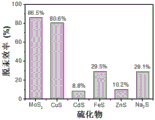
【图1】为实施例1所得的不同硫化物组成的吸收液对气体中的单质汞的脱除效果图。[Fig. 1] is a diagram showing the effect of removing elemental mercury in gas by absorbing liquids with different sulfide compositions obtained in Example 1. [Fig.
【图2】为实施例3所得的不同质量分数的二硫化钼吸收液对气体中的单质汞的脱除效果图。[Fig. 2] is a diagram showing the removal effect of molybdenum disulfide absorbing liquid of different mass fractions obtained in Example 3 on elemental mercury in the gas.
【图3】为实施例4所得的不同pH条件对单质汞的脱除效果影响曲线。[Fig. 3] is the influence curve of the removal effect of elemental mercury under different pH conditions obtained in Example 4.
【图4】为实施例5所得的二硫化钼分散液超声时间对单质汞的脱除影响效果图。[Fig. 4] is a graph showing the effect of the ultrasonic time of the molybdenum disulfide dispersion obtained in Example 5 on the removal of elemental mercury.
【图5】为实施例8所得的二硫化钼材料循环使用对单质汞的脱除影响效果图。[Fig. 5] is a diagram showing the effect of the recycling of the molybdenum disulfide material obtained in Example 8 on the removal of elemental mercury.
具体实施方式Detailed ways
以下实施例旨在进一步说明本发明内容,而不是限制发明权利要求保护范围。The following examples are intended to further illustrate the content of the present invention, rather than limit the protection scope of the claims of the invention.
以下实施例1~8中如没有特殊说明采用的二硫化钼均为纳米片层MoS2材料。其合成方法为:将4.3mmol钼酸铵和129mmol硫脲,在剧烈搅拌的条件下混合溶于150mL的去离子水中,形成均相溶液后,置于200mL的高温反应釜中于180℃的条件下水热反应24h。取反应产物分别用纯水和无水乙醇洗涤多次,置于60℃条件下真空干燥12h,得到黑色粉末状固体产物。Unless otherwise specified, molybdenum disulfide used in the following Examples 1 to 8 is nanosheet MoS 2 material. The synthesis method is as follows: 4.3 mmol of ammonium molybdate and 129 mmol of thiourea are mixed and dissolved in 150 mL of deionized water under vigorous stirring to form a homogeneous solution, and then placed in a 200 mL high-temperature reaction kettle at 180° C. Under the
实施例1Example 1
本实施采用的烟气的温度为25℃,烟气的主要成分含量(体积)为:SO2 4%,O25%,Hg0 245μg/Nm3,CO2 3%,其余的为N2。将气流量为0.5L/min的含汞烟气分别通入等量的不同的硫化物(MoS2、CuS、CdS、FeS、ZnS、Na2S)组成的汞吸收溶液中,溶液的pH为4,反应时间为120min,反应后气体中的单质汞的脱除效率如图1所示。从图1中可以看出,在相同的条件下,MoS2组成的汞吸收液的脱汞效果达到86.5%,其脱除单质汞的效果明显强于其它硫化物。The temperature of the flue gas used in this implementation is 25°C, and the main component contents (volume) of the flue gas are: SO 2 4%, O 2 5%, Hg 0 245 μg/Nm 3 , CO 2 3%, and the rest are N 2 . The mercury-containing flue gas with a gas flow of 0.5L/min was passed into the mercury absorption solution composed of the same amount of different sulfides (MoS 2 , CuS, CdS, FeS, ZnS, Na 2 S) respectively, and the pH of the solution was 4. The reaction time is 120 min, and the removal efficiency of elemental mercury in the gas after the reaction is shown in Figure 1. It can be seen from Figure 1 that under the same conditions, the mercury removal effect of the mercury absorbing solution composed of MoS2 reaches 86.5%, and its removal effect of elemental mercury is significantly stronger than that of other sulfides.
实施例2Example 2
本实施采用的烟气的温度为25℃,烟气的主要成分含量(体积)为:SO2 4%,O25%,Hg0 245μg/Nm3,CO2 3%,其余的为N2。将气流量为0.5L/min的含汞烟气分别通入等量的纳米二硫化钼和商业购买二硫化钼组成的汞吸收溶液中,溶液的pH为2,反应时间为24h,反应后气体中的单质汞脱除效率维持稳定在94.3%左右,而商业购买二硫化钼的单质汞脱除效率由反应开始的85%持续下降至反应结束时的29.8%。结果表明纳米二硫化钼材料在溶液中具有很好的稳定分散性,且对单质汞的脱除效率明显优于购买二硫化钼。The temperature of the flue gas used in this implementation is 25°C, and the main component contents (volume) of the flue gas are: SO 2 4%, O 2 5%, Hg 0 245 μg/Nm 3 , CO 2 3%, and the rest are N 2 . The mercury-containing flue gas with a gas flow of 0.5L/min was respectively introduced into the mercury absorption solution composed of the same amount of nano-molybdenum disulfide and commercially purchased molybdenum disulfide. The pH of the solution was 2, and the reaction time was 24h. After the reaction, the gas The removal efficiency of elemental mercury remained stable at about 94.3%, while the removal efficiency of commercially purchased molybdenum disulfide continued to drop from 85% at the beginning of the reaction to 29.8% at the end of the reaction. The results show that the nano-molybdenum disulfide material has good stability and dispersion in the solution, and the removal efficiency of elemental mercury is obviously better than that of purchasing molybdenum disulfide.
实施例3Example 3
本实施采用的烟气的温度为25℃,烟气的主要成分含量(体积)为:SO2 4%,O25%,Hg0 245μg/Nm3,CO2 3%,其余的为N2。汞吸收溶液中,二硫化钼的质量分数分别为0.03%,0.05%,0.11%,0.23%和0.33%,溶液的pH为4。将气流量为0.5L/min的含汞烟气通入超声2min的纳米片层MoS2分散液中,反应时间为100min,反应后气体中的单质汞的脱除效率如图2所示。从图2中可以看出,二硫化钼分散良好的溶液具有较高的脱汞效率,随着二硫化钼在溶液中质量分数的增加,汞的去除效率成上升的趋势,当质量分数为0.33%时,单质汞的脱除效率达到98.1%,该效果是在不添加任何氧化剂的条件下实现的。以上结果表明当添加的二硫化钼质量分数越大时,能够与单质汞结合的不饱和的硫活性位点就越多,从而脱除效果越好。The temperature of the flue gas used in this implementation is 25°C, and the main component contents (volume) of the flue gas are: SO 2 4%, O 2 5%, Hg 0 245 μg/Nm 3 , CO 2 3%, and the rest are N 2 . In the mercury absorption solution, the mass fractions of molybdenum disulfide were 0.03%, 0.05%, 0.11%, 0.23% and 0.33%, respectively, and the pH of the solution was 4. The mercury-containing flue gas with a gas flow rate of 0.5L/min was passed into the nanosheet MoS 2 dispersion solution of ultrasonic 2min, and the reaction time was 100min. The removal efficiency of elemental mercury in the gas after the reaction is shown in Figure 2. It can be seen from Figure 2 that the well-dispersed solution of molybdenum disulfide has higher mercury removal efficiency. With the increase of the mass fraction of molybdenum disulfide in the solution, the removal efficiency of mercury tends to increase. When the mass fraction is 0.33 %, the removal efficiency of elemental mercury reached 98.1%, which was achieved without adding any oxidant. The above results show that the larger the mass fraction of molybdenum disulfide added, the more unsaturated sulfur active sites that can combine with elemental mercury, and the better the removal effect.
实施例4Example 4
本实施采用的烟气的温度为25℃,烟气的主要成分含量(体积)为:SO2 4%,O25%,Hg0 245μg/Nm3,CO2 3%,其余的为N2。汞吸收溶液中,二硫化钼的质量分数为0.05%,溶液的pH分别为0,1,2,3,4,5,7,9,11,13和14。将气流量为0.5L/min的含汞烟气通入超声2min的纳米片层MoS2分散液中,反应时间为100min,反应后气体中的单质汞的脱除效率如图3所示。从图3中可以看出,pH对MoS2脱除单质汞具有一定的影响作用,从图中的总体趋势可以看出,随着溶液的pH由酸性向碱性过渡,其对单质汞的脱除效率呈下降趋势,当溶液的pH为14时,脱汞效率为75.0%,MoS2在酸性条件下表现出的脱汞效果明显强于碱性条件下的脱汞效果。酸性条件下,当pH由2降为0时,汞的脱除效率由94.0%降低至80.0%,出现明显的下降趋势,说明溶液H+的存在对单质汞的脱除具有一定的影响。The temperature of the flue gas used in this implementation is 25°C, and the main component contents (volume) of the flue gas are: SO 2 4%, O 2 5%, Hg 0 245 μg/Nm 3 , CO 2 3%, and the rest are N 2 . In the mercury absorption solution, the mass fraction of molybdenum disulfide is 0.05%, and the pH of the solution is 0, 1, 2, 3, 4, 5, 7, 9, 11, 13 and 14, respectively. The mercury-containing flue gas with a gas flow of 0.5 L/min was passed into the nano-sheet MoS 2 dispersion solution of ultrasonic 2 min, and the reaction time was 100 min. The removal efficiency of elemental mercury in the gas after the reaction is shown in Figure 3. It can be seen from Figure 3 that pH has a certain effect on the removal of elemental mercury from MoS 2. From the overall trend in the figure, it can be seen that as the pH of the solution transitions from acidic to alkaline, it has a certain effect on the removal of elemental mercury. The removal efficiency showed a downward trend. When the pH of the solution was 14, the mercury removal efficiency was 75.0%, and the mercury removal effect of MoS2 under acidic conditions was significantly stronger than that under alkaline conditions. Under acidic conditions, when the pH decreased from 2 to 0, the removal efficiency of mercury decreased from 94.0% to 80.0%, showing an obvious downward trend, indicating that the presence of solution H + has a certain influence on the removal of elemental mercury.
实施例5Example 5
本实施采用的烟气的温度为25℃,烟气的主要成分含量(体积)为:SO2 4%,O25%,Hg0 245μg/Nm3,CO2 3%,其余的为N2。汞吸收溶液中,二硫化钼的质量分数为0.05%,溶液的pH分别为4。将气流量为0.5L/min的含汞烟气通入超声时间分别为2min,1h,8h和24h的纳米片层MoS2分散液中,反应时间为100min,反应后气体中的单质汞的脱除效率如图4所示。从图4中可以看出,随着超声时间的增加,体系对单质汞的脱除效率逐渐增加,当超声时间为24h时,单质汞的脱除效率达到95.6%,表明超声对二硫化钼在溶液中脱除单质汞具有一定的促进作用。The temperature of the flue gas used in this implementation is 25°C, and the main component contents (volume) of the flue gas are: SO 2 4%, O 2 5%, Hg 0 245 μg/Nm 3 , CO 2 3%, and the rest are N 2 . In the mercury absorption solution, the mass fraction of molybdenum disulfide is 0.05%, and the pH of the solution is 4, respectively. The mercury-containing flue gas with a gas flow of 0.5L/min was passed into the nanosheet MoS2 dispersion with ultrasonic time of 2min , 1h, 8h and 24h respectively, and the reaction time was 100min. After the reaction, the elemental mercury in the gas was removed. The removal efficiency is shown in Figure 4. It can be seen from Figure 4 that with the increase of ultrasonic time, the removal efficiency of elemental mercury of the system gradually increased. When the ultrasonic time was 24h, the removal efficiency of elemental mercury reached 95.6%, indicating that the ultrasonic effect on molybdenum disulfide was not effective. The removal of elemental mercury in the solution has a certain promotion effect.
实施例6Example 6
本实施采用的烟气的温度为分别为25℃,35℃,45℃,55℃和65℃,烟气的主要成分含量(体积)为:SO2 4%,O2 5%,Hg0 245μg/Nm3,CO2 3%,其余的为N2。汞吸收溶液中,二硫化钼的质量分数为0.05%,溶液的pH分别为4。将气流量为0.5L/min的含汞烟气通入超声时间分别为2min的纳米片层MoS2分散液中,反应时间为100min,反应后发现随着温度的升高,汞的脱除效率出现缓慢下降的现象,但是趋势不明显,脱汞效率维持在85%~86.5%之间,其缓慢下降的原因可能是由于温度升高,单质汞的溶解度减少,容易挥发,在水中停留时间变短与二硫化钼接触机会减少。The temperatures of the flue gas used in this implementation are 25°C, 35°C, 45°C, 55°C and 65°C respectively, and the main component contents (volume) of the flue gas are: SO 2 4%, O 2 5%, Hg 0 245μg /Nm 3 , CO 2 3% and the rest N 2 . In the mercury absorption solution, the mass fraction of molybdenum disulfide is 0.05%, and the pH of the solution is 4, respectively. The mercury-containing flue gas with a gas flow of 0.5 L/min was passed into the nano-sheet MoS 2 dispersion with an ultrasonic time of 2 min respectively, and the reaction time was 100 min. After the reaction, it was found that with the increase of temperature, the removal efficiency of mercury increased. There is a slow decline, but the trend is not obvious. The mercury removal efficiency is maintained between 85% and 86.5%. The reason for the slow decline may be that the solubility of elemental mercury decreases due to the increase in temperature, and it is easy to volatilize. The residence time in water changes. Shorter chances of contact with molybdenum disulfide.
实施例7Example 7
本实施采用的烟气的温度为25℃,烟气的主要成分含量(体积)为:SO2 4%,O25%,Hg0 245μg/Nm3,CO2 3%,其余的为N2。汞吸收溶液中,二硫化钼的质量分数为0.05%,溶液中Hg2+的浓度为4.67ppm,溶液的pH为4。将气流量为0.5L/min的含汞烟气通入超声2min的纳米片层MoS2分散液中,反应时间为100min。反应结束后测得单质汞的透过率11.7%,与不加入Hg2+时的透过率的13.5%稍有降低,说明一定浓度的Hg2+的加入对单质汞的脱除效率有一定程度的促进作用。The temperature of the flue gas used in this implementation is 25°C, and the main component contents (volume) of the flue gas are: SO 2 4%, O 2 5%, Hg 0 245 μg/Nm 3 , CO 2 3%, and the rest are N 2 . In the mercury absorption solution, the mass fraction of molybdenum disulfide is 0.05%, the concentration of Hg 2+ in the solution is 4.67 ppm, and the pH of the solution is 4. The mercury-containing flue gas with a gas flow of 0.5 L/min was passed into the nano-sheet MoS 2 dispersion liquid that was sonicated for 2 min, and the reaction time was 100 min. After the reaction, the transmittance of elemental mercury was measured to be 11.7%, which was slightly lower than the transmittance of 13.5 % when Hg was not added, indicating that the addition of a certain concentration of Hg had a certain effect on the removal efficiency of elemental mercury. degree of promotion.
实施例8Example 8
本实施采用的烟气的温度为分别为25℃,35℃,45℃,55℃和65℃,烟气的主要成分含量(体积)为:SO2 4%,O2 5%,Hg0 245μg/Nm3,CO2 3%,其余的为N2。汞吸收溶液中,二硫化钼的质量分数为0.05%,溶液的pH分别为2。将吸附饱和的二硫化钼材料用12.5mol/L的浓盐酸进行脱附,脱附后的纳米二硫化钼材料在循环使用两次后,依然能够保持较高的汞去除率,单质汞的脱除效率如图5所示。The temperatures of the flue gas used in this implementation are 25°C, 35°C, 45°C, 55°C and 65°C respectively, and the main component contents (volume) of the flue gas are: SO 2 4%, O 2 5%, Hg 0 245μg /Nm 3 , CO 2 3% and the rest N 2 . In the mercury absorption solution, the mass fraction of molybdenum disulfide is 0.05%, and the pH of the solution is 2, respectively. The saturated molybdenum disulfide material was desorbed with 12.5mol/L concentrated hydrochloric acid, and the desorbed nano-molybdenum disulfide material could still maintain a high mercury removal rate after being recycled twice. The removal efficiency is shown in Figure 5.
Claims (8)
Priority Applications (1)
| Application Number | Priority Date | Filing Date | Title |
|---|---|---|---|
| CN201810081939.3A CN108187451B (en) | 2018-01-29 | 2018-01-29 | A method for wet removal of gaseous elemental mercury from nano molybdenum sulfide material |
Applications Claiming Priority (1)
| Application Number | Priority Date | Filing Date | Title |
|---|---|---|---|
| CN201810081939.3A CN108187451B (en) | 2018-01-29 | 2018-01-29 | A method for wet removal of gaseous elemental mercury from nano molybdenum sulfide material |
Publications (2)
| Publication Number | Publication Date |
|---|---|
| CN108187451A CN108187451A (en) | 2018-06-22 |
| CN108187451B true CN108187451B (en) | 2020-06-26 |
Family
ID=62591607
Family Applications (1)
| Application Number | Title | Priority Date | Filing Date |
|---|---|---|---|
| CN201810081939.3A Active CN108187451B (en) | 2018-01-29 | 2018-01-29 | A method for wet removal of gaseous elemental mercury from nano molybdenum sulfide material |
Country Status (1)
| Country | Link |
|---|---|
| CN (1) | CN108187451B (en) |
Families Citing this family (10)
| Publication number | Priority date | Publication date | Assignee | Title |
|---|---|---|---|---|
| CN109200795B (en) * | 2018-11-13 | 2020-07-31 | 中南大学 | A method for efficient removal of elemental mercury in flue gas with sulfur dioxide and nano-sulfur solution |
| CN109248549B (en) * | 2018-11-13 | 2020-07-31 | 中南大学 | Method for washing and removing elemental mercury in mercury-containing gas by using superfine nano sulfur solution |
| CN109569551A (en) * | 2018-11-27 | 2019-04-05 | 中国科学院北京综合研究中心 | A kind of preparation method and regeneration method of the nano ceramic material loading nanometer selenium |
| CN111394144A (en) * | 2020-03-13 | 2020-07-10 | 山西新华化工有限责任公司 | Mercury remover and preparation method thereof |
| CN111330427A (en) * | 2020-03-23 | 2020-06-26 | 中南大学 | Application of a metal sulfide mercury removal agent in washing and removing mercury from flue gas |
| CN112047667B (en) * | 2020-09-15 | 2021-11-12 | 常熟理工学院 | A kind of preparation method and application of mercury-contaminated soil molybdenum disulfide geopolymer composite material |
| CN112755764B (en) * | 2020-12-16 | 2021-10-19 | 中南大学 | A kind of stable suspension system for removing mercury in flue gas and its recovery method |
| CN115780817B (en) * | 2022-12-08 | 2025-11-07 | 中国科学院大学 | Device and method for removing elemental mercury by using electric explosion metal wire |
| CN116588973A (en) * | 2023-02-21 | 2023-08-15 | 中南大学 | Preparation method of DMF expanded molybdenum disulfide, DMF expanded molybdenum disulfide and its application |
| CN119926433B (en) * | 2025-04-09 | 2025-07-25 | 中南大学 | Vanadium-molybdenum disulfide/aluminum oxide composite material, preparation method thereof and application thereof in preparing sulfur and hydrogen by catalytic hydrogen sulfide thermal cracking |
Citations (1)
| Publication number | Priority date | Publication date | Assignee | Title |
|---|---|---|---|---|
| CN107362767A (en) * | 2016-05-13 | 2017-11-21 | 中国科学院长春应用化学研究所 | A kind of method of transient metal sulfide absorption mercury ion with broadening piece interlamellar spacing |
Family Cites Families (6)
| Publication number | Priority date | Publication date | Assignee | Title |
|---|---|---|---|---|
| CN101480605B (en) * | 2009-01-05 | 2011-05-25 | 浙江工业大学 | A kind of activated carbon fiber adsorbent and its preparation method and application |
| DE112014001316T5 (en) * | 2013-03-13 | 2015-12-31 | Novinda Corporation | Multi-component compositions for the removal of mercury |
| CN105107362A (en) * | 2015-09-17 | 2015-12-02 | 昆明理工大学 | Method for deep removal of zero valence mercury in mercury smelting flue gas |
| CN106731559B (en) * | 2015-11-23 | 2020-06-23 | 中国铝业股份有限公司 | Mercury-containing flue gas wet-process mercury removal agent and mercury removal method |
| CN105344309B (en) * | 2015-12-01 | 2019-03-05 | 宁波诺丁汉新材料研究院有限公司 | Mercury remover with nano-layered structure and preparation method thereof |
| JP2017176997A (en) * | 2016-03-30 | 2017-10-05 | 住友金属鉱山エンジニアリング株式会社 | Heavy metal adsorbent, method for producing heavy metal adsorbent, and method for removing heavy metal |
-
2018
- 2018-01-29 CN CN201810081939.3A patent/CN108187451B/en active Active
Patent Citations (1)
| Publication number | Priority date | Publication date | Assignee | Title |
|---|---|---|---|---|
| CN107362767A (en) * | 2016-05-13 | 2017-11-21 | 中国科学院长春应用化学研究所 | A kind of method of transient metal sulfide absorption mercury ion with broadening piece interlamellar spacing |
Non-Patent Citations (1)
| Title |
|---|
| 具有纳米层状MoS2结构的新型汞吸附剂;赵海涛等;《2015年汞污染防治与履行国际汞公约国际研讨会》;20151231;第118-122页 * |
Also Published As
| Publication number | Publication date |
|---|---|
| CN108187451A (en) | 2018-06-22 |
Similar Documents
| Publication | Publication Date | Title |
|---|---|---|
| CN108187451B (en) | A method for wet removal of gaseous elemental mercury from nano molybdenum sulfide material | |
| Yang et al. | Highly stable activated carbon composite material to selectively capture gas-phase elemental mercury from smelting flue gas: Copper polysulfide modification | |
| Tan et al. | Preparation and characterization of Fe2O3–SiO2 composite and its effect on elemental mercury removal | |
| Liu et al. | Immobilization of elemental mercury in non-ferrous metal smelting gas using ZnSe1− xSx nanoparticles | |
| CN106943871B (en) | A method for removing multi-pollutants from flue gas by gas-phase catalytic oxidation at low temperature | |
| CN103623772B (en) | A kind of adsorbent for removing and reclaim liquid phase mercury and preparation method thereof and using method | |
| Liu et al. | Co-doped ZnS with large adsorption capacity for recovering Hg0 from non-ferrous metal smelting gas as a co-benefit of electrostatic demisters | |
| CN108568290A (en) | The preparation method and application of the spherical adsorbent of efficient removal low concentration hydrogen sulphide | |
| CN112169757A (en) | A low temperature plasma modified carbon nanotube and its application in water treatment | |
| US12427495B2 (en) | Preparation method of mercury removal material | |
| CN113713594B (en) | Method for improving deep demercuration effect of sulfide and/or selenide | |
| CN113816554B (en) | Treatment method and treatment device for isooctyl thioglycolate production wastewater | |
| CN112717931B (en) | An iron-based composite desulfurizer, its preparation method and its application in removing hydrogen sulfide in gas | |
| CN101406794B (en) | Method for preparing exhaust gas mercury-removing reagent from modification of waste desulfurizing agent | |
| CN115715973A (en) | In-situ nano-selenium carbon-based demercuration adsorption material and preparation method and application thereof | |
| CN101357322A (en) | Preparation method of transition metal compound loaded vermiculite absorbent | |
| CN108554368A (en) | A kind of preparation method and application of the adsorbent of removing low concentration hydrogen sulphide | |
| CN114100592B (en) | A method for regenerating flue gas mercury removal materials and recovering elemental mercury | |
| CN102580674A (en) | Method for preparing mercury removal agent by utilizing modified waste tire pyrolysis residue | |
| AU2020203664B2 (en) | Magnetic selenium doped iron-sulfur composite and preparation method and application thereof | |
| CN105080487A (en) | Active carbon desulphurization adsorbent loaded with cobalt phthalocyanine sulfonate and copper and preparation method thereof | |
| CN114425305A (en) | A kind of mercury adsorption material and preparation method thereof and application in flue gas or solution mercury removal | |
| CN107398171A (en) | A kind of method that acid gas in flue gas is removed using metal tailings | |
| CN114272748B (en) | Ammonia purification equipment and method | |
| CN118649538A (en) | A desulfurizing agent and its preparation method and application |
Legal Events
| Date | Code | Title | Description |
|---|---|---|---|
| PB01 | Publication | ||
| PB01 | Publication | ||
| SE01 | Entry into force of request for substantive examination | ||
| SE01 | Entry into force of request for substantive examination | ||
| GR01 | Patent grant | ||
| GR01 | Patent grant |