CN108137539B - Substituted benzimidazoles, their preparation and their use as pharmaceuticals - Google Patents
Substituted benzimidazoles, their preparation and their use as pharmaceuticals Download PDFInfo
- Publication number
- CN108137539B CN108137539B CN201680059249.7A CN201680059249A CN108137539B CN 108137539 B CN108137539 B CN 108137539B CN 201680059249 A CN201680059249 A CN 201680059249A CN 108137539 B CN108137539 B CN 108137539B
- Authority
- CN
- China
- Prior art keywords
- cancer
- compound
- mmol
- propyl
- alkyl
- Prior art date
- Legal status (The legal status is an assumption and is not a legal conclusion. Google has not performed a legal analysis and makes no representation as to the accuracy of the status listed.)
- Active
Links
Classifications
-
- C—CHEMISTRY; METALLURGY
- C07—ORGANIC CHEMISTRY
- C07D—HETEROCYCLIC COMPOUNDS
- C07D401/00—Heterocyclic compounds containing two or more hetero rings, having nitrogen atoms as the only ring hetero atoms, at least one ring being a six-membered ring with only one nitrogen atom
- C07D401/02—Heterocyclic compounds containing two or more hetero rings, having nitrogen atoms as the only ring hetero atoms, at least one ring being a six-membered ring with only one nitrogen atom containing two hetero rings
- C07D401/10—Heterocyclic compounds containing two or more hetero rings, having nitrogen atoms as the only ring hetero atoms, at least one ring being a six-membered ring with only one nitrogen atom containing two hetero rings linked by a carbon chain containing aromatic rings
-
- C—CHEMISTRY; METALLURGY
- C07—ORGANIC CHEMISTRY
- C07D—HETEROCYCLIC COMPOUNDS
- C07D401/00—Heterocyclic compounds containing two or more hetero rings, having nitrogen atoms as the only ring hetero atoms, at least one ring being a six-membered ring with only one nitrogen atom
- C07D401/14—Heterocyclic compounds containing two or more hetero rings, having nitrogen atoms as the only ring hetero atoms, at least one ring being a six-membered ring with only one nitrogen atom containing three or more hetero rings
-
- A—HUMAN NECESSITIES
- A61—MEDICAL OR VETERINARY SCIENCE; HYGIENE
- A61K—PREPARATIONS FOR MEDICAL, DENTAL OR TOILETRY PURPOSES
- A61K31/00—Medicinal preparations containing organic active ingredients
- A61K31/33—Heterocyclic compounds
- A61K31/395—Heterocyclic compounds having nitrogen as a ring hetero atom, e.g. guanethidine or rifamycins
- A61K31/41—Heterocyclic compounds having nitrogen as a ring hetero atom, e.g. guanethidine or rifamycins having five-membered rings with two or more ring hetero atoms, at least one of which being nitrogen, e.g. tetrazole
- A61K31/4164—1,3-Diazoles
- A61K31/4184—1,3-Diazoles condensed with carbocyclic rings, e.g. benzimidazoles
-
- A—HUMAN NECESSITIES
- A61—MEDICAL OR VETERINARY SCIENCE; HYGIENE
- A61K—PREPARATIONS FOR MEDICAL, DENTAL OR TOILETRY PURPOSES
- A61K31/00—Medicinal preparations containing organic active ingredients
- A61K31/33—Heterocyclic compounds
- A61K31/395—Heterocyclic compounds having nitrogen as a ring hetero atom, e.g. guanethidine or rifamycins
- A61K31/435—Heterocyclic compounds having nitrogen as a ring hetero atom, e.g. guanethidine or rifamycins having six-membered rings with one nitrogen as the only ring hetero atom
- A61K31/44—Non condensed pyridines; Hydrogenated derivatives thereof
- A61K31/4427—Non condensed pyridines; Hydrogenated derivatives thereof containing further heterocyclic ring systems
- A61K31/4439—Non condensed pyridines; Hydrogenated derivatives thereof containing further heterocyclic ring systems containing a five-membered ring with nitrogen as a ring hetero atom, e.g. omeprazole
-
- A—HUMAN NECESSITIES
- A61—MEDICAL OR VETERINARY SCIENCE; HYGIENE
- A61P—SPECIFIC THERAPEUTIC ACTIVITY OF CHEMICAL COMPOUNDS OR MEDICINAL PREPARATIONS
- A61P1/00—Drugs for disorders of the alimentary tract or the digestive system
-
- A—HUMAN NECESSITIES
- A61—MEDICAL OR VETERINARY SCIENCE; HYGIENE
- A61P—SPECIFIC THERAPEUTIC ACTIVITY OF CHEMICAL COMPOUNDS OR MEDICINAL PREPARATIONS
- A61P1/00—Drugs for disorders of the alimentary tract or the digestive system
- A61P1/04—Drugs for disorders of the alimentary tract or the digestive system for ulcers, gastritis or reflux esophagitis, e.g. antacids, inhibitors of acid secretion, mucosal protectants
-
- A—HUMAN NECESSITIES
- A61—MEDICAL OR VETERINARY SCIENCE; HYGIENE
- A61P—SPECIFIC THERAPEUTIC ACTIVITY OF CHEMICAL COMPOUNDS OR MEDICINAL PREPARATIONS
- A61P11/00—Drugs for disorders of the respiratory system
-
- A—HUMAN NECESSITIES
- A61—MEDICAL OR VETERINARY SCIENCE; HYGIENE
- A61P—SPECIFIC THERAPEUTIC ACTIVITY OF CHEMICAL COMPOUNDS OR MEDICINAL PREPARATIONS
- A61P11/00—Drugs for disorders of the respiratory system
- A61P11/06—Antiasthmatics
-
- A—HUMAN NECESSITIES
- A61—MEDICAL OR VETERINARY SCIENCE; HYGIENE
- A61P—SPECIFIC THERAPEUTIC ACTIVITY OF CHEMICAL COMPOUNDS OR MEDICINAL PREPARATIONS
- A61P13/00—Drugs for disorders of the urinary system
- A61P13/12—Drugs for disorders of the urinary system of the kidneys
-
- A—HUMAN NECESSITIES
- A61—MEDICAL OR VETERINARY SCIENCE; HYGIENE
- A61P—SPECIFIC THERAPEUTIC ACTIVITY OF CHEMICAL COMPOUNDS OR MEDICINAL PREPARATIONS
- A61P17/00—Drugs for dermatological disorders
-
- A—HUMAN NECESSITIES
- A61—MEDICAL OR VETERINARY SCIENCE; HYGIENE
- A61P—SPECIFIC THERAPEUTIC ACTIVITY OF CHEMICAL COMPOUNDS OR MEDICINAL PREPARATIONS
- A61P17/00—Drugs for dermatological disorders
- A61P17/02—Drugs for dermatological disorders for treating wounds, ulcers, burns, scars, keloids, or the like
-
- A—HUMAN NECESSITIES
- A61—MEDICAL OR VETERINARY SCIENCE; HYGIENE
- A61P—SPECIFIC THERAPEUTIC ACTIVITY OF CHEMICAL COMPOUNDS OR MEDICINAL PREPARATIONS
- A61P17/00—Drugs for dermatological disorders
- A61P17/06—Antipsoriatics
-
- A—HUMAN NECESSITIES
- A61—MEDICAL OR VETERINARY SCIENCE; HYGIENE
- A61P—SPECIFIC THERAPEUTIC ACTIVITY OF CHEMICAL COMPOUNDS OR MEDICINAL PREPARATIONS
- A61P17/00—Drugs for dermatological disorders
- A61P17/10—Anti-acne agents
-
- A—HUMAN NECESSITIES
- A61—MEDICAL OR VETERINARY SCIENCE; HYGIENE
- A61P—SPECIFIC THERAPEUTIC ACTIVITY OF CHEMICAL COMPOUNDS OR MEDICINAL PREPARATIONS
- A61P17/00—Drugs for dermatological disorders
- A61P17/14—Drugs for dermatological disorders for baldness or alopecia
-
- A—HUMAN NECESSITIES
- A61—MEDICAL OR VETERINARY SCIENCE; HYGIENE
- A61P—SPECIFIC THERAPEUTIC ACTIVITY OF CHEMICAL COMPOUNDS OR MEDICINAL PREPARATIONS
- A61P19/00—Drugs for skeletal disorders
- A61P19/02—Drugs for skeletal disorders for joint disorders, e.g. arthritis, arthrosis
-
- A—HUMAN NECESSITIES
- A61—MEDICAL OR VETERINARY SCIENCE; HYGIENE
- A61P—SPECIFIC THERAPEUTIC ACTIVITY OF CHEMICAL COMPOUNDS OR MEDICINAL PREPARATIONS
- A61P21/00—Drugs for disorders of the muscular or neuromuscular system
- A61P21/04—Drugs for disorders of the muscular or neuromuscular system for myasthenia gravis
-
- A—HUMAN NECESSITIES
- A61—MEDICAL OR VETERINARY SCIENCE; HYGIENE
- A61P—SPECIFIC THERAPEUTIC ACTIVITY OF CHEMICAL COMPOUNDS OR MEDICINAL PREPARATIONS
- A61P25/00—Drugs for disorders of the nervous system
- A61P25/14—Drugs for disorders of the nervous system for treating abnormal movements, e.g. chorea, dyskinesia
- A61P25/16—Anti-Parkinson drugs
-
- A—HUMAN NECESSITIES
- A61—MEDICAL OR VETERINARY SCIENCE; HYGIENE
- A61P—SPECIFIC THERAPEUTIC ACTIVITY OF CHEMICAL COMPOUNDS OR MEDICINAL PREPARATIONS
- A61P25/00—Drugs for disorders of the nervous system
- A61P25/28—Drugs for disorders of the nervous system for treating neurodegenerative disorders of the central nervous system, e.g. nootropic agents, cognition enhancers, drugs for treating Alzheimer's disease or other forms of dementia
-
- A—HUMAN NECESSITIES
- A61—MEDICAL OR VETERINARY SCIENCE; HYGIENE
- A61P—SPECIFIC THERAPEUTIC ACTIVITY OF CHEMICAL COMPOUNDS OR MEDICINAL PREPARATIONS
- A61P29/00—Non-central analgesic, antipyretic or antiinflammatory agents, e.g. antirheumatic agents; Non-steroidal antiinflammatory drugs [NSAID]
-
- A—HUMAN NECESSITIES
- A61—MEDICAL OR VETERINARY SCIENCE; HYGIENE
- A61P—SPECIFIC THERAPEUTIC ACTIVITY OF CHEMICAL COMPOUNDS OR MEDICINAL PREPARATIONS
- A61P3/00—Drugs for disorders of the metabolism
- A61P3/08—Drugs for disorders of the metabolism for glucose homeostasis
- A61P3/10—Drugs for disorders of the metabolism for glucose homeostasis for hyperglycaemia, e.g. antidiabetics
-
- A—HUMAN NECESSITIES
- A61—MEDICAL OR VETERINARY SCIENCE; HYGIENE
- A61P—SPECIFIC THERAPEUTIC ACTIVITY OF CHEMICAL COMPOUNDS OR MEDICINAL PREPARATIONS
- A61P31/00—Antiinfectives, i.e. antibiotics, antiseptics, chemotherapeutics
-
- A—HUMAN NECESSITIES
- A61—MEDICAL OR VETERINARY SCIENCE; HYGIENE
- A61P—SPECIFIC THERAPEUTIC ACTIVITY OF CHEMICAL COMPOUNDS OR MEDICINAL PREPARATIONS
- A61P35/00—Antineoplastic agents
-
- A—HUMAN NECESSITIES
- A61—MEDICAL OR VETERINARY SCIENCE; HYGIENE
- A61P—SPECIFIC THERAPEUTIC ACTIVITY OF CHEMICAL COMPOUNDS OR MEDICINAL PREPARATIONS
- A61P35/00—Antineoplastic agents
- A61P35/02—Antineoplastic agents specific for leukemia
-
- A—HUMAN NECESSITIES
- A61—MEDICAL OR VETERINARY SCIENCE; HYGIENE
- A61P—SPECIFIC THERAPEUTIC ACTIVITY OF CHEMICAL COMPOUNDS OR MEDICINAL PREPARATIONS
- A61P37/00—Drugs for immunological or allergic disorders
- A61P37/02—Immunomodulators
- A61P37/06—Immunosuppressants, e.g. drugs for graft rejection
-
- A—HUMAN NECESSITIES
- A61—MEDICAL OR VETERINARY SCIENCE; HYGIENE
- A61P—SPECIFIC THERAPEUTIC ACTIVITY OF CHEMICAL COMPOUNDS OR MEDICINAL PREPARATIONS
- A61P7/00—Drugs for disorders of the blood or the extracellular fluid
-
- A—HUMAN NECESSITIES
- A61—MEDICAL OR VETERINARY SCIENCE; HYGIENE
- A61P—SPECIFIC THERAPEUTIC ACTIVITY OF CHEMICAL COMPOUNDS OR MEDICINAL PREPARATIONS
- A61P7/00—Drugs for disorders of the blood or the extracellular fluid
- A61P7/06—Antianaemics
-
- A—HUMAN NECESSITIES
- A61—MEDICAL OR VETERINARY SCIENCE; HYGIENE
- A61P—SPECIFIC THERAPEUTIC ACTIVITY OF CHEMICAL COMPOUNDS OR MEDICINAL PREPARATIONS
- A61P9/00—Drugs for disorders of the cardiovascular system
- A61P9/10—Drugs for disorders of the cardiovascular system for treating ischaemic or atherosclerotic diseases, e.g. antianginal drugs, coronary vasodilators, drugs for myocardial infarction, retinopathy, cerebrovascula insufficiency, renal arteriosclerosis
-
- C—CHEMISTRY; METALLURGY
- C07—ORGANIC CHEMISTRY
- C07D—HETEROCYCLIC COMPOUNDS
- C07D401/00—Heterocyclic compounds containing two or more hetero rings, having nitrogen atoms as the only ring hetero atoms, at least one ring being a six-membered ring with only one nitrogen atom
- C07D401/02—Heterocyclic compounds containing two or more hetero rings, having nitrogen atoms as the only ring hetero atoms, at least one ring being a six-membered ring with only one nitrogen atom containing two hetero rings
- C07D401/04—Heterocyclic compounds containing two or more hetero rings, having nitrogen atoms as the only ring hetero atoms, at least one ring being a six-membered ring with only one nitrogen atom containing two hetero rings directly linked by a ring-member-to-ring-member bond
-
- C—CHEMISTRY; METALLURGY
- C07—ORGANIC CHEMISTRY
- C07D—HETEROCYCLIC COMPOUNDS
- C07D405/00—Heterocyclic compounds containing both one or more hetero rings having oxygen atoms as the only ring hetero atoms, and one or more rings having nitrogen as the only ring hetero atom
- C07D405/14—Heterocyclic compounds containing both one or more hetero rings having oxygen atoms as the only ring hetero atoms, and one or more rings having nitrogen as the only ring hetero atom containing three or more hetero rings
Landscapes
- Health & Medical Sciences (AREA)
- Chemical & Material Sciences (AREA)
- Organic Chemistry (AREA)
- Medicinal Chemistry (AREA)
- Animal Behavior & Ethology (AREA)
- Life Sciences & Earth Sciences (AREA)
- Veterinary Medicine (AREA)
- Public Health (AREA)
- Pharmacology & Pharmacy (AREA)
- General Health & Medical Sciences (AREA)
- General Chemical & Material Sciences (AREA)
- Nuclear Medicine, Radiotherapy & Molecular Imaging (AREA)
- Chemical Kinetics & Catalysis (AREA)
- Bioinformatics & Cheminformatics (AREA)
- Engineering & Computer Science (AREA)
- Dermatology (AREA)
- Rheumatology (AREA)
- Immunology (AREA)
- Orthopedic Medicine & Surgery (AREA)
- Physical Education & Sports Medicine (AREA)
- Diabetes (AREA)
- Neurology (AREA)
- Epidemiology (AREA)
- Biomedical Technology (AREA)
- Neurosurgery (AREA)
- Hematology (AREA)
- Pain & Pain Management (AREA)
- Pulmonology (AREA)
- Oncology (AREA)
- Urology & Nephrology (AREA)
- Obesity (AREA)
- Transplantation (AREA)
- Hospice & Palliative Care (AREA)
- Endocrinology (AREA)
- Psychiatry (AREA)
- Psychology (AREA)
- Emergency Medicine (AREA)
- Vascular Medicine (AREA)
- Cardiology (AREA)
- Heart & Thoracic Surgery (AREA)
Abstract
本申请涉及式(I)的取代的苯并咪唑,包含它们的组合物以及它们在治疗其中需要抑制溴结构域的疾病和病症中的用途。例如,本申请涉及取代的苯并咪唑以及它们作为溴结构域抑制剂的用途。本申请还涉及治疗或预防增殖性病症、自身免疫性疾病、炎性病症、皮肤病症和新生物(包括肿瘤和/或癌症)。
Description
相关申请Related applications
本发明要求于2015年8月12日提交的美国临时申请No.62/204,178以及于2016年7月4日提交的美国临时申请No.62/358,101的优先权,其内容为了所有目的通过引用整体并入本文。This application claims priority to US Provisional Application No. 62/204,178, filed August 12, 2015, and US Provisional Application No. 62/358,101, filed July 4, 2016, the entire contents of which are incorporated by reference for all purposes Incorporated herein.
技术领域technical field
技术领域总体关于化合物,组合物及其在治疗其中需要抑制溴结构域的疾病和病症中的用途。例如,本发明涉及苯并咪唑,包含它们的药物组合物,以及它们作为溴结构域抑制剂的用途。本发明还涉及治疗或预防增殖性病症、自身免疫性疾病、炎性病症、皮肤病症和赘生物(包括肿瘤和/或癌症)。The technical field relates generally to compounds, compositions and their use in the treatment of diseases and disorders in which inhibition of bromodomains is desired. For example, the present invention relates to benzimidazoles, pharmaceutical compositions containing them, and their use as bromodomain inhibitors. The present invention also relates to the treatment or prevention of proliferative disorders, autoimmune diseases, inflammatory disorders, skin disorders and neoplasms (including tumors and/or cancers).
背景技术Background technique
在各种哺乳动物DNA结合蛋白中发现了溴结构域。已知溴结构域是染色质相关蛋白和组蛋白乙酰基转移酶中保守的结构模块,可识别蛋白上的乙酰基赖氨酸残基。认为溴结构域抑制剂可用于治疗各种疾病或病症,例如癌症以及慢性自身免疫性和炎性病症。因此需要能够抑制溴结构域的化合物。Bromodomains are found in various mammalian DNA-binding proteins. Bromodomains are known to be conserved structural modules in chromatin-associated proteins and histone acetyltransferases that recognize acetyllysine residues on proteins. Bromodomain inhibitors are believed to be useful in the treatment of various diseases or disorders, such as cancer and chronic autoimmune and inflammatory disorders. There is thus a need for compounds capable of inhibiting bromodomains.
发明内容SUMMARY OF THE INVENTION
根据一个方面,本申请涉及式I的化合物及其药学上可接受的盐、溶剂合物、酯或前药:According to one aspect, the application relates to compounds of formula I and pharmaceutically acceptable salts, solvates, esters or prodrugs thereof:

其中,R1是:where R1 is :
a)未取代的C1-C6烷基;a) unsubstituted C 1 -C 6 alkyl;
b)C1-C6烷基,其被一个或多个选自以下的基团取代:卤素(例如氟)、CN、NO2、C(O)NHR11、C(O)N(R11)2、CO2H、SO2R11、SO2NHR11和SO2N(R11)2;b) C1 - C6 alkyl substituted with one or more groups selected from halogen (eg fluorine), CN, NO2 , C(O) NHR11 , C(O)N( R11 ) 2 , CO 2 H, SO 2 R 11 , SO 2 NHR 11 and SO 2 N(R 11 ) 2 ;
c)C2-C6烷基基团,其被一个选自以下的基团取代:OR11、卤代OC1-C6烷基、SH、SR11、NH2、NHR11、N(R11)2、NHC(O)R11和N(R11)C(O)R11;或者c) C 2 -C 6 alkyl groups substituted with one group selected from OR 11 , halogenated OC 1 -C 6 alkyl, SH, SR 11 , NH 2 , NHR 11 , N(R 11 ) 2 , NHC(O)R 11 and N(R 11 )C(O)R 11 ; or
d)选自以下的基团:C(O)R11、C(O)NHR11、C(O)N(R11)2、SO2R11、SO2NHR11和SO2N(R11)2;d) a group selected from the group consisting of C(O)R 11 , C(O)NHR 11 , C(O)N(R 11 ) 2 , SO 2 R 11 , SO 2 NHR 11 and SO 2 N(R 11 ) 2 ;
R2选自氢和取代或未取代的基团,其选自C1-C6烷基、C2-C6烯基、C2-C6炔基、C3-C10环烷基、C3-C10杂环烷基、C(O)R12、NH2、NHR12、N(R12)2、C(O)NH2、C(O)NHR12、C(O)N(R12)2、NHC(O)R12、SO2R12、SO2NHR12、SO2N(R12)2、NHSO2R12、N(R12)SO2R12、NHSO2NHR12、N(R12)SO2NHR12、NHSO2N(R12)2和N(R12)SO2N(R12)2;R 2 is selected from hydrogen and substituted or unsubstituted groups selected from C 1 -C 6 alkyl, C 2 -C 6 alkenyl, C 2 -C 6 alkynyl, C 3 -C 10 cycloalkyl, C 3 -C 10 heterocycloalkyl, C(O)R 12 , NH 2 , NHR 12 , N(R 12 ) 2 , C(O)NH 2 , C(O)NHR 12 , C(O)N( R 12 ) 2 , NHC(O)R 12 , SO 2 R 12 , SO 2 NHR 12 , SO 2 N(R 12 ) 2 , NHSO 2 R 12 , N(R 12 )SO 2 R 12 , NHSO 2 NHR 12 , N(R 12 )SO 2 NHR 12 , NHSO 2 N(R 12 ) 2 and N(R 12 )SO 2 N(R 12 ) 2 ;
R3和R6各自独立地为H或取代或未取代的基团,其选自C1-C6烷基、C(O)R11、NH2、NHR11、N(R11)2、C(O)NH2、C(O)NHR11、C(O)N(R11)2、NHC(O)R11;且R 4和R5中的一个是H或取代或未取代的基团,其选自C1-C6烷基、C(O)R11、NH2、NHR11、N(R11)2、C(O)NH2、C(O)NHR11、C(O)N(R11)2和NHC(O)R11;R4和R5中的另一个是式II的基团:R 3 and R 6 are each independently H or a substituted or unsubstituted group selected from C 1 -C 6 alkyl, C(O)R 11 , NH 2 , NHR 11 , N(R 11 ) 2 , C(O)NH 2 , C(O)NHR 11 , C(O)N(R 11 ) 2 , NHC(O)R 11 ; and one of R 4 and R 5 is H or a substituted or unsubstituted group group selected from C1 - C6 alkyl, C(O)R11, NH2 , NHR11 , N(R11) 2 , C(O ) NH2 , C( O ) NHR11 , C(O ) N(R 11 ) 2 and NHC(O)R 11 ; the other of R 4 and R 5 is a group of formula II:

其中,in,
R7、R8和R10各自独立地为H、卤素(如F、Cl)、CN或取代或未取代的C1-C6烷基或C3-C6环烷基、OR11、SR11、NHR11、N(R11)2、NHC(O)R11和N(R11)C(O)R11,条件是R7、R8和R10中的至少一个不是H;R 7 , R 8 and R 10 are each independently H, halogen (eg F, Cl), CN or substituted or unsubstituted C 1 -C 6 alkyl or C 3 -C 6 cycloalkyl, OR 11 , SR 11 , NHR 11 , N(R 11 ) 2 , NHC(O)R 11 and N(R 11 )C(O)R 11 , provided that at least one of R 7 , R 8 and R 10 is not H;
R9是取代或未取代的C1-C3烷基或C3-C5环烷基;R 9 is substituted or unsubstituted C 1 -C 3 alkyl or C 3 -C 5 cycloalkyl;
R11在每种情况下独立地为取代或未取代的C1-C6烷基;R 11 is in each case independently substituted or unsubstituted C 1 -C 6 alkyl;
R12在每种情况下独立地为取代或未取代的C1-C6烷基、C2-C6链烯基、C2-C6炔基、C3-C10环烷基和C3-C10杂环烷基;X1、X2和X3各自选自N或C,其中当X1、X2或X3为N时,则与其连接的R7、R8或R10不存在,条件是X1、X2和X3中的至少两个是C;R 12 is in each case independently substituted or unsubstituted C 1 -C 6 alkyl, C 2 -C 6 alkenyl, C 2 -C 6 alkynyl, C 3 -C 10 cycloalkyl and C 3 -C 10 heterocycloalkyl; X 1 , X 2 and X 3 are each selected from N or C, wherein when X 1 , X 2 or X 3 is N, then R 7 , R 8 or R 10 to which it is attached does not exist, provided that at least two of X 1 , X 2 and X 3 are C;
其中当任何前述基团含有烷基时,则所述烷基为直链或支链非环状烷基。Wherein when any of the foregoing groups contain an alkyl group, the alkyl group is a straight or branched chain acyclic alkyl group.
根据一个实施方案,化合物是式I的化合物,其中R4是式II的基团,优选地其中所述R5是氢或取代的或未取代的C1-C3烷基。根据另一个实施方案,所述化合物是式I的化合物,其中R5是式II的基团,优选地,其中所述R4是氢或取代或未取代的C1-C3烷基。According to one embodiment, the compound is a compound of formula I, wherein R 4 is a group of formula II, preferably wherein said R 5 is hydrogen or substituted or unsubstituted C 1 -C 3 alkyl. According to another embodiment, the compound is a compound of formula I, wherein R5 is a group of formula II, preferably, wherein said R4 is hydrogen or substituted or unsubstituted C1 - C3 alkyl.
在一个实施方案中,在式II中,基团X1、X2和X3全部是碳原子。在另一个实施方案中,X1是氮原子且R10不存在,并且X2和X3是碳原子。例如,式II的基团可以定义为式II(a)的基团:In one embodiment, in Formula II, the groups X 1 , X 2 and X 3 are all carbon atoms. In another embodiment, X1 is a nitrogen atom and R10 is absent, and X2 and X3 are carbon atoms. For example, a group of formula II can be defined as a group of formula II(a):
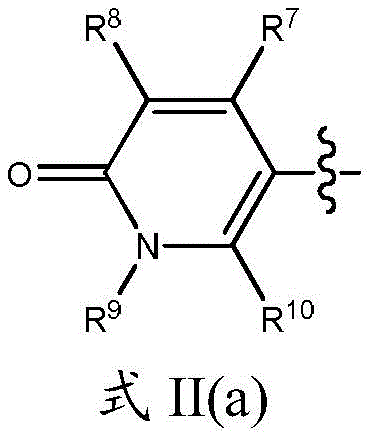
其中R7、R8、R9和R10如本文所定义。wherein R 7 , R 8 , R 9 and R 10 are as defined herein.
在一个实施方案中,R9是未取代的C1-C3烷基或C3-C5环烷基,例如甲基、乙基、正丙基、异丙基或环丙基。在另一个实施方案中,R7和R10各自为氢原子且R8选自Cl、CN、NHR11和取代或未取代的C1-C6烷基或C3-C6环烷基。In one embodiment, R 9 is unsubstituted C 1 -C 3 alkyl or C 3 -C 5 cycloalkyl, such as methyl, ethyl, n-propyl, isopropyl or cyclopropyl. In another embodiment, R 7 and R 10 are each a hydrogen atom and R 8 is selected from Cl, CN, NHR 11 and substituted or unsubstituted C 1 -C 6 alkyl or C 3 -C 6 cycloalkyl.
本申请的另一个实施方案涉及式I(a)的化合物及其药学上可接受的盐、溶剂合物、酯或前药:Another embodiment of the present application relates to compounds of formula I(a) and pharmaceutically acceptable salts, solvates, esters or prodrugs thereof:

其中,in,
R1、R2、R3、R5、R6、R7、R8、R9和R10如本文所定义。R 1 , R 2 , R 3 , R 5 , R 6 , R 7 , R 8 , R 9 and R 10 are as defined herein.
根据另一个实施方案,本申请还涉及式I(b)的化合物及其药学上可接受的盐、溶剂合物、酯或前药:According to another embodiment, the application also relates to compounds of formula I(b) and pharmaceutically acceptable salts, solvates, esters or prodrugs thereof:

其中,in,
R1、R2、R4、R3、R6、R7、R8、R9和R10如本文所定义。R 1 , R 2 , R 4 , R 3 , R 6 , R 7 , R 8 , R 9 and R 10 are as defined herein.
在一个实施方案中,本申请涉及如本文所定义的化合物,其R3是H或取代或未取代的C1-C6烷基基团,优选R3是H。在另一个实施方案中,本申请涉及如本文所定义的化合物,其中R6是H或取代或未取代的C1-C6烷基基团,优选R6是H。In one embodiment, the application relates to compounds as defined herein, wherein R3 is H or a substituted or unsubstituted C1 - C6 alkyl group, preferably R3 is H. In another embodiment, the application relates to compounds as defined herein, wherein R6 is H or a substituted or unsubstituted C1 -C6 alkyl group, preferably R6 is H.
在另一个实施方案中,本申请涉及式III的化合物及其药学上可接受的盐、溶剂合物、酯或前药:In another embodiment, the application relates to compounds of formula III and pharmaceutically acceptable salts, solvates, esters or prodrugs thereof:
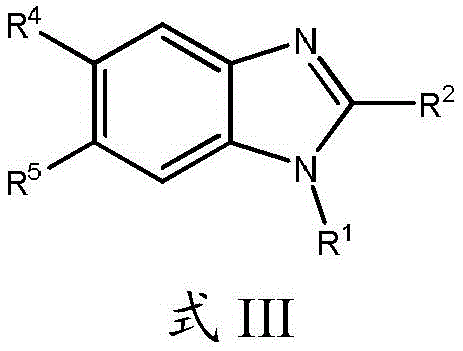
其中,in,
R1、R2、R4和R5如本文所定义。R 1 , R 2 , R 4 and R 5 are as defined herein.
本申请的另一个实施方案涉及式III(a)的化合物及其药学上可接受的盐、溶剂合物、酯或前药:Another embodiment of the present application relates to compounds of formula III(a) and pharmaceutically acceptable salts, solvates, esters or prodrugs thereof:
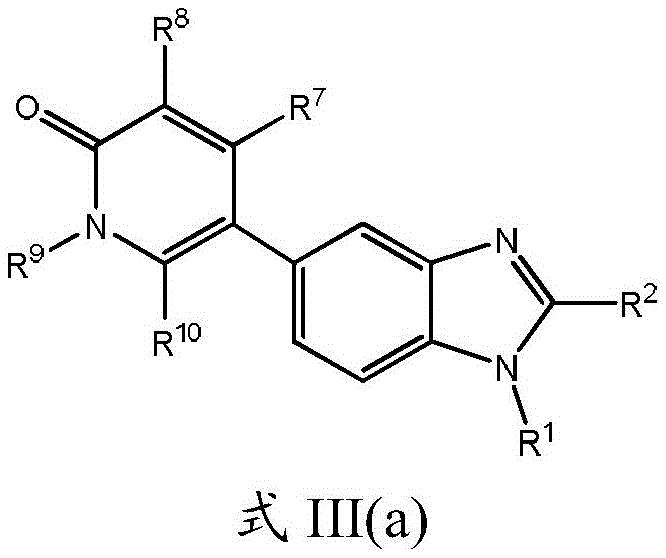
其中R1、R2、R7、R8、R9和R10如本文所定义。wherein R 1 , R 2 , R 7 , R 8 , R 9 and R 10 are as defined herein.
根据另一个实施方案,本申请还涉及式III(b)的化合物及其药学上可接受的盐、溶剂合物、酯或前药:According to another embodiment, the application also relates to compounds of formula III(b) and pharmaceutically acceptable salts, solvates, esters or prodrugs thereof:

其中R1、R2、R7、R8、R9和R10如本文所定义。wherein R 1 , R 2 , R 7 , R 8 , R 9 and R 10 are as defined herein.
根据一个实施方案,本申请涉及如本文所定义的式III(a)或III(b)的化合物,其中R9是未取代的C1-C3烷基或C3-C5环烷基,或R9是氟取代的C1-C3烷基或C3-C5环烷基,例如,R9选自甲基、三氟甲基、乙基、正丙基、异丙基和环丙基。在另一个实施方案中,本申请涉及式III(a)或III(b)的化合物,其中所述R7和R10各自为氢原子且R8选自Cl、CN、NHR11和取代或未取代的C1-C6烷基或C3-C6环烷基。在另一个实施方案中,R8和R9各自独立地为甲基、乙基、异丙基、氟甲基、二氟甲基、三氟甲基、环丙基或二氟环丙基。According to one embodiment, the application relates to compounds of formula III(a) or III(b) as defined herein, wherein R 9 is unsubstituted C 1 -C 3 alkyl or C 3 -C 5 cycloalkyl, or R 9 is fluorine-substituted C 1 -C 3 alkyl or C 3 -C 5 cycloalkyl, for example, R 9 is selected from methyl, trifluoromethyl, ethyl, n-propyl, isopropyl and cyclo propyl. In another embodiment, the application relates to compounds of formula III(a) or III(b), wherein said R7 and R10 are each a hydrogen atom and R8 is selected from Cl, CN , NHR11 and substituted or unsubstituted Substituted C 1 -C 6 alkyl or C 3 -C 6 cycloalkyl. In another embodiment, R8 and R9 are each independently methyl, ethyl, isopropyl, fluoromethyl, difluoromethyl, trifluoromethyl, cyclopropyl, or difluorocyclopropyl.
在又一个实施方案中,本申请涉及如本文所定义的式I、I(a)、I(b)、III、III(a)或III(b)的化合物,其中R2是氢或取代或未取代的基团,其选自C1-C6烷基、C3-C10环烷基或C3-C10杂环烷基。例如,R2是取代或未取代的C1-C3烷基、C3-C6环烷基或C3-C6杂环烷基,或者是取代或未取代的基团,其选自甲基、乙基、丙基、异丙基、丁基、异丁基、叔丁基、环丙基、环丁基、环戊基、四氢呋喃基、四氢吡喃基、二氧杂环戊烷基、哌啶基和吡咯烷基。In yet another embodiment, the application relates to compounds of formula I, I(a), I(b), III, III(a) or III(b) as defined herein, wherein R is hydrogen or substituted or An unsubstituted group selected from C 1 -C 6 alkyl, C 3 -C 10 cycloalkyl or C 3 -C 10 heterocycloalkyl. For example, R 2 is substituted or unsubstituted C 1 -C 3 alkyl, C 3 -C 6 cycloalkyl or C 3 -C 6 heterocycloalkyl, or a substituted or unsubstituted group selected from Methyl, ethyl, propyl, isopropyl, butyl, isobutyl, tert-butyl, cyclopropyl, cyclobutyl, cyclopentyl, tetrahydrofuranyl, tetrahydropyranyl, dioxolane Alkyl, piperidinyl and pyrrolidinyl.
根据另一个实施方案,本发明化合物是如本文所定义的式I、I(a)、I(b)、III、III(a)或III(b)的化合物,其中R1是支链或直链C2-C6烷基,其被选自氟、OC1-C6烷基和卤代OC1-C6烷基的基团取代。例如,R1是支链或直链C2-C3烷基,其被选自氟、OC1-C6烷基和卤代OC1-C6烷基的基团取代。在另一个实施方案中,R1选自氟甲基、二氟甲基、三氟甲基、2,2,2-三氟乙基、2-甲氧基乙基、2-乙氧基乙基、2-(氟甲氧基)乙基、2-(二氟甲氧基)乙基、2-(三氟甲氧基)乙基、3,3,3-三氟-1-丙基、3-甲氧基-1-丙基、3-乙氧基-1-丙基、3-(氟甲氧基)-1-丙基、3-(二氟甲氧基)-1-丙基、3-(三氟甲氧基)-1-丙基、1-甲氧基-2-丙基、1-乙氧基-2-丙基、1-(氟甲氧基)-2-丙基、1-(二氟甲氧基)-2-丙基、1-(三氟甲氧基)-2-丙基、2-甲氧基-1-丙基、2-乙氧基-1-丙基、2-(氟甲氧基)-1-丙基、2-(二氟甲氧基)-1-丙基或2-(三氟甲氧基)-1-丙基,例如,R1是2-甲氧基乙基、2-(三氟甲氧基)乙基、1-甲氧基-2-丙基、1-(三氟甲氧基)-2-丙基、2-甲氧基-1-丙基或2-(三氟甲氧基)-1-丙基。在另一个实施方案中,R1是甲基、三氟甲基、乙基、2,2,2-三氟乙基、正丙基、3,3,3-三氟-1-丙基、异丙基、正丁基、异丁基或叔丁基。According to another embodiment, the compound of the invention is a compound of formula I, I(a), I(b), III, III( a ) or III(b) as defined herein, wherein R1 is branched or straight Chain C2 - C6 alkyl substituted with a group selected from fluoro, OC1 - C6 alkyl and haloOC1 - C6 alkyl. For example, R 1 is a branched or straight chain C 2 -C 3 alkyl group substituted with a group selected from fluoro, OC 1 -C 6 alkyl and halogenated OC 1 -C 6 alkyl. In another embodiment, R 1 is selected from fluoromethyl, difluoromethyl, trifluoromethyl, 2,2,2-trifluoroethyl, 2-methoxyethyl, 2-ethoxyethyl , 2-(fluoromethoxy)ethyl, 2-(difluoromethoxy)ethyl, 2-(trifluoromethoxy)ethyl, 3,3,3-trifluoro-1-propyl , 3-methoxy-1-propyl, 3-ethoxy-1-propyl, 3-(fluoromethoxy)-1-propyl, 3-(difluoromethoxy)-1-propyl , 3-(trifluoromethoxy)-1-propyl, 1-methoxy-2-propyl, 1-ethoxy-2-propyl, 1-(fluoromethoxy)-2- propyl, 1-(difluoromethoxy)-2-propyl, 1-(trifluoromethoxy)-2-propyl, 2-methoxy-1-propyl, 2-ethoxy- 1-propyl, 2-(fluoromethoxy)-1-propyl, 2-(difluoromethoxy)-1-propyl or 2-(trifluoromethoxy)-1-propyl, for example , R 1 is 2-methoxyethyl, 2-(trifluoromethoxy)ethyl, 1-methoxy-2-propyl, 1-(trifluoromethoxy)-2-propyl, 2-methoxy-1-propyl or 2-(trifluoromethoxy)-1-propyl. In another embodiment, R 1 is methyl, trifluoromethyl, ethyl, 2,2,2-trifluoroethyl, n-propyl, 3,3,3-trifluoro-1-propyl, isopropyl, n-butyl, isobutyl or tert-butyl.
在另一个实施方案中,本申请涉及选自本文定义的化合物1至67的化合物或其药学上可接受的盐、溶剂合物或前药,例如这些化合物或其异构体中的任一种或其药学上可接受的盐、溶剂合物或前药,单独或作为亚组使用。In another embodiment, the present application relates to a compound selected from compounds 1 to 67 as defined herein, or a pharmaceutically acceptable salt, solvate or prodrug thereof, such as any of these compounds or isomers thereof or a pharmaceutically acceptable salt, solvate or prodrug thereof, alone or as a subgroup.
另一方面涉及药物组合物,其包含本发明所定义的化合物以及药学上可接受的载体、稀释剂或赋形剂。Another aspect relates to pharmaceutical compositions comprising a compound as defined in the present invention together with a pharmaceutically acceptable carrier, diluent or excipient.
另一方面涉及如本发明所定义的化合物在治疗或预防其中需要溴结构域抑制剂的疾病或病症中的用途,或该化合物,其用于治疗或预防其中需要溴结构域抑制剂的疾病或病症。类似地,该方面涉及本发明化合物在制备用于治疗或预防其中需要溴结构域抑制剂的疾病或病症的药物中的用途。该方面还涉及治疗其中需要溴结构域抑制剂的疾病或病症的方法,其包括向有需要的受试者给药治疗有效量的如本文所定义的化合物。在一个实施方案中,其中需要溴结构域抑制剂的疾病或病症是自身免疫性疾病、炎性病症(例如类风湿性关节炎、肠易激综合征或牛皮癣)、皮肤病症或癌症(例如脑癌、胰腺癌、乳腺癌、肺癌或前列腺癌)。例如,所述疾病或病症是脑癌,如多形性成胶质细胞瘤。Another aspect relates to the use of a compound as defined in the present invention in the treatment or prevention of a disease or disorder in which a bromodomain inhibitor is required, or the compound for the treatment or prevention of a disease in which a bromodomain inhibitor is required or disease. Similarly, this aspect relates to the use of a compound of the present invention in the manufacture of a medicament for the treatment or prevention of a disease or condition in which a bromodomain inhibitor is required. This aspect also relates to a method of treating a disease or disorder in which a bromodomain inhibitor is required, comprising administering to a subject in need thereof a therapeutically effective amount of a compound as defined herein. In one embodiment, the disease or disorder in which a bromodomain inhibitor is required is an autoimmune disease, an inflammatory disorder (eg, rheumatoid arthritis, irritable bowel syndrome, or psoriasis), a skin disorder, or a cancer (eg, brain cancer, pancreatic cancer, breast cancer, lung cancer, or prostate cancer). For example, the disease or disorder is brain cancer, such as glioblastoma multiforme.
根据另一方面,本发明涉及本文所定义的化合物在治疗选自以下的疾病或病症中的用途:自身免疫性疾病、炎性病症、皮肤病症和赘生物,或该化合物,其用于治疗选自以下的疾病或病症:自身免疫性疾病、炎性病症、皮肤病症和赘生物。该方面还涉及治疗或预防选自以下的疾病或病症的方法:自身免疫性疾病、炎性病症、皮肤病症和赘生物,其包括向有需要的受试者给药治疗有效量的如本文所定义的化合物。例如,所述炎性疾病是类风湿性关节炎、肠易激综合征或牛皮癣。例如,所述疾病或病症是赘生物,其为脑癌(例如多形性成胶质细胞瘤)、胰腺癌、乳腺癌、肺癌或前列腺癌。According to another aspect, the present invention relates to the use of a compound as defined herein for the treatment of a disease or disorder selected from autoimmune diseases, inflammatory disorders, skin disorders and neoplasms, or the compound for use in the treatment of selected Diseases or conditions selected from autoimmune diseases, inflammatory conditions, skin conditions, and neoplasms. This aspect also relates to a method of treating or preventing a disease or disorder selected from autoimmune diseases, inflammatory disorders, skin disorders, and neoplasms, comprising administering to a subject in need thereof a therapeutically effective amount of a therapeutically effective amount as described herein defined compound. For example, the inflammatory disease is rheumatoid arthritis, irritable bowel syndrome or psoriasis. For example, the disease or disorder is a neoplasm, which is brain cancer (eg, glioblastoma multiforme), pancreatic cancer, breast cancer, lung cancer, or prostate cancer.
本发明化合物、组合物、方法和用途的其它目的和特征将通过阅读示例性实施方案的以下非限制性描述而变得更加明显,所述实施方案不应被解释为限制本发明的范围。Other objects and features of the compounds, compositions, methods, and uses of the present invention will become more apparent upon reading the following non-limiting description of exemplary embodiments, which should not be construed to limit the scope of the invention.
发明详述Detailed description of the invention
本文使用的所有技术和科学术语具有与本技术所属领域的普通技术人员通常理解的相同的含义。为了方便起见,以下提供了本文使用的一些术语和短语的含义。All technical and scientific terms used herein have the same meaning as commonly understood by one of ordinary skill in the art to which this technology belongs. For convenience, the meanings of some terms and phrases used herein are provided below.
在通过引用并入本文的出版物、专利和专利申请中的术语的定义与本说明书中阐述的定义相反的情况下,以本说明书中的定义为准。本文使用的章节标题仅用于组织目的,并不被解释为限制所公开的主题。In the event that definitions of terms in publications, patents, and patent applications incorporated herein by reference contradict the definitions set forth in this specification, the definitions in this specification shall control. The section headings used herein are for organizational purposes only and are not to be construed as limiting the disclosed subject matter.
i.定义i. Definition
这里使用的术语仅仅是为了描述具体实施方案的目的,而不是限制性的。应该注意的是,除非内容明确地另外指出,否则单数形式“一”,“一个”和“该”也包括复数形式。因此,例如,提到含有“一种化合物”的组合物时,也包括两种或更多种化合物的混合物。还应该注意的是,术语“或”通常以包括“和/或”的意义使用,除非内容另有明确规定。此外,对于在发明详述和/或权利要求书中使用术语“包括”、“包含”、“具有”、“有”、“含有”或其变体而言,这样的术语旨在包括与术语“包含”类似的方式。The terminology used herein is for the purpose of describing particular embodiments only and is not limiting. It should be noted that the singular forms "a," "an," and "the" include the plural forms as well, unless the content clearly dictates otherwise. Thus, for example, reference to a composition containing "a compound" also includes mixtures of two or more compounds. It should also be noted that the term "or" is generally employed in its sense including "and/or" unless the content clearly dictates otherwise. Furthermore, with respect to the use of the terms "comprising", "including", "having", "having", "containing" or variations thereof in the detailed description and/or claims, such terms are intended to include and "includes" in a similar way.
术语“约”或“大约”是指在由本领域普通技术人员确定的特定值的可接受误差范围内,其将部分取决于如何测量或确定该值,即,测量系统的限制。例如,根据本领域的实践,“约”可以指1个或多于1个标准偏差内。或者,“约”可以表示给定值的至多20%,优选至多10%,更优选至多5%,还更优选至多1%的范围。或者,特别是对于生物系统或方法,该术语可以意指数值的一个数量级以内,优选在5倍以内,更优选在2倍以内。如果在本申请和权利要求书中描述了特定的值,除非另有说明,否则应该假定术语“约”在特定值的可接受的误差范围内。The terms "about" or "approximately" mean within an acceptable error range for a particular value as determined by one of ordinary skill in the art, which will depend in part on how the value is measured or determined, ie, the limitations of the measurement system. For example, "about" can mean within 1 or more than 1 standard deviation, according to the practice in the art. Alternatively, "about" can mean a range of up to 20%, preferably up to 10%, more preferably up to 5%, still more preferably up to 1% of the given value. Alternatively, particularly for biological systems or methods, the term can mean within an order of magnitude, preferably within 5-fold, more preferably within 2-fold of the exponential value. If a particular value is described in this application and in the claims, unless otherwise stated, the term "about" should be assumed to be within an acceptable error range for the particular value.
如本文所用,术语“本文所述的化合物”、“本发明化合物”和等同表述是指本申请中描述的化合物,例如由结构式如式I、I(a)、I(b)、III、III(a)和III(b)涵盖的那些,任选地参照任何适用的实施方案,并且还包括示例性化合物,例如化合物1-36,以及它们的药学上可接受的盐、溶剂合物、酯和前体药物。当两性离子形式是可能的时,为了实际目的,该化合物可以作为其中性形式来绘制,但是该化合物被理解为也包括其两性离子形式。本文的实施方案也可以排除一种或多种化合物。化合物可以通过其化学结构或化学名称来识别。如果化学结构和化学名称发生冲突,以化学结构为准。As used herein, the terms "compounds described herein," "compounds of the present invention," and equivalents refer to compounds described in this application, eg, represented by structural formulae such as formulae I, I(a), I(b), III, III Those encompassed by (a) and III(b), optionally with reference to any applicable embodiment, and also include exemplary compounds, such as compounds 1-36, and their pharmaceutically acceptable salts, solvates, esters and prodrugs. When a zwitterionic form is possible, the compound may be drawn as its neutral form for practical purposes, but the compound is understood to include its zwitterionic form as well. Embodiments herein may also exclude one or more compounds. Compounds can be identified by their chemical structure or chemical name. In the event of a conflict between chemical structure and chemical name, the chemical structure shall prevail.
除非另有说明,否则本文所述的结构还意味着包括该结构的所有异构形式(例如,对映异构体、非对映异构体和几何异构体(或构象异构体));例如每个不对称中心的R和S构型,Z和E双键异构体以及Z和E构象异构体。因此,本发明化合物的单一立体化学异构体以及对映异构体、非对映异构体和几何异构体(或构象异构体)的混合物均在本说明书的范围内。除非另有说明,否则化合物的所有互变异构形式都在本说明书的范围内。另外,除非另有说明,否则本文所述的结构还旨在包括区别仅在于存在一个或多个同位素富集的原子的化合物。例如,具有包括用氘或氚取代氢的本发明结构的化合物,或用富含13C-或14C-的碳取代碳的化合物都在本说明书的范围内。这些化合物例如可用作分析工具,作为生物测定中的探针或根据本说明书的治疗剂。Unless otherwise indicated, a structure depicted herein is also meant to include all isomeric forms of the structure (eg, enantiomers, diastereomers, and geometric isomers (or conformational isomers)) ; such as the R and S configuration of each asymmetric center, the Z and E double bond isomers and the Z and E conformational isomers. Accordingly, single stereochemical isomers as well as enantiomeric, diastereomeric, and geometric (or conformational) mixtures of the compounds of the present invention are within the scope of this specification. All tautomeric forms of compounds are within the scope of this specification unless otherwise indicated. Additionally, unless otherwise stated, structures depicted herein are also intended to include compounds that differ only by the presence of one or more isotopically enriched atoms. For example, compounds having structures of the present invention that include the replacement of hydrogen with deuterium or tritium, or the replacement of carbons with carbons enriched in13C- or14C- are within the scope of this specification. These compounds are useful, for example, as analytical tools, as probes in biological assays or as therapeutic agents according to the present specification.
在特定的对映异构体是优选的情况下,在一些实施方案中可以提供基本上不含相应的对映异构体,并且也可以称为“光学富集的”。如本文所用,“光学富集”是指该化合物由显著更大比例的一种对映异构体构成。在一些实施方案中,该化合物由至少约90%重量的优选的对映异构体构成。在其他实施方案中,化合物由至少约95重量%、98重量%或99重量%的优选对映异构体构成。优选的对映异构体可以通过本领域技术人员已知的任何方法从外消旋混合物中分离,包括手性高压液相色谱(HPLC)和手性盐的形成和结晶,或者通过不对称合成制备。例如参见,Jacques等,Enantiomers,Racemates和Resolutions(WileyInterscience,New York,1981);Wlen等人,Tetrahedron 33:2725(1977);Eliel,E.L.Stereochemistry of Carbon Compounds(McGraw-Hill,NY,1962);Wilen,S.H.Tables of Resolving Agents and Optical Resolutions,p.268(E.L.Eliel,Ed.,Notre DamePress,Notre Dame,Univ。,Notre Dame,IN 1972)。Where a particular enantiomer is preferred, in some embodiments it may be provided substantially free of the corresponding enantiomer and may also be referred to as "optically enriched". As used herein, "optically enriched" means that the compound consists of a significantly greater proportion of one enantiomer. In some embodiments, the compound consists of at least about 90% by weight of the preferred enantiomer. In other embodiments, the compound consists of at least about 95%, 98%, or 99% by weight of the preferred enantiomer. Preferred enantiomers can be separated from racemic mixtures by any method known to those skilled in the art, including chiral high pressure liquid chromatography (HPLC) and chiral salt formation and crystallization, or by asymmetric synthesis preparation. See, eg, Jacques et al., Enantiomers, Racemates and Resolutions (Wiley Interscience, New York, 1981); Wlen et al., Tetrahedron 33:2725 (1977); Eliel, EL . Stereochemistry of Carbon Compounds (McGraw-Hill, NY, 1962); Wilen, SH Tables of Resolving Agents and Optical Resolutions , p. 268 (ELEliel, Ed., Notre Dame Press, Notre Dame, Univ., Notre Dame, IN 1972).
以下更详细地描述特定官能团和化学术语的定义。为了本说明的目的,化学元素根据元素周期表(CAS版本,Handbook of Chemistry and Physics,第75版,封面)确定化学元素,特定官能团通常如其中所述定义。此外,有机化学的一般原理以及特定的功能部分和反应性描述在Organic Chemistry,Thomas Sorrell,University Science Books,Sausalito,1999;Smith和March March's Advanced Organic Chemistry,第5版,JohnWiley&Sons,Inc.,New York,2001;Larock,Comprehensive Organic Transformations,VCH Publishers,Inc.,New York,1989;Carruthers,Some Modern Methods of Organic Synthesis,第3版,Cambridge University Press,Cambridge,1987。Definitions of specific functional groups and chemical terms are described in more detail below. For the purposes of this description, chemical elements are identified according to the Periodic Table of the Elements (CAS version, Handbook of Chemistry and Physics , 75th Edition, cover page), and specific functional groups are generally defined as described therein. In addition, general principles of organic chemistry as well as specific functional moieties and reactivity are described in Organic Chemistry, Thomas Sorrell, University Science Books, Sausalito, 1999; Smith and March March's Advanced Organic Chemistry , 5th Edition, John Wiley & Sons, Inc., New York , 2001; Larock, Comprehensive Organic Transformations , VCH Publishers, Inc., New York, 1989; Carruthers, Some Modern Methods of Organic Synthesis , 3rd ed., Cambridge University Press, Cambridge, 1987.
烃基取代基中的碳原子数可以用前缀“Cx-Cy”表示,其中x是取代基中碳原子数的最小值,y是取代基中碳原子数的最大值。然而,当前缀“Cx-Cy”通过定义与含有一个或多个杂原子的基团(例如杂环烷基、杂芳基等)结合时,则x和y分别定义该环中原子(包括碳原子和杂原子)的最小和最大数目。The number of carbon atoms in a hydrocarbyl substituent can be represented by the prefix " Cx - Cy ", where x is the minimum number of carbon atoms in the substituent and y is the maximum number of carbon atoms in the substituent. However, when the prefix " Cx - Cy " is by definition combined with a group containing one or more heteroatoms (eg, heterocycloalkyl, heteroaryl, etc.), then x and y respectively define the atoms in the ring ( including carbon atoms and heteroatoms) minimum and maximum numbers.
前缀“卤代”表示前缀所连接的取代基被一个或多个独立选择的卤素基团取代。更具体地,本文所用的术语“卤代”和“卤素”是指选自氟(氟,-F)、氯(氯,-Cl)、溴(溴,-Br)和碘(碘,-I)。例如,“卤代烷基”是指其中至少一个氢基团被卤素基团置换的烷基取代基。The prefix "halo" means that the substituent to which the prefix is attached is substituted with one or more independently selected halo groups. More specifically, the terms "halo" and "halogen" as used herein refer to the group consisting of fluorine (fluorine, -F), chlorine (chlorine, -Cl), bromine (bromine, -Br) and iodine (iodine, -I) ). For example, "haloalkyl" refers to an alkyl substituent in which at least one hydrogen group is replaced by a halogen group.
术语“杂原子”是指氧、硫、氮、磷或硅中的一种或多种(包括氮、硫、磷或硅的任何氧化形式;任何碱性氮的季铵化形式;或杂环的可取代N,例如N(如在3,4-二氢-2H-吡咯基中)、NH(如在吡咯烷基中)或NR+(如在N-取代的吡咯烷基中)。The term "heteroatom" refers to one or more of oxygen, sulfur, nitrogen, phosphorus, or silicon (including any oxidized form of nitrogen, sulfur, phosphorus, or silicon; any quaternized form of basic nitrogen; or a heterocyclic ring Substitutable N of , such as N (as in 3,4-dihydro-2H-pyrrolidinyl), NH (as in pyrrolidinyl) or NR+ (as in N-substituted pyrrolidinyl).
如本文所用,“直接键”或“共价键”是指单键、双键或叁键。在一些实施方案中,“直接键”或“共价键”是指单键。As used herein, "direct bond" or "covalent bond" refers to a single bond, double bond or triple bond. In some embodiments, "direct bond" or "covalent bond" refers to a single bond.
在整个申请中也可以使用缩写,除非另有说明,这样的缩写意图具有本领域通常理解的含义。这种缩写的例子包括Me(甲基)、Et(乙基)、Pr(丙基)、i-Pr(异丙基)、Bu(丁基)、t-Bu(叔丁基)、i-Bu(异丁基)、s-Bu(仲丁基)、c-Bu(环丁基)、Ph(苯基)、Bn(苄基)、Bz(苯甲酰基)、CBz或Cbz或Z(苄氧基羰基)、Boc或BOC(叔丁氧基羰基)和Su或Suc(琥珀酰亚胺)。为了更确定地说明,在本申请中使用的缩写的例子在实施例部分的表格中列出。Abbreviations may also be used throughout the application, and unless otherwise specified, such abbreviations are intended to have the meanings commonly understood in the art. Examples of such abbreviations include Me (methyl), Et (ethyl), Pr (propyl), i-Pr (isopropyl), Bu (butyl), t-Bu (tert-butyl), i- Bu (isobutyl), s-Bu (sec-butyl), c-Bu (cyclobutyl), Ph (phenyl), Bn (benzyl), Bz (benzoyl), CBz or Cbz or Z ( benzyloxycarbonyl), Boc or BOC (tert-butoxycarbonyl) and Su or Suc (succinimide). For more definitive illustration, examples of abbreviations used in this application are listed in the table in the Examples section.
本文的化学结构根据本领域已知的常规标准绘制。因此,在所绘制的原子如碳原子看来具有不饱和的化合价的情况下,即使该氢原子不一定明确地画出,也认为该化合价被氢原子满足。应该推断氢原子是化合物的一部分。The chemical structures herein are drawn according to conventional standards known in the art. Thus, where a drawn atom, such as a carbon atom, appears to have an unsaturated valence, the valence is considered to be satisfied by the hydrogen atom, even though the hydrogen atom is not necessarily drawn explicitly. It should be inferred that the hydrogen atom is part of the compound.
如本文所用,术语“脂族”或“脂肪烃团”表示可以是直链(即,无支链)、支链或环状(包括稠合、桥连和螺稠合的多环)的烃部分,并且可以是完全饱和的或可以含有一个或多个不饱和单元,但不是芳香族的。除非另有说明,脂肪烃团含有1-6个碳原子。在一些实施方案中,脂肪烃团含有1-4个碳原子,在又一些实施方案中,脂肪烃团含有1-3个碳原子。脂肪烃团包括但不限于烷基、烯基、炔基、碳环。合适的脂肪烃团包括但不限于线性或支化的烷基、烯基和炔基,及其杂化物如(环烷基)烷基、(环烯基)烷基或(环烷基)烯基。As used herein, the term "aliphatic" or "aliphatic hydrocarbon group" refers to a hydrocarbon that may be straight chain (ie, unbranched), branched, or cyclic (including fused, bridged, and spiro-fused polycyclic rings) partially, and may be fully saturated or may contain one or more units of unsaturation, but is not aromatic. Unless otherwise specified, aliphatic hydrocarbon groups contain 1-6 carbon atoms. In some embodiments, the aliphatic hydrocarbon group contains 1-4 carbon atoms, and in still other embodiments, the aliphatic hydrocarbon group contains 1-3 carbon atoms. Aliphatic hydrocarbon groups include, but are not limited to, alkyl, alkenyl, alkynyl, carbocycle. Suitable aliphatic hydrocarbon groups include, but are not limited to, linear or branched alkyl, alkenyl, and alkynyl groups, and hybrids thereof such as (cycloalkyl)alkyl, (cycloalkenyl)alkyl, or (cycloalkyl)alkene base.
本文使用的术语“烷基”是指通常含有1至20个碳原子的饱和的直链或支链烃基。例如,“C1-C8烷基”含有1至8个碳原子。烷基的实例包括但不限于甲基、乙基、丙基、异丙基、正丁基、叔丁基、新戊基、正己基、庚基、辛基等。The term "alkyl" as used herein refers to a saturated straight or branched chain hydrocarbon group generally containing from 1 to 20 carbon atoms. For example, " C1 -C8 alkyl" contains 1 to 8 carbon atoms. Examples of alkyl groups include, but are not limited to, methyl, ethyl, propyl, isopropyl, n-butyl, t-butyl, neopentyl, n-hexyl, heptyl, octyl, and the like.
如本文所用,术语“烯基”表示含有一个或多个双键且通常具有2至20个碳原子的直链或支链烃基。例如,“C2-C8链烯基”含有2至8个碳原子。烯基包括但不限于例如乙烯基、丙烯基、丁烯基、1-甲基-2-丁烯-1-基、庚烯基、辛烯基等。As used herein, the term "alkenyl" refers to a straight or branched chain hydrocarbon group containing one or more double bonds and generally having from 2 to 20 carbon atoms. For example, "C2 - C8 alkenyl" contains 2 to 8 carbon atoms. Alkenyl groups include, but are not limited to, for example, vinyl, propenyl, butenyl, 1-methyl-2-buten-1-yl, heptenyl, octenyl, and the like.
如本文所用的术语“炔基”表示含有一个或多个叁键并且通常具有2至20个碳原子的直链或支链烃基。例如,“C2-C8炔基”含有2至8个碳原子。代表性的炔基包括但不限于例如乙炔基、1-丙炔基、1-丁炔基、庚炔基、辛炔基等。The term "alkynyl" as used herein refers to a straight or branched chain hydrocarbon group containing one or more triple bonds and generally having from 2 to 20 carbon atoms. For example, "C2-C8alkynyl" contains 2 to 8 carbon atoms. Representative alkynyl groups include, but are not limited to, for example, ethynyl, 1-propynyl, 1-butynyl, heptynyl, octynyl, and the like.
术语“环烷基”、“脂环族”、“碳环”和等同表述是指在单环或多环体系中包含饱和或部分不饱和(非芳香族)碳环的基团,包括螺(共享一个原子)、稠合(共享至少一个键)或桥连(共享两个或更多个键)的具有3至15个环成员的碳环系统。环烷基基团的实例包括但不限于环丙基、环丁基、环戊基、环戊烯-1-基、环戊烯-2-基、环戊烯-3-基、环己基、环己烯-1-基、环己烯-2-基、环己烯-3-基、环庚基、二环[4,3,0]壬基、降冰片基等。术语“环烷基”包括未取代的环烷基基团和取代的环烷基基团。术语“C3-Cn环烷基”是指在环结构中具有3至指定的“n”个碳原子的环烷基基团。除非另有说明,否则本文使用的“低级环烷基”基团在其环结构中具有至少3个且等于或少于8个碳原子。The terms "cycloalkyl", "cycloaliphatic", "carbocycle" and equivalents refer to groups comprising saturated or partially unsaturated (non-aromatic) carbocyclic rings in monocyclic or polycyclic ring systems, including spiro( Carbocyclic ring systems of 3 to 15 ring members that share one atom), fused (share at least one bond), or bridged (share two or more bonds). Examples of cycloalkyl groups include, but are not limited to, cyclopropyl, cyclobutyl, cyclopentyl, cyclopenten-1-yl, cyclopenten-2-yl, cyclopenten-3-yl, cyclohexyl, Cyclohexen-1-yl, cyclohexen-2-yl, cyclohexen-3-yl, cycloheptyl, bicyclo[4,3,0]nonyl, norbornyl and the like. The term "cycloalkyl" includes unsubstituted cycloalkyl groups and substituted cycloalkyl groups. The term "C3 - Cncycloalkyl" refers to a cycloalkyl group having from 3 to the designated " n " carbon atoms in the ring structure. Unless otherwise specified, a "lower cycloalkyl" group as used herein has at least 3 and equal to or less than 8 carbon atoms in its ring structure.
如本文所用,术语“杂环”、“杂环烷基”、“杂环基”、“杂环基团”可互换使用,是指化学上稳定的3至7元单环或7-10元双环杂环部分,其为饱和的或部分不饱和的,并且除碳原子外还具有一个或多个,优选一至四个如上所定义的杂原子。当涉及杂环的环原子时,术语“氮”包括取代的氮。作为实例,在具有1-3个选自氧、硫或氮的杂原子的饱和或部分不饱和环中,氮可以是N(如在3,4-二氢-2H-吡咯基中)、NH(如在吡咯烷基中)或+NR(如在N-取代的吡咯烷基中)。杂环可以在其任何杂原子或碳原子上连接到其侧基,产生化学稳定的结构,并且任何环原子可以任选被取代。杂环烷基的实例包括但不限于1,3-二氧杂环戊烷基、吡咯烷基、吡咯烷酮基、吡唑啉基、吡唑烷基、咪唑啉基、咪唑烷基、哌啶基、哌嗪基、噁唑烷基、异噁唑烷基、吗啉基、噻唑烷基、异噻唑烷基、四氢呋喃基、四氢吡喃基、四氢噻喃基、四氢联二噻吩基(tetrahydrodithienyl)、四氢噻吩基、硫代吗啉代、噻噁烷基(thioxanyl)、氮杂环丁烷基、氧杂环丁烷基、硫杂环丁烷基、高哌啶基、氧杂环庚烷基、硫杂环庚烷基、氧氮杂环庚三烯基、二氮杂环庚三烯基、硫氮杂环庚三烯基、1,2,3,6-四氢吡啶基、2-吡咯啉基、3-吡咯啉基、2H-吡喃基、4H-吡喃基、二噁烷基、二噻烷基、二硫杂环戊烷基、二氢吡喃基、二氢噻吩基、二氢呋喃基、3-氮杂双环[3,1,0]己烷基、3-氮杂双环[4,1,0]庚基、喹嗪基、奎宁环基(quinuclidinyl)、四氢喹啉基、四氢异喹啉基、十氢喹啉基等。杂环基还包括其中杂环与一个或多个芳基、杂芳基或脂环族环稠合的基团,例如吲哚啉基、3H-吲哚基、色满基、色烯基、菲啶基、2-氮杂二环[2.2.1]庚基、八氢吲哚基或四氢喹啉基,其中连接基团或连接点在杂环基环上。杂环基可以是单环或双环的。术语“杂环基烷基”是指被杂环基取代的烷基,其中所述烷基和杂环基部分独立地任选被取代。As used herein, the terms "heterocycle", "heterocycloalkyl", "heterocyclyl", "heterocyclic group" are used interchangeably and refer to a chemically stable 3 to 7 membered monocyclic or 7-10 A membered bicyclic heterocyclic moiety, which is saturated or partially unsaturated, and which, in addition to carbon atoms, has one or more, preferably one to four, heteroatoms as defined above. The term "nitrogen" when referring to ring atoms of a heterocycle includes substituted nitrogens. As an example, in saturated or partially unsaturated rings having 1-3 heteroatoms selected from oxygen, sulfur or nitrogen, nitrogen can be N (as in 3,4-dihydro-2H-pyrrolyl), NH (as in pyrrolidinyl) or +NR (as in N-substituted pyrrolidinyl). A heterocycle can be attached to its pendant group at any of its heteroatom or carbon atom, resulting in a chemically stable structure, and any ring atom can be optionally substituted. Examples of heterocycloalkyl include, but are not limited to, 1,3-dioxolane, pyrrolidinyl, pyrrolidinyl, pyrazolinyl, pyrazolidinyl, imidazolinyl, imidazolidinyl, piperidinyl , piperazinyl, oxazolidinyl, isoxazolidinyl, morpholinyl, thiazolidinyl, isothiazolidinyl, tetrahydrofuranyl, tetrahydropyranyl, tetrahydrothiopyranyl, tetrahydrobithienyl (tetrahydrodithienyl), tetrahydrothienyl, thiomorpholino, thioxanyl, azetidinyl, oxetanyl, thietane, homopiperidinyl, oxygen Hepheptanyl, Thiazepanyl, Oxeptatrienyl, Diazeptrienyl, Thiazepanyl, 1,2,3,6-Tetrahydro Pyridyl, 2-pyrrolinyl, 3-pyrrolinyl, 2H-pyranyl, 4H-pyranyl, dioxanyl, dithianyl, dithiolanyl, dihydropyranyl , dihydrothienyl, dihydrofuranyl, 3-azabicyclo[3,1,0]hexyl, 3-azabicyclo[4,1,0]heptyl, quinazinyl, quinuclidinyl (quinuclidinyl), tetrahydroquinolinyl, tetrahydroisoquinolinyl, decahydroquinolinyl and the like. Heterocyclyl also includes groups in which the heterocycle is fused to one or more aryl, heteroaryl, or alicyclic rings, such as indolinyl, 3H-indolyl, chromanyl, chromenyl, phenanthridine, 2-azabicyclo[2.2.1]heptyl, octahydroindolyl, or tetrahydroquinolinyl, wherein the group or point of attachment is on the heterocyclyl ring. Heterocyclyl groups can be monocyclic or bicyclic. The term "heterocyclylalkyl" refers to an alkyl group substituted with a heterocyclyl group, wherein the alkyl and heterocyclyl moieties are independently optionally substituted.
如本文所用,术语“部分不饱和”是指在环原子之间包含至少一个双键或叁键但不是芳族的环部分。术语“部分不饱和”旨在涵盖具有多个不饱和位点的环,但不打算包括本文所定义的芳基或杂芳基部分。As used herein, the term "partially unsaturated" refers to a ring moiety that contains at least one double or triple bond between ring atoms but is not aromatic. The term "partially unsaturated" is intended to encompass rings having multiple sites of unsaturation, but is not intended to include aryl or heteroaryl moieties as defined herein.
单独使用或作为“芳烷基”、“芳烷氧基”或“芳氧基烷基”中较大部分的一部分使用的术语“芳基”是指单环部分或者指总共具有6-15个环成员的双环或三环稠合环体系,其中体系中的至少一个环是芳香族的,并且其中体系中的每个环含有3-7个环成员。术语“芳基”可以与术语“芳基环”互换使用。在本说明书的一些实施方案中,“芳基”是指包括但不限于可带有一个或多个取代基的苯基、联苯、萘基、薁基、蒽基等的芳香环体系。The term "aryl" used alone or as part of a larger moiety in "aralkyl", "aralkoxy" or "aryloxyalkyl" refers to a monocyclic moiety or to a group having a total of 6-15 A bicyclic or tricyclic fused ring system of ring members wherein at least one ring in the system is aromatic and wherein each ring in the system contains 3-7 ring members. The term "aryl" is used interchangeably with the term "aryl ring". In some embodiments of the present specification, "aryl" refers to an aromatic ring system including, but not limited to, phenyl, biphenyl, naphthyl, azulenyl, anthracenyl, and the like, which may bear one or more substituents.
术语“芳烷基”或“芳基烷基”是指与芳环连接的烷基。芳烷基的实例包括但不限于苄基、苯乙基、1-苯乙基等。如本文所用,术语“芳基”的范围内还包括芳环与一个或多个非芳环稠合的基团,如茚满基、茚基、邻苯二甲酰亚胺基、萘亚胺基、芴基、菲啶基、或四氢萘基等。The term "aralkyl" or "arylalkyl" refers to an alkyl group attached to an aromatic ring. Examples of aralkyl groups include, but are not limited to, benzyl, phenethyl, 1-phenethyl, and the like. Also included within the scope of the term "aryl" as used herein are groups in which an aromatic ring is fused to one or more non-aromatic rings, such as indanyl, indenyl, phthalimido, naphthylimide base, fluorenyl, phenanthridine, or tetrahydronaphthyl, etc.
单独使用或作为例如“杂芳烷基”或“杂芳烷氧基”的较大部分的一部分使用的术语“杂芳基”和“杂芳-”是指具有5至18个环原子,优选5、6或9个环原子的基团;其在环阵列中共享6、10或14个π电子;并且除了碳原子之外还具有一至五个杂原子。术语“杂原子”包括但不限于氮、氧或硫,并且包括氮或硫的任何氧化形式,以及碱性氮的任何季铵化形式。杂芳基可以是单环,或者两个或更多个稠环。杂芳基基团包括噻吩基、呋喃基、噻吩基、吡咯基、咪唑基、吡唑基、三唑基、四唑基、噁唑基、异噁唑基、噁二唑基、噻唑基、异噻唑基、噻二唑基、吡啶基、哒嗪基、嘧啶基、吡嗪基、三嗪基、呋喃并吡啶基、吲嗪基、嘌呤基、萘啶基和蝶啶基。如本文所用,术语“杂芳基”和“杂芳基-”还包括其中杂芳香族环与一个或多个芳基、脂环族或杂环基环稠合的基团,其中连接基团或连接点位于杂芳香族环上。非限制性实例包括吲哚基、3H-吲哚基、异吲哚基、苯并噻吩基、苯并呋喃基、二苯并呋喃基、吲唑基、苯并咪唑基、苯并噁唑基、苯并噻唑基、喹啉基、异喹啉基、喹诺酮基、异喹诺酮基、噌啉基、酞嗪基、喹唑啉基、喹喔啉基、4H-喹嗪基、咔唑基、吖啶基、菲啶基、吩嗪基、吩噻嗪基、吩噁嗪基、四氢喹啉基、四氢异喹啉基和吡啶并[2,3-b]-1,4-噁嗪-3(4H)酮。杂芳基可以是单环或双环的。杂芳基包括任选被取代的环。The terms "heteroaryl" and "heteroar-" used alone or as part of a larger moiety such as "heteroaralkyl" or "heteroaralkoxy" mean from 5 to 18 ring atoms, preferably A group of 5, 6 or 9 ring atoms; it shares 6, 10 or 14 pi electrons in the ring array; and has one to five heteroatoms in addition to carbon atoms. The term "heteroatom" includes, but is not limited to, nitrogen, oxygen, or sulfur, and includes any oxidized form of nitrogen or sulfur, and any quaternized form of basic nitrogen. A heteroaryl group can be a single ring, or two or more fused rings. Heteroaryl groups include thienyl, furyl, thienyl, pyrrolyl, imidazolyl, pyrazolyl, triazolyl, tetrazolyl, oxazolyl, isoxazolyl, oxadiazolyl, thiazolyl, Isothiazolyl, thiadiazolyl, pyridyl, pyridazinyl, pyrimidinyl, pyrazinyl, triazinyl, furopyridyl, indolizinyl, purinyl, naphthyridinyl and pteridyl. As used herein, the terms "heteroaryl" and "heteroaryl-" also include groups in which a heteroaromatic ring is fused to one or more aryl, alicyclic or heterocyclyl rings, wherein the linking group Or the point of attachment is on a heteroaromatic ring. Non-limiting examples include indolyl, 3H-indolyl, isoindolyl, benzothienyl, benzofuranyl, dibenzofuranyl, indazolyl, benzimidazolyl, benzoxazolyl , benzothiazolyl, quinolyl, isoquinolyl, quinolone, isoquinolone, cinnoline, phthalazinyl, quinazolinyl, quinoxalinyl, 4H-quinolinyl, carbazolyl, acridinyl, phenanthridine, phenazinyl, phenothiazinyl, phenoxazinyl, tetrahydroquinolinyl, tetrahydroisoquinolinyl and pyrido[2,3-b]-1,4-oxa oxazin-3(4H)one. Heteroaryl groups can be monocyclic or bicyclic. Heteroaryl groups include rings that are optionally substituted.
术语“杂芳烷基”是指被杂芳基取代的烷基基团,其中烷基和杂芳基部分独立地任选被取代。实例包括但不限于吡啶基甲基、嘧啶基乙基等。The term "heteroaralkyl" refers to an alkyl group substituted with a heteroaryl, wherein the alkyl and heteroaryl moieties are independently optionally substituted. Examples include, but are not limited to, pyridylmethyl, pyrimidinylethyl, and the like.
术语“二价烃”是指二价饱和或不饱和烃基。这种二价烃基包括亚烷基、亚烯基和亚炔基。The term "divalent hydrocarbon" refers to a divalent saturated or unsaturated hydrocarbon group. Such divalent hydrocarbon groups include alkylene groups, alkenylene groups and alkynylene groups.
术语“亚烷基”是指衍生自通常含有1至20个碳原子,更典型地含有1至8个碳原子的直链或支链饱和烃基链的二价基团。“亚烷基”的实例包括多亚甲基,即-(CH2)n-,其中n是正整数,优选1至6、1至4、1至3、1至2或2至3;或-CH2-、-CH2CH2-、-CH2CH2CH2-、-CH2CH2CH2CH2-和-CH2CH(CH3)CH2-。取代的亚烷基链是其中一个或多个亚甲基氢原子被取代基取代的多亚甲基。合适的取代基包括下面针对取代的脂肪烃团所描述的那些。The term "alkylene" refers to a divalent group derived from a straight or branched saturated hydrocarbyl chain usually containing 1 to 20 carbon atoms, more typically 1 to 8 carbon atoms. Examples of "alkylene" include polymethylene, ie -( CH2 )n-, where n is a positive integer, preferably 1 to 6, 1 to 4, 1 to 3, 1 to 2, or 2 to 3; or - CH2- , -CH2CH2- , -CH2CH2CH2- , -CH2CH2CH2CH2- , and -CH2CH ( CH3 ) CH2- . A substituted alkylene chain is a polymethylene group in which one or more methylene hydrogen atoms are replaced by a substituent. Suitable substituents include those described below for substituted aliphatic hydrocarbon groups.
术语“亚烯基”是指可以是直链或支链并且具有至少一个碳-碳双键的二价不饱和烃基。亚烯基通常含有2至20个碳原子,更典型地含有2至8个碳原子。亚烯基的非限制性实例包括-C(H)=C(H)-、-C(H)=C(H)-CH2-、-C(H)=C(H)-CH2-CH2-、-CH2-C(H)=C(H)-CH2-、-C(H)=C(H)-CH(CH3)-和-CH2-C(H)=C(H)-CH(CH2CH3)-。The term "alkenylene" refers to a divalent unsaturated hydrocarbon group which may be straight or branched and having at least one carbon-carbon double bond. Alkenylene groups generally contain 2 to 20 carbon atoms, more typically 2 to 8 carbon atoms. Non-limiting examples of alkenylene groups include -C(H)=C(H)-, -C(H)=C(H) -CH2- , -C(H)=C(H) -CH2- CH2-, -CH2 -C(H)=C(H) -CH2- , -C(H)=C(H)-CH( CH3 ) - and -CH2 -C(H)=C (H)-CH( CH2CH3 ) -.
术语“亚炔基”是指可以是直链或支链并且具有至少一个碳-碳叁键的二价不饱和烃基。亚炔基的实例包括但不限于-C≡C-、-C≡C-CH2-、-C≡C-CH2-CH2-、-CH2-C≡C-CH2-、-C≡C-CH(CH3)-和-CH2-C≡C-CH(CH2CH3)-。The term "alkynylene" refers to a divalent unsaturated hydrocarbon group which may be straight or branched and having at least one carbon-carbon triple bond. Examples of alkynylene groups include, but are not limited to, -C≡C-, -C≡C-CH2-, -C≡C- CH2 - CH2-, -CH2 - C≡C-CH2-, -C ≡C-CH( CH3 )- and -CH2 -C≡C-CH( CH2CH3 ) -.
如本文所述,本说明书的化合物可以含有“任选取代的”部分。通常,术语“取代的”,无论是否在术语“任选”之前还是之后,是指指定部分的一个或多个氢被合适的取代基代替。除非另外指明,否则“任选取代的”基团可以在该基团的每个可取代位置上具有合适的取代基,并且当任何给定结构中的多于一个位置可以被选自特定基团的多于一个取代基取代时,取代基可以在每个位置可以相同或不同。在本说明书中设想的取代基的组合优选为产生形成化学稳定的或化学上可行的化合物的那些。如本文所用,术语“化学稳定的”是指当经历以允许其生产、检测、并且在某些实施方案中的回收、纯化和用于一种或多种本文公开的目的的用途的条件时,化合物基本上不改变。As described herein, the compounds of the present specification may contain "optionally substituted" moieties. In general, the term "substituted", whether or not preceded or followed by the term "optional", means that one or more hydrogens of the specified moiety have been replaced with a suitable substituent. Unless otherwise indicated, an "optionally substituted" group may have a suitable substituent at each substitutable position of the group, and when more than one position in any given structure may be selected from a particular group When substituted by more than one substituent, the substituents may be the same or different at each position. Combinations of substituents contemplated in this specification are preferably those that result in the formation of chemically stable or chemically feasible compounds. As used herein, the term "chemically stable" refers to when subjected to conditions that permit its production, detection, and in certain embodiments recovery, purification, and use for one or more of the purposes disclosed herein, The compound is essentially unchanged.
术语“任选取代的”、“任选取代的烷基”、“任选取代的烯基”、“任选取代的炔基”、“任选取代的碳环”、“任选取代的芳基”、“任选取代的杂芳基”、“任选取代的杂环”和本文所用的任何其它任选取代的基团是指所述基团为未取代的或其上的一、二或三或更多氢原子独立地被以下取代基取代:包括但不限于F、Cl、Br、I、OH、CO2H、烷氧基、氧代、硫代、NO2、CN、CF3、NH2、保护的氨基、NH烷基、NH烯基、NH炔基、NH环烷基、NH芳基、NH杂芳基、NH杂环、二烷基氨基、二芳基氨基、二杂芳基氨基、O-烷基、O-烯基、O-炔基、O-环烷基、O-芳基、O-杂芳基、O-卤代烷基、O-杂环基、C(O)烷基、C(O)烯基、C(O)炔基、C(O)环烷基、C(O)芳基、C(O)杂芳基、C(O)杂环烷基、CO2烷基、CO2烯基、CO2炔基、CO2环烷基、CO2芳基、CO2杂芳基、CO2杂环烷基、OC(O)烷基、OC(O)烯基、OC(O)炔基、OC(O)环烷基、OC(O)芳基、OC(O)杂芳基、OC(O)杂环烷基、C(O)NH2、C(O)NH烷基、C(O)NH烯基、C(O)NH炔基、C(O)NH环烷基、C(O)NH芳基、C(O)NH杂芳基、C(O)NH杂环烷基、OCO2烷基、OCO2烯基、OCO2炔基、OCO2环烷基、OCO2芳基、OCO2杂芳基、OCO2杂环烷基、OC(O)NH2、OC(O)NH烷基、OC(O)NH烯基、OC(O)NH炔基、OC(O)NH环烷基、OC(O)NH芳基、OC(O)NH杂芳基、OC(O)NH杂环烷基、NHC(O)烷基、NHC(O)烯基、NHC(O)炔基、NHC(O)环烷基、NHC(O)芳基、NHC(O)杂芳基、NHC(O)杂环烷基、NHCO2烷基、NHCO2烯基、NHCO2炔基、NHCO2环烷基、NHCO2芳基、NHCO2杂芳基、NHCO2杂环烷基、NHC(O)NH2、NHC(O)NH烷基、NHC(O)NH烯基、NHC(O)NH炔基、NHC(O)NH环烷基、NHC(O)NH芳基、NHC(O)NH杂芳基、NHC(O)NH杂环烷基、NHC(S)NH2、NHC(S)NH烷基、NHC(S)NH烯基、NHC(S)NH炔基、NHC(S)NH环烷基、NHC(S)NH芳基、NHC(S)NH杂芳基、NHC(S)NH杂环烷基、NHC(NH)NH2、NHC(NH)NH烷基、NHC(NH)NH烯基、NHC(NH)NH烯基、NHC(NH)NH环烷基、NHC(NH)NH芳基、NHC(NH)NH杂芳基、NHC(NH)NH杂环烷基、NHC(NH)烷基、NHC(NH)烯基、NHC(NH)烯基、NHC(NH)环烷基、NHC(NH)芳基、NHC(NH)杂芳基、NHC(NH)杂环烷基、C(NH)NH烷基、C(NH)NH烯基、C(NH)NH炔基、C(NH)NH环烷基、C(NH)NH芳基、C(NH)NH杂芳基、C(NH)NH杂环烷基、S(O)烷基、S(O)烯基、S(O)炔基、S(O)环烷基、S(O)芳基、S(O)2烷基、S(O)2烯基、S(O)2炔基、S(O)2环烷基、S(O)2芳基、S(O)杂芳基、S(O)杂环烷基、SO2NH2、SO2NH烷基、SO2NH烯基、SO2NH炔基、SO2NH环烷基、SO2NH芳基、SO2NH杂芳基、SO2NH杂环烷基、NHSO2烷基、NHSO2烯基、NHSO2炔基、NHSO2环烷基、NHSO2芳基、NHSO2杂芳基、NHSO2杂环烷基、CH2NH2、CH2SO2CH3、烷基、烯基、炔基、芳基、芳基烷基、杂芳基、杂芳基烷基、杂环烷基、环烷基、碳环、杂环、多烷氧基烷基、多烷氧基、甲氧基甲氧基、甲氧基乙氧基、SH、S-烷基、S-烯基、S-炔基、S-环烷基、S-芳基、S-杂芳基、S-杂环烷基或甲硫基甲基。Terms "optionally substituted", "optionally substituted alkyl", "optionally substituted alkenyl", "optionally substituted alkynyl", "optionally substituted carbocycle", "optionally substituted aryl""optionally substituted heteroaryl", "optionally substituted heteroaryl", "optionally substituted heterocycle", and any other optionally substituted group used herein means that the group is unsubstituted or mono-, di- or three or more hydrogen atoms are independently substituted with substituents including, but not limited to, F, Cl, Br, I, OH, CO2H , alkoxy, oxo, thio, NO2 , CN, CF3 , NH 2 , protected amino, NH alkyl, NH alkenyl, NH alkynyl, NH cycloalkyl, NH aryl, NH heteroaryl, NH heterocycle, dialkylamino, diarylamino, diheterocycle Arylamino, O-alkyl, O-alkenyl, O-alkynyl, O-cycloalkyl, O-aryl, O-heteroaryl, O-haloalkyl, O-heterocyclyl, C(O ) alkyl, C(O)alkenyl, C(O)alkynyl, C(O)cycloalkyl, C(O)aryl, C(O)heteroaryl, C(O)heterocycloalkyl, CO2 alkyl, CO2 alkenyl, CO2 alkynyl, CO2 cycloalkyl, CO2 aryl, CO2 heteroaryl, CO2 heterocycloalkyl, OC(O)alkyl, OC(O) Alkenyl, OC(O)alkynyl, OC(O)cycloalkyl, OC(O)aryl, OC(O)heteroaryl, OC(O)heterocycloalkyl, C(O)NH 2 , C (O)NHalkyl, C(O)NHalkenyl, C(O)NHalkynyl, C(O)NHcycloalkyl, C(O)NHaryl, C(O)NHheteroaryl, C (O)NH heterocycloalkyl, OCO 2 alkyl, OCO 2 alkenyl, OCO 2 alkynyl, OCO 2 cycloalkyl, OCO 2 aryl, OCO 2 heteroaryl, OCO 2 heterocycloalkyl, OC ( O) NH2 , OC(O)NHalkyl, OC(O)NHalkenyl, OC(O)NHalkynyl, OC(O)NHcycloalkyl, OC(O)NHaryl, OC(O) NHheteroaryl, OC(O)NHheterocycloalkyl, NHC(O)alkyl, NHC(O)alkenyl, NHC(O)alkynyl, NHC(O)cycloalkyl, NHC(O)aryl , NHC(O) heteroaryl, NHC(O) heterocycloalkyl, NHCO 2 alkyl, NHCO 2 alkenyl, NHCO 2 alkynyl, NHCO 2 cycloalkyl, NHCO 2 aryl, NHCO 2 heteroaryl, NHCO 2 Heterocycloalkyl, NHC(O)NH 2 , NHC(O)NH Alkyl, NHC(O)NH Alkenyl, NHC(O)NH Alkynyl, NHC(O)NH Cycloalkyl, NHC(O )NHaryl, NHC(O)NHheteroaryl, NHC(O)NHheterocycloalkyl, NHC(S) NH2 , NHC(S)NHalkyl, NHC(S)NHalkenyl, NHC(S) )NHalkynyl, NHC(S)NHcycloalkyl, NHC(S)NHaryl, NHC(S)NHheteroaryl, NHC(S) NHheterocycloalkyl, NHC(NH) NH2 , NHC(NH)NHalkyl, NHC(NH)NHalkenyl, NHC(NH)NHalkenyl, NHC(NH)NHcycloalkyl, NHC(NH) NHaryl, NHC(NH)NHheteroaryl, NHC(NH)NHheterocycloalkyl, NHC(NH)alkyl, NHC(NH)alkenyl, NHC(NH)alkenyl, NHC(NH)cycloalkane group, NHC(NH)aryl, NHC(NH)heteroaryl, NHC(NH)heterocycloalkyl, C(NH)NHalkyl, C(NH)NHalkenyl, C(NH)NHalkynyl, C(NH)NHcycloalkyl, C(NH)NHaryl, C(NH)NHheteroaryl, C(NH)NHheterocycloalkyl, S(O)alkyl, S(O)alkenyl, S(O)alkynyl, S(O)cycloalkyl, S(O)aryl, S(O)2alkyl, S(O) 2alkenyl , S(O ) 2alkynyl , S(O) 2cycloalkyl , S(O) 2aryl , S(O)heteroaryl, S(O)heterocycloalkyl, SO2NH2 , SO2NHalkyl , SO2NHalkenyl , SO2NH Alkynyl, SO 2 NH Cycloalkyl, SO 2 NH Aryl, SO 2 NH Heteroaryl, SO 2 NH Heterocycloalkyl, NHSO 2 Alkyl, NHSO 2 Alkenyl, NHSO 2 Alkynyl, NHSO 2 Cycloalkane base, NHSO 2 aryl, NHSO 2 heteroaryl, NHSO 2 heterocycloalkyl, CH 2 NH 2 , CH 2 SO 2 CH 3 , alkyl, alkenyl, alkynyl, aryl, arylalkyl, hetero Aryl, heteroarylalkyl, heterocycloalkyl, cycloalkyl, carbocycle, heterocycle, polyalkoxyalkyl, polyalkoxy, methoxymethoxy, methoxyethoxy, SH, S-alkyl, S-alkenyl, S-alkynyl, S-cycloalkyl, S-aryl, S-heteroaryl, S-heterocycloalkyl or methylthiomethyl.
在一些实施方案中,“任选取代的”基团的可取代的碳原子上的合适的一价取代基独立地为卤素;(CH2)0-4R°;(CH2)0-4OR°;O(CH2)0-4C(O)OR°;(CH2)0-4CH(OR°)2;(CH2)0-4SR°;(CH2)0-4Ph,其可以被R°取代;(CH2)0-4O(CH2)0-4Ph,其可以被R°取代;-CH=CHPh,其可以被R°取代;NO2;CN;N3;(CH2)0-4N(R°)2;(CH2)0-4N(R°)C(O)R°;N(R°)C(S)R°;(CH2)0-4N(R°)C(O)NR°2;N(R°)C(S)NR°2;(CH2)0-4N(R°)C(O)OR°;N(R°)N(R°)C(O)R°;N(R°)N(R°)C(O)NR°2;N(R°)N(R°)C(O)OR°;(CH2)0-4C(O)R°;C(S)R°;(CH2)0-4C(O)OR°;(CH2)0-4C(O)SR°;(CH2)0-4C(O)OSiR°3;(CH2)0-4OC(O)R°;OC(O)(CH2)0-4SR-、SC(S)SR°;(CH2)0-4SC(O)R°;(CH2)0-4C(O)NR°2;C(S)NR°2;C(S)SR°;SC(S)SR°、(CH2)0-4OC(O)NR°2;C(O)N(OR°)R°;C(O)C(O)R°;C(O)CH2C(O)R°;C(NOR°)R°;(CH2)0-4SSR°;(CH2)0-4S(O)2R°;(CH2)0-4(O)2OR°;(CH2)0-4OS(O)2R°;S(O)2NR°2;(CH2)0-4S(O)R°;N(R°)S(O)2NR°2;N(R°)S(O)2R°;N(OR°)R°;C(NH)NR°2;P(O)2R°;P(O)R°2;OP(O)R°2;OP(O)(OR°)2;SiR°3;(直链或支链C1-4亚烷基)O-N(R°)2;或(直链或支链C1-4亚烷基)C(O)O-N(R°)2,其中各个R°可以如如下定义被取代并且独立地为氢、C1-6脂肪烃、CH2Ph、O(CH2)0-1Ph、或者5-6元具有0-4个独立地选自氮、氧或硫的杂原子的饱和、部分不饱和或芳香环,或者除了上述定义外,两个独立的R°与它们的间隔原子一起可以形成具有0至4个独立地选自氮、氧或硫的杂原子的3至12元饱和、部分不饱和或芳基单环或双环,其可以如下定义被取代。In some embodiments, suitable monovalent substituents on substitutable carbon atoms of an "optionally substituted" group are independently halogen; (CH 2 ) 0-4 R°; (CH 2 ) 0-4 OR°; O(CH 2 ) 0-4 C(O)OR°; (CH 2 ) 0-4 CH(OR°) 2 ; (CH 2 ) 0-4 SR°; (CH 2 ) 0-4 Ph , which can be substituted by R°; (CH 2 ) 0-4 O(CH 2 ) 0-4 Ph, which can be substituted by R°; -CH=CHPh, which can be substituted by R°; NO 2 ; CN; N 3 ; (CH 2 ) 0-4 N(R°) 2 ; (CH 2 ) 0-4 N(R°)C(O)R°;N(R°)C(S)R°;(CH 2 ) 0-4 N(R°)C(O)NR° 2 ; N(R°)C(S)NR° 2 ; (CH 2 ) 0-4 N(R°)C(O)OR° ;N (R°)N(R°)C(O)R°; N(R°)N(R°)C(O)NR° 2 ; N(R°)N(R°)C(O)OR° ; (CH 2 ) 0-4 C(O)R°; C(S)R°; (CH 2 ) 0-4 C(O)OR°; (CH 2 ) 0-4 C(O)SR°; (CH 2 ) 0-4 C(O)OSiR° 3 ; (CH 2 ) 0-4 OC(O)R°; OC(O)(CH 2 ) 0-4 SR-, SC(S)SR°; (CH 2 ) 0-4 SC(O)R°; (CH 2 ) 0-4 C(O)NR° 2 ; C(S)NR° 2 ; C(S)SR°; SC(S)SR° , (CH 2 ) 0-4 OC(O)NR° 2 ; C(O)N(OR°)R°; C(O)C(O)R°; C(O)CH 2 C(O)R °; C(NOR°)R°; (CH 2 ) 0-4 SSR°; (CH 2 ) 0-4 S(O) 2 R°; (CH 2 ) 0-4 (O) 2 OR°; ( CH 2 ) 0-4 OS(O) 2 R°; S(O) 2 NR° 2 ; (CH 2 ) 0-4 S(O)R°; N(R°)S(O) 2 NR° 2 ;N(R°)S(O) 2 R°;N(OR°)R°;C(NH)NR° 2 ;P(O) 2 R°;P(O)R° 2 ;OP(O) R° 2 ; OP(O)(OR°) 2 ; SiR° 3 ; (straight or branched C 1-4 alkylene) ON(R°) 2 ; or (straight or branched C 1-4 alkylene) C(O)ON(R°) 2 , wherein each R° may be substituted as defined below and is independently hydrogen, C 1-6 aliphatic hydrocarbon, CH 2 Ph, O(CH 2 ) 0-1 Ph, or 5-6 membered saturated, partially unsaturated or aromatic having 0-4 heteroatoms independently selected from nitrogen, oxygen or sulfur Rings, or in addition to the above definitions, two independent R° together with their spacer atoms may form a 3- to 12-membered saturated, partially unsaturated or 3- to 12-membered saturated, partially unsaturated or Aryl monocyclic or bicyclic, which may be substituted as defined below.
R°(或两个独立的R°与它们的间隔原子一起形成的环)上的一价取代基的实例独立地为卤素、-(CH2)0-2R*、-(卤代R*)、-(CH2)0-2OH、-(CH2)0-2OR*、-(CH2)0-2CH(OR*)2、-O(卤代R')、-CN、-N3、-(CH2)0-2C(O)R*、-(CH2)0-2C(O)OH、-(CH2)0-2C(O)OR*、-(CH2)0-2SR*、-(CH2)0- 2SH、-(CH2)0-2NH2、-(CH2)0-2NHR*、-(CH2)0-2NR*2、-NO2、-SiR*3、-OSiR*3、-C(O)SR*-(C1-4直链或支链亚烷基)C(O)OR*或-SSR*,其中每个R*是未取代的或者带有前缀“卤代”时仅被一个或多个卤素取代,并且独立地选自C1-4脂肪烃、-CH2Ph、-O(CH2)0-1Ph或具有0-4个独立地选自氮、氧或硫的杂原子的5-6元饱和、部分不饱和或芳基环。R°的饱和碳原子上合适的二价取代基包括=O和=S。Examples of monovalent substituents on R° (or the ring formed by two independent R° together with their spacer atoms) are independently halogen, -( CH2 ) 0-2R *, -(halogenated R* ), -(CH 2 ) 0-2 OH, -(CH 2 ) 0-2 OR*, -(CH 2 ) 0-2 CH(OR*) 2 , -O(halogenated R'), -CN, -N 3 , -(CH 2 ) 0-2 C(O)R*, -(CH 2 ) 0-2 C(O)OH, -(CH 2 ) 0-2 C(O)OR*, -( CH 2 ) 0-2 SR*, -(CH 2 ) 0-2 SH, -(CH 2 ) 0-2 NH 2 , -( CH 2 ) 0-2 NHR*, -(CH 2 ) 0-2 NR * 2 , -NO 2 , -SiR* 3 , -OSiR* 3 , -C(O)SR*-(C 1-4 straight or branched chain alkylene)C(O)OR* or -SSR*, wherein each R* is unsubstituted or substituted with only one or more halogens with the prefix "halo" and is independently selected from C1-4 aliphatic hydrocarbons, -CH2Ph, -O( CH2 ) 0-1 Ph or a 5-6 membered saturated, partially unsaturated or aryl ring having 0-4 heteroatoms independently selected from nitrogen, oxygen or sulfur. Suitable divalent substituents on the saturated carbon atoms of R° include =O and =S.
“任选取代的”基团的饱和碳原子上的二价取代基的实例包括以下:=O、=S、=NNR*2、=NNHC(O)R*、=NNHC(O)OR*、=NNHS(O)2R*、=NR*、=NOR*、-O(C(R*2))2-30-或-S(C(R*2))2-3S-,其中各个独立的R*选自氢、可以如下定义取代的C1-6脂肪烃或具有0-4个独立地选自氮、氧或硫的杂原子的未取代的5-6-元饱和、部分不饱和或芳基环。结合至“任选取代的”基团的邻位可取代的碳上的合适的二价取代基包括:-O(CR2)2-30-,其中各个独立的R选自氢、可以如下定义被取代的C1-6脂肪烃或具有0-4个独立地选自氮、氧或硫的杂原子的未取代的5-6元饱和、部分不饱和或芳基环。Examples of divalent substituents on saturated carbon atoms of "optionally substituted" groups include the following: =O, =S, =NNR* 2 , =NNHC(O)R*, =NNHC(O)OR*, =NNHS(O) 2 R*, =NR*, =NOR*, -O(C(R* 2 )) 2-30 - or -S(C(R* 2 )) 2-3 S-, where each Independent R* is selected from hydrogen, C 1-6 aliphatic hydrocarbons substituted as defined below, or unsubstituted 5-6-membered saturated, partially unsubstituted heteroatoms having 0-4 heteroatoms independently selected from nitrogen, oxygen or sulfur. Saturated or aryl ring. Suitable divalent substituents bonded to the ortho-substitutable carbon of an "optionally substituted" group include: -O( CR2)2-30- , where each independent R is selected from hydrogen and may be defined as follows Substituted C1-6 aliphatic hydrocarbon or unsubstituted 5-6 membered saturated, partially unsaturated or aryl ring having 0-4 heteroatoms independently selected from nitrogen, oxygen or sulfur.
R*的脂肪烃基团上的示例性取代基取代基包括卤素、-R*、-(卤代R*)、-OH、-OR*、-O(卤代R')、-CN、-C(O)OH、-C(O)OR*、-NH2、-NHR*、-NR*2或-NO2,其中各个R*是未取代的或者带有前缀“卤代”时仅被一个或多个卤素取代,并且独立地为C1-4脂肪烃、-CH2Ph、-O(CH2)0- 1Ph或具有0-4个独立地选自氮、氧或硫的杂原子的5-6元饱和、部分不饱和或芳基环。Exemplary substituents on the aliphatic hydrocarbon group of R* include halogen, -R*, -(halo R*), -OH, -OR*, -O(halo R'), -CN, -C (O)OH, -C(O)OR*, -NH2 , -NHR*, -NR* 2 , or -NO2 , where each R* is unsubstituted or with the prefix "halo" by only one or more halogen substituted and independently C 1-4 aliphatic hydrocarbons, -CH 2 Ph, -O(CH 2 ) 0-1 Ph or with 0-4 heteroatoms independently selected from nitrogen, oxygen or sulfur 5-6 membered saturated, partially unsaturated or aryl ring.
表述“药学上可接受的盐”是指通过本说明书的方法形成的化合物的那些盐,其在合理的医学判断范围内适合用于与人和低等动物的组织接触而没有不适当的毒性、刺激性、过敏反应等,并且与合理的利益/风险比相称。药学上可接受的盐在本领域中是公知的。例如S.M.Berge等人在J.Pharmaceutical Sciences,66:1-19(1977)中详细描述了药学上可接受的盐。盐可以在本说明书的化合物的最终分离和纯化过程中原位制备,或者通过使化合物的游离碱官能团与合适的有机或无机酸(酸加成盐)反应或通过使化合物的酸性官能团与合适的有机或无机碱(碱加成盐)反应。药学上可接受的盐的实例包括但不限于无毒酸加成盐或与无机酸如盐酸、氢溴酸、磷酸、硫酸和高氯酸或与有机酸如有机酸如乙酸、马来酸、酒石酸、柠檬酸、琥珀酸或丙二酸形成的氨基的盐或通过使用本领域中使用的其它方法如离子交换形成的盐。其他药学上可接受的盐包括但不限于己二酸盐、藻酸酸盐、抗坏血酸盐、天冬氨酸盐、苯磺酸盐、苯甲酸盐、硫酸氢盐、硼酸盐、丁酸盐、樟脑酸盐、樟脑磺酸盐、柠檬酸盐、环戊烷丙酸盐、二葡糖酸盐、十二烷基硫酸盐、乙磺酸盐、甲酸盐、富马酸盐、葡庚糖酸盐、甘油磷酸盐、葡糖酸盐、半硫酸盐、庚酸盐、己酸盐、氢碘酸盐、2-羟基乙烷磺酸盐、乳糖酸盐、乳酸盐、月桂酸盐、月桂基硫酸盐、苹果酸盐、马来酸盐、丙二酸盐、甲磺酸盐、2-萘磺酸盐、烟酸盐、硝酸盐、油酸盐、草酸盐、棕榈酸盐、双羟萘酸盐、果胶酸盐、过硫酸盐、3-苯基丙酸盐、磷酸盐、苦味酸盐、新戊酸盐、丙酸盐、硬脂酸盐、琥珀酸盐、硫酸盐、酒石酸盐、硫氰酸盐、对甲苯磺酸盐、十一烷酸盐、戊酸盐等。代表性的碱或碱土金属盐包括钠、锂、钾、钙或镁的盐等。其他药学上可接受的盐包括,当适当时,使用抗衡离子例如卤化物、氢氧根、羧酸根、硫酸根、磷酸根、硝酸根、磺酸根和芳基磺酸根形成的无毒铵盐、季铵盐和胺阳离子。The expression "pharmaceutically acceptable salts" refers to those salts of the compounds formed by the methods of this specification which, within the scope of sound medical judgment, are suitable for use in contact with tissues of humans and lower animals without undue toxicity, irritants, allergic reactions, etc., and are commensurate with a reasonable benefit/risk ratio. Pharmaceutically acceptable salts are well known in the art. Pharmaceutically acceptable salts are described in detail, for example, by S.M. Berge et al. in J. Pharmaceutical Sciences, 66: 1-19 (1977). Salts can be prepared in situ during the final isolation and purification of the compounds of this specification, either by reacting the free base function of the compound with a suitable organic or inorganic acid (acid addition salt) or by reacting the acidic function of the compound with a suitable organic acid. Or inorganic base (base addition salt) reaction. Examples of pharmaceutically acceptable salts include, but are not limited to, non-toxic acid addition salts or with inorganic acids such as hydrochloric, hydrobromic, phosphoric, sulfuric and perchloric acids or with organic acids such as acetic, maleic, Salts of amino groups formed from tartaric acid, citric acid, succinic acid or malonic acid or by using other methods used in the art such as ion exchange. Other pharmaceutically acceptable salts include, but are not limited to, adipates, alginates, ascorbates, aspartates, besylates, benzoates, bisulfates, borates, butyric acid Salt, camphorate, camphorsulfonate, citrate, cyclopentane propionate, digluconate, lauryl sulfate, ethanesulfonate, formate, fumarate, glucose Heptonate, Glycerophosphate, Gluconate, Hemisulfate, Heptanoate, Caproate, Hydroiodate, 2-Hydroxyethane Sulfonate, Lactobate, Lactate, Lauric Acid Salt, lauryl sulfate, malate, maleate, malonate, mesylate, 2-naphthalenesulfonate, nicotinate, nitrate, oleate, oxalate, palmitic acid Salt, Pamoate, Pectate, Persulfate, 3-Phenylpropionate, Phosphate, Picrate, Pivalate, Propionate, Stearate, Succinate, Sulfate, tartrate, thiocyanate, p-toluenesulfonate, undecanoate, valerate, etc. Representative alkali or alkaline earth metal salts include sodium, lithium, potassium, calcium or magnesium salts and the like. Other pharmaceutically acceptable salts include, when appropriate, non-toxic ammonium salts formed using counterions such as halides, hydroxides, carboxylates, sulfates, phosphates, nitrates, sulfonates and arylsulfonates, Quaternary ammonium salts and amine cations.
术语“溶剂合物”是指本发明化合物之一与一种或多种溶剂分子的物理缔合。这种物理缔合包括氢键。在一些情况下,例如当一种或多种溶剂分子结合在结晶固体的晶格中时,溶剂合物将能够被分离。“溶剂合物”包括溶液相和可分离的溶剂合物。示例性的溶剂合物包括但不限于水合物、半水合物、乙醇溶剂合物、半乙醇溶剂合物、正丙醇溶剂合物、异丙醇溶剂合物、1-丁醇溶剂合物、2-丁醇溶剂合物和其它生理学上可接受的溶剂的溶剂合物,如国际药品注册协调会议(International Conference on Harmonization,ICH)工业指南,Q3 CImpurities:Residual Solvents(1997)中描述的3类溶剂。本文所述的化合物还包括其各自的溶剂合物及其混合物。The term "solvate" refers to a physical association of one of the compounds of the present invention with one or more solvent molecules. This physical association includes hydrogen bonding. In some cases, such as when one or more solvent molecules are incorporated in the crystal lattice of the crystalline solid, the solvate will be capable of isolation. "Solvate" includes solution phase and isolatable solvates. Exemplary solvates include, but are not limited to, hydrates, hemihydrates, ethanol solvates, hemiethanol solvates, n-propanol solvates, isopropanol solvates, 1-butanol solvates, 2-Butanol solvates and solvates of other physiologically acceptable solvents, such as Class 3 described in International Conference on Harmonization (ICH) Industry Guidelines, Q3 CImpurities: Residual Solvents (1997) solvent. The compounds described herein also include their respective solvates and mixtures thereof.
如本文所用,术语“药学上可接受的酯”是指通过本说明书的方法形成的化合物的酯,其在体内水解并且包括容易在人体中分解而留下母体化合物或其盐的化合物。合适的酯基包括例如衍生自药学上可接受的脂族羧酸,特别是烷酸、烯酸、环烷酸和烷二酸的那些,其中每个烷基或链烯基部分有利地具有不多于6个碳原子。具体的酯的实例包括但不限于甲酸酯、乙酸酯、丙酸酯、丁酸酯、丙烯酸酯和乙基琥珀酸酯。As used herein, the term "pharmaceutically acceptable ester" refers to an ester of a compound formed by the methods of this specification that hydrolyzes in vivo and includes compounds that are readily broken down in the human body leaving the parent compound or salt thereof. Suitable ester groups include, for example, those derived from pharmaceutically acceptable aliphatic carboxylic acids, particularly alkanoic, alkenoic, naphthenic and alkanedioic acids, wherein each alkyl or alkenyl moiety advantageously has no more than 6 carbon atoms. Examples of specific esters include, but are not limited to, formate, acetate, propionate, butyrate, acrylate, and ethylsuccinate.
如本文所用的表述“药学上可接受的前药”是指通过本说明书的方法形成的化合物的前体药物,其在合理的医学判断范围内适用于与人和低等动物的组织接触,而不具有不适当的毒性、刺激性、过敏反应等,与合理的效益/风险比相称,并且有效用于其预期的用途。如本文所用,“前药”是指通过代谢方式(例如通过水解)可在体内转化以得到由本说明书的通式描绘的任何化合物的化合物。前药的各种形式在本领域中是已知的,例如,如在Bundgaard(ed.),Design of Prodrugs,Elsevier(1985);Widder等人(编辑),Methods in Enzymology,4,学术出版社(1985);Krogsgaard-Larsen等(ed),“Design and Application of Prodrugs,Textbook of Drug Design and Development”,第5章,113-191(1991);Bundgaard等,Journal of Drug Deliver Reviews,8:1-38(1992);Bundgaard,药物科学杂志(J.of Pharmaceutical Sciences),77:285及以下(1988);Higuchi和Stella(eds.)Prodrugs as Novel Drug Delivery Systems,American Chemical Society(1975);和Bernard Testa和Joachim Mayer,“HydrolysisIn Drug和Prodrug Metabolism: Chemistry,Biochemistry和Enzymology”,John Wiley和Sons,Ltd.(2002)中所讨论。The expression "pharmaceutically acceptable prodrug" as used herein refers to a prodrug of a compound formed by the methods of the present specification that is suitable, within the scope of sound medical judgment, for contact with human and lower animal tissues, and Does not have inappropriate toxicity, irritation, allergic reactions, etc., is commensurate with a reasonable benefit/risk ratio, and is effective for its intended use. As used herein, a "prodrug" refers to a compound that can be transformed in vivo by metabolic means (eg, by hydrolysis) to yield any compound depicted by the general formula of this specification. Various forms of prodrugs are known in the art, eg, as in Bundgaard (ed.), Design of Prodrugs , Elsevier (1985); Widder et al. (eds.), Methods in Enzymology , 4, Academic Press (1985); Krogsgaard-Larsen et al. (ed), " Design and Application of Prodrugs, Textbook of Drug Design and Development ", Chapter 5, 113-191 (1991); Bundgaard et al., Journal of Drug Deliver Reviews, 8:1 -38 (1992); Bundgaard, J. of Pharmaceutical Sciences, 77:285 et seq. (1988); Higuchi and Stella (eds.) Prodrugs as Novel Drug Delivery Systems , American Chemical Society (1975); and Discussed in Bernard Testa and Joachim Mayer, " Hydrolysis In Drug and Prodrug Metabolism: Chemistry, Biochemistry and Enzymology ", John Wiley and Sons, Ltd. (2002).
本说明书所设想的取代基和变量的组合仅是导致形成稳定化合物的那些。如本文所用,术语“稳定的”是指具有足够的稳定性以允许制造并且维持化合物的完整性持续足够时间以用于本文详述的目的(例如,治疗性或预防性给药至受试者)的化合物。Combinations of substituents and variables contemplated by this specification are only those that result in the formation of stable compounds. As used herein, the term "stable" refers to having sufficient stability to permit manufacture and maintaining the integrity of the compound for a sufficient period of time for the purposes detailed herein (eg, therapeutic or prophylactic administration to a subject) )compound of.
ii.化合物ii. Compounds
本发明化合物可以通过常规化学合成制备,例如在方案1和实施例1至60中所示例的。如本领域技术人员可以理解的,合成本文通式的化合物的其他方法对于本领域的普通技术人员来说将是显而易见的。另外,各种合成步骤可以按照替代顺序进行,以得到所需化合物。此外,本文所述的溶剂、温度、反应持续时间等仅用于说明目的,并且本领域普通技术人员将认识到,反应条件的变化可产生本说明书的所需产物。用于合成本文所述化合物的合成化学转化和保护基方法(保护和脱保护)是本领域已知的,并且包括例如在R.Larock,Comprehensive Organic Transformations,VCH Publishers(1989);T.W.Greene和P.G.M.Wuts,Protective Groups in Organic Synthesis,2d.Ed.,John Wiley和Sons(1991);L.Fieser和M.Fieser,Fieser and Fieser's Reagents for Organic Synthesis,John Wiley和Sons(1994);和L.Paquette编辑的Encyclopedia of Reagents for Organic Synthesis,John Wley和Sons(1995)及其随后版本中所述的那些。可以将合成的化合物从反应混合物中分离,并通过标准方法如柱色谱、高压液相色谱或重结晶进一步纯化。Compounds of the present invention can be prepared by conventional chemical synthesis, such as exemplified in Scheme 1 and Examples 1-60. As will be appreciated by those skilled in the art, other methods of synthesizing the compounds of the general formulae herein will be apparent to those of ordinary skill in the art. Additionally, the various synthetic steps can be performed in alternate sequences to provide the desired compounds. Furthermore, the solvents, temperatures, reaction durations, etc. described herein are for illustration purposes only, and one of ordinary skill in the art will recognize that changes in reaction conditions can produce the desired products of the present specification. Synthetic chemical transformations and methods of protecting groups (protection and deprotection) used to synthesize the compounds described herein are known in the art and include, for example, in R. Larock, Comprehensive Organic Transformations , VCH Publishers (1989); TW Greene and PGMWuts, Protective Groups in Organic Synthesis , 2d. Ed., John Wiley and Sons (1991); L. Fieser and M. Fieser, Fieser and Fieser's Reagents for Organic Synthesis , John Wiley and Sons (1994); and Encyclopedia edited by L. Paquette of Reagents for Organic Synthesis , those described in John Wley and Sons (1995) and subsequent editions. The synthesized compound can be isolated from the reaction mixture and further purified by standard methods such as column chromatography, high pressure liquid chromatography or recrystallization.
本说明书的化合物可以经由本文描述的任何合成方法通过附加各种官能团来修饰,以增强选择性生物学性质。这样的修饰是本领域已知的,并且包括增加生物穿透到给定生物系统(例如血液、淋巴系统、中枢神经系统)、增加口服利用度、增加溶解度以允许注射给药、改变代谢和改变排泄速率的那些。The compounds of this specification can be modified by attaching various functional groups to enhance selective biological properties via any of the synthetic methods described herein. Such modifications are known in the art and include increased biopenetration into a given biological system (eg blood, lymphatic system, central nervous system), increased oral availability, increased solubility to allow administration by injection, altered metabolism and altered those of excretion rates.
对在本文的变量的任何定义中列举的化学基团列表的引用包括该变量作为任何单个基团或列出的基团的组合的定义。对本文的变量的实施方案的引用包括作为任何单个实施方案的实施方案或与任何其他实施方案或其部分组合的实施方案。对本文的实施方案的引用包括作为任何单个实施方案的实施方案或与任何其他实施方案或其部分组合的实施方案。如此,如果适用,以下实施方案以单独或组合存在:Reference to a listing of chemical groups recited in any definition of a variable herein includes the definition of that variable as any single group or combination of listed groups. References to embodiments of variables herein include embodiments as any single embodiment or in combination with any other embodiments or portions thereof. Reference to an embodiment herein includes an embodiment as any single embodiment or in combination with any other embodiments or portions thereof. As such, the following embodiments exist alone or in combination, as applicable:
本发明提供了通式I的取代的苯并咪唑化合物及其可药用盐、溶剂合物、酯或前药:The present invention provides substituted benzimidazole compounds of general formula I and pharmaceutically acceptable salts, solvates, esters or prodrugs thereof:

其中,in,
R1是:R1 is :
a)未取代的C1-C6烷基;a) unsubstituted C 1 -C 6 alkyl;
b)C1-C6烷基,其被一个或多个选自以下的基团取代:卤素(例如氟)、CN、NO2、C(O)NHR11、C(O)N(R11)2、CO2H、SO2R11、SO2NHR11和SO2N(R11)2;b) C 1 -C 6 alkyl substituted with one or more groups selected from halogen (eg fluorine), CN, NO 2 , C(O)NHR 11 , C(O)N(R 11 ) 2 , CO 2 H, SO 2 R 11 , SO 2 NHR 11 and SO 2 N(R 11 ) 2 ;
c)C2-C6烷基,其被选自以下的基团取代:OR11、卤代OC1-C6烷基、SH、SR11、NH2、NHR11、N(R11)2、NHC(O)R11和N(R11)C(O)R11;或者c) C 2 -C 6 alkyl substituted with a group selected from OR 11 , halogenated OC 1 -C 6 alkyl, SH, SR 11 , NH 2 , NHR 11 , N(R 11 ) 2 , NHC(O)R 11 and N(R 11 )C(O)R 11 ; or
d)选自以下的基团:C(O)R11、C(O)NHR11、C(O)N(R11)2、SO2R11、SO2NHR11和SO2N(R11)2;d) a group selected from the group consisting of C(O)R 11 , C(O)NHR 11 , C(O)N(R 11 ) 2 , SO 2 R 11 , SO 2 NHR 11 and SO 2 N(R 11 ) 2 ;
R2选自氢和取代或未取代的基团,其选自C1-C6烷基、C2-C6烯基、C2-C6炔基、C3-C10环烷基、C3-C10杂环烷基、C(O)R12、NH2、NHR12、N(R12)2、C(O)NH2、C(O)NHR12、C(O)N(R12)2、NHC(O)R12、SO2R12、SO2NHR12、SO2N(R12)2、NHSO2R12、N(R12)SO2R12、NHSO2NHR12、N(R12)SO2NHR12、NHSO2N(R12)2和N(R12)SO2N(R12)2;R 2 is selected from hydrogen and substituted or unsubstituted groups selected from C 1 -C 6 alkyl, C 2 -C 6 alkenyl, C 2 -C 6 alkynyl, C 3 -C 10 cycloalkyl, C 3 -C 10 heterocycloalkyl, C(O)R 12 , NH 2 , NHR 12 , N(R 12 ) 2 , C(O)NH 2 , C(O)NHR 12 , C(O)N( R 12 ) 2 , NHC(O)R 12 , SO 2 R 12 , SO 2 NHR 12 , SO 2 N(R 12 ) 2 , NHSO 2 R 12 , N(R 12 )SO 2 R 12 , NHSO 2 NHR 12 , N(R 12 )SO 2 NHR 12 , NHSO 2 N(R 12 ) 2 and N(R 12 )SO 2 N(R 12 ) 2 ;
R3和R6各自独立地为H或取代或未取代的基团,其选自C1-C6烷基、C(O)R11、NH2、NHR11、N(R11)2、C(O)NH2、C(O)NHR11、C(O)N(R11)2、NHC(O)R11;且R4和R5中的一个是H或选自C1-C6烷基、C(O)R11、NH2、NHR11、N(R11)2、C(O)NH2、C(O)NHR11、C(O)N(R11)2和NHC(O)R11,并且R4和R5中的另一个是式II的基团:R 3 and R 6 are each independently H or a substituted or unsubstituted group selected from C 1 -C 6 alkyl, C(O)R 11 , NH 2 , NHR 11 , N(R 11 ) 2 , C(O)NH 2 , C(O)NHR 11 , C(O)N(R 11 ) 2 , NHC(O)R 11 ; and one of R 4 and R 5 is H or selected from C 1 -C 6 alkyl, C(O)R 11 , NH 2 , NHR 11 , N(R 11 ) 2 , C(O)NH 2 , C(O)NHR 11 , C(O)N(R 11 ) 2 and NHC (O)R 11 , and the other of R 4 and R 5 is a group of formula II:
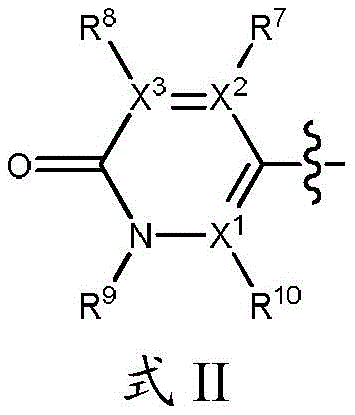
其中,in,
R7、R8和R10各自独立地为H、卤素(如F、Cl)、CN或取代或未取代的C1-C6烷基或C3-C6环烷基、OR11、SR11、NHR11、N(R11)2、NHC(O)R11和N(R11)C(O)R11,条件是R7、R8和R10中的至少一个不是H;R 7 , R 8 and R 10 are each independently H, halogen (eg F, Cl), CN or substituted or unsubstituted C 1 -C 6 alkyl or C 3 -C 6 cycloalkyl, OR 11 , SR 11 , NHR 11 , N(R 11 ) 2 , NHC(O)R 11 and N(R 11 )C(O)R 11 , provided that at least one of R 7 , R 8 and R 10 is not H;
R9是取代或未取代的C1-C3烷基或C3-C5环烷基;R 9 is substituted or unsubstituted C 1 -C 3 alkyl or C 3 -C 5 cycloalkyl;
R11在每种情况下独立地为取代或未取代的C1-C6烷基;R 11 is in each case independently substituted or unsubstituted C 1 -C 6 alkyl;
R12在每种情况下独立地为取代或未取代的C1-C6烷基、C2-C6烯基、C2-C6炔基、C3-C10环烷基和C3-C10杂环烷基;R 12 is in each case independently substituted or unsubstituted C 1 -C 6 alkyl, C 2 -C 6 alkenyl, C 2 -C 6 alkynyl, C 3 -C 10 cycloalkyl and C 3 -C 10 heterocycloalkyl;
X1、X2和X3各自选自N或C,其中当X1、X2或X3为N时,则与其连接的R7、R8或R10不存在,条件是X1、X2和X3中的至少两个是C;X 1 , X 2 and X 3 are each selected from N or C, wherein when X 1 , X 2 or X 3 is N, then R 7 , R 8 or R 10 attached thereto is absent, provided that X 1 , X at least two of 2 and X 3 are C;
其中当任何前述基团含有烷基时,则所述烷基为直链或支链非环状烷基。Wherein when any of the foregoing groups contain an alkyl group, the alkyl group is a straight or branched chain acyclic alkyl group.
在一个实施方案中,R8为卤素(例如F、Cl)、CN或取代的或未取代的C1-C6烷基或C3-C6环烷基、OR11、SR11、NHR11、N(R11)2、NHC(O)R11或N(R11)C(O)R11。In one embodiment, R 8 is halogen (eg F, Cl), CN or substituted or unsubstituted C 1 -C 6 alkyl or C 3 -C 6 cycloalkyl, OR 11 , SR 11 , NHR 11 , N(R 11 ) 2 , NHC(O)R 11 or N(R 11 )C(O)R 11 .
根据一个实施方案,R4可以是式II的基团,并且R5是氢或取代的或未取代的C1-C3烷基。在另一个实施方案中,其中R5是式II的基团,例如当R4是氢或取代或未取代的C1-C3烷基时。在一个实施方案中,R4是氢。According to one embodiment, R 4 may be a group of formula II and R 5 is hydrogen or substituted or unsubstituted C 1 -C 3 alkyl. In another embodiment, wherein R5 is a group of formula II, such as when R4 is hydrogen or substituted or unsubstituted C1 - C3 alkyl. In one embodiment, R4 is hydrogen.
在一个实施方案中,在式II中,基团X1、X2和X3全部是碳原子。在另一个实施方案中,X1是氮原子且R10不存在,并且X2和X3是碳原子。例如,式II的基团可以定义为式II(a)的基团:In one embodiment, in Formula II, the groups X 1 , X 2 and X 3 are all carbon atoms. In another embodiment, X1 is a nitrogen atom and R10 is absent, and X2 and X3 are carbon atoms. For example, a group of formula II can be defined as a group of formula II(a):
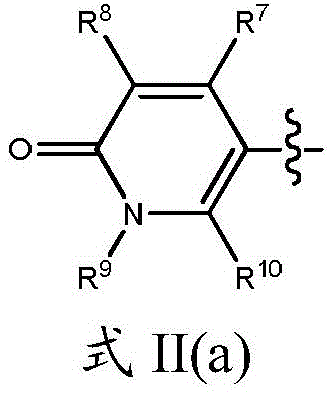
其中R7、R8、R9和R10如本文所定义。wherein R 7 , R 8 , R 9 and R 10 are as defined herein.
在一个实施方案中,R9是未取代的C1-C3烷基或C3-C5环烷基,例如甲基、乙基、正丙基、异丙基或环丙基,例如R9是甲基或R9是氟取代的C1-C3烷基或C3-C5环烷基,例如三氟甲基或二氟环丙基。在另一个实施方案中,R7和R10各自为氢原子且R8选自Cl、CN、NHR11和取代或未取代的C1-C6烷基或C3-C6环烷基。In one embodiment, R 9 is unsubstituted C 1 -C 3 alkyl or C 3 -C 5 cycloalkyl, such as methyl, ethyl, n-propyl, isopropyl or cyclopropyl, such as R 9 is methyl or R9 is fluoro substituted C1 - C3 alkyl or C3 - C5 cycloalkyl, eg trifluoromethyl or difluorocyclopropyl. In another embodiment, R 7 and R 10 are each a hydrogen atom and R 8 is selected from Cl, CN, NHR 11 and substituted or unsubstituted C 1 -C 6 alkyl or C 3 -C 6 cycloalkyl.
另一个实施方案涉及式I(a)的化合物及其药学上可接受的盐、溶剂合物、酯或前药:Another embodiment relates to compounds of formula I(a) and pharmaceutically acceptable salts, solvates, esters or prodrugs thereof:

其中R1、R2、R3、R5、R6、R7、R8、R9和R10如本文所定义。wherein R 1 , R 2 , R 3 , R 5 , R 6 , R 7 , R 8 , R 9 and R 10 are as defined herein.
根据另一个实施方案,本申请还涉及式I(b)的化合物及其药学上可接受的盐、溶剂合物、酯或前药:According to another embodiment, the application also relates to compounds of formula I(b) and pharmaceutically acceptable salts, solvates, esters or prodrugs thereof:

其中R1、R2、R4、R3、R6、R7、R8、R9和R10如本文针对任何适用的实施方案所定义。wherein R 1 , R 2 , R 4 , R 3 , R 6 , R 7 , R 8 , R 9 and R 10 are as defined herein for any applicable embodiment.
在一个实施方案中,本申请涉及如本文所定义的化合物,其中R3是H或取代或未取代的C1-C6烷基,优选R3是H。在另一个实施方案中,本申请涉及如本文所定义的化合物,其中R6是H或取代或未取代的C1-C6烷基,优选R6是H。In one embodiment, the application relates to a compound as defined herein, wherein R3 is H or substituted or unsubstituted C1 - C6 alkyl, preferably R3 is H. In another embodiment, the application relates to compounds as defined herein, wherein R6 is H or substituted or unsubstituted C1 -C6 alkyl , preferably R6 is H.
在另一个实施方案中,本申请涉及式III的化合物及其药学上可接受的盐、溶剂合物、酯或前药:In another embodiment, the application relates to compounds of formula III and pharmaceutically acceptable salts, solvates, esters or prodrugs thereof:

其中R1、R2、R4和R5如本文关于任何适用的实施方案所定义。wherein R 1 , R 2 , R 4 and R 5 are as defined herein for any applicable embodiment.
本申请的另一个实施方案涉及式III(a)的化合物及其药学上可接受的盐、溶剂合物、酯或前药:Another embodiment of the present application relates to compounds of formula III(a) and pharmaceutically acceptable salts, solvates, esters or prodrugs thereof:

其中R1、R2、R7、R8、R9和R10如本文所定义。wherein R 1 , R 2 , R 7 , R 8 , R 9 and R 10 are as defined herein.
根据另一个实施方案,本申请还涉及式III(b)的化合物及其药学上可接受的盐、溶剂合物、酯或前药:According to another embodiment, the application also relates to compounds of formula III(b) and pharmaceutically acceptable salts, solvates, esters or prodrugs thereof:
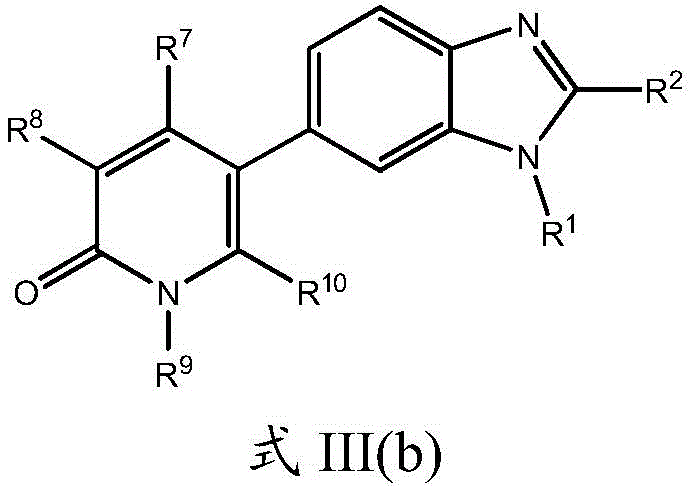
其中R1、R2、R7、R8、R9和R10如本文所定义。wherein R 1 , R 2 , R 7 , R 8 , R 9 and R 10 are as defined herein.
根据一个实施方案,本申请涉及如本文所定义的式III(a)或III(b)的化合物,其中R9是未取代的C1-C3烷基或C3-C5环烷基,或R9是氟取代的C1-C3烷基或C3-C5环烷基。例如,R9选自例如甲基、三氟甲基、乙基、正丙基、异丙基和环丙基,或者R9是甲基。在另一个实施方案中,本申请涉及式III(a)或III(b)的化合物,其中R7和R10各自为氢原子且R8选自Cl、CN、NHR11和取代或未取代的C1-C6烷基或C3-C6环烷基。在另一个实施方案中,R8和R9各自独立地为甲基、乙基、异丙基、氟甲基、二氟甲基、三氟甲基、环丙基或二氟环丙基。According to one embodiment, the application relates to compounds of formula III(a) or III(b) as defined herein, wherein R 9 is unsubstituted C 1 -C 3 alkyl or C 3 -C 5 cycloalkyl, or R 9 is fluoro substituted C 1 -C 3 alkyl or C 3 -C 5 cycloalkyl. For example, R9 is selected from, for example, methyl, trifluoromethyl, ethyl, n-propyl, isopropyl and cyclopropyl, or R9 is methyl. In another embodiment, the application relates to compounds of formula III(a) or III(b), wherein R7 and R10 are each a hydrogen atom and R8 is selected from Cl, CN , NHR11 and substituted or unsubstituted C 1 -C 6 alkyl or C 3 -C 6 cycloalkyl. In another embodiment, R8 and R9 are each independently methyl, ethyl, isopropyl, fluoromethyl, difluoromethyl, trifluoromethyl, cyclopropyl, or difluorocyclopropyl.
在又一个实施方案中,本申请涉及针对任一适用的实施方案的如本文所定义的式I、I(a)、I(b)、III、III(a)或III(b),其中R2是氢或选自C1-C6烷基、C3-C10环烷基或C3-C10杂环烷基的取代或未取代的基团。例如,R2是取代或未取代的C1-C3烷基、C3-C6环烷基或C3-C6杂环烷基,或者是选自甲基、乙基、丙基、异丙基、丁基、异丁基、叔丁基、环丙基、环丁基、环戊基、四氢呋喃基、四氢吡喃基、二氧杂环戊烷基、哌啶基和吡咯烷基的取代或未取代的基团。In yet another embodiment, the application relates to formula I, I(a), I(b), III, III(a) or III(b) as defined herein for any applicable embodiment, wherein R 2 is hydrogen or a substituted or unsubstituted group selected from C 1 -C 6 alkyl, C 3 -C 10 cycloalkyl or C 3 -C 10 heterocycloalkyl. For example, R 2 is substituted or unsubstituted C 1 -C 3 alkyl, C 3 -C 6 cycloalkyl or C 3 -C 6 heterocycloalkyl, or is selected from methyl, ethyl, propyl, isopropyl, butyl, isobutyl, tert-butyl, cyclopropyl, cyclobutyl, cyclopentyl, tetrahydrofuranyl, tetrahydropyranyl, dioxolane, piperidinyl and pyrrolidine substituted or unsubstituted groups.
根据另一个实施方案,本发明化合物是如本文所定义的式I、I(a)、I(b)、III、III(a)或III(b)的化合物,包括其各自的实施方案中的任一个,其中R1是支链或直链C2-C6烷基,其被选自氟、OC1-C6烷基和卤代OC1-C6烷基的基团取代。例如,R1是支链或直链C2-C3烷基,其被选自氟、OC1-C6烷基和卤代OC1-C6烷基的基团取代。在另一个实施方案中,R1选自氟甲基、二氟甲基、三氟甲基、2,2,2-三氟乙基、2-甲氧基乙基、2-乙氧基乙基、2-(氟甲氧基)乙基、2-(二氟甲氧基)乙基、2-(三氟甲氧基)乙基、3,3,3-三氟-1-丙基、3-甲氧基-1-丙基、3-乙氧基-1-丙基、3-(氟甲氧基)-1-丙基、3-(二氟甲氧基)-1-丙基、3-(三氟甲氧基)-1-丙基、1-甲氧基-2-丙基、1-乙氧基-2-丙基、1-(氟甲氧基)-2-丙基、1-(二氟甲氧基)-2-丙基、1-(三氟甲氧基)-2-丙基、2-甲氧基-1-丙基、2-乙氧基-1-丙基、2-(氟甲氧基)-1-丙基、2-(二氟甲氧基)-1-丙基或2-(三氟甲氧基)-1-丙基,例如,R1是2-甲氧基乙基、2-(三氟甲氧基)乙基、1-甲氧基-2-丙基、1-(三氟甲氧基)-2-丙基、2-甲氧基-1-丙基或2-(三氟甲氧基)-1-丙基。在另一个实施方案中,R1是甲基、三氟甲基、乙基、2,2,2-三氟乙基、正丙基、3,3,3-三氟-1-丙基、异丙基、正丁基、异丁基或叔丁基。According to another embodiment, the compound of the invention is a compound of formula I, I(a), I(b), III, III(a) or III(b) as defined herein, including in the respective embodiments thereof Any where R1 is branched or straight chain C2 - C6 alkyl substituted with a group selected from fluoro, OC1 - C6 alkyl and haloOC1 - C6 alkyl. For example, R 1 is a branched or straight chain C 2 -C 3 alkyl group substituted with a group selected from fluoro, OC 1 -C 6 alkyl and halogenated OC 1 -C 6 alkyl. In another embodiment, R 1 is selected from fluoromethyl, difluoromethyl, trifluoromethyl, 2,2,2-trifluoroethyl, 2-methoxyethyl, 2-ethoxyethyl , 2-(fluoromethoxy)ethyl, 2-(difluoromethoxy)ethyl, 2-(trifluoromethoxy)ethyl, 3,3,3-trifluoro-1-propyl , 3-methoxy-1-propyl, 3-ethoxy-1-propyl, 3-(fluoromethoxy)-1-propyl, 3-(difluoromethoxy)-1-propyl , 3-(trifluoromethoxy)-1-propyl, 1-methoxy-2-propyl, 1-ethoxy-2-propyl, 1-(fluoromethoxy)-2- propyl, 1-(difluoromethoxy)-2-propyl, 1-(trifluoromethoxy)-2-propyl, 2-methoxy-1-propyl, 2-ethoxy- 1-propyl, 2-(fluoromethoxy)-1-propyl, 2-(difluoromethoxy)-1-propyl or 2-(trifluoromethoxy)-1-propyl, for example , R 1 is 2-methoxyethyl, 2-(trifluoromethoxy)ethyl, 1-methoxy-2-propyl, 1-(trifluoromethoxy)-2-propyl, 2-methoxy-1-propyl or 2-(trifluoromethoxy)-1-propyl. In another embodiment, R 1 is methyl, trifluoromethyl, ethyl, 2,2,2-trifluoroethyl, n-propyl, 3,3,3-trifluoro-1-propyl, isopropyl, n-butyl, isobutyl or tert-butyl.
本申请的化合物的实例包括但不限于:Examples of compounds of the present application include, but are not limited to:

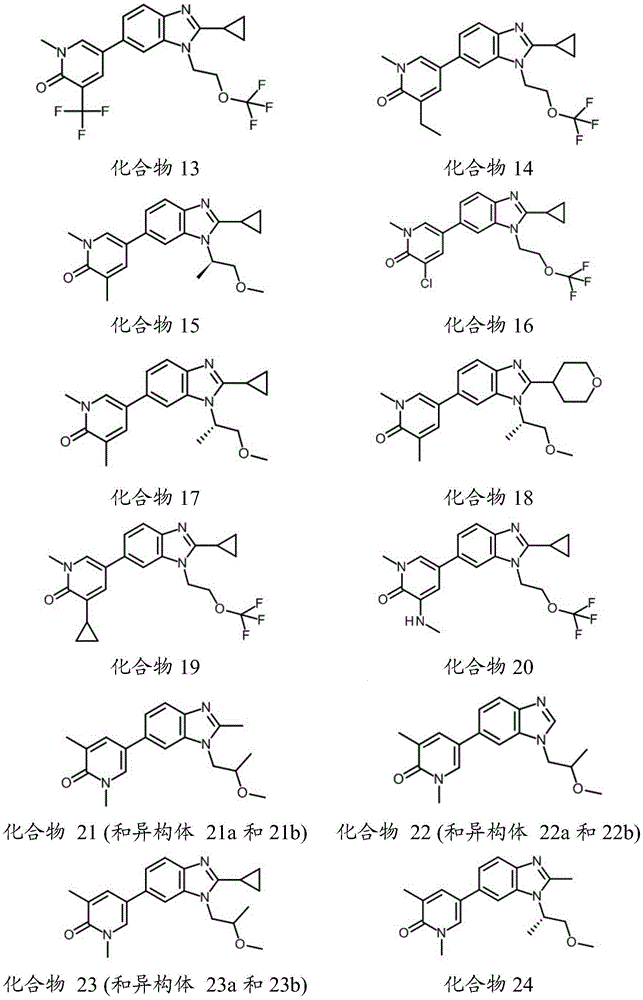
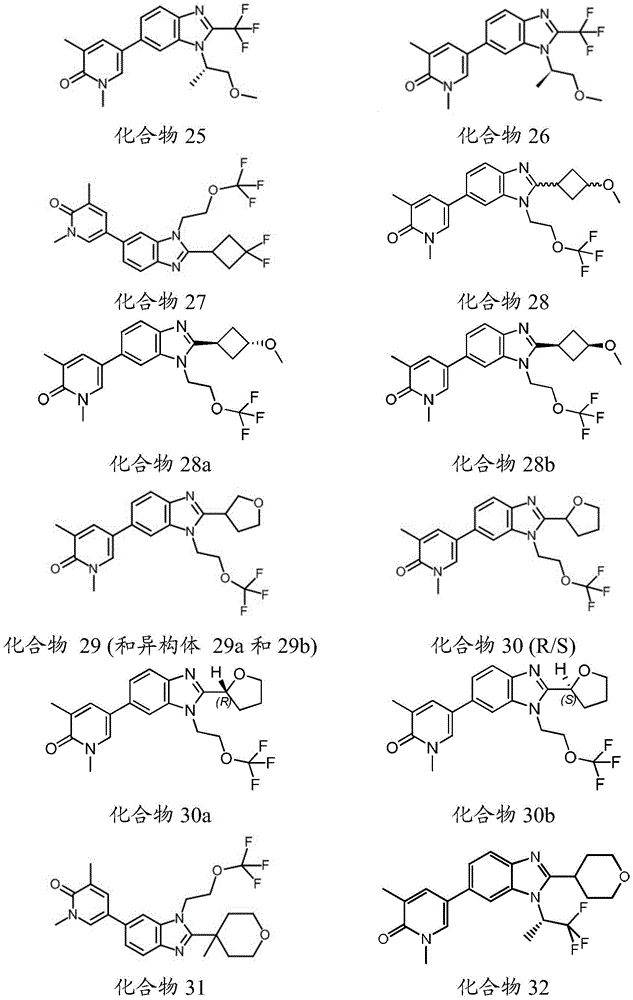


或其药学上可接受的盐、溶剂合物或前药。or a pharmaceutically acceptable salt, solvate or prodrug thereof.
在另一个实施方案中,本申请涉及选自如本文所定义的化合物1至67的化合物或其药学上可接受的盐、溶剂合物或前药。In another embodiment, the application relates to a compound selected from Compounds 1 to 67 as defined herein, or a pharmaceutically acceptable salt, solvate or prodrug thereof.
iii.方法、用途、制剂和给药iii. Methods, Uses, Formulations and Administration
如本文所用,术语“有效量”是指例如由研究人员或临床医师寻求的将引起组织、系统、动物或人的生物或医学反应的药物或药剂的量。此外,术语“治疗有效量”是指与未接受该量的相应受试者相比,导致治疗、治愈、预防或改善疾病、病症或副作用或减少疾病或病症的进展速度的任何量。该术语在其范围内还包括有效增强正常生理功能的量。As used herein, the term "effective amount" refers to the amount of a drug or agent that will elicit a biological or medical response in a tissue, system, animal or human, eg, as sought by a researcher or clinician. Furthermore, the term "therapeutically effective amount" refers to any amount that results in treatment, cure, prevention or amelioration of a disease, disorder or side effects or a reduction in the rate of progression of a disease or disorder as compared to a corresponding subject not receiving that amount. The term also includes within its scope amounts effective to enhance normal physiological function.
如本文所用,术语“治疗”是指逆转、缓解、延缓本文所述的疾病或病症或其一种或多种症状的发作或抑制其发展。在一些实施方案中,治疗可以在一种或多种症状已经出现之后施用。在其他实施方案中,治疗可以在没有症状的情况下施用。例如,可以在症状发作之前(例如根据症状史和/或根据遗传或其他易感因素)对易感个体进行治疗。症状解决后还可继续治疗,例如预防或延缓其复发。As used herein, the term "treating" refers to reversing, alleviating, delaying the onset or inhibiting the progression of a disease or disorder described herein, or one or more symptoms thereof. In some embodiments, treatment may be administered after one or more symptoms have occurred. In other embodiments, treatment can be administered in the absence of symptoms. For example, a susceptible individual can be treated prior to the onset of symptoms (eg, based on a history of symptoms and/or based on genetic or other predisposing factors). Treatment can be continued after symptoms resolve, such as to prevent or delay their recurrence.
如本文所用,术语“溴结构域抑制剂”表示抑制溴结构域与其同源乙酰化蛋白结合的化合物。在一个实施方案中,溴结构域抑制剂是抑制溴结构域与乙酰化赖氨酸残基结合的化合物。在另一个实施方案中,溴结构域抑制剂是抑制溴结构域与组蛋白,特别是组蛋白H3和H4上的乙酰基化赖氨酸残基结合的化合物。As used herein, the term "bromodomain inhibitor" refers to a compound that inhibits the binding of a bromodomain to its cognate acetylated protein. In one embodiment, a bromodomain inhibitor is a compound that inhibits the binding of a bromodomain to acetylated lysine residues. In another embodiment, a bromodomain inhibitor is a compound that inhibits the binding of a bromodomain to acetylated lysine residues on histones, particularly histones H3 and H4.
在一个具体的实施方案中,溴结构域抑制剂是抑制BET家族溴结构域与乙酰基化赖氨酸残基结合的化合物(以下称为“BET家族溴结构域抑制剂”)。包含溴结构域蛋白的BET家族包含4个蛋白质(BRD2、BRD3、BRD4和BRD-t),其含有能够紧密结合两个乙酰基化赖氨酸残基的串联溴结构域,增加了相互作用的特异性。In a specific embodiment, the bromodomain inhibitor is a compound that inhibits the binding of a BET family bromodomain to acetylated lysine residues (hereinafter referred to as "BET family bromodomain inhibitor"). The BET family of bromodomain-containing proteins comprises four proteins (BRD2, BRD3, BRD4, and BRD-t) that contain tandem bromodomains capable of tightly binding two acetylated lysine residues, increasing the interaction specificity.
如本文所用,术语“抑制剂”定义为以可测量的亲和力结合和/或抑制靶标含溴结构域蛋白(例如BET蛋白,例如BRD2、BRD3、BRD4和/或BRDT)的化合物。As used herein, the term "inhibitor" is defined as a compound that binds and/or inhibits a target bromodomain-containing protein (eg, a BET protein, eg, BRD2, BRD3, BRD4, and/or BRDT) with measurable affinity.
如本文所用,术语“可测量的亲和力”和“可测量地抑制”是指包含所提供的化合物或其组合物以及至少一种组蛋白甲基转移酶的样品,与包含至少一种含溴结构域蛋白在不存在所述化合物或其组合物的的情况下的等同样品之间,至少一个含溴结构域蛋白的活性的可测量的变化。As used herein, the terms "measurable affinity" and "measurably inhibits" refer to a sample comprising a provided compound or composition thereof and at least one histone methyltransferase, and a sample comprising at least one bromo-containing structure Domain protein A measurable change in the activity of at least one bromodomain-containing protein between equivalent samples in the absence of the compound or composition thereof.
如本文所用,术语“患者或受试者”是指哺乳动物。因此,受试者是指例如狗、猫、马、牛、猪、豚鼠等。优选地,受试者是人。当受试者是人时,受试者可以是患者或健康人。As used herein, the term "patient or subject" refers to a mammal. Thus, a subject refers to, for example, dogs, cats, horses, cows, pigs, guinea pigs, and the like. Preferably, the subject is a human. When the subject is a human, the subject can be a patient or a healthy human.
在一些实施方案中,疾病或病症可以是自身免疫性疾病、炎性病症、皮肤病症或癌症。在一些任选的实施方案中,疾病或病症可以是自身免疫性疾病。在一些其他任选的实施方案中,疾病或病症可以是炎性病症。在进一步的任选实施方案中,炎性病症可以是类风湿性关节炎、肠易激综合征或牛皮癣。In some embodiments, the disease or disorder may be an autoimmune disease, an inflammatory disorder, a skin disorder, or cancer. In some optional embodiments, the disease or disorder may be an autoimmune disease. In some other optional embodiments, the disease or disorder may be an inflammatory disorder. In further optional embodiments, the inflammatory disorder may be rheumatoid arthritis, irritable bowel syndrome or psoriasis.
在一些其他任选的实施方案中,疾病或病症可以是癌症。在进一步的任选实施方案中,癌症可以是脑癌、胰腺癌、乳腺癌、肺癌或前列腺癌。在进一步的任选实施方案中,癌症可以是脑癌。在进一步的任选实施方案中,脑癌是多形性成胶质细胞瘤。In some other optional embodiments, the disease or disorder may be cancer. In further optional embodiments, the cancer may be brain cancer, pancreatic cancer, breast cancer, lung cancer or prostate cancer. In a further optional embodiment, the cancer may be brain cancer. In a further optional embodiment, the brain cancer is glioblastoma multiforme.
在一些实施方案中,所述癌症选自:脑(胶质瘤)、成胶质细胞瘤、白血病、淋巴瘤、Bannayan-Zonana综合征、考登病、Lhermitte-Duclos病、乳腺癌、炎性乳腺癌、维尔姆氏瘤、尤因氏肉瘤、横纹肌肉瘤、室管膜瘤、髓母细胞瘤、结肠癌、胃癌、膀胱癌、头颈癌、肾癌、肺癌、肝癌、黑素瘤、肾脏癌、卵巢癌、胰腺癌、前列腺癌、肉瘤、骨肉瘤、骨巨细胞瘤和甲状腺癌。In some embodiments, the cancer is selected from the group consisting of: brain (glioma), glioblastoma, leukemia, lymphoma, Bannayan-Zonana syndrome, Cowden disease, Lhermitte-Duclos disease, breast cancer, inflammatory Breast cancer, Wilm's tumor, Ewing's sarcoma, rhabdomyosarcoma, ependymoma, medulloblastoma, colon cancer, stomach cancer, bladder cancer, head and neck cancer, kidney cancer, lung cancer, liver cancer, melanoma, kidney cancer , ovarian cancer, pancreatic cancer, prostate cancer, sarcoma, osteosarcoma, giant cell tumor of bone and thyroid cancer.
在一些实施方案中,病症可以是增殖性病症、炎性疾病、败血症、自身免疫性疾病或病毒感染。在一些任选的实施方案中,增殖性病症可以是癌症。In some embodiments, the disorder may be a proliferative disorder, an inflammatory disease, sepsis, an autoimmune disease, or a viral infection. In some optional embodiments, the proliferative disorder may be cancer.
术语“增殖性病症”是指具有自主生长能力的细胞,即特征在于快速增殖的细胞生长的异常状态的病症,其通常形成一种不同的块,其显示与正常组织的结构组织和功能协调的部分或完全缺乏。The term "proliferative disorder" refers to a disorder characterized by an abnormal state of cell growth with the ability to grow autonomously, ie, a disorder characterized by the growth of rapidly proliferating cells, which usually forms a distinct mass that exhibits structural organization and function in harmony with normal tissue Partially or completely absent.
术语“赘生物”、“肿瘤性疾病”、“瘤”、“癌症”和“肿瘤”意在包括造血系统肿瘤(例如淋巴瘤或白血病)以及实体肿瘤(例如肉瘤或癌),包括所有类型的癌前和癌生长,或致癌过程,转移组织或恶性转化的细胞、组织或器官,而不考虑组织病理学类型或侵袭阶段。造血系肿瘤是影响造血结构(与血细胞形成有关的结构)和免疫系统成分的恶性肿瘤,包括来自骨髓、淋巴或红细胞系统谱系的白血病(与血液和骨髓中的白细胞及其前体有关)和淋巴瘤(与淋巴细胞有关)。实体瘤包括肉瘤,其是源自肌肉、软骨、血管、纤维组织、脂肪或骨等结缔组织的恶性肿瘤。实体瘤还包括癌,其为由上皮结构(包括外部上皮(例如,胃肠道、肺和子宫颈的皮肤和内层))和来自各种腺体的内部上皮(例如乳房、胰腺、甲状腺)的恶性肿瘤。肿瘤的实例包括白血病和肝细胞癌、肉瘤、血管内皮癌、乳腺癌、中枢神经系统癌症(例如星形细胞瘤、胶质肉瘤、神经母细胞瘤、少突神经胶质瘤和成胶质细胞瘤)、前列腺癌、肺和支气管癌、喉癌、食道癌、结肠癌、结直肠癌、胃肠癌、黑素瘤、卵巢癌和子宫内膜癌、肾癌和膀胱癌、肝癌、内分泌癌(例如甲状腺癌)和胰腺癌。The terms "neoplasia," "neoplastic disease," "tumor," "cancer," and "tumor" are intended to include hematopoietic tumors (eg, lymphomas or leukemias) as well as solid tumors (eg, sarcomas or carcinomas), including all types of Precancerous and cancerous growths, or oncogenic processes, metastatic tissue or malignantly transformed cells, tissues or organs, regardless of histopathological type or stage of invasion. Hematopoietic tumors are malignant tumors that affect hematopoietic structures (structures involved in the formation of blood cells) and components of the immune system, including leukemias from the myeloid, lymphoid, or erythroid lineages (associated with leukocytes and their precursors in the blood and bone marrow) and lymphocytes tumor (associated with lymphocytes). Solid tumors include sarcomas, which are malignant tumors derived from connective tissue such as muscle, cartilage, blood vessels, fibrous tissue, fat, or bone. Solid tumors also include carcinomas, which are formed by epithelial structures, including outer epithelium (eg, the skin and lining of the gastrointestinal tract, lungs, and cervix) and inner epithelium from various glands (eg, breast, pancreas, thyroid). malignant tumor. Examples of tumors include leukemia and hepatocellular carcinoma, sarcoma, vascular endothelial carcinoma, breast cancer, cancers of the central nervous system (eg, astrocytoma, gliosarcoma, neuroblastoma, oligodendroglioma, and glioblastoma) cancer), prostate cancer, lung and bronchial cancer, laryngeal cancer, esophagus cancer, colon cancer, colorectal cancer, gastrointestinal cancer, melanoma, ovarian and endometrial cancer, kidney and bladder cancer, liver cancer, endocrine cancer (eg thyroid cancer) and pancreatic cancer.
在一些方面,使用本文所述的化合物和方法治疗的癌症的实例包括但不限于腺泡细胞癌、听神经瘤、肢端雀斑状黑素瘤、顶端螺旋瘤、急性嗜酸细胞性白血病、急性红细胞性白血病、急性淋巴母细胞性白血病、急性淋巴细胞性白血病、急性巨核细胞性白血病、急性单核细胞性白血病、急性髓性白血病、急性粒细胞性白血病、急性早幼粒细胞白血病、肾上腺癌、腺癌、腺样囊性癌、腺瘤、腺瘤样牙源性肿瘤、腺鳞癌、脂肪组织肿瘤、肾上腺癌、肾上腺皮质癌、成人T细胞白血病/淋巴瘤、侵袭性NK细胞白血病、与AIDS相关的淋巴瘤、肺泡横纹肌肉瘤、肺泡软部肉瘤、成釉细胞纤维瘤、间变性大细胞淋巴瘤、间变性甲状腺癌、血管免疫母细胞性T细胞淋巴瘤、血管平滑肌脂肪瘤、血管肉瘤、星形细胞瘤、非典型畸胎样杆状瘤、Bannayan-Zo nana综合征、基底细胞癌、B细胞慢性淋巴细胞性白血病、B细胞淋巴瘤、B细胞幼淋巴细胞白血病、胆道癌、膀胱癌、膀胱癌、母细胞瘤、骨癌、脑(神经胶质瘤)、脑癌、乳腺癌、乳腺癌、勃勒纳瘤、布朗瘤、伯基特淋巴瘤、癌、原位癌、癌肉瘤、软骨瘤、牙骨质瘤、宫颈癌、软骨瘤、脊索瘤、绒毛膜癌、脉络丛乳头状瘤、慢性淋巴细胞性白血病、肾透明细胞肉瘤、结肠癌、结直肠癌、考登病、颅咽管瘤、皮肤T细胞淋巴瘤、德戈斯病、促结缔组织小圆细胞瘤、弥漫性大B细胞淋巴瘤、胚胎发育不良性神经上皮瘤、无性细胞瘤、胚胎癌、内分泌腺瘤、内胚窦瘤、伴有T细胞淋巴瘤、室管膜瘤、食管癌、尤因肉瘤、胎内胎、纤维瘤、纤维肉瘤、滤泡性淋巴瘤、滤泡性甲状腺癌、胆囊癌、神经节瘤、胃癌、胃癌、胃肠癌、生殖细胞瘤、妊娠绒毛膜癌、巨细胞成纤维细胞瘤、骨和甲状腺巨细胞瘤、骨巨细胞瘤、胶质瘤、多形性成胶质细胞瘤、成胶质细胞瘤、胶质瘤、大脑神经胶质瘤、高血糖素瘤、成性腺细胞瘤、颗粒细胞瘤、两性胚细胞瘤、多毛细胞白血病、头颈部肿瘤、头颈癌、血管母细胞瘤、血管外皮细胞瘤、血液恶性肿瘤、肝母细胞瘤、肝脾T细胞淋巴瘤、霍奇金淋巴瘤、炎性乳腺癌、肠癌、浸润性小叶癌、肾癌、肾脏癌、喉癌、恶性痣、致死性中线癌、白血病、白血病、莱迪希细胞瘤、Lhermitte-Duclos病、脂肪肉瘤、肝癌、肝脏癌、肺癌、肺脏癌、淋巴管肉瘤、淋巴管瘤、淋巴上皮瘤、淋巴瘤、淋巴瘤、恶性纤维组织细胞瘤、恶性外周神经鞘瘤、恶性蝾螈瘤、MALT淋巴瘤、套细胞淋巴瘤、边缘区B细胞淋巴瘤、肥大细胞白血病、纵隔生殖细胞肿瘤、乳腺髓样癌、甲状腺髓样癌、成神经管细胞瘤、黑素瘤、脑膜瘤、梅克尔细胞癌、间皮瘤、转移性尿路上皮癌、恶性Mullerian混合瘤、粘蛋白瘤、多发性骨髓瘤、肌肉细胞瘤、蕈样肉芽肿、骨髓样肉瘤、粘液瘤、粘液肉瘤、鼻咽癌、神经鞘瘤、神经母细胞瘤、神经纤维瘤、神经瘤、结节性黑素瘤、非霍奇金淋巴瘤、非小细胞肺癌、眼癌、寡星状细胞瘤、少突神经胶质瘤、嗜酸粒细胞腺瘤、视神经鞘膜瘤、视神经肿瘤、口腔癌、骨肉瘤、卵巢癌、卵巢癌、肺上沟瘤、胰腺癌、胰腺癌、乳头状甲状腺癌、副神经节瘤、咽癌、松果体母细胞瘤、松果体细胞瘤、垂体腺瘤、垂体腺瘤、垂体瘤、浆细胞瘤、多胚瘤、前体T-淋巴母细胞性淋巴瘤、原发性中枢神经系统淋巴瘤、原发性渗出性淋巴瘤、原发性腹膜癌、前列腺癌、前列腺癌、腹膜假性粘液瘤、直肠癌、肾癌、肾细胞癌、肾髓样癌、视网膜母细胞瘤、横纹肌瘤、横纹肌肉瘤、Richter转化、肉瘤、神经鞘瘤病、精细胞瘤、塞托利细胞细胞瘤、性索性腺间质肿瘤、Sezary病、印戒细胞癌、皮肤癌、小蓝圆细胞瘤、小细胞癌、小细胞肺癌、小肠癌、软组织肉瘤、生长抑素瘤、烟尘疣、脊柱肿瘤、脾边缘区淋巴瘤、鳞状癌、鳞状细胞癌、胃癌、滑膜肉瘤、T细胞淋巴瘤、睾丸癌、泡膜细胞瘤、喉癌、甲状腺癌、移行细胞癌、脐尿管癌、泌尿生殖系统癌、膀胱上皮癌、子宫癌,葡萄膜黑色素瘤、阴道癌、疣状癌、视神经胶质瘤、外阴癌、瓦尔登斯特伦巨球蛋白血症、沃辛瘤和维尔姆斯瘤。In some aspects, examples of cancers treated using the compounds and methods described herein include, but are not limited to, acinar cell carcinoma, acoustic neuroma, acral lentiginous melanoma, apical helicoma, acute oncocytic leukemia, acute erythrocyte leukemia, acute lymphoblastic leukemia, acute lymphoblastic leukemia, acute megakaryocytic leukemia, acute monocytic leukemia, acute myeloid leukemia, acute myeloid leukemia, acute promyelocytic leukemia, adrenal cancer, Adenocarcinoma, adenoid cystic carcinoma, adenoma, adenomatous odontogenic tumor, adenosquamous carcinoma, adipose tissue tumor, adrenal carcinoma, adrenocortical carcinoma, adult T-cell leukemia/lymphoma, aggressive NK-cell leukemia, and AIDS-related lymphoma, alveolar rhabdomyosarcoma, alveolar soft sarcoma, ameloblastoma fibroma, anaplastic large cell lymphoma, anaplastic thyroid cancer, angioimmunoblastic T-cell lymphoma, angiomyolipoma, angiosarcoma , astrocytoma, atypical teratoid rod tumor, Bannayan-Zonana syndrome, basal cell carcinoma, B-cell chronic lymphocytic leukemia, B-cell lymphoma, B-cell prolymphocytic leukemia, biliary tract cancer, bladder cancer, bladder cancer, blastoma, bone cancer, brain (glioma), brain cancer, breast cancer, breast cancer, Brener tumor, Brown tumor, Burkitt lymphoma, carcinoma, carcinoma in situ, carcinoma Sarcoma, chondroma, cementoma, cervical cancer, chondroma, chordoma, choriocarcinoma, choroid plexus papilloma, chronic lymphocytic leukemia, renal clear cell sarcoma, colon cancer, colorectal cancer, Cowden disease , craniopharyngioma, cutaneous T-cell lymphoma, Degos disease, desmoplastic small round cell tumor, diffuse large B-cell lymphoma, dysembryoplastic neuroepithelioma, dysgerminoma, embryonal carcinoma, endocrine glands tumor, endodermal sinus tumor, T-cell lymphoma, ependymoma, esophageal cancer, Ewing's sarcoma, intrauterine tumor, fibroma, fibrosarcoma, follicular lymphoma, follicular thyroid cancer, gallbladder cancer, Gangliomas, gastric, gastric, gastrointestinal, germ cell tumors, gestational choriocarcinoma, giant cell fibroblastoma, giant cell tumor of bone and thyroid, giant cell tumor of bone, glioma, glioblastoma multiforme cell tumor, glioblastoma, glioma, cerebral glioma, glucagon tumor, gonadoblastoma, granulosa cell tumor, hermaphroditic tumor, hairy cell leukemia, head and neck tumor, head and neck cancer, Hemangioblastoma, hemangiopericytoma, hematological malignancies, hepatoblastoma, hepatosplenic T-cell lymphoma, Hodgkin lymphoma, inflammatory breast cancer, bowel cancer, invasive lobular carcinoma, kidney cancer, kidney cancer , Laryngeal cancer, Malignant mole, Fatal midline cancer, Leukemia, Leukemia, Leydig cell tumor, Lhermitte-Duclos disease, Liposarcoma, Liver cancer, Liver cancer, Lung cancer, Lung cancer, Lymphangiosarcoma, Lymphangioma, Lymphoepithelium tumor, lymphoma, lymphoma, malignant fibrous histiocytoma, malignant peripheral nerve sheath tumor, malignant salamander tumor, MALT lymphoma, mantle cell lymphoma, marginal zone B-cell lymphoma, mast cell leukemia, mediastinal germ cell tumor tumor, medullary breast carcinoma, medullary thyroid carcinoma, medulloblastoma, melanoma, meningioma, Merkel cell carcinoma, mesothelioma, metastatic urothelial carcinoma, malignant Mullerian mixed tumor, mucinoma , multiple myeloma, myocytoma, mycosis fungoides, myeloid sarcoma, myxoma, myxosarcoma, nasopharyngeal carcinoma, schwannoma, neuroblastoma, neurofibroma, neuroma, nodular melanoma tumor, non-Hodgkin lymphoma, non-small cell lung cancer, eye cancer, oligoastrocytoma, oligodendroglioma, oncocytic adenoma, optic nerve sheath tumor, optic nerve tumor, oral cancer, osteosarcoma , ovarian cancer, ovarian cancer, superior sulcus tumor, pancreatic cancer, pancreatic cancer, papillary thyroid cancer, paraganglioma, pharyngeal cancer, pineoblastoma, pineal cell tumor, pituitary adenoma, pituitary gland tumor, pituitary tumor, plasmacytoma, polyblastoma, precursor T-lymphoblastic lymphoma, primary central nervous system lymphoma, primary effusion lymphoma, primary peritoneal cancer, prostate cancer , prostate cancer, peritoneal pseudomyxoma, rectal cancer, kidney cancer, renal cell carcinoma, renal medullary carcinoma, retinoblastoma, rhabdomyomas, rhabdomyosarcoma, Richter's transformation, sarcoma, schwannomatosis, semicytoma, Setoli cell tumor, gonadal stromal tumor, Sezary disease, signet ring cell carcinoma, skin cancer, small blue round cell tumor, small cell carcinoma, small cell lung cancer, small bowel cancer, soft tissue sarcoma, somatostatinoma, Soot warts, spinal tumors, splenic marginal zone lymphoma, squamous cell carcinoma, squamous cell carcinoma, gastric cancer, synovial sarcoma, T cell lymphoma, testicular cancer, theca cell tumor, laryngeal cancer, thyroid cancer, transitional cell carcinoma, Urachal carcinoma, genitourinary carcinoma, bladder epithelial carcinoma, uterine carcinoma, uveal melanoma, vaginal carcinoma, verrucous carcinoma, optic glioma, vulvar carcinoma, Waldenstrom macroglobulinemia, Worthing tumor and Wilms tumor.
在一些实施方案中,癌症可以是腺癌、成人T细胞白血病/淋巴瘤、膀胱癌、胚细胞瘤、骨癌、乳腺癌、脑癌、癌、髓样肉瘤、宫颈癌、结直肠癌、食道癌、胃肠癌、多形性成胶质细胞瘤、胶质瘤、胆囊癌、胃癌、头颈癌、霍奇金淋巴瘤、非霍奇金淋巴瘤、肠癌、肾癌、喉癌、白血病、肺癌、淋巴瘤、肝癌、小细胞肺癌、非小细胞肺癌、间皮瘤、多发性骨髓瘤、眼癌、视神经肿瘤、口腔癌、卵巢癌、垂体瘤、原发性中枢神经系统淋巴瘤、前列腺癌、胰腺癌、咽癌、肾细胞癌、直肠癌、肉瘤、皮肤癌、脊柱肿瘤、小肠癌、胃癌、T细胞淋巴瘤、睾丸癌、甲状腺癌、咽喉癌、泌尿生殖道癌、尿路上皮癌、子宫癌、阴道癌症或维尔姆斯瘤。在一些其他实施方案中,癌症可以是急性骨髓性白血病或伯基特淋巴瘤。In some embodiments, the cancer can be adenocarcinoma, adult T-cell leukemia/lymphoma, bladder cancer, blastoma, bone cancer, breast cancer, brain cancer, carcinoma, myeloid sarcoma, cervical cancer, colorectal cancer, esophagus Cancer, gastrointestinal cancer, glioblastoma multiforme, glioma, gallbladder cancer, stomach cancer, head and neck cancer, Hodgkin lymphoma, non-Hodgkin lymphoma, bowel cancer, kidney cancer, throat cancer, leukemia , lung cancer, lymphoma, liver cancer, small cell lung cancer, non-small cell lung cancer, mesothelioma, multiple myeloma, eye cancer, optic nerve tumor, oral cancer, ovarian cancer, pituitary tumor, primary central nervous system lymphoma, Prostate cancer, pancreatic cancer, pharyngeal cancer, renal cell cancer, rectal cancer, sarcoma, skin cancer, spinal tumor, small bowel cancer, stomach cancer, T-cell lymphoma, testicular cancer, thyroid cancer, throat cancer, genitourinary tract cancer, urinary tract Skin cancer, uterine cancer, vaginal cancer, or Wilms tumor. In some other embodiments, the cancer may be acute myeloid leukemia or Burkitt lymphoma.
在一些实施方案中,自身免疫性或炎性疾病或病症可包括对细菌、病毒、真菌、寄生虫或其毒素以及病毒的感染的炎症反应。在一些其他实施方案中,自身免疫性或炎性疾病或病症可选自急性肺损伤、急性胰腺炎、急性肾衰竭、ARDS(成人呼吸窘迫综合征)、烧伤、冠状病毒、脑炎、内毒素血症、暴发性肝炎、单纯疱疹、带状疱疹、赫克斯海默反应、疟疾和与病毒感染有关的SIRS(如流感)、脑膜炎、多器官功能障碍综合征、脊髓炎、手术后综合征、结节病、败血症、败血症综合征、感染性休克、全身炎症反应综合征(SIRS)、中毒性休克综合征。In some embodiments, an autoimmune or inflammatory disease or disorder may include an inflammatory response to infection by bacteria, viruses, fungi, parasites or their toxins and viruses. In some other embodiments, the autoimmune or inflammatory disease or disorder may be selected from acute lung injury, acute pancreatitis, acute renal failure, ARDS (adult respiratory distress syndrome), burns, coronavirus, encephalitis, endotoxin Hyperemia, fulminant hepatitis, herpes simplex, herpes zoster, Herxheimer reaction, malaria and SIRS associated with viral infections (eg, influenza), meningitis, multiple organ dysfunction syndrome, myelitis, postoperative syndrome Symptoms, sarcoidosis, sepsis, sepsis syndrome, septic shock, systemic inflammatory response syndrome (SIRS), toxic shock syndrome.
在一些实施方案中,本说明书提供了治疗其他病症的方法。这些其他病症包括但不限于痤疮、急性炎症反应(例如急性呼吸窘迫综合征和局部缺血/再灌注损伤、成胶质细胞瘤、格雷夫斯病、HIV、HPV、炎性疾病、瘢痕疙瘩和相关瘢痕形成、肺癌、脑膜炎(细菌和病毒)、多发性硬化、肿瘤、成神经细胞瘤、胰腺癌、硬皮病、皮肤癌、中毒性休克、病毒感染、病毒感染和疾病。In some embodiments, the present specification provides methods of treating other disorders. These other conditions include, but are not limited to, acne, acute inflammatory responses (eg, acute respiratory distress syndrome and ischemia/reperfusion injury, glioblastoma, Graves' disease, HIV, HPV, inflammatory diseases, keloids and Associated scarring, lung cancer, meningitis (bacterial and viral), multiple sclerosis, tumors, neuroblastoma, pancreatic cancer, scleroderma, skin cancer, toxic shock, viral infections, viral infections and diseases.
在一些实施方案中,本说明书提供了治疗良性增殖性病症的方法。这种良性增殖性病症包括但不限于良性软组织肿瘤、骨肿瘤、脑和脊柱肿瘤、眼睑和眼眶肿瘤、肉芽肿、脂肪瘤、脑膜瘤、多发性内分泌瘤形成、鼻息肉、垂体肿瘤、泌乳素瘤、假性脑肿瘤、脂溢性角化病、胃息肉、甲状腺结节、胰腺囊性肿瘤、血管瘤、声带结节、息肉和囊肿、淋巴结增生症、慢性皮肤病、皮肤纤维瘤、毛发囊肿、泌乳素瘤、大脑假瘤、化脓性肉芽肿和青少年息肉病综合征。In some embodiments, the present specification provides methods of treating benign proliferative disorders. Such benign proliferative disorders include, but are not limited to, benign soft tissue tumors, bone tumors, brain and spine tumors, eyelid and orbital tumors, granulomas, lipomas, meningiomas, multiple endocrine neoplasia, nasal polyps, pituitary tumors, prolactin Tumors, pseudo brain tumors, seborrheic keratosis, gastric polyps, thyroid nodules, pancreatic cystic tumors, hemangiomas, vocal cord nodules, polyps and cysts, lymphadenopathy, chronic skin diseases, dermatofibroma, hair Cyst, prolactinoma, cerebral pseudotumor, pyogenic granuloma, and juvenile polyposis syndrome.
本发明进一步涉及通过将有效量的所提供的化合物给予需要这种治疗的哺乳动物,特别是人类来治疗感染性和非感染性炎症事件和自身免疫以及其他炎性疾病的方法。使用本文所述的化合物和方法治疗的自身免疫性和炎性疾病、病症和综合征的实例包括炎性骨盆疾病、尿道炎、皮肤晒伤、鼻窦炎、肺炎、脑炎、脑膜炎、心肌炎、肾炎、骨髓炎、肌炎、肝炎、胃炎、肠炎、皮炎、牙龈炎、阑尾炎、胰腺炎、胆囊炎、无丙种球蛋白血症、牛皮癣、变态反应、克罗恩氏病、肠易激综合征、溃疡性结肠炎、干燥综合征、组织移植排斥、移植器官超急性排斥、哮喘、变应性鼻炎、慢性阻塞性肺病(COPD)、自身免疫性多腺疾病(也称为自身免疫性多腺综合征)、自身免疫性脱发、恶性贫血、肾小球肾炎、皮肌炎、多发性硬化、硬皮病、血管炎、自身免疫性溶血和血小板减少症、Goodpasture综合征、动脉粥样硬化、艾迪生病、帕金森病、阿尔茨海默氏病、I型糖尿病、感染性休克、系统性红斑狼疮(SLE)、类风湿性关节炎、牛皮癣关节炎、青少年关节炎、骨关节炎、慢性特发性血小板减少性紫癜、瓦尔登斯特伦巨球蛋白血症、重症肌无力、桥本甲状腺炎、特应性皮炎、退行性关节病、白癜风、自身免疫性垂体功能减退症、格-巴综合征、白塞病、巩膜瘤、蕈样霉菌病、急性炎症反应(如急性呼吸窘迫综合征和局部缺血/再灌注损伤)和格雷夫斯病。感染和非感染性炎症事件、自身免疫和其他炎性疾病的其他实例包括但不限于阿狄森氏病、无丙种球蛋白血症、变应性鼻炎、变态反应、阿尔茨海默病、阑尾炎、哮喘、动脉粥样硬化、特应性皮炎、自身免疫性脱发、自身免疫性溶血和血小板减少状态、自身免疫性垂体功能减退、自身免疫性多腺疾病(也称自身免疫性多腺综合征)、贝赫切特病、胆囊炎、慢性特发性血小板减少性紫癜、慢性阻塞性肺疾病(COPD)、克罗恩病、退行性关节病、皮炎、皮肌炎、脑炎、肠炎、胃炎、牙龈炎、肾小球肾炎、Goodpasture综合征、格-巴综合征、桥本甲状腺炎、肝炎、移植器官的超急性排斥、炎性骨盆疾病、肠易激综合征、青少年关节炎、脑膜炎、多发性硬化症、重症肌无力、蕈样肉芽肿、心肌炎、肌炎、肾炎、骨关节炎、骨髓炎、胰腺炎、帕金森病、恶性贫血、肺炎、牛皮癣、牛皮癣性关节炎、类风湿性关节炎、巩膜硬化症、硬皮病、败血性休克、鼻窦炎、舍格伦病、皮肤晒伤、系统性红斑狼疮(SLE)、组织移植排斥、I型糖尿病、溃疡性结肠炎、尿道炎、血管炎、白癜风和瓦尔登斯特伦巨球蛋白血症。The present invention further relates to methods of treating infectious and non-infectious inflammatory events and autoimmune and other inflammatory diseases by administering an effective amount of a provided compound to a mammal, particularly a human, in need of such treatment. Examples of autoimmune and inflammatory diseases, disorders and syndromes treated using the compounds and methods described herein include inflammatory pelvic disease, urethritis, skin sunburn, sinusitis, pneumonia, encephalitis, meningitis, myocarditis, Nephritis, osteomyelitis, myositis, hepatitis, gastritis, enteritis, dermatitis, gingivitis, appendicitis, pancreatitis, cholecystitis, agammaglobulinemia, psoriasis, allergy, Crohn's disease, irritable bowel syndrome , ulcerative colitis, Sjögren's syndrome, tissue transplant rejection, hyperacute rejection of transplanted organs, asthma, allergic rhinitis, chronic obstructive pulmonary disease (COPD), autoimmune polyglandular disease (also known as autoimmune polyglandular disease) syndrome), autoimmune alopecia, pernicious anemia, glomerulonephritis, dermatomyositis, multiple sclerosis, scleroderma, vasculitis, autoimmune hemolysis and thrombocytopenia, Goodpasture syndrome, atherosclerosis, Addison's disease, Parkinson's disease, Alzheimer's disease, Type I diabetes, septic shock, systemic lupus erythematosus (SLE), rheumatoid arthritis, psoriatic arthritis, juvenile arthritis, osteoarthritis, chronic Idiopathic thrombocytopenic purpura, Waldenström macroglobulinemia, myasthenia gravis, Hashimoto's thyroiditis, atopic dermatitis, degenerative joint disease, vitiligo, autoimmune hypopituitarism, grid- Barr's syndrome, Behcet's disease, scleroma, mycosis fungoides, acute inflammatory reactions (eg, acute respiratory distress syndrome and ischemia/reperfusion injury), and Graves' disease. Other examples of infectious and non-infectious inflammatory events, autoimmune and other inflammatory diseases include, but are not limited to, Addison's disease, agammaglobulinemia, allergic rhinitis, allergies, Alzheimer's disease, appendicitis , asthma, atherosclerosis, atopic dermatitis, autoimmune alopecia, autoimmune hemolytic and thrombocytopenic states, autoimmune hypopituitarism, autoimmune polyglandular disease (also known as autoimmune polyglandular syndrome) ), Behçet's disease, cholecystitis, chronic idiopathic thrombocytopenic purpura, chronic obstructive pulmonary disease (COPD), Crohn's disease, degenerative joint disease, dermatitis, dermatomyositis, encephalitis, enteritis, Gastritis, gingivitis, glomerulonephritis, Goodpasture syndrome, Guillain-Barré syndrome, Hashimoto's thyroiditis, hepatitis, hyperacute rejection of transplanted organs, inflammatory pelvic disease, irritable bowel syndrome, juvenile arthritis, meninges inflammation, multiple sclerosis, myasthenia gravis, mycosis fungoides, myocarditis, myositis, nephritis, osteoarthritis, osteomyelitis, pancreatitis, Parkinson's disease, pernicious anemia, pneumonia, psoriasis, psoriatic arthritis, Rheumatoid arthritis, scleroderma, scleroderma, septic shock, sinusitis, Sjogren's disease, skin sunburn, systemic lupus erythematosus (SLE), tissue transplant rejection, type I diabetes, ulcerative colitis, Urethritis, vasculitis, vitiligo, and Waldenstrom's macroglobulinemia.
在一些实施方案中,本说明书提供了通过将有效量的所提供化合物给予需要这种治疗的哺乳动物,特别是人,来治疗全身炎症反应综合征例如LPS诱导的内毒素休克和/或细菌诱导的败血症的方法。In some embodiments, the present specification provides for the treatment of systemic inflammatory response syndromes such as LPS-induced endotoxic shock and/or bacterial induction by administering an effective amount of a provided compound to a mammal, particularly a human, in need of such treatment method of sepsis.
本说明书还涉及通过将有效量的所提供的化合物给予需要这种治疗的哺乳动物,特别是人,来治疗病毒感染和疾病的方法。使用本文所述的化合物和方法治疗的病毒感染和疾病的实例包括基于附加体的DNA病毒,包括但不限于人乳头瘤病毒、疱疹病毒、爱泼斯坦-巴尔病毒、人免疫缺陷病毒、乙肝病毒和丙肝病毒。The specification also relates to methods of treating viral infections and diseases by administering an effective amount of a provided compound to a mammal, particularly a human, in need of such treatment. Examples of viral infections and diseases treated using the compounds and methods described herein include episome-based DNA viruses, including but not limited to human papilloma virus, herpes virus, Epstein-Barr virus, human immunodeficiency virus, hepatitis B virus and hepatitis C virus.
本说明书进一步涉及治疗患有上述病症、病、障碍或疾病之一的患者(例如人)的方法。该方法包括向需要这种治疗的受试者给药治疗有效量的一种或多种所提供的化合物,所述化合物通过抑制溴结构域并且通常通过调节基因表达来诱导各种细胞效应,特别是诱导或抑制基因表达、阻止细胞增殖、诱导细胞分化和/或诱导凋亡来起作用。The present specification further relates to methods of treating a patient (eg, a human) suffering from one of the above conditions, diseases, disorders or diseases. The method comprises administering to a subject in need of such treatment a therapeutically effective amount of one or more of the provided compounds that induce various cellular effects by inhibiting bromodomains and generally by modulating gene expression, particularly It acts by inducing or inhibiting gene expression, preventing cell proliferation, inducing cell differentiation and/or inducing apoptosis.
本说明书进一步提供了在上述疾病(特别是癌症、炎性疾病和/或病毒性疾病)中调节体内蛋白质甲基化、基因表达、细胞增殖、细胞分化和/或细胞凋亡的治疗方法,包括向需要这种疗法的受试者给药药理活性和治疗有效量的一种或多种所提供的化合物。The present specification further provides therapeutic methods for modulating in vivo protein methylation, gene expression, cell proliferation, cell differentiation and/or apoptosis in the above-mentioned diseases, particularly cancer, inflammatory diseases and/or viral diseases, including A pharmacologically active and therapeutically effective amount of one or more of the provided compounds is administered to a subject in need of such therapy.
本说明书进一步提供了通过使细胞与提供的化合物接触来调节内源或异源启动子活性的方法。The present specification further provides methods of modulating the activity of an endogenous or heterologous promoter by contacting a cell with a provided compound.
在一些实施方案中,本说明书提供了治疗受试者中的病症(如本文所述)的方法,其包括向鉴定为有需要的受试者给药本说明书的化合物。需要治疗上述病症的那些患者的鉴定完全在本领域技术人员的能力和知识范围内。用于鉴定患者处于发展上述可通过本主题方法治疗的疾病的风险的某些方法在医学领域中是熟知的,例如家族史,和在主体患者中存在与该疾病状态发展有关的风险因素。本领域的临床医生可以通过使用例如临床测试、身体检查和医疗/家庭病史来容易地识别这样的候选患者。In some embodiments, the specification provides a method of treating a disorder (as described herein) in a subject comprising administering to a subject identified as in need a compound of the specification. The identification of those patients in need of treatment for the above-mentioned conditions is well within the ability and knowledge of those skilled in the art. Certain methods for identifying patients at risk for developing the above-described diseases treatable by the subject methods are well known in the medical arts, such as family history, and the presence of risk factors in the subject patient associated with the development of the disease state. Clinicians in the art can readily identify such candidate patients using, for example, clinical tests, physical examinations, and medical/family history.
评估在受试者中的治疗效力的方法包括通过本领域公知的方法确定疾病的预先治疗程度(例如,确定肿瘤大小或筛选细胞增殖性疾病为癌症时的肿瘤标志物),然后向受试者给药治疗有效量的本说明书的化合物。在化合物给药后的适当时间段后(例如1天、1周、2周、1个月、6个月),再次测定病症的程度。病症程度或侵袭性的调节(例如降低)表明治疗的功效。可以在整个治疗过程中定期确定病症的程度或侵袭性。例如,可以每隔几小时、几天或几周检查病症的程度或侵袭性,以评估治疗的进一步功效。该病症程度或侵袭性的降低表明该治疗是有效的。所描述的方法可用于筛选或选择可能受益于本说明书的化合物治疗的患者。Methods of assessing the efficacy of a treatment in a subject include determining the extent of pre-treatment of the disease by methods known in the art (eg, determining tumor size or screening for tumor markers in the case of a cell proliferative disease as cancer), and then providing the subject with the treatment. A therapeutically effective amount of a compound of this specification is administered. After an appropriate period of time following compound administration (eg, 1 day, 1 week, 2 weeks, 1 month, 6 months), the extent of the disorder is again determined. Modulation (eg, reduction) in the degree or aggressiveness of the disorder indicates efficacy of the treatment. The extent or aggressiveness of the condition can be determined periodically throughout the course of treatment. For example, the extent or aggressiveness of the condition can be checked every few hours, days or weeks to assess the further efficacy of the treatment. A reduction in the degree or aggressiveness of the condition indicates that the treatment is effective. The described methods can be used to screen or select patients who may benefit from treatment with the compounds of this specification.
根据一个方面,提供了鉴定可用于治疗自身免疫疾病或炎性疾病或病症的化合物的方法,其包括确定化合物是否抑制溴结构域与其同源乙酰基化蛋白的结合的步骤。According to one aspect, there is provided a method of identifying a compound useful in the treatment of an autoimmune disease or an inflammatory disease or disorder, comprising the step of determining whether the compound inhibits the binding of a bromodomain to its cognate acetylated protein.
根据另一个实施方案,说明书提供了使用包含本说明书的化合物或其药学上可接受的衍生物和药学上可接受的载体、佐剂或媒介物的组合物来抑制含溴结构域蛋白(例如BET蛋白质,例如BRD2、BRD3、BRD4和/或BRDT)。在所提供的组合物中本发明化合物的量是实现在生物样品或患者中可测量地抑制一种或多种含溴结构域蛋白(例如BET蛋白质,例如BRD2、BRD3、BRD4和/或BRDT)或其突变体的量。在一些实施方案中,提供的组合物中化合物的量是实现在生物样品或患者中可测量地抑制一种或多种含溴结构域蛋白(例如BET蛋白质,例如BRD2、BRD3、BRD4和/或BRDT)或其突变体的量。在一些实施方案中,提供的组合物被配制用于向需要这种组合物的患者给药。在一些实施方案中,提供的组合物被配制用于口服给予患者。According to another embodiment, the instructions provide for the use of a composition comprising a compound of the specification, or a pharmaceutically acceptable derivative thereof, and a pharmaceutically acceptable carrier, adjuvant or vehicle for inhibiting a bromodomain-containing protein such as BET proteins such as BRD2, BRD3, BRD4 and/or BRDT). The amount of a compound of the invention in the provided compositions is such that a measurable inhibition of one or more bromodomain-containing proteins (eg, BET proteins, eg, BRD2, BRD3, BRD4, and/or BRDT) is achieved in a biological sample or patient. or the amount of its mutants. In some embodiments, the amount of compound in the provided compositions is such that a measurable inhibition of one or more bromodomain-containing proteins (eg, BET proteins, eg, BRD2, BRD3, BRD4, and/or a biological sample or patient) is achieved in a biological sample or patient. BRDT) or its mutants. In some embodiments, provided compositions are formulated for administration to patients in need of such compositions. In some embodiments, provided compositions are formulated for oral administration to a patient.
在一些实施方案中,如本文所定义的化合物的治疗有效量可以单独给予患者或与药学上可接受的载体、佐剂或媒介物混合给予。In some embodiments, a therapeutically effective amount of a compound as defined herein may be administered to a patient alone or in admixture with a pharmaceutically acceptable carrier, adjuvant or vehicle.
表述“药学上可接受的载体、佐剂或媒介物”和等同表述是指不破坏与其配制的化合物的药理学活性的无毒载体、佐剂或媒介物。可用于本发明组合物中的药学上可接受的载体、佐剂或赋形剂包括但不限于离子交换剂、氧化铝、硬脂酸铝、卵磷脂、血清蛋白如人血清白蛋白、缓冲物质如磷酸盐、甘氨酸、山梨酸、山梨酸钾、饱和植物脂肪酸的偏甘油酯混合物、水、盐或电解质如硫酸鱼精蛋白、磷酸氢二钠、磷酸氢钾、氯化钠、锌盐、胶体二氧化硅、三硅酸镁、聚乙烯吡咯烷酮、基于纤维素的物质、聚乙二醇、羧甲基纤维素钠、聚丙烯酸酯、蜡、聚乙烯-聚氧丙烯嵌段聚合物、聚乙二醇和羊毛脂。The expression "pharmaceutically acceptable carrier, adjuvant or vehicle" and equivalent expressions refer to a non-toxic carrier, adjuvant or vehicle that does not destroy the pharmacological activity of the compound with which it is formulated. Pharmaceutically acceptable carriers, adjuvants or excipients that can be used in the compositions of the present invention include, but are not limited to, ion exchangers, alumina, aluminum stearate, lecithin, serum proteins such as human serum albumin, buffer substances Such as phosphates, glycine, sorbic acid, potassium sorbate, partial glyceride mixtures of saturated vegetable fatty acids, water, salts or electrolytes such as protamine sulfate, disodium hydrogen phosphate, potassium hydrogen phosphate, sodium chloride, zinc salts, colloids Silica, magnesium trisilicate, polyvinylpyrrolidone, cellulose-based substances, polyethylene glycol, sodium carboxymethylcellulose, polyacrylate, wax, polyethylene-polyoxypropylene block polymer, polyethylene Glycol and Lanolin.
“药学上可接受的衍生物”是指本发明化合物的任何无毒的盐、酯、酯的盐、前药、前药的盐或其它衍生物,其在给予接受者时能够直接或间接地提供本说明书的化合物或其抑制性活性代谢产物或残余物。"Pharmaceutically acceptable derivative" refers to any non-toxic salt, ester, salt of ester, prodrug, salt of prodrug, or other derivative of a compound of the present invention which, when administered to a recipient, is capable of, directly or indirectly, A compound of the present specification or an inhibitory active metabolite or residue thereof is provided.
如本文所用,术语“抑制性活性代谢产物或其残余物”是指其代谢产物或残余物也是一种或多种含溴结构域的蛋白(例如BET蛋白,例如BRD2、BRD3、BRD4,和/或BRDT)或其突变体的抑制剂。As used herein, the term "inhibitory active metabolite or residue thereof" refers to a metabolite or residue of which is also one or more bromodomain-containing proteins (eg, BET proteins, eg, BRD2, BRD3, BRD4, and/or or BRDT) or an inhibitor of its mutants.
本文所述的组合物可以通过口服、肠胃外、通过吸入喷雾、局部、直肠、经鼻、经颊、阴道或经由植入的储库来给药。本文使用的术语“肠胃外”包括皮下、静脉内、肌内、关节内、滑膜内、胸骨内、鞘内、肝内、病灶内和颅内注射或输注技术。其他给药方式还包括皮内或经皮给药。The compositions described herein can be administered orally, parenterally, by inhalation spray, topically, rectally, nasally, bucally, vaginally, or via an implanted reservoir. The term "parenteral" as used herein includes subcutaneous, intravenous, intramuscular, intraarticular, intrasynovial, intrasternal, intrathecal, intrahepatic, intralesional and intracranial injection or infusion techniques. Other modes of administration include intradermal or transdermal administration.
用于口服给药的液体剂型包括但不限于药学上可接受的乳剂、微乳剂、溶液剂、混悬剂、糖浆剂和酏剂。除了活性化合物之外,液体剂型还可以含有本领域常用的惰性稀释剂,例如水或其它溶剂、增溶剂和乳化剂如乙醇、异丙醇、碳酸乙酯、乙酸乙酯、苄醇、苯甲酸苄酯、丙二醇、1,3-丁二醇、二甲基甲酰胺、油(特别是棉籽油、花生油、玉米油、胚芽油、橄榄油、蓖麻油和芝麻油)、甘油、四氢糠醇、聚乙二醇和脱水山梨糖醇的脂肪酸酯,以及它们的混合物。除了惰性稀释剂之外,口服组合物还可以包含佐剂,例如润湿剂、乳化剂和悬浮剂、甜味剂、调味剂和芳香剂。Liquid dosage forms for oral administration include, but are not limited to, pharmaceutically acceptable emulsions, microemulsions, solutions, suspensions, syrups, and elixirs. In addition to the active compound, liquid dosage forms may also contain inert diluents commonly used in the art, such as water or other solvents, solubilizers and emulsifiers such as ethanol, isopropanol, ethyl carbonate, ethyl acetate, benzyl alcohol, benzoic acid Benzyl esters, propylene glycol, 1,3-butanediol, dimethylformamide, oils (especially cottonseed oil, peanut oil, corn oil, germ oil, olive oil, castor oil and sesame oil), glycerol, tetrahydrofurfuryl alcohol, poly Fatty acid esters of ethylene glycol and sorbitan, and mixtures thereof. Besides inert diluents, the oral compositions can also contain adjuvants such as wetting agents, emulsifying and suspending agents, sweetening, flavoring, and perfuming agents.
可注射制剂,例如无菌可注射水性或油性悬浮液可根据已知技术使用合适的分散剂或润湿剂和悬浮剂来配制。无菌注射制剂还可以是在无毒肠胃外可接受的稀释剂或溶剂中的无菌可注射溶液、悬浮液或乳液,例如在1,3-丁二醇中的溶液。在可接受的载体和溶剂中可以使用的是水、U.S.P.林格溶液和等渗氯化钠溶液。另外,通常将无菌的固定油用作溶剂或悬浮介质。为此目的,可以使用任何温和的固定油,包括合成的甘油一酯或甘油二酯。此外,脂肪酸如油酸用于制备注射剂。Injectable preparations, such as sterile injectable aqueous or oily suspensions, can be formulated according to the known art using suitable dispersing or wetting agents and suspending agents. The sterile injectable preparation may also be a sterile injectable solution, suspension or emulsion in a nontoxic parenterally acceptable diluent or solvent, for example as a solution in 1,3-butanediol. Among the acceptable vehicles and solvents that can be employed are water, U.S.P. Ringer's solution and isotonic sodium chloride solution. In addition, sterile fixed oils are conventionally employed as a solvent or suspending medium. For this purpose any bland fixed oil may be employed including synthetic mono- or diglycerides. In addition, fatty acids such as oleic acid are used in the preparation of injectables.
可注射制剂可以例如通过经细菌保留过滤器过滤或通过掺入无菌固体组合物形式的灭菌剂来灭菌,所述灭菌剂可在使用前溶解或分散于无菌水或其它无菌可注射介质中。Injectable preparations can be sterilized, for example, by filtration through a bacterial-retaining filter or by incorporating sterilizing agents in the form of sterile solid compositions that can be dissolved or dispersed in sterile water or other sterile solution prior to use. Injectable medium.
为了延长所提供的化合物的作用,通常需要减缓从皮下或肌内注射的化合物的吸收。这可以通过使用水溶性差的晶体或无定形材料的液体悬浮液来完成。化合物的吸收速率取决于其溶解速率,而溶解速率又取决于晶体大小和结晶形式。或者,胃肠外给药的化合物形式的延迟吸收通过将化合物溶解或悬浮于油性载体中来完成。通过在可生物降解的聚合物例如聚丙交酯-聚乙交酯中形成化合物的微胶囊基质来制备可注射储库形式。取决于化合物与聚合物的比例和所用特定聚合物的性质,可以控制化合物释放的速率。In order to prolong the effect of a provided compound, it is often desirable to slow the absorption of the compound from subcutaneous or intramuscular injection. This can be accomplished by using liquid suspensions of poorly water-soluble crystalline or amorphous materials. The rate of absorption of a compound depends on its rate of dissolution, which in turn depends on crystal size and crystalline form. Alternatively, delayed absorption of a parenterally administered compound form is accomplished by dissolving or suspending the compound in an oily vehicle. Injectable depot forms are prepared by forming microcapsule matrices of the compound in biodegradable polymers such as polylactide-polyglycolide. Depending on the ratio of compound to polymer and the nature of the particular polymer used, the rate of compound release can be controlled.
其他生物可降解聚合物的实例包括聚(原酸酯)和聚(酸酐)。还通过将化合物包埋在与身体组织相容的脂质体或微乳液中来制备贮库注射制剂。Examples of other biodegradable polymers include poly(orthoesters) and poly(anhydrides). Depot injectable formulations are also prepared by entrapping the compound in liposomes or microemulsions that are compatible with body tissues.
用于直肠或阴道给药的组合物优选为栓剂,其可以通过将本说明书的化合物与合适的无刺激性赋形剂或载体(例如可可脂、聚乙二醇或栓剂蜡)混合来制备,所述赋形剂或载体在环境温度下为固体但在身体温度为液体并因此在直肠或阴道腔中融化并释放活性化合物。Compositions for rectal or vaginal administration are preferably suppositories, which may be prepared by admixing a compound of this specification with a suitable non-irritating excipient or carrier such as cocoa butter, polyethylene glycol or a suppository wax, The excipient or carrier is solid at ambient temperature but liquid at body temperature and will therefore melt in the rectal or vaginal cavity and release the active compound.
口服给药的固体剂型包括胶囊、片剂、丸剂、粉剂和颗粒剂。在这样的固体剂型中,将活性化合物与至少一种以下惰性的药学上可接受的赋形剂或载体:如柠檬酸钠或磷酸二钙和/或a)填充剂或增量剂如淀粉、乳糖、蔗糖、葡萄糖、甘露糖醇和硅酸,b)粘合剂,例如羧甲基纤维素、海藻酸盐、明胶、聚乙烯吡咯烷酮(PVP)、蔗糖和阿拉伯胶,c)保湿剂,如甘油,d)崩解剂,如琼脂、碳酸钙、马铃薯或木薯淀粉、海藻酸、某些硅酸盐和碳酸钠,e)溶液阻滞剂如石蜡,f)吸收促进剂如季铵化合物,g)润湿剂如鲸蜡醇和甘油单硬脂酸酯,h)吸收剂如高岭土和膨润土,和i)润滑剂如滑石、硬脂酸钙、硬脂酸镁、固体聚乙二醇、月桂基硫酸钠及其混合物。在胶囊、片剂和丸剂的情况下,剂型还可以包含缓冲剂。Solid dosage forms for oral administration include capsules, tablets, pills, powders and granules. In such solid dosage forms, the active compounds are combined with at least one of the following inert pharmaceutically acceptable excipients or carriers: such as sodium citrate or dicalcium phosphate and/or a) fillers or extenders such as starch, Lactose, sucrose, glucose, mannitol and silicic acid, b) binders such as carboxymethyl cellulose, alginates, gelatin, polyvinylpyrrolidone (PVP), sucrose and acacia, c) humectants such as glycerin , d) disintegrants such as agar, calcium carbonate, potato or tapioca starch, alginic acid, certain silicates and sodium carbonate, e) solution retarders such as paraffin, f) absorption enhancers such as quaternary ammonium compounds, g ) wetting agents such as cetyl alcohol and glycerol monostearate, h) absorbents such as kaolin and bentonite, and i) lubricants such as talc, calcium stearate, magnesium stearate, solid polyethylene glycol, lauryl Sodium sulfate and mixtures thereof. In the case of capsules, tablets and pills, the dosage form may also contain buffering agents.
类似类型的固体组合物也可作为软和硬填充明胶胶囊中的填充物,所述胶囊使用例如乳糖或奶糖以及高分子量聚乙二醇等的赋形剂制得。片剂、糖锭剂、胶囊剂、丸剂和颗粒剂的固体剂型可以用包衣和外壳制备,例如肠溶衣和药物配制领域公知的其他包衣。它们可以任选地含有遮光剂,并且还可以具有这样的组成:即其仅仅或优先在肠道的某个部分释放活性成分,任选地以延迟的方式释放活性成分。可以使用的包埋组合物的实例包括聚合物质和蜡。类似类型的固体组合物也可作为软和硬填充明胶胶囊中的填充物,所述胶囊使用例如乳糖或奶糖以及高分子量聚乙二醇等的赋形剂制得。Solid compositions of a similar type can also be used as fills in soft and hard filled gelatin capsules prepared using excipients such as lactose or milk sugar and high molecular weight polyethylene glycols and the like. Solid dosage forms of tablets, dragees, capsules, pills, and granules can be prepared with coatings and shells, such as enteric coatings and other coatings well known in the pharmaceutical formulation art. They may optionally contain opacifying agents and may also be of such a composition that they release the active ingredient only or preferentially in a certain part of the intestinal tract, optionally in a delayed manner. Examples of embedding compositions that can be used include polymeric substances and waxes. Solid compositions of a similar type can also be used as fills in soft and hard filled gelatin capsules prepared using excipients such as lactose or milk sugar and high molecular weight polyethylene glycols and the like.
所提供的化合物也可以如上所述与一种或多种赋形剂一起以微胶囊形式存在。片剂、锭剂、胶囊剂、丸剂和颗粒剂的固体剂型可以用包衣和外壳制备,例如肠溶衣、释放控制包衣和药物配制领域中众所周知的其它包衣。在这种固体剂型中,活性化合物可以与至少一种惰性稀释剂例如蔗糖、乳糖或淀粉混合。正常情况下,此类剂型还可以包含除惰性稀释剂以外的其他物质,例如压片润滑剂和其他压片助剂,如硬脂酸镁和微晶纤维素。在胶囊、片剂和丸剂的情况下,剂型还可以包含缓冲剂。它们可以任选地含有遮光剂并且还可以具有这样的组成:即其仅仅或优先在肠道的某个部分释放活性成分,任选地以延迟的方式释放活性成分。可以使用的包埋组合物的实例包括聚合物质和蜡。The provided compounds may also be in microencapsulated form with one or more excipients as described above. Solid dosage forms of tablets, dragees, capsules, pills, and granules can be prepared with coatings and shells, such as enteric coatings, release-controlling coatings, and other coatings well known in the pharmaceutical formulation art. In such solid dosage forms, the active compound may be mixed with at least one inert diluent such as sucrose, lactose or starch. Normally, such dosage forms may also contain other substances than inert diluents, such as tableting lubricants and other tableting aids, such as magnesium stearate and microcrystalline cellulose. In the case of capsules, tablets and pills, the dosage form may also contain buffering agents. They may optionally contain opacifying agents and may also be of such a composition that they release the active ingredient only or preferentially in a certain part of the intestinal tract, optionally in a delayed manner. Examples of embedding compositions that can be used include polymeric substances and waxes.
局部或透皮施用本说明书的化合物的剂型包括软膏剂、糊剂、乳膏剂、洗剂、凝胶剂、粉剂、溶液剂、喷雾剂、吸入剂或贴剂。活性组分在无菌条件下与药学上可接受的载体以及可能需要的任何需要的防腐剂或缓冲剂混合。眼科制剂、滴耳剂和滴眼剂也被认为是在本说明书的范围内。另外,本说明书考虑使用透皮贴剂,其具有向身体提供化合物的受控递送的附加优点。这种剂型可以通过将化合物溶解或分散在合适的介质中来制备。吸收促进剂也可用于增加化合物穿过皮肤的通量。速率可以通过提供速率控制膜或通过将化合物分散在聚合物基质或凝胶中来控制。Dosage forms for topical or transdermal administration of the compounds of this specification include ointments, pastes, creams, lotions, gels, powders, solutions, sprays, inhalants or patches. The active ingredient is mixed under sterile conditions with a pharmaceutically acceptable carrier and any desired preservatives or buffers that may be required. Ophthalmic formulations, ear drops and eye drops are also considered to be within the scope of this specification. Additionally, the present specification contemplates the use of transdermal patches, which have the added advantage of providing controlled delivery of the compound to the body. Such dosage forms can be made by dissolving or dispensing the compound in the proper medium. Absorption enhancers can also be used to increase the flux of the compound across the skin. The rate can be controlled by providing a rate controlling membrane or by dispersing the compound in a polymer matrix or gel.
本文提供的药学上可接受的组合物还可以通过鼻腔气雾剂或吸入给药。这样的组合物根据药物制剂领域熟知的技术制备,并且可以使用苯甲醇或其它合适的防腐剂、增强生物利用度的吸收促进剂、碳氟化合物和/或其它常规增溶剂或分散剂制备成在盐水中的溶液。The pharmaceutically acceptable compositions provided herein can also be administered by nasal aerosol or inhalation. Such compositions are prepared according to techniques well known in the pharmaceutical formulation arts, and can be prepared using benzyl alcohol or other suitable preservatives, absorption enhancers to enhance bioavailability, fluorocarbons, and/or other conventional solubilizing or dispersing agents. solution in salt water.
本文提供的药学上可接受的组合物可以配制用于口服给药。这种的制剂可以随餐或不随餐给药。在一些实施方案中,本公开的药学上可接受的组合物不随餐给药。在其他实施方案中,本公开的药学可接受组合物随餐给药。The pharmaceutically acceptable compositions provided herein can be formulated for oral administration. Such formulations can be administered with or without a meal. In some embodiments, the pharmaceutically acceptable compositions of the present disclosure are administered without meals. In other embodiments, the pharmaceutically acceptable compositions of the present disclosure are administered with a meal.
可以与载体材料组合以提供单一剂型的组合物的所提供的化合物的量将根据待治疗的患者和具体的给药模式而变化。所提供的组合物可以配制成使得可以将0.01-100mg/kg体重/天的抑制剂剂量给予接受这些组合物的患者。The amount of compound provided that can be combined with a carrier material to provide a composition in a single dosage form will vary depending on the patient to be treated and the particular mode of administration. The provided compositions can be formulated such that a dose of the inhibitor of 0.01-100 mg/kg body weight/day can be administered to patients receiving these compositions.
还应该理解,对于任何特定患者的具体剂量和治疗方案将取决于各种因素,包括年龄、体重、一般健康状况、性别、饮食、给药时间、排泄速率、药物组合、治疗医师的判断,以及所治疗的具体疾病的严重程度。所提供的化合物在组合物中的量也将取决于组合物中的具体化合物。It will also be understood that the specific dosage and treatment regimen for any particular patient will depend on various factors, including age, weight, general health, sex, diet, time of administration, rate of excretion, drug combination, the judgment of the treating physician, and The severity of the specific disease being treated. The amount of compound provided in the composition will also depend on the specific compound in the composition.
本文所述的化合物或组合物可使用有效治疗或减轻本文所考虑的病症或疾病的严重性的任何量和任何给药途径来给药。所需的确切量将随受试者的不同而变化,这取决于受试者的物种、年龄和一般状况、感染的严重程度、具体药物、其给药模式等。所提供的化合物优选配制成单位剂型以便于给药和剂量均匀。如本文所用的表述“单位剂型”是指适合于待治疗的患者的物理上离散的药物单位。然而,将理解的是,本公开的化合物和组合物的总日用量将由主治医师在合理的医学判断范围内决定。任何具体患者或生物体的特定有效剂量水平将取决于各种因素,包括所治疗的疾病和疾病的严重程度;所用具体化合物的活性;采用的具体组合物;病人的年龄、体重、一般健康状况、性别和饮食;所用具体化合物的给药时间、给药途径和排泄速率;治疗的持续时间;与所使用的特定化合物联合或同时使用的药物,以及医学领域众所周知的类似因素。The compounds or compositions described herein may be administered using any amount and any route of administration effective to treat or lessen the severity of the disorder or disease contemplated herein. The exact amount required will vary from subject to subject, depending on the species, age and general condition of the subject, the severity of the infection, the specific drug, its mode of administration, and the like. The provided compounds are preferably formulated in dosage unit form for ease of administration and uniformity of dosage. The expression "unit dosage form" as used herein refers to physically discrete pharmaceutical units suitable for the patient to be treated. It will be understood, however, that the total daily dosage of the compounds and compositions of the present disclosure will be determined by the attending physician within the scope of sound medical judgment. The particular effective dosage level for any particular patient or organism will depend on various factors, including the disease being treated and the severity of the disease; the activity of the particular compound employed; the particular composition employed; the age, weight, general health of the patient , sex, and diet; timing, route of administration, and rate of excretion of the particular compound used; duration of treatment; drugs used in combination or concomitantly with the particular compound used, and similar factors well known in the medical arts.
可将本公开的药学上可接受的组合物可以口服、直肠、肠胃外、脑池内、阴道内、腹膜内、局部(如通过粉末、软膏或滴剂)、口腔、作为口腔或鼻腔喷雾等给予人和其它动物,这取决于所治疗感染的严重程度。在一些实施方案中,所提供的化合物可以每天(或一天多次)约0.01mg/kg至约50mg/kg且优选约1mg/kg至约25mg/kg的受试者体重的剂量水平口服或胃肠外给药,以获得所需的治疗效果。The pharmaceutically acceptable compositions of the present disclosure may be administered orally, rectally, parenterally, intracisternally, intravaginally, intraperitoneally, topically (eg, by powder, ointment, or drops), bucally, as a buccal or nasal spray, and the like In humans and other animals, it depends on the severity of the infection being treated. In some embodiments, provided compounds may be administered orally or gastricly at dosage levels of about 0.01 mg/kg to about 50 mg/kg and preferably about 1 mg/kg to about 25 mg/kg of the subject's body weight per day (or multiple times a day) Parenteral administration to obtain the desired therapeutic effect.
本文所述的化合物和组合物通常用于抑制参与表观遗传调节的一种或多种蛋白的活性。因此,在一些实施方案中,本说明书提供了抑制参与表观遗传调节的一种或多种蛋白质(例如含有乙酰基赖氨酸识别基序的蛋白,也称为溴结构域(例如BET蛋白质,如BRD2、BRD3、BRD4,和/或BRDT))的方法,通过给药所提供的化合物或组合物。The compounds and compositions described herein are generally used to inhibit the activity of one or more proteins involved in epigenetic regulation. Accordingly, in some embodiments, the present specification provides for inhibition of one or more proteins involved in epigenetic regulation (eg, proteins containing an acetyl lysine recognition motif, also known as bromodomains (eg, BET proteins, A method such as BRD2, BRD3, BRD4, and/or BRDT)), by administering a provided compound or composition.
由本文所述的化合物和组合物抑制并且可用于本文所述方法的蛋白的实例包括含溴结构域的蛋白,诸如BET蛋白质,诸如BRD2、BRD3、BRD4和/或BRDT,或其同工型或突变体。Examples of proteins inhibited by the compounds and compositions described herein and useful in the methods described herein include bromodomain-containing proteins, such as BET proteins, such as BRD2, BRD3, BRD4, and/or BRDT, or isoforms or mutant.
作为含溴结构域蛋白(例如BET蛋白,例如BRD2、BRD3、BRD4和/或BRDT或其同工型或突变体)的抑制剂的所提供的化合物或其组合物的活性可以在体外、在体内或在细胞系中测定。体外测定包括确定含溴结构域蛋白(例如BET蛋白,如BRD2、BRD3、BRD4和/或BRDT)或其突变体的抑制的测定。或者,可以通过进行竞争性实验来确定抑制剂结合,其中将提供的化合物与未标记的含溴结构域的蛋白质(例如与已知配体结合的BET蛋白质如BRD2、BRD3、BRD4和/或BRDT)培养。测定所提供的化合物作为含溴结构域蛋白(如BET蛋白,如BRD2、BRD3、BRD4和/或BRDT)或其突变体的抑制剂的详细条件。The activity of the provided compounds or compositions thereof as inhibitors of bromodomain-containing proteins (eg, BET proteins, eg, BRD2, BRD3, BRD4 and/or BRDT or isoforms or mutants thereof) can be in vitro, in vivo or assayed in cell lines. In vitro assays include assays to determine inhibition of bromodomain-containing proteins (eg, BET proteins such as BRD2, BRD3, BRD4 and/or BRDT) or mutants thereof. Alternatively, inhibitor binding can be determined by performing a competition assay in which a provided compound is bound to an unlabeled bromodomain-containing protein (e.g. BET proteins such as BRD2, BRD3, BRD4 and/or BRDT that bind to known ligands) )nourish. Detailed conditions for assaying provided compounds as inhibitors of bromodomain-containing proteins such as BET proteins such as BRD2, BRD3, BRD4 and/or BRDT or mutants thereof.
本说明书提供了治疗患有MYC依赖性癌症的受试者的方法,包括:鉴定需要治疗的受试者;向受试者给药BET抑制剂;确定MYC mRNA表达、MYC蛋白表达和肿瘤质量中的至少一个,并且其中在给药后,MYC mRNA表达、MYC蛋白表达和肿瘤质量中的至少一个降低,从而治疗疾病。This specification provides methods of treating a subject with MYC-dependent cancer, including: identifying a subject in need of treatment; administering a BET inhibitor to the subject; determining MYC mRNA expression, MYC protein expression, and tumor mass and wherein at least one of MYC mRNA expression, MYC protein expression and tumor mass is decreased after administration, thereby treating the disease.
在一个实施方案中,鉴定步骤包括确定受试者是否具有MYC易位、MYC基因重排、MYC扩增、MYC过表达中的至少一种和至少一种促进细胞和/或肿瘤生长的细胞功能,并且是在MYC mRNA或蛋白质表达减少时改变。In one embodiment, the identifying step comprises determining whether the subject has at least one of MYC translocation, MYC gene rearrangement, MYC amplification, MYC overexpression, and at least one cellular function that promotes cell and/or tumor growth , and was altered when MYC mRNA or protein expression decreased.
本发明还提供了治疗患有MYC依赖性癌症的受试者的方法,包括:确定MYC mRNA表达、MYC蛋白表达和肿瘤质量中的至少一个;向受试者给药BET抑制剂;并且在给药BET抑制剂之前和之后比较受试者中MYC mRNA表达、MYC蛋白表达和肿瘤质量中的至少一个。The present invention also provides a method of treating a subject with MYC-dependent cancer, comprising: determining at least one of MYC mRNA expression, MYC protein expression, and tumor mass; administering to the subject a BET inhibitor; and Comparing at least one of MYC mRNA expression, MYC protein expression, and tumor mass in the subject before and after administration of the BET inhibitor.
本发明还提供了治疗患有MYC依赖性癌症的受试者的方法,包括:向受试者给药经鉴定能够降低MYC mRNA表达、MYC蛋白表达和肿瘤质量中的至少一个的BET抑制剂;并确定MYC mRNA表达、MYC蛋白表达和肿瘤质量中的至少一个;其中在给药后,MYC mRNA表达、MYC蛋白表达和肿瘤质量中的至少一种减少,从而治疗疾病。The present invention also provides a method of treating a subject with MYC-dependent cancer, comprising: administering to the subject a BET inhibitor identified to reduce at least one of MYC mRNA expression, MYC protein expression, and tumor mass; and determining at least one of MYC mRNA expression, MYC protein expression and tumor mass; wherein after administration, at least one of MYC mRNA expression, MYC protein expression and tumor mass is reduced, thereby treating the disease.
本发明还提供了治疗患有疾病的受试者的方法,其包括:给药经鉴定能够降低MYCmRNA表达、MYC蛋白表达和肿瘤质量中的至少一个的BET抑制剂,其中在给药后,出现MYCmRNA表达、MYC蛋白表达和肿瘤质量中的至少一个的降低,从而治疗疾病。The present invention also provides a method of treating a subject with a disease comprising: administering a BET inhibitor identified to reduce at least one of MYC mRNA expression, MYC protein expression and tumor mass, wherein upon administration, the appearance of Reduction of at least one of MYC mRNA expression, MYC protein expression and tumor mass, thereby treating the disease.
乙酰基化组蛋白识别且含溴结构域蛋白(如BET蛋白)已经涉及增殖性疾病。BRD4基因敲除小鼠在植入后不久即死亡,并且其维持内细胞质量的能力受损,杂合子显示出与增殖率降低相关的出生前和出生后生长缺陷。BRD4调节在M/GI期间表达的基因,包括生长相关基因,并在整个细胞周期中与染色质保持结合(Dey等人(2009)Mol.Biol.Cell。20:4899-4909)。BRD4还与介体和P-TEFb(CDK9/细胞周期蛋白T1)物理相关以促进转录延伸(Yang等(2005)Oncogene 24:1653-1662;Yang等人(2005)Mol.Cell 19:535-545)。CDK9是慢性淋巴细胞白血病(CLL)中的有效靶点,并且与c-MYC依赖性转录相关(Phelps等,Blood113:2637-2645;Rahl等(2010)Cell 141:432-445)。Acetylated histones recognize and bromodomain-containing proteins such as BET proteins have been implicated in proliferative diseases. BRD4 knockout mice died shortly after implantation and their ability to maintain inner cell mass was impaired, and heterozygotes displayed prenatal and postnatal growth defects associated with reduced proliferation rates. BRD4 regulates genes expressed during M/GI, including growth-related genes, and remains associated with chromatin throughout the cell cycle (Dey et al. (2009) MoI. Biol. Cell. 20:4899-4909). BRD4 also physically associates with mediator and P-TEFb (CDK9/cyclin T1) to promote transcription elongation (Yang et al. (2005) Oncogene 24:1653-1662; Yang et al. (2005) Mol. Cell 19:535-545 ). CDK9 is a potent target in chronic lymphocytic leukemia (CLL) and is associated with c-MYC-dependent transcription (Phelps et al., Blood 113:2637-2645; Rahl et al. (2010) Cell 141:432-445).
在致命性中线癌(一种人类鳞状癌的侵袭性形式)的患者中,BRD4易位至NUT蛋白(French等人(2001)Am.J.Pathol.159:1987-1992;French等人(2003)Cancer Res.63:304-307)。用RNAi体外分析支持BRD4在这种复发性t(15;19)染色体易位中的因果作用。BRD4溴结构域的药理学抑制导致BRD4-NUT细胞系在体外和体内的生长停滞/分化(Filippakopoulos等人,“Selective Inhibition of BET Bromodomains”,Nature(2010年9月24日在线发表))。In patients with lethal midline carcinoma, an aggressive form of human squamous cell carcinoma, BRD4 translocates to the NUT protein (French et al. (2001) Am. J. Pathol. 159:1987-1992; French et al. ( 2003) Cancer Res. 63:304-307). In vitro analysis with RNAi supports a causal role of BRD4 in this recurrent t(15;19) chromosomal translocation. Pharmacological inhibition of BRD4 bromodomains resulted in growth arrest/differentiation of BRD4-NUT cell lines in vitro and in vivo (Filippakopoulos et al., "Selective Inhibition of BET Bromodomains", Nature (published online September 24, 2010)).
含溴结构域的蛋白(如BET蛋白)也涉及炎性疾病。BET蛋白(例如BRD2、BRD3、BRD4和BRDT)调节控制炎性基因表达的组蛋白乙酰基化依赖性染色质复合物的组装(Hargreaves等人,(2009)Cell 138:129-145;LeRoy等人.(2008)Mol.Cell 30:51-60;Jang等人(2005)Mol.Cell 19:523-534;Yang等人(2005)Mol.Cell 19:535-545)。当BET亚家族的溴结构域抑制时,关键的炎症基因(二次应答基因)被下调,并且非应答基因(一级应答基因)准备转录。BET溴结构域抑制在体内保护免受LPS诱导的内毒素休克和细菌诱导的败血症(Nicodeme等人,"Suppression of Inflammation by a Synthetic Histone Mimic,"Nature(2010年11月10日网络发表))。Bromodomain-containing proteins, such as BET proteins, are also implicated in inflammatory diseases. BET proteins such as BRD2, BRD3, BRD4 and BRDT regulate the assembly of histone acetylation-dependent chromatin complexes that control inflammatory gene expression (Hargreaves et al. (2009) Cell 138:129-145; LeRoy et al. (2008) Mol. Cell 30:51-60; Jang et al. (2005) Mol. Cell 19:523-534; Yang et al. (2005) Mol. Cell 19:535-545). When the bromodomain of the BET subfamily is inhibited, key inflammatory genes (secondary response genes) are down-regulated and non-responsive genes (primary response genes) are ready for transcription. BET bromodomain inhibition protects against LPS-induced endotoxic shock and bacterial-induced sepsis in vivo (Nicodeme et al., "Suppression of Inflammation by a Synthetic Histone Mimic," Nature (online 10 November 2010)).
含溴结构域蛋白(如BET蛋白质)也在病毒性疾病中发挥作用。例如,BRD4涉及人乳头瘤病毒(HPV)。在基底上皮细胞的HPV感染的主要阶段,病毒基因组保持在染色体外附加体中。在一些HPV菌株中,与HPV E2蛋白结合的BRD4起着将病毒基因组连接到染色体的作用。E2对E6/E7的抑制和对HPV病毒基因的活化都是至关重要的。BRD4或BRD4-E2相互作用的破坏阻断E2依赖性基因活化。BRD4还起到束缚其他类型的病毒基因组以宿主染色质(例如,疱疹病毒、爱泼斯坦-巴尔病毒)的作用。Bromodomain-containing proteins, such as BET proteins, also play a role in viral diseases. For example, BRD4 is involved in human papillomavirus (HPV). During the main stage of HPV infection of basal epithelial cells, the viral genome is maintained in extrachromosomal episomes. In some HPV strains, BRD4, which binds to the HPV E2 protein, acts to link the viral genome to the chromosome. Both the inhibition of E6/E7 by E2 and the activation of HPV viral genes are critical. Disruption of BRD4 or BRD4-E2 interaction blocks E2-dependent gene activation. BRD4 also functions to tether other types of viral genomes to host chromatin (eg, herpes virus, Epstein-Barr virus).
在一些实施方案中,提供的化合物抑制BRD2、BRD3、BRD4、BRDT和/或含溴结构域蛋白的其他成员或其突变体中的一种或多种。在一些实施方案中,提供的化合物抑制BRD2、BRD3、BRD4、BRDT和/或含溴结构域蛋白的其他成员或其突变体中的两种或更多种。所提供的化合物是一种或多种含溴结构域蛋白(例如BRD2、BRD3、BRD4和/或BRDT)的抑制剂,因此可用于治疗一种或多种与一种或多种含溴结构域蛋白(如BRD2、BRD3、BRD4和/或BRDT)的活性相关的疾病。因此,在一些实施方案中,本说明书提供了用于治疗含溴结构域蛋白介导的病症(例如BET介导的、BRD2介导的、BRD3介导的、BRD4介导的病症和/或BRDT介导的疾病)的方法,其包括通过向有需要的患者施用所提供的化合物或其药学上可接受的组合物来抑制含溴结构域蛋白(诸如BET蛋白,诸如BRD2、BRD3、BRD4和/或BRDT)或其突变体的步骤。In some embodiments, provided compounds inhibit one or more of BRD2, BRD3, BRD4, BRDT, and/or other members of bromodomain-containing proteins, or mutants thereof. In some embodiments, provided compounds inhibit two or more of BRD2, BRD3, BRD4, BRDT, and/or other members of bromodomain-containing proteins, or mutants thereof. The provided compounds are inhibitors of one or more bromodomain-containing proteins (eg, BRD2, BRD3, BRD4, and/or BRDT), and are therefore useful in the treatment of one or more bromodomain-containing proteins. Diseases associated with the activity of proteins such as BRD2, BRD3, BRD4 and/or BRDT. Accordingly, in some embodiments, the present specification provides for the treatment of disorders mediated by bromodomain-containing proteins (eg, BET-mediated, BRD2-mediated, BRD3-mediated, BRD4-mediated disorders and/or BRDT) A method of mediated disease) comprising inhibiting a bromodomain-containing protein (such as a BET protein, such as BRD2, BRD3, BRD4 and/or by administering a provided compound or a pharmaceutically acceptable composition thereof to a patient in need thereof) or BRDT) or its mutants.
如本文所用,术语“含溴结构域蛋白介导的”、“BET介导的”、“BRD2介导的”、“BRD3介导的”、“BRD4介导的”和/或“BRDT-介导的”疾病或病症是指已知一种或多种含溴结构域蛋白例如BET蛋白例如BRD2、BRD3、BRD4和/或BRDT或其突变体发挥作用的任何疾病或其他有害病症。As used herein, the terms "bromodomain-containing protein-mediated", "BET-mediated", "BRD2-mediated", "BRD3-mediated", "BRD4-mediated" and/or "BRDT-mediated" A "induced" disease or disorder refers to any disease or other detrimental disorder in which one or more bromodomain-containing proteins such as BET proteins such as BRD2, BRD3, BRD4 and/or BRDT or mutants thereof are known to play a role.
在一些实施方案中,BET家族溴结构域可以是BRD2、BRD3或BRD4。In some embodiments, the BET family bromodomain can be BRD2, BRD3, or BRD4.
因此,本说明书的另一个实施方案涉及治疗一种或多种疾病或减轻一种或多种疾病的严重性,其中一种或多种含溴结构域蛋白(如BET蛋白质,如BRD2、BRD3、BRD4和/或BRDT),或其突变体已知在该疾病中发挥作用。Accordingly, another embodiment of the present specification relates to treating or lessening the severity of one or more diseases wherein one or more bromodomain-containing proteins (eg BET proteins such as BRD2, BRD3, BRD4 and/or BRDT), or mutants thereof, are known to play a role in this disease.
根据本说明书的方法可治疗的疾病和病症包括但不限于癌症和其他增殖性病症、炎症性疾病、败血症、自身免疫性疾病和病毒感染。因此,一个方面是治疗患有疾病、病症或其症状的受试者的方法,所述方法包括将本文的化合物或组合物施用于受试者。在一个实施方案中,用本说明书的化合物和药学上可接受的载体、佐剂或媒介物处理人患者,其中所述化合物以可测量地抑制含溴结构域蛋白(例如BET蛋白质,例如,BRD2、BRD3、BRD4和/或BRDT)的活性的量存在于所述患者。Diseases and disorders treatable according to the methods of the present specification include, but are not limited to, cancer and other proliferative disorders, inflammatory diseases, sepsis, autoimmune diseases, and viral infections. Accordingly, one aspect is a method of treating a subject having a disease, disorder, or symptom thereof, the method comprising administering to the subject a compound or composition herein. In one embodiment, a human patient is treated with a compound of the present specification and a pharmaceutically acceptable carrier, adjuvant or vehicle, wherein the compound measurably inhibits a bromodomain-containing protein (eg, a BET protein, eg, BRD2 , BRD3, BRD4 and/or BRDT) activity is present in the patient.
本说明书还涉及所提供的化合物在制备用于治疗和/或预防和/或缓解本文提到的疾病、障碍、病和/或病症的药物组合物中的用途。The specification also relates to the use of the provided compounds in the manufacture of a pharmaceutical composition for the treatment and/or prevention and/or alleviation of the diseases, disorders, diseases and/or conditions mentioned herein.
本说明书进一步涉及所提供的化合物在制备用于治疗和/或预防对抑制含溴结构域蛋白有反应或敏感的疾病和/或病症(特别是上述那些疾病,例如,癌症、炎性疾病、病毒性疾病)的药物组合物中的用途。The present specification further relates to the preparation of the provided compounds for use in the treatment and/or prevention of diseases and/or disorders responsive to or susceptible to inhibition of bromodomain-containing proteins (particularly those diseases described above, eg, cancer, inflammatory diseases, viruses sexually transmitted diseases) in pharmaceutical compositions.
根据一些实施方案,本说明书涉及抑制生物样品中的含溴结构域蛋白的方法,其包括使所述生物样品与所提供的化合物或其组合物接触的步骤。According to some embodiments, the present specification relates to a method of inhibiting a bromodomain-containing protein in a biological sample comprising the step of contacting the biological sample with a provided compound or composition thereof.
根据一些实施方案,本说明书涉及一种在生物样品中抑制含溴结构域蛋白(例如BET蛋白质,诸如BRD2、BRD3、BRD4和/或BRDT)或其突变体的活性的方法,包括将所述生物样品与提供的化合物或其组合物接触的步骤。According to some embodiments, the present specification relates to a method of inhibiting the activity of a bromodomain-containing protein (eg, a BET protein such as BRD2, BRD3, BRD4 and/or BRDT) or a mutant thereof in a biological sample, comprising subjecting the biological The step of contacting a sample with a provided compound or composition thereof.
如本文所用,术语“生物样品”包括但不限于细胞培养物或其提取物,从哺乳动物或其提取物获得的活检材料,以及血液、唾液、尿液、粪便、精液、泪液或其他体液,或其提取物。As used herein, the term "biological sample" includes, but is not limited to, cell cultures or extracts thereof, biopsy material obtained from mammals or extracts thereof, and blood, saliva, urine, feces, semen, tears or other bodily fluids, or its extracts.
抑制在生物样品中的蛋白(例如含溴结构域蛋白,例如BET蛋白质(例如BRD2、BRD3、BRD4和/或BRDT)或其突变体)的活性可用于多种本领域技术人员已知的目的。这种目的的实例包括但不限于输血、器官移植、生物标本储存和生物测定。Inhibiting the activity of a protein (eg, a bromodomain-containing protein, eg, a BET protein (eg, BRD2, BRD3, BRD4, and/or BRDT) or mutants thereof) in a biological sample can be used for a variety of purposes known to those of skill in the art. Examples of such purposes include, but are not limited to, blood transfusion, organ transplantation, storage of biological specimens, and bioassays.
根据另一个实施方案,本说明书涉及一种抑制患者中的一种或多种含溴结构域蛋白(如BET蛋白质,如BRD2、BRD3、BRD4和/或BRDT)或其突变体的活性的方法,包括向所述患者施用所提供的化合物或包含所述化合物的组合物的步骤。在一些实施方案中,本说明书提供了治疗在有需要的患者中由一种或多种含溴结构域蛋白质(例如BET蛋白质,如BRD2、BRD3、BRD4和/或BRDT)或其突变体介导的病症的方法,包括向所述患者施用所提供的化合物或其药学上可接受的组合物的步骤。这些病症在本文中详细描述。According to another embodiment, the present specification relates to a method of inhibiting the activity of one or more bromodomain-containing proteins (such as BET proteins such as BRD2, BRD3, BRD4 and/or BRDT) or mutants thereof in a patient, Included is the step of administering to the patient a provided compound or a composition comprising the compound. In some embodiments, the present specification provides that treatment is mediated by one or more bromodomain-containing proteins (eg, BET proteins such as BRD2, BRD3, BRD4 and/or BRDT) or mutants thereof in a patient in need thereof A method of a disorder comprising the step of administering to said patient a provided compound or a pharmaceutically acceptable composition thereof. These conditions are described in detail herein.
根据待治疗的具体病症或疾病,通常给药用于治疗该病症的另外的治疗剂也可以存在于本公开的组合物中或作为剂量方案的一部分分开施用。如本文所用,通常施用用于治疗具体疾病或病症的其他治疗剂被称为“适合于正在治疗的疾病或病症”。Depending on the particular condition or disease to be treated, additional therapeutic agents typically administered to treat that condition may also be present in the compositions of the present disclosure or administered separately as part of a dosage regimen. As used herein, other therapeutic agents generally administered for the treatment of a particular disease or condition are referred to as being "appropriate for the disease or condition being treated."
在一些实施方案中,本文所述的一种或多种化合物的组合物可以与另外的治疗剂组合。In some embodiments, compositions of one or more compounds described herein can be combined with additional therapeutic agents.
在一些实施方案中,另外的治疗剂是表观遗传学药物。如本文所用,术语“表观遗传药物”是指靶向表观遗传调节剂的治疗剂。表观遗传调节剂的实例包括组蛋白赖氨酸甲基转移酶、组蛋白精氨酸甲基转移酶、组蛋白脱甲基酶、组蛋白脱乙酰酶、组蛋白乙酰化酶和DNA甲基转移酶。组蛋白脱乙酰酶抑制剂包括但不限于伏立诺他(vorinostat)。In some embodiments, the additional therapeutic agent is an epigenetic drug. As used herein, the term "epigenetic drug" refers to a therapeutic agent that targets an epigenetic modulator. Examples of epigenetic regulators include histone lysine methyltransferases, histone arginine methyltransferases, histone demethylases, histone deacetylases, histone acetylases, and DNA methylases transferase. Histone deacetylase inhibitors include, but are not limited to, vorinostat.
其他疗法,化学治疗剂或其他抗增殖剂可以与所提供的化合物组合以治疗增殖性疾病和癌症。可与本文所述化合物组合使用的治疗剂或抗癌剂的实例包括手术、放射疗法(例如γ-辐射、中子束放射疗法、电子束放射疗法、质子疗法、近距离放射疗法和全身性放射性同位素)、内分泌疗法、生物反应调节剂(例如干扰素、白细胞介素、肿瘤坏死因子(TNF)、热疗和冷冻疗法、减弱任何不良作用的药物(例如止吐剂)和任何其他批准的化学治疗药物)。Other therapies, chemotherapeutic agents or other antiproliferative agents, can be combined with the provided compounds to treat proliferative diseases and cancers. Examples of therapeutic or anticancer agents that can be used in combination with the compounds described herein include surgery, radiation therapy (eg, gamma-radiation, neutron beam radiation therapy, electron beam radiation therapy, proton therapy, brachytherapy, and systemic radiation. isotopes), endocrine therapy, biological response modifiers (such as interferons, interleukins, tumor necrosis factor (TNF), hyperthermia and cryotherapy, drugs to attenuate any adverse effects (such as antiemetics) and any other approved chemical medicine).
所提供的化合物也可以有利地与一种或多种抗增殖化合物组合使用。这样的抗增殖化合物包括芳香酶抑制剂;抗雌激素;抗雄激素;促性激素释放素激动剂;拓扑异构酶I抑制剂;拓扑异构酶II抑制剂;微管活性剂;烷化剂;类视黄醇、类胡萝卜素或生育酚;环加氧酶抑制剂;MMP抑制剂;mTOR抑制剂;抗代谢物;铂化合物;甲硫氨酸氨基肽酶抑制剂;双膦酸盐;抗增殖抗体;类肝素酶抑制剂;Ras致癌同工型的抑制剂;端粒酶抑制剂;蛋白酶体抑制剂;用于治疗血液恶性肿瘤的化合物;Flt-3抑制剂;Hsp90抑制剂;驱动蛋白纺锤蛋白抑制剂;MEK抑制剂;抗肿瘤抗生素;亚硝基脲;靶向/降低蛋白或脂质激酶活性的化合物、靶向/降低蛋白质或脂质磷酸酶活性的化合物或任何其他抗血管生成化合物。The provided compounds may also be advantageously used in combination with one or more antiproliferative compounds. Such antiproliferative compounds include aromatase inhibitors; antiestrogens; antiandrogens; gonadotropin agonists; topoisomerase I inhibitors; topoisomerase II inhibitors; microtubule active agents; alkylating agents ; Retinoids, Carotenoids or Tocopherols; Cyclooxygenase Inhibitors; MMP Inhibitors; mTOR Inhibitors; Antimetabolites; Platinum Compounds; Methionine Aminopeptidase Inhibitors; Bisphosphonates; Antiproliferative Antibodies; Heparanase Inhibitors; Inhibitors of Ras Oncogenic Isoforms; Telomerase Inhibitors; Proteasome Inhibitors; Compounds for the Treatment of Hematological Malignancies; Flt-3 Inhibitors; Hsp90 Inhibitors; Kinesin spindle protein inhibitors; MEK inhibitors; antineoplastic antibiotics; nitrosoureas; compounds that target/reduce the activity of protein or lipid kinases, compounds that target/reduce the activity of protein or lipid phosphatases, or any other Angiogenic compounds.
示例性的芳香酶抑制剂包括甾体化合物,如阿他美坦、依西美坦和福美斯坦,以及非甾体化合物,如氨鲁米特、罗谷亚胺、吡鲁米特、曲洛司坦、睾内脂、酮康唑、伏氯唑、法倔唑、阿那曲唑和来曲唑。Exemplary aromatase inhibitors include steroids, such as atamestane, exemestane, and formestane, and non-steroidal compounds, such as aminoglutimide, logimide, pirlutamide, trelox Stan, testosterone, ketoconazole, vorozole, fadrozole, anastrozole, and letrozole.
示例性抗雌激素药物包括他莫昔芬、氟维司群、雷洛昔芬和盐酸雷洛昔芬。抗雄激素药物包括但不限于比卡鲁胺。促性激素释放素激动剂包括但不限于阿巴瑞克、戈舍瑞林和醋酸戈舍瑞林。Exemplary antiestrogen drugs include tamoxifen, fulvestrant, raloxifene, and raloxifene hydrochloride. Antiandrogens include, but are not limited to, bicalutamide. Gonadotropin agonists include, but are not limited to, abarelix, goserelin, and goserelin acetate.
示例性的拓扑异构酶I抑制剂包括托泊替康、吉马替康、伊立替康、喜树碱及其类似物、9-硝基喜树碱和大分子喜树碱缀合物PNU-166148。拓扑异构酶II抑制剂包括但不限于蒽环类抗生素,如多柔比星、柔红霉素、表柔比星、伊达比星和奈莫柔比星、蒽醌类米托蒽醌和洛索蒽醌,以及鬼臼毒素类依托泊苷和替尼泊苷。Exemplary topoisomerase I inhibitors include topotecan, gimatecan, irinotecan, camptothecin and its analogs, 9-nitrocamptothecin and macrocamptothecin conjugate PNU -166148. Topoisomerase II inhibitors include, but are not limited to, anthracyclines such as doxorubicin, daunorubicin, epirubicin, idarubicin, and nanorubicin, anthraquinones like mitoxantrone and loxantrone, and the podophyllotoxins etoposide and teniposide.
示例性微管活性剂包括微管稳定化、微管去稳定化化合物和微管蛋白聚合抑制剂,包括但不限于紫杉烷类,如紫杉醇和多西他赛;长春花生物碱类,如长春碱或硫酸长春碱、长春新碱或硫酸长春新碱和长春瑞滨;圆皮海绵内酯;秋水仙碱和埃坡霉素及其衍生物。Exemplary microtubule active agents include microtubule stabilizing, microtubule destabilizing compounds and tubulin polymerization inhibitors, including but not limited to taxanes such as paclitaxel and docetaxel; vinca alkaloids such as Vinblastine or Vincristine Sulfate, Vincristine or Vincristine Sulfate and Vinorelbine; Spongeolide; Colchicine and Epothilone and their derivatives.
示例性的烷化剂包括环磷酰胺、异环磷酰胺、美法仑或亚硝基脲,如卡莫司汀和洛莫司汀。Exemplary alkylating agents include cyclophosphamide, ifosfamide, melphalan, or nitrosoureas, such as carmustine and lomustine.
示例性的环加氧酶抑制剂包括Cox-2抑制剂、5-烷基取代的2-芳基氨基苯基乙酸和衍生物,例如塞来昔布、罗非考昔、依他昔布、伐地考昔或5-烷基-2-芳基氨基苯基乙酸,例如罗美昔布。Exemplary cyclooxygenase inhibitors include Cox-2 inhibitors, 5-alkyl substituted 2-arylaminophenylacetic acids and derivatives such as celecoxib, rofecoxib, etacoxib, Valdecoxib or 5-alkyl-2-arylaminophenylacetic acids such as lumiracoxib.
示例性的基质金属蛋白酶抑制剂(“MMP抑制剂”)包括胶原肽模拟物和非肽模拟物抑制剂、四环素衍生物、巴马司他、马立马司他、普啉司他、美他司他(metastat)、BMS-279251、BAY 12-9566、TAA211、MM 1270B和AAJ996。Exemplary matrix metalloproteinase inhibitors ("MMP inhibitors") include collagen peptidomimetic and non-peptide mimetic inhibitors, tetracycline derivatives, bamarstat, marimastat, prolinostat, metastat He (metastat), BMS-279251, BAY 12-9566, TAA211, MM 1270B and AAJ996.
示例性的mTOR抑制剂包括抑制哺乳动物雷帕霉素靶标(mTOR)并具有抗增殖活性的化合物,例如西罗莫司、依维莫司、CCI-779和ABT578。Exemplary mTOR inhibitors include compounds that inhibit the mammalian target of rapamycin (mTOR) and have antiproliferative activity, such as sirolimus, everolimus, CCI-779, and ABT578.
示例性抗代谢物包括5-氟尿嘧啶(5-FU)、卡培他滨、吉西他滨、DNA脱甲基化化合物如5-氮杂胞苷和地西他滨、甲氨蝶呤和依达曲沙,以及叶酸拮抗剂,如培美曲塞。Exemplary antimetabolites include 5-fluorouracil (5-FU), capecitabine, gemcitabine, DNA demethylating compounds such as 5-azacytidine and decitabine, methotrexate and edatrexate , and folic acid antagonists such as pemetrexed.
示例性的含铂化合物包括卡铂、顺铂、奈达铂和奥沙利铂。Exemplary platinum-containing compounds include carboplatin, cisplatin, nedaplatin, and oxaliplatin.
示例性的甲硫氨酸氨肽酶抑制剂包括泵阿米德或其衍生物和PPI-2458。Exemplary methionine aminopeptidase inhibitors include pump amid or derivatives thereof and PPI-2458.
示例性的双膦酸盐包括羟乙磷酸、氯膦酸、替鲁膦酸、帕米膦酸、阿仑膦酸、伊班膦酸、利塞膦酸和唑来膦酸。Exemplary bisphosphonates include etidronic acid, clodronic acid, tiludronic acid, pamidronic acid, alendronic acid, ibandronic acid, risedronic acid, and zoledronic acid.
示例性的抗增殖抗体包括曲妥珠单抗、曲妥珠单抗-DMI、西妥昔单抗、贝伐单抗、利妥昔单抗、PR064553和2C4。术语“抗体”意在包括完整的单克隆抗体、多克隆抗体、由至少两种完整抗体形成的多特异性抗体和抗体片段,只要它们表现出所需的生物学活性即可。Exemplary anti-proliferative antibodies include trastuzumab, trastuzumab-DMI, cetuximab, bevacizumab, rituximab, PR064553, and 2C4. The term "antibody" is intended to include intact monoclonal antibodies, polyclonal antibodies, multispecific antibodies and antibody fragments formed from at least two intact antibodies, so long as they exhibit the desired biological activity.
示例性类肝素酶抑制剂包括靶向、降低或抑制硫酸肝素降解的化合物,例如PI-88和OGT2115。Exemplary heparanase inhibitors include compounds that target, reduce or inhibit the degradation of heparin sulfate, such as PI-88 and OGT2115.
如本文所用,术语“Ras致癌同工型抑制剂”,例如H-Ras、K-Ras或N-Ras是指靶向、降低或抑制Ras的致癌活性的化合物;例如法尼基转移酶抑制剂,例如L-744832、DK8G557、替比法尼和洛那法尼。As used herein, the term "Ras oncogenic isoform inhibitor", eg, H-Ras, K-Ras or N-Ras, refers to compounds that target, reduce or inhibit the oncogenic activity of Ras; eg, farnesyltransferase inhibitors , such as L-744832, DK8G557, Tipifarnib, and Lonafarnib.
示例性的端粒酶抑制剂包括靶向、降低或抑制端粒酶活性的化合物,如抑制端粒酶受体的化合物,如端粒抑素(telomestatin)。Exemplary telomerase inhibitors include compounds that target, decrease or inhibit the activity of telomerase, such as compounds that inhibit the telomerase receptor, such as telomestatin.
示例性的蛋白酶体抑制剂包括靶向、降低或抑制蛋白酶体活性的化合物,包括但不限于硼替佐米。Exemplary proteasome inhibitors include compounds that target, reduce or inhibit proteasome activity, including but not limited to bortezomib.
如本文所用,短语“用于治疗血液恶性肿瘤的化合物”包括FMS样酪氨酸激酶抑制剂,其是靶向、降低或抑制FMS样酪氨酸激酶受体(Flt-3R)活性的化合物;干扰素、1-β-D-阿拉伯呋喃糖基胞嘧啶(ara-c)和白消安;和ALK抑制剂,它们是靶向、降低或抑制间变性淋巴瘤激酶的化合物。As used herein, the phrase "compounds for the treatment of hematological malignancies" includes FMS-like tyrosine kinase inhibitors, which are compounds that target, decrease or inhibit the activity of the FMS-like tyrosine kinase receptor (Flt-3R); Interferons, 1-beta-D-arabinofuranosylcytosine (ara-c), and busulfan; and ALK inhibitors, which are compounds that target, decrease or inhibit anaplastic lymphoma kinase.
示例性Flt-3抑制剂包括PKC412、米哚妥林、星形孢菌素衍生物、SU11248和MLN518。Exemplary Flt-3 inhibitors include PKC412, midostaurin, staurosporine derivatives, SU11248, and MLN518.
示例性HSP90抑制剂包括靶向、降低或抑制HSP90的内源性ATP酶活性的化合物;通过泛素蛋白酶体通路降解、靶向、降低或抑制HSP90客户蛋白的好好玩。靶向、降低或抑制HSP90的内源性ATP酶活性的化合物尤其是抑制HSP90的ATP酶活性的化合物、蛋白或抗体,例如17-烯丙基氨基、17-去甲氧基格尔德霉素(17AAG)、格尔德霉素衍生物;其他格尔德霉素相关化合物;根赤壳菌素和HDAC抑制剂。Exemplary HSP90 inhibitors include compounds that target, decrease or inhibit the endogenous ATPase activity of HSP90; those that degrade, target, decrease or inhibit HSP90 client proteins through the ubiquitin proteasome pathway. Compounds that target, reduce or inhibit the endogenous ATPase activity of HSP90, especially compounds, proteins or antibodies that inhibit the ATPase activity of HSP90, such as 17-allylamino, 17-desmethoxygeldanamycin (17AAG), geldanamycin derivatives; other geldanamycin-related compounds; rhizocin and HDAC inhibitors.
如本文所用,短语“靶向/降低蛋白质或脂质激酶活性;靶向/降低蛋白或脂质磷酸酶活性的化合物;或靶向/降低任何其它抗血管生成的化合物”包括蛋白质酪氨酸激酶和/或丝氨酸和/或苏氨酸激酶抑制剂或脂质激酶抑制剂,例如a)靶向、降低或抑制血小板衍生生长因子-受体(PDGFR)活性的化合物,如靶向、降低或抑制PDGFR活性的化合物,如N-苯基-2-嘧啶-胺衍生物,如伊马替尼、SU101、SU6668和GFB-111;b)靶向、降低或抑制成纤维细胞生长因子-受体(FGFR)活性的化合物;c)靶向、降低或抑制胰岛素样生长因子受体I(IGF-IR)活性的化合物,例如靶向、降低或抑制IGF-IR活性的化合物;d)靶向、降低或抑制Trk受体酪氨酸激酶家族活性的化合物或肝配蛋白B4抑制剂;e)靶向、降低或抑制Axl受体酪氨酸激酶家族活性的化合物;f)靶向、降低或抑制Ret受体酪氨酸激酶活性的化合物;g)靶向、降低或抑制Kit/SCFR受体酪氨酸激酶活性的化合物如伊马替尼;h)靶向、降低或抑制c-Kit受体酪氨酸激酶活性的化合物如伊马替尼;i)靶向、降低或抑制c-Abl家族成员,其基因融合产物(例如Bcr-Abl激酶)和突变体的活性的化合物,如N-苯基-2-嘧啶-胺衍生物,如伊马替尼或尼罗替尼;PD180970;AG957;NSC 680410;PD173955;或达沙替尼;j)靶向、降低或抑制蛋白激酶C(PKC)和丝氨酸/苏氨酸激酶Raf家族成员,MEK、SRC、JAK、FAK、PDK1、PKB/Akt和Ras/MAPK家族成员,和/或细胞周期蛋白依赖性激酶家族(CDK)的成员的活性的化合物,如US 5,093,330中公开的星形孢菌素衍生物,如米哚妥林;其他化合物的实例包括UCN-01、沙芬戈、BAY 43-9006、苔藓抑素1、哌立福辛;伊莫福新;RO 318220和RO 320432;GO 6976;ISIS 3521;LY333531/LY379196;异喹啉化合物;法尼基转移酶抑制剂;PD184352或QAN697或AT7519;k)靶向、降低或抑制蛋白酪氨酸激酶活性的化合物,如甲磺酸伊马替尼,或酪氨酸磷酸化酶,如酪氨酸磷酸化酶A23/RG-50810;AG 99;酪氨酸磷酸化抑制剂AG 213;酪氨酸磷酸化抑制剂AG 1748;酪氨酸磷酸化抑制剂AG 490;酪氨酸磷酸化抑制剂B44;酪氨酸磷酸化抑制剂B44(+)对映体;酪氨酸磷酸化抑制剂AG 555;AG 494;酪氨酸磷酸化抑制剂AG556、AG957和adaphostin(4-{[(2,5-二羟基苯基)甲基]氨基}-苯甲酸金刚烷基酯;NSC680410,adaphostin);1)靶向、降低或抑制受体酪氨酸激酶的表皮生长因子家族(EGFR、ErbB2、ErbB3、ErbB4作为同二聚体或异二聚体)及其突变体的活性的化合物,如CP 358774、ZD 1839、ZM 105180;曲妥珠单抗、西妥昔单抗、吉非替尼、厄洛替尼、OSI-774、CI-1033、EKB-569、GW-2016、抗体El.l、E2.4、E2.5、E6.2、E6.4、E2.l l、E6.3和E7.6.3,和7H-吡咯并[2,3-d]嘧啶衍生物;和m)靶向、降低或抑制c-Met受体活性的化合物。As used herein, the phrase "a compound that targets/reduces protein or lipid kinase activity; a compound that targets/reduces protein or lipid phosphatase activity; or any other anti-angiogenic compound" includes protein tyrosine kinases and/or serine and/or threonine kinase inhibitors or lipid kinase inhibitors, for example a) compounds that target, reduce or inhibit platelet-derived growth factor-receptor (PDGFR) activity, such as targeting, reducing or inhibiting Compounds with PDGFR activity, such as N-phenyl-2-pyrimidin-amine derivatives, such as imatinib, SU101, SU6668 and GFB-111; b) targeting, reducing or inhibiting fibroblast growth factor-receptors ( FGFR) active compounds; c) compounds that target, reduce or inhibit insulin-like growth factor receptor I (IGF-IR) activity, such as compounds that target, reduce or inhibit IGF-IR activity; d) target, reduce Or a compound that inhibits the activity of the Trk receptor tyrosine kinase family or an ephrin B4 inhibitor; e) a compound that targets, reduces or inhibits the activity of the Axl receptor tyrosine kinase family; f) targets, reduces or inhibits Ret Compounds that target, reduce or inhibit the activity of receptor tyrosine kinases; g) compounds that target, reduce or inhibit Kit/SCFR receptor tyrosine kinase activity, such as imatinib; h) target, reduce or inhibit c-Kit receptor tyrosine kinases Compounds with amino acid kinase activity such as imatinib; i) compounds that target, reduce or inhibit the activity of c-Abl family members, their gene fusion products (eg Bcr-Abl kinase) and mutants, such as N-phenyl -2-pyrimidine-amine derivatives such as imatinib or nilotinib; PD180970; AG957; NSC 680410; PD173955; or dasatinib; j) targeting, reducing or inhibiting protein kinase C (PKC) and Compounds that are active members of the Raf family of serine/threonine kinases, MEK, SRC, JAK, FAK, PDK1, PKB/Akt and Ras/MAPK families, and/or members of the cyclin-dependent kinase family (CDK), Staurosporine derivatives such as midostaurin as disclosed in US 5,093,330; examples of other compounds include UCN-01, safingo, BAY 43-9006, bryostatin 1, perifoxine; imo Fuxin; RO 318220 and RO 320432; GO 6976; ISIS 3521; LY333531/LY379196; isoquinoline compounds; farnesyltransferase inhibitors; PD184352 or QAN697 or AT7519; k) targeting, reducing or inhibiting protein tyrosine Compounds with kinase activity, such as imatinib mesylate, or tyrosine phosphorylases, such as tyrosine phosphorylase A23/RG-50810; AG 99; tyrosine phosphorylation inhibitor AG 213; tyrosine Acid Phosphorylation Inhibitor AG 1748; Tyrosine Phosphorylation Inhibitor AG 490; Tyrosine Phosphorylation Inhibitor B 44; Tyrosine phosphorylation inhibitor B44(+) enantiomer; Tyrosine phosphorylation inhibitor AG 555; AG 494; Tyrosine phosphorylation inhibitor AG556, AG957 and adaphostin (4-{[(2, 5-Dihydroxyphenyl)methyl]amino}-adamantyl benzoate; NSC680410, adaphostin); 1) Targeting, reducing or inhibiting the epidermal growth factor family of receptor tyrosine kinases (EGFR, ErbB2, ErbB3 , ErbB4 as homodimer or heterodimer) and its mutants active compounds, such as CP 358774, ZD 1839, ZM 105180; Trastuzumab, Cetuximab, Gefitinib, Er Lotinib, OSI-774, CI-1033, EKB-569, GW-2016, antibodies E1.1, E2.4, E2.5, E6.2, E6.4, E2.11, E6.3 and E7 .6.3, and 7H-pyrrolo[2,3-d]pyrimidine derivatives; and m) compounds that target, decrease or inhibit c-Met receptor activity.
靶向、降低或抑制蛋白或脂质磷酸酶活性的示例性化合物包括磷酸酶1、磷酸酶2A或CDC25的抑制剂,例如冈田酸或其衍生物。Exemplary compounds that target, decrease or inhibit protein or lipid phosphatase activity include inhibitors of phosphatase 1, phosphatase 2A or CDC25, such as okadaic acid or derivatives thereof.
其他抗血管生成化合物包括具有针对与蛋白或脂质激酶抑制无关的活性的另一种机制的化合物,例如,沙利度胺和TNP-470。Other anti-angiogenic compounds include compounds with another mechanism of activity unrelated to protein or lipid kinase inhibition, eg, thalidomide and TNP-470.
其中一种或多种可与所提供化合物组合使用的另外的示例性化学治疗化合物包括:柔红霉素、阿霉素、Ara-C、VP-16、替尼泊苷、米托蒽醌、伊达比星、卡铂、PKC412、6-巯嘌呤(6-MP)、磷酸氟达拉滨、奥曲肽、SOM230、FTY720、6-硫鸟嘌呤、克拉屈滨、6-巯基嘌呤、喷司他丁、羟基脲、2-羟基-1H-异吲哚-1,3-二酮衍生物、1-(4-氯苯胺基)(4-吡啶基甲基)酞嗪或其药学上可接受的盐、1-(4-氯苯胺基)-4-(4-吡啶基甲基)酞嗪琥珀酸盐、血管抑制素、内皮抑素、邻氨基苯甲酸酰胺、ZD4190、ZD6474、SU5416、SU6668、贝伐单抗、rhuMAb、rhuFab、macugen;FLT-4抑制剂、FLT-3抑制剂、VEGFR-2IgGI抗体、RPI 4610、贝伐单抗、卟菲尔钠、阿奈可他、曲安西龙、氢化可的松、11α-表氢皮质醇、11-脱氢皮甾醇(cortexolone)、17α-羟基孕酮、皮质酮、去氧皮质酮、睾酮、雌酮、地塞米松、氟轻松、植物生物碱、激素化合物和/或拮抗剂,生物反应调节剂(例如淋巴因子或干扰素),反义寡核苷酸或寡核苷酸衍生物、shRNA或siRNA,或混杂化合物或,或具有其它或未知作用机制的化合物。Additional exemplary chemotherapeutic compounds of which one or more may be used in combination with the provided compounds include: Daunorubicin, Doxorubicin, Ara-C, VP-16, Teniposide, Mitoxantrone, Idarubicin, carboplatin, PKC412, 6-mercaptopurine (6-MP), fludarabine phosphate, octreotide, SOM230, FTY720, 6-thioguanine, cladribine, 6-mercaptopurine, pentostat Butyl, hydroxyurea, 2-hydroxy-1H-isoindole-1,3-dione derivatives, 1-(4-chloroanilino)(4-pyridylmethyl)phthalazine or pharmaceutically acceptable ones thereof salt, 1-(4-chloroanilino)-4-(4-pyridylmethyl) phthalazine succinate, angiostatin, endostatin, anthranilamide, ZD4190, ZD6474, SU5416, SU6668, Bevacizumab, rhuMAb, rhuFab, macugen; FLT-4 inhibitor, FLT-3 inhibitor, VEGFR-2 IgGI antibody, RPI 4610, bevacizumab, porfir sodium, anectostat, triamcinolone, Hydrocortisone, 11α-Epihydrocortisol, 11-Dehydrocortisol (cortexolone), 17α-Hydroxyprogesterone, Corticosterone, Deoxycorticosterone, Testosterone, Estrone, Dexamethasone, Fluocinolone, Plant Bio Bases, hormonal compounds and/or antagonists, biological response modifiers (eg lymphokines or interferons), antisense oligonucleotides or oligonucleotide derivatives, shRNA or siRNA, or hybrid compounds or, or with other or Compounds of unknown mechanism of action.
更新的癌症治疗的更全面讨论见:默克手册,第17版,1999。也可参见美国国家癌症研究所(CNI)网站(www.nci.nih.gov)和美国食品和药物管理局(FDA)网站,获取FDA批准的肿瘤药物清单。For a more comprehensive discussion of updated cancer treatment see: Merck Manual, 17th Edition, 1999. See also the National Cancer Institute (CNI) website (www.nci.nih.gov) and the Food and Drug Administration (FDA) website for a list of FDA-approved oncology drugs.
一种或多种所提供的化合物也可以与其组合的其它治疗剂的其它实例包括:治疗阿尔茨海默氏病,如多奈哌齐和利斯的明;帕金森氏病,例如L-DOPA/卡比多巴、恩他卡朋、罗匹尼罗、普拉克索、溴隐亭、培高利特、苯海索和金刚烷胺;用于治疗多发性硬化症(MS)的药剂,例如β干扰素(例如

可以与所提供的化合物组合使用的上述化合物中的一种或多种,可以如本领域所述制备和给药。One or more of the above compounds, which can be used in combination with the provided compounds, can be prepared and administered as described in the art.
所提供的化合物可以单独施用或与一种或多种其他治疗化合物联合施用,采用固定组合形式的可能联合疗法或所提供化合物和一种或多种其他治疗化合物的交错或彼此独立给予,或固定组合和一种或多种其他治疗化合物的联合给药。所提供的化合物可以另外地或附加地与化学疗法、放射疗法、免疫疗法、光疗法、外科手术或这些的组合联合给予,尤其用于肿瘤治疗。长期治疗与如上所述的其他治疗策略中的辅助治疗同样可行。其他可能的治疗方法是在肿瘤消退后维持患者状态的疗法,或甚至化学预防疗法,例如在处于风险中的患者中。The provided compounds may be administered alone or in combination with one or more other therapeutic compounds, in a possible combination therapy in a fixed combination or in staggered or independent administration of the provided compounds and one or more other therapeutic compounds, or fixed Combination and co-administration of one or more other therapeutic compounds. The provided compounds can be administered additionally or additionally in combination with chemotherapy, radiation therapy, immunotherapy, phototherapy, surgery, or a combination of these, especially for tumor treatment. Long-term treatment is equally feasible as adjuvant therapy among other treatment strategies described above. Other possible treatments are therapies that maintain the patient's state after tumor regression, or even chemoprevention, such as in at-risk patients.
作为多剂量方案的一部分,这些另外的药剂可以与含有提供的化合物的组合物分开施用。或者,那些药剂可以是单一剂型的一部分,与提供的化合物一起混合在单一组合物中。如果作为多剂量方案的一部分施用,则两种活性剂可以同时递送,顺序递送或在通常彼此相隔五小时的时间段内依次递送。These additional agents may be administered separately from compositions containing the provided compounds as part of a multiple dose regimen. Alternatively, those agents may be part of a single dosage form, mixed with the provided compounds in a single composition. If administered as part of a multiple dose regimen, the two active agents may be delivered simultaneously, sequentially or sequentially within a time period typically separated by five hours from each other.
在改善受试者的病症时,如果需要,可以给药维持剂量的本说明书的化合物、组合物或组合。随后,当给药剂量或频率或这两者作为症状的函数,可以降低至保持改善的病症的水平,当症状缓解到所需水平时,应当停止治疗。但是,当疾病症状复发时,受试者可能需要长期间歇治疗。A maintenance dose of a compound, composition or combination of the present specification can be administered, if necessary, in ameliorating the condition of the subject. Subsequently, when the dose or frequency of administration, or both, as a function of symptoms, can be reduced to a level that maintains an improved condition, treatment should be discontinued when symptoms are relieved to the desired level. However, when disease symptoms recur, subjects may require intermittent treatment on a long-term basis.
然而,将理解,本说明书的化合物和组合物的总日用量将由主治医师在合理的医学判断的范围内决定。任何特定患者的特异性抑制剂量取决于多种因素,包括所治疗的疾病和疾病的严重程度;所用具体化合物的活性;采用的具体组成;病人的年龄、体重、一般健康状况、性别和饮食;所用具体化合物的给药时间、给药途径和排泄速率;治疗的持续时间;与所用具体化合物组合或同时使用的药物;以及医学领域众所周知的类似因素。It will be understood, however, that the total daily dosage of the compounds and compositions of this specification will be determined by the attending physician within the scope of sound medical judgment. The specific inhibitory dose for any particular patient depends on a variety of factors, including the disease being treated and the severity of the disease; the activity of the particular compound employed; the particular composition employed; the patient's age, weight, general health, sex, and diet; The timing of administration, route of administration, and rate of excretion of the particular compound employed; the duration of treatment; drugs used in combination or concomitantly with the particular compound employed; and similar factors well known in the medical arts.
本发明化合物以单剂量或分剂量给予受试者的总每日抑制剂量可为例如0.01-50mg/kg体重或更通常0.1-25mg/kg体重的量。单剂量组合物可以含有这样的量或其约数以构成所述日剂量。在一个实施方案中,根据本说明书的治疗方案包括每天以单剂量或多剂量给予需要这种治疗的患者约10mg至约1000mg本发明化合物。The total daily inhibitory dose of a compound of the invention administered to a subject in single or divided doses may be, for example, an amount of 0.01-50 mg/kg body weight or more typically 0.1-25 mg/kg body weight. Single dose compositions may contain such amounts or submultiples thereof to make up the daily dose. In one embodiment, a treatment regimen according to the present specification comprises administering to a patient in need of such treatment from about 10 mg to about 1000 mg of a compound of the invention per day in single or multiple doses.
如本文所用,术语“组合”、“组合的”和相关术语是指根据本说明书同时或顺序施用治疗剂。例如,所提供的化合物可以与另一种治疗剂同时或依次以分开的单位剂型或一起以单一单位剂型给药。因此,本说明书的一个实施方案提供了包含所提供的化合物,另外的治疗剂以及药学上可接受的载体、佐剂或媒介物的单一单位剂型,其用于本说明书的方法。As used herein, the terms "combination," "combined," and related terms refer to the simultaneous or sequential administration of therapeutic agents in accordance with the present specification. For example, a provided compound can be administered concurrently or sequentially with another therapeutic agent in separate unit dosage forms or together in a single unit dosage form. Accordingly, one embodiment of the present specification provides a single unit dosage form comprising a provided compound, an additional therapeutic agent, and a pharmaceutically acceptable carrier, adjuvant or vehicle for use in the methods of the present specification.
可以与载体材料组合以产生单一剂型的提供的化合物和其它治疗剂(在包含如上所述的其它治疗剂的那些组合物中)的量取决于所治疗的宿主和具体的给药方式。优选地,组合物应该被配制成使得可以施用0.01-100mg/kg体重/天的所提供的化合物的剂量。The amount of a provided compound and other therapeutic agent (in those compositions containing the other therapeutic agent as described above) that can be combined with a carrier material to produce a single dosage form will depend on the host being treated and the particular mode of administration. Preferably, the composition should be formulated such that a dose of 0.01-100 mg/kg body weight/day of the provided compound can be administered.
在包含另外的治疗剂的那些组合物中,该另外的治疗剂和所提供的化合物可以协同地起作用。因此,该组合物中其他治疗剂的量将小于仅利用该治疗剂的单一疗法所需的量。在这样的组合物中,可以施用0.01-1,000g/kg体重/天的另外的治疗剂。In those compositions comprising an additional therapeutic agent, the additional therapeutic agent and the provided compound can act synergistically. Thus, the amount of the other therapeutic agent in the composition will be less than that required for monotherapy with that therapeutic agent alone. In such compositions, 0.01-1,000 g/kg body weight/day of the additional therapeutic agent may be administered.
存在于本公开的组合物中的另外的治疗剂的量将不超过通常在包含该治疗剂作为唯一活性剂的组合物中施用的量。优选地,在本公开的组合物中其它治疗剂的量将在包含该治疗剂作为唯一治疗活性剂的组合物中通常存在量的约50%至100%范围内。The amount of additional therapeutic agent present in the compositions of the present disclosure will not exceed the amount typically administered in a composition comprising that therapeutic agent as the only active agent. Preferably, the amount of the other therapeutic agent in the compositions of the present disclosure will range from about 50% to 100% of the amount typically present in a composition comprising that therapeutic agent as the sole therapeutically active agent.
所提供的化合物或其药物组合物也可以掺入用于涂覆植入式医疗装置的组合物中,例如假体、人造瓣膜、血管移植物、支架和导管。例如,血管支架已被用于克服再狭窄(损伤后血管壁再狭窄)。然而,使用支架或其他植入式装置的患者有形成血块或血小板活化的风险。通过用包含提供的化合物的药学上可接受的组合物预涂布该装置,可以防止或减轻这些不希望的影响。涂有本发明化合物的可植入装置是本说明书的另一个实施方案。The provided compounds or pharmaceutical compositions thereof can also be incorporated into compositions for coating implantable medical devices, such as prostheses, artificial valves, vascular grafts, stents, and catheters. For example, vascular stents have been used to overcome restenosis (restenosis of the vessel wall after injury). However, patients using stents or other implantable devices are at risk for blood clot formation or platelet activation. These undesired effects can be prevented or mitigated by precoating the device with a pharmaceutically acceptable composition comprising a provided compound. Implantable devices coated with the compounds of the present invention are another embodiment of this specification.
另一方面,本说明书提供了合成本文任何通式化合物的方法。另一个实施方案是使用本文描述的反应中的任何一个或其组合来制备本文任何通式的化合物的方法。该方法可以包括使用本文描述的一种或多种中间体或化学试剂。In another aspect, the present specification provides methods of synthesizing compounds of any of the formulae herein. Another embodiment is a method of preparing a compound of any of the general formulae herein using any one or combination of the reactions described herein. The method can include the use of one or more of the intermediates or chemical reagents described herein.
对本文的变量的任何定义中列举的化学基团列表的引用包括该变量作为任何单个基团或列出的基团的组合的定义。对本文的变量的实施方案的引用包括作为任何单个实施方案的实施方案或与任何其它实施方案或其部分的组合。对本文的实施方案的引用包括作为任何单个实施方案的实施方案或与任何其它实施方案或其部分的组合。Reference to a listing of chemical groups recited in any definition of a variable herein includes the definition of that variable as any single group or combination of listed groups. Reference to an embodiment of a variable herein includes that embodiment as any single embodiment or in combination with any other embodiment or portion thereof. Reference to an embodiment herein includes the embodiment as any single embodiment or in combination with any other embodiments or portions thereof.
实施例Example
下文提出的实施例提供了对于某些示例性化合物获得的合成和实验结果。除非另外指明,否则说明书和权利要求中使用的表示成分、反应条件、浓度、性质、稳定性等的数量的所有数字应理解为在所有情况下均由术语“约”修饰。至少,每个数字参数至少应该根据报告的有效数字的数量和通过应用普通舍入技术来解释。因此,除非有相反的指示,否则本说明书和所附权利要求书中提出的数值参数是近似值,其可以根据试图获得的性质而变化。尽管阐述实施例的广泛范围的数值范围和参数是近似值,但是在具体实施例中阐述的数值尽可能精确地报告。然而,任何数值固有地包含由实验,测试测量,统计分析等的变化导致的某些误差。The examples set forth below provide synthetic and experimental results obtained for certain exemplary compounds. Unless otherwise indicated, all numbers used in the specification and claims representing quantities of ingredients, reaction conditions, concentrations, properties, stability, etc., should be understood to be modified in all instances by the term "about". At a minimum, each numeric argument should at least be interpreted in terms of the number of reported significant digits and by applying ordinary rounding techniques. Accordingly, unless indicated to the contrary, the numerical parameters set forth in this specification and attached claims are approximations that may vary depending upon the properties sought to be obtained. Notwithstanding that the numerical ranges and parameters setting forth the broad scope of the examples are approximations, the numerical values set forth in the specific examples are reported as precisely as possible. Any numerical value, however, inherently contains certain errors resulting from variations in experimentation, test measurements, statistical analysis, and the like.
以下仅被解释为说明性的,而不是以任何方式对前述公开内容进行限制。本领域技术人员将立即认识到反应物以及反应条件和技术的操作的适当变化。在一些情况下,起始材料或中间体可以市售获得。商业材料通常可以从已知来源获得,例如Sigma-Aldrich、Bachem、Lancaster、Alfa Aesar等。The following is to be interpreted as illustrative only, and not in any way limiting of the foregoing disclosure. Those skilled in the art will immediately recognize appropriate changes in the reactants as well as in the operation of reaction conditions and techniques. In some cases, starting materials or intermediates are commercially available. Commercial materials are generally available from known sources such as Sigma-Aldrich, Bachem, Lancaster, Alfa Aesar, and the like.
示例性化合物的化学合成Chemical Synthesis of Exemplary Compounds
通用:Universal:
所有的温度都是摄氏度(℃)表示,未经校正。试剂级化学品和无水溶剂购自商业渠道,除非另有说明,不经进一步纯化即可使用。产品名称使用Contour Software AB电子实验室笔记本iLabber版本4.11.3075.18678版中包含的命名软件确定。使用预先包装的一次性SiO2固定相柱在Teledyne Isco仪器(洗脱液流速范围为5-300mL/min,UV检测(254和280nm))上进行快速色谱。在具有Phenomenex GeminiTM C18柱,150:30mm,5微米的GilsonHPLC上进行HPLC纯化,用含有0.1%(NH4)2CO3(高pH)的MeOH和水的混合物,或者含有0.1%甲酸的MeCN和水(低pH)的混合物,以40mL/min洗脱。在Mettler-Toledo的Minigram半制备型SFC上进行手性异构体分离。分析HPLC色谱图使用Agilent 1100系列仪器进行。使用Waters Micromass ZQ检测器在120℃记录质谱。质谱仪配有以正离子模式运行的电喷雾离子源(ESI),并设置为在m/z150-750之间扫描,扫描时间为0.3s。使用5%至95%MeOH的H2O溶液(0.03%(NH4)2CO3/0.375%NH4OH)的高pH缓冲液梯度,通过X-Bridge C18柱(3.5μM,2.10×30mm)上的HPLC/MS,经4.5min以1mL/min在6min的运行中分析产物和中间体。在Bruker UltraShieldTM 500MHz/54mm仪器(BZH 43/500/70B,D221/54-3209)上或在BrukerUltraShieldTM Avance 400MHz/5mm(BBFO Probe)上记录1H NMR谱。化学位移以自四甲基硅烷标准品的百万分率报道。All temperatures are in degrees Celsius (°C) and are uncorrected. Reagent grade chemicals and anhydrous solvents were purchased from commercial sources and used without further purification unless otherwise stated. Product names were determined using the naming software included with the Contour Software AB electronic lab notebook iLabber version 4.11.3075.18678. Flash chromatography was performed on a Teledyne Isco instrument (eluent flow rate range 5-300 mL/min, UV detection (254 and 280 nm)) using prepackaged disposable SiO2 stationary phase columns. HPLC purification was performed on a GilsonHPLC with a Phenomenex Gemini ™ C18 column, 150:30 mm, 5 microns with a mixture of MeOH and water containing 0.1% ( NH4 ) 2CO3 (high pH), or MeCN containing 0.1% formic acid and water (low pH), eluting at 40 mL/min. Chiral isomer separation was performed on a Minigram semi-preparative SFC from Mettler-Toledo. Analytical HPLC chromatograms were performed using an Agilent 1100 series instrument. Mass spectra were recorded at 120°C using a Waters Micromass ZQ detector. The mass spectrometer was equipped with an electrospray ionization source (ESI) operating in positive ion mode and set to scan between m/z 150-750 with a scan time of 0.3 s. Pass a high pH buffer gradient from 5% to 95% MeOH in H2O (0.03% ( NH4 ) 2CO3/ 0.375 % NH4OH ) through an X-Bridge C18 column (3.5 μM, 2.10×30 mm ), products and intermediates were analyzed in a 6 min run at 1 mL/min over 4.5 min. 1H NMR spectra were recorded on a Bruker UltraShield ™ 500MHz/54mm instrument (BZH 43/500/70B, D221/54-3209) or on a Bruker UltraShield ™ Avance 400MHz/5mm (BBFO Probe). Chemical shifts are reported in parts per million from tetramethylsilane standards.
如本文所用,以下缩写可具有以下含义:As used herein, the following abbreviations may have the following meanings:


方案1.苯并咪唑核心的制备:Scheme 1. Preparation of benzimidazole cores:

其中R2、R8和R9如本文所定义,CH2R表示例如在式I的(a)至(c)项中定义的R1,并且Y例如是H、OH、Cl。wherein R 2 , R 8 and R 9 are as defined herein, CH 2 R represents R 1 as defined for example in items (a) to (c) of formula I, and Y is for example H, OH, Cl.
中间体1(4-溴-N2-[2-(三氟甲氧基)乙基]苯-1,2-二胺)Intermediate 1 (4-Bromo-N2-[2-(trifluoromethoxy)ethyl]benzene-1,2-diamine)
步骤1:制备5-溴-2-硝基-N-[2-(三氟甲氧基)乙基]苯胺Step 1: Preparation of 5-bromo-2-nitro-N-[2-(trifluoromethoxy)ethyl]aniline

向2-(三氟甲氧基)乙胺(0.41g,3.18mmol)在DMSO(6mL)中的溶液中加入DIPEA(1.66mL,9.55mmol)并将混合物在室温下搅拌10min,然后分批加入4-溴-2-氟-1-硝基苯(0.7g,3.18mmol)。然后将混合物在室温下搅拌2小时,然后加入水。或者,将反应混合物转移到冰/水中。过滤收集沉淀,减压干燥固体,得到标题化合物,将其不经进一步纯化即用于下一步(0.86g,82%)。MS(ESI)[M+H]+329.1,331.1.1H NMR(400MHz,CDCl3)δppm8.22(s,1H),8.08(d,J=8.8Hz,1H),7.30(d,J=2Hz,1H),6.87(dd,J=2和9.2Hz,1H),4.25(t,J=5.2Hz,2H),3.66(dd,J=5.2和5.6Hz,2H)。To a solution of 2-(trifluoromethoxy)ethylamine (0.41 g, 3.18 mmol) in DMSO (6 mL) was added DIPEA (1.66 mL, 9.55 mmol) and the mixture was stirred at room temperature for 10 min, then added in portions 4-Bromo-2-fluoro-1-nitrobenzene (0.7 g, 3.18 mmol). The mixture was then stirred at room temperature for 2 hours before water was added. Alternatively, transfer the reaction mixture to ice/water. The precipitate was collected by filtration and the solid was dried under reduced pressure to give the title compound, which was used in the next step without further purification (0.86 g, 82%). MS(ESI) [M+H] + 329.1, 331.1. 1 H NMR (400 MHz, CDCl 3 ) δ ppm 8.22 (s, 1H), 8.08 (d, J=8.8 Hz, 1H), 7.30 (d, J= 2Hz, 1H), 6.87 (dd, J=2 and 9.2Hz, 1H), 4.25 (t, J=5.2Hz, 2H), 3.66 (dd, J=5.2 and 5.6Hz, 2H).
步骤2:制备中间体1Step 2: Preparation of Intermediate 1

在室温,向5-溴-2-硝基-N-[2-(三氟甲氧基)乙基]苯胺(0.86g,2.61mmol)的MeOH(5mL)溶液中加入乙酸(0.45mL,7.84mmol)和锌粉(1.71g,26.13mmol)。将悬浮液在室温下搅拌45分钟,然后在60℃加热30分钟。然后冷却混合物,过滤并减压蒸发。将残余物用EtOAc(50mL)稀释并加入饱和NaHCO3(15mL)。分离各相,水相用EtOAc(2×30mL)萃取。将合并的有机相用盐水洗涤,经Na2SO4干燥并减压蒸发,得到中间体1,将其不经进一步纯化用于下一步骤(0.77g,98%)。MS(ESI)[M+H]+299.1,301.1。To a solution of 5-bromo-2-nitro-N-[2-(trifluoromethoxy)ethyl]aniline (0.86 g, 2.61 mmol) in MeOH (5 mL) was added acetic acid (0.45 mL, 7.84 mL) at room temperature mmol) and zinc dust (1.71 g, 26.13 mmol). The suspension was stirred at room temperature for 45 minutes and then heated at 60°C for 30 minutes. The mixture was then cooled, filtered and evaporated under reduced pressure. The residue was diluted with EtOAc (50 mL) and saturated NaHCO3 (15 mL) was added. The phases were separated and the aqueous phase was extracted with EtOAc (2 x 30 mL). The combined organic phases were washed with brine, dried over Na2SO4 and evaporated under reduced pressure to give Intermediate 1 which was used in the next step without further purification (0.77 g, 98%). MS(ESI)[M+H] + 299.1, 301.1.
中间体2(5-[4-氨基-3-(2-甲氧基乙基氨基)苯基]-1,3-二甲基-吡啶-2-酮)Intermediate 2(5-[4-Amino-3-(2-methoxyethylamino)phenyl]-1,3-dimethyl-pyridin-2-one)
步骤1:5-溴-N-(2-甲氧基乙基)-2硝基-苯胺Step 1: 5-Bromo-N-(2-methoxyethyl)-2nitro-aniline

将2-甲氧基乙胺(1mL,13.64mmol)溶于DMSO(5mL)中并加入DIPEA(0.79mL,4.55mmol),然后将混合物在室温下搅拌5min。然后加入4-溴-2-氟-1-硝基-苯(1g,4.55mmol),并将反应混合物在室温下搅拌18小时。加入水(10mL),过滤收集固体,然后减压干燥,得到标题化合物(1g,80%)。MS(ESI)[M+H]+275.0,277.0。2-Methoxyethylamine (1 mL, 13.64 mmol) was dissolved in DMSO (5 mL) and DIPEA (0.79 mL, 4.55 mmol) was added, then the mixture was stirred at room temperature for 5 min. 4-Bromo-2-fluoro-1-nitro-benzene (1 g, 4.55 mmol) was then added and the reaction mixture was stirred at room temperature for 18 hours. Water (10 mL) was added, and the solid was collected by filtration and then dried under reduced pressure to give the title compound (1 g, 80%). MS(ESI)[M+H] + 275.0, 277.0.
步骤2:制备5-[3-(2-甲氧基乙基氨基)-4-硝基-苯基]-1,3-二甲基-吡啶-2-酮Step 2: Preparation of 5-[3-(2-Methoxyethylamino)-4-nitro-phenyl]-1,3-dimethyl-pyridin-2-one
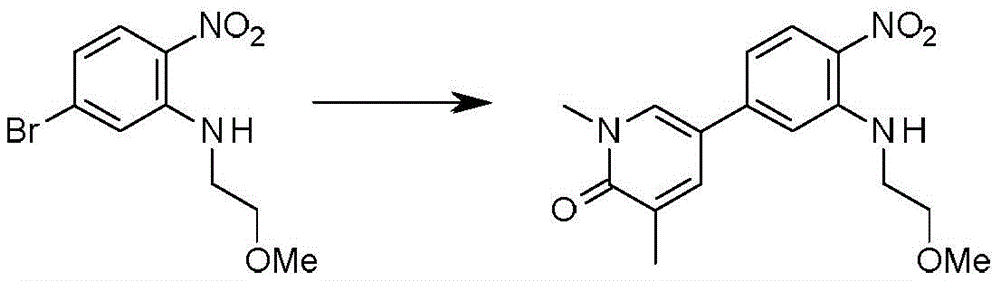
向5-溴-N-(2-甲氧基乙基)-2-硝基苯胺(320mg,1.16mmol)和1,3-二甲基-5-(4,4,5,5-四甲基-1,3,5-二氧杂硼杂环戊烷-2-基)吡啶-2-酮(使用US20130053362中所述的程序制备,348mg,1.396mmol)在DME(8mL)和水(0.4mL)中的溶液通过用N2鼓泡10分钟而脱气。然后加入Cs2CO3(0.796g,2.44mmol)和Pd(PPh3)4(134mg,0.12mmol),通过用N2鼓泡10分钟以上使混合物脱气。将所得混合物加热至85℃持续18小时过夜,然后冷却至室温。向混合物中加入饱和NaHCO3(10mL)和EtOAc(50mL),并将水相用EtOAc(3×20mL)萃取。将合并的有机相用MgSO4干燥,过滤并减压浓缩。通过硅胶上的快速色谱使用EtOAc在己烷中的混合物作为洗脱液纯化该物质,得到标题化合物(340mg,92%)。1H NMR(500MHz,CDCl3)δ8.35(bs,1H),8.23(d,J=8.9Hz,1H),7.50(dd,J=12.9,2.0Hz,2H),6.85(d,J=1.9Hz,1H),6.72(dd,J=8.9,1.9Hz,1H),3.74(t,J=5.4Hz,2H),3.67(s,3H),3.58(dd,J=10.6,5.2Hz,2H),3.48(s,3H),2.26(s,3H)。MS(ESI)[M+H]+318.2。To 5-bromo-N-(2-methoxyethyl)-2-nitroaniline (320 mg, 1.16 mmol) and 1,3-dimethyl-5-(4,4,5,5-tetramethyl) yl-1,3,5-dioxaborol-2-yl)pyridin-2-one (prepared using the procedure described in US20130053362, 348 mg, 1.396 mmol) in DME (8 mL) and water (0.4 The solution in mL) was degassed by bubbling with N for 10 min. Then Cs2CO3 (0.796 g, 2.44 mmol) and Pd( PPh3 )4 ( 134 mg, 0.12 mmol) were added and the mixture was degassed by bubbling with N2 over 10 min. The resulting mixture was heated to 85°C for 18 hours overnight and then cooled to room temperature. To the mixture was added saturated NaHCO3 (10 mL) and EtOAc (50 mL), and the aqueous phase was extracted with EtOAc (3 x 20 mL). The combined organic phases were dried over MgSO4 , filtered and concentrated under reduced pressure. This material was purified by flash chromatography on silica gel using EtOAc in hexanes as eluent to give the title compound (340 mg, 92%). 1 H NMR (500 MHz, CDCl 3 ) δ 8.35 (bs, 1H), 8.23 (d, J=8.9 Hz, 1H), 7.50 (dd, J=12.9, 2.0 Hz, 2H), 6.85 (d, J= 1.9Hz, 1H), 6.72 (dd, J=8.9, 1.9Hz, 1H), 3.74 (t, J=5.4Hz, 2H), 3.67 (s, 3H), 3.58 (dd, J=10.6, 5.2Hz, 2H), 3.48(s, 3H), 2.26(s, 3H). MS(ESI)[M+H] + 318.2.
步骤3:制备中间体2Step 3: Preparation of Intermediate 2

将AcOH(0.184mL,3.21mmol)和Zn(0.70g,10.71mmol)加入到5-[3-(2-甲氧基乙基氨基)-4-硝基-苯基]-1,3-二甲基-吡啶-2-酮(0.34g,1.07mmol)的MeOH(7mL)溶液中并将该悬浮液在室温下搅拌30分钟。将混合物通过CeliteTM过滤,用EtOAc(10mL)洗涤,然后减压浓缩。向残余物中加入EtOAc(50mL)和饱和NaHCO3(30mL),水相用EtOAc(2×30mL)萃取。将合并的有机相用盐水洗涤,经Na2SO4干燥,过滤并减压浓缩以提供中间体2,将其不经进一步纯化用于下一步。(0.29,94%)。MS(ESI)[M+H]+288.2。AcOH (0.184 mL, 3.21 mmol) and Zn (0.70 g, 10.71 mmol) were added to 5-[3-(2-methoxyethylamino)-4-nitro-phenyl]-1,3-di Methyl-pyridin-2-one (0.34 g, 1.07 mmol) in MeOH (7 mL) and the suspension was stirred at room temperature for 30 minutes. The mixture was filtered through Celite ™ , washed with EtOAc (10 mL), and concentrated under reduced pressure. To the residue was added EtOAc (50 mL) and saturated NaHCO3 (30 mL) and the aqueous phase was extracted with EtOAc (2 x 30 mL). The combined organic phases were washed with brine, dried over Na2SO4 , filtered and concentrated under reduced pressure to provide intermediate 2, which was used in the next step without further purification. (0.29,94%). MS(ESI)[M+H] + 288.2.
中间体3(5-[4-氨基-3-[[(1R)-2-甲氧基-1-甲基-乙基]氨基]苯基]-1,3-二甲基吡啶-2-酮)Intermediate 3(5-[4-Amino-3-[[(1R)-2-methoxy-1-methyl-ethyl]amino]phenyl]-1,3-lutidine-2- ketone)
步骤1:制备5-溴-N-[(1R)-2-甲氧基-1-甲基-乙基]-2-硝基-苯胺Step 1: Preparation of 5-bromo-N-[(1R)-2-methoxy-1-methyl-ethyl]-2-nitro-aniline

向(2R)-1-甲氧基丙-2-胺盐酸盐(343mg,2.73mmol)的DMSO(3mL)溶液中加入DIPEA(0.95mL,5.45mmol),并将混合物在室温下搅拌10min,然后滴加4-溴-2-氟-1-硝基-苯(400mg,1.828mmol)在DMSO(3mL)中的溶液,然后将反应混合物在室温下搅拌。2小时后,仍观察到原料,并加入更多(2R)-1-甲氧基丙-2-胺盐酸盐(114mg,0.91mmol)和DIPEA(0.63mL,3.64mmol),并将混合物在50℃下搅拌1小时。向混合物中加入饱和的NaHCO3(50mL)和EtOAc(50mL),并将水相用EtOAc(3×50mL)萃取。将合并的有机相用Na2SO4干燥,过滤并减压浓缩。通过硅胶上的快速色谱使用EtOAc在己烷中的混合物作为洗脱液纯化该物质,得到标题化合物(484mg,92%)。1H NMR(500MHz,CDCl3)δ8.19(d,J=6.4Hz,1H),8.02(d,J=9.1Hz,1H),7.07(d,J=2.0Hz,1H),6.73(dd,J=9.1,2.0Hz,1H),3.88–3.79(m,1H),3.48(dd,J=5.0,1.2Hz,2H),3.41(s,3H),1.33(d,J=6.5Hz,3H)。MS(ESI)[M+H]+291.0。To a solution of (2R)-1-methoxypropan-2-amine hydrochloride (343 mg, 2.73 mmol) in DMSO (3 mL) was added DIPEA (0.95 mL, 5.45 mmol) and the mixture was stirred at room temperature for 10 min, A solution of 4-bromo-2-fluoro-1-nitro-benzene (400 mg, 1.828 mmol) in DMSO (3 mL) was then added dropwise and the reaction mixture was stirred at room temperature. After 2 hours, starting material was still observed, and more (2R)-1-methoxypropan-2-amine hydrochloride (114 mg, 0.91 mmol) and DIPEA (0.63 mL, 3.64 mmol) were added, and the mixture was placed in Stir at 50°C for 1 hour. To the mixture was added saturated NaHCO3 (50 mL) and EtOAc (50 mL), and the aqueous phase was extracted with EtOAc (3 x 50 mL). The combined organic phases were dried over Na2SO4 , filtered and concentrated under reduced pressure. This material was purified by flash chromatography on silica gel using EtOAc in hexanes as eluent to give the title compound (484 mg, 92%). 1 H NMR (500 MHz, CDCl 3 ) δ 8.19 (d, J=6.4 Hz, 1H), 8.02 (d, J=9.1 Hz, 1H), 7.07 (d, J=2.0 Hz, 1H), 6.73 (dd , J=9.1, 2.0Hz, 1H), 3.88–3.79(m, 1H), 3.48(dd, J=5.0, 1.2Hz, 2H), 3.41(s, 3H), 1.33(d, J=6.5Hz, 3H). MS(ESI)[M+H] + 291.0.
步骤2:制备5-[3-[[(1R)-2-甲氧基-1-甲基-乙基]氨基]-4-硝基-苯基]-1,3-二甲基-吡啶-2-酮Step 2: Preparation of 5-[3-[[(1R)-2-methoxy-1-methyl-ethyl]amino]-4-nitro-phenyl]-1,3-dimethyl-pyridine -2-keto

在氮气下,将Pd(PPh3)4(194mg,0.167mmol)加入到5-溴-N-[(1R)-2-甲氧基-1-甲基-乙基]-2-硝基-苯胺(484mg,1.674mmol)、1,3-二甲基-5-(4,4,5,5-四甲基-1,3,2-二氧杂硼杂环戊烷-2-基)吡啶-2-酮(使用US20130053362中描述的方法制备,542mg,2.18mmol)和Cs2CO3(1.36g,4.19mmol)在DME(20mL)和水(2mL)的混合物中的脱气溶液中,将所得混合物加热至80℃持续20小时。将混合物冷却至室温,加入饱和NaHCO3(50mL)和EtOAc(50mL),并将水相用EtOAc(3×50mL)萃取。将合并的有机相用Na2SO4干燥,通过CeliteTM过滤并减压浓缩。通过硅胶快速色谱纯化产物,使用在己烷中的EtOAc混合物作为洗脱液,得到标题化合物(561mg,99%)。1H NMR(500MHz,CDCl3)δ8.29(d,J=7.6Hz,1H),8.20(d,J=8.9Hz,1H),7.71–7.63(m,1H),7.48–7.46(m,1H),6.87(d,J=1.8Hz,1H),6.66(dd,J=8.9,1.9Hz,1H),4.02–3.94(m,1H),3.65(s,3H),3.57–3.48(m,2H),3.43(d,J=4.5Hz,3H),2.24(t,J=0.8Hz,3H),1.37(d,J=6.5Hz,3H)。MS(ESI)[M+H]+332.2。Under nitrogen, Pd( PPh3 ) 4 (194 mg, 0.167 mmol) was added to 5-bromo-N-[(1R)-2-methoxy-1-methyl-ethyl]-2-nitro- Aniline (484 mg, 1.674 mmol), 1,3-dimethyl-5-(4,4,5,5-tetramethyl-1,3,2-dioxaborolane-2-yl) Pyridin-2-one (prepared using the method described in US20130053362, 542 mg, 2.18 mmol) and Cs2CO3 ( 1.36 g, 4.19 mmol) in a degassed solution of a mixture of DME (20 mL) and water (2 mL), The resulting mixture was heated to 80°C for 20 hours. The mixture was cooled to room temperature, saturated NaHCO3 (50 mL) and EtOAc (50 mL) were added, and the aqueous phase was extracted with EtOAc (3 x 50 mL). The combined organic phases were dried over Na2SO4 , filtered through Celite ™ and concentrated under reduced pressure. The product was purified by flash chromatography on silica gel using a mixture of EtOAc in hexanes as eluent to give the title compound (561 mg, 99%). 1 H NMR (500 MHz, CDCl 3 ) δ 8.29 (d, J=7.6 Hz, 1H), 8.20 (d, J=8.9 Hz, 1H), 7.71-7.63 (m, 1H), 7.48-7.46 (m, 1H), 6.87(d, J=1.8Hz, 1H), 6.66(dd, J=8.9, 1.9Hz, 1H), 4.02–3.94(m, 1H), 3.65(s, 3H), 3.57–3.48(m , 2H), 3.43 (d, J=4.5Hz, 3H), 2.24 (t, J=0.8Hz, 3H), 1.37 (d, J=6.5Hz, 3H). MS(ESI)[M+H] + 332.2.
步骤3:制备中间体3Step 3: Preparation of Intermediate 3
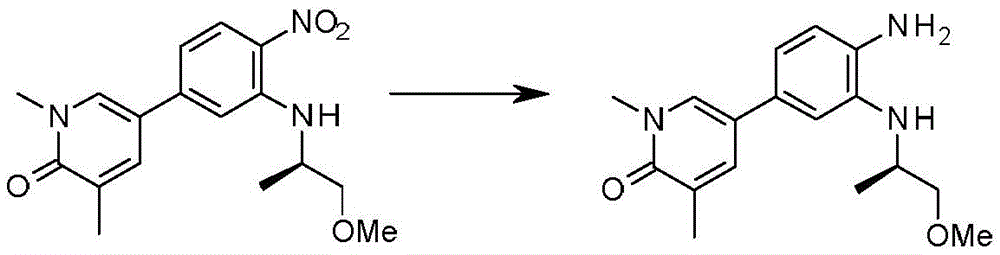
将AcOH(0.29mL,5.08mmol)和Zn(1.11g,16.93mmol)加入到5-[3-[[(1R)-2-甲氧基-1-甲基-乙基]氨基]-4-硝基-苯基]-1,3-二甲基-吡啶-2-酮(561mg,1.69mmol)的MeOH(10mL)溶液中并将所得悬浮液在室温下搅拌30分钟。然后将混合物通过CeliteTM过滤,用EtOAc(10mL)洗涤并减压浓缩。向残余物中加入EtOAc(50mL)和饱和NaHCO3(30mL),水相用EtOAc(2×30mL)萃取。将合并的有机相用盐水洗涤,经Na2SO4干燥,过滤并减压浓缩,得到中间体3(505mg,99%),将其不经进一步纯化用于下一步骤。1H NMR(500MHz,CDCl3)δ7.70–7.64(m,1H),7.45(dd,J=2.5,1.2Hz,1H),7.27(d,J=2.5Hz,1H),6.72(dd,J=7.3,2.2Hz,2H),3.69(dd,J=11.3,5.3Hz,1H),3.61(s,3H),3.46(dd,J=5.1,2.6Hz,2H),3.40(s,3H),2.22(s,3H),1.26(d,J=6.4Hz,3H)。MS(ESI)[M+H]+302.2。AcOH (0.29 mL, 5.08 mmol) and Zn (1.11 g, 16.93 mmol) were added to 5-[3-[[(1R)-2-methoxy-1-methyl-ethyl]amino]-4- Nitro-phenyl]-1,3-dimethyl-pyridin-2-one (561 mg, 1.69 mmol) in MeOH (10 mL) and the resulting suspension was stirred at room temperature for 30 minutes. The mixture was then filtered through Celite ™ , washed with EtOAc (10 mL) and concentrated under reduced pressure. To the residue was added EtOAc (50 mL) and saturated NaHCO3 (30 mL) and the aqueous phase was extracted with EtOAc (2 x 30 mL). The combined organic phases were washed with brine, dried over Na2SO4 , filtered and concentrated under reduced pressure to give Intermediate 3 (505 mg, 99%) which was used in the next step without further purification. 1 H NMR (500 MHz, CDCl 3 ) δ 7.70-7.64 (m, 1H), 7.45 (dd, J=2.5, 1.2 Hz, 1H), 7.27 (d, J=2.5 Hz, 1H), 6.72 (dd, J=7.3, 2.2Hz, 2H), 3.69(dd, J=11.3, 5.3Hz, 1H), 3.61(s, 3H), 3.46(dd, J=5.1, 2.6Hz, 2H), 3.40(s, 3H) ), 2.22(s, 3H), 1.26(d, J=6.4Hz, 3H). MS(ESI)[M+H] + 302.2.
中间体4:(1-甲基-5-(4,4,5,5-四甲基-1,3,2-二氧杂硼杂环戊烷-2-基)-3-(三氟甲基)吡啶-2-酮)Intermediate 4: (1-methyl-5-(4,4,5,5-tetramethyl-1,3,2-dioxaborol-2-yl)-3-(trifluoro methyl)pyridin-2-one)
步骤1:制备5-溴-1-甲基-3-(三氟甲基)吡啶-2-酮Step 1: Preparation of 5-bromo-1-methyl-3-(trifluoromethyl)pyridin-2-one

将碘甲烷(0.12mL,1.88mmol)和Cs2CO3(0.942g,2.89mmol)加入到5-溴-3-(三氟甲基)-1H-吡啶-2-酮(0.350g,1.45mmol)在DMF(3mL)中的溶液中,并将所得混合物在室温下搅拌18小时。减压蒸发溶剂,向残余物中加水(10ml),水相用乙酸乙酯(2×30ml)萃取。将合并的有机相用盐水洗涤并经MgSO4干燥,过滤并减压浓缩。将该物质用乙醚研磨,然后干燥,得到标题化合物,将其不经进一步纯化即用于下一步(0.32g,86%)。1H NMR(500MHz,CDCl3)δ7.78(d,J=2.1Hz,1H),7.64(d,J=2.7Hz,1H),3.59(s,3H)。Iodomethane (0.12 mL, 1.88 mmol) and Cs2CO3 ( 0.942 g, 2.89 mmol) were added to 5-bromo-3-(trifluoromethyl)-1H-pyridin-2-one (0.350 g, 1.45 mmol) ) in DMF (3 mL) and the resulting mixture was stirred at room temperature for 18 hours. The solvent was evaporated under reduced pressure, water (10 ml) was added to the residue, and the aqueous phase was extracted with ethyl acetate (2 x 30 ml). The combined organic phases were washed with brine and dried over MgSO4 , filtered and concentrated under reduced pressure. This material was triturated with ether and dried to give the title compound, which was used in the next step without further purification (0.32 g, 86%). 1 H NMR (500 MHz, CDCl 3 ) δ 7.78 (d, J=2.1 Hz, 1H), 7.64 (d, J=2.7 Hz, 1H), 3.59 (s, 3H).
步骤2:中间体4的制备Step 2: Preparation of Intermediate 4

在氮气下,将4,4,4',4',5,5,5',5'-八甲基-2,2'-双(1,3,2-二氧杂硼杂环戊烷)(0.31g,1.23mmol)、PdCl2(dppf).CH2Cl2(0.07g,0.082mmol)和KOAc(0.24g,2.46mmol)加至5-溴-1-甲基-3-(三氟甲基)吡啶-2-酮(0.21g,0.82mmol)在二噁烷(7mL)中的脱气溶液中,并将所得混合物回流20小时。将溶液冷却至室温并通过CeliteTM过滤,用EtOAc洗涤并减压浓缩。通过硅胶快速色谱使用EtOAc在己烷中的混合物纯化物质,然后用乙醚研磨,得到中间体4(43mg,17%)。1H NMR(500MHz,CDCl3)δ8.02(d,J=1.0Hz,1H),7.93(d,J=1.9Hz,1H),3.60(s,3H),1.31(s,12H)。MS(ESI)[M+H]+304.2。Under nitrogen, 4,4,4',4',5,5,5',5'-octamethyl-2,2'-bis(1,3,2-dioxaborolane ) (0.31 g, 1.23 mmol), PdCl 2 (dppf).CH 2 Cl 2 (0.07 g, 0.082 mmol) and KOAc (0.24 g, 2.46 mmol) were added to 5-bromo-1-methyl-3-(tris A degassed solution of fluoromethyl)pyridin-2-one (0.21 g, 0.82 mmol) in dioxane (7 mL) and the resulting mixture was refluxed for 20 hours. The solution was cooled to room temperature and filtered through Celite ™ , washed with EtOAc and concentrated under reduced pressure. The material was purified by flash chromatography on silica gel using EtOAc in hexanes followed by trituration with ether to give Intermediate 4 (43 mg, 17%). 1 H NMR (500 MHz, CDCl 3 ) δ 8.02 (d, J=1.0 Hz, 1H), 7.93 (d, J=1.9 Hz, 1H), 3.60 (s, 3H), 1.31 (s, 12H). MS(ESI)[M+H] + 304.2.
中间体5:3-乙基-1-甲基-5-(4,4,5,5-四甲基-1,3,2-二氧杂环戊硼烷-2-基)吡啶-2-酮Intermediate 5: 3-Ethyl-1-methyl-5-(4,4,5,5-tetramethyl-1,3,2-dioxaborolane-2-yl)pyridine-2 -ketone
步骤1:3,5-二溴-1-甲基-吡啶-2-酮Step 1: 3,5-Dibromo-1-methyl-pyridin-2-one
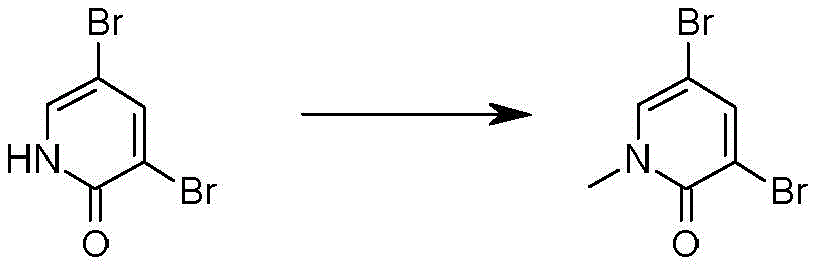
加入3,5-二溴-1H-吡啶-2-酮(5g,19.8mmol)在DMF(170ml)中的溶液,加入K2CO3(6.01g,43.5mmol),并将该混悬液搅拌15分钟。向该混合物中加入Mel(1.36mL,21.8mmol)并将反应混合物在室温下搅拌18小时。向混合物中加入水(200ml),然后用EtOAc(3×200ml)萃取水层。将合并的有机层用Na2SO4干燥,过滤并减压浓缩。所得固体用Et2O研磨,得到2g标题化合物。减压蒸发滤液,用Et2O研磨后得到第二批产物(2.0g)。浓缩滤液,通过硅胶快速色谱纯化所述材料,使用EtOAc和己烷的混合物作为洗脱液,得到标题化合物(总量4.5g,85%)。1H NMR(500MHz,CDCl3)δ7.78(d,J=2.5Hz,1H),7.42(d,J=2.5Hz,1H),3.59(s,3H)。MS(ESI)[M+H]+266.01,267.99,269.99。A solution of 3,5-dibromo-lH-pyridin-2-one (5 g, 19.8 mmol) in DMF (170 ml) was added, K2CO3 ( 6.01 g , 43.5 mmol) was added, and the suspension was stirred 15 minutes. To this mixture was added Mel (1.36 mL, 21.8 mmol) and the reaction mixture was stirred at room temperature for 18 hours. Water (200ml) was added to the mixture and the aqueous layer was extracted with EtOAc (3x200ml). The combined organic layers were dried over Na2SO4 , filtered and concentrated under reduced pressure. The resulting solid was triturated with Et2O to give 2 g of the title compound. The filtrate was evaporated under reduced pressure and triturated with Et2O to give a second crop (2.0 g). The filtrate was concentrated and the material was purified by flash chromatography on silica gel using a mixture of EtOAc and hexanes as eluent to give the title compound (4.5 g total, 85%). 1 H NMR (500 MHz, CDCl 3 ) δ 7.78 (d, J=2.5 Hz, 1H), 7.42 (d, J=2.5 Hz, 1H), 3.59 (s, 3H). MS(ESI)[M+H] + 266.01, 267.99, 269.99.
步骤2:制备5-溴-3-乙基-1-甲基-吡啶-2-酮Step 2: Preparation of 5-bromo-3-ethyl-1-methyl-pyridin-2-one

将3,5-二溴-1-甲基-吡啶-2-酮(1.2g,4.19mmol)和Fe(acac)3(55.6mg,0.15mmol)加入烧瓶中,并用N2(3x)将空气抽空,然后加入THF(25ml)和NMP(5ml)。将混合物冷却至0℃,逐滴加入EtMgBr(1.68ml,5.03mmol),将反应混合物搅拌1小时。向该混合物中加入1M HCl溶液(10ml),并将水层用EtOAc(3×10mL)萃取。将合并的有机相用MgSO4干燥,过滤并减压浓缩。通过硅胶快速色谱纯化所述材料,使用EtOAc和己烷的混合物作为洗脱液,得到标题化合物(275mg,30%)。1H NMR(500MHz,CDCl3)δ7.23(d,J=2.7Hz,1H),7.13(dt,J=2.4,1.1Hz,1H),3.47(d,J=12.3Hz,3H),2.49(qd,J=7.5,6.6Hz,2H),1.14–1.04(m,3H)。3,5-Dibromo-1-methyl-pyridin-2-one (1.2 g, 4.19 mmol) and Fe(acac) 3 (55.6 mg, 0.15 mmol) were added to the flask and the air was purged with N2 (3x) Evacuate, then add THF (25ml) and NMP (5ml). The mixture was cooled to 0°C, EtMgBr (1.68 ml, 5.03 mmol) was added dropwise and the reaction mixture was stirred for 1 hour. To this mixture was added 1M HCl solution (10 ml) and the aqueous layer was extracted with EtOAc (3 x 10 mL). The combined organic phases were dried over MgSO4 , filtered and concentrated under reduced pressure. The material was purified by flash chromatography on silica gel using a mixture of EtOAc and hexanes as eluents to give the title compound (275 mg, 30%). 1 H NMR (500 MHz, CDCl 3 ) δ 7.23 (d, J=2.7 Hz, 1H), 7.13 (dt, J=2.4, 1.1 Hz, 1H), 3.47 (d, J=12.3 Hz, 3H), 2.49 (qd, J=7.5, 6.6 Hz, 2H), 1.14-1.04 (m, 3H).
步骤3:制备中间体5Step 3: Preparation of Intermediate 5

在N2下,将4,4,4',4',5,5,5',5'-八甲基-2,2'-双(1,3,2-二氧杂硼杂环戊烷)(352.6mg,1.39mmol)、PdCl2(dppf)(47.2mg,0.058mmol)和KOAc(283.9mg,2.89mmol)加入到5-溴-3-乙基-1-甲基-吡啶-2-酮(250mg,1.16mmol)在二噁烷(3mL)中的脱气溶液中。将溶液在密封管中加热至90℃持续18小时。将反应混合物冷却至室温,加入EtOAc(20ml)和水(10ml)。将有机相分离并经Na2SO4干燥,过滤并减压浓缩。通过硅胶快速色谱纯化所述材料,使用EtOAc和己烷的混合物作为洗脱液,得到中间体5(152mg,50%),将其不经任何进一步纯化用于下一步。1H NMR(500MHz,CDCl3)δ7.66(d,J=1.9Hz,1H),7.48–7.41(m,1H),3.55(s,3H),2.55(q,J=7.4Hz,2H),1.36–1.22(m,12H),1.19(t,J=7.5Hz,3H)。Under N2, 4,4,4',4',5,5,5',5'-octamethyl-2,2'-bis(1,3,2-dioxaborolane ) (352.6 mg, 1.39 mmol), PdCl 2 (dppf) (47.2 mg, 0.058 mmol) and KOAc (283.9 mg, 2.89 mmol) were added to 5-bromo-3-ethyl-1-methyl-pyridine-2- A degassed solution of the ketone (250 mg, 1.16 mmol) in dioxane (3 mL). The solution was heated to 90°C in a sealed tube for 18 hours. The reaction mixture was cooled to room temperature and EtOAc (20ml) and water (10ml) were added. The organic phase was separated and dried over Na2SO4 , filtered and concentrated under reduced pressure. The material was purified by flash chromatography on silica gel using a mixture of EtOAc and hexanes as eluent to give Intermediate 5 (152 mg, 50%) which was used in the next step without any further purification. 1 H NMR (500 MHz, CDCl 3 ) δ 7.66 (d, J=1.9 Hz, 1H), 7.48-7.41 (m, 1H), 3.55 (s, 3H), 2.55 (q, J=7.4 Hz, 2H) , 1.36–1.22 (m, 12H), 1.19 (t, J=7.5Hz, 3H).
中间体6:5-[4-氨基-3-(2-甲氧基丙基氨基)苯基]-1,3-二甲基-吡啶-2-酮Intermediate 6: 5-[4-Amino-3-(2-methoxypropylamino)phenyl]-1,3-dimethyl-pyridin-2-one
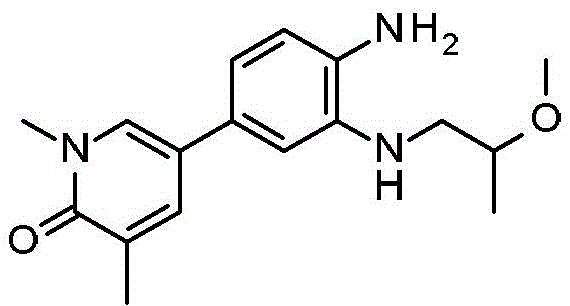
步骤1:制备5-溴-N-(2-甲氧基丙基)-2-硝基苯胺Step 1: Preparation of 5-bromo-N-(2-methoxypropyl)-2-nitroaniline

向4-溴-2-氟-1-硝基-苯(752mg,3.41mmol)的无水DMF(7ml)溶液中加入K2CO3(945mg,6.84mmol)和2-甲氧基丙-1-胺(365mg,4.1mmol),将反应混合物加热至40℃持续2小时。将混合物冷却至室温,用EtOAc(20mL)稀释并用水(3×10mL)洗涤。收集有机相,用Na2SO4干燥,过滤并减压浓缩。通过硅胶快速色谱使用MeOH在DCM中的混合物作为洗脱液纯化该物质,得到固体形式的标题化合物(852mg,86%)。1H NMR(500MHz,CDCl3)δ8.24(s,1H),8.01(d,J=9.1Hz,1H),7.00(d,J=2.0Hz,1H),6.74(dd,J=9.1,2.0Hz,1H),3.68–3.59(m,1H),3.41(s,3H),3.34(ddd,J=12.8,5.7,4.0Hz,1H),3.21(ddd,J=12.8,7.3,4.4Hz,1H),1.26(dd,J=6.1,2.5Hz,3H)。To a solution of 4-bromo-2-fluoro-1-nitro-benzene (752 mg, 3.41 mmol) in dry DMF ( 7 ml) was added K2CO3 (945 mg, 6.84 mmol) and 2 -methoxypropan-1 - Amine (365 mg, 4.1 mmol), the reaction mixture was heated to 40°C for 2 hours. The mixture was cooled to room temperature, diluted with EtOAc (20 mL) and washed with water (3 x 10 mL). The organic phase was collected, dried over Na2SO4 , filtered and concentrated under reduced pressure. This material was purified by flash chromatography on silica gel using MeOH in DCM as eluent to give the title compound (852 mg, 86%) as a solid. 1 H NMR (500 MHz, CDCl 3 ) δ 8.24 (s, 1H), 8.01 (d, J=9.1 Hz, 1H), 7.00 (d, J=2.0 Hz, 1H), 6.74 (dd, J=9.1, 2.0Hz, 1H), 3.68–3.59 (m, 1H), 3.41 (s, 3H), 3.34 (ddd, J=12.8, 5.7, 4.0Hz, 1H), 3.21 (ddd, J=12.8, 7.3, 4.4Hz) , 1H), 1.26 (dd, J=6.1, 2.5Hz, 3H).
步骤2:制备5-[3-(2-甲氧基丙基氨基)-4-硝基-苯基]-1,3-二甲基吡啶-2-酮Step 2: Preparation of 5-[3-(2-Methoxypropylamino)-4-nitro-phenyl]-1,3-lutidine-2-one
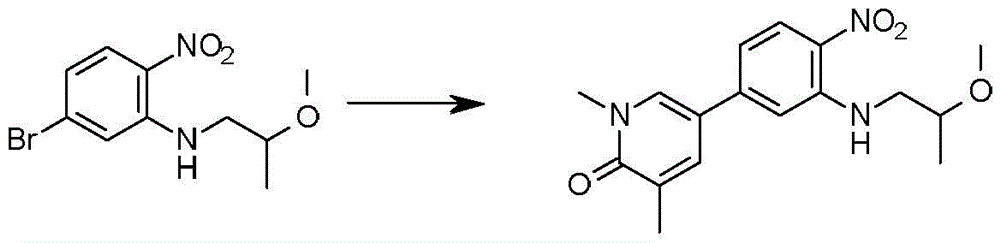
向5-溴-N-(2-甲氧基丙基)-2-硝基-苯胺(450mg,1.56mmol)在DME(4ml)中的悬浮液中加入1,3-二甲基-5-(4,4,5,5-四甲基-1,3,2-二氧杂硼杂环戊烷-2-基)吡啶-2-酮(使用US20130053362中所述的程序制备,465mg,1.87mmol)、Cs2CO3(1.27g,3.89mmol)、Pd(PPh3)4(180mg,0.16mmol)和水(0.5ml),通过用N2鼓泡5分钟使反应混合物脱气,然后在密封管中加热至90℃达18小时。将混合物用EtOAc(10mL)稀释并用水(10mL)洗涤。收集有机相,用Na2SO4干燥,过滤并减压浓缩。将得到的固体(466mg,90%)与Et2O一起研磨,得到标题化合物,将其不经进一步纯化用于下一步。1H NMR(500MHz,DMSO)δ8.32(t,J=5.0Hz,1H),8.23(d,J=2.6Hz,1H),8.09(d,J=9.0Hz,1H),7.93–7.80(m,1H),7.13(d,J=1.9Hz,1H),6.95(dd,J=9.1,1.9Hz,1H),3.67(dddd,J=13.2,9.5,7.8,5.1Hz,2H),3.54(d,J=3.9Hz,3H),3.39(ddd,J=13.2,6.6,4.6Hz,1H),3.34(s,3H),2.10(s,3H),1.22(d,J=6.1Hz,3H)。MS(ESI)[M+H]+332.1。To a suspension of 5-bromo-N-(2-methoxypropyl)-2-nitro-aniline (450 mg, 1.56 mmol) in DME (4 ml) was added 1,3-dimethyl-5- (4,4,5,5-Tetramethyl-1,3,2-dioxaborol-2-yl)pyridin-2-one (prepared using the procedure described in US20130053362, 465 mg, 1.87 mmol), Cs 2 CO 3 (1.27 g, 3.89 mmol), Pd(PPh 3 ) 4 (180 mg, 0.16 mmol) and water ( 0.5 ml), the reaction mixture was degassed by bubbling with N Heat to 90°C in a sealed tube for 18 hours. The mixture was diluted with EtOAc (10 mL) and washed with water (10 mL). The organic phase was collected, dried over Na2SO4 , filtered and concentrated under reduced pressure. The resulting solid (466 mg, 90%) was triturated with Et2O to give the title compound, which was used in the next step without further purification. 1 H NMR(500MHz,DMSO)δ8.32(t,J=5.0Hz,1H),8.23(d,J=2.6Hz,1H),8.09(d,J=9.0Hz,1H),7.93-7.80( m, 1H), 7.13 (d, J=1.9Hz, 1H), 6.95 (dd, J=9.1, 1.9Hz, 1H), 3.67 (dddd, J=13.2, 9.5, 7.8, 5.1Hz, 2H), 3.54 (d, J=3.9Hz, 3H), 3.39 (ddd, J=13.2, 6.6, 4.6Hz, 1H), 3.34 (s, 3H), 2.10 (s, 3H), 1.22 (d, J=6.1Hz, 3H). MS(ESI)[M+H] + 332.1.
步骤3:中间体6的制备Step 3: Preparation of Intermediate 6

在室温,向5-[3-(2-甲氧基丙基氨基)-4-硝基-苯基]-1,3-二甲基吡啶-2-酮(466mg,1.41mmol)的MeOH(6mL)溶液中加入乙酸(0.24ml,4.21mmol)和锌粉(919mg,14.06mmol),并将所得悬浮液在室温下搅拌45分钟。将混合物通过CeliteTM垫过滤并减压浓缩。将残余物用EtOAc(10mL)和饱和NaHCO3(10mL)稀释。分离各相,水相用EtOAc(2×30mL)萃取。将合并的有机相用盐水洗涤,经Na2SO4干燥并减压浓缩,得到中间体6(389mg,89%),将其不经进一步纯化用于下一步。MS(ESI)[M+H]+302.3。To 5-[3-(2-methoxypropylamino)-4-nitro-phenyl]-1,3-lutidine-2-one (466 mg, 1.41 mmol) in MeOH ( 6 mL) solution was added acetic acid (0.24 ml, 4.21 mmol) and zinc powder (919 mg, 14.06 mmol), and the resulting suspension was stirred at room temperature for 45 minutes. The mixture was filtered through a pad of Celite ™ and concentrated under reduced pressure. The residue was diluted with EtOAc (10 mL) and saturated NaHCO3 (10 mL). The phases were separated and the aqueous phase was extracted with EtOAc (2 x 30 mL). The combined organic phases were washed with brine, dried over Na2SO4 and concentrated under reduced pressure to give Intermediate 6 (389 mg, 89%) which was used in the next step without further purification. MS(ESI)[M+H] + 302.3.
中间体7:5-[4-氨基-3-[[(1S)-2-甲氧基-1-甲基-乙基]氨基]苯基]-1,3-二甲基吡啶-2-酮Intermediate 7: 5-[4-Amino-3-[[(1S)-2-methoxy-1-methyl-ethyl]amino]phenyl]-1,3-lutidine-2- ketone

步骤1:制备5-溴-N-[(1S)-2-甲氧基-1-甲基-乙基]-2-硝基-苯胺Step 1: Preparation of 5-bromo-N-[(1S)-2-methoxy-1-methyl-ethyl]-2-nitro-aniline

将(2S)-1-甲氧基丙-2-胺(384μl,3.64mmol)溶于DMSO(3mL)中并加入DIPEA(0.95mL,5.45mmol)。将该混合物在室温下搅拌10min,然后滴加在DMSO(3mL)中的4-溴-2-氟-1-硝基-苯(400mg,1.82mmol)。将反应混合物在50℃下搅拌3小时。将混合物用饱和NaHCO3(50mL)和EtOAc(50mL)稀释,并将水相用EtOAc(3×50mL)萃取。将合并的有机相用Na2SO4干燥,过滤并减压浓缩。通过硅胶上的快速色谱使用EtOAc在己烷中的混合物作为洗脱液纯化该物质,得到标题化合物(466mg,89%)。1H NMR(500MHz,CDCl3)δ8.19(d,J=6.5Hz,1H),8.02(d,J=9.1Hz,1H),7.07(d,J=1.9Hz,1H),6.73(dd,J=9.1,2.0Hz,1H),3.89–3.78(m,1H),3.48(dd,J=5.0,1.2Hz,2H),3.41(s,3H),1.33(d,J=6.5Hz,3H)。MS(ESI)[M+H]+291.0。(2S)-1-methoxypropan-2-amine (384 μl, 3.64 mmol) was dissolved in DMSO (3 mL) and DIPEA (0.95 mL, 5.45 mmol) was added. The mixture was stirred at room temperature for 10 min, then 4-bromo-2-fluoro-1-nitro-benzene (400 mg, 1.82 mmol) in DMSO (3 mL) was added dropwise. The reaction mixture was stirred at 50°C for 3 hours. The mixture was diluted with saturated NaHCO3 (50 mL) and EtOAc (50 mL), and the aqueous phase was extracted with EtOAc (3 x 50 mL). The combined organic phases were dried over Na2SO4 , filtered and concentrated under reduced pressure. This material was purified by flash chromatography on silica gel using EtOAc in hexanes as eluent to give the title compound (466 mg, 89%). 1 H NMR (500 MHz, CDCl 3 ) δ 8.19 (d, J=6.5 Hz, 1H), 8.02 (d, J=9.1 Hz, 1H), 7.07 (d, J=1.9 Hz, 1H), 6.73 (dd , J=9.1, 2.0Hz, 1H), 3.89–3.78(m, 1H), 3.48(dd, J=5.0, 1.2Hz, 2H), 3.41(s, 3H), 1.33(d, J=6.5Hz, 3H). MS(ESI)[M+H] + 291.0.
步骤2:制备5-[3-[[(1S)-2-甲氧基-1-甲基-乙基]氨基]-4-硝基苯基]-1,3-二甲基吡啶-2-酮Step 2: Preparation of 5-[3-[[(1S)-2-methoxy-1-methyl-ethyl]amino]-4-nitrophenyl]-1,3-lutidine-2 -ketone

在氮气下,将Pd(PPh3)4(186mg,0.161mmol)加入到5-溴-N-[(1S)-2-甲氧基-1-甲基-乙基]-2-硝基-苯胺(466mg,1.61mmol)、1,3-二甲基-5-(4,4,5,5-四甲基-1,3,2-二氧杂硼杂环戊烷-2-基)吡啶-2-酮(使用US20130053362中所述的程序制备,522mg,2.09mmol)和Cs2CO3(1.31g,4.03mmol)在DME(20mL)和水(2mL)中的脱气溶液中。将反应混合物加热至80℃持续18小时,然后冷却至室温。将混合物用饱和NaHCO3(50mL)和EtOAc(50mL)稀释,并将水相用EtOAc(3×50mL)萃取。将合并的有机相用Na2SO4干燥,通过CeliteTM过滤并减压浓缩。通过硅胶上的快速色谱使用EtOAc在己烷中的混合物作为洗脱液纯化该物质,得到标题化合物(603mg,99%),为固体。1H NMR(500MHz,CDCl3)δ8.29(d,J=7.6Hz,1H),8.20(d,J=8.9Hz,1H),7.47(d,J=0.8Hz,2H),6.87(d,J=1.8Hz,1H),6.66(dd,J=8.9,1.9Hz,1H),4.03–3.92(m,1H),3.65(s,3H),3.57–3.48(m,2H),3.43(s,3H),2.24(t,J=0.8Hz,3H),1.37(d,J=6.5Hz,3H)。MS(ESI)[M+H]+332.2。Under nitrogen, Pd( PPh3 ) 4 (186 mg, 0.161 mmol) was added to 5-bromo-N-[(1S)-2-methoxy-1-methyl-ethyl]-2-nitro- Aniline (466 mg, 1.61 mmol), 1,3-dimethyl-5-(4,4,5,5-tetramethyl-1,3,2-dioxaborol-2-yl) Pyridin-2-one (prepared using the procedure described in US20130053362, 522 mg, 2.09 mmol) and Cs2CO3 ( 1.31 g, 4.03 mmol) in a degassed solution of DME (20 mL) and water (2 mL). The reaction mixture was heated to 80°C for 18 hours and then cooled to room temperature. The mixture was diluted with saturated NaHCO3 (50 mL) and EtOAc (50 mL), and the aqueous phase was extracted with EtOAc (3 x 50 mL). The combined organic phases were dried over Na2SO4 , filtered through Celite ™ and concentrated under reduced pressure. This material was purified by flash chromatography on silica gel using EtOAc in hexanes as eluent to give the title compound (603 mg, 99%) as a solid. 1 H NMR (500 MHz, CDCl 3 ) δ 8.29 (d, J=7.6 Hz, 1H), 8.20 (d, J=8.9 Hz, 1H), 7.47 (d, J=0.8 Hz, 2H), 6.87 (d , J=1.8Hz, 1H), 6.66 (dd, J=8.9, 1.9Hz, 1H), 4.03–3.92 (m, 1H), 3.65 (s, 3H), 3.57–3.48 (m, 2H), 3.43 ( s, 3H), 2.24 (t, J=0.8Hz, 3H), 1.37 (d, J=6.5Hz, 3H). MS(ESI)[M+H] + 332.2.
步骤3:制备中间体7Step 3: Preparation of Intermediate 7
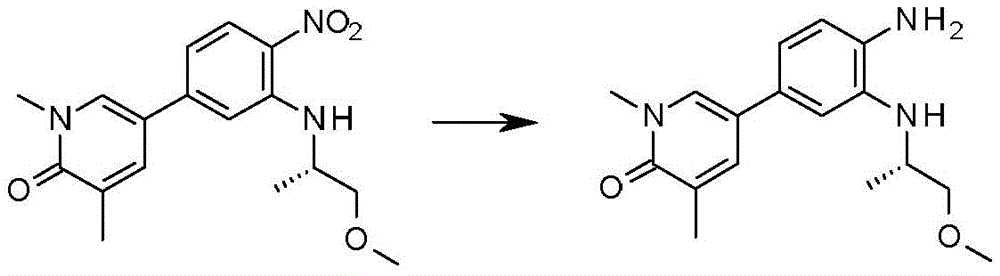
将AcOH(0.28mL,4.84mmol)和锌(1.05g,16.12mmol)加入到5-[3-[[(1S)-2-甲氧基-1-甲基-乙基]氨基]-4-硝基-苯基]-1,3-二甲基-吡啶-2-酮(534mg,1.61mmol)的MeOH(10mL)溶液中并将该悬浮液在室温下搅拌30分钟。然后将混合物通过CeliteTM过滤,用EtOAc(10mL)洗涤并减压浓缩。将残余物用EtOAc(50mL)和饱和NaHCO3(30mL)稀释,然后将水相用EtOAc(2×30mL)萃取。将合并的有机相用盐水洗涤,经Na2SO4干燥,过滤并减压浓缩,得到固体形式的中间体7(535mg,99%)。1H NMR(500MHz,CDCl3)δ7.64–7.57(m,1H),7.39–7.37(m,1H),7.20(d,J=2.4Hz,1H),6.67–6.65(m,1H),6.64(s,1H),3.65–3.59(m,1H),3.54(s,3H),3.38(dd,J=5.1,2.4Hz,2H),3.33(s,3H),2.16–2.12(m,3H),1.18(d,J=6.4Hz,3H)。MS(ESI)[M+H]+302.2。AcOH (0.28 mL, 4.84 mmol) and zinc (1.05 g, 16.12 mmol) were added to 5-[3-[[(1S)-2-methoxy-1-methyl-ethyl]amino]-4- Nitro-phenyl]-1,3-dimethyl-pyridin-2-one (534 mg, 1.61 mmol) in MeOH (10 mL) and the suspension was stirred at room temperature for 30 minutes. The mixture was then filtered through Celite ™ , washed with EtOAc (10 mL) and concentrated under reduced pressure. The residue was diluted with EtOAc (50 mL) and saturated NaHCO3 (30 mL), then the aqueous phase was extracted with EtOAc (2 x 30 mL). The combined organic phases were washed with brine, dried over Na2SO4 , filtered and concentrated under reduced pressure to give Intermediate 7 as a solid (535 mg, 99%). 1 H NMR (500MHz, CDCl 3 )δ7.64-7.57(m,1H),7.39-7.37(m,1H),7.20(d,J=2.4Hz,1H),6.67-6.65(m,1H), 6.64(s, 1H), 3.65-3.59(m, 1H), 3.54(s, 3H), 3.38(dd, J=5.1, 2.4Hz, 2H), 3.33(s, 3H), 2.16-2.12(m, 3H), 1.18 (d, J=6.4Hz, 3H). MS(ESI)[M+H] + 302.2.
中间体8:5-(4-氨基-3-((2-(三氟甲氧基)乙基)氨基)苯基)-1,3-二甲基吡啶-2(1H)-酮Intermediate 8: 5-(4-Amino-3-((2-(trifluoromethoxy)ethyl)amino)phenyl)-1,3-lutidine-2(1H)-one

步骤1:制备1,3-二甲基-5-(4-硝基-3-((2-(三氟甲氧基)乙基)氨基)苯基)吡啶-2(1H)-酮Step 1: Preparation of 1,3-Dimethyl-5-(4-nitro-3-((2-(trifluoromethoxy)ethyl)amino)phenyl)pyridin-2(1H)-one
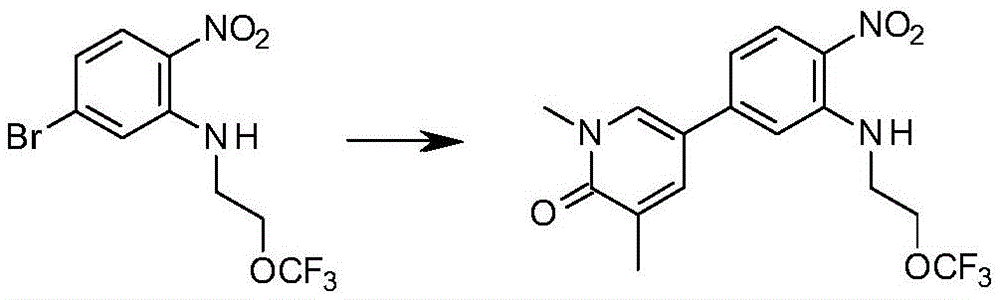
将5-溴-2-硝基-N-[2-(三氟甲氧基)乙基]苯胺(中间体1,步骤1;320mg,1.16mmol),1,3-二甲基-5-(4,4,5,5-四甲基-1,3,2-二氧杂硼杂环戊烷-2-基)吡啶-2-酮(如US20130053362中所述制备,348mg,1.40mmol)在DME(8mL)和水(0.4mL)中的溶液通过鼓泡脱气持续10分钟。然后加入Cs2CO3(0.80g,2.44mmol)和Pd(PPh3)4(134mg,0.116mmol),通过用N2鼓泡10分钟以上使混合物脱气。将所得混合物加热至85℃持续18小时,然后冷却至室温。将混合物用饱和NaHCO3(10mL)和EtOAc(50mL)稀释,然后将水相用EtOAc(3×20mL)萃取。将合并的有机相用MgSO4干燥,过滤并减压浓缩。通过硅胶上的快速色谱使用EtOAc在己烷中的混合物作为洗脱液纯化该物质,得到标题化合物(340mg,92%)。MS(ESI)[M+H]+372.17。5-Bromo-2-nitro-N-[2-(trifluoromethoxy)ethyl]aniline (Intermediate 1, Step 1; 320 mg, 1.16 mmol), 1,3-dimethyl-5- (4,4,5,5-Tetramethyl-1,3,2-dioxaborol-2-yl)pyridin-2-one (prepared as described in US20130053362, 348 mg, 1.40 mmol) A solution in DME (8 mL) and water (0.4 mL) was degassed by bubbling for 10 minutes. Then Cs 2 CO 3 (0.80 g, 2.44 mmol) and Pd(PPh 3 ) 4 (134 mg, 0.116 mmol) were added and the mixture was degassed by bubbling with N 2 over 10 min. The resulting mixture was heated to 85°C for 18 hours and then cooled to room temperature. The mixture was diluted with saturated NaHCO3 (10 mL) and EtOAc (50 mL), then the aqueous phase was extracted with EtOAc (3 x 20 mL). The combined organic phases were dried over MgSO4 , filtered and concentrated under reduced pressure. This material was purified by flash chromatography on silica gel using EtOAc in hexanes as eluent to give the title compound (340 mg, 92%). MS(ESI)[M+H] + 372.17.
步骤2:中间体8的制备Step 2: Preparation of Intermediate 8

将AcOH(0.184mL,3.21mmol)和锌粉(0.70g,10.71mmol)加入到1,3-二甲基-5-(4-硝基-3-((2-(三氟甲氧基)乙基)氨基)苯基)吡啶-2(1H)-酮(0.34g,1.07mmol)的MeOH(7mL)溶液中并将该悬浮液在室温下搅拌30分钟。然后将混合物通过CeliteTM过滤,用EtOAc(10mL)洗涤并减压浓缩。将残余物用EtOAc(50mL)和饱和NaHCO3(30mL)稀释,然后将水相用EtOAc(2×30mL)萃取。将合并的有机相用盐水洗涤,经Na2SO4干燥,过滤并减压浓缩以提供中间体8,将其用于下一步而无需进一步纯化。(0.29,94%)。1H NMR(500MHz,CDCl3)δ7.47–7.42(m,1H),7.27(d,J=4.4Hz,1H),6.77(s,2H),6.66(s,1H),4.23(t,J=5.3Hz,2H),3.61(s,3H),3.54–3.42(m,5H),2.22(s,3H)。MS(ESI)[M+H]+342.34。AcOH (0.184 mL, 3.21 mmol) and zinc dust (0.70 g, 10.71 mmol) were added to 1,3-dimethyl-5-(4-nitro-3-((2-(trifluoromethoxy)) ethyl)amino)phenyl)pyridin-2(1H)-one (0.34 g, 1.07 mmol) in MeOH (7 mL) and the suspension was stirred at room temperature for 30 minutes. The mixture was then filtered through Celite ™ , washed with EtOAc (10 mL) and concentrated under reduced pressure. The residue was diluted with EtOAc (50 mL) and saturated NaHCO3 (30 mL), then the aqueous phase was extracted with EtOAc (2 x 30 mL). The combined organic phases were washed with brine, dried over Na2SO4 , filtered and concentrated under reduced pressure to provide intermediate 8, which was used in the next step without further purification. (0.29,94%). 1 H NMR (500MHz, CDCl 3 ) δ 7.47-7.42(m, 1H), 7.27(d, J=4.4Hz, 1H), 6.77(s, 2H), 6.66(s, 1H), 4.23(t, J = 5.3 Hz, 2H), 3.61 (s, 3H), 3.54–3.42 (m, 5H), 2.22 (s, 3H). MS(ESI)[M+H] + 342.34.
中间体9:3-氯-1-甲基-5-(4,4,5,5-四甲基-1,3,2-二氧杂硼杂环戊烷-2-基)吡啶-2(1H)-酮Intermediate 9: 3-Chloro-1-methyl-5-(4,4,5,5-tetramethyl-1,3,2-dioxaborol-2-yl)pyridine-2 (1H)-ketone

步骤1:制备5-溴-3-氯-1-甲基吡啶-2(1H)-酮Step 1: Preparation of 5-bromo-3-chloro-1-methylpyridin-2(1H)-one

在室温,向5-溴-3-氯吡啶-2(1H)-酮(4g,19.19mmol)的MeOH(80mL)搅拌溶液中加入K2CO3(7.94g,57.57mmol),接着加入碘甲烷(3.6mL,57.57mmol)。将反应混合物加热至70℃持续3小时。将混合物在压力下浓缩,用水(200mL)稀释,水层用DCM(3×150mL)萃取。将合并的有机层用盐水(100mL)洗涤,经Na2SO4干燥,过滤并减压浓缩,得到标题化合物(4g,93%),为固体。MS(ESI)[M+H]+223.5。To a stirred solution of 5-bromo-3-chloropyridin-2(1H)-one ( 4 g, 19.19 mmol) in MeOH (80 mL) at room temperature was added K2CO3 (7.94 g , 57.57 mmol) followed by iodomethane (3.6 mL, 57.57 mmol). The reaction mixture was heated to 70°C for 3 hours. The mixture was concentrated under pressure, diluted with water (200 mL), and the aqueous layer was extracted with DCM (3 x 150 mL). The combined organic layers were washed with brine (100 mL), dried over Na2SO4 , filtered and concentrated under reduced pressure to give the title compound ( 4 g, 93%) as a solid. MS(ESI)[M+H] + 223.5.
步骤2:制备中间体9Step 2: Preparation of Intermediate 9

将5-溴-3-氯-1-甲基吡啶-2(1H)-酮(4g,18mmol)和乙酸钾(5.3g,54mmol)的二噁烷(80mL)的搅拌溶液用氮气吹扫15分钟。将双(频哪醇合)二硼烷(6.85g,27mmol)加入到反应混合物中,再次用氮气吹扫30分钟。加入Pd(dppf)Cl2.CH2Cl2(0.73g,0.09mmol)并将所得混合物在110℃加热16小时。将混合物冷却并通过CeliteTM过滤并用EtOAc(3×50mL)洗涤。有机层用Na2SO4干燥,过滤并减压浓缩。通过硅胶上的快速色谱纯化所述材料,使用梯度(0-3%)MeOH的DCM溶液作为洗脱液,然后用Et2O研磨,得到为固体的中间体9(1.5g,31%)。1HNMR(400MHz,DMSO)δppm 7.81(d,J=1.6Hz,1H),7.71(d,J=1.6Hz,1H),3.63(s,3H),1.32(s,12H)。MS(ESI)[M+H]+270.2。A stirred solution of 5-bromo-3-chloro-1-methylpyridin-2(1H)-one (4 g, 18 mmol) and potassium acetate (5.3 g, 54 mmol) in dioxane (80 mL) was purged with nitrogen for 15 minute. Bis(pinacol)diborane (6.85 g, 27 mmol) was added to the reaction mixture and purged with nitrogen again for 30 minutes. Pd(dppf)Cl 2 .CH 2 Cl 2 (0.73 g, 0.09 mmol) was added and the resulting mixture was heated at 110° C. for 16 hours. The mixture was cooled and filtered through Celite ™ and washed with EtOAc (3 x 50 mL). The organic layer was dried over Na2SO4 , filtered and concentrated under reduced pressure. The material was purified by flash chromatography on silica gel using a gradient (0-3%) MeOH in DCM as eluent followed by trituration with Et2O to give Intermediate 9 (1.5 g, 31%) as a solid. 1 H NMR (400 MHz, DMSO) δ ppm 7.81 (d, J=1.6 Hz, 1H), 7.71 (d, J=1.6 Hz, 1H), 3.63 (s, 3H), 1.32 (s, 12H). MS(ESI)[M+H] + 270.2.
中间体10:5-[4-氨基-3-(3,3,3-三氟丙基氨基)苯基]-1,3-二甲基-吡啶-2-酮Intermediate 10: 5-[4-Amino-3-(3,3,3-trifluoropropylamino)phenyl]-1,3-dimethyl-pyridin-2-one

步骤1:制备5-(3-氟-4-硝基-苯基)-1,3-二甲基-吡啶-2-酮Step 1: Preparation of 5-(3-Fluoro-4-nitro-phenyl)-1,3-dimethyl-pyridin-2-one

向4-溴-2-氟-1-硝基苯(2.0g,9.09mmol)的DME(20mL)溶液中加入1,3-二甲基-5-(4,4,5,5-四甲基-1,3,2-二氧杂硼杂环戊烷-2-基)吡啶-2-酮(如US20130053362中所述制备,4.53g,18.18mmol)、Cs2CO3(2.96g,9.09mmol)、Pd(PPh3)4(1.05g,0.909mmol)和水(2mL)。将反应混合物脱气5分钟,然后加热至80℃持续1小时。将混合物冷却至室温。过滤收集固体并用水洗涤。标题化合物(2.2g,92%)在减压下干燥,不经进一步纯化即用于下一步。1H NMR(500MHz,DMSO)δ8.36(d,J=2.7Hz,1H),8.19(t,J=8.5Hz,1H),7.92(dd,J=2.7,1.1Hz,1H),7.86(dd,J=13.6,2.0Hz,1H),7.69(dd,J=8.7,1.8Hz,1H),3.54(s,3H),2.09(s,3H)。MS(ESI)[M+H]+263.2。To a solution of 4-bromo-2-fluoro-1-nitrobenzene (2.0 g, 9.09 mmol) in DME (20 mL) was added 1,3-dimethyl-5-(4,4,5,5-tetramethyl) yl-1,3,2-dioxaborol-2-yl)pyridin-2-one (prepared as described in US20130053362, 4.53 g, 18.18 mmol), Cs2CO3 ( 2.96 g, 9.09 mmol), Pd( PPh3 ) 4 (1.05 g, 0.909 mmol) and water (2 mL). The reaction mixture was degassed for 5 minutes and then heated to 80°C for 1 hour. The mixture was cooled to room temperature. The solid was collected by filtration and washed with water. The title compound (2.2 g, 92%) was dried under reduced pressure and used in the next step without further purification. 1 H NMR (500MHz, DMSO) δ 8.36 (d, J=2.7Hz, 1H), 8.19 (t, J=8.5Hz, 1H), 7.92 (dd, J=2.7, 1.1Hz, 1H), 7.86 ( dd, J=13.6, 2.0 Hz, 1H), 7.69 (dd, J=8.7, 1.8 Hz, 1H), 3.54 (s, 3H), 2.09 (s, 3H). MS(ESI)[M+H] + 263.2.
步骤2:1,3-二甲基-5-[4-硝基-3-(3,3,3-三氟丙基氨基)苯基]-吡啶-2-酮的制备Step 2: Preparation of 1,3-dimethyl-5-[4-nitro-3-(3,3,3-trifluoropropylamino)phenyl]-pyridin-2-one

向5-(3-氟-4-硝基苯基)-1,3-二甲基吡啶-2-酮(350mg,1.335mmol)的DMF(7mL)溶液中加入K2CO3(461.1mg,3.34mmol)和3,3,3-三氟丙-1-胺(196.2mg,1.735mmol),将反应混合物加热至50℃持续18小时。用EtOAc(20mL)和水(10mL)稀释混合物。将有机层用水(2×10mL)洗涤,用MgSO4干燥,过滤并减压浓缩。将所得固体用乙醚研磨,得到标题化合物(272mg,57%),为固体。1H NMR(500MHz,CDCl3)δ8.29–8.20(m,2H),7.49(dt,J=2.6,1.8Hz,2H),6.77(dt,J=5.8,1.9Hz,2H),3.74–3.58(m,5H),2.58(dt,J=10.5,7.1Hz,2H),2.25(s,3H)。MS(ESI)[M+H]+356.2。To a solution of 5-(3-fluoro-4-nitrophenyl)-1,3-lutidine-2-one (350 mg, 1.335 mmol) in DMF ( 7 mL) was added K2CO3 (461.1 mg , 3.34 mmol) and 3,3,3-trifluoropropan-1-amine (196.2 mg, 1.735 mmol) and the reaction mixture was heated to 50°C for 18 hours. The mixture was diluted with EtOAc (20 mL) and water (10 mL). The organic layer was washed with water (2 x 10 mL), dried over MgSO4 , filtered and concentrated under reduced pressure. The resulting solid was triturated with ether to give the title compound (272 mg, 57%) as a solid. 1 H NMR (500 MHz, CDCl 3 ) δ 8.29–8.20 (m, 2H), 7.49 (dt, J=2.6, 1.8 Hz, 2H), 6.77 (dt, J=5.8, 1.9 Hz, 2H), 3.74– 3.58(m, 5H), 2.58(dt, J=10.5, 7.1Hz, 2H), 2.25(s, 3H). MS(ESI)[M+H] + 356.2.
步骤3:中间体10的制备Step 3: Preparation of Intermediate 10

向1,3-二甲基-5-[4-硝基-3-(3,3,3-三氟丙基氨基)苯基]吡啶-2-酮(270mg,0.76mmol)的MeOH(6mL)溶液中加入乙酸(0.13mL,2.28mmol)和锌粉(497mg,7.60mmol),并将该悬浮液在室温下搅拌45分钟。将混合物通过CeliteTM过滤并将滤液减压浓缩。将残余物溶于EtOAc(10mL)中并加入饱和NaHCO3(10mL)。分离各相并将水层用EtOAc(2×30mL)萃取。将合并的有机层用盐水洗涤,用Na2SO4干燥,过滤并减压浓缩,得到固体形式的中间体10(244mg,99%)。MS(ESI)[M+H]+326.2。To 1,3-dimethyl-5-[4-nitro-3-(3,3,3-trifluoropropylamino)phenyl]pyridin-2-one (270 mg, 0.76 mmol) in MeOH (6 mL ) solution was added acetic acid (0.13 mL, 2.28 mmol) and zinc powder (497 mg, 7.60 mmol), and the suspension was stirred at room temperature for 45 minutes. The mixture was filtered through Celite ™ and the filtrate was concentrated under reduced pressure. The residue was dissolved in EtOAc (10 mL) and saturated NaHCO3 (10 mL) was added. The phases were separated and the aqueous layer was extracted with EtOAc (2 x 30 mL). The combined organic layers were washed with brine, dried over Na2SO4 , filtered and concentrated under reduced pressure to give Intermediate 10 as a solid (244 mg, 99%). MS(ESI)[M+H] + 326.2.
中间体11:(R)-2-乙氧基丙-1-胺盐酸盐Intermediate 11: (R)-2-ethoxypropan-1-amine hydrochloride

步骤1:(R)-(2-乙氧基丙基)氨基甲酸叔丁酯的制备Step 1: Preparation of tert-butyl (R)-(2-ethoxypropyl)carbamate

在0℃,向NaH(60%,在矿物油中,0.43g,10.7mmol)在THF(10mL)中的混悬液中滴加(R)-(2-羟基丙基)氨基甲酸叔丁酯(1.5g,8.56mmol)的THF(10mL)溶液,并在此温度下搅拌30分钟。在0℃滴加碘乙烷(1.7g,10.7mmol)并将反应混合物在室温下搅拌2小时。然后将反应混合物用水(100mL)稀释并用EtOAc(100mL×3)萃取。将合并的有机层用盐水(100mL)洗涤,用无水Na2SO4干燥,过滤并浓缩,得到标题化合物(1g,57%),为油状物,将其不经进一步纯化用于下一步。To a suspension of NaH (60% in mineral oil, 0.43 g, 10.7 mmol) in THF (10 mL) at 0 °C was added tert-butyl (R)-(2-hydroxypropyl)carbamate dropwise (1.5 g, 8.56 mmol) in THF (10 mL) and stirred at this temperature for 30 min. Iodoethane (1.7 g, 10.7 mmol) was added dropwise at 0°C and the reaction mixture was stirred at room temperature for 2 hours. The reaction mixture was then diluted with water (100 mL) and extracted with EtOAc (100 mL x 3). The combined organic layers were washed with brine (100 mL), dried over anhydrous Na2SO4 , filtered and concentrated to give the title compound (1 g, 57%) as an oil which was used in the next step without further purification.
第2步:中间体11的制备Step 2: Preparation of Intermediate 11

在10℃氮气下,向(R)-(2-乙氧基丙基)氨基甲酸叔丁酯(1g,4.92mmol)于DCM(10mL)中的搅拌溶液中加入6M HCl的二噁烷溶液(3mL)。将反应混合物在室温下搅拌16小时。然后蒸发该反应混合物,得到中间体11(0.9g),将其不经进一步纯化用于下一步。To a stirred solution of tert-butyl (R)-(2-ethoxypropyl)carbamate (1 g, 4.92 mmol) in DCM (10 mL) at 10 °C under nitrogen was added 6M HCl in dioxane ( 3mL). The reaction mixture was stirred at room temperature for 16 hours. The reaction mixture was then evaporated to yield intermediate 11 (0.9 g), which was used in the next step without further purification.
中间体12:(S)-2-乙氧基丙-1-胺盐酸盐Intermediate 12: (S)-2-ethoxypropan-1-amine hydrochloride

步骤1:(S)-(2-乙氧基丙基)氨基甲酸叔丁酯的制备Step 1: Preparation of tert-butyl (S)-(2-ethoxypropyl)carbamate

使用(S)-(2-羟基丙基)氨基甲酸酯遵循中间体11的步骤1中描述的操作,得到为油状物的标题化合物(1g,57%),将其不经任何进一步纯化用于下一步骤。Following the procedure described in Step 1 of Intermediate 11 using (S)-(2-hydroxypropyl)carbamate, the title compound (1 g, 57%) was obtained as an oil which was used without any further purification in the next step.
步骤2:中间体12的制备Step 2: Preparation of Intermediate 12

按照中间体11的步骤2的操作,使用(S)-(2-乙氧基丙基)氨基甲酸叔丁酯(1g,4.92mmol),得到中间体12(0.8g),其用于下一步骤无需进一步纯化。Following the procedure of step 2 of intermediate 11 using tert-butyl (S)-(2-ethoxypropyl)carbamate (1 g, 4.92 mmol), intermediate 12 (0.8 g) was obtained, which was used in the next step This step did not require further purification.
实施例1:1,3-二甲基-5-[2-四氢吡喃-4-基-3-[2-(三氟甲氧基)乙基]苯并咪唑-5-基]吡啶-2-酮的合成(化合物1)Example 1: 1,3-Dimethyl-5-[2-tetrahydropyran-4-yl-3-[2-(trifluoromethoxy)ethyl]benzimidazol-5-yl]pyridine Synthesis of -2-one (Compound 1)
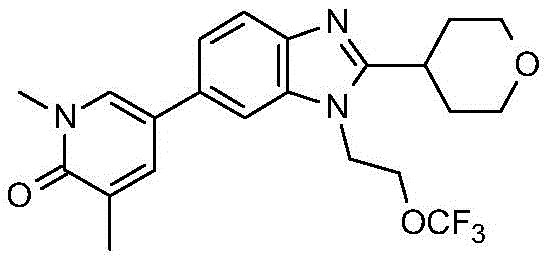
操作AOperation A
步骤1:制备6-溴-2-四氢吡喃-4-基-1-[2-三氟甲氧基)乙基]苯并咪唑Step 1: Preparation of 6-bromo-2-tetrahydropyran-4-yl-1-[2-trifluoromethoxy)ethyl]benzimidazole

在室温,向4-溴-N2-[2-(三氟甲氧基)乙基]苯-1,2-二胺(中间体1,150mg,0.50mmol)在DCM(5mL)中的溶液中加入四氢吡喃-4-甲酰氯(78.2mg,0.527mmol)。将反应混合物搅拌1小时,然后加水淬灭。加入稀释于EtOAc(50mL)和饱和NaHCO3(10mL)中的混合物。分离各相,水相用EtOAc(2×20mL)萃取。将合并的有机相用盐水洗涤,经Na2SO4干燥并减压蒸发,得到酰胺,将其不经进一步纯化用于下一步骤。MS(ESI)[M+H]+411.1,413.1。To a solution of 4-bromo-N2-[2-(trifluoromethoxy)ethyl]benzene-1,2-diamine (Intermediate 1, 150 mg, 0.50 mmol) in DCM (5 mL) was added at room temperature Tetrahydropyran-4-carbonyl chloride (78.2 mg, 0.527 mmol). The reaction mixture was stirred for 1 hour and then quenched by the addition of water. A mixture diluted in EtOAc (50 mL) and saturated NaHCO3 (10 mL) was added. The phases were separated and the aqueous phase was extracted with EtOAc (2 x 20 mL). The combined organic phases were washed with brine, dried over Na2SO4 and evaporated under reduced pressure to give the amide which was used in the next step without further purification. MS(ESI)[M+H] + 411.1, 413.1.
向在甲苯(10mL)中的上述化合物中加入pTSA(86.3mg,0.50mmol)并将反应混合物加热至120℃持续18小时。然后将混合物冷却至室温并减压蒸发。将残余物用EtOAc(50mL)稀释并加入饱和NaHCO3(10mL)。分离各相,水相用EtOAc(2×20mL)萃取。将合并的有机相用盐水洗涤,用Na2SO4干燥并减压蒸发。通过硅胶上的快速色谱使用EtOAc在己烷中的混合物作为洗脱液纯化该物质,得到标题化合物(140mg,64%)。MS(ESI)[M+H]+393.1,395.0。To the above compound in toluene (10 mL) was added pTSA (86.3 mg, 0.50 mmol) and the reaction mixture was heated to 120°C for 18 hours. The mixture was then cooled to room temperature and evaporated under reduced pressure. The residue was diluted with EtOAc (50 mL) and saturated NaHCO3 (10 mL) was added. The phases were separated and the aqueous phase was extracted with EtOAc (2 x 20 mL). The combined organic phases were washed with brine, dried over Na2SO4 and evaporated under reduced pressure. This material was purified by flash chromatography on silica gel using EtOAc in hexanes as eluent to give the title compound (140 mg, 64%). MS(ESI)[M+H] + 393.1, 395.0.
步骤2:制备化合物1Step 2: Preparation of Compound 1

将6-溴-2-四氢吡喃-4-基-1-[2-(三氟甲氧基)乙基]苯并咪唑(70mg,0.18mmol)、1,3-二甲基-5-(4,4,5,5-四甲基-1,3,2-二氧杂硼杂环戊烷-2-基)吡啶-2-酮(使用US20130053362中所述的程序制备,53mg,0.21mmol)和Cs2CO3(122mg,0.37mmol)在DME(2mL)和水(0.2mL)的混合物通过鼓泡N210分钟进行脱气。然后加入Pd(PPh3)4(21mg,0.018mmol),通过用N2鼓泡10分钟使反应混合物脱气。将所得混合物加热至85℃持续3小时,然后冷却至室温。用饱和NaHCO3(10mL)和EtOAc(30mL)稀释该混合物。分离各相,水相用EtOAc(2×15mL)萃取。将合并的有机相用盐水洗涤,用Na2SO4干燥并减压蒸发。通过硅胶快速色谱纯化所述材料,使用EtOAc/己烷的混合物作为洗脱液,然后通过制备型HPLC纯化,提供化合物1(23mg,30%)。1H NMR(500MHz,CDCl3)δ7.81(d,J=8.3Hz,1H),7.56(dd,J=2.6,1.1Hz,1H),7.41(d,J=2.5Hz,1H),7.34(dd,J=8.3,1.7Hz,1H),7.29–7.28(m,1H),(4.54(t,J=5.4Hz,2H),4.35(t,J=5.3Hz,2H),4.17(dd,J=11.7,2.6Hz,2H),3.67(s,3H),3.60(td,J=11.9,1.9Hz,2H),3.21–3.00(m,1H),2.28(s,3H),2.38–2.16(m,2H),1.87(d,J=11.4Hz,2H).MS(ESI)[M+H]+436.2。6-Bromo-2-tetrahydropyran-4-yl-1-[2-(trifluoromethoxy)ethyl]benzimidazole (70 mg, 0.18 mmol), 1,3-dimethyl-5 -(4,4,5,5-Tetramethyl-1,3,2-dioxaborol-2-yl)pyridin-2-one (prepared using the procedure described in US20130053362, 53 mg, 0.21 mmol) and Cs2CO3 ( 122 mg, 0.37 mmol) in DME (2 mL) and water (0.2 mL) were degassed by bubbling N2 for 10 min. Pd( PPh3 ) 4 (21 mg, 0.018 mmol) was then added and the reaction mixture was degassed by bubbling with N2 for 10 minutes. The resulting mixture was heated to 85°C for 3 hours and then cooled to room temperature. The mixture was diluted with saturated NaHCO3 (10 mL) and EtOAc (30 mL). The phases were separated and the aqueous phase was extracted with EtOAc (2 x 15 mL). The combined organic phases were washed with brine, dried over Na2SO4 and evaporated under reduced pressure. The material was purified by flash chromatography on silica gel using a mixture of EtOAc/hexanes as eluent, followed by preparative HPLC to provide compound 1 (23 mg, 30%). 1 H NMR (500 MHz, CDCl 3 ) δ 7.81 (d, J=8.3 Hz, 1H), 7.56 (dd, J=2.6, 1.1 Hz, 1H), 7.41 (d, J=2.5 Hz, 1H), 7.34 (dd,J=8.3,1.7Hz,1H),7.29–7.28(m,1H),(4.54(t,J=5.4Hz,2H),4.35(t,J=5.3Hz,2H),4.17(dd , J=11.7, 2.6Hz, 2H), 3.67(s, 3H), 3.60(td, J=11.9, 1.9Hz, 2H), 3.21–3.00(m, 1H), 2.28(s, 3H), 2.38– 2.16 (m, 2H), 1.87 (d, J=11.4 Hz, 2H). MS (ESI) [M+H] + 436.2.
操作BAction B
步骤1:制备N-(4-(1,5-二甲基-6-氧代-1,6-二氢吡啶-3-基)-2-((2-(三氟甲氧基)乙基)氨基)苯基)四氢-2H-吡喃-4-甲酰胺Step 1: Preparation of N-(4-(1,5-Dimethyl-6-oxo-1,6-dihydropyridin-3-yl)-2-((2-(trifluoromethoxy)ethyl) yl)amino)phenyl)tetrahydro-2H-pyran-4-carboxamide

在室温,将四氢-2H-吡喃-4-甲酸(6.4g,49.2mmol)在DCM(200mL)中的搅拌溶液中加入T3PTM(50%在EtOAc中)(23.0g,61.5mmol),并将反应混合物搅拌20分钟。然后加入中间体8(14.0g,41.1mmol)和DIPEA(10.6g,82mmol)在DCM(20mL)中的溶液,并将反应混合物在室温下搅拌8小时。完成后,将反应混合物减压浓缩,产物用EtOAc(300mL×3)萃取。将合并的有机层用水(150mL),盐水(150mL)洗涤,用无水Na2SO4干燥,过滤并浓缩。将所得产物与Et2O一起研磨并在真空下干燥,得到标题化合物(13.0g,63%),为固体。[M+H]+454.35。To a stirred solution of tetrahydro-2H-pyran-4-carboxylic acid (6.4 g, 49.2 mmol) in DCM (200 mL) at room temperature was added T3P ™ (50% in EtOAc) (23.0 g, 61.5 mmol), The reaction mixture was stirred for 20 minutes. A solution of Intermediate 8 (14.0 g, 41.1 mmol) and DIPEA (10.6 g, 82 mmol) in DCM (20 mL) was then added and the reaction mixture was stirred at room temperature for 8 hours. After completion, the reaction mixture was concentrated under reduced pressure and the product was extracted with EtOAc (300 mL x 3). The combined organic layers were washed with water (150 mL), brine (150 mL), dried over anhydrous Na 2 SO 4 , filtered and concentrated. The resulting product was triturated with Et2O and dried under vacuum to give the title compound (13.0 g, 63%) as a solid. [M+H] + 454.35.
步骤2:制备1,3-二甲基-5-(2-(四氢-2H-吡喃-4-基)-1-(2-(三氟甲氧基)乙基)-1H-苯并[d]咪唑-6-基)吡啶-2(1H)-酮Step 2: Preparation of 1,3-dimethyl-5-(2-(tetrahydro-2H-pyran-4-yl)-1-(2-(trifluoromethoxy)ethyl)-1H-benzene [d]imidazol-6-yl)pyridin-2(1H)-one
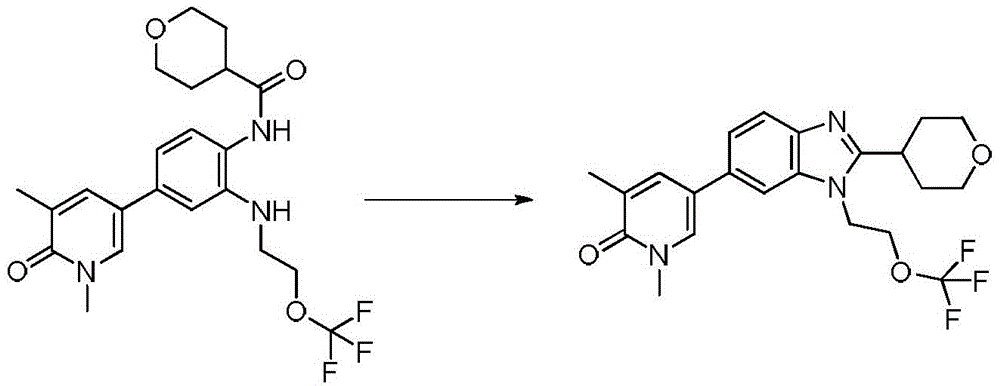
将(4-(1,5-二甲基-6-氧代-1,6-二氢吡啶-3-基)-2-((2-(三氟甲氧基)乙基)氨基)苯基)四氢-2H-吡喃-4-甲酰胺(13.0g,28.7mmol)在乙酸(320mL)中的搅拌溶液在100℃加热14小时。完成后,将乙酸真空蒸发。向残余物中加入饱和NaHCO3溶液(500mL)以中和任何剩余的酸,并使用EtOAc(300mL)萃取混合物。将有机层用盐水(150mL)洗涤,经无水Na2SO4干燥,过滤并浓缩。通过使用4%MeOH的DCM溶液作为洗脱液的硅胶色谱纯化粗产物,得到11.0g产物,将其进一步在甲苯中结晶,得到化合物1(6.6g,53%),为固体。1H NMR(500MHz,CDCl3)δ7.81(d,J=8.3Hz,1H),7.56(dd,J=2.6,1.1Hz,1H),7.41(d,J=2.5Hz,1H),7.34(dd,J=8.3,1.7Hz,1H),7.29–7.28(m,1H),(4.54(t,J=5.4Hz,2H),4.35(t,J=5.3Hz,2H),4.17(dd,J=11.7,2.6Hz,2H),3.67(s,3H),3.60(td,J=11.9,1.9Hz,2H),3.21–3.00(m,1H),2.28(s,3H),2.38–2.16(m,2H),1.87(d,J=11.4Hz,2H)。MS(ESI)[M+H]+436.2。(4-(1,5-Dimethyl-6-oxo-1,6-dihydropyridin-3-yl)-2-((2-(trifluoromethoxy)ethyl)amino)benzene yl)tetrahydro-2H-pyran-4-carboxamide (13.0 g, 28.7 mmol) in acetic acid (320 mL) was heated at 100 °C for 14 h. Upon completion, the acetic acid was evaporated in vacuo. To the residue was added saturated NaHCO3 solution (500 mL) to neutralize any remaining acid, and the mixture was extracted with EtOAc (300 mL). The organic layer was washed with brine (150 mL), dried over anhydrous Na 2 SO 4 , filtered and concentrated. The crude product was purified by silica gel chromatography using 4% MeOH in DCM as eluent to give 11.0 g of product which was further crystallized from toluene to give compound 1 (6.6 g, 53%) as a solid. 1 H NMR (500 MHz, CDCl 3 ) δ 7.81 (d, J=8.3 Hz, 1H), 7.56 (dd, J=2.6, 1.1 Hz, 1H), 7.41 (d, J=2.5 Hz, 1H), 7.34 (dd,J=8.3,1.7Hz,1H),7.29–7.28(m,1H),(4.54(t,J=5.4Hz,2H),4.35(t,J=5.3Hz,2H),4.17(dd , J=11.7, 2.6Hz, 2H), 3.67(s, 3H), 3.60(td, J=11.9, 1.9Hz, 2H), 3.21–3.00(m, 1H), 2.28(s, 3H), 2.38– 2.16 (m, 2H), 1.87 (d, J=11.4 Hz, 2H). MS (ESI) [M+H] + 436.2.
实施例2:5-[2-环丙基-3-[2-(三氟甲氧基)乙基]苯并咪唑-5-基]-1,3-二甲基吡啶-2-酮(化合物2)Example 2: 5-[2-Cyclopropyl-3-[2-(trifluoromethoxy)ethyl]benzimidazol-5-yl]-1,3-lutidine-2-one ( Compound 2)

操作AOperation A
步骤1:制备6-溴-2-环丙基-1-[2-(三氟甲氧基)乙基]苯并咪唑Step 1: Preparation of 6-bromo-2-cyclopropyl-1-[2-(trifluoromethoxy)ethyl]benzimidazole

向4-溴-N2-[2-(三氟甲氧基)乙基]苯-1,2-二胺(中间体1,150mg,0.50mmol)的MeOH(4mL)溶液中快速加入环丙烷甲醛(35mg,0.502mmol),然后缓慢加入乙酸(0.143mL,2.51mmol),然后将反应混合物在室温下搅拌18小时。将溶液减压蒸发,然后用EtOAc(20mL)和饱和NaHCO3(10mL)稀释。分离各相,水相用EtOAc(3×15mL)萃取。将合并的有机相用盐水洗涤,用Na2SO4干燥,过滤并减压蒸发。通过硅胶上的快速色谱使用EtOAc在己烷中的混合物作为洗脱液纯化该物质,得到标题化合物(88mg,45%)。MS(ESI)[M+H]+349.0,351.0。To a solution of 4-bromo-N2-[2-(trifluoromethoxy)ethyl]benzene-1,2-diamine (intermediate 1,150 mg, 0.50 mmol) in MeOH (4 mL) was added rapidly cyclopropanecarbaldehyde ( 35 mg, 0.502 mmol), then acetic acid (0.143 mL, 2.51 mmol) was added slowly, and the reaction mixture was stirred at room temperature for 18 hours. The solution was evaporated under reduced pressure, then diluted with EtOAc (20 mL) and saturated NaHCO3 (10 mL). The phases were separated and the aqueous phase was extracted with EtOAc (3 x 15 mL). The combined organic phases were washed with brine, dried over Na2SO4 , filtered and evaporated under reduced pressure. This material was purified by flash chromatography on silica gel using EtOAc in hexanes as eluent to give the title compound (88 mg, 45%). MS(ESI)[M+H] + 349.0, 351.0.
步骤2:制备化合物2Step 2: Preparation of Compound 2
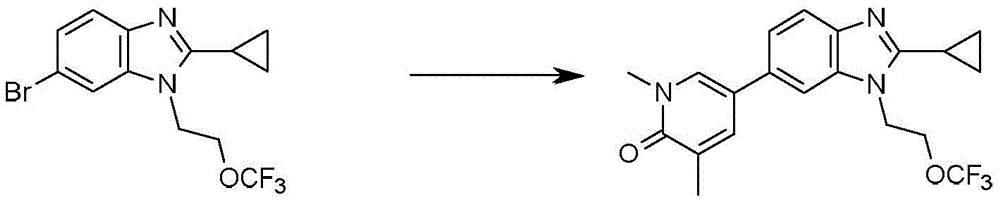
将6-溴-2-环丙基-1-[2-(三氟甲氧基)乙基]苯并咪唑(88mg,0.252mmol),1,3-二甲基-5-(4,4,5,5-四甲基-1,3,2-二氧杂硼杂环戊烷-2-基)吡啶-2-酮(如US20130053362中制备,63mg,0.252mmol)在DME(2mL)和水(0.1mL)中的溶液通过鼓泡N2脱气10分钟。然后向该混合物中加入Cs2CO3(172mg,0.529mmol)和Pd(PPh3)4(29mg,0.025mmol),然后通过鼓泡N2脱气10分钟。将所得混合物加热至85℃持续3小时,然后冷却至室温。用饱和NaHCO3(10mL)和EtOAc(10mL)稀释该混合物,并将水相用EtOAc(3×10mL)萃取。将合并的有机相用MgSO4干燥,过滤并减压蒸发。通过硅胶快速色谱纯化所述材料,使用在己烷中的EtOAc的混合物作为洗脱液,然后通过制备性HPLC纯化,提供化合物2(56mg,57%)。1H NMR(500MHz,CDCl3)δ7.66(d,J=8.2Hz,1H),7.55–7.48(m,1H),7.37(d,J=2.5Hz,1H),7.29–7.25(m,1H),7.25–7.23(m,1H),4.59(t,J=5.5Hz,2H),4.34(t,J=5.5Hz,2H),3.62(s,3H),2.23(s,3H),2.07–1.90(m,1H),1.33–1.22(m,2H),1.17–1.09(m,2H)。[M+H]+392.2。6-Bromo-2-cyclopropyl-1-[2-(trifluoromethoxy)ethyl]benzimidazole (88 mg, 0.252 mmol), 1,3-dimethyl-5-(4,4 ,5,5-tetramethyl-1,3,2-dioxaborol-2-yl)pyridin-2-one (as prepared in US20130053362, 63 mg, 0.252 mmol) in DME (2 mL) and The solution in water (0.1 mL) was degassed by bubbling N2 for 10 min. Cs2CO3 (172 mg, 0.529 mmol) and Pd( PPh3 )4 ( 29 mg, 0.025 mmol) were then added to the mixture, followed by degassing by bubbling N2 for 10 minutes. The resulting mixture was heated to 85°C for 3 hours and then cooled to room temperature. The mixture was diluted with saturated NaHCO3 (10 mL) and EtOAc (10 mL), and the aqueous phase was extracted with EtOAc (3 x 10 mL). The combined organic phases were dried over MgSO4 , filtered and evaporated under reduced pressure. The material was purified by flash chromatography on silica gel using a mixture of EtOAc in hexanes as eluent followed by preparative HPLC to provide compound 2 (56 mg, 57%). 1 H NMR (500MHz, CDCl 3 ) δ 7.66 (d, J=8.2Hz, 1H), 7.55-7.48 (m, 1H), 7.37 (d, J=2.5Hz, 1H), 7.29-7.25 (m, 1H), 7.25–7.23(m, 1H), 4.59(t, J=5.5Hz, 2H), 4.34(t, J=5.5Hz, 2H), 3.62(s, 3H), 2.23(s, 3H), 2.07–1.90 (m, 1H), 1.33–1.22 (m, 2H), 1.17–1.09 (m, 2H). [M+H] + 392.2.
操作BAction B
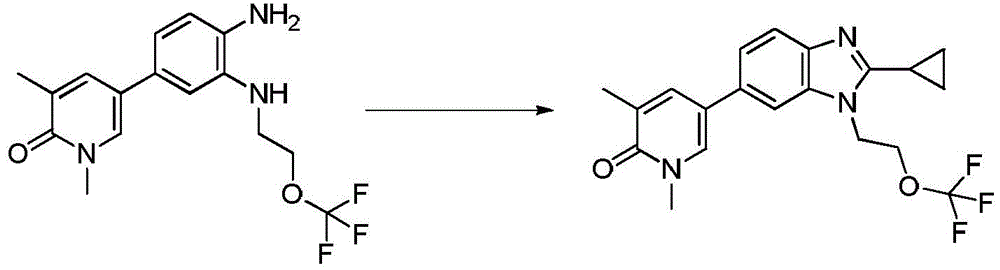
将中间体8(14.0g,41.0mmol)和环丙烷甲醛(3.44g,49.0mmol)在乙酸(560mL)中的溶液在室温下搅拌14小时。反应完成后,减压蒸发溶剂。向残余物中加入饱和的NaHCO3溶液(1L)以中和存在的任何酸,并使用EtOAc(150mL×3)萃取产物。将合并的有机层用盐水(500mL)洗涤,用无水Na2SO4干燥并浓缩。通过使用3%MeOH的DCM溶液作为洗脱液的硅胶色谱纯化粗产物。将合并的级分减压浓缩,得到5.2g浅黄色固体,将其进一步在丙酮中结晶(分两批),得到化合物2(总计4.68g,30%),为白色固体。1H NMR(500MHz,CDCl3)δ7.66(d,J=8.2Hz,1H),7.55–7.48(m,1H),7.37(d,J=2.5Hz,1H),7.29–7.25(m,1H),7.25–7.23(m,1H),4.59(t,J=5.5Hz,2H),4.34(t,J=5.5Hz,2H),3.62(s,3H),2.23(s,3H),2.07–1.90(m,1H),1.33–1.22(m,2H),1.17–1.09(m,2H)。[M+H]+392.2。A solution of Intermediate 8 (14.0 g, 41.0 mmol) and cyclopropanecarbaldehyde (3.44 g, 49.0 mmol) in acetic acid (560 mL) was stirred at room temperature for 14 hours. After the reaction was completed, the solvent was evaporated under reduced pressure. To the residue was added saturated NaHCO3 solution (1 L) to neutralize any acid present, and the product was extracted with EtOAc (150 mL x 3). The combined organic layers were washed with brine (500 mL), dried over anhydrous Na 2 SO 4 and concentrated. The crude product was purified by silica gel chromatography using 3% MeOH in DCM as eluent. The combined fractions were concentrated under reduced pressure to give 5.2 g of a pale yellow solid which was further crystallized from acetone (in two batches) to give compound 2 (4.68 g total, 30%) as a white solid. 1 H NMR (500MHz, CDCl 3 ) δ 7.66 (d, J=8.2Hz, 1H), 7.55-7.48 (m, 1H), 7.37 (d, J=2.5Hz, 1H), 7.29-7.25 (m, 1H), 7.25–7.23(m, 1H), 4.59(t, J=5.5Hz, 2H), 4.34(t, J=5.5Hz, 2H), 3.62(s, 3H), 2.23(s, 3H), 2.07–1.90 (m, 1H), 1.33–1.22 (m, 2H), 1.17–1.09 (m, 2H). [M+H] + 392.2.
实施例3:1,3-二甲基-5-[3-[2-(三氟甲氧基)乙基]苯并咪唑-5-基]吡啶-2-酮(化合物3)Example 3: 1,3-Dimethyl-5-[3-[2-(trifluoromethoxy)ethyl]benzimidazol-5-yl]pyridin-2-one (Compound 3)

步骤1:6-溴-1-[2-(三氟甲氧基)乙基]苯并咪唑的制备Step 1: Preparation of 6-bromo-1-[2-(trifluoromethoxy)ethyl]benzimidazole

将4-溴-N2-[2-(三氟甲氧基)乙基]苯-1,2-二胺(中间体1,150mg,0.502mmol)溶于原甲酸三乙酯(10mL)中,并将溶液搅拌5分钟。然后加入pTSA(10mg,0.05mmol)并将混合物在室温下搅拌18小时。然后将溶液用EtOAc(30mL)稀释并将有机相用饱和NaHCO3(5mL)洗涤。水层用EtOAc(2×20mL)萃取。将合并的有机层用Na2SO4干燥,过滤,并减压下得到标题化合物,其不经任何进一步纯化即可用于下一步骤(100mg,65%)。MS(ESI)[M+H]+309.1,311.1。4-Bromo-N2-[2-(trifluoromethoxy)ethyl]benzene-1,2-diamine (intermediate 1,150 mg, 0.502 mmol) was dissolved in triethyl orthoformate (10 mL) and the The solution was stirred for 5 minutes. Then pTSA (10 mg, 0.05 mmol) was added and the mixture was stirred at room temperature for 18 hours. The solution was then diluted with EtOAc (30 mL) and the organic phase was washed with saturated NaHCO3 (5 mL). The aqueous layer was extracted with EtOAc (2 x 20 mL). The combined organic layers were dried over Na2SO4 , filtered, and the title compound was obtained under reduced pressure, which was used in the next step (100 mg, 65%) without any further purification. MS(ESI) [M+H] + 309.1, 311.1.
步骤2:制备化合物3Step 2: Preparation of Compound 3

将6-溴-1-[2-(三氟甲氧基)乙基]苯并咪唑(50mg,0.162mmol)、1,3-二甲基-5-(4,4,5,5-四甲基-1,3,2-二氧杂硼杂环戊烷-2-基)吡啶-2-酮(使用US20130053362中描述的操作制备,48mg,0.194mmol)在DME(2mL)和水(0.1mL)中的溶液通过鼓泡N2 10分钟进行脱气。然后加入Cs2CO3(111mg,0.340mmol)和Pd(PPh3)4(19mg,0.016mmol),并通过用N2鼓泡10分钟使该混合物脱气。将所得混合物加热至85℃持续3小时,然后冷却至室温。将该混合物用饱和NaHCO3(10mL)和EtOAc(30mL)稀释,水相用EtOAc(3×10mL)萃取。将合并的有机相用Na2SO4干燥,过滤并减压浓缩。通过硅胶快速色谱纯化所述材料,使用在己烷中的EtOAc的混合物作为洗脱液,然后使用MeOH在DCM中的混合物作为洗脱液,然后通过制备性HPLC纯化,提供化合物3(56mg,38%)。1H NMR(500MHz,CDCl3)δ7.95(s,1H),7.84(d,J=8.4Hz,1H),7.57–7.52(m,1H),7.41(d,J=2.5Hz,1H),7.38–7.37(m,1H),7.35(dd,J=8.4,1.7Hz,1H),4.52(t,J=5.2Hz,2H),4.34(t,J=5.2Hz,2H),3.65(s,3H),2.25(s,3H)。MS(ESI)[M+H]+352.4。6-Bromo-1-[2-(trifluoromethoxy)ethyl]benzimidazole (50 mg, 0.162 mmol), 1,3-dimethyl-5-(4,4,5,5-tetrakis Methyl-1,3,2-dioxaborol-2-yl)pyridin-2-one (prepared using the procedure described in US20130053362, 48 mg, 0.194 mmol) in DME (2 mL) and water (0.1 mL) was degassed by bubbling N2 for 10 minutes. Cs2CO3 (111 mg, 0.340 mmol) and Pd( PPh3 )4 ( 19 mg, 0.016 mmol) were then added, and the mixture was degassed by bubbling with N2 for 10 minutes. The resulting mixture was heated to 85°C for 3 hours and then cooled to room temperature. The mixture was diluted with saturated NaHCO3 (10 mL) and EtOAc (30 mL), and the aqueous phase was extracted with EtOAc (3 x 10 mL). The combined organic phases were dried over Na2SO4 , filtered and concentrated under reduced pressure. The material was purified by flash chromatography on silica gel using a mixture of EtOAc in hexanes as eluent, then a mixture of MeOH in DCM as eluent, followed by preparative HPLC to provide compound 3 (56 mg, 38 %). 1 H NMR (500MHz, CDCl 3 ) δ 7.95 (s, 1H), 7.84 (d, J=8.4Hz, 1H), 7.57-7.52 (m, 1H), 7.41 (d, J=2.5Hz, 1H) ,7.38–7.37(m,1H),7.35(dd,J=8.4,1.7Hz,1H),4.52(t,J=5.2Hz,2H),4.34(t,J=5.2Hz,2H),3.65( s, 3H), 2.25 (s, 3H). MS(ESI)[M+H] + 352.4.
实施例4:5-[2-(1-乙酰基-4-哌啶基)-3-[2-(三氟甲氧基)乙基]苯并咪唑-5-基]-1,3-二甲基吡啶-2-酮(化合物4)Example 4: 5-[2-(1-Acetyl-4-piperidinyl)-3-[2-(trifluoromethoxy)ethyl]benzimidazol-5-yl]-1,3- Lutidine-2-one (Compound 4)

步骤1:制备1-[4-[6-溴-1-[2-(三氟甲氧基)乙基]苯并咪唑-2-基]-1-哌啶基]乙酮Step 1: Preparation of 1-[4-[6-Bromo-1-[2-(trifluoromethoxy)ethyl]benzimidazol-2-yl]-1-piperidinyl]ethanone

在室温,向4-溴-N2-[2-(三氟甲氧基)乙基]苯-1,2-二胺(中间体1,140mg,0.468mmol)在DCM(5mL)中的溶液中加入1-乙酰基哌啶-4-甲酰氯(93.1mg,0.491mmol),并将反应混合物在室温下搅拌2小时,然后加入水淬灭。将混合物用EtOAc(50mL)稀释并加入饱和NaHCO3(10mL)。分离各相,水相用EtOAc(2×20mL)萃取。将合并的有机相用盐水洗涤,经Na2SO4干燥,过滤并减压蒸发,得到酰胺,将其不经进一步纯化用于下一步。MS(ESI)[M+H]+454.0。To a solution of 4-bromo-N2-[2-(trifluoromethoxy)ethyl]benzene-1,2-diamine (Intermediate 1, 140 mg, 0.468 mmol) in DCM (5 mL) was added at room temperature 1-Acetylpiperidine-4-carbonyl chloride (93.1 mg, 0.491 mmol), and the reaction mixture was stirred at room temperature for 2 hours, then quenched by the addition of water. The mixture was diluted with EtOAc (50 mL) and saturated NaHCO3 (10 mL) was added. The phases were separated and the aqueous phase was extracted with EtOAc (2 x 20 mL). The combined organic phases were washed with brine, dried over Na2SO4 , filtered and evaporated under reduced pressure to give the amide which was used in the next step without further purification. MS(ESI)[M+H] + 454.0.
加入上述化合物的甲苯溶液(10mL)和pTSA(80mg,0.468mmol)并将该混合物加热至110℃达18小时。然后将混合物冷却并减压蒸发。将残余物用EtOAc(50mL)稀释并加入饱和NaHCO3(10mL)。分离各相,水相用EtOAc(2×20mL)萃取。将合并的有机相用盐水洗涤,用Na2SO4干燥,过滤并减压蒸发。通过硅胶快速色谱纯化所述材料,使用在己烷中的EtOAc作为洗脱液,得到标题化合物(140mg,64%)。MS(ESI)[M+H]+434.0,436.0。A solution of the above compound in toluene (10 mL) and pTSA (80 mg, 0.468 mmol) were added and the mixture was heated to 110°C for 18 hours. The mixture was then cooled and evaporated under reduced pressure. The residue was diluted with EtOAc (50 mL) and saturated NaHCO3 (10 mL) was added. The phases were separated and the aqueous phase was extracted with EtOAc (2 x 20 mL). The combined organic phases were washed with brine, dried over Na2SO4 , filtered and evaporated under reduced pressure. The material was purified by flash chromatography on silica gel using EtOAc in hexanes as eluent to give the title compound (140 mg, 64%). MS(ESI) [M+H] + 434.0, 436.0.
步骤2:化合物4的制备Step 2: Preparation of Compound 4

将1,3-二甲基-5-(4,4,5,5-四甲基-1,3,2-二氧杂硼杂环戊烷-2-基)吡啶-2-酮(使用US20130053362中描述的操作制备,54.8mg,0.246mmol)、1-[4-[6-溴-1-[2-(三氟甲氧基)乙基]苯并咪唑-2-基]-1-哌啶基]乙酮(89mg,0.21mmol)、Pd(PPh3)4(23.7mg,0.02mmol)、Cs2CO3(140mg,0.43mmol)在DME(2mL)和水(0.2mL)的混合物中的混合物在85℃加热2小时。然后将混合物冷却并减压浓缩。向该残余物中加入EtOAc(30mL),然后加入饱和NaHCO3(20mL)。分离各相,水相用EtOAc(2×30mL)萃取。将合并的有机相用盐水洗涤,用Na2SO4干燥,过滤并减压蒸发。该物质通过制备型HPLC纯化,得到化合物4(20mg,21%)。1HNMR(500MHz,MeOD)δ7.85(dd,J=11.1,1.5Hz,2H),7.71(d,J=1.4Hz,1H),7.65(d,J=8.4Hz,1H),7.45(dd,J=8.4,1.5Hz,1H),4.75(t,J=4.9Hz,2H),4.69(d,J=13.3Hz,1H),4.45(t,J=4.9Hz,2H),4.10(d,J=13.5Hz,1H),3.66(s,3H),3.46–3.31(m,2H),2.80(td,J=13.0,2.4Hz,1H),2.21(s,3H),2.16(s,3H),2.07–2.00(m,3H),2.00–1.93(m,1H)。MS(ESI)[M+H]+477.3。1,3-Dimethyl-5-(4,4,5,5-tetramethyl-1,3,2-dioxaborol-2-yl)pyridin-2-one (using Prepared by the procedure described in US20130053362, 54.8 mg, 0.246 mmol), 1-[4-[6-bromo-1-[2-(trifluoromethoxy)ethyl]benzimidazol-2-yl]-1- A mixture of piperidinyl]ethanone (89 mg, 0.21 mmol), Pd( PPh3 ) 4 (23.7 mg, 0.02 mmol), Cs2CO3 ( 140 mg, 0.43 mmol) in DME (2 mL) and water (0.2 mL) The mixture was heated at 85°C for 2 hours. The mixture was then cooled and concentrated under reduced pressure. To the residue was added EtOAc (30 mL) followed by saturated NaHCO3 (20 mL). The phases were separated and the aqueous phase was extracted with EtOAc (2 x 30 mL). The combined organic phases were washed with brine, dried over Na2SO4 , filtered and evaporated under reduced pressure. This material was purified by preparative HPLC to give compound 4 (20 mg, 21%). 1 HNMR(500MHz,MeOD)δ7.85(dd,J=11.1,1.5Hz,2H),7.71(d,J=1.4Hz,1H),7.65(d,J=8.4Hz,1H),7.45(dd , J=8.4, 1.5Hz, 1H), 4.75(t, J=4.9Hz, 2H), 4.69(d, J=13.3Hz, 1H), 4.45(t, J=4.9Hz, 2H), 4.10(d , J=13.5Hz, 1H), 3.66(s, 3H), 3.46–3.31(m, 2H), 2.80(td, J=13.0, 2.4Hz, 1H), 2.21(s, 3H), 2.16(s, 3H), 2.07–2.00 (m, 3H), 2.00–1.93 (m, 1H). MS(ESI)[M+H] + 477.3.
实施例5:1,3-二甲基-5-[2-甲基-3-[2-(三氟甲氧基)乙基]苯并咪唑-5-基]吡啶-2-酮(化合物5)Example 5: 1,3-Dimethyl-5-[2-methyl-3-[2-(trifluoromethoxy)ethyl]benzimidazol-5-yl]pyridin-2-one (compound 5)

步骤1:制备6-溴-2-甲基-1-[2-(三氟甲氧基)乙基]苯并咪唑Step 1: Preparation of 6-bromo-2-methyl-1-[2-(trifluoromethoxy)ethyl]benzimidazole

向中间体1(67mg,0.224mmol)在原乙酸三甲酯(1.25mL)中的溶液中加入6N HCl(37μL,0.224mmol),并将反应混合物在室温下搅拌1小时。然后将混合物用DCM(40mL)稀释并用饱和NaHCO3(10mL)洗涤。将水层用DCM(2×20mL)萃取,合并的有机层经Na2SO4干燥,过滤并减压蒸发。通过硅胶上的快速色谱使用EtOAc在己烷中的混合物作为洗脱液纯化该物质,得到标题化合物(44mg,55%)。MS(ESI)[M+H]+323.0,325.0。To a solution of Intermediate 1 (67 mg, 0.224 mmol) in trimethyl orthoacetate (1.25 mL) was added 6N HCl (37 μL, 0.224 mmol) and the reaction mixture was stirred at room temperature for 1 hour. The mixture was then diluted with DCM (40 mL) and washed with saturated NaHCO3 (10 mL). The aqueous layer was extracted with DCM (2 x 20 mL), the combined organic layers were dried over Na2SO4 , filtered and evaporated under reduced pressure. This material was purified by flash chromatography on silica gel using EtOAc in hexanes as eluent to give the title compound (44 mg, 55%). MS(ESI) [M+H] + 323.0, 325.0.
步骤2:化合物5的制备Step 2: Preparation of Compound 5

将6-溴-2-甲基-1-[2-(三氟甲氧基)乙基]苯并咪唑(44mg,0.136mmol)、1,3-二甲基-5-(4,4,5,5-四甲基-1,3,2-二氧杂硼杂环戊烷-2-基)吡啶-2-酮(使用US20130053362中描述的操作制备,41mg,0.163mmol)在DME(2mL)和水(0.1mL)中的溶液通过鼓泡N2脱气10分钟。然后加入Cs2CO3(93mg,0.286mmol)和Pd(PPh3)4(16mg,0.014mmol),通过用N2鼓泡10分钟使混合物脱气。将所得混合物加热至85℃持续3小时,然后冷却至室温。将混合物用饱和NaHCO3(10mL)和EtOAc(30mL)稀释,水相用EtOAc(3×10mL)萃取。将合并的有机相用Na2SO4干燥,过滤并减压蒸发。通过硅胶快速色谱纯化所述材料,使用EtOAc在己烷中的混合物作为洗脱液,然后使用MeOH在DCM中的溶液作为洗脱液,然后通过制备性HPLC纯化,提供化合物5(7.8mg,16%)。1H NMR(500MHz,CDCl3)δ7.71(d,J=8.3Hz,1H),7.56–7.50(m,1H),7.39(d,J=2.6Hz,1H),7.29(ddd,J=8.3,1.6,0.8Hz,1H),7.24(d,J=1.2Hz,1H),4.46(t,J=5.3Hz,2H),4.31(t,J=5.3Hz,2H),3.64(s,3H),2.65(s,3H),2.25(d,J=0.5Hz,3H)。MS(ESI)[M+H]+366.2。6-Bromo-2-methyl-1-[2-(trifluoromethoxy)ethyl]benzimidazole (44 mg, 0.136 mmol), 1,3-dimethyl-5-(4,4, 5,5-Tetramethyl-1,3,2-dioxaborol-2-yl)pyridin-2-one (prepared using the procedure described in US20130053362, 41 mg, 0.163 mmol) in DME (2 mL) ) and water (0.1 mL) were degassed by bubbling N for 10 min. Then Cs2CO3 (93 mg, 0.286 mmol) and Pd( PPh3 ) 4 ( 16 mg, 0.014 mmol) were added and the mixture was degassed by bubbling with N2 for 10 minutes. The resulting mixture was heated to 85°C for 3 hours and then cooled to room temperature. The mixture was diluted with saturated NaHCO3 (10 mL) and EtOAc (30 mL), and the aqueous phase was extracted with EtOAc (3 x 10 mL). The combined organic phases were dried over Na2SO4 , filtered and evaporated under reduced pressure. The material was purified by flash chromatography on silica gel using EtOAc in hexanes as eluent, then MeOH in DCM as eluent, followed by preparative HPLC to provide compound 5 (7.8 mg, 16 %). 1 H NMR (500 MHz, CDCl 3 ) δ 7.71 (d, J=8.3 Hz, 1H), 7.56-7.50 (m, 1H), 7.39 (d, J=2.6 Hz, 1H), 7.29 (ddd, J= 8.3, 1.6, 0.8Hz, 1H), 7.24(d, J=1.2Hz, 1H), 4.46(t, J=5.3Hz, 2H), 4.31(t, J=5.3Hz, 2H), 3.64(s, 3H), 2.65(s, 3H), 2.25(d, J=0.5Hz, 3H). MS(ESI)[M+H] + 366.2.
实施例6:5-[2-环丁基-3-[2-(三氟甲氧基)乙基]苯并咪唑-5-基]-1,3-二甲基-吡啶-2-酮(化合物6)Example 6: 5-[2-Cyclobutyl-3-[2-(trifluoromethoxy)ethyl]benzimidazol-5-yl]-1,3-dimethyl-pyridin-2-one (Compound 6)

步骤1:6-溴-2-环丁基-1-[2-(三氟甲氧基)乙基]苯并咪唑的制备Step 1: Preparation of 6-bromo-2-cyclobutyl-1-[2-(trifluoromethoxy)ethyl]benzimidazole
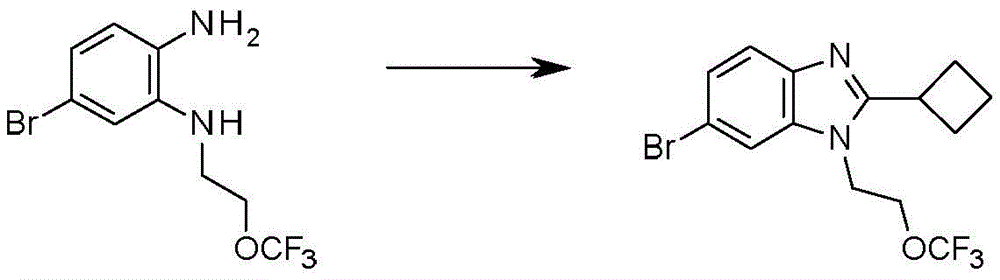
向中间体1(86mg,0.288mmol)在DMF(2mL)中的溶液中添加DIPEA(0.1mL,0.575mmol)、环丁烷甲酸(0.04mL,0.374mmol)和HATU(0.109g,0.288mmol),并将所得混合物在室温下搅拌1小时。将溶液减压浓缩并向残余物中加入EtOAc(20mL)和饱和NaHCO3(10mL)。分离各相,水相用EtOAc(2×10mL)萃取。将合并的有机层用盐水洗涤,用Na2SO4干燥,过滤并减压浓缩,得到酰胺,将其不经进一步纯化用于下一步骤。MS(ESI)[M+H]+383.1,383.3。To a solution of Intermediate 1 (86 mg, 0.288 mmol) in DMF (2 mL) was added DIPEA (0.1 mL, 0.575 mmol), cyclobutanecarboxylic acid (0.04 mL, 0.374 mmol) and HATU (0.109 g, 0.288 mmol), The resulting mixture was stirred at room temperature for 1 hour. The solution was concentrated under reduced pressure and EtOAc (20 mL) and saturated NaHCO3 (10 mL) were added to the residue. The phases were separated and the aqueous phase was extracted with EtOAc (2 x 10 mL). The combined organic layers were washed with brine, dried over Na2SO4 , filtered and concentrated under reduced pressure to give the amide which was used in the next step without further purification. MS(ESI) [M+H] + 383.1, 383.3.
加入上述在甲苯中的残余物(6mL)、pTSA(49mg,0.288),并将混合物加热至100℃达18小时。将该混合物冷却,然后减压浓缩。向残余物中加入EtOAc(20mL)和饱和NaHCO3(10mL)。分离各相并将水相用EtOAc(2×20mL)萃取。将合并的有机相用盐水洗涤,经Na2SO4干燥,过滤并减压浓缩,得到标题化合物,将其不经任何进一步纯化用于下一步。MS(ESI)[M+H]+363.0,365.0。The above residue in toluene (6 mL), pTSA (49 mg, 0.288) were added and the mixture was heated to 100°C for 18 hours. The mixture was cooled and concentrated under reduced pressure. To the residue was added EtOAc (20 mL) and saturated NaHCO3 (10 mL). The phases were separated and the aqueous phase was extracted with EtOAc (2 x 20 mL). The combined organic phases were washed with brine, dried over Na2SO4 , filtered and concentrated under reduced pressure to give the title compound which was used in the next step without any further purification. MS(ESI) [M+H] + 363.0, 365.0.
步骤2:制备化合物6Step 2: Preparation of Compound 6
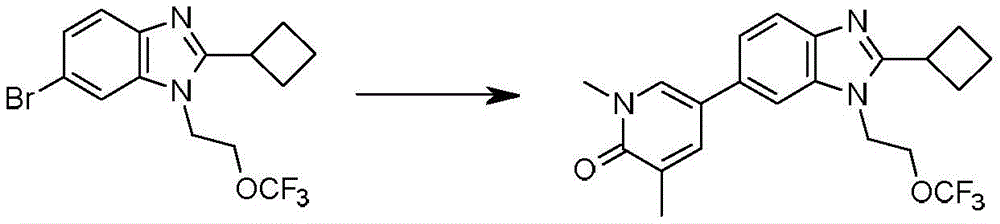
向6-溴-2-环丁基-1-[2-(三氟甲氧基)乙基]苯并咪唑(50mg,0.162mmol)和1,3-二甲基-5-(4,4,5,5-四甲基-1,3,2-二氧杂硼杂环戊烷-2-基)吡啶-2-酮(通过US20130053362中描述的操作制备,48mg,0.194mmol)在DME(2mL)和水(0.1mL)中的溶液通过用N2鼓泡10分钟而脱气。然后加入Cs2CO3(111mg,0.340mmol)和Pd(PPh3)4(19mg,0.016mmol),并通过用N2鼓泡10分钟以上使混合物脱气。将所得混合物加热至85℃持续3小时,然后冷却至室温。向混合物中加入饱和NaHCO3水溶液(10mL)和EtOAc(30mL),并将水相用EtOAc(3×10mL)萃取。将合并的有机相用Na2SO4干燥,过滤并减压浓缩。通过硅胶快速色谱纯化所述材料,使用EtOAc在己烷中的混合物,然后MeOH在DCM中的溶液作为洗脱液。用制备型HPLC进一步纯化混合物,得到化合物6(56mg,38%)。1H NMR(500MHz,CDCl3)δ7.82–7.78(m,1H),7.60–7.51(m,1H),7.40(d,J=2.3Hz,1H),7.31(dd,J=8.3,1.7Hz,1H),7.27–7.22(m,1H),4.40(t,J=5.5Hz,2H),4.26(t,J=5.5Hz,2H),3.81–3.70(m,1H),3.65(s,3H),2.74–2.52(m,2H),2.52–2.34(m,2H),2.24(s,3H),2.22–1.94(m,2H)。MS(ESI)[M+H]+406.1。To 6-bromo-2-cyclobutyl-1-[2-(trifluoromethoxy)ethyl]benzimidazole (50 mg, 0.162 mmol) and 1,3-dimethyl-5-(4,4 ,5,5-tetramethyl-1,3,2-dioxaborol-2-yl)pyridin-2-one (prepared by the procedure described in US20130053362, 48 mg, 0.194 mmol) in DME ( 2 mL) and water (0.1 mL) were degassed by bubbling N2 for 10 min. Cs2CO3 (111 mg, 0.340 mmol) and Pd( PPh3 )4 ( 19 mg, 0.016 mmol) were then added and the mixture was degassed by bubbling with N2 over 10 min. The resulting mixture was heated to 85°C for 3 hours and then cooled to room temperature. To the mixture was added saturated aqueous NaHCO3 (10 mL) and EtOAc (30 mL), and the aqueous phase was extracted with EtOAc (3 x 10 mL). The combined organic phases were dried over Na2SO4 , filtered and concentrated under reduced pressure. The material was purified by flash chromatography on silica gel using EtOAc in hexanes and then MeOH in DCM as eluents. The mixture was further purified by preparative HPLC to give compound 6 (56 mg, 38%). 1 H NMR (500 MHz, CDCl 3 ) δ 7.82-7.78 (m, 1H), 7.60-7.51 (m, 1H), 7.40 (d, J=2.3 Hz, 1H), 7.31 (dd, J=8.3, 1.7 Hz, 1H), 7.27–7.22 (m, 1H), 4.40 (t, J=5.5Hz, 2H), 4.26 (t, J=5.5Hz, 2H), 3.81–3.70 (m, 1H), 3.65 (s) , 3H), 2.74–2.52 (m, 2H), 2.52–2.34 (m, 2H), 2.24 (s, 3H), 2.22–1.94 (m, 2H). MS(ESI)[M+H] + 406.1.
实施例7:5-[2-环丙基-3-(2-甲氧基乙基)苯并咪唑-5-基]-1,3-二甲基-吡啶-2-酮(化合物7)Example 7: 5-[2-Cyclopropyl-3-(2-methoxyethyl)benzimidazol-5-yl]-1,3-dimethyl-pyridin-2-one (Compound 7)

向中间体2(80mg,0.278mmol)在MeOH(4mL)中的溶液中加入环丙烷甲醛(0.021mL,0.278mmol),然后滴加乙酸(0.08mL,1.39mmol),将所得混合物在室温搅拌18小时。将溶液减压浓缩,然后加入EtOAc(20mL)和饱和NaHCO3(10mL)。分离各相,水相用EtOAc(2×30mL)萃取。将合并的有机相用盐水洗涤,用Na2SO4干燥,过滤并减压蒸发。通过二氧化硅上的快速色谱使用EtOAc在己烷中的混合物作为洗脱液纯化物质,然后通过制备型HPLC纯化,得到化合物7(13mg,14%)。1H NMR(500MHz,CDCl3)δ7.65(dd,J=8.3,0.4Hz,1H),7.55(dd,J=2.6,1.2Hz,1H),7.39(d,J=2.2Hz,1H),7.28(d,J=1.2Hz,1H),7.24(dd,J=8.3,1.7Hz,1H),4.45(t,J=5.7Hz,2H),3.86–3.68(m,2H),3.64(s,3H),3.32(s,3H),2.25(d,J=0.8Hz,3H),2.17–1.99(m,1H),1.31–1.16(m,2H),1.18–1.00(m,2H)。MS(ESI)[M+H]+338.2。To a solution of Intermediate 2 (80 mg, 0.278 mmol) in MeOH (4 mL) was added cyclopropanecarbaldehyde (0.021 mL, 0.278 mmol) followed by dropwise addition of acetic acid (0.08 mL, 1.39 mmol) and the resulting mixture was stirred at room temperature for 18 Hour. The solution was concentrated under reduced pressure, then EtOAc (20 mL) and saturated NaHCO3 (10 mL) were added. The phases were separated and the aqueous phase was extracted with EtOAc (2 x 30 mL). The combined organic phases were washed with brine, dried over Na2SO4 , filtered and evaporated under reduced pressure. The material was purified by flash chromatography on silica using EtOAc in hexanes as eluent, followed by preparative HPLC to give compound 7 (13 mg, 14%). 1 H NMR (500 MHz, CDCl 3 ) δ 7.65 (dd, J=8.3, 0.4 Hz, 1H), 7.55 (dd, J=2.6, 1.2 Hz, 1H), 7.39 (d, J=2.2 Hz, 1H) ,7.28(d,J=1.2Hz,1H),7.24(dd,J=8.3,1.7Hz,1H),4.45(t,J=5.7Hz,2H),3.86–3.68(m,2H),3.64( s, 3H), 3.32 (s, 3H), 2.25 (d, J=0.8Hz, 3H), 2.17–1.99 (m, 1H), 1.31–1.16 (m, 2H), 1.18–1.00 (m, 2H) . MS(ESI)[M+H] + 338.2.
实施例8:5-[3-(2-甲氧基乙基)-2-甲基-苯并咪唑-5-基]-1,3-二甲基吡啶-2-酮(化合物8)Example 8: 5-[3-(2-Methoxyethyl)-2-methyl-benzimidazol-5-yl]-1,3-lutidine-2-one (Compound 8)

向中间体2(49mg,0.171mmol)的原乙酸三甲酯(1mL)溶液中加入6NHCl(0.028mL,0.171mmol)并将得到的混合物在室温下搅拌2小时。向混合物中加入DCM(40mL),并将有机层用饱和NaHCO3(10mL)洗涤。将水层用DCM(2×20mL)反萃取,将合并的有机层用Na2SO4干燥,过滤并减压浓缩。该物质通过制备型HPLC纯化,得到化合物8(24mg,41%)。1H NMR(500MHz,CDCl3)δ7.74(d,J=8.5Hz,1H),7.55(d,J=1.3Hz,1H),7.41(d,J=2.4Hz,1H),7.34–7.27(m,2H),4.33(t,J=5.2Hz,2H),3.72(t,J=5.3Hz,2H),3.66(s,3H),3.29(s,3H),2.65(d,J=23.0Hz,3H),2.25(s,3H)。MS(ESI)[M+H]+312.2。To a solution of Intermediate 2 (49 mg, 0.171 mmol) in trimethyl orthoacetate (1 mL) was added 6N HCl (0.028 mL, 0.171 mmol) and the resulting mixture was stirred at room temperature for 2 hours. To the mixture was added DCM (40 mL), and the organic layer was washed with saturated NaHCO3 (10 mL). The aqueous layer was back extracted with DCM (2 x 20 mL), the combined organic layers were dried over Na2SO4 , filtered and concentrated under reduced pressure. This material was purified by preparative HPLC to give compound 8 (24 mg, 41%). 1 H NMR (500 MHz, CDCl 3 ) δ 7.74 (d, J=8.5 Hz, 1H), 7.55 (d, J=1.3 Hz, 1H), 7.41 (d, J=2.4 Hz, 1H), 7.34-7.27 (m, 2H), 4.33(t, J=5.2Hz, 2H), 3.72(t, J=5.3Hz, 2H), 3.66(s, 3H), 3.29(s, 3H), 2.65(d, J= 23.0Hz, 3H), 2.25(s, 3H). MS(ESI)[M+H] + 312.2.
实施例9:5-[3-(2-甲氧基乙基)-2-四氢吡喃-4-基-苯并咪唑-5-基]-1,3-二甲基吡啶-2-酮(化合物9)Example 9: 5-[3-(2-Methoxyethyl)-2-tetrahydropyran-4-yl-benzimidazol-5-yl]-1,3-lutidine-2- Ketone (Compound 9)

向中间体2(56mg,0.195mmol)在DCM(5mL)中的溶液中加入四氢吡喃-4-甲酰氯(30mg,0.21mmol)并将所得混合物在室温下搅拌1小时。向该混合物中加入水,接着加入EtOAc(50mL)和饱和NaHCO3(10mL)。分离各相,水相用EtOAc(2×20mL)萃取。将合并的有机相用盐水洗涤,干燥Na2SO4,过滤并减压浓缩,得到酰胺,将其不经进一步纯化用于下一步骤。MS(ESI)[M+H]+400.2。To a solution of Intermediate 2 (56 mg, 0.195 mmol) in DCM (5 mL) was added tetrahydropyran-4-carbonyl chloride (30 mg, 0.21 mmol) and the resulting mixture was stirred at room temperature for 1 hour. To the mixture was added water, followed by EtOAc (50 mL) and saturated NaHCO3 (10 mL). The phases were separated and the aqueous phase was extracted with EtOAc (2 x 20 mL). The combined organic phases were washed with brine, dried over Na2SO4 , filtered and concentrated under reduced pressure to give the amide which was used in the next step without further purification. MS(ESI)[M+H] + 400.2.
向上述化合物的甲苯溶液(5mL)中加入pTSA(33mg,0.195mmol),并将混合物加热至110℃达18小时。将该溶液冷却至室温,然后减压浓缩。向残余物中加入EtOAc(50mL)和饱和NaHCO3(10mL)。分离各相,水相用EtOAc(2×20mL)萃取。将合并的有机相用盐水洗涤,经Na2SO4干燥,过滤并减压浓缩。该物质通过硅胶快速色谱纯化,使用EtOAc的己烷溶液,然后用MeOH的EtOAc溶液作为洗脱液。该物质再次通过制备型HPLC纯化,得到化合物9(17mg,20%)。1H NMR(500MHz,CDCl3)δ7.82-7.76(m,1H),7.56(dd,J=2.5,1.1Hz,1H),7.40(d,J=2.3Hz,1H),7.29(dd,J=6.7,1.8Hz,2H),4.38(t,J=5.3Hz,2H),4.13(dd,J=11.5,3.1Hz,2H),3.72(t,J=5.3Hz,2H),3.65(s,3H),3.57(td,J=12.0,1.7Hz,2H),3.28(s,3H),3.26-3.18(m,1H),2.25(m,3H),2.23-2.15(m,2H),1.90-1.81(m,2H)。MS(ESI)[M+H]+382.2。To a solution of the above compound in toluene (5 mL) was added pTSA (33 mg, 0.195 mmol), and the mixture was heated to 110°C for 18 hours. The solution was cooled to room temperature and concentrated under reduced pressure. To the residue was added EtOAc (50 mL) and saturated NaHCO3 (10 mL). The phases were separated and the aqueous phase was extracted with EtOAc (2 x 20 mL). The combined organic phases were washed with brine, dried over Na2SO4 , filtered and concentrated under reduced pressure. This material was purified by flash chromatography on silica gel using EtOAc in hexanes and then MeOH in EtOAc as eluents. This material was purified again by preparative HPLC to give compound 9 (17 mg, 20%). 1 H NMR (500 MHz, CDCl 3 ) δ 7.82-7.76 (m, 1H), 7.56 (dd, J=2.5, 1.1 Hz, 1H), 7.40 (d, J=2.3 Hz, 1H), 7.29 (dd, J=6.7, 1.8Hz, 2H), 4.38 (t, J=5.3Hz, 2H), 4.13 (dd, J=11.5, 3.1Hz, 2H), 3.72 (t, J=5.3Hz, 2H), 3.65 ( s, 3H), 3.57 (td, J=12.0, 1.7Hz, 2H), 3.28 (s, 3H), 3.26-3.18 (m, 1H), 2.25 (m, 3H), 2.23-2.15 (m, 2H) , 1.90-1.81 (m, 2H). MS(ESI)[M+H] + 382.2.
实施例10:5-[3-[(1R)-2-甲氧基-1-甲基-乙基]-2-四氢吡喃-4-基-苯并咪唑-5-基]-1,3-二甲基-吡啶-2-酮(化合物10)Example 10: 5-[3-[(1R)-2-Methoxy-1-methyl-ethyl]-2-tetrahydropyran-4-yl-benzimidazol-5-yl]-1 ,3-Dimethyl-pyridin-2-one (Compound 10)

在室温下,向中间体3(50mg,0.166mmol)在DCM(1.5mL)中的溶液中加入四氢吡喃-4-甲酰氯(22μL,0.174mmol)并且将反应混合物搅拌2小时。向该混合物中加入EtOAc(50mL)和饱和NaHCO3(10mL)。分离各相,水相用EtOAc(2×20mL)萃取。将合并的有机相用盐水洗涤,经Na2SO4干燥,过滤并减压浓缩,得到酰胺,将其不经进一步纯化用于下一步骤。MS(ESI)[M+H]+414.2。To a solution of Intermediate 3 (50 mg, 0.166 mmol) in DCM (1.5 mL) was added tetrahydropyran-4-carbonyl chloride (22 μL, 0.174 mmol) at room temperature and the reaction mixture was stirred for 2 h. To the mixture was added EtOAc (50 mL) and saturated NaHCO3 (10 mL). The phases were separated and the aqueous phase was extracted with EtOAc (2 x 20 mL). The combined organic phases were washed with brine, dried over Na2SO4 , filtered and concentrated under reduced pressure to give the amide which was used in the next step without further purification. MS(ESI)[M+H] + 414.2.
向上述化合物在甲苯(2mL)中的溶液中加入pTSA(29mg,0.166mmol)并将所得混合物加热至110℃持续20小时。然后将混合物冷却并减压浓缩。向残余物中加入EtOAc(50mL)和饱和NaHCO3(10mL)。分离各相,水相用EtOAc(2×20mL)萃取。将合并的有机相用盐水洗涤,用Na2SO4干燥,过滤并减压浓缩。通过使用EtOAc在己烷中的混合物作为洗脱液的硅胶快速色谱纯化物质,然后通过制备型HPLC纯化,得到化合物10(6.9mg,11%)。1H NMR(500MHz,CDCl3)δ7.77(d,J=8.3Hz,1H),7.51(dd,J=2.5,1.1Hz,1H),7.42(d,J=1.2Hz,1H),7.36(d,J=2.3Hz,1H),7.25(d,J=1.7Hz,1H),4.78–4.68(m,1H),4.17–4.09(m,2H),3.91(dd,J=9.7,8.1Hz,1H),3.78(dd,J=9.8,5.2Hz,1H),3.65(s,3H),3.63–3.55(m,2H),3.27(s,3H),3.20–3.09(m,1H),2.26(s,3H),2.24–2.11(m,2H),1.98(dd,J=13.5,1.5Hz,1H),1.84(ddd,J=13.5,3.6,2.0Hz,1H),1.70(d,J=7.2Hz,3H)。[M+H]+396.2。To a solution of the above compound in toluene (2 mL) was added pTSA (29 mg, 0.166 mmol) and the resulting mixture was heated to 110 °C for 20 h. The mixture was then cooled and concentrated under reduced pressure. To the residue was added EtOAc (50 mL) and saturated NaHCO3 (10 mL). The phases were separated and the aqueous phase was extracted with EtOAc (2 x 20 mL). The combined organic phases were washed with brine, dried over Na2SO4 , filtered and concentrated under reduced pressure. The material was purified by flash chromatography on silica gel using EtOAc in hexanes as eluent, followed by preparative HPLC to give compound 10 (6.9 mg, 11%). 1 H NMR (500 MHz, CDCl 3 ) δ 7.77 (d, J=8.3 Hz, 1H), 7.51 (dd, J=2.5, 1.1 Hz, 1H), 7.42 (d, J=1.2 Hz, 1H), 7.36 (d, J=2.3Hz, 1H), 7.25 (d, J=1.7Hz, 1H), 4.78–4.68 (m, 1H), 4.17–4.09 (m, 2H), 3.91 (dd, J=9.7, 8.1 Hz, 1H), 3.78 (dd, J=9.8, 5.2Hz, 1H), 3.65 (s, 3H), 3.63–3.55 (m, 2H), 3.27 (s, 3H), 3.20–3.09 (m, 1H) ,2.26(s,3H),2.24–2.11(m,2H),1.98(dd,J=13.5,1.5Hz,1H),1.84(ddd,J=13.5,3.6,2.0Hz,1H),1.70(d , J=7.2Hz, 3H). [M+H] + 396.2.
实施例11:5-[3-[(1R)-2-甲氧基-1-甲基-乙基]-2-甲基-苯并咪唑-5-基]-1,3-二甲基吡啶-2-酮(化合物11)Example 11: 5-[3-[(1R)-2-Methoxy-1-methyl-ethyl]-2-methyl-benzimidazol-5-yl]-1,3-dimethyl Pyridin-2-one (Compound 11)

将中间体3(50mg,0.166mmol)溶于原乙酸三甲酯(2mL)中并将混合物搅拌5分钟。然后加入p-TSA(3.2mg,0.017mmol)并将混合物在室温下搅拌2小时。向该混合物中加入EtOAc(30mL)和饱和NaHCO3(10mL)。分离各相,水相用EtOAc(2×20mL)萃取。将合并的有机相用盐水洗涤,经Na2SO4干燥,过滤并减压浓缩。通过硅胶上的快速色谱使用EtOAc在己烷中的混合物作为洗脱液纯化物质,然后通过制备型HPLC纯化,得到化合物11(8mg,15%)。1HNMR(500MHz,CDCl3)δ7.68(d,J=8.3Hz,1H),7.52(s,1H),7.39(s,1H),7.36(d,J=2.3Hz,1H),7.23(dd,J=8.3,1.5Hz,1H),4.68(dd,J=12.7,7.4Hz,1H),3.87(dd,J=9.7,8.1Hz,1H),3.74(dd,J=9.8,5.1Hz,1H),3.64(s,3H),3.28(s,3H),2.64(s,3H),2.25(s,3H),1.68(d,J=7.2Hz,3H)。MS(ESI)[M+H]+326.1。Intermediate 3 (50 mg, 0.166 mmol) was dissolved in trimethyl orthoacetate (2 mL) and the mixture was stirred for 5 min. Then p-TSA (3.2 mg, 0.017 mmol) was added and the mixture was stirred at room temperature for 2 hours. To the mixture was added EtOAc (30 mL) and saturated NaHCO3 (10 mL). The phases were separated and the aqueous phase was extracted with EtOAc (2 x 20 mL). The combined organic phases were washed with brine, dried over Na2SO4 , filtered and concentrated under reduced pressure. The material was purified by flash chromatography on silica gel using EtOAc in hexanes as eluent, followed by preparative HPLC to give compound 11 (8 mg, 15%). 1 H NMR (500 MHz, CDCl 3 ) δ 7.68 (d, J=8.3 Hz, 1H), 7.52 (s, 1H), 7.39 (s, 1H), 7.36 (d, J=2.3 Hz, 1H), 7.23 ( dd,J=8.3,1.5Hz,1H),4.68(dd,J=12.7,7.4Hz,1H),3.87(dd,J=9.7,8.1Hz,1H),3.74(dd,J=9.8,5.1Hz , 1H), 3.64(s, 3H), 3.28(s, 3H), 2.64(s, 3H), 2.25(s, 3H), 1.68(d, J=7.2Hz, 3H). MS(ESI)[M+H] + 326.1.
实施例12:5-[3-[(1R)-2-甲氧基-1-甲基-乙基]苯并咪唑-5-基]-1,3-二甲基-吡啶-2-酮(化合物12)Example 12: 5-[3-[(1R)-2-Methoxy-1-methyl-ethyl]benzimidazol-5-yl]-1,3-dimethyl-pyridin-2-one (Compound 12)

将中间体3(50mg,0.17mmol)溶于原甲酸三乙酯(2mL)中并将混合物搅拌5分钟。然后加入p-TSA(3.2mg,0.017mmol)并将反应混合物在室温下搅拌16小时。向该混合物中加入EtOAc(30mL)和饱和NaHCO3(10mL)。分离各相,水相用EtOAc(2×20mL)萃取。将合并的有机相用盐水洗涤,经Na2SO4干燥,过滤并减压浓缩。通过硅胶快速色谱纯化所述材料,使用在己烷中的EtOAc混合物作为洗脱液,然后通过制备性HPLC纯化,提供化合物12(33mg,64%)。1HNMR(500MHz,CDCl3)δ8.06(s,1H),7.80(d,J=8.3Hz,1H),7.54(dd,J=2.5,1.1Hz,1H),7.40(d,J=2.1Hz,2H),7.29(dd,J=8.3,1.6Hz,1H),4.72–4.62(m,1H),3.71(ddd,J=14.4,9.8,5.2Hz,2H),3.63(s,3H),3.32(s,3H),2.23(s,3H),1.66(d,J=7.0Hz,3H)。MS(ESI)[M+H]+312.2。Intermediate 3 (50 mg, 0.17 mmol) was dissolved in triethyl orthoformate (2 mL) and the mixture was stirred for 5 min. Then p-TSA (3.2 mg, 0.017 mmol) was added and the reaction mixture was stirred at room temperature for 16 hours. To the mixture was added EtOAc (30 mL) and saturated NaHCO3 (10 mL). The phases were separated and the aqueous phase was extracted with EtOAc (2 x 20 mL). The combined organic phases were washed with brine, dried over Na2SO4 , filtered and concentrated under reduced pressure. The material was purified by flash chromatography on silica gel using a mixture of EtOAc in hexanes as eluent followed by preparative HPLC to provide compound 12 (33 mg, 64%). 1 HNMR (500MHz, CDCl 3 ) δ 8.06 (s, 1H), 7.80 (d, J=8.3 Hz, 1H), 7.54 (dd, J=2.5, 1.1 Hz, 1H), 7.40 (d, J=2.1 Hz, 2H), 7.29 (dd, J=8.3, 1.6Hz, 1H), 4.72–4.62 (m, 1H), 3.71 (ddd, J=14.4, 9.8, 5.2Hz, 2H), 3.63 (s, 3H) , 3.32(s, 3H), 2.23(s, 3H), 1.66(d, J=7.0Hz, 3H). MS(ESI)[M+H] + 312.2.
实施例13:5-[2-环丙基-3-[2-(三氟甲氧基)乙基]苯并咪唑-5-基]-1-甲基-3-(三氟甲基)吡啶-2-酮(化合物13)Example 13: 5-[2-Cyclopropyl-3-[2-(trifluoromethoxy)ethyl]benzimidazol-5-yl]-1-methyl-3-(trifluoromethyl) Pyridin-2-one (Compound 13)

将6-溴-2-环丙基-1-[2-(三氟甲氧基)乙基]苯并咪唑(实施例2步骤1;50mg,0.143mmol)和中间体4(43mg,0.143mmol)在DME(2mL)和水(0.1mL)中的溶液通过鼓泡10分钟进行脱气。然后加入Cs2CO3(98mg,0.30mmol)和Pd(PPh3)4(16mg,0.014mmol)并将混合物脱气10分钟以上。将所得混合物加热至85℃持续3小时,然后冷却至室温。向混合物中加入饱和的NaHCO3(10mL)和EtOAc(10mL),并将水相用EtOAc(3×10mL)萃取。将合并的有机相用MgSO4干燥,过滤并减压浓缩。通过硅胶快速色谱纯化所述材料,使用EtOAc在己烷中的混合物作为洗脱液,然后通过制备性HPLC纯化,提供化合物13(9mg,14%)。1H NMR(500MHz,MeOD)δ8.33–8.24(m,2H),7.71(d,J=1.3Hz,1H),7.60(dt,J=6.8,3.4Hz,1H),7.44(dd,J=8.4,1.8Hz,1H),4.79(t,J=5.0Hz,2H),4.48(t,J=5.0Hz,2H),3.71(s,3H),2.31–2.09(m,1H),1.23–1.12(m,4H)。MS(ESI)[M+H]+446.2。Combine 6-bromo-2-cyclopropyl-1-[2-(trifluoromethoxy)ethyl]benzimidazole (Example 2, Step 1; 50 mg, 0.143 mmol) and Intermediate 4 (43 mg, 0.143 mmol) ) in DME (2 mL) and water (0.1 mL) was degassed by bubbling for 10 minutes. Then Cs2CO3 (98 mg, 0.30 mmol) and Pd( PPh3 ) 4 ( 16 mg, 0.014 mmol) were added and the mixture was degassed over 10 minutes. The resulting mixture was heated to 85°C for 3 hours and then cooled to room temperature. To the mixture was added saturated NaHCO3 (10 mL) and EtOAc (10 mL), and the aqueous phase was extracted with EtOAc (3 x 10 mL). The combined organic phases were dried over MgSO4 , filtered and concentrated under reduced pressure. The material was purified by flash chromatography on silica gel using EtOAc in hexanes as eluent followed by preparative HPLC to provide compound 13 (9 mg, 14%). 1 H NMR (500MHz, MeOD) δ 8.33-8.24 (m, 2H), 7.71 (d, J=1.3Hz, 1H), 7.60 (dt, J=6.8, 3.4Hz, 1H), 7.44 (dd, J =8.4,1.8Hz,1H),4.79(t,J=5.0Hz,2H),4.48(t,J=5.0Hz,2H),3.71(s,3H),2.31–2.09(m,1H),1.23 -1.12 (m, 4H). MS(ESI)[M+H] + 446.2.
实施例14:5-(2-环丙基-3-(2-(三氟甲氧基)乙基)苯并咪唑-5-基)-3-乙基-1-甲基吡啶-2-酮(化合物14)Example 14: 5-(2-Cyclopropyl-3-(2-(trifluoromethoxy)ethyl)benzimidazol-5-yl)-3-ethyl-1-methylpyridine-2- Ketone (Compound 14)

向6-溴-2-环丙基-1-[2-(三氟甲氧基)乙基]苯并咪唑(实施例2步骤1,50mg,0.143mmol)的二噁烷(1.2ml)溶液中加入Cs2CO3(116.6mg,0.36mmol)、中间体5(53.5mg,0.215mmol)、Pd(PPh3)4(16.6mg,0.014mmol)和水(0.1ml)。通过鼓泡N2使反应混合物脱气,然后将所得混合物加热至80℃达18小时。将混合物冷却至室温,然后减压浓缩。向残余物中加入EtOAc(20ml),并将有机层用水(5ml)洗涤。有机相用Na2SO4干燥,过滤并减压浓缩。通过硅胶快速色谱纯化所述材料,使用EtOAc在己烷中的混合物作为洗脱液,然后通过制备性HPLC纯化,提供化合物14(8.5mg,15%)。1H NMR(500MHz,CDCl3)δ7.69(d,J=8.3Hz,1H),7.50(d,J=2.4Hz,1H),7.38(d,J=2.5Hz,1H),7.28(dd,J=8.3,1.6Hz,1H),7.25(m,1H),4.60(t,J=5.5Hz,2H),4.36(t,J=5.5Hz,2H),3.65(s,3H),2.66(q,J=7.4Hz,2H),2.00(dd,J=9.0,4.1Hz,1H),1.27(dt,J=14.9,6.1Hz,5H),1.19–1.10(m,2H)。MS(ESI)[M+H]+406.2。To a solution of 6-bromo-2-cyclopropyl-1-[2-(trifluoromethoxy)ethyl]benzimidazole (Example 2, step 1, 50 mg, 0.143 mmol) in dioxane (1.2 ml) To this was added Cs2CO3 (116.6 mg, 0.36 mmol), intermediate 5 (53.5 mg, 0.215 mmol), Pd( PPh3 ) 4 (16.6 mg, 0.014 mmol) and water (0.1 ml). The reaction mixture was degassed by bubbling N2 , then the resulting mixture was heated to 80 °C for 18 h. The mixture was cooled to room temperature and concentrated under reduced pressure. To the residue was added EtOAc (20 ml), and the organic layer was washed with water (5 ml). The organic phase was dried over Na2SO4 , filtered and concentrated under reduced pressure. The material was purified by flash chromatography on silica gel using EtOAc in hexanes as eluent followed by preparative HPLC to provide compound 14 (8.5 mg, 15%). 1 H NMR (500 MHz, CDCl 3 ) δ 7.69 (d, J=8.3 Hz, 1H), 7.50 (d, J=2.4 Hz, 1H), 7.38 (d, J=2.5 Hz, 1H), 7.28 (dd ,J=8.3,1.6Hz,1H),7.25(m,1H),4.60(t,J=5.5Hz,2H),4.36(t,J=5.5Hz,2H),3.65(s,3H),2.66 (q, J=7.4 Hz, 2H), 2.00 (dd, J=9.0, 4.1 Hz, 1H), 1.27 (dt, J=14.9, 6.1 Hz, 5H), 1.19–1.10 (m, 2H). MS(ESI)[M+H] + 406.2.
实施例15:5-[2-环丙基-3-[(1R)-2-甲氧基-1-甲基乙基]苯并咪唑-5-基]-1,3-二甲基吡啶-2-酮(化合物15)Example 15: 5-[2-Cyclopropyl-3-[(1R)-2-methoxy-1-methylethyl]benzimidazol-5-yl]-1,3-lutidine -2-keto (compound 15)

将中间体3(63mg,0.21mmol)溶于MeOH(2mL)中并快速加入环丙烷甲醛(16μL,0.21mmol)。然后滴加乙酸(60μL,1.05mmol),并将该混合物在室温下搅拌3小时。将该溶液减压浓缩并将该物质通过硅胶快速色谱纯化,使用EtOAc在己烷中的混合物作为洗脱液,然后通过制备型HPLC纯化,提供化合物15(21mg,29%)。1H NMR(500MHz,CDCl3)δ7.68–7.64(m,1H),7.52(dd,J=2.5,1.2Hz,1H),7.39(d,J=1.2Hz,1H),7.36(d,J=2.3Hz,1H),7.21(dd,J=8.3,1.7Hz,1H),5.07–4.97(m,1H),3.92(dd,J=9.8,7.7Hz,1H),3.80(dd,J=9.8,5.5Hz,1H),3.64(s,3H),3.31(s,3H),2.25(s,3H),2.08–2.01(m,1H),1.70(d,J=7.2Hz,3H),1.32–1.26(m,1H),1.17–1.12(m,1H),1.12–1.06(m,2H)。MS(ESI)[M+H]+352.2。Intermediate 3 (63 mg, 0.21 mmol) was dissolved in MeOH (2 mL) and cyclopropanecarbaldehyde (16 μL, 0.21 mmol) was added rapidly. Acetic acid (60 μL, 1.05 mmol) was then added dropwise, and the mixture was stirred at room temperature for 3 hours. The solution was concentrated under reduced pressure and the material was purified by flash chromatography on silica gel using EtOAc in hexanes as eluent followed by preparative HPLC to provide compound 15 (21 mg, 29%). 1 H NMR (500MHz, CDCl3)δ7.68-7.64(m,1H),7.52(dd,J=2.5,1.2Hz,1H),7.39(d,J=1.2Hz,1H),7.36(d,J =2.3Hz,1H),7.21(dd,J=8.3,1.7Hz,1H),5.07–4.97(m,1H),3.92(dd,J=9.8,7.7Hz,1H),3.80(dd,J= 9.8, 5.5Hz, 1H), 3.64(s, 3H), 3.31(s, 3H), 2.25(s, 3H), 2.08–2.01(m, 1H), 1.70(d, J=7.2Hz, 3H), 1.32–1.26 (m, 1H), 1.17–1.12 (m, 1H), 1.12–1.06 (m, 2H). MS(ESI)[M+H] + 352.2.
实施例16:5-[2-环丙基-3-[(1S)-2-甲氧基-1-甲基乙基]苯并咪唑-5-基]-1,3-二甲基吡啶-2-酮(化合物17)Example 16: 5-[2-Cyclopropyl-3-[(1S)-2-methoxy-1-methylethyl]benzimidazol-5-yl]-1,3-lutidine -2-keto (compound 17)

将中间体7(100mg,0.332mmol)溶于MeOH(3mL)中并快速加入环丙烷甲醛(25μL,0.332mmol)。然后滴加乙酸(95μL,1.66mmol),并将混合物在室温下搅拌20小时。减压浓缩混合物,然后通过硅胶快速色谱纯化,使用EtOAc/己烷的混合物作为洗脱液,然后通过制备型HPLC纯化,得到化合物17(33mg,29%),为固体。1H NMR(500MHz,CDCl3)δ7.65(d,J=8.2Hz,1H),7.51(dd,J=2.5,1.1Hz,1H),7.38(d,J=1.2Hz,1H),7.35(d,J=2.4Hz,1H),7.20(dd,J=8.3,1.7Hz,1H),5.05–4.96(m,1H),3.91(dd,J=9.8,7.7Hz,1H),3.79(dd,J=9.8,5.5Hz,1H),3.62(s,3H),3.30(s,3H),2.23(s,3H),2.07–2.00(m,1H),1.69(d,J=7.2Hz,3H),1.31–1.25(m,1H),1.16–1.10(m,1H),1.10–1.05(m,2H)。MS(ESI)[M+H]+352.2。Intermediate 7 (100 mg, 0.332 mmol) was dissolved in MeOH (3 mL) and cyclopropanecarbaldehyde (25 μL, 0.332 mmol) was added rapidly. Acetic acid (95 μL, 1.66 mmol) was then added dropwise, and the mixture was stirred at room temperature for 20 hours. The mixture was concentrated under reduced pressure and purified by flash chromatography on silica gel using a mixture of EtOAc/hexanes as eluent, followed by preparative HPLC to give compound 17 (33 mg, 29%) as a solid. 1 H NMR (500 MHz, CDCl 3 ) δ 7.65 (d, J=8.2 Hz, 1H), 7.51 (dd, J=2.5, 1.1 Hz, 1H), 7.38 (d, J=1.2 Hz, 1H), 7.35 (d, J=2.4Hz, 1H), 7.20 (dd, J=8.3, 1.7Hz, 1H), 5.05–4.96 (m, 1H), 3.91 (dd, J=9.8, 7.7Hz, 1H), 3.79 ( dd, J=9.8, 5.5Hz, 1H), 3.62(s, 3H), 3.30(s, 3H), 2.23(s, 3H), 2.07–2.00(m, 1H), 1.69(d, J=7.2Hz , 3H), 1.31–1.25 (m, 1H), 1.16–1.10 (m, 1H), 1.10–1.05 (m, 2H). MS(ESI)[M+H] + 352.2.
实施例17:5-[3-[(1S)-2-甲氧基-1-甲基乙基]-2-四氢吡喃-4-基-苯并咪唑-5-基]-1,3-二甲基吡啶-2-酮(化合物18)Example 17: 5-[3-[(1S)-2-methoxy-1-methylethyl]-2-tetrahydropyran-4-yl-benzimidazol-5-yl]-1, 3-Lutidine-2-one (Compound 18)

将中间体7(100mg,0.33mmol)溶于DCM(3mL)中,并在室温加入四氢吡喃-4-甲酰氯(52mg,0.348mmol)。将反应混合物搅拌3小时,然后加水淬灭。加入用DCM(50mL)和饱和NaHCO3(10mL)稀释的混合物。分离各相并将水相用DCM(2×20mL)萃取。将合并的有机相用盐水洗涤,经Na2SO4干燥,过滤并减压浓缩,得到酰胺,将其不经进一步纯化用于下一步骤。Intermediate 7 (100 mg, 0.33 mmol) was dissolved in DCM (3 mL) and tetrahydropyran-4-carbonyl chloride (52 mg, 0.348 mmol) was added at room temperature. The reaction mixture was stirred for 3 hours and then quenched by the addition of water. A mixture diluted with DCM (50 mL) and saturated NaHCO3 (10 mL) was added. The phases were separated and the aqueous phase was extracted with DCM (2 x 20 mL). The combined organic phases were washed with brine, dried over Na2SO4 , filtered and concentrated under reduced pressure to give the amide which was used in the next step without further purification.
加入上述酰胺的甲苯溶液(3mL)和pTSA(57mg,0.332mmol)并将混合物加热至110℃。20小时后,仍观察到未环化的产物,并加入更多的pPTSA(57mg,0.332mmol),并将混合物加热至120℃持续4小时。然后将混合物冷却并减压浓缩。将残余物用EtOAc(50mL)稀释并加入饱和NaHCO3(10mL)。分离各相,水相用EtOAc(2×20mL)萃取。将合并的有机相用盐水洗涤,经Na2SO4干燥,过滤并减压浓缩。通过硅胶快速色谱使用EtOAc在己烷中的混合物作为洗脱液纯化该物质,得到为固体的化合物18(6.9mg,11%)。1H NMR(500MHz,CDCl3)δ7.76(dd,J=8.3,0.4Hz,1H),7.51(dd,J=2.5,1.2Hz,1H),7.42(d,J=1.2Hz,1H),7.36(d,J=2.3Hz,1H),7.26–7.24(m,1H),4.78–4.68(m,1H),4.17–4.08(m,2H),3.91(dd,J=9.7,8.1Hz,1H),3.78(dd,J=9.8,5.2Hz,1H),3.65(s,3H),3.62–3.55(m,2H),3.26(s,3H),3.18–3.09(m,1H),2.25(s,3H),2.24–2.10(m,2H),2.01–1.95(m,1H),1.88–1.81(m,1H),1.70(d,J=7.2Hz,3H)。MS(ESI)[M+H]+396.2。A solution of the above amide in toluene (3 mL) and pTSA (57 mg, 0.332 mmol) were added and the mixture was heated to 110 °C. After 20 hours, uncyclized product was still observed and more pPTSA (57 mg, 0.332 mmol) was added and the mixture was heated to 120°C for 4 hours. The mixture was then cooled and concentrated under reduced pressure. The residue was diluted with EtOAc (50 mL) and saturated NaHCO3 (10 mL) was added. The phases were separated and the aqueous phase was extracted with EtOAc (2 x 20 mL). The combined organic phases were washed with brine, dried over Na2SO4 , filtered and concentrated under reduced pressure. This material was purified by flash chromatography on silica gel using EtOAc in hexanes as eluent to give compound 18 (6.9 mg, 11%) as a solid. 1 H NMR (500 MHz, CDCl 3 ) δ 7.76 (dd, J=8.3, 0.4 Hz, 1H), 7.51 (dd, J=2.5, 1.2 Hz, 1H), 7.42 (d, J=1.2 Hz, 1H) ,7.36(d,J=2.3Hz,1H),7.26-7.24(m,1H),4.78-4.68(m,1H),4.17-4.08(m,2H),3.91(dd,J=9.7,8.1Hz ,1H),3.78(dd,J=9.8,5.2Hz,1H),3.65(s,3H),3.62–3.55(m,2H),3.26(s,3H),3.18–3.09(m,1H), 2.25 (s, 3H), 2.24–2.10 (m, 2H), 2.01–1.95 (m, 1H), 1.88–1.81 (m, 1H), 1.70 (d, J=7.2 Hz, 3H). MS(ESI)[M+H] + 396.2.
实施例18:3-环丙基-5-[2-环丙基-3-[2-(三氟甲氧基)乙基]苯并咪唑-5-基]-1-甲基吡啶-2-酮(化合物19)Example 18: 3-Cyclopropyl-5-[2-cyclopropyl-3-[2-(trifluoromethoxy)ethyl]benzimidazol-5-yl]-1-methylpyridine-2 - Ketone (Compound 19)

向6-溴-2-环丙基-1-[2-(三氟甲氧基)乙基]苯并咪唑(实施例2步骤1;50mg,0.143mmol)的DME(2mL)溶液中加入3-环丙基-1-5-(4,4,5,5-四甲基-1,3,2-二氧杂硼杂环戊烷-2-基)吡啶-2-酮(如WO2015058160中制备,59mg,0.215mmol)、Cs2CO3(116mg,0.358mmol)、水(0.2毫升)和Pd(PPh3)4(16mg,0.014mmol),通过鼓泡5分钟使反应混合物脱气,然后加热至90℃持续18小时。将反应混合物冷却至室温,用EtOAc(10mL)和水(10mL)稀释。分离有机相,然后用另外的水(2×10mL)洗涤。收集有机相,用Na2SO4干燥,过滤并减压浓缩。使用MeOH在DCM中的混合物作为洗脱液纯化所述材料,随后用制备型HPLC纯化,得到为固体的化合物19(22.7mg,38%)。1H NMR(500MHz,CDCl3)δ7.66(dd,J=8.3,0.5Hz,1H),7.32(d,J=2.5Hz,1H),7.23(dd,J=8.3,1.7Hz,1H),7.21(d,J=1.1Hz,1H),7.16(d,J=2.2Hz,1H),4.58(t,J=5.5Hz,2H),4.34(t,J=5.5Hz,2H),3.64(s,3H),2.26–2.14(m,1H),1.98(ddd,J=8.3,4.7,3.3Hz,1H),1.29–1.23(m,2H),1.14(ddd,J=11.0,6.8,4.2Hz,2H),0.98(ddd,J=8.5,6.3,4.4Hz,2H),0.72–0.63(m,2H)。MS(ESI)[M+H]+418.2。To a solution of 6-bromo-2-cyclopropyl-1-[2-(trifluoromethoxy)ethyl]benzimidazole (Example 2, Step 1; 50 mg, 0.143 mmol) in DME (2 mL) was added 3 -Cyclopropyl-1-5-(4,4,5,5-tetramethyl-1,3,2-dioxaborol-2-yl)pyridin-2-one (as in WO2015058160 Preparation, 59 mg, 0.215 mmol), Cs2CO3 ( 116 mg, 0.358 mmol), water (0.2 mL) and Pd( PPh3 ) 4 (16 mg, 0.014 mmol), the reaction mixture was degassed by bubbling for 5 min, then Heated to 90°C for 18 hours. The reaction mixture was cooled to room temperature and diluted with EtOAc (10 mL) and water (10 mL). The organic phase was separated, then washed with additional water (2 x 10 mL). The organic phase was collected, dried over Na2SO4 , filtered and concentrated under reduced pressure. The material was purified using MeOH in DCM as eluent followed by preparative HPLC to give compound 19 as a solid (22.7 mg, 38%). 1 H NMR (500MHz, CDCl 3 ) δ 7.66 (dd, J=8.3, 0.5Hz, 1H), 7.32 (d, J=2.5Hz, 1H), 7.23 (dd, J=8.3, 1.7Hz, 1H) ,7.21(d,J=1.1Hz,1H),7.16(d,J=2.2Hz,1H),4.58(t,J=5.5Hz,2H),4.34(t,J=5.5Hz,2H),3.64 (s, 3H), 2.26–2.14 (m, 1H), 1.98 (ddd, J=8.3, 4.7, 3.3Hz, 1H), 1.29–1.23 (m, 2H), 1.14 (ddd, J=11.0, 6.8, 4.2Hz, 2H), 0.98 (ddd, J=8.5, 6.3, 4.4Hz, 2H), 0.72–0.63 (m, 2H). MS(ESI)[M+H] + 418.2.
实施例19:5-[2-环丙基-3-[2-(三氟甲氧基)乙基]苯并咪唑-5-基]-1-甲基-3-(甲基氨基)吡啶-2-酮(化合物20)Example 19: 5-[2-Cyclopropyl-3-[2-(trifluoromethoxy)ethyl]benzimidazol-5-yl]-1-methyl-3-(methylamino)pyridine -2-keto (compound 20)
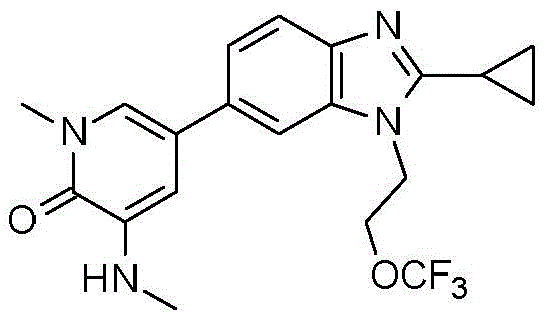
步骤1:制备N-甲基-N-[1-甲基-2-氧代-5-(4,4,5,5-四甲基-1,3,2-二氧杂硼杂环戊烷-2-基)-3-吡啶基]氨基甲酸叔丁酯Step 1: Preparation of N-methyl-N-[1-methyl-2-oxo-5-(4,4,5,5-tetramethyl-1,3,2-dioxaborolane Alk-2-yl)-3-pyridyl]carbamate tert-butyl ester
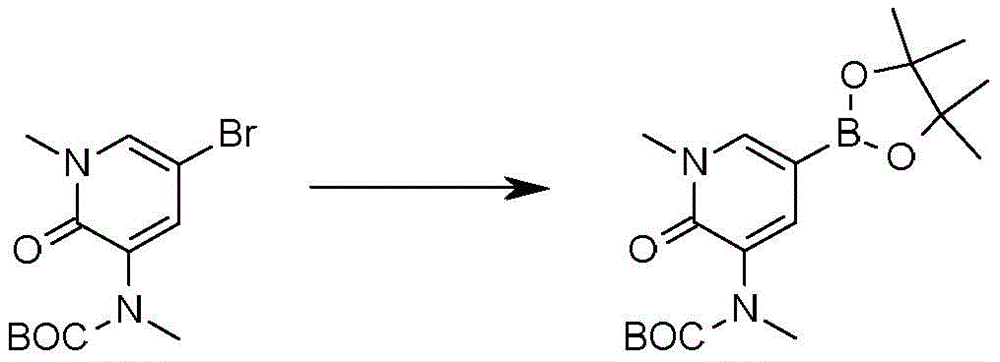
在氮气下,将4,4,4',4',5,5,5',5'-八甲基-2,2'-双(1,3,2-二氧杂环戊硼烷)(380mg,1.49mmol)、PdCl2(dppf)(51mg,0.062mmol)和KOAc(306mg,3.12mmol)添加至N-(5-溴-1-甲基-2-氧代-3-吡啶基)-N-甲基-氨基甲酸叔丁酯(使用WO2015058160中描述的操作制备,396mg,1.25mmol)的二噁烷(3mL)溶液中。通过用N2鼓泡5分钟使所述混合物脱气,然后将该反应混合物在密封管中加热至90℃达18小时。将混合物冷却至室温,并用EtOAc(10ml)和水(10ml)稀释。将有机相分离并经Na2SO4干燥,过滤并减压浓缩。通过硅胶快速色谱使用EtOAc在己烷中的混合物作为洗脱液纯化该物质,得到标题化合物(125mg,28%),为固体。1H NMR(500MHz,CDCl3)δ7.68(d,J=1.9Hz,1H),7.53(s,1H),3.56(s,3H),3.10(s,3H),1.33–1.16(m,21H)。Under nitrogen, 4,4,4',4',5,5,5',5'-octamethyl-2,2'-bis(1,3,2-dioxaborane) (380 mg, 1.49 mmol), PdCl 2 (dppf) (51 mg, 0.062 mmol) and KOAc (306 mg, 3.12 mmol) were added to N-(5-bromo-1-methyl-2-oxo-3-pyridyl) -N-methyl-carbamic acid tert-butyl ester (prepared using the procedure described in WO2015058160, 396 mg, 1.25 mmol) in dioxane (3 mL). The mixture was degassed by bubbling N2 for 5 minutes, then the reaction mixture was heated to 90 °C in a sealed tube for 18 hours. The mixture was cooled to room temperature and diluted with EtOAc (10 ml) and water (10 ml). The organic phase was separated and dried over Na2SO4 , filtered and concentrated under reduced pressure. This material was purified by flash chromatography on silica gel using EtOAc in hexanes as eluent to give the title compound (125 mg, 28%) as a solid. 1 H NMR (500MHz, CDCl 3 ) δ 7.68(d, J=1.9Hz, 1H), 7.53(s, 1H), 3.56(s, 3H), 3.10(s, 3H), 1.33-1.16(m, 21H).
步骤2:制备N-[5-[2-环丙基-3-[2-(三氟甲氧基)乙基]苯并咪唑-5-基]-1-甲基-2-氧代-3-吡啶基]-N-甲基-氨基甲酸叔丁酯Step 2: Preparation of N-[5-[2-Cyclopropyl-3-[2-(trifluoromethoxy)ethyl]benzimidazol-5-yl]-1-methyl-2-oxo- 3-Pyridinyl]-N-methyl-carbamic acid tert-butyl ester

向6-溴-2-环丙基-1-[2-(三氟甲氧基)乙基]苯并咪唑(实施例2,步骤1,50mg,0.143mmol)的DME(2mL)溶液中加入N-甲基-N-[1-甲基-2-氧代-5-(4,4,5,5-四甲基-1,3,2-二氧杂硼杂环戊烷-2-基)-3-吡啶基]氨基甲酸叔丁酯(78mg,0.215mmol)、Cs2CO3(116mg,0.358mmol)和Pd(PPh3)4(17mg,0.014mmol),通过用N2鼓泡5分钟使反应混合物脱气,然后将反应混合物在密封管中在90℃下加热18H。将混合物冷却至室温,用EtOAc(10mL)和水(10mL)稀释。收集有机相,用Na2SO4干燥,过滤并减压浓缩。通过硅胶快速色谱纯化所述材料,使用EtOAc/己烷的混合物作为洗脱液,得到标题化合物(65mg,89%),其为固体。1H NMR(500MHz,CDCl3)δ7.64–7.55(m,2H),7.38(d,J=2.5Hz,1H),7.19(dt,J=9.9,4.0Hz,2H),4.53(t,J=5.4Hz,2H),4.28(t,J=5.4Hz,2H),3.57(s,3H),3.12(s,3H),1.96–1.85(m,1H),1.25–1.12(m,11H),1.12–1.01(m,2H)。MS(ESI)[M+H]+507.2。To a solution of 6-bromo-2-cyclopropyl-1-[2-(trifluoromethoxy)ethyl]benzimidazole (Example 2, step 1, 50 mg, 0.143 mmol) in DME (2 mL) was added N-methyl-N-[1-methyl-2-oxo-5-(4,4,5,5-tetramethyl-1,3,2-dioxaborolane-2- tert-butyl)-3-pyridyl]carbamate (78 mg, 0.215 mmol), Cs2CO3 (116 mg, 0.358 mmol) and Pd( PPh3 )4 ( 17 mg, 0.014 mmol) by bubbling with N2 The reaction mixture was degassed for 5 minutes and then heated in a sealed tube at 90°C for 18H. The mixture was cooled to room temperature and diluted with EtOAc (10 mL) and water (10 mL). The organic phase was collected, dried over Na2SO4 , filtered and concentrated under reduced pressure. The material was purified by flash chromatography on silica gel using a mixture of EtOAc/hexanes as eluent to give the title compound (65 mg, 89%) as a solid. 1 H NMR (500MHz, CDCl 3 ) δ 7.64-7.55 (m, 2H), 7.38 (d, J=2.5Hz, 1H), 7.19 (dt, J=9.9, 4.0Hz, 2H), 4.53 (t, J=5.4Hz, 2H), 4.28(t, J=5.4Hz, 2H), 3.57(s, 3H), 3.12(s, 3H), 1.96-1.85(m, 1H), 1.25-1.12(m, 11H) ), 1.12–1.01 (m, 2H). MS(ESI)[M+H] + 507.2.
步骤3:化合物20的制备Step 3: Preparation of Compound 20

向N-[5-[2-环丙基-3-[2-(三氟甲氧基)乙基]苯并咪唑-5-基]-1-甲基-2-氧代-3-吡啶基]-N-甲基氨基甲酸叔丁酯(67mg,0.132mmol)的DCM(5mL)溶液中加入TFA(0.10mL,1.32mmol)并将反应混合物在室温下搅拌2小时。将混合物用饱和NaHCO3(5mL)淬灭并加入固体NaHCO3直至泡腾结束。有机相用EtOAc(10mL)和水(10mL)稀释。分离各相,收集有机相,用Na2SO4干燥,过滤并减压浓缩。通过硅胶快速色谱使用MeOH在DCM中的混合物作为洗脱液纯化物质,然后通过制备型HPLC纯化,得到为固体的化合物20(10.7mg,20%)。1H NMR(500MHz,CDCl3)δ7.68(dd,J=8.3,0.5Hz,1H),7.33(dd,J=8.3,1.7Hz,1H),7.30(d,J=1.1Hz,1H),6.83(d,J=2.2Hz,1H),6.43(d,J=2.1Hz,1H),5.11(d,J=5.4Hz,1H),4.60(t,J=5.5Hz,2H),4.36(t,J=5.6Hz,2H),3.65(s,3H),2.91(d,J=5.3Hz,3H),1.99(dd,J=9.0,4.1Hz,1H),1.32–1.21(m,2H),1.19–1.09(m,2H)。MS(ESI)[M+H]+407.22。To N-[5-[2-cyclopropyl-3-[2-(trifluoromethoxy)ethyl]benzimidazol-5-yl]-1-methyl-2-oxo-3-pyridine To a solution of tert-butyl]-N-methylcarbamate (67 mg, 0.132 mmol) in DCM (5 mL) was added TFA (0.10 mL, 1.32 mmol) and the reaction mixture was stirred at room temperature for 2 hours. The mixture was quenched with saturated NaHCO3 (5 mL) and solid NaHCO3 was added until effervescence was over. The organic phase was diluted with EtOAc (10 mL) and water (10 mL). The phases were separated and the organic phase was collected, dried over Na2SO4 , filtered and concentrated under reduced pressure. The material was purified by flash chromatography on silica gel using MeOH in DCM as eluent followed by preparative HPLC to give compound 20 (10.7 mg, 20%) as a solid. 1 H NMR (500 MHz, CDCl 3 ) δ 7.68 (dd, J=8.3, 0.5 Hz, 1H), 7.33 (dd, J=8.3, 1.7 Hz, 1H), 7.30 (d, J=1.1 Hz, 1H) ,6.83(d,J=2.2Hz,1H),6.43(d,J=2.1Hz,1H),5.11(d,J=5.4Hz,1H),4.60(t,J=5.5Hz,2H),4.36 (t, J=5.6Hz, 2H), 3.65(s, 3H), 2.91(d, J=5.3Hz, 3H), 1.99(dd, J=9.0, 4.1Hz, 1H), 1.32–1.21(m, 2H), 1.19–1.09 (m, 2H). MS(ESI)[M+H] + 407.22.
实施例20:5-[3-(2-甲氧基丙基)-2-甲基苯并咪唑-5-基]-1,3-二甲基吡啶-2-酮(化合物21a和21b)Example 20: 5-[3-(2-Methoxypropyl)-2-methylbenzimidazol-5-yl]-1,3-lutidine-2-one (Compounds 21a and 21b)

向中间体6(100mg,0.332mmol)的原乙酸三甲酯(3mL)溶液中加入6N HCl水溶液(0.055mL,0.332mmol),并将反应混合物在室温下搅拌2小时。然后将混合物用DCM(40mL)稀释并用饱和NaHCO3(10mL)洗涤。将水层用DCM(2×20mL)萃取并将合并的有机层经Na2SO4干燥,过滤并减压浓缩。通过硅胶快速色谱纯化所述材料,使用MeOH在DCM中的混合物作为洗脱液,接着通过SFC纯化(AD 10×250mm,5μm等度15%MeOH+0.1%NH4OH,10mL/min,100bar,35℃),得到为固体的化合物21a(11.1mg)和化合物21b(4.3mg)。To a solution of intermediate 6 (100 mg, 0.332 mmol) in trimethyl orthoacetate (3 mL) was added 6N aqueous HCl (0.055 mL, 0.332 mmol) and the reaction mixture was stirred at room temperature for 2 hours. The mixture was then diluted with DCM (40 mL) and washed with saturated NaHCO3 (10 mL). The aqueous layer was extracted with DCM (2 x 20 mL) and the combined organic layers were dried over Na2SO4 , filtered and concentrated under reduced pressure. The material was purified by flash chromatography on silica gel using MeOH in DCM as eluent, followed by SFC (AD 10 x 250 mm, 5 μm isocratic 15% MeOH + 0.1% NH4OH , 10 mL/min, 100 bar, 35°C) to obtain compound 21a (11.1 mg) and compound 21b (4.3 mg) as solids.
化合物21a:保留时间=11.75分钟;1H NMR(500MHz,CDCl3)δ7.61(d,J=8.4Hz,1H),7.48(dd,J=2.4,1.1Hz,1H),7.32(d,J=2.4Hz,1H),7.18(dd,J=10.7,2.6Hz,2H),4.04(qd,J=14.9,6.1Hz,2H),3.64(ddd,J=8.0,6.2,4.1Hz,1H),3.58(s,3H),3.12(s,3H),2.56(d,J=14.4Hz,3H),2.18(s,3H),1.19(t,J=7.5Hz,3H)。MS(ESI)[M+H]+326.2。Compound 21a: retention time = 11.75 min; 1 H NMR (500 MHz, CDCl 3 ) δ 7.61 (d, J=8.4 Hz, 1H), 7.48 (dd, J=2.4, 1.1 Hz, 1H), 7.32 (d, J=2.4Hz, 1H), 7.18 (dd, J=10.7, 2.6Hz, 2H), 4.04 (qd, J=14.9, 6.1Hz, 2H), 3.64 (ddd, J=8.0, 6.2, 4.1Hz, 1H) ), 3.58(s, 3H), 3.12(s, 3H), 2.56(d, J=14.4Hz, 3H), 2.18(s, 3H), 1.19(t, J=7.5Hz, 3H). MS(ESI)[M+H] + 326.2.
化合物21b:保留时间=13.12分钟;1H NMR(500MHz,CDCl3)δ7.61(d,J=8.4Hz,1H),7.48(dd,J=2.4,1.1Hz,1H),7.32(d,J=2.4Hz,1H),7.18(dd,J=10.7,2.6Hz,2H),4.04(qd,J=14.9,6.1Hz,2H),3.64(ddd,J=8.0,6.2,4.1Hz,1H),3.58(s,3H),3.12(s,3H),2.56(d,J=14.4Hz,3H),2.18(s,3H),1.19(t,J=7.5Hz,3H)。MS(ESI)[M+H]+326.2。Compound 21b: retention time = 13.12 min; 1 H NMR (500 MHz, CDCl 3 ) δ 7.61 (d, J=8.4 Hz, 1H), 7.48 (dd, J=2.4, 1.1 Hz, 1H), 7.32 (d, J=2.4Hz, 1H), 7.18 (dd, J=10.7, 2.6Hz, 2H), 4.04 (qd, J=14.9, 6.1Hz, 2H), 3.64 (ddd, J=8.0, 6.2, 4.1Hz, 1H) ), 3.58(s, 3H), 3.12(s, 3H), 2.56(d, J=14.4Hz, 3H), 2.18(s, 3H), 1.19(t, J=7.5Hz, 3H). MS(ESI)[M+H] + 326.2.
实施例21:5-[3-(2-甲氧基丙基)苯并咪唑-5-基]-1,3-二甲基吡啶-2-酮(化合物22a和22b)Example 21: 5-[3-(2-Methoxypropyl)benzimidazol-5-yl]-1,3-lutidine-2-one (Compounds 22a and 22b)

将中间体6(154.0mg,0.511mmol)在甲酸(1mL)中的溶液在40℃下加热1小时。将该混合物冷却至室温并倒入饱和NaHCO3(10mL)中,并且加入另外的固体NaHCO3直至pH达到7。将水层用DCM(3×10mL)萃取并将合并的有机层用MgSO4干燥,过滤并减压浓缩。通过硅胶快速色谱纯化所述材料,使用MeOH在DCM中的混合物作为洗脱液,接着通过SFC纯化(1A 10×250mm,5μm等度30%EtOH+0.1%NH4OH,10mL/min,100bar 35℃),得到为固体的化合物22a(24.8mg;24%)和化合物22b(31.2mg;30%)。A solution of Intermediate 6 (154.0 mg, 0.511 mmol) in formic acid (1 mL) was heated at 40 °C for 1 h. The mixture was cooled to room temperature and poured into saturated NaHCO 3 (10 mL), and additional solid NaHCO 3 was added until pH reached 7. The aqueous layer was extracted with DCM (3 x 10 mL) and the combined organic layers were dried over MgSO4 , filtered and concentrated under reduced pressure. The material was purified by flash chromatography on silica gel using MeOH in DCM as eluent, followed by SFC (1A 10 x 250 mm, 5 μm isocratic 30% EtOH + 0.1% NH4OH , 10 mL/min, 100 bar 35 °C) to give compound 22a (24.8 mg; 24%) and compound 22b (31.2 mg; 30%) as solids.
化合物22a:保留时间=12.65分钟;1H NMR(500MHz,CDCl3)δ7.90(s,1H),7.74(d,J=8.4Hz,1H),7.49(dd,J=2.5,1.1Hz,1H),7.33(dd,J=15.2,1.8Hz,2H),7.24(dd,J=8.4,1.7Hz,1H),4.11(qd,J=14.7,5.6Hz,2H),3.69–3.61(m,1H),3.59(d,J=15.1Hz,3H),3.19(s,3H),2.18(s,3H),1.16(d,J=6.2Hz,3H).MS(ESI)[M+H]+312.2。Compound 22a: retention time = 12.65 min; 1 H NMR (500 MHz, CDCl 3 ) δ 7.90 (s, 1H), 7.74 (d, J=8.4 Hz, 1H), 7.49 (dd, J=2.5, 1.1 Hz, 1H), 7.33 (dd, J=15.2, 1.8Hz, 2H), 7.24 (dd, J=8.4, 1.7Hz, 1H), 4.11 (qd, J=14.7, 5.6Hz, 2H), 3.69–3.61 (m ,1H),3.59(d,J=15.1Hz,3H),3.19(s,3H),2.18(s,3H),1.16(d,J=6.2Hz,3H).MS(ESI)[M+H ] + 312.2.
化合物22b:保留时间=16.75分钟;1H NMR(500MHz,CDCl3)δ7.90(s,1H),7.74(d,J=8.4Hz,1H),7.49(dd,J=2.5,1.1Hz,1H),7.33(dd,J=15.2,1.8Hz,2H),7.24(dd,J=8.4,1.7Hz,1H),4.11(qd,J=14.7,5.6Hz,2H),3.69–3.61(m,1H),3.59(d,J=15.1Hz,3H),3.19(s,3H),2.18(s,3H),1.16(d,J=6.2Hz,3H).MS(ESI)[M+H]+312.2。Compound 22b: retention time = 16.75 min; 1 H NMR (500 MHz, CDCl 3 ) δ 7.90 (s, 1H), 7.74 (d, J=8.4 Hz, 1H), 7.49 (dd, J=2.5, 1.1 Hz, 1H), 7.33 (dd, J=15.2, 1.8Hz, 2H), 7.24 (dd, J=8.4, 1.7Hz, 1H), 4.11 (qd, J=14.7, 5.6Hz, 2H), 3.69–3.61 (m ,1H),3.59(d,J=15.1Hz,3H),3.19(s,3H),2.18(s,3H),1.16(d,J=6.2Hz,3H).MS(ESI)[M+H ] + 312.2.
实施例22:制备5-[2-环丙基-3-(2-甲氧基丙基)苯并咪唑-5-基]-1,3-二甲基吡啶-2-酮(化合物23a和23b)Example 22: Preparation of 5-[2-cyclopropyl-3-(2-methoxypropyl)benzimidazol-5-yl]-1,3-lutidine-2-one (compound 23a and 23b)

将中间体6(73mg,0.242mmol)溶于MeOH(2mL)中并迅速加入环丙烷甲醛(20μL,0.266mmol)。然后滴加乙酸(69μL,1.211mmol),并将混合物在室温下搅拌3小时。将混合物减压浓缩,然后通过硅胶快速色谱纯化,使用MeOH在DCM中的混合物作为洗脱液,得到标题化合物。通过半制备型SFC(条件:ID 10×250mm,5μM等度30%IPA+0.1%NH4OH,10mL/min100Bar)分离化合物23的异构体,得到化合物23a(9mg,11%)和化合物23b(9mg,11%),其为固体。Intermediate 6 (73 mg, 0.242 mmol) was dissolved in MeOH (2 mL) and cyclopropanecarbaldehyde (20 μL, 0.266 mmol) was added rapidly. Acetic acid (69 μL, 1.211 mmol) was then added dropwise, and the mixture was stirred at room temperature for 3 hours. The mixture was concentrated under reduced pressure and purified by flash chromatography on silica gel using MeOH in DCM as eluent to give the title compound. Isomers of compound 23 were separated by semi-preparative SFC (conditions: ID 10×250 mm, 5 μM isocratic 30% IPA+0.1% NH 4 OH, 10 mL/min 100 Bar) to give compound 23a (9 mg, 11%) and compound 23b (9 mg, 11%) as a solid.
化合物23a:保留时间=23.40;1H NMR(500MHz,CDCl3)δ7.66(dd,J=8.3,0.5Hz,1H),7.55(dd,J=2.5,1.2Hz,1H),7.39(d,J=2.3Hz,1H),7.29–7.21(m,2H),4.33(dd,J=14.9,7.9Hz,1H),4.19(dd,J=14.9,4.3Hz,1H),3.78(ddd,J=7.9,6.2,4.4Hz,1H),3.65(s,3H),3.24(s,3H),2.25(s,3H),2.11(tt,J=8.3,5.0Hz,1H),1.36–1.32(m,1H),1.32–1.25(m,3H),1.21–1.09(m,3H)。MS(ESI)[M+H]+352.2。Compound 23a: retention time=23.40; 1 H NMR (500 MHz, CDCl3) δ 7.66 (dd, J=8.3, 0.5 Hz, 1 H), 7.55 (dd, J=2.5, 1.2 Hz, 1 H), 7.39 (d, J=2.3Hz, 1H), 7.29–7.21 (m, 2H), 4.33 (dd, J=14.9, 7.9Hz, 1H), 4.19 (dd, J=14.9, 4.3Hz, 1H), 3.78 (ddd, J =7.9,6.2,4.4Hz,1H),3.65(s,3H),3.24(s,3H),2.25(s,3H),2.11(tt,J=8.3,5.0Hz,1H),1.36–1.32( m, 1H), 1.32–1.25 (m, 3H), 1.21–1.09 (m, 3H). MS(ESI)[M+H] + 352.2.
化合物23b:保留时间=26.11;1H NMR(500MHz,CDCl3)δ7.66(d,J=8.3Hz,1H),7.55(dd,J=2.5,1.1Hz,1H),7.39(d,J=2.3Hz,1H),7.29–7.22(m,2H),4.33(dd,J=14.9,7.9Hz,1H),4.19(dd,J=14.9,4.3Hz,1H),3.78(ddd,J=7.9,6.2,4.4Hz,1H),3.65(s,3H),3.24(s,3H),2.25(s,3H),2.17–2.08(m,1H),1.34(ddd,J=9.0,4.8,2.4Hz,1H),1.27(t,J=8.3Hz,3H),1.19–1.06(m,3H)。MS(ESI)[M+H]+352.3。Compound 23b: retention time = 26.11; 1 H NMR (500 MHz, CDCl 3 ) δ 7.66 (d, J = 8.3 Hz, 1 H), 7.55 (dd, J = 2.5, 1.1 Hz, 1 H), 7.39 (d, J =2.3Hz,1H),7.29–7.22(m,2H),4.33(dd,J=14.9,7.9Hz,1H),4.19(dd,J=14.9,4.3Hz,1H),3.78(ddd,J= 7.9, 6.2, 4.4Hz, 1H), 3.65(s, 3H), 3.24(s, 3H), 2.25(s, 3H), 2.17–2.08(m, 1H), 1.34(ddd, J=9.0, 4.8, 2.4Hz, 1H), 1.27 (t, J=8.3Hz, 3H), 1.19–1.06 (m, 3H). MS(ESI)[M+H] + 352.3.
实施例23:5-[3-[(1R)-2-甲氧基-1-甲基-乙基]-2-(三氟甲基)苯并咪唑-5-基]-1,3-二甲基吡啶-2-酮(化合物26)Example 23: 5-[3-[(1R)-2-Methoxy-1-methyl-ethyl]-2-(trifluoromethyl)benzimidazol-5-yl]-1,3- Lutidine-2-one (Compound 26)
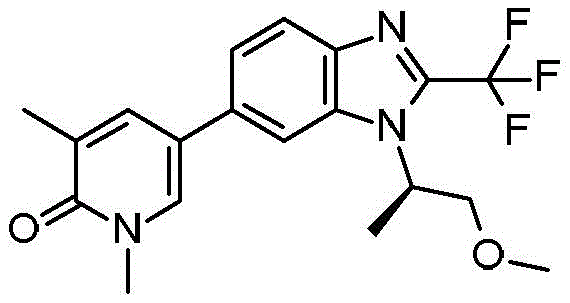
将中间体3(134mg,0.445mmol)在TFA(1.5mL)中的溶液在密封管中加热至70℃达18小时。将反应混合物冷却至室温并倒入饱和NaHCO3(20mL)中,然后加入另外的固体NaHCO3直至达到约8的pH。将含水混合物用EtOAc(2×20mL)萃取,将合并的有机层用盐水(20mL)洗涤,用MgSO4干燥,过滤并减压浓缩。获得的物质通过硅胶快速色谱纯化,使用MeOH在DCM中的混合物作为洗脱液,随后与Et2O一起研磨,得到化合物26(76.3mg,45%),为固体。1H NMR(500MHz,CDCl3)δ7.91(d,J=8.5Hz,1H),7.65(d,J=1.2Hz,1H),7.54(d,J=1.3Hz,1H),7.48–7.38(m,2H),4.97(m,1H),3.98(dd,J=10.2,7.0Hz,1H),3.83(dd,J=10.2,5.3Hz,1H),3.69(s,3H),3.36(s,3H),2.29(s,3H),1.76(d,J=7.1Hz,3H)。MS(ESI)[M+H]+380.2。A solution of Intermediate 3 (134 mg, 0.445 mmol) in TFA (1.5 mL) was heated to 70 °C in a sealed tube for 18 h. The reaction mixture was cooled to room temperature and poured into saturated NaHCO 3 (20 mL), then additional solid NaHCO 3 was added until a pH of about 8 was reached. The aqueous mixture was extracted with EtOAc (2 x 20 mL), the combined organic layers were washed with brine (20 mL), dried over MgSO4 , filtered and concentrated under reduced pressure. The obtained material was purified by flash chromatography on silica gel using MeOH in DCM as eluent followed by trituration with Et2O to give compound 26 (76.3 mg, 45%) as a solid. 1 H NMR (500 MHz, CDCl 3 ) δ 7.91 (d, J=8.5 Hz, 1H), 7.65 (d, J=1.2 Hz, 1H), 7.54 (d, J=1.3 Hz, 1H), 7.48-7.38 (m,2H),4.97(m,1H),3.98(dd,J=10.2,7.0Hz,1H),3.83(dd,J=10.2,5.3Hz,1H),3.69(s,3H),3.36( s, 3H), 2.29 (s, 3H), 1.76 (d, J=7.1 Hz, 3H). MS(ESI)[M+H] + 380.2.
实施例24:5-[2-(3,3-二氟环丁基)-3-[2-(三氟甲氧基)乙基]苯并咪唑-5-基]-1,3-二甲基吡啶-2-酮(化合物27)Example 24: 5-[2-(3,3-Difluorocyclobutyl)-3-[2-(trifluoromethoxy)ethyl]benzimidazol-5-yl]-1,3-di Methylpyridin-2-one (Compound 27)

步骤1:制备N-(4-(1,5-二甲基-6-氧代-1,6-二氢吡啶-3-基)-2-((2-(三氟甲氧基)乙基)氨基)苯基)-3,3-二氟环丁烷甲酰胺Step 1: Preparation of N-(4-(1,5-Dimethyl-6-oxo-1,6-dihydropyridin-3-yl)-2-((2-(trifluoromethoxy)ethyl) yl)amino)phenyl)-3,3-difluorocyclobutanecarboxamide

向中间体8(57.3mg,0.168mmol)在DCM(5mL)中的溶液中加入3,3-二氟环丁烷甲酰氯(25.9mg,0.168mmol),并将反应混合物在室温下搅拌1小时。用水稀释混合物并加入EtOAc(10mL)。将有机层分离并用饱和NaHCO3(10mL)洗涤然后用盐水(20mL)洗涤。将有机层用Na2SO4干燥,过滤并减压浓缩,得到标题化合物,将其不经进一步纯化用于下一步。To a solution of Intermediate 8 (57.3 mg, 0.168 mmol) in DCM (5 mL) was added 3,3-difluorocyclobutanecarbonyl chloride (25.9 mg, 0.168 mmol) and the reaction mixture was stirred at room temperature for 1 hour . The mixture was diluted with water and EtOAc (10 mL) was added. The organic layer was separated and washed with saturated NaHCO3 (10 mL) then brine (20 mL). The organic layer was dried over Na2SO4 , filtered and concentrated under reduced pressure to give the title compound, which was used in the next step without further purification.
步骤2:化合物27的制备Step 2: Preparation of Compound 27

向N-(4-(1,5-二甲基-6-氧代-1,6-二氢吡啶-3-基)-2-((2-(三氟甲氧基)乙基)氨基)苯基)-3,3-二氟环丁烷甲酰胺(直接来自前面的步骤)在甲苯(5mL)中的溶液中加入pTSA(31.9mg,0.168mmol),并将反应混合物加热回流18小时。将混合物冷却至室温,用EtOAc(10mL)稀释,并用饱和NaHCO3(2×10mL)和盐水(10mL)洗涤。有机层用Na2SO4干燥,过滤并减压浓缩。通过硅胶快速色谱使用MeOH在DCM中的混合物作为洗脱液纯化所述材料,然后通过制备型HPLC纯化,得到为固体的化合物27(10.6mg,14%)。1H NMR(500MHz,CDCl3)δ7.72(d,J=8.4Hz,1H),7.47(d,J=1.3Hz,1H),7.33(d,J=2.2Hz,1H),7.27(dd,J=8.4,1.6Hz,1H),7.22–7.17(m,1H),4.38(t,J=5.1Hz,2H),4.23(t,J=5.1Hz,2H),3.59(d,J=7.9Hz,3H),3.48(td,J=8.6,2.1Hz,1H),3.17(m,2H),3.04–2.92(m,2H),2.19(d,J=7.6Hz,3H)。MS(ESI)[M+H]+442.3。to N-(4-(1,5-dimethyl-6-oxo-1,6-dihydropyridin-3-yl)-2-((2-(trifluoromethoxy)ethyl)amino )phenyl)-3,3-difluorocyclobutanecarboxamide (directly from the previous step) in toluene (5 mL) was added pTSA (31.9 mg, 0.168 mmol) and the reaction mixture was heated to reflux for 18 h . The mixture was cooled to room temperature, diluted with EtOAc (10 mL), and washed with saturated NaHCO3 (2 x 10 mL) and brine (10 mL). The organic layer was dried over Na2SO4 , filtered and concentrated under reduced pressure. The material was purified by flash chromatography on silica gel using MeOH in DCM as eluent followed by preparative HPLC to give compound 27 (10.6 mg, 14%) as a solid. 1 H NMR (500 MHz, CDCl 3 ) δ 7.72 (d, J=8.4 Hz, 1H), 7.47 (d, J=1.3 Hz, 1H), 7.33 (d, J=2.2 Hz, 1H), 7.27 (dd , J=8.4, 1.6Hz, 1H), 7.22–7.17(m, 1H), 4.38(t, J=5.1Hz, 2H), 4.23(t, J=5.1Hz, 2H), 3.59(d, J= 7.9Hz, 3H), 3.48 (td, J=8.6, 2.1Hz, 1H), 3.17 (m, 2H), 3.04–2.92 (m, 2H), 2.19 (d, J=7.6Hz, 3H). MS(ESI)[M+H] + 442.3.
实施例25:1,3-二甲基-5-[2-(3-甲氧基环丁基)-3-(2-(三氟甲氧基)乙基)苯并咪唑-5-基)]吡啶-2-酮(化合物28a和28b)Example 25: 1,3-Dimethyl-5-[2-(3-methoxycyclobutyl)-3-(2-(trifluoromethoxy)ethyl)benzimidazol-5-yl )]pyridin-2-one (compounds 28a and 28b)

步骤1:制备N-(4-(1,5-二甲基-6-氧代-1,6-二氢吡啶-3-基)-2-((2-(三氟甲氧基)乙基)氨基)苯基-3-甲氧基环丁烷-1-甲酰胺Step 1: Preparation of N-(4-(1,5-Dimethyl-6-oxo-1,6-dihydropyridin-3-yl)-2-((2-(trifluoromethoxy)ethyl) yl)amino)phenyl-3-methoxycyclobutane-1-carboxamide

向3-甲氧基环丁烷-1-甲酸(0.148g,1.1432mmol)在DCM(4mL)中的搅拌溶液中加入HATU(0.501g,1.3191mmol)。使反应在室温下搅拌10分钟,然后加入中间体8(0.3g,0.8794mmol)和DIPEA(0.3mL,1.7580mmol)的DCM(1mL)溶液。将反应混合物在室温下搅拌4小时。将反应混合物用饱和NaHCO3水溶液(25mL)稀释并将产物用DCM(20mL×3)萃取。将合并的有机层用盐水(30mL)洗涤,经无水Na2SO4干燥,过滤并减压浓缩。所得产物经硅胶柱层析纯化,使用3-5%MeOH的DCM溶液作为洗脱液。将级分合并并浓缩,得到标题化合物(0.04g,93%)。[M+H]+454.35。To a stirred solution of 3-methoxycyclobutane-1-carboxylic acid (0.148 g, 1.1432 mmol) in DCM (4 mL) was added HATU (0.501 g, 1.3191 mmol). The reaction was allowed to stir at room temperature for 10 minutes, then a solution of Intermediate 8 (0.3 g, 0.8794 mmol) and DIPEA (0.3 mL, 1.7580 mmol) in DCM (1 mL) was added. The reaction mixture was stirred at room temperature for 4 hours. The reaction mixture was diluted with saturated aqueous NaHCO 3 (25 mL) and the product was extracted with DCM (20 mL x 3). The combined organic layers were washed with brine (30 mL), dried over anhydrous Na 2 SO 4 , filtered and concentrated under reduced pressure. The resulting product was purified by silica gel column chromatography using 3-5% MeOH in DCM as eluent. The fractions were combined and concentrated to give the title compound (0.04 g, 93%). [M+H] + 454.35.
步骤2:制备化合物28a和28bStep 2: Preparation of Compounds 28a and 28b

将N-(4-(1,5-二甲基-6-氧代-1,6-二氢吡啶-3-基)-2-((2-(三氟甲氧基)乙基)氨基)苯基)-3-甲氧基环丁烷-1,2-二胺(0.4g,0.8826mmol)在乙酸(5mL)中的溶液在110℃下搅拌10小时。将反应混合物减压浓缩并将残余物溶于DCM(20mL)中。用饱和NaHCO3(20mL)和盐水(10mL)洗涤该混合物,用无水Na2SO4干燥并减压浓缩。使用含有0.3%DEA作为调节剂的15-65%IPA:MeOH(1:1v/v)的己烷溶液通过制备性HPLC纯化所得产物,得到化合物28a(反式)(0.07g)和化合物28b(顺式)(0.210克),73%。通过NMR分析(包括选择性照射)实现顺式/反式评估。N-(4-(1,5-Dimethyl-6-oxo-1,6-dihydropyridin-3-yl)-2-((2-(trifluoromethoxy)ethyl)amino )phenyl)-3-methoxycyclobutane-1,2-diamine (0.4 g, 0.8826 mmol) in acetic acid (5 mL) was stirred at 110 °C for 10 h. The reaction mixture was concentrated under reduced pressure and the residue was dissolved in DCM (20 mL). The mixture was washed with saturated NaHCO 3 (20 mL) and brine (10 mL), dried over anhydrous Na 2 SO 4 and concentrated under reduced pressure. The resulting product was purified by preparative HPLC using 15-65% IPA:MeOH (1:1 v/v) in hexanes containing 0.3% DEA as modifier to give compound 28a (trans) (0.07 g) and compound 28b ( cis) (0.210 g), 73%. Cis/trans assessment was achieved by NMR analysis including selective irradiation.
化合物28a(反式):1H NMR(400MHz,CDCl3)δppm 7.81(d,J=8.4Hz,1H),7.56(d,J=1.2Hz,1H),7.42(d,J=2.4Hz,1H),7.34(dd,J=1.2和8.4Hz,1H),7.24(s,1H),4.70-4.34(m,2H),4.33-4.27(m,3H),3.81-3.76(m,1H),3.67(s,3H),3.34(s,3H),2.86-2.79(m,2H),2.57-2.50(m,2H),2.27(s,3H)。[M+H]+436.36。Compound 28a (trans): 1 H NMR (400 MHz, CDCl 3 ) δ ppm 7.81 (d, J=8.4 Hz, 1H), 7.56 (d, J=1.2 Hz, 1H), 7.42 (d, J=2.4 Hz, 1H), 7.34(dd, J=1.2 and 8.4Hz, 1H), 7.24(s, 1H), 4.70-4.34(m, 2H), 4.33-4.27(m, 3H), 3.81-3.76(m, 1H) , 3.67(s, 3H), 3.34(s, 3H), 2.86-2.79(m, 2H), 2.57-2.50(m, 2H), 2.27(s, 3H). [M+H] + 436.36.
化合物28b(顺式):1H NMR(400MHz,CDCl3)δ7.81(d,J=8.4Hz,1H),7.56(t,J=1.2Hz,1H),7.41(d,J=2.4Hz,1H),7.31(dd,J=1.6Hz和8.4Hz,1H),7.26(d,J=1.2Hz,1H),4.43-4.42(m,2H),4.30-4.28(t,J=5.6Hz,2H),4.05-4.00(m,1H),3.66(s,3H),3.32(s,3H),3.26-3.21(m,1H),2.84-2.78(m,2H),2.60-2.53(m,2H),2.27(s,3H)。[M+H]+436.36。Compound 28b (cis): 1 H NMR (400 MHz, CDCl 3 ) δ 7.81 (d, J=8.4 Hz, 1H), 7.56 (t, J=1.2 Hz, 1H), 7.41 (d, J=2.4 Hz) ,1H),7.31(dd,J=1.6Hz and 8.4Hz,1H),7.26(d,J=1.2Hz,1H),4.43-4.42(m,2H),4.30-4.28(t,J=5.6Hz ,2H),4.05-4.00(m,1H),3.66(s,3H),3.32(s,3H),3.26-3.21(m,1H),2.84-2.78(m,2H),2.60-2.53(m , 2H), 2.27(s, 3H). [M+H] + 436.36.
实施例26:1,3-二甲基-5-[2-四氢呋喃-3-基-3-[2-(三氟甲氧基)乙基]苯并咪唑-5-基]吡啶-2-酮(化合物29a和29b)Example 26: 1,3-Dimethyl-5-[2-tetrahydrofuran-3-yl-3-[2-(trifluoromethoxy)ethyl]benzimidazol-5-yl]pyridine-2- Ketones (compounds 29a and 29b)

将四氢呋喃-3-甲醛(26mg,0.258mmol)快速加入到中间体8(88mg,0.258mmol)在MeOH(2mL)中的溶液中。然后滴加乙酸(0.074mL,1.29mmol),并将该反应混合物在室温下搅拌18小时。将该混合物减压浓缩并用EtOAc(20mL)和饱和NaHCO3(10mL)稀释。分离各相并将水层用EtOAc(2×10mL)萃取。将合并的有机层用盐水洗涤,用Na2SO4干燥,过滤并减压浓缩。通过硅胶快速色谱使用EtOAc在己烷中的混合物作为洗脱液纯化该物质,得到为外消旋形式的化合物29(90mg)。然后通过反相HPLC纯化所述产物,然后通过SFC纯化(IC 10×250mm,5μm等度45%IPA+0.1%NH4OH,10mL/分钟100Bar),提供化合物29a(1.24mg)和化合物29b(1.24mg)。Tetrahydrofuran-3-carbaldehyde (26 mg, 0.258 mmol) was added rapidly to a solution of Intermediate 8 (88 mg, 0.258 mmol) in MeOH (2 mL). Acetic acid (0.074 mL, 1.29 mmol) was then added dropwise, and the reaction mixture was stirred at room temperature for 18 hours. The mixture was concentrated under reduced pressure and diluted with EtOAc (20 mL) and saturated NaHCO3 (10 mL). The phases were separated and the aqueous layer was extracted with EtOAc (2 x 10 mL). The combined organic layers were washed with brine, dried over Na2SO4 , filtered and concentrated under reduced pressure. This material was purified by flash chromatography on silica gel using EtOAc in hexanes as eluent to give compound 29 in racemic form (90 mg). The product was then purified by reverse phase HPLC followed by SFC (IC 10×250 mm, 5 μm isocratic 45% IPA+0.1% NH4OH , 10 mL/min 100 Bar) to afford compound 29a (1.24 mg) and compound 29b ( 1.24 mg).
化合物29a:保留时间=14.56分钟;1H NMR(500MHz,CDCl3)δ7.77(d,J=8.8Hz,1H),7.56–7.51(m,1H),7.39(d,J=2.4Hz,1H),7.32(dd,J=8.4,1.7Hz,1H),7.27–7.25(m,1H),4.56–4.48(m,2H),4.32(t,J=5.3Hz,2H),4.27(t,J=8.1Hz,1H),4.19–4.13(m,1H),4.12–4.07(m,1H),4.04(dd,J=14.8,8.0Hz,1H),3.69–3.61(m,1H),3.65(s,3H),2.63–2.35(m,2H),2.25(s,3H)。MS(ESI)[M+H]+422.2。Compound 29a: retention time = 14.56 min; 1 H NMR (500 MHz, CDCl 3 ) δ 7.77 (d, J=8.8 Hz, 1 H), 7.56-7.51 (m, 1 H), 7.39 (d, J=2.4 Hz, 1H), 7.32(dd, J=8.4, 1.7Hz, 1H), 7.27-7.25(m, 1H), 4.56-4.48(m, 2H), 4.32(t, J=5.3Hz, 2H), 4.27(t , J=8.1Hz, 1H), 4.19–4.13 (m, 1H), 4.12–4.07 (m, 1H), 4.04 (dd, J=14.8, 8.0Hz, 1H), 3.69–3.61 (m, 1H), 3.65(s, 3H), 2.63–2.35(m, 2H), 2.25(s, 3H). MS(ESI)[M+H] + 422.2.
化合物29b:保留时间=17.09分钟;1H NMR(500MHz,CDCl3)δ7.77(d,J=8.3Hz,1H),7.54(dd,J=2.5,1.1Hz,1H),7.39(d,J=2.4Hz,1H),7.32(dd,J=8.4,1.7Hz,1H),7.27–7.25(m,1H),4.56–4.49(m,2H),4.32(t,J=5.3Hz,2H),4.27(t,J=8.1Hz,1H),4.20–4.13(m,1H),4.08(t,J=16.7,8.4Hz,1H),4.04(dd,J=15.4,7.3Hz,1H),3.70–3.60(m,1H),3.65(s,3H),2.55–2.35(m,2H),2.25(s,3H)。MS(ESI)[M+H]+422.2。Compound 29b: retention time = 17.09 min; 1 H NMR (500 MHz, CDCl 3 ) δ 7.77 (d, J=8.3 Hz, 1H), 7.54 (dd, J=2.5, 1.1 Hz, 1H), 7.39 (d, J=2.4Hz, 1H), 7.32 (dd, J=8.4, 1.7Hz, 1H), 7.27–7.25 (m, 1H), 4.56–4.49 (m, 2H), 4.32 (t, J=5.3Hz, 2H) ),4.27(t,J=8.1Hz,1H),4.20–4.13(m,1H),4.08(t,J=16.7,8.4Hz,1H),4.04(dd,J=15.4,7.3Hz,1H) , 3.70–3.60 (m, 1H), 3.65 (s, 3H), 2.55–2.35 (m, 2H), 2.25 (s, 3H). MS(ESI)[M+H] + 422.2.
实施例27:1,3-二甲基-5-[2-四氢呋喃-2-基-3-[2-(三氟甲氧基)乙基]苯并咪唑-5-基]吡啶-2-酮(化合物30a和30b)Example 27: 1,3-Dimethyl-5-[2-tetrahydrofuran-2-yl-3-[2-(trifluoromethoxy)ethyl]benzimidazol-5-yl]pyridine-2- Ketones (compounds 30a and 30b)
操作AOperation A

将中间体8(98mg,0.287mmol)溶于MeOH(2mL)中并迅速加入四氢呋喃-2-甲醛(29mg,0.287mmol)。然后滴加乙酸(82μL,1.44mmol)并将混合物在室温下搅拌18小时。然后将混合物减压浓缩,然后用EtOAc(20mL)和饱和NaHCO3(10mL)稀释。分离各相并将水相用EtOAc(2×10mL)萃取。将合并的有机相用盐水洗涤,经Na2SO4干燥,过滤并减压浓缩。通过硅胶快速色谱纯化所述材料,使用EtOAc在己烷中的混合物作为洗脱液,然后使用EtOAc/MeOH作为洗脱液,得到标题化合物。然后通过制备型HPLC纯化所述物质,然后通过半制备型SFC(条件:ID 10×250mm,5μM等度30%IPA+0.1%NH4OH,10mL/min 100Bar)分离化合物30的异构体,提供为固体的化合物30a(2.41mg)和为固体的化合物30b(1.95mg)。Intermediate 8 (98 mg, 0.287 mmol) was dissolved in MeOH (2 mL) and tetrahydrofuran-2-carbaldehyde (29 mg, 0.287 mmol) was added rapidly. Acetic acid (82 μL, 1.44 mmol) was then added dropwise and the mixture was stirred at room temperature for 18 hours. The mixture was then concentrated under reduced pressure, then diluted with EtOAc (20 mL) and saturated NaHCO3 (10 mL). The phases were separated and the aqueous phase was extracted with EtOAc (2 x 10 mL). The combined organic phases were washed with brine, dried over Na2SO4 , filtered and concentrated under reduced pressure. The material was purified by flash chromatography on silica gel using EtOAc in hexanes as eluent followed by EtOAc/MeOH to give the title compound. The material was then purified by preparative HPLC, followed by separation of the isomers of compound 30 by semi-preparative SFC (conditions: ID 10 x 250 mm, 5 μM isocratic 30% IPA + 0.1% NH4OH , 10 mL/min 100 Bar), Compound 30a (2.41 mg) was provided as a solid and Compound 30b (1.95 mg) was provided as a solid.
化合物30a:保留时间=8.00;1H NMR(500MHz,CDCl3)δ7.77(d,J=8.3Hz,1H),7.55(s,1H),7.38(d,J=13.6Hz,2H),7.31(d,J=8.3Hz,1H),5.20(t,J=6.7Hz,1H),4.80–4.62(m,1H),4.62–4.45(m,1H),4.39(t,J=5.4Hz,2H),4.04–3.79(m,2H),3.65(s,3H),2.96–2.81(m,1H),2.51–2.32(m,1H),2.25(s,3H),2.23–2.13(m,1H),2.13–2.03(m,1H)。MS(ESI)[M+H]+422.2。Compound 30a: retention time=8.00; 1 H NMR (500 MHz, CDCl 3 ) δ 7.77 (d, J=8.3 Hz, 1H), 7.55 (s, 1H), 7.38 (d, J=13.6 Hz, 2H), 7.31(d, J=8.3Hz, 1H), 5.20(t, J=6.7Hz, 1H), 4.80–4.62 (m, 1H), 4.62–4.45 (m, 1H), 4.39 (t, J=5.4Hz) ,2H),4.04–3.79(m,2H),3.65(s,3H),2.96–2.81(m,1H),2.51–2.32(m,1H),2.25(s,3H),2.23–2.13(m , 1H), 2.13–2.03 (m, 1H). MS(ESI)[M+H] + 422.2.
化合物30b:保留时间=10.56;1H NMR(500MHz,CDCl3)δ7.77(d,J=8.3Hz,1H),7.58–7.52(m,1H),7.38(dd,J=12.4,1.7Hz,2H),7.31(dd,J=8.4,1.7Hz,1H),5.20(dd,J=7.2,6.3Hz,1H),4.77–4.66(m,1H),4.62–4.52(m,1H),4.39(dd,J=6.3,4.8Hz,2H),3.99–3.86(m,2H),3.65(s,3H),2.95–2.84(m,1H),2.46–2.35(m,1H),2.25(s,3H),2.23–2.13(m,1H),2.14–2.00(m,1H)。MS(ESI)[M+H]+422.2。Compound 30b: retention time = 10.56; 1 H NMR (500 MHz, CDCl 3 ) δ 7.77 (d, J = 8.3 Hz, 1 H), 7.58-7.52 (m, 1 H), 7.38 (dd, J = 12.4, 1.7 Hz ,2H),7.31(dd,J=8.4,1.7Hz,1H),5.20(dd,J=7.2,6.3Hz,1H),4.77–4.66(m,1H),4.62–4.52(m,1H), 4.39(dd,J=6.3,4.8Hz,2H),3.99-3.86(m,2H),3.65(s,3H),2.95-2.84(m,1H),2.46-2.35(m,1H),2.25( s, 3H), 2.23–2.13 (m, 1H), 2.14–2.00 (m, 1H). MS(ESI)[M+H] + 422.2.
方法B:制备化合物30aMethod B: Preparation of Compound 30a

步骤1:制备(R)-N-(4-(1,5-二甲基-6-氧代-1,6-二氢吡啶-3-基)-2-((2-(三氟甲氧基)乙基)氨基)苯基)四氢呋喃-2-甲酰胺Step 1: Preparation of (R)-N-(4-(1,5-Dimethyl-6-oxo-1,6-dihydropyridin-3-yl)-2-((2-(trifluoromethyl) Oxy)ethyl)amino)phenyl)tetrahydrofuran-2-carboxamide

将DIPEA(0.454g,3.52mmol)加入到(R)-四氢呋喃-2-甲酸(0.153g,1.32mmol)和HATU(0.669g,1.76mmol)在DCM(6mL)中的搅拌溶液中,然后加入中间体8(0.3g,0.88mmol),并将该反应在室温下搅拌5小时。完成后,将反应混合物倒入水(30mL)中并用EtOAc(20mL×3)萃取。合并的EtOAc层用盐水(30mL)洗涤,经无水Na2SO4干燥并减压浓缩。通过使用3%MeOH的DCM溶液作为洗脱液的硅胶色谱纯化粗产物,得到标题化合物(0.31g,77%),为固体。[M+H]+440.30。DIPEA (0.454 g, 3.52 mmol) was added to a stirred solution of (R)-tetrahydrofuran-2-carboxylic acid (0.153 g, 1.32 mmol) and HATU (0.669 g, 1.76 mmol) in DCM (6 mL) followed by an intermediate Compound 8 (0.3 g, 0.88 mmol), and the reaction was stirred at room temperature for 5 hours. After completion, the reaction mixture was poured into water (30 mL) and extracted with EtOAc (20 mL x 3). The combined EtOAc layers were washed with brine (30 mL), dried over anhydrous Na 2 SO 4 and concentrated under reduced pressure. The crude product was purified by silica gel chromatography using 3% MeOH in DCM as eluent to give the title compound (0.31 g, 77%) as a solid. [M+H] + 440.30.
步骤2:制备化合物30aStep 2: Preparation of Compound 30a
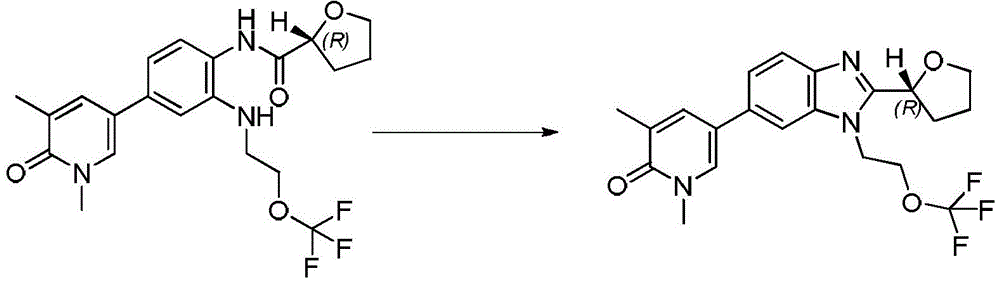
将(R)-N-(4-(1,5-二甲基-6-氧代-1,6-二氢吡啶-3-基)-2-((2-(三氟甲氧基)乙基)氨基)苯基)四氢呋喃-2-甲酰胺(0.31g,0.71mmol)在乙酸(10mL)中的溶液在室温下搅拌,然后在100℃加热14h。完成后,减压蒸发溶剂并加入EtOAc(50mL)。将所得有机层用饱和NaHCO3(30mL)、盐水(30mL)洗涤,经无水Na2SO4干燥,过滤并减压浓缩。通过使用4%MeOH的DCM溶液作为洗脱液的硅胶色谱纯化粗产物,得到化合物30a(0.178g,59%),为固体。1HNMR(400MHz,DMSO)δppm 7.99(d,J=2.4Hz,1H),7.81(d,J=1.2Hz,1H),7.79(d,J=1.2Hz,1H),7.64(d,J=8.4Hz,1H),7.42(dd,J=1.6和8.4Hz,1H),5.26(t,J=7.2Hz,1H),4.82-4.75(m,2H),4.51-4.48(m,2H),3.88-3.78(m,2H),3.54(s,3H),2.74-2.66(m,1H),2.26-2.19(m,1H),2.11(s,3H),2.09-2.01(m,1H),1.99-1.94(m,1H)。[M+H]+422.20。(R)-N-(4-(1,5-Dimethyl-6-oxo-1,6-dihydropyridin-3-yl)-2-((2-(trifluoromethoxy) A solution of ethyl)amino)phenyl)tetrahydrofuran-2-carboxamide (0.31 g, 0.71 mmol) in acetic acid (10 mL) was stirred at room temperature, then heated at 100 °C for 14 h. Upon completion, the solvent was evaporated under reduced pressure and EtOAc (50 mL) was added. The resulting organic layer was washed with saturated NaHCO 3 (30 mL), brine (30 mL), dried over anhydrous Na 2 SO 4 , filtered and concentrated under reduced pressure. The crude product was purified by silica gel chromatography using 4% MeOH in DCM as eluent to give compound 30a (0.178 g, 59%) as a solid. 1 HNMR(400MHz,DMSO)δppm 7.99(d,J=2.4Hz,1H),7.81(d,J=1.2Hz,1H),7.79(d,J=1.2Hz,1H),7.64(d,J= 8.4Hz, 1H), 7.42 (dd, J=1.6 and 8.4Hz, 1H), 5.26 (t, J=7.2Hz, 1H), 4.82-4.75 (m, 2H), 4.51-4.48 (m, 2H), 3.88-3.78(m, 2H), 3.54(s, 3H), 2.74-2.66(m, 1H), 2.26-2.19(m, 1H), 2.11(s, 3H), 2.09-2.01(m, 1H), 1.99-1.94 (m, 1H). [M+H] + 422.20.
步骤C:制备化合物30bStep C: Preparation of Compound 30b
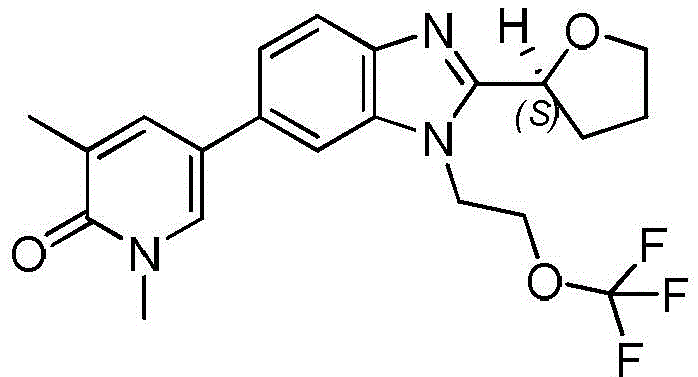
步骤1:(S)-N-(4-(1,5-二甲基-6-氧代-1,6-二氢吡啶-3-基)-2-((2-(三氟甲氧基)乙基)氨基)苯基)四氢呋喃-2-甲酰胺Step 1: (S)-N-(4-(1,5-Dimethyl-6-oxo-1,6-dihydropyridin-3-yl)-2-((2-(trifluoromethoxy yl)ethyl)amino)phenyl)tetrahydrofuran-2-carboxamide

遵循上述操作B的步骤1,除了使用(S)-四氢呋喃-2-甲酸。纯化得到为固体的标题化合物(0.32g,78%)。[M+H]+440。Follow Step 1 of Procedure B above, except use (S)-tetrahydrofuran-2-carboxylic acid. Purification gave the title compound as a solid (0.32 g, 78%). [M+H] + 440.
步骤2:制备化合物30bStep 2: Preparation of Compound 30b

遵循上述操作B的步骤2,除了使用(S)-N-(4-(1,5-二甲基-6-氧代-1,6-二氢吡啶-3-基)-2-((2-(三氟甲氧基)乙基)氨基)苯基)四氢呋喃-2-甲酰胺(0.32g,0.73mmol)。纯化得到化合物30b(0.178g,58%),为固体。1H NMR(400MHz,DMSO)δppm 7.99(d,J=2.4Hz,1H),7.81(s,1H),7.79(s,1H),7.65(d,J=8.8Hz,1H),7.42(dd,J=1.6和8.4Hz,1H),5.27(t,J=13.2Hz,1H),4.78-4.67(m,2H),4.51(d,J=4.4Hz,2H),3.86-3.78(m,2H),3.54(s,3H),2.72-2.67(m,1H),2.26-2.22(m,1H),2.11(s,3H),2.09-2.05(m,1H),2.01-1.97(m,1H)。[M+H]+422.40。Follow Step 2 of Procedure B above, except use (S)-N-(4-(1,5-dimethyl-6-oxo-1,6-dihydropyridin-3-yl)-2-(( 2-(Trifluoromethoxy)ethyl)amino)phenyl)tetrahydrofuran-2-carboxamide (0.32 g, 0.73 mmol). Purification gave compound 30b (0.178 g, 58%) as a solid. 1 H NMR (400MHz, DMSO) δppm 7.99(d, J=2.4Hz, 1H), 7.81(s, 1H), 7.79(s, 1H), 7.65(d, J=8.8Hz, 1H), 7.42(dd , J=1.6 and 8.4Hz, 1H), 5.27 (t, J=13.2Hz, 1H), 4.78-4.67 (m, 2H), 4.51 (d, J=4.4Hz, 2H), 3.86-3.78 (m, 2H), 3.54(s, 3H), 2.72-2.67(m, 1H), 2.26-2.22(m, 1H), 2.11(s, 3H), 2.09-2.05(m, 1H), 2.01-1.97(m, 1H). [M+H] + 422.40.
实施例28:1,3-二甲基-5-(2-(4-甲基四氢-2H-吡喃-4-基)-1-(2-(三氟甲氧基)乙基)-1H-苯并[d]嘧啶-6-基)吡啶-2(1H)-酮(化合物31)Example 28: 1,3-Dimethyl-5-(2-(4-methyltetrahydro-2H-pyran-4-yl)-1-(2-(trifluoromethoxy)ethyl) -1H-Benzo[d]pyrimidin-6-yl)pyridin-2(1H)-one (Compound 31)

步骤1:制备N-(4-(1,5-二甲基-6-氧代-1,6-二氢吡啶-3-基)-2-((2-(三氟甲氧基)乙基)氨基)苯基)-4-甲基四氢-2H吡喃-4-甲酰胺Step 1: Preparation of N-(4-(1,5-Dimethyl-6-oxo-1,6-dihydropyridin-3-yl)-2-((2-(trifluoromethoxy)ethyl) yl)amino)phenyl)-4-methyltetrahydro-2Hpyran-4-carboxamide
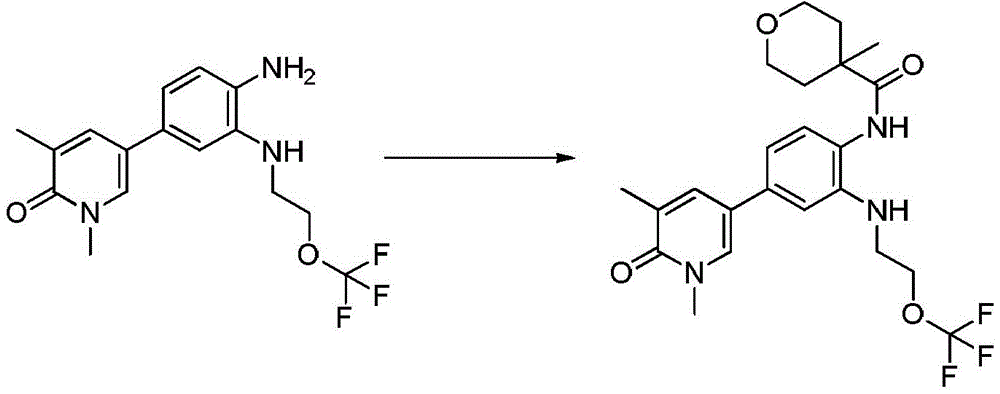
将HATU(1.11g,2.92mmol)加入到4-甲基四氢-2H-吡喃-4-甲酸(0.31g,2.19mmol)在DCM(5mL)中的在室温搅拌的溶液中,并将该反应混合物搅拌20分钟。加入中间体8(0.5g,1.46mmol)和DIPEA(0.56g,4.39mmol)在DCM(5mL)中的溶液,并将该反应混合物在室温下搅拌16小时。然后减压蒸发溶剂,产物用DCM(20mL×3)萃取。将合并的有机层用水(50mL)和盐水(50mL)洗涤,并用无水Na2SO4干燥,过滤并浓缩至干。将所得产物与Et2O一起研磨并在真空下干燥,得到标题化合物(0.35g,51%)。M+2 469.49。HATU (1.11 g, 2.92 mmol) was added to a stirred solution of 4-methyltetrahydro-2H-pyran-4-carboxylic acid (0.31 g, 2.19 mmol) in DCM (5 mL) at room temperature and the The reaction mixture was stirred for 20 minutes. A solution of Intermediate 8 (0.5 g, 1.46 mmol) and DIPEA (0.56 g, 4.39 mmol) in DCM (5 mL) was added and the reaction mixture was stirred at room temperature for 16 hours. The solvent was then evaporated under reduced pressure and the product was extracted with DCM (20 mL x 3). The combined organic layers were washed with water (50 mL) and brine (50 mL), dried over anhydrous Na 2 SO 4 , filtered and concentrated to dryness. The resulting product was triturated with Et2O and dried under vacuum to give the title compound (0.35 g, 51%). M+2 469.49.
步骤2:化合物31的制备Step 2: Preparation of Compound 31
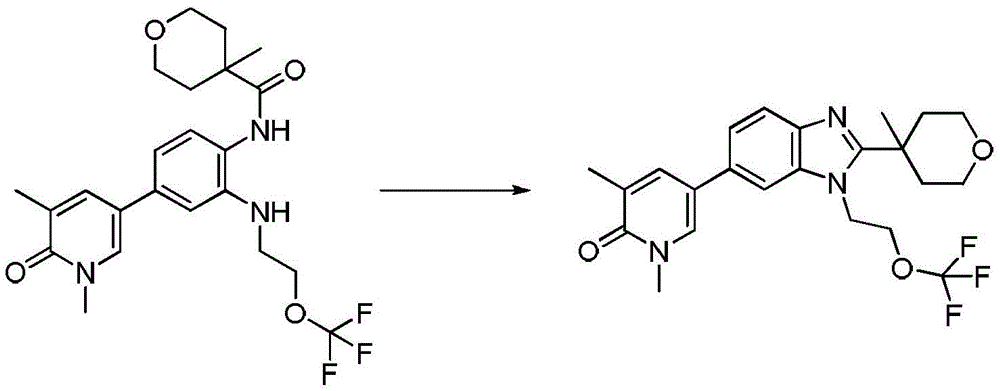
将N-(4-(1,5-二甲基-6-氧代-1,6-二氢吡啶-3-基)-2-((2-(三氟甲氧基)乙基)氨基)苯基)-4-甲基四氢-2H-吡喃-4-甲酰胺(0.35g,0.74mmol)在乙酸(2mL)中的搅拌溶液在100℃微波照射下加热3小时。反应完成后,减压蒸发乙酸。将所得残余物用饱和NaHCO3(50mL)中和并使用EtOAc(100mL)萃取。将有机层用盐水(50mL)洗涤,用无水Na2SO4干燥并减压浓缩。粗产物通过使用1.5%MeOH的DCM溶液作为洗脱液的硅胶色谱纯化。将级分合并并浓缩至干,得到半纯化产物,将其用35%MeCN的水溶液进行制备型HPLC纯化,得到化合物31(0.04g,12%),为固体。1H NMR(400MHz,MeOH)δppm 7.90(s,1H),7.87(s,1H),7.73(s,1H),7.71(s,1H),7.48(dd,J=1.6和1.2Hz,1H),4.87(t,J=11.2Hz,2H),4.54(t,J=10.8Hz,2H),3.89-3.84(m,2H),3.77-3.72(m,2H),3.70(s,3H),2.54-2.50(m,2H),2.24(s,3H),1.96-1.89(m,2H),1.55(s,3H)。[M+H]+450.47。N-(4-(1,5-Dimethyl-6-oxo-1,6-dihydropyridin-3-yl)-2-((2-(trifluoromethoxy)ethyl)amino )phenyl)-4-methyltetrahydro-2H-pyran-4-carboxamide (0.35 g, 0.74 mmol) in acetic acid (2 mL) was heated under microwave irradiation for 3 h at 100 °C. After the reaction was completed, acetic acid was evaporated under reduced pressure. The resulting residue was neutralized with saturated NaHCO3 (50 mL) and extracted with EtOAc (100 mL). The organic layer was washed with brine (50 mL), dried over anhydrous Na 2 SO 4 and concentrated under reduced pressure. The crude product was purified by silica gel chromatography using 1.5% MeOH in DCM as eluent. Fractions were combined and concentrated to dryness to give semi-purified product which was purified by preparative HPLC with 35% MeCN in water to give compound 31 (0.04 g, 12%) as a solid. 1 H NMR (400MHz, MeOH) δppm 7.90(s,1H), 7.87(s,1H), 7.73(s,1H), 7.71(s,1H), 7.48(dd, J=1.6 and 1.2Hz,1H) ,4.87(t,J=11.2Hz,2H),4.54(t,J=10.8Hz,2H),3.89-3.84(m,2H),3.77-3.72(m,2H),3.70(s,3H), 2.54-2.50(m, 2H), 2.24(s, 3H), 1.96-1.89(m, 2H), 1.55(s, 3H). [M+H] + 450.47.
实施例29:1,3-二甲基-5-[2-四氢吡喃-4-基-3-(3,3,3-三氟丙基)苯并咪唑-5-基]吡啶-2-酮(化合物34)Example 29: 1,3-Dimethyl-5-[2-tetrahydropyran-4-yl-3-(3,3,3-trifluoropropyl)benzimidazol-5-yl]pyridine- 2-keto (compound 34)

步骤1:制备N-(4-(1,5-二甲基-6-氧代-1,6-二氢吡啶-3-基)-2-(3,3,3-三氟丙-1-基氨基)苯基)四氢吡喃-4-甲酰胺Step 1: Preparation of N-(4-(1,5-Dimethyl-6-oxo-1,6-dihydropyridin-3-yl)-2-(3,3,3-trifluoropropane-1) -ylamino)phenyl)tetrahydropyran-4-carboxamide

向中间体10(244mg,0.75mmol)的DCM(5mL)溶液中加入四氢吡喃-4-甲酰氯(111mg,0.75mmol),并将反应混合物在室温下搅拌1小时。将混合物用水稀释,然后加入EtOAc(5mL)。将有机层分离并用饱和NaHCO3(2×10mL)洗涤然后用盐水(20mL)洗涤。将有机层用Na2SO4干燥,过滤并减压浓缩,得到酰胺化合物,将其不经进一步纯化用于下一步。To a solution of Intermediate 10 (244 mg, 0.75 mmol) in DCM (5 mL) was added tetrahydropyran-4-carbonyl chloride (111 mg, 0.75 mmol) and the reaction mixture was stirred at room temperature for 1 hour. The mixture was diluted with water, then EtOAc (5 mL) was added. The organic layer was separated and washed with saturated NaHCO3 (2 x 10 mL) then brine (20 mL). The organic layer was dried over Na2SO4 , filtered and concentrated under reduced pressure to give the amide compound, which was used in the next step without further purification.
步骤2:化合物34的制备Step 2: Preparation of Compound 34

向N-(4-(1,5-二甲基-6-氧代-1,6-二氢吡啶-3-基)-2-(3,3,3-三氟丙-1-基氨基)苯基)四氢吡喃-2-甲酰胺(直接来自前面的步骤)的甲苯(5mL)溶液中加入pTSA(143mg,0.75mmol),并将反应混合物加热回流18小时。然后将混合物冷却至室温,用EtOAc(5ml)稀释并用饱和NaHCO3(2×10mL)和盐水(10mL)洗涤。有机层用Na2SO4干燥,过滤并减压浓缩。通过硅胶快速色谱纯化所述材料,使用EtOAc在己烷中的混合物作为洗脱液,随后与Et2O一起研磨,得到为固体的化合物34(167mg,53%)。1H NMR(500MHz,CDCl3)δ7.80(d,J=8.3Hz,1H),7.56(d,J=1.3Hz,1H),7.42(d,J=2.5Hz,1H),7.34(dd,J=8.4,1.6Hz,1H),7.29–7.23(m,1H),4.52–4.42(m,2H),4.22–4.14(m,2H),3.68(s,3H),3.62(dd,J=11.8,10.2Hz,2H),3.14–3.02(m,1H),2.69(dd,J=16.6,8.9Hz,2H),2.33–2.20(m,5H),1.88(d,J=13.3Hz,2H)。MS(ESI)[M+H]+420.2。To N-(4-(1,5-dimethyl-6-oxo-1,6-dihydropyridin-3-yl)-2-(3,3,3-trifluoropropan-1-ylamino )phenyl)tetrahydropyran-2-carboxamide (directly from the previous step) in toluene (5 mL) was added pTSA (143 mg, 0.75 mmol) and the reaction mixture was heated to reflux for 18 hours. The mixture was then cooled to room temperature, diluted with EtOAc (5 ml) and washed with saturated NaHCO3 (2 x 10 mL) and brine (10 mL). The organic layer was dried over Na2SO4 , filtered and concentrated under reduced pressure. The material was purified by flash chromatography on silica gel using EtOAc in hexanes as eluent followed by trituration with Et2O to give compound 34 (167 mg, 53%) as a solid. 1 H NMR (500 MHz, CDCl 3 ) δ 7.80 (d, J=8.3 Hz, 1H), 7.56 (d, J=1.3 Hz, 1H), 7.42 (d, J=2.5 Hz, 1H), 7.34 (dd , J=8.4, 1.6Hz, 1H), 7.29–7.23 (m, 1H), 4.52–4.42 (m, 2H), 4.22–4.14 (m, 2H), 3.68 (s, 3H), 3.62 (dd, J = 11.8, 10.2Hz, 2H), 3.14–3.02 (m, 1H), 2.69 (dd, J=16.6, 8.9Hz, 2H), 2.33–2.20 (m, 5H), 1.88 (d, J=13.3Hz, 2H). MS(ESI)[M+H] + 420.2.
实施例30:5-[3-(2-甲氧基丙基)-2-四氢吡喃-4-基-苯并咪唑-5-基]-1,3-二甲基吡啶-2-酮(化合物35a和35b)Example 30: 5-[3-(2-Methoxypropyl)-2-tetrahydropyran-4-yl-benzimidazol-5-yl]-1,3-lutidine-2- Ketones (compounds 35a and 35b)

将中间体6(120mg,0.39mmol)溶于DCM(5ml)中并加入四氢吡喃-4-甲酰氯(50mg,0.39mmol),将反应混合物搅拌1小时。通过加入水和EtOAc(10mL)稀释该混合物。将有机相分离并用饱和NaHCO3(10mL)然后用盐水(20mL)洗涤。收集有机相,用Na2SO4干燥,过滤并浓缩,得到酰胺,将其用于下一步并进一步纯化。Intermediate 6 (120 mg, 0.39 mmol) was dissolved in DCM (5 ml) and tetrahydropyran-4-carbonyl chloride (50 mg, 0.39 mmol) was added and the reaction mixture was stirred for 1 hour. The mixture was diluted by the addition of water and EtOAc (10 mL). The organic phase was separated and washed with saturated NaHCO3 (10 mL) followed by brine (20 mL). The organic phase was collected, dried over Na2SO4 , filtered and concentrated to give the amide which was used in the next step and further purified.
向上述酰胺在甲苯(5mL)中的溶液中加入pTSA(75mg,0.39mmol)并将混合物加热回流18小时。将混合物冷却至室温,用EtOAc(10mL)稀释,然后用饱和NaHCO3(2×10mL)和盐水(10mL)洗涤。收集有机相,用Na2SO4干燥,过滤并减压浓缩。通过硅胶快速色谱使用MeOH在DCM中的混合物作为洗脱液纯化所述材料,接着通过制备型HPLC纯化,得到标题化合物。使用半制备型SFC(IC 10×250mm,5μm等度55%MeOH+0.1%NH4OH,10mL/min100Bar)分离化合物35的异构体以提供化合物35a(22.5mg,14%)和化合物35b14.9mg,10%),其为固体。To a solution of the above amide in toluene (5 mL) was added pTSA (75 mg, 0.39 mmol) and the mixture was heated to reflux for 18 hours. The mixture was cooled to room temperature, diluted with EtOAc (10 mL), then washed with saturated NaHCO3 (2 x 10 mL) and brine (10 mL). The organic phase was collected, dried over Na2SO4 , filtered and concentrated under reduced pressure. The material was purified by flash chromatography on silica gel using MeOH in DCM as eluent followed by preparative HPLC to give the title compound. The isomers of compound 35 were separated using semi-preparative SFC (IC 10×250 mm, 5 μm isocratic 55% MeOH+0.1% NH 4 OH, 10 mL/min 100 Bar) to provide compound 35a (22.5 mg, 14%) and compound 35b14. 9 mg, 10%) as a solid.
化合物35a:保留时间=15.23,1H NMR(500MHz,CDCl3)δ7.76(dd,J=8.2,0.6Hz,1H),7.54(dd,J=2.5,1.1Hz,1H),7.39(d,J=2.4Hz,1H),7.28(dd,J=8.2,1.7Hz,2H),4.22–4.06(m,4H),3.71(ddd,J=8.3,6.2,3.7Hz,1H),3.65(s,3H),3.58(tdd,J=11.8,6.1,2.1Hz,2H),3.24(tt,J=11.6,3.7Hz,1H),3.16(s,3H),2.35–2.22(m,4H),2.15(ddd,J=25.2,12.1,4.3Hz,1H),1.85(dd,J=44.7,13.4Hz,2H),1.28(t,J=10.5Hz,3H)。MS(ESI)[M+H]+396.2。Compound 35a: retention time=15.23, 1 H NMR (500 MHz, CDCl 3 ) δ 7.76 (dd, J=8.2, 0.6 Hz, 1H), 7.54 (dd, J=2.5, 1.1 Hz, 1H), 7.39 (d , J=2.4Hz, 1H), 7.28 (dd, J=8.2, 1.7Hz, 2H), 4.22–4.06 (m, 4H), 3.71 (ddd, J=8.3, 6.2, 3.7Hz, 1H), 3.65 ( s, 3H), 3.58 (tdd, J=11.8, 6.1, 2.1Hz, 2H), 3.24 (tt, J=11.6, 3.7Hz, 1H), 3.16 (s, 3H), 2.35–2.22 (m, 4H) , 2.15 (ddd, J=25.2, 12.1, 4.3 Hz, 1H), 1.85 (dd, J=44.7, 13.4 Hz, 2H), 1.28 (t, J=10.5 Hz, 3H). MS(ESI)[M+H] + 396.2.
化合物35b:保留时间=17.47,1H NMR(500MHz,CDCl3)δ7.75(dd,J=8.2,0.6Hz,1H),7.53(dd,J=2.5,1.2Hz,1H),7.38(d,J=2.3Hz,1H),7.30–7.23(m,2H),4.22–4.05(m,4H),3.69(ddd,J=8.3,6.2,3.8Hz,1H),3.64(s,3H),3.63–3.52(m,2H),3.29–3.18(m,1H),3.15(s,3H),2.30–2.22(m,4H),2.20–2.09(m,1H),1.84(dd,J=45.4,14.2Hz,2H),1.28(d,J=6.2Hz,3H)。MS(ESI)[M+H]+396.3。Compound 35b: retention time=17.47, 1 H NMR (500 MHz, CDCl 3 ) δ 7.75 (dd, J=8.2, 0.6 Hz, 1H), 7.53 (dd, J=2.5, 1.2 Hz, 1H), 7.38 (d , J=2.3Hz, 1H), 7.30–7.23 (m, 2H), 4.22–4.05 (m, 4H), 3.69 (ddd, J=8.3, 6.2, 3.8Hz, 1H), 3.64 (s, 3H), 3.63–3.52 (m, 2H), 3.29–3.18 (m, 1H), 3.15 (s, 3H), 2.30–2.22 (m, 4H), 2.20–2.09 (m, 1H), 1.84 (dd, J=45.4 , 14.2Hz, 2H), 1.28 (d, J=6.2Hz, 3H). MS(ESI)[M+H] + 396.3.
实施例31:3-氯-1-甲基-5-[2-四氢吡喃-4-基-3-[2-(三氟甲氧基)乙基]苯并咪唑-5-基]吡啶-2-酮(化合物36)Example 31: 3-Chloro-1-methyl-5-[2-tetrahydropyran-4-yl-3-[2-(trifluoromethoxy)ethyl]benzimidazol-5-yl] Pyridin-2-one (Compound 36)

将Na2CO3(48.5mg,0.458mmol)、Pd(PPh3)4(8.82mg,0.008mmol)和中间体9(61.69mg,0.229mmol)加入到6-溴-2-四氢吡喃-4-基-1-[2-(三氟甲氧基)乙基]苯并咪唑(实施例1,步骤1;60mg,0.153mmol)在水(1mL)和二噁烷(5mL)的混合物中的溶液中。通过鼓泡氮气15分钟将得到的混合物脱气,然后在110℃下加热16小时。然后冷却该混合物,通过CeliteTM过滤并用EtOAc(3×50mL)萃取。有机层用Na2SO4干燥,过滤并减压浓缩。通过硅胶快速色谱纯化所述材料,使用梯度(0-20%)的MeOH的EtOAc溶液作为洗脱液,随后用制备型HPLC纯化,得到为固体的化合物36(20mg,40%)。1H NMR(500MHz,CDCl3)δ7.87(d,J=2.5Hz,1H),7.83-7.78(m,1H),7.47(d,J=2.5Hz,1H),7.30(dd,J=8.3,1.7Hz,1H),7.25(d,J=1.2Hz,1H),4.52(t,J=5.3Hz,2H),4.32(t,J=5.3Hz,2H),4.15(dd,J=11.7,2.5Hz,2H),3.71(s,3H),3.63-3.55(m,2H),3.13(tt,J=11.8,3.8Hz,1H),2.30-2.18(m,2H),1.85(dd,J=13.4,1.7Hz,2H)。 Na2CO3 (48.5 mg , 0.458 mmol), Pd( PPh3 ) 4 (8.82 mg, 0.008 mmol) and Intermediate 9 (61.69 mg, 0.229 mmol) were added to 4-yl-1-[2-(trifluoromethoxy)ethyl]benzimidazole (Example 1, Step 1; 60 mg, 0.153 mmol) in a mixture of water (1 mL) and dioxane (5 mL) in the solution. The resulting mixture was degassed by bubbling nitrogen for 15 minutes and then heated at 110°C for 16 hours. The mixture was then cooled, filtered through Celite ™ and extracted with EtOAc (3 x 50 mL). The organic layer was dried over Na2SO4 , filtered and concentrated under reduced pressure. The material was purified by flash chromatography on silica gel using a gradient (0-20%) of MeOH in EtOAc as eluent followed by preparative HPLC to give compound 36 (20 mg, 40%) as a solid. 1 H NMR (500MHz, CDCl 3 ) δ 7.87 (d, J=2.5Hz, 1H), 7.83-7.78 (m, 1H), 7.47 (d, J=2.5Hz, 1H), 7.30 (dd, J= 8.3, 1.7Hz, 1H), 7.25 (d, J=1.2Hz, 1H), 4.52 (t, J=5.3Hz, 2H), 4.32 (t, J=5.3Hz, 2H), 4.15 (dd, J= 11.7,2.5Hz,2H),3.71(s,3H),3.63-3.55(m,2H),3.13(tt,J=11.8,3.8Hz,1H),2.30-2.18(m,2H),1.85(dd , J=13.4, 1.7 Hz, 2H).
实施例32:5-(2-苄基-1-(2-甲氧基乙基)-1H-苯并[d]咪唑-6-基)-1,3-二甲基吡啶-2(1H)-酮(化合物37)Example 32: 5-(2-Benzyl-1-(2-methoxyethyl)-1H-benzo[d]imidazol-6-yl)-1,3-lutidine-2(1H )-keto (compound 37)

步骤1:制备5-溴-N-(2-甲氧基乙基)-2-硝基苯胺Step 1: Preparation of 5-bromo-N-(2-methoxyethyl)-2-nitroaniline

将TEA(0.9mL,5.90mmol)加至4-溴-2-氟-1-硝基苯(1g,4.54mmol)和2-甲氧基乙-1-胺(0.5g,5.54mmol)在乙醇(5mL)中的搅拌溶液中并将反应混合物在80℃加热3小时。将所得混合物倒入水(50mL)中并用EtOAc(30mL×3)萃取。将合并的EtOAc层用盐水(30mL)洗涤,用无水Na2SO4干燥并减压浓缩。粗产物通过使用20%EtOAc的己烷溶液作为洗脱液的硅胶色谱纯化。合并产物级分并浓缩至干,得到标题化合物(1.1g,89%),为固体。1H NMR(400MHz,DMSO)δppm 8.22(t,J=4.8Hz,1H),7.99(d,J=2Hz,1H),7.31(d,J=2Hz,1H),7.86(dd,J1,J2=2Hz,1H),3.60-3.51(m,4H),3.32(d,J=9.6Hz,3H)。TEA (0.9 mL, 5.90 mmol) was added to 4-bromo-2-fluoro-1-nitrobenzene (1 g, 4.54 mmol) and 2-methoxyethan-1-amine (0.5 g, 5.54 mmol) in ethanol (5 mL) in a stirred solution and heated the reaction mixture at 80°C for 3 hours. The resulting mixture was poured into water (50 mL) and extracted with EtOAc (30 mL x 3). The combined EtOAc layers were washed with brine (30 mL), dried over anhydrous Na2SO4 and concentrated under reduced pressure. The crude product was purified by silica gel chromatography using 20% EtOAc in hexanes as eluent. The product fractions were combined and concentrated to dryness to give the title compound (1.1 g, 89%) as a solid. 1 H NMR (400MHz, DMSO) δppm 8.22 (t, J=4.8Hz, 1H), 7.99 (d, J=2Hz, 1H), 7.31 (d, J=2Hz, 1H), 7.86 (dd, J 1 , J2= 2Hz , 1H), 3.60-3.51 (m, 4H), 3.32 (d, J=9.6Hz, 3H).
步骤2:制备5-溴-N1-(2-甲氧基乙基)苯-1,2-二胺Step 2: Preparation of 5-bromo-N1-( 2 -methoxyethyl)benzene-1,2-diamine

向在室温搅拌的5-溴-N-(2-甲氧基乙基)-2-硝基苯胺(1.1g,4.00mmol)的MeOH(25mL)溶液中加入连二亚硫酸钠(5.99g,48.00mmol),然后加入水(10mL),并将反应混合物在50℃加热3小时。然后将所得混合物倒入水(30mL)中并用EtOAc(20mL×3)萃取。用盐水(25mL)洗涤合并的EtOAc层,用无水Na2SO4干燥并减压浓缩。通过使用15%EtOAc的己烷溶液作为洗脱液的硅胶色谱纯化粗物质。合并产物级分并浓缩至干,得到标题化合物(0.60g,62%),为固体。M+2 247.12。To a stirred solution of 5-bromo-N-(2-methoxyethyl)-2-nitroaniline (1.1 g, 4.00 mmol) in MeOH (25 mL) at room temperature was added sodium dithionite (5.99 g, 48.00 mmol) ), then water (10 mL) was added and the reaction mixture was heated at 50°C for 3 hours. The resulting mixture was then poured into water (30 mL) and extracted with EtOAc (20 mL x 3). The combined EtOAc layers were washed with brine (25 mL), dried over anhydrous Na2SO4 and concentrated under reduced pressure. The crude material was purified by silica gel chromatography using 15% EtOAc in hexanes as eluent. The product fractions were combined and concentrated to dryness to give the title compound (0.60 g, 62%) as a solid. M +2 247.12.
步骤3:制备2-苄基-6-溴-1-(2-甲氧基乙基)-1H-苯并[d]咪唑Step 3: Preparation of 2-benzyl-6-bromo-1-(2-methoxyethyl)-1H-benzo[d]imidazole

将5-溴-N1-(2-甲氧基乙基)苯-1,2-二胺(0.30g,1.22mmol)和2-苯基乙醛(0.18g,1.46mmol)在乙酸(10mL)中的溶液在室温下搅拌14小时。完成后,减压蒸发溶剂。用饱和NaHCO3水溶液(20mL)中和残余物并用EtOAc(25mL×3)萃取。将合并的有机层用盐水(20mL)洗涤,用无水Na2SO4干燥并减压浓缩。通过使用15%EtOAc的己烷溶液作为洗脱液的硅胶色谱纯化粗物质。合并产物级分并浓缩至干,得到标题化合物(0.15g,36%),为固体。[M+H]+345.24。Combine 5-bromo-N 1 -(2-methoxyethyl)benzene-1,2-diamine (0.30 g, 1.22 mmol) and 2-phenylacetaldehyde (0.18 g, 1.46 mmol) in acetic acid (10 mL) ) was stirred at room temperature for 14 hours. After completion, the solvent was evaporated under reduced pressure. The residue was neutralized with saturated aqueous NaHCO3 (20 mL) and extracted with EtOAc (25 mL x 3). The combined organic layers were washed with brine (20 mL), dried over anhydrous Na 2 SO 4 and concentrated under reduced pressure. The crude material was purified by silica gel chromatography using 15% EtOAc in hexanes as eluent. The product fractions were combined and concentrated to dryness to give the title compound (0.15 g, 36%) as a solid. [M+H] + 345.24.
步骤4:化合物37的制备Step 4: Preparation of Compound 37

将2-苄基-6-溴-1-(2-甲氧基乙基)-1H-苯并[d]咪唑(0.15g,0.43mmol)和1,3-二甲基-5-(4,4,5,5-四甲基-1,3,2-二氧杂硼杂环戊烷-2-基)吡啶-2(1H)-酮(0.14g,0.56mmol)的1,4-二噁烷(5mL)溶液用氮气吹扫10分钟随后加入Na2CO3(0.14g,1.30mmol)在水(0.5mL)中的溶液。将所得混合物再次用氮气吹扫10分钟。加入Pd(PPh3)4(0.025g,0.02mmol)并将反应混合物在90℃加热5小时。然后减压蒸发溶剂并将残余物用EtOAc(20mL×3)萃取。将合并的有机层用水(20mL),盐水(20mL)洗涤,用无水Na2SO4干燥并减压浓缩。通过使用1.5%MeOH/DCM作为洗脱液的快速色谱纯化粗物质。合并级分并浓缩至干,得到化合物37(0.08g,38%),为固体。1H NMR(400MHz,DMSO)δppm 7.97(d,J=2Hz,1H),7.80(s,1H),7.70(s,1H),7.57(d,J=8.4Hz,1H),7.38-7.24(m,6H),4.38(t,J=5Hz,2H),4.31(s,2H),3.53-3.51(m,5H),3.16(s,3H),2.10(s,3H).[M+H]+387.48。2-Benzyl-6-bromo-1-(2-methoxyethyl)-1H-benzo[d]imidazole (0.15 g, 0.43 mmol) and 1,3-dimethyl-5-(4 ,4,5,5-tetramethyl-1,3,2-dioxaborol-2-yl)pyridin-2(1H)-one (0.14 g, 0.56 mmol) in 1,4- A solution of dioxane (5 mL) was purged with nitrogen for 10 minutes then a solution of Na2CO3 (0.14 g , 1.30 mmol) in water (0.5 mL) was added. The resulting mixture was again purged with nitrogen for 10 minutes. Pd( PPh3 ) 4 (0.025 g, 0.02 mmol) was added and the reaction mixture was heated at 90°C for 5 hours. The solvent was then evaporated under reduced pressure and the residue was extracted with EtOAc (20 mL x 3). The combined organic layers were washed with water (20 mL), brine (20 mL), dried over anhydrous Na 2 SO 4 and concentrated under reduced pressure. The crude material was purified by flash chromatography using 1.5% MeOH/DCM as eluent. Fractions were combined and concentrated to dryness to give compound 37 (0.08 g, 38%) as a solid. 1 H NMR (400MHz, DMSO) δppm 7.97(d, J=2Hz, 1H), 7.80(s, 1H), 7.70(s, 1H), 7.57(d, J=8.4Hz, 1H), 7.38-7.24( m, 6H), 4.38(t, J=5Hz, 2H), 4.31(s, 2H), 3.53-3.51(m, 5H), 3.16(s, 3H), 2.10(s, 3H).[M+H ] + 387.48.
实施例33:5-(2-环己基-1-(2-甲氧基乙基)-1H-苯并[d]咪唑-6-基)-1,3-二甲基吡啶-2(1H)-酮(化合物38)Example 33: 5-(2-Cyclohexyl-1-(2-methoxyethyl)-1H-benzo[d]imidazol-6-yl)-1,3-lutidine-2(1H )-keto (compound 38)

步骤1:制备6-溴-2-环己基-1-(2-甲氧基乙基)-1H-苯并[d]咪唑Step 1: Preparation of 6-bromo-2-cyclohexyl-1-(2-methoxyethyl)-1H-benzo[d]imidazole

将5-溴-N1-(2-甲氧基乙基)苯-1,2-二胺(实施例32,步骤2,0.30g,1.22mmol)和环己烷甲醛(0.16g,1.46mmol)在乙酸(10mL)中的溶液在室温下搅拌14小时。完成后,将溶剂真空蒸发。用饱和NaHCO3水溶液(20mL)中和残余物并用EtOAc(25mL×3)萃取。将合并的有机层用盐水(20mL)洗涤,用无水Na2SO4干燥并减压浓缩。通过使用15%EtOAc的己烷溶液作为洗脱液的硅胶色谱纯化粗物质。将级分合并并浓缩至干,得到为固体的标题化合物(0.16g,38%)。M+2 339.26。Combine 5-bromo-N1-( 2 -methoxyethyl)benzene-1,2-diamine (Example 32, step 2, 0.30 g, 1.22 mmol) and cyclohexanecarbaldehyde (0.16 g, 1.46 mmol) ) in acetic acid (10 mL) was stirred at room temperature for 14 hours. Upon completion, the solvent was evaporated in vacuo. The residue was neutralized with saturated aqueous NaHCO3 (20 mL) and extracted with EtOAc (25 mL x 3). The combined organic layers were washed with brine (20 mL), dried over anhydrous Na 2 SO 4 and concentrated under reduced pressure. The crude material was purified by silica gel chromatography using 15% EtOAc in hexanes as eluent. The fractions were combined and concentrated to dryness to give the title compound as a solid (0.16 g, 38%). M +2 339.26.
步骤2:化合物38的制备Step 2: Preparation of Compound 38

将6-溴-2-环己基-1-(2-甲氧基乙基)-1H-苯并[d]咪唑(0.16g,0.47mmol)和1,3-二甲基-5-(4,4,5,5-四甲基-1,3,2-二氧杂硼杂环戊烷-2-基)吡啶-2(1H)-酮(0.15g,0.62mmol)在1,4-二噁烷(5mL)中的搅拌溶液用氮气吹扫10分钟随后加入Na2CO3(0.15g,1.42mmol)在水(0.5mL)中的溶液。将所得混合物再次用氮气吹扫10分钟。加入Pd(PPh3)4(0.028g,0.02mmol)并将反应混合物在90℃加热14h。减压蒸发溶剂,残余物用EtOAc(20mL×3)萃取。将合并的有机层用水(20mL)、盐水(20mL)洗涤,用无水Na2SO4干燥并减压浓缩。粗物质通过使用1.3%MeOH的DCM溶液作为洗脱液的硅胶色谱纯化。合并产物级分并浓缩至干,得到化合物38(0.1g,56%),其为固体。1H NMR(400MHz,DMSO)δ7.97(d,J=2.4Hz,1H),7.80(s,1H),7.69(d,J=1.2Hz,1H),7.54(d,J=8.4Hz,1H),7.34(dd,J1,J2=1.6Hz,1H),4.43(t,J=5Hz,2H),3.65(t,J=5Hz,2H),3.54(s,3H),3.20(s,3H),3.01-2.95(m,1H),2.11(s,3H),1.90-1.83(m,4H),1.80-1.59(m,3H),1.46-1.26(m,3H)。[M+H]+380。6-Bromo-2-cyclohexyl-1-(2-methoxyethyl)-1H-benzo[d]imidazole (0.16 g, 0.47 mmol) and 1,3-dimethyl-5-(4 ,4,5,5-tetramethyl-1,3,2-dioxaborol-2-yl)pyridin-2(1H)-one (0.15 g, 0.62 mmol) in 1,4- A stirred solution in dioxane (5 mL) was purged with nitrogen for 10 minutes followed by the addition of a solution of Na2CO3 (0.15 g , 1.42 mmol) in water (0.5 mL). The resulting mixture was again purged with nitrogen for 10 minutes. Pd( PPh3 ) 4 (0.028 g, 0.02 mmol) was added and the reaction mixture was heated at 90 °C for 14 h. The solvent was evaporated under reduced pressure, and the residue was extracted with EtOAc (20 mL×3). The combined organic layers were washed with water (20 mL), brine (20 mL), dried over anhydrous Na 2 SO 4 and concentrated under reduced pressure. The crude material was purified by silica gel chromatography using 1.3% MeOH in DCM as eluent. The product fractions were combined and concentrated to dryness to give compound 38 (0.1 g, 56%) as a solid. 1 H NMR(400MHz,DMSO)δ7.97(d,J=2.4Hz,1H),7.80(s,1H),7.69(d,J=1.2Hz,1H),7.54(d,J=8.4Hz, 1H), 7.34(dd, J1, J2 = 1.6Hz, 1H), 4.43(t, J=5Hz, 2H), 3.65(t, J=5Hz, 2H), 3.54(s, 3H), 3.20( s, 3H), 3.01-2.95 (m, 1H), 2.11 (s, 3H), 1.90-1.83 (m, 4H), 1.80-1.59 (m, 3H), 1.46-1.26 (m, 3H). [M+H] + 380.
实施例34:(R)-5-(1-(2-乙氧基丙基)-2-(四氢-2H-吡喃-4-基)-1H-苯并[d]咪唑-6-基)-1,3-二甲基吡啶-2(1H)-酮(化合物39)Example 34: (R)-5-(1-(2-ethoxypropyl)-2-(tetrahydro-2H-pyran-4-yl)-1H-benzo[d]imidazole-6- yl)-1,3-lutidine-2(1H)-one (Compound 39)

步骤1:(R)-5-溴-N-(2-乙氧基丙基)-2-硝基苯胺的制备Step 1: Preparation of (R)-5-bromo-N-(2-ethoxypropyl)-2-nitroaniline

将4-溴-2-氟-1-硝基苯(0.6g,2.73mmol)和中间体11(0.57g,5.45mmol)在乙醇(10mL)中的搅拌溶液在室温下搅拌10分钟。滴加TEA(1.3mL,8.19mmol),并将反应混合物在70℃加热8小时。然后将反应混合物用水(100mL)稀释并用EtOAc(100mL×3)萃取。将合并的有机层用盐水(30mL)洗涤,经无水Na2SO4干燥,过滤并减压浓缩。将粗物质通过硅胶色谱纯化,使用梯度的1-3%EtOAc的己烷溶液作为洗脱液。将级分合并并减压浓缩,得到标题化合物(0.275g,32%),为固体。1H NMR(400MHz,DMSO)δ8.30(t,J=4.8Hz,1H),7.98(d,J=9.2Hz,1H),7.33(d,J=1.6Hz,1H),6.83(dd,J=2和9.2Hz,1H),3.72-3.67(m,1H),3.63-3.50(m,2H),3.44-3.36(m,1H),3.26-3.20(m,1H),1.16-1.13(m,6H)。A stirred solution of 4-bromo-2-fluoro-1-nitrobenzene (0.6 g, 2.73 mmol) and intermediate 11 (0.57 g, 5.45 mmol) in ethanol (10 mL) was stirred at room temperature for 10 minutes. TEA (1.3 mL, 8.19 mmol) was added dropwise and the reaction mixture was heated at 70°C for 8 hours. The reaction mixture was then diluted with water (100 mL) and extracted with EtOAc (100 mL x 3). The combined organic layers were washed with brine (30 mL), dried over anhydrous Na 2 SO 4 , filtered and concentrated under reduced pressure. The crude material was purified by silica gel chromatography using a gradient of 1-3% EtOAc in hexanes as eluent. The fractions were combined and concentrated under reduced pressure to give the title compound (0.275 g, 32%) as a solid. 1 H NMR (400MHz, DMSO)δ8.30(t,J=4.8Hz,1H),7.98(d,J=9.2Hz,1H),7.33(d,J=1.6Hz,1H),6.83(dd, J=2 and 9.2Hz, 1H), 3.72-3.67(m, 1H), 3.63-3.50(m, 2H), 3.44-3.36(m, 1H), 3.26-3.20(m, 1H), 1.16-1.13( m, 6H).
步骤2:制备5-溴-N1-(2-乙氧基丙基)苯-1,2-二胺Step 2: Preparation of 5-bromo-N1-( 2 -ethoxypropyl)benzene-1,2-diamine

将连二亚硫酸钠(1.51g,11.87mmol)加入到(R)-5-溴-N-(2-乙氧基丙基)-2-硝基苯胺(0.3g,0.99mmol)在MeOH(10mL)和水(4mL)中的室温混悬液中并将反应混合物在50℃加热1小时。然后将所得混合物用水(50mL)稀释并用DCM(50mL×3)萃取。将合并的有机层用盐水(50mL)洗涤,用无水Na2SO4干燥,过滤并减压浓缩,得到为固体的标题化合物(0.2g,68%)。[M+H]+273.2。Sodium dithionite (1.51 g, 11.87 mmol) was added to (R)-5-bromo-N-(2-ethoxypropyl)-2-nitroaniline (0.3 g, 0.99 mmol) in MeOH (10 mL) and a room temperature suspension in water (4 mL) and the reaction mixture was heated at 50°C for 1 hour. The resulting mixture was then diluted with water (50 mL) and extracted with DCM (50 mL x 3). The combined organic layers were washed with brine (50 mL), dried over anhydrous Na2SO4 , filtered and concentrated under reduced pressure to give the title compound (0.2 g, 68%) as a solid. [M+H] + 273.2.
步骤3:制备(R)-6-溴-1-(2-乙氧基丙基)-2-(四氢-2H-吡喃-4-基)-1H-苯并[d]咪唑Step 3: Preparation of (R)-6-bromo-1-(2-ethoxypropyl)-2-(tetrahydro-2H-pyran-4-yl)-1H-benzo[d]imidazole

将四氢-2H-吡喃-4-甲醛(0.1g,0.88mmol)加入到(R)-5-溴-N1-(2-乙氧基丙基)苯-1,2-二胺(0.2g,0.73mmol)在乙酸(10mL)中的室温搅拌溶液中,并将反应混合物在相同温度下搅拌48小时。然后浓缩该反应混合物,用饱和NaHCO3中和并用EtOAc(50mL×3)萃取。将合并的有机层用盐水(50mL)洗涤,经无水Na2SO4干燥,过滤并减压浓缩。通过硅胶色谱,使用梯度的35-40%EtOAc的己烷溶液作为洗脱液来纯化粗物质。合并产物级分并减压浓缩,得到标题化合物(0.14g,49%),为固体。[M+H]+367.24。Tetrahydro-2H-pyran-4-carbaldehyde (0.1 g, 0.88 mmol) was added to (R)-5-bromo-N1-( 2 -ethoxypropyl)benzene-1,2-diamine ( 0.2 g, 0.73 mmol) in a stirred solution of acetic acid (10 mL) at room temperature and the reaction mixture was stirred at the same temperature for 48 hours. The reaction mixture was then concentrated, neutralized with saturated NaHCO3 and extracted with EtOAc (50 mL x 3). The combined organic layers were washed with brine (50 mL), dried over anhydrous Na 2 SO 4 , filtered and concentrated under reduced pressure. The crude material was purified by silica gel chromatography using a gradient of 35-40% EtOAc in hexanes as eluent. The product fractions were combined and concentrated under reduced pressure to give the title compound (0.14 g, 49%) as a solid. [M+H] + 367.24.
步骤4:化合物39的制备Step 4: Preparation of Compound 39

将(R)-6-溴-1-(2-乙氧基丙基)-2-(四氢-2H-吡喃-4-基)-1H-苯并[d]咪唑(0.14g,0.38mmol)和1,3-二甲基-5-(4,4,5,5-四甲基-1,3,2-二氧杂硼杂环戊烷-2-基)吡啶-2(1H)-酮(0.145g,0.57mmol)在1,4-二噁烷(3mL)中的搅拌溶液用氮气吹扫20分钟,然后加入Na2CO3(0.125g,1.14mmol)在水(0.3mL)中的溶液。将所得混合物再次用氮气吹扫20分钟。加入Pd(PPh3)4(0.025g,0.019mmol)并将反应混合物在90℃加热16小时。然后将反应混合物用水(30mL)稀释并用EtOAc(30mL×3)萃取。将合并的有机层用盐水(30mL)洗涤,用无水Na2SO4干燥,过滤并减压浓缩。通过硅胶色谱,使用梯度的3-5%MeOH的DCM溶液作为洗脱液纯化粗物质。合并产物级分并浓缩至干,得到0.09g产物,将其通过制备型HPLC进一步纯化,使用20-55%MeCN的水溶液,得到为固体的化合物39(0.031g,20%)。1H NMR(400MHz,DMSO)δ7.95(d,J=2Hz,1H),7.80(s,1H),7.70(s,1H),7.56(d,J=8.4Hz,1H),7.34(dd,J=1.6和8.4Hz,1H),4.34-4.19(m,2H),4.01-3.92(m,2H),3.76(s,1H),3.53(s,3H),3.51-3.37(m,4H),3.03-2.97(m,1H),2.10(s,3H),2.07-1.96(m,1H),1.82-1.79(m,3H),1.21(t,J=9.2Hz,3H),0.84(t,J=6.8Hz,3H)。[M+H]+410.4。(R)-6-Bromo-1-(2-ethoxypropyl)-2-(tetrahydro-2H-pyran-4-yl)-1H-benzo[d]imidazole (0.14 g, 0.38 g mmol) and 1,3-dimethyl-5-(4,4,5,5-tetramethyl-1,3,2-dioxaborol-2-yl)pyridine-2(1H )-one (0.145 g, 0.57 mmol) in 1,4-dioxane (3 mL) was stirred with nitrogen for 20 min, then Na2CO3 (0.125 g , 1.14 mmol) in water (0.3 mL) was added ) in the solution. The resulting mixture was again purged with nitrogen for 20 minutes. Pd( PPh3 ) 4 (0.025 g, 0.019 mmol) was added and the reaction mixture was heated at 90°C for 16 hours. The reaction mixture was then diluted with water (30 mL) and extracted with EtOAc (30 mL x 3). The combined organic layers were washed with brine (30 mL), dried over anhydrous Na 2 SO 4 , filtered and concentrated under reduced pressure. The crude material was purified by silica gel chromatography using a gradient of 3-5% MeOH in DCM as eluent. The product fractions were combined and concentrated to dryness to give 0.09 g of product which was further purified by preparative HPLC using 20-55% MeCN in water to give compound 39 as a solid (0.031 g, 20%). 1 H NMR(400MHz, DMSO)δ7.95(d,J=2Hz,1H),7.80(s,1H),7.70(s,1H),7.56(d,J=8.4Hz,1H),7.34(dd , J=1.6 and 8.4Hz, 1H), 4.34-4.19(m, 2H), 4.01-3.92(m, 2H), 3.76(s, 1H), 3.53(s, 3H), 3.51-3.37(m, 4H) ),3.03-2.97(m,1H),2.10(s,3H),2.07-1.96(m,1H),1.82-1.79(m,3H),1.21(t,J=9.2Hz,3H),0.84( t, J=6.8 Hz, 3H). [M+H] + 410.4.
实施例35:(S)-5-(1-(2-乙氧基丙基)-2-(四氢-2H-吡喃-4-基)-1H-苯并[d]咪唑-6-基)-1,3-二甲基吡啶-2(1H)-酮(化合物40)Example 35: (S)-5-(1-(2-ethoxypropyl)-2-(tetrahydro-2H-pyran-4-yl)-1H-benzo[d]imidazole-6- yl)-1,3-lutidine-2(1H)-one (Compound 40)
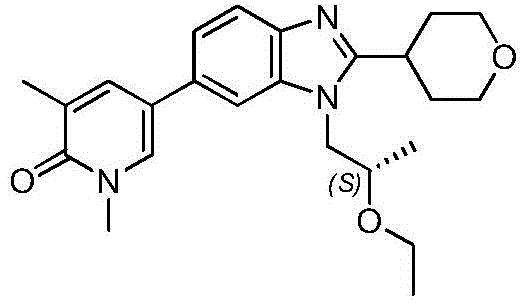
步骤1:(S)-5-溴-N-(2-乙氧基丙基)-2-硝基苯胺的制备Step 1: Preparation of (S)-5-bromo-N-(2-ethoxypropyl)-2-nitroaniline

除了使用中间体12(0.57g,5.45mmol)之外,进行实施例34的步骤1的操作。使用梯度的1-5%EtOAc的己烷溶液作为洗脱液,通过硅胶色谱纯化获得的粗物质。合并和浓缩级分,得到为固体的标题化合物(0.25g,30%)。1H NMR(400MHz,DMSO)δ8.30(t,J=4.8Hz,1H),7.98(d,J=9.2Hz,1H),7.33(d,J=1.6Hz,1H),6.83(dd,J=2和9.2Hz,1H),3.72-3.67(m,1H),3.63-3.50(m,2H),3.44-3.36(m,1H),3.26-3.20(m,1H),1.16(d,J=6Hz,3H),1.12(t,J=6.8Hz,3H)。The procedure of Step 1 of Example 34 was followed except that Intermediate 12 (0.57 g, 5.45 mmol) was used. The obtained crude material was purified by silica gel chromatography using a gradient of 1-5% EtOAc in hexanes as eluent. Fractions were combined and concentrated to give the title compound as a solid (0.25 g, 30%). 1 H NMR (400MHz, DMSO)δ8.30(t,J=4.8Hz,1H),7.98(d,J=9.2Hz,1H),7.33(d,J=1.6Hz,1H),6.83(dd, J=2 and 9.2Hz, 1H), 3.72-3.67(m, 1H), 3.63-3.50(m, 2H), 3.44-3.36(m, 1H), 3.26-3.20(m, 1H), 1.16(d, J=6Hz, 3H), 1.12 (t, J=6.8Hz, 3H).
步骤2:制备(S)-5-溴-N1-(2-乙氧基丙基)苯-1,2-二胺Step 2: Preparation of (S)-5-bromo-N1-( 2 -ethoxypropyl)benzene-1,2-diamine

与实施例34的步骤2的条件类似,将连二亚硫酸钠(2.51g,19.79mmol)加至(S)-5-溴-N-(2-乙氧基丙基)-2-硝基苯胺(0.5g,19.79mmol)在MeOH(13mL)和水(6mL)中的室温悬浮液中,并将反应混合物在50℃加热1小时。如实施例34的步骤2中那样处理反应混合物,得到标题化合物(0.2g,31%),为固体。[M+H]+273.2。Similar to the conditions of step 2 of Example 34, sodium dithionite (2.51 g, 19.79 mmol) was added to (S)-5-bromo-N-(2-ethoxypropyl)-2-nitroaniline ( 0.5 g, 19.79 mmol) in MeOH (13 mL) and water (6 mL) at room temperature, and the reaction mixture was heated at 50 °C for 1 hour. The reaction mixture was worked up as in step 2 of Example 34 to give the title compound (0.2 g, 31%) as a solid. [M+H] + 273.2.
步骤3:(S)-6-溴-1-(2-乙氧基丙基)-2-(四氢-2H-吡喃-4-基)-1H-苯并咪唑的制备Step 3: Preparation of (S)-6-bromo-1-(2-ethoxypropyl)-2-(tetrahydro-2H-pyran-4-yl)-1H-benzimidazole

除了使用(S)-5-溴-N1-(2-乙氧基丙基)苯-1,2-二胺之外,进行实施例34步骤3中所述的操作。将粗物质通过硅胶色谱纯化,使用梯度的30-35%EtOAc的己烷溶液作为洗脱液。合并产物级分并减压浓缩,得到标题化合物(0.12g,42%),为固体。[M+H]+367.24。The procedure described in Example 34, Step 3 was followed except that (S)-5-bromo-N1-( 2 -ethoxypropyl)benzene-1,2-diamine was used. The crude material was purified by silica gel chromatography using a gradient of 30-35% EtOAc in hexanes as eluent. The product fractions were combined and concentrated under reduced pressure to give the title compound (0.12 g, 42%) as a solid. [M+H] + 367.24.
步骤4:化合物40的制备Step 4: Preparation of Compound 40
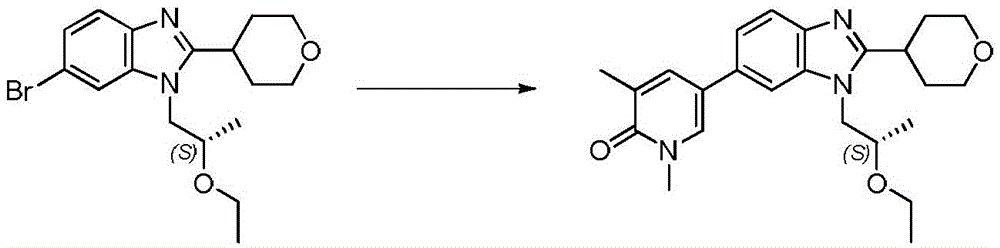
将(S)-6-溴-1-(2-乙氧基丙基)-2-(四氢-2H-吡喃-4-基)-1H-苯并[d]咪唑(0.12g,0.33mmol)和1,3-二甲基-5-(4,4,5,5-四甲基-1,3,2-二氧杂硼杂环戊烷-2-基)吡啶-2(1H)-酮(0.13g,0.49mmol)在1,4-二噁烷(2mL)中的搅拌溶液用氮气吹扫20分钟,然后加入Na2CO3(0.11g,0.98mmol)的水(0.2mL)溶液。将所得混合物再次用氮气吹扫20分钟。加入Pd(PPh3)4(0.02g,0.016mmol)并将反应混合物在90℃加热16小时。如实施例34的步骤4中所述处理和纯化所得混合物,得到为固体的化合物40(0.026g,19%)。1H NMR(400MHz,DMSO)δ7.95(d,J=2Hz,1H),7.80(d,J=1.6Hz,1H),7.70(d,J=1.6Hz,1H),7.56(d,J=8.4Hz,1H),7.34(dd,J=1.6和8.4Hz,1H),4.22-4.20(m,2H),4.01-3.92(m,2H),3.78-3.74(m,1H),3.54(s,3H),3.51-3.36(m,4H),3.03-2.95(m,1H),2.11(s,3H),2.02-1.96(m,1H),1.81-1.78(m,3H),1.21(t,J=9.2Hz,3H),0.84(t,J=6.8Hz,3H)。[M+H]+410.4。(S)-6-Bromo-1-(2-ethoxypropyl)-2-(tetrahydro-2H-pyran-4-yl)-1H-benzo[d]imidazole (0.12 g, 0.33 mmol) and 1,3-dimethyl-5-(4,4,5,5-tetramethyl-1,3,2-dioxaborol-2-yl)pyridine-2(1H )-one (0.13 g, 0.49 mmol) in 1,4-dioxane (2 mL) was stirred with nitrogen purged for 20 min, then Na2CO3 (0.11 g , 0.98 mmol) in water (0.2 mL) was added ) solution. The resulting mixture was again purged with nitrogen for 20 minutes. Pd( PPh3 ) 4 (0.02 g, 0.016 mmol) was added and the reaction mixture was heated at 90°C for 16 hours. The resulting mixture was processed and purified as described in step 4 of Example 34 to give compound 40 as a solid (0.026 g, 19%). 1 H NMR(400MHz,DMSO)δ7.95(d,J=2Hz,1H),7.80(d,J=1.6Hz,1H),7.70(d,J=1.6Hz,1H),7.56(d,J =8.4Hz,1H),7.34(dd,J=1.6 and 8.4Hz,1H),4.22-4.20(m,2H),4.01-3.92(m,2H),3.78-3.74(m,1H),3.54( s,3H),3.51-3.36(m,4H),3.03-2.95(m,1H),2.11(s,3H),2.02-1.96(m,1H),1.81-1.78(m,3H),1.21( t, J=9.2 Hz, 3H), 0.84 (t, J=6.8 Hz, 3H). [M+H] + 410.4.
实施例36:1,3-二甲基-5-(2-(四氢-2H-吡喃-4-基)-1-(2-(2,2,2-三氟乙氧基)乙基)-1H-苯并[d]咪唑-6-基)吡啶-2(1H)-酮(化合物41)Example 36: 1,3-Dimethyl-5-(2-(tetrahydro-2H-pyran-4-yl)-1-(2-(2,2,2-trifluoroethoxy)ethyl yl)-1H-benzo[d]imidazol-6-yl)pyridin-2(1H)-one (Compound 41)

步骤1:制备5-溴-2-硝基-N-(2-(2,2,2-三氟乙氧基)乙基)苯胺Step 1: Preparation of 5-bromo-2-nitro-N-(2-(2,2,2-trifluoroethoxy)ethyl)aniline

将TEA(0.6mL,1.17mmol)加入到4-溴-2-氟-1-硝基苯(0.2g,0.9mmol)和2-(2,2,2-三氟乙氧基)乙-1-胺(0.19g,1.09mmol)在乙醇(4mL)中的室温搅拌溶液中并将反应混合物在50℃加热2小时。然后将所得混合物倒入水(50mL)中并用EtOAc(40mL×3)萃取。将合并的有机层用盐水(30mL)洗涤,经无水Na2SO4干燥,过滤并减压浓缩。通过使用20%EtOAc的己烷溶液作为洗脱液的硅胶色谱纯化粗物质。将级分合并并浓缩,得到标题化合物(0.3,96%),其为固体。1H NMR(400MHz,DMSO)δppm 8.25(d,J=5.6Hz,1H),7.99(d,J=9.2Hz,1H),7.34(d,J=2.0Hz,1H),6.86(dd,J=2.0和9.2Hz,1H),4.17-4.10(m,2H),3.83(t,J=5.2Hz,2H),3.62-3.58(m,2H)。TEA (0.6 mL, 1.17 mmol) was added to 4-bromo-2-fluoro-1-nitrobenzene (0.2 g, 0.9 mmol) and 2-(2,2,2-trifluoroethoxy)ethane-1 - A stirred solution of the amine (0.19 g, 1.09 mmol) in ethanol (4 mL) at room temperature and the reaction mixture was heated at 50°C for 2 hours. The resulting mixture was then poured into water (50 mL) and extracted with EtOAc (40 mL x 3). The combined organic layers were washed with brine (30 mL), dried over anhydrous Na 2 SO 4 , filtered and concentrated under reduced pressure. The crude material was purified by silica gel chromatography using 20% EtOAc in hexanes as eluent. The fractions were combined and concentrated to give the title compound (0.3, 96%) as a solid. 1 H NMR (400MHz, DMSO) δppm 8.25 (d, J=5.6 Hz, 1H), 7.99 (d, J=9.2 Hz, 1H), 7.34 (d, J=2.0 Hz, 1H), 6.86 (dd, J = 2.0 and 9.2 Hz, 1H), 4.17-4.10 (m, 2H), 3.83 (t, J=5.2 Hz, 2H), 3.62-3.58 (m, 2H).
步骤2:制备5-溴-N1-(2-(2,2,2-三氟乙氧基)乙基)苯-1,2-二胺Step 2: Preparation of 5 -bromo-N1-(2-(2,2,2-trifluoroethoxy)ethyl)benzene-1,2-diamine

向5-溴-2-硝基-N-(2-(2,2,2-三氟乙氧基)乙基)苯胺(0.3g,0.87mmol)在MeOH(8mL)中的室温搅拌溶液中加入连二亚硫酸钠(13.32g,10.49mmol),然后加入水(3mL),将反应混合物加热至50℃,保持3小时。将所得混合物倒入水(30mL)中并用EtOAc(20mL×3)萃取。将合并的有机层用盐水(25mL)洗涤,经无水Na2SO4干燥,过滤并减压浓缩。粗物质通过使用30%EtOAc的己烷溶液作为洗脱液的硅胶色谱纯化。将级分合并并浓缩,得到标题化合物(0.2g,73%),其为固体。[M+H]+313.1,315.14。To a stirred solution of 5-bromo-2-nitro-N-(2-(2,2,2-trifluoroethoxy)ethyl)aniline (0.3 g, 0.87 mmol) in MeOH (8 mL) at room temperature Sodium dithionite (13.32 g, 10.49 mmol) was added followed by water (3 mL) and the reaction mixture was heated to 50°C for 3 hours. The resulting mixture was poured into water (30 mL) and extracted with EtOAc (20 mL x 3). The combined organic layers were washed with brine (25 mL), dried over anhydrous Na 2 SO 4 , filtered and concentrated under reduced pressure. The crude material was purified by silica gel chromatography using 30% EtOAc in hexanes as eluent. The fractions were combined and concentrated to give the title compound (0.2 g, 73%) as a solid. [M+H] + 313.1, 315.14.
步骤3:制备6-溴-2-(四氢-2H-吡喃-4-基)-1-(2-(2,2,2-三氟乙氧基)乙基)-1H-苯并[d]咪唑Step 3: Preparation of 6-bromo-2-(tetrahydro-2H-pyran-4-yl)-1-(2-(2,2,2-trifluoroethoxy)ethyl)-1H-benzo [d]imidazole

将5-溴-N1-(2-(2,2,2-三氟乙氧基)乙基)苯-1,2-二胺(0.2g,0.63mmol)和四氢-2H-吡喃-4-甲醛(0.1l g,0.76mmol)在乙酸(10mL)中的溶液在室温下搅拌14小时。然后减压蒸发溶剂。使用饱和NaHCO3水溶液(20mL)中和残余物并用EtOAc(25mL×3)萃取。将合并的有机层用盐水(20mL)洗涤,用无水Na2SO4干燥,过滤并减压浓缩。通过使用15%EtOAc的己烷溶液作为洗脱液的硅胶柱色谱纯化粗物质。将级分合并并浓缩,得到标题化合物(0.14g,54%),为固体。[M+H]+407.23,409.23。 5 -Bromo-N1-(2-(2,2,2-trifluoroethoxy)ethyl)benzene-1,2-diamine (0.2 g, 0.63 mmol) and tetrahydro-2H-pyran A solution of -4-carbaldehyde (0.11 g, 0.76 mmol) in acetic acid (10 mL) was stirred at room temperature for 14 hours. The solvent was then evaporated under reduced pressure. The residue was neutralized with saturated aqueous NaHCO3 (20 mL) and extracted with EtOAc (25 mL x 3). The combined organic layers were washed with brine (20 mL), dried over anhydrous Na 2 SO 4 , filtered and concentrated under reduced pressure. The crude material was purified by silica gel column chromatography using 15% EtOAc in hexanes as eluent. The fractions were combined and concentrated to give the title compound (0.14 g, 54%) as a solid. [M+H] + 407.23, 409.23.
步骤4:化合物41的制备Step 4: Preparation of Compound 41

将6-溴-2-(四氢-2H-吡喃-4-基)-1-(2-(2,2,2-三氟乙氧基)乙基)-1H-苯并[d]咪唑(0.14g,0.34mmol)和1,3-二甲基-5-(4,4,5,5-四甲基-1,3,2-二氧杂硼杂环戊烷-2-基)吡啶-2(1H)-酮(0.11g,0.44mmol)于1,4-二噁烷(5mL)中的搅拌溶液用氮气吹扫10分钟,然后加入Na2CO3(0.11g,1.03mmol)的水(0.5mL)溶液。将反应混合物再次用氮气吹扫10分钟。加入Pd(PPh3)4(0.02g,0.01mmol)并将反应混合物加热至90℃持续5小时。然后减压蒸发溶剂并将残余物用EtOAc(20mL×3)萃取。将合并的有机层用水(20mL)和盐水(20mL)洗涤,用无水Na2SO4干燥,过滤并减压浓缩。粗物质通过使用1.5%MeOH的DCM溶液作为洗脱液的硅胶色谱纯化。将级分合并并浓缩以提供半纯化产物,将其通过制备型HPLC进一步纯化,使用35-45%MeCN的水溶液,得到为固体的化合物41(0.07g,45%)。1H NMR(400MHz,DMSO)δppm 7.97(d,J=2.4Hz,1H),7.80(s,1H),7.74(d,J=1.2Hz,1H),7.58(d,J=8.4Hz,1H),7.34(dd,J1.6和8.4Hz,1H),4.53(t,J=4.8Hz,2H),4.09-3.91(m,6H),3.54(s,3H),3.50-3.34(m,2H),3.31-3.28(m,1H),2.11(s,3H),1.91-1.77(m,4H)。[M+H]+450.35。6-Bromo-2-(tetrahydro-2H-pyran-4-yl)-1-(2-(2,2,2-trifluoroethoxy)ethyl)-1H-benzo[d] Imidazole (0.14 g, 0.34 mmol) and 1,3-dimethyl-5-(4,4,5,5-tetramethyl-1,3,2-dioxaborol-2-yl ) pyridin-2(1H)-one (0.11 g, 0.44 mmol) in 1,4-dioxane (5 mL) was purged with nitrogen for 10 min before adding Na2CO3 (0.11 g , 1.03 mmol) ) in water (0.5 mL). The reaction mixture was again purged with nitrogen for 10 minutes. Pd( PPh3 ) 4 (0.02 g, 0.01 mmol) was added and the reaction mixture was heated to 90°C for 5 hours. The solvent was then evaporated under reduced pressure and the residue was extracted with EtOAc (20 mL x 3). The combined organic layers were washed with water (20 mL) and brine (20 mL), dried over anhydrous Na 2 SO 4 , filtered and concentrated under reduced pressure. The crude material was purified by silica gel chromatography using 1.5% MeOH in DCM as eluent. Fractions were combined and concentrated to provide semi-purified product which was further purified by preparative HPLC using 35-45% MeCN in water to afford compound 41 as a solid (0.07 g, 45%). 1 H NMR (400MHz, DMSO) δppm 7.97 (d, J=2.4Hz, 1H), 7.80 (s, 1H), 7.74 (d, J=1.2Hz, 1H), 7.58 (d, J=8.4Hz, 1H) ), 7.34(dd, J1.6 and 8.4Hz, 1H), 4.53(t, J=4.8Hz, 2H), 4.09-3.91(m, 6H), 3.54(s, 3H), 3.50-3.34(m, 2H), 3.31-3.28 (m, 1H), 2.11 (s, 3H), 1.91-1.77 (m, 4H). [M+H] + 450.35.
实施例37:5-(1-(2-甲氧基乙基)-2-((四氢-2H-吡喃-4-基)甲基)-1H-苯并[d]咪唑-6-基)-1,3-二甲基吡啶-2(1H)-酮(化合物42)Example 37: 5-(1-(2-Methoxyethyl)-2-((tetrahydro-2H-pyran-4-yl)methyl)-1H-benzo[d]imidazole-6- yl)-1,3-lutidine-2(1H)-one (Compound 42)

步骤1:制备6-溴-1-(2-甲氧基乙基)-2-((四氢-2H-吡喃-4-基)甲基)-1H-苯并[d]咪唑Step 1: Preparation of 6-bromo-1-(2-methoxyethyl)-2-((tetrahydro-2H-pyran-4-yl)methyl)-1H-benzo[d]imidazole

将5-溴-N1-(2-甲氧基乙基)苯-1,2-二胺(实施例32,步骤2,0.30g,1.22mmol)和2-(四氢-2H-吡喃-4-基)乙醛(0.19g,1.46mmol)的乙酸(10mL)溶液在室温下搅拌14小时。反应完成后,减压蒸发溶剂。使用饱和NaHCO3(20mL)中和残余物并用EtOAc(25mL×3)萃取。将合并的有机层用盐水(20mL)洗涤,用无水Na2SO4干燥,过滤并减压浓缩。通过使用10%EtOAc的己烷溶液作为洗脱液的硅胶色谱纯化粗物质,得到标题化合物(0.18g,42%),为固体。[M+H]+353.2,355.26。Combine 5-bromo-N1-( 2 -methoxyethyl)benzene-1,2-diamine (Example 32, step 2, 0.30 g, 1.22 mmol) and 2-(tetrahydro-2H-pyran A solution of -4-yl)acetaldehyde (0.19 g, 1.46 mmol) in acetic acid (10 mL) was stirred at room temperature for 14 hours. After the reaction was completed, the solvent was evaporated under reduced pressure. The residue was neutralized with saturated NaHCO3 (20 mL) and extracted with EtOAc (25 mL x 3). The combined organic layers were washed with brine (20 mL), dried over anhydrous Na 2 SO 4 , filtered and concentrated under reduced pressure. The crude material was purified by silica gel chromatography using 10% EtOAc in hexanes as eluent to give the title compound (0.18 g, 42%) as a solid. [M+H] + 353.2, 355.26.
步骤2:化合物42的制备Step 2: Preparation of Compound 42
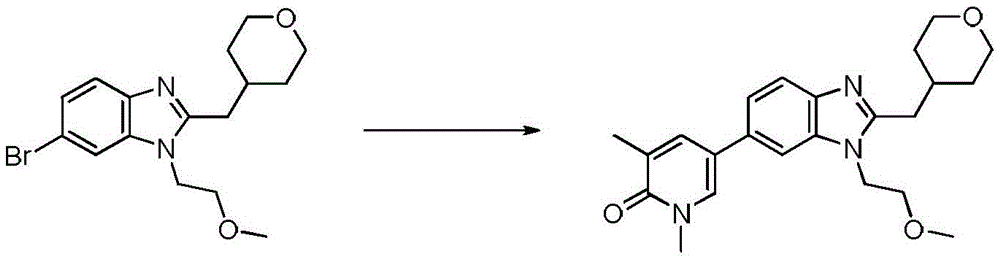
将6-溴-1-(2-甲氧基乙基)-2-((四氢-2H-吡喃-4-基)甲基)-1H-苯并[d]咪唑(0.18g,0.51mmol)和1,3-二甲基-5-(4,4,5,5-四甲基-1,3,2-二氧杂硼杂环戊烷-2-基)吡啶-2(1H)-酮(0.16g,0.66mmol)在1,4-二噁烷(5mL)中的搅拌溶液用氮气吹扫10分钟,然后加入水(0.5mL)中的Na2CO3(0.16g,1.53mmol)。将反应混合物再次用氮气吹扫10分钟。加入Pd(PPh3)4(0.03g,0.05mmol)并将反应混合物加热至90℃持续5小时。减压蒸发溶剂,残余物用EtOAc(20mL×3)萃取。将合并的有机层用水(20mL)和盐水(20mL)洗涤,用无水Na2SO4干燥,过滤并减压浓缩。通过硅胶色谱使用1.3%MeOH的DCM溶液作为洗脱液纯化粗物质,得到为固体的化合物42(0.07g,34%)。6-Bromo-1-(2-methoxyethyl)-2-((tetrahydro-2H-pyran-4-yl)methyl)-1H-benzo[d]imidazole (0.18 g, 0.51 mmol) and 1,3-dimethyl-5-(4,4,5,5-tetramethyl-1,3,2-dioxaborol-2-yl)pyridine-2(1H )-one (0.16 g, 0.66 mmol) in 1,4-dioxane (5 mL) was purged with nitrogen for 10 min, then Na2CO3 (0.16 g , 1.53 in water (0.5 mL) was added mmol). The reaction mixture was again purged with nitrogen for 10 minutes. Pd( PPh3 ) 4 (0.03 g, 0.05 mmol) was added and the reaction mixture was heated to 90°C for 5 hours. The solvent was evaporated under reduced pressure, and the residue was extracted with EtOAc (20 mL×3). The combined organic layers were washed with water (20 mL) and brine (20 mL), dried over anhydrous Na 2 SO 4 , filtered and concentrated under reduced pressure. The crude material was purified by silica gel chromatography using 1.3% MeOH in DCM as eluent to give compound 42 as a solid (0.07 g, 34%).
1H NMR(400MHz,DMSO)δppm 7.97(d,J=2.4Hz,1H),7.80(s,1H),7.69(s,1H),7.55(d,J=8.4Hz,1H),7.34(dd,J=1.6和8.4Hz,1H),4.41(t,J=5.2Hz,2H),3.84(dd,J=2.4和11.2Hz,2H),3.65(t,J=5.2Hz,2H),3.53(s,3H),3.34-3.31(m,2H),3.19(s,3H),2.81(d,J=6.8Hz,2H),2.23-2.18(m,1H),2.10(s,3H),1.68-1.65(m,2H),1.37-1.27(m,2H)。[M+H]+395.50。 1 H NMR (400MHz, DMSO) δppm 7.97(d, J=2.4Hz, 1H), 7.80(s, 1H), 7.69(s, 1H), 7.55(d, J=8.4Hz, 1H), 7.34(dd , J=1.6 and 8.4Hz, 1H), 4.41 (t, J=5.2Hz, 2H), 3.84 (dd, J=2.4 and 11.2Hz, 2H), 3.65 (t, J=5.2Hz, 2H), 3.53 (s,3H),3.34-3.31(m,2H),3.19(s,3H),2.81(d,J=6.8Hz,2H),2.23-2.18(m,1H),2.10(s,3H), 1.68-1.65 (m, 2H), 1.37-1.27 (m, 2H). [M+H] + 395.50.
实施例38:1,3-二甲基-5-(2-((四氢-2H-吡喃-4-基)甲基)-1-(2-(三氟甲氧基)乙基)-1H-苯并[d]咪唑-6-基)吡啶-2(1H)-酮(化合物43)Example 38: 1,3-Dimethyl-5-(2-((tetrahydro-2H-pyran-4-yl)methyl)-1-(2-(trifluoromethoxy)ethyl) -1H-Benzo[d]imidazol-6-yl)pyridin-2(1H)-one (Compound 43)

将中间体8(0.25g,0.73mmol)和2-(四氢-2H-吡喃-4-基)乙醛(0.11g,0.88mmol)在乙酸(10mL)中的溶液在室温下搅拌14小时。将所得混合物减压浓缩并用EtOAc(100mL)稀释,将其用饱和NaHCO3水溶液(30mL)和盐水(30mL)洗涤,经无水Na2SO4干燥,过滤并减压浓缩。通过硅胶色谱使用4%MeOH的DCM溶液作为洗脱液纯化粗物质,得到为固体的化合物43(0.98g,33%)。1H NMR(400MHz,DMSO)δppm 7.97(d,J=2.4Hz,1H),7.80(d,J=1.2Hz,1H),7.74(d,J=1.6Hz,1H),7.58(d,J=8.4Hz,1H),7.37(dd,J=1.6和8.4Hz,1H),4.63(t,J=9.6Hz,2H),4.43(t,J=10Hz,2H),3.84(dd,J=2.8和11.2Hz,2H),3.53(s,3H),3.30(d,J=1.2Hz,2H),2.80(d,J=7.2Hz,2H),2.24-2.19(m,1H),2.10(s,3H),1.67(d,J=10.8Hz,2H),1.37-1.26(m,2H)。[M+H]+450.40。A solution of Intermediate 8 (0.25 g, 0.73 mmol) and 2-(tetrahydro-2H-pyran-4-yl)acetaldehyde (0.11 g, 0.88 mmol) in acetic acid (10 mL) was stirred at room temperature for 14 hours . The resulting mixture was concentrated under reduced pressure and diluted with EtOAc (100 mL), which was washed with saturated aqueous NaHCO 3 (30 mL) and brine (30 mL), dried over anhydrous Na 2 SO 4 , filtered and concentrated under reduced pressure. The crude material was purified by silica gel chromatography using 4% MeOH in DCM as eluent to give compound 43 (0.98 g, 33%) as a solid. 1 H NMR (400MHz, DMSO) δppm 7.97 (d, J=2.4 Hz, 1H), 7.80 (d, J=1.2 Hz, 1H), 7.74 (d, J=1.6 Hz, 1H), 7.58 (d, J = 8.4Hz, 1H), 7.37 (dd, J=1.6 and 8.4Hz, 1H), 4.63 (t, J=9.6Hz, 2H), 4.43 (t, J=10Hz, 2H), 3.84 (dd, J= 2.8 and 11.2Hz, 2H), 3.53(s, 3H), 3.30(d, J=1.2Hz, 2H), 2.80(d, J=7.2Hz, 2H), 2.24-2.19(m, 1H), 2.10( s, 3H), 1.67 (d, J=10.8Hz, 2H), 1.37-1.26 (m, 2H). [M+H] + 450.40.
实施例39:5-(2-(4,4-二氟环己基)-1-(2-甲氧基乙基)-1H-苯并[d]咪唑-6-基)-1,3-二甲基吡啶-2(1H)-酮(化合物44)Example 39: 5-(2-(4,4-Difluorocyclohexyl)-1-(2-methoxyethyl)-1H-benzo[d]imidazol-6-yl)-1,3- Lutidine-2(1H)-one (Compound 44)

步骤1:制备6-溴-2-(4,4-二氟环己基)-1-(2-甲氧基乙基)-1H-苯并[d]咪唑Step 1: Preparation of 6-bromo-2-(4,4-difluorocyclohexyl)-1-(2-methoxyethyl)-1H-benzo[d]imidazole

将5-溴-N1-(2-甲氧基乙基)苯-1,2-二胺(实施例32,步骤2,0.3g,1.22mmol)和4,4-二氟环己基甲醛(0.27g,1.46mmol)在乙酸(10mL)中的溶液在室温下搅拌14小时。减压蒸发溶剂。用饱和NaHCO3(20mL)中和残余物并用EtOAc(25mL×3)萃取。将合并的有机层用盐水(20mL)洗涤,用无水Na2SO4干燥,过滤并减压浓缩。通过使用25%EtOAc的己烷溶液作为洗脱液的硅胶色谱纯化粗物质。将产物级分合并并浓缩至干,得到标题化合物(0.35g,77%),为固体。[M+H]+373.2,375.24。Combine 5-bromo-N1-( 2 -methoxyethyl)benzene-1,2-diamine (Example 32, step 2, 0.3 g, 1.22 mmol) and 4,4-difluorocyclohexylcarbaldehyde ( A solution of 0.27 g, 1.46 mmol) in acetic acid (10 mL) was stirred at room temperature for 14 hours. The solvent was evaporated under reduced pressure. The residue was neutralized with saturated NaHCO3 (20 mL) and extracted with EtOAc (25 mL x 3). The combined organic layers were washed with brine (20 mL), dried over anhydrous Na 2 SO 4 , filtered and concentrated under reduced pressure. The crude material was purified by silica gel chromatography using 25% EtOAc in hexanes as eluent. The product fractions were combined and concentrated to dryness to give the title compound (0.35 g, 77%) as a solid. [M+H] + 373.2, 375.24.
步骤2:化合物44的制备Step 2: Preparation of Compound 44

将6-溴-2-(4,4-二氟环己基)-1-(2-甲氧基乙基)-1H-苯并[d]咪唑(0.2g,0.53mmol)和1,3-二甲基-5-(4,4,5,5-四甲基-1,3,2-二氧杂硼杂环戊烷-2-基)吡啶-2(1H)-酮(0.17g,0.69mmol)在1,4-二噁烷(5mL)中的搅拌溶液用氮气吹扫10分钟,接着加入水(0.5mL)中的Na2CO3(0.17g,1.60mmol)。再次用氮气吹扫反应混合物10分钟。加入Pd(PPh3)4(0.03g,0.02mmol)并将反应混合物加热至90℃达5小时。然后减压蒸发溶剂,残余物用EtOAc(20mL×3)萃取。将合并的有机层用水(20mL)和盐水(20mL)洗涤,用无水Na2SO4干燥,过滤并减压浓缩。通过使用1.5%MeOH的DCM溶液作为洗脱液通过快速色谱纯化粗物质,得到为固体的化合物44(0.06g,27%)。1H NMR(400MHz,DMSO)δppm 7.97(d,J=2Hz,1H),7.81(s,1H),7.72(s,1H),7.56(d,J=8.4Hz,1H),7.36(dd,J=1.2和8.4Hz,1H),4.47(t,J=5Hz,2H),3.67(t,J=5Hz,2H),3.54(s,3H),3.21(s,4H),2.19-1.88(m,11H)。[M+H]+415.48。6-Bromo-2-(4,4-difluorocyclohexyl)-1-(2-methoxyethyl)-1H-benzo[d]imidazole (0.2 g, 0.53 mmol) and 1,3- Dimethyl-5-(4,4,5,5-tetramethyl-1,3,2-dioxaborol-2-yl)pyridin-2(1H)-one (0.17 g, A stirred solution of 0.69 mmol) in 1,4-dioxane (5 mL) was purged with nitrogen for 10 min, followed by the addition of Na2CO3 (0.17 g , 1.60 mmol) in water (0.5 mL). The reaction mixture was again purged with nitrogen for 10 minutes. Pd( PPh3 ) 4 (0.03 g, 0.02 mmol) was added and the reaction mixture was heated to 90 °C for 5 hours. The solvent was then evaporated under reduced pressure and the residue was extracted with EtOAc (20 mL x 3). The combined organic layers were washed with water (20 mL) and brine (20 mL), dried over anhydrous Na 2 SO 4 , filtered and concentrated under reduced pressure. The crude material was purified by flash chromatography using 1.5% MeOH in DCM as eluent to give compound 44 as a solid (0.06 g, 27%). 1 H NMR (400MHz, DMSO) δppm 7.97(d, J=2Hz, 1H), 7.81(s, 1H), 7.72(s, 1H), 7.56(d, J=8.4Hz, 1H), 7.36(dd, J=1.2 and 8.4Hz, 1H), 4.47(t, J=5Hz, 2H), 3.67(t, J=5Hz, 2H), 3.54(s, 3H), 3.21(s, 4H), 2.19-1.88( m, 11H). [M+H] + 415.48.
实施例40:5-(2-环丙基-1-(2-(2,2,2-三氟乙氧基)乙基)-1H-苯并[d]咪唑-6-基)-1,3-二甲基吡啶-2(1H)-酮(化合物45)Example 40: 5-(2-Cyclopropyl-1-(2-(2,2,2-trifluoroethoxy)ethyl)-1H-benzo[d]imidazol-6-yl)-1 ,3-Lutidine-2(1H)-one (Compound 45)

步骤1:制备1,3-二甲基-5-(4-硝基-3-((2-(2,2,2-三氟乙氧基)乙基)氨基)苯基)吡啶-2(1H)-酮Step 1: Preparation of 1,3-Dimethyl-5-(4-nitro-3-((2-(2,2,2-trifluoroethoxy)ethyl)amino)phenyl)pyridine-2 (1H)-ketone
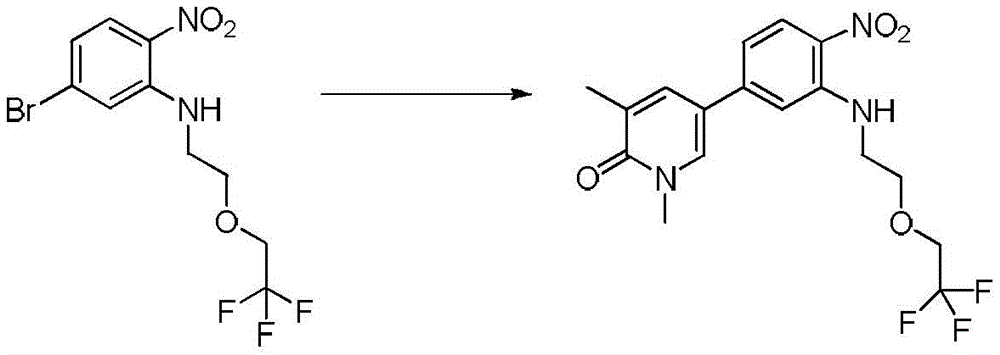
将5-溴-2-硝基-N-(2-(2,2,2-三氟乙氧基)乙基)苯胺(实施例36,步骤1,0.3g,0.87mmol)和1,3-二甲基-5-(4,4,5,5-四甲基-1,3,2-二氧杂硼杂环戊烷-2-基)吡啶-2(1H)-酮(0.26g,1.04mmol)在1,4-二噁烷(5mL)中的搅拌溶液用氮气吹扫10分钟,然后加入Cs2CO3(0.71g,2.18mmol)的水(0.5mL)溶液。再次用氮气吹扫混合物10分钟。加入Pd(PPh3)4(0.10g,0.08mmol)并将反应混合物加热至90℃达16小时。然后真空蒸发溶剂并将残余物用EtOAc(20mL×3)萃取。将合并的有机层用水(20mL)和盐水(20mL)洗涤,用无水Na2SO4干燥,过滤并减压浓缩。粗物质通过使用1.0%MeOH的DCM溶液作为洗脱液的硅胶色谱纯化。将产物级分合并并浓缩至干,得到标题化合物(0.25g,74%),为固体。[M+H]+386.54。5-Bromo-2-nitro-N-(2-(2,2,2-trifluoroethoxy)ethyl)aniline (Example 36, step 1, 0.3 g, 0.87 mmol) and 1,3 -Dimethyl-5-(4,4,5,5-tetramethyl-1,3,2-dioxaborol-2-yl)pyridin-2(1H)-one (0.26g , 1.04 mmol) in 1,4-dioxane (5 mL) was purged with nitrogen for 10 min, then a solution of Cs2CO3 ( 0.71 g, 2.18 mmol) in water (0.5 mL) was added. The mixture was again purged with nitrogen for 10 minutes. Pd( PPh3 ) 4 (0.10 g, 0.08 mmol) was added and the reaction mixture was heated to 90 °C for 16 hours. The solvent was then evaporated in vacuo and the residue was extracted with EtOAc (20 mL x 3). The combined organic layers were washed with water (20 mL) and brine (20 mL), dried over anhydrous Na 2 SO 4 , filtered and concentrated under reduced pressure. The crude material was purified by silica gel chromatography using 1.0% MeOH in DCM as eluent. The product fractions were combined and concentrated to dryness to give the title compound (0.25 g, 74%) as a solid. [M+H] + 386.54.
步骤2:制备5-(4-氨基-3-((2-(2,2,2-三氟乙氧基)乙基)氨基)苯基)-1,3-二甲基吡啶-2(1H)-酮Step 2: Preparation of 5-(4-Amino-3-((2-(2,2,2-trifluoroethoxy)ethyl)amino)phenyl)-1,3-lutidine-2( 1H)-keto

向(1,3-二甲基-5-(4-硝基-3-((2-(2,2,2-三氟乙氧基)乙基)氨基)苯基)吡啶-2(1H)-酮(0.2g,0.51mmol)在MeOH(8mL)中的搅拌溶液中加入锌(0.35g,10mmol),然后加入乙酸(0.08mL,1.53mmol),并在室温下搅拌30分钟。将所得混合物用NaHCO3中和,倒入水(40mL)中并用EtOAc(20mL×3)萃取。将合并的有机层用盐水(25mL)洗涤,用无水Na2SO4,干燥,过滤并减压浓缩。通过使用1.3%MeOH的DCM溶液作为洗脱液的硅胶色谱纯化粗物质。合并产物级分并减压浓缩,得到标题化合物(0.06g,92%),为固体。[M+H]+356.29。To (1,3-dimethyl-5-(4-nitro-3-((2-(2,2,2-trifluoroethoxy)ethyl)amino)phenyl)pyridine-2(1H )-one (0.2 g, 0.51 mmol) in MeOH (8 mL) was added zinc (0.35 g, 10 mmol) followed by acetic acid (0.08 mL, 1.53 mmol) and stirred at room temperature for 30 min. The resulting The mixture was neutralized with NaHCO3 , poured into water (40 mL) and extracted with EtOAc (20 mL x 3). The combined organic layers were washed with brine ( 25 mL), dried over anhydrous Na2SO4 , filtered and concentrated under reduced pressure The crude material was purified by silica gel chromatography using 1.3% MeOH in DCM as eluent. Product fractions were combined and concentrated under reduced pressure to give the title compound (0.06 g, 92%) as a solid. [M+H] + 356.29 .
步骤3:化合物45的制备Step 3: Preparation of Compound 45

将5-(4-氨基-3-((2-(2,2,2-三氟乙氧基)乙基)氨基)苯基)-1,3-二甲基吡啶-2(1H)-酮(0.17g,0.47mmol)和环丙烷甲醛(0.04g,0.57mmol)在乙酸(10mL)中的溶液在室温下搅拌14小时。反应完成后,真空蒸发溶剂并用饱和NaHCO3(20mL)中和并用EtOAc(25mL×3)萃取,将有机层用盐水(20mL)洗涤,经无水Na2SO4干燥,过滤并在减压下浓缩。通过快速色谱纯化粗物质,产物在1.5%MeOH的DCM溶液中梯度洗脱,得到化合物45(0.06g),为灰白色固体(31%产率)。1H NMR(400MHz,DMSO)δppm 7.95(s,1H),7.79(s,1H),7.69(s,1H),7.47(d,J=8Hz,1H),7.33(d,J=8Hz,1H),4.58(s,2H),4.07(q,J=9.2Hz,2H),3.97(s,2H),3.53(s,3H),2.27-2.25(m,1H),2.10(s,3H),1.05-1.03(m,4H)。[M+H]+405.42。5-(4-Amino-3-((2-(2,2,2-trifluoroethoxy)ethyl)amino)phenyl)-1,3-lutidine-2(1H)- A solution of ketone (0.17 g, 0.47 mmol) and cyclopropanecarbaldehyde (0.04 g, 0.57 mmol) in acetic acid (10 mL) was stirred at room temperature for 14 hours. After completion of the reaction, the solvent was evaporated in vacuo and neutralized with saturated NaHCO 3 (20 mL) and extracted with EtOAc (25 mL×3), the organic layer was washed with brine (20 mL), dried over anhydrous Na 2 SO 4 , filtered and under reduced pressure concentrate. The crude material was purified by flash chromatography eluting with a gradient of 1.5% MeOH in DCM to give compound 45 (0.06 g) as an off-white solid (31% yield). 1 H NMR (400MHz, DMSO) δppm 7.95(s, 1H), 7.79(s, 1H), 7.69(s, 1H), 7.47(d, J=8Hz, 1H), 7.33(d, J=8Hz, 1H) ), 4.58(s, 2H), 4.07(q, J=9.2Hz, 2H), 3.97(s, 2H), 3.53(s, 3H), 2.27-2.25(m, 1H), 2.10(s, 3H) , 1.05-1.03 (m, 4H). [M+H] + 405.42.
实施例41:1,3-二甲基-5-(2-(四氢-2H-吡喃-4-基)-1-(3,3,3-三氟-2-甲基丙基)-1H-苯并[d]咪唑-6-基)吡啶-2(1H)-酮(化合物46a和46b)Example 41: 1,3-Dimethyl-5-(2-(tetrahydro-2H-pyran-4-yl)-1-(3,3,3-trifluoro-2-methylpropyl) -1H-Benzo[d]imidazol-6-yl)pyridin-2(1H)-one (compounds 46a and 46b)

步骤1:制备5-溴-2-硝基-N-(3,3,3-三氟-2-甲基丙基)苯胺Step 1: Preparation of 5-bromo-2-nitro-N-(3,3,3-trifluoro-2-methylpropyl)aniline

将TEA(0.24mL,2.48mmol)加入到4-溴-2-氟-1-硝基苯(0.4g,1.83mmol)和3,3,3-三氟-2-甲基丙-1-胺盐酸盐(0.36g,2.20mmol)在乙醇(8mL)中的室溫搅拌溶液中,将反应混合物在70℃加热8小时。所得混合物用水(100mL)稀释并用EtOAc(100mL×3)萃取。将合并的有机层用盐水(30mL)洗涤,经无水Na2SO4干燥,过滤并减压浓缩。粗物质通过硅胶色谱纯化,使用梯度的1-3%EtOAc的己烷溶液作为洗脱液。将产物级分合并并浓缩至干,得到标题化合物(0.46g,52%),为固体。MH-326.9。TEA (0.24 mL, 2.48 mmol) was added to 4-bromo-2-fluoro-1-nitrobenzene (0.4 g, 1.83 mmol) and 3,3,3-trifluoro-2-methylpropan-1-amine In a stirred solution of the hydrochloride salt (0.36 g, 2.20 mmol) in ethanol (8 mL) at room temperature, the reaction mixture was heated at 70 °C for 8 h. The resulting mixture was diluted with water (100 mL) and extracted with EtOAc (100 mL x 3). The combined organic layers were washed with brine (30 mL), dried over anhydrous Na 2 SO 4 , filtered and concentrated under reduced pressure. The crude material was purified by silica gel chromatography using a gradient of 1-3% EtOAc in hexanes as eluent. The product fractions were combined and concentrated to dryness to give the title compound (0.46 g, 52%) as a solid. MH - 326.9.
步骤2:制备5-溴-N1-(3,3,3-三氟-2-甲基丙基)苯-1,2-二胺Step 2: Preparation of 5 -bromo-N1-(3,3,3-trifluoro-2-methylpropyl)benzene-1,2-diamine
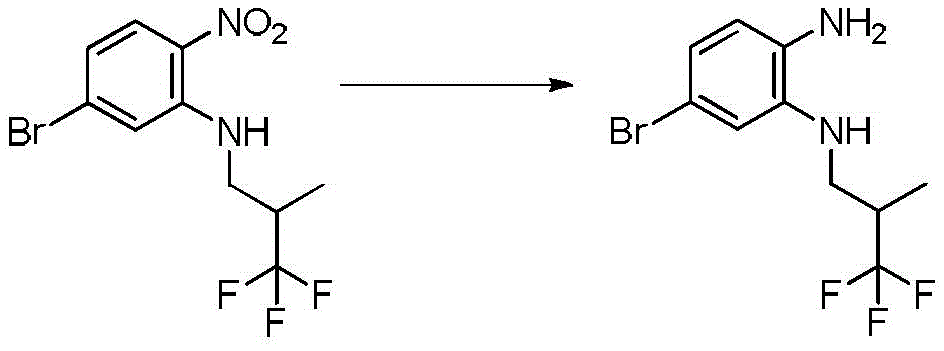
向5-溴-2-硝基-N-(3,3,3-三氟-2-甲基丙基)苯胺(0.46g,1.40mmol)在MeOH(8mL)和水(4mL)中的室温悬浮液中加入连二亚硫酸钠(2.14g,16.88mmol),将反应混合物在50℃加热1小时。将反应混合物用水(50mL)稀释并用DCM(50mL×3)萃取。将合并的有机层用盐水(50mL)洗涤,用无水Na2SO4干燥,过滤并减压浓缩,得到标题化合物(0.3g,71%),为白色固体。[M+H]+297.1,299.2。To 5-bromo-2-nitro-N-(3,3,3-trifluoro-2-methylpropyl)aniline (0.46 g, 1.40 mmol) in MeOH (8 mL) and water (4 mL) at room temperature To the suspension was added sodium dithionite (2.14 g, 16.88 mmol) and the reaction mixture was heated at 50°C for 1 hour. The reaction mixture was diluted with water (50 mL) and extracted with DCM (50 mL x 3). The combined organic layers were washed with brine (50 mL), dried over anhydrous Na2SO4 , filtered and concentrated under reduced pressure to give the title compound (0.3 g, 71%) as a white solid. [M+H] + 297.1, 299.2.
步骤3:制备6-溴-2-(四氢-2H-吡喃-4-基)-1-(3,3,3-三氟-2-甲基丙基)-1H-苯并[d]咪唑Step 3: Preparation of 6-bromo-2-(tetrahydro-2H-pyran-4-yl)-1-(3,3,3-trifluoro-2-methylpropyl)-1H-benzo[d ]imidazole

向5-溴-N1-(3,3,3-三氟-2-甲基丙基)苯-1,2-二胺(0.3g,1.10mmol)在乙酸(5mL)中的搅拌溶液中加入四氢-2H-吡喃-4-甲醛(0.13g,1.21mmol),并将反应混合物在室温下搅拌48小时。将所得混合物减压浓缩。将饱和NaHCO3水溶液加入到残余物中并将水层用EtOAc(50mL×3)萃取。将合并的EtOAc层用盐水溶液(50mL)洗涤,用无水Na2SO4干燥,过滤并减压浓缩。通过硅胶色谱使用梯度的35-40%EtOAc的己烷溶液作为洗脱液纯化粗物质。将产物级分合并并真空浓缩,得到标题化合物(0.28g,70%),为固体。[M+H]+391.1,393.2。To a stirred solution of 5 -bromo-N1-(3,3,3-trifluoro-2-methylpropyl)benzene-1,2-diamine (0.3 g, 1.10 mmol) in acetic acid (5 mL) Tetrahydro-2H-pyran-4-carbaldehyde (0.13 g, 1.21 mmol) was added and the reaction mixture was stirred at room temperature for 48 hours. The resulting mixture was concentrated under reduced pressure. Saturated aqueous NaHCO3 was added to the residue and the aqueous layer was extracted with EtOAc (50 mL x 3). The combined EtOAc layers were washed with brine solution (50 mL), dried over anhydrous Na2SO4 , filtered and concentrated under reduced pressure. The crude material was purified by silica gel chromatography using a gradient of 35-40% EtOAc in hexanes as eluent. The product fractions were combined and concentrated in vacuo to give the title compound (0.28 g, 70%) as a solid. [M+H] + 391.1, 393.2.
步骤4:制备化合物46a和46bStep 4: Preparation of Compounds 46a and 46b

将6-溴-2-(四氢-2H-吡喃-4-基)-1-(3,3,3-三氟-2-甲基丙基)-1H-苯并[d]咪唑(0.18g,0.51mmol)和1,3-二甲基-5-(4,4,5,5-四甲基-1,3,2-二氧杂硼杂环戊烷-2-基)吡啶-2(1H)-酮(0.165g,0.66mmol)在1,4-二噁烷(3mL)中的搅拌溶液用氮气吹扫20分钟,随后加入水(0.3mL)中的Na2CO3(0.162g,1.52mmol)并用氮气再吹扫20分钟。加入Pd(PPh3)4(0.030g,0.022mmol)并将反应混合物在90℃加热16小时。将所得混合物用水(30mL)稀释并用EtOAc(30mL×3)萃取。将合并的有机层用盐水(30mL)洗涤,用无水Na2SO4干燥,过滤并减压浓缩。通过硅胶色谱使用梯度的3-5%MeOH的DCM溶液作为洗脱液纯化粗物质。将产物级分合并并蒸发至干,得到0.09g作为外消旋产物的化合物46。将化合物46使用(A)液体CO2(B)0.3%DEA的IPA溶液,(A):(B)=85:15,通过手性制备HPLC进一步纯化(ChiralpakTM AD-H(250×21)mm,5μ柱,流速70.0mL/min),得到为固体的第一级分(化合物46a,0.025g)和第二级分(化合物46b,0.023g)(总共21%产率)。6-Bromo-2-(tetrahydro-2H-pyran-4-yl)-1-(3,3,3-trifluoro-2-methylpropyl)-1H-benzo[d]imidazole ( 0.18 g, 0.51 mmol) and 1,3-dimethyl-5-(4,4,5,5-tetramethyl-1,3,2-dioxaborol-2-yl)pyridine A stirred solution of -2(1H)-one (0.165 g, 0.66 mmol) in 1,4-dioxane (3 mL) was purged with nitrogen for 20 min, followed by the addition of Na2CO3 in water (0.3 mL) ( 0.162 g, 1.52 mmol) and purged with nitrogen for an additional 20 minutes. Pd( PPh3 ) 4 (0.030 g, 0.022 mmol) was added and the reaction mixture was heated at 90°C for 16 hours. The resulting mixture was diluted with water (30 mL) and extracted with EtOAc (30 mL x 3). The combined organic layers were washed with brine (30 mL), dried over anhydrous Na 2 SO 4 , filtered and concentrated under reduced pressure. The crude material was purified by silica gel chromatography using a gradient of 3-5% MeOH in DCM as eluent. The product fractions were combined and evaporated to dryness to yield 0.09 g of compound 46 as a racemic product. Compound 46 was further purified by chiral preparative HPLC using (A) liquid CO 2 (B) 0.3% DEA in IPA, (A):(B)=85:15 (Chiralpak ™ AD-H (250×21) mm, 5μ column, flow rate 70.0 mL/min), the first fraction (compound 46a, 0.025 g) and the second fraction (compound 46b, 0.023 g) were obtained as solids (21% yield total).
化合物46a:1H NMR(400MHz,DMSO)7.98(d,J=2.4Hz,1H),7.81(s,1H),7.69(s,1H),7.60(d,J=8.4Hz,1H),7.38(dd,J=1.6和2Hz,1H),4.58(dd,J=7.6和15.2Hz,1H),4.39(dd,J=7.6和15.2Hz,1H),3.97(t,J=7.8Hz,2H),3.54-3.48(m,4H),3.48(m,1H),3.19-3.15(m,2H),2.11(s,3H),1.98-1.911(m,1H),1.87-1.76(m,3H),1.12(d,J=7.2Hz,3H)。[M+H]+434.4。Compound 46a: 1 H NMR (400 MHz, DMSO) 7.98 (d, J=2.4 Hz, 1H), 7.81 (s, 1H), 7.69 (s, 1H), 7.60 (d, J=8.4 Hz, 1H), 7.38 (dd, J=1.6 and 2Hz, 1H), 4.58 (dd, J=7.6 and 15.2Hz, 1H), 4.39 (dd, J=7.6 and 15.2Hz, 1H), 3.97 (t, J=7.8Hz, 2H) ), 3.54-3.48(m, 4H), 3.48(m, 1H), 3.19-3.15(m, 2H), 2.11(s, 3H), 1.98-1.911(m, 1H), 1.87-1.76(m, 3H ), 1.12 (d, J=7.2Hz, 3H). [M+H] + 434.4.
化合物46b:1H NMR(400MHz,DMSO)7.98(d,J=2.4Hz,1H),7.81(s,1H),7.69(s,1H),7.60(d,J=8.4Hz,1H),7.38(dd,J=1.6和2Hz,1H),4.58(dd,J=7.6和15.2Hz,1H),4.39(dd,J=7.6和15.2Hz,1H),3.97(t,J=7.8Hz,2H),3.54-3.48(m,4H),3.48(m,1H),3.19-3.15(m,2H),2.11(s,3H),1.98-1.911(m,1H),1.87-1.76(m,3H),1.12(d,J=7.2Hz,3H)。[M+H]+434.4。Compound 46b: 1 H NMR (400 MHz, DMSO) 7.98 (d, J=2.4 Hz, 1H), 7.81 (s, 1H), 7.69 (s, 1H), 7.60 (d, J=8.4 Hz, 1H), 7.38 (dd, J=1.6 and 2Hz, 1H), 4.58 (dd, J=7.6 and 15.2Hz, 1H), 4.39 (dd, J=7.6 and 15.2Hz, 1H), 3.97 (t, J=7.8Hz, 2H) ), 3.54-3.48(m, 4H), 3.48(m, 1H), 3.19-3.15(m, 2H), 2.11(s, 3H), 1.98-1.911(m, 1H), 1.87-1.76(m, 3H ), 1.12 (d, J=7.2Hz, 3H). [M+H] + 434.4.
实施例42:(R)-5-(1-(1-乙氧基丙-2-基)-2-(四氢-2H-吡喃-4-基)-1H-苯并[d]咪唑-6-基)-1,3-二甲基吡啶-2(1H)-酮(化合物47)Example 42: (R)-5-(1-(1-ethoxyprop-2-yl)-2-(tetrahydro-2H-pyran-4-yl)-1H-benzo[d]imidazole -6-yl)-1,3-lutidine-2(1H)-one (Compound 47)

步骤1:(R)-2-((5-溴-2-硝基苯基)氨基)丙-1-醇的制备Step 1: Preparation of (R)-2-((5-bromo-2-nitrophenyl)amino)propan-1-ol

将TEA(0.95mL,6.82mmol)加入到4-溴-2-氟-1-硝基苯(0.5g,2.27mmol)和(R)-2-氨基丙-1-醇(0.34g,4.54mmol)在乙醇(10mL)中的搅拌溶液中并将反应混合物加热至70℃持续3小时。将所得混合物用水(70mL)稀释并用EtOAc(70mL×3)萃取。将合并的有机层经无水Na2SO4干燥,过滤并减压浓缩至干,得到标题化合物(0.6g,96%),为固体。1H NMR(400MHz,DMSO)δ8.19(d,J=7.6Hz,1H),7.99(d,J=9.2Hz,1H),7.34(d,J=2Hz,1H),6.83(dd,J=2和9.2Hz,1H),5.08(bs,1H),3.94-3.88(m,1H),3.55-3.34(m,2H),1.18(dd,J=6.4和7.2Hz,1H)。[M+H]+275.13。TEA (0.95 mL, 6.82 mmol) was added to 4-bromo-2-fluoro-1-nitrobenzene (0.5 g, 2.27 mmol) and (R)-2-aminopropan-1-ol (0.34 g, 4.54 mmol) ) in a stirred solution of ethanol (10 mL) and the reaction mixture was heated to 70°C for 3 hours. The resulting mixture was diluted with water (70 mL) and extracted with EtOAc (70 mL x 3). The combined organic layers were dried over anhydrous Na2SO4 , filtered and concentrated to dryness under reduced pressure to give the title compound (0.6 g, 96%) as a solid. 1 H NMR(400MHz, DMSO)δ8.19(d,J=7.6Hz,1H),7.99(d,J=9.2Hz,1H),7.34(d,J=2Hz,1H),6.83(dd,J = 2 and 9.2 Hz, 1H), 5.08 (bs, 1H), 3.94-3.88 (m, 1H), 3.55-3.34 (m, 2H), 1.18 (dd, J=6.4 and 7.2 Hz, 1H). [M+H] + 275.13.
步骤2:制备(R)-5-溴-N-(1-乙氧基丙-2-基)-2-硝基苯胺Step 2: Preparation of (R)-5-bromo-N-(1-ethoxyprop-2-yl)-2-nitroaniline

向(R)-2-((5-溴-2-硝基苯基)氨基)丙-1-醇(0.6g,2.18mmol)在DMF(10mL)中的0℃搅拌悬浮液中加入60%NaH矿物油(0.13g,3.27mmol)并在相同温度下搅拌30分钟。在0℃滴加碘乙烷(0.26mL,3.27mmol),并将反应混合物在室温下搅拌16小时。将反应混合物用水(100mL)稀释并用EtOAc(70mL×3)萃取。将合并的有机层用盐水(70mL)洗涤,用无水Na2SO4干燥,过滤并减压浓缩。粗物质通过使用10%EtOAc的己烷溶液作为洗脱液的硅胶色谱纯化。将级分合并并浓缩至干,得到标题化合物(0.5g,75%),为油状物。1H NMR(400MHz,DMSO)δ8.19(d,J=8Hz,1H),7.98(d,J=9.2Hz,1H),7.36(d,J=2Hz,1H),6.83(dd,J=2和9.2Hz,1H),4.11-4.05(m,1H),3.54-3.47(m,4H),1.21(d,J=6.4Hz,3H),1.13(t,J=7Hz,3H),[M+H]+303.14。To a stirred suspension of (R)-2-((5-bromo-2-nitrophenyl)amino)propan-1-ol (0.6 g, 2.18 mmol) in DMF (10 mL) at 0°C was added 60% NaH mineral oil (0.13 g, 3.27 mmol) and stirred at the same temperature for 30 minutes. Iodoethane (0.26 mL, 3.27 mmol) was added dropwise at 0°C and the reaction mixture was stirred at room temperature for 16 hours. The reaction mixture was diluted with water (100 mL) and extracted with EtOAc (70 mL x 3). The combined organic layers were washed with brine (70 mL), dried over anhydrous Na 2 SO 4 , filtered and concentrated under reduced pressure. The crude material was purified by silica gel chromatography using 10% EtOAc in hexanes as eluent. The fractions were combined and concentrated to dryness to give the title compound (0.5 g, 75%) as an oil. 1 H NMR (400MHz, DMSO) δ 8.19 (d, J=8Hz, 1H), 7.98 (d, J=9.2Hz, 1H), 7.36 (d, J=2Hz, 1H), 6.83 (dd, J= 2 and 9.2Hz, 1H), 4.11-4.05(m, 1H), 3.54-3.47(m, 4H), 1.21(d, J=6.4Hz, 3H), 1.13(t, J=7Hz, 3H), [ M+H] + 303.14.
步骤3:制备(R)-5-(3-((1-乙氧基丙-2-基)氨基)-4-硝基苯基)-1,3-二甲基吡啶-2(1H)-酮Step 3: Preparation of (R)-5-(3-((1-ethoxyprop-2-yl)amino)-4-nitrophenyl)-1,3-lutidine-2(1H) -ketone

将(R)-5-溴-N-(1-乙氧基丙烷-2-基)-2-硝基苯胺(0.5g,1.65mmol)和1,3-二甲基-5-(4,4,5,5-四甲基-1,3,2-二氧杂硼杂环戊烷-2-基)吡啶-2(1H)-酮(0.49g,1.98mmol)在DME(10mL)中的搅拌溶液在室温下用氮气吹扫15分钟,接着加入Cs2CO3(1.34g,4.12mmol)的水(2mL)溶液并用氮气吹扫另外15分钟。加入Pd(PPh3)4(0.19g,0.16mmol)并将反应混合物加热至80℃达16小时。然后将所得混合物通过CeliteTM过滤并用EtOAc(15mL×3)洗涤。将合并的有机层用盐水(50mL)洗涤,经无水Na2SO4干燥,过滤并减压浓缩。通过使用1-2%MeOH的DCM溶液作为洗脱液的硅胶色谱纯化粗物质。合并产物级分并蒸发至干,得到为固体的标题化合物(0.5g,88%),[M+H]+346.29。(R)-5-Bromo-N-(1-ethoxypropan-2-yl)-2-nitroaniline (0.5 g, 1.65 mmol) and 1,3-dimethyl-5-(4, 4,5,5-Tetramethyl-1,3,2-dioxaborol-2-yl)pyridin-2(1H)-one (0.49 g, 1.98 mmol) in DME (10 mL) The stirred solution was purged with nitrogen for 15 min at room temperature, then a solution of Cs2CO3 ( 1.34 g, 4.12 mmol) in water (2 mL) was added and purged with nitrogen for an additional 15 min. Pd( PPh3 ) 4 (0.19 g, 0.16 mmol) was added and the reaction mixture was heated to 80°C for 16 hours. The resulting mixture was then filtered through Celite ™ and washed with EtOAc (15 mL x 3). The combined organic layers were washed with brine (50 mL), dried over anhydrous Na 2 SO 4 , filtered and concentrated under reduced pressure. The crude material was purified by silica gel chromatography using 1-2% MeOH in DCM as eluent. The product fractions were combined and evaporated to dryness to give the title compound as a solid (0.5 g, 88%), [M+H] + 346.29.
步骤4:制备(R)-5-(4-氨基-3-((1-乙氧基丙-2-基)氨基)苯基)-1,3-二甲基吡啶-2(1H)-酮Step 4: Preparation of (R)-5-(4-Amino-3-((1-ethoxyprop-2-yl)amino)phenyl)-1,3-lutidine-2(1H)- ketone

将连二亚硫酸钠(3.34g,17.37mmol)加入到(R)-5-(3-((1-乙氧基丙-2-基)氨基)-4-硝基苯基)-1,3-二甲基吡啶-2(1H)-酮(0.5g,1.45mmol)在MeOH(20mL)和水(10mL)中的室温混悬液中,将反应混合物加热至50℃持续1小时。将所得混合物用水(50mL)稀释并用DCM(50mL×3)萃取。将合并的DCM层用盐水(50mL)洗涤,用无水Na2SO4干燥,过滤并减压浓缩,得到为油状物的标题化合物(0.45g,94%),[M+H]+316.34。Sodium dithionite (3.34 g, 17.37 mmol) was added to (R)-5-(3-((1-ethoxypropan-2-yl)amino)-4-nitrophenyl)-1,3- In a room temperature suspension of lutidine-2(1H)-one (0.5 g, 1.45 mmol) in MeOH (20 mL) and water (10 mL), the reaction mixture was heated to 50 °C for 1 hour. The resulting mixture was diluted with water (50 mL) and extracted with DCM (50 mL x 3). The combined DCM layers were washed with brine (50 mL), dried over anhydrous Na2SO4 , filtered and concentrated under reduced pressure to give the title compound (0.45 g, 94%) as an oil, [M+H] + 316.34.
步骤5:化合物47的制备Step 5: Preparation of Compound 47

将四氢-2H-吡喃-4-甲醛(0.11g,0.95mmol)加至(R)-5-(4-氨基-3-((1-乙氧基丙-2-基)氨基)苯基)-1,3-二甲基吡啶-2(1H)-酮(0.25g,0.79mmol)在乙酸(12mL)中的搅拌溶液中,并将反应混合物在室温下搅拌48小时。然后将所得混合物减压浓缩,用饱和NaHCO3水溶液(50mL)稀释并用EtOAc(30mL×3)萃取。将合并的有机层用盐水(50mL)洗涤,经无水Na2SO4干燥,过滤并减压浓缩。通过使用4%MeOH的DCM溶液作为洗脱液的硅胶色谱纯化粗物质。将级分合并并浓缩,得到化合物47(0.07g,22%),为固体。1H NMR(400MHz,MeOD)δ7.87(d,J=2.4Hz,1H),7.84(d,J=0.8Hz,1H),7.78(d,J=1.2Hz,1H),7.67(d,J=8.4Hz,1H),7.41(dd,J=1.6和8.4Hz,1H),4.96-4.94(m,1H),4.14-4.07(m,3H),3.86-3.82(m,1H),3.70(s,3H),3.69-3.63(m,2H),3.50-3.45(m,1H),3.41-3.35(m,2H),2.24(s,3H),2.11-2.06(m,3H),1.91-1.87(m,1H),1.73(d,J=7.2Hz,3H),1.03(t,J=7.0Hz,3H),[M+H]+410.64。Tetrahydro-2H-pyran-4-carbaldehyde (0.11 g, 0.95 mmol) was added to (R)-5-(4-amino-3-((1-ethoxypropan-2-yl)amino)benzene yl)-1,3-lutidine-2(1H)-one (0.25 g, 0.79 mmol) in a stirred solution of acetic acid (12 mL) and the reaction mixture was stirred at room temperature for 48 hours. The resulting mixture was then concentrated under reduced pressure, diluted with saturated aqueous NaHCO3 (50 mL) and extracted with EtOAc (30 mL x 3). The combined organic layers were washed with brine (50 mL), dried over anhydrous Na 2 SO 4 , filtered and concentrated under reduced pressure. The crude material was purified by silica gel chromatography using 4% MeOH in DCM as eluent. The fractions were combined and concentrated to give compound 47 (0.07 g, 22%) as a solid. 1 H NMR(400MHz,MeOD)δ7.87(d,J=2.4Hz,1H),7.84(d,J=0.8Hz,1H),7.78(d,J=1.2Hz,1H),7.67(d, J=8.4Hz, 1H), 7.41 (dd, J=1.6 and 8.4Hz, 1H), 4.96-4.94 (m, 1H), 4.14-4.07 (m, 3H), 3.86-3.82 (m, 1H), 3.70 (s,3H),3.69-3.63(m,2H),3.50-3.45(m,1H),3.41-3.35(m,2H),2.24(s,3H),2.11-2.06(m,3H),1.91 -1.87(m, 1H), 1.73(d, J=7.2Hz, 3H), 1.03(t, J=7.0Hz, 3H), [M+H] + 410.64.
实施例43:(S)-5-(1-(1-乙氧基丙烷-2-基)-2-(四氢-2H-吡喃-4-基)-1H-苯并[d]咪唑-6-基)-1,3-二甲基吡啶-2(1H)-酮(化合物48)Example 43: (S)-5-(1-(1-ethoxypropan-2-yl)-2-(tetrahydro-2H-pyran-4-yl)-1H-benzo[d]imidazole -6-yl)-1,3-lutidine-2(1H)-one (Compound 48)

步骤1:(S)-(1-乙氧基丙-2-基)氨基甲酸叔丁酯的制备Step 1: Preparation of tert-butyl (S)-(1-ethoxyprop-2-yl)carbamate

向(S)-(1-羟基丙-2-基)氨基甲酸叔丁酯(1.4g,7.99mmol)在DMF(14mL)中的搅拌的0℃溶液中加入60%NaH的矿物油溶液(0.48g,11.98mmol),并将反应混合物在该温度下搅拌30分钟。然后在0℃滴加碘乙烷(0.97mL,11.98mmol)并将该反应在室温下搅拌16小时。然后将所得混合物用水(70mL)稀释并用EtOAc(50mL×3)萃取。将合并的有机层用盐水(70mL)洗涤,用无水Na2SO4干燥,过滤并减压浓缩。将粗物质通过使用20%EtOAc的己烷溶液作为洗脱液的硅胶色谱纯化。将级分合并并浓缩至干,得到标题化合物(1.1g,68%),为油状物。To a stirred 0°C solution of (S)-(1-hydroxyprop-2-yl)carbamate (1.4 g, 7.99 mmol) in DMF (14 mL) was added 60% NaH in mineral oil (0.48 g, 11.98 mmol) and the reaction mixture was stirred at this temperature for 30 minutes. Iodoethane (0.97 mL, 11.98 mmol) was then added dropwise at 0°C and the reaction was stirred at room temperature for 16 hours. The resulting mixture was then diluted with water (70 mL) and extracted with EtOAc (50 mL x 3). The combined organic layers were washed with brine (70 mL), dried over anhydrous Na 2 SO 4 , filtered and concentrated under reduced pressure. The crude material was purified by silica gel chromatography using 20% EtOAc in hexanes as eluent. The fractions were combined and concentrated to dryness to give the title compound (1.1 g, 68%) as an oil.
步骤2:(S)-1-乙氧基丙-2-胺盐酸盐的制备Step 2: Preparation of (S)-1-ethoxypropan-2-amine hydrochloride

向(S)-(1-乙氧基丙烷-2-基)氨基甲酸叔丁酯(1.1g,5.41mmol)在1,4-二噁烷(5mL)中的10℃搅拌溶液中加入6M HCl的二噁烷溶液(11mL)并将反应混合物在室温下搅拌16小时。然后将所得混合物减压浓缩,并用EtOAc(5mL)研磨,得到标题化合物(0.7g,93%),为固体。To a stirred solution of (S)-(1-ethoxypropan-2-yl)carbamate (1.1 g, 5.41 mmol) in 1,4-dioxane (5 mL) at 10°C was added 6M HCl solution in dioxane (11 mL) and the reaction mixture was stirred at room temperature for 16 hours. The resulting mixture was then concentrated under reduced pressure and triturated with EtOAc (5 mL) to give the title compound (0.7 g, 93%) as a solid.
步骤3:(S)-5-溴-N-(1-乙氧基丙烷-2-基)-2-硝基苯胺的制备Step 3: Preparation of (S)-5-bromo-N-(1-ethoxypropan-2-yl)-2-nitroaniline
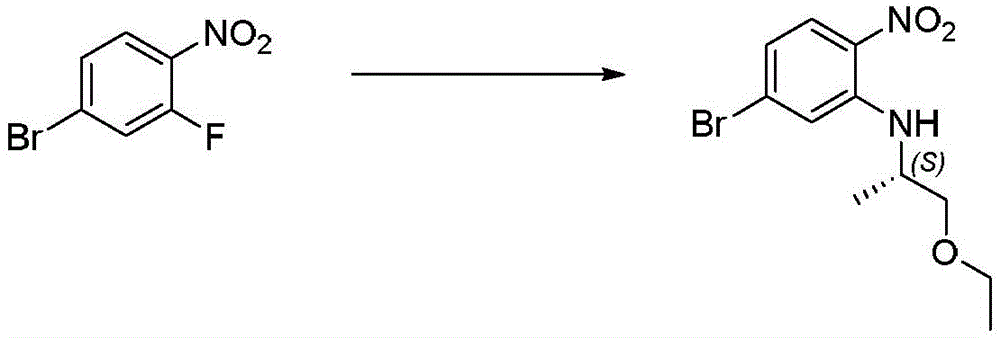
将TEA(0.95mL,6.82mmol)加入到4-溴-2-氟-1-硝基苯(0.5g,2.27mmol)和(S)-1-乙氧基丙-2-胺盐酸盐(0.45g,3.27mmol)在乙醇(10mL)中的室温搅拌溶液中并将反应混合物加热至70℃持续3小时。然后将所得混合物用水(70mL)稀释并用EtOAc(70mL×3)萃取。将合并的有机层经无水Na2SO4干燥,过滤并减压浓缩,得到标题化合物(0.65g,94%),为油状物。1H NMR(400MHz,DMSO)δ8.19(d,J=8Hz,1H),7.98(d,J=9.2Hz,1H),7.36(d,J=2Hz,1H),6.83(dd,J=2和9.2Hz,1H),4.11-4.06(m,1H),3.54-3.47(m,4H),1.21(d,J=6.4Hz,3H),1.12(t,J=6.8Hz,3H),[M+H]+303.14。TEA (0.95 mL, 6.82 mmol) was added to 4-bromo-2-fluoro-1-nitrobenzene (0.5 g, 2.27 mmol) and (S)-1-ethoxypropan-2-amine hydrochloride ( 0.45 g, 3.27 mmol) in a stirred solution of ethanol (10 mL) at room temperature and the reaction mixture was heated to 70 °C for 3 hours. The resulting mixture was then diluted with water (70 mL) and extracted with EtOAc (70 mL x 3). The combined organic layers were dried over anhydrous Na2SO4 , filtered and concentrated under reduced pressure to give the title compound (0.65 g, 94%) as an oil. 1 H NMR (400MHz, DMSO) δ 8.19 (d, J=8Hz, 1H), 7.98 (d, J=9.2Hz, 1H), 7.36 (d, J=2Hz, 1H), 6.83 (dd, J= 2 and 9.2Hz, 1H), 4.11-4.06(m, 1H), 3.54-3.47(m, 4H), 1.21(d, J=6.4Hz, 3H), 1.12(t, J=6.8Hz, 3H), [M+H] + 303.14.
步骤4:(S)-5-(3-((1-乙氧基丙-2-基)氨基)-4-硝基苯基)-1,3-二甲基吡啶-2(1H)-酮的制备Step 4: (S)-5-(3-((1-Ethoxyprop-2-yl)amino)-4-nitrophenyl)-1,3-lutidine-2(1H)- Preparation of ketones

将(S)-5-溴-N-(1-乙氧基丙烷-2-基)-2-硝基苯胺(0.65g,2.14mmol)和1,3-二甲基-5-(4,4,5,5-四甲基-1,3,2-二氧硼杂环戊烷-2-基)吡啶-2(1H)-酮(0.64g,2.57mmol)在DME(13mL)中的搅拌溶液在室温用氮气吹扫15分钟,接着加入水(2mL)中的Cs2CO3(1.75g,5.36mmol)并用氮气吹扫另外15分钟。加入Pd(PPh3)4(0.19g,0.16mmol)并将反应混合物加热至80℃达16小时。然后将所得混合物通过CeliteTM过滤并用EtOAc(15mL×3)洗涤。将合并的有机层用盐水(50mL)洗涤,用无水Na2SO4干燥,过滤并减压浓缩。通过使用2%MeOH的DCM溶液作为洗脱液的硅胶色谱纯化粗物质。将产物级分合并并蒸发至干,得到为固体的标题化合物(0.7g,94%),[M+H]+346.29。Combine (S)-5-bromo-N-(1-ethoxypropan-2-yl)-2-nitroaniline (0.65 g, 2.14 mmol) and 1,3-dimethyl-5-(4, 4,5,5-Tetramethyl-1,3,2-dioxaborol-2-yl)pyridin-2(1H)-one (0.64 g, 2.57 mmol) in DME (13 mL) The stirred solution was purged with nitrogen for 15 minutes at room temperature, then Cs2CO3 ( 1.75 g, 5.36 mmol) in water (2 mL) was added and purged with nitrogen for an additional 15 minutes. Pd( PPh3 ) 4 (0.19 g, 0.16 mmol) was added and the reaction mixture was heated to 80°C for 16 hours. The resulting mixture was then filtered through Celite ™ and washed with EtOAc (15 mL x 3). The combined organic layers were washed with brine (50 mL), dried over anhydrous Na 2 SO 4 , filtered and concentrated under reduced pressure. The crude material was purified by silica gel chromatography using 2% MeOH in DCM as eluent. The product fractions were combined and evaporated to dryness to give the title compound as a solid (0.7 g, 94%), [M+H] + 346.29.
步骤5:(S)-5-(4-氨基-3-((1-乙氧基丙烷-2-基)氨基)苯基)-1,3-二甲基吡啶-2(1H)-酮的制备Step 5: (S)-5-(4-Amino-3-((1-ethoxypropan-2-yl)amino)phenyl)-1,3-lutidine-2(1H)-one preparation

将连二亚硫酸钠(4.67g,24.32mmol)加入到(S)-5-(3-((1-乙氧基丙-2-基)氨基)-4-硝基苯基)-1,3-二甲基吡啶-2(1H)-酮(0.7g,2.03mmol)在MeOH(20mL)和水(10mL)中的室温混悬液中并将反应混合物加热至50℃持续1小时。所得混合物用水(50mL)稀释并用DCM(50mL×3)萃取。将合并的DCM层用盐水(50mL)洗涤,用无水Na2SO4干燥,过滤并减压浓缩,得到为油状物的标题化合物(0.6g,94%),[M+H]+316.34。Sodium dithionite (4.67 g, 24.32 mmol) was added to (S)-5-(3-((1-ethoxyprop-2-yl)amino)-4-nitrophenyl)-1,3- A suspension of lutidine-2(1H)-one (0.7 g, 2.03 mmol) in MeOH (20 mL) and water (10 mL) at room temperature and the reaction mixture was heated to 50 °C for 1 hour. The resulting mixture was diluted with water (50 mL) and extracted with DCM (50 mL x 3). The combined DCM layers were washed with brine (50 mL), dried over anhydrous Na2SO4 , filtered and concentrated under reduced pressure to give the title compound (0.6 g, 94%) as an oil, [M+H] + 316.34.
步骤6:化合物48的制备Step 6: Preparation of Compound 48

将四氢-2H-吡喃-4-甲醛(0.13g,1.14mmol)加至(S)-5-(4-氨基-3-((1-乙氧基丙烷-2-基)氨基)苯基)-1,3-二甲基吡啶-2(1H)-酮(0.3g,0.95mmol)在乙酸(15mL)中的搅拌溶液中并将反应混合物在室温下搅拌48小时。然后将所得混合物减压浓缩,用饱和NaHCO3水溶液(60mL)稀释并用EtOAc(40mL×3)萃取。将合并的有机层用盐水(50mL)洗涤,用无水Na2SO4干燥,过滤并减压浓缩。粗物质通过使用4%MeOH的DCM溶液作为洗脱液的硅胶色谱纯化。合并级分并浓缩,得到化合物48(0.08g,21%),其为固体。1H NMR(400MHz,MeOD)δ7.88(d,J=2.4Hz,1H),7.84(d,J=0.8Hz,1H),7.78(d,J=1.2Hz,1H),7.68(d,J=8.4Hz,1H),7.42(dd,J=1.6和8.4Hz,1H),4.96-4.95(m,1H),4.14-4.07(m,3H),3.86-3.82(m,1H),3.70(s,3H),3.69-3.63(m,2H),3.50-3.46(m,1H),3.40-3.35(m,2H),2.24(s,3H),2.11-2.05(m,3H),1.91-1.87(m,1H),1.73(d,J=6.8Hz,3H),1.03(t,J=7.0Hz,3H)。[M+H]+410.64。Tetrahydro-2H-pyran-4-carbaldehyde (0.13 g, 1.14 mmol) was added to (S)-5-(4-amino-3-((1-ethoxypropan-2-yl)amino)benzene (0.3 g, 0.95 mmol) in a stirred solution of acetic acid (15 mL) and the reaction mixture was stirred at room temperature for 48 hours. The resulting mixture was then concentrated under reduced pressure, diluted with saturated aqueous NaHCO3 (60 mL) and extracted with EtOAc (40 mL x 3). The combined organic layers were washed with brine (50 mL), dried over anhydrous Na 2 SO 4 , filtered and concentrated under reduced pressure. The crude material was purified by silica gel chromatography using 4% MeOH in DCM as eluent. Fractions were combined and concentrated to give compound 48 (0.08 g, 21%) as a solid. 1 H NMR(400MHz,MeOD)δ7.88(d,J=2.4Hz,1H),7.84(d,J=0.8Hz,1H),7.78(d,J=1.2Hz,1H),7.68(d, J=8.4Hz, 1H), 7.42 (dd, J=1.6 and 8.4Hz, 1H), 4.96-4.95 (m, 1H), 4.14-4.07 (m, 3H), 3.86-3.82 (m, 1H), 3.70 (s,3H),3.69-3.63(m,2H),3.50-3.46(m,1H),3.40-3.35(m,2H),2.24(s,3H),2.11-2.05(m,3H),1.91 -1.87 (m, 1H), 1.73 (d, J=6.8 Hz, 3H), 1.03 (t, J=7.0 Hz, 3H). [M+H] + 410.64.
实施例44:5-(1-(2-异丙氧基乙基)-2-(四氢-2H-吡喃-4-基)-1H-苯并[d]咪唑-6-基)-1,3-二甲基吡啶-2(1H)-酮(化合物49)Example 44: 5-(1-(2-Isopropoxyethyl)-2-(tetrahydro-2H-pyran-4-yl)-1H-benzo[d]imidazol-6-yl)- 1,3-Lutidine-2(1H)-one (Compound 49)

步骤1:制备5-溴-N-(2-异丙氧基乙基)-2-硝基苯胺Step 1: Preparation of 5-bromo-N-(2-isopropoxyethyl)-2-nitroaniline

将TEA(0.3g,2.95mmol)加入到4-溴-2-氟-1-硝基苯(0.5g,2.27mmol)和2-异丙氧基乙烷-1-胺盐酸盐(0.38g,2.72mmol)在乙醇(8mL)中的室温搅拌溶液中并将反应混合物在70℃加热6小时。然后将所得混合物用水(100mL)稀释并用EtOAc(100mL×3)萃取。合并的EtOAc层用盐水(50mL)洗涤,用无水Na2SO4干燥,过滤并减压浓缩。粗物质通过硅胶色谱纯化,使用梯度的10-30%EtOAc的己烷溶液作为洗脱液。将级分合并并蒸发至干,得到标题化合物(0.6g,57%),其为固体,[M+H]+303.2,305.2。TEA (0.3 g, 2.95 mmol) was added to 4-bromo-2-fluoro-1-nitrobenzene (0.5 g, 2.27 mmol) and 2-isopropoxyethane-1-amine hydrochloride (0.38 g , 2.72 mmol) in a stirred solution of ethanol (8 mL) at room temperature and the reaction mixture was heated at 70 °C for 6 h. The resulting mixture was then diluted with water (100 mL) and extracted with EtOAc (100 mL x 3). The combined EtOAc layers were washed with brine (50 mL), dried over anhydrous Na2SO4 , filtered and concentrated under reduced pressure. The crude material was purified by silica gel chromatography using a gradient of 10-30% EtOAc in hexanes as eluent. Fractions were combined and evaporated to dryness to give the title compound (0.6 g, 57%) as a solid, [M+H] + 303.2, 305.2.
步骤2:制备5-溴-N1-(2-异丙氧基乙基)苯-12-二胺Step 2: Preparation of 5-bromo-N1-( 2 -isopropoxyethyl)benzene-12-diamine

将连二亚硫酸钠(3g,23.76mmol)加入到5-溴-N-(2-异丙氧基乙基)-2-硝基苯胺(0.6g,1.98mmol)在MeOH(10mL)和水(4mL)中的室温悬浮液中,并将反应混合物在50℃加热1小时。将所得混合物用水(50mL)稀释并用EtOAc(50mL×3)萃取。将合并的有机层用盐水(50mL)洗涤,用无水Na2SO4干燥,过滤并真空浓缩,得到标题化合物(0.54g,58%),其为固体,M+2 275.23。Sodium dithionite (3 g, 23.76 mmol) was added to 5-bromo-N-(2-isopropoxyethyl)-2-nitroaniline (0.6 g, 1.98 mmol) in MeOH (10 mL) and water (4 mL) ) in suspension at room temperature and the reaction mixture was heated at 50°C for 1 hour. The resulting mixture was diluted with water (50 mL) and extracted with EtOAc (50 mL x 3). The combined organic layers were washed with brine (50 mL), dried over anhydrous Na2SO4 , filtered and concentrated in vacuo to give the title compound (0.54 g, 58%) as a solid, M +2 275.23.
步骤3:制备6-溴-1-(2-异丙氧基乙基)-2-(四氢-2H-吡喃-4-基)-1H-苯并[d]咪唑Step 3: Preparation of 6-bromo-1-(2-isopropoxyethyl)-2-(tetrahydro-2H-pyran-4-yl)-1H-benzo[d]imidazole

将四氢-2H-吡喃-4-甲醛(0.25g,2.2mmol)加入到5-溴-N1-(2-异丙氧基乙基)苯-1,2-二胺(0.5g,1.83mmol)在乙酸(6mL)中的室温搅拌溶液中,并将反应混合物在相同温度下搅拌48小时。将所得混合物浓缩,向该残余物中加入饱和NaHCO3水溶液(60mL),并将水层用EtOAc(50mL×3)萃取。将合并的有机层用盐水(50mL)洗涤,用无水Na2SO4干燥,过滤并真空浓缩。粗物质通过硅胶色谱纯化,使用梯度的35-40%EtOAc的己烷溶液作为洗脱液。将级分合并,浓缩至干,得到标题化合物(0.28g,42%),为白色固体。M+2 369.24。Tetrahydro-2H-pyran-4-carbaldehyde (0.25 g, 2.2 mmol) was added to 5-bromo-N1-( 2 -isopropoxyethyl)benzene-1,2-diamine (0.5 g, 1.83 mmol) in a stirred solution of acetic acid (6 mL) at room temperature and the reaction mixture was stirred at the same temperature for 48 hours. The resulting mixture was concentrated, to the residue was added saturated aqueous NaHCO 3 (60 mL), and the aqueous layer was extracted with EtOAc (50 mL×3). The combined organic layers were washed with brine (50 mL), dried over anhydrous Na2SO4 , filtered and concentrated in vacuo. The crude material was purified by silica gel chromatography using a gradient of 35-40% EtOAc in hexanes as eluent. The fractions were combined and concentrated to dryness to give the title compound (0.28 g, 42%) as a white solid. M +2 369.24.
步骤4:化合物49的制备Step 4: Preparation of Compound 49

将6-溴-1-(2-异丙氧基乙基)-2-(四氢-2H-吡喃-4-基)-1H-苯并[d]咪唑(0.27g,0.74mmol)和1,3-二甲基-5-(4,4,5,5-四甲基-1,3,2-二氧杂硼杂环戊烷-2-基)吡啶-2(1H)-酮(0.24g,0.97mmol)在1,4-二噁烷(4mL)中的搅拌溶液用氮气吹扫20分钟,接着加入水(0.3mL)中的NaHCO3(0.29g,2.24mmol)并用氮气吹扫另外20分钟。在室温下加入Pd(PPh3)4(0.025g,0.022mmol)并将反应混合物在90℃加热16小时。将所得混合物用水(30mL)稀释并用EtOAc(30mL×3)萃取。将合并的有机层用盐水(30mL)洗涤,用无水Na2SO4干燥,过滤并真空浓缩。通过使用2-3%MeOH的DCM溶液作为洗脱液的硅胶色谱纯化粗物质。将级分合并并浓缩,得到0.13g,将其通过制备型HPLC进一步纯化,使用20-60%MeCN的水溶液,得到为固体的化合物49(0.075g,25%)。1H NMR(400MHz,DMSO)7.97(s,1H),7.81(s,1H),7.71(s,1H),7.57(d,J=8Hz,1H),7.35(d,J=8Hz,1H),4.43(s,2H),3.97(d,J=10Hz,2H),3.69(s,2H),3.53(s,3H),3.51-3.42(m,3H),3.35-3.32(m,1H),2.10(s,3H),1.94-1.80(m,4H),0.95(d,J=6Hz,6H)。[M+H]+410.4。6-Bromo-1-(2-isopropoxyethyl)-2-(tetrahydro-2H-pyran-4-yl)-1H-benzo[d]imidazole (0.27 g, 0.74 mmol) and 1,3-Dimethyl-5-(4,4,5,5-tetramethyl-1,3,2-dioxaborol-2-yl)pyridin-2(1H)-one A stirred solution of (0.24 g, 0.97 mmol) in 1,4-dioxane (4 mL) was purged with nitrogen for 20 min, then NaHCO3 (0.29 g, 2.24 mmol) in water (0.3 mL) was added and purged with nitrogen Sweep for another 20 minutes. Pd( PPh3 ) 4 (0.025 g, 0.022 mmol) was added at room temperature and the reaction mixture was heated at 90°C for 16 hours. The resulting mixture was diluted with water (30 mL) and extracted with EtOAc (30 mL x 3). The combined organic layers were washed with brine (30 mL), dried over anhydrous Na2SO4 , filtered and concentrated in vacuo. The crude material was purified by silica gel chromatography using 2-3% MeOH in DCM as eluent. Fractions were combined and concentrated to give 0.13 g, which was further purified by preparative HPLC using 20-60% MeCN in water to give compound 49 as a solid (0.075 g, 25%). 1 H NMR (400MHz, DMSO) 7.97(s, 1H), 7.81(s, 1H), 7.71(s, 1H), 7.57(d, J=8Hz, 1H), 7.35(d, J=8Hz, 1H) ,4.43(s,2H),3.97(d,J=10Hz,2H),3.69(s,2H),3.53(s,3H),3.51-3.42(m,3H),3.35-3.32(m,1H) , 2.10(s, 3H), 1.94-1.80(m, 4H), 0.95(d, J=6Hz, 6H). [M+H] + 410.4.
实施例45:(R)-5-(1-(1-甲氧基丙-2-基)-2-((四氢-2H-吡喃-4-基)甲基)-1H-苯并[d]嘧啶-6-基)-1,3-二甲基吡啶-2(1H)-酮(化合物50)Example 45: (R)-5-(1-(1-Methoxypropan-2-yl)-2-((tetrahydro-2H-pyran-4-yl)methyl)-1H-benzo [d]pyrimidin-6-yl)-1,3-lutidine-2(1H)-one (Compound 50)
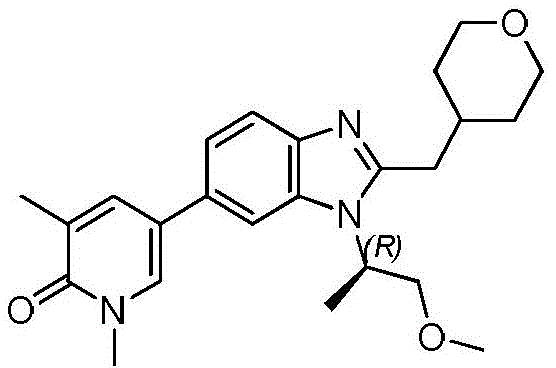
步骤1:制备(R)-5-溴-N-(1-甲氧基丙-2-基)-2-硝基苯胺Step 1: Preparation of (R)-5-bromo-N-(1-methoxyprop-2-yl)-2-nitroaniline
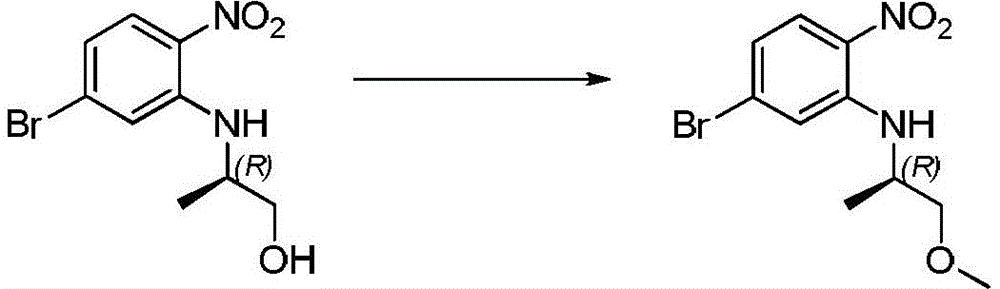
向(R)-2-((5-溴-2-硝基苯基)氨基)丙-1-醇(实施例42,步骤1,0.6g,2.18mmol)在DMF(12mL)中的搅拌的0℃悬浮液中加入60%NaH的矿物油(0.13g,3.27mmol),并将反应混合物在该温度下搅拌30分钟。然后在0℃滴加碘甲烷(0.2mL,3.27mmol),并使混合物在室温下搅拌16小时。然后将所得混合物用水(100mL)稀释并用EtOAc(70mL×3)萃取。将合并的有机层用盐水(70mL)洗涤,用无水Na2SO4干燥,过滤并真空浓缩,得到为油状物的标题化合物(0.6g,95%),M+2291.18。To a stirred solution of (R)-2-((5-bromo-2-nitrophenyl)amino)propan-1-ol (Example 42, step 1, 0.6 g, 2.18 mmol) in DMF (12 mL) To the 0°C suspension was added 60% NaH in mineral oil (0.13 g, 3.27 mmol) and the reaction mixture was stirred at this temperature for 30 minutes. Iodomethane (0.2 mL, 3.27 mmol) was then added dropwise at 0°C and the mixture was allowed to stir at room temperature for 16 hours. The resulting mixture was then diluted with water (100 mL) and extracted with EtOAc (70 mL x 3). The combined organic layers were washed with brine (70 mL), dried over anhydrous Na2SO4 , filtered and concentrated in vacuo to give the title compound (0.6 g, 95%) as an oil, M +2 291.18.
步骤2:制备(R)-5-(3-((1-甲氧基丙-2-基)氨基)-4-硝基苯基)-1,3-二甲基吡啶-2(1H)-酮Step 2: Preparation of (R)-5-(3-((1-methoxyprop-2-yl)amino)-4-nitrophenyl)-1,3-lutidine-2(1H) -ketone
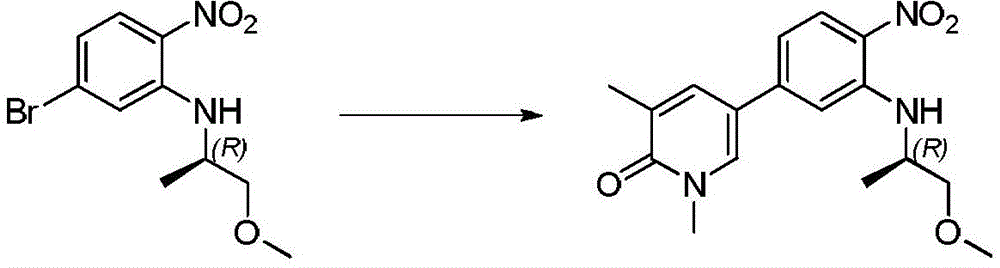
在室温下,将(R)-5-溴-N-(1-甲氧基丙-2-基)-2-硝基苯胺(0.6g,2.07mmol)和1,3-二甲基-5-(4,4,5,5-四甲基-1,3,2-二氧硼杂环戊烷-2-基)吡啶-2(1H)-酮(0.62g,2.49mmol)在DME(12mL)中的搅拌溶液用氮气吹扫15分钟,接着加入Cs2CO3(1.69g,5.19mmol)的水(3mL)溶液并用氮气吹扫另外15分钟。加入Pd(PPh3)4(0.24g,0.21mmol)并将反应混合物加热至80℃持续4小时。然后将所得混合物通过CeliteTM过滤并用EtOAc(15mL×3)洗涤。将合并的有机层用盐水(50mL)洗涤,经无水Na2SO4干燥,过滤并真空浓缩。通过使用1-2%MeOH的DCM溶液作为洗脱液的硅胶色谱纯化粗物质。将级分合并,将溶剂蒸发至干,得到标题化合物(0.4g,58%),为固体,[M+H]+332.29。At room temperature, (R)-5-bromo-N-(1-methoxyprop-2-yl)-2-nitroaniline (0.6 g, 2.07 mmol) and 1,3-dimethyl-5 -(4,4,5,5-Tetramethyl-1,3,2-dioxaborol-2-yl)pyridin-2(1H)-one (0.62 g, 2.49 mmol) in DME ( The stirred solution in 12 mL) was purged with nitrogen for 15 minutes, then a solution of Cs2CO3 (1.69 g, 5.19 mmol) in water ( 3 mL) was added and purged with nitrogen for an additional 15 minutes. Pd( PPh3 ) 4 (0.24 g, 0.21 mmol) was added and the reaction mixture was heated to 80°C for 4 hours. The resulting mixture was then filtered through Celite ™ and washed with EtOAc (15 mL x 3). The combined organic layers were washed with brine (50 mL), dried over anhydrous Na2SO4 , filtered and concentrated in vacuo. The crude material was purified by silica gel chromatography using 1-2% MeOH in DCM as eluent. The fractions were combined and the solvent was evaporated to dryness to give the title compound (0.4 g, 58%) as a solid, [M+H] + 332.29.
步骤3:制备(R)-5-(4-氨基-3-((1-甲氧基丙-2-基)氨基)苯基)-1,3-二甲基吡啶-2-酮Step 3: Preparation of (R)-5-(4-amino-3-((1-methoxyprop-2-yl)amino)phenyl)-1,3-lutidine-2-one

将连二亚硫酸钠(2.8g,14.48mmol)加入到(R)-5-(3-((1-甲氧基丙-2-基)氨基)-4-硝基苯基)-1,3-二甲基吡啶-2(1H)-酮(0.4g,1.21mmol)在MeOH(15mL)和水(8mL)中的室温混悬液中,并将反应混合物在50℃加热1小时。将所得混合物用水(50mL)稀释并用DCM(50mL×3)萃取。将合并的DCM层用盐水(50mL)洗涤,经无水Na2SO4干燥,过滤并浓缩至干,得到标题化合物(0.3g,82%),为固体,[M+H]+302.39。Sodium dithionite (2.8 g, 14.48 mmol) was added to (R)-5-(3-((1-methoxyprop-2-yl)amino)-4-nitrophenyl)-1,3- A suspension of lutidine-2(1H)-one (0.4 g, 1.21 mmol) in MeOH (15 mL) and water (8 mL) at room temperature, and the reaction mixture was heated at 50 °C for 1 hour. The resulting mixture was diluted with water (50 mL) and extracted with DCM (50 mL x 3). The combined DCM layers were washed with brine (50 mL), dried over anhydrous Na2SO4 , filtered and concentrated to dryness to give the title compound (0.3 g, 82%) as a solid, [M+H] + 302.39.
步骤4:制备化合物50Step 4: Preparation of Compound 50

将(R)-5-(4-氨基-3-((1-甲氧基丙-2-基)氨基)苯基)-1,3-二甲基吡啶-2(1H)-酮(0.15g,0.5mmol)在乙酸(5mL)中的溶液中加入2-(四氢-2H-吡喃-4-基)乙醛(0.076g,0.6mmol)。将反应混合物在室温下搅拌24小时。将所得混合物真空浓缩,用饱和NaHCO3(50mL)稀释并用EtOAc(30mL×3)萃取。将合并的有机层用盐水(50mL)洗涤,经无水Na2SO4干燥,过滤并减压浓缩。使用3%MeOH的DCM溶液作为洗脱液,通过快速色谱纯化粗物质。收集级分并蒸发至干,得到化合物50(0.05g,24%),为固体。1H NMR(400MHz,MeOD)δ7.87(d,J=2.4Hz,1H),7.84(s,1H),7.77(s,1H),7.64(d,J=8.4Hz,1H),7.41(dd,J=1.6和8.4Hz,1H),4.96-4.94(m,1H),4.10(t,J=9.8Hz,1H),3.95(d,J=11.6Hz,2H),3.78(dd,J=4.4和10.4Hz,1H),3.70(s,3H),3.48-3.41(m,2H),3.27(s,3H),2.92(d,J=7.2Hz,2H),2.25-2.22(m,4H),1.71(d,J=7.2Hz,3H),1.68-1.64(m,2H),1.50-1.44(m,2H)。[M+H]+410.64。(R)-5-(4-Amino-3-((1-methoxyprop-2-yl)amino)phenyl)-1,3-lutidine-2(1H)-one (0.15 g, 0.5 mmol) in acetic acid (5 mL) was added 2-(tetrahydro-2H-pyran-4-yl)acetaldehyde (0.076 g, 0.6 mmol). The reaction mixture was stirred at room temperature for 24 hours. The resulting mixture was concentrated in vacuo, diluted with saturated NaHCO3 (50 mL) and extracted with EtOAc (30 mL x 3). The combined organic layers were washed with brine (50 mL), dried over anhydrous Na 2 SO 4 , filtered and concentrated under reduced pressure. The crude material was purified by flash chromatography using 3% MeOH in DCM as eluent. Fractions were collected and evaporated to dryness to give compound 50 (0.05 g, 24%) as a solid. 1 H NMR(400MHz,MeOD)δ7.87(d,J=2.4Hz,1H),7.84(s,1H),7.77(s,1H),7.64(d,J=8.4Hz,1H),7.41( dd, J=1.6 and 8.4Hz, 1H), 4.96-4.94 (m, 1H), 4.10 (t, J=9.8Hz, 1H), 3.95 (d, J=11.6Hz, 2H), 3.78 (dd, J = 4.4 and 10.4Hz, 1H), 3.70(s, 3H), 3.48-3.41(m, 2H), 3.27(s, 3H), 2.92(d, J=7.2Hz, 2H), 2.25-2.22(m, 4H), 1.71 (d, J=7.2Hz, 3H), 1.68-1.64 (m, 2H), 1.50-1.44 (m, 2H). [M+H] + 410.64.
实施例46:(R)-5-(2-(3,3-二氟环丁基)-1-(1-甲氧基丙-2-基)-1H-苯并[d]咪唑-6-基)-1,3-二甲基吡啶-2(1H)-酮(化合物51)Example 46: (R)-5-(2-(3,3-Difluorocyclobutyl)-1-(1-methoxyprop-2-yl)-1H-benzo[d]imidazole-6 -yl)-1,3-lutidine-2(1H)-one (Compound 51)

步骤1:制备(R)-N-(4-(1,5-二甲基-6-氧代-1,6-二氢吡啶-3-基)-2-((1-甲氧基丙-2-基)氨基)苯基)-3,3-二氟环丁烷-1-甲酰胺Step 1: Preparation of (R)-N-(4-(1,5-Dimethyl-6-oxo-1,6-dihydropyridin-3-yl)-2-((1-methoxypropane) -2-yl)amino)phenyl)-3,3-difluorocyclobutane-1-carboxamide

向3,3-二氟环丁烷-1-甲酸(0.1g,0.75mmol)在DCM(2mL)中的0℃搅拌的溶液中加入HATU(0.28g,0.75mmol),并将反应在此温度下的氮气下搅拌30分钟。在0℃滴加(R)-5-(4-氨基-3-((1-甲氧基丙-2-基)氨基)苯基)-1,3-二甲基吡啶-2(1H)-酮(实施例45,步骤3,0.15g,0.5mmol)于DCM(1mL)中的溶液随后滴加DIPEA(0.26mL,1.5mmol),并将混合物在室温下搅拌2小时。将所得混合物用水(50mL)稀释并用DCM(30mL×3)萃取。将合并的有机层用盐水(50mL)洗涤,经无水Na2SO4干燥,过滤并减压浓缩,得到为油状物的标题化合物(0.2g,100%),[M+H]+420.35。该产物不经进一步纯化而用于下一步。To a stirred solution of 3,3-difluorocyclobutane-1-carboxylic acid (0.1 g, 0.75 mmol) in DCM (2 mL) at 0°C was added HATU (0.28 g, 0.75 mmol) and the reaction was allowed to stand at this temperature Stir under nitrogen for 30 minutes. (R)-5-(4-Amino-3-((1-methoxyprop-2-yl)amino)phenyl)-1,3-lutidine-2(1H) was added dropwise at 0°C - A solution of ketone (Example 45, step 3, 0.15 g, 0.5 mmol) in DCM (1 mL) followed by dropwise addition of DIPEA (0.26 mL, 1.5 mmol) and the mixture was stirred at room temperature for 2 hours. The resulting mixture was diluted with water (50 mL) and extracted with DCM (30 mL x 3). The combined organic layers were washed with brine (50 mL), dried over anhydrous Na2SO4 , filtered and concentrated under reduced pressure to give the title compound (0.2 g, 100%) as an oil, [M+H] + 420.35. This product was used in the next step without further purification.
步骤2:化合物51的制备Step 2: Preparation of Compound 51

将(R)-N-(4-(1,5-二甲基-6-氧代-1,6-二氢吡啶-3-基)-2-((1-甲氧基丙-2-基)氨基)苯基)-3,3-二氟环丁烷-1-甲酰胺(0.2g,0.048mmol)在乙酸(5mL)中的搅拌溶液加热至110℃达16小时。将所得混合物真空浓缩,用饱和NaHCO3(100mL)中和,并用EtOAc(30mL×3)萃取。将合并的有机层用盐水(50mL)洗涤,经无水Na2SO4干燥,过滤并减压浓缩。通过使用2%MeOH/DCM作为洗脱液的快速色谱纯化粗物质。合并级分并蒸发至干,得到化合物51(0.06g,31%),为固体。1H NMR(400MHz,DMSO-d6)δ7.98(d,J=2.4Hz,1H),7.80(d,J=1.2Hz,1H),7.74(d,J=0.8Hz,1H),7.63(d,J=8.4Hz,1H),7.41(dd,J=1.6和8.4Hz,1H),4.72-4.71(m,1H),3.98(t,J=9.6Hz,1H),3.77(dt,J=8.4和2.8Hz,1H),3.68-3.65(m,1H),3.55(s,3H),3.18(s,3H),3.14-3.05(m,4H),2.11(s,3H),1.58(d,J=7.2Hz,3H)。[M+H]+410.64。(R)-N-(4-(1,5-Dimethyl-6-oxo-1,6-dihydropyridin-3-yl)-2-((1-methoxyprop-2- (0.2 g, 0.048 mmol) in acetic acid (5 mL) was heated to 110 °C for 16 h. The resulting mixture was concentrated in vacuo, neutralized with saturated NaHCO3 (100 mL), and extracted with EtOAc (30 mL x 3). The combined organic layers were washed with brine (50 mL), dried over anhydrous Na 2 SO 4 , filtered and concentrated under reduced pressure. The crude material was purified by flash chromatography using 2% MeOH/DCM as eluent. Fractions were combined and evaporated to dryness to give compound 51 (0.06 g, 31%) as a solid. 1 H NMR(400MHz,DMSO-d6)δ7.98(d,J=2.4Hz,1H),7.80(d,J=1.2Hz,1H),7.74(d,J=0.8Hz,1H),7.63( d, J=8.4Hz, 1H), 7.41 (dd, J=1.6 and 8.4Hz, 1H), 4.72-4.71 (m, 1H), 3.98 (t, J=9.6Hz, 1H), 3.77 (dt, J = 8.4 and 2.8Hz, 1H), 3.68-3.65(m, 1H), 3.55(s, 3H), 3.18(s, 3H), 3.14-3.05(m, 4H), 2.11(s, 3H), 1.58( d, J=7.2 Hz, 3H). [M+H] + 410.64.
实施例47:(R)-5-(2-(3,3-二氟环丁基)-1-(1-乙氧基丙-2-基)-1H-苯并[d]咪唑-6-基)-1,3-二甲基吡啶-2(1H)-酮(化合物52)Example 47: (R)-5-(2-(3,3-Difluorocyclobutyl)-1-(1-ethoxyprop-2-yl)-1H-benzo[d]imidazole-6 -yl)-1,3-lutidine-2(1H)-one (Compound 52)

步骤1:制备(R)-N-(4-(1,5-二甲基-6-氧代-1,6-二氢吡啶-3-基)-2-((1-乙氧基丙-2-基)氨基)苯基)-3,3-二氟环丁烷-1-甲酰胺Step 1: Preparation of (R)-N-(4-(1,5-Dimethyl-6-oxo-1,6-dihydropyridin-3-yl)-2-((1-ethoxypropane) -2-yl)amino)phenyl)-3,3-difluorocyclobutane-1-carboxamide

将HATU(0.36g,0.95mmol)加入3,3-二氟环丁烷-1-甲酸(0.13g,0.95mmol)在DCM(3mL)中的0℃搅拌溶液中,在该温度在氮气下搅拌反应混合物保持30分钟。在0℃滴加(R)-5-(4-氨基-3-((1-乙氧基丙-2-基)氨基)苯基)-1,3-二甲基吡啶-2(1H)-酮(实施例42,步骤4,0.2g,0.63mmol)于DCM(2mL)中的溶液,接着滴加DIPEA(0.26mL,1.5mmol),并将混合物在室温下搅拌2小时。将所得混合物用水(50mL)稀释并用DCM(30mL×3)萃取。将合并的有机层用盐水(50mL)洗涤,经无水Na2SO4干燥,过滤并减压浓缩,得到为油状物的标题化合物(0.3g,100%),[M+H]+434.40。该产物不经进一步纯化而用于下一步。HATU (0.36 g, 0.95 mmol) was added to a stirred solution of 3,3-difluorocyclobutane-1-carboxylic acid (0.13 g, 0.95 mmol) in DCM (3 mL) at 0°C and stirred at this temperature under nitrogen The reaction mixture was held for 30 minutes. (R)-5-(4-Amino-3-((1-ethoxyprop-2-yl)amino)phenyl)-1,3-lutidine-2(1H) was added dropwise at 0°C - ketone (Example 42, step 4, 0.2 g, 0.63 mmol) in DCM (2 mL) followed by DIPEA (0.26 mL, 1.5 mmol) dropwise and the mixture was stirred at room temperature for 2 hours. The resulting mixture was diluted with water (50 mL) and extracted with DCM (30 mL x 3). The combined organic layers were washed with brine (50 mL), dried over anhydrous Na2SO4 , filtered and concentrated under reduced pressure to give the title compound (0.3 g, 100%) as an oil, [M+H] + 434.40. This product was used in the next step without further purification.
步骤2:化合物52的制备Step 2: Preparation of Compound 52

将(R)-N-(4-(1,5-二甲基-6-氧代-1,6-二氢吡啶-3-基)-2-((1-乙氧基丙-2-基)氨基)苯基)-3,3-二氟环丁烷-1-甲酰胺(0.3g,0.069mmol)在乙酸(10mL)中的搅拌溶液加热至110℃达16小时。将所得混合物真空浓缩,用饱和NaHCO3(150mL)中和,并用EtOAc(50mL×3)萃取。将合并的有机层用盐水(50mL)洗涤,用无水Na2SO4干燥,过滤并减压浓缩。通过使用2%MeOH/DCM作为洗脱液的快速色谱纯化粗物质。将级分合并并蒸发至干,得到化合物52(0.07g,24%),为固体。1H NMR(400MHz,DMSO-d6)δ7.98(d,J=1.2Hz,1H),7.80(s,1H),7.75(s,1H),7.63(d,J=8.4Hz,1H),7.41(d,J=8.4Hz,1H),4.70-4.69(m,1H),4.00(t,J=9.6Hz,1H),3.77(t,J=7.4Hz,1H),3.73-3.69(m,1H),3.54(s,3H),3.42-3.40(m,1H),3.31-3.29(m,1H),3.12-3.10(m,4H),2.11(s,3H),1.58(d,J=7.2Hz,3H),0.97(t,J=7.0Hz,3H)。[M+H]+416.40。(R)-N-(4-(1,5-Dimethyl-6-oxo-1,6-dihydropyridin-3-yl)-2-((1-ethoxyprop-2- (0.3 g, 0.069 mmol) in acetic acid (10 mL) was heated to 110 °C for 16 h. The resulting mixture was concentrated in vacuo, neutralized with saturated NaHCO3 (150 mL), and extracted with EtOAc (50 mL x 3). The combined organic layers were washed with brine (50 mL), dried over anhydrous Na 2 SO 4 , filtered and concentrated under reduced pressure. The crude material was purified by flash chromatography using 2% MeOH/DCM as eluent. The fractions were combined and evaporated to dryness to give compound 52 (0.07 g, 24%) as a solid. 1 H NMR(400MHz,DMSO-d6)δ7.98(d,J=1.2Hz,1H),7.80(s,1H),7.75(s,1H),7.63(d,J=8.4Hz,1H), 7.41(d,J=8.4Hz,1H),4.70-4.69(m,1H),4.00(t,J=9.6Hz,1H),3.77(t,J=7.4Hz,1H),3.73-3.69(m ,1H),3.54(s,3H),3.42-3.40(m,1H),3.31-3.29(m,1H),3.12-3.10(m,4H),2.11(s,3H),1.58(d,J =7.2Hz,3H),0.97(t,J=7.0Hz,3H). [M+H] + 416.40.
实施例48:(S)-5-(2-(3,3-二氟环丁基)-1-(2-乙氧基丙基)-1H-苯并[d]咪唑-6-基)-1,3-二甲基吡啶-2(1H)-酮(化合物53)Example 48: (S)-5-(2-(3,3-Difluorocyclobutyl)-1-(2-ethoxypropyl)-1H-benzo[d]imidazol-6-yl) -1,3-Lutidine-2(1H)-one (Compound 53)

步骤1:(S)-5-(3-((2-乙氧基丙基)氨基)-4-硝基苯基)-1,3-二甲基吡啶-2(1H)-酮的制备Step 1: Preparation of (S)-5-(3-((2-ethoxypropyl)amino)-4-nitrophenyl)-1,3-lutidine-2(1H)-one
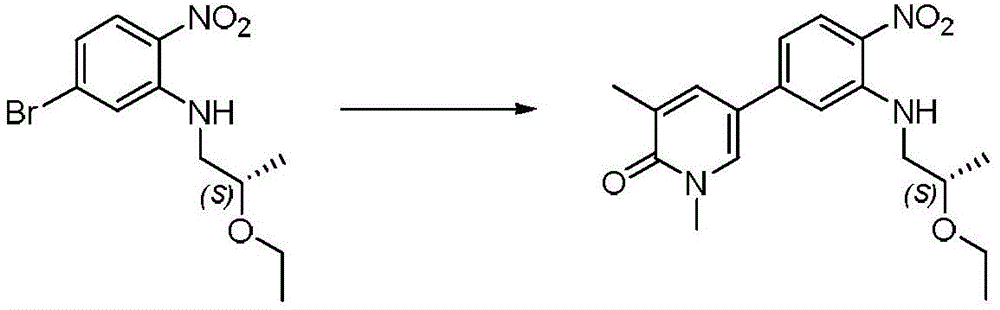
在室温,将(S)-5-溴-N-(2-乙氧基丙基)-2-硝基苯胺(实施例35,步骤1,0.5g,1.65mmol)和1,3-二甲基-5-(4,4,5,5-四甲基-1,3,2-二氧硼杂环戊烷-2-基)吡啶-2(1H)-酮(0.49g,1.98mmol)在DME(10mL)中的搅拌溶液用氮气吹扫15分钟,随后加入Cs2CO3(1.34g,4.12mmol)的水(3mL)溶液并用氮气吹扫另外15分钟。然后加入Pd(PPh3)4(0.19g,0.16mmol),并将反应混合物加热至80℃持续16小时。将得到的混合物通过CeliteTM过滤并用EtOAc(15mL×3)洗涤。将有机层用盐水(50mL)洗涤,经无水Na2SO4干燥,过滤并减压浓缩。通过使用1-2%MeOH的DCM溶液作为洗脱液的硅胶色谱纯化粗物质。合并产物级分并蒸发至干,得到为固体的标题化合物(0.5g,88%),[M+H]+346.29。At room temperature, (S)-5-bromo-N-(2-ethoxypropyl)-2-nitroaniline (Example 35, step 1, 0.5 g, 1.65 mmol) and 1,3-dimethyl yl-5-(4,4,5,5-tetramethyl-1,3,2-dioxaborol-2-yl)pyridin-2(1H)-one (0.49 g, 1.98 mmol) The stirred solution in DME (10 mL) was purged with nitrogen for 15 minutes, then a solution of Cs2CO3 (1.34 g, 4.12 mmol) in water ( 3 mL) was added and purged with nitrogen for an additional 15 minutes. Pd( PPh3 ) 4 (0.19 g, 0.16 mmol) was then added and the reaction mixture was heated to 80°C for 16 hours. The resulting mixture was filtered through Celite ™ and washed with EtOAc (15 mL x 3). The organic layer was washed with brine (50 mL), dried over anhydrous Na 2 SO 4 , filtered and concentrated under reduced pressure. The crude material was purified by silica gel chromatography using 1-2% MeOH in DCM as eluent. The product fractions were combined and evaporated to dryness to give the title compound as a solid (0.5 g, 88%), [M+H] + 346.29.
步骤2:(S)-5-(4-氨基-3-((2-乙氧基丙基)氨基)苯基)-1,3-二甲基吡啶-2(1H)-酮的制备Step 2: Preparation of (S)-5-(4-amino-3-((2-ethoxypropyl)amino)phenyl)-1,3-lutidine-2(1H)-one

将连二亚硫酸钠(3.33g,17.4mmol)加入到(S)-5-(3-((2-乙氧基丙基)氨基)-4-硝基苯基)-1,3-二甲基吡啶-2(1H)(0.5g,1.45mmol)在MeOH(20mL)和水(10mL)中的室温混悬液中,将反应混合物加热至50℃持续1小时。将所得混合物用水(50mL)稀释并用DCM(50mL×3)萃取。将合并的DCM层用盐水(50mL)洗涤,用无水Na2SO4干燥,过滤并减压浓缩,得到为油状物的标题化合物(0.4g,88%),[M+H]+316.34。Sodium dithionite (3.33 g, 17.4 mmol) was added to (S)-5-(3-((2-ethoxypropyl)amino)-4-nitrophenyl)-1,3-dimethyl In a room temperature suspension of pyridine-2(1H) (0.5 g, 1.45 mmol) in MeOH (20 mL) and water (10 mL), the reaction mixture was heated to 50 °C for 1 hour. The resulting mixture was diluted with water (50 mL) and extracted with DCM (50 mL x 3). The combined DCM layers were washed with brine (50 mL), dried over anhydrous Na2SO4 , filtered and concentrated under reduced pressure to give the title compound (0.4 g, 88%) as an oil, [M+H] + 316.34.
步骤3:(S)-N-(4-(1,5-二甲基-6-氧代-1,6-二氢吡啶-3-基)-2-((2-乙氧基丙基)氨基)苯基)-33-二氟环丁烷-1-甲酰胺的制备Step 3: (S)-N-(4-(1,5-Dimethyl-6-oxo-1,6-dihydropyridin-3-yl)-2-((2-ethoxypropyl) ) Amino)phenyl)-33-difluorocyclobutane-1-carboxamide preparation

将HATU(0.36g,0.95mmol)加入3,3-二氟环丁烷-1-甲酸(0.13g,0.95mmol)在DCM(2mL)中的0℃搅拌溶液中,并将反应在此温度下在氮气下搅拌30分钟。然后在0℃滴加(S)-5-(4-氨基-3-((2-乙氧基丙基)氨基)苯基)-1,3-二甲基吡啶-2(1H)-酮(0.2g,0.63mmol)在DCM(2mL)中的溶液,然后滴加DIPEA(0.13mL,1.90mmol),并将混合物在室温下搅拌2小时。将所得混合物用水(50mL)稀释并用DCM(30mL×2)萃取。将合并的有机层用盐水(50mL)洗涤,用无水Na2SO4干燥,过滤并减压浓缩,得到标题化合物(0.2g,73%),为油状物,[M+H]+434.4产物不经进一步纯化而用于下一步。HATU (0.36 g, 0.95 mmol) was added to a stirred solution of 3,3-difluorocyclobutane-1-carboxylic acid (0.13 g, 0.95 mmol) in DCM (2 mL) at 0°C and the reaction was allowed to stand at this temperature Stir under nitrogen for 30 minutes. Then (S)-5-(4-amino-3-((2-ethoxypropyl)amino)phenyl)-1,3-lutidine-2(1H)-one was added dropwise at 0°C (0.2 g, 0.63 mmol) in DCM (2 mL), then DIPEA (0.13 mL, 1.90 mmol) was added dropwise and the mixture was stirred at room temperature for 2 hours. The resulting mixture was diluted with water (50 mL) and extracted with DCM (30 mL x 2). The combined organic layers were washed with brine (50 mL), dried over anhydrous Na 2 SO 4 , filtered and concentrated under reduced pressure to give the title compound (0.2 g, 73%) as an oil, [M+H] + 434.4 product Used in the next step without further purification.
步骤4:化合物53的制备Step 4: Preparation of Compound 53

将(S)-N-(4-(1,5-二甲基-6-氧代-1,6-二氢吡啶-3-基)-2-((2-乙氧基丙基)氨基)苯基)-3,3-二氟环丁烷-1-甲酰胺(0.2g,0.048mmol)的乙酸(6mL)溶液加热至110℃达16小时。然后将反应混合物减压浓缩,用饱和NaHCO3水溶液(120mL)中和,并用EtOAc(30mL×3)萃取。将合并的有机层用盐水(50mL)洗涤,经无水Na2SO4干燥,过滤并减压浓缩。通过使用1-2%MeOH的DCM溶液作为洗脱液的快速色谱纯化粗物质。将产物级分合并并蒸发至干,得到为固体的化合物53(0.1g,52%)。1H NMR(400MHz,DMSO-d6)δ7.97(d,J=2.4Hz,1H),7.81(d,J=1.2Hz,1H),7.73(d,J=1.6Hz,1H),7.62(d,J=8.4Hz,1H),7.38(dd,J=1.6和8.4Hz,1H),4.28(dd,J=3.6和15.2Hz,1H),4.16(dd,J=8.8和14.8Hz,1H),3.87-3.82(m,1H),3.77-3.72(m,1H),3.54(s,3H),3.45-3.39(m,1H),3.15-2.97(m,5H),2.11(s,3H),1.19(d,J=6Hz,3H),0.83(t,J=6.8Hz,3H)。[M+H]+416.20。(S)-N-(4-(1,5-Dimethyl-6-oxo-1,6-dihydropyridin-3-yl)-2-((2-ethoxypropyl)amino )phenyl)-3,3-difluorocyclobutane-1-carboxamide (0.2 g, 0.048 mmol) in acetic acid (6 mL) was heated to 110 °C for 16 h. The reaction mixture was then concentrated under reduced pressure, neutralized with saturated aqueous NaHCO 3 (120 mL), and extracted with EtOAc (30 mL×3). The combined organic layers were washed with brine (50 mL), dried over anhydrous Na 2 SO 4 , filtered and concentrated under reduced pressure. The crude material was purified by flash chromatography using 1-2% MeOH in DCM as eluent. The product fractions were combined and evaporated to dryness to give compound 53 as a solid (0.1 g, 52%). 1 H NMR(400MHz,DMSO-d6)δ7.97(d,J=2.4Hz,1H),7.81(d,J=1.2Hz,1H),7.73(d,J=1.6Hz,1H),7.62( d, J=8.4Hz, 1H), 7.38 (dd, J=1.6 and 8.4Hz, 1H), 4.28 (dd, J=3.6 and 15.2Hz, 1H), 4.16 (dd, J=8.8 and 14.8Hz, 1H) ),3.87-3.82(m,1H),3.77-3.72(m,1H),3.54(s,3H),3.45-3.39(m,1H),3.15-2.97(m,5H),2.11(s,3H) ), 1.19 (d, J=6Hz, 3H), 0.83 (t, J=6.8Hz, 3H). [M+H] + 416.20.
实施例49:(R)-5-(2-(3,3-二氟环丁基)-1-(2-乙氧基丙基)-1H-苯并[d]咪唑-6-基)-1,3-二甲基吡啶-2(1H)-酮(化合物54)Example 49: (R)-5-(2-(3,3-Difluorocyclobutyl)-1-(2-ethoxypropyl)-1H-benzo[d]imidazol-6-yl) -1,3-Lutidine-2(1H)-one (Compound 54)
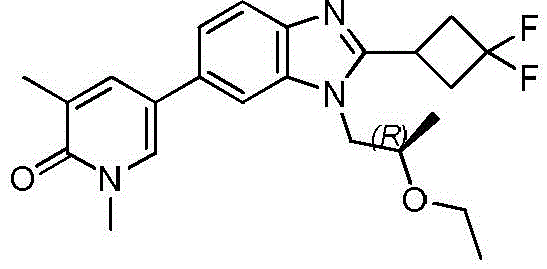
步骤1:(R)-5-(3-((2-乙氧基丙基)氨基)-4-硝基苯基)-1,3-二甲基吡啶-2(1H)-酮的制备Step 1: Preparation of (R)-5-(3-((2-ethoxypropyl)amino)-4-nitrophenyl)-1,3-lutidine-2(1H)-one

除了使用(R)-5-溴-N-(2-乙氧基丙基)-2-硝基苯胺(实施例34,步骤1,0.5g,1.65mmol)外,按照实施例48的步骤1中所述的反应和分离操作,得到为固体的标题化合物(0.5g,88%),[M+H]+346.29。Step 1 of Example 48 was followed except that (R)-5-bromo-N-(2-ethoxypropyl)-2-nitroaniline (Example 34, Step 1, 0.5 g, 1.65 mmol) was used The reaction and isolation procedure described in gave the title compound as a solid (0.5 g, 88%), [M+H] + 346.29.
步骤2:(R)-5-(4-氨基-3-((2-乙氧基丙基)氨基)苯基)-1,3-二甲基吡啶-2(1H)-酮的制备Step 2: Preparation of (R)-5-(4-amino-3-((2-ethoxypropyl)amino)phenyl)-1,3-lutidine-2(1H)-one
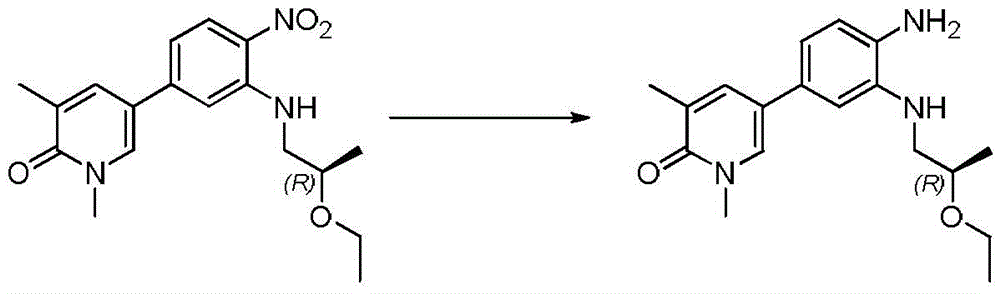
除了使用(R)-5-(3-((2-乙氧基丙基)氨基)-4-硝基苯基)-1,3-二甲基吡啶-2(1H)-酮(0.5g,1.45mmol)作为原料之外,按照实施例48(步骤2)的操作,得到为油状物的标题化合物(0.4g,88%),[M+H]+316.34。Except using (R)-5-(3-((2-ethoxypropyl)amino)-4-nitrophenyl)-1,3-lutidine-2(1H)-one (0.5 g , 1.45 mmol) as starting material, following the procedure of Example 48 (step 2) to give the title compound (0.4 g, 88%) as an oil, [M+H] + 316.34.
步骤3:(R)-N-(4-(1,5-二甲基-6-氧代-1,6-二氢吡啶-3-基)-2-((2-乙氧基丙基)氨基)苯基)-3,3-二氟环丁烷-1-甲酰胺的制备Step 3: (R)-N-(4-(1,5-Dimethyl-6-oxo-1,6-dihydropyridin-3-yl)-2-((2-ethoxypropyl) )amino)phenyl)-3,3-difluorocyclobutane-1-carboxamide preparation

除了使用异构体(R)-5-(4-氨基-3-((2-乙氧基丙基)氨基)苯基)-1,3-二甲基吡啶-2(1H)-酮(0.2g,0.63mmol)以外,按照实施例48的步骤3的操作,得到为油状物的标题化合物(0.2g,73%),[M+H]+434.3。该产物不经进一步纯化而用于下一步。In addition to using the isomer (R)-5-(4-amino-3-((2-ethoxypropyl)amino)phenyl)-1,3-lutidine-2(1H)-one ( 0.2 g, 0.63 mmol), following the procedure of step 3 of Example 48, the title compound (0.2 g, 73%) was obtained as an oil, [M+H] + 434.3. This product was used in the next step without further purification.
步骤4:化合物54的制备Step 4: Preparation of Compound 54

除了使用(R)-N-(4-(1,5-二甲基-6-氧代-1,6-二氢吡啶-3-基)-2-((2-乙氧基丙基)氨基)苯基)-3,3-二氟环丁烷-1-甲酰胺(0.2g,0.048mmol)之外,遵循实施例48步骤4中描述的步骤。通过快速色谱(1-2%MeOH的DCM溶液)分离产物,得到为固体的化合物54(0.1g,52%)。1H NMR(400MHz,DMSO-d6)δ7.97(d,J=2.4Hz,1H),7.81(t,J=1.2Hz,1H),7.73(d,J=1.2Hz,1H),7.62(d,J=8.4Hz,1H),7.38(dd,J=1.6和8.4Hz,1H),4.28(dd,J=3.2和2.8Hz,1H),4.16(dd,J=8.8和8.4Hz,1H),3.87-3.82(m,1H),3.77-3.72(m,1H),3.54(s,3H),3.45-3.39(m,1H),3.15-2.97(m,5H),2.12(s,3H),1.19(d,J=6.4Hz,3H),0.83(t,J=7.0Hz,3H)。[M+H]+416.20。Except using (R)-N-(4-(1,5-dimethyl-6-oxo-1,6-dihydropyridin-3-yl)-2-((2-ethoxypropyl) The procedure described in Example 48, Step 4 was followed except that amino)phenyl)-3,3-difluorocyclobutane-1-carboxamide (0.2 g, 0.048 mmol). The product was isolated by flash chromatography (1-2% MeOH in DCM) to give compound 54 as a solid (0.1 g, 52%). 1 H NMR(400MHz, DMSO-d6)δ7.97(d,J=2.4Hz,1H),7.81(t,J=1.2Hz,1H),7.73(d,J=1.2Hz,1H),7.62( d, J=8.4Hz, 1H), 7.38 (dd, J=1.6 and 8.4Hz, 1H), 4.28 (dd, J=3.2 and 2.8Hz, 1H), 4.16 (dd, J=8.8 and 8.4Hz, 1H) ),3.87-3.82(m,1H),3.77-3.72(m,1H),3.54(s,3H),3.45-3.39(m,1H),3.15-2.97(m,5H),2.12(s,3H) ), 1.19 (d, J=6.4 Hz, 3H), 0.83 (t, J=7.0 Hz, 3H). [M+H] + 416.20.
实施例50:(S)-5-(2-(4,4-二氟环己基)-1-(2-乙氧基丙基)-1H-苯并[d]咪唑-6-基)-1,3-二甲基吡啶-2(1H)-酮(化合物55)Example 50: (S)-5-(2-(4,4-Difluorocyclohexyl)-1-(2-ethoxypropyl)-1H-benzo[d]imidazol-6-yl)- 1,3-Lutidine-2(1H)-one (Compound 55)

步骤1:制备(S)-N-(4-(1,5-二甲基-6-氧代-1,6-二氢吡啶-3-基)-2-((2-乙氧基丙基)氨基)苯基)-4,4-二氟环己烷-1-甲酰胺Step 1: Preparation of (S)-N-(4-(1,5-Dimethyl-6-oxo-1,6-dihydropyridin-3-yl)-2-((2-ethoxypropane) yl)amino)phenyl)-4,4-difluorocyclohexane-1-carboxamide

将HATU(0.36g,0.95mmol)加入4,4-二氟环己烷-1-甲酸(0.13g,0.95mmol)在DCM(3mL)中的0℃搅拌溶液中,并将该反应在此温度下在氮气下搅拌30分钟。在0℃滴加(S)-5-(4-氨基-3-((2-乙氧基丙基)氨基)苯基)-1,3-二甲基吡啶-2(1H)-酮(实施例48,步骤2,0.2g,0.63mmol)在DCM(2mL)中的溶液,然后滴加DIPEA(0.33mL,1.90mmol),并将反应混合物在室温下搅拌2小时。然后将所得混合物用水(50mL)稀释并用DCM(30mL×3)萃取。将合并的有机层用盐水(50mL)洗涤,经无水Na2SO4干燥,过滤并减压浓缩。然后通过使用2%MeOH/DCM作为洗脱液的快速色谱纯化粗物质。将产物级分合并并蒸发至干,得到标题化合物(0.2g,68%),其为固体,[M+H]+462.46。HATU (0.36 g, 0.95 mmol) was added to a stirred solution of 4,4-difluorocyclohexane-1-carboxylic acid (0.13 g, 0.95 mmol) in DCM (3 mL) at 0°C and the reaction was allowed to stand at this temperature It was stirred under nitrogen for 30 minutes. (S)-5-(4-Amino-3-((2-ethoxypropyl)amino)phenyl)-1,3-lutidine-2(1H)-one ( Example 48, Step 2, 0.2 g, 0.63 mmol) in DCM (2 mL), then DIPEA (0.33 mL, 1.90 mmol) was added dropwise and the reaction mixture was stirred at room temperature for 2 hours. The resulting mixture was then diluted with water (50 mL) and extracted with DCM (30 mL x 3). The combined organic layers were washed with brine (50 mL), dried over anhydrous Na 2 SO 4 , filtered and concentrated under reduced pressure. The crude material was then purified by flash chromatography using 2% MeOH/DCM as eluent. The product fractions were combined and evaporated to dryness to give the title compound (0.2 g, 68%) as a solid, [M+H] + 462.46.
步骤2:制备化合物55Step 2: Preparation of Compound 55
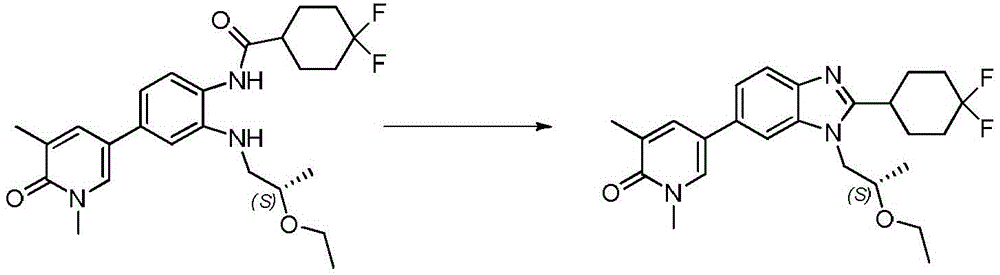
将(S)-N-(4-(1,5-二甲基-6-氧代-1,6-二氢吡啶-3-基)-2-((2-乙氧基丙基)氨基)苯基)-4,4-二氟环己烷-1-甲酰胺(0.2g,0.043mmol)在乙酸(5mL)中的溶液在110℃加热16小时。将所得混合物减压浓缩,用饱和NaHCO3水溶液(100mL)中和并用EtOAc(50mL×3)萃取。将合并的有机层用盐水(50mL)洗涤,经无水Na2SO4干燥,过滤并减压浓缩。通过使用2%MeOH/DCM作为洗脱液的快速色谱纯化粗物质。将产物级分合并并浓缩至干,得到为固体的化合物55(0.07g,24%)。1H NMR(400MHz,DMSO-d6)δ7.96(d,J=2.4Hz,1H),7.80(d,J=1.2Hz,1H),7.71(d,J=1.2Hz,1H),7.56(d,J=8.4Hz,1H),7.35(dd,J=1.2和2Hz,1H),4.34-4.21(m,2H),3.80-3.75(m,1H),3.54(s,3H),3.46-3.38(m,1H),3.32-3.27(m,1H),3.05-2.98(m,1H),2.23-2.16(m,2H),2.11(s,3H),2.06-1.80(m,6H),1.20(d,J=6Hz,3H),0.86(t,J=6.8Hz,3H)[M+H]+444.51。(S)-N-(4-(1,5-Dimethyl-6-oxo-1,6-dihydropyridin-3-yl)-2-((2-ethoxypropyl)amino )phenyl)-4,4-difluorocyclohexane-1-carboxamide (0.2 g, 0.043 mmol) in acetic acid (5 mL) was heated at 110 °C for 16 h. The resulting mixture was concentrated under reduced pressure, neutralized with saturated aqueous NaHCO 3 (100 mL) and extracted with EtOAc (50 mL×3). The combined organic layers were washed with brine (50 mL), dried over anhydrous Na 2 SO 4 , filtered and concentrated under reduced pressure. The crude material was purified by flash chromatography using 2% MeOH/DCM as eluent. The product fractions were combined and concentrated to dryness to give compound 55 as a solid (0.07 g, 24%). 1 H NMR(400MHz,DMSO-d6)δ7.96(d,J=2.4Hz,1H),7.80(d,J=1.2Hz,1H),7.71(d,J=1.2Hz,1H),7.56( d, J=8.4Hz, 1H), 7.35 (dd, J=1.2 and 2Hz, 1H), 4.34-4.21 (m, 2H), 3.80-3.75 (m, 1H), 3.54 (s, 3H), 3.46- 3.38(m,1H), 3.32-3.27(m,1H), 3.05-2.98(m,1H), 2.23-2.16(m,2H), 2.11(s,3H), 2.06-1.80(m,6H), 1.20(d, J=6Hz, 3H), 0.86(t, J=6.8Hz, 3H) [M+H] + 444.51.
实施例51:(S)-5-(2-(4,4-二氟环己基)-1-(1-甲氧基丙-2-基)-1H-苯并[d]咪唑-6-基)-1,3-二甲基吡啶-2(1H)-酮(化合物56)Example 51: (S)-5-(2-(4,4-Difluorocyclohexyl)-1-(1-methoxyprop-2-yl)-1H-benzo[d]imidazole-6- yl)-1,3-lutidine-2(1H)-one (Compound 56)

步骤1:(S)-(1-甲氧基丙-2-基)氨基甲酸叔丁酯的制备Step 1: Preparation of tert-butyl (S)-(1-methoxyprop-2-yl)carbamate

向(S)-(1-羟基丙-2-基)氨基甲酸叔丁酯(1.0g,5.71mmol)在DMF(10mL)中的0℃搅拌溶液中加入60%NaH的矿物油(0.34g,8.57mmol),并将反应在此温度下搅拌30分钟。在0℃滴加碘甲烷(0.54mL,8.57mmol),并将反应混合物在室温下搅拌6小时。将所得混合物用水(100mL)稀释并用EtOAc(50mL×3)萃取。将合并的有机层用盐水(50mL)洗涤,经无水Na2SO4干燥,过滤并减压浓缩。粗物质通过使用10%EtOAc的己烷溶液作为洗脱液的硅胶色谱纯化。将产物级分合并并真空浓缩,得到标题化合物(0.9g,83%),为油状物。1H NMR(400MHz,CDCl3)δ4.71(s,1H),3.83(s,1H),3.40-3.31(m,5H),1.48(s,9H),1.18(d,J=6.8Hz,3H)。To a stirred solution of (S)-(1-hydroxypropan-2-yl)carbamate (1.0 g, 5.71 mmol) in DMF (10 mL) at 0°C was added 60% NaH in mineral oil (0.34 g, 8.57 mmol) and the reaction was stirred at this temperature for 30 minutes. Iodomethane (0.54 mL, 8.57 mmol) was added dropwise at 0°C and the reaction mixture was stirred at room temperature for 6 hours. The resulting mixture was diluted with water (100 mL) and extracted with EtOAc (50 mL x 3). The combined organic layers were washed with brine (50 mL), dried over anhydrous Na 2 SO 4 , filtered and concentrated under reduced pressure. The crude material was purified by silica gel chromatography using 10% EtOAc in hexanes as eluent. The product fractions were combined and concentrated in vacuo to give the title compound (0.9 g, 83%) as an oil. 1 H NMR (400MHz, CDCl 3 ) δ 4.71(s, 1H), 3.83(s, 1H), 3.40-3.31(m, 5H), 1.48(s, 9H), 1.18(d, J=6.8Hz, 3H).
步骤2:(S)-1-甲氧基丙-2-胺盐酸盐的制备Step 2: Preparation of (S)-1-methoxypropan-2-amine hydrochloride

向(S)-(1-甲氧基丙-2-基)氨基甲酸叔丁酯(0.9g,4.76mmol)在DCM(7mL)中的室温搅拌溶液中加入4N HCl的二噁烷溶液(10mL),并将反应混合物搅拌8小时。将所得混合物减压浓缩,并用Et2O(8mL)研磨,得到标题化合物(0.5g,84%),为固体,其不经进一步纯化直接使用。To a stirred solution of (S)-(1-methoxyprop-2-yl)carbamate (0.9 g, 4.76 mmol) in DCM (7 mL) at room temperature was added 4N HCl in dioxane (10 mL) ) and the reaction mixture was stirred for 8 hours. The resulting mixture was concentrated under reduced pressure and triturated with Et2O (8 mL) to give the title compound (0.5 g, 84%) as a solid, which was used without further purification.
步骤3:(S)-5-溴-N-(1-甲氧基丙-2-基)-2-硝基苯胺的制备Step 3: Preparation of (S)-5-bromo-N-(1-methoxyprop-2-yl)-2-nitroaniline

将TEA(0.96mL,9.54mmol)加入到4-溴-2-氟-1-硝基苯(0.7g,3.18mmol)和(S)-1-甲氧基丙-2-胺盐酸盐(0.48g,3.82mmol)在乙醇(10mL)中的室温搅拌溶液中,并将反应混合物在70℃加热2小时。将所得混合物用水(80mL)稀释并用EtOAc(50mL×3)萃取。将合并的有机层用盐水(60mL)洗涤,经无水Na2SO4干燥,过滤并减压浓缩,得到为固体的标题化合物(0.6g,92%),[M+H]+289.03。TEA (0.96 mL, 9.54 mmol) was added to 4-bromo-2-fluoro-1-nitrobenzene (0.7 g, 3.18 mmol) and (S)-1-methoxypropan-2-amine hydrochloride ( 0.48 g, 3.82 mmol) in a stirred solution of ethanol (10 mL) at room temperature, and the reaction mixture was heated at 70 °C for 2 h. The resulting mixture was diluted with water (80 mL) and extracted with EtOAc (50 mL x 3). The combined organic layers were washed with brine (60 mL), dried over anhydrous Na2SO4 , filtered and concentrated under reduced pressure to give the title compound (0.6 g, 92%) as a solid, [M+H] + 289.03.
步骤4:(S)-5-溴-N1-(1-甲氧基丙-2-基)苯-1,2-二胺的制备Step 4: Preparation of (S)-5-bromo-N 1 -(1-methoxyprop-2-yl)benzene-1,2-diamine

将连二亚硫酸钠(1.62g,24.91mmol)加入到(S)-5-溴-N-(1-甲氧基丙烷-2-基)-2-硝基苯胺(0.6g,2.07mmol)在MeOH(10mL)和水(10mL)中的室温混悬液中,并将反应混合物搅拌2小时。将所得混合物用水(60mL)稀释并用EtOAc(40mL×3)萃取。将合并的有机层用盐水(40mL)洗涤,用无水Na2SO4干燥,过滤并减压浓缩。粗物质通过使用20%EtOAc的己烷溶液作为洗脱液的硅胶色谱纯化。将产物级分合并并蒸发至干,得到标题化合物(0.42g,78%),为固体,[M+H]+261.04。Sodium dithionite (1.62 g, 24.91 mmol) was added to (S)-5-bromo-N-(1-methoxypropan-2-yl)-2-nitroaniline (0.6 g, 2.07 mmol) in MeOH (10 mL) and water (10 mL) at room temperature, and the reaction mixture was stirred for 2 hours. The resulting mixture was diluted with water (60 mL) and extracted with EtOAc (40 mL x 3). The combined organic layers were washed with brine (40 mL), dried over anhydrous Na 2 SO 4 , filtered and concentrated under reduced pressure. The crude material was purified by silica gel chromatography using 20% EtOAc in hexanes as eluent. The product fractions were combined and evaporated to dryness to give the title compound (0.42 g, 78%) as a solid, [M+H] + 261.04.
步骤5:(S)-N-(4-溴-2-((1-甲氧基丙-2-基)氨基)苯基)-4,4-二氟环己烷-1-甲酰胺的制备Step 5: (S)-N-(4-bromo-2-((1-methoxyprop-2-yl)amino)phenyl)-4,4-difluorocyclohexane-1-carboxamide preparation

将HATU(1.2g,3.20mmol)加入4,4-二氟环己烷-1-甲酸(0.42g,1.62mmol)在DCM(4mL)中的0℃搅拌溶液中,并将反应混合物在氮气下搅拌30分钟。在0℃下滴加(S)-5-溴-N1-(1-甲氧基丙烷-2-基)苯-1,2-二胺(0.42g,1.62mmol)在DCM(4mL)中的溶液,随后加入DIPEA(0.61mL,4.70mmol)并将反应混合物在室温下搅拌6小时。将所得混合物用水(80mL)稀释并用DCM(40mL×2)萃取。将合并的有机层用盐水(50mL)洗涤,经无水Na2SO4干燥,过滤并减压浓缩。将所得产物与Et2O(10mL)一起研磨,得到标题化合物(0.4g,50%),为固体,[M+H]+405.24。HATU (1.2 g, 3.20 mmol) was added to a stirred solution of 4,4-difluorocyclohexane-1-carboxylic acid (0.42 g, 1.62 mmol) in DCM (4 mL) at 0°C and the reaction mixture was brought under nitrogen Stir for 30 minutes. (S)-5-Bromo-N1-( 1 -methoxypropan-2-yl)benzene-1,2-diamine (0.42 g, 1.62 mmol) in DCM (4 mL) was added dropwise at 0 °C , then DIPEA (0.61 mL, 4.70 mmol) was added and the reaction mixture was stirred at room temperature for 6 hours. The resulting mixture was diluted with water (80 mL) and extracted with DCM (40 mL x 2). The combined organic layers were washed with brine (50 mL), dried over anhydrous Na 2 SO 4 , filtered and concentrated under reduced pressure. The resulting product was triturated with Et2O (10 mL) to give the title compound (0.4 g, 50%) as a solid, [M+H] + 405.24.
步骤6:制备(S)-6-溴-2-(4,4-二氟环己基)-1-(1-甲氧基丙-2-基)-1H-苯并[d]咪唑Step 6: Preparation of (S)-6-bromo-2-(4,4-difluorocyclohexyl)-1-(1-methoxyprop-2-yl)-1H-benzo[d]imidazole
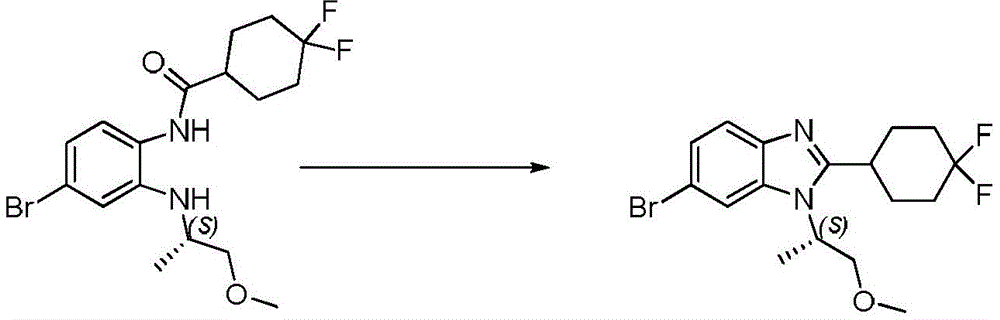
将(S)-N-(4-溴-2-((1-甲氧基丙-2-基)氨基)苯基)-4,4-二氟环己烷-1-甲酰胺(0.4g,1.04mmol)在乙酸(15mL)中的溶液在110℃加热16小时。将所得混合物减压浓缩,用饱和NaHCO3水溶液(150mL)中和,并用EtOAc(50mL×3)萃取。将合并的有机层用盐水(60mL)洗涤,用无水Na2SO4干燥,过滤并减压浓缩。粗物质通过使用15%EtOAc/己烷作为洗脱液的硅胶色谱纯化。将产物级分合并并蒸发至干,得到标题化合物(0.32g,77%),为固体。[M+H]+389.18。(S)-N-(4-Bromo-2-((1-methoxyprop-2-yl)amino)phenyl)-4,4-difluorocyclohexane-1-carboxamide (0.4 g , 1.04 mmol) in acetic acid (15 mL) was heated at 110 °C for 16 h. The resulting mixture was concentrated under reduced pressure, neutralized with saturated aqueous NaHCO 3 (150 mL), and extracted with EtOAc (50 mL×3). The combined organic layers were washed with brine (60 mL), dried over anhydrous Na 2 SO 4 , filtered and concentrated under reduced pressure. The crude material was purified by silica gel chromatography using 15% EtOAc/hexanes as eluent. The product fractions were combined and evaporated to dryness to give the title compound (0.32 g, 77%) as a solid. [M+H] + 389.18.
步骤7:化合物56的制备Step 7: Preparation of Compound 56

将(S)-6-溴-2-(4,4-二氟环己基)-1-(1-甲氧基丙-2-基)-1H-苯并[d]咪唑(0.32g,8.30mmol)和1,3-二甲基-5-(4,4,5,5-四甲基-1,3,2-二氧硼杂环戊烷-2-基)吡啶-2(1H)-酮(0.25g,9.94mmol)在1,4-二噁烷(8mL)中的搅拌溶液在室温下用氮气吹扫15分钟,随后加入Cs2CO3(0.808g,24.9mmol)的水(0.8mL)溶液并用氮气吹扫另外15分钟。加入Pd(PPh3)4(0.095g,0.83mmol)并将反应混合物在80℃加热5小时。通过CeliteTM过滤所得混合物并用EtOAc(25mL×3)洗涤。将有机层用盐水(50mL)洗涤,经无水Na2SO4干燥,过滤并减压浓缩。通过制备型HPLC使用45-100%MeCN的水溶液(含有0.1%NH3作为改性剂)纯化粗物质,得到为固体的化合物56(0.054g,15%)。1H NMR(400MHz,DMSO)δppm7.96(d,J=2Hz,1H),7.79(s,1H),7.73(s,1H),7.58(d,J=8Hz,1H),7.34(dd,J=1.2和8.4Hz,1H),4.88(m,1H),4.01(t,J=9.6Hz,1H),3.72(dd,J=4.8和4.4Hz,1H),3.54(s,3H),3.29-3.21(m,1H),3.18(s,3H),2.13-1.86(m,11H),1.61(d,J=7.2Hz,3H)。[M+H]+430.35。(S)-6-Bromo-2-(4,4-difluorocyclohexyl)-1-(1-methoxyprop-2-yl)-1H-benzo[d]imidazole (0.32 g, 8.30 mmol) and 1,3-dimethyl-5-(4,4,5,5-tetramethyl-1,3,2-dioxaborolane-2-yl)pyridine-2(1H) - A stirred solution of the ketone (0.25 g, 9.94 mmol) in 1,4-dioxane (8 mL) was purged with nitrogen for 15 min at room temperature, followed by the addition of Cs2CO3 ( 0.808 g, 24.9 mmol) in water ( 0.8 mL) solution and purged with nitrogen for an additional 15 minutes. Pd( PPh3 ) 4 (0.095 g, 0.83 mmol) was added and the reaction mixture was heated at 80°C for 5 hours. The resulting mixture was filtered through Celite ™ and washed with EtOAc (25 mL x 3). The organic layer was washed with brine (50 mL), dried over anhydrous Na 2 SO 4 , filtered and concentrated under reduced pressure. The crude material was purified by preparative HPLC using 45-100% MeCN in water (containing 0.1% NH3 as modifier) to give compound 56 as a solid (0.054 g, 15%). 1 H NMR (400MHz, DMSO) δppm 7.96 (d, J=2Hz, 1H), 7.79 (s, 1H), 7.73 (s, 1H), 7.58 (d, J=8Hz, 1H), 7.34 (dd, J=1.2 and 8.4Hz, 1H), 4.88 (m, 1H), 4.01 (t, J=9.6Hz, 1H), 3.72 (dd, J=4.8 and 4.4Hz, 1H), 3.54 (s, 3H), 3.29-3.21 (m, 1H), 3.18 (s, 3H), 2.13-1.86 (m, 11H), 1.61 (d, J=7.2Hz, 3H). [M+H] + 430.35.
实施例52:(R)-5-(2-(4,4-二氟环己基)-1-(1-甲氧基丙-2-基)-1H-苯并[d]咪唑-6-基)-1,3-二甲基吡啶-2(1H)-酮(化合物57)Example 52: (R)-5-(2-(4,4-Difluorocyclohexyl)-1-(1-methoxyprop-2-yl)-1H-benzo[d]imidazole-6- yl)-1,3-lutidine-2(1H)-one (Compound 57)

步骤1:制备(R)-(5-溴-N1-(1-甲氧基丙烷-2-基)苯-1,2-二胺Step 1: Preparation of (R)-(5-bromo-N1-(1-methoxypropan-2-yl)benzene-1,2-diamine

将连二亚硫酸钠(3.5g,20mmol)加入到(R)-5-溴-N-(1-甲氧基丙-2-基)-2-硝基苯胺(实施例45,步骤1,0.5g,1.73mmol)在MeOH(10mL)和水(10mL)中的室温混悬液中并将反应混合物搅拌1小时。将所得混合物用水(50mL)稀释并用EtOAc(30mL×3)萃取。将合并的有机层用盐水(50mL)洗涤,经无水Na2SO4干燥,过滤并减压浓缩。然后将产物用Et2O研磨,得到标题化合物(0.4g,89%),为固体,[M+H]+261.04。Sodium dithionite (3.5 g, 20 mmol) was added to (R)-5-bromo-N-(1-methoxypropan-2-yl)-2-nitroaniline (Example 45, step 1, 0.5 g , 1.73 mmol) in MeOH (10 mL) and water (10 mL) at room temperature and the reaction mixture was stirred for 1 hour. The resulting mixture was diluted with water (50 mL) and extracted with EtOAc (30 mL x 3). The combined organic layers were washed with brine (50 mL), dried over anhydrous Na 2 SO 4 , filtered and concentrated under reduced pressure. The product was then triturated with Et2O to give the title compound (0.4 g, 89%) as a solid, [M+H] + 261.04.
步骤2:制备(R)-N-(4-溴-2-((1-甲氧基丙-2-基)氨基)苯基)-4,4-二氟环己烷-1-甲酰胺Step 2: Preparation of (R)-N-(4-bromo-2-((1-methoxyprop-2-yl)amino)phenyl)-4,4-difluorocyclohexane-1-carboxamide

将HATU(1.2g,3.10mmol)加至4,4-二氟环己烷-1-甲酸(0.38g,1.55mmol)于DCM(4mL)中的0℃搅拌溶液中并将反应混合物在该温度下在氮气下搅拌30分钟。在0℃下加入(R)-5-溴-N1-(1-甲氧基丙-2-基)苯-1,2-二胺(0.4g,1.55mmol)在DCM(4mL)中的溶液,接着加入DIPEA(0.61mL,4.70mmol)。将该反应在室温下搅拌6小时。将所得混合物用水(80mL)稀释并用DCM(40mL×2)萃取。将合并的有机层用盐水(50mL)洗涤,经无水Na2SO4干燥,过滤并减压浓缩。将产物与Et2O(15mL)一起研磨,得到标题化合物(0.42g,50%),为固体,[M+H]+407.19。HATU (1.2 g, 3.10 mmol) was added to a stirred solution of 4,4-difluorocyclohexane-1-carboxylic acid (0.38 g, 1.55 mmol) in DCM (4 mL) at 0°C and the reaction mixture was kept at this temperature It was stirred under nitrogen for 30 minutes. A solution of (R)-5-bromo-N1-(1-methoxyprop-2-yl)benzene-1,2-diamine (0.4 g, 1.55 mmol) in DCM (4 mL) was added at 0 °C , followed by the addition of DIPEA (0.61 mL, 4.70 mmol). The reaction was stirred at room temperature for 6 hours. The resulting mixture was diluted with water (80 mL) and extracted with DCM (40 mL x 2). The combined organic layers were washed with brine (50 mL), dried over anhydrous Na 2 SO 4 , filtered and concentrated under reduced pressure. The product was triturated with Et2O (15 mL) to give the title compound (0.42 g, 50%) as a solid, [M+H] + 407.19.
步骤3:制备(R)-6-溴-2-(4,4-二氟环己基)-1-(1-甲氧基丙-2-基)-1H-苯并[d]咪唑Step 3: Preparation of (R)-6-bromo-2-(4,4-difluorocyclohexyl)-1-(1-methoxyprop-2-yl)-1H-benzo[d]imidazole

将(R)-N-(4-溴-2-((1-甲氧基丙-2-基)氨基)苯基)-4,4-二氟环己烷-1-甲酰胺(0.42g,1.04mmol)在乙酸(15mL)中的溶液加热至110℃达16小时。将所得混合物减压浓缩,用饱和NaHCO3水溶液(120mL)中和,并用EtOAc(40mL×3)萃取。将合并的有机层用盐水(50mL)洗涤,经无水Na2SO4干燥,过滤并减压浓缩。粗物质通过使用20%EtOAc的己烷溶液作为洗脱液的硅胶色谱纯化。将产物级分合并并浓缩至干,得到为固体的标题化合物(0.38g,88%)。[M+H]+389.18。(R)-N-(4-Bromo-2-((1-methoxyprop-2-yl)amino)phenyl)-4,4-difluorocyclohexane-1-carboxamide (0.42 g , 1.04 mmol) in acetic acid (15 mL) was heated to 110 °C for 16 h. The resulting mixture was concentrated under reduced pressure, neutralized with saturated aqueous NaHCO 3 (120 mL), and extracted with EtOAc (40 mL×3). The combined organic layers were washed with brine (50 mL), dried over anhydrous Na 2 SO 4 , filtered and concentrated under reduced pressure. The crude material was purified by silica gel chromatography using 20% EtOAc in hexanes as eluent. The product fractions were combined and concentrated to dryness to give the title compound as a solid (0.38 g, 88%). [M+H] + 389.18.
步骤4:化合物57的制备Step 4: Preparation of Compound 57

将(R)-6-溴-2-(4,4-二氟环己基)-1-(1-甲氧基丙-2-基)-1H-苯并[d]咪唑(0.38g,0.984mmol)和1,3-二甲基-5-(4,4,5,5-四甲基-1,3,2-二氧杂硼杂环戊烷-2-基)吡啶-2(1H)-酮(0.29g,1.18mmol)在1,4-二噁烷(8mL)中的搅拌溶液在室温下用氮气吹扫15分钟,然后加入Cs2CO3(0.96g,2.95mmol)的水(0.8mL)溶液并用氮气吹扫另外15分钟。加入Pd(PPh3)4(0.1g,0.098mmol)并将反应混合物在80℃加热5小时。将所得混合物通过CeliteTM过滤并用EtOAc(30mL×3)洗涤。将有机层用盐水(60mL)洗涤,经无水Na2SO4干燥,过滤并减压浓缩。通过使用3%MeOH的DCM溶液作为洗脱液的硅胶色谱纯化粗物质。合并产物级分并真空浓缩,得到为固体的化合物57(0.11g,26%)。1H NMR(400MHz,DMSO)δppm7.96(d,J=2.4Hz,1H),7.79(d,J=1.6Hz,1H),7.73(d,J=1.2Hz,1H),7.58(d,J=8.4Hz,1H),7.34(dd,J=1.6和8.4Hz,1H),4.90(m,1H),4.01(t,J=10Hz,1H),3.73(dd,J=4.8和10.4Hz,1H),3.54(s,3H),3.21-3.18(m,4H),2.14-1.86(m,11H),1.60(d,J=7.2Hz,3H)。[M+H]+430.40。(R)-6-Bromo-2-(4,4-difluorocyclohexyl)-1-(1-methoxyprop-2-yl)-1H-benzo[d]imidazole (0.38 g, 0.984 mmol) and 1,3-dimethyl-5-(4,4,5,5-tetramethyl-1,3,2-dioxaborol-2-yl)pyridine-2(1H )-ketone (0.29 g, 1.18 mmol) in 1,4-dioxane (8 mL) was purged with nitrogen for 15 min at room temperature before adding Cs2CO3 ( 0.96 g, 2.95 mmol) in water (0.8 mL) of the solution and purged with nitrogen for an additional 15 minutes. Pd( PPh3 ) 4 (0.1 g, 0.098 mmol) was added and the reaction mixture was heated at 80°C for 5 hours. The resulting mixture was filtered through Celite ™ and washed with EtOAc (30 mL x 3). The organic layer was washed with brine (60 mL), dried over anhydrous Na 2 SO 4 , filtered and concentrated under reduced pressure. The crude material was purified by silica gel chromatography using 3% MeOH in DCM as eluent. The product fractions were combined and concentrated in vacuo to give compound 57 as a solid (0.11 g, 26%). 1 H NMR (400MHz, DMSO) δppm 7.96(d, J=2.4Hz, 1H), 7.79(d, J=1.6Hz, 1H), 7.73(d, J=1.2Hz, 1H), 7.58(d, J=8.4Hz, 1H), 7.34 (dd, J=1.6 and 8.4Hz, 1H), 4.90 (m, 1H), 4.01 (t, J=10Hz, 1H), 3.73 (dd, J=4.8 and 10.4Hz) , 1H), 3.54 (s, 3H), 3.21-3.18 (m, 4H), 2.14-1.86 (m, 11H), 1.60 (d, J=7.2Hz, 3H). [M+H] + 430.40.
实施例53:(R)-5-(2-(4,4-二氟环己基)-1-(2-甲氧基丙基)-1H-苯并[d]咪唑-6-基)-1,3-二甲基吡啶-2(1H)-酮(化合物58)Example 53: (R)-5-(2-(4,4-Difluorocyclohexyl)-1-(2-methoxypropyl)-1H-benzo[d]imidazol-6-yl)- 1,3-Lutidine-2(1H)-one (Compound 58)

步骤1:(R)-5-溴-N-(2-甲氧基丙基)-2-硝基苯胺的制备Step 1: Preparation of (R)-5-bromo-N-(2-methoxypropyl)-2-nitroaniline

将TEA(0.95mL,6.82mmol)加入到4-溴-2-氟-1-硝基苯(0.5g,2.27mmol)和(R)-2-甲氧基丙-1-胺盐酸盐(0.343g,2.73mmol)在乙醇(10毫升)中的搅拌溶液中并将反应混合物加热至70℃持续2小时。然后将所得混合物用水(50mL)稀释并用EtOAc(50mL×3)萃取。将合并的有机层经无水Na2SO4干燥,过滤并减压浓缩,得到标题化合物(0.65g,99%),为固体。TEA (0.95 mL, 6.82 mmol) was added to 4-bromo-2-fluoro-1-nitrobenzene (0.5 g, 2.27 mmol) and (R)-2-methoxypropan-1-amine hydrochloride ( 0.343 g, 2.73 mmol) in a stirred solution of ethanol (10 mL) and the reaction mixture was heated to 70 °C for 2 h. The resulting mixture was then diluted with water (50 mL) and extracted with EtOAc (50 mL x 3). The combined organic layers were dried over anhydrous Na2SO4 , filtered and concentrated under reduced pressure to give the title compound (0.65 g, 99%) as a solid.
步骤2:制备(R)-5-溴-N1-(2-甲氧基丙基)苯-1,2-二胺Step 2: Preparation of (R)-5-bromo-N1-( 2 -methoxypropyl)benzene-1,2-diamine

将连二亚硫酸钠(4.7g,26.98mmol)加至(R)-5-溴-N-(2-甲氧基丙基)-2-硝基苯胺(0.65g,2.25mmol)在MeOH(10mL)和水(10mL)中的室温搅拌悬浮液中并将反应混合物在50℃加热15分钟。将所得混合物减压浓缩,用饱和NaHCO3水溶液(250mL)中和,并用EtOAc(100mL×3)萃取。将合并的有机层用盐水(50mL)洗涤,经无水Na2SO4干燥,过滤并减压浓缩,得到为固体的标题化合物(0.45g,59%),[M+H]+261.03。Sodium dithionite (4.7 g, 26.98 mmol) was added to (R)-5-bromo-N-(2-methoxypropyl)-2-nitroaniline (0.65 g, 2.25 mmol) in MeOH (10 mL) The suspension was stirred at room temperature in water (10 mL) and the reaction mixture was heated at 50 °C for 15 min. The resulting mixture was concentrated under reduced pressure, neutralized with saturated aqueous NaHCO 3 (250 mL), and extracted with EtOAc (100 mL×3). The combined organic layers were washed with brine (50 mL), dried over anhydrous Na2SO4 , filtered and concentrated under reduced pressure to give the title compound (0.45 g, 59%) as a solid, [M+H] + 261.03.
步骤3:制备(R)-N-(4-溴-2-((2-甲氧基丙基)氨基)苯基)-4,4-二氟环己烷-1-甲酰胺Step 3: Preparation of (R)-N-(4-bromo-2-((2-methoxypropyl)amino)phenyl)-4,4-difluorocyclohexane-1-carboxamide

将HATU(0.99g,2.61mmol)加入4,4-二氟环己烷-1-甲酸(0.428g,2.61mmol)在DCM(5mL)中的0℃搅拌溶液中,并将反应混合物搅拌30分钟。在室温,加入(R)-5-溴-N1-(2-甲氧基丙基)苯-1,2-二胺(0.45g,1.74mmol)和DIPEA(0.9mL,5.21mmol)的DCM(5mL)溶液并将该反应搅拌2小时。将所得混合物用水(100mL)稀释并用DCM(50mL×3)萃取。将合并的有机层用盐水(50mL)洗涤,经无水Na2SO4干燥,过滤并减压浓缩,得到为半固体的标题化合物(0.7g,75%),[M+H]+405.35。HATU (0.99 g, 2.61 mmol) was added to a stirred solution of 4,4-difluorocyclohexane-1-carboxylic acid (0.428 g, 2.61 mmol) in DCM (5 mL) at 0°C and the reaction mixture was stirred for 30 min . At room temperature, (R)-5-bromo-N1-(2-methoxypropyl)benzene-1,2-diamine (0.45 g, 1.74 mmol) and DIPEA (0.9 mL, 5.21 mmol) in DCM ( 5 mL) solution and the reaction was stirred for 2 hours. The resulting mixture was diluted with water (100 mL) and extracted with DCM (50 mL x 3). The combined organic layers were washed with brine (50 mL), dried over anhydrous Na2SO4 , filtered and concentrated under reduced pressure to give the title compound (0.7 g, 75%) as a semi-solid, [M+H] + 405.35.
步骤4:制备(R)-6-溴-2-(4,4-二氟环己基)-1-(2-甲氧基丙基)-1H-苯并[d]咪唑Step 4: Preparation of (R)-6-bromo-2-(4,4-difluorocyclohexyl)-1-(2-methoxypropyl)-1H-benzo[d]imidazole

将(R)-N-(4-溴-2-((2-甲氧基丙基)氨基)苯基)-4,4-二氟环己烷-1-甲酰胺(0.7g,1.73mmol)在乙酸(10mL)中的溶液加热至100℃保持16小时。将所得混合物用饱和NaHCO3水溶液(150mL)碱化并用EtOAc(100mL×3)萃取。将合并的有机层用盐水(50mL)洗涤,经无水Na2SO4干燥,过滤并减压浓缩。将粗产物通过硅胶色谱纯化,使用梯度的20-40%EtOAc的己烷溶液。将产物级分合并并蒸发至干燥,得到为半固体的标题化合物(0.4g,36%),[M+H]+387.23。(R)-N-(4-Bromo-2-((2-methoxypropyl)amino)phenyl)-4,4-difluorocyclohexane-1-carboxamide (0.7 g, 1.73 mmol ) in acetic acid (10 mL) was heated to 100 °C for 16 h. The resulting mixture was basified with saturated aqueous NaHCO 3 (150 mL) and extracted with EtOAc (100 mL x 3). The combined organic layers were washed with brine (50 mL), dried over anhydrous Na 2 SO 4 , filtered and concentrated under reduced pressure. The crude product was purified by silica gel chromatography using a gradient of 20-40% EtOAc in hexanes. The product fractions were combined and evaporated to dryness to give the title compound as a semi-solid (0.4 g, 36%), [M+H] + 387.23.
步骤5:化合物58的制备Step 5: Preparation of Compound 58

将(R)-6-溴-2-(4,4-二氟环己基)-1-(2-甲氧基丙基)-1H-苯并[d]咪唑(0.4g,1.03mmol)和1,3-二甲基-5-(4,4,5,5-四甲基-1,3,2-二氧杂硼杂环戊烷-2-基)吡啶-2(1H)-酮(0.386g,1.55mmol)在1,4-二噁烷(5mL)中的搅拌溶液在室温下用氮气吹扫15分钟,接着加入水(1mL)中的Na2CO3(0.329g,3.10mmol)并用氮气吹扫另外15分钟。加入Pd(PPh3)4(0.06g,0.05mmol)并将反应混合物在100℃搅拌6小时。将所得混合物减压浓缩。通过使用1-2%MeOH的DCM溶液作为洗脱液的硅胶色谱纯化粗物质。将产物级分合并并蒸发至干,得到化合物58(0.08g,18%),为固体。1H NMR(400MHz,DMSO)δppm 7.96(d,J=2.4Hz,1H),7.79(s,1H),7.71(s,1H),7.56(d,J=8.4Hz,1H),7.35(dd,J=1.6和8.4Hz,1H),4.35-4.24(m,2H),3.72-3.67(m,1H),3.54(s,3H),3.27-3.23(m,1H),3.08(s,3H),2.19-2.17(m,2H),2.12(s,3H),2.08-1.91(m,4H),1.90-1.84(m,2H),1.19(d,J=6.4Hz,3H),[M+H]+430.40。(R)-6-Bromo-2-(4,4-difluorocyclohexyl)-1-(2-methoxypropyl)-1H-benzo[d]imidazole (0.4 g, 1.03 mmol) and 1,3-Dimethyl-5-(4,4,5,5-tetramethyl-1,3,2-dioxaborol-2-yl)pyridin-2(1H)-one A stirred solution of (0.386 g, 1.55 mmol) in 1,4-dioxane (5 mL) was purged with nitrogen at room temperature for 15 min, followed by the addition of Na2CO3 (0.329 g , 3.10 mmol) in water (1 mL) ) and purged with nitrogen for an additional 15 minutes. Pd( PPh3 ) 4 (0.06 g, 0.05 mmol) was added and the reaction mixture was stirred at 100°C for 6 hours. The resulting mixture was concentrated under reduced pressure. The crude material was purified by silica gel chromatography using 1-2% MeOH in DCM as eluent. The product fractions were combined and evaporated to dryness to give compound 58 (0.08 g, 18%) as a solid. 1 H NMR (400MHz, DMSO) δppm 7.96(d, J=2.4Hz, 1H), 7.79(s, 1H), 7.71(s, 1H), 7.56(d, J=8.4Hz, 1H), 7.35(dd , J=1.6 and 8.4Hz, 1H), 4.35-4.24(m, 2H), 3.72-3.67(m, 1H), 3.54(s, 3H), 3.27-3.23(m, 1H), 3.08(s, 3H) ), 2.19-2.17(m, 2H), 2.12(s, 3H), 2.08-1.91(m, 4H), 1.90-1.84(m, 2H), 1.19(d, J=6.4Hz, 3H), [M +H] + 430.40.
实施例54:(S)-5-(2-(4,4-二氟环己基)-1-(2-甲氧基丙基)-1H-苯并[d]咪唑-6-基)-1,3-二甲基吡啶-2(1H)-酮(化合物59)Example 54: (S)-5-(2-(4,4-Difluorocyclohexyl)-1-(2-methoxypropyl)-1H-benzo[d]imidazol-6-yl)- 1,3-Lutidine-2(1H)-one (Compound 59)
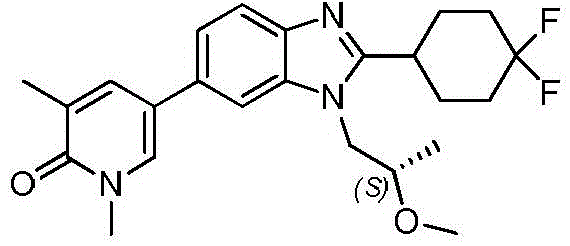
步骤1:(S)-5-溴-N-(2-甲氧基丙基)-2-硝基苯胺的制备Step 1: Preparation of (S)-5-bromo-N-(2-methoxypropyl)-2-nitroaniline
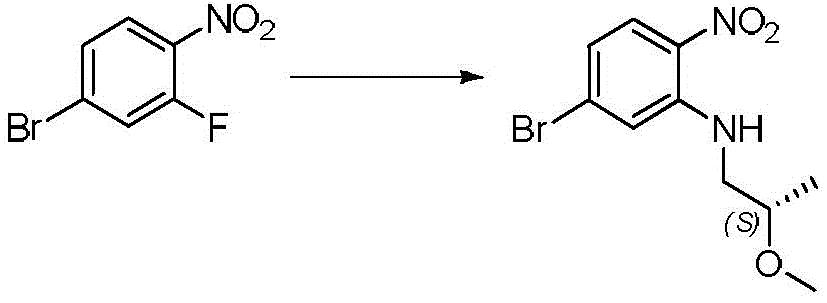
除了使用(S)-2-甲氧基丙-1-胺盐酸盐(0.343g,2.73mmol)外,遵循实施例53步骤1的操作,得到为固体的标题化合物(0.65g,99%),[M+H]+289.08。Following the procedure of Example 53, Step 1, except that (S)-2-methoxypropan-1-amine hydrochloride (0.343 g, 2.73 mmol) was used, the title compound (0.65 g, 99%) was obtained as a solid , [M+H] + 289.08.
步骤2:(S)-5-溴-N1-(2-甲氧基丙基)苯-1,2-二胺的制备Step 2: Preparation of (S)-5-bromo-N1-( 2 -methoxypropyl)benzene-1,2-diamine
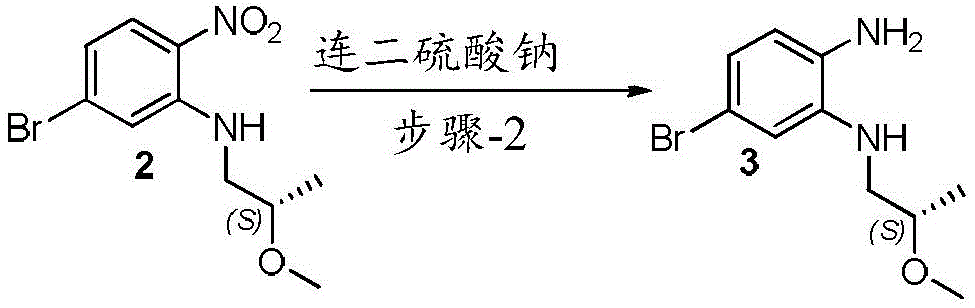
除了使用对映异构体(S)-5-溴-N-(2-甲氧基丙基)-2-硝基苯胺外,按照实施例53步骤2的操作得到标题化合物(0.45g,59%),其为固体,[M+H]+261.0。Following the procedure of Example 53, Step 2, except using the enantiomer (S)-5-bromo-N-(2-methoxypropyl)-2-nitroaniline, the title compound (0.45 g, 59 %) as a solid, [M+H] + 261.0.
步骤3:(S)-N-(4-溴-2-((2-甲氧基丙基)氨基)苯基)-4,4-二氟环己烷-1-甲酰胺的制备Step 3: Preparation of (S)-N-(4-bromo-2-((2-methoxypropyl)amino)phenyl)-4,4-difluorocyclohexane-1-carboxamide

除了使用(S)-5-溴-N1-(2-甲氧基丙基)苯-1,2-二胺(0.45g,1.74mmol)外,遵循实施例53步骤3的操作,得到为半固体的标题化合物(0.7g,75%),[M+H]+405.35。Following the procedure of Example 53, Step 3, except that (S)-5-bromo-N1-( 2 -methoxypropyl)benzene-1,2-diamine (0.45 g, 1.74 mmol) was used, the following was obtained: Semi-solid title compound (0.7 g, 75%), [M+H] + 405.35.
步骤4:(S)-6-溴-2-(4,4-二氟环己基)-1-(2-甲氧基丙基)-1H-苯并[d]咪唑的制备Step 4: Preparation of (S)-6-bromo-2-(4,4-difluorocyclohexyl)-1-(2-methoxypropyl)-1H-benzo[d]imidazole

除了使用(S)-N-(4-溴-2-((2-甲氧基丙基)氨基)苯基)-4,4-二氟环己烷-1-甲酰胺外,遵循实施例53步骤4的操作。纯化得到为半固体的标题化合物(0.5g,64%),[M+H]+387.23。The examples were followed except that (S)-N-(4-bromo-2-((2-methoxypropyl)amino)phenyl)-4,4-difluorocyclohexane-1-carboxamide was used 53 The operation of step 4. Purification gave the title compound as a semi-solid (0.5 g, 64%), [M+H] + 387.23.
步骤5:化合物59的制备Step 5: Preparation of Compound 59

除了使用(S)-6-溴-2-(4,4-二氟环己基)-1-(2-甲氧基丙基)-1H-苯并[d]咪唑(0.5g,1.29mmol)外,遵循实施例53步骤5的操作。其他试剂的量按比例调整。纯化得到化合物59(0.085g,15%),其为固体。1H NMR(400MHz,DMSO)δppm 7.96(d,J=2.0Hz,1H),7.79(s,1H),7.71(s,1H),7.56(d,J=8.4Hz,1H),7.35(dd,J=1.2和8.4Hz,1H),4.35-4.24(m,2H),3.71-3.67(m,1H),3.54(s,3H),3.27-3.23(m,1H),3.08(s,3H),2.33-2.17(m,2H),2.11(s,3H),2.08-2.03(m,1H),1.99-1.91(m,4H),1.88-1.82(m,1H),1.24-1.17(m,3H),[M+H]+430.2。In addition to using (S)-6-bromo-2-(4,4-difluorocyclohexyl)-1-(2-methoxypropyl)-1H-benzo[d]imidazole (0.5 g, 1.29 mmol) Otherwise, follow step 5 of Example 53. The amounts of other reagents were adjusted proportionally. Purification gave compound 59 (0.085 g, 15%) as a solid. 1 H NMR (400MHz, DMSO) δppm 7.96(d, J=2.0Hz, 1H), 7.79(s, 1H), 7.71(s, 1H), 7.56(d, J=8.4Hz, 1H), 7.35(dd , J=1.2 and 8.4Hz, 1H), 4.35-4.24(m, 2H), 3.71-3.67(m, 1H), 3.54(s, 3H), 3.27-3.23(m, 1H), 3.08(s, 3H) ), 2.33-2.17(m, 2H), 2.11(s, 3H), 2.08-2.03(m, 1H), 1.99-1.91(m, 4H), 1.88-1.82(m, 1H), 1.24-1.17(m ,3H),[M+H] + 430.2.
实施例55:5-(1-(2-乙氧基乙基)-2-(四氢-2H-吡喃-4-基)-1H-苯并[d]咪唑-6-基)-1,3-二甲基吡啶-2(1H)-酮(化合物60)Example 55: 5-(1-(2-Ethoxyethyl)-2-(tetrahydro-2H-pyran-4-yl)-1H-benzo[d]imidazol-6-yl)-1 ,3-Lutidine-2(1H)-one (Compound 60)

步骤1:2-((5-溴-2-硝基苯基)氨基)乙-1-醇的制备Step 1: Preparation of 2-((5-bromo-2-nitrophenyl)amino)ethan-1-ol
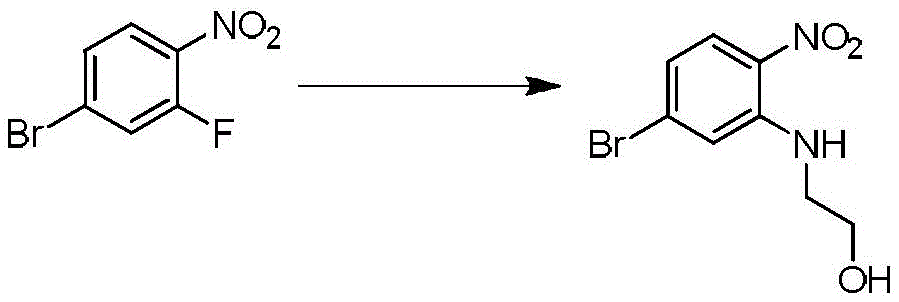
将TEA(2.9mL,20.55mmol)加入到4-溴-2-氟-1-硝基苯(1.5g,6.85mmol)和2-氨基乙-1-醇(0.51g,8.22mmol)在乙醇(15mL)中的室温搅拌的溶液中并将反应混合物在80℃加热2小时。然后将所得混合物用水(100mL)稀释并用EtOAc(40mL×3)萃取。将合并的有机层经无水Na2SO4干燥,过滤并减压浓缩,得到标题化合物(1.7g,95%),为油状物。[M+H]+262.94。TEA (2.9 mL, 20.55 mmol) was added to 4-bromo-2-fluoro-1-nitrobenzene (1.5 g, 6.85 mmol) and 2-aminoethan-1-ol (0.51 g, 8.22 mmol) in ethanol ( 15 mL) in a stirred solution at room temperature and heated the reaction mixture at 80°C for 2 hours. The resulting mixture was then diluted with water (100 mL) and extracted with EtOAc (40 mL x 3). The combined organic layers were dried over anhydrous Na2SO4 , filtered and concentrated under reduced pressure to give the title compound (1.7 g, 95%) as an oil. [M+H] + 262.94.
步骤2:制备5-溴-N-(2-乙氧基乙基)-2-硝基苯胺Step 2: Preparation of 5-bromo-N-(2-ethoxyethyl)-2-nitroaniline

向2-((5-溴-2-硝基苯基)氨基)乙-1-醇(1.7g,6.54mmol)在DMF(15mL)中的悬浮液的0℃搅拌的溶液中加入60%NaH的矿物油(0.24g,9.81mmol),并将混合物在该温度下搅拌30分钟。然后在0℃滴加碘乙烷(0.8mL,9.81mmol)并将反应混合物在室温下搅拌16小时。将所得混合物用水(100mL)稀释并用EtOAc(40mL×3)萃取。将合并的有机层用盐水(50mL)洗涤,经无水Na2SO4干燥,过滤并减压浓缩。通过使用20%EtOAc作为洗脱液的硅胶色谱纯化粗物质。合并产物级分并浓缩至干,得到为油状物的标题化合物(1.7g,93%)。1HNMR(400MHz,DMSO)δppm 8.26(t,J=4.8Hz,1H),7.99(d,J=9.2Hz,1H),7.33(d,J=1.6Hz,1H),6.85(dd,J=2和9.2Hz,1H),3.60(t,J=5.2Hz,2H),3.54-3.43(m,4H),1.13(t,J=7.2Hz,3H),[M+H]+289.1。To a stirred solution of 2-((5-bromo-2-nitrophenyl)amino)ethan-1-ol (1.7 g, 6.54 mmol) in DMF (15 mL) at 0°C was added 60% NaH of mineral oil (0.24 g, 9.81 mmol) and the mixture was stirred at this temperature for 30 minutes. Iodoethane (0.8 mL, 9.81 mmol) was then added dropwise at 0°C and the reaction mixture was stirred at room temperature for 16 hours. The resulting mixture was diluted with water (100 mL) and extracted with EtOAc (40 mL x 3). The combined organic layers were washed with brine (50 mL), dried over anhydrous Na 2 SO 4 , filtered and concentrated under reduced pressure. The crude material was purified by silica gel chromatography using 20% EtOAc as eluent. The product fractions were combined and concentrated to dryness to give the title compound as an oil (1.7 g, 93%). 1 HNMR (400MHz, DMSO) δppm 8.26 (t, J=4.8Hz, 1H), 7.99 (d, J=9.2Hz, 1H), 7.33 (d, J=1.6Hz, 1H), 6.85 (dd, J= 2 and 9.2Hz, 1H), 3.60 (t, J=5.2Hz, 2H), 3.54-3.43 (m, 4H), 1.13 (t, J=7.2Hz, 3H), [M+H] + 289.1.
步骤3:5-溴-N1-(2-乙氧基乙基)苯-1,2-二胺的制备Step 3: Preparation of 5-bromo-N1-(2-ethoxyethyl)benzene-1,2-diamine

将连二亚硫酸钠(13.99g,72.91mmol)加入到5-溴-N-(2-乙氧基乙基)-2-硝基苯胺(1.75g,6.08mmol)在MeOH(30mL)和水(15mL)中的室温悬浮液中,并将反应混合物在50℃加热10分钟。将所得混合物用水(200mL)稀释并用DCM(50mL×3)萃取。将合并的DCM层用盐水(50mL)洗涤,经无水Na2SO4干燥,过滤并减压浓缩,得到标题化合物(1g,64%),为油状物,[M+H]+2=261.26。Sodium dithionite (13.99 g, 72.91 mmol) was added to 5-bromo-N-(2-ethoxyethyl)-2-nitroaniline (1.75 g, 6.08 mmol) in MeOH (30 mL) and water (15 mL) ) in suspension at room temperature and the reaction mixture was heated at 50 °C for 10 min. The resulting mixture was diluted with water (200 mL) and extracted with DCM (50 mL x 3). The combined DCM layers were washed with brine (50 mL), dried over anhydrous Na2SO4 , filtered and concentrated under reduced pressure to give the title compound (1 g, 64%) as an oil, [M+H] +2 = 261.26 .
步骤4:6-溴-1-(2-乙氧基乙基)-2-(四氢-2H-吡喃-4-基)-1H-苯并[d]咪唑的制备Step 4: Preparation of 6-bromo-1-(2-ethoxyethyl)-2-(tetrahydro-2H-pyran-4-yl)-1H-benzo[d]imidazole

向5-溴-N1-(2-甲氧基乙基)苯-1,2-二胺(0.3g,1.16mmol)在乙酸(5mL)中的搅拌溶液中加入四氢-2H-吡喃-4-甲醛(0.14g,1.16mmol),并将反应在室温下搅拌12小时。将所得混合物减压浓缩,用饱和NaHCO3水溶液(60mL)稀释并用EtOAc(40mL×3)萃取。将合并的有机层用盐水(50mL)洗涤,经无水Na2SO4干燥,过滤并减压浓缩。通过使用3%MeOH的DCM溶液作为洗脱液的硅胶色谱纯化粗物质。将产物级分合并并真空浓缩,得到标题化合物(0.21g,51%),为油状物。[M+H]+353.15。To a stirred solution of 5-bromo-N1-(2-methoxyethyl)benzene-1,2-diamine (0.3 g, 1.16 mmol) in acetic acid (5 mL) was added tetrahydro-2H-pyran- 4-Carboxaldehyde (0.14 g, 1.16 mmol) and the reaction was stirred at room temperature for 12 hours. The resulting mixture was concentrated under reduced pressure, diluted with saturated aqueous NaHCO 3 (60 mL) and extracted with EtOAc (40 mL×3). The combined organic layers were washed with brine (50 mL), dried over anhydrous Na 2 SO 4 , filtered and concentrated under reduced pressure. The crude material was purified by silica gel chromatography using 3% MeOH in DCM as eluent. The product fractions were combined and concentrated in vacuo to give the title compound (0.21 g, 51%) as an oil. [M+H] + 353.15.
步骤5:化合物60的制备Step 5: Preparation of Compound 60
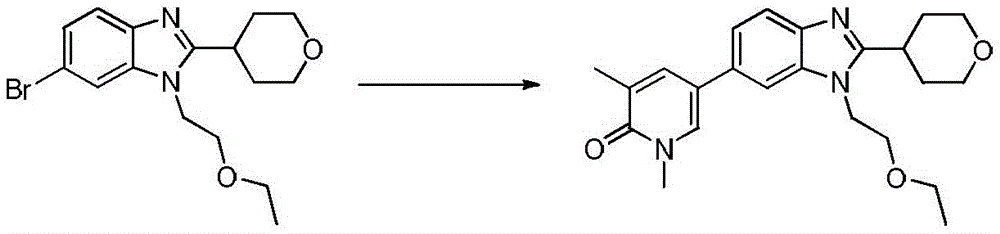
将6-溴-1-(2-乙氧基乙基)-2-(四氢-2H-吡喃-4-基)-1H-苯并[d]咪唑(0.21g,0.60mmol)和1,3-二甲基-5-(4,4,5,5-四甲基-1,3,2-二氧杂环戊硼烷-2-基)吡啶-2(1H)-酮(0.2g,0.77mmol)在1,4-二噁烷(4mL)中的搅拌溶液用氮气吹扫10分钟,随后加入水(0.5mL)中的Na2CO3(0.19g,1.8mmol)并用氮气吹扫另外10分钟。然后加入Pd(PPh3)4(0.035g,0.03mmol)并将反应混合物在100℃加热3小时。用EtOAc(100mL)稀释得到的混合物,用水(40mL×2)和盐水(30mL)洗涤,用无水Na2SO4干燥,过滤并减压浓缩。使用1.5-2%MeOH/DCM作为洗脱液,使用快速色谱纯化粗物质。将产物级分合并并蒸发至干,得到化合物60(0.09g,39%),为固体。1H NMR(400MHz,DMSO)δppm 7.97(d,J=2Hz,1H),7.80(s,1H),7.72(s,1H),7.58(d,J=8.4Hz,1H),7.37(dd,J=1.6和8.4Hz,1H),4.46(t,J=4.8Hz,2H),3.99(d,J=10.5Hz,2H),3.70(t,J=4.8Hz,2H),3.54-3.46(m,5H),3.40-3.32(m,3H),2.11(s,3H),1.95-1.80(m,4H),1.01(t,J=7.2Hz,3H)。MH+396.43。6-Bromo-1-(2-ethoxyethyl)-2-(tetrahydro-2H-pyran-4-yl)-1H-benzo[d]imidazole (0.21 g, 0.60 mmol) and 1 ,3-dimethyl-5-(4,4,5,5-tetramethyl-1,3,2-dioxaborolane-2-yl)pyridin-2(1H)-one (0.2 g, 0.77 mmol) in 1,4-dioxane (4 mL) was purged with nitrogen for 10 min, then Na2CO3 (0.19 g , 1.8 mmol) in water (0.5 mL) was added and purged with nitrogen Sweep for another 10 minutes. Then Pd( PPh3 ) 4 (0.035 g, 0.03 mmol) was added and the reaction mixture was heated at 100 °C for 3 hours. The resulting mixture was diluted with EtOAc (100 mL), washed with water (40 mL x 2) and brine (30 mL), dried over anhydrous Na2SO4 , filtered and concentrated under reduced pressure. The crude material was purified using flash chromatography using 1.5-2% MeOH/DCM as eluent. The product fractions were combined and evaporated to dryness to give compound 60 (0.09 g, 39%) as a solid. 1 H NMR (400MHz, DMSO) δppm 7.97(d, J=2Hz, 1H), 7.80(s, 1H), 7.72(s, 1H), 7.58(d, J=8.4Hz, 1H), 7.37(dd, J=1.6 and 8.4Hz, 1H), 4.46 (t, J=4.8Hz, 2H), 3.99 (d, J=10.5Hz, 2H), 3.70 (t, J=4.8Hz, 2H), 3.54-3.46 ( m, 5H), 3.40-3.32 (m, 3H), 2.11 (s, 3H), 1.95-1.80 (m, 4H), 1.01 (t, J=7.2Hz, 3H). MH + 396.43.
实施例56:5-(2-(4,4-二氟环己基)-1-(2-乙氧基乙基)-1H-苯并[d]咪唑-6-基)-1,3-二甲基吡啶-2(1H)-酮(化合物61)Example 56: 5-(2-(4,4-Difluorocyclohexyl)-1-(2-ethoxyethyl)-1H-benzo[d]imidazol-6-yl)-1,3- Lutidine-2(1H)-one (Compound 61)

步骤1:N-(4-溴-2-((2-乙氧基乙基)氨基)苯基)-4,4-二氟环己烷-1-甲酰胺的制备Step 1: Preparation of N-(4-bromo-2-((2-ethoxyethyl)amino)phenyl)-4,4-difluorocyclohexane-1-carboxamide

在氮气氛下,将HATU(0.66g,1.74mmol)加入4,4-二氟环己烷-1-甲酸(0.3g,1.16mmol)在DCM(4mL)中的0℃搅拌溶液中。然后滴加5-溴-N1-(2-乙氧基乙基)苯-1,2-二胺(实施例55,步骤3,0.20g,1.22mmol)和DIPEA(0.6mL,3.48mmol)在DCM(2mL)中的溶液,并将反应混合物在0℃下搅拌3小时。将所得混合物用饱和NaHCO3(25mL)稀释并将产物用DCM(20mL×3)萃取。将合并的有机层用盐水(30mL)洗涤,经无水Na2SO4干燥,过滤并减压浓缩。通过硅胶色谱使用梯度的3-5%MeOH的DCM溶液作为洗脱液纯化粗物质。将产物级分合并并浓缩,得到标题化合物(0.33g,65%),为油状物。[M+H]+405.2,407.24。Under nitrogen atmosphere, HATU (0.66 g, 1.74 mmol) was added to a stirred solution of 4,4-difluorocyclohexane-1-carboxylic acid (0.3 g, 1.16 mmol) in DCM (4 mL) at 0°C. Then 5-bromo-N1-( 2 -ethoxyethyl)benzene-1,2-diamine (Example 55, step 3, 0.20 g, 1.22 mmol) and DIPEA (0.6 mL, 3.48 mmol) were added dropwise solution in DCM (2 mL) and the reaction mixture was stirred at 0 °C for 3 hours. The resulting mixture was diluted with saturated NaHCO3 (25 mL) and the product was extracted with DCM (20 mL x 3). The combined organic layers were washed with brine (30 mL), dried over anhydrous Na 2 SO 4 , filtered and concentrated under reduced pressure. The crude material was purified by silica gel chromatography using a gradient of 3-5% MeOH in DCM as eluent. The product fractions were combined and concentrated to give the title compound (0.33 g, 65%) as an oil. [M+H] + 405.2, 407.24.
步骤2:6-溴-2-(4,4-二氟环己基)-1-(2-乙氧基乙基)-1H-苯并[d]咪唑的制备Step 2: Preparation of 6-bromo-2-(4,4-difluorocyclohexyl)-1-(2-ethoxyethyl)-1H-benzo[d]imidazole

将N-(4-溴-2-((2-乙氧基乙基)氨基)苯基)-4,4-二氟环己烷-1-甲酰胺(0.3g,0.74mmol)在乙酸(5mL)中的溶液在100℃搅拌12小时。减压蒸发得到的混合物,将残余物溶于DCM(30mL)中,用饱和NaHCO3(20mL×2)和盐水(10mL)洗涤;用无水Na2SO4干燥,过滤并减压浓缩。通过硅胶色谱使用梯度的3-5%MeOH的DCM溶液作为洗脱液纯化粗物质。将产物级分合并并浓缩,得到标题化合物(0.13g,46%),为油状物。[M+H]+2 389.18。N-(4-Bromo-2-((2-ethoxyethyl)amino)phenyl)-4,4-difluorocyclohexane-1-carboxamide (0.3 g, 0.74 mmol) in acetic acid ( The solution in 5 mL) was stirred at 100°C for 12 hours. The resulting mixture was evaporated under reduced pressure, the residue was dissolved in DCM (30 mL), washed with saturated NaHCO 3 (20 mL×2) and brine (10 mL); dried over anhydrous Na 2 SO 4 , filtered and concentrated under reduced pressure. The crude material was purified by silica gel chromatography using a gradient of 3-5% MeOH in DCM as eluent. The product fractions were combined and concentrated to give the title compound (0.13 g, 46%) as an oil. [M+H] +2 389.18.
步骤3:化合物61的制备Step 3: Preparation of Compound 61

将6-溴-2-(4,4-二氟环己基)-1-(2-乙氧基乙基)-1H-苯并[d]咪唑(0.13g,0.34mmol)和1,3-二甲基-5-(4,4,5,5-四甲基-1,3,2-二氧杂硼杂环戊烷-2-基)吡啶-2(1H)-酮(0.11g,0.44mmol)在1,4-二噁烷(4mL)中的搅拌溶液用氮气吹扫10分钟,接着加入水(0.5mL)中的Na2CO3(0.11g,1.02mmol)并用氮气吹扫另外10min。加入Pd(PPh3)4(0.02g,0.02mmol)并将反应混合物在100℃加热3小时。然后将所得混合物用EtOAc(60mL)稀释,用水(40mL×2)和盐水(30mL)洗涤,用无水Na2SO4干燥,过滤并减压浓缩。通过使用1.5-1.8%MeOH/DCM作为洗脱液的快速色谱纯化获得的粗物质。合并产物级分并浓缩至干,得到为固体的化合物61(0.088g,61%)。1H NMR(400MHz,DMSO)δ7.97(d,J=2Hz,1H),7.80(s,1H),7.72(s,1H),7.57(d,J=8.4Hz,1H),7.38(d,J=8.4Hz,1H),4.48(t,J=4.4Hz,2H),3.70(t,J=4.8Hz,2H),3.54(s,3H),3.40-3.35(m,2H),3.28-2.25(m,1H),2.19-2.17(m,2H),2.11(s,3H),2.02-2.00(m,3H),1.95-1.86(m,3H),1.02(t,J=7.2Hz,3H)。[M+H]+430.40。6-Bromo-2-(4,4-difluorocyclohexyl)-1-(2-ethoxyethyl)-1H-benzo[d]imidazole (0.13 g, 0.34 mmol) and 1,3- Dimethyl-5-(4,4,5,5-tetramethyl-1,3,2-dioxaborol-2-yl)pyridin-2(1H)-one (0.11 g, A stirred solution of 0.44 mmol) in 1,4-dioxane (4 mL) was purged with nitrogen for 10 min, then Na2CO3 (0.11 g , 1.02 mmol) in water (0.5 mL) was added and purged with nitrogen for additional 10min. Pd( PPh3 ) 4 (0.02 g, 0.02 mmol) was added and the reaction mixture was heated at 100 °C for 3 hours. The resulting mixture was then diluted with EtOAc (60 mL), washed with water (40 mL x 2) and brine (30 mL), dried over anhydrous Na2SO4 , filtered and concentrated under reduced pressure. The crude material obtained was purified by flash chromatography using 1.5-1.8% MeOH/DCM as eluent. The product fractions were combined and concentrated to dryness to give compound 61 as a solid (0.088 g, 61%). 1 H NMR(400MHz, DMSO)δ7.97(d,J=2Hz,1H),7.80(s,1H),7.72(s,1H),7.57(d,J=8.4Hz,1H),7.38(d , J=8.4Hz, 1H), 4.48(t, J=4.4Hz, 2H), 3.70(t, J=4.8Hz, 2H), 3.54(s, 3H), 3.40-3.35(m, 2H), 3.28 -2.25(m, 1H), 2.19-2.17(m, 2H), 2.11(s, 3H), 2.02-2.00(m, 3H), 1.95-1.86(m, 3H), 1.02(t, J=7.2Hz , 3H). [M+H] + 430.40.
实施例57:5-[2-(3-甲氧基环丁基)-1-(2-(2,2,2-三氟乙氧基)乙基)-1H-苯并[d]咪唑-6-基]-1,3-二甲基吡啶-2(1H)-酮(化合物62和63)Example 57: 5-[2-(3-Methoxycyclobutyl)-1-(2-(2,2,2-trifluoroethoxy)ethyl)-1H-benzo[d]imidazole -6-yl]-1,3-lutidine-2(1H)-one (Compounds 62 and 63)
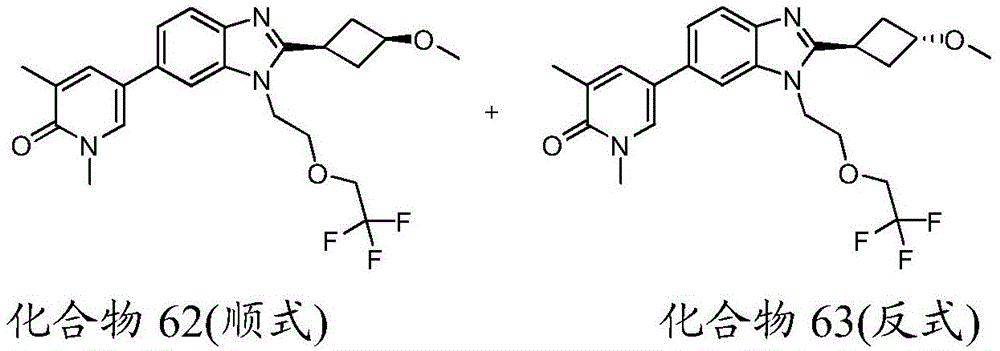
步骤1:N-(4-(1,5-二甲基-6-氧代-1,6-二氢吡啶-3-基)-2-((2-(2,2,2-三氟乙氧基)乙基)氨基)苯基)-3-甲氧基环丁烷-1-甲酰胺的制备Step 1: N-(4-(1,5-Dimethyl-6-oxo-1,6-dihydropyridin-3-yl)-2-((2-(2,2,2-trifluoro Preparation of ethoxy)ethyl)amino)phenyl)-3-methoxycyclobutane-1-carboxamide

将HATU(0.53g,1.3929mmol)加入到3-甲氧基环丁烷-1-甲酸(0.12g,0.9286mmol)在DCM(5mL)中的搅拌溶液中,并使反应在室温下搅拌20分钟。将5-(4-氨基-3-((2-(2,2,2-三氟乙氧基)乙基)氨基)苯基)-1,3-二甲基吡啶-2(1H)-酮(实施例40,步骤2,0.33g,0.9286mmol)和DIPEA(0.35mL,1.8572mmol)于DCM(1mL)中的溶液中并将反应混合物搅拌4小时。然后将所得混合物用饱和NaHCO3水溶液(25mL)稀释并将产物用DCM(20mL×3)萃取。将合并的有机层用盐水(30mL)洗涤,经无水Na2SO4干燥,过滤并减压浓缩。通过硅胶色谱使用梯度的3-5%MeOH的DCM溶液作为洗脱液纯化粗物质。收集产物级分并蒸发,得到标题化合物(0.4g,92%),为油状物。[M+H]+468.36。HATU (0.53 g, 1.3929 mmol) was added to a stirred solution of 3-methoxycyclobutane-1-carboxylic acid (0.12 g, 0.9286 mmol) in DCM (5 mL) and the reaction was allowed to stir at room temperature for 20 minutes . 5-(4-Amino-3-((2-(2,2,2-trifluoroethoxy)ethyl)amino)phenyl)-1,3-lutidine-2(1H)- Ketone (Example 40, Step 2, 0.33 g, 0.9286 mmol) and DIPEA (0.35 mL, 1.8572 mmol) in DCM (1 mL) and the reaction mixture was stirred for 4 hours. The resulting mixture was then diluted with saturated aqueous NaHCO 3 (25 mL) and the product was extracted with DCM (20 mL x 3). The combined organic layers were washed with brine (30 mL), dried over anhydrous Na 2 SO 4 , filtered and concentrated under reduced pressure. The crude material was purified by silica gel chromatography using a gradient of 3-5% MeOH in DCM as eluent. Product fractions were collected and evaporated to give the title compound (0.4 g, 92%) as an oil. [M+H] + 468.36.
步骤2:化合物62和63的制备Step 2: Preparation of Compounds 62 and 63

将N-(4-(1,5-二甲基-6-氧代-1,6-二氢吡啶-3-基)-2-((2-(2,2,2-三氟乙氧基)乙基)氨基)苯基)-3-甲氧基环丁烷-1-甲酰胺(0.4g,0.8561mmol)于乙酸(5mL)中的溶液在100℃下搅拌12小时。将反应混合物减压浓缩并将残余物溶于DCM(20mL)中,用饱和NaHCO3溶液(20mL)、盐水(10mL)洗涤,用无水Na2SO4干燥,过滤并减压浓缩。通过使用3-5%MeOH的DCM溶液作为洗脱液的硅胶色谱纯化粗物质。合并产物级分并浓缩至干,得到为固体的顺式和反式异构体混合物(0.4g)。通过使用25%MeCN的水溶液(含有0.1%甲酸作为改性剂)的制备型HPLC来纯化获得的混合物,得到化合物62(0.15g)和化合物63(0.062g),其为固体,合并产率为55%。N-(4-(1,5-Dimethyl-6-oxo-1,6-dihydropyridin-3-yl)-2-(((2-(2,2,2-trifluoroethoxy) A solution of (0.4 g, 0.8561 mmol) in acetic acid (5 mL) was stirred at 100 °C for 12 h. The reaction mixture was concentrated under reduced pressure and the residue was dissolved in DCM (20 mL), washed with saturated NaHCO 3 solution (20 mL), brine (10 mL), dried over anhydrous Na 2 SO 4 , filtered and concentrated under reduced pressure. The crude material was purified by silica gel chromatography using 3-5% MeOH in DCM as eluent. The product fractions were combined and concentrated to dryness to give a mixture of cis and trans isomers as a solid (0.4 g). The obtained mixture was purified by preparative HPLC using 25% MeCN in water (containing 0.1% formic acid as modifier) to give compound 62 (0.15 g) and compound 63 (0.062 g) as solids in combined yields 55%.
化合物62(顺式):1H NMR(400MHz,CDCl3)δppm 7.79(d,J=8.8Hz,1H),7.57(d,J=1.2Hz,1H),7.42(d,J=2.4Hz,1H),7.32-7.28(m,2H),4.34(t,J=5.2Hz,2H),4.04-4.00(m,1H),3.95(t,J=9.2Hz,2H),3.76(q,J=8.4和17.2Hz,2H),3.66(s,3H),3.34-3.25(m,4H),2.83-2.76(m,2H),2.58-2.51(m 2H),2.27(s,3H)。[M+H]+450.46。Compound 62 (cis): 1 H NMR (400 MHz, CDCl 3 ) δppm 7.79 (d, J=8.8 Hz, 1H), 7.57 (d, J=1.2 Hz, 1H), 7.42 (d, J=2.4 Hz, 1H), 7.32-7.28(m, 2H), 4.34(t, J=5.2Hz, 2H), 4.04-4.00(m, 1H), 3.95(t, J=9.2Hz, 2H), 3.76(q, J = 8.4 and 17.2 Hz, 2H), 3.66 (s, 3H), 3.34-3.25 (m, 4H), 2.83-2.76 (m, 2H), 2.58-2.51 (m 2H), 2.27 (s, 3H). [M+H] + 450.46.
化合物63(反式):1H NMR(400MHz,CDCl3)δ7.96(d,J=2Hz,1H),7.80(s,1H),7.71(s,1H),7.61(d,J=8.4Hz,1H),7.38(dd,J=1.2和8.4Hz,1H),4.38(t,J=4.8Hz,2H),4.18-4.15(m,1H),4.05(q,J1=9.2和18.4Hz,2H),3.90(t,J=4.8Hz,2H),3.85-3.80(m,1H),3.54(s,3H),3.19(s,3H),2.67-2.58(m,2H),2.39-2.33(m,2H),2.11(s 3H)。[M+H]+436.36。Compound 63 (trans): 1 H NMR (400 MHz, CDCl 3 ) δ 7.96 (d, J=2Hz, 1H), 7.80 (s, 1H), 7.71 (s, 1H), 7.61 (d, J=8.4 Hz, 1H), 7.38 (dd, J=1.2 and 8.4 Hz, 1H), 4.38 (t, J=4.8 Hz, 2H), 4.18-4.15 (m, 1H), 4.05 (q, J 1 =9.2 and 18.4 Hz, 2H), 3.90(t, J=4.8Hz, 2H), 3.85-3.80(m, 1H), 3.54(s, 3H), 3.19(s, 3H), 2.67-2.58(m, 2H), 2.39 -2.33 (m, 2H), 2.11 (s 3H). [M+H] + 436.36.
实施例58:5-[1-(2-异丙氧基乙基)-2-(3-甲氧基环丁基)-1H-苯并[d]咪唑-6-基]-1,3-二甲基吡啶-2(1H)-酮(化合物64和65)Example 58: 5-[1-(2-Isopropoxyethyl)-2-(3-methoxycyclobutyl)-1H-benzo[d]imidazol-6-yl]-1,3 -Lutidine-2(1H)-one (compounds 64 and 65)

步骤1:5-(3-((2-异丙氧基乙基)氨基)-4-硝基苯基)-1,3-二甲基吡啶-2(1H)-酮的制备Step 1: Preparation of 5-(3-((2-isopropoxyethyl)amino)-4-nitrophenyl)-1,3-lutidine-2(1H)-one

将5-溴-N-(2-异丙氧基乙基)-2-硝基苯胺(实施例44,步骤1,0.65g,2.14mmol)和1,3-二甲基-5-(4,4,5,5-四甲基-1,3,2-二氧硼杂环戊烷-2-基)吡啶-2(1H)-酮(0.801g,3.22mmol)在1,4-二噁烷(5mL)中的搅拌溶液在室温用氮气吹扫15分钟,然后加入水(1mL)中的Na2CO3(0.682g,6.43mmol)并用氮气吹扫另外15分钟。加入Pd(PPh3)4(0.124g,0.12mmol)并将反应混合物在100℃加热6小时。然后将所得混合物减压浓缩。通过使用3-5%MeOH的DCM溶液作为洗脱液的硅胶色谱纯化粗物质。将产物级分合并并真空浓缩,得到为半固体的标题化合物(0.8g,90%),[M+H]+346.25。Combine 5-bromo-N-(2-isopropoxyethyl)-2-nitroaniline (Example 44, step 1, 0.65 g, 2.14 mmol) and 1,3-dimethyl-5-(4 ,4,5,5-tetramethyl-1,3,2-dioxaborolane-2-yl)pyridin-2(1H)-one (0.801 g, 3.22 mmol) in 1,4-bis A stirred solution in oxane (5 mL) was purged with nitrogen at room temperature for 15 min, then Na2CO3 (0.682 g , 6.43 mmol) in water (1 mL) was added and purged with nitrogen for an additional 15 min. Pd( PPh3 ) 4 (0.124 g, 0.12 mmol) was added and the reaction mixture was heated at 100 °C for 6 hours. The resulting mixture was then concentrated under reduced pressure. The crude material was purified by silica gel chromatography using 3-5% MeOH in DCM as eluent. The product fractions were combined and concentrated in vacuo to give the title compound as a semi-solid (0.8 g, 90%), [M+H] + 346.25.
步骤2:5-(4-氨基-3-((2-异丙氧基乙基)氨基)苯基)-1,3-二甲基吡啶-2(1H)-酮的制备Step 2: Preparation of 5-(4-amino-3-((2-isopropoxyethyl)amino)phenyl)-1,3-lutidine-2(1H)-one

将连二亚硫酸钠(4.84g,27.79mmol)加入到5-(3-((2-异丙氧基乙基)氨基)-4-硝基苯基)-1,3-二甲基吡啶-2(1H)-酮(0.8g,2.32mmol)在MeOH(10毫升)和水(10毫升)中的室温搅拌溶液中,并将反应混合物在50℃加热15分钟。将所得混合物减压浓缩,用饱和NaHCO3(250mL)碱化并用EtOAc(100mL×3)萃取。将合并的有机层用盐水(50mL)洗涤,经无水Na2SO4干燥,过滤并减压浓缩。通过使用2-4%MeOH的DCM溶液作为洗脱液的硅胶色谱纯化粗产物。合并产物级分并真空浓缩,得到为半固体的标题化合物(0.7g,96%),[M+H]+316.27。Sodium dithionite (4.84 g, 27.79 mmol) was added to 5-(3-((2-isopropoxyethyl)amino)-4-nitrophenyl)-1,3-lutidine-2 In a stirred solution of (1H)-one (0.8 g, 2.32 mmol) in MeOH (10 mL) and water (10 mL) at room temperature, the reaction mixture was heated at 50 °C for 15 min. The resulting mixture was concentrated under reduced pressure, basified with saturated NaHCO3 (250 mL) and extracted with EtOAc (100 mL x 3). The combined organic layers were washed with brine (50 mL), dried over anhydrous Na 2 SO 4 , filtered and concentrated under reduced pressure. The crude product was purified by silica gel chromatography using 2-4% MeOH in DCM as eluent. The product fractions were combined and concentrated in vacuo to give the title compound as a semi-solid (0.7 g, 96%), [M+H] + 316.27.
步骤3:N-(4-(1,5-二甲基-6-氧代-1,6-二氢吡啶-3-基)-2-((2-异丙氧基乙基)氨基)苯基)-3-甲氧基环丁烷-1-甲酰胺的制备Step 3: N-(4-(1,5-Dimethyl-6-oxo-1,6-dihydropyridin-3-yl)-2-((2-isopropoxyethyl)amino) Preparation of phenyl)-3-methoxycyclobutane-1-carboxamide
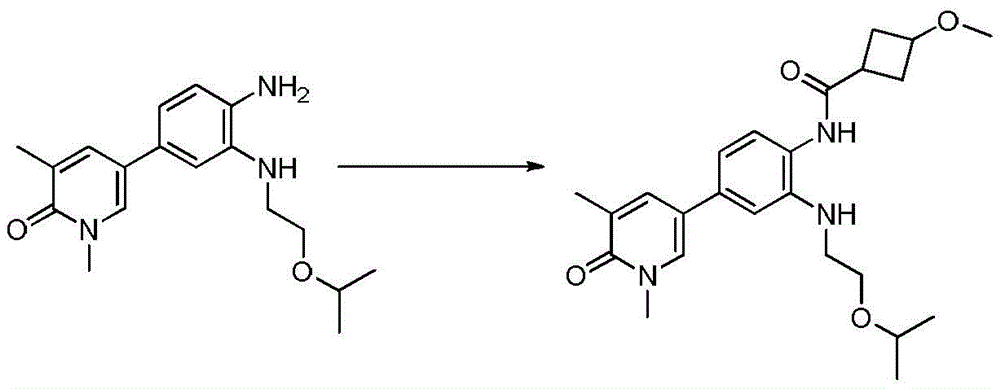
将HATU(0.904g,2.38mmol)加入3-甲氧基环丁烷-1-甲酸(0.248g,1.90mmol)在DCM(5mL)中的0℃搅拌溶液中并将该混合物搅拌30分钟。在室温加入5-(4-氨基-3-((2-异丙氧基乙基)氨基)苯基)-1,3-二甲基吡啶-2(1H)-酮(0.5g,1.59mmol)和DIPEA(0.8mL,4.76mmol)的DCM(5mL)溶液,将反应混合物搅拌2小时。将所得混合物用水(100mL)稀释并用DCM(50mL×3)萃取。将合并的有机层用盐水(50mL)洗涤,用无水Na2SO4干燥,过滤并减压浓缩。通过硅胶色谱使用梯度的3-10%MeOH的DCM溶液作为洗脱液纯化粗产物。将产物级分合并并浓缩,得到为半固体的标题化合物(0.65g,68%),[M+H]+428.45。HATU (0.904 g, 2.38 mmol) was added to a stirred solution of 3-methoxycyclobutane-1-carboxylic acid (0.248 g, 1.90 mmol) in DCM (5 mL) at 0°C and the mixture was stirred for 30 min. 5-(4-Amino-3-((2-isopropoxyethyl)amino)phenyl)-1,3-lutidine-2(1H)-one (0.5 g, 1.59 mmol) was added at room temperature ) and DIPEA (0.8 mL, 4.76 mmol) in DCM (5 mL) and the reaction mixture was stirred for 2 h. The resulting mixture was diluted with water (100 mL) and extracted with DCM (50 mL x 3). The combined organic layers were washed with brine (50 mL), dried over anhydrous Na 2 SO 4 , filtered and concentrated under reduced pressure. The crude product was purified by silica gel chromatography using a gradient of 3-10% MeOH in DCM as eluent. The product fractions were combined and concentrated to give the title compound as a semi-solid (0.65 g, 68%), [M+H] + 428.45.
步骤4:化合物64和65的制备Step 4: Preparation of Compounds 64 and 65
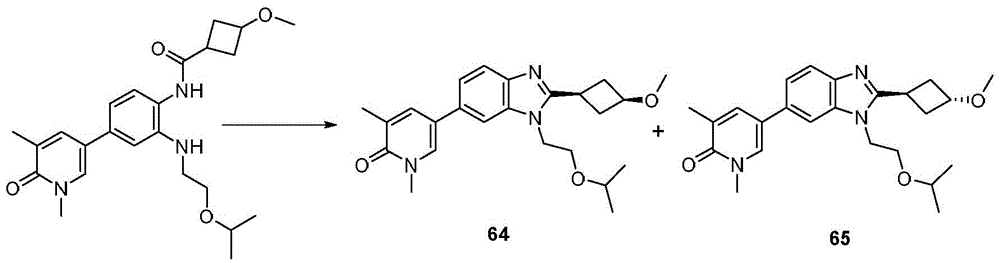
将N-(4-(1,5-二甲基-6-氧代-1,6-二氢吡啶-3-基)-2-((2-异丙氧基乙基)氨基)苯基)-3-甲氧基环丁烷-1-甲酰胺(0.65g,1.52mmol)在乙酸(10mL)中的溶液在100℃加热16小时。使用饱和NaHCO3水溶液(300mL)将所得混合物碱化并用EtOAc(100mL×3)萃取。将合并的有机层用盐水(50mL)洗涤,经无水Na2SO4干燥,过滤并减压浓缩。通过使用1-3%MeOH的DCM溶液作为洗脱液,通过硅胶色谱纯化粗产物。将产物级分合并并真空浓缩,得到顺式和反式异构体的混合物。所述异构体混合物通过使用18%ACN的水溶液(含有0.1%甲酸作为改性剂)的制备型HPLC进一步纯化,得到化合物64(0.08g)和化合物65(0.03g),其为固体,组合产率为18%。N-(4-(1,5-Dimethyl-6-oxo-1,6-dihydropyridin-3-yl)-2-((2-isopropoxyethyl)amino)phenyl )-3-methoxycyclobutane-1-carboxamide (0.65 g, 1.52 mmol) in acetic acid (10 mL) was heated at 100 °C for 16 h. The resulting mixture was basified using saturated aqueous NaHCO3 (300 mL) and extracted with EtOAc (100 mL x 3). The combined organic layers were washed with brine (50 mL), dried over anhydrous Na 2 SO 4 , filtered and concentrated under reduced pressure. The crude product was purified by silica gel chromatography using 1-3% MeOH in DCM as eluent. The product fractions were combined and concentrated in vacuo to give a mixture of cis and trans isomers. The isomer mixture was further purified by preparative HPLC using 18% ACN in water (containing 0.1% formic acid as modifier) to give compound 64 (0.08 g) and compound 65 (0.03 g) as solids, combined Yield 18%.
化合物64:1H NMR(400MHz,CDCl3)δppm 7.78(d,J=8.4Hz,1H),7.58(s,1H),7.42(d,J=2.0Hz,1H),7.33(s,1H),7.30(d,J=2.0Hz,1H),4.26(t,J=5.4Hz,2H),4.04-4.00(m,1H),3.72(t,J=5.4Hz,2H),3.67(s,3H),3.51-3.44(m,1H),3.38-3.33(m,1H),3.32(s,3H),2.83-2.77(m,2H),2.58-2.51(m,2H),2.27(s,3H),1.07(d,J=6.0Hz,6H);[M+H]+410.44。Compound 64: 1 H NMR (400 MHz, CDCl 3 ) δ ppm 7.78 (d, J=8.4 Hz, 1H), 7.58 (s, 1H), 7.42 (d, J=2.0 Hz, 1H), 7.33 (s, 1H) ,7.30(d,J=2.0Hz,1H),4.26(t,J=5.4Hz,2H),4.04-4.00(m,1H),3.72(t,J=5.4Hz,2H),3.67(s, 3H), 3.51-3.44(m, 1H), 3.38-3.33(m, 1H), 3.32(s, 3H), 2.83-2.77(m, 2H), 2.58-2.51(m, 2H), 2.27(s, 3H), 1.07 (d, J=6.0 Hz, 6H); [M+H] + 410.44.
化合物65:1H NMR(400MHz,CDCl3)δppm 7.78(d,J=8.4Hz,1H),7.59(s,1H),7.43(d,J=2.4Hz,1H),7.35(d,J=1.2Hz,1H),7.31(d,J=1.6Hz,1H),4.33-4.29(m,1H),4.25(t,J=5.4Hz,2H),3.89-3.87(m,1H),3.71(t,J=5.6Hz,2H),3.67(s,3H),3.49-3.46(m,1H),3.34(s,3H),2.85-2.79(m,2H),2.55-2.48(m,2H),2.27(s,3H),1.07(d,J=6.0Hz,6H);[M+H]+410.39。Compound 65: 1 H NMR (400 MHz, CDCl 3 ) δ ppm 7.78 (d, J=8.4 Hz, 1H), 7.59 (s, 1H), 7.43 (d, J=2.4 Hz, 1H), 7.35 (d, J= 1.2Hz, 1H), 7.31(d, J=1.6Hz, 1H), 4.33-4.29(m, 1H), 4.25(t, J=5.4Hz, 2H), 3.89-3.87(m, 1H), 3.71( t, J=5.6Hz, 2H), 3.67(s, 3H), 3.49-3.46(m, 1H), 3.34(s, 3H), 2.85-2.79(m, 2H), 2.55-2.48(m, 2H) , 2.27 (s, 3H), 1.07 (d, J=6.0 Hz, 6H); [M+H] + 410.39.
实施例59:(R)-5-(1-(1-异丙氧基丙烷-2-基)-2-(四氢-2H-吡喃-4-基)-1H-苯并[d]咪唑-6-基)-1,3-二甲基吡啶-2(1H)-酮(化合物66)Example 59: (R)-5-(1-(1-Isopropoxypropan-2-yl)-2-(tetrahydro-2H-pyran-4-yl)-1H-benzo[d] Imidazol-6-yl)-1,3-lutidine-2(1H)-one (Compound 66)

步骤1:(R)-5-溴-N-(1-异丙氧基丙烷-2-基)-2-硝基苯胺的制备Step 1: Preparation of (R)-5-bromo-N-(1-isopropoxypropan-2-yl)-2-nitroaniline

将(R)-2-((5-溴-2-硝基苯基)氨基)丙-1-醇(实施例42,步骤1,0.55g,2.15mmol)在DMF(10mL)中的溶液在0℃搅拌10分钟。加入60%NaH的矿物油(0.30g,3.21mmol),并将反应混合物在相同温度下搅拌15分钟。在0℃加入2-碘丙烷(0.50g,3.21mmol),并将反应混合物在70℃加热24小时。然后将所得混合物用水(100mL)稀释并用EtOAc(100mL×3)萃取。将合并的有机层用盐水(30mL)洗涤,经无水Na2SO4干燥,过滤并减压浓缩。粗物质通过硅胶色谱纯化,使用梯度的10-30%EtOAc的己烷溶液作为洗脱液。将产物级分合并并蒸发至干,得到标题化合物(0.14g,19%),为固体。[M+H]+317.1,319.12。A solution of (R)-2-((5-bromo-2-nitrophenyl)amino)propan-1-ol (Example 42, step 1, 0.55 g, 2.15 mmol) in DMF (10 mL) was Stir at 0°C for 10 minutes. 60% NaH in mineral oil (0.30 g, 3.21 mmol) was added and the reaction mixture was stirred at the same temperature for 15 minutes. 2-Iodopropane (0.50 g, 3.21 mmol) was added at 0°C and the reaction mixture was heated at 70°C for 24 hours. The resulting mixture was then diluted with water (100 mL) and extracted with EtOAc (100 mL x 3). The combined organic layers were washed with brine (30 mL), dried over anhydrous Na 2 SO 4 , filtered and concentrated under reduced pressure. The crude material was purified by silica gel chromatography using a gradient of 10-30% EtOAc in hexanes as eluent. The product fractions were combined and evaporated to dryness to give the title compound (0.14 g, 19%) as a solid. [M+H] + 317.1, 319.12.
步骤2:(R)-5-(3-((1-异丙氧基丙烷-2-基)氨基)-4-硝基苯基)-1,3-二甲基吡啶-2(1H)-酮的制备Step 2: (R)-5-(3-((1-isopropoxypropan-2-yl)amino)-4-nitrophenyl)-1,3-lutidine-2(1H) - Preparation of ketones
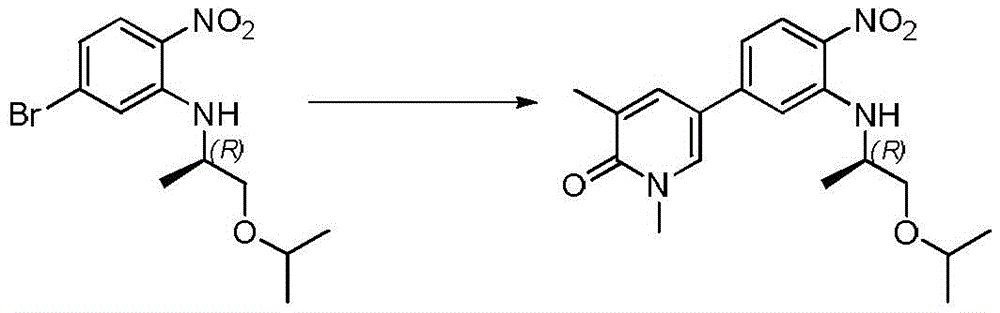
将(R)-5-溴-N-(1-异丙氧基丙-2-基)-2-硝基苯胺(0.14g,0.44mmol)和1,3-二甲基-5-(4,4,5,5-四甲基-1,3,2-二氧硼杂环戊烷-2-基)吡啶-2(1H)-酮(0.14g,0.57mmol)在DME(5mL)中的搅拌溶液用氮气吹扫20分钟,然后加入Cs2CO3(0.42g,1.32mmol)的水(0.3mL)溶液并用氮气吹扫另外20分钟。然后在室温下加入Pd(PPh3)4(0.025g,0.022mmol)并将反应混合物在90℃加热16小时。将所得混合物用水(30mL)稀释并用EtOAc(30mL×3)萃取。将合并的有机层用盐水(30mL)洗涤,经无水Na2SO4干燥,过滤并减压浓缩。通过使用3-5%MeOH的DCM溶液作为洗脱液的硅胶色谱纯化粗物质。将产物级分合并并蒸发至干,得到标题化合物(0.16g,91%),为固体。[M+H]+360.31。(R)-5-Bromo-N-(1-isopropoxyprop-2-yl)-2-nitroaniline (0.14 g, 0.44 mmol) and 1,3-dimethyl-5-(4 ,4,5,5-tetramethyl-1,3,2-dioxaborol-2-yl)pyridin-2(1H)-one (0.14 g, 0.57 mmol) in DME (5 mL) The stirred solution was purged with nitrogen for 20 min, then a solution of Cs2CO3 ( 0.42 g, 1.32 mmol) in water (0.3 mL) was added and purged with nitrogen for an additional 20 min. Then Pd( PPh3 ) 4 (0.025 g, 0.022 mmol) was added at room temperature and the reaction mixture was heated at 90°C for 16 hours. The resulting mixture was diluted with water (30 mL) and extracted with EtOAc (30 mL x 3). The combined organic layers were washed with brine (30 mL), dried over anhydrous Na 2 SO 4 , filtered and concentrated under reduced pressure. The crude material was purified by silica gel chromatography using 3-5% MeOH in DCM as eluent. The product fractions were combined and evaporated to dryness to give the title compound (0.16 g, 91%) as a solid. [M+H] + 360.31.
步骤3:(R)-5-(4-氨基-3-((1-异丙氧基丙烷-2-基)氨基)苯基)-1,3-二甲基吡啶-2(1H)-酮的制备Step 3: (R)-5-(4-Amino-3-((1-isopropoxypropan-2-yl)amino)phenyl)-1,3-lutidine-2(1H)- Preparation of ketones

将连二亚硫酸钠(0.68g,5.28mmol)加入到(R)-5-(3-((1-异丙氧基丙-2-基)氨基)-4-硝基苯基)-1,3-二甲基吡啶-2(1H)-酮(0.16g,0.44mmol)在MeOH(5mL)和水(2mL)中的室温混悬液中,并将反应混合物在50℃加热1小时。将所得混合物用水(50mL)稀释并用DCM(50mL×3)萃取。将合并的DCM层用盐水(50mL)洗涤,经无水Na2SO4干燥,过滤并减压浓缩,得到标题化合物(0.14g,90%),为固体。[M+H]+330.33。Sodium dithionite (0.68 g, 5.28 mmol) was added to (R)-5-(3-((1-isopropoxyprop-2-yl)amino)-4-nitrophenyl)-1,3 - Lutidine-2(1H)-one (0.16 g, 0.44 mmol) in MeOH (5 mL) and water (2 mL) at room temperature and the reaction mixture was heated at 50°C for 1 hour. The resulting mixture was diluted with water (50 mL) and extracted with DCM (50 mL x 3). The combined DCM layers were washed with brine (50 mL), dried over anhydrous Na2SO4 , filtered and concentrated under reduced pressure to give the title compound (0.14 g, 90%) as a solid. [M+H] + 330.33.
步骤4:化合物66的制备Step 4: Preparation of Compound 66

将四氢-2H-吡喃-4-甲醛(0.062g,0.54mmol)加至(R)-5-(4-氨基-3-((1-异丙氧基丙-2-基)氨基)苯基)-1,3-二甲基吡啶-2(1H)-酮(0.15g,0.45mmol)在乙酸(4mL)中的室温搅拌溶液中,并将反应混合物在相同温度下搅拌48小时。将所得混合物减压浓缩,用饱和NaHCO3水溶液(50mL)稀释并用EtOAc(50mL×3)萃取。将合并的有机层用盐水(50mL)洗涤,用无水Na2SO4干燥,过滤并减压浓缩。粗物质通过使用1-3%MeOH的DCM溶液作为洗脱液的硅胶色谱纯化。将产物级分合并并蒸发至干,得到为固体的化合物66(0.075g,41%)。1H NMR(400MHz,CDCl3)δppm7.79(d,J=8.4Hz,1H),7.54(s,1H),7.46(d,J=0.8Hz,1H),7.38(d,J=2.4Hz,1H),7.26(d,J=1.6Hz,1H),4.74-4.69(m,1H),4.16-4.12(m,2H),3.94-3.90(m,1H),3.85-3.82(m,1H),3.67(s,3H),3.64-3.58(m,2H),3.48-3.42(m,1H),3.22-3.15(m,1H),2.27(s,3H),2.24-2.20(m,2H),2.04-2.00(m,1H),1.88-1.84(m,1H),1.73(d,J=7.2Hz,3H),1.11(d,J=6Hz,3H),0.94,(d,J=6Hz,3H)。[M+H]+424.39。Tetrahydro-2H-pyran-4-carbaldehyde (0.062 g, 0.54 mmol) was added to (R)-5-(4-amino-3-((1-isopropoxypropan-2-yl)amino) A stirred solution of phenyl)-1,3-lutidine-2(1H)-one (0.15 g, 0.45 mmol) in acetic acid (4 mL) at room temperature and the reaction mixture was stirred at the same temperature for 48 hours. The resulting mixture was concentrated under reduced pressure, diluted with saturated aqueous NaHCO3 (50 mL) and extracted with EtOAc (50 mL x 3). The combined organic layers were washed with brine (50 mL), dried over anhydrous Na 2 SO 4 , filtered and concentrated under reduced pressure. The crude material was purified by silica gel chromatography using 1-3% MeOH in DCM as eluent. The product fractions were combined and evaporated to dryness to give compound 66 as a solid (0.075 g, 41%). 1 H NMR (400MHz, CDCl3) δppm 7.79 (d, J=8.4Hz, 1H), 7.54 (s, 1H), 7.46 (d, J=0.8Hz, 1H), 7.38 (d, J=2.4Hz, 1H), 7.26(d, J=1.6Hz, 1H), 4.74-4.69(m, 1H), 4.16-4.12(m, 2H), 3.94-3.90(m, 1H), 3.85-3.82(m, 1H) ,3.67(s,3H),3.64-3.58(m,2H),3.48-3.42(m,1H),3.22-3.15(m,1H),2.27(s,3H),2.24-2.20(m,2H) ,2.04-2.00(m,1H),1.88-1.84(m,1H),1.73(d,J=7.2Hz,3H),1.11(d,J=6Hz,3H),0.94,(d,J=6Hz , 3H). [M+H] + 424.39.
实施例60:(S)-5-(1-(2-异丙氧基丙基)-2-(四氢-2H-吡喃-4-基)-1H-苯并[d]咪唑-6-基)-1,3-二甲基吡啶-2(1H)-酮(化合物67)Example 60: (S)-5-(1-(2-isopropoxypropyl)-2-(tetrahydro-2H-pyran-4-yl)-1H-benzo[d]imidazole-6 -yl)-1,3-lutidine-2(1H)-one (Compound 67)

步骤1:(S)-(2-异丙氧基丙基)氨基甲酸叔丁酯的制备Step 1: Preparation of tert-butyl (S)-(2-isopropoxypropyl)carbamate

将(S)-(2-羟基丙基)氨基甲酸叔丁酯(1g,5.71mmol)、2-碘丙烷(1.93g,11.42mmol)和Cs2CO3(5.56g,17.13mmol)在DMSO(25mL)中的搅拌溶液搅拌并在100℃加热24小时。将所得混合物用水(100mL)稀释并用EtOAc(100mL×3)萃取。将合并的有机层用盐水(30mL)洗涤,经无水Na2SO4干燥,过滤并减压浓缩。将粗物质通过硅胶色谱纯化,使用梯度的10-30%EtOAc的己烷溶液作为洗脱液。将产物级分合并并蒸发至干,得到为固体的标题化合物(0.26g,21%)。[M+H]+219.12。Combine (S)-(2-hydroxypropyl)carbamate (1 g, 5.71 mmol), 2-iodopropane (1.93 g, 11.42 mmol) and Cs2CO3 ( 5.56 g, 17.13 mmol) in DMSO ( The stirred solution in 25 mL) was stirred and heated at 100°C for 24 hours. The resulting mixture was diluted with water (100 mL) and extracted with EtOAc (100 mL x 3). The combined organic layers were washed with brine (30 mL), dried over anhydrous Na 2 SO 4 , filtered and concentrated under reduced pressure. The crude material was purified by silica gel chromatography using a gradient of 10-30% EtOAc in hexanes as eluent. The product fractions were combined and evaporated to dryness to give the title compound as a solid (0.26 g, 21%). [M+H] + 219.12.
步骤2:(S)-2-异丙氧基丙-1-胺的制备Step 2: Preparation of (S)-2-isopropoxypropan-1-amine

将(S)-(2-异丙氧基丙基)氨基甲酸叔丁酯(0.12g)在4M HCl的二噁烷(2mL)中的溶液在0℃下搅拌2小时。然后蒸发过量溶剂,得到为固体的标题化合物(0.13g,92%),其不经进一步纯化直接用于下一步。A solution of (S)-(2-isopropoxypropyl)carbamate (0.12 g) in 4M HCl in dioxane (2 mL) was stirred at 0°C for 2 hours. Excess solvent was then evaporated to give the title compound as a solid (0.13 g, 92%) which was used in the next step without further purification.
步骤3:(S)-5-溴-N-(2-异丙氧基丙基)-2-硝基苯胺的制备Step 3: Preparation of (S)-5-bromo-N-(2-isopropoxypropyl)-2-nitroaniline
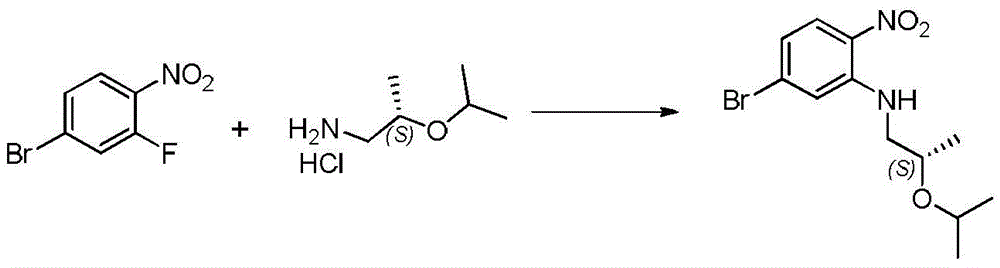
将TEA(0.2mL,0.95mmol)加入到4-溴-2-氟-1-硝基苯(0.16g,0.72mmol)和(S)-2-异丙氧基丙-1-胺盐酸盐(0.13g,0.87mmol)在乙醇(4毫升)中的搅拌溶液中,将反应混合物在70℃加热8小时。将所得混合物用水(50mL)稀释并用EtOAc(50mL×3)萃取。将合并的有机层用盐水(20mL)洗涤,用无水Na2SO4干燥,过滤并减压浓缩。粗物质通过硅胶色谱纯化,使用梯度的10-30%EtOAc的己烷溶液作为洗脱液。将产物级分合并并蒸发至干,得到为固体的标题化合物(0.24g,77%)。[M+H]+2319.12。TEA (0.2 mL, 0.95 mmol) was added to 4-bromo-2-fluoro-1-nitrobenzene (0.16 g, 0.72 mmol) and (S)-2-isopropoxyprop-1-amine hydrochloride (0.13 g, 0.87 mmol) in a stirred solution of ethanol (4 mL) and the reaction mixture was heated at 70 °C for 8 h. The resulting mixture was diluted with water (50 mL) and extracted with EtOAc (50 mL x 3). The combined organic layers were washed with brine (20 mL), dried over anhydrous Na 2 SO 4 , filtered and concentrated under reduced pressure. The crude material was purified by silica gel chromatography using a gradient of 10-30% EtOAc in hexanes as eluent. The product fractions were combined and evaporated to dryness to give the title compound as a solid (0.24 g, 77%). [M+H] +2 319.12.
步骤4:(S)-5-(3-((2-异丙氧基丙基)氨基)-4-硝基苯基)-1,3-二甲基吡啶-2(1H)-酮的制备Step 4: (S)-5-(3-((2-isopropoxypropyl)amino)-4-nitrophenyl)-1,3-lutidine-2(1H)-one preparation

将(S)-5-溴-N-(2-异丙氧基丙基)-2-硝基苯胺(0.24g,0.75mmol)和1,3-二甲基-5-(4,4,5,5-四甲基-1,3,2-二氧硼杂环戊烷-2-基)吡啶-2(1H)-酮(0.24g,0.98mmol)在DME(4mL)中的搅拌溶液用氮气吹扫20分钟,随后加入Cs2CO3(0.73g,2.27mmol)的水(0.4mL)溶液并用氮气吹扫另外20分钟。然后加入Pd(PPh3)4(0.045g,0.037mmol),并将反应混合物在90℃加热16小时。将所得混合物用水(30mL)稀释并用EtOAc(30mL×3)萃取。将合并的有机层用盐水(30mL)洗涤,用无水Na2SO4干燥,过滤并减压浓缩。通过使用3-5%MeOH的DCM溶液作为洗脱液的硅胶色谱纯化粗物质。将产物级分合并并蒸发至干燥,得到为固体的标题化合物(0.16g,48%)。[M+H]+360.31。(S)-5-Bromo-N-(2-isopropoxypropyl)-2-nitroaniline (0.24 g, 0.75 mmol) and 1,3-dimethyl-5-(4,4, A stirred solution of 5,5-tetramethyl-1,3,2-dioxaborol-2-yl)pyridin-2(1H)-one (0.24 g, 0.98 mmol) in DME (4 mL) Purge with nitrogen for 20 minutes, then add a solution of Cs2CO3 ( 0.73 g, 2.27 mmol) in water (0.4 mL) and purge with nitrogen for an additional 20 minutes. Pd( PPh3 ) 4 (0.045 g, 0.037 mmol) was then added and the reaction mixture was heated at 90°C for 16 hours. The resulting mixture was diluted with water (30 mL) and extracted with EtOAc (30 mL x 3). The combined organic layers were washed with brine (30 mL), dried over anhydrous Na 2 SO 4 , filtered and concentrated under reduced pressure. The crude material was purified by silica gel chromatography using 3-5% MeOH in DCM as eluent. The product fractions were combined and evaporated to dryness to give the title compound as a solid (0.16 g, 48%). [M+H] + 360.31.
步骤5:(S)-5-(4-氨基-3-((2-异丙氧基丙基)氨基)苯基)-1,3-二甲基吡啶-2(1H)-酮的制备Step 5: Preparation of (S)-5-(4-amino-3-((2-isopropoxypropyl)amino)phenyl)-1,3-lutidine-2(1H)-one
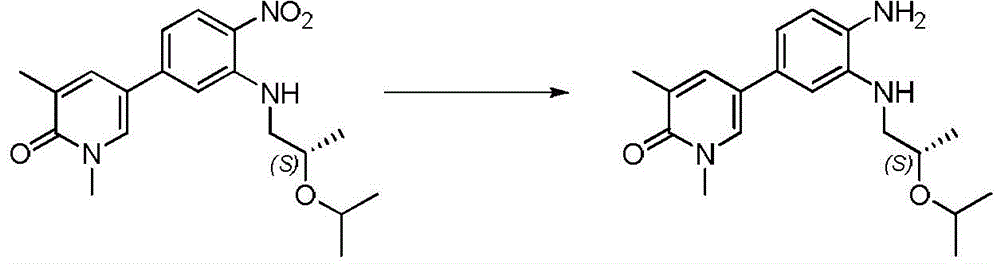
将连二亚硫酸钠(0.68g,5.28mmol)加入到(S)-5-(3-((2-异丙氧基丙基)氨基)-4-硝基苯基)-1,3-二甲基吡啶-2(1H)-酮(0.16g,0.44mmol)在MeOH(5mL)和水(2mL)中的搅拌混悬液中并将反应混合物在50℃加热1小时。然后将反应混合物用水(50mL)稀释并用DCM(50mL×3)萃取。将合并的DCM层用盐水(20mL)洗涤,用无水Na2SO4干燥,过滤并减压浓缩,得到标题化合物(0.14g,41%),为固体。[M+H]+330.28。Sodium dithionite (0.68 g, 5.28 mmol) was added to (S)-5-(3-((2-isopropoxypropyl)amino)-4-nitrophenyl)-1,3-dimethyl In a stirred suspension of pyridin-2(1H)-one (0.16 g, 0.44 mmol) in MeOH (5 mL) and water (2 mL) and the reaction mixture was heated at 50 °C for 1 h. The reaction mixture was then diluted with water (50 mL) and extracted with DCM (50 mL x 3). The combined DCM layers were washed with brine (20 mL), dried over anhydrous Na2SO4 , filtered and concentrated under reduced pressure to give the title compound (0.14 g, 41%) as a solid. [M+H] + 330.28.
步骤6:化合物67的制备Step 6: Preparation of Compound 67

将四氢-2H-吡喃-4-甲醛(0.062g,0.54mmol)加入(S)-5-(4-氨基-3-((2-异丙氧基丙基)氨基)苯基)-1,3-二甲基吡啶-2(1H)-酮(0.15g,0.45mmol)在乙酸(4mL)中的室温搅拌溶液中并将反应混合物搅拌48小时。然后蒸发得到的混合物,用饱和NaHCO3水溶液(50mL)稀释,并用EtOAc(50mL×3)萃取。将合并的有机层用盐水(20mL)洗涤,经无水Na2SO4干燥,过滤并减压浓缩。粗物质通过使用1-3%MeOH的DCM溶液的硅胶色谱纯化。合并产物级分并真空蒸发至干,得到化合物67(0.035g,39%),为固体。1H NMR(400MHz,CDCl3)δppm7.77(dd,J=2和2.4Hz,1H),7.58(d,J=1.2Hz,1H),7.42(d,J=2.4Hz,1H),7.31(d,J=2.4Hz,1H),7.30(d,J=1.6Hz,1H),4.20-4.66(m,1H),4.14-4.10(m,3H),3.89-3.84(m,1H),3.67(s,3H),3.65-3.58(m,2H),3.38-3.31(m,2H),2.39-2.31(m,1H),2.27(s,3H),2.13-2.03(m,1H),1.98-1.94(m,1H),1.85-1.82(m,1H),1.32(d,J=5.2Hz,3H),1.06(d,J=6.4Hz,3H),0.61,(d,J=6Hz,3H)。Tetrahydro-2H-pyran-4-carbaldehyde (0.062 g, 0.54 mmol) was added to (S)-5-(4-amino-3-((2-isopropoxypropyl)amino)phenyl)- In a stirred solution of 1,3-lutidine-2(1H)-one (0.15 g, 0.45 mmol) in acetic acid (4 mL) at room temperature and the reaction mixture was stirred for 48 hours. The resulting mixture was then evaporated, diluted with saturated aqueous NaHCO3 (50 mL), and extracted with EtOAc (50 mL x 3). The combined organic layers were washed with brine (20 mL), dried over anhydrous Na 2 SO 4 , filtered and concentrated under reduced pressure. The crude material was purified by silica gel chromatography using 1-3% MeOH in DCM. The product fractions were combined and evaporated to dryness in vacuo to give compound 67 (0.035 g, 39%) as a solid. 1 H NMR (400 MHz, CDCl 3 ) δ ppm 7.77 (dd, J=2 and 2.4 Hz, 1H), 7.58 (d, J=1.2 Hz, 1H), 7.42 (d, J=2.4 Hz, 1H), 7.31 (d, J=2.4Hz, 1H), 7.30(d, J=1.6Hz, 1H), 4.20-4.66(m, 1H), 4.14-4.10(m, 3H), 3.89-3.84(m, 1H), 3.67(s, 3H), 3.65-3.58(m, 2H), 3.38-3.31(m, 2H), 2.39-2.31(m, 1H), 2.27(s, 3H), 2.13-2.03(m, 1H), 1.98-1.94(m,1H),1.85-1.82(m,1H),1.32(d,J=5.2Hz,3H),1.06(d,J=6.4Hz,3H),0.61,(d,J=6Hz , 3H).
实施例61:生物活性Example 61: Biological Activity
a)体外溴结构域抑制测定a) In vitro bromodomain inhibition assay
为了测量溴结构域抑制剂的活性,His-表位标记的BRD4BD149-170购自BPSBioscience。通过使用AlphaLISA技术(Perkin-Elmer)监测生物素化的H4-四乙酰基肽(H4K5/8/12/16;AnaSpec#64989-025)与靶标的结合来评估BRD4结合和抑制。具体而言,在384孔OptiPlate中,将BRD4(BD1)(200nM终浓度)与DMSO(终浓度1.0%DMSO)或DMSO中的化合物稀释系列预培养。将所有试剂在含有50mM HEPES(pH 7.4),100mM NaCl,0.1%(w/v)BSA和0.05%(w/v)CHAPS的测定缓冲液中稀释。在室温培养30分钟后,添加H4肽(200nM终浓度),并将反应在室温另外培养30分钟。然后加入α-链亲和素供体珠和AlphaLISA镍螯合物受体珠至各为10μg/mL的终浓度。1小时后,在Envision仪器上读取平衡板,并使用四参数非线性曲线拟合计算IC50(结果显示在表1中)。To measure the activity of bromodomain inhibitors, His-epitope-tagged BRD4BD149-170 was purchased from BPS Bioscience. BRD4 binding and inhibition were assessed by monitoring the binding of biotinylated H4-tetraacetyl peptide (H4K5/8/12/16; AnaSpec #64989-025) to the target using AlphaLISA technology (Perkin-Elmer). Specifically, BRD4(BD1) (200 nM final concentration) was preincubated with DMSO (1.0% DMSO final) or compound dilution series in DMSO in a 384-well OptiPlate. All reagents were diluted in assay buffer containing 50 mM HEPES (pH 7.4), 100 mM NaCl, 0.1% (w/v) BSA and 0.05% (w/v) CHAPS. After a 30 minute incubation at room temperature, H4 peptide (200 nM final concentration) was added and the reaction was incubated for an additional 30 minutes at room temperature. Alpha-Streptavidin Donor Beads and AlphaLISA Nickel Chelate Acceptor Beads were then added to a final concentration of 10 μg/mL each. After 1 hour, the equilibrium plates were read on the Envision instrument and IC50s were calculated using a four-parameter nonlinear curve fit (results are shown in Table 1).
b)在人白血病MV-4-11细胞中转录人C-Myc:b) Transcription of human C-Myc in human leukemia MV-4-11 cells:
使用QuantiGene 2.0测定试剂盒(Affymetrix,Santa Clara,California,USA),在人B-骨髓单核细胞白血病细胞系MV-4-11(来自美国典型培养物保藏中心(ATCC),Manassas,Virginia,USA)中监测化合物对人C-Myc基因转录的影响。The human B-myelomonocytic leukemia cell line MV-4-11 (from the American Type Culture Collection (ATCC), Manassas, Virginia, USA) was tested using the QuantiGene 2.0 assay kit (Affymetrix, Santa Clara, California, USA). ) to monitor the effect of compounds on human C-Myc gene transcription.
通常,将8000个MV-4-11细胞置于无菌96孔板(Costar#3598,来自FisherScientific Canada,Ottawa,Ontario,Canada)中的补充有10%胎牛血清,谷氨酰胺(2mM),青霉素(100I.U.)和链霉素(100μg/mL)的Iscove's培养基(均来自Wisent Inc.,St.Bruno,Quebec,Canada)中。化合物以30mM溶解在DMSO中。首先在DMSO中制备一系列1:3稀释液,并在含血清的细胞培养基中进一步制备1:100稀释液。在细胞培养基中DMSO的终浓度为0.1%。细胞用各种浓度的测试化合物处理4小时后,使用Quantigene 2.0样品处理试剂盒(#QS0100)裂解细胞。使用QuantiGene 2.0测定试剂盒(#QS0009)和人C-Myc(#SA-50182)的基因特异性探针,根据制造商的推荐检测C-Myc mRNA。在Flexstation II酶标仪(Molecular Devices,Sunnyvale,California,USA)上读取发光信号。使用EXCEL(2010版)分析C-Myc转录抑制百分比(结果见表1)。Typically, 8000 MV-4-11 cells were plated in sterile 96-well plates (Costar #3598 from Fisher Scientific Canada, Ottawa, Ontario, Canada) supplemented with 10% fetal bovine serum, glutamine (2 mM), Penicillin (100 I.U.) and streptomycin (100 μg/mL) in Iscove's medium (both from Wisent Inc., St. Bruno, Quebec, Canada). Compounds were dissolved in DMSO at 30 mM. A series of 1:3 dilutions were made first in DMSO and further 1:100 dilutions were made in serum-containing cell culture medium. The final concentration of DMSO in cell culture medium was 0.1%. After cells were treated with various concentrations of test compounds for 4 hours, cells were lysed using the Quantigene 2.0 sample processing kit (#QS0100). C-Myc mRNA was detected using the QuantiGene 2.0 Assay Kit (#QS0009) and a gene-specific probe for human C-Myc (#SA-50182) according to the manufacturer's recommendations. Luminescence signals were read on a Flexstation II microplate reader (Molecular Devices, Sunnyvale, California, USA). The percentage of C-Myc transcriptional inhibition was analyzed using EXCEL (version 2010) (see Table 1 for the results).
表1Table 1
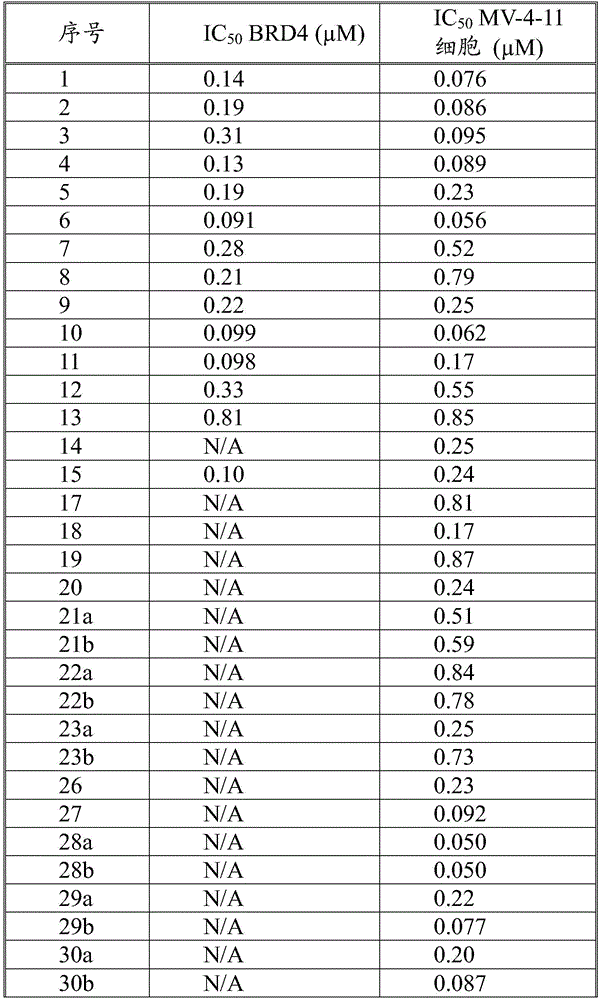

虽然已经针对一个或多个实施方案说明和描述了本发明,但是本领域技术人员在阅读和理解本说明书之后将会想到等同的改变和修改。另外,虽然本发明的特定特征在数个实施方式中仅公开了一个,但是这样的特征可以与其他实施方式的一个或多个其他特征组合,如对于任何给定的或特定的应用是需要且有利的。While the invention has been illustrated and described with respect to one or more embodiments, equivalent changes and modifications will occur to those skilled in the art after reading and understanding this specification. Additionally, although a particular feature of the invention is disclosed in only one of several embodiments, such feature may be combined with one or more other features of other embodiments, as required for any given or particular application and advantageous.
因此,应当理解,本文描述的实施例和实施方案仅用于说明性目的,并且对于本领域技术人员将暗示对其进行各种修改或改变,并且将被包括在本申请的精神和范围内,并且范围如所附权利要求书。出于所有目的,本文中提到的任何出版物,文献,专利,专利申请或出版物应被解释为通过引用整体并入本文。Therefore, it should be understood that the examples and embodiments described herein are for illustrative purposes only and that various modifications or changes thereto will be suggested to those skilled in the art and are to be included within the spirit and scope of this application, And the scope is as in the appended claims. For all purposes, any publication, document, patent, patent application or publication mentioned herein should be construed as incorporated by reference in its entirety.
Claims (31)


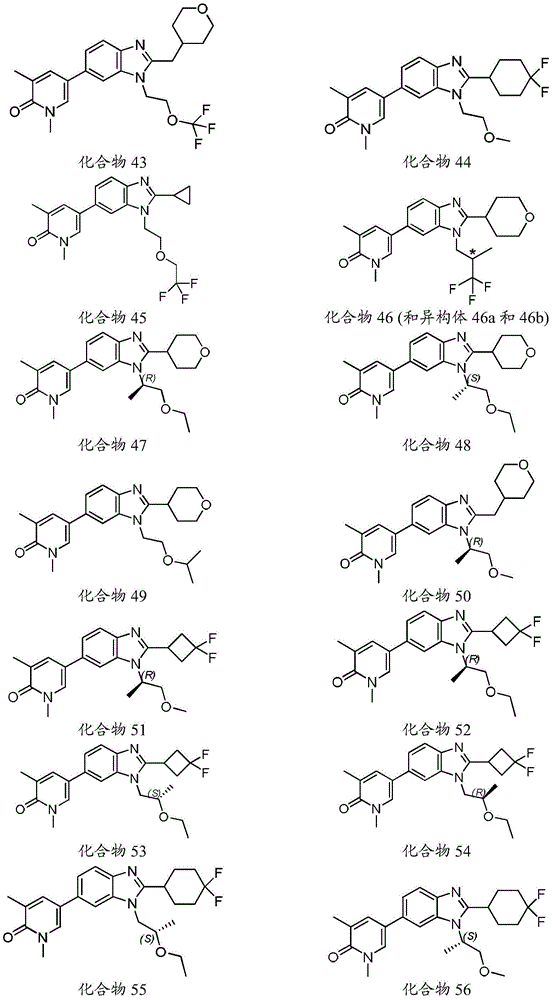


Priority Applications (1)
| Application Number | Priority Date | Filing Date | Title |
|---|---|---|---|
| CN202111621671.6A CN114605387A (en) | 2015-08-12 | 2016-08-12 | Substituted benzimidazoles, their preparation and their use as medicaments |
Applications Claiming Priority (5)
| Application Number | Priority Date | Filing Date | Title |
|---|---|---|---|
| US201562204178P | 2015-08-12 | 2015-08-12 | |
| US62/204,178 | 2015-08-12 | ||
| US201662358101P | 2016-07-04 | 2016-07-04 | |
| US62/358,101 | 2016-07-04 | ||
| PCT/CA2016/050952 WO2017024412A1 (en) | 2015-08-12 | 2016-08-12 | Substituted benzimidazoles, their preparation and their use as pharmaceuticals |
Related Child Applications (1)
| Application Number | Title | Priority Date | Filing Date |
|---|---|---|---|
| CN202111621671.6A Division CN114605387A (en) | 2015-08-12 | 2016-08-12 | Substituted benzimidazoles, their preparation and their use as medicaments |
Publications (2)
| Publication Number | Publication Date |
|---|---|
| CN108137539A CN108137539A (en) | 2018-06-08 |
| CN108137539B true CN108137539B (en) | 2022-01-11 |
Family
ID=57982882
Family Applications (2)
| Application Number | Title | Priority Date | Filing Date |
|---|---|---|---|
| CN201680059249.7A Active CN108137539B (en) | 2015-08-12 | 2016-08-12 | Substituted benzimidazoles, their preparation and their use as pharmaceuticals |
| CN202111621671.6A Pending CN114605387A (en) | 2015-08-12 | 2016-08-12 | Substituted benzimidazoles, their preparation and their use as medicaments |
Family Applications After (1)
| Application Number | Title | Priority Date | Filing Date |
|---|---|---|---|
| CN202111621671.6A Pending CN114605387A (en) | 2015-08-12 | 2016-08-12 | Substituted benzimidazoles, their preparation and their use as medicaments |
Country Status (11)
| Country | Link |
|---|---|
| US (4) | US10703740B2 (en) |
| EP (1) | EP3334719B1 (en) |
| JP (1) | JP6912039B2 (en) |
| KR (1) | KR102784592B1 (en) |
| CN (2) | CN108137539B (en) |
| AU (2) | AU2016305515A1 (en) |
| CA (1) | CA2994478C (en) |
| ES (1) | ES2904258T3 (en) |
| IL (1) | IL257340B2 (en) |
| MX (1) | MX382832B (en) |
| WO (1) | WO2017024412A1 (en) |
Families Citing this family (11)
| Publication number | Priority date | Publication date | Assignee | Title |
|---|---|---|---|---|
| CN108137539B (en) * | 2015-08-12 | 2022-01-11 | 尼奥迈德研究所 | Substituted benzimidazoles, their preparation and their use as pharmaceuticals |
| GB201617627D0 (en) | 2016-10-18 | 2016-11-30 | Cellcentric Ltd | Pharmaceutical compounds |
| GB201617630D0 (en) | 2016-10-18 | 2016-11-30 | Cellcentric Ltd | Pharmaceutical compounds |
| JP7165501B2 (en) * | 2017-03-15 | 2022-11-04 | 住友ファーマ株式会社 | Pharmaceuticals comprising novel benzimidazole compounds |
| WO2018207882A1 (en) * | 2017-05-12 | 2018-11-15 | 武田薬品工業株式会社 | Heterocyclic compounds |
| GB201806320D0 (en) | 2018-04-18 | 2018-05-30 | Cellcentric Ltd | Process |
| WO2020093162A1 (en) * | 2018-11-07 | 2020-05-14 | Neomed Institute | Treatment of bet inhibitor-resistant cancers and other diseases responsive to dual bet and cbp/ep300 inhibition therapy |
| JP2022053557A (en) * | 2019-02-08 | 2022-04-06 | マルホ株式会社 | Pyridone derivative |
| CN112174945B (en) * | 2019-07-02 | 2022-06-07 | 四川大学 | Indazole compound with anticancer effect and preparation method and application thereof |
| CN115232074A (en) * | 2022-08-22 | 2022-10-25 | 湖南复瑞生物医药技术有限责任公司 | Synthesis method of 1-alkyl substituted-2-methyl-5-bromobenzimidazole |
| WO2024249796A2 (en) * | 2023-06-02 | 2024-12-05 | Epigenetix, Inc. | Extended and delayed release compositions of substituted benzimidazoles |
Citations (2)
| Publication number | Priority date | Publication date | Assignee | Title |
|---|---|---|---|---|
| CA2098243A1 (en) * | 1992-06-13 | 1993-12-14 | Werner Mederski | Benzimidazole derivatives |
| CN107635558A (en) * | 2015-04-15 | 2018-01-26 | 赛尔基因昆蒂赛尔研究公司 | Bu Luomo domain inhibitor |
Family Cites Families (55)
| Publication number | Priority date | Publication date | Assignee | Title |
|---|---|---|---|---|
| US4550166A (en) | 1984-05-21 | 1985-10-29 | American Cyanamid Company | (Pyridinyl)-1,2,4-triazolo[4,3-a]pyridines |
| US4785005A (en) | 1986-06-25 | 1988-11-15 | Rorer Pharmaceutical Corporation | 6-(6-alkylpyridone)-carbostyril compounds and their cardiotonic uses |
| US5093330A (en) | 1987-06-15 | 1992-03-03 | Ciba-Geigy Corporation | Staurosporine derivatives substituted at methylamino nitrogen |
| US6162804A (en) | 1997-09-26 | 2000-12-19 | Merck & Co., Inc. | Tyrosine kinase inhibitors |
| US6465484B1 (en) | 1997-09-26 | 2002-10-15 | Merck & Co., Inc. | Angiogenesis inhibitors |
| AU760020B2 (en) | 1998-08-31 | 2003-05-08 | Merck & Co., Inc. | Novel angiogenesis inhibitors |
| MY139563A (en) | 2002-09-04 | 2009-10-30 | Bristol Myers Squibb Co | Heterocyclic aromatic compounds useful as growth hormone secretagogues |
| CA2550064A1 (en) | 2003-12-18 | 2005-07-07 | Pfizer Products Inc. | Methods of treating acute inflammation in animals with p38 map kinase inhibitors |
| ES2328047T3 (en) | 2004-03-19 | 2009-11-06 | Warner-Lambert Company Llc | IMIDAZOPIRIDINE AND IMIDAZOPIRIMIDINE DERIVATIVES AS ANTIBACTERIAL AGENTS. |
| PE20121506A1 (en) | 2006-07-14 | 2012-11-26 | Amgen Inc | TRIAZOLOPYRIDINE COMPOUNDS AS C-MET INHIBITORS |
| MX2009006706A (en) | 2006-12-22 | 2009-07-02 | Astex Therapeutics Ltd | Bicyclic heterocyclic compounds as fgfr inhibitors. |
| MX2009008531A (en) * | 2007-02-16 | 2009-08-26 | Amgen Inc | Nitrogen-containing heterocyclyl ketones and methods of use. |
| US8119658B2 (en) | 2007-10-01 | 2012-02-21 | Bristol-Myers Squibb Company | Triazolopyridine 11-beta hydroxysteroid dehydrogenase type I inhibitors |
| JP5456681B2 (en) | 2007-10-17 | 2014-04-02 | ノバルティス アーゲー | Imidazo [1,2-a] pyridine derivatives useful as ALK inhibitors |
| MY153913A (en) | 2009-05-12 | 2015-04-15 | Janssen Pharmaceuticals Inc | 7-aryl-1,2,4-triazolo[4,3-a]pyridine derivatives and their use as positive allosteric modulators of mglur2 receptors |
| GB0919423D0 (en) | 2009-11-05 | 2009-12-23 | Glaxosmithkline Llc | Novel compounds |
| EP2501232A1 (en) | 2009-11-16 | 2012-09-26 | Merck Sharp & Dohme Corp. | Imidazole derivatives and methods of use thereof |
| TWI527813B (en) | 2010-12-13 | 2016-04-01 | 亞雷生物製藥股份有限公司 | Substituted n-(1h-indazol-4-yl)imidazo(1,2-a)pyridine-3-carboxamide compounds as type iii receptor tyrosine kinase inhibitors |
| GB201114103D0 (en) | 2011-08-17 | 2011-09-28 | Glaxosmithkline Llc | Novel compounds |
| WO2013032591A1 (en) | 2011-08-29 | 2013-03-07 | Infinity Pharmaceuticals Inc. | Heterocyclic compounds and uses thereof |
| PH12014500842A1 (en) * | 2012-04-20 | 2014-06-09 | Gilead Sciences Inc | Benzothiazol-6-yl acetic acid derivatives and their use for treating an hiv infection |
| EA028626B1 (en) * | 2012-06-11 | 2017-12-29 | Юсб Байофарма Спрл | Tnf-alpha modulating benzimidazoles |
| BR112014031068A2 (en) | 2012-06-12 | 2017-06-27 | Abbvie Inc | pyridinone and pyridazinone derivatives |
| SG11201503299YA (en) | 2012-09-28 | 2015-06-29 | Univ Vanderbilt | Fused heterocyclic compounds as selective bmp inhibitors |
| US20140094456A1 (en) | 2012-10-02 | 2014-04-03 | Intermune, Inc. | Anti-fibrotic pyridinones |
| AR092742A1 (en) | 2012-10-02 | 2015-04-29 | Intermune Inc | ANTIFIBROTIC PYRIDINONES |
| CA2895404A1 (en) | 2012-12-20 | 2014-06-26 | Bayer Pharma Aktiengesellschaft | Bet-protein-inhibiting dihydropyridopyrazinones |
| EP2935253B1 (en) | 2012-12-21 | 2018-08-01 | Zenith Epigenetics Ltd. | Novel heterocyclic compounds as bromodomain inhibitors |
| WO2014128655A1 (en) | 2013-02-25 | 2014-08-28 | Aurigene Discovery Technologies Limited | Substituted imidazo[4,5-c]quinoline derivatives as bromodomain inhibitors |
| WO2014159837A1 (en) | 2013-03-14 | 2014-10-02 | Convergene Llc | Methods and compositions for inhibition of bromodomain-containing proteins |
| DK2970265T3 (en) | 2013-03-15 | 2018-10-01 | Plexxikon Inc | HETEROCYCLIC COMPOUNDS AND APPLICATIONS THEREOF |
| JP2016519660A (en) | 2013-03-15 | 2016-07-07 | エピジェネティクス・インコーポレイテッド | Oxazolo [5,4-c] quinolin-2-one compounds as bromodomain inhibitors |
| US8975417B2 (en) | 2013-05-27 | 2015-03-10 | Novartis Ag | Pyrazolopyrrolidine derivatives and their use in the treatment of disease |
| EP3010918B1 (en) | 2013-06-21 | 2018-08-15 | Zenith Epigenetics Ltd. | Novel substituted bicyclic compounds as bromodomain inhibitors |
| SI3010503T1 (en) | 2013-06-21 | 2020-07-31 | Zenith Epigenetics Ltd. | Novel bicyclic bromodomain inhibitors |
| HK1221721A1 (en) | 2013-07-09 | 2017-06-09 | Bayer Pharma Aktiengesellschaft | Modified bet-protein-inhibiting dihydroquinoxalinones and dihydropyridopyrazinones |
| US20150051208A1 (en) * | 2013-08-14 | 2015-02-19 | Boehringer Ingelheim International Gmbh | Pyridinones |
| WO2015049629A1 (en) | 2013-10-01 | 2015-04-09 | Piramal Enterprises Limited | Imidazoquinoline compounds as bromodomain inhibitors |
| SG11201602996RA (en) | 2013-10-18 | 2016-05-30 | Celgene Quanticel Res Inc | Bromodomain inhibitors |
| WO2015081189A1 (en) * | 2013-11-26 | 2015-06-04 | Incyte Corporation | Bicyclic heterocycles as bet protein inhibitors |
| US9399640B2 (en) | 2013-11-26 | 2016-07-26 | Incyte Corporation | Substituted pyrrolo[2,3-c]pyridines and pyrazolo[3,4-c]pyridines as BET protein inhibitors |
| EP3089970B1 (en) | 2013-12-09 | 2018-10-17 | AbbVie Inc. | Dihydropyridinone and dihydropyridazinone derivatives useful as bromodomain inhibitors |
| GB201321729D0 (en) | 2013-12-09 | 2014-01-22 | Ucb Pharma Sa | Therapeutic agents |
| UA117165C2 (en) | 2014-01-09 | 2018-06-25 | Оріон Корпорейшн | Bicyclic heterocyclic derivatives as bromodomain inhibitors |
| WO2015153683A1 (en) | 2014-04-02 | 2015-10-08 | Intermune, Inc. | Anti-fibrotic pyridinones |
| NZ763740A (en) | 2014-04-23 | 2023-06-30 | Incyte Holdings Corp | 1h-pyrrolo[2,3-c]pyridin-7(6h)-ones and pyrazolo[3,4-c]pyridin-7(6h)-ones as inhibitors of bet proteins |
| CN107207486A (en) | 2014-11-13 | 2017-09-26 | 康威基内有限公司 | For suppressing method of protein and combination outside Bu Luomo domains and end |
| CA2966298A1 (en) | 2014-12-01 | 2016-06-09 | Zenith Epigenetics Ltd. | Substituted pyridinones as bromodomain inhibitors |
| EP3233846A4 (en) | 2014-12-17 | 2018-07-18 | Zenith Epigenetics Ltd. | Inhibitors of bromodomains |
| CA2966452A1 (en) | 2014-12-17 | 2016-06-23 | Samuel David Brown | Substituted bicyclic compounds as bromodomain inhibitors |
| GB201503720D0 (en) | 2015-03-05 | 2015-04-22 | Glaxosmithkline Ip No 2 Ltd | Chemical compound |
| GB201504689D0 (en) | 2015-03-19 | 2015-05-06 | Glaxosmithkline Ip Dev Ltd | Chemical compounds |
| GB201506660D0 (en) | 2015-04-20 | 2015-06-03 | Cellcentric Ltd | Pharmaceutical compounds |
| GB201506658D0 (en) | 2015-04-20 | 2015-06-03 | Cellcentric Ltd | Pharmaceutical compounds |
| CN108137539B (en) * | 2015-08-12 | 2022-01-11 | 尼奥迈德研究所 | Substituted benzimidazoles, their preparation and their use as pharmaceuticals |
-
2016
- 2016-08-12 CN CN201680059249.7A patent/CN108137539B/en active Active
- 2016-08-12 AU AU2016305515A patent/AU2016305515A1/en not_active Abandoned
- 2016-08-12 IL IL257340A patent/IL257340B2/en unknown
- 2016-08-12 JP JP2018506999A patent/JP6912039B2/en active Active
- 2016-08-12 CN CN202111621671.6A patent/CN114605387A/en active Pending
- 2016-08-12 CA CA2994478A patent/CA2994478C/en active Active
- 2016-08-12 KR KR1020187006581A patent/KR102784592B1/en active Active
- 2016-08-12 MX MX2018001756A patent/MX382832B/en unknown
- 2016-08-12 WO PCT/CA2016/050952 patent/WO2017024412A1/en not_active Ceased
- 2016-08-12 ES ES16834372T patent/ES2904258T3/en active Active
- 2016-08-12 US US15/751,801 patent/US10703740B2/en active Active
- 2016-08-12 EP EP16834372.1A patent/EP3334719B1/en active Active
-
2020
- 2020-05-22 US US16/881,803 patent/US11365186B2/en active Active
-
2021
- 2021-01-12 AU AU2021200147A patent/AU2021200147B2/en active Active
-
2022
- 2022-05-13 US US17/743,792 patent/US11981657B2/en active Active
-
2024
- 2024-04-08 US US18/629,321 patent/US20240425481A1/en active Pending
Patent Citations (2)
| Publication number | Priority date | Publication date | Assignee | Title |
|---|---|---|---|---|
| CA2098243A1 (en) * | 1992-06-13 | 1993-12-14 | Werner Mederski | Benzimidazole derivatives |
| CN107635558A (en) * | 2015-04-15 | 2018-01-26 | 赛尔基因昆蒂赛尔研究公司 | Bu Luomo domain inhibitor |
Non-Patent Citations (1)
| Title |
|---|
| 3(2H)-Pyridazinone, 5-(aminomethyl)-2-methyl-6-(1-methyl-1H-benzimidazol-5-yl)-;Aurora Fine Chemicals;《STN International》;20150617;2-3 * |
Also Published As
| Publication number | Publication date |
|---|---|
| US20240425481A1 (en) | 2024-12-26 |
| CA2994478C (en) | 2023-10-03 |
| CA2994478A1 (en) | 2017-02-16 |
| US20180237417A1 (en) | 2018-08-23 |
| AU2021200147A1 (en) | 2021-03-18 |
| HK1256752A1 (en) | 2019-10-04 |
| WO2017024412A1 (en) | 2017-02-16 |
| MX382832B (en) | 2025-03-13 |
| AU2016305515A1 (en) | 2018-03-08 |
| US10703740B2 (en) | 2020-07-07 |
| ES2904258T3 (en) | 2022-04-04 |
| US11365186B2 (en) | 2022-06-21 |
| CN114605387A (en) | 2022-06-10 |
| KR20180039669A (en) | 2018-04-18 |
| EP3334719A1 (en) | 2018-06-20 |
| IL257340B1 (en) | 2023-06-01 |
| IL257340A (en) | 2018-03-29 |
| AU2021200147B2 (en) | 2022-09-08 |
| US11981657B2 (en) | 2024-05-14 |
| CN108137539A (en) | 2018-06-08 |
| US20230120413A1 (en) | 2023-04-20 |
| US20210107893A1 (en) | 2021-04-15 |
| EP3334719B1 (en) | 2021-09-15 |
| JP6912039B2 (en) | 2021-07-28 |
| JP2018522925A (en) | 2018-08-16 |
| BR112018002547A2 (en) | 2018-09-18 |
| KR102784592B1 (en) | 2025-03-19 |
| EP3334719A4 (en) | 2019-02-06 |
| MX2018001756A (en) | 2018-09-06 |
| IL257340B2 (en) | 2023-10-01 |
Similar Documents
| Publication | Publication Date | Title |
|---|---|---|
| CN108137539B (en) | Substituted benzimidazoles, their preparation and their use as pharmaceuticals | |
| CN104428304B (en) | Benzo [c] isoxazole azepine * bromodomain inhibitor and application thereof | |
| JP2016519660A (en) | Oxazolo [5,4-c] quinolin-2-one compounds as bromodomain inhibitors | |
| JP2017511801A (en) | 9H-pyrimido [4,5-b] indoles and related analogs as BET bromodomain inhibitors | |
| US10501459B2 (en) | Substituted imidazo[1,2-a]pyridines as bromodomain inhibitors | |
| US20200299262A1 (en) | Aryl-substituted dihydroquinolinones, their preparation and their use as pharmaceuticals | |
| US10836742B2 (en) | N-substituted bicyclic lactams, their preparation and their use as pharmaceuticals | |
| AU2016302400B2 (en) | Benzodiazepines as bromodomain inhibitors | |
| HK1256752B (en) | Substituted benzimidazoles, their preparation and their use as pharmaceuticals | |
| BR112018002547B1 (en) | SUBSTITUTED BENZIMIDAZOLES, THEIR USES, AND PHARMACEUTICAL COMPOSITION |
Legal Events
| Date | Code | Title | Description |
|---|---|---|---|
| PB01 | Publication | ||
| PB01 | Publication | ||
| SE01 | Entry into force of request for substantive examination | ||
| SE01 | Entry into force of request for substantive examination | ||
| GR01 | Patent grant | ||
| GR01 | Patent grant |