CN108113706B - Heart rate monitoring method, device and system based on audio signals - Google Patents
Heart rate monitoring method, device and system based on audio signals Download PDFInfo
- Publication number
- CN108113706B CN108113706B CN201711382014.4A CN201711382014A CN108113706B CN 108113706 B CN108113706 B CN 108113706B CN 201711382014 A CN201711382014 A CN 201711382014A CN 108113706 B CN108113706 B CN 108113706B
- Authority
- CN
- China
- Prior art keywords
- sound wave
- signal
- frequency
- heart rate
- microphone
- Prior art date
- Legal status (The legal status is an assumption and is not a legal conclusion. Google has not performed a legal analysis and makes no representation as to the accuracy of the status listed.)
- Active
Links
- 230000005236 sound signal Effects 0.000 title claims abstract description 69
- 238000012544 monitoring process Methods 0.000 title claims abstract description 59
- 238000000034 method Methods 0.000 title claims abstract description 28
- 230000029058 respiratory gaseous exchange Effects 0.000 claims abstract description 31
- 238000012806 monitoring device Methods 0.000 claims abstract description 22
- 238000012545 processing Methods 0.000 claims abstract description 16
- 210000000115 thoracic cavity Anatomy 0.000 claims abstract description 5
- 238000001228 spectrum Methods 0.000 claims description 22
- 230000001121 heart beat frequency Effects 0.000 claims description 21
- 238000001914 filtration Methods 0.000 claims description 10
- 230000035565 breathing frequency Effects 0.000 claims description 8
- 230000036391 respiratory frequency Effects 0.000 claims description 7
- 238000006243 chemical reaction Methods 0.000 claims description 5
- 238000010586 diagram Methods 0.000 description 10
- 210000000038 chest Anatomy 0.000 description 5
- 238000004364 calculation method Methods 0.000 description 3
- 238000005259 measurement Methods 0.000 description 3
- 230000036387 respiratory rate Effects 0.000 description 3
- 230000008859 change Effects 0.000 description 2
- 238000005516 engineering process Methods 0.000 description 2
- 238000012986 modification Methods 0.000 description 2
- 230000004048 modification Effects 0.000 description 2
- 230000008569 process Effects 0.000 description 2
- 230000000241 respiratory effect Effects 0.000 description 2
- 239000008280 blood Substances 0.000 description 1
- 210000004369 blood Anatomy 0.000 description 1
- 238000004891 communication Methods 0.000 description 1
- 238000013461 design Methods 0.000 description 1
- 238000011161 development Methods 0.000 description 1
- 238000003745 diagnosis Methods 0.000 description 1
- 201000010099 disease Diseases 0.000 description 1
- 208000037265 diseases, disorders, signs and symptoms Diseases 0.000 description 1
- 210000005069 ears Anatomy 0.000 description 1
- 230000008030 elimination Effects 0.000 description 1
- 238000003379 elimination reaction Methods 0.000 description 1
- 239000000284 extract Substances 0.000 description 1
- 230000036541 health Effects 0.000 description 1
- 238000009532 heart rate measurement Methods 0.000 description 1
- 230000002452 interceptive effect Effects 0.000 description 1
- 230000000737 periodic effect Effects 0.000 description 1
- 238000010587 phase diagram Methods 0.000 description 1
- 238000005070 sampling Methods 0.000 description 1
- 239000000126 substance Substances 0.000 description 1
- 230000009466 transformation Effects 0.000 description 1
- 230000000007 visual effect Effects 0.000 description 1
Images


Classifications
-
- A—HUMAN NECESSITIES
- A61—MEDICAL OR VETERINARY SCIENCE; HYGIENE
- A61B—DIAGNOSIS; SURGERY; IDENTIFICATION
- A61B8/00—Diagnosis using ultrasonic, sonic or infrasonic waves
- A61B8/02—Measuring pulse or heart rate
-
- A—HUMAN NECESSITIES
- A61—MEDICAL OR VETERINARY SCIENCE; HYGIENE
- A61B—DIAGNOSIS; SURGERY; IDENTIFICATION
- A61B8/00—Diagnosis using ultrasonic, sonic or infrasonic waves
- A61B8/52—Devices using data or image processing specially adapted for diagnosis using ultrasonic, sonic or infrasonic waves
- A61B8/5207—Devices using data or image processing specially adapted for diagnosis using ultrasonic, sonic or infrasonic waves involving processing of raw data to produce diagnostic data, e.g. for generating an image
-
- G—PHYSICS
- G10—MUSICAL INSTRUMENTS; ACOUSTICS
- G10L—SPEECH ANALYSIS TECHNIQUES OR SPEECH SYNTHESIS; SPEECH RECOGNITION; SPEECH OR VOICE PROCESSING TECHNIQUES; SPEECH OR AUDIO CODING OR DECODING
- G10L25/00—Speech or voice analysis techniques not restricted to a single one of groups G10L15/00 - G10L21/00
- G10L25/48—Speech or voice analysis techniques not restricted to a single one of groups G10L15/00 - G10L21/00 specially adapted for particular use
- G10L25/51—Speech or voice analysis techniques not restricted to a single one of groups G10L15/00 - G10L21/00 specially adapted for particular use for comparison or discrimination
- G10L25/66—Speech or voice analysis techniques not restricted to a single one of groups G10L15/00 - G10L21/00 specially adapted for particular use for comparison or discrimination for extracting parameters related to health condition
Landscapes
- Health & Medical Sciences (AREA)
- Engineering & Computer Science (AREA)
- Life Sciences & Earth Sciences (AREA)
- Public Health (AREA)
- Physics & Mathematics (AREA)
- General Health & Medical Sciences (AREA)
- Animal Behavior & Ethology (AREA)
- Veterinary Medicine (AREA)
- Radiology & Medical Imaging (AREA)
- Biomedical Technology (AREA)
- Heart & Thoracic Surgery (AREA)
- Medical Informatics (AREA)
- Molecular Biology (AREA)
- Surgery (AREA)
- Nuclear Medicine, Radiotherapy & Molecular Imaging (AREA)
- Biophysics (AREA)
- Pathology (AREA)
- Computer Vision & Pattern Recognition (AREA)
- Cardiology (AREA)
- Epidemiology (AREA)
- Computational Linguistics (AREA)
- Signal Processing (AREA)
- Audiology, Speech & Language Pathology (AREA)
- Human Computer Interaction (AREA)
- Acoustics & Sound (AREA)
- Multimedia (AREA)
- Measurement Of The Respiration, Hearing Ability, Form, And Blood Characteristics Of Living Organisms (AREA)
- Measuring Pulse, Heart Rate, Blood Pressure Or Blood Flow (AREA)
Abstract
The invention discloses a heart rate monitoring method based on an audio signal, wherein the heart rate monitoring method based on the audio signal comprises the following steps: emitting frequency-modulated continuous waves outwards through a loudspeaker; receiving sound wave signals through a microphone, wherein the sound wave signals comprise reflected sound wave signals obtained by reflecting frequency-modulated continuous waves through the chest cavity of a human body and direct sound wave signals of the frequency-modulated continuous waves which directly reach the microphone through a loudspeaker, and the reflected sound wave signals comprise heartbeat reflected sound wave signals and respiration reflected sound wave signals; and processing the sound wave signal to obtain the heart rate. The invention also discloses a heart rate monitoring device based on the audio signal and a heart rate monitoring system based on the audio signal. The heart rate monitoring method based on the audio signal provided by the invention realizes the heart rate monitoring based on the audio signal, provides a non-contact heart rate monitoring means, is convenient to monitor and operate, and has low cost.
Description
Technical Field
The invention relates to the technical field of mobile medical treatment, in particular to a heart rate monitoring method based on an audio signal, a heart rate monitoring device based on the audio signal and an audio signal heart rate monitoring system comprising the heart rate monitoring device based on the audio signal.
Background
Mobile medical monitoring is a new technology, and the vital signs of a human body are measured in real time by using pervasive mobile equipment. Thanks to the development of the internet of things and the mobile sensing technology, the mobile medical monitoring solves the problems of low frequency, high cost, complex use and the like of professional equipment measurement in the traditional medical field, and provides a universal, user-friendly, sustainable and low-price medical monitoring means.
Heart rate is an important vital sign reflecting the health condition of the human body. However, conditions such as heart rate imbalance are typically sporadic, i.e., may not be apparent to the physician during the diagnosis. Therefore, daily heart rate monitoring is an important means for timely finding diseases such as heart rate imbalance and the like. Currently, heart rate measurements are mainly measured by wearable or implanted electrocardiographs. While accurate and reliable electrocardiograph measurements require users to wear complex, bulky, expensive measurement equipment. Therefore, electrocardiographs are not suitable for daily monitoring. Currently, there are work using radar or smartphone cameras to detect heart rate. However, the radar transmits a radio frequency signal and monitors the heart rate through a reflected signal, and specific radar equipment needs to be deployed in advance; the camera infers the heart rate according to the blood color change caused by the pulse in the visual field, and a user is required to actively place a finger on the camera or aim the face at the camera.
Therefore, how to provide a convenient and non-contact heart rate monitoring method becomes a technical problem to be solved by those skilled in the art.
Disclosure of Invention
The present invention is directed to at least solve one of the technical problems in the prior art, and provides an audio signal-based heart rate monitoring method, an audio signal-based heart rate monitoring device, and an audio signal heart rate monitoring system including the audio signal-based heart rate monitoring device, so as to solve the problems in the prior art.
As a first aspect of the present invention, there is provided an audio signal-based heart rate monitoring method, wherein the audio signal-based heart rate monitoring method includes:
emitting frequency-modulated continuous waves outwards through a loudspeaker;
receiving sound wave signals through a microphone, wherein the sound wave signals comprise reflected sound wave signals obtained by reflecting frequency-modulated continuous waves through the chest cavity of a human body and direct sound wave signals of the frequency-modulated continuous waves which directly reach the microphone through a loudspeaker, and the reflected sound wave signals comprise heartbeat reflected sound wave signals and respiration reflected sound wave signals;
and processing the sound wave signal to obtain the heart rate.
Preferably, the processing the acoustic signal to obtain the heart rate includes:
filtering the direct sound wave signal in the sound wave signals to obtain the reflected sound wave signal;
converting the reflected sound wave signal into a baseband signal, and calculating the phase of the baseband signal;
carrying out Fourier transform on the baseband signal to obtain a reflected sound wave signal frequency spectrum;
and separating the heartbeat reflected sound wave signal and the respiration reflected sound wave signal in the reflected sound wave signal spectrum according to the heartbeat frequency range and the respiration frequency range to obtain the heart rate.
Preferably, the microphone comprises a first microphone and a second microphone, and the sound wave signal comprises a sound wave signal of the first microphone and a sound wave signal of the second microphone.
Preferably, the filtering out the direct sound wave signal from the sound wave signals to obtain the reflected sound wave signal includes:
calculating the acoustic signal r of the first microphone by Fourier transformation1(t) and the acoustic signal r of the second microphone2Relative time delay between (t)t,

Wherein, F [ r ]1(t)]A sound wave signal r representing the first microphone1(t) Fourier transform, F*[r2(t)]A sound wave signal r representing said second microphone2(t) the conjugate of the Fourier transform, F denotes the conjugate of F [ r ]1(t)]F*[r2(t)]Corresponding frequency, x represents the unknown quantity to be solved;
calculating the sound wave signal r of the first microphone1(t) and the acoustic signal r of the second microphone2(t) the cross-correlation coefficient c between,
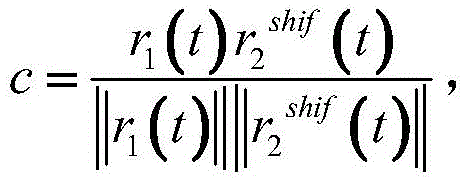
wherein, r2 shif(t) represents r2(t) an inverse fourier transform;
will r is2 shif(t) amplifying by c times to obtain the reflected sound wave signal r obtained by filtering the direct sound wave signal from the sound wave signalcancel(t),
rcancel(t)=r1(t)-cr2 shif(t)。
Preferably, the converting the reflected sound wave signal into a baseband signal and calculating the phase of the baseband signal includes:
the reflected acoustic signal rcancel(t) is:

wherein α represents the signal amplitude and is a constant; f. ofcWhich is indicative of the carrier frequency,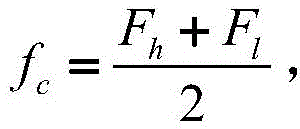 Fh=19kHz,Fl=17kHz;TSrepresents the period, TS10.7 ms; τ (t) represents the time delay between the transmitted frequency modulated continuous wave and the received reflected acoustic wave signal,
 af represents the frequency difference between the frequency of the frequency modulated continuous wave signal and the reflected acoustic wave signal, k represents the slope of the linear increase of the signal frequency,
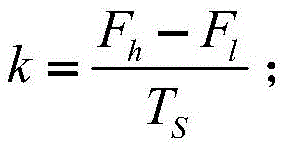 b denotes the bandwidth, B ═ Fh-Fl(ii) a When in use
 When N is present1When is equal to N-1
 When N is present1N, N ∈ Z, Z representing an integer;
the reflected sound wave signal rcancel(t) conversion to a baseband signal rb(t),

For the baseband signal rb(t) Fourier transform to obtain frequency spectrum, and selecting corresponding frequency deviation The frequency point signals b (t),

taking the phase of the frequency point signal b (t) to obtain the phase phi (t) ═ 2 pi f of the baseband signalcτ(t)。
Preferably, the separating the heartbeat reflected sound wave signal and the respiration reflected sound wave signal in the reflected sound wave signal spectrum according to the heartbeat frequency range and the respiration frequency range to obtain the heart rate includes:
extracting values of a main peak and two adjacent frequency points in the frequency spectrum of the reflected sound wave signal according to the respiratory frequency range, and performing inverse Fourier transform on the values to obtain a time domain complex signal phi1(t);
Fitting according to a least square algorithm to obtain slope (& lt phi & gt phi & lt phi & gt)1(t));
According to the slope ([ phi ]1(t)) calculating the breathing frequency BR,
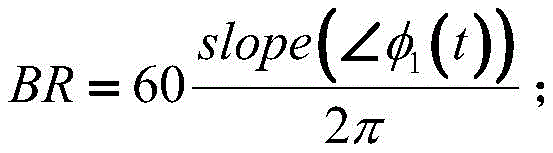
extracting values of a main peak and two adjacent frequency points in the frequency spectrum of the reflected sound wave signal according to the heartbeat frequency range, and performing inverse Fourier transform on the values to obtain a time domain complex signal phi2(t);
Fitting according to a least square algorithm to obtain slope (& lt phi & gt phi & lt phi & gt)2(t));
According to the slope ([ phi ]2(t)) calculating the heart beat frequency HB,

the heartbeat frequency HB is the heart rate.
Preferably, the respiratory frequency range is 0-60 BPM.
Preferably, the heartbeat frequency range is max (2BR,50) BPM at the lowest.
As a second aspect of the present invention, there is provided an audio signal-based heart rate monitoring apparatus, wherein the audio signal-based heart rate monitoring apparatus comprises:
the transmitting module is used for transmitting frequency-modulated continuous waves outwards through a loudspeaker;
the receiving module is used for receiving sound wave signals through a microphone, the sound wave signals comprise reflected sound wave signals obtained by reflecting the frequency modulation continuous waves through the chest cavity of a human body and direct sound wave signals of the frequency modulation continuous waves directly reaching the microphone through the loudspeaker, and the reflected sound wave signals comprise heartbeat reflected sound wave signals and respiration reflected sound wave signals;
and the processing module is used for processing the sound wave signals to obtain the heart rate.
As a third aspect of the present invention, there is provided an audio signal based heart rate monitoring system, wherein the audio signal based heart rate monitoring system comprises: a speaker, a microphone, and the aforementioned audio signal-based heart rate monitoring device, wherein the speaker and the microphone are both in communication connection with the audio signal-based heart rate monitoring device.
The heart rate monitoring method based on the audio signal provided by the invention realizes the heart rate monitoring based on the audio signal, provides a non-contact heart rate monitoring means, is convenient to monitor and operate, and has low cost.
Drawings
The accompanying drawings, which are included to provide a further understanding of the invention and are incorporated in and constitute a part of this specification, illustrate embodiments of the invention and together with the description serve to explain the principles of the invention and not to limit the invention. In the drawings:
fig. 1 is a flowchart of a heart rate monitoring method based on an audio signal according to the present invention.
Fig. 2 is a comparison before and after the elimination of the direct acoustic signal provided by the present invention.
Fig. 3 is a schematic signal design diagram of a frequency modulated continuous wave provided by the present invention.
Fig. 4 is a schematic diagram of a frequency spectrum of a baseband signal provided by the present invention.
Fig. 5 is a schematic diagram of the phase of a signal including respiration and heartbeat according to the present invention.
Fig. 6 is a schematic diagram of down-conversion provided by the present invention.
Fig. 7 is a schematic spectrum diagram of a baseband signal including a respiratory frequency and a heartbeat frequency according to the present invention.
Fig. 8 is a working principle diagram of the frequency-modulated continuous wave sonar provided by the present invention.
Fig. 9 is a schematic workflow diagram of a heart rate monitoring method based on an audio signal according to the present invention.
Fig. 10 is a schematic diagram of the audio signal-based heart rate monitoring provided by the present invention.
Fig. 11 is a schematic structural diagram of an audio signal-based heart rate monitoring device provided by the invention.
Fig. 12 is a schematic structural diagram of an audio signal-based heart rate monitoring system provided by the invention.
Detailed Description
The following detailed description of embodiments of the invention refers to the accompanying drawings. It should be understood that the detailed description and specific examples, while indicating the present invention, are given by way of illustration and explanation only, not limitation.
As a first aspect of the present invention, there is provided an audio signal-based heart rate monitoring method, wherein as shown in fig. 1, the audio signal-based heart rate monitoring method includes:
s110, emitting frequency-modulated continuous waves outwards through a loudspeaker;
s120, receiving sound wave signals through a microphone, wherein the sound wave signals comprise reflected sound wave signals obtained by reflecting frequency-modulated continuous waves through the chest of a human body and direct sound wave signals of the frequency-modulated continuous waves directly reaching the microphone through a loudspeaker, and the reflected sound wave signals comprise heartbeat reflected sound wave signals and respiration reflected sound wave signals;
and S130, processing the sound wave signal to obtain the heart rate.
The heart rate monitoring method based on the audio signal provided by the invention realizes the heart rate monitoring based on the audio signal, provides a non-contact heart rate monitoring means, is convenient to monitor and operate, and has low cost.
It will be appreciated that the frequency modulated continuous wave may be received by the microphone while being transmitted outwardly by the speaker. It will be appreciated that there is a time delay between the received acoustic wave signal and the transmitted frequency modulated continuous wave signal.
As a specific implementation manner, the processing of the acoustic wave signal in step S130 to obtain the heart rate may specifically include:
filtering the direct sound wave signal in the sound wave signals to obtain the reflected sound wave signal;
converting the reflected sound wave signal into a baseband signal, and calculating the phase of the baseband signal;
carrying out Fourier transform on the baseband signal to obtain a reflected sound wave signal frequency spectrum;
and separating the heartbeat reflected sound wave signal and the respiration reflected sound wave signal in the reflected sound wave signal spectrum according to the heartbeat frequency range and the respiration frequency range to obtain the heart rate.
It will be appreciated that in processing the acoustic signals, it is first necessary to filter out the direct acoustic signals from the loudspeaker directly into the microphone, which are not reflected by the thorax of the human body. And human thorax includes breathing and heartbeat two parts, consequently reflection acoustic wave signal includes the reflection acoustic wave signal of breathing that obtains through breathing reflection and the heartbeat reflection acoustic wave signal that obtains through heartbeat reflection, and the frequency range of breathing and heartbeat is inequality, therefore can separate heartbeat reflection acoustic wave signal according to breathing frequency range and heartbeat frequency range, finally obtains the heart rate.
It should be noted that, in order to facilitate the calculation of the direct acoustic wave signal, the two microphones commonly configured on the current mobile device are used for illustration. In particular, the microphones include a first microphone and a second microphone, and the sound wave signals include a sound wave signal of the first microphone and a sound wave signal of the second microphone.
Further specifically, the filtering out the direct sound wave signal from the sound wave signals to obtain the reflected sound wave signal includes:
calculating the acoustic signal r of the first microphone by Fourier transformation1(t) and the acoustic signal r of the second microphone2Relative time delay between (t)t,

Wherein, F [ r ]1(t)]A sound wave signal r representing the first microphone1(t) Fourier transform, F*[r2(t)]A sound wave signal r representing said second microphone2(t) the conjugate of the Fourier transform, F denotes the conjugate of F [ r ]1(t)]F*[r2(t)]Corresponding frequency, x represents the unknown quantity to be solved;
calculating the sound wave signal r of the first microphone1(t) and the acoustic signal r of the second microphone2(t) the cross-correlation coefficient c between,

wherein, r2 shif(t) represents r2(t) an inverse fourier transform;
will r is2 shif(t) amplifying by c times to obtain the reflected sound wave signal r obtained by filtering the direct sound wave signal from the sound wave signalcancel(t),
rcancel(t)=r1(t)-cr2 shif(t)。
After filtering the direct sound wave signals in the sound wave signals, the rest are reflected sound wave signals, and the reflected sound wave signals are processed below to distinguish heartbeat reflected sound wave signals from respiration reflected sound wave signals. Fig. 2 is a graph showing a comparison between before and after the cancellation of the direct acoustic signal.
First, the operation principle of converting the reflected acoustic wave signal into the baseband signal will be explained.
The frequency modulated continuous wave may be emitted as a sonar, whereby the sonar emits a frequency modulated continuous wave through the speaker as a chirp signal, which is at a predefined period TSThe instantaneous frequency in (c) is linearly increasing with time as shown in fig. 3. When the transmitted frequency modulation continuous wave is reflected back to the sonar through an obstacle in the environment, because the frequency of the sonar transmitting signal is linearly increased along with the time, the propagation time of the reflected signal can be determined through the frequency difference between the received reflected signal and the transmitted frequency modulation continuous wave signal, and then the propagation distance is obtained. When there are several obstacles in the environment that reflect signals, if the distances from the obstacles to the sonar are different, the signals they reflect have different frequency shifts when they reach the sonar. Thus, these signals can be distinguished by fourier transformation. As shown in fig. 8, the signal propagation delay Δ f represents the frequency difference between the frequency of the frequency modulated continuous wave signal and the reflected acoustic wave signal, and k represents the slope of the linear increase in the frequency of the signal. The invention sets the signal frequency threshold value as Fh=19kHz,Fl=17kHz,TS10.7 ms. When a 48kHz sampling rate handset microphone is used, one cycle of the chirp signal contains 512 samples. As shown in FIG. 3, in order to further eliminate the energy leakage of the frequency modulated continuous wave at the end of the period, the invention adopts Tukey window function to reduce the energy at the boundary of the signal so that the signal can not be perceived by human ears, wherein the parameter r of the window function determines the length of the rest chord part.
Specifically, the converting the reflected sound wave signal into a baseband signal and calculating the phase of the baseband signal includes:
the reflected acoustic signal rcancel(t) is:

wherein α represents the signal amplitude and is a constant; f. ofcWhich is indicative of the carrier frequency, Fh=19kHz,Fl=17kHz;TSrepresents the period, TS10.7 ms; τ (t) represents the time delay between the transmitted frequency modulated continuous wave and the received reflected acoustic wave signal,
 af represents the frequency difference between the frequency of the frequency modulated continuous wave signal and the reflected acoustic wave signal, k represents the slope of the linear increase of the signal frequency,
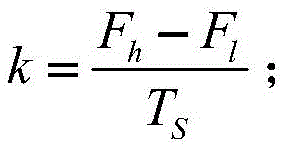 b denotes the bandwidth, B ═ Fh-Fl(ii) a When in use
 When N is present1When is equal to N-1
 When N is present1N, N ∈ Z, Z representing an integer;
the reflected sound wave signal rcancel(t) conversion to a baseband signal rb(t),

For the baseband signal rb(t) Fourier transform to obtain frequency spectrum (as shown in FIG. 4), and selecting corresponding frequency offset The frequency point signals b (t),

taking the phase of the frequency point signal b (t) to obtain the phase phi (t) ═ 2 pi f of the baseband signalcτ(t)。
It should be noted that the second term in the calculation formula of B (t) is generated by frequency modulation of the chirp signal at the end of each period, resulting in the generation of an interfering frequency offset B- Δ f in addition to the true frequency offset Δ f in the frequency spectrum. Since the strongest reflected signal is the signal reflected by the thorax of the human body after the direct signal is eliminated, the invention further aligns the reflected signals so that the signal segment subjected to Fourier transform each time is exactly one period of chirp signal to eliminate the second interference in the calculation formula of b (t). On the other hand, both the amplitude and the phase of the baseband signal comprise the respiration and heartbeat signals. Because the amplitude of the sound wave is more easily interfered by random noise, the invention adopts the signal phase And (6) sensing. Under actual parameter setting
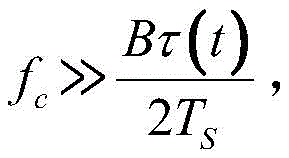 The signal phase can therefore be approximated as phi (t) ═ 2 pi fcτ(t)
Fig. 5 is a schematic phase diagram of a baseband signal including respiration and heartbeat.
It will be appreciated that sensing breathing and heartbeat movement directly by frequency shift is not possible due to the limitation of the inaudible acoustic bandwidth in the mobile device audio system. Thus, the present invention down-converts frequency modulated continuous wave signals to baseband and tracks these signals by baseband signal phase. Fig. 6 shows the flow of down-conversion according to the present invention.
Specifically, the step of separating the heartbeat reflected sound wave signal and the respiration reflected sound wave signal in the reflected sound wave signal spectrum according to the heartbeat frequency range and the respiration frequency range to obtain the heart rate includes:
extracting values of a main peak and two adjacent frequency points in the frequency spectrum of the reflected sound wave signal according to the respiratory frequency range, and performing inverse Fourier transform on the values to obtain a time domain complex signal phi1(t);
Fitting according to a least square algorithm to obtain slope (& lt phi & gt phi & lt phi & gt)1(t));
According to the slope ([ phi ]1(t)) calculating the breathing frequency BR,

extracting values of a main peak and two adjacent frequency points in the frequency spectrum of the reflected sound wave signal according to the heartbeat frequency range, and performing inverse Fourier transform on the values to obtain a time domain complex signal phi2(t);
Fitting according to a least square algorithm to obtain slope (& lt phi & gt phi & lt phi & gt)2(t));
According to the slope ([ phi ]2(t)) calculating the heart beat frequency HB,
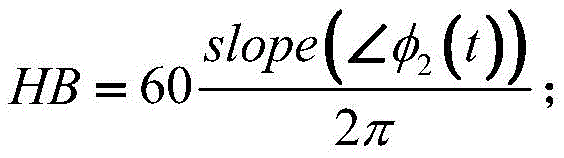
the heartbeat frequency HB is the heart rate.
Preferably, the respiratory frequency range is 0-60 BPM.
Preferably, the heartbeat frequency range is max (2BR,50) BPM at the lowest.
Since the human breathing signal is a periodic signal, the invention obtains the breathing frequency by performing Fourier transform on the signal phase. As shown in FIG. 7, the present invention searches for a peak in the normal breathing frequency range (0-60 BPM). The peak is a rough estimate of the human breathing frequency, the accuracy of which is limited by the fourier transform resolution. In order to obtain more accurate estimation, the invention extracts the main peak and the values of two adjacent frequency points from the signal frequency spectrum, and performs Fourier change on the main peak and the values to obtain a time domain complex signal phi1(t) of (d). Due to phi1(t) contains only the respiratory rate signal, whose phase is approximately a linear intimate slope of respiratory rate.
Similarly, the heartbeat signal has periodicity and can be extracted by the method. In order to avoid interference of the respiration signal, the invention utilizes that the heartbeat signal and the respiration signal have different frequency ranges. Specifically, the present invention sets the lowest search range for heart rate to max (2BR,50) BPM. Fig. 7 shows the spike corresponding to the heart rate.
The BPM is abbreviated as Bit Per Minute, and represents the number of breaths Per Minute for the respiratory rate and the number of heartbeats Per Minute for the heartbeat rate.
As a second aspect of the present invention, there is provided an audio signal-based heart rate monitoring apparatus 10, wherein as shown in fig. 8, the audio signal-based heart rate monitoring apparatus includes:
a transmitting module 110, wherein the transmitting module 110 is used for transmitting the frequency-modulated continuous wave outwards through a loudspeaker;
the receiving module 120 is configured to receive a sound wave signal through a microphone, where the sound wave signal includes a reflected sound wave signal obtained by reflecting the frequency-modulated continuous wave through a chest of a human body and a direct sound wave signal of the frequency-modulated continuous wave directly reaching the microphone from the speaker, and the reflected sound wave signal includes a heartbeat reflected sound wave signal and a respiration reflected sound wave signal;
a processing module 130, wherein the processing module 130 is configured to process the acoustic wave signal to obtain a heart rate.
The heart rate monitoring device based on the audio signal provided by the invention realizes the heart rate monitoring based on the audio signal, provides a non-contact heart rate monitoring means, is convenient to monitor and operate, and has low cost.
The reflection module may be a sonar.
Specifically, as shown in fig. 9, the heart rate monitoring device based on an audio signal provided by the present invention mainly emits a frequency modulated continuous wave signal through a speaker, and then processes the frequency modulated continuous wave signal, wherein the specific steps include eliminating a sound wave signal directly from the speaker to a microphone and processing a reflected sound wave signal into a baseband signal, and after the frequency modulated continuous wave signal is processed, since the reflected sound wave signal includes a respiratory reflected sound wave signal and a heartbeat reflected sound wave signal, the respiratory reflected sound wave signal and the heartbeat reflected sound wave signal need to be separated, and the respiratory frequency range and the heartbeat frequency range are different, and the frequency ranges on a spectrogram are different to distinguish, so as to finally obtain the heart rate.
For the working principle of the heart rate monitoring device based on audio signals provided by the present invention, reference may be made to the foregoing description of the heart rate monitoring method based on audio signals, and details are not described herein again.
As a third aspect of the present invention, there is provided an audio signal based heart rate monitoring system, wherein, as shown in fig. 9, the audio signal based heart rate monitoring system 1 includes: a speaker 20, a microphone 30 and the audio signal based heart rate monitoring device 10 as described above, wherein the speaker 20 and the microphone 30 are both communicatively connected to the audio signal based heart rate monitoring device 10.
According to the heart rate monitoring system based on the audio signal, the heart rate monitoring based on the audio signal is realized by adopting the cooperation of the heart rate monitoring device based on the audio signal, the loudspeaker and the microphone, a non-contact heart rate monitoring means is provided, the monitoring is convenient, the operation is convenient, and the cost is low.
It should be noted that the heartbeat monitoring system based on the audio signal may be a mobile device such as a mobile phone and a tablet computer having a speaker and a microphone, or may be an independent system integrating the microphone and the speaker and the heart rate monitoring device based on the audio signal. The heart rate monitoring device based on the audio signal may be a functional module embedded in the heart rate monitoring system based on the audio signal, or may be installed in the heart rate monitoring system based on the audio signal as an application, for example, as an APP installed in a mobile phone or a tablet computer, and the specific implementation form is not limited here.
For example, as shown in fig. 10, the heartbeat monitoring system based on an audio signal is a mobile phone, a frequency-modulated continuous wave that is emitted by a speaker and is inaudible to the human ear is reflected by heartbeat and breath, and then enters the heartbeat monitoring device based on an audio signal through the microphone, and the heartbeat monitoring device based on an audio signal obtains a heart rate by processing a received reflected signal and separating out a heartbeat signal.
It will be understood that the above embodiments are merely exemplary embodiments taken to illustrate the principles of the present invention, which is not limited thereto. It will be apparent to those skilled in the art that various modifications and improvements can be made without departing from the spirit and substance of the invention, and these modifications and improvements are also considered to be within the scope of the invention.
Claims (9)
1. A heart rate monitoring method based on an audio signal is characterized by comprising the following steps:
emitting frequency-modulated continuous waves outwards through a loudspeaker;
receiving sound wave signals through a microphone, wherein the sound wave signals comprise reflected sound wave signals obtained by reflecting frequency-modulated continuous waves through the chest cavity of a human body and direct sound wave signals of the frequency-modulated continuous waves which directly reach the microphone through a loudspeaker, and the reflected sound wave signals comprise heartbeat reflected sound wave signals and respiration reflected sound wave signals;
processing the sound wave signal to obtain a heart rate;
wherein, the processing the acoustic wave signal to obtain the heart rate comprises:
filtering the direct sound wave signal in the sound wave signals to obtain the reflected sound wave signal;
converting the reflected sound wave signal into a baseband signal, and calculating the phase of the baseband signal;
carrying out Fourier transform on the baseband signal to obtain a reflected sound wave signal frequency spectrum;
and separating the heartbeat reflected sound wave signal and the respiration reflected sound wave signal in the reflected sound wave signal spectrum according to the heartbeat frequency range and the respiration frequency range to obtain the heart rate.
2. A method as claimed in claim 1, wherein the microphones comprise a first microphone and a second microphone, and the sound wave signals comprise a sound wave signal of the first microphone and a sound wave signal of the second microphone.
3. The audio signal-based heart rate monitoring method according to claim 2, wherein the filtering out the direct sound wave signal from the sound wave signals to obtain the reflected sound wave signal comprises:
calculating the acoustic signal r of the first microphone by Fourier transformation1(t) and the acoustic signal r of the second microphone2Relative time delay between (t)t,

Wherein, F [ r ]1(t)]Represents the firstAcoustic signal r of microphone1(t) Fourier transform, F*[r2(t)]A sound wave signal r representing said second microphone2(t) the conjugate of the Fourier transform, F denotes the conjugate of F [ r ]1(t)]F*[r2(t)]Corresponding frequency, x represents the unknown quantity to be solved;
calculating the sound wave signal r of the first microphone1(t) and the acoustic signal r of the second microphone2(t) the cross-correlation coefficient c between,
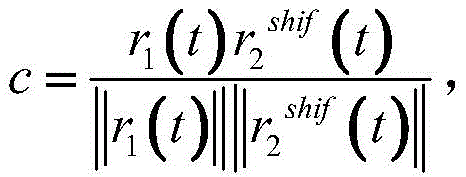
wherein, r2 shif(t) represents r2(t) an inverse fourier transform;
will r is2 shif(t) amplifying by c times to obtain the reflected sound wave signal r obtained by filtering the direct sound wave signal from the sound wave signalcancel(t),
rcancel(t)=r1(t)-cr2 shif(t)。
4. The audio-signal-based heart rate monitoring method of claim 3, wherein converting the reflected acoustic wave signal to a baseband signal and calculating the phase of the baseband signal comprises:
the reflected acoustic signal rcancel(t) is:

wherein α represents the signal amplitude and is a constant; f. ofcWhich is indicative of the carrier frequency,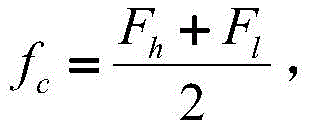 Fh=19kHz,Fl=17kHz;TSrepresents the period, TS10.7 ms; τ (t) represents the time delay between the transmitted frequency modulated continuous wave and the received reflected acoustic wave signal,
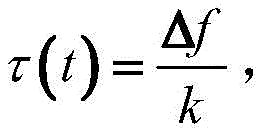 af represents the frequency difference between the frequency of the frequency modulated continuous wave signal and the reflected acoustic wave signal, k represents the slope of the linear increase of the signal frequency,
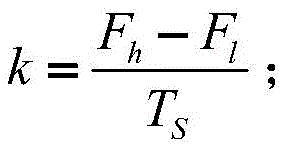 b denotes the bandwidth, B ═ Fh-Fl(ii) a When in use
 When N is present1When is equal to N-1
 When N is present1N, N ∈ Z, Z representing an integer;
the reflected sound wave signal rcancel(t) conversion to a baseband signal rb(t),
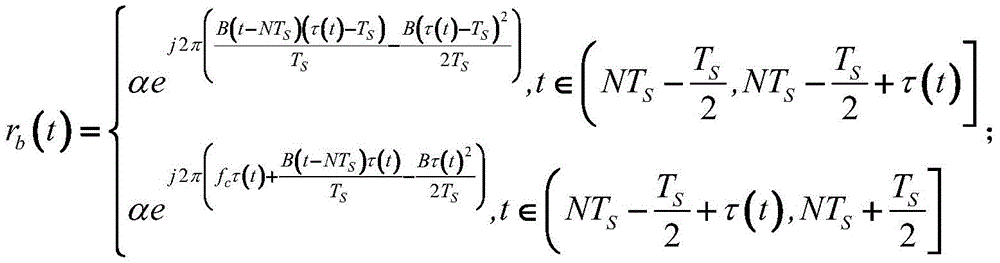
For the baseband signal rb(t) Fourier transform to obtain frequency spectrum, and selecting corresponding frequency deviation The frequency point signals b (t),

taking the phase of the frequency point signal b (t) to obtain the phase phi (t) ═ 2 pi f of the baseband signalcτ(t)。
5. The audio signal-based heart rate monitoring method according to claim 4, wherein the separating the heartbeat reflected sound wave signal and the respiration reflected sound wave signal in the reflected sound wave signal spectrum according to a heartbeat frequency range and a respiration frequency range to obtain a heart rate comprises:
extracting values of a main peak and two adjacent frequency points in the frequency spectrum of the reflected sound wave signal according to the respiratory frequency range, and performing inverse Fourier transform on the values to obtain a time domain complex signal phi1(t);
Fitting according to a least square algorithm to obtain slope (& lt phi & gt phi & lt phi & gt)1(t));
According to the slope ([ phi ]1(t)) calculating the breathing frequency BR,

extracting values of a main peak and two adjacent frequency points in the frequency spectrum of the reflected sound wave signal according to the heartbeat frequency range, and performing inverse Fourier transform on the values to obtain a time domain complex signal phi2(t);
Fitting according to a least square algorithm to obtain slope (& lt phi & gt phi & lt phi & gt)2(t));
According to the slope ([ phi ]2(t)) calculating the heart beat frequency HB,
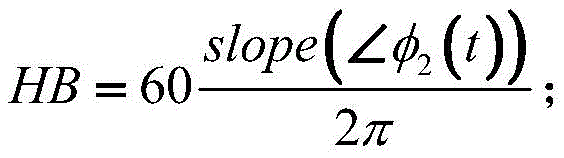
the heartbeat frequency HB is the heart rate.
6. The audio signal-based heart rate monitoring method of claim 5, wherein the breathing frequency range is 0-60 BPM.
7. Method for audio signal based heart rate monitoring according to claim 5, wherein the heart beat frequency range is max (2BR,50) BPM at the lowest.
8. An audio-signal-based heart rate monitoring device for implementing the audio-signal-based heart rate monitoring method according to any one of claims 1 to 7, wherein the audio-signal-based heart rate monitoring device comprises:
the transmitting module is used for transmitting frequency-modulated continuous waves outwards through a loudspeaker;
the receiving module is used for receiving sound wave signals through a microphone, the sound wave signals comprise reflected sound wave signals obtained by reflecting the frequency modulation continuous waves through the chest cavity of a human body and direct sound wave signals of the frequency modulation continuous waves directly reaching the microphone through the loudspeaker, and the reflected sound wave signals comprise heartbeat reflected sound wave signals and respiration reflected sound wave signals;
and the processing module is used for processing the sound wave signals to obtain the heart rate.
9. An audio signal based heart rate monitoring system, comprising: a speaker, a microphone, and the audio signal based heart rate monitoring device of claim 8, the speaker and the microphone both communicatively connected to the audio signal based heart rate monitoring device.
Priority Applications (1)
| Application Number | Priority Date | Filing Date | Title |
|---|---|---|---|
| CN201711382014.4A CN108113706B (en) | 2017-12-19 | 2017-12-19 | Heart rate monitoring method, device and system based on audio signals |
Applications Claiming Priority (1)
| Application Number | Priority Date | Filing Date | Title |
|---|---|---|---|
| CN201711382014.4A CN108113706B (en) | 2017-12-19 | 2017-12-19 | Heart rate monitoring method, device and system based on audio signals |
Publications (2)
| Publication Number | Publication Date |
|---|---|
| CN108113706A CN108113706A (en) | 2018-06-05 |
| CN108113706B true CN108113706B (en) | 2021-01-05 |
Family
ID=62230429
Family Applications (1)
| Application Number | Title | Priority Date | Filing Date |
|---|---|---|---|
| CN201711382014.4A Active CN108113706B (en) | 2017-12-19 | 2017-12-19 | Heart rate monitoring method, device and system based on audio signals |
Country Status (1)
| Country | Link |
|---|---|
| CN (1) | CN108113706B (en) |
Cited By (1)
| Publication number | Priority date | Publication date | Assignee | Title |
|---|---|---|---|---|
| US20220039779A1 (en) * | 2018-12-19 | 2022-02-10 | Nec Corporation | Information processing device, wearable device, information processing method, and storage medium |
Families Citing this family (14)
| Publication number | Priority date | Publication date | Assignee | Title |
|---|---|---|---|---|
| KR102658390B1 (en) | 2017-12-22 | 2024-04-17 | 레스메드 센서 테크놀로지스 리미티드 | Devices, systems, and methods for health and medical sensing |
| WO2019122413A1 (en) | 2017-12-22 | 2019-06-27 | Resmed Sensor Technologies Limited | Apparatus, system, and method for motion sensing |
| WO2019122414A1 (en) | 2017-12-22 | 2019-06-27 | Resmed Sensor Technologies Limited | Apparatus, system, and method for physiological sensing in vehicles |
| CN109009125B (en) * | 2018-06-07 | 2019-05-28 | 上海交通大学 | Driver's fine granularity monitoring of respiration method and system based on audio frequency of mobile terminal |
| CN110604553B (en) * | 2018-06-15 | 2022-03-11 | 富士通株式会社 | Non-contact vital sign detection method and device and electronic equipment |
| CN110934585A (en) * | 2019-11-29 | 2020-03-31 | 维沃移动通信有限公司 | A monitoring method and electronic device |
| CN111006702A (en) * | 2019-12-17 | 2020-04-14 | 保定河软机器人科技有限公司 | Passive ultrasonic sensor and method |
| CN111551208A (en) * | 2020-05-14 | 2020-08-18 | 魏磊 | Multi-sensing sensor, sensor network and sensing method applied to Internet of things |
| CN112401863A (en) * | 2020-11-19 | 2021-02-26 | 华中师范大学 | A non-contact real-time vital sign monitoring system and method based on millimeter wave radar |
| CN112450900B (en) * | 2020-12-09 | 2021-10-01 | 中国科学院软件研究所 | A non-contact heartbeat detection method based on smart speakers |
| CN113267780A (en) * | 2021-04-29 | 2021-08-17 | 兴科迪科技(泰州)有限公司 | Space scanning life body detection system and method based on sound waves |
| CN113616188B (en) * | 2021-08-11 | 2022-10-04 | 燕山大学 | Respiration monitoring method based on frequency modulated continuous waves of inaudible sound |
| CN114469178A (en) * | 2022-02-25 | 2022-05-13 | 大连理工大学 | Blink detection method based on sound wave signals and applicable to smart phone |
| CN119791616B (en) * | 2024-11-26 | 2025-10-10 | 深圳大学 | Anti-motion-interference ear-wearing type heart rate respiration real-time monitoring method and system |
Citations (3)
| Publication number | Priority date | Publication date | Assignee | Title |
|---|---|---|---|---|
| CN1732854A (en) * | 2004-03-24 | 2006-02-15 | 株式会社东芝 | Ultrasonograph |
| CN102309318A (en) * | 2011-07-08 | 2012-01-11 | 首都医科大学 | Method for detecting human body physiological parameters on basis of infrared sequence image |
| US9375152B2 (en) * | 2012-03-07 | 2016-06-28 | Cardiac Pacemakers, Inc. | Heart sound detection systems and methods using updated heart sound expectation window functions |
Family Cites Families (9)
| Publication number | Priority date | Publication date | Assignee | Title |
|---|---|---|---|---|
| DE3782167T2 (en) * | 1987-07-21 | 1993-02-18 | Hewlett Packard Gmbh | MEASURING VALUE TRANSMITTER. |
| US20110208060A1 (en) * | 2010-02-24 | 2011-08-25 | Haase Wayne C | Non-contact Biometric Monitor |
| JP5760994B2 (en) * | 2011-11-30 | 2015-08-12 | コニカミノルタ株式会社 | Ultrasound diagnostic imaging equipment |
| JP6073563B2 (en) * | 2012-03-21 | 2017-02-01 | 東芝メディカルシステムズ株式会社 | Ultrasonic diagnostic apparatus, image processing apparatus, and image processing program |
| CN203970415U (en) * | 2014-04-29 | 2014-12-03 | 南京铁道职业技术学院 | A kind of portable simple Doppler ultrasonography on monitoring instrument |
| CN104244126B (en) * | 2014-08-25 | 2017-06-13 | 歌尔股份有限公司 | A kind of heart rate detection method for being applied to earphone and the earphone that heart rate can be detected |
| CN106971055B (en) * | 2016-01-12 | 2019-10-25 | 深圳迈瑞生物医疗电子股份有限公司 | Contrast-enhanced ultrasound imaging method and system |
| US20170323130A1 (en) * | 2016-05-06 | 2017-11-09 | Qualcomm Incorporated | Bidirectional ultrasonic sensor system for biometric devices |
| CN106405542A (en) * | 2016-10-10 | 2017-02-15 | 康佳集团股份有限公司 | Life sign detection processing method and system based on continuous waves, and life detector |
-
2017
- 2017-12-19 CN CN201711382014.4A patent/CN108113706B/en active Active
Patent Citations (3)
| Publication number | Priority date | Publication date | Assignee | Title |
|---|---|---|---|---|
| CN1732854A (en) * | 2004-03-24 | 2006-02-15 | 株式会社东芝 | Ultrasonograph |
| CN102309318A (en) * | 2011-07-08 | 2012-01-11 | 首都医科大学 | Method for detecting human body physiological parameters on basis of infrared sequence image |
| US9375152B2 (en) * | 2012-03-07 | 2016-06-28 | Cardiac Pacemakers, Inc. | Heart sound detection systems and methods using updated heart sound expectation window functions |
Non-Patent Citations (2)
| Title |
|---|
| Power spectrum analysis of heart rate and blood flow velocity variability measured in the umbilical and uterine arteries in early pregnancy: a comparative study;P. C. STRUIJK, N. T. C. URSEM, J. MATHEWS ,et al;《Ultrasound Obstet Gynecol》;20011231;全文 * |
| 生物雷达检测中呼吸和心跳实时分离技术的研究;杨芳,张华,李盛,薛慧君,路国华;《医疗卫生装备》;20140730;第35卷(第7期);全文 * |
Cited By (2)
| Publication number | Priority date | Publication date | Assignee | Title |
|---|---|---|---|---|
| US20220039779A1 (en) * | 2018-12-19 | 2022-02-10 | Nec Corporation | Information processing device, wearable device, information processing method, and storage medium |
| US12042328B2 (en) * | 2018-12-19 | 2024-07-23 | Nec Corporation | Information processing device, wearable device, information processing method, and storage medium |
Also Published As
| Publication number | Publication date |
|---|---|
| CN108113706A (en) | 2018-06-05 |
Similar Documents
| Publication | Publication Date | Title |
|---|---|---|
| CN108113706B (en) | Heart rate monitoring method, device and system based on audio signals | |
| KR102647218B1 (en) | Apparatus, system, and method for detecting physiological movement from audio and multimodal signals | |
| US8597196B2 (en) | Cardiac signal processing apparatus and cardiac signal processing method | |
| CN113729677A (en) | Intelligent vital sign monitoring method | |
| CN112450900B (en) | A non-contact heartbeat detection method based on smart speakers | |
| Chen et al. | Exploring the feasibility of remote cardiac auscultation using earphones | |
| CN107928674B (en) | Non-contact type respiration detection method based on acoustic ranging | |
| US10349858B2 (en) | Heartbeat detecting device and biological signal processing device | |
| EP3539219B1 (en) | Method for wireless data transmission range extension | |
| US20180042499A1 (en) | Biological signal detecting device, biological signal processing device, and blood pressure measuring system | |
| Wang et al. | Smartphone sonar-based contact-free respiration rate monitoring | |
| US10376243B2 (en) | Method and apparatus for low complexity ultrasound based heart rate detection | |
| US20180092552A1 (en) | Biological signal processing device and blood pressure measurement system | |
| EP4536070A1 (en) | Active acoustic sensing | |
| CN114830689A (en) | Heart rate measurement using hearing devices and APP | |
| KR101221406B1 (en) | Apparatus for sensing fetal heart sound and system including the same | |
| EP4344403A1 (en) | Respiration rate sensing | |
| JP2006304963A (en) | Noncontact diagnostic device | |
| CN103705270A (en) | Fetal heart monitoring equipment | |
| CN114403820A (en) | Vital sign detection method and system for moving target | |
| EP4312732B1 (en) | Audioplethysmography calibration | |
| EP4434450B1 (en) | Detecting heart rate variability using a hearable | |
| Wang et al. | Acoustic-based vital signs monitoring | |
| KR20150112226A (en) | Apparatus and method for measuring pulse wave velocity by using body communication | |
| Yong et al. | A contactless human vital sign monitoring system using a Doppler radar |
Legal Events
| Date | Code | Title | Description |
|---|---|---|---|
| PB01 | Publication | ||
| PB01 | Publication | ||
| SE01 | Entry into force of request for substantive examination | ||
| SE01 | Entry into force of request for substantive examination | ||
| GR01 | Patent grant | ||
| GR01 | Patent grant |