Disclosure of Invention
The first purpose of the present invention is to provide an organic electroluminescent compound, which can be further used to prepare an organic electroluminescent device, and can reduce the starting voltage during the preparation process, and improve the luminous efficiency and stability of the device.
A second object of the present invention is to provide an organic electroluminescent device comprising the organic electroluminescent compound of the present invention.
The third object of the present invention is to provide an application of the organic electroluminescent compound of the present invention.
In order to achieve the above purpose of the present invention, the following technical solutions are adopted:
the technical scheme of the independent right is described.
Depicting the technical effect of the exclusive rights. (the shortcomings of the prior art can be described first, and the technical effect of … provided by the present invention compared to … in the prior art (the technical effect is obtained by analyzing the technical features of the independent claims and combining the technical features).
The characteristics from the rights are listed and the technical effects are given separately in combination with the technical characteristics.
If there are any, features not written in the claims but prepared in advance for future amendment of the claims, such as features summarized in the middle, are listed and combined with technical features to give technical effects, respectively.
An organic electroluminescent compound having the following structure:
wherein R is1Is C1-C20 straight chain or branched chain alkyl, phenyl, pyridyl, naphthyl, phenanthryl, anthryl, phenanthridinyl, biphenyl, pyrimidyl or triazinyl;
R2is H, D, F, Cl, Br, I, CN, Si (R)2)3(e.g., trialkylsilyl such as trimethylsilyl wherein alkyl is as defined for R2The same), a linear alkyl group, an alkoxy group or a thioalkoxy group of C1 to C30, a branched or cyclic alkyl group, an alkoxy group or a thioalkoxy group of C3 to C40, a phenyl group, a naphthyl group, a phenanthryl group, a fluorenyl group, a spirofluorenyl group, a dibenzofuranyl group, a dibenzothiophenyl group, or an aryl group or an arylheterocyclyl group having 6 to 60 aromatic ring atoms, an aryloxy group having 5 to 60 aromatic ring atoms, or an aralkyl group having 5 to 60 aromatic ring atoms, which is composed of 2 or more of the same or different groups;
R3is hydrogen, deuterium, a linear or branched alkyl group of C1-C20, phenyl, anilino, diphenylamino, 2-phenyl, 3-aminopyridyl, 4-aminobipyridyl, 2-phenyl-1-naphthylamino, 2-aminodinaphthyl, 2-phenyl-1-aminophenanthryl, 3-aminodiphenanthryl, 2-phenyl-1-aminophenanthryl, 2-aminodibenzenyl, phenanthridinyl, biphenyl, pyridyl, pyrimidyl, or triazinyl;
n is an integer of 0 to 4.
Preferably, in the organic electroluminescent compounds according to the present invention, when R is1Is phenyl, pyridyl, naphthyl, phenanthryl, anthryl, phenanthridinyl,biphenyl, pyrimidinyl, or triazinyl, wherein at least one hydrogen is substituted or unsubstituted with a C1-C20 linear or branched alkyl group, a C3-C24 cycloalkyl group, a C1-C20 alkoxy group, a halogen group, a cyano group, a trifluoromethyl group, a trimethylsilyl group, a naphthyl group, an anthryl group, a phenanthryl group, a benzofuranyl group, a dibenzofuranyl group, a fluorenyl group, a carbazolyl group, a spirofluorenyl group, or a heteroaryl group having 5-20 nuclear atoms.
Preferably, in the organic electroluminescent compounds according to the present invention, when R is3When the compound is phenyl, anilino, diphenylamino, 2-phenyl, 3-aminopyridyl, 4-aminobipyridyl, 2-phenyl-1-naphthylamino, 2-aminodinaphthyl, 2-phenyl-1-aminophenanthryl, 3-aminodiphenanthrenyl, 2-phenyl-1-aminoanthracenyl, 2-aminodianthranyl, phenanthridinyl, biphenyl, pyridyl, pyrimidyl or triazinyl, one or more of the hydrogens are substituted or unsubstituted by C1-C10 linear or branched alkyl, C3-C12 cycloalkyl, C1-C10 oxyalkyl, halogen, cyano, trifluoromethyl or trimethylsilyl, naphthyl, anthracenyl, phenanthryl, dibenzofuranyl, benzofuranyl, carbazolyl, spirofluorenyl and 5-20 nuclear heteroaryl.
Preferably, the organic electroluminescent compound according to the present invention is any one of the following compounds:
meanwhile, the invention also provides an organic electroluminescent device of the organic electroluminescent compound.
Preferably, the organic electroluminescent device of the present invention comprises: a structure in which an anode, a hole injection layer, a hole transport layer, a light emitting layer, an electron transport layer, an electron injection layer, and a cathode are sequentially stacked;
wherein, an electron blocking layer is optionally arranged between the anode and the luminescent layer; a hole blocking layer is optionally arranged between the cathode and the light-emitting layer; the cathode surface is optionally also provided with a cover layer.
Preferably, in the organic electroluminescent device according to the present invention, at least one of the hole transport layer, the electron blocking layer, the hole blocking layer, or the electron transport layer includes the organic electroluminescent compound according to the present invention.
Also, the present invention provides an organic electroluminescent display device comprising the organic electroluminescent device according to the present invention.
Furthermore, the invention also provides application of the organic electroluminescent compound in preparing organic electroluminescent devices.
Meanwhile, the invention also provides application of the organic electroluminescent compound in preparing organic electroluminescent display devices.
Compared with the prior art, the invention has the beneficial effects that:
the organic electroluminescent compound can be used as various materials such as blue doping materials, hole transport materials, electron blocking materials and the like in organic electroluminescent devices, and has the effects of reducing driving voltage, improving the luminous efficiency, brightness, thermal stability, color purity and service life of the devices.
Meanwhile, an organic electroluminescent device using the organic electroluminescent compound of the present invention has excellent properties of high efficiency and long life.
Detailed Description
Embodiments of the present invention will be described in detail below with reference to examples, but it will be understood by those skilled in the art that the following examples are only illustrative of the present invention and should not be construed as limiting the scope of the present invention. The examples, in which specific conditions are not specified, were conducted under conventional conditions or conditions recommended by the manufacturer. The reagents or instruments used are not indicated by the manufacturer, and are all conventional products available commercially.
In view of the fact that organic electroluminescent compounds have great influence on the performance, service life and the like of devices and display devices, and the actual problem that the existing organic electroluminescent compounds cannot meet the actual use requirements, the invention particularly provides a novel organic electroluminescent compound, and a device comprising the same.
Specifically, the organic electroluminescent compound provided by the invention has the following structure:
wherein R is1Is C1-C20 straight chain or branched chain alkyl, phenyl, pyridyl, naphthyl, phenanthryl, anthryl, phenanthridinyl, biphenyl, pyrimidyl or triazinyl;
wherein when R is1When the aryl group is a phenyl group, a pyridyl group, a naphthyl group, a phenanthryl group, an anthryl group, a phenanthridinyl group, a biphenyl group, a pyrimidyl group or a triazinyl group, at least one hydrogen of the phenyl group, the pyridyl group, the naphthyl group, the phenanthryl group, the anthryl group, the phenanthridinyl group, the biphenyl group, the pyrimidyl group or the triazinyl group may be substituted by a C1-C20 linear or branched alkyl group, a C3-C24 cycloalkyl group, a C1-C20 alkoxy group, a halogen, a cyano group, a trifluoromethyl group, a trimethylsilyl group, the naphthyl group, the anthryl group, the phenanthryl group, a benzofuranyl group, a dibenzofuranyl group, a fluorenyl group, a carbazolyl group, a spirofluorenyl group or a heteroaryl group having 5Phenyl, pyridyl, naphthyl, phenanthryl, anthracyl, phenanthridinyl, biphenyl, pyrimidinyl, or triazinyl of (a);
R2is H, D, F, Cl, Br, I, CN, Si (R2)3Straight-chain alkyl, alkoxy or thioalkoxy groups of C1-C30, branched or cyclic alkyl, alkoxy or thioalkoxy groups of C3-C40, phenyl, naphthyl, phenanthryl, fluorenyl, spirofluorenyl, dibenzofuranyl, dibenzothiophenyl;
or, R2May also be H, D, F, Cl, Br, I, CN, Si (R2) as described above3An aryl or arylheterocyclyl group having 6 to 60 aromatic ring atoms, an aryloxy group having 5 to 60 aromatic ring atoms, or an aralkyl group having 5 to 60 aromatic ring atoms, which is composed of 2 or more (for example, 2, 3, 4, or 5 groups, each of which may be the same or different) groups (e.g., a straight-chain alkyl group, an alkoxy group, or a thioalkoxy group of C1 to C30, a branched or cyclic alkyl group of C3 to C40, an alkoxy group, or a thioalkoxy group, a phenyl group, a naphthyl group, a phenanthryl group, a fluorenyl group, a spirofluorenyl group, a dibenzofuranyl group, or a dibenzothiophenyl group;
R3is hydrogen, deuterium, a linear or branched alkyl group of C1-C20, phenyl, anilino, diphenylamino, 2-phenyl, 3-aminopyridyl, 4-aminobipyridyl, 2-phenyl-1-naphthylamino, 2-aminodinaphthyl, 2-phenyl-1-aminophenanthryl, 3-aminodiphenanthryl, 2-phenyl-1-aminophenanthryl, 2-aminodibenzenyl, phenanthridinyl, biphenyl, pyridyl, pyrimidyl, or triazinyl;
wherein when R is3Is phenyl, anilino, diphenylamino, 2-phenyl, 3-aminopyridyl, 4-aminobipyridyl, 2-phenyl-1-naphthylamino, 2-aminodinaphthyl, 2-phenyl-1-aminophenanthryl, 3-aminodiphenanthryl, 2-phenyl-1-aminophenanthryl, 2-aminodibenzenyl, phenanthridinyl, biphenyl, pyridyl, pyrimidyl, or triazinyl, said phenyl, anilino, diphenylamino, 2-phenyl, 3-aminopyridyl, 4-aminobipyridyl, 2-phenyl-1-naphthylamino, 2-aminodinaphthyl, 2-phenyl-1-aminophenanthryl, 3-aminodiphenanthrenyl, 2-phenyl-1-amine.More than one hydrogen of anthryl, 2-aminodianthranyl, phenanthridinyl, biphenyl, pyridyl, pyrimidyl or triazinyl can be substituted by C1-C10 straight-chain or branched alkyl, C3-C12 cycloalkyl, C1-C10 oxyalkyl, halogen, cyano, trifluoromethyl or trimethylsilyl, naphthyl, anthryl, phenanthryl, dibenzofuranyl, benzofuranyl, carbazolyl, spirofluorenyl and heteroaryl having 5-20 nuclear atoms, so as to form a group with or without substituent structure, anilino, diphenylamino, 2-phenyl, 3-aminopyridyl, 4-aminobipyridyl, 2-phenyl-1-naphthylamino, 2-aminodinaphthyl, 2-phenyl-1-aminophenanthryl, 3-aminodiphenanthryl, 2-phenyl-1-aminoanthracenyl, 2-aminodianthranyl, phenanthridinyl, biphenyl, pyridyl, pyrimidyl, or triazinyl;
n is an integer from 0 to 4, for example n can be0, 1, 2, 3, 4.
The organic electroluminescent compound can be used as a hole transport layer, an electron blocking layer, a hole blocking layer or an electron transport layer material to be applied to an organic electroluminescent device.
Further preferably, the present invention also provides an organic electroluminescent device comprising the hole transport layer or electron blocking layer material. The organic electroluminescent device has a structure in which an anode (hole injection electrode), a Hole Injection Layer (HIL), a Hole Transport Layer (HTL), an emission layer (EML), an Electron Transport Layer (ETL), an Electron Injection Layer (EIL), and a cathode (electron injection electrode) are sequentially stacked, and if possible, an Electron Blocking Layer (EBL) may be added between the anode and the emission layer, a Hole Blocking Layer (HBL) may be added between the cathode and the emission layer, and a capping layer (CPL) may be added on the surface of the cathode.
The manufacturing method of the organic electroluminescent device comprises the following steps:
step 1, evaporating an anode material on the surface of a substrate by using a conventional method to form an anode, wherein the adopted substrate is a glass substrate or a transparent plastic substrate with good transparency, surface smoothness, operability and waterproofness, and the anode material can be transparent ITO, IZO or SnO with excellent conductivity2ZnO, etc.
And 2, performing vacuum thermal deposition or spin coating on the surface of the anode by using a conventional method to obtain a hole injection layer material (HIL), wherein the hole injection layer material can be CuPc, m-MTDATA, m-MTDAPB, TCTA of star amines, 2-TNATA or IDE406 commercially available from Nippon Kyowa Co.
And 3, performing vacuum evaporation or spin coating on the surface of the hole injection layer by using a hole transport layer material (HTL) by using a conventional method to form the hole transport layer. The hole transport layer material may be α -NPD, NPB or TPD, in addition to the organic compound according to the present invention.
And 4, performing vacuum evaporation or spin coating on the surface of the hole transport layer by using a conventional method to form a luminescent layer. As the material of the light-emitting layer and the light-emitting host substance, the compound of the present invention, tris (8-quinolinolato) aluminum (Alq), can be used3) Balq, DPVBi series compounds, spiro-DPVBi, LiPBO, bis (diphenylethylene) benzene, metal complexes of aluminum-quinoline, metal complexes of imidazole, thiazole, oxazole, and the like.
In the light-emitting layer, a dopant substance used together with a light-emitting host substance, which is blue light, can be used; in addition, IDE102 and IDE105 of Nippon Kagaku K.K.; phosphorescent dopants Ir (ppy)3FIrpic (reference [ Chihaya Adachi et al, appl. Phys. Lett.,2001,79,3082-]) PtOEP, TBE002(Cobion Co.), etc.
Further, an Electron Blocking Layer (EBL) may be added between the hole transport layer and the light emitting layer. The material of the electron-blocking layer is not particularly limited, and the organic compound according to the present invention can be used.
And 5, carrying out vacuum thermal deposition or spin coating on the surface of the light-emitting layer by using an electron transport layer material (ETL) by adopting a conventional method to form the electron transport layer. The material of the electron transport layer is not particularly limited, and the organic compound and Alq according to the present invention can be used3And the like.
Step 6, adopting a conventional method to carry out vacuum thermal deposition or spin coating on the surface of the electron transport layer by using an electron injection layer material (EIL) to form electronsAnd injecting the layer. The electron injection layer material may be LiF, Liq, Li2O, BaO, NaCl, CsF, etc.
And 7, carrying out vacuum thermal deposition or spin coating on the cathode material on the electron injection layer by adopting a conventional method to form the cathode. The cathode material can be Li, Al, Al-Li, Ca, Mg, Mg-In, Mg-Ag, etc. In addition, a transparent cathode that transmits light may be formed using Indium Tin Oxide (ITO) or Indium Zinc Oxide (IZO).
A covering layer (CPL) may be further added to the cathode surface. The material of the cover layer is not particularly limited, and the organic compound according to the present invention can be used.
Further, a Hole Blocking Layer (HBL) may be further added between the light emitting layer and the electron transport layer, and at the same time, phosphorescence doping is used in the light emitting layer, and an effect of preventing triplet excitons or holes from diffusing into the electron transport layer may be achieved. And (3) carrying out vacuum thermal deposition or spin coating on the surface of the light-emitting layer by using a conventional method to form a hole barrier layer. The hole-blocking layer material is not particularly limited, and the organic compound according to the present invention, Liq, 2-methyl-8-hydroxyquinoline p-hydroxybiphenyl aluminum, BCP, LiF, and the like can be used.
The organic electroluminescent device prepared by the method has the advantages of low starting voltage, long service life and the like.
EXAMPLE 1 Synthesis of Compound 27
Synthesis of intermediate-1
[ reaction formula 1]
In a 2L three-necked flask, 12.8g (100mmol,1.0eq.) of thiophene-3-boronic acid was added, dissolved in 400ml of DMF, and 19.6g (110mmol,1.1eq.) of NBS was added in portions, stirred at room temperature for 16 hours, after the reaction was completed, 500ml of water was added, a large amount of solid was precipitated, stirred for 1 hour, filtered, washed with water, washed with ethanol, and slurried with ethanol 2 times, to finally obtain 17g of intermediate-1, with a yield of 82%.
Synthesis of intermediate-2
[ reaction formula 2]
17g (82mmol,1.0eq.) of intermediate-1 and 22.4g (82mmol,1.0eq.) of 3-bromo-9, 9' -dimethylfluorene were charged into a 2L three-necked flask, dissolved in 800ml of toluene and 80ml of ethanol, purged with nitrogen for 15 minutes, and then 123ml of 2M medium containing 34g (246mmol,3.0eq.) of K2CO3To the aqueous solution of (1.9 g) of Pd (PPh) was finally added3)4(2 mol%). The temperature was raised to 110 ℃ and the reaction was terminated overnight. Adding activated carbon for adsorption, performing suction filtration, rotatably removing the solvent, drying, and recrystallizing by using toluene and ethanol to obtain 23.6g of intermediate-2 with the yield of 81%.
Synthesis of intermediate-3
[ reaction formula 3]
23.6g (66.4mmol,1.0eq.) of intermediate-2 and 10g (73.1mmol,1.1eq.) of p-aminobenzoic acid were charged in a 2L three-necked flask, dissolved in 700ml of toluene and 70ml of ethanol, purged with nitrogen for 15 minutes, and 99.6ml of 2M solution containing 27.5g (199.2mmol,3.0eq.) of K2CO3To the aqueous solution of (1), and finally 2.3g of Pd (PPh) was added3)4(2 mol%). The temperature was raised to 110 ℃ and the reaction was terminated overnight. Adding activated carbon for adsorption, performing suction filtration, rotatably removing the solvent, drying, and recrystallizing with toluene and ethanol to obtain 19g of intermediate-3, wherein the yield is 78%.
Synthesis of intermediate-4
[ reaction formula 4]
Adding 24.6g (100mmol,1.0eq.) of 1-pyreneboronic acid and 31.1g (110mmol,1.1eq.) of p-bromoiodobenzene into a 2L three-neck flask, adding 1100ml of toluene and 110ml of ethanol for dissolving, introducing nitrogen for 15 minutesA150 ml 2M solution containing 41.5g (300mmol,3.0eq.) of K was added2CO3To the aqueous solution of (1), and finally 2.3g of Pd (PPh) was added3)4(2 mol%). The temperature was raised to 110 ℃ and the reaction was terminated overnight. Adding activated carbon for adsorption, performing suction filtration, rotatably removing the solvent, drying, and recrystallizing by using toluene and ethanol to obtain 27.2g of intermediate-4, wherein the yield is 76%.
Synthesis of intermediate-5
[ reaction formula 5]
In a dry 2L three-necked flask, 19g (51.7mmol, 1.1eq.) of intermediate-3 and 16.8g (47mmol, 1.1eq.) of intermediate-4 were placed, and 700ml of toluene, which was dried and degassed, was added as a solvent, and nitrogen was passed through for 15 minutes. 6.8g (70.5mmol,1.5eq.) of sodium tert-butoxide and 0.9g (2% mol) of Pd as a catalyst were then added2(dba)3And 3.8ml (4% mol) of P (t-bu)3In toluene (m/v, 10%). The temperature was raised to 90 ℃ and the reaction was carried out for 1.5 hours. After the reaction is finished, cooling to room temperature, adding activated carbon for adsorption, performing suction filtration, removing the solvent by rotation, and recrystallizing with toluene and ethanol to obtain 21.5g of intermediate-5 with the yield of 71%.
Synthesis of Compound-27
[ reaction formula 6]
A dry 2L three-necked flask was charged with 21.5g (33.4mmol, 1.0eq.) of intermediate-5 and 8.6g (33.4mmol, 1.1eq.) of 2-bromophenanthrene, and then 600ml of dried and degassed toluene was added as a solvent, and nitrogen was passed through for 15 minutes. 6.4g (66.8mmol,2.0eq.) of sodium tert-butoxide and 0.6g (2% mol) of Pd as a catalyst were then added2(dba)3And 2.7ml (4% mol) of P (t-bu)3In toluene (m/v, 10%).The temperature was raised to 90 ℃ and the reaction was carried out for 1.5 hours. After the reaction is finished, cooling to room temperature, adding activated carbon for adsorption, performing suction filtration, removing the solvent by rotation, and recrystallizing with toluene and ethanol to obtain 19.7g of intermediate-6 with the yield of 72%.
The following is an nmr hydrogen and mass spectroscopy analysis of compound-27:
1H NMR(DMSO,300Hz):δ(ppm)=8.96-8.81(d,1H),8.78-8.65(d,1H),8.57-8.46(d,1H),8.38-8.25(d,1H),8.19-8.02(m,5H),7.96-7.85(m,5H),7.77-7.15(m,19H),7.04-6.89(m,2H),1.79-1.48(s,6H);
MS(FAB):820(M+)
EXAMPLE 2 Synthesis of Compound 28
Synthesis of intermediate-6
[ reaction formula 7]
24.6g (100mmol,1.0eq.) of 2-bromocarbazole and 31.6g (110mmol,1.1eq.) of N-phenyl-3-carbazole boronic acid were charged in a 2L three-necked flask, dissolved in 1100ml of toluene and 110ml of ethanol, purged with nitrogen for 15 minutes, and then 150ml of 2M aqueous solution containing 41.5g (300mmol,3.0eq.) of K2CO3To the aqueous solution of (1), and finally 2.3g of Pd (PPh) was added3)4(2 mol%). The temperature was raised to 100 ℃ and the reaction was terminated overnight. Adding activated carbon for adsorption, performing suction filtration, rotatably removing the solvent, drying, and recrystallizing with toluene and ethanol to obtain 32.7g of intermediate-6, wherein the yield is 80%.
Synthesis of intermediate-7
[ reaction formula 8]
A dry 2L three-necked flask was charged with 32.7g (80mmol, 1.0eq.) of intermediate-6 and 25.4g (88mmol, 1.1eq.) of 2-bromo-5-iodothiophene, and 1200ml of dried and degassed toluene was added as a solvent, and nitrogen was passed through for 15 minutes. Then, 11.5g (120mmol,1.5eq.) of sodium tert-butoxide and 1.5g (2% mol) of Pd as a catalyst were added2(dba)3And 6.5ml (4% mol) of P (t-bu)3In toluene (m/v, 10%). The temperature was raised to 90 ℃ and the reaction was carried out for 1.5 hours. After the reaction is finished, cooling to room temperature, adding activated carbon for adsorption, performing suction filtration, removing the solvent by rotation, and recrystallizing with toluene and ethanol to obtain 32.8g of intermediate-7 with the yield of 72%.
Synthesis of intermediate-8
[ reaction formula 9]
32.8g (57.6mmol,1.0eq.) of intermediate-7 and 8.7g (63.4mmol,1.1eq.) of p-aminobenzoic acid were charged in a 2L three-necked flask, dissolved in 800ml of toluene and 80ml of ethanol, purged with nitrogen for 15 minutes, and then added with 86.4ml of 2M medium containing 23.9g (172.8mmol,3.0eq.) of K2CO3To the aqueous solution of (1), and finally 2.3g of Pd (PPh) was added3)4(2 mol%). The temperature was raised to 110 ℃ and the reaction was terminated overnight. Adding activated carbon for adsorption, performing suction filtration, rotatably removing the solvent, drying, and recrystallizing with toluene and ethanol to obtain 25.5g of a product with the yield of 76%.
Synthesis of intermediate-9
[ reaction formula 10]
In a dry 2L three-necked flask, 25.5g (43.8mmol, 1.1eq.) of intermediate-8 and 12.8g (39.8mmol, 1.0eq.) of N-phenyl-3-bromocarbazole were charged, followed by 800ml of toluene, which was dried and degassed, as a solvent, and nitrogen gas was passed through for 15 minutes. 5.7g (59.7mmol,1.5eq.) of sodium tert-butoxide and 0.7g (2% mol) of Pd as a catalyst were then added2(dba)3And 3.2ml (4% mol) of P (t-bu)3In toluene (m/v, 10%). The temperature was raised to 90 ℃ and the reaction was carried out for 1.5 hours. After the reaction is finished, cooling to room temperature, adding active carbon for adsorption, and pumpingFiltration, removal of the solvent by rotation, and recrystallization from ui toluene and ethanol gave 22.9g of intermediate-9 in 70% yield.
Synthesis of Compound-28
[ reaction formula 11]
In a dry 2L three-necked flask, 22.9g (27.9mmol, 1.0eq.) of intermediate-9 and 7.6g (27.9mmol, 1.0eq.) of 2-bromo-9, 9' -dimethylfluorene were charged, and 600ml of dried and degassed toluene was added as a solvent, and nitrogen was introduced for 15 minutes. 5.4g (55.8mmol,2.0eq.) of sodium tert-butoxide and 0.5g (2% mol) of Pd as a catalyst were then added2(dba)3And 2.3ml (4% mol) of P (t-bu)3In toluene (m/v, 10%). The temperature was raised to 90 ℃ and the reaction was carried out for 1.5 hours. After the reaction is finished, cooling to room temperature, adding activated carbon for adsorption, performing suction filtration, removing the solvent by spinning, and recrystallizing with toluene and ethanol to obtain 18.7g of compound-28 with the yield of 66%.
The following is the nmr hydrogen and mass spectroscopy data analysis of compound-28:
1H NMR(DMSO,300Hz):δ(ppm)=8.61-8.46(d,3H),8.38-8.23(d,1H),8.11-7.83(m,8H),7.81-7.68(m,2H),7.65-7.46(m,12H),7.44-7.21(m,11H),7.18-7.04(m,5H),7.02-6.92(m,2H),1.79-1.48(s,6H);
MS(FAB):1015(M+)。
EXAMPLE 3 Synthesis of Compound 32
Synthesis of intermediate-10
[ reaction formula 12]
In a dry 2L three-necked flask, 17.1g (100mmol,1.0eq.) of 2,2' -dipyridylamine and 31.8g (110mmol,1.1eq.) of 2-bromo-5-iodothiophene were charged, and 1000ml of toluene, which was dried and degassed, was added as a solvent, and nitrogen was introduced for 15 minutes. 14.4g (150mmol,1.5eq.) of sodium tert-butoxide and 1.8g (2% mol) of Pd as a catalyst were then added2(dba)3And 8.1ml (4% mol) of P (t-bu)3In toluene (m/v, 10%). The temperature was raised to 90 ℃ and the reaction was carried out for 1.5 hours. After the reaction is finished, cooling to room temperature, adding activated carbon for adsorption, performing suction filtration, removing the solvent by spinning, and recrystallizing with toluene and ethanol to obtain 23.3g of intermediate-10, wherein the yield is 70%.
Synthesis of intermediate-11
[ reaction formula 13]
23.3g (70mmol,1.0eq.) of intermediate-10 and 10.5g (77mmol,1.1eq.) of p-aminobenzoic acid were charged in a 2L three-necked flask, dissolved in 700ml of toluene and 70ml of ethanol, purged with nitrogen for 15 minutes, and then 105ml of 2M solution containing 29g (210mmol,3.0eq.) of K2CO3To the aqueous solution of (1.6 g) of Pd (PPh) was finally added3)4(2 mol%). The temperature was raised to 100 ℃ and the reaction was terminated overnight. Adding activated carbon for adsorption, performing suction filtration, rotatably removing the solvent, drying, and recrystallizing by using toluene and ethanol to obtain 19.8g of intermediate-11 with the yield of 82%.
Synthesis of intermediate-12
[ reaction formula 14]
In a dry 2L three-necked flask, 19.8g (57.5mmol, 1.1eq.) of intermediate-11 and 12.2g (52.3mmol, 1.0eq.) of 4-bromobiphenyl were charged, and 600ml of toluene which had been dried and degassed was added as a solvent, and nitrogen was passed through for 15 minutes. 7.5g (78.5mmol,1.5eq.) of sodium tert-butoxide and 1.0g (2% mol) of Pd as a catalyst were then added2(dba)3And 4.2ml (4% mol) of P (t-bu)3In toluene (m/v, 10%). The temperature was raised to 90 ℃ and the reaction was carried out for 1.5 hours. After the reaction is finished, cooling to room temperature, adding active carbon for adsorption, and performing suction filtrationThe solvent was removed by rotation and recrystallized from toluene and ethanol to give 19.7g of intermediate-12 in 76% yield.
Synthesis of intermediate-13
[ reaction formula 15]
36g (100mmol,1.0eq.) of 9, 9' -spirobifluorene-2-boronic acid and 31.1g (110mmol,1.1eq.) of p-bromoiodobenzene were charged into a 3L three-necked flask, dissolved in 1400ml of toluene and 140ml of ethanol, purged with nitrogen for 15 minutes, and then 150ml of 2M aqueous solution containing 41.5g (300mmol,3.0eq.) of K2CO3To the aqueous solution of (1), and finally 2.3g of Pd (PPh) was added3)4(2 mol%). The temperature was raised to 110 ℃ and the reaction was terminated overnight. Adding activated carbon for adsorption, performing suction filtration, rotatably removing the solvent, drying, and recrystallizing by using toluene and ethanol to obtain 33.9g of intermediate-13 with the yield of 72%.
Synthesis of Compound-32
[ reaction formula 16]
In a dry 2L three-necked flask, 19.7g (39.7mmol, 1.0eq.) of intermediate-12 and 18.7g (39.7mmol, 1.0eq.) of intermediate-13 were placed, and 600ml of toluene, which had been dried and degassed, was added as a solvent, and nitrogen was introduced for 15 minutes. Then, 7.6g (79.4mmol,2.0eq.) of sodium tert-butoxide and 0.7g (2% mol) of Pd as a catalyst were added2(dba)3And 3.2ml (4% mol) of P (t-bu)3In toluene (m/v, 10%). The temperature was raised to 90 ℃ and the reaction was carried out for 1.5 hours. After the reaction is finished, cooling to room temperature, adding activated carbon for adsorption, performing suction filtration, removing the solvent by spinning, and recrystallizing with toluene and ethanol to obtain 22.2g of compound-32 with the yield of 63%.
The following is the nuclear magnetic resonance hydrogen spectrum and mass spectrum data analysis of compound-32:
1H NMR(DMSO,300Hz):δ(ppm)=8.16-8.01(m,3H),7.98-7.85(m,4H),7.83-7.71(m,3H),7.69-7.09(m,24H),7.05-6.92(m,2H),6.88-6.81(d,1H)6.78-6.69(m,2H)6.67-6.58(m,2H),6.24-6.06(d,1H);
MS(FAB):887(M+)。
EXAMPLE 4 Synthesis of Compound-120
Synthesis of intermediate-14
[ reaction formula 17]
In a dry 2L three-necked flask, 31.2g (100mmol,1.0eq.) of 2-bromo-4, 6-diphenyl-1, 3, 5-triazine and 27.9g (110mmol,1.1eq.) of pinacol diboron were placed, 1200ml of dried and degassed 1, 4-dioxane was added as solvent, nitrogen was passed for 15 minutes, and 1.6g of catalyst Pd (dppf) was added2Cl2(2% mol) and 19.6g (200mmol,2.0eq.) of potassium acetate. The temperature was raised to 100 ℃ and the reaction was carried out overnight for 15 hours. After the reaction was completed, it was cooled to room temperature, activated carbon was added, the mixture was passed through a short column of silica gel, the filtrate was spin-dried, and it was recrystallized from toluene and ethanol to obtain 29.1g of intermediate-14 with a yield of 81%.
Synthesis of intermediate-15
[ reaction formula 18]
29.1g (81mmol,1.0eq.) of intermediate-14 and 25.7g (89.1mmol,1.1eq.) of 2-bromo-5-iodothiophene were charged into a 2L three-necked flask, dissolved in 1100ml of toluene and 110ml of ethanol, purged with nitrogen for 15 minutes, and added to 121.5ml of a 2M solution containing 33.6g (243mmol,3.0eq.) of K2CO3To the aqueous solution of (1.9 g) of Pd (PPh) was finally added3)4(2 mol%). The temperature was raised to 100 ℃ and the reaction was terminated overnight. Adding activated carbon for adsorption, performing suction filtration, rotatably removing the solvent, drying, and recrystallizing with toluene and ethanol to obtain 23g of intermediate-15 with a yield of 72%.
Synthesis of intermediate-16
[ reaction formula 19]
23g (58.3mmol,1.0eq.) of intermediate-15 and 8.8g (64.2mmol,1.1eq.) of p-aminobenzoic acid were charged in a 2L three-necked flask, dissolved in 600ml of toluene and 60ml of ethanol, purged with nitrogen for 15 minutes, and 87.5ml of 2M medium containing 24.2g (174.9mmol,3.0eq.) of K2CO3To the aqueous solution of (1.3 g) of Pd (PPh) was finally added3)4(2 mol%). The temperature was raised to 100 ℃ and the reaction was terminated overnight. Adding activated carbon for adsorption, performing suction filtration, rotatably removing the solvent, drying, and recrystallizing with toluene and ethanol to obtain 19g of intermediate-16 with the yield of 80%.
Synthesis of intermediate-17
[ reaction formula 20]
In a dry 2L three-necked flask, 19g (46.6mmol, 1.1eq.) of intermediate-16 and 10.9g (42.4mmol, 1.0eq.) of 2-bromophenanthrene were charged, and 600ml of toluene, which was dried and degassed, was added as a solvent, and nitrogen was passed through for 15 minutes. 6.1g (63.6mmol,1.5eq.) of sodium tert-butoxide and 0.8g (2% mol) of Pd as a catalyst were then added2(dba)3And 3.4ml (4% mol) of P (t-bu)3In toluene (m/v, 10%). The temperature was raised to 90 ℃ and the reaction was carried out for 1.5 hours. After the reaction is finished, cooling to room temperature, adding activated carbon for adsorption, performing suction filtration, removing the solvent by spinning, and recrystallizing with toluene and ethanol to obtain 17g of intermediate-17 with the yield of 69%.
Synthesis of intermediate-18
[ reaction formula 21]
In a dry 2L three-necked flask, 24.4g (100mmol,1.0eq.) of 4-phenyldibenzofuran was charged, dissolved in 300ml of dry tetrahydrofuran, purged with nitrogen, cooled to-10 ℃, 44ml of 2.5M (110mmol,1.1eq.) of n-BuLi was added dropwise, after the addition was complete, stirring was continued for 1 hour at that temperature, 38.1g (150mmol,1.5eq.) of iodine was added in portions, the cooling environment was removed, the reaction was continued overnight for 17 hours, after the reaction was complete, 4M HCl solution was added dropwise, stirring was continued for 1 hour, the mixture was allowed to stand, the mixture was separated, the upper organic phase was washed with water for 3 times, the lower organic phase was extracted with dichloromethane, washed with water for 3 times, the organic phases were combined, dried, the solvent was removed by rotation, and the column chromatography purification was carried out to obtain 32.9g of intermediate-18 with a yield of 89%.
Synthesis of intermediate-19
[ reaction formula 22]
32.9g (89mmol,1.0eq.) of intermediate-18 and 24.9g (97.9mmol, 1.1eq.) of pinacol diboron were placed in a dry 2L three-necked flask, 1100ml of dried and degassed toluene were added as solvent, nitrogen was passed through for 15 minutes, and 1.5g of catalyst Pd (dppf) was added2Cl2(2% mol) and 17.5g (178mmol,2.0eq.) of potassium acetate. The temperature was raised to 100 ℃ and the reaction was carried out overnight for 5 hours. After the reaction was completed, the reaction mixture was cooled to room temperature, activated carbon was added, the mixture was passed through a short column of silica gel, the filtrate was spin-dried, and recrystallization was carried out with toluene and ethanol to obtain 27g of intermediate-19 with a yield of 82%.
Synthesis of intermediate-20
[ reaction formula 23]
27g (73mmol,1.0eq.) of intermediate-19 and 22.7g (80.3mmol,1.1eq.) of M-bromoiodobenzene were charged into a 2L three-necked flask, dissolved in 1000ml of toluene and 100ml of ethanol, purged with nitrogen for 15 minutes, and then added with 109.5ml of 2M 30.3g (219mmol,3.0eq.) of K2CO3To the aqueous solution of (1.7 g) of Pd (PPh) was finally added3)4(2 mol%). The temperature was raised to 110 ℃ and the reaction was terminated overnight. Adding activated carbon for adsorption, performing suction filtration, rotatably removing the solvent, drying, and recrystallizing with toluene and ethanol to obtain 20.7g of intermediate-20 with the yield of 71%.
Synthesis of Compound-120
[ reaction formula 24]
In a dry 2L three-necked flask, 17g (29.2mmol, 1.0eq.) of intermediate-17 and 11.6g (29.2mmol, 1.0eq.) of intermediate-20 were placed, and 600ml of dry and degassed toluene was added as a solvent, and nitrogen was introduced for 15 minutes. 5.6g (58.4mmol,2.0eq.) of sodium tert-butoxide and 0.5g (2% mol) of Pd as a catalyst were then added2(dba)3And 4ml (4% mol) of P (t-bu)3In toluene (m/v, 10%). The temperature was raised to 90 ℃ and the reaction was carried out for 1.5 hours. After the reaction is finished, cooling to room temperature, adding activated carbon for adsorption, performing suction filtration, removing the solvent by spinning, and recrystallizing by using toluene and ethanol to obtain 16.6g of compound-120 with the yield of 63%.
The following is the nuclear magnetic resonance hydrogen spectrum and mass spectrum data analysis of compound-120:
1H NMR(DMSO,300Hz):δ(ppm)=8.96-8.81(d,1H),8.78-8.65(d,1H),8.48-8.28(m,4H),8.22-8.01(m,4H),7.97-7.86(m,4H),7.82-7.31(m,21H),7.29-7.23(s,1H),7.19-7.08(m,2H),7.04-6.89(m,2H);
MS(FAB):901(M+)。
further, other compounds encompassed by the general structures of the present invention, particularly specific compounds 1-120, can be prepared by reference to the methods of formulas 1-24 above.
Application example 1
An organic electroluminescent device using ITO as the anode substrate material of the reflecting layer and N
2Plasma or UV-Ozone is used for surface treatment. Depositing a hole injection layer over the anode substrate
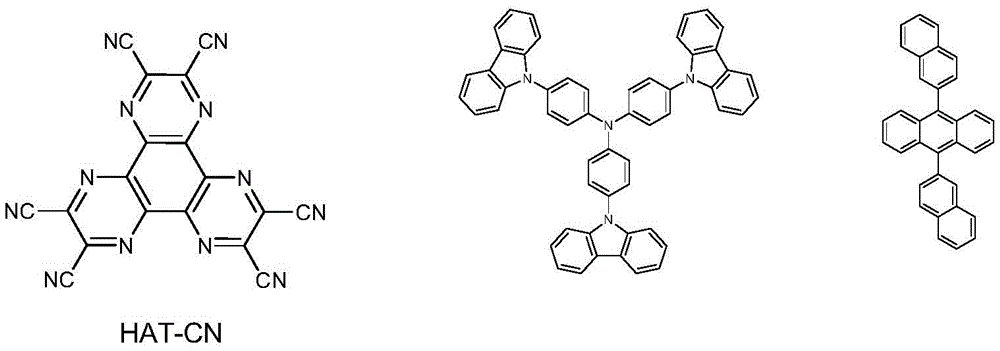
HAT-CN of thickness. Vacuum evaporation of the above compound 1 selected above the hole injection layer
A hole transport layer is formed.Vacuum evaporation of TCTA on the hole transport layer
The electron blocking layer is formed by evaporating blue EML9,10-Bis (2-naphthyl) Anthracenes (ADN) as a light emitting layer, and is formed by doping about 5% of 2,5,8, 11-tetrabutyl perylene with dopant
The light emitting layer of (1). Mixing anthracene derivative and Liq at a ratio of 1:1, and evaporating
To the electron transport layer, vapor depositing on the electron transport layer
Liq as an electron injection layer. Finally, evaporating on the cathode
Thickness of silver. In addition, the surface of the cathode is sealed with a water absorbing material containing a UV curable adhesive to protect the organic electroluminescent device from oxygen or moisture in the atmosphere.
The structural formula of the compound involved in the application example is as follows:
application examples 2 to 12
The organic electroluminescent devices of application examples 1 to 12 were produced by using compounds 15, 27, 28, 32, 44, 54, 67, 74, 91, 111, and 120 as Hole Transport Layer (HTL) materials, respectively, and the other portions were the same as application example 1.
Comparative example 1
The difference from application example 1 is that NPD was used as a hole transport layer material in place of the organic electroluminescent compound of the present invention, and the rest was the same as application example 1.
The organic electroluminescent devices prepared in application examples 1 to 12 and comparative example 1 were subjected to a performance test at a current density of 10mA/cm2, and the results are shown in Table 1 below.
Table 1 device performance test results for different experimental groups:
as can be seen from the experimental results shown in table 1, the organic electroluminescent devices of application examples 1 to 12 of the present invention have significantly improved luminous efficiency performance as compared with the conventional organic electroluminescent device described in comparative example 1.
Further, it is understood from the above experimental results that when the organic compound of the present invention is used as a hole transporting substance, it is confirmed that the driving voltage of the organic electroluminescent device is significantly reduced, the organic compound of the present invention can provide the device with the effects of reducing the electric power driving and reducing the electric power consumption, and further, the life of the organic electroluminescent device is improved by the lower electric power driving.
While particular application examples have been illustrated and described, it should be appreciated that many other changes and modifications can be made without departing from the spirit and scope of the invention. It is therefore intended to cover in the appended claims all such changes and modifications that are within the scope of this invention.