This application claims priority in accordance with U.S. application No.62/195,488 entitled "Methods, Systems, and Apparatus for Geographic Location Using Trace Routes" filed on 22/7/2015 as 35 u.s.c. 119 (e). The above application is incorporated by reference herein in its entirety.
Detailed Description
The following is a more detailed description of various concepts and embodiments thereof directed to the inventive systems, methods and apparatus for geolocation using traceroutes and other information. It should be appreciated that the various concepts introduced above and discussed in greater detail below may be implemented in any of numerous ways, as the disclosed concepts are not limited to any particular implementation. Examples of specific implementations and applications are provided primarily for illustrative purposes.
Theoretically, if all internet performance data is known, internet traffic can be routed perfectly; however, in practice, not all internet performance data is known, and therefore the available internet performance data and geolocation information is used to direct internet traffic. For example, data requests from south america IP addresses may be routed to south america data centers based on the assumed geographic proximity of the IP addresses to the data centers. South america IP addresses may have limited connectivity to each other; for example, amazon rainforest and andes mountain pose major physical barriers to connectivity. In contrast, internet traffic in south america is typically routed through miami. Thus, even though the columbia data center is geographically closer to the brazilian IP address, routing data requests from the brazilian IP address to a miami data server instead of the columbia data center may actually be more efficient. Similarly, erroneous information regarding the geolocation of a particular IP address may also result in routes that unnecessarily increase latency, congestion, and the like.
More accurate estimates of geographic location (geographic position) with respect to the IP address can be used to more efficiently direct traffic over the internet. For example, the geographic location of an IP address may be used to predict a theoretically limited latency for transmitting packets to and from the IP address. The geolocation data may be bound to a global latency map so that routing decisions are more likely to approach theoretical latency limits. Geolocation data may also be used to identify the physical location of traffic sources and destinations with an accuracy that will provide sufficient information to make intelligent routing decisions while also providing some degree of anonymity for the source and destination locations. For example, geolocation information may be used to route sensitive traffic within or avoid certain countries, e.g., to comply with export regulations or reduce exposure to eavesdropping. The geolocation information may also be used to troubleshoot network problems and plan network extensions.
The geolocation of the IP address may be estimated from latency measurements, DNS names, routing information, or various public or private sources (e.g., published data center locations, work boards, store locations, etc.). Triangulation using latency measurements from many known points provides a rough estimate of position, but the fiber is not straight, there may not be enough geographically differentiated points, the measurement point locations may not be known with sufficient accuracy, they may not be evenly/ideally distributed, the speed of the light is too fast to measure for short periods of time (1 millisecond in fiber-100 kilometers), etc. DNS name information (which typically includes a city name or airport code associated with an IP address) may be used to algorithmically resolve names recovered for different IP addresses of an ISP's infrastructure, but the naming convention may be different between ISPs, may be inconsistent, or may be erroneous. Furthermore, the device may be moved, making it difficult to verify its location. Geolocation may also be estimated from routing information based on the service area for a particular service provider, but would only work on a macroscopic level for regional players.
The technology disclosed herein relates to IP geolocation based on latency measurements, DNS information and routes. Unlike many other techniques, however, examples of the present technique may be used to detect and correct inconsistencies or errors in geolocation data (including commercial geolocation information) provided by third parties. Such geo-location data is often correct for the end user but is wrong for the infrastructure, which limits its utility in routing and analyzing internet traffic.
Identifying and correcting errors in third party IP geolocation estimates
FIG. 1A illustrates a process 101 for improving geolocation estimates of devices associated with a particular IP address from third party IP geolocation data. In this example, the process begins by obtaining geolocation data (block 111), which may include latitude and longitude estimates of one or more IP addresses. This data may be obtained periodically, on demand, automatically, or in response to user intervention from a third party, such as a commercial location source (e.g., Neustar, MaxMind, Digital enterprise, etc.), prefix registration data, or other public or private source.
In block 112, a processor or other suitable device estimates a geographic location based on latency measurements made from many points around the globe. These measurements may be made, for example, using the geolocation system illustrated in FIGS. 2A-2D. The processor uses the latency measurements to test the trustworthiness of the geo-location data (block 113). If the latency measurement indicates that the particular geolocation estimate is not trustworthy (e.g., because the latency measurement indicates that the actual location is closer to the particular measurement site than the geolocation estimate), the processor may discard the geolocation estimate (block 114).
The processor may also identify outliers in the geolocation data and/or the latency measurement using one or more suitable error detection techniques as described in more detail below (block 115). As described above, the processor may subject the outliers to data mining and/or routing information using latency, DNS naming, public or private sources (block 116). In block 117, the processor provides a probabilistic estimate of the actual geolocation of the disparate IP address based on latency, DNS naming, public or private sources, and/or routing information.
If desired, the processor may apply machine learning techniques to increase the confidence of the discrepancy identification (block 118). In other words, the processor may use information from consecutive measurements to lower the confidence interval. In general, more latency measurements yield a higher confidence IP geolocation estimate. The processor may also generate a map or other representation that displays the raw geolocation estimate, the corrected geolocation estimate, and/or the correction itself (block 119).
The following example illustrates how the process shown in FIG. 1A may be used to evaluate and correct a commercial IP geolocation estimate of the end-user prefix 195.160.236.0/22. The traceroute data for the IP address 195.160.236.1 in the end user prefix 195.160.236.0/22 from the collector of NH Hanover is as follows:
the end user prefix 195.160.236.0/22 contains at least two server IP addresses (i.e., 195.160.236.9 and 195.160.237.24); registration via roseaux IP Europ ens (ripe), which is a european regional internet registry; and self-reported as being in the uk. Two commercial sources place this IP prefix in the uk; four other commercial sources place it in manchester, england; and another commercial source places it in NH, Laconia.
The end-user prefix 195.160.236.0/22 is advertised by Terrenap (AS 23148) registered in miami, where the major internet service providers include Verizon, Hurricane Electric, and XO. AS 23148 originates 140 prefixes, 113 of which appear to be in the united states, others in argentina, belgium, dominican republic, spain and the netherlands. But the more specific prefix 195.160.236.0/24 is routed differently: it is advertised by WorldPath (AS 3770) registered AS NH AT Portsmouth, where the major Internet service providers include AT & T, Cogent and Century Link. AS 3770 originates 46 other prefixes, all of which appear to be in the united states. This indicates that this prefix is actually located in two different geographical locations, at least one of which is in the united states, but neither of which is in the united kingdom.
The DNS information associated with the end user prefixes 195.160.236.0/22 gives some additional clues as to the physical location, but does not allow the geographic location of the prefixes to be deterministically determined. The traceroute measurement yields the DNS name of the router associated with the prefix. Typically, the DNS name includes an airport code or city abbreviation that indicates the following three digits of the nearest airport or city. In this case, the router DNS name contains the following code (followed by an explanation of the airport code): BOS (boston, usa); NYC (new york city, usa); BST (afghanist Bost); and VOR (undefined). Thus, while DNS information may be used to validate additional evidence of a particular geographic location, DNS information itself does not necessarily provide an accurate IP geographic location estimate.
Latency measurements may set an upper limit on the distance between a prefix and one or more measurement stations. In this case, the latency measurement indicates that the target IP (195.160.236.1) is no more than 5300 kilometers from Hanover, New Hampshire, and no more than 1800 kilometers from New york city (assuming that the NYC name derived from the DNS information is correct and that the packets used for latency measurement follow a symmetrical path to and from the target IP address). These measurements exclude the uk as a possible location for the target IP address.
However, merely subtracting the latency measurement may not yield an accurate estimate of the geolocation of the target IP address due to errors in the latency measurement. Sources of errors include latency (discussed in the background section above), asymmetry of the paths to and from the target IP address (i.e., the measurement packets follow one path from the measurement device to the target IP address and a different path from the target IP address to the measurement device), and multi-protocol label switching (MPLS), which will be discussed in more detail below. Nonetheless, even a single latency measurement may be used to discard inaccurate IP geolocation estimates.
Fortunately, the integration of many latency measurements can reduce the uncertainty in the IP geolocation estimate, assuming there are no system measurement errors. For example, taking many latency measurements between a pair of nodes typically results in a distribution of latencies. The shortest latency may result in a more accurate measurement of the distance between nodes. The estimation can be improved by making more latency and traceroute measurements for the target IP from many different measurement sites.
In this case, more traceroute measurements are made to the two servers in the end-user prefix 195.160.236.0/22, further narrowing the positioning:
the traceroute from Portsmouth, NH to 195.160.236.9 is one hop:
·1gw-vip.ep.psm1.renesys.com(195.160.236.9)0.235ms 0.236 ms 0.236ms
the traceroute from miami, florida to 195.160.237.24 is also one hop:
·1master.ep.mia1.renesys.com(195.160.237.24)0.269ms 0.309 ms 0.310ms
this prefix belongs to the dynamic network service data center: 195.160.236.0/24 was announced from the New Hampshire, celtis, and 195.160.236.0/22 was announced from miami, florida. Whenever a/24 prefix is available, 195.160.236.9 is in celtsmus and 195.160.237.24 is in miami, florida. If the/24 prefix disappears, then both prefixes (and thus both IP addresses) are in Miami.
FIG. 1B illustrates another process 102 for estimating the geographic location of computers, routers, and other devices based on their IP addresses. In step 130, the geolocation server or other processor automatically obtains geolocation estimates for one or more computers, routers, etc. from one or more third party services. In some cases, the geolocation server may automatically download or receive these estimates from a server operated by a third party. If the geolocation server receives geolocation estimates for a given IP address from more than one source, it may compare the geolocation estimates to each other (step 132). If the estimates do not match-e.g., they are too far apart (e.g., more than 100 kilometers apart), or if one is general (e.g., "north america") and the other is specific (e.g., "new york, NY") -the geolocation server may obtain a latency distribution for the transmissions between the IP address and the collectors or sensors (step 134).
For example, as described in detail below, the geolocation server may derive the latency distribution from a Round Trip Time (RTT) associated with transmitting packets between the IP address and 200 or more collectors. The geolocation server (or collector) may determine an RTT distribution based on the RTT measurements for each collector, and then estimate the latency based on the RTT distribution to within a confidence interval associated with the RTT measurements. In some cases, the geolocation server eliminates RTT measurements associated with multi-protocol label switching (MPLS) hops, or that are too short or too long (and thus indicate a physically impossible distance between the collector and the IP address). The geolocation server may also identify the sources of errors in the latency and adjust the latency to resolve the errors.
In step 136, the geolocation server selects one or more latencies from the latency distribution for each IP address that is geographically located, and then identifies the corresponding collector(s) in step 138. Next, the geolocation server uses the selected latency to estimate the distance(s) between the IP address and the collector(s). More specifically, the geolocation server may use the latency measurements and the speed of light in the fiber to estimate the maximum distance between the IP address and the corresponding collector. If the geolocation server chooses three or more short latencies to make from the collectors around the IP address, it may estimate the geolocation of the IP address more accurately using triangulation techniques such as those shown in FIG. 5. (if not all ranges from the collectors overlap, the geolocation server may identify the IP address as an anycast IP address, as described in more detail below).
In step 142, the geolocation server determines whether the third party geolocation estimate is within the circle (or intersection) delineated by the distance estimated in step 140. If so, the geolocation server may indicate that the third party geolocation estimate is accurate within a particular distance range. If not, the geolocation server computes a new geolocation that generates an IP address based on the collector location and distance. This new estimate may fall within a confidence interval set by the RTT measurement distribution, which may affect the uncertainty of the range measurement. In some cases, the changes are quite dramatic. For example, fig. 1C shows a map generated for a pair of IP addresses using new and old geolocation, where one IP address is relocated from new york city to senegal karl and the other IP address is relocated from paris france to australian pompe.
The new geolocation estimate may be used in various ways. For example, the processor may use the new geolocation estimate to predict the latency associated with transmitting packets to or from the IP address as part of the routing table update. These updated latencies and routing tables may be used to route traffic more efficiently based on actual distance rather than the number of hops in the network (e.g., step 146). They may also be used to plan when and where additional routers are installed (e.g., in south america to eliminate or reduce the need to send traffic via miami routers). This may reduce overall latency and/or increase packet throughput in certain portions of the network.
The new geolocation estimates may also be used to prefer or avoid certain geographic areas. For example, a user may prefer to avoid or route sensitive information around countries or regions known to pose security risks. The user may not route traffic directly, but may select an Internet Service Provider (ISP) to carry traffic based on the geographic location of the ISP router (step 148). The user may also attempt to route traffic through certain countries by selecting an ISP based on the geographic location of the ISP router in order to comply with laws, regulations, or policies regarding the transmission of sensitive information.
In addition to or instead of hop counts and latencies, the new geolocation estimate may also be used to resolve Domain Name System (DNS) queries based on geolocation (step 150). By accurately knowing the user's geographic location, the domain of the user query may be resolved to the most appropriate data center hosting the requested context, where the data centers may be selected to be geographically close, thereby reducing latency, or for any of the reasons previously mentioned.
Example geolocation System
FIG. 2A illustrates an example of a geolocation system 200 suitable for collecting trace-route data that may be used to identify and correct errors in third-party geolocation data, for example, according to the process 101 shown in FIG. 1A. If desired, the collected traceroute data may be combined with DNS data and route data collected from an Internet service provider (ISP, e.g., Sprint, AT & T, etc.).
The geolocation system 200 shown in FIG. 2A includes a geolocation server 210 coupled to a geolocation database 212, one or more clients 214, and a network of trace route collectors 220. Although fig. 2A shows only one geolocation server 210 and database 212, system 200 may include and/or use multiple synchronized geolocation servers 210 and databases 212. When multiple geolocation servers 210 are used, the geolocation servers 210 may be synchronized to process data that may be distributed across multiple databases 212. Thus, the databases 212 may be synchronized and, thus, may communicate using wired and/or wireless communication protocols and/or technologies.
Traceroute collector 220 is a real or virtual machine residing within the data centers of their respective providers, each of which belongs to an Autonomous System (AS)230 or routing domain. In operation, the traceroute collectors 220 measure latencies associated with routes to routers 240, target computing devices 250, and Border Gateway Protocol (BGP) routers 260 (also referred to AS border routers 260) within their own AS 230 and within other ASs 230.
The ASs 230 may be considered AS the zip code of the computing device 250-i.e., each AS 230 may be depicted AS being ISP-based and not necessarily a geographically-wide neighborhood of the internet. Within each AS 230, there are Border Gateway Protocol (BGP) routers 260 (also referred to AS border routers 260) and other routers 240 that implement the routing policies of the AS 230 and maintain connections to BGP routers 260 in neighboring ases 230. At the time of filing, the number of ASs on the global internet exceeds 54,000.
More formally, an AS 230 is a connected group of IP networks having a single well-defined routing policy controlled by a common network administrator (or group of administrators) on behalf of a single administrative entity (such AS a university, business enterprise, business department, etc.). Nodes within a given IP network in AS 230 share the same network prefix, employing individual IP addresses within that prefix for internet connectivity. Most autonomous systems 230 include multiple network prefixes. The ASs 230 shares routing information with other ASs 230 by exchanging routing messages between border routers 260 using BGP, which is an Exterior Gateway Protocol (EGP) for performing inter-domain routing in a TCP/IP network.
Routing information may be shared within an AS 230 or between ases 230 by establishing a connection from border router 260 to one of its BGP peers for exchanging BGP updates. As understood by those skilled in the art, the process of exchanging data between border routers 260 is referred to as "peering". In a peer-to-peer session, two networks directly connect and exchange data. The internal BGP peering session involves directly connecting border routers 260 and internal routers 240 within a single AS 230. The external BGP peering session involves directly interconnecting border routers 260 in neighboring ASs 230.
Fig. 2A and 4 illustrate trace route measurements from the trace route collector 220 to the destination computer 250 a. The traceroute collector 220a sends the first packet to the destination computer 250a using the Internet Control Message Protocol (ICMP). The traceroute collector 220a also specifies a hop limit value (hop) for the first packet, called "time-to-live" (TTL), which is equal to 1. When the first router 240a receives the first packet, it decrements the TTL (from 1 to 0). After processing the TTL ═ 0 packet, the first router 240a returns a "Time expired" message 401a to the traceroute collector 220a, rather than forwarding the first packet to the next router along the path to the destination computer 250 a. This enables the traceroute collector 220a to determine the latency associated with a hop to the first router 240a on the path to the target computer 250 a. The traceroute collector 220a then sends a second packet with TTL 2 to the target computer 250 a. The second router 260a returns another time out message, and so on. Subsequent packets (including TTL 3 to TTL 6) issue time-out messages from routers 260b, 260c, 240b, 260d and 260 e. When destination computer 250a receives the final packet with TTL ═ 7, it returns an "Echo Reply" message to traceroute collector 220a, enabling traceroute collector 220a to measure the latency of the last hop.
In addition to the traceroute data obtained by the traceroute collector 220, each geo-location database 212 may also include other data, including but not limited to BGP UPDATE message data, route registry data, Domain Name Server (DNS) data, internet network data, data mining of public and private sources, and/or other data related to or derived from any or all of these data sources. These data may be collected from the ISP and/or other sources and may be used to improve geolocation estimation accuracy, as explained above and below.
Global coverage and distribution of traceroute data collectors
FIG. 2B illustrates the location of traceroute data collectors in the globally distributed traceroute data collection system of FIG. 2A. The system may include tens to hundreds or even thousands of collectors (e.g., 300 collectors) distributed based on geographic accessibility, population density, IP address density, etc. Each point on the map in fig. 2B represents a different physical or virtual traceroute data collector.
Fig. 2C and 2D illustrate the geographic coverage of a globally distributed traceroute data collection system such as the one shown in fig. 2A and 2B. The shading in fig. 2C and 2D indicates the median latency to an Internet Protocol (IP) address cell or group. More specifically, each quarter-degree latitude-longitude cell in fig. 2C and 2D is shaded according to the median latency from the nearest current trace route data collector to all IPs in that cell. The darker the cell 201 appears in fig. 2C and 2D, the closer the traceroute collector is to all IPs in the cell and, therefore, the better the accuracy of the geolocation estimation. The darker a cell 202 appears in fig. 2C and 2D, the farther a traceroute data collector is from the cell and the less accurate the geolocation estimate can be considered. Black indicates a latency of 0 milliseconds, white indicates a latency of at least 100 milliseconds, and gray indicates an intermediate latency (e.g., 25 milliseconds).
The shading in fig. 2C and 2D may help to place additional collectors and to weight the data collected by the traceroute collector for each cell. A best scenario is where the cells are completely black. Such an optimal scenario would allow an estimate of geolocation with 100% reliability or accuracy.
Geolocation server and traceroute data collector
Fig. 3A illustrates a block diagram of the geolocation server 110, the geolocation server 110 including a processor 318 coupled to the user interface 312, a communication interface 319, and a memory 314 storing executable instructions 316. These executable instructions 316 include instructions for performing a geolocation server process 317 that, when implemented by the processor 318, cause the processor 318 to analyze to estimate the geolocation of the IP address based on the traceroute data, network prefix information, and the like.
Processor 318 may include one or more high-speed data processing units to execute program components for performing user and/or system-generated requests. Typically, these high speed data processing units include various specialized processing units such as, but not limited to: an integrated system (bus) controller, a memory management control unit, a floating point unit, and even special purpose processing sub-units such as a graphics processing unit, a digital signal processing unit, and so forth. Further, the processor 318 may include internal fast-access addressable memory, and may be capable of mapping and addressing memory beyond the processor itself; internal memory may include, but is not limited to: fast registers, various levels of cache (e.g., levels 1, 2,3, etc.), RAM, ROM, etc. The processor 318 may access the memory 314 and executable instructions 316 by using a memory address space accessible via instruction addresses that the processor 318 may construct and decode to allow access to a circuit path to a particular memory address space having memory states and/or executable instructions.
While communication interface 319 may conventionally accept, connect to, and/or communicate with a number of interface adapters, it need not be in the form of an adapter card, such as, but not limited to: input output (I/O) interfaces, storage interfaces, network interfaces, and the like. For example, a network interface included in communication interface 319 may be used to send and receive information from traceroute collector device 320 in fig. 2A.
The user interface display 312 may include a Cathode Ray Tube (CRT) or Liquid Crystal Display (LCD) based monitor having an interface (e.g., DVI circuitry and cables) that accepts signals from a video interface. Alternatively, the user interface display 312 may include a touch screen and/or other content display device. The video interface synthesizes information generated by executable instructions 316 that are stored in memory 314 and executed by processor 318. Executable instructions 317 include a geolocation server processing module 317 having a set of instructions to process and analyze data obtained from one or more traceroute collector devices 220. User interface display 312 may include a conventional graphical user interface as provided by, with, and/or on top of an operating system and/or operating environment, such as Apple OS, Windows OS, Linux, Unix-based OS, and so forth. User interface display 312 may allow for the display, execution, interaction, manipulation, and/or operation of program components and/or system facilities through textual and/or graphical facilities. User interface display 312 provides a facility through which a user may influence, interact with, and/or operate the computer system. The user interface display 312 may communicate with and/or to other components in the set of components, including itself and/or the like. User interface display 312 may contain, communicate, generate, obtain, and/or provide program components, systems, users, and/or data communications, requests, and/or responses.
Fig. 3B illustrates a block diagram of an example traceroute collector device 220. Traceroute collector device 220 includes a communication interface 332 and a processor 324, such as communication interface 319 and processor 318, respectively, in server 110. The traceroute collector 220 also has a memory 326 that stores executable instructions 328, including instructions 329 for collecting traceroute data from one or more target computing devices (e.g., the router 240 and the target computing device 250 in fig. 2A).
Traceroute data collection and traceroute data
Fig. 1 and 4 illustrate the working principle of the traceroute data system. To perform traceroute, traceroute collector 220a sends the first packet to the destination computer using Internet Control Message Protocol (ICMP) (250 a). The traceroute collector 220a also specifies a hop limit value (TTL) for the first packet, called "time to live" (TTL), which is equal to 1. When the first router 240a receives the first packet, it decrements the TTL (from 1 to 0). After processing the packet with TTL ═ 0, the first router returns a "Time expired" message 401a to the traceroute collector 220a, rather than forwarding the first packet to the next router along the path to the destination computer 250 a. This enables the traceroute collector 220a to determine the latency associated with a hop to the first router 240a on the path to the target computer 250 a. The traceroute collector 220a then sends a second packet with TTL 2 to the target computer 250 a. The second router 260a returns another time out message, and so on. Subsequent packets (including TTL 3 to TTL 7) issue time-out messages from routers 260b, 260c, 240b, 260d and 260 e. When destination computer 250a receives the final packet with TTL ═ 8, it returns an "Echo Reply" message 402 to traceroute collector 220a, enabling traceroute collector 220a to measure the latency of the last hop.
By increasing the TTL each time it sends a packet and monitoring for "TTL exceeded" responses 401a, 401b, 401c, etc. from intermediate routers, the traceroute collector device 220a discovers both consecutive hops on the path to the destination computer 250a and the round trip time to the destination computer 250 a. The collected "over TTL" responses are used by the traceroute collector device 220a to build a list of routers traversed by the ICMP packet until the destination device 250a is reached and an ICMP echo reply 402 is returned.
The collected traceroute data includes an identifier for each device in the traceroute, including an identifier and/or an IP address of the corresponding traceroute collector device 220. The included IP address may represent a router that is part of a global or local computer network. The traceroute data also includes a time representing the time it takes for the traceroute collector device 220 to obtain a response from the router and the time it takes for the traceroute collector device 220 to obtain an ICMP echo reply from the target computing device.
If desired, the traceroute data obtained by the traceroute collector device 220 may be received and processed by the geolocation server 110 to generate an intermediate human-readable format in a data structure as shown below:
an example of trace route data in the tr _ base _ fields data format is given below. Each field is listed in a separate row to simplify the description of the geolocation server process:
1:T5
2:1431005462
3:I
4:0
5:192.170.146.138
6:192.170.146.138
7:vps01.nyc1
8:88.203.215.250
9:s
10:11
11:q,0,1,0
12:63.251.26.29,0.363,2,254
13:74.217.167.75,1.297,3,252
14:129.250.205.81,1.171,4,252
15:129.250.4.148,1.614,5,250,576241
16:129.250.3.181,87.140,6,250,519266
17:129.250.4.54,112.258,7,247,16013
18:129.250.3.25,114.446,8,248
19:83.217.227.22,123.002,9,245
20:212.39.70.174,125.613,10,245
21:88.203.215.250,124.967,11,51
the fields for geolocation include: 2: a timestamp (seconds since 1/1970, UNIX epoch); 7: collector name (unique identifier for each collector; this one in New York City); 8: tracing a routing target IP address; and 11 to 21: the number of routing hops (a variable number depending on the network topology) is tracked.
Each hop includes a comma-separated sub-list having: hop IP (q if no response is received); round Trip Time (RTT) in milliseconds; TTL; a reverse TTL; and zero or more MPLS labels.
In some implementations, the geolocation server process is based on latency from the trace route data collector, which is the RTT value found in each hop. As shown in the example above, one traceroute may produce several response hops, each with an IP and a Round Trip Time (RTT) from the collector (in this case, the collector located in new york city). The geolocation server process decomposes each trace route into individual (collector city, IP, RTT) tuples or collector edge latencies.
In this example of the collected traceroute data, consider row 12: 63.251.26.29,0.363,2,254. It is seen that IP address 63.251.26.29 is 0.363 milliseconds (RTT) from the gatherer. In some implementations, the geolocation server process may not consider the 3 rd or 4 th fields in the hop (TTL and reverse TTL). Each city may utilize a unique integer identifier. For example, geonamiid in new york is 5128581. A hop from a traceroute data collector device located in new york city may be represented as a tuple: (5128581,63.251.26.29,0.363).
Based on the speed of light in the fiber constraint, a 1 millisecond RTT corresponds to the maximum possible distance of about 100 kilometers of travel along a great circle or round trip. This means that for this hop, the maximum distance from the NYC trace route data collector to the device with IP address 63.251.26.29 is 36.3 kilometers (22.6 miles) with an RTT of 0.363 milliseconds. In some cases, when there is some initial delay in leaving the data center, there is a high probability that the IP is collocated at the same data center. In view of this evidence, augmented with additional measurements from other traceroutes, the geolocation server process may improve IP geolocation based on the latitude and longitude of the city in which the traceroute data collector is located and the radius covered by the collector. Geolocation server process analysis based on light speed considerations reinforces inferences that may be obtained from the geolocation server.
Multi-protocol label switching (MPLS) and geolocation
In some cases, the traceroute hops may include multiprotocol label switching (MPLS) labels at the end, as shown above in lines 15, 16, and 17, which end with MPLS labels 576241, 519266, and 16013, respectively. These MPLS hops may be dropped for latency measurement and comparison purposes because their RTTs generally correspond to those of MPLS tunnel egress hops and will therefore yield a larger confidence radius, as explained in more detail below with respect to fig. 6A. Removing MPLS hops provides a tighter confidence envelope when multiple measurements are considered. Thus, in some implementations, MPLS hops are filtered to improve measurements by reducing the statistical confidence radius.
Discarding the MPLS label from the example traceroute data results in a list of the following tuples generated for geolocation, where the first element corresponds to the geonamid (5128581) of the new york city collector and the origin of the traceroute:
(5128581,63.251.26.29,0.363)
(5128581,74.217.167.75,1.297)
(5128581,129.250.205.81,1.171)
(5128581,129.250.3.25,114.446)
(5128581,83.217.227.22,123.002)
(5128581,212.39.70.174,125.613)
(5128581,88.203.215.250,124.967)
note that the IP address in the last hop is 88.203.215.250, which is the same as the destination (field 8). This means that the ultimate target device in the traceroute responds or replies to the probe performed by the traceroute collector device.
Geolocation using overlapping edge latencies
In some implementations, the traceroute data collector edge latency may be based on the traceroute performed by the globally distributed traceroute data collector shown in fig. 2B. (in some cases, collectors may perform more than 500,000,000 measurements per day from a total of more than 300 collectors). The geolocation server may generate statistical inferences based on the multiple measurements for each edge. The embedded timers in each traceroute data collector may add noise to the measurements of observed RTTs utilized to define the confidence radius from each collector to the IP address. To account for measurement imperfections or noise, the geolocation server may use a modified Thompson Tau test to identify outliers, thereby eliminating outliers with (potentially artificial) low RTTs. As a computational convenience, the use of the 25 th percentile latency for each collector edge may reasonably eliminate outliers and thus may be used instead of the modified Thompson Tau test. The 25 th percentile is used from this point on, but this should be viewed as one of many ways that outliers can be eliminated, rather than as defining an aspect of the present technique. Other possibilities include, but are not limited to, using the 5 th, 10 th or 15 th percentile, median, modulo (mode), or any other suitable technique for reducing or eliminating outliers.
FIG. 5 illustrates the intersection of the areas covered by three traceroute data collectors. In some implementations, the geolocation server process may generate a radius of trustworthiness from each collector to the IP address corresponding to the target computer device. Such as traceroute data collector devices 501a, 503a, and 505 a. For a given IP address, the intersection of the network prefix and/or target device, the circles 509, 511, and 513 defined by the radius covered by each collector, defines an area 507a in which the IP is trustfully geo-located. Cities within that area are candidates for the geographic location of the IP. For example, among traceroute data collectors 501b, 503b, and 505b, city 507b may be a candidate city that depends on the traceroute data collected by the collectors.
In some cases, the circles may not intersect. In this case, latency may indicate that the IP is close to two or more collector cities, i.e., closer to each collector city than the midpoint between a pair of collectors. This case is classified as a geographic inconsistency because it indicates that devices with the same IP are located in more than one location. This is an attribute of the anycast network. The geolocation server process identifies instances of geographic inconsistencies and marks the corresponding IP as anycast.
Since the internet provider can change the location of a given IP, the collected traceroutes are continually probed to help ensure that measurements of the target IP are made while the geographic location of the target is stationary.
The following are essentially in PHP: the form of hypertext preprocessor code provides an example of pseudo-code representation of some of the functions of the geolocation server process, including probing target devices, identifying cities for these target devices, and identifying anycast IP addresses:
in some implementations, the geolocation server geolocates the IP address to a larger geographic range when the latency is too large to reduce the selection to a single city or metropolitan area. For example, if the final list of trusted cities are all located in the same state or country, the geolocation server process may choose to assign a state-wide or country-wide geolocation. Further implementations of the geolocation server process determine all trusted grid cells in which the IP may be geographically located.
Example geographic latency determination
Consider an IP address 41.181.245.81 initiated by an internet provider AS6637, MTN SA, headquarters in south africa.
The following is the output from the geolocation server process:
the underlined fields in the above output example are the location of the nearest collector, the latency to the IP of interest, the number of measurements, and geonamiid of the collector city. In this case, the nearest collector is in london, and the latency from the london collector to the IP is 0.7 milliseconds.
The data below the underlined fields is the tuple from each collector with the 25 th percentile latency. There are three entries in each comma-separated tuple:
RTT (25 th percentile), number of measurements, geonamiid
The tuples are ordered by latency such that the first tuple immediately following the underlined field has the smallest latency.
The tuple (0.7,1478,2643743) is the closest measurement of 0.7 milliseconds, based on 1478 measurements from the london (2643743) collector. This repeats the information in the previous three fields that is strictly broken down for convenience.
The tuple (6.2,3,2641170) is the second closest measurement of 6.2 milliseconds from the nottingham (2641170) gatherer. There are a total of 39 collector cities returning measurements for that IP.
The minimum possible RTT latency in the fiber between london and cape town is 95.7 milliseconds. Since the IP distance london traceroute collector device is only 0.7 milliseconds based on the light speed constraint, the geolocation server process may deterministically determine that the IP address 41.181.245.81 is not located in south africa, as may be implied by the identity of the internet provider. In addition, the geolocation server process may assign the geolocation of the IP to london, allowing for its low latency to london collectors. To make this correction, the geolocation server process first determines that the other traceroute data collector supports london as the trusted location for the IP.
For example, the following is a single traceroute data from the london collector to IP address 41.181.245.81. Additional support may be provided using more traceroutes from multiple locations before explicitly declaring this IP address in london.
Reverse Domain Name System (DNS)
In some implementations, the geolocation server process may further enhance inferences using reverse dns (rdns) for IP when available. Providers often encode geolocation information in their router names according to their defined naming schemes. In the above underlined traceroute example, 80.231.219.189 has rDNS 20.ae1. edge-01-lon.as33517. net, also underlined. The fragment "lon" highlighted in the label indicates that the IP address is located in london. The geolocation server process has a manually derived rules-based engine that extracts geolocation information from these tags, where possible. Unlike physically constrained latency, these tags are input by humans and subject to error if not properly maintained. However, combining geolocation according to rDNS with geolocation according to latency may result in more accurate IP geolocation. Consider, for example, 69.252.112.58 se02.
Woburn (Woburn) is located approximately 15 km above boston. Applying the geolocation server process to this IP address yields the following results:
boston is the closest traceroute data collector device 8.5 milliseconds from the IP address (69.252.112.58). rDNS provides clues that the IP address is in Woburn, MA, massachusetts. The geolocation server process verifies that the vogue is in a trusted city allowed by the collector latency distribution. Thus, the geolocation server process is able to make more accurate geolocation allocations to Wobbe, Mass, rather than Boston, thereby enhancing the accuracy of IP geolocation estimates.
Further, in some implementations, once the geolocation server is validated using latency, the geolocation server attempts to automatically discover its own rules by finding a similar rDNS name and assigning a geolocation to it through natural language processing. It does this by maintaining a database of all rDNS names it has discovered. For IPv4, this is done by reverse resolving the entire address space, which, as of this writing, yields over 12.4 million rDNS entries. For IPv6, rDNS entries are collected via passive DNS recursively captured from global open DNS and selective rDNS resolution over IPv6 space according to routes, taking into account the immense nature of the space. rDNS captures from the open recursion by instructing the service to record both the queries it receives and the answers it provides, including but not limited to the timestamp of the request, the domain and record type of the request, the answers provided, and other attributes that classify any DNS queries and responses.
As a simple example, the geolocation server may find (perhaps by examining existing rules or by considering latency) that the presence of a string containing 'nyc' in rDNS is strongly related to an associated IP address in new york city. There are currently over 260 tens of thousands of such rDNS entries in IPv4, many of which are not currently geographically located by commercial providers to new york city.
Consider 67.17.81.197 (lopp 0.cs1.nyc 2.nyc.gblx.net). Until this writing, three different commercial providers could alternatively place this IP address in dallas, ecuador (no city) or in the united states alone (no city) in texas, usa. The latency is consistent with the IP address being located in NYC and is completely untrusted for it to be located in texas or ecuador. There are currently over one hundred. nyc. glbx. net rDNS records in all IPv4 spaces, and the latency is consistent with all these records located in new york city. There are also many rDNS rules associated with new york city that contain 'nyc'. Thus, the geolocation server is able to discover that the string' nyc.
Public and private data sources
In some implementations, the geolocation server identifies trusted physical addresses from public, private, and semi-private sources for further verification by the techniques described herein. These sources may include, but are not limited to, workbooks and enterprise job sites pages for data center jobs to find declared physical addresses for data centers that are not otherwise published; routing glasses (clicking glasses), whose drop down menus typically provide the router location; storing a location that can be bound to an IP address, such as the location of a major chain store having multiple locations; and prefix registration data from tens of global and local Internet Routing Registries (IRRs).
As an example of the above technology, consider more than 36,000 mcdonald restaurants across 119 countries. Many of these stores are numbered and thousands of stores can be found in the rDNS data mentioned above. Consider the following two IP addresses and their rDNS entries:
·ip=206.59.233.82 fqdn=nmd.mcd18734.mia.wayport.net
·ip=206.59.233.83 fqdn=eth1-1.nmd.mcd18734.mia.wayport.net
these two IP addresses are clearly referenced to mcdonald's store # 18734. The store, which is located at 1930 Opalocka Blvd, Opa-Locka (Dade county), FL, 33054, is approximately 12 miles from the center of Miami. The trusted geographic position found in this manner may be further verified by other methods described herein.
Anycast example
When the target device has anycast IP, different examples can be obtained from the geolocation server process. Consider the results shown below for IP address 199.27.135.101:
the underlined value 7191 in the first line shown in the above example represents the number of geo-inconsistent collector city pairs. Although the IP address is 0.4 milliseconds from 4887398 (chicago), it is also 0.4 milliseconds from 4164138, 4744870, 5809844, and 2147714, which are Miami (Miami), ashbury (Ashburn), Seattle (Seattle), and Sydney (Sydney), respectively. Given that it is physically impossible for a single device with the IP address to be so close to each of these cities (and several other cities in the result), it is possible to infer that the IP address is an anycast instance and can be assigned the geographic location "earth".
Determining geographical location sandwich (sandwich)
Consider a traceroute that is a sequence of IP addresses starting from a collector IP address and ending with a target IP address. Each IP address may specify geographic location using one or more of the techniques described herein, as well as possibly other techniques. The IP address sequence may also be subdivided into subsequences or hops. In some implementations, the geolocation server uses a sandwich approach to consider some or all of the segments in the traceroute, where the first and last hops of a segment are geographically localized to the same country, but one or more intermediate hops are geographically localized to some other country.
The basis of the sandwich method is that traceroutes cannot leave one country and enter another, but can only return to the original country. If such a fragment is found, one or more of the IP addresses in the fragment may be erroneously geo-located. Each IP address in a fragment may be further analyzed using the techniques described herein. In some implementations, the geolocation server process uses a generalization of this approach to find any traceroute sequence in a segment where the first and last hops appear close in distance, but the sum of the distances between the hops of the segment is large. I.e. the net distance from the first hop to the last hop is smaller than the sum of the distances between the hops. For example, when traffic from two local providers is exchanged at some remote location, such a hair-ping sequence is sometimes legal because any two providers that are peer to peer may not be physically connected in all of the markets that they serve business or other reasons. Such seemingly anomalous geolocation should be verified by other techniques described herein, as should any potential erroneous geolocation.
Sandwich geolocation example
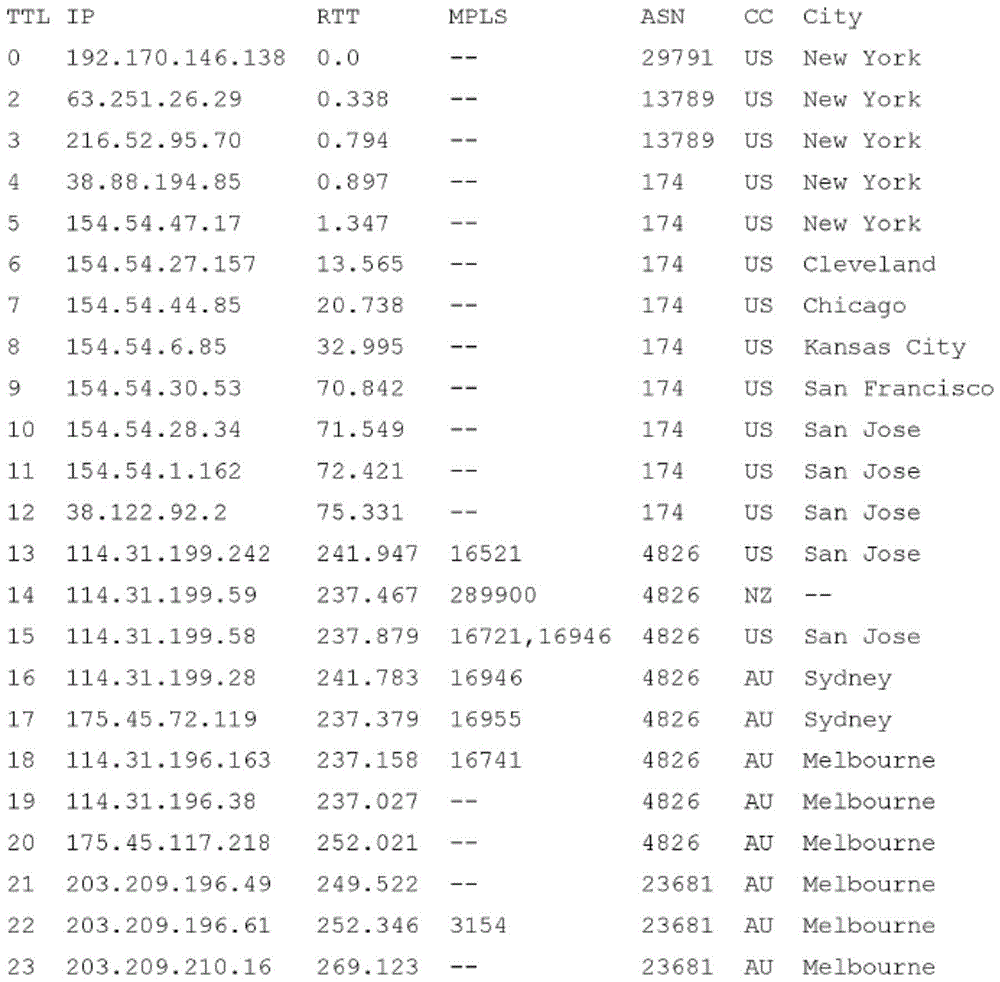
Consider the following traceroute from a new york city collector to an IP address in australia. Sandwiches are identified as sequences 114.31.199.242, 114.31.199.59, 114.31.199.58 (hops 13, 14 and 15) because these hops are geo-located to the united states, new zealand and the united states, respectively. Notably, RTT is not helpful in this case, because each hop of the sequence is in the MPLS tunnel (indicated by the MPLS label in the fourth column), and therefore RTT reflects the RTT at the end of the tunnel, rather than at the respective IP address.
From vps01.nyc1 to 203.209.210.16 at UTC1434920785 (2015-06-21-21: 06:25)
However, there are geolocation clues in the reverse DNS of the IP addresses in the sandwiches ("sjc" and "CA" in the names shown below), suggesting that San Jose, Calif. is the geolocation of all three IP addresses.
114.31.199.242 bundle-101.cor01.sjc01.ca.VOCUS.net
114.31.199.59 bundle-100.cor02.sjc01.ca.VOCUS.net
114.31.199.58 bundle-100.cor01.sjc01.ca.VOCUS.net
Further testing from the position in san Jose showed 114.31.199.59 to be within 2.157 milliseconds of san Jose, making New Zealand untrustworthy for its geographic positioning because the minimum possible RTT from san Jose to New Zealand Whiton (Wellington, NZ) was 107 milliseconds due to the light speed constraint.
Trace routing from San Jose, CA to 114.31.199.59:
traceroute to 114.31.199.59(114.31.199.59), 30 hops maximum; 60 byte packet
1 v199.mag01.sjc01.atlas.cogentco.com(66.250.250.113)0.338ms 0.347 ms
2 te0-4-0-1.ccr22.sjc01.atlas.cogentco.com(154.54.84.153)0.698 ms te0-4-0-1.ccr21.sjc01.atlas.cogentco.com(66.28.4.157)0.628ms
3 be2095.rcr21.b001848-1.sjc01.atlas.cogentco.com(154.54.3.138) 1.242ms 1.252ms
4 38.122.92.2(38.122.92.2)1.128ms 38.122.93.2(38.122.93.2) 1.120ms
5 bundle-101.cor01.sjc01.ca.VOCUS.net(114.31.199.242)1.348ms 1.166ms
6 bundle-100.cor02.sjc01.ca.VOCUS.net(114.31.199.59)2.157ms*
The geolocation server concludes that 114.31.199.59 is 2.157 milliseconds from san jose, which means that the true geolocation is no further than 215 kilometers from the san jose collector. Therefore, new zealand is not a trusted geographical location. The geolocation server also detects the "sjc" airport code of san Jose embedded in the rDNS for this IP address, further supporting san Jose as its actual geolocation, and the server corrects the geolocation of this IP address to san Jose, Calif.
Edge latency geolocation
In some implementations, the geolocation server uses an edge latency algorithm to infer the geolocation of neighboring hops. This is particularly useful when checking the geolocation of the penultimate hop in the traceroute to see if it informs the geolocation of the final destination, especially when the final destination is an end-user network, commonly referred to as an eyeball network by network engineers, that has no geolocation hints in its reverse DNS. In this case, the penultimate hop may be an infrastructure IP address, such as a data center router, where the location of the data center is embedded in its rDNS.
The method is implemented by the distribution of latency differences between adjacent IP addresses seen outside the MPLS tunnel in constructing trace routes. The median latency difference is calculated between all these pairs of RTTs. The calculated latency difference is then used to estimate the geolocation of one IP address of the pair, assuming that the geolocation of the other IP address is correct. The geolocation server then compares the calculated median with the smallest possible RTT of hypothetical geolocation for each pair of adjacent IP addresses. If the former is smaller than the latter, the geographic location of one or both of the IP addresses may be incorrect. Furthermore, in some implementations, if the geolocation of one IP address in the pair is well supported, the geolocation server process estimates the geolocation of the other IP address to be within a radius from its neighbors as defined by the median RTT and the given speed of light in the fiber.
Second to last hop example
Microsoft has a data center in Laramie county near Cheyenne, Wyoming. Consider a traceroute from a Cheyenne, eastern New Hampshire collector and one traceroute from Cheyenne, West Washington Seattle collector, West, as follows.
Portsmouth to 191.234.85.3[ mpr 27.69ms ]:
traceroute to 191.234.85.3(191.234.85.3), 30 hops maximum, 60 byte packet
1 rtr01.psm1.renesys.com(10.200.0.7)0.193ms 0.189ms 0.188 ms
2 hsrp2.psm1.renesys.com(195.160.236.3)2.381ms 2.395ms 2.397ms
3 ray-b2.worldpath.net(64.140.193.25)0.470ms 0.516ms 0.516 ms
4 bst-edge-05.inet.qwest.net(63.239.32.25)6.178ms 6.188ms 6.188ms
5 nyc-edge-04.inet.qwest.net(205.171.30.62)8.228ms 8.238ms 8.238ms
6 63.151.150.98(63.151.150.98)8.462ms 8.129ms 8.120ms
7 ae0-0.nyc-96cbe-1b.ntwk.msn.net(207.46.38.113)8.038ms 8.104 ms 8.257ms
8 ae6-0.was02-96cbe-1c.ntwk.msn.net(191.234.84.142)14.889ms 14.797ms*
9 ***
10 ***
11 ***
12 ***
13 ***
14 ae7-0.den01-96cbe-1a.ntwk.msn.net(191.234.84.222)52.028ms 52.041ms 52.044ms
15 ae8-0.cys01-96cbe-1a.ntwk.msn.net(191.234.80.191)56.479ms 56.490ms 54.767ms
16 191.234.85.3(191.234.85.3)54.487ms 54.500ms 57.758ms
Seattle to 191.234.85.3[ mpr 15.45ms ]:
traceroute to 191.234.85.3(191.234.85.3), 30 hops maximum, 60 byte packet
1 173.208.32.170.rdns.pingpipe.com(173.208.32.170)0.125ms 0.058ms 0.055ms
2 v3508.er01.sea.ubiquity.io(23.105.64.1)6.931ms 7.117ms 7.069ms
3 38.88.0.25(38.88.0.25)0.976ms 1.161ms 1.111ms
4 154.24.19.33(154.24.19.33)1.560ms 1.510ms 1.689ms
5 154.24.42.225(154.24.42.225)1.653ms 1.580ms 1.753ms
6 te0-1-0-7.ccr22.sea01.atlas.cogentco.com(154.54.41.145)1.567 ms 1.325ms 1.459ms
7 be2084.ccr21.sea02.atlas.cogentco.com(154.54.0.254)1.740ms 1.946ms 2.126ms
8 38.104.126.78(38.104.126.78)1.177ms 1.134ms 1.076ms
9 ***
10 ***
11 ae15-0.cys01-96cbe-1a.ntwk.msn.net(191.234.84.11)55.000ms 55.482ms 55.377ms
12 191.234.85.3(191.234.85.3)55.327ms 55.269ms 55.436ms
The penultimate hop in both traces contains the embedded rDNS. Each of these hops has a CYS01 in its rDNS (CYS is the IATA airport code of Cheyenne). The final destination latency is typically within 1 millisecond of the second last hop, which strongly implies that the second last IP address and the destination IP address are located in the same data center. Considering the latency between the penultimate hop and the target and the rDNS of the penultimate hop, the geolocation server places this target IP address in the same location as the penultimate hop, i.e., Cheyenne, wyoming.
Using IP aliases and MPLS labels for geolocation
Network interconnection devices (e.g., routers, firewalls, and switches) typically have many different network interfaces; each of these interfaces may have a unique IP address and may be physically connected to some other device (typically through a copper or fiber optic cable). For example, a single computer device is in a single geographic location, as are all IP addresses assigned to its interface(s). The process of finding all IP addresses belonging to a single piece of equipment is called de-aliasing.
In some implementations, the geolocation server described above may use one or more de-aliasing techniques (e.g., Mercator techniques) to look up alias IP addresses, in addition to MPLS label-based techniques. These techniques enable a geolocation server to determine sets of IP aliases and then infer a common geolocation for each set. Such a collection typically represents an interface on a single router on the internet. Thus, the geolocation server may more accurately determine the entire set of geolocation, and may correct many of the observed geolocation tracking the routing path and notify or alert one or more users about the potential geolocation of the hops adjacent to the device in question.
The mercator technique may include sending any packets to a random port of a selected IP address and observing when a port unreachable message is returned from an IP address that is not the target of a particular traceroute data collector. When an appropriate message is received from an IP address that is different from the target of the traceroute data collector, it may be possible to infer that the IP address has one or more IP aliases. The global traceroute data collector set may target all IP addresses observed in the global traceroute in this manner, thereby collecting trusted IP alias pairs. In addition, IP addresses newly discovered from this approach may also be added to the list of IP addresses to probe in an iterative manner, allowing more IP aliases to be discovered. Consistently observed pairs may be collected into a common set via a transitionable closure process.
An alternative implementation involves observing a common sequence of MPLS labels in global trace route data sent to a geolocation server. The label will not change for a given sequence, but the IP addresses encountered may be different when different traces traverse different router interfaces. The geolocation server may then associate different IP addresses with the same device using MPLS labels.
To understand how MPLS labels may be used to associate different IP addresses with the same device, consider an MPLS tunnel 600 as shown in fig. 6A. MPLS tunnel 600 includes a number of Label Switched Routers (LSRs) 604a-604c (collectively LSRs 604) coupled between an ingress Label Edge Router (LER)602, also referred to as edge LSR, and an egress LER 606. When the ingress LER 602 receives a packet, it determines the Forwarding Equivalence Class (FEC) of the packet and its Label Switched Path (LSP), creates an MPLS header for the packet, and inserts the appropriate label into the MPLS header before transmitting the packet to the first LSR604a in the MPLS tunnel 600. The label in the MPLS header specifies the node in MPLS tunnel 600 (LSR 604 in this example) between the ingress and egress.
Upon receiving the packet, first LSR604a examines a label in an MPLS header of the packet to determine a destination of the packet. However, unlike other routers, the first LSR604a does not necessarily have any IP routing information. Instead, it simply examines the label in the MPLS header of the packet to determine the next destination of the packet (here, second LSR604 b) within MPLS tunnel 600. The first LSR604a updates the MPLS header and then passes the packet to LSR604 b and so on until the packet reaches the egress LER 606, which has a complete IP routing table and routes the packet appropriately.
Because LSRs 604 perform using specific MPLS label information rather than a complete IP routing table, they may route traffic relatively quickly. But because they rely on MPLS labels rather than IP routing information, LSRs 604 do not necessarily route traffic to destinations outside MPLS tunnel 600. This means that if the first LSR604a receives a packet with TTL ═ 1 from the ingress LER 602, it will forward the packet to the second LSR604 b rather than return a "time out" message to the ingress LER 602. The second LSR604 b will forward the packet to the third LSR604 c, which third LSR604 c in turn forwards the packet to the egress LER 606, which returns a "time out" message to the ingress LER 602. The same thing happens if the ingress LER 602 conveys packets with TTL of 2 and 3 to the second and third LSRs 604b and 604c, respectively: they are forwarded to the egress LER 606, and the egress LER 606 returns a "time out" message to the ingress LER 602. The egress LER 606 also returns a "time out" message (correctly) in response to receiving a packet with TTL ═ 4. Thus, while the timing of the reported intermediate hop arrival is actually relative to LER 606, this actual end point is not visible until the TTL reaches 4. In view of the ubiquity of MPLS tunnels over the internet, finding MPLS tunnels and then ignoring intermediate hop latencies in MPLS tunnels provides significant advantages for using latencies in geolocation.
Fig. 6B illustrates a process 600 for estimating the geolocation of a particular router using MPLS labels in tracing routing data. Given the tracking through the known MPLS domain, the geolocation server determines the FEC used by the ingress LER to select the LSP (step 602). For each MPLS hop in the trace, the geolocation server maps the IP address of the MPLS hop to a sequence of MPLS labels at that point in the trace (step 604). The geolocation server repeats the IP address mapping over the sequence of all tracing paths through the MPLS domain within the selected time frame (step 606). The geolocation server aggregates all the IP addresses seen on each unique incoming MPLS label sequence (step 608), and then estimates the geolocation of the aggregated IP address using latency, rDNS information, or both (step 610).
As an example, consider the following three tracking sequences listing the IP addresses and MPLS labels encountered. In all three cases, the MPLS label sequence is the same. The underlined IP addresses belong to the same router and are identified by a label sequence (1314,1496,1793). The IP addresses in the lower italics belong to different public routers and are identified by a sequence of labels (1314,1496,1793,1807,1609). The geolocation server may identify MPLS IP addresses that share a common sequence of labels as belonging to the same router as seen across multiple tracking sequences through the same MPLS domain. Since MPLS IP addresses belong to the same router, they have the same geographical location.
Using the techniques described above, the geolocation server collects a set of IP addresses where there is strong evidence that they belong to a single piece of equipment and are therefore in a single geolocation. The geolocation server then attempts to geolocate each set to a common location or group of locations using latency and/or DNS information.
For a set of IP aliases found by the mercator sub-process, the IP address itself is usually directly possible. The geolocation server pings members of a given set from multiple locations to find the closest collector and computes a set of trustworthy geolocation based on latency measurements.
In some implementations, the geolocation server uses triangulation techniques from the closest collectors. The geolocation server resolves all the IPs in each set back, looking up airport codes, city names, or other geographic abbreviations. Intersecting a set of locations from DNS information with a set of locations from latency measurements may provide a smaller set of potential geo-locations. If the set is empty, then DNS information (which is human-entered and error prone) is ignored by the geolocation server. The end result of each set of IP aliases is a set of trusted geo-locations that are consistent with all observed latency measurements and, where possible, geographic "hints" derived from DNS tags.
For a set of IP aliases found via MPLS labels, the IP address itself is not necessarily directly possible and may only be observable when switching to other destinations via traceroutes. Moreover, the latency information observed in such traceroute measurements may not be used for intermediate hops of an MPLS tunnel, as the timing may be relative to the end of the tunnel. Thus, in general, for any latency measurement derived from a traceroute, the geolocation server may drop the latency from an intermediate hop in the MPLS tunnel, which may be identified by the geolocation server via the use of MPLS labels as described above. In the event direct probing or indirect acquisition of accurate latency information is not feasible, the geolocation server may revert to the DNS label to geolocation the IP alias belonging to the MPLS tunnel.
Fig. 7A and 7B illustrate examples of IP de-aliasing techniques utilized by geolocation servers and processes. An example of the mercator technique used by the geolocation server to identify IP addresses on a public router and then improve the geolocation estimate of the entire set is provided below. The following 12 IP addresses are identified as a set of related IP aliases:
68.86.83.46,68.86.83.42,68.86.83.38,68.86.83.34,68.86.82.94, 50.242.148.85,68.86.82.82,68.86.85.218,68.86.82.86,68.86.82.90, 23.30.206.41,23.30.206.153
the geolocation server identifies the set by looking up the connected components in the graph using the process 700 shown in figure 7A. That is, if the mercator probe for IP address a returns IP address B, then IP addresses a and B may be associated with each other. This association can be depicted in graph-theoretic terms as two nodes, one for each of A and B, with a directed edge between them. If A is the alias of B and B is the alias of C, then A, B and C are aliases of each other.
In other words, process 700 includes sending any packets (e.g., transmission control protocol or user datagram protocol packets) from the sensor to a random port that may represent a selected IP address of a router interface. The sensor measures the round-trip latency and observes port unreachable messages (step 704). If the sensor receives a port unreachable message, the sensor or geolocation server determines if the port unreachable message is returned from an IP address different from the destination of any packet (step 706). If so, the geolocation server determines that the destination IP address has one or more IP aliases, including the IP address of the return port unreachable message (step 708). The geolocation server then determines that all IP aliases are at the same geolocation (step 710) and estimates their geolocation using the techniques described above.
The 12 IP addresses given above and their learned associations may be represented by the connection diagram shown in fig. 7B, indicating that they are all related. Fig. 7B shows a sub-graph where 7 of these 12 IP addresses form a strong connection, meaning that each IP address is "visible" in both directions. That is, Probe A returns at least one member of the component, and one or more members of the Probe component also return A. (while strongly connected components provide very strong alias evidence, we only need connected components for our purposes).
Based on the connectivity described above, the geolocation server may infer which IPs belong to the same device and therefore should be located at the same geolocation. Latency measurements indicate that all of these IP addresses are near san jose, california. The DNS information for all these IP addresses points to the Great Oaks community of san Jose. For example, node 68.8.86.83.46 in fig. 7, node 705, resolves to 17pe02.11greatoaks.ca. Based on the automatic analysis performed by the geolocation server, all 12 IP addresses are located in Great Oaks of san jose, california, usa.
At the time of this writing, three commercial IP geolocation providers gave the following geolocation estimates for these 12 IP addresses:
provider 1: united states, no designated cities
Provider 2: several U.S. cities, including ashbook, Virginia, va, Marietta, Georgia, Denver, Colorado, and Los Angeles, California.
Provider 3: several U.S. cities, including seattle, Washington, Colorado, Dallas, Texas, and marrietta, Georgia.
This is quite typical of commercially available IP geolocation data. It is difficult to find a commercial geo-location provider that places all aliases in the same location, and it is not uncommon to see aliases placed in different countries (especially for routers with international connectivity).
Switching tree
In some implementations, the geolocation server may identify geolocation that are incorrect at the country level for subsequent correction and improvement using latency and DNS resolution. To accomplish this, the geolocation server performs an analysis derived from BGP routing data from multiple (e.g., over 600) peering sessions. The geolocation server receives BGP data from a BGP data collector containing information about Autonomous System (AS) paths to each routing network prefix on the internet. Each AS path contains AS-AS edges representing adjacent autonomous systems that exchange routes and maintain some business relationship.
Fig. 8A illustrates a single network prefix generated by a geolocation server that is switched out to the internet core from its origin. In some implementations, the geolocation server employs machine-learned classifiers to classify these AS edges into one of several different categories (labels): transit, peer-to-peer, cluster, exchange, etc. A local or regional transit provider may be expected to operate within a limited geographic range and thus transit network prefixes geographically localized to its operating country. The generated BGP edge markers are then utilized by the geolocation server to determine how each network prefix is to be ported out of its origin to the core of the internet, e.g., the transit tree shown in fig. 8A.
Fig. 8B illustrates a process 800 for determining a possible geographic location of the prefix in question based on assumed geographic locations of other prefixes carried on the same transit edge. In step 802, the geolocation server computes a transit tree for the prefix in question based on the generated edge markers. Next, the geolocation server checks the geolocation of some or all of the prefixes carried on the edges of the transit tree (step 804). To observe each edge of a prefix to transit, the geolocation server computes the geographic distribution of all prefixes across the edge, and weights the geographic distribution based on the number of BGP peers observing the prefix in question across the edge (step 806). The geolocation server combines these weighted geographic distributions into a country-level geolocation (where possible) for the prefix proposal in question (step 808). In step 810, the geolocation server compares the geolocation inferred from the transit tree to the geolocation(s) reported by the one or more third parties to the examined prefixes. (e.g., the geolocation server may automatically obtain the reported geolocation, as described above). If the inferred geolocation does not match the reported geolocation(s), the geolocation server verifies the geolocation of the prefix with the latency measurements, e.g., using the techniques described above (step 812).
An example utility of the transit tree in FIG. 8A is illustrated with respect to the prefix 118.150.0.0/20 that is geographically located by one of the primary business providers to Portland, Oregon. Examining the transit tree for this prefix shows that transit edges carry to a large extent the prefixes that the provider geographically locates to the taiwan region of china, and that most BGP peers observe these edges, especially those closest to the origin of the prefixes. The scoring performed by the geolocation server indicates that the most likely geolocation of the prefix is actually the taiwan region of china, with the united states being in a second, remote location. Latency measurements confirm the possibility of this prefix being located in taiwan and its complete untrustworthiness in the united states.
Routing time-dependent events
In some implementations, the geolocation service may identify incorrect geolocation for subsequent correction and improvement by using historical BGP outage and instability data. To accomplish this, the geolocation server performs break and instability calculations on some or all of the route prefixes on the internet derived from BGP route data from multiple (e.g., over 600) peering sessions and identifies an "event" as a set of prefixes that exhibit some behavior at approximately the same time. Over time, the correlation of these events typically reveals the commonality of the networking infrastructure and the routing paths of these prefixes.
These computed events are broken and repaired by large networks that represent specific geographic locations. For example, the geolocation server observes an event where 121 prefixes are withdrawn simultaneously-96% of these prefixes are geo-located to india through commercial services. Fifteen minutes later on the same day, the geolocation server sees that almost all of these prefixes are returned. Since the pair of events collectively contain 99 prefixes, they are likely to capture failures and repairs of the same physical infrastructure. The fact that almost all of them are geographically located to india adds support for this explanation.
By analyzing a few prefixes that are not located in india, the geolocation server is able to generate a candidate set of potentially erroneous geolocation. The chances that prefixes are withdrawn and restored at exactly these times without participating in the same network outage are very low, but not zero, and therefore their geolocation needs to be verified.
For example, 198.40.150.0/24 of Modine Manufacturing, Inc., registered to Racine, Wisconsin, USA, is one such prefix. In 2011 all available commercial services put this prefix in india and most still do so. The geolocation server observes 198.40.150.0/24 being advertised by AS21758 (Modine Manufacturing Inc.) and specifically ported via AS 18101 (alliance Communications Mumbai). AS 18101 has coverage specific to india, with many prefixes in monty (Mumbai) and chinney (Chennai). It would be very surprising if they were found to also provide internet services in the area of lasin, wisconsin, on which Modine is based. Registration authorities from ARIN list this prefix in lasin, wisconsin, which is certainly the source of these common misgeographic locations.
The latency data indicates that this prefix is in indolne. This is not surprising because Modine announced a new manufacturing plant in Qinni, India by news distribution on month 12 2008. It is not uncommon for the prefixes of a satellite office to be registered at the physical address of the headquarters. The geolocation server is able to place this prefix in changling after discovering a potential wrong geolocation from the cluster of time-dependent BGP route breaks and recoveries and then verifying the new geolocation via latency data. While latency data may be sufficient by itself to identify this level of false geolocation, BGP routing events may help improve and correct false geolocation over a smaller geographic area, particularly for neighboring cities where latency alone is uncertain.
Fig. 9 illustrates a collection of network prefixes during short-term regional internet instability. Time is represented along the x-axis and each prefix of interest is displayed along each "row" of the y-axis. Notably, the patterns are clearly displayed, which allows for algorithmic clustering of prefixes displaying common unstable patterns. The geolocation server looks for geographic inconsistencies within these clusters and uses the techniques described above to validate or invalidate any outliers.
Distance to anycast instance
In some implementations, the geolocation service may use the geographical distribution of observed IP addresses querying the global anycast network to identify incorrect geolocation for subsequent correction and refinement. The system may include a widely distributed global anycast network for providing authoritative DNS responses as part of a commercial DNS service, providing answers to tens of millions of recursions worldwide. By observing the recursive geographic distribution of each instance of the query anycast network, geographic outliers can be discovered and further investigated for possible correction by the techniques described herein. Furthermore, like rDNS, the geolocation of an anycast instance is a weak identifier of the location of the querier to the instance. That is, well-designed anycast networks tend to keep queries local.
Parametric path fitting
In some implementations, the geolocation service may use the geographical distribution of IP addresses observed downstream of the traceroute edge to identify incorrect geolocation for subsequent correction and refinement. Each traceroute contains a sequence of consecutive IP addresses observed along the path from the traceroute collector to the destination IP address. Each pair of consecutive IP addresses along such a path may be considered a directed edge in graph-theoretic terms. For each such edge or sequence of consecutive edges, the geolocation server computes the set of IP addresses observed downstream of the edges of all traceroutes traversing a given path segment, thus building a model of what latency and hops typically look like in the data. The geolocation server then looks for geographic outliers in each set of downstream IP addresses associated with each such directed path segment. These outliers may be further investigated by the techniques described herein for possible correction.
Non-geo-locatable IP address
In some implementations, the geolocation server identifies IP addresses that cannot be geographically located with any reasonable degree of specificity (e.g., other than "earth" or a very large area such as a continent). There are several reasons for this lack of specificity. The IP address may belong to the mobile device and may therefore roam freely. The IP address may be located at the other end of the satellite link. The satellites are typically in geosynchronous orbit (meaning latency times in excess of 500 milliseconds RTT) and have wide beams covering large geographic areas. Latency may be used to identify the satellite connection, but the actual location of the IP may be anywhere within the satellite beam.
Further, the IP address may be anycast, i.e., advertised from multiple locations via BGP routes. In this case, these IP addresses do not have a single geographic location because they are in many different locations at the same time. Anycast routing techniques are often used by content providers to reduce latency from a replicated repository of popular content to an end user. As previously described, IP addresses identified by the geolocation server as geographically inconsistent through latency measurements are marked as anycast.
Geolocation providers typically place each of the IP addresses they include in their databases in a single geolocation. Such a policy may be misleading for an anycast network. For example, consider the public DNS recursive resolver popular with Google at 8.8.8.8. Using the same business provider used in the previous example, the geolocation server outputs the following geolocation:
provider 1: mountain landscape city, california, usa
Provider 2: mountain landscape city, california, usa
Provider 3: mountain landscape city, california, usa
The geolocation server determines that the Google DNS 8.8.8.8 is within 5ms of 110 traceroute data collectors and is geographically inconsistent between 26,704 different collector pairs, implying a high degree of anycasting (i.e., many actual Google locations). However, none of these many Google instances of the geolocation server measurement indication 8.8.8.8 is actually in the mountain city, a conclusion supported by the information that Google itself publishes. The geolocation server may not only use the latency measurements to discover anycast prefixes, but it may also identify the possible locations of each anycast instance.
Conclusion
While various inventive embodiments have been described and illustrated herein, those of ordinary skill in the art will readily envision a variety of other means and/or structures for performing the functions and/or obtaining one or more of the results and/or advantages described herein, and each of such variations and/or modifications is deemed to be within the scope of the inventive embodiments described herein. More generally, those skilled in the art will readily appreciate that all parameters, dimensions, materials, and configurations described herein are meant to be exemplary and that the actual parameters, dimensions, materials, and configurations will depend upon the specific application(s) for which the inventive teachings is used. Those skilled in the art will recognize, or be able to ascertain using no more than routine experimentation, many equivalents to the specific inventive embodiments described herein. It is, therefore, to be understood that the foregoing embodiments are presented by way of example only and that, within the scope of the appended claims and equivalents thereto, the inventive embodiments may be practiced otherwise than as specifically described and claimed. Inventive embodiments of the present disclosure are directed to each individual feature, system, article, material, kit, and/or method described herein. In addition, any combination of two or more such features, systems, articles, materials, kits, and/or methods, if such features, systems, articles, materials, kits, and/or methods are not mutually inconsistent, is included within the inventive scope of the present disclosure.
The above-described embodiments of the present invention can be implemented in any of numerous ways. For example, some embodiments may be implemented using hardware, software, or a combination thereof. When any aspect of an embodiment is implemented, at least in part, in software, the software code can be executed on any suitable processor or collection of processors, whether provided in a single computer or distributed among multiple computers.
In this regard, various aspects of the invention may be at least partially embodied in a computer-readable storage medium (or multiple computer-readable storage media) (e.g., a computer memory, one or more floppy disks, compact disks, optical disks, magnetic tapes, flash memories, circuit configurations in field programmable gate arrays or other semiconductor devices, or other tangible computer storage medium or non-transitory medium) encoded with one or more programs that, when executed on one or more computers or other processors, perform methods that implement the various embodiments of the technology discussed above. The computer-readable medium(s) can be portable such that the program(s) stored thereon can be loaded onto one or more different computers or other processors to implement various aspects of the present technology as discussed above.
The terms "program" or "software" are used herein in a generic sense to refer to any type of computer code or set of processor-executable instructions that can be employed to program a computer or other processor to implement various aspects of the present technology as discussed above. Moreover, it should be appreciated that according to one aspect of this embodiment, one or more computer programs that, when executed, perform methods of the present technology need not reside on a single computer or processor, but may be distributed in a modular fashion amongst a number of different computers or processors to implement various aspects of the present technology.
Computer-executable instructions may be in many forms, such as program modules, executed by one or more computers or other devices. Generally, program modules include routines, programs, objects, components, data structures, etc. that perform particular tasks or implement particular abstract data types. Typically, the functionality of the program modules may be combined or distributed as desired in various embodiments.
Further, the techniques described herein may be embodied as methods that have provided at least one example. The actions performed as part of the method may be ordered in any suitable way. Thus, embodiments may be constructed in which acts are performed in an order different than illustrated, which may include performing some acts concurrently, although shown as sequential acts in illustrative embodiments.
All definitions, as defined and used herein, should be understood to control over definitions in documents incorporated by reference and/or ordinary meanings of the defined terms over definitions in a dictionary.
As used herein in the specification and in the claims, the indefinite articles "a" and "an" should be understood to mean "at least one" unless explicitly indicated to the contrary.
As used herein in the specification and in the claims, the phrase "and/or" should be understood to mean "either or both" of the elements so connected, i.e., the elements present in some cases combined and in other cases separated. Multiple elements listed with "and/or" should be interpreted in the same manner, i.e., "one or more" of the elements so combined. In addition to elements specifically identified by the "and/or" clause, other elements may optionally be present, whether related or unrelated to those elements specifically identified. Thus, as a non-limiting example, when used in conjunction with an open language such as "including," references to "a and/or B" may, in one embodiment, refer to only a (optionally including elements other than B); in another embodiment, only B (optionally including elements other than a); in yet another embodiment, refer to both a and B (optionally including other elements); and so on.
As used herein in the specification and claims, "or" should be understood to have the same meaning as "and/or" as defined above. For example, when separating items in a list, "or" and/or "should be interpreted as being inclusive, i.e., including at least one of multiple elements or lists of elements, but also including more than one, and optionally, including additional unlisted items. Only terms explicitly indicating the contrary, such as "one of only …" or "exactly one of …," or "consisting of …" when used in the claims, will refer to including exactly one of a plurality or list of elements. In general, as used herein, the term "or" as used herein, when preceded by an exclusive term (such as "any one," "one of …," "only one of …," or "exactly one of …") is to be construed merely as indicating an exclusive substitution (i.e., "one or the other but not both"). "consisting essentially of …" when used in the claims shall have its ordinary meaning as used in the patent law field.
As used herein in the specification and claims, the phrase "at least one," when referring to a list of one or more elements, should be understood to mean at least one element selected from any one or more of the elements in the list of elements, but not necessarily including at least one of each element specifically recited within the list of elements and not excluding any combinations of elements in the list of elements. This definition also allows that elements may optionally be present other than the elements specifically identified within the list of elements referred to by the phrase "at least one," whether related or unrelated to those elements specifically identified. Thus, as a non-limiting example, "at least one of a and B" (or, equivalently, "at least one of a or B," or, equivalently, "at least one of a and/or B") can, in one embodiment, refer to at least one, optionally including more than one, a, wherein B is not present (and optionally including elements other than B); in another embodiment, to at least one, optionally including more than one, B, where a is not present (and optionally includes elements other than a); in yet another embodiment, to at least one, optionally including more than one, a, and at least one, optionally including more than one, B (and optionally including other elements); and so on.
In the claims, as well as in the specification above, all transitional phrases such as "comprising," "including," "carrying," "having," "containing," "involving," "holding," and the like are to be understood to be open-ended, i.e., to mean including but not limited to. Only the transition phrases "consisting of …" and "consisting essentially of …" will be closed or semi-closed transition phrases, respectively.