CN107967536B - Green data center energy-saving task scheduling strategy based on robust optimization - Google Patents
Green data center energy-saving task scheduling strategy based on robust optimization Download PDFInfo
- Publication number
- CN107967536B CN107967536B CN201711201244.6A CN201711201244A CN107967536B CN 107967536 B CN107967536 B CN 107967536B CN 201711201244 A CN201711201244 A CN 201711201244A CN 107967536 B CN107967536 B CN 107967536B
- Authority
- CN
- China
- Prior art keywords
- data center
- energy
- computing node
- power generation
- time slot
- Prior art date
- Legal status (The legal status is an assumption and is not a legal conclusion. Google has not performed a legal analysis and makes no representation as to the accuracy of the status listed.)
- Expired - Fee Related
Links
Images


Classifications
-
- G—PHYSICS
- G06—COMPUTING OR CALCULATING; COUNTING
- G06Q—INFORMATION AND COMMUNICATION TECHNOLOGY [ICT] SPECIALLY ADAPTED FOR ADMINISTRATIVE, COMMERCIAL, FINANCIAL, MANAGERIAL OR SUPERVISORY PURPOSES; SYSTEMS OR METHODS SPECIALLY ADAPTED FOR ADMINISTRATIVE, COMMERCIAL, FINANCIAL, MANAGERIAL OR SUPERVISORY PURPOSES, NOT OTHERWISE PROVIDED FOR
- G06Q10/00—Administration; Management
- G06Q10/04—Forecasting or optimisation specially adapted for administrative or management purposes, e.g. linear programming or "cutting stock problem"
-
- G—PHYSICS
- G06—COMPUTING OR CALCULATING; COUNTING
- G06Q—INFORMATION AND COMMUNICATION TECHNOLOGY [ICT] SPECIALLY ADAPTED FOR ADMINISTRATIVE, COMMERCIAL, FINANCIAL, MANAGERIAL OR SUPERVISORY PURPOSES; SYSTEMS OR METHODS SPECIALLY ADAPTED FOR ADMINISTRATIVE, COMMERCIAL, FINANCIAL, MANAGERIAL OR SUPERVISORY PURPOSES, NOT OTHERWISE PROVIDED FOR
- G06Q10/00—Administration; Management
- G06Q10/06—Resources, workflows, human or project management; Enterprise or organisation planning; Enterprise or organisation modelling
- G06Q10/063—Operations research, analysis or management
- G06Q10/0639—Performance analysis of employees; Performance analysis of enterprise or organisation operations
-
- G—PHYSICS
- G06—COMPUTING OR CALCULATING; COUNTING
- G06Q—INFORMATION AND COMMUNICATION TECHNOLOGY [ICT] SPECIALLY ADAPTED FOR ADMINISTRATIVE, COMMERCIAL, FINANCIAL, MANAGERIAL OR SUPERVISORY PURPOSES; SYSTEMS OR METHODS SPECIALLY ADAPTED FOR ADMINISTRATIVE, COMMERCIAL, FINANCIAL, MANAGERIAL OR SUPERVISORY PURPOSES, NOT OTHERWISE PROVIDED FOR
- G06Q50/00—Information and communication technology [ICT] specially adapted for implementation of business processes of specific business sectors, e.g. utilities or tourism
- G06Q50/06—Energy or water supply
-
- Y—GENERAL TAGGING OF NEW TECHNOLOGICAL DEVELOPMENTS; GENERAL TAGGING OF CROSS-SECTIONAL TECHNOLOGIES SPANNING OVER SEVERAL SECTIONS OF THE IPC; TECHNICAL SUBJECTS COVERED BY FORMER USPC CROSS-REFERENCE ART COLLECTIONS [XRACs] AND DIGESTS
- Y02—TECHNOLOGIES OR APPLICATIONS FOR MITIGATION OR ADAPTATION AGAINST CLIMATE CHANGE
- Y02E—REDUCTION OF GREENHOUSE GAS [GHG] EMISSIONS, RELATED TO ENERGY GENERATION, TRANSMISSION OR DISTRIBUTION
- Y02E40/00—Technologies for an efficient electrical power generation, transmission or distribution
- Y02E40/70—Smart grids as climate change mitigation technology in the energy generation sector
-
- Y—GENERAL TAGGING OF NEW TECHNOLOGICAL DEVELOPMENTS; GENERAL TAGGING OF CROSS-SECTIONAL TECHNOLOGIES SPANNING OVER SEVERAL SECTIONS OF THE IPC; TECHNICAL SUBJECTS COVERED BY FORMER USPC CROSS-REFERENCE ART COLLECTIONS [XRACs] AND DIGESTS
- Y04—INFORMATION OR COMMUNICATION TECHNOLOGIES HAVING AN IMPACT ON OTHER TECHNOLOGY AREAS
- Y04S—SYSTEMS INTEGRATING TECHNOLOGIES RELATED TO POWER NETWORK OPERATION, COMMUNICATION OR INFORMATION TECHNOLOGIES FOR IMPROVING THE ELECTRICAL POWER GENERATION, TRANSMISSION, DISTRIBUTION, MANAGEMENT OR USAGE, i.e. SMART GRIDS
- Y04S10/00—Systems supporting electrical power generation, transmission or distribution
- Y04S10/50—Systems or methods supporting the power network operation or management, involving a certain degree of interaction with the load-side end user applications
Landscapes
- Business, Economics & Management (AREA)
- Engineering & Computer Science (AREA)
- Human Resources & Organizations (AREA)
- Economics (AREA)
- Strategic Management (AREA)
- Theoretical Computer Science (AREA)
- Entrepreneurship & Innovation (AREA)
- Development Economics (AREA)
- Marketing (AREA)
- General Physics & Mathematics (AREA)
- General Business, Economics & Management (AREA)
- Tourism & Hospitality (AREA)
- Physics & Mathematics (AREA)
- Health & Medical Sciences (AREA)
- Game Theory and Decision Science (AREA)
- Operations Research (AREA)
- Quality & Reliability (AREA)
- Educational Administration (AREA)
- Public Health (AREA)
- Primary Health Care (AREA)
- Water Supply & Treatment (AREA)
- General Health & Medical Sciences (AREA)
- Management, Administration, Business Operations System, And Electronic Commerce (AREA)
Abstract
本发明公开了一种基于鲁棒优化的绿色数据中心节能任务调度策略,主要用于解决数据中心高能耗、高电费、高污染的问题。本发明为数据中心部署了太阳能电池板,数据中心可由太阳能和传统电网混合发电。为了解决太阳能发电的随机性、间断性、不稳定性的特点,本发明设计了一个新颖灵活的不确定模型,通过参考分布的引入定义了不确定集来限制太阳能发电量的波动,并考虑了地理分布式计算节点的电价差异性和时变性,设计出合理的任务调度策略,将用户提交到数据中心的请求分配到太阳能产量高和电价低的计算节点和时间段去处理,以求消耗最少的电费,达到节约能源和保护环境的目的。

The invention discloses a green data center energy-saving task scheduling strategy based on robust optimization, which is mainly used to solve the problems of high energy consumption, high electricity cost and high pollution in the data center. The present invention deploys solar panels for the data center, and the data center can be mixed with solar energy and traditional power grid to generate electricity. In order to solve the characteristics of randomness, discontinuity and instability of solar power generation, the present invention designs a novel and flexible uncertainty model, which defines the uncertainty set through the introduction of reference distribution to limit the fluctuation of solar power generation, and considers the fluctuation of solar power generation. Due to the difference and time-varying electricity price of geographically distributed computing nodes, a reasonable task scheduling strategy is designed, and the requests submitted by users to the data center are allocated to computing nodes and time periods with high solar energy production and low electricity price for processing, in order to minimize consumption. electricity bills to save energy and protect the environment.
Description
技术领域technical field
本发明属于太阳能技术领域,具体涉及一种基于鲁棒优化的绿色数据中心节能任务调度策略,主要用于解决数据中心高能耗、高电费、高污染的问题。本发明从软件和服务层面考虑,将用户提交到数据中心的请求分配到地理分布式的计算节点进行处理,主要实现包括三部分:一是引入了可再生能源,即通过部署光伏太阳能板,将太阳能发电和传统电网发电结合起来为数据中心供电;二是考虑电价的地区差异性和时变性;三是设计节能的任务调度策略,即在前两部分的基础上,将到达数据中心的用户请求分配到太阳能产量高和电价低的计算节点和时间段去处理,以求消耗最少的电费,达到节约能源和保护环境的目的。The invention belongs to the technical field of solar energy, and in particular relates to a green data center energy-saving task scheduling strategy based on robust optimization, which is mainly used to solve the problems of high energy consumption, high electricity cost and high pollution in the data center. Considering the software and service aspects, the present invention allocates the requests submitted by users to the data center to geographically distributed computing nodes for processing. The main implementation includes three parts: first, renewable energy is introduced, that is, by deploying photovoltaic solar panels, the Solar power generation and traditional grid power generation are combined to supply power to the data center; the second is to consider the regional differences and time-varying electricity prices; the third is to design an energy-saving task scheduling strategy, that is, on the basis of the first two parts, the user requests arriving at the data center will be It is allocated to computing nodes and time periods with high solar energy production and low electricity price for processing, in order to consume the least electricity cost, and achieve the purpose of saving energy and protecting the environment.
背景技术Background technique
近年来,国内大型数据中心的建设呈现快速增长的趋势,金融、通信、石化、电力等大型国企、政府机构纷纷建设自己的数据中心。随着大数据、物联网、云计算及移动互联概念的推出,大批资金投入到商业数据中心的建设中,数据中心对电力供应产生了巨大的影响,已经成为一个高耗能的产业。在北京数据中心比较集中的地区,电力供应都出现饱和的问题,已无法再支撑新的数据中心。目前,某些数据中心移至西北等煤炭基地,利用当地电力供应充足、电价低的优势也不失为一个明智的选择。In recent years, the construction of large-scale data centers in China has shown a trend of rapid growth. Large-scale state-owned enterprises and government agencies such as finance, telecommunications, petrochemicals, and electric power have built their own data centers. With the introduction of big data, Internet of Things, cloud computing and mobile Internet concepts, a large amount of capital has been invested in the construction of commercial data centers. Data centers have had a huge impact on power supply and have become an energy-intensive industry. In areas where data centers are concentrated in Beijing, the power supply is saturated, and new data centers can no longer be supported. At present, some data centers are moved to coal bases such as the Northwest, and it is a wise choice to take advantage of the abundant local power supply and low electricity prices.
然而,仅仅转移数据中心治标不治本,因为数据中心的供电系统一般是传统公用电网,传统电网仍然在消耗大量的煤、石油、天然气等化石燃料,巨大的碳排放量给环境带来了严重的污染。据报道,在全球各大网站中,仅数据中心的用电功率就相当于30个核电站的供电功率,而其中约90%的电能被浪费;数据中心效率评估报告显示,300万个数据中心的1200万台计算机服务器为整个美国用户服务,消耗的电能足够供给整个纽约市家庭用户两年的用电量,这相当于34个燃煤发电厂的发电量和带来的环境污染。However, just transferring the data center is not a cure for the symptoms, because the power supply system of the data center is generally the traditional public power grid, and the traditional power grid still consumes a large amount of fossil fuels such as coal, oil, and natural gas, and the huge carbon emissions have brought serious environmental problems. Pollution. According to reports, in the world's major websites, the power consumption of data centers alone is equivalent to the power supply of 30 nuclear power plants, and about 90% of the power is wasted; the data center efficiency evaluation report shows that 1,200 of the 3 million data centers Ten thousand computer servers serve users throughout the United States, and consume enough electricity to supply the entire New York City households with electricity for two years, which is equivalent to the power generation and environmental pollution caused by 34 coal-fired power plants.
未来的数据中心需要重组以接入可再生能源发电设备,例如太阳能电池板、风力涡轮机等,使得数据中心既节能又环保。然而,在使用可再生能源后,尽管环境问题得到了有效的改善,一些问题却随之而来:首先,与传统电网可控稳定的发电机制不同,可再生能源发电具有高度的波动性、不确定性和与天气强烈的相关性,太阳能发电量难以量化;其次,如何在不违背用户服务请求的前提下,在地理分布式的计算节点上恰当调度数据中心的用户请求来最小化数据中心的电费也是个关键问题。The data center of the future will need to be restructured to connect to renewable energy power generation equipment, such as solar panels, wind turbines, etc., making the data center both energy efficient and environmentally friendly. However, after the use of renewable energy, although the environmental problems have been effectively improved, some problems have followed: First, unlike the controllable and stable power generation mechanism of the traditional power grid, the power generation of renewable energy is highly volatile and invariable. With certainty and strong correlation with weather, solar power generation is difficult to quantify; secondly, how to properly schedule user requests of data centers on geographically distributed computing nodes without violating user service requests to minimize data center costs. Electricity bills are also a key issue.
针对太阳能发电不稳定的特性,国内外处理太阳能发电量这一随机变量的方式主要有两大类,一类是随机优化,该方法需要事先获得随机变量的分布函数,然后不断抽样求解,费时费力,适合计算量小和简单的场景,而实际场景中,很难准确获得随机变量的分布函数;另一类是鲁棒优化,该方法最大的优点是不需要随机变量分布函数的信息,而是通过定义一个不确定集,让随机变量在不确定集一个规定的范围内波动,考虑了最坏情况下的最优解,最大程度上贴近了实际场景,具有很大的灵活性和可控性。In view of the unstable characteristics of solar power generation, there are two main ways to deal with the random variable of solar power generation at home and abroad. One is stochastic optimization. This method needs to obtain the distribution function of the random variable in advance, and then continuously sample and solve it, which is time-consuming and labor-intensive. , which is suitable for small and simple scenarios, but in actual scenarios, it is difficult to accurately obtain the distribution function of random variables; the other type is robust optimization. The biggest advantage of this method is that it does not require the information of the distribution function of random variables, but By defining an uncertain set, the random variables fluctuate within a specified range of the uncertain set, considering the optimal solution in the worst case, which is close to the actual scene to the greatest extent, and has great flexibility and controllability .
本发明的目的和意义在于,利用鲁棒优化的上述优势,将太阳能的引入由理想变为现实,通过对太阳能发电量这一随机变量的处理,化随机为确定,使得数据中心不再单独依赖于传统电网,在此基础上利用节能任务调度策略,将太阳能产量和电价的波动性有机结合在一起,为数据中心的任务处理制定了节能环保的调度方案。与以往的技术相比,本发明最大的优势就是不需要事先假设太阳能产量的具体分布函数,而是以详细又灵活的方式定义了一个限制随机变量波动的不确定集,这个集合包括了随机变量的很多详细信息,然后通过机会约束和鲁棒优化方法转化和解决了最小化电费的问题。通过收集真实数据进行实验,结果证明本发明确实将数据中心的任务负载调度到白天太阳能充足的计算节点和相应的时间段进行处理,与此同时,电价低的计算节点和时间段的任务负载要高于电价高的计算节点和时间段,并且每个规模的数据中心都对应一个最优的负载大小,使得数据中心单位负载的耗电量达到最低,因此,本发明可以切实为构建一个绿色数据中心贡献一些参考建议。The purpose and significance of the present invention is to make use of the above advantages of robust optimization, to change the introduction of solar energy from ideal to reality, and to change the random variable into determination by processing the random variable of solar power generation, so that the data center is no longer dependent on independent For the traditional power grid, on this basis, the energy-saving task scheduling strategy is used to organically combine the fluctuation of solar energy production and electricity price, and an energy-saving and environmentally friendly scheduling plan is formulated for the task processing of the data center. Compared with the previous technology, the biggest advantage of the present invention is that it does not need to assume a specific distribution function of solar energy production in advance, but defines an uncertain set that limits the fluctuation of random variables in a detailed and flexible way, and this set includes random variables. Many details of , and then the problem of minimizing electricity costs is transformed and solved through chance constraints and robust optimization methods. By collecting real data and conducting experiments, the results show that the present invention indeed schedules the task load of the data center to the computing nodes with sufficient solar energy during the day and the corresponding time period for processing. It is higher than the computing node and time period with high electricity price, and each scale of data center corresponds to an optimal load size, so that the power consumption per unit load of the data center can be minimized. Therefore, the present invention can effectively construct a green data The center contributes some reference suggestions.
发明内容SUMMARY OF THE INVENTION
发明目的:为了克服现有技术中存在的不足,本发明提供一种基于鲁棒优化的绿色数据中心节能任务调度策略,本发明方案主要包括以下内容:Purpose of the invention: In order to overcome the deficiencies in the prior art, the present invention provides a green data center energy-saving task scheduling strategy based on robust optimization. The solution of the present invention mainly includes the following contents:
1)太阳能发电量的获取1) Acquisition of solar power generation
未来数据中心的供电方式是传统电网供电与太阳能发电的混合,这就要求电能的供给不小于需求,而电能的供给就是传统电网的供电量加上太阳能的发电量,其中,太阳能的发电量是一个随机变量,对该变量的处理是整个模型中的关键工作。由于太阳能发电的间断性和不稳定性,很难获得其准确的概率分布,但是大量的历史数据又提供了关于太阳能发电量的有效信息,因此,可以构造一个参考分布,利用KL散度来控制真实分布与参考分布之间的差距,由此定义一个不确定集来限制真实分布的波动,通过调节差距的大小动态控制该过程的鲁棒性,然后,电能的供给需求约束被转化为机会约束,通过鲁棒优化、拉格朗日法、KKT条件、牛顿法和二分法获得最坏情况下的太阳能发电量,以保证数据中心在白天可以正常运转。In the future, the power supply method of the data center will be a mixture of traditional grid power supply and solar power generation, which requires that the supply of electric energy is not less than the demand, and the supply of electric energy is the power supply of the traditional power grid plus the power generation of solar energy. Among them, the power generation of solar energy is A random variable, the treatment of which is the key work in the whole model. Due to the discontinuity and instability of solar power generation, it is difficult to obtain its accurate probability distribution, but a large amount of historical data provides effective information about solar power generation. Therefore, a reference distribution can be constructed and the KL divergence can be used to control The gap between the real distribution and the reference distribution, thereby defining an uncertainty set to limit the fluctuation of the real distribution, and dynamically controlling the robustness of the process by adjusting the size of the gap, and then, the power supply and demand constraints are transformed into opportunity constraints , the worst-case solar power generation is obtained through robust optimization, Lagrangian method, KKT conditions, Newton's method and dichotomy method to ensure that the data center can operate normally during the day.
2)电价的区域差异性和时变性2) Regional differences and time-varying electricity prices
数据中心中每个计算节点所在地区的电价都是不同的,同一地区每个时间段的电价又是波动的,因此可以充分利用电价的差异性来最小化数据中心的总电费。The electricity price in the region where each computing node is located in the data center is different, and the electricity price in each time period in the same region fluctuates. Therefore, the difference in electricity price can be fully utilized to minimize the total electricity cost of the data center.
3)节能任务调度策略3) Energy-saving task scheduling strategy
数据中心中每个计算节点所在地区的太阳能产量获知后,结合该地区的电价设计出一个节能任务调度策略,使得数据中心的负载被分配到太阳能产量高和电价低的计算节点和时间段进行处理。由于考虑的任务是延迟容忍型的,例如系统升级、数据备份、视频下载等服务,这些任务可以被多个计算节点在多个时隙进行处理,即分布式计算,同理,一个计算节点也可以处理多个任务,因此,只要总任务量不超过数据中心计算节点的最大计算能力,都可以满足用户的需要,同时也优化了数据中心的能源分配。After the solar energy production in the region where each computing node in the data center is located, an energy-saving task scheduling strategy is designed in combination with the electricity price in the region, so that the load of the data center is allocated to the computing nodes and time periods with high solar energy production and low electricity price for processing. . Since the considered tasks are delay-tolerant, such as system upgrade, data backup, video download and other services, these tasks can be processed by multiple computing nodes in multiple time slots, that is, distributed computing. It can process multiple tasks. Therefore, as long as the total task volume does not exceed the maximum computing power of the computing nodes in the data center, it can meet the needs of users and optimize the energy distribution of the data center.
技术方案:为实现上述目的,本发明采用的技术方案为:Technical scheme: In order to realize the above-mentioned purpose, the technical scheme adopted in the present invention is:
1、一种基于鲁棒优化的绿色数据中心节能任务调度策略,其特征在于:数据中心由太阳能和传统电网混合发电,通过机会约束规划和鲁棒优化的方法处理随机变量,所述随机变量为太阳能发电量rjk,将主问题变成不含有随机变量rjk的线性规划,再进行主问题求解,具体包括以下步骤:1. A green data center energy-saving task scheduling strategy based on robust optimization, characterized in that: the data center is mixed with solar energy and traditional power grids, and random variables are processed by means of chance-constrained programming and robust optimization, and the random variables are Solar power generation r jk , transform the main problem into a linear program without random variables r jk , and then solve the main problem, which includes the following steps:
(1)获取太阳能发电量的历史数据;(1) Obtain historical data of solar power generation;
(2)根据历史数据构造参考分布,参考分布包括但不限于正态分布;(2) Construct a reference distribution based on historical data, which includes but is not limited to normal distribution;
(3)利用KL散度定义不确定集来限制太阳能发电量真实分布的波动;(3) Using the KL divergence to define the uncertainty set to limit the fluctuation of the true distribution of solar power generation;
(4)将电能的供给需求约束转化为机会约束,形成鲁棒优化子问题并求解;(4) Convert the supply and demand constraints of electric energy into opportunity constraints, form a robust optimization sub-problem and solve it;
(5)获得最坏情况下的太阳能发电量

(6)考虑地理分布式计算节点的电价差异性和时变性;(6) Consider the difference and time-varying electricity price of geographically distributed computing nodes;
(7)设计任务调度策略,即将用户提交到数据中心的请求分配到太阳能产量高和电价低的计算节点和时间段去处理,最小化数据中心的总电费,即min
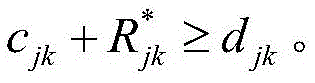
本发明中数据中心的计算节点都是地理分布式的,每个地区都分布了一些同构的计算节点,每个地区都部署了自己的太阳能电池板,也接入了当地的公用电网,因此,每个地区的太阳能发电量和电价都具有地区差异性和时变性。由于太阳能发电的不稳定性、间断性和随机性,太阳能发电量是一个随机变量。对数据中心而言,电能的总供给必须大于等于总需求,即cjk+rjk≥djk,而总供给等于太阳能发电量加上传统电网供电量。因此,本发明通过机会约束规划和鲁棒优化的方法有效处理了这一随机变量,并充分利用电价的地区差异性和时变性,目标就是最小化数据中心的总电费。本发明结合太阳能发电量的特点和电价的波动性,设计出合理的任务调度策略,该节能任务调度策略将任务调度与电能调度联合考虑,在不违背用户需求和服务质量的前提下,将任务分配到太阳能发电量高和电价低的计算节点和时间段去处理。The computing nodes of the data center in the present invention are all geographically distributed, and each region is distributed with some homogeneous computing nodes. Each region has deployed its own solar panels and is also connected to the local public power grid. Therefore, , the solar power generation and electricity prices in each region have regional differences and time-varying. Due to the instability, discontinuity and randomness of solar power generation, the amount of solar power generation is a random variable. For a data center, the total supply of electrical energy must be greater than or equal to the total demand, that is, c jk +r jk ≥d jk , and the total supply is equal to the solar power plus the traditional grid power. Therefore, the present invention effectively handles this random variable by means of chance-constrained programming and robust optimization, and makes full use of regional differences and time-varying electricity prices, with the goal of minimizing the total electricity cost of the data center. The invention combines the characteristics of solar power generation and the volatility of electricity price, and designs a reasonable task scheduling strategy. The energy-saving task scheduling strategy combines task scheduling and power scheduling, and under the premise of not violating user requirements and service quality, the task scheduling strategy Allocate to computing nodes and time periods with high solar power generation and low electricity prices for processing.
进一步的,数据中心每个计算节点处理器的能耗计算公式为


进一步的,所述的电能的供给需求约束为:cjk+rjk≥djk,其中,cjk表示计算节点j在第k个时隙从传统电网购买的电量,rjk表示计算节点j所在的地区部署的光伏太阳能板在第k个时隙的发电量。Further, the supply and demand constraints of the electric energy are: c jk +r jk ≥d jk , where c jk represents the electricity purchased by the computing node j from the traditional power grid in the kth time slot, and r jk represents the location where the computing node j is located. The amount of electricity generated by the photovoltaic solar panels deployed in the region in the kth time slot.
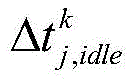
进一步的,所述任务调度的具体方法为:引入一个任务分配矩阵yjki,表示任务i被分配到计算节点j后在第k个时隙的处理时间,数据中心每个计算节点处理器的能耗计算公式转化为


其中,TH为数据中心的整个调度周期向量。Among them, TH is the entire scheduling cycle vector of the data center.
进一步的,所述主问题为:Further, the main problem is:


cjk+rjk≥djk, (4)c jk +r jk ≥d jk , (4)

其中,式(1)表示最小化数据中心的总电费,式(2)表示计算节点在每个时隙的忙碌时间不超过该时隙的长度,任务分配矩阵yjki表示任务i被分配到计算节点j后在第k个时隙的处理时间,式(3)表示每个任务最终都要被处理,sjk表示计算节点j在第k个时隙的处理速度,是一个常数,li表示任务i的大小,式(4)表示数据中心的电能供给和需求约束,式(5)表示数据中心中计算节点的处理器的能耗计算公式。Among them, equation (1) represents minimizing the total electricity cost of the data center, equation (2) represents that the busy time of computing nodes in each time slot does not exceed the length of the time slot, and the task allocation matrix y jki represents that task i is allocated to computing The processing time in the kth time slot after node j, formula (3) indicates that each task must be processed eventually, s jk represents the processing speed of the calculation node j in the kth time slot, which is a constant, li represents The size of task i, formula (4) represents the power supply and demand constraints of the data center, and formula (5) represents the energy consumption calculation formula of the processor of the computing node in the data center.
进一步的,步骤3)利用KL散度定义不确定集来限制太阳能发电量真实分布的波动的具体方法为:Further, in step 3) the specific method of using the KL divergence to define the uncertainty set to limit the fluctuation of the true distribution of solar power generation is:
3.1)KL散度:根据历史数据确定太阳能发电量的一个参考分布,用g(rjk)表示,太阳能产量的真实分布用f(rjk)表示,则KL散度定义二者之间的差距:3.1) KL divergence: a reference distribution of solar power generation is determined according to historical data, represented by g(r jk ), and the real distribution of solar energy output is represented by f(r jk ), then KL divergence defines the gap between the two :

其中,rjk表示计算节点j所在的地区部署的光伏太阳能板在第k个时隙的发电量,S表示积分域,真实分布越接近参考分布,则KL散度越小;Among them, r jk represents the power generation of photovoltaic solar panels deployed in the area where node j is located in the kth time slot, S represents the integral domain, the closer the real distribution is to the reference distribution, the smaller the KL divergence;
3.2)不确定集的定义:通过参考分布和KL散度定义的差距可构造一个不确定集:3.2) Definition of uncertain set: An uncertain set can be constructed by the difference between the reference distribution and the KL divergence definition:
Ur(g(rjk),Dk)={f(rjk)|Ef[lnf(rjk)-lng(rjk)]≤Dk},U r (g(r jk ),D k )={f(r jk )|E f [lnf(r jk )-lng(r jk )]≤D k },
其中,Dk表示真实分布和参考分布之间的差距,通过控制Dk的大小控制不确定集的大小和问题的鲁棒性,Dk越大,问题越保守,鲁棒性越强;Among them, D k represents the gap between the real distribution and the reference distribution. By controlling the size of D k , the size of the uncertain set and the robustness of the problem are controlled. The larger the D k , the more conservative the problem and the stronger the robustness;
进一步的,步骤4)机会约束规划的具体方法为:电能供给需求约束为cjk+rjk≥djk,其中,太阳能产量rjk是一个随机变量,为了更好地处理该随机变量,先把该约束转化为机会约束:Further, the specific method of step 4) chance-constrained programming is: the electric energy supply and demand constraint is c jk +r jk ≥d jk , wherein the solar energy output r jk is a random variable. In order to better deal with the random variable, first set the This constraint translates into a chance constraint:
max(P(rjk≤djk-cjk))≤ε即
其中,ε是一个错误容忍度因子,代表该约束的保守度,ε越大,保守度越高,鲁棒性越强。Among them, ε is an error tolerance factor, which represents the conservative degree of the constraint. The larger the ε, the higher the conservative degree and the stronger the robustness.
进一步的,步骤4)鲁棒优化的具体方法为:通过引入一个辅助函数


s.t.Ef[ln f(rjk)-ln g(rjk)]≤Dk stE f [ln f(r jk )-ln g(r jk )]≤D k
Ef[1]=1,E f [1] = 1,
f(rjk)∈Ur(g(rjk),Dk),f(r jk )∈U r (g(r jk ),D k ),
通过拉格朗日法、KKT条件、牛顿法求出该模型的最优解,再通过二分法求得满足步骤3.3)中不等式的解,得到最坏情况下的太阳能发电量即

进一步的,求解
a)输入参考分布g(rjk)、差距Dk、搜索半径ρ、错误容忍度ε;a) Input reference distribution g(r jk ), gap D k , search radius ρ, error tolerance ε;
b)定义初始搜索区间[0,ρ];b) Define the initial search interval [0, ρ];
c)用牛顿法求解子问题的最优解
d)用二分法求解


进一步的,将主问题变成不含有随机变量rjk的线性规划,使用现成的线性规划工具快速求解。Further, the main problem is transformed into a linear program without random variables r jk , and the off-the-shelf linear programming tools are used to solve it quickly.
有益效果:本发明提供的基于鲁棒优化的绿色数据中心节能任务调度策略,与现有技术相比,具有以下优势:Beneficial effects: Compared with the prior art, the robust optimization-based green data center energy-saving task scheduling strategy provided by the present invention has the following advantages:
本发明利用鲁棒优化的方法对太阳能产量进行处理,然后利用电价差异性对数据中心的任务调度进行了合理的设计,保证了太阳能和计算节点的利用率,有效降低了电费,减少了碳排放量,达到了节能减排的目的。具体如下:The invention uses the robust optimization method to process the solar energy output, and then uses the electricity price difference to reasonably design the task scheduling of the data center, which ensures the utilization rate of solar energy and computing nodes, effectively reduces electricity costs, and reduces carbon emissions. amount to achieve the purpose of energy saving and emission reduction. details as follows:
(1)数据中心既可由可再生能源(太阳能)发电,又可直接由传统电网供电;本发明为了缓解数据中心带给传统电网的压力,减轻环境污染,考虑使用清洁可再生的可再生能源对数据中心进行部分供电。(1) The data center can not only generate electricity from renewable energy (solar energy), but also can be directly powered by the traditional power grid; in order to relieve the pressure brought by the data center to the traditional power grid and reduce environmental pollution, the present invention considers the use of clean and renewable renewable energy to The data center is partially powered.
(2)数据中心的计算节点是地理分布式的,每个地区都部署了各自的光伏太阳能板,也接入到当地的公用电网中;(2) The computing nodes of the data center are geographically distributed, and each region has deployed its own photovoltaic solar panels, which are also connected to the local public power grid;
(3)充分考虑了电价的地区差异性和时变性;(3) The regional differences and time-varying electricity prices are fully considered;
(4)巧妙处理了太阳能发电量的随机性;(4) The randomness of solar power generation is skillfully handled;
(5)设计了合理的节能任务调度策略,将任务调度与电能调度联合考虑。(5) A reasonable energy-saving task scheduling strategy is designed, and the task scheduling and power scheduling are considered jointly.
附图说明Description of drawings
图1数据中心系统架构图;Figure 1 data center system architecture diagram;
图2求解子问题的算法图;Figure 2 is an algorithm diagram for solving the sub-problem;
图3求解主问题的流程图;Figure 3 is a flow chart for solving the main problem;
图4太阳能发电量参考分布的参数设置和相应最坏情况下的真实分布结果图;Fig. 4 Parameter settings of the reference distribution of solar power generation and the corresponding worst-case true distribution results;
图5实验参数设置图;Fig. 5 experimental parameter setting diagram;
图6本发明提出的任务调度策略和一种随机任务调度方式的结果对比图;Fig. 6 is a result comparison diagram of the task scheduling strategy proposed by the present invention and a random task scheduling method;
图7太阳能发电量和电价的波动性对能耗的影响;Figure 7 The impact of solar power generation and electricity price volatility on energy consumption;
图8任务数量对电费的影响。Figure 8 The effect of the number of tasks on the electricity bill.
具体实施方式Detailed ways
本发明公开了一种基于鲁棒优化的绿色数据中心节能任务调度策略,主要用于解决数据中心高能耗、高电费、高污染的问题。本发明为数据中心部署了太阳能电池板,数据中心可由太阳能和传统电网混合发电。为了解决太阳能发电的随机性、间断性、不稳定性的特点,本发明设计了一个新颖灵活的不确定模型,通过参考分布的引入定义了不确定集来限制太阳能发电量的波动,并考虑了地理分布式计算节点的电价差异性和时变性,设计出合理的任务调度策略,将用户提交到数据中心的请求分配到太阳能产量高和电价低的计算节点和时间段去处理,以求消耗最少的电费,达到节约能源和保护环境的目的。The invention discloses a green data center energy-saving task scheduling strategy based on robust optimization, which is mainly used to solve the problems of high energy consumption, high electricity cost and high pollution in the data center. The present invention deploys solar panels for the data center, and the data center can be mixed with solar energy and traditional power grid to generate electricity. In order to solve the characteristics of randomness, discontinuity and instability of solar power generation, the present invention designs a novel and flexible uncertainty model, which defines the uncertainty set through the introduction of reference distribution to limit the fluctuation of solar power generation, and considers the fluctuation of solar power generation. Due to the difference and time-varying electricity price of geographically distributed computing nodes, a reasonable task scheduling strategy is designed, and the requests submitted by users to the data center are allocated to computing nodes and time periods with high solar energy production and low electricity price for processing, in order to minimize consumption. electricity bills to save energy and protect the environment.
下面结合附图和实施例对本发明作更进一步的说明。The present invention will be further described below with reference to the accompanying drawings and embodiments.
实施例Example
如附图1所示,数据中心由调度器、地理分布式计算节点、混合供电系统组成,数据中心可以由太阳能电池板发电也可以由传统电网进行供电。当用户的请求到达调度器后,调度器根据每个计算节点上的太阳能产量、电价和每个时隙的剩余计算能力,智能地分配任务到最合适的计算节点进行处理,以达到最小化数据中心总电费的目标。As shown in Figure 1, the data center consists of a scheduler, geographically distributed computing nodes, and a hybrid power supply system. The data center can be powered by solar panels or traditional power grids. When the user's request arrives at the scheduler, the scheduler intelligently assigns tasks to the most suitable computing node for processing according to the solar energy production, electricity price and the remaining computing capacity of each time slot on each computing node to minimize data The target of the total electricity bill of the center.
1、数据中心能耗模型1. Data center energy consumption model
步骤1.1能耗表达式:数据中心每个计算节点处理器的能耗计算公式为


步骤1.2电能的供给需求约束:数据中心可由太阳能发电也可由传统电网供电,必须保证电能的供给不小于需求,即cjk+rjk≥djk,其中,cjk表示计算节点j在第k个时隙从传统电网购买的电量,rjk表示计算节点j所在的地区部署的光伏太阳能板在第k个时隙的发电量。Step 1.2 Power supply and demand constraints: The data center can be powered by solar power or traditional power grid. It must be ensured that the power supply is not less than the demand, that is, c jk +r jk ≥d jk , where c jk indicates that the computing node j is in the kth The amount of electricity purchased from the traditional grid in the time slot, r jk represents the power generation amount of the photovoltaic solar panel deployed in the area where the computing node j is located in the kth time slot.
2、任务调度模型2. Task scheduling model
本发明结合太阳能发电量的特点和电价的波动性,设计出合理的任务调度策略,在不违背用户需求和服务质量的前提下,将任务分配到太阳能发电量高和电价低的计算节点和时间段去处理。为了将用户提交到数据中心的请求分配到地理分布式的计算节点进行处理,需要对任务进行合理的调度,由此引入一个任务分配矩阵yjki,表示任务i被分配到计算节点j后在第k个时隙的处理时间,故上述能耗表达式可以转化为


其中,TH为数据中心的整个调度周期向量。Among them, TH is the entire scheduling cycle vector of the data center.
3、主问题形成3. Formation of the main problem
为了构建一个绿色的数据中心,必须减少供电系统对传统电网的依赖,尽量多的使用太阳能发电,目标就是在不超过每个计算节点负载和满足用户需求的情况下,最小化数据中心的总电费,即In order to build a green data center, it is necessary to reduce the dependence of the power supply system on the traditional power grid and use as much solar power as possible. The goal is to minimize the total electricity bill of the data center without exceeding the load of each computing node and meeting the needs of users. ,Right now


cjk+rjk≥djk, (4)c jk +r jk ≥d jk , (4)

其中,(1)为数据中心的总电费,也是本发明要优化的目标函数,pjk表示计算节点j在第k个时隙的电价,(2)表示计算节点在每个时隙的忙碌时间不超过该时隙的长度,(3)表示每个任务最终都要被处理,sjk表示计算节点j在第k个时隙的处理速度,是一个常数,(4)为数据中心的电能供给和需求约束,(5)为数据中心中计算节点的处理器的能耗计算公式,至此,主问题便形成了。Among them, (1) is the total electricity cost of the data center, which is also the objective function to be optimized in the present invention, p jk represents the electricity price of the computing node j in the kth time slot, (2) represents the busy time of the computing node in each time slot It does not exceed the length of the time slot, (3) indicates that each task will eventually be processed, s jk indicates the processing speed of the computing node j in the kth time slot, which is a constant, (4) is the power supply of the data center and demand constraints, (5) is the energy consumption calculation formula of the processor of the computing node in the data center, so far, the main problem is formed.
4、子问题之随机变量的处理4. Processing of random variables of sub-problems
太阳能的发电量是一个与时间、天气、温度有密切关联的随机变量,具有不稳定、间断性特点,处理起来没那么容易。本发明通过KL散度定义了一个不确定集来来限制这一随机变量的波动范围,具体说明如下步骤:The power generation of solar energy is a random variable closely related to time, weather, and temperature. It is unstable and intermittent, and it is not easy to deal with. The present invention defines an uncertain set through KL divergence to limit the fluctuation range of this random variable, and specifically describes the following steps:
步骤4.1KL散度:根据历史数据可以确定太阳能发电量的一个参考分布,例如正态分布(实际上,无论参考分布是什么都不会影响实验结果),用g(rjk)表示,而太阳能产量的真实分布用f(rjk)表示,则KL散度定义了二者之间的差距:Step 4.1 KL divergence: A reference distribution of solar power generation can be determined based on historical data, such as a normal distribution (in fact, no matter what the reference distribution is, it will not affect the experimental results), expressed by g(r jk ), while the solar energy The true distribution of yield is denoted by f(r jk ), then the KL divergence defines the gap between the two:

其中,S表示积分域,真实分布越接近参考分布,则KL散度越小;Among them, S represents the integral domain, and the closer the true distribution is to the reference distribution, the smaller the KL divergence;
步骤4.2不确定集的定义:通过参考分布和KL散度定义的差距可构造一个不确定集:Step 4.2 Definition of Uncertain Set: An uncertain set can be constructed by the difference between the reference distribution and the KL divergence definition:
Ur(g(rjk),Dk)={f(rjk)|Ef[lnf(rjk)-lng(rjk)]≤Dk},U r (g(r jk ),D k )={f(r jk )|E f [lnf(r jk )-lng(r jk )]≤D k },
其中,Dk表示真实分布和参考分布之间的差距,通过控制Dk的大小便可以控制不确定集的大小和问题的鲁棒性,Dk越大,问题越保守,鲁棒性越强;Among them, D k represents the gap between the real distribution and the reference distribution. By controlling the size of D k , the size of the uncertain set and the robustness of the problem can be controlled. The larger the D k , the more conservative the problem and the stronger the robustness. ;
步骤4.3机会约束转化:步骤1.2提到的电能供给需求约束为cjk+rjk≥djk,其中,代表太阳能产量的rjk是一个随机变量,本发明将该约束转化为机会约束:Step 4.3 Opportunity constraint transformation: The power supply and demand constraint mentioned in Step 1.2 is c jk +r jk ≥d jk , where r jk representing the solar energy yield is a random variable, and the present invention converts this constraint into a chance constraint:
max(P(rjk≤djk-cjk))≤ε即
其中,ε是一个错误容忍度因子,代表该约束的保守度,ε越大,保守度越高,鲁棒性越强;Among them, ε is an error tolerance factor, representing the conservative degree of the constraint, the larger the ε, the higher the conservative degree and the stronger the robustness;
步骤4.4鲁棒优化模型的建立和求解:通过引入一个辅助函数

s.t.Ef[ln f(rjk)-ln g(rjk)]≤Dk,stE f [ln f(r jk )-ln g(r jk )]≤D k ,
Ef[1]=1,E f [1] = 1,
f(rjk)∈Ur(g(rjk),Dk),f(r jk )∈U r (g(r jk ),D k ),
通过拉格朗日法、KKT条件、牛顿法可以求出该模型的最优解,再通过二分法便可求得满足步骤4.3中不等式的解,算法流程设计如下:The optimal solution of the model can be obtained by the Lagrangian method, KKT conditions and Newton's method, and then the solution that satisfies the inequality in step 4.3 can be obtained by the bisection method. The algorithm flow is designed as follows:
e)输入参考分布g(rjk)、差距Dk、搜索半径ρ、错误容忍度ε;e) Input reference distribution g(r jk ), gap D k , search radius ρ, error tolerance ε;
f)定义初始搜索区间[0,ρ];f) Define the initial search interval [0, ρ];
g)用牛顿法求解子问题的最优解
h)用二分法求解


具体的算法步骤和细节见附图2。至此,作为步骤3中问题的子问题,该算法求出了最坏情况下的太阳能产量,把随机变量变成了确定变量,步骤3中的不等式约束(4)化为
5、主问题求解5. Solving the main problem
处理好太阳能发电量这一随机变量后,步骤3中的主问题变成了不含有随机变量的线性规划,可以很方便的求解,整体求解流程见附图3。After dealing with the random variable of solar power generation, the main problem in
6.一种实施方案实例6. An example of an embodiment
(1)根据2017年8月份布鲁塞尔地区太阳能发电量的历史数据,得到太阳能发电量参考分布的均值和方差,通过步骤4之子问题的处理,可得到太阳能真实分布的一组数值,相应参数设置和结果见附图4。(1) According to the historical data of solar power generation in Brussels in August 2017, the mean and variance of the reference distribution of solar power generation are obtained. Through the processing of the sub-problems in
(2)其他实验参数设置见附图5。(2) See Figure 5 for other experimental parameter settings.
(3)将本发明提出的任务调度策略和一种随机任务调度方式进行对比,结果见附图6,其中,第一行的图6(A)中的(a)、(b)、(c)三个图为本发明提出的任务调度策略的结果图,可以看出每个计算节点基本都在太阳能发电量高的时间段处理用户请求,当太阳能发电量不足或夜间的时候才会从传统电网买电,因此极大减少了电费,第二行的图6(B)中的(a)、(b)、(c)三个图为一种随机任务调度方式的结果图,该方法没有将任务的调度与太阳能发电量结合起来,没有做到减能减排。(3) The task scheduling strategy proposed by the present invention is compared with a random task scheduling method, and the results are shown in Figure 6, wherein (a), (b), (c) in Figure 6(A) in the first row ) The three graphs are the result graphs of the task scheduling strategy proposed by the present invention. It can be seen that each computing node basically processes user requests in the time period when the solar power generation is high. When the solar power generation is insufficient or at night, the traditional The grid buys electricity, so the electricity bill is greatly reduced. The three figures (a), (b), and (c) in Figure 6(B) in the second row are the results of a random task scheduling method. This method does not Combining task scheduling with solar power generation has not achieved energy reduction and emission reduction.
(4)分析太阳能发电量和电价的波动性对任务调度的影响,见附图7(a)、(b),可以看出,一般情况下,当太阳能产量高时,能耗高,当电价低时,能耗高,由此可大大减少电费。(4) Analyze the impact of solar power generation and electricity price volatility on task scheduling, see Figure 7 (a), (b), it can be seen that in general, when the solar energy output is high, the energy consumption is high, and when the electricity price When it is low, the energy consumption is high, which can greatly reduce the electricity bill.
(5)分析任务数量对电费的影响,见附图8,可以看出,当任务数量由100增加到600时,电费保持不变,这是因为此时使用的是太阳能发电,而当任务数量超过600时,电费开始增加,这是因为随着任务数量的增多,太阳能发电量不足以处理,必须从传统电网买电来处理这些用户请求。(5) Analyze the impact of the number of tasks on the electricity cost, see Figure 8, it can be seen that when the number of tasks increases from 100 to 600, the electricity cost remains unchanged, this is because solar power is used at this time, and when the number of tasks When it exceeds 600, electricity bills start to increase because as the number of tasks increases, the solar power generation is not enough to handle and electricity must be purchased from the traditional grid to handle these user requests.
以上所述仅是本发明的优选实施方式,应当指出:对于本技术领域的普通技术人员来说,在不脱离本发明原理的前提下,还可以做出若干改进和润饰,这些改进和润饰也应视为本发明的保护范围。The above is only the preferred embodiment of the present invention, it should be pointed out that: for those skilled in the art, without departing from the principle of the present invention, several improvements and modifications can also be made, and these improvements and modifications are also It should be regarded as the protection scope of the present invention.
Claims (8)







Priority Applications (1)
| Application Number | Priority Date | Filing Date | Title |
|---|---|---|---|
| CN201711201244.6A CN107967536B (en) | 2017-11-27 | 2017-11-27 | Green data center energy-saving task scheduling strategy based on robust optimization |
Applications Claiming Priority (1)
| Application Number | Priority Date | Filing Date | Title |
|---|---|---|---|
| CN201711201244.6A CN107967536B (en) | 2017-11-27 | 2017-11-27 | Green data center energy-saving task scheduling strategy based on robust optimization |
Publications (2)
| Publication Number | Publication Date |
|---|---|
| CN107967536A CN107967536A (en) | 2018-04-27 |
| CN107967536B true CN107967536B (en) | 2021-02-26 |
Family
ID=61998721
Family Applications (1)
| Application Number | Title | Priority Date | Filing Date |
|---|---|---|---|
| CN201711201244.6A Expired - Fee Related CN107967536B (en) | 2017-11-27 | 2017-11-27 | Green data center energy-saving task scheduling strategy based on robust optimization |
Country Status (1)
| Country | Link |
|---|---|
| CN (1) | CN107967536B (en) |
Families Citing this family (22)
| Publication number | Priority date | Publication date | Assignee | Title |
|---|---|---|---|---|
| WO2018145201A1 (en) | 2017-02-08 | 2018-08-16 | Upstream Data Inc. | Blockchain mine at oil or gas facility |
| WO2019139632A1 (en) | 2018-01-11 | 2019-07-18 | Lancium Llc | Method and system for dynamic power delivery to a flexible datacenter using unutilized energy sources |
| US11025060B2 (en) | 2018-09-14 | 2021-06-01 | Lancium Llc | Providing computational resource availability based on power-generation signals |
| US11031787B2 (en) | 2018-09-14 | 2021-06-08 | Lancium Llc | System of critical datacenters and behind-the-meter flexible datacenters |
| US11016553B2 (en) | 2018-09-14 | 2021-05-25 | Lancium Llc | Methods and systems for distributed power control of flexible datacenters |
| US10873211B2 (en) | 2018-09-14 | 2020-12-22 | Lancium Llc | Systems and methods for dynamic power routing with behind-the-meter energy storage |
| CN109284336B (en) * | 2018-09-18 | 2021-07-27 | 南京航空航天大学 | A geographically distributed data center system and its scheduling method |
| US11031813B2 (en) | 2018-10-30 | 2021-06-08 | Lancium Llc | Systems and methods for auxiliary power management of behind-the-meter power loads |
| US10367353B1 (en) | 2018-10-30 | 2019-07-30 | Lancium Llc | Managing queue distribution between critical datacenter and flexible datacenter |
| US10452127B1 (en) | 2019-01-11 | 2019-10-22 | Lancium Llc | Redundant flexible datacenter workload scheduling |
| US11128165B2 (en) | 2019-02-25 | 2021-09-21 | Lancium Llc | Behind-the-meter charging station with availability notification |
| WO2020227811A1 (en) | 2019-05-15 | 2020-11-19 | Upstream Data Inc. | Portable blockchain mining system and methods of use |
| US11397999B2 (en) | 2019-08-01 | 2022-07-26 | Lancium Llc | Modifying computing system operations based on cost and power conditions |
| US11868106B2 (en) | 2019-08-01 | 2024-01-09 | Lancium Llc | Granular power ramping |
| US10618427B1 (en) | 2019-10-08 | 2020-04-14 | Lancium Llc | Behind-the-meter branch loads for electrical vehicle charging |
| US11016458B2 (en) | 2019-10-28 | 2021-05-25 | Lancium Llc | Methods and systems for adjusting power consumption based on dynamic power option agreement |
| WO2021121584A1 (en) | 2019-12-18 | 2021-06-24 | Fundació Per A La Universitat Oberta De Catalunya | Enabling a computing resource of a computing pool |
| US11042948B1 (en) | 2020-02-27 | 2021-06-22 | Lancium Llc | Computing component arrangement based on ramping capabilities |
| CA3076653A1 (en) | 2020-03-21 | 2021-09-21 | Upstream Data Inc. | Portable blockchain mining systems and methods of use |
| CN111461920B (en) * | 2020-03-23 | 2022-07-19 | 青海大学 | Smart grid-oriented data center demand response method and system |
| WO2021229686A1 (en) * | 2020-05-12 | 2021-11-18 | 日本電信電話株式会社 | Control device, control method, and program |
| EP4196876A4 (en) | 2020-08-14 | 2024-04-10 | Lancium Llc | Power aware scheduling |
Citations (5)
| Publication number | Priority date | Publication date | Assignee | Title |
|---|---|---|---|---|
| CN103377084A (en) * | 2012-04-11 | 2013-10-30 | 李涛 | Renewable energy based green data center load scheduling method and device |
| CN104536826A (en) * | 2015-01-26 | 2015-04-22 | 中国人民解放军国防科学技术大学 | Wind and light multi-energy data center-oriented green scheduling method for real-time task |
| CN104537505A (en) * | 2015-01-26 | 2015-04-22 | 中国人民解放军国防科学技术大学 | Real-time data center task scheduling method based on electricity price in market |
| CN104834980A (en) * | 2015-05-26 | 2015-08-12 | 杭州天宽科技有限公司 | Load scheduling method used for optimizing green data center electric charge |
| KR20160037737A (en) * | 2014-09-29 | 2016-04-06 | 삼성전자주식회사 | Scheduler computing device, data node of distributed computing system having the same, and method thereof |
-
2017
- 2017-11-27 CN CN201711201244.6A patent/CN107967536B/en not_active Expired - Fee Related
Patent Citations (5)
| Publication number | Priority date | Publication date | Assignee | Title |
|---|---|---|---|---|
| CN103377084A (en) * | 2012-04-11 | 2013-10-30 | 李涛 | Renewable energy based green data center load scheduling method and device |
| KR20160037737A (en) * | 2014-09-29 | 2016-04-06 | 삼성전자주식회사 | Scheduler computing device, data node of distributed computing system having the same, and method thereof |
| CN104536826A (en) * | 2015-01-26 | 2015-04-22 | 中国人民解放军国防科学技术大学 | Wind and light multi-energy data center-oriented green scheduling method for real-time task |
| CN104537505A (en) * | 2015-01-26 | 2015-04-22 | 中国人民解放军国防科学技术大学 | Real-time data center task scheduling method based on electricity price in market |
| CN104834980A (en) * | 2015-05-26 | 2015-08-12 | 杭州天宽科技有限公司 | Load scheduling method used for optimizing green data center electric charge |
Non-Patent Citations (2)
| Title |
|---|
| 窦晖 等.一种最小化绿色数据中心电费的负载调度算法.《软件学报》.2014, * |
| 钟元椋.考虑虚拟机生命周期和延时的云数据中心的节能算法研究.《中国优秀硕士学位论文全文数据库 信息科技辑》.2013, * |
Also Published As
| Publication number | Publication date |
|---|---|
| CN107967536A (en) | 2018-04-27 |
Similar Documents
| Publication | Publication Date | Title |
|---|---|---|
| CN107967536B (en) | Green data center energy-saving task scheduling strategy based on robust optimization | |
| CN106485352B (en) | A kind of multiclass power supply generation schedule combination decision-making method | |
| CN103762589B (en) | A kind of new forms of energy capacity ratio hierarchy optimization method in electrical network | |
| CN104779611B (en) | Micro-capacitance sensor economic load dispatching method based on centralized and distributed dual-layer optimization strategy | |
| CN109284336B (en) | A geographically distributed data center system and its scheduling method | |
| Changtian et al. | Energy-aware genetic algorithms for task scheduling in cloud computing | |
| CN102496968A (en) | Generation plan optimizing method in intermittent energy and conventional energy coordinated dispatching mode | |
| CN111915161B (en) | Short-term scheduling method and system for regional optical storage and charging system based on adjustable robust algorithm | |
| Yang et al. | Research on heat and electricity coordinated dispatch model for better integration of wind power based on electric boiler with thermal storage | |
| CN110138004A (en) | One kind is provided multiple forms of energy to complement each other system optimized operation method | |
| CN103441520A (en) | Micro-grid distribution type new energy storage system | |
| CN103414206A (en) | Water, fire and light combined optimization power generation scheduling optimization method considering security constraints | |
| CN109861302B (en) | Master-slave game-based energy internet day-ahead optimization control method | |
| CN103632205A (en) | Optimized electric-vehicle dispatching method considering wind-electricity and load uncertainty | |
| CN103632309A (en) | Method for solving unit commitment of wind-fire energy storing-saving and emission-reducing unit | |
| CN115483718A (en) | Electric-qi deficiency simulated power plant double-layer optimal scheduling method considering energy storage and demand response | |
| CN117148875B (en) | Photovoltaic panel corner control method and system based on energy storage cooperation and storage medium | |
| CN107086587B (en) | A kind of data center's dominant eigenvalues control method based on Demand Side Response | |
| CN114819508A (en) | Method and system for calculating the maximum access capacity of distributed photovoltaics in an integrated energy system | |
| CN118249422B (en) | An optimal scheduling method for industrial virtual power plants considering hydrogen production and energy storage | |
| CN106709178A (en) | Cool-heat-electricity cogeneration microgrid system modeling method | |
| CN109886524A (en) | A kind of edge cooperated computing method that distributed generation resource responds tou power price power generation | |
| CN119356860B (en) | A Data Center Demand Response Collaborative Control Method Based on Shapley Algorithm | |
| Gu et al. | GreenFlowing: A green way of reducing electricity cost for cloud data center using heterogeneous ESDs | |
| Zilin et al. | Design and practice of green data center construction scheme with high energy saving and high reliability |
Legal Events
| Date | Code | Title | Description |
|---|---|---|---|
| PB01 | Publication | ||
| PB01 | Publication | ||
| SE01 | Entry into force of request for substantive examination | ||
| SE01 | Entry into force of request for substantive examination | ||
| GR01 | Patent grant | ||
| GR01 | Patent grant | ||
| CF01 | Termination of patent right due to non-payment of annual fee |
Granted publication date: 20210226 |
|
| CF01 | Termination of patent right due to non-payment of annual fee |