CN107947682B - A common mode noise suppression method based on three-phase AC motor drive system - Google Patents
A common mode noise suppression method based on three-phase AC motor drive system Download PDFInfo
- Publication number
- CN107947682B CN107947682B CN201711353198.1A CN201711353198A CN107947682B CN 107947682 B CN107947682 B CN 107947682B CN 201711353198 A CN201711353198 A CN 201711353198A CN 107947682 B CN107947682 B CN 107947682B
- Authority
- CN
- China
- Prior art keywords
- phase
- bridge arm
- rising edge
- pulse width
- width modulation
- Prior art date
- Legal status (The legal status is an assumption and is not a legal conclusion. Google has not performed a legal analysis and makes no representation as to the accuracy of the status listed.)
- Active
Links
Images


Classifications
-
- H—ELECTRICITY
- H02—GENERATION; CONVERSION OR DISTRIBUTION OF ELECTRIC POWER
- H02P—CONTROL OR REGULATION OF ELECTRIC MOTORS, ELECTRIC GENERATORS OR DYNAMO-ELECTRIC CONVERTERS; CONTROLLING TRANSFORMERS, REACTORS OR CHOKE COILS
- H02P27/00—Arrangements or methods for the control of AC motors characterised by the kind of supply voltage
- H02P27/04—Arrangements or methods for the control of AC motors characterised by the kind of supply voltage using variable-frequency supply voltage, e.g. inverter or converter supply voltage
- H02P27/06—Arrangements or methods for the control of AC motors characterised by the kind of supply voltage using variable-frequency supply voltage, e.g. inverter or converter supply voltage using DC to AC converters or inverters
- H02P27/08—Arrangements or methods for the control of AC motors characterised by the kind of supply voltage using variable-frequency supply voltage, e.g. inverter or converter supply voltage using DC to AC converters or inverters with pulse width modulation
- H02P27/12—Arrangements or methods for the control of AC motors characterised by the kind of supply voltage using variable-frequency supply voltage, e.g. inverter or converter supply voltage using DC to AC converters or inverters with pulse width modulation pulsing by guiding the flux vector, current vector or voltage vector on a circle or a closed curve, e.g. for direct torque control
-
- H—ELECTRICITY
- H02—GENERATION; CONVERSION OR DISTRIBUTION OF ELECTRIC POWER
- H02M—APPARATUS FOR CONVERSION BETWEEN AC AND AC, BETWEEN AC AND DC, OR BETWEEN DC AND DC, AND FOR USE WITH MAINS OR SIMILAR POWER SUPPLY SYSTEMS; CONVERSION OF DC OR AC INPUT POWER INTO SURGE OUTPUT POWER; CONTROL OR REGULATION THEREOF
- H02M1/00—Details of apparatus for conversion
- H02M1/44—Circuits or arrangements for compensating for electromagnetic interference in converters or inverters
-
- H—ELECTRICITY
- H02—GENERATION; CONVERSION OR DISTRIBUTION OF ELECTRIC POWER
- H02P—CONTROL OR REGULATION OF ELECTRIC MOTORS, ELECTRIC GENERATORS OR DYNAMO-ELECTRIC CONVERTERS; CONTROLLING TRANSFORMERS, REACTORS OR CHOKE COILS
- H02P2201/00—Indexing scheme relating to controlling arrangements characterised by the converter used
Landscapes
- Engineering & Computer Science (AREA)
- Power Engineering (AREA)
- Physics & Mathematics (AREA)
- Electromagnetism (AREA)
- Inverter Devices (AREA)
Abstract
Description
技术领域technical field
本发明属于交流电机与驱动控制领域,更具体地,涉及一种基于三相交流电机驱动系统的共模噪声抑制方法。The invention belongs to the field of AC motor and drive control, and more particularly relates to a common mode noise suppression method based on a three-phase AC motor drive system.
背景技术Background technique
随着现代电机与电力电子控制技术的发展,基于电力电子逆变器驱动的交流电机变频调速系统,已广泛应用于工业伺服和交通牵引领域。由于系统的变频调速功能一般由脉宽调制技术结合逆变器的高速开关特性实现,电机的绕组末端存在以高频脉冲序列为特征的共模电压。共模电压产生的共模电流沿电机绕组传导,通过电机绕组与机壳或者轴承之间的杂散电容传导到接地端,不但增加了系统的电磁干扰噪声,而且会对电机绝缘和轴承等部件形成持续的损害,进而缩短电机的使用寿命,是电机驱动中的主要问题之一。With the development of modern motor and power electronic control technology, AC motor variable frequency speed regulation system driven by power electronic inverter has been widely used in the fields of industrial servo and traffic traction. Because the variable frequency speed regulation function of the system is generally realized by the pulse width modulation technology combined with the high-speed switching characteristics of the inverter, there is a common mode voltage characterized by a high frequency pulse sequence at the end of the motor winding. The common mode current generated by the common mode voltage is conducted along the motor winding, and is conducted to the ground terminal through the stray capacitance between the motor winding and the casing or bearing, which not only increases the electromagnetic interference noise of the system, but also affects the motor insulation and bearings and other components. The formation of continuous damage, which in turn shortens the service life of the motor, is one of the main problems in motor drives.
发明内容SUMMARY OF THE INVENTION
针对现有技术的以上缺陷或改进需求,本发明提供了一种基于三相交流电机驱动系统的共模噪声抑制方法,由此解决逆变器驱动三相交流电机存在的共模噪声问题。In view of the above defects or improvement requirements of the prior art, the present invention provides a common mode noise suppression method based on a three-phase AC motor drive system, thereby solving the common mode noise problem existing in the inverter-driven three-phase AC motor.
为实现上述目的,按照本发明的一个方面,提供了一种基于三相交流电机驱动系统的共模噪声抑制方法,包括:In order to achieve the above object, according to one aspect of the present invention, a common mode noise suppression method based on a three-phase AC motor drive system is provided, including:
将旋转坐标系下的d轴电流与q轴电流分别与d轴参考电流以及q轴参考电流进行比较,得到d轴误差电流以及q轴误差电流;Compare the d-axis current and q-axis current in the rotating coordinate system with the d-axis reference current and the q-axis reference current, respectively, to obtain the d-axis error current and the q-axis error current;
通过所述d轴误差电流以及所述q轴误差电流,得到d轴参考电压以及q轴参考电压,并通过所述d轴参考电压以及所述q轴参考电压和转子位置角度,得到静止坐标系下的三相参考电压;Through the d-axis error current and the q-axis error current, the d-axis reference voltage and the q-axis reference voltage are obtained, and the static coordinate system is obtained through the d-axis reference voltage, the q-axis reference voltage and the rotor position angle The three-phase reference voltage below;
通过将所述三相参考电压与三角载波进行幅值比较生成驱动三相逆变器(3)的初始脉宽调制信号,同时通过幅值恒为零的电压与所述三角载波进行幅值比较生成占空比恒为0.5的初始对称脉宽调制信号;The initial pulse width modulation signal for driving the three-phase inverter (3) is generated by comparing the amplitude of the three-phase reference voltage with the triangular carrier, and at the same time, the amplitude is compared with the triangular carrier by the voltage whose amplitude is always zero. Generate an initial symmetrical PWM signal with a constant duty cycle of 0.5;
根据所述转子位置角度所处的扇区,分别对所述初始脉宽调制信号以及所述初始对称脉宽调制信号进行移相,以保证共模电压状态不变,得到目标脉宽调制信号PWM1、PWM2、PWM3以及PWM4,其中,PWM1、PWM2以及PWM3用于控制所述三相逆变器(3)的开关管动作,PWM4用于控制额外桥臂(4)的开关管动作,以实现共模噪声抑制;According to the sector in which the rotor position angle is located, phase-shift the initial PWM signal and the initial symmetrical PWM signal respectively, so as to ensure that the state of the common mode voltage remains unchanged, and obtain the target PWM signal PWM1 , PWM2, PWM3 and PWM4, wherein, PWM1, PWM2 and PWM3 are used to control the switch tube action of the three-phase inverter (3), and PWM4 is used to control the switch tube action of the additional bridge arm (4), so as to achieve a common Mode noise suppression;
若所述转子位置角度处于第一扇区,则将Ga进行半开关周期移相,从中间对齐改为两侧对齐得到目标脉宽调制信号PWM1,移动Gb使Gb的下降沿与PWM1上升沿对齐得到目标脉宽调制信号PWM2,移动Gc使Gc的上升沿与PWM1下降沿对齐得到目标脉宽调制信号PWM3,所述额外桥臂(4)的目标脉宽调制信号PWM4的下降沿与PWM2上升沿对齐,而PWM4上升沿与PWM3下降沿对齐;If the rotor position angle is in the first sector, G a is phase shifted by half switching cycle, and the target pulse width modulation signal PWM1 is obtained from the middle alignment to the two sides alignment, and the G b is moved so that the falling edge of G b is the same as that of PWM1 Align the rising edge to obtain the target PWM signal PWM2, move G c to align the rising edge of G c with the falling edge of PWM1 to obtain the target PWM signal PWM3, the drop of the target PWM signal PWM4 of the additional bridge arm (4) The edge is aligned with the rising edge of PWM2, and the rising edge of PWM4 is aligned with the falling edge of PWM3;
若所述转子位置角度处于第二扇区,则将Gc进行半开关周期移相,从中间对齐改为两侧对齐得到目标脉宽调制信号PWM3,移动Ga使Ga的下降沿与PWM3上升沿对齐得到目标脉宽调制信号PWM1,移动Gb使Gb的上升沿与PWM3下降沿对齐得到目标脉宽调制信号PWM2,所述额外桥臂(4)的目标脉宽调制信号PWM4的下降沿与PWM1上升沿对齐,而PWM4上升沿与PWM2下降沿对齐;If the rotor position angle is in the second sector, G c is phase-shifted by half switching cycle, and the target pulse width modulation signal PWM3 is obtained from the middle alignment to the two sides alignment. The rising edge is aligned to obtain the target pulse width modulation signal PWM1, and the rising edge of G b is moved to align the falling edge of PWM3 to obtain the target pulse width modulation signal PWM2. The drop of the target pulse width modulation signal PWM4 of the additional bridge arm (4) The edge is aligned with the rising edge of PWM1, and the rising edge of PWM4 is aligned with the falling edge of PWM2;
若所述转子位置角度处于第三扇区,则将Gb进行半开关周期移相,从中间对齐改为两侧对齐得到目标脉宽调制信号PWM2,移动Gc使Gc的下降沿与PWM2上升沿对齐得到目标脉宽调制信号PWM3,移动Ga使Ga的上升沿与PWM2下降沿对齐得到目标脉宽调制信号PWM1,所述额外桥臂(4)的目标脉宽调制信号PWM4的下降沿与PWM3上升沿对齐,而PWM4上升沿与PWM1下降沿对齐;If the rotor position angle is in the third sector, then phase shift G b by half switching cycle, change from middle alignment to two sides alignment to obtain the target pulse width modulation signal PWM2, move G c so that the falling edge of G c and PWM2 The rising edge is aligned to obtain the target pulse width modulation signal PWM3, and the rising edge of Ga is aligned with the falling edge of PWM2 to obtain the target pulse width modulation signal PWM1 by moving Ga , and the drop of the target pulse width modulation signal PWM4 of the additional bridge arm (4) The edge is aligned with the rising edge of PWM3, and the rising edge of PWM4 is aligned with the falling edge of PWM1;
若所述转子位置角度处于第四扇区,则将Ga进行半开关周期移相,从中间对齐改为两侧对齐得到目标脉宽调制信号PWM1,移动Gb使Gb的下降沿与PWM1上升沿对齐得到目标脉宽调制信号PWM2,移动Gc使Gc的上升沿与PWM1下降沿对齐得到目标脉宽调制信号PWM3,所述额外桥臂(4)的目标脉宽调制信号PWM4的下降沿与PWM2上升沿对齐,而PWM4上升沿与PWM3下降沿对齐;If the rotor position angle is in the fourth sector, phase-shift G a by half switching cycle, change from middle alignment to two-side alignment to obtain the target PWM signal PWM1, move G b to make the falling edge of G b and PWM1 Align the rising edge to obtain the target PWM signal PWM2, move G c to align the rising edge of G c with the falling edge of PWM1 to obtain the target PWM signal PWM3, the drop of the target PWM signal PWM4 of the additional bridge arm (4) The edge is aligned with the rising edge of PWM2, and the rising edge of PWM4 is aligned with the falling edge of PWM3;
若所述转子位置角度处于第五扇区,则将Gc进行半开关周期移相,从中间对齐改为两侧对齐得到目标脉宽调制信号PWM3,移动Ga使Ga的下降沿与PWM3上升沿对齐得到目标脉宽调制信号PWM1,移动Gb使Gb的上升沿与PWM3下降沿对齐得到目标脉宽调制信号PWM2,所述额外桥臂(4)的目标脉宽调制信号PWM4的下降沿与PWM1上升沿对齐,而PWM4上升沿与PWM2下降沿对齐;If the rotor position angle is in the fifth sector, G c is phase shifted by half switching cycle, and the target pulse width modulation signal PWM3 is obtained from the middle alignment to the two sides alignment, and the falling edge of Ga is moved to make the falling edge of Ga and PWM3 The rising edge is aligned to obtain the target pulse width modulation signal PWM1, and the rising edge of G b is moved to align the falling edge of PWM3 to obtain the target pulse width modulation signal PWM2. The drop of the target pulse width modulation signal PWM4 of the additional bridge arm (4) The edge is aligned with the rising edge of PWM1, and the rising edge of PWM4 is aligned with the falling edge of PWM2;
若所述转子位置角度处于第六扇区,则将Gb进行半开关周期移相,从中间对齐改为两侧对齐得到目标脉宽调制信号PWM2,移动Gc使Gc的下降沿与PWM2上升沿对齐得到目标脉宽调制信号PWM3,移动Ga使Ga的上升沿与PWM2下降沿对齐得到目标脉宽调制信号PWM1,所述额外桥臂(4)的目标脉宽调制信号PWM4的下降沿与PWM3上升沿对齐,而PWM4上升沿与PWM1下降沿对齐,其中,Ga、Gb以及Gc分别为驱动所述三相逆变器(3)上管的初始脉宽调制信号;If the rotor position angle is in the sixth sector, then phase-shift G b by half switching cycle, change from middle alignment to both sides alignment to obtain the target pulse width modulation signal PWM2, move G c so that the falling edge of G c and PWM2 The rising edge is aligned to obtain the target pulse width modulation signal PWM3, and the rising edge of Ga is aligned with the falling edge of PWM2 to obtain the target pulse width modulation signal PWM1 by moving Ga , and the drop of the target pulse width modulation signal PWM4 of the additional bridge arm (4) The rising edge of PWM4 is aligned with the rising edge of PWM1, and the rising edge of PWM4 is aligned with the falling edge of PWM1, wherein Ga , Gb and Gc are respectively the initial pulse width modulation signals for driving the upper tube of the three-phase inverter (3);
所述三相交流电机驱动系统包括:直流电源(1)、直流母线电容(2)、三相逆变器(3)、额外桥臂(4)和额外电感(5);The three-phase AC motor drive system comprises: a DC power supply (1), a DC bus capacitor (2), a three-phase inverter (3), an additional bridge arm (4) and an additional inductor (5);
所述三相逆变器(3)包括第一桥臂、第二桥臂以及第三桥臂,所述第一桥臂包括第一开关管与第二开关管,所述第二桥臂包括第三开关管与第四开关管,所述第三桥臂包括第五开关管与第六开关管,所述额外桥臂(4)包括第七开关管与第八开关管;The three-phase inverter (3) includes a first bridge arm, a second bridge arm and a third bridge arm, the first bridge arm includes a first switch tube and a second switch tube, and the second bridge arm includes a third switch tube and a fourth switch tube, the third bridge arm includes a fifth switch tube and a sixth switch tube, and the additional bridge arm (4) includes a seventh switch tube and an eighth switch tube;
所述第一开关管的第二端与所述第二开关管的第一端连接,所述第三开关管的第二端与所述第四开关管的第一端连接,所述第五开关管的第二端与所述第六开关管的第一端连接,所述第七开关管的第二端与所述第八开关管的第一端连接;The second end of the first switch is connected to the first end of the second switch, the second end of the third switch is connected to the first end of the fourth switch, and the fifth The second end of the switch tube is connected to the first end of the sixth switch tube, and the second end of the seventh switch tube is connected to the first end of the eighth switch tube;
所述直流母线电容(2)的第一端、所述第一开关管的第一端、所述第三开关管的第一端、所述第五开关管的第一端以及所述第七开关管的第一端均与所述直流电源(1)的正极端连接;The first end of the DC bus capacitor (2), the first end of the first switch tube, the first end of the third switch tube, the first end of the fifth switch tube, and the seventh The first ends of the switching tubes are all connected to the positive terminal of the DC power supply (1);
所述直流母线电容(2)的第二端、所述第二开关管的第二端、所述第四开关管的第二端、所述第六开关管的第二端以及所述第八开关管的第二端均与所述直流电源(1)的负极端连接;The second end of the DC bus capacitor (2), the second end of the second switch tube, the second end of the fourth switch tube, the second end of the sixth switch tube, and the eighth switch tube The second ends of the switching tubes are all connected to the negative end of the DC power supply (1);
所述额外电感(5)的第一端与所述额外桥臂(4)的中点连接;The first end of the additional inductor (5) is connected to the midpoint of the additional bridge arm (4);
在工作时,所述第一桥臂的中点、所述第二桥臂的中点以及所述第三桥臂的中点分别与三相交流电机的定子绕组的三个接线端连接,所述额外电感(5)的第二端与所述三相交流电机的定子绕组中性点连接。During operation, the midpoint of the first bridge arm, the midpoint of the second bridge arm and the midpoint of the third bridge arm are respectively connected to the three terminals of the stator winding of the three-phase AC motor, so The second end of the additional inductance (5) is connected to the neutral point of the stator winding of the three-phase AC motor.
优选地,所述额外电感(5)的电感值与所述三相交流电机的任一相电机绕组电感值相同。Preferably, the inductance value of the additional inductance (5) is the same as the inductance value of any phase motor winding of the three-phase AC motor.
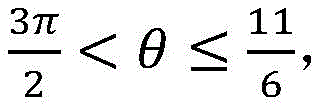
优选地,所述扇区的分区情况为:若


总体而言,通过本发明所构思的以上技术方案与现有技术相比,能够取得下列有益效果:由于增加了额外桥臂,使三相逆变器和额外桥臂组合的自由度更大,可以实现共模噪声的进一步抑制;另外额外并联桥臂流过的电流非常小,可以选择低容量的开关管,成本较低,能够降低共模电流和抑制共模噪声,保护电机绕组和轴承绝缘,提高系统可靠性。In general, compared with the prior art, the above technical solutions conceived by the present invention can achieve the following beneficial effects: due to the addition of the additional bridge arms, the degree of freedom of the combination of the three-phase inverter and the additional bridge arms is greater, The common mode noise can be further suppressed; in addition, the current flowing through the additional parallel bridge arm is very small, and a low-capacity switch tube can be selected, which is lower in cost, can reduce the common mode current and suppress the common mode noise, and protect the motor winding and bearing insulation. , improve system reliability.
附图说明Description of drawings
图1是按照本发明实现的三相逆变器组合额外桥臂驱动三相电机的拓扑结构图;1 is a topology diagram of a three-phase inverter combined with an additional bridge arm to drive a three-phase motor according to the present invention;
图2是按照本发明实现的三相逆变器组合额外桥臂驱动三相电机控制框图;2 is a control block diagram of a three-phase inverter combined with an additional bridge arm to drive a three-phase motor according to the present invention;
图3是按照本发明实现的三相逆变器组合额外桥臂的脉宽调制信号算法流程图;Fig. 3 is the pulse width modulation signal algorithm flow chart of the three-phase inverter combined extra bridge arm realized according to the present invention;
图4是按照本发明实现的三相逆变器组合额外桥臂的脉宽调制信号波形与传统SPWM调制算法的脉宽调制信号对比图;4 is a comparison diagram of the pulse width modulation signal waveform of the additional bridge arm of the three-phase inverter combined according to the present invention and the pulse width modulation signal of the traditional SPWM modulation algorithm;
图5是按照本发明实现的共模电流与三相逆变器的共模电流对比图;5 is a comparison diagram of the common mode current realized according to the present invention and the common mode current of the three-phase inverter;
图6是按照本发明实现的三相逆变器和额外桥臂的电流对比图。FIG. 6 is a current comparison diagram of a three-phase inverter and an additional bridge arm implemented according to the present invention.
在所有附图中,相同的附图标记用来表示相同的元件或结构,其中:Throughout the drawings, the same reference numbers are used to refer to the same elements or structures, wherein:
1-直流电源,2-直流母线电容,3-三相逆变器,4-额外桥臂,5-额外电感,6-三相交流电机,7-三相交流电机接地。1- DC power supply, 2- DC bus capacitor, 3- 3-phase inverter, 4- extra bridge arm, 5- extra inductor, 6- 3-phase AC motor, 7- 3-phase AC motor grounding.
具体实施方式Detailed ways
为了使本发明的目的、技术方案及优点更加清楚明白,以下结合附图及实施例,对本发明进行进一步详细说明。应当理解,此处所描述的具体实施例仅仅用以解释本发明,并不用于限定本发明。此外,下面所描述的本发明各个实施方式中所涉及到的技术特征只要彼此之间未构成冲突就可以相互组合。In order to make the objectives, technical solutions and advantages of the present invention clearer, the present invention will be further described in detail below with reference to the accompanying drawings and embodiments. It should be understood that the specific embodiments described herein are only used to explain the present invention, but not to limit the present invention. In addition, the technical features involved in the various embodiments of the present invention described below can be combined with each other as long as they do not conflict with each other.
本发明提供了一种基于三相交流电机驱动系统的共模噪声抑制方法,其目的在于抑制一般两电平三相逆变器驱动三相交流电机时产生的共模电流和共模电磁干扰噪声,减弱其对电机绝缘和轴承等部件产生的持续损害的问题。The present invention provides a common mode noise suppression method based on a three-phase AC motor drive system, the purpose of which is to suppress common mode current and common mode electromagnetic interference noise generated when a general two-level three-phase inverter drives a three-phase AC motor , reducing the problem of continued damage to components such as motor insulation and bearings.
如图1所示,本发明提供了一种抑制共模噪声的三相交流电机驱动系统,包括:直流电源1、直流母线电容2、三相逆变器3、额外桥臂4和额外电感5;As shown in FIG. 1 , the present invention provides a three-phase AC motor drive system for suppressing common mode noise, including: a
三相逆变器3包括第一桥臂、第二桥臂以及第三桥臂,第一桥臂包括第一开关管与第二开关管,第二桥臂包括第三开关管与第四开关管,第三桥臂包括第五开关管与第六开关管,额外桥臂4包括第七开关管与第八开关管;The three-
第一开关管的第二端与第二开关管的第一端连接,第三开关管的第二端与第四开关管的第一端连接,第五开关管的第二端与第六开关管的第一端连接,第七开关管的第二端与第八开关管的第一端连接;The second end of the first switch tube is connected to the first end of the second switch tube, the second end of the third switch tube is connected to the first end of the fourth switch tube, and the second end of the fifth switch tube is connected to the sixth switch tube The first end of the tube is connected, and the second end of the seventh switch tube is connected with the first end of the eighth switch tube;
直流母线电容2的第一端、第一开关管的第一端、第三开关管的第一端、第五开关管的第一端以及第七开关管的第一端均与直流电源1的正极端连接;The first end of the
直流母线电容2的第二端、第二开关管的第二端、第四开关管的第二端、第六开关管的第二端以及第八开关管的第二端均与直流电源1的负极端连接;The second end of the
额外电感5的第一端与额外桥臂4的中点连接;The first end of the
在工作时,第一桥臂的中点、第二桥臂的中点以及第三桥臂的中点分别与三相交流电机的定子绕组的三个接线端连接,额外电感5的第二端与三相交流电机的定子绕组中性点连接。During operation, the midpoint of the first bridge arm, the midpoint of the second bridge arm and the midpoint of the third bridge arm are respectively connected with the three terminals of the stator winding of the three-phase AC motor, and the second terminal of the
其中,直流电源1用于向系统提供直流电,直流母线电容2用于稳定直流侧电压,三相逆变器3用于输出三相交流电流并输入到电机定子绕组中驱动电机工作,额外桥臂4用于输出高频电流,以抵消三相逆变器3输出的共模噪声,额外电感5的电感值与三相交流电机的任一相电机绕组电感值相同,用于提供高频电流通路,三相交流电机6用于实现电能到机械能的转化,三相交流电机接地7用于防止电机因故障或者绝缘损坏而导致漏电对设备线路或者人身触电危险。Among them, the
其中,在本发明实施例中的三相交流电机包括星型连接的三相感应电机或者三相永磁同步电机。Wherein, the three-phase AC motor in the embodiment of the present invention includes a star-connected three-phase induction motor or a three-phase permanent magnet synchronous motor.
本发明还提供了一种基于上述三相交流电机驱动系统的共模噪声抑制方法,主要思路是在传统三相正弦脉宽调制(Sinusoidal Pulse Width Modulation,SPWM)调制算法的基础上,根据实时的转子角度信息进行扇区判断,然后根据扇区情况进行三相逆变器的脉宽调制信号移相,进行共模电压的抑制,但是共模电压仍然存在;此时需要根据剩余的共模电压脉冲的位置调节额外桥臂脉宽调制信号的位置,抵消剩余的共模电压,抑制共模电压在电机中产生共模噪声。The present invention also provides a common mode noise suppression method based on the above-mentioned three-phase AC motor drive system. The rotor angle information is used to determine the sector, and then the PWM signal of the three-phase inverter is phase-shifted according to the sector to suppress the common-mode voltage, but the common-mode voltage still exists; at this time, the remaining common-mode voltage needs to be The position of the pulse adjusts the position of the pulse width modulation signal of the additional bridge arm, cancels the remaining common mode voltage, and suppresses the common mode voltage that generates common mode noise in the motor.
在控制方面,采用传统的矢量控制方法,其基本思路是通过脉宽调制电路中设计的d轴和q轴电流控制器产生旋转坐标系下的参考电压矢量,然后通过参考电压矢量计算静止坐标系下的三相参考电压,同时保持额外桥臂的参考电压为零,再选择三角载波与三相电压和额外桥臂的参考电压指令作幅值比较,产生对称的脉宽调制信号;然后根据扇区信息进行移相组合,获取改进的脉宽调制信号,用于控制逆变器的开关管动作,实现共模电压的抑制。In terms of control, the traditional vector control method is adopted. The basic idea is to generate the reference voltage vector in the rotating coordinate system through the d-axis and q-axis current controllers designed in the pulse width modulation circuit, and then calculate the stationary coordinate system through the reference voltage vector. The three-phase reference voltage of the lower bridge arm is kept at zero, while the reference voltage of the additional bridge arm is kept at zero, and then the triangular carrier is selected to compare the amplitude of the three-phase voltage and the reference voltage command of the additional bridge arm to generate a symmetrical PWM signal; The area information is phase-shifted and combined to obtain an improved pulse width modulation signal, which is used to control the switching tube action of the inverter to achieve common-mode voltage suppression.
如图2所示,三相交流电机采用传统的矢量控制方法。控制系统由内环(电流环)与外环(速度环)组成。速度环通过速度控制器调节参考速度与反馈速度之差得到转矩电流分量的指令值iqref,同样d轴电流的指令值idref也根据实际需要进行调节。参考电流在d-q坐标下与反馈电流比较,其中d-q坐标下的反馈电流为测量到的三相电流经过坐标变换得到,最后由d轴和q轴电流控制器进行调节,产生参考电压Vd与Vq。参考电压Vd与Vq再经过坐标变换产生静止坐标系下的三相参考电压Va、Vb和Vc,输入到共模抑制调制算法模块,产生三相逆变器的脉宽调制信号(PWM1-3)用于驱动其对应的开关管动作,实现对电机的电流和速度的控制;同时产生额外桥臂的脉宽调制信号(PWM4),用于抑制系统产生的共模噪声。其中,电机的转子位置用于坐标变换,电机的转速用于速度环反馈,其中转子位置和转速可以由位置传感器得到。具体地,包括以下步骤:As shown in Figure 2, the three-phase AC motor adopts the traditional vector control method. The control system consists of an inner loop (current loop) and an outer loop (speed loop). The speed loop adjusts the difference between the reference speed and the feedback speed through the speed controller to obtain the command value i qref of the torque current component. Similarly, the command value idref of the d-axis current is also adjusted according to actual needs. The reference current is compared with the feedback current in the dq coordinate, where the feedback current in the dq coordinate is obtained from the measured three-phase current through coordinate transformation, and is finally adjusted by the d-axis and q-axis current controllers to generate the reference voltages V d and V q . The reference voltages V d and V q are then coordinately transformed to generate three-phase reference voltages V a , V b and V c in the static coordinate system, which are input to the common mode rejection modulation algorithm module to generate the pulse width modulation signal of the three-phase inverter (PWM1-3) is used to drive its corresponding switch tube to control the current and speed of the motor; at the same time, the pulse width modulation signal (PWM4) of the additional bridge arm is generated to suppress the common mode noise generated by the system. Among them, the rotor position of the motor is used for coordinate transformation, and the rotation speed of the motor is used for speed loop feedback, wherein the rotor position and rotation speed can be obtained by the position sensor. Specifically, it includes the following steps:
(1)将旋转坐标系下的d轴电流与q轴电流分别与d轴参考电流以及q轴参考电流进行比较,得到d轴误差电流以及q轴误差电流;(1) Compare the d-axis current and the q-axis current in the rotating coordinate system with the d-axis reference current and the q-axis reference current, respectively, to obtain the d-axis error current and the q-axis error current;
其中,由
其中,ia、ib以及ic通过采样反馈电路中电流传感器获取,θ由位置传感器获取,采样反馈电路输入端接三相电机电流传感器和转子位置传感器的输出端,输出与驱动控制电路相连,用于采集电机定子绕组电流和转子位置信息并送入至驱动控制电路中,驱动控制电路用于产生脉宽调制信号,控制逆变器开关管的动作。Among them, i a , ib and ic are obtained by the current sensor in the sampling feedback circuit, θ is obtained by the position sensor, the input end of the sampling feedback circuit is connected to the output end of the three-phase motor current sensor and the rotor position sensor, and the output is connected to the drive control circuit , used to collect the motor stator winding current and rotor position information and send it to the drive control circuit, which is used to generate a pulse width modulation signal to control the action of the inverter switch tube.
其中,由
(2)通过d轴误差电流以及q轴误差电流,得到d轴参考电压以及q轴参考电压,并通过d轴参考电压以及q轴参考电压和转子位置角度,得到静止坐标系下的三相参考电压;(2) Obtain the d-axis reference voltage and the q-axis reference voltage through the d-axis error current and the q-axis error current, and obtain the three-phase reference in the static coordinate system through the d-axis reference voltage, the q-axis reference voltage and the rotor position angle Voltage;
其中,Vd与Vq分别为d轴、q轴电流控制器输出的参考电压指令。Among them, V d and V q are the reference voltage commands output by the d-axis and q-axis current controllers, respectively.
其中,由
(3)通过将三相参考电压与三角载波进行幅值比较生成驱动三相逆变器3的初始脉宽调制信号,同时通过幅值恒为零的电压与三角载波进行幅值比较生成占空比恒为0.5的初始对称脉宽调制信号;(3) The initial pulse width modulation signal for driving the three-
(4)根据转子位置角度所处的扇区,分别对脉宽调制信号以及对称脉宽调制信号进行移相,以保证共模电压状态不变,得到目标脉宽调制信号PWM1、PWM2、PWM3以及PWM4,其中,PWM1、PWM2以及PWM3用于控制所述三相逆变器3的开关管动作,PWM4用于控制额外桥臂4的开关管动作,以实现共模噪声抑制。(4) According to the sector where the rotor position angle is located, phase-shift the PWM signal and the symmetrical PWM signal respectively to ensure that the state of the common-mode voltage remains unchanged, and obtain the target PWM signals PWM1, PWM2, PWM3 and PWM4, wherein PWM1, PWM2, and PWM3 are used to control the switch tube action of the three-
如图3所示,具有共模抑制功能的三相逆变器组合额外桥臂的脉宽调制信号通过以下的算法流程生成。首先通过三相正弦电压指令Va,Vb和Vc与三角载波进行幅值比较生成驱动三相逆变器的初始脉宽调制信号,同时通过幅值恒为零的电压指令与上述相同的三角载波进行幅值比较生成占空比恒为0.5的初始对称脉宽调制信号;另一方面,根据反馈的转子位置角度,进行扇区判断,扇区分组情况为:As shown in Figure 3, the pulse width modulation signal of the additional bridge arm of the three-phase inverter with common mode rejection function is generated through the following algorithm flow. First, compare the amplitudes of the three-phase sinusoidal voltage commands V a , V b and V c with the triangular carrier to generate the initial pulse width modulation signal for driving the three-phase inverter. The amplitude comparison of the triangular carrier generates an initial symmetrical PWM signal with a constant duty cycle of 0.5; on the other hand, according to the feedback rotor position angle, the sector is judged, and the sector grouping is as follows:

根据扇区情况在每个扇区内对初始脉宽调制信号实施合适的移相操作,最后生成移相的三相SPWM脉宽调制信号以及额外桥臂的脉宽调制信号用于控制开关管的动作和参考电压输出。Appropriate phase-shift operation is performed on the initial PWM signal in each sector according to the situation of the sector, and finally the phase-shifted three-phase SPWM PWM signal and the PWM signal of the additional bridge arm are generated to control the switching of the switch. action and reference voltage output.
如图4所示,左边图例为传统的SPWM调制方法在扇区1-6中生成的对称脉宽调制信号,其中Ga、Gb、Gc分别为驱动三相逆变器上管的初始脉宽调制信号波形,Vcm为三相逆变器输出的共模电压。可以看出三相逆变器输出的共模电压在一个开关周期内状态不断切换,会产生高频的共模噪声;右边图例为改进的调制方法生成的目标脉宽调制信号,通过对初始脉宽调制信号进行合适的移相,可以保证三相逆变器组合额外桥臂在任何一个桥臂进行开通时存在与之对应桥臂进行关断动作,保证共模电压状态不变,从而抑制共模噪声。其中实现共模抑制效果的移相原理如下:As shown in Figure 4, the legend on the left is the symmetric pulse width modulation signal generated by the traditional SPWM modulation method in sectors 1-6, in which Ga , Gb , and Gc are the initial values for driving the upper tube of the three-phase inverter, respectively. PWM signal waveform, V cm is the common mode voltage output by the three-phase inverter. It can be seen that the common-mode voltage output by the three-phase inverter is constantly switched in one switching cycle, which will generate high-frequency common-mode noise; the example on the right is the target PWM signal generated by the improved modulation method. Appropriate phase shifting of the wide modulation signal can ensure that the additional bridge arm of the three-phase inverter combination has the corresponding bridge arm to turn off when any bridge arm is turned on, so as to ensure that the state of the common mode voltage remains unchanged, thereby suppressing the common mode voltage. mode noise. The principle of phase shifting to achieve the common mode rejection effect is as follows:
在第一扇区内,A相的初始脉宽调制信号Ga的占空比最大,且满足B相和C相的初始脉宽调制信号占空比小于0.5。此时将A相初始脉宽调制信号进行半开关周期移相,将其从中间对齐改为两侧对齐得到目标脉宽调制信号PWM1,同样B相和C相的初始脉宽调制信号也进行移相控制,Gb向左移使其下降沿与PWM1上升沿对齐得到目标脉宽调制信号PWM2,而Gc向右移使其上升沿与PWM1下降沿对齐得到目标脉宽调制信号PWM3,最后将额外桥臂的初始脉宽调制信号Ge进行合适的移相,使Ge下降沿与PWM2上升沿对齐,而Ge上升沿与PWM3下降沿对齐得到目标脉宽调制信号PWM4,在第一扇区内采用该移相方式后,可以保证三相逆变器和额外桥臂产生的共模电压在一个开关周期内不变,抑制逆变器产生的共模噪声;In the first sector, the duty ratio of the initial pulse width modulation signal Ga of phase A is the largest, and the duty ratio of the initial pulse width modulation signal of phase B and phase C is less than 0.5. At this time, the initial PWM signal of phase A is phase-shifted by half the switching cycle, and the target PWM signal PWM1 is obtained by changing it from middle alignment to alignment on both sides. Similarly, the initial PWM signals of B-phase and C-phase are also shifted. Phase control, G b is shifted to the left so that its falling edge is aligned with the rising edge of PWM1 to obtain the target PWM signal PWM2, while G c is shifted to the right so that its rising edge is aligned with the falling edge of PWM1 to obtain the target PWM signal PWM3, and finally The initial PWM signal Ge of the additional bridge arm is appropriately phase-shifted, so that the falling edge of Ge is aligned with the rising edge of PWM2 , and the rising edge of Ge is aligned with the falling edge of PWM3 to obtain the target PWM signal PWM4 . After the phase shift method is adopted in the area, the common mode voltage generated by the three-phase inverter and the additional bridge arm can be guaranteed to remain unchanged within a switching cycle, and the common mode noise generated by the inverter can be suppressed;
在第二扇区内,C相的初始脉宽调制信号Gc的占空比最小,且满足A相和B相的初始脉宽调制信号占空比大于0.5。此时将C相初始脉宽调制信号进行半开关周期移相,将其从中间对齐改为两侧对齐得到目标脉宽调制信号PWM3,同样A相和B相的初始脉宽调制信号也进行移相控制,Ga向右移使其下降沿与PWM3上升沿对齐得到目标脉宽调制信号PWM1,而Gb向左移使其上升沿与PWM3下降沿对齐得到目标脉宽调制信号PWM2,最后将额外桥臂的初始脉宽调制信号Ge进行合适的移相,使Ge下降沿与PWM1上升沿对齐,而Ge上升沿与PWM2下降沿对齐得到目标脉宽调制信号PWM4,在第二扇区内采用该移相方式后,可以保证三相逆变器和额外桥臂产生的共模电压在一个开关周期内不变,抑制逆变器产生的共模噪声;In the second sector, the duty ratio of the initial pulse width modulation signal G c of phase C is the smallest, and the duty ratio of the initial pulse width modulation signal of phase A and phase B is greater than 0.5. At this time, the initial PWM signal of phase C is phase-shifted by half switching cycle, and the target PWM signal PWM3 is obtained by changing it from middle alignment to alignment on both sides. Similarly, the initial PWM signals of phase A and B are also shifted. Phase control, G a is shifted to the right so that its falling edge is aligned with the rising edge of PWM3 to obtain the target PWM signal PWM1, while G b is shifted to the left so that its rising edge is aligned with the falling edge of PWM3 to obtain the target PWM signal PWM2, and finally The initial PWM signal Ge of the additional bridge arm is appropriately phase-shifted, so that the falling edge of Ge is aligned with the rising edge of PWM1 , and the rising edge of Ge is aligned with the falling edge of PWM2 to obtain the target PWM signal PWM4 . After the phase shift method is adopted in the area, the common mode voltage generated by the three-phase inverter and the additional bridge arm can be guaranteed to remain unchanged within a switching cycle, and the common mode noise generated by the inverter can be suppressed;
在第三扇区内,B相的初始脉宽调制信号Gb的占空比最大,且满足A相和C相的初始脉宽调制信号占空比小于0.5。此时将B相初始脉宽调制信号进行半开关周期移相,将其从中间对齐改为两侧对齐得到目标脉宽调制信号PWM2,同样A相和C相的初始脉宽调制信号也进行移相控制,Gc向左移使其下降沿与PWM2上升沿对齐得到目标脉宽调制信号PWM3,而Ga向右移使其上升沿与PWM2下降沿对齐得到目标脉宽调制信号PWM1,最后将额外桥臂的初始脉宽调制信号Ge进行合适的移相,使Ge下降沿与PWM3上升沿对齐,而Ge上升沿与PWM1下降沿对齐得到目标脉宽调制信号PWM4,在第三扇区内采用该移相方式后,可以保证三相逆变器和额外桥臂产生的共模电压在一个开关周期内不变,抑制逆变器产生的共模噪声;In the third sector, the duty ratio of the initial pulse width modulation signal G b of phase B is the largest, and the duty ratio of the initial pulse width modulation signal of phase A and phase C is less than 0.5. At this time, the initial PWM signal of phase B is phase-shifted by half the switching period, and the target PWM signal PWM2 is obtained by changing it from middle alignment to alignment on both sides. Similarly, the initial PWM signals of phase A and C are also shifted. Phase control, G c is shifted to the left so that its falling edge is aligned with the rising edge of PWM2 to obtain the target PWM signal PWM3, while G a is shifted to the right so that its rising edge is aligned with the falling edge of PWM2 to obtain the target PWM signal PWM1, and finally The initial PWM signal Ge of the additional bridge arm is appropriately phase-shifted, so that the falling edge of Ge is aligned with the rising edge of PWM3 , and the rising edge of Ge is aligned with the falling edge of PWM1 to obtain the target PWM signal PWM4 . After the phase shift method is adopted in the area, the common mode voltage generated by the three-phase inverter and the additional bridge arm can be guaranteed to remain unchanged within a switching cycle, and the common mode noise generated by the inverter can be suppressed;
在第四扇区内,A相的初始脉宽调制信号Ga的占空比最小,且满足B相和C相的初始脉宽调制信号占空比大于0.5。此时将A相初始脉宽调制信号进行半开关周期移相,将其从中间对齐改为两侧对齐得到目标脉宽调制信号PWM1,同样B相和C相的初始脉宽调制信号也进行移相控制,Gb向右移使其下降沿与PWM1上升沿对齐得到目标脉宽调制信号PWM2,而Gc向左移使其上升沿与PWM1下降沿对齐得到目标脉宽调制信号PWM3,最后将额外桥臂的初始脉宽调制信号Ge进行合适的移相,使Ge下降沿与PWM2上升沿对齐,而Ge上升沿与PWM3下降沿对齐得到目标脉宽调制信号PWM4,在第四扇区内采用该移相方式后,可以保证三相逆变器和额外桥臂产生的共模电压在一个开关周期内不变,抑制逆变器产生的共模噪声;In the fourth sector, the duty ratio of the initial pulse width modulation signal Ga of the A phase is the smallest, and the duty ratio of the initial pulse width modulation signal of the B phase and the C phase is greater than 0.5. At this time, the initial PWM signal of phase A is phase-shifted by half the switching cycle, and the target PWM signal PWM1 is obtained by changing it from middle alignment to alignment on both sides. Similarly, the initial PWM signals of B-phase and C-phase are also shifted. Phase control, move G b to the right to align its falling edge with the rising edge of PWM1 to obtain the target PWM signal PWM2, and move G c to the left to align its rising edge with the falling edge of PWM1 to obtain the target PWM signal PWM3, and finally The initial PWM signal Ge of the additional bridge arm is appropriately phase-shifted, so that the falling edge of Ge is aligned with the rising edge of PWM2 , and the rising edge of Ge is aligned with the falling edge of PWM3 to obtain the target PWM signal PWM4 . After the phase shift method is adopted in the area, the common mode voltage generated by the three-phase inverter and the additional bridge arm can be guaranteed to remain unchanged within a switching cycle, and the common mode noise generated by the inverter can be suppressed;
在第五扇区内,C相的初始脉宽调制信号Gc的占空比最大,且满足A相和B相的初始脉宽调制信号占空比小于0.5。此时将C相初始脉宽调制信号进行半开关周期移相,将其从中间对齐改为两侧对齐得到目标脉宽调制信号PWM3,同样A相和B相的初始脉宽调制信号也进行移相控制,Ga向左移使其下降沿与PWM3上升沿对齐得到目标脉宽调制信号PWM1,而Gb向右移使其上升沿与PWM3下降沿对齐得到目标脉宽调制信号PWM2,最后将额外桥臂的初始脉宽调制信号Ge进行合适的移相,使Ge下降沿与PWM1上升沿对齐,而Ge上升沿与PWM2下降沿对齐得到目标脉宽调制信号PWM4,在第五扇区内采用该移相方式后,可以保证三相逆变器和额外桥臂产生的共模电压在一个开关周期内不变,抑制逆变器产生的共模噪声;In the fifth sector, the initial pulse width modulation signal G c of phase C has the largest duty ratio, and the duty ratio of the initial pulse width modulation signal of phase A and phase B is less than 0.5. At this time, the initial PWM signal of phase C is phase-shifted by half switching cycle, and the target PWM signal PWM3 is obtained by changing it from middle alignment to alignment on both sides. Similarly, the initial PWM signals of phase A and B are also shifted. Phase control, G a is shifted to the left so that its falling edge is aligned with the rising edge of PWM3 to obtain the target PWM signal PWM1, while G b is shifted to the right so that its rising edge is aligned with the falling edge of PWM3 to obtain the target PWM signal PWM2, and finally The initial PWM signal Ge of the additional bridge arm is appropriately phase-shifted, so that the falling edge of Ge aligns with the rising edge of PWM1 , and the rising edge of Ge aligns with the falling edge of PWM2 to obtain the target PWM signal PWM4 . After the phase shift method is adopted in the area, the common mode voltage generated by the three-phase inverter and the additional bridge arm can be guaranteed to remain unchanged within a switching cycle, and the common mode noise generated by the inverter can be suppressed;
在第六扇区内,B相的初始脉宽调制信号Gb的占空比最小,且满足A相和C相的初始脉宽调制信号占空比大于0.5。此时将B相初始脉宽调制信号进行半开关周期移相,将其从中间对齐改为两侧对齐得到目标脉宽调制信号PWM2,同样A相和C相的初始脉宽调制信号也进行移相控制,Gc向右移使其下降沿与PWM2上升沿对齐得到目标脉宽调制信号PWM3,而Ga向左移使其上升沿与PWM2下降沿对齐得到目标脉宽调制信号PWM1,最后将额外桥臂的初始脉宽调制信号Ge进行合适的移相,使Ge下降沿与PWM3上升沿对齐,而Ge上升沿与PWM1下降沿对齐得到目标脉宽调制信号PWM4,在第六扇区内采用该移相方式后,可以保证三相逆变器和额外桥臂产生的共模电压在一个开关周期内不变,抑制逆变器产生的共模噪声。In the sixth sector, the duty ratio of the initial pulse width modulation signal G b of phase B is the smallest, and the duty ratio of the initial pulse width modulation signal of phase A and phase C is greater than 0.5. At this time, the initial PWM signal of phase B is phase-shifted by half the switching period, and the target PWM signal PWM2 is obtained by changing it from middle alignment to alignment on both sides. Similarly, the initial PWM signals of phase A and C are also shifted. Phase control, G c is shifted to the right so that its falling edge is aligned with the rising edge of PWM2 to obtain the target PWM signal PWM3, and G a is shifted to the left so that its rising edge is aligned with the falling edge of PWM2 to obtain the target PWM signal PWM1, and finally The initial PWM signal Ge of the additional bridge arm is appropriately phase-shifted, so that the falling edge of Ge is aligned with the rising edge of PWM3 , and the rising edge of Ge is aligned with the falling edge of PWM1 to obtain the target PWM signal PWM4 . After the phase shift method is adopted in the area, the common mode voltage generated by the three-phase inverter and the extra bridge arm can be guaranteed to remain unchanged within a switching cycle, and the common mode noise generated by the inverter can be suppressed.
如图5所示,在相同工况下进行三相逆变器与三相逆变器组合额外桥臂的共模电流对比。可以看出相比三相逆变器,采用三相逆变器组合额外桥臂可以基本消除共模噪声。As shown in Figure 5, the common mode currents of the three-phase inverter combined with the additional bridge arm of the three-phase inverter are compared under the same working conditions. It can be seen that compared with the three-phase inverter, the use of the three-phase inverter combined with the additional bridge arm can basically eliminate the common mode noise.
如图6所示,在相同工况下进行三相逆变器组合额外桥臂的电流对比。可以看出三相逆变器输出的三相电流可以保持正弦,而额外桥臂输出的电流很小,可以采用低容量的开关管组成该桥臂,降低硬件的成本。As shown in Figure 6, the current comparison of the additional bridge arms of the three-phase inverter combination is carried out under the same operating conditions. It can be seen that the three-phase current output by the three-phase inverter can be kept sinusoidal, while the output current of the additional bridge arm is very small. The bridge arm can be composed of a low-capacity switch tube to reduce the cost of hardware.
本领域的技术人员容易理解,以上所述仅为本发明的较佳实施例而已,并不用以限制本发明,凡在本发明的精神和原则之内所作的任何修改、等同替换和改进等,均应包含在本发明的保护范围之内。Those skilled in the art can easily understand that the above are only preferred embodiments of the present invention, and are not intended to limit the present invention. Any modifications, equivalent replacements and improvements made within the spirit and principles of the present invention, etc., All should be included within the protection scope of the present invention.
Claims (2)


Priority Applications (1)
| Application Number | Priority Date | Filing Date | Title |
|---|---|---|---|
| CN201711353198.1A CN107947682B (en) | 2017-12-15 | 2017-12-15 | A common mode noise suppression method based on three-phase AC motor drive system |
Applications Claiming Priority (1)
| Application Number | Priority Date | Filing Date | Title |
|---|---|---|---|
| CN201711353198.1A CN107947682B (en) | 2017-12-15 | 2017-12-15 | A common mode noise suppression method based on three-phase AC motor drive system |
Publications (2)
| Publication Number | Publication Date |
|---|---|
| CN107947682A CN107947682A (en) | 2018-04-20 |
| CN107947682B true CN107947682B (en) | 2020-07-07 |
Family
ID=61943516
Family Applications (1)
| Application Number | Title | Priority Date | Filing Date |
|---|---|---|---|
| CN201711353198.1A Active CN107947682B (en) | 2017-12-15 | 2017-12-15 | A common mode noise suppression method based on three-phase AC motor drive system |
Country Status (1)
| Country | Link |
|---|---|
| CN (1) | CN107947682B (en) |
Families Citing this family (9)
| Publication number | Priority date | Publication date | Assignee | Title |
|---|---|---|---|---|
| JP7075587B2 (en) * | 2018-05-01 | 2022-05-26 | 株式会社ジェイテクト | Motor control device |
| CN108988718B (en) * | 2018-08-15 | 2020-10-02 | 华中科技大学 | Method for suppressing zero sequence current and common mode voltage |
| CN110011581B (en) * | 2019-01-28 | 2020-11-24 | 华中科技大学 | Method and system for suppressing common mode noise of asymmetric six-phase AC motor |
| CN111193388B (en) * | 2020-02-12 | 2024-06-21 | 北京汽车集团越野车有限公司 | Circuit, driving method thereof and vehicle |
| CN112217409B (en) * | 2020-11-05 | 2024-06-11 | 武汉理工大学 | Variable carrier pulse width modulation system and method for three-phase four-bridge-arm voltage-source inverter |
| CN114910683B (en) * | 2021-02-09 | 2025-06-24 | 上海晟矽微电子股份有限公司 | Current sampling device |
| CN113922730B (en) * | 2021-10-11 | 2024-05-28 | 臻驱科技(上海)有限公司 | A method and system for modulating the duty cycle of a switch tube |
| CN117353621B (en) * | 2022-06-29 | 2024-10-11 | 比亚迪股份有限公司 | Motor drive system, vehicle, and drive system control method |
| CN115133845B (en) * | 2022-07-27 | 2024-11-29 | 电子科技大学 | A system and method for suppressing common mode noise of three-level five-phase AC motor |
Citations (3)
| Publication number | Priority date | Publication date | Assignee | Title |
|---|---|---|---|---|
| JP2009118681A (en) * | 2007-11-08 | 2009-05-28 | Omron Corp | Control device for multiphase motor |
| CN103956890A (en) * | 2014-04-01 | 2014-07-30 | 燕山大学 | Method for restraining leakage current of three-phase four-bridge-arm photovoltaic grid-connected inverter |
| CN106787796A (en) * | 2016-12-20 | 2017-05-31 | 国家电网公司 | A kind of hybrid cascade multilevel converter and its control method with part energy-storage units |
-
2017
- 2017-12-15 CN CN201711353198.1A patent/CN107947682B/en active Active
Patent Citations (3)
| Publication number | Priority date | Publication date | Assignee | Title |
|---|---|---|---|---|
| JP2009118681A (en) * | 2007-11-08 | 2009-05-28 | Omron Corp | Control device for multiphase motor |
| CN103956890A (en) * | 2014-04-01 | 2014-07-30 | 燕山大学 | Method for restraining leakage current of three-phase four-bridge-arm photovoltaic grid-connected inverter |
| CN106787796A (en) * | 2016-12-20 | 2017-05-31 | 国家电网公司 | A kind of hybrid cascade multilevel converter and its control method with part energy-storage units |
Non-Patent Citations (2)
| Title |
|---|
| 三相四桥臂永磁同步电动机控制系统的研究;周实;《中国优秀硕士学位论文全文数据库工程II辑》;20140615(第6期);第11页 * |
| 采用三相四桥臂抑制逆变器共模干扰的SPWM控制策略;黄劲等;《电工技术学报》;中国电工技术学会;20090330(第03期);110-115 * |
Also Published As
| Publication number | Publication date |
|---|---|
| CN107947682A (en) | 2018-04-20 |
Similar Documents
| Publication | Publication Date | Title |
|---|---|---|
| CN107947682B (en) | A common mode noise suppression method based on three-phase AC motor drive system | |
| CN107482980B (en) | A three-phase AC motor drive system that suppresses common-mode noise | |
| CN108988718B (en) | Method for suppressing zero sequence current and common mode voltage | |
| CN102624297B (en) | Fault tolerance permanent magnet power generation system and control method thereof | |
| CN107834947B (en) | A Method of Suppressing Zero Sequence Current | |
| WO2011135694A1 (en) | Power conversion device | |
| JP2015128355A (en) | Motor controller | |
| CN102780433A (en) | Instantaneous torque control method of brushless direct-current motor based on direct-current control | |
| CN103956955A (en) | Co-bus winding opening permanent magnet motor system with one side controllable and zero sequence current suppression method thereof | |
| CN103731015B (en) | Inhibit the current feedback active power filter of frequency conversion speed-adjusting system common-mode voltage | |
| CN107645253A (en) | The three-phase simulation device of current-responsive type permagnetic synchronous motor and its drive system | |
| CN106655911A (en) | PWM (Pulse Width Modulation) method for suppressing commutation torque ripples of brushless DC motor | |
| CN106655648A (en) | Modular motor system and driving control method therefor | |
| CN110011581B (en) | Method and system for suppressing common mode noise of asymmetric six-phase AC motor | |
| CN106787916A (en) | A kind of space vector modulating method for suppressing Five-phase inverter common-mode voltage | |
| CN115868109A (en) | Open Winding Motor Drives | |
| CN104410341A (en) | Low-speed torque ripple restraining device and restraining method based on direct current voltage adjustment | |
| CN107947685B (en) | A kind of fault-tolerant operation method of direct current biasing type current transformer | |
| CN106849796A (en) | A kind of line inductance electromotor drive system stable state loss minimization controller method and system | |
| JP2013110859A (en) | Motor control device and air conditioner | |
| CN102710204A (en) | Method for rejecting torque ripple of motor | |
| Shi et al. | A novel commutation correction method for high-speed PM brushless DC motor | |
| CN107947670A (en) | A kind of power factor control method of direct current biasing type motor | |
| Chen et al. | Direct torque control for a matrix converter based on induction motor drive systems | |
| CN109889128B (en) | Method and system for suppressing common mode noise of dual-phase winding AC motor |
Legal Events
| Date | Code | Title | Description |
|---|---|---|---|
| PB01 | Publication | ||
| PB01 | Publication | ||
| SE01 | Entry into force of request for substantive examination | ||
| SE01 | Entry into force of request for substantive examination | ||
| GR01 | Patent grant | ||
| GR01 | Patent grant |