CN107922689B - Ethylene copolymers with in situ oil production - Google Patents
Ethylene copolymers with in situ oil production Download PDFInfo
- Publication number
- CN107922689B CN107922689B CN201680048781.9A CN201680048781A CN107922689B CN 107922689 B CN107922689 B CN 107922689B CN 201680048781 A CN201680048781 A CN 201680048781A CN 107922689 B CN107922689 B CN 107922689B
- Authority
- CN
- China
- Prior art keywords
- ethylene
- olefin
- alpha
- composition
- oligomer
- Prior art date
- Legal status (The legal status is an assumption and is not a legal conclusion. Google has not performed a legal analysis and makes no representation as to the accuracy of the status listed.)
- Active
Links
Images


Classifications
-
- C—CHEMISTRY; METALLURGY
- C08—ORGANIC MACROMOLECULAR COMPOUNDS; THEIR PREPARATION OR CHEMICAL WORKING-UP; COMPOSITIONS BASED THEREON
- C08L—COMPOSITIONS OF MACROMOLECULAR COMPOUNDS
- C08L23/00—Compositions of homopolymers or copolymers of unsaturated aliphatic hydrocarbons having only one carbon-to-carbon double bond; Compositions of derivatives of such polymers
- C08L23/02—Compositions of homopolymers or copolymers of unsaturated aliphatic hydrocarbons having only one carbon-to-carbon double bond; Compositions of derivatives of such polymers not modified by chemical after-treatment
- C08L23/16—Ethene-propene or ethene-propene-diene copolymers
-
- C—CHEMISTRY; METALLURGY
- C08—ORGANIC MACROMOLECULAR COMPOUNDS; THEIR PREPARATION OR CHEMICAL WORKING-UP; COMPOSITIONS BASED THEREON
- C08F—MACROMOLECULAR COMPOUNDS OBTAINED BY REACTIONS ONLY INVOLVING CARBON-TO-CARBON UNSATURATED BONDS
- C08F2/00—Processes of polymerisation
- C08F2/38—Polymerisation using regulators, e.g. chain terminating agents, e.g. telomerisation
-
- C—CHEMISTRY; METALLURGY
- C08—ORGANIC MACROMOLECULAR COMPOUNDS; THEIR PREPARATION OR CHEMICAL WORKING-UP; COMPOSITIONS BASED THEREON
- C08F—MACROMOLECULAR COMPOUNDS OBTAINED BY REACTIONS ONLY INVOLVING CARBON-TO-CARBON UNSATURATED BONDS
- C08F210/00—Copolymers of unsaturated aliphatic hydrocarbons having only one carbon-to-carbon double bond
- C08F210/16—Copolymers of ethene with alpha-alkenes, e.g. EP rubbers
-
- C—CHEMISTRY; METALLURGY
- C08—ORGANIC MACROMOLECULAR COMPOUNDS; THEIR PREPARATION OR CHEMICAL WORKING-UP; COMPOSITIONS BASED THEREON
- C08F—MACROMOLECULAR COMPOUNDS OBTAINED BY REACTIONS ONLY INVOLVING CARBON-TO-CARBON UNSATURATED BONDS
- C08F210/00—Copolymers of unsaturated aliphatic hydrocarbons having only one carbon-to-carbon double bond
- C08F210/16—Copolymers of ethene with alpha-alkenes, e.g. EP rubbers
- C08F210/18—Copolymers of ethene with alpha-alkenes, e.g. EP rubbers with non-conjugated dienes, e.g. EPT rubbers
-
- C—CHEMISTRY; METALLURGY
- C08—ORGANIC MACROMOLECULAR COMPOUNDS; THEIR PREPARATION OR CHEMICAL WORKING-UP; COMPOSITIONS BASED THEREON
- C08F—MACROMOLECULAR COMPOUNDS OBTAINED BY REACTIONS ONLY INVOLVING CARBON-TO-CARBON UNSATURATED BONDS
- C08F236/00—Copolymers of compounds having one or more unsaturated aliphatic radicals, at least one having two or more carbon-to-carbon double bonds
- C08F236/02—Copolymers of compounds having one or more unsaturated aliphatic radicals, at least one having two or more carbon-to-carbon double bonds the radical having only two carbon-to-carbon double bonds
- C08F236/20—Copolymers of compounds having one or more unsaturated aliphatic radicals, at least one having two or more carbon-to-carbon double bonds the radical having only two carbon-to-carbon double bonds unconjugated
-
- C—CHEMISTRY; METALLURGY
- C08—ORGANIC MACROMOLECULAR COMPOUNDS; THEIR PREPARATION OR CHEMICAL WORKING-UP; COMPOSITIONS BASED THEREON
- C08F—MACROMOLECULAR COMPOUNDS OBTAINED BY REACTIONS ONLY INVOLVING CARBON-TO-CARBON UNSATURATED BONDS
- C08F4/00—Polymerisation catalysts
- C08F4/42—Metals; Metal hydrides; Metallo-organic compounds; Use thereof as catalyst precursors
- C08F4/44—Metals; Metal hydrides; Metallo-organic compounds; Use thereof as catalyst precursors selected from light metals, zinc, cadmium, mercury, copper, silver, gold, boron, gallium, indium, thallium, rare earths or actinides
- C08F4/60—Metals; Metal hydrides; Metallo-organic compounds; Use thereof as catalyst precursors selected from light metals, zinc, cadmium, mercury, copper, silver, gold, boron, gallium, indium, thallium, rare earths or actinides together with refractory metals, iron group metals, platinum group metals, manganese, rhenium technetium or compounds thereof
- C08F4/62—Refractory metals or compounds thereof
- C08F4/64—Titanium, zirconium, hafnium or compounds thereof
- C08F4/659—Component covered by group C08F4/64 containing a transition metal-carbon bond
- C08F4/6592—Component covered by group C08F4/64 containing a transition metal-carbon bond containing at least one cyclopentadienyl ring, condensed or not, e.g. an indenyl or a fluorenyl ring
- C08F4/65922—Component covered by group C08F4/64 containing a transition metal-carbon bond containing at least one cyclopentadienyl ring, condensed or not, e.g. an indenyl or a fluorenyl ring containing at least two cyclopentadienyl rings, fused or not
- C08F4/65927—Component covered by group C08F4/64 containing a transition metal-carbon bond containing at least one cyclopentadienyl ring, condensed or not, e.g. an indenyl or a fluorenyl ring containing at least two cyclopentadienyl rings, fused or not two cyclopentadienyl rings being mutually bridged
-
- C—CHEMISTRY; METALLURGY
- C08—ORGANIC MACROMOLECULAR COMPOUNDS; THEIR PREPARATION OR CHEMICAL WORKING-UP; COMPOSITIONS BASED THEREON
- C08L—COMPOSITIONS OF MACROMOLECULAR COMPOUNDS
- C08L23/00—Compositions of homopolymers or copolymers of unsaturated aliphatic hydrocarbons having only one carbon-to-carbon double bond; Compositions of derivatives of such polymers
- C08L23/02—Compositions of homopolymers or copolymers of unsaturated aliphatic hydrocarbons having only one carbon-to-carbon double bond; Compositions of derivatives of such polymers not modified by chemical after-treatment
- C08L23/04—Homopolymers or copolymers of ethene
- C08L23/08—Copolymers of ethene
- C08L23/0807—Copolymers of ethene with unsaturated hydrocarbons only containing four or more carbon atoms
- C08L23/0815—Copolymers of ethene with unsaturated hydrocarbons only containing four or more carbon atoms with aliphatic 1-olefins containing one carbon-to-carbon double bond
-
- C—CHEMISTRY; METALLURGY
- C08—ORGANIC MACROMOLECULAR COMPOUNDS; THEIR PREPARATION OR CHEMICAL WORKING-UP; COMPOSITIONS BASED THEREON
- C08L—COMPOSITIONS OF MACROMOLECULAR COMPOUNDS
- C08L23/00—Compositions of homopolymers or copolymers of unsaturated aliphatic hydrocarbons having only one carbon-to-carbon double bond; Compositions of derivatives of such polymers
- C08L23/02—Compositions of homopolymers or copolymers of unsaturated aliphatic hydrocarbons having only one carbon-to-carbon double bond; Compositions of derivatives of such polymers not modified by chemical after-treatment
- C08L23/10—Homopolymers or copolymers of propene
- C08L23/12—Polypropene
-
- C—CHEMISTRY; METALLURGY
- C08—ORGANIC MACROMOLECULAR COMPOUNDS; THEIR PREPARATION OR CHEMICAL WORKING-UP; COMPOSITIONS BASED THEREON
- C08F—MACROMOLECULAR COMPOUNDS OBTAINED BY REACTIONS ONLY INVOLVING CARBON-TO-CARBON UNSATURATED BONDS
- C08F2500/00—Characteristics or properties of obtained polyolefins; Use thereof
- C08F2500/05—Bimodal or multimodal molecular weight distribution
-
- C—CHEMISTRY; METALLURGY
- C08—ORGANIC MACROMOLECULAR COMPOUNDS; THEIR PREPARATION OR CHEMICAL WORKING-UP; COMPOSITIONS BASED THEREON
- C08F—MACROMOLECULAR COMPOUNDS OBTAINED BY REACTIONS ONLY INVOLVING CARBON-TO-CARBON UNSATURATED BONDS
- C08F2500/00—Characteristics or properties of obtained polyolefins; Use thereof
- C08F2500/09—Long chain branches
-
- C—CHEMISTRY; METALLURGY
- C08—ORGANIC MACROMOLECULAR COMPOUNDS; THEIR PREPARATION OR CHEMICAL WORKING-UP; COMPOSITIONS BASED THEREON
- C08F—MACROMOLECULAR COMPOUNDS OBTAINED BY REACTIONS ONLY INVOLVING CARBON-TO-CARBON UNSATURATED BONDS
- C08F2500/00—Characteristics or properties of obtained polyolefins; Use thereof
- C08F2500/17—Viscosity
-
- C—CHEMISTRY; METALLURGY
- C08—ORGANIC MACROMOLECULAR COMPOUNDS; THEIR PREPARATION OR CHEMICAL WORKING-UP; COMPOSITIONS BASED THEREON
- C08F—MACROMOLECULAR COMPOUNDS OBTAINED BY REACTIONS ONLY INVOLVING CARBON-TO-CARBON UNSATURATED BONDS
- C08F2500/00—Characteristics or properties of obtained polyolefins; Use thereof
- C08F2500/21—Rubbery or elastomeric properties
-
- C—CHEMISTRY; METALLURGY
- C08—ORGANIC MACROMOLECULAR COMPOUNDS; THEIR PREPARATION OR CHEMICAL WORKING-UP; COMPOSITIONS BASED THEREON
- C08L—COMPOSITIONS OF MACROMOLECULAR COMPOUNDS
- C08L2205/00—Polymer mixtures characterised by other features
- C08L2205/02—Polymer mixtures characterised by other features containing two or more polymers of the same C08L -group
- C08L2205/025—Polymer mixtures characterised by other features containing two or more polymers of the same C08L -group containing two or more polymers of the same hierarchy C08L, and differing only in parameters such as density, comonomer content, molecular weight, structure
-
- C—CHEMISTRY; METALLURGY
- C08—ORGANIC MACROMOLECULAR COMPOUNDS; THEIR PREPARATION OR CHEMICAL WORKING-UP; COMPOSITIONS BASED THEREON
- C08L—COMPOSITIONS OF MACROMOLECULAR COMPOUNDS
- C08L2205/00—Polymer mixtures characterised by other features
- C08L2205/06—Polymer mixtures characterised by other features having improved processability or containing aids for moulding methods
-
- C—CHEMISTRY; METALLURGY
- C08—ORGANIC MACROMOLECULAR COMPOUNDS; THEIR PREPARATION OR CHEMICAL WORKING-UP; COMPOSITIONS BASED THEREON
- C08L—COMPOSITIONS OF MACROMOLECULAR COMPOUNDS
- C08L2207/00—Properties characterising the ingredient of the composition
- C08L2207/32—Properties characterising the ingredient of the composition containing low molecular weight liquid component
- C08L2207/324—Liquid component is low molecular weight polymer
Landscapes
- Chemical & Material Sciences (AREA)
- Health & Medical Sciences (AREA)
- Chemical Kinetics & Catalysis (AREA)
- Medicinal Chemistry (AREA)
- Polymers & Plastics (AREA)
- Organic Chemistry (AREA)
- Crystallography & Structural Chemistry (AREA)
- Engineering & Computer Science (AREA)
- Materials Engineering (AREA)
- Addition Polymer Or Copolymer, Post-Treatments, Or Chemical Modifications (AREA)
- Compositions Of Macromolecular Compounds (AREA)
Abstract
Description
相关申请的交叉引用CROSS-REFERENCE TO RELATED APPLICATIONS
本申请要求于2015年8月25日提交的U.S.S.N.62/209,560的优先权,该文献通过参考引入本文。This application claims priority to U.S.S.N. 62/209,560, filed August 25, 2015, which is incorporated herein by reference.
技术领域technical field
本发明涉及一种或多种金属茂催化剂或催化剂体系制备充油乙烯共聚物的应用和所制备的共聚物。The present invention relates to the use of one or more metallocene catalysts or catalyst systems to prepare oil-extended ethylene copolymers and the prepared copolymers.
背景技术Background technique
本发明涉及充油乙烯α-烯烃或乙烯α-烯烃和二烯共聚物。乙烯α-烯烃弹性体,尤其是乙烯-丙烯-二烯三元共聚物(EPDM)公认为可用于各种应用的优异的通用弹性体。众所周知,EPDM中的少量二烯单元引入不饱和部分并因此促进聚合物链的交联/硫化。硫化反应涉及使用使两种或更多种弹性体聚合物链化学交联的一种或多种固化剂。硫化在聚合后方法期间,例如在挤出机中发生。The present invention relates to oil-extended ethylene alpha-olefins or copolymers of ethylene alpha-olefins and dienes. Ethylene alpha-olefin elastomers, especially ethylene-propylene-diene terpolymers (EPDM), are recognized as excellent general-purpose elastomers that can be used in a variety of applications. It is well known that small amounts of diene units in EPDM introduce unsaturation and thus promote crosslinking/vulcanization of the polymer chain. The vulcanization reaction involves the use of one or more curing agents that chemically crosslink two or more elastomeric polymer chains. Vulcanization takes place during the post-polymerization process, eg in an extruder.
乙烯弹性体的分子量还已知影响组合物的弹性体性能。虽然更高分子量弹性体提供改进的橡胶弹性,但是高分子量乙烯弹性体的固有高粘度产生可加工性方面(包括混合和配混步骤)的困难。因此,橡胶制造商通常在聚合后,但是在乙烯弹性体的硫化之前添加加工/增量油以形成充油橡胶或弹性体产物。所添加的增量油的量取决于乙烯弹性体的分子量和终端用途应用。对于EPDM,典型地添加增量油以将表观粘度减小到大约100mu或更小的门尼粘度。对于高弹性应用,EPDM典型地含有大约50-大约125phr(份/一百份树脂)增量油。油填充也是工业混合操作要求的特征以促进EPDM的快速加工和混合,因为所述油促进成分的润滑、润湿和合适的分散。The molecular weight of the ethylene elastomer is also known to affect the elastomeric properties of the composition. While higher molecular weight elastomers provide improved rubber elasticity, the inherent high viscosity of high molecular weight ethylene elastomers creates difficulties in processability, including mixing and compounding steps. Therefore, rubber manufacturers typically add processing/extender oils after polymerization, but prior to vulcanization of ethylene elastomers, to form oil-extended rubber or elastomer products. The amount of extender oil added depends on the molecular weight of the ethylene elastomer and the end use application. For EPDM, extender oils are typically added to reduce the apparent viscosity to a Mooney viscosity of about 100 mu or less. For high elastic applications, EPDM typically contains from about 50 to about 125 phr (parts per hundred parts resin) extender oil. Oil filling is also a required feature in industrial mixing operations to facilitate rapid processing and mixing of EPDM, as the oil promotes lubrication, wetting and proper dispersion of the ingredients.
如所述,在充油EPDM制造方法中,典型地将增量油与乙烯共聚物在聚合后反应器中共混。油引入在反应器后但是在除去挥发物之前,例如在蒸汽汽提器之前发生。为了达到好的混合,当乙烯共聚物仍然溶解或悬浮在来自聚合反应器的反应介质中时,通常将增量油与乙烯共聚物共混。然而,油填充为制造增加额外步骤并将增量油的选择留给橡胶制造商,而不是橡胶制品制造者。为了实施反应器后加油,额外的硬件也是必要的。相应地,仍需要在聚合反应器中原位油产生的方法,从而消除在聚合后反应器中为了加油而需要额外的硬件。发明人已经发现原位引入油以制备烯烃低聚物和乙烯α-烯烃弹性体的方法。具体来说,烯烃低聚物具有乙烯基链端以致将一些低聚物引入到乙烯α-烯烃弹性体链中以形成支化聚合物结构。剩余未引入的低聚物充当弹性体的增量油。发明人还已经发现这种方法允许控制支化水平以消除凝胶产物的形成。As noted, in the oil-extended EPDM manufacturing process, the extender oil is typically blended with the ethylene copolymer in a post-polymerization reactor. Oil introduction occurs after the reactor but before the removal of volatiles, eg before the steam stripper. To achieve good mixing, extender oils are typically blended with the ethylene copolymer while the ethylene copolymer is still dissolved or suspended in the reaction medium from the polymerization reactor. However, oil filling adds an extra step to manufacturing and leaves the choice of extender oil to the rubber manufacturer, not the rubber product manufacturer. In order to implement post-reactor refueling, additional hardware is also necessary. Accordingly, there remains a need for a method of in-situ oil generation in the polymerization reactor, thereby eliminating the need for additional hardware for oiling in the post-polymerization reactor. The inventors have discovered a method of introducing oil in situ to prepare olefin oligomers and ethylene alpha-olefin elastomers. Specifically, olefin oligomers have vinyl chain ends such that some oligomers are incorporated into the ethylene alpha-olefin elastomer chain to form branched polymer structures. The remaining unintroduced oligomers act as extender oils for the elastomer. The inventors have also found that this method allows control of the level of branching to eliminate the formation of gel products.
发明内容SUMMARY OF THE INVENTION
发明概述SUMMARY OF THE INVENTION
本发明在一些方面中提供充油乙烯α-烯烃组合物,包含:烯烃低聚物和乙烯共聚物;其中所述烯烃低聚物具有大于大约200g/mol的数均分子量;其中所述组合物具有大于大约100的剪切稀化比,小于大约45度的相角,大于大约40门尼单位的门尼大粘度(aMooney Large Viscosity)(1+4@125℃)和大于大约500门尼单位·秒的门尼大松弛面积(aMooney Large Relaxation Area)。The present invention provides, in some aspects, an oil-extended ethylene alpha-olefin composition comprising: an olefin oligomer and an ethylene copolymer; wherein the olefin oligomer has a number average molecular weight greater than about 200 g/mol; wherein the composition Has a shear thinning ratio greater than about 100, a phase angle less than about 45 degrees, a Mooney Large Viscosity (1+4@125°C) greater than about 40 Mooney units and greater than about 500 Mooney units ·Second Mooney Large Relaxation Area.
附图简述Brief Description of Drawings
图1是实施例1-4中制备的本发明乙烯共聚物和VistalonTM 8600的Van Gurp-Palmen绘图(相角vs.复数剪切模量)。Figure 1 is a Van Gurp-Palmen plot (phase angle vs. complex shear modulus) of inventive ethylene copolymers and Vistalon ™ 8600 prepared in Examples 1-4.
图2示出了实施例3中制备的乙烯共聚物的分子量和乙烯含量两者的双峰分布。FIG. 2 shows the bimodal distribution of both molecular weight and ethylene content of the ethylene copolymer prepared in Example 3. FIG.
发明详述Detailed description of the invention
充油乙烯共聚物Oil-extended ethylene copolymer
本发明在一些方面中涉及充油乙烯α-烯烃或乙烯α-烯烃和二烯共聚物。所述油包含烯烃低聚物并且在乙烯共聚物的聚合方法期间原位产生。在一个方面中,所述低聚物具有一个或多个乙烯基链端并被引入到乙烯α-烯烃或乙烯、α-烯烃和二烯共聚物链中以形成侧臂(也称为分支)。本发明在另一个方面中涉及包含乙烯、α-烯烃和烯烃低聚物的乙烯α-烯烃或乙烯、α-烯烃和二烯共聚物,其中所述烯烃低聚物的所有不饱和链端的至少50%是乙烯基链端。The present invention relates in some aspects to oil-extended ethylene alpha-olefins or ethylene alpha-olefin and diene copolymers. The oil contains olefin oligomers and is produced in situ during the polymerization process of ethylene copolymers. In one aspect, the oligomer has one or more vinyl chain ends and is incorporated into an ethylene alpha-olefin or ethylene, alpha-olefin and diene copolymer chain to form side arms (also known as branches) . The present invention in another aspect relates to an ethylene alpha-olefin or ethylene, alpha-olefin and diene copolymer comprising ethylene, an alpha-olefin and an olefin oligomer, wherein at least one of all unsaturated chain ends of the olefin oligomer is 50% are vinyl chain ends.
在一个实施方案中,本发明进一步涉及充油和支化乙烯α-烯烃或乙烯、α-烯烃和二烯共聚物。当在聚合期间将具有至少一个反应性可聚合基团(例如烯丙基类封端链端)的低聚物引入到乙烯共聚物链中时,可以制备充油乙烯α-烯烃或乙烯、α-烯烃和二烯共聚物。所得的产物包含具有衍生自所引入的低聚物的侧臂的乙烯/低聚物共聚物。所述支化结构也称为梳或刷型支化。侧臂的组成和长度按与短链支化(SCB)乙烯共聚物类似的方式取决于低聚物的组成和分子量。在SCB聚乙烯中,1-丁烯、1-己烯或1-辛烯的引入分别导致沿着聚合物主链的乙基、丁基或己基分支。乙烯、α-烯烃和低聚物的共聚物在臂长和组成方面与SCB聚乙烯不同。因为大多数乙烯基封端低聚物具有高分子量并且不具有均匀分子量分布,所以优选包含所引入的低聚物的乙烯共聚物具有臂长长于16个碳原子的分支。臂长的分布遵循与聚合中采用的低聚物相似的分子量分布。In one embodiment, the present invention further relates to oil-extended and branched ethylene alpha-olefins or ethylene, alpha-olefin and diene copolymers. Oil-extended ethylene alpha-olefins or ethylene, alpha-olefins can be prepared when an oligomer having at least one reactive polymerizable group (eg, an allylic end-capped chain end) is incorporated into an ethylene copolymer chain during polymerization - Olefin and diene copolymers. The resulting product comprises an ethylene/oligomer copolymer with side arms derived from the introduced oligomer. The branched structures are also referred to as comb or brush branches. The composition and length of the side arms depend on the composition and molecular weight of the oligomer in a similar manner to short chain branched (SCB) ethylene copolymers. In SCB polyethylene, the introduction of 1-butene, 1-hexene or 1-octene results in ethyl, butyl or hexyl branches, respectively, along the polymer backbone. Copolymers of ethylene, alpha-olefins and oligomers differ from SCB polyethylene in arm length and composition. Since most vinyl terminated oligomers have high molecular weights and do not have a uniform molecular weight distribution, it is preferred that the ethylene copolymers comprising the introduced oligomers have branches with arm lengths longer than 16 carbon atoms. The distribution of arm lengths follows a similar molecular weight distribution to the oligomers employed in the polymerization.
乙烯共聚物典型地含有5-200phr含烯烃低聚物的增量油。或者,油含量是大约5-大约200重量份/100重量份乙烯α-烯烃或乙烯、α-烯烃和二烯共聚物。增量油的量认为是包含没有结合在乙烯共聚物链中的烯烃低聚物的油的量。Ethylene copolymers typically contain 5-200 phr of extender oil containing olefin oligomers. Alternatively, the oil content is from about 5 to about 200 parts by weight per 100 parts by weight of ethylene alpha-olefin or ethylene, alpha-olefin and diene copolymer. The amount of extender oil is considered to be the amount of oil that contains olefin oligomers not incorporated in the ethylene copolymer chain.
发明人已经发现,充油乙烯α-烯烃弹性体具有好的剪切稀化和熔体弹性。具体来说,当在190℃的温度下测量剪切流变学时,乙烯共聚物具有100或更高的剪切稀化比和45度或更低的相角。高熔体弹性归因于经由高乙烯基低聚物重新插入到乙烯共聚物骨架中而形成的梳状结构。将未反应的油与聚合反应器中制备的乙烯共聚物充分混合。高乙烯基链端油在单独的反应器中的产生使长链分支(LCB)在EPDM聚合方法期间的形成最大化。The inventors have discovered that oil-extended ethylene alpha-olefin elastomers have good shear thinning and melt elasticity. Specifically, the ethylene copolymer has a shear thinning ratio of 100 or higher and a phase angle of 45 degrees or lower when the shear rheology is measured at a temperature of 190°C. The high melt elasticity is attributed to the comb-like structure formed via re-insertion of high vinyl oligomers into the ethylene copolymer backbone. The unreacted oil is thoroughly mixed with the ethylene copolymer prepared in the polymerization reactor. The production of high vinyl chain end oils in a separate reactor maximizes the formation of long chain branches (LCBs) during the EPDM polymerization process.
这里所使用的“增量油”也称为加工油、合成加工油或低聚物增量剂。增量油可以是链烷、环烷、芳烃油,烯烃低聚物和它们的组合。优选地,增量油包含烯烃低聚物。上述烯烃低聚物是指烯烃的均聚低聚物或共聚低聚物,优选α-烯烃低聚物。As used herein, "extender oils" are also referred to as process oils, synthetic process oils, or oligomeric extenders. Extender oils can be paraffinic, naphthenic, aromatic oils, olefin oligomers, and combinations thereof. Preferably, the extender oil comprises olefin oligomers. The above-mentioned olefin oligomer refers to a homo-oligomer or co-oligomer of an olefin, preferably an α-olefin oligomer.
增量油中的和/或引入到乙烯共聚物中的烯烃低聚物Olefin oligomers in extender oils and/or incorporated into ethylene copolymers
在各种实施方案中,增量油包含烯烃低聚物。如所指出的那样,除了构成原位增量油的至少一部分之外,还可以另外将此类烯烃低聚物的一部分引入到各个实施方案的乙烯共聚物中。即,这里描述的烯烃低聚物可以(a)存在于增量油中和/或(b)被引入到乙烯共聚物本身中。In various embodiments, the extender oil comprises olefin oligomers. As noted, in addition to constituting at least a portion of the in-situ extender oil, a portion of such olefin oligomers may additionally be incorporated into the ethylene copolymers of various embodiments. That is, the olefin oligomers described herein can be (a) present in the extender oil and/or (b) incorporated into the ethylene copolymer itself.
这些各个实施方案的烯烃低聚物显示以下性能中的一种或多种。The olefin oligomers of these various embodiments exhibit one or more of the following properties.
a.在190℃的温度下的粘度(也称为布氏粘度)是90,000mPa.sec或更低或80,000或更低,或70,000或更低,或60,000或更低,或50,000或更低,或40,000或更低,或30,000或更低,或20,000或更低,或10,000或更低,或8,000或更低,或5,000或更低,或4,000或更低,或3,000或更低,或1,500或更低,或250-15,000mPa.sec,或500-5,500mPa.sec,或500-3,000mPa.sec,和/或在60℃下的粘度是8,000mPa.sec或更低或7,000或更低,或6,000或更低,或5,000或更低,或4,000或更低,或3,000或更低,或1,500或更低,或250-6,000mPa.sec,或500-5,500mPa.sec,或500-3,000mPa.sec,或500-1,500mPa.sec。a. The viscosity (also called Brookfield viscosity) at a temperature of 190°C is 90,000 mPa.sec or less or 80,000 or less, or 70,000 or less, or 60,000 or less, or 50,000 or less, or 40,000 or less, or 30,000 or less, or 20,000 or less, or 10,000 or less, or 8,000 or less, or 5,000 or less, or 4,000 or less, or 3,000 or less, or 1,500 or less, or 250-15,000mPa.sec, or 500-5,500mPa.sec, or 500-3,000mPa.sec, and/or the viscosity at 60°C is 8,000mPa.sec or less or 7,000 or less , or 6,000 or less, or 5,000 or less, or 4,000 or less, or 3,000 or less, or 1,500 or less, or 250-6,000mPa.sec, or 500-5,500mPa.sec, or 500- 3,000mPa.sec, or 500-1,500mPa.sec.
b.在60℃的温度下的粘度根据ASTM D3236测定是200mPa.sec或更高,优选400mPa.sec或更高(例如,500mPa.sec或更高,或甚至1,000mPa.sec或更高)。在60℃下的粘度也可以小于20,000mPa.sec,小于15,000mPa.sec,或小于10,000mPa.sec。b. The viscosity at a temperature of 60°C is 200 mPa.sec or higher, preferably 400 mPa.sec or higher (eg, 500 mPa.sec or higher, or even 1,000 mPa.sec or higher) as determined according to ASTM D3236. The viscosity at 60°C may also be less than 20,000 mPa.sec, less than 15,000 mPa.sec, or less than 10,000 mPa.sec.
c.Mn是200g/mol或更高(例如,200g/mol-100,000g/mol,例如,200g/mol-75,000g/mol,例如,200g/mol-60,000g/mol,例如,300g/mol-60,000g/mol,或例如350g/mol-30,000g/mol)(通过1H NMR测量)。c. Mn is 200 g/mol or higher (eg, 200 g/mol-100,000 g/mol, eg, 200 g/mol-75,000 g/mol, eg, 200 g/mol-60,000 g/mol, eg, 300 g/mol- 60,000 g/mol, or eg 350 g/mol to 30,000 g/mol) (measured by 1 H NMR).
d.重均分子量(Mw)是300g/mol或更高(通过GPC测量)。d. The weight average molecular weight (Mw) is 300 g/mol or higher (measured by GPC).
e.MWD是1.8或更高,优选2.0或更高,更优选2.5或更高。e. MWD is 1.8 or higher, preferably 2.0 or higher, more preferably 2.5 or higher.
f.数均链长度是小于4000个碳原子长度,优选小于3000个碳原子长度,更优选小于2000个碳原子长度。或者,数均链长度为20个碳原子至2000个碳原子长度。f. The number average chain length is less than 4000 carbon atoms in length, preferably less than 3000 carbon atoms in length, more preferably less than 2000 carbon atoms in length. Alternatively, the number average chain length is from 20 carbon atoms to 2000 carbon atoms in length.
g.所有不饱和链端的至少50%是乙烯基链端,优选60%或更多,更优选70%或更多,甚至更优选80%或更多,或甚至90%或更多。g. At least 50% of all unsaturated chain ends are vinyl chain ends, preferably 60% or more, more preferably 70% or more, even more preferably 80% or more, or even 90% or more.
h.支化指数g'vis是0.98或更低,优选0.95或更低。h. The branching index g'vis is 0.98 or lower, preferably 0.95 or lower.
i.烯烃低聚物在25℃下在液相中并在室温下可溶于脂族和芳族溶剂。i. Olefin oligomers are soluble in both aliphatic and aromatic solvents in the liquid phase at 25°C and at room temperature.
j.烯烃低聚物是无定形的,没有可从DSC测量检测的熔融峰并具有5J/g或更低的熔化热。j. Olefin oligomers are amorphous, have no melting peak detectable from DSC measurements and have a heat of fusion of 5 J/g or less.
优选地,烯烃低聚物具有至少50%乙烯基链端,基于烯烃低聚物中的所有不饱和链端。此类低聚物可以在这里称作“乙烯基封端”低聚物。Preferably, the olefin oligomer has at least 50% vinyl chain ends, based on all unsaturated chain ends in the olefin oligomer. Such oligomers may be referred to herein as "vinyl terminated" oligomers.
显示上述性能中一种或多种的烯烃低聚物的组成可以在不同实施方案当中改变。一般而言,烯烃低聚物可以是包含一种或多种C2-C40烯烃衍生的单元(例如,C2-C30,C2-C20或C2-C12,例如丁烯、戊烯、己烯、庚烯、辛烯、壬烯、癸烯、十一碳烯、十二碳烯、降冰片烯、降冰片二烯、双环戊二烯、环戊烯、环庚烯、环辛烯、环辛二烯、环十二碳烯、7-氧杂降冰片烯、7-氧杂降冰片二烯、它们的取代衍生物和它们的异构体)的均聚低聚物或共聚低聚物(即,由2种或更多种单体单元构成)。优选地,C2-C40烯烃单元各自是α-烯烃。C2-C20α-烯烃衍生的单元是优选的,其中C2-C12α-烯烃衍生的单元在许多实施方案中尤其优选。The composition of the olefin oligomers exhibiting one or more of the above properties may vary from one embodiment to another. In general, an olefin oligomer may be one comprising one or more C2 - C40 olefin-derived units (eg, C2- C30 , C2 - C20 , or C2 - C12 , such as butene, Pentene, hexene, heptene, octene, nonene, decene, undecene, dodecene, norbornene, norbornadiene, dicyclopentadiene, cyclopentene, cycloheptene, Homopolymeric oligomers of cyclooctene, cyclooctadiene, cyclododecene, 7-oxanorbornene, 7-oxanorbornadiene, their substituted derivatives and their isomers) or co-oligomers (ie, consisting of 2 or more monomeric units). Preferably, the C2 - C40 olefin units are each an alpha-olefin. Units derived from C2 - C20 alpha-olefins are preferred, with units derived from C2 - C12 alpha-olefins being especially preferred in many embodiments.
某些实施方案的烯烃低聚物是乙烯均聚低聚物或共聚低聚物(例如,包含衍生自乙烯和一种或多种C3-C12α-烯烃的单元)。乙烯共聚低聚物可以包含1mol%-99.9mol%的一种或多种C3-C12α-烯烃衍生的单元,其余部分是乙烯衍生的单元。The olefin oligomers of certain embodiments are ethylene homo-oligomers or co-oligomers (eg, comprising units derived from ethylene and one or more C3 - C12 alpha-olefins). The ethylene co-oligomer may contain from 1 mol% to 99.9 mol% of one or more C3 - C12 alpha-olefin derived units, with the remainder being ethylene derived units.
在特定的实施方案中,C3-C12α-烯烃是丙烯,以致烯烃低聚物是乙烯-丙烯共聚低聚物。乙烯衍生的单元可以按5mol%-95mol%存在于此种烯烃低聚物中,丙烯衍生的单元同样可以存在5mol%-95mol%。另外,此种乙烯-丙烯共聚低聚物的Mn优选在200-30,000g/mol的范围内(通过1H NMR测量)。In particular embodiments, the C3 - C12 alpha-olefin is propylene, such that the olefin oligomer is an ethylene-propylene co-oligomer. Ethylene derived units may be present in such olefin oligomers at 5 mol % to 95 mol %, and propylene derived units may likewise be present at 5 mol % to 95 mol %. In addition, the Mn of such an ethylene-propylene co-oligomer is preferably in the range of 200-30,000 g/mol (measured by 1 H NMR).
在还有的其它实施方案中,乙烯共聚低聚物包含衍生自乙烯和一种或多种C5-C40α-烯烃的单元。此类实施方案的乙烯共聚低聚物(包含更大的共聚-单体单元)在有些情况下可以仅具有30%或更多乙烯基封端,相对于所有不饱和链端(与上述一般对于各个其它实施方案的烯烃低聚物附贴的最小50%对照)。In still other embodiments, the ethylene co-oligomer comprises units derived from ethylene and one or more C5 - C40 alpha-olefins. Ethylene co-oligomers (containing larger comonomer units) of such embodiments may in some cases have only 30% or more vinyl end capping, relative to all unsaturated chain ends (as described above generally for Minimum 50% control for olefin oligomer attachments of various other embodiments).
或者,烯烃低聚物可以是丙烯均聚低聚物。无定形丙烯均聚低聚物是优选的。在还有的其它实施方案中,烯烃低聚物可以是丙烯共聚低聚物(例如,包含衍生自丙烯和一种或多种C2和/或C4-C20α-烯烃的单元)。丙烯按50mol%-99.99mol%的量存在于此种丙烯共聚低聚物中,其中一种或多种C4-C20α-烯烃构成其余部分(即,0.1mol%-50mol%)。Alternatively, the olefin oligomer may be a propylene homo-oligomer. Amorphous propylene homo-oligomers are preferred. In still other embodiments, the olefin oligomer may be a propylene co-oligomer (eg, comprising units derived from propylene and one or more C2 and/or C4 - C20 alpha-olefins). Propylene is present in this propylene co-oligomer in an amount of 50 mol% to 99.99 mol%, with one or more C4 - C20 alpha-olefins making up the remainder (ie, 0.1 mol% to 50 mol%).
在还有的其它实施方案中,烯烃低聚物可以是丁烯共聚低聚物,其包含80mol%-99.9mol%衍生自至少一种C4烯烃的单元和0.1mol%-20mol%丙烯衍生的单元。根据这些实施方案的共聚低聚物可以具有至少40%乙烯基链端,相对于所述低聚物的总不饱和链端。In still other embodiments, the olefin oligomer may be a butene co-oligomer comprising 80 mol% to 99.9 mol% of units derived from at least one C4 olefin and 0.1 mol% to 20 mol% of propylene derived units . Co-oligomers according to these embodiments may have at least 40% vinyl chain ends relative to the total unsaturated chain ends of the oligomer.
这里有用的低聚物可以通过本领域中已知制造乙烯基封端低聚物或聚合物的方法制备,包括用均相催化剂体系的溶液方法和用负载型催化剂的气相方法。The oligomers useful herein can be prepared by methods known in the art for making vinyl terminated oligomers or polymers, including solution methods with homogeneous catalyst systems and gas phase methods with supported catalysts.
例如,在一些实施方案中,基于苯氧基亚胺的催化剂(Mitsui FI催化剂)或基于吡咯亚胺的催化剂(Mitsui PI催化剂)可以用来制备乙烯基封端的乙烯低聚物。这些催化剂包含(a)具有苯氧基亚胺或吡咯亚胺作为配体的过渡金属(优选Ti或元素周期表第3-11族过渡金属)化合物,和(b)选自(b-1)有机金属化合物,(b-2)有机铝氧基化合物,和(b-3)与过渡金属化合物(a)反应形成离子对的化合物的一种或多种化合物,如日本专利公开号JP-A-2001-72706、JP-A-2002-332312、JP-A-2003-313247、JP-A-2004-107486和JP-A-2004-107563中所述那样。制备乙烯基封端的乙烯低聚物的优选的催化剂包括美国专利号7,795,347中描述的那些,通过参考引入本文。For example, in some embodiments, a phenoxyimine-based catalyst (Mitsui FI catalyst) or a pyrrolimine-based catalyst (Mitsui PI catalyst) can be used to prepare vinyl terminated ethylene oligomers. These catalysts comprise (a) a transition metal (preferably Ti or a transition metal from Groups 3-11 of the Periodic Table of the Elements) compound having phenoxyimine or pyrrolimine as ligand, and (b) selected from (b-1) One or more compounds of an organometallic compound, (b-2) an organoaluminum oxy compound, and (b-3) a compound that reacts with the transition metal compound (a) to form an ion pair, such as Japanese Patent Publication No. JP-A - as described in 2001-72706, JP-A-2002-332312, JP-A-2003-313247, JP-A-2004-107486 and JP-A-2004-107563. Preferred catalysts for preparing vinyl terminated ethylene oligomers include those described in US Pat. No. 7,795,347, incorporated herein by reference.
乙烯共聚物Ethylene copolymer
这里所使用的术语“乙烯共聚物”、“乙烯弹性体”是指乙烯和α-烯烃或乙烯、α-烯烃和二烯共聚物。As used herein, the terms "ethylene copolymer" and "ethylene elastomer" refer to copolymers of ethylene and alpha-olefin or ethylene, alpha-olefin and diene.
在一个实施方案中,充油乙烯共聚物包含乙烯、α-烯烃和引入的烯烃低聚物。非必要地,充油乙烯共聚物还包含一种或多种二烯衍生的单元。In one embodiment, the oil-extended ethylene copolymer comprises ethylene, an alpha-olefin, and an incorporated olefin oligomer. Optionally, the oil-extended ethylene copolymer further comprises one or more diene-derived units.
充油乙烯α-烯烃或乙烯α-烯烃和二烯共聚物中的α-烯烃可以选自C3-C40α-烯烃。优选地,α-烯烃含3-12个碳原子,例如丙烯、1-丁烯、1-戊烯、3-甲基-1-丁烯、1-己烯、3-甲基-1-戊烯、4-甲基-1-戊烯、3-乙基-1戊烯、1-辛烯、1-癸烯、1-十一碳烯(它们中两种或更多种可以组合使用)。在上列的那些当中,丙烯是更加优选的。优选地,这里制备的共聚物是乙烯、丙烯和低聚物的共聚物或乙烯、丙烯、二烯和低聚物的共聚物。The alpha-olefin in the oil-extended ethylene alpha-olefin or ethylene alpha-olefin and diene copolymer may be selected from C3 - C40 alpha-olefins. Preferably, the alpha-olefin contains 3-12 carbon atoms, such as propylene, 1-butene, 1-pentene, 3-methyl-1-butene, 1-hexene, 3-methyl-1-pentene ene, 4-methyl-1-pentene, 3-ethyl-1-pentene, 1-octene, 1-decene, 1-undecene (two or more of them may be used in combination) . Among those listed above, propylene is more preferred. Preferably, the copolymers prepared here are copolymers of ethylene, propylene and oligomers or copolymers of ethylene, propylene, dienes and oligomers.
在另一个实施方案中,这里制备的乙烯共聚物是1)乙烯;2)高达70mol%(优选30mol%-80mol%,优选40mol%-70mol%)的一种或多种C3-C40(优选C3-C20,优选C3-C12)烯烃,优选α-烯烃(优选丙烯、1-丁烯、1-己烯和1-辛烯)和3)低聚物(优选按30mol%,或更低,更优选20mol%或更低,甚至更优选15mol%或更低存在)的共聚物。In another embodiment, the ethylene copolymer prepared herein is 1) ethylene; 2) up to 70 mol% (preferably 30-80 mol%, preferably 40-70 mol%) of one or more C3 - C40 ( preferably C 3 -C 20 , preferably C 3 -C 12 ) olefins, preferably alpha-olefins (preferably propylene, 1-butene, 1-hexene and 1-octene) and 3) oligomers (preferably at 30 mol %) , or less, more preferably 20 mol% or less, even more preferably 15 mol% or less) of the copolymer.
在一个实施方案中,可以使充油乙烯α-烯烃或乙烯α-烯烃和二烯共聚物与至少一种二烯单体共聚合以产生可交联共聚物。适合的二烯单体包括含至少两个不饱和键的任何烃结构,优选C4-C30。优选地,所述二烯是含至少两个不饱和键的非共轭二烯,其中所述不饱和键之一容易引入到聚合物中。第二键可以部分参与聚合形成交联聚合物,但是一般在聚合物产物中提供至少一些适合于在聚合后方法中后续官能化(例如与马来酸或马来酸酐)、固化或硫化的不饱和键。二烯的实例包括,但不限于丁二烯、戊二烯、己二烯、庚二烯、辛二烯、壬二烯、癸二烯、十一碳二烯、十二碳二烯、十三碳二烯、十四碳二烯、十五碳二烯、十六碳二烯、十七碳二烯、十八碳二烯、十九碳二烯、二十碳二烯、二十一碳二烯、二十二碳二烯、二十三碳二烯、二十四碳二烯、二十五碳二烯、二十六碳二烯、二十七碳二烯、二十八碳二烯、二十九碳二烯、三十碳二烯,和具有小于1000g/mol的分子量(Mw)的聚丁二烯。直链无环二烯的实例包括,但不限于1,4-己二烯和1,6-辛二烯。支链无环二烯的实例包括,但不限于5-甲基-1,4-己二烯、3,7-二甲基-1,6-辛二烯和3,7-二甲基-1,7-辛二烯。单环脂环族二烯的实例包括,但不限于1,4-环己二烯、1,5-环辛二烯和1,7-环十二碳二烯。多环脂环族稠合和桥联环二烯的实例包括,但不限于四氢茚;甲基-四氢茚;双环戊二烯;双环(2.2.1)-庚-2,5-二烯;2,5-降冰片二烯;和烯基-、烷叉基-、环烯基-和环烷叉基降冰片烯[包括例如,5-亚甲基-2-降冰片烯、5-乙叉基-2-降冰片烯(ENB)、5-丙烯基-2-降冰片烯、5-异丙叉基-2-降冰片烯、5-(4-环戊烯基)-2-降冰片烯、5-环己叉基-2-降冰片烯和5-乙烯基-2-降冰片烯]。环烯基取代的烯烃的实例包括,但不限于乙烯基环己烯、烯丙基环己烯、乙烯基环辛烯、4-乙烯基环己烯、烯丙基环癸烯、乙烯基环十二碳烯和四环(A-11,12)-5,8-十二碳烯。5-乙叉基-2-降冰片烯(ENB)在特定的实施方案中是优选的二烯。In one embodiment, an oil-extended ethylene alpha-olefin or an ethylene alpha-olefin and diene copolymer can be copolymerized with at least one diene monomer to produce a crosslinkable copolymer. Suitable diene monomers include any hydrocarbon structure containing at least two unsaturated bonds, preferably C4 - C30 . Preferably, the diene is a non-conjugated diene containing at least two unsaturated bonds, wherein one of the unsaturated bonds is readily incorporated into the polymer. The second bond may partially participate in the polymerization to form the cross-linked polymer, but generally provides at least some in the polymer product suitable for subsequent functionalization (eg, with maleic acid or maleic anhydride), curing or vulcanization in post-polymerization processes saturated key. Examples of dienes include, but are not limited to, butadiene, pentadiene, hexadiene, heptadiene, octadiene, nonadiene, decadiene, undecadiene, dodecadiene, ten Tricarbonadiene, tetradecadiene, pentadecadiene, hexadecadiene, heptadecadiene, octadecadiene, nonadecadiene, eicosadiene, twenty-one Carbodiene, Docosadiene, 23, 24, 25, 25, 28, 27, 28 Dienes, nonacosadienes, tricosadienes, and polybutadienes having a molecular weight (Mw) of less than 1000 g/mol. Examples of linear acyclic dienes include, but are not limited to, 1,4-hexadiene and 1,6-octadiene. Examples of branched acyclic dienes include, but are not limited to, 5-methyl-1,4-hexadiene, 3,7-dimethyl-1,6-octadiene, and 3,7-dimethyl- 1,7-Octadiene. Examples of monocyclic alicyclic dienes include, but are not limited to, 1,4-cyclohexadiene, 1,5-cyclooctadiene, and 1,7-cyclododecadiene. Examples of polycyclic alicyclic fused and bridged cyclic dienes include, but are not limited to, tetrahydroindene; methyl-tetrahydroindene; dicyclopentadiene; bicyclo(2.2.1)-hept-2,5-diene alkenes; 2,5-norbornadiene; and alkenyl-, alkylidene-, cycloalkenyl- and cycloalkylidene norbornenes [including, for example, 5-methylene-2-norbornene, 5 -Ethylidene-2-norbornene (ENB), 5-propenyl-2-norbornene, 5-isopropylidene-2-norbornene, 5-(4-cyclopentenyl)-2 - norbornene, 5-cyclohexylidene-2-norbornene and 5-vinyl-2-norbornene]. Examples of cycloalkenyl substituted olefins include, but are not limited to, vinylcyclohexene, allylcyclohexene, vinylcyclooctene, 4-vinylcyclohexene, allylcyclodecene, vinylcyclohexene Dodecene and tetracyclo(A-11,12)-5,8-dodecene. 5-Ethylidene-2-norbornene (ENB) is a preferred diene in certain embodiments.
在一些实施方案中使用的二烯单体具有至少两个可以容易地引入到聚合物中以在聚合反应器中形成交联聚合物的可聚合不饱和键。二烯的可聚合键称为在链增长的聚合方法期间可以引入或插入聚合物链中的键。二烯引入通常是催化剂特异性的。对于使用金属茂催化剂的聚合,此类二烯的实例包括α,ω-二烯(例如丁二烯、1,4-戊二烯、1,5-己二烯、1,6-庚二烯、1,7-辛二烯、1,8-壬二烯、1,9-癸二烯、1,10-十一碳二烯、1,11-十二碳二烯、1,12-十三碳二烯和1,13-十四碳二烯)和某些多环脂环族稠合和桥联环二烯(例如四氢茚;7-氧杂降冰片二烯、双环戊二烯;双环(2.2.1)-庚-2,5-二烯;5-乙烯基-2-降冰片烯;3,7-二甲基-1,7-辛二烯;1,4-环己二烯;1,5-环辛二烯;1,7-环十二碳二烯和乙烯基环己烯)。在聚合物组合物(和/或它们的制造方法)的一个实施方案中,含至少两个可聚合键的二烯在本发明聚合物组合物中的含量占共聚物的小于0.5wt%,优选小于0.1wt%。The diene monomer used in some embodiments has at least two polymerizable unsaturated bonds that can be readily incorporated into the polymer to form a crosslinked polymer in the polymerization reactor. The polymerizable bonds of the diene are referred to as bonds that can be introduced or inserted into the polymer chain during the chain-extending polymerization process. Diene introduction is generally catalyst specific. For polymerization using metallocene catalysts, examples of such dienes include α,ω-dienes (eg butadiene, 1,4-pentadiene, 1,5-hexadiene, 1,6-heptadiene) , 1,7-octadiene, 1,8-nonadiene, 1,9-decadiene, 1,10-undecanadiene, 1,11-dodecadiene, 1,12-decadiene tricarbadiene and 1,13-tetradecadiene) and certain polycyclic alicyclic fused and bridged cyclic dienes (eg tetrahydroindene; 7-oxanorbornadiene, dicyclopentadiene ; Bicyclo(2.2.1)-hept-2,5-diene; 5-vinyl-2-norbornene; 3,7-dimethyl-1,7-octadiene; 1,4-cyclohexyl dienes; 1,5-cyclooctadiene; 1,7-cyclododecadiene and vinylcyclohexene). In one embodiment of the polymer compositions (and/or their methods of manufacture), the content of the diene containing at least two polymerizable bonds in the polymer composition of the present invention is less than 0.5% by weight of the copolymer, preferably less than 0.1 wt%.
在还有的其它实施方案中,乙烯共聚物组合物也可以或改为以它们的组成为特征。在一些常规实施方案中,聚合物组合物可以被认为包含衍生自一种或多种,两种或更多种,或三种或更多种C2-C40α-烯烃(或C2-C20α-烯烃,或C2-C12α-烯烃)和非必要的一种或多种二烯的单元。例如,聚合物组合物可以包含衍生自乙烯,一种或多种C3-C12α-烯烃和非必要的一种或多种二烯的单元。In still other embodiments, the ethylene copolymer compositions may also or instead be characterized by their composition. In some conventional embodiments, the polymer composition may be considered to comprise one or more, two or more, or three or more C2 - C40 alpha-olefins (or C2- units of C20 alpha-olefins, or C2 - C12 alpha-olefins) and optionally one or more dienes. For example, the polymer composition may comprise units derived from ethylene, one or more C3 - C12 alpha-olefins, and optionally one or more dienes.
在实施方案中乙烯共聚物可以表征为具有大约20-大约80(或者,例如,大约20,25,30,35和40中的任一个到大约45,50,55,60,65,70,75和80中的任一个)wt%的量的乙烯含量,基于共聚物组合物中的共聚物的总重量。当此种组合物还包括二烯时,它们可以按大约0.3-大约15(或者,例如大约0.3,0.5,0.7和1中的任一个到大约2,3,4,5,6,7,8,9,10,11,12,13,14和15中的任一个)wt%的量存在,基于所述共聚物组合物中的共聚物的总重量。In embodiments the ethylene copolymer can be characterized as having from about 20 to about 80 (or, for example, any of about 20, 25, 30, 35, and 40 to about 45, 50, 55, 60, 65, 70, 75 and any of 80) wt% ethylene content based on the total weight of the copolymer in the copolymer composition. When such compositions also include dienes, they may range from about 0.3 to about 15 (or, for example, any of about 0.3, 0.5, 0.7, and 1 to about 2, 3, 4, 5, 6, 7, 8 , 9, 10, 11, 12, 13, 14 and 15) are present in an amount by weight %, based on the total weight of the copolymers in the copolymer composition.
一些实施方案中的乙烯共聚物包含一种或多种乙烯共聚物(两种或更多种乙烯共聚物的共混物),每种乙烯共聚物包含衍生自两种或更多种不同C2-C12α-烯烃、低聚物和非必要的一种或多种二烯的单元。The ethylene copolymers in some embodiments comprise one or more ethylene copolymers (blends of two or more ethylene copolymers), each ethylene copolymer comprising C2 or more derived from different - Units of C12 alpha-olefins, oligomers and optionally one or more dienes.
此种乙烯共聚物组合物可以进一步表征为包含一种或多种共聚物,每种共聚物按大约20-大约80(或者,大约20,25,30,35和40中的任一个到大约45,50,55,60,65,70,75和80中的任一个)wt%的量含衍生自乙烯的单元,基于所述共聚物的总重量。当此种共聚物包括二烯时,所述二烯可以按大约0.3-大约15(或例如,大约0.3,0.5,0.7和1中的任一个到大约2,3,4,5,6,7,8,9,10,11,12,13,14和15中的任一个)wt%的量存在,基于所述共聚物的总重量。每种乙烯共聚物的比例可以使用本领域技术人员已知的分级技术测定。Such ethylene copolymer compositions can be further characterized as comprising one or more copolymers, each copolymer in a range of about 20 to about 80 (or, any of about 20, 25, 30, 35, and 40 to about 45 , 50, 55, 60, 65, 70, 75 and 80) wt % of units derived from ethylene, based on the total weight of the copolymer. When such a copolymer includes a diene, the diene may range from about 0.3 to about 15 (or, for example, any of about 0.3, 0.5, 0.7, and 1 to about 2, 3, 4, 5, 6, 7 , 8, 9, 10, 11, 12, 13, 14, and 15) in an amount of any of wt %, based on the total weight of the copolymer. The proportion of each ethylene copolymer can be determined using fractionation techniques known to those skilled in the art.
在一个实施方案中,可以使充油乙烯α-烯烃或乙烯α-烯烃和二烯共聚物与早先描述的低聚物共聚合而产生支化乙烯共聚物。In one embodiment, an oil-extended ethylene alpha-olefin or an ethylene alpha-olefin and diene copolymer can be copolymerized with the oligomers described earlier to produce branched ethylene copolymers.
通过乙烯、α-烯烃和低聚物的共聚达到低聚物到充油乙烯α-烯烃或乙烯α-烯烃和二烯共聚物中的引入。乙烯基封端低聚物的组成可以不同于乙烯共聚物主链的组成。充油乙烯和α-烯烃或乙烯α-烯烃和二烯共聚物可以在组成方面是均相或多相的。例如,当丙烯低聚物与乙烯/丙烯共聚物共聚合时,所述共聚物包含乙烯和丙烯。这样得到具有乙烯/丙烯主链和丙烯侧链(即,聚丙烯链段)的共聚物。同样地,当在聚合中使用乙烯基封端的乙烯/丙烯低聚物时,可以形成具有乙烯/丙烯主链和乙烯/丙烯侧链的共聚物。在一个实施方案中,乙烯共聚物在主链中具有与侧链相同的组成。在另一个实施方案中,主链上的组成不同于侧链中的组成。更优选,侧链包含丙烯,优选大于50mol%丙烯。The incorporation of oligomers into oil-extended ethylene alpha-olefins or ethylene alpha-olefin and diene copolymers is achieved by copolymerization of ethylene, alpha-olefins and oligomers. The composition of the vinyl terminated oligomer may differ from the composition of the ethylene copolymer backbone. The oil-extended ethylene and alpha-olefin or ethylene alpha-olefin and diene copolymer may be homogeneous or heterogeneous in composition. For example, when a propylene oligomer is copolymerized with an ethylene/propylene copolymer, the copolymer comprises ethylene and propylene. This results in a copolymer having an ethylene/propylene backbone and propylene side chains (ie, polypropylene segments). Likewise, when vinyl terminated ethylene/propylene oligomers are used in the polymerization, copolymers with ethylene/propylene backbones and ethylene/propylene side chains can be formed. In one embodiment, the ethylene copolymer has the same composition in the main chain as the side chains. In another embodiment, the composition on the main chain is different from the composition in the side chain. More preferably, the side chains comprise propylene, preferably greater than 50 mol% propylene.
分支数目和分支水平取决于引入的低聚物的量。一个分支将典型地由引入的每个低聚物产生。可以使用13C NMR测定分支的数目。在一个实施方案中,乙烯含量是30wt%或更高,优选40wt%或更高,甚至更优选50wt%或更高。在另一个实施方案中,低聚物含量(定义为引入在乙烯共聚物上的低聚物的量)是20mol%或更低,优选15mol%或更低,更优选10mol%或更低。优选地,低聚物含量为1-20mol%,优选1-10mol%,优选1-5mol%,该mol%基于乙烯共聚物的总摩尔组成。通过1H NMR测量的数均分子量用来计算低聚物的摩尔浓度。The number and level of branches depend on the amount of oligomer introduced. One branch will typically result from each oligomer introduced. The number of branches can be determined using13C NMR. In one embodiment, the ethylene content is 30 wt% or higher, preferably 40 wt% or higher, even more preferably 50 wt% or higher. In another embodiment, the oligomer content (defined as the amount of oligomer incorporated on the ethylene copolymer) is 20 mol% or less, preferably 15 mol% or less, more preferably 10 mol% or less. Preferably, the oligomer content is 1-20 mol%, preferably 1-10 mol%, preferably 1-5 mol%, based on the total molar composition of the ethylene copolymer. The number average molecular weight measured by 1 H NMR was used to calculate the molarity of the oligomer.
分支的长度和其分布取决于所使用的低聚物的分子量分布。在一个实施方案中,数均分支长度小于400个碳原子长度,优选小于350个碳原子长度,更优选小于300个碳原子长度。本发明材料的优点之一是其能够根据终端应用的需要调节链长度。例如,短分支显著地干扰晶体结构的形成,而长链分支对熔融状态下的流变性具有深刻影响。The lengths of the branches and their distribution depend on the molecular weight distribution of the oligomers used. In one embodiment, the number average branch length is less than 400 carbon atoms in length, preferably less than 350 carbon atoms in length, more preferably less than 300 carbon atoms in length. One of the advantages of the material of the present invention is its ability to adjust the chain length according to the needs of the end application. For example, short-chain branches significantly interfere with the formation of the crystal structure, while long-chain branches have profound effects on the rheology in the molten state.
当将烯烃低聚物引入到乙烯共聚物时,优选地,所述低聚物根据上述实施方案,其中所述低聚物是无定形的(即,没有可从DSC测量检测的熔融峰并具有5J/g或更低的熔化热)。优选地,无定形分支是无定形的聚丙烯。优选地,无定形丙烯低聚物的分子量(通过1HNMR测量)是10,000g/mol或更低,优选8,000g/mol或更低,更优选5,000g/mol或更低。When incorporating an olefin oligomer into an ethylene copolymer, preferably, the oligomer is according to the above-described embodiment, wherein the oligomer is amorphous (ie, has no melting peak detectable from DSC measurements and has 5J/g or less heat of fusion). Preferably, the amorphous branches are amorphous polypropylene. Preferably, the molecular weight (measured by 1 HNMR) of the amorphous propylene oligomer is 10,000 g/mol or less, preferably 8,000 g/mol or less, more preferably 5,000 g/mol or less.
在另一个实施方案中,烯烃低聚物是支化的,所以充油乙烯α-烯烃或乙烯α-烯烃和二烯共聚物具有超支化(分支上有分支)结构。In another embodiment, the olefin oligomer is branched such that the oil-extended ethylene alpha-olefin or ethylene alpha-olefin and diene copolymer has a hyperbranched (branch-on-branch) structure.
充油乙烯α-烯烃或乙烯α-烯烃和二烯共聚物中引入的低聚物的水平可以使用下面实验部分中所述的GPC-3D检测。支化指数g'vis用来测量支化的水平。在一个实施方案中,充油乙烯α-烯烃或乙烯α-烯烃和二烯共聚物具有小于0.95,优选0.90或更低,更优选0.85或更低的g'vis。使用线性均聚聚乙烯的特性粘度根据实验部分中描述的程序计算g'vis。充油乙烯α-烯烃或乙烯、α-烯烃和二烯共聚物的支化结构与同样分子量的线性均聚聚乙烯相比较还具有更小的回转半径。可以通过使用具有多角度光散射检测器的GPC测定回转半径。在一个实施方案中,充油乙烯α-烯烃或乙烯、α-烯烃和二烯共聚物的回转半径与相同分子量的乙烯均聚物的回转半径之比(“g值”)是0.9或更低,优选0.8或更低,更优选0.7或更低。对于选择具有相同分子量和共聚单体含量的线性标准样品和测定g-值的指导,参见Macromolecules,2001,34,6812-6820。The level of oligomers incorporated in oil-extended ethylene alpha-olefins or ethylene alpha-olefin and diene copolymers can be detected using GPC-3D as described in the experimental section below. The branching index g'vis is used to measure the level of branching. In one embodiment, the oil-extended ethylene alpha-olefin or ethylene alpha-olefin and diene copolymer has a g'vis of less than 0.95, preferably 0.90 or less, more preferably 0.85 or less. Calculate g'vis according to the procedure described in the experimental section using the intrinsic viscosity of the linear homopolymeric polyethylene. The branched structure of the oil-extended ethylene alpha-olefin or copolymer of ethylene, alpha-olefin and diene also has a smaller radius of gyration than linear homopolyethylene of the same molecular weight. The radius of gyration can be determined by using GPC with a multi-angle light scattering detector. In one embodiment, the ratio of the radius of gyration of the oil-extended ethylene alpha-olefin or copolymer of ethylene, alpha-olefin and diene to the radius of gyration of an ethylene homopolymer of the same molecular weight ("g value") is 0.9 or less , preferably 0.8 or lower, more preferably 0.7 or lower. For guidance on selecting linear standards with the same molecular weight and comonomer content and determining g-values, see Macromolecules, 2001, 34, 6812-6820.
充油乙烯α-烯烃或乙烯α-烯烃和二烯共聚物具有长链支化EPDM的流变特性。还可以通过在动态(振动)旋转流变仪上进行的熔融聚合物的小振幅振动式剪切(SAOS)测量观察经由低聚物的引入引起的支化结构。从通过此种试验产生的数据可以测定相角或损耗角δ,其是G"(损耗模量)与G'(储能模量)之比的反正切。对于典型的线性聚合物,低频率下的损耗角接近90°,因为链可以在熔体中松弛,吸收能量,并且使得损耗模量远远大于储能模量。随着频率增加,更多的链松弛太慢以至于不能在振动期间吸收能量,并且储能模量相对于损耗模量增长。最后,储能模量和损耗模量变得相等,且损耗角达到45°。相对照而言,支化链聚合物松弛得非常慢,因为在链的骨架可以沿着它在熔体中的管道松弛之前,支链首先需要缩回。这种聚合物决不会达到其中所有链能在振荡期间松弛的状态,并且损耗角在实验的最低频率ω下也决不会达到90°。损耗角也相对地独立于SAOS实验中振动的频率;另外表明,链在这些时间级别上不能松弛。在一个实施方案中,充油乙烯共聚物的相角是45°或更低,优选40°或更低,更优选35°或更低。或者,充油乙烯共聚物的tan(δ)是1或更低,0.8或更低,0.7或更低。Oil-extended ethylene alpha-olefins or ethylene alpha-olefins and diene copolymers have the rheological properties of long-chain branched EPDM. The branched structure induced via the introduction of oligomers can also be observed by small amplitude oscillatory shear (SAOS) measurements of molten polymers on a dynamic (vibrational) rotational rheometer. From the data generated by this test, the phase or loss angle δ, which is the arctangent of the ratio of G" (loss modulus) to G' (storage modulus), can be determined. For typical linear polymers, the low frequency The loss angle below is close to 90° because the chains can relax in the melt, absorbing energy, and making the loss modulus much larger than the storage modulus. As the frequency increases, more chains relax too slowly to vibrate Energy is absorbed during the period, and the storage modulus increases relative to the loss modulus. Finally, the storage and loss modulus become equal, and the loss angle reaches 45°. In contrast, the branched chain polymer relaxes very much Slow because the branch first needs to retract before the backbone of the chain can relax along its conduit in the melt. This polymer never reaches a state where all the chains can relax during oscillation and the loss angle is in The lowest frequency of the experiment, ω, also never reaches 90°. The loss angle is also relatively independent of the frequency of vibrations in the SAOS experiment; additionally it is shown that the chains cannot relax at these time levels. In one embodiment, the oil-extended ethylene is copolymerized The phase angle of the material is 45° or lower, preferably 40° or lower, more preferably 35° or lower. Alternatively, the tan(δ) of the oil-extended ethylene copolymer is 1 or lower, 0.8 or lower, 0.7 or lower.
如本领域技术人员已知的那样,流变数据可以通过将相角对复数剪切模量(G*)的绝对值绘图以产生van Gurp-Palmen绘图来呈现。常规的线性聚乙烯聚合物的绘图显示单调的行为和对于较高的G*值显示负斜率。没有长链分支的常规EPDM共聚物在van Gurp-Palmen绘图上显示负斜率。对于充油乙烯α-烯烃或乙烯α-烯烃和二烯共聚物,与没有长链分支的常规乙烯聚合物在相同G*值下的相角相比较,相角移动到较低值。在一个实施方案中,本发明充油乙烯共聚物的相角在50,000Pa-1,000,000Pa的复数剪切模量范围中小于45度。Rheological data can be presented by plotting the phase angle against the absolute value of the complex shear modulus (G*) to produce a van Gurp-Palmen plot, as known to those skilled in the art. Plots for conventional linear polyethylene polymers show monotonic behavior and negative slopes for higher G* values. Conventional EPDM copolymers without long chain branches show negative slopes on the van Gurp-Palmen plot. For oil-extended ethylene alpha-olefins or ethylene alpha-olefin and diene copolymers, the phase angles shift to lower values compared to the phase angles for conventional ethylene polymers without long chain branches at the same G* value. In one embodiment, the phase angle of the oil-extended ethylene copolymers of the present invention is less than 45 degrees in the complex shear modulus range of 50,000 Pa to 1,000,000 Pa.
本发明的充油乙烯α-烯烃或乙烯α-烯烃和二烯共聚物优选具有显著的剪切诱导的粘度稀化。剪切稀化的特征在于随着剪切速率(或频率)的增大,复数粘度降低。量化剪切稀化的一种方法是使用在0.1rad/s的频率下的复数粘度与在100rad/s的频率下的复数粘度之比。优选地,当在190℃的温度下测量复数粘度时,充油乙烯α-烯烃或乙烯α-烯烃和二烯共聚物的复数粘度比是50或更高,更优选75或更高,甚至更优选100或更高。The oil-extended ethylene alpha-olefins or ethylene alpha-olefin and diene copolymers of the present invention preferably have significant shear-induced viscosity thinning. Shear thinning is characterized by a decrease in complex viscosity with increasing shear rate (or frequency). One way to quantify shear thinning is to use the ratio of the complex viscosity at a frequency of 0.1 rad/s to the complex viscosity at a frequency of 100 rad/s. Preferably, the complex viscosity ratio of the oil-extended ethylene alpha-olefin or ethylene alpha-olefin and diene copolymer is 50 or higher, more preferably 75 or higher, even more when the complex viscosity is measured at a temperature of 190°
充油乙烯和α-烯烃或乙烯、α-烯烃和二烯共聚物优选具有通过下面实验部分中所述的尺寸排阻色谱测量的10,000-2,000,000g/mol,优选20,000-1,000,000g/mol,更优选30,000-500,000g/mol,更优选100,000g/mol或更高的Mw,和/或通过尺寸排阻色谱测量的2-100,优选2.5-80,更优选3-60,更优选3-50的Mw/Mn,和/或2-50,优选2.5-30,更优选3-20,更优选3-25的Mz/Mw。这里涉及的和用于所附权利要求目的的Mw由使用光散射检测器的GPC如下面实验部分所述获得。The oil-extended ethylene and alpha-olefin or ethylene, alpha-olefin and diene copolymer preferably has 10,000-2,000,000 g/mol, preferably 20,000-1,000,000 g/mol, more Preferably 30,000-500,000 g/mol, more preferably 100,000 g/mol or higher Mw, and/or 2-100, preferably 2.5-80, more preferably 3-60, more preferably 3-50 as measured by size exclusion chromatography Mw/Mn, and/or Mz/Mw of 2-50, preferably 2.5-30, more preferably 3-20, more preferably 3-25. The Mw referred to here and used for the purpose of the appended claims was obtained by GPC using a light scattering detector as described in the experimental section below.
在这里描述的本发明的任何实施方案中,充油乙烯和α-烯烃或乙烯、α-烯烃和二烯共聚物可以具有至少100,000Pa.sec(优选至少200,000Pa.sec,优选50,000-1,000,000Pa.sec,优选100,000-1,000,000Pa.sec)的在0.1rad/sec和190℃的温度下的复数粘度。In any of the embodiments of the invention described herein, the oil-extended ethylene and alpha-olefin or ethylene, alpha-olefin and diene copolymer may have at least 100,000 Pa.sec (preferably at least 200,000 Pa.sec, preferably 50,000-1,000,000 Pa sec, preferably 100,000-1,000,000 Pa.sec) complex viscosity at 0.1 rad/sec and a temperature of 190°C.
充油乙烯和α-烯烃或乙烯、α-烯烃和二烯共聚物可以具有从大约20,30,40,50和60MU(门尼单位)中任一个的下限到大约70,80,90,100,110,120,130,140,150,160,170和180MU中任一个的上限的门尼粘度ML(1+4,125℃)。就MST(5+4,200℃)而言的门尼粘度可以从大约10,20和30MU中任一个的下限到大约40,50,60,70,80,90和100MU中任一个的上限。The oil-extended ethylene and alpha-olefin or ethylene, alpha-olefin and diene copolymer may have a lower limit from any of about 20, 30, 40, 50 and 60 MU (Mooney Units) to about 70, 80, 90, 100 , 110, 120, 130, 140, 150, 160, 170 and 180MU for the upper limit of the Mooney viscosity ML (1+4, 125°C). The Mooney viscosity in terms of MST (5+4, 200°C) can range from a lower limit of any of about 10, 20, and 30 MU to an upper limit of any of about 40, 50, 60, 70, 80, 90, and 100 MU.
充油乙烯和α-烯烃或乙烯、α-烯烃和二烯共聚物可以具有从大约100,200,300,350和400mu*sec中任一个的下限到大约500,550,600,650,700,800,900,1000,1150,1200,1250,1300,1350,1400,1450,1500,1550,1600,1650,1700,1750,1800,1850,1900,1950和2000mu*sec中任一个的上限的MLRA。例如,MLRA可以在大约300-大约2000mu*sec,或大约400-大约1500mu*sec,或大约500-大约1200mu*sec的范围内等。在某些实施方案中,MLRA可以是至少500mu*sec,或至少600mu*sec,或至少700mu*sec。The oil-extended ethylene and alpha-olefin or ethylene, alpha-olefin and diene copolymer may have a lower limit from any of about 100, 200, 300, 350 and 400 mu*sec to about 500, 550, 600, 650, 700, MLRA of the upper limit of any of 800, 900, 1000, 1150, 1200, 1250, 1300, 1350, 1400, 1450, 1500, 1550, 1600, 1650, 1700, 1750, 1800, 1850, 1900, 1950 and 2000mu*sec . For example, the MLRA may be in the range of about 300 to about 2000 mu*sec, or about 400 to about 1500 mu*sec, or about 500 to about 1200 mu*sec, or the like. In certain embodiments, the MLRA can be at least 500mu*sec, or at least 600mu*sec, or at least 700mu*sec.
或者,充油乙烯和α-烯烃或乙烯、α-烯烃和二烯共聚物可以具有从大约200,250,300,350和400mu*sec中任一个的下限到大约500,550,600,650,700,800,900,1000,1150,1200,1250,1300,1350,1400,1450,1500,1550,1600,1650,1700,1750,1800,1850,1900,1950和2000mu*sec中任一个的上限的在门尼大粘度ML=80mu(门尼单位)下的cMLRA。例如,cMLRA可以在大约240-大约2000mu*sec,或大约400-大约1500mu*sec,或大约500-大约1200mu*sec的范围内等。在某些实施方案中,cMLRA可以是至少500mu*sec(没有必要的上限),或至少600mu*sec,或至少700mu*sec。Alternatively, the oil-extended ethylene and alpha-olefin or ethylene, alpha-olefin and diene copolymer may have a lower limit from any of about 200, 250, 300, 350 and 400 mu*sec to about 500, 550, 600, 650, Upper limit for any of 700, 800, 900, 1000, 1150, 1200, 1250, 1300, 1350, 1400, 1450, 1500, 1550, 1600, 1650, 1700, 1750, 1800, 1850, 1900, 1950 and 2000mu*sec of cMLRA at Mooney maximum viscosity ML=80mu (Mooney units). For example, the cMLRA may be in the range of about 240 to about 2000 mu*sec, or about 400 to about 1500 mu*sec, or about 500 to about 1200 mu*sec, or the like. In certain embodiments, the cMLRA may be at least 500 mu*sec (no upper limit necessary), or at least 600 mu*sec, or at least 700 mu*sec.
在一些实施方案中的充油乙烯α-烯烃或乙烯α-烯烃和二烯共聚物在沿着分子量的组成分布中具有双峰分布。在一个实施方案中,乙烯含量在更低分子量一侧比在更高分子量一侧高。差值具有5wt%或更多,优选10wt%或更多。乙烯组成方面的分布可以使用下面试验方法部分针对分子量和组成分布所述的GPC-IR技术测定。在另一个实施方案中,乙烯含量在更低分子量一侧比在更高分子量一侧低。差值具有5wt%或更多,优选10wt%或更多。The oil-extended ethylene alpha-olefin or ethylene alpha-olefin and diene copolymer in some embodiments has a bimodal distribution in the composition distribution along the molecular weight. In one embodiment, the ethylene content is higher on the lower molecular weight side than on the higher molecular weight side. The difference has 5 wt % or more, preferably 10 wt % or more. The distribution in terms of ethylene composition can be determined using the GPC-IR technique described in the Test Methods section below for molecular weight and composition distribution. In another embodiment, the ethylene content is lower on the lower molecular weight side than on the higher molecular weight side. The difference has 5 wt % or more, preferably 10 wt % or more.
还有一个实施方案提供乙烯聚合物组合物,其可以表征为以下物质中两种或更多种的反应器共混物:低聚物油;第一低分子量乙烯共聚物和第二高分子量乙烯共聚物。第一共聚物具有衍生自乙烯、C3-C12α-烯烃和非必要的一种或多种二烯的单元;和第二共聚物具有衍生自乙烯、C3-C12α-烯烃和非必要的一种或多种二烯的单元。第一共聚物可以具有大约20wt%-大约80wt%的乙烯含量,第二共聚物可以具有大约30wt%-大约80wt%的乙烯含量,其中第二共聚物具有比第一共聚物大至少5wt%的乙烯含量。在这样的实施方案中,第二共聚物的Mw与第一共聚物的Mw之比至少是大约1.5、2、3、4或5中任一个。Yet another embodiment provides an ethylene polymer composition that can be characterized as a reactor blend of two or more of the following: an oligomer oil; a first low molecular weight ethylene copolymer and a second high molecular weight ethylene copolymer. The first copolymer has units derived from ethylene, a C3 - C12 alpha-olefin, and optionally one or more dienes; and the second copolymer has units derived from ethylene, a C3 - C12 alpha-olefin, and Units of one or more dienes that are optional. The first copolymer can have an ethylene content of about 20 wt% to about 80 wt%, the second copolymer can have an ethylene content of about 30 wt% to about 80 wt%, wherein the second copolymer has an ethylene content that is at least 5 wt% greater than the first copolymer Ethylene content. In such embodiments, the ratio of the Mw of the second copolymer to the Mw of the first copolymer is at least about any of 1.5, 2, 3, 4, or 5.
在另一个实施方案中,第一和第二乙烯共聚物中的乙烯含量不同。差值是至少5wt%,优选10wt%。或者,第一乙烯共聚物的乙烯含量比第二共聚物的乙烯含量高至少5wt%。本发明乙烯共聚物的乙烯分布可以根据下面试验方法部分中的分子量和组成分布的描述测定。可以根据各个实施方案的聚合方法控制共混物的每一部分(例如,第一和第二共聚物中的每一种)中的乙烯含量。例如,两种或更多种催化剂体系可用来产生反应器共混物,并且所述催化剂可以经选择使得它们制备具有不同乙烯含量的聚合物。或者或另外,可以经由单体浓度根据每种催化剂的乙烯插入率的动态响应控制共混物的每一级分中的乙烯含量。或者,在涉及两个或更多个聚合区的方法中,可以改变每个区的乙烯单体进料实现共混物的级分当中的乙烯含量差异。用于油低聚物生产的催化剂也可以用来在单独的聚合区中制备乙烯共聚物。In another embodiment, the ethylene content of the first and second ethylene copolymers is different. The difference is at least 5 wt%, preferably 10 wt%. Alternatively, the ethylene content of the first ethylene copolymer is at least 5 wt% higher than the ethylene content of the second copolymer. The ethylene distribution of the ethylene copolymers of the present invention can be determined according to the description of the molecular weight and composition distribution in the Test Methods section below. The ethylene content in each portion of the blend (eg, each of the first and second copolymers) can be controlled according to the polymerization method of the various embodiments. For example, two or more catalyst systems can be used to produce the reactor blend, and the catalysts can be selected such that they produce polymers with different ethylene contents. Alternatively or additionally, the ethylene content in each fraction of the blend can be controlled via the dynamic response of the monomer concentration to the ethylene insertion rate of each catalyst. Alternatively, in processes involving two or more polymerization zones, the ethylene monomer feed to each zone can be varied to achieve differences in ethylene content among the fractions of the blend. Catalysts for oil oligomer production can also be used to produce ethylene copolymers in a separate polymerization zone.
在一个方面中,第一和第二乙烯共聚物都是无定形的。或者,乙烯共聚物之一是无定形的,另一种具有低结晶度。In one aspect, both the first and second ethylene copolymers are amorphous. Alternatively, one of the ethylene copolymers is amorphous and the other has low crystallinity.
另外,分子量可以在第一和第二乙烯共聚物之间不同。在一个实施方案中,第一乙烯共聚物具有50,000g/mol或更低的重均分子量(Mw),第二乙烯共聚物具有100,000或更高的Mw。在本发明的一个方面中,第二乙烯共聚物与第一乙烯共聚物的Mw比是1.5或更高,优选2.0或更高,更优选2.5或更高。Additionally, the molecular weight can differ between the first and second ethylene copolymers. In one embodiment, the first ethylene copolymer has a weight average molecular weight (Mw) of 50,000 g/mol or less and the second ethylene copolymer has a Mw of 100,000 or more. In one aspect of the invention, the Mw ratio of the second ethylene copolymer to the first ethylene copolymer is 1.5 or higher, preferably 2.0 or higher, more preferably 2.5 or higher.
取决于聚合物的性质和最终聚合物共混物的预期用途,第一乙烯共聚物相对于反应器内共混物的量可以宽泛变化。然而,特别地,本发明方法的一个优点是能够制备其中第一乙烯共聚物占总反应器共混物的多于30wt%,例如多于40wt%的反应器聚合物共混物的能力。可以根据制备此类根据各个实施方案的共混物的方法操控共混物中两种共聚物的比例。例如,当使用两种催化剂制备共混物时,两种催化剂的浓度比可能导致所述共混物的第一和第二乙烯共聚物的不同量。优选地,具有更低分子量的乙烯共聚物占总共混物的50或更少,更优选40或更少,30或更少,20或更少wt%。一个或多个聚合区中的每一个中的催化剂浓度可以经由催化剂向反应器的进料率调节。在一个实施方案中,第一催化剂进料率与第二催化剂进料率的摩尔比在0.05-20的范围中。每种乙烯共聚物的比例可以使用本领域技术人员已知的分级技术测定。The amount of first ethylene copolymer relative to the in-reactor blend can vary widely depending on the nature of the polymer and the intended use of the final polymer blend. In particular, however, one advantage of the process of the present invention is the ability to produce reactor polymer blends in which the first ethylene copolymer constitutes more than 30 wt%, eg, more than 40 wt%, of the total reactor blend. The ratio of the two copolymers in the blend can be manipulated according to the method of making such a blend according to various embodiments. For example, when two catalysts are used to prepare a blend, the concentration ratio of the two catalysts may result in different amounts of the first and second ethylene copolymers of the blend. Preferably, the ethylene copolymer having a lower molecular weight comprises 50 or less, more preferably 40 or less, 30 or less, 20 or less wt% of the total blend. The catalyst concentration in each of the one or more polymerization zones can be adjusted via the catalyst feed rate to the reactor. In one embodiment, the molar ratio of the first catalyst feed rate to the second catalyst feed rate is in the range of 0.05-20. The proportion of each ethylene copolymer can be determined using fractionation techniques known to those skilled in the art.
另外或作为替代,聚合物组合物可以表征为包含两种乙烯共聚物(第一和第二乙烯共聚物)的反应器共混物。优选地,第一乙烯共聚物具有10mu或更低的门尼粘度(1+4,125℃),第二乙烯共聚物具有20mu或更高的门尼粘度(1+4,125℃)。反应器共混物当在复数剪切模量G*=100,000Pa和190℃的温度下测量时具有50度或更低的相角,并具有至少40mu(1+4@125℃)的总门尼粘度。或者,最终产物具有1.2或更低(优选1.0或更低,更优选0.8或更低)的在10rad/sec的频率和190℃的温度下测量的tanδ。Additionally or alternatively, the polymer composition can be characterized as a reactor blend comprising two ethylene copolymers (first and second ethylene copolymers). Preferably, the first ethylene copolymer has a Mooney viscosity (1+4, 125°C) of 10 mu or lower, and the second ethylene copolymer has a Mooney viscosity (1+4, 125°C) of 20 mu or higher. The reactor blend has a phase angle of 50 degrees or less when measured at a complex shear modulus G*=100,000Pa and a temperature of 190°C, and has a total gate of at least 40mu (1+4@125°C) Nickel viscosity. Alternatively, the final product has a tan delta measured at a frequency of 10 rad/sec and a temperature of 190°C of 1.2 or less (preferably 1.0 or less, more preferably 0.8 or less).
不希望受到理论束缚,据信根据这些实施方案表征的各种不同组合物可能至少部分地归因于如下原因而得到:不同水平的低聚物引入到通过根据各个实施方案的聚合方法形成的乙烯和α-烯烃或乙烯、α-烯烃和二烯共聚物中。例如,当将所有或基本上所有低聚物引入到乙烯和α-烯烃或乙烯、α-烯烃和二烯共聚物中时,所述聚合物组合物可以被认为包含较少游离低聚物油。油面起霜可以改进或消除,因为所述油与乙烯共聚物链化学键接。当引入不完全时,组合物可以进一步包含更多低聚物油。引入的低聚物的水平可以经由低聚物与其它单体的浓度比控制。游离低聚物油的量可以使用溶液萃取技术测定。在一个实施方案中,游离油的量是至少5phr,优选至少10phr。在另一个实施方案中,游离油的量在5-150phr,优选10-120phr的范围内。Without wishing to be bound by theory, it is believed that the various compositions characterized according to these embodiments may result, at least in part, due to the incorporation of different levels of oligomers into the ethylene formed by the polymerization methods according to the various embodiments and alpha-olefins or ethylene, alpha-olefin and diene copolymers. For example, when all or substantially all of the oligomers are incorporated into ethylene and alpha-olefin or ethylene, alpha-olefin and diene copolymers, the polymer composition may be considered to contain less free oligomer oil . Oil blooming can be improved or eliminated because the oil is chemically bonded to the ethylene copolymer chains. When the introduction is incomplete, the composition may further comprise more oligomer oil. The level of oligomer introduced can be controlled via the concentration ratio of oligomer to other monomers. The amount of free oligomer oil can be determined using solution extraction techniques. In one embodiment, the amount of free oil is at least 5 phr, preferably at least 10 phr. In another embodiment, the amount of free oil is in the range of 5-150 phr, preferably 10-120 phr.
聚合方法Aggregation method
本发明在其它实施方案中还涉及制备早先描述的充油乙烯α-烯烃或乙烯α-烯烃和二烯共聚物的聚合方法。所述油包含上述烯烃低聚物,并且在同一个聚合方法中原位产生。在一个方面中,还将所述低聚物引入到乙烯α-烯烃或乙烯、α-烯烃和二烯共聚物链中以形成侧臂(也称为分支),也如此前指出那样。在一些实施方案中的方法包括:The present invention, in other embodiments, also relates to a polymerization process for preparing the earlier described oil-extended ethylene alpha-olefin or ethylene alpha-olefin and diene copolymer. The oil contains the olefin oligomers described above and is produced in situ in the same polymerization process. In one aspect, the oligomer is also incorporated into an ethylene alpha-olefin or ethylene, alpha-olefin and diene copolymer chain to form side arms (also referred to as branches), also as previously indicated. The method in some embodiments includes:
a.使丙烯和非必要地,一种或多种额外的α-烯烃与第一催化剂接触,而形成相对于所有不饱和链端含至少50%的乙烯基链端的烯烃低聚物(也称为“乙烯基封端低聚物”);和a. contacting propylene and, optionally, one or more additional alpha-olefins with the first catalyst to form olefin oligomers containing at least 50% vinyl chain ends relative to all unsaturated chain ends (also referred to as as "vinyl terminated oligomers"); and
b.使所述烯烃低聚物的至少一部分与乙烯和,非必要地,一种或多种额外的α-烯烃与第二催化剂接触,而形成乙烯和α-烯烃或乙烯、α-烯烃和二烯共聚物。b. contacting at least a portion of the olefin oligomer with ethylene and, optionally, one or more additional alpha-olefins with a second catalyst to form ethylene and an alpha-olefin or ethylene, an alpha-olefin and Diene copolymer.
在一个方面中,烯烃低聚物在第一反应器中使用第一催化剂制备。然后将所述烯烃低聚物的至少一部分转移到第二反应器中,其中使用第二催化剂制备乙烯和α-烯烃或乙烯、α-烯烃和二烯共聚物。在第二反应器中制备充油乙烯共聚物的最终产物。未反应的烯烃低聚物充当增量油,并与第二反应器中制备的乙烯共聚物充分混合。并且,在一些实施方案中,第二反应器中制备的共聚物还结合了烯烃低聚物的一部分。根据这些实施方案在单独的第一反应器中制备高乙烯基链端油允许使支化结构的形成在第二反应器中的乙烯共聚物聚合期间达到最大化。In one aspect, the olefin oligomer is prepared in the first reactor using the first catalyst. At least a portion of the olefin oligomer is then transferred to a second reactor where a second catalyst is used to produce ethylene and an alpha-olefin or an ethylene, a-olefin and diene copolymer. The final product of the oil-extended ethylene copolymer is prepared in the second reactor. The unreacted olefin oligomer acts as extender oil and is thoroughly mixed with the ethylene copolymer produced in the second reactor. Also, in some embodiments, the copolymer produced in the second reactor also incorporates a portion of the olefin oligomer. The production of high vinyl chain end oils in a separate first reactor according to these embodiments allows the formation of branched structures to be maximized during the polymerization of the ethylene copolymer in the second reactor.
如所指出的那样,共聚物可以结合烯烃低聚物的一部分。在聚合体系中,可以将具有反应性可聚合双键的低聚物按与在聚合反应期间共聚单体(例如,1-丁烯、1-己烯、1-辛烯)引入类似的方式引入到增长的聚合物链中。低聚物引入的量通常取决于低聚物的浓度,相对于乙烯或其它烯烃的浓度。催化剂和工艺条件的选择也可用于影响低聚物的引入。As noted, the copolymer may incorporate a portion of the olefin oligomer. In the polymerization system, oligomers with reactive polymerizable double bonds can be introduced in a similar manner to the introduction of comonomers (eg, 1-butene, 1-hexene, 1-octene) during the polymerization reaction into the growing polymer chain. The amount of oligomer introduced generally depends on the concentration of oligomer relative to the concentration of ethylene or other olefins. The choice of catalyst and process conditions can also be used to influence the introduction of oligomers.
在一个实施方案中,可以在具有至少两个按串联构造的反应器(例如,上述第一和第二反应器)的单一聚合方法中制备低聚物和乙烯α-烯烃或乙烯、α-烯烃和二烯共聚物这两者。低聚物可以在具有能够制备乙烯基封端低聚物的聚合催化剂的第一反应区中制备。然后将第一反应区的内容物的至少一部分连同乙烯或额外的选自C3-C12α-烯烃或其混合物的单体一起转移到单独的第二反应区中,使得在所制备的低聚物存在下制备支化乙烯和α-烯烃或乙烯、α-烯烃和二烯共聚物。支化结构衍生自低聚物向乙烯共聚物主链中的重新插入。“反应区”,也称为“聚合区”是其中聚合发生的容器,例如间歇式反应器或连续反应器。当多个反应器以串联或并联的构型使用时,每一个反应器都认为是单独的聚合区。对于在间歇式反应器和连续反应器两者中的多阶段聚合,每一个聚合阶段都认为是单独的聚合区。In one embodiment, the oligomer and ethylene alpha-olefin or ethylene, alpha-olefin may be produced in a single polymerization process having at least two reactors configured in series (eg, the first and second reactors described above) and diene copolymers. The oligomers can be produced in a first reaction zone having a polymerization catalyst capable of producing vinyl terminated oligomers. At least a portion of the contents of the first reaction zone is then transferred to a separate second reaction zone, along with ethylene or additional monomers selected from C3 - C12 alpha-olefins or mixtures thereof, such that at the produced low Branched ethylene and alpha-olefin or ethylene, alpha-olefin and diene copolymers are prepared in the presence of polymers. The branched structure is derived from the reinsertion of oligomers into the ethylene copolymer backbone. A "reaction zone", also referred to as a "polymerization zone", is a vessel in which polymerization occurs, such as a batch reactor or a continuous reactor. When multiple reactors are used in a series or parallel configuration, each reactor is considered a separate polymerization zone. For multi-stage polymerization in both batch and continuous reactors, each polymerization stage is considered a separate polymerization zone.
在一个实施方案中,低聚物可以在具有能够制备乙烯基封端低聚物的聚合催化剂的第一反应区中制备。然后将第一反应区的内容物的至少一部分连同乙烯、α-烯烃和额外的二烯或二烯的混合物一起转移到单独的第二反应区中,使得在所制备的低聚物存在下制备支化乙烯、α-烯烃和二烯共聚物。在本发明方法中可以使用各种类型的二烯。直链无环二烯的实例包括,但不限于1,4-己二烯和1,6-辛二烯。支链无环二烯的实例包括,但不限于5-甲基-1,4-己二烯、3,7-二甲基-1,6-辛二烯和3,7-二甲基-1,7-辛二烯。单环脂环族二烯的实例包括,但不限于1,4-环己二烯、1,5-环辛二烯和1,7-环十二碳二烯。多环脂环族稠合和桥联环二烯的实例包括,但不限于四氢茚;甲基-四氢茚;双环戊二烯;双环(2.2.1)-庚-2,5-二烯;2,5-降冰片二烯;和烯基-、烷叉基-、环烯基-和环烷叉基降冰片烯[包括例如,5-亚甲基-2-降冰片烯、5-乙叉基-2-降冰片烯(ENB)、5-丙烯基-2-降冰片烯、5-异丙叉基-2-降冰片烯、5-(4-环戊烯基)-2-降冰片烯、5-环己叉基-2-降冰片烯和5-乙烯基-2-降冰片烯]。环烯基取代的烯烃的实例包括,但不限于乙烯基环己烯、烯丙基环己烯、乙烯基环辛烯、4-乙烯基环己烯、烯丙基环癸烯、乙烯基环十二碳烯和四环(A-11,12)-5,8-十二碳烯。5-乙叉基-2-降冰片烯(ENB)在特定的实施方案中是优选的二烯。乙烯、丙烯和ENB共聚物是用于本发明的优选的乙烯共聚物。In one embodiment, the oligomers can be produced in a first reaction zone having a polymerization catalyst capable of producing vinyl terminated oligomers. At least a portion of the contents of the first reaction zone is then transferred to a separate second reaction zone along with the ethylene, alpha-olefin and additional diene or mixture of dienes such that the oligomer produced is produced in the presence of the produced oligomer Branched ethylene, alpha-olefin and diene copolymers. Various types of dienes can be used in the process of the present invention. Examples of linear acyclic dienes include, but are not limited to, 1,4-hexadiene and 1,6-octadiene. Examples of branched acyclic dienes include, but are not limited to, 5-methyl-1,4-hexadiene, 3,7-dimethyl-1,6-octadiene, and 3,7-dimethyl- 1,7-Octadiene. Examples of monocyclic alicyclic dienes include, but are not limited to, 1,4-cyclohexadiene, 1,5-cyclooctadiene, and 1,7-cyclododecadiene. Examples of polycyclic alicyclic fused and bridged cyclic dienes include, but are not limited to, tetrahydroindene; methyl-tetrahydroindene; dicyclopentadiene; bicyclo(2.2.1)-hept-2,5-diene alkenes; 2,5-norbornadiene; and alkenyl-, alkylidene-, cycloalkenyl- and cycloalkylidene norbornenes [including, for example, 5-methylene-2-norbornene, 5 -Ethylidene-2-norbornene (ENB), 5-propenyl-2-norbornene, 5-isopropylidene-2-norbornene, 5-(4-cyclopentenyl)-2 - norbornene, 5-cyclohexylidene-2-norbornene and 5-vinyl-2-norbornene]. Examples of cycloalkenyl substituted olefins include, but are not limited to, vinylcyclohexene, allylcyclohexene, vinylcyclooctene, 4-vinylcyclohexene, allylcyclodecene, vinylcyclohexene Dodecene and tetracyclo(A-11,12)-5,8-dodecene. 5-Ethylidene-2-norbornene (ENB) is a preferred diene in certain embodiments. Ethylene, propylene and ENB copolymers are the preferred ethylene copolymers for use in the present invention.
在一个实施方案中,第二反应区使用了由第一反应区中转移来的相同的催化剂体系,其中没有将额外的催化剂供给到第二反应区中。另选地,将额外量的与第一反应区中使用的相同的催化剂体系进料到第二反应中。一般而言,将总催化剂的10%-90%,例如20%-80%,例如30%-70%供给到第一反应区中,而将剩余部分供给到第二反应区中。供给到第一反应区的催化剂与供给到第二反应区的催化剂的摩尔比取决于该乙烯、α-烯烃或乙烯、α-烯烃和二烯共聚物的最终用途要求。In one embodiment, the second reaction zone uses the same catalyst system transferred from the first reaction zone, with no additional catalyst being fed to the second reaction zone. Alternatively, an additional amount of the same catalyst system used in the first reaction zone is fed to the second reaction. In general, 10%-90%, eg 20%-80%, eg 30%-70%, of the total catalyst is fed into the first reaction zone and the remainder is fed into the second reaction zone. The molar ratio of catalyst fed to the first reaction zone to catalyst fed to the second reaction zone depends on the end-use requirements of the ethylene, alpha-olefin or ethylene, alpha-olefin and diene copolymer.
在另一个实施方案中,能够引入低聚物的第二催化剂在第二反应区中使用。第二催化剂一般不同于用于第一反应中的低聚物制备的第一催化剂体系。第一聚合催化剂与第二聚合催化剂的摩尔比通常为5∶95到95∶5,这取决于应用及其它工艺变量。In another embodiment, a second catalyst capable of introducing oligomers is used in the second reaction zone. The second catalyst is generally different from the first catalyst system used for oligomer preparation in the first reaction. The molar ratio of the first polymerization catalyst to the second polymerization catalyst is typically 5:95 to 95:5, depending on the application and other process variables.
根据更多特定实施方案的方法包括:Methods according to more specific embodiments include:
(i)在第一聚合区中在足以制备基于总不饱和烯烃链端包含至少50%乙烯基链端的丙烯低聚物的条件下使丙烯聚合;和(i) polymerizing propylene in the first polymerization zone under conditions sufficient to produce propylene oligomers comprising at least 50% vinyl chain ends based on total unsaturated olefin chain ends; and
(ii)使所述丙烯低聚物的至少一部分与乙烯、丙烯和非必要的二烯单体在与所述第一聚合区分离的第二聚合区中在足以使所述单体和低聚物聚合的条件下接触以制备充油乙烯α-烯烃或乙烯α-烯烃和二烯共聚物。在一些实施方案中,所述丙烯低聚物的一部分形成原位增量油的至少一部分。在某些实施方案中,将丙烯低聚物的另一部分引入到乙烯α-烯烃或乙烯α-烯烃和二烯共聚物中。(ii) combining at least a portion of the propylene oligomer with ethylene, propylene and optional diene monomers in a second polymerization zone separate from the first polymerization zone in a sufficient amount to polymerize the monomers and oligomers to prepare oil-extended ethylene alpha-olefin or ethylene alpha-olefin and diene copolymer. In some embodiments, a portion of the propylene oligomer forms at least a portion of the in-situ extender oil. In certain embodiments, another portion of the propylene oligomer is incorporated into the ethylene alpha-olefin or ethylene alpha-olefin and diene copolymer.
如上所述,将第一反应器区中的内容物转移到第二反应器区中,并且变为在第二反应器区中的反应介质的一部分。第一反应器区中采用的催化剂体系仍然可能是(优选是)活性的以使第二反应器区中的聚合反应持续。可以在第二反应器中制备乙烯共聚物(或包含乙烯共聚物的共混物的聚合物组合物)。或者,将溶剂和未反应的单体中的一部分或全部从第一反应器区中的聚合流出物中除去,并且将低聚物以及剩余的溶剂和单体转移到第二反应器区中。这可以在具有串联的两个反应器并且具有在这两个反应器之间的初级分离器的体系中实现。这种方法方案还允许第一和第二聚合区中聚合温度的独立控制。As described above, the contents of the first reactor zone are transferred to the second reactor zone and become part of the reaction medium in the second reactor zone. The catalyst system employed in the first reactor zone may still be (preferably) active to sustain the polymerization reaction in the second reactor zone. The ethylene copolymer (or polymer composition comprising a blend of ethylene copolymers) can be prepared in the second reactor. Alternatively, some or all of the solvent and unreacted monomers are removed from the polymerization effluent in the first reactor zone, and the oligomers and the remaining solvent and monomers are transferred to the second reactor zone. This can be achieved in a system with two reactors in series with a primary separator between the two reactors. This process scheme also allows independent control of the polymerization temperature in the first and second polymerization zones.
为了使未反应的单体对第二反应器区中制备的乙烯/低聚物共聚物的影响最小化,优选第一反应器中的单体转化率高。优选,第一反应器中的单体转化率是至少50wt%,更优选至少70wt%。In order to minimize the effect of unreacted monomer on the ethylene/oligomer copolymer produced in the second reactor zone, it is preferred that the monomer conversion in the first reactor be high. Preferably, the monomer conversion in the first reactor is at least 50 wt%, more preferably at least 70 wt%.
不言而喻,虽然前述讨论仅仅指的是第一和第二聚合区,但是可以使用另外的反应区,其中将进料到第二反应区中的进料在附加的反应区之间分割。It goes without saying that although the foregoing discussion refers only to the first and second polymerization zones, additional reaction zones may be used, wherein the feed to the second reaction zone is split between the additional reaction zones.
在另一个实施方案中,使用预先制得的低聚物油制备充油乙烯α-烯烃或乙烯α-烯烃和二烯共聚物。将预先制得的低聚物在乙烯和至少能够引入所述低聚物的催化剂存在下供入聚合反应器。可以将低聚物呈液体、颗粒形式或溶解或稀释在运载溶剂中供入反应器。当低聚物在环境条件下呈固态时,优选首先将所述低聚物溶解在运载溶剂中并作为低聚物溶液供入反应器。In another embodiment, an oil-extended ethylene alpha-olefin or ethylene alpha-olefin and diene copolymer is prepared using a pre-made oligomer oil. The pre-prepared oligomer is fed to the polymerization reactor in the presence of ethylene and at least a catalyst capable of introducing said oligomer. The oligomer can be fed to the reactor in liquid, particulate form, or dissolved or diluted in a carrier solvent. When the oligomer is solid at ambient conditions, the oligomer is preferably first dissolved in a carrier solvent and fed to the reactor as an oligomer solution.
在一个实施方案中,这里描述的乙烯基封端低聚物可以与一种或多种含3-40个碳原子的单体,优选C3-C10,更优选C3-C8结合使用。优选的单体包括丙烯、1-丁烯、1-戊烯、4-甲基-1-戊烯、1-己烯、1-辛烯、1-癸烯、3-甲基-1-戊烯和环状烯烃或它们的组合。 In one embodiment, the vinyl terminated oligomers described herein may be used in combination with one or more monomers containing 3-40 carbon atoms, preferably C3 - C10 , more preferably C3 - C8 . Preferred monomers include propylene, 1-butene, 1-pentene, 4-methyl-1-pentene, 1-hexene, 1-octene, 1-decene, 3-methyl-1-pentene alkenes and cyclic alkenes or combinations thereof.
在另一个实施方案中,公开了制备(i)低分子量低聚物和(ii)高门尼粘度乙烯共聚物的共混物的方法,包括使第一金属茂催化剂体系与乙烯、丙烯和二烯单体接触,从而制备所述低分子量低聚物;使第二金属茂催化剂体系(不同于第一催化剂体系)与乙烯、丙烯和二烯单体接触以制备第二聚合物组分;和控制每个反应器中的条件以获得具有小于50,000mPa的布氏粘度(在60℃的温度下测量)的烯烃低聚物和具有60mu或更高的门尼粘度(1+4@125℃)的第二聚合物组分,其中最终共混物产物当在复数剪切模量G*=100,000Pa和190℃的温度下测量时具有50度或更低的相角,并具有至少40mu(1+4@125℃)的总门尼粘度。或者,最终产物具有在10rad/sec和190℃的温度下测得的1.2或更低的tanδ。In another embodiment, a method of preparing a blend of (i) a low molecular weight oligomer and (ii) a high Mooney viscosity ethylene copolymer is disclosed comprising combining a first metallocene catalyst system with ethylene, propylene and two contacting ethylene monomers to produce the low molecular weight oligomer; contacting a second metallocene catalyst system (different from the first catalyst system) with ethylene, propylene and diene monomers to produce a second polymer component; and The conditions in each reactor were controlled to obtain olefin oligomers with a Brookfield viscosity (measured at a temperature of 60°C) of less than 50,000 mPa and a Mooney viscosity of 60mu or higher (1+4@125°C) The second polymer component of +4@125°C) total Mooney viscosity. Alternatively, the final product has a tan delta of 1.2 or less measured at 10 rad/sec and a temperature of 190°C.
用于制备低聚物和乙烯共聚物的催化剂体系Catalyst systems for the preparation of oligomers and ethylene copolymers
适合的催化剂(例如,用于制备充油乙烯α-烯烃弹性体或乙烯-α-烯烃、二烯共聚物)是能够聚合C2-C20烯烃和低聚物的那些。这些包括金属茂和齐格勒-纳塔催化剂。在一些实施方案中,催化剂体系包括催化剂化合物和活化剂,以及在特定的实施方案中,非必要的载体和/或非必要的共活化剂。催化剂化合物可以是能够将乙烯基-封端的低聚物链引入到聚合物中,并且进一步能够制备高分子量乙烯共聚物的金属茂。在一些实施方案中,第一反应区中使用的催化剂包括能够制备具有反应性不饱和链端的低聚物的那些,优选基于总不饱和烯烃链端,至少50%的乙烯基不饱和部分,而第二反应区中使用的催化剂包括能够将可聚合低聚物引入到增长的链中以形成具有侧臂的支化乙烯共聚物的那些。Suitable catalysts (eg, for the preparation of oil-extended ethylene alpha-olefin elastomers or ethylene-alpha-olefin, diene copolymers) are those capable of polymerizing C2 - C20 olefins and oligomers. These include metallocene and Ziegler-Natta catalysts. In some embodiments, the catalyst system includes a catalyst compound and an activator, and in certain embodiments, an optional support and/or an optional co-activator. The catalyst compound may be a metallocene capable of incorporating vinyl-terminated oligomer chains into the polymer, and further capable of producing high molecular weight ethylene copolymers. In some embodiments, the catalysts used in the first reaction zone include those capable of producing oligomers having reactive unsaturated chain ends, preferably at least 50% vinyl unsaturation based on total unsaturated olefin chain ends, while Catalysts used in the second reaction zone include those capable of incorporating polymerizable oligomers into the growing chain to form branched ethylene copolymers with side arms.
聚合催化剂体系是可以使单体聚合成聚合物的催化剂体系。“催化剂体系”是至少一种催化剂化合物、至少一种活化剂、非必要的共活化剂和非必要的载体材料的组合。“阴离子配体”是为金属离子贡献一个或多个电子对的带负电荷的配体。“中性供体配体”是为金属离子贡献一个或多个电子对的带中性电荷的配体。A polymerization catalyst system is a catalyst system that can polymerize monomers into polymers. A "catalyst system" is a combination of at least one catalyst compound, at least one activator, an optional co-activator, and an optional support material. "Anionic ligands" are negatively charged ligands that donate one or more electron pairs to a metal ion. A "neutral donor ligand" is a neutrally charged ligand that donates one or more electron pairs to a metal ion.
对本发明目的及其权利要求目的来说,当催化剂体系描述为包含组分的中性稳定形式时,本领域技术人员应理解,所述组分的离子形式是与单体反应以产生聚合物的形式。For the purposes of this invention and its claims, when a catalyst system is described as comprising a component in a neutral stable form, it will be understood by those skilled in the art that the ionic form of the component is the one that reacts with the monomer to produce the polymer. form.
金属茂催化剂定义为具有至少一个π-键接环戊二烯基结构部分(或取代的环戊二烯基结构部分),更通常两个π-键接环戊二烯基结构部分或取代的结构部分的有机金属化合物。这包括其它π-键接的结构部分例如茚基或芴基或其衍生物。术语“取代的”是指氢基已经用烃基、杂原子或含杂原子的基团替换。例如,甲基环戊二烯(Cp)是取代有甲基的Cp基团,乙醇是取代有-OH基团的乙基,“取代的烃基”是由碳和氢构成的其中至少一个氢用杂原子替换的基团。Metallocene catalysts are defined as having at least one pi-bonded cyclopentadienyl moiety (or substituted cyclopentadienyl moiety), more typically two pi-bonded cyclopentadienyl moieties or substituted cyclopentadienyl moieties Structural part of an organometallic compound. This includes other π-bonded moieties such as indenyl or fluorenyl or derivatives thereof. The term "substituted" means that a hydrogen group has been replaced with a hydrocarbyl, heteroatom, or heteroatom-containing group. For example, methylcyclopentadiene (Cp) is a Cp group substituted with a methyl group, ethanol is an ethyl group substituted with an -OH group, and a "substituted hydrocarbyl" is composed of carbon and hydrogen where at least one hydrogen is Heteroatom-substituted groups.
用于制备充油乙烯α-烯烃弹性体或乙烯-α-烯烃、二烯共聚物的适合的催化剂化合物包括,例如,单-Cp氨基(amido)第4族络合物、桥联芴基-环戊二烯基第4族络合物、联苯酚(BPP)过渡金属络合物、吡啶基氨基过渡金属络合物和/或吡啶基二氨基过渡金属络合物。这些催化剂的详细结构在2015EM009中描述为HMP催化剂,通过参考全文引入。Suitable catalyst compounds for the preparation of oil-extended ethylene alpha-olefin elastomers or ethylene-alpha-olefin, diene copolymers include, for example, mono-Cp amino (amido)
一些适合的单-Cp氨基第4族催化剂化合物的具体实例包括:二甲基·二甲基亚甲硅烷基(四甲基环戊二烯基)(环十二烷基氨基)合钛;二甲基·二甲基亚甲硅烷基(四甲基环戊二烯基)(叔丁基氨基)合钛;二甲基·二甲基亚甲硅烷基(四甲基环戊二烯基)(金刚烷基氨基)合钛;二甲基·二甲基亚甲硅烷基(四甲基环戊二烯基)(环辛基氨基)合钛;二甲基·二甲基亚甲硅烷基(四甲基环戊二烯基)(环己基氨基)合钛;二甲基·二甲基亚甲硅烷基(四甲基环戊二烯基)(降冰片基氨基)合钛;二甲基·二甲基亚甲硅烷基(三甲基环戊二烯基)(环十二烷基氨基)合钛;二甲基·二甲基亚甲硅烷基(三甲基环戊二烯基)(金刚烷基氨基)合钛;二甲基·二甲基亚甲硅烷基(三甲基环戊二烯基)(叔丁基氨基)合钛;二甲基·二甲基亚甲硅烷基(6-甲基-1,2,3,5-四氢-s-引达省(indacen)-5-基)(叔丁基氨基)合钛;二甲基·二甲基亚甲硅烷基(6-甲基-1,2,3,5-四氢-s-引达省-5-基)(金刚烷基氨基)合钛;二甲基·二甲基亚甲硅烷基(6-甲基-1,2,3,5-四氢-s-引达省-5-基)(环辛基氨基)合钛;二甲基·二甲基亚甲硅烷基(6-甲基-1,2,3,5-四氢-s-引达省-5-基)(环己基氨基)合钛;二甲基·二甲基亚甲硅烷基(6-甲基-1,2,3,5-四氢-s-引达省-5-基)(环十二烷基氨基)合钛;二甲基·二甲基亚甲硅烷基(2,2,6-三甲基-1,2,3,5-四氢-s-引达省-5-基)(金刚烷基氨基)合钛;二甲基·二甲基亚甲硅烷基(2,2,6-三甲基-1,2,3,5-四氢-s-引达省-5-基)(环己基氨基)合钛;二甲基·二甲基亚甲硅烷基(2,2,6-三甲基-1,2,3,5-四氢-s-引达省-5-基)(环十二烷基氨基)合钛;二甲基·二甲基亚甲硅烷基(2,2,6-三甲基-1,2,3,5-四氢-s-引达省-5-基)(叔丁基氨基)合钛和它们的任何组合。Specific examples of some suitable mono-
尤其有用的芴基-环戊二烯基第4族络合物包括:二甲基·二甲基亚甲硅烷基(环戊二烯基)(2,7-二-叔丁基-芴-9-基)合铪;二甲基·二甲基亚甲硅烷基(环戊二烯基)(3,6-二-叔丁基-芴-9-基)合铪;二甲基·二苯基亚甲基(环戊二烯基)(2,7-二-叔丁基-芴-9-基)合铪;二甲基·二苯基亚甲基(环戊二烯基)(3,6-二-叔丁基-芴-9-基)合铪;二甲基·异丙叉基(环戊二烯基)(2,7-二-叔丁基-芴-9-基)合铪;二甲基·异丙叉基(环戊二烯基)(3,6-二-叔丁基-芴-9-基)合铪;二甲基·二甲基亚甲硅烷基(环戊二烯基)(2,7-二甲基芴-9-基)合铪;二甲基·二甲基亚甲硅烷基(环戊二烯基)(3,6-二甲基芴-9-基)合铪;二甲基·二苯基亚甲基(环戊二烯基)(2,7-二甲基芴-9-基)合铪;二甲基·二苯基亚甲基(环戊二烯基)(3,6-二甲基芴-9-基)合铪;二甲基·二甲基亚甲硅烷基(环戊二烯基)(芴-9-基)合铪,二甲基·异丙叉基(环戊二烯基)(芴-9-基)合铪,二甲基·二苯基亚甲基(环戊二烯基)(芴-9-基)合铪,和二甲基·1,1'-双(4-三乙基甲硅烷基苯基)亚甲基(环戊二烯基)(2,7-二-叔丁基-芴-9-基)合铪。Particularly useful fluorenyl-
在一个实施方案中,可以使用一种或多种活化剂结合所述金属茂催化剂化合物中一种或多种制备含乙烯基链端的低聚物。优选的催化剂描述在美国专利公开号2014/213745和2015/0025209中,在此全文引入作为参考。最优选地,金属茂催化剂化合物是那些桥联(特别是甲硅烷基或甲锗烷基桥联)双-环戊二烯基、桥联双-茚基或桥联双-四氢茚基二茂锆或二茂铪,最优选在与过渡金属中心键接的环系中的每一个上的一个或两个位置被C1-C6取代的那些。In one embodiment, one or more activators may be used in conjunction with one or more of the metallocene catalyst compounds to prepare vinyl chain end-containing oligomers. Preferred catalysts are described in US Patent Publication Nos. 2014/213745 and 2015/0025209, which are incorporated herein by reference in their entirety. Most preferably, the metallocene catalyst compounds are those bridged (especially silyl or germanyl bridged) bis-cyclopentadienyl, bridged bis-indenyl or bridged bis-tetrahydroindenylbis Zirconocene or hafnocene, most preferably those substituted with C1-C6 in one or two positions on each of the ring systems bonded to the transition metal center.
在一些实施方案中,金属茂可以由以下式表示:In some embodiments, the metallocene can be represented by the formula:

其中M是铪或锆,优选铪;wherein M is hafnium or zirconium, preferably hafnium;
每个X独立地选自取代或未取代的含1-20个碳原子的烃基,氢基(hydride),氨基(amide),烷氧基(alkoxide),硫基(sulfide),磷基(phosphide),卤基(halide),二烯,胺,膦,醚和它们的组合(两个X可以形成稠环或环系的一部分);优选地,每个X独立地选自卤基和C1-C6烃基,优选每个X是甲基、乙基、丙基、丁基、苯基、苄基、氯、溴或碘;Each X is independently selected from substituted or unsubstituted hydrocarbyl groups of 1-20 carbon atoms, hydride, amide, alkoxide, sulfide, phosphide ), halide, dienes, amines, phosphines, ethers and combinations thereof (two Xs may form part of a fused ring or ring system); preferably, each X is independently selected from halo and C1 -C6 hydrocarbyl, preferably each X is methyl, ethyl, propyl, butyl, phenyl, benzyl, chlorine, bromine or iodine;
每个R8独立地是取代或未取代的C1-C10烷基;优选甲基、乙基、丙基、丁基、戊基、己基、庚基、辛基、壬基、癸基或它们的异构体;优选甲基、正丙基或正丁基;或优选甲基;Each R8 is independently substituted or unsubstituted C1 - C10 alkyl; preferably methyl, ethyl, propyl, butyl, pentyl, hexyl, heptyl, octyl, nonyl, decyl or their isomers; preferably methyl, n-propyl or n-butyl; or preferably methyl;
每个R9独立地是取代或未取代的C1-C10烷基;优选甲基、乙基、丙基、丁基、戊基、己基、庚基、辛基、壬基、癸基或它们的异构体;优选甲基、正丙基或丁基;或优选正丙基;Each R 9 is independently substituted or unsubstituted C 1 -C 10 alkyl; preferably methyl, ethyl, propyl, butyl, pentyl, hexyl, heptyl, octyl, nonyl, decyl or their isomers; preferably methyl, n-propyl or butyl; or preferably n-propyl;
每个R10是氢;each R 10 is hydrogen;
每个R11、R12和R13独立地是氢或取代或未取代的烃基、杂原子或含杂原子的基团;优选每个R11、R12和R13是氢;Each R 11 , R 12 and R 13 is independently hydrogen or a substituted or unsubstituted hydrocarbyl, heteroatom or heteroatom-containing group; preferably each R 11 , R 12 and R 13 is hydrogen;
T是由式R2 aJ表示的桥联基,其中J是C、Si或Ge,优选Si;T is a bridging group represented by the formula R 2 a J, wherein J is C, Si or Ge, preferably Si;
每个Ra独立地是氢、卤素或C1-C20烃基,例如甲基、乙基、丙基、丁基、戊基、己基、庚基、辛基、苯基、苄基、取代的苯基,且两个Ra可以形成包括芳族、部分饱和或饱和的环状或稠环体系的环状结构;Each R is independently hydrogen, halogen, or C1 - C20 hydrocarbyl, such as methyl, ethyl, propyl, butyl, pentyl, hexyl, heptyl, octyl, phenyl, benzyl, substituted phenyl, and two R a can form cyclic structures including aromatic, partially saturated or saturated cyclic or fused ring systems;
进一步条件是任何两个相邻的R基可以形成其中环可以是芳族、部分饱和或饱和的稠环或多中心稠环体系。T还可以是如上面对于R2 aT所限定的桥联基;和进一步条件是任何相邻的R11、R12和R13基团可以形成其中环可以是芳族、部分饱和或饱和的稠环或多中心稠环体系。A further condition is that any two adjacent R groups can form a fused ring or a multicenter fused ring system in which the rings can be aromatic, partially saturated or saturated. T may also be a bridging group as defined above for R 2 a T; and further provided that any adjacent R 11 , R 12 and R 13 groups may form where the ring may be aromatic, partially saturated or saturated Fused rings or polycentric fused ring systems.
尤其可用于本发明制备含高乙烯基链端的低聚物的金属茂化合物包括以下物质中一种或多种:Metallocene compounds particularly useful in the present invention to prepare oligomers containing high vinyl chain ends include one or more of the following:
外消旋-二甲基甲硅烷基·双(2-甲基,3-丙基茚基)二甲基合铪,Racemic-dimethylsilyl Bis(2-methyl,3-propylindenyl)dimethylhafnium,
外消旋-二甲基甲硅烷基·双(2-甲基,3-丙基茚基)二甲基合锆,Racemic-dimethylsilyl Bis(2-methyl,3-propylindenyl)dimethylzirconium,
外消旋-二甲基甲硅烷基·双(2-乙基,3-丙基茚基)二甲基合铪,Racemic-dimethylsilyl Bis(2-ethyl,3-propylindenyl)dimethylhafnium,
外消旋-二甲基甲硅烷基·双(2-乙基,3-丙基茚基)二甲基合锆,Racemic-dimethylsilyl Bis(2-ethyl,3-propylindenyl)dimethylzirconium,
外消旋-二甲基甲硅烷基·双(2-甲基,3-乙基茚基)二甲基合铪,Racemic-dimethylsilyl·bis(2-methyl,3-ethylindenyl)dimethylhafnium,
外消旋-二甲基甲硅烷基·双(2-甲基,3-乙基茚基)二甲基合锆,Racemic-dimethylsilyl bis(2-methyl,3-ethylindenyl)dimethylzirconium,
外消旋-二甲基甲硅烷基·双(2-甲基,3-异丙基茚基)二甲基合铪,Racemic-dimethylsilyl Bis(2-methyl,3-isopropylindenyl)dimethylhafnium,
外消旋-二甲基甲硅烷基·双(2-甲基,3-异丙基茚基)二甲基合锆,Racemic-dimethylsilyl Bis(2-methyl,3-isopropylindenyl)dimethylzirconium,
外消旋-二甲基甲硅烷基·双(2-甲基,3-丁基茚基)二甲基合铪,Racemic-dimethylsilyl Bis(2-methyl,3-butylindenyl)dimethylhafnium,
外消旋-二甲基甲硅烷基·双(2-甲基,3-丁基茚基)二甲基合锆,Racemic-dimethylsilyl Bis(2-methyl,3-butylindenyl)dimethylzirconium,
外消旋-二甲基甲锗烷基(germanyl)·双(2-甲基,3-丙基茚基)二甲基合铪,Racemic-dimethylgermanyl bis(2-methyl,3-propylindenyl) dimethyl hafnium,
外消旋-二甲基甲锗烷基·双(2-甲基,3-丙基茚基)二甲基合锆,Racemic-dimethylgermanyl Bis(2-methyl,3-propylindenyl)dimethylzirconium,
外消旋-二甲基甲锗烷基·双(2-乙基,3-丙基茚基)二甲基合铪,Racemic-dimethylgermanyl Bis(2-ethyl,3-propylindenyl)dimethylhafnium,
外消旋-二甲基甲锗烷基·双(2-乙基,3-丙基茚基)二甲基合锆,Racemic-dimethylgermanyl Bis(2-ethyl,3-propylindenyl)dimethylzirconium,
外消旋-二甲基甲锗烷基·双(2-甲基,3-乙基茚基)二甲基合铪,Racemic-dimethylgermanyl Bis(2-methyl,3-ethylindenyl)dimethylhafnium,
外消旋-二甲基甲锗烷基·双(2-甲基,3-乙基茚基)二甲基合锆,Racemic-dimethylgermanyl Bis(2-methyl,3-ethylindenyl)dimethylzirconium,
外消旋-二甲基甲锗烷基·双(2-甲基,3-异丙基茚基)二甲基合铪,Racemic-dimethylgermanyl Bis(2-methyl,3-isopropylindenyl)dimethylhafnium,
外消旋-二甲基甲锗烷基·双(2-甲基,3-异丙基茚基)二甲基合锆,Racemic-dimethylgermanyl Bis(2-methyl,3-isopropylindenyl)dimethylzirconium,
外消旋-二甲基甲锗烷基·双(2-甲基,3-丁基茚基)二甲基合铪,Racemic-dimethylgermanyl Bis(2-methyl,3-butylindenyl)dimethylhafnium,
外消旋-二甲基甲锗烷基·双(2-甲基,3-丙基茚基)二甲基合锆,Racemic-dimethylgermanyl Bis(2-methyl,3-propylindenyl)dimethylzirconium,
外消旋-二甲基甲硅烷基·双(2-丙基,3-甲基茚基)二甲基合铪,Racemic-dimethylsilyl Bis(2-propyl,3-methylindenyl)dimethylhafnium,
外消旋-二甲基甲硅烷基·双(2-丙基,3-甲基茚基)二甲基合锆,Racemic-dimethylsilyl Bis(2-propyl,3-methylindenyl)dimethylzirconium,
外消旋-二甲基甲硅烷基·双(2-丙基,3-乙基茚基)二甲基合铪,Racemic-dimethylsilyl Bis(2-propyl,3-ethylindenyl)dimethylhafnium,
外消旋-二甲基甲硅烷基·双(2-丙基,3-乙基茚基)二甲基合锆,Racemic-dimethylsilyl Bis(2-propyl,3-ethylindenyl)dimethylzirconium,
外消旋-二甲基甲硅烷基·双(2-丙基,3-丁基茚基)二甲基合铪,Racemic-dimethylsilyl Bis(2-propyl,3-butylindenyl)dimethylhafnium,
外消旋-二甲基甲硅烷基·双(2-丙基,3-丁基茚基)二甲基合锆,Racemic-dimethylsilyl Bis(2-propyl,3-butylindenyl)dimethylzirconium,
外消旋-二甲基甲硅烷基·双(2-甲基,3-丁基茚基)二甲基合铪,Racemic-dimethylsilyl Bis(2-methyl,3-butylindenyl)dimethylhafnium,
外消旋-二甲基甲硅烷基·双(2-甲基,3-丁基茚基)二甲基合锆,Racemic-dimethylsilyl Bis(2-methyl,3-butylindenyl)dimethylzirconium,
外消旋-二甲基甲硅烷基·双(2,3-二甲基)二甲基合铪Racemic-dimethylsilyl·bis(2,3-dimethyl)dimethylhafnium
外消旋-二甲基甲硅烷基·双(2,3-二甲基)二甲基合锆,Racemic-dimethylsilyl bis(2,3-dimethyl)dimethylzirconium,
外消旋-二甲基甲锗烷基·双(2-丙基,3-甲基茚基)二甲基合铪,Racemic-dimethylgermanyl Bis(2-propyl,3-methylindenyl)dimethylhafnium,
外消旋-二甲基甲锗烷基·双(2-丙基,3-甲基茚基)二甲基合锆,Racemic-dimethylgermanyl Bis(2-propyl,3-methylindenyl)dimethylzirconium,
外消旋-二甲基甲锗烷基·双(2-丙基,3-乙基茚基)二甲基合铪,Racemic-dimethylgermanyl Bis(2-propyl,3-ethylindenyl)dimethylhafnium,
外消旋-二甲基甲锗烷基·双(2-丙基,3-乙基茚基)二甲基合锆,Racemic-dimethylgermanyl Bis(2-propyl,3-ethylindenyl)dimethylzirconium,
外消旋-二甲基甲锗烷基·双(2-丙基,3-丁基茚基)二甲基合铪,Racemic-dimethylgermanyl Bis(2-propyl,3-butylindenyl)dimethylhafnium,
外消旋-二甲基甲锗烷基·双(2-丙基,3-丁基茚基)二甲基合锆,Racemic-dimethylgermanyl Bis(2-propyl,3-butylindenyl)dimethylzirconium,
外消旋-二甲基甲锗烷基·双(2-甲基,3-丁基茚基)二甲基合铪,Racemic-dimethylgermanyl Bis(2-methyl,3-butylindenyl)dimethylhafnium,
外消旋-二甲基甲锗烷基·双(2-甲基,3-丁基茚基)二甲基合锆,Racemic-dimethylgermanyl Bis(2-methyl,3-butylindenyl)dimethylzirconium,
外消旋-二甲基甲锗烷基·双(2,3-二甲基)二甲基合铪,Racemic-dimethylgermanyl Bis(2,3-dimethyl)dimethylhafnium,
外消旋-二甲基甲锗烷基·双(2,3-二甲基)二甲基·合锆,和二甲基·环四亚甲基亚甲硅烷基-双(2,4,7-三甲基茚-1-基)合铪。在一个可选的实施方案中,在上面所列催化剂化合物中的过渡金属后面的"二甲基"被二卤基(例如二氯基或二氟基)或双苯氧基(bisphenoxide)替换,尤其是对于与铝氧烷活化剂一起使用。Racemic-dimethylgermanylbis(2,3-dimethyl)dimethylzirconium, and dimethylcyclotetramethylenesilylidene-bis(2,4, 7-trimethylinden-1-yl) hafnium. In an alternative embodiment, the "dimethyl" after the transition metal in the catalyst compounds listed above is replaced by a dihalo (eg, dichloro or difluoro) or bisphenoxide, Especially for use with alumoxane activators.
在特定的实施方案中,可用于制备含乙烯基链端的低聚物的金属茂化合物是外消旋-二甲基·二甲基甲硅烷基·双(2-甲基,3-丙基茚基)合铪(a)、外消旋-二甲基·二甲基甲硅烷基·双(2-甲基,3-丙基茚基)合锆(b),由下面式表示:In a specific embodiment, the metallocene compound useful for preparing vinyl-terminated oligomers is rac-dimethyldimethylsilylbis(2-methyl,3-propylindene) base) hafnium (a), rac-dimethyl·dimethylsilyl·bis(2-methyl,3-propylindenyl)zirconium (b), represented by the following formula:

在一个可选的实施方案中,在上面所列催化剂化合物中的过渡金属后面的“二甲基”(Me2)被二卤基(例如二氯基或二氟基)或双苯氧基替换,尤其是对于与铝氧烷活化剂一起使用。In an alternative embodiment, the "dimethyl" (Me2) after the transition metal in the catalyst compounds listed above is replaced by a dihalo (eg, dichloro or difluoro) or bisphenoxy, Especially for use with alumoxane activators.
在一个优选的实施方案中,经由包括以下步骤的方法制备乙烯基封端丙烯低聚物:使丙烯与催化剂体系在聚合条件下接触,该催化剂体系包含活化剂和至少一种由以下式表示的金属茂化合物:In a preferred embodiment, vinyl terminated propylene oligomers are prepared via a process comprising the steps of contacting propylene with a catalyst system comprising an activator and at least one represented by the following formula under polymerization conditions Metallocene Compounds:

其中M是铪或锆;每个X独立地选自含1-20个碳原子的烃基,氢基,氨基,烷氧基,硫基,磷基,卤基,二烯,胺,膦,醚和它们的组合,(两个X可以形成稠环或环系的一部分);每个R1独立地是C1-C10烷基;每个R2独立地是C1-C10烷基;每个R3是氢;每个R4、R5和R6独立地是氢或取代的烃基或未取代的烃基,或杂原子;T是桥联基;和相邻的R4、R5和R6中任一个可以形成其中环可以是芳族、部分饱和或饱和的稠环或多中心稠环体系;和获得具有至少50%乙烯基链端(相对于总不饱和部分)的丙烯低聚物。wherein M is hafnium or zirconium; each X is independently selected from hydrocarbyl, hydrogen, amino, alkoxy, thio, phosphorous, halo, diene, amine, phosphine, ether containing 1 to 20 carbon atoms and combinations thereof, (two Xs may form part of a fused ring or ring system); each R 1 is independently C 1 -C 10 alkyl; each R 2 is independently C 1 -C 10 alkyl; each R3 is hydrogen ; each R4, R5 and R6 is independently hydrogen or a substituted hydrocarbyl or unsubstituted hydrocarbyl, or a heteroatom ; T is a bridging group ; and adjacent R4, R5 and any of R 6 can form a fused ring or multicenter fused ring system wherein the rings can be aromatic, partially saturated or saturated; and obtain propylene low with at least 50% vinyl chain ends (relative to total unsaturation) polymer.
在一个实施方案中,充油乙烯α-烯烃或乙烯、α-烯烃和二烯共聚物衍生自乙烯基封端烯烃低聚物。所述低聚物在单独的聚合区中制备。在一个优选的实施方案中,乙烯基封端烯烃低聚物是使用包括以下步骤的方法制备的:1)使以下物质接触:In one embodiment, the oil-extended ethylene alpha-olefin or ethylene, alpha-olefin and diene copolymer is derived from a vinyl terminated olefin oligomer. The oligomers are prepared in a separate polymerization zone. In a preferred embodiment, the vinyl terminated olefin oligomer is prepared using a method comprising the steps of: 1) contacting:
a)一种或多种烯烃与a) one or more olefins with
b)由以下式表示的过渡金属催化剂化合物:b) a transition metal catalyst compound represented by the formula:
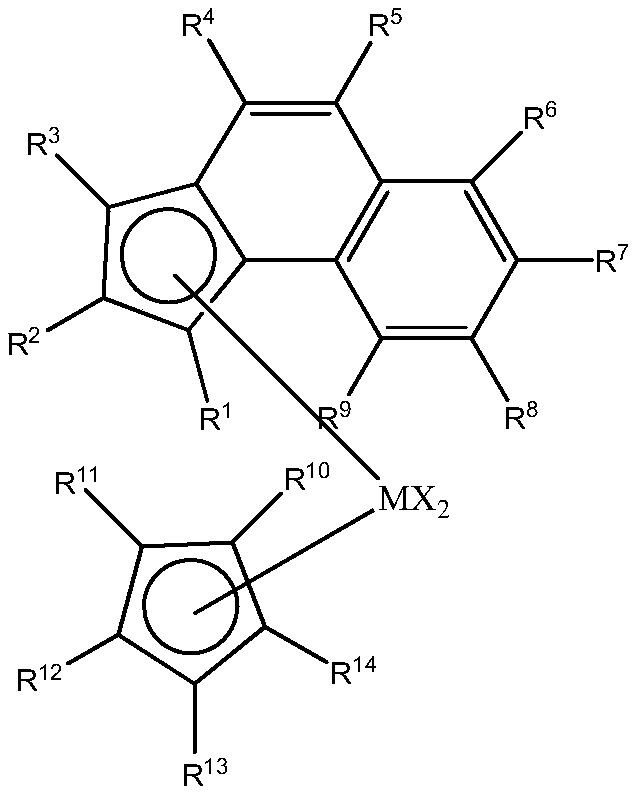
其中in
M是铪或锆;M is hafnium or zirconium;
每个X独立地选自含1-20个碳原子的烃基,氢基,氨基,烷氧基,硫基,磷基,卤素,二烯,胺,膦,醚或它们的组合;each X is independently selected from hydrocarbyl, hydrogen, amino, alkoxy, thio, phosphorus, halogen, diene, amine, phosphine, ether, or combinations thereof containing 1-20 carbon atoms;
每个R1和R3独立地是C1-C8烷基;和Each R 1 and R 3 is independently C 1 -C 8 alkyl; and
每个R2、R4、R5、R6、R7、R8、R9、R10、R11、R12、R13和R14独立地是氢或含1-8个碳原子的取代或未取代的烃基,条件是R10-R14基中至少三个不是氢;和Each of R 2 , R 4 , R 5 , R 6 , R 7 , R 8 , R 9 , R 10 , R 11 , R 12 , R 13 and R 14 is independently hydrogen or 1-8 carbon atoms substituted or unsubstituted hydrocarbyl, provided that at least three of the R10-R14 groups are not hydrogen; and
2)获得具有300g/mol或更高的Mn和至少30%乙烯基链端(相对于总不饱和部分)的乙烯基封端低聚物,如于2011年3月25日提交的USSN 13/072,249中所述,该文献通过参考引入本文。2) Obtain vinyl terminated oligomers with Mn of 300 g/mol or higher and at least 30% vinyl chain ends (relative to total unsaturation), as filed in USSN 13/3/25/2011 072,249, which is incorporated herein by reference.
术语“助催化剂”和“活化剂”在本文中可互换使用,并且定义为能够通过将中性催化剂化合物转化成催化活性的催化剂化合物阳离子而活化上述催化剂化合物中的任何一种的任何化合物。非限制性的活化剂例如包括铝氧烷,烷基铝,离子化活化剂(其可以是中性的或离子型的),和常规类型的助催化剂。具体的活化剂包括铝氧烷化合物,包括改性的铝氧烷化合物,和离子化阴离子前体化合物,其夺取反应性的、σ-键的金属配体,使得该金属络合物阳离子化和提供平衡电荷的非配位或弱配位阴离子。The terms "cocatalyst" and "activator" are used interchangeably herein and are defined as any compound capable of activating any of the above catalyst compounds by converting a neutral catalyst compound into a catalytically active catalyst compound cation. Non-limiting activators include, for example, alumoxanes, aluminum alkyls, ionizing activators (which may be neutral or ionic), and conventional types of cocatalysts. Particular activators include alumoxane compounds, including modified alumoxane compounds, and ionizing anionic precursor compounds that abstract reactive, sigma-bonded metal ligands such that the metal complex cationizes and Non-coordinating or weakly coordinating anions that provide charge balancing.
在一个实施方案中,铝氧烷活化剂用作所述催化剂组合物中的活化剂。铝氧烷通常是含有-Al(R1)-O-子单元的低聚物化合物,其中R1是烷基。铝氧烷的实例包括甲基铝氧烷(MAO)、改性甲基铝氧烷(MMAO)、乙基铝氧烷和异丁基铝氧烷。烷基铝氧烷和改性烷基铝氧烷合适作为催化剂活化剂,尤其是当可夺取的配体是烷基、卤基、烷氧基或氨基时。还可以使用不同铝氧烷和改性铝氧烷的混合物。可以优选使用视觉上透明的甲基铝氧烷。可以过滤混浊或凝胶铝氧烷以制备透明溶液或可以从该混浊溶液滗析透明铝氧烷。有用的铝氧烷是美国专利号5,041,584涵盖的改性甲基铝氧烷(MMAO)助催化剂3A型(从Akzo Chemicals,Inc.以商品名改性甲基铝氧烷3A型商购)。In one embodiment, an alumoxane activator is used as the activator in the catalyst composition. Aluminoxanes are generally oligomeric compounds containing -Al(R1)-O- subunits, where R1 is an alkyl group. Examples of alumoxanes include methylaluminoxane (MAO), modified methylaluminoxane (MMAO), ethylaluminoxane, and isobutylaluminoxane. Alkylaluminoxanes and modified alkylaluminoxanes are suitable as catalyst activators, especially when the abstractable ligand is an alkyl, halo, alkoxy or amino group. Mixtures of different alumoxanes and modified alumoxanes can also be used. Visually transparent methylaluminoxane can be preferably used. The cloudy or gelling alumoxane can be filtered to produce a clear solution or the clear alumoxane can be decanted from the cloudy solution. A useful alumoxane is the modified methylaluminoxane (MMAO) cocatalyst Type 3A covered by US Pat. No. 5,041,584 (commercially available from Akzo Chemicals, Inc. under the tradename Modified Methylaluminoxane Type 3A).
当活化剂是铝氧烷(改性或未改性)时,一些实施方案选择相对于催化剂化合物(每一金属催化位点)以5000倍摩尔过量(Al/M)的最大的活化剂量。最小活化剂与催化剂化合物是1:1摩尔比。其它范围可以包括1:1-1000:1,例如1:1-500:1。例如,活化剂可以按大约500,450,400,350,300,250,200,150,100,50,25,和1摩尔中的任一个或更少使用,基于每一摩尔催化剂化合物。When the activator is an alumoxane (modified or unmodified), some embodiments select the maximum amount of activator at a 5000-fold molar excess (Al/M) relative to the catalyst compound (per metal catalytic site). The minimum activator to catalyst compound is a 1:1 molar ratio. Other ranges may include 1:1-1000:1, such as 1:1-500:1. For example, the activator can be used in about any one of 500, 450, 400, 350, 300, 250, 200, 150, 100, 50, 25, and 1 mole or less, per mole of catalyst compound.
在一个可选的实施方案中,在这里描述的聚合方法中几乎没有或没有使用铝氧烷。特别地,铝氧烷可以按零摩尔%存在。In an alternative embodiment, little or no alumoxane is used in the polymerization process described herein. In particular, the alumoxane may be present at zero mole %.
另外或作为替代,本发明催化剂体系可以包括至少一种非配位阴离子(NCA)活化剂。可根据本发明使用的非配位阴离子是这样的阴离子,它们是相容的,在将其离子电荷平衡的意义上稳定过渡金属阳离子在+1,仍保持足够的不稳定性以允许在聚合过程中被置换。含硼的NCA活化剂的详细描述可以参见于2015年1月14日提交的美国申请序列号62/103372,全文引入本文作为参考。Additionally or alternatively, the catalyst system of the present invention may include at least one non-coordinating anion (NCA) activator. Non-coordinating anions that can be used in accordance with the present invention are those anions that are compatible, stabilize the transition metal cation at +1 in the sense of balancing their ionic charge, yet remain sufficiently unstable to allow during polymerization replaced in. A detailed description of boron-containing NCA activators can be found in US Application Serial No. 62/103372, filed January 14, 2015, which is incorporated herein by reference in its entirety.
对于适合的大体积活化剂的列表,参见美国专利号8,658,556,通过参考引入本文。适合的NCA活化剂的具体实例包括:四(五氟苯基)硼酸N,N-二甲基苯胺;四(全氟萘基)硼酸N,N-二甲基苯铵,四(全氟联苯基)硼酸N,N-二甲基苯铵,四(3,5-双(三氟甲基)苯基)硼酸N,N-二甲基苯铵,四(全氟萘基)硼酸三苯基碳


在另一个实施方案中,NCA中的一种或多种选自美国专利号6,211,105中描述的活化剂。In another embodiment, one or more of the NCAs are selected from the activators described in US Pat. No. 6,211,105.
这里描述的任何活化剂可以在与催化剂化合物组合之前或之后混合在一起,优选在与用于乙烯共聚物和低聚物的催化剂化合物中任一种或两种混合之前。Any of the activators described herein can be mixed together before or after combining with the catalyst compounds, preferably before mixing with either or both of the catalyst compounds for ethylene copolymers and oligomers.
在一些实施方案中,同一种活化剂或活化剂的混合物可以用于催化剂化合物。在其它实施方案中,然而,不同的活化剂或活化剂的混合物可以用于其中使用多重催化剂的体系中的催化剂化合物中的每一种。例如,在一个实施方案中:(i)活化剂例如四(全氟萘基)硼酸N,N-二甲基苯铵可用来活化一种催化剂化合物;和(ii)活化剂例如四(五氟苯基)硼酸N,N-二甲基苯铵可用来活化同一聚合方法中使用的另一种催化剂化合物。In some embodiments, the same activator or mixture of activators can be used for the catalyst compound. In other embodiments, however, different activators or mixtures of activators may be used for each of the catalyst compounds in systems in which multiple catalysts are used. For example, in one embodiment: (i) an activator such as N,N-dimethylanilinium tetrakis(perfluoronaphthyl)borate may be used to activate a catalyst compound; and (ii) an activator such as tetrakis(pentafluoro) N,N-dimethylanilinium phenyl)borate can be used to activate another catalyst compound used in the same polymerization process.
另外,每种催化剂的典型的活化剂与催化剂之比是1:1摩尔比。可供选择的优选范围包括0.1:1-100:1。例如,活化剂与催化剂之比可以是大约0.5,1,2,5,10,50,75,100,200,250,300,350,400,450,500,600,700,800,900和1000比1中的任一个。根据一些实施方案,活化剂与催化剂之比可以在上述中任何两个之间的范围内。Additionally, a typical activator to catalyst ratio for each catalyst is a 1:1 molar ratio. Alternative preferred ranges include 0.1:1 to 100:1. For example, the ratio of activator to catalyst can be about 0.5, 1, 2, 5, 10, 50, 75, 100, 200, 250, 300, 350, 400, 450, 500, 600, 700, 800, 900 and 1000 than either of 1. According to some embodiments, the ratio of activator to catalyst may be in a range between any two of the above.
可以将催化剂化合物与铝氧烷和NCA的组合结合也在本发明范围内。It is also within the scope of this invention to combine the catalyst compound with a combination of alumoxane and NCA.
在一些实施方案中,使活化剂(一种或多种)与催化剂化合物接触以形成包含活化催化剂和活化剂或其它电荷平衡结构部分的催化剂体系,然后使所述催化剂体系与一种或多种单体接触。在其它实施方案中,可以将活化剂(一种或多种)与催化剂化合物(一种或多种)共进料,并且催化剂/活化剂接触在进料管线中发生。或者,将催化剂和活化剂单独地供入聚合反应器,并在聚合反应器中将催化剂活化。在其中将两种催化剂体系用于一个聚合区中的实施方案中(例如,在使用下面更加详细描述的多重催化剂体系,例如双重催化剂体系的方法中),可以使所述催化剂化合物中的每一种与它们相应的活化剂(一种或多种)(它们同样可以是相同或不同的)接触,然后混合在一起。当相同活化剂用于每一个时,可以使催化剂的混合物与活化剂(在将单体供给催化剂混合物之前或连同将单体供给催化剂混合物一起)接触。In some embodiments, an activator(s) is contacted with a catalyst compound to form a catalyst system comprising an activating catalyst and an activator or other charge balancing moiety, and the catalyst system is then contacted with one or more single contact. In other embodiments, the activator(s) can be co-fed with the catalyst compound(s), and the catalyst/activator contacting occurs in the feed line. Alternatively, the catalyst and activator are fed separately to the polymerization reactor, and the catalyst is activated in the polymerization reactor. In embodiments in which two catalyst systems are used in one polymerization zone (eg, in processes using multiple catalyst systems, such as dual catalyst systems, described in more detail below), each of the catalyst compounds may be The species are contacted with their corresponding activator(s) (which likewise may be the same or different) and then mixed together. When the same activator is used for each, the mixture of catalysts can be contacted with the activator (before or in conjunction with supplying the monomer to the catalyst mixture).
非必要的清除剂或共活化剂unnecessary scavengers or co-activators
除了所述活化剂化合物之外,还可以在催化剂体系中使用清除剂或共活化剂。可以被用作清除剂或共活化剂的烷基铝或有机铝化合物包括例如,三甲基铝、三乙基铝、三异丁基铝、三正己基铝、三正辛基铝等。可以使用其它亲氧物质,例如二乙基锌。In addition to the activator compounds, scavengers or co-activators can also be used in the catalyst system. Alkyl aluminum or organoaluminum compounds that can be used as scavengers or co-activators include, for example, trimethylaluminum, triethylaluminum, triisobutylaluminum, tri-n-hexylaluminum, tri-n-octylaluminum, and the like. Other oxophilic species such as diethylzinc can be used.
聚合反应构造和条件Polymerization configuration and conditions
在这些实施方案的具体实施方案中,使用多重反应器方法以在一个反应器中制备低聚物,而串联的第二反应器制备高门尼粘度乙烯共聚物。反应器共混物的制备方法包括:在第一反应器中使活化的金属茂催化剂与丙烯接触,从而制备含低聚物的流出物;将所述流出物供给第二反应器,其中使活化的金属茂催化剂(可以相同或不同于第一催化剂)与额外的乙烯、丙烯和非必要的二烯接触以制备第二聚合物组分和最终产物;和控制每个反应器中的条件以便获得低聚物和高门尼粘度第二聚合物组分。In specific embodiments of these embodiments, a multiple reactor process is used to produce oligomers in one reactor, while a second reactor in series produces high Mooney viscosity ethylene copolymers. A method of preparing a reactor blend includes contacting an activated metallocene catalyst with propylene in a first reactor to produce an oligomer-containing effluent; feeding the effluent to a second reactor, wherein the activated metallocene catalyst is The metallocene catalyst (which may be the same or different from the first catalyst) is contacted with additional ethylene, propylene and optionally diene to produce the second polymer component and final product; and the conditions in each reactor are controlled to obtain An oligomer and a high Mooney viscosity second polymer component.
当两种催化剂在同一个反应区中采用时,优选地,催化剂中的至少一种与其它催化剂相比能够引入更多低聚物以致制备的聚合物将具有不同的密度。公知的是,当用适合的活化剂活化某些过渡金属化合物时,具有差的α-烯烃引入,并因此将制备含低聚物的较高密度乙烯共聚物。When both catalysts are employed in the same reaction zone, preferably at least one of the catalysts is capable of introducing more oligomers than the other catalysts so that the polymers produced will have different densities. It is known that certain transition metal compounds have poor alpha-olefin incorporation when activated with a suitable activator, and thus will produce higher density ethylene copolymers containing oligomers.
平行聚合根据一些实施方案也被考虑。例如,包含催化剂体系的第一聚合区可以制备低聚物,并且第二聚合区可以制备乙烯共聚物。可以将第一和第二聚合物产物中的每一种的至少一部分共混或以别的方式结合以形成聚合物组合物。Parallel polymerization is also contemplated according to some embodiments. For example, a first polymerization zone containing the catalyst system can produce oligomers, and a second polymerization zone can produce ethylene copolymers. At least a portion of each of the first and second polymer products can be blended or otherwise combined to form a polymer composition.
根据一些实施方案的多重反应器系统(例如,序列或平行聚合)提供经由调节工艺变量控制所得的聚合物组合物的分子性能的灵活性。分子量、单体含量(例如,其中乙烯是第一单体的乙烯含量),以及共混到所得的聚合物组合物中的每种聚合物产物的比例都可以经由每个反应器中的反应温度、催化剂进料速率和单体浓度加以控制。在一个实施方案中,第一聚合区中的反应温度低于第二聚合区中的温度。反应器的体积是可用于调节两种乙烯共聚物的比例的另一个变量。Multiple reactor systems (eg, sequential or parallel polymerizations) according to some embodiments provide flexibility to control the molecular properties of the resulting polymer composition via adjustment of process variables. Molecular weight, monomer content (eg, ethylene content where ethylene is the first monomer), and the proportion of each polymer product blended into the resulting polymer composition can all be determined via the reaction temperature in each reactor , catalyst feed rate and monomer concentration are controlled. In one embodiment, the reaction temperature in the first polymerization zone is lower than the temperature in the second polymerization zone. The volume of the reactor is another variable that can be used to adjust the ratio of the two ethylene copolymers.
本发明的各种聚合方法中的每一种可以使用本领域中已知的常规聚合技术进行。可以使用本领域中已知的任何悬浮、均相、本体、溶液、淤浆或气相聚合方法。这些方法可以按间歇、半间歇或连续模式运行。优选均相聚合方法。均相聚合方法定义为其中产物的至少90wt%可溶于反应介质的方法。本体均相方法定义为其中单体本身用作反应介质并且反应器的所有原料中的单体浓度是70体积%或更高的方法。或者,溶剂或稀释剂不存在于或添加于反应介质中(除了用作催化剂体系或其它添加剂的载体的少量,或通常与单体联用的量,例如在丙烯中的丙烷)。在另一个实施方案中,方法是淤浆方法。本文所使用的术语“淤浆聚合方法”是指其中使用负载型催化剂并在所述负载型催化剂颗粒上使单体聚合的聚合方法。源自负载型催化剂的聚合物产物的至少95wt%呈粒状为固体颗粒(不溶解在稀释剂中)。Each of the various polymerization methods of the present invention can be carried out using conventional polymerization techniques known in the art. Any suspension, homogeneous, bulk, solution, slurry or gas phase polymerization method known in the art can be used. These methods can be run in batch, semi-batch or continuous mode. Homogeneous polymerization methods are preferred. Homogeneous polymerization processes are defined as processes in which at least 90% by weight of the product is soluble in the reaction medium. A bulk homogeneous process is defined as a process in which the monomer itself is used as the reaction medium and the monomer concentration in all feeds to the reactor is 70% by volume or higher. Alternatively, a solvent or diluent is not present or added to the reaction medium (except in small amounts to serve as a support for the catalyst system or other additives, or in amounts typically used in conjunction with monomers such as propane in propylene). In another embodiment, the method is a slurry method. The term "slurry polymerization process" as used herein refers to a polymerization process in which a supported catalyst is used and monomers are polymerized on the supported catalyst particles. At least 95 wt% of the polymer product derived from the supported catalyst is particulate as solid particles (not dissolved in diluent).
因为间歇或连续聚合方法可以根据本发明的这些实施方案使用,所以这里引用的单体之比和单体进料速率之比应该认为可互换。例如,当待共聚合的第一单体和第二单体之比给定为10:1时,那种比例可以是间歇方法中存在的摩尔之比,或连续方法中的摩尔进料速率之比。相似地,当给定催化剂之比时,此种比例应该视为间歇方法中存在的摩尔之比,或相当地,连续方法中的摩尔进料速率之比。Since batch or continuous polymerization processes can be used in accordance with these embodiments of the present invention, the ratios of monomers and monomer feed rates referenced herein should be considered interchangeable. For example, when the ratio of the first monomer to be copolymerized to the second monomer is given as 10:1, that ratio may be the molar ratio present in a batch process, or the molar feed rate in a continuous process Compare. Similarly, when ratios of catalysts are given, such ratios should be considered as molar ratios present in batch processes, or equivalently, molar feed rates in continuous processes.
另外,虽然可以使用已知的聚合技术,但是根据某些实施方案的方法使用特定的条件(例如,温度和压力)。温度和/或压力一般可以包括大约0℃-大约300℃的温度。实例范围包括从大约20,30,35,40,45,50,55,60,65和70℃中任一个的下限到大约100,110,120,130,140,150,160,170,180,190,200,250和300℃中任一个的上限。例如,聚合温度可以落在大约40℃-大约200℃,或者大约45℃-大约150℃,70℃-大约150℃,或在特定的实施方案中,大约70℃-大约125℃的范围内。压力可以取决于聚合系统的期望规模。例如,在一些聚合中,压力可以一般从大约环境压力到200MPa的范围。在各种这样的实施方案中,压力可以从大约0.1,1,5和10中任一个的下限到大约3,5,10,50,100,150和200MPa中任一个的上限的范围内,只要所述范围的上限端大于下限端。根据这样的实施方案,压力优选在大约2-大约70MPa的范围中。Additionally, although known polymerization techniques may be used, methods according to certain embodiments employ specific conditions (eg, temperature and pressure). The temperature and/or pressure may generally include a temperature of from about 0°C to about 300°C. Example ranges include from the lower limit of any of about 20, 30, 35, 40, 45, 50, 55, 60, 65 and 70°C to about 100, 110, 120, 130, 140, 150, 160, 170, 180, The upper limit of any one of 190, 200, 250 and 300°C. For example, the polymerization temperature may fall within the range of about 40°C to about 200°C, or about 45°C to about 150°C, 70°C to about 150°C, or in certain embodiments, about 70°C to about 125°C. The pressure can depend on the desired scale of the polymerization system. For example, in some polymerizations, the pressure may generally range from about ambient pressure to 200 MPa. In various such embodiments, the pressure may range from a lower limit of any of about 0.1, 1, 5, and 10 to an upper limit of any of about 3, 5, 10, 50, 100, 150, and 200 MPa, as long as The upper end of the range is greater than the lower end. According to such embodiments, the pressure is preferably in the range of about 2 to about 70 MPa.
在典型的聚合中,反应的运转时间(也称为停留时间)是至多300分钟,优选大约5-250分钟,或优选大约10-120分钟。或者,当使用溶液方法时,反应的运转时间可以优选在5-30分钟的范围中。当使用淤浆或气相方法时,反应的运转时间优选在30-180分钟的范围中。反应的运转时间和反应器停留时间在这里可互换使用。In a typical polymerization, the run time (also referred to as residence time) of the reaction is up to 300 minutes, preferably about 5-250 minutes, or preferably about 10-120 minutes. Alternatively, when a solution method is used, the run time of the reaction may preferably be in the range of 5-30 minutes. When a slurry or gas phase method is used, the run time of the reaction is preferably in the range of 30-180 minutes. Reaction run time and reactor residence time are used interchangeably herein.
在一些实施方案中,氢气按0.001-50psig(0.007-345kPa),优选0.01-25psig(0.07-172kPa),更优选0.1-10psig(0.7-70kPa)的分压存在于聚合反应器中。或者,将500ppm或更少,或400ppm或更少,或300ppm或更少的氢气添加到反应器中。在另一个实施方案中,添加至少50ppm的氢气,或100ppm,或200ppm。因此,某些实施方案包括按从大约50,100,150和200ppm中任一个的下限到大约250,300,350,400,450和500ppm中任一个的上限的量添加到反应器中的氢气。In some embodiments, hydrogen is present in the polymerization reactor at a partial pressure of 0.001-50 psig (0.007-345 kPa), preferably 0.01-25 psig (0.07-172 kPa), more preferably 0.1-10 psig (0.7-70 kPa). Alternatively, 500 ppm or less, or 400 ppm or less, or 300 ppm or less of hydrogen is added to the reactor. In another embodiment, at least 50 ppm of hydrogen is added, or 100 ppm, or 200 ppm. Thus, certain embodiments include hydrogen added to the reactor in an amount from a lower limit of any of about 50, 100, 150, and 200 ppm to an upper limit of any of about 250, 300, 350, 400, 450, and 500 ppm.
在一些实施方案中,催化剂体系的活性是至少50g/mmol/小时,优选500g/mmol/小时或更高,优选5000g/mmol/hr或更高,优选50,000g/mmol/hr或更高,优选100,000g/mmol/hr或更高。或者,催化剂效率是10,000kg聚合物/kg催化剂或更高,优选,50,000kg聚合物/kg催化剂或更高,更优选100,000kg聚合物/kg催化剂或更高。In some embodiments, the activity of the catalyst system is at least 50 g/mmol/hour, preferably 500 g/mmol/hour or higher, preferably 5000 g/mmol/hr or higher, preferably 50,000 g/mmol/hr or higher, preferably 100,000 g/mmol/hr or more. Alternatively, the catalyst efficiency is 10,000 kg polymer/kg catalyst or higher, preferably 50,000 kg polymer/kg catalyst or higher, more preferably 100,000 kg polymer/kg catalyst or higher.
其它添加剂也可以依照要求用于聚合,例如一种或多种清除剂、促进剂、改性剂、链转移剂(例如二烷基锌,典型地二乙基锌)、还原剂、氧化剂、氢气、烷基铝或硅烷。Other additives may also be used in the polymerization as required, such as one or more scavengers, accelerators, modifiers, chain transfer agents (eg dialkylzinc, typically diethylzinc), reducing agents, oxidizing agents, hydrogen , alkyl aluminum or silane.
可以从任一个或更多聚合的流出物中通过使用常规的分离方式将所述聚合物与流出物的其它成分分离而回收聚合物。例如,可以通过用非溶剂例如异丙醇、丙酮或正丁醇的凝结从聚合流出物回收聚合物,或可以通过用热或蒸汽汽提溶剂或其它介质回收聚合物。在回收程序期间,可以将一种或多种常规的添加剂,例如抗氧化剂,引入到聚合物中。适合的抗氧化剂包括,但不限于苯基-β-萘胺;二叔丁基氢醌;磷酸三苯酯;庚基化的二苯胺;2,2′-亚甲基双(4-甲基-6-叔丁基)苯酚和2,2,4-三甲基-6-苯基-1,2-二氢喹啉。其它回收的方法,例如通过使用较低临界溶液温度(LCST),之后进行再挥发,也被考虑到。催化剂可以作为分离程序的一部分被减活以便减少或消除聚合物回收过程下游的进一步不受控制的聚合。减活可以通过与适合的极性物质例如水混合进行,所述极性物质在再循环之后的残留效果可以通过适合的筛分或清除系统抵消。The polymer may be recovered from any one or more of the polymerized effluents by separating the polymer from other components of the effluent using conventional separation means. For example, the polymer can be recovered from the polymerization effluent by coagulation with a non-solvent such as isopropanol, acetone, or n-butanol, or the polymer can be recovered by stripping the solvent or other medium with heat or steam. During the recovery procedure, one or more conventional additives, such as antioxidants, can be introduced into the polymer. Suitable antioxidants include, but are not limited to, phenyl-beta-naphthylamine; di-tert-butylhydroquinone; triphenyl phosphate; heptylated diphenylamine; 2,2'-methylenebis(4-methyl-6 -tert-butyl)phenol and 2,2,4-trimethyl-6-phenyl-1,2-dihydroquinoline. Other methods of recovery, such as by using a lower critical solution temperature (LCST) followed by revolatilization, are also contemplated. The catalyst may be deactivated as part of the separation procedure in order to reduce or eliminate further uncontrolled polymerization downstream of the polymer recovery process. Deactivation can be carried out by mixing with suitable polar substances, eg water, whose residual effects after recycling can be counteracted by suitable sieving or removal systems.
附加的化合物additional compound
在另一个实施方案中,这里制备的聚合物组合物还包括一种或多种附加的聚合物和/或添加剂,从而形成配混的聚合物组合物。因此,各种实施方案的方法可以还包括将根据各种上述实施方案的聚合物组合物(例如,一些实施方案的聚合物组合物)与一种或多种附加的聚合物组分和/或添加剂共混。In another embodiment, the polymer composition prepared herein further includes one or more additional polymers and/or additives, thereby forming a compounded polymer composition. Accordingly, the methods of the various embodiments may further include combining the polymer compositions according to the various above-described embodiments (eg, the polymer compositions of some embodiments) with one or more additional polymer components and/or Additive blending.
有用的附加聚合物组分包括聚乙烯,全同立构聚丙烯,间同立构聚丙烯,丙烯和乙烯和/或丁烯和/或己烯的无规共聚物,聚丁烯,乙烯-乙酸乙烯酯,低密度聚乙烯(LDPE),线性低密度聚乙烯(LLDPE),高密度聚乙烯(HDPE),乙烯-乙酸乙烯酯,乙烯丙烯酸甲酯,丙烯酸的共聚物,聚甲基丙烯酸甲酯或可通过高压自由基方法聚合的任何其它聚合物,聚氯乙烯,聚丁烯-1,全同立构聚丁烯,ABS树脂,乙烯-丙烯橡胶(EPR),硫化EPR,EPDM,嵌段共聚物,苯乙烯类嵌段共聚物,聚酰胺,聚碳酸酯,PET树脂,交联的聚乙烯,乙烯和乙烯醇(EVOH)的共聚物,芳族单体例如聚苯乙烯的聚合物,聚-1酯,聚缩醛,聚偏二氟乙烯,聚乙二醇和/或聚异丁烯。Useful additional polymer components include polyethylene, isotactic polypropylene, syndiotactic polypropylene, random copolymers of propylene and ethylene and/or butene and/or hexene, polybutene, ethylene- Vinyl Acetate, Low Density Polyethylene (LDPE), Linear Low Density Polyethylene (LLDPE), High Density Polyethylene (HDPE), Ethylene Vinyl Acetate, Ethylene Methyl Acrylate, Copolymer of Acrylic Acid, Polymethyl Methacrylate Ester or any other polymer polymerizable by high pressure free radical methods, polyvinyl chloride, polybutene-1, isotactic polybutene, ABS resin, ethylene-propylene rubber (EPR), vulcanized EPR, EPDM, embedded Block copolymers, styrenic block copolymers, polyamides, polycarbonates, PET resins, cross-linked polyethylene, copolymers of ethylene and vinyl alcohol (EVOH), polymers of aromatic monomers such as polystyrene , poly-1 ester, polyacetal, polyvinylidene fluoride, polyethylene glycol and/or polyisobutylene.
在一些实施方案中,附加的聚合物组分(一种或多种)按大约1-大约99wt%,例如在一些实施方案中,大约1-大约10wt%存在于上述配混的聚合物组合物中,基于所述配混的聚合物组合物中的所有聚合物的重量。在其它实施方案中,附加的聚合物组分(一种或多种)按从大约1,2,3,4,5,6,7,8,9,10,11,12,13,14,15,16,17,18,19和20wt%中任一个到大约5,6,7,8,9,10,11,12,13,14,15,16,17,18,19,20,25,30,35,40,45,50,55,60,65,70,75,80,85,90,95和99wt%中任一个存在,基于配混的聚合物组合物中的聚合物的总重量。In some embodiments, the additional polymer component(s) are present in the above compounded polymer composition at about 1 to about 99 wt %, eg, in some embodiments, about 1 to about 10 wt % , based on the weight of all polymers in the compounded polymer composition. In other embodiments, the additional polymer component(s) are ordered from about 1, 2, 3, 4, 5, 6, 7, 8, 9, 10, 11, 12, 13, 14, Any of 15, 16, 17, 18, 19 and 20 wt% to about 5, 6, 7, 8, 9, 10, 11, 12, 13, 14, 15, 16, 17, 18, 19, 20, 25 , 30, 35, 40, 45, 50, 55, 60, 65, 70, 75, 80, 85, 90, 95 and 99 wt % are present, based on the total polymer in the compounded polymer composition weight.
适合的添加剂也可以包括在配混的聚合物组合物中。此类添加剂包括本领域中已知用于弹性体配方,例如EPDM配方的任何添加剂。添加剂的实例包括,但不限于,以下物质中任一种或多种:附加的填充油;炭黑;增塑剂;加工助剂例如脂肪酸、蜡等;抗氧化剂(例如位阻酚类例如可以从Ciba-Geigy获得的IRGANOXTM 1010或IRGANOXTM1076);亚磷酸酯(例如,可以从Ciba-Geigy获得的IRGAFOSTM 168);固化剂(固化剂和助剂中任一种或两种,例如氧化锌、过氧化物、酚类树脂等);填料(包括碳酸钙、粘土、氧化硅等);抗臭氧剂;焦烧抑制剂;抗粘着添加剂;增粘剂(例如聚丁烯、萜烯树脂、脂族和芳族烃树脂、碱金属和甘油硬脂酸盐,和氢化松香等);UV稳定剂;热稳定剂;防粘连剂;剥离剂;抗静电剂;颜料;着色剂;染料;滑石;及本领域中已知的其它添加剂。Suitable additives may also be included in the compounded polymer composition. Such additives include any additives known in the art for use in elastomer formulations, such as EPDM formulations. Examples of additives include, but are not limited to, any one or more of the following: additional extender oils; carbon black; plasticizers; processing aids such as fatty acids, waxes, etc.; antioxidants such as hindered phenols such as can IRGANOX ™ 1010 or IRGANOX ™ 1076 available from Ciba-Geigy); phosphites (eg, IRGAFOS ™ 168 available from Ciba-Geigy); curing agents (either or both of curing agents and co-agents, eg Zinc oxides, peroxides, phenolic resins, etc.); fillers (including calcium carbonate, clay, silica, etc.); antiozonants; scorch inhibitors; anti-stick additives; tackifiers (eg, polybutene, terpenes) resins, aliphatic and aromatic hydrocarbon resins, alkali metal and glycerol stearates, and hydrogenated rosin, etc.); UV stabilizers; heat stabilizers; anti-blocking agents; release agents; antistatic agents; pigments; colorants; dyes ; talc; and other additives known in the art.
一般而言,适合于常规EP或EPDM配方的任何附加的聚合物组分和/或任何添加剂或其它附加的组分将适合于与这里描述的各种实施方案(尤其是其中聚合物组合物是或包含EP或EPDM共聚物的那些实施方案)的聚合物组合物配混。In general, any additional polymer components and/or any additives or other additional components suitable for conventional EP or EPDM formulations will be suitable for use with the various embodiments described herein (especially where the polymer composition is or those embodiments comprising EP or EPDM copolymers) are compounded.
可以如下制备上述配混的聚合物组合物:将各种实施方案的聚合物组合物与一种或多种附加的聚合物组分(如上所述)混合,将反应器串联或并联连接在一起制备反应器共混物,或在同一个反应器中使用多于一种催化剂以制备多重聚合物物质。可以在投入挤出机之前将聚合物混合在一起或可以在挤出机中混合。可以非必要地在本领域中已知的方法中的任一点添加添加剂。The above compounded polymer compositions can be prepared by mixing the polymer compositions of the various embodiments with one or more additional polymer components (as described above), connecting reactors together in series or in parallel Reactor blends are prepared, or more than one catalyst is used in the same reactor to prepare multiple polymer species. The polymers can be mixed together before being put into the extruder or can be mixed in the extruder. Additives may optionally be added at any point in methods known in the art.
配混的聚合物组合物可以使用常规设备和方法形成,例如将各组分干共混并随后在混合器中熔体混合,或将组分直接地在混合机例如Banbury混合机、Haake混合机、Brabender密炼机或单或双螺杆挤出机中混合在一起,其可以包括配混挤出机和在聚合方法下游直接使用的侧臂挤出机,其可以包括在膜挤出机的加料斗处将树脂的粉末或粒料共混。Compounded polymer compositions can be formed using conventional equipment and methods, such as dry blending the components and subsequent melt mixing in a mixer, or directly mixing the components in a mixer such as a Banbury mixer, Haake mixer , Brabender mixers or single or twin screw extruders, which may include compounding extruders and side arm extruders used directly downstream of the polymerization process, which may include additions in film extruders Powder or pellets of resin are blended at the hopper.
在一个实施方案中,本发明方法中产生的油的量可以是足够的,并且无需再添加油来形成可硫化橡胶组合物。在一些应用中,附加的油可能是期望的,在这种情况下,油可以按至多大约80重量份/100重量份的量添加,基于乙烯-α-烯烃-非共轭-二烯共聚物。优选地,油按大约5-大约15重量份烷属增量油/100重量份的量添加,基于所述乙烯共聚物。In one embodiment, the amount of oil produced in the process of the present invention may be sufficient and no further oil needs to be added to form the vulcanizable rubber composition. In some applications, additional oil may be desirable, in which case the oil may be added in an amount up to about 80 parts by weight per 100 parts by weight, based on the ethylene-alpha-olefin-non-conjugated-diene copolymer . Preferably, the oil is added in an amount of about 5 to about 15 parts by weight paraffinic extender oil per 100 parts by weight, based on the ethylene copolymer.
硫化乙烯共聚物Vulcanized ethylene copolymer
可以使用硫化剂使本发明实施方案的乙烯共聚物硫化。适合的硫化剂包括但不限于硫;氯化硫;二氯化硫;4,4'-二硫代二吗啉;二硫化吗啉;二硫化烷基酚;二硫化四甲基秋兰姆;二甲基二硫代氨基甲酸硒;和有机过氧化物例如过氧化二枯基,2,5-二甲基-2,5-二(叔丁基过氧)己烷,2,5-二甲基-2,5-二(苯甲酰基过氧)-己烷,2,5-二甲基-2,5-(叔丁基过氧)己炔-3,二-叔丁基过氧化物,二-叔丁基过氧-3,3,5-三甲基环己烷和叔丁基氢过氧化物。这些中,优选的是硫、过氧化二枯基、二-叔丁基过氧化物和叔丁基过氧-3,3,5-三甲基环己烷。The ethylene copolymers of embodiments of the present invention may be vulcanized using a vulcanizing agent. Suitable vulcanizing agents include, but are not limited to, sulfur; sulfur chloride; sulfur dichloride; 4,4'-dithiodimorpholine; morpholine disulfide; alkylphenol disulfide; tetramethylthiuram disulfide ; selenium dimethyldithiocarbamate; and organic peroxides such as dicumyl peroxide, 2,5-dimethyl-2,5-di(tert-butylperoxy)hexane, 2,5- Dimethyl-2,5-bis(benzoylperoxy)-hexane, 2,5-dimethyl-2,5-(tert-butylperoxy)hexyn-3,di-tert-butylperoxy oxides, di-tert-butylperoxy-3,3,5-trimethylcyclohexane and tert-butyl hydroperoxide. Of these, preferred are sulfur, dicumyl peroxide, di-tert-butyl peroxide and tert-butylperoxy-3,3,5-trimethylcyclohexane.
在硫固化的情况下,硫优选按0.1-10重量份,优选0.5-5重量份/100重量份乙烯-α-烯烃-非共轭-二烯的量使用。In the case of sulfur curing, sulfur is preferably used in an amount of 0.1 to 10 parts by weight, preferably 0.5 to 5 parts by weight per 100 parts by weight of ethylene-α-olefin-non-conjugated-diene.
在过氧化物固化的情况下,有机过氧化物按通常0.1-15重量份,优选0.5-8重量份/100重量份所述共聚物的量使用。In the case of peroxide curing, the organic peroxide is used in an amount of usually 0.1 to 15 parts by weight, preferably 0.5 to 8 parts by weight per 100 parts by weight of the copolymer.
如果有必要的话,硫化剂可以与硫化促进剂和硫化助剂结合使用。硫化促进剂的实例是N-环己基-2-苯并噻唑-亚磺酰胺,N-氧联二乙基-2-苯并噻唑-亚磺酰胺,N,N-二异丙基-2-苯并噻唑-亚磺酰胺,2-巯基苯并噻唑,2-(2,4-二硝基苯基)巯基苯并噻唑,2-(2,6-二乙基-4-吗啉基硫代)苯并噻唑,二硫化二苯并噻唑基,二苯胍,三苯胍,二邻甲苯基胍,邻甲苯基-双胍,二苯胍-邻苯二甲酸酯,乙醛-苯胺反应产物,丁醛-苯胺缩合物,六亚甲基四胺,乙醛氨,2-巯基咪唑啉,硫代N-碳酰苯胺,二乙基硫脲,二丁基硫脲,三甲基硫脲,二-邻甲苯基硫脲,一硫化四甲基秋兰姆,二硫化四甲基秋兰姆,二硫化四乙基秋兰姆,二硫化四丁基秋兰姆,四硫化二(五亚甲基)秋兰姆,二甲基二硫代氨基甲酸锌,二乙基硫代氨基甲酸锌,二-正丁基硫代氨基甲酸锌,乙基苯基二硫代氨基甲酸锌,丁基苯基-二硫代氨基甲酸锌,二甲基二硫代氨基甲酸钠,二甲基二硫代氨基甲酸硒,二乙基二硫代氨基甲酸碲,二丁基黄原酸锌和亚乙基硫脲。如果使用的话,硫化促进剂优选按0.1-20重量份,尤其是0.2-10重量份/100重量份乙烯-α-烯烃-非共轭-二烯的量使用。If necessary, a vulcanizing agent can be used in combination with a vulcanization accelerator and a vulcanization aid. Examples of vulcanization accelerators are N-cyclohexyl-2-benzothiazole-sulfenamide, N-oxydiethyl-2-benzothiazole-sulfenamide, N,N-diisopropyl-2- benzothiazole-sulfinamide, 2-mercaptobenzothiazole, 2-(2,4-dinitrophenyl)mercaptobenzothiazole, 2-(2,6-diethyl-4-morpholinosulfur Substituted) benzothiazole, dibenzothiazolyl disulfide, diphenylguanidine, triphenylguanidine, di-o-tolylguanidine, o-tolyl-biguanide, diphenylguanidine-phthalate, acetaldehyde-aniline reaction Product, butyraldehyde-aniline condensate, hexamethylenetetramine, acetaldehyde ammonia, 2-mercaptoimidazoline, thiocarbanilide, diethylthiourea, dibutylthiourea, trimethylsulfide Urea, di-o-tolylthiourea, tetramethylthiuram monosulfide, tetramethylthiuram disulfide, tetraethylthiuram disulfide, tetrabutylthiuram disulfide, bis( pentamethylene)thiuram, zinc dimethyldithiocarbamate, zinc diethylthiocarbamate, zinc di-n-butylthiocarbamate, zinc ethylphenyldithiocarbamate, Zinc butylphenyl-dithiocarbamate, sodium dimethyldithiocarbamate, selenium dimethyldithiocarbamate, tellurium diethyldithiocarbamate, zinc dibutylxanthate and sulfite Ethylthiourea. If used, the vulcanization accelerator is preferably used in an amount of 0.1-20 parts by weight, especially 0.2-10 parts by weight per 100 parts by weight of ethylene-α-olefin-non-conjugated-diene.
硫化助剂的实例是金属氧化物例如氧化镁和氧化锌。这些中,优选的是氧化锌。硫化助剂通常按2-20重量份/100重量份乙烯-α-烯烃-非共轭-二烯的量使用。Examples of vulcanization aids are metal oxides such as magnesium oxide and zinc oxide. Of these, zinc oxide is preferred. The vulcanization aid is usually used in an amount of 2-20 parts by weight per 100 parts by weight of ethylene-α-olefin-non-conjugated-diene.
当过氧化物用作硫化剂时,交联助剂或活化剂的实例是氰脲酸酯化合物,例如三烯丙基氰脲酸酯(TAC)和三烯丙基异氰脲酸酯(TAIC),(甲基)丙烯酸化化合物,例如三羟甲基丙烷-三甲基丙烯酸酯(TMPT或TRIM)和乙二醇二甲基丙烯酸酯(EDMA),二甲基丙烯酸锌(ZDMA)和二丙烯酸锌(ZDA),二乙烯基苯,对醌二肟,间亚苯基二马来酰亚胺(HVA-2),(高乙烯基)聚丁二烯和它们的组合。当过氧化物另外用作硫化剂时,优选硫(元素硫或作为硫促进剂或供体的一部分)可以用来获得所谓的杂化固化体系。这些固化体系将高耐热性能(对于过氧化物固化典型)与非常好的极限性能(例如拉伸和撕裂)以及典型地与硫固化体系相联系的优异的动态和疲劳性能结合。硫的应用计量水平优选是0.05-1.0重量份,优选0.2-0.5重量份/100重量份,基于乙烯-α-烯烃-非共轭-二烯共聚物。When peroxides are used as vulcanizing agents, examples of crosslinking aids or activators are cyanurate compounds such as triallyl cyanurate (TAC) and triallyl isocyanurate (TAIC) ), (meth)acrylated compounds such as trimethylolpropane-trimethacrylate (TMPT or TRIM) and ethylene glycol dimethacrylate (EDMA), zinc dimethacrylate (ZDMA) and dimethacrylate Zinc acrylate (ZDA), divinylbenzene, p-quinone dioxime, m-phenylene dimaleimide (HVA-2), (high vinyl) polybutadiene and combinations thereof. When peroxide is additionally used as a vulcanizing agent, preferably sulfur (elemental sulfur or as part of a sulfur accelerator or donor) can be used to obtain so-called hybrid curing systems. These curing systems combine high thermal resistance (typical for peroxide curing) with very good ultimate properties (eg tensile and tear) and the excellent dynamic and fatigue properties typically associated with sulfur curing systems. The applied metered level of sulfur is preferably 0.05-1.0 parts by weight, preferably 0.2-0.5 parts by weight per 100 parts by weight, based on the ethylene-alpha-olefin-non-conjugated-diene copolymer.
可硫化橡胶组合物另外可以含有其它成分,例如抗氧化剂(例如TMQ)、干燥剂(例如CaO)、增粘剂(例如树脂)、粘结剂、颜料、加工助剂(例如,油胶、脂肪酸、硬脂酸盐、多-或二-乙二醇)。本发明还涉及由本发明的可硫化橡胶组合物制得的硫化橡胶制品。此类硫化橡胶制品优选是发动机架。The vulcanizable rubber composition may additionally contain other ingredients such as antioxidants (eg, TMQ), drying agents (eg, CaO), tackifiers (eg, resins), binders, pigments, processing aids (eg, oil gums, fatty acids, stearate, poly- or di-ethylene glycol). The present invention also relates to vulcanized rubber articles made from the vulcanizable rubber compositions of the present invention. Such vulcanized rubber articles are preferably engine mounts.
任何上述聚合物(包括它们的配混物)可以用于各种终端用途应用。这些应用包括,例如,密封条、冷却剂胶管、顶板隔膜、线路和电缆绝缘层和动态硫化合金、动力传送带、发动机架、热塑性共混物等。Any of the aforementioned polymers, including their compounds, can be used in a variety of end-use applications. These applications include, for example, weather strips, coolant hoses, roof diaphragms, line and cable insulation and dynamically vulcanized alloys, power transmission belts, engine mounts, thermoplastic blends, and more.
试验方法experiment method
小振幅振动式剪切(SAOS):使用平行板(直径=25mm)用Advanced RheometricsExpansion System(ARES)以动态模式在氮气气氛下测量动态剪切熔体流变数据。对于所有实验,在将树脂(聚合物组合物)的压缩模塑样品插到平行板上之前,流变仪在190℃下热稳定至少30分钟。为了测定样品粘弹性行为,在190℃的温度下在10%恒定应变下进行在0.01-385rad/s范围内的频率扫描。氮气流穿过样品烘箱循环以最小化在实验期间的扩链或交联。将正弦形剪切应变施加于材料上。如果应变幅度足够小,则材料线性地表现。如本领域中普通技术人员将明白的那样,所得的稳态应力也将在相同频率下以正弦曲线方式摆动,但是将相对于应变波移位相角δ。应力超前应变δ。对于纯弹性材料,δ=0°(应力与应变同相)并且对于纯粹粘性材料,δ=90°,(应力超前应变90°,尽管应力与应变率同相)。对于粘弹性材料,0<δ<90。通过该小振幅振动式剪切试验提供作为频率的函数的复数粘度、损耗模量(G”)和储能模量(G')。动态粘度也称为复数粘度或动态剪切粘度。该相或损耗角δ是G”(剪切损耗模量)与G'(剪切储能模量)之比的反正切。Small Amplitude Oscillating Shear (SAOS): Dynamic shear melt rheology data was measured with an Advanced Rheometrics Expansion System (ARES) in dynamic mode under nitrogen atmosphere using parallel plates (diameter = 25 mm). For all experiments, the rheometer was thermally stabilized at 190°C for at least 30 minutes before inserting compression molded samples of the resin (polymer composition) into parallel plates. To determine the viscoelastic behavior of the samples, a frequency sweep in the range of 0.01-385 rad/s was performed at a temperature of 190°C at a constant strain of 10%. A stream of nitrogen was circulated through the sample oven to minimize chain extension or cross-linking during the experiment. A sinusoidal shear strain is applied to the material. If the strain amplitude is small enough, the material behaves linearly. As will be appreciated by one of ordinary skill in the art, the resulting steady state stress will also oscillate sinusoidally at the same frequency, but will be shifted by a phase angle delta relative to the strain wave. Stress leads strain δ. For purely elastic materials, δ=0° (stress and strain are in phase) and for purely viscous materials, δ=90°, (stress leads strain by 90°, although stress and strain rate are in phase). For viscoelastic materials, 0<δ<90. Complex viscosity, loss modulus (G") and storage modulus (G') as a function of frequency are provided by this small amplitude vibratory shear test. Dynamic viscosity is also known as complex viscosity or dynamic shear viscosity. The phase Or the loss angle δ is the arctangent of the ratio of G" (shear loss modulus) to G' (shear storage modulus).
剪切稀化比:剪切稀化是聚合物熔体的流变响应,其中流动阻力(粘度)随剪切速率增加而减小。复数剪切粘度在低剪切速率(牛顿区)下一般是恒定的并随剪切速率增加而减小。在低剪切速率区域中,粘度称作零剪切粘度,其通常对于多分散和/或LCB聚合物熔体难以测量。在更高的剪切速率下,聚合物链沿剪切方向取向,这减少链缠结的数目,相对于它们的未变形状态。这种链缠结的减少导致更低粘度。剪切稀化的特征在于随着以正弦曲线施加的剪切的频率增加,复数运动粘度降低。剪切稀化比定义为在0.1rad/sec的频率下的复数剪切粘度与在100rad/sec的频率下的复数剪切粘度之比。Shear Thinning Ratio: Shear thinning is the rheological response of a polymer melt in which resistance to flow (viscosity) decreases with increasing shear rate. Complex shear viscosity is generally constant at low shear rates (Newtonian region) and decreases with increasing shear rate. In the low shear rate region, viscosity is referred to as zero shear viscosity, which is often difficult to measure for polydisperse and/or LCB polymer melts. At higher shear rates, the polymer chains are oriented along the shear direction, which reduces the number of chain entanglements, relative to their undeformed state. This reduction in chain entanglement results in lower viscosity. Shear thinning is characterized by a decrease in complex kinematic viscosity as the frequency of sinusoidally applied shear increases. The shear thinning ratio is defined as the ratio of the complex shear viscosity at a frequency of 0.1 rad/sec to the complex shear viscosity at a frequency of 100 rad/sec.
门尼大粘度(ML)和门尼松弛面积(MLRA):使用门尼粘度计根据ASTM D-1646(如以下描述中详述那样修改)测量ML和MLRA。将正方形样品放置在转子的任一面上。通过气动降低上压板填充内腔。将上和下压板电加热并控制在125℃。通过转矩传感器测量以2rpm使转子转动的扭矩。门尼粘度计在2s-1的平均剪切速率下运转。在压板关闭后将样品预加热1分钟。然后开启发动机并记录扭矩4分钟的时期。结果报道为ML(1+4)125℃,其中M是门尼粘度数值,L表示大转子,1是预加热时间(分钟),4是在发动机开启后样品运转时间(分钟),125℃是试验温度。Mooney Maximum Viscosity (ML) and Mooney Relaxation Area (MLRA): ML and MLRA were measured using a Mooney viscometer in accordance with ASTM D-1646 (modified as detailed in the description below). Place a square sample on either side of the rotor. Fill the cavity by pneumatically lowering the upper platen. The upper and lower platens were electrically heated and controlled at 125°C. The torque that turns the rotor at 2 rpm is measured by a torque sensor. The Mooney viscometer was operated at an average shear rate of 2s -1 . The samples were preheated for 1 minute after the platen was closed. The engine was then turned on and torque was recorded for a 4 minute period. The results are reported as ML(1+4)125°C, where M is the Mooney viscosity number, L is the large rotor, 1 is the preheating time (minutes), 4 is the sample running time (minutes) after the engine is turned on, and 125°C is Test temperature.
门尼粘度计的扭矩极限是大约100门尼单位。大于大约100门尼单位的门尼粘度值一般不能在这些条件下测量。在这种情况下,使用非标准的转子设计,具有允许在门尼粘度计上的相同仪器用于更粘性聚合物的门尼尺度的改变。这种在直径方面更小且比标准门尼大(ML)转子更薄的转子称作MST—Mooney Small Thin。典型地当使用所述MST转子时,还在不同时间和温度下运行该试验。将预加热时间从标准1分钟改变成5分钟和在200℃下而不是标准125℃下运行该试验。因此,该值将报道为MST(5+4)200℃。应指出,在取得门尼读数结束时4分钟的运转时间仍然与标准条件相同。根据EP 1 519 967,当在(5+4@200℃)下测量MST和在(1+4@125℃)下测量ML时,一个MST点是大约5个ML点。MST转子应该准备如下:The torque limit of a Mooney viscometer is about 100 Mooney units. Mooney viscosity values greater than about 100 Mooney units generally cannot be measured under these conditions. In this case, a non-standard rotor design is used, with a change in Mooney scale that allows the same instrument on a Mooney viscometer to be used for more viscous polymers. This rotor, which is smaller in diameter and thinner than a standard Mooney Large (ML) rotor, is called MST—Mooney Small Thin. The experiments were also run at different times and temperatures, typically when using the MST rotor. Change the preheat time from the standard 1 minute to 5 minutes and run the test at 200°C instead of the standard 125°C. Therefore, this value will be reported as MST(5+4) 200°C. It should be noted that the 4 minute run time at the end of taking the Mooney reading is still the same as standard conditions. According to EP 1 519 967, when MST is measured at (5+4@200°C) and ML is measured at (1+4@125°C), one MST point is about 5 ML points. MST rotors should be prepared as follows:
a.转子应该具有30.48+/-0.03mm的直径和2.8+/-0.03mm(锯齿顶端)的厚度和直径为11mm或更小的轴。a. The rotor should have a diameter of 30.48 +/- 0.03 mm and a thickness of 2.8 +/- 0.03 mm (serrated tip) and a shaft with a diameter of 11 mm or less.
b.转子应该具有锯齿面和边缘,具有0.8mm宽度和在1.6mm中心上0.25-0.38mm切口深度的方槽。锯齿将由彼此垂直的两组槽构成(形成方形交叉影线)。b. The rotor should have serrated surfaces and edges, with a square slot of 0.8mm width and 0.25-0.38mm cut depth on 1.6mm center. The serrations will consist of two sets of grooves that are perpendicular to each other (forming a square cross-hatched).
c.转子应该布置在模腔的中心以致转盘的中线与模腔的中线重合至+/-0.25mm的容差内。间隔物或垫片可用来将轴提升至中点。c. The rotor should be positioned in the center of the cavity so that the centerline of the turntable coincides with the centerline of the cavity to within a tolerance of +/- 0.25mm. Spacers or spacers can be used to lift the shaft to the midpoint.
d.磨损点(位于转子的顶面的中心处的锥形隆起)应该切削加工掉,以使转子的表面平坦。d. The wear point (the conical ridge at the center of the top surface of the rotor) should be machined away to make the surface of the rotor flat.
当在转子后的橡胶松弛停止时,从门尼粘度测量获得MLRA数据。MLRA是在门尼扭矩-松驰时间曲线下从1-100秒的积分面积。MLRA是熔融聚合物中的链松弛的量度并可以认为是储能项,其表明在移除所施加的应变后更长或支化聚合物链能储存更多能量并要求更长松弛时间。因此,当在相同门尼粘度值下比较时,双峰橡胶(存在具有非常高分子量和相异组成的离散聚合物级分)或长链支化橡胶的MLRA值大于宽或窄分子量橡胶。MLRA data was obtained from Mooney viscosity measurements when the rubber relaxation after the rotor ceased. MLRA is the integrated area from 1-100 seconds under the Mooney torque-relaxation time curve. MLRA is a measure of chain relaxation in a molten polymer and can be considered an energy storage term, indicating that longer or branched polymer chains can store more energy and require longer relaxation times after the applied strain is removed. Thus, bimodal rubbers (where there are discrete polymer fractions with very high molecular weights and distinct compositions) or long chain branched rubbers have greater MLRA values than broad or narrow molecular weight rubbers when compared at the same Mooney viscosity value.
门尼松弛面积取决于聚合物的门尼粘度,并随门尼粘度增加而增加。为了移除对聚合物门尼粘度的依赖性,使用校正的MLRA(cMLRA)参数,其中将聚合物的MLRA标准化至80门尼粘度的基准。cMLRA的公式提供如下The Mooney relaxation area depends on the Mooney viscosity of the polymer and increases as the Mooney viscosity increases. To remove the dependence on the polymer Mooney viscosity, the corrected MLRA (cMLRA) parameter was used, where the polymer's MLRA was normalized to a baseline of 80 Mooney viscosity. The formula for cMLRA is provided as follows

其中MLRA和ML是在125℃下量度的聚合物样品的门尼松弛面积和门尼粘度。where MLRA and ML are the Mooney relaxation area and Mooney viscosity of the polymer sample measured at 125°C.
根据以下NMR方法测定Mn(1H NMR)。使用具有250MHz、400MHz或500MHz的1H频率的Varian摄谱仪(对权利要求来说,使用400MHz的质子频率)在室温或120℃(就权利要求书来说,应该使用120℃)在5mm探针中收集1H NMR数据。使用45°的最大脉冲宽度,8秒的脉冲和平均120次瞬变的信号间间隔来记录数据。将光谱信号积分,并且通过将不同基团乘以1000并将该结果除以总碳数来计算每1000个碳的不饱和部分类型的数目。Mn通过用不饱和物质的总数除以14,000计算,并具有单位g/mol。烯烃类型的化学位移区域定义为下述光谱区域之间。Mn ( 1 H NMR) was determined according to the following NMR method. Use a Varian spectrograph with a 1 H frequency of 250MHz, 400MHz or 500MHz (400MHz proton frequency for the claims) at room temperature or 120°C (for the claims, 120°C should be used) at a 5mm probe 1H NMR data was collected in the needle. Data were recorded using a maximum pulse width of 45°, a pulse of 8 s, and an inter-signal interval averaging 120 transients. The spectral signals were integrated and the number of unsaturation types per 1000 carbons was calculated by multiplying the different groups by 1000 and dividing the result by the total carbon number. Mn is calculated by dividing the total number of unsaturated species by 14,000 and has the unit g/mol. The chemical shift region of the olefin type is defined as between the spectral regions described below.
在进行13C NMR研究中,通过将0.3g的样品添加到在10mm的NMR管中的大约3g的四氯乙烷-d2中而制备样品。通过将管子和其内容物加热到150℃使样品溶解和均匀化。使用Varian摄谱仪,用400或700MHz的相应1H频率(抵触时,将应使用700MHz)收集数据。每个数据文件使用标称4000瞬变值获取数据,其中采用10秒脉冲重复延迟。为了获得用于定量分析的最大的信噪比,多个数据文件可以加在一起。调节光谱的宽度以包括所有感兴趣的NMR共振并且收集FID,含有32K数据点的最小值。在120℃下在10mm的宽谱带探针中分析样品。In conducting the 13 C NMR studies, samples were prepared by adding 0.3 g of the sample to approximately 3 g of tetrachloroethane-d2 in a 10 mm NMR tube. The sample was dissolved and homogenized by heating the tube and its contents to 150°C. Data were collected using a Varian spectrograph with the corresponding 1H frequency of 400 or 700 MHz (in case of conflict, 700 MHz should be used). Data was acquired using a nominal 4000 transients per data file with a 10 second pulse repetition delay. To obtain the maximum signal-to-noise ratio for quantitative analysis, multiple data files can be added together. The width of the spectrum was adjusted to include all NMR resonances of interest and the FID was collected, with a minimum of 32K data points. Samples were analyzed in a 10 mm broadband probe at 120°C.
乙烯基链端的量(也称作%乙烯基终端)使用在120℃下,使用氘代四氯乙烷作为溶剂,在500MHz机器上进行的1H NMR测定,并且在选择的情况中由13C NMR证实。Resconi已经在J American Chemical Society 114 1992,第1025-1032页(其在此是有用的)中报道了乙烯基封端的丙烯大分子单体的质子和碳分配(对于质子谱使用纯的全氘代四氯乙烷,而对于碳谱,使用正常的和全氘代的四氯乙烷的50∶50混合物;所有光谱在100℃在BrukerAM 300分光计上记录,所述分光计对于质子在300MHz下操作,对于碳在75.43MHz下操作)。乙烯基链端的百分率报道为烯丙基类乙烯基相对于不饱和链端的总摩尔数的摩尔百分率。The amount of vinyl chain ends (also referred to as % vinyl termination) was determined using1H NMR at 120°C using deuterated tetrachloroethane as solvent on a 500MHz machine, and in selected cases by13C NMR confirmed. Resconi has reported in J American Chemical Society 114 1992, pp. 1025-1032 (which is useful here) the proton and carbon partitioning of vinyl terminated propylene macromonomers (using pure perdeuterated for proton spectroscopy) tetrachloroethane, while for carbon spectra a 50:50 mixture of normal and perdeuterated tetrachloroethane was used; all spectra were recorded at 100°C on a BrukerAM 300 spectrometer at 300MHz for protons operating at 75.43 MHz for carbon). The percentage of vinyl chain ends is reported as the mole percent of allylic vinyl groups relative to the total moles of unsaturated chain ends.
使用配备有在线差示折光指数(DRI)、光散射(LS)和粘度计(VIS)检测器的Polymer Laboratories Model 220高温GPC-SEC(凝胶渗透/尺寸排阻色谱)测定分子量(数均分子量(Mn)、重均分子量(Mw)和Z-均分子量(Mz))。它使用三个Polymer LaboratoriesPLgel 10m Mixed-B柱用于分离,使用0.54ml/min的流速和300微升标称注射体积。检测器和柱容纳在维持于135℃的烘箱中。将从SEC柱排出的料流引导到miniDAWN光流槽中,然后引导到DRI检测器中。DRI检测器是Polymer Laboratories SEC的集成部分。粘度计在SEC烘箱内,布置在DRI检测器后。这些检测器的详述以及它们的校准已经由例如,T.Sun、P.Brant、R.R.Chance和W.W.Graessley描述在Macromolecules,第34卷,第19期,第6812-6820页(2001)中,通过参考引入本文。Molecular weight (number average molecular weight) was determined using a Polymer Laboratories Model 220 high temperature GPC-SEC (gel permeation/size exclusion chromatography) equipped with on-line Differential Refractive Index (DRI), Light Scattering (LS) and Viscometer (VIS) detectors (Mn), weight average molecular weight (Mw) and Z-average molecular weight (Mz)). It used three Polymer Laboratories PLgel 10m Mixed-B columns for separation using a flow rate of 0.54 ml/min and a nominal injection volume of 300 microliters. The detector and column were housed in an oven maintained at 135°C. The stream exiting the SEC column was directed into the miniDAWN optoflow cell and then into the DRI detector. The DRI detector is an integrated part of the Polymer Laboratories SEC. The viscometer was placed in the SEC oven after the DRI detector. Details of these detectors and their calibration have been described, for example, by T. Sun, P. Brant, R.R. Chance and W.W. Graessley in Macromolecules, Vol. 34, No. 19, pp. 6812-6820 (2001), via Reference is incorporated herein.
用于SEC实验的溶剂是通过将作为抗氧化剂的6克丁基化羟基甲苯溶解在4-升的Aldrich试剂级1,2,4-三氯苯(TCB)中制备的。然后让该TCB混合物滤过0.7微米玻璃预过滤器,随后滤过0.1微米Teflon过滤器。然后在进入SEC中之前用在线脱气器使TCB脱气。通过将干燥聚合物放入玻璃容器中,添加所需量的TCB,然后在连续搅拌下将混合物在160℃加热约2小时来制备聚合物溶液。以重量分析法测量所有的量。用于以质量/体积单位表示聚合物浓度的TCB密度是在室温下1.463g/ml和在135℃下1.324g/ml。注射浓度是1.0-2.0mg/ml,较低的浓度用于较高分子量的样品。在运行每个样品之前,吹扫DRI检测器和注射器。然后将设备中的流速提高到0.5ml/分钟,并在注射第一个样品之前允许DRI稳定化8-9小时。色谱图中各点的浓度(c)用以下方程式由减去基线的DRI信号(IDRI)计算:Solvents for SEC experiments were prepared by dissolving 6 grams of butylated hydroxytoluene as antioxidant in 4-liters of
c=KDRIIDRI/(dn/dc)c=K DRI I DRI /(dn/dc)
其中KDRI是用一系列具有600-10M的分子量的单-分散聚苯乙烯标准样品校准DRI测定的常数,(dn/dc)是体系的折光指数增值。对于TCB来说,在145℃下,折射指数,n=1.500,和λ=690nm。对于本发明及所附权利要求书而言,对于乙烯-丙烯共聚物,(dn/dc)=0.1048,对于EPDM,(dn/dc)=0.01048-0.0016ENB,其中ENB是乙烯-丙烯-二烯三元共聚物中按重量百分率的ENB含量。对于其它聚合物和共聚物,值(dn/dc)另外取为0.1。在SEC方法的整个描述中使用的参数的单位是:浓度以g/cm3表示,分子量以g/mol表示,以dL/g表示。where K DRI is a constant calibrated for DRI determination with a series of mono-dispersed polystyrene standards having molecular weights of 600-10 M, and (dn/dc) is the refractive index increase of the system. For TCB, at 145°C, the index of refraction, n=1.500, and λ=690 nm. For purposes of this invention and the appended claims, (dn/dc) = 0.1048 for ethylene-propylene copolymers, and (dn/dc) = 0.01048-0.0016 ENB for EPDM, where ENB is ethylene-propylene-diene ENB content by weight percent in the terpolymer. For other polymers and copolymers, the value (dn/dc) was additionally taken as 0.1. The units of parameters used throughout the description of the SEC method are: concentration in g/ cm3 , molecular weight in g/mol, in dL/g.
光散射检测器是高温miniDAWN(Wyatt Technology,Inc.)。主组件是光流槽,30mW,690nm激光二极管光源,和一系列按45°、90°和135°的收集角放置的三个光控二极管。在色谱图的每一点上的聚合物分子量M通过使用静态光散射的Zimm模型分析LS输出值来测定(M.B.Huglin,Light Scattering from Polymer Solutions(聚合物溶液的光散射),Academic出版社,1971):The light scattering detector was a high temperature miniDAWN (Wyatt Technology, Inc.). The main components are an optical flow cell, a 30mW, 690nm laser diode source, and a series of three photodiodes placed at collection angles of 45°, 90°, and 135°. The polymer molecular weight M at each point of the chromatogram was determined by analyzing the LS output using the Zimm model of static light scattering (M.B. Huglin, Light Scattering from Polymer Solutions, Academic Press, 1971) :

在此,ΔR(θ)是在散射角θ下测量的过量瑞利散射强度,c是由DRI分析测定的聚合物浓度,A2是第二维里系数(对于本发明目的,对于乙烯均聚物的A2=0.0015,对于乙烯-丙烯共聚物的A2=0.0015-0.00001EE,其中EE是乙烯-丙烯共聚物中按重量百分率的乙烯含量。P(θ)是单分散无规线团(coil)的形状因数、Ko是体系的光学常数:Here, ΔR(θ) is the excess Rayleigh scattering intensity measured at scattering angle θ, c is the polymer concentration determined by DRI analysis, and A is the second virial coefficient (for the purposes of the present invention, for ethylene homopolymers A2 = 0.0015 for ethylene - propylene copolymers, A2 = 0.0015-0.00001 EE for ethylene - propylene copolymers, where EE is the ethylene content in weight percent of the ethylene-propylene copolymer. P(θ) is the monodisperse random coil ( coil), Ko is the optical constant of the system:

其中NA是阿佛伽德罗数,(dn/dc)是体系的折光指数增值。对于TCB,在145℃下,折射指数,n=1.500,和λ=690nm。where NA is the Avogadro number and (dn/dc) is the increase in the refractive index of the system. For TCB, at 145°C, refractive index, n=1.500, and λ=690 nm.
支化指数(g'vis):得自Viscotek Corporation的高温粘度计用来测定特性粘度。该粘度计具有由呈惠斯登电桥构型排列的四个毛细管与两个压力传感器。一个传感器测定穿过所述检测器的总压降,另一个位于所述桥两侧之间的传感器测定压差。根据它们的输出,计算流过粘度计的溶液的特性粘度ηs。色谱图中每一个点的特性粘度[η]由以下方程式计算:Branching Index ( g'vis ): A high temperature viscometer from Viscotek Corporation was used to determine intrinsic viscosity. The viscometer has four capillaries and two pressure sensors arranged in a Wheatstone bridge configuration. One sensor measures the total pressure drop across the detector and another sensor located between the two sides of the bridge measures the differential pressure. From their outputs, the intrinsic viscosity ηs of the solution flowing through the viscometer is calculated. The intrinsic viscosity [η] at each point in the chromatogram is calculated by the following equation:
ηs=c[η]+0.3(c[η])2 η s =c[η]+0.3(c[η]) 2
其中c是浓度5并由DRI输出值测定。where c is the concentration of 5 and is determined from the DRI output.
支化指数(g'vis)定义为支化聚合物的特性粘度与相等分子量和相同组成的线性聚合物的特性粘度之比,并使用SEC-DRI-LS-VIS方法的输出如下计算。样品的平均特性粘度[η]avg如下计算:The branching index ( g'vis ) is defined as the ratio of the intrinsic viscosity of a branched polymer to that of a linear polymer of equal molecular weight and composition, and is calculated using the output of the SEC-DRI-LS-VIS method as follows. The average intrinsic viscosity [η] avg of the sample is calculated as follows:

其中求和是在积分极限之间的色谱薄片i上。where the summation is over the chromatographic slice i between the integration limits.
支化指数g'vis定义为:The branching index g'vis is defined as:

相等分子量和相同组成的线性聚合物的特性粘度使用马克-豪威克(Mark-Houwink)方程计算,其中K和α使用标准校准程序基于线性乙烯/丙烯共聚物和线性乙烯-丙烯-二烯三元共聚物的组成测定。Mv是基于通过LS分析测定的分子量的粘均分子量。对于有关选择具有相似的分子量和共聚单体含量的线性标准样品,并测定k系数和α指数的指导,参见Macromolecules,2001,34,pp.6812-6820和Macromolecules,2005,38,pp.7181-7183。Intrinsic viscosities of linear polymers of equal molecular weight and composition were calculated using the Mark-Houwink equation, where K and α were based on linear ethylene/propylene copolymers and linear ethylene-propylene-diene trienes using standard calibration procedures Compositional determination of the block copolymer. Mv is the viscosity average molecular weight based on the molecular weight determined by LS analysis. For guidance on selecting linear standards of similar molecular weight and comonomer content, and determining the k-factor and alpha-index, see Macromolecules, 2001, 34, pp. 6812-6820 and Macromolecules, 2005, 38, pp. 7181- 7183.
根据ASTM D3900使用FTIR测定乙烯含量并不对于二烯含量进行校正。使用FTIR根据ASTM D6047测定ENB。可以使用C13NMR获得其它二烯的含量。Ethylene content was determined using FTIR according to ASTM D3900 and was not corrected for diene content. ENB is determined according to ASTM D6047 using FTIR. The content of other dienes can be obtained using C13 NMR.
使用索格利特萃取测定与乙烯α-烯烃弹性体没有化学键接的油的比例。在索格利特萃取器中用丙酮和环己烷按2:1体积比的共沸物作为溶剂在纸壳筒中萃取共混物。维持回流24小时。在从残余物蒸发溶剂后,测定样品的重量损失并将该重量损失取为共沸物可溶物。The proportion of oil not chemically bonded to the ethylene alpha-olefin elastomer was determined using Soxhlet extraction. The blend was extracted in a paper shell cylinder in a Soxhlet extractor with an azeotrope of acetone and cyclohexane in a 2:1 volume ratio as solvent. Reflux was maintained for 24 hours. After evaporation of the solvent from the residue, the weight loss of the sample was determined and taken as the azeotrope solubles.
实施例Example
聚合实施例1-10Polymerization Examples 1-10
在具有两个串联装配的反应器的连续搅拌釜反应器系统中制备实施例1-5中的充油乙烯共聚物。第一反应器是0.5升,第二反应器是1升。两个反应器是不锈钢高压釜反应器,其安装了搅拌器、具有温度控制器的水冷/蒸汽加热元件和压力控制器。将反应器维持在超过反应物混合物的起泡点压力的压力下以保持反应物在液相中。反应器以满液体运转。首先在氧化铝和分子筛的床上纯化溶剂和单体。只要有聚合活性降低的证据就定期将纯化柱再生。通过Pulsa进料泵将所有液体原料泵送入反应器。使用Brooks质量流量控制器控制所有液体流量。将乙烯作为溶解在冷冻溶剂/单体混合物中的气体输送。然后在经由歧管供入反应器之前通过穿过冷却器将纯化的溶剂和单体冷却至大约-15℃。在该歧管中混合溶剂和单体并经由单根管子供入反应器。相似地,使用单独的ISCO注射泵进料活化的催化剂溶液。The oil-extended ethylene copolymers in Examples 1-5 were prepared in a continuous stirred tank reactor system with two reactors assembled in series. The first reactor was 0.5 liter and the second reactor was 1 liter. Both reactors were stainless steel autoclave reactors fitted with agitators, water-cooled/steam heating elements with temperature controllers and pressure controllers. The reactor is maintained at a pressure above the bubble point pressure of the reactant mixture to keep the reactants in the liquid phase. The reactor was run full of liquid. Solvents and monomers are first purified over a bed of alumina and molecular sieves. The purification column was periodically regenerated whenever there was evidence of reduced polymerization activity. All liquid feedstocks were pumped into the reactor by a Pulsa feed pump. All liquid flows were controlled using Brooks mass flow controllers. Ethylene is delivered as a gas dissolved in a refrigerated solvent/monomer mixture. The purified solvent and monomer were then cooled to approximately -15°C by passing through a cooler before being fed into the reactor via the manifold. The solvent and monomer are mixed in this manifold and fed to the reactor via a single tube. Similarly, a separate ISCO syringe pump was used to feed the activated catalyst solution.
首先如下准备反应器:在最大允许的温度下连续地N2吹扫,然后将异己烷和清除剂溶液经过反应器系统泵送至少一小时。然后将单体和催化剂溶液供入反应器用于聚合。一旦建立活性并且系统达到平衡状态,就在样品收集之前在已建立条件下连续操作系统保持是平均停留时间至少5倍的时间来输出反应器。所述反应器中制备的聚合物经由反压控制阀离开,该反压控制阀将压力降低至大气压。这使溶液中未转化的单体闪蒸入蒸气相中,该蒸气相从蒸气液体分离器的顶部排出。收集主要包含聚合物和溶剂的液相用于聚合物回收。收集的样品首先在通风橱中风干,以蒸发掉大多数溶剂,然后在真空烘箱内在大约90℃的温度下干燥大约12小时。称重真空烘箱干燥的样品,以获得产率。所有反应在2.7MPa的表压下进行。The reactor was first prepared as follows: with a continuous N 2 purge at the maximum allowable temperature, then the isohexane and scavenger solutions were pumped through the reactor system for at least one hour. The monomer and catalyst solutions are then fed into the reactor for polymerization. Once activity was established and the system reached equilibrium, the reactor was exited from the reactor under the established conditions continuously operating for at least 5 times the average residence time prior to sample collection. The polymer produced in the reactor exits via a back pressure control valve, which reduces the pressure to atmospheric pressure. This flashes unconverted monomer in solution into the vapor phase, which is withdrawn from the top of the vapor liquid separator. The liquid phase containing mainly polymer and solvent is collected for polymer recovery. The collected samples were first air-dried in a fume hood to evaporate most of the solvent, and then dried in a vacuum oven at a temperature of about 90°C for about 12 hours. Vacuum oven dried samples were weighed to obtain yields. All reactions were carried out at a gauge pressure of 2.7 MPa.
乙烯基封端低聚物制备中使用的催化剂是二甲基·二甲基甲硅烷基双(2-甲基3-丙基茚基)合铪(催化剂A),使用的活化剂是四(七氟-2-萘基)硼酸N,N-二甲基苯铵。用于乙烯、丙烯和乙烯基封端低聚物的共聚的催化剂是二甲基·[二(对三乙基甲硅烷基苯基)亚甲基](环戊二烯基)(3,8-二-叔丁基芴基)合铪(催化剂B)。催化剂B用四(五氟苯基)硼酸N,N-二甲基苯铵预活化。在900ml甲苯中用活化剂按1:1的摩尔比预活化这两种金属茂催化剂。将所有催化剂溶液保持在惰性气氛中并使用ISCO注射泵供入反应器。将三-正辛基铝(TNOAL)溶液(可以从Sigma Aldrich,Milwaukee,WI获得)进一步稀释在异己烷中并用作清除剂。调节清除剂进料速率以使催化剂效率最大化。The catalyst used in the preparation of vinyl-terminated oligomers is dimethyl dimethylsilyl bis(2-methyl 3-propyl indenyl) hafnium (catalyst A), and the activator used is tetra( Heptafluoro-2-naphthyl)boronic acid N,N-dimethylanilinium. The catalyst used for the copolymerization of ethylene, propylene and vinyl terminated oligomers was dimethyl[bis(p-triethylsilylphenyl)methylene](cyclopentadienyl)(3,8 -di-tert-butylfluorenyl)hafnium (catalyst B). Catalyst B was preactivated with N,N-dimethylanilinium tetrakis(pentafluorophenyl)borate. Both metallocene catalysts were pre-activated with activator in a molar ratio of 1:1 in 900 ml of toluene. All catalyst solutions were maintained in an inert atmosphere and fed into the reactor using an ISCO syringe pump. A solution of tri-n-octylaluminum (TNOAL) (available from Sigma Aldrich, Milwaukee, WI) was further diluted in isohexane and used as a scavenger. The scavenger feed rate is adjusted to maximize catalyst efficiency.
在实施例1-5中,将溶剂、预活化的催化剂A溶液、清除剂溶液和丙烯供入第一反应器以制备乙烯基封端的丙烯低聚物。将第一反应器的内容物转移到第二反应器中。将预活化的催化剂B溶液、乙烯和附加的溶剂供入第二反应器。调节催化剂进料速率以达到产率和单体转化率。工艺条件和分析结果归纳在表1中。In Examples 1-5, solvent, preactivated catalyst A solution, scavenger solution, and propylene were fed into the first reactor to prepare vinyl terminated propylene oligomers. The contents of the first reactor were transferred to the second reactor. The preactivated catalyst B solution, ethylene and additional solvent are fed to the second reactor. The catalyst feed rate was adjusted to achieve yield and monomer conversion. Process conditions and analytical results are summarized in Table 1.


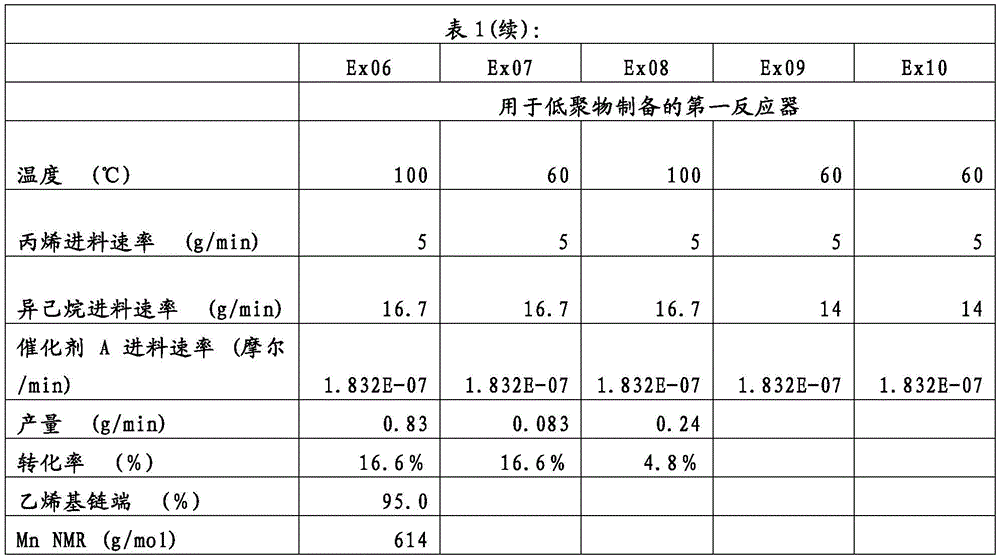

在190℃的温度下在0.01-385rad/s的角频率内测量实施例01-04中制备的聚合物的复数粘度。对于本发明材料观察到显著的剪切稀化。在0.1rad/s的频率下的复数粘度与在100rad/s的频率下的复数粘度之比对于所有四种乙烯共聚物超过200。剪切稀化行为与使用齐格勒-纳塔催化剂例如VistalonTM 8600制得的支化EPDM相似。Vistalon 8600是具有双峰MWD、81(1+4,125℃)的门尼粘度和8.9wt%的ENB可以从ExxonMobil ChemicalCompany获得的支化乙烯/丙烯/ENB三元共聚物(EPDM)。附图中对于Vistalon 8600所示的剪切流变学数据在200℃的温度下测量。The complex viscosities of the polymers prepared in Examples 01-04 were measured at an angular frequency of 0.01-385 rad/s at a temperature of 190°C. Significant shear thinning was observed for the materials of the present invention. The ratio of the complex viscosity at a frequency of 0.1 rad/s to the complex viscosity at a frequency of 100 rad/s exceeds 200 for all four ethylene copolymers. The shear thinning behavior is similar to branched EPDM made using Ziegler-Natta catalysts such as
图1中示出了与Vistalon 8600相比的实施例01-04中制备的乙烯共聚物的VanGurp-Palmen绘图。本发明乙烯共聚物在宽的复数剪切模量范围内具有比Vistalon 8600更低的相角。VanGurp-Palmen plots of the ethylene copolymers prepared in Examples 01-04 compared to
实施例09和10中制得的乙烯共聚物是具有大约2wt%的ENB含量的EPDM。这两种产物在与用于实施例1-8的那些相似的工艺条件下制备,不同之处在于ENB供入第二反应器。The ethylene copolymers prepared in Examples 09 and 10 were EPDM with an ENB content of about 2 wt%. Both products were prepared under process conditions similar to those used for Examples 1-8, except that ENB was fed to the second reactor.
使用这里描述的程序让实施例09中制得的乙烯共聚物经历索格利特(Soxhlet)萃取以除去游离低聚物。获得25.2wt%的共沸物可溶物。这种样品中的油(游离低聚物)含量是大约33.7phr。The ethylene copolymer prepared in Example 09 was subjected to Soxhlet extraction to remove free oligomers using the procedure described here. 25.2 wt% azeotrope solubles were obtained. The oil (free oligomer) content in this sample was approximately 33.7 phr.
还使用GPC-IR技术分析一些乙烯共聚物的分子量和组成分布。在GPC-IR分析之前除去这些样品中的游离油(未引入到乙烯共聚物中)。对于试验样品观察到双峰分子量和组成分布。该双峰性质归因于所述乙烯共聚物的两种组分。更低分子量组分主要衍生自第二反应器中制得的催化剂A,而更高分子量组分主要由催化剂B制得。可以使用工艺条件调节这种分布。The molecular weight and composition distribution of some ethylene copolymers were also analyzed using the GPC-IR technique. Free oil (not incorporated into the ethylene copolymer) was removed from these samples prior to GPC-IR analysis. A bimodal molecular weight and composition distribution was observed for the test samples. This bimodal nature is due to the two components of the ethylene copolymer. The lower molecular weight components are mainly derived from catalyst A produced in the second reactor, while the higher molecular weight components are mainly produced from catalyst B. This distribution can be adjusted using process conditions.
Claims (14)
Applications Claiming Priority (3)
| Application Number | Priority Date | Filing Date | Title |
|---|---|---|---|
| US201562209560P | 2015-08-25 | 2015-08-25 | |
| US62/209,560 | 2015-08-25 | ||
| PCT/US2016/040959 WO2017034680A1 (en) | 2015-08-25 | 2016-07-05 | Ethylene copolymer with in-situ oil production |
Publications (2)
| Publication Number | Publication Date |
|---|---|
| CN107922689A CN107922689A (en) | 2018-04-17 |
| CN107922689B true CN107922689B (en) | 2020-09-08 |
Family
ID=56511904
Family Applications (1)
| Application Number | Title | Priority Date | Filing Date |
|---|---|---|---|
| CN201680048781.9A Active CN107922689B (en) | 2015-08-25 | 2016-07-05 | Ethylene copolymers with in situ oil production |
Country Status (6)
| Country | Link |
|---|---|
| US (1) | US10519305B2 (en) |
| EP (1) | EP3341437B1 (en) |
| JP (1) | JP6654234B2 (en) |
| KR (1) | KR102138751B1 (en) |
| CN (1) | CN107922689B (en) |
| WO (1) | WO2017034680A1 (en) |
Families Citing this family (17)
| Publication number | Priority date | Publication date | Assignee | Title |
|---|---|---|---|---|
| US9796795B2 (en) | 2015-01-14 | 2017-10-24 | Exxonmobil Chemical Patents Inc. | Tetrahydroindacenyl catalyst composition, catalyst system, and processes for use thereof |
| EP3274380B1 (en) | 2015-04-20 | 2020-08-19 | ExxonMobil Chemical Patents Inc. | Catalyst composition comprising fluorided support and processes for use thereof |
| EP3286231B1 (en) | 2015-04-20 | 2019-10-09 | ExxonMobil Chemical Patents Inc. | Catalyst composition comprising fluorided support and processes for use thereof |
| US9803037B1 (en) | 2016-05-03 | 2017-10-31 | Exxonmobil Chemical Patents Inc. | Tetrahydro-as-indacenyl catalyst composition, catalyst system, and processes for use thereof |
| DE102017121303A1 (en) * | 2017-09-14 | 2019-03-14 | Arntz Beteiligungs Gmbh & Co. Kg | Rubberised textile material for a belt layer, associated rubber compound and belt |
| CN107602765B (en) * | 2017-09-26 | 2019-11-22 | 青岛瑞林材料科技有限公司 | A kind of preparation method of oil-filled polydiene rubber |
| US10703838B2 (en) | 2017-10-31 | 2020-07-07 | Exxonmobil Chemical Patents Inc. | Mixed catalyst systems with four metallocenes on a single support |
| US11041035B2 (en) | 2018-03-08 | 2021-06-22 | Exxonmobil Chemical Patents Inc. | Process to produce long-chain branched polyolefins using dienes |
| US11053329B2 (en) | 2018-03-19 | 2021-07-06 | Exxonmobil Chemical Patents Inc. | Multiple non-coordinating anion activators for propylene-ethylene-diene monomer polymerization reactions |
| WO2019194959A1 (en) | 2018-04-06 | 2019-10-10 | Exxonmobil Chemical Patents Inc. | Compatibilized thermoplastic vulcanizate compositions |
| CN112771085B (en) * | 2018-09-28 | 2023-07-21 | 波士胶公司 | Methods of making plasticized polymers, methods of making compositions using plasticized polymers, and compositions comprising plasticized polymers |
| US12202920B2 (en) | 2019-01-08 | 2025-01-21 | ExxonMobil Engineering & Technology Company | Olefin polymerization processes featuring in situ blending of an oil extension |
| WO2020263681A1 (en) * | 2019-06-26 | 2020-12-30 | Dow Global Technologies Llc | Controlled long chain branching in epdm by post-reactor modification |
| BR112021025999A2 (en) * | 2019-06-26 | 2022-02-08 | Dow Global Technologies Llc | Composition, b terpolymer, nr terpolymer, and nr epdm |
| CN114423838B (en) | 2019-07-17 | 2023-11-24 | 埃克森美孚化学专利公司 | Pressure sensitive adhesive comprising propylene-ethylene (-diene) copolymer |
| CN115380073A (en) | 2020-03-30 | 2022-11-22 | 埃克森美孚化学专利公司 | Comb block copolymers and methods thereof |
| KR102769120B1 (en) * | 2022-05-04 | 2025-02-14 | 디엘케미칼 주식회사 | Process oil for rubber processing, and rubber composition comprising the same |
Citations (3)
| Publication number | Priority date | Publication date | Assignee | Title |
|---|---|---|---|---|
| EP1473323A1 (en) * | 2003-04-28 | 2004-11-03 | Tosoh Corporation | Polyethylene composition and process for producing same |
| CN101679560A (en) * | 2007-05-14 | 2010-03-24 | 埃克森美孚化学专利公司 | Ethylene elastomer composition |
| WO2014120478A1 (en) * | 2013-01-30 | 2014-08-07 | Exxonmobil Chemical Patents Inc. | Polyethylene copolymers with vinyl terminated macromonomers as comonomers |
Family Cites Families (13)
| Publication number | Priority date | Publication date | Assignee | Title |
|---|---|---|---|---|
| US5120790A (en) * | 1987-05-07 | 1992-06-09 | The B. F. Goodrich Company | Blends of comb-shaped copolymers of a macromolecular monomer of polylactone with polymer (s) |
| AU4928993A (en) * | 1992-09-29 | 1994-04-26 | Exxon Chemical Patents Inc. | Long chain branched polymers and a process to make long chain branched polymers |
| US6225426B1 (en) * | 1996-04-10 | 2001-05-01 | Uniroyal Chemical Company, Inc. | Process for producing polyolefin elastomer employing a metallocene catalyst |
| WO2001007493A1 (en) * | 1999-07-26 | 2001-02-01 | Idemitsu Petrochemical Co., Ltd. | Branched olefinic macromonomer, olefin graft copolymer, and olefin resin composition |
| US7223822B2 (en) * | 2002-10-15 | 2007-05-29 | Exxonmobil Chemical Patents Inc. | Multiple catalyst and reactor system for olefin polymerization and polymers produced therefrom |
| KR101113341B1 (en) * | 2002-10-15 | 2012-09-27 | 엑손모빌 케미칼 패턴츠 인코포레이티드 | Multiple catalyst system for olefin polymerization and polymers produced therefrom |
| US7935760B2 (en) * | 2005-06-22 | 2011-05-03 | Exxonmobil Chemical Patents Inc. | Process of making a heterogeneous polymer blend |
| US7928164B2 (en) * | 2005-06-22 | 2011-04-19 | Exxonmobil Chemical Patents Inc. | Homogeneous polymer blend and process of making the same |
| US8283428B2 (en) | 2008-06-20 | 2012-10-09 | Exxonmobil Chemical Patents Inc. | Polymacromonomer and process for production thereof |
| US8106127B2 (en) * | 2008-12-15 | 2012-01-31 | Exxonmobil Chemical Patents Inc. | Heterogeneous in-reactor polymer blends |
| US8101685B2 (en) * | 2008-12-15 | 2012-01-24 | Exxonmobil Chemical Patents Inc. | Thermoplastic elastomer polyolefin in-reactor blends and molded articles therefrom |
| US20140213745A1 (en) * | 2013-01-30 | 2014-07-31 | Exxonmobil Chemical Patents Inc. | Branched Propylene Oligomers |
| US9422385B2 (en) * | 2013-01-30 | 2016-08-23 | Exxonmobil Chemical Patents Inc. | Polyethylene copolymers with vinyl terminated macromonomers as comonomers |
-
2016
- 2016-07-05 CN CN201680048781.9A patent/CN107922689B/en active Active
- 2016-07-05 WO PCT/US2016/040959 patent/WO2017034680A1/en not_active Ceased
- 2016-07-05 KR KR1020187004562A patent/KR102138751B1/en active Active
- 2016-07-05 JP JP2018510506A patent/JP6654234B2/en active Active
- 2016-07-05 EP EP16742100.7A patent/EP3341437B1/en active Active
- 2016-07-05 US US15/744,908 patent/US10519305B2/en active Active
Patent Citations (3)
| Publication number | Priority date | Publication date | Assignee | Title |
|---|---|---|---|---|
| EP1473323A1 (en) * | 2003-04-28 | 2004-11-03 | Tosoh Corporation | Polyethylene composition and process for producing same |
| CN101679560A (en) * | 2007-05-14 | 2010-03-24 | 埃克森美孚化学专利公司 | Ethylene elastomer composition |
| WO2014120478A1 (en) * | 2013-01-30 | 2014-08-07 | Exxonmobil Chemical Patents Inc. | Polyethylene copolymers with vinyl terminated macromonomers as comonomers |
Also Published As
| Publication number | Publication date |
|---|---|
| WO2017034680A1 (en) | 2017-03-02 |
| US10519305B2 (en) | 2019-12-31 |
| EP3341437B1 (en) | 2024-04-10 |
| EP3341437A1 (en) | 2018-07-04 |
| CN107922689A (en) | 2018-04-17 |
| US20180208757A1 (en) | 2018-07-26 |
| KR20180030659A (en) | 2018-03-23 |
| JP6654234B2 (en) | 2020-02-26 |
| KR102138751B1 (en) | 2020-07-28 |
| JP2018525504A (en) | 2018-09-06 |
Similar Documents
| Publication | Publication Date | Title |
|---|---|---|
| CN107922689B (en) | Ethylene copolymers with in situ oil production | |
| CN110845801B (en) | Polymer composition and process for producing the same | |
| JP5331103B2 (en) | Ethylene elastomer composition | |
| KR101791810B1 (en) | Process to produce ethylene propylene copolymers | |
| CN1878799A (en) | Transparent and translucent crosslinked propylenebased elastomers, and their production and use | |
| EP3827033B1 (en) | Preparation of bimodal rubber, thermoplastic vulcanizates, and articles made therefrom | |
| US11466149B2 (en) | Preparation of bimodal rubber, thermoplastic vulcanizates, and articles made therefrom | |
| CN104968693B (en) | Polyethylene copolymers containing vinyl-terminated macromonomers as comonomers | |
| CN107847920A (en) | Substituted double indenyl metallocene catalyst compounds comprising Si Si abutments | |
| CN109641990B (en) | Dual metallocene catalyst copolymer compositions | |
| EP3638730B1 (en) | Ethylene copolymer blends for cross-linking applications | |
| CN112805329B (en) | Process for preparing polymer compositions with enhanced elasticity by employing VTP and HMP catalyst systems in parallel process | |
| EP4121468A1 (en) | Ethylene-copolymers and catalyst mixture for making ethylene copolymers |
Legal Events
| Date | Code | Title | Description |
|---|---|---|---|
| PB01 | Publication | ||
| PB01 | Publication | ||
| SE01 | Entry into force of request for substantive examination | ||
| SE01 | Entry into force of request for substantive examination | ||
| GR01 | Patent grant | ||
| GR01 | Patent grant |