Disclosure of Invention
An object of one embodiment of the present disclosure is to provide a novel semiconductor device and a method for manufacturing the same, which can improve the conversion efficiency of a solar cell.
According to an embodiment of the present disclosure, there is provided a method of manufacturing a semiconductor device, including: providing a substrate structure, the substrate structure comprising: a conductive layer; and a plurality of nanopillars spaced apart from each other over the conductive layer, each nanopillar including a first semiconductor layer and a second semiconductor layer on the first semiconductor layer, the first semiconductor layer being of a different conductivity type than the second semiconductor layer; forming a graphene layer over the plurality of nanopillars, wherein the graphene layer over each nanopillar is in communication with each other.
In one embodiment, each of the nanopillars further comprises an aluminum layer on the second semiconductor layer.
In one embodiment, the substrate structure further comprises a substrate, the conductive layer being located on the substrate.
In one embodiment, the substrate structure further comprises: a third semiconductor layer on the conductive layer, a material of the third semiconductor layer being the same as a material of the first semiconductor layer; the plurality of nano-pillars is located over the third semiconductor layer.
In one embodiment, the step of providing a substrate structure comprises: providing an initial substrate structure comprising: a conductive layer; a first semiconductor layer on the conductive layer; a second semiconductor layer on the first semiconductor layer; and an aluminum layer on the second semiconductor layer; oxidizing an upper portion of the aluminum layer by an anodic oxidation process to form an aluminum oxide layer, wherein a plurality of nanopores are formed in the aluminum oxide layer, the nanopores extending from an upper surface of the aluminum oxide layer to a lower portion of the aluminum layer; filling a hard mask in the plurality of nanopores; etching the aluminum oxide layer, the lower part of the aluminum layer, the second semiconductor layer and at least one part of the first semiconductor layer in sequence by taking the hard mask as a mask; removing the hard mask, thereby forming the plurality of nanopillars.
In one embodiment, the material of the first semiconductor layer and the second semiconductor layer comprises silicon; the etching the aluminum oxide layer, the lower portion of the aluminum layer, the second semiconductor layer, and at least a portion of the first semiconductor layer in sequence using the hard mask as a mask includes: etching the aluminum oxide layer and the aluminum layer by using the second semiconductor layer as a stop layer and using Cl-containing plasma; etching at least a portion of the second semiconductor layer and the first semiconductor layer using a plasma comprising F.
In one embodiment, the anodizing process is performed using a neutral electrolyte including ammonium pentaborate and ammonium adipate and/or an acidic electrolyte including phosphoric acid and oxalic acid at a voltage of 0-100V.
In one embodiment, the method further comprises: and after removing the hard mask, cleaning the surface of the aluminum layer in the nano-pillar.
In one embodiment, the forming a continuous graphene layer over the plurality of nanopillars comprises: forming a graphene layer on a metal substrate in advance; transferring the graphene layer formed on the metal substrate onto the plurality of nanopillars.
In one embodiment, the method further comprises: forming a protective layer on the graphene layer.
In one embodiment, the nanopore has a lateral dimension of 5-5000 nm.
In one embodiment, the lateral dimension of the nanopillars is 5-5000 nm.
In one embodiment, the material of the first semiconductor layer is the same as the material of the second semiconductor layer.
In one embodiment, a material of the first semiconductor layer and a material of the second semiconductor layer are different.
According to another embodiment of the present disclosure, there is provided a semiconductor device including: a conductive layer; a plurality of nanopillars spaced apart from each other over the conductive layer, each nanopillar including a first semiconductor layer and a second semiconductor layer on the first semiconductor layer, the first semiconductor layer being of a different conductivity type than the second semiconductor layer; and a graphene layer over the plurality of nanopillars, wherein the graphene layer over each nanopillar is in communication with each other.
In one embodiment, each of the nanopillars further comprises an aluminum layer on the second semiconductor layer.
In one embodiment, the apparatus further comprises: a third semiconductor layer on the conductive layer, a material of the third semiconductor layer being the same as a material of the first semiconductor layer; wherein the plurality of nanopillars is located over the third semiconductor layer.
In one embodiment, the apparatus further comprises: a substrate, the conductive layer being located on the substrate.
In one embodiment, the apparatus further comprises: a protective layer on the graphene layer.
In one embodiment, the lateral dimension of the nanopillars is 5-5000 nm.
In one embodiment, the material of the first semiconductor layer is the same as the material of the second semiconductor layer.
In one embodiment, a material of the first semiconductor layer and a material of the second semiconductor layer are different.
Other features, aspects, and advantages of the present disclosure will become apparent from the following detailed description of exemplary embodiments thereof, which is to be read in connection with the accompanying drawings.
Detailed Description
Various exemplary embodiments of the present disclosure will now be described in detail with reference to the accompanying drawings. It should be understood that the relative arrangement of parts and steps, numerical expressions, and numerical values set forth in these embodiments should not be construed as limiting the scope of the present invention unless it is specifically stated otherwise.
Further, it should be understood that the dimensions of the various elements shown in the figures are not necessarily drawn to scale relative to actual scale, for example, the thickness or width of some layers may be exaggerated relative to other layers for ease of illustration.
The following description of the exemplary embodiment(s) is merely illustrative and is not intended to limit the invention, its application, or uses in any way.
Techniques, methods, and apparatus known to those of ordinary skill in the relevant art may not be discussed in detail, but are intended to be part of the specification as applicable.
It should be noted that like reference numerals and letters refer to like items in the following figures, and thus, once an item is defined or illustrated in one figure, further discussion thereof will not be required in the subsequent description of the figures.
Fig. 1 is a simplified flow diagram of a method of manufacturing a semiconductor device according to one embodiment of the present disclosure. As shown in fig. 1, the method comprises the steps of:
step 102, a substrate structure is provided. The substrate structure includes a conductive layer and a plurality of nano-pillars spaced apart from each other over the conductive layer. Each nano column comprises a first semiconductor layer and a second semiconductor layer on the first semiconductor layer, the conductivity types of the first semiconductor layer and the second semiconductor layer are different, and a PN junction is formed at the contact interface of the first semiconductor layer and the second semiconductor layer.
At step 104, a graphene layer is formed over the plurality of nanopillars, wherein the graphene layer over each nanopillar is in communication with each other.
Compared with the conventional solar cell, the semiconductor device obtained by the manufacturing method provided by the disclosure can be used as the solar cell, and on one hand, the surface area of the nano-column is obviously increased, so that the absorption efficiency of photons can be greatly improved, and the conversion efficiency of the solar cell is improved; on the other hand, the graphene layer is used as an electrode of the solar cell, so that the contact resistance between the electrode and a semiconductor can be reduced, the electromigration speed is improved, and the conversion efficiency of the solar cell is improved.
Fig. 2A-2C illustrate various stages of a method of fabricating a semiconductor device according to one embodiment of the present disclosure. A method of manufacturing a semiconductor device according to an embodiment of the present disclosure is described in detail below with reference to fig. 2A to 2C.
First, as shown in fig. 2A, a substrate structure is provided. The substrate structure includes a conductive layer 201 and a plurality of nano-pillars 202 spaced apart from each other over the conductive layer 201. Among them, the material of the conductive layer 201 may be an electrode material such as Al. Each of the nano-pillars 202 includes a first semiconductor layer 212 and a second semiconductor layer 222 on the first semiconductor layer 212. Here, the first semiconductor layer 212 and the second semiconductor layer 222 are different in conductivity type, so that a PN junction 232 may be formed at a contact interface of the first semiconductor layer 212 and the second semiconductor layer 222. In one embodiment, the material of the first semiconductor layer 212 and the material of the second semiconductor layer 222 may be the same, thereby forming a homojunction PN at the contact interface of the first semiconductor layer 212 and the second semiconductor layer 222. In another embodiment, the material of the first semiconductor layer 212 and the material of the second semiconductor layer 222 may also be different, so that a hetero PN junction is formed at a contact interface of the first semiconductor layer 212 and the second semiconductor layer 222. In addition, the substrate structure may further include a substrate (not shown), and the conductive layer 212 may be on the substrate.
Thereafter, as shown in fig. 2B, a graphene layer 203 is formed over the plurality of nanopillars 202, wherein the graphene layer 203 over each nanopillar 202 is in communication with each other. In one embodiment, the graphene layer may be formed on a metal substrate such as copper, platinum, tungsten, or nickel in advance; then, the graphene layer formed on the metal substrate is transferred onto the plurality of nanopillars. For example, a graphene layer may be deposited on a copper substrate by Chemical Vapor Deposition (CVD) or Plasma Enhanced Chemical Vapor Deposition (PECVD) at a temperature of 700-; and then transferring the graphene layer onto the nano-pillars by means of wet transfer. However, the present disclosure is not limited thereto, and the transfer of the graphene may be performed in other manners.
The structure of the resulting semiconductor device is described below with reference to fig. 2B.
As shown in fig. 2B, the semiconductor device includes: an electrically conductive layer 201, a plurality of nanopillars 202 spaced apart from one another over the electrically conductive layer 201, and a graphene layer 203 over the plurality of nanopillars 202, wherein the graphene layer 203 over each nanopillar 202 is in communication with one another. Each of the nano-pillars 202 includes a first semiconductor layer 212 and a second semiconductor layer 222 on the first semiconductor layer 212, the first semiconductor layer 212 and the second semiconductor layer 222 have different conductivity types, and a PN junction 232 may be formed at a contact interface of the first semiconductor layer 212 and the second semiconductor layer 222. In one embodiment, the lateral dimension of the nanopillars may be 5-5000 nm.
Thereafter, as shown in fig. 2C, a protective layer 204 may also be formed on the graphene layer 203 in the semiconductor device shown in fig. 2B. Preferably, the protective layer 204 may be a glass film; more preferably, the protective layer 204 may be a silica glass film.
Fig. 3A-3C illustrate various stages of a method of fabricating a semiconductor device according to another embodiment of the present disclosure. It should be noted that, since the manufacturing process of the semiconductor device has been described in detail with reference to fig. 2A to 2C, the present embodiment only focuses on the differences from the above embodiments, and reference may be made to the description of the above embodiments for relevant points.
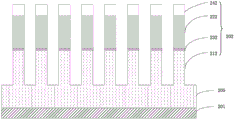
First, as shown in fig. 3A, a substrate structure is provided. In contrast to the substrate structure shown in fig. 2A, each of the nano-pillars in the substrate structure shown in fig. 3A may further include an aluminum layer 242 on the second semiconductor layer 222. In addition, the substrate structure shown in fig. 3A may further include a third semiconductor layer 205 on the conductive layer 201, and the plurality of nano-pillars 202 are located on the third semiconductor layer 205. Here, the material of the third semiconductor layer 205 is the same as that of the first semiconductor layer 212, and is, for example, silicon. Note that since the material of the third semiconductor layer 205 is the same as that of the first semiconductor layer 212, fig. 3A integrally shows the third semiconductor layer 205 and the first semiconductor layer 212.
Then, as shown in fig. 3B, a graphene layer 203 is formed over the plurality of nanopillars 202, wherein the graphene layer 203 over each nanopillar 202 is in communication with each other. The graphene layer 203 may be formed according to the above-described manner, and will not be described in detail herein.
The structure of the resulting semiconductor device is described below with reference to fig. 3B.
As shown in fig. 3B, the semiconductor device includes: the semiconductor device includes an electrically conductive layer 201, a third semiconductor layer 205 on the electrically conductive layer 201, a plurality of nanopillars 202 spaced apart from each other on top of the third semiconductor layer 205, and a graphene layer 203 on top of the plurality of nanopillars 202, wherein the graphene layer 203 on top of each nanopillar 202 is in communication with each other, and a material of the third semiconductor layer 205 is the same as a material of the first semiconductor layer 212. Each of the nano-pillars 202 includes a first semiconductor layer 212, a second semiconductor layer 222 on the first semiconductor layer 212, and an aluminum layer 232 on the second semiconductor layer 222, the first semiconductor layer 212 and the second semiconductor layer 222 have different conductivity types, and a PN junction 232 is formed at a contact interface of the first semiconductor layer 212 and the second semiconductor layer 222.
Thereafter, as shown in fig. 3C, a protective layer 204, such as a glass film or the like, may also be formed on the graphene layer 203.
The substrate structures shown in fig. 2A and 3A may be formed according to different ways. One specific implementation of forming the substrate structure is described below in conjunction with fig. 4A-4E.
First, as shown in fig. 4A, an initial substrate structure is provided, which includes: a conductive layer 201, a first semiconductor layer 212 over the conductive layer 201, a second semiconductor layer 222 over the first semiconductor layer 212, and an aluminum layer 242 over the second semiconductor layer. The contact interface of the first semiconductor layer 212 and the second semiconductor layer 222 forms a PN junction 232.
Then, as shown in fig. 4B, an upper portion of the aluminum layer 242 is oxidized through an anodic oxidation process to form an aluminum oxide layer 401, wherein a plurality of nano holes 402 are formed in the aluminum oxide layer 401, and the nano holes 402 extend from an upper surface of the aluminum oxide layer 401 to a lower portion of the aluminum layer 242. It should be understood that "upper" and "lower" are merely relative concepts, i.e., the upper portion of the aluminum layer 242 is located relatively above the aluminum layer 242 with respect to the lower portion of the aluminum layer 242. In one embodiment, the lateral dimension (e.g., diameter) of the nanopore may be 5-5000nm, such as 10nm, 50nm, 100nm, 1000nm, 3000nm, and the like. In one embodiment, the above-described anodizing process may be performed using a neutral electrolyte including ammonium pentaborate and ammonium adipate and/or an acidic electrolyte including phosphoric acid and oxalic acid at a voltage of 0 to 100V. However, the present disclosure is not limited thereto. One skilled in the art can adjust the process conditions of the anodization process to obtain nanopores of different lateral dimensions in light of the teachings of the present disclosure.
It is noted that the "lateral dimension" of the nanopore/pillar herein refers to the dimension in the direction perpendicular to the direction in which the nanopore/pillar extends, e.g., the "lateral" refers to the horizontal direction if the nanopore extends vertically downward.
Next, as shown in fig. 4C, a hard mask 403 is filled in the plurality of nano holes 402. For example, a hard mask material such as titanium nitride may be deposited to fill the plurality of nanopores 402 and cover the aluminum oxide layer 401, after which the hard mask material may be planarized, e.g., Chemical Mechanical Polishing (CMP), to obtain a hard mask 403 having a surface substantially flush with the surface of the aluminum oxide layer 401.
Next, as shown in fig. 4D and 4E, the aluminum oxide layer 401, the lower portion of the aluminum layer 242, the second semiconductor layer 222, and at least a portion of the first semiconductor layer 212 are sequentially etched using the hard mask 403 as a mask. In one embodiment, the material of the first semiconductor layer 212 and the second semiconductor layer 222 may include silicon. First, the aluminum oxide layer 401 and the aluminum layer 242 may be etched using a Cl-containing plasma with the second semiconductor layer 222 as a stop layer, for example, BCl may be used3Obtaining a Cl-containing plasma as a source gas; then, at least a portion of the second semiconductor layer 222 and the first semiconductor layer 212 may be etched using the F-containing plasma.
In one implementation, as shown in fig. 4D, only a portion of the first semiconductor layer 212 may be etched away, that is, the first semiconductor layer 212 may stop in the first semiconductor layer 212 above the conductive layer 201 when etching the first semiconductor layer 212. The unetched portion 212A of the first semiconductor layer 212 serves as the third semiconductor layer 205 shown in fig. 3A, and the remaining portion 212B of the etched portion of the first semiconductor layer 212 and the second semiconductor layer 222 constitute the nanopillar 202 shown in fig. 3A.
In another implementation, as shown in fig. 4E, the first semiconductor layer 212 may be etched while stopping on the conductive layer 201.
After that, the hard mask 403 is removed, so that the substrate structure shown in fig. 3A can be formed. Preferably, after removing the hard mask 403, the surface of the aluminum layer 242 in the nanopillars may be cleaned to remove aluminum oxide of the surface of the aluminum layer. In one embodiment, the surface of the aluminum layer 242 in the nanopillars may be cleaned with a weakly alkaline cleaning agent, such as sodium carbonate or triethanolamine.
Thereafter, the aluminum layer 242 on the second semiconductor layer 222 may also be removed, thereby forming the substrate structure shown in fig. 2A.
So far, the semiconductor device and the manufacturing method thereof according to the embodiments of the present disclosure have been described in detail. Some details which are well known in the art have not been described in order to avoid obscuring the concepts of the present disclosure, and it will be fully apparent to those skilled in the art from the above description how to implement the techniques disclosed herein. In addition, the embodiments taught by the present disclosure can be freely combined. It will be appreciated by those skilled in the art that numerous modifications may be made to the embodiments described above without departing from the spirit and scope of the disclosure as defined by the appended claims.