CN107530206B - Belt with treated inner surface - Google Patents
Belt with treated inner surface Download PDFInfo
- Publication number
- CN107530206B CN107530206B CN201580079327.5A CN201580079327A CN107530206B CN 107530206 B CN107530206 B CN 107530206B CN 201580079327 A CN201580079327 A CN 201580079327A CN 107530206 B CN107530206 B CN 107530206B
- Authority
- CN
- China
- Prior art keywords
- belt structure
- absorbent article
- belt
- personal care
- care composition
- Prior art date
- Legal status (The legal status is an assumption and is not a legal conclusion. Google has not performed a legal analysis and makes no representation as to the accuracy of the status listed.)
- Active
Links
Images




Classifications
-
- A—HUMAN NECESSITIES
- A61—MEDICAL OR VETERINARY SCIENCE; HYGIENE
- A61L—METHODS OR APPARATUS FOR STERILISING MATERIALS OR OBJECTS IN GENERAL; DISINFECTION, STERILISATION OR DEODORISATION OF AIR; CHEMICAL ASPECTS OF BANDAGES, DRESSINGS, ABSORBENT PADS OR SURGICAL ARTICLES; MATERIALS FOR BANDAGES, DRESSINGS, ABSORBENT PADS OR SURGICAL ARTICLES
- A61L15/00—Chemical aspects of, or use of materials for, bandages, dressings or absorbent pads
- A61L15/16—Bandages, dressings or absorbent pads for physiological fluids such as urine or blood, e.g. sanitary towels, tampons
- A61L15/40—Bandages, dressings or absorbent pads for physiological fluids such as urine or blood, e.g. sanitary towels, tampons containing ingredients of undetermined constitution or reaction products thereof, e.g. plant or animal extracts
-
- A—HUMAN NECESSITIES
- A61—MEDICAL OR VETERINARY SCIENCE; HYGIENE
- A61F—FILTERS IMPLANTABLE INTO BLOOD VESSELS; PROSTHESES; DEVICES PROVIDING PATENCY TO, OR PREVENTING COLLAPSING OF, TUBULAR STRUCTURES OF THE BODY, e.g. STENTS; ORTHOPAEDIC, NURSING OR CONTRACEPTIVE DEVICES; FOMENTATION; TREATMENT OR PROTECTION OF EYES OR EARS; BANDAGES, DRESSINGS OR ABSORBENT PADS; FIRST-AID KITS
- A61F13/00—Bandages or dressings; Absorbent pads
- A61F13/15—Absorbent pads, e.g. sanitary towels, swabs or tampons for external or internal application to the body; Supporting or fastening means therefor; Tampon applicators
- A61F13/45—Absorbent pads, e.g. sanitary towels, swabs or tampons for external or internal application to the body; Supporting or fastening means therefor; Tampon applicators characterised by the shape
- A61F13/49—Absorbent pads, e.g. sanitary towels, swabs or tampons for external or internal application to the body; Supporting or fastening means therefor; Tampon applicators characterised by the shape specially adapted to be worn around the waist, e.g. diapers, nappies
- A61F13/49007—Form-fitting, self-adjusting disposable diapers
- A61F13/49009—Form-fitting, self-adjusting disposable diapers with elastic means
- A61F13/49011—Form-fitting, self-adjusting disposable diapers with elastic means the elastic means is located at the waist region
-
- A—HUMAN NECESSITIES
- A61—MEDICAL OR VETERINARY SCIENCE; HYGIENE
- A61F—FILTERS IMPLANTABLE INTO BLOOD VESSELS; PROSTHESES; DEVICES PROVIDING PATENCY TO, OR PREVENTING COLLAPSING OF, TUBULAR STRUCTURES OF THE BODY, e.g. STENTS; ORTHOPAEDIC, NURSING OR CONTRACEPTIVE DEVICES; FOMENTATION; TREATMENT OR PROTECTION OF EYES OR EARS; BANDAGES, DRESSINGS OR ABSORBENT PADS; FIRST-AID KITS
- A61F13/00—Bandages or dressings; Absorbent pads
- A61F13/15—Absorbent pads, e.g. sanitary towels, swabs or tampons for external or internal application to the body; Supporting or fastening means therefor; Tampon applicators
- A61F13/45—Absorbent pads, e.g. sanitary towels, swabs or tampons for external or internal application to the body; Supporting or fastening means therefor; Tampon applicators characterised by the shape
- A61F13/49—Absorbent pads, e.g. sanitary towels, swabs or tampons for external or internal application to the body; Supporting or fastening means therefor; Tampon applicators characterised by the shape specially adapted to be worn around the waist, e.g. diapers, nappies
- A61F13/49058—Absorbent pads, e.g. sanitary towels, swabs or tampons for external or internal application to the body; Supporting or fastening means therefor; Tampon applicators characterised by the shape specially adapted to be worn around the waist, e.g. diapers, nappies characterised by the modular concept of constructing the diaper
- A61F13/4906—Absorbent pads, e.g. sanitary towels, swabs or tampons for external or internal application to the body; Supporting or fastening means therefor; Tampon applicators characterised by the shape specially adapted to be worn around the waist, e.g. diapers, nappies characterised by the modular concept of constructing the diaper the diaper having an outer chassis forming the diaper and an independent absorbent structure attached to the chassis
- A61F13/49061—Absorbent pads, e.g. sanitary towels, swabs or tampons for external or internal application to the body; Supporting or fastening means therefor; Tampon applicators characterised by the shape specially adapted to be worn around the waist, e.g. diapers, nappies characterised by the modular concept of constructing the diaper the diaper having an outer chassis forming the diaper and an independent absorbent structure attached to the chassis the diaper having one or two waist members forming the diaper waist region and an independent absorbent structure attached to the one or two waist members forming the crotch region
-
- A—HUMAN NECESSITIES
- A61—MEDICAL OR VETERINARY SCIENCE; HYGIENE
- A61F—FILTERS IMPLANTABLE INTO BLOOD VESSELS; PROSTHESES; DEVICES PROVIDING PATENCY TO, OR PREVENTING COLLAPSING OF, TUBULAR STRUCTURES OF THE BODY, e.g. STENTS; ORTHOPAEDIC, NURSING OR CONTRACEPTIVE DEVICES; FOMENTATION; TREATMENT OR PROTECTION OF EYES OR EARS; BANDAGES, DRESSINGS OR ABSORBENT PADS; FIRST-AID KITS
- A61F13/00—Bandages or dressings; Absorbent pads
- A61F13/15—Absorbent pads, e.g. sanitary towels, swabs or tampons for external or internal application to the body; Supporting or fastening means therefor; Tampon applicators
- A61F13/51—Absorbent pads, e.g. sanitary towels, swabs or tampons for external or internal application to the body; Supporting or fastening means therefor; Tampon applicators characterised by the outer layers of the pads
- A61F13/511—Topsheet, i.e. the permeable cover or layer facing the skin
- A61F13/51113—Topsheet, i.e. the permeable cover or layer facing the skin comprising an additive, e.g. lotion or odour control
-
- A—HUMAN NECESSITIES
- A61—MEDICAL OR VETERINARY SCIENCE; HYGIENE
- A61F—FILTERS IMPLANTABLE INTO BLOOD VESSELS; PROSTHESES; DEVICES PROVIDING PATENCY TO, OR PREVENTING COLLAPSING OF, TUBULAR STRUCTURES OF THE BODY, e.g. STENTS; ORTHOPAEDIC, NURSING OR CONTRACEPTIVE DEVICES; FOMENTATION; TREATMENT OR PROTECTION OF EYES OR EARS; BANDAGES, DRESSINGS OR ABSORBENT PADS; FIRST-AID KITS
- A61F13/00—Bandages or dressings; Absorbent pads
- A61F13/15—Absorbent pads, e.g. sanitary towels, swabs or tampons for external or internal application to the body; Supporting or fastening means therefor; Tampon applicators
- A61F13/84—Accessories, not otherwise provided for, for absorbent pads
- A61F13/8405—Additives, e.g. for odour, disinfectant or pH control
-
- A—HUMAN NECESSITIES
- A61—MEDICAL OR VETERINARY SCIENCE; HYGIENE
- A61L—METHODS OR APPARATUS FOR STERILISING MATERIALS OR OBJECTS IN GENERAL; DISINFECTION, STERILISATION OR DEODORISATION OF AIR; CHEMICAL ASPECTS OF BANDAGES, DRESSINGS, ABSORBENT PADS OR SURGICAL ARTICLES; MATERIALS FOR BANDAGES, DRESSINGS, ABSORBENT PADS OR SURGICAL ARTICLES
- A61L15/00—Chemical aspects of, or use of materials for, bandages, dressings or absorbent pads
- A61L15/16—Bandages, dressings or absorbent pads for physiological fluids such as urine or blood, e.g. sanitary towels, tampons
- A61L15/20—Bandages, dressings or absorbent pads for physiological fluids such as urine or blood, e.g. sanitary towels, tampons containing organic materials
-
- A—HUMAN NECESSITIES
- A61—MEDICAL OR VETERINARY SCIENCE; HYGIENE
- A61L—METHODS OR APPARATUS FOR STERILISING MATERIALS OR OBJECTS IN GENERAL; DISINFECTION, STERILISATION OR DEODORISATION OF AIR; CHEMICAL ASPECTS OF BANDAGES, DRESSINGS, ABSORBENT PADS OR SURGICAL ARTICLES; MATERIALS FOR BANDAGES, DRESSINGS, ABSORBENT PADS OR SURGICAL ARTICLES
- A61L15/00—Chemical aspects of, or use of materials for, bandages, dressings or absorbent pads
- A61L15/16—Bandages, dressings or absorbent pads for physiological fluids such as urine or blood, e.g. sanitary towels, tampons
- A61L15/22—Bandages, dressings or absorbent pads for physiological fluids such as urine or blood, e.g. sanitary towels, tampons containing macromolecular materials
- A61L15/32—Proteins, polypeptides; Degradation products or derivatives thereof, e.g. albumin, collagen, fibrin, gelatin
-
- A—HUMAN NECESSITIES
- A61—MEDICAL OR VETERINARY SCIENCE; HYGIENE
- A61L—METHODS OR APPARATUS FOR STERILISING MATERIALS OR OBJECTS IN GENERAL; DISINFECTION, STERILISATION OR DEODORISATION OF AIR; CHEMICAL ASPECTS OF BANDAGES, DRESSINGS, ABSORBENT PADS OR SURGICAL ARTICLES; MATERIALS FOR BANDAGES, DRESSINGS, ABSORBENT PADS OR SURGICAL ARTICLES
- A61L15/00—Chemical aspects of, or use of materials for, bandages, dressings or absorbent pads
- A61L15/16—Bandages, dressings or absorbent pads for physiological fluids such as urine or blood, e.g. sanitary towels, tampons
- A61L15/42—Use of materials characterised by their function or physical properties
- A61L15/48—Surfactants
-
- A—HUMAN NECESSITIES
- A61—MEDICAL OR VETERINARY SCIENCE; HYGIENE
- A61F—FILTERS IMPLANTABLE INTO BLOOD VESSELS; PROSTHESES; DEVICES PROVIDING PATENCY TO, OR PREVENTING COLLAPSING OF, TUBULAR STRUCTURES OF THE BODY, e.g. STENTS; ORTHOPAEDIC, NURSING OR CONTRACEPTIVE DEVICES; FOMENTATION; TREATMENT OR PROTECTION OF EYES OR EARS; BANDAGES, DRESSINGS OR ABSORBENT PADS; FIRST-AID KITS
- A61F13/00—Bandages or dressings; Absorbent pads
- A61F13/15—Absorbent pads, e.g. sanitary towels, swabs or tampons for external or internal application to the body; Supporting or fastening means therefor; Tampon applicators
- A61F13/51—Absorbent pads, e.g. sanitary towels, swabs or tampons for external or internal application to the body; Supporting or fastening means therefor; Tampon applicators characterised by the outer layers of the pads
- A61F2013/51059—Absorbent pads, e.g. sanitary towels, swabs or tampons for external or internal application to the body; Supporting or fastening means therefor; Tampon applicators characterised by the outer layers of the pads being sprayed with chemicals
-
- A—HUMAN NECESSITIES
- A61—MEDICAL OR VETERINARY SCIENCE; HYGIENE
- A61F—FILTERS IMPLANTABLE INTO BLOOD VESSELS; PROSTHESES; DEVICES PROVIDING PATENCY TO, OR PREVENTING COLLAPSING OF, TUBULAR STRUCTURES OF THE BODY, e.g. STENTS; ORTHOPAEDIC, NURSING OR CONTRACEPTIVE DEVICES; FOMENTATION; TREATMENT OR PROTECTION OF EYES OR EARS; BANDAGES, DRESSINGS OR ABSORBENT PADS; FIRST-AID KITS
- A61F13/00—Bandages or dressings; Absorbent pads
- A61F13/15—Absorbent pads, e.g. sanitary towels, swabs or tampons for external or internal application to the body; Supporting or fastening means therefor; Tampon applicators
- A61F13/51—Absorbent pads, e.g. sanitary towels, swabs or tampons for external or internal application to the body; Supporting or fastening means therefor; Tampon applicators characterised by the outer layers of the pads
- A61F13/511—Topsheet, i.e. the permeable cover or layer facing the skin
- A61F13/51113—Topsheet, i.e. the permeable cover or layer facing the skin comprising an additive, e.g. lotion or odour control
- A61F2013/51117—Topsheet, i.e. the permeable cover or layer facing the skin comprising an additive, e.g. lotion or odour control the lotion having skin care properties
Landscapes
- Health & Medical Sciences (AREA)
- Life Sciences & Earth Sciences (AREA)
- Public Health (AREA)
- Veterinary Medicine (AREA)
- Engineering & Computer Science (AREA)
- Epidemiology (AREA)
- Animal Behavior & Ethology (AREA)
- General Health & Medical Sciences (AREA)
- Chemical & Material Sciences (AREA)
- Materials Engineering (AREA)
- Hematology (AREA)
- Biomedical Technology (AREA)
- Heart & Thoracic Surgery (AREA)
- Vascular Medicine (AREA)
- Botany (AREA)
- Chemical Kinetics & Catalysis (AREA)
- Zoology (AREA)
- Absorbent Articles And Supports Therefor (AREA)
Abstract
吸收制品(10)包括中心基础结构(20)和束带结构(30)。所述束带结构(30)包括内层和外层。所述内层可由包括内表面的内部非织造纤维网形成。所述外层可由包括外表面的外部非织造纤维网形成。所述内表面不同于所述外表面。
The absorbent article (10) includes a central chassis structure (20) and a belt structure (30). The belt structure (30) includes an inner layer and an outer layer. The inner layer may be formed from an inner nonwoven fibrous web that includes an inner surface. The outer layer may be formed from an outer nonwoven fibrous web including an outer surface. The inner surface is different from the outer surface.
Description
Technical Field
The present disclosure generally relates to pull-on disposable absorbent articles comprising an elastomeric belt, wherein the inner surface of the belt comprises a treatment.
Background
Infants and other incontinent individuals wear disposable absorbent articles such as diapers to receive and contain urine and other body exudates. Training pants or pull-on diapers have been widely used for children who are able to walk and often perform toilet training. Many disposable pull-on garments use elastic elements that are secured in an elastically contractible condition in the waist opening and/or the leg openings. Typically, to ensure a sufficient elastic fit around the legs and waist, such as with durable undergarments, the leg and waist openings are at least partially surrounded by elasticized bands of rubber or other material positioned along the periphery of each opening.
While stretchable waist openings that produce high contraction forces can help anchor the waist opening of a pull-on article to the body of the wearer, such high contraction forces sometimes not only cause difficulty for caregivers to apply and remove the absorbent article, but can also cause marks on the wearer's skin or cause the wearer to become irritated. There is a need for articles wherein the inner surface is different from the outer surface in the waist region. The inner surface contacts the skin of the wearer's skin and may be the same material as the outer surface or layer in the waist region, but it may be treated with additional materials such as lotions or surfactants which are capable of soothing or soothing the frictional forces holding the article. Or the interior surface may be treated, such as by perforation or texturing, so that the interior surface has and/or delivers a softer feel. Or the inner surface material may be completely different from the rest of the waist portion, having a higher coefficient of friction to help the article stay in place, or having a higher basis weight. Therefore, there is a continuing need for a waist interior material having properties conducive to contact with the wearer's skin. Furthermore, there is a continuing need to provide such properties that are beneficial for contacting the skin of the wearer without significantly increasing the cost of the product. Furthermore, there is a continuing need to provide such treatments on-line during the production process.
Disclosure of Invention
An absorbent article having a front waist region, a back waist region, and a crotch region, and comprising a central chassis occupying a crotch region and comprising left and right longitudinal edges; a liquid pervious topsheet; a backsheet, and an absorbent core disposed between the topsheet and the backsheet; a belt structure disposed about the central chassis, the belt structure comprising an elasticized multilayer web covering the backsheet to its exterior in the front and back waist regions, the belt structure extending laterally and longitudinally outward from the chassis and laterally from each of the left and right longitudinal edges in each of the front and back waist regions, the belt structure having a front portion with a front waist edge, front left and right leg opening edges, and front left and right side edges, and a back portion with a back waist edge, back left and right leg opening edges, and back left and right side edges, the respective front and back left side edges being joined with the respective front and back right side edges at side seams, the belt structure forming a waist opening and left leg opening with a right leg opening, wherein each of the front and back portions of the belt structure further comprises: an inner layer formed from an inner nonwoven web comprising an inner surface; an outer layer formed from an outer nonwoven web comprising an outer surface; wherein the inner surface of the belt comprises a treatment and wherein the inner surface is different from the outer surface.
Drawings
The above-mentioned and other features and advantages of this disclosure, and the manner of attaining them, will become more apparent and the disclosure itself will be better understood by reference to the following description of non-limiting embodiments of the disclosure taken in conjunction with the accompanying drawings, wherein:
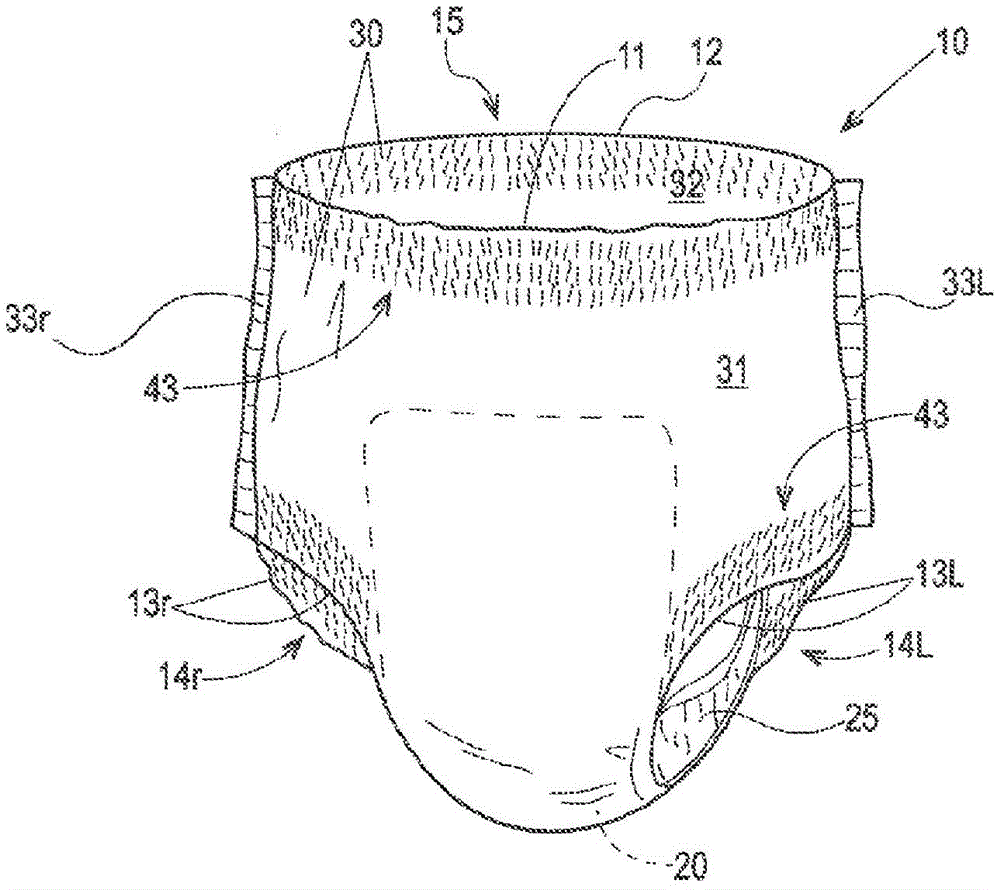
FIG. 1 is a simplified perspective view of a disposable absorbent pant;
FIG. 2 is a simplified plan view of a precursor structure of a disposable absorbent pant, shown with the inward-facing or wearer-facing surface facing upward;
fig. 3A-3C are varying longitudinal cross-sectional views taken along line 3-3 of fig. 2.
Fig. 4 is a longitudinal sectional view taken along line 4-4 of fig. 2.
Detailed Description
Various non-limiting embodiments of the present disclosure will now be described to provide a general understanding of the structural principles, function, manufacture, and use of the absorbent articles disclosed herein. One or more examples of these non-limiting embodiments are illustrated in the accompanying drawings. Those of ordinary skill in the art will understand that the absorbent articles described herein and illustrated in the accompanying drawings are non-limiting exemplary embodiments and that the scope of the various non-limiting embodiments of the present disclosure is defined solely by the claims. Features shown or described in connection with one non-limiting embodiment may be combined with features of other non-limiting embodiments. Such modifications and variations are intended to be included within the scope of the present disclosure.
The following explanations of terms may be used to understand the present disclosure:
"absorbent article" refers to pull-on garments generally worn by infants and other incontinent individuals to absorb and contain urine, feces, and/or menses. However, it should be understood that the term absorbent article also applies to other garments, such as training pants, incontinence briefs, feminine hygiene garments or panties, and the like. In some embodiments, "absorbent article" may refer to a taped diaper.
The terms "elastic," "elastomer," and "elastomeric" refer to a material that is generally capable of extending to a strain of at least 50% without breaking or rupturing and is capable of substantially returning to its original dimensions after the deforming force is removed.
"lateral" with respect to the pant and its wearer refers to a direction generally perpendicular to the height at which the wearer is standing, or horizontal when the wearer is standing. "lateral" is also a direction generally perpendicular to a line extending from the midpoint of the front waist edge to the midpoint of the back waist edge.
"longitudinal," with respect to a pant and its wearer, refers to a direction that is generally parallel to the height at which the wearer is standing, or vertical when the wearer is standing. "longitudinal" is also a direction generally parallel to a line extending from the midpoint of the front waist edge to the midpoint of the back waist edge.
As used herein, the term "pull-on garment" refers to an article of wear that has a defined waist opening and a pair of leg openings and that is worn on the body of the wearer by inserting legs into the leg openings and pulling the article up over the waist. The term "disposable" is used herein to describe garments that are not intended to be laundered or otherwise restored or reused as a garment (i.e., they are intended to be discarded after a single use and, preferably, to be recycled, composted or otherwise disposed of in an environmentally compatible manner). The pull-on garment is also preferably "absorbent" to absorb and contain the various exudates discharged from the body. The preferred embodiment of the absorbent article is a disposable absorbent pull-on garment as shown in figure 1.
The term "substrate" is used herein to describe a material that is predominantly two-dimensional (i.e., in the XY plane), and whose thickness (in the Z direction) is relatively small (i.e., 1/10 or less) compared to its length (in the X direction) and width (in the Y direction). Non-limiting examples of substrates include webs of fibers, one or more layers of fibrous material, nonwovens, and films and foils, such as, for example, polymeric films or metal foils. These materials may be used alone or may include two or more layers laminated together. Thus, the web may be a substrate or may be a laminate of two or more substrates.
Article of manufacture
The articles of the present disclosure provide a waist region having an interior surface that has been treated. Many existing absorbent pant structures have a central chassis with the backsheet and topsheet extending to and from the front and back waist edges of the pant in the region in the front portion near the wearer's navel and the back portion near the waist. The spaced apart and separate side/hip panels are joined to the longitudinal (side) edges of the front and back regions of the central chassis, joining them to form a pant structure.
An alternative configuration of an absorbent pant is one in which the central chassis does not extend to or form the front and back waist edges of the pant. Rather, the elasticized belt structure completely encircles the waist of the wearer and forms a waist edge around the entire pant and side/hip panels. The central chassis is joined to, typically on the inside of, the belt structure, with its ends disposed at a location in the front and back waist regions that is somewhat below the waist edges of the belt structure. The elastic belt is typically relatively wide (in the longitudinal direction) and elastically stretchable in the lateral direction. It completely encircles the waist of the wearer and thus covers a relatively large amount of the wearer's skin. This configuration is also sometimes referred to as a "band" or "balloon" configuration (hereinafter, "band" configuration).
Fig. 1 is a generally simplified perspective view of a disposable absorbent pant 10 having a belt configuration. The pant 10 may comprise a central chassis 20 and a belt structure 30. The belt structure 30 may be elastically extensible in the lateral direction to provide elastic stretchability for ease of donning, and a snug and comfortable fit after donning. The central chassis 20 may comprise a liquid pervious topsheet (not specifically shown in fig. 1) facing the wearer, an outward or garment facing backsheet (not specifically shown in fig. 1) and an absorbent core (not specifically shown in fig. 1) sandwiched or enclosed between the topsheet and the backsheet. Together with the central chassis in its crotch region, a pair of laterally opposing, longitudinally extending barrier cuffs 25 are also included, which are disposed adjacent to the topsheet. In general, the central chassis and barrier cuffs may have any configuration and means, including leg cuff structures, suitable for use in disposable diapers, training pants, adult incontinence pants, such as but not limited to those described in U.S. patent 8,939,957 and one or more patent applications claiming priority thereto. The belt structure 30 may have a front portion 31 and a back portion 32. The front and back portions 31,32 may be joined together at respective left and right side edge seams 33l,33 r. The belt structure 30 may form at least portions of the front and back waist edges 11,12 defining the waist opening 15, and the left and right leg opening edges 13l,13r of the pant 10.
Fig. 2 is a simplified plan view of the front body structure of the pant 10 shown in fig. 1, shown prior to joining the front and back portions 31,32 along their respective side edges 34l,35l and 34r,35 r. The front region 31a including the front portion 31 and the back region 32a including the back portion 32 may each comprise anywhere from 25% to 40% of the total longitudinal length of the precursor structure; accordingly, the crotch region 45 may comprise anywhere from 20% to 50% of the total longitudinal length of the precursor structure, wherein at least a portion thereof is located at the lateral axis LA. To form the pant 10, the precursor structure may be folded along the lateral axis LA to bring the front and back regions 31a,32a, and the front and back portions 31,32 together such that the side edges 34l,35l and 34r,35r thereof may be joined at seams 33l,33r, respectively (as shown in fig. 1). The seams 33l,33R may be formed by adhesive, heat, pressure, or ultrasonic bonding, and combinations thereof. In alternative examples, the seam may be formed by mechanical fasteners, such as mating pairs of hook-and-loop fastening components disposed along the side edges 34r,35r and 34l,35 l. The fasteners may also include tape tabs, interlocking fasteners such as tabs & slots, buckles, buttons, snaps, and/or hermaphroditic fastening elements. Exemplary surface fastening systems are disclosed in U.S. Pat. nos. 3,848,594; 4,662,875, respectively; 4,846,815; 4,894,060; 4,946,527, respectively; 5,151,092; and 5,221,274, while an exemplary interlocking fastening system is disclosed in U.S. patent 6,432,098. The fastening system may also include a primary fastening system and a secondary fastening system, as disclosed in U.S. patent 4,699,622. In addition, exemplary fasteners and fastener arrangements, fastening assemblies forming these fasteners, and materials suitable for forming fasteners are described in U.S. published patent applications 2003/0060794 and 2005/0222546 and U.S. Pat. No. 6,428,526.
Still referring to fig. 2, one or both of the front and back portions 31,32 may include at least a first elastic member 36,37 disposed closer to the waist edge 11,12, and at least a second elastic member 38,39 disposed closer to the leg-opening edge 13l,13 r. As set forth in fig. 2, one or more waist elastic members 36,37 may be disposed in a substantially straight lateral orientation and one or more leg elastic members 38,39 may be disposed along a curvilinear path to provide a cuff-like elastic stretch around the leg openings 13l,13r (as shown in fig. 1). For the purpose of making a pant having a neat appearance, as will be described below, it may be desirable for the leg elastic members 38,39 to terminate proximate the respective longitudinal edges 21 of the chassis 20. For purposes herein, "adjacent," when used to describe a positional relationship between two features, is intended to mean within 2.0cm, more preferably within 1.0cm, of the identified feature.
The elastic members 36,37,38 and 39 may be in the form of a film or portions thereof or strands, strips, ribbons, bands, circles or any other cross-sectional bundle formed of any elastic material in any configuration, such as described in, for example, co-pending U.S. patent application serial numbers 11/478,386 and 13/331,695, and U.S. patent 6,626,879. A suitable example is LYCRA HYFIT bunches, product of Invista (Wichita, Kansas).
Figures 3A-3C are examples of potential longitudinal cross-sections taken along line 3-3 through the back portion 32 of the belt structure and the back region of the pant as shown in figure 2 depicting features of three possible configurations. It is understood that in each of these particular examples, the cross-section may substantially mirror a cross-section taken through the front portion 31 of the belt structure and the front region of the pant.
Figure 4 is an example of a potential longitudinal cross-section taken along line 4-4 through the back portion 32 of the belt structure and the back region of the pant as shown in figure 2 depicting features of one configuration. It is to be understood that the cross-section may also be a substantially mirror image of a cross-section taken through the front portion 31 of the belt structure and the front region of the pant. The belt structure 30 shown in figure 4 has the same layers and components as those depicted in figure 3A, but due to the location of the cross-section, leg elastic members 39 are added and no chassis components. As shown in fig. 2, the leg elastic members 39 may terminate proximate the longitudinal edges 21 of the central chassis 20; therefore, they are not present in fig. 3A and 3B. Additional elastics (not shown) may be longitudinally disposed between the waist elastics and the leg elastics.
Referring to fig. 3A-3C, the chassis 20 may have a liquid permeable topsheet 22 forming at least a portion of the wearer-facing surface facing inwardly thereof. The topsheet 22 may be formed of a nonwoven web material that is preferably soft and compatible with sensitive skin, and may be formed of or have any of the features of topsheets for use in disposable diapers, training pants, and pantiliners (including those described, for example, in U.S. patent application serial No. 12/841,553). The chassis 20 may also have an outwardly facing backsheet 24, which may be liquid impervious. The backsheet 24 may be formed from or have any of the features of the backsheet for disposable diapers and training pants, including those described in, for example, the U.S. patent application referenced immediately above. The chassis 20 may also have an absorbent core 23 disposed between the topsheet 22 and the backsheet 24. The absorbent core 23 may include one or more absorbent acquisition, distribution and storage material layers and/or components; it may be formed from or have any of the features of the absorbent cores used in disposable diapers and training pants, including, for example, those described in the U.S. patent application referenced immediately above.
As mentioned in fig. 3A-3C, the chassis 20 may be attached to the belt structure 30, to the inward-facing, wearer-facing side thereof, or alternatively to the outward-facing, garment-facing surface thereof. The chassis 20 may be bonded to the belt structure 30 by adhesives, thermal bonding/welding, mechanical fasteners, or combinations thereof.
Referring to fig. 3A and 4, the belt structure 30 may have a first belt layer 40, which may be formed from a suitable nonwoven web material. Because the first belt layer may be in direct contact with the wearer's skin, the choice of nonwoven web material for the soft, comfortable and relatively breathable/vapor permeable layer may be deemed preferable. One or more waist elastic members 37 may be disposed between the first belt layer 40 and the second belt layer 41. The second belt layer 41 may be formed from the same, similar or different nonwoven web material as the first belt layer 40. The first belt layer 40 and the second belt layer 41 may be bonded together by an adhesive, a pattern of thermal bonds, or a combination thereof such that the first belt layer 40 and the second belt layer 41 form a laminate with the one or more waist elastic members 37 sandwiched and attached therebetween. Similarly, referring to figure 4, one or more leg elastic members 39 may be attached and sandwiched between a first belt layer 40 and a second belt layer 41.
As also shown in fig. 3A-3C and 4, the belt structure may include a longitudinally extending wrap layer 42. The wrap layer 42 may form a layer that not only wraps around the front and back portions of the belt structure, but also extends from the front, around and under the chassis 20, through the crotch, and into the back portion. The wrapping layer 42 may be formed from a single web of material provided as a layer of the back portion 32 of the belt structure 30, the central chassis 20, and the front portion 31 of the belt structure 30. The wrapping layer 42 may be provided to form an outer layer or cover of the belt structure 30 in the front and back portions as shown in figure 3A and figure 4, an intermediate layer in the front and back portions as shown in figure 3B, or an inner layer as shown in figure 3C. Wrapping layer 42 may be formed from any suitable nonwoven web material having the desired softness and mechanical strength characteristics. Wrapping layer 42 is optional. That is, there are embodiments in which there is no wrapping layer, and the back portion 32 of the belt and the front portion 31 of the belt may be separate and have no common layer when the article is laid flat. The only means of connecting the two belts in such embodiments would be the central chassis.
Examples of suitable nonwoven web materials that may be used to form any of layers 40, 41 and 42 are described in U.S. patent application serial No. 13/090,761. Some of the examples above, as well as others not explicitly described, may also be advantageous in that they may lend themselves to relatively efficient manufacturing.
Generally, the belt structure includes an inner layer that contacts the wearer's skin when the article is worn. The inner layer may be formed from an inner nonwoven web comprising an inner surface. According to the various embodiments described above, the inner surface that contacts the skin of the wearer can be the first belt layer (see, e.g., fig. 3A) or can be a wrapping layer (see, e.g., fig. 3C). The belt structure also includes an outer layer formed from an outer nonwoven web that includes an outer surface. The outer surface is the outermost surface of the article. In some embodiments described above, the outer surface can be a wrapping layer (see, e.g., fig. 3A) or can be a second belt layer (see, e.g., fig. 3C). In some embodiments, the inner surface of the belt comprises a treatment, and the inner surface is subsequently different from the outer surface. The outer surface itself may have a treatment, but in some embodiments the outer surface treatment will be different than the inner surface treatment.
Treatment of a surface, such as an interior or exterior surface, may be selected from application of a personal care composition, such as a lotion or surfactant, texturing, perforating, and combinations thereof.
Suitable nonwoven web materials useful in the present invention also include, but are not limited to, spunbond, spunlaid, meltblown, spunmelt, solvent spun, electrospun, carded, film fibrillated, melt film fibrillated, air-laid, dry-laid, wet-laid staple fibers, and other nonwoven web materials formed partially or completely of polymer fibers, as is known in the art. The nonwoven web may be formed primarily of polymeric fibers. In some examples, suitable nonwoven fibrous materials may include, but are not limited to, polymeric materials such as polyolefins, polyesters, polyamides, or in Particular Polypropylene (PP), Polyethylene (PE), polylactic acid (PLA), polyethylene terephthalate (PET), and/or blends thereof. In some examples, the fibers may be formed from PP/PE blends, such as described in U.S. patent 5,266,392 to Land, the disclosure of which is incorporated herein by reference. The nonwoven fibers may be formed from components that are additives or modifiers or may include them, such as aliphatic polyesters, thermoplastic polysaccharides, or other biopolymers. Additional useful nonwoven materials, fiber compositions, fibers, and nonwoven material formation and related methods are described in the following U.S. patents: U.S. Pat. Nos. 6,645,569 to Cramer et al; U.S. patent 6,863,933 to Cramer et al; and U.S. patent 7,112,621 to Rohrbaugh et al; and Cramer et al, U.S. patent application sequences 10/338,603 and 10/338,610; and 13/005,237 to Lu et al.
The individual fibers may be monocomponent or multicomponent. The multicomponent fibers may be bicomponent, such as in a core-sheath arrangement or side-by-side arrangement. The individual components often include polyolefins such as polypropylene or polyethylene, or copolymers thereof, polyesters, thermoplastic polysaccharides, or other biopolymers.
According to one example, the nonwoven may comprise a material that provides good recovery upon application and removal of external pressure. Further, according to one example, the nonwoven may comprise a blend of different fibers selected from, for example, polymer fibers of the types described above. In some embodiments, at least a portion of the fibers may exhibit a helical crimp having a helical shape. According to one example, the fibers may include bicomponent fibers, which are individual fibers each comprising different materials (typically a first polymeric material and a second polymeric material). It is believed that the use of side-by-side bicomponent fibers is beneficial in imparting helical crimp to the fibers.
To enhance the soft feel of the laminate, the nonwoven may be treated by jet blasting, a process which may also be referred to as hydroenhancing, hydroentanglement or water-filling. Such nonwovens and processes are described in the following patents: for example, U.S. patents 6,632,385 and 6,803,103, and U.S. patent application publication 2006/0057921.
Other examples of nonwoven webs that may be used in the laminates of the present invention may be SMS webs (spunbond-meltblown-spunbond webs) manufactured by Avgol nonwoven LTD (Tel Aviv, Israel) under the trade name XL-S70-26; soft belt SSS (spunbond-spunbond) web manufactured by Pegas nowovens AS (znojomo, Czech Republic) under the trade name 18XX 01000100 (where XX ═ variable basis weight); SSS web manufactured by Gulsan sentik Dok San VE TIC AS (gazintent, Turkey) under the trade name SBXXF0YYY (where XX is a variable basis weight and YYY is a variable cross-machine direction width); HESB (water-reinforced spunbond) webs manufactured by First Quality nowovens Inc (Hazelton, Pennsylvania) under the trade name SEH2503XXX (where XXX is the variable cross-direction width); and bicomponent SS webs.
The nonwoven webs that may be used as components to form one or any of the layers may be pre-bonded prior to aperturing as described below. The fibrous batt may be calendered and pre-bonded in a pattern to strengthen the batt/fibers and form a pattern of bonds that increase tensile strength and dimensional stability, thereby converting the fibrous batt into a coherent, useful nonwoven web material. The web may be imparted with a pre-bond pattern as described, for example, in the following patents: U.S. patent No. 5,916,661 (pre-bonded in a "dot impact bond 200 pattern for forming a coherent web structure") and U.S. application serial No. 13/893,405 ("primary fiber bond" pattern). The pre-bonds may consist of a pattern of thermal, mechanical, or adhesive bonds, although thermal bonds may be preferred in some circumstances.
The nonwoven web layers may sandwich one or more elastic members, such as a plurality of strands of elastomeric material, such as elastic fibers (e.g., LYCRA HYFIT fibers, which are a product of Invista (wisita, Kansas)). In other examples, the one or more elastic members may be a strip or a length of film formed from an elastomeric material.
The elastomeric member may also be formed from a variety of other materials, such as, but not limited to, rubber, styrene ethylbutylene styrene, styrene ethylene propylene styrene, styrene ethylene propylene styrene, styrene butadiene styrene, styrene isoprene styrene, polyolefin elastomers, elastomeric polyurethanes, and other elastomeric materials known in the art, and combinations thereof. In some embodiments, the elastic member may be an extruded strand elastic with any number of strands (or filaments). The elastomeric member may have a decitex in the range of 50 to 2000, or any integer value for any decitex value in this range, or any range formed by any of these integer values. The elastomeric member may be in the form of a membrane. Examples of membranes are fully described in prior patent applications (see, e.g., U.S. patent application publication 2010/0040826). The film may be formed with multiple resins combined in at least one of several sub-layers, the latter providing different benefits to the film.
During manufacture of the belt structure, elastic members, such as elastic strands, may experience a desired amount of longitudinal strain when incorporated into the belt structure. Upon subsequent belt relaxation, the elastic members, such as elastic strands, will contract toward their unstrained length. This causes the nonwoven layer to gather and form frills or folds having ridges and valleys generally transverse to the length of the elastic strands. As used herein, the term "gather" or "gathers" may refer to ridges, wrinkles, and/or folds formed in the substrate proximate to an elastic element attached or otherwise engaged with the substrate when the elastic element is in a relaxed or partially relaxed state. Each corrugation has an amplitude of at least 0.25 mm.
It will be recognized that one or more sizes and one or more shapes of the corrugations will be affected and manipulated by the design of the pattern of the engaging portions and/or the bonding between the nonwoven web layers relative to each other and to the elastic strands. When using an adhesive deposited on one or both layers to join and/or bond prior to lamination, the adhesive may be deposited in a pattern. An example of a method for applying patterned deposits of adhesive to a nonwoven web substrate to enable the manufacture of an elasticized laminate is described in U.S. patent No. 8,186,296. The selected pattern may be achieved by the design of the correspondingly designed roll. The pattern of adhesive to be applied can be designed to affect the size and shape of the wrinkle. The layers may be adhesively joined and/or bonded to each other at the locations of the adhesive deposits, and remain unbonded or separated from each other at other locations, such that they may move and shift slightly relative to each other as the laminate moves and stretches, such as during wear of the article. Similarly, when bonding and/or bonding is effected using hot calendar bonding, the bonding and/or bonding pattern may be designed to affect the size and shape of the corrugations.
Personal care compositions
In some embodiments, the inner surface of the belt may be treated with a personal care composition. The personal care compositions of the present invention may be fluid or paste at the processing temperature at which they are applied to a surface, depending on the manner in which the personal care composition is applied to the surface. The personal care composition comprises a component having an affinity for a surface, which may be a nonwoven substrate, and may partially migrate into the substrate. The personal care composition is selected so as not to inhibit the function of the belt, as described in further detail below. When applied to the inner surface of the belt, the personal care composition can impart a soft feel to the wearer and also provide the benefit of a therapeutic or protective coating to the skin of the wearer. The composition may be transferred to the skin of the wearer by normal contact, wearer motion, and/or body heat. The inner surface of the belt may be treated with an effective amount of the personal care composition, which depends on the particular composition used.
Examples of personal care compositions useful herein are disclosed in U.S. patent 6,533,765.
In some embodiments, the personal care composition may be in the form of an oil-in-water emulsion. Oil-in-water emulsion form refers to an emulsion having water as the continuous phase. Oil-in-water emulsions useful herein have a water content of from 50% to 99%, or from 60% to 95%, or from 85% to 90%.
Oil-in-water emulsions are useful because they have less tendency to migrate into the surface and even into the adhesive composition used to adhere the elastic member to the waistband nonwoven. Contact of the oil-containing component with the adhesive composition can plasticize the adhesive composition, resulting in a reduction or loss of the modulus of cohesive strength. Such deterioration of the adhesive composition may result in loss of the contractive force of the elastic member attached therewith, or eventually separation of the elastic member from the waistband nonwoven.
Oil-in-water emulsions are useful because they can reduce the coefficient of friction of any type of nonwoven fabric. Thus, softness can be obtained even with lower basis weight nonwoven fabrics or those fabrics without softness-imparting additives. For example, the emulsion may impart softness to a nonwoven fabric having a basis weight of no more than 25gsm, or no more than 20gsm, or no more than 17 gsm. The emulsion can impart softness to a nonwoven fabric made from a propylene homopolymer. The emulsion can impart softness to a non-perforated or non-textured nonwoven fabric. The emulsion can impart softness to a nonwoven fabric made by spunbond.
The lotion may also be applied to other elements of the absorbent article for imparting softness, such as the outer surface of the inner or outer cuff, the topsheet, the outer cover, or the outer layer of the belt, e.g., the backsheet (if no outer cover or wrapping layer is present). The absorbent article of the present invention may have a pair of opposing cuffs along the longitudinal edges of the central chassis. Inner and outer cuffs may be provided. The cuffs may comprise elastics enclosed along the longitudinal direction for good fit of the absorbent article. The emulsion of the present invention can be applied with less effect on the elastic enclosed in the cuff. The absorbent article of the present invention may have an outer cover on the garment-facing side of the central chassis, the outer cover comprising a nonwoven material. Applying lotion on the outer cover or outer surface of the belt reduces the absorbent article paper-like noise caused by the friction of the hands and the outer cover and means that the absorbent article as a whole has a soft and high-quality feel. Paper-like noise can be associated with rough skin, or low quality materials. When the emulsion is applied to the outer layer, the inner layer may be treated in a different manner, or may be treated with an emulsion having a different skin care benefit.
Oil-in-water emulsions are useful because the viscosity can be adjusted for various application forms of the nonwoven fabric in-line. Application forms include, but are not limited to, contact coating, spray coating, and ink jet printing. Oil-in-water emulsions useful herein may have a viscosity of 1 to 100,000 mPas.
The personal care compositions of the present invention may comprise a cationic surfactant. Cationic surfactants can be used to provide oil-in-water emulsions, and can also help prevent microbial growth on the product or product packaging. This is particularly advantageous for compositions containing a high percentage of water. Cationic surfactants useful herein include the following: suitable cationic surfactant levels herein range from 0.001% to 20%, or from 1% to 10%, or from 5% to 10% by weight of the composition.
A first preferred type of cationic surfactant comprises as the primary active substance a compound of the formula
{R4-m-N+-[(CH2)n-Y-R1]m}X- (1)
Wherein each R substituent is hydrogen, short chain C1-C6Preferably C1-C3Alkyl or hydroxyalkyl groups such as methyl, ethyl, propyl, hydroxyethyl, etc., poly (C)2-3Alkoxy), preferably polyethoxy, benzyl, or mixtures thereof; each m is 2 or 3; each n is 1 to about 4, preferably 2; each Y is-O- (O) C-, -C (O) -O-, -NR-C (O) -or-C (O) -NR-; each R1Wherein the sum of carbon is C12-C22Preferably C14-C20When Y is-O- (O) C-or-NR-C (O) -, the sum of carbons is added to one, each R1Is a hydrocarbyl or substituted hydrocarbyl group, and X-Can be any softener-compatible anion, preferably chloride, bromide, methylsulfate, ethylsulfate, sulfate, and nitrate, more preferably chloride or methylsulfate;
the second type of preferred cationic surfactant has the general formula:
[R3N+CH2CH(YR1)(CH2YR1)]X-
each of which Y, R, R1And X-Have the same meaning as above. Such compounds include those having the formula:
[CH3]3N(+)[CH2CH(CH2O(O)CR1)O(O)CR1]C1(-) (2)
wherein each R is a methyl or ethyl group, and preferably, each R is1At C15To C19Within the range. As used herein, when designated as a diester, it may include the monoester present.
These types of reagents and general methods for their preparation are disclosed in Naik et al, U.S. Pat. No. 4,137,180, published in 1979, 30.1, incorporated herein by reference. An example of a preferred DEQA (2) is the "propyl" ester quaternary ammonium fabric cationic surfactant having the formula 1, 2-bis (acyloxy) -3-trimethylpropylammonium chloride.
A third type of preferred cationic surfactant has the formula:
[R4-m-N+-R1 m]X- (3)
each of which R, R1And X-Have the same meaning as above.
A fourth type of preferred cationic surfactant has the formula:
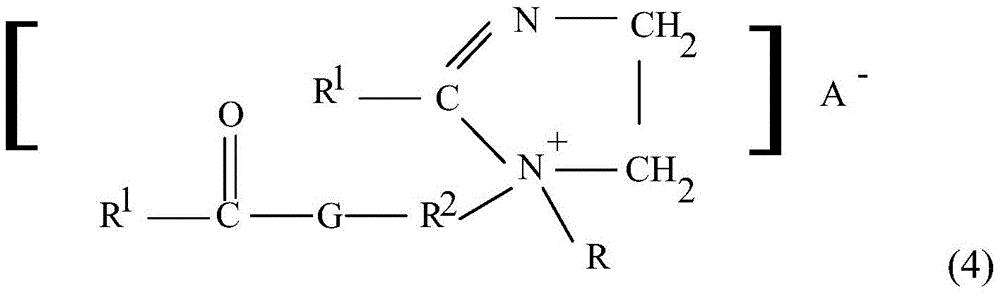
each of which R, R1And A-Have the meaning given above; each R2Is C1-6An alkylene group, preferably an ethylene group; and G is an oxygen atom or a-NR-group;
a fifth type of preferred cationic surfactant has the formula:

wherein R is1、R2And G is as defined above.
A sixth type of preferred cationic surfactant is, for example, a condensation reaction product of a fatty acid and a dialkylenetriamine in a molecular ratio of about 2:1, the reaction product comprising a compound of the formula:
R1—C(O)—NH—R2—NH—R3—NH—C(O)—R1 (6)
wherein R is1、R2As defined above, and each R3Is C1-6Alkylene groups, preferably ethylene groups, and wherein the reaction product may optionally be quaternized by addition of an alkylating agent, such as dimethyl sulfate. Such quaternization reaction products are also described in detail in U.S. patent 5,296,622 to Ushues et al, published 3, 22, 1994, which is incorporated herein by reference.
A seventh type of preferred cationic surfactant has the formula:
[R1—C(O)—NR—R2—N(R)2—R3—NR—C(O)—R1]+A- (7)
r, R therein1、R2、R3And A-As defined above;
a preferred cationic surfactant of the eighth type is a reaction product of a fatty acid and a hydroxyalkyl alkylene diamine in a molecular ratio of about 2:1, the reaction product comprising a compound of the formula:
R1-C(O)-NH-R2-N(R3OH)-C(O)-R1 (8)
wherein R is1、R2And R3As defined above;
a ninth type of preferred cationic surfactant has the formula:

r, R therein1、R2And A-As defined above.
Non-limiting examples of the compound (1) are N, N-bis (stearoyloxyethyl) -N, N-dimethylammonium chloride, N-bis (tallowyloxyethyl) -N, N-dimethylammonium chloride, N-bis (stearoyloxyethyl) -N- (2-hydroxyethyl) -N-methylammonium methylsulfate.
A non-limiting example of compound (2) is 1, 2-bis (stearoyloxy) -3-trimethylpropanammonium chloride.
Non-limiting examples of compound (3) are dialkylene dimethyl ammonium salts such as di-erucyl dimethyl ammonium chloride, di (hard) tallow dimethyl ammonium chloride, di-erucyl dimethyl ammonium methyl sulfate. An example of a commercially available dialkylenedimethylammonium salt that can be used in the present invention is under the trade name 472 Dioleyldimethylammonium chloride available from Wettekco (Witco Corporation) and di-hard tallow dimethylammonium chloride available from Aksu Nobel under the trade name Arquad 2HT 75.
Non-limiting examples of compound (4) are under the trade name 1-methyl-1-stearamidoethyl-2-stearyl imidazoline methyl ester sulfate commercially available from Witco Corporation, where R is1Is acyclic aliphatic C15-C17A hydrocarbyl radical, R2Is an ethylene group, G is an NH group, R5Is a methyl group, and A-Is a methyl sulfate anion.
A non-limiting example of compound (5) is 1-tallowamidoethyl-2-tallowoylimidazoline, wherein R1Is acyclic aliphatic C15-C17A hydrocarbyl radical, R2Is an ethylene group and G is an NH group.
A non-limiting example of compound (6) is the reaction product of a fatty acid and diethylenetriamine in a molecular ratio of about 2:1, the reaction product mixture comprising N, N "-dialkyldiethylenetriamine having the formula:
R1-C(O)-NH-CH2CH2-NH-CH2CH2-NH-C(O)-R1
wherein R is1-C (O) is a commercially available fatty acid derived from plant or animal sources (such as, for example, from Henkel Corporation 223LL or
 7021) And R is an alkyl group of2And R3Is a divalent ethylene group.
Non-limiting examples of compound (7) are the di-fatty amidoamine-based softeners having the following formula:
[R1-C(O)-NH-CH2CH2-N(CH3)(CH2CH2OH)-CH2CH2-NH-C(O)-R1]+CH3SO4 -
wherein R is1C (O) is an alkyl radical, e.g. under the trade name 222LT is commercially available from Witco Corporation.
An example of compound (8) is the reaction product of a fatty acid and N-2-hydroxyethylethylenediamine in a molecular ratio of about 2:1, the reaction product mixture comprising a compound of the formula:
R1-C(O)-NH-CH2CH2-N(CH2CH2OH)-C(O)-R1
wherein R is1-C (O) is a commercially available fatty acid derived from plant or animal sources (such as, for example, from Henkel Corporation 223LL or
 7021) An alkyl group of (2).
An example of compound (9) is a bis-quaternary ammonium compound having the formula:

wherein R is1Derived from fatty acids, and the compounds are commercially available from the Witco Company.
It is to be understood that combinations of the cationic surfactants disclosed above are suitable for use in the present invention.
In the cationic nitrogen-containing salts herein above, the anion A-Is any surfactant compatible anion that provides electrical neutrality. Most commonly, the anion used to provide electrical neutrality in these salts is derived from a strong acid, particularly a halide, such as chloride, bromide, or iodide. However, other anions can be used, such as methosulfate, ethanesulfate, acetate, formate, sulfate, carbonate, and the like. Chloride and methosulfate are preferred herein as anion a. The anion may also, but less preferably, be doubly charged, in which case A-Represents one half of the group.
The personal care compositions of the present invention may comprise a thickening agent which results in the composition having a desired viscosity. Suitable thickener levels herein range from 0.001% to 10%, or from 0.01% to 5%, or from 0.5% to 2% by weight of the emulsion composition.
In one embodiment, the thickening agent suitable for use herein may be selected from thickening stabilizers. These include gums and other similar polysaccharides, such as gellan gum, carrageenan, xanthan gum, Diutan gum (available from CP Kelco), and other known types of thickeners and rheological additives, such as CDP (available from BASF),
 L-520 (from Alco Chemical) and Sepigel 305 (from SEPPIC).
In another embodiment, cationic acrylic polymers are utilized as the thickening agents herein. One example of such a thickener is poly (acrylic acid), which is commercially available under the trade name Carbomer (Carbomer). Another example is a cationic acrylic polymer, which is available under the trade name CDE is sold by BASF.
As noted above, the suitable viscosity of the personal care composition herein depends on the form in which it is applied to a surface. Suitable compositions have a relatively high viscosity and a low water content for applying the composition by contact coating. Contact coating can be used to control application in the machine direction and also to maintain low water levels in order to prevent machine contamination and minimize microbial growth. Suitable compositions have a relatively low viscosity and a high water content for application of the composition by spray coating and ink jet printing. Spraying can be used to provide an economical treatment. Inkjet printing can be used to provide precise application to a surface in both the machine and cross directions, as well as patterning and varying the amount in certain areas. For example, the composition may be applied only to areas that have a higher contact or friction with the wearer's skin. One suitable embodiment of ink-jet printing in the high efficiency production of hygiene articles is disclosed in U.S. patent 6811239, which is incorporated herein by reference.
Regardless of the method of application of the composition, the amount of cationic surfactant applied per surface may be from 0.1% to 20%, or from 1% to 10%, or from 2% to 10% by weight to the weight of the surface substrate.
Personal care compositions may also contain additional components to provide aesthetic or functional benefits to the composition or skin, such as sensory benefits relating to appearance, smell, or feel, therapeutic benefits, or prophylactic benefits, as well as bactericides and preservatives. When included, the compositions comprise no more than about 20%, or about 10%, of additional components.
Additional components useful herein include; skin care actives such as chamomile extract, aloe vera extract, green tea extract, tocopherols, proteins, vitamins such as vitamin a and vitamin E; a fragrance; and preservatives such as methylparaben, ethylparaben and phenoxyethanol. Preservatives can be used to control microbial growth of residual water from the lotion in the absorbent article.
Nonionic surfactants, silicones, hydrocarbon waxes and other emollients may be included in the composition in amounts such that they are stabilized by the surfactant and in the form of an oil-in-water emulsion. As described above, the oil-containing property components are retained in an amount such that migration of these components to the adhesive composition of the belt is prevented.
In other embodiments, the personal care composition may comprise: (1) an emollient; (2) an emollient immobilizing agent; (3) optionally a hydrophilic surfactant; and (4) other optional components such as those described in US 5,635,191. Additional personal care compositions that may benefit the skin typically include at least one active ingredient to treat or prevent skin disorders such as diaper rash or to provide moisturizing benefits to the skin, including, for example, zinc oxide, petrolatum, white petrolatum, mineral oil, cod liver oil, lanolin, dimethicone, hard fat, vitamin a, allantoin, calamine, kaolin, glycerin, and colloidal oatmeal, as well as combinations of these materials. Examples of skin care compositions are disclosed in U.S. patent 8,466,355.
Texturing/perforating
In some embodiments, at least one of the inner and outer surfaces of the belt may be perforated. An example of a suitable perforation can be seen in 14/032,595. Apertures are formed in the nonwoven material used to form, for example, the topsheet, which may enhance the ability of the topsheet to allow aqueous liquid exudates to pass therethrough. In some cases, this may be desirable because the materials that typically form the topsheet may include polymers that are typically hydrophobic (such as polyolefins), and the pores or channels that are typically present between the nonwoven fibers may not be large enough for aqueous liquids to pass through them at a desired rate, as the materials tend to repel aqueous liquids.
Examples of methods of forming apertures in a pre-bonded nonwoven web to be used to form a topsheet are described in U.S. Pat. nos. 5,916,661 and 5,629,097. The method involves rolling a pre-bonded nonwoven web through a nip between a pair of rolls, one of which carries a pattern of raised bonding protrusions; and supplying thermal energy to heat the fibers under the protrusions in the nip. When appropriately controlled pressure and heat are provided at the nip, a suitable pattern of bonds or "weakened melt-stabilized locations" having rod shapes or other shapes are formed. At the bond sites, the polymer fibers of the web are melted, compressed, and thereby melted, such that the polymer material melted at the bond sites is relatively thin (in the z-direction) and brittle. When the cross-direction incremental stretching of the bonded nonwoven web is subsequently performed as described in the above-referenced patents, the material at the bond sites or "melt stabilization sites" breaks and opens in a direction transverse to the long dimension of the rod shape.
In contrast to processes in which the holes are merely punched or cut through the web without the application of heat energy, the bonding/stretching process described in the above-referenced patents does not cut the fibers, which can create loose fibers and fray the edges of the punched or cut holes. In contrast, the bonding/drawing process described herein does not readily form loose fibers and provides more cleanly defined edges around the hole. After incremental stretching, the web may be allowed to relax, which may cause the apertures to close to some extent, but they will still be present.
In another example, the web may be bonded by compression bonding without the application of externally generated or additional thermal energy. Examples of suitable compression bonding systems using rollers are described in, for example, U.S. Pat. nos. 4,854,984 and 4,919,738. In these types of mechanisms, the first roller and the second roller are arranged with their axes parallel and urged together to form a nip. The first roller may have one or more bonding protrusions arranged in a pattern on a surface thereof. The first and second rolls may be urged together by one or more actuators, such as bellows-type pneumatic actuators, acting directly or indirectly on one or both of their axes, while providing and regulating compression of the web material under the projections at the nip as it passes through the nip, in the manner described in the aforementioned patent. Compression bonding mechanisms, such as but not limited to those described in the above patents, provide for bonding of the nonwoven web material by rapid compression of the overlying fibers under the bonding protrusions along the nip line. Without wishing to be bound by theory, it is believed that the rapid compression under the protrusions causes the respective materials to rapidly deform and partially squeeze together from under the protrusions, thereby forming a structure of deformed, compressed and entangled fibrous material under and/or around the protrusions. A weld or weld-like structure is created at or around the projection. In some cases, compression bonding provides certain advantages, including relative simplicity and cost effectiveness. It may reduce or eliminate the need for more complex bonding systems that require the system to supply externally generated or additional thermal energy. Without being bound by theory, it is believed that in at least some instances, these advantages are substantially independent of variations in line speed, including line speeds within the economically and technically feasible ranges currently known for the manufacture of disposable diapers and training pants. After the compression bonds are so formed, the web may be incrementally stretched to form apertures at the bond sites in the manner taught in U.S. patent 5,916,661.
As noted, the nonwoven web may be pre-bonded with a relatively dense pattern of hot/calender bonds prior to aperturing, as suggested in U.S. patent 5,916,661. After that, the hole pattern may simply be punched or cut through the web. A relatively dense bond pattern may be used to minimize loose cut fibers and fraying, and to help maintain defined edges of the holes formed by cutting or punching.
It should be understood that the formed holes need not be rod-shaped. The holes may be rod-shaped, arc-shaped, other curved, finite path, circular, oval, elliptical, or polygonal, and any combination thereof. However, in some instances it may be desirable for the longest dimension of most individual apertures to be oriented along the machine direction of the nonwoven web — particularly when the web or components thereof are formed from processes that create a machine direction bias in the fibers, such as spunbond or spunlaid processes.
It is also understood that the apertures may be arranged in different patterns, such as, but not limited to, evenly distributed and aligned rows and columns, staggered rows and columns, diagonal patterns, shaped patterns, and the like. Additionally, the pattern of apertures may be substantially similar or identical to the pattern of pre-bonds (if present) in one or more of the longitudinal distribution, the transverse distribution, the aperture shape, and the aperture size. The use of a respective pattern of prebonds and apertures that are substantially similar in one or more of the aspects shown may help impart a more uniform, ordered, and/or consistent appearance to the material, as compared to a web in which the respective pattern of prebonds and apertures do not have such similarity, and may also help enhance tensile strength.
Using a nonwoven web that has been apertured in the manner described above to form one of the nonwoven web layers in a belt as described above can provide an attractive and interesting effect. For example, as the belts are moved and stretched during wear, the apertures and the material surrounding them may interact with shrinkage-induced wrinkles in the web layers. The holes in a layer will open, close, change shape and be offset relative to another layer, providing a visual impression of complexity, depth and increased texture. Apertures having various shapes and angles relative to the machine direction may produce z-direction protrusions and/or ridges along the edges of the aperture when the belt structure is contracted.
When the belt structure is contracted in the lateral or longitudinal direction, the "flaps" formed by the hole shapes can stand up and increase the z-direction bulk in addition to increasing the height of the corrugations. The increased loft may contribute to the tactile and visual perception of increased softness and/or breathability. Furthermore, as the belt structure expands and contracts, the "flaps" can open and close, alternately revealing and concealing any contrasting appearance and/or color of the underlying layer, and giving the belt structure a more complex and dramatic appearance. It will be appreciated that the selected hole pattern may be coordinated with the adhesive pattern selected to adhere the laminate to achieve different effects.
In some embodiments, at least one of the inner and outer surfaces of the elastomeric belt may be textured. In some embodiments, both the inner and outer surfaces of the belt may be textured, but different texturing is used for different purposes. For example, different texturing of the inner and outer surfaces may produce different coefficients of friction for the inner and outer surfaces, respectively. For example, texturing may provide a desired high coefficient of friction on the inner surface to help the article stay in place on the wearer. The interior surface may also be subsequently treated with a personal care composition to achieve softness. The same article may then have a differently treated outer surface, or be left untreated.
The dimensions and values disclosed herein are not to be understood as being strictly limited to the exact numerical values recited. Rather, unless otherwise specified, each such dimension is intended to mean both the recited value and a functionally equivalent range surrounding that value. For example, a dimension disclosed as "40 mm" is intended to mean "about 40 mm".
Each document cited herein, including any cross-referenced or related patent or application, is hereby incorporated by reference in its entirety unless expressly excluded or otherwise limited. The citation of any document is not an admission that it is prior art with respect to any invention disclosed or claimed herein or that it alone, or in combination with any other reference or references, teaches, suggests or discloses any such invention. Further, to the extent that any meaning or definition of a term in this document conflicts with any meaning or definition of the same term in a document incorporated by reference, the meaning or definition assigned to that term in this document shall govern.
While particular embodiments of the present invention have been illustrated and described, it would be obvious to those skilled in the art that various other changes and modifications can be made without departing from the spirit and scope of the invention. It is therefore intended to cover in the appended claims all such changes and modifications that are within the scope of this invention.
Claims (13)
1. An absorbent article having a front waist region, a back waist region, and a crotch region, and comprising:
a central chassis occupying the crotch region and comprising a left longitudinal edge and a right longitudinal edge; a liquid pervious topsheet; a backsheet, and an absorbent core disposed between the topsheet and the backsheet;
a belt structure disposed about the central chassis, the belt structure comprising an elasticized multilayer web overlapping the backsheet to the exterior thereof in the front and back waist regions, the belt structure extending laterally and longitudinally outward from the chassis and laterally from each of the left and right longitudinal edges in each of the front and back waist regions, the belt structure having a front portion with a front waist edge, front left and right leg opening edges, and front left and right side edges, and a back portion with a back waist edge, back left and right leg opening edges, and back left and right side edges, the front and left side edges joined with the front and right side edges at a right side seam, the belt structure forming a waist opening and left and right leg openings, wherein each of the front and back portions of the belt structure further comprises:
an inner layer formed from an inner nonwoven web comprising an inner surface;
an outer layer formed from an outer nonwoven web comprising an outer surface;
wherein the inner surface of the belt structure comprises a treatment, and wherein the inner surface is different from the outer surface;
wherein the treatment is the application of a personal care composition; and is
Wherein the personal care composition is an oil-in-water emulsion comprising a cationic surfactant; wherein the cationic surfactant comprises one or more of the following types:
the first type of cationic surfactant has the formula:
{R4-m-N+-[(CH2)n-Y-R1]m}X-
wherein each R substituent is hydrogen, C1-C3Alkyl or hydroxyalkyl radicals, poly (C)2-3Alkoxy), benzyl, or mixtures thereof; each m is 2 or 3;each n is 2; each Y is-O- (O) C-, -C (O) -O-, -NR-C (O) -or-C (O) -NR-; each R1Wherein the sum of carbon is C14-C20When Y is-O- (O) C-or-NR-C (O) -, the sum of carbons is added to one, each R1Is a hydrocarbyl or substituted hydrocarbyl group; and X-Is an anion selected from chloride, bromide, methylsulfate, ethylsulfate, sulfate and nitrate;
the second type of cationic surfactant has the formula:
[R3N+CH2CH(YR1)(CH2YR1)]X-
each of which Y, R, R1And X-Have the same definitions as above;
the third type of cationic surfactant has the formula:
[R4-m-N+-R1 m]X-
wherein each m, R1And X-Have the same definitions as above.
2. The absorbent article of claim 1, wherein the outer surface comprises a treatment.
3. The absorbent article of claim 2, wherein the treatment is selected from the group consisting of applying a lotion, applying a personal care composition, applying a surfactant, texturing, aperturing, and combinations thereof.
4. The absorbent article of claim 1, wherein the personal care composition further comprises a skin care active selected from the group consisting of chamomile extract, aloe vera extract, green tea extract, tocopherols, proteins, and vitamins.
5. The absorbent article of claim 1, wherein the cationic surfactant is applied at the interior surface in an amount of from 2% to 10% by weight of the interior surface substrate.
6. The absorbent article of claim 1, wherein the personal care composition is applied to the inner surface of the belt structure formed by a nonwoven fabric that is no more than 25gsm of propylene homopolymer.
7. The absorbent article of claim 1, further comprising a pair of opposing cuffs along the longitudinal edges of the central chassis, wherein the personal care composition is also applied to the cuffs.
8. The absorbent article of claim 1, further comprising an outer cover on the garment-facing side of the central chassis, the outer cover comprising a nonwoven material, wherein the personal care composition is further applied to the outer cover.
9. The absorbent article according to claim 1, wherein the inner surface of the belt structure has a higher coefficient of friction than the outer surface of the belt structure.
10. The absorbent article of claim 1, wherein the inner surface of the belt structure has a different texture than the outer surface of the belt structure.
11. The absorbent article of claim 1, wherein the inner nonwoven web has a higher basis weight than the outer nonwoven web.
12. The absorbent article of claim 1, wherein the inner surface of the belt structure in the front waist region comprises a different treatment than the inner surface of the belt structure in the back waist region.
13. The absorbent article of claim 1, wherein the outer surface of the belt structure and the inner surface of the belt structure comprise apertures, and wherein the apertures of the inner surface are different than the apertures of the outer surface.
Applications Claiming Priority (1)
| Application Number | Priority Date | Filing Date | Title |
|---|---|---|---|
| PCT/CN2015/077760 WO2016172865A1 (en) | 2015-04-29 | 2015-04-29 | Belt with treated inner surface |
Publications (2)
| Publication Number | Publication Date |
|---|---|
| CN107530206A CN107530206A (en) | 2018-01-02 |
| CN107530206B true CN107530206B (en) | 2021-10-29 |
Family
ID=57198940
Family Applications (1)
| Application Number | Title | Priority Date | Filing Date |
|---|---|---|---|
| CN201580079327.5A Active CN107530206B (en) | 2015-04-29 | 2015-04-29 | Belt with treated inner surface |
Country Status (5)
| Country | Link |
|---|---|
| US (1) | US10279070B2 (en) |
| EP (1) | EP3307220B2 (en) |
| JP (1) | JP2018513749A (en) |
| CN (1) | CN107530206B (en) |
| WO (1) | WO2016172865A1 (en) |
Families Citing this family (4)
| Publication number | Priority date | Publication date | Assignee | Title |
|---|---|---|---|---|
| EP3389586A2 (en) * | 2015-12-15 | 2018-10-24 | The Procter and Gamble Company | Belted structure with tackifier-free adhesive |
| CN115052571B (en) * | 2020-03-25 | 2023-11-03 | 大王制纸株式会社 | Disposable wearing article |
| EP4088700A4 (en) | 2020-03-25 | 2024-01-17 | Daio Paper Corporation | DISPOSABLE CARRY ITEM |
| EP4153113A1 (en) * | 2020-05-22 | 2023-03-29 | The Procter & Gamble Company | Absorbent articles with waistbands and waistband covers |
Citations (6)
| Publication number | Priority date | Publication date | Assignee | Title |
|---|---|---|---|---|
| CN1518968A (en) * | 2003-02-05 | 2004-08-11 | ������������ʽ���� | absorbent product |
| CN101394995A (en) * | 2006-03-02 | 2009-03-25 | 株式会社日本吸收体技术研究所 | Highly air-permeable water-resistant sheet, highly air-permeable water-resistant sheet composite, absorbent article, method for producing highly air-permeable water-resistant sheet, and method for producing highly air-permeable water-resistant sheet composite |
| WO2014028362A1 (en) * | 2012-08-13 | 2014-02-20 | The Procter & Gamble Company | Multilayered nonwoven webs with visually distinct bond sites and method of making |
| WO2014074411A1 (en) * | 2012-11-06 | 2014-05-15 | The Procter & Gamble Company | Article(s) with soft nonwoven web |
| CN104284643A (en) * | 2012-05-15 | 2015-01-14 | 宝洁公司 | Disposable absorbent pants having advantageous stretch and manufacturability features, and methods of making same |
| CN104284641A (en) * | 2012-05-15 | 2015-01-14 | 宝洁公司 | Disposable absorbent pants with advantageous stretch and manufacturability features, and methods for manufacturing the same |
Family Cites Families (64)
| Publication number | Priority date | Publication date | Assignee | Title |
|---|---|---|---|---|
| US3848594A (en) | 1973-06-27 | 1974-11-19 | Procter & Gamble | Tape fastening system for disposable diaper |
| US4662875A (en) | 1985-11-27 | 1987-05-05 | The Procter & Gamble Company | Absorbent article |
| US4699622A (en) | 1986-03-21 | 1987-10-13 | The Procter & Gamble Company | Disposable diaper having an improved side closure |
| US4846815A (en) | 1987-01-26 | 1989-07-11 | The Procter & Gamble Company | Disposable diaper having an improved fastening device |
| US4778458A (en) * | 1987-04-16 | 1988-10-18 | Whitestone Products | Disposable sanitary absorbent incontinence pad |
| US4894060A (en) | 1988-01-11 | 1990-01-16 | Minnesota Mining And Manufacturing Company | Disposable diaper with improved hook fastener portion |
| US4946527A (en) | 1989-09-19 | 1990-08-07 | The Procter & Gamble Company | Pressure-sensitive adhesive fastener and method of making same |
| US5221274A (en) | 1991-06-13 | 1993-06-22 | The Procter & Gamble Company | Absorbent article with dynamic elastic waist feature having a predisposed resilient flexural hinge |
| US5151092A (en) | 1991-06-13 | 1992-09-29 | The Procter & Gamble Company | Absorbent article with dynamic elastic waist feature having a predisposed resilient flexural hinge |
| US5167897A (en) | 1991-02-28 | 1992-12-01 | The Procter & Gamble Company | Method for incrementally stretching a zero strain stretch laminate web to impart elasticity thereto |
| US5143679A (en) | 1991-02-28 | 1992-09-01 | The Procter & Gamble Company | Method for sequentially stretching zero strain stretch laminate web to impart elasticity thereto without rupturing the web |
| US5156793A (en) | 1991-02-28 | 1992-10-20 | The Procter & Gamble Company | Method for incrementally stretching zero strain stretch laminate web in a non-uniform manner to impart a varying degree of elasticity thereto |
| US5980513A (en) | 1994-04-25 | 1999-11-09 | Autonomous Technologies Corp. | Laser beam delivery and eye tracking system |
| US5961761A (en) | 1994-11-07 | 1999-10-05 | Kimberly-Clark Worldwide, Inc. | Process of providing mechanical fasteners on disposable absorbent articles |
| US5635191A (en) | 1994-11-28 | 1997-06-03 | The Procter & Gamble Company | Diaper having a lotioned topsheet containing a polysiloxane emollient |
| US6166285A (en) * | 1994-11-28 | 2000-12-26 | The Procter & Gamble Company | Absorbent articles having cuffs with skin care composition disposed thereon |
| US6432098B1 (en) | 1997-09-04 | 2002-08-13 | The Procter & Gamble Company | Absorbent article fastening device |
| US6533765B1 (en) † | 1998-05-01 | 2003-03-18 | The Procter & Gamble Company | Absorbent articles having a lotion resistant adhesive |
| US6545197B1 (en) | 1998-05-02 | 2003-04-08 | The Procter & Gamble Company | Disposable absorbent article having an improved topsheet |
| US6447497B1 (en) | 1999-11-22 | 2002-09-10 | Kimberly-Clark Worldwide, Inc. | Absorbent article with child resistant refastenable seams |
| US6626879B1 (en) | 1999-05-17 | 2003-09-30 | The Procter & Gamble Company | Disposable absorbent article having article retention zones |
| US20050222546A1 (en) | 2004-04-01 | 2005-10-06 | The Procter & Gamble Company | Disposable absorbent article having refastenable side seams and a wetness sensation member |
| US6911024B2 (en) * | 2001-05-21 | 2005-06-28 | Sca Hygiene Products Ab | Absorbent article |
| JP4050232B2 (en) | 2001-11-05 | 2008-02-20 | ザ プロクター アンド ギャンブル カンパニー | Variable stretch composite and method for producing the same |
| CN1297392C (en) | 2001-11-05 | 2007-01-31 | 宝洁公司 | Tensile Composite |
| US8283515B2 (en) * | 2002-05-03 | 2012-10-09 | Sca Hygiene Products Ab | Absorbent article containing a skin conditioning agent |
| DE60221639T2 (en) † | 2002-05-03 | 2008-05-08 | Sca Hygiene Products Ab | Absorbent article with skin care product |
| DE60231704D1 (en) * | 2002-06-12 | 2009-05-07 | Sca Hygiene Prod Ab | Absorbent article with a skin care composition |
| JP4205400B2 (en) | 2002-11-12 | 2009-01-07 | ユニ・チャーム株式会社 | Method and apparatus for attaching an elastic member to a disposable worn article produced continuously |
| US20040222553A1 (en) | 2003-05-05 | 2004-11-11 | The Procter & Gamble Company | Method for making a stretch composite |
| WO2007002930A1 (en) | 2005-06-29 | 2007-01-04 | The Procter & Gamble Company | Disposable absorbent article containing an adhesively bonded elastic member |
| US20080300563A1 (en) † | 2005-12-23 | 2008-12-04 | Sca Hygiene Products Ab | Absorbent Article with Improved Elastic Means |
| US8395012B2 (en) * | 2006-03-10 | 2013-03-12 | The Procter & Gamble Company | Disposable absorbent articles containing odor controlling films |
| US7833211B2 (en) | 2006-04-24 | 2010-11-16 | The Procter & Gamble Company | Stretch laminate, method of making, and absorbent article |
| CA2654824C (en) | 2006-06-09 | 2012-01-10 | The Procter & Gamble Company | Stretch laminate, method of making, and absorbent article |
| KR101454048B1 (en) † | 2007-02-28 | 2014-10-27 | 다이오 페이퍼 코퍼레이션 | Paper diaper |
| US20080287899A1 (en) † | 2007-05-14 | 2008-11-20 | Tyco Healthcare Retail Services Ag | Absorbent article and method of making same |
| JP4887218B2 (en) | 2007-05-30 | 2012-02-29 | 株式会社リブドゥコーポレーション | Stretch sheet manufacturing method, stretch sheet and absorbent article |
| US9060900B2 (en) | 2007-09-07 | 2015-06-23 | The Proctor & Gamble Company | Disposable wearable absorbent articles with anchoring subsystems |
| US9056031B2 (en) | 2007-09-07 | 2015-06-16 | The Procter & Gamble Company | Disposable wearable absorbent articles with anchoring subsystems |
| US9050221B2 (en) | 2007-09-07 | 2015-06-09 | The Procter & Gamble Company | Disposable wearable absorbent articles with anchoring subsystems |
| US8597268B2 (en) | 2007-09-07 | 2013-12-03 | The Procter & Gamble Company | Disposable wearable absorbent articles with anchoring subsystems |
| US20090069777A1 (en) | 2007-09-07 | 2009-03-12 | Andrew James Sauer | Disposable wearable absorbent articles with anchoring subsystems |
| US8668679B2 (en) | 2007-09-07 | 2014-03-11 | The Procter & Gamble Company | Disposable wearable absorbent articles with anchoring subsystems |
| US8858523B2 (en) | 2007-09-07 | 2014-10-14 | The Procter & Gamble Company | Disposable wearable absorbent articles with anchoring subsystems |
| US8945079B2 (en) | 2007-09-07 | 2015-02-03 | The Procter & Gamble Company | Disposable wearable absorbent articles with anchoring subsystems |
| US8790325B2 (en) | 2007-09-07 | 2014-07-29 | The Procter & Gamble Company | Disposable wearable absorbent articles with anchoring subsystems |
| JP2009232881A (en) * | 2008-03-25 | 2009-10-15 | Uni Charm Corp | Absorbent article |
| US8182627B2 (en) | 2009-01-30 | 2012-05-22 | The Procter & Gamble Company | Method for high-speed continuous application of a strip material to a substrate along an application path on the substrate |
| US8171972B2 (en) | 2009-01-30 | 2012-05-08 | The Procter & Gamble Company | Strip guide for high-speed continuous application of a strip material to a moving sheet-like substrate material at laterally shifting locations |
| US20100193135A1 (en) | 2009-01-30 | 2010-08-05 | Joseph Allen Eckstein | System and Method for High-Speed Continuous Application of a Strip Material to a Moving Sheet-Like Substrate Material at Laterally Shifting Locations |
| JP5430178B2 (en) † | 2009-03-03 | 2014-02-26 | ユニ・チャーム株式会社 | Disposable diapers |
| US8821470B2 (en) | 2010-07-22 | 2014-09-02 | The Procter & Gamble Company | Two-piece wearable absorbent article with advantageous fastener performance configurations |
| US20120157955A1 (en) | 2010-12-20 | 2012-06-21 | Gregory Ashton | Disposable absorbent pant with efficient design and convenient single section side stretch panels |
| US8816220B2 (en) | 2011-01-28 | 2014-08-26 | Raytheon Company | Enclosure cooling apparatus |
| US20120271265A1 (en) | 2011-04-20 | 2012-10-25 | Frederick Michael Langdon | Zero-Strain Stretch Laminate with Enhanced Strength, Appearance and Tactile Features, and Absorbent Articles Having Components Formed Therefrom |
| CN106943239B (en) | 2011-04-29 | 2020-04-10 | 宝洁公司 | Absorbent article with leg gasketing cuffs |
| BR112014020013A8 (en) | 2012-02-13 | 2017-07-11 | Procter & Gamble | DISPOSABLE PULL CLOTHING PIECE |
| US8720666B2 (en) | 2012-04-16 | 2014-05-13 | The Procter & Gamble Company | Apparatuses for transferring discrete articles |
| US9333119B2 (en) | 2012-05-15 | 2016-05-10 | The Procter & Gamble Company | Absorbent articles having textured zones |
| DE102012208395A1 (en) * | 2012-05-18 | 2013-11-21 | Paul Hartmann Ag | Incontinence article in panty form |
| EP2900191B1 (en) * | 2012-09-26 | 2019-05-15 | Drylock Technologies NV | Disposable absorbent article with extensible and retractable core |
| US20150083310A1 (en) | 2013-09-20 | 2015-03-26 | The Procter & Gamble Company | Textured Laminate Structure, Absorbent Articles With Textured Laminate Structure, And Method for Manufacturing |
| US9532908B2 (en) | 2013-09-20 | 2017-01-03 | The Procter & Gamble Company | Textured laminate surface, absorbent articles with textured laminate structure, and for manufacturing |
-
2015
- 2015-04-29 CN CN201580079327.5A patent/CN107530206B/en active Active
- 2015-04-29 WO PCT/CN2015/077760 patent/WO2016172865A1/en not_active Ceased
- 2015-04-29 JP JP2017555472A patent/JP2018513749A/en not_active Withdrawn
- 2015-04-29 EP EP15890245.2A patent/EP3307220B2/en active Active
- 2015-06-01 US US14/726,812 patent/US10279070B2/en active Active
Patent Citations (6)
| Publication number | Priority date | Publication date | Assignee | Title |
|---|---|---|---|---|
| CN1518968A (en) * | 2003-02-05 | 2004-08-11 | ������������ʽ���� | absorbent product |
| CN101394995A (en) * | 2006-03-02 | 2009-03-25 | 株式会社日本吸收体技术研究所 | Highly air-permeable water-resistant sheet, highly air-permeable water-resistant sheet composite, absorbent article, method for producing highly air-permeable water-resistant sheet, and method for producing highly air-permeable water-resistant sheet composite |
| CN104284643A (en) * | 2012-05-15 | 2015-01-14 | 宝洁公司 | Disposable absorbent pants having advantageous stretch and manufacturability features, and methods of making same |
| CN104284641A (en) * | 2012-05-15 | 2015-01-14 | 宝洁公司 | Disposable absorbent pants with advantageous stretch and manufacturability features, and methods for manufacturing the same |
| WO2014028362A1 (en) * | 2012-08-13 | 2014-02-20 | The Procter & Gamble Company | Multilayered nonwoven webs with visually distinct bond sites and method of making |
| WO2014074411A1 (en) * | 2012-11-06 | 2014-05-15 | The Procter & Gamble Company | Article(s) with soft nonwoven web |
Also Published As
| Publication number | Publication date |
|---|---|
| CN107530206A (en) | 2018-01-02 |
| WO2016172865A1 (en) | 2016-11-03 |
| US10279070B2 (en) | 2019-05-07 |
| EP3307220A1 (en) | 2018-04-18 |
| JP2018513749A (en) | 2018-05-31 |
| EP3307220B2 (en) | 2023-11-29 |
| EP3307220B1 (en) | 2020-10-07 |
| US20160317695A1 (en) | 2016-11-03 |
| EP3307220A4 (en) | 2019-04-03 |
Similar Documents
| Publication | Publication Date | Title |
|---|---|---|
| JP5368591B2 (en) | Sheet member, method for producing high-density region-containing sheet, and disposable diaper using sheet member | |
| CN101854897B (en) | Method for producing absorbent garment and absorbent garment produced according to the method | |
| CN106604703B (en) | Pant structure having efficient manufacturing and aesthetically pleasing rear leg edge profiles | |
| AU2003284252B2 (en) | Absorbent article with elastomeric material | |
| EP3316834B2 (en) | Stretch laminate with incrementally stretched or selfed layer, method for manufacturing, and disposable absorbent article including the same | |
| CN103079511B (en) | Method of making disposable absorbent diaper pants | |
| CN107530206B (en) | Belt with treated inner surface | |
| US20040102754A1 (en) | Absorbent article material with elastomeric borders | |
| EP2450014A1 (en) | Pants type absorptive article | |
| JP6501710B2 (en) | Absorbent articles | |
| EP3445584B1 (en) | Elastomeric laminate with activation thickness | |
| JP4981539B2 (en) | Method for producing high-density region-containing sheet and disposable diaper using high-density-containing sheet | |
| CN102686199A (en) | Pant-type disposable wearing article | |
| JP2014171690A (en) | Disposable clothing article and manufacturing method thereof | |
| KR101947978B1 (en) | Absorbent article having a flat-back protective feature | |
| JP5415178B2 (en) | Pants-type absorbent article | |
| WO2008066010A1 (en) | Composite sheet and absorbent article comprising composite sheet | |
| WO2017035449A1 (en) | Belted structure | |
| CN101969908A (en) | Disposable pants-shaped article to be worn and method of producing the same | |
| WO2017070142A1 (en) | Absorbent articles comprising a separable belt | |
| JP5191302B2 (en) | Manufacturing method of wiping sheet and wiping sheet | |
| EP2990018A1 (en) | Stretchable laminate | |
| EP4018987A1 (en) | Stretch-bonded laminate and method to produce a machine direction stretch-bonded laminate | |
| WO2012087209A1 (en) | Method for making boxer-type briefs and boxer-type briefs produced according to the method |
Legal Events
| Date | Code | Title | Description |
|---|---|---|---|
| PB01 | Publication | ||
| PB01 | Publication | ||
| SE01 | Entry into force of request for substantive examination | ||
| SE01 | Entry into force of request for substantive examination | ||
| GR01 | Patent grant | ||
| GR01 | Patent grant |