CN107530182B - ostomy device - Google Patents
ostomy device Download PDFInfo
- Publication number
- CN107530182B CN107530182B CN201680021020.4A CN201680021020A CN107530182B CN 107530182 B CN107530182 B CN 107530182B CN 201680021020 A CN201680021020 A CN 201680021020A CN 107530182 B CN107530182 B CN 107530182B
- Authority
- CN
- China
- Prior art keywords
- adhesive
- adhesive composition
- switchable
- microns
- ostomy device
- Prior art date
- Legal status (The legal status is an assumption and is not a legal conclusion. Google has not performed a legal analysis and makes no representation as to the accuracy of the status listed.)
- Active
Links
Images


Classifications
-
- A—HUMAN NECESSITIES
- A61—MEDICAL OR VETERINARY SCIENCE; HYGIENE
- A61F—FILTERS IMPLANTABLE INTO BLOOD VESSELS; PROSTHESES; DEVICES PROVIDING PATENCY TO, OR PREVENTING COLLAPSING OF, TUBULAR STRUCTURES OF THE BODY, e.g. STENTS; ORTHOPAEDIC, NURSING OR CONTRACEPTIVE DEVICES; FOMENTATION; TREATMENT OR PROTECTION OF EYES OR EARS; BANDAGES, DRESSINGS OR ABSORBENT PADS; FIRST-AID KITS
- A61F5/00—Orthopaedic methods or devices for non-surgical treatment of bones or joints; Nursing devices ; Anti-rape devices
- A61F5/44—Devices worn by the patient for reception of urine, faeces, catamenial or other discharge; Colostomy devices
- A61F5/443—Devices worn by the patient for reception of urine, faeces, catamenial or other discharge; Colostomy devices having adhesive seals for securing to the body, e.g. of hydrocolloid type seals, e.g. gels, starches, karaya gums
-
- A—HUMAN NECESSITIES
- A61—MEDICAL OR VETERINARY SCIENCE; HYGIENE
- A61F—FILTERS IMPLANTABLE INTO BLOOD VESSELS; PROSTHESES; DEVICES PROVIDING PATENCY TO, OR PREVENTING COLLAPSING OF, TUBULAR STRUCTURES OF THE BODY, e.g. STENTS; ORTHOPAEDIC, NURSING OR CONTRACEPTIVE DEVICES; FOMENTATION; TREATMENT OR PROTECTION OF EYES OR EARS; BANDAGES, DRESSINGS OR ABSORBENT PADS; FIRST-AID KITS
- A61F5/00—Orthopaedic methods or devices for non-surgical treatment of bones or joints; Nursing devices ; Anti-rape devices
- A61F5/44—Devices worn by the patient for reception of urine, faeces, catamenial or other discharge; Colostomy devices
- A61F5/445—Colostomy, ileostomy or urethrostomy devices
Landscapes
- Health & Medical Sciences (AREA)
- Heart & Thoracic Surgery (AREA)
- Life Sciences & Earth Sciences (AREA)
- Epidemiology (AREA)
- Nursing (AREA)
- Orthopedic Medicine & Surgery (AREA)
- Engineering & Computer Science (AREA)
- Veterinary Medicine (AREA)
- Biomedical Technology (AREA)
- Vascular Medicine (AREA)
- Public Health (AREA)
- Animal Behavior & Ethology (AREA)
- General Health & Medical Sciences (AREA)
- Chemical & Material Sciences (AREA)
- Dispersion Chemistry (AREA)
- Orthopedics, Nursing, And Contraception (AREA)
- Adhesives Or Adhesive Processes (AREA)
Abstract
Description
披露了一种造口装置,该造口装置具有用于附接到使用者的皮肤表面的粘合薄片和连接到该粘合薄片上的收集袋。该粘合薄片包括背衬层、第一可转换的粘合剂组合物、第二粘合剂组合物以及离型衬垫。该第一可转换的粘合剂被包含在该装置的凹部中。An ostomy device is disclosed having an adhesive sheet for attachment to a skin surface of a user and a collection bag attached to the adhesive sheet. The adhesive sheet includes a backing layer, a first switchable adhesive composition, a second adhesive composition, and a release liner. The first switchable adhesive is contained in the recess of the device.
背景技术Background technique
关于多种胃-肠道疾病的手术,在许多情况下的结果之一是在患者的腹壁中留下了腹部造口(诸如结肠造口术、回肠造口术或尿道造口术),以用于内脏内容物的排出。无法随意调节内脏内容物的排出。为此目的,使用者将必须依赖器具将从这种开口出现的材料收集在袋中,该袋随后在适合的时间被排空和/或丢弃。造口术器具典型地通过造口术器具上的粘合薄片附接至造口术使用者的皮肤。With surgery for many gastrointestinal diseases, one of the outcomes in many cases is the creation of an abdominal stoma (such as a colostomy, ileostomy, or urethrostomy) in the patient's abdominal wall, to For excretion of visceral contents. Inability to regulate the expulsion of visceral contents at will. For this purpose, the user will have to rely on the appliance to collect material emerging from such openings in a bag which is then emptied and/or discarded at the appropriate time. The ostomy appliance is typically attached to the skin of the ostomy user by an adhesive sheet on the ostomy appliance.
附图说明Description of drawings
将这些附图包括在内以提供实施例的进一步理解。These figures are included to provide a further understanding of the embodiments.
图1以截面展示了造口装置的实施例,Figure 1 shows an embodiment of an ostomy device in cross section,
图2以截面示出了另一个实施例,Figure 2 shows another embodiment in cross section,
图3以截面示出了又一个实施例,Figure 3 shows yet another embodiment in cross section,
图4示出了施加到围绕造口的皮肤的图2的实施例Figure 4 shows the embodiment of Figure 2 applied to the skin surrounding the stoma
图5以截面示出了实施例,Figure 5 shows the embodiment in cross section,
图6以截面示出了实施例,并且Figure 6 shows the embodiment in cross section, and
图7以截面示出了实施例。Figure 7 shows the embodiment in cross section.
发明内容SUMMARY OF THE INVENTION
实施例提供了一种造口装置,该造口装置包括用于附接到使用者的皮肤表面的粘合薄片和连接到粘合薄片上的收集袋。收集袋适用于收集来自使用者的造口的输出物。粘合薄片具有用于容纳使用者的造口的贯穿孔。以此方式,来自造口的输出物最后进入收集袋中。该粘合薄片包括背衬层、第一可转换的粘合剂组合物、第二粘合剂组合物以及离型衬垫。该第一可转换的粘合剂组合物被容纳在该装置中的凹部中。Embodiments provide an ostomy device comprising an adhesive sheet for attachment to a skin surface of a user and a collection bag attached to the adhesive sheet. The collection bag is suitable for collecting output from the user's stoma. The adhesive sheet has a through hole for accommodating the user's stoma. In this way, the output from the stoma ends up in the collection bag. The adhesive sheet includes a backing layer, a first switchable adhesive composition, a second adhesive composition, and a release liner. The first switchable adhesive composition is contained in a recess in the device.
在实施例中,粘合薄片将具有在使用过程中面对使用者的皮肤的近侧(“面向皮肤”)表面和在使用过程中背离使用者的皮肤的远侧(“不面向皮肤”)表面。在使用前,粘合薄片的近侧表面可以被离型衬垫覆盖,该离型衬垫可释放地附接到粘合剂。在将粘合薄片施加到皮肤前,离型衬垫可以被使用者立即移除。在使用前和使用过程中,粘合薄片的远侧表面可以由背衬层组成,该背衬层可以用于将收集袋附接到粘合薄片,例如通过焊接。这样,粘合薄片可以包括远侧背衬层和近侧离型衬垫,其中第一可转换的粘合剂组合物和第二粘合剂组合物位于背衬层与离型衬垫之间。In an embodiment, the adhesive sheet will have a proximal ("skin-facing") surface that faces the user's skin during use and a distal ("non-skin-facing") surface that faces away from the user's skin during use surface. Prior to use, the proximal surface of the adhesive sheet can be covered with a release liner that is releasably attached to the adhesive. The release liner can be removed by the user immediately before applying the adhesive sheet to the skin. Before and during use, the distal surface of the adhesive sheet may consist of a backing layer that may be used to attach the collection bag to the adhesive sheet, for example by welding. As such, the adhesive sheet can include a distal backing layer and a proximal release liner, wherein the first switchable adhesive composition and the second adhesive composition are located between the backing layer and the release liner .
柔软或甚至液体的粘合剂由于它们流入到皮肤的微观结构和宏观结构内的能力而对于对皮肤的粘附性可能是优异的。然而,此类粘合剂的纹理(texture)使得难以将它们结合到造口装置中。该粘合剂可能在储存和施加期间流动,并且在所不希望的地点结束。Soft or even liquid adhesives may be excellent for adhesion to the skin due to their ability to flow into the micro- and macro-structure of the skin. However, the texture of such adhesives makes it difficult to incorporate them into ostomy devices. The adhesive may flow during storage and application and end up in undesired locations.
该第一可转换的粘合剂被包含在该装置的凹部中。通过在凹部中具有该第一粘合剂,以简单的方式关于流动控制该粘合剂,因为该粘合剂被包含在该凹部中并且该装置可以在没有粘合剂逃脱的情况下被储存并且处理。The first switchable adhesive is contained in the recess of the device. By having the first adhesive in the recess, the adhesive is controlled with respect to flow in a simple manner, since the adhesive is contained in the recess and the device can be stored without the adhesive escaping and deal with.
凹部在此是指能够包含可流动物质的结构,即,具有防止液体物质远离该凹部的非计划中的流动的壁的腔状结构。A recess here refers to a structure capable of containing a flowable substance, ie a cavity-like structure with walls that prevent unintended flow of liquid substances away from the recess.
在实施例中,该凹部在该离型衬垫中。该离型衬垫可以被形成例如热成型以包括用于包含该第一粘合剂的至少一部分的凹部。该凹部将防止该第一粘合剂在使用之前从该薄片逃脱。In an embodiment, the recess is in the release liner. The release liner may be formed, for example, thermoformed to include a recess for containing at least a portion of the first adhesive. The recess will prevent the first adhesive from escaping from the sheet prior to use.
在实施例中,该凹部在该第二粘合剂组合物中。腔可以被压纹到该第二粘合剂组合物中,从而提供用于包含该第一粘合剂的凹部。在该薄片的面向皮肤的表面是基本上平面的意义上,该第一和该第二粘合剂组合物的面向皮肤的表面可以在是齐平的。In an embodiment, the recess is in the second adhesive composition. Cavities may be embossed into the second adhesive composition to provide recesses for containing the first adhesive. The skin-facing surfaces of the first and second adhesive compositions may be flush in the sense that the skin-facing surfaces of the sheet are substantially planar.
在实施例中,该凹部部分地在该第二粘合剂组合物中并且部分地在该离型衬垫中。In an embodiment, the recess is partially in the second adhesive composition and partially in the release liner.
在实施例中,该凹部由已经转换成形状稳定的纹理(form-stable texture)的该第一粘合剂的边缘部分的至少一部分提供。该第一粘合剂的这些转换部分可以构成用于包含该粘合剂的凹部的壁。在实施例中,这些转换的边缘部分具有0.5-3mm诸如大约1mm的宽度。该凹部受转化的粘合剂和该背衬层或该第二粘合剂层的壁束缚。In an embodiment, the recess is provided by at least a portion of an edge portion of the first adhesive that has been converted to a form-stable texture. The transition portions of the first adhesive may constitute the walls of the recess for containing the adhesive. In an embodiment, the edge portions of these transitions have a width of 0.5-3 mm, such as about 1 mm. The recess is bound by the converted adhesive and the walls of the backing layer or the second adhesive layer.
在一个方面,提供了一种造口装置,该造口装置包括用于附接到使用者的皮肤表面的粘合薄片和连接到粘合薄片上的收集袋。收集袋适用于收集来自使用者的造口的输出物。粘合薄片具有用于容纳使用者的造口的贯穿孔。以此方式,来自造口的输出物最后进入收集袋中。该粘合薄片包括背衬层、和第一可转换的粘合剂组合物以及离型衬垫。该第一可转换的粘合剂组合物被容纳在该装置中的凹部中。In one aspect, an ostomy device is provided that includes an adhesive sheet for attachment to a skin surface of a user and a collection bag attached to the adhesive sheet. The collection bag is suitable for collecting output from the user's stoma. The adhesive sheet has a through hole for accommodating the user's stoma. In this way, the output from the stoma ends up in the collection bag. The adhesive sheet includes a backing layer, and a first switchable adhesive composition and a release liner. The first switchable adhesive composition is contained in a recess in the device.
在实施例中,该凹部具有基本上等于该第一可转换的粘合剂的层的尺寸和形状的尺寸和形状。In an embodiment, the recess has a size and shape substantially equal to the size and shape of the layer of the first switchable adhesive.
该离型衬垫可以与该第一可转换的粘合剂组合物和该第二粘合剂组合物两者接触。The release liner can be in contact with both the first switchable adhesive composition and the second adhesive composition.
在实施例中,该第一可转换的粘合剂组合物在第一液体状态下具有低于0.4MPa s(兆帕-秒,即MPa·s)的复粘度|η*|;并且在第二粘合剂状态下具有比第一液体状态的复粘度|η*|更高的复粘度|η*|,并且在第二粘合剂状态下具有高于1N的第二次重复的剥离力。In an embodiment, the first switchable adhesive composition has a complex viscosity |η * | of less than 0.4 MPa s (megapascal-second, ie MPa·s) in the first liquid state; and The second adhesive state has a higher complex viscosity |η * | than that of the first liquid state |η * |, and the second adhesive state has a peel force higher than 1 N for the second repetition .
在实施例中,该第一可转换的粘合剂组合物具有以与限定向内边界的贯穿孔的径向距离的内边沿以及以与限定用于以与该孔的径向距离的向外边界的贯穿孔的径向距离的外边沿。可以转换沿着该外边沿或边缘的该第一粘合剂的部分以便提供更固体且形式稳定的屏障或壁以防止该第一粘合剂流动。在实施例中,将该第一可转换的粘合剂的至少内边沿或外边沿转换以形成用于包含该第一可转换的粘合剂的凹部。In an embodiment, the first switchable adhesive composition has an inner rim at a radial distance from a through hole defining an inward boundary and an outer rim with a radial distance from the hole defined for The outer edge of the border's through-hole radial distance. Portions of the first adhesive along the outer rim or edge can be converted to provide a more solid and form-stable barrier or wall to prevent the first adhesive from flowing. In an embodiment, at least the inner edge or the outer edge of the first switchable adhesive is converted to form a recess for containing the first switchable adhesive.
在实施例中,该第一粘合剂的层可以提供有转换的粘合剂的线,为该第一粘合剂层提供稳定性。这些线可以将该第一粘合剂分成隔间,由转换壁分开。该粘合剂沿着该边沿和/或成一直线的转换可以通过激光或通过模具来进行。该转换线可具有0.5-3mm诸如大约1mm的宽度。In an embodiment, the layer of first adhesive may be provided with lines of converted adhesive to provide stability to the first adhesive layer. These lines may divide the first adhesive into compartments, separated by transition walls. The transition of the adhesive along the edge and/or in line can be done by a laser or by a mold. The conversion line may have a width of 0.5-3 mm, such as about 1 mm.
在一个方面,提供了一种施加造口装置的方法,该方法包括以下步骤:提供了一种造口装置,该造口装置包括用于附接到使用者的皮肤表面的粘合薄片和连接到粘合薄片上的收集袋;该粘合薄片具有用于容纳使用者的造口的贯穿孔;并且该粘合薄片包括背衬层、第一可转换的粘合剂组合物、第二粘合剂组合物以及至少一个离型衬垫,其中该第一可转换的粘合剂包括聚合物和转换引发剂,其中通过活化该转换引发剂,该组合物可从第一液体状态转换至第二粘合剂状态,其中该装置包括用于容纳该第一可转换的粘合剂组合物的凹部,从该装置移除该离型衬垫的至少一部分,将该粘合薄片施加到造口周围的皮肤上,模制该第一粘合剂以配合在造口周围,并且通过活化该转换引发剂,将该第一粘合剂组合物从第一液体状态转换至第二粘合剂状态。In one aspect, there is provided a method of applying an ostomy device, the method comprising the steps of: providing an ostomy device comprising an adhesive sheet and a connection for attachment to a skin surface of a user a collection bag onto an adhesive sheet; the adhesive sheet having a through hole for receiving a user's stoma; and the adhesive sheet comprising a backing layer, a first switchable adhesive composition, a second adhesive A mixture composition and at least one release liner, wherein the first switchable adhesive comprises a polymer and a switch initiator, wherein by activating the switch initiator, the composition is switchable from a first liquid state to a second Two adhesive states, wherein the device includes a recess for receiving the first switchable adhesive composition, removing at least a portion of the release liner from the device, applying the adhesive sheet to the stoma On the surrounding skin, the first adhesive is molded to fit around the stoma, and the first adhesive composition is converted from a first liquid state to a second adhesive state by activating the conversion initiator .
该方法可以由除了在其上附接该粘合剂的使用者之外的人进行。例如,该方法可以由收费协助该使用者的商业服务提供者进行。此类商业服务提供者存在并且向例如造口术使用者或具有伤口的人提供付费服务。该服务可以包括服务提供者为造口术使用者移除和施用造口袋或者为具有伤口的人移除和施用创伤敷料。The method may be performed by a person other than the user to which the adhesive is attached. For example, the method may be performed by a commercial service provider that assists the user for a fee. Such commercial service providers exist and provide paid services to, for example, ostomy users or people with wounds. The service may include the service provider removing and applying an ostomy bag for an ostomy user or a wound dressing for a person with a wound.
还可以进行该方法以获得来自造口术使用者的排出物的样品或来自具有伤口的人的伤口流出物的样品。例如,医护专业人员可能需要造口排出物或伤口流出物样品,以便作出医学决策或通常评估使用者的身体状况。在这种情况下,医护专业人员可以命令取样由专业服务提供者进行,以确保取样正确发生。同样,付费商业服务提供者将进行该方法,目的是为医护专业人员提供样品。这种有偿服务以商业条款存在,并且在以经济获益为目的连续且独立的基础上操作。它们并不仅仅依赖于所讨论的使用者的指示进行操作。例如,它们可以直接在医护专业人员的指示下工作。The method can also be performed to obtain a sample of exudate from an ostomy user or a sample of wound exudate from a person with a wound. For example, a healthcare professional may require a sample of stoma discharge or wound exudate in order to make medical decisions or generally to assess the physical condition of the user. In this case, the healthcare professional may order sampling to be performed by a professional service provider to ensure that sampling occurs correctly. Again, paid commercial service providers will conduct this method with the aim of providing samples to healthcare professionals. This paid service exists on commercial terms and operates on a continuous and independent basis for the purpose of economic gain. They do not rely solely on the instructions of the user in question to operate. For example, they can work directly under the direction of a healthcare professional.
在实施例中,该第一粘合剂可以由使用者主动地例如通过暴露于光或湿气而转换,或者它可以随时间的推移被动地/自动地转换。In embodiments, the first adhesive may be actively switched by the user, eg by exposure to light or moisture, or it may be passively/automatically switched over time.
在实施例中,主动转换可以是快速的,诸如在10秒内。被动转换可能是较慢的,例如是从施加到移除的持续过程。In an embodiment, the active transition may be rapid, such as within 10 seconds. Passive transitions may be slower, such as a continuous process from application to removal.
可以在施加之前切割该贯穿孔以配合造口。在实施例中,可以提供以转换粘合剂的形式的切割线或者减小厚度的线以便易于切割。The through hole can be cut to fit the stoma prior to application. In an embodiment, a cutting line in the form of a converting adhesive or a line of reduced thickness may be provided for ease of cutting.
在实施例中,该孔的尺寸和形状可以被适配以通过卷起该孔的边缘来配合造口。In embodiments, the hole may be sized and shaped to fit the stoma by rolling up the edge of the hole.
该第一粘合剂的纹理允许使用者将该粘合剂模制成在造口周围的适贴配合,并且因此可能的是将该薄片配合到造口,而无需精确地切割该孔。当该第一粘合剂被模制以配合造口时,可以将该粘合剂转换以实现更形式稳定的纹理,保护该粘合剂停留在适当位置。The texture of the first adhesive allows the user to mold the adhesive into a snug fit around the stoma, and thus it is possible to fit the sheet to the stoma without precisely cutting the hole. When the first adhesive is molded to fit the stoma, the adhesive can be converted to achieve a more form-stable texture, protecting the adhesive from staying in place.
该粘合剂的转换可以将该纹理从低内聚力改变为高内聚力。低内聚力使到皮肤的结构内的良好流动以及良好的粘性成为可能,而高内聚力使容易地移除该粘合剂成为可能,而不会在皮肤上留下残余物。The transition of the adhesive can change the texture from low cohesion to high cohesion. Low cohesion enables good flow into the structure of the skin and good tack, while high cohesion enables easy removal of the adhesive without leaving residue on the skin.
该第一可转换的粘合剂组合物包含聚合物和转换引发剂,其中通过活化该转换引发剂,该组合物可从第一液体状态转换至第二粘合剂状态。The first switchable adhesive composition comprises a polymer and a switching initiator, wherein by activating the switching initiator, the composition can be switched from a first liquid state to a second adhesive state.
在实施例中,该第一粘合剂组合物在第一液体状态下具有低于0.4MPa s(兆帕-秒,即MPa·s)的复粘度|η*|;并且在第二粘合剂状态下具有比第一液体状态的复粘度|η*|更高的复粘度|η*|,并且在第二粘合剂状态下具有高于1N的第二次重复的剥离力。In an embodiment, the first adhesive composition has a complex viscosity |η * | of less than 0.4 MPa s (megapascal-seconds, or MPa·s) in the first liquid state; and in the second adhesive The complex viscosity |η * | in the agent state is higher than that of the first liquid state |η * |, and the peel force for the second repetition is higher than 1 N in the second adhesive state.
诸位发明人已发现粘合剂的许多要求可通过使用可以至少两种不同状态存在的组合物解决,这些至少两种不同状态具有不同的物理特性并且解决粘合剂的不同要求。然后组合物可以在某一时刻从一种状态转换至另一种状态,从而改变它的物理特性和与这些特性相关联的特征。The inventors have discovered that many of the requirements for adhesives can be addressed by the use of compositions that can exist in at least two different states having different physical properties and addressing the different requirements of the adhesive. The composition can then transition from one state to another at some point, thereby changing its physical properties and the characteristics associated with those properties.
例如,组合物可以具有第一状态,在第一状态下,它迅速且容易地润湿它所附着至的表面并且因此实现充分的粘合剂附接。相同的组合物可具有第二状态,在第二状态下,它非常容易地保持牢固地附着至皮肤并且可以适当地被移除。在这种情况下,组合物在它的第一状态下可以施加至皮肤上。然后组合物可以转换至第二状态,在第二状态下,它将保持牢固地附接。For example, the composition may have a first state in which it quickly and easily wets the surface to which it is attached and thus achieves adequate adhesive attachment. The same composition can have a second state in which it remains firmly attached to the skin very easily and can be properly removed. In this case, the composition can be applied to the skin in its first state. The composition can then transition to a second state in which it will remain firmly attached.
组合物的第一状态可以是其中组合物是相对流动的,即具有低粘度的第一液体状态。The first state of the composition may be a first liquid state in which the composition is relatively fluid, ie, has a low viscosity.
第二状态可以是其中组合物具有良好的粘合剂质量,例如通过表现出压敏粘合剂的特征的第二粘合剂状态。第二状态下的组合物可以是更加粘性的,即具有比第一状态下的组合物更高的粘度。The second state may be a second adhesive state in which the composition has good adhesive quality, for example by exhibiting the characteristics of a pressure sensitive adhesive. The composition in the second state may be more viscous, ie, have a higher viscosity than the composition in the first state.
该第一可转换的粘合剂的组合物可以是皮肤粘合剂组合物,即待用在个人的皮肤上的粘合剂组合物。粘合剂组合物可以例如用于将造口装置附接至造口术使用者上。The composition of the first switchable adhesive may be a skin adhesive composition, ie an adhesive composition to be used on the skin of an individual. The adhesive composition can be used, for example, to attach an ostomy device to an ostomy user.
通过将第一状态和第二状态的特性结合到组合物中,获得能够迅速且毫不费力地建立良好粘附性并且可靠地保持附着至皮肤上的粘合剂。通过第一状态下的组合物实现迅速且毫不费力的粘附性,同时通过第二状态下的组合物实现例如对皮肤的可靠的附着。By combining the properties of the first state and the second state into the composition, an adhesive is obtained that quickly and effortlessly establishes good adhesion and remains securely attached to the skin. Rapid and effortless adhesion is achieved by the composition in the first state, while reliable adhesion, for example, to the skin is achieved by the composition in the second state.
转换是可转换的组合物从一种状态到另一种状态的转变。转换的持续时间将根据例如转换引发剂的性质和转换引发剂的活化方法而变化。通常,转换将是逐渐的过程,其中材料的物理特性从一种状态逐渐变化到另一种状态。在一些情况下,转换将非常快,并且物理特性将非常迅速地例如在数秒内变化到第二状态的那些物理特性。在其他情况下,转换将较慢,并且特性的变化将在例如几分钟或甚至几小时的时间段内逐渐发生。在一些实施例中,转换引发剂的活化包括将转换引发剂暴露于光或湿气。A transition is the transition of a switchable composition from one state to another. The duration of switching will vary depending on, for example, the nature of the switching initiator and the method of activation of the switching initiator. Typically, the transition will be a gradual process in which the physical properties of the material gradually change from one state to another. In some cases, the transition will be very fast, and the physical properties will change very rapidly, eg, within seconds, to those of the second state. In other cases, the transition will be slow and the change in characteristics will occur gradually over a period of time such as minutes or even hours. In some embodiments, activation of the transition initiator includes exposing the transition initiator to light or moisture.
在一些实施例中,光包括可见光和/或UV光。可见光被定义为具有400-700nm范围内的波长的电磁辐射。紫外线光被定义为具有10-400nm范围内的波长的电磁辐射。In some embodiments, the light includes visible light and/or UV light. Visible light is defined as electromagnetic radiation having wavelengths in the range of 400-700 nm. Ultraviolet light is defined as electromagnetic radiation having wavelengths in the range of 10-400 nm.
在一些实施例中,对光的暴露具有10-60秒的持续时间。In some embodiments, the exposure to light has a duration of 10-60 seconds.
例如,对光的暴露可以是小于60分钟、小于30分钟、小于10分钟、小于5分钟、小于4分钟、小于3分钟、小于2分钟、小于1分钟、小于45秒、小于30秒、小于15秒、小于10秒、小于5秒、1-10秒、10-30秒、10-60秒、30-60秒、1-2分钟、2-3分钟、3-4分钟或4-5分钟。For example, the exposure to light can be less than 60 minutes, less than 30 minutes, less than 10 minutes, less than 5 minutes, less than 4 minutes, less than 3 minutes, less than 2 minutes, less than 1 minute, less than 45 seconds, less than 30 seconds, less than 15 minutes seconds, less than 10 seconds, less than 5 seconds, 1-10 seconds, 10-30 seconds, 10-60 seconds, 30-60 seconds, 1-2 minutes, 2-3 minutes, 3-4 minutes, or 4-5 minutes.
在一些实施例中,转换引发剂的活化包括对湿气的摄取,例如从周围空气摄取至粘合剂组合物中。由可转换的粘合剂组合物实现的到皮肤的迅速且有效的粘附性进一步使得能防止输出物从造口中渗漏。In some embodiments, activation of the switching initiator includes uptake of moisture, eg, from ambient air, into the adhesive composition. The rapid and effective adhesion to the skin achieved by the switchable adhesive composition further enables prevention of leakage of the output from the stoma.
渗漏是造口输出物行进到造口装置外部的皮肤和织物的情况。这当然也可能损害皮肤和粘合剂并且明显也有使用者不舒适和气味方面的问题。渗漏典型地由造口输出物引起,该造口输出物首先渗漏到粘合剂并且然后通过粘合剂渗漏到外部,或者渗漏到皮肤与粘合剂之间的空间并且然后渗漏到外部。这样,防止粘合剂与皮肤之间的渗漏以及进入粘合剂的渗漏也将防止造口装置外部的大部分类型的渗漏。特殊类型的渗漏是造口袋在使用过程中部分或全部从使用者皮肤脱离,因此造成收集袋中的输出物直接溢出的情况。这种类型的渗漏最好通过确保使用者的皮肤与造口装置之间的强力耐久性粘合剂粘结来预防。而且,脱离典型地将是粘合剂在使用过程中变弱(例如,受到输出物的影响)的结果。这样,确保强力且持久的粘合剂粘结并预防渗漏也将使粘合剂脱离皮肤和袋下落的风险最小化。Leakage is a condition in which stoma output travels to the skin and fabric outside the stoma device. This can of course also damage the skin and adhesives and obviously also has problems with user discomfort and odor. Leakage is typically caused by stoma output that leaks first to the adhesive and then to the outside through the adhesive, or to the space between the skin and the adhesive and then to the outside leak to the outside. In this way, preventing leakage between the adhesive and the skin and into the adhesive will also prevent most types of leakage outside the ostomy device. A special type of leakage is when the ostomy bag is partially or completely detached from the user's skin during use, thus causing the output in the collection bag to spill directly. This type of leakage is best prevented by ensuring a strong durable adhesive bond between the user's skin and the ostomy device. Also, detachment will typically be a result of the adhesive weakening during use (eg, by the output). In this way, ensuring a strong and durable adhesive bond and preventing leakage will also minimize the risk of the adhesive coming off the skin and falling out of the bag.
通过使用具有预转换低粘度的可转换的粘合剂组合物,可以发生在该粘合剂与使用者的皮肤之间的快速初始附着,而且可能的是将该粘合剂模制成在造口周围的适贴配合。该粘合剂的低粘度允许其结合到皮肤的结构、皱纹和褶皱中以促进与皮肤的紧身粘附性。已经将粘合剂施加到皮肤的这种将防止输出物渗漏到皮肤与粘合剂之间的空间中。这与一些不可转换的压敏粘合剂相反,这些不可转换的压敏粘合剂典型地要求大量的时间,诸如10-60分钟来实现强力粘附性。通过将压力施加至压敏粘合剂,可能使粘合剂润湿并且更快速地流入皮肤表面中,从而获得大的接触面积并且从而增加粘合力。用于将造口装置附接至皮肤上的一些当前粘合剂体系需要来自使用者的高压或延长压力以便充分地流入基材的表面中并且润湿该表面。通过使用具有初始低粘度的可转换粘合剂,不需要高压力或长时间来确保对皮肤良好且持久的粘附性。By using a switchable adhesive composition with a pre-switched low viscosity, a rapid initial adhesion between the adhesive and the user's skin can occur, and it is possible to mold the adhesive in the manufacture A snug fit around the mouth. The low viscosity of the adhesive allows it to be incorporated into the structure, wrinkles and folds of the skin to promote tight adhesion to the skin. Such that the adhesive has been applied to the skin will prevent leakage of the output into the space between the skin and the adhesive. This is in contrast to some non-switchable pressure sensitive adhesives, which typically require significant time, such as 10-60 minutes, to achieve strong adhesion. By applying pressure to the pressure sensitive adhesive, it is possible to wet the adhesive and flow more rapidly into the skin surface, resulting in a large contact area and thus increased adhesion. Some current adhesive systems for attaching ostomy devices to the skin require high or prolonged pressure from the user in order to adequately flow into and wet the surface of the substrate. By using a switchable adhesive with an initial low viscosity, no high pressure or long periods of time are required to ensure good and long-lasting adhesion to the skin.
可转换粘合剂的快速且有效的初始粘结被认为至少部分是可转换粘合剂快速润湿皮肤的能力的结果,这意味着它将快速流入到皮肤的宏观结构和微观结构中并且因此在粘合剂与皮肤之间建立大的接触表面。粘合剂到皮肤的这种流动是压敏粘合剂的常见现象,但是它发生的速度和因此形成强力粘合剂粘结的快速程度对于不同组合物而言是广泛变化的。The fast and efficient initial bonding of the switchable adhesive is believed to be at least in part the result of the switchable adhesive's ability to quickly wet the skin, meaning that it will rapidly flow into the skin's macro and microstructure and thus A large contact surface is established between the adhesive and the skin. This flow of adhesive to the skin is a common phenomenon for pressure sensitive adhesives, but the speed at which it occurs, and thus how quickly a strong adhesive bond is formed, varies widely from composition to composition.
典型地,造口术使用者将需要能够在将造口装置施加于皮肤之后不久就四处运动。如果粘合剂未实现与皮肤的强力粘附性,则此类运动可能增加渗漏的风险。在使用可转换的粘合剂组合物的情况下,在施加后不久此渗漏的风险由于快速形成有效粘合剂粘结而得以降低。在施加到皮肤上之后转换该第一粘合剂可以提供具有较高粘度和形式稳定性的粘合剂,而且由于该粘合剂的较高的内聚力,该薄片的脱离可能是更容易的。Typically, an ostomy user will need to be able to move the ostomy device around shortly after applying the ostomy device to the skin. Such movement may increase the risk of leakage if the adhesive does not achieve strong adhesion to the skin. In the case of switchable adhesive compositions, the risk of this leakage shortly after application is reduced due to the rapid formation of an effective adhesive bond. Switching the first adhesive after application to the skin may provide an adhesive with higher viscosity and form stability, and release of the sheet may be easier due to the higher cohesion of the adhesive.
在实施例中,第一可转换的粘合剂组合物与背衬层接触。第一可转换的粘合剂组合物可以设置在背衬层上或涂覆在背衬层上。通过与背衬层接触,至少部分可转换的粘合剂组合物接近于粘合薄片的远侧非面向皮肤的表面。这将使得实现可转换的粘合剂组合物的转换更简单,例如通过穿过背衬层将光施加到可转换的粘合剂组合物上。在实施例中,该第一可转换的粘合剂可以完全覆盖该背衬层,或者它可以被设置在该背衬层的一部分上。如果存在第二粘合剂,则它可以覆盖该背衬层的剩余部分。In an embodiment, the first switchable adhesive composition is in contact with the backing layer. The first switchable adhesive composition may be disposed on or coated on the backing layer. By contacting the backing layer, at least a portion of the switchable adhesive composition is brought into proximity to the distal non-skin-facing surface of the adhesive sheet. This would make it easier to achieve switching of the switchable adhesive composition, eg by applying light to the switchable adhesive composition through the backing layer. In embodiments, the first switchable adhesive may completely cover the backing layer, or it may be disposed on a portion of the backing layer. If a second adhesive is present, it can cover the remainder of the backing layer.
在实施例中,离型衬垫与第一可转换的粘合剂组合物和第二粘合剂组合物两者接触。离型衬垫覆盖附接到使用者的皮肤的粘合剂的表面。这样,与离型衬垫接触的粘合剂的表面也是在使用过程中将与使用者的皮肤接触的表面。通过使第一可转换的粘合剂组合物和第二粘合剂组合物形成粘合剂表面与使用者的皮肤接触的部分,确保两个粘合剂可以直接对皮肤发挥它们对应的作用。换言之,在使用过程中,两种粘合剂组合物将与使用者的皮肤接触。In embodiments, the release liner is in contact with both the first switchable adhesive composition and the second adhesive composition. The release liner covers the surface of the adhesive that is attached to the user's skin. In this way, the surface of the adhesive that is in contact with the release liner is also the surface that will be in contact with the user's skin during use. By having the first switchable adhesive composition and the second adhesive composition form the portion of the adhesive surface in contact with the user's skin, it is ensured that both adhesives can exert their corresponding effects directly on the skin. In other words, during use, both adhesive compositions will come into contact with the user's skin.
在实施例中,粘合薄片具有与用于容纳造口的贯穿孔相邻的中心部分和与粘合薄片的远离孔的边缘相邻的周边部分。该第一可转换的粘合剂组合物可以至少位于粘合薄片的中心部分。薄片的中心部分是相比于靠近薄片的周边边缘,更靠近薄片的贯穿孔的部分。典型地,这将代表粘合薄片的围绕孔的环形区域。该中心部分将是在造口装置的使用过程中,最靠近造口的薄片部分。周边部分是粘合薄片的中心部分之外的其余部分,即相比于靠近孔更靠近周边边缘的部分。典型地,周边部分也将是粘合薄片的环形区域。该粘合剂可以在该薄片的整个周边部分中。该第二粘合剂还可以延伸到该粘合薄片的中心部分。In an embodiment, the adhesive sheet has a central portion adjacent the through hole for receiving the stoma and a peripheral portion adjacent the edge of the adhesive sheet remote from the hole. The first switchable adhesive composition may be located at least in a central portion of the adhesive sheet. The central portion of the sheet is the portion that is closer to the through hole of the sheet than to the peripheral edge of the sheet. Typically, this will represent the annular area of the adhesive sheet surrounding the aperture. The central portion will be the portion of the lamella closest to the stoma during use of the ostomy device. The peripheral portion is the remainder of the adhesive sheet outside the central portion, ie the portion closer to the peripheral edge than to the aperture. Typically, the peripheral portion will also be an annular region of the adhesive sheet. The adhesive may be in the entire peripheral portion of the sheet. The second adhesive may also extend to the central portion of the adhesive sheet.
在实施例中,该第一可转换的粘合剂组合物仅位于该粘合薄片的中心部分。该第一可转换的粘合剂组合物可以作为环形元件位于粘合薄片的中心部分中,因此在使用过程中围绕造口。In an embodiment, the first switchable adhesive composition is located only in the central portion of the adhesive sheet. The first switchable adhesive composition may be located in the central portion of the adhesive sheet as an annular element, thus surrounding the stoma during use.
在实施例中,该第二粘合剂组合物至少位于粘合薄片的周边部分中。该第二粘合剂组合物可以是在周边部分的整体中,或仅是在薄片的周边部分的部分中。该第二粘合剂组合物可以延伸到薄片的中心部分中。In an embodiment, the second adhesive composition is located at least in the peripheral portion of the adhesive sheet. The second adhesive composition may be in the entirety of the peripheral portion, or only in part of the peripheral portion of the sheet. The second adhesive composition may extend into the central portion of the sheet.
在实施例中,该离型衬垫与该粘合薄片的中心部分中的该第一粘合剂组合物接触。以此方式,在使用过程中,该第一粘合剂将与围绕造口的皮肤接触。这将允许该第一粘合剂被模制以密封在造口周围。在实施例中,该背衬层是具有适当弹性的,即它具有低模量,这使得该粘合结构能够适应于皮肤运动并且当使用它时提供舒适性。该背衬层可以具有结构化表面以改善该粘合剂与该背衬层之间的粘附性。该背衬层可以是非织造材料或非织造膜层压体。该背衬层可以是聚合物膜。该背衬层可以包含聚氨酯。该背衬层的厚度取决于所使用的背衬层的类型。对于聚合物膜,诸如聚氨酯膜,总体厚度可以是在10与100微米之间,诸如在20至50微米之间,诸如约20-30微米。In embodiments, the release liner is in contact with the first adhesive composition in the central portion of the adhesive sheet. In this way, during use, the first adhesive will be in contact with the skin surrounding the stoma. This will allow the first adhesive to be moulded to seal around the stoma. In embodiments, the backing layer is suitably elastic, ie it has a low modulus, which enables the adhesive structure to adapt to skin movement and provide comfort when using it. The backing layer may have a structured surface to improve adhesion between the adhesive and the backing layer. The backing layer can be a nonwoven material or a nonwoven film laminate. The backing layer can be a polymeric film. The backing layer may comprise polyurethane. The thickness of the backing layer depends on the type of backing layer used. For polymeric films, such as polyurethane films, the overall thickness may be between 10 and 100 microns, such as between 20 and 50 microns, such as about 20-30 microns.
该离型衬垫可以是已知的、作为医疗装置有用的离型衬垫的任何材料。例如,离型衬垫可以是聚合物膜、箔或纸的形式,具有能够使粘合剂容易地从衬垫上释放的释放特性。这种特性可以是材料中固有的,或者该层可以被硅化、涂覆有低表面张力涂层或经受其他合适的表面改性。离型衬垫通常在机械刚性背衬诸如纸、聚乙烯、聚丙烯或聚对苯二甲酸乙二酯上制成。这种刚性在施加收集装置时将支撑粘合薄片。该离型衬垫可以被热成型为形式稳定的形状,诸如具有用于容纳该第一粘合剂组合物的至少一部分的凹部。The release liner can be any material known to be useful as a release liner for medical devices. For example, the release liner can be in the form of a polymer film, foil or paper with release properties that allow the adhesive to be easily released from the liner. This property may be inherent in the material, or the layer may be siliconized, coated with a low surface tension coating, or subjected to other suitable surface modifications. Release liners are typically made on mechanically rigid backings such as paper, polyethylene, polypropylene, or polyethylene terephthalate. This rigidity will support the adhesive sheet when the collection device is applied. The release liner can be thermoformed into a form-stable shape, such as with a recess for receiving at least a portion of the first adhesive composition.
在实施例中,该第一可转换的粘合剂组合物是环形粘合剂元件的形式,定位成围绕粘合薄片中的孔并与离型衬垫接触。这种环形粘合剂元件可以具有30-70mm的直径,诸如40-70mm,诸如50-70mm,诸如60-70mm。该环形粘合剂元件可以例如具有30mm、40mm、50mm、60mm或70mm的直径。环形元件可具有至少10mm、至少20mm、至少30mm、至少40mm、至少50mm、10-20mm、10-30mm、10-50mm、20-30mm、20-40mm、20-50mm、30-40mm、30-50mm或40-50mm的宽度,即沿着环的表面测量的从环内边沿到环外边沿的距离。元件的宽度在整个元件上可以是恒定的,或者它可以变化。In an embodiment, the first switchable adhesive composition is in the form of an annular adhesive element positioned around a hole in the adhesive sheet and in contact with the release liner. Such annular adhesive elements may have a diameter of 30-70mm, such as 40-70mm, such as 50-70mm, such as 60-70mm. The annular adhesive element may for example have a diameter of 30mm, 40mm, 50mm, 60mm or 70mm. The annular element may have at least 10mm, at least 20mm, at least 30mm, at least 40mm, at least 50mm, 10-20mm, 10-30mm, 10-50mm, 20-30mm, 20-40mm, 20-50mm, 30-40mm, 30-50mm Or a width of 40-50mm, the distance from the inner edge of the ring to the outer edge of the ring measured along the surface of the ring. The width of the element may be constant across the element, or it may vary.
在实施例中,该第二粘合剂组合物在粘合薄片的整个区域中延伸。在实施例中,该第二粘合剂组合物是位于粘合薄片的周边处的环形粘合剂元件的形式。这种环形第二粘合剂元件可以具有50-150mm的直径,诸如50-120mm,诸如50-100mm,诸如50-75mm。环形粘合剂元件可以具有例如50mm、60mm、70mm、80mm、90mm、100mm、120mm或150mm的直径。环形元件可以具有至少10mm、至少20mm、至少30mm、至少40mm、至少50mm、至少60mm、至少70mm、至少80mm、至少90mm、至少100mm、10-20mm、10-30mm、10-50mm、10-100mm、20-30mm、20-40mm、20-50mm、20-100mm、30-40mm、30-50mm、30-100mm、40-50mm、40-100mm或50-100mm的宽度。元件的宽度在整个元件上可以是恒定的,或者它可以变化。In an embodiment, the second adhesive composition extends over the entire area of the adhesive sheet. In an embodiment, the second adhesive composition is in the form of annular adhesive elements located at the periphery of the adhesive sheet. Such annular second adhesive element may have a diameter of 50-150mm, such as 50-120mm, such as 50-100mm, such as 50-75mm. The annular adhesive element may have, for example, a diameter of 50mm, 60mm, 70mm, 80mm, 90mm, 100mm, 120mm or 150mm. The annular element may have at least 10mm, at least 20mm, at least 30mm, at least 40mm, at least 50mm, at least 60mm, at least 70mm, at least 80mm, at least 90mm, at least 100mm, 10-20mm, 10-30mm, 10-50mm, 10-100mm, Widths of 20-30mm, 20-40mm, 20-50mm, 20-100mm, 30-40mm, 30-50mm, 30-100mm, 40-50mm, 40-100mm or 50-100mm. The width of the element may be constant across the element, or it may vary.
粘合剂元件也可以仅具有大体环形、椭圆形或大体椭圆形的形式。在这种情况下,所述直径将是从元件的外边缘上的一个点到元件的外边缘上的另一个点的最大距离。该粘合剂元件可以是不对称形状的。The adhesive element may also only have a generally annular, elliptical or generally elliptical form. In this case, the diameter will be the maximum distance from one point on the outer edge of the element to another point on the outer edge of the element. The adhesive element may be asymmetrically shaped.
在实施例中,该第一可转换的粘合剂组合物具有均匀的厚度,即在垂直于粘合剂表面的直线上测量的从粘合剂的一个外表面到粘合剂的另一个外表面的距离。在实施例中,该第一粘合剂组合物的均匀厚度是至少50微米,诸如至少100微米,诸如至少200微米,诸如至少300微米,诸如至少400微米,诸如至少500微米,诸如至少750微米,诸如至少1,000微米,诸如至少1,500微米,诸如至少2,000微米,诸如至少3,000微米,诸如至少4,000微米。该第一粘合剂组合物的均匀厚度可以是在50微米与1,000微米之间,诸如100-500微米,诸如200-400微米,诸如200-300微米。该第一粘合剂组合物的均匀厚度可以是50-250微米、100-250微米、250-500微米、250-750微米、500-750微米、500-1,000微米、500-1,500微米、500-2,000微米、1,000-1,500微米、1,000-1,500微米、1,000-2,000微米或1,500-2,000微米。In embodiments, the first switchable adhesive composition has a uniform thickness, ie, from one outer surface of the adhesive to the other outer surface of the adhesive, measured on a line perpendicular to the adhesive surface distance from the surface. In an embodiment, the uniform thickness of the first adhesive composition is at least 50 microns, such as at least 100 microns, such as at least 200 microns, such as at least 300 microns, such as at least 400 microns, such as at least 500 microns, such as at least 750 microns , such as at least 1,000 microns, such as at least 1,500 microns, such as at least 2,000 microns, such as at least 3,000 microns, such as at least 4,000 microns. The uniform thickness of the first adhesive composition may be between 50 microns and 1,000 microns, such as 100-500 microns, such as 200-400 microns, such as 200-300 microns. The uniform thickness of the first adhesive composition may be 50-250 microns, 100-250 microns, 250-500 microns, 250-750 microns, 500-750 microns, 500-1,000 microns, 500-1,500 microns, 500- 2,000 microns, 1,000-1,500 microns, 1,000-1,500 microns, 1,000-2,000 microns or 1,500-2,000 microns.
在实施例中,该第一可转换的粘合剂组合物具有变化的厚度。在一些实施例中,该第二粘合剂组合物具有至少50微米,诸如至少100微米,诸如至少200微米,诸如至少300微米,诸如至少400微米,诸如至少500微米,诸如至少750微米,诸如至少1,000微米,诸如至少1,500微米,诸如至少2,000微米的最大厚度。该第一粘合剂组合物的最大厚度可以是在50微米与1,000微米之间,诸如100-500微米,诸如200-400微米,诸如200-300微米。该第一粘合剂组合物的最大厚度可以是50-250微米、100-250微米、250-500微米、250-750微米、500-750微米、500-1,000微米、500-1,500微米、500-2,000微米、1,000-1,500微米、1,000-1,500微米、1,000-2,000微米、或1,500-2,000微米、或1,500-3000微米、或1,500-4,000微米。In embodiments, the first switchable adhesive composition has a varying thickness. In some embodiments, the second adhesive composition has at least 50 microns, such as at least 100 microns, such as at least 200 microns, such as at least 300 microns, such as at least 400 microns, such as at least 500 microns, such as at least 750 microns, such as A maximum thickness of at least 1,000 microns, such as at least 1,500 microns, such as at least 2,000 microns. The maximum thickness of the first adhesive composition may be between 50 microns and 1,000 microns, such as 100-500 microns, such as 200-400 microns, such as 200-300 microns. The maximum thickness of the first adhesive composition may be 50-250 microns, 100-250 microns, 250-500 microns, 250-750 microns, 500-750 microns, 500-1,000 microns, 500-1,500 microns, 500- 2,000 microns, 1,000-1,500 microns, 1,000-1,500 microns, 1,000-2,000 microns, or 1,500-2,000 microns, or 1,500-3000 microns, or 1,500-4,000 microns.
在实施例中,该第二粘合剂组合物具有均匀厚度。在实施例中,该第一粘合剂组合物的均匀厚度是至少10微米,诸如至少25微米,诸如至少50微米,诸如至少100微米,诸如至少200微米,诸如至少300微米,诸如至少400微米,诸如至少500微米,诸如至少750微米,诸如至少1,000微米。该第一粘合剂组合物的均匀厚度可以是在10微米与1,000微米之间,诸如25-500微米,诸如50-500微米,诸如100-500微米,诸如200-400微米,诸如200-300微米。该第一粘合剂组合物的均匀厚度可以是10-50微米、10-100微米、25-50微米、25-100微米、50-100微米、50-250微米、100-250微米、250-500微米、250-750微米、500-750微米、500-1,000微米。In embodiments, the second adhesive composition has a uniform thickness. In embodiments, the uniform thickness of the first adhesive composition is at least 10 microns, such as at least 25 microns, such as at least 50 microns, such as at least 100 microns, such as at least 200 microns, such as at least 300 microns, such as at least 400 microns , such as at least 500 microns, such as at least 750 microns, such as at least 1,000 microns. The uniform thickness of the first adhesive composition may be between 10 microns and 1,000 microns, such as 25-500 microns, such as 50-500 microns, such as 100-500 microns, such as 200-400 microns, such as 200-300 microns microns. The uniform thickness of the first adhesive composition may be 10-50 microns, 10-100 microns, 25-50 microns, 25-100 microns, 50-100 microns, 50-250 microns, 100-250 microns, 250- 500 microns, 250-750 microns, 500-750 microns, 500-1,000 microns.
在实施例中,该第二粘合剂组合物具有不同的厚度。在实施例中,该第二粘合剂组合物的最大厚度是至少10微米,诸如至少25微米,诸如至少50微米,诸如至少100微米,诸如至少200微米,诸如至少300微米,诸如至少400微米,诸如至少500微米,诸如至少750微米,诸如至少1,000微米。该第二粘合剂组合物的最大厚度可以是在10微米与1,000微米之间,诸如25-500微米,诸如50-500微米,诸如100-500微米,诸如200-400微米,诸如200-300微米。该第二粘合剂组合物的最大厚度可以是10-50微米、10-100微米、25-50微米、25-100微米、50-100微米、50-250微米、100-250微米、250-500微米、250-750微米、500-750微米、500-1,000微米。在实施例中,该第二粘合剂组合物在粘合薄片的周边部分比在该粘合薄片的中心部分厚。在实施例中,该第二粘合剂组合物在粘合薄片的周边部分中的厚度是该第二粘合剂组合物在粘合薄片的中心部分中的厚度的至少120%,诸如至少150%,诸如至少200%,诸如至少250%,诸如至少500%。In embodiments, the second adhesive composition has different thicknesses. In embodiments, the maximum thickness of the second adhesive composition is at least 10 microns, such as at least 25 microns, such as at least 50 microns, such as at least 100 microns, such as at least 200 microns, such as at least 300 microns, such as at least 400 microns , such as at least 500 microns, such as at least 750 microns, such as at least 1,000 microns. The maximum thickness of the second adhesive composition may be between 10 microns and 1,000 microns, such as 25-500 microns, such as 50-500 microns, such as 100-500 microns, such as 200-400 microns, such as 200-300 microns microns. The maximum thickness of the second adhesive composition may be 10-50 microns, 10-100 microns, 25-50 microns, 25-100 microns, 50-100 microns, 50-250 microns, 100-250 microns, 250- 500 microns, 250-750 microns, 500-750 microns, 500-1,000 microns. In an embodiment, the second adhesive composition is thicker at a peripheral portion of the adhesive sheet than at a central portion of the adhesive sheet. In an embodiment, the thickness of the second adhesive composition in the peripheral portion of the adhesive sheet is at least 120%, such as at least 150%, of the thickness of the second adhesive composition in the central portion of the adhesive sheet %, such as at least 200%, such as at least 250%, such as at least 500%.
在实施例中,该第二粘合剂组合物被设置在该背衬层上并且覆盖整个背衬层。该第一粘合剂组合物是该粘合薄片的围绕该孔的中心的环形粘合剂元件的形式并且在该第二粘合剂组合物的面向皮肤的表面上。以此方式,该第二粘合剂组合物将与薄片周边的离型衬垫接触,并且该第一粘合剂组合物将与薄片中心的离型衬垫接触。两种粘合剂因此将在使用过程中与使用者的皮肤接触。In embodiments, the second adhesive composition is disposed on the backing layer and covers the entire backing layer. The first adhesive composition is in the form of an annular adhesive element of the adhesive sheet around the center of the aperture and on the skin-facing surface of the second adhesive composition. In this way, the second adhesive composition will be in contact with the release liner at the periphery of the sheet, and the first adhesive composition will be in contact with the release liner at the center of the sheet. Both adhesives will therefore come into contact with the user's skin during use.
聚合物组分:丙烯酸酯Polymer Component: Acrylate
在实施例中,组合物包含丙烯酸酯,包括甲基丙烯酸酯以及它们的共聚物。丙烯酸酯共聚物是特别优选的,例如,烷基丙烯酸酯共聚物。In embodiments, the compositions comprise acrylates, including methacrylates and copolymers thereof. Acrylate copolymers are particularly preferred, for example, alkyl acrylate copolymers.
聚丙烯酸酯中最常用的单体包括丙烯酸乙酯、丙烯酸丁酯、丙烯酸乙基己酯、丙烯酸羟乙酯、丙烯酸月桂酯以及丙烯酸。它们可以单独使用或以混合物使用,它们在混合物中的相对比例根据所需的粘滞弹性、玻璃化转变温度、相容性等来选择。The most commonly used monomers in polyacrylates include ethyl acrylate, butyl acrylate, ethylhexyl acrylate, hydroxyethyl acrylate, lauryl acrylate, and acrylic acid. They can be used alone or in a mixture, and their relative proportions in the mixture are selected according to the desired viscoelasticity, glass transition temperature, compatibility, and the like.
聚合物可以是具有一种或多种丙烯酸酯的共聚物。可替代地,聚合物可以是具有一种或多种丙烯酸酯和自由基可聚合的乙烯基部分的共聚物。这种乙烯基部分包括化合物诸如衣康酸酐、马来酸酐或乙烯基吖内酯或甲基丙烯酸缩水甘油酯。The polymer may be a copolymer with one or more acrylates. Alternatively, the polymer may be a copolymer having one or more acrylates and free radical polymerizable vinyl moieties. Such vinyl moieties include compounds such as itaconic anhydride, maleic anhydride or vinyl azlactone or glycidyl methacrylate.
聚合物可以是均聚物、无规共聚物或嵌段共聚物。聚合物可以是支链或直链的。The polymers can be homopolymers, random copolymers or block copolymers. The polymers can be branched or linear.
组合物可以包含结合进的可固化部分。可以使用任何常规已知的不饱和化合物例如烯属或芳族化合物,或者可以使用具有不稳定基团或可以进行自由基反应的基团的化合物作为可固化分子。也可以使用光反应性基团,并且可以包括基团诸如蒽、肉桂酸酯、马来酰亚胺以及香豆素基团。其他官能团包括羧基、环氧基、氨基甲酸乙酯、硅氧烷、酰胺以及羟基。也可以使用以上所有混合物。结合进的可固化基团可以是末端基团、侧基或可以结合到主链中。The composition may contain incorporated curable moieties. Any conventionally known unsaturated compound such as an olefinic or aromatic compound, or a compound having a labile group or a group that can undergo a radical reaction can be used as the curable molecule. Photoreactive groups can also be used, and can include groups such as anthracene, cinnamate, maleimide, and coumarin groups. Other functional groups include carboxyl, epoxy, urethane, siloxane, amide, and hydroxyl groups. Mixtures of all of the above can also be used. Incorporated curable groups may be terminal groups, pendant groups or may be incorporated into the backbone.
聚合物主链可以是部分交联的。交联可以通过将例如N-羟甲基丙烯酰胺、N-(异丁氧基亚甲基)-丙烯酰胺、甲基丙烯酰氨基乙醇酸酯甲基醚(全部0.5%-5%(w/w))的单体或金属螯合物例如Zr、Al或Fe的乙酰丙酮化物(高达聚合物重量的2%(w/w))引入聚合物主链中,然后在基材上铺展后的干燥期间交联来实现。也可以在聚合后将Al和Ti乙酰丙酮化物和类似的化合物以0.1%-2%(w/w)的浓度添加,并且在干燥步骤期间通过利用聚合物主链中的羧基基团而用作交联剂。The polymer backbone may be partially cross-linked. Cross-linking can be achieved by adding, for example, N-methylol acrylamide, N-(isobutoxymethylene)-acrylamide, methacrylamidoglycolate methyl ether (all 0.5%-5% (w/ w)) monomers or metal chelates such as acetylacetonates of Zr, Al or Fe (up to 2% by weight of the polymer (w/w)) are incorporated into the polymer backbone and then spread on the substrate. This is achieved by crosslinking during drying. Al and Ti acetylacetonates and similar compounds can also be added at concentrations of 0.1%-2% (w/w) after polymerization and used during the drying step by utilizing carboxyl groups in the polymer backbone crosslinking agent.
多官能异氰酸酯如甲苯二异氰酸酯(TDI)、三甲基六亚甲基二异氰酸酯(TMDI)和六亚甲基二异氰酸酯(HDI)可以用于化学连接不同聚合物链的羟基或羧基官能团,以高达1%(w/w)的浓度添加。Polyfunctional isocyanates such as toluene diisocyanate (TDI), trimethylhexamethylene diisocyanate (TMDI) and hexamethylene diisocyanate (HDI) can be used to chemically link the hydroxyl or carboxyl functional groups of different polymer chains to 1% (w/w) concentration added.
也可以在聚合物主链中的羧基基团与以高达6%(w/w)的浓度添加的氨基树脂之间实现交联,这些氨基树脂诸如三聚氰胺、苯基胍胺、甘脲以及脲的衍生物,例如,六甲氧基甲基三聚氰胺、甲氧基甲基羟甲基三聚氰胺、甲氧基甲基乙氧基甲基苯基胍胺、四丁氧基甲基甘脲、丁氧基甲基羟甲基脲。Crosslinking can also be achieved between carboxyl groups in the polymer backbone and amino resins such as melamine, phenylguanamine, glycoluril, and urea added at concentrations up to 6% (w/w). Derivatives, for example, hexamethoxymethylmelamine, methoxymethylmethylolmelamine, methoxymethylethoxymethylphenylguanamine, tetrabutoxymethyl glycoluril, butoxymethyl methylol urea.
也可以使用聚碳二亚胺或多官能丙烯亚胺实现上述交联。The above-mentioned crosslinking can also be achieved using polycarbodiimides or polyfunctional acrylimides.
还可以将具有高内聚强度的一种或多种聚合物与具有低内聚强度的一种或多种聚合物共混以便实现所希望的平衡。One or more polymers with high cohesive strength can also be blended with one or more polymers with low cohesive strength in order to achieve the desired balance.
聚合物最通常可溶于有机溶剂,诸如乙酸乙酯、己烷、甲苯、丙酮等,并因此作为于有机溶剂中的溶液在商业上提供。优选地,聚合物是非水溶性的。The polymers are most commonly soluble in organic solvents, such as ethyl acetate, hexane, toluene, acetone, etc., and are therefore commercially available as solutions in organic solvents. Preferably, the polymer is not water-soluble.
聚合物可以是商业上可获得的PSA或PSA前体,例如acResin A204UV、acResinA260UV(巴斯夫(BASF))、Aroset 1450-Z-40、Aroset S390(亚什兰(Ashland))、GMS 788、GMS1753(汉高(Henkel))。The polymer may be a commercially available PSA or PSA precursor, such as acResin A204UV, acResin A260UV (BASF), Aroset 1450-Z-40, Aroset S390 (Ashland), GMS 788, GMS1753 ( Henkel).
聚合物可以包括可固化分子,它可以是低分子量单体或低聚物。在最广泛的意义上,任何常规已知的不饱和化合物,或具有不稳定基团或可以进行自由基反应的基团的化合物可以用作可固化分子。单独或以混合物使用的优选的实例是可固化分子,诸如醇、二醇、季戊四醇、三甲基丙烷、甘油、脂族环氧化物、芳族环氧化物(包括双酚A环氧化物)、脂族氨基甲酸乙酯、硅酮、聚酯和聚醚的丙烯酸酯或甲基丙烯酸酯以及它们的乙氧基化或丙氧基化物质。The polymer may include curable molecules, which may be low molecular weight monomers or oligomers. In the broadest sense, any conventionally known unsaturated compound, or compound having a labile group or a group that can undergo a free radical reaction, can be used as the curable molecule. Preferred examples for use alone or in mixtures are curable molecules such as alcohols, glycols, pentaerythritol, trimethylpropane, glycerol, aliphatic epoxides, aromatic epoxides (including bisphenol A epoxides), Acrylates or methacrylates of aliphatic urethanes, silicones, polyesters and polyethers and their ethoxylated or propoxylated materials.
可固化分子可以具有多于一个的不饱和的或反应活性位点。具有多于一个的单官能度的情况下,它们能够链延伸。具有三或更大的多官能度的情况下,它们能够形成交联的三维聚合物网络。实例包括CN925(阿科玛(Arkema))、Ebecryl 870(湛新(Allnex))。The curable molecule may have more than one unsaturated or reactive site. With more than one monofunctionality, they are capable of chain extension. With multifunctionality of three or more, they are capable of forming crosslinked three-dimensional polymer networks. Examples include CN925 (Arkema), Ebecryl 870 (Allnex).
优选地,当在干燥状态下时,即在不存在溶剂的情况下,可固化分子和聚合物彼此可溶。可替代地,在当干燥时聚合物和可固化分子彼此不互溶或者仅部分互溶的情况下,它们均匀地分散在组合物中。Preferably, the curable molecule and the polymer are soluble in each other when in the dry state, ie in the absence of solvent. Alternatively, where the polymer and curable molecule are immiscible or only partially miscible with each other when dried, they are uniformly dispersed in the composition.
在实施例中,组合物包含硅酮聚合物。In an embodiment, the composition comprises a silicone polymer.
湿固化材料是当暴露于湿气时从液态变化为固态的聚合物材料。当这些材料固化时,它们能够承受变形力。Moisture-curable materials are polymeric materials that change from a liquid state to a solid state when exposed to moisture. When these materials cure, they are able to withstand deformation forces.
湿固化材料可以包含几种组分,包括反应性聚合物、催化剂、粘度调节剂、交联剂以及水清除剂。反应性聚合物与催化剂和交联剂一起的功能是在暴露于湿气时形成聚合物网络。这种事件使得湿固化材料从液态变化为固态。这可以被称为“转换”或“固化”。Moisture-curable materials can contain several components, including reactive polymers, catalysts, viscosity modifiers, crosslinkers, and water scavengers. The function of the reactive polymer, along with the catalyst and crosslinking agent, is to form a polymer network when exposed to moisture. This event causes the moisture-cured material to change from a liquid state to a solid state. This may be referred to as "conversion" or "curing".
粘度调节剂的功能是调整粘度以满足每种应用的要求。水清除剂的功能是防止容器中的非计划中的固化。The function of the viscosity modifier is to adjust the viscosity to meet the requirements of each application. The function of the water scavenger is to prevent unintended solidification in the container.
湿固化材料可以为一部分或两部分。在一部分湿固化材料的情况下,所有组分可以混合并且储存在单个容器中直到使用。固化仅在湿固化材料一经打开并暴露于湿气时开始。从另一方面来说,在双组分系统的情况下,反应性组分在储存过程中彼此分离在不同的容器中,并且仅在使用时才接触。反应性组分在使用前不久混合。反应组分一混合就开始固化。The moisture curing material can be one part or two parts. In the case of a portion of moisture cured material, all components can be mixed and stored in a single container until use. Curing only begins as soon as the moisture cure material is opened and exposed to moisture. On the other hand, in the case of a two-component system, the reactive components are separated from each other in different containers during storage and only come into contact during use. The reactive components are mixed shortly before use. Curing begins as soon as the reactive components are mixed.
湿固化材料中从液体到粘合剂状态的特性变化通常基于缩合固化化学。The change in properties from a liquid to an adhesive state in moisture-cured materials is often based on condensation-curing chemistry.
存在具有可以产生缩合固化的不同的主链化学的多种基础聚合物。硅酮聚合物可以用于缩合固化组合物中。为了经由缩合固化反应,硅酮可以在两个末端使用羟基基团封端。在存在既充当交联剂又充当水清除剂的多官能硅烷的情况下,催化剂和湿气、羟基封端的硅酮将固化。硅烷醇基团的反应性随硅原子上的吸电子基团取代基的数目而改变。There are a variety of base polymers with different backbone chemistries that can result in condensation curing. Silicone polymers can be used in condensation cure compositions. To cure via a condensation reaction, the silicone can be capped with hydroxyl groups at both ends. The catalyst and moisture, hydroxyl terminated silicone will cure in the presence of a multifunctional silane that acts as both a crosslinker and a water scavenger. The reactivity of the silanol group varies with the number of electron withdrawing group substituents on the silicon atom.
多官能交联剂上的取代基是相关的参数,可以影响固化速度。可以使用三官能、四官能和甚至更高官能的低聚物和聚合物交联剂。在实施例中,可以使用不同的取代基,诸如甲基基团、乙基基团和乙烯基基团。基于烷氧基基团的三官能交联剂的实例包括甲基三甲氧基硅烷和甲基三乙氧基硅烷。除了烷氧基,乙酰氧基、肟、胺、酰胺以及环氧基固化体系是可供使用的。Substituents on the multifunctional crosslinker are relevant parameters that can affect cure speed. Trifunctional, tetrafunctional and even higher functional oligomeric and polymeric crosslinkers can be used. In embodiments, various substituents may be used, such as methyl groups, ethyl groups, and vinyl groups. Examples of alkoxy group-based trifunctional crosslinking agents include methyltrimethoxysilane and methyltriethoxysilane. In addition to alkoxy, acetoxy, oxime, amine, amide, and epoxy-based curing systems are available.
根据固化过程的副产物,固化体系可以适应于不同的应用。例如,对于造口护理,副产物应当无毒并且不应当有异味。Depending on the by-products of the curing process, curing systems can be adapted to different applications. For example, for ostomy care, by-products should be non-toxic and should not have an unpleasant odor.
根据多官能硅烷的化学性质,选择合适的缩合固化催化剂。钛酸酯与烷氧基、酰胺或肟体系一起使用,而锡催化剂可以添加至乙酰氧基、肟和胺固化配制品中。在实施例中,所使用的钛酸酯催化剂选自四烷氧基钛酸酯和螯合钛酸酯。四烷氧基钛酸酯是更具催化活性的物质。Depending on the chemical properties of the multifunctional silane, a suitable condensation curing catalyst is selected. Titanates are used with alkoxy, amide or oxime systems, while tin catalysts can be added to acetoxy, oxime and amine curing formulations. In the examples, the titanate catalyst used is selected from the group consisting of tetraalkoxy titanates and chelate titanates. Tetraalkoxy titanates are the more catalytically active species.
缩合固化的速率取决于交联剂(它的官能度、浓度和化学结构)、催化剂的类型以及环境的相对湿度。The rate of condensation curing depends on the crosslinker (its functionality, concentration and chemical structure), the type of catalyst, and the relative humidity of the environment.
湿气固化配制品是用于造口护理应用的令人感兴趣的材料,作为附件或作为完整装置。对待用于造口护理中的湿固化组合物所考虑的一些相关的特征:Moisture-curable formulations are interesting materials for ostomy care applications, either as accessories or as complete devices. Some relevant characteristics to consider for moisture curing compositions to be used in ostomy care:
-在皮肤上使用安全:湿固化配制品应当在固化前后无毒,因为它们将与皮肤接触。-Safe to use on skin: Moisture-curing formulations should be non-toxic before and after curing as they will come into contact with the skin.
-对皮肤的粘附性:湿固化配制品应当在固化前后粘附至皮肤上。否则的话,这些材料将在皮肤与造口护理装置之间提供弱界面。- Adhesion to the skin: The moisture-curing formulation should adhere to the skin before and after curing. Otherwise, these materials will provide a weak interface between the skin and the ostomy care device.
-处理来自身体的湿气:造口护理产品应当处理来自皮肤、排泄物和汗水的湿气。否则的话,保留在皮肤上的水削弱了粘附性。- Dealing with moisture from the body: ostomy care products should deal with moisture from the skin, excreta and sweat. Otherwise, the water retained on the skin weakens the adhesion.
-在储存期间稳定:湿固化配制品应当在工厂中储存和运输期间是稳定的,而且还应当在使用前,在使用者的手中也是稳定的。根据地理位置,环境的温度和相对湿度变化。湿固化配制品应当足够稳定以免当暴露于与储存、运输和使用情况相关的温度时固化。此外,它们应当以湿气不能扩散到它们容器中的方式包装。- Stable during storage: Moisture-cured formulations should be stable during storage and transport in the factory, and should also be stable in the hands of the user prior to use. Depending on geographic location, the temperature and relative humidity of the environment vary. Moisture-curing formulations should be stable enough to avoid curing when exposed to temperatures associated with storage, shipping, and use conditions. Furthermore, they should be packaged in such a way that moisture cannot diffuse into their containers.
例如,在建筑工业中使用的商业上可获得的湿固化配制品典型地用于皮肤上不安全。来自翠欧健康护理(Trio Healthcare)的商业上可获得的“Trio Silken造口凝胶”被批准用于皮肤上。然而,Trio Silken造口凝胶具有显著缺点,因为它不附着至皮肤上并且不吸收体液。For example, commercially available moisture-curing formulations used in the construction industry are typically not safe for use on the skin. Commercially available "Trio Silken Ostomy Gel" from Trio Healthcare is approved for use on the skin. However, Trio Silken ostomy gel has significant disadvantages as it does not adhere to the skin and does not absorb bodily fluids.
典型地,用于造口护理应用的湿固化材料包含用于固化的反应性组分、用于吸收来自身体的湿气的吸水组分以及能够使皮肤粘附的粘合剂组分。获得基于湿固化的皮肤粘合剂的简单对策是将具有粘合剂特征的非反应性聚合物与反应性组分混合,它们自己在固化前后不附着至皮肤上。这些材料将在固化前后附着至皮肤上。在进行必要修改以满足皮肤应用的生物安全性要求之后,采用这种策略开创了使用其他行业中可获得的多种反应性材料的机会。可以使用例如天然水状胶体或合成亲水性聚合物作为吸水组分。Typically, moisture-curable materials used in ostomy care applications contain reactive components for curing, a water-absorbing component for absorbing moisture from the body, and an adhesive component capable of adhering to the skin. A simple strategy to obtain moisture-curing based skin adhesives is to mix non-reactive polymers with adhesive characteristics with reactive components, which themselves do not adhere to the skin before and after curing. These materials will adhere to the skin before and after curing. Following the necessary modifications to meet biosafety requirements for dermal applications, adopting this strategy opens up the opportunity to use a variety of reactive materials available in other industries. As the water-absorbing component, for example, natural hydrocolloids or synthetic hydrophilic polymers can be used.
将吸水组分添加至湿固化配制品中可能导致另外的考虑,因为一些水可存在于天然水状胶体或合成亲水性聚合物中,这可能对固化速度和储存稳定性两者导致不希望的影响。使这种影响最小化的方式是在将吸水组分添加至湿固化配制品之前对它们进行仔细干燥。The addition of water-absorbing components to moisture-curing formulations may lead to additional considerations, as some water may be present in natural hydrocolloids or synthetic hydrophilic polymers, which may result in undesirable effects on both cure speed and storage stability Impact. A way to minimize this effect is to carefully dry the water-absorbing components before adding them to the moisture-curing formulation.
转换引发剂是可转换组合物的组分,该组分在活化后能够触发可转换组合物的转换。A switching initiator is a component of the switchable composition which, upon activation, is capable of triggering the switching of the switchable composition.
在实施例中,转换引发剂包括下项或由下项组成:产生自由基的转换引发剂。产生自由基的转换引发剂可以是光引发剂。存在不同的光引发剂体系。光引发剂系统可以是(a)低分子量单组分、(b)低分子量多组分、(c)聚合性单组分或(d)聚合性多组分。这些体系可以使用以下指定的化学品和/或含有这些官能团的聚合物建立。In an embodiment, the transition initiator comprises or consists of: a free radical generating transition initiator. The free radical generating conversion initiator may be a photoinitiator. Different photoinitiator systems exist. The photoinitiator system can be (a) a low molecular weight monocomponent, (b) a low molecular weight multicomponent, (c) a polymeric monocomponent, or (d) a polymeric multicomponent. These systems can be established using the chemicals specified below and/or polymers containing these functional groups.
在本发明中,光引发剂定义为一个在吸收光后产生活性种类(离子或自由基)并且引发一个或数个化学反应或转化的部分。在一些实施例中,光引发剂的优选特性是UV光源光谱与光引发剂吸收光谱之间的良好重叠。在一些实施例中,所希望的特性是光引发剂吸收光谱与该组合物中的其他组分的本征的组合的吸收光谱之间微小地重叠或不重叠。In the present invention, a photoinitiator is defined as a moiety that, after absorbing light, generates reactive species (ions or radicals) and initiates one or several chemical reactions or transformations. In some embodiments, a preferred characteristic of a photoinitiator is a good overlap between the UV light source spectrum and the photoinitiator absorption spectrum. In some embodiments, the desired characteristic is little or no overlap between the photoinitiator absorption spectrum and the intrinsic combined absorption spectrum of the other components in the composition.
适当地,光引发剂部分侧接于聚合物上。这意味着它们在除了在聚合物末端处之外的点处附接至聚合物上,因此使得可以使多于两个的光引发剂部分附接至单一聚合物上。Suitably, the photoinitiator moiety is pendant to the polymer. This means that they are attached to the polymer at points other than at the polymer ends, thus making it possible to attach more than two photoinitiator moieties to a single polymer.
本发明的光引发剂部分独立地可以是可裂解的(诺里什I型)或不可裂解的(诺里什II型)。激发时,可裂解的光引发剂部分自发地分解成两个自由基,其中至少一个的反应性足以夺取氢原子。安息香醚(包括苯偶酰二烷基缩酮)、苯基羟基烷基酮以及苯基氨基烷基酮是可裂解的光引发剂部分的实例。The photoinitiator moieties of the present invention may independently be cleavable (Norish type I) or non-cleavable (Norish type II). Upon excitation, the cleavable photoinitiator moiety spontaneously decomposes into two radicals, at least one of which is reactive enough to abstract a hydrogen atom. Benzoin ethers (including benzil dialkyl ketals), phenylhydroxyalkyl ketones, and phenylamino alkyl ketones are examples of cleavable photoinitiator moieties.
在实施例中,光引发剂对于使来自UV或可见光源的光转化成反应性自由基是有效的,这些反应性自由基可以从聚合物中夺取氢原子和其他不稳定的原子并且因此实现共价交联。任选地,胺、硫醇以及其他电子供体可以共价连接到聚合物光引发剂或分开添加或两者。根据一个类似于下文关于不可裂解的光引发剂所描述的机理,添加电子供体不是必需的,但可以增强可裂解的光引发剂的总效率。In embodiments, photoinitiators are effective for converting light from UV or visible light sources into reactive radicals that can abstract hydrogen atoms and other labile atoms from the polymer and thus achieve co-polymerization. price cross-linking. Optionally, amines, thiols, and other electron donors can be covalently attached to the polymeric photoinitiator or added separately or both. According to a mechanism similar to that described below for non-cleavable photoinitiators, addition of electron donors is not necessary but can enhance the overall efficiency of cleavable photoinitiators.
在实施例中,本发明的光引发剂是不可裂解的(诺里什II型)。不可裂解的光引发剂在激发时不分解,因此对于小分子从组合物中的浸出提供了更少的可能性。激发的不可裂解的光引发剂不会在激发时分解成自由基,但会从有机分子中夺取氢原子,或更有效地,从电子供体(诸如胺或硫醇)中夺取电子。电子转移在光引发剂上产生一个自由基阴离子并且在电子供体上产生一个自由基阳离子。这之后是从自由基阳离子到自由基阴离子的质子转移以产生两个不带电的自由基;其中,电子供体上的自由基具有足够的反应性以夺取氢原子。In the examples, the photoinitiators of the present invention are not cleavable (Norish type II). Non-cleavable photoinitiators do not decompose upon excitation, thus offering less potential for leaching of small molecules from the composition. Excited non-cleavable photoinitiators do not dissociate into free radicals upon excitation, but will abstract hydrogen atoms from organic molecules or, more efficiently, electrons from electron donors such as amines or thiols. Electron transfer produces a radical anion on the photoinitiator and a radical cation on the electron donor. This is followed by a proton transfer from a radical cation to a radical anion to generate two uncharged radicals; where the radical on the electron donor is sufficiently reactive to abstract a hydrogen atom.
二苯甲酮和相关的酮(诸如噻吨酮、氧杂蒽酮、蒽醌、芴酮、二苯并环庚烯酮、苯偶酰以及苯基香豆素酮)是不可裂解的光引发剂的实例。大部分在氮原子的α位置具有一个C-H键的胺并且许多硫醇将充当电子供体。使用与I型光引发剂不同的诺里什II型的优点是在光引发的反应中产生的副产物更少。这样,广泛使用了二苯甲酮。当例如α-羟基-烷基-苯某酮(phenones)在光引发的反应中离解时,形成两种自由基,它们可以进一步离解并可能形成松散结合的、不希望的芳香族副产物。Benzophenones and related ketones such as thioxanthone, xanthone, anthraquinone, fluorenone, dibenzocycloheptenone, benzil, and phenylcoumarinone are non-cleavable photoinitiators example of an agent. Most amines have a C-H bond at the alpha position of the nitrogen atom and many thiols will act as electron donors. The advantage of using Norrish Type II as opposed to Type I photoinitiators is that fewer by-products are produced in the photo-initiated reaction. Thus, benzophenone is widely used. When, for example, alpha-hydroxy-alkyl-phenones dissociate in a photo-initiated reaction, two free radicals are formed, which can further dissociate and possibly form loosely bound, undesired aromatic by-products.
也可以使用自引发光引发剂部分。在UV或可见光激发时,此类光引发剂主要通过一种诺里什I型机理裂解并且在无任何常规光引发剂存在下进一步交联,从而允许厚层被转换。最近,引入了一类新的基于β-酮酸酯的光引发剂。Self-initiating photoinitiator moieties can also be used. Upon excitation by UV or visible light, such photoinitiators are cleaved primarily by a Norrish type I mechanism and further cross-linked in the absence of any conventional photoinitiators, allowing thick layers to be converted. Recently, a new class of β-ketoester-based photoinitiators has been introduced.
在一些实施例中,转换引发剂包括至少两种不同类型的光引发剂。因为不同光引发剂的吸收峰优选地处于不同波长,所以系统所吸收的光的总量增加。这些不同的光引发剂可以是全部可裂解的、全部不可裂解的、或可裂解的与不可裂解的光引发剂的混合物。几种光引发剂部分的共混物可表现出协同特性。在一些实施例中,转换引发剂包括不同光引发剂的混合,诸如两种、三种、四种或五种不同的光引发剂。In some embodiments, the conversion initiator includes at least two different types of photoinitiators. Because the absorption peaks of different photoinitiators are preferably at different wavelengths, the total amount of light absorbed by the system increases. These different photoinitiators can be all cleavable, all non-cleavable, or a mixture of cleavable and non-cleavable photoinitiators. Blends of several photoinitiator moieties can exhibit synergistic properties. In some embodiments, the conversion initiator includes a mixture of different photoinitiators, such as two, three, four or five different photoinitiators.
在200-400nm范围下吸收的光引发剂的实例包括α-羟基酮、二苯甲酮、二苯甲酮衍生物、二苯甲酮/α-羟基酮、苯基乙醛酸酯、苄基二甲基-缩酮、氨基酮、酰基氧化膦衍生物、单酰基膦(MAPO)、MAPO/α-羟基酮、双酰基膦(BAPO)、BAPO分散体、BAPO/α-羟基酮、氧化膦、金属茂络合物、鎓盐、噻吨酮衍生物、三芳基锍六氟磷酸盐在碳酸丙烯酯中的混合物、三芳基锍六氟锑酸盐在碳酸丙烯酯中的混合物、樟脑醌衍生物、苯偶酰衍生物、蒽醌衍生物、安息香醚衍生物以及聚硅烷。Examples of photoinitiators absorbing in the 200-400 nm range include alpha-hydroxyketones, benzophenones, benzophenone derivatives, benzophenone/alpha-hydroxyketones, phenylglyoxylate, benzyl Dimethyl-ketal, aminoketone, acylphosphine oxide derivatives, monoacylphosphine (MAPO), MAPO/α-hydroxyketone, bisacylphosphine (BAPO), BAPO dispersion, BAPO/α-hydroxyketone, phosphine oxide , metallocene complexes, onium salts, thioxanthone derivatives, mixtures of triarylsulfonium hexafluorophosphate in propylene carbonate, mixtures of triarylsulfonium hexafluoroantimonates in propylene carbonate, camphorquinone derivatives compounds, benzil derivatives, anthraquinone derivatives, benzoin ether derivatives and polysilanes.
光引发剂的具体实例包括2-苄基-2-(二甲基氨基)-4’-吗啉代苯丁酮、2-甲基-4’-(甲硫基)-2-吗啉代苯丙酮、(苯)三羰基铬、(异丙苯)茂铁(II)六氟磷酸盐、二苯并环庚烯酮、二茂铁以及甲基苯甲酰基甲酸酯。Specific examples of photoinitiators include 2-benzyl-2-(dimethylamino)-4'-morpholino acetophenone, 2-methyl-4'-(methylthio)-2-morpholino Propiophenone, (benzene) chromium tricarbonyl, (cumene) ferrocene (II) hexafluorophosphate, dibenzocycloheptenone, ferrocene and methyl benzoyl formate.
其他实例包括可在200-400nm范围下可用的芳族酮,例如苯乙酮;樟脑醌+碘鎓盐+硅烷(可用于在空气中获得有效的光引发);过氧化物,例如过氧化苯甲酰;和偶氮化合物,例如2,20-偶氮二异丁腈。Other examples include aromatic ketones, such as acetophenone, available in the 200-400 nm range; camphorquinone + iodonium salt + silane (available for efficient photoinitiation in air); peroxides such as benzene peroxide formyl; and azo compounds such as 2,20-azobisisobutyronitrile.
在>400nm范围下,光引发剂的实例包括任选与胺组合的咔唑衍生物、金属茂络合物、噻吨酮衍生物、樟脑醌衍生物、苯偶酰衍生物、二茂钛、蒽醌衍生物、酰基膦衍生物、酮基-香豆素、呫吨染料(xanthenic dye)(例如赤藓红B(erythhrosin B))、噻吨酮衍生物(例如2-氯噻吨酮、2-异丙基噻吨酮、2-巯基噻吨酮、噻吨酮乙酸衍生物)以及任选与胺组合的二苯甲酮。In the >400 nm range, examples of photoinitiators include carbazole derivatives, metallocene complexes, thioxanthone derivatives, camphorquinone derivatives, benzil derivatives, titanocenes, optionally in combination with amines, Anthraquinone derivatives, acylphosphine derivatives, keto-coumarins, xanthenic dyes (eg erythhrosin B), thioxanthone derivatives (eg 2-chlorothioxanthone, 2-isopropyl thioxanthone, 2-mercaptothioxanthone, thioxanthone acetic acid derivatives) and benzophenone optionally in combination with amines.
在实施例中,转换引发剂包括下项或由下项组成:双(.η.5-2,4-环戊二烯-1-基)-双(2,6-二氟-3-(1H-吡咯-1-基)-苯基)钛(汽巴Irgacure784)。In an embodiment, the transition initiator comprises or consists of bis(.n.5-2,4-cyclopentadien-1-yl)-bis(2,6-difluoro-3-( 1H-pyrrol-1-yl)-phenyl)titanium (Ciba Irgacure 784).
在实施例中,该第二粘合剂组合物包含聚合物,该聚合物包含选自下组的单体单元,该组由以下各项构成:苯乙烯、异戊二烯、丁二烯、乙烯以及丁烯。In embodiments, the second adhesive composition comprises a polymer comprising monomeric units selected from the group consisting of styrene, isoprene, butadiene, Ethylene and Butene.
在实施例中,该第二粘合剂组合物包含苯乙烯嵌段共聚物。In embodiments, the second adhesive composition comprises a styrenic block copolymer.
在实施例中,该第二粘合剂组合物包含选自下组的苯乙烯嵌段共聚物,该组由以下各项构成:苯乙烯-异戊二烯-苯乙烯(SIS)、苯乙烯-丁二烯-苯乙烯(SBS)、苯乙烯-异丁烯-苯乙烯(SIBS)、以及苯乙烯-乙烯/丁烯-苯乙烯(SEBS)。In embodiments, the second adhesive composition comprises a styrene block copolymer selected from the group consisting of: styrene-isoprene-styrene (SIS), styrene - Butadiene-styrene (SBS), styrene-isobutylene-styrene (SIBS), and styrene-ethylene/butylene-styrene (SEBS).
在实施例中,该第二粘合剂组合物包含聚乙烯共聚物。In an embodiment, the second adhesive composition comprises a polyethylene copolymer.
在实施例中,该第二粘合剂组合物包含选自下组的聚乙烯共聚物,该组由以下各项构成:乙烯乙酸乙烯酯、乙烯乙酸乙烯酯一氧化碳、乙烯乙酸丁酯、乙烯乙烯醇、乙烯丙烯酸丁酯、乙烯丙烯酸丁酯一氧化碳以及它们的组合。In embodiments, the second adhesive composition comprises a polyethylene copolymer selected from the group consisting of ethylene vinyl acetate, ethylene vinyl acetate carbon monoxide, ethylene butyl acetate, ethylene ethylene Alcohol, ethylene butyl acrylate, ethylene butyl acrylate, carbon monoxide, and combinations thereof.
在实施例中,该第二粘合剂组合物包含聚异丁烯(PIB)。In embodiments, the second adhesive composition comprises polyisobutylene (PIB).
在实施例中,该第二粘合剂组合物包含吸收性材料。在实施例中,该第二粘合剂组合物包含吸水性材料。In embodiments, the second adhesive composition comprises an absorbent material. In embodiments, the second adhesive composition comprises a water absorbent material.
在实施例中,该第二粘合剂组合物包含选自下组的吸收性材料,该组由以下各项构成:水状胶体、微胶体、盐以及超吸收性颗粒。In embodiments, the second adhesive composition comprises an absorbent material selected from the group consisting of hydrocolloids, microcolloids, salts, and superabsorbent particles.
在实施例中,该第二粘合剂组合物包含占组合物的1%-60%(w/w)的量的吸收性材料。In embodiments, the second adhesive composition comprises the absorbent material in an amount ranging from 1% to 60% (w/w) of the composition.
例如,该第二粘合剂组合物包含该组合物的1%-40%(w/w)或1%-20%(w/w)或20%-40%(w/w)或20%-60%(w/w)或40%-60%(w/w)或25%-50%(w/w)的量的吸收性材料。For example, the second adhesive composition comprises 1%-40% (w/w) or 1%-20% (w/w) or 20%-40% (w/w) or 20% of the composition absorbent material in an amount of 60% (w/w) or 40%-60% (w/w) or 25%-50% (w/w).
在实施例中,吸收性材料选自水状胶体、水溶性盐、单糖、二糖和寡糖、糖醇、多肽、有机酸、无机酸、氨基酸、胺、尿素、超吸收性颗粒诸如聚丙烯酸、乙二醇诸如聚乙二醇、煅制二氧化硅、有机皂土、以及它们的混合物。In embodiments, the absorbent material is selected from the group consisting of hydrocolloids, water soluble salts, monosaccharides, disaccharides and oligosaccharides, sugar alcohols, polypeptides, organic acids, inorganic acids, amino acids, amines, urea, superabsorbent particles such as poly Acrylic acid, glycols such as polyethylene glycol, fumed silica, organic bentonite, and mixtures thereof.
在实施例中,水状胶体选自瓜尔胶、刺槐豆胶、果胶、马铃薯淀粉、藻酸盐、明胶、黄原胶或梧桐胶、纤维素衍生物、羧甲基纤维素的盐、羧甲基纤维素钠、甲基纤维素、羟丙基纤维素、羟乙基纤维素、淀粉乙醇酸钠、聚乙烯醇以及它们的混合物。In an embodiment, the hydrocolloid is selected from the group consisting of guar gum, locust bean gum, pectin, potato starch, alginate, gelatin, xanthan or karaya gum, cellulose derivatives, salts of carboxymethylcellulose, Sodium carboxymethyl cellulose, methyl cellulose, hydroxypropyl cellulose, hydroxyethyl cellulose, sodium starch glycolate, polyvinyl alcohol, and mixtures thereof.
在实施例中,水溶性盐选自NaCl、CaCl2、K2SO4、NaHCO3、Na2CO3、KCl、NaBr、NaI、KI、NH4Cl、AlCl3、CH3COONa、CH3COOK、HCOONa、HCOOK以及它们的混合物。In embodiments, the water soluble salt is selected from the group consisting of NaCl , CaCl2 , K2SO4, NaHCO3 , Na2CO3 , KCl , NaBr, NaI, KI, NH4Cl , AlCl3 , CH3COONa , CH3COOK , HCOONa, HCOOK and their mixtures.
在实施例中,该粘合剂组合物可以包含多种成分,诸如增粘剂、增量剂、非反应性聚合物、油(例如聚环氧丙烷、环氧乙烷-环氧丙烷共聚物、矿物油)、增塑剂、填料以及表面活性剂。In embodiments, the adhesive composition may include ingredients such as tackifiers, extenders, non-reactive polymers, oils (eg, polypropylene oxide, ethylene oxide-propylene oxide copolymers) , mineral oil), plasticizers, fillers and surfactants.
形成粘合剂粘结的一个要素是粘合剂组合物向基材的微结构和宏观结构中的流动。粘合剂组合物能够越好地流入即润湿基材,则获得的粘合剂接触区越大。粘合剂与基材之间的大的接触区将使得粘附性改善。通过粘合剂组合物对基材的润湿取决于组合物的特征以及取决于例如时间、温度和压力。关于基材的润湿,粘合剂组合物的中心特征是粘度,在此测量为复粘度|η*|。One element of forming an adhesive bond is the flow of the adhesive composition into the microstructure and macrostructure of the substrate. The better the adhesive composition is able to flow, ie wet the substrate, the larger the adhesive contact area obtained. A large contact area between the adhesive and the substrate will result in improved adhesion. Wetting of the substrate by the adhesive composition depends on the characteristics of the composition and on, for example, time, temperature and pressure. With regard to substrate wetting, the central characteristic of an adhesive composition is viscosity, measured here as complex viscosity |η * |.
在实施例中,可转换的粘合剂组合物具有如在此所述地测量的低于400,000Pa s、300,000Pa s、200,000Pa s、低于150,000Pa s、低于100,000Pa s、低于75,000Pa s、低于50,000Pa s、低于25,000Pa s、低于10,000Pa s、低于5,000Pa s、低于1,000Pa s、低于500Pa s、低于250Pa s、低于100Pa s、低于50Pa s或低于10Pa s的复粘度|η*|。在实施例中,可转换的粘合剂组合物具有10-50Pa s、50-100Pa s、100-250Pa s、250-500、Pa s、500-1,000Pa s、1,000-5,000Pa s、5,000-10,000Pa s、10,000-25,000Pa s、25,000-50,000Pas、50,000-75,000Pa s、75,000-100,000Pa s、100,000-150,000Pa s、150,000-200,000Pas、200,000-300,000Pa s、300,000-400,000Pa s、400,000-500,000Pa s、10-100Pa s、100-1,000Pa s、1,000-10,000Pa s、10,000-100,000Pa s或100,000-500,000Pa s的复粘度|η*|。In embodiments, the switchable adhesive composition has less than 400,000 Pa s, 300,000 Pa s, 200,000 Pa s, less than 150,000 Pa s, less than 100,000 Pa s, less than 100,000 Pa s, as measured as described herein 75,000Pa s, Below 50,000Pa s, Below 25,000Pa s, Below 10,000Pa s, Below 5,000Pa s, Below 1,000Pa s, Below 500Pa s, Below 250Pa s, Below 100Pa s, Low Complex viscosity |η*| at 50 Pa s or below 10 Pa s. In an embodiment, the switchable adhesive composition has a 10,000Pa S, 10,000-25,000Pa S, 25,000-50,000PAS, 50,000-75,000Pa S, 75,000-100,000Pa S, 100,000-150,000Pa S, 150,000-200,000PAS, 200,000-300,000Pa S, 300,000-400,000Pa S, and Complex viscosity |η*| of 400,000-500,000Pa s, 10-100Pa s, 100-1,000Pa s, 1,000-10,000Pa s, 10,000-100,000Pa s or 100,000-500,000Pa s.
复粘度是对给定液体状态组合物逐渐变形的抵抗性的量度。通常,粘度越低,组合物将能够越迅速地通过流入表面的小结构诸如皮肤的微结构中而润湿粗糙表面。Complex viscosity is a measure of the resistance to gradual deformation of a composition in a given liquid state. Generally, the lower the viscosity, the more rapidly the composition will be able to wet rough surfaces by flowing into the small structures of the surface, such as the microstructure of the skin.
在本发明的上下文中,相对低的复粘度的有利之处在于它将使得组合物更容易且更迅速流入皮肤的轮廓中。In the context of the present invention, a relatively low complex viscosity is advantageous in that it will allow the composition to flow into the contours of the skin more easily and more rapidly.
这种低粘度的优点在于第一状态下的粘合剂将能够容易且迅速流入即润湿皮肤的微结构以及较大的不规则处诸如瘢痕组织和皱纹。这意指迅速建立粘合剂与皮肤之间的大的接触表面并且迅速获得皮肤与粘合剂之间的良好粘合剂粘结。The advantage of this low viscosity is that the adhesive in the first state will be able to flow easily and quickly, ie wet the skin's microstructure and larger irregularities such as scar tissue and wrinkles. This means that a large contact surface between the adhesive and the skin is quickly established and a good adhesive bond between the skin and the adhesive is quickly obtained.
在实施例中,可转换的粘合剂组合物在转换之后的复粘度比可转换的粘合剂组合物在转换之前的复粘度高至少2倍,诸如至少5倍,诸如至少10倍,诸如至少20倍,诸如至少50倍,诸如至少100倍,诸如至少1,000倍,诸如至少10,000倍。In an embodiment, the complex viscosity of the switchable adhesive composition after switching is at least 2 times higher, such as at least 5 times, such as at least 10 times higher, than the complex viscosity of the switchable adhesive composition before switching, such as At least 20 times, such as at least 50 times, such as at least 100 times, such as at least 1,000 times, such as at least 10,000 times.
测量方法Measurement methods
动态力学分析(DMA)和复粘度|η*|的确定Dynamic Mechanical Analysis (DMA) and Determination of Complex Viscosity |η*|
参数复粘度|η*|通过扫频如下进行测量。将粘合剂压成1mm厚度的板。切出直径为25mm的圆形样品,并且将它放在来自赛默飞世尔科技公司(Thermo Scientific)的哈克(Haake)RheoStress 6000旋转流变仪中。所应用的几何体是25mm平行板,并且将剪切应力固定在5556Pa下,并且在测量开始时对样品施加0.9-1.05mm的间隙尺寸以获得大约5N的法向力。测量在32℃下进行。对于复粘度|η*|,使用在0.01Hz的频率下测量的值。The parameter complex viscosity |η*| was measured by sweeping the frequency as follows. The adhesive was pressed into a 1 mm thick board. A circular sample of 25 mm diameter was cut and placed in a Haake RheoStress 6000 rotational rheometer from Thermo Scientific. The geometry applied was a 25mm parallel plate and the shear stress was fixed at 5556Pa and a gap size of 0.9-1.05mm was applied to the sample at the beginning of the measurement to obtain a normal force of approximately 5N. Measurements were performed at 32°C. For complex viscosity |η * |, the value measured at a frequency of 0.01 Hz is used.
湿蒸汽传输率Moisture Vapor Transmission Rate
湿蒸汽传输率(MVTR)是使用了倒杯法(inverted cup method)以在24小时内克每平方米(g/m2)来测量的。Moisture Vapor Transmission Rate (MVTR) was measured in grams per square meter (g/m 2 ) over a 24 hour period using the inverted cup method.
使用的是水或水蒸汽不可渗透的、有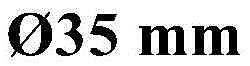
容器的重量损失是随着时间而变的。重量损失是由于水通过粘合剂和/或膜的传输而产生的。此差值用于计算测试粘合剂膜的MVTR。MVTR是用每时间的重量损失除以杯子中开口的面积(g/m2/24h)来计算的。The weight loss of the container changes over time. Weight loss is due to the transport of water through the adhesive and/or membrane. This difference is used to calculate the MVTR of the test adhesive film. MVTR is calculated by dividing the weight loss per time by the area of the opening in the cup (g/ m2 /24h).
材料的MVTR是该材料厚度的线性函数。因此,当报告MVTR来表征材料时,通告所要报告MVTR的材料的厚度是很重要的。将150μm用作参考。如果测量更薄或更厚的样品,则将MVTR报告对应于150μm的样品。因此,由于样品的厚度与样品的MVTR之间的线性关系,具有测量的10g/m2/24h的MVTR的300μm样品被报告为对于150μm样品具有MVTR=20g/m2/24h。The MVTR of a material is a linear function of the thickness of the material. Therefore, when reporting MVTR to characterize a material, it is important to announce the thickness of the material for which the MVTR is to be reported. 150 μm was used as a reference. If thinner or thicker samples were measured, the MVTR was reported corresponding to a 150 μm sample. Therefore, due to the linear relationship between the thickness of the sample and the MVTR of the sample, a 300 μm sample with a measured MVTR of 10 g/m 2 /24h is reported as having MVTR=20 g/m 2 /24h for the 150 μm sample.
最后,我们注意到通过使用这个方法,我们由于使用了支撑PU膜而引入误差。利用粘合剂/膜层层压件是两个串联电阻的系统来消除误差。当膜和粘合剂均匀时,传输速率可被表示为:Finally, we noticed that by using this method, we introduced errors due to the use of a supporting PU film. Errors are eliminated using a system where the adhesive/film laminate is two resistors in series. When the film and adhesive are homogeneous, the transfer rate can be expressed as:
1/P(测量的)=1/P(膜)+1/P(粘合剂)。1/P(measured)=1/P(film)+1/P(adhesive).
因此,通过知道该薄膜的渗透率和该粘合剂的厚度,就可以用下面的表达式计算该粘合剂的真实的渗透率P(粘合剂):Therefore, by knowing the permeability of the film and the thickness of the adhesive, the true permeability P(adhesive) of the adhesive can be calculated using the following expression:
P(粘合剂)=d(粘合剂)/150μm*1/(1/P(测量)-1/P(膜))P(adhesive)=d(adhesive)/150μm*1/(1/P(measurement)-1/P(film))
式中d(粘合剂)是该粘合剂的实际测量厚度,并且P(膜)是在没有任何粘合剂时膜的MVTR,并且P(测量)是实际测量的MVTR。where d(adhesive) is the actual measured thickness of the adhesive, and P(film) is the MVTR of the film without any adhesive, and P(measured) is the actual measured MVTR.
吸湿性Hygroscopic
通过在两个离型衬垫之间热成形至0.5mm厚的粘合剂膜来制备样品。使用冲孔工具冲压出样品。样品大小是25×25mm。移除离型衬垫。将样品胶合到目标玻璃并且放置于具有生理盐水的烧杯中,并且放置于37℃下的恒温箱中。Samples were prepared by thermoforming an adhesive film to a thickness of 0.5 mm between two release liners. Use a punch tool to punch out the sample. The sample size is 25 x 25 mm. Remove the release liner. The samples were glued to target glass and placed in a beaker with saline and placed in an incubator at 37°C.
在开头(M(开始))和在2小时后(M(2小时))称重样品。在称重之前,使用布将目标玻璃弄干。对于25×25mm样品,面积是6.25cm2(表面边缘不计入面积内)。吸湿性可以计算为:2小时后的吸水率=(M(2小时)-M(起始))/6.25cm2。结果是g/cm2/2h的单位。The samples were weighed at the beginning (M(start)) and after 2 hours (M(2 hours)). Use a cloth to dry the target glass before weighing. For a 25 x 25 mm sample, the area is 6.25 cm2 (surface edges are not included in the area). The hygroscopicity can be calculated as: water absorption after 2 hours=(M(2 hours)−M(initial))/6.25cm 2 . The result is in units of g/cm 2 /2h.
剥离测试peel test
用于剥离测试的基材和液体介质。Substrates and liquid media for peel testing.
用于模拟实际用途的基材是皮肤。The substrate used to simulate actual use is skin.
该剥离液体介质是盐水中的4%的洗手皂溶液。The stripping liquid medium is a 4% hand soap solution in saline.
剥离设置Stripping settings
为了模拟剥离测量中的渗漏传播,选择低且恒定的剥离角度。此剥离设置具有40度的恒定剥离和500g的恒定剥离负载。随时间的推移测量剥离延伸部分。使用不同的停留时间(从将该粘合剂施加到皮肤上直到测试开始的时间),以便观察如在此描述的该第二粘合剂以及可转换的粘合剂的瞬间粘附性特性。剥离实验在大约20℃的环境温度下进行。To simulate leak propagation in peel measurements, a low and constant peel angle was chosen. This peel setup has a constant peel of 40 degrees and a constant peel load of 500 g. The peel extension was measured over time. Different dwell times (the time from application of the adhesive to the skin until the start of the test) were used in order to observe the transient adhesion properties of the second adhesive as well as the switchable adhesive as described herein. The peel experiments were performed at an ambient temperature of approximately 20°C.
附图的详细说明Detailed Description of Drawings
在以下详细说明中,参考附图。附图形成本说明书的一部分,并且展示了用于实践本发明的示例性实施例。参考所描述的一个或多个图的取向,使用方向性术语,诸如“顶”、“底”、“前”、“后”、“前导”、“后面”等。因为实施例的部件可以被定位在一些取向中,所以方向性术语用于说明的目的并且绝不是限制。应理解,在不脱离本发明的范围的情况下,可以利用其他实施例并可以做出结构或逻辑的改变。详细说明描述了用于实践本发明的实例,并且不应被阅读为限制本发明的范围。本发明的范围由所附权利要求书限定。In the following detailed description, reference is made to the accompanying drawings. The accompanying drawings form a part of this specification and illustrate exemplary embodiments for practicing the invention. Directional terms, such as "top", "bottom", "front", "rear", "leading", "rear", etc., are used with reference to the orientation of one or more figures being described. Since components of an embodiment may be oriented in several orientations, directional terminology is used for purposes of illustration and is by no means limiting. It is to be understood that other embodiments may be utilized and structural or logical changes may be made without departing from the scope of the present invention. The detailed description describes examples for practicing the invention and should not be read as limiting the scope of the invention. The scope of the invention is defined by the appended claims.
除非另外专门指出,否则本申请中描述的实施例和这些不同示例性实施例的特征可以彼此组合(“混合和匹配”)。Unless specifically stated otherwise, the embodiments described in this application and the features of these various exemplary embodiments may be combined with each other ("mix and match").
在图1中示出了用于造口装置的粘合薄片的截面。为简单起见,附图中省略了收集袋和/或用于附接此类袋的联接。该薄片包括涂覆在该面向皮肤的表面上具有第二粘合剂3的背衬层1。第一可转换的粘合剂2被提供在该薄片的中心部分处,围绕用于容纳造口的贯穿孔5。离型衬垫4在施加之前覆盖该薄片的面向皮肤的表面。离型衬垫4设置有用于包含第一粘合剂2的形状稳定的凹部。A cross-section of an adhesive sheet for an ostomy device is shown in FIG. 1 . For simplicity, collection bags and/or couplings for attaching such bags have been omitted from the figures. The sheet comprises a backing layer 1 with a
图2是示出的薄片的截面,该薄片包括涂覆在该面向皮肤的表面上具有第二粘合剂3的背衬层1。第一可转换的粘合剂2被提供在该薄片的中心部分处,围绕用于容纳造口的贯穿孔5。离型衬垫4在施加之前覆盖该薄片的面向皮肤的表面。第二粘合剂3的中心部分设置有用于包含第一粘合剂2的凹部。该薄片的面向皮肤的表面是基本上平面的。Figure 2 is a cross-section of a sheet shown comprising a backing layer 1 with a
在图3中是示出的薄片的截面,其中第二粘合剂3和离型衬垫4两者设置有用于包含第一粘合剂2的凹部。In FIG. 3 is a section of the sheet shown in which both the
在图4中是被施加到围绕造口5的皮肤上的所示出的薄片的截面。移除该离型衬垫,并且第一粘合剂2已被模制以配合在造口5周围。In FIG. 4 is a cross-section of the sheet shown applied to the skin surrounding the
在图5中示出了具有背衬层1、第一可转换的粘合剂层2和离型衬垫4的实施例。沿着边缘部分6,该粘合剂已经被转换成更形式稳定的纹理,从而防止该粘合剂流出该薄片。An embodiment with a backing layer 1 , a first switchable
在图6中示出了具有背衬层1、第一可转换的粘合剂层2和离型衬垫4的实施例。沿着边缘部分6,并且在该第一粘合剂层的中心部分中的点7处,该粘合剂已经被转换成更形式稳定的纹理,从而防止该粘合剂流出该薄片。中心中的转换点或线7可以将粘合剂2分成更小的隔间。An embodiment with a backing layer 1 , a first switchable
在图7中示出了实施例,该实施例具有背衬层1、在该薄片的中心部分处的第一可转换的粘合剂层2和在该薄片的周边部分处的第二粘合剂3以及离型衬垫4。沿着边缘部分6,粘合剂2已经被转换成更形式稳定的纹理,从而防止粘合剂2流出该薄片。An embodiment is shown in Figure 7 with a backing layer 1, a first switchable
实例Example
样品1Sample 1
具有可转换的粘合剂的完全覆盖的粘合薄片Fully covered adhesive sheet with switchable adhesive
该粘合薄片由背衬层(DOW Saranex 630G)以及硅化的(siliconiced)离型衬垫(来自Hutamaki的0,11mm PPB,1803)组成,该背衬层涂覆有可转换的粘合剂(组合物:具有1%的光引发剂*和25%的水状胶体**的74%BASF acResin A 260UV)、具有1mm的厚度以及110mm的圆几何形状。The adhesive sheet consisted of a backing layer (DOW Saranex 630G) coated with a switchable adhesive ( Composition: 74% BASF acResin A 260 UV) with 1% photoinitiator* and 25% hydrocolloid**, with a thickness of 1 mm and a circular geometry of 110 mm.
该薄片旨在具有糊状特性,并且当转换时改变从可模制的糊纹理到形式稳定的粘合剂纹理的粘附性特征。The flakes are intended to have pasty properties, and when converted, change the adhesion characteristics from a moldable pasty texture to a form-stable adhesive texture.
样品2
在中心部分处具有可转换的粘合剂的粘合薄片Adhesive sheet with switchable adhesive at center portion
该粘合薄片由背衬层(DOW Saranex 630G)、具有1mm的厚度以及110mm的圆几何形状的基于标准水状胶体(hyderocolloide)粘合剂***的完全覆盖粘合剂、在中心部分处2mm厚度以及具有70mm的直径的圆几何形状的可转换的粘合剂(组合物:具有1%的光引发剂*和25%的水状胶体**的74%BASF acResin A 260UV)以及硅化的(siliconiced)离型衬垫(来自Hutamaki的0,11mm PPB,1803)组成。第二粘合剂***被提供在该周边部分处并且在该可转换的粘合剂的远侧部分上。The adhesive sheet consisted of a backing layer (DOW Saranex 630G), a fully covered adhesive based on a standard hydrocolloid adhesive*** with a thickness of 1 mm and a circular geometry of 110 mm, at the central portion A switchable adhesive of 2mm thickness and circular geometry with a diameter of 70mm (composition: 74% BASF acResin A 260UV with 1% photoinitiator* and 25% hydrocolloid**) and siliconized (siliconiced) release liner (0,11 mm PPB, 1803 from Hutamaki). A second adhesive*** is provided at the peripheral portion and on the distal portion of the switchable adhesive.
该第一粘合剂旨在具有糊状特性,并且当转换时将改变从可模制的糊纹理到形式稳定的粘合剂纹理的粘附性特征。周边粘合剂将不改变状态。This first adhesive is intended to have pasty properties and will change the adhesion characteristics from a moldable pasty texture to a form stable adhesive texture when converted. The perimeter adhesive will not change state.
*光引发剂化学:来自汽巴公司的Irgacure 784光引发剂(双(.η.5-2,4-环戊二烯-1-基)-双(2,6-二氟-3-(1H-吡咯-1-基)-苯基)钛)。*Photoinitiator chemistry: Irgacure 784 photoinitiator (Bis(.η.5-2,4-cyclopentadien-1-yl)-bis(2,6-difluoro-3-( 1H-pyrrol-1-yl)-phenyl)titanium).
**水状胶体混合物:25%的水状胶体(10%(w/w)的pectin LM CG,斯比凯可公司(CP Kelco);20%(w/w)的Akucell AF288,阿克苏诺贝尔公司(Akzo Nobel);30%(w/w)的PB明胶,普邦明胶公司(PB Gelatins);以及40%(w/w)的Guar gum FG-20,赫拉克勒斯公司(Hercules Corp.))。**Hydrocolloid mixture: 25% hydrocolloid (10% (w/w) pectin LM CG, CP Kelco; 20% (w/w) Akucell AF288, AkzoNobel Company (Akzo Nobel); 30% (w/w) PB Gelatin, PB Gelatins; and 40% (w/w) Guar gum FG-20, Hercules Corp. )).
***((10%(w/w)的Kraton 1161,来自科腾聚合物公司(Kraton polymers);40%的来自巴斯夫公司(BASF)的Ooppanol B12;5%(w/w)的pectin LM CG,斯比凯可公司;10%(w/w)的Akucell AF288,阿克苏诺贝尔公司;15%(w/w)的PB明胶,普邦明胶公司;以及20%(w/w)的Guar gum FG-20,赫拉克勒斯公司)。将这些组分在z刀片Austin 300g混合器中混合持续20min)。***((10% (w/w) Kraton 1161 from Kraton polymers; 40% Ooppanol B12 from BASF; 5% (w/w) pectin LM CG, Spike Co.; 10% (w/w) Akucell AF288, AkzoNobel; 15% (w/w) PB Gelatin, Pubon Gelatin; and 20% (w/w) Guar gum FG-20, Hercules Corporation). These components were mixed in a z-blade Austin 300 g mixer for 20 min).
将这些样品施加到皮肤上,通过剥离测试研究粘合剂特性。如从表1中可以看出,该可转换的粘合剂当它被转换时在剥离期间以内聚破裂分开,该粘合剂断裂并且残余物留在薄片和皮肤两者上。These samples were applied to the skin and the adhesive properties were investigated by peel testing. As can be seen from Table 1, the switchable adhesive ruptured cohesively during peel apart when it was switched, the adhesive fractured and residue was left on both the sheet and the skin.
表1Table 1
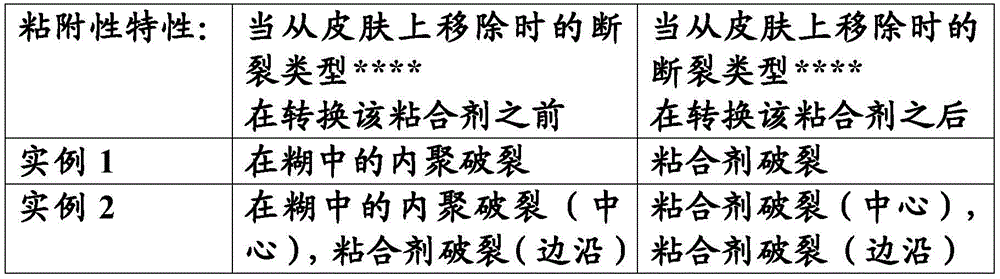
****在移除之前粘合剂保留在皮肤上10min。****The adhesive was left on the skin for 10 minutes before removal.
作为可转换的粘合剂的替代实例,可以使用湿气可转换的粘合剂。湿气可转换的粘合剂例如能够是以下之一:As an alternative to switchable adhesives, moisture switchable adhesives can be used. The moisture-convertible adhesive can be, for example, one of the following:
湿气组合物12:混合的湿气-可转换的硅酮粘合剂,具有10%混合的水状胶体Moisture Composition 12: Mixed Moisture-Switchable Silicone Adhesive with 10% Mixed Hydrocolloid
使用Speedmixer在3000rpm下将Trio Silken(18g,36重量%,翠欧健康护理)与水状胶体(5g,10重量%)的混合物混合3分钟。水状胶体混合物由羧甲基纤维素(20重量%)、瓜尔胶(40重量%)、明胶(30重量%)以及果胶(10重量%)组成。将非反应性的硅酮聚合物BioPSA(27g,54重量%,道康宁7-4560)添加至混合物,并且使用Speedmixer在3000rpm下再混合混合物3分钟。使用涂覆器,将混合物涂覆在聚氨酯Biatain膜(30μm)上。针对转换实验,这种组合物在32℃的烘箱中或在32℃和50%相对湿度的湿度柜(宾德(Binder)KBF)中转换。A mixture of Trio Silken (18 g, 36 wt %, Trio Health Care) and hydrocolloid (5 g, 10 wt %) was mixed using a Speedmixer for 3 minutes at 3000 rpm. The hydrocolloid mixture consisted of carboxymethyl cellulose (20% by weight), guar gum (40% by weight), gelatin (30% by weight) and pectin (10% by weight). The non-reactive silicone polymer BioPSA (27 g, 54 wt%, Dow Corning 7-4560) was added to the mixture and the mixture was mixed for an additional 3 minutes using a Speedmixer at 3000 rpm. Using an applicator, the mixture was coated on a polyurethane Biatain film (30 μm). For conversion experiments, this composition was converted in an oven at 32°C or in a humidity cabinet (Binder KBF) at 32°C and 50% relative humidity.
在转换前测量的粘度:0.01Hz下351Pa s。Viscosity measured before conversion: 351 Pa s at 0.01 Hz.
湿气组合物17:混合的湿气-可转换的硅酮粘合剂,具有40%干燥混合的水状胶体Moisture Composition 17: Mixed Moisture-Switchable Silicone Adhesive with 40% Dry Mixed Hydrocolloid
使用Speedmixer在3000rpm下将Trio Silken(12g,24重量%,翠欧健康护理)与水状胶体(20g,40重量%)的混合物混合3分钟。水状胶体混合物由羧甲基纤维素(20重量%,Akucell AF 2881,阿克苏诺贝尔公司)、瓜尔胶(40重量%、瓜尔胶FG-200,诺迪斯克明胶公司(Nordisk Gelatine))、明胶(30重量%,明胶UF220,普邦明胶有限公司)以及果胶(10重量%,LM 12CG-Z/200,斯比凯可公司)组成。在添加至配制品前,将水状胶体在80℃下干燥,直到它们达到2.43重量%的含水量。将非反应性的硅酮聚合物BioPSA(18g,36重量%,道康宁7-4560)添加至混合物,并且使用Speedmixer在3000rpm下再混合混合物3分钟。使用涂覆器,将所得混合物涂覆在膜上,并且在测试前,将膜在烘箱中在32℃下在50%的相对湿度下固化。A mixture of Trio Silken (12 g, 24 wt %, Trio Health Care) and hydrocolloid (20 g, 40 wt %) was mixed using a Speedmixer for 3 minutes at 3000 rpm. The hydrocolloid mixture consists of carboxymethyl cellulose (20 wt%, Akucell AF 2881, AkzoNobel), guar gum (40 wt%, Guar FG-200, Nordisk Gelatine) , gelatin (30% by weight, gelatin UF220, Pubon Gelatin Co., Ltd.) and pectin (10% by weight, LM 12CG-Z/200, Spike Co., Ltd.). The hydrocolloids were dried at 80°C until they reached a water content of 2.43% by weight before being added to the formulation. The non-reactive silicone polymer BioPSA (18 g, 36 wt%, Dow Corning 7-4560) was added to the mixture and the mixture was mixed for an additional 3 minutes using a Speedmixer at 3000 rpm. Using an applicator, the resulting mixture was coated on a film and the film was cured in an oven at 32°C at 50% relative humidity prior to testing.
在转换前测量的粘度:0.01Hz下2366Pa s。Viscosity measured before conversion: 2366 Pa s at 0.01 Hz.
Claims (13)
Applications Claiming Priority (3)
| Application Number | Priority Date | Filing Date | Title |
|---|---|---|---|
| DKPA201570210 | 2015-04-10 | ||
| DKPA201570210 | 2015-04-10 | ||
| PCT/DK2016/050099 WO2016162038A1 (en) | 2015-04-10 | 2016-04-08 | Ostomy device |
Publications (2)
| Publication Number | Publication Date |
|---|---|
| CN107530182A CN107530182A (en) | 2018-01-02 |
| CN107530182B true CN107530182B (en) | 2020-06-30 |
Family
ID=53276701
Family Applications (1)
| Application Number | Title | Priority Date | Filing Date |
|---|---|---|---|
| CN201680021020.4A Active CN107530182B (en) | 2015-04-10 | 2016-04-08 | ostomy device |
Country Status (13)
| Country | Link |
|---|---|
| US (2) | US11160681B2 (en) |
| EP (1) | EP3280368B1 (en) |
| JP (1) | JP6697000B2 (en) |
| CN (1) | CN107530182B (en) |
| AU (1) | AU2016244934B2 (en) |
| BR (1) | BR112017021501A2 (en) |
| CA (1) | CA2982012C (en) |
| DK (1) | DK3280368T3 (en) |
| ES (1) | ES2741852T3 (en) |
| HU (1) | HUE044528T2 (en) |
| PL (1) | PL3280368T3 (en) |
| RU (1) | RU2695603C2 (en) |
| WO (1) | WO2016162038A1 (en) |
Families Citing this family (46)
| Publication number | Priority date | Publication date | Assignee | Title |
|---|---|---|---|---|
| US11077224B2 (en) | 2015-02-02 | 2021-08-03 | Coloplast A/S | Ostomy device |
| CN107530182B (en) | 2015-04-10 | 2020-06-30 | 科洛普拉斯特公司 | ostomy device |
| US10729806B2 (en) | 2015-04-30 | 2020-08-04 | Coloplast A/S | Adhesive composition |
| EP3352715B1 (en) * | 2015-09-24 | 2019-06-26 | Coloplast A/S | An ostomy appliance with a release liner with an enclosure |
| US11141100B2 (en) | 2015-12-23 | 2021-10-12 | Coloplast A/S | Moisture assessment system and method for wound care |
| US11547594B2 (en) * | 2016-09-21 | 2023-01-10 | Coloplast A/S | Ostomy device |
| US11291578B2 (en) | 2017-02-20 | 2022-04-05 | Coloplast A/S | Adhesive wafer with an integrated release layer |
| RU2019135072A (en) * | 2017-04-10 | 2021-05-11 | Колопласт А/С | BODY-FIRED STOMA DEVICE ELEMENT |
| EP3912602B1 (en) * | 2017-04-10 | 2024-08-21 | Coloplast A/S | Body side member of an ostomy appliance |
| WO2019091526A1 (en) * | 2017-11-08 | 2019-05-16 | Coloplast A/S | An adhesive wafer with a neutralizer matrix |
| EP3706619B1 (en) | 2017-11-09 | 2024-04-24 | ConvaTec Technologies Inc. | Ostomy monitoring system |
| US11590015B2 (en) | 2017-12-22 | 2023-02-28 | Coloplast A/S | Sensor assembly part and a base plate for a medical appliance and a method for manufacturing a sensor assembly part and a base plate |
| US11986418B2 (en) | 2017-12-22 | 2024-05-21 | Coloplast A/S | Medical system and monitor device with angular leakage detection |
| WO2019120452A1 (en) | 2017-12-22 | 2019-06-27 | Coloplast A/S | Coupling part with a hinge for an ostomy base plate and sensor assembly part |
| LT3727240T (en) | 2017-12-22 | 2022-03-10 | Coloplast A/S | ADDITIONAL INSTALLATIONS AND ASSOCIATED TRANSMISSION METHODS FOR THE OSTOMY SYSTEM |
| WO2019120446A1 (en) | 2017-12-22 | 2019-06-27 | Coloplast A/S | Base plate and sensor assembly part of an ostomy system having a moisture sensor |
| US10500084B2 (en) | 2017-12-22 | 2019-12-10 | Coloplast A/S | Accessory devices of an ostomy system, and related methods for communicating leakage state |
| JP7422074B2 (en) | 2017-12-22 | 2024-01-25 | コロプラスト アクティーゼルスカブ | Ostomy system base plate and sensor assembly with leakage sensor |
| WO2019120425A1 (en) | 2017-12-22 | 2019-06-27 | Coloplast A/S | Ostomy appliance system, monitor device, and method of monitoring an ostomy appliance |
| EP3727242B1 (en) | 2017-12-22 | 2022-03-09 | Coloplast A/S | Monitor device of an ostomy system having a connector for coupling to both a base plate and an accessory device |
| AU2018391395B2 (en) | 2017-12-22 | 2024-05-23 | Coloplast A/S | Base plate for an ostomy appliance, a monitor device and a system for an ostomy appliance |
| EP4042985B1 (en) | 2017-12-22 | 2025-10-29 | Coloplast A/S | Processing schemes for an ostomy system, monitor device for an ostomy appliance and related methods |
| US12272449B2 (en) | 2017-12-22 | 2025-04-08 | Coloplast A/S | Data transmission schemes for a medical system, monitor device for a medical appliance and related methods |
| RU2020120424A (en) | 2017-12-22 | 2022-01-25 | Колопласт А/С | STOMY DEVICE WITH SELECTIVE MEASUREMENT POINTS AND RELATED METHODS |
| EP3755283B1 (en) | 2018-02-20 | 2024-05-01 | Coloplast A/S | Sensor assembly part and a base plate and an ostomy pouch for an ostomy appliance and a device for connecting to a base plate and/or a sensor assembly part |
| WO2019161863A1 (en) | 2018-02-20 | 2019-08-29 | Coloplast A/S | Accessory devices of an ostomy system, and related methods for changing an ostomy appliance based on future operating state |
| CN111885984B (en) | 2018-03-15 | 2023-08-04 | 科洛普拉斯特公司 | Apparatus and method for determining when to wear an ostomy appliance based on sensor data |
| LT3764961T (en) | 2018-03-15 | 2024-03-25 | Coloplast A/S | Apparatus and methods for navigating ostomy appliance user to changing room |
| EP4374776A3 (en) * | 2018-03-15 | 2024-09-11 | Coloplast A/S | Apparatus and methods for determining ostomy appliance wear time based on location data |
| WO2019174698A1 (en) | 2018-03-15 | 2019-09-19 | Coloplast A/S | Methods of configuring ostomy notifications and related accessory devices |
| US12232997B2 (en) | 2018-08-15 | 2025-02-25 | Coloplast A/S | Accessory device of a medical system and related methods for issue identification |
| GB2578167B (en) * | 2018-10-19 | 2023-06-21 | Adv Med Solutions Ltd | Ostomy device |
| USD893514S1 (en) | 2018-11-08 | 2020-08-18 | 11 Health And Technologies Limited | Display screen or portion thereof with graphical user interface |
| AU2019405880B2 (en) | 2018-12-20 | 2024-12-12 | Coloplast A/S | Ostomy condition classification with masking, devices and related methods |
| WO2020125907A1 (en) | 2018-12-20 | 2020-06-25 | Coloplast A/S | Ostomy condition classification with image data transformation, devices and related methods |
| US12232998B2 (en) | 2019-01-31 | 2025-02-25 | Coloplast A/S | Application of a stomal sensor patch |
| EP4275662B1 (en) | 2019-01-31 | 2025-08-27 | Coloplast A/S | Stomal sensor patch |
| JP7525500B2 (en) | 2019-01-31 | 2024-07-30 | コロプラスト アクティーゼルスカブ | Sensor patch for ostomy appliances |
| WO2020173534A1 (en) | 2019-02-28 | 2020-09-03 | Coloplast A/S | A sensor patch for attachment to a base plate |
| WO2020200382A1 (en) * | 2019-04-01 | 2020-10-08 | Coloplast A/S | A pliable skin barrier ring |
| EP4218691B1 (en) * | 2019-10-04 | 2024-11-27 | ConvaTec Limited | Ostomy appliance |
| AU2020361075A1 (en) * | 2019-10-04 | 2022-03-31 | Convatec Limited | Ostomy appliance |
| WO2021090277A1 (en) * | 2019-11-08 | 2021-05-14 | Kci Licensing, Inc. | Drapes with regions with higher adhesive properties |
| EP4228563A1 (en) | 2020-10-15 | 2023-08-23 | ConvaTec Technologies Inc. | Ostomy systems and methods |
| CN217245086U (en) * | 2022-03-18 | 2022-08-23 | 厦门溥博医疗科技有限公司 | Multi-lining protected ostomy base plate and ostomy bag |
| US12447644B2 (en) | 2023-12-14 | 2025-10-21 | Nicholas Marsh BUFFO | Ostomy bag preparation device |
Citations (6)
| Publication number | Priority date | Publication date | Assignee | Title |
|---|---|---|---|---|
| CN1073857A (en) * | 1991-12-31 | 1993-07-07 | 明尼苏达矿产制造公司 | Cementing compositions and method |
| CN1199342A (en) * | 1995-08-11 | 1998-11-18 | 史密夫及内修公开有限公司 | Adhesives |
| CN1258208A (en) * | 1997-05-26 | 2000-06-28 | 科洛普拉斯特公司 | Ostomy appliances |
| CN2430135Y (en) * | 2000-06-22 | 2001-05-16 | 陈锦 | Marsupialization bag for easy cleaning and exhausting air |
| CN102215790A (en) * | 2008-11-19 | 2011-10-12 | 康沃特克科技公司 | Ostomy appliance with moldable adhesive |
| CN102413797A (en) * | 2009-04-21 | 2012-04-11 | 科洛普拉斯特公司 | Adhesive wafer for use in a collecting device |
Family Cites Families (217)
| Publication number | Priority date | Publication date | Assignee | Title |
|---|---|---|---|---|
| GB1050070A (en) | 1900-01-01 | |||
| US2608542A (en) | 1950-09-26 | 1952-08-26 | Warren S D Co | Heat-energizable adhesives and coated products and process of making same |
| US2608543A (en) | 1950-09-26 | 1952-08-26 | Warren S D Co | Heat-activatable delayed-setting adhesive products |
| US3302647A (en) | 1964-03-03 | 1967-02-07 | Hollister Inc | Sealing pad for a post-surgical drainage pouch |
| US3612053A (en) * | 1969-06-23 | 1971-10-12 | Minnesota Mining & Mfg | Ostomy sealing washer |
| US4125522A (en) | 1977-07-01 | 1978-11-14 | E. I. Du Pont De Nemours And Company | Adhesive composition |
| DK147035C (en) | 1980-12-05 | 1984-09-03 | Coloplast As | Skin Barrier |
| US4528239A (en) | 1983-08-23 | 1985-07-09 | The Procter & Gamble Company | Deflection member |
| US4614787A (en) | 1984-11-13 | 1986-09-30 | Thermedics, Inc. | Drug dispensing wound dressing |
| US4847137A (en) | 1986-05-19 | 1989-07-11 | Minnesota Mining And Manufacturing Company | Pressure-sensitive adhesive crosslinked by copolymerizable aromatic ketone monomers |
| FR2618337B1 (en) * | 1987-07-22 | 1989-12-15 | Dow Corning Sa | SURGICAL DRESSING AND PROCESS FOR MAKING SAME |
| GB8720440D0 (en) | 1987-08-28 | 1987-10-07 | Smith & Nephew Ass | Curable compositions |
| DE3801511C2 (en) | 1988-01-20 | 1996-11-14 | Espe Stiftung | Use of photoinitiators for the production of dental materials that can be hardened in two steps |
| DE3810096A1 (en) | 1988-03-29 | 1989-10-05 | Kendall & Co | METHOD FOR CONNECTING TWO SUBSTRATES AND COMPOSITIONS SUITABLE THEREOF |
| US5030665A (en) | 1988-04-08 | 1991-07-09 | Becton, Dickinson And Company | Ultraviolet cured peelable film and method therefor |
| US5853864A (en) | 1988-06-30 | 1998-12-29 | H. B. Fuller Licensing & Financing Inc. | Composite article resistant to moisture-induced debonding |
| GB8907621D0 (en) | 1989-04-05 | 1989-05-17 | Colquhoun Joseph A | Sealing system |
| WO1990013420A1 (en) | 1989-05-11 | 1990-11-15 | Landec Labs, Inc. | Temperature-activated adhesive assemblies |
| US5013307A (en) | 1989-08-02 | 1991-05-07 | Marna Broida | Absorbent pad for an ostomy appliance |
| US5124076A (en) | 1990-01-19 | 1992-06-23 | Contour Electrodes, Inc. | Rapid, curing, electrically conductive adhesive |
| US5648167A (en) | 1990-03-29 | 1997-07-15 | Smith & Nephew Plc | Adhesive compositions |
| US5591447A (en) | 1990-10-01 | 1997-01-07 | Hollister Incorporated | Wound dressing having a contoured adhesive layer |
| AU1441692A (en) | 1991-02-12 | 1992-09-07 | Landec Corporation | Temperature zone specific pressure-sensitive adhesive compositions, and adhesive assemblies and methods of use associated therewith |
| DK122791D0 (en) | 1991-06-24 | 1991-06-24 | Coloplast As | wound dressing |
| DE4121703A1 (en) | 1991-07-01 | 1993-01-07 | Huels Chemische Werke Ag | FILM-FORMING, RADIATION-HARDENABLE AND HUMIDITY-HARDENING LAMINATING ADHESIVE, METHOD FOR LAMINATING TEXTILE LAYERS WITH THIS LAMINATING ADHESIVE, AND TEXTILE MATERIAL FROM TEXTILE LAYERS AND FOILS OF THE CASE |
| TW221061B (en) | 1991-12-31 | 1994-02-11 | Minnesota Mining & Mfg | |
| DK5492A (en) | 1992-01-17 | 1993-07-18 | Coloplast As | A dressing |
| CA2104046C (en) | 1992-10-05 | 1998-09-15 | Yen-Lane Chen | Adhesive compositions, wound dressings and methods |
| DK169711B1 (en) | 1993-01-15 | 1995-01-23 | Coloplast As | A dressing |
| GB2283916B (en) | 1993-10-25 | 1997-06-18 | Welland Medical Ltd | Adhesive flange |
| CA2178922C (en) | 1993-12-22 | 2001-04-10 | Ronald L. Bracken | Soft polysiloxanes having a pressure sensitive adhesive |
| JPH07275282A (en) | 1994-04-06 | 1995-10-24 | Arukea Kk | Skin contact part for ostomy appliance |
| DE69515896T2 (en) | 1994-11-02 | 2000-10-19 | The Procter & Gamble Company, Cincinnati | METHOD FOR PRODUCING FLEECE MATERIALS |
| US6602232B1 (en) | 1995-02-17 | 2003-08-05 | E.R. Squibb & Sons, Inc. | Ostomy system with repositionable pouch |
| US5814031A (en) | 1995-03-02 | 1998-09-29 | Mooney; Mark | Structured occllusive dressings |
| US5695837A (en) | 1995-04-20 | 1997-12-09 | Minnesota Mining And Manufacturing Company | Tackified acrylic adhesives |
| US5714305A (en) | 1995-05-24 | 1998-02-03 | Polaroid Corporation | Overcoat-releasing laminate and method for the manufacture thereof |
| US5722965A (en) | 1996-02-29 | 1998-03-03 | Bristol-Myers Squibb Company | Low profile ostomy system with repositionable pouch |
| AU757283B2 (en) | 1996-04-10 | 2003-02-13 | Convatec Technologies Inc. | Customized ostomy devices |
| US5889118A (en) | 1996-06-03 | 1999-03-30 | Minnesota Mining And Manufacturing Company | Thermomorphic "smart" pressure sensitive adhesives |
| US5800685A (en) | 1996-10-28 | 1998-09-01 | Cardiotronics Systems, Inc. | Electrically conductive adhesive hydrogels |
| WO1998026811A2 (en) | 1996-12-18 | 1998-06-25 | Vidacare International, Inc. | Releasable adhesive closure |
| WO1998055057A1 (en) | 1997-06-04 | 1998-12-10 | Coloplast A/S | An ostomy appliance |
| DK99397A (en) | 1997-08-29 | 1999-05-05 | Coloplast As | Adhesive and use of this agent |
| GB9720922D0 (en) | 1997-10-02 | 1997-12-03 | Smith & Nephew | Adhesives |
| US6068852A (en) | 1997-10-11 | 2000-05-30 | Polytherapeutics, Inc. | Polymeric composition for sealing and shielding animal skin |
| AU2046799A (en) | 1998-01-15 | 1999-08-02 | Coloplast A/S | A dressing |
| US6071268A (en) | 1998-05-29 | 2000-06-06 | Wagner; Neldon C. | Ostomy skin barrier assembly, stoma seal assembly and materials for use in stoma seals |
| GB2341185A (en) | 1998-09-07 | 2000-03-08 | Polybiomed Ltd | Polymerizable material and adhesive sheet material therefrom; dressings, electrodes and transdermal patches |
| FR2785526B1 (en) | 1998-11-06 | 2001-03-30 | Plasto Sa | SECURITY DEVICE FOR COLOSTOMY |
| DK173498B1 (en) * | 1998-11-19 | 2001-01-08 | Coloplast As | An ostomy appliance |
| US6143798A (en) | 1999-01-11 | 2000-11-07 | Jentec, Inc. | Wound dressing |
| EP1025867A1 (en) | 1999-02-02 | 2000-08-09 | The Procter & Gamble Company | Disposable human waste management devices with improved adhesive flange to facilitate adhesion in oily conditions |
| US6607516B2 (en) | 1999-02-02 | 2003-08-19 | The Procter & Gamble Company | Disposable human waste management devices with improved adhesive flange to facilitate adhesion in oily conditions |
| DK174650B1 (en) | 1999-02-25 | 2003-08-04 | Coloplast As | An ostomy appliance |
| US6624273B1 (en) | 1999-03-19 | 2003-09-23 | 3M Innovative Properties Company | Plasticized acrylics for pressure sensitive adhesive applications |
| US6855386B1 (en) | 1999-03-19 | 2005-02-15 | 3M Innovative Properties Company | Wet surface adhesives |
| GB9908000D0 (en) | 1999-04-09 | 1999-06-02 | Smith & Nephew | Curable compositions |
| US20040151902A1 (en) * | 1999-04-09 | 2004-08-05 | Christopher Ansell | Curable compositions |
| AU2004203234A1 (en) | 1999-04-09 | 2004-09-02 | Smith & Nephew Plc | Curable compositions |
| EP1044667A1 (en) | 1999-04-12 | 2000-10-18 | The Procter & Gamble Company | Container for the collection of bodily waste. |
| US6399672B1 (en) | 1999-06-02 | 2002-06-04 | Sartomer Technologies Co., Inc. | Oil soluble metal-containing compounds, compositions and methods |
| US7332218B1 (en) | 1999-07-14 | 2008-02-19 | Eic Laboratories, Inc. | Electrically disbonding materials |
| US6342561B1 (en) | 1999-11-17 | 2002-01-29 | 3M Innovative Properties Company | Organic particulate-filled adhesive |
| HUP0301947A3 (en) | 2000-05-08 | 2008-01-28 | Coloplast As | Ostomy carrier device with flexible flange |
| CA2308096C (en) | 2000-05-11 | 2006-09-05 | Advanced Therapeutic Technologies At2 Inc. | Adhesive suture strip |
| DE10037884A1 (en) | 2000-08-03 | 2002-02-21 | Henkel Kgaa | Accelerated curing process |
| US7067601B2 (en) | 2000-11-15 | 2006-06-27 | Henkel Corporation | Multi-functional alpha-alkoxyalkyl acrylate and methacrylate ester compositions and reworkable polymers formed therefrom |
| CN1269533C (en) | 2001-02-21 | 2006-08-16 | 科洛普拉斯特公司 | Adhesive composition |
| US6894204B2 (en) | 2001-05-02 | 2005-05-17 | 3M Innovative Properties Company | Tapered stretch removable adhesive articles and methods |
| US6718212B2 (en) | 2001-10-12 | 2004-04-06 | Medtronic, Inc. | Implantable medical electrical lead with light-activated adhesive fixation |
| FR2834902B1 (en) | 2002-01-23 | 2005-07-08 | Ziakovic Corinne Soulie | ADHESIVE SYSTEM, DEVICE FOR CARRYING OUT AND METHOD FOR ACTIVATION OR DEACTIVATION OF ADHESIVITY |
| EP1364663A1 (en) | 2002-05-21 | 2003-11-26 | Commonwealth Scientific And Industrial Research Organisation | Ocular devices with functionalized surface with adhesive properties |
| WO2004009720A2 (en) | 2002-07-24 | 2004-01-29 | Adhesives Research, Inc. | Transformable pressure sensitive adhesive tape and use thereof in display screens |
| DE60332750D1 (en) | 2002-10-02 | 2010-07-08 | Coloplast As | Hydrogel |
| US7612248B2 (en) | 2002-12-19 | 2009-11-03 | 3M Innovative Properties Company | Absorbent medical articles |
| US20040121120A1 (en) | 2002-12-20 | 2004-06-24 | The Procter & Gamble Company | Apparatus for making a polymeric web exhibiting a soft and silky tactile impression |
| US7501133B2 (en) | 2003-01-24 | 2009-03-10 | Rose-Hulman Institute Of Technology | Light-activated adhesive composite, system, and methods of use thereof |
| DK176425B1 (en) | 2003-03-17 | 2008-02-04 | Coloplast As | An ostomy appliance |
| KR20050116838A (en) | 2003-04-01 | 2005-12-13 | 디-본딩 리미티드 | Method and apparatus for bonding and debonding adhesive interface surfaces |
| US7927703B2 (en) | 2003-04-11 | 2011-04-19 | 3M Innovative Properties Company | Adhesive blends, articles, and methods |
| US20040242770A1 (en) | 2003-04-16 | 2004-12-02 | Feldstein Mikhail M. | Covalent and non-covalent crosslinking of hydrophilic polymers and adhesive compositions prepared therewith |
| DK176027B1 (en) | 2003-12-22 | 2005-12-19 | Hollister Inc | Adhesive face plate for securing ostomy bag to skin of ostomy patient has flatus gas passages extended between flexible plate and face plate coupling ring, that engages with coupler of ostomy bag, through filter |
| SE526906C2 (en) * | 2003-06-10 | 2005-11-15 | Moelnlycke Health Care Ab | Method of applying a protective layer to skin containing a highly viscous silicone composition |
| US7235593B2 (en) | 2003-08-04 | 2007-06-26 | Rensselaer Polytechnic Institute | Command-cure adhesives |
| WO2005013873A1 (en) | 2003-08-08 | 2005-02-17 | Bki Holding Corporation | Forming wire for airland manufacturing process and products made therefrom |
| CN100577207C (en) | 2003-08-27 | 2010-01-06 | 东亚合成株式会社 | Active energy radiation hardenable composition for skin plaster and skin plaster |
| WO2005033198A1 (en) | 2003-10-07 | 2005-04-14 | Coloplast A/S | A composition useful as an adhesive and use of such a composition |
| US20050080155A1 (en) | 2003-10-14 | 2005-04-14 | Fattman George F. | Ostomy pouch attachment adhesives resistant to stomal effluent |
| JP2007514011A (en) | 2003-11-13 | 2007-05-31 | ダウ・コーニング・コーポレイション | Method for bonding silicone gel to plastic |
| JP2005154477A (en) | 2003-11-20 | 2005-06-16 | Tottori Univ | Medical adhesives and medical coatings using UV-curable chitosan derivatives |
| WO2005061043A1 (en) | 2003-12-11 | 2005-07-07 | Gambro Lundia Ab | Switching device and apparatus for controlling flow of a fluid |
| WO2005070360A2 (en) | 2004-01-27 | 2005-08-04 | Coloplast A/S | An absorbing article with zones of different surface properties |
| WO2005082298A1 (en) | 2004-03-01 | 2005-09-09 | Coloplast A/S | Ostomy system |
| DE602005021767D1 (en) | 2004-04-08 | 2010-07-22 | Dow Corning | SILICON HAUTKLEBEGELS |
| JP4272636B2 (en) | 2004-04-13 | 2009-06-03 | コスメディ製薬株式会社 | Cross-linked skin adhesive |
| ES2395290T3 (en) | 2004-04-13 | 2013-02-11 | Nipro Patch Co., Ltd. | Skin-sensitive crosslinkable skin adhesive |
| RU2381835C2 (en) | 2004-07-21 | 2010-02-20 | Циба Спешиалти Кемикэлз Холдинг Инк. | Photoactivation method and use of catalyst through inverted two-stage procedure |
| KR100694445B1 (en) | 2004-08-24 | 2007-03-12 | 주식회사 엘지화학 | Acrylic pressure-sensitive adhesive composition having antistatic performance |
| GB2418861B (en) | 2004-10-07 | 2009-10-28 | Welland Medical Ltd | Ostomy bags |
| SE0500063L (en) * | 2005-01-11 | 2006-07-12 | Moelnlycke Health Care Ab | Component for sealing around an opening in the skin |
| SE0500062L (en) | 2005-01-11 | 2006-07-12 | Moelnlycke Health Care Ab | Component to facilitate attachment of an ostomy dressing to the skin |
| US7399800B2 (en) | 2005-04-15 | 2008-07-15 | E.I. Du Pont De Nemours And Company | Temperature switchable adhesives comprising crystallizable abietic acid derivative-based tackifiers |
| US20060235149A1 (en) | 2005-04-15 | 2006-10-19 | Burch Robert R | Crystallizable pinene-based tackifiers for temperature switchable adhesives |
| US8044234B2 (en) | 2005-05-05 | 2011-10-25 | Tyco Healthcare Group Lp | Bioabsorbable surgical composition |
| KR100812507B1 (en) | 2005-08-19 | 2008-03-11 | 주식회사 엘지화학 | Acrylic pressure-sensitive adhesive composition |
| US20100294344A1 (en) | 2005-09-28 | 2010-11-25 | Sipix Chemical Inc. | Decoration film and decoration device |
| US20070092733A1 (en) | 2005-10-26 | 2007-04-26 | 3M Innovative Properties Company | Concurrently curable hybrid adhesive composition |
| KR100813388B1 (en) | 2005-11-24 | 2008-03-12 | 주식회사 엘지화학 | Acrylic pressure sensitive adhesive compositions |
| NZ551481A (en) * | 2005-11-30 | 2008-08-29 | Bristol Myers Squibb Co | Controlled evacuation ostomy appliance |
| JP2009521964A (en) | 2005-12-30 | 2009-06-11 | コロプラスト アクティーゼルスカブ | Layered adhesive composition having a moldable layer as a skin contact surface |
| EP1996243B1 (en) | 2006-01-11 | 2014-04-23 | HyperBranch Medical Technology, Inc. | Crosslinked gels comprising polyalkyleneimines, and their uses as medical devices |
| DE602007009362D1 (en) | 2006-01-18 | 2010-11-04 | Coloplast As | ADHESIVE STICKER COMPOSITIONS WITH DIFFERENT HYDROCOLLIDE COMPOSITIONS |
| JP2007231095A (en) | 2006-02-28 | 2007-09-13 | National Cardiovascular Center | Visible light curable material and wound healing promoter |
| US7396976B2 (en) | 2006-04-21 | 2008-07-08 | I Did It, Inc. | Easy-to-peel securely attaching bandage |
| WO2007121744A1 (en) | 2006-04-25 | 2007-11-01 | Coloplast A/S | An adhesive wafer |
| US20070255402A1 (en) | 2006-05-01 | 2007-11-01 | Moore Jacob J | Wound closure method |
| CN101460583B (en) | 2006-06-20 | 2013-01-02 | 3M创新有限公司 | Adhesive composition, adhesive article and method for its preparation |
| RU2009113005A (en) | 2006-09-08 | 2010-10-20 | Колопласт А/С (Dk) | TWO COMPONENT SEALANT INCLUDING A crosslinked polyalkylene oxide |
| JP2008073443A (en) | 2006-09-25 | 2008-04-03 | National Cardiovascular Center | Visible light curable material and wound healing promoter |
| US7879942B2 (en) | 2006-10-05 | 2011-02-01 | Eastman Chemical Company | Switchable adhesive article for attachment to skin and method of using the same |
| US7385020B2 (en) | 2006-10-13 | 2008-06-10 | 3M Innovative Properties Company | 2-octyl (meth)acrylate adhesive composition |
| RU2009127797A (en) | 2006-12-20 | 2011-01-27 | Колопласт А/С (Dk) | COMPOSITION OF SALT SENSITIVE FOR PRESSURE GLUE CONTAINING SALT |
| US7947366B2 (en) | 2007-03-19 | 2011-05-24 | 3M Innovative Properties Company | Adhesive sheet article |
| WO2008124717A2 (en) | 2007-04-09 | 2008-10-16 | Bristol-Myers Squibb Company | Adhesive body fitment for ostomy appliance |
| US20100168633A1 (en) | 2007-06-04 | 2010-07-01 | Chaabane Bougherara | Method for manufacturing two different patterned adhesive layers simultaneously |
| EP2164437B1 (en) | 2007-06-04 | 2016-04-13 | Coloplast A/S | A method for manufacturing a net patterned adhesive layer |
| GB0710846D0 (en) | 2007-06-06 | 2007-07-18 | Bristol Myers Squibb Co | A wound dressing |
| EP2260878B1 (en) | 2007-06-19 | 2012-11-28 | Coloplast A/S | Multi-layered adhesive appliance |
| EP2167143A1 (en) | 2007-06-19 | 2010-03-31 | Coloplast A/S | A body waste collecting device |
| BRPI0812906B8 (en) | 2007-06-21 | 2021-06-22 | Coloplast As | body waste collection device |
| EP2117483B2 (en) | 2007-06-25 | 2014-12-10 | Coloplast A/S | An ostomy appliance with multiple release liners |
| ES2727972T3 (en) | 2007-07-06 | 2019-10-21 | Coloplast As | A permeable contact adhesive |
| JP2010532183A (en) * | 2007-07-06 | 2010-10-07 | コロプラスト アクティーゼルスカブ | Collection device for body fluids |
| CA2692753A1 (en) | 2007-07-06 | 2009-01-15 | Coloplast A/S | Adhesive component for ostomy devices |
| US20110086077A1 (en) | 2007-11-28 | 2011-04-14 | The Polymer Technology Group, Inc. | Silicone hydrogels for tissue adhesives and tissue dressing applications |
| WO2009085662A2 (en) | 2007-12-27 | 2009-07-09 | 3M Innovative Properties Company | Urea-based pressure sensitive adhesives |
| KR101322971B1 (en) | 2008-01-10 | 2013-10-29 | 알케어캄파니리미티드 | Pressure-sensitive adhesive agent for skin, pressure-sensitive adhesive sheet for skin and face plate of ostomy appliance |
| US20110045056A1 (en) | 2008-01-17 | 2011-02-24 | First Water Limited | Hydrogel co-polymer composition and its uses, for example as a wound dressing |
| EP2455044A3 (en) | 2008-04-17 | 2012-05-30 | Coloplast A/S | A collecting device for body fluids |
| DE102008023798A1 (en) | 2008-05-15 | 2009-11-19 | Hans Hermann Schulz | Hydrogel, which is formed by in situ radiation curing of at least one urethane acrylate-precursor, useful for treating wounds, where the precursor is obtained from polyalkylene oxide, diisocyanate and unsaturated alcohol |
| CN102065801B (en) | 2008-07-18 | 2014-07-30 | 科洛普拉斯特公司 | An ostomy collecting device |
| GB0904582D0 (en) | 2008-09-24 | 2009-04-29 | Lumina Adhesives | Switchable adhesives |
| EP3725274B1 (en) | 2008-11-12 | 2024-03-06 | Coloplast A/S | Convex shell for use with a skin plate of an ostomy appliance |
| US8414987B2 (en) | 2008-12-12 | 2013-04-09 | Great Eastern Resins Industrial Co., Ltd. | Primer composition for cured silicon-containing surface and its uses |
| AU2009328765A1 (en) | 2008-12-18 | 2011-06-23 | Coloplast A/S | A permeable pressure sensitive adhesive |
| KR101668131B1 (en) | 2008-12-31 | 2016-10-20 | 쓰리엠 이노베이티브 프로퍼티즈 컴파니 | Stretch releasable adhesive tape |
| EP2391322A1 (en) | 2009-02-02 | 2011-12-07 | BSN medical GmbH | Wound dressing, method for the production thereof, and use thereof for dressing wounds |
| US20100204556A1 (en) | 2009-02-12 | 2010-08-12 | Keimar, Inc. | Physiological parameter sensors |
| MX379512B (en) | 2009-04-03 | 2025-03-10 | Arkema France | Ultraviolet radiation curable pressure sensitive acrylic adhesive |
| CN102803423A (en) | 2009-04-17 | 2012-11-28 | 3M创新有限公司 | Silicone gel adhesive construction |
| CA2760294C (en) | 2009-04-27 | 2017-05-16 | Avery Dennison Corporation | Systems, methods and materials for delivery and debonding on demand |
| US8957277B2 (en) | 2009-04-27 | 2015-02-17 | Avery Dennison Corporation | Disruptable adhesive layer for fluid activated debonding |
| EP2430108A4 (en) | 2009-05-15 | 2014-04-30 | 3M Innovative Properties Co | Urethane-based pressure sensitive adhesives |
| US8211073B2 (en) | 2009-06-17 | 2012-07-03 | Hollister Incorporated | Ostomy faceplate having moldable adhesive wafer with diminishing surface undulations |
| BRPI1011746A2 (en) | 2009-06-25 | 2018-02-06 | 3M Innovative Properties Co | light-activated antimicrobial articles and methods of use |
| US8409158B2 (en) | 2009-07-07 | 2013-04-02 | Coloplast A/S | Ostomy appliance with a leakage indicator |
| EP2451413B1 (en) | 2009-07-07 | 2013-08-14 | Coloplast A/S | An ostomy appliance with a leakage indicator |
| CN102548545A (en) | 2009-08-18 | 2012-07-04 | 道康宁公司 | Multi-layer transdermal patch |
| WO2011044449A1 (en) | 2009-10-08 | 2011-04-14 | Euromed, Inc. | Adhesive composition |
| WO2011063089A2 (en) | 2009-11-20 | 2011-05-26 | 3M Innovative Properties Company | Surface-modified adhesives |
| WO2011063082A2 (en) | 2009-11-20 | 2011-05-26 | 3M Innovative Properties Company | Surface-modified adhesives |
| WO2011063818A1 (en) | 2009-11-27 | 2011-06-03 | Coloplast A/S | A body waste collecting device |
| US20110142907A1 (en) | 2009-11-30 | 2011-06-16 | Marchitto Kevin S | Polymer for tissue bonding |
| US20120302844A1 (en) | 2010-01-14 | 2012-11-29 | Schnidrig Juerg | Skin mounted medical patch device |
| US20120315601A1 (en) | 2010-02-24 | 2012-12-13 | CORONA DENT Ltd. | Long lasting dental restorations and methods for preparation thereof |
| JP6124111B2 (en) | 2010-02-26 | 2017-05-10 | エルジー・ケム・リミテッド | Optical member protective film, optical member, and liquid crystal display device |
| US8020065B1 (en) | 2010-03-19 | 2011-09-13 | Hitachi, Ltd. | Packet encoding method to provide unequal error protection to users and/or applications data |
| WO2011113442A1 (en) | 2010-03-19 | 2011-09-22 | Coloplast A/S | Ostomy base plate with mouldable centre part |
| EP2371920A1 (en) | 2010-03-31 | 2011-10-05 | Lumina Adhesives AB | Switchable adhesives |
| FR2959417B1 (en) | 2010-04-28 | 2012-07-13 | Urgo Lab | BANDWASHING COMPRISING AT LEAST TWO TACKIFIING RESINS |
| FR2959418B1 (en) | 2010-04-28 | 2012-08-31 | Urgo Lab | BANDOVER COMPRISING AN ADHESIVE HYDROCOLLOID MASS |
| US8828181B2 (en) | 2010-04-30 | 2014-09-09 | E I Du Pont De Nemours And Company | Temperature switchable adhesives comprising a crystallizable oil |
| PT2567257T (en) | 2010-05-06 | 2021-07-20 | Immunolight Llc | ADHESIVE BOND COMPOSITION AND METHOD OF USE |
| US20110278797A1 (en) | 2010-05-12 | 2011-11-17 | Freudenberg-Nok General Partnership | Ultraviolet curable sealant compositions |
| WO2011143620A2 (en) | 2010-05-13 | 2011-11-17 | Symdent, Inc. | Dental appliance, dental appliance adhesive and related methods and uses |
| WO2011150935A1 (en) | 2010-06-01 | 2011-12-08 | Coloplast A/S | Gels from polystyrene-based photoinitiators |
| WO2011160639A1 (en) | 2010-06-22 | 2011-12-29 | Coloplast A/S | Skin-friendly adhesives from polyalkylether-based photoinitiators |
| BR112012032054B1 (en) | 2010-06-22 | 2020-03-10 | Coloplast A/S | METHOD FOR MANUFACTURING A GEL |
| US8409703B2 (en) | 2010-07-23 | 2013-04-02 | E I Du Pont De Nemours And Company | Temperature switchable adhesive assemblies with temperature non-switchable tack |
| HUE027116T2 (en) | 2010-08-16 | 2016-08-29 | Coloplast As | An ostomy appliance |
| US8664463B2 (en) | 2010-10-06 | 2014-03-04 | Alfred E. Mann Institute For Biomedical Engineering At The University Of Southern California | Reversible adhesives |
| WO2012052031A1 (en) | 2010-10-20 | 2012-04-26 | Coloplast A/S | A base plate for an ostomy appliance |
| CN103180402B (en) | 2010-11-05 | 2015-09-23 | 3M创新有限公司 | There is the organic-silicon-modified tackiness agent of anti-skidding character |
| WO2012082706A2 (en) | 2010-12-16 | 2012-06-21 | 3M Innovative Properties Company | Methods for preparing optically clear adhesives and coatings |
| EP2651350B1 (en) | 2010-12-17 | 2015-11-04 | Coloplast A/S | Ostomy wafer |
| BR112013013278B1 (en) | 2010-12-22 | 2020-07-07 | Coloplast A/S | ostomy device |
| WO2012097199A2 (en) | 2011-01-12 | 2012-07-19 | Kenney George B | Methods and system for producing on-demand reduction in coupling strength of pressure-sensitive adhesives |
| US10377925B2 (en) | 2011-02-10 | 2019-08-13 | Futurecarbon Gmbh | Adhesive material with carbon material and method for its production and use |
| FR2974005B1 (en) | 2011-04-15 | 2014-05-02 | Urgo Lab | THIN ABSORBENT THIN ADHESIVE DRESSING, ITS USES FOR THE TREATMENT OF CHRONIC WOUNDS |
| US9622903B2 (en) | 2011-06-30 | 2017-04-18 | Coloplast A/S | Ostomy appliance |
| WO2013000480A1 (en) | 2011-06-30 | 2013-01-03 | Coloplast A/S | An ostomy appliance |
| CA2842138C (en) * | 2011-07-28 | 2020-06-02 | Hollister Incorporated | An ostomy sealing member package and an ostomy sealing member therefore |
| US20130041042A1 (en) | 2011-08-08 | 2013-02-14 | John S. Boyden, Jr. | Polymeric compositions and articles of manufacture for wound and burn treatment and other uses |
| WO2013059549A1 (en) | 2011-10-19 | 2013-04-25 | 3M Innovative Properties Company | Articles with thin melt coatings and methods for making same |
| EP2773304B1 (en) | 2011-10-31 | 2016-03-30 | Avery Dennison Corporation | Disruptable adhesive layer for fluid activated debonding |
| TWI504420B (en) | 2011-11-29 | 2015-10-21 | Kang Na Hsiung Entpr Co Ltd | Hydrogel Substrate and Manufacturing Method and Hydrogel Dressing |
| US20130133532A1 (en) | 2011-11-30 | 2013-05-30 | Avery Dennison Corporation | Linerless labels and activatable adhesives, systems, machines and methods therefor |
| JP5746445B2 (en) | 2011-12-22 | 2015-07-08 | スリーエム イノベイティブ プロパティズ カンパニー | Adhesive article including primer layer and method for producing the same |
| WO2013103537A1 (en) | 2012-01-04 | 2013-07-11 | Momentive Performance Materials Inc. | Silicone adhesive compositions |
| EP2831191A4 (en) | 2012-03-30 | 2016-01-13 | 3M Innovative Properties Co | Urea-based and urethane-based pressure sensitive adhesive blends |
| KR102103397B1 (en) | 2012-04-13 | 2020-04-22 | 쓰리엠 이노베이티브 프로퍼티즈 컴파니 | Pressure sensitive adhesive foams and articles therefrom |
| DE102012208597B4 (en) | 2012-05-23 | 2018-05-30 | Tesa Se | Pressure-sensitive adhesive for medical purposes, process for their preparation and the mixture containing pressure-sensitive adhesive |
| WO2014028024A1 (en) | 2012-08-16 | 2014-02-20 | E. I. Du Pont De Nemours And Company | Actinically curable adhesive composition and bonding method using same |
| EP2909270A1 (en) | 2012-10-22 | 2015-08-26 | Avery Dennison Corporation | Hybrid material of crosslinked microgel particles dispersed in an adhesive |
| US20160121018A1 (en) | 2012-11-21 | 2016-05-05 | Alcare Co., Ltd. | Adhesive composition for skin, adhesive for skin, and adhesive sheet for skin |
| US10098790B2 (en) | 2012-12-14 | 2018-10-16 | University Of Southern California | Adhesive articles |
| CN110051876B (en) | 2013-05-24 | 2022-05-31 | 麻省理工学院 | Hydrophobic tissue adhesives |
| GB201310808D0 (en) | 2013-06-17 | 2013-07-31 | Lumina Adhesives Ab | Medical skin coverings, surgical incision drapes, bacterial barriers for coverin wounds, skin closure devices and methods of treatment using same |
| GB201405947D0 (en) | 2013-12-04 | 2014-05-14 | Trio Healthcare Ltd | Skin compatible curing adhesives for adhering devices to mammalian body |
| CA2973334A1 (en) | 2014-01-07 | 2015-07-16 | Orthobond, Inc. | Surface adhesive for devices |
| GB201404021D0 (en) | 2014-03-05 | 2014-04-23 | Lumina Adhesives Ab | Low cytotoxity switchable adhesive compositions, medical dressings and skin coverings, and methods of treatment using same |
| EP3203945B1 (en) | 2014-10-09 | 2019-02-13 | Coloplast A/S | Composition comprising a polymer and a switch initiator |
| US11077224B2 (en) | 2015-02-02 | 2021-08-03 | Coloplast A/S | Ostomy device |
| US20180008451A1 (en) | 2015-02-02 | 2018-01-11 | Coloplast A/S | Ostomy device |
| CN107530182B (en) | 2015-04-10 | 2020-06-30 | 科洛普拉斯特公司 | ostomy device |
| JP6981995B2 (en) | 2016-04-13 | 2021-12-17 | コロプラスト アクティーゼルスカブ | How to apply the adhesive |
-
2016
- 2016-04-08 CN CN201680021020.4A patent/CN107530182B/en active Active
- 2016-04-08 ES ES16716461T patent/ES2741852T3/en active Active
- 2016-04-08 CA CA2982012A patent/CA2982012C/en active Active
- 2016-04-08 HU HUE16716461 patent/HUE044528T2/en unknown
- 2016-04-08 AU AU2016244934A patent/AU2016244934B2/en active Active
- 2016-04-08 BR BR112017021501A patent/BR112017021501A2/en not_active Application Discontinuation
- 2016-04-08 US US15/565,448 patent/US11160681B2/en active Active
- 2016-04-08 PL PL16716461T patent/PL3280368T3/en unknown
- 2016-04-08 DK DK16716461.5T patent/DK3280368T3/en active
- 2016-04-08 JP JP2017552492A patent/JP6697000B2/en active Active
- 2016-04-08 EP EP16716461.5A patent/EP3280368B1/en active Active
- 2016-04-08 RU RU2017134522A patent/RU2695603C2/en active
- 2016-04-08 WO PCT/DK2016/050099 patent/WO2016162038A1/en not_active Ceased
-
2021
- 2021-09-27 US US17/485,584 patent/US11819444B2/en active Active
Patent Citations (6)
| Publication number | Priority date | Publication date | Assignee | Title |
|---|---|---|---|---|
| CN1073857A (en) * | 1991-12-31 | 1993-07-07 | 明尼苏达矿产制造公司 | Cementing compositions and method |
| CN1199342A (en) * | 1995-08-11 | 1998-11-18 | 史密夫及内修公开有限公司 | Adhesives |
| CN1258208A (en) * | 1997-05-26 | 2000-06-28 | 科洛普拉斯特公司 | Ostomy appliances |
| CN2430135Y (en) * | 2000-06-22 | 2001-05-16 | 陈锦 | Marsupialization bag for easy cleaning and exhausting air |
| CN102215790A (en) * | 2008-11-19 | 2011-10-12 | 康沃特克科技公司 | Ostomy appliance with moldable adhesive |
| CN102413797A (en) * | 2009-04-21 | 2012-04-11 | 科洛普拉斯特公司 | Adhesive wafer for use in a collecting device |
Also Published As
| Publication number | Publication date |
|---|---|
| JP2018510723A (en) | 2018-04-19 |
| RU2695603C2 (en) | 2019-07-24 |
| BR112017021501A2 (en) | 2018-07-03 |
| US20220008240A1 (en) | 2022-01-13 |
| DK3280368T3 (en) | 2019-09-23 |
| CN107530182A (en) | 2018-01-02 |
| RU2017134522A3 (en) | 2019-05-22 |
| US20180116859A1 (en) | 2018-05-03 |
| US11819444B2 (en) | 2023-11-21 |
| RU2017134522A (en) | 2019-04-04 |
| HUE044528T2 (en) | 2019-10-28 |
| US11160681B2 (en) | 2021-11-02 |
| JP6697000B2 (en) | 2020-05-20 |
| AU2016244934B2 (en) | 2020-04-23 |
| PL3280368T3 (en) | 2019-11-29 |
| EP3280368A1 (en) | 2018-02-14 |
| CA2982012C (en) | 2024-03-05 |
| ES2741852T3 (en) | 2020-02-12 |
| CA2982012A1 (en) | 2016-10-13 |
| AU2016244934A1 (en) | 2017-11-09 |
| WO2016162038A1 (en) | 2016-10-13 |
| EP3280368B1 (en) | 2019-06-12 |
Similar Documents
| Publication | Publication Date | Title |
|---|---|---|
| CN107530182B (en) | ostomy device | |
| US11607472B2 (en) | Moisture switchable adhesive composition comprising a polymer and a switch initiator | |
| CN107249519B (en) | Ostomy device | |
| EP3442606A1 (en) | Method for applying an adhesive |
Legal Events
| Date | Code | Title | Description |
|---|---|---|---|
| PB01 | Publication | ||
| PB01 | Publication | ||
| SE01 | Entry into force of request for substantive examination | ||
| SE01 | Entry into force of request for substantive examination | ||
| GR01 | Patent grant | ||
| GR01 | Patent grant |