CN107506419B - Recommendation method based on heterogeneous context sensing - Google Patents
Recommendation method based on heterogeneous context sensing Download PDFInfo
- Publication number
- CN107506419B CN107506419B CN201710704380.0A CN201710704380A CN107506419B CN 107506419 B CN107506419 B CN 107506419B CN 201710704380 A CN201710704380 A CN 201710704380A CN 107506419 B CN107506419 B CN 107506419B
- Authority
- CN
- China
- Prior art keywords
- context
- user
- item
- attribute
- training
- Prior art date
- Legal status (The legal status is an assumption and is not a legal conclusion. Google has not performed a legal analysis and makes no representation as to the accuracy of the status listed.)
- Expired - Fee Related
Links
Images


Classifications
-
- G—PHYSICS
- G06—COMPUTING OR CALCULATING; COUNTING
- G06F—ELECTRIC DIGITAL DATA PROCESSING
- G06F16/00—Information retrieval; Database structures therefor; File system structures therefor
- G06F16/90—Details of database functions independent of the retrieved data types
- G06F16/95—Retrieval from the web
- G06F16/953—Querying, e.g. by the use of web search engines
- G06F16/9535—Search customisation based on user profiles and personalisation
-
- G—PHYSICS
- G06—COMPUTING OR CALCULATING; COUNTING
- G06F—ELECTRIC DIGITAL DATA PROCESSING
- G06F40/00—Handling natural language data
- G06F40/30—Semantic analysis
Landscapes
- Engineering & Computer Science (AREA)
- Theoretical Computer Science (AREA)
- Databases & Information Systems (AREA)
- Physics & Mathematics (AREA)
- General Engineering & Computer Science (AREA)
- General Physics & Mathematics (AREA)
- Computational Linguistics (AREA)
- General Health & Medical Sciences (AREA)
- Health & Medical Sciences (AREA)
- Audiology, Speech & Language Pathology (AREA)
- Artificial Intelligence (AREA)
- Data Mining & Analysis (AREA)
- Information Retrieval, Db Structures And Fs Structures Therefor (AREA)
- Machine Translation (AREA)
Abstract
本发明公开了一种基于异质上下文感知的推荐方法,其特征在于,包括如下步骤:1):获取用户‑项目的评分矩阵、交互上下文信息和属性上下文信息;2):基于张量分解技术构建交互上下文评分预测函数和交互上下文感知模型;3):基于矩阵分解技术构建属性上下文评分预测函数和属性上下文感知模型;4):交互上下文感知模型和属性上下文感知模型进行半监督协同训练;5):交互上下文感知模型和属性上下文感知模型进行权值融合评分,然后根据评分进行推荐。本发明不仅能够感知属性上下文信息和交互上下文信息对推荐的影响,而且能够缓解推荐系统的数据稀疏性问题,提升推荐的准确率。

The invention discloses a recommendation method based on heterogeneous context perception, which is characterized by comprising the following steps: 1): obtaining a user-item rating matrix, interaction context information and attribute context information; 2): based on tensor decomposition technology Build an interaction context score prediction function and an interaction context awareness model; 3): Build an attribute context score prediction function and an attribute context awareness model based on matrix factorization technology; 4): Conduct semi-supervised collaborative training of the interaction context awareness model and the attribute context awareness model; 5 ): The interaction context-aware model and the attribute context-aware model perform weight fusion scoring, and then make recommendations based on the scores. The present invention can not only perceive the influence of attribute context information and interaction context information on recommendation, but also alleviate the data sparsity problem of the recommendation system and improve the accuracy of recommendation.
Description
技术领域technical field
本发明涉及推荐系统领域,尤其涉及一种基于异质上下文感知的推荐方法。The present invention relates to the field of recommendation systems, in particular to a recommendation method based on heterogeneous context awareness.
背景技术Background technique
在传统协同过滤推荐系统领域中,往往只注重用户或项目之间相似性关系或“用户-项目”交互关系,然而这些经常容易受到数据稀疏问题的影响。事实上,上下文信息也影响着推荐系统,例如有人偏向于早晨阅读,职员偏向于在公司附近吃午餐。因此将这些上下文信息融入到推荐系统中,可以缓解推荐系统的数据稀疏性问题,以及提升推荐的准确率。In the field of traditional collaborative filtering recommender systems, only the similarity relationship between users or items or the "user-item" interaction relationship is often focused, but these are often easily affected by the problem of data sparseness. In fact, contextual information also affects the recommendation system, such as someone prefers to read in the morning, and employees prefer to have lunch near the company. Therefore, integrating these contextual information into the recommender system can alleviate the data sparsity problem of the recommender system and improve the accuracy of the recommendation.
上下文信息往往可以被分为两类,第一类即用户-项目的属性上下文信息,第二类即用户-项目的交互上下文信息。随着上下文信息在推荐系统中变得日益重要,已经研究出许多不同的上下文感知推荐模型。Context information can often be divided into two categories, the first category is user-item attribute context information, and the second category is user-item interaction context information. As contextual information becomes increasingly important in recommender systems, many different context-aware recommendation models have been developed.
有些研究将上下文作为类似于用户维度和项目维度的另一维度,然而这些研究仅仅考虑了各类上下文对用户及项目的共同影响,但忽略了上下文对用户及上下文对项目的特定影响。针对这个问题,有研究提出了一种考虑交互上下文对用户、项目特定语义影响的上下文操作张量推荐模型,在推荐准确率上有一定的效果,但忽略了用户、项目属性上下文的影响。针对这个问题,有研究提出一种为用户和项目的潜在向量分别构建“用户属性”、“项目属性”、“交互”三种不同上下文操作张量的模型,从而对潜在向量进行上下文操作,但随着张量个数的增加,其模型参数同时也增多,加大了模型训练复杂程度,不易于处理大规模上下文信息。综上所述,现有的上下文感知推荐算法在不同种类的上下文处理中,还常常受到推荐系统的数据稀疏性问题,这将极大影响着推荐算法的性能,使得推荐结果不够准确。Some studies use context as another dimension similar to user dimension and item dimension, however, these studies only consider the common influence of various contexts on users and items, but ignore the specific effects of context on users and context on items. In response to this problem, some studies have proposed a contextual operation tensor recommendation model that considers the impact of interaction context on user and item-specific semantics. It has a certain effect on recommendation accuracy, but ignores the impact of user and item attribute context. In response to this problem, some studies have proposed a model that constructs three different contextual operation tensors of "user attribute", "item attribute" and "interaction" for the latent vectors of users and items, so as to perform contextual operations on the latent vectors, but As the number of tensors increases, the model parameters also increase, which increases the complexity of model training and makes it difficult to handle large-scale contextual information. To sum up, the existing context-aware recommendation algorithms are often subject to the data sparsity problem of the recommendation system in different types of context processing, which will greatly affect the performance of the recommendation algorithm and make the recommendation results inaccurate.
发明内容SUMMARY OF THE INVENTION
本发明针对目前推荐算法的数据稀疏性问题,提出一种基于异质上下文感知的推荐方法,即融入了两种不同种类的上下文对推荐的影响,并利用半监督的协同训练算法来进一步缓解数据稀疏性问题,同时利用半监督的协同训练算法来优化两个构建后的上下文感知模型,然后将它们进行合并成一个最终推荐模型;最后使用均方根误差指标来衡量推荐算法性能。本发明不仅能够感知属性上下文信息和交互上下文信息对推荐的影响,而且能够缓解推荐系统的数据稀疏性问题,提升推荐的准确率。Aiming at the data sparsity problem of the current recommendation algorithm, the present invention proposes a recommendation method based on heterogeneous context awareness, which integrates the influence of two different types of context on the recommendation, and uses a semi-supervised collaborative training algorithm to further alleviate the data Sparsity problem, while using a semi-supervised co-training algorithm to optimize the two constructed context-aware models, and then merge them into a final recommendation model; finally, the root mean square error indicator is used to measure the performance of the recommendation algorithm. The present invention can not only perceive the influence of attribute context information and interaction context information on recommendation, but also alleviate the data sparsity problem of the recommendation system and improve the accuracy of recommendation.
实现本发明目的的技术方案是:The technical scheme that realizes the object of the present invention is:
一种基于异质上下文感知的推荐方法,包括如下步骤:A recommendation method based on heterogeneous context awareness, comprising the following steps:
1):获取用户-项目的评分矩阵、交互上下文信息和属性上下文信息;1): Obtain the user-item rating matrix, interaction context information and attribute context information;
2):基于张量分解技术构建交互上下文评分预测函数和交互上下文感知模型;2): build an interaction context score prediction function and an interaction context awareness model based on tensor decomposition technology;
3):基于矩阵分解技术构建属性上下文评分预测函数和属性上下文感知模型;3): construct attribute context scoring prediction function and attribute context aware model based on matrix decomposition technology;
4):交互上下文感知模型和属性上下文感知模型进行半监督协同训练;4): Semi-supervised collaborative training of interaction context-aware model and attribute context-aware model;
5):交互上下文感知模型和属性上下文感知模型进行权值融合评分,然后根据评分进行推荐。5): The interactive context-aware model and the attribute context-aware model perform weight fusion scoring, and then make recommendations based on the scores.
步骤1)中所述的交互上下文信息为用户-项目交互行为所处的上下文信息,属性上下文信息为用户自身属性及项目自身属性。The interaction context information described in step 1) is the context information where the user-item interaction behavior is located, and the attribute context information is the user's own attribute and the item's own attribute.
步骤2)中所述的张量分解技术包括如下步骤:The tensor decomposition technique described in step 2) comprises the following steps:
①:利用上下文潜在向量获取交互上下文信息的属性;①: Use the contextual latent vector to obtain the attributes of interactive contextual information;
②:利用上下文操作张量获取交互上下文信息对用户的共同语义操作和项目的共同语义操作;②: Use the context operation tensor to obtain the common semantic operation of the user and the common semantic operation of the item by the interactive context information;
③:构建用户上下文操作矩阵和项目上下文操作矩阵,表达如下:③: Construct the user context operation matrix and the project context operation matrix, which are expressed as follows:


MU,k表示用户的d×d维上下文操作矩阵,MV,k表示项目的d×d维上下文操作矩阵,d为用户和项目所设置的维度,U表示用户集合,即U={u1,u2,...},k表示上下文情境,V表示项目集合,即V={v1,v2,...};

ak=HkW;a k =H k W;
Hk是k中上下文值对应的dc×n维潜在矩阵,n为上下文的个数,W为每个上下文权值的n维向量;H k is the d c ×n-dimensional latent matrix corresponding to the context value in k, n is the number of contexts, and W is the n-dimensional vector of each context weight;
④:利用MU,k对用户和MV,k对项目的原始潜在向量进行上下文操作,表达如下:④: Use MU,k to perform contextual operations on the original latent vector of the user and MV,k on the item, which is expressed as follows:
ui,k=MU,kui;u i,k =M U,k u i ;
vj,k=MV,kvj;v j,k = MV,k v j ;
ui,k和vj,k分别为用户和项目在k中被上下文操作后的d维潜在向量,ui是用户的d维原始潜在向量,vj是项目的d维原始潜在向量,将MU,k、MV,k和ak的表达式带入ui,k和vj,k的表达式,得到:u i,k and vj,k are the d-dimensional latent vectors of the user and item after the context operation in k, respectively, ui is the d-dimensional original latent vector of the user, and vj is the d-dimensional original latent vector of the item. The expressions of M U,k , M V,k and a k are brought into the expressions of u i,k and v j,k to obtain:


步骤2)中所述的交互上下文评分预测函数

w0为全局平均偏置,wi为用户i的偏置,wj为项目j的偏置,wm,k为上下文值的偏置,n为上下文的个数,将ui,k和vj,k的公式带入

步骤3)中所述矩阵分解技术包括如下步骤:The matrix decomposition technique described in step 3) comprises the steps:
①:将评分矩阵分解成用户潜在矩阵P和项目潜在矩阵Q的乘积,其中P包含U全部的ui,Q包含V全部的vj;1: decompose the scoring matrix into the product of the user latent matrix P and the item latent matrix Q, wherein P contains all u i of U, and Q contains all v j of V;
②:从P中获取一个ui和从Q中获取一个vj;②: Get a ui from P and get a v j from Q;
步骤3)中所述属性上下文评分预测函数

wm为用户属性偏置,wn为项目属性偏置,m∈user_attributes表示m属于用户的属性上下文,n∈item_attributes表示n属于项目的属性上下文;w m is the user attribute bias, w n is the item attribute bias, m∈user_attributes indicates that m belongs to the user's attribute context, and n∈item_attributes indicates that n belongs to the item's attribute context;
将项目j和wm结合,将用户i和wn结合,使

wjm为项目j结合用户属性上下文种类m的偏置,win为用户i结合项目属性上下文种类n的偏置。w jm is the bias of item j combined with user attribute context type m, and w in is the bias of user i combined with item attribute context type n.
步骤4)中所述的半监督协同训练包括如下步骤:The semi-supervised collaborative training described in step 4) includes the following steps:
①:计算未标记样本子集的每个样本在h1(i,j)中的置信度C1(xi,j)及h2(i,j)中的置信度C2(xi,j),即未标记样本在不同模型下被预测的标签可信程度,表达如下:①: Calculate the confidence C 1 (x i, j ) in h 1 (i, j) and the confidence C 2 (x i, j ) in h 2 (i, j) of each sample of the unlabeled sample subset j ), that is, the reliability of the labels predicted by unlabeled samples under different models, expressed as follows:


xi,j为用户i对项目j的未标记样本,


②:计算未标记样本子集中每个样本的置信概率,进行归一化处理:②: Calculate the confidence probability of each sample in the unlabeled sample subset and normalize it:

m取值为1表示h1(i,j),取值为2表示h2(i,j),Pr(xi,j,m)为置信概率,即在hm(i,j)中,未标记样本xi,j的置信度占未标记样本子集U′样本置信度总和的比例;The value of m is 1 to represent h 1 (i,j), the value of 2 represents h 2 (i,j), and Pr(x i,j ,m) is the confidence probability, that is, in h m (i,j) , the proportion of the confidence of the unlabeled samples x i,j to the sum of the confidence of the unlabeled sample subset U';
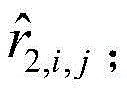
③:在h1(i,j)中,按Pr(xi,j,1)由高至低从U′取未标记样本子集;标记每个xi,j在h1(i,j)和h2(i,j)中的


④:在h2(i,j)中,按Pr(xi,j,2)由高至低从U′取未标记样本子集;标记每个xi,j在h1(i,j)和h2(i,j)中的


⑤:使T2合并到h1(i,j)训练集中,使T1合并到h2(i,j)训练集中,表式如下:⑤: Merge T 2 into h 1 (i,j) training set, and make T 1 merge into h 2 (i, j) training set, the formula is as follows:
L1=L1∪T2;L 1 =L 1 ∪T 2 ;
L2=L2∪T1;L 2 =L 2 ∪T 1 ;
L1为h1(i,j)的训练集,L2为h2(i,j)的训练集;L 1 is the training set of h 1 (i, j), and L 2 is the training set of h 2 (i, j);
⑥:利用L1对h1(i,j)和L2对h2(i,j)进行第二次训练优化,表示如下:⑥: Use L 1 for h 1 (i, j) and L 2 for h 2 (i, j) for the second training optimization, which is expressed as follows:
h1←L1;h 1 ←L 1 ;
h2←L2;h 2 ←L 2 ;
←表示第二次训练过程。← represents the second training process.
步骤5)所述的权值融合评分,表达如下:The weight fusion score described in step 5) is expressed as follows:
h(i,j)=αh1(i,j)+(1-α)h2(i,j);h(i,j)=αh 1 (i,j)+(1-α)h 2 (i,j);
α为0到1之间的一个权重因子。α is a weighting factor between 0 and 1.
本发明的优点:不仅能够感知属性上下文信息和交互上下文信息对推荐的影响,The advantages of the present invention: not only can perceive the influence of attribute context information and interaction context information on recommendation,
而且能够缓解推荐系统的数据稀疏性问题,提升推荐的准确率。Moreover, it can alleviate the data sparsity problem of the recommendation system and improve the accuracy of the recommendation.
附图说明Description of drawings
图1为实施例的流程示意图;1 is a schematic flowchart of an embodiment;
图2为实施例中在真实数据集MovieLens-100k上的均方根误差对比图。FIG. 2 is a comparison diagram of the root mean square error on the real data set MovieLens-100k in the embodiment.
具体实施方式Detailed ways
下面结合实施例和附图对本发明的内容作进一步的阐述,但不是对本发明的限定。The content of the present invention will be further elaborated below in conjunction with the embodiments and the accompanying drawings, but it is not intended to limit the present invention.
实施例:Example:
参照图1,一种基于异质上下文感知的推荐方法,包括如下步骤:1, a recommendation method based on heterogeneous context perception, comprising the following steps:
1):获取用户-项目的评分矩阵、交互上下文信息和属性上下文信息;1): Obtain the user-item rating matrix, interaction context information and attribute context information;
2):基于张量分解技术构建交互上下文评分预测函数和交互上下文感知模型;2): build an interaction context score prediction function and an interaction context awareness model based on tensor decomposition technology;
3):基于矩阵分解技术构建属性上下文评分预测函数和属性上下文感知模型;3): construct attribute context scoring prediction function and attribute context aware model based on matrix decomposition technology;
4):交互上下文感知模型和属性上下文感知模型进行半监督协同训练;4): Semi-supervised collaborative training of interaction context-aware model and attribute context-aware model;
5):交互上下文感知模型和属性上下文感知模型进行权值融合评分,然后根据评分进行推荐。5): The interactive context-aware model and the attribute context-aware model perform weight fusion scoring, and then make recommendations based on the scores.
步骤1)中所述的交互上下文信息为用户-项目交互行为所处的上下文信息,属性上下文信息为用户自身属性及项目自身属性。The interaction context information described in step 1) is the context information where the user-item interaction behavior is located, and the attribute context information is the user's own attribute and the item's own attribute.
步骤2)中所述的张量分解技术包括如下步骤:The tensor decomposition technique described in step 2) comprises the following steps:
①:利用上下文潜在向量获取交互上下文信息的属性;①: Use the contextual latent vector to obtain the attributes of interactive contextual information;
②:利用上下文操作张量获取交互上下文信息对用户的共同语义操作和项目的共同语义操作;②: Use the context operation tensor to obtain the common semantic operation of the user and the common semantic operation of the item by the interactive context information;
③:构建用户上下文操作矩阵和项目上下文操作矩阵,表达如下:③: Construct the user context operation matrix and the project context operation matrix, which are expressed as follows:

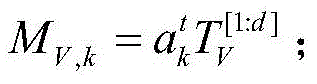
MU,k表示用户的d×d维上下文操作矩阵,MV,k表示项目的d×d维上下文操作矩阵,d为用户和项目所设置的维度,U表示用户集合,即U={u1,u2,...},k表示上下文情境,V表示项目集合,即V={v1,v2,...};

ak=HkW;a k =H k W;
Hk是k中上下文值对应的dc×n维潜在矩阵,n为上下文的个数,W为每个上下文权值的n维向量;H k is the d c ×n-dimensional latent matrix corresponding to the context value in k, n is the number of contexts, and W is the n-dimensional vector of each context weight;
④:利用MU,k对用户和MV,k对项目的原始潜在向量进行上下文操作,表达如下:④: Use MU,k to perform contextual operations on the original latent vector of the user and MV,k on the item, which is expressed as follows:
ui,k=MU,kui;u i,k =M U,k u i ;
vj,k=MV,kvj;v j,k = MV,k v j ;
ui,k和vj,k分别为用户和项目在k中被上下文操作后的d维潜在向量,ui是用户的d维原始潜在向量,vj是项目的d维原始潜在向量,将MU,k、MV,k和ak的表达式带入ui,k和vj,k的表达式,得到:u i,k and vj,k are the d-dimensional latent vectors of the user and item after the context operation in k, respectively, ui is the d-dimensional original latent vector of the user, and vj is the d-dimensional original latent vector of the item. The expressions of M U,k , M V,k and a k are brought into the expressions of u i,k and v j,k to obtain:


步骤2)中所述的交互上下文评分预测函数

w0为全局平均偏置,wi为用户i的偏置,wj为项目j的偏置,wm,k为上下文值的偏置,n为上下文的个数,将ui,k和vj,k的公式带入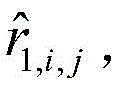

步骤3)中所述矩阵分解技术包括如下步骤:The matrix decomposition technique described in step 3) comprises the steps:
①:将评分矩阵分解成用户潜在矩阵P和项目潜在矩阵Q的乘积,其中P包含U全部的ui,Q包含V全部的vj;1: decompose the scoring matrix into the product of the user latent matrix P and the item latent matrix Q, wherein P contains all u i of U, and Q contains all v j of V;
②:从P中获取一个ui和从Q中获取一个vj;②: Get a ui from P and get a v j from Q;
步骤3)中所述属性上下文评分预测函数

wm为用户属性偏置,wn为项目属性偏置,m∈user_attributes表示m属于用户的属性上下文,n∈item_attributes表示n属于项目的属性上下文;w m is the user attribute bias, w n is the item attribute bias, m∈user_attributes indicates that m belongs to the user's attribute context, and n∈item_attributes indicates that n belongs to the item's attribute context;
将项目j和wm结合,将用户i和wn结合,使

wjm为项目j结合用户属性上下文种类m的偏置,win为用户i结合项目属性上下文种类n的偏置。w jm is the bias of item j combined with user attribute context type m, and w in is the bias of user i combined with item attribute context type n.
步骤4)中所述的半监督协同训练包括如下步骤:The semi-supervised collaborative training described in step 4) includes the following steps:
①:计算未标记样本子集的每个样本在h1(i,j)中的置信度C1(xi,j)及h2(i,j)中的置信度C2(xi,j),即未标记样本在不同模型下被预测的标签可信程度,表达如下:①: Calculate the confidence C 1 (x i, j ) in h 1 (i, j) and the confidence C 2 (x i, j ) in h 2 (i, j) of each sample of the unlabeled sample subset j ), that is, the reliability of the labels predicted by unlabeled samples under different models, expressed as follows:


xi,j为用户i对项目j的未标记样本,


②:计算未标记样本子集中每个样本的置信概率,进行归一化处理:②: Calculate the confidence probability of each sample in the unlabeled sample subset and normalize it:

m取值为1表示h1(i,j),取值为2表示h2(i,j),Pr(xi,j,m)为置信概率,即在hm(i,j)中,未标记样本xi,j的置信度占未标记样本子集U′样本置信度总和的比例;The value of m is 1 to represent h 1 (i,j), the value of 2 represents h 2 (i,j), and Pr(x i,j ,m) is the confidence probability, that is, in h m (i,j) , the proportion of the confidence of the unlabeled samples x i,j to the sum of the confidence of the unlabeled sample subset U';
③:在h1(i,j)中,按Pr(xi,j,1)由高至低从U′取未标记样本子集;标记每个xi,j在h1(i,j)和h2(i,j)中的


④:在h2(i,j)中,按Pr(xi,j,2)由高至低从U′取未标记样本子集;标记每个xi,j在h1(i,j)和h2(i,j)中的


⑤:使T2合并到h1(i,j)训练集中,使T1合并到h2(i,j)训练集中,表式如下:⑤: Merge T 2 into h 1 (i,j) training set, and make T 1 merge into h 2 (i, j) training set, the formula is as follows:
L1=L1∪T2;L 1 =L 1 ∪T 2 ;
L2=L2∪T1;L 2 =L 2 ∪T 1 ;
L1为h1(i,j)的训练集,L2为h2(i,j)的训练集;L 1 is the training set of h 1 (i, j), and L 2 is the training set of h 2 (i, j);
⑥:利用L1对h1(i,j)和L2对h2(i,j)进行第二次训练优化,表示如下:⑥: Use L 1 for h 1 (i, j) and L 2 for h 2 (i, j) for the second training optimization, which is expressed as follows:
h1←L1;h 1 ←L 1 ;
h2←L2;h 2 ←L 2 ;
←表示第二次训练过程。← represents the second training process.
步骤5)所述的权值融合评分,表达如下:The weight fusion score described in step 5) is expressed as follows:
h(i,j)=αh1(i,j)+(1-α)h2(i,j);h(i,j)=αh 1 (i,j)+(1-α)h 2 (i,j);
α为0到1之间的一个权重因子。α is a weighting factor between 0 and 1.
下面以电影的真实数据集作进一步描述:The following is further described with the real dataset of movies:
(1)数据集(1) Data set
利用MovieLens-100K的数据集,包含了来自943个用户对1,682部电影的100,000个电影评分数据。The MovieLens-100K dataset contains 100,000 movie ratings data from 943 users on 1,682 movies.
MovieLens-100K除了评分数据外,其还包含了丰富的上下文信息,例如属性上下文信息(用户的年龄、职位、性别,电影的种类)、交互上下文信息(时间戳对应的日期天数和小时)。In addition to rating data, MovieLens-100K also contains rich contextual information, such as attribute contextual information (user's age, position, gender, movie type), interaction contextual information (date days and hours corresponding to timestamps).
本实施例按照80%的评分数据集划分为训练集,20%的评分数据集划分为测试集。In this embodiment, 80% of the scoring data set is divided into a training set, and 20% of the scoring data set is divided into a test set.
(2)对比方法(2) Comparison method
将实施例提出的基于异质上下文感知的推荐方法(Heterogeneous Context-aware Semi-supervised Method,简称HASS)与传统协同过滤推荐算法以及现有的上下文感知推荐算法进行了对比。The recommendation method based on heterogeneous context awareness (Heterogeneous Context-aware Semi-supervised Method, referred to as HASS) proposed in the embodiment is compared with the traditional collaborative filtering recommendation algorithm and the existing context-aware recommendation algorithm.
传统的协同过滤推荐算法Traditional collaborative filtering recommendation algorithm
UB k-NN:基于用户的k近邻推荐方法;UB k-NN: user-based k-nearest neighbor recommendation method;
IB k-NN:基于项目的k近邻推荐方法;IB k-NN: item-based k-nearest neighbor recommendation method;
FactCF:基于矩阵分解的推荐方法;FactCF: A recommendation method based on matrix factorization;
现有的上下文感知推荐算法Existing context-aware recommendation algorithms
Context:属性上下文感知推荐模型;Context: attribute context-aware recommendation model;
CSEL:(Context-aware Semi-supervised Co-training Method,简称CSEL)将Context模型分成两个模型,即分别对用户属性和项目属性的上下文建模,最终对这两类属性上下文感知模型进行半监督协同训练算法;CSEL: (Context-aware Semi-supervised Co-training Method, referred to as CSEL) divides the Context model into two models, namely, the context modeling of user attributes and item attributes, and finally semi-supervised context-aware models for these two types of attributes Co-training algorithm;
COT:(Contextual Operating Tensor,简称COT)利用上下文操作张量模型为交互上下文感知进行建模的推荐算法;COT: (Contextual Operating Tensor, COT for short) is a recommendation algorithm that uses the contextual operating tensor model to model interactive context awareness;
(3)评估指标(3) Evaluation indicators
为了衡量评分预测的效果,实施例利用均方根误差来衡量。In order to measure the effect of scoring prediction, the embodiment uses the root mean square error to measure.

其中(i,j,k)∈Ωtest表示(i,j,k)对应属于测试集Ωtest的数据,其ri,j,k表示真实评分,
实验效果及分析:Experimental results and analysis:
参照图2,从RMSE实验效果上看,传统的协同过滤推荐算法忽略了上下文信息对推荐过程的重要影响,所以此类协同过滤推荐算法的RMSE实验效果往往要比上下文感知推荐算法的RMSE实验效果更高。Referring to Figure 2, from the perspective of the RMSE experimental effect, the traditional collaborative filtering recommendation algorithm ignores the important influence of context information on the recommendation process, so the RMSE experimental effect of such collaborative filtering recommendation algorithm is often higher than that of the context-aware recommendation algorithm. higher.
我们发现COT的RMSE实验效果相比CSEL的RMSE实验效果偏高,经分析发现在Movielens-100K数据集中,属性上下文信息相比交互上下文信息更加丰富,可能影响着CSEL和COT的RMSE实验效果。实施例提出的推荐方法,不仅考虑了属性上下文信息和交互上下文信息对推荐的影响,而且针对数据稀疏性问题,利用半监督协同训练进行模型优化。We found that the RMSE experimental effect of COT was higher than that of CSEL. After analysis, it was found that in the Movielens-100K data set, the attribute context information is more abundant than the interaction context information, which may affect the RMSE experimental effect of CSEL and COT. The recommendation method proposed in the embodiment not only considers the influence of attribute context information and interaction context information on recommendation, but also uses semi-supervised collaborative training to optimize the model for the problem of data sparsity.
实施例提出的推荐方法在预测评分上的RMSE实验效果,相比UB k-NN降低了7%,相比IB k-NN降低了9%,相比FactCF降低了4%,相比Context降低了2%,相比CSEL降低了2%,相比COT降低了3%。使得预测评分更加准确,推荐效果更好。Compared with UB k-NN, the RMSE experimental effect of the recommendation method proposed in the example is reduced by 7%, compared with IB k-NN, reduced by 9%, compared with FactCF, reduced by 4%, and reduced compared with Context. 2%, which is 2% lower than CSEL and 3% lower than COT. It makes the prediction score more accurate and the recommendation effect better.
Claims (7)









Priority Applications (1)
| Application Number | Priority Date | Filing Date | Title |
|---|---|---|---|
| CN201710704380.0A CN107506419B (en) | 2017-08-16 | 2017-08-16 | Recommendation method based on heterogeneous context sensing |
Applications Claiming Priority (1)
| Application Number | Priority Date | Filing Date | Title |
|---|---|---|---|
| CN201710704380.0A CN107506419B (en) | 2017-08-16 | 2017-08-16 | Recommendation method based on heterogeneous context sensing |
Publications (2)
| Publication Number | Publication Date |
|---|---|
| CN107506419A CN107506419A (en) | 2017-12-22 |
| CN107506419B true CN107506419B (en) | 2020-08-04 |
Family
ID=60691948
Family Applications (1)
| Application Number | Title | Priority Date | Filing Date |
|---|---|---|---|
| CN201710704380.0A Expired - Fee Related CN107506419B (en) | 2017-08-16 | 2017-08-16 | Recommendation method based on heterogeneous context sensing |
Country Status (1)
| Country | Link |
|---|---|
| CN (1) | CN107506419B (en) |
Families Citing this family (5)
| Publication number | Priority date | Publication date | Assignee | Title |
|---|---|---|---|---|
| CN109002488B (en) * | 2018-06-26 | 2020-10-02 | 北京邮电大学 | Recommendation model training method and device based on meta-path context |
| CN110717100B (en) * | 2019-09-30 | 2021-09-28 | 杭州电子科技大学 | Context perception recommendation method based on Gaussian embedded representation technology |
| CN111259235A (en) * | 2020-01-09 | 2020-06-09 | 齐鲁工业大学 | Personalized recommendation method and system based on context awareness and feature interaction modeling |
| CN111259255B (en) * | 2020-02-11 | 2022-03-22 | 汕头大学 | A Recommendation Method Based on Iterative Padding of 3D Tensors |
| CN114756766B (en) * | 2022-04-22 | 2025-04-22 | 山东大学 | A neural collaborative filtering recommendation method and system based on Chinese review mining |
Citations (6)
| Publication number | Priority date | Publication date | Assignee | Title |
|---|---|---|---|---|
| CN104254852A (en) * | 2012-03-17 | 2014-12-31 | 海智网聚网络技术(北京)有限公司 | Method and system for hybrid information query |
| CN104951518A (en) * | 2015-06-04 | 2015-09-30 | 中国人民大学 | Context recommending method based on dynamic incremental updating |
| CN105808680A (en) * | 2016-03-02 | 2016-07-27 | 西安电子科技大学 | Tensor decomposition based context-dependent position recommendation method |
| CN106126591A (en) * | 2016-06-16 | 2016-11-16 | 广东顺德中山大学卡内基梅隆大学国际联合研究院 | Music data recommends method and system |
| US9514124B2 (en) * | 2015-02-05 | 2016-12-06 | International Business Machines Corporation | Extracting and recommending business processes from evidence in natural language systems |
| CN106649657A (en) * | 2016-12-13 | 2017-05-10 | 重庆邮电大学 | Recommended system and method with facing social network for context awareness based on tensor decomposition |
Family Cites Families (1)
| Publication number | Priority date | Publication date | Assignee | Title |
|---|---|---|---|---|
| US20110191352A1 (en) * | 2009-12-03 | 2011-08-04 | New Jersey Institute Of Technology | Socially- And Context-Aware People-Matching Systems and Methods Relating Thereto |
-
2017
- 2017-08-16 CN CN201710704380.0A patent/CN107506419B/en not_active Expired - Fee Related
Patent Citations (6)
| Publication number | Priority date | Publication date | Assignee | Title |
|---|---|---|---|---|
| CN104254852A (en) * | 2012-03-17 | 2014-12-31 | 海智网聚网络技术(北京)有限公司 | Method and system for hybrid information query |
| US9514124B2 (en) * | 2015-02-05 | 2016-12-06 | International Business Machines Corporation | Extracting and recommending business processes from evidence in natural language systems |
| CN104951518A (en) * | 2015-06-04 | 2015-09-30 | 中国人民大学 | Context recommending method based on dynamic incremental updating |
| CN105808680A (en) * | 2016-03-02 | 2016-07-27 | 西安电子科技大学 | Tensor decomposition based context-dependent position recommendation method |
| CN106126591A (en) * | 2016-06-16 | 2016-11-16 | 广东顺德中山大学卡内基梅隆大学国际联合研究院 | Music data recommends method and system |
| CN106649657A (en) * | 2016-12-13 | 2017-05-10 | 重庆邮电大学 | Recommended system and method with facing social network for context awareness based on tensor decomposition |
Also Published As
| Publication number | Publication date |
|---|---|
| CN107506419A (en) | 2017-12-22 |
Similar Documents
| Publication | Publication Date | Title |
|---|---|---|
| US20220237246A1 (en) | Techniques for presenting content to a user based on the user's preferences | |
| CN107506419B (en) | Recommendation method based on heterogeneous context sensing | |
| US10409880B2 (en) | Techniques for presenting content to a user based on the user's preferences | |
| CN113420221B (en) | An interpretable recommendation method that integrates user implicit item preference and explicit feature preference | |
| CN107506480A (en) | A kind of excavated based on comment recommends method with the double-deck graph structure of Density Clustering | |
| CN102306298B (en) | Wiki-based dynamic evolution method of image classification system | |
| CN103995804A (en) | Cross-media topic detection method and device based on multimodal information fusion and graph clustering | |
| CN104933029A (en) | Text image joint semantics analysis method based on probability theme model | |
| CN109272390A (en) | Personalized recommendation method for fusion score and label information | |
| CN114022233A (en) | Novel commodity recommendation method | |
| Xiong et al. | Affective impression: Sentiment-awareness POI suggestion via embedding in heterogeneous LBSNs | |
| CN105701225B (en) | A kind of cross-media retrieval method based on unified association hypergraph specification | |
| CN110069713A (en) | A kind of personalized recommendation method based on user's context perception | |
| CN119807545A (en) | Negative emotion sudden topic detection system and method for the Internet | |
| CN117556051A (en) | Method and apparatus for information processing | |
| Zheng et al. | Product ranking considering differences across online review platforms: a method based on intuitionistic fuzzy soft sets | |
| US11294977B2 (en) | Techniques for presenting content to a user based on the user's preferences | |
| CN108920647A (en) | Low-rank matrix based on spectral clustering fills TOP-N recommended method | |
| CN110046657A (en) | A kind of social safety figure painting image space method based on multiple view study | |
| TW201243627A (en) | Multi-label text categorization based on fuzzy similarity and k nearest neighbors | |
| CN114282536A (en) | Intelligent recommendation engine system based on AI algorithm | |
| CN118035565B (en) | Active service recommendation method, system and device based on multimodal emotion perception | |
| CN118551068B (en) | Emoticon package retrieval method, electronic device and computer-readable storage medium | |
| CN104598559A (en) | Combined clustering method based on Web service tag data | |
| CN114117251B (en) | A Matrix Factorization Personalized Recommendation Method Integrating Multi-Factors for Smart Wenbo |
Legal Events
| Date | Code | Title | Description |
|---|---|---|---|
| PB01 | Publication | ||
| PB01 | Publication | ||
| SE01 | Entry into force of request for substantive examination | ||
| SE01 | Entry into force of request for substantive examination | ||
| GR01 | Patent grant | ||
| GR01 | Patent grant | ||
| EE01 | Entry into force of recordation of patent licensing contract |
Application publication date: 20171222 Assignee: Guilin Jinghui Software Technology Co.,Ltd. Assignor: GUILIN University OF ELECTRONIC TECHNOLOGY Contract record no.: X2022450000428 Denomination of invention: A recommendation method based on heterogeneous context awareness Granted publication date: 20200804 License type: Common License Record date: 20221227 |
|
| EE01 | Entry into force of recordation of patent licensing contract | ||
| CF01 | Termination of patent right due to non-payment of annual fee |
Granted publication date: 20200804 |
|
| CF01 | Termination of patent right due to non-payment of annual fee |