The application is a divisional application, the application number of the original application is 201110175253.9, the application date is 2011, 7 and 27 days, and the invention name is as follows: a method and user equipment for determining control channel resources.
Detailed Description
The technical solutions in the embodiments of the present invention will be clearly and completely described below with reference to the drawings in the embodiments of the present invention, and it is obvious that the described embodiments are some, not all, embodiments of the present invention. All other embodiments, which can be obtained by a person skilled in the art without any inventive step based on the embodiments of the present invention, shall fall within the scope of protection of the present invention.
It should be understood that the solution of the present invention can be applied to various communication systems, such as: a Global System for Mobile communications (GSM) System, a Code Division Multiple Access (CDMA) System, a Wideband Code Division Multiple Access (WCDMA) System, a General Packet Radio Service (GPRS), a Long Term Evolution (LTE), a Frequency Division Duplex (FDD) System, a Time Division Duplex (TDD), a Universal Mobile Telecommunications System (UMTS), etc.
It should also be understood that, in the embodiment of the present invention, a Terminal device may also be referred to as a User Equipment (UE), a Mobile Station (MS), a Mobile Terminal (RAN), etc., and the Terminal device may communicate with one or more core networks via a Radio Access Network (RAN), for example, the Terminal device may be a Mobile phone (or a "cellular" phone), a computer with a Mobile Terminal, etc., and the Terminal device may also be a portable, pocket, hand-held, computer-embedded, or vehicle-mounted Mobile device, which exchanges language and/or data with the RAN.
In the embodiment of the present invention, the Base Station may be a Base Transceiver Station (BTS) in GSM or CDMA, a Base Station (NodeB, NB) in WCDMA, or an evolved Node B (eNB or e-NodeB) in LTE. In the embodiments of the present invention, the base station and the user equipment are not limited, but for convenience of description, the following embodiments will take eNB and UE as examples for explanation.
Fig. 1 shows a schematic diagram of PDCCH and PDSCH multiplexing according to an embodiment of the present invention. As shown in fig. 1(a), the PDCCH and PDSCH are time-division multiplexed in one subframe. Without loss of generality, taking a general cyclic prefix as an example, each subframe (1ms) includes two slots, each slot includes 7 Orthogonal Frequency Division Multiplexing (OFDM) symbols, each OFDM symbol includes NRB × 12 Resource Elements (RE), and NRB is the number of Resource Blocks (RB) corresponding to a system bandwidth; where PDCCH is transmitted in the first n (n ═ 1,2,3) OFDM symbols of the first slot, n is dynamically variable and can be indicated by a Physical Control Format Indicator Channel (abbreviated as "PCFICH"), and the remaining OFDM symbols are used for transmitting PDSCH.
In addition to the above PDCCH for downlink scheduling, the PDCCH region further includes a PDCCH for uplink scheduling, a Physical Hybrid ARQ Indicator Channel (abbreviated as "PHICH") for uplink HARQ transmission of ACK/NACK information, and a PCFICH for indicating the number of OFDM symbols included in the PDCCH region. It should be understood that, in the following description, the PDCCH is referred to for downlink scheduling, if not specifically stated. Each PDCCH is composed of 1/2/4/8 consecutive Control Channel Elements (CCEs), each CCE is composed of 36 REs, and the number of CCEs composing each PDCCH is determined by the size of the PDCCH and Channel information of the user equipment corresponding to the PDCCH.
Since the number of REs included in the PDCCH region is limited to the number of OFDM symbols used for PDCCH, and if it is further considered that a part of the REs in the PDCCH region need PDCCH for PCFICH, PHICH and uplink scheduling, the remaining number of REs will limit the number of PDCCHs used for downlink scheduling, i.e. limit the number of downlink scheduling user equipments. For this purpose, the PDCCH is enhanced by dividing a part of resources in the original PDSCH region to transmit the E-PDCCH, and as shown in fig. 1(B), the PDCCH, the E-PDCCH, and the PDSCH are time-division multiplexed in one subframe. This can increase the capacity of the PDCCH and increase the number of simultaneously scheduled user equipments.
Fig. 2 illustrates a diagram of a DMRS when a transmission rank is 2 according to an embodiment of the present invention. As shown in fig. 2, when a transmission rank of a scheduled user equipment is 1 or 2, 12 REs in a pair of resource blocks are used to transmit DMRSs, wherein two DMRSs when the transmission rank is 2 are code division multiplexed; when the transmission rank of the scheduled user equipment is greater than 2, 24 REs in a pair of resource blocks are used to transmit the DMRS, wherein time-frequency division and code division multiplexing is employed between the plurality of DMRSs. It should be understood that the transmission mode 9 of the LTE Rel-10 communication system is PDSCH transmission based on DMRS, that is, DMRS are transmitted in resource blocks scheduled by user equipment, each DMRS defines one antenna port, each layer of data of the PDSCH is mapped to one corresponding antenna port, and the number of DMRS is equal to the number of data block layers of the PDSCH or the transmission rank of the scheduled user equipment.
Fig. 3 shows a schematic flow chart of a method 100 of determining control channel resources according to an embodiment of the invention. As shown in fig. 3, the method 100 includes:
s110, detecting a downlink control channel which is sent by a base station and used for bearing scheduling information of a downlink data channel, wherein the downlink control channel is formed by at least one control channel logic unit, and the at least one control channel logic unit is mapped to at least one antenna port;
s120, acquiring at least one of antenna port information and offset of a first antenna port corresponding to a first control channel logic unit of a successfully detected downlink control channel, and sequence number information of the first control channel logic unit;
s130, determining a first control channel resource according to the serial number information and at least one of the antenna port information and the offset, where the first control channel resource is used to feed back ACK/NACK information for a downlink data channel corresponding to the successfully detected downlink control channel.
In order to dynamically determine the control channel resources used by the user equipment for feeding back the ACK/NACK information, the user equipment may dynamically determine the control channel resources used for feeding back the ACK/NACK information according to at least one of antenna port information and offset of an antenna port corresponding to the control channel logical unit and sequence number information of the control channel logical unit by executing the method 100, and may determine different control channel resources for different user equipments, thereby being capable of avoiding a problem of control channel resource collision between different user equipments.
Fig. 4 shows a schematic flow diagram of a method 200 of determining control channel resources according to another embodiment of the invention. As shown in fig. 4, in S210, the ue detects a downlink control channel carrying scheduling information of a downlink data channel transmitted by the base station. In the embodiment of the present invention, the downlink control channel may include an E-PDCCH, and the downlink data channel may include a PDSCH. The E-PDCCH carries scheduling information for the PDSCH, the E-PDCCH being formed of at least one control channel logical unit, the at least one control channel logical unit being mapped to physical resource blocks in at least one antenna port. Optionally, at least one control channel logical unit corresponding to one user equipment is mapped to the same antenna port. Optionally, the antenna port is a DMRS antenna port. It is to be understood that the E-PDCCH and PDSCH transmitted by the base station are E-PDCCH and PDSCH related to at least one user equipment scheduled, the at least one antenna port corresponds to at least one control channel logic element forming the E-PDCCH of the at least one user equipment scheduled by the base station.
In the embodiment of the invention, because the E-PDCCH is transmitted in the PDSCH region, the E-PDCCH can also adopt a DMRS-based transmission mode similar to the PDSCH. For the E-PDCCH, the HARQ technology used by the PDSCH cannot be used, and thus the transmission performance requirement of the E-PDCCH is higher than that of the PDSCH. In order to ensure the transmission performance and efficiency of the E-PDCCH, the resources occupied by the E-PDCCH need to be variable, and therefore, adaptive modulation and/or coding can be performed for different channel conditions, such as signal-to-noise ratio, to meet the performance requirement of the E-PDCCH. In addition, the format of the E-PDCCH for different PDSCH transmission modes is also different, for example, the control channel data block is different, and thus the resource of the E-PDCCH is also required to be variable.
Due to the randomness of dynamic scheduling, the user equipment needs to perform blind detection on the E-PDCCH, and if the resource variability flexibility of the E-PDCCH is too large, the blind detection complexity of the user can be increased. To trade off between blind detection complexity and E-PDCCH transmission efficiency, a resource granularity of the E-PDCCH may be defined, where the resource granularity may be defined as a control channel logical unit. According to the control channel format and channel condition of the E-PDCCH, it may be determined that one E-PDCCH is composed of Mn control channel logical elements, that is, Mn control channel logical elements carry data of the E-PDCCH, where N is 0, 1, … N-1, and N is a control channel logical element aggregation level number. The number of control channel logical units constituting each E-PDCCH is related to the control channel format used by the scheduled user equipment and the channel condition, and the Mn control channel logical units constituting each E-PDCCH are mapped into a set of physical resource blocks in at least one antenna port. It should be understood that the control channel logical elements herein are virtual resource blocks or CCEs.
In S220, the ue obtains at least one of antenna port information and offset and sequence number information. Optionally, the ue obtains the sequence number information and/or the antenna port information according to a predefined or notified correspondence between the first control channel logical unit and the physical resource block.
The sequence number information is information related to a sequence number of a first control channel logic unit, and the first control channel logic unit forms an E-PDCCH for successful detection of the UE. Optionally, the sequence number information includes a sequence number of a first control channel logical unit in the first control channel logical unit. It should be understood that the sequence number information may also include the sequence numbers of other control channel logical units in the first control channel logical unit.
The antenna port information is related information of a first antenna port where a physical resource block corresponding to the first control channel logical unit is located. Optionally, the antenna port information at least includes one of a serial number of the first antenna port and a number of antenna ports of the at least one antenna port. That is, the antenna port information includes the serial number of the first antenna port, the antenna port information may also include the number of antenna ports of the at least one antenna port, and the antenna port information may also include the serial number of the first antenna port and the number of antenna ports of the at least one antenna port.
The offset may be configured by a high-level semi-static configuration or dynamically notified by a base station, where the offset may be set for the user equipment, that is, the offset of each user equipment is not exactly the same, or may be set for a cell to which the user equipment belongs, that is, the offset of the user equipment in one cell is the same, or may be set for the user equipment and a cell in which the user is located, that is, the offset includes two parts, where the first part is set for the user equipment, and the second part is set for the cell to which the user equipment belongs.
The following further describes an embodiment of the present invention with reference to a schematic diagram of a corresponding relationship between a control channel logical unit and a physical resource block according to the embodiment of the present invention shown in fig. 5.
As shown in FIG. 5, the user equipment takes out the received data from the physical resource blocks 6-21 of the received DMRS antenna port 7, that is, the data carried by the E-PDCCH, and the physical resource blocks 6-21 correspond to the E-PDCCH virtual resource blocks 0-15. And the user equipment performs blind detection on the E-PDCCH in the virtual resource block to obtain the E-PDCCH corresponding to the user equipment. For example, the E-PDCCH of user equipment 1 corresponds to virtual resource blocks 8-15, the E-PDCCH of user equipment 2 corresponds to virtual resource blocks 4-5, the E-PDCCH of user equipment 3 corresponds to virtual resource blocks 0-3, and the E-PDCCH of user equipment 4 corresponds to virtual resource block 7.
The user equipment can determine the serial number n of the first virtual resource block forming the E-PDCCH according to the E-PDCCH which is successfully detectedVRBWherein n isVRB=0,1,…,NVRB-1,NVRBIs the number of the configured virtual resource blocks and the serial number n of the first antenna port corresponding to the physical resource mapped by the first virtual resource blockDMRSWherein n isDMRS=0,1,…,NDMRS-1,NDMRSIs the number of first antenna ports, e.g. number n of DMRS antenna ports 7 and 8DMRSRespectively 0 and 1. For example, in the embodiment shown in fig. 5, the sequence number n of the first virtual resource block of the user equipment 1VRBTo 8, the number n of the first virtual resource block of the user equipment 2VRB4, sequence number n of the first virtual resource block of the user equipment 3VRBNumber n of first virtual resource block of user equipment 4 is 0VRBNumber of virtual resource blocks configured to 7, NVRBNumber n of the first antenna port, 16DMRSIs 0, the number of the first antenna ports NDMRSIs 1. Optionally, the sequence number of the first virtual resource block may also adopt the sequence number of the corresponding physical resource block. For example, if the sequence number of the physical resource block corresponding to the first virtual resource block of the user equipment 3 is 6, then the sequence number of the first virtual resource block may be 6.
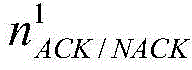
In S230, the user equipment determines a first control channel resource for feeding back the ACK/NACK information. Optionally, the ue may determine the first control channel resource according to the obtained sequence number information and antenna port information. Optionally, the ue may determine the first control channel resource according to the obtained sequence number information and the offset. Optionally, the ue may determine the first control channel resource according to the obtained sequence number information, antenna port information, and offset. For example, the user equipment may determine the sequence number of the first control channel resource according to the acquired sequence number information and antenna port information by the following equation (1) or (2)
Still in the right directionThe corresponding relation diagram shown in fig. 5 is illustrated as an example, for example, according to equation (1) or (2), the sequence number of the first control channel resource determined by the
user equipment 1
To 8, the
user equipment 2 determines the sequence number of the first
control channel resource 4, sequence number of first control channel resource determined by
user equipment 3
To 0, the
user equipment 4 determines the sequence number of the first control channel resource
Is 7.
Therefore, the method of the embodiment of the present invention can dynamically determine the control channel resource for feeding back the ACK/NACK information according to at least one of the antenna port information and the offset of the antenna port corresponding to the control channel logical unit and the sequence number information of the control channel logical unit, and can determine different control channel resources for different user equipments, thereby avoiding the problem of control channel resource collision between different user equipments.
In this embodiment of the present invention, optionally, the ue determines the first control channel resource for feeding back the ACK/NACK information according to the sequence number information and at least one of the antenna port information and the offset. The offset may be configured semi-statically or dynamically notified by a higher layer, and may be set for the user equipment, that is, the offset of each user equipment is not exactly the same, or may be set for a cell to which the user equipment belongs, that is, the offset of the user equipment in one cell is the same. For example, the offset may be included by
Equation (3) or (4) of (1) determines the secondA control channel resource sequence number
It should be understood that, for a control channel transmitted in a PDCCH region, its corresponding resource for feeding back ACK/NACK information in uplink consists of a sequence number of the first CCE of the PDCCH and an offset
And (4) determining. If the resources for feeding back the ACK/NACK information in uplink for the PDCCH and the E-PDCCH are allocated continuously, the boundary between the two types of resources for feeding back the ACK/NACK information needs to be determined, i.e. the offset needs to be determined
Since the number of CCEs in the PDCCH region is related to the number of symbols for OFDM of the PDCCH, it can be dynamically determined according to the number of symbols for OFDM of the PDCCH in each subframe
Wherein
Offset including resources for determining feedback ACK/NACK information for PDCCH
And the number of CCEs in the PDCCH region. Since the number of symbols for OFDM of PDCCH is indicated by PCFICH, the user equipment can acquire the number of symbols for OFDM of PDCCH by detecting PCFICH and calculate the number of CCEs for PDCCH, i.e., determine reservationThe number of resources for feeding back ACK/NACK information to the corresponding PDCCH, whereby the offset amount of the control channel resource for feeding back ACK/NACK information can be determined according to the sequence number of the immediately next resource for feeding back ACK/NACK information
It should be understood that, after the user equipment determines the first control channel resource for feeding back the ACK/NACK information, since the uplink feedback ACK/NACK information is based on code division multiplexing, the first control channel resource determined by each user equipment is actually a spreading sequence in one resource block. The user equipment modulates the spreading sequence with ACK/NACK information and then transmits the modulated spreading sequence on one antenna, thereby implementing uplink feedback of ACK/NACK information, as shown in fig. 6 (a).
When the user equipment transmits the ACK/NACK information using a Spatial Orthogonal Resource Transmit Diversity (Spatial Orthogonal Resource Transmit Diversity, abbreviated as "SORTD"), the method 200 for determining control channel resources according to the embodiment of the present invention further includes:
the user equipment determines a second control channel resource for feeding back the ACK/NACK information S240. Optionally, the ue may determine the second control channel resource according to at least one of the acquired sequence number of the control channel logical unit immediately after the first control channel logical unit in the first control channel logical unit and the sequence number of the second antenna port immediately after the first antenna port.
For example, the ue may determine the second control channel resource according to at least one of antenna port information and an offset of the first antenna port and a sequence number of a control channel logical unit immediately after the first control channel logical unit. The ue may also determine the second control channel resource according to at least one of the sequence number information and the offset of the first control channel logical unit and the sequence number of the second antenna port. The ue may further determine the second control channel resource according to the sequence number of the control channel logical unit immediately after the first control channel logical unit and the sequence number of the second antenna port, or according to the sequence number of the control channel logical unit immediately after the first control channel logical unit, the sequence number of the second antenna port, and the offset.
It is to be understood that, similar to the determination of the first control channel resource, the user equipment may determine the second control channel resource for feeding back the ACK/NACK information according to at least one of sequence numbers of other control channel logical units immediately after the first control channel logical unit and sequence numbers of other antenna ports immediately after the first antenna port. Of course, the ue may also determine the second control channel resource by referring to at least one of sequence number information of the first control channel logical unit, antenna port information of the first antenna port, and an offset.
Specifically, for example, the user equipment may determine the second control channel resource for feeding back the ACK/NACK information according to a sequence number of a second control channel logical unit immediately after the first control channel logical unit and the antenna port information of the first antenna port. For example, the sequence number of the second control channel resource may be determined by the following equation (5) or (6)
For example, the ue may also determine the second control channel resource for feeding back the ACK/NACK information according to the sequence number of the second antenna port immediately after the first antenna port, the number of the antenna ports, and the sequence number information of the first control channel logic unit. For example, the sequence number of the second control channel resource may be determined by the following equation (7) or (8)
It should be understood that the performance of feeding back the ACK/NACK information in uplink can be improved by using a two-antenna transmit diversity scheme SORTD. For the user equipment to use SORTD, it needs to have a spreading sequence on each antenna, and the spreading sequences on the two antennas are different, and then the spreading sequences on the different antennas are modulated by the same ACK/NACK signal and are respectively transmitted on the two antennas, thereby implementing uplink feedback of ACK/NACK information, as shown in fig. 6 (B).
It should also be understood that the specific process of HARQ may be as follows: in downlink scheduling, the ue needs to detect the E-PDCCH and the corresponding PDSCH. If the E-PDCCH is successfully detected, the user equipment demodulates the corresponding PDSCH according to the information in the E-PDCCH, and then the user equipment needs to feed back the demodulation result of the PDSCH in an uplink manner. If the PDSCH demodulates correctly, the user equipment feeds back ACK information to the eNB, which indicates that the user equipment has correctly received the transmitted data, so that the eNB can transmit a new data block; otherwise, the ue feeds back NACK information to the eNB, indicating that the data is not received correctly, and the eNB is required to retransmit the data. If the E-PDCCH is not correctly detected, the ue considers that there is no PDSCH scheduled to itself, and thus does not perform any feedback, i.e., Discontinuous Transmission (DTX), in the uplink.
It should be understood that the sequence numbers of the above-mentioned processes do not mean the execution sequence, and the execution sequence of each process should be determined by its function and inherent logic, and should not constitute any limitation to the implementation process of the embodiment of the present invention.
The above describes the embodiments of the present invention in detail with reference to the schematic diagram of the corresponding relationship between the control channel logical unit and the physical resource block shown in fig. 5. It should be understood that the control channel logical elements shown in fig. 5 are cell-specific, i.e., the base station allocates a set of control channel logical elements to each cell, and the E-PDCCH of each user equipment scheduled in the cell corresponds to at least one control channel logical element in the set of control channel logical elements. Therefore, the sequence number of the first control channel logical unit forming the E-PDCCH of each user equipment, which detection is successful, is different. The embodiment of the present invention is described by taking the control channel logical unit as the cell-specific example, but the embodiment of the present invention is not limited thereto.
The control channel logical elements may also be user equipment specific, i.e. the base station allocates a set of control channel logical elements to each scheduled user equipment, the E-PDCCH of each scheduled user equipment corresponding to at least one control channel logical element in the respective set of control channel logical elements. Therefore, the sequence numbers of the first control channel logical units forming the successfully detected E-PDCCH of each ue may be the same or different, and the physical resource blocks of different ues may be overlapped or separated, as shown in fig. 7. For example, the physical resource blocks of user equipment 1 partially overlap with the physical resource blocks of user equipment 2, but are all completely separate from the physical resource blocks of user equipment 3. In this case, the ue may also determine the first and/or second control channel resources for feeding back the ACK/NACK information according to the acquired parameters such as the sequence number information of the first control channel logical unit, the antenna port information of the first antenna port, and the offset, where the offset is specific to the ue, that is, the base station configures the offset for each user separately, and the offset may be notified in a high-layer semi-static configuration manner. Further, based on the offset specific to the ue, there is also an offset specific to the cell to which the ue belongs, and the offset includes two parts, and both parts can be notified by high-level semi-static configuration.
Therefore, in the method for determining control channel resources according to the embodiment of the present invention, according to at least one of the antenna port information and the offset of the antenna port corresponding to the control channel logic unit and the sequence number information of the control channel logic unit, the control channel resources for feeding back the ACK/NACK information can be dynamically determined, and different control channel resources can be determined for different user equipments, thereby avoiding the problem of control channel resource collision between different user equipments.
The method for determining control channel resources according to the embodiment of the present invention is described in detail above with reference to fig. 3 to 7, and the user equipment for determining control channel resources according to the embodiment of the present invention is described below with reference to fig. 8 to 9.
Fig. 8 shows a schematic block diagram of a user equipment 500 for determining control channel resources according to an embodiment of the present invention. As shown in fig. 8, the user equipment 500 includes:
a detecting module 510, configured to detect a downlink control channel that is sent by a base station and carries scheduling information of a downlink data channel, where the downlink control channel is formed by at least one control channel logic unit, and the at least one control channel logic unit is mapped to at least one antenna port;
an obtaining module 520, configured to obtain at least one of antenna port information and an offset of a first antenna port corresponding to a first control channel logical unit of a downlink control channel successfully detected by the detecting module 510, and sequence number information of the first control channel logical unit;
a first determining module 530, configured to determine a first control channel resource according to the sequence number information and at least one of the antenna port information and the offset acquired by the acquiring module 520, where the first control channel resource is used to feed back ACK/NACK information for a downlink data channel corresponding to the downlink control channel that is successfully detected.
According to the user equipment for determining the control channel resources, the control channel resources for feeding back the ACK/NACK information can be dynamically determined according to at least one of the antenna port information and the offset of the antenna port corresponding to the control channel logic unit and the serial number information of the control channel logic unit, and different control channel resources can be determined for different user equipment, so that the problem of control channel resource conflict among different user equipment can be avoided.
In this embodiment of the present invention, the sequence number information of the first control channel logical unit includes a sequence number of a first control channel logical unit in the first control channel logical unit; the antenna port information of the first antenna port at least includes one of a serial number of the first antenna port and the number of antenna ports of the at least one antenna port.
Optionally, the detecting module 510 is specifically configured to detect the downlink control channel sent by the base station, where the at least one control channel logical unit is mapped to a physical resource block in at least one antenna port, and the obtaining module 520 is specifically configured to obtain the sequence number information and/or the antenna port information according to a predefined or notified correspondence between the first control channel logical unit and the physical resource block.
Optionally, the obtaining module 520 is specifically configured to obtain at least one of the antenna port information and the offset, where the offset is dynamically notified by the base station or configured by a higher layer in a semi-static manner.
Optionally, the obtaining module 520 is specifically configured to obtain at least one of the antenna port information and the offset, where the offset is set for at least one of the user equipment and a cell to which the user equipment belongs.
In this embodiment of the present invention, the antenna port may be a demodulation reference signal DMRS antenna port.
Optionally, as shown in fig. 9, the user equipment 500 may further include:
a second determining module 540, configured to determine, when sending the ACK/NACK information by using SORTD, a second control channel resource for feeding back the ACK/NACK information according to at least one of a sequence number of a control channel logic unit immediately after a first control channel logic unit in the first control channel logic unit and a sequence number of a second antenna port immediately after the first antenna port.
It is to be understood that the second determining module 540 may determine the second control channel resource according to at least one of the antenna port information and the offset of the first antenna port and the sequence number of the control channel logical unit immediately after the first control channel logical unit. The second determining module 540 may also determine the second control channel resource according to at least one of the sequence number information and the offset of the first control channel logical unit and the sequence number of the second antenna port. The second determining module 540 may further determine the second control channel resource according to the sequence number of the control channel logical unit immediately after the first control channel logical unit and the sequence number of the second antenna port, or according to the sequence number of the control channel logical unit immediately after the first control channel logical unit, the sequence number of the second antenna port, and the offset.
It should be appreciated that, similar to the first determining module 530 determining the first control channel resource, the second determining module 540 may determine the second control channel resource for feeding back the ACK/NACK information according to at least one of sequence numbers of other control channel logical units immediately after the first control channel logical unit and sequence numbers of other antenna ports immediately after the first antenna port. Of course, the second determining module 540 may also determine the second control channel resource by referring to at least one of sequence number information of the first control channel logic unit, antenna port information of the first antenna port, and an offset.
The user equipment 500 for determining the control channel resource according to the embodiment of the present invention may correspond to the user equipment in the embodiment of the present invention, and the detecting module 510, the obtaining module 520, and the first determining module 530 in the user equipment 500 may be configured to perform S110, S120, S130, and S210, S220, and S230 in fig. 3 and fig. 4, respectively, and the second determining module 540 in the user equipment 500 may be configured to perform S240 in fig. 4, which is not described herein again for brevity.
According to the user equipment for determining the control channel resources, the control channel resources for feeding back the ACK/NACK information can be dynamically determined according to at least one of the antenna port information and the offset of the antenna port corresponding to the control channel logic unit and the serial number information of the control channel logic unit, and different control channel resources can be determined for different user equipment, so that the problem of control channel resource conflict among different user equipment can be avoided.
Those of ordinary skill in the art will appreciate that the various illustrative elements and algorithm steps described in connection with the embodiments disclosed herein may be implemented as electronic hardware or combinations of computer software and electronic hardware. Whether such functionality is implemented as hardware or software depends upon the particular application and design constraints imposed on the implementation. Skilled artisans may implement the described functionality in varying ways for each particular application, but such implementation decisions should not be interpreted as causing a departure from the scope of the present invention.
It is clear to those skilled in the art that, for convenience and brevity of description, the specific working processes of the above-described systems, apparatuses and units may refer to the corresponding processes in the foregoing method embodiments, and are not described herein again.
In the several embodiments provided in the present application, it should be understood that the disclosed system, apparatus and method may be implemented in other ways. For example, the above-described apparatus embodiments are merely illustrative, and for example, the division of the units is only one logical division, and other divisions may be realized in practice, for example, a plurality of units or components may be combined or integrated into another system, or some features may be omitted, or not executed. In addition, the shown or discussed mutual coupling or direct coupling or communication connection may be an indirect coupling or communication connection through some interfaces, devices or units, and may also be an electric, mechanical or other form of connection.
The units described as separate parts may or may not be physically separate, and parts displayed as units may or may not be physical units, may be located in one place, or may be distributed on a plurality of network units. Some or all of the units can be selected according to actual needs to achieve the purpose of the solution of the embodiment of the present invention.
In addition, functional units in the embodiments of the present invention may be integrated into one processing unit, or each unit may exist alone physically, or two or more units are integrated into one unit. The integrated unit can be realized in a form of hardware, or in a form of combination of a software functional unit and hardware.
The integrated unit, if implemented in the form of a software functional unit and sold or used as a stand-alone product, may be stored in a computer readable storage medium. Based on such understanding, the technical solution of the present invention essentially or partially contributes to the prior art, or all or part of the technical solution can be embodied in the form of a software product stored in a storage medium and including instructions for causing a computer device (which may be a personal computer, a server, or a network device) to execute all or part of the steps of the method according to the embodiments of the present invention. And the aforementioned storage medium includes: a U-disk, a removable hard disk, a Read-Only Memory (ROM), a Random Access Memory (RAM), a magnetic disk or an optical disk, and other various media capable of storing program codes.
While the invention has been described with reference to specific embodiments, the invention is not limited thereto, and various equivalent modifications and substitutions can be easily made by those skilled in the art within the technical scope of the invention. Therefore, the protection scope of the present invention shall be subject to the protection scope of the claims.