CN107394089B - ZIF particle and carbon nanotube co-modified diaphragm material for lithium-sulfur battery - Google Patents
ZIF particle and carbon nanotube co-modified diaphragm material for lithium-sulfur battery Download PDFInfo
- Publication number
- CN107394089B CN107394089B CN201710638515.8A CN201710638515A CN107394089B CN 107394089 B CN107394089 B CN 107394089B CN 201710638515 A CN201710638515 A CN 201710638515A CN 107394089 B CN107394089 B CN 107394089B
- Authority
- CN
- China
- Prior art keywords
- zif
- particles
- carbon nanotubes
- lithium
- modified
- Prior art date
- Legal status (The legal status is an assumption and is not a legal conclusion. Google has not performed a legal analysis and makes no representation as to the accuracy of the status listed.)
- Active
Links
Images


Classifications
-
- H—ELECTRICITY
- H01—ELECTRIC ELEMENTS
- H01M—PROCESSES OR MEANS, e.g. BATTERIES, FOR THE DIRECT CONVERSION OF CHEMICAL ENERGY INTO ELECTRICAL ENERGY
- H01M50/00—Constructional details or processes of manufacture of the non-active parts of electrochemical cells other than fuel cells, e.g. hybrid cells
- H01M50/40—Separators; Membranes; Diaphragms; Spacing elements inside cells
- H01M50/403—Manufacturing processes of separators, membranes or diaphragms
-
- H—ELECTRICITY
- H01—ELECTRIC ELEMENTS
- H01M—PROCESSES OR MEANS, e.g. BATTERIES, FOR THE DIRECT CONVERSION OF CHEMICAL ENERGY INTO ELECTRICAL ENERGY
- H01M10/00—Secondary cells; Manufacture thereof
- H01M10/05—Accumulators with non-aqueous electrolyte
- H01M10/052—Li-accumulators
-
- H—ELECTRICITY
- H01—ELECTRIC ELEMENTS
- H01M—PROCESSES OR MEANS, e.g. BATTERIES, FOR THE DIRECT CONVERSION OF CHEMICAL ENERGY INTO ELECTRICAL ENERGY
- H01M50/00—Constructional details or processes of manufacture of the non-active parts of electrochemical cells other than fuel cells, e.g. hybrid cells
- H01M50/40—Separators; Membranes; Diaphragms; Spacing elements inside cells
- H01M50/409—Separators, membranes or diaphragms characterised by the material
- H01M50/446—Composite material consisting of a mixture of organic and inorganic materials
-
- Y—GENERAL TAGGING OF NEW TECHNOLOGICAL DEVELOPMENTS; GENERAL TAGGING OF CROSS-SECTIONAL TECHNOLOGIES SPANNING OVER SEVERAL SECTIONS OF THE IPC; TECHNICAL SUBJECTS COVERED BY FORMER USPC CROSS-REFERENCE ART COLLECTIONS [XRACs] AND DIGESTS
- Y02—TECHNOLOGIES OR APPLICATIONS FOR MITIGATION OR ADAPTATION AGAINST CLIMATE CHANGE
- Y02E—REDUCTION OF GREENHOUSE GAS [GHG] EMISSIONS, RELATED TO ENERGY GENERATION, TRANSMISSION OR DISTRIBUTION
- Y02E60/00—Enabling technologies; Technologies with a potential or indirect contribution to GHG emissions mitigation
- Y02E60/10—Energy storage using batteries
Landscapes
- Chemical & Material Sciences (AREA)
- Engineering & Computer Science (AREA)
- Chemical Kinetics & Catalysis (AREA)
- Electrochemistry (AREA)
- General Chemical & Material Sciences (AREA)
- Manufacturing & Machinery (AREA)
- Composite Materials (AREA)
- Inorganic Chemistry (AREA)
- Materials Engineering (AREA)
- Battery Electrode And Active Subsutance (AREA)
- Secondary Cells (AREA)
- Cell Separators (AREA)
Abstract
本发明涉及一种锂硫电池用ZIF颗粒和碳纳米管共修饰的隔膜材料,属于化学储能电池领域。将锌或钴盐溶液与2‑甲基咪唑溶液混合搅拌,得ZIF颗粒,ZIF金属中心和有机配体中N元素可对多硫化物化学吸附,有效抑制多硫化物穿梭;将多壁碳纳米管引入ZIF的合成中,能够连接颗粒和提供电子导电通道负载有ZIF颗粒的多壁碳纳米管材料涂布在所述隔膜上,得到ZIF和WMCNTs共修饰的隔膜材料,负载有ZIF颗粒的多壁碳纳米管材料涂布层具有对多硫化物特定的吸附位点、较高的表面作用面积和良好的导电性能,可在吸附多硫化物抑制穿梭的同时,提供电子传输通道,提高反应动力学,有效提升容量;隔膜修饰采用湿法涂布,便于大规模制备。
The invention relates to a separator material co-modified with ZIF particles and carbon nanotubes for lithium-sulfur batteries, and belongs to the field of chemical energy storage batteries. The zinc or cobalt salt solution is mixed and stirred with the 2-methylimidazole solution to obtain ZIF particles. The N element in the ZIF metal center and organic ligands can chemically adsorb polysulfides and effectively inhibit the shuttle of polysulfides; Tubes are introduced into the synthesis of ZIF, which can connect the particles and provide electronic conduction channels. The multi-walled carbon nanotube material loaded with ZIF particles is coated on the separator to obtain a separator material co-modified with ZIF and WMCNTs. The coating layer of the walled carbon nanotube material has specific adsorption sites for polysulfides, high surface action area and good electrical conductivity, which can adsorb polysulfides and inhibit shuttle while providing electron transport channels and improving reaction kinetics. It can effectively improve the capacity; the diaphragm modification adopts wet coating, which is convenient for large-scale preparation.
Description
技术领域technical field
本发明涉及一种锂硫电池用沸石咪唑酯骨架结构材料(ZIF)颗粒和碳纳米管共修饰的隔膜材料,具体地说,所述隔膜材料具有高导电性和高活性吸附位点,可有效提高锂硫电池容量并抑制多硫化物穿梭,属于化学储能电池领域。The invention relates to a diaphragm material co-modified with zeolite imidazolate framework material (ZIF) particles and carbon nanotubes for lithium-sulfur batteries. Specifically, the diaphragm material has high conductivity and high active adsorption sites, and can effectively The invention improves the capacity of lithium-sulfur batteries and inhibits the shuttle of polysulfides, and belongs to the field of chemical energy storage batteries.
背景技术Background technique
在环境问题日益严峻,化石能源日益枯竭的今天,开发具有高比能量的二次电池系统显得尤为重要。锂硫电池以其高理论能量密度和低环境影响的优势成为最有潜力的下一代电化学储能系统之一。然而由于多硫化物的穿梭效应和硫电极的电化学惰性所带来的循环稳定性差与活性材料利用率低下等问题严重制约了其实际的应用。为解决以上问题,目前的研究工作主要是通过将硫负载在具有高孔隙率与特定吸附能力的导电基体结构中以改善复合硫电极的综合电化学性能。然而复杂的纳米结构设计对材料的制备时间和成本要求较高,因此在大规模的实际生产中可能难以实现。此外导电基体结构或包覆结构的引入将会降低复合材料中活性硫的相对含量,进而不利于具有高比能量密度的电极极片的制备。In today's increasingly serious environmental problems and depletion of fossil energy, it is particularly important to develop secondary battery systems with high specific energy. Lithium-sulfur batteries are one of the most promising next-generation electrochemical energy storage systems due to their high theoretical energy density and low environmental impact. However, poor cycling stability and low utilization of active materials due to the shuttle effect of polysulfides and the electrochemical inertness of sulfur electrodes severely restrict their practical applications. To solve the above problems, the current research work is mainly to improve the comprehensive electrochemical performance of composite sulfur electrodes by loading sulfur in a conductive matrix structure with high porosity and specific adsorption capacity. However, complex nanostructure design requires high preparation time and cost of materials, so it may be difficult to achieve in large-scale practical production. In addition, the introduction of a conductive matrix structure or a coating structure will reduce the relative content of active sulfur in the composite material, which is not conducive to the preparation of electrode sheets with high specific energy density.
对隔膜直接进行表面功能化涂布或引入中间插层等功能层材料的设计便是解决以上问题的重要方法。锂硫电池目前还主要沿用传统锂离子电池所使用的聚烯烃类隔膜(PP、PE)。这类绝缘的多孔隔膜可避免正负极的接触短路,同时不会阻碍电解液与锂离子的顺利通过。但由于锂硫电池的充放电机理异常复杂,大量的小分子中间态产物极易在有机电解液中溶解并透过多孔隔膜,进而造成活性物质的流失。因此,有必要对隔膜进行具备特定物理与化学特性的功能层修饰,在提高电极材料电接触的同时,有效弥补隔膜对多硫化物阻隔能力的不足,从而提升电极的综合电化学性能。The design of functional layer materials such as direct surface functional coating of the separator or introduction of intermediate intercalation layers is an important method to solve the above problems. Lithium-sulfur batteries still mainly use polyolefin separators (PP, PE) used in traditional lithium-ion batteries. This type of insulating porous separator can avoid the contact short circuit of the positive and negative electrodes, and at the same time will not hinder the smooth passage of the electrolyte and lithium ions. However, due to the extremely complex charging and discharging mechanism of lithium-sulfur batteries, a large number of small-molecule intermediate products are easily dissolved in the organic electrolyte and penetrate through the porous membrane, resulting in the loss of active materials. Therefore, it is necessary to modify the separator with a functional layer with specific physical and chemical properties. While improving the electrical contact of the electrode material, it can effectively make up for the lack of the separator's ability to block polysulfides, thereby improving the overall electrochemical performance of the electrode.
对隔膜直接用碳材料进行表面功能化涂布研究目前已经取得了较大的进展,包括:乙炔黑,氧化石墨烯,微孔碳,单壁碳纳米管,多壁碳纳米管等。这些材料修饰的隔膜在一定程度上提高的电池的电化学性能。不过对于纯硫作正极材料来说,穿梭效应更加严重,单纯的物理限制作用不足以达到稳定长循环的目的。那么具有化学吸附作用材料的引入将大大改善多硫化物的穿梭问题。由金属离子和有机配体构成的MOFs是具有高表面积和可调孔性的多孔材料。由于其高度有序的孔隙率,基于尺寸和形状的大的表面积和离子选择性以及对多硫化物的化学吸附特性,MOFs是锂硫电池中隔膜修饰最合适的构件之一。然而MOFs导电性的特点在一定程度上削弱了电化学性能的提升。Great progress has been made in the research on the surface functional coating of separators directly with carbon materials, including: acetylene black, graphene oxide, microporous carbon, single-walled carbon nanotubes, multi-walled carbon nanotubes, etc. The separators modified with these materials can improve the electrochemical performance of the battery to a certain extent. However, for pure sulfur as the cathode material, the shuttle effect is more serious, and the purely physical confinement effect is not enough to achieve the purpose of stable long cycle. Then the introduction of materials with chemical adsorption will greatly improve the shuttle problem of polysulfides. MOFs composed of metal ions and organic ligands are porous materials with high surface area and tunable porosity. Due to their highly ordered porosity, large surface area and ion selectivity based on size and shape, and chemisorption properties for polysulfides, MOFs are one of the most suitable building blocks for separator modification in lithium-sulfur batteries. However, the electrical conductivity of MOFs impairs the improvement of electrochemical performance to a certain extent.
发明内容SUMMARY OF THE INVENTION
有鉴于此,本发明的目的在于提供一种锂硫电池用ZIF颗粒和碳纳米管共修饰的隔膜材料;所述隔膜材料采用ZIF颗粒和碳纳米管进行共修饰,具有高导电性和高活性吸附位点的特定物理与化学特性,可提高电极材料的电接触并有效弥补隔膜对多硫化物阻隔能力的不足,从而提升电极的综合电化学性能。In view of this, the purpose of the present invention is to provide a separator material co-modified with ZIF particles and carbon nanotubes for lithium-sulfur batteries; the separator material is co-modified with ZIF particles and carbon nanotubes, and has high conductivity and high activity The specific physical and chemical properties of the adsorption site can improve the electrical contact of the electrode material and effectively compensate for the lack of the polysulfide barrier capacity of the separator, thereby improving the comprehensive electrochemical performance of the electrode.
本发明的目的是通过以下技术方案实现的。The object of the present invention is achieved through the following technical solutions.
一种锂硫电池用沸石咪唑酯骨架结构材料(ZIF)颗粒和碳纳米管(CNT)共修饰的隔膜材料,所述隔膜材料是通过如下制备方法制得的,步骤如下:A diaphragm material co-modified with zeolite imidazolate framework material (ZIF) particles and carbon nanotubes (CNT) for lithium-sulfur batteries, the diaphragm material is prepared by the following preparation method, and the steps are as follows:
步骤1.将锌盐或钴盐溶解在溶剂中,得到溶液A;
将2-甲基咪唑溶解在溶剂中,制备得到配体溶液,将羧基化多壁碳纳米管(MWCNTs)加入配体溶液,搅拌,超声,使其分散均匀,得到溶液B;Dissolving 2-methylimidazole in a solvent to prepare a ligand solution, adding carboxylated multi-walled carbon nanotubes (MWCNTs) into the ligand solution, stirring, and ultrasonicating to make it disperse uniformly to obtain solution B;
步骤2.将溶液A加入溶液B中,在20℃~40℃以600rpm~1000rpm搅拌20h~30h得到混合溶液,离心洗涤,干燥,得到负载有ZIF颗粒的MWCNTs材料,其中,加入溶解有锌盐的溶液A制得的负载有ZIF颗粒的MWCNTs材料为负载有ZIF-8颗粒的MWCNTs材料,加入溶解有钴盐的溶液A制得到的负载有ZIF颗粒的MWCNTs材料为负载有ZIF-67颗粒的MWCNTs材料;Step 2. Add solution A to solution B, stir at 600 rpm to 1000 rpm for 20 h to 30 h at 20° C. to 40° C. to obtain a mixed solution, centrifugally wash, and dry to obtain the MWCNTs material loaded with ZIF particles, wherein zinc salt is added and dissolved The MWCNTs material loaded with ZIF particles prepared from solution A is the MWCNTs material loaded with ZIF-8 particles, and the MWCNTs material loaded with ZIF particles prepared by adding solution A dissolved with cobalt salts is loaded with ZIF-67 particles. MWCNTs material;
步骤3.将步骤2制得的负载有ZIF颗粒的MWCNTs材料与聚偏二氟乙烯(PVDF)研磨混合均匀,并添加N-甲基吡咯烷酮(NMP)调节粘度,得到浆料,将浆料涂布在隔膜一侧,40℃~60℃干燥15h~24h,得到本发明所述的一种锂硫电池用ZIF颗粒和碳纳米管共修饰的隔膜材料。Step 3. Grind and mix the ZIF particle-loaded MWCNTs material prepared in step 2 with polyvinylidene fluoride (PVDF) uniformly, and add N-methylpyrrolidone (NMP) to adjust the viscosity to obtain a slurry, which is coated with a slurry. It is clothed on one side of the separator and dried at 40°C to 60°C for 15h to 24h to obtain a separator material co-modified with ZIF particles and carbon nanotubes for lithium-sulfur batteries according to the present invention.
步骤1中:In step 1:
锌盐为六水合硝酸锌或氯化锌,钴盐为六水合硝酸钴;The zinc salt is zinc nitrate hexahydrate or zinc chloride, and the cobalt salt is cobalt nitrate hexahydrate;
优选溶液A中锌离子或钴离子的浓度为0.05mol·L-1~0.1mol·L-1;Preferably, the concentration of zinc ions or cobalt ions in solution A is 0.05 mol·L -1 to 0.1 mol·L -1 ;
溶剂为甲醇、乙醇、水或N,N-二甲基甲酰胺;The solvent is methanol, ethanol, water or N,N-dimethylformamide;
优选羧基化多壁碳纳米管的管长为0.5μm~2μm,管径为20nm~30nm;Preferably, the tube length of the carboxylated multi-walled carbon nanotubes is 0.5 μm to 2 μm, and the diameter of the tube is 20 nm to 30 nm;
优选搅拌10min~20min,超声2h~4h,使其分散均匀;It is preferable to stir for 10min~20min and ultrasonic for 2h~4h to make it evenly dispersed;
步骤2中:In step 2:
优选在室温下搅拌得到混合溶液;Preferably, the mixed solution is obtained by stirring at room temperature;
混合溶液中锌离子或钴离子与2-甲基咪唑的摩尔比为1:5~10,羧基化多壁碳纳米管与锌离子或钴离子的质量比为0.3~4:1;The molar ratio of zinc ion or cobalt ion to 2-methylimidazole in the mixed solution is 1:5 to 10, and the mass ratio of carboxylated multi-walled carbon nanotube to zinc ion or cobalt ion is 0.3 to 4:1;
优选离心采用离心机,转速为4000rpm~7000rpm,时间为4min~8min;优选洗涤所用的溶剂为乙醇;优选干燥温度为60℃~80℃;Preferably, centrifuge is used for centrifugation, the rotation speed is 4000rpm~7000rpm, and the time is 4min~8min; the solvent used for washing is preferably ethanol; the preferred drying temperature is 60℃~80℃;
步骤3中:In step 3:
优选负载有ZIF颗粒的MWCNTs材料与聚偏二氟乙烯的质量比为6~19:1;Preferably, the mass ratio of MWCNTs material loaded with ZIF particles to polyvinylidene fluoride is 6-19:1;
N-甲基吡咯烷酮与聚偏二氟乙烯的质量比为100~200:1;The mass ratio of N-methylpyrrolidone to polyvinylidene fluoride is 100-200:1;
优选步骤3制得的锂硫电池用ZIF颗粒和碳纳米管共修饰的隔膜材料中,干燥后的浆料,即ZIF颗粒、WMCNTs和PVDF的负载量为0.9mg·cm-2~1.3mg·cm-2。Preferably, in the separator material co-modified with ZIF particles and carbon nanotubes for lithium-sulfur batteries prepared in step 3, the dried slurry, that is, the loading of ZIF particles, WMCNTs and PVDF, is 0.9 mg·cm -2 -1.3 mg· cm -2 .
有益效果beneficial effect
1.本发明提供了一种锂硫电池用ZIF颗粒和碳纳米管共修饰的隔膜材料,所述隔膜材料具有高导电性和高活性吸附位点的物理与化学特性,可提高电极材料的电接触,并有效弥补隔膜对多硫化物阻隔能力的不足,从而提升电池的综合电化学性能,无需制备复杂的复合硫电极,仅通过改插层材料的引入即可有效提升纯硫电极的电传导效率与隔膜对多硫化物的控制能力,有效提高电池的能量密度;1. The present invention provides a separator material co-modified with ZIF particles and carbon nanotubes for lithium-sulfur batteries, the separator material has the physical and chemical properties of high electrical conductivity and high active adsorption sites, and can improve the electrical properties of the electrode material. It can effectively make up for the lack of polysulfide barrier capability of the separator, thereby improving the comprehensive electrochemical performance of the battery. There is no need to prepare complex composite sulfur electrodes. The electrical conductivity of pure sulfur electrodes can be effectively improved only by the introduction of modified intercalation materials. Efficiency and the ability of the separator to control polysulfides, effectively improving the energy density of the battery;
2.本发明提供了一种锂硫电池用ZIF颗粒和碳纳米管共修饰的隔膜材料,所述隔膜材料的制备方法中:(1)在室温条件下,锌盐或钴盐溶液与2-甲基咪唑溶液混合搅拌,即得ZIF颗粒,ZIF的金属中心和有机配体中的N元素都能够对多硫化物进行化学吸附,从而有效的抑制多硫化物的穿梭;(2)将多壁碳纳米管引入ZIF的合成中,能够连接颗粒和提供电子导电通道,得到负载有ZIF颗粒的多壁碳纳米管材料;(3)负载有ZIF颗粒的多壁碳纳米管材料涂布在隔膜上,得到ZIF和WMCNTs共修饰的隔膜材料,负载有ZIF颗粒的多壁碳纳米管材料涂布层具有对多硫化物特定的吸附位点、较高的表面作用面积和良好的导电性能,可在吸附多硫化物抑制穿梭的同时,提供电子传输通道,提高反应动力学,有效提升容量;(4)采用的隔膜修饰的手段是湿法涂布,便于大规模制备。2. The present invention provides a separator material co-modified with ZIF particles and carbon nanotubes for lithium-sulfur batteries. In the preparation method of the separator material: (1) at room temperature, a solution of zinc salt or cobalt salt is mixed with 2- The methylimidazole solution is mixed and stirred to obtain ZIF particles. Both the metal center of ZIF and the N element in the organic ligand can chemically adsorb polysulfides, thereby effectively inhibiting the shuttle of polysulfides; (2) The multi-walled Carbon nanotubes are introduced into the synthesis of ZIF, which can connect particles and provide electronic conduction channels to obtain multi-walled carbon nanotube materials loaded with ZIF particles; (3) The multi-walled carbon nanotube materials loaded with ZIF particles are coated on the separator , to obtain a separator material co-modified with ZIF and WMCNTs. The coating layer of multi-walled carbon nanotube material loaded with ZIF particles has specific adsorption sites for polysulfides, high surface area and good electrical conductivity. While the adsorption of polysulfides inhibits the shuttle, it provides electron transport channels, improves the reaction kinetics, and effectively increases the capacity; (4) The method used for membrane modification is wet coating, which is convenient for large-scale preparation.
附图说明Description of drawings
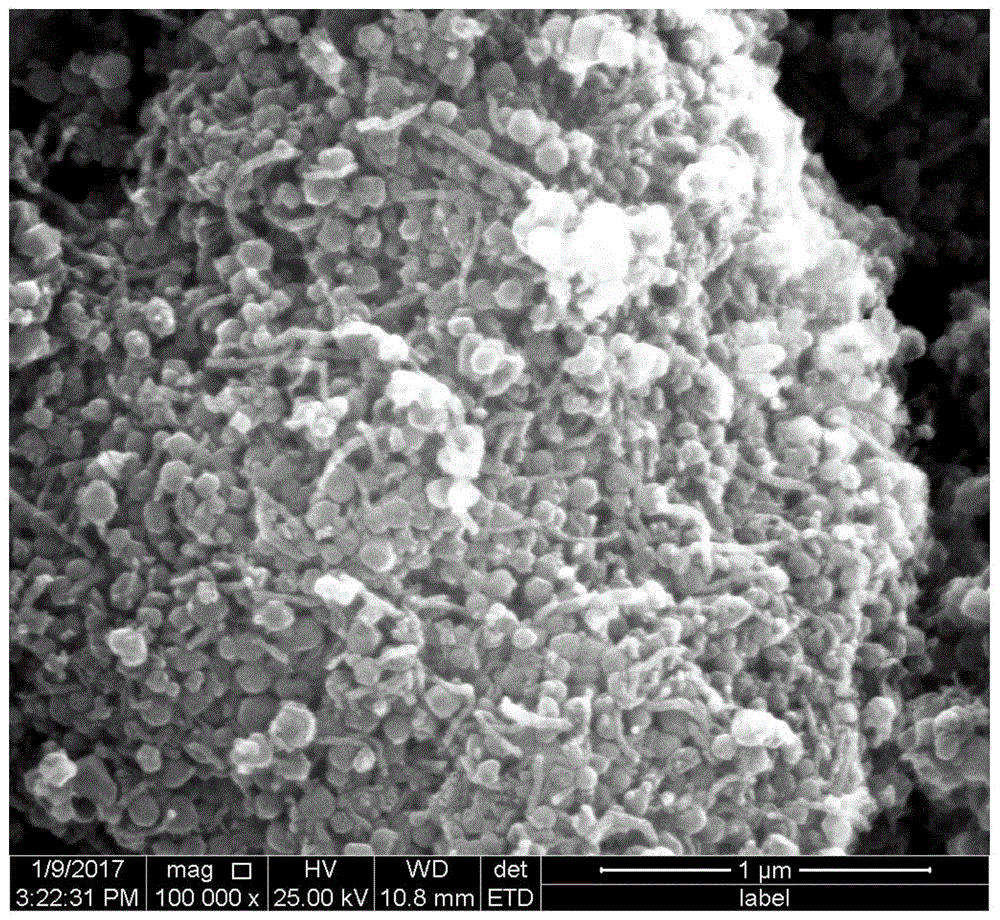
图1为实施例1中制得的负载有ZIF-67颗粒的MWCNTs材料的放大倍数为100000倍的扫描电子显微镜(SEM)图。FIG. 1 is a scanning electron microscope (SEM) image of the MWCNTs material loaded with ZIF-67 particles prepared in Example 1 at a magnification of 100,000 times.
图2为实施例2中制得的负载有ZIF-8颗粒的MWCNTs材料的放大倍数为50000倍的SEM图。FIG. 2 is an SEM image of the MWCNTs material loaded with ZIF-8 particles prepared in Example 2 at a magnification of 50,000 times.
图3为实施例2中制得的锂硫电池用ZIF-8颗粒和碳纳米管共修饰的隔膜材料的放大倍数为800倍的SEM图。3 is an SEM image of the separator material co-modified with ZIF-8 particles and carbon nanotubes for lithium-sulfur batteries prepared in Example 2 at a magnification of 800 times.
图4为实施例3中制得的负载有ZIF-8颗粒的MWCNTs材料的放大倍数为20000倍的SEM图。4 is an SEM image of the MWCNTs material loaded with ZIF-8 particles prepared in Example 3 at a magnification of 20,000 times.
图5为实施例3中制得的负载有ZIF-8颗粒的MWCNTs材料的透射电子显微镜(TEM)图。5 is a transmission electron microscope (TEM) image of the ZIF-8 particle-loaded MWCNTs material prepared in Example 3. FIG.
图6为实施例4中制得的负载有ZIF-8颗粒的MWCNTs材料的放大倍数为50000倍的SEM图。FIG. 6 is an SEM image of the MWCNTs material loaded with ZIF-8 particles prepared in Example 4 at a magnification of 50,000 times.
图7为实施例4中制得的负载有ZIF-8颗粒的MWCNTs材料的TEM图。FIG. 7 is a TEM image of the MWCNTs material loaded with ZIF-8 particles prepared in Example 4. FIG.
图8为实施例5中制得的负载有ZIF-8颗粒的MWCNTs材料的放大倍数为50000倍的SEM图。FIG. 8 is an SEM image of the MWCNTs material loaded with ZIF-8 particles prepared in Example 5 at a magnification of 50,000 times.
图9为实施例5中制得的负载有ZIF-8颗粒的MWCNTs材料的TEM图。FIG. 9 is a TEM image of the MWCNTs material loaded with ZIF-8 particles prepared in Example 5. FIG.
图10为实施例6中制得的负载有ZIF-8颗粒的MWCNTs材料的放大倍数为50000倍的SEM图。FIG. 10 is an SEM image of the MWCNTs material loaded with ZIF-8 particles prepared in Example 6 at a magnification of 50,000 times.
图11为实施例6中制得的负载有ZIF-8颗粒的MWCNTs材料的TEM图。FIG. 11 is a TEM image of the MWCNTs material loaded with ZIF-8 particles prepared in Example 6. FIG.
图12为以实施例1~6中制得ZIF颗粒和碳纳米管共修饰的隔膜材料作为隔膜的测试电池的充放电循环电化学性能对比图。FIG. 12 is a comparison diagram of the electrochemical performance of charge-discharge cycles of test batteries using the separator materials co-modified with ZIF particles and carbon nanotubes prepared in Examples 1 to 6 as separators.
具体实施方式Detailed ways
为更好理解本发明,下面结合具体实施例对本发明做进一步详细描述。For better understanding of the present invention, the present invention will be further described in detail below with reference to specific embodiments.
下面对本发明的优选实施方式做出详细说明。The preferred embodiments of the present invention will be described in detail below.
以下实施例1~6中,所用到的表征分析仪器如下:In the following examples 1 to 6, the used characterization and analysis instruments are as follows:
湿膜制备器:型号:SZQ,上海现代环境工程技术有限公司;Wet film preparation device: Model: SZQ, Shanghai Modern Environmental Engineering Technology Co., Ltd.;
扫描电子显微镜测试:仪器型号:FEI Quanta,荷兰;Scanning Electron Microscope Test: Instrument Model: FEI Quanta, The Netherlands;
透射电镜测试:仪器型号JEM-2100,日本JEOL公司生产的;Transmission electron microscope test: instrument model JEM-2100, produced by JEOL company in Japan;
电池的循环性能测试:LAND CT 2001A测试仪,购自武汉市蓝电电子有限公司。Battery cycle performance test: LAND CT 2001A tester, purchased from Wuhan Landian Electronics Co., Ltd.
羧基化多壁碳纳米管购自南京先丰纳米材料科技有限公司,型号是XFM30:1333-86-4,规格是:管长为0.5μm~2μm,管径为20nm~30nm。Carboxylated multi-walled carbon nanotubes were purchased from Nanjing Xianfeng Nanomaterials Technology Co., Ltd., the model is XFM30: 1333-86-4, and the specifications are: the tube length is 0.5 μm to 2 μm, and the diameter is 20 nm to 30 nm.
实施例1Example 1
步骤1.将0.815g六水合硝酸钴溶解在40ml甲醇中,得到溶液A,溶液A中钴离子的浓度为0.07mol·L-1;
将1.85g 2-甲基咪唑溶解在40ml甲醇中,制备得到配体溶液,将0.05g羧基化多壁碳纳米管加入配体溶液,搅拌15min,超声4h,使其分散均匀,得到溶液B;Dissolve 1.85g of 2-methylimidazole in 40ml of methanol to prepare a ligand solution, add 0.05g of carboxylated multi-walled carbon nanotubes to the ligand solution, stir for 15min, and ultrasonicate for 4h to uniformly disperse to obtain solution B;
步骤2.将溶液A全部倒入溶液B中,在室温下以800rpm剧烈搅拌24h,混合均匀得到混合溶液,混合溶液中钴离子与2-甲基咪唑的摩尔比为1:8,羧基化多壁碳纳米管与钴离子的质量比为0.3:1,采用乙醇反复离心洗涤三次,离心机转速为5000rpm,时间设定为5min,60℃干燥24h后,得到负载有ZIF-67颗粒的MWCNTs材料;Step 2. Pour all solution A into solution B, stir vigorously at 800 rpm for 24 h at room temperature, and mix well to obtain a mixed solution. The molar ratio of cobalt ion and 2-methylimidazole in the mixed solution is 1:8, and the carboxylation is more. The mass ratio of walled carbon nanotubes to cobalt ions was 0.3:1, and ethanol was used for repeated centrifugation and washing three times. The speed of the centrifuge was 5000 rpm, and the time was set to 5 min. After drying at 60 °C for 24 h, the MWCNTs material loaded with ZIF-67 particles was obtained. ;
步骤3.将步骤2制得的负载有ZIF-67颗粒的MWCNTs材料与PVDF以质量比9:1研磨混合均匀,总质量为200mg,并加入2.2g N-甲基吡咯烷酮调节粘度,得到浆料,随后将浆料使用湿膜制备器涂布在隔膜一侧,50℃干燥20h,得到本发明所述的一种锂硫电池用ZIF颗粒和碳纳米管共修饰的隔膜材料。Step 3. Grind and mix the ZIF-67 particle-loaded MWCNTs material prepared in step 2 and PVDF at a mass ratio of 9:1, the total mass is 200 mg, and add 2.2 g of N-methylpyrrolidone to adjust the viscosity to obtain a slurry Then, the slurry is coated on one side of the separator using a wet film preparer, and dried at 50° C. for 20 hours to obtain a separator material co-modified with ZIF particles and carbon nanotubes for lithium-sulfur batteries according to the present invention.
如图1所示,采用扫描电子显微镜对实施例1制备的负载有ZIF-67颗粒的MWCNTs材料进行SEM形貌分析,图1放大倍数为100000倍,从图1中可以看出,实施例1制备的负载在MWCNTs材料上的ZIF-67颗粒平均粒径为30nm左右,碳纳米管贯穿其中,ZIF-67颗粒与碳纳米管团聚在一起;实施例1制备的负载有ZIF-67颗粒的MWCNTs材料的TEM测试结果与实施例3的图5类似,ZIF-67颗粒均匀地生长在碳纳米管周围,碳纳米管将ZIF-8颗粒串在一起,形成网络,包覆层厚度在50nm左右。As shown in Figure 1, the SEM morphology of the MWCNTs material loaded with ZIF-67 particles prepared in Example 1 was analyzed by scanning electron microscopy. The magnification of Figure 1 is 100,000 times. It can be seen from Figure 1 that Example 1 The prepared ZIF-67 particles loaded on the MWCNTs material have an average particle size of about 30 nm, and the carbon nanotubes run through them, and the ZIF-67 particles and the carbon nanotubes are agglomerated together; the MWCNTs loaded with ZIF-67 particles prepared in Example 1 The TEM test results of the material are similar to Figure 5 in Example 3. The ZIF-67 particles grow uniformly around the carbon nanotubes, and the carbon nanotubes string the ZIF-8 particles together to form a network. The thickness of the coating layer is about 50 nm.
对ZIF-67颗粒和碳纳米管共修饰的隔膜材料进行SEM形貌分析,结果与实施例2中的图3类似,图3放大倍数为800倍,可以看出,制备的所述隔膜材料表面粗糙,并含有大量的孔隙,这有利于电解液的浸润和多硫化物的吸附,所述隔膜材料中,干燥后浆料,即ZIF颗粒、WMCNTs和PVDF的负载量为1.2mg·cm-2。The SEM morphology analysis of the separator material co-modified with ZIF-67 particles and carbon nanotubes, the result is similar to Figure 3 in Example 2, the magnification of Figure 3 is 800 times, it can be seen that the prepared separator material surface It is rough and contains a lot of pores, which is beneficial to the infiltration of electrolyte and the adsorption of polysulfides. In the separator material, the loading amount of the dried slurry, namely ZIF particles, WMCNTs and PVDF is 1.2 mg·cm -2 .
实施例2Example 2
步骤1.将0.595g六水合硝酸锌溶解在40ml甲醇中,得到溶液A,溶液A中锌离子的浓度为0.05mol·L-1;
将1.64g 2-甲基咪唑溶解在40ml甲醇中,制备得到配体溶液,将0.04g羧基化多壁碳纳米管加入配体溶液,搅拌10min,超声4h,使其分散均匀,得到溶液B;Dissolve 1.64 g of 2-methylimidazole in 40 ml of methanol to prepare a ligand solution, add 0.04 g of carboxylated multi-walled carbon nanotubes to the ligand solution, stir for 10 min, and sonicate for 4 h to make it uniformly dispersed to obtain solution B;
步骤2.将溶液A全部倒入溶液B中,在室温下以600rpm剧烈搅拌30h,混合均匀得到混合溶液,混合溶液中锌离子与2-甲基咪唑的摩尔比为1:10,羧基化多壁碳纳米管与锌离子的质量比为0.3:1,采用乙醇反复离心洗涤三次,离心机转速为4000rpm,时间为8min,60℃干燥24h后,得到负载有ZIF-8颗粒的MWCNTs材料;Step 2. Pour all solution A into solution B, stir vigorously at 600rpm for 30h at room temperature, and mix well to obtain a mixed solution. The molar ratio of zinc ion to 2-methylimidazole in the mixed solution is 1:10, and the carboxylation is more. The mass ratio of walled carbon nanotubes to zinc ions was 0.3:1, and ethanol was used for repeated centrifugation and washing three times. The centrifuge speed was 4000 rpm for 8 min, and after drying at 60 °C for 24 h, the MWCNTs material loaded with ZIF-8 particles was obtained;
步骤3.将步骤2制得的负载有ZIF-8颗粒的MWCNTs材料与PVDF以质量比9:1研磨混合均匀,总质量为200mg,并加入2g N-甲基吡咯烷酮调节粘度,得到浆料,随后将浆料使用湿膜制备器涂布在隔膜一侧,50℃干燥20h,得到本发明所述的一种锂硫电池用ZIF颗粒和碳纳米管共修饰的隔膜材料。Step 3. Grind and mix the ZIF-8 particle-loaded MWCNTs material obtained in step 2 and PVDF at a mass ratio of 9:1, with a total mass of 200 mg, and add 2 g of N-methylpyrrolidone to adjust the viscosity to obtain a slurry, Then, the slurry is coated on one side of the separator using a wet film preparer, and dried at 50° C. for 20 hours to obtain a separator material co-modified with ZIF particles and carbon nanotubes for lithium-sulfur batteries according to the present invention.
如图2所示,采用扫描电子显微镜对实施例2制备的负载有ZIF-8颗粒的MWCNTs材料进行SEM形貌分析,图2放大倍数为50000倍,从图2中可以看出,实施例2制备的负载在MWCNTs材料上的ZIF-8颗粒平均粒径为30nm左右,碳纳米管贯穿其中,ZIF-8颗粒与碳纳米管团聚在一起;实施例2制备的负载有ZIF-8颗粒的MWCNTs材料的TEM测试结果与实施例3的图5类似,ZIF-8颗粒均匀地生长在碳纳米管周围,碳纳米管将ZIF-8颗粒串在一起,形成网络,包覆层厚度在50nm左右。As shown in Figure 2, the SEM morphology of the MWCNTs material loaded with ZIF-8 particles prepared in Example 2 was analyzed by scanning electron microscopy. The magnification of Figure 2 is 50,000 times. It can be seen from Figure 2 that Example 2 The prepared ZIF-8 particles loaded on the MWCNTs material have an average particle size of about 30 nm, and the carbon nanotubes run through them, and the ZIF-8 particles and the carbon nanotubes are agglomerated together; the MWCNTs loaded with ZIF-8 particles prepared in Example 2 The TEM test results of the material are similar to Figure 5 in Example 3. The ZIF-8 particles grow uniformly around the carbon nanotubes, and the carbon nanotubes string the ZIF-8 particles together to form a network. The thickness of the coating layer is about 50 nm.
如图3所示,采用扫描电子显微镜对实施例2制备的一种锂硫电池用ZIF颗粒和碳纳米管共修饰的隔膜材料进行SEM形貌分析,图3的放大倍数为800倍,从图3中可以看出,实施例2制备的所述隔膜材料表面粗糙,并含有大量的孔隙,这有利于电解液的浸润和多硫化物的吸附,所述隔膜材料中,干燥后浆料,即ZIF颗粒、WMCNTs和PVDF的负载量为1.2mg·cm-2。As shown in Figure 3, the SEM morphology of a separator material prepared in Example 2 for a lithium-sulfur battery co-modified with ZIF particles and carbon nanotubes was analyzed by scanning electron microscopy. The magnification of Figure 3 is 800 times. 3, it can be seen that the surface of the diaphragm material prepared in Example 2 is rough and contains a large number of pores, which is conducive to the infiltration of the electrolyte and the adsorption of polysulfides. The loadings of ZIF particles, WMCNTs and PVDF were 1.2 mg·cm −2 .
实施例3Example 3
步骤1.将0.833g六水合硝酸锌溶解在40ml乙醇中,得到溶液A,溶液A中锌离子的浓度为0.07mol·L-1;
将1.85g 2-甲基咪唑溶解在40ml乙醇中,制备得到配体溶液,将0.09g羧基化多壁碳纳米管加入配体溶液,搅拌20min,超声2h,使其分散均匀,得到溶液B;Dissolve 1.85 g of 2-methylimidazole in 40 ml of ethanol to prepare a ligand solution, add 0.09 g of carboxylated multi-walled carbon nanotubes to the ligand solution, stir for 20 min, and sonicate for 2 h to make it uniformly dispersed to obtain solution B;
步骤2.将溶液A全部倒入溶液B中,在室温下以800rpm剧烈搅拌24h,混合均匀得到混合溶液,混合溶液中锌离子与2-甲基咪唑的摩尔比为1:8,羧基化多壁碳纳米管与锌离子的质量比为0.5:1,采用乙醇反复离心洗涤三次,离心机转速为5000rpm,时间为7min,60℃干燥24h后,得到负载有ZIF-8颗粒的MWCNTs材料;Step 2. Pour all solution A into solution B, stir vigorously at 800rpm for 24h at room temperature, and mix well to obtain a mixed solution. The molar ratio of zinc ion to 2-methylimidazole in the mixed solution is 1:8, and the carboxylation is more. The mass ratio of wall carbon nanotubes to zinc ions was 0.5:1, and ethanol was used for repeated centrifugation and washing three times. The centrifuge speed was 5000 rpm for 7 min, and after drying at 60 °C for 24 h, the MWCNTs material loaded with ZIF-8 particles was obtained;
步骤3.将步骤2制得的负载有ZIF-8颗粒的MWCNTs材料与PVDF以质量比17:3研磨混合均匀,总质量为200mg,并加入3g N-甲基吡咯烷酮调节粘度,得到浆料,随后将浆料使用湿膜制备器涂布在隔膜上一侧,50℃干燥20h,得到本发明所述的一种锂硫电池用ZIF颗粒和碳纳米管共修饰的隔膜材料。Step 3. Grind and mix the ZIF-8 particle-loaded MWCNTs material prepared in step 2 and PVDF at a mass ratio of 17:3 to a total mass of 200 mg, and add 3 g of N-methylpyrrolidone to adjust the viscosity to obtain a slurry, Then, the slurry is coated on one side of the separator using a wet film preparation device, and dried at 50° C. for 20 hours to obtain a separator material co-modified with ZIF particles and carbon nanotubes for lithium-sulfur batteries according to the present invention.
如图4和5所示,采用扫描电子显微镜和透射电子显微镜分别对实施例3制备的负载有ZIF-8颗粒的MWCNTs材料进行SEM(图4)和TEM(图5)形貌分析。图4放大倍数为20000倍,从图4中可以看出,实施例3制备的负载在MWCNTs材料上的ZIF-8颗粒平均粒径为30nm左右,碳纳米管贯穿其中,与实施例2比较而言,碳纳米管含量增加,团聚现象有所缓解;从图5中可以看出,ZIF-8颗粒均匀地生长在碳纳米管周围,碳纳米管将ZIF-8颗粒串在一起,形成网络,包覆层厚度在50nm左右。As shown in Figures 4 and 5, SEM (Figure 4) and TEM (Figure 5) were used to analyze the morphology of the MWCNTs material loaded with ZIF-8 particles prepared in Example 3 by scanning electron microscopy and transmission electron microscopy, respectively. The magnification of Figure 4 is 20,000 times. It can be seen from Figure 4 that the average particle size of the ZIF-8 particles prepared in Example 3 and supported on the MWCNTs material is about 30 nm, and the carbon nanotubes run through them. It can be seen from Figure 5 that the ZIF-8 particles grow uniformly around the carbon nanotubes, and the carbon nanotubes string the ZIF-8 particles together to form a network, The thickness of the cladding layer is about 50 nm.
对实施例3制备的ZIF-67颗粒和碳纳米管共修饰的隔膜材料进行SEM形貌分析,结果与实施例2中的图3类似,制备的所述隔膜材料表面粗糙,并含有大量的孔隙,这有利于电解液的浸润和多硫化物的吸附,所述隔膜材料中,干燥后浆料,即ZIF颗粒、WMCNTs和PVDF的负载量为1.0mg·cm-2。SEM morphology analysis of the separator material prepared in Example 3 with ZIF-67 particles and carbon nanotubes co-modified, the result is similar to Figure 3 in Example 2, the prepared separator material has a rough surface and contains a large number of pores , which is beneficial to the infiltration of the electrolyte and the adsorption of polysulfides. In the separator material, the loading amount of the dried slurry, that is, ZIF particles, WMCNTs and PVDF, is 1.0 mg·cm -2 .
实施例4Example 4
步骤1.将0.382g氯化锌溶解在40ml水中,得到溶液A,溶液A中锌离子浓度为0.07mol·L-1;
将1.85g 2-甲基咪唑溶解在40ml水中,制备得到配体溶液,将0.183g羧基化多壁碳纳米管加入配体溶液,搅拌15min,超声3h,使其分散均匀,得到溶液B;Dissolve 1.85g of 2-methylimidazole in 40ml of water to prepare a ligand solution, add 0.183g of carboxylated multi-walled carbon nanotubes to the ligand solution, stir for 15min, and sonicate for 3h to uniformly disperse to obtain solution B;
步骤2.将溶液A全部倒入溶液B中,室温下以800rpm剧烈搅拌24h,混合均匀得到混合溶液,混合溶液中锌离子与2-甲基咪唑的摩尔比为1:8,羧基化多壁碳纳米管与锌离子的质量比为1:1,采用乙醇反复离心洗涤三次,离心机转速为6000rpm,时间为5min,80℃干燥20h后,得到负载有ZIF-8颗粒的MWCNTs材料;Step 2. Pour all solution A into solution B, stir vigorously at 800rpm for 24h at room temperature, and mix well to obtain a mixed solution. The molar ratio of zinc ions to 2-methylimidazole in the mixed solution is 1:8, and the carboxylated multi-wall The mass ratio of carbon nanotubes to zinc ions was 1:1, and ethanol was used for repeated centrifugation and washing three times. The speed of the centrifuge was 6000 rpm for 5 min, and after drying at 80 °C for 20 h, the MWCNTs material loaded with ZIF-8 particles was obtained;
步骤3.将步骤2制得的负载有ZIF-8颗粒的MWCNTs材料与PVDF以质量比19:1研磨混合均匀,总质量为200mg,并加入1.5g N-甲基吡咯烷酮调节粘度,得到浆料,随后将浆料使用湿膜制备器涂布在隔膜上一侧,50℃干燥20h,得到本发明所述的一种锂硫电池用ZIF颗粒和碳纳米管共修饰的隔膜材料。Step 3. Grind and mix the MWCNTs material loaded with ZIF-8 particles prepared in step 2 and PVDF at a mass ratio of 19:1, the total mass is 200 mg, and add 1.5 g of N-methylpyrrolidone to adjust the viscosity to obtain a slurry Then, the slurry is coated on one side of the separator using a wet film preparer, and dried at 50° C. for 20 hours to obtain a separator material co-modified with ZIF particles and carbon nanotubes for lithium-sulfur batteries according to the present invention.
如图6和7所示,采用扫描电子显微镜和透射电子显微镜分别对实施例4制备的负载有ZIF-8颗粒的MWCNTs材料进行SEM(图6)和TEM(图7)形貌分析。图6放大倍数为50000倍,从图6中可以看出,实施例4制备的负载在MWCNTs材料上的ZIF-8颗粒平均粒径为30nm左右,碳纳米管贯穿其中,与实施例3比较而言,碳纳米管含量增加,团聚现象有所缓解,明显地看出ZIF-8颗粒均匀地生长在碳纳米管周围;从图7中可以看出,ZIF-8颗粒均匀地生长在碳纳米管周围,碳纳米管将ZIF-8颗粒串在一起,形成网络,与实施例3比较而言,负载的ZIF-8颗粒减少,基本保持在一个ZIF-8颗粒大小的包覆层厚度。As shown in Figures 6 and 7, SEM (Figure 6) and TEM (Figure 7) were used to analyze the morphology of the MWCNTs material loaded with ZIF-8 particles prepared in Example 4 by scanning electron microscopy and transmission electron microscopy, respectively. The magnification of Figure 6 is 50,000 times. It can be seen from Figure 6 that the average particle size of the ZIF-8 particles prepared in Example 4 and supported on the MWCNTs material is about 30 nm, and the carbon nanotubes run through them. It can be seen from Figure 7 that the ZIF-8 particles grow evenly around the carbon nanotubes as the content of carbon nanotubes increases, and the agglomeration phenomenon is alleviated. Around the carbon nanotubes, the ZIF-8 particles are strung together to form a network. Compared with Example 3, the loaded ZIF-8 particles are reduced, and the coating thickness of a ZIF-8 particle size is basically maintained.
对实施例4制备的ZIF-67颗粒和碳纳米管共修饰的隔膜材料进行SEM形貌分析,结果与实施例2中的图3类似,制备的所述隔膜材料表面粗糙,并含有大量的孔隙,这有利于电解液的浸润和多硫化物的吸附,所述隔膜材料中,干燥后浆料,即ZIF颗粒、WMCNTs和PVDF的负载量为1.3mg·cm-2。SEM morphology analysis of the separator material prepared in Example 4 with ZIF-67 particles and carbon nanotubes co-modified, the result is similar to Figure 3 in Example 2, the prepared separator material has a rough surface and contains a large number of pores , which is beneficial to the infiltration of the electrolyte and the adsorption of polysulfides. In the separator material, the dried slurry, that is, the loading of ZIF particles, WMCNTs and PVDF, is 1.3 mg·cm -2 .
实施例5Example 5
步骤1.将1.19g六水合硝酸锌溶解在40ml N,N-二甲基甲酰胺中,得到溶液A,溶液A中锌离子的浓度为0.1mol·L-1;
将1.64g 2-甲基咪唑溶解在40ml N,N-二甲基甲酰胺中,制备得到配体溶液,将0.523g羧基化多壁碳纳米管加入配体溶液,搅拌20min,超声3h,使其分散均匀,得到溶液B;Dissolve 1.64 g of 2-methylimidazole in 40 ml of N,N-dimethylformamide to prepare a ligand solution, add 0.523 g of carboxylated multi-walled carbon nanotubes to the ligand solution, stir for 20 min, and sonicate for 3 h to make the solution. It is uniformly dispersed to obtain solution B;
步骤2.将溶液A全部倒入溶液B中,在室温下以800rpm剧烈搅拌24h,混合均匀得到混合溶液,混合溶液中锌离子与2-甲基咪唑的摩尔比为1:5,羧基化多壁碳纳米管与锌离子的质量比为2:1,采用反复乙醇离心洗涤三次,离心机转速为7000rpm,时间为4min,60℃干燥24h后,得到负载有ZIF-8颗粒的MWCNTs材料;Step 2. Pour all solution A into solution B, stir vigorously at 800 rpm for 24 h at room temperature, and mix well to obtain a mixed solution. The molar ratio of zinc ions to 2-methylimidazole in the mixed solution is 1:5, and the carboxylation is more. The mass ratio of walled carbon nanotubes to zinc ions was 2:1, washed three times by repeated ethanol centrifugation, the speed of the centrifuge was 7000 rpm, the time was 4 min, and after drying at 60 °C for 24 h, the MWCNTs material loaded with ZIF-8 particles was obtained;
步骤3.将步骤2制得的负载有ZIF-8颗粒的MWCNTs材料与PVDF以质量比9:1研磨混合均匀,总质量为200mg,并加入2.5g N-甲基吡咯烷酮调节粘度,得到浆料,随后将浆料使用湿膜制备器涂布在隔膜上一侧,50℃干燥20h,得到本发明所述的一种锂硫电池用ZIF颗粒和碳纳米管共修饰的隔膜材料。Step 3. Grind and mix the MWCNTs material loaded with ZIF-8 particles prepared in step 2 and PVDF at a mass ratio of 9:1, the total mass is 200 mg, and add 2.5 g of N-methylpyrrolidone to adjust the viscosity to obtain a slurry Then, the slurry is coated on one side of the separator using a wet film preparer, and dried at 50° C. for 20 hours to obtain a separator material co-modified with ZIF particles and carbon nanotubes for lithium-sulfur batteries according to the present invention.
如图8和9所示,采用扫描电子显微镜和透射电子显微镜分别对实施例5制备的负载有ZIF-8颗粒的MWCNTs材料进行SEM(图8)和TEM(图9)形貌分析。图8放大倍数为50000倍,从图8中可以看出,实施例5制备的负载在MWCNTs材料上的ZIF-8颗粒平均粒径为30nm左右,ZIF-8颗粒点缀在碳纳米管网络中,与实施例4比较而言,碳纳米管含量增加,无团聚现象,孔隙均匀;从图9中可以看出,ZIF-8颗粒均匀地生长在碳纳米管周围,碳纳米管将ZIF-8颗粒串在一起,形成网络,与实施例4比较而言,负载的ZIF-8颗粒减少,没有形成完整的包覆层,存在裸露的碳纳米管,但是ZIF-8颗粒在碳纳米管上还是均匀分布的。As shown in Figures 8 and 9, SEM (Figure 8) and TEM (Figure 9) were used to analyze the morphology of the MWCNTs material loaded with ZIF-8 particles prepared in Example 5 by scanning electron microscopy and transmission electron microscopy, respectively. The magnification of Fig. 8 is 50000 times. It can be seen from Fig. 8 that the average particle size of the ZIF-8 particles supported on the MWCNTs material prepared in Example 5 is about 30 nm, and the ZIF-8 particles are dotted in the carbon nanotube network. Compared with Example 4, the content of carbon nanotubes increases, there is no agglomeration phenomenon, and the pores are uniform; as can be seen from Figure 9, ZIF-8 particles grow uniformly around the carbon nanotubes, and the carbon nanotubes combine the ZIF-8 particles. String together to form a network. Compared with Example 4, the loaded ZIF-8 particles are reduced, a complete coating layer is not formed, and there are bare carbon nanotubes, but the ZIF-8 particles are still uniform on the carbon nanotubes diversified.
对实施例5制备的ZIF-67颗粒和碳纳米管共修饰的隔膜材料进行SEM形貌分析,结果与实施例2中的图3类似,制备的所述隔膜材料表面粗糙,并含有大量的孔隙,这有利于电解液的浸润和多硫化物的吸附,所述隔膜材料中,干燥后浆料,即ZIF颗粒、WMCNTs和PVDF的负载量为1.1mg·cm-2。SEM morphology analysis was performed on the separator material prepared in Example 5, which was co-modified with ZIF-67 particles and carbon nanotubes. The results were similar to Figure 3 in Example 2. The prepared separator material had a rough surface and contained a large number of pores. , which is beneficial to the infiltration of the electrolyte and the adsorption of polysulfides. In the separator material, the loading amount of the dried slurry, that is, ZIF particles, WMCNTs and PVDF, is 1.1 mg·cm −2 .
实施例6Example 6
步骤1.将0.833g六水合硝酸锌溶解在40ml甲醇中,得到溶液A,溶液A中锌离子的浓度为0.07mol·L-1;
将1.85g 2-甲基咪唑溶解在40ml甲醇中,制备得到配体溶液,将0.732g羧基化多壁碳纳米管加入配体溶液,搅拌15min,超声4h,使其分散均匀,得到溶液B;Dissolve 1.85 g of 2-methylimidazole in 40 ml of methanol to prepare a ligand solution, add 0.732 g of carboxylated multi-walled carbon nanotubes to the ligand solution, stir for 15 min, and sonicate for 4 h to make it uniformly dispersed to obtain solution B;
步骤2.将溶液A全部倒入溶液B中,在室温下以1000rpm剧烈搅拌20h,混合均匀得到混合溶液,混合溶液中锌离子与2-甲基咪唑的摩尔比为1:8,羧基化多壁碳纳米管与锌离子的质量比为4:1,采用乙醇反复离心洗涤三次,离心机转速为5000rpm,时间为5min,60℃干燥24h后,得到负载有ZIF-8颗粒的MWCNTs材料;Step 2. Pour all solution A into solution B, stir vigorously at 1000rpm for 20h at room temperature, and mix well to obtain a mixed solution. The molar ratio of zinc ion to 2-methylimidazole in the mixed solution is 1:8, and the carboxylation is more. The mass ratio of walled carbon nanotubes to zinc ions was 4:1, and ethanol was used for repeated centrifugation and washing three times. The centrifuge speed was 5000 rpm for 5 min, and after drying at 60 °C for 24 h, the MWCNTs material loaded with ZIF-8 particles was obtained;
步骤3.将步骤2制得的负载有ZIF-8颗粒的MWCNTs材料与PVDF以质量比9:1研磨混合均匀,总质量为200mg,并加入3g N-甲基吡咯烷酮调节粘度,得到浆料,随后将浆料使用湿膜制备器涂布在隔膜上一侧,50℃干燥20h,得到本发明所述的一种锂硫电池用ZIF颗粒和碳纳米管共修饰的隔膜材料。Step 3. Grind and mix the ZIF-8 particle-loaded MWCNTs material prepared in step 2 and PVDF at a mass ratio of 9:1, with a total mass of 200 mg, and add 3 g of N-methylpyrrolidone to adjust the viscosity to obtain a slurry, Then, the slurry is coated on one side of the separator using a wet film preparation device, and dried at 50° C. for 20 hours to obtain a separator material co-modified with ZIF particles and carbon nanotubes for lithium-sulfur batteries according to the present invention.
如图10和11所示,采用扫描电子显微镜和透射电子显微镜分别对实施例6制备的负载有ZIF-8颗粒的MWCNTs材料进行SEM(图10)和TEM(图11)形貌分析。图10放大倍数为50000倍,从图10中可以看出,实施例6制备的负载在MWCNTs材料上的ZIF-8颗粒平均粒径在为30nm左右,ZIF-8颗粒点缀在碳纳米管网络中,与实施例5比较而言,碳纳米管含量增加,团聚现象在此出现;从图11中可以看出,ZIF-8颗粒只是点缀在碳纳米管网络中,零星地生长在碳纳米管上,与实施例5比较而言,负载的ZIF-8颗粒骤减,没有形成完整的包覆层,存在很多裸露的碳纳米管。As shown in Figures 10 and 11, SEM (Figure 10) and TEM (Figure 11) were used to analyze the morphology of the MWCNTs material loaded with ZIF-8 particles prepared in Example 6 by scanning electron microscopy and transmission electron microscopy, respectively. The magnification of Fig. 10 is 50,000 times. It can be seen from Fig. 10 that the average particle size of the ZIF-8 particles supported on the MWCNTs material prepared in Example 6 is about 30 nm, and the ZIF-8 particles are dotted in the carbon nanotube network. , compared with Example 5, the content of carbon nanotubes increases, and the agglomeration phenomenon occurs here; it can be seen from Figure 11 that the ZIF-8 particles are only dotted in the carbon nanotube network and grow sporadically on the carbon nanotubes , compared with Example 5, the supported ZIF-8 particles decreased sharply, a complete coating layer was not formed, and there were many bare carbon nanotubes.
对实施例6制备的ZIF-67颗粒和碳纳米管共修饰的隔膜材料进行SEM形貌分析,结果与实施例2中的图3类似,制备的所述隔膜材料表面粗糙,并含有大量的孔隙,这有利于电解液的浸润和多硫化物的吸附,所述隔膜材料中,干燥后浆料,即ZIF颗粒、WMCNTs和PVDF的负载量为0.9mg·cm-2。SEM morphology analysis of the separator material prepared in Example 6 with ZIF-67 particles and carbon nanotubes co-modified, the result is similar to Figure 3 in Example 2, the prepared separator material has a rough surface and contains a large number of pores , which is beneficial to the infiltration of the electrolyte and the adsorption of polysulfides. In the separator material, the loading amount of the dried slurry, that is, ZIF particles, WMCNTs and PVDF, is 0.9 mg·cm −2 .
实施例7Example 7
将实施例1~6中制备的ZIF颗粒和碳纳米管共修饰的隔膜材料作为隔膜装入锂硫电池作为测试电池,具体制备方法如下:The ZIF particles and carbon nanotubes co-modified separator materials prepared in Examples 1 to 6 were used as separators and loaded into a lithium-sulfur battery as a test battery, and the specific preparation method was as follows:
将正极材料升华硫粉、导电剂乙炔黑、粘合剂聚偏氟乙烯(PVDF)以质量比70:20:10的比例混合,在研钵中充分混合约1h,期间以N-甲基吡咯烷酮(NMP)为稀释液调节混合物的粘度,最后将所得的粘稠浆料用湿膜制备器均匀涂覆在铝箔衬底之上,放入60℃真空干燥箱中烘24h,得到薄膜;用手动冲压机将薄膜裁剪成面积约为1.1cm2的圆形小极片,然后称重。The positive electrode material sublimation sulfur powder, the conductive agent acetylene black, and the binder polyvinylidene fluoride (PVDF) are mixed in a mass ratio of 70:20:10, and are fully mixed in a mortar for about 1 hour, during which N-methylpyrrolidone is used. (NMP) is the diluent to adjust the viscosity of the mixture, and finally the obtained viscous slurry is evenly coated on the aluminum foil substrate with a wet film preparer, and placed in a 60°C vacuum drying oven for 24 hours to obtain a film; A punching machine cuts the film into small circular pole pieces with an area of about 1.1 cm 2 , which are then weighed.
将称重后的极片、电池壳体、实施例1~6制备的ZIF颗粒和碳纳米管共修饰的隔膜材料一同放入真空干燥箱中干燥,然后放入氩气气氛的手套箱(德国,MBRAUN)中进行纽扣电池的组装。以称取的极片为正极,金属锂片为负极,隔膜放在正极和负极之间,并且修饰有隔膜材料的一侧朝向正极,电解液为含有0.2M LiNO3的1M双三氟甲烷磺酰亚胺锂(LiTFSI)溶解在1,3-二氧戊环(DOL)与二甲氧基乙烷(DME)体积比为1:1的溶剂中制备而成。The weighed pole piece, battery case, ZIF particles prepared in Examples 1 to 6, and the separator material co-modified with carbon nanotubes were put into a vacuum drying oven for drying, and then put into an argon atmosphere glove box (Germany). , MBRAUN) for the assembly of button batteries. Take the weighed pole piece as the positive electrode, the metal lithium piece as the negative electrode, the separator is placed between the positive electrode and the negative electrode, and the side decorated with the separator material faces the positive electrode, and the electrolyte is 1M bis-trifluoromethanesulfonic acid containing 0.2M LiNO 3 . Lithium imide (LiTFSI) was prepared by dissolving 1,3-dioxolane (DOL) and dimethoxyethane (DME) in a solvent with a volume ratio of 1:1.
采用LAND CT 2001A测试仪对测试电池进行电化学测试,图12所示为所述测试电池在1000mA g-1下的循环可逆容量曲线。以实施例1~6中制得的ZIF颗粒和碳纳米管共修饰的隔膜材料为隔膜的测试电池的初始放电容量分别为843.8mAh g-1、571.3mAh g-1、916.5mAh g-1、1002.1mAh g-1、1099.5mAh g-1和1275.1mAh g-1,所述结果表明测试电池首周容量随着碳纳米管含量的增加而增加,是由于极片中大量硫单质的密集堆积,需要通过电解液的充分浸润以及硫与导电剂的重新有效排布才能达到最高的活性物质利用效率。而随着碳纳米管含量的增加,隔膜一侧的导电性增加,起到良好的导电传递作用,使初始容量尽可能的发挥出来,而隔膜的另一侧并没有进行修饰,起到隔膜本身隔绝电子的作用。随着循环的进行,实施例5展现出较好的循环稳定性,说明具有化学吸附作用但导电性差的ZIF-8颗粒与具有良好导电性的碳纳米管的巧妙结合,能够高效的化学吸附和物理阻隔多硫化物,从而有效地抑制多硫化物通过隔膜向负极的迁移。The electrochemical test was carried out on the test cell using a LAND CT 2001A tester, and Figure 12 shows the cycle reversible capacity curve of the test cell at 1000 mA g −1 . The initial discharge capacities of the test cells using the separator materials co-modified with ZIF particles and carbon nanotubes prepared in Examples 1 to 6 were 843.8mAh g -1 , 571.3mAh g -1 , 916.5mAh g -1 , 1002.1mAh g -1 , 1099.5mAh g -1 and 1275.1mAh g -1 , the results show that the first week capacity of the test battery increases with the increase of carbon nanotube content, which is due to the dense accumulation of a large amount of sulfur in the pole piece, It is necessary to achieve the highest utilization efficiency of active materials through sufficient infiltration of electrolyte and effective rearrangement of sulfur and conductive agent. With the increase of carbon nanotube content, the conductivity of one side of the diaphragm increases, which plays a good role in conduction transfer, so that the initial capacity can be exerted as much as possible, while the other side of the diaphragm is not modified, which plays the role of the diaphragm itself. Isolate the effect of electrons. With the progress of the cycle, Example 5 showed good cycle stability, indicating that the ingenious combination of ZIF-8 particles with chemisorption but poor conductivity and carbon nanotubes with good conductivity can efficiently chemisorb and Physically block polysulfides, thereby effectively inhibiting the migration of polysulfides to the anode through the separator.
本发明包括但不限于以上实施例,凡是在本发明精神的原则之下进行的任何等同替换或局部改进,都将视为在本发明的保护范围之内。The present invention includes but is not limited to the above embodiments, and any equivalent replacement or partial improvement made under the spirit of the present invention will be deemed to be within the protection scope of the present invention.
Claims (9)
Priority Applications (1)
| Application Number | Priority Date | Filing Date | Title |
|---|---|---|---|
| CN201710638515.8A CN107394089B (en) | 2017-07-31 | 2017-07-31 | ZIF particle and carbon nanotube co-modified diaphragm material for lithium-sulfur battery |
Applications Claiming Priority (1)
| Application Number | Priority Date | Filing Date | Title |
|---|---|---|---|
| CN201710638515.8A CN107394089B (en) | 2017-07-31 | 2017-07-31 | ZIF particle and carbon nanotube co-modified diaphragm material for lithium-sulfur battery |
Publications (2)
| Publication Number | Publication Date |
|---|---|
| CN107394089A CN107394089A (en) | 2017-11-24 |
| CN107394089B true CN107394089B (en) | 2020-01-10 |
Family
ID=60341464
Family Applications (1)
| Application Number | Title | Priority Date | Filing Date |
|---|---|---|---|
| CN201710638515.8A Active CN107394089B (en) | 2017-07-31 | 2017-07-31 | ZIF particle and carbon nanotube co-modified diaphragm material for lithium-sulfur battery |
Country Status (1)
| Country | Link |
|---|---|
| CN (1) | CN107394089B (en) |
Families Citing this family (37)
| Publication number | Priority date | Publication date | Assignee | Title |
|---|---|---|---|---|
| CN108461692A (en) * | 2018-03-09 | 2018-08-28 | 齐鲁工业大学 | A kind of preparation method of the electrode supporting zeolite imidazole diaphragm of lithium ion battery |
| CN108598390B (en) * | 2018-03-29 | 2020-08-28 | 武汉新能源研究院有限公司 | Preparation method of positive electrode material for lithium-sulfur battery and lithium-sulfur battery |
| CN108807798A (en) * | 2018-08-01 | 2018-11-13 | 南京大学 | Composite battery separator film and its preparation method and application based on metal-organic framework materials |
| CN109461903A (en) * | 2018-09-29 | 2019-03-12 | 昆明理工大学 | A kind of preparation method of lithium-sulfur battery composite cathode material |
| CN109461873B (en) * | 2018-09-30 | 2021-05-28 | 南京大学 | High temperature resistant metal-organic framework material coated battery separator and its preparation method and application |
| CN109461906B (en) * | 2018-09-30 | 2021-08-20 | 昆明理工大学 | A kind of preparation method of lithium-sulfur battery cathode material |
| CN109505035B (en) * | 2018-10-30 | 2021-04-27 | 肇庆市华师大光电产业研究院 | Preparation method of lithium-sulfur battery diaphragm material |
| CN109592666A (en) * | 2018-11-24 | 2019-04-09 | 天津大学 | A kind of preparation method of celestial being's palmate carbon nano pipe array |
| CN109742439B (en) * | 2018-12-24 | 2021-02-23 | 肇庆市华师大光电产业研究院 | Novel lithium-sulfur battery porous interlayer material, preparation method and application |
| CN109950455A (en) * | 2019-04-03 | 2019-06-28 | 江西中汽瑞华新能源科技有限公司 | A kind of preparation method of lithium-sulfur cell modified diaphragm |
| CN109822110A (en) * | 2019-04-09 | 2019-05-31 | 安徽大学 | A kind of preparation method of Zn@MWCNTs nanocomposite absorbing material |
| CN111834660B (en) * | 2019-04-18 | 2024-11-05 | 康宁股份有限公司 | Improved positive electrode design and related preparation methods for solid-state lithium-sulfur batteries |
| CN110600656B (en) * | 2019-09-12 | 2022-03-25 | 肇庆市华师大光电产业研究院 | Preparation method of lithium-sulfur battery diaphragm material |
| CN110611068B (en) * | 2019-09-12 | 2022-03-25 | 肇庆市华师大光电产业研究院 | Preparation method of novel lithium-sulfur battery diaphragm material |
| CN110867550A (en) * | 2019-11-25 | 2020-03-06 | 天津工业大学 | Composite membrane for lithium-sulfur battery and preparation method thereof |
| CN111321394A (en) * | 2020-02-28 | 2020-06-23 | 盱眙新远光学科技有限公司 | Method for preparing nano flaky cobalt phosphide by vapor deposition |
| CN111525122B (en) * | 2020-05-12 | 2021-07-27 | 苗珍录 | A kind of NaTi2(PO4)3-porous carbon nanofiber sodium ion battery anode material and preparation method thereof |
| CN111554936B (en) * | 2020-05-18 | 2021-03-26 | 齐鲁工业大学 | Conductive MOF modified carbon fiber paper insertion layer material for lithium-sulfur battery |
| CN112058312A (en) * | 2020-09-25 | 2020-12-11 | 西华大学 | Iron-zinc bimetal ZIFs and carbon nanotube compound and preparation method thereof |
| CN112886134B (en) * | 2021-01-18 | 2023-05-16 | 福建师范大学 | Preparation method of modified diaphragm for lithium-sulfur battery |
| CN113206235B (en) * | 2021-04-30 | 2022-11-18 | 陕西科技大学 | A kind of multi-component (V, Zn) metal sulfide and preparation method thereof |
| CN113422153B (en) * | 2021-05-19 | 2022-07-29 | 大连理工大学 | Preparation method of anode side interlayer material for lithium-sulfur battery |
| CN113328201B (en) * | 2021-05-28 | 2022-04-08 | 上海电力大学 | Lithium-sulfur battery diaphragm with functional interlayer and preparation method thereof |
| CN113555646B (en) * | 2021-08-10 | 2022-04-19 | 大连理工大学 | A kind of preparation method of coagulant type lithium-sulfur battery cathode side separator material |
| CN114069159B (en) * | 2021-11-09 | 2024-03-01 | 广东工业大学 | Diaphragm based on nitrogen-rich column layer structure MOF, and preparation method and application thereof |
| CN114614197B (en) * | 2022-03-15 | 2023-11-03 | 宁夏氟峰新材料科技有限公司 | Modified PVDF/nano MOFs low-crosslinking-density composite film and preparation method thereof |
| CN115252781B (en) * | 2022-07-22 | 2024-02-27 | 哈尔滨医科大学 | Preparation method and application of hypericin-carboxylated carbon nanotube-zeolite-like imidazole framework nanocomposite |
| CN115020921A (en) * | 2022-08-10 | 2022-09-06 | 宁德卓高新材料科技有限公司 | Carbon nanotube composite diaphragm and preparation method and application thereof |
| CN115347323B (en) * | 2022-09-01 | 2024-04-02 | 陕西科技大学 | BC loaded MOFs derived CNF/CoP composite material applied to Li-S battery diaphragm and preparation and application methods thereof |
| CN115911753B (en) * | 2022-10-11 | 2024-04-26 | 天津工业大学 | Preparation method of composite lithium-sulfur battery diaphragm material based on polyphenylene sulfide |
| CN115888413B (en) * | 2022-11-17 | 2024-07-12 | 吉林大学 | ZIFs particle loaded nanotube modified polymer-based ultrafiltration membrane, and preparation method and application thereof |
| CN115810865A (en) * | 2022-12-23 | 2023-03-17 | 上海纳米技术及应用国家工程研究中心有限公司 | Preparation method of Zn-based double MOF modified diaphragm for lithium-sulfur battery, product and application thereof |
| CN116487537B (en) * | 2023-06-08 | 2025-09-05 | 陕西科技大学 | A BC/CNT-S/CNF-CoS-Co9S8-NC self-supporting flexible electrode and its preparation and application method |
| TR2023019608A2 (en) * | 2023-12-29 | 2024-03-21 | İnönü Üni̇versi̇tesi̇ Rektörlüğü | Synthesis of Metal Sulfide-Carbon Composites from ZIF-11, ZIF-12 or Amorphous-ZIF Structures |
| CN118085378B (en) * | 2024-02-02 | 2024-08-16 | 江汉大学 | A chain-like nanosphere material and its preparation method and its application in modifying lithium battery separator |
| CN118472554B (en) * | 2024-07-11 | 2024-10-22 | 洛阳微栎科技有限公司 | A method for producing high-performance diaphragm material for lithium-sulfur batteries |
| CN118545768B (en) * | 2024-07-29 | 2024-11-12 | 川北医学院 | A cobalt oxide/carbon-based electrode material and a preparation method thereof and application in the preparation of a non-enzymatic glucose electrochemical sensor |
Citations (3)
| Publication number | Priority date | Publication date | Assignee | Title |
|---|---|---|---|---|
| CN104393220A (en) * | 2014-12-03 | 2015-03-04 | 中南大学 | Preparation method of composite diaphragm of lithium-sulphur battery |
| CN106784525A (en) * | 2016-12-12 | 2017-05-31 | 中南大学 | A kind of Co N C@RGO composites, preparation method and the application for lithium-sulfur cell diagram modification |
| KR20170078893A (en) * | 2015-12-29 | 2017-07-10 | 전자부품연구원 | Sodium ion secondary battery separator and manufacturing method thereof |
-
2017
- 2017-07-31 CN CN201710638515.8A patent/CN107394089B/en active Active
Patent Citations (3)
| Publication number | Priority date | Publication date | Assignee | Title |
|---|---|---|---|---|
| CN104393220A (en) * | 2014-12-03 | 2015-03-04 | 中南大学 | Preparation method of composite diaphragm of lithium-sulphur battery |
| KR20170078893A (en) * | 2015-12-29 | 2017-07-10 | 전자부품연구원 | Sodium ion secondary battery separator and manufacturing method thereof |
| CN106784525A (en) * | 2016-12-12 | 2017-05-31 | 中南大学 | A kind of Co N C@RGO composites, preparation method and the application for lithium-sulfur cell diagram modification |
Non-Patent Citations (1)
| Title |
|---|
| "Networking Pyrolyzed Zeolitic Imidazolate Frameworks by Carbon Nanotubes Improves Conductivity and Enhances Oxygen-Reduction Performance in Polymer-Electrolyte-Membrane Fuel Cells";Chao Zhang等;《Adv. Mater.》;20161122;第29卷;第1604556(1-7)页 * |
Also Published As
| Publication number | Publication date |
|---|---|
| CN107394089A (en) | 2017-11-24 |
Similar Documents
| Publication | Publication Date | Title |
|---|---|---|
| CN107394089B (en) | ZIF particle and carbon nanotube co-modified diaphragm material for lithium-sulfur battery | |
| Song et al. | Fe-N-doped carbon nanofiber and graphene modified separator for lithium-sulfur batteries | |
| Cheng et al. | CeO2 decorated graphene as separator modification material for capture and boost conversion of polysulfide in lithium-sulfur batteries | |
| Zeng et al. | N-doped porous carbon nanofibers sheathed pumpkin-like Si/C composites as free-standing anodes for lithium-ion batteries | |
| Li et al. | Inhibition of polysulfide shuttles in Li–S batteries: modified separators and solid‐state electrolytes | |
| Wu et al. | Metal-organic frameworks composites threaded on the CNT knitted separator for suppressing the shuttle effect of lithium sulfur batteries | |
| Chu et al. | Metal–organic frameworks as separators and electrolytes for lithium–sulfur batteries | |
| Jiang et al. | Honeycomb-like nitrogen and sulfur dual-doped hierarchical porous biomass carbon bifunctional interlayer for advanced lithium-sulfur batteries | |
| Chen et al. | Metal–organic frameworks (MOFs)‐Derived nitrogen‐doped porous carbon anchored on graphene with multifunctional effects for lithium–sulfur batteries | |
| Chen et al. | MnO2 nanosheets grown on the internal/external surface of N-doped hollow porous carbon nanospheres as the sulfur host of advanced lithium-sulfur batteries | |
| CN103972467B (en) | A kind of lithium-sulfur cell MULTILAYER COMPOSITE positive pole and preparation method thereof | |
| Zheng et al. | Ultralight carbon flakes modified separator as an effective polysulfide barrier for lithium-sulfur batteries | |
| Ren et al. | Nitrogen-doped carbon fiber foam enabled sulfur vapor deposited cathode for high performance lithium sulfur batteries | |
| Sun et al. | High-performance lithium-sulfur batteries based on self-supporting graphene/carbon nanotube foam@ sulfur composite cathode and quasi-solid-state polymer electrolyte | |
| Wang et al. | Robust Room‐Temperature Sodium‐Sulfur Batteries Enabled by a Sandwich‐Structured MXene@ C/Polyolefin/MXene@ C Dual‐functional Separator | |
| CN105932235B (en) | A kind of lithium sulfur battery anode material and preparation method thereof based on galapectite | |
| Liao et al. | Novel flower-like hierarchical carbon sphere with multi-scale pores coated on PP separator for high-performance lithium-sulfur batteries | |
| CN109742489B (en) | A kind of lithium-oxygen/air battery and preparation method thereof | |
| CN113381012B (en) | A kind of MXene-based metal sulfide and its preparation method and application | |
| Li et al. | Preparation of Fe3O4/FexSy heterostructures via electrochemical deposition method and their enhanced electrochemical performance for lithium-sulfur batteries | |
| Ponnada et al. | Improved performance of lithium–sulfur batteries by employing a sulfonated carbon nanoparticle-modified glass fiber separator | |
| CN106816576A (en) | A kind of preparation method of anode material of lithium-ion battery and products thereof and application | |
| Qian et al. | MOF drived MnO/N–C/CNT composite and its modified separator for advanced Li–S battery | |
| CN103280586A (en) | High-energy-density Li-air battery air electrode, and battery and making method thereof | |
| Wang et al. | Carbon nanofibers with uniformly embedded silicon nanoparticles as self-standing anode for high-performance lithium-ion battery |
Legal Events
| Date | Code | Title | Description |
|---|---|---|---|
| PB01 | Publication | ||
| PB01 | Publication | ||
| SE01 | Entry into force of request for substantive examination | ||
| SE01 | Entry into force of request for substantive examination | ||
| GR01 | Patent grant | ||
| GR01 | Patent grant |