CN107220995B - Improved method of ICP (inductively coupled plasma) rapid point cloud registration algorithm based on ORB (object-oriented bounding Box) image features - Google Patents
Improved method of ICP (inductively coupled plasma) rapid point cloud registration algorithm based on ORB (object-oriented bounding Box) image features Download PDFInfo
- Publication number
- CN107220995B CN107220995B CN201710267277.4A CN201710267277A CN107220995B CN 107220995 B CN107220995 B CN 107220995B CN 201710267277 A CN201710267277 A CN 201710267277A CN 107220995 B CN107220995 B CN 107220995B
- Authority
- CN
- China
- Prior art keywords
- matrix
- point
- icp
- matching
- feature
- Prior art date
- Legal status (The legal status is an assumption and is not a legal conclusion. Google has not performed a legal analysis and makes no representation as to the accuracy of the status listed.)
- Expired - Fee Related
Links
Images


Classifications
-
- G—PHYSICS
- G06—COMPUTING OR CALCULATING; COUNTING
- G06T—IMAGE DATA PROCESSING OR GENERATION, IN GENERAL
- G06T7/00—Image analysis
- G06T7/30—Determination of transform parameters for the alignment of images, i.e. image registration
- G06T7/33—Determination of transform parameters for the alignment of images, i.e. image registration using feature-based methods
-
- G—PHYSICS
- G06—COMPUTING OR CALCULATING; COUNTING
- G06T—IMAGE DATA PROCESSING OR GENERATION, IN GENERAL
- G06T2207/00—Indexing scheme for image analysis or image enhancement
- G06T2207/10—Image acquisition modality
- G06T2207/10024—Color image
-
- G—PHYSICS
- G06—COMPUTING OR CALCULATING; COUNTING
- G06T—IMAGE DATA PROCESSING OR GENERATION, IN GENERAL
- G06T2207/00—Indexing scheme for image analysis or image enhancement
- G06T2207/10—Image acquisition modality
- G06T2207/10028—Range image; Depth image; 3D point clouds
Landscapes
- Engineering & Computer Science (AREA)
- Computer Vision & Pattern Recognition (AREA)
- Physics & Mathematics (AREA)
- General Physics & Mathematics (AREA)
- Theoretical Computer Science (AREA)
- Image Analysis (AREA)
Abstract
Description
技术领域technical field
本发明涉及计算机视觉三维重建技术领域,特别涉及一种基于 ORB图像特征的ICP快速点云配准算法的改进方法。The invention relates to the technical field of computer vision three-dimensional reconstruction, in particular to an improved method for an ICP fast point cloud registration algorithm based on ORB image features.
背景技术Background technique
人类感知外部环境中的信息,有不到三成来自于听觉、嗅觉、 触觉等感受器官,而超过七成的信息是通过视觉来感知的。随着社会 的发展和科技的进步,仅仅依靠二维视觉信息已难以满足人们的需 求,各种各样的三维技术层出不穷,开始慢慢渗入到人们生活中方方 面面。Less than 30% of the information that humans perceive in the external environment comes from auditory, olfactory, tactile and other receptors, while more than 70% of the information is perceived through vision. With the development of society and the advancement of science and technology, it is difficult to meet people's needs only by relying on two-dimensional visual information.
三维重建(3D Reconstruction)是指建立适合计算机表示和 处理的三维真实物体或场景的数学模型,三维重建技术是在计算机环 境下进行处理、操作和分析其性质的基础,也是在计算机中建立表达 客观世界的虚拟现实的关键技术。3D reconstruction refers to the establishment of a mathematical model of a 3D real object or scene suitable for computer representation and processing. 3D reconstruction technology is the basis for processing, operating and analyzing its properties in a computer environment. The key technology of virtual reality of the world.
一直以来,三维重建技术是计算机视觉、模式识别、虚拟现实 等领域的研究热点与难点,广泛的应用在医疗技术、文物修复、机器 人领域、人机交互、3D动画、沉浸式体感游戏等方面,因此,研究 三维重建技术对计算机视觉的发展有着重要的促进作用。For a long time, 3D reconstruction technology has been a research hotspot and difficulty in the fields of computer vision, pattern recognition, virtual reality, etc. It is widely used in medical technology, cultural relic restoration, robotics, human-computer interaction, 3D animation, immersive somatosensory games, etc. Therefore, the study of 3D reconstruction technology plays an important role in promoting the development of computer vision.
基于RGB-D相机的三维重建技术由于其简单廉价受到研究者 的青睐,其中最关键的技术是三维点云的配准。目前,点云配准使用 最为广泛的是迭代最近点(IterativeClosest Points,ICP)算法, 但是原始的ICP算法存在不足,例如:(1)对初值要求比较高,否则 会造成迭代陷入局部最优解的情况,最终导致误配或不收敛;(2)在 整个点云内逐点搜索会造成计算量大、计算速度慢;(3)错误匹配点 对过多。The 3D reconstruction technology based on RGB-D camera is favored by researchers because of its simplicity and cheapness, and the most critical technology is the registration of 3D point cloud. At present, the most widely used point cloud registration is the Iterative Closest Points (ICP) algorithm, but the original ICP algorithm has shortcomings, such as: (1) The requirements for the initial value are relatively high, otherwise the iteration will fall into the local optimum (2) Point-by-point search in the entire point cloud will result in a large amount of calculation and slow calculation speed; (3) There are too many incorrectly matched point pairs.
现有的利用RGB-D相机的ICP点云配准算法是对原始ICP算法 的进一步优化,能够较好地解决原始ICP算法中计算速度慢和错误匹 配点对过多的问题,但由于利用RGB-D相机的ICP点云配准算法只考 虑了深度数据,并没有完全有效地利用RGB-D相机的优点,导致原始 ICP算法中对初值要求高,否则会造成迭代陷入局部最优的问题依然 存在。The existing ICP point cloud registration algorithm using RGB-D camera is a further optimization of the original ICP algorithm, which can better solve the problems of slow calculation speed and too many incorrect matching point pairs in the original ICP algorithm. The ICP point cloud registration algorithm of the -D camera only considers the depth data, and does not fully and effectively utilize the advantages of the RGB-D camera, resulting in high initial value requirements in the original ICP algorithm, otherwise it will cause the iteration to fall into the problem of local optimality Still exist.
因此,本发明提出了一种基于ORB图像特征的ICP快速点云配 准算法的改进方法。Therefore, the present invention proposes an improved method of ICP fast point cloud registration algorithm based on ORB image features.
发明内容SUMMARY OF THE INVENTION
本发明的目的在于提供一种基于ORB图像特征的ICP快速点云 配准算法的改进方法,通过对彩色图像进行ORB特征匹配,为ICP精 确配准提供初始变换矩阵,针对现有基于ORB图像特征的ICP快速点 云配准算法中存在的迭代陷入局部最优的问题做出改进,以保证在高 精度匹配的前提下满足算法实时性要求。The purpose of the present invention is to provide an improved method for ICP fast point cloud registration algorithm based on ORB image features, by performing ORB feature matching on color images, to provide an initial transformation matrix for ICP accurate registration, for the existing ORB image features based on the original transformation matrix The problem of iterative trapping in local optimum in the ICP fast point cloud registration algorithm is improved to ensure that the algorithm can meet the real-time requirements of the algorithm under the premise of high-precision matching.
为实现上述目的,本发明提供如下技术方案:To achieve the above object, the present invention provides the following technical solutions:
本发明提供一种基于ORB图像特征的ICP快速点云配准算法的 改进方法,包括如下步骤:The present invention provides a kind of improvement method of ICP fast point cloud registration algorithm based on ORB image feature, comprises the following steps:
步骤1:提取RGB-D相机相邻两帧彩色图像的ORB特征并匹配;Step 1: Extract the ORB features of two adjacent color images of the RGB-D camera and match them;
步骤1.1:利用运算速度快的FAST(Features from Accelerated Segment Test)角点检测子来检测图像特征点;Step 1.1: Use the fast FAST (Features from Accelerated Segment Test) corner detector to detect image feature points;
步骤1.2:利用基于像素点二进制位比较的BRIEF特征描述子 来描述特征,由于BRIEF不具有旋转不变性,所以ORB算法中利用特 征点的方向矢量对BRIEF特征描述符进行转向,生成steered BRIEF 特征描述符;Step 1.2: Use the Brief feature descriptor based on the comparison of the binary bits of the pixel points to describe the features. Since the Brief does not have rotation invariance, the ORB algorithm uses the direction vector of the feature points to steer the Brief feature descriptor to generate a Steered BRIEF feature description symbol;
设原始的BRIEF选取的点集为:Let the set of points selected by the original Brief be:

使用特征点方向θ和相对应的旋转矩阵Rθ将S构建为一个 “转向”矩阵,即S is constructed as a "steering" matrix using the feature point orientation θ and the corresponding rotation matrix R θ , i.e.
Sθ=RθSS θ =R θ S
其中,
则生成的steered BRIEF特征描述符为:Then the generated Steered BRIEF feature descriptor is:
gn(p,θ)=fn(p)|(xi,yi)∈Sθ g n (p,θ)=f n (p)|(x i ,y i )∈S θ
步骤1.3:对于图像1中的任意特征点,通过蛮力算法在图像 2中寻找与所述任意特征点匹配的特征点;Step 1.3: For any feature point in image 1, find a feature point matching the arbitrary feature point in image 2 through a brute force algorithm;
步骤1.4:剔除错误匹配点对,根据匹配点对的Hamming距离 筛选正确匹配点对;Step 1.4: Eliminate incorrect matching point pairs, and filter correct matching point pairs according to the Hamming distance of the matching point pairs;
步骤1.5:使用随机采样一致性(Random Sampling Consensus,RANSAN)算法计算基本矩阵

步骤2:求解旋转平移矩阵;Step 2: Solve the rotation and translation matrix;
步骤2.1:结合所述步骤1.5中得到的基本矩阵F和彩色摄像 机内参矩阵KRGB计算本质矩阵E,
步骤2.2:采用奇异值分解法(SVD)对所述步骤2.1中的本 质矩阵E进行分解,得到
步骤2.3:对所述步骤2.2中的本质矩阵

其中,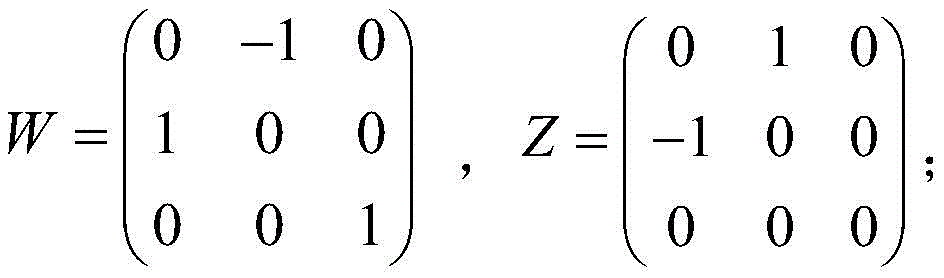
步骤3:采用GPU加速实现ICP精确配准;Step 3: Use GPU acceleration to achieve accurate ICP registration;
步骤3.1:为RGB-D相机获取的深度图像的每个像素分配一个GPU线程;Step 3.1: Allocate a GPU thread for each pixel of the depth image acquired by the RGB-D camera;
步骤3.2:计算每个像素对应的三维顶点坐标和法向量,其中, 所述三维顶点坐标为
Ni(u,v)=(Vi(u+1,v)-Vi(u,v))×(Vi(u,v+1)-Vi(u,v));N i (u,v)=(V i (u+1,v)-V i (u,v))×(V i (u,v+1)-V i (u,v));
步骤3.3:将所述步骤2.3中求得的旋转矩阵R和平移向量t 作为两帧点云间的初始变换矩阵;Step 3.3: Use the rotation matrix R and translation vector t obtained in the step 2.3 as the initial transformation matrix between the two frames of point clouds;
步骤3.4:设置迭代最大次数,开始迭代,设置对应点间距离 和法向量间的夹角作为约束条件,剔除不满足所述约束条件的错误匹 配点对,当迭代次数达到最大值,迭代结束,完成点云配准,否则继 续迭代计算点云配准矩阵。Step 3.4: Set the maximum number of iterations, start the iteration, set the distance between the corresponding points and the angle between the normal vectors as constraints, and remove the wrong matching point pairs that do not meet the constraints. When the number of iterations reaches the maximum value, the iteration ends. Complete the point cloud registration, otherwise continue to iteratively calculate the point cloud registration matrix.
所述通过蛮力算法进行搜索的具体过程如下所示:查找图像1 中每个特征点的2个最邻近特征点:如果某个特征点的最邻近匹配 点,没有一一相互对应,则拒绝这一对匹配点;同时如果某个特征点 的最邻近距离与次邻近距离的比值小于某个比例阈值,则拒绝这一对 匹配点。The specific process of searching through the brute force algorithm is as follows: Find the 2 nearest feature points of each feature point in the image 1: If the nearest matching points of a feature point do not correspond to each other one by one, then reject This pair of matching points; at the same time, if the ratio of the nearest neighbor distance to the next neighbor distance of a feature point is less than a certain proportion threshold, the pair of matching points is rejected.
所述根据匹配点对的Hamming距离筛选正确匹配点对的方法 为:The described method for screening correct matching point pairs according to the Hamming distance of the matching point pairs is:
其 中,max_dis表示所有匹配点对之间的最大距离,per∈(0,1),dis(xi,yi)表示第i对点对之间的Hamming距离,即对一组特征点 对的描述符进行异或运算,统计结果为1的个数为所求的Hamming距离。当某点对之间的距离小于最大距离的per倍时,我们认为这是一 对正确匹配点对。 Among them, max_dis represents the maximum distance between all matching point pairs, per∈(0,1), dis(x i , y i ) represents the Hamming distance between the i-th pair of points, that is, for a set of feature point pairs The descriptor is XORed, and the number of 1s in the statistical result is the required Hamming distance. When the distance between a pair of points is less than per times the maximum distance, we consider it to be a correctly matched pair of points.
所述GPU用于接受来自CPU的数据并行计算,然后将计算结果 返回CPU,提高大规模数据的计算速度。The GPU is used to accept data from the CPU for parallel computing, and then return the computing result to the CPU, thereby improving the computing speed of large-scale data.
所述匹配点对间的距离阈值和角度阈值作为约束条件,用于去 除错误匹配点对。The distance threshold and the angle threshold between the matching point pairs are used as constraints to remove erroneous matching point pairs.
附图说明Description of drawings
图1为本发明具体实施方式中的一种基于ORB图像特征的ICP 快速点云配准算法的改进方法的流程图;1 is a flowchart of an improved method for an ICP fast point cloud registration algorithm based on ORB image features in a specific embodiment of the present invention;
图2为本发明具体实施方式中ORB特征检测与匹配流程图;2 is a flowchart of ORB feature detection and matching in a specific embodiment of the present invention;
图3为本发明具体实施方式中求解旋转平移矩阵流程图;Fig. 3 is the flow chart of solving the rotation-translation matrix in the specific embodiment of the present invention;
图4为本发明具体实施方式中CUDA编程模型示意图;Fig. 4 is the schematic diagram of CUDA programming model in the specific embodiment of the present invention;
图5为本发明具体实施方式中基于GPU加速的ICP配准流程 图。Fig. 5 is the ICP registration flow chart based on GPU acceleration in the specific embodiment of the present invention.
具体实施方式Detailed ways
下面结合附图对本发明实施例中的技术方案进行清楚、完整地 描述。The technical solutions in the embodiments of the present invention will be clearly and completely described below with reference to the accompanying drawings.
如图1所示,为本发明实施例的一种基于ORB图像特征的ICP 快速点云配准算法的改进方法的流程图,包括以下步骤:As shown in FIG. 1 , it is a flowchart of an improved method for an ICP fast point cloud registration algorithm based on ORB image features according to an embodiment of the present invention, including the following steps:
步骤1:提取RGB-D相机相邻两帧彩色图像的ORB特征并匹配。Step 1: Extract the ORB features of two adjacent color images of the RGB-D camera and match them.
步骤2:计算三维空间旋转平移矩阵。Step 2: Calculate the three-dimensional space rotation and translation matrix.
步骤3:采用GPU加速实现ICP精确配准。Step 3: Accurate ICP registration with GPU acceleration.
如图2所示,为本发明实施例的ORB特征检测与匹配流程图。As shown in FIG. 2 , it is a flowchart of ORB feature detection and matching according to an embodiment of the present invention.
利用RGB-D相机采集连续两帧彩色图像1和图像2,分别提取 各自的ORB特征。ORB(Oriented FAST and Rotated BRIEF)算法是 一种基于视觉信息的特征点检测与描述算法,是FAST特征点检测算 法和BRIEF特征描述子的结合与优化。利用运算速度快的FAST角点 检测子来检测特征点,且增加了FAST特征的方向信息,利用基于像 素点二进制位比较的BRIEF特征描述子来描述特征,且ORB算法改进 了BRIEF描述子不具备旋转不变性以及对图像噪声敏感的缺点。具 体包括以下步骤:Two consecutive frames of color image 1 and image 2 were collected with an RGB-D camera, and their ORB features were extracted respectively. ORB (Oriented FAST and Rotated BRIEF) algorithm is a feature point detection and description algorithm based on visual information, which is the combination and optimization of FAST feature point detection algorithm and BRIEF feature descriptor. The fast corner detector is used to detect the feature points, and the direction information of the FAST feature is added, and the brief feature descriptor based on the comparison of the binary bits of the pixel points is used to describe the feature, and the ORB algorithm improves the Brief descriptor does not have Rotation invariance and the disadvantage of being sensitive to image noise. Specifically, it includes the following steps:
步骤1.1:采用FAST(Features from Accelerated Segment Test)算法检测图像特征点。Step 1.1: Use FAST (Features from Accelerated Segment Test) algorithm to detect image feature points.
该算法的基本原理是:当待测像素点的邻域内有足够多的像素 点与其有很大的区别时,认为该像素点为一个特征点。以灰度图为例, 检测待测像素点O是否为特征点,有The basic principle of the algorithm is: when there are enough pixels in the neighborhood of the pixel to be measured that are very different from it, the pixel is considered as a feature point. Taking the grayscale image as an example, to detect whether the pixel point O to be measured is a feature point, there are


其中,I(O)表示待测像素点O处的灰度值,I(i)是以像素点O 为圆心,r为半径的离散化的Bresenham圆的边界上任意一点像素 灰度值,thr为用户设置的灰度差阈值,N为与待测像素点O的灰度 值具有较大差异的像素个数,当N大于圆周像素个数总数的四分之三时,认为像素O是一个特征点。Among them, I(O) represents the gray value at the pixel point O to be measured, I(i) is the gray value of any pixel on the boundary of the discrete Bresenham circle with the pixel point O as the center and r as the radius, thr The grayscale difference threshold set by the user, N is the number of pixels that have a large difference with the grayscale value of the pixel point O to be measured. When N is greater than three-quarters of the total number of pixels in the circumference, the pixel O is considered to be one. Feature points.
FAST特征点不具备尺度不变性,解决方法是建立图像金字塔, 通过在每一层金字塔图像上都做一次FAST特征检测来实现尺度不变 性。FAST feature points do not have scale invariance. The solution is to build an image pyramid, and achieve scale invariance by doing a FAST feature detection on each layer of pyramid images.
FAST特征点的方向通过计算矩阵得到,对于任意特征点O,定 义O的邻域像素的(p+q)阶距为:The direction of the FAST feature point is obtained by calculating the matrix. For any feature point O, the (p+q) order distance of the neighborhood pixels of O is defined as:
其中,I(u,v)是像素点(u,v)处的灰度值。Among them, I(u, v) is the gray value at the pixel point (u, v).
则图像块的质心位置为:Then the centroid position of the image block is:

构建一个从图像块的中心O指向质心C的向量,则定义特征点 的方向为:Construct a vector from the center O of the image block to the centroid C, then define the direction of the feature point as:
θ=arctan(m01,m10)θ=arctan(m 01 ,m 10 )
为提高方法的旋转不变特性,特征点邻域像素需确保在一个圆 形区域内,即u,v∈[-r,r],r为邻域半径。由此得到具有旋转不 变性的oFAST(oriented FAST)描述符。In order to improve the rotation invariance of the method, the pixels in the neighborhood of the feature point need to be guaranteed to be in a circular area, that is, u, v∈[-r, r], where r is the neighborhood radius. This results in an oFAST (oriented FAST) descriptor with rotational invariance.
步骤1.2:利用基于像素点二进制位比较的BRIEF特征描述 子来描述特征。Step 1.2: Describe the feature using the Brief feature descriptor based on the comparison of pixel binary bits.
利用BRIEF算法作为特征点的描述子,并针对其不具备旋转不 变性的问题进行改进形成了rBRIEF描述子。BRIEF是类似二进制编 码表示的一种局部图像特征描述符,首先平滑图像块,然后根据高斯 分布选取N组点对(xi,yi),1≤i≤N,对每一组点对,定义二 进制测试τThe rBRIEF descriptor is formed by using the Brief algorithm as the descriptor of the feature points, and aiming at the problem that it does not possess rotation invariance. BRIEF is a local image feature descriptor similar to binary coding. First, smooth the image block, and then select N groups of point pairs (x i , y i ) according to the Gaussian distribution, 1≤i≤N, for each group of point pairs, Define Binary Test τ
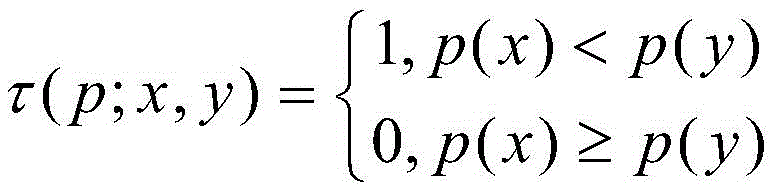
其中,p(x),p(y)分别为像素点x,y处的灰度值。依 次对每一组点对进行τ操作,可定义唯一的N维二进制码串,即 BRIEF描述子Among them, p(x), p(y) are the grayscale values at the pixel points x and y, respectively. Perform τ operation on each group of point pairs in turn to define a unique N-dimensional binary code string, namely the BRIEF descriptor

N一般可选择128,256,512等,在此选择N=256。Generally, N can be selected from 128, 256, 512, etc., and N=256 is selected here.
对于任何一个特征点来说,它的BRIEF描述子S是由该特征点 周围邻域N个点对组成的一个长度为N的二值串,定义2×N矩 阵S为BRIEF选取的初始点集对For any feature point, its Brief descriptor S is a binary string of length N composed of N point pairs in the neighborhood around the feature point, and a 2×N matrix S is defined as the initial point set selected by Brief right
使用特征点方向θ和θ对应的旋转矩阵Rθ将S构建为一 个“转向”矩阵,即:S is constructed as a "steering" matrix using the rotation matrix R θ corresponding to the feature point orientations θ and θ, namely:
Sθ=RθSS θ =R θ S
其中,
我们得到具有旋转不变性的描述子,即:We get a rotationally invariant descriptor, namely:
gn(p,θ)=fn(p)|(xi,yi)∈Sθ g n (p,θ)=f n (p)|(x i ,y i )∈S θ
步骤1.3:特征点匹配。Step 1.3: Feature point matching.
对于图像1中的任意特征点,采用Brute Force算法在图像2 中寻找与其匹配的特征点,即通过蛮力算法进行搜索,蛮力算法是一 种普通的模式匹配算法,查找图像1中每个特征点的2个最邻近特征 点:如果某个特征点的最邻近匹配点,没有一一相互对应,则拒绝这 一对匹配点;同时如果某个特征点的最邻近距离与次邻近距离的比值 小于某个比例阈值,则拒绝这一对匹配点,通过这样滤除一些不好的 匹配点对后,可以提高后续匹配的速度和精度。For any feature point in image 1, the Brute Force algorithm is used to find the matching feature point in image 2, that is, the brute force algorithm is used to search. The brute force algorithm is a common pattern matching algorithm. The 2 closest adjacent feature points of a feature point: if the closest matching points of a feature point do not correspond to each other one by one, the pair of matching points is rejected; If the ratio is smaller than a certain ratio threshold, the pair of matching points will be rejected. By filtering out some bad matching point pairs in this way, the speed and accuracy of subsequent matching can be improved.
步骤1.4:去除错误匹配点对,根据匹配点对的Hamming距离 筛选正确匹配点对。Step 1.4: Remove incorrect matching point pairs, and filter correct matching point pairs according to the Hamming distance of the matching point pairs.
根据ORB算法求得的一系列特征点对会存在错误匹配点对,需 要将它们从中剔除。由于ORB算法得到的BRIEF描述符为二进制码串, 很容易计算匹配点对之间的Hamming距离,对一组特征点对描述符进 行异或运算,统计结果为1的个数即为所求的Hamming距离。我们根 据匹配点对间的Hamming距离来筛选正确匹配点对,具体方法如下:A series of feature point pairs obtained according to the ORB algorithm will have incorrect matching point pairs, which need to be eliminated from them. Since the Brief descriptor obtained by the ORB algorithm is a binary code string, it is easy to calculate the Hamming distance between the matching point pairs, and perform XOR operation on a set of feature point pair descriptors, and the number of statistical results of 1 is the desired number. Hamming distance. We filter the correct matching point pairs according to the Hamming distance between the matching point pairs. The specific methods are as follows:

其中,max_dis表示所有匹配点对之间的最大距离, dis(xi,yi)表示第i对点对之间的Hamming距离, per∈(0,1),当某点对之间的距离小于最大距离的per倍时, 我们认为这是一对正确匹配点对,并将该点对用于后续运算。Among them, max_dis represents the maximum distance between all matching point pairs, dis(x i , y i ) represents the Hamming distance between the i-th pair of points, per∈(0,1), when the distance between a pair of points When it is less than per times the maximum distance, we consider it to be a correct matching point pair and use this point pair for subsequent operations.
步骤1.5:使用随机采样一致性(Random Sampling Consensus, RANSAN)算法计算基本矩阵F。Step 1.5: Calculate the fundamental matrix F using the Random Sampling Consensus (RANSAN) algorithm.
首先利用8点法估计基本矩阵F'作为RANSAC算法的迭代初 值,然后根据该基本矩阵F'判断内点(正确匹配点对)和外点(误 匹配点对)的个数,当内点越多,表示该矩阵越有可能是正确的基本 矩阵。重复随机采样过程,选取具有最多的内点数据集的基本矩阵作为最终求得的基本矩阵F,即:First, the fundamental matrix F' is estimated by the 8-point method as the initial value of the RANSAC algorithm iteration, and then the number of interior points (correctly matched point pairs) and exterior points (mismatched point pairs) is determined according to the fundamental matrix F'. The more, the more likely the matrix is to be the correct fundamental matrix. Repeat the random sampling process, and select the fundamental matrix with the most interior point data set as the final fundamental matrix F, namely:

其中,KRGB是彩色摄像机的内参矩阵,R是旋转矩阵,S 是由平移向量t定义的反对称矩阵,即Among them, K RGB is the internal parameter matrix of the color camera, R is the rotation matrix, and S is the antisymmetric matrix defined by the translation vector t, namely

如图3所示,为本发明实施例的求解旋转平移矩阵流程图。具 体包括如下步骤:As shown in FIG. 3 , it is a flowchart of solving a rotation-translation matrix according to an embodiment of the present invention. Specifically include the following steps:
步骤2.1:由已得到的基本矩阵F,结合彩色摄像机内参矩阵 KRGB计算本质矩阵E,计算公式为:Step 2.1: Calculate the essential matrix E from the obtained basic matrix F, combined with the color camera internal parameter matrix K RGB , and the calculation formula is:

步骤2.2:对本质矩阵E采用奇异值分解法(SVD)进行分解。 用奇异值分解法(SVD)来求解ICP算法过程中的几何参数最初是由 ARUN等提出来的,通过矩阵变换的相关性质,直接求解出最优的参 数解。对由(1)中得到的本质矩阵E采用奇异值分解法(SAD)分解 后,得到:Step 2.2: Use singular value decomposition (SVD) to decompose the essential matrix E. The use of singular value decomposition (SVD) to solve the geometric parameters in the process of ICP algorithm was first proposed by ARUN et al. The optimal parameter solution can be directly solved through the relevant properties of matrix transformation. After decomposing the essential matrix E obtained from (1) by singular value decomposition (SAD), we get:

步骤2.3:计算旋转矩阵R和平移向量t。本质矩阵包含了摄 像机的运动信息(R|t),对本质矩阵进行运动分解,可得:Step 2.3: Calculate the rotation matrix R and translation vector t. The essential matrix contains the motion information (R|t) of the camera, and the motion decomposition of the essential matrix can be obtained:
其中,
如图4所示,为本发明实施例的CUDA编程模型示意图。As shown in FIG. 4 , it is a schematic diagram of a CUDA programming model according to an embodiment of the present invention.
图形处理器(Graphic Processing Unit,GPU)是显卡的主要 处理单元,能够和CPU高速交换数据,GPU相比于CPU可以并行处理 数据,非常适合大规模数据的运算。统一计算设备架构(Compute Unified Device Architecture,CUDA)是由NVIDIA推出的通用并行计算架构,非常适合大规模数据密集型计算。在CUDA编程环境中, CPU作为主机(Host)负责控制整个程序的主流程,GPU为一个通用 计算设备(Device),为协处理器。编写CUDA并行程序时,程序代码 分为主机端代码和设备端代码,主机端代码主要是串行部分的代码, 并行部分的代码以Kernel函数的形式放入GPU的多线程中并行执行, 主机端代码可以通过Kernel函数入口调用并行计算功能。Kernel函 数使用一种扩展的C语言编程,称为CUDA C语言。CUDA分为网格- 线程块-线程三级架构,其中线程(thread)是CUDA的最小执行单元,每个线程执行一次基本运算,多个线程组成一个线程块(block),多 个块组成一个网格(grid)。通过共享存储在共享内存中的数据,相同 线程块内的线程之间可以相互通信,但线程块与线程块之间是不能进 行通信的。The Graphics Processing Unit (GPU) is the main processing unit of the graphics card, which can exchange data with the CPU at high speed. Compared with the CPU, the GPU can process data in parallel and is very suitable for large-scale data operations. Compute Unified Device Architecture (CUDA) is a general-purpose parallel computing architecture introduced by NVIDIA, which is very suitable for large-scale data-intensive computing. In the CUDA programming environment, the CPU, as the host (Host), is responsible for controlling the main process of the entire program, and the GPU is a general-purpose computing device (Device) and a co-processor. When writing a CUDA parallel program, the program code is divided into host-side code and device-side code. The host-side code is mainly the code of the serial part, and the code of the parallel part is put into the multi-threading of the GPU in the form of Kernel function for parallel execution, and the host-side code is executed in parallel. The code can call the parallel computing function through the Kernel function entry. Kernel functions are programmed using an extended C language called CUDA C. CUDA is divided into grid-thread block-thread three-level architecture, in which thread (thread) is the smallest execution unit of CUDA, each thread performs a basic operation, multiple threads form a thread block (block), and multiple blocks form a grid. By sharing data stored in shared memory, threads in the same thread block can communicate with each other, but thread blocks cannot communicate with each other.
如图5所示,为本发明实施例的基于GPU加速的ICP配准流程 图,具体包括以下步骤:As shown in Figure 5, is the ICP registration flow chart based on GPU acceleration of the embodiment of the present invention, specifically comprises the following steps:
步骤3.1:为第i帧深度图像Di(p)上的每一个像素 p(u,v)分配一个GPU线程,具体方法为:将分辨率为640×480的 深度图像分给一个网格,该网格分为20×60个线程块,各个块又分 为
步骤3.2:通过红外摄像机内参矩阵KIR反透射变换计算深 度图像对应的三维顶点坐标映射Vi,计算公式为:Step 3.2: Calculate the three-dimensional vertex coordinate map V i corresponding to the depth image through the inverse transmission transformation of the internal parameter matrix K IR of the infrared camera. The calculation formula is:
Vi=Di(p)K-1 V i =D i (p)K -1
将该顶点分别指向相邻顶点的两个向量叉乘便是该顶点对应 的法向量,即:The cross product of the two vectors that point the vertex to the adjacent vertex is the normal vector corresponding to the vertex, namely:
Ni(u,v)=(Vi(u+1,v)-Vi(u,v))×(Vi(u,v+1)-Vi(u,v))N i (u,v)=(V i (u+1,v)-V i (u,v))×(V i (u,v+1)-V i (u,v))
步骤3.3:将已求得的旋转矩阵R和平移向量t作为两帧点云 间的初始变换矩阵。Step 3.3: Use the obtained rotation matrix R and translation vector t as the initial transformation matrix between the two frames of point clouds.
步骤3.4:利用ICP算法估计点云配准矩阵。Step 3.4: Use the ICP algorithm to estimate the point cloud registration matrix.
步骤3.4.1:根据投影法获取相邻两帧点云间的匹配点对,即 对第i帧点云中的任意一点,利用变换矩阵转换到第i-1帧点云摄 像机坐标系下,利用投影法在第i-1帧点云中找到与其对应的点。Step 3.4.1: Obtain the matching point pair between two adjacent frame point clouds according to the projection method, that is, for any point in the i-th frame point cloud, use the transformation matrix to convert it to the i-1th frame point cloud camera coordinate system, Use the projection method to find the corresponding point in the i-1th frame point cloud.
步骤3.4.2:计算对应点间的欧式距离和法向量间夹角,并设 置距离阈值和角度阈值作为约束条件,用于去除错误匹配点对。Step 3.4.2: Calculate the Euclidean distance between the corresponding points and the angle between the normal vectors, and set the distance threshold and angle threshold as constraints to remove incorrectly matched point pairs.
本实施例中设置的距离阈值为0.1m,法向量间夹角的角度阈 值为20°,当对应点间的距离和法向量间的夹角不满足以下条件时, 我们认为该点对为错误匹配点对,即:The distance threshold set in this embodiment is 0.1m, and the angle threshold of the angle between the normal vectors is 20°. When the distance between the corresponding points and the angle between the normal vectors do not meet the following conditions, we consider the point pair to be wrong Match point pairs, i.e.:
s=||V-Vk,g||,s<0.1m,
步骤3.4.3:以第i帧点云到第i-1帧点云中对应点的切平 面距离的平方和作为误差函数,利用最小化误差函数法估计变换矩阵 Ti。假设第i帧点云集中任意一点p在第i-1帧点云中的对应 点为q,则距离误差函数表示为:Step 3.4.3: Take the sum of the squares of the tangent plane distances from the point cloud of the i-th frame to the corresponding point in the point cloud of the i-1-th frame as the error function, and use the minimized error function method to estimate the transformation matrix T i . Assuming that the corresponding point of any point p in the i-th frame point cloud set in the i-1th frame point cloud is q, the distance error function is expressed as:
E=arg min||ni-1·(Tipi-qi-1)||2 E=arg min||n i-1 ·(T i p i -q i-1 )|| 2
其中,Ti表示第i帧的4×4的旋转平移矩阵。Among them, T i represents the 4×4 rotation-translation matrix of the i-th frame.
设定迭代次数最大值s=max为迭代终止条件,设s=0为第一次 迭代,上述步骤3.4.1-3.4.3重复一次,迭代次数加1,即s=s+1。Set the maximum number of iterations s=max as the iteration termination condition, set s=0 as the first iteration, repeat steps 3.4.1-3.4.3 above, and add 1 to the number of iterations, that is, s=s+1.
当迭代次数达到所述设定的最大值s=max,迭代结束,否则继 续迭代计算估计点云配准矩阵,直到满足终止条件为止。利用最终得 到的旋转平移矩阵即可将两帧点云配准到一个坐标系下,从而完成点 云配准的目的。When the number of iterations reaches the set maximum value s=max, the iteration ends, otherwise, continue to iteratively calculate the estimated point cloud registration matrix until the termination condition is met. Using the final rotation and translation matrix, the two frames of point clouds can be registered to one coordinate system, so as to complete the purpose of point cloud registration.
对于本领域技术人员而言,显然本发明不限于上述示范性实施 例的细节,而且在不背离本发明的精神的情况下,能够以其他具体形 式实现本发明。本发明的范围由所附权利要求而不是上述说明限定, 因此旨在将落在权利要求的等同要件的含义和范围内的所有变化囊 括在本发明内。It will be apparent to those skilled in the art that the invention is not limited to the details of the above-described exemplary embodiments, but that the invention may be embodied in other specific forms without departing from the spirit of the invention. The scope of the invention is defined by the appended claims rather than the above description, and therefore all changes that come within the meaning and range of equivalency of the claims are intended to be embraced therein.
Claims (6)


Priority Applications (1)
| Application Number | Priority Date | Filing Date | Title |
|---|---|---|---|
| CN201710267277.4A CN107220995B (en) | 2017-04-21 | 2017-04-21 | Improved method of ICP (inductively coupled plasma) rapid point cloud registration algorithm based on ORB (object-oriented bounding Box) image features |
Applications Claiming Priority (1)
| Application Number | Priority Date | Filing Date | Title |
|---|---|---|---|
| CN201710267277.4A CN107220995B (en) | 2017-04-21 | 2017-04-21 | Improved method of ICP (inductively coupled plasma) rapid point cloud registration algorithm based on ORB (object-oriented bounding Box) image features |
Publications (2)
| Publication Number | Publication Date |
|---|---|
| CN107220995A CN107220995A (en) | 2017-09-29 |
| CN107220995B true CN107220995B (en) | 2020-01-03 |
Family
ID=59943846
Family Applications (1)
| Application Number | Title | Priority Date | Filing Date |
|---|---|---|---|
| CN201710267277.4A Expired - Fee Related CN107220995B (en) | 2017-04-21 | 2017-04-21 | Improved method of ICP (inductively coupled plasma) rapid point cloud registration algorithm based on ORB (object-oriented bounding Box) image features |
Country Status (1)
| Country | Link |
|---|---|
| CN (1) | CN107220995B (en) |
Families Citing this family (29)
| Publication number | Priority date | Publication date | Assignee | Title |
|---|---|---|---|---|
| WO2019079093A1 (en) * | 2017-10-19 | 2019-04-25 | Interdigital Vc Holdings, Inc. | Method and device for predictive encoding/decoding of a point cloud |
| CN107704889B (en) * | 2017-10-30 | 2020-09-11 | 沈阳航空航天大学 | A fast labeling method for MBD model array features for digital detection |
| CN108022262A (en) * | 2017-11-16 | 2018-05-11 | 天津大学 | A kind of point cloud registration method based on neighborhood of a point center of gravity vector characteristics |
| CN109816703B (en) * | 2017-11-21 | 2021-10-01 | 西安交通大学 | A Point Cloud Registration Method Based on Camera Calibration and ICP Algorithm |
| CN109839624A (en) * | 2017-11-27 | 2019-06-04 | 北京万集科技股份有限公司 | A kind of multilasered optical radar position calibration method and device |
| CN108596867A (en) * | 2018-05-09 | 2018-09-28 | 五邑大学 | A kind of picture bearing calibration and system based on ORB algorithms |
| CN108921175A (en) * | 2018-06-06 | 2018-11-30 | 西南石油大学 | One kind being based on the improved SIFT method for registering images of FAST |
| CN108921895B (en) * | 2018-06-12 | 2021-03-02 | 中国人民解放军军事科学院国防科技创新研究院 | Sensor relative pose estimation method |
| CN108846857A (en) * | 2018-06-28 | 2018-11-20 | 清华大学深圳研究生院 | The measurement method and visual odometry of visual odometry |
| CN109087342A (en) * | 2018-07-12 | 2018-12-25 | 武汉尺子科技有限公司 | A kind of three-dimensional point cloud global registration method and system based on characteristic matching |
| CN110826355B (en) * | 2018-08-07 | 2024-12-03 | 腾讯数码(天津)有限公司 | Image recognition method, device and storage medium |
| CN110837751B (en) * | 2018-08-15 | 2023-12-29 | 上海脉沃医疗科技有限公司 | Human motion capturing and gait analysis method based on RGBD depth camera |
| CN110838136B (en) * | 2018-08-15 | 2023-06-20 | 上海脉沃医疗科技有限公司 | Image calibration method based on RGBD depth camera |
| CN110874850A (en) * | 2018-09-04 | 2020-03-10 | 湖北智视科技有限公司 | Real-time unilateral grid feature registration method oriented to target positioning |
| CN109741374B (en) * | 2019-01-30 | 2022-12-06 | 重庆大学 | Point cloud registration rotation transformation method, point cloud registration equipment and readable storage medium |
| CN109903326B (en) | 2019-02-28 | 2022-02-22 | 北京百度网讯科技有限公司 | Method and device for determining a rotation angle of a construction machine |
| CN110909778B (en) * | 2019-11-12 | 2023-07-21 | 北京航空航天大学 | An image semantic feature matching method based on geometric consistency |
| CN111553937B (en) * | 2020-04-23 | 2023-11-21 | 东软睿驰汽车技术(上海)有限公司 | Laser point cloud map construction method, device, equipment and system |
| CN112116638B (en) * | 2020-09-04 | 2024-07-16 | 季华实验室 | A three-dimensional point cloud matching method, device, electronic device and storage medium |
| CN112115953B (en) * | 2020-09-18 | 2023-07-11 | 南京工业大学 | Optimized ORB algorithm based on RGB-D camera combined plane detection and random sampling coincidence algorithm |
| CN112184783A (en) * | 2020-09-22 | 2021-01-05 | 西安交通大学 | A 3D Point Cloud Registration Method Combined with Image Information |
| CN114596333B (en) * | 2020-12-03 | 2025-07-22 | 北京华航无线电测量研究所 | A target tracking method suitable for vehicle-mounted environment |
| CN112562000A (en) * | 2020-12-23 | 2021-03-26 | 安徽大学 | Robot vision positioning method based on feature point detection and mismatching screening |
| CN113284170A (en) * | 2021-05-26 | 2021-08-20 | 北京智机科技有限公司 | Point cloud rapid registration method |
| CN113702941B (en) * | 2021-08-09 | 2023-10-13 | 哈尔滨工程大学 | A point cloud speed measurement method based on improved ICP |
| CN116664636A (en) * | 2022-10-25 | 2023-08-29 | 张羽 | A point cloud registration method based on display color and geometric information |
| CN115661811B (en) * | 2022-11-07 | 2025-07-29 | 中国人民解放军战略支援部队航天工程大学 | Polarization three-dimensional target identification method based on orb operators |
| CN116236146A (en) * | 2022-12-19 | 2023-06-09 | 苏州火象医疗技术有限公司 | Human cavity navigation method and system based on endoscope positioning |
| CN117152219A (en) * | 2023-08-25 | 2023-12-01 | 北京石油化工学院 | An image registration method, system and device |
Citations (2)
| Publication number | Priority date | Publication date | Assignee | Title |
|---|---|---|---|---|
| CN103236064A (en) * | 2013-05-06 | 2013-08-07 | 东南大学 | Point cloud automatic registration method based on normal vector |
| CN105469388A (en) * | 2015-11-16 | 2016-04-06 | 集美大学 | Building point cloud registration algorithm based on dimension reduction |
Family Cites Families (4)
| Publication number | Priority date | Publication date | Assignee | Title |
|---|---|---|---|---|
| US8401242B2 (en) * | 2011-01-31 | 2013-03-19 | Microsoft Corporation | Real-time camera tracking using depth maps |
| EP3198522A1 (en) * | 2014-09-23 | 2017-08-02 | Keylemon SA | A face pose rectification method and apparatus |
| CN105856230B (en) * | 2016-05-06 | 2017-11-24 | 简燕梅 | A kind of ORB key frames closed loop detection SLAM methods for improving robot pose uniformity |
| CN106056664B (en) * | 2016-05-23 | 2018-09-21 | 武汉盈力科技有限公司 | A kind of real-time three-dimensional scene reconstruction system and method based on inertia and deep vision |
-
2017
- 2017-04-21 CN CN201710267277.4A patent/CN107220995B/en not_active Expired - Fee Related
Patent Citations (2)
| Publication number | Priority date | Publication date | Assignee | Title |
|---|---|---|---|---|
| CN103236064A (en) * | 2013-05-06 | 2013-08-07 | 东南大学 | Point cloud automatic registration method based on normal vector |
| CN105469388A (en) * | 2015-11-16 | 2016-04-06 | 集美大学 | Building point cloud registration algorithm based on dimension reduction |
Non-Patent Citations (1)
| Title |
|---|
| "Probabilistic 3D ICP Algorithm Based on ORB Feature";Zhe Ji et al;《 2013 IEEE Third International Conference on Information Science and Technology 》;20130325;300-304 * |
Also Published As
| Publication number | Publication date |
|---|---|
| CN107220995A (en) | 2017-09-29 |
Similar Documents
| Publication | Publication Date | Title |
|---|---|---|
| CN107220995B (en) | Improved method of ICP (inductively coupled plasma) rapid point cloud registration algorithm based on ORB (object-oriented bounding Box) image features | |
| CN114463736B (en) | A multi-target detection method and device based on multimodal information fusion | |
| CN110930452B (en) | A Method of Object Pose Estimation Based on Self-Supervised Learning and Template Matching | |
| CN106127170B (en) | A kind of training method, recognition methods and system merging key feature points | |
| CN114140418B (en) | Seven-DOF grasping posture detection method based on RGB image and depth image | |
| WO2021103648A1 (en) | Hand key point detection method, gesture recognition method, and related devices | |
| CN106407891B (en) | Target matching method and device based on convolutional neural networks | |
| CN111127631B (en) | Three-dimensional shape and texture reconstruction method, system and storage medium based on single image | |
| CN106384383A (en) | RGB-D and SLAM scene reconfiguration method based on FAST and FREAK feature matching algorithm | |
| CN101388115A (en) | A Depth Image Automatic Registration Method Combined with Texture Information | |
| Huang et al. | Deepfinger: A cascade convolutional neuron network approach to finger key point detection in egocentric vision with mobile camera | |
| CN112489218B (en) | A single-view three-dimensional reconstruction system and method based on semi-supervised learning | |
| Weiyao et al. | Human action recognition using multilevel depth motion maps | |
| CN111444764A (en) | Gesture recognition method based on depth residual error network | |
| CN110634160B (en) | 3D Keypoint Extraction Model Construction and Pose Recognition Method of Target in 2D Graphics | |
| Yin et al. | Estimation of the fundamental matrix from uncalibrated stereo hand images for 3D hand gesture recognition | |
| Liao et al. | Local feature matching from detector-based to detector-free: a survey: Y. Liao et al. | |
| Cai et al. | 3D face reconstruction and dense alignment with a new generated dataset | |
| CN109977834A (en) | The method and apparatus divided manpower from depth image and interact object | |
| CN115008454A (en) | An online hand-eye calibration method for robots based on multi-frame pseudo-label data enhancement | |
| CN114581973A (en) | Face pose estimation method and device, storage medium and computer equipment | |
| Alam et al. | Affine transformation of virtual 3D object using 2D localization of fingertips | |
| Cheng et al. | An augmented reality image registration method based on improved ORB | |
| CN107229935B (en) | A Binary Description Method for Triangular Features | |
| Lee et al. | Fast hand and finger detection algorithm for interaction on smart display |
Legal Events
| Date | Code | Title | Description |
|---|---|---|---|
| PB01 | Publication | ||
| PB01 | Publication | ||
| SE01 | Entry into force of request for substantive examination | ||
| SE01 | Entry into force of request for substantive examination | ||
| GR01 | Patent grant | ||
| GR01 | Patent grant | ||
| CF01 | Termination of patent right due to non-payment of annual fee | ||
| CF01 | Termination of patent right due to non-payment of annual fee |
Granted publication date: 20200103 |