CN107119130B - DNA marker for detecting coal geological microbial bacterial species and preparation method and application - Google Patents
DNA marker for detecting coal geological microbial bacterial species and preparation method and application Download PDFInfo
- Publication number
- CN107119130B CN107119130B CN201710348819.0A CN201710348819A CN107119130B CN 107119130 B CN107119130 B CN 107119130B CN 201710348819 A CN201710348819 A CN 201710348819A CN 107119130 B CN107119130 B CN 107119130B
- Authority
- CN
- China
- Prior art keywords
- dna
- seq
- dna fragment
- nucleotide sequence
- pcr amplification
- Prior art date
- Legal status (The legal status is an assumption and is not a legal conclusion. Google has not performed a legal analysis and makes no representation as to the accuracy of the status listed.)
- Active
Links
- 239000003550 marker Substances 0.000 title claims abstract description 57
- 230000001580 bacterial effect Effects 0.000 title claims abstract description 50
- 239000003245 coal Substances 0.000 title claims abstract description 50
- 230000000813 microbial effect Effects 0.000 title claims abstract description 24
- 238000002360 preparation method Methods 0.000 title claims description 11
- 239000012634 fragment Substances 0.000 claims abstract description 73
- 238000003935 denaturing gradient gel electrophoresis Methods 0.000 claims abstract description 57
- 239000002773 nucleotide Substances 0.000 claims abstract description 46
- 125000003729 nucleotide group Chemical group 0.000 claims abstract description 46
- 241000894007 species Species 0.000 claims abstract description 35
- 244000005700 microbiome Species 0.000 claims abstract description 26
- 238000001514 detection method Methods 0.000 claims abstract description 17
- 241000894006 Bacteria Species 0.000 claims abstract description 15
- 238000012408 PCR amplification Methods 0.000 claims description 47
- XLYOFNOQVPJJNP-UHFFFAOYSA-N water Substances O XLYOFNOQVPJJNP-UHFFFAOYSA-N 0.000 claims description 25
- 239000000499 gel Substances 0.000 claims description 24
- 238000004458 analytical method Methods 0.000 claims description 18
- 239000000243 solution Substances 0.000 claims description 15
- 239000008367 deionised water Substances 0.000 claims description 10
- 229910021641 deionized water Inorganic materials 0.000 claims description 10
- 239000000203 mixture Substances 0.000 claims description 10
- 108020004465 16S ribosomal RNA Proteins 0.000 claims description 9
- 238000000246 agarose gel electrophoresis Methods 0.000 claims description 7
- 238000011084 recovery Methods 0.000 claims description 6
- 239000000284 extract Substances 0.000 claims description 4
- 239000007788 liquid Substances 0.000 claims description 3
- 239000013598 vector Substances 0.000 claims description 3
- 241000620209 Escherichia coli DH5[alpha] Species 0.000 claims description 2
- 239000012723 sample buffer Substances 0.000 claims description 2
- 238000002791 soaking Methods 0.000 claims description 2
- 238000012546 transfer Methods 0.000 claims description 2
- 108020004414 DNA Proteins 0.000 description 98
- VNWKTOKETHGBQD-UHFFFAOYSA-N methane Chemical compound C VNWKTOKETHGBQD-UHFFFAOYSA-N 0.000 description 32
- 238000001962 electrophoresis Methods 0.000 description 30
- 239000000047 product Substances 0.000 description 22
- 239000000523 sample Substances 0.000 description 22
- 239000013612 plasmid Substances 0.000 description 12
- 238000006243 chemical reaction Methods 0.000 description 11
- 239000007789 gas Substances 0.000 description 11
- 238000000034 method Methods 0.000 description 11
- 230000000035 biogenic effect Effects 0.000 description 9
- 239000011543 agarose gel Substances 0.000 description 8
- 238000012163 sequencing technique Methods 0.000 description 7
- QTBSBXVTEAMEQO-UHFFFAOYSA-N Acetic acid Chemical compound CC(O)=O QTBSBXVTEAMEQO-UHFFFAOYSA-N 0.000 description 6
- 238000004925 denaturation Methods 0.000 description 6
- 230000036425 denaturation Effects 0.000 description 6
- 241000203069 Archaea Species 0.000 description 5
- 239000002609 medium Substances 0.000 description 5
- 238000012257 pre-denaturation Methods 0.000 description 5
- 238000011160 research Methods 0.000 description 5
- 238000012795 verification Methods 0.000 description 5
- 241000588923 Citrobacter Species 0.000 description 4
- 241000160321 Parabacteroides Species 0.000 description 4
- FAPWRFPIFSIZLT-UHFFFAOYSA-M Sodium chloride Chemical compound [Na+].[Cl-] FAPWRFPIFSIZLT-UHFFFAOYSA-M 0.000 description 4
- ROOXNKNUYICQNP-UHFFFAOYSA-N ammonium persulfate Chemical compound [NH4+].[NH4+].[O-]S(=O)(=O)OOS([O-])(=O)=O ROOXNKNUYICQNP-UHFFFAOYSA-N 0.000 description 4
- 239000003292 glue Substances 0.000 description 4
- 238000004519 manufacturing process Methods 0.000 description 4
- 230000035772 mutation Effects 0.000 description 4
- 238000007894 restriction fragment length polymorphism technique Methods 0.000 description 4
- 238000001228 spectrum Methods 0.000 description 4
- 241001112780 Acetoanaerobium Species 0.000 description 3
- 241000193403 Clostridium Species 0.000 description 3
- 241000194033 Enterococcus Species 0.000 description 3
- 241000605909 Fusobacterium Species 0.000 description 3
- 241000588771 Morganella <proteobacterium> Species 0.000 description 3
- 238000010367 cloning Methods 0.000 description 3
- 238000010586 diagram Methods 0.000 description 3
- 238000005516 engineering process Methods 0.000 description 3
- 238000000605 extraction Methods 0.000 description 3
- 238000011068 loading method Methods 0.000 description 3
- OPIFSICVWOWJMJ-AEOCFKNESA-N 5-bromo-4-chloro-3-indolyl beta-D-galactoside Chemical compound O[C@@H]1[C@@H](O)[C@@H](O)[C@@H](CO)O[C@H]1OC1=CNC2=CC=C(Br)C(Cl)=C12 OPIFSICVWOWJMJ-AEOCFKNESA-N 0.000 description 2
- 108020000946 Bacterial DNA Proteins 0.000 description 2
- 238000007400 DNA extraction Methods 0.000 description 2
- UFHFLCQGNIYNRP-UHFFFAOYSA-N Hydrogen Chemical compound [H][H] UFHFLCQGNIYNRP-UHFFFAOYSA-N 0.000 description 2
- KWYHDKDOAIKMQN-UHFFFAOYSA-N N,N,N',N'-tetramethylethylenediamine Chemical compound CN(C)CCN(C)C KWYHDKDOAIKMQN-UHFFFAOYSA-N 0.000 description 2
- 241000321184 Raoultella Species 0.000 description 2
- 241000122971 Stenotrophomonas Species 0.000 description 2
- 230000000789 acetogenic effect Effects 0.000 description 2
- 239000002253 acid Substances 0.000 description 2
- 229910001870 ammonium persulfate Inorganic materials 0.000 description 2
- 230000003321 amplification Effects 0.000 description 2
- 238000009835 boiling Methods 0.000 description 2
- 229940041514 candida albicans extract Drugs 0.000 description 2
- 239000000470 constituent Substances 0.000 description 2
- 238000002474 experimental method Methods 0.000 description 2
- 238000000855 fermentation Methods 0.000 description 2
- 230000004151 fermentation Effects 0.000 description 2
- 238000001502 gel electrophoresis Methods 0.000 description 2
- JGBUYEVOKHLFID-UHFFFAOYSA-N gelred Chemical compound [I-].[I-].C=1C(N)=CC=C(C2=CC=C(N)C=C2[N+]=2CCCCCC(=O)NCCCOCCOCCOCCCNC(=O)CCCCC[N+]=3C4=CC(N)=CC=C4C4=CC=C(N)C=C4C=3C=3C=CC=CC=3)C=1C=2C1=CC=CC=C1 JGBUYEVOKHLFID-UHFFFAOYSA-N 0.000 description 2
- 238000012165 high-throughput sequencing Methods 0.000 description 2
- 229910052739 hydrogen Inorganic materials 0.000 description 2
- 239000001257 hydrogen Substances 0.000 description 2
- BPHPUYQFMNQIOC-NXRLNHOXSA-N isopropyl beta-D-thiogalactopyranoside Chemical compound CC(C)S[C@@H]1O[C@H](CO)[C@H](O)[C@H](O)[C@H]1O BPHPUYQFMNQIOC-NXRLNHOXSA-N 0.000 description 2
- 239000002207 metabolite Substances 0.000 description 2
- 230000000696 methanogenic effect Effects 0.000 description 2
- 238000002156 mixing Methods 0.000 description 2
- 238000003199 nucleic acid amplification method Methods 0.000 description 2
- 229920002401 polyacrylamide Polymers 0.000 description 2
- 239000013641 positive control Substances 0.000 description 2
- 108090000623 proteins and genes Proteins 0.000 description 2
- 238000000746 purification Methods 0.000 description 2
- 239000012488 sample solution Substances 0.000 description 2
- 238000012216 screening Methods 0.000 description 2
- 239000011780 sodium chloride Substances 0.000 description 2
- 239000007787 solid Substances 0.000 description 2
- 239000000126 substance Substances 0.000 description 2
- 239000012137 tryptone Substances 0.000 description 2
- 239000012138 yeast extract Substances 0.000 description 2
- 241001468161 Acetobacterium Species 0.000 description 1
- 229920001817 Agar Polymers 0.000 description 1
- 241000692822 Bacteroidales Species 0.000 description 1
- OKTJSMMVPCPJKN-UHFFFAOYSA-N Carbon Chemical compound [C] OKTJSMMVPCPJKN-UHFFFAOYSA-N 0.000 description 1
- 241000588921 Enterobacteriaceae Species 0.000 description 1
- 241000588724 Escherichia coli Species 0.000 description 1
- 241000192125 Firmicutes Species 0.000 description 1
- 241000202974 Methanobacterium Species 0.000 description 1
- 241000205017 Methanolobus Species 0.000 description 1
- 241000205276 Methanosarcina Species 0.000 description 1
- 238000012300 Sequence Analysis Methods 0.000 description 1
- 239000008272 agar Substances 0.000 description 1
- 229910052799 carbon Inorganic materials 0.000 description 1
- 230000015556 catabolic process Effects 0.000 description 1
- 239000013599 cloning vector Substances 0.000 description 1
- 238000009833 condensation Methods 0.000 description 1
- 230000005494 condensation Effects 0.000 description 1
- 238000012136 culture method Methods 0.000 description 1
- 238000012258 culturing Methods 0.000 description 1
- 238000006731 degradation reaction Methods 0.000 description 1
- 230000000593 degrading effect Effects 0.000 description 1
- 230000000694 effects Effects 0.000 description 1
- 125000001495 ethyl group Chemical group [H]C([H])([H])C([H])([H])* 0.000 description 1
- 230000002068 genetic effect Effects 0.000 description 1
- 239000011544 gradient gel Substances 0.000 description 1
- 239000001963 growth medium Substances 0.000 description 1
- 238000011081 inoculation Methods 0.000 description 1
- 239000012160 loading buffer Substances 0.000 description 1
- 210000000627 locus coeruleus Anatomy 0.000 description 1
- 239000003147 molecular marker Substances 0.000 description 1
- 239000005416 organic matter Substances 0.000 description 1
- 239000000843 powder Substances 0.000 description 1
- 230000008929 regeneration Effects 0.000 description 1
- 238000011069 regeneration method Methods 0.000 description 1
- 239000006228 supernatant Substances 0.000 description 1
- 230000000476 thermogenic effect Effects 0.000 description 1
- 230000009466 transformation Effects 0.000 description 1
- 241001148471 unidentified anaerobic bacterium Species 0.000 description 1
Images


Classifications
-
- C—CHEMISTRY; METALLURGY
- C12—BIOCHEMISTRY; BEER; SPIRITS; WINE; VINEGAR; MICROBIOLOGY; ENZYMOLOGY; MUTATION OR GENETIC ENGINEERING
- C12Q—MEASURING OR TESTING PROCESSES INVOLVING ENZYMES, NUCLEIC ACIDS OR MICROORGANISMS; COMPOSITIONS OR TEST PAPERS THEREFOR; PROCESSES OF PREPARING SUCH COMPOSITIONS; CONDITION-RESPONSIVE CONTROL IN MICROBIOLOGICAL OR ENZYMOLOGICAL PROCESSES
- C12Q1/00—Measuring or testing processes involving enzymes, nucleic acids or microorganisms; Compositions therefor; Processes of preparing such compositions
- C12Q1/68—Measuring or testing processes involving enzymes, nucleic acids or microorganisms; Compositions therefor; Processes of preparing such compositions involving nucleic acids
- C12Q1/6876—Nucleic acid products used in the analysis of nucleic acids, e.g. primers or probes
- C12Q1/6888—Nucleic acid products used in the analysis of nucleic acids, e.g. primers or probes for detection or identification of organisms
- C12Q1/689—Nucleic acid products used in the analysis of nucleic acids, e.g. primers or probes for detection or identification of organisms for bacteria
-
- C—CHEMISTRY; METALLURGY
- C12—BIOCHEMISTRY; BEER; SPIRITS; WINE; VINEGAR; MICROBIOLOGY; ENZYMOLOGY; MUTATION OR GENETIC ENGINEERING
- C12N—MICROORGANISMS OR ENZYMES; COMPOSITIONS THEREOF; PROPAGATING, PRESERVING, OR MAINTAINING MICROORGANISMS; MUTATION OR GENETIC ENGINEERING; CULTURE MEDIA
- C12N15/00—Mutation or genetic engineering; DNA or RNA concerning genetic engineering, vectors, e.g. plasmids, or their isolation, preparation or purification; Use of hosts therefor
- C12N15/09—Recombinant DNA-technology
- C12N15/63—Introduction of foreign genetic material using vectors; Vectors; Use of hosts therefor; Regulation of expression
- C12N15/70—Vectors or expression systems specially adapted for E. coli
-
- C—CHEMISTRY; METALLURGY
- C12—BIOCHEMISTRY; BEER; SPIRITS; WINE; VINEGAR; MICROBIOLOGY; ENZYMOLOGY; MUTATION OR GENETIC ENGINEERING
- C12Q—MEASURING OR TESTING PROCESSES INVOLVING ENZYMES, NUCLEIC ACIDS OR MICROORGANISMS; COMPOSITIONS OR TEST PAPERS THEREFOR; PROCESSES OF PREPARING SUCH COMPOSITIONS; CONDITION-RESPONSIVE CONTROL IN MICROBIOLOGICAL OR ENZYMOLOGICAL PROCESSES
- C12Q2600/00—Oligonucleotides characterized by their use
- C12Q2600/166—Oligonucleotides used as internal standards, controls or normalisation probes
Landscapes
- Chemical & Material Sciences (AREA)
- Life Sciences & Earth Sciences (AREA)
- Health & Medical Sciences (AREA)
- Organic Chemistry (AREA)
- Genetics & Genomics (AREA)
- Engineering & Computer Science (AREA)
- Wood Science & Technology (AREA)
- Zoology (AREA)
- Proteomics, Peptides & Aminoacids (AREA)
- Bioinformatics & Cheminformatics (AREA)
- Biotechnology (AREA)
- General Engineering & Computer Science (AREA)
- Analytical Chemistry (AREA)
- Microbiology (AREA)
- Molecular Biology (AREA)
- Biochemistry (AREA)
- Biophysics (AREA)
- General Health & Medical Sciences (AREA)
- Physics & Mathematics (AREA)
- Biomedical Technology (AREA)
- Immunology (AREA)
- Plant Pathology (AREA)
- Measuring Or Testing Involving Enzymes Or Micro-Organisms (AREA)
Abstract
本发明涉及一种煤地质环境微生物菌群的变性梯度凝胶电泳(DGGE)分子检测中煤地质环境细菌专用的物种DNA Marker,属于微生物分子生态学领域。本发明用于检测煤地质微生物细菌物种的DNA Marker,该DNA Marker由11条DNA片段a‑k组成,DNA片段a的核苷酸序列如SEQ.ID.NO.1所示,DNA片段b的核苷酸序列如SEQ.ID.NO.2所示,DNA片段c的核苷酸序列如SEQ.ID.NO.3所示,DNA片段d的核苷酸序列如SEQ.ID.NO.4所示,DNA片段e的核苷酸序列如SEQ.ID.NO.5所示,DNA片段f的核苷酸序列如SEQ.ID.NO.6所示,DNA片段g的核苷酸序列如SEQ.ID.NO.7所示,DNA片段h的核苷酸序列如SEQ.ID.NO.8所示,DNA片段i的核苷酸序列如SEQ.ID.NO.9所示,DNA片段j的核苷酸序列如SEQ.ID.NO.10所示,DNA片段k的核苷酸序列如SEQ.ID.NO.11所示。The invention relates to a specific species DNA marker for coal geological environment bacteria in the denaturing gradient gel electrophoresis (DGGE) molecular detection of microbial flora of coal geological environment, and belongs to the field of microbial molecular ecology. The present invention is used to detect the DNA Marker of coal geological microorganism bacterial species. The DNA Marker consists of 11 DNA fragments a-k, the nucleotide sequence of the DNA fragment a is shown in SEQ.ID.NO.1, and the nucleotide sequence of the DNA fragment b is shown in SEQ.ID.NO.1. The nucleotide sequence is shown in SEQ.ID.NO.2, the nucleotide sequence of DNA fragment c is shown in SEQ.ID.NO.3, and the nucleotide sequence of DNA fragment d is shown in SEQ.ID.NO.4 The nucleotide sequence of DNA fragment e is shown in SEQ.ID.NO.5, the nucleotide sequence of DNA fragment f is shown in SEQ.ID.NO.6, and the nucleotide sequence of DNA fragment g is shown in SEQ.ID.NO.7, the nucleotide sequence of DNA fragment h is shown in SEQ.ID.NO.8, the nucleotide sequence of DNA fragment i is shown in SEQ.ID.NO.9, the DNA fragment The nucleotide sequence of j is shown in SEQ.ID.NO.10, and the nucleotide sequence of DNA fragment k is shown in SEQ.ID.NO.11.
Description
技术领域technical field
本发明涉及一种煤地质环境微生物菌群的变性梯度凝胶电泳(DGGE)分子检测中煤地质环境细菌专用的物种DNA Marker,属于微生物分子生态学领域。The invention relates to a specific species DNA marker for coal geological environment bacteria in the denaturing gradient gel electrophoresis (DGGE) molecular detection of microbial flora of coal geological environment, and belongs to the field of microbial molecular ecology.
背景技术Background technique
煤地质环境微生物是指煤层产出水样或煤样中检测到的微生物或上述两样经富集培养后检测到的微生物,主要分为细菌和古菌两大类。它们主要参与降解煤产甲烷的过程中。煤层气作为一种清洁能源,在世界上备受关注,根据成因不同,煤层气可分为热成因气和生物成因气。生物成因气又可分为原生生物成因气和次生生物成因气,原生生物成因气形成于煤化作用的早期阶段,难于大量保存,目前探测到的生物成因煤层气多为次生生物气,次生生物气是由产甲烷菌等厌氧菌(包括细菌及古菌等)代谢煤或煤层物质产生的以甲烷为主要成分的气体。目前,生物成因煤层气具体的生成过程及机理还不是十分清楚,唯一确定的是产甲烷的最后一步,它是由产甲烷古菌将CO2+H2、乙酸和一些甲基化物质转化为甲烷。国内外研究学者们在生物成因气的产气机理上形成了普遍的共识,即一些发酵细菌和产氢气产乙酸菌分解煤层有机质产生CO2、H2、乙酸等中间代谢产物,最后,产甲烷古菌可利用这些中间代谢产物作为能源、碳源产生甲烷。研究煤层气相关微生物多样性及其活性与功能对煤层气再生和揭示生物降解煤具有重要意义。目前研究发现,参与产气过程中的产甲烷古菌主要有Methanosarcina spp、Methanolobus、Methanobacterium等,发酵细菌及产氢气产乙酸菌主要有Bacteroidales、Firmicutes、Acetobacterium spp等。Coal geological environment microorganisms refer to the microorganisms detected in the coal seam water samples or coal samples or the microorganisms detected after enrichment and culture of the above two samples, which are mainly divided into two categories: bacteria and archaea. They are mainly involved in the process of degrading coal to produce methane. As a kind of clean energy, CBM has attracted much attention in the world. According to different origins, CBM can be divided into thermogenic gas and biogenic gas. Biogenic gas can be further divided into protist biogenic gas and secondary biogenic gas. Protist biogenic gas is formed in the early stage of coalification and is difficult to preserve in large quantities. The biogenic coalbed methane detected at present is mostly secondary biogenic gas. Biogas is a gas with methane as the main component produced by anaerobic bacteria (including bacteria and archaea) such as methanogens metabolizing coal or coal seam substances. At present, the specific generation process and mechanism of biogenic coalbed methane is not very clear, the only certainty is the last step of methane production, which is the conversion of CO 2 +H 2 , acetic acid and some methylated substances by methanogenic archaea into Methane. Researchers at home and abroad have formed a general consensus on the gas production mechanism of biogenic gas, that is, some fermentation bacteria and hydrogen-producing acetogenic bacteria decompose coal seam organic matter to produce intermediate metabolites such as CO 2 , H 2 , and acetic acid. Finally, methane is produced. Archaea can use these intermediate metabolites as energy and carbon sources to produce methane. The study of CBM-related microbial diversity, activity and function is of great significance for CBM regeneration and for revealing biodegraded coal. The current research found that the methanogenic archaea involved in the gas production process mainly include Methanosarcina spp, Methanolobus, Methanobacterium, etc., and the fermentation bacteria and hydrogen-producing acetogenic bacteria mainly include Bacteroidales, Firmicutes, Acetobacterium spp, etc.
在以往的几十年,国内外学者主要基于16S rRNA的未培微生物研究技术来分析煤层气相关微生物的多样性,常见于克隆文库、末端限制性片段长度多样性(Terminal-restriction fragment length polymorphism,T-RFLP)、高通量测序、变性梯度凝胶电泳(Denatured Gradient Gel Electrophoresis,DGGE)等分析。各项分析技术都有其特有的局限性。其中,克隆文库建库库容量有限,往往不能准确地反应原始样品中微生物的多样性。T-RFLP可能会对微生物的多样性造成过多估计,准确性较差。高通量测序虽然准确性高,但针对微生物多样性分析的周期较长,耗时又耗钱,成本较高。In the past few decades, domestic and foreign scholars have mainly analyzed the diversity of CBM-related microorganisms based on 16S rRNA uncultivated microbial research technology, which is commonly found in clone libraries, terminal-restriction fragment length polymorphism (Terminal-restriction fragment length polymorphism, T-RFLP), high-throughput sequencing, denaturing gradient gel electrophoresis (Denatured Gradient Gel Electrophoresis, DGGE) and other analyses. Each analytical technique has its own unique limitations. Among them, the library capacity of the clone library is limited, and it often cannot accurately reflect the diversity of microorganisms in the original sample. T-RFLP may overestimate microbial diversity with poor accuracy. Although high-throughput sequencing has high accuracy, it takes a long time to analyze microbial diversity, is time-consuming and expensive, and has a high cost.
DGGE技术在微生物多样性的研究应用中表现出了其可靠性、精确性、高效性等优点,但是,对微生物多样性的分析过程中仍需依赖于DGGE条带的克隆及测序分析,需要一定的实验周期,因而不能够快速直观地对DGGE条带所属的种属地位进行表征。在生命科学研究领域,DNA Marker常作为一种分子标记运用在分子生物学的各种电泳过程中,以便直观地对样品进行分析。一般的DNA Marker是由分子量不同的DNA片段混合组成,常应用在分子生物学实验中。这种DNA Marker的使用主要是通过其大小粗略估算样品DNA分子量的大小,如DL2000、100bp、Lambda DNA/HindIII等。在微生物多样性分析方面,DNA Marker可以作为个体特异性的遗传标记。因此,需要一种DNA Marker能够应用在微生物菌群PCR-DGGE的快速检测中。但是截至目前为止,还没有有关煤地质环境微生物菌群PCR-DGGE检测中DNAMarker的研究报道。综上所述,获得煤地质环境微生物菌群分子检测的DNA Marker对应用PCR-DGGE检测煤地质环境微生物菌群多样性及其研究微生物降解煤产生煤层气的机制具有重要意义。DGGE technology has shown its advantages of reliability, accuracy, and high efficiency in the research and application of microbial diversity. However, the analysis of microbial diversity still needs to rely on the cloning and sequencing analysis of DGGE bands, which requires certain Therefore, it is impossible to quickly and intuitively characterize the species status to which the DGGE bands belong. In the field of life science research, DNA Marker is often used as a molecular marker in various electrophoresis processes of molecular biology to analyze samples intuitively. A general DNA marker is composed of a mixture of DNA fragments with different molecular weights, and is often used in molecular biology experiments. The use of this DNA Marker is mainly to roughly estimate the molecular weight of sample DNA through its size, such as DL2000, 100bp, Lambda DNA/HindIII, etc. In the analysis of microbial diversity, DNA markers can be used as individual-specific genetic markers. Therefore, there is a need for a DNA marker that can be used in the rapid detection of microbial flora PCR-DGGE. But so far, there is no research report on DNAMarker in PCR-DGGE detection of coal geological environment microbial flora. In conclusion, obtaining DNA markers for molecular detection of microbial flora in coal geological environment is of great significance for the application of PCR-DGGE to detect the diversity of microbial flora in coal geological environment and to study the mechanism of microbial degradation of coal to generate coalbed methane.
发明内容SUMMARY OF THE INVENTION
为实现高效快速且又经济有效地应用PCR-DGGE技术检测煤地质环境微生物菌群的多样性,本发明公开了一种煤地质微生物PCR-DGGE检测中细菌物种的DNA Marker。In order to realize the efficient, rapid and economical application of PCR-DGGE technology to detect the diversity of microbial flora in coal geological environment, the invention discloses a DNA marker of bacterial species in PCR-DGGE detection of coal geological microorganisms.
本发明是通过以下方法实现的:The present invention is achieved by the following methods:
本发明用于检测煤地质微生物细菌物种的DNA Marker,该DNA Marker由11条DNA片段a-k组成,DNA片段a的核苷酸序列如SEQ.ID.NO.1所示,DNA片段b的核苷酸序列如SEQ.ID.NO.2所示,DNA片段c的核苷酸序列如SEQ.ID.NO.3所示,DNA片段d的核苷酸序列如SEQ.ID.NO.4所示,DNA片段e的核苷酸序列如SEQ.ID.NO.5所示,DNA片段f的核苷酸序列如SEQ.ID.NO.6所示,DNA片段g的核苷酸序列如SEQ.ID.NO.7所示,DNA片段h的核苷酸序列如SEQ.ID.NO.8所示,DNA片段i的核苷酸序列如SEQ.ID.NO.9所示,DNA片段j的核苷酸序列如SEQ.ID.NO.10所示,DNA片段k的核苷酸序列如SEQ.ID.NO.11所示。The invention is used to detect the DNA Marker of coal geological microorganism bacterial species, the DNA Marker is composed of 11 DNA fragments a-k, the nucleotide sequence of DNA fragment a is shown in SEQ.ID.NO.1, the nucleotide sequence of DNA fragment b is The acid sequence is shown in SEQ.ID.NO.2, the nucleotide sequence of DNA fragment c is shown in SEQ.ID.NO.3, and the nucleotide sequence of DNA fragment d is shown in SEQ.ID.NO.4 , the nucleotide sequence of DNA fragment e is shown in SEQ.ID.NO.5, the nucleotide sequence of DNA fragment f is shown in SEQ.ID.NO.6, and the nucleotide sequence of DNA fragment g is shown in SEQ.ID.NO.6. ID.NO.7, the nucleotide sequence of DNA fragment h is shown in SEQ.ID.NO.8, the nucleotide sequence of DNA fragment i is shown in SEQ.ID.NO.9, and the nucleotide sequence of DNA fragment j is shown in SEQ.ID.NO.9. The nucleotide sequence is shown in SEQ.ID.NO.10, and the nucleotide sequence of DNA fragment k is shown in SEQ.ID.NO.11.
本发明用于检测煤地质微生物细菌物种的DNA Marker制备方法,包括以下步骤:The present invention is used to detect the DNA Marker preparation method of coal geological microorganism bacterial species, comprising the following steps:
(1)提取高阶煤层产出水样的富集培养液基因组DNA,以提取的微生物基因组DNA为模板,第一次PCR扩增细菌16S rDNA V3区序列,将第一次PCR扩增产物进行琼脂糖凝胶电泳分析,并回收目标DNA片段;(1) Extract the genomic DNA of the enriched culture broth from the water samples produced by the high-rank coal seam, take the extracted microbial genomic DNA as a template, amplify the bacterial 16S rDNA V3 region sequence by PCR for the first time, and carry out the first PCR amplification product. Agarose gel electrophoresis analysis, and recovery of target DNA fragments;
(2)以回收的目标DNA片段为模板进行第二次PCR扩增,将第二次PCR扩增产物进行DGGE分析,从DGGE胶上切下的DNA片段为细菌16S rDNA V3区DNA片段;(2) carrying out the second PCR amplification with the recovered target DNA fragment as a template, carrying out the DGGE analysis of the second PCR amplification product, and the DNA fragment excised from the DGGE gel is the bacterial 16S rDNA V3 region DNA fragment;
(3)以步骤(2)DGGE胶上切下的细菌16S rDNA V3区DNA片段为模板经第三次PCR扩增,回收第三次PCR扩增产物;(3) using the DNA fragment of the bacterial 16S rDNA V3 region excised on the DGGE gel in step (2) as a template through the third PCR amplification, and reclaiming the third PCR amplification product;
(4)将步骤(3)的第三次PCR扩增产物克隆到T载体上获得连接产物;(4) the third PCR amplification product of step (3) is cloned on the T carrier to obtain the ligation product;
(5)将经步骤(4)获得的连接产物转入宿主菌,筛选阳性重组子;(5) transfer the ligation product obtained through step (4) into host bacteria, and screen positive recombinants;
(6)以阳性重组子作为模板进行第四次PCR扩增;(6) carrying out the fourth PCR amplification with the positive recombinant as a template;
(7)将步骤(6)第四次PCR扩增产物再次进行DGGE分析,验证条带位置,条带位置正确的DNA片段作为煤地质微生物细菌物种DNA Marker组成中的DNA片段a;(7) DGGE analysis is carried out on the fourth PCR amplification product of step (6) again to verify the band position, and the DNA fragment with the correct band position is used as the DNA fragment a in the composition of the coal geological microorganism bacterial species DNA Marker;
(8)重复步骤(1)至(7),制备煤地质微生物细菌物种DNA Marker组成中的DNA片段b-k;(8) repeating steps (1) to (7) to prepare DNA fragments b-k in the composition of coal geological microorganism bacterial species DNA Marker;
(9)步骤(7)和(8)的组合构成煤地质微生物细菌物种DNA Marker。(9) The combination of steps (7) and (8) constitutes the coal geological microbial bacterial species DNA Marker.
优选地,本发明步骤(6)中第四次PCR扩增中所使用的模板浓度为8~12ng/μL。Preferably, the template concentration used in the fourth PCR amplification in step (6) of the present invention is 8-12 ng/μL.
优选地,本发明所述步骤(2)中的从DGGE胶上切下的DNA片段用30μL去离子水在4℃条件下浸泡过夜,取浸泡液作为步骤(3)的模板。Preferably, the DNA fragments excised from the DGGE gel in step (2) of the present invention are soaked in 30 μL of deionized water at 4° C. overnight, and the soaking solution is used as a template in step (3).
优选地,本发明所述步骤(4)中T载体为北京全式金生物技术有限公司的
优选地,本发明所述步骤(5)中宿主菌为大肠杆菌DH5α。Preferably, the host bacteria in step (5) of the present invention is Escherichia coli DH5α.
优选地,本发明所述步骤(1)中第一次PCR扩增和步骤(3)中第三次PCR扩增时用到的引物为338f/518r;所述步骤(2)中第二次PCR扩增和步骤(6)中第四次PCR扩增时用到的引物为338f-GC/518r。Preferably, the primers used in the first PCR amplification in step (1) and the third PCR amplification in step (3) of the present invention are 338f/518r; in the second step (2), the primers used are 338f/518r The primers used in PCR amplification and the fourth PCR amplification in step (6) were 338f-GC/518r.
优选地,本发明所述引物338f/518r和338f-GC/518r的序列为:Preferably, the sequences of the primers 338f/518r and 338f-GC/518r of the present invention are:
338f:ACTCCTACGGGAGGCAGCAG;338f: ACTCCTACGGGAGGCAGCAG;
338f-GC:CGCCCGCCGCGCGCGGCGGGCGGGGCGGGGGCACGGGGGGACTCCTACGGGAGGCAGCAG;338f-GC: CGCCCGCCGCGCGCGGCGGGCGGGGCGGGGGCACGGGGGGACTCCTACGGGAGGCAGCAG;
518r:ATTACCGCGGCTGCTGG。518r: ATTACCGCGGCTGCTGG.
本发明用于检测煤地质微生物细菌物种的DNA Marker制备方法的应用,将物种DNA Marker与6×DNA上样缓冲液以体积比5:1混合,用于煤地质微生物PCR-DGGE细菌物种的检测。The invention is used for the application of the DNA Marker preparation method for detecting coal geological microorganism bacterial species. The species DNA Marker is mixed with 6×DNA sample buffer solution in a volume ratio of 5:1, which is used for the detection of coal geological microorganism PCR-DGGE bacterial species .
本发明技术方案中提到的PCR-DGGE检测中的DNA Marker并非DNA片段大小的尺度,而是通过其物种特异性序列(16S rDNA的可变区V3区,在细菌鉴定与分类的应用中,能将除肠杆菌科以外的细菌鉴别至属的水平)来精准表征样品DNA所属的菌属地位,Marker的每条组成条带都为单一序列,代表特定的菌种,仅限于在变性梯度凝胶电泳中使用,本发明公开应用于PCR-DGGE检测中的DNA Marker具有条带锐利、条带亮度均一、Marker组成条带数不受限制、种属特异性等优点。此外,本发明公开的DNA Marker克隆在了载体上,可以通过培养大肠杆菌得到大量质粒,然后通过PCR法获得,生产重复性高、稳定性好,此种Marker的使用可以加速实验进程,减短实验耗时,尤其是样品量较大的实验。The DNA Marker in the PCR-DGGE detection mentioned in the technical solution of the present invention is not the scale of the size of the DNA fragment, but is determined by its species-specific sequence (variable region V3 region of 16S rDNA, in the application of bacterial identification and classification, It can identify bacteria other than Enterobacteriaceae to the genus level) to accurately characterize the genus status of the sample DNA. Each component band of the Marker is a single sequence, representing a specific bacterial species, which is limited to denaturing gradient condensation. When used in gel electrophoresis, the DNA Marker disclosed in the invention and applied in PCR-DGGE detection has the advantages of sharp bands, uniform band brightness, unlimited number of bands composed of markers, species specificity and the like. In addition, the DNA Marker disclosed in the present invention is cloned on a vector, and a large number of plasmids can be obtained by culturing E. coli, and then obtained by PCR method, with high production repeatability and good stability. The use of such a Marker can accelerate the experimental process and shorten the Experiments are time-consuming, especially those with larger sample sizes.
附图说明Description of drawings
图1为本发明使用高阶煤层产出水样的富集培养液基因组DNA提取结果0.7%琼脂糖凝胶电泳图,Fig. 1 is the 0.7% agarose gel electrophoresis diagram of the results of genomic DNA extraction from the enriched culture solution of the high-rank coal seam produced water samples according to the present invention,
图中为4种富集培养方式,分别为甲基型产甲烷培养(5),乙基型产甲烷培养(7),H2-CO2型产甲烷培养(9),对照培养(11),下同,M为Lambda DNA/HindIII;The figure shows four enrichment culture methods, namely methyl-type methanogenesis culture (5), ethyl-type methanogenesis culture (7), H 2 -CO 2 type methanogenesis culture (9), and control culture (11) , the same below, M is Lambda DNA/HindIII;
图2为本发明使用高阶煤层产出水样的富集培养液基因组DNA进行PCR扩增细菌16S rDNA V3区的结果1.5%琼脂糖凝胶电泳图,Figure 2 is a 1.5% agarose gel electrophoresis image of the results of PCR amplification of bacterial 16S rDNA V3 region using the enriched culture broth genomic DNA of high-rank coal seam produced water samples according to the present invention,
图中M为100bp;M in the figure is 100bp;
图3为本发明使用高阶煤层产出水样富集培养液基因组DNA进行PCR扩增细菌16SrDNA V3区扩增产物的DGGE图谱,Fig. 3 is the DGGE map of the present invention using the high-rank coal seam produced water samples to enrich the genomic DNA of the culture solution to carry out PCR amplification of the amplified product of the bacterial 16SrDNA V3 region,
DGGE的电泳条件为预电泳200V,5min,然后85V,13h,胶浓度为10%,变性范围为40%-60%,电泳液温度为60℃,采用的设备为美国BIO-RAD公司生产的D-Code UniversalMutation Detection System(Bio-Rad,USA);The electrophoresis conditions of DGGE are pre-electrophoresis at 200V for 5min, then 85V for 13h, the gel concentration is 10%, the denaturation range is 40%-60%, and the temperature of the electrophoresis solution is 60℃. -Code Universal Mutation Detection System (Bio-Rad, USA);
图4为本发明筛选阳性克隆子菌落PCR结果1.5%琼脂糖凝胶电泳图,Fig. 4 is a 1.5% agarose gel electrophoresis diagram of the PCR result of screening positive clones of the present invention,
图中K1为空白对照,K2为克隆片段,KL为以蓝斑为模板的阳性对照;In the figure, K 1 is a blank control, K 2 is a clone fragment, and K L is a positive control using the locus coeruleus as a template;
图5为本发明筛到的阳性克隆子质粒提取结果0.7%琼脂糖凝胶电泳图;Fig. 5 is a 0.7% agarose gel electrophoresis diagram of the positive clone plasmid extraction results screened by the present invention;
图6为本发明筛选部分DGGE Marker组成条带的DGGE图谱,Fig. 6 is the DGGE spectrum of the present invention screening part DGGE Marker composition band,
图中c、e、f、i、k分别为DGGE Marker的组成条带,DGGE的电泳条件为预电泳200V,5min,然后85V,13h,胶浓度为10%,变性范围为40%-60%,电泳液温度为60℃,采用的设备为美国BIO-RAD公司生产的D-Code Universal Mutation Detection System(Bio-Rad,USA);In the figure, c, e, f, i, and k are the constituent bands of DGGE Marker, respectively. The electrophoresis conditions of DGGE are pre-electrophoresis at 200V for 5min, then 85V for 13h, the gel concentration is 10%, and the denaturation range is 40%-60%. , the temperature of the electrophoresis solution is 60°C, and the equipment used is the D-Code Universal Mutation Detection System (Bio-Rad, USA) produced by the US BIO-RAD company;
图7为本发明制备的煤地质微生物PCR-DGGE检测中细菌物种DNA Marker(命名为CBMbac1)的DGGE电泳图谱,以及各序列菌属相似性比对结果,Fig. 7 is the DGGE electrophoresis map of bacterial species DNA Marker (named as CBMbac1) in the coal geological microorganism PCR-DGGE detection prepared by the present invention, and the similarity comparison result of each sequence of bacteria and genus,
图中11个条带分别标记为a、b、c、d、e、f、g、h、i、j、k。DGGE的电泳条件为预电泳200V,5min,然后85V,13h。胶浓度为10%,变性范围为40%-60%,电泳液温度为60℃,采用的设备为美国BIO-RAD公司生产的D-Code Universal Mutation Detection System(Bio-Rad,USA);The 11 bands in the figure are marked as a, b, c, d, e, f, g, h, i, j, k, respectively. The electrophoresis conditions of DGGE were pre-electrophoresis at 200V for 5min, then 85V for 13h. The gel concentration was 10%, the denaturation range was 40%-60%, the temperature of the electrophoresis solution was 60°C, and the equipment used was the D-Code Universal Mutation Detection System (Bio-Rad, USA) produced by BIO-RAD Company in the United States;
图8为应用本发明制备的细菌物种DNA Marker(CBMbac1)对其他类型富集培养样品进行检测的DGGE电泳图谱,Fig. 8 is the DGGE electrophoresis pattern of applying the bacterial species DNA Marker (CBMbac1) prepared by the present invention to detect other types of enriched culture samples,
图中CBMbac1为本发明制备的用于检测煤地质细菌物种的DNA Marker,其他两个泳道分别为甲基型产甲烷培养样品与乙基型产甲烷培养样品,In the figure, CBMbac1 is the DNA Marker prepared by the present invention for detecting coal geological bacterial species, and the other two lanes are the methyl-type methane-producing culture sample and the ethyl-type methane-producing culture sample, respectively.
DGGE的电泳条件为预电泳200V,5min,然后85V,13h。胶浓度为10%,变性范围为40%-60%,电泳液温度为60℃,采用的设备为美国BIO-RAD公司生产的D-Code UniversalMutation Detection System(Bio-Rad,USA)。The electrophoresis conditions of DGGE were pre-electrophoresis at 200V for 5min, then 85V for 13h. The gel concentration was 10%, the denaturation range was 40%-60%, the temperature of the electrophoresis solution was 60°C, and the equipment used was D-Code Universal Mutation Detection System (Bio-Rad, USA) produced by BIO-RAD Company, USA.
具体实施方式Detailed ways
实施例1Example 1
用于检测煤地质微生物细菌物种的DNA Marker,该DNA Marker由11条DNA片段a-k组成,DNA片段a的核苷酸序列如SEQ.ID.NO.1所示,DNA片段b的核苷酸序列如SEQ.ID.NO.2所示,DNA片段c的核苷酸序列如SEQ.ID.NO.3所示,DNA片段d的核苷酸序列如SEQ.ID.NO.4所示,DNA片段e的核苷酸序列如SEQ.ID.NO.5所示,DNA片段f的核苷酸序列如SEQ.ID.NO.6所示,DNA片段g的核苷酸序列如SEQ.ID.NO.7所示,DNA片段h的核苷酸序列如SEQ.ID.NO.8所示,DNA片段i的核苷酸序列如SEQ.ID.NO.9所示,DNA片段j的核苷酸序列如SEQ.ID.NO.10所示,DNA片段k的核苷酸序列如SEQ.ID.NO.11所示。A DNA Marker for detecting coal geological microbial bacterial species, the DNA Marker consists of 11 DNA fragments a-k, the nucleotide sequence of DNA fragment a is shown in SEQ.ID.NO.1, and the nucleotide sequence of DNA fragment b is shown in SEQ.ID.NO.1 As shown in SEQ.ID.NO.2, the nucleotide sequence of DNA fragment c is shown as SEQ.ID.NO.3, the nucleotide sequence of DNA fragment d is shown as SEQ.ID.NO.4, the DNA The nucleotide sequence of fragment e is shown in SEQ.ID.NO.5, the nucleotide sequence of DNA fragment f is shown in SEQ.ID.NO.6, and the nucleotide sequence of DNA fragment g is shown in SEQ.ID. As shown in NO.7, the nucleotide sequence of DNA fragment h is shown in SEQ.ID.NO.8, the nucleotide sequence of DNA fragment i is shown in SEQ.ID.NO.9, and the nucleotide sequence of DNA fragment j is shown in SEQ.ID.NO.9. The acid sequence is shown in SEQ.ID.NO.10, and the nucleotide sequence of DNA fragment k is shown in SEQ.ID.NO.11.
具体制备方法包括以下步骤:The specific preparation method includes the following steps:
1.提取高阶煤层产出水样的H2+CO2类型及对照富集培养液中基因组DNA,选用2套引物进行PCR扩增;1. Extract the H 2 +CO 2 type of the high-rank coal seam produced water samples and the genomic DNA in the control enrichment medium, and select 2 sets of primers for PCR amplification;
1.1基因组DNA提取步骤见专利文献CN2016103727233,基因组DNA 0.7%琼脂糖凝胶验证图谱如附图1所示;1.1 See patent document CN2016103727233 for the genomic DNA extraction steps, and the genomic DNA 0.7% agarose gel verification map is shown in Figure 1;
1.2第一次PCR扩增,得到的PCR产物用中科瑞泰(北京)生物科技有限公司的琼脂糖凝胶DNA回收试剂盒纯化回收,-20℃保存备用,PCR反应在PTC-200,Bio-Rad,USA PCR仪上运行;1.2 The first PCR amplification, the obtained PCR product was purified and recovered by the agarose gel DNA recovery kit of Zhongke Ruitai (Beijing) Biotechnology Co., Ltd., stored at -20 °C for later use, and the PCR reaction was performed in PTC-200, Bio -Run on Rad, USA PCR machine;
1.2.1 PCR反应体系:1.2.1 PCR reaction system:

1.2.2 PCR反应程序为:95℃预变性5min,95℃30s,55℃30s,72℃45s,30个循环,72℃10min,10℃for ever,1.2.2 The PCR reaction program is: 95°C pre-denaturation for 5min, 95°C for 30s, 55°C for 30s, 72°C for 45s, 30 cycles, 72°C for 10min, 10°C for ever,
1.2.3引物序列如下:1.2.3 The primer sequences are as follows:
338f:ACTCCTACGGGAGGCAGCAG338f: ACTCCTACGGGAGGCAGCAG
518r:ATTACCGCGGCTGCTGG518r: ATTACCGCGGCTGCTGG
1.3上述纯化回收的DNA片段再次进行PCR扩增,即第二次PCR扩增,PCR扩增产物1.5%琼脂糖凝胶验证图谱如附图2所示。得到的PCR扩增产物于-20℃条件下保存备用,PCR反应在PTC-200,Bio-Rad,USA PCR仪上运行;1.3 The DNA fragments recovered by the above purification were subjected to PCR amplification again, that is, the second PCR amplification, and the 1.5% agarose gel verification map of the PCR amplification product was shown in FIG. The obtained PCR amplification product was stored at -20°C for later use, and the PCR reaction was run on a PTC-200, Bio-Rad, USA PCR machine;
1.3.1 PCR反应体系:1.3.1 PCR reaction system:


1.3.2 PCR反应程序为:95℃预变性5min,95℃30s,55℃30s,72℃45s,30个循环,72℃10min,10℃for ever,1.3.2 The PCR reaction program is: 95°C pre-denaturation for 5min, 95°C for 30s, 55°C for 30s, 72°C for 45s, 30 cycles, 72°C for 10min, 10°C for ever,
1.3.3引物序列如下:1.3.3 The primer sequences are as follows:
338f-GC:CGCCCGCCGCGCGCGGCGGGCGGGGCGGGGGCACGGGGGGACTCCTACGGGAGGCAGCAG338f-GC: CGCCCGCCGCGCGCGGCGGGCGGGGCGGGGGCACGGGGGGACTCCTACGGGAGGCAGCAG
518r:ATTACCGCGGCTGCTGG518r: ATTACCGCGGCTGCTGG
2.DGGE分析:2. DGGE analysis:
2.1选择聚丙烯酰胺凝胶胶浓度为10%,胶变性范围为40%~60%,取40%、60%胶各18ml,分别加入50μL的TEMED及40μL的10%过硫酸铵,梯度混合制胶,夏天室温凝固,冬天可放在37℃培养箱里凝固,若室温凝固,凝胶时间至少3h;2.1 Select polyacrylamide gel with a concentration of 10% gel and a gel denaturation range of 40% to 60%. Take 18 ml of 40% and 60% gels, add 50 μL of TEMED and 40 μL of 10% ammonium persulfate, respectively, and make gradient mixing. The gel is solidified at room temperature in summer, and can be solidified in a 37°C incubator in winter. If it solidifies at room temperature, the gel time is at least 3 hours;
2.2待胶凝固完全之后,拔掉梳子,将整个板子安装在DGGE支架上,将安装有板子的DGGE支架放入电泳槽中,清洗胶孔,接通电源,待电泳液温度上升至60℃时,200V预电泳5min,用50微升微量进样器快速上样,PCR产物上样量为45-50μL,于60℃、85V条件下电泳13h;2.2 After the glue is completely solidified, unplug the comb, install the entire board on the DGGE bracket, put the DGGE bracket with the board installed in the electrophoresis tank, clean the glue hole, turn on the power supply, and wait for the temperature of the electrophoresis solution to rise to 60 ℃. , 200V pre-electrophoresis for 5min, use a 50μl microinjector to quickly load the sample, the PCR product loading volume is 45-50μL, electrophoresis at 60℃, 85V for 13h;
2.3电泳完毕后,将胶放入3×GelRed染液中染色30min左右,拍照,DGGE图谱如附图3所示;2.3 After electrophoresis, put the gel into 3×GelRed dye solution for about 30min, take pictures, and the DGGE map is shown in Figure 3;
2.4将11条特异性目的条带切下,放入无菌的EP管中,编号;2.4 Cut out 11 specific target bands, put them into sterile EP tubes, and number them;
2.5用去离子水洗涤胶条,并将胶条弄碎成小段,加入30μL去离子水浸泡,4℃过夜;2.5 Wash the strip with deionized water, break the strip into small pieces, add 30 μL of deionized water to soak, overnight at 4°C;
2.6使用不含GC夹的引物再次进行PCR扩增,即第三次PCR扩增。得到的PCR产物用中科瑞泰(北京)生物科技有限公司的琼脂糖凝胶DNA回收试剂盒纯化回收,-20℃保存备用;2.6 Use primers without GC clips to perform PCR amplification again, that is, the third PCR amplification. The obtained PCR product was purified and recovered with the agarose gel DNA recovery kit of Zhongke Ruitai (Beijing) Biotechnology Co., Ltd., and stored at -20°C for future use;
2.6.1 PCR反应体系:2.6.1 PCR reaction system:

2.6.2 PCR反应程序为:95℃预变性5min,95℃30s,55℃30s,72℃30s,30个循环,72℃10min,10℃for ever,2.6.2 The PCR reaction program is: 95°C pre-denaturation for 5min, 95°C for 30s, 55°C for 30s, 72°C for 30s, 30 cycles, 72°C for 10min, 10°C for ever,
2.6.3引物序列如下:2.6.3 The primer sequences are as follows:
338f:ACTCCTACGGGAGGCAGCAG338f: ACTCCTACGGGAGGCAGCAG
518r:ATTACCGCGGCTGCTGG518r: ATTACCGCGGCTGCTGG
3.TA克隆转化,上述纯化回收的DNA片段的TA连接方法按北京全式金生物技术有限公司的
3.1克隆反应体系:PCR产物:0.5~4μL;
3.1.1使用的LB培养基配方(1L):胰蛋白胨10g,氯化钠5g,酵母提取物5g,琼脂粉15g。使用的感受态细胞为DH5α;3.1.1 LB medium formula (1L) used: tryptone 10g, sodium chloride 5g, yeast extract 5g, agar powder 15g. The competent cell used is DH5α;
3.2使用菌落PCR的方法鉴定阳性克隆;3.2 Use colony PCR to identify positive clones;
3.2.1挑取白色单克隆菌落于Amp+抗性的LB固体平板上备份菌种后,放入盛有10μL去离子水的EP管中,沸水浴煮样5min;3.2.1 Pick the white monoclonal colonies on the Amp + resistant LB solid plate to back up the strains, put them into an EP tube containing 10 μL of deionized water, and boil the samples in a boiling water bath for 5 minutes;
3.2.2取2μL沸水浴煮过的样液作模板进行PCR扩增,设阳性对照(以蓝色单克隆菌落为模板)及空白对照(以去离子水为模板);3.2.2 Take 2 μL of sample solution boiled in boiling water bath as template for PCR amplification, set positive control (with blue monoclonal colony as template) and blank control (with deionized water as template);
3.2.2.1 PCR反应体系:3.2.2.1 PCR reaction system:


3.2.2.2 PCR反应程序为:95℃预变性5min,95℃30s,55℃30s,72℃45s,30个循环,72℃10min,10℃for ever,3.2.2.2 The PCR reaction program is: 95°C pre-denaturation for 5min, 95°C for 30s, 55°C for 30s, 72°C for 45s, 30 cycles, 72°C for 10min, 10°C for ever,
3.2.2.3引物序列如下:3.2.2.3 The primer sequences are as follows:
M13R:CAGGAAACAGCTATGACCM13R: CAGGAAACAGCTATGACC
M13F:TGTAAAACGACGGCCAGTM13F: TGTAAAACGACGGCCAGT
3.2.3 PCR产物于1.5%琼脂糖凝胶验证大小,片段大小在400-500bp之间的克隆子视为阳性克隆,PCR产物1.5%琼脂糖凝胶验证图谱如附图4所示;3.2.3 The size of PCR product was verified on 1.5% agarose gel, clones with fragment size between 400-500bp were regarded as positive clones, and the 1.5% agarose gel verification map of PCR product was shown in Figure 4;
3.2.4挑取确定的阳性克隆接种于5mL的LB液体培养基(接种前加入5μL 50mg/mL的Amp)中,37℃,200rmp培养12~14h,用生工的SanPrep柱式质粒DNA小量抽提试剂盒提取质粒,溶于50μL的去离子水中,-20℃保存备用。其中,提取质粒的0.7%琼脂糖凝胶验证图谱如附图5所示;3.2.4 Pick the confirmed positive clones and inoculate them in 5 mL of LB liquid medium (add 5 μL of 50 mg/mL Amp before inoculation), cultivate at 37°C, 200 rmp for 12-14 h, and use a small amount of SanPrep column plasmid DNA from Sanken The plasmid was extracted with the extraction kit, dissolved in 50 μL of deionized water, and stored at -20°C for later use. Wherein, the 0.7% agarose gel verification map of the extracted plasmid is shown in Figure 5;
3.2.4.1使用的LB液体培养基配方(1L):胰蛋白胨10g,氯化钠5g,酵母提取物5g。3.2.4.1 LB liquid medium formula (1L) used: tryptone 10g, sodium chloride 5g, yeast extract 5g.
4.再次进行DGGE分析,验证条带在DGGE胶片上的位置,条带在DGGE图谱上与模板条带电泳行为一致的,其相应质粒送出测序,测序结果提交至NCBI,在线比对确定序列的菌属地位;4. Perform DGGE analysis again to verify the position of the band on the DGGE film. If the band has the same electrophoresis behavior as the template band on the DGGE map, the corresponding plasmid is sent for sequencing, and the sequencing result is submitted to NCBI, and the sequence is determined by online comparison. Genus status;
4.1酶标仪测提取质粒的浓度,用去离子水稀释质粒浓度至25ng/μL左右,以稀释质粒为模板进行PCR扩增,即第四次PCR扩增;4.1 Use a microplate reader to measure the concentration of the extracted plasmid, dilute the plasmid concentration with deionized water to about 25ng/μL, and use the diluted plasmid as a template for PCR amplification, that is, the fourth PCR amplification;
4.1.1 PCR反应体系:4.1.1 PCR reaction system:
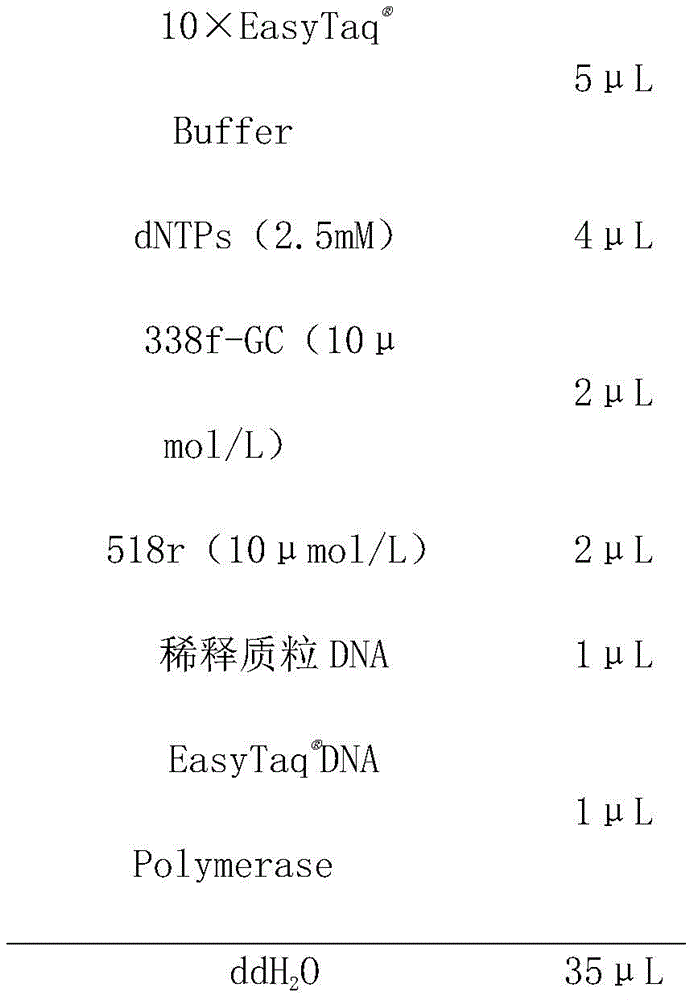
4.1.2 PCR反应程序为:95℃预变性5min,95℃30s,55℃30s,72℃45s,30个循环,72℃10min,10℃for ever,4.1.2 The PCR reaction program is: 95°C pre-denaturation for 5min, 95°C for 30s, 55°C for 30s, 72°C for 45s, 30 cycles, 72°C for 10min, 10°C for ever,
4.1.3引物序列如下:4.1.3 The primer sequences are as follows:
338f-GC:CGCCCGCCGCGCGCGGCGGGCGGGGCGGGGGCACGGGGGGACTCCTACGGGAGGCAGCAG338f-GC: CGCCCGCCGCGCGCGGCGGGCGGGGCGGGGGCACGGGGGGACTCCTACGGGAGGCAGCAG
518r:ATTACCGCGGCTGCTGG518r: ATTACCGCGGCTGCTGG
4.2 PCR扩增产物用于DGGE上样分析,DGGE电泳过程参照具体实施方案1中的2.1、2.2、2.3进行,DGGE图谱上条带电泳行为与模板条带电泳行为一致者则视为目的阳性克隆子。验证的DGGE图谱如附图6所示。此阳性克隆子的质粒送至上海华大基因科技有限公司测序;4.2 PCR amplification products are used for DGGE sample loading analysis. The DGGE electrophoresis process is carried out with reference to 2.1, 2.2, and 2.3 in the specific embodiment 1. The band electrophoresis behavior on the DGGE map is consistent with the template band electrophoresis behavior. It is regarded as the target positive clone son. The verified DGGE spectrum is shown in Figure 6. The plasmid of this positive clone was sent to Shanghai Huada Gene Technology Co., Ltd. for sequencing;
4.3测序结果提交至NCBI,在线比对确定序列的菌属地位;4.3 The sequencing results are submitted to NCBI, and the genus status of the sequences is determined by online comparison;
5.制作煤地质微生物PCR-DGGE检测中细菌物种的DNA Marker;5. Make DNA markers of bacterial species in the PCR-DGGE detection of coal geological microorganisms;
5.1以混合质粒为模板进行PCR扩增,各质粒模板量控制在8-12ng/μL范围内,扩增体系、条件、所用引物参照具体实施方案1中步骤4.1.1、4.1.2、4.1.3。5.1 Use the mixed plasmid as a template to carry out PCR amplification, and the amount of each plasmid template is controlled within the range of 8-12ng/μL. The amplification system, conditions, and primers used refer to steps 4.1.1, 4.1.2, and 4.1 in the specific embodiment 1. 3.
5.2 PCR扩增产物与6×DNA Loading buffer以体积比5:1混合均匀,即获得DNAMarker,制备好的DNA Marker用于DGGE上样分析,DGGE电泳过程参照具体实施方案1中的步骤2.1、2.2、2.3,DGGE图谱如附图7所示;5.2 Mix the PCR amplification product and 6×DNA Loading buffer at a volume ratio of 5:1 to obtain a DNA Marker. The prepared DNA Marker is used for DGGE loading analysis. Refer to steps 2.1 and 2.2 in the specific embodiment 1 for the DGGE electrophoresis process. , 2.3, the DGGE spectrum is shown in accompanying drawing 7;
6.结合每条DNA Marker条带所代表的菌属地位,对制备的PCR-DGGE检测中DNAMarker进行命名,本发明专利制备的DNA Marker命名为CBMbac1。6. Name the DNAMarker in the PCR-DGGE detection prepared according to the genus status represented by each DNA Marker band. The DNA Marker prepared by the patent of the present invention is named CBMbac1.
实施例2Example 2
一种用于检测煤地质微生物细菌物种的DNA Marker的制备方法,包括以下步骤:A preparation method of DNA Marker for detecting coal geological microbial bacterial species, comprising the following steps:
1.提取产出水样的甲基型产甲烷类型及乙基型产甲烷类型富集培养液中的基因组DNA,选用2套引物进行PCR扩增,基因组提取及PCR扩增参照具体实施方案1中的1.1、1.2、1.3,基因组DNA 0.7%琼脂糖凝胶电泳验证图谱如附图1所示。1. Extract the methyl-type methane-producing type and ethyl-type methane-producing type of the output water sample to enrich the genomic DNA in the culture medium, select 2 sets of primers for PCR amplification, and refer to specific embodiment 1 for genome extraction and PCR amplification In 1.1, 1.2, 1.3, the verification map of genomic DNA 0.7% agarose gel electrophoresis is shown in FIG. 1 .
2.DGGE分析:2. DGGE analysis:
2.1选择聚丙烯酰胺凝胶胶浓度为10%,胶变性范围为40%~60%,取40%、60%胶各18ml,分别加入50μL的TEMED及40μL的10%过硫酸铵,梯度混合制胶,夏天室温凝固,冬天可放在37℃培养箱里凝固,若室温凝固,凝胶时间至少3h;2.1 Select polyacrylamide gel with a concentration of 10% gel and a gel denaturation range of 40% to 60%. Take 18 ml of 40% and 60% gels, add 50 μL of TEMED and 40 μL of 10% ammonium persulfate, respectively, and make gradient mixing. The gel is solidified at room temperature in summer, and can be solidified in a 37°C incubator in winter. If it solidifies at room temperature, the gel time is at least 3 hours;
2.2待胶凝固完全之后,拔掉梳子,将整个板子安装在DGGE支架上,将安装有板子的DGGE支架放入电泳槽中,清洗胶孔,接通电源,待电泳液温度上升至60℃时,200V预电泳5min,用50微升微量进样器快速上样,上样样品为产出水的甲基型产甲烷富集培养样与乙基型产甲烷富集培养样的细菌V3区PCR扩增产物及具体实施方案1中制备的细菌DNAMarker。产出水富集培养样的细菌V3区PCR扩增产物及细菌DNA Marker上样量均为45-50μL。于60℃、85V条件下电泳13h;2.2 After the glue is completely solidified, unplug the comb, install the entire board on the DGGE bracket, put the DGGE bracket with the board installed in the electrophoresis tank, clean the glue hole, turn on the power supply, and wait for the temperature of the electrophoresis solution to rise to 60 ℃. , 200V pre-electrophoresis for 5 minutes, and quickly load the sample with a 50 μl microinjector. The sample loaded is the methyl-type methanogenesis enrichment culture sample of produced water and the bacterial V3 region PCR of the ethyl-type methanogenesis enrichment culture sample Amplification product and bacterial DNAMarker prepared in specific embodiment 1. The amount of PCR amplification product of bacterial V3 region and bacterial DNA Marker in the enriched culture sample of produced water were both 45-50 μL. Electrophoresis at 60°C and 85V for 13h;
2.3电泳完毕后,将胶放入3×GelRed染液中染色30min左右,拍照,DGGE图谱如附图8所示;2.3 After electrophoresis, put the gel into 3×GelRed dye solution for about 30min, take pictures, and the DGGE spectrum is shown in Figure 8;
2.4结果分析:如附图8中所示,本专利发明制备的DNA Marker部分组成条带与样品所含的部分条带一一对应,初步认为样品中与Marker对应的条带为Marker组成条带相对应的菌属,即甲基型产甲烷富集培养样与乙基型产甲烷富集培养样中细菌的菌群结构包含本专利发明制备Marker所对应的部分菌属。2.4 Analysis of results: As shown in Figure 8, the DNA Marker partial bands prepared by the patented invention correspond one-to-one with the partial bands contained in the sample, and it is preliminarily believed that the bands corresponding to Markers in the sample are Marker constituent bands. The corresponding bacterial genera, that is, the bacterial flora structure of the bacteria in the methyl-type methane-producing enrichment culture sample and the ethyl-type methanogenesis enrichment culture sample include part of the bacterial genera corresponding to the Marker prepared by the patented invention.
3.样品条带序列分析:3. Sample band sequence analysis:
3.1将甲基型产甲烷及乙基型产甲烷富集培养样品中与制备的细菌DNA Marker位于同一位置的条带切下,放入无菌的EP管中,编号;3.1 Cut out the bands located in the same position as the prepared bacterial DNA Marker in the enriched culture samples of methyl-type methanogenesis and ethyl-type methanogenesis, and put them into sterile EP tubes, numbered;
3.2用去离子水洗涤胶条,并将胶条弄碎成小段,加入30μL去离子水浸泡,4℃过夜;3.2 Wash the strip with deionized water, break the strip into small pieces, add 30 μL of deionized water to soak, overnight at 4°C;
3.3使用不含GC夹的引物再次进行PCR扩增,PCR扩增反应体系、条件及引物参照具体实施方案1中的2.6.1、2.6.2及2.6.3。得到的PCR产物用中科瑞泰(北京)生物科技有限公司的琼脂糖凝胶DNA回收试剂盒纯化回收,回收的DNA片段送至上海华大基因科技有限公司进行测序;3.3 Use primers without GC clips to perform PCR amplification again. Refer to 2.6.1, 2.6.2 and 2.6.3 in the specific embodiment 1 for the PCR amplification reaction system, conditions and primers. The obtained PCR product was purified and recovered with the agarose gel DNA recovery kit of Zhongke Ruitai (Beijing) Biotechnology Co., Ltd., and the recovered DNA fragments were sent to Shanghai Huada Gene Technology Co., Ltd. for sequencing;
3.测序结果提交至NCBI,在线比对确定序列的菌属地位,经比对分析,样品中与Marker位于同一位置的条带所属菌属地位与对应的Marker相同,且菌属相似性均大于97%。证明了甲基型产甲烷富集培养样与乙基型产甲烷富集培养样中细菌的菌群结构确实包含了本专利发明制备Marker所对应的部分菌属。即甲基型产甲烷富集培养样液中含有的细菌菌属有Enterococcus、Parabacteroides、Fusobacterium、Morganella、Citrobacter、Raoultella、Clostridium、Acetoanaerobium。乙基型产甲烷富集培养样中细菌菌属组成包含有Enterococcus、Parabacteroides、Fusobacterium、Morganella、Citrobacter、Clostridium、Stenotrophomonas、Acetoanaerobium。3. The sequencing results were submitted to NCBI, and the genus status of the sequences was determined by online comparison. After comparison and analysis, the genus status of the band located in the same position as the Marker in the sample was the same as that of the corresponding Marker, and the similarity of the genus was greater than that of the marker. 97%. It is proved that the bacterial flora structure of the methyl-type methane-producing enrichment culture sample and the ethyl-type methanogenesis enrichment culture sample does indeed contain part of the bacterial genera corresponding to the Marker prepared by the patented invention. That is, the bacterial genera contained in the methyl-type methane-producing enrichment culture sample solution include Enterococcus, Parabacteroides, Fusobacterium, Morganella, Citrobacter, Raoultella, Clostridium, and Acetoanaerobium. The bacterial genus composition in the enriched culture samples of ethyl methanogenesis included Enterococcus, Parabacteroides, Fusobacterium, Morganella, Citrobacter, Clostridium, Stenotrophomonas, and Acetoanaerobium.
SEQUENCE LISTINGSEQUENCE LISTING
<110> 山西大学<110> Shanxi University
<120> 用于检测煤地质微生物细菌物种的DNA Marker及制备方法和应用<120> DNA Marker for detecting coal geological microbial bacterial species and preparation method and application
<130> .<130> .
<160> 11<160> 11
<170> PatentIn version 3.5<170> PatentIn version 3.5
<210> 1<210> 1
<211> 198<211> 198
<212> DNA<212> DNA
<213> Enterococcus<213> Enterococcus
<400> 1<400> 1
actcctacgg gaggcagcag tagggaatct tcggcaatgg acgaaagtct gaccgagcaa 60actcctacgg gaggcagcag tagggaatct tcggcaatgg acgaaagtct gaccgagcaa 60
cgccgcgtga gtgaagaagg ttttcggatc gtaaaactct gttgttagag aagaacaagg 120cgccgcgtga gtgaagaagg ttttcggatc gtaaaactct gttgttagag aagaacaagg 120
atgagagtaa aatgttcatc ccttgacggt atctaaccag aaagccacgg ctaactacgt 180atgagagtaa aatgttcatc ccttgacggt atctaaccag aaagccacgg ctaactacgt 180
gccagcagcc gcggtaat 198gccagcagcc gcggtaat 198
<210> 2<210> 2
<211> 192<211> 192
<212> DNA<212> DNA
<213> Parabacteroides<213> Parabacteroides
<400> 2<400> 2
attaccgcgg ctgctggcac ggagttagcc gatccttatt ctcagggtac atacaaaaca 60attaccgcgg ctgctggcac ggagttagcc gatccttatt ctcagggtac atacaaaaca 60
ggacacgtcc tgaactttat tcccctgcaa aagaagttta cgaaccatag atccttcttc 120ggacacgtcc tgaactttat tcccctgcaa aagaagttta cgaaccatag atccttcttc 120
cttcacgcga cttggctggt tcaggctccc gcccattgac caatattcct cactgctgcc 180cttcacgcga cttggctggt tcaggctccc gcccattgac caatattcct cactgctgcc 180
tcccgtagga gt 192tcccgtagga gt 192
<210> 3<210> 3
<211> 192<211> 192
<212> DNA<212> DNA
<213> Parabacteroides<213> Parabacteroides
<400> 3<400> 3
attaccgcgg ctgctggcac ggagttagcc gatccttatt ctcagggtac atacaaaaca 60attaccgcgg ctgctggcac ggagttagcc gatccttatt ctcagggtac atacaaaaca 60
ggacacgtcc tgcactttat tcccctgcaa aagaagttta cgaaccatag atccttcttc 120ggacacgtcc tgcactttat tcccctgcaa aagaagttta cgaaccatag atccttcttc 120
cttcacgcga cttggctggt tcaggctccc gcccattgac caatattcct cactgctgcc 180cttcacgcga cttggctggt tcaggctccc gcccattgac caatattcct cactgctgcc 180
tcccgtagga gt 192tcccgtagga gt 192
<210> 4<210> 4
<211> 176<211> 176
<212> DNA<212> DNA
<213> Fusobacterium<213> Fusobacterium
<400> 4<400> 4
actcctacgg gaggcagcag tggggaatat tggacaatgg accaaaagtc tgatccagca 60actcctacgg gaggcagcag tggggaatat tggacaatgg accaaaagtc tgatccagca 60
attctgtgtg cacgatgaag tttttcggaa tgtaaagtgc tttcagttgg gaagaagtca 120attctgtgtg cacgatgaag tttttcggaa tgtaaagtgc tttcagttgg gaagaagtca 120
gtgacggtac caacagaaga agcgacggct aaatacgtgc cagcagccgc ggtaat 176gtgacggtac caacagaaga agcgacggct aaatacgtgc cagcagccgc ggtaat 176
<210> 5<210> 5
<211> 197<211> 197
<212> DNA<212> DNA
<213> Morganella<213> Morganella
<400> 5<400> 5
attaccgcgg ctgctggcac ggagttagcc ggtgcttctt ctgtcggtaa cgtcaattgt 60attaccgcgg ctgctggcac ggagttagcc ggtgcttctt ctgtcggtaa cgtcaattgt 60
caaggttatt aaccttaaca ccttcctccc gactgaaagt actttacaac ccgaaggcct 120caaggttatt aaccttaaca ccttcctccc gactgaaagt actttacaac ccgaaggcct 120
tcttcataca cgcggcatgg ctgcatcagg cttgcgccca ttgtgcaata ttccccactg 180tcttcataca cgcggcatgg ctgcatcagg cttgcgccca ttgtgcaata ttccccactg 180
ctgcctcccg taggagt 197ctgcctcccg taggagt 197
<210> 6<210> 6
<211> 197<211> 197
<212> DNA<212> DNA
<213> Citrobacter<213> Citrobacter
<400> 6<400> 6
attaccgcgg ctgctggcac ggagttagcc ggtgcttctt ctgcgggtaa cgtcaatgaa 60attaccgcgg ctgctggcac ggagttagcc ggtgcttctt ctgcgggtaa cgtcaatgaa 60
taaggttatt aaccttactc ccttcctccc cgctgaaagt actttacaac ccgaaggcct 120taaggttatt aaccttactc ccttcctccc cgctgaaagt actttacaac ccgaaggcct 120
tcttcataca cgcggcatgg ctgcatcagg cttgcgccca ttgtgcaata ttccccactg 180tcttcataca cgcggcatgg ctgcatcagg cttgcgccca ttgtgcaata ttccccactg 180
ctgcctcccg taggagt 197ctgcctcccg taggagt 197
<210> 7<210> 7
<211> 197<211> 197
<212> DNA<212> DNA
<213> Raoultella<213> Raoultella
<400> 7<400> 7
actcctacgg gaggcagcag tggggaatat tgcacaatgg gcgcaagcct gatgcagcca 60actcctacgg gaggcagcag tggggaatat tgcacaatgg gcgcaagcct gatgcagcca 60
tgccgcgtgt atgaagaagg ccttcgggtt gtaaagtact ttcagcgacg aggaaggcgt 120tgccgcgtgt atgaagaagg ccttcgggtt gtaaagtact ttcagcgacg aggaaggcgt 120
taaggttaat aaccttaacg attgacgtta ctcgcagaag aagcaccggc taactccgtg 180taaggttaat aaccttaacg attgacgtta ctcgcagaag aagcaccggc taactccgtg 180
ccagcagccg cggtaat 197ccagcagccg cggtaat 197
<210> 8<210> 8
<211> 172<211> 172
<212> DNA<212> DNA
<213> Clostridium<213> Clostridium
<400> 8<400> 8
attaccgcgg ctgctggcac gtagttagcc gtggcttcct cctctggtac cgtcattatc 60attaccgcgg ctgctggcac gtagttagcc gtggcttcct cctctggtac cgtcattatc 60
gtcccagaaa acagaacttt acaaccctaa ggccttcttc attcacgcgg cgttgctgcg 120gtcccagaaa acagaacttt acaaccctaa ggccttcttc attcacgcgg cgttgctgcg 120
tcagggtttc ccccattgcg caatattccc cactgctgcc tcccgtagga gt 172tcagggtttc ccccattgcg caatattccc cactgctgcc tcccgtagga gt 172
<210> 9<210> 9
<211> 197<211> 197
<212> DNA<212> DNA
<213> Citrobacter<213> Citrobacter
<400> 9<400> 9
attaccgcgg ctgctggcac ggagttagcc ggtgcttctt ctgcgagtaa cgtcaattgc 60attaccgcgg ctgctggcac ggagttagcc ggtgcttctt ctgcgagtaa cgtcaattgc 60
tgcggttatt aacctcaaca ccttcctcct cgctgaaagt actttacaac ccgaaggcct 120tgcggttatt aacctcaaca ccttcctcct cgctgaaagt actttacaac ccgaaggcct 120
tcttcataca cgcggcatgg ctgcatcagg cttgcgccca ttgtgcaata ttccccactg 180tcttcataca cgcggcatgg ctgcatcagg cttgcgccca ttgtgcaata ttccccactg 180
ctgcctcccg taggagt 197ctgcctcccg taggagt 197
<210> 10<210> 10
<211> 197<211> 197
<212> DNA<212> DNA
<213> Stenotrophomonas<213> Stenotrophomonas
<400> 10<400> 10
attaccgcgg ctgctggcac gaagttagcc ggtgcttatt ctttgggtac cgtcatccca 60attaccgcgg ctgctggcac gaagttagcc ggtgcttatt ctttgggtac cgtcatccca 60
accgggtatt agccagctgg atttctttcc caacaaaagg gctttacaac ccgaaggcct 120accgggtatt agccagctgg atttctttcc caacaaaagg gctttacaac ccgaaggcct 120
tcttcaccca cgcggtatgg ctggatcagg cttgcgccca ttgtccaata ttccccactg 180tcttcaccca cgcggtatgg ctggatcagg cttgcgccca ttgtccaata ttccccactg 180
ctgcctcccg taggagt 197ctgcctcccg taggagt 197
<210> 11<210> 11
<211> 172<211> 172
<212> DNA<212> DNA
<213> Acetoanaerobium<213> Acetoanaerobium
<400> 11<400> 11
actcctacgg gaggcagcag tggggaatat tgcacaatgg gcgaaagcct gatgcagcaa 60actcctacgg gaggcagcag tggggaatat tgcacaatgg gcgaaagcct gatgcagcaa 60
cgccgcgtga gcgatgaagg ccttcgggtc gtaaagctct gtcctatggg aagataatga 120cgccgcgtga gcgatgaagg ccttcgggtc gtaaagctct gtcctatggg aagataatga 120
cggtaccata ggaggaagcc ccggctaact acgtgccagc agccgcggta at 172cggtaccata ggaggaagcc ccggctaact acgtgccagc agccgcggta at 172
Claims (7)
Priority Applications (1)
| Application Number | Priority Date | Filing Date | Title |
|---|---|---|---|
| CN201710348819.0A CN107119130B (en) | 2017-05-17 | 2017-05-17 | DNA marker for detecting coal geological microbial bacterial species and preparation method and application |
Applications Claiming Priority (1)
| Application Number | Priority Date | Filing Date | Title |
|---|---|---|---|
| CN201710348819.0A CN107119130B (en) | 2017-05-17 | 2017-05-17 | DNA marker for detecting coal geological microbial bacterial species and preparation method and application |
Publications (2)
| Publication Number | Publication Date |
|---|---|
| CN107119130A CN107119130A (en) | 2017-09-01 |
| CN107119130B true CN107119130B (en) | 2020-11-10 |
Family
ID=59727294
Family Applications (1)
| Application Number | Title | Priority Date | Filing Date |
|---|---|---|---|
| CN201710348819.0A Active CN107119130B (en) | 2017-05-17 | 2017-05-17 | DNA marker for detecting coal geological microbial bacterial species and preparation method and application |
Country Status (1)
| Country | Link |
|---|---|
| CN (1) | CN107119130B (en) |
Families Citing this family (1)
| Publication number | Priority date | Publication date | Assignee | Title |
|---|---|---|---|---|
| CN112626243A (en) * | 2020-12-24 | 2021-04-09 | 山西大学 | Kit and method for rapidly detecting bacteria in coal geological environment |
Citations (4)
| Publication number | Priority date | Publication date | Assignee | Title |
|---|---|---|---|---|
| CN104101914A (en) * | 2014-07-31 | 2014-10-15 | 盎亿泰地质微生物技术(北京)有限公司 | Method for oil-gas resource exploration indicating by utilizing molecular ecology |
| DE102014116204B3 (en) * | 2014-11-06 | 2015-08-27 | Bundesrepublik Deutschland, Vertreten Durch Den Bundesminister Für Wirtschaft Und Energie, Dieser Vertreten Durch Den Präsidenten Der Bundesanstalt Für Materialforschung Und -Prüfung (Bam) | Method for the quantitative detection of a contamination of a liquid by a microorganism by means of quantitative polymerase chain reaction |
| CN105802957A (en) * | 2016-05-30 | 2016-07-27 | 山西大学 | Method for extracting microorganism total DNA from coal seam water sample |
| WO2016210251A1 (en) * | 2015-06-25 | 2016-12-29 | Ascus Biosciences, Inc. | Methods, apparatuses, and systems for analyzing microorganism strains from complex heterogeneous communities, predicting and identifying functional relationships and interactions thereof, and selecting and synthesizing microbial ensembles based thereon |
Family Cites Families (1)
| Publication number | Priority date | Publication date | Assignee | Title |
|---|---|---|---|---|
| CN101701264B (en) * | 2009-11-20 | 2011-12-28 | 深圳大学 | Method for detecting water body blue algae based on PCR-DCG and kit thereof |
-
2017
- 2017-05-17 CN CN201710348819.0A patent/CN107119130B/en active Active
Patent Citations (4)
| Publication number | Priority date | Publication date | Assignee | Title |
|---|---|---|---|---|
| CN104101914A (en) * | 2014-07-31 | 2014-10-15 | 盎亿泰地质微生物技术(北京)有限公司 | Method for oil-gas resource exploration indicating by utilizing molecular ecology |
| DE102014116204B3 (en) * | 2014-11-06 | 2015-08-27 | Bundesrepublik Deutschland, Vertreten Durch Den Bundesminister Für Wirtschaft Und Energie, Dieser Vertreten Durch Den Präsidenten Der Bundesanstalt Für Materialforschung Und -Prüfung (Bam) | Method for the quantitative detection of a contamination of a liquid by a microorganism by means of quantitative polymerase chain reaction |
| WO2016210251A1 (en) * | 2015-06-25 | 2016-12-29 | Ascus Biosciences, Inc. | Methods, apparatuses, and systems for analyzing microorganism strains from complex heterogeneous communities, predicting and identifying functional relationships and interactions thereof, and selecting and synthesizing microbial ensembles based thereon |
| CN105802957A (en) * | 2016-05-30 | 2016-07-27 | 山西大学 | Method for extracting microorganism total DNA from coal seam water sample |
Non-Patent Citations (5)
| Title |
|---|
| Effect of changes in the physicochemical properties of sand-alternatives on bacterial community structure in coastal sediments;TetsujiOkuda等;《Ecological Engineering》;20160107;第88卷;第177-185页 * |
| Structural diversity of microbial communities in arable soils of a heavily industrialised area determined by PCR-DGGE fingerprinting and FAME profiling;Jacek Kozdrój等;《Applied Soil Ecology》;20010319;第17卷(第1期);第31-42页 * |
| 基于mcrA基因的沁水盆地煤层气田产甲烷菌群与途径分析;杨秀清等;《微生物学通报》;20170120;第44卷(第4期);第795-806页 * |
| 煤层微生物生产甲烷及其物种DNA Marker的制备和应用;陈彦梅;《中国优秀硕士学位论文全文数据库 基础科学辑》;20160401(第4期);第1-43页 * |
| 益生菌DGGE Marker 的制备及验证;陈廷涛等;《中国微生态学杂志》;20091030;第21卷(第10期);第865-868页 * |
Also Published As
| Publication number | Publication date |
|---|---|
| CN107119130A (en) | 2017-09-01 |
Similar Documents
| Publication | Publication Date | Title |
|---|---|---|
| Lebuhn et al. | Towards molecular biomarkers for biogas production from lignocellulose-rich substrates | |
| Park et al. | Metagenomic insight into methanogenic reactors promoting direct interspecies electron transfer via granular activated carbon | |
| Peng et al. | Metatranscriptomics reveals a differential temperature effect on the structural and functional organization of the anaerobic food web in rice field soil | |
| Pap et al. | Temperature-dependent transformation of biogas-producing microbial communities points to the increased importance of hydrogenotrophic methanogenesis under thermophilic operation | |
| Puri et al. | Genetic tools for the industrially promising methanotroph Methylomicrobium buryatense | |
| Venkiteshwaran et al. | Correlating methane production to microbiota in anaerobic digesters fed synthetic wastewater | |
| Rydzak et al. | Deletion of type I glutamine synthetase deregulates nitrogen metabolism and increases ethanol production in Clostridium thermocellum | |
| Xu et al. | Microbes from mature compost to promote bacterial chemotactic motility via tricarboxylic acid cycle-regulated biochemical metabolisms for enhanced composting performance | |
| Li et al. | Time-shifted expression of acetoclastic and methylotrophic methanogenesis by a single Methanosarcina genomospecies predominates the methanogen dynamics in Philippine rice field soil | |
| Yang et al. | Potential of biogenic methane for pilot-scale fermentation ex situ with lump anthracite and the changes of methanogenic consortia | |
| Dalcin Martins et al. | Wetland sediments host diverse microbial taxa capable of cycling alcohols | |
| Fischer et al. | Long‐term investigation of microbial community composition and transcription patterns in a biogas plant undergoing ammonia crisis | |
| CN104059975B (en) | To Providence O3, the Nucleotide that O4, O8, O12, O13 and O20 are special and application thereof | |
| CN107130030B (en) | DNA marker for detecting coal geological microbial archaea species and preparation method and application | |
| CN107119130B (en) | DNA marker for detecting coal geological microbial bacterial species and preparation method and application | |
| Xing et al. | Composition of the archaeal community involved in methane production during the decomposition of Microcystis blooms in the laboratory | |
| Yamei et al. | Bioreactor performance and microbial community dynamics in a production-scale biogas plant in northeastern China | |
| KR102491679B1 (en) | Quality control method | |
| Lee et al. | Direct mRNA-to-sgRNA conversion generates design-free ultra-dense CRISPRi libraries for systematic phenotypic screening | |
| CN114317808A (en) | Quantitative detection kit, detection method and application of thermophilic fungi | |
| CN104498516A (en) | High-efficiency hydrogen-production functional gene carrier pETD-SL and construction and application thereof | |
| Shi et al. | Microbial community characterization of an UASB treating increased organic loading rates of vitamin C biosynthesis wastewater | |
| Wu et al. | Methane-related mierobe influenced by water management and rile straw returning in paddy soil | |
| CN114107285B (en) | A method to use alkane sensors to evolve hydrocarbon-producing enzymes to produce long-chain alkanes | |
| Dąbrowska et al. | Substrate influence on the structure of methanogenic Archaea communities during anaerobic digestion |
Legal Events
| Date | Code | Title | Description |
|---|---|---|---|
| PB01 | Publication | ||
| PB01 | Publication | ||
| SE01 | Entry into force of request for substantive examination | ||
| SE01 | Entry into force of request for substantive examination | ||
| GR01 | Patent grant | ||
| GR01 | Patent grant | ||
| TR01 | Transfer of patent right |
Effective date of registration: 20231122 Address after: 034000, No. 5 Xinye 3rd Street, Douluo Building Materials Industrial Park, Douluo Town, Xinfu District, Xinzhou City, Shanxi Province Patentee after: Shanxi Hengrui Resource Recycling Technology Co.,Ltd. Address before: 030006, No. 92, Hollywood Road, Xiaodian District, Shanxi, Taiyuan Patentee before: SHANXI University |
|
| TR01 | Transfer of patent right |