CN107105229B - Image decoding method, video decoder, and non-transitory computer-readable storage medium - Google Patents
Image decoding method, video decoder, and non-transitory computer-readable storage medium Download PDFInfo
- Publication number
- CN107105229B CN107105229B CN201611005691.XA CN201611005691A CN107105229B CN 107105229 B CN107105229 B CN 107105229B CN 201611005691 A CN201611005691 A CN 201611005691A CN 107105229 B CN107105229 B CN 107105229B
- Authority
- CN
- China
- Prior art keywords
- image
- mmr
- model
- prediction
- dynamic range
- Prior art date
- Legal status (The legal status is an assumption and is not a legal conclusion. Google has not performed a legal analysis and makes no representation as to the accuracy of the status listed.)
- Active
Links
Images


Classifications
-
- H—ELECTRICITY
- H04—ELECTRIC COMMUNICATION TECHNIQUE
- H04N—PICTORIAL COMMUNICATION, e.g. TELEVISION
- H04N19/00—Methods or arrangements for coding, decoding, compressing or decompressing digital video signals
- H04N19/10—Methods or arrangements for coding, decoding, compressing or decompressing digital video signals using adaptive coding
- H04N19/102—Methods or arrangements for coding, decoding, compressing or decompressing digital video signals using adaptive coding characterised by the element, parameter or selection affected or controlled by the adaptive coding
- H04N19/103—Selection of coding mode or of prediction mode
- H04N19/105—Selection of the reference unit for prediction within a chosen coding or prediction mode, e.g. adaptive choice of position and number of pixels used for prediction
-
- H—ELECTRICITY
- H04—ELECTRIC COMMUNICATION TECHNIQUE
- H04N—PICTORIAL COMMUNICATION, e.g. TELEVISION
- H04N19/00—Methods or arrangements for coding, decoding, compressing or decompressing digital video signals
- H04N19/10—Methods or arrangements for coding, decoding, compressing or decompressing digital video signals using adaptive coding
- H04N19/102—Methods or arrangements for coding, decoding, compressing or decompressing digital video signals using adaptive coding characterised by the element, parameter or selection affected or controlled by the adaptive coding
- H04N19/103—Selection of coding mode or of prediction mode
-
- G—PHYSICS
- G06—COMPUTING OR CALCULATING; COUNTING
- G06F—ELECTRIC DIGITAL DATA PROCESSING
- G06F17/00—Digital computing or data processing equipment or methods, specially adapted for specific functions
- G06F17/10—Complex mathematical operations
- G06F17/18—Complex mathematical operations for evaluating statistical data, e.g. average values, frequency distributions, probability functions, regression analysis
-
- H—ELECTRICITY
- H04—ELECTRIC COMMUNICATION TECHNIQUE
- H04N—PICTORIAL COMMUNICATION, e.g. TELEVISION
- H04N19/00—Methods or arrangements for coding, decoding, compressing or decompressing digital video signals
- H04N19/10—Methods or arrangements for coding, decoding, compressing or decompressing digital video signals using adaptive coding
- H04N19/134—Methods or arrangements for coding, decoding, compressing or decompressing digital video signals using adaptive coding characterised by the element, parameter or criterion affecting or controlling the adaptive coding
- H04N19/146—Data rate or code amount at the encoder output
- H04N19/147—Data rate or code amount at the encoder output according to rate distortion criteria
-
- H—ELECTRICITY
- H04—ELECTRIC COMMUNICATION TECHNIQUE
- H04N—PICTORIAL COMMUNICATION, e.g. TELEVISION
- H04N19/00—Methods or arrangements for coding, decoding, compressing or decompressing digital video signals
- H04N19/10—Methods or arrangements for coding, decoding, compressing or decompressing digital video signals using adaptive coding
- H04N19/134—Methods or arrangements for coding, decoding, compressing or decompressing digital video signals using adaptive coding characterised by the element, parameter or criterion affecting or controlling the adaptive coding
- H04N19/157—Assigned coding mode, i.e. the coding mode being predefined or preselected to be further used for selection of another element or parameter
- H04N19/16—Assigned coding mode, i.e. the coding mode being predefined or preselected to be further used for selection of another element or parameter for a given display mode, e.g. for interlaced or progressive display mode
-
- H—ELECTRICITY
- H04—ELECTRIC COMMUNICATION TECHNIQUE
- H04N—PICTORIAL COMMUNICATION, e.g. TELEVISION
- H04N19/00—Methods or arrangements for coding, decoding, compressing or decompressing digital video signals
- H04N19/10—Methods or arrangements for coding, decoding, compressing or decompressing digital video signals using adaptive coding
- H04N19/189—Methods or arrangements for coding, decoding, compressing or decompressing digital video signals using adaptive coding characterised by the adaptation method, adaptation tool or adaptation type used for the adaptive coding
- H04N19/192—Methods or arrangements for coding, decoding, compressing or decompressing digital video signals using adaptive coding characterised by the adaptation method, adaptation tool or adaptation type used for the adaptive coding the adaptation method, adaptation tool or adaptation type being iterative or recursive
-
- H—ELECTRICITY
- H04—ELECTRIC COMMUNICATION TECHNIQUE
- H04N—PICTORIAL COMMUNICATION, e.g. TELEVISION
- H04N19/00—Methods or arrangements for coding, decoding, compressing or decompressing digital video signals
- H04N19/30—Methods or arrangements for coding, decoding, compressing or decompressing digital video signals using hierarchical techniques, e.g. scalability
-
- H—ELECTRICITY
- H04—ELECTRIC COMMUNICATION TECHNIQUE
- H04N—PICTORIAL COMMUNICATION, e.g. TELEVISION
- H04N19/00—Methods or arrangements for coding, decoding, compressing or decompressing digital video signals
- H04N19/90—Methods or arrangements for coding, decoding, compressing or decompressing digital video signals using coding techniques not provided for in groups H04N19/10-H04N19/85, e.g. fractals
- H04N19/98—Adaptive-dynamic-range coding [ADRC]
Landscapes
- Engineering & Computer Science (AREA)
- Multimedia (AREA)
- Signal Processing (AREA)
- Physics & Mathematics (AREA)
- Data Mining & Analysis (AREA)
- General Physics & Mathematics (AREA)
- Mathematical Optimization (AREA)
- Theoretical Computer Science (AREA)
- Mathematical Physics (AREA)
- Computational Mathematics (AREA)
- Pure & Applied Mathematics (AREA)
- Mathematical Analysis (AREA)
- Bioinformatics & Computational Biology (AREA)
- Software Systems (AREA)
- Probability & Statistics with Applications (AREA)
- Evolutionary Biology (AREA)
- Algebra (AREA)
- Bioinformatics & Cheminformatics (AREA)
- Databases & Information Systems (AREA)
- Operations Research (AREA)
- General Engineering & Computer Science (AREA)
- Life Sciences & Earth Sciences (AREA)
- Compression Or Coding Systems Of Tv Signals (AREA)
- Image Processing (AREA)
- Compression Of Band Width Or Redundancy In Fax (AREA)
- Facsimile Image Signal Circuits (AREA)
Abstract
Description
本申请为2012年4月13日提交的国际申请号为PCT/US2012/033605、发明名称为“多颜色通道多元回归预测算子”的PCT申请的分案申请,该PCT申请进入中国国家阶段日期为2013年10月11日,国家申请号为201280018070.9。This application is a divisional application of the PCT application filed on April 13, 2012 with the international application number PCT/US2012/033605 and the title of the invention "Multiple Color Channel Multiple Regression Prediction Operator". On October 11, 2013, the national application number is 201280018070.9.
相关申请的交叉引用Cross References to Related Applications
本申请要求于2011年4月14日提交的美国临时专利申请No.61/475,359的权益,其全部内容通过引用结合于此。This application claims the benefit of US Provisional Patent Application No. 61/475,359, filed April 14, 2011, the entire contents of which are hereby incorporated by reference.
本申请还涉及于2011年4月14日提交的共同未决的美国临时专利申请No.61/475,372,其全部内容通过引用结合于此。This application is also related to co-pending US Provisional Patent Application No. 61/475,372, filed April 14, 2011, the entire contents of which are hereby incorporated by reference.
技术领域technical field
本发明总体上涉及图像。更具体地,本发明的实施例涉及高动态范围图像与标准动态范围图像之间的多颜色通道、多元回归预测算子。The present invention generally relates to images. More specifically, embodiments of the present invention relate to multi-color channel, multiple regression predictors between high dynamic range images and standard dynamic range images.
背景技术Background technique
如本文中所使用的术语“动态范围”(DR,dynamic range)涉及人类视觉系统(HVS,human psychovisual system)对图像中例如从最暗的暗部到最亮的亮部的强度(例如,亮度)范围进行感知的能力。从这个意义上讲,DR涉及“与场景相关”的强度。DR还可涉及显示设备适当地或近似地呈现特定宽度的强度范围的能力。从这个意义上讲,DR涉及“与显示器相关”的强度。除非在本文的描述中的任何一点处明确地指出特定的意义具有特定含义,否则应推断该术语可以(例如,互换地)用在任意一种意义中。As used herein, the term "dynamic range" (DR, dynamic range) relates to the human visual system (HVS, human psychovisual system) in an image, for example from the darkest dark part to the brightest bright part of the intensity (for example, brightness) Ability to perceive range. In this sense, DR involves "scene-related" intensities. DR may also relate to the ability of a display device to properly or approximately render a particular width of intensity range. In this sense, DR involves intensity "relative to the display". Unless it is expressly stated at any point in the description herein that a particular meaning has a particular meaning, it should be inferred that the terms can be used (eg, interchangeably) in either sense.
如本文中所使用的术语高动态范围(HDR,high dynamic range)涉及跨越人类视觉系统(HVS)的某14-15个数量级的DR宽度。例如,基本正常的适应良好的人(例如,在一个或多个统计学意义上、计量生物学意义上或眼科学意义上)具有跨越约15个数量级的强度范围。适应的人可感知少到只有极少数光子的微弱光源。然而,同样的人可感知沙漠、海或雪中正午太阳的近乎刺痛的耀眼强度(或甚至看着太阳,然而只是短暂地看着,以防止伤害)。虽然这个跨度对“适应的”人而言是可达到的,但例如那些人的HVS具有进行重置和调节的时间段。The term high dynamic range (HDR) as used herein refers to a DR width of some 14-15 orders of magnitude across the Human Visual System (HVS). For example, a substantially normal well-adjusted human (eg, in one or more statistical, biometric, or ophthalmological senses) has a range of intensities spanning about 15 orders of magnitude. Adapted humans can perceive faint light sources with as few as a handful of photons. However, the same person can perceive (or even look at the sun, however only briefly, to prevent injury) the almost stinging intensity of the midday sun in deserts, seas, or snow. While this span is achievable for "adapted" people, for example the HVS of those people has a period of time to reset and adjust.
相比之下,较之HDR,人类可同步感知强度范围中的扩展宽度的DR可在一定程度上缩短。如在本文中所使用的术语“视觉动态范围”或“可变动态范围”(VDR,variabledynamic range)可单独地或互换地涉及可由HVS同时感知的DR。如本文中所使用的VDR可涉及跨越5-6个数量级的DR。因此,尽管与真实场景相关的HDR可能在一定程度上变窄,但VDR仍表示较宽的DR宽度。如本文中所使用的术语“同步动态范围”可涉及VDR。In contrast, DR for the extended width in the human-synchronizable perceptual intensity range can be somewhat shortened compared to HDR. The term "visual dynamic range" or "variable dynamic range" (VDR) as used herein may refer individually or interchangeably to DR that can be simultaneously perceived by the HVS. VDR as used herein may refer to DR spanning 5-6 orders of magnitude. So, while HDR may be somewhat narrower in relation to real scenes, VDR still represents a wider DR width. The term "synchronized dynamic range" as used herein may refer to VDR.
直至最近,显示器具有了比HDR或VDR明显更窄的DR。使用常规阴极射线管(CRT,cathode ray tube),带有恒定的荧光白背光照明的液晶显示器(LCD,liquid crystaldisplay)或等离子屏幕技术的电视(TV)和计算机监视装置在它们的DR呈现能力上会限制于约三个数量级。因此这种传统的显示器特征是低动态范围(LDR,low dynamic range),对于VDR和HDR,还称为标准动态范围(SDR,standard dynamic range)。Until recently, displays had significantly narrower DR than HDR or VDR. Television (TV) and computer monitoring devices using conventional cathode ray tube (CRT, cathode ray tube), liquid crystal display (LCD, liquid crystal display) with constant fluorescent white backlighting or plasma screen technology in their DR rendering capabilities will be limited to about three orders of magnitude. Therefore, this traditional display is characterized by a low dynamic range (LDR, low dynamic range), and for VDR and HDR, it is also called a standard dynamic range (SDR, standard dynamic range).
然而,它们的基础技术中的进步允许更新式的显示器设计,以便相对于呈现在不够新式的显示器上的图像和视频内容,以在多种质量特征上具有显著改进的方式来呈现该内容。例如,更新式的显示设备可能能够呈现高清晰度(HD,high definition)内容和/或可根据多种显示能力(诸如,图像缩放器(image scaler))进行缩放的内容。此外,某些更新式的显示器能够以比传统显示器的SDR更高的DR来呈现内容。However, advances in their underlying technology have allowed newer display designs to present image and video content in a manner that has significant improvements in a variety of quality characteristics relative to image and video content presented on less modern displays. For example, newer display devices may be capable of presenting high definition (HD) content and/or content that can be scaled according to various display capabilities (such as an image scaler). Additionally, some newer displays are capable of rendering content at a higher DR than the SDR of traditional displays.
例如,某些新式LCD显示器具有包括发光二极管(LED,light emitting diode)阵列的背光单元(BLU,backlight unit)。BLU阵列的LED可与有源LCD元件的偏振态的调制分开地进行调制。这种双调制方法是可(诸如)通过BLU阵列与LCD屏幕元件之间的可控中间层来扩展的(例如,扩展成N调制层,其中N包括大于2的整数)。其基于LED阵列的BLU和双(或N)调制有效地增加了具有这种特征的LCD监视器的与显示器相关的DR。For example, some new LCD displays have a backlight unit (BLU) that includes an array of light emitting diodes (LEDs). The LEDs of the BLU array can be modulated separately from the modulation of the polarization states of the active LCD elements. This dual modulation approach is scalable (eg, to N modulation layers, where N includes an integer greater than 2), such as by a controllable intermediate layer between the BLU array and the LCD screen elements. Its LED array-based BLU and dual (or N) modulation effectively increases the display-related DR of LCD monitors with this feature.
关于传统SDR显示器,通常所称的这种“HDR显示器”(尽管实际上,它们的能力可能更近似VDR的范围)和它们可能的DR扩展在显示图像、视频内容和其他视频信息的能力上表现出显著进步。这种HDR显示器可以呈现的色域还可显著地超出多数传统显示器的色域,甚至到能呈现宽色域(WCG,wide color gamut)的程度。与场景相关的HDR或VDR和WCG图像内容,诸如可通过“下一代”电影和TV摄像机产生,现在可通过“HDR”显示器(下文中称为“HDR显示器”)来更真实有效地显示。With respect to conventional SDR displays, such "HDR displays" as they are commonly called (although in reality, their capabilities may more closely approximate the range of VDR) and their possible DR extensions are expressed in the ability to display images, video content, and other video information Significant progress has been made. The color gamut that can be presented by this HDR display can also significantly exceed the color gamut of most traditional displays, even to the extent that it can present a wide color gamut (WCG, wide color gamut). Scene-related HDR or VDR and WCG image content, such as can be produced by "next generation" movie and TV cameras, can now be displayed more realistically and efficiently by "HDR" displays (hereinafter "HDR displays").
就可扩展视频编码和HDTV技术而言,扩展图像DR通常涉及分叉方法。例如,通过新式HDR功能摄像机获取的与场景相关的HDR内容可用于产生内容的SDR版本,该内容的SDR版本可显示在传统SDR显示器上。在一种方法中,根据所获取的VDR版本产生SDR版本,可能涉及将全局色调映射算子(TMO,global tone mapping operator)应用于在HDR内容中的与强度(例如,亮度)相关的像素值。在第二种方法(如为了所有的目的通过引用结合在本文中的、于2011年8月23日提交的国际专利申请NO.PCT/US2011/048861中所描述的)中,产生SDR图像可涉及将可逆算子(或预测算子)应用在VDR数据上。为了保留带宽或出于其他考虑,传输实际获取的VDR内容可能不是最好的方法。As far as scalable video coding and HDTV technologies are concerned, extending picture DR usually involves a forking approach. For example, scene-related HDR content captured by a newer HDR-capable camera can be used to generate an SDR version of the content that can be displayed on a conventional SDR display. In one approach, an SDR version is generated from the acquired VDR version, which may involve applying a global tone mapping operator (TMO) to intensity (eg luminance) related pixel values in the HDR content . In a second approach (as described in International Patent Application No. PCT/US2011/048861, filed August 23, 2011, incorporated herein by reference for all purposes), generating an SDR image may involve Apply the reversible operator (or predictor) to the VDR data. In order to preserve bandwidth or for other considerations, it may not be the best way to transfer the actual acquired VDR content.
因此,关于初始TMO的逆的逆色调映射算子(iTMO,inverse tonemappingoperator)或者关于初始预测算子的逆算子可应用于所产生的SDR内容版本,这允许预测VDR内容的版本。所预测的VDR内容版本可与初始获取的HDR内容相比较。例如,从初始VDR版本减去预测的VDR版本可产生残余图像。编码器可将所产生的SDR内容作为基层(BL,baselayer)发送,并且将所产生的SDR内容版本、任意残余图像以及iTMO或其他预测算子打包作为增强层(EL,enhancement layer)或作为元数据。Therefore, an inverse tonemapping operator (iTMO) with respect to the inverse of the original TMO or an inverse operator with respect to the original prediction operator can be applied to the generated SDR content version, which allows to predict the version of the VDR content. The predicted VDR content version can be compared with the initially acquired HDR content. For example, subtracting a predicted VDR version from an initial VDR version can produce a residual image. The encoder may send the generated SDR content as a base layer (BL, base layer) and package the generated SDR content version, any residual image, and iTMO or other predictor as an enhancement layer (EL) or as a meta data.
相比于将HDR内容和SDR内容这两者直接发送进比特流所占用的带宽,将EL和元数据(具有其SDR内容、残余图像和预测算子)发送进比特流中通常占用更少的带宽。接收由编码器发送的比特流的可兼容解码器可对SDR进行解码并且呈现在传统显示器上。然而,可兼容解码器还可使用残余图像,iTMO预测算子或元数据,以根据它们来计算HDR内容的预定版本,以用在更多功能的显示器上。本发明的目的是提供用于产生预测算子的新方法,该预测算子允许利用对应的SDR数据对VDR数据进行有效的编码、传输以及解码。Sending EL and metadata (with its SDR content, residual image and predictor) into the bitstream typically takes less bandwidth than sending both HDR content and SDR content directly into the bitstream bandwidth. A compatible decoder receiving the bitstream sent by the encoder can decode the SDR and render it on a conventional display. However, compatible decoders can also use residual images, iTMO predictors or metadata from which to compute a predetermined version of the HDR content for use on more capable displays. The object of the present invention is to provide a new method for generating predictors that allow efficient encoding, transmission and decoding of VDR data with corresponding SDR data.
在这一部分中描述的方法是能够执行的方法,但并不一定是以前所设想或执行的方法。因此,除非另有指示,否则不应认为在这一部分所描述的方法中的任何一种因包括在这一部分中而被限定为现有技术。类似地,关于一种或多种方法所确定的问题不应认为已基于这部分在任何现有技术中确定,除非另有指示。The approaches described in this section are approaches that could have been performed, but not necessarily approaches previously conceived or performed. Therefore, unless otherwise indicated, no one should be construed as limiting the prior art to any of the approaches described in this section by inclusion in this section. Similarly, issues identified with respect to one or more approaches should not be considered to have been identified in any prior art based on this section unless otherwise indicated.
发明内容Contents of the invention
在下文中给出了关于本发明的简要概述,以便提供关于本发明的某些方面的基本理解。应当理解,该概述并不是关于本发明的穷举性概述,它并非意图确定本发明的关键或重要部分,也不是意图限定本发明的范围。其目的仅仅是以简化的形式给出某些概念,以此作为后文的具体实施方式部分的铺垫。A brief overview of the invention is given below in order to provide a basic understanding of some aspects of the invention. It should be understood that this summary is not an exhaustive overview of the invention, and that it is not intended to identify key or critical parts of the invention, nor to limit the scope of the invention. Its purpose is only to present some concepts in a simplified form as a foreshadowing for the detailed description below.
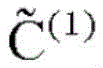
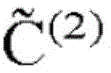
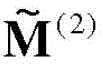
根据本发明的一个方面,提供了一种使用处理器的图像解码方法,该方法包括:接收第一图像;接收元数据,该元数据包括用于多通道、多元回归MMR预测模型的预测参数,其中,MMR模型适于根据第一图像来预测第二图像;以及将第一图像和预测参数应用于MMR预测模型以生成对第二图像进行近似的输出图像,其中,基于第一图像中的至少两个颜色成分的像素值来计算输出图像中的至少一个颜色成分的像素值,其中,MMR模型包括根据下述公式的具有交叉相乘的一阶MMR模型:According to one aspect of the present invention, there is provided an image decoding method using a processor, the method comprising: receiving a first image; receiving metadata, the metadata including prediction parameters for a multi-channel, multiple regression MMR prediction model, wherein the MMR model is adapted to predict the second image from the first image; and the first image and the prediction parameters are applied to the MMR prediction model to generate an output image that approximates the second image, wherein based on at least The pixel values of two color components are used to calculate the pixel values of at least one color component in the output image, wherein the MMR model includes a first-order MMR model with cross multiplication according to the following formula:
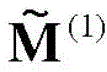
其中,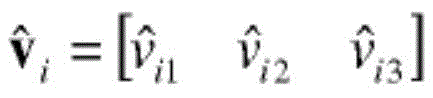
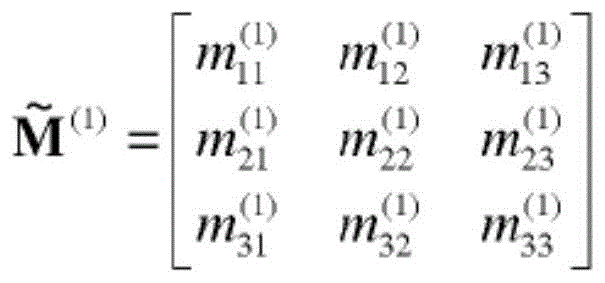
根据下式,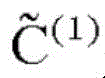

sci是根据sci=[si1·si2 si1·si3 si2·si3 si1·si2·si3]的1×4向量。sc i is a 1×4 vector according to sc i =[s i1 ·s i2 s i1 ·s i3 s i2 ·s i3 s i1 ·s i2 ·s i3 ].
根据本发明的一个方面,提供了一种视频解码器,该解码器包括:用于接收第一图像和元数据的输入端,其中,元数据包括用于多通道、多元回归MMR预测模型的预测参数,其中,MMR模型适于根据第一图像来预测第二图像;处理器;以及用于存储输出图像的存储器,其中处理器用于将第一图像和预测参数应用于MMR预测模型以生成对第二图像进行近似的输出图像,其中,基于第一图像中的至少两个颜色成分的像素值来计算输出图像中的至少一个颜色成分的像素值,其中,MMR模型包括根据下述公式的具有交叉相乘的一阶MMR模型:According to an aspect of the present invention there is provided a video decoder comprising: an input for receiving a first image and metadata, wherein the metadata includes predictions for a multi-channel, multiple regression MMR prediction model parameters, wherein the MMR model is adapted to predict a second image from the first image; a processor; and a memory for storing the output image, wherein the processor is used to apply the first image and the prediction parameters to the MMR prediction model to generate a prediction for the first image The output image of the two-image approximation, wherein the pixel value of at least one color component in the output image is calculated based on the pixel values of at least two color components in the first image, wherein the MMR model includes Multiplicative first-order MMR models:

其中,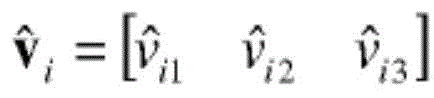
根据下式,
根据下式,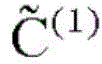

sci是根据sci=[si1·si2 si1·si3 si2·si3 si1·si2·si3]的1×4向量。sc i is a 1×4 vector according to sc i =[s i1 ·s i2 s i1 ·s i3 s i2 ·s i3 s i1 ·s i2 ·s i3 ].
根据本发明的一个方面,提供了一种非暂态计算机可读存储介质,其上存储有用于使用一个或更多个处理器执行上述使用处理器的图像解码方法的计算机可执行程序。According to one aspect of the present invention, there is provided a non-transitory computer-readable storage medium on which is stored a computer-executable program for using one or more processors to execute the above-mentioned image decoding method using a processor.
附图说明Description of drawings
通过示例(但不是通过限制的方式)在附图部分的图中例示了本发明的实施例,附图中相同的附图标记指示类似的元件,其中:Embodiments of the invention are illustrated by way of example, but not by way of limitation, in the figures of the accompanying drawings, in which like reference numerals indicate similar elements, in which:
图1描绘了根据本发明的实施例的VDR-SDR系统的示例数据流;Figure 1 depicts an example data flow of a VDR-SDR system according to an embodiment of the invention;
图2描绘了根据本发明的实施例的示例VDR编码系统;Figure 2 depicts an example VDR encoding system according to an embodiment of the invention;
图3描绘了根据本发明的实施例的多变量多元回归预测算子的输入和输出接口;Fig. 3 depicts the input and output interfaces of a multivariate multiple regression predictor according to an embodiment of the present invention;
图4描绘了根据本发明的实施例的示例多变量多元回归预测处理;Figure 4 depicts an example multivariate multiple regression forecasting process according to an embodiment of the invention;
图5描绘了根据本发明的实施例的关于确定多变量多元回归预测算子的模型的示例处理;5 depicts an example process for determining a model of a multivariate multiple regression predictor according to an embodiment of the invention;
图6描绘了带有根据本发明的实施例进行操作的预测算子的示例图像解码器。Figure 6 depicts an example image decoder with a predictor operating in accordance with an embodiment of the present invention.
具体实施方式Detailed ways
在本文中描述基于多变量多元回归建模的颜色间(inter-color)图像预测。给定一对对应的VDR和SDR图像,即,表示相同场景但是在不同的动态范围等级的图像,这部分描述了允许编码器根据多变量多元回归(MMR,multivariate multi-regression)预测算子和SDR图像对VDR图像进行近似的方法。在下面的描述中,为了解释的目的,陈述了许多特定细节以提供对本发明的充分理解。然而,显然的是,本发明无需这些特定细节仍可实现。在其他情形中,为了避免不必要的掩盖、模糊或者混淆了本发明,没有详尽地描述已知的结构和设备。Inter-color image prediction based on multivariate multiple regression modeling is described herein. Given a pair of corresponding VDR and SDR images, i.e., images representing the same scene but at different levels of dynamic range, this section describes an operator that allows an encoder to predict MMR and A method for approximating VDR images from SDR images. In the following description, for purposes of explanation, numerous specific details are set forth in order to provide a thorough understanding of the invention. It may be evident, however, that the present invention may be practiced without these specific details. In other instances, known structures and devices have not been described in exhaustive detail in order not to unnecessarily obscure, obscure, or obscure the present invention.
概述overview
本文中所描述的示范实施例涉及具有高动态范围的编码图像。实施例创建了MMR预测算子,该MMR预测算子允许VDR图像关于其对应的SDR表示来进行表达。Exemplary embodiments described herein relate to encoded images with high dynamic range. An embodiment creates an MMR predictor that allows a VDR image to be expressed with respect to its corresponding SDR representation.
示例VDR-SDR系统Example VDR-SDR system
图1描绘了在根据本发明的实施例的VDR-SDR系统100中的示例数据流。利用HDR摄像机110获取HDR图像或视频序列。在获取之后,所获取的图像或视频通过灌制处理(mastering process)来进行处理以创建目标VDR图像125。灌制处理可包含多个处理步骤,诸如:编辑,一次和二次颜色校正、颜色变换以及噪声过滤。此处理的VDR输出125表示关于所获取的图像将如何在目标VDR显示器上进行显示的负责人的意图。Figure 1 depicts an example data flow in a VDR-
灌制处理还可输出对应的SDR图像145,其表示关于所获取的图像将如何在合法的SDR显示器上进行显示的负责人的意图。SDR输出145可直接从灌制电路120提供或者SDR输出145可通过分开的VDR至SDR转换器140来产生。The mastering process may also output a
在本示例实施例中,VDR 125和SDR 145信号被输入进编码器130。编码器130的目的是创建经编码的比特流,其中该经编码的比特流减少了传输VDR和SDR信号所需的带宽并且还允许对应的解码器150进行解码并且呈现SDR信号或者VDR信号。在示例实现方式中,编码器130可以是分层编码器,诸如通过MPEG-2和H.264编码标准定义的那些编码器中的一个,这将其输出表示为基层、可选增强层以及元数据。如本文中所使用的术语“元数据”涉及作为经编码的比特流的一部分被传输并且帮助解码器呈现经解码的图像的任何辅助信息。这种元数据可包括(但是不限于)如下这些数据:色空间或色域信息、动态范围信息、色调映射信息或者MMR预测算子,诸如本文所描述的那些。In this example embodiment,
在接收器上,解码器150使用所接收的经编码的比特流和元数据,以根据目标显示器的能力来呈现SDR图像或者VDR图像。例如,SDR显示器可仅使用基层和元数据来呈现SDR图像。相比之下,VDR显示器可使用来自所有输入层的信息和元数据来呈现VDR信号。At the receiver, a
图2更详细地示出了包括本发明的方法的编码器130的示例实现方式。在图2中,SDR’表示增强的SDR信号。SDR视频现在是8比特、4:2:0、ITU Rec.709数据。SDR’可具有与SDR相同的色空间(原色和白点),但是,对在全空间分辨率下的所有颜色成分(例如,4:4:4RGB)可使用高精度,比方说每个像素12比特。根据图2,能够利用一组正变换从SDR’信号容易地导出SDR,所述一组正变换可包括从比方说每个像素12比特到每个像素8比特的量化,比方说从RGB到YUV的颜色变换以及比方说从4:4:4到4:2:0的颜色子采样。变换器210的SDR输出施加于压缩系统220。根据应用,压缩系统220可能是有损耗的(诸如H.264或MPEG-2)或者无损耗的。压缩系统220的输出可作为基层225传输。为了减小经编码的信号与经解码的信号之间的偏移,编码器130在压缩处理220之后紧接对应的解压缩处理230和对应于正变换210的逆变换240,这并非罕见。因此,预测算子250可具有下列输入:VDR输入205,以及SDR’信号245(当该信号将由对应的解码器接收时其对应于SDR’信号)或输入SDR’207。使用输入的VDR和SDR’数据的预测算子250将创建信号257,信号257表示输入VDR 205的近似或估计。加法器260从初始的VDR 205减去经预测的VDR 257以形成输出残余信号265。随后(未示出),残余265也可由另一有损耗或无损耗的编码器进行编码并且可作为增强层传输至解码器。Fig. 2 shows an example implementation of an
预测算子250还可提供在预测处理中使用的预测参数,作为元数据255。由于预测参数可在编码处理期间例如逐帧地或者逐场景地变化,所以这些元数据可作为数据中还包括基层及增强层的一部分被传输至解码器。The
由于VDR 205和SDR’207都表示相同的场景,但针对的是具有不同特征(诸如,动态范围和色域)的不同显示器,所以期望这两个信号具有非常紧密的关联性。在本发明的示例实施方式中,开发了新的多变量、多元回归(MMR)预测算子250,其允许使用与VDR信号对应的SDR’信号和多变量MMR算子来预测输入VDR信号。Since both
示例预测模型Example predictive model
图3示出了根据本发明的示例实现方式的MMR预测算子300的输入和输出接口。根据图3,预测算子330接收输入向量v 310和s 320,它们分别表示VDR图像数据和SDR图像数据,并且预测算子330输出向量
示例标记法和命名法Example notation and nomenclature
SDR图像320中的第i个像素的三个颜色成分标记为:The three color components of the ith pixel in the
si=[si1 si2 si3]。 (1)s i =[s i1 s i2 s i3 ]. (1)
VDR输入310中的第i个像素的三个颜色成分标记为:The three color components of the ith pixel in the
Vi=[vi1 vi2 vi3]。 (2)V i =[v i1 v i2 v i3 ]. (2)
经预测的VDR 340中的第i个像素的经预测的三个颜色成分标记为:The predicted three color components of the i-th pixel in the predicted

一个颜色成分中的像素总数标记为p。The total number of pixels in a color component is denoted p.
在等式(1-3)中,颜色像素可以是RGB、YUV、YCbCr、XYZ或者任意其他颜色表示。尽管等式(1-3)针对每个图像或视频帧中的每个像素假定三个颜色表示,但还如后面所示,本文所描述的方法可容易地扩展至每个像素具有多于三个颜色成分的图像和视频表示,或者扩展至这样的图像表示,其中输入中的一个可具有颜色表示数量与其他输入不同的像素。In equations (1-3), the color pixels can be RGB, YUV, YCbCr, XYZ or any other color representation. Although equations (1-3) assume three color representations for each pixel in each image or video frame, as also shown later, the methods described herein can be easily extended to have more than three color representations per pixel. image and video representations of color components, or extended to image representations where one of the inputs may have a different number of pixels of color representation than the other inputs.
一阶模型(MMR-1)First-order model (MMR-1)
利用多变量多元回归(MMR)模型,一阶预测模型能够表示为:Using a multivariate multiple regression (MMR) model, the first-order predictive model can be expressed as:

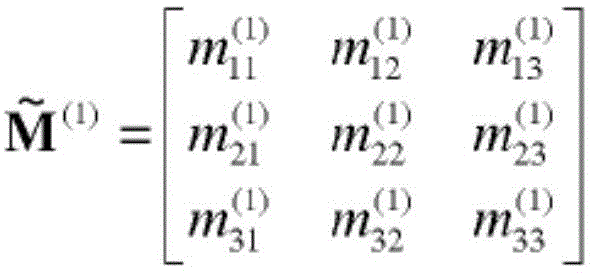
其中,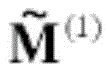

应当注意,这是多颜色通道预测模型。在等式(4)的
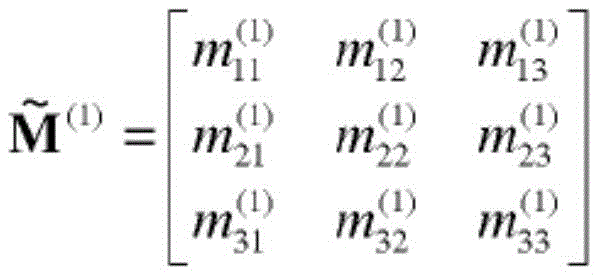
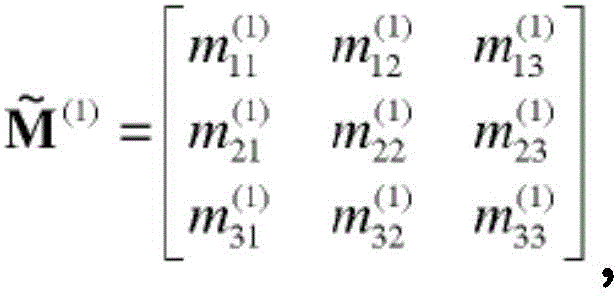
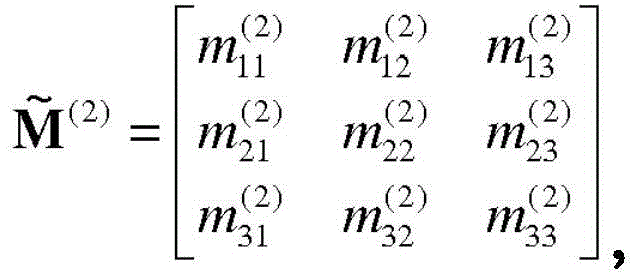
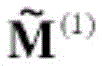
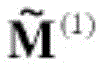
通过使用基于单个矩阵的表示能够将等式(4)简化为:Equation (4) can be simplified to:

其中,in,
和S′i=[1 si1 si2 si3] (7) and S′ i =[1 s i1 s i2 s i3 ] (7)
通过将帧(或者输入的其他合适片段或部分)的所有p个像素集合在一起,可以具有下面的矩阵表示:By grouping together all p pixels of a frame (or other suitable segment or part of the input), one can have the following matrix representation:
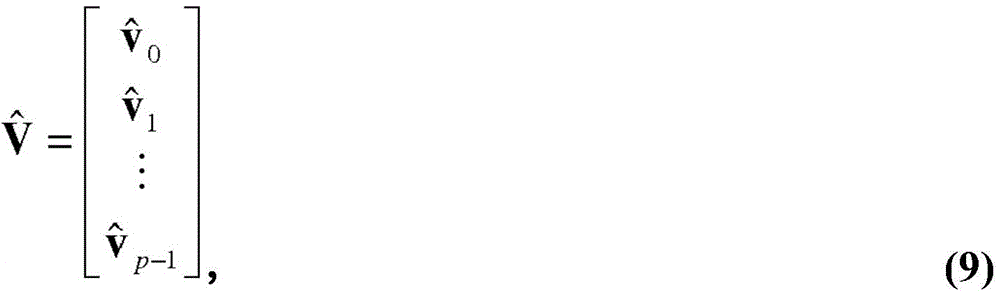
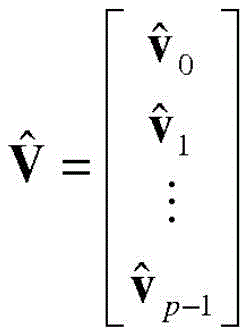
其中,in,
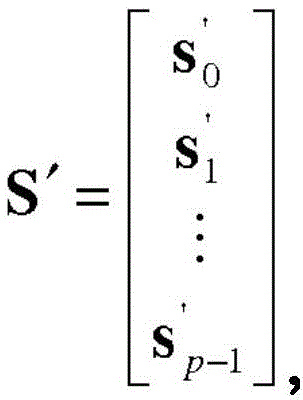

基于等式(8)的这个线性系统,能够将此MMR系统用公式表示为两个不同的问题:(a)最小二乘问题,或者(b)总体最小二乘问题;两个问题都能使用已知的数值方法求解。例如,使用最小二乘方法,用于求解M的问题可用公式表示为将残余或预测均方误差最小化,或者Based on this linear system of equation (8), it is possible to formulate this MMR system as two different problems: (a) a least squares problem, or (b) a total least squares problem; both problems can use known numerical methods. For example, using the method of least squares, the problem for solving M can be formulated as minimizing the residual or prediction mean squared error, or

其中V是使用对应的VDR输入数据形成的p×3矩阵。where V is a p×3 matrix formed using the corresponding VDR input data.
给定了等式(8)和(10),M(1)的最佳解给出为Given equations (8) and (10), the optimal solution for M (1) is given as
M(1)=(S′TS′)-1S′TV, (11)M (1) = (S′ T S′) -1 S′ T V, (11)
其中,S’T表示S’的转置矩阵,S’TS’是4×4矩阵。Among them, S' T represents the transpose matrix of S', and S' T S' is a 4×4 matrix.
如果S’是满列秩,例如,If S' is full column rank, e.g.,
rank(S′)=4≤p,rank(S')=4≤p,
则,还可利用多种替代的数值技术(包括SVD、QR或者LU分解)来解出M(1)。Then, M (1) can also be solved using a variety of alternative numerical techniques including SVD, QR or LU decomposition.
二阶模型(MMR-2)Second-order model (MMR-2)
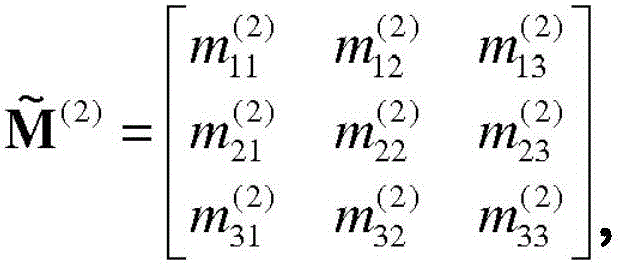
等式(4)表示一阶MMR预测模型。还可以考虑采用如接下来所描述的更高阶预测。Equation (4) represents a first-order MMR prediction model. Higher order predictions as described next can also be considered.
二阶预测MMR模型可表示为:The second-order predictive MMR model can be expressed as:
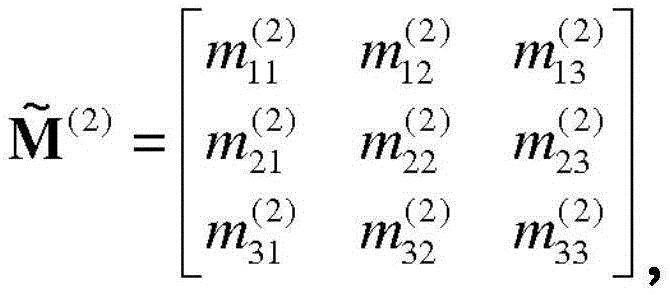
其中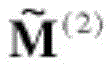

等式(12)能够通过使用单个预测矩阵来简化,Equation (12) can be simplified by using a single predictor matrix,

其中,in,
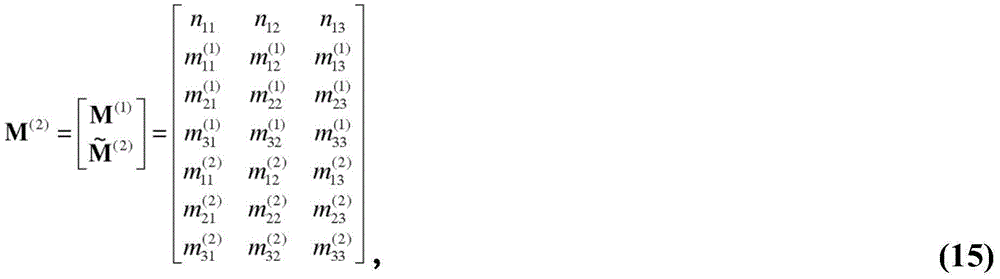
并且and

通过将所有p个像素集合在一起,可定义下面的矩阵表示:By grouping all p pixels together, the following matrix representation can be defined:

其中,in,
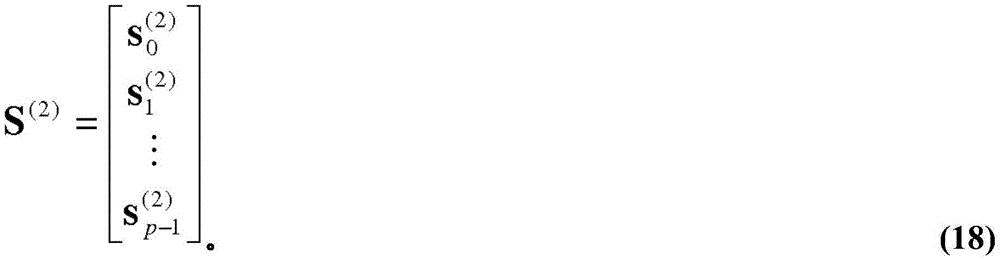
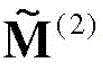
能够利用在前面的部分中描述的相同优化和求解法来求解等式(14)。最小二乘问题的M(2)的最佳解是Equation (14) can be solved using the same optimization and solution methods described in the previous section. The optimal solution to M (2) of the least squares problem is
M(2)=(S(2)TS(2))-1S(2)TV, (19)M (2) = (S (2) T S (2) ) -1 S (2) T V, (19)
其中,S(2)TS(2)现在是7×7矩阵。where S (2)T S (2) is now a 7×7 matrix.
还能够以类似的方式构建三阶或更高阶的MMR模型。A third-order or higher-order MMR model can also be constructed in a similar manner.
具有交叉相乘的一阶模型(MMR-1C)First-order model with cross multiplication (MMR-1C)
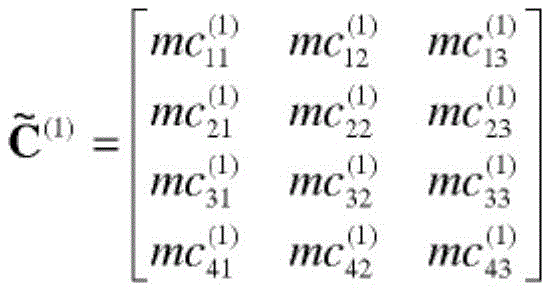
在替代MMR模型中,能够增强等式(4)的一阶预测模型以包括每个像素的颜色成分之间的交叉相乘(cross-multiplication),如下:In an alternative MMR model, the first-order prediction model of equation (4) can be enhanced to include cross-multiplication between the color components of each pixel, as follows:

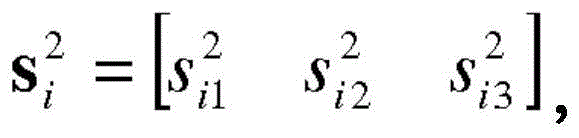
其中,

并且sci=[si1·si2 si1·si3 si2·si3 si1·si2·si3]。 (21)And sc i =[s i1 ·s i2 s i1 ·s i3 s i2 ·s i3 s i1 ·s i2 ·s i3 ]. (twenty one)
根据如之前一样的方法,等式(20)的MMR-1C模型能够通过利用单个预测矩阵MC简化,如下:According to the same method as before, the MMR-1C model of equation (20) can be simplified by using a single prediction matrix MC as follows:

其中,in,
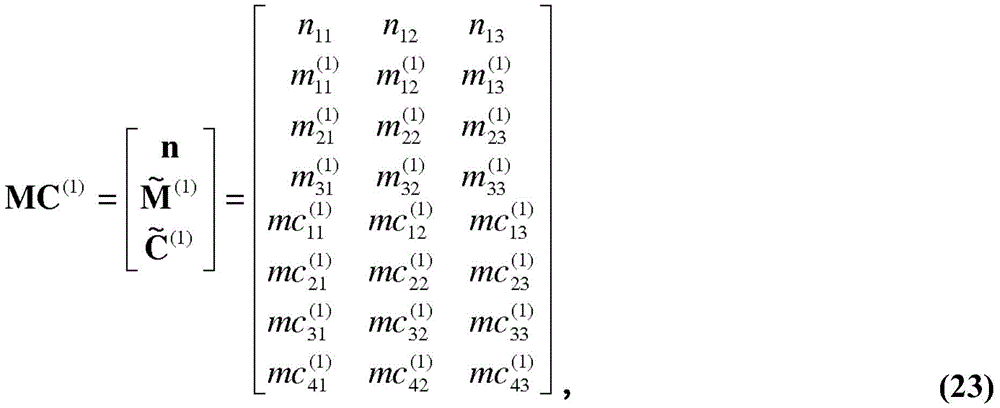
并且and

通过将所有p个像素集合在一起,可以导出简化的矩阵表示,如下:By grouping all p pixels together, a simplified matrix representation can be derived as follows:
其中,in,

SC是p×(1+7)矩阵并且能够利用前面描述的相同最小二乘解来求解。SC is a px(1+7) matrix and can be solved using the same least squares solution described previously.
具有交叉相乘的二阶模型(MMR-2C)Second-order model with cross multiplication (MMR-2C)
一阶MMR-1C能够扩展至还包括二阶数据。例如,The first order MMR-1C can be extended to also include second order data. E.g,

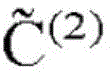
其中,in,

并且and

并且等式(27)的其余分量与之前在等式(5-26)中定义的那些相同。And the remaining components of equation (27) are the same as those previously defined in equations (5-26).
与前面一样,等式(27)通过使用简单预测矩阵MC(2)来简化,As before, equation (27) is simplified by using the simple predictor matrix MC (2) ,

其中,in,
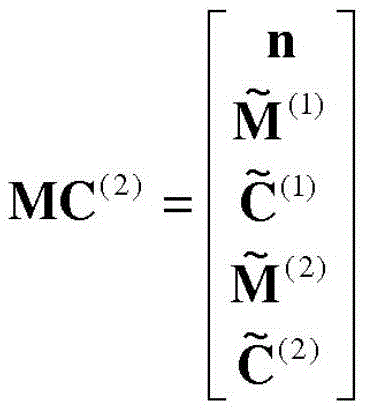
并且
通过将所有的p个像素集合在一起,可以具有简化的矩阵表示By grouping all p pixels together, one can have a simplified matrix representation of

其中,in,

并且SC(2)是px(1+2*7)矩阵并且可以应用如之前所描述的相同最小二乘解。And SC (2) is a px(1+2*7) matrix and the same least squares solution as described before can be applied.
能够以类似的方式构建具有交叉相乘参数的三阶或更高阶模型。替代地,如在“Chaper 5.4.3of“Digital Color Imaging Handbook”,CRC Press,2002,Edited byGaurav Sharma”中所描述的,还能够利用下列的公式描述MMR交叉相乘模型的K阶表示。Third-order or higher-order models with cross-multiply parameters can be constructed in a similar manner. Alternatively, as described in "Chaper 5.4.3 of "Digital Color Imaging Handbook", CRC Press, 2002, Edited by Gaurav Sharma", the K-order representation of the MMR cross-multiply model can also be described using the following formula.


并且and

其中,K表示MMR预测算子的最高阶。Among them, K represents the highest order of the MMR predictor.
基于空间扩展的MMR(MMR-C-S)MMR based on space expansion (MMR-C-S)
到目前为止所描述的所有MMR模型中,经预测的像素
如果在一个图像中考虑所有八个可能的邻近像素,则此方法可将每个颜色成分的多达八个多一阶变量添加进该预测矩阵M中。然而,在实际中,通常仅添加与两个水平邻近像素和两个垂直邻近像素对应的预测变量就足够了,忽略对角邻近像素。这将每个颜色成分的多达四个变量添加进预测矩阵中,即,所述四个变量与上边、左边、下边以及右边像素对应。类似地,还能够添加与邻近的像素值的更高阶数对应的参数。This method can add up to eight more first-order variables per color component into the prediction matrix M if all eight possible neighbors are considered in an image. In practice, however, it is usually sufficient to only add predictors corresponding to two horizontally adjacent pixels and two vertically adjacent pixels, ignoring diagonally adjacent pixels. This adds up to four variables for each color component into the prediction matrix, ie the four variables correspond to the top, left, bottom and right pixels. Similarly, parameters corresponding to higher orders of neighboring pixel values can also be added.
为了简化这种MMR空间模型的复杂性和计算要求,可以考虑仅针对单个颜色成分,诸如亮度成分(如在亮度-色度表示中)或绿色成分(如在RGB表示中),将空间扩展添加至传统模型。例如,假定仅针对绿色的颜色成分添加基于空间的像素预测,则根据等式(34-36),预测绿色输出像素值的一般表示将是To simplify the complexity and computational requirements of such an MMR spatial model, one can consider adding the spatial extension to traditional models. For example, assuming that spatially-based pixel prediction is added only for the color component of green, then according to equations (34-36), the general representation of the predicted green output pixel value would be

具有空间扩展的一阶模型(MMR-1-S)First-order model with spatial extension (MMR-1-S)
如另一示例实现方式,可以再考虑等式(4)的一阶MMR模型(MMR-1),但是,现在被增强了,以包括在一个或更多个颜色成分中的空间扩展。例如,当应用于第一颜色成分中的每个像素的四个邻近像素时,As another example implementation, the first-order MMR model (MMR-1) of equation (4) may again be considered, but now enhanced to include spatial expansion in one or more color components. For example, when applied to the four neighbors of each pixel in the first color component,

其中,
并且
其中,等式(39)中的m表示具有m列和n行的输入帧中的列数,或者m×n=p总像素。等式(39)能够容易地扩展成将这些方法应用于其他颜色成分和应用于替代的邻近像素构造。where m in equation (39) represents the number of columns in an input frame with m columns and n rows, or m x n = p total pixels. Equation (39) can be easily extended to apply these methods to other color components and to alternative neighboring pixel configurations.
根据与之前相同的方法,等式(38)能够容易地用公式表示为线性等式的系统According to the same method as before, equation (38) can be easily formulated as a system of linear equations

其可以如之前描述的一样进行求解。It can be solved as described previously.
具有多于三个原色的VDR信号的应用Application of VDR signals with more than three primary colors
所有所提出的MMR预测模型能够容易地扩展至具有多于三个原色的信号空间。作为示例,可以考虑这样的情况,其中SDR信号具有三个原色,比方说RGB,但是,VDR信号以具有六个原色的P6色空间来定义。在这种情况下,等式(1-3)能够改写为All proposed MMR prediction models can be easily extended to signal spaces with more than three primaries. As an example, consider the case where an SDR signal has three primary colors, say RGB, whereas a VDR signal is defined in a P6 color space with six primary colors. In this case, equations (1-3) can be rewritten as
si=[si1 si2 si3], (41)s i =[s i1 s i2 s i3 ], (41)
vi=[vi1 vi2 vi3 vi4 vi5 vi6], (42)v i =[v i1 v i2 v i3 v i4 v i5 v i6 ], (42)
以及as well as
如之前一样,在一个颜色成分中的像素的数量表示为p。现在考虑等式(4)的一阶MMR预测模型(MMR-1),As before, the number of pixels in one color component is denoted p. Now consider the first-order MMR prediction model (MMR-1) of equation (4),

以及n=[n11 n12 n13 n14 n15 n16]。 (46)and n=[n 11 n 12 n 13 n 14 n 15 n 16 ]. (46)
等式(41)能够使用单个预测矩阵M(1)表示为:Equation (41) can be expressed using a single predictor matrix M (1) as:
其中,in,

通过将所有p个像素集合在一起,这个预测问题能够描述为By grouping all p pixels together, the prediction problem can be described as
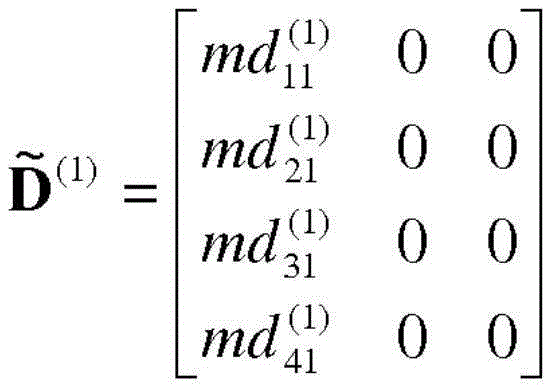
其中,in,
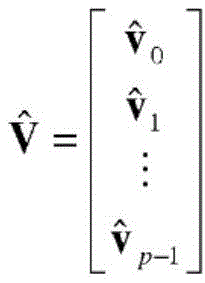
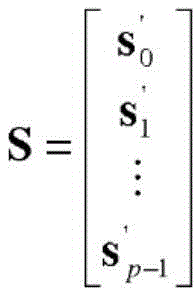
更高阶的MMR预测模型还能够以类似的方式扩展并且经由之前描述的方法能够获得预测矩阵的解。Higher order MMR prediction models can also be extended in a similar manner and the solution of the prediction matrix can be obtained via the method described before.
多通道、多元回归预测的示例处理Example Processing of Multi-Channel, Multiple Regression Forecasting
图4示出了根据本发明的示例实现方式的多通道多元回归预测的示例处理。Figure 4 illustrates an example process for multi-channel multiple regression prediction according to an example implementation of the invention.
该处理开始于步骤410,其中,预测算子(诸如预测算子250)接收输入的VDR和SDR信号。给定两个输入的情形下,在步骤420中预测算子决定选择哪个MMR模型。如前面所描述的,预测算子能够在多种MMR模型当中进行选择,这些模型包括(但不限于):一阶模型(MMR-1)、二阶模型(MMR-2)、三阶或更高阶模型、具有交叉相乘的一阶模型(MMR-1C)、具有交叉相乘的二阶模型(MMR-2C)、具有交叉相乘的三阶模型(MMR-3C)、具有交叉相乘的三阶或更高阶模型、或者添加有空间扩展的上述模型中的任何一种。The process begins at
能够使用考虑到多个准则的多种方法来进行MMR模型的选择,所述准则包括:关于SDR和VDR输入的现有知识、可获得的计算和存储器资源以及目标编码效率。图5示出了基于残余要比预定阈值低的要求的步骤420的示例实现方式。The selection of the MMR model can be done using a variety of methods that take into account several criteria including: prior knowledge about SDR and VDR inputs, available computational and memory resources, and target coding efficiency. FIG. 5 shows an example implementation of
如之前所描述的,如下形式的一组线性等式能够表示任意MMR模型As previously described, a set of linear equations of the form can represent any MMR model

其中,M是预测矩阵。Among them, M is the prediction matrix.
在步骤430,能够使用多种数值方法来求解M。例如,在使V与其估计
M=(STS)-1STV。 (51)M = (S T S) -1 S T V. (51)
最后,在步骤440,使用等式(50),预测算子输出
图5示出了在预测期间用于选择MMR模型的示例处理420。在步骤510中预测算子250可以开始于初始MMR模型,诸如,已在之前的帧或场景中使用的MMR模型,例如,二阶模型(MMR-2),或最简单的可能模型,诸如MMR-1。针对M进行求解之后,在步骤520中,预测算子计算输入V与其预测的值之间的预测误差。在步骤530中,如果预测误差低于给定的阈值,则预测算子选择现有的模型并且停止选择处理(540),否则,在步骤550,检查是否使用更复杂的模型。例如,如果当前模型是MMR-2,则预测算子可决定使用MMR-2-C或MMR-2-C-S。如前面所描述的,此决定可取决于多种准则,包括预测误差的值、处理功率要求以及目标编码效率。如果使用更复杂的模型切实可行,则在步骤560中选择新模型并且处理返回步骤520。否则,预测算子将使用现有的模型(540)。FIG. 5 illustrates an
可根据需要以多种间隔来重复预测处理400,以在利用可用的计算资源的同时保持编码效率。例如,当对视频信号进行编码时,针对每一帧、一组帧或者每当预测残余超过特定阈值时,可基于每个预定义的视频片段大小来重复处理400。
预测处理400还能够使用所有可用的输入像素或者这些像素的子采样。在一个示例实现方式中,可以使用来自输入数据的每第k个像素行和每第k个像素列的像素,其中k是等于或大于2的整数。在另一示例实现方式中,可以决定跳过处于特定裁剪阈值(例如,非常接近于0)以下的输入像素或者处于特定饱和阈值(例如,对于n比特数据,非常接近于2n-1的像素值)以上的像素。在另一实现方式中,可使用这种子采样和阈值化技术的结合,以减小像素采样大小并且适应特定实现方式的计算约束。
图像解码image decoding
可在图像编码器或在图像解码器上实现本发明的实施例。图6示出了根据本发明的实施例的解码器150的示例实现方式。解码系统600接收经编码的比特流,该经编码的比特流可兼有基层690、可选的增强层(或残余)665以及元数据645,它们在解压缩630和多种逆变换640之后被提取。例如,在VDR-SDR系统中,基层690可表示经编码的信号的SDR表示,并且元数据645可包括与在编码器预测算子250中使用的MMR预测模型和对应的预测参数有关的信息。在一种示例实现方式中,当编码器使用根据本发明的方法的MMR预测算子时,元数据可包括所使用的模型的识别(例如,MMR-1、MMR-2、MMR-2C等)以及与具体模型相关联的所有矩阵系数。给定基层690和从元数据645提取的颜色MMR相关的参数,则预测算子650能够利用本文所描述的对应等式中的任意等式来计算预测的

示例计算机系统实现方式Example computer system implementation
可通过计算机系统、以电子电路和组件配置的系统、集成电路(IC,integratedcircuit)器件(诸如微控制器、现场可编程门阵列(FPGA,field programmable gatearray)或另一可配置或可编程逻辑器件(PLD,programmable logic device))、离散时间或数字信号处理器(DSP,digital signal processor)、专用IC(ASIC,application specificIC)和/或包括一个或多个这样的系统、器件或组件的装置来实现本发明的实施例。计算机和/或IC可执行、控制或运行与基于MMR的预测(诸如,如本文中所描述的那些)有关的指令。计算机和/或IC可计算与如本文所描述的MMR预测有关的多种参数或值中的任一个。可以以硬件、软件、固件以及它们的多种组合来实现图像和视频动态范围扩展实施例。A computer system, a system configured with electronic circuits and components, an integrated circuit (IC, integrated circuit) device (such as a microcontroller, a field programmable gate array (FPGA, field programmable gatearray) or another configurable or programmable logic device (PLD, programmable logic device)), discrete time or digital signal processor (DSP, digital signal processor), application-specific IC (ASIC, application specificIC) and/or a device including one or more such systems, devices or components to Embodiments of the present invention are realized. A computer and/or IC may execute, control or execute instructions related to MMR-based predictions such as those described herein. A computer and/or IC may calculate any of a variety of parameters or values related to MMR prediction as described herein. Image and video dynamic range extension embodiments can be implemented in hardware, software, firmware, and various combinations thereof.
本发明的特定实现方式包括计算机处理器,其运行软件指令,该软件指令使处理器执行本发明的方法。例如,显示器、编码器、机顶盒、代码转换器等中的一个或多个处理器可通过运行处理器可访问的程序存储器中的软件指令来实现如上所述的基于MMR的预测方法。本发明还以程序产品的形式提供。程序产品可包括任意介质,所述任意介质承载包括指令的一套计算机可读信号,所述指令在通过数据处理器执行时使数据处理器执行本发明的方法。根据本发明的程序产品可以是多种多样的形式中的任意一种形式。程序产品可包括例如物理介质,诸如包括软盘、硬盘驱动器的磁性数据存储介质,包括CD ROM、DVD的光数据存储介质,包括ROM、闪存RAM的电子数据存储介质,等。程序产品上的计算机可读信号可选地可以进行压缩或加密。A particular implementation of the invention includes a computer processor executing software instructions that cause the processor to perform the method of the invention. For example, one or more processors in a display, encoder, set-top box, transcoder, etc. may implement the MMR-based prediction method described above by executing software instructions in a program memory accessible to the processor. The present invention is also provided in the form of a program product. The program product may comprise any medium carrying a set of computer readable signals comprising instructions which, when executed by a data processor, cause the data processor to perform the method of the invention. Program products according to the present invention may be in any of a wide variety of forms. The program product may include, for example, physical media such as magnetic data storage media including floppy disks, hard drives, optical data storage media including CD ROM, DVD, electronic data storage media including ROM, flash RAM, and the like. The computer readable signal on the program product may optionally be compressed or encrypted.
上面所指的组件(例如,软件模块、处理器、配件、器件、电路等),除非另有指示,否则对该组件的引用(包括对“装置”的引用)应被解释为包括作为那个组件的等同物的、执行所描述的组件的功能(例如,功能上等同)的任意组件,包括结构上不等同于执行本发明的所例举示例实施例中的功能的被公开结构的组件。Components referred to above (eg, software modules, processors, accessories, devices, circuits, etc.), unless otherwise indicated, references to the component (including references to "means") should be construed as including Any component that performs the function (eg, is functionally equivalent) of a described component is an equivalent, including components that are not structurally equivalent to disclosed structures that perform the function in illustrated example embodiments of the invention.
等同、扩展、替代以及多样化Equivalence, extension, substitution and diversification
因此描述了涉及在对VDR和SDR图像进行编码的过程中应用MMR预测的示例实施例。在前述的说明中,已参考会因实现方式不同而变化的很多具体细节来描述了本发明的实施例。因此,本发明的技术方案以及申请人认为发明所涉及的技术方案的唯一指示是一套权利要求,所述一套权利要求源于本申请、按照公布这样的权利要求所遵循的特定形式、包括后续的修正。本文针对在这样的权利要求中所包含的术语所给出的任何明确定义应涵盖如权利要求中所使用的这种术语的含义。因此,权利要求中没有明确陈述的限制、元件、属性、特征、优点或标志不应以任何方式限制这种权利要求的范围。因此说明书和附图被看作是说明性的而没有限制的意思。Example embodiments relating to the application of MMR prediction in the encoding of VDR and SDR images are thus described. In the foregoing specification, embodiments of the invention have been described with reference to numerous specific details that may vary from implementation to implementation. Accordingly, the only indication of what is the invention, and what the applicant believes to be the invention, is the set of claims that originate from this application in accordance with the specific form in which such claims are issued, including Subsequent corrections. Any explicit definition given herein for a term contained in such a claim shall encompass the meaning of such term as used in the claim. Hence, no limitation, element, property, feature, advantage or sign that is not expressly recited in a claim should limit the scope of such claim in any way. Accordingly, the specification and drawings are to be regarded as illustrative and not in a restrictive sense.
第一组附记:First set of notes:
1.一种方法,包括:1. A method comprising:
接收第一图像和第二图像,其中,所述第二图像具有与所述第一图像不同的动态范围;receiving a first image and a second image, wherein the second image has a different dynamic range than the first image;
从MMR模型的族中选择多通道、多元回归(MMR)预测模型;Select a multi-channel, multiple regression (MMR) forecasting model from the family of MMR models;
求解所选择的MMR模型的预测参数;Solve the prediction parameters of the selected MMR model;
利用所述第二图像和所述MMR模型的预测参数来计算表示所述第一图像的预测值的输出图像;using the second image and the prediction parameters of the MMR model to calculate an output image representing the predicted value of the first image;
输出所述MMR模型的预测参数和所述输出图像。outputting the prediction parameters of the MMR model and the output image.
2.根据附记1所述的方法,其中,所述第一图像包括VDR图像并且所述第二图像包括SDR图像。2. The method according to supplementary note 1, wherein the first image comprises a VDR image and the second image comprises an SDR image.
3.根据附记1所述的方法,其中,所述MMR模型是一阶MMR模型、二阶MMR模型、三阶MMR模型、具有交叉相乘的一阶MMR模型、具有交叉相乘的二阶MMR模型或者具有交叉相乘的三阶MMR模型中的至少一个。3. The method according to Note 1, wherein the MMR model is a first-order MMR model, a second-order MMR model, a third-order MMR model, a first-order MMR model with cross multiplication, a second-order MMR model with cross multiplication At least one of an MMR model or a third order MMR model with cross multiplication.
4.根据附记3所述的方法,其中,所述MMR模型中的任意一个进一步包括涉及相邻像素的预测参数。4. The method according to supplementary note 3, wherein any one of the MMR models further includes prediction parameters related to neighboring pixels.
5.根据附记4所述的方法,其中,所考虑的相邻像素包括左边相邻像素、右边相邻像素、上边相邻像素以及下边相邻像素。5. The method according to supplementary note 4, wherein the considered adjacent pixels include left adjacent pixels, right adjacent pixels, upper adjacent pixels and lower adjacent pixels.
6.根据附记2所述的方法,其中,在所述VDR图像中的像素具有比所述SDR图像中的像素更多的颜色成分。6. The method according to note 2, wherein pixels in the VDR image have more color components than pixels in the SDR image.
7.根据附记1所述的方法,其中,求解所选择的MMR模型的预测参数进一步包括应用使所述第一图像与所述输出图像之间的均方误差最小化的数值方法。7. The method according to supplementary note 1, wherein solving the prediction parameters of the selected MMR model further comprises applying a numerical method that minimizes the mean square error between the first image and the output image.
8.根据附记1所述的方法,其中,从MMR模型的族中选择MMR预测模型进一步包括迭代选择处理,包括:8. The method according to supplementary note 1, wherein selecting the MMR prediction model from the family of MMR models further comprises an iterative selection process, comprising:
(a)选择并应用初始MMR模型;(a) select and apply an initial MMR model;
(b)计算所述第一图像与所述输出图像之间的残余误差;(b) calculating a residual error between said first image and said output image;
(c)如果所述残余误差小于阈值并且无其他MMR模型可用则选择现有MMR模型;否则,选择与先前的模型不同的新MMR模型;并且返回步骤(b)。(c) selecting an existing MMR model if the residual error is less than a threshold and no other MMR model is available; otherwise, selecting a new MMR model different from the previous model; and returning to step (b).
9.一种图像解码方法,包括:9. An image decoding method, comprising:
接收具有第一动态范围的第一图像;receiving a first image having a first dynamic range;
接收元数据,其中,所述元数据定义MMR预测模型和所述MMR预测模型的对应的预测参数;receiving metadata, wherein the metadata defines an MMR prediction model and corresponding prediction parameters of the MMR prediction model;
将所述第一图像和所述预测参数应用到所述MMR预测模型,以计算表示第二图像的预测值的输出图像,其中,所述第二图像具有与所述第一图像的动态范围不同的动态范围。applying the first image and the prediction parameters to the MMR prediction model to compute an output image representing a prediction for a second image, wherein the second image has a dynamic range different from that of the first image dynamic range.
10.根据附记9所述的方法,其中,所述MMR模型是一阶MMR模型、二阶MMR模型、三阶MMR模型、具有交叉相乘的一阶MMR模型、具有交叉相乘的二阶MMR模型或者具有交叉相乘的三阶MMR模型中的至少一个。10. The method according to Note 9, wherein the MMR model is a first-order MMR model, a second-order MMR model, a third-order MMR model, a first-order MMR model with cross multiplication, a second-order MMR model with cross multiplication At least one of an MMR model or a third order MMR model with cross multiplication.
11.根据附记10所述的方法,其中,所述MMR模型中的任意一个进一步包括涉及相邻像素的预测参数。11. The method according to supplementary note 10, wherein any one of the MMR models further includes prediction parameters related to neighboring pixels.
12.根据附记9所述的方法,其中,所述第一图像包括SDR图像,并且所述第二图像包括VDR图像。12. The method according to supplementary note 9, wherein the first image comprises an SDR image, and the second image comprises a VDR image.
13.一种装置,包括处理器并且配置成执行附记1-12中所述的方法中的任意一种方法。13. An apparatus, comprising a processor and configured to execute any one of the methods described in Supplements 1-12.
14.一种计算机可读存储介质,存储有用于执行根据附记1-12中的任意一项所述的方法的计算机可执行指令。14. A computer-readable storage medium storing computer-executable instructions for executing the method according to any one of Supplements 1-12.
第二组附记:Second set of notes:
1.一种方法,包括:1. A method comprising:
提供多种多通道、多元回归(MMR)预测模型,每个MMR预测模型适于根据下列项来近似具有第一动态范围的图像,A plurality of multi-channel, multiple regression (MMR) prediction models are provided, each MMR prediction model being adapted to approximate an image having a first dynamic range according to,
具有第二动态范围的图像,以及an image with a second dynamic range, and
通过应用颜色间图像预测而获得的所述各个MMR预测模型的预测参数;prediction parameters of said respective MMR prediction models obtained by applying inter-color image prediction;
接收第一图像和第二图像,其中,所述第二图像具有与所述第一图像不同的动态范围;receiving a first image and a second image, wherein the second image has a different dynamic range than the first image;
从所述多种MMR模型中选择多通道、多元回归(MMR)预测模型;Select a multi-channel, multiple regression (MMR) prediction model from the plurality of MMR models;
确定所选择的MMR模型的预测参数的值;determining the values of the predictive parameters of the selected MMR model;
基于所述第二图像和应用于所选择的MMR预测模型的预测参数的所确定值来计算对所述第一图像进行近似的输出图像;calculating an output image that approximates the first image based on the second image and the determined values of the prediction parameters applied to the selected MMR prediction model;
输出所述预测参数的所确定的值和所计算的输出图像,其中,所述多种MMR模型包括根据如下公式的结合每个像素的颜色成分之间的交叉相乘的一阶多通道、多元回归预测模型,Outputting the determined values of the prediction parameters and the calculated output image, wherein the various MMR models include a first-order multi-channel, multivariate multi-channel multiplication according to the following formula: regression predictive model,

其中,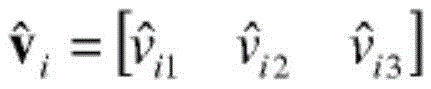
si=[si1 si2 si3]表示所述第二图像的第i像素的三个颜色成分,s i =[s i1 s i2 s i3 ] represents the three color components of the i-th pixel of the second image,
根据下式,

sci=[si1·si2 si1·si3 si2·si3 si1·si2·si3],并且sc i =[s i1 s i2 s i1 s i3 s i2 s i3 s i1 s i2 s i3 ], and
其中,通过使所述第一图像与所述输出图像之间的均方误差最小化来在数值上获得所述一阶多通道、多元回归预测模型的预测参数。Wherein, the prediction parameters of the first-order multi-channel, multiple regression prediction model are numerically obtained by minimizing the mean square error between the first image and the output image.
2.根据附记1所述的方法,其中,所述第一图像包括VDR图像并且所述第二图像包括SDR图像。2. The method according to supplementary note 1, wherein the first image comprises a VDR image and the second image comprises an SDR image.
3.根据附记1所述的方法,其中,所选择的MMR预测模型是一阶MMR模型、二阶MMR模型、三阶MMR模型、具有交叉相乘的一阶MMR模型、具有交叉相乘的二阶MMR模型或者具有交叉相乘的三阶MMR模型中的至少一个。3. The method according to Note 1, wherein the selected MMR prediction model is a first-order MMR model, a second-order MMR model, a third-order MMR model, a first-order MMR model with cross multiplication, a cross multiplication At least one of a second order MMR model or a third order MMR model with cross multiplication.
4.根据附记3所述的方法,其中,所述MMR模型中的任意一个进一步包括涉及相邻像素的预测参数。4. The method according to supplementary note 3, wherein any one of the MMR models further includes prediction parameters related to neighboring pixels.
5.根据附记4所述的方法,其中,所述相邻像素包括左边相邻像素、右边相邻像素、上边相邻像素以及下边相邻像素。5. The method according to supplementary note 4, wherein the adjacent pixels include left adjacent pixels, right adjacent pixels, upper adjacent pixels and lower adjacent pixels.
6.根据附记2所述的方法,其中,在所述VDR图像中的像素具有比所述SDR图像中的像素更多的颜色成分。6. The method according to note 2, wherein pixels in the VDR image have more color components than pixels in the SDR image.
7.根据附记1所述的方法,其中,从所述多种MMR预测模型中选择MMR预测模型进一步包括迭代选择处理,包括:7. The method according to Note 1, wherein selecting the MMR prediction model from the multiple MMR prediction models further includes iterative selection processing, including:
(a)选择并应用初始MMR预测模型;(a) select and apply an initial MMR prediction model;
(b)计算所述第一图像与所述输出图像之间的残余误差;(b) calculating a residual error between said first image and said output image;
(c)如果所述残余误差小于误差阈值并且无其他MMR预测模型能够选择,则选择所述初始MMR模型;否则,从所述多种MMR预测模型中选择新MMR预测模型,所述新MMR预测模型不同于之前选择的MMR预测模型;并且返回步骤(b)。(c) If the residual error is less than the error threshold and no other MMR prediction model can be selected, then select the initial MMR model; otherwise, select a new MMR prediction model from the multiple MMR prediction models, and the new MMR prediction The model is different from the previously selected MMR prediction model; and return to step (b).
8.一种图像解码方法,包括:8. An image decoding method, comprising:
接收具有第一动态范围的第一图像;receiving a first image having a first dynamic range;
接收元数据,其中,所述元数据包括receiving metadata, wherein the metadata includes
多元回归(MMR)预测模型,所述多元回归预测模型适于根据下列项来近似具有第二动态范围的第二图像,a multiple regression (MMR) prediction model adapted to approximate the second image having the second dynamic range according to,
所述第一图像,以及the first image, and
通过应用颜色间图像预测而获得的所述MMR预测模型的预测参数,所述元数据进一步包括所述预测参数的先前确定值,以及prediction parameters of said MMR prediction model obtained by applying inter-color image prediction, said metadata further comprising previously determined values of said prediction parameters, and
将所述第一图像和所述预测参数的先前确定值应用于所述MMR预测模型,以计算用于近似所述第二图像的输出图像,其中,所述第二动态范围不同于所述第一动态范围,其中,所述MMR预测模型是根据如下公式的结合每个像素的颜色成分之间的交叉相乘的一阶多通道、多元回归预测模型,applying the first image and previously determined values of the prediction parameters to the MMR prediction model to compute an output image for approximating the second image, wherein the second dynamic range is different from the first A dynamic range, wherein the MMR prediction model is a first-order multi-channel, multiple regression prediction model combined with the cross multiplication between the color components of each pixel according to the following formula,

其中,
si=[si1 si2 si3]表示所述第二图像的第i像素的三个颜色成分,s i =[s i1 s i2 s i3 ] represents the three color components of the i-th pixel of the second image,
根据下式,
sci=[si1·si2 si1·si3 si2·si3 si1·si2·si3],并且sc i =[s i1 s i2 s i1 s i3 s i2 s i3 s i1 s i2 s i3 ], and

9.根据附记8所述的方法,其中,将所述一阶MMR预测模型扩展成具有像素交叉相乘的二阶MMR预测模型或三阶MMR预测模型。9. The method according to supplementary note 8, wherein the first-order MMR prediction model is extended to a second-order MMR prediction model or a third-order MMR prediction model with pixel cross multiplication.
10.根据附记8或9所述的方法,其中,所述MMR预测模型进一步包括涉及相邻像素的预测参数。10. The method according to Supplement 8 or 9, wherein the MMR prediction model further includes prediction parameters related to adjacent pixels.
11.根据附记8所述的方法,其中,所述第一图像包括SDR图像和所述第二图像包括VDR图像。11. The method according to supplementary note 8, wherein the first image comprises an SDR image and the second image comprises a VDR image.
12.一种装置,包括处理器并且配置成执行附记1-11中所述的方法中的任意一种方法。12. An apparatus, comprising a processor and configured to execute any one of the methods described in Supplements 1-11.
13.一种计算机可读存储介质,存储有用于执行根据附记1-11中的任意一项所述的方法的计算机可执行指令。13. A computer-readable storage medium storing computer-executable instructions for executing the method according to any one of Supplements 1-11.
14.一种方法,包括:14. A method comprising:
提供多种多通道、多元回归(MMR)预测模型,每个MMR预测模型适于根据下列项来近似具有第一动态范围的图像,A plurality of multi-channel, multiple regression (MMR) prediction models are provided, each MMR prediction model being adapted to approximate an image having a first dynamic range according to,
具有第二动态范围的图像,以及an image with a second dynamic range, and
通过应用颜色间图像预测而获得的所述各个MMR预测模型的预测参数;prediction parameters of said respective MMR prediction models obtained by applying inter-color image prediction;
接收第一图像和第二图像,其中,所述第二图像具有与所述第一图像不同的动态范围;receiving a first image and a second image, wherein the second image has a different dynamic range than the first image;
从所述多种MMR模型中选择多通道、多元回归(MMR)预测模型;Select a multi-channel, multiple regression (MMR) prediction model from the plurality of MMR models;
确定所选择的MMR模型的预测参数的值;determining the values of the predictive parameters of the selected MMR model;
基于所述第二图像和应用于所选择的MMR预测模型的预测参数的所确定值来计算对所述第一图像进行近似的输出图像;calculating an output image that approximates the first image based on the second image and the determined values of the prediction parameters applied to the selected MMR prediction model;
输出所述预测参数的所确定值和所计算的输出图像,其中,所述多种MMR模型包括根据如下公式的二阶多通道、多元回归预测,outputting the determined values of the prediction parameters and the calculated output images, wherein the plurality of MMR models comprise second-order multi-channel, multiple regression predictions according to the formula,

其中,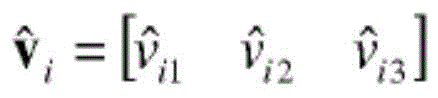
si=[si1 si2 si3]表示所述第二图像的第i像素的三个颜色成分,s i =[s i1 s i2 s i3 ] represents the three color components of the i-th pixel of the second image,
根据下式,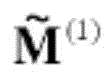

n=[n11 n12 n13],n=[n 11 n 12 n 13 ],
其中,通过使所述第一图像与所述输出图像之间的均方误差最小化来在数值上获得所述二阶多通道、多元回归预测模型的预测参数。Wherein, the prediction parameters of the second-order multi-channel, multiple regression prediction model are numerically obtained by minimizing the mean square error between the first image and the output image.
15.根据附记14所述的方法,其中,所述MMR模型中的任意一个包括涉及相邻像素的预测参数。15. The method according to appendix 14, wherein any one of the MMR models includes prediction parameters related to neighboring pixels.
16.根据附记15所述的方法,其中,所述相邻像素包括左边相邻像素、右边相邻像素、上边相邻像素以及下边相邻像素。16. The method according to supplementary note 15, wherein the adjacent pixels include left adjacent pixels, right adjacent pixels, upper adjacent pixels and lower adjacent pixels.
17.根据附记14所述的方法,其中,从所述多种MMR预测模型中选择MMR预测模型进一步包括迭代选择处理,包括:17. The method according to supplementary note 14, wherein selecting an MMR prediction model from the plurality of MMR prediction models further includes an iterative selection process, including:
(a)选择并应用初始MMR预测模型;(a) select and apply an initial MMR prediction model;
(b)计算所述第一图像与所述输出图像之间的残余误差;(b) calculating a residual error between said first image and said output image;
(c)如果所述残余误差小于误差阈值并且无其他MMR模型能够选择则选择初始MMR模型;否则,从所述多种MMR预测模型中选择新MMR预测模型,所述新MMR预测模型不同于先前选择的MMR预测模型;并且返回步骤(b)。(c) if the residual error is less than the error threshold and no other MMR models can be selected then select the initial MMR model; otherwise, select a new MMR prediction model from the multiple MMR prediction models, the new MMR prediction model is different from the previous The selected MMR prediction model; and return to step (b).
18.一种图像解码方法,包括:18. An image decoding method, comprising:
接收具有第一动态范围的第一图像;receiving a first image having a first dynamic range;
接收元数据,其中,所述元数据包括receiving metadata, wherein the metadata includes
多元回归(MMR)预测模型,所述多元回归预测模型适于根据下列项来近似具有第二动态范围的第二图像,a multiple regression (MMR) prediction model adapted to approximate the second image having the second dynamic range according to,
所述第一图像,以及the first image, and
通过应用颜色间图像预测而获得的所述MMR预测模型的预测参数,所述元数据进一步包括所述预测参数的先前确定值;以及Prediction parameters of said MMR prediction model obtained by applying inter-color image prediction, said metadata further comprising previously determined values of said prediction parameters; and
将所述第一图像和所述预测参数的先前确定值应用于所述MMR预测模型,以计算用于近似所述第二图像的输出图像,其中,所述第二动态范围不同于所述第一动态范围,其中,所述MMR预测模型是根据如下公式的二阶多通道、多元回归预测,applying the first image and previously determined values of the prediction parameters to the MMR prediction model to compute an output image for approximating the second image, wherein the second dynamic range is different from the first A dynamic range, wherein the MMR prediction model is a second-order multi-channel, multiple regression prediction according to the following formula,

其中,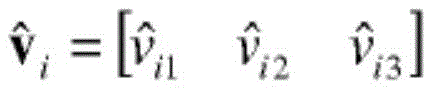

根据下式,

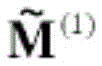
n=[n11 n12 n13],n=[n 11 n 12 n 13 ],

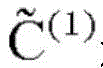
其中,通过使所述第一图像与所述输出图像之间的均方误差最小化来在数值上获得所述二阶多通道、多元回归预测模型的预测参数。Wherein, the prediction parameters of the second-order multi-channel, multiple regression prediction model are numerically obtained by minimizing the mean square error between the first image and the output image.
19.根据附记18所述的方法,其中,将所述二阶MMR预测模型扩展成具有像素交叉相乘的二阶MMR预测模型或三阶MMR预测模型。19. The method according to supplementary note 18, wherein the second-order MMR prediction model is extended to a second-order MMR prediction model or a third-order MMR prediction model with pixel cross multiplication.
20.根据附记18或19所述的方法,其中,所述MMR预测模型进一步包括涉及相邻像素的预测参数。20. The method according to supplementary note 18 or 19, wherein the MMR prediction model further includes prediction parameters related to adjacent pixels.
21.一种装置,包括处理器并且配置成执行附记14-17中所述的方法中的任意一种方法。21. An apparatus, comprising a processor and configured to execute any one of the methods described in Supplements 14-17.
22.一种计算机可读存储介质,存储有用于执行根据附记14-17中的任意一项所述的方法的计算机可执行指令。22. A computer-readable storage medium storing computer-executable instructions for executing the method according to any one of Supplements 14-17.
Claims (10)







Applications Claiming Priority (3)
| Application Number | Priority Date | Filing Date | Title |
|---|---|---|---|
| US201161475359P | 2011-04-14 | 2011-04-14 | |
| US61/475,359 | 2011-04-14 | ||
| CN201280018070.9A CN103563372B (en) | 2011-04-14 | 2012-04-13 | Multi-color channel multiple regression predictor |
Related Parent Applications (1)
| Application Number | Title | Priority Date | Filing Date |
|---|---|---|---|
| CN201280018070.9A Division CN103563372B (en) | 2011-04-14 | 2012-04-13 | Multi-color channel multiple regression predictor |
Publications (3)
| Publication Number | Publication Date |
|---|---|
| CN107105229A CN107105229A (en) | 2017-08-29 |
| CN107105229B true CN107105229B (en) | 2019-10-15 |
| CN107105229B9 CN107105229B9 (en) | 2020-03-31 |
Family
ID=46022694
Family Applications (3)
| Application Number | Title | Priority Date | Filing Date |
|---|---|---|---|
| CN201280018070.9A Active CN103563372B (en) | 2011-04-14 | 2012-04-13 | Multi-color channel multiple regression predictor |
| CN201611027011.4A Active CN106878707B (en) | 2011-04-14 | 2012-04-13 | More color channel multiple regression predictors |
| CN201611005691.XA Active CN107105229B9 (en) | 2011-04-14 | 2012-04-13 | Image decoding method, video decoder, and non-transitory computer-readable storage medium |
Family Applications Before (2)
| Application Number | Title | Priority Date | Filing Date |
|---|---|---|---|
| CN201280018070.9A Active CN103563372B (en) | 2011-04-14 | 2012-04-13 | Multi-color channel multiple regression predictor |
| CN201611027011.4A Active CN106878707B (en) | 2011-04-14 | 2012-04-13 | More color channel multiple regression predictors |
Country Status (10)
| Country | Link |
|---|---|
| US (5) | US8811490B2 (en) |
| EP (3) | EP3324622B1 (en) |
| JP (4) | JP5744318B2 (en) |
| CN (3) | CN103563372B (en) |
| DK (1) | DK3324622T3 (en) |
| ES (2) | ES2750234T3 (en) |
| HU (1) | HUE046186T2 (en) |
| PL (2) | PL3324622T3 (en) |
| TR (1) | TR201802291T4 (en) |
| WO (1) | WO2012142471A1 (en) |
Families Citing this family (94)
| Publication number | Priority date | Publication date | Assignee | Title |
|---|---|---|---|---|
| US8971408B2 (en) | 2011-04-14 | 2015-03-03 | Dolby Laboratories Licensing Corporation | Piecewise cross color channel predictor |
| EP3324622B1 (en) | 2011-04-14 | 2019-09-11 | Dolby Laboratories Licensing Corporation | Multiple color channel multiple regression predictor |
| EP2697972B1 (en) | 2011-04-14 | 2015-01-14 | Dolby Laboratories Licensing Corporation | Image prediction based on primary color grading model |
| EP2702764B1 (en) | 2011-04-25 | 2016-08-31 | Dolby Laboratories Licensing Corporation | Non-linear vdr residual quantizer |
| CN103535038B (en) | 2011-05-16 | 2017-10-13 | 杜比实验室特许公司 | Effective framework for being layered VDR codings |
| EP2719176B1 (en) | 2011-06-13 | 2021-07-07 | Dolby Laboratories Licensing Corporation | Visual display resolution prediction based on fused regions |
| US8873877B2 (en) | 2011-11-01 | 2014-10-28 | Dolby Laboratories Licensing Corporation | Adaptive false contouring prevention in layered coding of images with extended dynamic range |
| ES2670504T3 (en) * | 2012-01-24 | 2018-05-30 | Dolby Laboratories Licensing Corporation | Channel color cross predictor by sections |
| US9420302B2 (en) | 2012-01-24 | 2016-08-16 | Dolby Laboratories Licensing Corporation | Weighted multi-band cross color channel predictor |
| JP5905610B2 (en) | 2012-03-12 | 2016-04-20 | ドルビー ラボラトリーズ ライセンシング コーポレイション | 3D visual dynamic range coding |
| US9357197B2 (en) | 2012-05-24 | 2016-05-31 | Dolby Laboratories Licensing Corporation | Multi-layer backwards-compatible video delivery for enhanced dynamic range and enhanced resolution formats |
| WO2014107255A1 (en) | 2013-01-02 | 2014-07-10 | Dolby Laboratories Licensing Corporation | Backward-compatible coding for ultra high definition video signals with enhanced dynamic range |
| US11146803B2 (en) | 2013-03-11 | 2021-10-12 | Dolby Laboratories Licensing Corporation | Distribution of multi-format high dynamic range video using layered coding |
| CN105052143B (en) | 2013-03-26 | 2018-04-20 | 杜比实验室特许公司 | The video content that perception in being decoded to multilayer VDR quantifies encodes |
| EP2819414A3 (en) | 2013-06-28 | 2015-02-25 | Samsung Electronics Co., Ltd | Image processing device and image processing method |
| US9712834B2 (en) * | 2013-10-01 | 2017-07-18 | Dolby Laboratories Licensing Corporation | Hardware efficient sparse FIR filtering in video codec |
| JP6355345B2 (en) * | 2014-01-29 | 2018-07-11 | キヤノン株式会社 | Image processing apparatus, image processing method, display apparatus, display method, and program |
| CN105993175B (en) * | 2014-02-13 | 2019-01-18 | 杜比国际公司 | Segmental Inter-Layer Prediction for Signals with Enhanced Dynamic Range |
| EP2958075A1 (en) * | 2014-06-20 | 2015-12-23 | Thomson Licensing | Method and apparatus for dynamic range expansion of LDR video sequence |
| US9911179B2 (en) | 2014-07-18 | 2018-03-06 | Dolby Laboratories Licensing Corporation | Image decontouring in high dynamic range video processing |
| US9866734B2 (en) | 2014-08-26 | 2018-01-09 | Dolby Laboratories Licensing Corporation | Scene-change detection using video stream pairs |
| US10542265B2 (en) | 2014-09-09 | 2020-01-21 | Dolby Laboratories Licensing Corporation | Self-adaptive prediction method for multi-layer codec |
| EP3198556B1 (en) * | 2014-09-26 | 2018-05-16 | Dolby Laboratories Licensing Corp. | Encoding and decoding perceptually-quantized video content |
| US10015525B2 (en) | 2014-10-27 | 2018-07-03 | Dolby Laboratories Licensing Corporation | Content mapping using extended color range |
| US9747673B2 (en) | 2014-11-05 | 2017-08-29 | Dolby Laboratories Licensing Corporation | Systems and methods for rectifying image artifacts |
| US10531109B2 (en) | 2015-01-27 | 2020-01-07 | Dolby Laboratories Licensing Corporation | Predictive image encoding and decoding with pixel group based quantization |
| US9998742B2 (en) * | 2015-01-27 | 2018-06-12 | Qualcomm Incorporated | Adaptive cross component residual prediction |
| US10666990B2 (en) | 2015-01-30 | 2020-05-26 | Interdigital Vc Holdings, Inc. | Method and device for matching colors between color pictures of different dynamic range |
| WO2016133865A1 (en) | 2015-02-17 | 2016-08-25 | Dolby Laboratories Licensing Corporation | Inter-layer prediction for signals with enhanced dynamic range |
| CN107431833B (en) * | 2015-02-27 | 2021-08-27 | 索尼公司 | Transmission device, transmission method, reception device, and reception method |
| KR102531489B1 (en) * | 2015-08-28 | 2023-05-11 | 애리스 엔터프라이지즈 엘엘씨 | Color volume transforms in coding of high dynamic range and wide color gamut sequences |
| JP6581862B2 (en) * | 2015-09-18 | 2019-09-25 | 日本放送協会 | Video camera for HDR-SDR integrated production |
| FR3042327B1 (en) * | 2015-10-07 | 2019-08-02 | Guillemot Corporation | COOLING SYSTEM OF AN ELECTRIC MOTOR |
| US9693011B2 (en) * | 2015-11-02 | 2017-06-27 | Barco N.V. | Upgraded image streaming to legacy and upgraded displays |
| JP6470474B2 (en) | 2015-12-09 | 2019-02-13 | ドルビー ラボラトリーズ ライセンシング コーポレイション | Low-computation lookup table construction with reduced interpolation error |
| JP6237797B2 (en) | 2016-01-05 | 2017-11-29 | ソニー株式会社 | Video system, video processing method, program, and video converter |
| JP6233424B2 (en) * | 2016-01-05 | 2017-11-22 | ソニー株式会社 | Imaging system and imaging method |
| US10701375B2 (en) | 2016-03-23 | 2020-06-30 | Dolby Laboratories Licensing Corporation | Encoding and decoding reversible production-quality single-layer video signals |
| WO2017163685A1 (en) * | 2016-03-24 | 2017-09-28 | シャープ株式会社 | Video processing device, display apparatus, video processing method, control program, and recording medium |
| JP2017184220A (en) * | 2016-03-24 | 2017-10-05 | シャープ株式会社 | VIDEO PROCESSING DEVICE, DISPLAY DEVICE, VIDEO PROCESSING METHOD, CONTROL PROGRAM, AND RECORDING MEDIUM |
| US10440401B2 (en) | 2016-04-07 | 2019-10-08 | Dolby Laboratories Licensing Corporation | Backward-compatible HDR codecs with temporal scalability |
| EP3249605A1 (en) * | 2016-05-23 | 2017-11-29 | Thomson Licensing | Inverse tone mapping method and corresponding device |
| GB201611253D0 (en) * | 2016-06-29 | 2016-08-10 | Dolby Laboratories Licensing Corp | Efficient Histogram-based luma look matching |
| EP3504875B1 (en) * | 2016-08-26 | 2020-06-24 | Dolby Laboratories Licensing Corporation | Chroma reshaping based on just noticeable differences |
| TWI631505B (en) * | 2016-08-26 | 2018-08-01 | 晨星半導體股份有限公司 | Image processing method and related circuit applied to playback device |
| WO2018039665A1 (en) | 2016-08-26 | 2018-03-01 | Dolby Laboratories Licensing Corporation | Chroma reshaping based on just noticeable differences |
| CN109792523B (en) | 2016-08-30 | 2022-11-04 | 杜比实验室特许公司 | Real-time Shaping for Single Layer Backward Compatible Codecs |
| WO2018044803A1 (en) | 2016-08-30 | 2018-03-08 | Dolby Laboratories Licensing Corporation | Real-time reshaping of single-layer backwards-compatible codec |
| EP3510772B1 (en) | 2016-09-09 | 2020-12-09 | Dolby Laboratories Licensing Corporation | Coding of high dynamic range video using segment-based reshaping |
| WO2018049335A1 (en) | 2016-09-09 | 2018-03-15 | Dolby Laboratories Licensing Corporation | Coding of high dynamic range video using segment-based reshaping |
| EP3485433A1 (en) * | 2016-09-30 | 2019-05-22 | Deepmind Technologies Limited | Generating video frames using neural networks |
| EP3306563B1 (en) | 2016-10-05 | 2022-01-12 | Dolby Laboratories Licensing Corporation | Inverse luma/chroma mappings with histogram transfer and approximation |
| US10264287B2 (en) * | 2016-10-05 | 2019-04-16 | Dolby Laboratories Licensing Corporation | Inverse luma/chroma mappings with histogram transfer and approximation |
| CN107995497B (en) | 2016-10-26 | 2021-05-28 | 杜比实验室特许公司 | Screen Adaptive Decoding of High Dynamic Range Video |
| WO2018136432A1 (en) * | 2017-01-18 | 2018-07-26 | Dolby Laboratories Licensing Corporation | Segment-based reshaping for coding high dynamic range video |
| US10902601B2 (en) | 2017-01-18 | 2021-01-26 | Dolby Laboratories Licensing Corporation | Segment-based reshaping for coding high dynamic range video |
| WO2018169571A1 (en) * | 2017-03-15 | 2018-09-20 | Google Llc | Segmentation-based parameterized motion models |
| KR102301232B1 (en) * | 2017-05-31 | 2021-09-10 | 삼성전자주식회사 | Method and apparatus for processing multiple-channel feature map images |
| US11288781B2 (en) | 2017-06-16 | 2022-03-29 | Dolby Laboratories Licensing Corporation | Efficient end-to-end single layer inverse display management coding |
| US10609372B2 (en) * | 2017-09-29 | 2020-03-31 | Dolby Laboratories Licensing Corporation | Up-conversion to content adaptive perceptual quantization video signals |
| JP6753386B2 (en) * | 2017-10-25 | 2020-09-09 | ソニー株式会社 | Camera system, video processing methods and programs |
| EP3759916A1 (en) * | 2018-02-28 | 2021-01-06 | Dolby Laboratories Licensing Corporation | Linear encoder for image/video processing |
| US10609424B2 (en) | 2018-03-09 | 2020-03-31 | Dolby Laboratories Licensing Corporation | Single-layer progressive coding for supporting multi-capability HDR composition |
| CN110351509B (en) * | 2018-04-03 | 2021-12-14 | 北京小鸟科技股份有限公司 | Multi-channel high-bandwidth data exchange method based on FPGA (field programmable Gate array) stack |
| CN112204617B (en) * | 2018-04-09 | 2023-09-05 | 杜比实验室特许公司 | HDR Image Representation Using Neural Network Mapping |
| US11711486B2 (en) * | 2018-06-18 | 2023-07-25 | Dolby Laboratories Licensing Corporation | Image capture method and systems to preserve apparent contrast of an image |
| WO2020117603A1 (en) | 2018-12-03 | 2020-06-11 | Dolby Laboratories Licensing Corporation | Interpolation of reshaping functions |
| TWI734059B (en) * | 2018-12-10 | 2021-07-21 | 財團法人工業技術研究院 | Dynamic prediction model establishment method, electric device, and user interface |
| CN113228660B (en) | 2018-12-18 | 2023-12-12 | 杜比实验室特许公司 | Machine learning-based dynamic synthesis in enhanced standard dynamic range video (SDR+) |
| US12335508B2 (en) | 2019-03-20 | 2025-06-17 | V-Nova International Limited | Residual filtering in signal enhancement coding |
| JP7574277B2 (en) | 2019-07-30 | 2024-10-28 | ドルビー ラボラトリーズ ライセンシング コーポレイション | Electro-optical transfer function conversion and signal regulation |
| US12272039B2 (en) | 2019-08-15 | 2025-04-08 | Dolby Laboratories Licensing Corporation | Efficient user-defined SDR-to-HDR conversion with model templates |
| TWI812874B (en) * | 2019-10-01 | 2023-08-21 | 美商杜拜研究特許公司 | Tensor-product b-spline predictor |
| JP7434554B2 (en) | 2019-12-06 | 2024-02-20 | ドルビー ラボラトリーズ ライセンシング コーポレイション | Cascade prediction |
| EP4140129A1 (en) | 2020-04-21 | 2023-03-01 | Dolby Laboratories Licensing Corporation | Reshaping functions for hdr imaging with continuity and reversibility constraints |
| JP7298033B2 (en) | 2020-04-22 | 2023-06-26 | ドルビー ラボラトリーズ ライセンシング コーポレイション | Iterative Optimization of Reshaping Functions in Single-Layer HDR Image Codecs |
| CN115918074A (en) | 2020-06-10 | 2023-04-04 | 华为技术有限公司 | Adaptive Image Enhancement Based on Inter-Channel Correlation Information |
| CN116157824A (en) * | 2020-06-24 | 2023-05-23 | 杜比实验室特许公司 | Image prediction for HDR imaging in open-loop codecs |
| JP7577827B2 (en) | 2020-07-09 | 2024-11-05 | ドルビー ラボラトリーズ ライセンシング コーポレイション | Workload Allocation and Processing in Cloud-Based Encoding of HDR Video |
| CN116195248A (en) | 2020-09-18 | 2023-05-30 | 杜比实验室特许公司 | Recursive segment-to-scene segmentation for cloud-based encoding of HDR video |
| JP7775296B2 (en) | 2020-09-18 | 2025-11-25 | ドルビー ラボラトリーズ ライセンシング コーポレイション | Trim-path correction for cloud-based encoding of HDR video |
| EP4229869A1 (en) | 2020-10-14 | 2023-08-23 | Dolby Laboratories Licensing Corporation | Color transformation for hdr video with a coding-efficiency constraint |
| EP4245035A1 (en) | 2020-11-11 | 2023-09-20 | Dolby Laboratories Licensing Corporation | Wrapped reshaping for codeword augmentation with neighborhood consistency |
| EP4285590B1 (en) | 2021-01-27 | 2025-02-26 | Dolby Laboratories Licensing Corporation | Image enhancement via global and local reshaping |
| WO2022245695A1 (en) | 2021-05-21 | 2022-11-24 | Dolby Laboratories Licensing Corporation | Patch-based reshaping and metadata for volumetric video |
| ES3014895T3 (en) | 2021-06-08 | 2025-04-28 | Dolby Laboratories Licensing Corp | Chained reshaping function optimization |
| EP4388740B1 (en) | 2021-08-16 | 2025-02-26 | Dolby Laboratories Licensing Corporation | Applying minimum and average distance constraint in video streaming |
| WO2023033991A1 (en) | 2021-08-30 | 2023-03-09 | Dolby Laboratories Licensing Corporation | Reshaper for learning-based image/video coding |
| MX2024002914A (en) | 2021-09-09 | 2024-05-15 | Dolby Laboratories Licensing Corp | TENSOR PRODUCT B-SPLINE PREDICTION FOR HDR VIDEO IN MOBILE APPLICATIONS. |
| US20250024072A1 (en) * | 2021-11-01 | 2025-01-16 | Mediatek Singapore Pte. Ltd. | Method and Apparatus for Prediction Based on Cross Component Linear Model in Video Coding System |
| JP7797682B2 (en) | 2022-03-18 | 2026-01-13 | ドルビー ラボラトリーズ ライセンシング コーポレイション | Image optimization in mobile capture and editing applications |
| US20250363595A1 (en) | 2022-03-18 | 2025-11-27 | Dolby Laboratories Licensing Corporation | Image optimization in mobile capture and editing applications |
| JP7767655B2 (en) | 2022-05-24 | 2025-11-11 | ドルビー ラボラトリーズ ライセンシング コーポレイション | Preserving neutral colors for single-layer backward compatible codecs |
| WO2025024152A1 (en) | 2023-07-24 | 2025-01-30 | Dolby Laboratories Licensing Corporation | Photo coding operations for different image displays |
Citations (1)
| Publication number | Priority date | Publication date | Assignee | Title |
|---|---|---|---|---|
| WO2010082692A1 (en) * | 2009-01-19 | 2010-07-22 | Sharp Kabushiki Kaisha | Methods and systems for enhanced dynamic range images and video from multiple exposures |
Family Cites Families (58)
| Publication number | Priority date | Publication date | Assignee | Title |
|---|---|---|---|---|
| US6560285B1 (en) | 1998-03-30 | 2003-05-06 | Sarnoff Corporation | Region-based information compaction as for digital images |
| US7149262B1 (en) | 2000-07-06 | 2006-12-12 | The Trustees Of Columbia University In The City Of New York | Method and apparatus for enhancing data resolution |
| US6771311B1 (en) | 2000-12-11 | 2004-08-03 | Eastman Kodak Company | Automatic color saturation enhancement |
| AU2003220595A1 (en) | 2002-03-27 | 2003-10-13 | The Trustees Of Columbia University In The City Of New York | Imaging method and system |
| US7035460B2 (en) | 2002-05-31 | 2006-04-25 | Eastman Kodak Company | Method for constructing an extended color gamut digital image from a limited color gamut digital image |
| US7522774B2 (en) * | 2004-03-10 | 2009-04-21 | Sindhara Supermedia, Inc. | Methods and apparatuses for compressing digital image data |
| CA2563520C (en) | 2004-04-15 | 2014-12-16 | The University Of British Columbia | Methods and systems for converting images from low dynamic range to high dynamic range |
| US8218625B2 (en) | 2004-04-23 | 2012-07-10 | Dolby Laboratories Licensing Corporation | Encoding, decoding and representing high dynamic range images |
| US20050259729A1 (en) * | 2004-05-21 | 2005-11-24 | Shijun Sun | Video coding with quality scalability |
| US8050512B2 (en) | 2004-11-16 | 2011-11-01 | Sharp Laboratories Of America, Inc. | High dynamic range images from low dynamic range images |
| JP5116208B2 (en) | 2004-11-19 | 2013-01-09 | 株式会社ジャパンディスプレイイースト | Image signal display device |
| WO2006113583A2 (en) * | 2005-04-15 | 2006-10-26 | Mississippi State University | Remote sensing imagery accuracy analysis method and apparatus |
| US20070076971A1 (en) * | 2005-09-30 | 2007-04-05 | Nokia Corporation | Compression of images for computer graphics |
| EP3197157B1 (en) | 2006-01-23 | 2021-12-15 | Max-Planck-Gesellschaft zur Förderung der Wissenschaften E.V. | High dynamic range codecs |
| JP2007208736A (en) * | 2006-02-02 | 2007-08-16 | Canon Inc | Color processing method and apparatus |
| US8014445B2 (en) | 2006-02-24 | 2011-09-06 | Sharp Laboratories Of America, Inc. | Methods and systems for high dynamic range video coding |
| EP1996959A4 (en) * | 2006-03-03 | 2012-02-29 | Medic Vision Brain Technologies Ltd | System and method of automatic prioritization and analysis of medical images |
| CN101513069B (en) | 2006-09-30 | 2011-04-13 | 汤姆逊许可公司 | Method and equipment for encoding and decoding video color enhancement layer |
| WO2008049445A1 (en) | 2006-10-25 | 2008-05-02 | Fraunhofer-Gesellschaft zur Förderung der angewandten Forschung e.V. | Quality scalable coding |
| WO2008049446A1 (en) | 2006-10-25 | 2008-05-02 | Fraunhofer-Gesellschaft zur Förderung der angewandten Forschung e.V. | Quality scalable coding |
| MX2009005564A (en) | 2006-11-27 | 2009-08-13 | Dolby Lab Licensing Corp | Apparatus and methods for boosting dynamic range in digital images. |
| CA2570090C (en) | 2006-12-06 | 2014-08-19 | Brightside Technologies Inc. | Representing and reconstructing high dynamic range images |
| US8237865B2 (en) * | 2006-12-18 | 2012-08-07 | Emanuele Salvucci | Multi-compatible low and high dynamic range and high bit-depth texture and video encoding system |
| US7826673B2 (en) * | 2007-01-23 | 2010-11-02 | Sharp Laboratories Of America, Inc. | Methods and systems for inter-layer image prediction with color-conversion |
| US8503524B2 (en) | 2007-01-23 | 2013-08-06 | Sharp Laboratories Of America, Inc. | Methods and systems for inter-layer image prediction |
| US8665942B2 (en) | 2007-01-23 | 2014-03-04 | Sharp Laboratories Of America, Inc. | Methods and systems for inter-layer image prediction signaling |
| US8233536B2 (en) | 2007-01-23 | 2012-07-31 | Sharp Laboratories Of America, Inc. | Methods and systems for multiplication-free inter-layer image prediction |
| US7760949B2 (en) | 2007-02-08 | 2010-07-20 | Sharp Laboratories Of America, Inc. | Methods and systems for coding multiple dynamic range images |
| US8014613B2 (en) | 2007-04-16 | 2011-09-06 | Sharp Laboratories Of America, Inc. | Methods and systems for inter-layer image parameter prediction |
| CN101663896A (en) * | 2007-04-23 | 2010-03-03 | 汤姆森许可贸易公司 | Method and apparatus for encoding video data, method and apparatus for decoding encoded video data and encoded video signal |
| TW200845723A (en) * | 2007-04-23 | 2008-11-16 | Thomson Licensing | Method and apparatus for encoding video data, method and apparatus for decoding encoded video data and encoded video signal |
| US8085852B2 (en) * | 2007-06-26 | 2011-12-27 | Mitsubishi Electric Research Laboratories, Inc. | Inverse tone mapping for bit-depth scalable image coding |
| US7983496B2 (en) | 2007-06-26 | 2011-07-19 | Mitsubishi Electric Research Laboratories, Inc. | Inverse tone mapping for bit-depth scalable image coding adapted to variable block sizes |
| ATE484155T1 (en) | 2007-06-29 | 2010-10-15 | Fraunhofer Ges Forschung | SCALABLE VIDEO CODING THAT SUPPORTS PIXEL VALUE REFINEMENT SCALABILITY |
| KR101365596B1 (en) | 2007-09-14 | 2014-03-12 | 삼성전자주식회사 | Video encoding apparatus and method and video decoding apparatus and method |
| US8208560B2 (en) * | 2007-10-15 | 2012-06-26 | Intel Corporation | Bit depth enhancement for scalable video coding |
| CN101822055B (en) | 2007-10-15 | 2013-03-13 | 汤姆森许可贸易公司 | Methods and apparatus for inter-layer residue prediction for scalable video |
| EP2204047B1 (en) | 2007-10-16 | 2018-04-25 | Thomson Licensing DTV | Methods and apparatus for artifact removal for bit depth scalability |
| KR101365597B1 (en) | 2007-10-24 | 2014-02-20 | 삼성전자주식회사 | Video encoding apparatus and method and video decoding apparatus and method |
| US8175158B2 (en) * | 2008-01-04 | 2012-05-08 | Sharp Laboratories Of America, Inc. | Methods and systems for inter-layer image prediction parameter determination |
| WO2009120928A2 (en) | 2008-03-28 | 2009-10-01 | The Trustees Of Columbia University In The City Of New York | Generalized assorted pixel camera systems and methods |
| US8165395B2 (en) | 2008-04-15 | 2012-04-24 | Sony Corporation | Automatic image color tone correction |
| PT2835976T (en) | 2008-04-16 | 2016-11-22 | Ge Video Compression Llc | BITS DEPTH SCALABILITY |
| US8270759B2 (en) | 2008-06-16 | 2012-09-18 | International Business Machines Corporation | Transformation of a video image from a high dynamic range image to a low dynamic range image |
| EP2144444B1 (en) * | 2008-07-10 | 2012-06-27 | The University Of Warwick | HDR video data compression devices and methods |
| WO2010043922A1 (en) | 2008-10-17 | 2010-04-22 | Trellis Management Co., Ltd. | High dynamic range texture and video coding |
| US8290295B2 (en) * | 2009-03-03 | 2012-10-16 | Microsoft Corporation | Multi-modal tone-mapping of images |
| KR101256030B1 (en) | 2009-03-10 | 2013-04-23 | 돌비 레버러토리즈 라이쎈싱 코오포레이션 | Extended dynamic range and extended dimensionality image signal conversion |
| RU2504011C2 (en) * | 2009-03-13 | 2014-01-10 | Долби Лабораторис Лайсэнзин Корпорейшн | Multilayer compression of video with extended dynamic range, visual dynamic range and wide colour gamma |
| US8139857B2 (en) * | 2009-03-18 | 2012-03-20 | Xerox Corporation | Local regression methods and systems for image processing systems |
| US8358839B2 (en) * | 2009-11-30 | 2013-01-22 | Xerox Corporation | Local regression methods and systems for image processing systems |
| US8654141B2 (en) * | 2009-12-29 | 2014-02-18 | Intel Corporation | Techniques for adapting a color gamut |
| US8606009B2 (en) * | 2010-02-04 | 2013-12-10 | Microsoft Corporation | High dynamic range image generation and rendering |
| US9100661B2 (en) * | 2010-04-05 | 2015-08-04 | Samsung Electronics Co., Ltd. | Method and apparatus for encoding video by using dynamic-range transformation, and method and apparatus for decoding video by using dynamic-range transformation |
| TWI479898B (en) | 2010-08-25 | 2015-04-01 | 杜比實驗室特許公司 | Extended image dynamic range |
| US8611655B2 (en) * | 2011-02-04 | 2013-12-17 | Apple Inc. | Hue-based color matching |
| EP3324622B1 (en) * | 2011-04-14 | 2019-09-11 | Dolby Laboratories Licensing Corporation | Multiple color channel multiple regression predictor |
| US9036042B2 (en) * | 2011-04-15 | 2015-05-19 | Dolby Laboratories Licensing Corporation | Encoding, decoding, and representing high dynamic range images |
-
2012
- 2012-04-13 EP EP17204552.8A patent/EP3324622B1/en active Active
- 2012-04-13 EP EP14171538.3A patent/EP2782348B1/en active Active
- 2012-04-13 PL PL17204552T patent/PL3324622T3/en unknown
- 2012-04-13 CN CN201280018070.9A patent/CN103563372B/en active Active
- 2012-04-13 PL PL14171538T patent/PL2782348T3/en unknown
- 2012-04-13 CN CN201611027011.4A patent/CN106878707B/en active Active
- 2012-04-13 TR TR2018/02291T patent/TR201802291T4/en unknown
- 2012-04-13 HU HUE17204552A patent/HUE046186T2/en unknown
- 2012-04-13 CN CN201611005691.XA patent/CN107105229B9/en active Active
- 2012-04-13 ES ES17204552T patent/ES2750234T3/en active Active
- 2012-04-13 ES ES14171538.3T patent/ES2659961T3/en active Active
- 2012-04-13 EP EP12717990.1A patent/EP2697971B1/en active Active
- 2012-04-13 JP JP2014505358A patent/JP5744318B2/en active Active
- 2012-04-13 WO PCT/US2012/033605 patent/WO2012142471A1/en not_active Ceased
- 2012-04-13 DK DK17204552.8T patent/DK3324622T3/en active
- 2012-04-13 US US14/110,694 patent/US8811490B2/en active Active
-
2014
- 2014-05-21 US US14/283,845 patent/US9386313B2/en active Active
-
2015
- 2015-03-17 JP JP2015053247A patent/JP5921741B2/en active Active
-
2016
- 2016-04-12 JP JP2016079491A patent/JP6246255B2/en active Active
- 2016-05-24 US US15/163,613 patent/US9699483B2/en active Active
-
2017
- 2017-05-30 US US15/608,433 patent/US10021390B2/en active Active
- 2017-11-14 JP JP2017218877A patent/JP6490178B2/en active Active
-
2018
- 2018-05-24 US US15/988,937 patent/US10237552B2/en active Active
Patent Citations (1)
| Publication number | Priority date | Publication date | Assignee | Title |
|---|---|---|---|---|
| WO2010082692A1 (en) * | 2009-01-19 | 2010-07-22 | Sharp Kabushiki Kaisha | Methods and systems for enhanced dynamic range images and video from multiple exposures |
Also Published As
Similar Documents
| Publication | Publication Date | Title |
|---|---|---|
| CN107105229B (en) | Image decoding method, video decoder, and non-transitory computer-readable storage medium | |
| CN103493489B (en) | Image prediction based on primary colors hierarchy model | |
| EP2807823B1 (en) | Piecewise cross color channel predictor | |
| US20140369409A1 (en) | Piecewise Cross Color Channel Predictor | |
| HK1238458A1 (en) | Multiple color channel multiple regression predictor | |
| HK1238458B (en) | Multiple color channel multiple regression predictor | |
| HK1241609A1 (en) | Image decoding method, video decoder, and non-transitory computer-readable storage medium | |
| HK1241609B (en) | Image decoding method, video decoder, and non-transitory computer-readable storage medium | |
| HK1193688B (en) | Multiple color channel multiple regression predictor | |
| HK1204741B (en) | Piecewise cross color channel predictor |
Legal Events
| Date | Code | Title | Description |
|---|---|---|---|
| PB01 | Publication | ||
| PB01 | Publication | ||
| SE01 | Entry into force of request for substantive examination | ||
| SE01 | Entry into force of request for substantive examination | ||
| REG | Reference to a national code |
Ref country code: HK Ref legal event code: DE Ref document number: 1241609 Country of ref document: HK |
|
| GR01 | Patent grant | ||
| GR01 | Patent grant | ||
| CI03 | Correction of invention patent |
Correction item: Description Correct: Correct False: error Number: 42-01 Page: full text Volume: 35 |
|
| CI03 | Correction of invention patent | ||
| CI03 | Correction of invention patent |
Correction item: Description Correct: Gong Shixianshizhengque False: Incomplete formula display in [0142] [0143] [0145] Number: 50-02 Page: full text Volume: 35 |
|
| CI03 | Correction of invention patent |