CN107075739B - lyocell crimped fibers - Google Patents
lyocell crimped fibers Download PDFInfo
- Publication number
- CN107075739B CN107075739B CN201580050416.7A CN201580050416A CN107075739B CN 107075739 B CN107075739 B CN 107075739B CN 201580050416 A CN201580050416 A CN 201580050416A CN 107075739 B CN107075739 B CN 107075739B
- Authority
- CN
- China
- Prior art keywords
- lyocell
- fiber
- fibers
- expansion
- spinning
- Prior art date
- Legal status (The legal status is an assumption and is not a legal conclusion. Google has not performed a legal analysis and makes no representation as to the accuracy of the status listed.)
- Active
Links
Classifications
-
- D—TEXTILES; PAPER
- D01—NATURAL OR MAN-MADE THREADS OR FIBRES; SPINNING
- D01F—CHEMICAL FEATURES IN THE MANUFACTURE OF ARTIFICIAL FILAMENTS, THREADS, FIBRES, BRISTLES OR RIBBONS; APPARATUS SPECIALLY ADAPTED FOR THE MANUFACTURE OF CARBON FILAMENTS
- D01F2/00—Monocomponent artificial filaments or the like of cellulose or cellulose derivatives; Manufacture thereof
-
- D—TEXTILES; PAPER
- D01—NATURAL OR MAN-MADE THREADS OR FIBRES; SPINNING
- D01F—CHEMICAL FEATURES IN THE MANUFACTURE OF ARTIFICIAL FILAMENTS, THREADS, FIBRES, BRISTLES OR RIBBONS; APPARATUS SPECIALLY ADAPTED FOR THE MANUFACTURE OF CARBON FILAMENTS
- D01F2/00—Monocomponent artificial filaments or the like of cellulose or cellulose derivatives; Manufacture thereof
- D01F2/06—Monocomponent artificial filaments or the like of cellulose or cellulose derivatives; Manufacture thereof from viscose
- D01F2/08—Composition of the spinning solution or the bath
- D01F2/10—Addition to the spinning solution or spinning bath of substances which exert their effect equally well in either
-
- D—TEXTILES; PAPER
- D01—NATURAL OR MAN-MADE THREADS OR FIBRES; SPINNING
- D01F—CHEMICAL FEATURES IN THE MANUFACTURE OF ARTIFICIAL FILAMENTS, THREADS, FIBRES, BRISTLES OR RIBBONS; APPARATUS SPECIALLY ADAPTED FOR THE MANUFACTURE OF CARBON FILAMENTS
- D01F11/00—Chemical after-treatment of artificial filaments or the like during manufacture
- D01F11/02—Chemical after-treatment of artificial filaments or the like during manufacture of cellulose, cellulose derivatives, or proteins
-
- D—TEXTILES; PAPER
- D02—YARNS; MECHANICAL FINISHING OF YARNS OR ROPES; WARPING OR BEAMING
- D02G—CRIMPING OR CURLING FIBRES, FILAMENTS, THREADS, OR YARNS; YARNS OR THREADS
- D02G1/00—Producing crimped or curled fibres, filaments, yarns, or threads, giving them latent characteristics
- D02G1/12—Producing crimped or curled fibres, filaments, yarns, or threads, giving them latent characteristics using stuffer boxes
Landscapes
- Engineering & Computer Science (AREA)
- Textile Engineering (AREA)
- Chemical & Material Sciences (AREA)
- Chemical Kinetics & Catalysis (AREA)
- General Chemical & Material Sciences (AREA)
- Mechanical Engineering (AREA)
- Yarns And Mechanical Finishing Of Yarns Or Ropes (AREA)
- Artificial Filaments (AREA)
Abstract
本发明涉及一种通过卷曲莱赛尔纤维复丝制造的莱赛尔卷曲纤维,所述莱赛尔纤维复丝通过纺丝含有纤维素浆料和N‑甲基吗啉‑N‑氧化物(NMMO)水溶液的莱赛尔纤维纺丝液来制造,其中莱赛尔卷曲纤维的膨胀指数为800至2000。The present invention relates to a lyocell crimped fiber produced by crimping a lyocell fiber multifilament containing cellulose pulp and N-methylmorpholine-N-oxide ( NMMO) aqueous solution of lyocell fiber spinning solution, wherein the swelling index of lyocell crimped fiber is 800 to 2000.
Description
技术领域technical field
本发明总体涉及莱赛尔纤维,更具体地,涉及莱赛尔卷曲纤维。The present invention relates generally to lyocell fibers, and more particularly, to lyocell crimped fibers.
背景技术Background technique
纤维是柔性的且薄的线性物体,并且在形状方面具有非常大的长度与厚度比,即非常大的细度。纤维在形态方面可以分为长纤维、准长纤维和短纤维,就原材料而言可分为天然纤维和人造纤维。Fibers are flexible and thin linear objects and have a very large length to thickness ratio in shape, ie a very large fineness. Fibers can be divided into long fibers, quasi-long fibers and short fibers in terms of morphology, and natural fibers and man-made fibers in terms of raw materials.
从过去起,纤维与人类生活有着密切的关系。早期纤维主要用作服装的原料,并且是天然纤维,例如棉花、大麻、羊毛和蚕丝纤维。然而,根据工业革命以来的科学技术的发展,除了用于涂覆的材料之外,纤维的使用已经扩展到工业材料。此外,最近人工纤维的领域被充分开发,以便满足根据文化发展和人口增长对纤维的快速增长的需求。Fiber has been closely related to human life since the past. Early fibers were mainly used as raw materials for clothing and were natural fibers such as cotton, hemp, wool and silk fibers. However, according to the development of science and technology since the Industrial Revolution, the use of fibers has been extended to industrial materials in addition to materials for coating. In addition, the field of artificial fibers has recently been fully developed in order to meet the rapidly increasing demand for fibers according to cultural development and population growth.
人造纤维具有不逊于天然纤维的触感和穿戴感,并且还具有优异的强度和快速的水分吸收和排出功能,从而逐步受到消费者的偏爱。特别是,在人造纤维中,由诸如木浆的天然材料合成的再生纤维具有与天然纤维几乎相同的触感,并被认为对人体无害。因此,对再生纤维的兴趣逐渐增加。Man-made fibers have a touch and wearing feeling that are not inferior to natural fibers, and also have excellent strength and fast moisture absorption and discharge functions, thereby gradually being favored by consumers. In particular, among man-made fibers, regenerated fibers synthesized from natural materials such as wood pulp have almost the same touch as natural fibers and are considered harmless to the human body. Therefore, interest in regenerated fibers is gradually increasing.
在再生纤维中,与蚕丝相比,粘胶人造丝在过去已广泛用作具有优异的光泽和着色性的纤维。然而,在粘胶人造丝的情况下,其制造过程有些复杂,并且在熔化木浆的过程中使用许多化学品。因此,环境问题和废水处理一直是个问题。因此,可以代替诸如铜铵人造纤维和莱赛尔纤维的常规粘胶人造丝纤维的诸如基于人造丝的再生纤维和乙酸纤维素再生纤维已开始受到关注。Among the regenerated fibers, viscose rayon has been widely used in the past as a fiber having excellent luster and colorability compared with silk. However, in the case of viscose rayon, its manufacturing process is somewhat complicated and many chemicals are used in the process of melting the wood pulp. Therefore, environmental issues and wastewater treatment have always been a problem. Therefore, regenerated fibers such as rayon-based fibers and cellulose acetate regenerated fibers, which can replace conventional viscose rayon fibers such as cupro rayon fibers and lyocell fibers, have begun to attract attention.
特别地,与常规再生纤维相比,使用天然浆料和氧化胺水合物制造的莱赛尔纤维具有优异的拉伸性能和触感,并且在制造莱赛尔纤维时使用的氧化胺类溶剂可以在废弃时再循环且可生物降解,因此在制造过程中不产生任何污染物。因此,近年更加积极地研究作为环保再生纤维的莱赛尔纤维。In particular, compared with conventional regenerated fibers, lyocell fibers manufactured using natural pulp and amine oxide hydrate have excellent tensile properties and touch, and the amine oxide-based solvent used in the manufacture of lyocell fibers can be used in Recyclable and biodegradable at disposal, so no contaminants are created during the manufacturing process. Therefore, in recent years, lyocell fibers, which are environmentally friendly recycled fibers, have been more actively studied.
在例如美国专利No.4,416,698和美国专利No.4,246,221中描述的制造莱赛尔纤维的方法中,将含有溶解在氧化胺(NMMO)中的纤维素的纺丝液纺丝并固化以制造长丝,并且将长丝进行洗涤、干燥,并处理。此外,莱赛尔纤维不是自然卷曲的。因此,为了有利地使用莱赛尔纤维,可以根据EP No.797,696中描述的方法压缩湿纤维,或者可以通过根据EPNo.703,997中描述的方法通过使用干蒸汽的填塞箱卷曲工艺来提供卷曲。In methods of making lyocell fibers such as described in US Patent No. 4,416,698 and US Patent No. 4,246,221, a dope containing cellulose dissolved in amine oxide (NMMO) is spun and solidified to produce filaments , and the filaments are washed, dried, and processed. Additionally, lyocell fibers are not naturally crimped. Thus, to advantageously use lyocell fibers, wet fibers can be compressed according to the method described in EP No. 797,696, or crimp can be provided by a stuffer box crimping process using dry steam according to the method described in EP No. 703,997.
在常规的莱赛尔纤维的情况下,由于形成卷曲而获得的膨胀(blooming)性能并不优异。此外,大多数关于莱赛尔纤维的研究只是为了改善物理性能,例如强度。因此,对有效地提高莱赛尔纤维的膨胀性能的技术研究存在稳定的需求。In the case of conventional lyocell fibers, the blooming properties obtained due to crimp formation are not excellent. Furthermore, most of the research on lyocell fibers is only to improve physical properties such as strength. Therefore, there is a steady demand for technical research to effectively improve the swelling properties of lyocell fibers.
发明内容SUMMARY OF THE INVENTION
技术问题technical problem
因此,考虑到现有技术中存在的上述问题而进行了本发明,并且本发明的目的是提供具有优异的卷曲数和卷曲稳定性从而改善膨胀性能的莱赛尔卷曲纤维。Therefore, the present invention has been made in view of the above-mentioned problems in the prior art, and an object of the present invention is to provide a lyocell crimped fiber having excellent crimp number and crimp stability to improve swelling properties.
技术方案Technical solutions
为了完成上述目的,本发明提供了一种通过使莱赛尔纤维复丝卷曲而制造的莱赛尔卷曲纤维,所述莱赛尔纤维复丝通过纺丝含有纤维素浆料和N-甲基吗啉-N-氧化物(NMMO)水溶液的莱赛尔纤维纺丝液制备,所述莱赛尔卷曲纤维具有800至2,000的膨胀指数,所述膨胀指数由下面的式1定义。In order to accomplish the above object, the present invention provides a lyocell crimped fiber produced by crimping a lyocell fiber multifilament containing cellulose pulp and N-methyl cellulose by spinning A lyocell fiber spinning solution of aqueous morpholine-N-oxide (NMMO) solution was prepared, the lyocell crimped fibers having a swelling index of 800 to 2,000, the swelling index being defined by Equation 1 below.
(式1)膨胀指数=膨胀因子(BF)×每英寸卷曲数(CN)。(Equation 1) Expansion index = expansion factor (BF) x number of curls per inch (CN).
在式1中,所述膨胀因子由下面的式2定义。In Equation 1, the expansion factor is defined by Equation 2 below.
(式2)膨胀因子={(永久变形前后的纤维宽度的变化)÷(永久变形前后的纤维长度的变化)}×100。(Formula 2) Expansion factor={(change in fiber width before and after permanent deformation)÷(change in fiber length before and after permanent deformation)}×100.
在一个实施例中,基于所述纺丝液的总重量,所述莱赛尔纤维纺丝液可以包含6重量%至16重量%的纤维素浆料以及84重量%至94重量%的N-甲基吗啉-N-氧化物水溶液。In one embodiment, based on the total weight of the dope, the lyocell fiber dope may comprise 6 to 16 wt% of cellulose pulp and 84 to 94 wt% of N- Methylmorpholine-N-oxide in water.
基于所述浆料的总重量,所述纤维素浆料可以包含85重量%至97重量%的α-纤维素含量,并且所述纤维素浆料具有600至1700的聚合度(DPw)。The cellulose pulp may comprise an alpha-cellulose content of 85% to 97% by weight based on the total weight of the pulp, and the cellulose pulp may have a degree of polymerization (DPw) of 600 to 1700.
在实施例中,所述每英寸的卷曲数(CN)可以为25个/英寸至39个/英寸,并且在所述莱赛尔卷曲纤维中由所述式2定义的所述膨胀因子(BF)可以为30至50。In an embodiment, the number of crimps per inch (CN) may be 25 to 39 per inch, and the expansion factor (BF) defined by the formula 2 in the lyocell crimped fiber ) can be 30 to 50.
在实施例中,所述莱赛尔纤维复丝可以包括拉伸强度为2.0g/d至3.5g/d的莱赛尔纤维单丝。In embodiments, the lyocell fiber multifilaments may include lyocell fiber monofilaments having a tensile strength of 2.0 g/d to 3.5 g/d.
所述莱赛尔纤维单丝可以具有1.0旦尼尔至8.0旦尼尔的细度和5%至13%的延展性。The lyocell fiber monofilament may have a fineness of 1.0 denier to 8.0 denier and a ductility of 5% to 13%.
有益效果beneficial effect
根据本发明,可以提供具有改善的膨胀性能的莱赛尔卷曲纤维。与常规莱赛尔纤维相比,根据本发明的莱赛尔卷曲纤维具有改善的体积效应和优异的卷曲形状稳定性。因此,当将莱赛尔卷曲纤维用于服装和工业材料时,即使使用少量的纤维,也可以期望与现有技术相同或比其更好的物理性能。According to the present invention, lyocell crimped fibers with improved swelling properties can be provided. Compared to conventional lyocell fibers, the lyocell crimped fibers according to the present invention have an improved bulk effect and excellent crimp shape stability. Therefore, when lyocell crimped fibers are used in apparel and industrial materials, physical properties equivalent to or better than those of the prior art can be expected, even with small amounts of fibers.
具体实施方式Detailed ways
本发明的一个方面可以提供通过卷曲莱赛尔纤维复丝制造的莱赛尔卷曲纤维。通过纺丝含有纤维素浆料和N-甲基吗啉-N-氧化物(NMMO)水溶液的莱赛尔纤维纺丝液来制造该莱赛尔纤维复丝。该莱赛尔卷曲纤维的膨胀指数为800至2000,膨胀指数由下面的式1定义。One aspect of the present invention may provide a lyocell crimped fiber produced by crimping a lyocell fiber multifilament. The lyocell fiber multifilament is produced by spinning a lyocell fiber dope containing a cellulose pulp and an aqueous solution of N-methylmorpholine-N-oxide (NMMO). The lyocell crimped fiber has a swelling index of 800 to 2000, and the swelling index is defined by Equation 1 below.
(式1)膨胀指数=膨胀因子(BF)×每英寸卷曲数(CN)(Formula 1) Expansion Index = Expansion Factor (BF) × Number of Curls per Inch (CN)
在式1中,膨胀因子由下面的式2定义。In Equation 1, the expansion factor is defined by Equation 2 below.
(式2)膨胀因子={(永久变形前后的纤维宽度的变化)÷(永久变形前后的纤维长度的变化)}×100(Formula 2) Expansion factor={(change in fiber width before and after permanent deformation)÷(change in fiber length before and after permanent deformation)}×100
[膨胀因子和膨胀指数][Expansion Factor and Expansion Index]
通常,卷曲是指在长丝中形成卷曲的工艺,换句话说,卷曲工艺,并且还指用于形成褶皱以便对通过进行人造纺丝以获得纤维形式而制造的人造纤维赋予天然纤维状组织的工艺。由于在卷曲纤维束之间形成可能存在空气的空间,因此即使在相同重量的情况下也可以确保更大的体积,从而提供柔软的手感和温暖感(warmth)。此外,可以确保透气性,从而表现出抗菌效果。此外,当纤维的材料是环境友好的生物可降解材料时,如本发明的莱赛尔纤维,卷曲的效果可以加倍。Generally, crimping refers to a process of forming crimps in filaments, in other words, a crimping process, and also refers to a process for forming pleats in order to impart a natural fibrous texture to artificial fibers manufactured by performing artificial spinning to obtain a fiber form craft. Since spaces where air may be present are formed between the crimped fiber bundles, a larger volume can be secured even with the same weight, thereby providing a soft feel and warmth. In addition, breathability can be ensured, thereby exhibiting an antibacterial effect. Furthermore, when the material of the fiber is an environmentally friendly biodegradable material, such as the lyocell fiber of the present invention, the effect of crimping can be doubled.
因此,卷曲的莱赛尔纤维可以用作纤维材料,例如包括户外服装、贴身衣、帽子、运动袜和内衣的冬季服装,羽绒被,医用纤维和卫生用品。卷曲的莱赛尔纤维还可用于MRG(机械橡胶商品),例如在建筑和车辆领域中作为工业材料的轮胎帘布、各种过滤器和软管增强件、水泥增强件和车辆内部增强件。Therefore, crimped lyocell fibers can be used as fiber materials such as winter clothing including outdoor clothing, intimate clothing, hats, sports socks and underwear, duvets, medical fibers and hygiene products. Crimped lyocell fibers can also be used in MRGs (Mechanical Rubber Commodities) such as tire cords, various filter and hose reinforcements, cement reinforcements and vehicle interior reinforcements as industrial materials in the construction and vehicle fields.
在本发明中,由等式1定义的膨胀指数是根据在莱赛尔纤维中每英寸形成的卷曲数和膨胀因子的值,所述膨胀因子是永久变形前/后的宽度变化与永久变形前/后的长度变化的比率。膨胀指数值越大,膨胀因子或每英寸的卷曲数越大。因此,可以通过使用膨胀指数而容易地检查莱赛尔纤维的膨胀程度。当膨胀指数小于800时,难以充分满足所期望的卷曲数和膨胀因子两者。当膨胀指数大于2000时,可能存在技术限制。因此,优选的是,膨胀指数满足上述范围。In the present invention, the expansion index defined by Equation 1 is a value according to the number of crimps formed per inch in the lyocell fiber and the expansion factor, which is the change in width before/after permanent deformation and before permanent deformation / Ratio of post length change. The larger the swell index value, the greater the swell factor or number of curls per inch. Therefore, the degree of swelling of the lyocell fibers can be easily checked by using the swelling index. When the swelling index is less than 800, it is difficult to sufficiently satisfy both the desired crimp number and swelling factor. When the inflation index is greater than 2000, there may be technical limitations. Therefore, it is preferable that the expansion index satisfies the above-mentioned range.
为了满足本发明中的膨胀指数的上述范围,如等式2所示的定义为永久变形前/后的纤维宽度变化对永久变形前后纤维长度变化的百分比值的膨胀因子,更优选设定为满足30至50的范围,并且所测量的每英寸的卷曲数(CN)优选设定为满足25至39个/英寸的范围。In order to satisfy the above-mentioned range of the expansion index in the present invention, the expansion factor defined as the percentage value of the fiber width change before/after permanent deformation to the fiber length change before and after permanent deformation as shown in Equation 2 is more preferably set to satisfy The range of 30 to 50, and the measured number of curls per inch (CN) is preferably set to satisfy the range of 25 to 39 per inch.
本发明中使用的术语“永久变形”是指当卷曲纤维被拉伸然后释放时,在卷曲不恢复其原始形状的时间点的变形。在本发明的实验中,当荷重为4kg.f时,莱赛尔卷曲纤维表现出永久变形的行为。因此,在本发明中,可以将负载为4kg.f的张力设定为永久变形的基准。The term "permanent deformation" as used in the present invention refers to the deformation at the point in time when the crimp does not return to its original shape when the crimped fiber is stretched and then released. In the experiment of the present invention, when the load is 4kg.f, the lyocell crimped fiber exhibits the behavior of permanent deformation. Therefore, in the present invention, the tension with a load of 4 kg.f can be set as the reference for permanent deformation.
在优选的卷曲纤维的情况下,由于每英寸的卷曲数足够高,所以在永久变形之前,由于卷曲,纤维的膨胀程度是有利的,但是在永久变形后,膨胀程度显著降低,因此,观察到纤维的宽度变化非常大。另一方面,在卷曲不良的纤维的情况下,永久变形前后由卷曲引起的膨胀程度几乎没有差别。如上所述,随着膨胀因子增大,可以由于足够的卷曲数而改善膨胀性能,从而可以获得令人满意的膨胀指数值。In the case of the preferred crimped fibers, since the number of crimps per inch is high enough, the degree of expansion of the fiber due to crimping is favorable before permanent deformation, but after permanent deformation, the degree of expansion is significantly reduced, therefore, it is observed that The width of the fibers varies greatly. On the other hand, in the case of poorly crimped fibers, there is little difference in the degree of swelling due to crimp before and after permanent deformation. As described above, as the expansion factor increases, the expansion performance can be improved due to a sufficient number of crimps, so that a satisfactory expansion index value can be obtained.
然而,由于每英寸的卷曲数和膨胀因子在概念上与彼此不成反比,所以考虑到要确保的最小卷曲数(25个/英寸),膨胀因子可以为30以上。由于卷曲数不能无限地增加,所以不希望膨胀因子大于50。However, since the number of curls per inch and the expansion factor are not conceptually inversely proportional to each other, the expansion factor may be 30 or more considering the minimum number of curls to be ensured (25 per inch). Expansion factors greater than 50 are not desired since the number of curls cannot be increased indefinitely.
同时,可以通过以下步骤(S1)至(S5)制造根据本发明的具有膨胀性能的莱赛尔卷曲纤维。Meanwhile, the lyocell crimped fiber having swelling properties according to the present invention may be manufactured through the following steps (S1) to (S5).
[步骤(S1)][Step (S1)]
在步骤(S1)期间,将含有纤维素浆料和N-甲基吗啉-N-氧化物(NMMO)水溶液的莱赛尔纺丝液进行纺丝。根据本发明的优选方式,莱赛尔纺丝液可以含有6重量%至16重量%的纤维素浆料和84重量%至94重量%的N-甲基吗啉-N-氧化物水溶液。纤维素浆料可以具有85重量%至97重量%的α-纤维素含量和600至1700的聚合度(DPw)。During step (S1), a lyocell spinning solution containing cellulose pulp and an aqueous solution of N-methylmorpholine-N-oxide (NMMO) is spun. According to a preferred mode of the present invention, the lyocell spinning solution may contain 6 to 16 wt % of cellulose pulp and 84 to 94 wt % of an aqueous N-methylmorpholine-N-oxide solution. The cellulose pulp may have an alpha-cellulose content of 85% to 97% by weight and a degree of polymerization (DPw) of 600 to 1700.
当纤维素浆料的含量小于6重量%时,可能难以实现纤维结构和特性,并且当纤维素浆料的含量大于16重量%时,可能难以将纤维素浆料溶解在水溶液中,并且拉伸强度可能未必增大。此外,当N-甲基吗啉-N-氧化物水溶液的含量小于84重量%时,不利的是,溶解粘度可能大大增加。当N-甲基吗啉-N-氧化物水溶液的含量大于94重量%时,纺丝粘度可能大大降低,这使得在纺丝步骤期间难以制造均匀的纤维。When the content of the cellulose pulp is less than 6% by weight, it may be difficult to achieve fiber structure and characteristics, and when the content of the cellulose pulp is more than 16% by weight, it may be difficult to dissolve the cellulose pulp in an aqueous solution and stretch Strength may not necessarily increase. Furthermore, when the content of the N-methylmorpholine-N-oxide aqueous solution is less than 84% by weight, unfavorably, the solution viscosity may be greatly increased. When the content of the N-methylmorpholine-N-oxide aqueous solution is more than 94% by weight, the spinning viscosity may be greatly reduced, which makes it difficult to manufacture uniform fibers during the spinning step.
另外,可以在80℃至130℃的纺丝温度下进行从喷丝头排出纺丝液的步骤。喷丝头用于将长丝上的纺丝液通过气隙部分排出到固化浴中的固化溶液中。当温度偏离上述纺丝温度范围时,纺丝液的流动性可能较差或纺丝液的粘度可能降低,因此,可能难以控制排出量。In addition, the step of discharging the spinning solution from the spinneret may be performed at a spinning temperature of 80°C to 130°C. The spinneret is used to discharge the spinning solution on the filament through the air gap portion into the curing solution in the curing bath. When the temperature deviates from the above spinning temperature range, the fluidity of the spinning dope may be poor or the viscosity of the spinning dope may decrease, and therefore, it may be difficult to control the discharge amount.
[步骤(S2)][Step (S2)]
在步骤(S2)期间,在步骤(S1)期间纺丝的莱赛尔纺丝液固化,以得到莱赛尔纤维复丝。步骤(S2)的固化可以包括将冷却空气供应至纺丝液以使用空气淬火(Q/A)固化纺丝液的初次固化步骤,以及将初次固化的纺丝液添加到固化溶液中以固化纺丝液的二次固化步骤。During the step (S2), the lyocell dope spun during the step (S1) is solidified to obtain a lyocell fiber multifilament. The solidification of the step (S2) may include a primary solidification step of supplying cooling air to the spinning dope to solidify the spinning dope using air quenching (Q/A), and adding the primary solidified spinning dope to the solidifying solution to solidify the spinning dope. The secondary curing step of silk liquid.
在步骤(S1)期间,在通过喷丝头排出纺丝液之后,纺丝液可以通过作为喷丝头和固化浴之间的空间的气隙部分。在气隙部分中,冷却空气从位于环形喷丝头内部的空气冷却部分供给到喷丝头的外部。可以使用空气淬火来进行初次固化以用于将冷却空气供应至纺丝液。During the step (S1), after the spinning dope is discharged through the spinneret, the spinning dope may pass through an air gap portion that is a space between the spinneret and the curing bath. In the air gap portion, cooling air is supplied from an air cooling portion located inside the annular spinneret to the outside of the spinneret. Air quenching can be used for primary curing for supplying cooling air to the spinning dope.
影响在步骤(S2)期间获得的莱赛尔纤维复丝的物理性质的因素包括气隙部分中的冷却空气的温度和风速。可以向纺丝液供应温度为4℃至15℃并且风速为5m/s至50m/s的冷却空气,从而进行步骤(S2)的固化。当初次固化期间冷却空气的温度低于4℃时,喷丝头的表面迅速冷却,莱塞尔纤维复丝非均匀固化,导致纺丝可加工性能差。当冷却空气的温度大于15℃时,使用冷却空气的初次固化不充分,这可能不利地影响纺丝可加工性。Factors affecting the physical properties of the lyocell fiber multifilament obtained during step (S2) include the temperature and wind speed of the cooling air in the air gap portion. The solidification of step (S2) may be performed by supplying cooling air with a temperature of 4°C to 15°C and a wind speed of 5m/s to 50m/s to the spinning solution. When the temperature of the cooling air during the primary solidification is lower than 4°C, the surface of the spinneret is rapidly cooled, and the lyocell fiber multifilament is non-uniformly solidified, resulting in poor spinning processability. When the temperature of the cooling air is greater than 15°C, the primary solidification using the cooling air is insufficient, which may adversely affect spinning processability.
此外,在初次固化时冷却空气的风速小于5m/s的情况下,因为不充分地执行冷却空气的初次固化,所以纺丝可加工性降低,从而导致纱线切断。当风速大于50m/s时,从喷丝头排出的纺丝液可能被空气摇动,从而降低纺丝可加工性。In addition, in the case where the wind speed of the cooling air at the time of primary solidification is less than 5 m/s, because the primary solidification of the cooling air is not sufficiently performed, the spinning processability decreases, resulting in yarn cutting. When the wind speed is greater than 50 m/s, the spinning solution discharged from the spinneret may be shaken by the air, thereby reducing the spinning processability.
在使用空气淬火的初次固化之后,可以将纺丝液供应到包含固化溶液的固化浴,从而进行二次固化。为了恰当地进行二次固化,固化溶液的温度优选为30℃以下。由于固化温度不过高,因此可以恰当地控制固化速率。固化溶液没有特别限制,只要其制造为在本发明所属的技术领域中具有典型的成分即可。After the primary curing using air quenching, the spinning solution may be supplied to a curing bath containing a curing solution to perform secondary curing. In order to properly perform secondary curing, the temperature of the curing solution is preferably 30°C or lower. Since the curing temperature is not too high, the curing rate can be properly controlled. The curing solution is not particularly limited as long as it is manufactured to have typical components in the technical field to which the present invention pertains.
[步骤(S3)][Step (S3)]
在步骤(S3)期间,在步骤(S2)期间获得的莱赛尔纤维复丝用水洗涤。具体地,在步骤(S2)期间获得的莱赛尔纤维复丝可以被引入牵引辊中,然后加入到洗涤浴中以用水洗涤。在洗涤长丝的步骤期间,考虑到在用水洗涤后溶剂的回收和再利用的容易性,可以使用温度为0℃至100℃的洗涤溶液。水可以用作洗涤溶液,并且如果需要,可以进一步包含其它添加剂组分。During step (S3), the lyocell fiber multifilaments obtained during step (S2) are washed with water. Specifically, the lyocell fiber multifilaments obtained during step (S2) may be introduced into a pulling roll, and then added to a washing bath for washing with water. During the step of washing the filaments, in consideration of the ease of recovery and reuse of the solvent after washing with water, a washing solution having a temperature of 0°C to 100°C may be used. Water can be used as the washing solution and, if desired, can further contain other additive components.
[步骤(S4)][Step (S4)]
在步骤(S4)期间,在步骤(S3)期间用水洗涤的莱赛尔纤维复丝用乳液处理,并且优选在乳液处理后进行干燥。乳液处理可以以这样的方式进行,使得复丝完全浸入乳液中,并且使用连接在乳液处理装置的进入辊和排出辊上的挤压辊来保持施加到长丝上的乳液的量。乳液有助于减少当长丝在卷曲步骤期间与干燥辊和引导件接触时发生的摩擦,使得可以良好地形成卷曲。During step (S4), the lyocell fiber multifilaments washed with water during step (S3) are treated with an emulsion, and preferably dried after the emulsion treatment. Emulsion treatment can be carried out in such a way that the multifilaments are completely immersed in the emulsion, and the amount of emulsion applied to the filaments is maintained using squeezing rolls connected to the entry and exit rolls of the emulsion treatment apparatus. The emulsion helps reduce the friction that occurs when the filaments come into contact with the drying rolls and guides during the crimping step, so that good crimp can be formed.
根据本发明的优选方式,构成通过步骤(S1)至(S4)制造的莱赛尔纤维复丝的莱赛尔纤维单丝的强度优选为2.0g/d至3.5g/d。单丝是指从复丝分离的单丝,所述复丝通过喷丝头中的多个孔排出,固化,用水洗涤,并用乳液处理,从而制成纤维状。单丝的强度可以指从纤维复丝分离的单丝的强度。According to a preferred mode of the present invention, the strength of the lyocell fiber monofilament constituting the lyocell fiber multifilament produced by the steps (S1) to (S4) is preferably 2.0 g/d to 3.5 g/d. Monofilament refers to a single filament separated from a multifilament that is discharged through a plurality of holes in a spinneret, solidified, washed with water, and treated with an emulsion to be fibrous. The strength of the monofilament may refer to the strength of the monofilament separated from the fibrous multifilament.
通常,卷曲纤维具有改善的物理性质,例如触感、蓬松性、保暖性和吸收性。因此,需要确保预定的强度,但是不必过度地增加强度。换句话说,当莱赛尔纤维单丝的强度小于2.0g/d时,可能减小纺丝可加工性。当莱赛尔纤维单丝的强度大于3.5g/d时,必须施加非常高的负荷以在卷曲形成之后通过梳理引起膨胀,这不利地影响工艺效率。Generally, crimped fibers have improved physical properties such as feel, bulk, warmth, and absorbency. Therefore, it is necessary to secure a predetermined strength, but it is not necessary to increase the strength excessively. In other words, when the strength of the lyocell fiber monofilament is less than 2.0 g/d, spinning processability may be reduced. When the strength of the lyocell fiber monofilament is greater than 3.5 g/d, a very high load must be applied to induce expansion by carding after crimp formation, which adversely affects process efficiency.
此外,考虑到膨胀性能,优选地,莱赛尔纤维单丝的细度为1.0de至8.0de。当单丝的细度小于1.0de(旦尼尔)时,在形成卷曲之后的梳理期间在相邻的单丝之间可能发生缠绕,从而降低梳理率。当单丝的细度大于8.0de时,必须提供大量的蒸汽和压力以增加卷曲数,这不利地影响能量效率,并且即使当不改变膨胀程度时,最终产品的重量也可能相对增大。In addition, in consideration of expansion properties, preferably, the fineness of the lyocell fiber monofilament is 1.0 de to 8.0 de. When the fineness of the monofilament is less than 1.0 de (denier), entanglement may occur between adjacent monofilaments during carding after crimp formation, thereby reducing the carding rate. When the fineness of the monofilament is greater than 8.0de, a large amount of steam and pressure must be provided to increase the number of crimps, which adversely affects the energy efficiency, and the weight of the final product may be relatively increased even when the degree of expansion is not changed.
此外,莱赛尔纤维单丝的延展性可以为5%至13%。当延展性小于5%时,在形成卷曲之后的梳理期间纤维可能容易断裂,从而降低了产量。由于该工艺的特性,难以进行控制,使得单丝的延展性超过13%,考虑到卷曲纤维的应用领域,也没有必要满足大于13%的延展性。In addition, the ductility of the lyocell fiber monofilament may be 5% to 13%. When the ductility is less than 5%, fibers may be easily broken during carding after crimp formation, thereby reducing yield. Due to the characteristics of the process, it is difficult to control such that the ductility of the monofilament exceeds 13%, and considering the application field of the crimped fiber, it is not necessary to satisfy the ductility of more than 13%.
[步骤(S5)][Step (S5)]
在本发明的步骤(S5)期间,在步骤(S4)期间用乳液处理的莱赛尔纤维复丝被卷曲。本发明的莱赛尔卷曲纤维的膨胀性能可以在步骤(S5)期间确定,并且可以通过向莱赛尔纤维复丝施加蒸汽并向其施加压力来形成卷曲。特定的卷曲装置是可以为包括蒸汽箱和压辊的装置的填塞箱。During step (S5) of the present invention, the lyocell fiber multifilaments treated with the emulsion during step (S4) are crimped. The swelling properties of the lyocell crimped fibers of the present invention can be determined during step (S5), and the crimps can be formed by applying steam to the lyocell fiber multifilaments and applying pressure thereto. A particular crimping device is a stuffer box, which may be a device that includes a steam box and press rolls.
在特定的卷曲方法中,优选地,将莱赛尔纤维复丝通过蒸汽箱以提供0.1kgf/cm2至1.0kgf/cm2的蒸汽,从而加热。当供给至蒸汽箱的蒸汽量小于0.1kgf/cm2时,压辊不可能平滑地形成卷曲,或者即使形成卷曲,因为没有进行热定形,也不能维持包括卷曲的结构形状。当蒸汽量大于1.0kgf/cm2时,填塞箱中的温度升高到120℃或更高,由此长丝彼此粘结,使得长丝不能通过填塞箱。In a specific crimping method, preferably, the lyocell fiber multifilament is heated by passing it through a steam box to provide 0.1 kgf/cm 2 to 1.0 kgf/cm 2 of steam. When the amount of steam supplied to the steam box is less than 0.1 kgf/cm 2 , it is impossible for the press roll to smoothly form the curl, or even if the curl is formed, the structural shape including the curl cannot be maintained because heat setting is not performed. When the amount of steam is more than 1.0 kgf/cm 2 , the temperature in the stuffing box is raised to 120° C. or higher, whereby the filaments are bonded to each other, so that the filaments cannot pass through the stuffing box.
在通过蒸汽箱之后,可以将莱赛尔纤维复丝提供给压辊,然后在1.5kgf/cm2至2.0kgf/cm2的压力下进行压制,从而形成卷曲。当由压辊施加的压力小于1.5kgf/cm2时,不能获得所需的卷曲数。当压力大于2.0kgf/cm2时,压力太强而无法使细丝通过填塞箱。After passing through the steam box, the lyocell fiber multifilaments may be supplied to a pressing roll and then pressed under a pressure of 1.5 kgf/cm 2 to 2.0 kgf/cm 2 to form crimps. When the pressure applied by the pressing roller is less than 1.5 kgf/cm 2 , the desired number of curls cannot be obtained. When the pressure is greater than 2.0kgf/ cm2 , the pressure is too strong to pass the filament through the stuffer box.
在本发明中,通过填塞箱时形成的卷曲数非常重要。卷曲数优选为25个/英寸至39个/英寸。当卷曲数小于25个/英寸时,由于不容易进行梳理,由等式1定义的膨胀因子小于30,因此,宽度方向上的膨胀特性可能很差。此外,即使加压辊的压力增加,卷曲数增加到39个/英寸以上也是有限制的。In the present invention, the number of curls formed when passing through the stuffer box is very important. The number of crimps is preferably 25/inch to 39/inch. When the number of crimps is less than 25/inch, the expansion factor defined by Equation 1 is less than 30 because carding is not easy, and therefore, the expansion characteristics in the width direction may be poor. Furthermore, even if the pressure of the pressing roller is increased, there is a limit to increasing the number of crimps to 39/inch or more.
本发明的实施方式Embodiments of the present invention
通过以下实例可以获得对本发明的更好理解,所述实例用于说明,而不应解释为限制本发明。A better understanding of the present invention can be obtained by the following examples, which are intended to illustrate but not to be construed as limiting the invention.
制备实例1Preparation Example 1
将聚合度(DPw)为820且α-纤维素含量为93.9%的纤维素浆料与丙酸酯(propylate)含量为0.01重量%的NMMO/H2O混合溶剂(重量比为90/10)混合以制备用于制备莱赛尔纤维的12重量%的纺丝液。The cellulose pulp with a degree of polymerization (DPw) of 820 and a content of α-cellulose of 93.9% and a mixed solvent of NMMO/H 2 O with a propylate content of 0.01% by weight (weight ratio of 90/10) Mixed to make a 12 wt % dope used to make lyocell fibers.
首先,在喷丝头的纺丝喷嘴中将纺丝液保持在110℃的纺丝温度,并且在调节纺丝液的排出量和纺丝速度使长丝的单个细度为3.37旦尼尔时而对纺丝液进行纺丝。将从纺丝喷嘴排出的长丝状纺丝液通过气隙部分加入固化浴的固化溶液中。使用温度为8℃、风速为10m/s的冷却空气使纺丝液在气隙部分中初次固化。First, the spinning solution was maintained at a spinning temperature of 110° C. in the spinning nozzle of the spinneret, and while the discharge amount of the spinning solution and the spinning speed were adjusted so that the individual fineness of the filament was 3.37 denier, the The spinning solution is spun. The filamentous spinning solution discharged from the spinning nozzle is added to the curing solution of the curing bath through the air gap portion. The spinning dope was primarily solidified in the air gap portion using cooling air at a temperature of 8°C and a wind speed of 10 m/s.
固化溶液在25℃下包含85重量%的水和15重量%的NMMO。使用传感器和折射计连续监测固化溶液的浓度。使用牵引辊在空气层中拉伸的长丝用在洗涤装置中喷射的洗涤溶液洗涤,从而除去剩余的NMMO并且在长丝上均匀地涂覆乳液。然后挤压所得到的长丝,使得长丝的乳液含量为0.2%,并使用150℃的干燥辊干燥,从而制造莱赛尔纤维长丝。The curing solution contained 85 wt% water and 15 wt% NMMO at 25°C. The concentration of the curing solution was continuously monitored using a sensor and a refractometer. The filaments drawn in the air layer using the draw rolls were washed with a washing solution sprayed in a washing device, thereby removing the remaining NMMO and uniformly coating the filaments with the emulsion. The resulting filaments were then extruded so that the emulsion content of the filaments was 0.2%, and dried using a drying roll at 150°C, thereby producing lyocell fiber filaments.
使所制造的莱赛尔纤维复丝不经单独的蒸汽处理而通过填塞箱(压辊压力为1.5kgf/cm2),使得仅使用压辊提供卷曲,从而制造最终的莱赛尔卷曲纤维。The produced lyocell fiber multifilament was passed through a stuffer box (press roll pressure of 1.5 kgf/cm 2 ) without a separate steam treatment so that crimp was provided using only the press roll, thereby producing final lyocell crimped fibers.
将所制造的莱塞尔卷曲纤维在无张力状态下切断为200mm的长度,然后在第一点(0mm位置)和中点(100mm位置)处固定。此外,在200mm的位置施加张力,从而使长度增加50%(50mm),并将终点固定在拉伸位置。随后,松开在100mm位置处的固定以分开张力,并拍摄显微镜照片,以获得每10mm的卷曲数(CN)。卷曲数(CN)转换为CPI(每英寸的个数),并且当被测量时,制备实例1的卷曲数为7(ea/英寸)。The manufactured lyocell crimped fibers were cut into a length of 200 mm in a tension-free state, and then fixed at the first point (0 mm position) and the midpoint (100 mm position). In addition, tension was applied at 200mm to increase the length by 50% (50mm) and the end point was fixed in the stretched position. Subsequently, the fixation at the 100 mm position was loosened to separate the tension, and a micrograph was taken to obtain the number of curls per 10 mm (CN). The number of curls (CN) was converted to CPI (numbers per inch) and when measured, the number of curls for Preparation Example 1 was 7 (ea/inch).
制备实例2至6Preparation Examples 2 to 6
使用与制备实例1相同的方法制造莱赛尔卷曲纤维,不同之处在于改变压辊的压力,由此获得卷曲数为15(ea/英寸)、20(ea/英寸)、25(ea/英寸)、30(ea/英寸)和39(ea/英寸)的制备实例2至制备实例6。然而,即使当压辊的压力变为39ea/英寸以上时,卷曲数也不再增加。因此,在制备实例中,卷曲数变化高达39ea/英寸。Lyocell crimped fibers were produced using the same method as in Preparation Example 1, except that the pressure of the press roll was changed, thereby obtaining crimp numbers of 15 (ea/inch), 20 (ea/inch), 25 (ea/inch) ), 30 (ea/inch) and 39 (ea/inch) Preparative Examples 2 to 6. However, even when the pressure of the pressing roll became 39 ea/inch or more, the number of curls did not increase any more. Thus, in the preparation examples, the number of crimps varied by as much as 39ea/inch.
实例1至实例3Example 1 to Example 3
使用与制备实例4至制备实例6相同的方法制备卷曲数为25(ea/英寸)、30(ea/英寸)和39(ea/英寸)的莱赛尔卷曲纤维(实例1至3),不同之处在于通过使用蒸汽箱在1.0kgf/cm2的压力下提供蒸汽(120℃),以便在莱赛尔纤维通过填料箱中的压辊之前使莱赛尔纤维热定型。Lyocell crimped fibers (Examples 1 to 3) with crimp counts of 25 (ea/inch), 30 (ea/inch), and 39 (ea/inch) (Examples 1 to 3) were prepared using the same method as Preparative Examples 4 to 6. The point is that steam (120° C.) is supplied at a pressure of 1.0 kgf/cm 2 by using a steam box to heat-set the lyocell fibers before they pass through the pressing rolls in the stuffing box.
比较例1至比较例3Comparative Example 1 to Comparative Example 3
使用与制备实例1至制备实例3相同的方法制造卷曲数为7(ea/英寸)、15(ea/英寸)和20(ea/英寸)的莱赛尔卷曲纤维(比较例1至比较例3),不同之处在于如实例1至3中那样在填塞箱中进行蒸汽处理。Lyocell crimped fibers with crimp counts of 7 (ea/inch), 15 (ea/inch), and 20 (ea/inch) (Comparative Examples 1 to 3) were produced using the same method as Preparation Example 1 to Preparation Example 3. ), except that the steam treatment was carried out in a stuffer box as in Examples 1 to 3.
测量实例Measurement example
将制备实例1至制备实例6、实例1至实例13和比较例1至比较例3中的每一个在恒温恒湿(温度:22℃,湿度:55%)的条件下放置48小时。然后使用UTM(万能试验机,INSTRON,型号名称:5566,测试模式:张力试验)进行拉伸强度试验。拉伸强度试验的结果是,当负载为4kgf时,开始出现卷曲纤维的永久变形。在拉伸强度试验之前的样品的长度(I.length)和宽度(I.width)以及在拉伸强度试验后的永久变形样品的长度(A.length)和宽度(A.width)代入下面的计算式1,从而计算膨胀因子(BF)。Each of Preparation Examples 1 to 6, Examples 1 to 13, and Comparative Examples 1 to 3 was left to stand for 48 hours under conditions of constant temperature and humidity (temperature: 22°C, humidity: 55%). The tensile strength test was then carried out using UTM (Universal Testing Machine, INSTRON, Model Name: 5566, Test Mode: Tensile Test). As a result of the tensile strength test, permanent deformation of the crimped fibers started to occur when the load was 4 kgf. The length (I.length) and width (I.width) of the sample before the tensile strength test and the length (A.length) and width (A.width) of the permanently deformed sample after the tensile strength test are substituted into the following Equation 1 is calculated to calculate the expansion factor (BF).
(计算式1)膨胀因子={(永久变形前后的纤维宽度的变化)÷(永久变形前后的纤维长度的变化)}×100(Calculation formula 1) Expansion factor={(change in fiber width before and after permanent deformation)÷(change in fiber length before and after permanent deformation)}×100
在计算式1中,永久变形前后的纤维长度变化ΔL为|(A.length)-(I.length)|,并且永久变形前后的纤维宽度的变化ΔW为|(A.width)-(I.width)|。In calculation formula 1, the change ΔL of fiber length before and after permanent deformation is |(A.length)-(I.length)|, and the change ΔW of fiber width before and after permanent deformation is |(A.width)-(I. width)|.
此外,如下面的计算式2所示,将实例1和实例2以及比较例1和比较例2中的每一个的卷曲数乘以测量的膨胀因子,以获得膨胀指数,并且在下表1中描述所获得的值。In addition, as shown in the following calculation formula 2, the curl number of each of Examples 1 and 2 and Comparative Examples 1 and 2 was multiplied by the measured expansion factor to obtain the expansion index, and described in Table 1 below the value obtained.
计算式2)膨胀指数=膨胀因子(BF)×每英寸卷曲数(CN)Calculation formula 2) expansion index = expansion factor (BF) × number of curls per inch (CN)
[表1][Table 1]
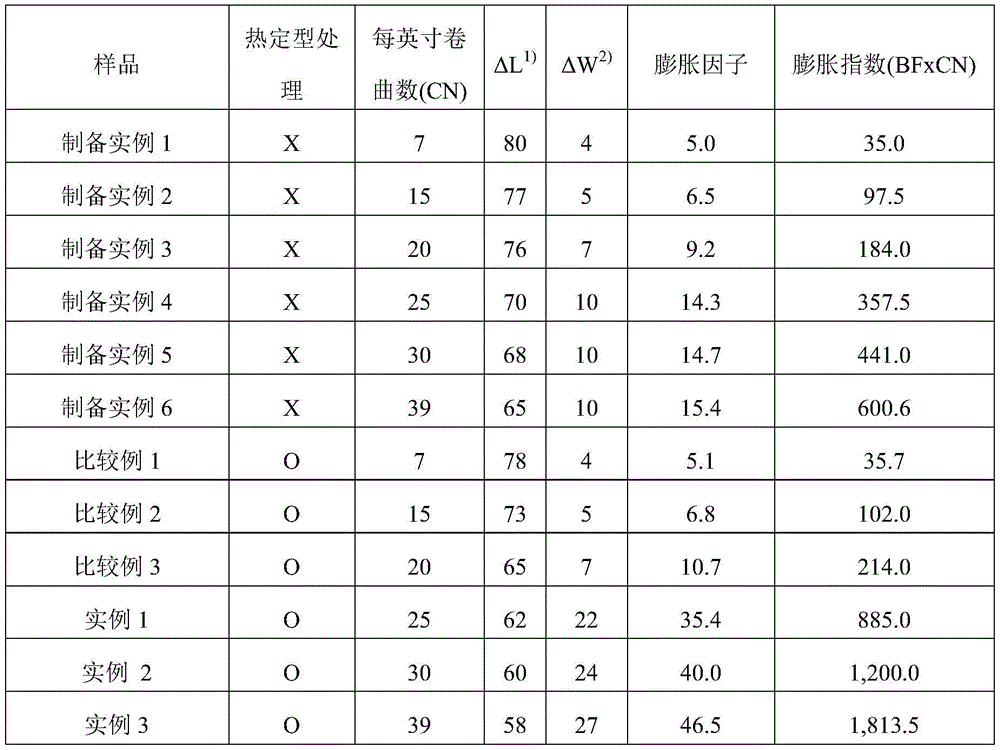
1)ΔL:永久变形前后纤维长度的变化1) ΔL: change in fiber length before and after permanent deformation
2)ΔW:永久变形前后纤维宽度的变化2) ΔW: change of fiber width before and after permanent deformation
通过比较表1中的膨胀因子和膨胀指数的结果,可以确认当每英寸的卷曲数为25以上时,膨胀因子和膨胀指数显著增加。特别是进行热定形时,膨胀指数增加到800以上,因此,莱赛尔卷曲纤维表现出优异的膨胀性能。By comparing the results of the swelling factor and swelling index in Table 1, it can be confirmed that the swelling factor and swelling index increase significantly when the number of curls per inch is 25 or more. In particular, when heat-setting is performed, the expansion index increases to more than 800, and therefore, the lyocell crimped fibers exhibit excellent expansion properties.
特别是,即使当卷曲数为25以上时,如果不进行热定形,则膨胀因子没有接近30,因此膨胀指数没有进一步增加。即使进行热定形,当卷曲数小于25时,也难以确保高的膨胀因子和高的膨胀指数。In particular, even when the number of crimps is 25 or more, if heat setting is not performed, the expansion factor does not approach 30, and thus the expansion index does not further increase. Even if heat-setting is performed, when the number of crimps is less than 25, it is difficult to secure a high expansion factor and a high expansion index.
Claims (6)
Applications Claiming Priority (5)
| Application Number | Priority Date | Filing Date | Title |
|---|---|---|---|
| KR10-2014-0131932 | 2014-09-30 | ||
| KR20140131932 | 2014-09-30 | ||
| KR1020150136000A KR102157887B1 (en) | 2014-09-30 | 2015-09-25 | Crimped Lyocell Fiber |
| KR10-2015-0136000 | 2015-09-25 | ||
| PCT/KR2015/010319 WO2016052998A1 (en) | 2014-09-30 | 2015-09-30 | Lyocell crimped fiber |
Publications (2)
| Publication Number | Publication Date |
|---|---|
| CN107075739A CN107075739A (en) | 2017-08-18 |
| CN107075739B true CN107075739B (en) | 2020-02-18 |
Family
ID=55789844
Family Applications (1)
| Application Number | Title | Priority Date | Filing Date |
|---|---|---|---|
| CN201580050416.7A Active CN107075739B (en) | 2014-09-30 | 2015-09-30 | lyocell crimped fibers |
Country Status (5)
| Country | Link |
|---|---|
| US (1) | US20170292207A1 (en) |
| EP (1) | EP3202959A4 (en) |
| JP (1) | JP2017528616A (en) |
| KR (1) | KR102157887B1 (en) |
| CN (1) | CN107075739B (en) |
Families Citing this family (6)
| Publication number | Priority date | Publication date | Assignee | Title |
|---|---|---|---|---|
| KR102352034B1 (en) * | 2018-06-29 | 2022-01-14 | 코오롱인더스트리 주식회사 | Non-woven Fiber aggregates containing Lyocell Fibers |
| CN111778576A (en) * | 2019-04-03 | 2020-10-16 | 上海水星家用纺织品股份有限公司 | Preparation method of formaldehyde-removing lyocell fibers |
| TW202041732A (en) * | 2019-04-10 | 2020-11-16 | 奧地利商蘭仁股份有限公司 | Lyocell fiber tow, its manufacture and use |
| CN117867673A (en) * | 2023-12-22 | 2024-04-12 | 南京化纤股份有限公司 | Lyocell fiber and its preparation method and application |
| WO2025143825A1 (en) * | 2023-12-28 | 2025-07-03 | 코오롱인더스트리 주식회사 | Lyocell material, filter for smoking article, smoking article, and methods for manufacturing same |
| KR20250177733A (en) * | 2024-06-17 | 2025-12-24 | 코오롱인더스트리 주식회사 | Lyocell material, filters, smoking articles and method for preparing thereof |
Citations (3)
| Publication number | Priority date | Publication date | Assignee | Title |
|---|---|---|---|---|
| CN1139961A (en) * | 1994-03-09 | 1997-01-08 | 考脱沃兹纤维(控股)有限公司 | Fiber production process and fibers resulting from the process |
| CN1576403A (en) * | 2003-07-25 | 2005-02-09 | 株式会社晓星 | Lyocell multifilament |
| CN1688637A (en) * | 2003-06-30 | 2005-10-26 | 株式会社晓星 | A homogeneous cellulose solution and high tenacity lyocell multifilament using the same |
Family Cites Families (13)
| Publication number | Priority date | Publication date | Assignee | Title |
|---|---|---|---|---|
| TW392003B (en) * | 1995-10-11 | 2000-06-01 | Asahi Chemical Ind | False twist yarn |
| GB9526168D0 (en) * | 1995-12-21 | 1996-02-21 | Courtaulds Fibres Holdings Ltd | Fibre manufacture |
| US6306334B1 (en) * | 1996-08-23 | 2001-10-23 | The Weyerhaeuser Company | Process for melt blowing continuous lyocell fibers |
| EP0920548B1 (en) * | 1996-08-23 | 2002-10-02 | Weyerhaeuser Company | Lyocell fibers and process for their preparation |
| JP3832000B2 (en) * | 1996-11-21 | 2006-10-11 | 東洋紡績株式会社 | Modified cross-section regenerated cellulose fiber and process for producing the same |
| KR100416212B1 (en) * | 2001-10-16 | 2004-01-31 | 주식회사한일합섬 | Process for producing crimped cellulose fiber by forming melt fracture |
| CA2438445C (en) * | 2002-12-26 | 2006-11-28 | Hyosung Corporation | Lyocell multi-filament for tire cord and method of producing the same |
| KR100824980B1 (en) * | 2006-12-28 | 2008-04-28 | 주식회사 효성 | Cellulose Multifilament with Low Cross Section Coefficient |
| AT505511B1 (en) * | 2007-07-11 | 2014-03-15 | Chemiefaser Lenzing Ag | FILLING FIBER WITH IMPROVED OPENING BEHAVIOR, METHOD FOR THE PRODUCTION THEREOF AND THEIR USE |
| CN103025931B (en) * | 2010-06-30 | 2015-07-08 | 可隆工业株式会社 | Dope for spinning lyocell, method for preparing a lyocell filament fiber using same, and method for preparing a lyocell staple fiber using same |
| JP2011021311A (en) * | 2010-08-27 | 2011-02-03 | Toyobo Co Ltd | Woven fabric for adhesive interlining, and method for producing the same, and adhesive interlining |
| KR101954239B1 (en) * | 2012-12-31 | 2019-03-05 | 코오롱인더스트리 주식회사 | Spinning apparatus for preparing lyocell fiber, and method for preparing lyocell filament fiber and lyocell staple fiber using the same |
| KR101455002B1 (en) * | 2013-06-28 | 2014-11-03 | 코오롱인더스트리 주식회사 | Lyocell Material Cigarette Filter and Method for the Same |
-
2015
- 2015-09-25 KR KR1020150136000A patent/KR102157887B1/en active Active
- 2015-09-30 EP EP15847023.7A patent/EP3202959A4/en not_active Withdrawn
- 2015-09-30 JP JP2017513701A patent/JP2017528616A/en active Pending
- 2015-09-30 US US15/512,969 patent/US20170292207A1/en not_active Abandoned
- 2015-09-30 CN CN201580050416.7A patent/CN107075739B/en active Active
Patent Citations (3)
| Publication number | Priority date | Publication date | Assignee | Title |
|---|---|---|---|---|
| CN1139961A (en) * | 1994-03-09 | 1997-01-08 | 考脱沃兹纤维(控股)有限公司 | Fiber production process and fibers resulting from the process |
| CN1688637A (en) * | 2003-06-30 | 2005-10-26 | 株式会社晓星 | A homogeneous cellulose solution and high tenacity lyocell multifilament using the same |
| CN1576403A (en) * | 2003-07-25 | 2005-02-09 | 株式会社晓星 | Lyocell multifilament |
Also Published As
| Publication number | Publication date |
|---|---|
| EP3202959A4 (en) | 2018-03-21 |
| KR102157887B1 (en) | 2020-09-18 |
| EP3202959A1 (en) | 2017-08-09 |
| CN107075739A (en) | 2017-08-18 |
| KR20160038800A (en) | 2016-04-07 |
| US20170292207A1 (en) | 2017-10-12 |
| JP2017528616A (en) | 2017-09-28 |
Similar Documents
| Publication | Publication Date | Title |
|---|---|---|
| CN103025931B (en) | Dope for spinning lyocell, method for preparing a lyocell filament fiber using same, and method for preparing a lyocell staple fiber using same | |
| CN107075739B (en) | lyocell crimped fibers | |
| US10806174B2 (en) | Lyocell material for cigarette filter and method for preparing same | |
| CN105556012B (en) | Lyocell material for tobacco filter and manufacturing method thereof | |
| RU2664206C1 (en) | Lyocell material for cigarette filter and its production method | |
| CN108474142A (en) | Lyocell fibers and its manufacturing method | |
| US20190345641A1 (en) | Lyocell fiber, nonwoven fibrous aggregate containing the same, and a mask pack sheet containing the same | |
| KR102205529B1 (en) | Lyocell Fiber | |
| KR101385275B1 (en) | Dope for spinning lyocell, method for preparing lyocell staple fiber, and lyocell staple fiber prepared therefrom | |
| JP2024523387A (en) | Lyocell material for cigarette filters and its manufacturing method | |
| US20210235848A1 (en) | Non-woven fiber aggregates and mask pack sheet using the same | |
| TWI831101B (en) | Moulded body that comprises elastane incorporated in cellulose and manufacturing method | |
| KR102356631B1 (en) | The mask pack sheet | |
| TW202319603A (en) | Improvements relating to the cold-alkali process for the production of regenerated cellulosic fibers | |
| JP7752163B2 (en) | Regenerated cellulose fiber, fiber assembly thereof, method for producing viscose rayon fiber bundle, fiber bundle for artificial hair, artificial hair, and hair accessories | |
| WO2016052998A1 (en) | Lyocell crimped fiber | |
| KR20110073979A (en) | Cellulose Multifilament Manufacturing Method | |
| CN118639368A (en) | Flame retardant paper yarn and preparation method thereof | |
| CN117940028A (en) | Lyocell material for cigarette filter tip and method for producing the same | |
| KR20110078123A (en) | Method for manufacturing lyocell filament fiber with improved washing process | |
| KR20190081702A (en) | Non-woven Fiber aggregates containing Lyocell Fibers |
Legal Events
| Date | Code | Title | Description |
|---|---|---|---|
| PB01 | Publication | ||
| PB01 | Publication | ||
| SE01 | Entry into force of request for substantive examination | ||
| SE01 | Entry into force of request for substantive examination | ||
| GR01 | Patent grant | ||
| GR01 | Patent grant |