CN107071489B - Image coding supporting block merging and skip mode - Google Patents
Image coding supporting block merging and skip mode Download PDFInfo
- Publication number
- CN107071489B CN107071489B CN201710067804.7A CN201710067804A CN107071489B CN 107071489 B CN107071489 B CN 107071489B CN 201710067804 A CN201710067804 A CN 201710067804A CN 107071489 B CN107071489 B CN 107071489B
- Authority
- CN
- China
- Prior art keywords
- image
- samples
- bitstream
- sample set
- groups
- Prior art date
- Legal status (The legal status is an assumption and is not a legal conclusion. Google has not performed a legal analysis and makes no representation as to the accuracy of the status listed.)
- Active
Links
Images


Classifications
-
- H—ELECTRICITY
- H04—ELECTRIC COMMUNICATION TECHNIQUE
- H04N—PICTORIAL COMMUNICATION, e.g. TELEVISION
- H04N19/00—Methods or arrangements for coding, decoding, compressing or decompressing digital video signals
- H04N19/50—Methods or arrangements for coding, decoding, compressing or decompressing digital video signals using predictive coding
- H04N19/503—Methods or arrangements for coding, decoding, compressing or decompressing digital video signals using predictive coding involving temporal prediction
- H04N19/51—Motion estimation or motion compensation
- H04N19/513—Processing of motion vectors
- H04N19/517—Processing of motion vectors by encoding
- H04N19/52—Processing of motion vectors by encoding by predictive encoding
-
- H—ELECTRICITY
- H04—ELECTRIC COMMUNICATION TECHNIQUE
- H04N—PICTORIAL COMMUNICATION, e.g. TELEVISION
- H04N19/00—Methods or arrangements for coding, decoding, compressing or decompressing digital video signals
- H04N19/10—Methods or arrangements for coding, decoding, compressing or decompressing digital video signals using adaptive coding
- H04N19/134—Methods or arrangements for coding, decoding, compressing or decompressing digital video signals using adaptive coding characterised by the element, parameter or criterion affecting or controlling the adaptive coding
- H04N19/157—Assigned coding mode, i.e. the coding mode being predefined or preselected to be further used for selection of another element or parameter
-
- H—ELECTRICITY
- H04—ELECTRIC COMMUNICATION TECHNIQUE
- H04N—PICTORIAL COMMUNICATION, e.g. TELEVISION
- H04N19/00—Methods or arrangements for coding, decoding, compressing or decompressing digital video signals
- H04N19/10—Methods or arrangements for coding, decoding, compressing or decompressing digital video signals using adaptive coding
- H04N19/102—Methods or arrangements for coding, decoding, compressing or decompressing digital video signals using adaptive coding characterised by the element, parameter or selection affected or controlled by the adaptive coding
- H04N19/103—Selection of coding mode or of prediction mode
-
- H—ELECTRICITY
- H04—ELECTRIC COMMUNICATION TECHNIQUE
- H04N—PICTORIAL COMMUNICATION, e.g. TELEVISION
- H04N19/00—Methods or arrangements for coding, decoding, compressing or decompressing digital video signals
- H04N19/10—Methods or arrangements for coding, decoding, compressing or decompressing digital video signals using adaptive coding
- H04N19/102—Methods or arrangements for coding, decoding, compressing or decompressing digital video signals using adaptive coding characterised by the element, parameter or selection affected or controlled by the adaptive coding
- H04N19/119—Adaptive subdivision aspects, e.g. subdivision of a picture into rectangular or non-rectangular coding blocks
-
- H—ELECTRICITY
- H04—ELECTRIC COMMUNICATION TECHNIQUE
- H04N—PICTORIAL COMMUNICATION, e.g. TELEVISION
- H04N19/00—Methods or arrangements for coding, decoding, compressing or decompressing digital video signals
- H04N19/10—Methods or arrangements for coding, decoding, compressing or decompressing digital video signals using adaptive coding
- H04N19/102—Methods or arrangements for coding, decoding, compressing or decompressing digital video signals using adaptive coding characterised by the element, parameter or selection affected or controlled by the adaptive coding
- H04N19/13—Adaptive entropy coding, e.g. adaptive variable length coding [AVLC] or context adaptive binary arithmetic coding [CABAC]
-
- H—ELECTRICITY
- H04—ELECTRIC COMMUNICATION TECHNIQUE
- H04N—PICTORIAL COMMUNICATION, e.g. TELEVISION
- H04N19/00—Methods or arrangements for coding, decoding, compressing or decompressing digital video signals
- H04N19/10—Methods or arrangements for coding, decoding, compressing or decompressing digital video signals using adaptive coding
- H04N19/134—Methods or arrangements for coding, decoding, compressing or decompressing digital video signals using adaptive coding characterised by the element, parameter or criterion affecting or controlling the adaptive coding
- H04N19/157—Assigned coding mode, i.e. the coding mode being predefined or preselected to be further used for selection of another element or parameter
- H04N19/159—Prediction type, e.g. intra-frame, inter-frame or bidirectional frame prediction
-
- H—ELECTRICITY
- H04—ELECTRIC COMMUNICATION TECHNIQUE
- H04N—PICTORIAL COMMUNICATION, e.g. TELEVISION
- H04N19/00—Methods or arrangements for coding, decoding, compressing or decompressing digital video signals
- H04N19/10—Methods or arrangements for coding, decoding, compressing or decompressing digital video signals using adaptive coding
- H04N19/169—Methods or arrangements for coding, decoding, compressing or decompressing digital video signals using adaptive coding characterised by the coding unit, i.e. the structural portion or semantic portion of the video signal being the object or the subject of the adaptive coding
- H04N19/17—Methods or arrangements for coding, decoding, compressing or decompressing digital video signals using adaptive coding characterised by the coding unit, i.e. the structural portion or semantic portion of the video signal being the object or the subject of the adaptive coding the unit being an image region, e.g. an object
- H04N19/172—Methods or arrangements for coding, decoding, compressing or decompressing digital video signals using adaptive coding characterised by the coding unit, i.e. the structural portion or semantic portion of the video signal being the object or the subject of the adaptive coding the unit being an image region, e.g. an object the region being a picture, frame or field
-
- H—ELECTRICITY
- H04—ELECTRIC COMMUNICATION TECHNIQUE
- H04N—PICTORIAL COMMUNICATION, e.g. TELEVISION
- H04N19/00—Methods or arrangements for coding, decoding, compressing or decompressing digital video signals
- H04N19/10—Methods or arrangements for coding, decoding, compressing or decompressing digital video signals using adaptive coding
- H04N19/169—Methods or arrangements for coding, decoding, compressing or decompressing digital video signals using adaptive coding characterised by the coding unit, i.e. the structural portion or semantic portion of the video signal being the object or the subject of the adaptive coding
- H04N19/17—Methods or arrangements for coding, decoding, compressing or decompressing digital video signals using adaptive coding characterised by the coding unit, i.e. the structural portion or semantic portion of the video signal being the object or the subject of the adaptive coding the unit being an image region, e.g. an object
- H04N19/176—Methods or arrangements for coding, decoding, compressing or decompressing digital video signals using adaptive coding characterised by the coding unit, i.e. the structural portion or semantic portion of the video signal being the object or the subject of the adaptive coding the unit being an image region, e.g. an object the region being a block, e.g. a macroblock
-
- H—ELECTRICITY
- H04—ELECTRIC COMMUNICATION TECHNIQUE
- H04N—PICTORIAL COMMUNICATION, e.g. TELEVISION
- H04N19/00—Methods or arrangements for coding, decoding, compressing or decompressing digital video signals
- H04N19/10—Methods or arrangements for coding, decoding, compressing or decompressing digital video signals using adaptive coding
- H04N19/169—Methods or arrangements for coding, decoding, compressing or decompressing digital video signals using adaptive coding characterised by the coding unit, i.e. the structural portion or semantic portion of the video signal being the object or the subject of the adaptive coding
- H04N19/184—Methods or arrangements for coding, decoding, compressing or decompressing digital video signals using adaptive coding characterised by the coding unit, i.e. the structural portion or semantic portion of the video signal being the object or the subject of the adaptive coding the unit being bits, e.g. of the compressed video stream
-
- H—ELECTRICITY
- H04—ELECTRIC COMMUNICATION TECHNIQUE
- H04N—PICTORIAL COMMUNICATION, e.g. TELEVISION
- H04N19/00—Methods or arrangements for coding, decoding, compressing or decompressing digital video signals
- H04N19/10—Methods or arrangements for coding, decoding, compressing or decompressing digital video signals using adaptive coding
- H04N19/169—Methods or arrangements for coding, decoding, compressing or decompressing digital video signals using adaptive coding characterised by the coding unit, i.e. the structural portion or semantic portion of the video signal being the object or the subject of the adaptive coding
- H04N19/186—Methods or arrangements for coding, decoding, compressing or decompressing digital video signals using adaptive coding characterised by the coding unit, i.e. the structural portion or semantic portion of the video signal being the object or the subject of the adaptive coding the unit being a colour or a chrominance component
-
- H—ELECTRICITY
- H04—ELECTRIC COMMUNICATION TECHNIQUE
- H04N—PICTORIAL COMMUNICATION, e.g. TELEVISION
- H04N19/00—Methods or arrangements for coding, decoding, compressing or decompressing digital video signals
- H04N19/50—Methods or arrangements for coding, decoding, compressing or decompressing digital video signals using predictive coding
-
- H—ELECTRICITY
- H04—ELECTRIC COMMUNICATION TECHNIQUE
- H04N—PICTORIAL COMMUNICATION, e.g. TELEVISION
- H04N19/00—Methods or arrangements for coding, decoding, compressing or decompressing digital video signals
- H04N19/70—Methods or arrangements for coding, decoding, compressing or decompressing digital video signals characterised by syntax aspects related to video coding, e.g. related to compression standards
Landscapes
- Engineering & Computer Science (AREA)
- Multimedia (AREA)
- Signal Processing (AREA)
- Compression Or Coding Systems Of Tv Signals (AREA)
Abstract
本发明公开了支持区块合并和跳过模式的图像编码。一种被配置为对一图像被编码至其中的比特流解码的装置,图像的样本数组被分隔为分别与相应编码参数关联的样本集合,装置被配置为对于一当前样本集合,关于与当前样本集合关联的编码参数是根据一合并候选者被设定还是从比特流取得的一第一决定,以及关于图像的当前样本集合是仅以取决于与当前样本集合关联的编码参数的一预测信号为基础而无需任何残余数据被重建还是通过比特流内的残余数据来提炼取决于与当前样本集合的编码参数的预测信号被重建的一第二决定,而共同地响应于比特流内的一标记。
The invention discloses image coding supporting block merging and skip mode. An apparatus configured to decode a bitstream into which an image is encoded, an array of samples of the image being partitioned into sets of samples respectively associated with respective encoding parameters, the apparatus being configured to, for a current set of samples, Whether the encoding parameters associated with the set are based on a first decision whether a merge candidate is set or obtained from the bitstream, and whether the current sample set for the picture is based only on a prediction signal that depends on the encoding parameters associated with the current sample set is Whether the base is reconstructed without any residual data or refined by residual data in the bitstream depends on a second decision with the prediction signal of the coding parameters of the current sample set being reconstructed, collectively responding to a flag in the bitstream.
Description
本申请是分案申请,其母案申请的申请号为201180064204.6,申请日为2011年11月4日,发明名称为“支持区块合并和跳过模式的图像编码”。This application is a divisional application, the application number of the parent application is 201180064204.6, the filing date is November 4, 2011, and the title of the invention is "Image Coding Supporting Block Merging and Skip Mode".
技术领域technical field
本申请涉及图像和/或视频编码,并且尤其涉及支持区块分隔及跳过模式的编解码器。The present application relates to image and/or video encoding, and in particular to codecs that support block separation and skip modes.
背景技术Background technique
许多图像(picture,画面)和/或视频编解码器以区块为单位来处理图像。例如,预测式编解码器使用一区块间隔尺寸以便实现在一方面花费太多的侧信息在预测参数上,以高空间分辨率被设定的非常精确地设定的预测参数,以及另一方面由于较低空间分辨率的预测参数而导致编码预测残差所需的位数量增加的太粗糙地设定预测参数之间的良好妥协。实际上,这些预测参数的最佳设定是位于两极端点的某处。Many picture (picture) and/or video codecs process pictures in units of blocks. For example, predictive codecs use a block interval size in order to achieve on the one hand spending too much side information on prediction parameters, very precisely set prediction parameters at high spatial resolution, and on the other hand A good compromise between setting the prediction parameters too coarsely due to the increased number of bits required to encode the prediction residual due to the prediction parameters of lower spatial resolution. In practice, the best settings for these prediction parameters lie somewhere between the extremes.
为了得到上述问题的最佳解决办法,已经有许多的尝试。例如,取代使用规则地被配置成为列与行的区块的图像的规则子分割,多树型分隔子分割在对于子分割信息的合理要求的下寻求增加子分割一图像成为区块的自由度。然而,即使多树型子分割需要可观的数据数量,即使在使用此多树型子分割的情况中,子分割一图像的自由度是相当被限制的。There have been many attempts to obtain the best solution to the above problem. For example, instead of using regular sub-segments of images that are regularly arranged into blocks of columns and rows, multi-tree-segmented sub-segments seek to increase the degree of freedom of sub-segments—images into blocks with reasonable requirements for sub-segment information . However, even if multi-tree sub-segmentation requires a considerable amount of data, even in the case of using this multi-tree sub-segmentation, the degree of freedom of sub-segmenting an image is rather limited.
为了在一方面针对图像子分割所需的侧信息数量发信令以及另一方面针对子分割图像的自由度发信令之间能够有较佳的折衷,可使用区块合并,以便在在对合并信息发信令所需的额外数据的合理数量下增加可能的图像子分割数目。对于被合并的区块,编码参数需要在比特流之内仅完全被发送一次,相似于犹如产生的合并区块群组是图像的直接子分割部分一般。In order to be able to have a better compromise between signaling the amount of side information required for sub-segmentation of the image on the one hand and the degrees of freedom of the sub-segmented image on the other hand, block merging can be used to The number of possible image sub-segments is increased with a reasonable amount of additional data required for combined information signaling. For merged blocks, the encoding parameters need to be sent exactly once within the bitstream, similar to as if the resulting group of merged blocks were direct sub-segments of the picture.
为了另外增加编码图像内容的效能,跳过模式已被引入一些区块为基础的图像编解码器中,该跳过模式使编码器抑制不发送某一区块的残余数据至解码器。亦即,跳过模式是可能抑制对于某些区块的残余数据发送。抑制对于某些区块的残余数据的发送的能力,导致对于将编码/预测参数加以编码的较宽的间隔尺寸区间,其中在一方面编码质量以及另一方面的花费总位率之间的最佳交换可被预期:当然,增加编码/预测参数的编码的空间分辨率导致侧信息率的增加,但同时也减少残余量,因而降低必须编码残余数据的位率。但是,由于跳过模式的可利用性,其可利用仅适度地进一步增加编码/预测参数被发送的间隔尺寸,而残余量是如此地小而使残余量的相应发送可被省去,而有利于得到一意外的编码率节省。To additionally increase the efficiency of encoding image content, a skip mode has been introduced in some block-based image codecs, which enables the encoder to refrain from sending residual data for a certain block to the decoder. That is, skip mode is possible to suppress residual data transmission for certain blocks. The ability to suppress the transmission of residual data for certain blocks results in a wider interval size interval for encoding the encoding/prediction parameters, with the best between encoding quality on the one hand and cost total bit rate on the other hand. An optimal exchange can be expected: of course, increasing the spatial resolution of the encoding of the encoding/prediction parameters results in an increase in the side information rate, but at the same time also reduces the residual amount and thus reduces the bit rate at which the residual data has to be encoded. However, due to the availability of skip mode, which can only modestly further increase the interval size at which coding/prediction parameters are sent, the residual is so small that the corresponding transmission of the residual can be omitted, and there is It is advantageous to obtain an unexpected code rate saving.
但是,由于因区块合并组合以及跳过模式使用所新近引起的留下的冗余量,仍然有需要达到较佳的编码效能。However, there is still a need to achieve better coding performance due to the newly left redundancy caused by block merging and the use of skip mode.
因此,本发明的目的是提供具有增加编码效率的编码概念。It is therefore an object of the present invention to provide a coding concept with increased coding efficiency.
发明内容SUMMARY OF THE INVENTION
本发明的构想是如果关于合并致动以及跳过模式致动的共同发信令在比特流之内被使用,则可实现进一步的编码效能的增加。亦即,在比特流之内一个或多个语法元素的可能状态之一可发信令,对于一图像的一当前样本集合,相应样本集合是将被合并并且不具有预测残差量被编码且被插入比特流内。另外,一共同标记可共同地发信令,关于关联一当前样本集合的编码参数是否将根据一合并候选者被设定或将自该比特流取得,以及关于该图像的当前样本集合是否将仅以取决于关联于该当前样本集合的编码参数的一预测信号为基础而无需任何残余数据地被重建,或将利用在比特流内的残余数据通过提炼取决于与当前样本集合关联的编码参数的预测信号而被重建。The idea of the present invention is that a further increase in coding efficiency can be achieved if co-signaling for merge activation and skip mode activation is used within the bitstream. That is, one of the possible states of one or more syntax elements within the bitstream may signal that, for a current set of samples for a picture, the corresponding set of samples is to be merged and has no prediction residuals encoded and inserted into the bitstream. Additionally, a common flag can be collectively signaled as to whether coding parameters associated with a current sample set will be set according to a merge candidate or will be obtained from the bitstream, and whether the current sample set for the picture will only be is reconstructed without any residual data based on a prediction signal that depends on the coding parameters associated with the current sample set, or will utilize the residual data within the bitstream by refining a prediction signal that depends on the coding parameters associated with the current sample set. The predicted signal is reconstructed.
本发明的发明者发现一方面合并的致动以及另一方面跳过模式的致动的共同发信令的引介节省位率,因为彼此分开的合并和/或跳过模式的致动的发信令的附加经常支出可被减低或可能仅在合并以及跳过模式不同时被致动的情况中必须被花费。The inventors of the present invention found that the introduction of co-signaling of the actuation of merge on the one hand and the actuation of skip mode on the other hand saves bit rate because the signaling of the actuation of merge and/or skip mode separate from each other The additional overhead of the order may be reduced or may only have to be spent if the merge and skip modes are not activated at the same time.
本申请的较佳实施例将配合有关附图在下面更详细地被说明。Preferred embodiments of the present application will be described in more detail below in conjunction with the relevant drawings.
附图说明Description of drawings
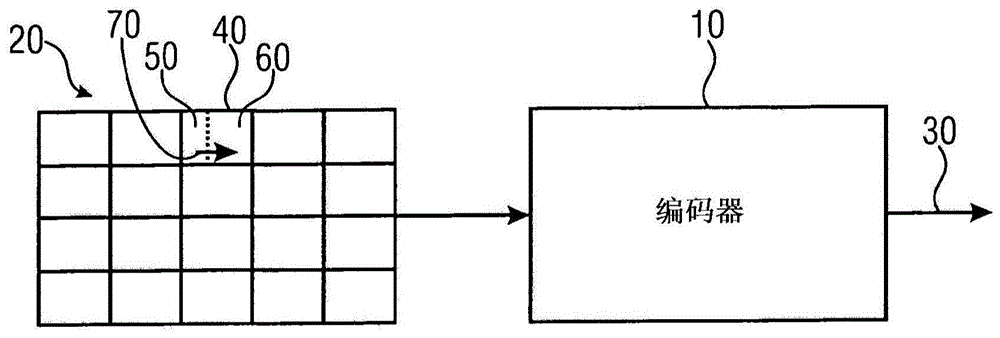
图1示出根据一实施例而用于编码的装置的方块图;1 shows a block diagram of an apparatus for encoding according to an embodiment;
图2示出根据更详细的实施例而用于编码的装置的方块图;Figure 2 shows a block diagram of an apparatus for encoding according to a more detailed embodiment;
图3示出根据一实施例而用于解码的装置的方块图;3 shows a block diagram of an apparatus for decoding according to an embodiment;
图4示出根据更详细的实施例而用于解码的装置的方块图;4 shows a block diagram of an apparatus for decoding according to a more detailed embodiment;
图5示出图1或图2的编码器的可能内部结构的方块图;Figure 5 shows a block diagram of a possible internal structure of the encoder of Figure 1 or Figure 2;
图6示出图3或图4的解码器的可能内部结构的方块图;Figure 6 shows a block diagram of a possible internal structure of the decoder of Figure 3 or Figure 4;
图7A分解地示出一图像成为树根区块(tree-root block)、编码单位(区块)以及预测单位(分隔)的可能的子分割;FIG. 7A decomposes a picture into possible sub-divisions of tree-root blocks, coding units (blocks), and prediction units (divisions);
图7B示出根据一说明范例的在图7A中所示的向下至分隔位准的树根区块的子分割树型;7B shows the sub-split tree shown in FIG. 7A down to the root block of the split level, according to an illustrative example;
图8示出根据一实施例对于一组可能支持的分隔图样的实施例;8 illustrates an embodiment for a set of possible supported separation patterns according to an embodiment;
图9示出,当根据图8使用区块分隔时,将有效地自组合区块合并以及区块分隔中产生的可能分隔图样;Figure 9 shows, when using block separation according to Figure 8, the possible separation patterns that would effectively be generated from combining block merging and block separation;
图10分解地示出根据一实施例的用于一跳过/直接(SKIP/DIRECT)模式的候选区块;10 explodes a candidate block for a skip/direct (SKIP/DIRECT) mode according to an embodiment;
图11至图13A和图13B示出根据一实施例的一语法的语法部分;以及Figures 11-13A and 13B illustrate syntax portions of a syntax according to an embodiment; and
图14分解地示出根据一实施例的用于一分隔的邻近分隔的界定。Figure 14 explodes the definition of adjacent partitions for a partition, according to an embodiment.
具体实施方式Detailed ways
关于下面的说明,应注意到,每当相同的参考符号被使用于不同附图时,关于相对这些附图之一的相应组件的说明将同样地适用至其它附图,只要自一附图转移至另一附图的说明是不与另一附图的其余说明冲突。With regard to the following description, it should be noted that whenever the same reference signs are used in different figures, the description of the corresponding component with respect to one of these figures will apply equally to the other figures as long as it is transferred from one figure The description to another figure does not conflict with the remaining description of the other figure.
图1示出了用于编码一图像20使成为一比特流30的装置10。当然,图像20可以为视频的一部分,在其情况中,编码器10将是视频编码器。FIG. 1 shows an
虽然不在图1中明确地被示出,图像20被表示如一样本数组。图像20的样本数组被分隔成为样本集合40,其可以是任何样本集合,例如,含盖图像20的非重迭单一连接区域的样本集合。为容易了解起见,样本集合40被示出如,并且在下面被称为,区块40,但是其中,下面的说明将不被视为对任何特别类型的样本集合40的限制。根据一具体实施例,样本集合40是矩形和/或正方形区块。Although not explicitly shown in Figure 1, the
例如,图像20可被子分割成为区块40的规则性配置,因而区块40如图1的示出而示例地以列及行方式配置。但是,任何将图像20细分成为区块40的其它子分割也是可能。尤其是,使图像20细分成为区块40的子分割可以是固定的,亦即,为解码器已知的原定值或可在比特流30内被发信令至解码器。尤其是,图像20的区块40可以有变化间隔尺寸。例如,多树型子分割,例如,四分式树型子分割可被应用至图像20或应用至图像20的规则性预子分割使成为规则地被配置的树根区块,以便得到区块40,在此情况中,区块40形成树根区块的多树型子分割的叶部区块。For example, the
在任何情况中,编码器10被配置为对于当前样本集合40,编码一标记进入比特流30而共同地发信令关联于当前样本集合40的编码参数是根据一合并候选者被设定还是从比特流30中取得,以及图像20的当前样本集合是仅以取决于关联于当前样本集合的编码参数的一预测信号为基础,而无需任何残余数据被重建,还是利用在比特流30内的残余数据通过提炼取决于关联于当前样本集合40的编码参数的预测信号而被重建。例如,编码器10被配置为对于当前样本集合40,编码一标记成为比特流30而共同地发信令,如果假设一第一状态,关联于当前样本集合40的编码参数是根据一合并候选者被设定而不是自比特流30取得,并且图像20的当前样本集合是仅以取决于关联于当前样本集合的编码参数的一预测信号为基础,而无需任何残余数据地被重建,以及如果假设任何其它的状态,关联于当前样本集合40的编码参数是自比特流30取得,或图像20的当前样本集合是利用在比特流30内的残余数据通过提炼取决于关联于当前样本集合40的编码参数的预测信号而被重建。这表示下列事项。编码器10支持区块40的合并。该合并是要被授权的。亦即,不是每个区块40进行合并。对于一些区块40,例如,在位率/失真最佳化意义上,是适于合并当前区块40与一合并候选者,但是对于其它者却是相反。为了决定某一区块40是否应合并,编码器10决定合并候选者的一集合或列表,并且,对于这些合并候选者的各者,例如,在位率/失真最佳化意义上,是否合并当前区块40与合并候选者将形成较佳编码选择。编码器10被配置为依比特流30先前被编码部分为基础而决定对于一当前区块40的合并候选者的集合或列表。例如,编码器10通过接受关联于已先前取决于编码器10所应用的编码顺序被编码的区域性和/或时间性邻近区块40的编码参数而取得至少一部分的合并候选者的集合或列表。时间性邻近表示,例如,图像20所属的先前被编码的视频图像的区块,具有时间性邻近区块,其空间上被安置以便空间地重迭当前图像20的当前区块40。因此,对于合并候选者的集合或列表的这部分,在各合并候选者以及空间和/或时间邻近区块的间有一种一对一的关联性。各合并候选者具有与的相关的编码参数。如果当前区块40与任何合并候选者合并,则编码器10根据合并候选者设定当前区块40的编码参数。例如,编码器10可设定当前区块40的编码参数等于相应的合并候选者,亦即,编码器10可从相应的合并候选者复制当前区块40的编码参数。因此,对于合并候选者的集合或列表的这描述部分,一合并候选者的编码参数直接地自一空间和/或时间邻近区块被采用,或通过同样地采用相同者,亦即,相等地设定合并候选者,使相应合并候选者的编码参数自此一空间和/或时间邻近区块的编码参数被得到,但是,同时考虑区域改变,例如,通过根据该区域改变而尺度调整所采用的编码参数。例如,经历合并的至少一部分的编码参数可包含移动参数。但是,移动参数可指示不同的参考图像索引。更确切地说,被采用的移动参数可指示在当前图像以及参考图像的间的某一时间区间,并且在合并当前区块与具有相应移动参数的相应的合并候选者中,编码器10可被配置为调整相应合并候选者的移动参数尺度以便调适其的时间区间至选择给当前区块的时间区间。In any case, the
在任何情况中,到当前为止上述的合并候选者共同地具有它们相关的编码参数,并且在这些合并候选者以及邻近区块的间有一种一对一关联性。因此,合并区块40与刚描述合并候选者可被视为将这些区块合并成为一个或多个区块40群组,因而编码参数不变化跨越这些区块40群组内的图像20,除了尺度调适或其类似者的外。实际上,与任何刚描述合并候选者的合并将减低编码参数越过图像20变化的尺度。此外,与任何刚描述的合并候选者的合并将导致子分割图像20分别地成为区块40以及区块40的群组的额外自由度。因此,就此而言,使区块40合并成为此些区块群组可被认为是导致编码器10使用于这些区块40群组为单位变化跨越图像20的编码参数而编码图像20。In any case, the merge candidates described above so far have their associated coding parameters in common, and there is a one-to-one correlation between these merge candidates and neighboring blocks. Accordingly, merging
除了刚提到的合并候选者外,编码器10也可增加合并候选者至合并候选者的集合/列表中,其是二个或更多个邻近区块的编码参数的组合结果,例如,其算术平均、几何平均或邻近区块的编码参数的中数以及其类似者。In addition to the just-mentioned merge candidates, the
因此,比较至使图像20为区块40的子分割所定义的间隔尺寸,编码器10有效地减低编码参数明确地在比特流30的内被发送的间隔尺寸。这些区块40的一些通过使用上面概述的合并选择以使用一者以及其编码参数而形成区块群组。一些区块经由合并彼此耦合,但是经由相应的尺度调适和/或组合功能使用在彼此间相关联的不同的编码参数。一些区块40并不受合并,并且因此编码器10直接地编码这些编码参数进入比特流30。Thus, the
编码器10使用因此被定义的区块40的编码参数以便决定对于图像20的预测信号。编码器10进行区块方式的预测信号的决定,其中预测信号取决于关联于相应区块40的编码参数。The
利用编码器10被进行的另一决定是关于残余量,亦即,在当前区块40的相应的局部区域的预测信号以及原始图像内容间的差量,是否将在比特流30的内被发送。亦即,编码器10决定,对于区块40,是否跳过模式将被应用至相应的区块。如果跳过模式被应用,则编码器10仅以从关联于相应区块40的编码参数被导出、或取决于关联于相应区块40的编码参数的预测信号形式,来编码在当前部分区块40的内的图像20,并且在跳过模式被取消的情况中,编码器10使用预测信号以及残余数据将在区块40内的图像20编码成为比特流30。Another decision made with the
为了节省用于对关于一方面为合并以及另一方面的跳过模式的决定发信令的位率,编码器10共同地使用一个标记而对于区块40的两个决定发信令。更精确地说,可实现共同发信令,使得合并和跳过模式两者的致动共同地在比特流30的内通过假设一第一可能标记状态的相应区块40的标记被指示,然而,该标记的其它标记状态仅指示解码器关于合并或跳过模式的一者不被致动。例如,编码器10可决定对于某一区块40致动合并,但是撤销该跳过模式。该情况中,编码器10使用其它标记状态以便在比特流30的内发信令关于合并以及跳过模式至少一者的撤销,同时在比特流30的内依次地,例如,利用另一标记而发信令合并的致动。因此,仅在区块40是合并以及跳过模式不同时被致动的情况中,编码器10必须发送这进一步的标记。在下面进一步说明的实施例中,第一标记被称为mrg_cbf或跳过_标记(skip_flag),而辅助合并指示标记被称为mrg或合并_标记(merge_flag)。本申请发明者已发现这一发信令状态的共同使用,以便共同地发信令合并以及跳过模式的致动可降低比特流30的整体位率。In order to save the bit rate for signaling the decisions regarding merge on the one hand and skip mode on the other hand, the
关于刚刚提及的发信令状态,应注意到,此一发信令状态可利用比特流30的一位状态被决定。但是,编码器10可被配置而以熵编码技术将比特流30编码,并且因此在标记发信令状态以及比特流30的间的对应性可能更复杂化。该情况中,状态可对应至熵解码领域中的比特流30的一位。更进一步地,发信令状态可对应至对于编码字组根据可变长度编码机构被规定的标记两个状态的一者。在算术编码的情况中,共同地发信令合并以及跳过模式的致动的发信令状态,可对应至算术编码机构下的符号文字的符号的一者。With regard to the signaling state just mentioned, it should be noted that this signaling state can be determined using one bit state of the
如上面的描述,编码器10使用比特流30的内的一标记以发信令合并以及跳过模式的同时致动。如下面将更详细的描述,这标记可在具有多于二个可能状态的一语法元素的内被发送。这语法元素同样地也可,例如,发信令其它的编码选择。下面将更详细说明其细节。但是,在那情况中,一个或多个语法元素的可能状态的一者将发信令同时发生的致动。亦即,每当刚刚描述的当前区块40的语法元素确定这预定的可能状态时,编码器10因而发信令合并以及跳过模式两者的致动。解码器因此不需要进一步相应地发信令关于合并的致动以及跳过模式的致动。As described above,
关于上面的说明,应注意到,使图像20分隔成为区块40可能不代表对于图像20所决定编码参数的最佳分辨率。反而,编码器10可将进一步的分隔信息附加于各区块40,以便在比特流30内发信令供相应地分隔当前区块40成为子区块50以及60,亦即,样本子集,的所支援分隔图样的一者。该情况中,同时的合并/跳过决定是以区块40为单位利用编码器10被进行,因而编码参数以及,例如,彼此分开的辅助合并决定和/或跳过模式决定,以区块40的次分隔为单位,亦即,以图1区块40示出范例的子区块50以及60为单位,对于图像20被定义。当然,一非分隔模式可代表所支持分隔图样的一者,因而导致编码器10仅决定对于区块40的一组编码参数。无关于相应的分隔图样的子区块50以及60数目,合并决定可应用至所有的子区块,亦即,一个或多个子区块。亦即,如果对于区块40的合并被致动,这致动对于所有的子区块可以是有效的。根据下面进一步描述的一实施例,上述共同状态的共同地发信令合并以及跳过模式致动,可另外地同时发信令对于当前区块40的所支持分隔图样间的非分隔图样,因而在标记或语法元素假设这状态的情况中,不需要进一步发送对于当前区块的分隔信息。当然,除了合并以及跳过模式的致动的外,任何在支持分隔图样的间的其它分隔图样可另外地同时被指示。With regard to the above description, it should be noted that dividing the
根据本申请的一些实施例,编码器10避免一方面自区块40的区块分隔的共同使用于及另一方面来自子区块50以及60的合并所产生的位效能损失。为更精确故,例如,在位率/失真最佳化意义,编码器10可决定是否对进一步的分隔区块40是较佳,以及关于那个支持分隔图样应被使用于当前区块40中,以便调适某些编码参数在图像20的当前区块40内被设定或被定义的间隔尺寸。如将在下面更详细的描述,编码参数,例如,可代表预测参数,例如,像框间预测参数。此些像框间预测参数,例如,可包括一参考图像索引、一移动向量以及其类似者。支持分隔图样,例如,可包括一非分隔模式,亦即,根据其使当前区块40是不进一步被分隔的一选择,一水平分隔模式,亦即,根据其使当前区块40沿着一水平延伸线被子分割成为一上方或顶部部分与一底部或下方部分的一选择,以及一垂直分隔模式,亦即,根据其使当前区块40沿着一垂直延伸线垂直地被子分割成为一左方部分与一右方部分的一选择。除此的外,支持分隔图样也可包括一选择,根据其使当前区块40进一步规则性地被子分割成为各假设为当前区块40的四分的一的四个进一步区块。进一步地,分隔可以是有关图像20的所有区块40或仅是其的一适当的子集,例如,那些具有与的相关的某一编码模式者,例如,像框间预测模式。同样地,应注意到,就其本身而言,合并可仅是供用于某些区块,例如,那些以像框间预测模式被编码者。根据下面进一步描述的一实施例,上述共同地说明的状态也同时发信令关于相应的区块是像框间预测模式而不是像框内预测模式。因此,对于区块40的上述标记的一状态可发信令关于这区块是不进一步被分隔并且合并与跳过模式针对其被致动的像框间预测编码区块。但是,如于标记假设另一状态的情况中的一辅助决定,各分隔或样本子集50以及60可在比特流30之内相应地附有一进一步的标记,以便发信令合并是否将被应用至相应的分隔50以及60。进一步地,支持分隔模式的不同子集可能是可供用于区块40,例如,在多树型子分割叶部区块情况中,组合或相应地取决于区块40的区块尺寸、子分割位准。According to some embodiments of the present application,
亦即,使图像20子分割成为区块,以便得到,尤其是,区块40可在比特流之内被固定或被发信令。同样地,将被使用于进一步分隔当前区块40的分隔图样可以分隔信息形式在比特流30之内被发信令。因此,分隔信息因此可被视为图像20子分割成为区块40的一种延伸。另一方面,使图像20成为区块40的子分割的原始间隔尺寸的另外的关联性仍然可保持。例如,编码器10可被配置为在比特流30之内发信令将被使用于利用区块40所定义的间隔尺寸的图像20的相应部分或区块40的编码模式,同时编码器10可被配置为通过针对相应区块40所选择的相应分隔图样所定义的一增加(较细)间隔尺寸,而在相应区块40之内变化相应编码模式的编码参数。例如,以区块40的间隔尺寸发信令的编码模式可区分像框内预测模式、像框间预测模式以及其类似者,例如,时间性像框间预测模式、视图间预测模式等等。自相应区块40的分隔产生的关联于一个或多个子区块(分隔)的编码参数类别,接着取决于被规定至相应区块40的编码模式。例如,对于一像框内编码区块40,编码参数可包括一空间方向,沿着该空间方向的图像20先前被解码部分的图像内容被使用于充填相应区块40。在一像框间编码区块40的情况中,编码参数可包括,尤其,用于移动补偿预测的一移动向量。That is, the
图1示例地示出被子分割成为两个子区块50以及60的当前区块40。尤其是,一垂直分隔模式示例地被示出。较小的区块50以及60也可被称为子区块50以及60或分隔部分50以及60或预测单位50以及60。尤其是,编码器10可被配置,以于被发信令的支持分隔图样的一者规定使当前区块40成为两个或更多个进一步区块50以及60的一子分割的情况中,对于除了编码顺序中的子区块50以及60的一第一子区块之外的所有进一步区块,自供用于相应子区块的一组编码参数候选者,移除具有编码参数相同于关联于任何子区块(其当与相应子区块合并时,将形成支持分隔图样之一)的编码参数的编码参数候选者。为更精确故,对于支持分隔图样各者,一编码顺序被定义在产生的一个或多个分隔图样50以及60之中。在图1的情况中,编码顺序利用箭号70被示例地示出,其定义左方分隔50优先于右方分隔60被编码。在水平分隔模式情况中,其可被定义上方分隔优先于下方分隔被编码。在任何情况中,编码器10被配置而对于以编码顺序70的第二分隔60,自对于相应第二分隔60的该组编码参数候选者,移除具有相同于关联第一分隔50的编码参数的编码参数的编码参数候选者,以便避免该合并的产生,亦即,事实上分隔50以及60两者皆将具有与的相关的相同编码参数,实际上,其可通过选择对于当前区块40的非分隔模式而以较低编码率等效地产生。FIG. 1 exemplarily shows the
为了更精确,编码器10可被配置为有效方法与区块分隔一起使用区块合并。就关于区块合并而言,编码器10可针对分隔50以及60各者而决定编码参数候选者的相应的集合。编码器可被配置为关联先前被解码区块的编码参数为基础而决定对于分隔50以及60各者的编码参数候选者集合。尤其是,在编码参数候选者集合内的至少一些编码参数候选者可以是等于,亦即,可被采用自先前被解码的分隔的编码参数。另外地,至少一些的编码参数候选者可经由一适当的组合(例如,中值数、均数或其类似者),而从关联多于一个先前被编码分隔的编码参数候选者被导出。但是,因为编码器10被配置为进行编码参数候选者减低集合的决定,并且,如果在移除之后多于一个的编码参数候选者留下,对于非第一分隔60的每一个,在留下的非移除编码参数候选者之间的选择,以便取决于一非移除或被选择的编码参数候选者而设定关联相应分隔的编码参数,编码器10被配置为进行移除使得将有效地导致分隔50以及60的再联合的编码参数候选者被移除。亦即,语法群集有效地被避免,根据其一有效的分隔情况被编码将比仅通过单独的使用分隔信息而直接地发信令这分隔的情况更复杂。To be more precise, the
此外,由于编码参数候选者集合成为较小,编码合并信息进入比特流30所需的侧信息数量可能由于这些候选者集合中较低的元素数量而减少。尤其是,由于解码器是可如图1的编码器般,以相同方式决定并且依次地减低编码参数候选者集合,图1的编码器10是可利用编码参数候选者的减低集合(通过,例如,使用较少的位),以便将一语法元素塞进入比特流30中,指明非移除编码参数候选者的哪一个是将被使用于合并。当然,在相应分隔的非移除编码参数候选者数目仅是一的情况中,进入比特流30的语法元素的引进可完全被抑制。在任何情况中,由于合并,亦即,取决于非移除的编码参数候选者的其余的一者,或被选择的一者而设定关联相应分隔的编码参数,编码器10是可完全地抑制对于相应分隔的编码参数的一新插入于比特流30中,因而也减低侧信息。根据本申请的一些实施例,编码器10可被配置为在比特流30的内发信令用于提炼关于相应分隔的编码参数候选者的余留一者、或被选择的一者的提炼信息。Furthermore, as the encoding parameter candidate sets become smaller, the amount of side information required to encode merge information into the
根据刚描述的减低合并候选者列表的可能性,编码器10可被配置为经由它们的编码参数与分隔的编码参数的比较来决定将被移除的合并候选者,其合并将产生另一支持分隔图样。该处理编码参数候选者的方式,将有效地移除图1示出的情况中的至少一个编码参数候选者,例如,假设左方分隔50的编码参数形成用于右方分隔60的编码参数候选者集合的一元素。但是,在它们是等于左方分隔50的编码参数的情况中,另外的编码参数候选者也可被移除。但是,根据本发明另一实施例,编码器10可被配置,以通过自一组候选者区块移除那个或那些的候选者区块(其当与相应的分隔合并时,将产生支持分隔图样的一者),而决定编码顺序中的各第二以及下面的分隔的一组候选者区块。在某些意义上而言,这表示下面的意思。编码器10可被配置为决定供用于一相应分隔50或60(亦即,编码顺序中第一以及下面的一者)的合并候选者,使得候选者集合的各元素确切地具有与候选者采用相关分隔的相应的编码参数相关的先前被编码的区块40的任一者或当前区块40的一分隔。例如,候选者集合的各元素可以是等于,亦即,被采用从先前被编码分隔的这些编码参数的一者,或可以至少仅从先前被编码分隔的一者的编码参数被导出,例如,通过另外地调整尺度或使用另外地被传送的提炼信息的提炼处理。但是,编码器10也可被配置为以使该候选者集合附随有进一步的元素或候选者,亦即,编码参数候选者,其已从多于一个的先前被编码分隔的编码参数的组合被导出,或其已通过修改从一先前被编码分隔的编码参数而被导出,例如,通过仅采取一移动参数列表的编码参数。对于“被组合”元素,在相应候选者元素的编码参数以及一相应的分隔的间没有1:1关联性。根据图1说明的第一选择,编码器10可被配置为自整体的候选者集合移除编码参数等于分隔50的编码参数的所有候选者。根据图1说明的后面选择,编码器10可被配置为仅移除关联于分隔50的候选者集合的元素。协调两论点,编码器10可被配置为自示出一个1:1关联性至一些(例如邻近的)先前被编码的分隔的候选者集合部分以移除候选者,而不延伸该移除(并且搜寻具有相等编码参数的候选者)至具有利用组合所得到的编码参数的候选者集合的其余部分。但是当然,如果一组合也将导致冗余的表示,这可通过自列表移除冗余的编码参数或也可通过对于被组合候选者进行冗余检查而被解决。In accordance with the just-described possibility of reducing the merge candidate list, the
在叙述适合于刚描述的图1实施例的解码器实施例的前,用于编码的一装置,亦即,一编码器,根据图1而更详细描述的实施例将参考图2在下面更详细地被说明。图2示出编码器为包括一子分割器72(其被配置为子分割图像20成为区块40)、一合并器74(其被配置为合并区块40成为如上面描述的一个或多个样本集合群组)、一编码器或编码级76(其被配置为使用于样本集合群组为单位变化跨越图像20的编码参数而编码图像20)、以及位流产生器78。编码器76被配置为通过预测图像20而将图像20编码以及编码对于预定区块的一预测残差量。亦即,编码器76编码,如上所述,不是所有的区块40的预测残差量。反而,它们的一些具有被致动的跳过模式。位流产生器78被配置,以将预测残差量以及编码参数一起嵌进比特流30中,同时有对于区块40的至少一子集各者的一个或多个语法元素,其发信令相应的区块40是否与另一区块一起被合并进入这些群组的一者中,以及相应的区块是否使用跳过模式。如上所述,在子分割器72的子分割的下的子分割信息也可利用位流产生器78将图像20编码成为比特流30。这在图2中利用虚线被指示。通过合并器74进行的合并决定以及通过编码器76进行的跳过模式决定,如上面描述的,是共同地利用位流产生器78被编码成为比特流30,使得当前区块40的一个或多个语法元素的可能状态的一者发信令,关于相应的区块将与图像20的另一区块一起被合并成为区块群组的一者,并且不具有预测残差量被编码并且被插入比特流30中。位流产生器78,例如,可使用熵编码技术,以便进行插入。子分割器72可能需负责使图像20子分割成为区块40的子分割,以及进一步相应地分隔成为分隔50以及60的选择。合并器74是负责于上面所描述的合并决定,而编码器76,例如,可决定区块40的跳过模式。当然,所有的这些决定整体影响位率/失真量测,并且因此装置10可被配置为试验许多决定选择,以便确定那个选择是较佳的。Before describing the decoder embodiment suitable for the embodiment of FIG. 1 just described, an apparatus for encoding, that is, an encoder, the embodiment described in more detail with reference to FIG. 1 will be described in more detail below with reference to FIG. 2 . is explained in detail. Figure 2 shows the encoder as including a sub-segmenter 72 (which is configured to sub-segment the
在说明根据本发明关于第1及2图的一实施例的编码器后,用于解码的一装置,亦即,根据一实施例的解码器80将参考图3被说明。图3的解码器80被配置为解码比特流30,如上所述地,图像20被编码在其中。尤其是,解码器80被配置,以对于一当前样本集合或区块40,共同地回应于在比特流30内的上述标记关于关联当前区块40的编码参数是否将根据一合并候选者被设定或将自比特流30取得的一第一决定,以及图像20的当前区块40是否仅以取决于关联当前区块40的编码参数的一预测信号为基础,而无需任何残余数据地被重建、或将利用比特流30内的残余数据通过提炼取决于关联当前区块40的编码参数的预测信号而被重建的一第二决定。After describing an encoder according to an embodiment of the present invention with respect to FIGS. 1 and 2, an apparatus for decoding, ie a
亦即,解码器的功能主要与有关第1以及2图所说明的编码器一致。例如,解码器80可被配置为进行使图像20成为区块40的子分割。这子分割可以是原定解码器80所已知的,或解码器80可被配置为自比特流30提取相应的子分割信息。每当区块40被合并时,解码器80可被配置为通过根据一合并候选者而设定编码参数以得到关联于区块40的编码参数。为了决定合并候选者,解码器80可以完全地相同于编码器处理的方式而进行上面描述的合并候选者集合或列表的决定。根据本申请的一些实施例,这甚至包含合并候选者的初步集合/列表的减缩,以便避免上面描述的在一方面的区块分隔以及另一方面的区块合并的间的冗余。每当合并被致动时,在决定的合并候选者集合或列表的间的选择可通过自比特流30提取一相应合并索引利用解码器80被进行。合并索引指示从上述所决定的(减缩)合并候选者集合或列表中将被使用的合并候选者。进一步地,也如上所述,解码器80也可被配置而使区块40根据支持分隔图样的一者接受分隔。当然,这些分隔图样的一者可包含一非分隔模式,区块40根据其而不进一步被分隔。在假设共同地被定义的状态指示对于某一区块40的合并以及跳过模式致动的详细说明的标记情况中,解码器80可被配置而仅以预测的信号而不是其与任何残余信号的组合为基础而重建当前区块40。换言之,该情况中解码器80抑制对于当前区块40的残余数据提取并且仅通过使用自当前区块编码参数所导出的预测信号重建在当前区块40内的图像20。也如先前所述地,解码器80可解释标记的共同状态作为当前区块40的一发信令,而这区块是一像框间预测区块和/或不进一步被分隔的区块。亦即,解码器80可被配置为至于通过根据一合并候选者以设定这些编码参数而得到关联于当前区块40的编码参数,并且如果在30比特流内的当前区块40的讨论中的标记发信令关联当前区块40的编码参数是将使用合并被设定,则仅以取决于当前区块40的编码参数而无需任何残余数据的预测信号为基础而重建图像20的当前区块40。但是,如果讨论中的标记,发信令当前区块40不遭受合并或跳过模式不被使用,则解码器80可以响应在30比特流内的另一标记,使得解码器80,取决于这另一标记,通过根据一相应的合并候选者设定编码参数而得到关联于当前区块的编码参数、自比特流30得到对于当前区块的残余数据并且以预测信号以及残余数据为基础重建图像20的当前区块40、或自比特流30提取关联于当前区块40的编码参数、从比特流30得到对于当前区块40的残余数据并且以预测信号和残余数据为基础重建图像20的当前区块40。如上面的描述,解码器80可被配置为仅在第一标记不假设共同地发信令状态同时地发信令合并以及跳过模式的致动的情况中,预期在比特流30内的另一标记的存在。接着,解码器80自比特流提取另一标记,以便确定合并是否将发生而无跳过模式。当然,在第二标记发信令合并撤销,而有第三标记发信令跳过模式致动或撤销的情况中,解码器80可另外地被配置为等待对于当前区块40的在比特流30内的另一个第三标记。That is, the functions of the decoder are mainly the same as those of the encoder described with respect to FIGS. 1 and 2 . For example,
类似于图2,图4示出用于图3的解码的装置的可能实施例。因此,图4示出用于解码的装置,亦即,解码器80,其包括一子分割器82(其被配置为将被编码成为比特流30的图像20子分割成为区块40)、一合并器84(其被配置为合并这些区块40成为一个或多个区块各者的群组)、一解码器86(其被配置为使用样本集合群组为单位变化跨越图像20的编码参数而解码或重建图像20)以及一提取器88。解码器86也被配置,以对于这些预定区块40,亦即,那些具有被关闭的跳过模式者,通过预测图像20、解码对于预定区块40的预测残差以及组合预测残差与自预测图像20所产生的一预测而解码图像20。提取器88被配置为自比特流30一起提取预测残差以及编码参数、与对于区块40的至少一子集的各者的一个或多个语法元素,其发信令相应的区块40是否将与另一区块40一起被合并成为这些群组的一者,其中合并器84被配置为回应于一个或多个语法元素而执行该合并,其中一个或多个语法元素的可能状态的一者发信令关于相应的区块40是将与另一区块40一起被合并成为区块群组的一者并且不具有被编码以及被插入比特流30中的预测残差。Similar to FIG. 2 , FIG. 4 shows a possible embodiment of the apparatus for decoding of FIG. 3 . Thus, Figure 4 shows an apparatus for decoding, namely a
因此,比较图4与图2,子分割器82的作用类似于子分割器72,以便恢复利用子分割器72所产生的子分割。子分割器82通过原定值或经由提取器88自比特流30提取子分割信息而辨别关于图像20的子分割。同样地,合并器84形成区块40的合并并且关于经由上述在比特流30内的发信令关于区块40以及区块部分被致动。解码器86使用在比特流30内的编码参数进行图像20的预测信号的产生。在合并情况中,解码器86自相邻区块/分隔复制一当前区块40或当前区块的分隔的编码参数或另外根据合并候选者而以不同方式设定其编码参数。Thus, comparing FIG. 4 with FIG. 2 , sub-segmenter 82 functions similarly to sub-segmenter 72 in order to recover the sub-segmentation produced by
如上面的描述,提取器88被配置为解释一当前区块的一标记或语法元素的可能状态的一者,作为同时地发信令合并以及跳过模式的致动的一信号。同时地,提取器88可解释该状态为也发信令对于当前区块40的在支持分隔图样中的一预定的一者。例如,预定的分隔图样可以是区块40根据其而保持不被分隔的非分割模式,并且它本身因此形成一分隔。因此,仅于相应标记或语法元素不确定该同时地发信令状态的情况中,提取器8预测比特流30包括发信令区块40分隔的分隔信息。如将在下面更详细地描述,分隔信息可经由一语法元素在比特流30的内被传送,该语法元素同时地控制当前区块40的编码模式,亦即,分割区块40成为像框被编码的一者以及像框内编码的一者。该情况中,第一标记/语法元素的共同地发信令状态也可被解释作为像框间预测编码模式的一发信令。对于自发信令的分隔信息所产生的各分隔,在对于区块40的第一标记/语法元素不确定共同地发信令状态同时地发信令合并以及跳过模式的致动的情况中,提取器88可自比特流提取另一合并标记。该情况中,跳过模式必然可被提取器88解释为关闭,并且虽然合并可相应地对于这些分隔利用比特流30被致动,残余信号对于这当前区块40自比特流30被提取。As described above,
因此,图3或图4的解码器80被配置为解码比特流30。如上所述,比特流30可针对图像20的一当前区块40的支持分隔图样之一发信令。如果被发信令的支持分隔图样之一规定当前区块40子分割成为两个或多个分隔50和60,则解码器80可被配置为以编码顺序70从具有与关联于这些分隔任一个的编码参数相同或相等的编码参数的相应分隔编码参数候选者的一组编码参数候选者,移除除了这些分隔的第一分隔50之外的所有分隔,亦即,图1以及图3示出的范例的分隔60,其中,这些分隔当与相应分隔合并时,将形成支持分隔图样之一,亦即不在比特流30之内被发信令的一者,但却是这些支援分隔图样的一者。Accordingly, the
例如,如果不被移除的编码参数候选者数目不是零,则解码器80可被配置为取决于不被移除的参数候选者的一者而设定关联相应分隔60的编码参数。例如,解码器80根据编码参数涉及的时间距离,相应地通过或不通过另外的提炼和/或通过或不通过尺度调整而设定分隔60的编码参数,以便使等于非移除的编码参数候选者的一者。例如,编码参数候选者与出自非移除候选者的合并,除了明确地在比特流30的内对于分隔60而发信令的一参考图像索引外,可具有与的相关的另一参考图像索引。该情况中,编码参数候选者的编码参数可定义各关于一相应的参考图像索引的移动向量,并且解码器80可被配置为根据在两参考图像索引的间的比例而尺度调整最后被选择的非移除的编码参数候选者的移动向量。因此,根据刚刚提及的选择,接受合并的编码参数将包含移动参数,因而参考图像索引将从该处分离。但是,如上面的指示,根据另外的实施例,这些参考图像索引可也以是接受合并的编码参数的一部分。For example, if the number of non-removed encoding parameter candidates is not zero, the
同样地适用于图1与图2的编码器以及第3与4图的解码器,该合并行为可被限制于像框间预测区块40中。因此,解码器80以及编码器10可被配置,以支持当前区块40的像框内以及像框间预测模式,并且仅于当前区块40以像框间预测模式被编码的情况中进行合并。因此,仅此些像框间预测先前被编码的分隔的编码/预测参数可被使用于决定/建构候选者列表。The same applies to the encoders of FIGS. 1 and 2 and the decoders of FIGS. 3 and 4 , the merging behavior may be restricted to the
如上面所讨论的,编码参数可以是预测参数,并且解码器80可被配置为使用分隔50以及60的预测参数,以便导出对于相应分隔的一预测信号。当然,编码器10也以此相同方式进行预测信号的导出。但是,编码器10另外地设定预测参数与在比特流30内的所有其它的语法元素,以便以一适当的最佳化意义实现一些最佳化。As discussed above, the encoding parameters may be prediction parameters, and the
进一步地,如先前所述,编码器可被配置为仅在对于一相应的分隔的(非移除)编码参数候选者数目是较大于1的情况中,将一索引插入至一(非移除)编码参数候选者。因此,解码器80可被配置,以根据(非移除)编码参数候选者数目(例如,对于分隔60),如果(非移除)编码参数候选者数目是较大于1,则仅预期比特流30包括指明(非移除)编码参数候选者的哪一者被采用于合并的语法元素。但是,在候选者集合数目变为比2较小的情况,可通常地被排除发生,如上所述,通过使用组合编码参数延伸候选者列表/集合而实现,亦即,这些参数从多于一个–或多于二个先前被编码的分隔的编码参数的组合被导出,其限制候选者集合减少的性能为通过采取自或导自正好一先前被编码分隔的而被得到的那些候选者。相对者也是可能的,亦即,通常地移除具有导致另一支持分隔图样的那些分隔的相同数值的所有编码参数候选者。Further, as previously described, the encoder can be configured to insert an index into a (non-removed) only if the number of encoding parameter candidates for a corresponding separation is greater than 1 ) encoding parameter candidates. Thus, the
关于决定,解码器80作用如同编码器10所为。亦即,解码器80可被配置而以关联于先前被解码的分隔的编码参数为基础以决定供用于一区块40的分隔的合并候选者集合。亦即,一编码顺序不仅在相应的区块40分隔50以及60的中被定义,同时也在图像20本身的区块40的中被定义。所有先前于分隔60被编码的分隔,因此,可作为任何依次的分隔(例如,图3情况中的分隔60)的合并候选者集合的决定基础。同时也如上所述,编码器以及解码器可限定合并候选者集合分隔的决定在某一空间和/或时间相邻者中。例如,解码器80可被配置为以关联邻近当前分隔的先前被解码的分隔的编码参数为基础而决定合并候选者集合,其中,这些分隔可置于当前区块40外面以及内部。当然,合并候选者的决定也可以对于编码顺序的第一分隔被进行。仅移除可被移开。Regarding the decision, the
相同于图1的说明,除了以一像框内预测模式被编码的一者的外,解码器80可被配置为对于出自先前被解码分隔的一启始集合的相应的非第一分隔60决定编码参数候选者集合。1, except for the one encoded in an intra-frame prediction mode, the
进一步地,在编码器将子分割信息引入比特流以便子分割图像20成为区块40的情况中,解码器80可被配置为根据比特流30中的子分割信息而恢复图像20的子分割成为此些编码区块40。Further, where the encoder introduced sub-segmentation information into the bitstream so that the
关于图1至图4,应注意到,对于当前区块40的残余信号可经由比特流30以可能不同于利用关于编码参数的分隔所定义的一间隔尺寸的间隔尺寸被发送。例如,对于跳过模式是不被引动的区块,图1的编码器10可被配置为平行于、或无关于被分隔成为分隔50以及60的方式而将区块40子分割成为一个或多个转换区块。编码器可通过进一步的子分割信息而对于区块40的相应的转换区块子分割发信令。解码器80,接着,可被配置为根据比特流中的进一步的子分割信息,将这区块40的进一步子分割恢复成为一个或多个转换区块,并且以这些转换区块为单位从比特流取得当前区块40的一残余信号。转换区块分隔的含义可以是编码器中的转换,例如,DCT,以及对应的解码器中的反向转换,例如,IDCT分别地在区块40的各转换区块的内被进行。为了重建在区块40的内的图像20,编码器10接着组合,例如,分别地相加,通过应用编码参数在相应的分隔50与60所导出的预测信号,以及残余信号。但是,应注意到,残余编码可能不分别地涉及任何转换以及反向转换,并且预测残差,例如,却在空间领域中被编码。With respect to Figures 1-4, it should be noted that the residual signal for the
在进一步地说明下面进一步实施例的可能细节的前,第1至4图的编码器以及解码器的可能内部结构将关于第5与6图被说明,但是其中,合并器以及子分割器不在这些附图中被示出,以便集中于混合编码性质。图5示例地示出关于编码器10可如何内部地被构成。如所示出,编码器10可包括一减法器108、转换器100、以及位流产生器102,如图5所指示地,其可进行一熵编码。组件108、100以及102被串连在接收图像20的一输入112,以及输出上述比特流30的一输出114的间。尤其是,减法器108具有连接到输入112的非反相输入并且转换器100被连接在减法器108输出以及位流产生器102的一第一输入的间,位流产生器102具有接着连接到输出114的一输出。图5的编码器10进一步包括以所述顺序串连至转换器100输出的一反向转换器104以及一加法器110。编码器10进一步包括连接在加法器110输出以及加法器110进一步输入与减法器108反向输入的间的一预测器106。The possible internal structures of the encoders and decoders of Figures 1 to 4 will be described with respect to Figures 5 and 6, but where the combiner and sub-slicer are not included in these are shown in the figures in order to focus on the hybrid coding nature. FIG. 5 shows by way of example how the
图5的组件如下所示地互动:预测器106预测图像20的一部分,而预测结果,亦即,预测信号,被施加至减法器108的反相输入。减法器108的输出,接着,代表在预测信号以及图像20的相应部分的间的差量,亦即,残余信号。残余信号在转换器100中接受转换编码。亦即,转换器100可进行一转换,例如,一DCT或其类似者,以及在转换的残余信号(亦即,转换系数)上的一随后的量化,以便得到转换系数位准。反向转换器104重建通过转换器100输出的最后残余信号,以得到对应至输入转换器100的残余信号的一重建的残余信号(除了由于在转换器100中的量化的信息损失的外)。重建残余信号以及利用预测器106输出的预测信号相加将导致图像20的相应部分的重建并且自加法器110输出被传送至预测器106输入。预测器106以如上所述的不同模式操作,例如,一像框内预测模式、像框间预测模式以及其类似者。被预测器106所应用于便得到预测信号的预测模式以及对应的编码或预测参数,利用预测器106被传送至熵编码器102以供插入比特流中。The components of FIG. 5 interact as follows:
图3以及图4的解码器80的内部结构的一可能实施例,对应至图5中示出的有关编码器的可能者,被示出于图6中。如其中所示出,解码器80可包括一比特流提取器150,其如在图6示出,被实施如一熵解码器、一反向转换器152以及一加法器154,其是,以上述顺序,连接在解码器输入158以及输出160之间。进一步地,图6的解码器包括一连接在加法器154输出以及其进一步的输入之间的预测器156。熵解码器150连接到预测器156的参数输入。A possible embodiment of the internal structure of the
简要地叙述图6的解码器功能,熵解码器150是用于提取包含在比特流30中的所有信息。被使用的熵编码机构可以是可变长度编码或算术编码。通过这样,熵解码器150自比特流恢复代表残余信号的转换系数位准并且传送其至反向转换器152。进一步地,熵解码器150作用如同上述的提取器88并且自比特流恢复所有的编码模式以及相关的编码参数并且传送其至预测器156。另外地,分隔信息以及合并信息利用提取器150自比特流被提取。反向地被转换,亦即,被重建残余信号以及如利用预测器156所导出的预测信号被组合,例如,相加,利用加法器154,接着,在输出160输出因此重建的信号并且传送其至预测器156。Briefly describing the decoder function of FIG. 6 ,
自图5以及图6的比较而清楚,组件152、154以及156在功能上对应至图5的组件104、110以及106。As is clear from a comparison of FIGS. 5 and 6 ,
在上面第1至6图的说明中,关于图像20可能的子分割以及包含在编码图像20中的一些参数变化的对应的间隔尺寸的许多不同可能性已呈现。此一可能性再次参考于图7A以及图7B被说明。图7A示出图像20的一部分。根据图7A的实施例,编码器以及解码器被配置为首先将图像20子分割成为树根区块200。此一个树根区块在图7A中被示出。子分割成为树根区块的图像20以列以及行方式的子分割规则地被完成,如利用虚线所示出。树根区块200的大小可利用编码器被选择并且利用比特流30被发信令至解码器。另外地,这些树根区块200的大小可利用原定值被固定。这些树根区块200通过使用构成四分树分隔被子分割,以便产生与上面一致的区块40,其可被称为编码区块或编码单位。这些编码区块或编码单位在图7A中以细实线被画出。通过这点,编码器将子分割信息伴随着于各个树根区块200并且将该子分割信息塞入比特流中。这子分割信息指示关于树根区块200是如何被子分割成为区块40。以这些区块40的间隔尺寸以及单位,预测模式在图像20之内变化。如上面所指示,各个区块40–或具有某一预测模式,例如,像框间预测模式的各个区块-被伴随着关于哪一支持分隔图样被使用于相应区块40的分隔信息。就此而言,但是,回想至上述标记/语法元素,当假设共同地发信令状态时,可同时地也发信令对于相应区块40的支持分隔模式的一者,因而对于这区块40的另一分隔信息的明确发送可在编码器端被抑制并且不被预期,因此,在解码器端亦然。在图7A示出的情况中,对于许多编码区块40,非分割模式已被选择,因而编码区块40空间地与对应的分隔一致。换言之,编码区块40,同时地,是具有与的相关的预测参数的一相应集合的一分隔。预测参数的分类,接着,取决于关联于相应编码区块40的模式。其它编码区块,但是,示例地被示出将进一步地被分隔。在树根区块200顶部右手边角落的编码区块40,例如,被示出被分隔为四个分隔,因而在树根区块200底部右手边角落的编码区块示例地被示出垂直地被子分割为二个分隔。用于分隔为多数分隔的子分割利用虚线被示出。图7A也示出在因此被定义的多数分隔之间的编码顺序。如所示出,一深度-首先经过顺序被使用。跨越树根区块边沿,编码顺序可以一扫描顺序(根据该扫描顺序树根区块200的列从图像20顶部至底部以列方式被扫描)被继续。通过这措施,其可能具有一最大机会,某一分隔具有相邻至其的顶部边沿以及左手边沿的一先前编码分隔。各个区块40–或具有某一预测模式,例如,像框间预测模式的各个区块–可在比特流之内具有一合并切换指示器而指示关于合并是否对于其中对应的分隔被致动。应注意到,分隔区块成为分隔/预测单位可被限制至最大为二个分隔的一分隔,这法则的唯一例外是区块40的最小可能区块尺寸。在使用四分树子分割以便得到区块40的情况,这可避免在用于子分割图像20成为区块40的子分割信息以及用于子分割区块40成为分隔的分隔信息之间的冗余。另外地,仅分隔成为一个或二个分隔可被允许,而包含或不包含非对称者。In the description of Figures 1 to 6 above, a number of different possibilities have been presented with regard to possible sub-divisions of the
图7B示出一子分割树。树根区块200的子分割通过实线被示出,而虚线标志出四分树子分割的叶部区块的分隔,其是编码区块40。亦即,编码区块的分隔代表一种四分式子分割的延伸。Figure 7B shows a sub-split tree. The sub-partitions of the
如在上面所提到,各个编码区块40可以是平行地被子分割成为转换区块,因而转换区块可代表相应编码区块40的一不同的子分割。对于这些转换区块各者,其不被示出于第7a以及7b图中,转换编码区块的残余信号的一转换可分别地被进行。As mentioned above, each
在下面,本发明进一步实施例将被说明。虽然上面的实施例集中在一方面的区块合并以及另一方面的区块分隔的间的关系,下面的说明也包含关于当前编解码器中所知的其它编码原理的本申请的论点,例如,跳过/直接模式。然而,随后的说明将不被视为仅描述分别的实施例,亦即,自上面所述分别的那些实施例。当然,下面的说明也揭露如上所述的实施例的可能实施细节。因此,下面的说明使用如先前所述的附图的参考符号,因而在下面被说明的一相应的可能实施,将也定义如上所述的实施例的可能变化。多数的这些变化可分别地被转移至上面的实施例。In the following, further embodiments of the present invention will be described. While the above embodiments focus on the relationship between block merging on the one hand and block separation on the other hand, the following description also contains the arguments of this application regarding other coding principles known in current codecs, such as , skip/direct mode. However, the ensuing description is not to be regarded as describing only separate embodiments, ie, those separate from those described above. Of course, the following description also discloses possible implementation details of the embodiments described above. Accordingly, the following description uses the reference signs of the drawings as previously described, so that a corresponding possible implementation, described below, will also define possible variations of the embodiments described above. Most of these variations can be transferred to the above embodiments, respectively.
换言之,本申请实施例说明用于通过组合合并的发信令以及对于样本集合残余数据的不存在而减低在影像以及视频编码应用中的侧信息率的方法。换言之,通过组合指示合并机构的利用的语法元素以及指示残余数据不存在的语法元素,在影像以及视频编码应用中的侧信息率被减低。In other words, embodiments of the present application describe methods for reducing the side information rate in image and video coding applications by combining combined signaling and the absence of residual data for sample sets. In other words, by combining syntax elements indicating the utilization of the merge mechanism and syntax elements indicating the absence of residual data, the side information rate in image and video coding applications is reduced.
进一步地,在说明这些变化以及进一步的细节之前,一图像以及视频编解码器的概述被提出。Further, before explaining these changes and further details, an overview of image and video codecs is presented.
在影像以及视频编码应用中,关联于一图像的样本数组通常地被分隔成为特定的样本(或样本集合)的集合,其可代表矩形或正方形区块或包含任意形状区域、三角形或任何其它形状的任何其它的样本集合。样本数组的子分割可通过语法被固定或子分割(至少部分地)在比特流内部被发信令。为了使用于发信令子分割信息的侧信息率维持小量,该语法通常地仅允许导致简单分隔(例如,使区块成为较小区块的子分割)的一有限数目选择。一时常被使用的分隔机构是使正方形区块分隔成为四个较小正方形区块、或使成为二个相同尺寸的矩形区块、或使成为二个不同尺寸的矩形区块,其中实际上被采用的分隔在比特流内部被发信令。样本集合是关联于特定的编码参数,其可指明预测信息或残余编码模式,等等。在视频编码应用中,一分隔时常为了移动呈现目的而被完成。一区块的所有样本(在一分隔图样内部)是关联于相同移动参数集合,其可包含指明预测型式(例如,列表0、列表1、或双向预测;和/或移转或仿射预测或具有一不同的移动模型的预测)的参数、指明被采用的参考图像的参数、指明对于这些参考图像的移动的参数(例如,位移向量、仿射移动参数向量、或用于任何其它移动模型的移动参数向量),其通常地作为一差量被发送至预测器、指明移动参数的精确度(例如,一半样本或四分的一样本精确度)的参数、指明参考样本信号的加权(例如,用于亮度补偿目的)的参数、或指明被采用于导出当前区块的移动补偿预测信号的插补滤波器的参数。假设,对于各样本集合,相应的编码参数(例如,用于指明预测和/或残余编码)被发送。为了实现一改进的编码效率,本发明提出用于合并二个或更多个样本集合使成为所谓的样本集合群组的一方法以及特定实施例。此一群组的所有样本集合共享相同的编码参数,其可与群组中的样本集合的一者一起被发送。通过如此处理,编码参数不需要分别地对于样本集合群组的各样本集合被发送,反而编码参数对于样本集合的整个群组仅被发送一次。In image and video coding applications, arrays of samples associated with an image are typically partitioned into specific sets of samples (or sets of samples), which may represent rectangular or square blocks or contain arbitrary shaped regions, triangles, or any other shape of any other sample set. The sub-segmentation of the sample array may be fixed by syntax or the sub-segmentation may be signaled (at least in part) within the bitstream. In order to keep the side information rate for signaling sub-partition information small, the syntax typically allows only a limited number of choices that result in simple partitioning (eg, making a block a sub-partition of a smaller block). A commonly used separation mechanism is to separate a square block into four smaller square blocks, or two equal-sized rectangular blocks, or two different-sized rectangular blocks, which are actually The separation used is signaled inside the bitstream. A sample set is associated with a specific coding parameter, which may indicate prediction information or residual coding mode, among others. In video coding applications, a separation is often done for mobile presentation purposes. All samples of a block (within a separation pattern) are associated with the same set of motion parameters, which may include a specified prediction type (eg,
因而用于发送编码参数的侧信息率被减低并且整体的编码效率被改进。如另一个方法,对于一个或多个编码参数的一另外的提炼可对于样本集合群组的一个或多个样本集合被发送。该提炼可任意地被施加至一群组的所有样本集合或仅被施加至供发送的样本集合。Thus the side information rate for transmitting coding parameters is reduced and the overall coding efficiency is improved. As another approach, an additional refinement for one or more encoding parameters may be sent for one or more sample sets of the sample set group. The refinement can be applied arbitrarily to all sample sets of a group or only to the sample sets for transmission.
本发明的一些实施例组合合并处理程序与使一区块成为各子区块50、60(如上所述)的一分隔。通常地,影像或视频编码系统支持供用于区块40的各种分隔图样。如一范例,一正方形区块可不被分隔或其可被分隔成为四个相同尺寸的正方形区块、或使成为二个相同尺寸的矩形区块(其中该正方形区块可垂直地或水平地被分割)、或使成为不同尺寸的矩形区块(水平地或垂直地)。上述的范例分隔图样被示出在图8中。除了上面的说明之外,分隔甚至可包含多于一个的分隔位准。例如,正方形子区块也可选择地使用相同分隔图样进一步被分隔。当此一分隔处理程序与一合并处理程序(允许一(正方形或矩形)区块与,例如,其相邻区块的一者合并)被组合时所形成的议题是相同产生的分隔可通过分隔图样以及合并信号的不同组合被实现。因此,相同信息可使用不同编码字组而在比特流中被发送,其清楚地对于编码效率是近似最佳的。如一简单范例,我们考虑正方形区块,其不进一步被分隔(如图8顶部左方角落的示出)。这分隔可直接地通过传送这区块40不被子分割的一语法元素被发信令。但是,相同图样也可通过传送规定这区块,例如,被子分割成为二个垂直地(或水平地)对齐的矩形区块50、60的一语法元素而被发信令。接着我们可发送指明这些矩形区块的第二者与第一矩形区块被合并的合并信息,其正好导致如同当我们发信令区块是不进一步被分隔时的相同分隔。其也可通过首先指明区块以四个正方形子区块中被子分割并且接着发送有效地合并所有的这些四区块的合并信息而被实现。这概念是清楚地近似最佳的(因为我们具有用于对相同事件发信令的不同的编码字组)。Some embodiments of the present invention combine the merge process with making a block a partition of the sub-blocks 50, 60 (described above). Typically, an image or video encoding system supports various separation patterns for blocks 40 . As an example, a square block can be undivided or it can be divided into four square blocks of the same size, or made into two rectangular blocks of the same size (wherein the square block can be divided vertically or horizontally ), or into rectangular blocks of different sizes (horizontal or vertical). The example separation pattern described above is shown in FIG. 8 . In addition to the description above, the separation may even include more than one separation level. For example, square sub-blocks may optionally be further separated using the same separation pattern. The problem that arises when this separation handler is combined with a merge handler (allowing a (square or rectangular) block to merge with, for example, one of its adjacent blocks) is that the same resulting separation can be achieved by separation Different combinations of patterns and combined signals are implemented. Thus, the same information can be sent in the bitstream using different codewords, which are clearly approximately optimal for coding efficiency. As a simple example, we consider square blocks, which are not further divided (as shown in the top left corner of Figure 8). This separation can be signaled directly by transmitting a syntax element that the
本发明的一些实施例减低侧信息率并且因此增加对于合并概念与提供对于一区块的不同分隔图样的概念的组合的编码效率。如果我们参看图8中的分割图样范例,当我们禁止(亦即,排除比特流语法指明)一矩形区块与一第一矩形区块被合并的情况时,不利用具有二个矩形区块的任何分隔图样被进一步分割区块的“模拟”可被避免。当更深地参看该议题时,也可能通过合并第二矩形与关联于如第一矩形区块的相同参数(例如,用于指明预测的信息)的任何另一相邻者(亦即,不是第一矩形区块),而“模拟”不被子分割的图样。通过调节合并信息的传送的方式使得当这些合并参数导致也可通过发信令支持分隔图样的一者而被实现的一图样时,特定合并参数的传送不包括比特流语法,而使冗余可被避免。如一范例,如果当前分隔图样指明子分割成为二个矩形区块,如于图1与3的示出,例如,在传送对于第二区块,亦即,图1以及3情况中的区块60的合并信息的前,其可被检查哪一可能合并候选者具有如第一矩形区块,亦即,图1以及3情况中的区块50的相同参数(例如,用于指明预测信号的参数)。并且具有相同移动参数(包含第一矩形区块本身)的所有候选者自合并候选者集合被移除。被发送以供发信令合并信息的编码字组或标记是适用于产生的候选者集合。如果候选者集合由于参数检查而成为空集合,则没有合并信息可被发送。如果候选者集合刚好包含一个项目,其仅发信令区块是否被合并,但是候选者不需要被发信令,因为其可在解码器端被导出。对于上面的范例,相同概念也被采用至分割一正方形区块成为四个较小的正方形区块的分隔图样。在此处,合并标记的传送的适用的方式是既不是指明没有子分割的分隔图样也不是指明子分割成为二个相同尺寸的矩形区块的二个分隔图样的任一者可利用合并标记的组合被实现。虽然,我们在上面的范例说明具有特定分隔图样的多数概念,应明白,相同概念(避免通过另一分隔图样以及对应的合并信息的组合的一特定分隔图样的说明)可被采用于任何其它分隔图样的集合。Some embodiments of the present invention reduce the side information rate and thus increase the coding efficiency for the combination of the merging concept and the concept of providing different separation patterns for a block. If we refer to the partition pattern example in Figure 8, when we prohibit (ie, exclude the bitstream syntax specification) the case where a rectangular block is merged with a first rectangular Any "simulation" of the partition pattern being further divided into blocks can be avoided. When looking at this issue in more depth, it is also possible by merging the second rectangle with any other neighbors (ie, not a rectangular block), while "simulating" a pattern that is not subdivided. By adjusting the way in which the combining information is transmitted, when these combining parameters result in a pattern that can also be achieved by signaling support for one of the delimiting patterns, the transmission of specific combining parameters does not include bitstream syntax, making redundancy available. be avoided. As an example, if the current partition pattern specifies a subdivision into two rectangular blocks, as shown in FIGS. 1 and 3 , for example, in the transmission for the second block, ie, block 60 in the case of FIGS. 1 and 3 Before the merge information of the ). And all candidates with the same movement parameters (including the first rectangular block itself) are removed from the merge candidate set. The codewords or flags that are sent for signaling the combined information are the set of candidates suitable for generation. If the candidate set becomes an empty set due to parameter checking, no merge information can be sent. If the candidate set contains exactly one item, it only signals whether the block is merged or not, but the candidate does not need to be signaled as it can be derived at the decoder side. For the above example, the same concept is also applied to the separation pattern that divides one square block into four smaller square blocks. Here, the mode of transmission of the merge mark is applicable neither to indicate a separation pattern without sub-division nor to indicate that either of the two separation patterns in which the sub-division is divided into two rectangular blocks of the same size can utilize the merge mark. Combination is achieved. While our examples above illustrate most concepts with a particular partition, it should be understood that the same concept (avoiding the specification of one particular partition by a combination of another partition and corresponding merged information) can be applied to any other partition Collection of patterns.
需要被考虑的另一论点是合并概念于某些意义是相似于在视频编码设计中被发现的跳过或直接模式。在跳过/直接模式中,根本上没有移动参数对于一当前区块被发送,而是自一空间和/或时间相邻者被推断。在跳过/直接模式的一特定有效的观念中,一移动参数候选者列表(参考帧索引、位移向量、等等)自一空间和/或时间相邻者被产生并且进入这列表中而指明哪一候选者参数被选择的一索引被发送。对于双向预测区块(或多假设像框),一个别的候选者可对于各参考列表被发信令。可能的候选者可包含至当前区块顶部的区块、至当前区块左方的区块、至当前区块顶部左方的区块、至当前区块顶部右方的区块、各种这些候选者的中间预测器、于一个或多个先前参考像框(或任何其它先前已被编码的区块、或自先前已被编码的区块所得到的组合)中的相同座落的区块。Another argument that needs to be considered is that the merging concept is in some sense similar to the skip or direct mode found in video coding design. In skip/direct mode, no movement parameters are sent for a current block at all, but are inferred from a spatial and/or temporal neighbor. In a particularly efficient concept of skip/direct mode, a list of motion parameter candidates (reference frame indices, displacement vectors, etc.) is generated from a spatial and/or temporal neighbor and specified into the list An index of which candidate parameter is selected is sent. For bi-predicted blocks (or multi-hypothesis picture frames), an additional candidate may be signaled for each reference list. Possible candidates may include blocks to the top of the current block, blocks to the left of the current block, blocks to the left of the top of the current block, blocks to the right of the top of the current block, various of these The candidate's intermediate predictor, the same located block in one or more previous reference frames (or any other previously coded blocks, or combinations resulting from previously coded blocks).
以合并概念组合跳过/直接意谓着一区块可使用一跳过/直接或一合并模式的任一者被编码。虽然跳过/直接以及合并概念是相似的,但在二个概念的间却有差异,其将在部分1中更详细地被说明。在跳过以及直接的间的主要差异是,跳过模式进一步地发信令没有残余信号被发送。当合并概念被使用时,通常地一标记被发送,其发信令一区块是否包含非零转换系数位准。Combining skip/direct with a merge concept means that a block can be encoded using either a skip/direct or a merge mode. Although the skip/direct and merge concepts are similar, there are differences between the two concepts, which will be explained in more detail in
为了实现一改进的编码效率,如上面以及下面所述实施例组合是否一样本集合使用另一样本集合的编码参数的发信令以及是否没有残余信号对于该区块被发送的发信令。组合标记指示一样本集合使用另一样本集合的编码参数并且没有残余数据被发送。对于这情况,仅一个标记,而非二个,需要被发送。To achieve an improved coding efficiency, the embodiments described above and below combine the signaling of whether one sample set uses the coding parameters of another sample set and the signaling whether no residual signal is sent for the block. The combination flag indicates that one sample set uses the coding parameters of another sample set and no residual data is sent. For this case, only one token, not two, needs to be sent.
如上所述,本发明一些实施例同时也提供具较大自由度供产生一比特流的一编码器,因为合并方法显著地增加用于选择图像样本数组分隔而不引介冗余于比特流的数目可能性。因为编码器可在更多选所述的间选择,例如,使一特定的位率/失真量测最小化,编码效率可被改进。如一范例,可利用次分割和合并组合表示的一些另外图样(例如,图9图样)可另外地被测试(使用用于移动估计和模式决定的对应区块尺寸)并且利用单纯分隔(图8)以及利用分隔和合并(图9)被提供的最佳图样可根据一特定的位率/失真量测被选择。此外,对于各个区块可被测试是否与任何先前被编码候选者集合的合并产生特定的位率/失真量测的减少并且接着对应的合并标记在编码程序期间被设定。概要言的,有许多可能性以操作一编码器。一简单方法中,编码器可首先决定样本数组的最佳子分割(如当前技术编码机构)。接着其检查对于各样本集合,是否与另一样本集合或另一样本集合群组合并减低一特定的位率/失真成本量测。此时,关联于合并的样本集合群组的预测参数可被重新估计(例如,利用进行新的移动搜寻)或对于先前被决定的合并当前样本集合以及候选者样本集合(或样本集合群组)的预测参数可对于考虑样本集合群组被估计。在更广泛方法中,一特定的位率/失真成本量测可对于另外的样本集合候选者群组被估计。如一特定的范例,当测试各种可能分隔图样时(例如参考图8),利用分隔和合并组合表示的一些或所有的图样(例如参考图9)可另外地被测试。亦即,对于所有的图样,一特定移动估计和模式决定程序被执行并且其产生最小位率/失真量测的图样被选择。这处理程序同时也可如上所述与低复杂性处理程序被组合,因而对于产生的区块,其另外地测试是否与先前被编码区块(例如,在图8和图9图样的外)的合并产生位率/失真量测减少。As mentioned above, some embodiments of the present invention also provide an encoder with greater degrees of freedom for generating a bitstream, since the merging method significantly increases the number of image sample array partitions used to select images without introducing redundancy into the bitstream possibility. Since the encoder can choose between more options, eg, minimizing a particular bit rate/distortion measure, coding efficiency can be improved. As an example, some additional patterns (eg, the Figure 9 pattern) that can be represented using the sub-split and merge combination can additionally be tested (using the corresponding block sizes for motion estimation and mode determination) and use pure separation (Figure 8) And the best pattern provided by splitting and combining (FIG. 9) can be selected according to a specific bit rate/distortion measurement. Furthermore, each block can be tested for merging with any previously coded candidate set resulting in a reduction in a particular bit rate/distortion measure and then the corresponding merge flag is set during the encoding process. In summary, there are many possibilities to operate an encoder. In a simple approach, the encoder may first determine the best sub-partition of the sample array (eg, current technology encoding mechanisms). It then checks whether, for each sample set, combining with another sample set or another sample set group reduces a particular bit rate/distortion cost measure. At this point, the prediction parameters associated with the merged sample set group may be re-estimated (eg, by performing a new move search) or for the previously determined merged current sample set and candidate sample set (or sample set group) The prediction parameters of can be estimated for the considered sample set group. In a broader approach, a particular rate/distortion cost measure may be estimated for additional sample set candidate groups. As a particular example, when testing various possible separation patterns (eg, with reference to FIG. 8 ), some or all of the patterns represented by the combination of separation and merging (eg, with reference to FIG. 9 ) may additionally be tested. That is, for all patterns, a specific motion estimation and mode determination procedure is performed and the pattern that yields the smallest bit rate/distortion measurement is selected. This handler can also be combined with a low-complexity handler as described above, so that for the resulting block, it additionally tests whether the Combining yields a reduction in bit rate/distortion measurements.
下面,对于上述实施例的一些可能详细实施被说明,例如对于图1、2和5编码器以及图3、4和6解码器。如上面已经注意到,相同者可使用于影像和视频编码。如上所述,图像或对于图像的特定样本数组集合可以被分解成为区块,其是关联于特定的编码参数。这些图像通常包含复数个样本数组。此外,一图像也可关联于另外的辅助样本数组,例如,其规定透明度信息或深度图。该图像样本数组(包含辅助样本数组)可被群组化成为一个或多个所谓的平面群组,其中各平面群组包括一个或多个样本数组。一图像的平面群组可独立地被编码或,如果图像是关联于多于一个平面群组,则从相同图像的其它平面群组预测。各平面群组通常被分解成为区块。这些区块(或样本数组的对应区块)利用像框间-图像预测或像框内-图像预测任一者被预测。这些区块可具有不同的尺寸并且可以是方形或矩形。分隔图像成为区块可以是利用语法被固定,或其可在比特流内部被(至少部分地)发信令。通常语法元素被发送,其发信令对于预定尺寸区块的子分割。此些语法元素可以指明是否以及如何一区块被子分割成为较小的区块并且关联于编码参数,例如用于预测用途。一可能分隔图样范例被示出于图8。对于一区块的所有样本(或样本数组的对应区块)相关编码参数的解码以某种方式被规定。在该范例中,一区块的所有样本使用相同预测参数集合被预测,例如参考索引(辨识先前被编码图像的集合中参考图像),移动参数(指明对于在参考图像和当前图像的间区块移动的量测),指明插补滤波器,像框内预测模式,等的参数。移动参数可利用具有水平和垂直成分的位移向量表示或利用较高阶移动参数,例如包括六成分的仿射移动参数。同时也可能有多于一个特定预测参数的集合(例如参考索引和移动参数)是关联于单一区块。因此,对于这些特定预测参数的各集合,对于区块(或样本数组的对应区块)的一单一中间预测信号被产生,并且最后预测信号利用包括重合这些中间预测信号的组合被建立。对应的加权参数以及可能一固定偏移量(其被添加至被加权的总和)可对于一图像,或一参考图像,或一参考图像集合任一者被固定,或它们可被包含对于对应区块的预测参数集合。在原始区块(或对应的样本数组区块)以及它们的预测信号的间差量,同时也被称为残余信号,其通常被转换并且被量化。通常,一个二维转换被应用至该残余信号(或对于残余区块的对应样本数组)。对于转换编码,这些区块(或对应的样本数组区块),其中一特定的预测参数集合已被被使用,在应用转换之前可进一步地分隔。这些转换区块可相等于或较小于被使用于预测的区块。同时也可能是一转换区块包含多于一个被使用于预测的区块。不同的转换区块可具有不同的尺寸并且这些转换区块可代表正方形或矩形区块。在上面对于第1-7图范例中,应注意到,可能是首先子分割的叶部节点,亦即,编码区块40,可以一方面平行地进一步分隔成为定义编码参数间隔尺寸的分隔,并且另一方面二维转换分别地被应用至转换区块。在转换的后,产生的转换系数被量化并且所谓的转换系数位准被得到。这些转换系数位准以及这些预测参数,并且,如果呈现,该子分割信息被熵编码。尤其是,对于这些转换区块的编码参数被称为残余参数。这些残余参数以及这些预测参数并且,如果呈现,子分割信息可以被熵编码。在当前技术H.264视频编码标准中,称为编码区块标记(CBF)的一标记可以发信令所有转换系数位准是零并且因此,没有残余参数被编码。根据本发明,这发信令被组合成为合并致动发信令。In the following, some possible detailed implementations of the above-described embodiments are described, eg for the encoders of Figs. 1, 2 and 5 and the decoders of Figs. As already noted above, the same can be used for image and video encoding. As described above, an image, or for a particular set of sample arrays for an image, can be decomposed into blocks, which are associated with particular encoding parameters. These images usually contain multiple arrays of samples. In addition, an image can also be associated with additional auxiliary sample arrays, eg, which specify transparency information or depth maps. The image sample arrays (including auxiliary sample arrays) may be grouped into one or more so-called plane groups, where each plane group includes one or more sample arrays. The plane groups of a picture can be encoded independently or, if the picture is associated with more than one plane group, predicted from other plane groups of the same picture. Each plane group is usually broken down into blocks. These blocks (or corresponding blocks of sample arrays) are predicted using either inter-picture prediction or intra-picture prediction. These blocks can be of different sizes and can be square or rectangular. Separating pictures into tiles may be fixed using syntax, or it may be signaled (at least in part) within the bitstream. Typically syntax elements are sent that signal sub-partitions for predetermined size blocks. Such syntax elements may specify whether and how a block is sub-divided into smaller blocks and associated with coding parameters, eg, for prediction purposes. An example of a possible separation pattern is shown in FIG. 8 . The decoding of the relevant coding parameters for all samples of a block (or corresponding blocks of an array of samples) is specified in some way. In this example, all samples of a block are predicted using the same set of prediction parameters, such as reference indices (to identify reference pictures in the set of previously coded pictures), motion parameters (to specify for the block between the reference picture and the current picture) measure of motion), specifying parameters for interpolation filters, like in-frame prediction modes, etc. The movement parameters can be represented using displacement vectors with horizontal and vertical components or using higher order movement parameters, such as affine movement parameters comprising six components. There may also be more than one set of specific prediction parameters (eg reference indices and motion parameters) associated with a single block. Thus, for each set of these specific prediction parameters, a single inter-prediction signal is generated for the block (or corresponding block of the sample array), and the final prediction signal is built using a combination that includes overlapping the inter-prediction signals. The corresponding weighting parameters and possibly a fixed offset (which is added to the weighted sum) can be fixed for either a picture, or a reference picture, or a set of reference pictures, or they can be included for the corresponding region The set of prediction parameters for the block. The delta between the original blocks (or corresponding sample array blocks) and their predicted signals, also called residual signals, is usually transformed and quantized. Typically, a two-dimensional transform is applied to the residual signal (or corresponding sample array for residual blocks). For transform coding, these blocks (or corresponding sample array blocks), in which a specific set of prediction parameters has been used, can be further separated before applying the transform. These transition blocks may be equal to or smaller than the blocks used for prediction. It is also possible that a transition block contains more than one block used for prediction. Different conversion blocks can have different sizes and these conversion blocks can represent square or rectangular blocks. In the above examples for Figures 1-7, it should be noted that the leaf nodes that may be the first sub-partitions, i.e., the encoding blocks 40, may be further partitioned in parallel on the one hand into partitions that define the encoding parameter interval size, and On the other hand 2D transformations are applied to the transformation blocks separately. After conversion, the resulting transform coefficients are quantized and so-called transform coefficient levels are obtained. The transform coefficient levels, as well as the prediction parameters, and, if present, the sub-segmentation information are entropy coded. In particular, the coding parameters for these transform blocks are called residual parameters. These residual parameters as well as these prediction parameters and, if present, the sub-segmentation information may be entropy coded. In the current state of the art H.264 video coding standard, a flag called a coded block flag (CBF) can signal that all transform coefficient levels are zero and therefore, no residual parameters are encoded. According to the present invention, this signaling is combined into combined activation signaling.
在当前技术影像和视频编码标准中,对于子分割一图像(或平面群组)成为利用语法提供的区块的可能性非常受限制。通常,其仅可指明是否(及如何)一预定尺寸区块可被子分割成为较小的区块。如一范例,H.264中最大的区块尺寸是16×16。16×16区块同时也被称为巨区块并且各个图像于第一阶段中被分隔成为巨区块。对于各16×16巨区块,其可发信令是否被编码为一个16×16区块,或两个16×8区块,或两个8×16区块,或四个8x8区块。如果一个16×16区块被子分割成为四个8×8区块,则这些8×8区块各者可被编码为一个8×8区块,或两个8×4区块,或两个4×8区块,或四个4×4区块的任一者。在当前技术影像和视频编码标准中用于指明分隔成为区块的可能小集合的优点是用于发信令子分割信息的侧信息率can被维持小量,但是其缺点是发送对于该区块预测参数所需的位率成为显著,如下面的说明。用于发信令预测信息的侧信息率通常代表一区块的全部位率的主要数量。当这侧信息减低时,例如,可使用较大区块尺寸实现,编码效率可被增加。比较至H.264,同时也可能增加支持分隔图样集合。例如,示出于图8的分隔图样可被提供至所有尺寸(或选择尺寸)的方形区块。一视频序列的真正影像或图像包括特定性质的任意形状对象。如一范例,这些对象或对象部分特征在于唯一的纹理结构或唯一的移动。通常,相同预测参数集合可被应用于此些对象或对象部分。但是对象边界通常不与大预测区块的可能区块边界(例如,H.264中16×16巨区块)重合。一编码器通常决定子分割(在有限可能集合之中),其导致特定的位率/失真成本量测最小化。对于任意地形状对象这可导致大量的小区块。当更多分隔图样(如上所述)被提供时,这说明同时也维持真实性。应该注意到分隔图样数量不应该成为太大,因为接着会有很多侧信息和/或编码器/解码器复杂性需用于发信令和处理这些图样。因此,任意形状对象通常由于分隔而导致大量的小区块。且因为这些小的区块各者是关联于一预测参数集合,其需要被发送,侧信息率可成为全部位率的一主要部分。但是因为许多小的区块仍然代表相同对象或对象部分的区域,对于一些所得到区块的预测参数是相同或非常相似。直觉地,当语法以不仅允许子分割一区块,但是同时也允许合并在子分割之后得到的二个或更多个区块方式延伸时,编码效率可被增加。因而,吾人将得到以相同预测参数被编码的区块群组。对于此一区块群组的预测参数仅需要被编码一次。在上面第1-7图范例中,例如,如果合并发生则当前区块40的编码参数不被发送。亦即,编码器不发送关联于当前区块的编码参数,并且解码器不预期比特流30包含当前区块40的编码参数。反而,根据其的特定实施例,仅提炼信息可以对于合并的当前区块40被传送。候选者集合及其减少以及合并和其它者的决定同时也对于图像20的其它的编码区块40被进行。这些编码区块通常形成编码区块群组以及编码链,其中对于这些群组的编码参数在比特流内仅完全被发送一次。In the current state of the art image and video coding standards, the possibilities for sub-segmenting a picture (or group of planes) into blocks provided using syntax are very limited. Typically, it can only indicate if (and how) a predetermined size block can be subdivided into smaller blocks. As an example, the largest block size in H.264 is 16x16. 16x16 blocks are also called jumbo blocks and each image is divided into jumbo blocks in the first stage. For each 16x16 macroblock, it can signal whether it is encoded as one 16x16 block, or two 16x8 blocks, or two 8x16 blocks, or four 8x8 blocks. If a 16x16 block is subdivided into four 8x8 blocks, then each of these 8x8 blocks can be encoded as one 8x8 block, or two 8x4 blocks, or two 4x8 blocks, or any of the four 4x4 blocks. The advantage in the current state of the art image and video coding standards for specifying a possible small set of partitions into blocks is that the side information rate for signaling sub-partition information can be kept small, but the disadvantage is that the The bit rate required to predict the parameters becomes significant, as explained below. The side information rate used to signal prediction information generally represents the dominant amount of the overall bit rate of a block. When this side information is reduced, eg, can be implemented using larger block sizes, the coding efficiency can be increased. Comparing to H.264, support for delimiter sets may also be added. For example, the separation pattern shown in Figure 8 can be provided to square blocks of all sizes (or selected sizes). The actual images or images of a video sequence include arbitrary shaped objects of specific properties. As an example, these objects or object parts are characterized by unique textures or unique movements. Typically, the same set of prediction parameters can be applied to such objects or object parts. But object boundaries generally do not coincide with possible block boundaries for large prediction blocks (eg, 16x16 macroblocks in H.264). An encoder typically decides sub-partitions (out of a limited set of possibilities) that result in a particular bit rate/distortion cost measure minimization. For arbitrarily shaped objects this can result in a large number of small blocks. This illustration also maintains authenticity when more separation patterns (as described above) are provided. It should be noted that the number of separation patterns should not become too large, since then there will be a lot of side information and/or encoder/decoder complexity required for signaling and processing these patterns. Therefore, objects of arbitrary shape often result in a large number of small blocks due to separation. And because each of these small blocks is associated with a prediction parameter set that needs to be sent, the side information rate can become a major part of the overall bit rate. But because many small blocks still represent regions of the same object or object part, the prediction parameters for some of the resulting blocks are the same or very similar. Intuitively, coding efficiency can be increased when the syntax is extended in a way that not only allows sub-splitting a block, but also allows merging of two or more blocks obtained after sub-splitting. Thus, we will get groups of blocks encoded with the same prediction parameters. The prediction parameters for this block group only need to be encoded once. In the examples of Figures 1-7 above, for example, the encoding parameters for the
如果利用减低被编码预测参数的数量被节省的位率是较大于对于编码合并信息另外地花费的位率,则上面说明的合并导致增加编码效率。应该进一步提及,上面说明的语法延伸(对于合并)提供编码器有另外的自由度可选择分隔一图像或平面群组成为区块,而不引介冗余量。该编码器不被限制于首先子分割并且接着检查是否一些产生的区块具有相同预测参数集合。如一简单的不同情况,该编码器可首先决定子分割,如当前编码技术。且接着对于各个区块检查,是否与其的相邻者区块(或相关的先前决定区块群组)的一个的合并减低位率/失真成本量测。这情况中,关联于新区块群组的预测参数可被重新估计(例如,利用进行一新的移动搜寻)或对于当前区块以及相邻区块或区块群组的先前决定预测参数可对于区块群组被估计。一编码器同时也可直接地检查利用切割和合并的组合提供的图样(或其一子集);亦即,移动估计和模式决定可依上述产生形状进行。该合并信息可依区块基础被发信令。有效地,该合并同时也可被解释为对于当前区块预测参数的推理,其中这些推理预测参数被设定为等于相邻区块的一个的预测参数。If the bit rate saved by reducing the number of coded prediction parameters is greater than the bit rate that would otherwise be expended to encode the merge information, the above-described merging results in an increase in coding efficiency. It should be further mentioned that the syntax extensions described above (for merging) provide an additional degree of freedom for the encoder to choose to separate a picture or group of planes into blocks without introducing an amount of redundancy. The encoder is not restricted to first sub-partitioning and then checking if some of the resulting blocks have the same set of prediction parameters. As a simple different case, the encoder may first decide on sub-partitions, as in current coding techniques. And then for each block it is checked whether the merge reduces the bitrate/distortion cost measurement with one of its neighbor blocks (or related previously determined block groups). In this case, the prediction parameters associated with the new block group may be re-estimated (eg, by performing a new move search) or the previously determined prediction parameters for the current block and neighboring blocks or block groups may be used for Block groups are estimated. An encoder can also directly examine the pattern (or a subset thereof) provided by the combination of cutting and merging; that is, motion estimation and mode determination can be made in accordance with the resulting shape described above. The merge information may be signaled on a block basis. Effectively, the merging can also be interpreted as an inference on the prediction parameters of the current block, where these inference prediction parameters are set equal to the prediction parameters of one of the neighboring blocks.
对于跳过外的其它模式,需要另外的标记,其类似于CBF,以发信令没有残余的信号被发送。当前技术视频编码标准H.264中有二种不同的跳过/直接模式,其依图像位准被选择:时间直接模式和空间直接模式。两直接模式仅可应用至B图像。在时间直接模式,对于参考图像列表0的参考索引被设定为等于0并且对于参考图像列表1的参考索引以及对于两参考列表的移动向量根据参考图像列表1的第一参考图像相同座落巨区块的移动数据被导出。时间直接模式使用来自时间相同座落区块的移动向量并且根据在当前和相同座落区块的间时间距离调整移动向量尺寸。在空间直接模式中,对于两者参考图像列表的参考索引和移动向量基本上根据空间相邻移动数据被推导。参考索引被选择为空间相邻者中对应的参考索引的最小者并且各移动向量成分被设定为等于空间相邻者中对应的移动向量成分的中值。跳过模式仅可被使用于编码H.264中16×16巨区块(P和B图像中)并且直接模式可被使用于编码16×16巨区块或8×8次巨区块。相对于直接模式,如果合并被应用至当前区块,则所有的预测参数可以自当前区块与的合并的区块复制。合并也可被应用至导致上述更多弹性分隔图样的任意区块尺寸,其中一个图样的所有样本使用相同预测参数被预测。For modes other than skip, an additional flag, similar to CBF, is required to signal that no residual signal is sent. There are two different skip/direct modes in the current technical video coding standard H.264, which are selected according to the picture level: temporal direct mode and spatial direct mode. Two-direct mode can only be applied to B-pictures. In temporal direct mode, the reference index for
本发明实施例描述的基本观念是利用组合合并和CBF标记而减低发送CBF标记所需的位率。如果一样本集合使用合并并且没有残余数据被发送,则一个标记被发送而发信令两者。The basic concept described in the embodiments of the present invention is to reduce the bit rate required to transmit CBF markers by combining combining and CBF markers. If a sample set uses combining and no residual data is sent, a flag is sent to signal both.
为了减低影像和视频编码应用中的侧信息率,特定的样本集合(其可代表矩形或正方形区块或任意地形状区域或任何其它的样本集合)通常是关联于一特定的编码参数集合。对于这些样本集合各者,编码参数被包含于比特流。这些编码参数可以代表预测参数,其指明对应的样本如何使用先前被编码样本而被预测。分隔图像样本数组成为样本集合可以利用语法被固定或可以利用在比特流内部的对应子分割信息被发信令。对于一区块可以允许复数个分隔图样。对于样本集合的编码参数以预定顺序被发送,其利用语法所给予。其可对于与一个或多个其它的样本集合合并(例如,用于预测目的)成为样本集合群组的当前样本集合被发信令。对于对应合并信息的可能数值集合可以调适于被采用的分隔图样,其方式为特定的分隔图样不能利用其它的分隔图样和对应的合并数据的组合表示。对于一样本集合群组的编码参数仅需要被发送一次。除预测参数的外,残余参数(例如转换和量化侧信息以及转换系数位准)可以被发送。如果当前样本集合被合并,则描述合并程序的侧信息被发送。这侧信息将进一步地被称为合并信息。本发明实施例说明一概念,其使合并信息的发信令与被编码区块标记(指明残余数据是否对于一区块呈现)的发信令组合。In order to reduce the side information rate in image and video coding applications, a specific set of samples (which may represent rectangular or square blocks or arbitrarily shaped regions or any other set of samples) is usually associated with a specific set of coding parameters. For each of these sample sets, encoding parameters are included in the bitstream. These encoding parameters may represent prediction parameters that specify how the corresponding samples are predicted using previously encoded samples. Separating an array of image samples into sample sets may be fixed with syntax or may be signaled with corresponding sub-segmentation information within the bitstream. Multiple separation patterns can be allowed for a block. The encoding parameters for the sample set are sent in a predetermined order, which is given using the syntax. It may be signaled for the current sample set to be merged with one or more other sample sets (eg, for prediction purposes) into a sample set group. The set of possible values for the corresponding merge information can be adapted to the adopted separation pattern in such a way that a particular separation pattern cannot be represented by a combination of other separation patterns and the corresponding merged data. The coding parameters for a sample set group only need to be sent once. In addition to prediction parameters, residual parameters such as transform and quantization side information and transform coefficient levels may be sent. If the current sample set is merged, side information describing the merge procedure is sent. This side information will be further referred to as merge information. Embodiments of the present invention illustrate a concept that combines signaling of merge information with signaling of encoded block flags (indicating whether residual data is present for a block).
在一特定的实施例中,合并信息包含一组合标记,称为mrg_cbf,如果当前样本集合被合并并且没有残余数据被发送则其等于1。在此情况中,没有进一步的编码参数和残余参数被发送。如果被组合mrg_cbf标记是等于0,则指示是否合并被应用的另一标记被编码。指示没有残余参数被发送的更多标记被编码。在CABAC和前后自适应VLC,对于有关合并信息的语法元素的可能性推导(及VLC列表切换)脉络可被选择为先前被发送语法元素和/或被解码参数(例如被组合mrg_cbf标记)的函数。In a particular embodiment, the merge information contains a combination flag, called mrg_cbf, which is equal to 1 if the current sample set is merged and no residual data is sent. In this case, no further coding parameters and residual parameters are sent. If the combined mrg_cbf flag is equal to 0, another flag indicating whether combining is applied is encoded. More flags are encoded indicating that no residual parameters were sent. In CABAC and pre- and post-adaptive VLC, context may be selected as a function of previously sent syntax elements and/or decoded parameters (eg combined mrg_cbf flags) for syntax elements related to merge information .
在一较佳实施例中,包含被组合mrg_cbf标记的合并信息在编码参数(例如预测信息和子分割信息)的前被编码。In a preferred embodiment, the merge information including the combined mrg_cbf flag is encoded before encoding parameters (eg prediction information and sub-segmentation information).
在一较佳实施例中,包含被组合mrg_cbf标记的合并信息在编码参数子集(例如预测信息和子分割信息)的后被编码。对于每一样本集合,产生自子分割信息,合并信息可以被编码。In a preferred embodiment, the merge information containing the combined mrg_cbf flags is encoded after encoding a subset of parameters (eg prediction information and sub-segmentation information). For each sample set, generated from sub-split information, merge information can be encoded.
在下面参考第11至13图所说明实施例中,mrg_cbf称为skip_flag。一般,mrg_cbf可被称为merge_skip以便示出其是关于区块合并的另一跳过版本。In the embodiments described below with reference to Figures 11 to 13, mrg_cbf is referred to as skip_flag. Generally, mrg_cbf may be called merge_skip to show that it is another skip version for block merging.
下面的较佳实施例针对代表矩形和正方形区块的样本集合说明,但是其可直接被延伸至任意形状区域或其它的样本集合。较佳实施例说明关于合并机构语法元素以及指示无残余数据语法元素的组合。残余数据包含残余的侧信息以及转换系数位准。对于所有的较佳实施例,无残余数据利用被编码区块标记(CBF)方式指明,但是其也可利用其它的方式或标记表示。一CBF等于0系有关于其中没有残余数据被发送的情况。The preferred embodiments below are described for sample sets representing rectangular and square blocks, but can be directly extended to arbitrarily shaped regions or other sample sets. The preferred embodiment is described with respect to combinations of merging mechanism syntax elements and indicating no residual data syntax elements. The residual data contains residual side information and transform coefficient levels. For all preferred embodiments, no residual data is indicated by means of a coded block flag (CBF), but it may also be represented by other means or flags. A CBF equal to 0 relates to the case where no residual data is sent.
1.合并标记和CBF标记的组合1. Combination of Merge Markers and CBF Markers
下面,辅助合并致动标记称为mrg,而稍后,有关于第11至13图,相同者称为merge_flag。相似地该合并索引当前称为mrg_idx,而稍后merge_idx被使用。Hereinafter, the auxiliary merge actuation flag is referred to as mrg, and later, with respect to Figures 11 to 13, the same is referred to as merge_flag. Similarly the merge index is currently called mrg_idx, while merge_idx is used later.
使用一语法元素的合并标记和CBF标记的可能组合在这部分被说明。在下面所述这可能组合的说明,可以被转移至第1至6图示出的上面说明任何一者。Possible combinations of merge tags and CBF tags using a syntax element are described in this section. The description of this possible combination, described below, can be transferred to any of the above descriptions shown in Figures 1-6.
在一较佳实施例中,高至三种语法元素被发送以指明合并信息和CBF。In a preferred embodiment, up to three syntax elements are sent to indicate merge information and CBF.
第一语法元素,其在下面称为mrg_cbf,指明当前集合样本是否与另一样本集合合并并且是否所有对应的CBF等于0。如果一候选者样本集合的导出集合不是空集合(在将产生可利用不同的分隔图样被发信令的分隔而无合并的候选者移除之后),mrg_cbf语法元素才可以被编码。但是,其可by合并候选者列表不会消失的原定值保证,至少有一个或甚至于至少二个合并候选者可用。在本发明一较佳实施例中,如果一候选者样本集合的导出集合不是空集合,则mrg_cbf语法元素被编码,如下所述。The first syntax element, referred to below as mrg_cbf, indicates whether the current set of samples is merged with another set of samples and if all corresponding CBFs are equal to zero. The mrg_cbf syntax element may only be encoded if the derived set of a candidate sample set is not the empty set (after the removal of candidates that would result in separation without merging that could be signaled using a different separation pattern). However, it can be guaranteed that at least one or even at least two merge candidates are available by the original value that the merge candidate list will not disappear. In a preferred embodiment of the present invention, if the derived set of a candidate sample set is not the empty set, the mrg_cbf syntax element is encoded as described below.
如果当前区块被合并并且CBF对于所有的成分(例如一亮度以及二色度成分)是等于0,则mrg_cbf语法元素被设定为1并且被编码。If the current block is merged and the CBF is equal to 0 for all components (eg, one luma and two chroma components), the mrg_cbf syntax element is set to 1 and encoded.
否则,mrg_cbf语法元素被设定为等于0并且被编码。Otherwise, the mrg_cbf syntax element is set equal to 0 and encoded.
对于mrg_cbf语法元素的数值0和1也可被切换。The
第二语法元素,进一步地称为mrg,其指明当前样本集合是否与另一样本集合合并。如果mrg_cbf语法元素是等于1,则mrg语法元素不被编码并且被推断为等于1。如果mrg_cbf语法元素不呈现(因为所导出候选者样本集合是空集合),则mrg语法元素同时也不呈现,但是被推断为等于0。但是,其可by合并候选者列表不会消失的原定值保证,至少有一个或甚至于至少二个合并候选者可用。A second syntax element, further referred to as mrg, indicates whether the current sample set is merged with another sample set. If the mrg_cbf syntax element is equal to 1, the mrg syntax element is not encoded and is inferred to be equal to 1. If the mrg_cbf syntax element is not present (because the derived candidate sample set is an empty set), then the mrg syntax element is also not present, but is inferred to be equal to zero. However, it can be guaranteed that at least one or even at least two merge candidates are available by the original value that the merge candidate list will not disappear.
第三语法元素,进一步地称为mrg_idx,仅如果mrg语法元素是等于1(或被推断为等于1)其才被编码,指明哪一候选者样本集合的集合被采用于合并。在一较佳实施例中,仅如果一候选者样本集合的导出集合包含多于一个候选者样本集合,mrg_idx语法元素才被编码。在进一步的较佳实施例中,仅如果一候选者样本集合的导出集合的至少二组样本集合是关联于不同的编码参数,mrg_idx语法元素才被编码。A third syntax element, further referred to as mrg_idx, is encoded only if the mrg syntax element is equal to 1 (or is inferred to be equal to 1), specifying which set of candidate sample sets to use for merging. In a preferred embodiment, the mrg_idx syntax element is encoded only if the derived set of a candidate sample set contains more than one candidate sample set. In a further preferred embodiment, the mrg_idx syntax element is encoded only if at least two sample sets of the derived set of a candidate sample set are associated with different encoding parameters.
应该提及,合并候选者列表可被固定以便解耦合分析和重建而改进分析产能并且对于信息损失更强健。为更精确故,解耦合可使用固定配置的列表项目以及编码字组被确定。这将不需固定列表长度。但是,利用添加另外的候选者而同时固定列表长度允许补偿固定(较长)编码字组的编码效率损失。因此,如上所述,仅如果候选者列表包含多于一个候选者时合并索引语法元素可以被被发送。但是,这将需要在分析合并索引的前导出列表,防止平行地进行这二程序。为允许增加分析产能并且使分析程序更强健对于传输错误,可对于各索引数值使用固定编码字组以及固定数目候选者而移除这相依性。如果这数目不能利用候选者选择被达到,则可能导出辅助候选者以完成该列表。这些另外的候选者可包含所谓的组合候选者,其自先前已经在列表中可能不同的候选者的移动参数,以及零移动向量被建立。It should be mentioned that the merge candidate list can be fixed in order to decouple analysis and reconstruction to improve analysis throughput and to be more robust against information loss. To be more precise, decoupling can be determined using a fixed configuration of list items and codewords. This will eliminate the need for a fixed list length. However, using the addition of additional candidates while fixing the list length allows compensating for the loss of coding efficiency for fixed (longer) codewords. Therefore, as described above, the merge index syntax element may be sent only if the candidate list contains more than one candidate. However, this would require exporting the list before analyzing the merged index, preventing the two procedures from being performed in parallel. To allow for increased analysis throughput and to make the analysis program more robust to transmission errors, this dependency can be removed using a fixed codeword and a fixed number of candidates for each index value. If this number cannot be reached with candidate selection, auxiliary candidates may be derived to complete the list. These additional candidates may include so-called combined candidates whose movement parameters and zero movement vectors are established from candidates that may have been different previously in the list.
在一较佳实施例中,对于一样本集合的合并信息在预测参数(或,更一般地,关联于样本集合的特定编码参数)的子集已被发送之后被编码。该预测参数子集可包括一个或多个参考图像索引或一个或多个移动参数向量成分或一个参考图像索引以及一个或多个移动参数向量成分,等等。In a preferred embodiment, the merge information for a sample set is encoded after a subset of prediction parameters (or, more generally, specific encoding parameters associated with the sample set) have been transmitted. The subset of prediction parameters may include one or more reference picture indices or one or more motion parameter vector components or one reference picture index and one or more motion parameter vector components, and so on.
在一较佳实施例中,合并信息的mrg_cbf语法元素仅对于分隔模式的减小集合被编码。分隔模式的一可能集合呈现于图8。在一较佳实施例中,这分隔模式的减小集合是受限制于一并且对应至第一分隔模式(图8列表的顶部-左方)。如一范例,仅如果一区块不进一步地被分隔mrg_cbf才被编码。如进一步的范例,mrg_cfb可以仅对于正方形区块被编码。In a preferred embodiment, the mrg_cbf syntax element of the merge information is encoded only for a reduced set of separation modes. A possible set of separation patterns is presented in FIG. 8 . In a preferred embodiment, this reduced set of separation patterns is limited to one and corresponds to the first separation pattern (top-left of the list in Figure 8). As an example, mrg_cbf is encoded only if a block is not further separated. As a further example, mrg_cfb may only be encoded for square blocks.
在另一较佳实施例中,该合并信息的mrg_cbf语法元素仅对于一分隔的一个区块被编码,其中这分隔是被示出于图8中的一个可能分隔模式,例如该分隔模式具有四左方底部区块。在一较佳实施例中,如果有多于一个区块以这些分隔模式的一被合并,则该第一合并区块(以解码顺序)的合并信息包含供用于完全分隔的mrg_cbf语法元素。对于随后被解码的该相同分隔模式的所有其它的区块,该合并信息仅包含mrg语法元素指明是否该当前样本集合另一样本集合合并。残余数据是否呈现的信息是自该第一区块中被编码mrg_cbf语法元素推断出。In another preferred embodiment, the mrg_cbf syntax element of the merge information is encoded only for a block of a partition, where the partition is one possible partition pattern shown in Figure 8, eg the partition pattern has four Bottom block on the left. In a preferred embodiment, if more than one block is merged in one of these separation modes, the merge information for the first merged block (in decoding order) contains the mrg_cbf syntax element for full separation. For all other blocks of the same separation pattern that are subsequently decoded, the merge information contains only the mrg syntax element indicating whether the current sample set is merged with another sample set. The information on whether residual data is present is inferred from the mrg_cbf syntax element encoded in the first block.
在本发明进一步的较佳实施例中,一样本集合的合并信息在预测参数(或者,更一般地说,关联于该样本集合的特定编码参数)的前被编码。该合并信息,包括mrg_cbf,mrg以及mrg_idx语法元素,是上面第一较佳实施例说明方式被编码。这些预测或编码参数以及这些残余参数仅如果合并信息发信令当前样本集合是不与另一样本集合合并并且该CBF,对于至少一个构件,是等于1时才发送。在一较佳实施例中,如果mrg_cbf语法元素指明当前区块被合并并且对于所有构件的CBF等于0,则对于这当前区块在合并信息之后将不需要更多的发信令。In a further preferred embodiment of the invention, the merging information for a sample set is encoded before the prediction parameters (or, more generally, specific coding parameters associated with the sample set). The merge information, including mrg_cbf, mrg and mrg_idx syntax elements, is encoded in the manner described in the first preferred embodiment above. These prediction or coding parameters and these residual parameters are only sent if the merge information signals that the current sample set is not merged with another sample set and the CBF, for at least one component, is equal to 1. In a preferred embodiment, if the mrg_cbf syntax element indicates that the current block is merged and the CBF for all components is equal to 0, then no more signaling will be required after the merge information for this current block.
在本发明另一较佳实施例中,语法元素mrg_cbf,mrg,以及mrg_idx被组合并且被编码为一个或二个语法元素。在一较佳实施例中,mrg_cbf以及mrg被组合成为一语法元素,其指明下面的任何情况:(a)该区块被合并并且其不包含残余的数据,(b)该区块被合并并且包含残余的数据(或可包含残余的数据),(c)该区块不被合并。在另一较佳实施例中,该语法元素mrg以及mrg_idx被组合成为一语法元素。如果N是合并候选者数量,则被组合语法元素指明下面情况之一:该区块不被合并,该区块是与候选者1合并,该区块是与候选者2合并,…,该区块是与候选者N合并。在本发明进一步的较佳实施例中,语法元素mrg_cfb,mrg,以及mrg_idx被组合成为一语法元素,其指明下面的情况之一(N是候选者数量):该区块不被合并,该区块是与候选者1合并并且不包含残余的数据,该区块是与候选者2合并并且不包含残余的数据,…,该区块是与候选者N合并并且不包含残余的数据,该区块是与候选者1合并并且包含残余的数据,该区块是与候选者2合并并且包含残余的数据,…,该区块是与候选者N合并并且包含残余的数据。被组合语法元素可以用可变长度码发送或可以用算术编码发送或可以用使用任何特定的二进制机构的二进制算术编码发送。In another preferred embodiment of the present invention, the syntax elements mrg_cbf, mrg, and mrg_idx are combined and encoded as one or two syntax elements. In a preferred embodiment, mrg_cbf and mrg are combined into a syntax element that specifies any of the following: (a) the block is merged and it contains no residual data, (b) the block is merged and Contains residual data (or may contain residual data), (c) the block is not merged. In another preferred embodiment, the syntax elements mrg and mrg_idx are combined into one syntax element. If N is the number of merge candidates, the combined syntax element indicates one of the following: the block is not merged, the block is merged with
2.合并标记和CBF标记的组合以及跳过/直接模式2. Combination of merge markers and CBF markers and skip/direct mode
跳过/直接模式可以对于所有的或仅特定的区块尺寸和/或区块形状被支援。在当前技术视频编码标准H.264说明的跳过/直接模式延伸技术中,一组候选者区块被使用于跳过/直接模式。在跳过以及直接模式的间的差异为残余参数是否被传送。这些跳过以及直接参数(例如,供预测)可自对应候选者的任何一者被推断。一候选者索引被编码,其发信令哪一候选者被使用于推断这些编码参数。如果复数个预测被组合以形成当前区块的最后预测信号(如于H.264的B-帧中被使用的双向-预测区块),则每一预测可涉及不同的候选者。因此一候选者索引可对于每一预测被编码。Skip/Direct mode may be supported for all or only certain block sizes and/or block shapes. In the skip/direct mode extension technique specified by the current state video coding standard H.264, a set of candidate blocks are used for skip/direct mode. The difference between skip and direct mode is whether residual parameters are transmitted. These skip and direct parameters (eg, for prediction) can be inferred from any of the corresponding candidates. A candidate index is encoded that signals which candidate was used to infer the encoding parameters. If multiple predictions are combined to form the final prediction signal for the current block (as bi-predicted blocks are used in B-frames of H.264), each prediction may involve a different candidate. Thus a candidate index can be encoded for each prediction.
在本发明的一较佳实施例中,跳过/直接的候选者列表可包含合并模式候选者列表的不同候选者区块。其范例如图10示出。该候选者列表包含下面的区块(当前区块利用Xi表示):In a preferred embodiment of the present invention, the skip/direct candidate list may include different candidate blocks of the merge mode candidate list. An example of this is shown in Figure 10. The candidate list contains the following blocks (the current block is denoted by Xi):
●移动向量(0,0)● move vector (0, 0)
●中间(在左方,上面,角落之间)● Middle (on the left, above, between the corners)
●左方区块(Li)●Left block (Li)
●上面区块(Ai)●Above block (Ai)
●角落区块(依次地:上面右方(Ci1),下面左方(Ci2),上面左方(Ci3))Corner blocks (sequentially: top right (Ci1), bottom left (Ci2), top left (Ci3))
●于不同,但是先前已经被编码图像中的相同位置区块at the same location block in a different, but previously encoded image
●下面的标志被使用于说明下面的实施例:- The following symbols are used to illustrate the following embodiments:
●set_mvp_ori是被使用于跳过/直接模式的一候选者集合。这集合由{中间,左方,上面,角落,相同位置}构成,其中中间是中间数值(左方,上面以及角落的顺序集合的中间数值),并且相同位置是最接近的参考帧所给予(或参考图像列表之一中的第一参考图像)并且对应的移动向量根据时间距离被量度。两成分等于0的移动向量可另外地被插入候选者列表,例如如果有没有左方,没有上面,没有角落区块。• set_mvp_ori is a set of candidates used for skip/direct mode. This set consists of {center, left, top, corner, same position}, where middle is the median value (the median value of the sequential set of left, top, and corner), and the same position is given by the closest reference frame ( or the first reference image in one of the reference image lists) and the corresponding motion vector is measured in terms of temporal distance. A motion vector with two components equal to 0 can additionally be inserted into the candidate list, eg if there is no left, no top, no corner block.
●set_mvp_comb是set_mvp_ori的子集。• set_mvp_comb is a subset of set_mvp_ori.
在一较佳实施例中,跳过/直接模式以及区块合并模式两者皆被支持。跳过/直接模式使用原始的候选者集合,set_mvp_ori。关于区块合并模式的合并信息可包含被组合mrg_cbf语法元素。In a preferred embodiment, both skip/direct mode and block merge mode are supported. Skip/direct mode uses the original set of candidates, set_mvp_ori. The merge information about the block merge mode may include the combined mrg_cbf syntax element.
在另一实施例中,跳过/直接模式以及区块合并模式两者皆被支持,但是跳过/直接模式使用被修改的候选者集合,set_mvp_comb。这被修改候选者集合可以是原始集合set_mvp_ori的特定子集。在一较佳实施例中,该被修改候选者集合是由角落区块以及相同位置区块构成。在一较佳实施例中,该被修改候选者集合是仅被相同位置区块构成。进一步的子集也是可能。In another embodiment, both skip/direct mode and block merge mode are supported, but skip/direct mode uses a modified set of candidates, set_mvp_comb. This modified candidate set may be a specific subset of the original set set_mvp_ori. In a preferred embodiment, the modified candidate set is composed of corner blocks and co-located blocks. In a preferred embodiment, the modified candidate set is composed of only the same location blocks. Further subsets are also possible.
在一较佳实施例中,包含mrg_cbf语法元素的合并信息是在跳过模式相关参数之前被编码。In a preferred embodiment, the merge information including the mrg_cbf syntax element is encoded before the skip mode related parameters.
在一较佳实施例中,该跳过模式相关参数在包含mrg_cbf语法元素的合并信息之前被编码。In a preferred embodiment, the skip mode related parameters are encoded before the merge information containing the mrg_cbf syntax element.
根据另一实施例,直接模式可能不被致动(甚至不呈现)并且区块合并具有跳过模式以mrg_cbf取代的候选者延伸集合。According to another embodiment, direct mode may not be activated (or even presented) and block merging has a candidate extension set with skip mode replaced by mrg_cbf.
在一较佳实施例中,区块合并的候选者列表可包含不同的候选者区块。一范例如图10示出。该候选者列表包含下面的区块(当前区块是利用Xi代表):In a preferred embodiment, the candidate list for block merging may include different candidate blocks. An example is shown in FIG. 10 . The candidate list contains the following blocks (the current block is represented by Xi):
●移动向量(0,0)● move vector (0, 0)
●左方区块(Li)●Left block (Li)
●上面区块(Ai)●Above block (Ai)
●于不同,但是先前已经被编码图像中的相同位置区块at the same location block in a different, but previously encoded image
●角落区块(依次地:上面右方(Ci1),下面左方(Ci2),在上面左方(Ci3))Corner blocks (sequentially: top right (Ci1), bottom left (Ci2), top left (Ci3))
●被组合双向-预测候选者● Combined bi-prediction candidates
●非尺度调整双向-预测候选者● Unscaled bidirectional-prediction candidates
应该注意,区块合并候选者位置可相同于像框间-预测中MVP列表以便节省内存存取。It should be noted that the block merge candidate location can be the same as the inter-frame-predicted MVP list in order to save memory accesses.
进一步地,该列表可如上所述“固定”以便将语法分析和重建解耦合而改进语法分析且关于信息损失更强健。Further, the list may be "fixed" as described above in order to decouple parsing and reconstruction to improve parsing and be more robust with respect to information loss.
3.CBF的编码3. Encoding of CBF
在一较佳实施例中,如果mrg_cfb语法元素是等于0(其发信令关于区块是不被合并或其包含非零残余数据),一标记是被发送而发信令是否所有残余数据的成分(例如,一亮度以及二彩度成分)均为零。如果mrg_cfb是等于1,则这标记不被发送。在一特定配置中,如果mrg_cfb是等于0则这标记不被发送并且语法元素mrg指明区块被合并。In a preferred embodiment, if the mrg_cfb syntax element is equal to 0 (which signals whether the block is not merged or contains non-zero residual data), a flag is sent signaling whether all residual data is The components (eg, one luminance and two chrominance components) are both zero. If mrg_cfb is equal to 1, this flag is not sent. In a particular configuration, if mrg_cfb is equal to 0 then this flag is not sent and the syntax element mrg indicates that the block is merged.
在另一较佳实施例中,如果mrg_cfb语法元素是等于0(其发信令关于区块是不被合并还是其包含非零残余数据),对于各成分的一分别语法元素被发送而发信令对于该成分的残余数据是否为零。In another preferred embodiment, if the mrg_cfb syntax element is equal to 0 (which signals whether the block is not to be merged or if it contains non-zero residual data), a separate syntax element for each component is sent to signal Let the residual data for this component be zero.
不同的前后文模型可被使用于mrg_cbf。Different context models can be used for mrg_cbf.
因此,在上面实施例说明用于编码一图像的装置,其包含Therefore, in the above embodiment an apparatus for encoding an image is described, which includes
一子分割器,其被配置为子分割该图像成为样本的样本集合;a sub-segmenter configured to sub-segment the image into a sample set of samples;
一合并器,其被配置为将这些样本集合合并至一个或多个样本集合的互斥集合中;a combiner configured to combine the sample sets into a mutually exclusive set of one or more sample sets;
一编码器,其被配置而以这些样本集合的互斥集合为单位使用跨越该图像变化的编码参数而编码该图像,其中,该编码器被配置为,对于预定样本集合通过预测该图像及编码一预测残差来编码该图像;以及an encoder configured to encode the image in units of mutually exclusive sets of the sample sets using encoding parameters that vary across the image, wherein the encoder is configured to predict the image and encode the image for a predetermined set of samples by a prediction residual to encode the image; and
一位流产生器,其被配置为将该预测残差以及这些编码参数,与对于这些样本集合的至少一子集的每一个的一个或多个语法元素一起地插入一比特流中,这些语法元素关于相应的样本集合是否与另一样本集合一起被合并至这些互斥集合之一中而发信令。A bitstream generator configured to insert the prediction residual and the encoding parameters into a bitstream together with one or more syntax elements for each of at least a subset of the sample sets, the syntax The element signals whether the corresponding sample set is merged into one of these mutually exclusive sets along with another sample set.
进一步地,已说明用于解码具有图像被编码于其中的比特流的装置,其包含Further, an apparatus for decoding a bitstream having images encoded therein has been described, comprising
一子分割器,其被配置为将该图像子分割成为多个样本的样本集合;a sub-segmenter configured to sub-segment the image into a set of samples of a plurality of samples;
一合并器,其被配置为将这些样本集合合并至均为一个或多个样本集合的互斥集合;a combiner configured to combine the sample sets into mutually exclusive sets that are each one or more sample sets;
一解码器,其被配置而以这些样本集合的互斥集合为单位使用跨越图像变化的编码参数而解码该图像,其中,该解码器被配置为对于预定样本集合通过预测该图像、解码用于这些预定样本集合的一预测残差、以及组合该预测残差与由于预测该图像所产生的一预测,来解码图像;a decoder configured to decode the image in units of mutually exclusive sets of the sample sets using encoding parameters that vary across the image, wherein the decoder is configured to decode the image for a predetermined set of samples by predicting the image, decoding the image for a prediction residual of the predetermined set of samples, and combining the prediction residual with a prediction resulting from predicting the image to decode the image;
一提取器,其被配置为与用于这些样本集合的至少一子集的每一个的一个或多个语法元素一起地,从该比特流提取该预测残差和这些编码参数,这些语法元素关于相应样本集合是否将与另一样本集合一起被合并进入这些互斥集合之一中而发信令,其中,该合并器被配置为响应于该语法元素而进行合并。an extractor configured to extract the prediction residual and the coding parameters from the bitstream, along with one or more syntax elements for each of the at least a subset of the sample sets, the syntax elements relating to Signals whether the respective set of samples is to be merged into one of the mutually exclusive sets with another set of samples, wherein the merger is configured to merge in response to the syntax element.
其中,一个或多个语法元素的可能状态之一将关于该相应样本集合将与另一样本集合一起被合并进入这些互斥集合的一者内以及该相应样本集合没有被编码且被插入该比特流中的预测残差而发信令。where one of the possible states of one or more syntax elements will be with respect to that the corresponding sample set will be merged into one of these mutually exclusive sets along with another sample set and that the corresponding sample set is not encoded and inserted into the bit Signaling the prediction residuals in the stream.
该提取器还被配置为从该比特流提取子分割信息,并且该子分割器被配置为响应于该子分割信息而将该图像子分割成为样本集合。The extractor is further configured to extract sub-segmentation information from the bitstream, and the sub-segmenter is configured to sub-segment the image into sets of samples in response to the sub-segmentation information.
该提取器以及该合并器被配置为根据一样本集合扫描顺序依次地步进这些样本集合,并且,对于一当前样本集合,The extractor and the combiner are configured to sequentially step through the sample sets according to a sample set scan order, and, for a current sample set,
从该比特流提取一第一二进制语法元素(mrg_cbf);extract a first binary syntax element (mrg_cbf) from the bitstream;
如果该第一二进制语法元素确定为是一第一二进制状态,则通过推断用于该当前样本集合的编码参数是等于关联于这互斥集合的编码参数来讲该当前样本集合合并进入这些互斥集合之一、跳过对于该当前样本集合的预测残差的提取并且以样本集合扫描顺序步进至下一个样本集合;If the first binary syntax element is determined to be a first binary state, then the current sample set is merged by inferring that the encoding parameter for the current sample set is equal to the encoding parameter associated with the mutually exclusive set enter one of these mutually exclusive sets, skip the extraction of prediction residuals for the current set of samples and step to the next set of samples in the sample set scan order;
如果该第一二进制语法元素确定为是一第二二进制状态,则从该比特流提取一第二语法元素(mrg,mrg_idx);并且extracting a second syntax element (mrg, mrg_idx) from the bitstream if the first binary syntax element is determined to be a second binary state; and
取决于该第二语法元素,通过推断对于该当前样本集合的编码参数是等于关联于这互斥集合的编码参数而将该当前样本集合合并至些互斥集合的一者,或进行用于该当前样本集合的这些编码参数的提取,同时提取与对于该当前样本集合的预测残差有关的至少一个另外的语法元素。Depending on the second syntax element, merge the current sample set into one of the mutually exclusive sets by inferring that the encoding parameter for the current sample set is equal to the encoding parameter associated with the mutually exclusive set, or proceed for the The extraction of these coding parameters for the current set of samples simultaneously extracts at least one further syntax element related to the prediction residuals for the current set of samples.
对于这些样本集合的至少一子集的每一个的一个或多个语法元素也发信令,如果相应样本集合是将与另一样本集合一起被合并至互斥集合的任何一集合内,则该相应样本集合是将与邻近于该相应样本集合的预定候选者样本集合的哪一集合被合并。One or more syntax elements for each of at least a subset of these sample sets are also signaled, if the respective sample set is to be merged with another sample set into any one of mutually exclusive sets, the The corresponding sample set is which set of predetermined candidate sample sets adjacent to the corresponding sample set will be merged with.
该提取器也被配置为,如果一个或多个语法元素不关于相应的样本集合将与另一样本集合一起被合并至任一互斥集合中发信令,The extractor is also configured to signal if one or more syntax elements are not related to the corresponding sample set being merged into either mutually exclusive set together with the other sample set,
则从该比特流提取一个或多个另外的语法元素(跳过/直接模式),这些语法元素针对如果所述相应样本集合将与另一样本集合一起被合并到互斥集合的任一集合中、则相应样本集合是将与邻近所述相应样本集合的预定候选者样本集合中的哪一个集合合并而发信令。One or more additional syntax elements (skip/direct mode) are then extracted from the bitstream, which syntax elements are specific if the respective set of samples is to be merged into any of the mutually exclusive sets together with the other set of samples , then the corresponding sample set is to signal which set of predetermined candidate sample sets adjacent to the corresponding sample set will be merged with.
在该情况中,该预定候选者样本集合的集合以及该预定候选者样本集合进一步的集合可以是分别地有关于该预定候选者样本集合的集合的少数预定候选者样本集合以及该进一步的预定候选者样本集合的集合而彼此互斥或相交。In this case, the set of predetermined candidate sample sets and the further set of the predetermined candidate sample set may be a small number of predetermined candidate sample sets and the further predetermined candidate respectively related to the set of predetermined candidate sample sets sets of sample sets that are mutually exclusive or intersect with each other.
该提取器也被配置为从该比特流提取子分割信息,并且该子分割器被配置为响应于该子分割信息而将该图像阶级式子分割成为样本集合,并且该提取器被配置为依次地步进一亲系样本集合的子系样本集合,其中,该亲系样本集合由该图像被子分割的样本集合所组成,并且对于一当前子系样本集合,The extractor is also configured to extract sub-segmentation information from the bitstream, and the sub-segmenter is configured to sub-segment the image hierarchy into sets of samples in response to the sub-segmentation information, and the extractor is configured to sequentially step into the descendant sample set of a parental sample set, wherein the parental sample set consists of the image sub-segmented sample set, and for a current descendant sample set,
从该比特流提取一第一二进制语法元素(mrg_cbf);extract a first binary syntax element (mrg_cbf) from the bitstream;
如果该第一二进制语法元素确定为是一第一二进制状态,则通过推断对于该当前子系样本集合的编码参数等于与该互斥集合关联的编码参数而将该当前子系样本集合合并至这些互斥集合的一者中、跳过对于该当前子系样本集合的预测残差的提取、并且步进至下一个子系样本集合;If the first binary syntax element is determined to be a first binary state, then the current subset sample is determined by inferring that the encoding parameter for the current subset sample is equal to the encoding parameter associated with the mutually exclusive set combining sets into one of the mutually exclusive sets, skipping extraction of prediction residuals for the current subset of samples, and stepping to the next subset of samples;
如果该第一二进制语法元素确定为是一第二二进制状态,则从该比特流提取一第二语法元素(mrg,mrg_idx);并且extracting a second syntax element (mrg, mrg_idx) from the bitstream if the first binary syntax element is determined to be a second binary state; and
取决于该第二语法元素,通过推断对于该当前子系样本集合的编码参数等于关联于该群组的编码参数而将该当前子系样本集合合并至这些群组的一者中,或进行对于该当前子系样本集合的这些编码参数的提取,同时提取与对于该当前子系样本集合的预测残差有关的至少一个另外的语法元素,并且接着步进至下一个子系样本集合,Depending on the second syntax element, the current subset of samples is merged into one of the groups by inferring that the encoding parameters for the current subset of samples are equal to the encoding parameters associated with the group, or a extraction of the coding parameters for the current subset of samples, while extracting at least one further syntax element related to the prediction residuals for the current subset of samples, and then stepping to the next subset of samples,
对于下一个子系样本集合,如果当前子系样本集合的该第一二进制语法元素确定为是该第一二进制状态,则跳过该第一二进制语法元素的提取,并且反而开始提取该第二语法元素,而且如果当前子系样本集合的该第一二进制语法元素确定为是该第二二进制状态,则提取该第一二进制语法元素。For the next subset of samples, if the first binary syntax element of the current subset of samples is determined to be the first binary state, then the extraction of the first binary syntax element is skipped, and instead Extraction of the second syntax element is started, and if the first binary syntax element of the current subset of samples is determined to be the second binary state, the first binary syntax element is extracted.
假设,例如,一个亲系样本集合(CU)被分割成为二个子系样本集合(PU)。接着,如果对于第一PU,该第一二进制语法元素(merge_cbf)具有第一二进制状态,1)第一PU使用合并并且第一和第二PU(整个CU)在比特流中不具有残余数据,并且2)对于第二PU,第二二进制语法元素(merge_flag,merge_idx)被发信令。但是,如果第一二进制语法元素对于第一PU具有第二二进制状态,接着则1)对于第一PU,第二二进制语法元素(merge_flag,merge_idx)被发信令,并且残余数据是在比特流中,然而2)对于第二PU,第一二进制语法元素(merge_cbf)被发信令。因此,可以是merge_cbf同时也在一PU位准发信令,亦即,对于依次子系样本集合,如果对于所有的先前的子系样本集合,merge_cbf是在第二二进制状态。如果对于依次子系样本集合,merge_cbf是在第一二进制状态,则在这子系样本集合下面的所有的子系样本集合在比特流中不具有残余数据。例如,对于一CU分割成为,例如,4个PU,可能对于第二PU,merge_cbf是在第一二进制状态,而表示编码顺序中第三个和第四个PU在比特流中不具有残余数据,但是第一PU具有或可具有。Suppose, for example, that one parental sample set (CU) is divided into two child sample sets (PU). Then, if for the first PU, the first binary syntax element (merge_cbf) has the first binary state, 1) the first PU uses merge and the first and second PU (the whole CU) are not in the bitstream has residual data, and 2) for the second PU, a second binary syntax element (merge_flag, merge_idx) is signaled. However, if the first binary syntax element has a second binary state for the first PU, then 1) for the first PU, the second binary syntax element (merge_flag, merge_idx) is signaled, and the residual The data is in the bitstream, however 2) for the second PU, the first binary syntax element (merge_cbf) is signaled. Thus, it can be that merge_cbf is also signaled at a PU level at the same time, ie, for successive sub-sample sets, if merge_cbf is in the second binary state for all previous sub-sample sets. If merge_cbf is in the first binary state for a sequential sub-sample set, then all sub-sample sets below this sub-sample set have no residual data in the bitstream. For example, for a CU partitioned into, for example, 4 PUs, perhaps for the second PU, merge_cbf is in the first binary state, while the third and fourth PUs in coding order have no residuals in the bitstream data, but the first PU has or can have.
第一二进制语法元和第二二进制语法元素可以使用前后自适应可变长度编码或前后自适应(二进制)算术编码被编码并且用于编码这些语法元素的脉络是根据先前已经被编码区块中对于这些语法元素的数值被导出。The first binary syntax element and the second binary syntax element may be coded using pre- and post-adaptive variable length coding or pre- and post-adaptive (binary) arithmetic coding and the context used to encode these syntax elements is based on what has been previously coded. Values for these syntax elements in the block are derived.
如在另一较佳实施例被说明,语法元素merge_idx可以仅如果候选者列表包含多于一个候选者被发送。这需要在分析合并索引前从该列表导出,以防止平行地进行这二程序。为允许增加分析产能并且使分析程序对于发送传输错误更强健,可能对于各索引数值以及固定数目候选者使用固定编码字组而移除这相关性。如果这数目不能被一候选者选择达到,则可能导出辅助的候选者以完成该列表。这些另外的候选者可包含所谓的被组合候选者,其可从已经在该列表中的可能不同的候选者的移动参数,以及零移动向量被建立。As explained in another preferred embodiment, the syntax element merge_idx may be sent only if the candidate list contains more than one candidate. This needs to be derived from this list before analyzing the merged index to prevent the two procedures from being performed in parallel. To allow for increased analysis throughput and to make the analysis program more robust to transmit transmission errors, it is possible to remove this correlation using a fixed codeword for each index value and a fixed number of candidates. If this number cannot be reached by a candidate selection, auxiliary candidates may be derived to complete the list. These additional candidates may include so-called combined candidates, which may be established from the movement parameters of possibly different candidates already in the list, as well as the zero movement vector.
在另一较佳实施例中,用于发信令这些候选者集合的哪一区块的语法同时地适用于编码器和解码器。如果例如,提供供合并区块的3种选择,那三种选择仅出现在语法中并且被考虑供熵编码用。所有其它的选择的机率被考虑为0并且熵编解码器在编码器和解码器同时被调整。In another preferred embodiment, the syntax used to signal which block of these candidate sets applies to both the encoder and the decoder. If, for example, 3 choices are provided for merging blocks, those three choices are only present in the syntax and are considered for entropy coding. All other selected probabilities are considered to be 0 and the entropy codec is adjusted at both the encoder and decoder.
由于合并程序结果被推断的预测参数可以代表关联于一区块的预测参数完全集合或它们可以代表这些预测参数(例如,对于多个假设预测被使用的区块的一个假设预测参数)的子集。The prediction parameters inferred as a result of the merge procedure may represent the complete set of prediction parameters associated with a block or they may represent a subset of these prediction parameters (eg, a hypothetical prediction parameter for a block where multiple hypothetical predictions are used) .
在一较佳实施例中,关于合并信息的语法元素使用前后文模型被熵编码。In a preferred embodiment, syntax elements for merge information are entropy encoded using a context model.
转移上述的实施例至一特定语法的方法在下面关于下面的附图被说明。尤其是,图11至图13A和图13B示出采用上述实施例优点的一语法的不同部分。尤其是,根据在下面说明的实施例,图像20首先向上-分割成为编码树区块,其图像内容使用图11中示出的语法coding_tree被编码。如其中所示出,对于entropy_coding_mode_flag=1,其系关于,例如,前后自适应二进制算术编码或另一特定熵编码模式,当前编码树区块的四分树子分割经由在标志400称为split_coding_unit_flag的标记在语法部分coding_tree的内被发信令。如在图11的示出,根据在此处的后被说明的实施例,该树根区块被子分割如的图7A示出的深度-首先经过顺序利用split_coding_unit_flag被发信令。每当达到一叶部节点时,该相同者代表一编码单位,其使用语法函数coding_unit直接被编码。这可自图11看出,当观看在402的if-clause时,其检查关于当前split_coding_unit_flag是否被设定。如果是,则函数coding_tree反复地被呼叫,导致进一步的split_coding_unit_flag分别地在编码器和解码器进一步的发送/提取。如果不是,亦即,如果split_coding_unit_flag=0,则图7A树根区块200的当前子区块是叶部区块并且为了编码这编码单位,图10的函数coding_unit在404被呼叫。Methods of transferring the above-described embodiments to a specific syntax are described below with respect to the following figures. In particular, Figures 11 to 13A and 13B illustrate different parts of a syntax that take advantage of the above-described embodiments. In particular, according to the embodiment described below, the
在当前说明实施例中,上述选择被使用,根据该选择,合并仅可使用于像框间预测模式可用的图像。亦即,像框内编码切片/图像不使用合并。这自图12可知,其中仅在切片型式不等于像框内-图像切片型式情况,亦即,如果当前编码单位所属的当前切片允许分隔被像框间编码,标记skip_flag才在406被发送。合并系仅关于,根据本实施例,相关于像框间预测的预测参数。根据本实施例,skip_flag对于整体编码单位40发信令并且如果skip_flag等于1,这标记数值同时发信令至解码器:In the presently illustrated embodiment, the above-mentioned selection is used, according to which the merging is only available for pictures for which the inter-frame prediction mode is available. That is, in-frame coded slices/images do not use merging. This can be seen from Figure 12, where the flag skip_flag is sent at 406 only if the slice type is not equal to the intra-picture slice type, that is, if the current slice to which the current coding unit belongs allows splits to be inter-coded. The merging is only about, according to this embodiment, the prediction parameters related to the inter-frame prediction. According to this embodiment, skip_flag is signaled for the
1)当前编码单位分隔模式是非分割模式,根据其,相同者不被分隔并且呈现它本身为该编码单位的唯一分隔,1) the current coding unit separation mode is a non-segmented mode, according to which the same is not separated and presents itself as the only separation for the coding unit,
2)当前编码单位/分隔是像框间编码,亦即,是被规定至像框间编码模式,2) the current coding unit/separation is inter-frame coding, that is, is specified to the inter-frame coding mode,
3)当前编码单位/分隔接受合并,以及3) the current encoding unit/delimiter accepts merging, and
4)当前编码单位/分隔接受跳过模式,亦即,具有被致动跳过模式。4) The current coding unit/department accepts skip mode, ie, has an activated skip mode.
因此,如果skip_flag被设定,则函数prediction_unit在408被呼叫,其指示当前编码单位为预测单位。但是,这不是切换于合并选择的仅可能者。反而,如果关于整体编码单位的skip_flag在406不被设定,则非像框内-图像切片的编码单位的预测型式利用语法元素pred_type在410被发信令,根据于该者,在当前编码单位不进一步地被分隔情况,例如,在412,对于当前编码单位的任何分隔呼叫函数prediction_unit。在图12中,仅四个不同的分隔选择被示出,但是被示出于图8的其它分隔选择同样地也是可用的。另一可能性是分隔选择PART_NxN不可用,但是其它者可用。在图12中被使用的分隔模式的名称与图8中被示出的分隔选择的间关联性是利用在图8中相应的分隔选择的下的相应下标被指示。请注意到,预测型式语法元素pred_type不仅发信令预测模式,亦即,像框内或像框间编码,但是同时也发信令像框间编码模式情况中的分隔。像框间-编码模式情况进一步地被讨论。函数prediction_unit对于各分隔被呼叫,例如上述编码顺序中分隔50以及60。函数prediction_unit在414以检查skip_flag开始。如果skip_flag被设定,merge_idx在416接在后面。在步骤414的检查,是检查关于在406被发信令关于整体编码单位的skip_flag是否已被设定。如果否,则一merge_flag再次在418被发信令,并且如果后者被设定,则在420有一merge_idx接在后面,其指示当前分隔的合并候选者。再次地,仅当前编码单位的当前预测模式是一像框间预测模式情况(参考422),merge_flag才在418对于当前分隔被发信令。亦即,skip_flag不被设定情况,在410预测模式经由pred_type被发信令,其中,对于各预测单位,假设pred_type发信令该像框间编码模式被致动(参考422),一合并特定标记,亦即merge_flag,对于接在下面的各分隔相应地被发送,如果合并通过合并索引merge_idx对于相应的分隔被致动。Therefore, if skip_flag is set, the function prediction_unit is called at 408, which indicates that the current coding unit is the prediction unit. However, this is not the only possibility to switch to the merge option. Conversely, if skip_flag for the overall coding unit is not set at 406, then the prediction type for the coding unit of the non-in-frame-picture slice is signaled at 410 using the syntax element pred_type, according to which the current coding unit is not Further delimited cases, eg, at 412, the function prediction_unit is called for any delimitation of the current coding unit. In Figure 12, only four different separation options are shown, but other separation options shown in Figure 8 are equally available. Another possibility is that the separation selection PART_NxN is not available, but the others are available. The correlation between the names of the separation modes used in FIG. 12 and the separation choices shown in FIG. 8 is indicated with the corresponding subscripts under the corresponding separation choices in FIG. 8 . Note that the prediction type syntax element pred_type not only signals the prediction mode, ie like intra-frame or like inter-frame coding, but also signals separation like in the case of inter-frame coding mode. The case of inter-coding mode is discussed further. The function prediction_unit is called for each partition, eg
如自图13B可见,在424使用于当前预测单位的预测参数发送是,根据本实施例,仅合并不被使用于当前预测单位情况中才被进行,亦即,因为合并不利用skip_flag被致动,也不利用相应分隔的相应merge_flag被致动。As can be seen from FIG. 13B, at 424 the prediction parameters for the current prediction unit are sent is, according to the present embodiment, only the merge is done in the case where the merge is not used for the current prediction unit, that is, because the merge is not activated with skip_flag , nor is the corresponding merge_flag activated with the corresponding partition.
如已于上面被指示的,skip_flag=1同时地发信令没有残余数据被发送。这可自对于当前编码单位在图12中在426的残余数据发送仅skip_flag等于0情况下发生的事实导出,也可自实时地在其发送的后检查skip_flag状态在if-clause428的else选择的内这残余数据发送的事实导出。As already indicated above, skip_flag=1 simultaneously signals that no residual data is sent. This can be derived from the fact that for the current coding unit in Figure 12 the residual data transmission at 426 occurs only with skip_flag equal to 0, and also from checking the skip_flag status in real-time after its transmission within the else option of if-
当前为止,图11至图13A和图13B的实施例仅在entropy_coding_mode_flag等于1的假设下被说明。但是,图11至图13A和图13B的实施例同时也包括entropy_coding_mode_flag=0情况中上述实施例的实施例,在其情况中另一熵编码模式被使用于便将语法元素进行熵编码,例如,可变长度编码并且,为了更精确故,前后自适应可变长度编码,例如,尤其是,同时地一方面发信令合并致动并且另一方面发信令跳过模式的可能性存在于上述的实施例,根据其,共同地发信令状态仅是在相应语法元素的多于二组状态的中的一个状态。这现在更详细被说明。但是,应注意在两种熵编码模式的间切换的可能性是可选择的,并且因此,不同的实施例可以仅允许两种熵编码模式的一而容易地自第11至13图导出。So far, the embodiments of FIGS. 11-13A and 13B have only been described under the assumption that entropy_coding_mode_flag is equal to one. However, the embodiments of Figures 11 to 13A and 13B also include embodiments of the above-described embodiments in the case of entropy_coding_mode_flag=0, in which another entropy coding mode is used to facilitate entropy coding of syntax elements, eg, Variable-length coding and, for the sake of more precision, adaptive variable-length coding before and after, for example, in particular, the possibility of simultaneously signaling combined activation on the one hand and signaling skip mode on the other hand exists in the above-mentioned , according to which the jointly signaling state is only one of more than two sets of states for the corresponding syntax element. This is now explained in more detail. However, it should be noted that the possibility to switch between the two entropy coding modes is optional, and thus, different embodiments may allow only one of the two entropy coding modes as easily derived from Figures 11 to 13.
例如,参看图11。如果entropy_coding_mode_flag等于0并且slice_type语法元素发信令当前树根区块属于像框间编码切片,亦即,像框间编码模式是可用的,则一语法元素cu_split_pred_part_mode在430被发送,并且这语法元素发信令,如经由其名称被指示,当前编码单位的进一步子分割信息,跳过模式的致动或撤销,合并以及预测模式致动或撤销以及相应的分隔信息。参看列表1:See, for example, FIG. 11 . If entropy_coding_mode_flag is equal to 0 and the slice_type syntax element signals that the current tree root block belongs to an inter-coded slice, ie, inter-coding mode is available, then a syntax element cu_split_pred_part_mode is sent at 430 and this syntax element signals , as indicated via its name, further sub-split information for the current coding unit, activation or deactivation of skip mode, merge and prediction mode activation or deactivation and corresponding separation information. See Listing 1:
列表1
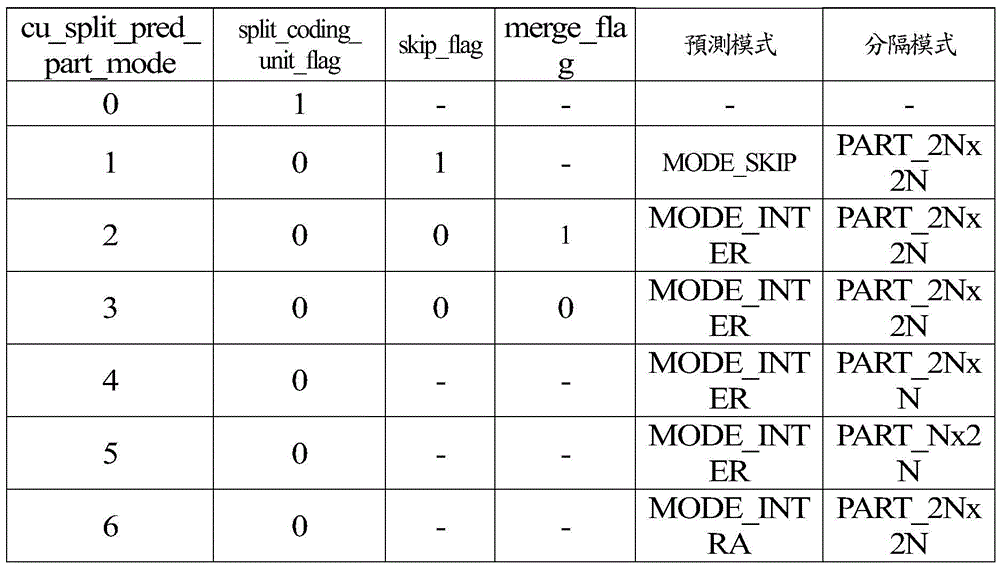
列表1指明当前编码单位不是当前树根区块四分树子分割中最小的一个尺寸的情况中,语法元素cu_split_pred_part_mode可能状态的主要性。这些可能状态被列表于列表1最外面左行。因列表1指示其中当前编码单位不最小尺寸的情况,有一状态cu_split_pred_part_mode,亦即状态0,其发信令当前编码单位不是一实际编码单位,但是须被进一步子分割成为四单位,其接着以深度-首先行经顺序被经过,再次地,如在432呼叫函数coding_tree所述。亦即,cu_split_pred_part_mode=0发信令当前树根区块的当前四分树子分割单位将被进一步再次子分割成为四个较小的单位,亦即,split_coding_unit_flag=1。但是,如果cu_split_pred_part_mode确定为任何其它的可能状态,则split_coding_unit_flag=0并且当前单位形成当前树根区块的叶部区块,亦即,一编码单位。该情况中,cu_split_pred_part_mode的一个其余可能状态代表上面说明共同地发信令状态,其同时地发信令当前编码单位接受合并并且具有跳过模式被致动,利用列表1第三行skip_flag等于1被指示,而同时地发信令当前编码单位没有进一步的分隔发生,亦即,PART_2Nx2N被选择为分隔模式。cu_split_pred_part_mode同时也具一可能状态,其发信令合并致动与跳过模式不被引动。这是可能状态2,对应至skip_flag=0而merge_flag=1,且无分隔模式作用,亦即,PART_2Nx2N。亦即,在该情况,merge_flag预先被发信令而不是在prediction_unit语法的内。在cu_split_pred_part_mode其余可能状态,具有其它的分隔模式的像框间预测模式被发信令,而这些分隔模式分隔当前编码单位成为多于一个分隔。
列表2

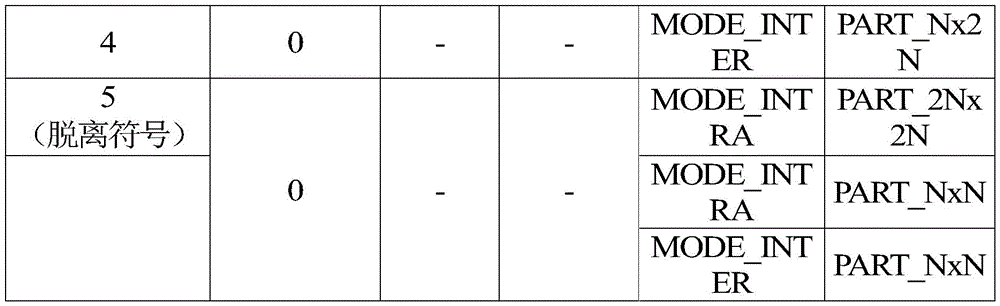
列表2示出根据当前树根区块的四分树子分割具有最小的可能尺寸的当前编码单位情况中,cu_split_pred_part_mode可能状态的主要性或语法。该情况中,根据split_coding_unit_flag=0,所有的可能状态cu_split_pred_part_mode对应至没有进一步的子分割。但是,该可能状态0发信令skip_flag=1,亦即,同时地发信令合并被致动并且跳过模式作用。此外,相同者亦发信令没有分割发生,亦即,分隔模式PART_2Nx2N。可能状态1对应至列表1的可能状态2并且相同情况适用至列表2的可能状态2,其对应至列表1的可能状态3。
虽然在图11至图13A和图13B实施例的上面说明已经说明大部分功能和语法,一些进一步的信息呈现在下面。While most of the functionality and syntax has been described in the above description of the Figures 11-13A and 13B embodiments, some further information is presented below.
skip_flag[x0]y0]等于1指明当前编码单位(参看附图中40),当解码P或B切片时,除了移动向量预测器索引(merge_idx)之外,在skip_flag[x0][y0]之后没有更多语法元素剖析。skip_flag[x0][y0]等于0指明编码单位不跳过。数组索引x0,y0指示相对于图像之顶部-左方亮度样本(附图中的20)所考虑编码单位顶部-左方亮度样本的位置(x0,y0)。skip_flag[x0]y0] equal to 1 indicates that the current coding unit (see 40 in the figure), when decoding P or B slices, there is nothing after skip_flag[x0][y0] except for the motion vector predictor index (merge_idx) More parsing of syntax elements. skip_flag[x0][y0] equal to 0 indicates that the coding unit is not skipped. The array indices x0, y0 indicate the position (x0, y0) of the considered coding unit top-left luma sample relative to the top-left luma sample (20 in the drawing) of the picture.
当skip_flag[x0][y0]不呈现时,其将被推断等于0。When skip_flag[x0][y0] is not present, it will be inferred to be equal to 0.
如上所述,如果skip_flag[x0][y0]等于1,As mentioned above, if skip_flag[x0][y0] is equal to 1,
-预测模式被推断等于MODE_SKIP- The prediction mode is inferred to be equal to MODE_SKIP
-分隔模式被推断等于PART_2Nx2N- Separation mode is inferred to be equal to PART_2Nx2N
cu_split_pred_part_mode[x0][y0]指明split_coding_unit_flag以及何时编码单位不切割skip_flag[x0][y0],merge_flag[x0][y0],编码单位的预测模式和分隔模式。数组索引x0,y0指示相对于图像之顶部-左方亮度样本所考虑编码单位顶部-左方亮度样本的位置(x0,y0)。cu_split_pred_part_mode[x0][y0] specifies split_coding_unit_flag and when the coding unit is not split skip_flag[x0][y0], merge_flag[x0][y0], prediction mode and separation mode of the coding unit. The array indices x0, y0 indicate the position (x0, y0) of the top-left luma sample of the considered coding unit relative to the top-left luma sample of the picture.
merge_flag[x0][y0]指示是否对于当前预测单位(附图中50以及60,亦即,在编码单位40之内的分隔)的像框间预测参数自相邻像框间-预测分隔推断出。数组索引x0,y0指示相对于图像的顶部-左方亮度样本所考虑预测区块顶部-左方亮度样本的位置(x0,y0)。merge_flag[x0][y0] indicates whether the inter-frame prediction parameters for the current prediction unit (50 and 60 in the figure, ie, the separation within coding unit 40) are inferred from the adjacent inter-frame-prediction separation. The array indices x0, y0 indicate the position (x0, y0) of the top-left luma sample of the considered prediction block relative to the top-left luma sample of the picture.
merge_idx[x0][y0]指示合并候选者列表之合并候选者索引,其中x0,y0指示相对于图像的顶部-左方亮度样本所考虑预测区块顶部-左方亮度样本的位置(x0,y0)。merge_idx[x0][y0] indicates the merge candidate index of the merge candidate list, where x0, y0 indicate the position of the considered prediction block top-left luma sample relative to the top-left luma sample of the picture (x0, y0 ).
虽然未明确地被指示在上面第11-13图说明中,合并候选者或合并候选者列表的决定这在实施例中是示例地不仅使用空间相邻预测单位/分隔的编码参数或预测参数,同时,候选者列表的形成也使用时间相邻的时间相邻分隔预测参数以及先前编码图像。此外,空间和/或时间相邻预测单位/分隔的预测参数组合被使用并且被包含于合并候选者列表。当然,仅其子集可以被使用。尤其是,图14示出决定空间相邻,亦即,空间相邻分隔或预测单位的一个可能性。图14示例地示出一预测单位或分隔60以及像素B0至B2以及A0和A1其直接地座落相邻于分隔60的边界500,亦即B2是对角线相邻分隔60的顶部左方像素,B1是座落于分隔60的垂直上面并且相邻顶部右方像素,B0是座落于对角线至分隔60的顶部右方像素,A1是座落于分隔60的水平左方,并且相邻于底部左方像素,以及A0是座落于对角线至分隔60的底部左方像素。包含B0至B2以及A0和A1的至少一个像素的分隔形成一空间相邻并且其预测参数形成一合并候选者。Although not explicitly indicated in the descriptions of Figures 11-13 above, the decision of a merge candidate or a merge candidate list which is exemplary in an embodiment not only uses spatially adjacent prediction units/separated coding parameters or prediction parameters, At the same time, the formation of the candidate list also uses temporally adjacent temporally adjacent separated prediction parameters and previously coded pictures. In addition, spatially and/or temporally adjacent prediction unit/separated prediction parameter combinations are used and included in the merge candidate list. Of course, only a subset thereof can be used. In particular, Figure 14 shows one possibility for determining spatial neighbors, ie, spatial neighbor separations or prediction units. FIG. 14 exemplarily shows a prediction unit or
为了进行上述选择移除其将导致其中候选者同时也可用的另一分隔模式之那些候选者,下面的函数可被使用:In order to make the above selection to remove those candidates that would result in another split mode where the candidate is also available at the same time, the following function can be used:
尤其是,候选者N,亦即,编码/预测参数自含盖像素N=(B0,B1,B2,A0,A1),亦即,位置(xN,yN)的预测单位/分隔还原,自候选者列表移除,如果任何下面的条件为真(参看图8的分隔模式(PartMode)以及检索在编码单位内部的相应分隔的对应分隔索引(PartIdx)):In particular, candidate N, that is, the coding/prediction parameter self-covering pixel N=(B 0 , B 1 , B 2 , A 0 , A 1 ), that is, the prediction unit at position (xN, yN)/ Partition restoration, removed from the candidate list, if any of the following conditions are true (see PartMode (PartMode) of Figure 8 and the corresponding Partition Index (PartIdx) retrieving the corresponding Partition inside the coding unit):
-当前预测单位之分隔模式是PART_2NxN且分隔索引是等于1并且含盖亮度位置(xP,yP–1)(PartIdx=0)以及亮度位置(xN,yN)(Cand.N)的预测单位具有相同的移动参数:- the separation mode of the current prediction unit is PART_2NxN and the separation index is equal to 1 and the prediction unit covering the luma position (xP, yP-1) (PartIdx=0) and the luma position (xN, yN) (Cand.N) have the same The movement parameters of :
mvLX[xP,yP–1]==mvLX[xN,yN]mvLX[xP,yP–1]==mvLX[xN,yN]
refIdxLX[xP,yP–1]==refIdxLX[xN,yN]refIdxLX[xP, yP-1]==refIdxLX[xN,yN]
predFlagLX[xP,yP–1]==predFlagLX[xN,yN]predFlagLX[xP, yP–1]==predFlagLX[xN, yN]
-当前预测单位分隔模式是PART_Nx2N且PartIdx是等于1并且含盖亮度位置(xP–1,yP)(PartIdx=0)及亮度(xN,yN)(Cand.N)的预测单位具有相同的移动参数:- The current PU separation mode is PART_Nx2N and PartIdx is equal to 1 and the PUs covering luma position (xP-1, yP) (PartIdx=0) and luma (xN, yN) (Cand.N) have the same movement parameters :
mvLX[xP–1,yP]==mvLX[xN,yN]mvLX[xP–1,yP]==mvLX[xN,yN]
refIdxLX[xP–1,yP]==refIdxLX[xN,yN]refIdxLX[xP-1, yP]==refIdxLX[xN,yN]
predFlagLX[xP–1,yP]==predFlagLX[xN,yN]predFlagLX[xP-1, yP]==predFlagLX[xN,yN]
-当前预测单位之分隔模式是PART_NxN且PartIdx是等于3并且含盖亮度位置(xP–1,yP)(PartIdx=2)及亮度位置(xP–1,yP–1)(PartIdx=0)的预测单位具有相同的移动参数:- The separation mode of the current prediction unit is PART_NxN and PartIdx is equal to 3 and covers the prediction of luma position (xP-1, yP) (PartIdx=2) and luma position (xP-1, yP-1) (PartIdx=0) The units have the same movement parameters:
mvLX[xP–1,yP]==mvLX[xP–1,yP–1]mvLX[xP–1, yP]==mvLX[xP–1, yP–1]
refIdxLX[xP–1,yP]==refIdxLX[xP–1,yP–1]refIdxLX[xP-1, yP]==refIdxLX[xP-1,yP-1]
predFlagLX[xP–1,yP]==predFlagLX[xP–1,yP–1]predFlagLX[xP–1, yP]==predFlagLX[xP–1, yP–1]
并且包含盖亮度位置(xP,yP–1)(PartIdx=1)及亮度位置(xN,yN)(Cand.N)的预测单位具有相同的移动参数:And the prediction unit including the cover luminance position (xP, yP-1) (PartIdx=1) and the luminance position (xN, yN) (Cand.N) have the same movement parameters:
mvLX[xP,yP–1]==mvLX[xN,yN]mvLX[xP,yP–1]==mvLX[xN,yN]
refIdxLX[xP,yP–1]==refIdxLX[xN,yN]refIdxLX[xP, yP-1]==refIdxLX[xN,yN]
predFlagLX[xP,yP–1]==predFlagLX[xN,yN]predFlagLX[xP, yP–1]==predFlagLX[xN, yN]
当前预测单位的分隔模式是PART_NxN且PartIdx是等于3并且含盖亮度位置(xP,yP–1)(PartIdx=1)及亮度位置(xP–1,yP–1)(PartIdx=0)之预测单位具有相同的移动参数:The separation mode of the current PU is PART_NxN and PartIdx is a PU equal to 3 and covers the luma position (xP, yP-1) (PartIdx=1) and the luma position (xP-1, yP-1) (PartIdx=0) with the same movement parameters:
mvLX[xP,yP–1]==mvLX[xP–1,yP–1]mvLX[xP, yP–1]==mvLX[xP–1, yP–1]
refIdxLX[xP,yP–1]==refIdxLX[xP–1,yP–1]refIdxLX[xP, yP-1]==refIdxLX[xP-1,yP-1]
predFlagLX[xP,yP–1]==predFlagLX[xP–1,yP–1]predFlagLX[xP, yP–1]==predFlagLX[xP–1, yP–1]
并且含盖亮度位置(xP–1,yP)(PartIdx=2)及亮度位置(xN,yN)(Cand.N)的预测单位相同的移动参数:And it covers the motion parameters of the same prediction unit for the luminance position (xP-1, yP) (PartIdx=2) and the luminance position (xN, yN) (Cand.N):
mvLX[xP–1,yP]==mvLX[xN,yN]mvLX[xP–1,yP]==mvLX[xN,yN]
refIdxLX[xP–1,yP]==refIdxLX[xN,yN]refIdxLX[xP-1, yP]==refIdxLX[xN,yN]
在这方面,请注意到,位置(xP,yP)指示当前分隔/预测单位的最上方像素。亦即,根据第一项,所有的编码参数候选者被检查,其利用直接地采用相邻预测单位,亦即预测单位N,的相应编码参数被导出。但是,其它的编码参数候选者可依相同方式被检查,关于其是否相同于相应预测单位的编码参数,与其合并将导致也被语法支持的另一分隔图样的分隔。根据刚好上述被说明的实施例,编码参数的相等性包括检查移动向量,亦即,mvLX,参考索引,亦即,refIxLX,以及预测标记predFlagLX的相等性,其指示关联于参考列表X的参数,亦即,移动向量和参考索引,是具有X为0或1,被使用于像框间预测。In this regard, note that position (xP, yP) indicates the topmost pixel of the current separation/prediction unit. That is, according to the first term, all coding parameter candidates are examined, which are derived with the corresponding coding parameters that directly employ the adjacent prediction unit, ie, the prediction unit N. However, other coding parameter candidates can be checked in the same way as to whether they are the same as the coding parameters of the corresponding prediction unit, merging with them will result in the separation of another separation pattern that is also supported by the syntax. According to the embodiment just described above, the equality of the encoding parameters includes checking the equality of the motion vector, i.e. mvLX, the reference index, i.e. refIxLX, and the prediction flag predFlagLX, which indicates the parameter associated with the reference list X, That is, the motion vector and reference index, with X being 0 or 1, are used for inter-frame prediction.
请注意到,刚刚提及的相邻预测单位/分隔的编码参数候选者移除可能性也可应用于被图8右半部示出的支持非对称分隔模式情况。该情况中,模式PART_2NxN可代表所有的水平子分割模式并且PART_Nx2N可对应至所有的垂直子分割模式。进一步地,模式PART_NxN可从支持分隔模式或分隔图样排除并且该情况中,仅首先二次移除检查将被进行。Note that the just-mentioned adjacent PU/separated coding parameter candidate removal possibility is also applicable to the case of supporting asymmetric separation mode shown in the right half of FIG. 8 . In this case, the pattern PART_2NxN may represent all horizontal sub-partitioning patterns and PART_Nx2N may correspond to all vertical sub-partitioning patterns. Further, the pattern PART_NxN may be excluded from supporting a separation pattern or separation pattern and in this case only the first second removal check will be performed.
关于第11-14图实施例,同时也应该注意到,可能自候选者列表排除像框内预测分隔,亦即,它们的编码参数,当然,不被包含进入候选者列表。With regard to the Figures 11-14 embodiment, it should also be noted that in-frame prediction partitions may be excluded from the candidate list, ie their coding parameters, of course, are not included into the candidate list.
进一步地,应注意到,三组脉络可分别地被使用于skip_flag,merge_flag以及merge_idx。Further, it should be noted that three sets of contexts can be used for skip_flag, merge_flag and merge_idx, respectively.
虽然一些论点以装置脉络被说明,应明白,这些论点同时也代表对应方法的说明,其中一区块或装置对应至方法步骤或一方法步骤的特点。类似地,以方法步骤脉络被说明的论点同时也代表一对应的区块或项目的说明或一对应装置的特点。一些或所有的方法步骤可以通过(或使用)一硬件装置被执行,例如,微处理机、可编程序计算机或电子电路。在一些实施例中,最重要方法步骤的一些或多个可以利用此些装置被执行。Although some issues are described in the context of devices, it should be understood that these issues also represent descriptions of corresponding methods, wherein a block or device corresponds to a method step or a feature of a method step. Similarly, an argument described in the context of method steps also represents a description of a corresponding block or item or a feature of a corresponding device. Some or all of the method steps may be performed by (or using) a hardware device, eg, a microprocessor, a programmable computer, or an electronic circuit. In some embodiments, some or more of the most important method steps may be performed using such apparatus.
取决于某些实施需要,本发明实施例可以硬件或软件被实施。该实施可利用具有电子式可读取控制信号储存在其上的数字储存媒体而被进行,例如,软磁盘、DVD、CD、ROM、PROM、EPROM、EEPROM或闪存,其与可编程计算机系统配合(或能够配合),使得分别的方法被进行。因此,该数字储存媒体可以被计算机读取。Depending on certain implementation needs, embodiments of the present invention may be implemented in hardware or software. This implementation may be performed using a digital storage medium having electronically readable control signals stored thereon, such as a floppy disk, DVD, CD, ROM, PROM, EPROM, EEPROM, or flash memory, in conjunction with a programmable computer system ( or can cooperate), so that the separate method is carried out. Therefore, the digital storage medium can be read by a computer.
根据本发明的一些实施例包含具有电子式可读取控制信号的数据携载器,其可与可编程计算机系统配合,使得此处说明的方法的一者被进行。Some embodiments in accordance with the present invention include a data carrier having electronically readable control signals that can cooperate with a programmable computer system to cause one of the methods described herein to be performed.
通常,本发明的实施例可被实施如具有程序代码的计算机程序产品,当在计算机上执行该计算机程序产品时,该程序代码是可供用于进行这些方法的一者的操作。该程序代码,例如,可被储存在一机器可读取携载器上。In general, embodiments of the present invention may be implemented as a computer program product having program code that, when executed on a computer, is available for carrying out the operation of one of these methods. The program code, for example, may be stored on a machine-readable carrier.
其它实施例包含用于进行此处说明的方法之一者的计算机程序,其被储存在机器可读取携载器上。Other embodiments include a computer program for performing one of the methods described herein, stored on a machine-readable carrier.
换言之,本发明方法的一实施例,因此,是当在一计算机上执行一计算机程序时,该计算机程序是用于进行此处说明的方法的一者的程序代码的计算机程序。In other words, an embodiment of the method of the present invention is, therefore, a computer program that, when executed on a computer, is a computer program of program code for carrying out one of the methods described herein.
本发明方法的一进一步的实施例,因此,是一数据携载器(或数字储存媒体,或计算机可读取媒体),其包含被记录其之上而用于进行此处说明的方法的一者的计算机程序。该数据携载器,该数字储存媒体或该记录媒体是一般的实体和/或非瞬时性。A further embodiment of the method of the present invention, therefore, is a data carrier (or digital storage medium, or computer-readable medium) comprising a method recorded thereon for carrying out the methods described herein the computer program of the person. The data carrier, the digital storage medium or the recording medium are generally physical and/or non-transitory.
本发明方法的一进一步的实施例,因此是一数据流或一信号序列,其代表用于进行此处说明的方法的一者的计算机程序。该数据流或信号序列,例如,可被配置为经由数据通讯连接(例如,经由因特网)而被传输。A further embodiment of the method of the present invention is thus a data stream or a sequence of signals representing a computer program for carrying out one of the methods described herein. The data stream or sequence of signals, for example, may be configured to be transmitted via a data communication connection (eg, via the Internet).
一进一步的实施例包含一处理构件,例如,计算机、或可编程逻辑装置,其被配置或被调适以进行此处说明的方法的一者。A further embodiment includes a processing means, eg, a computer, or a programmable logic device, configured or adapted to perform one of the methods described herein.
一进一步的实施例包含一计算机,其具有被安装在其上的用于进行此处说明的方法的一者的计算机程序。A further embodiment includes a computer having installed thereon a computer program for performing one of the methods described herein.
根据本发明的进一步实施例包含一装置或一系统,其被配置为传送(例如,电子式或光学式)供进行此处说明的方法的一的计算机程序至一接收器。该接收器,例如,为一计算机、一移动式装置、一内存装置或其类似者。该装置或系统,例如,包含用于传送计算机程序至接收器的一档案服务器。Further embodiments in accordance with the present invention include an apparatus or a system configured to transmit (eg, electronically or optically) a computer program for performing one of the methods described herein to a receiver. The receiver is, for example, a computer, a mobile device, a memory device, or the like. The apparatus or system, for example, includes a file server for transmitting the computer program to the receiver.
在一些实施例中,一可编程逻辑设备(例如,现场可编程门阵列)可被使用于进行此处说明的方法的一些或所有的功能。在一些实施例中,一现场可编程门阵列可与微处理器共同操作以便进行此处说明的方法的一者。通常,这些方法最好是利用任何的硬件装置被进行。In some embodiments, a programmable logic device (eg, a field programmable gate array) may be used to perform some or all of the functions of the methods described herein. In some embodiments, a field programmable gate array is operable with a microprocessor to perform one of the methods described herein. In general, these methods are preferably performed using any hardware device.
上面说明的实施例仅是供示出本发明原理。熟悉本技术者应了解,本发明的配置以及此处说明的细节可有各种的修改与变化。因此其仅受限定于本发明待决的权利要求的范畴并且不受限定于经由此处本发明实施例的说明以及叙述的特定细节。The above-described embodiments are merely provided to illustrate the principles of the present invention. It will be understood by those skilled in the art that various modifications and variations are possible in the configuration of the present invention and in the details described herein. The invention is therefore to be limited only by the scope of the pending claims and not by the specific details described and described by way of embodiments of the invention herein.
Claims (27)
Applications Claiming Priority (3)
| Application Number | Priority Date | Filing Date | Title |
|---|---|---|---|
| US41024610P | 2010-11-04 | 2010-11-04 | |
| US61/410,246 | 2010-11-04 | ||
| CN201180064204.6A CN103299623B (en) | 2010-11-04 | 2011-11-04 | Image encoding that supports block merging and skipping modes |
Related Parent Applications (1)
| Application Number | Title | Priority Date | Filing Date |
|---|---|---|---|
| CN201180064204.6A Division CN103299623B (en) | 2010-11-04 | 2011-11-04 | Image encoding that supports block merging and skipping modes |
Publications (2)
| Publication Number | Publication Date |
|---|---|
| CN107071489A CN107071489A (en) | 2017-08-18 |
| CN107071489B true CN107071489B (en) | 2020-10-30 |
Family
ID=44925528
Family Applications (11)
| Application Number | Title | Priority Date | Filing Date |
|---|---|---|---|
| CN201710067799.XA Active CN107071486B (en) | 2010-11-04 | 2011-11-04 | Decoding apparatus and method, encoding apparatus and method, and method for storing and transmitting image |
| CN201710067975.XA Active CN106851320B (en) | 2010-11-04 | 2011-11-04 | Digital storage medium, method of decoding bit stream |
| CN201710067972.6A Active CN107071492B (en) | 2010-11-04 | 2011-11-04 | Image encoding supporting block merging and skip mode |
| CN201710067804.7A Active CN107071489B (en) | 2010-11-04 | 2011-11-04 | Image coding supporting block merging and skip mode |
| CN201710067793.2A Active CN107105303B (en) | 2010-11-04 | 2011-11-04 | Decoding apparatus and method, encoding apparatus and method, and image storage and transmission method |
| CN201710067801.3A Active CN107071487B (en) | 2010-11-04 | 2011-11-04 | Image coding supporting block merging and skip mode |
| CN201710067934.0A Active CN107105304B (en) | 2010-11-04 | 2011-11-04 | Decoding apparatus and method, encoding apparatus and method, and image storage and transmission method |
| CN201710067802.8A Active CN107071488B (en) | 2010-11-04 | 2011-11-04 | Decoding apparatus and method, encoding apparatus and method, and image storage and transmission method |
| CN201180064204.6A Active CN103299623B (en) | 2010-11-04 | 2011-11-04 | Image encoding that supports block merging and skipping modes |
| CN201710067883.1A Active CN107071491B (en) | 2010-11-04 | 2011-11-04 | Image coding supporting block merging and skip mode |
| CN201710067876.1A Active CN107071490B (en) | 2010-11-04 | 2011-11-04 | Decoding apparatus and method, encoding apparatus and method, and image storage and transmission method |
Family Applications Before (3)
| Application Number | Title | Priority Date | Filing Date |
|---|---|---|---|
| CN201710067799.XA Active CN107071486B (en) | 2010-11-04 | 2011-11-04 | Decoding apparatus and method, encoding apparatus and method, and method for storing and transmitting image |
| CN201710067975.XA Active CN106851320B (en) | 2010-11-04 | 2011-11-04 | Digital storage medium, method of decoding bit stream |
| CN201710067972.6A Active CN107071492B (en) | 2010-11-04 | 2011-11-04 | Image encoding supporting block merging and skip mode |
Family Applications After (7)
| Application Number | Title | Priority Date | Filing Date |
|---|---|---|---|
| CN201710067793.2A Active CN107105303B (en) | 2010-11-04 | 2011-11-04 | Decoding apparatus and method, encoding apparatus and method, and image storage and transmission method |
| CN201710067801.3A Active CN107071487B (en) | 2010-11-04 | 2011-11-04 | Image coding supporting block merging and skip mode |
| CN201710067934.0A Active CN107105304B (en) | 2010-11-04 | 2011-11-04 | Decoding apparatus and method, encoding apparatus and method, and image storage and transmission method |
| CN201710067802.8A Active CN107071488B (en) | 2010-11-04 | 2011-11-04 | Decoding apparatus and method, encoding apparatus and method, and image storage and transmission method |
| CN201180064204.6A Active CN103299623B (en) | 2010-11-04 | 2011-11-04 | Image encoding that supports block merging and skipping modes |
| CN201710067883.1A Active CN107071491B (en) | 2010-11-04 | 2011-11-04 | Image coding supporting block merging and skip mode |
| CN201710067876.1A Active CN107071490B (en) | 2010-11-04 | 2011-11-04 | Decoding apparatus and method, encoding apparatus and method, and image storage and transmission method |
Country Status (16)
| Country | Link |
|---|---|
| US (11) | US9924193B2 (en) |
| EP (6) | EP2636218B1 (en) |
| JP (7) | JP6258704B2 (en) |
| KR (10) | KR102286294B1 (en) |
| CN (11) | CN107071486B (en) |
| DK (2) | DK2636218T3 (en) |
| ES (5) | ES3038310T3 (en) |
| FI (1) | FI3962088T3 (en) |
| HU (5) | HUE072362T2 (en) |
| LT (2) | LT2636218T (en) |
| PL (5) | PL4398569T3 (en) |
| PT (2) | PT3962088T (en) |
| RS (2) | RS64610B1 (en) |
| SI (2) | SI3962088T1 (en) |
| TW (8) | TWI833626B (en) |
| WO (1) | WO2012059577A1 (en) |
Families Citing this family (127)
| Publication number | Priority date | Publication date | Assignee | Title |
|---|---|---|---|---|
| KR20110068792A (en) * | 2009-12-16 | 2011-06-22 | 한국전자통신연구원 | Adaptive Image Coding Apparatus and Method |
| CN106067985B (en) | 2010-04-13 | 2019-06-28 | Ge视频压缩有限责任公司 | Cross-Plane Prediction |
| TWI864983B (en) | 2010-04-13 | 2024-12-01 | 美商Ge影像壓縮有限公司 | Sample region merging |
| BR122020008249B1 (en) | 2010-04-13 | 2021-02-17 | Ge Video Compression, Llc | inheritance in a multitree subdivision arrangement sample |
| EP3958573B1 (en) | 2010-04-13 | 2023-06-07 | GE Video Compression, LLC | Video coding using multi-tree sub-divisions of images |
| JP6258704B2 (en) * | 2010-11-04 | 2018-01-10 | ジーイー ビデオ コンプレッション エルエルシー | Image coding and decoding supporting block integration and skip mode |
| US11102494B2 (en) * | 2011-03-03 | 2021-08-24 | Electronics And Telecommunication Research Institute | Method for scanning transform coefficient and device therefor |
| WO2012118358A2 (en) * | 2011-03-03 | 2012-09-07 | 한국전자통신연구원 | Method for scanning transform coefficient and device therefor |
| US9066110B2 (en) | 2011-03-08 | 2015-06-23 | Texas Instruments Incorporated | Parsing friendly and error resilient merge flag coding in video coding |
| JP5982734B2 (en) * | 2011-03-11 | 2016-08-31 | ソニー株式会社 | Image processing apparatus and method |
| KR20120140181A (en) | 2011-06-20 | 2012-12-28 | 한국전자통신연구원 | Method and apparatus for encoding and decoding using filtering for prediction block boundary |
| US9313494B2 (en) | 2011-06-20 | 2016-04-12 | Qualcomm Incorporated | Parallelization friendly merge candidates for video coding |
| EP4228264B1 (en) | 2011-06-23 | 2024-07-31 | Sun Patent Trust | Image decoding device, image encoding device |
| US9106919B2 (en) | 2011-06-24 | 2015-08-11 | Panasonic Intellectual Property Corporation Of America | Image decoding method, image coding method, image decoding apparatus, image coding apparatus, and image coding and decoding apparatus |
| CN106878723B (en) * | 2011-06-24 | 2019-11-12 | 太阳专利托管公司 | Coding method and code device |
| BR112013030347B1 (en) | 2011-06-27 | 2022-06-28 | Sun Patent Trust | IMAGE DECODING METHOD, IMAGE ENCODING METHOD, IMAGE DECODING APPARATUS, IMAGE ENCODING APPARATUS AND IMAGE ENCODING AND DECODING APPARATUS |
| MX2013012980A (en) | 2011-06-28 | 2013-12-06 | Panasonic Corp | Image decoding method, image encoding method, image decoding device, image encoding device, and image encoding/decoding device. |
| WO2013001767A1 (en) | 2011-06-29 | 2013-01-03 | パナソニック株式会社 | Image decoding method, image encoding method, image decoding device, image encoding device, and image encoding/decoding device |
| KR102060619B1 (en) | 2011-06-30 | 2019-12-30 | 선 페이턴트 트러스트 | Image decoding method, image encoding method, image decoding device, image encoding device, and image encoding/decoding device |
| PL2728869T3 (en) | 2011-06-30 | 2022-02-28 | Sun Patent Trust | Image decoding method |
| RU2604680C2 (en) | 2011-07-11 | 2016-12-10 | Сан Пэтент Траст | Image decoding method, image encoding method, image decoding device, image encoding device, and image encoding and decoding device |
| US9300975B2 (en) * | 2011-09-11 | 2016-03-29 | Texas Instruments Incorporated | Concurrent access shared buffer in a video encoder |
| US9756353B2 (en) * | 2012-01-09 | 2017-09-05 | Dolby Laboratories Licensing Corporation | Hybrid reference picture reconstruction method for single and multiple layered video coding systems |
| US9749645B2 (en) * | 2012-06-22 | 2017-08-29 | Microsoft Technology Licensing, Llc | Coded-block-flag coding and derivation |
| US10230956B2 (en) | 2012-09-26 | 2019-03-12 | Integrated Device Technology, Inc. | Apparatuses and methods for optimizing rate-distortion of syntax elements |
| KR102657912B1 (en) | 2012-10-01 | 2024-04-15 | 지이 비디오 컴프레션, 엘엘씨 | Scalable video coding using subblock-based coding of transform coefficient blocks in the enhancement layer |
| US9699450B2 (en) | 2012-10-04 | 2017-07-04 | Qualcomm Incorporated | Inter-view predicted motion vector for 3D video |
| CN110545422B (en) | 2012-10-12 | 2022-11-22 | 韩国电子通信研究院 | Image encoding/decoding method and apparatus using the same |
| US20150256845A1 (en) * | 2012-10-22 | 2015-09-10 | Humax Holding Co., Ltd. | Method for predicting inter-view motion and method for determining interview merge candidates in 3d video |
| US20140219331A1 (en) * | 2013-02-06 | 2014-08-07 | Magnum Semiconductor, Inc. | Apparatuses and methods for performing joint rate-distortion optimization of prediction mode |
| US9300906B2 (en) * | 2013-03-29 | 2016-03-29 | Google Inc. | Pull frame interpolation |
| EP2997732A1 (en) * | 2013-05-15 | 2016-03-23 | VID SCALE, Inc. | Single loop decoding based inter layer prediction |
| WO2015000108A1 (en) * | 2013-07-01 | 2015-01-08 | Mediatek Singapore Pte. Ltd. | An improved texture merging candidate in 3dvc |
| CN105765974B (en) | 2013-10-14 | 2019-07-02 | 微软技术许可有限责任公司 | Features of Intra Block Copy Prediction Modes for Video and Image Encoding and Decoding |
| RU2666635C2 (en) | 2013-10-14 | 2018-09-11 | МАЙКРОСОФТ ТЕКНОЛОДЖИ ЛАЙСЕНСИНГ, ЭлЭлСи | Features of base colour index map mode for video and image coding and decoding |
| WO2015054813A1 (en) | 2013-10-14 | 2015-04-23 | Microsoft Technology Licensing, Llc | Encoder-side options for intra block copy prediction mode for video and image coding |
| CN105684441B (en) | 2013-10-25 | 2018-09-21 | 微软技术许可有限责任公司 | The Block- matching based on hash in video and image coding |
| US11076171B2 (en) | 2013-10-25 | 2021-07-27 | Microsoft Technology Licensing, Llc | Representing blocks with hash values in video and image coding and decoding |
| AU2014376061B8 (en) | 2014-01-03 | 2019-05-30 | Microsoft Technology Licensing, Llc | Block vector prediction in video and image coding/decoding |
| US10390034B2 (en) | 2014-01-03 | 2019-08-20 | Microsoft Technology Licensing, Llc | Innovations in block vector prediction and estimation of reconstructed sample values within an overlap area |
| US11284103B2 (en) | 2014-01-17 | 2022-03-22 | Microsoft Technology Licensing, Llc | Intra block copy prediction with asymmetric partitions and encoder-side search patterns, search ranges and approaches to partitioning |
| US10542274B2 (en) | 2014-02-21 | 2020-01-21 | Microsoft Technology Licensing, Llc | Dictionary encoding and decoding of screen content |
| KR20160129075A (en) | 2014-03-04 | 2016-11-08 | 마이크로소프트 테크놀로지 라이센싱, 엘엘씨 | Block flipping and skip mode in intra block copy prediction |
| EP3114838B1 (en) | 2014-03-04 | 2018-02-07 | Microsoft Technology Licensing, LLC | Hash table construction and availability checking for hash-based block matching |
| WO2015131326A1 (en) | 2014-03-04 | 2015-09-11 | Microsoft Technology Licensing, Llc | Encoder-side decisions for block flipping and skip mode in intra block copy prediction |
| US10250895B2 (en) * | 2014-03-14 | 2019-04-02 | Sharp Kabushiki Kaisha | DPB capacity limits |
| US10785486B2 (en) | 2014-06-19 | 2020-09-22 | Microsoft Technology Licensing, Llc | Unified intra block copy and inter prediction modes |
| EP3158751B1 (en) | 2014-06-23 | 2019-07-31 | Microsoft Technology Licensing, LLC | Encoder decisions based on results of hash-based block matching |
| EP2975008B1 (en) | 2014-07-16 | 2017-03-01 | Saint-Gobain Glass France | Transparent diffusive oled substrate and method for producing such a substrate |
| US10812817B2 (en) | 2014-09-30 | 2020-10-20 | Microsoft Technology Licensing, Llc | Rules for intra-picture prediction modes when wavefront parallel processing is enabled |
| MX383283B (en) | 2014-09-30 | 2025-03-13 | Microsoft Technology Licensing Llc | HASH-BASED ENCODER DECISIONS FOR VIDEO ENCODING. |
| EP3028999B1 (en) | 2014-12-01 | 2017-05-24 | Saint-Gobain Glass France | Transparent diffusive oled substrate and method for producing such a substrate |
| US9591325B2 (en) | 2015-01-27 | 2017-03-07 | Microsoft Technology Licensing, Llc | Special case handling for merged chroma blocks in intra block copy prediction mode |
| US9936201B2 (en) * | 2015-01-27 | 2018-04-03 | Qualcomm Incorporated | Contexts for large coding tree units |
| EP3308540B1 (en) | 2015-06-09 | 2020-04-15 | Microsoft Technology Licensing, LLC | Robust encoding/decoding of escape-coded pixels in palette mode |
| CN107431822B (en) * | 2015-06-09 | 2019-11-29 | 华为技术有限公司 | Image coding/decoding method and equipment |
| US10091506B2 (en) * | 2015-06-11 | 2018-10-02 | Sony Corporation | Data-charge phase data compression architecture |
| CN108965871B (en) | 2015-09-29 | 2023-11-10 | 华为技术有限公司 | Image prediction methods and devices |
| CN116489347B (en) * | 2015-11-20 | 2026-01-06 | 韩国电子通信研究院 | Methods and apparatus for encoding/decoding images |
| WO2017135662A1 (en) * | 2016-02-01 | 2017-08-10 | 엘지전자 주식회사 | Method and apparatus for encoding/decoding video signal by using edge-adaptive graph-based transform |
| US10390015B2 (en) * | 2016-08-26 | 2019-08-20 | Qualcomm Incorporated | Unification of parameters derivation procedures for local illumination compensation and cross-component linear model prediction |
| US10390039B2 (en) | 2016-08-31 | 2019-08-20 | Microsoft Technology Licensing, Llc | Motion estimation for screen remoting scenarios |
| CN114501006B (en) | 2016-09-20 | 2025-03-04 | 株式会社Kt | Video decoding method, video encoding method and device for sending compressed video data |
| WO2018062892A1 (en) * | 2016-09-28 | 2018-04-05 | 엘지전자(주) | Method and apparatus for performing optimal prediction on basis of weight index |
| WO2018062950A1 (en) * | 2016-09-30 | 2018-04-05 | 엘지전자(주) | Picture processing method and apparatus for same |
| KR20190052128A (en) | 2016-10-04 | 2019-05-15 | 김기백 | Image data encoding / decoding method and apparatus |
| KR20190053238A (en) * | 2016-10-06 | 2019-05-17 | 엘지전자 주식회사 | Image processing method based on inter prediction mode and apparatus therefor |
| KR20180045530A (en) | 2016-10-26 | 2018-05-04 | 디지털인사이트 주식회사 | Video coding method and apparatus using arbitrary block partition |
| WO2018093184A1 (en) * | 2016-11-18 | 2018-05-24 | 주식회사 케이티 | Video signal processing method and device |
| CN110024410B (en) | 2016-11-25 | 2023-07-28 | 株式会社Kt | Methods for encoding and decoding video |
| US11095877B2 (en) | 2016-11-30 | 2021-08-17 | Microsoft Technology Licensing, Llc | Local hash-based motion estimation for screen remoting scenarios |
| US10715827B2 (en) * | 2017-01-06 | 2020-07-14 | Mediatek Inc. | Multi-hypotheses merge mode |
| US10943100B2 (en) | 2017-01-19 | 2021-03-09 | Mindmaze Holding Sa | Systems, methods, devices and apparatuses for detecting facial expression |
| WO2018142228A2 (en) | 2017-01-19 | 2018-08-09 | Mindmaze Holding Sa | Systems, methods, apparatuses and devices for detecting facial expression and for tracking movement and location including for at least one of a virtual and augmented reality system |
| CN110892408A (en) * | 2017-02-07 | 2020-03-17 | 迈恩德玛泽控股股份有限公司 | Systems, methods, and apparatus for stereo vision and tracking |
| US20200036978A1 (en) | 2017-03-22 | 2020-01-30 | Industry-University Cooperation Foundation Hanyang University | Image encoding/decoding method using pixel value range constituting image |
| CN116684604A (en) * | 2017-03-31 | 2023-09-01 | 松下电器(美国)知识产权公司 | Image encoding device, image decoding device, and storage medium |
| US10630978B2 (en) | 2017-05-12 | 2020-04-21 | Blackberry Limited | Methods and devices for intra-coding in video compression |
| JP7147145B2 (en) * | 2017-09-26 | 2022-10-05 | 富士通株式会社 | Video encoding device, video encoding method, and video encoding program |
| US10986349B2 (en) | 2017-12-29 | 2021-04-20 | Microsoft Technology Licensing, Llc | Constraints on locations of reference blocks for intra block copy prediction |
| KR102524628B1 (en) | 2018-01-05 | 2023-04-21 | 에스케이텔레콤 주식회사 | Method and Apparatus for Video Encoding or Decoding |
| WO2019135628A1 (en) * | 2018-01-05 | 2019-07-11 | 에스케이텔레콤 주식회사 | Method and device for encoding or decoding image |
| US11328533B1 (en) | 2018-01-09 | 2022-05-10 | Mindmaze Holding Sa | System, method and apparatus for detecting facial expression for motion capture |
| KR102732473B1 (en) * | 2018-02-28 | 2024-11-21 | 프라운호퍼 게젤샤프트 쭈르 푀르데룽 데어 안겐반텐 포르슝 에. 베. | Composed prediction and restricted merge |
| KR20250099275A (en) * | 2018-03-05 | 2025-07-01 | 파나소닉 인텔렉츄얼 프로퍼티 코포레이션 오브 아메리카 | Coding device, decoding device, coding method and decoding method |
| KR20240169129A (en) * | 2018-03-27 | 2024-12-02 | (주)휴맥스 | Video signal processing method and apparatus using motion compensation |
| CN118474357A (en) | 2018-04-01 | 2024-08-09 | 有限公司B1影像技术研究所 | Image encoding/decoding method, medium, and method for transmitting bit stream |
| US10659781B2 (en) * | 2018-04-02 | 2020-05-19 | Tencent America LLC | Concatenated coding units in flexible tree structure |
| CN110505482B (en) * | 2018-05-16 | 2021-10-26 | 华为技术有限公司 | Encoding and decoding method and device |
| TWI764015B (en) * | 2018-07-13 | 2022-05-11 | 弗勞恩霍夫爾協會 | Partitioned intra coding concept |
| US11051025B2 (en) * | 2018-07-13 | 2021-06-29 | Tencent America LLC | Method and apparatus for video coding |
| CN110858905B (en) * | 2018-08-26 | 2023-04-07 | 北京字节跳动网络技术有限公司 | Method and apparatus for pruning in video blocks for skip and direct mode coding and decoding based on multiple motion models |
| WO2020060374A1 (en) * | 2018-09-21 | 2020-03-26 | 엘지전자 주식회사 | Method and apparatus for processing video signals using affine prediction |
| FR3086485A1 (en) * | 2018-09-21 | 2020-03-27 | Orange | METHODS AND DEVICES FOR ENCODING AND DECODING A DATA FLOW REPRESENTATIVE OF AT LEAST ONE IMAGE. |
| EP3857882A1 (en) * | 2018-09-24 | 2021-08-04 | Fraunhofer-Gesellschaft zur Förderung der angewandten Forschung e.V. | Efficient coding of transform coefficients using or suitable for a combination with dependent scalar quantization |
| CN110944171B (en) * | 2018-09-25 | 2023-05-09 | 华为技术有限公司 | An image prediction method and device |
| US20210400298A1 (en) * | 2018-09-28 | 2021-12-23 | Lg Electronics Inc. | Method and apparatus for processing video signal by using affine prediction |
| CN118175302A (en) | 2018-10-08 | 2024-06-11 | Lg电子株式会社 | Image decoding method, image encoding method, storage medium, and transmission method |
| WO2020084502A1 (en) | 2018-10-23 | 2020-04-30 | Beijing Bytedance Network Technology Co., Ltd. | Video processing using local illumination compensation |
| CN113287317B (en) | 2018-10-23 | 2023-04-28 | 北京字节跳动网络技术有限公司 | Juxtaposed local illumination compensation and modified inter-frame codec tool |
| CN119653077A (en) | 2018-10-29 | 2025-03-18 | 华为技术有限公司 | Video image prediction method and device |
| US10931958B2 (en) | 2018-11-02 | 2021-02-23 | Fungible, Inc. | JPEG accelerator using last-non-zero (LNZ) syntax element |
| US10827191B2 (en) | 2018-11-02 | 2020-11-03 | Fungible, Inc. | Parallel coding of syntax elements for JPEG accelerator |
| US10848775B2 (en) | 2018-11-02 | 2020-11-24 | Fungible, Inc. | Memory layout for JPEG accelerator |
| US10827192B2 (en) * | 2018-11-02 | 2020-11-03 | Fungible, Inc. | Work allocation for JPEG accelerator |
| CN113273198B (en) | 2018-11-06 | 2024-10-18 | 交互数字Vc控股公司 | Parameter grouping between multiple codec units for video encoding and decoding |
| EP3888357A1 (en) * | 2018-11-30 | 2021-10-06 | InterDigital VC Holdings, Inc. | Unified process and syntax for generalized prediction in video coding/decoding |
| US11115652B2 (en) * | 2018-12-07 | 2021-09-07 | Tencent America LLC | Method and apparatus for further improved context design for prediction mode and coded block flag (CBF) |
| US10893298B2 (en) | 2018-12-12 | 2021-01-12 | Tencent America LLC | Method and apparatus for video coding |
| WO2020122654A1 (en) | 2018-12-12 | 2020-06-18 | 주식회사 윌러스표준기술연구소 | Video signal processing method and device using current picture reference |
| KR102585131B1 (en) | 2018-12-13 | 2023-10-06 | 텐센트 아메리카 엘엘씨 | Method and video decoder for video decoding |
| KR20260004538A (en) * | 2018-12-17 | 2026-01-08 | 삼성전자주식회사 | Video signal processing method and device for signaling prediction mode |
| TWI755665B (en) * | 2018-12-20 | 2022-02-21 | 弗勞恩霍夫爾協會 | Intra predictions using linear or affine transforms with neighbouring sample reduction |
| WO2020147747A1 (en) | 2019-01-15 | 2020-07-23 | Beijing Bytedance Network Technology Co., Ltd. | Weighted prediction in video coding |
| EP4648411A2 (en) * | 2019-01-18 | 2025-11-12 | Wilus Institute of Standards and Technology Inc. | Video signal processing method and device using motion compensation |
| CN113454992B (en) * | 2019-02-19 | 2024-08-16 | 数码士有限公司 | Video signal processing method and device based on intra-frame prediction |
| KR102379676B1 (en) | 2019-03-04 | 2022-03-28 | 엘지전자 주식회사 | Video decoding method and apparatus using context-coded sine flag in video coding system |
| WO2021034122A1 (en) * | 2019-08-21 | 2021-02-25 | 엘지전자 주식회사 | Image encoding/decoding method and device for performing prediction on basis of hmvp candidate, and method for transmitting bitstream |
| CN111050165B (en) * | 2019-11-29 | 2022-02-22 | 苏州浪潮智能科技有限公司 | Video decoding method, device and medium |
| CN119545020A (en) * | 2020-02-25 | 2025-02-28 | Lg电子株式会社 | Image decoding and encoding device and device for transmitting data for image information |
| US11405628B2 (en) | 2020-04-06 | 2022-08-02 | Tencent America LLC | Method and apparatus for video coding |
| US11202085B1 (en) | 2020-06-12 | 2021-12-14 | Microsoft Technology Licensing, Llc | Low-cost hash table construction and hash-based block matching for variable-size blocks |
| US12225205B2 (en) * | 2021-06-18 | 2025-02-11 | Tencent America LLC | Block-wise entropy coding method in neural image compression |
| EP4464009A1 (en) * | 2022-01-12 | 2024-11-20 | Nokia Technologies Oy | High-level syntax of predictive residual encoding in neural network compression |
| US12340485B1 (en) | 2022-09-20 | 2025-06-24 | Apple Inc. | Graphics geometry processing with segmented and non-segmented sets of work |
| WO2025038308A1 (en) * | 2023-08-14 | 2025-02-20 | Google Llc | Direct frame prediction with residual coding |
| US20250104284A1 (en) * | 2023-09-27 | 2025-03-27 | Sony Interactive Entertainment LLC | High quality transcode-efficient texture format |
Family Cites Families (38)
| Publication number | Priority date | Publication date | Assignee | Title |
|---|---|---|---|---|
| JP3353968B2 (en) | 1992-09-25 | 2002-12-09 | オリンパス光学工業株式会社 | Image processing device |
| JPH08298665A (en) | 1994-04-21 | 1996-11-12 | Sanyo Electric Co Ltd | Circuit and method for detecting motion vector |
| US6026232A (en) | 1995-07-13 | 2000-02-15 | Kabushiki Kaisha Toshiba | Method and system to replace sections of an encoded video bitstream |
| KR100287868B1 (en) | 1998-06-17 | 2001-05-02 | 구자홍 | A signal recording and reproducing apparatus of a digital storage medium |
| JP3561485B2 (en) * | 2000-08-18 | 2004-09-02 | 株式会社メディアグルー | Coded signal separation / synthesis device, difference coded signal generation device, coded signal separation / synthesis method, difference coded signal generation method, medium recording coded signal separation / synthesis program, and difference coded signal generation program recorded Medium |
| ES2664270T3 (en) * | 2001-12-17 | 2018-04-18 | Microsoft Technology Licensing, Llc | Default macroblock coding |
| JP4088205B2 (en) | 2002-06-11 | 2008-05-21 | 松下電器産業株式会社 | Encoding apparatus, computer-readable program, and encoding method. |
| KR20050105222A (en) * | 2003-02-17 | 2005-11-03 | 코닌클리케 필립스 일렉트로닉스 엔.브이. | Video coding |
| US20060047522A1 (en) | 2004-08-26 | 2006-03-02 | Nokia Corporation | Method, apparatus and computer program to provide predictor adaptation for advanced audio coding (AAC) system |
| US8948266B2 (en) | 2004-10-12 | 2015-02-03 | Qualcomm Incorporated | Adaptive intra-refresh for digital video encoding |
| EP1647937A1 (en) * | 2004-10-15 | 2006-04-19 | Sony Deutschland GmbH | Method for motion estimation |
| US7551772B2 (en) * | 2004-11-30 | 2009-06-23 | Hewlett-Packard Development Company, L.P. | Blur estimation in a digital image |
| KR101246915B1 (en) * | 2005-04-18 | 2013-03-25 | 삼성전자주식회사 | Method and apparatus for encoding or decoding moving picture |
| CN101375605A (en) * | 2006-01-31 | 2009-02-25 | 汤姆森许可贸易公司 | Method and apparatus for implementing restricted prediction for reduced resolution update mode and complexity scalability in video encoders and decoders |
| CN101427472A (en) | 2006-04-21 | 2009-05-06 | 株式会社东芝 | Method and apparatus for entropy coding and decoding |
| US20080025390A1 (en) * | 2006-07-25 | 2008-01-31 | Fang Shi | Adaptive video frame interpolation |
| JP4956304B2 (en) | 2006-08-08 | 2012-06-20 | キヤノン株式会社 | Image encoding apparatus, control method therefor, computer program, and computer-readable storage medium |
| CN101168276A (en) | 2006-10-23 | 2008-04-30 | 乔小刚 | Method for manufacturing furniture support or pedestal capable of being reclaimed and die-casting formed |
| BRPI0809512A2 (en) * | 2007-04-12 | 2016-03-15 | Thomson Licensing | context-dependent merge method and apparatus for direct jump modes for video encoding and decoding |
| JP4774382B2 (en) * | 2007-05-08 | 2011-09-14 | 株式会社リコー | Image processing apparatus, image processing circuit, and image processing method |
| EP2191652B1 (en) * | 2007-09-02 | 2017-02-08 | Lg Electronics Inc. | A method and an apparatus for processing a video signal |
| US7710296B2 (en) * | 2007-09-19 | 2010-05-04 | Texas Instruments Incorporated | N-bin arithmetic coding for context adaptive binary arithmetic coding |
| CN101415115B (en) * | 2007-10-15 | 2011-02-02 | 华为技术有限公司 | Method for encoding and decoding video based on movement dancing mode, and encoder and decoder thereof |
| US20090162973A1 (en) | 2007-12-21 | 2009-06-25 | Julien Gatineau | Germanium precursors for gst film deposition |
| EP2232875A2 (en) | 2008-01-11 | 2010-09-29 | Thomson Licensing | Video and depth coding |
| JP5071721B2 (en) | 2008-02-27 | 2012-11-14 | ソニー株式会社 | Image processing apparatus and method, and program |
| CN102210153A (en) * | 2008-10-06 | 2011-10-05 | Lg电子株式会社 | Method and device for processing video signals |
| TWI370410B (en) * | 2008-12-30 | 2012-08-11 | Ind Tech Res Inst | Image processing method for providing depth information |
| US8873626B2 (en) | 2009-07-02 | 2014-10-28 | Qualcomm Incorporated | Template matching for video coding |
| US20110090954A1 (en) * | 2009-10-21 | 2011-04-21 | Cohen Robert A | Video Codes with Directional Transforms |
| CN101835044B (en) * | 2010-04-23 | 2012-04-11 | 南京邮电大学 | A Classification and Combination Method in Frequency Domain Distributed Video Coding |
| EP2924995B1 (en) * | 2010-07-09 | 2018-09-12 | Samsung Electronics Co., Ltd | Method for decoding video by using block merging |
| KR101484281B1 (en) * | 2010-07-09 | 2015-01-21 | 삼성전자주식회사 | Method and apparatus for video encoding using block merging, method and apparatus for video decoding using block merging |
| JP6258704B2 (en) * | 2010-11-04 | 2018-01-10 | ジーイー ビデオ コンプレッション エルエルシー | Image coding and decoding supporting block integration and skip mode |
| FI3923579T3 (en) * | 2010-11-25 | 2023-03-22 | Lg Electronics Inc | Method for signaling image information and method for decoding image information using same |
| US20120189052A1 (en) * | 2011-01-24 | 2012-07-26 | Qualcomm Incorporated | Signaling quantization parameter changes for coded units in high efficiency video coding (hevc) |
| US20120195366A1 (en) | 2011-02-01 | 2012-08-02 | Mediatek Singapore Pte. Ltd. | Method and Apparatus of Adaptive Inter Mode Coding Using Variable Length Codes |
| US9648334B2 (en) * | 2011-03-21 | 2017-05-09 | Qualcomm Incorporated | Bi-predictive merge mode based on uni-predictive neighbors in video coding |
-
2011
- 2011-11-04 JP JP2013537146A patent/JP6258704B2/en active Active
- 2011-11-04 TW TW112112476A patent/TWI833626B/en active
- 2011-11-04 PL PL24163024.3T patent/PL4398569T3/en unknown
- 2011-11-04 RS RS20230823A patent/RS64610B1/en unknown
- 2011-11-04 CN CN201710067799.XA patent/CN107071486B/en active Active
- 2011-11-04 KR KR1020207017633A patent/KR102286294B1/en active Active
- 2011-11-04 KR KR1020147030835A patent/KR101607426B1/en active Active
- 2011-11-04 KR KR1020227018195A patent/KR102648076B1/en active Active
- 2011-11-04 DK DK11781501.9T patent/DK2636218T3/en active
- 2011-11-04 CN CN201710067975.XA patent/CN106851320B/en active Active
- 2011-11-04 KR KR1020247008039A patent/KR20240038124A/en active Pending
- 2011-11-04 CN CN201710067972.6A patent/CN107071492B/en active Active
- 2011-11-04 TW TW107137593A patent/TWI725348B/en active
- 2011-11-04 HU HUE24163024A patent/HUE072362T2/en unknown
- 2011-11-04 RS RS20211216A patent/RS62555B1/en unknown
- 2011-11-04 ES ES24163024T patent/ES3038310T3/en active Active
- 2011-11-04 ES ES24163026T patent/ES3038305T3/en active Active
- 2011-11-04 KR KR1020137014189A patent/KR101527666B1/en active Active
- 2011-11-04 TW TW104135588A patent/TWI559740B/en active
- 2011-11-04 HU HUE24163025A patent/HUE072351T2/en unknown
- 2011-11-04 KR KR1020217024268A patent/KR102405537B1/en active Active
- 2011-11-04 EP EP11781501.9A patent/EP2636218B1/en active Active
- 2011-11-04 EP EP21182527.8A patent/EP3962088B1/en active Active
- 2011-11-04 LT LTEPPCT/EP2011/069408T patent/LT2636218T/en unknown
- 2011-11-04 HU HUE24163026A patent/HUE072408T2/en unknown
- 2011-11-04 EP EP23179369.6A patent/EP4270957A3/en active Pending
- 2011-11-04 ES ES11781501T patent/ES2891598T3/en active Active
- 2011-11-04 TW TW105131691A patent/TWI644561B/en active
- 2011-11-04 PT PT211825278T patent/PT3962088T/en unknown
- 2011-11-04 PL PL24163026.8T patent/PL4398571T3/en unknown
- 2011-11-04 FI FIEP21182527.8T patent/FI3962088T3/en active
- 2011-11-04 ES ES21182527T patent/ES2955542T3/en active Active
- 2011-11-04 CN CN201710067804.7A patent/CN107071489B/en active Active
- 2011-11-04 PL PL24163025.0T patent/PL4398570T3/en unknown
- 2011-11-04 PL PL11781501T patent/PL2636218T3/en unknown
- 2011-11-04 CN CN201710067793.2A patent/CN107105303B/en active Active
- 2011-11-04 CN CN201710067801.3A patent/CN107071487B/en active Active
- 2011-11-04 HU HUE11781501A patent/HUE056453T2/en unknown
- 2011-11-04 CN CN201710067934.0A patent/CN107105304B/en active Active
- 2011-11-04 EP EP24163024.3A patent/EP4398569B1/en active Active
- 2011-11-04 KR KR1020187024669A patent/KR102024178B1/en active Active
- 2011-11-04 DK DK21182527.8T patent/DK3962088T3/en active
- 2011-11-04 PT PT11781501T patent/PT2636218T/en unknown
- 2011-11-04 KR KR1020147030834A patent/KR101603860B1/en active Active
- 2011-11-04 SI SI201132092T patent/SI3962088T1/en unknown
- 2011-11-04 LT LTEP21182527.8T patent/LT3962088T/en unknown
- 2011-11-04 HU HUE21182527A patent/HUE063103T2/en unknown
- 2011-11-04 EP EP24163025.0A patent/EP4398570B1/en active Active
- 2011-11-04 ES ES24163025T patent/ES3038304T3/en active Active
- 2011-11-04 TW TW110110237A patent/TWI799816B/en active
- 2011-11-04 TW TW112112474A patent/TWI832743B/en active
- 2011-11-04 TW TW100140313A patent/TWI513277B/en active
- 2011-11-04 KR KR1020197013440A patent/KR102126374B1/en active Active
- 2011-11-04 CN CN201710067802.8A patent/CN107071488B/en active Active
- 2011-11-04 SI SI201132004T patent/SI2636218T1/en unknown
- 2011-11-04 WO PCT/EP2011/069408 patent/WO2012059577A1/en not_active Ceased
- 2011-11-04 KR KR1020167007532A patent/KR101894355B1/en active Active
- 2011-11-04 CN CN201180064204.6A patent/CN103299623B/en active Active
- 2011-11-04 EP EP24163026.8A patent/EP4398571B1/en active Active
- 2011-11-04 CN CN201710067883.1A patent/CN107071491B/en active Active
- 2011-11-04 CN CN201710067876.1A patent/CN107071490B/en active Active
- 2011-11-04 PL PL21182527.8T patent/PL3962088T3/en unknown
- 2011-11-04 TW TW113101983A patent/TW202431850A/en unknown
-
2013
- 2013-05-02 US US13/875,779 patent/US9924193B2/en active Active
-
2015
- 2015-10-09 JP JP2015201551A patent/JP6659299B2/en active Active
- 2015-10-09 JP JP2015201550A patent/JP6659298B2/en active Active
-
2016
- 2016-06-28 US US15/195,609 patent/US9788009B2/en active Active
-
2017
- 2017-09-05 US US15/695,433 patent/US10027976B2/en active Active
-
2018
- 2018-01-04 JP JP2018000341A patent/JP6856554B2/en active Active
- 2018-01-04 JP JP2018000340A patent/JP6727238B2/en active Active
- 2018-02-06 US US15/890,168 patent/US10382776B2/en active Active
- 2018-06-13 US US16/007,084 patent/US10382777B2/en active Active
-
2019
- 2019-01-18 US US16/251,785 patent/US10785500B2/en active Active
- 2019-04-17 US US16/386,403 patent/US10602182B2/en active Active
-
2020
- 2020-02-14 US US16/790,892 patent/US10841608B2/en active Active
- 2020-09-21 US US17/027,168 patent/US11785246B2/en active Active
-
2021
- 2021-03-18 JP JP2021044196A patent/JP7381513B2/en active Active
-
2023
- 2023-08-01 US US18/363,057 patent/US12137242B2/en active Active
- 2023-11-02 JP JP2023188257A patent/JP7791149B2/en active Active
-
2024
- 2024-09-25 US US18/895,939 patent/US20250097453A1/en active Pending
Also Published As
Similar Documents
| Publication | Publication Date | Title |
|---|---|---|
| CN107071489B (en) | Image coding supporting block merging and skip mode | |
| HK1242880B (en) | Picture coding supporting block merging and skip mode | |
| HK1242497B (en) | Picture coding supporting block merging and skip mode | |
| HK1245543B (en) | Apparatus for decoding and method for decoding, apparatus for encoding and method for encoding, method for storing a picture and method for transmitting a picture | |
| HK1243257B (en) | Apparatus for decoding and method for decoding, apparatus for encoding and method for encoding, method for storing a picture and method for transmitting a picture | |
| HK1243255B (en) | Picture coding supporting block merging and skip mode | |
| HK1242495A1 (en) | Apparatus for decoding and method for decoding , apparatus for encoding and methodfor encoding, method for storing a picture and method for transmitting a picture | |
| HK1242496B (en) | Decoding devices and methods, encoding devices and methods, methods for storing and transmitting picture | |
| HK1242495B (en) | Apparatus for decoding and method for decoding , apparatus for encoding and methodfor encoding, method for storing a picture and method for transmitting a picture | |
| HK1243254A1 (en) | Picture coding supporting block merging and skip mode | |
| HK1243254A (en) | Picture coding supporting block merging and skip mode | |
| HK1242498B (en) | Apparatus and methodfor decoding, apparatus and method for coding ,method for transmitting picture,and method for storing picture | |
| HK1242495A (en) | Picture coding supporting block merging and skip mode | |
| HK1242497A (en) | Picture coding supporting block merging and skip mode | |
| HK1242497A1 (en) | Picture coding supporting block merging and skip mode | |
| HK1243254B (en) | Picture coding supporting block merging and skip mode |
Legal Events
| Date | Code | Title | Description |
|---|---|---|---|
| PB01 | Publication | ||
| PB01 | Publication | ||
| SE01 | Entry into force of request for substantive examination | ||
| SE01 | Entry into force of request for substantive examination | ||
| REG | Reference to a national code |
Ref country code: HK Ref legal event code: DE Ref document number: 1243255 Country of ref document: HK |
|
| GR01 | Patent grant | ||
| GR01 | Patent grant | ||
| CP03 | Change of name, title or address |
Address after: New York, USA Patentee after: Dolby Video Compression Co.,Ltd. Country or region after: U.S.A. Address before: New York, USA Patentee before: GE VIDEO COMPRESSION, LLC Country or region before: U.S.A. |
|
| CP03 | Change of name, title or address |